WO2009108111A1 - Method of bleaching a pulp - Google Patents
Method of bleaching a pulp Download PDFInfo
- Publication number
- WO2009108111A1 WO2009108111A1 PCT/SE2009/050152 SE2009050152W WO2009108111A1 WO 2009108111 A1 WO2009108111 A1 WO 2009108111A1 SE 2009050152 W SE2009050152 W SE 2009050152W WO 2009108111 A1 WO2009108111 A1 WO 2009108111A1
- Authority
- WO
- WIPO (PCT)
- Prior art keywords
- pulp
- bleaching
- chlorine dioxide
- consistency
- washing
- Prior art date
- Legal status (The legal status is an assumption and is not a legal conclusion. Google has not performed a legal analysis and makes no representation as to the accuracy of the status listed.)
- Ceased
Links
Classifications
-
- D—TEXTILES; PAPER
- D21—PAPER-MAKING; PRODUCTION OF CELLULOSE
- D21C—PRODUCTION OF CELLULOSE BY REMOVING NON-CELLULOSE SUBSTANCES FROM CELLULOSE-CONTAINING MATERIALS; REGENERATION OF PULPING LIQUORS; APPARATUS THEREFOR
- D21C9/00—After-treatment of cellulose pulp, e.g. of wood pulp, or cotton linters ; Treatment of dilute or dewatered pulp or process improvement taking place after obtaining the raw cellulosic material and not provided for elsewhere
- D21C9/10—Bleaching ; Apparatus therefor
- D21C9/12—Bleaching ; Apparatus therefor with halogens or halogen-containing compounds
- D21C9/14—Bleaching ; Apparatus therefor with halogens or halogen-containing compounds with ClO2 or chlorites
-
- D—TEXTILES; PAPER
- D21—PAPER-MAKING; PRODUCTION OF CELLULOSE
- D21C—PRODUCTION OF CELLULOSE BY REMOVING NON-CELLULOSE SUBSTANCES FROM CELLULOSE-CONTAINING MATERIALS; REGENERATION OF PULPING LIQUORS; APPARATUS THEREFOR
- D21C9/00—After-treatment of cellulose pulp, e.g. of wood pulp, or cotton linters ; Treatment of dilute or dewatered pulp or process improvement taking place after obtaining the raw cellulosic material and not provided for elsewhere
- D21C9/10—Bleaching ; Apparatus therefor
- D21C9/1026—Other features in bleaching processes
- D21C9/1036—Use of compounds accelerating or improving the efficiency of the processes
-
- D—TEXTILES; PAPER
- D21—PAPER-MAKING; PRODUCTION OF CELLULOSE
- D21C—PRODUCTION OF CELLULOSE BY REMOVING NON-CELLULOSE SUBSTANCES FROM CELLULOSE-CONTAINING MATERIALS; REGENERATION OF PULPING LIQUORS; APPARATUS THEREFOR
- D21C9/00—After-treatment of cellulose pulp, e.g. of wood pulp, or cotton linters ; Treatment of dilute or dewatered pulp or process improvement taking place after obtaining the raw cellulosic material and not provided for elsewhere
- D21C9/10—Bleaching ; Apparatus therefor
- D21C9/147—Bleaching ; Apparatus therefor with oxygen or its allotropic modifications
-
- D—TEXTILES; PAPER
- D21—PAPER-MAKING; PRODUCTION OF CELLULOSE
- D21C—PRODUCTION OF CELLULOSE BY REMOVING NON-CELLULOSE SUBSTANCES FROM CELLULOSE-CONTAINING MATERIALS; REGENERATION OF PULPING LIQUORS; APPARATUS THEREFOR
- D21C9/00—After-treatment of cellulose pulp, e.g. of wood pulp, or cotton linters ; Treatment of dilute or dewatered pulp or process improvement taking place after obtaining the raw cellulosic material and not provided for elsewhere
- D21C9/10—Bleaching ; Apparatus therefor
- D21C9/16—Bleaching ; Apparatus therefor with per compounds
Definitions
- the present invention relates to a method of bleaching of a pulp. More specifically, it relates to a method of bleaching an oxygen delignified pulp, such as an oxygen delignified hardwood pulp, to a brightness of 88-92 % ISO.
- an oxygen delignified pulp such as an oxygen delignified hardwood pulp
- the pulps are normally delignified in one or more oxygen steps and thereafter bleached by means of various sequences composing chforine dioxide steps, extraction steps,
- Hardwood pulps differ from softwood pulps in that they contain high amounts of Hexenur ⁇ ic Acid (HexA).
- HexA depends on the raw material used and the cooking conditions. Modem methods of cooking, which utilize relatively tow cooking temperatures, normally render high contents of HexA.
- HexA is oxidized by potassium permanganate (KIvINO 4 ) and thereby contributes to the kappa number. Irs a hardwood pulp with a kappa value of 10, 50-70% of the kappa vafu ⁇ could be a result of HexA and only 30-50% is attributed to lignin and other compounds.
- bleaching HexA can be reduced by oxidation with bleaching chemicals such as chlorine dioxide and ozone.
- DHT hot chlorine dioxide step
- the high temperature In D H ⁇ can give a reduction of the kappa number from for example 10.5 to 2.5.
- most of the reduction of the kappa number typically 85-90%, is achieved in such a D H ⁇ -st ⁇ p and only a minor part, typically 10-15 %, in a following extraction step (E).
- ⁇ i is believed that lignin is also degraded into smaller, more water soluble pieces during the D H ⁇ step.
- SE 486 082 discloses a method of bleaching chemical pulp in a sequence comprising at least four bleaching steps with final bleaching in a first and a second chlorine dioxide step. Between the chlorine dioxide steps an alkaline extraction is carried out and washing takes place between the first chlorine dioxide step and extraction. Immediately after said washing step, NaOH is charged in an amount of 4-10 kg/ton pulp. Thereafter an oxidizing agent is admixed in an amount of up to 2 kg/ton pulp, An acid is added for lowering the pH-value r but without effecting a complete neutralization of residual alkaline.
- SE 528 182 discloses a bleaching process for hardwood pulp wherein an oxygen-delignified and washed pulp Is subjected to a chlorine dioxide bleaching step at high temperature, such as at least 90 0 C 1 and treated with a chelating agent without any intermediate wash. The pulp is thereafter washed and subjected to a pressurized peroxide bleaching step in which alkali is also added. The bleached pulp is finally washed in order to obtain a pulp with a brightness of 88-90 % ISO.
- WO 02/075048 discloses a method for end bleaching of pulp comprising two chlorine dioxide steps.
- the pulp is washed and dewatered after the first chlorine dioxide step to a concentration of 12-50 % in order to remove dissolved metal ions. Thereafter, alkali is added for extraction and rapid increase of the pH.
- acid and chlorine are added to the pulp.
- the object of the invention is to provide a method for bleaching a hardwood pulp to a brightness of 88-92 % ISO in a cost effective manner.
- the method of bleaching a pulp comprises subjecting an oxygen delig ⁇ ified pulp to a hot chloride dioxide bleaching step at a temperature of 80-95
- the pulp is thereafter subjected to an alkaline extraction step and a chlorine dioxide bleaching step integrated with said alkaline extraction step.
- integrated should be interpreted as following directly after the preceding step without any intermediate wash.
- an oxygen-defignified and washed pulp is subjected to a hot chtorine dioxide step (D H ⁇ ) in a reactor in order to reduce the kappa value to typically 3 or less
- the hot chlorine dioxide step is performed at a temperature of 80-95 0 C 1 preferably 85-95 3 C, on a pulp having a consistency of 8-20%, preferably 8-15 %, at a pH of 2-4, preferably pH 2.5-3.5, for a period of time sufficient to reduce the kappa number to the desired value.
- the time required for achieving the desired result depends on selected values of the parameters given above. However, the skilled person can easily determine the suitable period of time for the selected parameters by routine tests.
- the pulp is washed in accordance with conventional techniques, for example by using a wash-press or a dewatering- press, in order to remove the dissolved matter.
- Alkali for example in the form of a iiquid containing NaOH, is thereafter added to the memep in order to subject the pulp to an alkaline extraction step at a pH of 8-14, preferably pH 9-12, for a period of time sufficient to dissolve oxidized iignin.
- the consistency of the pulp should in this step be 8-20 %, preferably 8- 15%.
- the alkaline extraction step may suitably be performed at a temperature of 75-85 0 C for 2-30 minutes, preferably 5-15 minutes, Chlorine dioxide is added to the pulp directly after said alkaline extraction step, i.e. without any intermediate wash, and the phi of the pulp is adjusted to 2-4, preferably pH 2.5-4. This chlorine dioxide addition will subject the pulp to a second chlorine dioxide bleaching step.
- the temperature of the pulp should preferably be the same, or substantially the same, in this second bleaching step as in the alkaline extraction step. Since there is no washing step between the alkaline extraction step and the second chlorine dioxide bleaching step, these are considered
- the pulp may be subjected to a peroxide treatment.
- a peroxide treatment may be performed directly after the second bleaching step, i.e. integrated with the alkaline extraction and chlorine dioxide bleaching step, or after an intermediate washing step.
- the peroxide treatment is performed at a temperature of 75-90 0 C for a period of time sufficient to accomplish the desired final brightness, such as 88-92 % ISO, after subsequent wash of the pulp. It should be noted that the time required for achieving the desired result depends on the amount peroxide used and the temperature of the memep given above, but can easily be determined by the skilled person by routine tests.
- the alkaline extraction step and the second chlorine dioxide bleaching step are repeated after an intermediate wash.
- the amount of chemicals required in each step of the process according to the invention Io obtain the desired result can be easily determined by the skilled person by using common general knowledge within the field of bleaching or by mere routine tests. It has been noted that by using a sequence comprising a hot chloride dioxide bleaching step followed by an integrated alkaline extraction and chlorine dioxide bleaching step In accordance with the present invention, it is possible to obtain a brightness of 89 % ISO when bleaching a hardwood pulp. By repeating said integrated alkaline extraction and chlorine dioxide bleaching step in such a sequence, it is possible to obtain a brightness of about 92 % ISO.
- 92 % ISO can also be obtained by using a sequence comprising a hot chloride dioxide bleaching step followed by an integrated alkaline extraction and chlorine dioxide bleaching step and a subsequent peroxide step in accordance with a preferred embodiment of the invention.
- the bleaching method according to the invention has proven to be especially suitable for bleaching Eucalyptus-based pulps.
- a sulphate pulp produced from Eucalyptus grandis wood was used for laboratory tests.
- the unbleached pulp had a kappa number of 18.
- the pulp After oxygen delignification, the pulp had a kappa number of 10,5, a viscosity of 1090 ml/g and a brightness of 65 % ISO,
- the pulp was bleached with two different sequences according to the invention, Sj nv i and S ⁇ , and two reference sequences, S Ref1 and S Ref2 .
- S Re f2 are fisted below and the results are shown in Table t
- the alternative sequence S ⁇ m2 renders a lower chemical cost. Furthermore, it also provides 0.5 % ISO higher reverted brightness and 15 % lower COD generation than S r ⁇ f2 .
- Spie f! has the lowest estimated chemical cost and a slightly higher reverted brightness than the sequence S re f2.
- the COD generation is also lower than S ref2 but the investment cost for this four step sequences is substantially higher than for the sequences according to the invention, Sj nv i and S ⁇ n v 2 , due to the number of Table 1
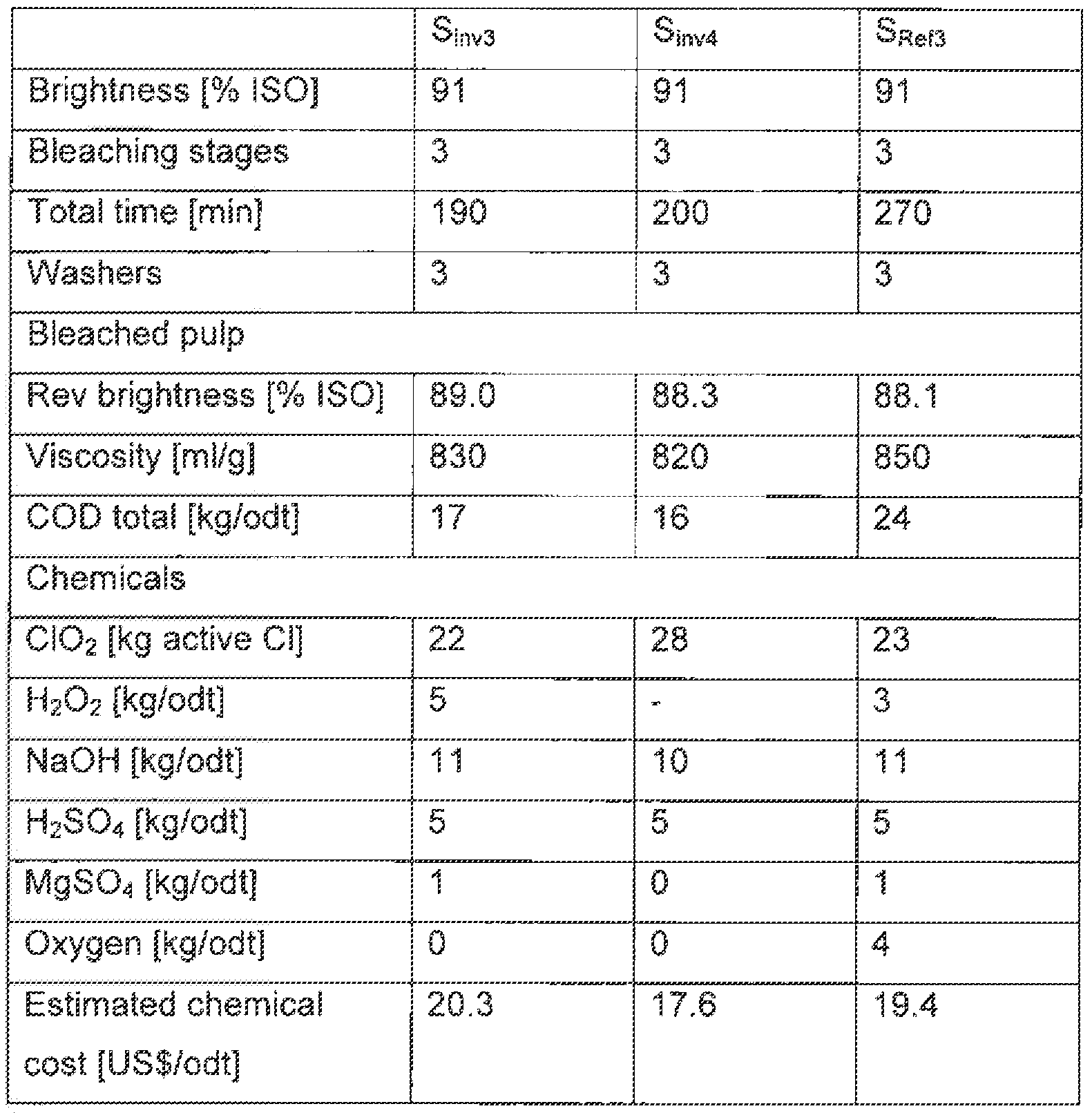
- a sulphate pulp produced by a wood mixture of 70 % Eucalyptus nitens and 30 % Eucalyptus globulus was used for laboratory tests.
- the pulp had, after oxygen delignificafion (In a processing plant) a kappa number of 8.6, a viscosity of 935 ml/g and a brightness of 84 % ISO.
- the pulp was bleached according to two sequences according to the invention, and Sj !1V 4, and one reference sequence
Landscapes
- Life Sciences & Earth Sciences (AREA)
- Engineering & Computer Science (AREA)
- Wood Science & Technology (AREA)
- Paper (AREA)
Abstract
Description



Claims
Priority Applications (4)
| Application Number | Priority Date | Filing Date | Title |
|---|---|---|---|
| EP09715038.7A EP2247782B1 (en) | 2008-02-28 | 2009-02-12 | Method of bleaching a pulp |
| BRPI0907550-0A BRPI0907550A2 (en) | 2008-02-28 | 2009-02-12 | Method of bleaching a pulp |
| US12/867,985 US8257550B2 (en) | 2008-02-28 | 2009-02-12 | Method of bleaching a pulp |
| CN200980106978.3A CN101960069B (en) | 2008-02-28 | 2009-02-12 | pulp bleaching method |
Applications Claiming Priority (2)
| Application Number | Priority Date | Filing Date | Title |
|---|---|---|---|
| SE0800475A SE532370C2 (en) | 2008-02-28 | 2008-02-28 | Method of bleaching a pulp |
| SE0800475-6 | 2008-02-28 |
Publications (1)
| Publication Number | Publication Date |
|---|---|
| WO2009108111A1 true WO2009108111A1 (en) | 2009-09-03 |
Family
ID=41016339
Family Applications (1)
| Application Number | Title | Priority Date | Filing Date |
|---|---|---|---|
| PCT/SE2009/050152 Ceased WO2009108111A1 (en) | 2008-02-28 | 2009-02-12 | Method of bleaching a pulp |
Country Status (6)
| Country | Link |
|---|---|
| US (1) | US8257550B2 (en) |
| EP (1) | EP2247782B1 (en) |
| CN (1) | CN101960069B (en) |
| BR (1) | BRPI0907550A2 (en) |
| SE (1) | SE532370C2 (en) |
| WO (1) | WO2009108111A1 (en) |
Cited By (7)
| Publication number | Priority date | Publication date | Assignee | Title |
|---|---|---|---|---|
| US20110036524A1 (en) * | 2008-02-28 | 2011-02-17 | Metso Paper, Inc. | Method of bleaching a pulp |
| CN102182093A (en) * | 2011-03-31 | 2011-09-14 | 重庆理文造纸有限公司 | Bleaching process of bamboo dissolving pulp |
| CN102352572A (en) * | 2011-09-30 | 2012-02-15 | 重庆理文造纸有限公司 | Preparation method for bamboo wood dissolving pulp |
| CN102877347A (en) * | 2012-09-18 | 2013-01-16 | 山东海龙股份有限公司 | Bleaching technology for using chemical paper pulp to prepare dissolving pulp |
| US8402660B1 (en) | 2009-10-07 | 2013-03-26 | Lift-U, Division Of Hogan Mfg., Inc. | Ramp assembly installation method |
| US8568558B2 (en) | 2010-01-19 | 2013-10-29 | Evonik Degussa Gmbh | Process for delignifying and bleaching chemical pulp |
| US10006169B2 (en) | 2013-11-06 | 2018-06-26 | Evonik Degussa Gmbh | Method for delignifying and bleaching pulp |
Families Citing this family (1)
| Publication number | Priority date | Publication date | Assignee | Title |
|---|---|---|---|---|
| CN113550167A (en) * | 2021-07-29 | 2021-10-26 | 陕西科技大学 | A kind of elemental chlorine-free bleaching method of straw pulp |
Citations (3)
| Publication number | Priority date | Publication date | Assignee | Title |
|---|---|---|---|---|
| WO1991017306A1 (en) * | 1990-04-30 | 1991-11-14 | Sunds Defibrator Industries Aktiebolag | Bleaching of chemical pulp |
| SE504210C2 (en) * | 1993-09-16 | 1996-12-09 | Sunds Defibrator Ind Ab | Bleaching of pulp with chlorine dioxide under overpressure |
| WO2002075046A1 (en) * | 2001-03-20 | 2002-09-26 | Metso Paper, Inc | Bleaching of pulp with chlorine dioxide |
Family Cites Families (17)
| Publication number | Priority date | Publication date | Assignee | Title |
|---|---|---|---|---|
| FR1404605A (en) * | 1964-05-22 | 1965-07-02 | Air Liquide | Improvement in delignification of chemical cellulose pulps |
| US4238281A (en) * | 1979-04-30 | 1980-12-09 | Canadian International Paper Company | Simplified bleaching process |
| AU6730390A (en) * | 1989-10-19 | 1991-05-16 | North Carolina State University | Chlorine dioxide pulp bleaching process using sequential chlorine addition |
| US5164044A (en) * | 1990-05-17 | 1992-11-17 | Union Camp Patent Holding, Inc. | Environmentally improved process for bleaching lignocellulosic materials with ozone |
| CA2053035C (en) * | 1990-10-12 | 1997-09-30 | Repap Enterprises Inc. | Chlorine-free wood pulps and process of making |
| US5938892A (en) * | 1991-01-28 | 1999-08-17 | Champion International Corporation | Process for recycling bleach plant filtrate |
| BE1006056A3 (en) * | 1992-07-06 | 1994-05-03 | Solvay Interox | Method of laundering of chemical pulp. |
| CN1100177C (en) * | 2000-07-20 | 2003-01-29 | 华南理工大学 | High-temp ClO2 bleaching method of sulfated wood pulp |
| SE516969C2 (en) * | 2000-08-14 | 2002-03-26 | Metso Paper Inc | Chlorine dioxide bleaching in two stages with return of filtrate |
| SE526162C2 (en) | 2002-01-23 | 2005-07-19 | Kvaerner Pulping Tech | Bleaching process, comprises oxygen delignification, chlorine dioxide bleaching, chelating agent treatment and peroxide bleaching steps |
| JP2003342886A (en) * | 2002-05-27 | 2003-12-03 | Nippon Paper Industries Co Ltd | Method for bleaching pulp |
| US20050045291A1 (en) * | 2002-08-08 | 2005-03-03 | Martin Ragnar | Reduction of organically bound chlorine formed in chlorine dioxide bleaching |
| CN1940177A (en) * | 2006-09-01 | 2007-04-04 | 华泰集团有限公司 | Three-sectional bleaching process of vegetable-fible slurry |
| FI122241B (en) * | 2007-06-15 | 2011-10-31 | Andritz Oy | Procedure in connection with pulp washing at a pulp mill |
| SE532370C2 (en) * | 2008-02-28 | 2009-12-29 | Metso Paper Inc | Method of bleaching a pulp |
| SE532470C2 (en) * | 2008-05-13 | 2010-02-02 | Metso Paper Inc | Final bleaching of oxygen delignified pulp with ozone, chlorine dioxide and peroxide |
| DE102010001001A1 (en) * | 2010-01-19 | 2011-07-21 | Evonik Degussa GmbH, 45128 | Process for delignification and bleaching of pulp |
-
2008
- 2008-02-28 SE SE0800475A patent/SE532370C2/en not_active IP Right Cessation
-
2009
- 2009-02-12 BR BRPI0907550-0A patent/BRPI0907550A2/en not_active IP Right Cessation
- 2009-02-12 CN CN200980106978.3A patent/CN101960069B/en not_active Expired - Fee Related
- 2009-02-12 EP EP09715038.7A patent/EP2247782B1/en not_active Not-in-force
- 2009-02-12 US US12/867,985 patent/US8257550B2/en not_active Expired - Fee Related
- 2009-02-12 WO PCT/SE2009/050152 patent/WO2009108111A1/en not_active Ceased
Patent Citations (3)
| Publication number | Priority date | Publication date | Assignee | Title |
|---|---|---|---|---|
| WO1991017306A1 (en) * | 1990-04-30 | 1991-11-14 | Sunds Defibrator Industries Aktiebolag | Bleaching of chemical pulp |
| SE504210C2 (en) * | 1993-09-16 | 1996-12-09 | Sunds Defibrator Ind Ab | Bleaching of pulp with chlorine dioxide under overpressure |
| WO2002075046A1 (en) * | 2001-03-20 | 2002-09-26 | Metso Paper, Inc | Bleaching of pulp with chlorine dioxide |
Non-Patent Citations (4)
| Title |
|---|
| "Handbook of pulp", 2006, WILEY-VCH, COP., WEINHEIM, ISBN: 3-527-30999-3, article HERBERT SIXTA, pages: 768, 874 - 876, XP008140482 * |
| "Papermaking Science and Technology", 2000, FAPET OY, ISBN: 952-5216-06-3, article GULLICHSEN, J ET AL.: "Chemical Pulping", pages: A642 - A643, XP008140464 * |
| "Pulping Conference 1998", article DOMINIQUE LACHENAL ET AL.: "High temperature chlorine dioxide delignification: a breakthrough in ECF bleaching of hardwood kraft pulps", pages: 601 - 604, XP002905597 * |
| See also references of EP2247782A4 * |
Cited By (10)
| Publication number | Priority date | Publication date | Assignee | Title |
|---|---|---|---|---|
| US20110036524A1 (en) * | 2008-02-28 | 2011-02-17 | Metso Paper, Inc. | Method of bleaching a pulp |
| US8257550B2 (en) * | 2008-02-28 | 2012-09-04 | Metso Paper, Inc. | Method of bleaching a pulp |
| US8402660B1 (en) | 2009-10-07 | 2013-03-26 | Lift-U, Division Of Hogan Mfg., Inc. | Ramp assembly installation method |
| US8568558B2 (en) | 2010-01-19 | 2013-10-29 | Evonik Degussa Gmbh | Process for delignifying and bleaching chemical pulp |
| RU2525760C2 (en) * | 2010-01-19 | 2014-08-20 | Эвоник Дегусса Гмбх | Cellulose delignification and bleaching method |
| CN102182093A (en) * | 2011-03-31 | 2011-09-14 | 重庆理文造纸有限公司 | Bleaching process of bamboo dissolving pulp |
| CN102352572A (en) * | 2011-09-30 | 2012-02-15 | 重庆理文造纸有限公司 | Preparation method for bamboo wood dissolving pulp |
| CN102877347A (en) * | 2012-09-18 | 2013-01-16 | 山东海龙股份有限公司 | Bleaching technology for using chemical paper pulp to prepare dissolving pulp |
| CN102877347B (en) * | 2012-09-18 | 2015-05-13 | 恒天海龙股份有限公司 | Bleaching technology for using chemical paper pulp to prepare dissolving pulp |
| US10006169B2 (en) | 2013-11-06 | 2018-06-26 | Evonik Degussa Gmbh | Method for delignifying and bleaching pulp |
Also Published As
| Publication number | Publication date |
|---|---|
| SE0800475L (en) | 2009-08-29 |
| CN101960069B (en) | 2013-02-06 |
| SE532370C2 (en) | 2009-12-29 |
| US20110036524A1 (en) | 2011-02-17 |
| EP2247782B1 (en) | 2014-07-02 |
| CN101960069A (en) | 2011-01-26 |
| BRPI0907550A2 (en) | 2015-08-04 |
| US8257550B2 (en) | 2012-09-04 |
| EP2247782A4 (en) | 2013-11-06 |
| EP2247782A1 (en) | 2010-11-10 |
Similar Documents
| Publication | Publication Date | Title |
|---|---|---|
| FI111964B (en) | Process for bleaching lignocellulosic pulp | |
| EP2247782A1 (en) | Method of bleaching a pulp | |
| WO2007132836A1 (en) | Process for producing bleached pulp | |
| CA2121387C (en) | Method for bleaching lignocellulose-containing pulp | |
| AU2007331538B2 (en) | Method for bleaching chemical paper pulps by final ozone treatment at high temperature | |
| EP2029809A1 (en) | Bleaching process of chemical pulp | |
| EP1030943B1 (en) | Bleaching of chemical pulp and treatment with a chelating agent | |
| AU3412593A (en) | Bleaching of sulphate pulp | |
| CN101460676A (en) | Bleaching process of chemical pulp | |
| JP3768986B2 (en) | Process for producing bleached kraft pulp with improved thermal fading | |
| JP5478610B2 (en) | Pulp bleaching method using ozone, chlorine dioxide and peroxide | |
| WO1997030207A1 (en) | Process for bleaching of chemical pulp | |
| SE501253C2 (en) | Chlorine-free bleaching of chemical pulp | |
| WO1998021400A1 (en) | Prebleaching of paperpulp before a peroxide bleaching stage | |
| WO2000008251A1 (en) | An improved method for bleaching pulp | |
| AU641858B2 (en) | Process for bleaching of lignocellulose-containing material | |
| JP2004232164A (en) | Bleaching method of chemical pulp for papermaking | |
| JPH10266085A (en) | Method for treating chemical pulp with acidic bleached white water and printing paper or base paper for coating | |
| JP2005042210A (en) | Method for producing ECF bleached pulp | |
| JP2004360124A (en) | Method for bleaching lignocellulose substance | |
| CA2490390A1 (en) | Improved process for bleaching kraft pulp |
Legal Events
| Date | Code | Title | Description |
|---|---|---|---|
| WWE | Wipo information: entry into national phase |
Ref document number: 200980106978.3 Country of ref document: CN |
|
| 121 | Ep: the epo has been informed by wipo that ep was designated in this application |
Ref document number: 09715038 Country of ref document: EP Kind code of ref document: A1 |
|
| DPE1 | Request for preliminary examination filed after expiration of 19th month from priority date (pct application filed from 20040101) | ||
| WWE | Wipo information: entry into national phase |
Ref document number: 2653/KOLNP/2010 Country of ref document: IN |
|
| WWE | Wipo information: entry into national phase |
Ref document number: 12867985 Country of ref document: US |
|
| NENP | Non-entry into the national phase |
Ref country code: DE |
|
| WWE | Wipo information: entry into national phase |
Ref document number: 2009715038 Country of ref document: EP |
|
| ENP | Entry into the national phase |
Ref document number: PI0907550 Country of ref document: BR Kind code of ref document: A2 Effective date: 20100825 |