WO2009109258A1 - Quinoxalinone derivatives as insulin secretion stimulators, methods for obtaining them and use thereof for the treatment of diabetes - Google Patents
Quinoxalinone derivatives as insulin secretion stimulators, methods for obtaining them and use thereof for the treatment of diabetes Download PDFInfo
- Publication number
- WO2009109258A1 WO2009109258A1 PCT/EP2009/000209 EP2009000209W WO2009109258A1 WO 2009109258 A1 WO2009109258 A1 WO 2009109258A1 EP 2009000209 W EP2009000209 W EP 2009000209W WO 2009109258 A1 WO2009109258 A1 WO 2009109258A1
- Authority
- WO
- WIPO (PCT)
- Prior art keywords
- quinoxalin
- ethyl
- groups
- compound
- formula
- Prior art date
- Legal status (The legal status is an assumption and is not a legal conclusion. Google has not performed a legal analysis and makes no representation as to the accuracy of the status listed.)
- Ceased
Links
- 0 *c(c(*)c1N)c(*)c(*)c1N* Chemical compound *c(c(*)c1N)c(*)c(*)c1N* 0.000 description 6
- CGVKEGIGQGDJIU-UHFFFAOYSA-N CC1C=CC(C2=Nc(cccc3)c3N(C3CC3)C2=O)=CC1 Chemical compound CC1C=CC(C2=Nc(cccc3)c3N(C3CC3)C2=O)=CC1 CGVKEGIGQGDJIU-UHFFFAOYSA-N 0.000 description 1
- NBFBBBHLERFOND-UHFFFAOYSA-N CCCCNc1ccccc1N Chemical compound CCCCNc1ccccc1N NBFBBBHLERFOND-UHFFFAOYSA-N 0.000 description 1
- SHTSIAFEGJRUOX-UHFFFAOYSA-N CCN(c(cccc1)c1N=C1Cc2ccc(C)cc2)C1=O Chemical compound CCN(c(cccc1)c1N=C1Cc2ccc(C)cc2)C1=O SHTSIAFEGJRUOX-UHFFFAOYSA-N 0.000 description 1
- BHLCTIPHQOOBTL-UHFFFAOYSA-N CCN(c(cccc1)c1N=C1c(cc2)c(C)cc2F)C1=O Chemical compound CCN(c(cccc1)c1N=C1c(cc2)c(C)cc2F)C1=O BHLCTIPHQOOBTL-UHFFFAOYSA-N 0.000 description 1
- BDJBXRBWLMPXOK-UHFFFAOYSA-N CCN(c(cccc1)c1N=C1c(cc2)ccc2N2CCOCC2)C1=O Chemical compound CCN(c(cccc1)c1N=C1c(cc2)ccc2N2CCOCC2)C1=O BDJBXRBWLMPXOK-UHFFFAOYSA-N 0.000 description 1
- LNEXGSMTRWXUPK-UHFFFAOYSA-N CCN(c(cccc1)c1N=C1c2c[n](C)nc2)C1=O Chemical compound CCN(c(cccc1)c1N=C1c2c[n](C)nc2)C1=O LNEXGSMTRWXUPK-UHFFFAOYSA-N 0.000 description 1
- SKCPOPHSHKICKK-UHFFFAOYSA-N CCN(c(cccc1)c1N=C1c2ccc(C(F)(F)F)cc2)C1=O Chemical compound CCN(c(cccc1)c1N=C1c2ccc(C(F)(F)F)cc2)C1=O SKCPOPHSHKICKK-UHFFFAOYSA-N 0.000 description 1
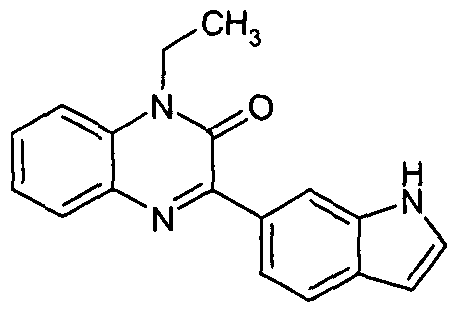
- CSMFAHKRWWXOFD-UHFFFAOYSA-N CCN(c(cccc1)c1N=C1c2ccc3[nH]ccc3c2)C1=O Chemical compound CCN(c(cccc1)c1N=C1c2ccc3[nH]ccc3c2)C1=O CSMFAHKRWWXOFD-UHFFFAOYSA-N 0.000 description 1
- FWIXYJAGDPGJHQ-UHFFFAOYSA-N CCN(c1ccccc1N=C1Cc(cc2)ccc2Cl)C1=O Chemical compound CCN(c1ccccc1N=C1Cc(cc2)ccc2Cl)C1=O FWIXYJAGDPGJHQ-UHFFFAOYSA-N 0.000 description 1
- QRSAVQAYGUKHRC-UHFFFAOYSA-N Nc(c(NCCl)ccc1)c1F Chemical compound Nc(c(NCCl)ccc1)c1F QRSAVQAYGUKHRC-UHFFFAOYSA-N 0.000 description 1
- NPUUHVOZAWKVCR-UHFFFAOYSA-N Nc1ccccc1NCC(F)F Chemical compound Nc1ccccc1NCC(F)F NPUUHVOZAWKVCR-UHFFFAOYSA-N 0.000 description 1
- DRDAJCFMFQOQAU-UHFFFAOYSA-N O=C1N(CC(F)F)c(cccc2)c2N=C1c1ccccc1 Chemical compound O=C1N(CC(F)F)c(cccc2)c2N=C1c1ccccc1 DRDAJCFMFQOQAU-UHFFFAOYSA-N 0.000 description 1
- FAQJJMHZNSSFSM-UHFFFAOYSA-N OC(C(c1ccccc1)=O)=O Chemical compound OC(C(c1ccccc1)=O)=O FAQJJMHZNSSFSM-UHFFFAOYSA-N 0.000 description 1
- GCDFRPZVHHTOIY-UHFFFAOYSA-N [O-][N+](c(c(NCCl)c1)cc(F)c1F)=O Chemical compound [O-][N+](c(c(NCCl)c1)cc(F)c1F)=O GCDFRPZVHHTOIY-UHFFFAOYSA-N 0.000 description 1
Classifications
-
- C—CHEMISTRY; METALLURGY
- C07—ORGANIC CHEMISTRY
- C07D—HETEROCYCLIC COMPOUNDS
- C07D413/00—Heterocyclic compounds containing two or more hetero rings, at least one ring having nitrogen and oxygen atoms as the only ring hetero atoms
- C07D413/02—Heterocyclic compounds containing two or more hetero rings, at least one ring having nitrogen and oxygen atoms as the only ring hetero atoms containing two hetero rings
- C07D413/10—Heterocyclic compounds containing two or more hetero rings, at least one ring having nitrogen and oxygen atoms as the only ring hetero atoms containing two hetero rings linked by a carbon chain containing aromatic rings
-
- A—HUMAN NECESSITIES
- A61—MEDICAL OR VETERINARY SCIENCE; HYGIENE
- A61P—SPECIFIC THERAPEUTIC ACTIVITY OF CHEMICAL COMPOUNDS OR MEDICINAL PREPARATIONS
- A61P25/00—Drugs for disorders of the nervous system
-
- A—HUMAN NECESSITIES
- A61—MEDICAL OR VETERINARY SCIENCE; HYGIENE
- A61P—SPECIFIC THERAPEUTIC ACTIVITY OF CHEMICAL COMPOUNDS OR MEDICINAL PREPARATIONS
- A61P27/00—Drugs for disorders of the senses
- A61P27/02—Ophthalmic agents
-
- A—HUMAN NECESSITIES
- A61—MEDICAL OR VETERINARY SCIENCE; HYGIENE
- A61P—SPECIFIC THERAPEUTIC ACTIVITY OF CHEMICAL COMPOUNDS OR MEDICINAL PREPARATIONS
- A61P29/00—Non-central analgesic, antipyretic or antiinflammatory agents, e.g. antirheumatic agents; Non-steroidal antiinflammatory drugs [NSAID]
-
- A—HUMAN NECESSITIES
- A61—MEDICAL OR VETERINARY SCIENCE; HYGIENE
- A61P—SPECIFIC THERAPEUTIC ACTIVITY OF CHEMICAL COMPOUNDS OR MEDICINAL PREPARATIONS
- A61P3/00—Drugs for disorders of the metabolism
- A61P3/04—Anorexiants; Antiobesity agents
-
- A—HUMAN NECESSITIES
- A61—MEDICAL OR VETERINARY SCIENCE; HYGIENE
- A61P—SPECIFIC THERAPEUTIC ACTIVITY OF CHEMICAL COMPOUNDS OR MEDICINAL PREPARATIONS
- A61P3/00—Drugs for disorders of the metabolism
- A61P3/06—Antihyperlipidemics
-
- A—HUMAN NECESSITIES
- A61—MEDICAL OR VETERINARY SCIENCE; HYGIENE
- A61P—SPECIFIC THERAPEUTIC ACTIVITY OF CHEMICAL COMPOUNDS OR MEDICINAL PREPARATIONS
- A61P3/00—Drugs for disorders of the metabolism
- A61P3/08—Drugs for disorders of the metabolism for glucose homeostasis
- A61P3/10—Drugs for disorders of the metabolism for glucose homeostasis for hyperglycaemia, e.g. antidiabetics
-
- A—HUMAN NECESSITIES
- A61—MEDICAL OR VETERINARY SCIENCE; HYGIENE
- A61P—SPECIFIC THERAPEUTIC ACTIVITY OF CHEMICAL COMPOUNDS OR MEDICINAL PREPARATIONS
- A61P9/00—Drugs for disorders of the cardiovascular system
-
- A—HUMAN NECESSITIES
- A61—MEDICAL OR VETERINARY SCIENCE; HYGIENE
- A61P—SPECIFIC THERAPEUTIC ACTIVITY OF CHEMICAL COMPOUNDS OR MEDICINAL PREPARATIONS
- A61P9/00—Drugs for disorders of the cardiovascular system
- A61P9/10—Drugs for disorders of the cardiovascular system for treating ischaemic or atherosclerotic diseases, e.g. antianginal drugs, coronary vasodilators, drugs for myocardial infarction, retinopathy, cerebrovascula insufficiency, renal arteriosclerosis
-
- A—HUMAN NECESSITIES
- A61—MEDICAL OR VETERINARY SCIENCE; HYGIENE
- A61P—SPECIFIC THERAPEUTIC ACTIVITY OF CHEMICAL COMPOUNDS OR MEDICINAL PREPARATIONS
- A61P9/00—Drugs for disorders of the cardiovascular system
- A61P9/12—Antihypertensives
-
- C—CHEMISTRY; METALLURGY
- C07—ORGANIC CHEMISTRY
- C07D—HETEROCYCLIC COMPOUNDS
- C07D241/00—Heterocyclic compounds containing 1,4-diazine or hydrogenated 1,4-diazine rings
- C07D241/36—Heterocyclic compounds containing 1,4-diazine or hydrogenated 1,4-diazine rings condensed with carbocyclic rings or ring systems
- C07D241/38—Heterocyclic compounds containing 1,4-diazine or hydrogenated 1,4-diazine rings condensed with carbocyclic rings or ring systems with only hydrogen or carbon atoms directly attached to the ring nitrogen atoms
- C07D241/40—Benzopyrazines
- C07D241/44—Benzopyrazines with hetero atoms or with carbon atoms having three bonds to hetero atoms with at the most one bond to halogen, e.g. ester or nitrile radicals, directly attached to carbon atoms of the hetero ring
-
- C—CHEMISTRY; METALLURGY
- C07—ORGANIC CHEMISTRY
- C07D—HETEROCYCLIC COMPOUNDS
- C07D401/00—Heterocyclic compounds containing two or more hetero rings, having nitrogen atoms as the only ring hetero atoms, at least one ring being a six-membered ring with only one nitrogen atom
- C07D401/02—Heterocyclic compounds containing two or more hetero rings, having nitrogen atoms as the only ring hetero atoms, at least one ring being a six-membered ring with only one nitrogen atom containing two hetero rings
- C07D401/04—Heterocyclic compounds containing two or more hetero rings, having nitrogen atoms as the only ring hetero atoms, at least one ring being a six-membered ring with only one nitrogen atom containing two hetero rings directly linked by a ring-member-to-ring-member bond
-
- C—CHEMISTRY; METALLURGY
- C07—ORGANIC CHEMISTRY
- C07D—HETEROCYCLIC COMPOUNDS
- C07D403/00—Heterocyclic compounds containing two or more hetero rings, having nitrogen atoms as the only ring hetero atoms, not provided for by group C07D401/00
- C07D403/02—Heterocyclic compounds containing two or more hetero rings, having nitrogen atoms as the only ring hetero atoms, not provided for by group C07D401/00 containing two hetero rings
- C07D403/04—Heterocyclic compounds containing two or more hetero rings, having nitrogen atoms as the only ring hetero atoms, not provided for by group C07D401/00 containing two hetero rings directly linked by a ring-member-to-ring-member bond
-
- C—CHEMISTRY; METALLURGY
- C07—ORGANIC CHEMISTRY
- C07D—HETEROCYCLIC COMPOUNDS
- C07D403/00—Heterocyclic compounds containing two or more hetero rings, having nitrogen atoms as the only ring hetero atoms, not provided for by group C07D401/00
- C07D403/02—Heterocyclic compounds containing two or more hetero rings, having nitrogen atoms as the only ring hetero atoms, not provided for by group C07D401/00 containing two hetero rings
- C07D403/10—Heterocyclic compounds containing two or more hetero rings, having nitrogen atoms as the only ring hetero atoms, not provided for by group C07D401/00 containing two hetero rings linked by a carbon chain containing aromatic rings
-
- C—CHEMISTRY; METALLURGY
- C07—ORGANIC CHEMISTRY
- C07D—HETEROCYCLIC COMPOUNDS
- C07D405/00—Heterocyclic compounds containing both one or more hetero rings having oxygen atoms as the only ring hetero atoms, and one or more rings having nitrogen as the only ring hetero atom
- C07D405/02—Heterocyclic compounds containing both one or more hetero rings having oxygen atoms as the only ring hetero atoms, and one or more rings having nitrogen as the only ring hetero atom containing two hetero rings
- C07D405/04—Heterocyclic compounds containing both one or more hetero rings having oxygen atoms as the only ring hetero atoms, and one or more rings having nitrogen as the only ring hetero atom containing two hetero rings directly linked by a ring-member-to-ring-member bond
-
- C—CHEMISTRY; METALLURGY
- C07—ORGANIC CHEMISTRY
- C07D—HETEROCYCLIC COMPOUNDS
- C07D405/00—Heterocyclic compounds containing both one or more hetero rings having oxygen atoms as the only ring hetero atoms, and one or more rings having nitrogen as the only ring hetero atom
- C07D405/02—Heterocyclic compounds containing both one or more hetero rings having oxygen atoms as the only ring hetero atoms, and one or more rings having nitrogen as the only ring hetero atom containing two hetero rings
- C07D405/10—Heterocyclic compounds containing both one or more hetero rings having oxygen atoms as the only ring hetero atoms, and one or more rings having nitrogen as the only ring hetero atom containing two hetero rings linked by a carbon chain containing aromatic rings
Definitions
- the present invention relates to quinoxalinone derivatives of formula (I) as insulin secretion stimulators.
- the invention also relates to the preparation and use of these quinoxalinone derivatives for the prophylaxis and/or treatment of diabetes and pathologies associated.
- Type 2 diabetes mellitus is one of the most common worldwide diseases. In 2007, its prevalence was estimated at 5.9 % (246 million people) of the adult population and is in continuous increase. This disease is even more serious since it could lead to severe micro- and macro-complications, which could become disabling or lethal, as diabetes is a major risk factor for cardiovascular disease and stroke.
- Type 2 diabetes is characterized by a fasted and post-prandial hyperglycemia, consequence of two main defects: an insulin resistance at the level of target tissues and an altered insulin secretion from the pancreatic beta cells. This latter anomaly seems to appear very early as it is present at the Impaired Glucose Tolerance (IGT) stage (Mitrakou et al., N. Engl. J. Med. 326: 22-29, 1992). It has been observed in UK Prospective Diabetes Study (UKPDS) that 50% of the beta cell function is already lost when diabetes is diagnosed, suggesting that deterioration in beta cell function may begin 10- 12 years before diabetes diagnosis (Holman, Diabetes Res. CHn. Pract. 40 : S21, 1998 or UKPDS Group, Diabetes 44: 1249-58, 1995).
- ITT Impaired Glucose Tolerance
- UKPDS UK Prospective Diabetes Study
- the defective insulin secretion is due to a quantitative and a qualitative defect of the beta cell, i.e. a decreased beta cell mass and a specific defect of insulin release in response to glucose, especially the first phase of secretion, since the response to non-glucose secretagogues is preserved (Pfeifer et al., Am. J. Med. 70: 579-88, 1981 ).
- the importance of restoring a normal profile of insulin release in response to glucose to maintain the glycemic control within a normal range was supported by studies in non diabetic volunteers showing that delaying the first phase of insulin secretion in response to glucose led to glucose intolerance (Calles-Escandon et al.,
- Oral antidiabetics available for treatment of type 2 diabetic patients such as sulfonylureas or glinides, are known to induce insulin secretion, by binding to sulfonyurea receptor on the K-ATP channels of the beta cell, leading to increase in intracellular calcium and insulin exocytosis.
- This insulin release is thus totally independent of the plasma glucose level and treatment with these molecules usually induces sustained hyperinsulinemia, which could lead to several side-effects, such as severe hypoglycaemia, body weight gain, and aggravation of cardiovascular risk.
- the prolonged hyperinsulinemia observed with sulfonylurea treatment with no preservative effect of the beta cell mass, could lead to secondary failure due to beta cell exhaustion, another deleterious side effect of these compounds.
- New treatment of type 2 diabetes should restore a normal profile of insulin release specifically in response to glucose, while preserving or increasing the beta cell mass. This is observed with GLP-1 analogs, such as exenatide or liraglutide, but these molecules are peptides and must be administered by parenteral route. Such characteristics for a new oral small molecule would be a great advantage over the other antidiabetic drugs.
- the compounds of the formula (I) are insulin secretion stimulators, useful for treatment of diabetes and pathologies associated. They lower blood glucose levels by restoring the defective glucose-induced insulin secretion in type 2 diabetics.
- the patent application EP 995742 discloses cGMP-PDE inhibitors, characterized by the presence of a sulfonamide group -SO 2 NHCO-, useful as hypoglycemics, bronchodilating, vasodilating, smooth muscle cell inhibitory, and antiallergic effects.
- EP 1068190 discloses quinoxalinones serine protease inhibitors for treatment of thrombotic disorders.
- the present invention is directed towards quinoxalinone derivatives of formula (I). Said derivatives are useful for treating diabetes and pathologies associated therewith.
- Quinoxalinone derivatives according to the invention have the following formula (I):
- R1 is: hydrogen, alkyl, cycloalkyl, heterocycloalkyl, aryl, heteroaryl, arylalkyl, cycloalkylalkyl, heterocycloalkylalkyl, alkyloxyalkyl, R7R8N-alkyl, alkylthioalkyl; heterocycloalkyl and heteroaryl groups can include one or more heteroatom selected from N, O and S; each of these groups can be optionally substituted by one or more groups selected from Y or Z;
- R1 is: alkyl, cycloalkyl, cycloalkylalkyl, heterocycloalkyl, heterocycloalkylalkyl, alkyloxyalkyl, R7R8N-alkyl, alkylthioalkyl; heterocycloalkyl groups can include one or more heteroatom selected from N, O and S; each of these groups can be optionally substituted by one or more groups selected from Y or Z;
- R1 is: alkyl, cycloalkyl, cycloalkylalkyl, heterocycloalkyl, heterocycloalkylalkyl, alkyloxyalkyl, R7R8N-alkyl; heterocycloalkyl groups can include one or more heteroatom selected from N, O and S; each of these groups can be optionally substituted by one or more groups selected from Y or Z;
- R1 is: methyl, ethyl, 2,2-difluoroethyl, 2,2,2-trifluoroethyl, butyl, cyclopropyl, cyclopropylmethyl; each of these groups can be optionally substituted by one or more groups selected from Y or Z;
- R1 is: hydrogen, alkyl, cycloalkyl, heterocycloalkyl, aryl, heteroaryl, arylalkyl, cycloalkylalkyl, heterocycloalkylalkyl, alkyloxyalkyl, R7R8N-alkyl, alkylthioalkyl; heterocycloalkyl and heteroaryl groups can include one or more heteroatom selected from N, O and S; each of these groups can be optionally substituted by one or more groups selected from Y or Z; wherein Y is thiazolidinyl, oxazolidinyl, tetrahydrothienyl, dihydrofuranyl, tetrahydrofuranyl, pyrazolidinyl, 1 ,3- dioxolanyl, pyranyl, dihydropyranyl, isoxazolidinyl, imidazolidinyl and the like;
- R6 is: alkyl, aryl, heteroaryl, cycloalkyl, heterocycloalkyl, arylalkyl, aryloxyalkyl, arylalkyloxyalkyl, arylthioalkyl, arylsulfinylalkyl, arylsulfonylalkyl, arylalkylthioalkyl, arylalkylsulfinylalkyl, arylalkylsulfonylalkyl, heteroarylalkyl, heteroaryloxyalkyl, heteroarylalkoxyalkyl, heteroarylthioalkyl, heteroarylsulfinylalkyl, heteroarylsulfonylalkyl, heteroarylalkylthioalkyl, heteroarylalkylsulfinylalkyl, heteroarylalkylsulfonylalkyl, heteroarylalkylthioalkyl, heteroaryl
- R6 is: alkyl, aryl, heteroaryl, cycloalkyl, heterocycloalkyl, arylalkyl, arylthioalkyl, arylsulfonylalkyl, aryloxyalkyl, arylalkyloxyalkyl, heteroarylalkyl, heteroaryloxyalkyl, heteroarylalkoxyalkyl, heterocycloalkylalkyl, heterocycloalkyloxyalkyl; heteroaryl or heterocycloalkyl groups can include one or more heteroatoms selected from N, O and S; each of these groups can be optionally substituted by one or more groups selected from Y or Z;
- R6 is: alkyl, aryl, heteroaryl, heterocycloalkyl, arylalkyl, arylthioalkyl, arylsulfonylalkyl, heteroarylalkyl, heterocycloalkyl, heterocycloalkylalkyl; heteroaryl or heterocycloalkyl groups can include one or more heteroatoms selected from N, O and S; each of these groups can be optionally substituted by one or more groups selected from Y or Z;
- R6 is: methyl, ethyl, propyl, isopropyl, butyl, isobutyl, phenyl, benzyl, furanyl, pyridinyl, pyrimidinyl, pyrazolyl, phenylthiomethyl, phenylsulphonylmethyl; each of these groups can be optionally substituted by one or more groups selected from Y or Z.
- R2, R3, R4, R5 are independently selected from hydrogen, Y or Z; other preferred compounds are compounds of general formula (I), wherein R1 , R2, R3, R4, R5 and R6 can be optionally substituted by one or more groups selected from Z;
- Y is: alkyl, cycloalkyl, heterocycloalkyl, alkoxy, heteroaryl, aryl, alkylsulfonyl, aryloxy, arylalkoxy, alkylsulfinyl, alkylthio; heteroaryl or heterocycloalkyl groups can include one or more heteroatom selected from N, O and S; each of these groups can be optionally substituted by one or more groups selected from Z;
- Y is: alkyl, cycloalkyl, alkoxy, aryl, alkylsulfonyl, aryloxy, arylalkoxy, alkylsulfinyl, alkylthio; each of these groups can be optionally substituted by one or more groups selected from Z;
- Z is: hydroxy, thio, halogen, cyano, trifluoromethoxy, trifluoromethyl, carboxy, carboxy methyle, carboxyethyle, alkyle, cycloalkyl, alkoxy, NR7R8, azido, nitro, guanidino, amidino, phosphono, oxo, alkylthio, alkylsulfonyl, SF5, two Y groups can form a methylenedioxy;
- Z is: halogen, trifluoromethyl, carboxy, alkoxy, alkylthio, alkylsulfonyl;
- R7 and R8 are independently selected from: - hydrogen; - lower alkyl, cycloalkyl;
- R7 and R8 can also constitute a heterocycloakyl group, which can include one or more heteroatoms selected from N, O and S; R7 and R8 independently can be optionally substituted by one or more substituents selected from Z;
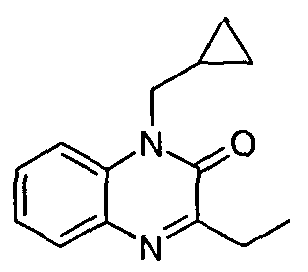
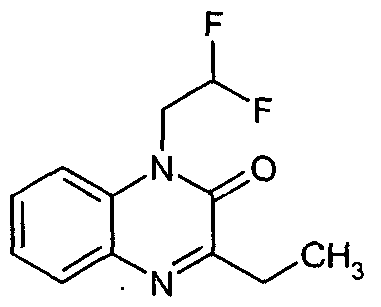
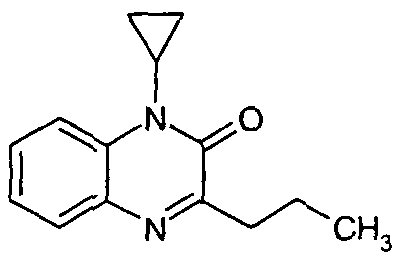
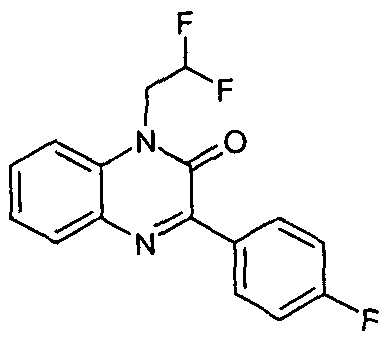
- the compounds of the formula (I) may be chosen from:
- the compounds of the formula (I) according to the invention may be chosen from: 1-Butyl-3-ethyl-quinoxalin-2(1/-/)-one
- the invention also relates to the racemic forms, tautomeric forms, enantiomers, diastereoisomers, epimers and organic or mineral salts of the compounds of the general formula (I), as well as their crystalline forms, including their polymorphic forms and the polymorphic forms of the compounds of formula (I).
- the present invention is directed not only to racemic mixtures of these compounds, but also to individual stereoisomers and/or diastereoisomers thereof, as well or as mixtures of these in all proportions.
- the compounds of the invention of the formula (I), as defined above, containing a sufficiently acidic function or a sufficiently basic function, or both, may include the corresponding pharmaceutically acceptable salts of an organic or mineral acid, or of an organic or mineral base.
- pharmaceutically acceptable salts refers to the relatively non-toxic mineral and organic acid-addition salts, and the base-addition salts, of the compounds of the present invention. These salts may be prepared in situ during the final isolation and purification of the compounds.
- the acid-addition salts may be prepared by separately reacting the purified compound in its purified form with an organic or mineral acid and isolating the salt thus formed.
- the resulting salts are, for example, hydrochlorides, hydrobromides, sulfates, hydrogenosulfates, dihydrogenophosphates, citrates, maleates, fumarates, trifluoroacetates, 2- naphtalenesulfonates, para-toluenesulfonates.
- the invention also relates to pharmaceutically acceptable salts with organic or inorganic bases.
- the basic-addition salts may be prepared by separately reacting the purified compound in its purified form with an organic or inorganic base and isolating the salt thus formed.
- the resulting salts are, for example, metal salts, particularly alkali metal salts, alkaline-earth metal salts and transition metal salts (such as sodium, potassium, calcium, magnesium, aluminum), or salts obtained with bases, such as ammonia or secondary or tertiary amines (such as diethylamine, triethylamine, piperidine, piperazine, morpholine), or with basic amino-acids, or with osamines (such as meglumine), or with aminoalcohols (such as 3-aminobutanol and 2- aminoethanol).
- bases such as ammonia or secondary or tertiary amines (such as diethylamine, triethylamine, piperidine, piperazine, morpholine), or with basic amino-acids, or with osamines (such as meglumine), or with aminoalcohols (such as 3-aminobutanol and 2- aminoethanol).
- bases such as ammonia or secondary or ter
- the invention also relates to the salts used for chiral resolution of the racemates.
- the following chiral acids can be used : (+)-D-di-O- benzoyltartaric acid, (-)-L-di-O-benzoyltartaric acid, (-)-L-di-O,O'-p-toluyl-L- tartaric acid, (+)-D-di-O,O'-p-toluyl-L-tartaric acid, (R)-(+)-malic acid, (S)-(-)- malic acid, (+)-camphoric acid, (-)-camphoric acid, R-(-)1 ,1'-binaphtalen-2,2'- diyl hydrogenophosphonic, (+)-camphanic acid, (-)-camphanic acid, (S)-(+)-2- phenylpropionic acid, (R)-(+)-2-phenylpropionic acid, D-(
- the following chiral amines can be used: quinine, brucine, (S)- 1-(benzyloxymethyl)propylamine (III), (-)-ephedrine, (4S,5R)-(+)-1 , 2,2,3,4- tetramethyl-5-phenyl-1 ,3-oxazolidine, (R)-1-phenyl-2-p-tolylethylamine, (S)- phenylglycinol, (-)-N-methylephedrine, (+)-(2S,3R)-4-dimethylamino-3- methyl-1 ,2-diphenyl-2-butanol, (S)-phenylglycinol, (S)- ⁇ -methylbenzylamine or any mixture of them.
- prodrugs of the compounds of formula (I) are also included in the scope of the present invention.
- prodrug refers to any compound that when administered to a biological system generates the "drug” substance (a biologically active compound) as a result of spontaneous chemical reaction(s), enzyme catalyzed chemical reaction(s), and/or metabolic chemical reaction(s).
- aryl refers to aromatic groups which have 5-14 ring atoms and at least one ring having a conjugated pi ( ⁇ ) electron system and includes biaryl groups, all of which may be optionally substituted. Suitable aryl groups include phenyl, naphthyl, biphenyl, anthryl, phenanthryl, indenyl and the like.
- heteroaryl refers to 5-14 ring atom aromatic heterocycles containing 1 to 4 heteroatoms, as ring atoms in the aromatic ring and the remainder of the ring atoms being carbon atoms. Suitable heteroatoms include O, S, N.
- Suitable heteroaryl groups include furanyl, benzofuranyl, thienyl, pyridyl, pyridyl-N-oxide, pyrimidinyl, pyrazinyl, oxazolyl, thiazolyl, isoxazolyl, quinolinyl, triazolyl, pyridazinyl, pyrrolyl, imidazolyl, indazolyl, isothiazolyl, indolyl, oxadiazolyl and the like.
- cycloalkyl means saturated carbocyclic rings, optionally substituted, and includes mono-, bi- and tri-cyclic compounds with 3 to 10 carbon atoms. Suitable cycloalkyl groups are: cyclopropyl, cyclobutyl, cyclopentyl, cyclohexyl, cycloheptyl, cyclooctyl, cyclodecyl, adamantyl and the like.
- heterocycloalkyl refers to optionally substituted monocyclic, bicyclic or tricyclic radicals, comprising one or more heteroatoms, preferably chosen from among O, S and N 1 optionally in the oxidized state (for S and N), and optionally one or more double bonds. At least one of the rings preferably comprises from 1 to 4 endocyclic heteroatoms, more preferably from 1 to 3 heteroatoms. Most preferably, the heterocycloalkyl (or simply "heterocyclic") radical comprises one or more rings, each having from 5 to 8 nodes.
- heterocyclic radicals are: morpholinyl, piperidinyl, piperazinyl, thiazolidinyl, oxazolidinyl, tetrahydrothienyl, dihydrofuranyl, tetrahydrofuranyl, pyrazolidinyl, 1 ,3-dioxolanyl, pyrrolidinyl, pyranyl, dihydropyranyl, isoxazolidinyl, imidazolyl, imidazolidinyl and the like.
- alkyl refers to a saturated aliphatic groups, including straight chain and branched chain groups. Suitable alkyl groups, having 1 to 20 carbon atoms, include methyl, ethyl, propyl, isopropyl, butyl, sec-butyl, tert-butyl, pentyl, hexyl, octyl, decanoyl, dodecanoyl, hexadecyl, octadecyl groups and the like.
- alkenyl refers to unsaturated groups comprising at least one carbon-carbon double bond, and includes straight chain, branched chain and cyclic groups. Suitable alkenyl groups, having 2 to 20 carbon atoms, include ethenyl, 2-propenyl, 2-butenyl, 3-butenyl, 2-pentenyl, 3-pentenyl, 4-pentenyl and the like.
- alkynyl refers to unsaturated groups comprising at least one carbon-carbon triple bond and includes straight chain, branched chain and cyclic groups; and optionally includes at least one carbon-carbon double bond.
- Suitable alkynyl groups having 2 to 20 carbon atoms, include ethynyl, 2-propynyl, 2-butynyl, 3-butynyl, 2-pentynyl, 3-pentynyl, 4-pentynyl and the like.
- arylalkyl refers to an alkyl group, preferably an alkyl group having 1 to 20 carbon atoms, substituted with an aryl group. Suitable arylalkyl groups include benzyl, picolyl, and the like.
- alkoxy refers to the group alk-O- wherein “alk” is an alkyl group.
- aryloxy refers to the group aryl-O-.
- aryloxyalkyl refers to an alkyl group substituted with an aryloxy group.
- arylalkyloxyalkyl refers to an alkyl group substituted with an arylalkyloxy group.
- arylalkoxy refers to the group aryl-Alk-O-, wherein "AIk” is an alkyl group.
- alkylthioalkyl refers to an alkyl group substituted with an alkylthio.
- arylthioalkyl refers to an alkyl group substituted with an arylthio group.
- alkylsulfinyl refers to an alkyl-SO- group.
- alkylsulfonyl refers to an alkyl-SO 2 - group.
- arylsulfinylalkyl refers to an alkyl group substituted with an arylsulfinyl (aryl-SO-) group.
- arylalkylsulfinylalkyl refers to an alkyl group substituted with an arylalkylsulfinyl group.
- arylsulfonylalkyl refers to an alkyl group substituted with an arylsulfonyl (aryl-SO 2 -) group.
- arylalkylsulfonylalkyl refers to an alkyl group substituted with an arylalkylsulfonyl group.
- arylalkylthioalkyl refers to an alkyl group substituted with an arylalkylthio.
- heteroarylalkyl refers to an alkyl group substituted with a heteroaryl group.
- heteroaryloxyalkyl refers to an alkyl group substituted with a heteroaryloxy group.
- heteroarylalkoxyalkyl refers to an alkyl group substituted with a heteroarylalkoxy group.
- heteroarylthioalkyl refers to an alkyl group substituted with a heteroarylthio group.
- heteroarylsulfinylalkyl refers to an alkyl group substituted with a heteroarylsulfinyl group.
- heteroarylsulfonylalkyl refers to an alkyl group substituted with a heteroarylsulfonyl group.
- heteroarylalkylthioalkyl refers to an alkyl group substituted with a heteroarylalkylthio group.
- heteroarylalkylsulfinylalkyl refers to an alkyl group substituted with a heteroarylalkylsulfinyl group.
- heteroarylalkylsulfonylalkyl refers to an alkyl group substituted with a heteroarylalkylsulfonyl group.
- heterocycloalkylalkyl refers to an alkyl group substituted with a heterocycloalkyl group.
- heterocycloalkyloxyalkyl refers to an alkyl group substituted with a heterocycloalkyloxy group.
- heterocycloalkylalkoxyalkyl refers to an alkyl group substituted with a heterocycloalkylalkoxy group.
- heterocycloalkylthioalkyl refers to an alkyl group substituted with a heterocycloalkylthio group.
- heterocycloalkylsulfinylalkyl refers to an alkyl group substituted with a heterocycloalkylsulfinyl group.
- heterocycloalkylsulfonylalkyl refers to an alkyl group substituted with a heterocycloalkylsulfonyl group.
- heterocycloalkylalkylthioalkyl refers to an alkyl group substituted with a heterocycloalkylalkylthio group.
- heterocycloalkylalkylsulfinylalkyl refers to an alkyl group substituted with a heterocycloalkylalkylsulfinyl group.
- heterocycloalkylalkylsulfonylalkyl refers to an alkyl group substituted with a heterocycloalkylalkylsulfonyl group.
- alkyloxyalkyl refers to an alkyl group substituted with an alkyloxy group.
- cycloalkylalkyl refers to an alkyl group substituted with a cycloalkyl group.
- lower referred to herein in connection with organic radicals or compounds respectively defines such as with up to and including 10, preferably up to and including 6, and advantageously 1 to 4 carbon atoms.
- Such groups may be straight, branched, or cyclic chain.
- alkylthio refers to the group alkyl-S-, wherein “alk” is an alkyl group.
- halogen refers to a fluorine, bromine or chlorine atom.
- amino refers to -C(NR7)-NR7R8 where R7R8 are as defined above, all, except hydrogen, are optionally substituted.
- the invention's compounds according to formula (I) exhibit an hypoglycemic activity, and are useful in the treatment of pathologies associated with the syndrome of insulin resistance.
- Insulin resistance is characterised by a reduction in the action of insulin (cf. "Presse Medicale”, (1997), 26(14), 671-677) and is involved in many pathological conditions, such as diabetes and more particularly non-insulin- dependent diabetes (type Il diabetes or NIDDM), dyslipidaemia, obesity, arterial hypertension, and also certain cardiac, microvascular and macrovascular complications, for instance atherosclerosis, retinopathy and neuropathy.
- type Il diabetes or NIDDM non-insulin- dependent diabetes
- dyslipidaemia for instance atherosclerosis, retinopathy and neuropathy.
- atherosclerosis retinopathy and neuropathy
- the invention also relates to pharmaceutical composition containing as active ingredient at least one compound of formula (I), as defined above, and/or a pharmaceutically acceptable salt thereof, in combination with one or several pharmaceutically acceptable carrier, adjuvant, diluent or excipient.
- a pharmaceutically acceptable carrier for example, a pharmaceutically acceptable sulfate, a pharmaceutically acceptable sulfate, a pharmaceutically acceptable sulfate, a pharmaceutically acceptable sulfate, as defined above, and/or a pharmaceutically acceptable salt thereof, in combination with one or several pharmaceutically acceptable carrier, adjuvant, diluent or excipient.
- carrier, adjuvant, diluent or excipient compounds suitable to formulate a pharmaceutical composition.
- the pharmaceutical compositions of the present invention can be administered by a variety of routes including oral, parenteral, intravenous, intramuscular, rectal, permucous or percutaneous.
- excipients that are suitable for such administrations are pharmaceutically acceptable excipients, such as cellulose or microcrystalline cellulose derivatives, alkaline-earth metal carbonates, magnesium phosphate, starches, modified starches, lactose and the like for solid forms.
- cocoa butter or polyethylene glycol stearates are the preferred excipients.
- water, aqueous solutions, physiological saline and isotonic solutions are the vehicles most appropriately used.
- a suitable posology of the compounds is between about 0.1 mg/kg and about 100 mg/kg, preferably between about 0.5 mg/kg and about 50 mg/kg, more preferably between about 1 mg/kg and about 10 mg/kg and most preferably between about 2 mg/kg and about 5 mg/kg of body weight per day.
- suitable dosages of the compounds of the formula (I) will be between about 1-10 mg/per day and 1000-10000 mg/per day, preferably between about 5-50 mg/per day and 500-5000 mg/per day, more preferably between 10-100 mg and 100-1000 mg/per day and most preferably between 20-200 mg and 50-500 mg/per day.
- the specific dose level for any particular patient will depend on a variety of factors including the activity of the specific compound employed; the age, body weight, general health, sex and diet of the individual being treated; the time and route of administration; the rate of excretion; other drugs which have previously been administered; and the severity of the particular disease undergoing therapy, as is well understood by those skilled in the art.
- formulations of the present invention suitable for oral administration may be presented as discrete units, such as capsules, cachets or tablets, each containing a predetermined amount of the active ingredient; as a powder or granules; as a solution or a suspension in an aqueous or nonaqueous liquid; or as an oil-in-water liquid emulsion or a water-in-oil liquid emulsion.
- the active ingredient may also be administered as a bolus, electuary or paste.
- the hyperglycemia is the results of two main defects: an alteration of the insulin secretion and a reduction in the effectiveness of insulin at level of three sites to knowing the liver, the muscles and adipose tissue.
- the present invention also relates to compound of general formula (I) as well as its racemic forms, tautomers, enantiomers, diastereomers, epimers and polymorphs, and mixtures thereof, and the pharmaceutically acceptable salts thereof, for the preparation of a medicament for the prevention and/or treatment of pathologies associated with hyperglycaemia; for the preparation of a medicament that induces insulin secretion in response of glucose concentration, preferably for the treatment of diabetes, more preferably for the prevention and/or treatment of type Il diabetes and pathologies associated to metabolic disorders, hypercholesteremia, hyperlipidemia, which are increased by hyperinsulinemia and hyperglycemia; for the treatment of diseases chosen from diabetes related microvascular and macrovascular complications, such as arterial hypertension, inflammatory processes, microangiopathy, macroangiopathy, retinopathy and neuropathy; for reducing hyperglycaemia, for the treatment of dyslipidaemia and obesity; or diseases such as cardiovascular diseases, comprising atherosclerosis, myocardial ischemia.
- the present invention also relates to the use of at least a compound of the general formula (I), as well as its racemic forms, tautomers, enantiomers, diastereomers, epimers and polymorphs, and mixtures thereof, and the pharmaceutically acceptable salts, and pro-drugs thereof, for the prevention and/or treatment of pathologies associated with hyperglycaemia, preferably for the treatment of diabetes, more preferably for the prevention and/or treatment of type Il diabetes and pathologies associated to metabolic disorders, hypercholesteremia, hyperlipidemia, which are increased by hyperinsulinemia and hyperglycemia; for the treatment of diseases chosen from diabetes related microvascular and macrovascular complications, such as arterial hypertension, inflammatory processes, microangiopathy, macroangiopathy, retinopathy and neuropathy; for reducing hyperglycaemia, for the treatment of dyslipidaemia and obesity; or diseases such as cardiovascular diseases, comprising atherosclerosis, myocardial ischemia.
- pathologies associated with hyperglycaemia preferably for the treatment of diabetes
- the present invention also relates to manufacturing process of compounds of formula (I), as defined above, according to the following representative methods shown in Scheme 1 (Preparation of the Intermediates diaminophenyl derivatives); Scheme 2 (Method A) or Scheme 3 (Method B), in which R1 , R2, R3, R4, R5 and R6 are as above defined in formula (I) and Hal is a halogen atom, preferably Cl, Br.
- Scheme 1 Preparation of the Intermediates diaminophenyl derivatives
- Scheme 2 Method 3
- R1 , R2, R3, R4, R5 and R6 are as above defined in formula (I)
- Hal is a halogen atom, preferably Cl, Br.
- Hal is a halogen atom, preferably Cl, Br;
- R1 , R2, R3, R4 and R5 are as above defined in formula (I).
- Phenyl nitro amino derivatives (2) are prepared by reacting an halo- nitrophenyl derivative (1) with an amine, in the presence of at least one equivalent of a base, such as sodium or potassium carbonate, cesium carbonate, or in the presence of at least two equivalents of the considered amine, in an inert solvent, such as tetrahydrofurane, acetonitrile or toluene, at a temperature between 20 0 C and the reflux for 1 to 24h.
- Diamino phenyl derivatives (3) may be prepared from compounds of formula (2) by reduction of the nitro to the corresponding primary aromatic amine.
- Preferred methods use metal, such as Zn, Sn or Fe, in acids, such as aqueous HCI.
- metal in lower state of oxidation such as Sn(ll)chloride in HCI.
- metal catalysts from metals such as Pd, Pt or Ni, preferably Pd on charcoal or Raney Nickel in solvents, such as methanol, ethanol, tetrahydrofurane.
- Rx is Hal, ORe (wherein Re is hydrogen, lower alky!);
- Hal is a halogen atom, preferably Cl, Br;
- R1 is as above defined in formula (I);
- R6 is as above defined in formula (I);
- R2, R3, R4 and R5 are as above defined in formula (I).
- Quinoxalinones (I) are prepared by cyclization of (3) with a an ⁇ - keto acid derivative in a solvent, such as, for example, methanol, acetonitrile, dimethylformamide (DMF) or toluene, at a temperature between 20°C and the reflux, more preferably reflux, for 1 to 36 h.
- a solvent such as, for example, methanol, acetonitrile, dimethylformamide (DMF) or toluene
- Rx is Hal, ORe (wherein Re is hydrogen, lower alkyl); Hal is a halogen atom, preferably Cl, Br;
- R1 is as above defined in formula (I);
- R6 is as above defined in formula (I);
- R2, R3, R4 and R5 are as above defined in formula (I).
- Hydroxyquinoxalinones (5) are obtained by cyclization of (3) with, for example, chloro(oxo)acetate derivatives in the presence of at least one equivalent of a base, an inorganic base, such as sodium or potassium carbonate, cesium carbonate, or an organic base, such as triethylamine or diisopropylethylamine, in a inert solvent, such as, for example, dichloromethane, acetonitrile, DMF, at a temperature between 20 0 C and the reflux, for 1 to 24h.
- a base such as sodium or potassium carbonate, cesium carbonate
- an organic base such as triethylamine or diisopropylethylamine
- Bromo derivatives (6) are prepared by bromination of (5) using a brominating agent, such as POBr 3 , in an inert solvent, such as 1 ,2-dichloroethane, at a temperature between 20 0 C and the reflux, more preferably reflux for 1 to 24h.
- a brominating agent such as POBr 3
- an inert solvent such as 1 ,2-dichloroethane
- Quinoxalinones (I) are prepared by reacting the bromo compounds (6) with boronic acid derivatives or their esters, in the presence of a base, such as sodium carbonate or potassium carbonate, and a catalyst, such as bis(triphenylphosphine) palladium(ll)chloride, in an inert solvent, such as dimethylformamide or toluene, at a temperature between 20 0 C and the reflux, more preferably reflux, for 1 to 24h.
- a base such as sodium carbonate or potassium carbonate
- a catalyst such as bis(triphenylphosphine) palladium(ll)chloride
- the starting materials used are known products or products prepared according to known procedures. The percentages are expressed on a weight basis, unless otherwise mentioned.
- the compounds were characterised especially via the following analytical techniques.
- the NMR spectra were acquired using a Bruker Avance DPX 300 MHz NMR spectrometer.
- the masses were determined by HPLC coupled to an Agilent Series 1100 mass detector.
- the melting points (m.p.) were measured on a Stuart Scientific block.
- Example 2-7 /V 1 -ethyl-3-fluorobenzene-1 ,2-diamine
- Example 3-7 1 -ethyl-7-methyl-3-propyl-quinoxalin-2(1 H)-one
- Example 3-10 1 -ethyl-6,7-difluoro-3-(4-chlorophenyl)quinoxalin-2(1 H)- one
- Example 3-12 1 -ethyl-3-furan-2-yl-quinoxalin-2(1 H)-one
- Example 3-13 1-ethyl-5-fluoro-3-(4-fluorophenyl)quinoxalin-2(1W)-one
- Example 3-18 3-(4-chlorophenyl)-1 -(2,2,2-trifluoroethyl)quinoxalin- 2(1H)-one
- Example 6-3 1-ethyl-3-(4-fluorophenyl)quinoxalin-2(1//)-one
- Example 6-4 1 -ethyl-3-(4-methylphenyl)quinoxal in-2(1 H)-one
- Example 6-5 1 -ethyl-3-(4-fluoro-2-methylphenyl)quinoxalin-2(1 H)-one
- Example 6-8 1-ethyl-3-(4-methanesulfonyl-phenyl)quinoxalin-2(1/-/)-one
- Example 6-13 4-(4-ethyl-3-oxo-3,4-dihydro-quinoxalin-2-yl)-benzoic acid
- Example 6-16 1-ethvl-3-pvridin-3-vl-quinoxalin-2(1ffl-one
- Example 10-2 3- ⁇ [(4-chlorophenyl)sulfonyl]methyl ⁇ -1 -methyl- quinoxalin-2(1 H)-one
- Example 10-3 1 -ethyl-3- ⁇ [(4-methoxyphenyl)sulfonyl]methyl ⁇ quinoxalin-
- Example 10-4 1 -methyl-3-[(phenylsulfonyl)methyl]quinoxalin-2(1 H)-one
- Example 10-5 1 -ethyl-3-[(phenylsulfonyl)methyl]quinoxalin-2(1 H)-one
- the INS-1 cells were selected to evaluate compounds of the present invention for their superior response to glucose and other physiological and pharmacological insulin secretagogues.
- INS-1 cells were cultured in complete medium, RPM11640 containing 1mM sodium pyruvate, 50 ⁇ M 2-mercaptoethanol, 2mM glutamine, 1OmM HEPES, 100IU/ml_ penicillin, and 100 ⁇ g/mL streptomycin (CM), supplemented with 1OmM glucose, and 10% (vol/vol) heat-inactivated fetal calf serum (FCS), as described by Asfari et al. (Endocrinology 130: 167-178, 1992).
- FCS heat-inactivated fetal calf serum
- INS-1 cells were plated and cultured in 48-well plates. After 2 days of culture, the medium was removed and cells were cultured for 24h with a medium change to 5mM glucose, 1 % FCS. The cells were then washed with Krebs- Ringer Bicarbonate HEPES buffer (KRBH; 135mM NaCI; 3,6mM KCI; 5mM NaHCO3; 0,5mM NaH2PO4; 0,5mM MgCI2; 1 ,5mM CaCI2 and 1OmM HEPES; pH 7,4) 0,1 % BSA containing 2,8mM glucose and preincubated for 30 min at 37°C in the same buffer.
- Krebs- Ringer Bicarbonate HEPES buffer KRBH; 135mM NaCI; 3,6mM KCI; 5mM NaHCO3; 0,5mM NaH2PO4; 0,5mM MgCI2; 1 ,5mM CaCI2 and 1OmM HEPES; pH 7,4
- the cells were then washed twice and incubated for 1h in KRBH 0,1 % BSA containing 4,2mM glucose and different concentrations of the tested molecule. Insulin concentration in the collected supematants was measured with ELISA using rat insulin antibody (Insulin Rat Elit PLUS, cat. ref 10-1145-01). Insulin secretion results are expressed in % of control (glucose 4,2mM).
- Insulin secretion in INS-1 cells insulin at 4,2 mM
- Insulin secretion in diabetic NOSTZ rat islets Insulin secretion in diabetic NOSTZ rat islets.
- Rat pancreatic islets of Langerhans were isolated from the pancreas of 8 rats by collagenase P (Boehringer, Meylan, France) digestion. Islets were purified by sedimentation in Hanks balanced salt solution [NaCI (137mM) ; KCI (5.36 mM) ; MgSO 4 , 7 H 2 O (0.81 mM) ; Na 2 HPO 4 , 12 H 2 O (0.34 mM) ; KH 2 PO 4 (0.44 mM) ; CaCI 2 , 2 H 2 O (1.26 mM) ; NaHCO 3 (4.17 mM)] followed by Ficoll gradient separation.
- Hanks balanced salt solution NaCI (137mM) ; KCI (5.36 mM) ; MgSO 4 , 7 H 2 O (0.81 mM) ; Na 2 HPO 4 , 12 H 2 O (0.34 mM) ; KH 2 PO 4 (0.44 mM) ; CaCI
- Islets were then hand-picked under stereoscopic microscope and batches of 3 islets were incubated for 90 minutes at 37°C with continuous shaking under a humidified condition (95% O 2 , 5% CO 2 ) in 1 ml of Krebs/Hepes pH 7 solution [NaCI (115 mM), NaHCO 3 (24 mM), KCI (5 mM), MgCI 2 (1 mM), CaCI 2 , 2 H 2 O (1mM), 0.2 % of Bovine serum albumin (Fraction V, fatty acid free, Boehringer, Mannheim), 10 mM Hepes] containing the required glucose or compound concentration. Compounds were dissolved in DMSO at 2.10- 2M stock solutions. They were then diluted at the required concentration in Krebs/Hepes buffer containing the required glucose concentration. At the end of incubation, media was collected and insulin levels were measured using ELISA (EUROBIO, Courtaboeuf, France).
- ELISA ELISA
- Islets were hand-picked and incubated in the presence of increasing concentrations of compounds in the presence of glucose at 2.8 or 8 mM. At the end of incubation, media was collected and insulin levels were measured using ELISA method. Results are expressed as % of glucose control (2.8 or 8 mM) and represent Means ⁇ SEM.
Landscapes
- Chemical & Material Sciences (AREA)
- Organic Chemistry (AREA)
- Health & Medical Sciences (AREA)
- Medicinal Chemistry (AREA)
- Engineering & Computer Science (AREA)
- Bioinformatics & Cheminformatics (AREA)
- Chemical Kinetics & Catalysis (AREA)
- General Chemical & Material Sciences (AREA)
- Nuclear Medicine, Radiotherapy & Molecular Imaging (AREA)
- Pharmacology & Pharmacy (AREA)
- Life Sciences & Earth Sciences (AREA)
- Animal Behavior & Ethology (AREA)
- General Health & Medical Sciences (AREA)
- Public Health (AREA)
- Veterinary Medicine (AREA)
- Diabetes (AREA)
- Cardiology (AREA)
- Obesity (AREA)
- Heart & Thoracic Surgery (AREA)
- Hematology (AREA)
- Pain & Pain Management (AREA)
- Urology & Nephrology (AREA)
- Vascular Medicine (AREA)
- Emergency Medicine (AREA)
- Endocrinology (AREA)
- Ophthalmology & Optometry (AREA)
- Rheumatology (AREA)
- Biomedical Technology (AREA)
- Neurology (AREA)
- Neurosurgery (AREA)
- Child & Adolescent Psychology (AREA)
- Pharmaceuticals Containing Other Organic And Inorganic Compounds (AREA)
- Plural Heterocyclic Compounds (AREA)
Abstract
Description











Claims


Priority Applications (14)
| Application Number | Priority Date | Filing Date | Title |
|---|---|---|---|
| AU2009221327A AU2009221327B2 (en) | 2008-03-05 | 2009-01-15 | Quinoxalinone derivatives as insulin secretion stimulators, methods for obtaining them and use thereof for the treatment of diabetes |
| CN200980105428.XA CN101952258B (en) | 2008-03-05 | 2009-01-15 | Quinoxalinone derivatives as insulin secretion stimulators, processes for obtaining them and their use in the treatment of diabetes |
| MX2010009576A MX2010009576A (en) | 2008-03-05 | 2009-01-15 | Quinoxalinone derivatives as insulin secretion stimulators, methods for obtaining them and use thereof for the treatment of diabetes. |
| BRPI0908406A BRPI0908406B8 (en) | 2008-03-05 | 2009-01-15 | QUINOXALINONE DERIVATIVES, PROCESS FOR THE PREPARATION OF THEM, THEIR USE AND PHARMACEUTICAL COMPOSITION |
| EP09718118.4A EP2247580B1 (en) | 2008-03-05 | 2009-01-15 | Quinoxalinone derivatives as insulin secretion stimulators, methods for obtaining them and use thereof for the treatment of diabetes |
| EA201001407A EA021904B1 (en) | 2008-03-05 | 2009-01-15 | Quinoxalinone derivatives as insulin secretion stimulators, methods for obtaining them and use thereof for the treatment of diabetes |
| US12/920,736 US8415352B2 (en) | 2008-03-05 | 2009-01-15 | Quinoxalinone derivatives as insulin secretion stimulators, methods for obtaining them and use thereof for the treatment of diabetes |
| ES09718118.4T ES2548583T3 (en) | 2008-03-05 | 2009-01-15 | Quinoxalinone derivatives as stimulators of insulin secretion, methods for obtaining them and their use for the treatment of diabetes |
| CA2717718A CA2717718C (en) | 2008-03-05 | 2009-01-15 | Quinoxalinone derivatives as insulin secretion stimulators, methods for obtaining them and use thereof for the treatment of diabetes |
| JP2010549024A JP5618837B2 (en) | 2008-03-05 | 2009-01-15 | Quinoxalinone derivatives as insulin secretion stimulators, methods of obtaining them and their use to treat diabetes |
| DK09718118.4T DK2247580T3 (en) | 2008-03-05 | 2009-01-15 | Quinoxalinone derivatives AS INSULINSEKRETIONSSTIMULATORER, METHODS FOR OBTAINING THEREOF AND USE THEREOF FOR THE TREATMENT OF DIABETES |
| IL207720A IL207720A (en) | 2008-03-05 | 2010-08-19 | Quinoxalinone derivatives as insulin secretion stimulators, methods for obtaining them and use thereof for the treatment of diabetes |
| ZA2010/07059A ZA201007059B (en) | 2008-03-05 | 2010-10-04 | Quinoxalinone derivatives as insulin secretion stimulators,methods for obtaining them and use thereof for the treatment of diabetes |
| US13/734,288 US8835634B2 (en) | 2008-03-05 | 2013-01-04 | Quinoxalinone derivatives as insulin secretion stimulators, methods for obtaining them and use thereof for the treatment of diabetes |
Applications Claiming Priority (2)
| Application Number | Priority Date | Filing Date | Title |
|---|---|---|---|
| EP08004053.8 | 2008-03-05 | ||
| EP08004053 | 2008-03-05 |
Related Child Applications (2)
| Application Number | Title | Priority Date | Filing Date |
|---|---|---|---|
| US12/920,736 A-371-Of-International US8415352B2 (en) | 2008-03-05 | 2009-01-15 | Quinoxalinone derivatives as insulin secretion stimulators, methods for obtaining them and use thereof for the treatment of diabetes |
| US13/734,288 Division US8835634B2 (en) | 2008-03-05 | 2013-01-04 | Quinoxalinone derivatives as insulin secretion stimulators, methods for obtaining them and use thereof for the treatment of diabetes |
Publications (1)
| Publication Number | Publication Date |
|---|---|
| WO2009109258A1 true WO2009109258A1 (en) | 2009-09-11 |
Family
ID=40547943
Family Applications (1)
| Application Number | Title | Priority Date | Filing Date |
|---|---|---|---|
| PCT/EP2009/000209 Ceased WO2009109258A1 (en) | 2008-03-05 | 2009-01-15 | Quinoxalinone derivatives as insulin secretion stimulators, methods for obtaining them and use thereof for the treatment of diabetes |
Country Status (18)
| Country | Link |
|---|---|
| US (2) | US8415352B2 (en) |
| EP (1) | EP2247580B1 (en) |
| JP (1) | JP5618837B2 (en) |
| KR (1) | KR101637387B1 (en) |
| CN (1) | CN101952258B (en) |
| AR (1) | AR070797A1 (en) |
| AU (1) | AU2009221327B2 (en) |
| BR (1) | BRPI0908406B8 (en) |
| CA (1) | CA2717718C (en) |
| DK (1) | DK2247580T3 (en) |
| EA (1) | EA021904B1 (en) |
| ES (1) | ES2548583T3 (en) |
| HU (1) | HUE027811T2 (en) |
| IL (1) | IL207720A (en) |
| MX (1) | MX2010009576A (en) |
| PT (1) | PT2247580E (en) |
| WO (1) | WO2009109258A1 (en) |
| ZA (1) | ZA201007059B (en) |
Cited By (10)
| Publication number | Priority date | Publication date | Assignee | Title |
|---|---|---|---|---|
| EP2567959A1 (en) | 2011-09-12 | 2013-03-13 | Sanofi | 6-(4-Hydroxy-phenyl)-3-styryl-1H-pyrazolo[3,4-b]pyridine-4-carboxylic acid amide derivatives as kinase inhibitors |
| US9296701B2 (en) | 2012-04-24 | 2016-03-29 | Vertex Pharmaceuticals Incorporated | DNA-PK inhibitors |
| US9340557B2 (en) | 2013-03-12 | 2016-05-17 | Vertex Pharmaceuticals Incorporated | Substituted quinoxaline DNA-PK inhibitors |
| CN105769870A (en) * | 2016-04-09 | 2016-07-20 | 李曼 | Drug for treating diabetes |
| WO2017112951A1 (en) | 2015-12-24 | 2017-06-29 | The Regents Of The University Of California | Cftr regulators and methods of use thereof |
| US10039761B2 (en) | 2013-10-17 | 2018-08-07 | Vertex Pharmaceuticals Incorporated | Co-crystals and pharmaceutical compositions comprising the same |
| RU2730855C2 (en) * | 2015-12-24 | 2020-08-26 | Дзе Риджентс Оф Дзе Юниверсити Оф Калифорниа | Cftr regulators and methods of using |
| US11110108B2 (en) | 2016-09-27 | 2021-09-07 | Vertex Pharmaceuticals Incorporated | Method for treating cancer using a combination of DNA-damaging agents and DNA-PK inhibitors |
| US11192869B2 (en) | 2015-12-24 | 2021-12-07 | The Regents Of The University Of California | CFTR regulators and methods of use thereof |
| US11839616B2 (en) | 2017-08-24 | 2023-12-12 | The Regents Of The University Of California | Ocular pharmaceutical compositions |
Families Citing this family (5)
| Publication number | Priority date | Publication date | Assignee | Title |
|---|---|---|---|---|
| CN104628661A (en) * | 2015-02-05 | 2015-05-20 | 北京理工大学 | Structure of quinoxalinone derivatives as aldose reductase inhibitor, preparation method and use |
| CN109793739A (en) * | 2019-01-14 | 2019-05-24 | 北京理工大学 | A kind of structure of quinokysalines derivative, Preparation method and use |
| CN109796417A (en) * | 2019-01-14 | 2019-05-24 | 北京理工大学 | A series of structure of quinokysalines derivatives, Preparation method and use |
| CN114957222B (en) * | 2022-05-31 | 2023-08-15 | 内蒙古民族大学 | Compound and preparation method and application thereof |
| CN114907323B (en) * | 2022-05-31 | 2023-08-15 | 内蒙古民族大学 | Quinoxalinone compounds, preparation method and application thereof |
Citations (8)
| Publication number | Priority date | Publication date | Assignee | Title |
|---|---|---|---|---|
| US4181724A (en) | 1978-09-11 | 1980-01-01 | The Upjohn Company | Quinoxalinone compounds useful for expanding the lumina or air passages in mammals |
| WO1991005772A1 (en) | 1989-10-23 | 1991-05-02 | Pierre Fabre Medicament | Novel dihydro-1,2 oxo-2 quinoxaline derivates, their preparation and their application in therapeutics |
| EP0995742A1 (en) | 1997-06-27 | 2000-04-26 | Fujisawa Pharmaceutical Co., Ltd. | Sulfonamide compounds and medicinal use thereof |
| EP1068190A1 (en) | 1998-03-31 | 2001-01-17 | Warner-Lambert Company Llc | Quinoxalinones as serine protease inhibitors such as factor xa and thrombin |
| US6348461B1 (en) | 1997-09-01 | 2002-02-19 | Kyorin Pharmaceutical Co., Ltd. | 6,7-asymmetrically disubstituted quinoxalinecarboxylic acid derivatives, addition salts thereof, and processes for the preparation of both |
| WO2005028451A1 (en) | 2003-09-18 | 2005-03-31 | Bayer Healthcare Ag | Tetrahydroquinoxalines and their use as m2 acetylcholine receptor agonists |
| WO2005067932A1 (en) | 2004-01-06 | 2005-07-28 | Janssen Pharmaceutica, N.V. | (3-oxo-3, 4-dihydro-quinoxalin-2-yl-amino) -benzamide derivatives and related compound as glycogen phosphorylase inhibitors for the treatment of diabetes and obesity |
| WO2005112630A1 (en) | 2004-05-12 | 2005-12-01 | Bayer Cropscience Gmbh | Quinoxalin-2-one derivatives crop protection agents comprising the same and method for production and use therof |
Family Cites Families (3)
| Publication number | Priority date | Publication date | Assignee | Title |
|---|---|---|---|---|
| SU410015A1 (en) * | 1971-06-22 | 1974-01-05 | ||
| SU616955A1 (en) * | 1977-03-02 | 2006-12-27 | Пермский ордена Трудового Красного Знамени государственный университет им.А.М.Горького | 2- (α-bromfenacil) -quinoxalon-3, showing anti-inflammatory activity |
| WO2007135527A2 (en) * | 2006-05-23 | 2007-11-29 | Pfizer Products Inc. | Benzimidazolyl compounds |
-
2009
- 2009-01-15 HU HUE09718118A patent/HUE027811T2/en unknown
- 2009-01-15 PT PT97181184T patent/PT2247580E/en unknown
- 2009-01-15 BR BRPI0908406A patent/BRPI0908406B8/en not_active IP Right Cessation
- 2009-01-15 MX MX2010009576A patent/MX2010009576A/en active IP Right Grant
- 2009-01-15 WO PCT/EP2009/000209 patent/WO2009109258A1/en not_active Ceased
- 2009-01-15 US US12/920,736 patent/US8415352B2/en active Active
- 2009-01-15 EP EP09718118.4A patent/EP2247580B1/en active Active
- 2009-01-15 DK DK09718118.4T patent/DK2247580T3/en active
- 2009-01-15 CA CA2717718A patent/CA2717718C/en active Active
- 2009-01-15 CN CN200980105428.XA patent/CN101952258B/en active Active
- 2009-01-15 KR KR1020107022236A patent/KR101637387B1/en not_active Expired - Fee Related
- 2009-01-15 EA EA201001407A patent/EA021904B1/en not_active IP Right Cessation
- 2009-01-15 JP JP2010549024A patent/JP5618837B2/en active Active
- 2009-01-15 AU AU2009221327A patent/AU2009221327B2/en active Active
- 2009-01-15 ES ES09718118.4T patent/ES2548583T3/en active Active
- 2009-03-05 AR ARP090100781A patent/AR070797A1/en unknown
-
2010
- 2010-08-19 IL IL207720A patent/IL207720A/en active IP Right Grant
- 2010-10-04 ZA ZA2010/07059A patent/ZA201007059B/en unknown
-
2013
- 2013-01-04 US US13/734,288 patent/US8835634B2/en active Active
Patent Citations (8)
| Publication number | Priority date | Publication date | Assignee | Title |
|---|---|---|---|---|
| US4181724A (en) | 1978-09-11 | 1980-01-01 | The Upjohn Company | Quinoxalinone compounds useful for expanding the lumina or air passages in mammals |
| WO1991005772A1 (en) | 1989-10-23 | 1991-05-02 | Pierre Fabre Medicament | Novel dihydro-1,2 oxo-2 quinoxaline derivates, their preparation and their application in therapeutics |
| EP0995742A1 (en) | 1997-06-27 | 2000-04-26 | Fujisawa Pharmaceutical Co., Ltd. | Sulfonamide compounds and medicinal use thereof |
| US6348461B1 (en) | 1997-09-01 | 2002-02-19 | Kyorin Pharmaceutical Co., Ltd. | 6,7-asymmetrically disubstituted quinoxalinecarboxylic acid derivatives, addition salts thereof, and processes for the preparation of both |
| EP1068190A1 (en) | 1998-03-31 | 2001-01-17 | Warner-Lambert Company Llc | Quinoxalinones as serine protease inhibitors such as factor xa and thrombin |
| WO2005028451A1 (en) | 2003-09-18 | 2005-03-31 | Bayer Healthcare Ag | Tetrahydroquinoxalines and their use as m2 acetylcholine receptor agonists |
| WO2005067932A1 (en) | 2004-01-06 | 2005-07-28 | Janssen Pharmaceutica, N.V. | (3-oxo-3, 4-dihydro-quinoxalin-2-yl-amino) -benzamide derivatives and related compound as glycogen phosphorylase inhibitors for the treatment of diabetes and obesity |
| WO2005112630A1 (en) | 2004-05-12 | 2005-12-01 | Bayer Cropscience Gmbh | Quinoxalin-2-one derivatives crop protection agents comprising the same and method for production and use therof |
Non-Patent Citations (4)
| Title |
|---|
| BIOMEDICAL & ENVIRONMENTAL MASS SPECTROMETRY , 13(10), 569-81 CODEN: BEMSEN; ISSN: 0887-6134, 1986 * |
| DATABASE CA [online] CHEMICAL ABSTRACTS SERVICE, COLUMBUS, OHIO, US; FERNANDES, ALBERT A. ET AL: "Quantitation of branched-chain .alpha.-keto acids as their N-methylquinoxalone derivatives: comparison of O- and N-alkylation versus silylation", XP002524949, retrieved from STN Database accession no. 1987:134692 * |
| KALININ A A ET AL: "Spirothiazolo[4',2] and thiazolo-[3,4-a]quinoxalines based on 3-([alpha]-bromoethyl)quinoxalin-2-ones and thiourea", CHEMISTRY OF HETEROCYCLIC COMPOUNDS, KLUWER ACADEMIC PUBLISHERS-CONSULTANTS BUREAU, NE, vol. 40, no. 11, 1 November 2004 (2004-11-01), pages 1510 - 1512, XP019276173, ISSN: 1573-8353 * |
| KALININ AA ET AL., CHEMISTRY OF HETEROCYCLIC COMPOUNDS, vol. 40, no. 11, 2004, pages 1510 - 1512 |
Cited By (36)
| Publication number | Priority date | Publication date | Assignee | Title |
|---|---|---|---|---|
| EP2567959A1 (en) | 2011-09-12 | 2013-03-13 | Sanofi | 6-(4-Hydroxy-phenyl)-3-styryl-1H-pyrazolo[3,4-b]pyridine-4-carboxylic acid amide derivatives as kinase inhibitors |
| US10076521B2 (en) | 2012-04-24 | 2018-09-18 | Vertex Pharamceuticals Incorporated | DNA-PK inhibitors |
| US9296701B2 (en) | 2012-04-24 | 2016-03-29 | Vertex Pharmaceuticals Incorporated | DNA-PK inhibitors |
| US11008305B2 (en) | 2012-04-24 | 2021-05-18 | Vertex Pharmaceuticals Incorporated | DNA-PK inhibitors |
| US9376448B2 (en) | 2012-04-24 | 2016-06-28 | Vertex Pharmaceuticals Incorporated | DNA-PK inhibitors |
| US10501439B2 (en) | 2012-04-24 | 2019-12-10 | Vertex Pharmaceuticals Incorporated | DNA-PK inhibitors |
| US9592232B2 (en) | 2012-04-24 | 2017-03-14 | Vertex Pharmaceuticals Incorporated | DNA-PK inhibitors |
| US10442791B2 (en) | 2012-04-24 | 2019-10-15 | Vertex Pharmaceuticals Incorporated | DNA-PK inhibitors |
| US9878993B2 (en) | 2012-04-24 | 2018-01-30 | Vertex Pharmaceuticals Incorporated | DNA-PK inhibitors for treatment of cancer |
| US9925188B2 (en) | 2012-04-24 | 2018-03-27 | Vertex Pharmaceuticals Incorporated | DNA-PK inhibitors and uses thereof |
| US10391095B2 (en) | 2012-04-24 | 2019-08-27 | Vertex Pharmaceuticals Incorporated | DNA-PK inhibitors |
| US11021465B2 (en) | 2012-04-24 | 2021-06-01 | Vertex Pharmaceuticals Incorporated | DNA-PK inhibitors |
| US12251387B2 (en) | 2013-03-12 | 2025-03-18 | Vertex Pharmaceuticals Incorporated | Substituted quinoxalines and benzo[c][1,2,5]oxadiazoles as DNA-PK inhibitors |
| US10258627B2 (en) | 2013-03-12 | 2019-04-16 | Vertex Pharmaceutical Incorporated | DNA-PK inhibitors |
| US9987284B2 (en) | 2013-03-12 | 2018-06-05 | Vertex Pharmaceuticals Incorporated | Substituted benzooxadiazole DNA-PK inhibitors |
| US11813267B2 (en) | 2013-03-12 | 2023-11-14 | Vertex Pharmaceuticals Incorporated | DNA-PK inhibitors |
| US10786512B2 (en) | 2013-03-12 | 2020-09-29 | Vertex Pharmaceuticals Incorporated | DNA-PK inhibitors |
| US9359380B2 (en) | 2013-03-12 | 2016-06-07 | Vertex Pharmaceuticals Incorporated | DNA-PK inhibitors |
| US9340557B2 (en) | 2013-03-12 | 2016-05-17 | Vertex Pharmaceuticals Incorporated | Substituted quinoxaline DNA-PK inhibitors |
| US10973830B2 (en) | 2013-03-12 | 2021-04-13 | Vertex Pharmaceuticals Incorporated | Substituted quinoxaline DNA-PK inhibitors |
| US10716789B2 (en) | 2013-10-17 | 2020-07-21 | Vertex Pharmaceuticals Incorporated | Co-crystals and pharmaceutical compositions comprising the same |
| US10039761B2 (en) | 2013-10-17 | 2018-08-07 | Vertex Pharmaceuticals Incorporated | Co-crystals and pharmaceutical compositions comprising the same |
| US11230535B2 (en) | 2015-12-24 | 2022-01-25 | The Regents Of The University Of California | CFTR regulators and methods of use thereof |
| EP4071140A1 (en) | 2015-12-24 | 2022-10-12 | The Regents of The University of California | Cftr regulators and methods of use thereof |
| US11084795B2 (en) | 2015-12-24 | 2021-08-10 | The Regents Of The University Of California | CFTR regulators and methods of use thereof |
| US12503447B2 (en) | 2015-12-24 | 2025-12-23 | The Regents Of The University Of California | CFTR regulators and methods of use thereof |
| US11192869B2 (en) | 2015-12-24 | 2021-12-07 | The Regents Of The University Of California | CFTR regulators and methods of use thereof |
| RU2730855C2 (en) * | 2015-12-24 | 2020-08-26 | Дзе Риджентс Оф Дзе Юниверсити Оф Калифорниа | Cftr regulators and methods of using |
| EP4019501A1 (en) | 2015-12-24 | 2022-06-29 | The Regents of the University of California | Cftr regulators and methods of use thereof |
| US10604492B2 (en) | 2015-12-24 | 2020-03-31 | The Regents Of The Universtiy Of California | CFTR regulators and methods of use thereof |
| WO2017112951A1 (en) | 2015-12-24 | 2017-06-29 | The Regents Of The University Of California | Cftr regulators and methods of use thereof |
| US12065412B2 (en) | 2015-12-24 | 2024-08-20 | The Regents Of The University Of California | CFTR regulators and methods of use thereof |
| CN105769870A (en) * | 2016-04-09 | 2016-07-20 | 李曼 | Drug for treating diabetes |
| US11980633B2 (en) | 2016-09-27 | 2024-05-14 | Vertex Pharmaceuticals Incorporated | Method for treating cancer using a combination of DNA-damaging agents and DNA-PK inhibitors |
| US11110108B2 (en) | 2016-09-27 | 2021-09-07 | Vertex Pharmaceuticals Incorporated | Method for treating cancer using a combination of DNA-damaging agents and DNA-PK inhibitors |
| US11839616B2 (en) | 2017-08-24 | 2023-12-12 | The Regents Of The University Of California | Ocular pharmaceutical compositions |
Also Published As
| Publication number | Publication date |
|---|---|
| HUE027811T2 (en) | 2016-11-28 |
| CA2717718A1 (en) | 2009-09-11 |
| JP5618837B2 (en) | 2014-11-05 |
| EA021904B1 (en) | 2015-09-30 |
| BRPI0908406B8 (en) | 2023-02-07 |
| US20110015194A1 (en) | 2011-01-20 |
| AR070797A1 (en) | 2010-05-05 |
| KR101637387B1 (en) | 2016-07-07 |
| EP2247580A1 (en) | 2010-11-10 |
| ES2548583T3 (en) | 2015-10-19 |
| JP2011513343A (en) | 2011-04-28 |
| CN101952258B (en) | 2014-03-19 |
| AU2009221327B2 (en) | 2014-03-27 |
| BRPI0908406B1 (en) | 2019-04-09 |
| US8835634B2 (en) | 2014-09-16 |
| US8415352B2 (en) | 2013-04-09 |
| ZA201007059B (en) | 2011-06-29 |
| AU2009221327A1 (en) | 2009-09-11 |
| CN101952258A (en) | 2011-01-19 |
| US20130123257A1 (en) | 2013-05-16 |
| BRPI0908406A2 (en) | 2015-08-11 |
| IL207720A (en) | 2014-12-31 |
| PT2247580E (en) | 2015-10-19 |
| KR20100123899A (en) | 2010-11-25 |
| IL207720A0 (en) | 2010-12-30 |
| CA2717718C (en) | 2016-05-31 |
| EP2247580B1 (en) | 2015-07-08 |
| EA201001407A1 (en) | 2011-06-30 |
| DK2247580T3 (en) | 2015-10-05 |
| MX2010009576A (en) | 2010-09-24 |
Similar Documents
| Publication | Publication Date | Title |
|---|---|---|
| CA2717718C (en) | Quinoxalinone derivatives as insulin secretion stimulators, methods for obtaining them and use thereof for the treatment of diabetes | |
| US9102632B2 (en) | Pyrazinone derivatives as insulin secretion stimulators, methods for obtaining them and use thereof for the treatment of diabetes | |
| US8642617B2 (en) | Pyridopyrazinones derivatives insulin secretion stimulators, methods for obtaining them and use thereof for the treatment of diabetes | |
| HK1153459A (en) | Quinoxalinone derivatives as insulin secretion stimulators, methods for obtaining them and use thereof for the treatment of diabetes | |
| HK1153193A (en) | Pyrazinone derivatives as insulin secretion stimulators, methods for obtaining them and use thereof for the treatmentof diabetes |
Legal Events
| Date | Code | Title | Description |
|---|---|---|---|
| WWE | Wipo information: entry into national phase |
Ref document number: 200980105428.X Country of ref document: CN |
|
| 121 | Ep: the epo has been informed by wipo that ep was designated in this application |
Ref document number: 09718118 Country of ref document: EP Kind code of ref document: A1 |
|
| WWE | Wipo information: entry into national phase |
Ref document number: 2009718118 Country of ref document: EP |
|
| WWE | Wipo information: entry into national phase |
Ref document number: 207720 Country of ref document: IL |
|
| WWE | Wipo information: entry into national phase |
Ref document number: MX/A/2010/009576 Country of ref document: MX |
|
| WWE | Wipo information: entry into national phase |
Ref document number: 12920736 Country of ref document: US |
|
| WWE | Wipo information: entry into national phase |
Ref document number: 2717718 Country of ref document: CA Ref document number: 2010549024 Country of ref document: JP |
|
| NENP | Non-entry into the national phase |
Ref country code: DE |
|
| WWE | Wipo information: entry into national phase |
Ref document number: 2009221327 Country of ref document: AU Ref document number: 201001407 Country of ref document: EA |
|
| WWE | Wipo information: entry into national phase |
Ref document number: 3683/KOLNP/2010 Country of ref document: IN |
|
| ENP | Entry into the national phase |
Ref document number: 20107022236 Country of ref document: KR Kind code of ref document: A |
|
| ENP | Entry into the national phase |
Ref document number: 2009221327 Country of ref document: AU Date of ref document: 20090115 Kind code of ref document: A |
|
| ENP | Entry into the national phase |
Ref document number: PI0908406 Country of ref document: BR Kind code of ref document: A2 Effective date: 20100830 |