WO2009109781A2 - Polycyclic organic compounds, polarizing elements and method of production thereof - Google Patents
Polycyclic organic compounds, polarizing elements and method of production thereof Download PDFInfo
- Publication number
- WO2009109781A2 WO2009109781A2 PCT/GB2009/050218 GB2009050218W WO2009109781A2 WO 2009109781 A2 WO2009109781 A2 WO 2009109781A2 GB 2009050218 W GB2009050218 W GB 2009050218W WO 2009109781 A2 WO2009109781 A2 WO 2009109781A2
- Authority
- WO
- WIPO (PCT)
- Prior art keywords
- benzo
- polycyclic
- perylene
- list
- organic compound
- Prior art date
- Legal status (The legal status is an assumption and is not a legal conclusion. Google has not performed a legal analysis and makes no representation as to the accuracy of the status listed.)
- Ceased
Links
- GCPCJORPZUCECP-UHFFFAOYSA-N CCCCCC(C)CN(C(c(c1c2cc3c(CCCC)c4)cc5cc(CCCC)c(cc(c6c78)C(N9CC(CC)CCCC)=O)c7c5c1c3c8c4cc6C9=O)=O)C2=O Chemical compound CCCCCC(C)CN(C(c(c1c2cc3c(CCCC)c4)cc5cc(CCCC)c(cc(c6c78)C(N9CC(CC)CCCC)=O)c7c5c1c3c8c4cc6C9=O)=O)C2=O GCPCJORPZUCECP-UHFFFAOYSA-N 0.000 description 1
Classifications
-
- C—CHEMISTRY; METALLURGY
- C07—ORGANIC CHEMISTRY
- C07D—HETEROCYCLIC COMPOUNDS
- C07D487/00—Heterocyclic compounds containing nitrogen atoms as the only ring hetero atoms in the condensed system, not provided for by groups C07D451/00 - C07D477/00
- C07D487/02—Heterocyclic compounds containing nitrogen atoms as the only ring hetero atoms in the condensed system, not provided for by groups C07D451/00 - C07D477/00 in which the condensed system contains two hetero rings
- C07D487/04—Ortho-condensed systems
-
- C—CHEMISTRY; METALLURGY
- C07—ORGANIC CHEMISTRY
- C07D—HETEROCYCLIC COMPOUNDS
- C07D471/00—Heterocyclic compounds containing nitrogen atoms as the only ring hetero atoms in the condensed system, at least one ring being a six-membered ring with one nitrogen atom, not provided for by groups C07D451/00 - C07D463/00
- C07D471/02—Heterocyclic compounds containing nitrogen atoms as the only ring hetero atoms in the condensed system, at least one ring being a six-membered ring with one nitrogen atom, not provided for by groups C07D451/00 - C07D463/00 in which the condensed system contains two hetero rings
- C07D471/04—Ortho-condensed systems
-
- C—CHEMISTRY; METALLURGY
- C07—ORGANIC CHEMISTRY
- C07D—HETEROCYCLIC COMPOUNDS
- C07D487/00—Heterocyclic compounds containing nitrogen atoms as the only ring hetero atoms in the condensed system, not provided for by groups C07D451/00 - C07D477/00
- C07D487/22—Heterocyclic compounds containing nitrogen atoms as the only ring hetero atoms in the condensed system, not provided for by groups C07D451/00 - C07D477/00 in which the condensed system contains four or more hetero rings
-
- C—CHEMISTRY; METALLURGY
- C07—ORGANIC CHEMISTRY
- C07D—HETEROCYCLIC COMPOUNDS
- C07D495/00—Heterocyclic compounds containing in the condensed system at least one hetero ring having sulfur atoms as the only ring hetero atoms
- C07D495/12—Heterocyclic compounds containing in the condensed system at least one hetero ring having sulfur atoms as the only ring hetero atoms in which the condensed system contains three hetero rings
- C07D495/16—Peri-condensed systems
Definitions
- the present invention relates to organic chemistry, in particular, to polycyclic organic compounds, optically anisotropic layers based on these compounds and methods of production thereof. More specifically, the present invention is related to the optical films for liquid crystal displays and in particular to polarizing elements.
- Polarizing elements based on polyvinyl alcohol (PVA) are widely used in production of liquid-crystal indicators for screens, watches, calculators, computers, mobile phones etc
- the conventional polarizers based on the polyvinyl alcohol films dyed with iodine vapours have high polarization characteristics.
- these polarizers have a low mechanical strength and low stability under humid conditions, and for these reasons require special arrangements for protection against mechanical damages or environment, which makes liquid crystal devices more complicated and expensive.
- One of the alternative technologies for the polarizing elements is manufacturing of the dye-based thin optical films.
- the ability of organic dyes to form liquid crystal phases, the methods of making the film from the dye solutions and the optical properties of dye-based thin films are described in J. Lydon, Chromonics, in Handbook of Liquid Crystals, Wiley VCH, Weinheirm (1998), Vol. 2B, p. 981-1007.
- Linearly polarizing elements are usually dichroic which means a capability of absorbing one of two orthogonal polarized components of an electromagnetic radiation and transmission the other. Due to the random positioning of the molecules of the dichroic material, selective absorption by the individual molecules will cancel each other polarising effect Thus, it is usually required to orient the molecules to achieve a net linear polarization. Certain molecules, including dichroic dyes, are capable of forming such oriented structures, namely supramolecular structures, in the solutions The thin films thus obtained are rendered anisotropic either by preliminary mechanical orientation of the substrate surface or by applying external mechanical, electromagnetic, or other orienting actions applied to the liquid crystal layer material on the substrate.
- a polarizer which comprises a thin film of the molecularly oriented layer of water-soluble dyes in which sulfo-groups provide water-solubility and which is capable of forming a stable lyotropic liquid crystal phase
- a general disadvantage of water soluble organic compounds used in the aforementioned polarizers is that organic layers based on these compounds are characterised by low stability in high humidity conditions and by depolarisation of the transmitted light
- the present invention suggests a decision to the problems mentioned above.
- partially aromatic refers to an aromatic conjugated system within a molecule. Examples of aromatic systems are selected from the list but not limited to benzene, naphthalene, coronene etc.
- polarizing element or “polarizer” is used to mean an optical device which in a given state of polarization transmits certain component of light of certain wavelength subrange, and blocks other components.
- a typical polarizing element consists of an anisotropically absorbing layer, a substrate, and may contain additional layers. The additional layers may comprise a protective layer, an adhesive layer and others - depending on the design and type of the final optical device, for example, a liquid crystal display
- absorbing layer refers to an optically anisotropic layer obtained from a solution of the disclosed polycyclic organic compound in organic solvent.
- the layer as used herein refers also to any stack formed of absorbing layers regardless of the number of layers thereof.
- visible spectral range refers to the spectral range of which the lower boundary equals approximately to 400 nm, and upper boundary equals to approximately 700 nm.
- the present invention provides a polycyclic organic compound of a general structural formula I
- Y is a predominantly planar polycyclic system being at least partially aromatic
- W 1 , W 2 , and W 3 are different groups providing solubility in an organic solvent
- sum (n1 +n2+n3) is 1 , 2, 3, 4, 5, 6, 7,
- the polycyclic organic compound of the present invention is capable of forming supramolecules in the organic solvent, and the compound is capable of absorbing electromagnetic radiation in at least one subrange of the visible spectral range
- the present invention provides a solution comprising at least one polycyclic organic compound of a general structural formula I
- Y is a predominantly planar polycyclic system being at least partially aromatic
- W 1 , W 2 , and W 3 are different groups providing solubility in an organic solvent
- sum (n1 +n2+n3) is 1 , 2, 3, 4, 5, 6, 7, 8, 9 or 10.
- Said polycyclic organic compound is capable of forming supramolecules in the organic solvent, and the compound is capable of absorbing electromagnetic radiation in at least one subrange of visible spectral range.
- the solution is capable of forming at least one organic layer ensuring anisotropic absorption of electromagnetic radiation in at least one subrange of the visible spectral range
- the present invention provides a polarizing element which comprises at least one organic layer which is capable of anisotropic absorption of the electromagnetic radiation in at least one subrange of the visible spectral range
- the organic layer comprises at least one polycyclic organic compound of a general structural formula I
- Y is a predominantly planar polycyclic system being at least partially aromatic
- W 1 , W 2 , and W 3 are different groups providing solubility in an organic solvent
- sum (n1 +n2+n3) is 1 , 2, 3, 4, 5, 6, 7, 8, 9 or 10.
- the present invention provides a method of forming a polarizing element.
- the disclosed method comprises the steps of. a) preparation of a solution of a polycyclic organic compound of the general structural formula I in an organic solvent
- Y is a predominantly planar polycyclic system being at least partially aromatic
- W 1 , W 2 , and W 3 are different groups providing solubility in an organic solvent, and sum (n1 +n2+n3) is 1 , 2, 3, 4, 5, 6, 7, 8, 9 or 8
- the polycyclic organic compound is capable of forming supramolecules in the solution, and said compound is capable of absorbing electromagnetic radiation in at least one subrange of the visible spectral range
- the polycyclic system Y contains a conjugated system of double and/or triple bonds, and ⁇ - ⁇ * -trans ⁇ tions in molecules with conjugated double and triple bonds ensure the absorption of the electromagnetic radiation in the visible spectral range.
- the polycyclic system Y is heterocyclic
- the heteroatoms of the heterocyclic system are selected from the list comprising N, O and S
- the polycyclic system Y comprises at least one fragment selected from the list comprising furan, oxirane, 4H-pyran, 2/-/-chromene, benzo[£>]furan, 2H-pyran, thiophene, benzo[£>]thiophene, parathiazine, pyrrole, pyrrolidine, pyrazole, imidazole, imidazoline, irmidazolidine, pyrazohdine, pynmidine, pyridine, piperazine, piperidine, pyrazine, indole, purine, benzirmidazole, quinoline, phenothiazine, morpholine, thiaziole, thiadiazole, and o
- the polycyclic system Y comprises at least one fragment representing a polycyclic aromatic hydrocarbon
- the polycyclic aromatic hydrocarbons are selected from the list comprising acenaphthene, acenaphthylene, acephenanthrylene, aceanthrylene, anthanthrene, benzo[a]coronene, benzo[a]naphthacene, benzo[a]pyrene, benzo[b]chrysene, benzo[b]fluorene, benzo[c]chrysene, benzo[c]phenanthrene, benzo[e]pyrene, benzo[gh ⁇ ]fluoranthene, benzo[ghi]naphtho[cde]perylene, benzo[gh ⁇ ]perylene, benzo[j]fluoranthene, benzo[rst]dinaphtho[defg, ⁇ jkl]p
- the polycyclic system Y comprises fragments selected from the list comprising perylene, tetrapyrrolic macrocycles, coronene and pyrazine, and having general structural formulas selected from structures 1 ⁇ 6 and shown in the Table 1.
- M is selected from the list comprising 2H, Cu, Zn, Co, Fe and Pt
- the W groups providing solubility in the organic compound is selected from the list comprising linear and branched (Ci-C 35 )alkyl, (C 2 - C 35 )alkenyl, and (C 2 -C 35 )alkinyl.
- said W groups are connected with the polycyclic system Y via at least one covalent bond.
- alkyl groups form a cycle by connecting to the polycyclic system Y via at least two covalent bonds
- the hydrophobic interaction between alkyl chains improves solubility by forming supramolecules, and the intermolecular ⁇ - ⁇ - interactions of unsaturated bonds may play substantial role to ensure the formation of supramolecules in solutions of organic solvents.
- the term "supramolecules" comprises molecular aggregations in the solution, and the types of supramolecules comprise rod-like, lamellar supramolecules and other types known by those skilled in the art.
- At least one of the W groups is connected with the polycyclic system Y via a bridging group A.
- the bridging group A is selected from the list, comprising -C(O)- -C(O)O-, -C(O)-NH-, -(SO 2 )NH-, -0-, -CH 2 O-, -NH-, >N-, and any combination thereof.
- the polycyclic organic compound is selected from the list comprising diimides 1.1 , I.2, I.3, and I.4 shown in Table 2, wherein 1.1 is perylene diimides and I.2- I.4 are coronene diimides Table 2.
- diimides 1.1 , I.2, I.3, and I.4 shown in Table 2, wherein 1.1 is perylene diimides and I.2- I.4 are coronene diimides Table 2.
- said polycyclic systems may be capable of forming rod-like supramolecules via ⁇ - ⁇ -interaction.
- the rod-like supramolecules have interplanar spacing between the polycyclic systems in the range of approximately 3.1-3.7 A.
- said compound is photochromic
- the polycyclic organic compound is further capable of absorbing electromagnetic radiation in at least one subrange of the UV spectral range.
- the present invention also provides the solution as disclosed hereinabove
- the solution comprises a mix of at least two polycyclic organic compounds of the general structural formula I, wherein said polycyclic organic compounds are capable of absorbing of electromagnetic radiation in at least two subranges of the visible spectral range.
- the polycyclic system Y is heterocyclic
- the heteroatoms in said polycyclic system are selected from the list comprising N, O and S
- the polycyclic system Y comprises at least one fragment selected from the list comprising furan, oxirane, 4H-pyran, 2/-/-chromene, benzo[£>]furan, 2H-pyran, thiophene, benzo[£>]th ⁇ ophene, parathiazine, pyrrole, pyrrolidine, pyrazole, imidazole, imidazoline, imidazolidine, pyrazohdine, pyrimidine, pyridine, piperazine, piperidine, pyrazine, indole, purine, benzimidazole, quinoline, phenothiazine, morpholine, thiaziole, thiadiazole, and oxazole.
- the polycyclic system Y comprises at least one fragment representing a polycyclic aromatic hydrocarbon.
- the polycyclic aromatic hydrocarbons are selected from the list comprising acenaphthene, acenaphthylene, acephenanthrylene, aceanthrylene, anthanthrene, benzo[a]coronene, benzo[a]naphthacene, benzo[a]pyrene, benzo[b]chrysene, benzo[b]fluorene, benzo[c]chrysene, benzo[c]phenanthrene, benzo[e]pyrene, benzo[gh ⁇ ]fluoranthene, benzo[ghi]naphtho[cde]perylene, benzo[gh ⁇ ]perylene, benzo[j]fluoranthene, benzo[rst]dinaphtho[defg, ⁇ jkl]
- the polycyclic system Y comprises fragments selected from the list comprising perylene, tetrapyrrolic macrocycles, coronene and pyrazine, and having general structural formula selected from the structures 1 to 49 as shown in Table 1.
- At least one of the W groups providing the solubility in the organic compound is selected from the list comprising linear and branched (Ci-C 35 )alkyl, (C 2 - C 35 )alkenyl, and (C 2 -C 35 )alkinyl.
- said W-groups are connected with the polycyclic system Y via at least one covalent bond.
- alkyl groups form a cycle by connecting to the polycyclic system Y via at least two covalent bonds. The hydrophobic interaction between alkyl chains improves solubility by forming supramolecules, and the intermolecular ⁇ - ⁇ - interactions of unsaturated bonds may play substantial role to ensure the formation of supramolecules in solutions of organic solvents.
- At least one of the W groups providing solubility is connected with the polycyclic system Y via a bridging group A.
- the bridging group A is selected from the list, comprising -C(O)- -C(O)O-, -C(O)-NH-, -(SO 2 )NH-, -O- , -CH 2 O-, -NH-, >N-, and any combination thereof.
- the polycyclic compound of the present invention is selected from the list comprising the compounds 1.1 , I.2, I.3 and I.4 shown in Table 2.
- the organic solvent is selected from the list comprising ketones, carboxylic acids, hydrocarbons, cyclohydrocarbons, chlorohydrocarbons, alcohols, ethers, esters, and any combination thereof.
- the organic solvent is selected from the list comprising acetone, xylene, toluene, ethanol, methylcyclohexane, ethyl acetate, diethyl ether, octane, chloroform, methylenechloride, dichloroethane, trichloroethene, tetrachloroethene, carbon tetrachloride, 1 ,4-d ⁇ oxane, tetrahydrofuran, pyridine, triethylamine, nitromethane, acetonitrile, dimethylformamide, dimethulsulfoxide, and any combination thereof.
- the disclosed solution is selected from the list comprising ketones, carboxylic acids, hydrocarbons, cyclo
- the supramolecules are formed by interaction of at least two different compounds of said formula I In another embodiment of the disclosed solution, the supramolecules are formed by interaction of the same compounds of the general structural formula I.
- the solution further comprises additives, such as surfactants and/or plasticizers which are soluble in the organic solvents.
- additives and/or plasticizers are chosen from the compounds which do not damage the alignment of the solution
- the present invention also provides the polarizing element as disclosed hereinabove.
- said layer comprises two or more said polycyclic compounds of the general structural formula I, ensuring absorption of electromagnetic radiation in at least two different predetermined wavelength subranges of the visible spectral range.
- the polarizing element comprises two or more organic layers, wherein each of said layers comprises different polycyclic compounds of the general structural formula I, ensuring the absorption of electromagnetic radiation in at least two predetermined wavelength subranges of the visible spectral range.
- the polarizing element may comprise two organic layers.
- One layer may comprise one type of polycyclic compound of the general structural formula I, ensuring the absorption of electromagnetic radiation in one predetermined wavelength subrange of the visible spectral range.
- Another layer may comprise another type of polycyclic compound of the general structural formula I, ensuring the absorption of electromagnetic radiation in another predetermined wavelength subrange of the visible spectral range.
- the polycyclic system Y is heterocyclic. Heteroatoms of said polycyclic system are selected from the list comprising N, O and S.
- the polycyclic system Y comprises at least one fragment selected from the list comprising furan, oxirane, 4/-/-pyran, 2H-chromene, benzo[ ⁇ ]furan, 2/-/-pyran, thiophene, benzo[ ⁇ ]thiophene, parathiazine, pyrrole, pyrrolidine, pyrazole, imidazole, imidazoline, imidazolidine, pyrazolidine, pyrimidine, pyridine, piperazine, piperidine, pyrazine, indole, purine, benzimidazole, quinoline, phenothiazine, morphohne, thiaziole, thiadiazole, and oxazole.
- the polycyclic system Y comprises at least one fragment representing a polycyclic aromatic hydrocarbon.
- the polycyclic aromatic hydrocarbons are selected from the list comprising acenaphthene, acenaphthylene, acephenanthrylene, aceanthrylene, anthanthrene, benzo[a]coronene, benzo[a]naphthacene, benzo[a]pyrene, benzo[b]chrysene, benzo[b]fluorene, benzo[c]chrysene, benzo[c]phenanthrene, benzo[e]pyrene, benzo[ghi]fluoranthene, benzo[ghi]naphtho[cde]perylene, benzo[ghi]perylene, benzo[j]fluoranthene, benzo[rst]dinaphtho[defg,ijkl]pentaphene, benzo
- the polycyclic system Y comprises fragments selected from the list comprising perylene, tetrapyrrolic macrocycles, and pyrazine, and having the general structural formula selected from the structures 1 to 49 as shown in the Table 1
- the W groups providing the solubility in the organic compound is selected from the list comprising linear and branched (Ci-C 35 )alkyl, (C 2 -
- the W groups providing solubility is connected with the polycyclic system Y via a bridging group A.
- the bridging group A is selected from the list, comprising -C(O)-, - C(O)O-, -C(O)-NH-, -(SO 2 )NH-, -O- -CH 2 O-, -NH-, >N- and any combination thereof.
- the polycyclic compound of the present invention is selected from the list comprising the compounds 1.1 , I.2, I.3 and 1.4 shown in Table 2
- the organic solvent is selected from the list comprising ketones, carboxylic acids, hydrocarbons, cyclohydrocarbons, chlorohydrocarbons, alcohols, ethers, esters, and any combination thereof.
- the organic solvent is selected from the list comprising comprising acetone, xylene, toluene, ethanol, methylcyclohexane, ethyl acetate, diethyl ether, octane, chloroform, methylenechlo ⁇ de, dichloroethane, trichloroethene, tetrachloroethene, carbon tetrachloride, 1 ,4-d ⁇ oxane, tetrahydrofuran, pyridine, triethylamine, nitromethane, acetonitrile, dimethylformamide, dimethulsulfoxide, and any combination thereof.
- the disclosed polarizing element further comprises a substrate
- the substrate is transparent for electromagnetic radiation in the visible spectral range.
- the substrate may be made of polymer.
- the substrate may be made of glass.
- the substrate may be made of foil having specular or diffuse reflecting surface.
- the polarizing element further comprises a transparent adhesive layer applied on top of the organic layer.
- the polarizing element further comprises a protective coating applied on the adhesive transparent layer.
- the optically anisotropic organic layer is at least partially crystalline.
- the present invention also provides a method for producing the polarizing element, as disclosed hereinabove.
- the disclosed method further comprises an application of an external orienting action onto the layer of the solution in order to provide dominant orientation of supramolecules.
- the orienting action may take place after the step b) of the deposition of the layer of the solution In another embodiment it may take place simultaneously with the step b)
- the orienting action may be selected from the list comprising external mechanical, electromagnetic, other orienting actions known from the art and any combinations thereof
- the polycyclic system Y is heterocyclic. In still another embodiment of the disclosed method, at least one heteroatom of the heterocyclic system Y is selected from the list comprising N, O and S In yet another embodiment, the polycyclic system Y comprises at least one fragment selected from the list comprising furan, oxirane, 4H-pyran, 2H- chromene, benzo[ ⁇ ]furan, 2/-/-pyran, thiophene, benzo[£>]th ⁇ ophene, parathiazine, pyrrole, pyrrolidine, pyrazole, imidazole, imidazoline, imidazolidine, pyrazolidine, pyrimidine, pyridine, piperazine, piperidine, pyrazine, indole, purine, benzimidazole, quinoline, phenothiazine, morpholine, thiazole, thiadiazole, and oxazole.
- the polycyclic system Y comprises at least one fragment representing a polycyclic aromatic hydrocarbon.
- the polycyclic aromatic hydrocarbon of the system Y is selected from the list comprising acenaphthene, acenaphthylene, acephenanthrylene, aceanthrylene, anthanthrene, benzo[a]coronene, benzo[a]naphthacene, benzo[a]pyrene, benzo[b]chrysene, benzo[b]fluorene, benzo[c]chrysene, benzo[c]phenanthrene, benzo[e]pyrene, benzo[ghi]fluoranthene, benzo[ghi]naphtho[cde]perylene, benzo[ghi]perylene, benzo[j]fluoranthene, benzo[rst]dinaphtho[defg,ijkl]pentaphene,
- the polycyclic system Y comprises fragments selected from the list comprising perylene, tetrapyrrolic macrocycles, coronene and pyrazine, and having a general structural formula selected from structures 1 to 49 as shown in Table 1.
- at least one of W groups providing the solubility in the organic solvent is selected from the list comprising linear and branched (C- ⁇ -C 35 )alkyl, (C 2 -C 35 )alkenyl, and (C 2 -C 35 )alkinyl.
- At least one of the W groups providing solubility is connected with the polycyclic system Y via a bridging group A.
- the bridging group A is selected from the list, comprising -C(O)- -C(O)O-, -C(O)-NH-, -(SO 2 )NH-, -O- , -CH 2 O-, -NH-, >N-, and any combination thereof
- the polycyclic compound of the present invention is selected from the list comprising compounds 1.1 , I.2, I.3 and 1.4 shown in Table 2.
- the organic solvent is selected from the list comprising ketones, carboxylic acids, hydrocarbons, cyclohydrocarbons, chlorohydrocarbons, alcohols, ethers, esters, and any combination thereof.
- the organic solvent is selected from the list comprising comprising acetone, xylene, toluene, ethanol, methylcyclohexane, ethyl acetate, diethyl ether, octane, chloroform, methylenechloride, dichloroethane, trichloroethene, tetrachloroethene, carbon tetrachloride, 1 ,4-d ⁇ oxane, tetrahydrofuran, pyridine, triethylamine, nitromethane, acetonitrile, dimethylformamide, dimethulsulfoxide, and any combination thereof. .
- the substrate is made of polymer. In another embodiment the substrate is made of glass. In still another embodiment the substrate is made of foil which might have a specular or diffuse reflecting surface. In another embodiment of the present invention, the method further comprises the step of removing the substrate by one of the methods chosen from the list comprising wet chemical etching, dry chemical etching, plasma etching, laser etching, and grinding.
- the sequence of the steps of preparation of a solution of a polycyclic organic compound of the general structural formula I, deposition of a layer of the solution on a substrate, and the drying are repeated two or more times and each consequent optically anisotropic layer is formed using the organic solution, this solution being either the same or different from that used in the previous cycle and having the absorption of the electromagnetic radiation in at least one predetermined wavelength subrange of the visible spectral range
- Figure 1 schematically shows the polarizing element according to the present invention
- Figure 2 shows coronene derivative used in an embodiment for preparation of the polarizing element
- Figure 3 shows a typical absorption spectrum of the polarizing element according to an embodiment of the present invention
- Figure 4 shows a dichroic ratio of the polarizing element according to one embodiment of the present invention.
- Figure 5 shows a contrast ratio of the polarizing element according to one embodiment of the present invention.
- Example 1 describes preparation of the N,N'-d ⁇ (2-ethylhexyl)-1 ,7-d ⁇ (hex-1-ynyl)perylene-3,4:9,10- tetracarboxydiimide (1.1 ; Table 2)
- the apparatus was evacuated and filled with argon several times.
- Anhydrous degassed tetrahydrofuran (400 ml_) was added to the reaction vessel, followed by triethylamine (6 6 g, 9 0 ml_, 66 mmol), bis(triphenylphosphine)palladium(ll) chloride, (0.38 g, 0.54 mmol), copper (I) iodide (0.20 g, 1 1 mmol), and triphenylphosphine (0 14 g, 0 54 mmol)
- the resultant suspension was evacuated until slight boiling occurred and then the reaction vessel was filled with argon. The last step was repeated three times using vacuum of a membrane pump.
- the resultant dark violet solution was separated from a small amount of a precipitate by filtration, evaporated to half of initial volume under reduced pressure (rotary evaporator) and poured into the mixture of 70 ml_ of hydrochloric acid (36%) with ice and water (200 ml_)
- the resultant mixture was extracted with dichloromethane (500 mL), organic phase was washed with water (3x200 mL), and filtered through silica gel (200 mL).
- the filtrate was then filtered through a paper filter, and evaporated on a rotary evaporator to 100 mL volume, lsopropanol was added (250 mL), and total volume was decreased to 145 mL (114-117 g).
- Example 2 describes preparation of the compound N,N'-di(2-ethylhexyl)-5,11-dibutylcoronene- 2,3:8,9-tetracarboxydiimide (I.2, Table 2).
- Example 3 describes preparation of N,N'-(1-undecyl)dodecyl-5,11-dihexylcoronene-2,3:8,9- tetracarboxydiimide, the predominantly planar polycyclic system of which is presented in Table 1 , structural formula 31.
- This example is also representative for synthesis of compounds possessing polycyclic aromatic systems with structural formulas 26, 32 and 33, depicted in Table 1. The synthetic procedure is shown in Scheme 3 and comprises six steps.
- N.N'-Dicyclohexyl-I J-dibromoperylene-S ⁇ . ⁇ .IO-tetracarboxydiimide was synthesized by reaction of 1 ,7-d ⁇ bromoperylene-3,4.9,10-tetracarboxyl ⁇ c dianhydride (30.0 g) with cyclohexylamine (18.6 mL) in N-methylpyrrolidone (390 mL) at -85 ° C.
- the yield of N,N'-d ⁇ cyclohexyl-1 ,7- dibromoperylene-3,4:9,10-tetracarboxydiim ⁇ de was 30 g (77%).
- N.N'-dicyclohexyl-I J-d ⁇ oct-i-ynyOperylene-S ⁇ .IO- tetracarboxydiimide was 15.7 g (60 %).
- N,N'-Dicyclohexyl-5,11-d ⁇ hexylcoronene-2,3:8,9-tetracarboxydiim ⁇ de was synthesized by heating of N,N'-dicyclohexyl-1 ,7-d ⁇ (oct-1-ynyl)perylene-3,4.9,10-tetracarboxyd ⁇ mide (7.7 g) in toluene (400 mL) in the presence of 1 ,8-D ⁇ azab ⁇ cyclo[5.4.0]undec-7-ene (0.6 ml) at 100-110° C for 20 hours.
- 5,1 i-dihexylcoronene ⁇ .S' ⁇ . ⁇ -tetracarboxylic dianhydride was prepared by hydrolysis of N 1 N'- dicyclohexyl-5,11-dihexylcoronene-2,3:8,9-tetracarboxydiimide (6 4 g, 8 3 mmol) with Potassium hydroxide (7 0 g, 85%) in the mixture of tert-butanol (400 mL) and water (0.4 mL) at 85-90°C
- the yield of 5,1 i-dihexylcoronene ⁇ S' ⁇ . ⁇ -tetracarboxylic dianhydride was 4 2 g (83%).
- N,N'-(1-undecyl)dodecyl-5,11-d ⁇ hexylcoronene-2,3:8,9-tetracarboxydiim ⁇ de by the reaction of 5,11-di(hexyl)coronene-2,3:8,9-tetracarboxylic dianhydride with 12-t ⁇ cosanamine.
- Example 4 describes preparation of z ⁇ nc-4,4 ⁇ 4 " ⁇ 4 " " " -tetracarboxyphthalocyan ⁇ ne, the predominantly planar polycyclic system of which is presented in Table 1 , structural formula 34
- This example is also representative for synthesis of compounds possessing polycyclic aromatic systems with structural formulas 35, 36 and 37, depicted in Table 1
- the synthetic procedure is shown in Scheme 4 and comprises two steps performed in one pot.
- trimellitic anhydride (10 g), urea (30 g), zinc (II) chloride (3 05 g) and ammonium molybdate (1 g) was agitated in nitrobenzene (200 ml) for 5 hours at 160-165°C. After self cooling precipitate was filtered and rinsed with water and acetone. Filter cake was stirred in the boiling 30% potassium hydroxide solution (200 ml) for 6 hours. After cooling reaction mixture was diluted with water (400 ml) and filtered. Filtrate was acidified with concentrated hydrochloric acid. Precipitate was filtered, suspended in water (200 ml), filtered and rinsed with water Yield 0 78 g
- Example 5 describes preparation of 9-(formyloxy)quinoxalino[2,3-b]phenazine-2-carboxylic acid, the predominantly planar polycyclic system of which is presented in Table 1 , structural formula 44.
- the synthetic procedure is shown in Scheme 5 and comprises one step.
- Example 6 describes preparation of N,N'-(4-octyl)phenyl-3,4,9,10-Perylenetetracarboxylic diimide, the predominantly planar polycyclic system of which is presented in Table 1 , structural formula 19
- This example is also representative for synthesis of compounds possessing polycyclic aromatic systems with structural formulas 1 , 6, and 10 depicted in Table 1
- the synthetic procedure is shown in Scheme 6 and comprises three steps.
- Dianhyd ⁇ de of perylene-3,4,9,10-tetracarboxylic acid was prepared in two steps using standard procedure of alkaline melting to produce perylene-3,4,9,10-tetracarboxylic acid followed by acid- assisted dehydration leading to the corresponding dianhydride
- Example 7 describes preparation of compounds A and B depicted in Scheme 7, the predominantly planar polycyclic systems of which is presented in Table 1 , structural formulas 4 and 6. This example is also representative for synthesis of compounds possessing polycyclic aromatic systems with structural formula 7 depicted in Table 1. The synthetic route is shown in Scheme 7 and comprises one step starting from perylene-3,4,9,10-tetracarboxylic acid dianhydride, preparation of which is described in Example 6
- Example 8 describes preparation of compound C, the predominantly planar polycyclic system of which is presented in Table 1 , structural formula 40. This example is also representative for synthesis of compounds possessing polycyclic aromatic systems with structural formula 39 depicted in Table 1. The synthetic procedure is shown in Scheme 8 and comprises one step.
- Dichroic polarizing element according to the present invention shown in Figure 1 is obtained via formation of at least one anisotropically absorbing optically layer 2 located on substrate 1
- the layer 2 comprising oriented molecules of organic compound may be produced with one of the known methods.
- Compound 10 is used for preparation of the polarizing element according to the present invention
- Ethyl acetate is used as a solvent
- the dyestuff was transformed into liquid crystal (LC) solution.
- the obtained LC solution is applied onto a glass substrate (10x10 cm 2 ) as a strip and on 1 5 cm distance from the edges of the substrate.
- the glass substrate is transparent for electromagnetic radiation in the visible spectral range.
- the substrate is fixed on the linearly moving stage. Non-rotating roller of 2-crm diameter is pressed against the substrate.
- the desired dyestuff solution layer thickness is controlled by two spacers fixed on the roller.
- the stage with the fastened substrate is moved with the speed of approximately 10 cm/sec.
- Orientation of the supramolecules of the LC solution is controlled by varying an external alignment force in the process of the layer formation
- Different external alignment force may be used for this purpose, for example electro-magnetic, mechanical, et al.
- An intensity of the external alignment force is determined by properties of the LC solution 1 chemical content, concentration, temperature, etc Layer thickness is approximately 5 - 10 ⁇ m
- Next step of the method is drying. It is required that the rate of solvent removal should not be too high in order to prevent disturbance of the previously oriented structure of the optically anisotropic organic layer.
- the drying was performed at room temperature and 60% humidity.
- a transparent adhesive layer 3 (polyacrylate, polyvinylbutyral, etc.) was applied on top of the organic layer 2 according to the conventional manufacturing technology.
- a transparent adhesive layer 3 polyacrylate, polyvinylbutyral, etc.
- a polymer protective layer 4 is formed for protecting the polarizing element from damage in the course of its transportation.
- the polarizing element is a semi-product, which can be used as a polarizer, for example, in liquid crystal displays (LCDs).
- the remaining multi-layer structure is applied onto an LCD glass with adhesive layer.
- the produced polarizing element is comprises an optically anisotropic layer of approximately
- Example 10 describes preparation of the polarizing element based on organic compound with the polycyclic system Y as shown in Table 1 , structure 31. Controlling interactions between the molecules and therefore their self-assembling by choosing the chemical composition is the key factor tailoring the solubility Amongst the possible interactions between polyaromatic molecules with alkyl periphery we can select pi-stacking and hydrophobic interactions as two main driving forces of lyomesophase formation
- Molecules with a pronounced tendency to self-associate are suitable for obtaining in-plane stacks distribution, since they possess the required pre-ordering. Tendency to aggregation depends on the chosen solvent. Aromatic solvents, like toluene, nitrobenzene, suppress pi-stacking between aromatic solutes as such interactions tend to prevail over interactions between solutes. In contrary, molecules of aliphatic solvent, like octane or decane, undergo hydrophobic interaction with molecular periphery improving the aromatic stacking Coronene derivative as shown in Figure 2 is used for this example
- Lyotropic liquid crystal is deposited and an aligning shear force is applied
- the coating liquid can be also prepared as isotropic solution. In this case there is an optimum relation between the rate of drying and the speed of deposition at which pre-aggregated species are aligned in the direction of deposition. Pre-treatment as rubbing of substrate also enhances the alignment. The following films were deposited by rod at different speeds.
- #1 - MR 2 5, 5 mm/s (thickness 680 nm); #2- MR 1 5, 20 mm/s (thickness 560 nm); #3- MR 6 0, 100 mm/s (thickness 1770 nm).
- Figure 3 shows absorption spectrum of coronene film on glass. Three lines are clearly defined. Coronene has its lowest energy absorption band at 521 nm with two vibronic lines at 425 and 489 nm. At wavelengths higher than 521 nm the films are almost transparent.
Landscapes
- Chemical & Material Sciences (AREA)
- Organic Chemistry (AREA)
- Polarising Elements (AREA)
- Organic Low-Molecular-Weight Compounds And Preparation Thereof (AREA)
- Nitrogen Condensed Heterocyclic Rings (AREA)
- Electroluminescent Light Sources (AREA)
- Heterocyclic Carbon Compounds Containing A Hetero Ring Having Oxygen Or Sulfur (AREA)
- Nitrogen And Oxygen Or Sulfur-Condensed Heterocyclic Ring Systems (AREA)
Abstract
This invention relates to polycyclic organic compounds of a general structural formula (I): wherein Y is a predominantly planar polycyclic system being at least partially aromatic, W1, W2, and W3 are different groups providing solubility in an organic solvent, and sum n1 +n2+n3 is 1, 2, 3, 4, 5, 6, 7, 8, 9 or 10, which are capable of forming supramolecular structures in a wide range of organic solvents, and which are capable of absorbing electromagnetic radiation in at least one subrange of the visible spectral range.
Description
POLYCYCLIC ORGANIC COMPOUNDS, POLARIZING ELEMENTS AND METHOD OF
PRODUCTION THEREOF
The present invention relates to organic chemistry, in particular, to polycyclic organic compounds, optically anisotropic layers based on these compounds and methods of production thereof. More specifically, the present invention is related to the optical films for liquid crystal displays and in particular to polarizing elements.
Polarizing elements based on polyvinyl alcohol (PVA) are widely used in production of liquid-crystal indicators for screens, watches, calculators, computers, mobile phones etc The conventional polarizers based on the polyvinyl alcohol films dyed with iodine vapours have high polarization characteristics. However these polarizers have a low mechanical strength and low stability under humid conditions, and for these reasons require special arrangements for protection against mechanical damages or environment, which makes liquid crystal devices more complicated and expensive.
One of the alternative technologies for the polarizing elements is manufacturing of the dye-based thin optical films. The ability of organic dyes to form liquid crystal phases, the methods of making the film from the dye solutions and the optical properties of dye-based thin films are described in J. Lydon, Chromonics, in Handbook of Liquid Crystals, Wiley VCH, Weinheirm (1998), Vol. 2B, p. 981-1007.
Linearly polarizing elements are usually dichroic which means a capability of absorbing one of two orthogonal polarized components of an electromagnetic radiation and transmission the other. Due to the random positioning of the molecules of the dichroic material, selective absorption by the individual molecules will cancel each other polarising effect Thus, it is usually required to orient the molecules to achieve a net linear polarization. Certain molecules, including dichroic dyes, are capable of forming such oriented structures, namely supramolecular structures, in the solutions The thin films thus obtained are rendered anisotropic either by preliminary mechanical orientation of the substrate surface or by applying external mechanical, electromagnetic, or other orienting actions applied to the liquid crystal layer material on the substrate.
It is known a polarizer which comprises a thin film of the molecularly oriented layer of water-soluble dyes in which sulfo-groups provide water-solubility and which is capable of forming a stable lyotropic liquid crystal phase A general disadvantage of water soluble organic compounds used in the aforementioned polarizers is that organic layers based on these compounds are characterised by low stability in high humidity conditions and by depolarisation of the transmitted light Thus there is a need to provide new polarizing materials with good environment stability and mechanical strength. The present invention suggests a decision to the problems mentioned above.
Definitions of various terms used in the description and claims of the present invention are listed below.
The term "partially aromatic" refers to an aromatic conjugated system within a molecule. Examples of aromatic systems are selected from the list but not limited to benzene, naphthalene, coronene etc.
The term "polarizing element" or "polarizer" is used to mean an optical device which in a given state of polarization transmits certain component of light of certain wavelength subrange, and blocks other components. A typical polarizing element consists of an anisotropically absorbing layer, a substrate, and may contain additional layers. The additional layers may comprise a protective layer, an adhesive layer and others - depending on the design and type of the final optical device, for example, a liquid crystal display
The term "absorbing layer" refers to an optically anisotropic layer obtained from a solution of the disclosed polycyclic organic compound in organic solvent. The layer as used herein refers also to any stack formed of absorbing layers regardless of the number of layers thereof. The term "visible spectral range" refers to the spectral range of which the lower boundary equals approximately to 400 nm, and upper boundary equals to approximately 700 nm.
A more complete assessment of the present invention and its advantages will be readily achieved as the same becomes better understood by reference to the following detailed description, considered in connection with the accompanying examples and detailed specification, all of which forms a part of the disclosure
In a first aspect, the present invention provides a polycyclic organic compound of a general structural formula I

wherein Y is a predominantly planar polycyclic system being at least partially aromatic, W1, W2, and W3 are different groups providing solubility in an organic solvent, and sum (n1 +n2+n3) is 1 , 2, 3, 4, 5, 6, 7,
8, 9 or 10. The polycyclic organic compound of the present invention is capable of forming supramolecules in the organic solvent, and the compound is capable of absorbing electromagnetic radiation in at least one subrange of the visible spectral range
In a second aspect, the present invention provides a solution comprising at least one polycyclic organic compound of a general structural formula I

wherein Y is a predominantly planar polycyclic system being at least partially aromatic, W1, W2, and W3 are different groups providing solubility in an organic solvent, and sum (n1 +n2+n3) is 1 , 2, 3, 4, 5, 6, 7,
8, 9 or 10. Said polycyclic organic compound is capable of forming supramolecules in the organic solvent, and the compound is capable of absorbing electromagnetic radiation in at least one subrange of visible spectral range. The solution is capable of forming at least one organic layer ensuring anisotropic absorption of electromagnetic radiation in at least one subrange of the visible spectral range
In a third aspect, the present invention provides a polarizing element which comprises at least one organic layer which is capable of anisotropic absorption of the electromagnetic radiation in at least one subrange of the visible spectral range The organic layer comprises at least one polycyclic organic compound of a general structural formula I

wherein Y is a predominantly planar polycyclic system being at least partially aromatic, W1, W2, and W3 are different groups providing solubility in an organic solvent, and sum (n1 +n2+n3) is 1 , 2, 3, 4, 5, 6, 7, 8, 9 or 10.
In a fourth aspect, the present invention provides a method of forming a polarizing element. The disclosed method comprises the steps of. a) preparation of a solution of a polycyclic organic compound of the general structural formula I in an organic solvent

wherein Y is a predominantly planar polycyclic system being at least partially aromatic, W1, W2, and W3 are different groups providing solubility in an organic solvent, and sum (n1 +n2+n3) is 1 , 2, 3, 4, 5, 6, 7, 8, 9 or 8; the polycyclic organic compound is capable of forming supramolecules in the solution, and said compound is capable of absorbing electromagnetic radiation in at least one subrange of the visible spectral range; b) deposition of a layer of the solution on a substrate, and c) drying with formation of an optically anisotropic layer.
In one embodiment of the disclosed polycyclic organic compound the polycyclic system Y contains a conjugated system of double and/or triple bonds, and ττ-π*-transιtions in molecules with conjugated double and triple bonds ensure the absorption of the electromagnetic radiation in the visible spectral range. In another embodiment of the disclosed polycyclic organic compound, the polycyclic system Y is heterocyclic In still another embodiment the heteroatoms of the heterocyclic system are selected from the list comprising N, O and S In still another embodiment of the disclosed polycyclic organic compound, the polycyclic system Y comprises at least one fragment selected from the list comprising furan, oxirane, 4H-pyran, 2/-/-chromene, benzo[£>]furan, 2H-pyran, thiophene, benzo[£>]thiophene, parathiazine, pyrrole, pyrrolidine, pyrazole, imidazole, imidazoline, irmidazolidine, pyrazohdine, pynmidine, pyridine, piperazine, piperidine, pyrazine, indole, purine, benzirmidazole, quinoline, phenothiazine, morpholine, thiaziole, thiadiazole, and oxazole.
In yet another embodiment of the disclosed polycyclic organic compound, the polycyclic system Y comprises at least one fragment representing a polycyclic aromatic hydrocarbon In another embodiment, the polycyclic aromatic hydrocarbons are selected from the list comprising acenaphthene, acenaphthylene, acephenanthrylene, aceanthrylene, anthanthrene, benzo[a]coronene, benzo[a]naphthacene, benzo[a]pyrene, benzo[b]chrysene, benzo[b]fluorene, benzo[c]chrysene, benzo[c]phenanthrene, benzo[e]pyrene, benzo[ghι]fluoranthene, benzo[ghi]naphtho[cde]perylene, benzo[ghι]perylene, benzo[j]fluoranthene, benzo[rst]dinaphtho[defg,ιjkl]pentaphene, benzo[rst]phenanthro[1 ,10,9-cde]pentaphene, benz[a]anthracene, benz[e]acephenanthrylene, benz[rst]anthra[cde]pentaphene, biphenylene, chrysene, coronene, dibenzo[b,def]chrysene, dibenzo[bc,ef]coronene, dibenzo[cd,lm]perylene, dibenzo[g,p]chrysene, dibenzo[j,lm]naphtho[ab]perylene, dibenz[a,c]anthracene, dibenz[a,h]anthracene, dibenz[a,j]anthracene, dιnaphtho[defg,opqr]pentacene, fluoranthene, fluorene, hexabenzo[a,cd,f,j,lm,o]perylene, naphthacene, naphthalene, naphtho[a]anthracene, naphtho[bcd]perylene, naphtho[d]coronene, pentabenzo[a,cd,f,j,lm]perylene, pentacene, pentaphene, perylene, phenanthrene, phenanthro[3,4-c]phenanthrene, picene, pyranthrene, pyrene, quaterrylene, tetrabenzo[a,cd,f,lm]perylene, terrylene, trinaphthylene, tetranaphthylene, and triphenylene.
In yet another embodiment, the polycyclic system Y comprises fragments selected from the list comprising perylene, tetrapyrrolic macrocycles, coronene and pyrazine, and having general structural formulas selected from structures 1^6 and shown in the Table 1.
Table 1 Examples of polycvclic systems Y with perylene, tetrapyrrolic macrocvcles, coronene and pyrazine fragments


In one embodiment of the disclosed polycyclic organic compound, the W groups providing solubility in the organic compound is selected from the list comprising linear and branched (Ci-C35)alkyl, (C2- C35)alkenyl, and (C2-C35)alkinyl. In one embodiment, said W groups are connected with the polycyclic system Y via at least one covalent bond. In still another embodiment, alkyl groups form a cycle by connecting to the polycyclic system Y via at least two covalent bonds The hydrophobic interaction between alkyl chains improves solubility by forming supramolecules, and the intermolecular π-π- interactions of unsaturated bonds may play substantial role to ensure the formation of supramolecules in solutions of organic solvents. Hereinafter the term "supramolecules" comprises molecular aggregations in the solution, and the types of supramolecules comprise rod-like, lamellar supramolecules and other types known by those skilled in the art.
In another embodiment of the disclosed polycyclic organic compound, at least one of the W groups is connected with the polycyclic system Y via a bridging group A. In yet another embodiment, the bridging group A is selected from the list, comprising -C(O)- -C(O)O-, -C(O)-NH-, -(SO2)NH-, -0-, -CH2O-, -NH-, >N-, and any combination thereof.
In one embodiment of the present invention, the polycyclic organic compound is selected from the list comprising diimides 1.1 , I.2, I.3, and I.4 shown in Table 2, wherein 1.1 is perylene diimides and I.2- I.4 are coronene diimides
Table 2. Examples of the polycyclic organic compounds of the invention: diimides

N,N'-di(2-ethylhexyl)-1 ,7-di(hex-1-ynyl)perylene-3,4:9,10-tetracarboxydiimide

N,N'-di(2-ethylhexyl)-5,11-dibutylcoronene-2,3:8,9-tetracarboxydiimιde
-CH,
H,C
O — . — o
— N =,, >= N— I 3
O — ■ — O
CH,
H3C-
N.N'-dihexyl-δ.H-dihexylcoronene^.S.δ.θ-tetracarboxydnmide
I.4
N,N'-di(2-ethylhexyl)-5,11-dihexylcoronene-2,3:8,9-tetracarboxydiimide
In one embodiment of the disclosed polycyclic organic compound, said polycyclic systems may be capable of forming rod-like supramolecules via π-π-interaction. In another embodiment of the disclosed polycyclic organic compound, the rod-like supramolecules have interplanar spacing between the polycyclic systems in the range of approximately 3.1-3.7 A. In still another embodiment of the present invention, said compound is photochromic In yet another embodiment of the present invention, the polycyclic organic compound is further capable of absorbing electromagnetic radiation in at least one subrange of the UV spectral range.
The present invention also provides the solution as disclosed hereinabove In one embodiment of the present invention, the solution comprises a mix of at least two polycyclic organic compounds of the general structural formula I, wherein said polycyclic organic compounds are capable of absorbing of electromagnetic radiation in at least two subranges of the visible spectral range.
In another embodiment of the disclosed solution, the polycyclic system Y is heterocyclic The heteroatoms in said polycyclic system are selected from the list comprising N, O and S In still another embodiment of the invention, the polycyclic system Y comprises at least one fragment selected from the list comprising furan, oxirane, 4H-pyran, 2/-/-chromene, benzo[£>]furan, 2H-pyran, thiophene, benzo[£>]thιophene, parathiazine, pyrrole, pyrrolidine, pyrazole, imidazole, imidazoline, imidazolidine, pyrazohdine, pyrimidine, pyridine, piperazine, piperidine, pyrazine, indole, purine, benzimidazole, quinoline, phenothiazine, morpholine, thiaziole, thiadiazole, and oxazole.
In another embodiment of the disclosed solution, the polycyclic system Y comprises at least one fragment representing a polycyclic aromatic hydrocarbon. In yet another embodiment of the present invention, the polycyclic aromatic hydrocarbons are selected from the list comprising acenaphthene, acenaphthylene, acephenanthrylene, aceanthrylene, anthanthrene, benzo[a]coronene, benzo[a]naphthacene, benzo[a]pyrene, benzo[b]chrysene, benzo[b]fluorene, benzo[c]chrysene, benzo[c]phenanthrene, benzo[e]pyrene, benzo[ghι]fluoranthene, benzo[ghi]naphtho[cde]perylene, benzo[ghι]perylene, benzo[j]fluoranthene, benzo[rst]dinaphtho[defg,ιjkl]pentaphene, benzo[rst]phenanthro[1 ,10,9-cde]pentaphene, benz[a]anthracene, benz[e]acephenanthrylene, benz[rst]anthra[cde]pentaphene, biphenylene, chrysene, coronene, dιbenzo[b,def]chrysene, dibenzo[bc,ef]coronene, dibenzo[cd,lm]perylene, dibenzo[g,p]chrysene, dibenzo[j,lm]naphtho[ab]perylene, dibenz[a,c]anthracene, dibenz[a,h]anthracene, dibenz[aj]anthracene, dinaphtho[defg,opqr]pentacene, fluoranthene, fluorene, hexabenzo[a,cd,fj,lm,o]perylene, naphthacene, naphthalene, naphtho[a]anthracene, naphtho[bcd]perylene, naphtho[d]coronene, pentabenzo[a,cd,f,j,lm]perylene, pentacene, pentaphene, perylene, phenanthrene, phenanthro[3,4-c]phenanthrene, picene, pyranthrene, pyrene, quaterrylene, tetrabenzo[a,cd,f,lm]perylene, terrylene trinaphthylene, tetranaphthylene, and triphenylene. In yet another embodiment of the disclosed solution, the polycyclic system Y comprises fragments selected from the list comprising perylene, tetrapyrrolic macrocycles, coronene and pyrazine, and having general structural formula selected from the structures 1 to 49 as shown in Table 1.
In one embodiment of the disclosed solution, at least one of the W groups providing the solubility in the organic compound is selected from the list comprising linear and branched (Ci-C35)alkyl, (C2- C35)alkenyl, and (C2-C35)alkinyl. In one embodiment, said W-groups are connected with the polycyclic
system Y via at least one covalent bond. In still another embodiment, alkyl groups form a cycle by connecting to the polycyclic system Y via at least two covalent bonds. The hydrophobic interaction between alkyl chains improves solubility by forming supramolecules, and the intermolecular π-π- interactions of unsaturated bonds may play substantial role to ensure the formation of supramolecules in solutions of organic solvents.
In another embodiment of the disclosed solution, at least one of the W groups providing solubility is connected with the polycyclic system Y via a bridging group A. In yet another embodiment, the bridging group A is selected from the list, comprising -C(O)- -C(O)O-, -C(O)-NH-, -(SO2)NH-, -O- , -CH2O-, -NH-, >N-, and any combination thereof. In yet another embodiment of the disclosed solution, the polycyclic compound of the present invention is selected from the list comprising the compounds 1.1 , I.2, I.3 and I.4 shown in Table 2.
In yet another embodiment of the disclosed solution, the organic solvent is selected from the list comprising ketones, carboxylic acids, hydrocarbons, cyclohydrocarbons, chlorohydrocarbons, alcohols, ethers, esters, and any combination thereof. In the preferred embodiment of the disclosed solution, the organic solvent is selected from the list comprising acetone, xylene, toluene, ethanol, methylcyclohexane, ethyl acetate, diethyl ether, octane, chloroform, methylenechloride, dichloroethane, trichloroethene, tetrachloroethene, carbon tetrachloride, 1 ,4-dιoxane, tetrahydrofuran, pyridine, triethylamine, nitromethane, acetonitrile, dimethylformamide, dimethulsulfoxide, and any combination thereof In still another embodiment of the present invention, the disclosed solution is a lyotropic liquid crystal solution In yet another embodiment of the present invention, the solution is an isotropic solution.
In one embodiment of the disclosed solution, the supramolecules are formed by interaction of at least two different compounds of said formula I In another embodiment of the disclosed solution, the supramolecules are formed by interaction of the same compounds of the general structural formula I.
In another embodiment of the invention, the solution further comprises additives, such as surfactants and/or plasticizers which are soluble in the organic solvents. The additives and/or plasticizers are chosen from the compounds which do not damage the alignment of the solution
The present invention also provides the polarizing element as disclosed hereinabove. In one embodiment of the disclosed polarizing element, said layer comprises two or more said polycyclic compounds of the general structural formula I, ensuring absorption of electromagnetic radiation in at least two different predetermined wavelength subranges of the visible spectral range. In another embodiment of the invention, the polarizing element comprises two or more organic layers, wherein each of said layers comprises different polycyclic compounds of the general structural formula I, ensuring the absorption of electromagnetic radiation in at least two predetermined wavelength subranges of the visible spectral range. In this embodiment the polarizing element may comprise two organic layers. One layer may comprise one type of polycyclic compound of the general structural formula I, ensuring the absorption of electromagnetic radiation in one predetermined wavelength subrange of the visible spectral range. Another layer may comprise another type of polycyclic
compound of the general structural formula I, ensuring the absorption of electromagnetic radiation in another predetermined wavelength subrange of the visible spectral range.
In another embodiment of the polarizing element, the polycyclic system Y is heterocyclic. Heteroatoms of said polycyclic system are selected from the list comprising N, O and S. In still another embodiment of the polarizing element, the polycyclic system Y comprises at least one fragment selected from the list comprising furan, oxirane, 4/-/-pyran, 2H-chromene, benzo[ύ]furan, 2/-/-pyran, thiophene, benzo[ύ]thiophene, parathiazine, pyrrole, pyrrolidine, pyrazole, imidazole, imidazoline, imidazolidine, pyrazolidine, pyrimidine, pyridine, piperazine, piperidine, pyrazine, indole, purine, benzimidazole, quinoline, phenothiazine, morphohne, thiaziole, thiadiazole, and oxazole. In another embodiment of the disclosed polarizing element, the polycyclic system Y comprises at least one fragment representing a polycyclic aromatic hydrocarbon. In still another embodiment the polycyclic aromatic hydrocarbons are selected from the list comprising acenaphthene, acenaphthylene, acephenanthrylene, aceanthrylene, anthanthrene, benzo[a]coronene, benzo[a]naphthacene, benzo[a]pyrene, benzo[b]chrysene, benzo[b]fluorene, benzo[c]chrysene, benzo[c]phenanthrene, benzo[e]pyrene, benzo[ghi]fluoranthene, benzo[ghi]naphtho[cde]perylene, benzo[ghi]perylene, benzo[j]fluoranthene, benzo[rst]dinaphtho[defg,ijkl]pentaphene, benzo[rst]phenanthro[1 ,10,9-cde]pentaphene, benz[a]anthracene, benz[e]acephenanthrylene, benz[rst]anthra[cde]pentaphene, biphenylene, chrysene, coronene, dιbenzo[b,def]chrysene, dibenzo[bc,ef]coronene, dιbenzo[cd,lm]perylene, dibenzo[g,p]chrysene, dibenzo[j,lm]naphtho[ab]perylene, dιbenz[a,c]anthracene, dιbenz[a,h]anthracene, dibenz[aj]anthracene, dinaphtho[defg,opqr]pentacene, fluoranthene, fluorene, hexabenzo[a,cd,fj,lm,o]perylene, naphthacene, naphthalene, naphtho[a]anthracene, naphtho[bcd]perylene, naphtho[d]coronene, pentabenzo[a,cd,fj,lm]perylene, pentacene, pentaphene, perylene, phenanthrene, phenanthro[3,4-c]phenanthrene, picene, pyranthrene, pyrene, quaterrylene, tetrabenzo[a,cd,f,lm]perylene, terrylene, trinaphthylene, tetranaphthylene and tπphenylene.
In yet another embodiment of the disclosed polarizing element, the polycyclic system Y comprises fragments selected from the list comprising perylene, tetrapyrrolic macrocycles, and pyrazine, and having the general structural formula selected from the structures 1 to 49 as shown in the Table 1
In one embodiment of the disclosed polarizing element, the W groups providing the solubility in the organic compound is selected from the list comprising linear and branched (Ci-C35)alkyl, (C2-
C35)alkenyl, and (C2-C35)alkinyl. In another embodiment of the disclosed polarizing element, at least one of the W groups providing solubility is connected with the polycyclic system Y via a bridging group A. In yet another embodiment, the bridging group A is selected from the list, comprising -C(O)-, - C(O)O-, -C(O)-NH-, -(SO2)NH-, -O- -CH2O-, -NH-, >N- and any combination thereof. In yet another embodiment of the disclosed polarizing element, the polycyclic compound of the present invention is selected from the list comprising the compounds 1.1 , I.2, I.3 and 1.4 shown in Table 2
In one embodiment of the disclosed polarizing element, the organic solvent is selected from the list comprising ketones, carboxylic acids, hydrocarbons, cyclohydrocarbons, chlorohydrocarbons, alcohols, ethers, esters, and any combination thereof. In the preferred embodiment of the disclosed solution, the organic solvent is selected from the list comprising comprising acetone, xylene, toluene,
ethanol, methylcyclohexane, ethyl acetate, diethyl ether, octane, chloroform, methylenechloπde, dichloroethane, trichloroethene, tetrachloroethene, carbon tetrachloride, 1 ,4-dιoxane, tetrahydrofuran, pyridine, triethylamine, nitromethane, acetonitrile, dimethylformamide, dimethulsulfoxide, and any combination thereof. In another embodiment of the disclosed polarizing element, the organic compound is photochromic.
In one embodiment of the present invention, the disclosed polarizing element further comprises a substrate In another embodiment of the disclosed polarizing element, the substrate is transparent for electromagnetic radiation in the visible spectral range. In still another embodiment of the disclosed polarizing element, the substrate may be made of polymer. In yet another embodiment the substrate may be made of glass. For the reflective LCDs the substrate may be made of foil having specular or diffuse reflecting surface. In one embodiment the polarizing element further comprises a transparent adhesive layer applied on top of the organic layer. In yet another embodiment the polarizing element further comprises a protective coating applied on the adhesive transparent layer.
In one embodiment of the polarizing element, the optically anisotropic organic layer is at least partially crystalline.
The present invention also provides a method for producing the polarizing element, as disclosed hereinabove. In one embodiment of the present invention, the disclosed method further comprises an application of an external orienting action onto the layer of the solution in order to provide dominant orientation of supramolecules. The orienting action may take place after the step b) of the deposition of the layer of the solution In another embodiment it may take place simultaneously with the step b) The orienting action may be selected from the list comprising external mechanical, electromagnetic, other orienting actions known from the art and any combinations thereof
In another embodiment of the disclosed method, the polycyclic system Y is heterocyclic. In still another embodiment of the disclosed method, at least one heteroatom of the heterocyclic system Y is selected from the list comprising N, O and S In yet another embodiment, the polycyclic system Y comprises at least one fragment selected from the list comprising furan, oxirane, 4H-pyran, 2H- chromene, benzo[ύ]furan, 2/-/-pyran, thiophene, benzo[£>]thιophene, parathiazine, pyrrole, pyrrolidine, pyrazole, imidazole, imidazoline, imidazolidine, pyrazolidine, pyrimidine, pyridine, piperazine, piperidine, pyrazine, indole, purine, benzimidazole, quinoline, phenothiazine, morpholine, thiazole, thiadiazole, and oxazole. In another embodiment of the disclosed method, the polycyclic system Y comprises at least one fragment representing a polycyclic aromatic hydrocarbon. In yet another embodiment, the polycyclic aromatic hydrocarbon of the system Y is selected from the list comprising acenaphthene, acenaphthylene, acephenanthrylene, aceanthrylene, anthanthrene, benzo[a]coronene, benzo[a]naphthacene, benzo[a]pyrene, benzo[b]chrysene, benzo[b]fluorene, benzo[c]chrysene, benzo[c]phenanthrene, benzo[e]pyrene, benzo[ghi]fluoranthene, benzo[ghi]naphtho[cde]perylene, benzo[ghi]perylene, benzo[j]fluoranthene, benzo[rst]dinaphtho[defg,ijkl]pentaphene, benzo[rst]phenanthro[1 ,10,9-cde]pentaphene, benz[a]anthracene, benz[e]acephenanthrylene, benz[rst]anthra[cde]pentaphene, biphenylene, chrysene, coronene, dibenzo[b,def]chrysene, dibenzo[bc,ef]coronene, dιbenzo[cd,lm]perylene, dibenzo[g,p]chrysene,
dibenzo[j,lm]naphtho[ab]perylene, dιbenz[a,c]anthracene, dιbenz[a,h]anthracene, dibenz[a,j]anthracene, dιnaphtho[defg,opqr]pentacene, fluoranthene, fluorene, hexabenzo[a,cd,f,j,lm,o]perylene, naphthacene, naphthalene, naphtho[a]anthracene, naphtho[bcd]perylene, naphtho[d]coronene, pentabenzo[a,cd,f,j,lm]perylene, pentacene, pentaphene, perylene, phenanthrene, phenanthro[3,4-c]phenanthrene, picene, pyranthrene, pyrene, quaterrylene, tetrabenzo[a,cd,f,lm]perylene, terrylene,, trinaphthylene, tetranaphthylene and triphenylene.
In yet another embodiment of the disclosed method, the polycyclic system Y comprises fragments selected from the list comprising perylene, tetrapyrrolic macrocycles, coronene and pyrazine, and having a general structural formula selected from structures 1 to 49 as shown in Table 1. In one embodiment of the disclosed method, at least one of W groups providing the solubility in the organic solvent is selected from the list comprising linear and branched (C-ι-C35)alkyl, (C2-C35)alkenyl, and (C2-C35)alkinyl.
In one embodiment of disclosed method, at least one of the W groups providing solubility is connected with the polycyclic system Y via a bridging group A. In yet another embodiment, the bridging group A is selected from the list, comprising -C(O)- -C(O)O-, -C(O)-NH-, -(SO2)NH-, -O- , -CH2O-, -NH-, >N-, and any combination thereof
In yet another embodiment of the disclosed method, the polycyclic compound of the present invention is selected from the list comprising compounds 1.1 , I.2, I.3 and 1.4 shown in Table 2. In one embodiment of the disclosed method, the organic solvent is selected from the list comprising ketones, carboxylic acids, hydrocarbons, cyclohydrocarbons, chlorohydrocarbons, alcohols, ethers, esters, and any combination thereof. In the preferred embodiment of the disclosed method, the organic solvent is selected from the list comprising comprising acetone, xylene, toluene, ethanol, methylcyclohexane, ethyl acetate, diethyl ether, octane, chloroform, methylenechloride, dichloroethane, trichloroethene, tetrachloroethene, carbon tetrachloride, 1 ,4-dιoxane, tetrahydrofuran, pyridine, triethylamine, nitromethane, acetonitrile, dimethylformamide, dimethulsulfoxide, and any combination thereof. .
In one embodiment of the disclosed method, the substrate is made of polymer. In another embodiment the substrate is made of glass. In still another embodiment the substrate is made of foil which might have a specular or diffuse reflecting surface. In another embodiment of the present invention, the method further comprises the step of removing the substrate by one of the methods chosen from the list comprising wet chemical etching, dry chemical etching, plasma etching, laser etching, and grinding. In one embodiment of the disclosed method, the sequence of the steps of preparation of a solution of a polycyclic organic compound of the general structural formula I, deposition of a layer of the solution on a substrate, and the drying are repeated two or more times and each consequent optically anisotropic layer is formed using the organic solution, this solution being either the same or different from that used in the previous cycle and having the absorption of the electromagnetic radiation in at least one predetermined wavelength subrange of the visible spectral range
The general description of the present invention having been made, a further understanding can be obtained by reference to the specific preferred embodiments, which are given herein only for the
purpose of illustration and are not intended to limit the scope of the appended claims provided below, and upon reference to the drawings, in which.
Figure 1 schematically shows the polarizing element according to the present invention,
Figure 2 shows coronene derivative used in an embodiment for preparation of the polarizing element, Figure 3 shows a typical absorption spectrum of the polarizing element according to an embodiment of the present invention,
Figure 4 shows a dichroic ratio of the polarizing element according to one embodiment of the present invention; and
Figure 5 shows a contrast ratio of the polarizing element according to one embodiment of the present invention.
Other objects and advantages of the present invention will become apparent upon reading detailed description of the examples and the appended claims provided below. The following examples are detailed descriptions of methods of preparation and use of certain compounds of the present invention. Although there is only one detailed synthetic example illustrating each polycyclic system Y (Table 1 ), it should be understood that the scope of the invention in not limited to these specific structures as many other variations with different W-groups can be readily obtained using the provided procedures. The examples are presented to illustrate the embodiments of the invention and are not intended as a restriction on the scope of the invention.
The following examples describing detailed preparation of the polarizing elements are included for the purpose of illustration and the person skilled in the art can obtain the polarizing elements with any other compound of the present invention. In the following examples, all percentages are weight percentages and all temperatures are in centigrade.
EXAMPLE 1
Example 1 describes preparation of the N,N'-dι(2-ethylhexyl)-1 ,7-dι(hex-1-ynyl)perylene-3,4:9,10- tetracarboxydiimide (1.1 ; Table 2)

Scheme 1
Synthetic procedure is presented by Scheme 1 The perylene diimide I.5 is shown as an initial compound in Scheme 1 The perylene diimides I.5 (4 2 g, 5 4 mmol) were placed into a three-neck 0 6 L flask equipped with a thermometer, argon inlet tube, air condenser and bubble counter.
The apparatus was evacuated and filled with argon several times. Anhydrous degassed tetrahydrofuran (400 ml_) was added to the reaction vessel, followed by triethylamine (6 6 g, 9 0 ml_, 66 mmol), bis(triphenylphosphine)palladium(ll) chloride, (0.38 g, 0.54 mmol), copper (I) iodide (0.20 g, 1 1 mmol), and triphenylphosphine (0 14 g, 0 54 mmol) The resultant suspension was evacuated until slight boiling occurred and then the reaction vessel was filled with argon. The last step was repeated three times using vacuum of a membrane pump. Then 1-hexyne was added (2.2 g, 3.18 rmL, 15 mmol), and the reaction mixture was heated with simultaneous stirring until the mild boiling of the reaction mixture (64°C). Heating was continued for 14 hours. Thin layer chromotography (TLC, Merck, silica gel 60 UV 254, eluent chloroform-ethylacetate 100:1 ) does not show any presence of the initial perylene diimide I.5.
The resultant dark violet solution was separated from a small amount of a precipitate by filtration, evaporated to half of initial volume under reduced pressure (rotary evaporator) and poured into the mixture of 70 ml_ of hydrochloric acid (36%) with ice and water (200 ml_) The resultant mixture was extracted with dichloromethane (500 mL), organic phase was washed with water (3x200 mL), and filtered through silica gel (200 mL). The filtrate was then filtered through a paper filter, and evaporated on a rotary evaporator to 100 mL volume, lsopropanol was added (250 mL), and total volume was decreased to 145 mL (114-117 g). Then methanol was added drop-wise with a hand stirring (80 mL). The separated dark violet crystals were filtered off. The yield was 4 to 5 g The crystals were then dissolved in dichloromethane (100 mL), isopropanol was added (200 mL), and total volume of the solution was decreased to 145 mL. Then methanol (60 mL) was added dropwise with stirring. The separated dark violet crystals were filtered off. The formed crystals were washed with isopropanol- methanol mixture with 20 mL and 3 mL of the parts respectively, and dried for 3 hours at 40° C in vacuum.
The yield of the preparation of N,N'-di(2-ethylhexyl)-1 ,7-di(hex-1-ynyl)perylene-3,4.9,10- tetracarboxydiimide 1.1 was 3.1 g (74%).
EXAMPLE 2
Example 2 describes preparation of the compound N,N'-di(2-ethylhexyl)-5,11-dibutylcoronene- 2,3:8,9-tetracarboxydiimide (I.2, Table 2).

Scheme 2
Synthetic procedure is presented by Scheme 2. A mixture of 1.5g N,N'-di(2-ethylhexyl)- 1 ,7-di(hex-1-ynyl)perylene-3,4:9,10-tetracarboxydiimide (1.1) and 3 0 ml_ of 1 ,8- diazabicyclo[5.4.0]undec-7-ene (DBU) in 100 mL of toluene was refluxed for 20 hours under argon atmosphere After cooling the resultant mixture was poured into 6N hydrochloric acid (300 mL) and then extracted with methylene chloride (500 mL). Organic phase was separated and dried over magnesium sulfate, and then solution was filtered out, concentrated and crystallized in hot methanol to produce a crude N,N'-di(2-ethylhexyl)-5,11-dibutylcoronene-2,3:8,9-tetracarboxydiimide (1 3 g) The product was purified on a column with an eluent made of silica gel and chloroform-petroleum ether (3.1 ).
EXAMPLE 3
Example 3 describes preparation of N,N'-(1-undecyl)dodecyl-5,11-dihexylcoronene-2,3:8,9- tetracarboxydiimide, the predominantly planar polycyclic system of which is presented in Table 1 , structural formula 31. This example is also representative for synthesis of compounds possessing polycyclic aromatic systems with structural formulas 26, 32 and 33, depicted in Table 1. The synthetic procedure is shown in Scheme 3 and comprises six steps.
Br Br
O — — O O = - O NH2 O — — O
0^ = = ~O Bh' U~- O =. =. 0 + 2 [J -N =- = N- +2C8H14 [Pd]
— , — , , — H2SO4 > — , — , — ^ • — , — — : : — • — o = — o o — — o o — — o
Br Br
-CH3 — -CH,
O O O -→ = O
N =< >= N- DBU ^
-N =< >= ^ N_ ~ KOH
O ^ = O O -→ = O
— H3C^
H3C- i

Scheme 3
Commercially available Perylene-3,4.9,10-tetracarboxylιc dian hydride (100.0 g, 0.255 mol) was brominated with mixture of bromine (29 ml.) and Iodine (2.38 g) in 100% sulfuric acid (845 ml.) at.~ 85° C. The yield of 1 ,7-dibromoperylene-3,4:9,10-tetracarboxylic dianhydride was 90 g (64%). Analysis: calculated' C24H6Br2O6, C 52.40, H 1.10, Br 29 05, O 17.45 %; found: C 52 29, H, 1 07, Br 28, 79 % Absorption spectrum (9 82x105 M solution in 93% sulfuric acid): 405 (9572), 516 (27892), 553 (37769).
N.N'-Dicyclohexyl-I J-dibromoperylene-S^.Θ.IO-tetracarboxydiimide was synthesized by reaction of 1 ,7-dιbromoperylene-3,4.9,10-tetracarboxylιc dianhydride (30.0 g) with cyclohexylamine (18.6 mL) in N-methylpyrrolidone (390 mL) at -85 ° C. The yield of N,N'-dιcyclohexyl-1 ,7- dibromoperylene-3,4:9,10-tetracarboxydiimιde was 30 g (77%). N.N'-Dicyclohexyl-I J-dKoct-i-ynyOperylene-S^ Θ.IO-tetracarboxydiimide by Sonogashira reaction: N.N'-dicyclohexyl-I J-dibromperylene-S^ Θ.IO-tetracarboxydiimide (24.7 g) and octyne-1 (15 2 g) in the presence of bis(triphenylphosphine)palladium(ll) chloride (2.42 g), triphenylphospine (0 9 g),and copper(l) iodide (0.66 g). The yield of N.N'-dicyclohexyl-I J-d^oct-i-ynyOperylene-SΛΘ.IO- tetracarboxydiimide was 15.7 g (60 %). N,N'-Dicyclohexyl-5,11-dιhexylcoronene-2,3:8,9-tetracarboxydiimιde was synthesized by heating of N,N'-dicyclohexyl-1 ,7-dι(oct-1-ynyl)perylene-3,4.9,10-tetracarboxydιιmide (7.7 g) in toluene (400 mL) in the presence of 1 ,8-Dιazabιcyclo[5.4.0]undec-7-ene (0.6 ml) at 100-110° C for 20 hours. 5,1 i-dihexylcoronene^.S'δ.θ-tetracarboxylic dianhydride was prepared by hydrolysis of N1N'- dicyclohexyl-5,11-dihexylcoronene-2,3:8,9-tetracarboxydiimide (6 4 g, 8 3 mmol) with Potassium hydroxide (7 0 g, 85%) in the mixture of tert-butanol (400 mL) and water (0.4 mL) at 85-90°C The yield of 5,1 i-dihexylcoronene^S'δ.θ-tetracarboxylic dianhydride was 4 2 g (83%).
N,N'-(1-undecyl)dodecyl-5,11-dιhexylcoronene-2,3:8,9-tetracarboxydiimιde by the reaction of 5,11-di(hexyl)coronene-2,3:8,9-tetracarboxylic dianhydride with 12-tπcosanamine. 5,11- di(hexyl)coronene-2,3.8,9-tetracarboxylιc dianhydride (3.44 g), 12-tπcosanamine (7.38 g), benzoic acid (45 mg) and 3-chlorophenol (15 mL) was evacuated and saturated with argon two times at room temperature and 2 times at 1000C The reaction mixture was agitated at ~140°C for 1 hour and 160- 165°C for 20 hours in a flow of argon After that the reaction mixture was agitated at ~100°C and was vacuumed at 10 mm Hg for half an hour. Then apparatus was filled with argon once again and heating was continued for the next 24 hours The yield of preparation of N,N'-(1-undecyl)dodecyl-5,11- dihexylcoronene-2,3.8,9-tetracarboxydιιmide was 5.0 g (70%).
EXAMPLE 4
Example 4 describes preparation of zιnc-4,4\4"\4" " "-tetracarboxyphthalocyanιne, the predominantly planar polycyclic system of which is presented in Table 1 , structural formula 34 This example is also representative for synthesis of compounds possessing polycyclic aromatic systems with structural formulas 35, 36 and 37, depicted in Table 1 The synthetic procedure is shown in Scheme 4 and comprises two steps performed in one pot.

Scheme 4
A. Synthesis of zinc-4,4',4",4"'-tetracarboxyphthalocvanine
Mixture of trimellitic anhydride (10 g), urea (30 g), zinc (II) chloride (3 05 g) and ammonium molybdate (1 g) was agitated in nitrobenzene (200 ml) for 5 hours at 160-165°C. After self cooling precipitate was filtered and rinsed with water and acetone. Filter cake was stirred in the boiling 30% potassium hydroxide solution (200 ml) for 6 hours. After cooling reaction mixture was diluted with water (400 ml) and filtered. Filtrate was acidified with concentrated hydrochloric acid. Precipitate was filtered, suspended in water (200 ml), filtered and rinsed with water Yield 0 78 g
EXAMPLE 5
Example 5 describes preparation of 9-(formyloxy)quinoxalino[2,3-b]phenazine-2-carboxylic acid, the predominantly planar polycyclic system of which is presented in Table 1 , structural formula 44. The synthetic procedure is shown in Scheme 5 and comprises one step.

Scheme 5
Mixture of 3,4-Diaminobenzoic acid (1 2 g) and 2,5-Dihydroxy-1 ,4-benzoquinone (0.5 g) in N- Methylpyrrolidone (30 ml) was boiled for 13 hours Self cooled reaction mass was diluted with water (30 ml) Precipitate was filtered and rinsed with 50% N-Methylpyrrolidone and water. Filter cake was dissolved in the mixture of water (150 ml) and concentrated ammonia solution (10 ml) Acetic acid (10 ml) was added into the solution. Precipitate was filtered and rinsed with water on the filter. The product was isolated as a mixture of regioisomers.
EXAMPLE 6
Example 6 describes preparation of N,N'-(4-octyl)phenyl-3,4,9,10-Perylenetetracarboxylic diimide, the predominantly planar polycyclic system of which is presented in Table 1 , structural formula 19 This example is also representative for synthesis of compounds possessing polycyclic aromatic systems with structural formulas 1 , 6, and 10 depicted in Table 1 The synthetic procedure is shown in Scheme 6 and comprises three steps.

Scheme 6
A. Synthesis of perylene-3,4,9,10-tetracarboxylιc acid dianhydride
Dianhydπde of perylene-3,4,9,10-tetracarboxylic acid was prepared in two steps using standard procedure of alkaline melting to produce perylene-3,4,9,10-tetracarboxylic acid followed by acid- assisted dehydration leading to the corresponding dianhydride
B. Synthesis of N,N'-(4-octyl)phenyl-3,4,9,10-Perylenetetracarboxylic diimide
4-Octylaniline (2 1 O g, 11 mmol), perylene-3,4,9,10-tetracarboxylic acid dianhydride (2 20 g, 3 70 mmol), and benzoic acid (0.020 g, 0.16 mmol) were mixed with m-CIPhOH was added (9 rmL). The mixture was heated for 40 h at 150° C upon stirring. Solvent was removed in vacuo, residue was purified using column chromatography on silica gel using toluene-petroleum. ether mixture as eluent. Yield. 2.6 g (74%).
EXAMPLE 7
Example 7 describes preparation of compounds A and B depicted in Scheme 7, the predominantly planar polycyclic systems of which is presented in Table 1 , structural formulas 4 and 6. This example is also representative for synthesis of compounds possessing polycyclic aromatic systems with structural formula 7 depicted in Table 1. The synthetic route is shown in Scheme 7 and comprises one step starting from perylene-3,4,9,10-tetracarboxylic acid dianhydride, preparation of which is described in Example 6

Scheme 7 Compounds A and B were synthesized from perylene-3,4,9,10-tetracarboxylιc acid dianhydride and 4,5-bιs(hexyloxy)benzene-1 ,2-diamιne using procedures similar to those described in Example 6. Typically, standard technique leads to the mixture of regio-isomers A and B which can be separated chromatographically.
EXAMPLE 8
Example 8 describes preparation of compound C, the predominantly planar polycyclic system of which is presented in Table 1 , structural formula 40. This example is also representative for synthesis of compounds possessing polycyclic aromatic systems with structural formula 39 depicted in Table 1. The synthetic procedure is shown in Scheme 8 and comprises one step.

Scheme 8
Compound C was synthesized from perylene1 ,1',3,3'-tetraoxo-1 ,1 ',3,3'-tetrahydro-6,6'- bibenzo[de]isochromene-7,7'-dicarboxylιc acid and 3,4-dιaminobenzoic acid using procedures similar to those described in Example 6. Typically, standard technique leads to the mixture of regio-isomers which can be separated chromatographically.
EXAMPLE 9
Dichroic polarizing element according to the present invention shown in Figure 1 is obtained via formation of at least one anisotropically absorbing optically layer 2 located on substrate 1 The layer 2 comprising oriented molecules of organic compound may be produced with one of the known methods.
Compound 10 is used for preparation of the polarizing element according to the present invention Ethyl acetate is used as a solvent The dyestuff was transformed into liquid crystal (LC) solution. The obtained LC solution is applied onto a glass substrate (10x10 cm2) as a strip and on 1 5 cm distance from the edges of the substrate. The glass substrate is transparent for electromagnetic radiation in the visible spectral range. The substrate is fixed on the linearly moving stage. Non-rotating roller of 2-crm diameter is pressed against the substrate. The desired dyestuff solution layer thickness is controlled by two spacers fixed on the roller. The stage with the fastened substrate is moved with the speed of approximately 10 cm/sec. Orientation of the supramolecules of the LC solution is controlled by varying an external alignment force in the process of the layer formation Different external alignment force may be used for this purpose, for example electro-magnetic, mechanical, et al. An intensity of the external alignment force is determined by properties of the LC solution1 chemical content, concentration, temperature, etc Layer thickness is approximately 5 - 10 μm
Next step of the method is drying. It is required that the rate of solvent removal should not be too high in order to prevent disturbance of the previously oriented structure of the optically anisotropic organic layer. For the present experiment the drying was performed at room temperature and 60% humidity.
Then a transparent adhesive layer 3 (polyacrylate, polyvinylbutyral, etc.) was applied on top of the organic layer 2 according to the conventional manufacturing technology. To a material of an adhesive layer the following requirements (demands) were made1 small absorption, a low parameter of refraction and insolubility in water.
At last a polymer protective layer 4 is formed for protecting the polarizing element from damage in the course of its transportation. In this example the polarizing element is a semi-product, which can be used as a polarizer, for example, in liquid crystal displays (LCDs). Upon the removal of protective layer 4, the remaining multi-layer structure is applied onto an LCD glass with adhesive layer. The produced polarizing element is comprises an optically anisotropic layer of approximately
0.3-0.4 μm thickness which possesses an average dichroic ratio equal to 7.0 (maximum is 9.0). The disclosed method has a good reproducibility of parameters both over the surface of the layer and from batch to batch.
EXAMPLE 10
Example 10 describes preparation of the polarizing element based on organic compound with the polycyclic system Y as shown in Table 1 , structure 31. Controlling interactions between the molecules and therefore their self-assembling by choosing the chemical composition is the key factor tailoring the solubility Amongst the possible interactions between polyaromatic molecules with alkyl periphery we can select pi-stacking and hydrophobic interactions as two main driving forces of lyomesophase formation
Molecules with a pronounced tendency to self-associate are suitable for obtaining in-plane stacks distribution, since they possess the required pre-ordering. Tendency to aggregation depends on the chosen solvent. Aromatic solvents, like toluene, nitrobenzene, suppress pi-stacking between aromatic solutes as such interactions tend to prevail over interactions between solutes. In contrary, molecules of aliphatic solvent, like octane or decane, undergo hydrophobic interaction with molecular periphery improving the aromatic stacking Coronene derivative as shown in Figure 2 is used for this example
It is a flat polycyclic compound with alkyl substituents, soluble in a wide range of solvents It gives lyomesophase at 20% solution in octane
Lyotropic liquid crystal is deposited and an aligning shear force is applied The coating liquid can be also prepared as isotropic solution. In this case there is an optimum relation between the rate of drying and the speed of deposition at which pre-aggregated species are aligned in the direction of deposition. Pre-treatment as rubbing of substrate also enhances the alignment. The following films were deposited by rod at different speeds.
#1 - MR 2 5, 5 mm/s (thickness 680 nm); #2- MR 1 5, 20 mm/s (thickness 560 nm); #3- MR 6 0, 100 mm/s (thickness 1770 nm).
Figure 3 shows absorption spectrum of coronene film on glass. Three lines are clearly defined. Coronene has its lowest energy absorption band at 521 nm with two vibronic lines at 425 and 489 nm. At wavelengths higher than 521 nm the films are almost transparent.
Dichroic and contrast ratios of the samples are presented in Figures 4 and 5. Average Kd is 5.0 (maximum value is 7 0), whereas thickness-dependent CR reaches 40 for the thicker film. Present example demonstrates that we obtained polarizers of acceptable properties in blue spectral region.
While certain preferred embodiments of the invention have been specifically disclosed, it should be understood that the invention is not limited thereto as many variations will be readily apparent to those skilled in the art and the invention is to be given its broadest possible interpretation within the terms of the following claims.
Claims
1. A polycyclic organic compound of a general structural formula I

wherein Y is a predominantly planar polycyclic system being at least partially aromatic,
W1, W2, and W3 are different groups providing solubility in an organic solvent, and sum (n1 +n2+n3) is 1 , 2, 3, 4, 5, 6, 7, 8, 9 or 10, wherein said polycyclic organic compound is capable of forming supramolecules in the organic solvent, and said polycyclic organic compound is capable of absorbing electromagnetic radiation in at least one subrange of the visible spectral range.
2. A polycyclic organic compound according to Claim 1 , wherein the polycyclic system Y is heterocyclic.
3. A polycyclic organic compound according to Claim 2, wherein one or more heteroatoms of the heterocyclic system are selected from the list comprising N, O and S.
4. A polycyclic organic compound according to any of Claims from 1 to 3, wherein the polycyclic system Y comprises at least one fragment selected from the list comprising furan, oxirane, 4H- pyran, 2H-chromene, benzo[ύ]furan, 2/-/-pyran, thiophene, benzo[ύ]thiophene, parathiazine, pyrrole, pyrrolidine, pyrazole, imidazole, imidazoline, irmidazolidine, pyrazohdine, pyrimidine, pyridine, piperazine, pipeπdine, pyrazine, indole, purine, benzimidazole, quinoline, phenothiazine, morphohne, thiaziole, thiadiazole, and oxazole.
5. A polycyclic organic compound according to Claim 1 , wherein the polycyclic system Y comprises at least one fragment representing a polycyclic aromatic hydrocarbon.
6. A polycyclic organic compound according to Claim 5, wherein the polycyclic aromatic hydrocarbon is selected from the list comprising acenaphthene, acenaphthylene, acephenanthrylene, aceanthrylene, anthanthrene, benzo[a]coronene, benzo[a]naphthacene, benzo[a]pyrene, benzo[b]chrysene, benzo[b]fluorene, benzo[c]chrysene, benzo[c]phenanthrene, benzo[e]pyrene, benzo[ghι]fluoranthene, benzo[ghi]naphtho[cde]perylene, benzo[ghi]perylene, benzo[j]fluoranthene, benzo[rst]dinaphtho[defg,ιjkl]pentaphene, benzo[rst]phenanthro[1 ,10,9- cde]pentaphene, benz[a]anthracene, benz[e]acephenanthrylene, benz[rst]anthra[cde]pentaphene, biphenylene, chrysene, coronene, dibenzo[b,def]chrysene, dibenzo[bc,ef]coronene, dibenzo[cd,lm]perylene, dibenzo[g,p]chrysene, dibenzo[j,lm]naphtho[ab]perylene, dibenz[a,c]anthracene, dibenz[a,h]anthracene, dibenz[a,j]anthracene, dinaphtho[defg,opqr]pentacene, fluoranthene, fluorene, hexabenzo[a,cd,f,j,lm,o]perylene, naphthacene, naphthalene, naphtho[a]anthracene, naphtho[bcd]perylene, naphtho[d]coronene, pentabenzo[a,cd,f,j,lm]perylene, pentacene, pentaphene, perylene, phenanthrene, phenanthro[3,4-
c]phenanthrene, picene, pyranthrene, pyrene, quaterrylene, tetrabenzo[a,cd,f,lm]perylene, terrylene, trinaphthylene, tetranaphthylene and tπphenylene.
7. A polycyclic organic compound according to any of Claims from 1 to 6, wherein the polycyclic system Y comprises fragments selected from the list comprising perylene, tetrapyrrolic macrocycles, coronene and pyrazine, and having a general structural formula selected from structures 1^6:

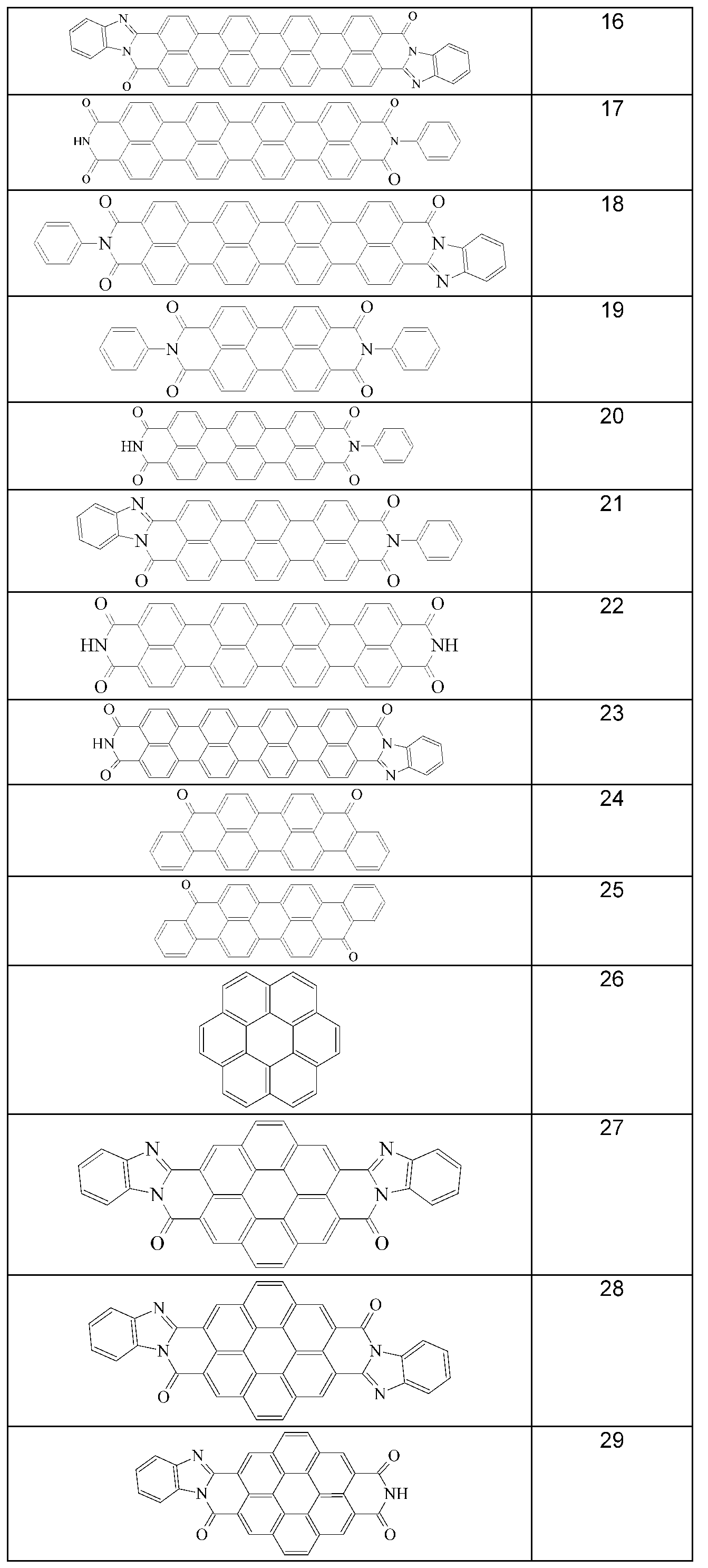


8. A polycyclic organic compound according to any of Claims from 1 to 7, wherein at least one of the W groups providing solubility is selected from the list comprising linear and branched (C1- C35)alkyl, (C2-C35)alkenyl, and (C2-C35)alkinyl.
9. A polycyclic organic compound according to any of Claims from 1 to 8, wherein at least one of the W groups providing solubility is connected with the polycyclic system Y via a bridging group A.
10. A polycyclic organic compound according to Claim 9, wherein the bridging group A is selected from the list comprising -C(O)- -C(O)O-, -C(O)-NH-, -(SO2)NH-, -O- -CH2O-, -NH-, >N- and any combination thereof.
11. A polycyclic organic compound according to any of Claims 1 , 5, 6, 7, 8, 9 or 10, selected from the list comprising diimides 1.1 , I.2, I.3 and I.4:

N,N'-di(2-ethylhexyl)-1 ,7-di(hex-1-ynyl)perylene-3,4:9,10-tetracarboxydiimide

N,N'-di(2-ethylhexyl)-5,11-dibutylcoronene-2,3:8,9-tetracarboxydiimιde
-CH,
H,C
O — . — o
— N =< >= N— I 3
O — . — O
CH,
H3C-
N,N'-dihexyl-5,11-dihexylcoronene-2,3.8,9-tetracarboxydiimide
I.4
N,N'-di(2-ethylhexyl)-5,11-dihexylcoronene-2,3:8,9-tetracarboxydiimide
12. A polycyclic organic compound according to any of Claims from 1 to 11 , wherein the polycyclic systems are capable of forming rod-like supramolecules via π-π-interaction
13. A polycyclic organic compound according to Claim 12, wherein the rod-like supramolecules have interplanar spacing between the polycyclic systems in the range of approximately 3.1-3.7 A.
14. A polycyclic organic compound according to any of Claims from 1 to 13, wherein said compound is photochromic.
15. A polycyclic organic compound according to any of Claims from 1 to 14, wherein said polycyclic organic compound is further capable of absorbing electromagnetic radiation in at least one subrange of the UV spectral range.
16. A solution comprising at least one polycyclic organic compound of a general structural formula I

W1, W2, and W3 are different groups providing solubility in an organic solvent, and sum (n1+n2+n3) is 1 , 2, 3, 4, 5, 6, 7, 8, 9 or 10, wherein said polycyclic organic compound is capable of forming supramolecules in the organic solvent, said polycyclic organic compound is capable of absorbing electromagnetic radiation in at least one subrange of the visible spectral range, and the solution is capable of forming an organic layer ensuring anisotropic absorption of electromagnetic radiation in at least one subrange of the visible spectral range.
17. A solution according to Claim 16, comprising a mix of at least two polycyclic organic compounds of a general structural formula wherein said solution is capable of absorbing of electromagnetic radiation in at least two subranges of the visible spectral range.
18. A solution according to any of Claims from 16 to 17, wherein the polycyclic system Y is heterocyclic.
19. A solution according to Claim 18, wherein heteroatoms of the heterocyclic system Y are selected from the list comprising N, O and S.
20. A solution according to any of Claims from 16 to 19, wherein the polycyclic system Y comprises at least one fragment selected from the list comprising furan, oxirane, 4H-pyran, 2H-chromene, benzo[£>]furan, 2H-pyran, thiophene, benzo[£>]thiophene, parathiazine, pyrrole, pyrrolidine, pyrazole, imidazole, imidazoline, imidazoline, pyrazolidine, pyπmidine, pyridine, piperazine, piperidine, pyrazine, indole, purine, benzimidazole, quinoline, phenothiazine, morphohne, thiaziole, thiadiazole, and oxazole
21. A solution according to any of Claims from 16 to 17, wherein the polycyclic organic compound having at least one fragment representing a polycyclic aromatic hydrocarbon.
22. A solution according to Claim 21 , wherein the polycyclic aromatic hydrocarbon is selected from the list comprising acenaphthene, acenaphthylene, acephenanthrylene, aceanthrylene, anthanthrene, benzo[a]coronene, benzo[a]naphthacene, benzo[a]pyrene, benzo[b]chrysene, benzo[b]fluorene, benzo[c]chrysene, benzo[c]phenanthrene, benzo[e]pyrene,
benzo[ghi]fluoranthene, benzo[ghι]naphtho[cde]perylene, benzo[ghι]perylene, benzo[j]fluoranthene, benzo[rst]dinaphtho[defg,ιjkl]pentaphene, benzo[rst]phenanthro[1 ,10,9-cde]pentaphene, benz[a]anthracene, benz[e]acephenanthrylene, benz[rst]anthra[cde]pentaphene, biphenylene, chrysene, coronene, dibenzo[b,def]chrysene, dibenzo[bc,ef]coronene, dιbenzo[cd,lm]perylene, dibenzo[g,p]chrysene, dibenzo[j,lm]naphtho[ab]perylene, dibenz[a,c]anthracene, dibenz[a,h]anthracene, dibenz[a,j]anthracene, dinaphtho[defg,opqr]pentacene, fluoranthene, fluorene, hexabenzo[a,cd,f,j,lm,o]perylene, naphthacene, naphthalene, naphtho[a]anthracene, naphtho[bcd]perylene, naphtho[d]coronene, pentabenzo[a,cd,f,j,lm]perylene, pentacene, pentaphene, perylene, phenanthrene, phenanthro[3,4-c]phenanthrene, picene, pyranthrene, pyrene, quaterrylene, tetrabenzo[a,cd,f,lm]perylene, terrylene, tπnaphthylene, tetranaphthylene and triphenylene.
23. A solution according to any of Claims from 16 to 22, wherein the polycyclic system Y is selected from the list comprising perylene, tetrapyrrolic macrocycles, and pyrazine, and having general structural formula selected from structures 1^6:

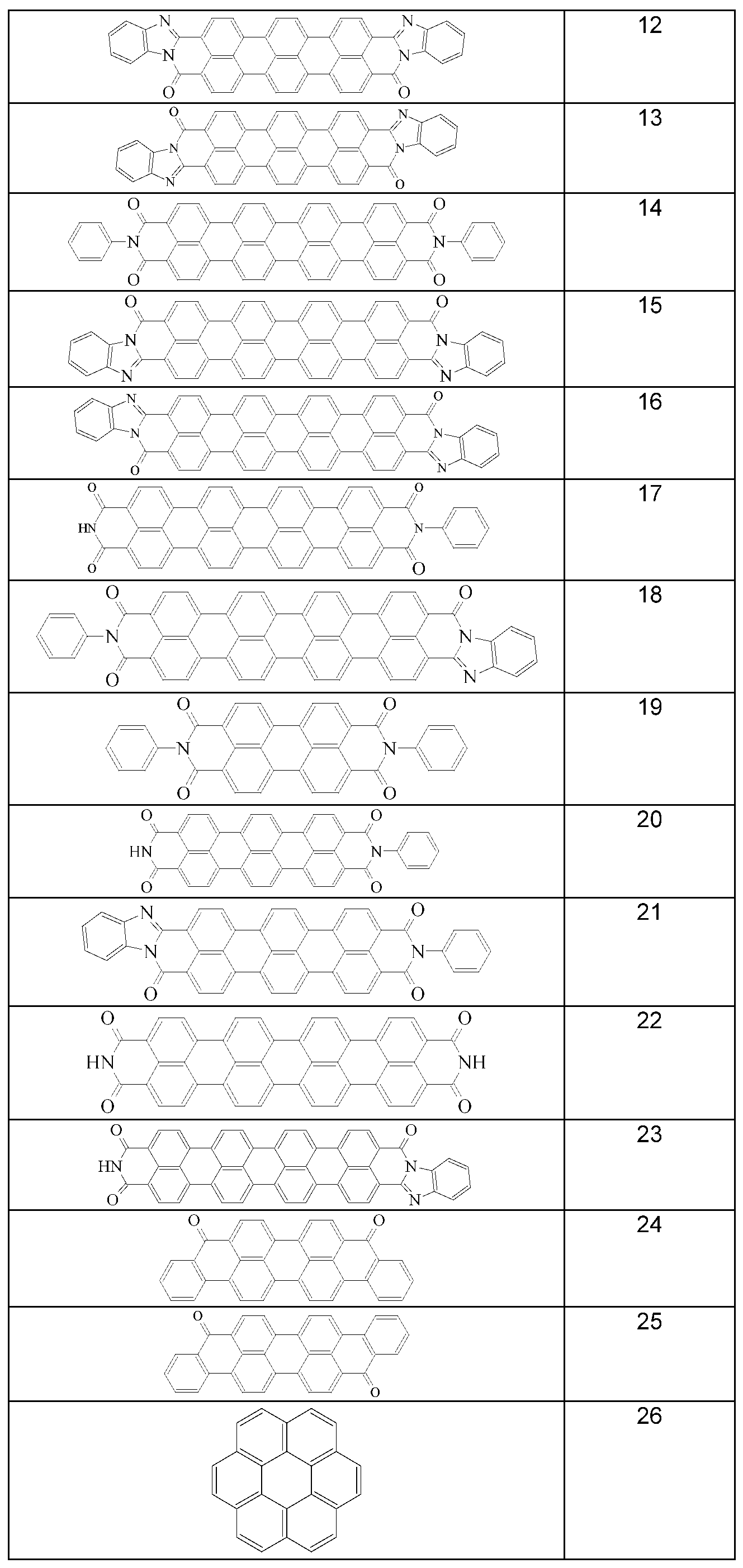


24. A solution according to any of Claims from 16 to 23, wherein at least one the W groups providing solubility is selected from the list comprising linear and branched (C-ι-C35)alkyl, (C2-C35)alkenyl, and (C2-C35)alkιnyl.
25. A solution according to any of Claims from 16 to 24, wherein at least one of the W groups providing solubility is connected with the polycyclic system Y via a bridging group A.
26. A solution according to any of Claims from 16 to 25, wherein the bridging group A is selected from the list, comprising -C(O)-, -C(O)O-, -C(O)-NH- -(SO2)NH- -O- -CH2O-, -NH- >N- and any combination thereof
27. A solution according to any of Claims from 16 to 17 or from 21 to 26, wherein the polycyclic organic compound is selected from the list comprising diirmides 1.1-1.4:

N,N'-di(2-ethylhexyl)-1 ,7-di(hex-1-ynyl)perylene-3,4:9,10-tetracarboxydiimide

N,N'-di(2-ethylhexyl)-5,11-dibutylcoronene-2,3:8,9-tetracarboxydiimide
-CH,
H,C
O — . — o
— N =< >= N— I 3
O — . — O
CH,
H3C-
N.N'-dihexyl-δ.H-dihexylcoronene^S'δ.θ-tetracarboxydiimide
1 4
N,N'-di(2-ethylhexyl)-5,11-dihexylcoronene-2,3:8,9-tetracarboxydiimide
28 A solution according to any of Claims from 16 to 27, wherein the organic solvent is selected from the list comprising ketones, carboxylic acids, hydrocarbons, cyclohydrocarbons, chlorohydrocarbons, alcohols, ethers, esters, and any combination thereof. 29. A solution according from 16 to 28 wherein the organic solvent is selected from the list comprising acetone, xylene, toluene, ethanol, methylcyclohexane, ethyl acetate, diethyl ether, octane, chloroform, methylenechloride, dichloroethane, trichloroethene, tetrachloroethene, carbon tetrachloride, 1 ,4-dioxane, tetrahydrofuran, pyridine, triethylamine, nitromethane, acetonitrile, dimethylformamide, dimethulsulfoxide, and any combination thereof 30 A solution according to any of Claims from 16 to 29, wherein the solution is a lyotropic liquid crystal solution.
31. A solution according to any of Claims from 16 to 30, wherein the solution is an isotropic solution.
32. A solution according to any of Claims from 16 to 31 , wherein the supramolecules are formed by interaction of at least two different compounds of the general structural formula I. 33 A solution according to any of Claims from 16 to 32, wherein the supramolecules are formed by interaction of the same compounds of formula I.
34 A solution according to any of Claims from 16 to 33, further comprising surfactants
35 A solution according to any of Claims from 16 to 34, further comprising plasticizers.
36. A polarizing element, comprising at least one organic layer which is capable of anisotropic absorption of the electromagnetic radiation in at least one subrange of the visible spectral range, wherein the organic layer comprising at least one polycyclic organic compound of a general structural formula I

37. A polarizing element according to Claim 36, wherein said layer comprises two or more said polycyclic compounds of the general structural formula I, ensuring absorption of electromagnetic radiation in at least two different predetermined wavelength subranges of the visible spectral range.
38. A polarizing element according to any of Claims from 36 to 37, comprising two or more organic layers, wherein each of said layers comprises different polycyclic compounds of the general structural formula I and ensuring the absorption of electromagnetic radiation in at least two predetermined wavelength subranges of the visible spectral range. 39. A polarizing element according to any of Claims from 36 to 38, wherein the polycyclic system Y is heterocyclic.
40. A polarizing element according to Claim 39, wherein the heteroatoms of the heterocyclic system Y are selected from the list comprising N, O and S.
41. A polarizing element according to any of Claims from 36 to 40, wherein the polycyclic system Y comprises at least one fragment selected from the list comprising furan, oxirane, 4H-pyran, 2H- chromene, benzo[£>]furan, 2H-pyran, thiophene, benzo[ύ]thiophene, parathiazine, pyrrole, pyrrolidine, pyrazole, imidazole, imidazoline, imidazolidine, pyrazolidine, pyrimidine, pyridine, piperazine, piperidine, pyrazine, indole, purine, benzimidazole, quinoline, phenothiazine, morpholine, thiaziole, thiadiazole, and oxazole. 42. A polarizing element according to any of Claims from 36 to 38, wherein the polycyclic system comprises at least one fragment representing a polycyclic aromatic hydrocarbon.
43. A polarizing element according to Claim 42, wherein the polycyclic aromatic hydrocarbon is selected from the list comprising acenaphthene, acenaphthylene, acephenanthrylene, aceanthrylene, anthanthrene, benzo[a]coronene, benzo[a]naphthacene, benzo[a]pyrene, benzo[b]chrysene, benzo[b]fluorene, benzo[c]chrysene, benzo[c]phenanthrene, benzo[e]pyrene, benzo[ghi]fluoranthene, benzo[ghi]naphtho[cde]perylene, benzo[ghi]perylene, benzo[j]fluoranthene, benzo[rst]dinaphtho[defg,ijkl]pentaphene, benzo[rst]phenanthro[1 ,10,9-cde]pentaphene, benz[a]anthracene, benz[e]acephenanthrylene, benz[rst]anthra[cde]pentaphene, biphenylene, chrysene, coronene, dibenzo[b,def]chrysene, dibenzo[bc,ef]coronene, dibenzo[cd,lm]perylene, dibenzo[g,p]chrysene, dibenzo[j,lm]naphtho[ab]perylene, dibenz[a,c]anthracene, dibenz[a,h]anthracene, dibenz[a,j]anthracene, dinaphtho[defg,opqr]pentacene, fluoranthene, fluorene, hexabenzo[a,cd,f,j,lm,o]perylene, naphthacene, naphthalene, naphtho[a]anthracene, naphtho[bcd]perylene, naphtho[d]coronene, pentabenzo[a,cd,f,j,lm]perylene, pentacene, pentaphene, perylene, phenanthrene, phenanthro[3,4-c]phenanthrene, picene, pyranthrene, pyrene, quaterrylene, tetrabenzo[a,cd,f,lm]perylene, terrylene, trinaphthylene, tetranaphthylene and triphenylene.
44. A polarizing element according to any of Claims from 36 to 43, wherein the polycyclic system Y is selected from the list comprising perylene, tetrapyrrolic macrocycles, and pyrazine, and having general structural formula selected from structures 1-46:
~ ^ ~ I ϊ
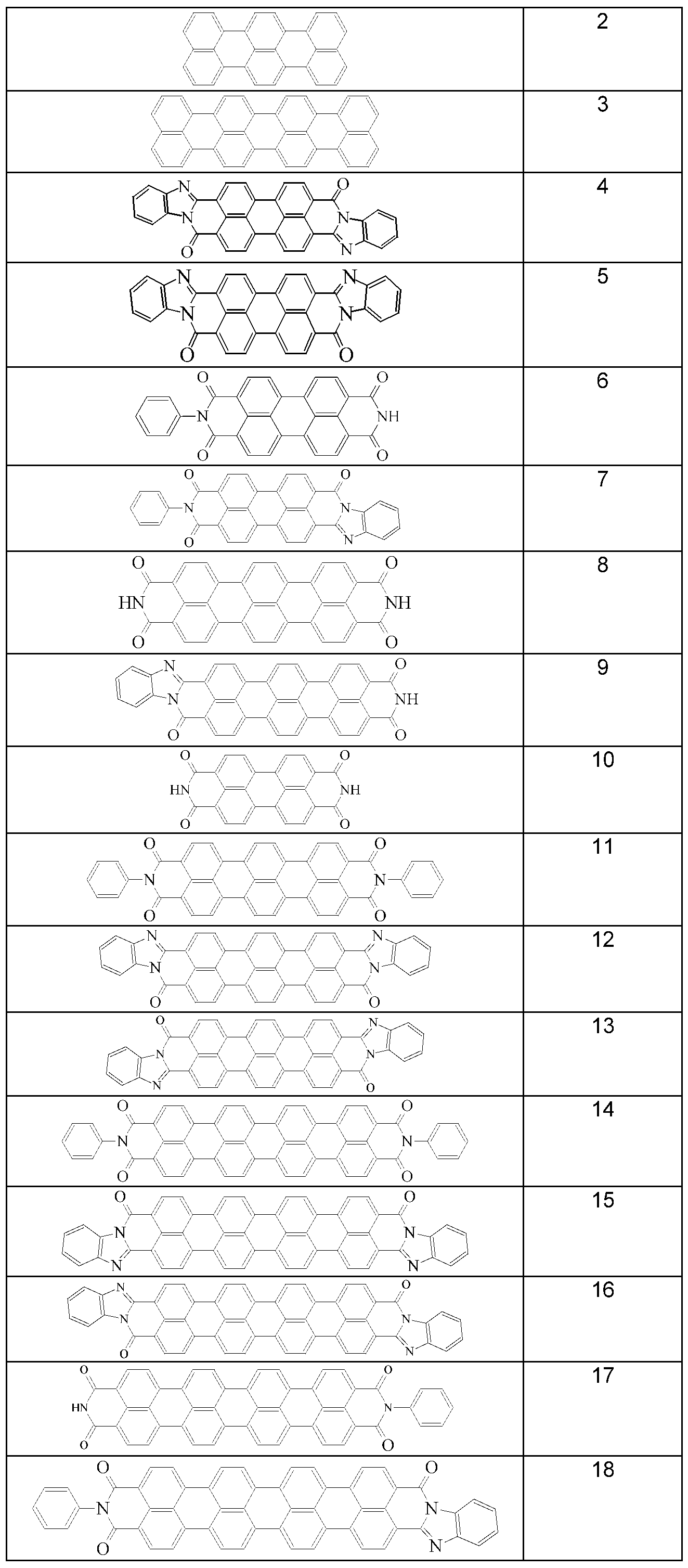


45. A polarizing element according to any of Claims from 35 to 44, wherein at least one of the W groups providing the solubility in the organic compound is selected from the list comprising linear and branched (CτC35)alkyl, (C2-C35)alkenyl, and (C2-C35)alkιnyl.
46. A polarizing element according to any of Claims from 36 to 45 wherein at least one of the W groups providing solubility is connected with the polycyclic system Y via a bridging group A.
47. A polarizing element according to Claim 46, wherein the bridging group A is selected from the list, comprising -C(O)-, -C(O)O-, -C(O)-NH-, -(SO2)NH-, -O- -CHO-, -NH-, >N- and any combination thereof.
48. A polarizing element according to any of Claims from 36 to 38 or from 42 to 47, wherein the polycyclic organic compound is selected from the list comprising diimides 1.1-1.4:

N,N'-di(2-ethylhexyl)-1 ,7-di(hex-1-ynyl)perylene-3,4:9,10-tetracarboxydiimide

N,N'-di(2-ethylhexyl)-5,11-dibutylcoronene-2,3:8,9-tetracarboxydiimιde
-CH,
H,C
O — . — o
— N =< >= N— I 3
O — . — O
CH,
H3C-
N,N'-dihexyl-5,11-dihexylcoronene-2,3.8,9-tetracarboxydiimide
I.4
N,N'-di(2-ethylhexyl)-5,11-dihexylcoronene-2,3:8,9-tetracarboxydiimide
49. A polarizing element according to any of Claims from 36 to 48, wherein the organic solvent is selected from the list comprising ketones, carboxylic acids, hydrocarbons, cyclohydrocarbons, chlorohydrocarbons, alcohols, ethers, esters, and any combination thereof.
50. A polarizing element according to any of Claims from 36 to 49, wherein the organic solvent is selected from the list comprising acetone, xylene, toluene, ethanol, methylcyclohexane, ethyl acetate, diethyl ether, octane, chloroform, methylenechloride, dichloroethane, trichloroethene, tetrachloroethene, carbon tetrachloride, 1 ,4-dioxane, tetrahydrofuran, pyridine, triethylamine, nitromethane, acetonitrile, dimethylformamide, dimethulsulfoxide, and any combination thereof.
51. A polarizing element according to any of Claims from 36 to 50, wherein said organic compound is photochromic.
52. A polarizing element according to any of Claims 36 to 51 , further comprising a substrate.
53. A polarizing element according to Claim 52, wherein the substrate is transparent for electromagnetic radiation in the visible spectral range.
54 A polarizing element according to 52, wherein the substrate is made of polymer 55 A polarizing element according to 52, wherein the substrate is made of glass. 56 A polarizing element according to 52, wherein the substrate is made of foil
57. A polarizing element according to any of Claims from 36 to 56, further comprising a transparent adhesive layer applied on top of the organic layer.
58. A polarizing element according to Claim 57, further comprising a protective coating applied on the adhesive transparent layer.
59 A polarizing element according to any of Claims 36 to 58, wherein said optically anisotropic organic layer is at least partially crystalline.
60 A method of forming a polarizing element comprising the steps of a) preparation of a solution of a polycyclic organic compound of the general structural formula I in an organic solvent

W1, W2, and W3 are different groups providing solubility in an organic solvent, and sum (n1+n2+n3) is 1 , 2, 3, 4, 5, 6, 7, 8, 9 or 10, wherein said polycyclic organic compound is capable of forming supramolecules in the organic solvent, and said polycyclic organic compound is capable of absorbing electromagnetic radiation in at least one subrange of the visible spectral range, b) deposition of a layer of the solution on a substrate, and c) drying with formation of an optically anisotropic layer.
61. A method according to Claim 60, further comprising an application of an external orienting action on the solution layer to provide a dominant orientation of supramolecules, wherein the orienting action may take place after the step b) of the deposition of the solution layer or simultaneously with the step b). 62. A method according to Claim 61 , wherein the orienting action is selected from the list comprising external mechanical, electromagnetic orienting actions and any combinations thereof.
63. A method according to any of Claims from 60 to 62, wherein the polycyclic system Y is heterocyclic.
64. A method according to Claim 63, wherein one or more heteroatoms in the heterocyclic system Y is selected from the list comprising N, O and S.
65. A method according to any of Claims from 60 to 64 wherein the polycyclic system Y comprises at least one fragment selected from the list comprising furan, oxirane, 4H-pyran, 2/-/-chromene, benzo[ύ]furan, 2/-/-pyran, thiophene, benzo[£>]thιophene, parathiazine, pyrrole, pyrrolidine, pyrazole, imidazole, imidazoline, imidazolidine, pyrazolidine, pyrimidine, pyridine, piperazine, piperidine, pyrazine, indole, purine, benzimidazole, quinoline, phenothiazine, morpholine, thiazole, thiadiazole, and oxazole
66. A method according to any of Claims from 60 to 62, wherein the polycyclic system Y comprises at least one fragment representing a polycyclic aromatic hydrocarbon.
67. A method according to Claim 66, wherein the polycyclic aromatic hydrocarbon of the system Y is selected from the list comprising acenaphthene, acenaphthylene, acephenanthrylene, aceanthrylene, anthanthrene, benzo[a]coronene, benzo[a]naphthacene, benzo[a]pyrene, benzo[b]chrysene, benzo[b]fluorene, benzo[c]chrysene, benzo[c]phenanthrene, benzo[e]pyrene, benzo[ghi]fluoranthene, benzo[ghi]naphtho[cde]perylene, benzo[ghi]perylene, benzo[j]fluoranthene, benzo[rst]dinaphtho[defg,ιjkl]pentaphene, benzo[rst]phenanthro[1 ,10,9-cde]pentaphene, benz[a]anthracene, benz[e]acephenanthrylene, benz[rst]anthra[cde]pentaphene, biphenylene, chrysene, coronene, dibenzo[b,def]chrysene, dibenzo[bc,ef]coronene, dιbenzo[cd,lm]perylene, dιbenzo[g,p]chrysene, dιbenzo[j,lm]naphtho[ab]perylene, dibenz[a,c]anthracene, dibenz[a,h]anthracene, dibenz[a,j]anthracene, dinaphtho[defg,opqr]pentacene, fluoranthene, fluorene, hexabenzo[a,cd,f,j,lm,o]perylene, naphthacene, naphthalene, naphtho[a]anthracene, naphtho[bcd]perylene, naphtho[d]coronene, pentabenzo[a,cd,f,j,lm]perylene, pentacene, pentaphene, perylene, phenanthrene, phenanthro[3,4-c]phenanthrene, picene, pyranthrene, pyrene, quaterrylene, tetrabenzo[a,cd,f,lm]perylene, terrylene, tπnaphthylene, tetranaphthylene and triphenylene.
68. A method according to any of Claims from 60 to 67, wherein the polycyclic system Y comprises fragments selected from the list comprising perylene, tetrapyrrolic macrocycles, and pyrazine, and having general structural formula selected from structures 1-461


69. A method according to any of Claims from 60 to 68, wherein at least one of the W groups providing solubility in the organic solvent is selected from the list comprising linear and branched (CrC35)alkyl, (C2-C35)alkenyl, and (C2-C35)alkinyl
70. A method according to any of Claims from 60 to 69, wherein at least one of the W groups providing solubility is connected with the polycyclic system Y via a bridging group A.
71. A method according to Claim 70, wherein the bridging group A is selected from the list, comprising -C(O)- -C(O)O-, -C(O)-NH-, -(SO2)NH-, -O-, -CH2O-, -NH-, >N- and any combination thereof.
72. A method according to any of Claims from 60 to 62 or from 66 to 70, wherein the polycyclic organic compound is selected from the list comprising diimides 1.1 - 1.4:
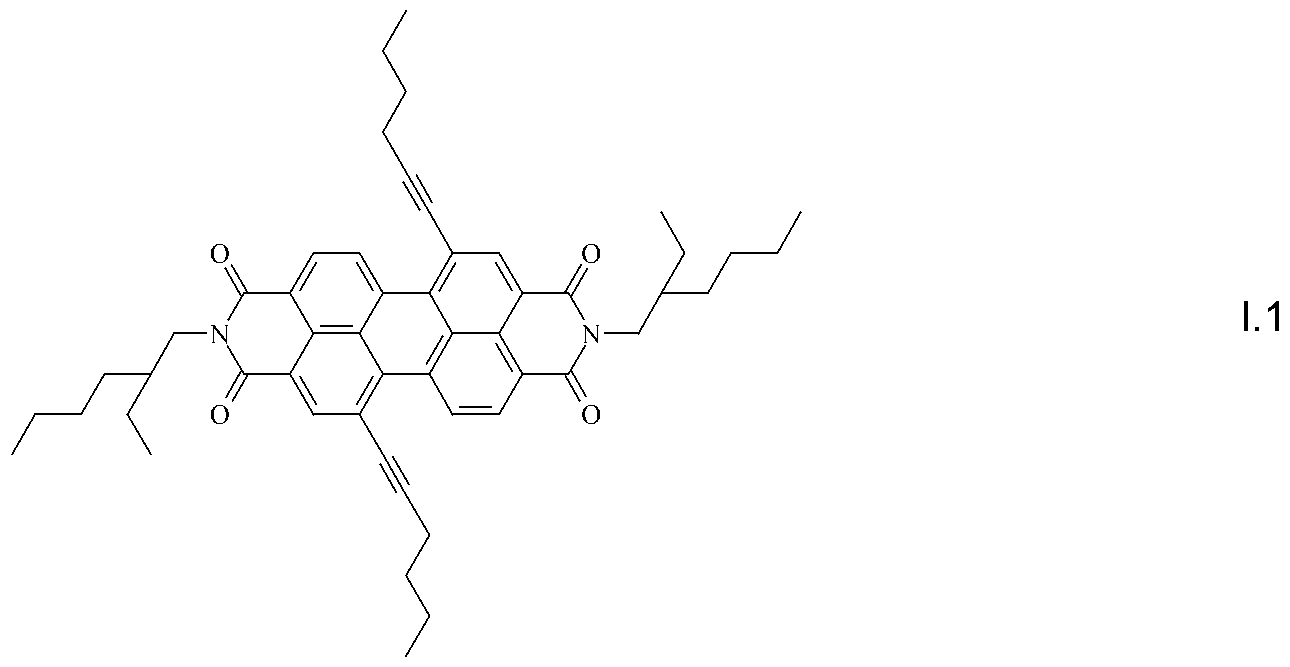
N,N'-dι(2-ethylhexyl)-1 ,7-dι(hex-1-ynyl)perylene-3,4:9,10-tetracarboxydiimιde

N,N'-di(2-ethylhexyl)-5,11-dibutylcoronene-2,3:8,9-tetracarboxydiimide
-CH,
B1C
O : : O
— N =■ =. N — 1.3
O : : O
CH,
HX-
N.N'-dihexyl-δ.H-dihexylcoronene^S'δ.θ-tetracarboxydiimide
*U \ o _ ^ ^
1 4
N,N'-di(2-ethylhexyl)-5,11-dihexylcoronene-2,3:8,9-tetracarboxydiimide
73. A method according to any of Claims from 60 to 72, wherein the organic solvent is selected from the list comprising ketones, carboxylic acids, hydrocarbons, cyclohydrocarbons, chlorohydrocarbons, alcohols, ethers, esters, and any combination thereof.
74. A method according to any of Claims from 60 to 73, wherein the organic solvent is selected from the list comprising acetone, xylene, toluene, ethanol, methylcyclohexane, ethyl acetate, diethyl ether, octane, chloroform, methylenechloride, dichloroethane, trichloroethene, tetrachloroethene, carbon tetrachloride, 1 ,4-dioxane, tetrahydrofuran, pyridine, triethylamine, nitromethane, acetonitrile, dimethylformamide, dimethulsulfoxide, and any combination thereof
75. A method according to any of Claims from 60 to 74, wherein the substrate is made of polymer
76. A method according to any of Claims from 60 to 74, wherein the substrate is made of glass.
77. A method according to any of Claims from 60 to 74, wherein the substrate is made of foil.
78 A method according to any of Claims from 60 to 77, further comprising the step of removing the substrate by one of the methods from the list comprising wet chemical etching, dry chemical etching, plasma etching, laser etching, and grinding
79. A method according to Claim 60, wherein the sequence of steps of the preparation of a solution of a polycyclic organic compound of the general structural formula I, deposition of a layer of the solution on a substrate and the drying are repeated two or more times and each consequent optically anisotropic layer is formed using the organic solution, this solution being either the same or different from that used in the previous cycle
Priority Applications (3)
| Application Number | Priority Date | Filing Date | Title |
|---|---|---|---|
| US12/921,094 US20110149393A1 (en) | 2008-03-04 | 2009-03-04 | Polycyclic Organic Compounds, Polarizing Elements and Method of Production Thereof |
| JP2010549198A JP2011513376A (en) | 2008-03-04 | 2009-03-04 | Polycyclic organic compound, polarizing element and method for producing the same |
| EP09717753.9A EP2260035B1 (en) | 2008-03-04 | 2009-03-04 | Polycyclic organic compounds, polarizing elements and method of production thereof |
Applications Claiming Priority (2)
| Application Number | Priority Date | Filing Date | Title |
|---|---|---|---|
| GB0804082.6 | 2008-03-04 | ||
| GBGB0804082.6A GB0804082D0 (en) | 2008-03-04 | 2008-03-04 | Polycyclic organic compounds, polarizing elements and method of production t hereof |
Publications (2)
| Publication Number | Publication Date |
|---|---|
| WO2009109781A2 true WO2009109781A2 (en) | 2009-09-11 |
| WO2009109781A3 WO2009109781A3 (en) | 2009-10-29 |
Family
ID=39315984
Family Applications (1)
| Application Number | Title | Priority Date | Filing Date |
|---|---|---|---|
| PCT/GB2009/050218 Ceased WO2009109781A2 (en) | 2008-03-04 | 2009-03-04 | Polycyclic organic compounds, polarizing elements and method of production thereof |
Country Status (5)
| Country | Link |
|---|---|
| US (1) | US20110149393A1 (en) |
| EP (1) | EP2260035B1 (en) |
| JP (1) | JP2011513376A (en) |
| GB (1) | GB0804082D0 (en) |
| WO (1) | WO2009109781A2 (en) |
Cited By (2)
| Publication number | Priority date | Publication date | Assignee | Title |
|---|---|---|---|---|
| WO2011079296A3 (en) * | 2009-12-23 | 2011-12-01 | University Of Utah | Photoconductive sensor materials for detection of explosive vapor |
| WO2012162269A3 (en) * | 2011-05-20 | 2013-03-28 | Northwestern University | Modular supramolecular approach for co-crystallization of donors and acceptors into ordered networks |
Families Citing this family (22)
| Publication number | Priority date | Publication date | Assignee | Title |
|---|---|---|---|---|
| US9360596B2 (en) | 2013-04-24 | 2016-06-07 | Light Polymers Holding | Depositing polymer solutions to form optical devices |
| AU2015259291A1 (en) | 2014-05-12 | 2016-11-24 | Capacitor Sciences Incorporated | Energy storage device and method of production thereof |
| US10340082B2 (en) | 2015-05-12 | 2019-07-02 | Capacitor Sciences Incorporated | Capacitor and method of production thereof |
| US10319523B2 (en) | 2014-05-12 | 2019-06-11 | Capacitor Sciences Incorporated | Yanli dielectric materials and capacitor thereof |
| US10347423B2 (en) | 2014-05-12 | 2019-07-09 | Capacitor Sciences Incorporated | Solid multilayer structure as semiproduct for meta-capacitor |
| CN107592939B (en) | 2014-11-04 | 2020-05-05 | 电容器科学股份公司 | Energy storage device and method for producing same |
| US9829617B2 (en) | 2014-11-10 | 2017-11-28 | Light Polymers Holding | Polymer-small molecule film or coating having reverse or flat dispersion of retardation |
| US9932358B2 (en) | 2015-05-21 | 2018-04-03 | Capacitor Science Incorporated | Energy storage molecular material, crystal dielectric layer and capacitor |
| US9941051B2 (en) | 2015-06-26 | 2018-04-10 | Capactor Sciences Incorporated | Coiled capacitor |
| US9856172B2 (en) | 2015-08-25 | 2018-01-02 | Light Polymers Holding | Concrete formulation and methods of making |
| US10026553B2 (en) | 2015-10-21 | 2018-07-17 | Capacitor Sciences Incorporated | Organic compound, crystal dielectric layer and capacitor |
| US10600574B2 (en) * | 2015-10-21 | 2020-03-24 | Capacitor Sciences Incorporated | Organic compound, crystal dielectric layer and capacitor |
| CA3012337A1 (en) * | 2016-01-26 | 2017-08-03 | Gpcp Ip Holdings Llc | Mechanical dispenser for perforated sheet products |
| US20170233528A1 (en) * | 2016-02-12 | 2017-08-17 | Capacitor Sciences Incorporated | Sharp polymer and capacitor |
| US9978517B2 (en) | 2016-04-04 | 2018-05-22 | Capacitor Sciences Incorporated | Electro-polarizable compound and capacitor |
| CN107523290B (en) * | 2016-06-20 | 2019-10-18 | 国家纳米科学中心 | A two-dimensional ordered structure of organic molecules and its preparation method |
| US10403435B2 (en) | 2017-12-15 | 2019-09-03 | Capacitor Sciences Incorporated | Edder compound and capacitor thereof |
| US10962696B2 (en) | 2018-01-31 | 2021-03-30 | Light Polymers Holding | Coatable grey polarizer |
| US11370914B2 (en) | 2018-07-24 | 2022-06-28 | Light Polymers Holding | Methods of forming polymeric polarizers from lyotropic liquid crystals and polymeric polarizers formed thereby |
| CN109180911B (en) * | 2018-08-31 | 2021-03-30 | 武汉工程大学 | A kind of perylene imide polymer and its preparation method and application |
| US20230361302A1 (en) * | 2021-01-07 | 2023-11-09 | Lg Energy Solution, Ltd. | Positive electrode additive for lithium secondary battery, positive electrode active material comprising same, positive electrode, and lithium secondary battery |
| US12072520B2 (en) | 2021-11-11 | 2024-08-27 | Light Polymers Holding | Linear polarizers and methods of forming a linear polarizer |
Family Cites Families (15)
| Publication number | Priority date | Publication date | Assignee | Title |
|---|---|---|---|---|
| JPS5774361A (en) * | 1980-08-22 | 1982-05-10 | Bbc Brown Boveri & Cie | Liquid crystal mixture and novel bichromophoric coloring matter |
| FR2721228B1 (en) * | 1994-06-17 | 1996-08-09 | Cricket Sa | Heterogeneous material contained in a porous permeable and rigid support. |
| KR100612086B1 (en) * | 2003-08-14 | 2006-08-14 | 주식회사 엘지화학 | Complex light-compensation c plate with two or more of c plates different in dispersion ratio value and liquid crystal display using the same |
| US7291223B2 (en) * | 2003-09-24 | 2007-11-06 | Nitto Denko Corporation | Epitaxial organic layered structure and method for making |
| JP4581627B2 (en) * | 2003-10-31 | 2010-11-17 | 三菱化学株式会社 | Perylene dye, anisotropic dye film forming composition, anisotropic dye film, and polarizing element |
| US7045177B2 (en) * | 2003-11-21 | 2006-05-16 | Nitto Denko Corporation | Sulfoderivatives of acenaphtho[1,2-b]quinoxaline, lyotropic liquid crystal and anisotropic film on their base |
| US7267849B2 (en) * | 2004-03-02 | 2007-09-11 | Nitto Denko Corporation | Compensator for liquid crystal display |
| EP1632494A1 (en) * | 2004-08-24 | 2006-03-08 | Ferring B.V. | Vasopressin v1a antagonists |
| JP4525280B2 (en) * | 2004-09-30 | 2010-08-18 | 三菱化学株式会社 | Dye for anisotropic dye film, composition for forming anisotropic dye film, anisotropic dye film and polarizing element |
| WO2006093965A2 (en) * | 2005-03-01 | 2006-09-08 | Georgia Tech Research Corporation | Coronene charge-transport materials, methods of fabrication thereof, and methods of use thereof |
| KR20060124998A (en) * | 2005-06-01 | 2006-12-06 | 엘지.필립스 엘시디 주식회사 | Transverse electric field liquid crystal display device |
| US8778509B2 (en) * | 2005-09-01 | 2014-07-15 | Konica Minolta Holdings, Inc. | Organic electroluminescence element, display device and lighting device |
| EP1843407A1 (en) * | 2006-04-07 | 2007-10-10 | Basf Aktiengesellschaft | Liquid crystalline rylenetetracarboxylic acid derivatives and their use |
| JP2008031133A (en) * | 2006-08-01 | 2008-02-14 | Nippon Kayaku Co Ltd | New lyotropic liquid-crystalline compound and its aqueous solution, method for producing polarized element using the same |
| GB0616358D0 (en) * | 2006-08-16 | 2006-09-27 | Crysoptix Ltd | Anisotropic polymer film and method of production thereof |
-
2008
- 2008-03-04 GB GBGB0804082.6A patent/GB0804082D0/en active Pending
-
2009
- 2009-03-04 EP EP09717753.9A patent/EP2260035B1/en not_active Not-in-force
- 2009-03-04 JP JP2010549198A patent/JP2011513376A/en active Pending
- 2009-03-04 WO PCT/GB2009/050218 patent/WO2009109781A2/en not_active Ceased
- 2009-03-04 US US12/921,094 patent/US20110149393A1/en not_active Abandoned
Non-Patent Citations (1)
| Title |
|---|
| J. LYDON: "Chromonics, in Handbook of Liquid Crystals", vol. 2B, 1998, WILEY VCH, pages: 981 - 1007 |
Cited By (7)
| Publication number | Priority date | Publication date | Assignee | Title |
|---|---|---|---|---|
| WO2011079296A3 (en) * | 2009-12-23 | 2011-12-01 | University Of Utah | Photoconductive sensor materials for detection of explosive vapor |
| CN102762566A (en) * | 2009-12-23 | 2012-10-31 | 犹他大学研究基金会 | Photoconductive sensor materials for detection of explosive vapor |
| US8889420B2 (en) | 2009-12-23 | 2014-11-18 | University Of Utah Research Foundation | Photoconductive sensor materials for detection of explosive vapor |
| CN102762566B (en) * | 2009-12-23 | 2015-07-08 | 犹他大学研究基金会 | Photoconductive sensor materials for detection of explosive vapor |
| WO2012162269A3 (en) * | 2011-05-20 | 2013-03-28 | Northwestern University | Modular supramolecular approach for co-crystallization of donors and acceptors into ordered networks |
| US9449731B2 (en) | 2011-05-20 | 2016-09-20 | Northwestern University | Modular supramolecular approach for co-crystallization of donors and acceptors into ordered networks |
| US9997272B2 (en) | 2011-05-20 | 2018-06-12 | Northwestern University | Modular supramolecular approach for co-crystallization of donors and acceptors into ordered networks |
Also Published As
| Publication number | Publication date |
|---|---|
| US20110149393A1 (en) | 2011-06-23 |
| EP2260035A2 (en) | 2010-12-15 |
| WO2009109781A3 (en) | 2009-10-29 |
| GB0804082D0 (en) | 2008-04-09 |
| EP2260035B1 (en) | 2014-08-20 |
| JP2011513376A (en) | 2011-04-28 |
Similar Documents
| Publication | Publication Date | Title |
|---|---|---|
| EP2260035B1 (en) | Polycyclic organic compounds, polarizing elements and method of production thereof | |
| US8933208B2 (en) | Photo-responsive liquid crystalline compound and its applications | |
| Cristiano et al. | Synthesis and optical/thermal properties of low molecular mass V-shaped materials based on 2, 3-dicyanopyrazine | |
| KR20030020448A (en) | Liquid crystalline 3,4:9,10-perylenetetracarboxylic acid diimides | |
| Zhu et al. | Novel fluorescent perylene liquid crystal with diphenylacrylonitrile groups: Observation of a large pseudo stokes shift based on AIE and FRET effects | |
| EP2260036A2 (en) | Polycyclic organic compounds, retardation layer and compensation panel on their base | |
| Wang et al. | Facile synthesis and controllable bromination of asymmetrical intermediates of perylene monoanhydride/monoimide diester | |
| WO2007080420A1 (en) | 6,7-dihydrobenzimidazo[1 ,2-c]quinazolin-6-one carboxylic acids, their esters, and methods of synthesis thereof | |
| WO2009114385A1 (en) | Lyotropic chromophoric compounds, liquid crystal systems and optically anisotropic films | |
| CN114685469A (en) | Thiophene derivative based on 9-phenyl-carbazole and preparation and application thereof | |
| WO2010099223A1 (en) | Lyotropic liquid crystal systems based on aromatic tetracarboxylic bisbenzoimidazole derivatives and methods for making | |
| Ozser et al. | Novel derivatives of regioisomerically pure 1, 7-disubstituted perylene diimide dyes bearing phenoxy and pyrrolidinyl substituents: Synthesis, photophysical, thermal, and structural properties | |
| CN105294721B (en) | The synthesis of Yi Zhong perylene diimide derivatives and micro wire preparation method | |
| CN115286644B (en) | Organic optoelectronic small molecule containing [1,2,5]thiadiazolo[3,4-g]quinoxaline structure and its preparation method and application | |
| CN115626911B (en) | Trans-dithienylethylene derivative and preparation method and application thereof | |
| CN117820873B (en) | Diazobiphenyl dyes, polarizers containing them, and methods for preparing diazobiphenyl dyes. | |
| CN113292585B (en) | BODIPY-benzothiadiazole-porphyrin-carbazole quaternary system linear compound and preparation method thereof | |
| CN109705147B (en) | Environment-sensitive dye and preparation method and application thereof | |
| CN115197260A (en) | A kind of alkynyl-coupled double BODIPY near-infrared fluorescent dye with J aggregation effect and preparation method thereof | |
| Naidu et al. | Color tuning of perylene based lyotropic chromonic liquid crystal | |
| CN106905331A (en) | The synthetic method of the ester binary compound of dodecyloxy phenyl porphyrin benzoyl octane epoxide Qiao Lian perylenes four | |
| CN106905326A (en) | The synthetic method of dodecyloxy phenyl porphyrin benzamide hexane imines Qiao Lian perylene dihexyl binary compounds | |
| CN102471601B (en) | Phthalocyanine compounds | |
| CN118852209A (en) | Asymmetric benzoselenophene benzoselenophene benzophenone derivative and its preparation method and photoelectric application | |
| CN103509019B (en) | A kind of dibenzocoralone compound and preparation method thereof |
Legal Events
| Date | Code | Title | Description |
|---|---|---|---|
| 121 | Ep: the epo has been informed by wipo that ep was designated in this application |
Ref document number: 09717753 Country of ref document: EP Kind code of ref document: A2 |
|
| WWE | Wipo information: entry into national phase |
Ref document number: 2010549198 Country of ref document: JP |
|
| NENP | Non-entry into the national phase |
Ref country code: DE |
|
| WWE | Wipo information: entry into national phase |
Ref document number: 2009717753 Country of ref document: EP |
|
| WWE | Wipo information: entry into national phase |
Ref document number: 12921094 Country of ref document: US |