WO2009109782A2 - Polycyclic organic compounds, retardation layer and compensation panel on their base - Google Patents
Polycyclic organic compounds, retardation layer and compensation panel on their base Download PDFInfo
- Publication number
- WO2009109782A2 WO2009109782A2 PCT/GB2009/050219 GB2009050219W WO2009109782A2 WO 2009109782 A2 WO2009109782 A2 WO 2009109782A2 GB 2009050219 W GB2009050219 W GB 2009050219W WO 2009109782 A2 WO2009109782 A2 WO 2009109782A2
- Authority
- WO
- WIPO (PCT)
- Prior art keywords
- polycyclic
- compensation panel
- organic compound
- retardation layer
- list
- Prior art date
- Legal status (The legal status is an assumption and is not a legal conclusion. Google has not performed a legal analysis and makes no representation as to the accuracy of the status listed.)
- Ceased
Links
- YEIWVPXXCSONBH-UHFFFAOYSA-N COc1cc2cc(OC)cc(C(C3=O)=O)c2c3c1 Chemical compound COc1cc2cc(OC)cc(C(C3=O)=O)c2c3c1 YEIWVPXXCSONBH-UHFFFAOYSA-N 0.000 description 1
- PHOJYQYBRFWBAV-UHFFFAOYSA-N OC(c1cc2ccc(c(ccc(C(O)=O)c3)c3cc3C(O)=O)c3c2cc1)=O Chemical compound OC(c1cc2ccc(c(ccc(C(O)=O)c3)c3cc3C(O)=O)c3c2cc1)=O PHOJYQYBRFWBAV-UHFFFAOYSA-N 0.000 description 1
Classifications
-
- C—CHEMISTRY; METALLURGY
- C07—ORGANIC CHEMISTRY
- C07D—HETEROCYCLIC COMPOUNDS
- C07D403/00—Heterocyclic compounds containing two or more hetero rings, having nitrogen atoms as the only ring hetero atoms, not provided for by group C07D401/00
- C07D403/02—Heterocyclic compounds containing two or more hetero rings, having nitrogen atoms as the only ring hetero atoms, not provided for by group C07D401/00 containing two hetero rings
- C07D403/04—Heterocyclic compounds containing two or more hetero rings, having nitrogen atoms as the only ring hetero atoms, not provided for by group C07D401/00 containing two hetero rings directly linked by a ring-member-to-ring-member bond
-
- C—CHEMISTRY; METALLURGY
- C07—ORGANIC CHEMISTRY
- C07C—ACYCLIC OR CARBOCYCLIC COMPOUNDS
- C07C37/00—Preparation of compounds having hydroxy or O-metal groups bound to a carbon atom of a six-membered aromatic ring
- C07C37/01—Preparation of compounds having hydroxy or O-metal groups bound to a carbon atom of a six-membered aromatic ring by replacing functional groups bound to a six-membered aromatic ring by hydroxy groups, e.g. by hydrolysis
- C07C37/055—Preparation of compounds having hydroxy or O-metal groups bound to a carbon atom of a six-membered aromatic ring by replacing functional groups bound to a six-membered aromatic ring by hydroxy groups, e.g. by hydrolysis the substituted group being bound to oxygen, e.g. ether group
-
- C—CHEMISTRY; METALLURGY
- C07—ORGANIC CHEMISTRY
- C07C—ACYCLIC OR CARBOCYCLIC COMPOUNDS
- C07C37/00—Preparation of compounds having hydroxy or O-metal groups bound to a carbon atom of a six-membered aromatic ring
- C07C37/11—Preparation of compounds having hydroxy or O-metal groups bound to a carbon atom of a six-membered aromatic ring by reactions increasing the number of carbon atoms
- C07C37/18—Preparation of compounds having hydroxy or O-metal groups bound to a carbon atom of a six-membered aromatic ring by reactions increasing the number of carbon atoms by condensation involving halogen atoms of halogenated compounds
-
- C—CHEMISTRY; METALLURGY
- C07—ORGANIC CHEMISTRY
- C07C—ACYCLIC OR CARBOCYCLIC COMPOUNDS
- C07C39/00—Compounds having at least one hydroxy or O-metal group bound to a carbon atom of a six-membered aromatic ring
- C07C39/02—Compounds having at least one hydroxy or O-metal group bound to a carbon atom of a six-membered aromatic ring monocyclic with no unsaturation outside the aromatic ring
- C07C39/11—Alkylated hydroxy benzenes containing also acyclically bound hydroxy groups, e.g. saligenol
-
- C—CHEMISTRY; METALLURGY
- C07—ORGANIC CHEMISTRY
- C07C—ACYCLIC OR CARBOCYCLIC COMPOUNDS
- C07C39/00—Compounds having at least one hydroxy or O-metal group bound to a carbon atom of a six-membered aromatic ring
- C07C39/12—Compounds having at least one hydroxy or O-metal group bound to a carbon atom of a six-membered aromatic ring polycyclic with no unsaturation outside the aromatic rings
- C07C39/15—Compounds having at least one hydroxy or O-metal group bound to a carbon atom of a six-membered aromatic ring polycyclic with no unsaturation outside the aromatic rings with all hydroxy groups on non-condensed rings, e.g. phenylphenol
-
- C—CHEMISTRY; METALLURGY
- C07—ORGANIC CHEMISTRY
- C07C—ACYCLIC OR CARBOCYCLIC COMPOUNDS
- C07C43/00—Ethers; Compounds having groups, groups or groups
- C07C43/02—Ethers
- C07C43/20—Ethers having an ether-oxygen atom bound to a carbon atom of a six-membered aromatic ring
-
- C—CHEMISTRY; METALLURGY
- C07—ORGANIC CHEMISTRY
- C07C—ACYCLIC OR CARBOCYCLIC COMPOUNDS
- C07C43/00—Ethers; Compounds having groups, groups or groups
- C07C43/02—Ethers
- C07C43/20—Ethers having an ether-oxygen atom bound to a carbon atom of a six-membered aromatic ring
- C07C43/205—Ethers having an ether-oxygen atom bound to a carbon atom of a six-membered aromatic ring the aromatic ring being a non-condensed ring
- C07C43/2055—Ethers having an ether-oxygen atom bound to a carbon atom of a six-membered aromatic ring the aromatic ring being a non-condensed ring containing more than one ether bond
-
- C—CHEMISTRY; METALLURGY
- C07—ORGANIC CHEMISTRY
- C07D—HETEROCYCLIC COMPOUNDS
- C07D241/00—Heterocyclic compounds containing 1,4-diazine or hydrogenated 1,4-diazine rings
- C07D241/36—Heterocyclic compounds containing 1,4-diazine or hydrogenated 1,4-diazine rings condensed with carbocyclic rings or ring systems
-
- C—CHEMISTRY; METALLURGY
- C07—ORGANIC CHEMISTRY
- C07D—HETEROCYCLIC COMPOUNDS
- C07D251/00—Heterocyclic compounds containing 1,3,5-triazine rings
- C07D251/02—Heterocyclic compounds containing 1,3,5-triazine rings not condensed with other rings
- C07D251/12—Heterocyclic compounds containing 1,3,5-triazine rings not condensed with other rings having three double bonds between ring members or between ring members and non-ring members
- C07D251/14—Heterocyclic compounds containing 1,3,5-triazine rings not condensed with other rings having three double bonds between ring members or between ring members and non-ring members with hydrogen or carbon atoms directly attached to at least one ring carbon atom
- C07D251/24—Heterocyclic compounds containing 1,3,5-triazine rings not condensed with other rings having three double bonds between ring members or between ring members and non-ring members with hydrogen or carbon atoms directly attached to at least one ring carbon atom to three ring carbon atoms
-
- C—CHEMISTRY; METALLURGY
- C07—ORGANIC CHEMISTRY
- C07D—HETEROCYCLIC COMPOUNDS
- C07D251/00—Heterocyclic compounds containing 1,3,5-triazine rings
- C07D251/02—Heterocyclic compounds containing 1,3,5-triazine rings not condensed with other rings
- C07D251/12—Heterocyclic compounds containing 1,3,5-triazine rings not condensed with other rings having three double bonds between ring members or between ring members and non-ring members
- C07D251/26—Heterocyclic compounds containing 1,3,5-triazine rings not condensed with other rings having three double bonds between ring members or between ring members and non-ring members with only hetero atoms directly attached to ring carbon atoms
- C07D251/40—Nitrogen atoms
- C07D251/54—Three nitrogen atoms
- C07D251/70—Other substituted melamines
-
- C—CHEMISTRY; METALLURGY
- C07—ORGANIC CHEMISTRY
- C07D—HETEROCYCLIC COMPOUNDS
- C07D403/00—Heterocyclic compounds containing two or more hetero rings, having nitrogen atoms as the only ring hetero atoms, not provided for by group C07D401/00
- C07D403/02—Heterocyclic compounds containing two or more hetero rings, having nitrogen atoms as the only ring hetero atoms, not provided for by group C07D401/00 containing two hetero rings
- C07D403/12—Heterocyclic compounds containing two or more hetero rings, having nitrogen atoms as the only ring hetero atoms, not provided for by group C07D401/00 containing two hetero rings linked by a chain containing hetero atoms as chain links
-
- C—CHEMISTRY; METALLURGY
- C07—ORGANIC CHEMISTRY
- C07D—HETEROCYCLIC COMPOUNDS
- C07D471/00—Heterocyclic compounds containing nitrogen atoms as the only ring hetero atoms in the condensed system, at least one ring being a six-membered ring with one nitrogen atom, not provided for by groups C07D451/00 - C07D463/00
- C07D471/02—Heterocyclic compounds containing nitrogen atoms as the only ring hetero atoms in the condensed system, at least one ring being a six-membered ring with one nitrogen atom, not provided for by groups C07D451/00 - C07D463/00 in which the condensed system contains two hetero rings
- C07D471/04—Ortho-condensed systems
-
- C—CHEMISTRY; METALLURGY
- C07—ORGANIC CHEMISTRY
- C07D—HETEROCYCLIC COMPOUNDS
- C07D487/00—Heterocyclic compounds containing nitrogen atoms as the only ring hetero atoms in the condensed system, not provided for by groups C07D451/00 - C07D477/00
- C07D487/02—Heterocyclic compounds containing nitrogen atoms as the only ring hetero atoms in the condensed system, not provided for by groups C07D451/00 - C07D477/00 in which the condensed system contains two hetero rings
- C07D487/04—Ortho-condensed systems
-
- C—CHEMISTRY; METALLURGY
- C07—ORGANIC CHEMISTRY
- C07C—ACYCLIC OR CARBOCYCLIC COMPOUNDS
- C07C2603/00—Systems containing at least three condensed rings
- C07C2603/02—Ortho- or ortho- and peri-condensed systems
- C07C2603/40—Ortho- or ortho- and peri-condensed systems containing four condensed rings
- C07C2603/42—Ortho- or ortho- and peri-condensed systems containing four condensed rings containing only six-membered rings
- C07C2603/50—Pyrenes; Hydrogenated pyrenes
-
- C—CHEMISTRY; METALLURGY
- C09—DYES; PAINTS; POLISHES; NATURAL RESINS; ADHESIVES; COMPOSITIONS NOT OTHERWISE PROVIDED FOR; APPLICATIONS OF MATERIALS NOT OTHERWISE PROVIDED FOR
- C09K—MATERIALS FOR MISCELLANEOUS APPLICATIONS, NOT PROVIDED FOR ELSEWHERE
- C09K2323/00—Functional layers of liquid crystal optical display excluding electroactive liquid crystal layer characterised by chemical composition
Definitions
- the present invention relates to organic chemistry, in particular, to polycyclic organic compounds, solution thereof and compensation panel comprising retardation layers based on these compounds. More specifically, the present invention is related to the optical compensators for liquid crystal displays
- Optical compensators are used to alter the relative phase of polarized light passing through said compensators, and thus, are well suited for use in applications where control over the polarization is required.
- optical compensators comprising at least one retardation layer are used to introduce a phase delay in incident light to correct the phase differences between two components of polarized light introduced by other optical components in a system.
- optical retardation layers are providing polarization compensation for liquid crystal display (LCD) panels.
- LCD panels are widely used in watches and clocks, photographic cameras, technical instruments, computers, flat TV, projection screens, control panels and large area of information- providing devices.
- the information in many LCD panels is presented in the form of a row of numerals or characters, which are generated by a number of segmented electrodes arranged in a pattern.
- the segments are connected by individual leads to driving electronics, which applies a voltage to the appropriate combination of segments to display the desired information by controlling the light transmitted through the segments.
- Graphic information or television displays may be achieved by a matrix of pixels, which are connected by an X-Y sequential addressing scheme between two sets of perpendicular conductors More advanced addressing schemes use arrays of thin film transistors to control the drive voltage at the individual pixels. This scheme is applied predominantly to twisted nematic liquid crystal displays, but is also finding use in high performance versions of super twist nematic liquid crystal displays.
- Ideal display should show equal contrast and colour rendering, while looking on them under different angles deviating from the normal observation direction.
- the different kinds of displays based on nematic liquid crystal possess an angle dependence of the contrast. This is, at angles deviating from the normal observation direction, the contrast becomes lower and the visibility of the information is diminished.
- partially aromatic refers to an aromatic conjugated system within a molecule
- optical axis refers to a direction in which propagating light does not exhibit birefringence.
- visible spectral range refers to a spectral range having the lower boundary approximately equal to 400 nm, and upper boundary approximately equal to 700 nm.
- retardation layer refers to an optical element that divides an incident monochromatic polarized light into components and introduces a relative retardance or phase shift between them
- retardance of a retardation element refers to the just-mentioned relative retardance of phase shift
- Quarter-wave plate refers to a retardation element that has a constant retardance equal to 90°
- Half-wave plate refers to a retardation element that has a constant retardance equal to 180 °.
- correction panel refers to an optic device which includes retardation layer.
- Types of plates in the compensation panel are closely connected to orientations of the principal axes of a particular permittivity tensor with respect to the natural coordinate frame of the plate.
- the natural xyz coordinate frame of the plate is chosen so that the z-axis is parallel to the normal direction and the xy plane coincides with the plate surface.
- Figure 1 (prior art) demonstrates a general case when the principal axes (A, B, C) of the permittivity tensor are arbitrarily oriented relative to the xyz frame.
- Orientations of the principal axes can be characterized using three Euler's angles ( ⁇ , ⁇ , ⁇ ) which, together with the principal permittivity tensor components ( ⁇ A , ⁇ ⁇ , ⁇ c ), uniquely define different types of optical compensators ( Figure 1 ).
- the case when all the principal components of the permittivity tensor have different values corresponds to a biaxial compensator, whereby the plate has two optical axes.
- ⁇ A ⁇ ⁇ B ⁇ ⁇ c these optical axes are in the plane of C and A axes symmetrically on both sides from the C axis.
- the x, y and z-axes of the laboratory frame have been chosen coinciding with A, B and C axes respectively.
- the lowest and highest magnitudes of three principal values ⁇ A , ⁇ B , and ⁇ c of the dielectric permittivity tensor correspond to the A and B axes respectively, then ⁇ A ⁇ ⁇ c ⁇ ⁇ B , and two optical axes belong to the AB plane.
- the optical axis coincides with the principal C axis
- ⁇ B > ⁇ c the plate is referred to as a "negative C-plate”
- Figure 3 shows an orientation of the principal axes and values of a particular permittivity tensor with respect to the natural coordinate frame of a positive (a) and a negative (b) C-plate.
- the permittivity tensor components ( ⁇ ⁇ , ⁇ ⁇ , and ⁇ c ) are complex values.
- the principal permittivity tensor components ( ⁇ A , ⁇ B , and ⁇ c ) the principal permittivity tensor components ( ⁇ A , ⁇ B , and ⁇ c ), the principal refraction indices (n A , n B , and n c ), and the principal absorption coefficients (k A , k B , and k c ) meet the following relation:
- the given relation can also be applied to non-conductive biaxial media.
- the given relation is not valid if the orientation of principal axes of the conductivity tensor is different of that for the dielectric tensor.
- phase speed of an electromagnetic wave propagating along the normal of the anisotropic plate depends on orientation of the wave polarization vector with respect to the principal axes If the electric field vector of an electromagnetic wave oscillates along the principal axis of the lowest refractive index, then the phase speed of the wave is highest
- the corresponding principal axis can be designated as "fast axis", and the refractive index as "nf In a similar way, the largest refractive index defines the "slow" principal axis, and the corresponding designation for the refractive index is "ns".
- the retardation layer may be characterized by two in-plane refractive indices corresponding to a fast principal axis and a slow principal axis (nf and ns), and by one refractive index (nn) in the normal direction.
- all refractive indices nf, ns and nn have different values.
- B A - and A c -plates are biaxial plates.
- the refractive indices obey the condition ns > nn > nf for a B A -plate, and the condition ns > nf > nn for a positive A c -plate.
- A- and C-plates are uniaxial plates.
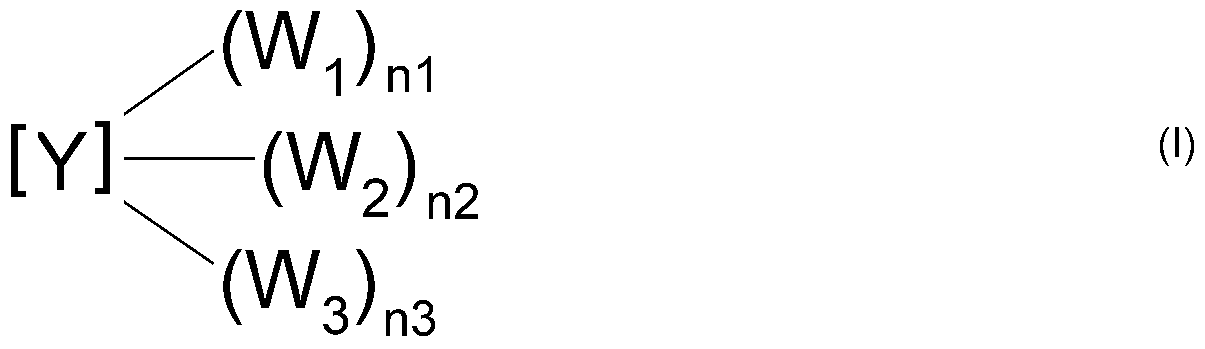
- the present invention provides a polycyclic organic compound of a general structural formula (I)
- Y is a predominantly planar polycyclic system being at least partially aromatic
- W 1 , W 2 , and W 3 are different groups providing solubility in an organic solvent
- sum (n1 +n2+n3) is 1 , 2, 3, 4, 5, 6, 7 or 8
- the polycyclic organic compound of the present invention is capable of forming supramolecules in the organic solvent, is substantially transparent for electromagnetic radiation in the visible spectral range.
- the present invention provides a solution comprising at least one polycyclic organic compound of a general structural formula (I)
- Y is a predominantly planar polycyclic system being at least partially aromatic
- W 1 , W 2 , and W 3 are different groups providing solubility in an organic solvent
- sum (n1 +n2+n3) is 1 , 2, 3, 4, 5, 6, 7 or 8
- Said polycyclic organic compound is capable of forming supramolecules in the organic solvent, and this compound is substantially transparent for electromagnetic radiation in the visible spectral range
- the solution of said compound is capable of forming a substantially transparent retardation layer in the visible spectral range.
- the present invention provides a compensation panel comprising at least one retardation layer being substantially transparent in the visible spectral range and comprising at least one polycyclic organic compound of a general structural formula (I):
- Y is a predominantly planar polycyclic system being at least partially aromatic
- W-i, W 2 , and W 3 are different groups providing solubility in an organic solvent
- sum n1 +n2+n3 is 1 , 2, 3, 4, 5, 6, 7 or - -
- Said polycyclic organic compound is capable of forming supramolecules in the organic solvent and this compound is substantially transparent for electromagnetic radiation in the visible spectral range.
- the polycyclic system Y is heterocyclic.
- the heteroatoms in the heterocyclic system are selected from the list comprising N, O and S
- the polycyclic system Y comprises at least one fragment selected from the list comprising furan, oxirane, 4H-pyran, 2/-/-chromene, benzo[£>]furan, 2H-pyran, thiophene, benzo[£>]th ⁇ ophene, parathiazine, pyrrole, pyrrolidine, pyrazole, imidazole, imidazoline, imidazolidine, pyrazolidine, pyrimidine, pyridine, piperazine, piperidine, pyrazine, indole, purine, benzirmidazole, quinoline, phenothiazine, morpholine, thiaziole, thiadiazole, and oxazole.
- the polycyclic system Y comprises at least one fragment representing an aromatic hydrocarbon
- the aromatic hydrocarbons are selected from the list comprising acenaphthene, acenaphthylene, acephenanthrylene, biphenylene and naphthalene
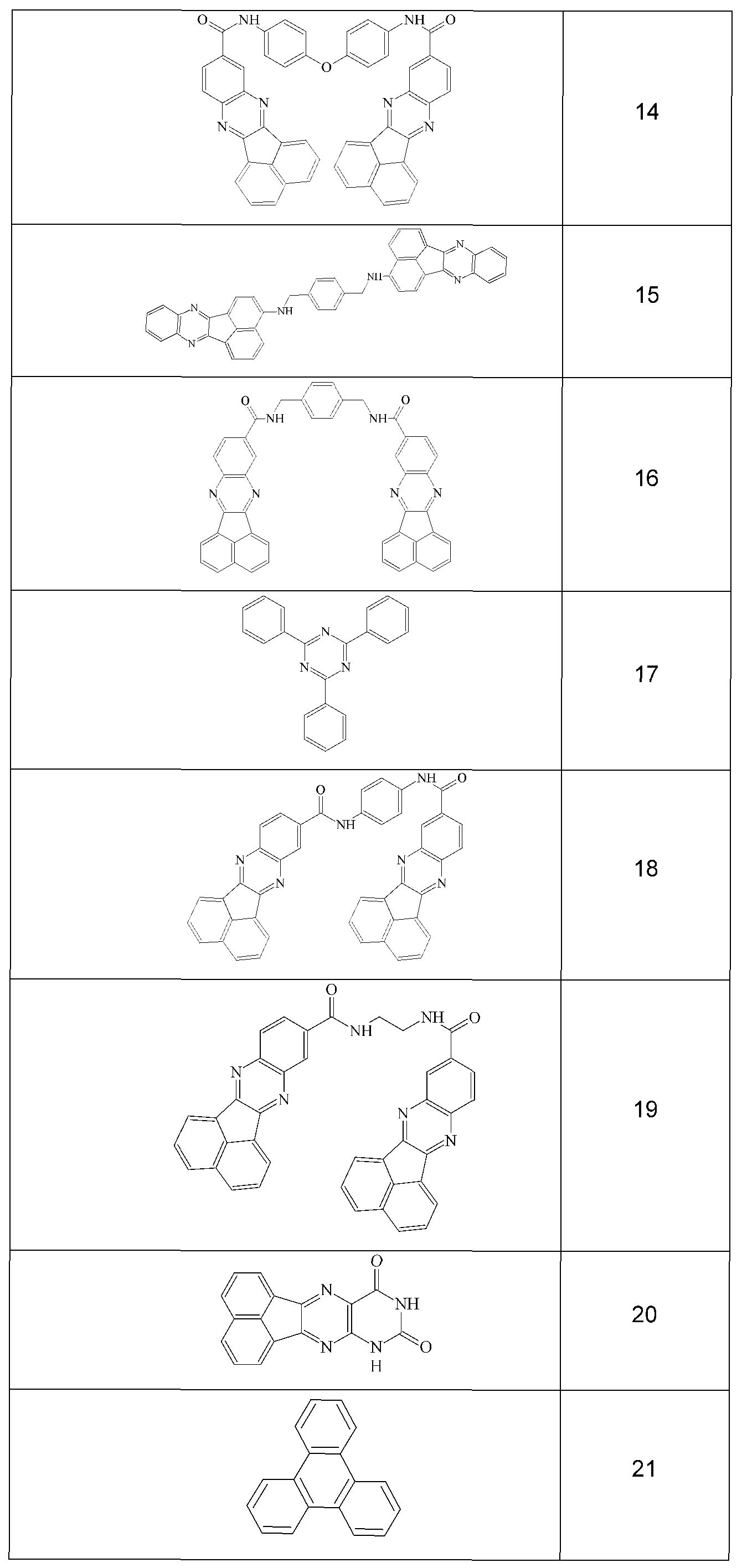
- the polycyclic system Y comprises fragments selected from the list comprising oligophenyl, imidazole, pyrazole, acenaphthene, triaizine, and having general structural formulas selected from structures 1-24 and shown in the Table 1.
- At least one of the W-groups providing solubility is selected from the list comprising carboxylic (COOH) group, linear and branched (C- ⁇ -C 2 o)alkyl, (C 2 -C 20 )alkenyl groups, and (C 2 -C 20 )alkinyl groups.
- said W-groups are connected with the polycyclic system Y via at least one covalent bond.
- alkyl groups form a cycle by connecting to the polycyclic system Y via at least two covalent bonds.
- supramolecules comprises molecular aggregations in the solution.
- the types of supramolecules include rod-like, lamellar supramolecules and the other types known by those skilled in the art.
- the bridging group A is selected from the list, comprising -C(O)- -C(O)O-, -C(O)-NH-, -(SO 2 )NH-, -0-, - CH 2 O-, -NH-, >N-, and any combination thereof
- said polycyclic systems may be capable of forming rod-like supramolecules via ⁇ - ⁇ -interaction.
- the rod-like supramolecules have interplanar spacing between the polycyclic systems in the range of approximately 3.1-3.7 A.
- the present invention also provides the solution as disclosed hereinabove.
- the polycyclic system Y is heterocyclic.
- the polycyclic system Y comprises at least one fragment selected from the list comprising furan, oxirane, 4H-pyran, 2/-/-chromene, benzo[£>]furan, 2H-pyran, thiophene, benzo[£>]thiophene, parathiazine, pyrrole, pyrrolidine, pyrazole, imidazole, imidazoline, irmidazolidine, pyrazohdine, pynmidine, pyridine, piperazine, piperidine, pyrazine, indole, purine, benzirmidazole, quinoline, phenothiazine, morpholine, thiaziole, thiadiazole, and oxazole.
- the polycyclic system Y comprises at least one fragment representing an aromatic hydrocarbon
- the aromatic hydrocarbons are selected from the list comprising acenaphthene, acenaphthylene, acephenanthrylene, biphenylene and naphthalene
- the polycyclic system Y is selected from the list comprising oligophenyl, imidazole, pyrazole, acenaphthene, triaizine, and having general structural formula selected from structures 1-24 and shown in the Table 1.
- At least one of W-groups providing solubility in the polycyclic organic compound is selected from the list comprising, carboxylic (COOH) group, linear and branched (Ci-C 2 o)alkyl, (C 2 -C 2 o)alkenyl, and (C 2 -C 20 )alkinyl
- said W-groups in the disclosed polycyclic organic compound are connected with the polycyclic system Y via at least one covalent bond.
- alkyl groups form a cycle by connecting to the polycyclic system Y via at least two covalent bonds. The hydrophobic interaction between alkyl chains improves solubility by forming supramolecules, and the intermolecular ⁇ - ⁇ -interactions of unsaturated bonds may play substantial role to ensure the formation of supramolecules in solutions of organic solvents
- At least one of the groups W of the polycyclic organic compounds is connected with the polycyclic system Y via a bridging group A
- the bridging group A is selected from the list, comprising -C(O)-, -C(O)O-, -C(O)-NH-, -(SO 2 )NH-, -0-, -CH 2 O-, -NH-, >N- and any combination thereof.
- the bridging group A is selected from the list, comprising -C(O)-, -C(O)O-, -C(O)-NH-, -(SO 2 )NH-, -O- -CH 2 O-, -NH- >N-, and any combination thereof.
- the organic solvent is selected from the list comprising ketones, carboxylic acids, hydrocarbons, cyclohydrocarbons, chlorohydrocarbons, alcohols, ethers, esters, and any combination thereof.
- the organic solvent is selected from the list comprising acetone, xylene, toluene, ethanol, methylcyclohexane, ethyl acetate, diethyl ether, octane, chloroform, methylenechloride, dichloroethane, trichloroethene, tetrachloroethene, carbon tetrachloride, 1 ,4-dioxane, tetrahydrofuran, pyridine, triethylamine, nitromethane, acetonitrile, dimethylformamide, dimethulsulfoxide, and any combination thereof.
- the solution is a lyotropic liquid crystal solution. In another embodiment of the present invention, the solution is an isotropic solution.
- the supramolecules are formed by interaction of at least two said different compounds of formula (I) In another embodiment of disclosed solution, the supramolecules are formed by interaction of the same compounds of the general structural formula (I).
- the solution further comprises additives, such as surfactants and/or plasticizers which are soluble in the organic solvents.
- additives and/or plasticizers are chosen from the compounds which do not damage the alignment of the solution
- the method of forming a retardation layer from the disclosed solution comprises the steps of: a) preparation of a solution of a polycyclic organic compound of the general structural formula (I) in an organic solvent.
- the polycyclic organic compound is capable of forming supramolecules in the solution, and said compound is substantially transparent in the visible spectral range; b) deposition of a layer of the solution on a substrate; and c) drying with formation of a retardation layer
- the method of preparation the disclosed compensation panel further comprises an applying of an external orienting action onto the layer of the solution in order to provide dominant orientation of supramolecules.
- the orienting action may take place after the step b) of the deposition of the layer of the solution. In another embodiment it may be simultaneously with the step b).
- the orienting action may be selected from the list comprising external mechanical, electromagnetic, other orienting actions known from the art and any combinations thereof
- the present invention also provides the compensation panel as disclosed hereinabove.
- the polycyclic system Y is heterocyclic.
- the heteroatoms in said polycyclic system are selected from the list comprising N, O and S
- the polycyclic system Y comprises at least one fragment selected from the list comprising furan, oxirane, 4/-/-pyran, 2H-chromene, benzo[£>]furan, 2/-/-pyran, thiophene, benzo[£>]thiophene, parathiazine, pyrrole, pyrrolidine, pyrazole, imidazole, imidazoline, imidazoline, pyrazolidine, py ⁇ midine, pyridine, piperazine, piperidine, pyrazine, indole, purine, benzimidazole, quinoline, phenothiazine, morpholine, thiaziole, thiadiazole, and oxazole
- the polycyclic system Y comprises at least one fragment representing an aromatic hydrocarbon.
- the aromatic hydrocarbons are selected from the list comprising acenaphthene, acenaphthylene, acephenanthrylene, biphenylene and naphthalene.
- the polycyclic system Y comprises fragments selected from the list comprising oligophenyl, imidazole, pyrazole, acenaphthene, triaizine, and having general structural formula selected from structures 1-24 in Table 1.
- the W-groups providing the solubility in the polycyclic organic compound are selected from the list comprising, carboxylic (COOH) group, linear and branched (C r C 2 o)alkyl, (C 2 -C 2 o)alkenyl, and (C 2 -C 2 o)alkinyl.
- at least one of the groups W of the polycyclic organic compound is connected with the polycyclic system Y via a bridging group A.
- the bridging group A is selected from the list, comprising -C(O)-, -C(O)O-, -C(O)-NH-, -(SO 2 )NH-, -O- -CH 2 O-, -NH-, >N-, and any combination thereof.
- the compensation panel comprises two or more retardation layers, wherein at least two of said layers comprise different polycyclic compounds of the general structural formula (I).
- the disclosed compensation panel further comprises a substrate.
- the substrate is transparent for electromagnetic radiation in the visible spectral range.
- the substrate may be made of polymer.
- the substrate may be made of glass.
- the compensation panel further comprises a transparent adhesive layer applied on top of the retardation layer.
- the compensation panel further comprises a protective coating applied on the adhesive transparent layer
- the retardation layer is at least partially crystalline.
- the retardation layer is a biaxial retardation layer of BA-type which is characterized by two in-plane refractive indices (nf and ns) corresponding to a fast principal axis and a slow principal axis respectively, and one refractive index (nn) in the normal direction which obey the following condition for electromagnetic radiation in the visible spectral range, ns > nn > nf.
- the retardation layer is a biaxial retardation layer of AC-type which is characterized by two in-plane refractive indices (nf and ns) corresponding to a fast principal axis and a slow principal axis respectively, and one refractive index (nn) in the normal direction which obey the following condition for electromagnetic radiation in the visible spectral range 1 ns > nf > nn
- the disclosed compensation panel comprises at least one retardation layer of a first type having slow and fast principal axes lying substantially in the plane of the first type retardation layer, and at least one retardation layer of a second type having an optical axis directed substantially perpendicular to the plane of the second type retardation layer.
- the retardation layer of the first type comprises rod-like supramolecules which are oriented with their longitudinal axes substantially parallel to the fast principal axis.
- the disclosed compensation panel comprises said rod-like supramolecules having approximately isotropic polarizability in planes which are perpendicular to their longitudinal axes.
- the retardation layer of the second type is a uniaxial retardation layer of negative C- type which is characterized by two in-plane refractive indices (nf an ⁇ ns) corresponding to a fast principal axis and a slow principal axis respectively, and one refractive index (nn) in the normal direction which obey the following condition for electromagnetic radiation in the visible spectral range 1 nf - ns > nn.
- the retardation layer of the second type comprises sheet-like supramolecules with their plane oriented substantially parallel to the surface of said retardation layer.
- Example 1 describes preparation of N,N'-(1-undecyl)dodecyl-5,11-d ⁇ hexylcoronene-2,3:8,9- tetracarboxydiimide, the predominantly planar polycyclic system of which is presented in Table 1 , structural formula 24.
- the synthetic procedure is shown in Scheme 1 and comprises six steps.
- N.N'-Dicyclohexyl-i y-dibromopeiylene-SA ⁇ .IO-tetracarboxydiimide was synthesized by reaction of 1 ,7-d ⁇ bromoperylene-3,4.9,10-tetracarboxyl ⁇ c dianhydride (30.0 g) with cyclohexylamine (18.6 mL) in N-methylpyrrolidone (390 mL) at -85 ° C.
- the yield of N,N'-d ⁇ cyclohexyl-1 ,7- dibromoperylene-3,4:9,10-tetracarboxydiimide was 30 g (77%).
- N,N'-Dicyclohexyl-5,11-d ⁇ hexylcoronene-2,3:8,9-tetracarboxydiim ⁇ de was synthesized by heating of N,N'-dicyclohexyl-1 ,7-d ⁇ (oct-1-ynyl)perylene-3,4.9,10-tetracarboxyd ⁇ mide (7.7 g) in toluene (400 mL) in the presence of 1 ,8-Diazabicyclo[5 4.0]undec-7-ene (0 6 ml) at 100-110° C for 20 hours.
- 5,1 i-dihexylcoronene ⁇ S' ⁇ . ⁇ -tetracarboxylic dianhydride was prepared by hydrolysis of N 1 N'- dicyclohexyl-5,11-dihexylcoronene-2,3:8,9-tetracarboxydiimide (6 4 g, 8 3 mmol) with Potassium ⁇ ⁇ hydroxide (7.0 g, 85%) in the mixture of tert-butanol (400 mL) and water (0.4 mL) at 85-90 0 C.
- the yield of 5,1 i-dihexylcoronene ⁇ .S. ⁇ . ⁇ -tetracarboxyhc dianhyd ⁇ de was 4.2 g (83%).
- reaction mixture was mixed with acetic acid (5 mL), centrifuged, solid was dissolved in chloroform (0 5 mL) which was washed with water and dried over sodium sulfate.
- Thin layer chromatography probe showed good formation of product with Rf 0 9 (eluent: Chloroform-Hexane- Ethylacetate-Methanol (100 50:0 3:0 1 by V)).
- the reaction mixture was added in small portions to acetic acid (500 mL) with simultaneous shaking.
- the orange-red suspension was kept for 3 hours with periodic shaking, then filtered off.
- the filter cake was washed with water (0.5 L), and then was shaken with water (0.5 L) and chloroform (250 mL) in a separator funnel.
- the organic layer was separated, washed with water (2x350 mL) and dried over sodium sulfate overnight. The evaporation resulted in 7.0 g of crude product.
- Example 2 describes preparation of a compensation panel with a retardation layer of C-type
- Coating liquid was prepared as 5% chloroform solution of N,N'-(1-undecyl)dodecyl-5,11- dihexylcoronene-2,3.8,9-tetracarboxyd ⁇ mide prepared according to Example 1.
- ITO-coated glass substrates were cleaned following the standard organic-based protocol comprising the steps of soaking in a liquid detergent for 5 minutes, ultrasonic washing with deionized water for 1 hour; drying with compressed air, ultrasonic bath with acetone for 10 min, washing in boiling - - trichloroethylene during 30 min, ultrasonic bath with acetone for 10 mm, washing in boiling isopropanol during 30 mm and further drying with compressed air.
- a layer of the coating liquid layer was deposited on the fresh treated substrates by Meyer rod technique.
- the thickness of the resultant retardation layer depends on the coating liquid concentration and Meyer rod gauge. The typical values are from 100 to 1000 nm.
- the samples were placed in the furnace and rapidly heated up to 23O 0 C. Then they were cooled down to room temperature at the rate of 5°C/min.
- the retardation layers were uniform with defect-free homogeneous area of several sq cm. as it is shown in Figure 5.
- Polarizing microscopy reveals specific for homeotropic molecular alignment textures.
- Example 3 describes synthesis of bisbenzimidazo[1 ',2':3,4; 1 ",2":5,6][1 ,3,5]triazino[1 ,2- a]benz ⁇ midazole-2,8,14-t ⁇ carboxylic acid, the predominantly planar polycyclic system of which is presented in Table 1 , structural formula 3 1
- reaction mixture was charged to a heat-resistant beaker and heated up to 150°C. After 1 5 hours a reaction mixture was cooled to room temperature. The solid material was triturated and charged to heat-resistant beaker and was further heated at 150 0 C for 1 5 hours. Then reaction mixture was dissolved in the boiling 1-1.5% aqueous solution of sodium hydroxide (1.5 L). Obtained solution was filtered from an undissolved solid, boiled with activated black carbon (BAU-A, 2 g) for 20-30 mm and filtered. Filtrate was acidified by concentrated hydrochloric acid till pH ⁇ 6. White precipitate was filtered, washed with water (100 rmL) and dried in desiccator under Phosphorous oxide in vacuo. Yield. 13.1 g (83 5%).
- Example 4 describes preparation of a solid optical retardation layer of negative C-type with bisbenzim ⁇ dazo[1 ',2':3,4; 1 ",2":5,6][1 ,3,5]t ⁇ az ⁇ no[1 ,2-a]benzim ⁇ dazole-2,8, 14-tricarboxyl ⁇ c acid prepared as described in Example 3
- the coatings were produced and optically characterized, as was described in Example 2.
- the obtained solid optical retardation layer is characterized by thickness equal to approximately 300 nm and the principle refractive indices which obey the following condition. n z ⁇ n y ⁇ n x .. Out-of-plane birefringence equals to 0 15.
- Example 5 describes preparation of 2,5,9-(dodecyn-1-yl)acenaphtho[1 ,2-b]qu ⁇ noxal ⁇ ne, the predominantly planar polycyclic system of which is presented in Table 1 , structural formula 4.
- the synthetic procedure is shown in Scheme 2 and comprises two steps. - -
- T ⁇ bromoacenaphtho[1 ,2-b]quinoxaline (49 g, 100 mmol) was mixed with PdCI 2 (PPh 3 ) 2 (3.7 g, 5 mol %) and CuI (4 g) in 100 ml of dry triethylamine under argon atmosphere.
- Example 6 describes preparation of 2,5,9-tris(decyloxy)acenaphtho[1 ,2-b]py ⁇ do[2,3-e]pyraz ⁇ ne, the predominantly planar polycyclic system of which is presented in Table 1 , structural formula 6.
- the synthetic procedure is shown in Scheme 3 and comprises two steps. - -
- Example 7 describes preparation of acenaphthoII ⁇ -bJpyrido ⁇ .S-eJpyrazine ⁇ . ⁇ .iO-tricarboxylic acid, the predominantly planar polycyclic system of which is presented in Table 1 , structural formula 7.
- the synthetic procedure is shown in Scheme 4 and consists of two steps
- Example 8 describes preparation of N,N,N-tris(3,5-b ⁇ s(octyloxy)phenyl)-1 ,3,5-triazine-2,4,6- t ⁇ amine, the predominantly planar polycyclic system of which is presented in Table 1 , structural formula 8.
- This example is also representative for synthesis of compounds possessing polycyclic aromatic systems with structural formulas 9 and 13, depicted in Table 1. The synthetic procedure is shown in Scheme 5 and consists of two steps
- N,N,N-tris(3,5-b ⁇ s(octyloxy)phenyl)-1 ,3,5-triazine-2,4,6-t ⁇ amine was isolated from the concentrated organic phase by column chromatography using hexane-ethylacetate mixture (9:1) as an eluent Yield' 102 2 g, 91 %
- Example 8 describes preparation of 9,9'-(1 ,4- phenyleneb ⁇ s(azaned ⁇ yl))bis(oxomethylene)d ⁇ acenaphtho-[1 ,2-b]qu ⁇ noxal ⁇ ne-2,5-dicarboxyl ⁇ c acid, the predominantly planar polycyclic system of which is presented in Table 1 , structural formula 18.
- This example is also representative for synthesis of compounds possessing polycyclic aromatic systems with structural formulas 11 , 14, 16, and 19, depicted in Table 1. The synthetic procedure is shown in Scheme 6 and consists of four steps.
- N,N'-(1 ,4-phenylene)bis(2,5-dimethylacenaphtho[1 ,2-b]quinoxaline-9-carboxamide) (36 2 g, 50 mmol) was added to mixture (100 ml_) of concentrated sulfuric acid and glacial acid (ratio 8:12) Then powder of chromium trioxide (35 g) was added slowly with a simultaneous cooling of reaction mixture. The mixture was stirred for 3 hours at room temperature Water (200 ml_) was added dropwise to the reaction mixture with cooling (20-40 0 C). Precipitate was filtered and washed with water and diluted hydrochloric acid (300 mL).
- Example 10 describes preparation of 2,4,6-tris(3,5-bis(dodecyloxy)phenyl)-1 ,3,5-triazine, the predominantly planar polycyclic system of which is presented in Table 1 , structural formula 10 The synthetic procedure is shown in Scheme 7 and consists of two steps.
- Example 11 describes preparation of 4,9-dioctyl-2,7-b ⁇ s(octyloxy)pyrene, the predominantly planar polycyclic system of which is presented in Table 1 , structural formula 22
- the synthetic procedure is shown in Scheme 8 and consists of four steps
- 4,9-dioctylpyrene-2,7-diol was prepared via standard procedure of f-butyldimethylsilyl protection removal with TBAF in THF.
- Example 12 describes preparation of chrysene-2,5,8-t ⁇ carboxylic acid, the predominantly planar polycyclic system of which is presented in Table 1 , structural formula 23 The synthetic procedure is shown in Scheme 9 and consists of three steps
- 2,5,8-trimethylchrysene was synthesized by the heating of 2-rmethyl-6-(2-(prop-1- ynyl)phenyl)naphthalene (13.5 g, 50 mmol) in toluene (700 rmL) in the presence of 1 ,8- Diazabicyclo[5 4.0]undec-7-ene (DBU) (91 2g, 60 mmol) at 100-110° C for 20 hours Yield' 9 72 g (54
- Example 13 describes preparation of 1 ,4-di(3,5-dioctyloxyphenyl)benzene, the predominantly planar polycyclic system of which is presented in Table 1 , structural formula 1.
- the synthetic procedure is shown in Scheme 10 and consists of two steps.
Landscapes
- Chemical & Material Sciences (AREA)
- Organic Chemistry (AREA)
- Chemical Kinetics & Catalysis (AREA)
- Polarising Elements (AREA)
- Heterocyclic Carbon Compounds Containing A Hetero Ring Having Oxygen Or Sulfur (AREA)
- Organic Low-Molecular-Weight Compounds And Preparation Thereof (AREA)
- Nitrogen Condensed Heterocyclic Rings (AREA)
- Plural Heterocyclic Compounds (AREA)
Abstract
This invention relates to polycyclic organic compounds of general structural formula (I): wherein Y is a predominantly planar polycyclic system being at least partially aromatic, W1, W2, and W3 are different groups providing solubility in an organic solvent, and sum (n1 +n2+n3) is 1, 2, 3, 4, 5, 6, 7 or 8. The polycyclic organic compounds are substantially transparent for electromagnetic radiation in the visible spectral range and are capable of forming supramolecules in the organic solvent.
Description
POLYCYCLIC ORGANIC COMPOUNDS, RETARDATION LAYER AND COMPENSATION
PANEL ON THEIR BASE
The present invention relates to organic chemistry, in particular, to polycyclic organic compounds, solution thereof and compensation panel comprising retardation layers based on these compounds. More specifically, the present invention is related to the optical compensators for liquid crystal displays
Optical compensators are used to alter the relative phase of polarized light passing through said compensators, and thus, are well suited for use in applications where control over the polarization is required. For example, optical compensators comprising at least one retardation layer are used to introduce a phase delay in incident light to correct the phase differences between two components of polarized light introduced by other optical components in a system.
One particularly important application of optical retardation layers is providing polarization compensation for liquid crystal display (LCD) panels.
LCD panels are widely used in watches and clocks, photographic cameras, technical instruments, computers, flat TV, projection screens, control panels and large area of information- providing devices. The information in many LCD panels is presented in the form of a row of numerals or characters, which are generated by a number of segmented electrodes arranged in a pattern. The segments are connected by individual leads to driving electronics, which applies a voltage to the appropriate combination of segments to display the desired information by controlling the light transmitted through the segments. Graphic information or television displays may be achieved by a matrix of pixels, which are connected by an X-Y sequential addressing scheme between two sets of perpendicular conductors More advanced addressing schemes use arrays of thin film transistors to control the drive voltage at the individual pixels. This scheme is applied predominantly to twisted nematic liquid crystal displays, but is also finding use in high performance versions of super twist nematic liquid crystal displays.
Ideal display should show equal contrast and colour rendering, while looking on them under different angles deviating from the normal observation direction. The different kinds of displays based on nematic liquid crystal, however, possess an angle dependence of the contrast. This is, at angles deviating from the normal observation direction, the contrast becomes lower and the visibility of the information is diminished. The materials commonly used in nematic LCDs are optically positively uniaxially birefringent, which means that an extraordinary refractive index ne is larger then the ordinary refractive index n0; Δn=ne-no>0. The visibility of the displays under oblique angles can be improved by using optical compensators with negative birefringence (Δn<0) Besides that, the loss of contrast is caused by light leaking through the black state pixel elements at large viewing angles In colour liquid crystal displays the leakage also causes severe colour shifts for both saturated and grey scale colours. These limitations are particularly important for displays used for the control panels in aircraft applications, where co-pilot viewing of the pilot's displays is important. It would be a significant improvement in the art to provide a liquid crystal display capable of presenting a high quality, high contrast image over a wide field of view The chemical compounds used for the compensators should be transparent in the working spectral wavelength range Most LCD devices are adapted for a human eye and for these devices the working range is a visible spectral range
The water-based retardation films are not always the optimal solution in some applications due to their low stability in highly humid conditions. Thus there is a need to provide new optical compensators with good environment stability and mechanical strength. The present invention provides overcoming the disadvantages mentioned above. Definitions of various terms used in the description and claims of the present invention are listed below.
The term "partially aromatic" refers to an aromatic conjugated system within a molecule
The term "optical axis" refers to a direction in which propagating light does not exhibit birefringence. The term "visible spectral range" refers to a spectral range having the lower boundary approximately equal to 400 nm, and upper boundary approximately equal to 700 nm.
The term "retardation layer" refers to an optical element that divides an incident monochromatic polarized light into components and introduces a relative retardance or phase shift between them
The term "retardance" of a retardation element refers to the just-mentioned relative retardance of phase shift "Quarter-wave plate" refers to a retardation element that has a constant retardance equal to 90° "Half-wave plate" refers to a retardation element that has a constant retardance equal to 180 °.
The term "compensation panel" refers to an optic device which includes retardation layer.
Types of plates in the compensation panel are closely connected to orientations of the principal axes of a particular permittivity tensor with respect to the natural coordinate frame of the plate. The natural xyz coordinate frame of the plate is chosen so that the z-axis is parallel to the normal direction and the xy plane coincides with the plate surface. Figure 1 (prior art) demonstrates a general case when the principal axes (A, B, C) of the permittivity tensor are arbitrarily oriented relative to the xyz frame.
Orientations of the principal axes can be characterized using three Euler's angles (θ, φ, ψ) which, together with the principal permittivity tensor components (εA, ε β, ε c), uniquely define different types of optical compensators (Figure 1 ). The case when all the principal components of the permittivity tensor have different values corresponds to a biaxial compensator, whereby the plate has two optical axes. For example, in case of εA < ε B < ε c, these optical axes are in the plane of C and A axes symmetrically on both sides from the C axis. In the uniaxial case with εA = ε B, there is a degenerate case when the two axes coincide, and the C axis is a single optical axis.
The zenith angle θ between the C axis and the z axis is important for the definitions of various compensator types. In the case of θ=0 there are several important types of retardation layers, which are most frequently used for compensation of LCD Hereinafter the x, y and z-axes of the laboratory frame have been chosen coinciding with A, B and C axes respectively. In the case the lowest and highest magnitudes of three principal values εA , ε B, and ε c of the dielectric permittivity tensor correspond to the A and B axes respectively, then εA< ε c < ε B, and two optical axes belong to the AB plane. This retardation layer is named "A8" or "BA" type plate (Fig. 2, prior art). A negative AB plate, when ε A - ε B < 0, is equivalent to a positive BA plate (formally replacing the order of the naming letters changes the sign of the dielectric permittivity difference: ε B - ε A > 0). There is a different case when two optical axes belong to the plane orthogonal to the plate surface. This case takes place if the lowest or highest magnitude of one of the principal permittivity
corresponds to the C-axis. For example, in the case of ε c < ε B < εA the retardation layer is named a negative CA or a positive A0 plate because two optical axes belong to the plane formed by A and C axes.
There are several important types of uniaxial retardation layers, which are most frequently used for compensation of LCD. A C-plate is defined by εA = ε B ≠ ε c. In this case, the optical axis coincides with the principal C axis In the case of εA = ε B < ε c the plate is called "positive C-plate" On the contrary, if εA = ε B > ε c, the plate is referred to as a "negative C-plate" In these two cases the C-axis also corresponds to an extraordinary refractive index Figure 3 (prior art) shows an orientation of the principal axes and values of a particular permittivity tensor with respect to the natural coordinate frame of a positive (a) and a negative (b) C-plate.
In the case of εA ≠ε B = ε c the A-pπncipal axis is the optical axis and the plate is named "A-plate". In the case of εA >ε B = ε c the plate is named "positive A-plate" (Figure 4a, prior art). And in the case of ε A <ε B = ε c the plate is named "negative A-plate" (Figure 4b, prior art)
In a general case the permittivity tensor components (εΛ, ε β, and ε c) are complex values. For uniaxial media the principal permittivity tensor components (ε A, ε B, and ε c), the principal refraction indices (nA, nB, and nc), and the principal absorption coefficients (kA, kB, and kc) meet the following relation:
S1 = where i e {A, B, C) .

The given relation can also be applied to non-conductive biaxial media. In case of conductive biaxial materials the given relation is not valid if the orientation of principal axes of the conductivity tensor is different of that for the dielectric tensor.
The phase speed of an electromagnetic wave propagating along the normal of the anisotropic plate depends on orientation of the wave polarization vector with respect to the principal axes If the electric field vector of an electromagnetic wave oscillates along the principal axis of the lowest refractive index, then the phase speed of the wave is highest The corresponding principal axis can be designated as "fast axis", and the refractive index as "nf In a similar way, the largest refractive index defines the "slow" principal axis, and the corresponding designation for the refractive index is "ns".
Thus the retardation layer may be characterized by two in-plane refractive indices corresponding to a fast principal axis and a slow principal axis (nf and ns), and by one refractive index (nn) in the normal direction. In the case of a biaxial plate all refractive indices nf, ns and nn have different values. As discussed earlier, BA- and Ac-plates are biaxial plates. The refractive indices obey the condition ns > nn > nf for a BA -plate, and the condition ns > nf > nn for a positive Ac -plate. A- and C-plates are uniaxial plates. The refractive indices of a negative A-plate obey the condition, nn = ns > nf. A-plate can be characterized by the retardation parameter RA= d (ns - nή, where d is thickness of the retardation layer. In the case of a C-plate there is no in-plane "fast" or "slow" axis (nf-ns) The refractive indices of a negative A-plate obey the condition: nf = ns > nn C-plate can be characterized by the retardation parameter R0= d |ns - nn| = d \nf- nn\, where d is thickness of the retardation layer The subject of the invention is illustrated by the following Figures, of which: Figures 1 to 4 are described hereinabove as illustrations to prior art Figure 5 is a sample of compensation panel with a retardation layer of C-type according to present invention
- -
A more complete assessment of the present invention and its advantages will be readily achieved as the same becomes better understood by reference to the following detailed description, considered in connection with the accompanying examples and detailed specification, all of which forms a part of the disclosure.
In a first aspect, the present invention provides a polycyclic organic compound of a general structural formula (I)

wherein Y is a predominantly planar polycyclic system being at least partially aromatic, W1, W2, and W3 are different groups providing solubility in an organic solvent, and sum (n1 +n2+n3) is 1 , 2, 3, 4, 5, 6, 7 or 8 The polycyclic organic compound of the present invention is capable of forming supramolecules in the organic solvent, is substantially transparent for electromagnetic radiation in the visible spectral range.
In a second aspect, the present invention provides a solution comprising at least one polycyclic organic compound of a general structural formula (I)
In a third aspect, the present invention provides a compensation panel comprising at least one retardation layer being substantially transparent in the visible spectral range and comprising at least one polycyclic organic compound of a general structural formula (I):

8. Said polycyclic organic compound is capable of forming supramolecules in the organic solvent and this compound is substantially transparent for electromagnetic radiation in the visible spectral range.
In one embodiment of the disclosed polycyclic organic compound, the polycyclic system Y is heterocyclic. In another embodiment the heteroatoms in the heterocyclic system are selected from the list comprising N, O and S In still another embodiment of the disclosed polycyclic organic compound, the polycyclic system Y comprises at least one fragment selected from the list comprising furan, oxirane, 4H-pyran, 2/-/-chromene, benzo[£>]furan, 2H-pyran, thiophene, benzo[£>]thιophene, parathiazine, pyrrole, pyrrolidine, pyrazole, imidazole, imidazoline, imidazolidine, pyrazolidine, pyrimidine, pyridine, piperazine, piperidine, pyrazine, indole, purine, benzirmidazole, quinoline, phenothiazine, morpholine, thiaziole, thiadiazole, and oxazole.
In yet another embodiment of the disclosed polycyclic organic compound, the polycyclic system Y comprises at least one fragment representing an aromatic hydrocarbon In another embodiment, the aromatic hydrocarbons are selected from the list comprising acenaphthene, acenaphthylene, acephenanthrylene, biphenylene and naphthalene
In still another embodiment, the polycyclic system Y comprises fragments selected from the list comprising oligophenyl, imidazole, pyrazole, acenaphthene, triaizine, and having general structural formulas selected from structures 1-24 and shown in the Table 1.
Table 1 Examples of polvcvclic systems Y with polvcvclic aromatic hydrocarbon, imidazole, pyrazole and triaizine fragments



In one embodiment of the disclosed polycyclic organic compound, at least one of the W-groups providing solubility is selected from the list comprising carboxylic (COOH) group, linear and branched (C-ι-C2o)alkyl, (C2-C20)alkenyl groups, and (C2-C20)alkinyl groups. In one embodiment, said W-groups are connected with the polycyclic system Y via at least one covalent bond. In still another embodiment, alkyl groups form a cycle by connecting to the polycyclic system Y via at least two covalent bonds. The hydrophobic interaction between alkyl chains improves solubility by forming supramolecules, and the intermolecular π-π-interactions of unsaturated bonds may play substantial role to ensure the formation of supramolecules in solutions of organic solvents. Hereinafter the term supramolecules comprises molecular aggregations in the solution. The types of supramolecules include rod-like, lamellar supramolecules and the other types known by those skilled in the art.
In another embodiment of the disclosed polycyclic organic compound, at least one of the groups W is connected with the polycyclic system Y via a bridging group A In yet another embodiment, the bridging group A is selected from the list, comprising -C(O)- -C(O)O-, -C(O)-NH-, -(SO2)NH-, -0-, - CH2O-, -NH-, >N-, and any combination thereof
In one embodiment of the disclosed polycyclic organic compound, said polycyclic systems may be capable of forming rod-like supramolecules via π-π-interaction. In another embodiment of the disclosed polycyclic organic compound, the rod-like supramolecules have interplanar spacing between the polycyclic systems in the range of approximately 3.1-3.7 A. The present invention also provides the solution as disclosed hereinabove. In another embodiment of the disclosed solution, the polycyclic system Y is heterocyclic. The heteroatoms in said polycyclic system are selected from the list comprising N, O and S In still another embodiment of the invention, the polycyclic system Y comprises at least one fragment selected from the list comprising furan, oxirane, 4H-pyran, 2/-/-chromene, benzo[£>]furan, 2H-pyran, thiophene, benzo[£>]thiophene, parathiazine, pyrrole, pyrrolidine, pyrazole, imidazole, imidazoline, irmidazolidine, pyrazohdine, pynmidine, pyridine, piperazine, piperidine, pyrazine, indole, purine, benzirmidazole, quinoline, phenothiazine, morpholine, thiaziole, thiadiazole, and oxazole.
In another embodiment of the disclosed solution, the polycyclic system Y comprises at least one fragment representing an aromatic hydrocarbon In still another embodiment of the present invention, the aromatic hydrocarbons are selected from the list comprising acenaphthene, acenaphthylene, acephenanthrylene, biphenylene and naphthalene
In yet another embodiment of the disclosed solution, the polycyclic system Y is selected from the list comprising oligophenyl, imidazole, pyrazole, acenaphthene, triaizine, and having general structural formula selected from structures 1-24 and shown in the Table 1.
In one embodiment of the disclosed solution, at least one of W-groups providing solubility in the polycyclic organic compound is selected from the list comprising, carboxylic (COOH) group, linear and branched (Ci-C2o)alkyl, (C2-C2o)alkenyl, and (C2-C20)alkinyl In one embodiment, said W-groups in the disclosed polycyclic organic compound are connected with the polycyclic system Y via at least one covalent bond. In still another embodiment, alkyl groups form a cycle by connecting to the polycyclic system Y via at least two covalent bonds. The hydrophobic interaction between alkyl chains improves solubility by forming supramolecules, and the intermolecular π-π-interactions of unsaturated bonds may play substantial role to ensure the formation of supramolecules in solutions of organic solvents
In another embodiment of the disclosed solution, at least one of the groups W of the polycyclic organic compounds is connected with the polycyclic system Y via a bridging group A In yet another embodiment, the bridging group A is selected from the list, comprising -C(O)-, -C(O)O-, -C(O)-NH-, -(SO2)NH-, -0-, -CH2O-, -NH-, >N- and any combination thereof.
In the other embodiment of the disclosed solution, at least one of the groups W is connected with the polycyclic system Y via a bridging group A In yet another embodiment, the bridging group A is selected from the list, comprising -C(O)-, -C(O)O-, -C(O)-NH-, -(SO2)NH-, -O- -CH2O-, -NH- >N-, and any combination thereof.
In yet another embodiment of the disclosed solution, the organic solvent is selected from the list comprising ketones, carboxylic acids, hydrocarbons, cyclohydrocarbons, chlorohydrocarbons, alcohols, ethers, esters, and any combination thereof. In still another embodiment of the disclosed solution, the organic solvent is selected from the list comprising acetone, xylene, toluene, ethanol, methylcyclohexane, ethyl acetate, diethyl ether, octane, chloroform, methylenechloride, dichloroethane, trichloroethene, tetrachloroethene, carbon tetrachloride, 1 ,4-dioxane, tetrahydrofuran, pyridine, triethylamine, nitromethane, acetonitrile, dimethylformamide, dimethulsulfoxide, and any combination thereof.
In one embodiment of the present invention, the solution is a lyotropic liquid crystal solution. In another embodiment of the present invention, the solution is an isotropic solution.
In one embodiment of the disclosed solution, the supramolecules are formed by interaction of at least two said different compounds of formula (I) In another embodiment of disclosed solution, the supramolecules are formed by interaction of the same compounds of the general structural formula (I).
In another embodiment of the invention, the solution further comprises additives, such as surfactants and/or plasticizers which are soluble in the organic solvents. The additives and/or plasticizers are chosen from the compounds which do not damage the alignment of the solution
The method of forming a retardation layer from the disclosed solution comprises the steps of: a) preparation of a solution of a polycyclic organic compound of the general structural formula (I) in an organic solvent. The polycyclic organic compound is capable of forming supramolecules in the solution, and said compound is substantially transparent in the visible spectral range; b) deposition of a layer of the solution on a substrate; and c) drying with formation of a retardation layer In one embodiment of the present invention, the method of preparation the disclosed compensation panel further comprises an
applying of an external orienting action onto the layer of the solution in order to provide dominant orientation of supramolecules. The orienting action may take place after the step b) of the deposition of the layer of the solution. In another embodiment it may be simultaneously with the step b). The orienting action may be selected from the list comprising external mechanical, electromagnetic, other orienting actions known from the art and any combinations thereof
The present invention also provides the compensation panel as disclosed hereinabove.
In one embodiment of the compensation panel the polycyclic system Y is heterocyclic. The heteroatoms in said polycyclic system are selected from the list comprising N, O and S In another embodiment of the compensation panel, the polycyclic system Y comprises at least one fragment selected from the list comprising furan, oxirane, 4/-/-pyran, 2H-chromene, benzo[£>]furan, 2/-/-pyran, thiophene, benzo[£>]thiophene, parathiazine, pyrrole, pyrrolidine, pyrazole, imidazole, imidazoline, imidazoline, pyrazolidine, pyπmidine, pyridine, piperazine, piperidine, pyrazine, indole, purine, benzimidazole, quinoline, phenothiazine, morpholine, thiaziole, thiadiazole, and oxazole
In still another embodiment of the disclosed compensation panel the polycyclic system Y comprises at least one fragment representing an aromatic hydrocarbon. In yet another embodiment, the aromatic hydrocarbons are selected from the list comprising acenaphthene, acenaphthylene, acephenanthrylene, biphenylene and naphthalene.
In another embodiment of the disclosed compensation panel the polycyclic system Y comprises fragments selected from the list comprising oligophenyl, imidazole, pyrazole, acenaphthene, triaizine, and having general structural formula selected from structures 1-24 in Table 1.
In one embodiment of the disclosed compensation panel the W-groups providing the solubility in the polycyclic organic compound are selected from the list comprising, carboxylic (COOH) group, linear and branched (CrC2o)alkyl, (C2-C2o)alkenyl, and (C2-C2o)alkinyl. In another embodiment of the disclosed compensation panel, at least one of the groups W of the polycyclic organic compound is connected with the polycyclic system Y via a bridging group A. In yet another embodiment, the bridging group A is selected from the list, comprising -C(O)-, -C(O)O-, -C(O)-NH-, -(SO2)NH-, -O- -CH2O-, -NH-, >N-, and any combination thereof.
In another embodiment of the invention, the compensation panel comprises two or more retardation layers, wherein at least two of said layers comprise different polycyclic compounds of the general structural formula (I).
In one embodiment of the present invention, the disclosed compensation panel further comprises a substrate. In another embodiment of the disclosed compensation panel, the substrate is transparent for electromagnetic radiation in the visible spectral range. In still another embodiment of disclosed compensation panel the substrate may be made of polymer. In yet another embodiment, the substrate may be made of glass. For the reflective LCDs the substrate may be made of foil having specular or diffuse reflecting surface. In one embodiment, the compensation panel further comprises a transparent adhesive layer applied on top of the retardation layer. In yet another embodiment, the compensation panel further comprises a protective coating applied on the adhesive transparent layer
In one embodiment of the compensation panel, the retardation layer is at least partially crystalline.
In yet another embodiment of the disclosed compensation panel, the retardation layer is a biaxial retardation layer of BA-type which is characterized by two in-plane refractive indices (nf and ns)
corresponding to a fast principal axis and a slow principal axis respectively, and one refractive index (nn) in the normal direction which obey the following condition for electromagnetic radiation in the visible spectral range, ns > nn > nf.
In still another embodiment of the disclosed compensation panel, the retardation layer is a biaxial retardation layer of AC-type which is characterized by two in-plane refractive indices (nf and ns) corresponding to a fast principal axis and a slow principal axis respectively, and one refractive index (nn) in the normal direction which obey the following condition for electromagnetic radiation in the visible spectral range1 ns > nf > nn
In one embodiment of the present invention, the disclosed compensation panel comprises at least one retardation layer of a first type having slow and fast principal axes lying substantially in the plane of the first type retardation layer, and at least one retardation layer of a second type having an optical axis directed substantially perpendicular to the plane of the second type retardation layer.
In still another embodiment of the disclosed compensation panel, the retardation layer of the first type is a uniaxial retardation layer of negative A-type which is characterized by two in-plane refractive indices (nf and ns) corresponding to a fast principal axis and a slow principal axis respectively, and one refractive index (nn) in the normal direction which obey the following condition for electromagnetic radiation in the visible spectral range: nn = ns > nf.
In one embodiment of the disclosed compensation panel, the retardation layer of the first type comprises rod-like supramolecules which are oriented with their longitudinal axes substantially parallel to the fast principal axis. In another embodiment of the present invention, the disclosed compensation panel comprises said rod-like supramolecules having approximately isotropic polarizability in planes which are perpendicular to their longitudinal axes In still another embodiment of the disclosed compensation panel, the retardation layer of the second type is a uniaxial retardation layer of negative C- type which is characterized by two in-plane refractive indices (nf anό ns) corresponding to a fast principal axis and a slow principal axis respectively, and one refractive index (nn) in the normal direction which obey the following condition for electromagnetic radiation in the visible spectral range1 nf - ns > nn. In yet another embodiment of the disclosed compensation panel, the retardation layer of the second type comprises sheet-like supramolecules with their plane oriented substantially parallel to the surface of said retardation layer The following examples are detailed descriptions of methods of preparation and use of certain compounds of the present invention. The examples are presented to illustrate the embodiments of the invention and are not intended as a restriction on the scope of the invention.
It should be understood that the scope of the invention in not limited to these specific structures as many other variations with different W-groups can be readily obtained using the provided procedures. The following examples describing detailed preparation of the retardation layer and compensation panel are included for the illustration and the person skilled in the art can obtain the retardation layers and compensation panels with any other compound of the present invention
In the following examples, all the percents are the weight percents and all the temperatures are in the centigrade
EXAMPLE 1
Example 1 describes preparation of N,N'-(1-undecyl)dodecyl-5,11-dιhexylcoronene-2,3:8,9- tetracarboxydiimide, the predominantly planar polycyclic system of which is presented in Table 1 , structural formula 24. The synthetic procedure is shown in Scheme 1 and comprises six steps.
Bi Br
O . — , O O O NH2 O O
Br2, 12
O >=! O N- ~ + 2 ,rL8M,14 [Pd]
H2SO4 U
O — O O O O O
Br Br
-CH3
^CH3
—
O O O — : — . O
^ DBU
-N N — KOH _
^N =! =! N-
O — , — O O — ; O
— H3C-
H1C- CH3
—
 CH3
CH3
Scheme 1
Commercially available Perylene-3,4.9,10-tetracarboxylιc dianhydπde (100.0 g, 0.255 mol) was brominated with mixture of bromine (29 rmL) and Iodine (2.38 g) in 100% sulfuric acid (845 mL) at.~ 85° C The yield of 1 ,7-dibromoperylene-3,4-9,10-tetracarboxylic dianhydride was 90 g (64%)
Analysis: calculated' C24H6Br2O6, C 52.40, H 1.10, Br 29 05, O 17.45 %; found: C 52 29, H, 1.07, Br 28, 79 %. Absorption spectrum (9.82x10⁵ M solution in 93% sulfuric acid)- 405 (9572), 516 (27892), 553 (37769).
N.N'-Dicyclohexyl-i y-dibromopeiylene-SAΘ.IO-tetracarboxydiimide was synthesized by reaction of 1 ,7-dιbromoperylene-3,4.9,10-tetracarboxylιc dianhydride (30.0 g) with cyclohexylamine (18.6 mL) in N-methylpyrrolidone (390 mL) at -85 ° C. The yield of N,N'-dιcyclohexyl-1 ,7- dibromoperylene-3,4:9,10-tetracarboxydiimide was 30 g (77%).
N.N'-Dicyclohexyl-I J-di^ct-i-ynyOperylene-S^ Θ.IO-tetracarboxydiimide by Sonogashira reaction: N.N'-dicyclohexyl-I J-dibromperylene-S^ Θ.IO-tetracarboxydiimide (24.7 g) and octyne-1 (15 2 g) in the presence of bis(triphenylphosphine)palladium(ll) chloride (2.42 g), triphenylphospine (0 9 g),and copper(l) iodide (0.66 g). The yield of N.N'-dicyclohexyl-i y-dKoct-i-ynyOperylene-SAΘ.IO- tetracarboxydiimide was 15.7 g (60 %).
N,N'-Dicyclohexyl-5,11-dιhexylcoronene-2,3:8,9-tetracarboxydiimιde was synthesized by heating of N,N'-dicyclohexyl-1 ,7-dι(oct-1-ynyl)perylene-3,4.9,10-tetracarboxydιιmide (7.7 g) in toluene (400 mL) in the presence of 1 ,8-Diazabicyclo[5 4.0]undec-7-ene (0 6 ml) at 100-110° C for 20 hours.
5,1 i-dihexylcoronene^S'δ.θ-tetracarboxylic dianhydride was prepared by hydrolysis of N1N'- dicyclohexyl-5,11-dihexylcoronene-2,3:8,9-tetracarboxydiimide (6 4 g, 8 3 mmol) with Potassium
~ ~ hydroxide (7.0 g, 85%) in the mixture of tert-butanol (400 mL) and water (0.4 mL) at 85-900C. The yield of 5,1 i-dihexylcoronene^.S.δ.θ-tetracarboxyhc dianhydπde was 4.2 g (83%).
N,N'-(1-undecyl)dodecyl-5,11-dιhexylcoronene-2,3:8,9-tetracarboxydiimιde by the reaction of 5,11-di(hexyl)coronene-2,3:8,9-tetracarboxylic dianhydride with 12-tricosanamine
5,11-di(hexyl)coronene-2,3l8,9-tetracarboxylic dianhydride (3 44 g), 12-tricosanamine (7.38 g), benzoic acid (45 mg) and 3-chlorophenol (15 mL) was evacuated and saturated with argon two times at room temperature and 2 times at 1000C The reaction mixture was agitated at ~140°C for 1 hour and 160-165°C for 20 hours in a flow of argon. After that the reaction mixture was agitated at ~100°C and was vacuumed at 10 mm Hg for half an hour. Then apparatus was filled with argon once again and heating was continued for the next 24 hours.
A drop of reaction mixture was mixed with acetic acid (5 mL), centrifuged, solid was dissolved in chloroform (0 5 mL) which was washed with water and dried over sodium sulfate. Thin layer chromatography probe showed good formation of product with Rf 0 9 (eluent: Chloroform-Hexane- Ethylacetate-Methanol (100 50:0 3:0 1 by V)).
The reaction mixture was added in small portions to acetic acid (500 mL) with simultaneous shaking. The orange-red suspension was kept for 3 hours with periodic shaking, then filtered off. The filter cake was washed with water (0.5 L), and then was shaken with water (0.5 L) and chloroform (250 mL) in a separator funnel. The organic layer was separated, washed with water (2x350 mL) and dried over sodium sulfate overnight. The evaporation resulted in 7.0 g of crude product.
Column chromatography was carried out using exactly tuned eluent mixture1 chloroform (700 mL), petroleum ether (2 L), ethylacetate (0 6 mL) and methanol (0 2).
Column chromatography was carried out using column1 I = 20, d = 7 cm Elution of orange fraction and evaporation resulted in orange soft solid material, which was dissolved in chloroform (25 mL) and added slowly to methanol (400 mL) with agitation. The soft precipitate was dried on air overnight, then in vacuum (15 mm Hg) at mild heating (35°) for 5 hours. The yield of preparation of N1N'- (1-undecyl)dodecyl-5,11-dιhexylcoronene-2,3:8,9-tetracarboxydiimιde was 5.0 g (70%).
EXAMPLE 2 Example 2 describes preparation of a compensation panel with a retardation layer of C-type
Coating liquid was prepared as 5% chloroform solution of N,N'-(1-undecyl)dodecyl-5,11- dihexylcoronene-2,3.8,9-tetracarboxydιιmide prepared according to Example 1.
O
H1C-(CH,),,, — (CH2)K -CH ,
: N = >=< N
H1C-(CH,),,, — (CHj)10-CH,
O ; . Q
An ITO-coated glass substrates were cleaned following the standard organic-based protocol comprising the steps of soaking in a liquid detergent for 5 minutes, ultrasonic washing with deionized water for 1 hour; drying with compressed air, ultrasonic bath with acetone for 10 min, washing in boiling
- - trichloroethylene during 30 min, ultrasonic bath with acetone for 10 mm, washing in boiling isopropanol during 30 mm and further drying with compressed air.
A layer of the coating liquid layer was deposited on the fresh treated substrates by Meyer rod technique. The thickness of the resultant retardation layer depends on the coating liquid concentration and Meyer rod gauge. The typical values are from 100 to 1000 nm.
The samples were placed in the furnace and rapidly heated up to 23O0C. Then they were cooled down to room temperature at the rate of 5°C/min.
The retardation layers were uniform with defect-free homogeneous area of several sq cm. as it is shown in Figure 5.
Polarizing microscopy reveals specific for homeotropic molecular alignment textures. Anisotropy of refractive indices in transparency spectral region is measured to be nf- nn = 0.3 {nf = ns)
EXAMPLE 3
Example 3 describes synthesis of bisbenzimidazo[1 ',2':3,4; 1 ",2":5,6][1 ,3,5]triazino[1 ,2- a]benzιmidazole-2,8,14-tπcarboxylic acid, the predominantly planar polycyclic system of which is presented in Table 1 , structural formula 31

A Synthesis of 5-methyl-1 ,3-dihydro-2/-/-benzimidazol-2-one 4-Methyl-1 ,2-phenylendiamine dihydrocloride (20 75 g, 106 mmol) was grinded with urea (7 64 g,
127 mmol) The mixture was charged to a heat-resistant beaker and heated up to 150°C. After 1 5 hours a reaction mixture was cooled to room temperature. The solid material was triturated and charged to heat-resistant beaker and was further heated at 1500C for 1 5 hours. Then reaction mixture was dissolved in the boiling 1-1.5% aqueous solution of sodium hydroxide (1.5 L). Obtained solution was filtered from an undissolved solid, boiled with activated black carbon (BAU-A, 2 g) for 20-30 mm and filtered. Filtrate was acidified by concentrated hydrochloric acid till pH ~ 6. White precipitate was filtered, washed with water (100 rmL) and dried in desiccator under Phosphorous oxide in vacuo. Yield. 13.1 g (83 5%).
B. Synthesis of 2-chloro-6-methyl-1 H-benzimidazole 5-Methyl-1 ,3-dιhydro-2H-benzimιdazol-2-one (13.1 g, 88.5 mmol) and phosphorus oxychloride
(130 rmL, freshly distillated) was charged into three-neck round-bottom flask. The mixture was heated up to boiling point till homogeneous solution was formed. After that the dried hydrogen chloride was bubbled through inlet gas-pipe into the reaction mixture. The mixture was boiled for 15 hours. Excess of
phosphorus oxychloride was distillated in vacuo. Mixture of ice and water (250 ml_) was added to residue. The obtained suspension was cooled to room temperature and filtered. Filtrate was alkalinized by aqueous ammonia solution till pH 8, cooled by cold water and filtered crude 2-chloro-6-methyl-1H- benzimidazole. White powder was crystallized from aqueous methanol (water-methanol: 1.1 , 200 mL), washed by aqueous methanol and dried in desiccator under Phosphorous oxide in vacuo. Yield. 8.17 g (55 %).
C. Synthesis of 2,8,14-Trimethyl-bisbenzimidazof1 ',2'-3,4;1 ",2"-5,6lF1 ,3,5ltriazinof1 , 2- albenzimidazole
2-Chloro-6-methyl-1H-benzimidazole (2.7 g, 16.2 mmol) was charged into round-bottom flask and heated up to 200-2050C for about 1 hour. Reaction mixture was cooled to room temperature. Solid material (2.2 g) was dissolved in the boiling dioxane (70 mL), resulted solution was cooled to room temperature. Solution was filtered, filter was washed by dioxane (25 mL) and washing dioxane was combined with main solution. Water (40 mL) was added dropwise to obtained solution. Precipitate was filtered, washed with acetone and dried in vacuo under Phosphorous oxide at about 7O 0C. Yield. 1.16 g (54%)
D. Synthesis of BisbenzimidazoH ',2' 3,4; 1 ", 2" 5,61H ,3,51triazino[1 ,2-a1benzimidazole-2,8,14- tπcarboxylic acid
2,8,14-Trimethyl-bisbenzimidazo[1 ',2':3,4; 1 ",2":5,6][1 ,3,5]triazino[1 ,2-a]benzimidazole(1.03 g, 2.6 mmol) was added to mixture (20 mL) of concentrated sulfuric acid and glacial acid (ratio 8:12). Then powder of chromium trioxide (3 5 g) was added slowly with cooling of reaction mixture. The mixture was stirred for 3 hours at room temperature Water (20 mL) was added dropwise to the reaction mixture with cooling (20-400C) Precipitate was filtered and washed with big volume of water and diluted hydrogen chloride solution (30 mL) additionally. Then precipitate was dried in vacuo under Phosphorous oxide. Yield. 0.72 g (57.6%).
EXAMPLE 4
Example 4 describes preparation of a solid optical retardation layer of negative C-type with bisbenzimιdazo[1 ',2':3,4; 1 ",2":5,6][1 ,3,5]tπazιno[1 ,2-a]benzimιdazole-2,8, 14-tricarboxylιc acid prepared as described in Example 3
1 g of bisbenzimιdazo[1 ',2':3,4; 1 ",2":5,6][1 ,3,5]tπazιno[1 ,2-a]benzimιdazole-2,8, 14-tricarboxylιc acid was dissolved in 9 g of dimethylsulfoxide. The suspension was mixed with a magnet stirrer till complete dissolution.
The coatings were produced and optically characterized, as was described in Example 2. The obtained solid optical retardation layer is characterized by thickness equal to approximately 300 nm and the principle refractive indices which obey the following condition. nz < ny ∞ nx.. Out-of-plane birefringence equals to 0 15.
EXAMPLE 5 Example 5 describes preparation of 2,5,9-(dodecyn-1-yl)acenaphtho[1 ,2-b]quιnoxalιne, the predominantly planar polycyclic system of which is presented in Table 1 , structural formula 4. The synthetic procedure is shown in Scheme 2 and comprises two steps.
- -

Scheme 2.
A. Synthesis of 2,5,9-tribromoacenaphtho[1 ,2-b1quιnoxalιne.
1-bromo-3,4-dιaminobenzene (18.7 g, 100 mmol) was added to a suspension of 4,7- dibromoacenaphthenequinone (34 g) in acetic acid (350 ml). The reaction mixture was refluxed for 12 hours The solid was separated, washed with acetic acid (80 ml) and dried at 120 0C for 3 hours to yield 36 26 g (74 %) of 2,5,9-tribromoacenaphtho[1 ,2-b]quinoxaline B Synthesis of 2,5,9-(dodecyn-1-yl)acenaphtho[1 ,2-b1quinoxaline.
Tπbromoacenaphtho[1 ,2-b]quinoxaline (49 g, 100 mmol) was mixed with PdCI2(PPh3)2 (3.7 g, 5 mol %) and CuI (4 g) in 100 ml of dry triethylamine under argon atmosphere. Dodecyne-1 (66 g, 400 mmol) was added and the mixture was stirred at 65 0C overnight The solvent was removed in vacuo, the residue was dissolved in ethylacetate and washed successively with saturated solutions of NH4CI and NaCI 2,5,9-(dodecyn-1-yl)acenaphtho[1 ,2-b]quinoxaline was isolated from the concentrated organic phase by column chromatography using hexane-ethylacetate mixture (9 1 ) as an eluent. Yield: 63.49 g, 85%
EXAMPLE 6 Example 6 describes preparation of 2,5,9-tris(decyloxy)acenaphtho[1 ,2-b]pyπdo[2,3-e]pyrazιne, the predominantly planar polycyclic system of which is presented in Table 1 , structural formula 6. The synthetic procedure is shown in Scheme 3 and comprises two steps.
- -

Scheme , ' 3
A. Synthesis of acenaphthoH ,2-bipyrido[2,3-eipyrazine-2,5,9-tπol.
5,6-diamιnopyridin-2-ol (12.5 g, 100 mmol) was added to a suspension of 4,7-dihydroxy- acenaphthenequinone (21 4 g, 100 mmol) in acetic acid (250 ml) The reaction mixture was refluxed for 12 hours. The solid was separated, washed with acetic acid (80 ml) and dried at 120 0C for 3 hours to yield 21 23 g (58 %) of acenaphtho[1 ,2-b]pyrido[2,3-e]pyrazine-2,5,9-triol B Synthesis of 2,5,9-tris(decyloxy)acenaphtho[1 ,2-b1pyrido[2,3-e1pyrazine.
Acenaphtho[1 ,2-b]pyπdo[2,3-e]pyrazιne-2,5,9-triol (36.6 g, 100 mmol) was dissolved in DCM (150 ml). 1-bromodecane (66.3 ml, 300 mmol), K2CO3 (55.2 g, 400 mmol) and 18-crown-6 (10 rmol%, 2.64 g) were added upon stirring. The reaction mixture was stirred at 50 0C for 15 hours. The solvent was removed in vacuo, the residue was dissolved in ethylacetate and washed successively with saturated solutions of NH4CI and NaCI 2,5,9-tris(decyloxy)acenaphtho[1 ,2-b]pyrido[2,3-e]pyrazine was isolated from the concentrated organic phase by column chromatography using hexane-ethylacetate mixture (9:1) as an eluent Yield' 57 2 g, 79%
EXAMPLE 7 Example 7 describes preparation of acenaphthoII ^-bJpyridoμ.S-eJpyrazine^.δ.iO-tricarboxylic acid, the predominantly planar polycyclic system of which is presented in Table 1 , structural formula 7. The synthetic procedure is shown in Scheme 4 and consists of two steps

Scheme 4
A Synthesis of 2,5, 10-trimethylacenaphthoH ,2-b1pyrido[4,3-e1pyrazine 6-rmethylpyπdιne-3,4-diamιne (12.3 g, 100 mmol) was added to a suspension of 4,7- dimethylacenaphthenequinone (21 g, 100 mmol) in acetic acid (150 ml). The reaction mixture was refluxed for 12 hours. The solid was separated, washed with acetic acid (30 ml) and dried at 120 0C for 3 hours to yield 20.2 g (68 %) of 2,5,10-trimethylacenaphtho[1 ,2-b]pyrido[4,3-e]pyrazine. B Synthesis of acenaphthoH , 2-b1pyrido[4,3-e1pyrazine-2, 5, 10-tricarboxvlic acid
- -
2,5,10-trimethylacenaphtho[1 ,2-b]pyrido[4,3-e]pyrazine (29.7 g, 100 mmol) was added to mixture (200 mL) of concentrated sulfuric acid and glacial acid (ratio 8:12). Then powder of chromium tπoxide (50 g) was added slowly with a simultaneous cooling of reaction mixture. The mixture was stirred for 3 hours at room temperature. Water (200 mL) was added dropwise to the reaction mixture with cooling (20-400C). Precipitate was filtered, and washed with water and diluted hydrochloric acid (300 mL). The product was dried in vacuo over phosphorous oxide. Yield. 20.12 g (52%).
EXAMPLE 8
Example 8 describes preparation of N,N,N-tris(3,5-bιs(octyloxy)phenyl)-1 ,3,5-triazine-2,4,6- tπamine, the predominantly planar polycyclic system of which is presented in Table 1 , structural formula 8. This example is also representative for synthesis of compounds possessing polycyclic aromatic systems with structural formulas 9 and 13, depicted in Table 1. The synthetic procedure is shown in Scheme 5 and consists of two steps
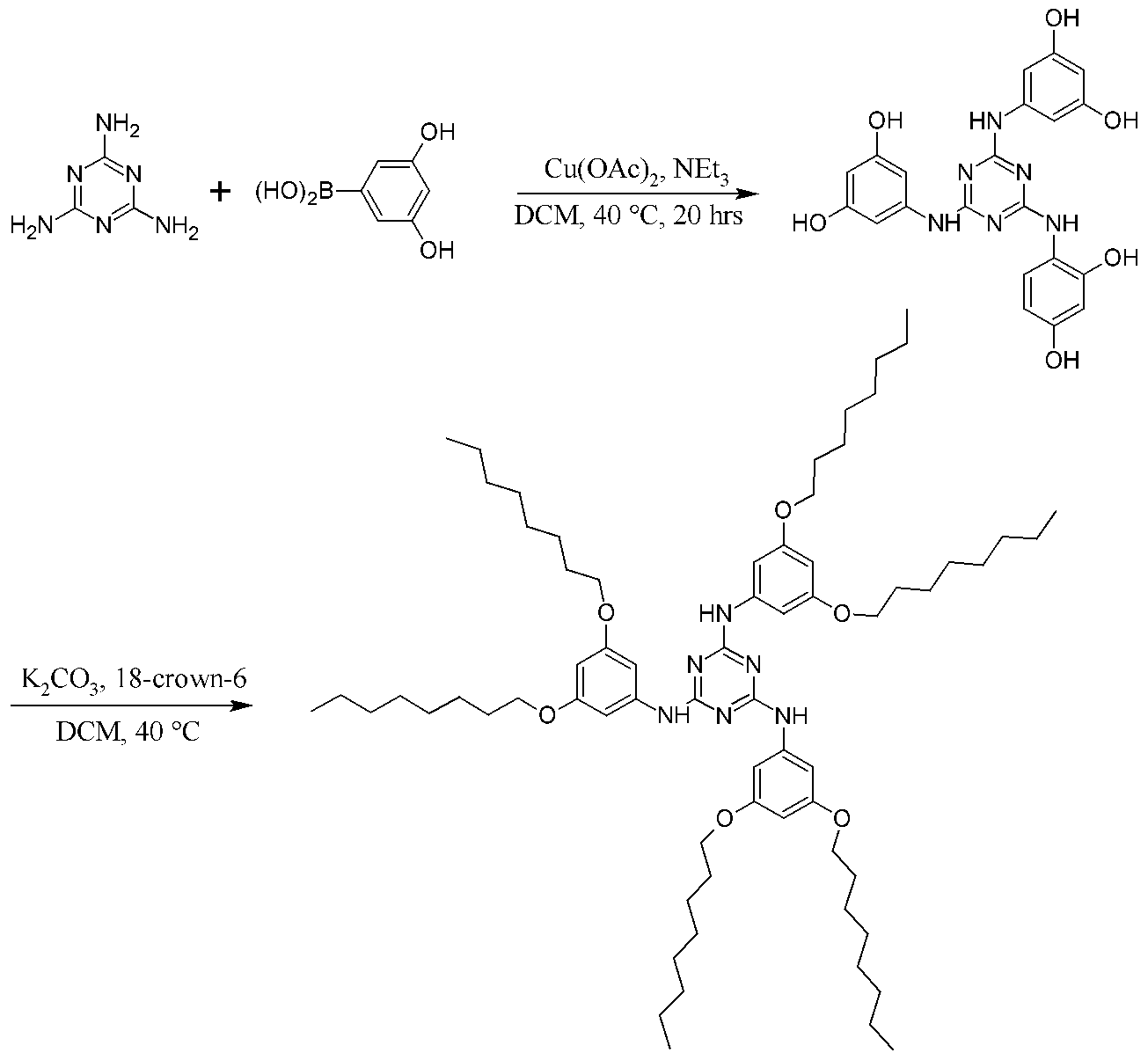
Scheme 5
A. Synthesis of 5,5',5"-(1 ,3,5-triazine-2,4,6-tπyl)tπs(azanedιyl)tπbenzene-1 ,3-diol Commercially available 1 ,3,5-triazine-2,4,6-tπamine (12.6 g, 100 mmol) and (3,5- dihydroxyphenyl)boronιc acid (15.3 g, 100 mmol) were dissolved in DCM (100 ml), tπethylamine (10 ml) and Cu(OAc) 2 (10 mol%, 1.82 g) were added The reaction mixture was stirred at 40 0C for 20 hours and then quenched with saturated solution of NH4CI The mixture was extracted with DCM (3x100 ml) 5,5',5"-(1 ,3,5-triazine-2,4,6-triyl)tris(azanediyl)tribenzene-1 ,3-diol was isolated by column chromatography using hexane-ethylacetate mixture as an eluent Yield1 38 25 g (85%).
B. Synthesis of N,N,N-tris(3,5-bιs(octyloxy)phenyl)-1 ,3,5-triazine-2,4,6-tπamine 5,5',5"-(1 ,3,5-triazine-2,4,6-tπyl)tπs(azanedιyl)tπbenzene-1 ,3-diol (45 g) was dissolved in DCM
(450 ml). 1-bromooctane (99 g, 600 mmol), K2CO3 (96.6 g, 700 mmol) and 18-crown-6 (10 mol%, 2.64 g)
- - were added upon stirring. The reaction mixture was stirred at 50 0C for 15 hours. The solvent was removed in vacuo, the residue was dissolved in ethylacetate and washed successively with saturated solutions of NH4CI and NaCI. N,N,N-tris(3,5-bιs(octyloxy)phenyl)-1 ,3,5-triazine-2,4,6-tπamine was isolated from the concentrated organic phase by column chromatography using hexane-ethylacetate mixture (9:1) as an eluent Yield' 102 2 g, 91 %
EXAMPLE 9
Example 8 describes preparation of 9,9'-(1 ,4- phenylenebιs(azanedιyl))bis(oxomethylene)dιacenaphtho-[1 ,2-b]quιnoxalιne-2,5-dicarboxylιc acid, the predominantly planar polycyclic system of which is presented in Table 1 , structural formula 18. This example is also representative for synthesis of compounds possessing polycyclic aromatic systems with structural formulas 11 , 14, 16, and 19, depicted in Table 1. The synthetic procedure is shown in Scheme 6 and consists of four steps.

Scheme 6
A Synthesis of 2,5-dimethylacenaphtho[1 ,2-b1quinoxaline-9-carboxylic acid 3,4-diamιnobenzoιc acid (15.2 g, 100 mmol) was added to a suspension of 4,7- dimethylacenaphthenequinone (21 g, 100 mmol) in acetic acid (450 ml). The reaction mixture was refluxed for 12 hours. The solid was separated, washed with acetic acid (130 ml) and dried at 120 0C for 3 hours to yield 15.97 g (49 %) of 2,5-dιmethylacenaphtho[1 ,2-b]quinoxaline-9-carboxylιc acid. B Synthesis of 2,5-dimethylacenaphtho[1 ,2-b1quinoxaline-9-carbonyl chloride 2,5-dimethylacenaphtho[1 ,2-b]quinoxaline-9-carboxylic acid (32 6 g, 100 mmol) was added to thionyl chloride (300 ml) and the mixture was refluxed overnight The mixture was cooled down to room temperature and filtered The excessive thionyl chloride was removed in vacuo. 2,5- dimethylacenaphtho[1 ,2-b]quιnoxalιne-9-carbonyl chloride were isolated after re-crystallization from hexane Yield: 22.36 g (65%). C. Synthesis of N,N'-(1 ,4-phenylene)bιs(2,5-dimethylacenaphtho[1 ,2-b1quιnoxalιne-9- carboxamide)
2,5-dimethylacenaphtho[1 ,2-b]quinoxaline-9-carbonyl chloride (34 4 g, 100 mmol) and 1 ,4- diaminobenzene (5 4 g, 50 mmol) were dissolved in DCM (100 ml). Upon vigorous stirring an aqueous solution of NaOH (7 g, 25 ml) was added dropwise. The reaction mixture was stirred for 6 hours, the organic layer was separated and washed three times with saturated solution of NH4CI and twice with saturated solution of NaCI Solution was concentrated in vacuo and filtered through silica gel using
- - hexane-ethylacetate mixture as an eluent. The solvents were removed in vacuo, leaving 44 g (61 g) of N,N'-(1 ,4-phenylene)bιs(2,5-dimethylacenaphtho[1 ,2-b]quιnoxalιne-9-carboxamide).
D. Synthesis of 9,9'-(1 ,4-phenylenebιs(azanedιvD)bis(oxomethylene)dιacenaphtho-[1 ,2- b1quιnoxalιne-2,5-dicarboxylιc acid
N,N'-(1 ,4-phenylene)bis(2,5-dimethylacenaphtho[1 ,2-b]quinoxaline-9-carboxamide) (36 2 g, 50 mmol) was added to mixture (100 ml_) of concentrated sulfuric acid and glacial acid (ratio 8:12) Then powder of chromium trioxide (35 g) was added slowly with a simultaneous cooling of reaction mixture. The mixture was stirred for 3 hours at room temperature Water (200 ml_) was added dropwise to the reaction mixture with cooling (20-400C). Precipitate was filtered and washed with water and diluted hydrochloric acid (300 mL). 9,9'-(1 ,4-phenylenebis(azanediyl))bιs(oxomethylene)diacenaphtho-[1 ,2- b]quinoxaline-2,5-dicarboxylic acid was dried in vacuo over phosphorous oxide. Yield: 47.2 (56 %)
EXAMPLE 10
Example 10 describes preparation of 2,4,6-tris(3,5-bis(dodecyloxy)phenyl)-1 ,3,5-triazine, the predominantly planar polycyclic system of which is presented in Table 1 , structural formula 10 The synthetic procedure is shown in Scheme 7 and consists of two steps.

Scheme 7
A. Synthesis of 5.5',5"-(1.3,5-triazine-2,4.6-trιyl)trιbenzene-1.3-diol
Commercially available 2,4,6-trichloro-1 ,3,5-trιazιne (18.4 g, 100 mmol) and (3,5- dihydroxyphenyl)boronιc acid (45.9 g, 300 mmol) were dissolved in DMF (50 ml). Palladium acetate (1 12 g, 5 mol %) and potassium carbonate (55 2 g, 400 mmol) were added and the reaction mixture was stirred at 45 0C overnight The reaction was extracted with ethylactetate, organic phase was washed successively with saturated solutions of NH4CI and NaCI 5,5',5"-(1 ,3,5-triazine-2,4,6-triyl)tribenzene-1 ,3- diol was isolated by column chromatography using hexane-ethylacetate mixture (9.1 ) as an eluent. Yield: 35.2 g, 87%.
- -
B. Synthesis of 2 ,4,6-tris(3,5-bιs(dodecyloxy)phenvP-1 ,3,5-tπazιne
5,5',5"-(1 ,3,5-triazine-2,4,6-tπyl)tπbenzene-1 ,3-diol (40.5 g, 100 mmol) was dissolved in DCM (350 ml). 1-bromododecane (149.4 g, 600 mmol), K2CO3 (96.6 g, 700 mmol) and 18-crown-6 (10 mol%, 2 64 g) were added upon stirring The reaction mixture was stirred at 50 0C for 15 hours The solvent was removed in vacuo, the residue was dissolved in ethylacetate and washed successively with saturated solutions of NH4CI and NaCI 2,4,6-tris(3,5-bis(dodecyloxy)phenyl)-1 ,3,5-triazine was isolated from the concentrated organic phase by column chromatography using hexane-ethylacetate mixture (9.1 ) as an eluent. Yield: 83.5 g, 59%.
EXAMPLE 11
Example 11 describes preparation of 4,9-dioctyl-2,7-bιs(octyloxy)pyrene, the predominantly planar polycyclic system of which is presented in Table 1 , structural formula 22 The synthetic procedure is shown in Scheme 8 and consists of four steps
CuI hrs '


Scheme 8
A Synthesis of (2,2'-di(dec-1-ynyl)biphenyl-4,4'-diyl)bis(oxy)bis(tert-butyldimethylsilane).
In 100 ml of dry triethylamine under argon atmosphere (2,2'-dibromobiphenyl-4,4'- diyl)bis(oxy)bis(tert-butyldimethylsilane) (43 3 g, 100 mmol) was mixed with PdCI2(PPh3)2 (3.7 g, 5 mol %) and CuI (4 g, 2 mol %). Decyne-1 (27.3 g, 200 mmol) was added and the mixture was stirred at 65 0C overnight The solvent was removed in vacuo, the residue was dissolved in ethylacetate and washed successively with saturated solutions of NH4CI and NaCI. (2,2'-dι(dec-1-ynyl)bιphenyl-4,4'-
- - diyl)bιs(oxy)bis(tert-butyldimethylsιlane) was isolated from the concentrated organic phase by column chromatography using hexane-ethylacetate mixture (9:1 ) as an eluent. Yield. 39.45 g, 72%.
B. Synthesis of (4,9-dioctylpyrene-2,7-diyl)bis(oxy)bis(tert-butyldimethylsilane) (4,9-dioctylpyrene-2,7-diyl)bιs(oxy)bis(tert-butyldimethylsιlane) was synthesized by the heating of
(2,2'-di(dec-1-ynyl)biphenyl-4,4'-diyl)bis(oxy)bis(tert-butyldimethylsilane) (27.4 g, 50 mmol) in toluene (700 imL) in the presence of 1 ,8-Diazabicyclo[5.4 0]undec-7-ene (DBLJ) (91.2g, 60 mmol) at 100-110° C for 20 hours Yield' 11 5O g (42 %)
C. Synthesis of 4,9-dioctylpyrene-2,7-diol.
4,9-dioctylpyrene-2,7-diol was prepared via standard procedure of f-butyldimethylsilyl protection removal with TBAF in THF.
D. Synthesis of 4,9-dιoctyl-2,7-bis(octyloxy)pyrene
4,9-dioctylpyrene-2,7-diol (45.8 g, 100 mmol) was dissolved in DCM (350 ml). 1-bromooctane (38 6 g, 200 mmol), K2CO3 (41 4 g, 300 mmol) and 18-crown-6 (10 mol%, 2.64 g) were added upon stirring. The reaction mixture was stirred at 50 0C for 15 hours. The solvent was removed in vacuo, the residue was dissolved in ethylacetate and washed successively with saturated solutions of NH4CI and NaCI 4,9-dioctyl-2,7-bis(octyloxy)pyrene was isolated from the concentrated organic phase by column chromatography using hexane-ethylacetate mixture (9:1 ) as an eluent. Yield. 49.8 g, 73%.
EXAMPLE 12 Example 12 describes preparation of chrysene-2,5,8-tπcarboxylic acid, the predominantly planar polycyclic system of which is presented in Table 1 , structural formula 23 The synthetic procedure is shown in Scheme 9 and consists of three steps


Scheme 9
A Synthesis of 2-methyl-6-(2-(prop-1-vnyl)phenyl)naphthalene
1-bromo-2-(prop-1-ynyl)benzene (20.9, 100 mmol) and 6-methylnaphthalen-2-ylboronic acιd (18.6 g, 100 mmol) were dissolved in DMF (50 ml). Palladium acetate (1.12 g, 5 mol %) and potassium carbonate (27.6 g, 200 mmol) were added and the reaction mixture was stirred at 45 0C overnight. The reaction was extracted with ethylactetate, organic phase was washed successively with saturated solutions of NH4CI and NaCI. 2-methyl-6-(2-(prop-1-ynyl)phenyl)naphthalene was isolated by column chromatography using hexane-ethylacetate mixture (20:1) as an eluent Yield1 18 9 g, 70%
- -
B. Synthesis of 2,5,8-trimethylchrysene
2,5,8-trimethylchrysene was synthesized by the heating of 2-rmethyl-6-(2-(prop-1- ynyl)phenyl)naphthalene (13.5 g, 50 mmol) in toluene (700 rmL) in the presence of 1 ,8- Diazabicyclo[5 4.0]undec-7-ene (DBU) (91 2g, 60 mmol) at 100-110° C for 20 hours Yield' 9 72 g (54
%)
C. Synthesis of chrysene-2,5,8-tricarboxylic acid
2,5,8-trimethylchrysene (27 g, 100 mmol) was added to mixture (200 ml_) of concentrated sulfuric acid and glacial acid (ratio 8:12). Then powder of chromium trioxide (35 g) was added slowly with cooling of reaction mixture. The mixture was stirred for 3 hours at room temperature. Water (200 mL) was added dropwise to the reaction mixture with cooling (20-400C). Precipitate was filtered and washed with water and diluted hydrochloric acid (300 mL) 2,5,8-tricarboxylic acid was dried in vacuo over phosphorous oxide. Yield: 16.2 g (45%)
EXAMPLE 13
Example 13 describes preparation of 1 ,4-di(3,5-dioctyloxyphenyl)benzene, the predominantly planar polycyclic system of which is presented in Table 1 , structural formula 1. The synthetic procedure is shown in Scheme 10 and consists of two steps.
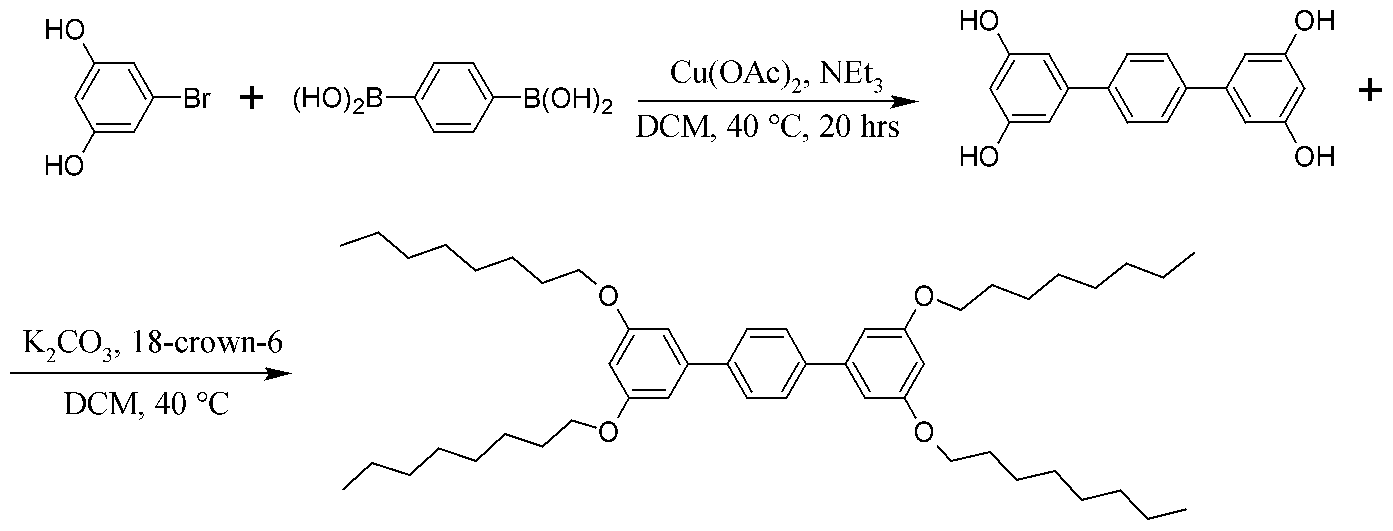
Scheme 10
A. Synthesis of 1 ,4-di(3,5-dιhydroxyphenyl)benzene
5-bromobenzene-1 ,3-dιol (18.9, 100 mmol) and 1 ,4-phenylenediboronic acιd (8.28 g, 50 mmol) were dissolved in DMF (150 ml) Palladium acetate (1 12 g, 5 mol %) and potassium carbonate (27 6 g, 200 mmol) were added and the reaction mixture was stirred at 45 0C overnight. The reaction was extracted with ethylactetate, organic phase was washed successively with saturated solutions of NH4CI and NaCI. 2-methyl-6-(2-(prop-1-ynyl)phenyl)naphthalene was isolated by column chromatography using hexane-ethylacetate mixture (7.1 ) as an eluent. Yield: 11.46 g, 75%. B. Synthesis of 1.4-di(3.5-dιoctyloxyphenyl)benzene
1 ,4-di(3,5-dιhydroxyphenyl)benzene (29.4 g, 100 mmol) was dissolved in DCM (350 ml). 1- bromooctane (77.2 g, 400 mmol), K2CO3 (41.4 g, 500 mmol) and 18-crown-6 (10 mol%, 2 64 g) were added upon stirring. The reaction mixture was stirred at 50 0C for 15 hours. The solvent was removed in vacuo, the residue was dissolved in ethylacetate and washed successively with saturated solutions of NH4CI and NaCI 4,9-dioctyl-2,7-bis(octyloxy)pyrene was isolated from the concentrated organic phase by column chromatography using hexane-ethylacetate mixture (9:1 ) as an eluent. Yield. 60.1 g, 81 %.
While certain preferred embodiments of the invention have been specifically disclosed, it should be understood that the invention is not limited thereto as many variations will be readily apparent to those skilled in the art and the invention is to be given its broadest possible interpretation within the terms of the following claims.
Claims
- -
CLAIMS 1. A polycyclic organic compound of the general structural formula I

wherein Y is a predominantly planar polycyclic system being at least partially aromatic, W1, W2, and W3 are different groups providing solubility in an organic solvent, and sum (n1 +n2+n3) is 1 , 2, 3, 4, 5, 6, 7 or 8, wherein said polycyclic organic compound is capable of forming supramolecules in the organic solvent and is substantially transparent for electromagnetic radiation in the visible spectral range.
2 A polycyclic organic compound according to Claim 1 , wherein the polycyclic system Y is heterocyclic.
3 A polycyclic organic compound according to Claim 2, wherein one or more heteroatoms of the heterocyclic system are selected from the list comprising N, O and S
4 A polycyclic organic compound according to any of Claims from 1 to 3, wherein the polycyclic system Y comprises at least one fragment selected from the list comprising furan, oxirane, 4H-pyran, 2H-chromene, benzo[£>]furan, 2/-/-pyran, thiophene, benzo[£>]thiophene, parathiazine, pyrrole, pyrrolidine, pyrazole, imidazole, imidazoline, imidazoline, pyrazolidine, pyπmidine, pyridine, piperazine, piperidine, pyrazine, indole, purine, benzirmidazole, quinoline, phenothiazine, morpholine, thiaziole, thiadiazole, and oxazole. 5. A polycyclic organic compound according to Claim 1 , wherein the polycyclic system Y comprises at least one fragment representing an aromatic hydrocarbon.
6 A polycyclic organic compound according to Claim 5, wherein the aromatic hydrocarbon is selected from the list comprising acenaphthene, acenaphthylene, acephenanthrylene, biphenylene and naphthalene.
7. A polycyclic organic compound according to any of Claims from 1 to 6, wherein the polycyclic system Y comprises fragments selected from the list comprising oligophenyl, imidazole, pyrazole, acenaphthene, triaizine, and having a general structural formula selected from structures 1-24:

- -


8. A polycyclic organic compound according to any of Claims from 1 to 7, wherein at least one of the groups W providing solubility is selected from the list comprising carboxylic (COOH) group, linear and branched (C-ι-C2o)alkyl, (C2-C20)alkenyl, and (C2-C20)alkinyl.
9 A polycyclic organic compound according to any of Claims from 1 to 8, wherein at least one of the groups W providing solubility is connected with the polycyclic system Y via a bridging group A
10 A polycyclic organic compound according to Claim 9, wherein the bridging group A is selected from the list comprising -C(O)-, -C(O)O-, -C(O)-NH-, -(SO2)NH-, -0-, -CH2O-, -NH-, >N-, and any combination thereof.
11. A polycyclic organic compound according to any of Claims from 1 to 10, wherein the polycyclic system Y is capable of forming rod-like supramolecules via π-π-interaction.
12. A polycyclic organic compound according to Claim 11 , wherein the rod-like supramolecules have interplanar spacing between the polycyclic systems in the range of approximately 3 1-3.7 A
13 A solution comprising at least one polycyclic organic compound of the general structural formula I

15 A solution according to Claim 14, wherein heteroatoms of the heterocyclic system Y are selected from the list comprising N, O and S.
16 A solution according to any of Claims from 13 to 15, wherein the polycyclic system Y comprises at least one fragment selected from the list comprising furan, oxirane, 4H-pyran, 2/-/-chromene, benzo[£>]furan, 2H-pyran, thiophene, benzo[ύ]thiophene, parathiazine, pyrrole, pyrrolidine, pyrazole, imidazole, imidazoline, imidazolidine, pyrazolidine, pyrimidine, pyridine, piperazine, piperidine, pyrazine, indole, purine, benzirmidazole, quinoline, phenothiazine, morpholine, thiaziole, thiadiazole, and oxazole.
17 A solution according to Claim 13, wherein the polycyclic system Y comprises at least one fragment representing an aromatic hydrocarbon.
18 A solution according to Claim 17, wherein the polycyclic aromatic hydrocarbon is selected from the list comprising acenaphthene, acenaphthylene, acephenanthrylene, biphenylene and naphthalene. 19. A solution according to any of Claims from 13 to 18, wherein the polycyclic system Y is selected from the list comprising oligophenyl, imidazole, pyrazole, acenaphthene, triaizine, and having general structural formula selected from structures 1-24.

H

/ \ N
- -
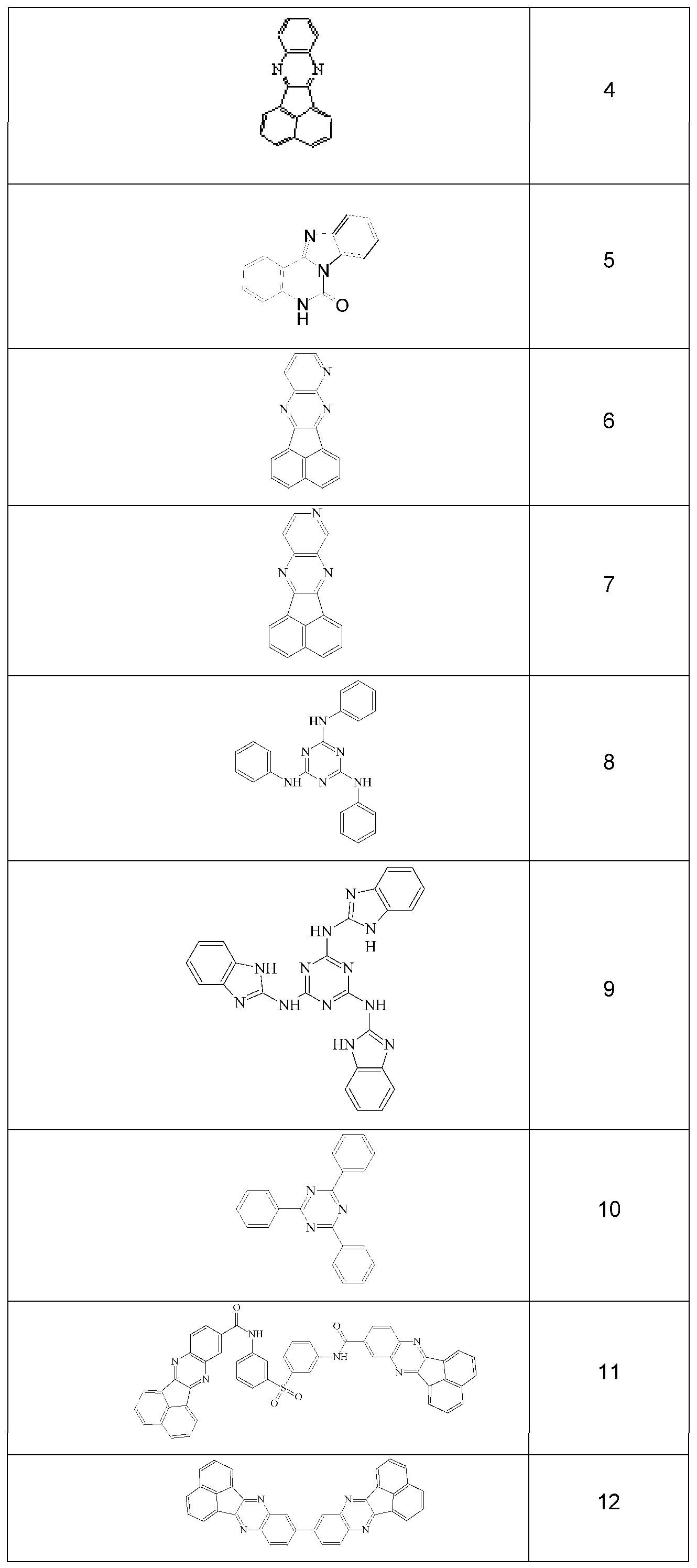
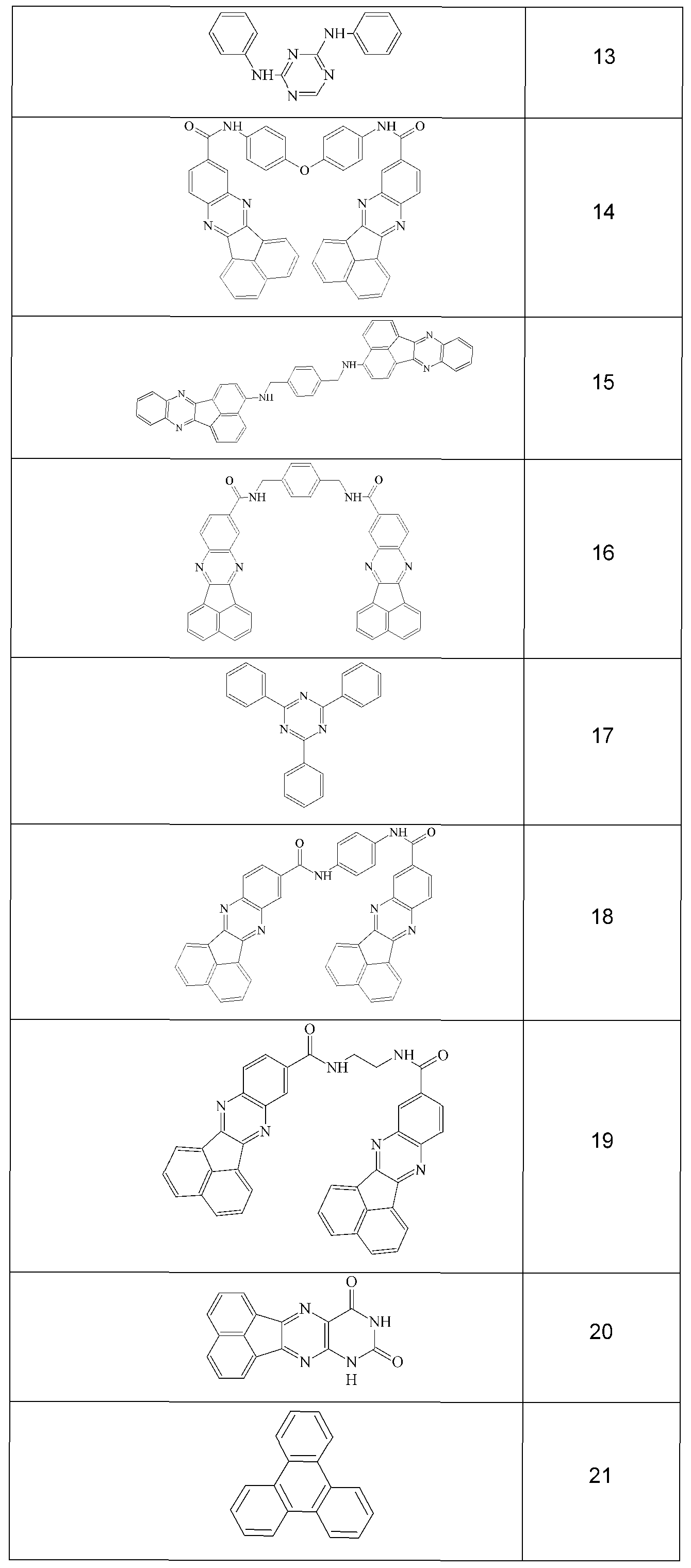

20 A solution according to any of Claims from 13 to 19, wherein at least one of the groups W providing solubility is selected from the list comprising carboxylic (COOH) group, linear and branched (C-ι-C20)alkyl, (C2-C20)alkenyl, and (C2-C20)alkinyl. 21. A solution according to any of Claims from 13 to 20, wherein at least one of the groups W providing solubility in the polycyclic organic compound is connected with the polycyclic system Y via a bridging group A
22 A solution according to Claim 21 , wherein the bridging group A is selected from the list comprising -C(O)-, -C(O)O-, -C(O)-NH-, -(SO2)NH-, -0-, -CH2O-, -NH-, >N-, and any combination thereof.
23. A solution according to any of Claims from 13 to 22, wherein the organic solvent is selected from the list comprising ketones, carboxylic acids, hydrocarbons, cyclohydrocarbons, chlorohydrocarbons, alcohols, ethers, esters, and any combination thereof.
24. A solution according from to Claims from 13 to 23, wherein the organic solvent is selected from the list comprising acetone, xylene, toluene, ethanol, methylcyclohexane, ethyl acetate, diethyl ether, octane, chloroform, methylenechloride, dichloroethane, trichloroethene, tetrachloroethene, carbon tetrachloride, 1 ,4-dioxane, tetrahydrofuran, pyridine, triethylamine, nitromethane, acetonitrile, dimethylformamide, dimethulsulfoxide, and any combination thereof
25. A solution according to any of Claims from 13 to 24, wherein the solution is a lyotropic liquid crystal solution.
26. A solution according to any of Claims from 13 to 24, wherein the solution is an isotropic solution.
27. A solution according to any of Claims from 13 to 26, wherein the supramolecules are formed by interaction of at least two different compounds of the general structural formula I.
28 A solution according to any of Claims from 13 to 26, wherein the supramolecules are formed by interaction of the same compounds of the general structural formula I.
29 A solution according to any of Claims from 13 to 28, further comprising surfactants
30. A solution according to any of Claims from 13 to 28, further comprising plasticizers.
31. A compensation panel comprising at least one retardation layer being substantially transparent in the visible spectral range and comprising at least one polycyclic organic compound of a general structural formula (I),
- -

32 A compensation panel according to Claim 31 , wherein the polycyclic system Y is heterocyclic. 33. A compensation panel according to Claim 32, wherein the heteroatoms of the heterocyclic system Y are selected from the list comprising N, O and S 34 A compensation panel according to any of Claims from 31 to 33, wherein the polycyclic system Y comprises at least one fragment selected from the list comprising furan, oxirane, 4/-/-pyran, 2H-chromene, benzo[ύ]furan, 2/-/-pyran, thiophene, benzo[£>]thιophene, parathiazine, pyrrole, pyrrolidine, pyrazole, imidazole, imidazoline, imidazolidine, pyrazolidine, pyrimidine, pyridine, piperazine, piperidine, pyrazine, indole, purine, benzimidazole, quinoline, phenothiazine, morpholine, thiaziole, thiadiazole, and oxazole.
35. A compensation panel according to Claim 31 , wherein the polycyclic system comprises at least one fragment representing a polycyclic aromatic hydrocarbon.
36 A compensation panel according to Claim 35, wherein the polycyclic aromatic hydrocarbon is selected from the list comprising acenaphthene, acenaphthylene, acephenanthrylene, biphenylene, and naphthalene.
37. A compensation panel according to any of Claims from 31 to 36, wherein the polycyclic system Y is selected from the list comprising, oligophenyl, imidazole, pyrazole, acenaphthene, triaizine, and having a general structural formula selected from structures 1-24:

H
 H
- -
H
- -


38. A compensation panel according to any of Claims from 31 to 37, in which at least one of the groups W providing solubility of the polycyclic organic compound in the organic solvent is selected from the list comprising carboxylic (COOH) group, linear and branched (C-ι-C2o)alkyl, (C2-C20)alkenyl, and (C2-C20)alkinyl.
39 A compensation panel according to any of Claims from 31 to 38, wherein at least one of the groups W providing solubility of the polycyclic organic compound is connected with the polycyclic system Y via a bridging group A.
40 A compensation panel according to Claim 39, wherein the bridging group A of the polycyclic organic compound is selected from the list comprising -C(O)-, -C(O)O-, -C(O)-NH-, -(SO2)NH-, -0-,
-CH2O-, -NH-, >N-, and any combination thereof.
41. A compensation panel according to any of Claims from 31 to 40, comprising two or more retardation layers, wherein at least two of said layers comprise different polycyclic compounds of the general structural formula (I). 42 A compensation panel according to any of Claims 31 to 41 , further comprising a substrate.
43 A compensation panel according to Claim 42, wherein the substrate is transparent for electromagnetic radiation in the visible spectral range.
44. A compensation panel according to any of Claims 42 or 43, wherein the substrate is made of polymer. 45. A compensation panel according to any of Claims 42 or 43, wherein the substrate is made of glass.
46 A compensation panel according to any of Claims 42 or 43, wherein the substrate is made of foil
47. A compensation panel according to any of Claims from 31 to 46, further comprising a transparent adhesive layer applied on top of the retardation layer.
48. A compensation panel according to Claim 47, further comprising a protective coating applied on the adhesive transparent layer. 49 A compensation panel according to any of Claims 31 to 48, wherein said retardation layer is at least partially crystalline.
50 A compensation panel according to any of Claims from 31 to 49, wherein the retardation layer is a biaxial retardation layer of BA-type which is characterized by two in-plane refractive indices (nf and ns) corresponding to a fast principal axis and a slow principal axis respectively, and one refractive index (nn) in the normal direction which obey the following condition for electromagnetic radiation in the visible spectral range1 ns > nn > nf.
51. A compensation panel according to any of Claims from 31 to 49, wherein the retardation layer is a biaxial retardation layer of Ac-type which is characterized by two in-plane refractive indices (nf and ns) corresponding to a fast principal axis and a slow principal axis respectively, and one refractive index (nn) in the normal direction which obey the following condition for electromagnetic radiation in the visible spectral range. ns > nf > nn.
52. A compensation panel according to any of Claims from 31 to 49, comprising at least one retardation layer of a first type having slow and fast principal axes lying substantially in the plane of the first type retardation layer, and at least one retardation layer of a second type having an optical axis directed substantially perpendicular to the plane of the second type retardation layer.
53 A compensation panel according to Claim 52, wherein the retardation layer of the first type is a uniaxial retardation layer of negative A-type which is characterized by two in-plane refractive indices {nf and ns) corresponding to a fast principal axis and a slow principal axis respectively, and one refractive index (nn) in the normal direction which obey the following condition for electromagnetic radiation in the visible spectral range1 nn - ns > nf.
54. A compensation panel according to any of Claims 52 or 53, wherein the retardation layer of the first type comprises rod-like supramolecules which are oriented with their longitudinal axes substantially parallel to the fast principal axis
55 A compensation panel according to Claim 54, wherein said rod-like supramolecules have approximately isotropic polarizability in planes which are perpendicular to their longitudinal axes.
56 A compensation panel according to any of Claims from 52 to 55, wherein the retardation layer of the second type is a uniaxial retardation layer of negative C-type which is characterized by two in-plane refractive indices (nf and ns) corresponding to a fast principal axis and a slow principal axis respectively, and one refractive index (nn) in the normal direction which obey the following condition for electromagnetic radiation in the visible spectral range: nf - ns > nn
57 A compensation panel according to any of Claims from 52 to 56, wherein the retardation layer of the second type comprises sheet-like supramolecules with their plane oriented substantially parallel to the surface of said retardation layer.
Priority Applications (3)
| Application Number | Priority Date | Filing Date | Title |
|---|---|---|---|
| US12/921,091 US20110064892A1 (en) | 2008-03-04 | 2009-03-04 | Polycyclic Organic Compounds, Retardation Layer and Compensation Panel on Their Base |
| EP09718415A EP2260036A2 (en) | 2008-03-04 | 2009-03-04 | Polycyclic organic compounds, retardation layer and compensation panel on their base |
| JP2010549199A JP2011515340A (en) | 2008-03-04 | 2009-03-04 | Polycyclic organic compounds, retardation layers and compensators based on their substrates |
Applications Claiming Priority (2)
| Application Number | Priority Date | Filing Date | Title |
|---|---|---|---|
| GBGB0804083.4A GB0804083D0 (en) | 2008-03-04 | 2008-03-04 | Polycyclic organic compounds, retardation layer and compensation panel on their base |
| GB0804083.4 | 2008-03-04 |
Publications (2)
| Publication Number | Publication Date |
|---|---|
| WO2009109782A2 true WO2009109782A2 (en) | 2009-09-11 |
| WO2009109782A3 WO2009109782A3 (en) | 2009-10-29 |
Family
ID=39315985
Family Applications (1)
| Application Number | Title | Priority Date | Filing Date |
|---|---|---|---|
| PCT/GB2009/050219 Ceased WO2009109782A2 (en) | 2008-03-04 | 2009-03-04 | Polycyclic organic compounds, retardation layer and compensation panel on their base |
Country Status (5)
| Country | Link |
|---|---|
| US (1) | US20110064892A1 (en) |
| EP (1) | EP2260036A2 (en) |
| JP (1) | JP2011515340A (en) |
| GB (1) | GB0804083D0 (en) |
| WO (1) | WO2009109782A2 (en) |
Cited By (2)
| Publication number | Priority date | Publication date | Assignee | Title |
|---|---|---|---|---|
| WO2012064618A1 (en) * | 2010-11-09 | 2012-05-18 | Crysoptix Kk | Negative dispersion retardation plate and achromatic circular polarizer |
| EP2841404A4 (en) * | 2012-04-25 | 2016-01-13 | Sinvent As | Synthetic alkylated graphenes and solutions thereof as multiphase flow test fluids to be used by the oil and gas industry. |
Families Citing this family (8)
| Publication number | Priority date | Publication date | Assignee | Title |
|---|---|---|---|---|
| US20130286317A1 (en) * | 2012-04-28 | 2013-10-31 | Shenzhen China Star Optoelectronics Technology Co. Ltd. | Liquid Crystal Medium Composition, Liquid Crystal Display Using Same and Manufacturing Method Thereof |
| US20140085592A1 (en) * | 2012-09-21 | 2014-03-27 | Sheznhen China Star Optoelectronics Technology Co. Ltd. | Mixture for Liquid Crystal Medium and Liquid Crystal Display Using the Same |
| JP2015138162A (en) * | 2014-01-23 | 2015-07-30 | 住友化学株式会社 | Optical anisotropic film |
| CN107592939B (en) | 2014-11-04 | 2020-05-05 | 电容器科学股份公司 | Energy storage device and method for producing same |
| US9941051B2 (en) | 2015-06-26 | 2018-04-10 | Capactor Sciences Incorporated | Coiled capacitor |
| US10026553B2 (en) | 2015-10-21 | 2018-07-17 | Capacitor Sciences Incorporated | Organic compound, crystal dielectric layer and capacitor |
| US10403435B2 (en) | 2017-12-15 | 2019-09-03 | Capacitor Sciences Incorporated | Edder compound and capacitor thereof |
| CN110776497B (en) * | 2019-10-30 | 2022-12-13 | 西北工业大学 | Preparation method for constructing two-dimensional organic layer based on cation-pi interaction |
Citations (3)
| Publication number | Priority date | Publication date | Assignee | Title |
|---|---|---|---|---|
| US20050196550A1 (en) | 2004-03-02 | 2005-09-08 | Lazarev Pavel I. | Compensator for liquid crystal display |
| EP1632494A1 (en) | 2004-08-24 | 2006-03-08 | Ferring B.V. | Vasopressin v1a antagonists |
| WO2007029533A1 (en) | 2005-09-01 | 2007-03-15 | Konica Minolta Holdings, Inc. | Organic electroluminescence element, display device and illuminating device |
Family Cites Families (3)
| Publication number | Priority date | Publication date | Assignee | Title |
|---|---|---|---|---|
| KR100612086B1 (en) * | 2003-08-14 | 2006-08-14 | 주식회사 엘지화학 | Complex light-compensation c plate with two or more of c plates different in dispersion ratio value and liquid crystal display using the same |
| US7045177B2 (en) * | 2003-11-21 | 2006-05-16 | Nitto Denko Corporation | Sulfoderivatives of acenaphtho[1,2-b]quinoxaline, lyotropic liquid crystal and anisotropic film on their base |
| GB0520489D0 (en) * | 2005-10-07 | 2005-11-16 | Kontrakt Technology Ltd | Organic compound, optical crystal film and method of producing thereof |
-
2008
- 2008-03-04 GB GBGB0804083.4A patent/GB0804083D0/en active Pending
-
2009
- 2009-03-04 WO PCT/GB2009/050219 patent/WO2009109782A2/en not_active Ceased
- 2009-03-04 JP JP2010549199A patent/JP2011515340A/en not_active Withdrawn
- 2009-03-04 US US12/921,091 patent/US20110064892A1/en not_active Abandoned
- 2009-03-04 EP EP09718415A patent/EP2260036A2/en not_active Withdrawn
Patent Citations (3)
| Publication number | Priority date | Publication date | Assignee | Title |
|---|---|---|---|---|
| US20050196550A1 (en) | 2004-03-02 | 2005-09-08 | Lazarev Pavel I. | Compensator for liquid crystal display |
| EP1632494A1 (en) | 2004-08-24 | 2006-03-08 | Ferring B.V. | Vasopressin v1a antagonists |
| WO2007029533A1 (en) | 2005-09-01 | 2007-03-15 | Konica Minolta Holdings, Inc. | Organic electroluminescence element, display device and illuminating device |
Non-Patent Citations (3)
| Title |
|---|
| BASHKIRSKII KHIMICHESKII ZHURNAL, vol. 14, no. 1, 2007, pages 124 - 128 |
| KAWABATA H. ET AL., IPAP CONFERENCE SERIES, vol. 6, no. 6, 2005, pages 42 - 45 |
| LIANG BOET, ADV. FUNCT. MATER, vol. 17, 2007, pages 3580 - 3589 |
Cited By (4)
| Publication number | Priority date | Publication date | Assignee | Title |
|---|---|---|---|---|
| WO2012064618A1 (en) * | 2010-11-09 | 2012-05-18 | Crysoptix Kk | Negative dispersion retardation plate and achromatic circular polarizer |
| CN103261370A (en) * | 2010-11-09 | 2013-08-21 | 克里斯奥普提克斯株式会社 | Negative dispersion retardation plate and achromatic circular polarizer |
| US8895118B2 (en) | 2010-11-09 | 2014-11-25 | Crysoptix K.K. | Negative dispersion retardation plate and achromatic circular polarizer |
| EP2841404A4 (en) * | 2012-04-25 | 2016-01-13 | Sinvent As | Synthetic alkylated graphenes and solutions thereof as multiphase flow test fluids to be used by the oil and gas industry. |
Also Published As
| Publication number | Publication date |
|---|---|
| WO2009109782A3 (en) | 2009-10-29 |
| US20110064892A1 (en) | 2011-03-17 |
| EP2260036A2 (en) | 2010-12-15 |
| JP2011515340A (en) | 2011-05-19 |
| GB0804083D0 (en) | 2008-04-09 |
Similar Documents
| Publication | Publication Date | Title |
|---|---|---|
| WO2009109782A2 (en) | Polycyclic organic compounds, retardation layer and compensation panel on their base | |
| EP2291703B1 (en) | Color liquid crystal display and compensation panel | |
| EP1984372B1 (en) | Organic compound, anisotropic optical film and method of production thereof | |
| US8933208B2 (en) | Photo-responsive liquid crystalline compound and its applications | |
| JP2009523164A (en) | 6,7-Dihydrobenzimidazo [1,2-c] quinazolin-6-onecarboxylic acid and its esters and methods for their synthesis | |
| JP2009540345A (en) | Liquid crystal display operating in vertical alignment mode | |
| CN101652452A (en) | Polycyclic organic compound, optical anisotropic film and production method thereof | |
| WO2008142635A2 (en) | Compensated in-plane switching mode liquid crystal display | |
| JP2010500397A (en) | Benzimidazole, benzoxazole and benzothiazole derivatives, optical film containing them, and method for producing the same | |
| JP2010026024A (en) | Composition for anisotropic film, anisotropic film, polarizing element, and azo compound | |
| JP2005330185A (en) | Dithia-s-indacene derivative | |
| JP2009511460A (en) | Organic compound, optical crystal film and method for producing the same | |
| KR100778637B1 (en) | Silicon derivative, liquid crystal composition comprising the same and compensation film using the same liquid crystal composition | |
| KR101575025B1 (en) | Silsesquioxane derivatives, method for preparing the same and liquid-crystal display comprising the same | |
| KR20080084585A (en) | Birefringent film, polycyclic compound, coating solution and image display device | |
| WO2009037565A2 (en) | Colour liquid crystal display and patterned compensation panel | |
| US8009267B2 (en) | Method of producing optical laminate and image displaying apparatus | |
| KR101834042B1 (en) | Reactive mesogen dye and liquid crystal display comprising the same | |
| CN100457755C (en) | Sulfo derivative, lyotropic liquid crystal system and anisotropic film containing sulfo derivative, and manufacturing methods of sulfo derivative and lyotropic liquid crystal system and anisotropic film | |
| CN100334086C (en) | Lyotropic liquid crystal systems based on perylenetetracarboxylic acid dibenzimidazole sulfoderivatives | |
| JP5060853B2 (en) | Method for purifying polycyclic compound, method for producing polycyclic compound, and use of polycyclic compound | |
| KR20050120662A (en) | Benzene derivative having long linear conjugated structure moiety, method for production thereof and liquid crystalline material | |
| KR100819690B1 (en) | Vinylsulfone derivative, liquid crystal composition comprising the same and compensation film using the same liquid crystal composition | |
| KR20160072366A (en) | A reactive mesogen composition, a polarizer and a display device comprising the same | |
| WO2008059702A1 (en) | Process for purification of polycyclic compounds, process for production of polycyclic compounds, and uses of polycyclic compounds |
Legal Events
| Date | Code | Title | Description |
|---|---|---|---|
| 121 | Ep: the epo has been informed by wipo that ep was designated in this application |
Ref document number: 09718415 Country of ref document: EP Kind code of ref document: A2 |
|
| WWE | Wipo information: entry into national phase |
Ref document number: 2010549199 Country of ref document: JP |
|
| NENP | Non-entry into the national phase |
Ref country code: DE |
|
| WWE | Wipo information: entry into national phase |
Ref document number: 2009718415 Country of ref document: EP |
|
| WWE | Wipo information: entry into national phase |
Ref document number: 12921091 Country of ref document: US |