WO2009110053A1 - 放送サービス信号送信方法及び送信装置 - Google Patents
放送サービス信号送信方法及び送信装置 Download PDFInfo
- Publication number
- WO2009110053A1 WO2009110053A1 PCT/JP2008/053762 JP2008053762W WO2009110053A1 WO 2009110053 A1 WO2009110053 A1 WO 2009110053A1 JP 2008053762 W JP2008053762 W JP 2008053762W WO 2009110053 A1 WO2009110053 A1 WO 2009110053A1
- Authority
- WO
- WIPO (PCT)
- Prior art keywords
- speed
- moving
- broadcast service
- frequency
- signal
- Prior art date
- Legal status (The legal status is an assumption and is not a legal conclusion. Google has not performed a legal analysis and makes no representation as to the accuracy of the status listed.)
- Ceased
Links
Images




Classifications
-
- H—ELECTRICITY
- H04—ELECTRIC COMMUNICATION TECHNIQUE
- H04W—WIRELESS COMMUNICATION NETWORKS
- H04W56/00—Synchronisation arrangements
- H04W56/0035—Synchronisation arrangements detecting errors in frequency or phase
Definitions
- the present invention relates to a broadcast service signal transmission method and transmission apparatus, and more particularly to a broadcast service signal transmission method and transmission apparatus for wirelessly transmitting a broadcast service signal.
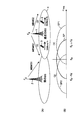
- FIG. 16 is an explanatory diagram of fluctuations in reception frequency due to Doppler shift.
- broadcast service MBMS Multimedia Broadcast Multicast Service
- MBMS Multimedia Broadcast Multicast Service
- the mobile terminal 3 of interest exists in the area 4 where the broadcast service MBMS can be received from the base station 1, and is moving at a high speed of 350 km / h, for example. If the mobile terminal 3 is in a high speed approaching the base station 1 ((1 area)), the frequency of the base station 1 in the mobile terminal shifts from f 0 by the Doppler effect to f 0 + f d.
- the frequency of the base station 1 in the mobile terminal shifts from f 0 to f 0 -f d by the Doppler effect.
- the frequency spectrum SP1 is shifted to a higher frequency side than the original spectrum SP
- the frequency spectrum SP2 is lower in frequency than the original spectrum SP. Shift to the side. For this reason, the reception power of the frequency f 0 at the mobile terminal is reduced, Doppler distortion occurs, and good reception cannot be performed.
- the amount of Doppler shift increases due to higher radio frequency and higher speed of the moving body (for example, the moving speed is 350 km / h in the 2 GHz band of the radio frequency). (The Doppler shift amount at about 1500Hz). In order to cope with this frequency fluctuation, it is necessary to insert reference pilots with high density on the time axis, but this is a countermeasure that contradicts the direction of improving the frequency utilization efficiency.
- a mobile station uses a GPS satellite to measure its moving speed and position (longitude / latitude), finds the direction of the base station that has been measured in advance (longitude / latitude), and calculates the Doppler shift amount. ⁇ F is calculated, and the local frequency of the transmitter is finely adjusted from the calculation result, thereby correcting the Doppler shift amount ⁇ F of the transmission wave to the base station.
- the above-described conventional technique transmits only one wave having an increased frequency or a decreased frequency with respect to the original transmission frequency in order to compensate for the Doppler effect.
- the conventional technique has a problem that the control of which radio signal of the increase side frequency or the decrease side frequency should be transmitted becomes complicated.
- the above-described conventional technique is transmission control of the mobile station to the base station in consideration of Doppler shift, and is not transmission control in the base station in consideration of the moving speed of the mobile object. That is, the prior art does not allow a mobile unit to correctly receive a signal from a base station when a Doppler shift occurs.
- the above-described prior art requires a GPS receiver to be provided on the moving body, which causes a problem that increases the cost of the moving body.
- the purpose of this case is to enable a mobile terminal to correctly receive data from a base station in a high-speed mobile body on which a large number of users are boarded, and to enable the base station to transmit data efficiently.
- Another object of the present case is to enable a mobile terminal to correctly receive a signal from a base station even if a Doppler shift occurs.
- Another object of the present case is to make it unnecessary to control whether to transmit a radio signal having a frequency higher or lower than the original transmission frequency in order to compensate for the Doppler effect.
- Another object of the present case is to enable a mobile terminal to correctly receive a signal from a base station without providing a GPS receiver in the mobile terminal when a Doppler shift occurs. JP 2003-309517 A
- the first of the present cases is a broadcast service signal transmission method of a transmission apparatus that wirelessly transmits a broadcast service signal.
- the first broadcast service signal transmission method includes a step of determining whether or not there is a moving body that is approaching at high speed or moving away at high speed, and if there is, the amount of radio wave Doppler shift caused by the high speed movement is Calculating based on the moving speed of the body, and shifting the frequency of the radio signal for transmitting the broadcast service signal by the Doppler shift amount in the direction opposite to the Doppler shift direction.
- the second broadcast service signal transmission method includes a step of determining whether there is a moving body that is approaching at high speed or moving away at high speed, and if there is, the amount of radio wave Doppler shift caused by high-speed movement is A step of calculating based on a moving speed of the body, a step of shifting the frequency of the radio signal for transmitting the broadcast service signal by a Doppler shift amount in each of the plus direction and the minus direction, and the broadcast service signal by each shifted radio signal Transmitting.
- the first and second broadcast service signal transmission methods further include a reference speed from an external mobile position management server that manages the position and speed of the mobile located in an area communicable with the transmitting device.
- the Doppler shift amount is calculated based on the moving speed of each moving body, The frequency of the radio signal is shifted by each Doppler shift amount, and the broadcast service signal is transmitted using each shifted radio signal.
- the moving speed is divided into a plurality of speed ranges, a representative speed in each speed range is set, and the frequency of the radio signal is set by the Doppler shift amount corresponding to the representative speed in the speed range to which the moving body speed belongs.
- the broadcast service signal is transmitted using the shifted radio signal.
- the frequency of the first radio signal for transmitting the broadcast service signal is shifted in the negative direction by a Doppler shift amount, and is different from the frequency of the first radio signal.
- the frequency of the radio signal is shifted by a Doppler shift amount in the plus direction, and a broadcast service signal is transmitted using each shifted radio signal.
- the second of the present case is a transmitting device that wirelessly transmits a broadcast service signal.
- the first transmission device determines whether there is a moving object that is approaching at high speed or moving away at high speed. If there is, the first transmission device calculates the Doppler shift amount of the radio frequency caused by the high speed movement of the moving object.
- a Doppler shift amount calculation unit that calculates based on a moving speed, a radio frequency shift unit that shifts the frequency of a radio signal for transmitting a broadcast service signal by the Doppler shift amount in a direction opposite to the Doppler shift direction, and a shifted radio signal
- a transmission unit for transmitting a broadcast service signal is a transmitting device that wirelessly transmits a broadcast service signal.
- the second transmission device determines whether there is a moving object that is approaching at high speed or moving away at high speed. If there is, the second transmitting device determines the Doppler shift amount of the radio frequency caused by the high-speed movement.
- a Doppler shift amount calculation unit that calculates based on a moving speed, a radio frequency shift unit that shifts a frequency of a radio signal for transmitting the broadcast service signal by a Doppler shift amount in each of the plus direction and the minus direction, and each of the shifted values
- a transmission unit that transmits a broadcast service signal using a wireless signal.
- the first and second transmission devices are further approaching at a speed higher than the reference speed from an external mobile body position management server that manages the position and speed of the mobile body that exists in an area communicable with the own apparatus.
- the receiving part which receives the presence or absence and the moving speed of the moving body which is moving away from reference speed at high speed.
- the Doppler shift amount calculation unit calculates the Doppler shift amount based on the moving speed of each moving body.
- the radio frequency shift unit shifts the frequency of the radio signal by each Doppler shift amount, and the transmission unit transmits a broadcast service signal using each shifted radio signal.
- the moving speed is divided into a plurality of speed ranges and a representative speed in each speed range is set, and the radio frequency shift unit is configured to perform a Doppler shift amount corresponding to the representative speed in the speed range to which the moving body speed belongs.
- the frequency of the radio signal is shifted by only, and the transmitting unit transmits the broadcast service signal using the shifted radio signal.
- the radio frequency shift unit shifts the frequency of the first radio signal for transmitting the broadcast service signal in the minus direction by a Doppler shift amount, and the frequency of the first radio signal
- the frequency of the different second radio signal is shifted in the plus direction by the amount of Doppler shift, and the transmission unit transmits the broadcast service signal using each shifted radio signal.
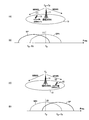
- FIG. 1 is a schematic explanatory diagram of the first example.
- a broadcast service MBMS for mobile phones from the base station 11 is provided to mobile terminals by radio signals of a predetermined frequency.
- the mobile terminal 12 currently focused on exists in an area (cell) 13 where the broadcast service MBMS can be received from the base station 11, and is moving at a high speed of 350 km / h, for example. As shown in FIG.
- the frequency spectrum SP at the base station 11 is shown by the solid line in FIG. 1B, whereas the frequency spectrum SP1 at the mobile terminal 12 is shown by the dotted line, and the original received frequency f At 0 , the power is maximized and good reception is possible. Further, as shown in FIG.
- the base station 11 shifts from the original radio frequency f 0 to Doppler shift.
- the frequency spectrum SP at the base station 11 is shown by the solid line in FIG. 1D, whereas the frequency spectrum SP2 at the mobile terminal 12 is shown by the dotted line, and the original received frequency f At 0 , the power is maximized and good reception is possible.
- the base station 11 grasps whether the mobile body 12 is moving toward or away from the base station 11, and Know the relative speed to the base station. Then, based on the moving direction and the relative speed, a Doppler shift amount f d that is a frequency variation from the radio frequency is calculated, and a transmission frequency f 0 ⁇ that is increased or decreased by the Doppler shift amount from the original transmission frequency at the base station. Data is transmitted with a radio signal of f d or f 0 + f d . In this way, even when subjected to Doppler shift at the time of receiving in the mobile terminal can receive the signal by radio frequency f 0 of the desired nature.
- the present invention when there is a mobile body that moves at high speed in a cell, it is possible to stably supply a broadcasting service to the mobile terminal of the mobile body.
- the present invention is easy to apply when providing a broadcast service, but can also be applied to multicast and unicast.
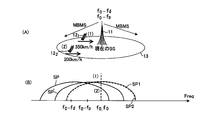
- FIG. 2 is a schematic explanatory view of the second embodiment, and the same reference numerals are given to the same parts as those in FIG. FIG. 1 shows a case where one moving body exists in the cell 13, but FIG. 2 shows a case where a plurality of mobile bodies (two in the figure) exist in the cell. For example, it is assumed that the mobile body 12 1 is approaching the base station 11 at a high speed of 350 km / h, and the mobile body 12 2 is approaching the base station 11 at a high speed of 200 km / h.
- the base station 11 knows that the mobile body 12 1 is moving toward the base station and the relative speed is 350 km / h, and at the same time, the other mobile body 12 2 is moving toward the base station, and Know that the relative speed is 200km / h.
- Base station 11 by the movement direction and the relative speed based on the calculated Doppler shift amount, to obtain the moving body 12 1 of the Doppler shift amount f d, of the moving body 12 2 Doppler shift amount f p, respectively.
- the frequency spectrum SP of the base station 11, SP 'is is as shown by the solid line in FIG. 2 (B)
- the frequency spectrum SP1 in the mobile 12 1 is as shown by a dotted line.
- the frequency spectrum SP2 in the moving body 12 2 is shown by a dotted line, and the power is maximized at the original reception frequency f 0 in the moving bodies 12 1 and 12 2 , thereby enabling good reception.
- MBMS broadcasting is performed with the first radio signal so as to compensate for the Doppler shift of the moving body 12 1
- MBMS broadcasting is performed with the second wireless signal so as to compensate for the Doppler shift of the moving body 12 2.
- each mobile terminal can receive MBMS radio waves from the base station at the originally desired radio frequency.
- FIG. 2 demonstrated the case where the number of the moving bodies in high-speed movement was two, the same control is possible even if two or more.
- the case of high speed approach has been described with reference to FIG. 2, the same control can be performed when both the approach and the distance are mixed when moving away at high speed.
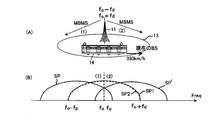
- FIG. 3 is a schematic explanatory diagram of the third embodiment, and the same reference numerals are given to the same portions as those in FIG.
- the base station 11 broadcasts the broadcast service MBMS using a radio signal of frequency f 0 -f d , and if it is moving away at high speed, the radio signal of frequency f 0 + f d Broadcasts the MBMS broadcasting service.
- the moving body is as short as an automobile, there is no problem with the method of FIG.
- the vehicle located in front of the moving train 14 is away from the base station as shown in FIG.
- the vehicle located rearward is moving in the direction approaching the base station, and the Doppler shift amount suddenly changes from + to-at a certain position of the vehicle.
- the method of FIG. 1 only the user's mobile terminal riding in one of the vehicles ahead or behind can receive MBMS radio waves at the original reception frequency satisfactorily, but the user riding in the other vehicle Mobile terminals cannot successfully receive MBMS radio waves at the original reception frequency due to Doppler shift.
- the base station 11 assumes that there are a user (mobile terminal) approaching the base station and a mobile terminal moving away from the mobile body 14 moving at high speed at the same time, and the original transmission frequency f 0.
- MBMS radio waves are simultaneously transmitted by two radio signals of transmission frequencies f 0 -f d and f 0 + f d which are increased or decreased by a Doppler shift amount f d from.
- the mobile terminal can satisfactorily receive MBMS radio waves at the originally desired radio frequency f 0 , regardless of the vehicle on which it is riding. That is, the base station 11 recognizes that the mobile body 14 is moving toward the base station and the relative speed is 350 km / h.
- the base station 11 calculates the Doppler shift amount f d from the original radio frequency f 0 based on the relative speed, and prepares for the two frequencies f 0 ⁇ in preparation for the mobile body passing directly under the base station.
- MBMS radio waves are transmitted using radio signals of f d and f 0 + f d .
- the frequency spectrum SP, SP ′ at the base station 11 becomes as shown by the solid line in FIG. 3B, but the frequency spectrum SP1 at the approaching vehicle also becomes shown as a dotted line, frequency spectrum SP2 in moving away the vehicle is as shown by the dotted line, the power is maximum at the original receiving frequency f 0.
- the mobile terminal can receive the MBMS radio wave satisfactorily at the desired radio frequency f 0 regardless of the vehicle on which it is boarded.
- FIG. 4 is a schematic explanatory view of the fourth embodiment, and the same reference numerals are given to the same parts as those in FIG.
- the base station transmits MBMS radio waves using radio signals of two frequencies f 0 -f d and f 0 + f d when detecting a high-speed moving body.
- the base station 11 is moving at high speed.
- MBMS radio waves are transmitted using radio signals of two frequencies f 0 -f d and f 1 + f d (f 1 > f 0 ).
- the mobile terminal on the receiving side needs to have two tuned receivers for the reception frequencies f 0 and f 1 .
- the base station 11 recognizes that the mobile body 14 is moving toward the base station and the relative speed is 350 km / h. Next, the base station 11 calculates the Doppler shift amount f d based on this relative speed, and prepares for the two frequencies f 0 -f d and f 1 + f d in preparation for the mobile unit to pass directly under the base station. Sends MBMS radio waves using radio signals.
- the mobile terminal of the mobile unit 14 receives and demodulates and decodes the radio signals of the frequencies f 0 and f 1 and outputs the decoding result with the smaller error rate. By doing so, the frequency spectrum SP, SP ′ at the base station 11 becomes as shown by the solid line in FIG.
- the mobile terminal can receive MBMS radio waves satisfactorily from one of the originally desired radio frequencies f 0 or f 1 regardless of the boarding vehicle.
- the transmission signal f 1 + f d is f 1 + to 2f d Since this shifts, this signal becomes almost undecodable at the receiver.
- the transmission signal of the f 0 -f d is f 0 Since this shifts to -2f d , this signal is almost impossible to decode at the receiver.
- the receiver performs control to receive, demodulate and decode two radio signals transmitted through the same broadcast, and to select and output the one with the least error.
- FIG. 5 is a schematic explanatory diagram of the fifth embodiment, and the same components as those in FIG.
- radio signals having a plurality of frequencies f 0 -f d and f 0 + f d other than the original radio frequency f 0 are used. It performs transmission of the broadcast service MBMS radio waves to transmit the MBMS radio waves by using only the radio frequency f 0 at other times. That is, in the fifth embodiment, the allocation of the frequency number of the broadcast service is adaptively controlled.
- the location information server 21 notifies the passing time and the scheduled passing speed of the moving body 14, and executes the adaptive control according to the notification.
- a server that manages a train diagram can be used as the location information management server 21, and the latest information can be transferred in advance before the train passes.
- the moving body does not need to be equipped with a GPS receiver.
- the base station 11 can always detect the moving body 14 blindly and adjust the transmission frequency, thereby omitting the detection processing of the high-speed moving body, and making the broadcasting service stable. You can do it efficiently.
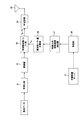
- FIG. 6 is a block diagram of the transmitter in the base station of 1st Example.
- the encoding unit 31 performs turbo encoding or convolutional encoding on the broadcast data to be transmitted
- the modulation unit 32 performs a predetermined modulation process on the encoded broadcast data
- the frequency conversion / shift 33 is a baseband signal that is a modulation result
- the RF transmitter 34 amplifies the RF signal and transmits it from the antenna 35.
- the receiving unit 36 From the position information server 51, the receiving unit 36 has a moving body (for example, a train or a train) running at a higher speed than the reference speed in the cell, or is approaching the moving speed and the base station when there is a moving body.
- a moving body for example, a train or a train
- the position information server 51 is a limit speed that can be followed by channel estimation, for example.
- the moving direction / moving speed extracting unit 37 extracts the moving speed and moving direction (approach / disengagement) of a moving object traveling at a speed higher than the reference speed from the information received from the position information server 51, and calculates a frequency shift amount calculating unit. 38.
- the frequency shift amount calculation unit 38 has the following formula: Thus, the frequency shift amount f d due to the Doppler effect is calculated and input to the frequency conversion / shift unit 33.
- m is a correction speed
- m + v when the mobile body approaches the base station at a relative speed v [m / s]
- m + v
- m -V.
- F 0 (Hz) is the original radio frequency
- c (m / sec) is the radio wave propagation speed.
- the frequency conversion / shift unit 33 does not perform the frequency conversion / shift operation unless the moving body moving at a high speed equal to or higher than the reference speed (predetermined speed) exists in the cell, and sets its output to, for example, zero.
- the broadcast service MBMS is not provided to a mobile terminal of a mobile body that moves at a low speed below the reference speed.
- the frequency conversion / shift unit 33 converts the baseband signal, which is the modulation result, into a radio signal of frequency f 0 -f d.
- the signal is input to the RF transmission unit 34, and the RF transmission unit 34 transmits the RF signal.
- the transmission apparatus of the base station receives a report from the location information server 51 that there is a mobile body that moves at a speed that cannot be followed by channel estimation, that is, a mobile terminal, and When the moving direction of the body and the relative speed (moving speed) with respect to the base station are received, the Doppler shift amount f d is calculated based on the information. Then, so that the mobile terminal can compensate for the Doppler shift at the time of receiving the broadcast data, the transmission apparatus transmits the broadcast data with a frequency shift of ( ⁇ f d ) in advance.
- the first embodiment is a broadcasting service for a specific mobile terminal, for example, a mobile terminal existing on a high-speed moving body (train, train, etc.), and performs frequency compensation on the transmission side for the mobile terminal. ing.
- frequency conversion / shift part 33 when the moving body which is moving at high speed more than reference speed does not exist in a cell, frequency conversion / shift part 33 does not perform frequency conversion / shift operation. Its output is set to zero. However, when there is no moving object moving in the cell at a higher speed than the reference speed, the frequency converting / shifting unit 33 converts the baseband signal, which is the modulation result, into a radio signal having the frequency f 0 , and the RF transmitting unit. 34, the RF transmitter 34 can be configured to transmit the RF signal. In this way, it is possible to realize the adaptive control of the fifth embodiment described above. This modification can also be applied to the other second to fourth embodiments.
- FIG. 7 is a block diagram of a transmission apparatus that can always provide a broadcast service MBMS to a moving mobile terminal whose moving speed is lower than a reference speed, and is configured as shown in FIG.
- a frequency conversion unit 39 and a synthesis unit 40 are added.
- the frequency conversion unit 39 always converts the baseband signal, which is the modulation result, into a radio signal of the original frequency f 0 and outputs it, and the frequency conversion / shift unit 33 is at a higher speed than the reference speed. Only when a moving mobile body is present in the cell, the baseband signal as a modulation result is converted into a radio signal of frequency f 0 -f d and output.
- the synthesizing unit 40 synthesizes the radio signal having the frequency f 0 output from the frequency converting unit 39 and the radio signal having the frequency f 0 -f d output from the frequency converting / shifting unit 33 and inputs the synthesized signal to the RF transmitting unit 34.
- the transmitter 34 transmits the synthesized RF signal.
- FIG. 7 is also possible in second to fourth embodiments to be described later.
- FIG. 8 is an overall processing flow of FIG. 7. If there is no moving body moving at a higher speed than the position information server 51 (“NO” in step 101), the broadcast is performed to the low-speed mobile terminal via the frequency conversion unit 39.
- Step 106 Service MBMS is provided (step 102 normal service), and if a high-speed mobile body exists, a broadcast service MBMS is provided to the mobile terminal of the high-speed mobile body in addition to the normal service through steps 103-105. (Step 106).
- FIG. 9 is a block diagram of a transmission apparatus in a base station according to the second embodiment, and the same reference numerals are given to the same parts as those in the first embodiment of FIG. The difference is that two frequency conversion / shift units 33 1 , 33 2 and a synthesis unit 41 are provided so that a broadcast service MBMS can be provided to two mobile bodies that move at high speeds at different speeds.
- the location information server 51 determines whether there is a moving body (for example, a train or a train) running at a higher speed than the reference speed in the cell, and if there is a moving speed and approaching the base station, Information indicating whether the user is further away is transmitted to the transmission device of the base station.
- a moving body for example, a train or a train
- the position information server 51 transmits the moving speed and the moving direction (separate approach / separation) for each moving body to the transmission device. Further, when there are two moving bodies moving at high speed at the same speed, the position information server 51 transmits the moving speed and the moving direction for each moving body if the moving direction (approach / disengagement) is different. Send to.
- the moving direction / moving speed extracting unit 37 extracts the moving speed and moving direction of the two moving bodies from the information received from the position information server 51 via the receiving unit 36 and inputs them to the frequency shift amount calculating unit 38.
- the frequency shift amount calculation unit 38 calculates the frequency shift amounts f d and f p due to the Doppler effect of each moving body according to the equation (1), and inputs them to the frequency conversion / shift units 33 1 and 33 2 , respectively.
- the frequency conversion / shift unit 33 1 converts the baseband signal, which is the modulation result, into a radio signal having the frequency f 0 -f d and outputs it
- the frequency conversion / shift unit 33 2 converts the baseband signal, which is the modulation result, into the frequency f.
- 0- f p radio signals are converted and output
- the synthesis unit 41 synthesizes the radio signals output from the frequency conversion / shift units 33 1 and 33 2 and inputs the radio signals to the RF transmission unit 34.
- FIG. 10 shows a modified example of the second embodiment, in which components identical with those of the second embodiment of FIG. The difference is that a speed group detection unit 42 is provided.
- the moving speed is divided into a plurality of speed ranges, a representative speed in each speed range is set, and the Doppler shift corresponding to the representative speed in the speed range to which the moving speed of the moving body moving at high speed belongs.
- the frequency conversion / shift units 33 1 to 33 n are configured to shift by the amount.
- the threshold A km / h is preferably a limit value that can be followed by channel estimation.
- the frequency shift amount calculation unit 38 calculates the frequency shift amounts f d1 to f dn corresponding to each moving speed according to the equation (1), and converts each of the frequency shifts / shifts. Input to the parts 33 1 to 33 n .
- the frequency conversion / shift unit 33 1 converts the baseband signal that is the modulation result into a radio signal having the frequency f 0 -f d1 and outputs the radio signal, and the frequency conversion / shift unit 33 2 converts the baseband signal that is the modulation result to the frequency f.
- the frequency conversion / shifting unit 33 n and outputs the converted baseband signal is modulated result to the radio signal frequency f 0 -f dn.
- the combining unit 41 combines the radio signals output from the frequency conversion / shift units 33 1 to 33 n and inputs them to the RF transmission unit 34, and the RF transmission unit 34 transmits the combined RF signal.
- the relative speed considering the moving direction is arranged as a speed group, and if the moving speed of the moving object is within the speed group range, the Doppler shift amount is calculated using the representative speed for compensation. Thus, it is possible to collectively compensate for users having close relative velocities.
- FIG. 11 is a block diagram of a transmitting apparatus in a base station according to a third embodiment. Components identical with those of the first embodiment of FIG. The difference is that two frequency conversion / shift units 33a and 33b and a synthesis unit 41 are provided. As illustrated in FIG. 3, when the length of a moving body reaches 100 m, such as a train or a train, the vehicle in front of the train that is the moving body is in the rearward direction away from the base station. The vehicle moves toward the base station, and the Doppler shift amount suddenly changes from + to-at a certain position of the vehicle.
- the shift MBMS radio waves are simultaneously transmitted using radio signals having the frequencies f 0 ⁇ f d and f 0 + f d . In this way, even if the moving body is long, the mobile terminal on the moving body can receive MBMS radio waves satisfactorily at the desired radio frequency f 0 regardless of the boarding vehicle.
- the location information server 51 determines whether there is a moving body (for example, a train or a train) running at a higher speed than the reference speed in the cell, and if there is a moving speed and approaching the base station, Information on whether the user is moving further away is transmitted to the base station.
- the moving speed extracting unit 37 ′ extracts the moving speed of the high speed moving body from the information received from the position information server 51 via the receiving unit 36 and inputs it to the frequency shift amount calculating unit 38.
- the frequency shift amount calculation unit 38 calculates the Doppler shift amount f d corresponding to the moving speed of the moving body by the equation (1) and inputs it to the frequency conversion / shift units 33a and 33b.
- the frequency conversion / shift unit 33a converts the baseband signal that is the modulation result into a radio signal having the frequency f 0 -f d and outputs the radio signal
- the frequency conversion / shift unit 33b outputs the baseband signal that is the modulation result to the frequency f 0 + f.
- the signal is converted into a radio signal d and output, and the synthesis unit 41 synthesizes the radio signals output from the frequency conversion / shift units 33a and 33b and inputs them to the RF transmission unit 34.
- the RF transmission unit 34 performs the synthesis. Transmit an RF signal.
- the moving body be longer as a train or trains, all the mobile terminals on the moving body will be able to favorably receive the MBMS radio by the radio frequency f 0 of the desired nature.
- the frequency conversion unit 39 of FIG. 7 it is possible to provide a constant broadcast service MBMS to a mobile terminal that is moving at a reference speed or lower.
- FIG. 12 is a block diagram of a receiving apparatus of a mobile terminal corresponding to the first to third embodiments.
- the RF receiver 61 extracts a radio signal having a frequency f 0 from the signal received by the antenna 60, the frequency converter 62 down-converts the radio signal having the frequency f 0 into a baseband signal, and the demodulator 63 has a baseband.
- the signal is demodulated, and the decoding unit 64 performs error detection decoding processing on the demodulated data to decode and output the broadcast data 65.
- FIG. 13A is a block diagram of a transmission apparatus according to a fourth embodiment, in which components identical with those of the transmission apparatus of the third embodiment in FIG. The difference is that a synthesizing unit 44 and a radio frequency specifying unit 45 are provided.
- radio waves of the broadcast service MBMS are transmitted using radio signals of two frequencies f 0 -f d and f 0 + f d when a high-speed moving object is detected.
- the transmission device moves at high speed.
- MBMS radio waves are transmitted using radio signals of two frequencies f 0 ⁇ f d and f 1 + f d .
- the frame is time-division multiplexed in the order of the pilot PL, the control channel CT, and the broadcast data channel BR in the time axis direction as shown in FIG. 13B, and each pilot, control channel, and broadcast data channel are Frequency multiplexing is performed in the frequency axis direction.
- the pilot PL is used for channel estimation and reception quality measurement
- the control channel CT is used to notify the mobile terminal of two radio frequencies f 0 and f 1 in addition to various control data such as modulation scheme and coding rate. Used.
- the synthesizer 44 time-division-multiplexes pilot, control data, and broadcast data in order and inputs them to the modulator 32.
- the modulator 32 performs, for example, OFDM modulation processing on the input data, and converts the modulation result into a frequency converter / shifter 33a. , 33b.
- the radio frequency designation unit 45 inputs the radio frequencies f 0 and f 1 to the frequency conversion / shift units 33a and 33b, respectively.
- the location information server 51 has a moving body (for example, a train or a train) running at a speed higher than the reference speed in the cell, or is approaching the moving speed and the base station when there is a moving body. Or information indicating whether the user is moving away from the base station.
- the moving speed extracting unit 37 ′ extracts the moving speed of the high speed moving body from the information received from the position information server 51 via the receiving unit 36 and inputs it to the frequency shift amount calculating unit 38.
- the frequency shift amount calculation unit 38 calculates the Doppler shift amount f d corresponding to the moving speed of the moving body by the equation (1) and inputs it to the frequency conversion / shift units 33a and 33b.
- the frequency conversion / shift unit 33a converts the baseband signal, which is the modulation result, into a radio signal having the frequency f 0 -f d and outputs it
- the frequency conversion / shift unit 33b converts the baseband signal, which is the modulation result, to the frequency f 1 + f.
- the signal is converted into a radio signal d and output, and the synthesis unit 41 synthesizes the radio signals output from the frequency conversion / shift units 33a and 33b and inputs them to the RF transmission unit 34.
- the RF transmission unit 34 performs the synthesis. Transmit an RF signal.
- a mobile terminal that is approaching the base station with a radio signal of frequency f 0 -f d can receive MBMS radio waves well, and a mobile terminal that is moving away from the base station with a radio signal of frequency f 1 + f d is MBMS radio waves. Can be received well. As a result, even if the moving body is long like a train or a train, all the mobile terminals on the moving body can receive MBMS radio waves better than one of the radio frequencies f 0 or f 1 .
- FIG. 14 is a configuration diagram of a receiving device of a mobile terminal that receives and outputs broadcast data transmitted from the transmitting device of FIG. It is assumed that the radio frequency f 0 used when approaching at high speed out of the two radio frequencies f 0 and f 1 is known. For example, it is assumed that the radio frequency f 0 is notified from the base station to the mobile terminal when the communication link with the base station is set up.
- the RF receiving unit 71 extracts a radio signal having the frequency f 0 from the signal received by the antenna 70, the frequency converting unit 72a frequency-converts the radio signal having the frequency f 0 into a baseband signal, and the demodulating unit 73a
- the signal is demodulated, and the separation unit 74 separates pilot, control data, and broadcast data.
- the channel estimation 75 performs channel estimation using a pilot, and inputs the estimation results to the demodulation units 73a and 73b to perform channel compensation.
- the frequency information extraction unit 76 extracts the radio frequencies f 0 and f 1 and inputs them to the frequency conversion units 72a and 72b.
- the frequency converting unit 72a frequency-converts the radio signal having the frequency f 0 included in the antenna reception signal to a baseband signal
- the demodulating unit 73a performs demodulation processing on the baseband signal
- the decoding unit 77a is demodulated.
- the error detection decoding process is performed on the data
- the block error rate detection unit (BLER unit) 78a receives the decoding result and calculates the error occurrence rate (error rate) per block.
- the issue result is input to the selection unit 79.
- the frequency converting unit 72b is frequency down-converts the radio signal of frequency f 1 included in the antenna reception signals to baseband signals, demodulating part 73b demodulates the baseband signal, the decryption unit 77b demodulates
- the error detection decoding process is applied to the data, and the block error rate detection unit (BLER unit) 78b receives the decoding result, calculates the error occurrence rate per block, and calculates the error occurrence rate and decoding result.
- the selection unit 79 compares the error occurrence rates input from the BLER units 78a and 78b, and selects and outputs the smaller decoding result as broadcast data. It should be noted that by adding the frequency conversion unit 39 of FIG. 7 to the fourth embodiment, it can be configured to be able to always provide the broadcast service MBMS to mobile terminals that are moving at or below the reference speed.
- FIG. 15 is a processing flow of the location information server 51.
- a reference speed A (km / h) that manages the position and moving speed of a mobile unit existing in a cell of a predetermined base station (step 201) and sets a relative speed (moving speed) of the mobile unit to the base station It is determined whether it is larger (step 202). If there is no moving object faster than A (km / h), no processing is performed (step 203), and the processing after step 201 is repeated.
- step 203 if there is a moving body having a speed higher than A (km / h), the moving speed of the moving body and the moving direction with respect to the base station (approach / disengagement) are specified and notified to the base station. (Steps 204 and 205). Thereafter, the management of the position and moving speed of the moving body existing in the cell of the predetermined base station is continued (step 206), and the moving body moving faster than the reference speed A (km / h) exists in the cell. It is monitored whether it has stopped (step 207), and if it still exists, the processing after step 204 is repeated. On the other hand, in step 207, if there is no moving body moving faster than the reference speed A (km / h), the base station is notified to that effect (step 208) and the process returns to the beginning.
- Reference speed A (km / h) in which the relative speed (moving speed) of each moving body with respect to the base station is set by managing the position and moving speed of the moving body existing in the cell of the predetermined base station (step 201). It is determined whether it is larger (step 202). If there is no moving object faster than A (km / h), no processing is performed (step 203), and the processing after step 201 is repeated.
- step 203 if there is one or more moving objects higher than A (km / h), the moving speed of each moving object and the moving direction (approach / disengagement) with respect to the base station are specified and the base station (Steps 204 and 205). Thereafter, management of the position and moving speed of the moving body existing in the cell of the predetermined base station is continued (step 206), and there is no moving body moving faster than the reference speed A (km / h). Monitor (step 207), and if it still exists, repeat the processing from step 204 onward. If there is no moving object that moves at the moving speed notified to the base station, the base station is notified in step 205. In step 207, if there is no moving body moving faster than the reference speed A (km / h), the base station is notified of this (step 208) and the process returns to the beginning.
- a mobile terminal can correctly receive MBMS broadcast service data from a base station in a high-speed mobile body on which a large number of users are boarded, and transmits data more efficiently than the base station. be able to.
- a mobile terminal can correctly receive a signal from a base station.
- it is possible to eliminate the need for control for determining whether to transmit a radio signal having an increase side or a decrease side frequency from the original transmission frequency in order to compensate for the Doppler effect.
- the mobile terminal when a Doppler shift occurs, the mobile terminal can correctly receive a signal from the base station without providing a GPS receiver on the mobile body.
Landscapes
- Engineering & Computer Science (AREA)
- Computer Networks & Wireless Communication (AREA)
- Signal Processing (AREA)
- Mobile Radio Communication Systems (AREA)
- Transmitters (AREA)
Abstract
放送サービス信号を無線で送信する送信装置の放送サービス信号の送信に際して、高速接近中、あるいは高速に遠ざかっている移動体がセル内に存在するか判定し、存在する場合には、高速移動に起因する無線周波数のドップラーシフト量を移動体の移動速度に基づいて計算する。そして、放送サービス信号を送信するための無線信号の周波数をドップラーシフトする方向と逆方向に該ドップラーシフト量だけシフトする。これにより、移動端末はドップラーシフトに関係なく本来の無線周波数で放送サービス信号を受信することができる。
Description
本発明は放送サービス信号送信方法及び送信装置に係わり、特に、放送サービス信号を無線で送信する放送サービス信号送信方法及び送信装置に関する。
移動通信において、移動体が高速移動しているとドップラー効果によりスペクトラムが偏移する現象が発生する。特に、山中やトンネル内であると反射波がほとんど存在しないために、移動体の方向への電波のみが伝搬してライス分布(Ricean distribution)になりやすい。このようにライス分布によるドップラーシフトが発生した状況において、従来ではドップラーの歪を補正する手段としてAFC(Automatic Frequency Control)や高性能なチャネル推定が導入された。
図16はドップラーシフトによる受信周波数変動の説明図である。(A)に示すように、基地局1,2より携帯電話向けの放送サービスMBMS(Multimedia Broadcast Multicast Service)が周波数f0の無線信号により移動端末に向けて行なわれている。現在、着目する移動端末3は、基地局1より放送サービスMBMSを受信できるエリア4内に存在し、例えば350km/hの高速度で移動中である。移動端末3が基地局1に高速接近中の場合((1)のエリア)、該移動端末における基地局1からの周波数はドップラー効果によりf0からf0+fdにシフトする。また、移動端末3が基地局1から高速で遠ざかっている場合((2)のエリア)、該移動端末における基地局1からの周波数はドップラー効果によりf0からf0-fdにシフトする。このドップラーシフトにより(B)に示すように、(1)のエリアでは周波数スペクトラムSP1は本来のスペクトラムSPより高周波側にシフトし、(2)のエリアでは周波数スペクトラムSP2は本来のスペクトラムSPより低周波側にシフトする。このため、移動端末における周波数f0の受信パワーが減少し、ドップラー歪が発生して良好な受信ができなくなる。
しかしドップラーの歪を補正する手段として、従来のAFC(Automatic Frequency Control)や高性能なチャネル推定手段には以下の問題がある。
すなわち、近年では周波数利用効率の向上を目的に回線交換型からパケットスイッチ型へ通信方式が切り替えられ、これにより通信回線が定常的に張られないようになっている。従来のAFCを適用できる前提条件としては、周期的に通信回線が張られている必要があり、通信方式の変更によりAFC技術でドップラー歪を補償する事が非常に難しくなってきた。
一方、チャネル推定でドップラー歪を補償することは可能であるが、無線周波数の高周波化、移動体の高速化によりドップラーシフト量が大きくなる(例えば、無線周波数が2GHz帯で移動速度が350km/hのときのドップラーシフト量は約1500Hz)。この周波数変動に対処するには時間軸で高密度に参照用のパイロットを挿入する必要があるが、周波数利用効率を向上するという方向と矛盾する対処法になってしまう。
すなわち、近年では周波数利用効率の向上を目的に回線交換型からパケットスイッチ型へ通信方式が切り替えられ、これにより通信回線が定常的に張られないようになっている。従来のAFCを適用できる前提条件としては、周期的に通信回線が張られている必要があり、通信方式の変更によりAFC技術でドップラー歪を補償する事が非常に難しくなってきた。
一方、チャネル推定でドップラー歪を補償することは可能であるが、無線周波数の高周波化、移動体の高速化によりドップラーシフト量が大きくなる(例えば、無線周波数が2GHz帯で移動速度が350km/hのときのドップラーシフト量は約1500Hz)。この周波数変動に対処するには時間軸で高密度に参照用のパイロットを挿入する必要があるが、周波数利用効率を向上するという方向と矛盾する対処法になってしまう。
ドップラー歪の補償方法としてGPS衛星を利用した従来技術がある(特許文献1参照)。この従来技術では、移動局が、GPS衛星を利用して自分の移動速度や位置(経緯度)を測定し、あらかじめ位置測定(経緯度)しておいた基地局の方向を割り出し、ドップラーシフト分ΔFを計算し、当該計算結果より送信機のローカル周波数を微調整し、これにより、基地局への送信波のドップラーシフト分ΔFを補正する。
しかし、上記従来技術は、ドップラー効果を補償するために本来の送信周波数より増加側の周波数、あるいは減少側の周波数の1波のみを送信するものである。このため、従来技術は増加側周波数、あるいは減少側周波数のいずれの無線信号を送信すべきかの制御が
複雑になる問題がある。
また、上記従来技術は、ドップラーシフトを考慮した基地局への移動局の送信制御であり、移動体の移動速度を考慮した基地局における送信制御ではない。すなわち、従来技術は、ドップラーシフトが発生したとき基地局からの信号を移動体が正しく受信できるようにしたものではない。
また、上記従来技術はGPS受信機を移動体に設ける必要があり、移動体のコストアップにつながる問題がある。
しかし、上記従来技術は、ドップラー効果を補償するために本来の送信周波数より増加側の周波数、あるいは減少側の周波数の1波のみを送信するものである。このため、従来技術は増加側周波数、あるいは減少側周波数のいずれの無線信号を送信すべきかの制御が
複雑になる問題がある。
また、上記従来技術は、ドップラーシフトを考慮した基地局への移動局の送信制御であり、移動体の移動速度を考慮した基地局における送信制御ではない。すなわち、従来技術は、ドップラーシフトが発生したとき基地局からの信号を移動体が正しく受信できるようにしたものではない。
また、上記従来技術はGPS受信機を移動体に設ける必要があり、移動体のコストアップにつながる問題がある。
以上より、本件の目的は、多数のユーザが搭乗している高速の移動体において移動端末が基地局から正しくデータ受信できるようにし、かつ、基地局が効率よくデータ送信できるようにすることである。
本件の別の目的は、ドップラーシフトが発生しても基地局からの信号を移動端末が正しく受信できるようにすることである。
本件の別の目的は、ドップラー効果を補償するために本来の送信周波数より増加側、あるいは減少側の周波数のいずれの無線信号を送信すべきかの決定制御を不要にすることである。
本件の別の目的は、ドップラーシフトが発生した際、GPS受信機を移動端末に設けなくても基地局からの信号を移動端末が正しく受信できるようにすることである。
特開2003-309517号公報
本件の別の目的は、ドップラーシフトが発生しても基地局からの信号を移動端末が正しく受信できるようにすることである。
本件の別の目的は、ドップラー効果を補償するために本来の送信周波数より増加側、あるいは減少側の周波数のいずれの無線信号を送信すべきかの決定制御を不要にすることである。
本件の別の目的は、ドップラーシフトが発生した際、GPS受信機を移動端末に設けなくても基地局からの信号を移動端末が正しく受信できるようにすることである。
・放送サービス信号送信方法
本件の第1は放送サービス信号を無線で送信する送信装置の放送サービス信号送信方法である。
第1の放送サービス信号送信方法は、高速接近中、あるいは高速に遠ざかっている移動体が存在するか判定するステップ、存在する場合には、高速移動に起因する無線周波数のドップラーシフト量を前記移動体の移動速度に基づいて計算するステップ、放送サービス信号を送信するための無線信号の周波数をドップラーシフト方向と逆方向に該ドップラーシフト量だけシフトするステップ、を備えている。
第2の放送サービス信号送信方法は、高速接近中、あるいは高速に遠ざかっている移動体が存在するか判定するステップ、存在する場合には、高速移動に起因する無線周波数のドップラーシフト量を前記移動体の移動速度に基づいて計算するステップ、前記放送サービス信号を送信するための無線信号の周波数をプラス方向及びマイナス方向のそれぞれにドップラーシフト量だけシフトするステップ、シフトした各無線信号で放送サービス信号を送信するステップ、を備えている。
上記第1、第2の放送サービス信号送信方法は、更に、前記送信装置と通信可能なエリア内に存在する前記移動体の位置及び速度を管理する外部の移動体位置管理サーバより、基準速度より高速に接近中、あるいは基準速度より高速に遠ざかっている移動体の存否および移動速度を受信するステップ、を備えている。
上記第1、第2の放送サービス信号送信方法において、高速接近中、あるいは高速に遠ざかっている移動体が複数存在する場合、それぞれの移動体の移動速度に基づいてドップラーシフト量を計算し、前記無線信号の周波数を各ドップラーシフト量だけシフトし、シフトした各無線信号で放送サービス信号を送信する。この場合、移動速度を複数の速度範囲に区分すると共に、各速度範囲における代表速度を設定しておき、移動体速度が属する速度範囲の代表速度に対応するドップラーシフト量だけ前記無線信号の周波数をシフトし、シフトした無線信号で放送サービス信号を送信する。
上記第2の放送サービス信号送信方法において、前記放送サービス信号を送信するための第1の無線信号の周波数をマイナス方向にドップラーシフト量だけシフトし、前記第1の無線信号の周波数と異なる第2の無線信号の周波数をプラス方向にドップラーシフト量だけシフトし、シフトした各無線信号で放送サービス信号を送信する。
本件の第1は放送サービス信号を無線で送信する送信装置の放送サービス信号送信方法である。
第1の放送サービス信号送信方法は、高速接近中、あるいは高速に遠ざかっている移動体が存在するか判定するステップ、存在する場合には、高速移動に起因する無線周波数のドップラーシフト量を前記移動体の移動速度に基づいて計算するステップ、放送サービス信号を送信するための無線信号の周波数をドップラーシフト方向と逆方向に該ドップラーシフト量だけシフトするステップ、を備えている。
第2の放送サービス信号送信方法は、高速接近中、あるいは高速に遠ざかっている移動体が存在するか判定するステップ、存在する場合には、高速移動に起因する無線周波数のドップラーシフト量を前記移動体の移動速度に基づいて計算するステップ、前記放送サービス信号を送信するための無線信号の周波数をプラス方向及びマイナス方向のそれぞれにドップラーシフト量だけシフトするステップ、シフトした各無線信号で放送サービス信号を送信するステップ、を備えている。
上記第1、第2の放送サービス信号送信方法は、更に、前記送信装置と通信可能なエリア内に存在する前記移動体の位置及び速度を管理する外部の移動体位置管理サーバより、基準速度より高速に接近中、あるいは基準速度より高速に遠ざかっている移動体の存否および移動速度を受信するステップ、を備えている。
上記第1、第2の放送サービス信号送信方法において、高速接近中、あるいは高速に遠ざかっている移動体が複数存在する場合、それぞれの移動体の移動速度に基づいてドップラーシフト量を計算し、前記無線信号の周波数を各ドップラーシフト量だけシフトし、シフトした各無線信号で放送サービス信号を送信する。この場合、移動速度を複数の速度範囲に区分すると共に、各速度範囲における代表速度を設定しておき、移動体速度が属する速度範囲の代表速度に対応するドップラーシフト量だけ前記無線信号の周波数をシフトし、シフトした無線信号で放送サービス信号を送信する。
上記第2の放送サービス信号送信方法において、前記放送サービス信号を送信するための第1の無線信号の周波数をマイナス方向にドップラーシフト量だけシフトし、前記第1の無線信号の周波数と異なる第2の無線信号の周波数をプラス方向にドップラーシフト量だけシフトし、シフトした各無線信号で放送サービス信号を送信する。
・送信装置
本件の第2は放送サービス信号を無線で送信する送信装置である。
第1の送信装置は、高速接近中、あるいは高速に遠ざかっている移動体が存在するか判定する判定部、存在する場合には、高速移動に起因する無線周波数のドップラーシフト量を前記移動体の移動速度に基づいて計算するドップラーシフト量計算部、放送サービス信号を送信するための無線信号の周波数をドップラーシフト方向と逆方向に該ドップラーシフト量だけシフトする無線周波数シフト部、シフトした無線信号で放送サービス信号を送信する送信部、を備えている。
第2の送信装置は、高速接近中、あるいは高速に遠ざかっている移動体が存在するか判定する判定部、存在する場合には、高速移動に起因する無線周波数のドップラーシフト量を前記移動体の移動速度に基づいて計算するドップラーシフト量計算部、前記放送サービス信号を送信するための無線信号の周波数をプラス方向及びマイナス方向のそれぞれにドップラーシフト量だけシフトする無線周波数シフト部、前記シフトした各無線信号で放送サービス信号を送信する送信部、を備えている。
第1、第2の送信装置は、更に、自装置と通信可能なエリア内に存在する前記移動体の位置及び速度を管理する外部の移動体位置管理サーバより、基準速度より高速に接近中、あるいは基準速度より高速に遠ざかっている移動体の存否および移動速度を受信する受信部、を備えている。
第1、第2の送信装置において、高速接近中、あるいは高速に遠ざかっている移動体が複数存在する場合、前記ドップラーシフト量計算部はそれぞれの移動体の移動速度に基づいてドップラーシフト量を計算し、前記無線周波数シフト部は、無線信号の周波数を各ドップラーシフト量だけシフトし、前記送信部はシフトした各無線信号で放送サービス信号を送信する。この場合、移動速度を複数の速度範囲に区分すると共に、各速度範囲における代表速度を設定しておき、前記無線周波数シフト部は、移動体速度が属する速度範囲の代表速度に対応するドップラーシフト量だけ前記無線信号の周波数をシフトし、前記送信部はシフトした無線信号で放送サービス信号を送信する。
第2の送信装置において、前記無線周波数シフト部は、前記放送サービス信号を送信するための第1の無線信号の周波数をマイナス方向にドップラーシフト量だけシフトし、前記第1の無線信号の周波数と異なる第2の無線信号の周波数をプラス方向にドップラーシフト量だけシフトし、前記送信部はシフトした各無線信号で放送サービス信号を送信する。
本件の第2は放送サービス信号を無線で送信する送信装置である。
第1の送信装置は、高速接近中、あるいは高速に遠ざかっている移動体が存在するか判定する判定部、存在する場合には、高速移動に起因する無線周波数のドップラーシフト量を前記移動体の移動速度に基づいて計算するドップラーシフト量計算部、放送サービス信号を送信するための無線信号の周波数をドップラーシフト方向と逆方向に該ドップラーシフト量だけシフトする無線周波数シフト部、シフトした無線信号で放送サービス信号を送信する送信部、を備えている。
第2の送信装置は、高速接近中、あるいは高速に遠ざかっている移動体が存在するか判定する判定部、存在する場合には、高速移動に起因する無線周波数のドップラーシフト量を前記移動体の移動速度に基づいて計算するドップラーシフト量計算部、前記放送サービス信号を送信するための無線信号の周波数をプラス方向及びマイナス方向のそれぞれにドップラーシフト量だけシフトする無線周波数シフト部、前記シフトした各無線信号で放送サービス信号を送信する送信部、を備えている。
第1、第2の送信装置は、更に、自装置と通信可能なエリア内に存在する前記移動体の位置及び速度を管理する外部の移動体位置管理サーバより、基準速度より高速に接近中、あるいは基準速度より高速に遠ざかっている移動体の存否および移動速度を受信する受信部、を備えている。
第1、第2の送信装置において、高速接近中、あるいは高速に遠ざかっている移動体が複数存在する場合、前記ドップラーシフト量計算部はそれぞれの移動体の移動速度に基づいてドップラーシフト量を計算し、前記無線周波数シフト部は、無線信号の周波数を各ドップラーシフト量だけシフトし、前記送信部はシフトした各無線信号で放送サービス信号を送信する。この場合、移動速度を複数の速度範囲に区分すると共に、各速度範囲における代表速度を設定しておき、前記無線周波数シフト部は、移動体速度が属する速度範囲の代表速度に対応するドップラーシフト量だけ前記無線信号の周波数をシフトし、前記送信部はシフトした無線信号で放送サービス信号を送信する。
第2の送信装置において、前記無線周波数シフト部は、前記放送サービス信号を送信するための第1の無線信号の周波数をマイナス方向にドップラーシフト量だけシフトし、前記第1の無線信号の周波数と異なる第2の無線信号の周波数をプラス方向にドップラーシフト量だけシフトし、前記送信部はシフトした各無線信号で放送サービス信号を送信する。
(A)各実施形態の概略
(a) 第1実施例の概略
図1は第1実施例の概略説明図である。基地局11より携帯電話向けの放送サービスMBMSが所定周波数の無線信号により移動端末に向けて行なわれている。現在着目する移動端末12が、基地局11より放送サービスMBMSを受信できるエリア(セル)13内に存在し、例えば350km/hの高速度で移動中である。
図1の(A)に示すように、移動端末12が基地局11に高速接近中の場合には((1)のエリア)、基地局11は本来の無線周波数f0よりドップラーシフト量(=fd)だけ低い周波数f0-fdの無線信号により放送サービスMBMSの放送を行なう。このようにすれば、基地局11での周波数スペクトラムSPは図1の(B)の実線で示すようになるが、移動端末12における周波数スペクトラムSP1は点線で示すようになり、本来の受信周波数f0でパワーが最大となり良好な受信が可能になる。
又、図1の(C)に示すように、移動端末12が基地局11から高速に遠ざかっている場合には((2)のエリア)、基地局11は本来の無線周波数f0よりドップラーシフト量(=fd)だけ高い周波数f0+fdの無線信号により放送サービスMBMSの放送を行なう。このようにすれば、基地局11での周波数スペクトラムSPは図1の(D)の実線で示すようになるが、移動端末12における周波数スペクトラムSP2は点線で示すようになり、本来の受信周波数f0でパワーが最大となり良好な受信が可能になる。
要約すれば、基地局11は高速で移動する移動体(移動端末)12を認識すると、該移動体12が基地局11に近づく、もしくは、遠ざかる方向に移動しているのかを把握し、また、基地局に対する相対速度を把握する。そして、この移動方向と相対速度を基にして、無線周波数からの周波数変動であるドップラーシフト量fdを算出し、基地局で本来の送信周波数から該ドップラーシフト量だけ増減した送信周波数f0-fdあるいはf0+fdの無線信号でデータを送信する。このようにすると、移動端末で受信する際にドップラーシフトを受けても、本来希望する無線周波数f0により信号を受信することができる。
第1実施例によれば、セル内に高速移動する移動体が存在する場合、該移動体の移動端末に対して放送サービスを安定して供給する事ができる。本発明は放送サービスを提供する際に適用しやすいが、そのほかマルチキャスト、ユニキャストする際にも応用することができる。
(a) 第1実施例の概略
図1は第1実施例の概略説明図である。基地局11より携帯電話向けの放送サービスMBMSが所定周波数の無線信号により移動端末に向けて行なわれている。現在着目する移動端末12が、基地局11より放送サービスMBMSを受信できるエリア(セル)13内に存在し、例えば350km/hの高速度で移動中である。
図1の(A)に示すように、移動端末12が基地局11に高速接近中の場合には((1)のエリア)、基地局11は本来の無線周波数f0よりドップラーシフト量(=fd)だけ低い周波数f0-fdの無線信号により放送サービスMBMSの放送を行なう。このようにすれば、基地局11での周波数スペクトラムSPは図1の(B)の実線で示すようになるが、移動端末12における周波数スペクトラムSP1は点線で示すようになり、本来の受信周波数f0でパワーが最大となり良好な受信が可能になる。
又、図1の(C)に示すように、移動端末12が基地局11から高速に遠ざかっている場合には((2)のエリア)、基地局11は本来の無線周波数f0よりドップラーシフト量(=fd)だけ高い周波数f0+fdの無線信号により放送サービスMBMSの放送を行なう。このようにすれば、基地局11での周波数スペクトラムSPは図1の(D)の実線で示すようになるが、移動端末12における周波数スペクトラムSP2は点線で示すようになり、本来の受信周波数f0でパワーが最大となり良好な受信が可能になる。
要約すれば、基地局11は高速で移動する移動体(移動端末)12を認識すると、該移動体12が基地局11に近づく、もしくは、遠ざかる方向に移動しているのかを把握し、また、基地局に対する相対速度を把握する。そして、この移動方向と相対速度を基にして、無線周波数からの周波数変動であるドップラーシフト量fdを算出し、基地局で本来の送信周波数から該ドップラーシフト量だけ増減した送信周波数f0-fdあるいはf0+fdの無線信号でデータを送信する。このようにすると、移動端末で受信する際にドップラーシフトを受けても、本来希望する無線周波数f0により信号を受信することができる。
第1実施例によれば、セル内に高速移動する移動体が存在する場合、該移動体の移動端末に対して放送サービスを安定して供給する事ができる。本発明は放送サービスを提供する際に適用しやすいが、そのほかマルチキャスト、ユニキャストする際にも応用することができる。
(b) 第2実施例の概略
図2は第2実施例の概略説明図であり、図1と同一部分には同一符号を付している。図1では、セル13内に移動体が1台存在する場合であるが、図2では該セル内に複数台(図では2台)存在する場合である。例えば、移動体121は350km/hの高速度で基地局11に接近中であり、移動体122は200km/hの高速度で基地局11に接近中であるとする。基地局11は移動体121が基地局に向かってきており、かつ、相対速度が350km/hである事を把握し、同時に他の移動体122が基地局に向かってきており、かつ、相対速度が200km/hである事を把握する。この移動方向と相対速度を基にして基地局11はドップラーシフト量を計算し、移動体121のドップラーシフト量fd、移動体122のドップラーシフト量fpをそれぞれ取得する。そして、基地局11は本来の無線周波数f0より第1のドップラーシフト量(=fd)だけ低い第1の周波数f0-fdの無線信号により放送サービスMBMSの放送を行なうと共に、本来の無線周波数f0より第2のドップラーシフト量(=fp)だけ低い第2の周波数f0-fpの無線信号により放送サービスMBMSの放送を行なう。このようにすれば、基地局11での周波数スペクトラムSP、SP′は図2の(B)の実線で示すようになるが、移動体121における周波数スペクトラムSP1は点線で示すようになる。また、移動体122における周波数スペクトラムSP2は点線で示すようになり、移動体121、122において本来の受信周波数f0でパワーが最大となり良好な受信が可能になる。
以上により、移動体121のドップラーシフトを補償するように第1の無線信号でMBMSの放送を行ない、移動体122のドップラーシフトを補償するように第2の無線信号でMBMSの放送を行なう。このようにする事で、それぞれの移動体の移動端末は本来希望する無線周波数で基地局からのMBMS電波を受信することができる。なお、図2では高速移動中の移動体が2台の場合について説明したが2台以上でも同様な制御が可能である。また、図2では高速接近中の場合について説明したが,高速に遠ざかっている場合、接近及び遠ざかりの両者が混在する場合にも同様な制御が可能である。
図2は第2実施例の概略説明図であり、図1と同一部分には同一符号を付している。図1では、セル13内に移動体が1台存在する場合であるが、図2では該セル内に複数台(図では2台)存在する場合である。例えば、移動体121は350km/hの高速度で基地局11に接近中であり、移動体122は200km/hの高速度で基地局11に接近中であるとする。基地局11は移動体121が基地局に向かってきており、かつ、相対速度が350km/hである事を把握し、同時に他の移動体122が基地局に向かってきており、かつ、相対速度が200km/hである事を把握する。この移動方向と相対速度を基にして基地局11はドップラーシフト量を計算し、移動体121のドップラーシフト量fd、移動体122のドップラーシフト量fpをそれぞれ取得する。そして、基地局11は本来の無線周波数f0より第1のドップラーシフト量(=fd)だけ低い第1の周波数f0-fdの無線信号により放送サービスMBMSの放送を行なうと共に、本来の無線周波数f0より第2のドップラーシフト量(=fp)だけ低い第2の周波数f0-fpの無線信号により放送サービスMBMSの放送を行なう。このようにすれば、基地局11での周波数スペクトラムSP、SP′は図2の(B)の実線で示すようになるが、移動体121における周波数スペクトラムSP1は点線で示すようになる。また、移動体122における周波数スペクトラムSP2は点線で示すようになり、移動体121、122において本来の受信周波数f0でパワーが最大となり良好な受信が可能になる。
以上により、移動体121のドップラーシフトを補償するように第1の無線信号でMBMSの放送を行ない、移動体122のドップラーシフトを補償するように第2の無線信号でMBMSの放送を行なう。このようにする事で、それぞれの移動体の移動端末は本来希望する無線周波数で基地局からのMBMS電波を受信することができる。なお、図2では高速移動中の移動体が2台の場合について説明したが2台以上でも同様な制御が可能である。また、図2では高速接近中の場合について説明したが,高速に遠ざかっている場合、接近及び遠ざかりの両者が混在する場合にも同様な制御が可能である。
(c) 第3実施例の概略
図3は第3実施例の概略説明図であり、図1と同一部分には同一符号を付している。図1では、移動体12が基地局11に高速接近中であるか、高速に遠ざかっているかを判定する。移動体12が基地局11に高速接近中であれば基地局11は周波数f0-fdの無線信号により放送サービスMBMSの放送を行ない、高速に遠ざかっていれば周波数f0+fdの無線信号により放送サービスMBMSの放送を行なう。移動体が自動車のように短い場合には図1の方法で何らの問題も生じない。
ところが、例えば、電車や列車のように移動体の長さが100mにも及ぶ場合、図3の(A)に示すように移動体である列車14の前方に位置する車両は基地局から遠ざかる方向へ、後方に位置する車両は基地局へ近づく方向へ移動しており、車両のある位置でドップラーシフト量が+から-へ急変する。かかる場合、図1の方法では、前方あるいは後方の一方の車両に乗車しているユーザの移動端末だけが本来の受信周波数でMBMS電波を良好に受信できるが、他方の車両に乗車しているユーザの移動端末はドップラーシフトにより本来の受信周波数でMBMS電波を良好に受信することができなくなる。
そこで、第3実施例において基地局11は、高速度で移動する移動体14には基地局に近づくユーザ(移動端末)と遠ざかる移動端末が同時に存在するものと想定し、本来の送信周波数f0からドップラーシフト量fdだけ増減した送信周波数f0-fdおよびf0+fdの2つの無線信号で同時にMBMS電波を送信する。このようにすると、移動体14が長くても、乗車している車両に関係なく、移動端末は本来希望する無線周波数f0によりMBMS電波を良好に受信することができる。
すなわち、基地局11は、移動体14が基地局に向かってきており、かつ、相対速度が350km/hである事を把握する。ついで、基地局11はこの相対速度を基にして、本来の無線周波数f0からのドップラーシフト量fdを算出し、移動体が基地局直下を通過する事に備えて二つの周波数f0-fdおよびf0+fdの無線信号を用いてMBMS電波を送信する。このようにする事で、基地局11での周波数スペクトラムSP、SP′は図3の(B)の実線で示すよ
うになるが、接近車両における周波数スペクトラムSP1も点線で示すようになり、また、遠ざかっている車両における周波数スペクトラムSP2は点線で示すようになり、本来の受信周波数f0でパワーが最大となる。この結果、乗車している車両に関係なく、移動端末は本来希望する無線周波数f0によりMBMS電波を良好に受信することができるようになる。
図3は第3実施例の概略説明図であり、図1と同一部分には同一符号を付している。図1では、移動体12が基地局11に高速接近中であるか、高速に遠ざかっているかを判定する。移動体12が基地局11に高速接近中であれば基地局11は周波数f0-fdの無線信号により放送サービスMBMSの放送を行ない、高速に遠ざかっていれば周波数f0+fdの無線信号により放送サービスMBMSの放送を行なう。移動体が自動車のように短い場合には図1の方法で何らの問題も生じない。
ところが、例えば、電車や列車のように移動体の長さが100mにも及ぶ場合、図3の(A)に示すように移動体である列車14の前方に位置する車両は基地局から遠ざかる方向へ、後方に位置する車両は基地局へ近づく方向へ移動しており、車両のある位置でドップラーシフト量が+から-へ急変する。かかる場合、図1の方法では、前方あるいは後方の一方の車両に乗車しているユーザの移動端末だけが本来の受信周波数でMBMS電波を良好に受信できるが、他方の車両に乗車しているユーザの移動端末はドップラーシフトにより本来の受信周波数でMBMS電波を良好に受信することができなくなる。
そこで、第3実施例において基地局11は、高速度で移動する移動体14には基地局に近づくユーザ(移動端末)と遠ざかる移動端末が同時に存在するものと想定し、本来の送信周波数f0からドップラーシフト量fdだけ増減した送信周波数f0-fdおよびf0+fdの2つの無線信号で同時にMBMS電波を送信する。このようにすると、移動体14が長くても、乗車している車両に関係なく、移動端末は本来希望する無線周波数f0によりMBMS電波を良好に受信することができる。
すなわち、基地局11は、移動体14が基地局に向かってきており、かつ、相対速度が350km/hである事を把握する。ついで、基地局11はこの相対速度を基にして、本来の無線周波数f0からのドップラーシフト量fdを算出し、移動体が基地局直下を通過する事に備えて二つの周波数f0-fdおよびf0+fdの無線信号を用いてMBMS電波を送信する。このようにする事で、基地局11での周波数スペクトラムSP、SP′は図3の(B)の実線で示すよ
うになるが、接近車両における周波数スペクトラムSP1も点線で示すようになり、また、遠ざかっている車両における周波数スペクトラムSP2は点線で示すようになり、本来の受信周波数f0でパワーが最大となる。この結果、乗車している車両に関係なく、移動端末は本来希望する無線周波数f0によりMBMS電波を良好に受信することができるようになる。
(d) 第4実施例の概略
図4は第4実施例の概略説明図であり、図3と同一部分には同一符号を付している。図3において基地局は、高速移動体検出時に二つの周波数f0-fdおよびf0+fdの無線信号を用いてMBMS電波を送信するが、第4実施例において基地局11は高速移動中の移動体(列車)14を検出した時、二つの周波数f0-fdおよびf1+fd(f1>f0)の無線信号を用いてMBMS電波を送信する。ただし、受信側である移動端末は受信周波数f0とf1用の2つの同調受信器を備える必要がある。
すなわち、基地局11は、移動体14が基地局に向かってきており、かつ、相対速度が350km/hである事を把握する。ついで、基地局11はこの相対速度を基にして、ドップラーシフト量fdを算出し、移動体が基地局直下を通過する事に備えて二つの周波数f0-fdおよびf1+fdの無線信号を用いてMBMS電波を送信する。移動体14の移動端末は、周波数f0およびf1の無線信号をそれぞれ受信して復調、復号し、誤り率の小さな方の復号結果を出力する。このようにする事で、基地局11での周波数スペクトラムSP、SP′は図4の(B)の実線で示すようになるが、接近車両における周波数スペクトラムSP1は点線で示すようになり、また、遠ざかっている車両における周波数スペクトラムSP2は点線で示すようになり、本来の受信周波数f0、f1においてパワーがそれぞれ最大となる。また、異なる周波数の無線信号を用いてドップラー補償することにより周波数スペクトラムSP、SP′は干渉しない。この結果、乗車車両に関係なく、移動端末は本来希望する無線周波数f0あるいはf1の一方からMBMS電波を良好に受信することができるようになる。
なお、移動体14上の移動端末は基地局11に近づく時、高周波側に周波数シフトするので受信周波数f0の信号を復号するが、f1+fdの送信信号はf1+2fdへ移行するので、この信号は受信機でほとんど復号不可能となる。又、同様に、移動体14上の移動端末は基地局11から遠ざかる時、低周波側に周波数シフトするので受信周波数f1の信号を復号するが、f0-fdの送信信号はf0-2fdへ移行するので、この信号は受信機でほとんど復号不可能となる。この結果、周波数f0とf1の2つの無線信号を受信して復号を行えば、移動方向に依存してどちらか一方で良好な特性が得られる。このため受信機では、同じ放送が送られている2つの無線信号を受信して復調、復号して、誤りの少ない方を選択して出力するように制御を行う。
図4は第4実施例の概略説明図であり、図3と同一部分には同一符号を付している。図3において基地局は、高速移動体検出時に二つの周波数f0-fdおよびf0+fdの無線信号を用いてMBMS電波を送信するが、第4実施例において基地局11は高速移動中の移動体(列車)14を検出した時、二つの周波数f0-fdおよびf1+fd(f1>f0)の無線信号を用いてMBMS電波を送信する。ただし、受信側である移動端末は受信周波数f0とf1用の2つの同調受信器を備える必要がある。
すなわち、基地局11は、移動体14が基地局に向かってきており、かつ、相対速度が350km/hである事を把握する。ついで、基地局11はこの相対速度を基にして、ドップラーシフト量fdを算出し、移動体が基地局直下を通過する事に備えて二つの周波数f0-fdおよびf1+fdの無線信号を用いてMBMS電波を送信する。移動体14の移動端末は、周波数f0およびf1の無線信号をそれぞれ受信して復調、復号し、誤り率の小さな方の復号結果を出力する。このようにする事で、基地局11での周波数スペクトラムSP、SP′は図4の(B)の実線で示すようになるが、接近車両における周波数スペクトラムSP1は点線で示すようになり、また、遠ざかっている車両における周波数スペクトラムSP2は点線で示すようになり、本来の受信周波数f0、f1においてパワーがそれぞれ最大となる。また、異なる周波数の無線信号を用いてドップラー補償することにより周波数スペクトラムSP、SP′は干渉しない。この結果、乗車車両に関係なく、移動端末は本来希望する無線周波数f0あるいはf1の一方からMBMS電波を良好に受信することができるようになる。
なお、移動体14上の移動端末は基地局11に近づく時、高周波側に周波数シフトするので受信周波数f0の信号を復号するが、f1+fdの送信信号はf1+2fdへ移行するので、この信号は受信機でほとんど復号不可能となる。又、同様に、移動体14上の移動端末は基地局11から遠ざかる時、低周波側に周波数シフトするので受信周波数f1の信号を復号するが、f0-fdの送信信号はf0-2fdへ移行するので、この信号は受信機でほとんど復号不可能となる。この結果、周波数f0とf1の2つの無線信号を受信して復号を行えば、移動方向に依存してどちらか一方で良好な特性が得られる。このため受信機では、同じ放送が送られている2つの無線信号を受信して復調、復号して、誤りの少ない方を選択して出力するように制御を行う。
(e) 第5実施例の概略
図5は第5実施例の概略説明図であり、図3と同一部分には同一符号を付している。第5実施例では、高速で移動中の移動体14がセル13内に存在する時のみ本来の無線周波数f0以外の複数の周波数f0-fdおよびf0+fdの無線信号を用いて放送サービスMBMS電波の送信を行い、それ以外の時には無線周波数f0のみを用いてMBMS電波の送信を行う。すなわち、第5実施例では、放送サービスの周波数数割り当てを適応的に制御する。実現手段としては、位置情報サーバ21から移動体14の通過時刻と予定通過速度を通知して貰い、それに従って上記の適応制御を実行する。例えば、列車のダイヤグラム管理を行うサーバを位置情報管理サーバ21として用い、列車等が通過する前に事前に最新の情報を転送することで対応することができる。位置情報管理サーバ21から移動体14の通過時刻と予定通過速度を受信するように構成することにより、移動体はGPS受信機を搭載する必要がない。第5実施例によれば、基地局11で常に移動体14をブラインドで検出して送信周波数を調整することができ、高速移動体の検出処理を省く事が可能になり、放送サービスを安定で効率的に行なえるようになる。
図5は第5実施例の概略説明図であり、図3と同一部分には同一符号を付している。第5実施例では、高速で移動中の移動体14がセル13内に存在する時のみ本来の無線周波数f0以外の複数の周波数f0-fdおよびf0+fdの無線信号を用いて放送サービスMBMS電波の送信を行い、それ以外の時には無線周波数f0のみを用いてMBMS電波の送信を行う。すなわち、第5実施例では、放送サービスの周波数数割り当てを適応的に制御する。実現手段としては、位置情報サーバ21から移動体14の通過時刻と予定通過速度を通知して貰い、それに従って上記の適応制御を実行する。例えば、列車のダイヤグラム管理を行うサーバを位置情報管理サーバ21として用い、列車等が通過する前に事前に最新の情報を転送することで対応することができる。位置情報管理サーバ21から移動体14の通過時刻と予定通過速度を受信するように構成することにより、移動体はGPS受信機を搭載する必要がない。第5実施例によれば、基地局11で常に移動体14をブラインドで検出して送信周波数を調整することができ、高速移動体の検出処理を省く事が可能になり、放送サービスを安定で効率的に行なえるようになる。
(B)第1実施例
図6は第1実施例の基地局における送信装置の構成図である。符号化部31は送信すべき放送データをターボ符号化あるいは畳み込み符号化し、変調部32は符号化された放送データに所定の変調処理を施し、周波数変換/シフト33は変調結果であるベースバンド信号の周波数をRF信号に変換し、RF送信部34は該RF信号を増幅してアンテナ35より送信する。受信部36は位置情報サーバ51より、セル内に基準速度より高速で走行中の移動体(例えば電車あるいは列車)が存在するか、存在する場合にはその移動速度及び基地局に接近中であるか、基地局より遠ざかっているかの情報を取得する。なお、列車や電車の運行状況を管理する鉄道会社の運行管理サーバを位置情報サーバ51として採用することができる。また、基準速度は、例えばチャネル推定が追従できる限界の速度である。
移動方向・移動速度抽出部37は位置情報サーバ51から受信した情報より基準速度より高速で走行中の移動体の移動速度と移動方向(接近/離脱の別)を抽出して周波数シフト量計算部38に入力する。周波数シフト量計算部38は次式

により、ドップラー効果による周波数シフト量fdを計算して周波数変換/シフト部33に入力する。ただし、mは補正速度であり、移動体が基地局に対して相対速度v [m/s]で近づく時、m=+v、移動端末が基地局に対して相対速度vで遠ざかる時、m=-vである。また、f0(Hz)は本来の無線周波数、c(m/sec)は電波伝搬速度である。
周波数変換/シフト部33は、基準速度(所定の速度)以上の高速度で移動中の移動体がセル内に存在しなければ周波数変換/シフト動作せずその出力を例えば零にする。これにより、基準速度以下の低速で移動する移動体の移動端末には放送サービスMBMSを提供しない。
図6は第1実施例の基地局における送信装置の構成図である。符号化部31は送信すべき放送データをターボ符号化あるいは畳み込み符号化し、変調部32は符号化された放送データに所定の変調処理を施し、周波数変換/シフト33は変調結果であるベースバンド信号の周波数をRF信号に変換し、RF送信部34は該RF信号を増幅してアンテナ35より送信する。受信部36は位置情報サーバ51より、セル内に基準速度より高速で走行中の移動体(例えば電車あるいは列車)が存在するか、存在する場合にはその移動速度及び基地局に接近中であるか、基地局より遠ざかっているかの情報を取得する。なお、列車や電車の運行状況を管理する鉄道会社の運行管理サーバを位置情報サーバ51として採用することができる。また、基準速度は、例えばチャネル推定が追従できる限界の速度である。
移動方向・移動速度抽出部37は位置情報サーバ51から受信した情報より基準速度より高速で走行中の移動体の移動速度と移動方向(接近/離脱の別)を抽出して周波数シフト量計算部38に入力する。周波数シフト量計算部38は次式
周波数変換/シフト部33は、基準速度(所定の速度)以上の高速度で移動中の移動体がセル内に存在しなければ周波数変換/シフト動作せずその出力を例えば零にする。これにより、基準速度以下の低速で移動する移動体の移動端末には放送サービスMBMSを提供しない。
一方、基準速度以上の高速度で移動中の移動体がセル内に存在すれば、周波数変換/シフト部33は変調結果であるベースバンド信号を周波数f0-fdの無線信号に変換してRF送信部34に入力し、RF送信部34は該RF信号を送信する。この結果、高速移動体の移動端末はドップラーシフトに影響されずに良好にMBMS電波を受信することができる。
以上、第1実施例において、基地局の送信装置は、チャネル推定では追従できないほどの速度で移動する移動体、すなわち、移動端末が存在するという報告を位置情報サーバ51より受け、かつ、該移動体の移動方向と基地局に対する相対速度(移動速度)を受信すると、該情報を基にしてドップラーシフト量fdを算出する。そして、移動端末が放送データ受信時にこのドップラーシフトを補償できるように、送信装置側で予め(-fd)分だけ周波数シフトして放送データを送信する。なお、第1実施例は特定の移動端末向け、例えば、高速移動体(電車、列車など)上に存在する移動端末向けの放送サービスであり、その移動端末の為に送信側で周波数補償を行っている。
以上、第1実施例において、基地局の送信装置は、チャネル推定では追従できないほどの速度で移動する移動体、すなわち、移動端末が存在するという報告を位置情報サーバ51より受け、かつ、該移動体の移動方向と基地局に対する相対速度(移動速度)を受信すると、該情報を基にしてドップラーシフト量fdを算出する。そして、移動端末が放送データ受信時にこのドップラーシフトを補償できるように、送信装置側で予め(-fd)分だけ周波数シフトして放送データを送信する。なお、第1実施例は特定の移動端末向け、例えば、高速移動体(電車、列車など)上に存在する移動端末向けの放送サービスであり、その移動端末の為に送信側で周波数補償を行っている。
・第1実施例の第1変形例
第1実施例では、基準速度以上の高速度で移動中の移動体がセル内に存在しない場合、周波数変換/シフト部33は周波数変換/シフト動作せずその出力を零にしている。しかし、基準速度以上の高速度で移動中の移動体がセル内に存在しない場合、周波数変換/シフト部33は変調結果であるベースバンド信号を周波数f0の無線信号に変換してRF送信部34に入力し、RF送信部34が該RF信号を送信するように構成することができる。このようにすれば、前述の第5実施例の適応制御を実現することが可能となる。なお、この変形例は他の第2~第4実施例にも適用することができる。
第1実施例では、基準速度以上の高速度で移動中の移動体がセル内に存在しない場合、周波数変換/シフト部33は周波数変換/シフト動作せずその出力を零にしている。しかし、基準速度以上の高速度で移動中の移動体がセル内に存在しない場合、周波数変換/シフト部33は変調結果であるベースバンド信号を周波数f0の無線信号に変換してRF送信部34に入力し、RF送信部34が該RF信号を送信するように構成することができる。このようにすれば、前述の第5実施例の適応制御を実現することが可能となる。なお、この変形例は他の第2~第4実施例にも適用することができる。
・第1実施例の第2変形例
図7は移動速度が基準速度以下で移動中の移動端末に常時放送サービスMBMSを提供可能となるようにした送信装置の構成図であり、図6の構成に周波数変換部39及び合成部40が追加されている。
図7の送信装置では、周波数変換部39は常に変調結果であるベースバンド信号を本来の周波数f0の無線信号に変換して出力し、周波数変換/シフト部33は基準速度以上の高速度で移動中の移動体がセル内に存在する場合のみ、変調結果であるベースバンド信号を周波数f0-fdの無線信号に変換して出力する。合成部40は周波数変換部39から出力される周波数f0の無線信号と周波数変換/シフト部33から出力する周波数f0-fdの無線信号を合成してRF送信部34に入力し、RF送信部34は該合成されたRF信号を送信する。なお、図7の構成は後述する第2~第4実施例においても可能である。
図8は図7の全体の処理フローであり、位置情報サーバ51より高速移動中の移動体が存在しなければ(ステップ101で「NO」)、周波数変換部39を介して低速移動端末へ放送サービスMBMSを提供し(ステップ102通常サービス)、高速移動体が存在する場合には、ステップ103~105を介して通常サービスに加えて、高速移動体の移動端末に対して放送サービスMBMSを提供する(ステップ106)。
図7は移動速度が基準速度以下で移動中の移動端末に常時放送サービスMBMSを提供可能となるようにした送信装置の構成図であり、図6の構成に周波数変換部39及び合成部40が追加されている。
図7の送信装置では、周波数変換部39は常に変調結果であるベースバンド信号を本来の周波数f0の無線信号に変換して出力し、周波数変換/シフト部33は基準速度以上の高速度で移動中の移動体がセル内に存在する場合のみ、変調結果であるベースバンド信号を周波数f0-fdの無線信号に変換して出力する。合成部40は周波数変換部39から出力される周波数f0の無線信号と周波数変換/シフト部33から出力する周波数f0-fdの無線信号を合成してRF送信部34に入力し、RF送信部34は該合成されたRF信号を送信する。なお、図7の構成は後述する第2~第4実施例においても可能である。
図8は図7の全体の処理フローであり、位置情報サーバ51より高速移動中の移動体が存在しなければ(ステップ101で「NO」)、周波数変換部39を介して低速移動端末へ放送サービスMBMSを提供し(ステップ102通常サービス)、高速移動体が存在する場合には、ステップ103~105を介して通常サービスに加えて、高速移動体の移動端末に対して放送サービスMBMSを提供する(ステップ106)。
(C)第2実施例
図9は第2実施例の基地局における送信装置の構成図であり、図6の第1実施例と同一部分には同一符号を付している。異なる点は、2つの周波数変換/シフト部331、332と合成部41を設け、異なる速度で高速移動する2つの移動体に対して放送サービスMBMSを提供できるようにした点である。
位置情報サーバ51は、セル内に基準速度より高速で走行中の移動体(例えば電車あるいは列車)が存在するか、存在する場合にはその移動速度及び基地局に接近中であるか、基地局より遠ざかっているかの情報を基地局の送信装置に送信する。この場合、位置情報サーバ51は異なる速度で高速移動中の移動体が2台存在する場合にはそれぞれの移動体について、移動速度及び移動方向(接近/離脱の別)を送信装置に送信する。また、位置情報サーバ51は同一速度で高速移動中の移動体が2台存在するとき、移動方向(接近/離脱の別)が異なれば、それぞれの移動体について、移動速度及び移動方向を送信装置に送信する。
移動方向・移動速度抽出部37は受信部36を介して位置情報サーバ51から受信した情報より、2つの移動体の移動速度と移動方向を抽出して周波数シフト量計算部38に入力する。周波数シフト量計算部38は(1)式により各移動体のドップラー効果による周波数シフト量fd、fpを計算し、それぞれを周波数変換/シフト部331、332に入力する。周波数変換/シフト部331は変調結果であるベースバンド信号を周波数f0-fdの無線信号に変換して出力し、周波数変換/シフト部332は変調結果であるベースバンド信号を周波数f0-fpの無線信号に変換して出力し、合成部41は周波数変換/シフト部331、332から出力される各無線信号を合成してRF送信部34に入力し、RF送信部34は該合成されたRF信号を送信する。この結果、異なる速度で高速移動している2つの移動体、あるいは同一速度で異なる方向に高速移動している2つの移動体の移動端末は、ドップラーシフトに影響されずに良好にMBMS電波を受信することができる。
以上では、2台の高速移動体に対応するように構成した場合であるが、周波数変換/シフト部をn個設け、n台の高速移動体に対応するように構成することもできる。
また、第2実施例に図7の周波数変換部39を加えることにより、基準速度以下で移動中の移動端末に常時放送サービスMBMSを提供可能となるように構成することができる。
図9は第2実施例の基地局における送信装置の構成図であり、図6の第1実施例と同一部分には同一符号を付している。異なる点は、2つの周波数変換/シフト部331、332と合成部41を設け、異なる速度で高速移動する2つの移動体に対して放送サービスMBMSを提供できるようにした点である。
位置情報サーバ51は、セル内に基準速度より高速で走行中の移動体(例えば電車あるいは列車)が存在するか、存在する場合にはその移動速度及び基地局に接近中であるか、基地局より遠ざかっているかの情報を基地局の送信装置に送信する。この場合、位置情報サーバ51は異なる速度で高速移動中の移動体が2台存在する場合にはそれぞれの移動体について、移動速度及び移動方向(接近/離脱の別)を送信装置に送信する。また、位置情報サーバ51は同一速度で高速移動中の移動体が2台存在するとき、移動方向(接近/離脱の別)が異なれば、それぞれの移動体について、移動速度及び移動方向を送信装置に送信する。
移動方向・移動速度抽出部37は受信部36を介して位置情報サーバ51から受信した情報より、2つの移動体の移動速度と移動方向を抽出して周波数シフト量計算部38に入力する。周波数シフト量計算部38は(1)式により各移動体のドップラー効果による周波数シフト量fd、fpを計算し、それぞれを周波数変換/シフト部331、332に入力する。周波数変換/シフト部331は変調結果であるベースバンド信号を周波数f0-fdの無線信号に変換して出力し、周波数変換/シフト部332は変調結果であるベースバンド信号を周波数f0-fpの無線信号に変換して出力し、合成部41は周波数変換/シフト部331、332から出力される各無線信号を合成してRF送信部34に入力し、RF送信部34は該合成されたRF信号を送信する。この結果、異なる速度で高速移動している2つの移動体、あるいは同一速度で異なる方向に高速移動している2つの移動体の移動端末は、ドップラーシフトに影響されずに良好にMBMS電波を受信することができる。
以上では、2台の高速移動体に対応するように構成した場合であるが、周波数変換/シフト部をn個設け、n台の高速移動体に対応するように構成することもできる。
また、第2実施例に図7の周波数変換部39を加えることにより、基準速度以下で移動中の移動端末に常時放送サービスMBMSを提供可能となるように構成することができる。
・変形例
図10は第2実施例の変形例であり、図9の第2実施例の構成と同一部分には同一符号を付している。異なる点は、速度群検出部42を設けている点である。第2実施例において、例えばn=4とすれば、4つの高速移動体にのみ対応できるだけである。そこで、変形例では、移動速度を複数の速度範囲に区分すると共に、各速度範囲における代表速度を
設定しておき、高速移動する移動体の移動速度が属する速度範囲の代表速度に対応するドップラーシフト量だけ周波数変換/シフト部331~33nでシフトするように構成する。図10の例では、テーブル42aに4個の速度範囲を定め、それぞれの代表速度を2A,A,-A,-2A(正は接近を、負は離脱)としている。このようにすることにより、4つの高速移動体に限らず多数の移動体に対応することができる。なお、閾値であるA km/hは、チャネル推定が追従できる限界の値が望ましい。
速度群検出部42は移動方向・移動速度抽出部37から複数の高速移動体の移動速度が入力すると、テーブル42aを参照して各移動体の移動速度が属する速度範囲を求め、各速度範囲の代表速度を周波数シフト量計算部38に入力する。
周波数シフト量計算部38はn個の代表速度が入力されたものとすれば、(1)式により各移動速度に応じた周波数シフト量fd1~fdnを計算し、それぞれを周波数変換/シフト部331~33nに入力する。周波数変換/シフト部331は変調結果であるベースバンド信号を周波数f0-fd1の無線信号に変換して出力し、周波数変換/シフト部332は変調結果であるベースバンド信号を周波数f0-fd2の無線信号に変換して出力し、以下同様に周波数変換/シフト部33nは変調結果であるベースバンド信号を周波数f0-fdnの無線信号に変換して出力する。合成部41は各周波数変換/シフト部331~33nから出力される各無線信号を合成してRF送信部34に入力し、RF送信部34は該合成されたRF信号を送信する。
図10の実施例によれば、移動方向も考慮した相対速度を速度群として整理し、速度群のレンジ内に移動体の移動速度があれば補償用の代表速度を用いてドップラーシフト量を算出し、これにより、相対速度が近いユーザをまとめて補償することができる。
図10は第2実施例の変形例であり、図9の第2実施例の構成と同一部分には同一符号を付している。異なる点は、速度群検出部42を設けている点である。第2実施例において、例えばn=4とすれば、4つの高速移動体にのみ対応できるだけである。そこで、変形例では、移動速度を複数の速度範囲に区分すると共に、各速度範囲における代表速度を
設定しておき、高速移動する移動体の移動速度が属する速度範囲の代表速度に対応するドップラーシフト量だけ周波数変換/シフト部331~33nでシフトするように構成する。図10の例では、テーブル42aに4個の速度範囲を定め、それぞれの代表速度を2A,A,-A,-2A(正は接近を、負は離脱)としている。このようにすることにより、4つの高速移動体に限らず多数の移動体に対応することができる。なお、閾値であるA km/hは、チャネル推定が追従できる限界の値が望ましい。
速度群検出部42は移動方向・移動速度抽出部37から複数の高速移動体の移動速度が入力すると、テーブル42aを参照して各移動体の移動速度が属する速度範囲を求め、各速度範囲の代表速度を周波数シフト量計算部38に入力する。
周波数シフト量計算部38はn個の代表速度が入力されたものとすれば、(1)式により各移動速度に応じた周波数シフト量fd1~fdnを計算し、それぞれを周波数変換/シフト部331~33nに入力する。周波数変換/シフト部331は変調結果であるベースバンド信号を周波数f0-fd1の無線信号に変換して出力し、周波数変換/シフト部332は変調結果であるベースバンド信号を周波数f0-fd2の無線信号に変換して出力し、以下同様に周波数変換/シフト部33nは変調結果であるベースバンド信号を周波数f0-fdnの無線信号に変換して出力する。合成部41は各周波数変換/シフト部331~33nから出力される各無線信号を合成してRF送信部34に入力し、RF送信部34は該合成されたRF信号を送信する。
図10の実施例によれば、移動方向も考慮した相対速度を速度群として整理し、速度群のレンジ内に移動体の移動速度があれば補償用の代表速度を用いてドップラーシフト量を算出し、これにより、相対速度が近いユーザをまとめて補償することができる。
(D)第3実施例
図11は第3実施例の基地局における送信装置の構成図であり、図6の第1実施例と同一部分には同一符号を付している。異なる点は、2つの周波数変換/シフト部33a、33bと合成部41を設けた点である。
図3で説明したように、電車や列車のように移動体の長さが100mにも及ぶ場合、基地局直下において、移動体である列車の前方の車両は該基地局から遠ざかる方向へ、後方の車両は該基地局へ近づく方向へ移動しており、車両のある位置でドップラーシフト量が+から-へ急変する。そこで、第3実施例において、周波数変換/シフト部33a、33bにおいて高速移動体の移動速度に応じたドップラーシフト量fdだけ無線信号の周波数をプラス方向及びマイナス方向にそれぞれにシフトし、該シフトした周波数f0-fdおよびf0+fdの無線信号で同時にMBMS電波を送信する。このようにすると、移動体が長くても、乗車車両に関係なく、移動体上の移動端末は本来希望する無線周波数f0によりMBMS電波を良好に受信することができるようになる。
位置情報サーバ51は、セル内に基準速度より高速で走行中の移動体(例えば電車あるいは列車)が存在するか、存在する場合にはその移動速度及び基地局に接近中であるか、基地局より遠ざかっているかの情報を基地局に送信する。
移動速度抽出部37′は受信部36を介して位置情報サーバ51から受信した情報より、高速移動体の移動速度を抽出して周波数シフト量計算部38に入力する。周波数シフト量計算部38は(1)式により移動体の移動速度に応じたドップラーシフト量fdを計算し、周波数変換/シフト部33a,33bに入力する。周波数変換/シフト部33aは変調結果であるベースバンド信号を周波数f0-fdの無線信号に変換して出力し、周波数変換/シフト部33bは変調結果であるベースバンド信号を周波数f0+fdの無線信号に変換して出力し、合成部41は周波数変換/シフト部33a,33bから出力される各無線信号を合成してRF送信部34に入力し、RF送信部34は該合成されたRF信号を送信する。この結果、移動体が列車や電車のように長くても、移動体上の全移動端末は本来希望する無線周波数f0によりMBMS電波を良好に受信することができるようになる。
なお、第3実施例に図7の周波数変換部39を加えることにより、基準速度以下で移動中の移動端末に常時放送サービスMBMSを提供可能となるように構成することができる。
図11は第3実施例の基地局における送信装置の構成図であり、図6の第1実施例と同一部分には同一符号を付している。異なる点は、2つの周波数変換/シフト部33a、33bと合成部41を設けた点である。
図3で説明したように、電車や列車のように移動体の長さが100mにも及ぶ場合、基地局直下において、移動体である列車の前方の車両は該基地局から遠ざかる方向へ、後方の車両は該基地局へ近づく方向へ移動しており、車両のある位置でドップラーシフト量が+から-へ急変する。そこで、第3実施例において、周波数変換/シフト部33a、33bにおいて高速移動体の移動速度に応じたドップラーシフト量fdだけ無線信号の周波数をプラス方向及びマイナス方向にそれぞれにシフトし、該シフトした周波数f0-fdおよびf0+fdの無線信号で同時にMBMS電波を送信する。このようにすると、移動体が長くても、乗車車両に関係なく、移動体上の移動端末は本来希望する無線周波数f0によりMBMS電波を良好に受信することができるようになる。
位置情報サーバ51は、セル内に基準速度より高速で走行中の移動体(例えば電車あるいは列車)が存在するか、存在する場合にはその移動速度及び基地局に接近中であるか、基地局より遠ざかっているかの情報を基地局に送信する。
移動速度抽出部37′は受信部36を介して位置情報サーバ51から受信した情報より、高速移動体の移動速度を抽出して周波数シフト量計算部38に入力する。周波数シフト量計算部38は(1)式により移動体の移動速度に応じたドップラーシフト量fdを計算し、周波数変換/シフト部33a,33bに入力する。周波数変換/シフト部33aは変調結果であるベースバンド信号を周波数f0-fdの無線信号に変換して出力し、周波数変換/シフト部33bは変調結果であるベースバンド信号を周波数f0+fdの無線信号に変換して出力し、合成部41は周波数変換/シフト部33a,33bから出力される各無線信号を合成してRF送信部34に入力し、RF送信部34は該合成されたRF信号を送信する。この結果、移動体が列車や電車のように長くても、移動体上の全移動端末は本来希望する無線周波数f0によりMBMS電波を良好に受信することができるようになる。
なお、第3実施例に図7の周波数変換部39を加えることにより、基準速度以下で移動中の移動端末に常時放送サービスMBMSを提供可能となるように構成することができる。
図12は第1実施例~第3実施例に対応する移動端末の受信装置の構成図である。RF受信部61はアンテナ60により受信された信号より周波数f0の無線信号を抽出し、周波数変換部62は周波数f0の無線信号をベースバンド信号に周波数ダウンコンバートし、復調部63はベースバンド信号に復調処理を施し、複号化部64は復調されたデータに誤り検出複号処理を施して放送データ65を復号して出力する。
(E)第4実施例
図13の(A)は第4実施例の送信装置の構成図であり、図11の第3実施例の送信装置と同一部分には同一符号を付している。異なる点は、合成部44と無線周波数指定部45を設けた点である。
第3実施例では、高速移動体検出時に二つの周波数f0-fdおよびf0+fdの無線信号を用いて放送サービスMBMSの電波を送信するが、第4実施例において送信装置は高速移動中の移動体を検出した時、二つの周波数f0-fdおよびf1+fdの無線信号を用いてMBMS電波を送信する。このようにすることにより、第4実施例の概略(図4参照)で説明した作用効果を奏することができる。
OFDM送信する場合、フレームは図13の(B)に示すように、時間軸方向にパイロットPL、制御チャネルCT、放送データチャネルBRの順に時分割多重され、各パイロット、制御チャネル、放送データチャネルは周波数軸方向に周波数多重される。パイロットPLはチャネル推定や受信品質の測定などに用いられ、制御チャネルCTは変調方式、符号化率などの各種制御データに加えて2つの無線周波数f0およびf1を移動端末に通知するために用いられる。
合成部44はパイロット、制御データ、放送データの順に時分割多重して変調部32に入力し、変調部32は入力データに対して例えばOFDM変調処理を施して変調結果を周波数変換/シフト部33a,33bに入力する。また、無線周波数指定部45は無線周波数f0およびf1をそれぞれ周波数変換/シフト部33a,33bに入力する。
図13の(A)は第4実施例の送信装置の構成図であり、図11の第3実施例の送信装置と同一部分には同一符号を付している。異なる点は、合成部44と無線周波数指定部45を設けた点である。
第3実施例では、高速移動体検出時に二つの周波数f0-fdおよびf0+fdの無線信号を用いて放送サービスMBMSの電波を送信するが、第4実施例において送信装置は高速移動中の移動体を検出した時、二つの周波数f0-fdおよびf1+fdの無線信号を用いてMBMS電波を送信する。このようにすることにより、第4実施例の概略(図4参照)で説明した作用効果を奏することができる。
OFDM送信する場合、フレームは図13の(B)に示すように、時間軸方向にパイロットPL、制御チャネルCT、放送データチャネルBRの順に時分割多重され、各パイロット、制御チャネル、放送データチャネルは周波数軸方向に周波数多重される。パイロットPLはチャネル推定や受信品質の測定などに用いられ、制御チャネルCTは変調方式、符号化率などの各種制御データに加えて2つの無線周波数f0およびf1を移動端末に通知するために用いられる。
合成部44はパイロット、制御データ、放送データの順に時分割多重して変調部32に入力し、変調部32は入力データに対して例えばOFDM変調処理を施して変調結果を周波数変換/シフト部33a,33bに入力する。また、無線周波数指定部45は無線周波数f0およびf1をそれぞれ周波数変換/シフト部33a,33bに入力する。
以上と並行して、位置情報サーバ51は、セル内に基準速度より高速で走行中の移動体(例えば電車あるいは列車)が存在するか、存在する場合にはその移動速度及び基地局に接近中であるか、基地局より遠ざかっているかの情報を基地局に送信する。
移動速度抽出部37′は受信部36を介して位置情報サーバ51から受信した情報より、高速移動体の移動速度を抽出して周波数シフト量計算部38に入力する。周波数シフト量計算部38は(1)式により移動体の移動速度に応じたドップラーシフト量fdを計算し、周波数変換/シフト部33a,33bに入力する。
周波数変換/シフト部33aは変調結果であるベースバンド信号を周波数f0-fdの無線信号に変換して出力し、周波数変換/シフト部33bは変調結果であるベースバンド信号を周波数f1+fdの無線信号に変換して出力し、合成部41は周波数変換/シフト部33a,33bから出力される各無線信号を合成してRF送信部34に入力し、RF送信部34は該合成されたRF信号を送信する。周波数f0-fdの無線信号により基地局に接近中の移動端末はMBMS電波を良好に受信することができ、周波数f1+fdの無線信号により基地局から遠ざかっている移動端末はMBMS電波を良好に受信することができる。
この結果、移動体が列車や電車のように長くても、移動体上の全移動端末は無線周波数f0あるいはf1の一方よりMBMS電波を良好に受信することができるようになる。
移動速度抽出部37′は受信部36を介して位置情報サーバ51から受信した情報より、高速移動体の移動速度を抽出して周波数シフト量計算部38に入力する。周波数シフト量計算部38は(1)式により移動体の移動速度に応じたドップラーシフト量fdを計算し、周波数変換/シフト部33a,33bに入力する。
周波数変換/シフト部33aは変調結果であるベースバンド信号を周波数f0-fdの無線信号に変換して出力し、周波数変換/シフト部33bは変調結果であるベースバンド信号を周波数f1+fdの無線信号に変換して出力し、合成部41は周波数変換/シフト部33a,33bから出力される各無線信号を合成してRF送信部34に入力し、RF送信部34は該合成されたRF信号を送信する。周波数f0-fdの無線信号により基地局に接近中の移動端末はMBMS電波を良好に受信することができ、周波数f1+fdの無線信号により基地局から遠ざかっている移動端末はMBMS電波を良好に受信することができる。
この結果、移動体が列車や電車のように長くても、移動体上の全移動端末は無線周波数f0あるいはf1の一方よりMBMS電波を良好に受信することができるようになる。
図14は図13の送信装置より送信された放送データを受信して出力する移動端末の受信装置の構成図である。なお、2つの無線周波数f0およびf1のうち高速接近する際に使用する無線周波数f0は既知であるとする。例えば、基地局との通信リンク設定時に無線周波数f0は基地局から移動端末に通知されているものとする。
RF受信部71はアンテナ70により受信された信号より周波数f0の無線信号を抽出し、周波数変換部72aは周波数f0の無線信号をベースバンド信号に周波数ダウンコンバートし、復調部73aはベースバンド信号に復調処理を施し、分離部74はパイロット、制御
データ、放送データを分離する。チャネル推定75はパイロットを用いてチャネル推定し、推定結果を復調部73a、73bに入力してチャネル補償を行わせる。又、周波数情報抽出部76は無線周波数f0およびf1を抽出し、周波数変換部72a、72bに入力する。
以後、周波数変換部72aはアンテナ受信信号に含まれる周波数f0の無線信号をベースバンド信号に周波数ダウンコンバートし、復調部73aはベースバンド信号に復調処理を施し、複号化部77aは復調されたデータに誤り検出複号処理を施し、ブロックエラーレート検出部(BLER部)78aは複号結果を入力されて1ブロック当たりのエラー発生率(誤り率)を計算し、該エラー発生率と複号結果を選択部79に入力する。
同様に、周波数変換部72bはアンテナ受信信号に含まれる周波数f1の無線信号をベースバンド信号に周波数ダウンコンバートし、復調部73bはベースバンド信号に復調処理を施し、複号化部77bは復調されたデータに誤り検出複号処理を施し、ブロックエラーレート検出部(BLER部)78bは複号結果を入力されて1ブロック当たりのエラー発生率を計算し、該エラー発生率と複号結果を選択部79に入力する。選択部79はBLER部78a、78bより入力されたエラー発生率を比較し、小さいほうの複号結果を放送データとして選択出力する。
なお、第4実施例に図7の周波数変換部39を加えることにより、基準速度以下で移動中の移動端末に常時放送サービスMBMSを提供可能となるように構成することができる。
RF受信部71はアンテナ70により受信された信号より周波数f0の無線信号を抽出し、周波数変換部72aは周波数f0の無線信号をベースバンド信号に周波数ダウンコンバートし、復調部73aはベースバンド信号に復調処理を施し、分離部74はパイロット、制御
データ、放送データを分離する。チャネル推定75はパイロットを用いてチャネル推定し、推定結果を復調部73a、73bに入力してチャネル補償を行わせる。又、周波数情報抽出部76は無線周波数f0およびf1を抽出し、周波数変換部72a、72bに入力する。
以後、周波数変換部72aはアンテナ受信信号に含まれる周波数f0の無線信号をベースバンド信号に周波数ダウンコンバートし、復調部73aはベースバンド信号に復調処理を施し、複号化部77aは復調されたデータに誤り検出複号処理を施し、ブロックエラーレート検出部(BLER部)78aは複号結果を入力されて1ブロック当たりのエラー発生率(誤り率)を計算し、該エラー発生率と複号結果を選択部79に入力する。
同様に、周波数変換部72bはアンテナ受信信号に含まれる周波数f1の無線信号をベースバンド信号に周波数ダウンコンバートし、復調部73bはベースバンド信号に復調処理を施し、複号化部77bは復調されたデータに誤り検出複号処理を施し、ブロックエラーレート検出部(BLER部)78bは複号結果を入力されて1ブロック当たりのエラー発生率を計算し、該エラー発生率と複号結果を選択部79に入力する。選択部79はBLER部78a、78bより入力されたエラー発生率を比較し、小さいほうの複号結果を放送データとして選択出力する。
なお、第4実施例に図7の周波数変換部39を加えることにより、基準速度以下で移動中の移動端末に常時放送サービスMBMSを提供可能となるように構成することができる。
(F)位置情報サーバの処理
図15は位置情報サーバ51の処理フローであり、第1実施例に適用した場合、例えば以下の処理が行われる。
所定基地局のセル内に存在する移動体の位置、移動速度を管理し(ステップ201)、該移動体の基地局に対する相対速度(移動速度)が設定されている基準速度A(km/h)より大きいか判定し(ステップ202)、A(km/h)より高速の移動体が存在しなければ何らの処理もせず(ステップ203)、上記ステップ201以降の処理を繰り返す。
一方、ステップ203において、A(km/h)より高速の移動体が存在すれば、該移動体の移動速度と基地局に対する移動方向(接近/離脱の別)を特定して基地局に通知する(ステップ204,205)。以後、所定基地局のセル内に存在する移動体の位置、移動速度の管理を継続し(ステップ206)、基準速度A(km/h)より高速で移動している移動体がセル内に存在しなくなったか監視し(ステップ207)、依然として存在すれば、ステップ204以降の処理を繰り返す。一方、ステップ207において、基準速度A(km/h)より高速で移動している移動体が存在しなくなれば、その旨を基地局に通知して(ステップ208)始めに戻る。
図15は位置情報サーバ51の処理フローであり、第1実施例に適用した場合、例えば以下の処理が行われる。
所定基地局のセル内に存在する移動体の位置、移動速度を管理し(ステップ201)、該移動体の基地局に対する相対速度(移動速度)が設定されている基準速度A(km/h)より大きいか判定し(ステップ202)、A(km/h)より高速の移動体が存在しなければ何らの処理もせず(ステップ203)、上記ステップ201以降の処理を繰り返す。
一方、ステップ203において、A(km/h)より高速の移動体が存在すれば、該移動体の移動速度と基地局に対する移動方向(接近/離脱の別)を特定して基地局に通知する(ステップ204,205)。以後、所定基地局のセル内に存在する移動体の位置、移動速度の管理を継続し(ステップ206)、基準速度A(km/h)より高速で移動している移動体がセル内に存在しなくなったか監視し(ステップ207)、依然として存在すれば、ステップ204以降の処理を繰り返す。一方、ステップ207において、基準速度A(km/h)より高速で移動している移動体が存在しなくなれば、その旨を基地局に通知して(ステップ208)始めに戻る。
図15の処理フローは第2実施例に適用した場合には以下の処理が行われる。
所定基地局のセル内に存在する移動体の位置、移動速度を管理し(ステップ201)、各移動体の基地局に対する相対速度(移動速度)が設定されている基準速度A(km/h)より大きいか判定し(ステップ202)、A(km/h)より高速の移動体が存在しなければ何らの処理もせず(ステップ203)、上記ステップ201以降の処理を繰り返す。
一方、ステップ203において、A(km/h)より高速の移動体が1以上存在すれば、それぞれの移動体の移動速度と基地局に対する移動方向(接近/離脱の別)を特定して基地局に通知する(ステップ204,205)。以後、所定基地局のセル内に存在する移動体の位置、移動速度の管理を継続し(ステップ206)、基準速度A(km/h)より高速で移動している移動体が存在しなくなったか監視し(ステップ207)、依然として存在すれば、ステップ204以降の処理を繰り返す。なお、基地局に通知した移動速度で高速移動する移動体が存在しなくなれば、ステップ205においてその旨を基地局に通知する。ステップ207において、基準速度A(km/h)より高速で移動している移動体が存在しなくなれば、その旨を基地局に通知(ステップ208)して始めに戻る。
所定基地局のセル内に存在する移動体の位置、移動速度を管理し(ステップ201)、各移動体の基地局に対する相対速度(移動速度)が設定されている基準速度A(km/h)より大きいか判定し(ステップ202)、A(km/h)より高速の移動体が存在しなければ何らの処理もせず(ステップ203)、上記ステップ201以降の処理を繰り返す。
一方、ステップ203において、A(km/h)より高速の移動体が1以上存在すれば、それぞれの移動体の移動速度と基地局に対する移動方向(接近/離脱の別)を特定して基地局に通知する(ステップ204,205)。以後、所定基地局のセル内に存在する移動体の位置、移動速度の管理を継続し(ステップ206)、基準速度A(km/h)より高速で移動している移動体が存在しなくなったか監視し(ステップ207)、依然として存在すれば、ステップ204以降の処理を繰り返す。なお、基地局に通知した移動速度で高速移動する移動体が存在しなくなれば、ステップ205においてその旨を基地局に通知する。ステップ207において、基準速度A(km/h)より高速で移動している移動体が存在しなくなれば、その旨を基地局に通知(ステップ208)して始めに戻る。
・発明の効果
本実施形態によれば、多数のユーザが搭乗している高速の移動体において移動端末が基地局から正しくMBMS放送サービスデータの受信ができ、かつ、基地局より効率よくデータ送信することができる。
本実施形態によれば、ドップラーシフトが発生しても基地局からの信号を移動端末が正しく受信することができる。
本実施形態によれば、ドップラー効果を補償するために本来の送信周波数より増加側、あるいは減少側の周波数のいずれの無線信号を送信すべきかの決定制御を不要にできる。
本実施形態によれば、ドップラーシフトが発生した際、GPS受信機を移動体に設けなくても基地局からの信号を移動端末は正しく受信することができる。
本実施形態によれば、多数のユーザが搭乗している高速の移動体において移動端末が基地局から正しくMBMS放送サービスデータの受信ができ、かつ、基地局より効率よくデータ送信することができる。
本実施形態によれば、ドップラーシフトが発生しても基地局からの信号を移動端末が正しく受信することができる。
本実施形態によれば、ドップラー効果を補償するために本来の送信周波数より増加側、あるいは減少側の周波数のいずれの無線信号を送信すべきかの決定制御を不要にできる。
本実施形態によれば、ドップラーシフトが発生した際、GPS受信機を移動体に設けなくても基地局からの信号を移動端末は正しく受信することができる。
Claims (16)
- 放送サービス信号を無線で送信する送信装置の放送サービス信号送信方法において、
前記送信装置に所定の速度以上の移動速度で接近中、あるいは遠ざかっている移動体が存在するか判定し、
存在する場合には、前記移動体の移動速度に基づいて無線周波数のドップラーシフト量を計算し、
放送サービス信号を送信するための無線信号の周波数をドップラーシフト方向と逆方向に該ドップラーシフト量だけシフトする、
ことを特徴とする放送サービス信号送信方法。 - 放送サービス信号を無線で送信する送信装置の放送サービス信号送信方法において、
前記送信装置に所定の速度以上の移動速度で接近中、あるいは遠ざかっている移動体が存在するか判定し、
存在する場合には、前記移動体の移動速度に基づいて無線周波数のドップラーシフト量を計算し、
前記放送サービス信号を送信するための無線信号の周波数をプラス方向及びマイナス方向のそれぞれにドップラーシフト量だけシフトし、
シフトした各無線信号で放送サービス信号を送信する、
ことを特徴とする放送サービス信号送信方法。 - 前記送信装置と通信可能なエリア内に存在する前記移動体の位置及び速度を管理する外部の移動体位置管理サーバより、所定の速度より高速に接近中、あるいは所定の速度より高速に遠ざかっている移動体の存否および移動速度を受信する、
ことを特徴とする請求項1または2記載の放送サービス信号送信方法。 - 前記送信装置に所定の速度以上の移動速度で接近中、あるいは遠ざかっている移動体が複数存在する場合、それぞれの移動体の移動速度に基づいてドップラーシフト量を計算し、前記無線信号の周波数を各ドップラーシフト量だけシフトし、シフトした各無線信号で放送サービス信号を送信する、
ことを特徴とする請求項1または2記載の放送サービス信号送信方法。 - 前記移動速度を複数の速度範囲に区分すると共に、各速度範囲における代表速度を設定しておき、移動体速度が属する速度範囲の代表速度に対応するドップラーシフト量だけ前記無線信号の周波数をシフトし、シフトした無線信号で放送サービス信号を送信する、
ことを特徴とする請求項4記載の放送サービス信号送信方法。 - 前記放送サービス信号を送信するための第1の無線信号の周波数をマイナス方向にドップラーシフト量だけシフトし、第2の無線信号の周波数をプラス方向にドップラーシフト量だけシフトし、シフトした各無線信号で放送サービス信号を送信する、
ことを特徴とする請求項2記載の放送サービス信号送信方法。 - 送信装置より前記第1、第2の無線信号の周波数を報知情報として受信装置に送信する、
ことを特徴とする請求項6記載の放送サービス信号送信方法。 - 受信装置において、前記報知情報により報知された第1、第2の無線周波数で送信装置からの無線信号を同調受信する、
ことを特徴とする請求項7記載の放送サービス信号送信方法。 - 放送サービス信号を無線で送信する送信装置において、
前記送信装置に所定の速度以上の移動速度で接近中、あるいは遠ざかっている移動体が存在するか判定する判定部、
存在する場合には、前記移動体の移動速度に基づいて無線周波数のドップラーシフト量を計算するドップラーシフト量計算部、
放送サービス信号を送信するための無線信号の周波数をドップラーシフト方向と逆方向に該ドップラーシフト量だけシフトする無線周波数シフト部、
シフトした無線信号で放送サービス信号を送信する送信部、
を有することを特徴とする送信装置。 - 放送サービス信号を無線で送信する送信装置において、
前記送信装置に所定の速度以上の移動速度で接近中、あるいは遠ざかっている移動体が存在するか判定する判定部、
存在する場合には、前記移動体の移動速度に基づいて無線周波数のドップラーシフト量を計算するドップラーシフト量計算部、
前記放送サービス信号を送信するための無線信号の周波数をプラス方向及びマイナス方向のそれぞれにドップラーシフト量だけシフトする無線周波数シフト部、
前記シフトした各無線信号で放送サービス信号を送信する送信部、
を有することを特徴とする送信装置。 - 送信装置は、更に、
自装置と通信可能なエリア内に存在する前記移動体の位置及び速度を管理する外部の移動体位置管理サーバより、所定の速度より高速に接近中、あるいは所定の速度より高速に遠ざかっている移動体の存否および移動速度を受信する受信部、
を備えたことを特徴とする請求項9または10記載の送信装置。 - 前記送信装置に所定の速度以上の移動速度で接近中、あるいは遠ざかっている移動体が複数存在する場合、前記ドップラーシフト量計算部はそれぞれの移動体の移動速度に基づいてドップラーシフト量を計算し、前記無線周波数シフト部は、無線信号の周波数を各ドップラーシフト量だけシフトし、前記送信部はシフトした各無線信号で放送サービス信号を送信する、
ことを特徴とする請求項9または10記載の送信装置。 - 前記移動速度を複数の速度範囲に区分すると共に、各速度範囲における代表速度を設定しておき、前記無線周波数シフト部は、移動体速度が属する速度範囲の代表速度に対応するドップラーシフト量だけ前記無線信号の周波数をシフトし、前記送信部はシフトした無線信号で放送サービス信号を送信する、
ことを特徴とする請求項12記載の送信装置。 - 前記無線周波数シフト部は、前記放送サービス信号を送信するための第1の無線信号の周波数をマイナス方向にドップラーシフト量だけシフトし、第2の無線信号の周波数をプラス方向にドップラーシフト量だけシフトし、前記送信部はシフトした各無線信号で放送サービス信号を送信する、
ことを特徴とする請求項10記載の送信装置。 - 前記送信部は、前記第1、第2の無線信号の周波数を報知情報として受信装置に送信する、
ことを特徴とする請求項14記載の送信装置 - 送信装置からの放送サービス信号を無線で受信する受信装置において、
受信信号から複数の周波数の無線信号を抽出して復調する復調部、
前記復調された信号それぞれに復号処理を行う復号化部、
前記復号結果からそれぞれの誤り率を計算する誤り率検出部、
前記誤り率に基づいて出力する復号結果を選択する選択部、
を有することを特徴とする受信装置。
Priority Applications (4)
| Application Number | Priority Date | Filing Date | Title |
|---|---|---|---|
| PCT/JP2008/053762 WO2009110053A1 (ja) | 2008-03-03 | 2008-03-03 | 放送サービス信号送信方法及び送信装置 |
| EP08721182A EP2251992A1 (en) | 2008-03-03 | 2008-03-03 | Method for transmitting broadcast service signal, and transmitter |
| JP2010501699A JPWO2009110053A1 (ja) | 2008-03-03 | 2008-03-03 | 放送サービス信号送信方法 |
| US12/861,212 US20100317293A1 (en) | 2008-03-03 | 2010-08-23 | Broadcast service signal transmission method and transmission device |
Applications Claiming Priority (1)
| Application Number | Priority Date | Filing Date | Title |
|---|---|---|---|
| PCT/JP2008/053762 WO2009110053A1 (ja) | 2008-03-03 | 2008-03-03 | 放送サービス信号送信方法及び送信装置 |
Related Child Applications (1)
| Application Number | Title | Priority Date | Filing Date |
|---|---|---|---|
| US12/861,212 Continuation US20100317293A1 (en) | 2008-03-03 | 2010-08-23 | Broadcast service signal transmission method and transmission device |
Publications (1)
| Publication Number | Publication Date |
|---|---|
| WO2009110053A1 true WO2009110053A1 (ja) | 2009-09-11 |
Family
ID=41055632
Family Applications (1)
| Application Number | Title | Priority Date | Filing Date |
|---|---|---|---|
| PCT/JP2008/053762 Ceased WO2009110053A1 (ja) | 2008-03-03 | 2008-03-03 | 放送サービス信号送信方法及び送信装置 |
Country Status (4)
| Country | Link |
|---|---|
| US (1) | US20100317293A1 (ja) |
| EP (1) | EP2251992A1 (ja) |
| JP (1) | JPWO2009110053A1 (ja) |
| WO (1) | WO2009110053A1 (ja) |
Cited By (6)
| Publication number | Priority date | Publication date | Assignee | Title |
|---|---|---|---|---|
| JP2013543697A (ja) * | 2010-10-01 | 2013-12-05 | エンパイア テクノロジー ディベロップメント エルエルシー | トラフィックデータを使用したモデルベースのドップラー補償 |
| JP2018148335A (ja) * | 2017-03-03 | 2018-09-20 | 日本電気株式会社 | 無線基地局、無線通信システム、並びに無線基地局の制御方法及び制御プログラム |
| JP2019001446A (ja) * | 2017-06-12 | 2019-01-10 | エーエスティー アンド サイエンス エルエルシーAST & Science, LLC | 小型または超小型衛星の飛行編隊を用いて、エンドユーザ装置および端末間を直に接続する高スループット分散型衛星(htfs)のためのシステムおよび方法 |
| JP2019517204A (ja) * | 2016-05-13 | 2019-06-20 | 中興通訊股▲ふん▼有限公司Zte Corporation | ダウンリンク信号処理方法、装置および基地局 |
| JP2022036483A (ja) * | 2020-08-24 | 2022-03-08 | 日本電気株式会社 | 位相計算装置、端末、通信システム、位相計算方法、及び位相計算プログラム |
| JP2022526721A (ja) * | 2019-03-20 | 2022-05-26 | エーエスティー アンド サイエンス エルエルシー | 高スループットの分散型衛星 |
Families Citing this family (14)
| Publication number | Priority date | Publication date | Assignee | Title |
|---|---|---|---|---|
| US20110217934A1 (en) * | 2008-11-11 | 2011-09-08 | Toshiyuki Oga | Mobile radio communication system, mobile communication device, and frequency control method thereof |
| US8599956B1 (en) * | 2010-09-27 | 2013-12-03 | Rockwell Collins, Inc. | Doppler compensated communications link |
| CN103797723B (zh) * | 2011-09-21 | 2016-09-21 | 英派尔科技开发有限公司 | 用于高速车辆通信的多普勒调零行波天线中继器 |
| US9179328B2 (en) | 2011-12-06 | 2015-11-03 | Telefonaktiebolaget L M Ericsson (Publ) | Doppler shift compensation apparatus and method |
| DE102012106958A1 (de) * | 2012-07-31 | 2015-08-13 | Deutsche Telekom Ag | Kompensation des Dopplereffektes bei der Datenübertragung im Millimeter- und Teraherzbereich |
| WO2014107882A1 (en) * | 2013-01-11 | 2014-07-17 | Empire Technology Development Llc | Distributed antenna for wireless communication at high speed |
| CN103841573A (zh) * | 2014-03-10 | 2014-06-04 | 联想(北京)有限公司 | 一种频移调整方法、装置、移动终端以及基站 |
| CN105722094B (zh) * | 2014-12-03 | 2019-12-06 | 索尼公司 | 在小小区之间进行干扰协同的方法以及无线通信设备 |
| US10841854B2 (en) * | 2016-08-04 | 2020-11-17 | Sony Corporation | Mobile telecommunications system transmission and reception points and methods for switching transmission and reception points between active and inactive states |
| US11101918B2 (en) * | 2016-09-16 | 2021-08-24 | Qualcomm Incorporated | Techniques for compensating for doppler effects in communications |
| US10979133B2 (en) | 2017-06-12 | 2021-04-13 | Ast & Science, Llc | System and method for high throughput fractionated satellites (HTFS) for direct connectivity to and from end user devices and terminals using flight formations of small or very small satellites |
| WO2020200396A1 (en) * | 2019-03-29 | 2020-10-08 | Nokia Technologies Oy | Apparatus for doppler shift compensation, corresponding method and computer program |
| JP7320674B2 (ja) | 2019-10-18 | 2023-08-03 | エーエスティー アンド サイエンス エルエルシー | ネットワークアクセスマネージメント |
| CN113329470B (zh) * | 2021-05-28 | 2022-06-10 | 中移智行网络科技有限公司 | 网络资源分配方法、装置、终端设备及目标基站 |
Citations (7)
| Publication number | Priority date | Publication date | Assignee | Title |
|---|---|---|---|---|
| JP2001024576A (ja) * | 1999-07-07 | 2001-01-26 | Sumitomo Electric Ind Ltd | 路上送信装置 |
| JP2001517913A (ja) * | 1997-09-11 | 2001-10-09 | ノキア ネットワークス オサケ ユキチュア | 移動電話システムにおける移動ターミナルの地理的位置の決定 |
| JP2003309517A (ja) | 2003-05-12 | 2003-10-31 | Nec Mobiling Ltd | 移動体通信における移動局、システム及び周波数補正方法 |
| JP2005117110A (ja) * | 2003-10-02 | 2005-04-28 | Ntt Docomo Inc | 移動局 |
| JP2006345427A (ja) * | 2005-06-10 | 2006-12-21 | Matsushita Electric Ind Co Ltd | 移動体の無線伝送方法、無線伝送装置及び無線伝送システム |
| JP2007081952A (ja) * | 2005-09-15 | 2007-03-29 | Fujitsu Ltd | 移動通信システム、並びに移動通信システムにおいて使用される基地局装置および移動局装置 |
| JP2007194754A (ja) * | 2006-01-18 | 2007-08-02 | Nec Corp | 移動体通信システム及びそれに用いるセル配置方法 |
Family Cites Families (1)
| Publication number | Priority date | Publication date | Assignee | Title |
|---|---|---|---|---|
| JP2001508263A (ja) * | 1997-02-04 | 2001-06-19 | ノキア テレコミュニケーションズ オサケユイチア | 移動通信システムにおけるドプラシフトの適応補償 |
-
2008
- 2008-03-03 EP EP08721182A patent/EP2251992A1/en not_active Withdrawn
- 2008-03-03 JP JP2010501699A patent/JPWO2009110053A1/ja active Pending
- 2008-03-03 WO PCT/JP2008/053762 patent/WO2009110053A1/ja not_active Ceased
-
2010
- 2010-08-23 US US12/861,212 patent/US20100317293A1/en not_active Abandoned
Patent Citations (7)
| Publication number | Priority date | Publication date | Assignee | Title |
|---|---|---|---|---|
| JP2001517913A (ja) * | 1997-09-11 | 2001-10-09 | ノキア ネットワークス オサケ ユキチュア | 移動電話システムにおける移動ターミナルの地理的位置の決定 |
| JP2001024576A (ja) * | 1999-07-07 | 2001-01-26 | Sumitomo Electric Ind Ltd | 路上送信装置 |
| JP2003309517A (ja) | 2003-05-12 | 2003-10-31 | Nec Mobiling Ltd | 移動体通信における移動局、システム及び周波数補正方法 |
| JP2005117110A (ja) * | 2003-10-02 | 2005-04-28 | Ntt Docomo Inc | 移動局 |
| JP2006345427A (ja) * | 2005-06-10 | 2006-12-21 | Matsushita Electric Ind Co Ltd | 移動体の無線伝送方法、無線伝送装置及び無線伝送システム |
| JP2007081952A (ja) * | 2005-09-15 | 2007-03-29 | Fujitsu Ltd | 移動通信システム、並びに移動通信システムにおいて使用される基地局装置および移動局装置 |
| JP2007194754A (ja) * | 2006-01-18 | 2007-08-02 | Nec Corp | 移動体通信システム及びそれに用いるセル配置方法 |
Cited By (9)
| Publication number | Priority date | Publication date | Assignee | Title |
|---|---|---|---|---|
| JP2013543697A (ja) * | 2010-10-01 | 2013-12-05 | エンパイア テクノロジー ディベロップメント エルエルシー | トラフィックデータを使用したモデルベースのドップラー補償 |
| US8954103B2 (en) | 2010-10-01 | 2015-02-10 | Empire Technology Development Llc | Model based doppler compensation using traffic data |
| JP2019517204A (ja) * | 2016-05-13 | 2019-06-20 | 中興通訊股▲ふん▼有限公司Zte Corporation | ダウンリンク信号処理方法、装置および基地局 |
| JP2018148335A (ja) * | 2017-03-03 | 2018-09-20 | 日本電気株式会社 | 無線基地局、無線通信システム、並びに無線基地局の制御方法及び制御プログラム |
| JP2019001446A (ja) * | 2017-06-12 | 2019-01-10 | エーエスティー アンド サイエンス エルエルシーAST & Science, LLC | 小型または超小型衛星の飛行編隊を用いて、エンドユーザ装置および端末間を直に接続する高スループット分散型衛星(htfs)のためのシステムおよび方法 |
| JP2022526721A (ja) * | 2019-03-20 | 2022-05-26 | エーエスティー アンド サイエンス エルエルシー | 高スループットの分散型衛星 |
| JP7132445B2 (ja) | 2019-03-20 | 2022-09-06 | エーエスティー アンド サイエンス エルエルシー | 高スループットの分散型衛星 |
| JP2022036483A (ja) * | 2020-08-24 | 2022-03-08 | 日本電気株式会社 | 位相計算装置、端末、通信システム、位相計算方法、及び位相計算プログラム |
| JP7547859B2 (ja) | 2020-08-24 | 2024-09-10 | 日本電気株式会社 | 位相計算装置、端末、通信システム、位相計算方法、及び位相計算プログラム |
Also Published As
| Publication number | Publication date |
|---|---|
| US20100317293A1 (en) | 2010-12-16 |
| JPWO2009110053A1 (ja) | 2011-07-14 |
| EP2251992A1 (en) | 2010-11-17 |
Similar Documents
| Publication | Publication Date | Title |
|---|---|---|
| WO2009110053A1 (ja) | 放送サービス信号送信方法及び送信装置 | |
| CN106470062B (zh) | 一种数据传输方法及系统 | |
| US20150065142A1 (en) | Method and apparatus for performing handover in vehicle communication environment | |
| CN101001098B (zh) | 一种中继站转发下行信号的方法及其设备 | |
| US11153418B2 (en) | Wireless vehicular communications with dynamic-based relationships | |
| US20250317931A1 (en) | Method of using a 2-stage sidelink control information (sci) design | |
| EP2645595B1 (en) | Relay device | |
| KR20020032620A (ko) | 통신 단말 장치, 기지국 장치 및 통신 방법 | |
| CN103516637A (zh) | 高速铁路系统中的下行链路通信方法和装置 | |
| US7756473B2 (en) | Apparatus and method of on-channel repeater | |
| CN1859056B (zh) | 一种蜂窝通信系统中优化导频的方法和装置 | |
| JP4345508B2 (ja) | 受信装置 | |
| CN103152763B (zh) | 一种无线接纳控制方法和装置 | |
| US8195094B1 (en) | Cognitive modulators | |
| US9137060B2 (en) | Method of cancelling inter-subcarrier interference in distributed antenna system and apparatus for performing the same | |
| WO2009057920A3 (en) | Method and apparatus for transmitting/receiving control information in broadcast communication system | |
| Akamine et al. | Field trial for Brazilian DTV using space diversity | |
| EP1729473B1 (en) | Single frequency network optimization by phase and amplitude offset | |
| JP5106892B2 (ja) | 移動中継伝送システム | |
| Huţu et al. | Driver’s warning notifications by using FM RDS technology | |
| CN110417426B (zh) | 接收器、通信系统以及检测方法 | |
| Bedicks et al. | Performance evaluation of Brazilian DTV mobile reception | |
| Briantoro et al. | A Low-Cost Vehicle-to-Vehicle Communication System Using HackRF One and GNU Radio | |
| KR101212822B1 (ko) | 광대역 이더넷 데이터와 영상데이터 전송을 위한 지상 무선국간 스위칭 로밍 방법 | |
| CN111585588A (zh) | Ku波段信号的无线传输方法及装置 |
Legal Events
| Date | Code | Title | Description |
|---|---|---|---|
| 121 | Ep: the epo has been informed by wipo that ep was designated in this application |
Ref document number: 08721182 Country of ref document: EP Kind code of ref document: A1 |
|
| WWE | Wipo information: entry into national phase |
Ref document number: 2010501699 Country of ref document: JP |
|
| WWE | Wipo information: entry into national phase |
Ref document number: 2008721182 Country of ref document: EP |
|
| NENP | Non-entry into the national phase |
Ref country code: DE |