WO2009110475A1 - 3-アミノ-2-クロロ-6-トリフルオロメチルピリジンの製造方法 - Google Patents
3-アミノ-2-クロロ-6-トリフルオロメチルピリジンの製造方法 Download PDFInfo
- Publication number
- WO2009110475A1 WO2009110475A1 PCT/JP2009/053978 JP2009053978W WO2009110475A1 WO 2009110475 A1 WO2009110475 A1 WO 2009110475A1 JP 2009053978 W JP2009053978 W JP 2009053978W WO 2009110475 A1 WO2009110475 A1 WO 2009110475A1
- Authority
- WO
- WIPO (PCT)
- Prior art keywords
- chloro
- trifluoromethylnicotinamide
- reaction
- trifluoromethylpyridine
- amino
- Prior art date
- Legal status (The legal status is an assumption and is not a legal conclusion. Google has not performed a legal analysis and makes no representation as to the accuracy of the status listed.)
- Ceased
Links
Classifications
-
- C—CHEMISTRY; METALLURGY
- C07—ORGANIC CHEMISTRY
- C07D—HETEROCYCLIC COMPOUNDS
- C07D213/00—Heterocyclic compounds containing six-membered rings, not condensed with other rings, with one nitrogen atom as the only ring hetero atom and three or more double bonds between ring members or between ring members and non-ring members
- C07D213/02—Heterocyclic compounds containing six-membered rings, not condensed with other rings, with one nitrogen atom as the only ring hetero atom and three or more double bonds between ring members or between ring members and non-ring members having three double bonds between ring members or between ring members and non-ring members
- C07D213/04—Heterocyclic compounds containing six-membered rings, not condensed with other rings, with one nitrogen atom as the only ring hetero atom and three or more double bonds between ring members or between ring members and non-ring members having three double bonds between ring members or between ring members and non-ring members having no bond between the ring nitrogen atom and a non-ring member or having only hydrogen or carbon atoms directly attached to the ring nitrogen atom
- C07D213/60—Heterocyclic compounds containing six-membered rings, not condensed with other rings, with one nitrogen atom as the only ring hetero atom and three or more double bonds between ring members or between ring members and non-ring members having three double bonds between ring members or between ring members and non-ring members having no bond between the ring nitrogen atom and a non-ring member or having only hydrogen or carbon atoms directly attached to the ring nitrogen atom with hetero atoms or with carbon atoms having three bonds to hetero atoms with at the most one bond to halogen, e.g. ester or nitrile radicals, directly attached to ring carbon atoms
- C07D213/72—Nitrogen atoms
- C07D213/73—Unsubstituted amino or imino radicals
-
- C—CHEMISTRY; METALLURGY
- C07—ORGANIC CHEMISTRY
- C07D—HETEROCYCLIC COMPOUNDS
- C07D213/00—Heterocyclic compounds containing six-membered rings, not condensed with other rings, with one nitrogen atom as the only ring hetero atom and three or more double bonds between ring members or between ring members and non-ring members
- C07D213/02—Heterocyclic compounds containing six-membered rings, not condensed with other rings, with one nitrogen atom as the only ring hetero atom and three or more double bonds between ring members or between ring members and non-ring members having three double bonds between ring members or between ring members and non-ring members
- C07D213/04—Heterocyclic compounds containing six-membered rings, not condensed with other rings, with one nitrogen atom as the only ring hetero atom and three or more double bonds between ring members or between ring members and non-ring members having three double bonds between ring members or between ring members and non-ring members having no bond between the ring nitrogen atom and a non-ring member or having only hydrogen or carbon atoms directly attached to the ring nitrogen atom
- C07D213/60—Heterocyclic compounds containing six-membered rings, not condensed with other rings, with one nitrogen atom as the only ring hetero atom and three or more double bonds between ring members or between ring members and non-ring members having three double bonds between ring members or between ring members and non-ring members having no bond between the ring nitrogen atom and a non-ring member or having only hydrogen or carbon atoms directly attached to the ring nitrogen atom with hetero atoms or with carbon atoms having three bonds to hetero atoms with at the most one bond to halogen, e.g. ester or nitrile radicals, directly attached to ring carbon atoms
- C07D213/78—Carbon atoms having three bonds to hetero atoms, with at the most one bond to halogen, e.g. ester or nitrile radicals
- C07D213/79—Acids; Esters
- C07D213/803—Processes of preparation
- C07D213/807—Processes of preparation by oxidation of pyridines or condensed pyridines
-
- C—CHEMISTRY; METALLURGY
- C07—ORGANIC CHEMISTRY
- C07D—HETEROCYCLIC COMPOUNDS
- C07D213/00—Heterocyclic compounds containing six-membered rings, not condensed with other rings, with one nitrogen atom as the only ring hetero atom and three or more double bonds between ring members or between ring members and non-ring members
- C07D213/02—Heterocyclic compounds containing six-membered rings, not condensed with other rings, with one nitrogen atom as the only ring hetero atom and three or more double bonds between ring members or between ring members and non-ring members having three double bonds between ring members or between ring members and non-ring members
- C07D213/04—Heterocyclic compounds containing six-membered rings, not condensed with other rings, with one nitrogen atom as the only ring hetero atom and three or more double bonds between ring members or between ring members and non-ring members having three double bonds between ring members or between ring members and non-ring members having no bond between the ring nitrogen atom and a non-ring member or having only hydrogen or carbon atoms directly attached to the ring nitrogen atom
- C07D213/60—Heterocyclic compounds containing six-membered rings, not condensed with other rings, with one nitrogen atom as the only ring hetero atom and three or more double bonds between ring members or between ring members and non-ring members having three double bonds between ring members or between ring members and non-ring members having no bond between the ring nitrogen atom and a non-ring member or having only hydrogen or carbon atoms directly attached to the ring nitrogen atom with hetero atoms or with carbon atoms having three bonds to hetero atoms with at the most one bond to halogen, e.g. ester or nitrile radicals, directly attached to ring carbon atoms
- C07D213/78—Carbon atoms having three bonds to hetero atoms, with at the most one bond to halogen, e.g. ester or nitrile radicals
- C07D213/81—Amides; Imides
- C07D213/82—Amides; Imides in position 3
Definitions
- the present invention relates to a method for producing 3-amino-2-chloro-6-trifluoromethylpyridine useful as an intermediate for pharmaceuticals, agricultural chemicals and the like.
- 3-Amino-2-chloro-6-trifluoromethylpyridine is a known compound as an intermediate for pharmaceuticals and agrochemicals.
- Patent Document 1 discloses 2-chloro-3-nitro-6-trifluoro. A process by reduction of methylpyridine is disclosed.
- the method for producing 3-amino-2-chloro-6-trifluoromethylpyridine although disclosed in Patent Document 1, has a low yield and is insufficient as an industrial production method.
- An object of the present invention is to provide a process for producing 3-amino-2-chloro-6-trifluoromethylpyridine with good industrial yield.
- the present inventors have reacted 2-chloro-6-trifluoromethylnicotinamide with hypochlorite in the presence of a solvent and a base. While finding that 3-amino-2-chloro-6-trifluoromethylpyridine can be produced with high yield, a method for efficiently producing 2-chloro-6-trifluoromethylnicotinamide as a raw material was found, The present invention has been completed. That is, the present invention is characterized by reacting 2-chloro-6-trifluoromethylnicotinamide with hypochlorite in the presence of a solvent and a base. The present invention relates to a method for producing methylpyridine.
- the present invention also provides 2-chloro-6-trifluoromethylnicotinic acid chloride by reacting 2-chloro-6-trifluoromethylnicotinic acid with thionyl chloride or oxalyl chloride, and the resulting 2-chloro- A process for producing 2-chloro-6-trifluoromethylnicotinamide by reacting 6-trifluoromethylnicotinic acid chloride with aqueous ammonia; and 2-hydroxy-6-trifluoromethylnicotinamide in the presence of a base.
- the present invention relates to a process for producing 6-trifluoromethylnicotinamide.
- 3-amino-2-chloro-6-trifluoromethylpyridine can be produced industrially efficiently.
- the hypochlorite that can be used in this reaction is preferably an alkali metal hypochlorite such as sodium hypochlorite or potassium hypochlorite, and more preferably sodium hypochlorite.
- the amount of hypochlorite used is 0.5 to 1.5 times mol, preferably 0.7 to 1 times mol for the compound of formula (II).
- bases that can be used in this reaction include alkali metal hydroxides such as sodium hydroxide and potassium hydroxide; alkaline earth metal hydroxides such as barium hydroxide and calcium hydroxide.
- the amount used is 2 to 3 times the mol of the compound of formula (II).
- sodium hydroxide is preferable.
- the solvent may be any solvent as long as it is inert to the reaction.
- ethers such as tetrahydrofuran and dioxane; acetonitrile, propionitrile, N, N-dimethylformamide, dimethyl sulfoxide, hexamethylphosphoric
- polar aprotic solvents such as triamide, sulfolane, dimethylacetamide and N-methylpyrrolidone; water and the like can be appropriately selected.
- the solvent can be used in an amount of 5 to 10 times the volume of the compound of formula (II).
- the solvent is preferably water.
- the reaction can usually be carried out at 60 to 100 ° C., and the reaction time is usually about 0.5 to 1 hour.
- the compound of formula (II), which is a raw material for the reaction [A], can be produced by the reaction [B] or [C] described later.
- 2-chloro-6-trifluoromethylnicotinic acid represented by the formula (III) is usually converted to 2-chloro-6-trifluoromethylnicotinic acid chloride represented by the formula (IV) (acid).
- the resulting acid chloride can be treated with aqueous ammonia in the presence of a solvent to obtain the compound of formula (II).
- the reaction to be converted into an acid chloride can usually be carried out by reacting the compound of the formula (III) with an equimolar amount or more of thionyl chloride or oxalyl chloride. This reaction may use a solvent, and any solvent may be used as long as it is inert to the reaction.
- halogenated hydrocarbons such as methylene chloride, chloroform, carbon tetrachloride and chlorobenzene.
- aromatic hydrocarbons such as benzene, toluene and xylene.
- the reaction can usually be carried out at 60 to 100 ° C., and the reaction time is usually about 0.5 to 2 hours.
- the compound of the formula (IV) produced in this reaction is purified or used for the next reaction without purification.
- the resulting acid chloride is usually treated with 20 to 30% aqueous ammonia in the presence of a solvent to produce the compound of formula (II).
- Aqueous ammonia can be used in an excess amount relative to the compound of formula (IV), and is preferably 3 to 10 moles.
- the solvent any solvent inert to the reaction may be used.
- ethers such as butyl methyl ether, tetrahydrofuran, dioxane, dimethoxyethane; acetonitrile, propionitrile, N, N-dimethylformamide,
- polar aprotic solvents such as dimethyl sulfoxide, hexamethylphosphoric triamide, sulfolane, dimethylacetamide, N-methylpyrrolidone and the like.
- the solvent can be used in an amount of 1 to 3 times the volume of the compound of formula (III).
- the reaction can usually be carried out at 0 to 40 ° C., and the reaction time is usually about 0.5 to 2 hours.
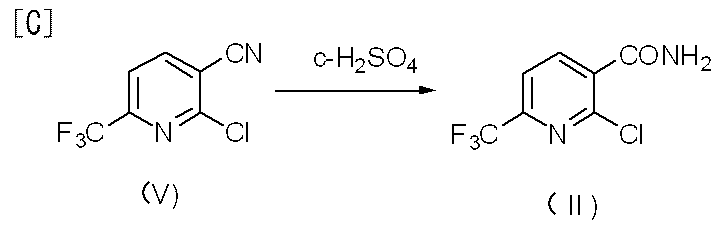
- the reaction [C] is usually carried out by treating 2-chloro-6-trifluoromethylnicotinonitrile represented by the formula (V) with 1 to 3 times by volume, preferably 94 to 98% concentrated sulfuric acid. be able to.
- the reaction can usually be carried out at 60 to 80 ° C., and the reaction time is usually about 1 to 3 hours.
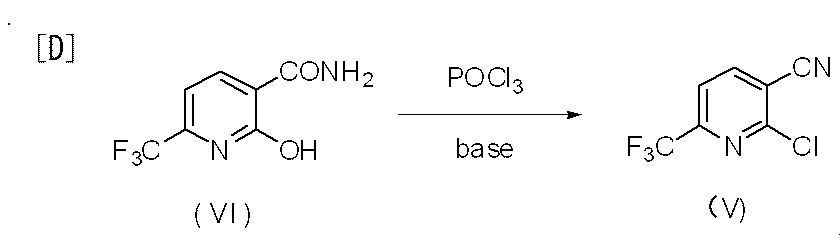
- the compound of Formula (V) can be manufactured by reaction [D].
- Reaction [D] can usually be carried out by reacting 2-hydroxy-6-trifluoromethylnicotinamide represented by the formula (VI) with phosphorus oxychloride in the presence of a base.
- the phosphorus oxychloride used in this reaction can be used in an amount of 2 to 3 moles compared to the compound of the formula (VI).
- Examples of the base that can be used in this reaction include trimethylamine, triethylamine, triisopropylamine, diisopropylethylamine, tributylamine, 4-dimethylaminopyridine, 4-pyrrolidinopyridine, N-methylmorpholine, N, N-dimethylaniline, N, N-diethylaniline, N-ethyl-N-methylaniline, 1,8-diazabicyclo [5.4.0] -7-undecene, 1,4-diazabicyclo [2.2.2] octane and the like.
- One or more can be selected as appropriate from tertiary amines; quinoline; pyridine; 2,6-dimethylpyridine and the like.
- the base can be used in an amount of 1 to 3 moles compared to the compound of the formula (V).
- the base is preferably a tertiary amine or quinoline.
- This reaction can be carried out usually at 100 to 160 ° C., preferably 130 to 140 ° C., and the reaction time is usually about 3 to 36 hours.
- This reaction can be performed in the presence of a solvent, if necessary. Any solvent may be used as long as it does not adversely affect the reaction.
- aromatic hydrocarbons such as toluene, xylene, chlorobenzene, 1,2-dichlorobenzene, 1,3-dichlorobenzene, 1,4-dichlorobenzene. Among them, 1,2-dichlorobenzene is preferable.
- the present invention also includes the following methods.
- a compound of formula (II) is produced by the reaction [B], and the compound of formula (II) is reacted with hypochlorite in the presence of a base to give 3- A process for producing amino-2-chloro-6-trifluoromethylpyridine.
- a compound of formula (II) is produced by the reaction [C], and the compound of formula (II) is reacted with hypochlorite in the presence of a base to give 3- A process for producing amino-2-chloro-6-trifluoromethylpyridine.
- a compound of formula (II) is produced by the above reactions [D] and [C], and the compound of formula (II) is reacted with hypochlorite in the presence of a base to give a compound of formula (I ) 3-amino-2-chloro-6-trifluoromethylpyridine.
- Example 1 Synthesis of 2-chloro-6-trifluoromethylnicotinonitrile (1) To 300 g of 2-hydroxy-6-trifluoromethylnicotinamide, 300 mL of triethylamine was added, and 300 mL of phosphorus oxychloride was added dropwise little by little. After reacting at 130 ° C. for 4 hours, the cooled reaction solution was gradually added to 1 L of water. After stirring for 30 minutes under ice cooling, the precipitated solid was collected by filtration and washed with 300 mL of water.
- Example 6 Synthesis of 3-amino-2-chloro-6-trifluoromethylpyridine 11.6 wt% sodium hypochlorite in a mixture of 200 g 2-chloro-6-trifluoromethylnicotinamide and 1000 ml water under ice-cooling 432 ml of an aqueous solution and then 190 ml of a 10N aqueous sodium hydroxide solution were added dropwise and stirred at 90 ° C. for 30 minutes.
Landscapes
- Chemical & Material Sciences (AREA)
- Organic Chemistry (AREA)
- Pyridine Compounds (AREA)
Abstract
Description
本発明の目的は、工業的に収率良く、3-アミノ-2-クロロ-6-トリフルオロメチルピリジンを製造する方法を提供することにある。
即ち、本発明は2-クロロ-6-トリフルオロメチルニコチンアミドを溶媒及び塩基の存在下で、次亜塩素酸塩と反応させることを特徴とする3-アミノ-2-クロロ-6-トリフルオロメチルピリジンの製造方法に関する。又、本発明は、2-クロロ-6-トリフルオロメチルニコチン酸を塩化チオニル又はオキサリルクロリドと反応させて2-クロロ-6-トリフルオロメチルニコチン酸クロリドを製造し、得られた2-クロロ-6-トリフルオロメチルニコチン酸クロリドをアンモニア水と反応させて2-クロロ-6-トリフルオロメチルニコチンアミドを製造する方法;並びに、2-ヒドロキシ-6-トリフルオロメチルニコチンアミドを塩基の存在下でオキシ塩化リンと反応させて、2-クロロ-6-トリフルオロメチルニコチノニトリルを製造し、得られた2-クロロ-6-トリフルオロメチルニコチノニトリルを濃硫酸と反応させて2-クロロ-6-トリフルオロメチルニコチンアミドを製造する方法に関する。
反応[A]で示したように、式(I)で表される3-アミノ-2-クロロ-6-トリフルオロメチルピリジンは、式(II)で表される2-クロロ-6-トリフルオロメチルニコチンアミドを溶媒及び塩基の存在下、次亜塩素酸塩と反応することにより製造することができる。

本反応に使用することができる塩基の例としては、水酸化ナトリウム、水酸化カリウムのようなアルカリ金属水酸化物;水酸化バリウム、水酸化カルシウムのようなアルカリ土類金属水酸化物が挙げられ、その使用量は式(II)の化合物に対して2~3倍モルである。塩基としては、水酸化ナトリウムが好ましい。
溶媒としては、反応に不活性な溶媒であればいずれのものでもよく、例えば、テトラヒドロフラン、ジオキサンのようなエーテル類;アセトニトリル、プロピオニトリル、N,N-ジメチルホルムアミド、ジメチルスルホキシド、ヘキサメチルホスホリックトリアミド、スルホラン、ジメチルアセトアミド、N-メチルピロリドンのような極性非プロトン性溶媒;水などから1種又は2種以上を適宜選択することができる。溶媒は、式(II)の化合物に対して5~10倍容量使用することができる。溶媒は、水が好ましい。
反応は、通常60~100℃で行うことができ、その反応時間は、通常0.5~1時間程度である。

酸塩化物に変換させる反応は、通常、式(III)の化合物と、等モル以上の塩化チオニル又はオキサリルクロリドとを反応させることにより行なうことができる。
本反応は溶媒を使用してもよく、溶媒としては、反応に不活性な溶媒であればいずれの物でもよく、例えば、塩化メチレン、クロロホルム、四塩化炭素、クロロベンゼンのようなハロゲン化炭化水素類;ベンゼン、トルエン、キシレンのような芳香族炭化水素類などから1種又は2種以上を適宜選択することができる。
反応は、通常60~100℃で行うことができ、その反応時間は、通常0.5~2時間程度である。
本反応で製造される式(IV)の化合物は、精製し、又は精製することなく次反応に使用される。
次に、得られる酸塩化物を、通常、溶媒の存在下で好ましくは20~30%のアンモニア水で処理することにより、式(II)の化合物を製造することができる。
アンモニア水は式(IV)の化合物に対して過剰量使用することができ、望ましくは3倍モル~10倍モルである。
溶媒としては、反応に不活性な溶媒であればいずれのものでもよく、例えば、ブチルメチルエーテル、テトラヒドロフラン、ジオキサン、ジメトキシエタンのようなエーテル類;アセトニトリル、プロピオニトリル、N,N-ジメチルホルムアミド、ジメチルスルホキシド、ヘキサメチルホスホリックトリアミド、スルホラン、ジメチルアセトアミド、N-メチルピロリドンのような極性非プロトン性溶媒などから1種又は2種以上を適宜選択することができる。溶媒は式(III)の化合物に対して1~3倍容量使用することができる。
反応は、通常0~40℃で行うことができ、その反応時間は、通常0.5~2時間程度である。
式(V)の化合物は、反応〔D〕により製造することができる。
本反応に使用するオキシ塩化リンは、式(VI)の化合物に対して2~3倍モル使用することができる。
本反応に使用することのできる塩基としては、トリメチルアミン、トリエチルアミン、トリイソプロピルアミン、ジイソプロピルエチルアミン、トリブチルアミン、4-ジメチルアミノピリジン、4-ピロリジノピリジン、N-メチルモルホリン、N,N-ジメチルアニリン、N,N-ジエチルアニリン、N-エチル-N-メチルアニリン、1,8-ジアザビシクロ〔5.4.0〕-7-ウンデセン、1,4-ジアザビシクロ〔2.2.2〕オクタンのような第三級アミン類;キノリン;ピリジン;2,6-ジメチルピリジンなどから1種又は2種以上を適宜選択することができる。塩基は、式(V)の化合物に対して1~3倍モル使用することができる。塩基は、第三級アミン類又はキノリンが好ましい。
本反応は、必要に応じて溶媒存在下で行うことができる。溶媒としては、反応に悪影響を与えないものであれば良く、例えばトルエン、キシレン、クロロベンゼン、1,2-ジクロロベンゼン、1,3-ジクロロベンゼン、1,4-ジクロロベンゼンのような芳香族炭化水素類を挙げることができるが、中でも1,2-ジクロロベンゼンが望ましい。
(1)前記反応〔B〕により、式(II)の化合物を製造し、式(II)の化合物を塩基の存在下で、次亜塩素酸塩と反応させることにより式(I)の3-アミノ-2-クロロ-6-トリフルオロメチルピリジンを製造する方法。
(2)前記反応〔C〕により、式(II)の化合物を製造し、式(II)の化合物を塩基の存在下で、次亜塩素酸塩と反応させることにより式(I)の3-アミノ-2-クロロ-6-トリフルオロメチルピリジンを製造する方法。
(3)前記反応〔D〕及び〔C〕により、式(II)の化合物を製造し、式(II)の化合物を塩基の存在下で、次亜塩素酸塩と反応させることにより式(I)の3-アミノ-2-クロロ-6-トリフルオロメチルピリジンを製造する方法。
実施例1 2-クロロ-6-トリフルオロメチルニコチノニトリルの合成(1)
2-ヒドロキシ-6-トリフルオロメチルニコチンアミド300gにトリエチルアミン300mLを添加し、オキシ塩化リン300mLを少しずつ滴下した。130℃で4時間反応後、放冷した反応液を水1Lに徐々に加えた。氷冷下、30分攪拌後、析出した固体をろ取し、水300mLで洗浄した。ろ取した固体を減圧蒸留(120℃/18mmHg)により精製し、2-クロロ-6-トリフルオロメチルニコチノニトリル(融点:35~36℃)247gを得た。1H-NMR(CDCl3) δ=7.75(1H, d, J= 7.8Hz), 8.21(1H, d, J= 7.8Hz).
2-ヒドロキシ-6-トリフルオロメチルニコチンアミド100g中にキノリン86mL、オキシ塩化リン136mLを順に加え、140℃で24時間攪拌した。得られた残渣を室温に戻した後水500mL中にゆっくり加え、氷冷下攪拌後、析出した固体を濾取し、減圧蒸留(90℃/4mmHg)により精製し、2-クロロ-6-トリフルオロメチルニコチノニトリル72gを得た。
2-ヒドロキシ-6-トリフルオロメチルニコチンアミド300gの1,2-ジクロロベンゼン600ml懸濁液にトリエチルアミン300mLを添加し、オキシ塩化リン300mLを少しずつ滴下した。140℃で4時間反応後、放冷した反応液を水1Lに徐々に加えた。有機層を分離し、減圧蒸留(110~120℃/15mmHg)により精製し、2-クロロ-6-トリフルオロメチルニコチノニトリル220gを得た。
2-クロロ-6-トリフルオロメチルニコチン酸49gにオキサリルクロリド49mL、DMF(ジメチルホルムアミド)1滴を滴下し、1時間還流した。反応終了後、過剰のオキサリルクロリドを減圧下に留去し、粗製の2-クロロ-6-トリフルオロメチルニコチン酸クロリド(油状物質)を得た。1H-NMR(CDCl3) δ= 7.78(1H, d, J = 7.6Hz), 8.50(1H, d, J = 7.6Hz).
次に、得られた2-クロロ-6-トリフルオロメチルニコチン酸クロリドにTHF(テトラヒドロフラン)50mLを加えた溶液を氷冷下、28wt%アンモニア水250mLに、少しずつ滴下した。30分攪拌した後、水を加えて、ろ取し、水洗、乾燥して、2-クロロ-6-トリフルオロメチルニコチンアミド40.7g(融点:215~217℃)を得た。1H-NMR(DMSO-d6) δ= 7.97(1H, bs), 8.00(1H, d, J= 7.4Hz), 8.18(1H, bs), 8.18(1H, d, J= 7.4Hz).
2-クロロ-6-トリフルオロメチルニコチノニトリル100g中に96vol%硫酸140mLを加え、75℃で2時間攪拌した。反応液を冷水500mL中に投入し析出した結晶を濾取、水洗、乾燥して、2-クロロ-6-トリフルオロメチルニコチンアミド108gを得た。
2-クロロ-6-トリフルオロメチルニコチンアミド200g及び水1000mlの混合物に氷冷下で11.6wt%次亜塩素酸ナトリウム水溶液432ml、次いで10規定水酸化ナトリウム水溶液190mlを滴下し、90℃で30分間攪拌した。反応混合物を10℃まで冷却し、析出した結晶を濾取、冷水100mlで3回洗浄した後、室温で24時間乾燥して、3-アミノ-2-クロロ-6-トリフルオロメチルピリジン(融点:96~97℃)144gを得た。1H-NMR(CDCl3) δ= 4.47(2H, bs, NH2), 7.09(1H, d, J= 7.8Hz), 7.42(1H, d, J= 7.8Hz).
なお、2008年3月4日に出願された日本特許出願2008-053247号の明細書、特許請求の範囲、及び要約書の全内容をここに引用し、本発明の明細書の開示として、取り入れるものである。
Claims (5)
- 2-クロロ-6-トリフルオロメチルニコチンアミドを溶媒及び塩基の存在下で、次亜塩素酸塩と反応させることを特徴とする3-アミノ-2-クロロ-6-トリフルオロメチルピリジンの製造方法。
- 2-クロロ-6-トリフルオロメチルニコチン酸を塩化チオニル又はオキサリルクロリドと反応させて2-クロロ-6-トリフルオロメチルニコチン酸クロリドを製造し、得られた2-クロロ-6-トリフルオロメチルニコチン酸クロリドをアンモニア水と反応させて2-クロロ-6-トリフルオロメチルニコチンアミドを製造し、次に、2-クロロ-6-トリフルオロメチルニコチンアミドを次亜塩素酸塩と反応させることを特徴とする請求項1に記載の製造方法。
- 2-ヒドロキシ-6-トリフルオロメチルニコチンアミドを塩基の存在下でオキシ塩化リンと反応させて2-クロロ-6-トリフルオロメチルニコチノニトリルを製造し、得られた2-クロロ-6-トリフルオロメチルニコチノニトリルを濃硫酸と反応させて2-クロロ-6-トリフルオロメチルニコチンアミドを製造し、次に、2-クロロ-6-トリフルオロメチルニコチンアミドを次亜塩素酸塩と反応させることを特徴とする請求項1に記載の製造方法。
- 2-クロロ-6-トリフルオロメチルニコチン酸を塩化チオニル又はオキサリルクロリドと反応させて2-クロロ-6-トリフルオロメチルニコチン酸クロリドを製造し、得られた2-クロロ-6-トリフルオロメチルニコチン酸クロリドをアンモニア水と反応させることを特徴とする2-クロロ-6-トリフルオロメチルニコチンアミドの製造方法。
- 2-ヒドロキシ-6-トリフルオロメチルニコチンアミドを塩基の存在下でオキシ塩化リンと反応させて2-クロロ-6-トリフルオロメチルニコチノニトリルを製造し、得られた2-クロロ-6-トリフルオロメチルニコチノニトリルを濃硫酸と反応させることを特徴とする2-クロロ-6-トリフルオロメチルニコチンアミドの製造方法。
Priority Applications (2)
| Application Number | Priority Date | Filing Date | Title |
|---|---|---|---|
| CN200980107668.3A CN101959863B (zh) | 2008-03-04 | 2009-03-03 | 3-氨基-2-氯-6-三氟甲基吡啶的制造方法 |
| EP09717293A EP2251329A4 (en) | 2008-03-04 | 2009-03-03 | PROCESS FOR THE PRODUCTION OF 3-AMINO-2-CHLORO-6-TRIFLUOROMETHYLPYRIDINE |
Applications Claiming Priority (2)
| Application Number | Priority Date | Filing Date | Title |
|---|---|---|---|
| JP2008-053247 | 2008-03-04 | ||
| JP2008053247 | 2008-03-04 |
Publications (1)
| Publication Number | Publication Date |
|---|---|
| WO2009110475A1 true WO2009110475A1 (ja) | 2009-09-11 |
Family
ID=41056029
Family Applications (1)
| Application Number | Title | Priority Date | Filing Date |
|---|---|---|---|
| PCT/JP2009/053978 Ceased WO2009110475A1 (ja) | 2008-03-04 | 2009-03-03 | 3-アミノ-2-クロロ-6-トリフルオロメチルピリジンの製造方法 |
Country Status (5)
| Country | Link |
|---|---|
| EP (1) | EP2251329A4 (ja) |
| JP (1) | JP5524491B2 (ja) |
| KR (1) | KR101540495B1 (ja) |
| CN (1) | CN101959863B (ja) |
| WO (1) | WO2009110475A1 (ja) |
Cited By (1)
| Publication number | Priority date | Publication date | Assignee | Title |
|---|---|---|---|---|
| WO2015000715A1 (en) | 2013-07-02 | 2015-01-08 | Syngenta Participations Ag | Pesticidally active bi- or tricyclic heterocycles with sulfur containing substituents |
Families Citing this family (2)
| Publication number | Priority date | Publication date | Assignee | Title |
|---|---|---|---|---|
| CN102532008A (zh) * | 2012-01-12 | 2012-07-04 | 南京红太阳生物化学有限责任公司 | 一种合成2,5-二氯-3-氟吡啶的新方法 |
| CN102964298B (zh) * | 2012-11-30 | 2014-04-16 | 华中药业股份有限公司 | 甘露六烟酯的改进制备方法 |
Citations (6)
| Publication number | Priority date | Publication date | Assignee | Title |
|---|---|---|---|---|
| JPS6348268A (ja) | 1986-08-14 | 1988-02-29 | Ishihara Sangyo Kaisha Ltd | N−ピリジル−n’−ベンゾイルウレア系化合物及びそれらを含有する殺虫剤 |
| JP2002201179A (ja) * | 2000-12-28 | 2002-07-16 | Ishihara Sangyo Kaisha Ltd | 6−ハロアルキルニコチン酸類の製造方法 |
| WO2003051817A1 (de) * | 2001-12-19 | 2003-06-26 | Bayer Chemicals Ag | Verfahren zur herstellung von aminen |
| WO2005117883A1 (en) * | 2004-05-28 | 2005-12-15 | Vertex Pharmaceuticals Incorporated | Modulators of muscarinic receptors |
| WO2006082392A1 (en) * | 2005-02-04 | 2006-08-10 | Astrazeneca Ab | Pyrazolylaminopyridine derivatives useful as kinase inhibitors |
| WO2007088876A1 (ja) * | 2006-02-02 | 2007-08-09 | Kumiai Chemical Industry Co., Ltd. | ピリドン誘導体及び除草剤 |
Family Cites Families (4)
| Publication number | Priority date | Publication date | Assignee | Title |
|---|---|---|---|---|
| US4329351A (en) * | 1979-10-01 | 1982-05-11 | Merck & Co., Inc. | 2-Substituted propoxy-3-cyano-5-RO-pyridines and intermediates |
| GB9711114D0 (en) * | 1997-05-29 | 1997-07-23 | Merck Sharp & Dohme | Therapeutic agents |
| TW200526626A (en) * | 2003-09-13 | 2005-08-16 | Astrazeneca Ab | Chemical compounds |
| JP2009528989A (ja) * | 2006-02-17 | 2009-08-13 | ファイザー・リミテッド | Tlr7変調剤としての3−デアザプリン誘導体 |
-
2009
- 2009-02-25 JP JP2009042981A patent/JP5524491B2/ja not_active Expired - Fee Related
- 2009-03-03 EP EP09717293A patent/EP2251329A4/en not_active Withdrawn
- 2009-03-03 KR KR1020107019738A patent/KR101540495B1/ko not_active Expired - Fee Related
- 2009-03-03 WO PCT/JP2009/053978 patent/WO2009110475A1/ja not_active Ceased
- 2009-03-03 CN CN200980107668.3A patent/CN101959863B/zh not_active Expired - Fee Related
Patent Citations (6)
| Publication number | Priority date | Publication date | Assignee | Title |
|---|---|---|---|---|
| JPS6348268A (ja) | 1986-08-14 | 1988-02-29 | Ishihara Sangyo Kaisha Ltd | N−ピリジル−n’−ベンゾイルウレア系化合物及びそれらを含有する殺虫剤 |
| JP2002201179A (ja) * | 2000-12-28 | 2002-07-16 | Ishihara Sangyo Kaisha Ltd | 6−ハロアルキルニコチン酸類の製造方法 |
| WO2003051817A1 (de) * | 2001-12-19 | 2003-06-26 | Bayer Chemicals Ag | Verfahren zur herstellung von aminen |
| WO2005117883A1 (en) * | 2004-05-28 | 2005-12-15 | Vertex Pharmaceuticals Incorporated | Modulators of muscarinic receptors |
| WO2006082392A1 (en) * | 2005-02-04 | 2006-08-10 | Astrazeneca Ab | Pyrazolylaminopyridine derivatives useful as kinase inhibitors |
| WO2007088876A1 (ja) * | 2006-02-02 | 2007-08-09 | Kumiai Chemical Industry Co., Ltd. | ピリドン誘導体及び除草剤 |
Non-Patent Citations (2)
| Title |
|---|
| NANTKA-NAMIRSKI, P. ET AL.: "Bipyridyls. IX. Synthesis and reactions of 2-hydroxy-6-pyridylnicotinic acid derivatives", ACTA POLONIAE PHARMACEUTICA, vol. 34, no. 2, 1977, pages 133 - 138, XP008140339 * |
| See also references of EP2251329A4 * |
Cited By (2)
| Publication number | Priority date | Publication date | Assignee | Title |
|---|---|---|---|---|
| WO2015000715A1 (en) | 2013-07-02 | 2015-01-08 | Syngenta Participations Ag | Pesticidally active bi- or tricyclic heterocycles with sulfur containing substituents |
| EP3778598A2 (en) | 2013-07-02 | 2021-02-17 | Syngenta Participations Ag | Pesticidally active bi- or tricyclic heterocycles with sulfur containing substituents |
Also Published As
| Publication number | Publication date |
|---|---|
| KR101540495B1 (ko) | 2015-07-29 |
| EP2251329A1 (en) | 2010-11-17 |
| CN101959863B (zh) | 2014-01-08 |
| CN101959863A (zh) | 2011-01-26 |
| JP2009235062A (ja) | 2009-10-15 |
| KR20100124269A (ko) | 2010-11-26 |
| EP2251329A4 (en) | 2012-03-21 |
| JP5524491B2 (ja) | 2014-06-18 |
Similar Documents
| Publication | Publication Date | Title |
|---|---|---|
| EP3166611A1 (en) | Process for the preparation of 4-alkoxy-3-hydroxypicolinic acids | |
| JP4838924B2 (ja) | 2−クロロ−5−クロロメチルチアゾールの製造方法 | |
| JP6352389B2 (ja) | パーハロアルキル基を含有するヒンダードアニリンからのアミドの製造方法 | |
| JP5524491B2 (ja) | 3−アミノ−2−クロロ−6−トリフルオロメチルピリジンの製造方法 | |
| JP2010537957A (ja) | 新規な化合物及び製造方法 | |
| US9975851B2 (en) | Method for producing 2-acyliminopyridine derivative | |
| CN102712593B (zh) | 2-氨基-4-三氟甲基吡啶的生产方法 | |
| US9518019B2 (en) | Process for the preparation of 4-amino-5-fluoro-3-chloro-6-(substituted)picolinates | |
| JP7032903B2 (ja) | スルホンアミド化合物の製造方法 | |
| AU2006240772B2 (en) | Method for producing nicotinic acid derivative or salt thereof | |
| EP1431278A1 (en) | Process for producing (2-nitrophenyl)acetonitrile derivative and intermediate therefor | |
| JP4675234B2 (ja) | 光学活性なキノロンカルボン酸誘導体の製造中間体およびその製造法 | |
| JP6477187B2 (ja) | 2−アミノ−6−メチルニコチン酸エステルの製造方法 | |
| JP5036198B2 (ja) | フルオレン骨格含有フタルイミド類及びそれから誘導されるジアミン類 | |
| JP3959994B2 (ja) | 4−フタロニトリル誘導体の製造方法 | |
| JP3498343B2 (ja) | N−置換−5−アミノピラゾール誘導体の製造法 | |
| JP5148836B2 (ja) | ニコチン酸誘導体又はその塩の製造方法 | |
| JP2011213642A (ja) | トリフルオロビニロキシ−n−モノアルキルアニリン化合物およびその製造方法 |
Legal Events
| Date | Code | Title | Description |
|---|---|---|---|
| WWE | Wipo information: entry into national phase |
Ref document number: 200980107668.3 Country of ref document: CN |
|
| 121 | Ep: the epo has been informed by wipo that ep was designated in this application |
Ref document number: 09717293 Country of ref document: EP Kind code of ref document: A1 |
|
| WWE | Wipo information: entry into national phase |
Ref document number: 2009717293 Country of ref document: EP |
|
| WWE | Wipo information: entry into national phase |
Ref document number: 6206/DELNP/2010 Country of ref document: IN |
|
| ENP | Entry into the national phase |
Ref document number: 20107019738 Country of ref document: KR Kind code of ref document: A |
|
| NENP | Non-entry into the national phase |
Ref country code: DE |
|
| NENP | Non-entry into the national phase |
Ref country code: JP |