WO2009122974A1 - 酸化亜鉛単結晶およびその製造方法 - Google Patents
酸化亜鉛単結晶およびその製造方法 Download PDFInfo
- Publication number
- WO2009122974A1 WO2009122974A1 PCT/JP2009/055870 JP2009055870W WO2009122974A1 WO 2009122974 A1 WO2009122974 A1 WO 2009122974A1 JP 2009055870 W JP2009055870 W JP 2009055870W WO 2009122974 A1 WO2009122974 A1 WO 2009122974A1
- Authority
- WO
- WIPO (PCT)
- Prior art keywords
- zinc oxide
- single crystal
- oxide single
- plane
- producing
- Prior art date
- Legal status (The legal status is an assumption and is not a legal conclusion. Google has not performed a legal analysis and makes no representation as to the accuracy of the status listed.)
- Ceased
Links
Images

Classifications
-
- C—CHEMISTRY; METALLURGY
- C30—CRYSTAL GROWTH
- C30B—SINGLE-CRYSTAL GROWTH; UNIDIRECTIONAL SOLIDIFICATION OF EUTECTIC MATERIAL OR UNIDIRECTIONAL DEMIXING OF EUTECTOID MATERIAL; REFINING BY ZONE-MELTING OF MATERIAL; PRODUCTION OF A HOMOGENEOUS POLYCRYSTALLINE MATERIAL WITH DEFINED STRUCTURE; SINGLE CRYSTALS OR HOMOGENEOUS POLYCRYSTALLINE MATERIAL WITH DEFINED STRUCTURE; AFTER-TREATMENT OF SINGLE CRYSTALS OR A HOMOGENEOUS POLYCRYSTALLINE MATERIAL WITH DEFINED STRUCTURE; APPARATUS THEREFOR
- C30B29/00—Single crystals or homogeneous polycrystalline material with defined structure characterised by the material or by their shape
- C30B29/10—Inorganic compounds or compositions
- C30B29/16—Oxides
-
- C—CHEMISTRY; METALLURGY
- C30—CRYSTAL GROWTH
- C30B—SINGLE-CRYSTAL GROWTH; UNIDIRECTIONAL SOLIDIFICATION OF EUTECTIC MATERIAL OR UNIDIRECTIONAL DEMIXING OF EUTECTOID MATERIAL; REFINING BY ZONE-MELTING OF MATERIAL; PRODUCTION OF A HOMOGENEOUS POLYCRYSTALLINE MATERIAL WITH DEFINED STRUCTURE; SINGLE CRYSTALS OR HOMOGENEOUS POLYCRYSTALLINE MATERIAL WITH DEFINED STRUCTURE; AFTER-TREATMENT OF SINGLE CRYSTALS OR A HOMOGENEOUS POLYCRYSTALLINE MATERIAL WITH DEFINED STRUCTURE; APPARATUS THEREFOR
- C30B7/00—Single-crystal growth from solutions using solvents which are liquid at normal temperature, e.g. aqueous solutions
- C30B7/10—Single-crystal growth from solutions using solvents which are liquid at normal temperature, e.g. aqueous solutions by application of pressure, e.g. hydrothermal processes
Definitions
- the present invention relates to a high-quality zinc oxide single crystal that can be used for a semiconductor device and a method for producing the same. More specifically, the present invention relates to a zinc oxide single crystal having a low lithium concentration and a characteristic production method thereof.
- Zinc oxide single crystal is a semiconductor having a crystal structure of a hexagonal wurtzite compound and having a large forbidden band width (Eg: 3.37 eV) by direct transition. Further, since the exciton binding energy (ZnO: 60 meV) is very large compared to other semiconductor materials (GaN: 21 meV, ZnSe: 20 meV), it is expected as a highly efficient light-emitting device material. In order to realize a light emitting device using zinc oxide, it is necessary to prepare zinc oxide in p-type. However, zinc oxide easily generates defects such as oxygen vacancies or interstitial zinc, and is likely to be n-type. It is difficult to become.
- Zinc oxide has the same crystal structure as gallium nitride, which has been in practical use as a blue light emitting diode (LED) for several years, and has a close lattice constant (lattice mismatch: about 2%), and can be manufactured at a low price in the future. Because of this property, it is also attracting attention as a substrate for film formation of gallium nitride in place of sapphire and silicon carbide, which are currently mainly used.
- zinc oxide single crystals are used in various fields such as surface acoustic waves (SAW), gas sensors, piezoelectric elements, transparent conductors, and varistors.
- SAW surface acoustic waves
- gas sensors piezoelectric elements
- transparent conductors and varistors.
- varistors varistors
- the hydrothermal synthesis method is a method for growing a crystal in a raw material aqueous solution at a high temperature and a high pressure, and is a method for depositing a crystal on a seed crystal by utilizing a degree of supersaturation due to a temperature difference. Since it is suitable for mass production by using a large pressure vessel, the hydrothermal synthesis method has long been widely used as a crystal single crystal growth method known as a piezoelectric material. However, it is difficult to obtain a practical growth rate because the solubility of the quartz raw material in water at high temperature and high pressure is extremely low.
- a mineralizer is added to increase the solubility of the raw material and improve the crystal growth rate.
- NaOH or Na 2 CO 3 is used as a mineralizer, and in either case, the concentration is about 1 mol / l.
- a growth experiment was carried out with an aqueous NaOH solution having a concentration of 1 to 2 mol / l in accordance with quartz (see Non-Patent Document 1).
- a crystal is grown on the C-plane ((0001) plane) of the seed crystal, crevasse-like macro defects called flowing or crevasse flow appear, and a single crystal that can withstand evaluation has not been obtained.
- Non-Patent Document 2 In order to suppress the flowing that occurs during crystal growth on the C-plane, it has been proposed to add lithium to an aqueous solution of zinc oxide (see Non-Patent Document 2).
- the effective addition amount is said to be a concentration of about 0.1 to 2 mol / l as LiOH, and if it is 0.1 mol / l or less, the effect of suppressing the flow is lost. Further, it is said that the same effect can be obtained by using LiF, Li 2 B 4 O 7 or the like in addition to LiOH (see Patent Document 1).
- a detailed study result has been reported on the mechanism for suppressing the occurrence of C-plane flowing due to the addition of lithium (see Non-Patent Document 1).
- the zinc oxide single crystal grown by the method of adding lithium inevitably contains lithium.
- lithium uptake is not regarded as a problem.
- since lithium is taken up it works as an acceptor and improves resistivity.
- Non-Patent Document 3 In use as a single crystal substrate for a light-emitting element that is currently expected, lithium is required to be thoroughly reduced because it adversely affects the device. This is because if epitaxial growth is performed on a zinc oxide single crystal substrate containing a considerable amount of lithium, the target characteristics cannot be obtained because lithium in the single crystal substrate diffuses into the epitaxial film. Since lithium acts as a donor or acceptor in zinc oxide and adversely affects semiconductor characteristics, it is desired to suppress the content as much as possible.
- Patent Document 2 describes a method of reducing the lithium concentration to 3 ⁇ 10 16 atoms / cm 3 by heat-treating a zinc oxide wafer
- Patent Document 3 describes heat-treating the grown crystal. A method for reducing the lithium concentration to 1 ⁇ 10 15 atoms / cm 3 is described.
- both of the heat treatment methods described in Patent Document 2 and Patent Document 3 are based on the premise that it is inevitable from the manufacturing method that lithium is contained in a crystal grown by a hydrothermal synthesis method. It is a devised method. As the number of post-processes such as heat treatment increases, the cost increases such as a decrease in yield and an increase in quality variation. Furthermore, there is a concern that uncertain factors such as new point defects are introduced into the zinc oxide single crystal in the heat treatment step. A zinc oxide single crystal that does not require such a post-process is also desirable from the viewpoint of industrial technology or reduction of energy consumption required for production.
- the present inventors have developed a technique for growing a zinc oxide single crystal having a sufficiently low lithium concentration, which can simplify the process, improve the production yield, stabilize the quality, reduce the cost, and reduce the zinc oxide. It was thought that this would contribute to a dramatic improvement in the performance of semiconductor devices that use GaN.
- the present inventors aim to produce a zinc oxide single crystal having a sufficiently low lithium concentration and high crystallinity by a simple method. We proceeded with the examination.
- the present inventors suppressed defects such as flowing without adding lithium by growing crystals of zinc oxide under specific conditions. It has been found that a high-quality zinc oxide single crystal can be provided, and the present invention has been completed. That is, the following present invention has been provided as means for solving the problems.
- a zinc oxide single crystal wherein the lithium concentration in the crystal is 5 ⁇ 10 14 atoms / cm 3 or less.
- a solution having a lithium concentration of 1 ppm (weight basis) or less When growing zinc oxide crystals by hydrothermal synthesis, use a solution with a lithium concentration of 1 ppm (weight basis) or less to grow zinc oxide crystals while keeping the fluctuation range of the crystal growth temperature within 5 ° C.
- a method for producing a zinc oxide single crystal characterized by comprising: [14] The method for producing a zinc oxide single crystal according to [12] or [13], wherein the solution does not contain lithium.
- [15] The method for producing a zinc oxide single crystal according to any one of [12] to [14], wherein the solution does not contain ammonium ions.
- [16] The method for producing a zinc oxide single crystal according to any one of [12] to [15], wherein a raw material having a lithium concentration of 0.1 ppm (weight basis) or less is used.
- the manufacturing method of the zinc oxide single crystal of description [18] The method for producing a zinc oxide single crystal according to [17], wherein an alloy having a platinum group element content other than platinum of 5 to 30% by weight is used.
- the zinc oxide single crystal of the present invention has a sufficiently low lithium concentration and high crystallinity. Further, according to the production method of the present invention, such a zinc oxide single crystal can be produced stably and simply with a high yield.
- a numerical range represented by using “to” means a range including numerical values described before and after “to” as a lower limit value and an upper limit value.
- the zinc oxide single crystal of the present invention is characterized in that the lithium concentration in the crystal is 5 ⁇ 10 14 atoms / cm 3 or less.
- the lithium concentration in the crystal in the present invention can be measured by secondary ion mass spectrometry.
- the lithium concentration of the zinc oxide single crystal of the present invention is 5 ⁇ 10 14 atoms / cm 3 or less, preferably 1 ⁇ 10 14 atoms / cm 3 or less, and is 5 ⁇ 10 13 atoms / cm 3 or less. More preferably.
- the zinc oxide single crystal of the present invention has a high crystallinity.
- the full width at half maximum by X-ray rocking curve measurement in (0002) plane reflection is preferably 50 seconds or less, more preferably 30 seconds or less, even more preferably 25 seconds or less, 20 It is particularly preferred that it be less than a second.
- a zinc oxide single crystal having a low lithium concentration and high crystallinity could not be produced by the prior art, and has been provided for the first time by the production method of the present invention described later.
- the zinc oxide single crystal main surface here means the surface having the largest area among the grown zinc oxide single crystals.
- the main surface of the zinc oxide single crystal may be any surface constituting the zinc oxide single crystal, but is preferably the C plane, M plane, R plane, Rp plane or Rn plane, more preferably the C plane. It is.
- the C plane means the (0001) plane and the (000-1) plane in hexagonal crystal.
- the M plane refers to a (1-100) plane in hexagonal crystal and a plane equivalent thereto, which is a nonpolar plane and a normal cleavage plane. Specifically, there are (1-100) plane, (-1100) plane, (01-10 plane), (0-110) plane, (10-10) plane, and (-1010) plane. Good.
- the R plane refers to the (1-101) plane, (1-10-1) plane and equivalent plane in hexagonal crystal
- the Rp plane refers to the (1-102) plane and equivalent plane, Rn.
- the plane refers to the (2-20-1) plane and a plane equivalent thereto
- the A plane refers to the (11-20) plane in hexagonal crystal and the plane equivalent thereto.
- the normal directions of the C, M, and A planes are referred to as the c-axis, m-axis, and a-axis directions, respectively.
- the zinc oxide single crystal of the present invention preferably has a low impurity concentration other than lithium.
- the nitrogen content in the zinc oxide single crystal of the present invention is preferably 1 ⁇ 10 18 atoms / cm 3 or less, more preferably 5 ⁇ 10 17 atoms / cm 3 or less, and 1 ⁇ 10 17 atoms. More preferably, it is not more than atoms / cm 3 .
- a conventional method for producing a zinc oxide single crystal using ammonium ions as described in JP-A-6-289192 cannot achieve such a low nitrogen content.
- the aluminum concentration in the zinc oxide single crystal of the present invention can be 2 ⁇ 10 14 atoms / cm 3 or less, preferably 8 ⁇ 10 13 atoms / cm 3 or less, and 5 ⁇ 10 13 atoms / cm 3. More preferably, it is cm 3 or less.
- the aluminum concentration here can be measured by secondary ion mass spectrometry.
- the metal concentration other than aluminum contained in the zinc oxide single crystal of the present invention is preferably in the same concentration range as the preferable range of the aluminum concentration. Examples of metals other than aluminum include sodium, potassium, chromium, nickel, and titanium.
- the zinc oxide single crystal of the present invention contains one or more trivalent metal elements (Al, Ga, In) in order to control electric conductivity, and the content thereof is 1 ⁇ 10 16 to It is also preferably 1 ⁇ 10 20 atoms / cm 3 .
- a zinc oxide single crystal satisfying such conditions has an advantage that it has improved electrical conductivity and can be used as a conductive substrate.
- the content of the trivalent metal element is more preferably 1 ⁇ 10 17 to 1 ⁇ 10 20 atoms / cm 3 , and further preferably 1 ⁇ 10 18 to 1 ⁇ 10 20 atoms / cm 3 . Adjustment of said metal element density
- concentration can be performed by adjusting the addition amount of the metal oxide in a raw material, for example. Since the zinc oxide single crystal according to the present invention has a small content of unintentional impurities such as lithium, the characteristic control by intentional addition (doping) of impurities can be performed with higher accuracy than conventional zinc oxide single crystals.
- the major axis of the zinc oxide single crystal of the present invention is preferably 15 mm or more, more preferably 20 mm or more, and further preferably 25 mm or more.
- the major axis here means the longest diameter of the zinc oxide single crystal. According to the present invention, it is possible to provide a zinc oxide single crystal having an unprecedented large size and excellent crystallinity.
- the zinc oxide single crystal of the present invention preferably has a carrier concentration of 1 ⁇ 10 14 to 1 ⁇ 10 18 / cm 3 at room temperature, and more preferably 1 ⁇ 10 15 to 1 ⁇ 10 18 / cm 3. It is more preferably 1 ⁇ 10 15 to 1 ⁇ 10 17 / cm 3 , and particularly preferably 1 ⁇ 10 15 to 1 ⁇ 10 16 / cm 3 .
- Zinc oxide single crystal of the present invention mobility is usually 100cm 2 / V ⁇ sec than at room temperature, or less 300cm 2 / V ⁇ sec, preferably from 120 ⁇ 300cm 2 / V ⁇ sec , 150 ⁇ 300cm 2 More preferably, it is / V ⁇ sec. Mobility can be measured by hall measurement. In addition, the mobility here is the mobility of an undoped crystal.
- the zinc oxide single crystal of the present invention usually has a specific resistance of 1 ⁇ 10 ⁇ 3 to 1 ⁇ 10 3 ( ⁇ ⁇ cm) and 1 ⁇ 10 ⁇ 2 to 1 ⁇ 10 3 ( ⁇ ⁇ cm). It is preferably 1 ⁇ 10 ⁇ 1 to 1 ⁇ 10 3 ( ⁇ ⁇ cm).
- the specific resistance here is also the specific resistance of the undoped crystal.
- the zinc oxide single crystal of the present invention can be made low in resistivity by adding aluminum, gallium, or indium, more preferably gallium or indium, as a dopant.
- the additive concentration in zinc oxide is preferably 1 ⁇ 10 16 to 1 ⁇ 10 20 atoms / cm 3 , more preferably 1 ⁇ 10 17 to 1 ⁇ 10 20 atoms / cm 3 , and even more preferably 1 ⁇ 10 18 to 1 ⁇ 10 20 atoms / cm 3 .
- the zinc oxide single crystal of the present invention has a low lithium concentration and a high crystallinity as described above, there is an advantage that the resistance of the single crystal can be reduced in the case of an n-type semiconductor.
- concentration of impurities such as lithium is sufficiently low, high functionality such as improvement of mobility can be achieved.
- a semiconductor element is produced using the high-purity zinc oxide single crystal of the present invention as a substrate, adverse effects on the semiconductor element due to diffusion of lithium can be suppressed, and the element performance can be greatly improved.
- the method for producing the zinc oxide single crystal of the present invention having the above characteristics is not particularly limited. As long as the conditions of the above-mentioned claims are satisfied, it corresponds to the zinc oxide single crystal of the present invention regardless of the production method.
- a crystal growth apparatus, a seed crystal, and a crystal growth process used in a preferred method for producing a zinc oxide single crystal of the present invention will be described with reference to the drawings.
- the zinc oxide single crystal of the present invention can be produced by a hydrothermal synthesis method.
- a preferred crystal growth apparatus will be described with reference to FIG.
- a high-strength steel pressure vessel hereinafter referred to as an autoclave
- the autoclave has a thick cylindrical shape that is long in the vertical direction, and includes a main body 16 and a lid 14.
- the autoclave is installed in a heating furnace.
- the heating furnace includes a heat insulating material 18 and a heater 19, and a partition 20 is installed at an intermediate portion so that a sufficient temperature difference can be obtained between the upper and lower sides.
- the temperature is monitored by a thermocouple 3 and controlled by a temperature control device.
- the pressure is measured by the pressure gauge 12. Since the upper half from the partition 20 of the heating furnace is a cooling region, a plurality of windows 17 for cooling are installed in the heat insulating material 18, and the temperature can be precisely controlled by the degree of opening and closing of the windows 17.
- a container (hereinafter referred to as “inner cylinder”) 5 made of a corrosion resistant material is installed inside the autoclave body.
- the material of the inner cylinder 5 will not be limited if it is the material excellent in the corrosion resistance to alkaline aqueous solution, Generally platinum was considered preferable. However, since platinum is soft and easily deformed, there was a problem in controlling the growth conditions with high accuracy. Therefore, it is preferable to manufacture the inner cylinder 5 by selecting an alloy of platinum and a platinum group element in order to increase the strength of platinum and suppress deformation.
- the content of the platinum group element is preferably in the range of about 5 to 30% by weight, more preferably 10 to 20% by weight in view of strength and ease of processing.
- Examples of the platinum group element include one or more of ruthenium, rhodium, palladium, and osmium. Among these, iridium is preferable.
- a pressure buffering mechanism for example, a bellows structure 11 for easily deforming and eliminating the pressure difference is installed. It is preferable to do.
- the solubility curve is positive (the solubility increases as the temperature rises), so the upper part of the inner cylinder is the growing area and the lower part of the inner cylinder is the raw material area. For this reason, if a conventional device having a bellows structure on the top of the inner cylinder is used, the uppermost part of the inner cylinder is easily cooled. It will interfere.
- the present invention Since the decrease in the internal / external pressure difference absorption function due to microcrystal precipitation may cause the pressure balance to be lost and lead to deformation and breakage of the inner cylinder, it is particularly preferable in the present invention to grow crystals using a device in which the bellows is installed at the bottom of the inner cylinder. preferable. Since the lower part of the inner cylinder is a raw material region and a region where crystals dissolve, no precipitation of microcrystals occurs in the raw material region, and the function of the bellows is not impaired.
- the inner cylinder 5 main body is made of a platinum iridium alloy to increase the strength and impart high durability, but the bellows 11 is easily deformed to absorb the pressure difference between the inside and outside of the inner cylinder. There is a need. Therefore, it is preferable to use platinum as the material of the bellows 11.
- the material of the bellows 11 may be other than platinum as long as the material is harder than the material of the inner cylinder 5 and has sufficient corrosion resistance, and gold, silver, or an alloy thereof may be used.
- the lid 2 of the inner cylinder may use any material of platinum or a platinum iridium alloy, and the shape is not limited.
- the fixing method of the bellows 11 and the inner cylinder 5 and the lid 2 and the inner cylinder 5 may be any fixing method such as fixing by welding or mechanical fixing such as a clamp structure. Further, the inner cylinder 5 and the bellows 11 may be manufactured as an integral structure or may be divided.
- An external baffle 21 is installed outside the inner cylinder 5.
- the external baffle 21 plays a role of providing a necessary temperature difference between the upper and lower sides of the solution filled outside the inner cylinder 5.
- the material of the external baffle 21 is a metal (carbon steel, stainless steel alloy, nickel-base alloy, etc.), so that the thermal conductivity is high, and it is difficult to take a large temperature difference, which causes a decrease in temperature control accuracy. Therefore, by installing two or more external baffles 21 and having an aqueous solution between the external baffles 21, the heat conduction of the external baffles 21 can be suppressed and a more accurate temperature difference can be controlled.
- a baffle 8 is installed at an intermediate part, and the upper part is a growing area and the lower part is a raw material area with the baffle 8 in between.
- the material of the baffle 8 may be either platinum or a platinum iridium alloy.
- a seed crystal 6 cut from a zinc oxide single crystal and a growth frame 4 that holds the seed crystal 6 are installed in the growth region.
- a raw material 9 and a raw material basket 10 filled with the raw material are installed in the raw material region. Since the growth frame 4 and the raw material rod 10 need strength to support the load of the crystal and the raw material, it is preferable to use a platinum iridium alloy like the inner cylinder 5.
- the platinum iridium alloy preferably has an iridium content of about 5 to 30% by weight, like the material of the inner cylinder 5.
- a zinc oxide single crystal is grown on a seed crystal.
- the seed crystal it is particularly preferable to use a plate-like zinc oxide single crystal cut in parallel to the (0001) plane which is the C plane.
- the inclination from the C plane is preferably within 0.5 °.
- the thickness is usually 0.5 to 2.0 mm, preferably 0.8 to 1.2 mm. A thickness of 0.5 mm or more is preferable because there is a low risk of dissolution when the temperature is raised. Moreover, if the thickness is 2.0 mm or less, the cost of the seed crystal does not become too high, which is advantageous in terms of productivity. It is to be noted that high quality crystals containing no lithium can be grown even by using seed crystals of the M-plane which is a nonpolar plane, the R-plane, Rp-plane and Rn-plane which are semipolar planes.
- a work-affected layer is introduced on the surface of the seed crystal accordingly. It is preferable that the work-affected layer introduced into the seed crystal by these machining processes is removed by chemical etching.
- an acid preferably HCl, HNO 3 , H 2 SO 4 , H 3 PO 4
- an alkali preferably LiOH, NaOH, KOH, RbOH, CsOH
- a mixed acid or a mixed alkaline solution.
- the dislocation density in the seed crystal is a factor that determines the dislocation density in the crystal to be grown, it is desirable to use a seed crystal having a low dislocation density in order to grow a crystal having a low dislocation density. If a seed crystal having a low dislocation density is used, macro defects such as flowing are hardly introduced into the C-plane of the grown crystal. In the present invention, it is preferable that etch pits appear by the chemical etching, the etch pit density is measured with an optical microscope, and a seed crystal having an etch pit density of 1 ⁇ 10 4 pieces / cm 2 or less is selected and used.
- the hydrothermal synthesis method is a method of growing a crystal by dissolving a raw material in a subcritical to supercritical aqueous solution and recrystallizing the dissolved raw material.
- an aqueous solution having a lithium concentration of 1 ppm (weight basis) or less is used.
- an aqueous solution containing only KOH is used without adding lithium. Since the main purpose is not to include lithium as an impurity, NaOH can be used instead of KOH.
- a hole with a diameter of 0.3 to 0.5 mm is made in the seed crystal, a platinum wire is passed through the hole, and the seed crystal is fixed to the growth frame.
- substantially parallel means within 180 ° ⁇ 30 °.
- a zinc oxide sintered body obtained by forming a zinc oxide powder having a diameter of 1 to 10 ⁇ m with a pressure press machine and sintering it in an oxygen atmosphere or an air atmosphere at 1000 to 1400 ° C. is used.
- the purity of the raw material is preferably 99.999% or higher.
- the lithium concentration in the raw material is preferably 0.1 ppm (weight basis) or less, more preferably 0.05 ppm or less.
- the optimum size of the raw material varies depending on the size of the autoclave to be used, but the major axis is preferably 5 mm to 50 mm. Mixing raw materials of different sizes increases the filling amount of the raw material soot, which is effective when filling many raw materials.
- the baffle installed in the inner cylinder has an aperture ratio of 5 to 15%, and one or a plurality of holes are opened in the center part in an axial symmetry. It is preferable that there is a gap between the outer periphery of the baffle and the inner wall of the inner cylinder.
- the baffle opening ratio is obtained by dividing the total area of the hole formed in the baffle and the area of the gap between the outer periphery of the baffle and the inner cylinder inner wall by the sectional area in the inner cylinder. Even if the number of baffles is one, it is sufficiently effective. However, by using two or more baffles, it is possible to make a temperature difference more easily.
- the concentration of lithium contained in the KOH solution is 1 ppm (weight basis) or less, more preferably 0.1 ppm or less.
- the solution is further filled with 75 to 85% for heat conduction.
- pure water is suitable.
- corrosion can be further suppressed by using a dilute alkaline solution.
- 0.005 to 0.1 mol / l NaOH can be used.
- alkalis such as KOH, Na 2 CO 3 , K 2 CO 3 can also be used.
- the autoclave is covered and sealed, and then heated by an external heater.
- the temperature is raised from room temperature to the operating condition temperature in 30 to 72 hours. Since the solution is unsaturated when the temperature is raised, both the raw material and the seed crystal dissolve.
- the temperature raising process is a process necessary to completely remove the remaining work-affected layer that could not be removed by etching before growth on the seed crystal surface.
- the dissolution can be controlled by the heating rate. Depending on the size of the autoclave and the number of seed crystals, optimum results can be obtained by raising the temperature in the above 30 to 72 hours.
- the crystal After the temperature rise, the crystal is taken out after being cooled to below the boiling point of water after the growth period necessary to obtain the required crystal size at the control temperature. If the average temperature of the control point temperatures is 80 ° C. or less, it can be opened safely.
- the average temperature of the growing zone and the raw material zone is preferably 300 to 370 ° C, more preferably 310 to 360 ° C, and even more preferably 315 to 350 ° C.
- growth of a zinc oxide single crystal free of macro defects such as flowing is achieved by etching the seed crystal, removing the remaining work-affected layer when the temperature is raised, and controlling the temperature during the growth period.
- the grown zinc oxide single crystal can be taken out from the crystal growing apparatus and processed by a method known to those skilled in the art.
- a zinc oxide single crystal having a low lithium concentration can be obtained without going through a post-process such as heat treatment as in the prior art. For this reason, there is a significant cost reduction effect by shortening and simplifying the work process. In addition, it is possible to avoid a deterioration in yield due to generation of cracks caused by heat treatment due to a change in characteristics of the zinc oxide single crystal due to generation of point defects caused by heat treatment.
- Examples 1 to 21 A zinc oxide single crystal was produced using the crystal growth apparatus of FIG. As the seed crystal, a plate-like crystal having a major axis of 20 mm and having a C plane having a thickness of 1.0 mm and an etch pit density of 1 ⁇ 10 2 to 1 ⁇ 10 4 pieces / cm 2 was used. The conditions described in Table 1 were adopted in each of Examples 1 to 21. The LiOH concentration in the solution described in Table 1 is expressed in ppm units (weight basis) only in Example 21. The temperature fluctuations during zinc oxide crystal growth were measured by monitoring with a thermocouple and are shown in Table 1. Further, pressure fluctuations during crystal growth of zinc oxide were measured by monitoring with a pressure gauge, and are shown in Table 1.
- Example 1 In Examples 1, 3 to 9, 12, and 15 to 21, no macro defects such as flowing were observed in the obtained zinc oxide single crystal, and the quality was extremely high. It was also confirmed that the groups of Examples 2 and 10 were preferred, followed by Example 11, and then the groups of Examples 13 and 14.
- the lithium concentration and aluminum concentration in the obtained zinc oxide single crystal were measured by secondary ion mass spectrometry, and the results are shown in Table 1.
- the measuring apparatus used was a 4F type secondary ion mass spectrometer manufactured by Cameca. O 2 + ions were used as the primary ion species, and the primary ion energy was 8 keV. In this method, the detection limit of lithium is 5 ⁇ 10 13 atoms / cm 3 and the detection limit of aluminum is 5 ⁇ 10 13 atoms / cm 3 .
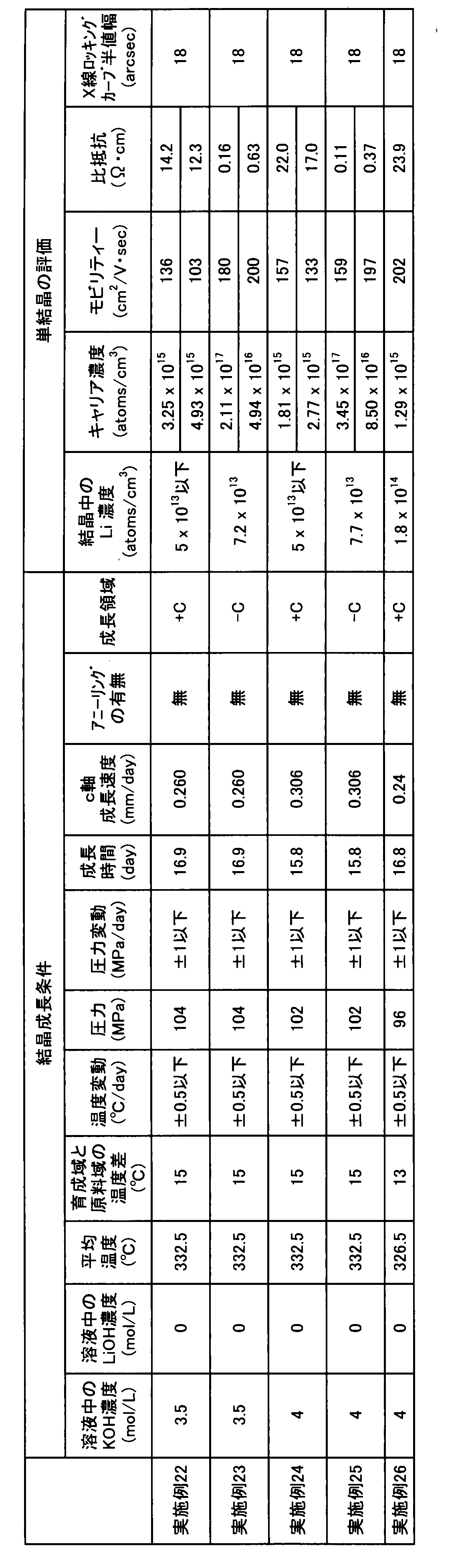
- Examples 22 to 26 Using the same seed crystal and crystal growth apparatus as in Examples 1 to 21, zinc oxide was grown in the same manner under the conditions shown in Table 2.
- Examples 22, 24, and 26 are crystals grown on the (0001) plane [+ C plane]
- Examples 23 and 25 are crystals grown on the (000-1) plane [ ⁇ C plane].
- two wafers were cut out from the same crystal and evaluated.
- the carrier concentration, mobility, and specific resistance of the obtained zinc oxide single crystal were determined by Hall measurement (van der Pauw method).
- ResiTest 8300 manufactured by Toyo Technica was used. Macro defects such as flowing were not observed at all in the obtained zinc oxide single crystal, and the quality was extremely high.
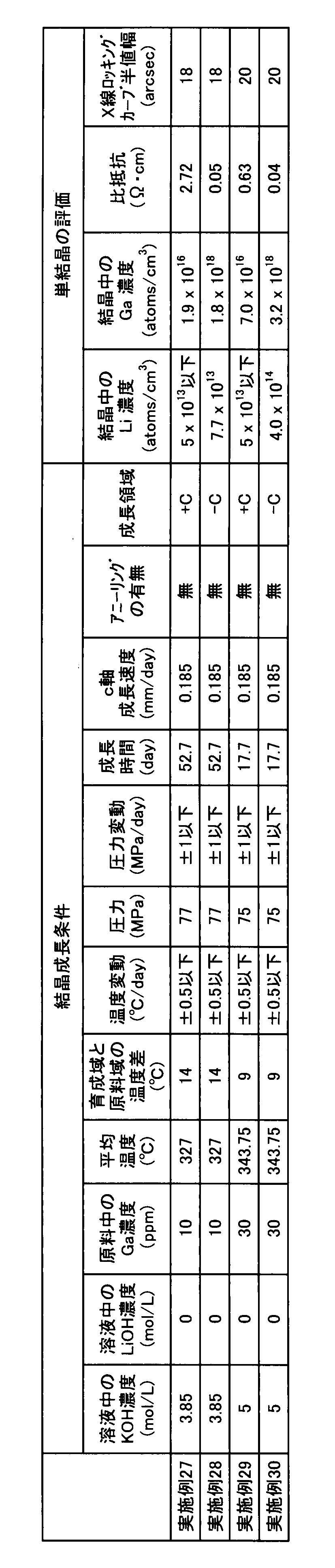
- Example 27 to 30 Using the same seed crystal and crystal growth apparatus as in Examples 1 to 21, gallium oxide (Ga 2 O 3 ) was added to the raw material, and zinc oxide was grown in the same manner under the conditions shown in Table 3.
- the Ga concentration shown in Table 3 is a concentration (weight basis) as a Ga element in the raw material.
- Examples 27 and 29 are crystals grown on the (0001) plane [+ C plane].
- Examples 28 and 30 are crystals grown on the (000-1) plane [-C plane].
- the gallium concentration of the obtained zinc oxide single crystal was measured by secondary ion mass spectrometry.
- the measuring apparatus used was a 4F type secondary ion mass spectrometer manufactured by Cameca.
- O 2 + ions were used as the primary ion species, and the primary ion energy was 8 keV.
- the detection limit of gallium in this method is 5 ⁇ 10 14 atoms / cm 3 .
- the specific resistance of the obtained zinc oxide single crystal was measured by an eddy current method using a non-contact type resistivity measuring apparatus (Lehighton Electronics Inc., Model 1510A). Macro defects such as flowing were not observed at all in the obtained zinc oxide single crystal, and the quality was extremely high.
- a zinc oxide single crystal having a sufficiently low lithium concentration and high crystallinity can be produced stably and simply at a high yield.
- the production method of the present invention is suitable for mass production, the industrial applicability is high.
- the zinc oxide single crystal of the present invention has a wide range of applications. For example, when used as a substrate for epitaxial growth, lithium does not diffuse from the substrate into the epitaxial film, so that an epitaxial film free from lithium contamination is produced. Is possible.
- it can be applied to semiconductor devices such as light emitting elements such as LEDs and solar cells. Therefore, the present invention has very high industrial applicability.
Landscapes
- Chemical & Material Sciences (AREA)
- Engineering & Computer Science (AREA)
- Crystallography & Structural Chemistry (AREA)
- Materials Engineering (AREA)
- Metallurgy (AREA)
- Organic Chemistry (AREA)
- Inorganic Chemistry (AREA)
- Crystals, And After-Treatments Of Crystals (AREA)
- Inorganic Compounds Of Heavy Metals (AREA)
Abstract
Description
[2] (0002)面反射におけるX線ロッキングカーブ測定による半値幅が50秒以下であることを特徴とする[1]に記載の酸化亜鉛単結晶。
[3] 主面がC面、M面、R面、Rp面またはRn面であることを特徴とする[1]または[2]に記載の酸化亜鉛単結晶。
[4] 結晶中の窒素含有量が1×10¹⁸atoms/cm3以下であることを特徴とする[1]~[3]のいずれか一項に記載の酸化亜鉛単結晶。
[5] 結晶中のアルミニウム濃度が2×10¹⁴atoms/cm3以下であることを特徴とする[1]~[4]のいずれか一項に記載された酸化亜鉛単結晶。
[6] 長径が15mm以上であることを特徴とする[1]~[5]のいずれか一項に記載の酸化亜鉛単結晶。
[7] 室温におけるキャリア濃度が1×10¹⁴~1×10¹⁸atoms/cm3であることを特徴とする[1]~[6]のいずれか一項に記載の酸化亜鉛単結晶。
[8] 室温におけるモビリティーが100cm2/V・sec超、300cm2/V・sec以下であることを特徴とする[1]~[7]のいずれか一項に記載の酸化亜鉛単結晶。
[9] 比抵抗が1×10⁻³~1×10³(Ω・cm)であることを特徴とする[1]~[8]のいずれか一項に記載の酸化亜鉛単結晶。
[10] 3価の金属元素を一種類または二種類以上含有し、その含有量が1×10¹⁶~1×10²⁰atoms/cm3であることを特徴とする[1]~[9]のいずれか一項に記載の酸化亜鉛単結晶。
[11] 水熱合成法により製造されたことを特徴とする[1]~[10]のいずれか一項に記載の酸化亜鉛単結晶。
[13] 水熱合成法によって酸化亜鉛結晶を成長させる際に、リチウム濃度が1ppm(重量基準)以下の溶液を使用し、結晶成長温度の変動幅を5℃以内に抑えながら酸化亜鉛結晶を成長させることを特徴とする酸化亜鉛単結晶の製造方法。
[14] 前記溶液がリチウムを含有しないことを特徴とする[12]または[13]に記載の酸化亜鉛単結晶の製造方法。
[15] 前記溶液がアンモニウムイオンを含有しないことを特徴とする[12]~[14]のいずれか一項に記載の酸化亜鉛単結晶の製造方法。
[16] リチウム濃度が0.1ppm(重量基準)以下である原料を用いることを特徴とする[12]~[15]のいずれか一項に記載の酸化亜鉛単結晶の製造方法。
[17] 白金と、白金以外の白金族元素を1種類以上含む合金を使用した内壁を有する反応容器内で酸化亜鉛結晶を成長させることを特徴とする[12]~[16]のいずれか一項に記載の酸化亜鉛単結晶の製造方法。
[18] 前記白金以外の白金族元素の含有量が5~30重量%である合金を使用することを特徴とする[17]に記載の酸化亜鉛単結晶の製造方法。
[19] 前記白金以外の白金族元素がイリジウムであることを特徴とする[17]たは[18]に記載の酸化亜鉛単結晶の製造方法。
[20] 原料溶解域に圧力緩衝機構が設置された反応容器内で酸化亜鉛結晶を成長させることを特徴とする[12]~[19]のいずれか一項に記載の酸化亜鉛単結晶の製造方法。
[21] [12]~[20]のいずれか一項に記載の製造方法により製造される酸化亜鉛単結晶。
2 内筒蓋
3 熱電対
4 育成枠
5 内筒
6 種結晶
7 ワイヤー
8 バッフル
9 原料
10 原料籠
11 ベローズ
12 圧力計
13 上部保温材
14 オートクレーブ蓋
15 クランプ
16 オートクレーブ本体
17 窓
18 保温材
19 ヒーター
20 保温材仕切
21 外部バッフル
本発明の酸化亜鉛単結晶は、結晶中のリチウム濃度が5×10¹⁴atoms/cm3以下であることを特徴とする。本発明における結晶中のリチウム濃度は、二次イオン質量分析により測定することができる。本発明の酸化亜鉛単結晶のリチウム濃度は、5×1014atoms/cm3以下であり、1×1014atoms/cm3以下であることが好ましく、5×1013atoms/cm3以下であることがさらに好ましい。
なお、本明細書において、C面とは六方晶での(0001)面と(000-1)面をいう。また、本願においてM面とは、六方晶での(1-100)面およびそれと等価な面をいい、非極性面であり、通常へき開面である。具体的には、(1-100)面、(-1100)面、(01-10面)、(0-110)面、(10-10)面、(-1010)面があるが、いずれでもよい。本願においてR面とは六方晶での(1-101)面、(1-10-1)面およびそれと等価な面をいい、Rp面とは(1-102)面およびそれと等価な面、Rn面とは(2-20-1)面およびそれと等価な面をいい、本願においてA面とは六方晶での(11-20)面およびそれと等価な面をいう。また、C面、M面、A面の法線方向をそれぞれc軸、m軸、a軸方向という。
例えば、本発明の酸化亜鉛単結晶中の窒素含有量は1×10¹⁸atoms/cm3以下であることが好ましく、5×1017atoms/cm3以下であることがより好ましく、1×1017atoms/cm3以下であることがさらに好ましい。例えば特開平6-289192号公報に記載されるような、従来のアンモニウムイオンを用いた酸化亜鉛単結晶の製造方法では、このような低濃度の窒素含有量を実現することはできない。
上記の金属元素濃度の調整は、例えば原料中への金属酸化物の添加量を調整することにより行うことができる。本発明による酸化亜鉛単結晶は、リチウムをはじめ意図しない不純物含有量が少ないため、従来の酸化亜鉛単結晶と比べて意図的な不純物の添加(ドーピング)による特性制御を精度良く行なうことができる。
本発明の酸化亜鉛単結晶は、水熱合成法により製造することができる。好ましい結晶育成装置について図1を参照しながら説明する。
好ましい水熱合成法では、高強度鋼製圧力容器(以下オートクレーブと呼ぶ)を用いる。オートクレーブは図1に示すように鉛直方向に長い厚肉円筒形を呈し、本体16と蓋14からなる。オートクレーブは加熱炉中に設置される。加熱炉は保温材18とヒーター19からなり上下で温度差を十分に取れるように中間部分に仕切20が設置されている。温度は熱電対3によりモニタリングされ、温度制御装置により制御される。圧力は圧力計12によって計測される。加熱炉の仕切20から上半分は冷却域であるため、保温材18には冷却のための窓17が複数設置され、この窓17の開閉度合いによって温度を精密に制御することが可能である。
本発明の酸化亜鉛単結晶の好ましい製造方法では、種結晶上に酸化亜鉛単結晶を育成する。
種結晶としては、特にC面である(0001)面に平行に切断された板状の酸化亜鉛単結晶を用いることが好ましい。C面からの傾きは0.5°以内であるのが好ましい。厚みは通常0.5~2.0mmであり、好ましくは0.8~1.2mmである。厚みが0.5mm以上であれば、昇温時に溶解してしまう危険性が低いため好ましい。また、厚みが2.0mm以下であれば種結晶のコストが高くなり過ぎることもなく、生産性という点で有利である。なお、非極性面であるM面、半極性面であるR面、Rp面、Rn面の種結晶を用いてもリチウムを含まない高品質の結晶の育成ができる。
上記の結晶育成装置を使用して、本発明の高純度の酸化亜鉛単結晶を育成する方法を以下に述べる。
水熱合成法は、亜臨界から超臨界の水溶液中で原料を溶解させ、溶解した原料を再結晶させることにより結晶を成長させる方法である。本発明ではリチウム濃度1ppm(重量基準)以下の水溶液を用いる。好ましくは、リチウムを添加せずにKOHのみの水溶液を用いる。リチウムを不純物として含まないことを主眼とするのでKOHの代わりにNaOHを用いることもできる。従来は水熱合成法ではリチウムを添加しない場合は欠陥のない高品質な酸化亜鉛単結晶の育成は不可能であると認識されていたが、発明者らはリチウムを添加しないで育成した酸化亜鉛単結晶のモルフォロジーの観察から、C面上のフローイング等のマクロ欠陥の発生原因は原料の供給量の不足、部分的な対流の停滞、温度の変動など結晶成長環境内の条件の変化、揺らぎにあることを見出した。リチウムを添加すれば、c軸に垂直な方向すなわちa軸、m軸方向への成長を促進することができるためフローイング発生を抑制できるが、発明者らは育成条件の最適化によりリチウム添加を行なわずにフローイング発生要因を抑制することが可能であることを見出した。
図1の結晶育成装置を用いて、酸化亜鉛単結晶の製造を行った。種結晶には、厚みが1.0mmでエッチピット密度が1×10²~1×10⁴個/cm2であるC面を主面とする長径20mmの板状の結晶を用いた。実施例1~21のそれぞれで表1に記載される条件を採用した。表1に記載の溶液中のLiOH濃度は、実施例21のみppm単位(重量基準)で表示している。
なお、酸化亜鉛の結晶成長中における温度変動を熱電対でモニタリングすることにより測定し、表1に記載した。また、酸化亜鉛の結晶成長中における圧力変動を圧力計でモニタリングすることにより測定し、表1に記載した。
実施例1、3~9、12、15~21では、得られた酸化亜鉛単結晶中にフローイング等のマクロ欠陥はまったく観察されず、極めて高品質であった。また、実施例2と10の群、次いで実施例11、次いで実施例13と14の群の順に好ましいことも確認された。
得られた酸化亜鉛単結晶中のリチウム濃度とアルミニウム濃度を二次イオン質量分析により測定し、結果を表1に記載した。測定装置はCameca製4F型二次イオン質量分析装置を使用した。一次イオン種としてO2 +イオンを用い、一次イオンエネルギーを8keVとした。なお、この方法のリチウムの検出限界は5×10¹³atoms/cm3、アルミニウムの検出限界は5×1013atoms/cm3である。
実施例6、8で得られた酸化亜鉛単結晶中の窒素濃度を二次イオン質量分析により測定したところ、いずれも検出限界である2×10¹⁶atoms/cm3以下であった。測定装置はCameca製4F型二次イオン質量分析装置を使用した。一次イオン種としてCs+イオンを用い、一次イオンエネルギーを14.5keVとした。
得られた酸化亜鉛結晶の(0002)面におけるX線ロッキングカーブ測定により半値幅を求め、結果を表1に記載した。測定装置はリガクATX-Eを使用し、光学系として4結晶Ge(440)モノクロメータを用いた。スリット寸法は1×10mmである。
実施例1~21と同じ種結晶と結晶育成装置を用いて、表1の条件下で同様にして酸化亜鉛を結晶成長させた。その結果、得られた酸化亜鉛単結晶のリチウム濃度は6.5×10¹⁷atoms/cm3であり、アルミニウム濃度は1.0×1015atoms/cm3であった。結晶中にフローイング等のマクロ欠陥は観察されなかった。
得られた酸化亜鉛単結晶を大気下にて、1400℃で2時間熱処理した。その結果、酸化亜鉛単結晶のリチウム濃度は表1に記載されるように9×10¹⁴/cm3となった。

実施例1~21と同じ種結晶と結晶育成装置を用いて、表2の条件下で同様にして酸化亜鉛を結晶成長させた。実施例22、24、26は(0001)面[+C面]上に成長した結晶であり、実施例23、25は(000-1)面[-C面]上に成長した結晶である。実施例22~25では同一結晶からそれぞれ2枚のウェハーを切り出し評価した。得られた酸化亜鉛単結晶のキャリア濃度、モビリティー、比抵抗をHall測定(van der Pauw法)により求めた。測定装置は東陽テクニカ製ResiTest 8300を使用した。得られた酸化亜鉛単結晶中にフローイング等のマクロ欠陥はまったく観察されず、極めて高品質であった。
実施例1~21と同じ種結晶と結晶育成装置を用いて、原料中に酸化ガリウム(Ga2O3)を添加し、表3の条件下で同様にして酸化亜鉛を結晶成長させた。表3に示すGa濃度は原料中のGa元素としての濃度(重量基準)である。実施例27、29は(0001)面[+C面]上に成長した結晶。実施例28、30は(000-1)面[-C面]上に成長した結晶である。得られた酸化亜鉛単結晶のガリウム濃度を二次イオン質量分析により測定した。測定装置はCameca製4F型二次イオン質量分析装置を使用した。一次イオン種としてO2 +イオンを用い、一次イオンエネルギーを8keVとした。なお、この方法のガリウムの検出限界は5×10¹⁴atoms/cm3である。また、得られた酸化亜鉛単結晶の比抵抗を非接触式抵抗率測定装置(Lehighton Electronics Inc.製, Model 1510A)を用いて渦電流方式により測定した。得られた酸化亜鉛単結晶中にフローイング等のマクロ欠陥はまったく観察されず、極めて高品質であった。
本出願は、2008年4月4日出願の日本特許出願(特願2008-097825号)と、2008年8月1日出願の日本特許出願(特願2008-199126号)と、2009年3月23日出願の日本特許出願(特願2009-069280号)とに基づくものであり、その内容はここに参照として取り込まれる。
Claims (21)
- 結晶中のリチウム濃度が5×10¹⁴atoms/cm3以下であることを特徴とする酸化亜鉛単結晶。
- (0002)面反射におけるX線ロッキングカーブ測定による半値幅が50秒以下であることを特徴とする請求項1に記載の酸化亜鉛単結晶。
- 主面がC面、M面、R面、Rp面またはRn面であることを特徴とする請求項1または2に記載の酸化亜鉛単結晶。
- 結晶中の窒素含有量が1×10¹⁸atoms/cm3以下であることを特徴とする請求項1~3のいずれか一項に記載の酸化亜鉛単結晶。
- 結晶中のアルミニウム濃度が2×10¹⁴atoms/cm3以下であることを特徴とする請求項1~4のいずれか一項に記載された酸化亜鉛単結晶。
- 長径が15mm以上であることを特徴とする請求項1~5のいずれか一項に記載の酸化亜鉛単結晶。
- 室温におけるキャリア濃度が1×10¹⁴~1×10¹⁸atoms/cm3であることを特徴とする請求項1~6のいずれか一項に記載の酸化亜鉛単結晶。
- 室温におけるモビリティーが100cm2/V・sec超、300cm2/V・sec以下であることを特徴とする請求項1~7のいずれか一項に記載の酸化亜鉛単結晶。
- 比抵抗が1×10⁻³~1×10³(Ω・cm)であることを特徴とする請求項1~8のいずれか一項に記載の酸化亜鉛単結晶。
- 3価の金属元素を一種類または二種類以上含有し、その含有量が1×10¹⁶~1×10²⁰atoms/cm3であることを特徴とする請求項1~9のいずれか一項に記載の酸化亜鉛単結晶。
- 水熱合成法により製造されたことを特徴とする請求項1~10のいずれか一項に記載の酸化亜鉛単結晶。
- リチウム濃度が1ppm(重量基準)以下の溶液を用いて、300~370℃の範囲内の温度で水熱合成法によって酸化亜鉛結晶を成長させることを特徴とする酸化亜鉛単結晶の製造方法。
- 水熱合成法によって酸化亜鉛結晶を成長させる際に、リチウム濃度が1ppm(重量基準)以下の溶液を使用し、結晶成長温度の変動幅を5℃以内に抑えながら酸化亜鉛結晶を成長させることを特徴とする酸化亜鉛単結晶の製造方法。
- 前記溶液がリチウムを含有しないことを特徴とする請求項12または13に記載の酸化亜鉛単結晶の製造方法。
- 前記溶液がアンモニウムイオンを含有しないことを特徴とする請求項12~14のいずれか一項に記載の酸化亜鉛単結晶の製造方法。
- リチウム濃度が0.1ppm(重量基準)以下である原料を用いることを特徴とする請求項12~15のいずれか一項に記載の酸化亜鉛単結晶の製造方法。
- 白金と、白金以外の白金族元素を1種類以上含む合金を使用した内壁を有する反応容器内で酸化亜鉛結晶を成長させることを特徴とする請求項12~16のいずれか一項に記載の酸化亜鉛単結晶の製造方法。
- 前記白金以外の白金族元素の含有量が5~30重量%である合金を使用することを特徴とする請求項17に記載の酸化亜鉛単結晶の製造方法。
- 前記白金以外の白金族元素がイリジウムであることを特徴とする請求項17または18に記載の酸化亜鉛単結晶の製造方法。
- 原料溶解域に圧力緩衝機構が設置された反応容器内で酸化亜鉛結晶を成長させることを特徴とする請求項12~19のいずれか一項に記載の酸化亜鉛単結晶の製造方法。
- 請求項12~20のいずれか一項に記載の製造方法により製造される酸化亜鉛単結晶。
Priority Applications (3)
| Application Number | Priority Date | Filing Date | Title |
|---|---|---|---|
| EP09728982.1A EP2264227A4 (en) | 2008-04-04 | 2009-03-24 | ZINC OXIDE CRYSTAL AND METHOD OF MANUFACTURING THEREOF |
| US12/936,295 US20110117349A1 (en) | 2008-04-04 | 2009-03-24 | Zinc oxide single crystal and method for producing the same |
| CN2009801120309A CN101983263A (zh) | 2008-04-04 | 2009-03-24 | 氧化锌单晶及其制造方法 |
Applications Claiming Priority (6)
| Application Number | Priority Date | Filing Date | Title |
|---|---|---|---|
| JP2008097825 | 2008-04-04 | ||
| JP2008-097825 | 2008-04-04 | ||
| JP2008-199126 | 2008-08-01 | ||
| JP2008199126 | 2008-08-01 | ||
| JP2009-069280 | 2009-03-23 | ||
| JP2009069280A JP2010053017A (ja) | 2008-04-04 | 2009-03-23 | 酸化亜鉛単結晶およびその製造方法 |
Publications (1)
| Publication Number | Publication Date |
|---|---|
| WO2009122974A1 true WO2009122974A1 (ja) | 2009-10-08 |
Family
ID=41135354
Family Applications (1)
| Application Number | Title | Priority Date | Filing Date |
|---|---|---|---|
| PCT/JP2009/055870 Ceased WO2009122974A1 (ja) | 2008-04-04 | 2009-03-24 | 酸化亜鉛単結晶およびその製造方法 |
Country Status (6)
| Country | Link |
|---|---|
| US (1) | US20110117349A1 (ja) |
| EP (1) | EP2264227A4 (ja) |
| JP (1) | JP2010053017A (ja) |
| KR (1) | KR20110016859A (ja) |
| CN (1) | CN101983263A (ja) |
| WO (1) | WO2009122974A1 (ja) |
Cited By (2)
| Publication number | Priority date | Publication date | Assignee | Title |
|---|---|---|---|---|
| JP2012153598A (ja) * | 2011-01-27 | 2012-08-16 | Mitsubishi Chemicals Corp | 窒化物結晶の製造方法、反応容器および結晶製造装置 |
| JP2016105478A (ja) * | 2010-09-08 | 2016-06-09 | 株式会社半導体エネルギー研究所 | 半導体装置 |
Families Citing this family (7)
| Publication number | Priority date | Publication date | Assignee | Title |
|---|---|---|---|---|
| CN102127802B (zh) * | 2011-03-18 | 2013-01-02 | 山东大学 | 一种利用矿化剂在水热条件下生长氧化锌单晶的方法 |
| JP6032590B2 (ja) * | 2012-04-04 | 2016-11-30 | 株式会社福田結晶技術研究所 | 酸化亜鉛単結晶の製造方法 |
| CN105297134B (zh) * | 2015-11-10 | 2017-11-10 | 桂林百锐光电技术有限公司 | 一种镓钪共掺氧化锌闪烁单晶及其制备方法 |
| CN105568360B (zh) * | 2016-03-10 | 2017-11-24 | 河南工程学院 | 水热法氧化锌单晶材料合成装置及合成方法 |
| CN106637382A (zh) * | 2016-11-09 | 2017-05-10 | 石长海 | 一种ф400高压釜 |
| CN108671914B (zh) * | 2018-05-15 | 2021-04-27 | 福州大学 | 一种复合型压电催化剂及其制备和应用 |
| CN111424318B (zh) * | 2020-06-10 | 2020-10-16 | 眉山博雅新材料有限公司 | 一种用于制备掺杂yag单晶光纤的方法 |
Citations (8)
| Publication number | Priority date | Publication date | Assignee | Title |
|---|---|---|---|---|
| US3201209A (en) | 1963-03-27 | 1965-08-17 | Bell Telephone Labor Inc | Hydrothermal growth of zinc oxide crystals |
| JPH06279192A (ja) * | 1993-03-29 | 1994-10-04 | Ngk Insulators Ltd | 圧電性半導体及びその製造方法 |
| JPH06289192A (ja) | 1993-03-30 | 1994-10-18 | Kansai Electric Power Co Inc:The | 原子炉容器フランジ部の清掃ロボット |
| JP2005039131A (ja) * | 2003-07-17 | 2005-02-10 | National Institute For Materials Science | 酸化亜鉛単結晶ウエファーの製造法 |
| WO2006075613A1 (ja) * | 2005-01-12 | 2006-07-20 | Solvothermal Crystal Growth Technology Research Alliance | 単結晶育成用圧力容器 |
| JP2007001787A (ja) | 2005-06-21 | 2007-01-11 | Stanley Electric Co Ltd | ZnO基板の製造方法 |
| JP2007204324A (ja) | 2006-02-02 | 2007-08-16 | Tokyo Denpa Co Ltd | 高純度酸化亜鉛単結晶の製造方法および高純度酸化亜鉛単結晶 |
| JP2008063204A (ja) * | 2006-09-11 | 2008-03-21 | Sumitomo Metal Mining Co Ltd | 酸化亜鉛結晶の成長方法 |
Family Cites Families (5)
| Publication number | Priority date | Publication date | Assignee | Title |
|---|---|---|---|---|
| US13926A (en) * | 1855-12-11 | Cutting cloaks | ||
| US5393444A (en) * | 1992-09-08 | 1995-02-28 | Ngk Insulators, Ltd. | Piezoelectric semiconductor |
| WO2007018216A1 (ja) * | 2005-08-09 | 2007-02-15 | Stanley Electric Co., Ltd. | ZnO結晶とその成長方法、及び発光素子の製造方法 |
| US8268075B2 (en) * | 2006-06-22 | 2012-09-18 | Fujikura Ltd. | Method of producing zinc oxide semiconductor crystal |
| WO2009119411A1 (ja) * | 2008-03-26 | 2009-10-01 | 三菱瓦斯化学株式会社 | ZnO単結晶の製造方法、それによって得られた自立ZnO単結晶ウエファー、並びに自立Mg含有ZnO系混晶単結晶ウエファーおよびそれに用いるMg含有ZnO系混晶単結晶の製造方法 |
-
2009
- 2009-03-23 JP JP2009069280A patent/JP2010053017A/ja active Pending
- 2009-03-24 US US12/936,295 patent/US20110117349A1/en not_active Abandoned
- 2009-03-24 KR KR1020107021643A patent/KR20110016859A/ko not_active Withdrawn
- 2009-03-24 CN CN2009801120309A patent/CN101983263A/zh active Pending
- 2009-03-24 WO PCT/JP2009/055870 patent/WO2009122974A1/ja not_active Ceased
- 2009-03-24 EP EP09728982.1A patent/EP2264227A4/en not_active Withdrawn
Patent Citations (8)
| Publication number | Priority date | Publication date | Assignee | Title |
|---|---|---|---|---|
| US3201209A (en) | 1963-03-27 | 1965-08-17 | Bell Telephone Labor Inc | Hydrothermal growth of zinc oxide crystals |
| JPH06279192A (ja) * | 1993-03-29 | 1994-10-04 | Ngk Insulators Ltd | 圧電性半導体及びその製造方法 |
| JPH06289192A (ja) | 1993-03-30 | 1994-10-18 | Kansai Electric Power Co Inc:The | 原子炉容器フランジ部の清掃ロボット |
| JP2005039131A (ja) * | 2003-07-17 | 2005-02-10 | National Institute For Materials Science | 酸化亜鉛単結晶ウエファーの製造法 |
| WO2006075613A1 (ja) * | 2005-01-12 | 2006-07-20 | Solvothermal Crystal Growth Technology Research Alliance | 単結晶育成用圧力容器 |
| JP2007001787A (ja) | 2005-06-21 | 2007-01-11 | Stanley Electric Co Ltd | ZnO基板の製造方法 |
| JP2007204324A (ja) | 2006-02-02 | 2007-08-16 | Tokyo Denpa Co Ltd | 高純度酸化亜鉛単結晶の製造方法および高純度酸化亜鉛単結晶 |
| JP2008063204A (ja) * | 2006-09-11 | 2008-03-21 | Sumitomo Metal Mining Co Ltd | 酸化亜鉛結晶の成長方法 |
Non-Patent Citations (4)
| Title |
|---|
| E.D. KOLB; R.A. LAUDISE: "Properties of Lithium-Doped Hydrothermally Grown Single Crystals of Zinc Oxide", JOURNAL OF THE AMERICAN CERAMIC SOCIETY, vol. 48, no. 7, 1965, pages 342 - 345 |
| R.A. LAUDISE; A.A. BAJIMAN: "Hydro-thermal synthesis method of Zinc Oxide and Zinc Sulfide", JOURNAL OF PHYSICAL CHEMISTRY, vol. 64, 1960, pages 688 - 691 |
| R.A. LAUDISE; E.D. KOLB; A.J. CAPORASO: "Hydrothermal Growth of Large Sound Crystals of Zinc Oxide", JOURNAL OF THE AMERICAN CERAMIC SOCIETY, vol. 47, 1964, pages 9 - 12 |
| See also references of EP2264227A4 * |
Cited By (2)
| Publication number | Priority date | Publication date | Assignee | Title |
|---|---|---|---|---|
| JP2016105478A (ja) * | 2010-09-08 | 2016-06-09 | 株式会社半導体エネルギー研究所 | 半導体装置 |
| JP2012153598A (ja) * | 2011-01-27 | 2012-08-16 | Mitsubishi Chemicals Corp | 窒化物結晶の製造方法、反応容器および結晶製造装置 |
Also Published As
| Publication number | Publication date |
|---|---|
| EP2264227A4 (en) | 2013-05-29 |
| EP2264227A1 (en) | 2010-12-22 |
| CN101983263A (zh) | 2011-03-02 |
| JP2010053017A (ja) | 2010-03-11 |
| KR20110016859A (ko) | 2011-02-18 |
| US20110117349A1 (en) | 2011-05-19 |
Similar Documents
| Publication | Publication Date | Title |
|---|---|---|
| JP2010053017A (ja) | 酸化亜鉛単結晶およびその製造方法 | |
| JP6481706B2 (ja) | 窒化ガリウム基板、半導体デバイスの製造方法、および、窒化ガリウム層接合基板の製造方法 | |
| JP5665094B2 (ja) | n型III族窒化物系化合物半導体 | |
| CN102383181B (zh) | 制备n-型Ⅲ族氮化物单晶的方法、所述单晶、和晶体基板 | |
| JP6020440B2 (ja) | 窒化物結晶の製造方法 | |
| JP5709122B2 (ja) | アモノサーマル法および窒化物結晶 | |
| US20240191395A1 (en) | Gallium nitride crystal, gallium nitride substrate, and method for producing gallium nitride crystal | |
| JP2014118323A (ja) | 周期表第13族金属窒化物半導体結晶の製造方法及び周期表第13族金属窒化物半導体結晶 | |
| JP6135080B2 (ja) | 13族窒化物結晶、13族窒化物結晶基板、及び13族窒化物結晶の製造方法 | |
| JP6074959B2 (ja) | Iii族窒化物結晶及びその製造方法 | |
| JP2015010023A (ja) | 周期表第13族金属窒化物結晶 | |
| JP6168091B2 (ja) | Iii族窒化物結晶およびiii族窒化物の結晶基板 | |
| EP4299801A1 (en) | Gallium nitride crystal, gallium nitride substrate, and method for producing gallium nitride substrate | |
| JP6123421B2 (ja) | Iii族窒化物結晶塊 | |
| WO2023127455A1 (ja) | 窒化アルミニウム単結晶、及びiii族窒化物単結晶の製造方法 | |
| JP2014076943A (ja) | 周期表第13族金属窒化物半導体基板 | |
| JP2014047134A (ja) | Iii族窒化物結晶塊 | |
| JP2013184886A (ja) | 窒化物半導体結晶の製造方法および窒化物半導体結晶 |
Legal Events
| Date | Code | Title | Description |
|---|---|---|---|
| WWE | Wipo information: entry into national phase |
Ref document number: 200980112030.9 Country of ref document: CN |
|
| 121 | Ep: the epo has been informed by wipo that ep was designated in this application |
Ref document number: 09728982 Country of ref document: EP Kind code of ref document: A1 |
|
| ENP | Entry into the national phase |
Ref document number: 20107021643 Country of ref document: KR Kind code of ref document: A |
|
| WWE | Wipo information: entry into national phase |
Ref document number: 2009728982 Country of ref document: EP |
|
| NENP | Non-entry into the national phase |
Ref country code: DE |
|
| WWE | Wipo information: entry into national phase |
Ref document number: 12936295 Country of ref document: US |