WO2009128913A1 - Substituted tetracycline compounds - Google Patents

Substituted tetracycline compounds Download PDF

Info

Publication number
WO2009128913A1
WO2009128913A1 PCT/US2009/002344 US2009002344W WO2009128913A1 WO 2009128913 A1 WO2009128913 A1 WO 2009128913A1 US 2009002344 W US2009002344 W US 2009002344W WO 2009128913 A1 WO2009128913 A1 WO 2009128913A1
Authority
WO
WIPO (PCT)
Prior art keywords
alkyl
aryl
heterocyclic
alkenyl
alkynyl
Prior art date
Legal status (The legal status is an assumption and is not a legal conclusion. Google has not performed a legal analysis and makes no representation as to the accuracy of the status listed.)
Ceased
Application number
PCT/US2009/002344
Other languages
French (fr)
Inventor
Joel Berniac
Todd Bowser
Current Assignee (The listed assignees may be inaccurate. Google has not performed a legal analysis and makes no representation or warranty as to the accuracy of the list.)
Paratek Pharmaceuticals Inc
Original Assignee
Paratek Pharmaceuticals Inc
Priority date (The priority date is an assumption and is not a legal conclusion. Google has not performed a legal analysis and makes no representation as to the accuracy of the date listed.)
Filing date
Publication date
Application filed by Paratek Pharmaceuticals Inc filed Critical Paratek Pharmaceuticals Inc
Priority to CA2721399A priority Critical patent/CA2721399A1/en
Priority to EP09732861A priority patent/EP2276342A4/en
Priority to AU2009236631A priority patent/AU2009236631A1/en
Priority to JP2011505019A priority patent/JP2011517697A/en
Publication of WO2009128913A1 publication Critical patent/WO2009128913A1/en
Priority to CL2010000356A priority patent/CL2010000356A1/en
Priority to PE2010000229A priority patent/PE20110069A1/en
Priority to ARP100101254A priority patent/AR079388A1/en
Anticipated expiration legal-status Critical
Ceased legal-status Critical Current

Links

Classifications

    • AHUMAN NECESSITIES
    • A61MEDICAL OR VETERINARY SCIENCE; HYGIENE
    • A61KPREPARATIONS FOR MEDICAL, DENTAL OR TOILETRY PURPOSES
    • A61K31/00Medicinal preparations containing organic active ingredients
    • A61K31/65Tetracyclines
    • AHUMAN NECESSITIES
    • A61MEDICAL OR VETERINARY SCIENCE; HYGIENE
    • A61PSPECIFIC THERAPEUTIC ACTIVITY OF CHEMICAL COMPOUNDS OR MEDICINAL PREPARATIONS
    • A61P11/00Drugs for disorders of the respiratory system
    • AHUMAN NECESSITIES
    • A61MEDICAL OR VETERINARY SCIENCE; HYGIENE
    • A61PSPECIFIC THERAPEUTIC ACTIVITY OF CHEMICAL COMPOUNDS OR MEDICINAL PREPARATIONS
    • A61P31/00Antiinfectives, i.e. antibiotics, antiseptics, chemotherapeutics
    • AHUMAN NECESSITIES
    • A61MEDICAL OR VETERINARY SCIENCE; HYGIENE
    • A61PSPECIFIC THERAPEUTIC ACTIVITY OF CHEMICAL COMPOUNDS OR MEDICINAL PREPARATIONS
    • A61P31/00Antiinfectives, i.e. antibiotics, antiseptics, chemotherapeutics
    • A61P31/04Antibacterial agents
    • AHUMAN NECESSITIES
    • A61MEDICAL OR VETERINARY SCIENCE; HYGIENE
    • A61PSPECIFIC THERAPEUTIC ACTIVITY OF CHEMICAL COMPOUNDS OR MEDICINAL PREPARATIONS
    • A61P43/00Drugs for specific purposes, not provided for in groups A61P1/00-A61P41/00
    • AHUMAN NECESSITIES
    • A61MEDICAL OR VETERINARY SCIENCE; HYGIENE
    • A61PSPECIFIC THERAPEUTIC ACTIVITY OF CHEMICAL COMPOUNDS OR MEDICINAL PREPARATIONS
    • A61P7/00Drugs for disorders of the blood or the extracellular fluid
    • YGENERAL TAGGING OF NEW TECHNOLOGICAL DEVELOPMENTS; GENERAL TAGGING OF CROSS-SECTIONAL TECHNOLOGIES SPANNING OVER SEVERAL SECTIONS OF THE IPC; TECHNICAL SUBJECTS COVERED BY FORMER USPC CROSS-REFERENCE ART COLLECTIONS [XRACs] AND DIGESTS
    • Y02TECHNOLOGIES OR APPLICATIONS FOR MITIGATION OR ADAPTATION AGAINST CLIMATE CHANGE
    • Y02ATECHNOLOGIES FOR ADAPTATION TO CLIMATE CHANGE
    • Y02A50/00TECHNOLOGIES FOR ADAPTATION TO CLIMATE CHANGE in human health protection, e.g. against extreme weather
    • Y02A50/30Against vector-borne diseases, e.g. mosquito-borne, fly-borne, tick-borne or waterborne diseases whose impact is exacerbated by climate change

Definitions

  • New tetracycline analogues have also been investigated which may prove to be equal to or more effective than the originally introduced tetracycline compounds.
  • Examples include U.S. Patent Nos. 2,980,584; 2,990,331; 3,062,717; 3,165,531; 3,454,697; 3,557,280; 3,674,859; 3,957,980; 4,018,889; 4,024,272; and 4,126,680. These patents are representative of the range of pharmaceutically active tetracycline and tetracycline analogue compositions.
  • tetracyclines were found to be highly effective pharmacologically against rickettsiae; a number of gram- positive and gram-negative bacteria; and the agents responsible for lymphogranuloma venereum, inclusion conjunctivitis, and psittacosis.
  • tetracyclines became known as "broad spectrum" antibiotics.
  • the tetracyclines as a class rapidly became widely used for therapeutic purposes.
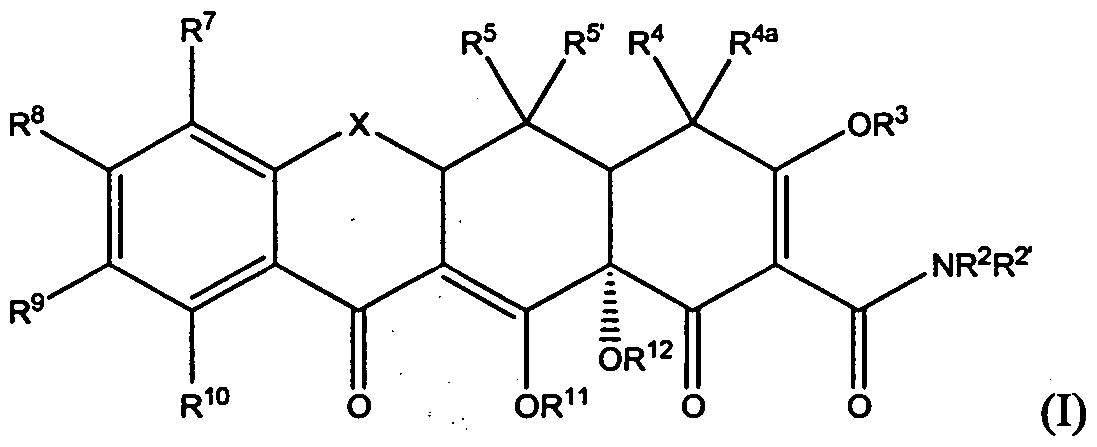
  • the invention pertains, at least in part, to methods of treating a microorganism-associated infection in a subject comprising administering to said subject an effective amount of a tetracycline compound of Formula I:
  • R 2 , R 2 , R 4 , and R 4 are each independently hydrogen, alkyl, alkenyl, alkynyl, acyl, hydroxyl, alkoxy, halogen, thioether, sulfinyl, sulfonyl, amino, cyano, nitro, carbonyl, aryl, heterocyclic or a prodrug moiety;
  • R 3 , R 4a , R 11 and R 12 are each independently hydrogen, alkyl, alkenyl, alkynyl, acyl, hydroxyl, alkoxy, halogen, thioether, sulfinyl, sulfonyl, amino, cyano, nitro, carbonyl, aryl, heterocyclic or a prodrug moiety;
  • R 4 is NR 4 R 4 , hydrogen, alkyl, alkenyl, alkynyl, acyl, hydroxyl, alkoxy, halogen, thioether, sulfinyl, sulfonyl, amino, cyano, nitro, carbonyl, aryl, heterocyclic or a prodrug moiety;
  • R 5 and R 5 are each hydrogen, alkyl, alkenyl, alkynyl, acyl, hydroxyl, alkoxy, halogen, thioether, sulfinyl, sulfonyl, amino, cyano, nitro, carbonyl, aryl, heterocyclic or a prodrug moiety;
  • R 6 and R 6 are each independently hydrogen, alkyl, alkenyl, alkynyl, acyl, hydroxyl, alkoxy, halogen, thioether, sulfinyl, sulfonyl, amino, cyano, nitro, carbonyl, aryl or heterocyclic;
  • R 10 is hydrogen, alkyl, alkenyl, alkynyl, acyl, hydroxyl, alkoxy, halogen, thioether, sulfinyl, sulfonyl, amino, cyano, nitro, carbonyl, aryl or heterocyclic;
  • R 7a , R 713 , R 7c , R 7d , R 7e , R 7f , R 8a , R 8b , R 8c , R 8d , R 8e , R 8f , R 9a , R 9b , R 9c , R 9d , R 9e , and R 9f are each hydrogen, alkyl, alkenyl, alkynyl, acyl, hydroxyl, alkoxy, halogen, thioether, sulfinyl, sulfonyl, amino, cyano, nitro, carbonyl, aryl or heterocyclic;
  • R 13 is hydrogen, alkyl, alkenyl, alkynyl, acyl, hydroxyl, alkoxy, halogen, thioether, sulfinyl, sulfonyl, amino, cyano, nitro, carbonyl, aryl or heterocyclic;
  • E is CR 8d R 8e , S, NR 8b or O;
  • E' is O, NR 8f , or S;
  • W is CR 7d R 7e , S, NRTM or O;
  • W is O, NR 7f , or S;
  • Z is CR 9d R 9e , S, NR 9b or O;
  • Z' is O, S, or NR 9f ;
  • Y' and Y are each independently hydrogen, alkyl, alkenyl, alkynyl, acyl, hydroxyl, alkoxy, halogen, thioether, sulfinyl, sulfonyl, amino, cyano, nitro, carbonyl, aryl or heterocyclic; or a pharmaceutically acceptable salt, ester or enantiomer thereof.
  • the invention pertains, at least in part, to methods of treating a microorganism-associated infection in a subject comprising administering to said subject an effective amount of a tetracycline compound of formula II:
  • r is an integer from 1 to 10;
  • M is OR 7o* orNR 7p* R 7q* ;
  • Q is hydrogen or alkyl
  • R 7 ° * is hydrogen, alkyl, alkenyl, alkynyl, acyl, hydroxyl, alkoxy, halogen, thioether, sulfinyl, sulfonyl, amino, cyano, nitro, carbonyl, aryl or heterocyclic;
  • R 7p* and R 7q* are each independently hydrogen, alkyl, alkenyl, alkynyl, acyl, hydroxyl, alkoxy, halogen, thioether, sulfinyl, sulfonyl, amino, cyano, nitro, carbonyl, aryl or heterocyclic or R 7p* and R 7q* are linked to form a 5- or 6-membered aryl, heterocyclic or aliphatic ring; or a pharmaceutically acceptable salt, ester or enantiomer thereof.
  • the invention pertains, at least in part, to methods of treating a microorganism-associated infection in a subject comprising administering to said subject an effective amount of a tetracycline compound of formula III:
  • s and s* are each independently an integer from 1 to 10;
  • T is OR 7r* orNR 7s* R 7t* ;
  • R 7r* is hydrogen, alkyl, alkenyl, alkynyl, acyl, hydroxyl, alkoxy, halogen, thioether, sulfmyl, sulfonyl, amino, cyano, nitro, carbonyl, aryl or heterocyclic;
  • R 7s* and R 7t* are each independently hydrogen, alkyl, alkenyl, alkynyl, acyl, hydroxyl, alkoxy, halogen, thioether, sulf ⁇ nyl, sulfonyl, amino, cyano, nitro, carbonyl, aryl or heterocyclic or R 7s* and R 7t* are linked to form a 5- or 6-membered aryl, heterocyclic or aliphatic ring; or a pharmaceutically acceptable salt, ester or enantiomer thereof.
  • the invention pertains, at least in part, to methods of treating a microorganism-associated infection in a subject comprising administering to said subject an effective amount of a tetracycline compound of formula IV:
  • t is an integer from 1 to 10;
  • U is OR 7u* or NR 7v* R 7w* ;
  • R 7u* is hydrogen, alkyl, alkenyl, alkynyl, acyl, hydroxyl, alkoxy, halogen, thioether, sulfinyl, sulfonyl, amino, cyano, nitro, carbonyl, aryl or heterocyclic;
  • R 7v* and R 7w* are each hydrogen, alkyl, alkenyl, alkynyl, acyl, hydroxyl, alkoxy, halogen, thioether, sulfinyl, sulfonyl, amino, cyano, nitro, carbonyl, aryl or heterocyclic or R 7v* and R 7w* are linked to form a 5- or 6-membered aryl, heterocyclic or aliphatic ring; or a pharmaceutically acceptable salt, ester or enantiomer thereof.
  • the invention pertains, at least in part, to methods of treating a microorganism-associated infection in a subject comprising administering to said subject an effective amount of a tetracycline compound of formula V:
  • u is an integer from 1 to 10;
  • L is OR 7x* orNR 7y V z ⁇ ;
  • R 7x* is hydrogen, alkyl, alkenyl, alkynyl, acyl, hydroxyl, alkoxy, halogen, thioether, sulfinyl, sulfonyl, amino, cyano, nitro, carbonyl, aryl or heterocyclic; and
  • R 7y* and R 7z* are each independently hydrogen, alkyl, alkenyl, alkynyl, acyl, hydroxyl, alkoxy, halogen, thioether, sulfinyl, sulfonyl, amino, cyano, nitro, carbonyl, aryl or heterocyclic or R 7y* and R 7z* are linked to form a 5- or 6-membered aryl, heterocyclic or aliphatic ring; or a pharmaceutically acceptable salt, ester or enantiomer thereof.
  • the invention pertains, at least in part, to methods of treating a microorganism-associated infection in a subject comprising administering to said subject an effective amount of a tetracycline compound of formula VI:
  • v and v* are each independently an integer from 1 to 10;
  • T is OR ⁇ or NR ⁇ 'V 1 ";
  • R 71 " ** is hydrogen, alkyl, alkenyl, alkynyl, acyl, hydroxyl, alkoxy, halogen, thioether, sulfinyl, sulfonyl, amino, cyano, nitro, carbonyl, aryl or heterocyclic; and
  • R 7c** and R 7d** are each independently hydrogen, alkyl, alkenyl, alkynyl, acyl, hydroxyl, alkoxy, halogen, thioether, sulfinyl, sulfonyl, amino, cyano, nitro, carbonyl, aryl or heterocyclic or R 7c " and R 7d " are linked to form a 5- or 6-membered aryl, heterocyclic or aliphatic ring; or a pharmaceutically acceptable salt, ester or enantiomer thereof.
  • the invention pertains, at least in part, to methods of treating a microorganism-associated infection in a subject comprising administering to said subject an effective amount of a tetracycline compound of formula VII:
  • x and x* are each independently an integer from 1 to 10;
  • A* is OR 7e “ orNR 7f “R 7g “;
  • D* is NH, NCH 3 , O, CH 2 ;
  • R 7e " is hydrogen, alkyl, alkenyl, alkynyl, acyl, hydroxyl, alkoxy, halogen, thioether, sulfinyl, sulfonyl, amino, cyano, nitro, carbonyl, aryl or heterocyclic;
  • R 7f** and R 7g** are each independently hydrogen, alkyl, alkenyl, alkynyl, acyl, hydroxyl, alkoxy, halogen, thioether, sulfinyl, sulfonyl, amino, cyano, nitro, carbonyl, aryl or heterocyclic; or R 7f>* and R 7g** are linked to form a 5- or 6-membered aryl, heterocyclic or aliphatic ring; or a pharmaceutically acceptable salt, ester or enantiomer thereof.
  • the invention pertains, at least in part, to methods of treating a microorganism-associated infection in a subject comprising administering to said subject an effective amount of a tetracycline compound of formula VIII:
  • u is an integer from 1 to 10;
  • G' is OR ⁇ orNR 7 ⁇ ";
  • E* is NH, NCH 3 , O, CH 2 ;
  • R 7 * 1 is hydrogen, alkyl, alkenyl, alkynyl, acyl, hydroxyl, alkoxy, halogen, thioether, sulfinyl, sulfonyl, amino, cyano, nitro, carbonyl, aryl or heterocyclic; and R 7 ' ** and R 7j** are each independently hydrogen, alkyl, alkenyl, alkynyl, acyl, hydroxyl, alkoxy, halogen, thioether, sulfinyl, sulfonyl, amino, cyano, nitro, carbonyl, aryl or heterocyclic or R 7 ' ** and R 7j " are linked to form a 5- or 6-membered aryl, heterocyclic or aliphatic ring; or a pharmaceutically acceptable salt, ester or enantiomer thereof.
  • the invention pertains, at least in part, to methods of treating a microorganism-associated infection in a subject comprising administering to said subject an effective amount of a tetracycline compound of formula IX:
  • y is an integer from 1 to 10;
  • K' is OR ⁇ orNR ⁇ R 7 " 1 ";
  • J* is NH, NCH 3 , O, CH 2 ;
  • R 7k is hydrogen, alkyl, alkenyl, alkynyl, acyl, hydroxyl, alkoxy, halogen, thioether, sulfinyl, sulfonyl, amino, cyano, nitro, carbonyl, aryl or heterocyclic; and R 71** and R 7m** are each independently hydrogen, alkyl, alkenyl, alkynyl, acyl, hydroxyl, alkoxy, halogen, thioether, sulfinyl, sulfonyl, amino, cyano, nitro, carbonyl, aryl or heterocyclic or R 71** and R 7m** are linked to form a 5- or 6-membered aryl, heterocyclic or aliphatic ring; or a pharmaceutically acceptable salt, ester or enantiomer thereof.
  • the invention pertains, at least in part, to methods of treating a microorganism-associated infection in a subject comprising administering to said subject an effective amount of a tetracycline compound of formula X:
  • W is CR 7 ⁇ r R 7e" , S, NR 7b" or O;
  • R 7a" , R 7b” , R 7c “ , R 7d “ and R 7e” are each independently hydrogen, alkyl, alkenyl, alkynyl, acyl, hydroxyl, alkoxy, halogen, thioether, sulfinyl, sulfonyl, amino, cyano, nitro, carbonyl, aryl or heterocyclic or R 7a and R 7c are linked together to form a 5- or 6-membered aryl, heterocyclic or aliphatic ring; or a pharmaceutically acceptable salt, ester or enantiomer thereof.
  • the invention pertains, at least in part, to a pharmaceutical composition for the treatment of a microorganism-associated infection comprising a therapeutically effective amount of a tetracycline compound of the invention, e.g., a compound of Formula I, II, III, IV, V, VI, VII, VIII, IX or X or a compound listed in Table 2, and a pharmaceutically acceptable carrier.
  • a tetracycline compound of the invention e.g., a compound of Formula I, II, III, IV, V, VI, VII, VIII, IX or X or a compound listed in Table 2
  • a pharmaceutically acceptable carrier e.g., a compound of Formula I, II, III, IV, V, VI, VII, VIII, IX or X or a compound listed in Table 2
  • the invention pertains, at least in part, to methods for treating a subject for a microorganism-associated infection by administering an effective amount of a tetracycline compound of the invention, e.g., a compound of Formula I, II, III, IV, V, VI, VII, VIII, IX or X or a compound listed in Table 2 or a tetracycline compound otherwise described herein.
  • a tetracycline compound of the invention e.g., a compound of Formula I, II, III, IV, V, VI, VII, VIII, IX or X or a compound listed in Table 2 or a tetracycline compound otherwise described herein.
  • the invention pertains, at least in part, to the use of a tetracycline compound in the manufacture of a medicament for treating a microorganism- associated infection, wherein said medicament comprises an effective amount of a tetracycline compound of the invention, e.g., a compound of Formula I, II, III, IV, V, VI, VII, VIII, IX or X or a compound listed in Table 2 or a salt, ester or enantiomer thereof.
  • a tetracycline compound of the invention e.g., a compound of Formula I, II, III, IV, V, VI, VII, VIII, IX or X or a compound listed in Table 2 or a salt, ester or enantiomer thereof.
  • the present invention pertains, at least in part, to use of a substituted tetracycline compound, for example, to treat a microorganism-associated infection (e.g., a bacterial infection).
  • a microorganism-associated infection e.g., a bacterial infection.
  • tetracycline compound includes many compounds with a similar ring structure to tetracycline.
  • tetracycline compounds include: chlortetracycline, oxytetracycline, demeclocycline, methacycline, sancycline, chelocardin, rolitetracycline, lymecycline, apicycline; clomocycline, guamecycline, meglucycline, mepylcycline, penimepicycline, pipacycline, etamocycline, penimocycline, etc.
  • Other derivatives and analogues comprising a similar four ring structure are also included (See Rogalski, "Chemical Modifications of Tetracyclines," the entire contents of which are hereby incorporated herein by reference).
  • Table 1 depicts tetracycline and several known other tetracycline derivatives.
  • the tetracycline compound used in the methods of the invention is not a compound shown in Table 1 (for example, oxytetracycline (e.g., a compound of formula I in which X is CR 6 R 6' ; R 2 , R 2' , R 3 , R 4a , R 5' R 7 , R 8 , R 9 , R 11 and R 12 are hydrogen; R 5 and R 10 are hydroxyl; R 6 is methyl; R 4 is NR 4 R 4 and R 4 and R 4 are methyl), demeclocycline (e.g., a compound of formula I in which X is CR 6 R 6' ; R 2 , R 2' , R 3 , R 4a , R 5 , R 5' , R 6' , R 8 , R 9 , R u , R 12 are hydrogen; R 6 and R 10 are each hydroxyl; R 7 is chlorine; R 4 is NR 4 R 4 and R 4 and R 4 are methyl), minocycline (
  • tetracycline compound also includes tetracycline compounds with one or more additional substituents, e.g., at the 1, 2, 3, 4, 5, 6, 7, 8, 9, 10, 11, 1 Ia, 12, 12a or 13 position or at any other position which allows the substituted tetracycline compound of the invention to perform its intended function, e.g., treat spinal muscular atrophy.
  • the tetracycline compound is a substituted oxytetracycline compound (e.g., R 4 is NR 4 R 4" , R 4a and R 5> are each hydrogen, R 5 is hydroxyl, X is CR 6 R 6' , R 6 is hydroxyl and R 6 is methyl).
  • the tetracycline compound is a substituted minocycline compound (e.g. , R 4 is NR 4> R 4" , X is CR 6 R 6' , R 4a R 5 , R 5' , R 6 and R 6' are each hydrogen and R 7 is N(CH 3 ) 2 ) .
  • the tetracycline compound is a substituted doxycycline compound (e.g., R 4 is NR 4 R 4 " , X is CR 6 R 6 , R 4a and R 5' are each hydrogen, R 5 is hydroxyl, R 6 is methyl and R 6 is hydrogen).
  • the tetracycline compound is a substituted tetracycline compound (e.g., R 4 is NR 4 R 4 , X is CR 6 R 6' , R 4a , R 5 and R 5' are each hydrogen, R 6 is methyl and R 6' is hydroxyl).
  • the tetracycline compound is a substituted sancycline compound (e.g., R 4 is NR 4 R 4" , X is CR 6 R 6' , R 4a , R 5' , R 5 , R 6 and R 6' are each hydrogen).
  • the tetracycline compound is a substituted demeclocycline compound (e.g., R 4 is NR 4 R 4 , X is CR 6 R 6' , R 4a , R 5 , R 5' and R 6 are hydrogen, R 6' is hydroxyl and R 7 is chlorine).
  • the tetracycline compound is a substituted chlortetracycline compound (e.g., R 4 is NR 4 R 4 , X is CR 6 R 6' , R 4a and R 5' are hydrogen, R 5 is hydroxyl, and R 6 is methyl, R 6' is hydroxyl and R 7 is chlorine).
  • the substituted tetracycline compound is a 7-substituted sancycline compound, a 9-substituted minocycline compound, or a 7,9- substituted sancycline compound.
  • a "tetracycline compound” used in methods of the invention includes compounds of the formula (T):
  • R 2 , R 2 , R 4 , and R 4 are each independently hydrogen, alkyl, alkenyl, alkynyl, acyl, hydroxyl, alkoxy, halogen, thioether, sulfinyl, sulfonyl, amino, cyano, nitro, carbonyl, aryl, heterocyclic or a prodrug moiety;
  • R 3 , R 4a , R 11 and R 12 are each independently hydrogen, alkyl, alkenyl, alkynyl, acyl, hydroxyl, alkoxy, halogen, thioether, sulfinyl, sulfonyl, amino, cyano, nitro, carbonyl, aryl, heterocyclic or a prodrug moiety;
  • R 4 is NR 4 R 4 , hydrogen, alkyl, alkenyl, alkynyl, acyl, hydroxyl, alkoxy, halogen, thioether, sulfinyl, sulfonyl, amino, cyano, nitro, carbonyl, aryl, heterocyclic or a prodrug moiety;
  • R 5 and R 5 are each hydrogen, alkyl, alkenyl, alkynyl, acyl, hydroxyl, alkoxy, halogen, thioether, sulfinyl, sulfonyl, amino, cyano, nitro, carbonyl, aryl, heterocyclic or a prodrug moiety;
  • R 6 and R 6 are each independently hydrogen, alkyl, alkenyl, alkynyl, acyl, hydroxyl, alkoxy, halogen, thioether, sulfinyl, sulfonyl, amino, cyano, nitro, carbonyl, aryl or heterocyclic;
  • R is hydrogen, alkyl, alkenyl, alkynyl, acyl, hydroxyl, alkoxy, halogen, thioether, sulfinyl, sulfonyl, amino, cyano, nitro, carbonyl, aryl, heterocyclic or -(CH 2 )o -3 (NR 8c )o --1i
  • R 10 is hydrogen, alkyl, alkenyl, alkynyl, acyl, hydroxyl, alkoxy, halogen, thioether, sulfinyl, sulfonyl, amino, cyano, nitro, carbonyl, aryl or heterocyclic;
  • R 7a , R 7 *, R 7c , R 7d , R 7e , R 7f , R 8a , R 8b , R 8c , R 8d , R 8e , R 8f , R 9a , R 9b , R 9c , R 9d , R 9e , and R 9f are each hydrogen, alkyl, alkenyl, alkynyl, acyl, hydroxyl, alkoxy, halogen, thioether, sulfinyl, sulfonyl, amino, cyano, nitro, carbonyl, aryl or heterocyclic;
  • R 13 is hydrogen, alkyl, alkenyl, alkynyl, acyl, hydroxyl, alkoxy, halogen, thioether, sulfinyl, sulfonyl, amino, cyano, nitro, carbonyl, aryl or heterocyclic;
  • E is CR 8d R 8e , S, NR 8b or O;
  • E' is O, NR 8f , or S;
  • W is CR 7d R 7e , S, NRTM or O; W is O, NR 7f , or S;
  • Z is CR 9d R 9e , S, NR 9b or O; Z' is O, S, or NR 9f ;
  • Y' and Y are each independently hydrogen, alkyl, alkenyl, alkynyl, acyl, hydroxyl, alkoxy, halogen, thioether, sulfinyl, sulfonyl, amino, cyano, nitro, carbonyl, aryl or heterocyclic; or a pharmaceutically acceptable salt, ester or enantiomer thereof.
  • X is CR 6 R 6' ;
  • R 2 ', R 2" , R 3 , R 4a , R 5 , R 5' , R 6 , R 6' , R 8 , R 9 , R 11 and R 12 are each hydrogen;
  • R 4 is NR 4 R 4 and R 4 and R 4 are each alkyl (e.g., methyl) and
  • R 7 is aryl, for example, of formula XI:
  • a 8 , A h , A 1 , A J and A k are each independently N or C; and when A g , A h , A j , A j and A k are C; R 7g , R 711 , R 7i , R 7j and R 7 * are each independently hydrogen, alkyl, alkenyl, alkynyl, acyl, hydroxyl, alkoxy, halogen, thioether, sulfinyl, sulfonyl, amino, cyano, nitro, carbonyl, aryl or heterocyclic or R 7 ⁇ and R 7 ' are linked to form a 5- or 6-membered aryl, heterocyclic or aliphatic ring; or R 7g , R 7h , R 7i , R 7j and R 7 * are absent when A 8 , A h , A 1 , A j and A k are N.
  • a g , A h , A 1 , A j or A k are each C; R 7 * 1 , R 7 ' and R 7k are each hydrogen and R 7j is carbonyl, for example, of formula XII:
  • R 7s and R 7t are each independently hydrogen, alkyl, alkenyl, alkynyl, acyl, hydroxyl, alkoxy, halogen, thioether, sulfinyl, sulfonyl, amino, cyano, nitro, carbonyl, aryl or heterocyclic or R 7s and R 7t are linked to form a 5- or 6-membered aryl, heterocyclic or aliphatic ring.
  • R 7t is hydrogen and R 7s is alkyl, for example, formula XIII: wherein
  • D is O, N, NR 7 Or CR 7' ; n is an integer from O to 10; R 7 is hydrogen, alkyl, alkenyl, alkynyl, acyl, hydroxyl, alkoxy, halogen, thioether, sulfinyl, sulfonyl, amino, cyano, nitro, carbonyl, aryl or heterocyclic; and when D is N or CR 7 , R 71 and R 7m are each independently hydrogen, alkyl, alkenyl, alkynyl, acyl, hydroxyl, alkoxy, halogen, thioether, sulfinyl, sulfonyl, amino, cyano, nitro, carbonyl, aryl or heterocyclic or R 71 and R 7m are linked to form a 5- or 6-membered aryl, heterocyclic or aliphatic ring; and when D is O, R 71 is hydrogen, alkyl, alkenyl
  • D is N; n is 2 and R 71 and R 7m are linked to form a 5- membered heterocyclic ring (e.g., pyrrolyl).
  • D is NR 7 ; n is 2 and R 7 , R 71 and R 7m are each alkyl (e.g., methyl).
  • R 7j is alkyl, for example, of formula XHI:
  • D is O, N, NR 7 Or CR 7' ; n is an integer from 0 to 10;
  • R 7 is hydrogen, alkyl, alkenyl, alkynyl, acyl, hydroxyl, alkoxy, halogen, thioether, sulfinyl, sulfonyl, amino, cyano, nitro, carbonyl, aryl or heterocyclic; and when D is N or CR 7 , R 71 and R 7m are each independently hydrogen, alkyl, alkenyl, alkynyl, acyl, hydroxyl, alkoxy, halogen, thioether, sulfinyl, sulfonyl, amino, cyano, nitro, carbonyl, aryl or heterocyclic or R 71 and R 7m are linked to form a 5- or 6-membered aryl, heterocyclic or aliphatic ring; and when D is O, R 71 is hydrogen, alkyl, alkenyl, alkynyl, acyl, hydroxyl, alkoxy, halogen, thio
  • D a is O, N, NR 7a> or CR 7a> ;
  • n a is an integer from 0 to 10;
  • R 7a is hydrogen, alkyl, alkenyl, alkynyl, acyl, hydroxyl, alkoxy, halogen, thioether, sulf ⁇ nyl, sulfonyl, amino, cyano, nitro, carbonyl, aryl or heterocyclic; and when D a is N or CR 7a , R 71a and R 7ma are each independently hydrogen, alkyl, alkenyl, alkynyl, acyl, hydroxyl, alkoxy, halogen, thioether, sulf ⁇ nyl, sulfonyl, amino, cyano, nitro, carbonyl, aryl or heterocyclic or R 7la and R 7ma are linked to form a 5- or 6-membered aryl, heterocyclic or aliphatic ring; and when D a is O, R 7Ia is hydrogen, alkyl, alkenyl, alkynyl, acyl, hydroxyl
  • D a is N; R 7la and R 7ma are each alkyl and n a is 2, 3 or 4.
  • R 7 is aryl, for example, of formula XV:
  • G a is N, O, S or CR 7f> ;
  • G b , G c , G d and G e are each independently N or CR 7f* ;
  • R 7f* is hydrogen, alkyl, alkenyl, alkynyl, acyl, hydroxyl, alkoxy, halogen, thioether, sulf ⁇ nyl, sulfonyl, amino, cyano, nitro, carbonyl, aryl or heterocyclic;
  • R 7a* is hydrogen, alkyl, alkenyl, alkynyl, acyl, hydroxyl, alkoxy, halogen, thioether, sulfinyl, sulfonyl, amino, cyano, nitro, carbonyl, aryl or heterocyclic when G a is N or CR 7f* or R 7a* is absent when G a is O or S;
  • R 71 " * is hydrogen, alkyl, alkenyl, alkynyl, acyl, hydroxyl, alkoxy, halogen, thioether, sulf ⁇ nyl, sulfonyl, amino, cyano, nitro, carbonyl, aryl or heterocyclic when G b is CR 7f* or R 7b* is absent when G b is N;
  • R 7c* is hydrogen, alkyl, alkenyl, alkynyl, acyl, hydroxyl, alkoxy, halogen, thioether, sulfinyl, sulfonyl, amino, cyano, nitro, carbonyl, aryl or heterocyclic when G c is CR 7f* or R 7c* is absent when G c is N;
  • R 7d* is hydrogen, alkyl, alkenyl, alkynyl, acyl, hydroxyl, alkoxy, halogen, thioether, sulfinyl, sulfonyl, amino, cyano, nitro, carbonyl, aryl or heterocyclic or R 7d* is covalently bonded to the 7-position of the tetracycline compound when G d is CR 7f* ; or R 7d* is absent when G d is N; and
  • R 7e* is hydrogen, alkyl, alkenyl, alkynyl, acyl, hydroxyl, alkoxy, halogen, thioether, sulfinyl, sulfonyl, amino, cyano, nitro, carbonyl, aryl or heterocyclic or R 7e* is covalently bonded to the 7-position of the tetracycline compound when G e is CR 7f* or R 7e* is absent when G e is N; provided that one of R 7d* or R 7e* are covalently bonded to the 7-position of the tetracycline compound.
  • R 7e* is covalently bonded to the 7-position of the tetracycline compound;
  • G a is O;
  • R 7c* and R 7d* are each hydrogen and
  • R 713* is alkyl, for example, of formula XIII:
  • D is O, N, NR 7' or CR 7' ;
  • n is an integer from 0 to 10;
  • R 7 is hydrogen, alkyl, alkenyl, alkynyl, acyl, hydroxyl, alkoxy, halogen, thioether, sulfinyl, sulfonyl, amino, cyano, nitro, carbonyl, aryl or heterocyclic; and when D is N or CR 7 , R 71 and R 7m are each independently hydrogen, alkyl, alkenyl, alkynyl, acyl, hydroxyl, alkoxy, halogen, thioether, sulfinyl, sulfonyl, amino, cyano, nitro, carbonyl, aryl or heterocyclic or R 71 and R 7m are linked to form a 5- or 6-membered aryl, heterocyclic or aliphatic ring; and when D is O, R 71 is hydrogen, alkyl, alkenyl, alkynyl, acyl, hydroxyl, alkoxy, halogen, thio
  • R 7m is hydrogen or alkyl (e.g., methyl); R 71 is alkyl, for example, of formula XIV: wherein
  • D a is O, N, NR 7a' or CR 7a' ; n a is an integer from 0 to 10; R 7a is hydrogen, alkyl, alkenyl, alkynyl, acyl, hydroxyl, alkoxy, halogen, thioether, sulfinyl, sulfonyl, amino, cyano, nitro, carbonyl, aryl or heterocyclic; and when D a is N or CR 7a , R 71a and R 7ma are each independently hydrogen, alkyl, alkenyl, alkynyl, acyl, hydroxyl, alkoxy, halogen, thioether, sulfinyl, sulfonyl, amino, cyano, nitro, carbonyl, aryl or heterocyclic or R 7Ia and R 7ma are linked to form a 5- or 6-membered aryl, heterocyclic or aliphatic ring; and when D
  • n a is 2; D a is N and R 7Ia and R 7ma are each alkyl ⁇ e.g., methyl).
  • the tetracycline compound used in methods of the invention includes compounds of formula II:
  • r is an integer from 1 to 10;
  • M is OR 7o* orNR 7p* R 7q* ;
  • Q is hydrogen or alkyl
  • R 7 ° * is hydrogen, alkyl, alkenyl, alkynyl, acyl, hydroxyl, alkoxy, halogen, thioether, sulfinyl, sulfonyl, amino, cyano, nitro, carbonyl, aryl or heterocyclic;
  • R 7p* and R 7q* are each independently hydrogen, alkyl, alkenyl, alkynyl, acyl, hydroxyl, alkoxy, halogen, thioether, sulfinyl, sulfonyl, amino, cyano, nitro, carbonyl, aryl or heterocyclic or R 7p* and R 7q* are linked to form a 5- or 6-membered aryl, heterocyclic or aliphatic ring; or a pharmaceutically acceptable salt, ester or enantiomer thereof.
  • the tetracycline compound used in methods of the invention includes compounds of formula III:
  • s and s* are each independently an integer from 1 to 10;
  • T is OR 7r* orNR 7s* R 7t* ;
  • R 7r* is hydrogen, alkyl, alkenyl, alkynyl, acyl, hydroxyl, alkoxy, halogen, thioether, sulfinyl, sulfonyl, amino, cyano, nitro, carbonyl, aryl or heterocyclic;
  • R 7s* and R 7t* are each independently hydrogen, alkyl, alkenyl, alkynyl, acyl, hydroxyl, alkoxy, halogen, thioether, sulfinyl, sulfonyl, amino, cyano, nitro, carbonyl, aryl or heterocyclic or R 7s* and R 7t* are linked to form a 5- or 6-membered aryl, heterocyclic or aliphatic ring; or a pharmaceutically acceptable salt, ester or enantiomer thereof.
  • the tetracycline compound used in methods of the invention includes compounds of formula IV:
  • t is an integer from 1 to 10;
  • U is OR 7u* orNR 7v* R 7w* ;
  • R 7u* is hydrogen, alkyl, alkenyl, alkynyl, acyl, hydroxyl, alkoxy, halogen, thioether, sulfinyl, sulfonyl, amino, cyano, nitro, carbonyl, aryl or heterocyclic;
  • R 7v* and R 7w* are each hydrogen, alkyl, alkenyl, alkynyl, acyl, hydroxyl, alkoxy, halogen, thioether, sulfinyl, sulfonyl, amino, cyano, nitro, carbonyl, aryl or heterocyclic or R 7v* and R 7w* are linked to form a 5- or 6-membered aryl, heterocyclic or aliphatic ring; or a pharmaceutically acceptable salt, ester or enantiomer thereof.
  • the tetracycline compound used in methods of the invention includes compounds of formula V:
  • u is an integer from 1 to 10;
  • L is OR 7x* orNR 7y V z* ;
  • R 7x* is hydrogen, alkyl, alkenyl, alkynyl, acyl, hydroxyl, alkoxy, halogen, thioether, sulf ⁇ nyl, sulfonyl, amino, cyano, nitro, carbonyl, aryl or heterocyclic;
  • R 7y* and R 7z* are each independently hydrogen, alkyl, alkenyl, alkynyl, acyl, hydroxyl, alkoxy, halogen, thioether, sulfinyl, sulfonyl, amino, cyano, nitro, carbonyl, aryl or heterocyclic or R 7y* and R 7z* are linked to form a 5- or 6-membered aryl, heterocyclic or aliphatic ring; or a pharmaceutically acceptable salt, ester or enantiomer thereof.
  • the tetracycline compound used in methods of the invention includes compounds of formula VI:
  • v and v* are each independently an integer from 1 to 10;
  • T is OR ⁇ or NR ⁇ R 711 ";
  • R 7a** and R 7b** are each independently hydrogen, alkyl, alkenyl, alkynyl, acyl, hydroxyl, alkoxy, halogen, thioether, sulfinyl, sulfonyl, amino, cyano, nitro, carbonyl, aryl or heterocyclic;
  • R 7c** and R 7d** are each independently hydrogen, alkyl, alkenyl, alkynyl, acyl, hydroxyl, alkoxy, halogen, thioether, sulfinyl, sulfonyl, amino, cyano, nitro, carbonyl, aryl or heterocyclic or
  • R 7c " and R 7d** are linked to form a 5- or 6-membered aryl, heterocyclic or aliphatic ring; or a pharmaceutically acceptable salt
  • the tetracycline compound used in methods of the invention includes compounds of formula VII:
  • x and x* are each independently an integer from 1 to 10;
  • A* is OR 7e " orNR 7f** R 7g ";
  • D* is NH, NCH 3 , O, CH 2 ;
  • R 7e " is hydrogen, alkyl, alkenyl, alkynyl, acyl, hydroxyl, alkoxy, halogen, thioether, sulfinyl, sulfonyl, amino, cyano, nitro, carbonyl, aryl or heterocyclic; and R 7f " and R 7g** are each independently hydrogen, alkyl, alkenyl, alkynyl, acyl, hydroxyl, alkoxy, halogen, thioether, sulfinyl, sulfonyl, amino, cyano, nitro, carbonyl, aryl or heterocyclic; or R 7f** and R 7g** are linked to form a 5- or 6-membered aryl, heterocyclic or aliphatic ring; or a pharmaceutically acceptable salt, ester or enantiomer thereof.
  • the tetracycline compound used in methods of the invention includes compounds of formula VIII:
  • u is an integer from 1 to 10;
  • G* is OR 7h “ orNR 7i "R 7 J”;
  • E* is NH, NCH 3 , O, CH 2 ;
  • R 711** is hydrogen, alkyl, alkenyl, alkynyl, acyl, hydroxyl, alkoxy, halogen, thioether, sulfinyl, sulfonyl, amino, cyano, nitro, carbonyl, aryl or heterocyclic; and R 7 ' ** and R 7j " are each independently hydrogen, alkyl, alkenyl, alkynyl, acyl, hydroxyl, alkoxy, halogen, thioether, sulfinyl, sulfonyl, amino, cyano, nitro, carbonyl, aryl or heterocyclic or R 7 ' ** and R 7 -* ** are linked to form a 5- or 6-membered aryl, heterocyclic or aliphatic ring; or a pharmaceutically acceptable salt, ester or enantiomer thereof.
  • the tetracycline compound used in methods of the invention includes compounds of formula IX:
  • y is an integer from 1 to 10;
  • K Ms OR 71 ⁇ OrNR 714 V 111 ";
  • J* is NH, NCH 3 , O, CH 2 ;
  • R 711** is hydrogen, alkyl, alkenyl, alkynyl, acyl, hydroxyl, alkoxy, halogen, thioether, sulfinyl, sulfonyl, amino, cyano, nitro, carbonyl, aryl or heterocyclic;
  • R 71** and R 7m** are each independently hydrogen, alkyl, alkenyl, alkynyl, acyl, hydroxyl, alkoxy, halogen, thioether, sulfinyl, sulfonyl, amino, cyano, nitro, carbonyl, aryl or heterocyclic or R 71** and R 7m** are linked to form a 5- or 6-membered aryl, heterocyclic or aliphatic ring; or a pharmaceutically acceptable salt, ester or enantiomer thereof.
  • the tetracycline compound used in methods of the invention includes compounds of formula X:
  • W is CR 7d R 7e , S, NR 7b or O; and R 7a , RTM, R 7c , R 7d and R 7e are each independently hydrogen, alkyl, alkenyl, alkynyl, acyl, hydroxyl, alkoxy, halogen, thioether, sulfinyl, sulfonyl, amino, cyano, nitro, carbonyl, aryl or heterocyclic or R 7a and R 71* are linked together to form a 5- or 6-membered aryl, heterocyclic or aliphatic ring; or a pharmaceutically acceptable salt, ester or enantiomer thereof.
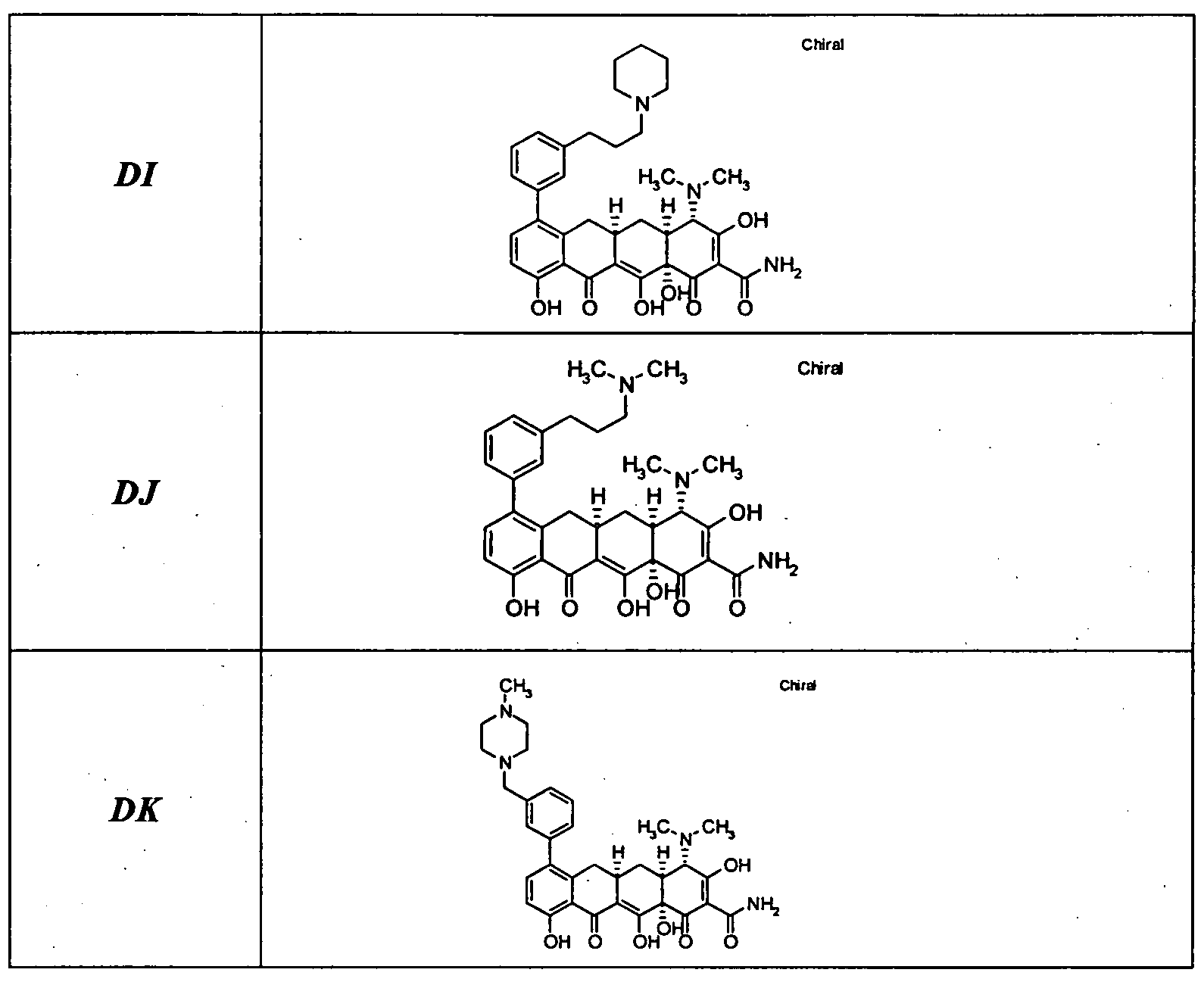
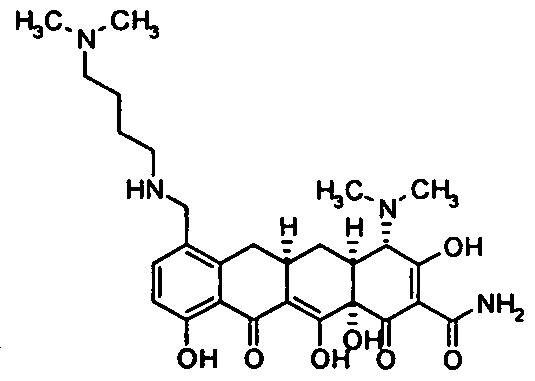
  • tetracycline compounds used in the methods of the invention include compounds of Table 2, and pharmaceutically acceptable salts, esters and enantiomers thereof.
  • tetracycline compounds described herein may be used in the methods and pharmaceutical compositions of the invention.
  • tetracycline compounds of the invention can be synthesized using the methods described in the following schemes and by using art recognized techniques.
  • Scheme 1 outlines the general synthesis of 7-substituted tetracyclines.
  • a 7-iodo sancycline derivative (1) may be reacted in a Stille coupling or a Suzuki coupling by reacting with an organotin derivative or a boronic acid derivative in the presence of a palladium catalyst to form the desired product (2).
  • Scheme 2 depicts a method for synthesizing aromatic substituted 9-substituted tetracycline compounds.
  • a 9-iodo tetracycline derivative (3) is reacted under Suzuki conditions by mixing with a boronic acid in the presence of the appropriate palladium catalyst to give compounds similar to compound 4.
  • compounds V, X, BA and CD may be synthesized as illustrated as in Scheme 2.
  • Scheme 3 depicts the synthesis of aminocarbonyl substituted aromatic 7-substituted- 4-dedimethylamino tetracycline compounds.
  • a Suzuki coupling reaction is performed with a boronic acid in the presence of a palladium catalyst to provide compound 6.
  • compounds B, Z and AE may be synthesized in this manner.
  • the 7-substituted acyl and oxime derivatives may also be prepared as shown in Scheme 4.
  • An 7-iodo sancycline derivative (1) can be reacted with a substituted alkyne in the presence of palladium to synthesize the alkynyl derivative 7.
  • Compound 7 may be converted to the acyl substituted compound 8 by any technique known in the art (e.g., by acid catalyzed hydrolysis).
  • compounds AV and CI may be prepared in this manner.
  • the desired oxime product 9 can be obtained by reacting the acyl moiety with a primary hydroxylamine.
  • compound CJ may be synthesized as shown in Scheme 4.
  • Scheme 4 depicts generally the synthesis of substituted aromatic 7-substituted tetracycline compounds. Beginning with 1 and performing a Suzuki coupling reaction in the presence of a boronic acid and a palladium catalyst, compounds of general formula 10 are formed. For example, compounds G, H, W, AQ, AR, AS, AT, AU, AW, BE, BG, BJ, BL, BM, BN, CM, BG and CO may be synthesized as shown in Scheme 5.
  • Scheme 5 also depicts the synthesis of substituted aromatic 7-substituted tetracycline compounds.
  • a Suzuki coupling reaction is performed with a boronic acid in the presence of a palladium catalyst to provide intermediate 11 in which R 7 ' or R 7 ⁇ are either an amine or a carboxylic acid. If the substituent is a carboxylic acidic moiety, a coupling to a secondary amine in the presence of base and a typical coupling reagent to form 7-substituted tetracyclines similar to 12a.
  • compounds A, C, D, E, F, I, J, L, M, N, O, P, R, S, T, U, Y, Z, AB, AC, AD, AE, CK, CL and DA may be synthesized as illustrated in this manner.
  • the substituent is an amino moiety
  • coupling of the amino moiety to an acid chloride or carboxylic acid in the presence of a base and a typical coupling reagent may be used to form 7-substituted tetracyclines similar to 12b.
  • compounds K, Q, AO, AF and BC may be synthesized in this manner.
  • Synthesis of substituted 7-acyl tetracycline compounds may be accomplished by the general procedure outlined in Scheme 7.
  • Alpha bromination of compound 13 yields the intermediate 14 which can be reacted with an appropriate nucleophile to yield compounds of the formula 15.
  • compounds AG, AJ, AM, BB, BH, BO, BP, BR, BS, BT, BU, BV, BW, BX, BY, BZ, CA, CB, CC, CE, CF and CH may be synthesized in this manner.
  • Substituted 7-carboxamide derivatives of tetracyclines may be prepared using the general synthesis outlined in Scheme 8. Carbonylation of the 7-iodotetracycline compound 1 yields the 7-carboxy tetracycline intermediate 16. Standard coupling reactions with the desired amine yields compounds of the formula 17. For example, compounds AH and AI may be synthesized in this manner.
  • Scheme 9 illustrates the synthesis of 7-heteroaryl-substituted tetracycline derivatives.
  • compounds of formula 18 may be prepared by performing a Suzuki coupling with a 2-formyl-heteroaryl boronic acid.
  • Subsequent reaction of compounds of formula 18 with an amine or alkoxyamine yields the imine or oxime 19. This is the procedure used to synthesis AZ.
  • Compound 19 may then be reduced to produce compounds of formula 20.
  • compounds AX, AY, BF, BI, BK, BQ, CY and CZ may be synthesized in this manner.
  • Scheme 10 describes the synthesis of 7-aminomethyl-substituted tetracyclines.
  • a carbonyl insertion reaction may be performed to yield the 7- formyl tetracycline 21.
  • a reductive alkylation of compound 21 with an appropriate amine yields compounds of formula 22.
  • compounds AK and CN may be synthesized in this manner.
  • Scheme 10 describes the synthesis of 7-alkenyl-substituted tetracyclines via a Heck- type coupling.
  • 7-iodotetracycline (1) is reacted with an appropriate alkene and appropriate palladium catalyst to yield the alkenyl-substituted compounds of formula 23.
  • compound AL may be synthesized in this manner.
  • Scheme 12 depicts the synthesis of 7-(3-aminomethylphenyl)-tetracycline derivatives of formula 25.
  • compound 24 (synthesized as described in Scheme 1), undergoes a reductive alkylation with an appropriate amine to yield compound 25.
  • compounds BJ, BL, BM, CS, CT, CU, CV, CW and CX may be synthesized in this manner.
  • Scheme 12 describes the synthesis of 7-aminoethyl tetracycline derivatives similar to compound 28.
  • 7-Iodotetracycline undergoes a Suzuki-type coupling with the appropriate boronic acid to yield compound 26, which is followed by an acid hydrolysis to yield aldehyde 27, which may further be modified by reductive alkylation to yield aminoethyl tetracyclines of formula 28.
  • compound BD may be synthesized in this manner.
  • alkyl includes saturated aliphatic groups, including straight-chain alkyl groups (e.g., methyl, ethyl, propyl, butyl, pentyl, hexyl, heptyl, octyl, nonyl, decyl, etc.), branched-chain alkyl groups (e.g., isopropyl, tert-butyl, isobutyl, etc.), cycloalkyl (alicyclic) groups (e.g., cyclopropyl, cyclobutyl, cyclopentyl, cyclohexyl, cycloheptyl, cyclooctyl), alkyl substituted cycloalkyl groups, and cycloalkyl substituted alkyl groups.
  • straight-chain alkyl groups e.g., methyl, ethyl, propyl, butyl, pentyl, hexyl, hepty
  • alkyl can include heteroalkyl groups that include oxygen, nitrogen, sulfur or phosphorous atoms replacing one or more carbons of the hydrocarbon backbone.
  • a straight chain or branched chain alkyl has 20 or fewer carbon atoms in its backbone (e.g., Ci- C 2 o for straight chain, C 3 -C 2O for branched chain), and more preferably 4 or fewer.
  • Cycloalkyls may have from 3-8 carbon atoms in their ring structure, and more preferably have 5 or 6 carbons in the ring structure.
  • Cj-C 6 includes alkyl groups containing 1 to 6 carbon atoms.
  • heterocyclic includes cycloalkyl moieties in which one or more carbons of the cycloalkyl scaffold is replace with a heteroatom, for example, oxygen, nitrogen, sulfur or phosphorous.
  • heterocyclic moieties include piperidine, morpholine, pyrrolidine, piperazine and tetrahydrofuran.
  • Unsubstituted alkyls refers to alkyl moieties having no substituents replacing a hydrogen on one or more carbons of the hydrocarbon backbone.
  • Substituted alkyls refers to alkyl moieties having one or more substituents replacing a hydrogen on one or more carbons of the hydrocarbon backbone.
  • substituents can include, for example, alkenyl, alkynyl, halogen, hydroxyl, alkylcarbonyloxy, arylcarbonyloxy, alkoxycarbonyloxy, aryloxycarbonyloxy, carboxylate, alkylcarbonyl, arylcarbonyl, alkoxycarbonyl, aminocarbonyl, alkylaminocarbonyl, dialkylaminocarbonyl, alkylthiocarbonyl, alkoxyl, phosphate, phosphonato, phosphinato, cyano, amino (including alkyl amino, dialkylamino, arylamino, diarylamino, and alkylarylamino), acylamino (including alkylcarbonylamino, arylcarbonylamino, carbamoyl and
  • Cycloalkyls can be substituted, e.g., with the substituents described above.
  • An "alkylaryl” or an “arylalkyl” moiety is an alkyl substituted with an aryl (e.g., phenylmethyl (benzyl)).
  • aryl includes groups, including 5- and 6-membered single-ring aromatic groups that may include from zero to four heteroatoms, for example, benzene, phenyl, pyrrole, furan, thiophene, thiazole, isothiazole, imidazole, triazole, tetrazole, pyrazole, oxazole, isooxazole, pyridine, tetrahydropyridine, quinoline, pyrazine, pyridazine, and pyrimidine, and the like.
  • aryl includes multicyclic aryl groups, e.g., tricyclic, bicyclic, e.g., naphthalene, benzoxazole, benzodioxazole, benzothiazole, benzoimidazole, benzothiophene, methylenedioxophenyl, quinoline, isoquinoline, naphthridine, indole, benzofuran, purine, benzofuran, deazapurine, or indolizine.
  • multicyclic aryl groups e.g., tricyclic, bicyclic, e.g., naphthalene, benzoxazole, benzodioxazole, benzothiazole, benzoimidazole, benzothiophene, methylenedioxophenyl, quinoline, isoquinoline, naphthridine, indole, benzofuran, purine, benzofuran, deazapurine, or indoli
  • aryl groups having heteroatoms in the ring structure may also be referred to as "aryl heterocycles," “heteroaryls” or “heteroaromatics.”
  • the aromatic ring can be substituted at one or more ring positions with such substituents as described above, as for example, halogen, hydroxyl, alkoxy, alkylcarbonyloxy, arylcarbonyloxy, alkoxycarbonyloxy, aryloxycarbonyloxy, carboxylate, alkylcarbonyl, alkylaminocarbonyl, arylalkyl aminocarbonyl, alkenylaminocarbonyl, alkylcarbonyl, arylcarbonyl, arylalkylcarbonyl, alkenylcarbonyl, alkoxycarbonyl, aminocarbonyl, alkylthiocarbonyl, phosphate, phosphonato, phosphinato, cyano, amino (including alkyl amino, dialkylamino, arylamino
  • Aryl groups can also be fused or bridged with alicyclic or heterocyclic rings which are not aromatic so as to form a polycycle (e.g., tetralin).
  • alkenyl includes unsaturated aliphatic groups analogous in length and possible substitution to the alkyls described above, but that contain at least one double bond.
  • alkenyl includes straight-chain alkenyl groups (e.g., ethylenyl, propenyl, butenyl, pentenyl, hexenyl, heptenyl, octenyl, nonenyl, decenyl, etc.), branched-chain alkenyl groups, cycloalkenyl (alicyclic) groups (cyclopropenyl, cyclopentenyl, cyclohexenyl, cycloheptenyl, cyclooctenyl), alkyl or alkenyl substituted cycloalkenyl groups, and cycloalkyl or cycloalkenyl substituted alkenyl groups.
  • alkenyl includes straight-chain alkenyl groups (e.g., ethylenyl, propenyl, butenyl, pentenyl, hexenyl, heptenyl, octenyl, nonen
  • alkenyl can include alkenyl groups which include oxygen, nitrogen, sulfur or phosphorous atoms replacing one or more carbons of the hydrocarbon backbone.
  • a straight chain or branched chain alkenyl group has 20 or fewer carbon atoms in its backbone (e.g., C 2 -C 2 O for straight chain, C 3 -C 2O for branched chain).
  • cycloalkenyl groups may have from 3-8 carbon atoms in their ring structure, and more preferably have 5 or 6 carbons in the ring structure.
  • C 2 -C 2O includes alkenyl groups containing 2 to 20 carbon atoms.
  • Unsubstituted alkenyls refers to alkenyl moieties having no substituents replacing a hydrogen on one or more carbons of the hydrocarbon backbone.
  • Substituted alkenyls refers to alkenyl moieties having one or more substituents replacing a hydrogen on one or more carbons of the hydrocarbon backbone.
  • substituents can include, for example, alkyl groups, alkynyl groups, halogens, hydroxyl, alkylcarbonyloxy, arylcarbonyloxy, alkoxycarbonyloxy, aryloxycarbonyloxy, carboxylate, alkylcarbonyl, arylcarbonyl, alkoxycarbonyl, aminocarbonyl, alkylaminocarbonyl, dialkylaminocarbonyl, alkylthiocarbonyl, alkoxyl, phosphate, phosphonato, phosphinato, cyano, amino (including alkyl amino, dialkylamino, arylamino, diarylamino, and alkylarylamino), acylamino (including alkylcarbonylamino, arylcarbonylamino, carbamo
  • alkynyl includes unsaturated aliphatic groups analogous in length and possible substitution to the alkyls described above, but which contain at least one triple bond.
  • alkynyl includes straight-chain alkynyl groups (e.g., ethynyl, propynyl, butynyl, pentynyl, hexynyl, heptynyl, octynyl, nonynyl, decynyl, etc.), branched- chain alkynyl groups, and cycloalkyl or cycloalkenyl substituted alkynyl groups.
  • alkynyl can include alkynyl groups which include oxygen, nitrogen, sulfur or phosphorous atoms replacing one or more carbons of the hydrocarbon backbone.
  • a straight chain or branched chain alkynyl group has 20 or fewer carbon atoms in its backbone (e.g., C 2 -C 2 O for straight chain, C 3 -C 2O for branched chain).
  • C 2 -C 6 includes alkynyl groups containing 2 to 6 carbon atoms.
  • "Unsubstituted alkynyls" refers to alkynyl moieties having no substituents replacing a hydrogen on one or more carbons of the hydrocarbon backbone.
  • Substituted alkynyls refers to alkynyl moieties having one or more substituents replacing a hydrogen on one or more carbons of the hydrocarbon backbone.
  • substituents can include, for example, alkyl groups, alkynyl groups, halogens, hydroxyl, alkylcarbonyloxy, arylcarbonyloxy, alkoxycarbonyloxy, aryloxycarbonyloxy, carboxylate, alkylcarbonyl, arylcarbonyl, alkoxycarbonyl, aminocarbonyl, alkylaminocarbonyl, dialkylaminocarbonyl, alkylthiocarbonyl, alkoxyl, phosphate, phosphonato, phosphinato, cyano, amino (including alkyl amino, dialkylamino, arylamino, diarylamino, and alkylarylamino), acylamino (including, e.g., alkylcarbonylamino, aryl
  • lower alkyl as used herein means an alkyl group, as defined above, but having from one to five carbon atoms in its backbone structure.
  • Lower alkenyl and “lower alkynyl” have chain lengths of, for example, two to five carbon atoms.
  • acyl includes compounds and moieties which contain the acyl radical
  • substituted acyl includes acyl groups where one or more of the hydrogen atoms are replaced by for example, alkyl groups, alkenyl, alkynyl groups, halogens, hydroxyl, alkylcarbonyloxy, arylcarbonyloxy, alkoxycarbonyloxy, aryloxycarbonyloxy, carboxylate, alkylcarbonyl, arylcarbonyl, alkoxycarbonyl, aminocarbonyl, alkylaminocarbonyl, dialkylaminocarbonyl, alkylthiocarbonyl, alkoxyl, phosphate, phosphonato, phosphinato, cyano, amino (including alkyl amino, dialkylamino, arylamino, diarylamino, and alkylarylamino), acylamino (including alkylcarbonylamino, arylcarbonylamino, carbamoyl and ureido), amidino
  • the term includes alkylcarbonylamino, arylcarbonylamino, carbamoyl and ureido groups.
  • alkoxy includes substituted and unsubstituted alkyl, alkenyl, and alkynyl groups covalently linked to an oxygen atom. Examples of alkoxy groups include methoxy, ethoxy, isopropyloxy, propoxy, butoxy, and pentoxy groups. Examples of substituted alkoxy groups include halogenated alkoxy groups.
  • the alkoxy groups can be substituted with groups such as alkenyl, alkynyl, halogen, hydroxyl, alkylcarbonyloxy, arylcarbonyloxy, alkoxycarbonyloxy, aryloxycarbonyloxy, carboxylate, alkylcarbonyl, arylcarbonyl, alkoxycarbonyl, aminocarbonyl, alkylaminocarbonyl, dialkylaminocarbonyl, alkylthiocarbonyl, alkoxyl, phosphate, phosphonato, phosphinato, cyano, amino (including alkyl amino, dialkylamino, arylamino, diarylamino, and alkylarylamino), acylamino (including alkylcarbonylamino, arylcarbonylamino, carbamoyl and ureido), amidino, imino, sulfhydryl, alkylthio, arylthio, thiocarboxylate
  • alkoxyalkyl includes alkyl groups, as described above, which further include oxygen, nitrogen or sulfur atoms replacing one or more carbons of the hydrocarbon backbone, e.g., oxygen, nitrogen or sulfur atoms.
  • amide or “aminocarbonyl” includes compounds or moieties which contain a nitrogen atom which is bound to the carbon of a carbonyl or a thiocarbonyl group.
  • arylaminocarbonyl groups which include aryl or heteroaryl moieties bound to an amino group which is bound to the carbon of a carbonyl or thiocarbonyl group.
  • alkylaminocarboxy “alkenylaminocarboxy,” “alkynylaminocarboxy,” and in which alkyl, alkenyl and alkynyl moieties, respectively, are bound to a nitrogen atom which is in turn bound to the carbon of a carbonyl group.
  • amine or "amino” includes compounds where a nitrogen atom is covalently bonded to at least one carbon or heteroatom.
  • the term includes “alkylamino” moieties, wherein the nitrogen is bound to at least one additional alkyl group.
  • the term also includes “dialkylamino” groups wherein the nitrogen atom is bound to at least two additional alkyl groups.
  • arylamino and “diarylamino” include groups wherein the nitrogen is bound to at least one or two aryl groups, respectively.
  • alkylarylamino alkylaminoaryl or “arylaminoalkyl” refers to an amino group which is bound to at least one alkyl group and at least one aryl group.
  • alkaminoalkyl refers to an alkyl, alkenyl, or alkynyl group bound to a nitrogen atom which is also bound to an alkyl group.
  • aroyl includes compounds and moieties with an aryl or heteroaromatic moiety bound to a carbonyl group. Examples of aroyl groups include phenylcarboxy, naphthyl carboxy, etc.
  • carbonyl or “carboxy” includes compounds and moieties which contain a carbon connected with a double bond to an oxygen atom and the carbon atom is bonded to two additional moieties. Examples of moieties which contain a carbonyl include aldehydes, ketones, carboxylic acids, amides, esters, anhydrides, etc.
  • Suitable moieties bonded to the carbon of a carbonyl group include, for example, hydrogen, alkyl groups, alkenyl, alkynyl groups, halogens, hydroxyl, alkylcarb onyloxy, arylcarbonyloxy, alkoxycarbonyloxy, aryloxycarbonyloxy, carboxylate, alkylcarbonyl, arylcarbonyl, alkoxycarbonyl, aminocarbonyl, alkylaminocarbonyl, dialkylaminocarbonyl, alkylthiocarbonyl, alkoxyl, phosphate, phosphonato, phosphinato, cyano, amino (including alkyl amino, dialkylamino, arylamino, diarylamino, and alkylarylamino), acylamino (including alkylcarbonylamino, arylcarbonylamino, carbamoyl and ureido), amidino, imino, sulfhydryl
  • carbonyloxy includes moieties in which the carbon of a carbonyl group is covalently bound to an oxygen.
  • esteer includes compounds and moieties which contain a carbon or a heteroatom bound to an oxygen atom which is bonded to the carbon of a carbonyl group.
  • esteer includes alkoxycarboxy groups such as methoxycarbonyl, ethoxycarbonyl, propoxycarbonyl, butoxycarbonyl, pentoxycarbonyl, etc.
  • the alkyl, alkenyl, or alkynyl groups are as defined above.
  • ether includes compounds or moieties which contain an oxygen bonded to two different carbon atoms or heteroatoms.
  • alkoxyalkyl which refers to an alkyl, alkenyl, or alkynyl group covalently bonded to an oxygen atom which is covalently bonded to another alkyl group.
  • halogen includes fluorine, bromine, chlorine, iodine, etc.
  • perhalogenated generally refers to a moiety wherein all hydrogens are replaced by halogen atoms.
  • heteroatom includes atoms of any element other than carbon or hydrogen. Preferred heteroatoms are nitrogen, oxygen, sulfur and phosphorus.
  • hydroxy or "hydroxyl” includes groups with an -OH or -O " X + , where X + is a counterion.
  • polycyclyl or “polycyclic radical” refer to two or more cyclic rings ⁇ e.g., cycloalkyls, cycloalkenyls, cycloalkynyls, aryls and/or heterocyclyls) in which two or more carbons are common to two adjoining rings, e.g., the rings are "fused rings.” Rings that are joined through non-adjacent atoms are termed "bridged" rings.
  • Each of the rings of the polycycle can be substituted with such substituents as described above, as for example, halogen, hydroxyl, alkylcarbonyloxy, arylcarbonyloxy, alkoxycarbonyloxy, aryloxycarbonyloxy, carboxylate, alkylcarbonyl, alkoxycarbonyl, alkylaminoacarbonyl, arylalkylaminocarbonyl, alkenylaminocarbonyl, alkylcarbonyl, arylcarbonyl, arylalkyl carbonyl, alkenylcarbonyl, aminocarbonyl, alkylthiocarbonyl, alkoxyl, phosphate, phosphonato, phosphinato, cyano, amino (including alkyl amino, dialkylamino, arylamino, diarylamino, and alkylarylamino), acylamino (including alkylcarbonylamino, arylcarbonylamino, carbamoyl and
  • thiocarbonyl or “thiocarboxy” includes compounds and moieties which contain a carbon connected with a double bond to a sulfur atom.
  • thioether includes compounds and moieties which contain a sulfur atom bonded to two different carbon or hetero atoms. Examples of thioethers include, but are not limited to alkthioalkyls, alkthioalkenyls, and alkthioalkynyls.
  • alkthioalkyls include compounds with an alkyl, alkenyl, or alkynyl group bonded to a sulfur atom which is bonded to an alkyl group.
  • alkthioalkenyls and alkthioalkynyls refer to compounds or moieties wherein an alkyl, alkenyl, or alkynyl group is bonded to a sulfur atom which is covalently bonded to an alkynyl group.
  • sulfonyl includes moieties which comprise a sulfonyl group.
  • sulfinyl includes moieties which comprise a sulfinyl group.
  • oximyl includes moieties which comprise an oxime group.
  • dimeric moiety includes moieties which comprise a second tetracycline four ring structure.
  • the dimeric moiety may be attached to the substituted tetracycline through a chain of from 1-30 atoms.
  • the chain may be comprised of atoms covalently linked together through single, double and triple bonds.
  • the tetracycline ring structure of the dimeric moiety may further be substituted or unsubstituted. It may be attached at the 1, 2, 3, 4, 5, 6, 7, 8, 9, 10, 11, 11a, 12, 12a, and/or 13 position.
  • prodrug moiety includes moieties which can be metabolized in vivo.
  • the prodrugs moieties are metabolized in vivo by esterases or by other mechanisms to hydroxyl groups or other advantageous groups.
  • Examples of prodrugs and their uses are well known in the art (See, e.g., Berge et al. (1977) "Pharmaceutical Salts", J. Pharm. Sci. 66:1-19).
  • the prodrugs can be prepared in situ during the final isolation and purification of the compounds, or by separately reacting the purified compound in its free acid form or hydroxyl with a suitable esterifying agent. Hydroxyl groups can be converted into esters via treatment with a carboxylic acid.
  • prodrug moieties include substituted and unsubstituted, branch or unbranched lower alkyl ester moieties, (e.g., propionoic acid esters), lower alkenyl esters, di-lower alkyl-amino lower-alkyl esters (e.g., dimethylaminoethyl ester), acylamino lower alkyl esters (e.g., acetyloxymethyl ester), acyloxy lower alkyl esters (e.g., pivaloyloxymethyl ester), aryl esters (phenyl ester), aryl-lower alkyl esters (e.g., benzyl ester), substituted (e.g., with methyl, halo, or methoxy substituents) aryl and aryl-lower alkyl esters, amides, lower-alkyl amides, di-lower alkyl amides, and hydroxy amides.
  • the structures of some of the substituted tetracycline compounds used in the methods and compositions of the invention include asymmetric carbon atoms.
  • the isomers arising from the chiral atoms e.g., all enantiomers and diastereomers
  • Such isomers can be obtained in substantially pure form by classical separation techniques and by stereochemically controlled synthesis.
  • the structures and other compounds and moieties discussed in this application also include all tautomers thereof.
  • the invention pertains to methods for treating a microorganism-associated infection in a subject, by administering to a subject an effective amount of a tetracycline compound of the invention (e.g., a compound of Formula I, II, III, IV, V, VI, VII, VIII, IX or X or a compound listed in Table 2), such that the microorganism-associated infection is treated.
  • a tetracycline compound of the invention e.g., a compound of Formula I, II, III, IV, V, VI, VII, VIII, IX or X or a compound listed in Table 2
  • treating includes ameliorating at least one symptom of the state, disease or disorder, e.g., the microorganism-associated infection. In one embodiment, the term “treating” includes curing at least one symptom of the state, disease or disorder, e.g., the microorganism-associated infection.
  • the term "preventing” or “prevent” describes reducing or eliminating the onset of the symptoms or complications of the microorganism-associated infection.
  • the tetracycline compounds of the present invention can be used to treat a microorganism-associated infection, including bacterial, viral, parasitic, or a fungal infection (including those which are resistant to other tetracycline compounds).
  • Compounds of the invention can be used to prevent or treat important mammalian and veterinary diseases such as diarrhea caused by a microorganism-associated infection, urinary tract infections, infections of skin and skin structure, ear, nose and throat infections, wound infection, mastitis and the like.
  • the compounds described herein may be used in combination with another therapeutic agent or treatment to treat or prevent a microorganism-associated infection.
  • the language "in combination with" another therapeutic agent or treatment includes co-administration of the tetracycline compound, (e.g., inhibitor) and with the other therapeutic agent or treatment, administration of the tetracycline compound first, followed by the other therapeutic agent or treatment and administration of the other therapeutic agent or treatment first, followed by the tetracycline compound.
  • the other therapeutic agent may be any agent that is known in the art to treat, prevent, or reduce the symptoms of a particular infection.
  • the other therapeutic agent may be any agent of benefit to the patient when administered in combination with the administration of a tetracycline compound.
  • Bacterial infections may be caused by a wide variety of gram positive and gram negative bacteria.
  • Some of the compounds of the invention are useful as antibiotics against organisms which are resistant and/or sensitive to other tetracycline compounds.
  • the antibiotic activity of the tetracycline compounds of the invention may by using the in vitro standard broth dilution method described in Waitz, J.A., CLSI, Document M7-A2, vol. 10, no. 8, pp. 13-20, 2 nd edition, Villanova, PA (1990).
  • the tetracycline compounds may also be used to treat infections traditionally treated with tetracycline compounds such as, for example, a microorganism-associated infection, caused by, e.g., rickettsiae; a number of gram-positive and gram-negative bacteria; or the agents responsible for lymphogranuloma venereum, inclusion conjunctivitis, or psittacosis.
  • infections traditionally treated with tetracycline compounds such as, for example, a microorganism-associated infection, caused by, e.g., rickettsiae; a number of gram-positive and gram-negative bacteria; or the agents responsible for lymphogranuloma venereum, inclusion conjunctivitis, or psittacosis.
  • the tetracycline compounds may be used to treat infections of, e.g., K. pneumoniae,
  • the tetracycline compound is used to treat a microorganism-associated infection that is resistant to other tetracycline antibiotic compounds.
  • the tetracycline compound of the invention may be administered with a pharmaceutically acceptable carrier.
  • the language "effective amount" of the compound is that amount necessary or sufficient to treat a microorganism-associated infection ⁇ e.g., bacterial infection, viral infection, parasitic infection or fungal infection).
  • an "effective amount" of the compound is that amount necessary or sufficient to prevent onset of a microorganism-associated infection ⁇ e.g., bacterial infection, viral infection, parasitic infection or fungal infection).
  • the effective amount can vary depending on such factors as the size and weight of the subject, the type of illness, or the particular tetracycline compound. For example, the choice of the tetracycline compound can affect what constitutes an "effective amount.”
  • One of ordinary skill in the art would be able to study the aforementioned factors and make the determination regarding the effective amount of the tetracycline compound without undue experimentation.
  • the invention pertains to methods of treatment against microorganism infections and associated diseases.
  • the methods include administration of an effective amount of one or more tetracycline compounds to a subject.
  • the subject can be either a plant or, advantageously, an animal, e.g., a mammal, e.g., a human.
  • one or more tetracycline compounds of the invention may be administered alone to a subject, or more typically a compound of the invention will be administered as part of a pharmaceutical composition in mixture with conventional excipient, i.e., pharmaceutically acceptable organic or inorganic carrier substances suitable for parenteral, oral or other desired administration and which do not deleteriously react with the active compounds and are not deleterious to the recipient thereof.
  • conventional excipient i.e., pharmaceutically acceptable organic or inorganic carrier substances suitable for parenteral, oral or other desired administration and which do not deleteriously react with the active compounds and are not deleterious to the recipient thereof.
  • compositions of the Invention also pertains to pharmaceutical compositions comprising a therapeutically effective amount of a tetracycline compound ⁇ e.g., a compound of Formula I, II, III, IV, V, VI, VII, VI ⁇ , IX or X or a compound listed in Table 2) and, optionally, a pharmaceutically acceptable carrier.
  • a tetracycline compound ⁇ e.g., a compound of Formula I, II, III, IV, V, VI, VII, VI ⁇ , IX or X or a compound listed in Table 2
  • a pharmaceutically acceptable carrier e.g., a compound of Formula I, II, III, IV, V, VI, VII, VI ⁇ , IX or X or a compound listed in Table 2
  • pharmaceutically acceptable carrier includes substances capable of being coadministered with the tetracycline compound(s), and which allow both to perform their intended function, e.g., treat a microorganism-associated infection (e.g., bacterial infection, viral infection, parasitic infection or fungal infection).
  • a microorganism-associated infection e.g., bacterial infection, viral infection, parasitic infection or fungal infection.
  • a "pharmaceutically acceptable carrier” includes substances capable of being coadministered with the tetracycline compound(s), and which allow both to perform their intended function, e.g., prevent a microorganism-associated infection (e.g., bacterial infection, viral infection, parasitic infection or fungal infection).
  • a microorganism-associated infection e.g., bacterial infection, viral infection, parasitic infection or fungal infection.
  • Suitable pharmaceutically acceptable carriers include but are not limited to water, salt solutions, alcohol, vegetable oils, polyethylene glycols, gelatin, lactose, amylose, magnesium stearate, talc, silicic acid, viscous paraffin, perfume oil, fatty acid monoglycerides and diglycerides, petroethral fatty acid esters, hydroxymethyl-cellulose, polyvinylpyrrolidone, etc.
  • the pharmaceutical preparations can be sterilized and if desired mixed with auxiliary agents, e.g., lubricants, preservatives, stabilizers, wetting agents, emulsifiers, salts for influencing osmotic pressure, buffers, colorings, flavorings and/or aromatic substances and the like which do not deleteriously react with the active compounds of the invention.
  • auxiliary agents e.g., lubricants, preservatives, stabilizers, wetting agents, emulsifiers, salts for influencing osmotic pressure, buffers, colorings, flavorings and/or aromatic substances and the like which do not deleteriously react with the active compounds of the invention.
  • the tetracycline compounds of the invention that are basic in nature are capable of forming a wide variety of salts with various inorganic and organic acids.
  • the acids that may be used to prepare pharmaceutically acceptable acid addition salts of the tetracycline compounds of the invention that are basic in nature are those that form non-toxic acid addition salts, i.e., salts containing pharmaceutically acceptable anions, such as the hydrochloride, hydrobromide, hydroiodide, nitrate, sulfate, bisulfate, phosphate, acid phosphate, isonicotinate, acetate, lactate, salicylate, citrate, acid citrate, tartrate, pantothenate, bitartrate, ascorbate, succinate, maleate, gentisinate, fumarate, gluconate, glucaronate, saccharate, formate, benzoate, glutamate, methanesulfonate, ethanesulfonate, benzenesulfonate
  • salts must be pharmaceutically acceptable for administration to a subject, e.g., a mammal
  • the acid addition salts of the base compounds of this invention are readily prepared by treating the base compound with a substantially equivalent amount of the chosen mineral or organic acid in an aqueous solvent medium or in a suitable organic solvent, such as methanol or ethanol. Upon careful evaporation of the solvent, the desired solid salt is readily obtained.
  • the tetracycline compounds of the invention that are acidic in nature are capable of forming a wide variety of base salts.
  • the chemical bases that may be used as reagents to prepare pharmaceutically acceptable base salts of those tetracycline compounds of the invention that are acidic in nature are those that form non-toxic base salts with such compounds.
  • Such non-toxic base salts include, but are not limited to those derived from such pharmaceutically acceptable cations such as alkali metal cations (e.g., potassium and sodium) and alkaline earth metal cations (e.g., calcium and magnesium), ammonium or water-soluble amine addition salts such as N-methylglucamine-(meglumine), and the lower alkanolammonium and other base salts of pharmaceutically acceptable organic amines.
  • the pharmaceutically acceptable base addition salts of tetracycline compounds of the invention that are acidic in nature may be formed with pharmaceutically acceptable cations by conventional methods.
  • these salts may be readily prepared by treating the tetracycline compound of the invention with an aqueous solution of the desired pharmaceutically acceptable cation and evaporating the resulting solution to dryness, preferably under reduced pressure.
  • a lower alkyl alcohol solution of the tetracycline compound of the invention may be mixed with an alkoxide of the desired metal and the solution subsequently evaporated to dryness.
  • the tetracycline compounds of the invention and pharmaceutically acceptable salts thereof can be administered via either the oral, parenteral or topical routes.
  • these compounds are most desirably administered in effective dosages, depending upon the weight and condition of the subject being treated and the particular route of administration chosen. Variations may occur depending upon the species of the subject being treated and its individual response to said medicament, as well as on the type of pharmaceutical formulation chosen and the time period and interval at which such administration is carried out.
  • the pharmaceutical compositions of the invention may be administered alone or in combination with other known compositions for treating microorganism-associated infections in a subject, e.g., a mammal.
  • Preferred mammals include pets (e.g., cats, dogs, ferrets, etc.), farm animals (cows, sheep, pigs, horses, goats, etc.), lab animals (rats, mice, monkeys, etc.), and primates (chimpanzees, humans, gorillas).
  • the language "in combination with" a known composition is intended to include simultaneous administration of the composition of the invention and the known composition, administration of the composition of the invention first, followed by the known composition and administration of the known composition first, followed by the composition of the invention.
  • the tetracycline compounds of the invention may be administered alone or in combination with pharmaceutically acceptable carriers or diluents by any of the routes previously mentioned, and the administration may be carried out in single or multiple doses.
  • the novel therapeutic agents of this invention can be administered advantageously in a wide variety of different dosage forms, i.e., they may be combined with various pharmaceutically acceptable inert carriers in the form of tablets, capsules, lozenges, troches, hard candies, powders, sprays ⁇ e.g., aerosols, etc.), creams, salves, suppositories, jellies, gels, pastes, lotions, ointments, aqueous suspensions, injectable solutions, elixirs, syrups, and the like.
  • Such carriers include solid diluents or fillers, sterile aqueous media and various non-toxic organic solvents, etc.
  • oral pharmaceutical compositions can be suitably sweetened and/or flavored.
  • the therapeutically-effective compounds of this invention are present in such dosage forms at concentration levels ranging from about 5.0% to about 70% by weight.
  • tablets containing various excipients such as microcrystalline cellulose, sodium citrate, calcium carbonate, dicalcium phosphate and glycine may be employed along with various disintegrants such as starch (and preferably corn, potato or tapioca starch), alginic acid and certain complex silicates, together with granulation binders like polyvinylpyrrolidone, sucrose, gelatin and acacia.
  • disintegrants such as starch (and preferably corn, potato or tapioca starch), alginic acid and certain complex silicates, together with granulation binders like polyvinylpyrrolidone, sucrose, gelatin and acacia.
  • lubricating agents such as magnesium stearate, sodium lauryl sulfate and talc are often very useful for tabletting purposes.
  • compositions of a similar type may also be employed as fillers in gelatin capsules; preferred materials in this connection also include lactose or milk sugar as well as high molecular weight polyethylene glycols.
  • the active ingredient may be combined with various sweetening or flavoring agents, coloring matter or dyes, and, if so desired, emulsifying and/or suspending agents as well, together with such diluents as water, ethanol, propylene glycol, glycerin and various like combinations thereof.
  • the compositions of the invention may be formulated such that the tetracycline compositions are released over a period of time after administration.
  • solutions of a therapeutic compound of the present invention in either sesame or peanut oil or in aqueous propylene glycol may be employed.
  • the aqueous solutions should be suitably buffered (preferably pH greater than 8) if necessary and the liquid diluent first rendered isotonic.
  • These aqueous solutions are suitable for intravenous injection purposes.
  • the oily solutions are suitable for intraarticular, intramuscular and subcutaneous injection purposes. The preparation of all these solutions under sterile conditions is readily accomplished by standard pharmaceutical techniques well known to those skilled in the art.
  • suitable preparations include solutions, preferably oily or aqueous solutions as well as suspensions, emulsions, or implants, including suppositories.
  • Therapeutic compounds may be formulated in sterile form in multiple or single dose formats such as being dispersed in a fluid carrier such as sterile physiological saline or 5% saline dextrose solutions commonly used with injectables.
  • topical administration examples include transdermal, buccal or sublingual application.
  • therapeutic compounds can be suitably admixed in a pharmacologically inert topical carrier such as a gel, an ointment, a lotion or a cream.
  • topical carriers include water, glycerol, alcohol, propylene glycol, fatty alcohols, triglycerides, fatty acid esters, or mineral oils.
  • topical carriers are liquid petrolatum, isopropylpalmitate, polyethylene glycol, ethanol 95%, polyoxyethylene monolauriate 5% in water, sodium lauryl sulfate 5% in water, and the like.
  • materials such as anti-oxidants, humectants, viscosity stabilizers and the like also may be added if desired.
  • tablets, dragees or capsules having talc and/or carbohydrate carrier binder or the like are particularly suitable, the carrier preferably being lactose and/or corn starch and/or potato starch.
  • a syrup, elixir or the like can be used wherein a sweetened vehicle is employed.
  • Sustained release compositions can be formulated including those wherein the active component is protected with differentially degradable coatings, e.g. , by microencapsulation, multiple coatings, etc.
  • the therapeutic methods of the invention also will have significant veterinary applications, e.g., for treatment of livestock such as cattle, sheep, goats, cows, swine and the like; poultry such as chickens, ducks, geese, turkeys and the like; horses; and pets such as dogs and cats.
  • livestock such as cattle, sheep, goats, cows, swine and the like
  • poultry such as chickens, ducks, geese, turkeys and the like
  • horses such as dogs and cats.
  • the compounds of the invention may be used to treat non-animal subjects, such as plants.
  • compounds of the invention for treatment can be administered to a subject in dosages used in prior tetracycline therapies. See, for example, the Physicians' Desk Reference.
  • a suitable effective dose of one or more compounds of the invention will be in the range of from 0.01 to 100 milligrams per kilogram of body weight of recipient per day, preferably in the range of from 0.1 to 50 milligrams per kilogram body weight of recipient per day, more preferably in the range of 1 to 20 milligrams per kilogram body weight of recipient per day.
  • the desired dose is suitably administered once daily, or several sub-doses, e.g., 2 to 5 sub-doses, are administered at appropriate intervals through the day, or other appropriate schedule.
  • the invention also pertains to the use of a tetracycline compound of Formula I, II, III, IV, V, VI, VII, VIII, IX or X or a compound listed in Table 2, or any other compound described herein, for the preparation of a medicament.
  • the medicament may include a pharmaceutically acceptable carrier and the tetracycline compound is an effective amount, e.g., an effective amount to treat a microorganism-associated infection.
  • MIC was defined as the lowest concentration of the tetracycline compound that inhibits growth. Table 3 includes MIC data for several substituted tetracycline compounds.
  • COS-I and CHO-Kl cell suspensions were prepared, seeded into 96-well tissue culture treated black-walled microtiter plates (density determined by cell line), and incubated overnight at 37 0 C, in 5% CO 2 and approximately 95% humidity. The following day, serial dilutions of compound were prepared under sterile conditions and transferred to cell plates. Cell/Compound plates were incubated under the above conditions for 24 hours. Following the incubation period, media/compound was aspirated and 50 ⁇ l of resazurin (0.042 mg/ml in PBS w/Ca and Mg) is added. The plates were then incubated under the above conditions for 2 hours and then placed in the dark at room temperature for an additional 30 minutes. Fluorescence measurements were taken (excitation 535 nm, emission 590 nm). The IC 50 (concentration of compound causing 50% growth inhibition) was then calculated. Table 3 includes IC50 data for several substituted tetracycline compounds.
  • 3T3 fibroblast cells were harvested and plated at a concentration of 1 x 10 5 cells/mL and the plates were incubated overnight at 37 0 C, in 5% CO 2 and approximately 95% humidity. On the following day the medium was removed from the plates and replaced with Hanks' Balanced Salt Solution (HBSS). Compound dilutions were made in HBSS and added to the plates. For each compound tested, a duplicate plate was prepared that was not exposed to light as a control for compound toxicity. Plates were then incubated in a dark drawer (for controls), or under UV light (meter reading of 1.6-1.8 mW/cm 2 ) for 50 minutes. Cells were then washed with HBSS, fresh medium was added, and plates were incubated overnight as described above.
  • HBSS Hanks' Balanced Salt Solution
  • the reaction solution was precipitated in 400 mL diethyl ether and a bright yellow solid formed.
  • the ether was decanted and 400 mL fresh ether added, and decanted once again.
  • An amount of acetonitrile (300 mL) was added to the yellow precipitate and the mixture was filtered through filter paper.
  • the filtrate was dried in vacuo to yield a dark yellow solid (1 g).
  • the crude bromo-acetyl sancycline was dissolved in DMF (20 mL) in a 100 mL round bottom flask.
  • the argon line was attached to reaction and TEA (1 mL, 7.19 mmol) was added, followed by 4-methylpiperidine (1 mL, 8.1mmol).
  • the aqueous solution was purified on a fluorinated DVB (divinylbenzene) column with gradients of a 50/50 methanol/acetonitrile, 0.1% TFA solution into a 0.1% TFA water solution. The fractions were collected and evaporated to a minimum volume. The residue was then purified by preparative HPLC chromatography (C 18, linear gradient 27-32% acetonitrile in water with 0.2% formic acid). The fractions were evaporated and the resulting residue was purified again by preparative HPLC chromatography (Cl 8, linear gradient 20-35% acetonitrile in 20 mM aqueous triethanolamine, pH 7.4) in order to separate the 4-epimers.
  • TFA salt of 7-formyl-sancycline 50 mg, 0.09 mmol was dissolved in dry tetrahydroturan (THF, 2 mL) at room temperature in a flask equipped with a magnetic stirring bar. Enough di-isopropylethylamine (DIEA) was added to adjust the pH to about 7. N,N-Dimethyl-4-amino-butylamine (22 mg, 0.18 mmol, 2.0 eq) was added and the reaction mixture was stirred at room temperature for 15 minutes. Sodium triacetoxyborohydride (59 mg, 0.27 mmol, 3.0 eq) was added at room temperature and the reaction is monitored by LC/MS.
  • DIEA di-isopropylethylamine
  • the sodium acetate solution was added to the microwave reaction vessel, which was sealed with a crimper.
  • the reaction mixture was then subjected to microwave irradiation for 10 minutes at 110 0 C, and the reaction was monitored by LC/MS.
  • the reaction mixture was filtered through a pad of celite and washed with methanol. After evaporation of organic solvents, the aqueous solution was purified on a fluorinated DVB (divinylbenzene) column with gradients of a 50/50 methanol/acetonitrile, 0.1% TFA solution into a 0.1 % TFA water solution. The fractions were collected and evaporated to dryness to yield an orange solid, which was used in the next step without further purification.
  • the sodium acetate solution was added to the microwave reaction vessel, which was sealed with a crimper.
  • the reaction mixture was then subjected to microwave irradiation for 10 minutes at 110 0 C, and the reaction was monitored by LC/MS.
  • the reaction mixture was filtered through a pad of celite and washed with methanol. After evaporation of organic solvents, the aqueous solution was purified on a fluorinated DVB (DiVinylBenzene) column with gradients of a 50/50 methanol/acetonitrile, 0.1% TFA solution into a 0.1% TFA water solution. The fractions were collected and evaporated to a minimum volume.
  • DVB DiVinylBenzene
  • the aqueous solution was purified on a fiuorinated DVB (DiVinylBenzene) column with gradients of a 50/50 methanol/acetonitrile, 0.1% TFA solution into a 0.1% TFA water solution. The fractions were collected and evaporated to a minimum volume. The residue was then purified by preparative HPLC chromatography (C 18, linear gradient 20-35% acetonitrile in water with 0.2% formic acid).
  • the sodium acetate solution was added to the microwave reaction vessel, which was sealed with a crimper.
  • the reaction mixture was then subjected to microwave irradiation for 20 minutes at 120 0 C, and the reaction was monitored by LC/MS.
  • the reaction mixture was then filtered through a pad of celite and washed with methanol. After evaporation of organic solvents, the aqueous solution was purified on a fluorinated DVB (DiVinylBenzene) column with gradients of a 50/50 methanol/acetonitrile, 0.1% TFA solution into a 0.1% TFA water solution. The fractions were collected and evaporated to dryness to yield a brown solid which is used in the next step without further purification.
  • DVB DiVinylBenzene

Landscapes

  • Health & Medical Sciences (AREA)
  • General Health & Medical Sciences (AREA)
  • Life Sciences & Earth Sciences (AREA)
  • Chemical & Material Sciences (AREA)
  • Veterinary Medicine (AREA)
  • Pharmacology & Pharmacy (AREA)
  • Medicinal Chemistry (AREA)
  • Animal Behavior & Ethology (AREA)
  • Public Health (AREA)
  • Nuclear Medicine, Radiotherapy & Molecular Imaging (AREA)
  • Organic Chemistry (AREA)
  • Chemical Kinetics & Catalysis (AREA)
  • General Chemical & Material Sciences (AREA)
  • Bioinformatics & Cheminformatics (AREA)
  • Engineering & Computer Science (AREA)
  • Oncology (AREA)
  • Communicable Diseases (AREA)
  • Epidemiology (AREA)
  • Diabetes (AREA)
  • Hematology (AREA)
  • Pulmonology (AREA)
  • Pharmaceuticals Containing Other Organic And Inorganic Compounds (AREA)
  • Organic Low-Molecular-Weight Compounds And Preparation Thereof (AREA)
  • Hydrogenated Pyridines (AREA)

Abstract

The present invention pertains, at least in part, to methods of treating a microorganism-associated infection in a subject comprising administering to said subject an effective amount of a tetracycline compound.

Description

SUBSTITUTED TETRACYCLINE COMPOUNDS
Related Applications
This application claims priority to U.S. Provisional Patent Application No. 61/044,773 filed on April 14, 2008. The contents of the aforementioned application are hereby incorporated by reference in their entirety.
Background
The development of the tetracycline antibiotics was the direct result of a systematic screening of soil specimens collected from many parts of the world for evidence of microorganisms capable of producing bactericidal and/or bacteriostatic compositions. The first of these novel compounds was introduced in 1948 under the name chlortetracycline. Two years later, oxytetracycline became available. The elucidation of the chemical structure of these compounds confirmed their similarity and furnished the analytical basis for the production of a third member of this group in 1952, tetracycline. A new family of tetracycline compounds, without the ring-attached methyl group present in earlier tetracyclines, was prepared in 1957 and became publicly available in 1967; and minocycline was in use by 1972.
Recently, research efforts have focused on developing new tetracycline antibiotic compositions effective under varying therapeutic conditions and routes of administration. New tetracycline analogues have also been investigated which may prove to be equal to or more effective than the originally introduced tetracycline compounds. Examples include U.S. Patent Nos. 2,980,584; 2,990,331; 3,062,717; 3,165,531; 3,454,697; 3,557,280; 3,674,859; 3,957,980; 4,018,889; 4,024,272; and 4,126,680. These patents are representative of the range of pharmaceutically active tetracycline and tetracycline analogue compositions.
Historically, soon after their initial development and introduction, the tetracyclines were found to be highly effective pharmacologically against rickettsiae; a number of gram- positive and gram-negative bacteria; and the agents responsible for lymphogranuloma venereum, inclusion conjunctivitis, and psittacosis. Hence, tetracyclines became known as "broad spectrum" antibiotics. With the subsequent establishment of their in vitro antimicrobial activity, effectiveness in experimental infections, and pharmacological properties, the tetracyclines as a class rapidly became widely used for therapeutic purposes. However, this widespread use of tetracyclines for both major and minor illnesses and diseases led directly to the emergence of resistance to these antibiotics even among highly susceptible bacterial species both commensal and pathogenic (e.g., pneumococci and Salmonella). The rise of tetracycline-resistant organisms has resulted in a general decline in use of tetracyclines as antibiotics of choice. Summary of the Invention
In one embodiment, the invention pertains, at least in part, to methods of treating a microorganism-associated infection in a subject comprising administering to said subject an effective amount of a tetracycline compound of Formula I:
Figure imgf000003_0001
wherein
X is CHC(R13Y5Y), CR6 R6, C=CR6 R6, S, NR6, or O;
R2, R2 , R4 , and R4 are each independently hydrogen, alkyl, alkenyl, alkynyl, acyl, hydroxyl, alkoxy, halogen, thioether, sulfinyl, sulfonyl, amino, cyano, nitro, carbonyl, aryl, heterocyclic or a prodrug moiety;
R3, R4a, R11 and R12 are each independently hydrogen, alkyl, alkenyl, alkynyl, acyl, hydroxyl, alkoxy, halogen, thioether, sulfinyl, sulfonyl, amino, cyano, nitro, carbonyl, aryl, heterocyclic or a prodrug moiety;
R4 is NR4 R4 , hydrogen, alkyl, alkenyl, alkynyl, acyl, hydroxyl, alkoxy, halogen, thioether, sulfinyl, sulfonyl, amino, cyano, nitro, carbonyl, aryl, heterocyclic or a prodrug moiety;
R5 and R5 are each hydrogen, alkyl, alkenyl, alkynyl, acyl, hydroxyl, alkoxy, halogen, thioether, sulfinyl, sulfonyl, amino, cyano, nitro, carbonyl, aryl, heterocyclic or a prodrug moiety; R6 and R6 are each independently hydrogen, alkyl, alkenyl, alkynyl, acyl, hydroxyl, alkoxy, halogen, thioether, sulfinyl, sulfonyl, amino, cyano, nitro, carbonyl, aryl or heterocyclic;
R7 is hydrogen, alkyl, alkenyl, alkynyl, acyl, hydroxyl, alkoxy, halogen, thioether, sulfinyl, sulfonyl, amino, cyano, nitro, carbonyl, oximyl, aryl, heterocyclic or -(CH2)o-3 (NR7c)o-iC(=W')WR7a;
R8 is hydrogen, alkyl, alkenyl, alkynyl, acyl, hydroxyl, alkoxy, halogen, thioether, sulfinyl, sulfonyl, amino, cyano, nitro, carbonyl, aryl, heterocyclic or -(CH2)o-3(NR8c)o-i C(=E')ER8a;
R9 is hydrogen, alkyl, alkenyl, alkynyl, acyl, hydroxyl, alkoxy, halogen, thioether, sulfinyl, sulfonyl, amino, cyano, nitro, carbonyl, aryl, heterocyclic or -(CH2)O-3 (NR9c)o- ,C(=Z')ZR9a; R10 is hydrogen, alkyl, alkenyl, alkynyl, acyl, hydroxyl, alkoxy, halogen, thioether, sulfinyl, sulfonyl, amino, cyano, nitro, carbonyl, aryl or heterocyclic;
R7a, R713, R7c, R7d, R7e, R7f, R8a, R8b, R8c, R8d, R8e, R8f, R9a, R9b, R9c, R9d, R9e, and R9f are each hydrogen, alkyl, alkenyl, alkynyl, acyl, hydroxyl, alkoxy, halogen, thioether, sulfinyl, sulfonyl, amino, cyano, nitro, carbonyl, aryl or heterocyclic;
R13 is hydrogen, alkyl, alkenyl, alkynyl, acyl, hydroxyl, alkoxy, halogen, thioether, sulfinyl, sulfonyl, amino, cyano, nitro, carbonyl, aryl or heterocyclic;
E is CR8dR8e, S, NR8b or O;
E' is O, NR8f, or S; W is CR7dR7e, S, NR™ or O;
W is O, NR7f, or S;
X is CHC(R13Y5Y), C=CR13Y, CR6 R6, S, NR6, or O;
Z is CR9dR9e, S, NR9b or O;
Z' is O, S, or NR9f; Y' and Y are each independently hydrogen, alkyl, alkenyl, alkynyl, acyl, hydroxyl, alkoxy, halogen, thioether, sulfinyl, sulfonyl, amino, cyano, nitro, carbonyl, aryl or heterocyclic; or a pharmaceutically acceptable salt, ester or enantiomer thereof.
In another embodiment, the invention pertains, at least in part, to methods of treating a microorganism-associated infection in a subject comprising administering to said subject an effective amount of a tetracycline compound of formula II:
Figure imgf000004_0001
wherein r is an integer from 1 to 10; M is OR7o* orNR7p*R7q*;
Q is hydrogen or alkyl;
R7°* is hydrogen, alkyl, alkenyl, alkynyl, acyl, hydroxyl, alkoxy, halogen, thioether, sulfinyl, sulfonyl, amino, cyano, nitro, carbonyl, aryl or heterocyclic; and
R7p* and R7q* are each independently hydrogen, alkyl, alkenyl, alkynyl, acyl, hydroxyl, alkoxy, halogen, thioether, sulfinyl, sulfonyl, amino, cyano, nitro, carbonyl, aryl or heterocyclic or R7p* and R7q* are linked to form a 5- or 6-membered aryl, heterocyclic or aliphatic ring; or a pharmaceutically acceptable salt, ester or enantiomer thereof.
In yet another embodiment, the invention pertains, at least in part, to methods of treating a microorganism-associated infection in a subject comprising administering to said subject an effective amount of a tetracycline compound of formula III:
Figure imgf000005_0001
wherein s and s* are each independently an integer from 1 to 10;
T is OR7r* orNR7s*R7t*;
R7r* is hydrogen, alkyl, alkenyl, alkynyl, acyl, hydroxyl, alkoxy, halogen, thioether, sulfmyl, sulfonyl, amino, cyano, nitro, carbonyl, aryl or heterocyclic; and
R7s* and R7t* are each independently hydrogen, alkyl, alkenyl, alkynyl, acyl, hydroxyl, alkoxy, halogen, thioether, sulfϊnyl, sulfonyl, amino, cyano, nitro, carbonyl, aryl or heterocyclic or R7s* and R7t* are linked to form a 5- or 6-membered aryl, heterocyclic or aliphatic ring; or a pharmaceutically acceptable salt, ester or enantiomer thereof.
In one embodiment, the invention, pertains, at least in part, to methods of treating a microorganism-associated infection in a subject comprising administering to said subject an effective amount of a tetracycline compound of formula IV:
Figure imgf000005_0002
wherein t is an integer from 1 to 10; U is OR7u* or NR7v*R7w*; R7u* is hydrogen, alkyl, alkenyl, alkynyl, acyl, hydroxyl, alkoxy, halogen, thioether, sulfinyl, sulfonyl, amino, cyano, nitro, carbonyl, aryl or heterocyclic; and
R7v* and R7w* are each hydrogen, alkyl, alkenyl, alkynyl, acyl, hydroxyl, alkoxy, halogen, thioether, sulfinyl, sulfonyl, amino, cyano, nitro, carbonyl, aryl or heterocyclic or R7v* and R7w* are linked to form a 5- or 6-membered aryl, heterocyclic or aliphatic ring; or a pharmaceutically acceptable salt, ester or enantiomer thereof.
In yet another embodiment, the invention pertains, at least in part, to methods of treating a microorganism-associated infection in a subject comprising administering to said subject an effective amount of a tetracycline compound of formula V:
Figure imgf000006_0001
wherein u is an integer from 1 to 10;
L is OR7x* orNR7yVz<; R7x* is hydrogen, alkyl, alkenyl, alkynyl, acyl, hydroxyl, alkoxy, halogen, thioether, sulfinyl, sulfonyl, amino, cyano, nitro, carbonyl, aryl or heterocyclic; and
R7y* and R7z* are each independently hydrogen, alkyl, alkenyl, alkynyl, acyl, hydroxyl, alkoxy, halogen, thioether, sulfinyl, sulfonyl, amino, cyano, nitro, carbonyl, aryl or heterocyclic or R7y* and R7z* are linked to form a 5- or 6-membered aryl, heterocyclic or aliphatic ring; or a pharmaceutically acceptable salt, ester or enantiomer thereof.
In another embodiment, the invention pertains, at least in part, to methods of treating a microorganism-associated infection in a subject comprising administering to said subject an effective amount of a tetracycline compound of formula VI:
Figure imgf000007_0001
wherein v and v* are each independently an integer from 1 to 10;
T is OR^ or NR^'V1"; R71"** is hydrogen, alkyl, alkenyl, alkynyl, acyl, hydroxyl, alkoxy, halogen, thioether, sulfinyl, sulfonyl, amino, cyano, nitro, carbonyl, aryl or heterocyclic; and
R7c** and R7d** are each independently hydrogen, alkyl, alkenyl, alkynyl, acyl, hydroxyl, alkoxy, halogen, thioether, sulfinyl, sulfonyl, amino, cyano, nitro, carbonyl, aryl or heterocyclic or R7c" and R7d" are linked to form a 5- or 6-membered aryl, heterocyclic or aliphatic ring; or a pharmaceutically acceptable salt, ester or enantiomer thereof.
In another embodiment, the invention pertains, at least in part, to methods of treating a microorganism-associated infection in a subject comprising administering to said subject an effective amount of a tetracycline compound of formula VII:
Figure imgf000007_0002
wherein x and x* are each independently an integer from 1 to 10; A* is OR7e" orNR7f"R7g"; D* is NH, NCH3, O, CH2; R7e" is hydrogen, alkyl, alkenyl, alkynyl, acyl, hydroxyl, alkoxy, halogen, thioether, sulfinyl, sulfonyl, amino, cyano, nitro, carbonyl, aryl or heterocyclic; and
R7f** and R7g** are each independently hydrogen, alkyl, alkenyl, alkynyl, acyl, hydroxyl, alkoxy, halogen, thioether, sulfinyl, sulfonyl, amino, cyano, nitro, carbonyl, aryl or heterocyclic; or R7f>* and R7g** are linked to form a 5- or 6-membered aryl, heterocyclic or aliphatic ring; or a pharmaceutically acceptable salt, ester or enantiomer thereof.
In a further embodiment, the invention pertains, at least in part, to methods of treating a microorganism-associated infection in a subject comprising administering to said subject an effective amount of a tetracycline compound of formula VIII:
Figure imgf000008_0001
wherein u is an integer from 1 to 10;
G' is OR^ orNR7^"; E* is NH, NCH3, O, CH2;
R7*1" is hydrogen, alkyl, alkenyl, alkynyl, acyl, hydroxyl, alkoxy, halogen, thioether, sulfinyl, sulfonyl, amino, cyano, nitro, carbonyl, aryl or heterocyclic; and R7'** and R7j** are each independently hydrogen, alkyl, alkenyl, alkynyl, acyl, hydroxyl, alkoxy, halogen, thioether, sulfinyl, sulfonyl, amino, cyano, nitro, carbonyl, aryl or heterocyclic or R7'** and R7j" are linked to form a 5- or 6-membered aryl, heterocyclic or aliphatic ring; or a pharmaceutically acceptable salt, ester or enantiomer thereof.
In yet another embodiment, the invention pertains, at least in part, to methods of treating a microorganism-associated infection in a subject comprising administering to said subject an effective amount of a tetracycline compound of formula IX:
Figure imgf000008_0002
wherein y is an integer from 1 to 10; K' is OR^ orNR^R7"1";
J* is NH, NCH3, O, CH2;
R7k" is hydrogen, alkyl, alkenyl, alkynyl, acyl, hydroxyl, alkoxy, halogen, thioether, sulfinyl, sulfonyl, amino, cyano, nitro, carbonyl, aryl or heterocyclic; and R71** and R7m** are each independently hydrogen, alkyl, alkenyl, alkynyl, acyl, hydroxyl, alkoxy, halogen, thioether, sulfinyl, sulfonyl, amino, cyano, nitro, carbonyl, aryl or heterocyclic or R71** and R7m** are linked to form a 5- or 6-membered aryl, heterocyclic or aliphatic ring; or a pharmaceutically acceptable salt, ester or enantiomer thereof.
In another embodiment, the invention pertains, at least in part, to methods of treating a microorganism-associated infection in a subject comprising administering to said subject an effective amount of a tetracycline compound of formula X:
Figure imgf000009_0001
wherein W" is CR7<rR7e", S, NR7b" or O; and
R7a", R7b", R7c ", R7d " and R7e" are each independently hydrogen, alkyl, alkenyl, alkynyl, acyl, hydroxyl, alkoxy, halogen, thioether, sulfinyl, sulfonyl, amino, cyano, nitro, carbonyl, aryl or heterocyclic or R7a and R7c are linked together to form a 5- or 6-membered aryl, heterocyclic or aliphatic ring; or a pharmaceutically acceptable salt, ester or enantiomer thereof.
In one embodiment, the invention pertains, at least in part, to a pharmaceutical composition for the treatment of a microorganism-associated infection comprising a therapeutically effective amount of a tetracycline compound of the invention, e.g., a compound of Formula I, II, III, IV, V, VI, VII, VIII, IX or X or a compound listed in Table 2, and a pharmaceutically acceptable carrier.
In another further embodiment, the invention pertains, at least in part, to methods for treating a subject for a microorganism-associated infection by administering an effective amount of a tetracycline compound of the invention, e.g., a compound of Formula I, II, III, IV, V, VI, VII, VIII, IX or X or a compound listed in Table 2 or a tetracycline compound otherwise described herein.
In another further embodiment, the invention pertains, at least in part, to the use of a tetracycline compound in the manufacture of a medicament for treating a microorganism- associated infection, wherein said medicament comprises an effective amount of a tetracycline compound of the invention, e.g., a compound of Formula I, II, III, IV, V, VI, VII, VIII, IX or X or a compound listed in Table 2 or a salt, ester or enantiomer thereof.
Detailed Description of the Invention
The present invention pertains, at least in part, to use of a substituted tetracycline compound, for example, to treat a microorganism-associated infection (e.g., a bacterial infection). The term "tetracycline compound" includes many compounds with a similar ring structure to tetracycline. Examples of tetracycline compounds include: chlortetracycline, oxytetracycline, demeclocycline, methacycline, sancycline, chelocardin, rolitetracycline, lymecycline, apicycline; clomocycline, guamecycline, meglucycline, mepylcycline, penimepicycline, pipacycline, etamocycline, penimocycline, etc. Other derivatives and analogues comprising a similar four ring structure are also included (See Rogalski, "Chemical Modifications of Tetracyclines," the entire contents of which are hereby incorporated herein by reference). Table 1 depicts tetracycline and several known other tetracycline derivatives.
Table 1
Figure imgf000010_0001
Other tetracycline compounds which may be modified using the methods of the invention include, but are not limited to, 6-demethyl-6-deoxy-4- dedimethylaminotetracycline; tetracyclino-pyrazole; 7-chloro-4- dedimethylaminotetracycline; 4-hydroxy-4-dedimethylaminotetracycline; 12α-deoxy-4- dedimethylaminotetracycline; 5-hydroxy-6α-deoxy-4-dedimethylaminotetracycline; 4- dedimethylamino- 12α-deoxyanhydrotetracycline; 7-dimethylamino-6-demethyl-6-deoxy-4- dedimethylaminotetracycline; tetracyclinonitrile; 4-oxo-4-dedimethylaminotetracycline 4,6- hemiketal; 4-oxo-l Ia CM-dedimethylaminotetracycline^jό-hemiketal; 5a,6-anhydro-4- hydrazon-4-dedimethylamino tetracycline; 4-hydroxyimino-4-dedimethylamino tetracyclines; 4-hydroxyimino-4-dedimethylamino 5a,6-anhydrotetracyclines; 4-amino-4- dedimethylamino-5a, 6 anhydrotetracycline; 4-methylamino-4-dedimethylamino tetracycline; 4-hydrazono- 11 a-chloro-6-deoxy-6-demethyl-6-methylene-4-dedimethylamino tetracycline; tetracycline quaternary ammonium compounds; anhydrotetracycline betaines; 4-hydroxy-6- methyl pretetramides; 4-keto tetracyclines; 5-keto tetracyclines; 5a, 11a dehydro tetracyclines; 11a Cl-6, 12 hemiketal tetracyclines; 11a Cl-6-methylene tetracyclines; 6, 13 diol tetracyclines; 6-benzylthiomethylene tetracyclines; 7, lla -dichloro-6-fluoro-methyl-6- deoxy tetracyclines; 6-fluoro (α)-6-demethyl-6-deoxy tetracyclines; 6-fluoro (β)-6-demethyl- 6-deoxy tetracyclines; 6-α acetoxy-6-demethyl tetracyclines; 6-β acetoxy-6-demethyl tetracyclines; 7, 13-epithiotetracyclines; oxytetracyclines; pyrazolotetracyclines; 11a halogens of tetracyclines; 12a formyl and other esters of tetracyclines; 5, 12a esters of tetracyclines; 10, 12a- diesters of tetracyclines; isotetracycline; 12-a-deoxyanhydro tetracyclines; 6-demethyl-12a-deoxy-7-chloroanhydrotetracyclines; B-nortetracyclines; 7- methoxy-ό-demethyl-ό-deoxytetracyclines; 6-demethyl-6-deoxy-5a-epitetracyclines; 8- hydroxy-6-demethyl-6-deoxy tetracyclines; monardene; chromocycline; 5a methyl-6- demethyl-6-deoxy tetracyclines; 6-oxa tetracyclines, and 6 thia tetracyclines.
For example, the tetracycline compound used in the methods of the invention is not a compound shown in Table 1 (for example, oxytetracycline (e.g., a compound of formula I in which X is CR6R6'; R2, R2', R3, R4a, R5' R7, R8, R9, R11 and R12 are hydrogen; R5 and R10 are hydroxyl; R6 is methyl; R4 is NR4 R4 and R4 and R4 are methyl), demeclocycline (e.g., a compound of formula I in which X is CR6R6'; R2, R2', R3, R4a, R5, R5', R6', R8, R9, Ru, R12 are hydrogen; R6 and R10 are each hydroxyl; R7is chlorine; R4 is NR4 R4 and R4 and R4 are methyl), minocycline (e.g., a compound of formula I in which X is CR6R6 ; R2, R2 , R3, R4a, R5, R5', R6, R6', R8, R9, R11 and R12 are hydrogen, R7 is -N(CH3)2, R10 is hydroxyl; R4 is NR4 R4 and R4 and R4 are methyl), methacycline (e.g., a compound of formula I in which X is C=R6R6'; R2, R2', R3, R4a, R5, R6, R6', R7, R8, R9, Ru and R12 are hydrogen; R5' and R10 are hydroxyl; R4 is NR4 R4 and R4 and R4 are methyl), doxycycline, (e.g., a compound of formula I in which X is CR6R6'; R2, R2', R3, R4a, R5, R6, R7, R8m R9, R1 ' and R12 are hydrogen; R5' and R10 are hydroxyl; R6' is methyl; R4 is NR4 R4" and R4' and R4" are methyl), chlortetracycline (e.g., a compound of formula I in which X is CR6R6'; R2, R2 , R3, R4a, R5, R5', R8, R9, R1 ' and R12 are hydrogen; R6' and R10 are hydroxyl; R6 is methyl; R7 is chlorine; R4 is NR4 R4 and R4 and R4 are methyl), tetracycyline (e.g., a compound of formula I in which X is CR6R6'; R2, R2', R3, R4a, R5, R5', R7, R8, R9, R1 \ R12 are hydrogen; R6 and R10 are hydroxyl; R6 is methyl; R4 is NR4 R4 and R4 and R4 are methyl) or sancycline (e.g., a compound of formula I in which X is CR6R6'; R2, R2', R3, R4a, R5, R5', R6, R6', R7, R8, R9, R11 and R12 are hydrogen; R10 is hydroxyl; R4 is NR4 R4" and R4> and R4" are methyl)).
The term "tetracycline compound" also includes tetracycline compounds with one or more additional substituents, e.g., at the 1, 2, 3, 4, 5, 6, 7, 8, 9, 10, 11, 1 Ia, 12, 12a or 13 position or at any other position which allows the substituted tetracycline compound of the invention to perform its intended function, e.g., treat spinal muscular atrophy. In one embodiment, the tetracycline compound is a substituted oxytetracycline compound (e.g., R4 is NR4 R4", R4a and R5> are each hydrogen, R5 is hydroxyl, X is CR6R6', R6 is hydroxyl and R6 is methyl). In another embodiment, the tetracycline compound is a substituted minocycline compound (e.g. , R4 is NR4>R4", X is CR6R6', R4a R5, R5', R6 and R6' are each hydrogen and R7 is N(CH3)2) . In yet another embodiment, the tetracycline compound is a substituted doxycycline compound (e.g., R4 is NR4 R4 ", X is CR6R6 , R4a and R5' are each hydrogen, R5 is hydroxyl, R6 is methyl and R6 is hydrogen). In another embodiment, the tetracycline compound is a substituted tetracycline compound (e.g., R4 is NR4 R4 , X is CR6R6', R4a, R5 and R5' are each hydrogen, R6 is methyl and R6' is hydroxyl). In one embodiment, the tetracycline compound is a substituted sancycline compound (e.g., R4 is NR4 R4", X is CR6R6', R4a, R5', R5, R6 and R6' are each hydrogen). In another embodiment, the tetracycline compound is a substituted demeclocycline compound (e.g., R4 is NR4 R4 , X is CR6R6', R4a, R5, R5' and R6 are hydrogen, R6' is hydroxyl and R7 is chlorine). In another embodiment, the tetracycline compound is a substituted methacycline compound (e.g., R4 is NR4 R4 ", X is C=CR6 R6, R5 is hydroxyl and R4a, R5', R6' and R6 are hydrogen). In another embodiment, the tetracycline compound is a substituted chlortetracycline compound (e.g., R4 is NR4 R4, X is CR6R6', R4a and R5' are hydrogen, R5 is hydroxyl, and R6 is methyl, R6' is hydroxyl and R7 is chlorine). In certain embodiments, the substituted tetracycline compound is a 7-substituted sancycline compound, a 9-substituted minocycline compound, or a 7,9- substituted sancycline compound.
A "tetracycline compound" used in methods of the invention includes compounds of the formula (T):
Figure imgf000012_0001
wherein
X is CHC(R13VY), CR6 R6, C=CR6 R6, S, NR6, or O; R2, R2 , R4 , and R4 are each independently hydrogen, alkyl, alkenyl, alkynyl, acyl, hydroxyl, alkoxy, halogen, thioether, sulfinyl, sulfonyl, amino, cyano, nitro, carbonyl, aryl, heterocyclic or a prodrug moiety;
R3, R4a, R11 and R12 are each independently hydrogen, alkyl, alkenyl, alkynyl, acyl, hydroxyl, alkoxy, halogen, thioether, sulfinyl, sulfonyl, amino, cyano, nitro, carbonyl, aryl, heterocyclic or a prodrug moiety;
R4 is NR4 R4 , hydrogen, alkyl, alkenyl, alkynyl, acyl, hydroxyl, alkoxy, halogen, thioether, sulfinyl, sulfonyl, amino, cyano, nitro, carbonyl, aryl, heterocyclic or a prodrug moiety; R5 and R5 are each hydrogen, alkyl, alkenyl, alkynyl, acyl, hydroxyl, alkoxy, halogen, thioether, sulfinyl, sulfonyl, amino, cyano, nitro, carbonyl, aryl, heterocyclic or a prodrug moiety;
R6 and R6 are each independently hydrogen, alkyl, alkenyl, alkynyl, acyl, hydroxyl, alkoxy, halogen, thioether, sulfinyl, sulfonyl, amino, cyano, nitro, carbonyl, aryl or heterocyclic;
R7 is hydrogen, alkyl, alkenyl, alkynyl, acyl, hydroxyl, alkoxy, halogen, thioether, sulfinyl, sulfonyl, amino, cyano, nitro, carbonyl, oximyl, aryl, heterocyclic or -(CH2)o-3 (NR7c)o-iC(=W')WR7a;
R is hydrogen, alkyl, alkenyl, alkynyl, acyl, hydroxyl, alkoxy, halogen, thioether, sulfinyl, sulfonyl, amino, cyano, nitro, carbonyl, aryl, heterocyclic or -(CH2)o-3(NR8c)o --1i
C(=E')ER8a;
R9 is hydrogen, alkyl, alkenyl, alkynyl, acyl, hydroxyl, alkoxy, halogen, thioether, sulfinyl, sulfonyl, amino, cyano, nitro, carbonyl, aryl, heterocyclic or -(CH2)o-3(NR9c)o- ,C(=Z')ZR9a; R10 is hydrogen, alkyl, alkenyl, alkynyl, acyl, hydroxyl, alkoxy, halogen, thioether, sulfinyl, sulfonyl, amino, cyano, nitro, carbonyl, aryl or heterocyclic;
R7a, R7*, R7c, R7d, R7e, R7f, R8a, R8b, R8c, R8d, R8e, R8f, R9a, R9b, R9c, R9d, R9e, and R9f are each hydrogen, alkyl, alkenyl, alkynyl, acyl, hydroxyl, alkoxy, halogen, thioether, sulfinyl, sulfonyl, amino, cyano, nitro, carbonyl, aryl or heterocyclic; R13 is hydrogen, alkyl, alkenyl, alkynyl, acyl, hydroxyl, alkoxy, halogen, thioether, sulfinyl, sulfonyl, amino, cyano, nitro, carbonyl, aryl or heterocyclic;
E is CR8dR8e, S, NR8b or O;
E' is O, NR8f, or S;
W is CR7dR7e, S, NR™ or O; W is O, NR7f, or S;
X is CHC(R13VY), C=CR13Y, CR6 R6, S, NR6, or O;
Z is CR9dR9e, S, NR9b or O; Z' is O, S, or NR9f;
Y' and Y are each independently hydrogen, alkyl, alkenyl, alkynyl, acyl, hydroxyl, alkoxy, halogen, thioether, sulfinyl, sulfonyl, amino, cyano, nitro, carbonyl, aryl or heterocyclic; or a pharmaceutically acceptable salt, ester or enantiomer thereof.
In one embodiment, X is CR6R6'; R2', R2", R3, R4a, R5, R5', R6, R6', R8, R9, R11 and R12 are each hydrogen; R4 is NR4 R4 and R4 and R4 are each alkyl (e.g., methyl) and R7 is aryl, for example, of formula XI:
wherein A8, Ah, A1, AJ and Ak are each independently N or C; and when Ag, Ah, Aj, Aj and Ak are C; R7g, R711, R7i, R7j and R7* are each independently hydrogen, alkyl, alkenyl, alkynyl, acyl, hydroxyl, alkoxy, halogen, thioether, sulfinyl, sulfonyl, amino, cyano, nitro, carbonyl, aryl or heterocyclic or R7^ and R7' are linked to form a 5- or 6-membered aryl, heterocyclic or aliphatic ring; or R7g, R7h, R7i, R7j and R7* are absent when A8, Ah, A1, Aj and Ak are N.
In another embodiment, Ag, Ah, A1, Aj or Ak are each C; R7*1, R7' and R7kare each hydrogen and R7j is carbonyl, for example, of formula XII:
Figure imgf000014_0002
wherein
R7s and R7t are each independently hydrogen, alkyl, alkenyl, alkynyl, acyl, hydroxyl, alkoxy, halogen, thioether, sulfinyl, sulfonyl, amino, cyano, nitro, carbonyl, aryl or heterocyclic or R7s and R7t are linked to form a 5- or 6-membered aryl, heterocyclic or aliphatic ring. In one embodiment, R7t is hydrogen and R7s is alkyl, for example, formula XIII:
Figure imgf000015_0001
wherein
D is O, N, NR7Or CR7'; n is an integer from O to 10; R7 is hydrogen, alkyl, alkenyl, alkynyl, acyl, hydroxyl, alkoxy, halogen, thioether, sulfinyl, sulfonyl, amino, cyano, nitro, carbonyl, aryl or heterocyclic; and when D is N or CR7 , R71 and R7m are each independently hydrogen, alkyl, alkenyl, alkynyl, acyl, hydroxyl, alkoxy, halogen, thioether, sulfinyl, sulfonyl, amino, cyano, nitro, carbonyl, aryl or heterocyclic or R71 and R7m are linked to form a 5- or 6-membered aryl, heterocyclic or aliphatic ring; and when D is O, R71 is hydrogen, alkyl, alkenyl, alkynyl, acyl, hydroxyl, alkoxy, halogen, thioether, sulfinyl, sulfonyl, amino, cyano, nitro, carbonyl, aryl or heterocyclic and R7m is absent.
In another embodiment, D is N; n is 2 and R71 and R7m are linked to form a 5- membered heterocyclic ring (e.g., pyrrolyl). Alternatively, D is NR7 ; n is 2 and R7 , R71 and R7m are each alkyl (e.g., methyl).
In yet another embodiment, R7j is alkyl, for example, of formula XHI:
Figure imgf000015_0002
wherein
D is O, N, NR7Or CR7'; n is an integer from 0 to 10;
R7 is hydrogen, alkyl, alkenyl, alkynyl, acyl, hydroxyl, alkoxy, halogen, thioether, sulfinyl, sulfonyl, amino, cyano, nitro, carbonyl, aryl or heterocyclic; and when D is N or CR7 , R71 and R7m are each independently hydrogen, alkyl, alkenyl, alkynyl, acyl, hydroxyl, alkoxy, halogen, thioether, sulfinyl, sulfonyl, amino, cyano, nitro, carbonyl, aryl or heterocyclic or R71 and R7m are linked to form a 5- or 6-membered aryl, heterocyclic or aliphatic ring; and when D is O, R71 is hydrogen, alkyl, alkenyl, alkynyl, acyl, hydroxyl, alkoxy, halogen, thioether, sulfinyl, sulfonyl, amino, cyano, nitro, carbonyl, aryl or heterocyclic and R7m is absent. In one embodiment, n is 1; D is N; R7m is hydrogen or alkyl (e.g., methyl) and R71 is alkyl, for example, of formula XIV:
Figure imgf000016_0001
wherein Da is O, N, NR7a> or CR7a>; na is an integer from 0 to 10;
R7a is hydrogen, alkyl, alkenyl, alkynyl, acyl, hydroxyl, alkoxy, halogen, thioether, sulfϊnyl, sulfonyl, amino, cyano, nitro, carbonyl, aryl or heterocyclic; and when Da is N or CR7a , R71a and R7ma are each independently hydrogen, alkyl, alkenyl, alkynyl, acyl, hydroxyl, alkoxy, halogen, thioether, sulfϊnyl, sulfonyl, amino, cyano, nitro, carbonyl, aryl or heterocyclic or R7la and R7ma are linked to form a 5- or 6-membered aryl, heterocyclic or aliphatic ring; and when Da is O, R7Ia is hydrogen, alkyl, alkenyl, alkynyl, acyl, hydroxyl, alkoxy, halogen, thioether, sulfϊnyl, sulfonyl, amino, cyano, nitro, carbonyl, aryl or heterocyclic and R7ma is absent.
In another embodiment, Da is N; R7la and R7ma are each alkyl and na is 2, 3 or 4. In one embodiment, R7 is aryl, for example, of formula XV:
Figure imgf000016_0002
wherein Ga is N, O, S or CR7f>;
Gb, Gc, Gd and Ge are each independently N or CR7f*;
R7f* is hydrogen, alkyl, alkenyl, alkynyl, acyl, hydroxyl, alkoxy, halogen, thioether, sulfϊnyl, sulfonyl, amino, cyano, nitro, carbonyl, aryl or heterocyclic;
R7a* is hydrogen, alkyl, alkenyl, alkynyl, acyl, hydroxyl, alkoxy, halogen, thioether, sulfinyl, sulfonyl, amino, cyano, nitro, carbonyl, aryl or heterocyclic when Ga is N or CR7f* or R7a* is absent when Ga is O or S;
R71"* is hydrogen, alkyl, alkenyl, alkynyl, acyl, hydroxyl, alkoxy, halogen, thioether, sulfϊnyl, sulfonyl, amino, cyano, nitro, carbonyl, aryl or heterocyclic when Gb is CR7f* or R7b* is absent when Gb is N; R7c* is hydrogen, alkyl, alkenyl, alkynyl, acyl, hydroxyl, alkoxy, halogen, thioether, sulfinyl, sulfonyl, amino, cyano, nitro, carbonyl, aryl or heterocyclic when Gc is CR7f* or R7c* is absent when Gc is N;
R7d* is hydrogen, alkyl, alkenyl, alkynyl, acyl, hydroxyl, alkoxy, halogen, thioether, sulfinyl, sulfonyl, amino, cyano, nitro, carbonyl, aryl or heterocyclic or R7d* is covalently bonded to the 7-position of the tetracycline compound when Gd is CR7f*; or R7d* is absent when Gd is N; and
R7e* is hydrogen, alkyl, alkenyl, alkynyl, acyl, hydroxyl, alkoxy, halogen, thioether, sulfinyl, sulfonyl, amino, cyano, nitro, carbonyl, aryl or heterocyclic or R7e* is covalently bonded to the 7-position of the tetracycline compound when Ge is CR7f* or R7e* is absent when Ge is N; provided that one of R7d* or R7e* are covalently bonded to the 7-position of the tetracycline compound.
In one embodiment, R7e* is covalently bonded to the 7-position of the tetracycline compound; Ga is O; R7c* and R7d* are each hydrogen and R713* is alkyl, for example, of formula XIII:
Figure imgf000017_0001
wherein D is O, N, NR7' or CR7'; n is an integer from 0 to 10;
R7 is hydrogen, alkyl, alkenyl, alkynyl, acyl, hydroxyl, alkoxy, halogen, thioether, sulfinyl, sulfonyl, amino, cyano, nitro, carbonyl, aryl or heterocyclic; and when D is N or CR7 , R71 and R7m are each independently hydrogen, alkyl, alkenyl, alkynyl, acyl, hydroxyl, alkoxy, halogen, thioether, sulfinyl, sulfonyl, amino, cyano, nitro, carbonyl, aryl or heterocyclic or R71 and R7m are linked to form a 5- or 6-membered aryl, heterocyclic or aliphatic ring; and when D is O, R71 is hydrogen, alkyl, alkenyl, alkynyl, acyl, hydroxyl, alkoxy, halogen, thioether, sulfinyl, sulfonyl, amino, cyano, nitro, carbonyl, aryl or heterocyclic and R7m is absent.
In another embodiment, R7m is hydrogen or alkyl (e.g., methyl); R71 is alkyl, for example, of formula XIV:
Figure imgf000018_0001
wherein
Da is O, N, NR7a' or CR7a'; na is an integer from 0 to 10; R7a is hydrogen, alkyl, alkenyl, alkynyl, acyl, hydroxyl, alkoxy, halogen, thioether, sulfinyl, sulfonyl, amino, cyano, nitro, carbonyl, aryl or heterocyclic; and when Da is N or CR7a , R71a and R7ma are each independently hydrogen, alkyl, alkenyl, alkynyl, acyl, hydroxyl, alkoxy, halogen, thioether, sulfinyl, sulfonyl, amino, cyano, nitro, carbonyl, aryl or heterocyclic or R7Ia and R7ma are linked to form a 5- or 6-membered aryl, heterocyclic or aliphatic ring; and when Da is O, R71a is hydrogen, alkyl, alkenyl, alkynyl, acyl, hydroxyl, alkoxy, halogen, thioether, sulfinyl, sulfonyl, amino, cyano, nitro, carbonyl, aryl or heterocyclic and R7ma is absent.
In a further embodiment, na is 2; Da is N and R7Ia and R7ma are each alkyl {e.g., methyl).
In another embodiment, the tetracycline compound used in methods of the invention includes compounds of formula II:
Figure imgf000018_0002
wherein r is an integer from 1 to 10;
M is OR7o* orNR7p*R7q*;
Q is hydrogen or alkyl;
R7°* is hydrogen, alkyl, alkenyl, alkynyl, acyl, hydroxyl, alkoxy, halogen, thioether, sulfinyl, sulfonyl, amino, cyano, nitro, carbonyl, aryl or heterocyclic; and
R7p* and R7q* are each independently hydrogen, alkyl, alkenyl, alkynyl, acyl, hydroxyl, alkoxy, halogen, thioether, sulfinyl, sulfonyl, amino, cyano, nitro, carbonyl, aryl or heterocyclic or R7p* and R7q* are linked to form a 5- or 6-membered aryl, heterocyclic or aliphatic ring; or a pharmaceutically acceptable salt, ester or enantiomer thereof. In yet another embodiment, the tetracycline compound used in methods of the invention includes compounds of formula III:
Figure imgf000019_0001
wherein s and s* are each independently an integer from 1 to 10;
T is OR7r* orNR7s*R7t*;
R7r* is hydrogen, alkyl, alkenyl, alkynyl, acyl, hydroxyl, alkoxy, halogen, thioether, sulfinyl, sulfonyl, amino, cyano, nitro, carbonyl, aryl or heterocyclic; and
R7s* and R7t* are each independently hydrogen, alkyl, alkenyl, alkynyl, acyl, hydroxyl, alkoxy, halogen, thioether, sulfinyl, sulfonyl, amino, cyano, nitro, carbonyl, aryl or heterocyclic or R7s* and R7t* are linked to form a 5- or 6-membered aryl, heterocyclic or aliphatic ring; or a pharmaceutically acceptable salt, ester or enantiomer thereof. In one embodiment, the tetracycline compound used in methods of the invention includes compounds of formula IV:
Figure imgf000019_0002
wherein t is an integer from 1 to 10; U is OR7u* orNR7v*R7w*;
R7u* is hydrogen, alkyl, alkenyl, alkynyl, acyl, hydroxyl, alkoxy, halogen, thioether, sulfinyl, sulfonyl, amino, cyano, nitro, carbonyl, aryl or heterocyclic; and
R7v* and R7w* are each hydrogen, alkyl, alkenyl, alkynyl, acyl, hydroxyl, alkoxy, halogen, thioether, sulfinyl, sulfonyl, amino, cyano, nitro, carbonyl, aryl or heterocyclic or R7v* and R7w* are linked to form a 5- or 6-membered aryl, heterocyclic or aliphatic ring; or a pharmaceutically acceptable salt, ester or enantiomer thereof. In another embodiment, the tetracycline compound used in methods of the invention includes compounds of formula V:
Figure imgf000020_0001
wherein u is an integer from 1 to 10;
L is OR7x* orNR7yVz*;
R7x* is hydrogen, alkyl, alkenyl, alkynyl, acyl, hydroxyl, alkoxy, halogen, thioether, sulfϊnyl, sulfonyl, amino, cyano, nitro, carbonyl, aryl or heterocyclic; and
R7y* and R7z* are each independently hydrogen, alkyl, alkenyl, alkynyl, acyl, hydroxyl, alkoxy, halogen, thioether, sulfinyl, sulfonyl, amino, cyano, nitro, carbonyl, aryl or heterocyclic or R7y* and R7z* are linked to form a 5- or 6-membered aryl, heterocyclic or aliphatic ring; or a pharmaceutically acceptable salt, ester or enantiomer thereof.
In one embodiment, the tetracycline compound used in methods of the invention includes compounds of formula VI:
Figure imgf000020_0002
wherein v and v* are each independently an integer from 1 to 10; T is OR^ or NR^R711"; R7a** and R7b** are each independently hydrogen, alkyl, alkenyl, alkynyl, acyl, hydroxyl, alkoxy, halogen, thioether, sulfinyl, sulfonyl, amino, cyano, nitro, carbonyl, aryl or heterocyclic; and R7c** and R7d** are each independently hydrogen, alkyl, alkenyl, alkynyl, acyl, hydroxyl, alkoxy, halogen, thioether, sulfinyl, sulfonyl, amino, cyano, nitro, carbonyl, aryl or heterocyclic or R7c" and R7d** are linked to form a 5- or 6-membered aryl, heterocyclic or aliphatic ring; or a pharmaceutically acceptable salt, ester or enantiomer thereof.
In another embodiment, the tetracycline compound used in methods of the invention includes compounds of formula VII:
Figure imgf000021_0001
wherein x and x* are each independently an integer from 1 to 10;
A* is OR7e" orNR7f**R7g"; D* is NH, NCH3, O, CH2;
R7e" is hydrogen, alkyl, alkenyl, alkynyl, acyl, hydroxyl, alkoxy, halogen, thioether, sulfinyl, sulfonyl, amino, cyano, nitro, carbonyl, aryl or heterocyclic; and R7f" and R7g** are each independently hydrogen, alkyl, alkenyl, alkynyl, acyl, hydroxyl, alkoxy, halogen, thioether, sulfinyl, sulfonyl, amino, cyano, nitro, carbonyl, aryl or heterocyclic; or R7f** and R7g** are linked to form a 5- or 6-membered aryl, heterocyclic or aliphatic ring; or a pharmaceutically acceptable salt, ester or enantiomer thereof. In a further embodiment, the tetracycline compound used in methods of the invention includes compounds of formula VIII:
Figure imgf000021_0002
wherein u is an integer from 1 to 10; G* is OR7h" orNR7i"R7J";
E* is NH, NCH3, O, CH2;
R711** is hydrogen, alkyl, alkenyl, alkynyl, acyl, hydroxyl, alkoxy, halogen, thioether, sulfinyl, sulfonyl, amino, cyano, nitro, carbonyl, aryl or heterocyclic; and R7'** and R7j" are each independently hydrogen, alkyl, alkenyl, alkynyl, acyl, hydroxyl, alkoxy, halogen, thioether, sulfinyl, sulfonyl, amino, cyano, nitro, carbonyl, aryl or heterocyclic or R7'** and R7-*** are linked to form a 5- or 6-membered aryl, heterocyclic or aliphatic ring; or a pharmaceutically acceptable salt, ester or enantiomer thereof. In yet another embodiment, the tetracycline compound used in methods of the invention includes compounds of formula IX:
Figure imgf000022_0001
wherein y is an integer from 1 to 10; K=Ms OR71^ OrNR714V111";
J* is NH, NCH3, O, CH2;
R711** is hydrogen, alkyl, alkenyl, alkynyl, acyl, hydroxyl, alkoxy, halogen, thioether, sulfinyl, sulfonyl, amino, cyano, nitro, carbonyl, aryl or heterocyclic; and
R71** and R7m** are each independently hydrogen, alkyl, alkenyl, alkynyl, acyl, hydroxyl, alkoxy, halogen, thioether, sulfinyl, sulfonyl, amino, cyano, nitro, carbonyl, aryl or heterocyclic or R71** and R7m** are linked to form a 5- or 6-membered aryl, heterocyclic or aliphatic ring; or a pharmaceutically acceptable salt, ester or enantiomer thereof. In another embodiment, the tetracycline compound used in methods of the invention includes compounds of formula X:
Figure imgf000022_0002
wherein W is CR7dR7e, S, NR7b or O; and R7a, R™, R7c, R7d and R7e are each independently hydrogen, alkyl, alkenyl, alkynyl, acyl, hydroxyl, alkoxy, halogen, thioether, sulfinyl, sulfonyl, amino, cyano, nitro, carbonyl, aryl or heterocyclic or R7a and R71* are linked together to form a 5- or 6-membered aryl, heterocyclic or aliphatic ring; or a pharmaceutically acceptable salt, ester or enantiomer thereof.
Examples of tetracycline compounds used in the methods of the invention include compounds of Table 2, and pharmaceutically acceptable salts, esters and enantiomers thereof.
Figure imgf000024_0001
Figure imgf000025_0001
Figure imgf000026_0001
Figure imgf000027_0001
Figure imgf000028_0001
Figure imgf000029_0001
Figure imgf000030_0001
Figure imgf000031_0001
Figure imgf000032_0001
Figure imgf000033_0001
Figure imgf000034_0001
Figure imgf000035_0001
Figure imgf000036_0001
Figure imgf000037_0001
Figure imgf000038_0001
Figure imgf000039_0001
Figure imgf000040_0001
Figure imgf000041_0001
Each of the tetracycline compounds described herein may be used in the methods and pharmaceutical compositions of the invention.
Methods for Synthesizing Tetracycline Compounds of the Invention.
The tetracycline compounds of the invention can be synthesized using the methods described in the following schemes and by using art recognized techniques.
Scheme 1 outlines the general synthesis of 7-substituted tetracyclines. A 7-iodo sancycline derivative (1) may be reacted in a Stille coupling or a Suzuki coupling by reacting with an organotin derivative or a boronic acid derivative in the presence of a palladium catalyst to form the desired product (2).
Figure imgf000042_0001
Scheme 1
Scheme 2 depicts a method for synthesizing aromatic substituted 9-substituted tetracycline compounds. A 9-iodo tetracycline derivative (3) is reacted under Suzuki conditions by mixing with a boronic acid in the presence of the appropriate palladium catalyst to give compounds similar to compound 4. For example, compounds V, X, BA and CD may be synthesized as illustrated as in Scheme 2.
Figure imgf000042_0002
Scheme 2
Scheme 3 depicts the synthesis of aminocarbonyl substituted aromatic 7-substituted- 4-dedimethylamino tetracycline compounds. Starting from 7-iodo substituted-4- dedimethylamino sancycline (5), a Suzuki coupling reaction is performed with a boronic acid in the presence of a palladium catalyst to provide compound 6. For example, compounds B, Z and AE may be synthesized in this manner.
Figure imgf000042_0003
Scheme 3 The 7-substituted acyl and oxime derivatives may also be prepared as shown in Scheme 4. An 7-iodo sancycline derivative (1) can be reacted with a substituted alkyne in the presence of palladium to synthesize the alkynyl derivative 7. Compound 7 may be converted to the acyl substituted compound 8 by any technique known in the art (e.g., by acid catalyzed hydrolysis). For example, compounds AV and CI may be prepared in this manner. The desired oxime product 9 can be obtained by reacting the acyl moiety with a primary hydroxylamine. For example, compound CJ may be synthesized as shown in Scheme 4.
Figure imgf000043_0001
Scheme 4 Scheme 5 depicts generally the synthesis of substituted aromatic 7-substituted tetracycline compounds. Beginning with 1 and performing a Suzuki coupling reaction in the presence of a boronic acid and a palladium catalyst, compounds of general formula 10 are formed. For example, compounds G, H, W, AQ, AR, AS, AT, AU, AW, BE, BG, BJ, BL, BM, BN, CM, BG and CO may be synthesized as shown in Scheme 5.
Figure imgf000043_0002
Scheme 5 Scheme 6 also depicts the synthesis of substituted aromatic 7-substituted tetracycline compounds. Again, starting from 7-iodo substituted sancycline (1), a Suzuki coupling reaction is performed with a boronic acid in the presence of a palladium catalyst to provide intermediate 11 in which R7' or R7^ are either an amine or a carboxylic acid. If the substituent is a carboxylic acidic moiety, a coupling to a secondary amine in the presence of base and a typical coupling reagent to form 7-substituted tetracyclines similar to 12a. For example, compounds A, C, D, E, F, I, J, L, M, N, O, P, R, S, T, U, Y, Z, AB, AC, AD, AE, CK, CL and DA may be synthesized as illustrated in this manner. Alternatively, if the substituent is an amino moiety, coupling of the amino moiety to an acid chloride or carboxylic acid in the presence of a base and a typical coupling reagent may be used to form 7-substituted tetracyclines similar to 12b. For example, compounds K, Q, AO, AF and BC may be synthesized in this manner.
Figure imgf000044_0001
Scheme 6
Synthesis of substituted 7-acyl tetracycline compounds may be accomplished by the general procedure outlined in Scheme 7. Alpha bromination of compound 13 yields the intermediate 14 which can be reacted with an appropriate nucleophile to yield compounds of the formula 15. For example, compounds AG, AJ, AM, BB, BH, BO, BP, BR, BS, BT, BU, BV, BW, BX, BY, BZ, CA, CB, CC, CE, CF and CH may be synthesized in this manner.
Figure imgf000045_0001
Scheme 7
Substituted 7-carboxamide derivatives of tetracyclines may be prepared using the general synthesis outlined in Scheme 8. Carbonylation of the 7-iodotetracycline compound 1 yields the 7-carboxy tetracycline intermediate 16. Standard coupling reactions with the desired amine yields compounds of the formula 17. For example, compounds AH and AI may be synthesized in this manner.
Figure imgf000045_0002
Scheme 8
Scheme 9 illustrates the synthesis of 7-heteroaryl-substituted tetracycline derivatives. Using the general procedure outlined in Scheme 1, compounds of formula 18 may be prepared by performing a Suzuki coupling with a 2-formyl-heteroaryl boronic acid. Subsequent reaction of compounds of formula 18 with an amine or alkoxyamine yields the imine or oxime 19. This is the procedure used to synthesis AZ. Compound 19 may then be reduced to produce compounds of formula 20. For example, compounds AX, AY, BF, BI, BK, BQ, CY and CZ may be synthesized in this manner.
Figure imgf000046_0001
Scheme 9
Scheme 10 describes the synthesis of 7-aminomethyl-substituted tetracyclines. Starting from compound 1, a carbonyl insertion reaction may be performed to yield the 7- formyl tetracycline 21. A reductive alkylation of compound 21 with an appropriate amine yields compounds of formula 22. For example, compounds AK and CN may be synthesized in this manner.
Figure imgf000046_0002
Scheme 10 Scheme 11 describes the synthesis of 7-alkenyl-substituted tetracyclines via a Heck- type coupling. In this reaction, 7-iodotetracycline (1) is reacted with an appropriate alkene and appropriate palladium catalyst to yield the alkenyl-substituted compounds of formula 23. For example, compound AL may be synthesized in this manner.
Figure imgf000047_0001
Scheme 11
Scheme 12 depicts the synthesis of 7-(3-aminomethylphenyl)-tetracycline derivatives of formula 25. In this reaction, compound 24 (synthesized as described in Scheme 1), undergoes a reductive alkylation with an appropriate amine to yield compound 25. For example, compounds BJ, BL, BM, CS, CT, CU, CV, CW and CX may be synthesized in this manner.
Figure imgf000047_0002
Scheme 12 Scheme 13 describes the synthesis of 7-aminoethyl tetracycline derivatives similar to compound 28. 7-Iodotetracycline undergoes a Suzuki-type coupling with the appropriate boronic acid to yield compound 26, which is followed by an acid hydrolysis to yield aldehyde 27, which may further be modified by reductive alkylation to yield aminoethyl tetracyclines of formula 28. For example, compound BD may be synthesized in this manner.
Figure imgf000048_0001
Scheme 13
The term "alkyl" includes saturated aliphatic groups, including straight-chain alkyl groups (e.g., methyl, ethyl, propyl, butyl, pentyl, hexyl, heptyl, octyl, nonyl, decyl, etc.), branched-chain alkyl groups (e.g., isopropyl, tert-butyl, isobutyl, etc.), cycloalkyl (alicyclic) groups (e.g., cyclopropyl, cyclobutyl, cyclopentyl, cyclohexyl, cycloheptyl, cyclooctyl), alkyl substituted cycloalkyl groups, and cycloalkyl substituted alkyl groups. The term alkyl can include heteroalkyl groups that include oxygen, nitrogen, sulfur or phosphorous atoms replacing one or more carbons of the hydrocarbon backbone. In certain embodiments, a straight chain or branched chain alkyl has 20 or fewer carbon atoms in its backbone (e.g., Ci- C2o for straight chain, C3-C2O for branched chain), and more preferably 4 or fewer. Cycloalkyls may have from 3-8 carbon atoms in their ring structure, and more preferably have 5 or 6 carbons in the ring structure. The term Cj-C6 includes alkyl groups containing 1 to 6 carbon atoms. The term "heterocyclic" includes cycloalkyl moieties in which one or more carbons of the cycloalkyl scaffold is replace with a heteroatom, for example, oxygen, nitrogen, sulfur or phosphorous. Examples of heterocyclic moieties include piperidine, morpholine, pyrrolidine, piperazine and tetrahydrofuran.
"Unsubstituted alkyls" refers to alkyl moieties having no substituents replacing a hydrogen on one or more carbons of the hydrocarbon backbone.
"Substituted alkyls" refers to alkyl moieties having one or more substituents replacing a hydrogen on one or more carbons of the hydrocarbon backbone. Such substituents can include, for example, alkenyl, alkynyl, halogen, hydroxyl, alkylcarbonyloxy, arylcarbonyloxy, alkoxycarbonyloxy, aryloxycarbonyloxy, carboxylate, alkylcarbonyl, arylcarbonyl, alkoxycarbonyl, aminocarbonyl, alkylaminocarbonyl, dialkylaminocarbonyl, alkylthiocarbonyl, alkoxyl, phosphate, phosphonato, phosphinato, cyano, amino (including alkyl amino, dialkylamino, arylamino, diarylamino, and alkylarylamino), acylamino (including alkylcarbonylamino, arylcarbonylamino, carbamoyl and ureido), amidino, imino, sulfhydryl, alkylthio, arylthio, thiocarboxylate, sulfates, alkylsulfinyl, sulfonato, sulfamoyl, sulfonamido, nitro, trifluoromethyl, cyano, azido, heterocyclyl, alkylaryl, or an aromatic or heteroaromatic moiety. Cycloalkyls can be substituted, e.g., with the substituents described above. An "alkylaryl" or an "arylalkyl" moiety is an alkyl substituted with an aryl (e.g., phenylmethyl (benzyl)).
The term "aryl" includes groups, including 5- and 6-membered single-ring aromatic groups that may include from zero to four heteroatoms, for example, benzene, phenyl, pyrrole, furan, thiophene, thiazole, isothiazole, imidazole, triazole, tetrazole, pyrazole, oxazole, isooxazole, pyridine, tetrahydropyridine, quinoline, pyrazine, pyridazine, and pyrimidine, and the like. Furthermore, the term "aryl" includes multicyclic aryl groups, e.g., tricyclic, bicyclic, e.g., naphthalene, benzoxazole, benzodioxazole, benzothiazole, benzoimidazole, benzothiophene, methylenedioxophenyl, quinoline, isoquinoline, naphthridine, indole, benzofuran, purine, benzofuran, deazapurine, or indolizine. Those aryl groups having heteroatoms in the ring structure may also be referred to as "aryl heterocycles," "heteroaryls" or "heteroaromatics." The aromatic ring can be substituted at one or more ring positions with such substituents as described above, as for example, halogen, hydroxyl, alkoxy, alkylcarbonyloxy, arylcarbonyloxy, alkoxycarbonyloxy, aryloxycarbonyloxy, carboxylate, alkylcarbonyl, alkylaminocarbonyl, arylalkyl aminocarbonyl, alkenylaminocarbonyl, alkylcarbonyl, arylcarbonyl, arylalkylcarbonyl, alkenylcarbonyl, alkoxycarbonyl, aminocarbonyl, alkylthiocarbonyl, phosphate, phosphonato, phosphinato, cyano, amino (including alkyl amino, dialkylamino, arylamino, diarylamino, and alkylarylamino), acylamino (including alkylcarbonylamino, arylcarbonylamino, carbamoyl and ureido), amidino, imino, sulfhydryl, alkylthio, arylthio, thiocarboxylate, sulfates, alkylsulfinyl, sulfonato, sulfamoyl, sulfonamido, nitro, trifluoromethyl, cyano, azido, heterocyclyl, alkylaryl, or an aromatic or heteroaromatic moiety. Aryl groups can also be fused or bridged with alicyclic or heterocyclic rings which are not aromatic so as to form a polycycle (e.g., tetralin). The term "alkenyl" includes unsaturated aliphatic groups analogous in length and possible substitution to the alkyls described above, but that contain at least one double bond.
For example, the term "alkenyl" includes straight-chain alkenyl groups (e.g., ethylenyl, propenyl, butenyl, pentenyl, hexenyl, heptenyl, octenyl, nonenyl, decenyl, etc.), branched-chain alkenyl groups, cycloalkenyl (alicyclic) groups (cyclopropenyl, cyclopentenyl, cyclohexenyl, cycloheptenyl, cyclooctenyl), alkyl or alkenyl substituted cycloalkenyl groups, and cycloalkyl or cycloalkenyl substituted alkenyl groups. The term alkenyl can include alkenyl groups which include oxygen, nitrogen, sulfur or phosphorous atoms replacing one or more carbons of the hydrocarbon backbone. In certain embodiments, a straight chain or branched chain alkenyl group has 20 or fewer carbon atoms in its backbone (e.g., C2-C2O for straight chain, C3-C2O for branched chain). Likewise, cycloalkenyl groups may have from 3-8 carbon atoms in their ring structure, and more preferably have 5 or 6 carbons in the ring structure. The term C2-C2O includes alkenyl groups containing 2 to 20 carbon atoms.
"Unsubstituted alkenyls" refers to alkenyl moieties having no substituents replacing a hydrogen on one or more carbons of the hydrocarbon backbone.
"Substituted alkenyls" refers to alkenyl moieties having one or more substituents replacing a hydrogen on one or more carbons of the hydrocarbon backbone. Such substituents can include, for example, alkyl groups, alkynyl groups, halogens, hydroxyl, alkylcarbonyloxy, arylcarbonyloxy, alkoxycarbonyloxy, aryloxycarbonyloxy, carboxylate, alkylcarbonyl, arylcarbonyl, alkoxycarbonyl, aminocarbonyl, alkylaminocarbonyl, dialkylaminocarbonyl, alkylthiocarbonyl, alkoxyl, phosphate, phosphonato, phosphinato, cyano, amino (including alkyl amino, dialkylamino, arylamino, diarylamino, and alkylarylamino), acylamino (including alkylcarbonylamino, arylcarbonylamino, carbamoyl and ureido), amidino, imino, sulfhydryl, alkylthio, arylthio, thiocarboxylate, sulfates, alkylsulfmyl, sulfonate, sulfamoyl, sulfonamido, nitro, trifluoromethyl, cyano, azido, heterocyclyl, alkylaryl, or an aromatic or heteroaromatic moiety. The term "alkynyl" includes unsaturated aliphatic groups analogous in length and possible substitution to the alkyls described above, but which contain at least one triple bond. For example, the term "alkynyl" includes straight-chain alkynyl groups (e.g., ethynyl, propynyl, butynyl, pentynyl, hexynyl, heptynyl, octynyl, nonynyl, decynyl, etc.), branched- chain alkynyl groups, and cycloalkyl or cycloalkenyl substituted alkynyl groups. The term alkynyl can include alkynyl groups which include oxygen, nitrogen, sulfur or phosphorous atoms replacing one or more carbons of the hydrocarbon backbone. In certain embodiments, a straight chain or branched chain alkynyl group has 20 or fewer carbon atoms in its backbone (e.g., C2-C2O for straight chain, C3-C2O for branched chain). The term C2-C6 includes alkynyl groups containing 2 to 6 carbon atoms. "Unsubstituted alkynyls" refers to alkynyl moieties having no substituents replacing a hydrogen on one or more carbons of the hydrocarbon backbone.
"Substituted alkynyls" refers to alkynyl moieties having one or more substituents replacing a hydrogen on one or more carbons of the hydrocarbon backbone. Such substituents can include, for example, alkyl groups, alkynyl groups, halogens, hydroxyl, alkylcarbonyloxy, arylcarbonyloxy, alkoxycarbonyloxy, aryloxycarbonyloxy, carboxylate, alkylcarbonyl, arylcarbonyl, alkoxycarbonyl, aminocarbonyl, alkylaminocarbonyl, dialkylaminocarbonyl, alkylthiocarbonyl, alkoxyl, phosphate, phosphonato, phosphinato, cyano, amino (including alkyl amino, dialkylamino, arylamino, diarylamino, and alkylarylamino), acylamino (including, e.g., alkylcarbonylamino, arylcarbonylamino, carbamoyl and ureido), amidino, imino, sulfhydryl, alkylthio, arylthio, thiocarboxylate, sulfates, alkylsulfϊnyl, sulfonate, sulfamoyl, sulfonamido, nitro, trifluoromethyl, cyano, azido, heterocyclyl, alkylaryl, or an aromatic or heteroaromatic moiety.
Unless the number of carbons is otherwise specified, "lower alkyl" as used herein means an alkyl group, as defined above, but having from one to five carbon atoms in its backbone structure. "Lower alkenyl" and "lower alkynyl" have chain lengths of, for example, two to five carbon atoms. The term "acyl" includes compounds and moieties which contain the acyl radical
(CH3CO-). The term "substituted acyl" includes acyl groups where one or more of the hydrogen atoms are replaced by for example, alkyl groups, alkenyl, alkynyl groups, halogens, hydroxyl, alkylcarbonyloxy, arylcarbonyloxy, alkoxycarbonyloxy, aryloxycarbonyloxy, carboxylate, alkylcarbonyl, arylcarbonyl, alkoxycarbonyl, aminocarbonyl, alkylaminocarbonyl, dialkylaminocarbonyl, alkylthiocarbonyl, alkoxyl, phosphate, phosphonato, phosphinato, cyano, amino (including alkyl amino, dialkylamino, arylamino, diarylamino, and alkylarylamino), acylamino (including alkylcarbonylamino, arylcarbonylamino, carbamoyl and ureido), amidino, imino, sulfhydryl, alkylthio, arylthio, thiocarboxylate, sulfates, alkylsulfmyl, sulfonato, sulfamoyl, sulfonamido, nitro, trifluoromethyl, cyano, azido, heterocyclyl, alkylaryl, or an aromatic or heteroaromatic moiety.
The term "carbonylamino" includes moieties wherein a carbonyl moiety (e.g., -C(=O)) is bonded to an amino group. For example, the term includes alkylcarbonylamino, arylcarbonylamino, carbamoyl and ureido groups. The term "alkoxy" includes substituted and unsubstituted alkyl, alkenyl, and alkynyl groups covalently linked to an oxygen atom. Examples of alkoxy groups include methoxy, ethoxy, isopropyloxy, propoxy, butoxy, and pentoxy groups. Examples of substituted alkoxy groups include halogenated alkoxy groups. The alkoxy groups can be substituted with groups such as alkenyl, alkynyl, halogen, hydroxyl, alkylcarbonyloxy, arylcarbonyloxy, alkoxycarbonyloxy, aryloxycarbonyloxy, carboxylate, alkylcarbonyl, arylcarbonyl, alkoxycarbonyl, aminocarbonyl, alkylaminocarbonyl, dialkylaminocarbonyl, alkylthiocarbonyl, alkoxyl, phosphate, phosphonato, phosphinato, cyano, amino (including alkyl amino, dialkylamino, arylamino, diarylamino, and alkylarylamino), acylamino (including alkylcarbonylamino, arylcarbonylamino, carbamoyl and ureido), amidino, imino, sulfhydryl, alkylthio, arylthio, thiocarboxylate, sulfates, alkylsulfmyl, sulfonato, sulfamoyl, sulfonamido, nitro, trifluoromethyl, cyano, azido, heterocyclyl, alkylaryl, or an aromatic or heteroaromatic moieties. Examples of halogen substituted alkoxy groups include, but are not limited to, fluoromethoxy, difluoromethoxy, trifluoromethoxy, chloromethoxy, dichloromethoxy, trichloromethoxy, etc.
The terms "alkoxyalkyl," "alkylaminoalkyl" and "thioalkoxyalkyl" include alkyl groups, as described above, which further include oxygen, nitrogen or sulfur atoms replacing one or more carbons of the hydrocarbon backbone, e.g., oxygen, nitrogen or sulfur atoms.
The term "amide" or "aminocarbonyl" includes compounds or moieties which contain a nitrogen atom which is bound to the carbon of a carbonyl or a thiocarbonyl group. The term includes "arylaminocarbonyl" groups which include aryl or heteroaryl moieties bound to an amino group which is bound to the carbon of a carbonyl or thiocarbonyl group. The term also includes "alkylaminocarboxy," "alkenylaminocarboxy," "alkynylaminocarboxy," and in which alkyl, alkenyl and alkynyl moieties, respectively, are bound to a nitrogen atom which is in turn bound to the carbon of a carbonyl group.
The term "amine" or "amino" includes compounds where a nitrogen atom is covalently bonded to at least one carbon or heteroatom. The term includes "alkylamino" moieties, wherein the nitrogen is bound to at least one additional alkyl group. The term also includes "dialkylamino" groups wherein the nitrogen atom is bound to at least two additional alkyl groups. The term "arylamino" and "diarylamino" include groups wherein the nitrogen is bound to at least one or two aryl groups, respectively. The term "alkylarylamino," "alkylaminoaryl" or "arylaminoalkyl" refers to an amino group which is bound to at least one alkyl group and at least one aryl group. The term "alkaminoalkyl" refers to an alkyl, alkenyl, or alkynyl group bound to a nitrogen atom which is also bound to an alkyl group.
The term "aroyl" includes compounds and moieties with an aryl or heteroaromatic moiety bound to a carbonyl group. Examples of aroyl groups include phenylcarboxy, naphthyl carboxy, etc. The term "carbonyl" or "carboxy" includes compounds and moieties which contain a carbon connected with a double bond to an oxygen atom and the carbon atom is bonded to two additional moieties. Examples of moieties which contain a carbonyl include aldehydes, ketones, carboxylic acids, amides, esters, anhydrides, etc. Suitable moieties bonded to the carbon of a carbonyl group include, for example, hydrogen, alkyl groups, alkenyl, alkynyl groups, halogens, hydroxyl, alkylcarb onyloxy, arylcarbonyloxy, alkoxycarbonyloxy, aryloxycarbonyloxy, carboxylate, alkylcarbonyl, arylcarbonyl, alkoxycarbonyl, aminocarbonyl, alkylaminocarbonyl, dialkylaminocarbonyl, alkylthiocarbonyl, alkoxyl, phosphate, phosphonato, phosphinato, cyano, amino (including alkyl amino, dialkylamino, arylamino, diarylamino, and alkylarylamino), acylamino (including alkylcarbonylamino, arylcarbonylamino, carbamoyl and ureido), amidino, imino, sulfhydryl, alkylthio, arylthio, thiocarboxylate, sulfates, alkylsulfinyl, sulfonato, sulfamoyl, sulfonamido, nitro, trifluoromethyl, cyano, azido, heterocyclyl, alkylaryl, or an aromatic or heteroaromatic moiety.
The term "carbonyloxy" includes moieties in which the carbon of a carbonyl group is covalently bound to an oxygen. The term "ester" includes compounds and moieties which contain a carbon or a heteroatom bound to an oxygen atom which is bonded to the carbon of a carbonyl group. The term "ester" includes alkoxycarboxy groups such as methoxycarbonyl, ethoxycarbonyl, propoxycarbonyl, butoxycarbonyl, pentoxycarbonyl, etc. The alkyl, alkenyl, or alkynyl groups are as defined above. The term "ether" includes compounds or moieties which contain an oxygen bonded to two different carbon atoms or heteroatoms. For example, the term includes "alkoxyalkyl" which refers to an alkyl, alkenyl, or alkynyl group covalently bonded to an oxygen atom which is covalently bonded to another alkyl group.
The term "halogen" includes fluorine, bromine, chlorine, iodine, etc. The term "perhalogenated" generally refers to a moiety wherein all hydrogens are replaced by halogen atoms.
The term "heteroatom" includes atoms of any element other than carbon or hydrogen. Preferred heteroatoms are nitrogen, oxygen, sulfur and phosphorus.
The term "hydroxy" or "hydroxyl" includes groups with an -OH or -O" X+, where X+ is a counterion.
The terms "polycyclyl" or "polycyclic radical" refer to two or more cyclic rings {e.g., cycloalkyls, cycloalkenyls, cycloalkynyls, aryls and/or heterocyclyls) in which two or more carbons are common to two adjoining rings, e.g., the rings are "fused rings." Rings that are joined through non-adjacent atoms are termed "bridged" rings. Each of the rings of the polycycle can be substituted with such substituents as described above, as for example, halogen, hydroxyl, alkylcarbonyloxy, arylcarbonyloxy, alkoxycarbonyloxy, aryloxycarbonyloxy, carboxylate, alkylcarbonyl, alkoxycarbonyl, alkylaminoacarbonyl, arylalkylaminocarbonyl, alkenylaminocarbonyl, alkylcarbonyl, arylcarbonyl, arylalkyl carbonyl, alkenylcarbonyl, aminocarbonyl, alkylthiocarbonyl, alkoxyl, phosphate, phosphonato, phosphinato, cyano, amino (including alkyl amino, dialkylamino, arylamino, diarylamino, and alkylarylamino), acylamino (including alkylcarbonylamino, arylcarbonylamino, carbamoyl and ureido), amidino, imino, sulfhydryl, alkylthio, arylthio, thiocarboxylate, sulfates, alkylsulfinyl, sulfonato, sulfamoyl, sulfonamide, nitro, trifluoromethyl, cyano, azido, heterocyclyl, alkyl, alkylaryl, or an aromatic or heteroaromatic moiety.
The term "thiocarbonyl" or "thiocarboxy" includes compounds and moieties which contain a carbon connected with a double bond to a sulfur atom. The term "thioether" includes compounds and moieties which contain a sulfur atom bonded to two different carbon or hetero atoms. Examples of thioethers include, but are not limited to alkthioalkyls, alkthioalkenyls, and alkthioalkynyls. The term "alkthioalkyls" include compounds with an alkyl, alkenyl, or alkynyl group bonded to a sulfur atom which is bonded to an alkyl group. Similarly, the term "alkthioalkenyls" and alkthioalkynyls" refer to compounds or moieties wherein an alkyl, alkenyl, or alkynyl group is bonded to a sulfur atom which is covalently bonded to an alkynyl group.
The term "sulfonyl" includes moieties which comprise a sulfonyl group. Similarly, the term "sulfinyl" includes moieties which comprise a sulfinyl group. The term "oximyl" includes moieties which comprise an oxime group.
The term "dimeric moiety" includes moieties which comprise a second tetracycline four ring structure. The dimeric moiety may be attached to the substituted tetracycline through a chain of from 1-30 atoms. The chain may be comprised of atoms covalently linked together through single, double and triple bonds. The tetracycline ring structure of the dimeric moiety may further be substituted or unsubstituted. It may be attached at the 1, 2, 3, 4, 5, 6, 7, 8, 9, 10, 11, 11a, 12, 12a, and/or 13 position.
The term "prodrug moiety" includes moieties which can be metabolized in vivo. Generally, the prodrugs moieties are metabolized in vivo by esterases or by other mechanisms to hydroxyl groups or other advantageous groups. Examples of prodrugs and their uses are well known in the art (See, e.g., Berge et al. (1977) "Pharmaceutical Salts", J. Pharm. Sci. 66:1-19). The prodrugs can be prepared in situ during the final isolation and purification of the compounds, or by separately reacting the purified compound in its free acid form or hydroxyl with a suitable esterifying agent. Hydroxyl groups can be converted into esters via treatment with a carboxylic acid. Examples of prodrug moieties include substituted and unsubstituted, branch or unbranched lower alkyl ester moieties, (e.g., propionoic acid esters), lower alkenyl esters, di-lower alkyl-amino lower-alkyl esters (e.g., dimethylaminoethyl ester), acylamino lower alkyl esters (e.g., acetyloxymethyl ester), acyloxy lower alkyl esters (e.g., pivaloyloxymethyl ester), aryl esters (phenyl ester), aryl-lower alkyl esters (e.g., benzyl ester), substituted (e.g., with methyl, halo, or methoxy substituents) aryl and aryl-lower alkyl esters, amides, lower-alkyl amides, di-lower alkyl amides, and hydroxy amides. Preferred prodrug moieties are propionoic acid esters and acyl esters. Prodrugs which are converted to active forms through other mechanisms in vivo are also included.
The structures of some of the substituted tetracycline compounds used in the methods and compositions of the invention include asymmetric carbon atoms. The isomers arising from the chiral atoms (e.g., all enantiomers and diastereomers) are included within the scope of this invention, unless indicated otherwise. Such isomers can be obtained in substantially pure form by classical separation techniques and by stereochemically controlled synthesis. Furthermore, the structures and other compounds and moieties discussed in this application also include all tautomers thereof.
Methods for Treating Bacterial Infections The invention pertains to methods for treating a microorganism-associated infection in a subject, by administering to a subject an effective amount of a tetracycline compound of the invention (e.g., a compound of Formula I, II, III, IV, V, VI, VII, VIII, IX or X or a compound listed in Table 2), such that the microorganism-associated infection is treated.
The term "treating" or "treat" includes ameliorating at least one symptom of the state, disease or disorder, e.g., the microorganism-associated infection. In one embodiment, the term "treating" includes curing at least one symptom of the state, disease or disorder, e.g., the microorganism-associated infection.
The term "preventing" or "prevent" describes reducing or eliminating the onset of the symptoms or complications of the microorganism-associated infection. The tetracycline compounds of the present invention can be used to treat a microorganism-associated infection, including bacterial, viral, parasitic, or a fungal infection (including those which are resistant to other tetracycline compounds). Compounds of the invention can be used to prevent or treat important mammalian and veterinary diseases such as diarrhea caused by a microorganism-associated infection, urinary tract infections, infections of skin and skin structure, ear, nose and throat infections, wound infection, mastitis and the like.
The compounds described herein may be used in combination with another therapeutic agent or treatment to treat or prevent a microorganism-associated infection.
The language "in combination with" another therapeutic agent or treatment includes co-administration of the tetracycline compound, (e.g., inhibitor) and with the other therapeutic agent or treatment, administration of the tetracycline compound first, followed by the other therapeutic agent or treatment and administration of the other therapeutic agent or treatment first, followed by the tetracycline compound. The other therapeutic agent may be any agent that is known in the art to treat, prevent, or reduce the symptoms of a particular infection. Furthermore, the other therapeutic agent may be any agent of benefit to the patient when administered in combination with the administration of a tetracycline compound. Bacterial infections may be caused by a wide variety of gram positive and gram negative bacteria. Some of the compounds of the invention are useful as antibiotics against organisms which are resistant and/or sensitive to other tetracycline compounds. The antibiotic activity of the tetracycline compounds of the invention may by using the in vitro standard broth dilution method described in Waitz, J.A., CLSI, Document M7-A2, vol. 10, no. 8, pp. 13-20, 2nd edition, Villanova, PA (1990). The tetracycline compounds may also be used to treat infections traditionally treated with tetracycline compounds such as, for example, a microorganism-associated infection, caused by, e.g., rickettsiae; a number of gram-positive and gram-negative bacteria; or the agents responsible for lymphogranuloma venereum, inclusion conjunctivitis, or psittacosis. The tetracycline compounds may be used to treat infections of, e.g., K. pneumoniae,
Salmonella, E. hirae, A. baumanii, B. catarrhalis, H. influenzae, P. aeruginosa, E. faecium, E. coli, S. aureus or E.faecalis. In one embodiment, the tetracycline compound is used to treat a microorganism-associated infection that is resistant to other tetracycline antibiotic compounds. The tetracycline compound of the invention may be administered with a pharmaceutically acceptable carrier.
The language "effective amount" of the compound is that amount necessary or sufficient to treat a microorganism-associated infection {e.g., bacterial infection, viral infection, parasitic infection or fungal infection).
Alternatively, an "effective amount" of the compound is that amount necessary or sufficient to prevent onset of a microorganism-associated infection {e.g., bacterial infection, viral infection, parasitic infection or fungal infection).
The effective amount can vary depending on such factors as the size and weight of the subject, the type of illness, or the particular tetracycline compound. For example, the choice of the tetracycline compound can affect what constitutes an "effective amount." One of ordinary skill in the art would be able to study the aforementioned factors and make the determination regarding the effective amount of the tetracycline compound without undue experimentation.
The invention pertains to methods of treatment against microorganism infections and associated diseases. The methods include administration of an effective amount of one or more tetracycline compounds to a subject. The subject can be either a plant or, advantageously, an animal, e.g., a mammal, e.g., a human.
In the therapeutic methods of the invention, one or more tetracycline compounds of the invention may be administered alone to a subject, or more typically a compound of the invention will be administered as part of a pharmaceutical composition in mixture with conventional excipient, i.e., pharmaceutically acceptable organic or inorganic carrier substances suitable for parenteral, oral or other desired administration and which do not deleteriously react with the active compounds and are not deleterious to the recipient thereof.
Pharmaceutical Compositions of the Invention The invention also pertains to pharmaceutical compositions comprising a therapeutically effective amount of a tetracycline compound {e.g., a compound of Formula I, II, III, IV, V, VI, VII, VIΠ, IX or X or a compound listed in Table 2) and, optionally, a pharmaceutically acceptable carrier.
The language "pharmaceutically acceptable carrier" includes substances capable of being coadministered with the tetracycline compound(s), and which allow both to perform their intended function, e.g., treat a microorganism-associated infection (e.g., bacterial infection, viral infection, parasitic infection or fungal infection).
Alternatively, a "pharmaceutically acceptable carrier" includes substances capable of being coadministered with the tetracycline compound(s), and which allow both to perform their intended function, e.g., prevent a microorganism-associated infection (e.g., bacterial infection, viral infection, parasitic infection or fungal infection).
Suitable pharmaceutically acceptable carriers include but are not limited to water, salt solutions, alcohol, vegetable oils, polyethylene glycols, gelatin, lactose, amylose, magnesium stearate, talc, silicic acid, viscous paraffin, perfume oil, fatty acid monoglycerides and diglycerides, petroethral fatty acid esters, hydroxymethyl-cellulose, polyvinylpyrrolidone, etc. The pharmaceutical preparations can be sterilized and if desired mixed with auxiliary agents, e.g., lubricants, preservatives, stabilizers, wetting agents, emulsifiers, salts for influencing osmotic pressure, buffers, colorings, flavorings and/or aromatic substances and the like which do not deleteriously react with the active compounds of the invention.
The tetracycline compounds of the invention that are basic in nature are capable of forming a wide variety of salts with various inorganic and organic acids. The acids that may be used to prepare pharmaceutically acceptable acid addition salts of the tetracycline compounds of the invention that are basic in nature are those that form non-toxic acid addition salts, i.e., salts containing pharmaceutically acceptable anions, such as the hydrochloride, hydrobromide, hydroiodide, nitrate, sulfate, bisulfate, phosphate, acid phosphate, isonicotinate, acetate, lactate, salicylate, citrate, acid citrate, tartrate, pantothenate, bitartrate, ascorbate, succinate, maleate, gentisinate, fumarate, gluconate, glucaronate, saccharate, formate, benzoate, glutamate, methanesulfonate, ethanesulfonate, benzenesulfonate, p-toluenesulfonate and palmoate [i.e., l,l'-methylene-bis-(2-hydroxy-3- naphthoate)] salts. Although such salts must be pharmaceutically acceptable for administration to a subject, e.g., a mammal, it is often desirable in practice to initially isolate a tetracycline compound of the invention from the reaction mixture as a pharmaceutically unacceptable salt and then simply convert the latter back to the free base compound by treatment with an alkaline reagent and subsequently convert the latter free base to a pharmaceutically acceptable acid addition salt. The acid addition salts of the base compounds of this invention are readily prepared by treating the base compound with a substantially equivalent amount of the chosen mineral or organic acid in an aqueous solvent medium or in a suitable organic solvent, such as methanol or ethanol. Upon careful evaporation of the solvent, the desired solid salt is readily obtained. The preparation of other tetracycline compounds of the invention not specifically described in the foregoing experimental section can be accomplished using combinations of the reactions described above that will be apparent to those skilled in the art. The preparation of other tetracycline compounds of the invention not specifically described in the foregoing experimental section can be accomplished using combinations of the reactions described above that will be apparent to those skilled in the art.
The tetracycline compounds of the invention that are acidic in nature are capable of forming a wide variety of base salts. The chemical bases that may be used as reagents to prepare pharmaceutically acceptable base salts of those tetracycline compounds of the invention that are acidic in nature are those that form non-toxic base salts with such compounds. Such non-toxic base salts include, but are not limited to those derived from such pharmaceutically acceptable cations such as alkali metal cations (e.g., potassium and sodium) and alkaline earth metal cations (e.g., calcium and magnesium), ammonium or water-soluble amine addition salts such as N-methylglucamine-(meglumine), and the lower alkanolammonium and other base salts of pharmaceutically acceptable organic amines. The pharmaceutically acceptable base addition salts of tetracycline compounds of the invention that are acidic in nature may be formed with pharmaceutically acceptable cations by conventional methods. Thus, these salts may be readily prepared by treating the tetracycline compound of the invention with an aqueous solution of the desired pharmaceutically acceptable cation and evaporating the resulting solution to dryness, preferably under reduced pressure. Alternatively, a lower alkyl alcohol solution of the tetracycline compound of the invention may be mixed with an alkoxide of the desired metal and the solution subsequently evaporated to dryness. The preparation of other tetracycline compounds of the invention not specifically described in the foregoing experimental section can be accomplished using combinations of the reactions described above that will be apparent to those skilled in the art.
The tetracycline compounds of the invention and pharmaceutically acceptable salts thereof can be administered via either the oral, parenteral or topical routes. In general, these compounds are most desirably administered in effective dosages, depending upon the weight and condition of the subject being treated and the particular route of administration chosen. Variations may occur depending upon the species of the subject being treated and its individual response to said medicament, as well as on the type of pharmaceutical formulation chosen and the time period and interval at which such administration is carried out. The pharmaceutical compositions of the invention may be administered alone or in combination with other known compositions for treating microorganism-associated infections in a subject, e.g., a mammal. Preferred mammals include pets (e.g., cats, dogs, ferrets, etc.), farm animals (cows, sheep, pigs, horses, goats, etc.), lab animals (rats, mice, monkeys, etc.), and primates (chimpanzees, humans, gorillas). The language "in combination with" a known composition is intended to include simultaneous administration of the composition of the invention and the known composition, administration of the composition of the invention first, followed by the known composition and administration of the known composition first, followed by the composition of the invention.
The tetracycline compounds of the invention may be administered alone or in combination with pharmaceutically acceptable carriers or diluents by any of the routes previously mentioned, and the administration may be carried out in single or multiple doses. For example, the novel therapeutic agents of this invention can be administered advantageously in a wide variety of different dosage forms, i.e., they may be combined with various pharmaceutically acceptable inert carriers in the form of tablets, capsules, lozenges, troches, hard candies, powders, sprays {e.g., aerosols, etc.), creams, salves, suppositories, jellies, gels, pastes, lotions, ointments, aqueous suspensions, injectable solutions, elixirs, syrups, and the like. Such carriers include solid diluents or fillers, sterile aqueous media and various non-toxic organic solvents, etc. Moreover, oral pharmaceutical compositions can be suitably sweetened and/or flavored. In general, the therapeutically-effective compounds of this invention are present in such dosage forms at concentration levels ranging from about 5.0% to about 70% by weight. For oral administration, tablets containing various excipients such as microcrystalline cellulose, sodium citrate, calcium carbonate, dicalcium phosphate and glycine may be employed along with various disintegrants such as starch (and preferably corn, potato or tapioca starch), alginic acid and certain complex silicates, together with granulation binders like polyvinylpyrrolidone, sucrose, gelatin and acacia. Additionally, lubricating agents such as magnesium stearate, sodium lauryl sulfate and talc are often very useful for tabletting purposes. Solid compositions of a similar type may also be employed as fillers in gelatin capsules; preferred materials in this connection also include lactose or milk sugar as well as high molecular weight polyethylene glycols. When aqueous suspensions and/or elixirs are desired for oral administration, the active ingredient may be combined with various sweetening or flavoring agents, coloring matter or dyes, and, if so desired, emulsifying and/or suspending agents as well, together with such diluents as water, ethanol, propylene glycol, glycerin and various like combinations thereof. The compositions of the invention may be formulated such that the tetracycline compositions are released over a period of time after administration. For parenteral administration (including intraperitoneal, subcutaneous, intravenous, intradermal or intramuscular injection), solutions of a therapeutic compound of the present invention in either sesame or peanut oil or in aqueous propylene glycol may be employed. The aqueous solutions should be suitably buffered (preferably pH greater than 8) if necessary and the liquid diluent first rendered isotonic. These aqueous solutions are suitable for intravenous injection purposes. The oily solutions are suitable for intraarticular, intramuscular and subcutaneous injection purposes. The preparation of all these solutions under sterile conditions is readily accomplished by standard pharmaceutical techniques well known to those skilled in the art. For parenteral application, examples of suitable preparations include solutions, preferably oily or aqueous solutions as well as suspensions, emulsions, or implants, including suppositories. Therapeutic compounds may be formulated in sterile form in multiple or single dose formats such as being dispersed in a fluid carrier such as sterile physiological saline or 5% saline dextrose solutions commonly used with injectables.
Additionally, it is also possible to administer the compounds of the present invention topically when treating inflammatory conditions of the skin. Examples of methods of topical administration include transdermal, buccal or sublingual application. For topical applications, therapeutic compounds can be suitably admixed in a pharmacologically inert topical carrier such as a gel, an ointment, a lotion or a cream. Such topical carriers include water, glycerol, alcohol, propylene glycol, fatty alcohols, triglycerides, fatty acid esters, or mineral oils. Other possible topical carriers are liquid petrolatum, isopropylpalmitate, polyethylene glycol, ethanol 95%, polyoxyethylene monolauriate 5% in water, sodium lauryl sulfate 5% in water, and the like. In addition, materials such as anti-oxidants, humectants, viscosity stabilizers and the like also may be added if desired.
For enteral application, particularly suitable are tablets, dragees or capsules having talc and/or carbohydrate carrier binder or the like, the carrier preferably being lactose and/or corn starch and/or potato starch. A syrup, elixir or the like can be used wherein a sweetened vehicle is employed. Sustained release compositions can be formulated including those wherein the active component is protected with differentially degradable coatings, e.g. , by microencapsulation, multiple coatings, etc.
In addition to treatment of human subjects, the therapeutic methods of the invention also will have significant veterinary applications, e.g., for treatment of livestock such as cattle, sheep, goats, cows, swine and the like; poultry such as chickens, ducks, geese, turkeys and the like; horses; and pets such as dogs and cats. Also, the compounds of the invention may be used to treat non-animal subjects, such as plants.
It will be appreciated that the actual preferred amounts of active compounds used in a given therapy will vary according to the specific compound being utilized, the particular compositions formulated, the mode of application, the particular site of administration, etc. Optimal administration rates for a given protocol of administration can be readily ascertained by those skilled in the art using conventional dosage determination tests conducted with regard to the foregoing guidelines.
In general, compounds of the invention for treatment can be administered to a subject in dosages used in prior tetracycline therapies. See, for example, the Physicians' Desk Reference. For example, a suitable effective dose of one or more compounds of the invention will be in the range of from 0.01 to 100 milligrams per kilogram of body weight of recipient per day, preferably in the range of from 0.1 to 50 milligrams per kilogram body weight of recipient per day, more preferably in the range of 1 to 20 milligrams per kilogram body weight of recipient per day. The desired dose is suitably administered once daily, or several sub-doses, e.g., 2 to 5 sub-doses, are administered at appropriate intervals through the day, or other appropriate schedule.
It will also be understood that normal, conventionally known precautions will be taken regarding the administration of tetracyclines generally to ensure their efficacy under normal use circumstances. Especially when employed for therapeutic treatment of humans and animals in vivo, the practitioner should take all sensible precautions to avoid conventionally known contradictions and toxic effects. Thus, the conventionally recognized adverse reactions of gastrointestinal distress and inflammations, the renal toxicity, hypersensitivity reactions, changes in blood, and impairment of absorption through aluminum, calcium, and magnesium ions should be duly considered in the conventional manner.
Furthermore, the invention also pertains to the use of a tetracycline compound of Formula I, II, III, IV, V, VI, VII, VIII, IX or X or a compound listed in Table 2, or any other compound described herein, for the preparation of a medicament. The medicament may include a pharmaceutically acceptable carrier and the tetracycline compound is an effective amount, e.g., an effective amount to treat a microorganism-associated infection.
The invention is further illustrated by the following examples, which should not be construed as further limiting. The contents of all references, pending patent applications and published patents, cited throughout this application are hereby expressly incorporated by reference.
Exemplification of the Invention
Example 1: In vitro Anti-Bacterial Activity Assay The following assay was used to determine the efficacy of the tetracycline compounds against gram positive and gram negative bacteria. 2 mg of each compound was dissolved in 100 μl of DMSO. The solution was then added to cation-adjusted Mueller Hinton broth (CAMHB), which resulted in a final compound concentration of 200 μg per ml. The tetracycline compound solutions were diluted to 50 μL volumes, with a test compound concentration of .098 μg/ml. Optical density (OD) determinations were made from fresh log- phase broth cultures of the test strains. Dilutions were made to achieve a final cell density of IxIO6 CFU/ml. At OD=I , cell densities for different genera were approximately:
E. coli IxIO9 CFU/ml
S. aureus 5xlO8 CFU/ml
50 μl of the cell suspensions were added to each well of microtiter plates. The final cell density was approximately 5x10⁵ CFU/ml. These plates were incubated at 35 0C in an ambient air incubator for approximately 18 hours. The plates were read with a microplate reader and were visually inspected when necessary. The MIC was defined as the lowest concentration of the tetracycline compound that inhibits growth. Table 3 includes MIC data for several substituted tetracycline compounds.
Example 2: Mammalian Cytotoxicity Assay
COS-I and CHO-Kl cell suspensions were prepared, seeded into 96-well tissue culture treated black-walled microtiter plates (density determined by cell line), and incubated overnight at 37 0C, in 5% CO2 and approximately 95% humidity. The following day, serial dilutions of compound were prepared under sterile conditions and transferred to cell plates. Cell/Compound plates were incubated under the above conditions for 24 hours. Following the incubation period, media/compound was aspirated and 50 μl of resazurin (0.042 mg/ml in PBS w/Ca and Mg) is added. The plates were then incubated under the above conditions for 2 hours and then placed in the dark at room temperature for an additional 30 minutes. Fluorescence measurements were taken (excitation 535 nm, emission 590 nm). The IC50 (concentration of compound causing 50% growth inhibition) was then calculated. Table 3 includes IC50 data for several substituted tetracycline compounds.
Example 3: In vitro Phototoxicity Assay
3T3 fibroblast cells were harvested and plated at a concentration of 1 x 10⁵ cells/mL and the plates were incubated overnight at 37 0C, in 5% CO2 and approximately 95% humidity. On the following day the medium was removed from the plates and replaced with Hanks' Balanced Salt Solution (HBSS). Compound dilutions were made in HBSS and added to the plates. For each compound tested, a duplicate plate was prepared that was not exposed to light as a control for compound toxicity. Plates were then incubated in a dark drawer (for controls), or under UV light (meter reading of 1.6-1.8 mW/cm2) for 50 minutes. Cells were then washed with HBSS, fresh medium was added, and plates were incubated overnight as described above. The following day neutral red was added as an indicator of cell viability. The plates were then incubated for an additional 3 hours. Cells were then washed with HBSS and blotted on absorbent paper to remove excess liquid. A solution of 50% EtOH, 10% glacial acetic acid was added and after 20 minutes incubation the plate's absorbance at 535 nm was read using a Wallac Victor 5 spectrophotometer. The phototoxicity reflected the difference between the light-treated and control cultures. Table 3 includes phototoxicity (μM) data for several substituted tetracycline compounds.
Figure imgf000064_0001
Figure imgf000065_0001
Figure imgf000066_0001
Figure imgf000067_0001
Figure imgf000068_0001
Figure imgf000069_0001
Figure imgf000070_0001
Figure imgf000071_0001
Figure imgf000072_0001
Figure imgf000073_0001
Figure imgf000074_0001
Figure imgf000075_0001
Figure imgf000076_0001
Figure imgf000077_0001
Figure imgf000078_0001
Figure imgf000079_0001
Figure imgf000080_0001
Example 4. Synthesis of Selected Substituted Tetracycline Compounds
7-[2-(4-methyl-piperidin-l-yl)acetvn-Sancvcline (Compound BH)
Figure imgf000081_0001
An amount of 7-acetyl sancycline (1 g, 2.19 mmol) was combined with acetic acid (4 mL), water (1 mL) and HBr (33 wt% solution in HOAc) (2 mL, 0.01 mmol) in a 40 mL glass vial. An argon line was attached to the septum and the reaction mixture was stirred until contents dissolved (5 minutes). Bromine (0.15 mL, 1.21 μmol) was added dropwise to reaction solution and an exotherm was detected. The reaction was monitored by HPLC and LC-MS and starting material was consumed within 15 minutes. Mono and bis-substituted bromine products were both detected. The reaction solution was precipitated in 400 mL diethyl ether and a bright yellow solid formed. The ether was decanted and 400 mL fresh ether added, and decanted once again. An amount of acetonitrile (300 mL) was added to the yellow precipitate and the mixture was filtered through filter paper. The filtrate was dried in vacuo to yield a dark yellow solid (1 g). The crude bromo-acetyl sancycline was dissolved in DMF (20 mL) in a 100 mL round bottom flask. The argon line was attached to reaction and TEA (1 mL, 7.19 mmol) was added, followed by 4-methylpiperidine (1 mL, 8.1mmol). The reaction was monitored by HPLC and LC-MS. Methanol (50 mL) was added to quench the reaction, and the solvent was dried in vacuo. The crude material was purified in 3 batches on a 2" C- 18 Luna column using a 10-30% organic gradient (CH3CN with 0.1% TFA and water with 0.1% TFA) over 35 minutes. The purified compound was dried in vacuo and redissolved in methanol (20 mL) saturated with HCl to exchange the salt. The compound was dried overnight over P2Os to yield BH (1 lOmg, 11%) as a yellow powder. MS: (m/z) 553. 1H NMR (CD3OD) δ 7.99 (IH, m), 6.93 (IH, m), 4.89 (IH, m), 4.61 (IH, m), 4.07 (IH, s), 3.68 (IH, m), 3.56 (IH, m), 3.30 (IH, m), 3.11 (2H, m), 3.01 (7H, m), 2.47 (IH, m), 2.15 (IH, m), 1.89 (2H, m), 1.55 (4H, m), 0.96 (3H, d, J= 9Hz). Compounds AG, AJ, AM, BB, BO, BP, BR, BS, BT, BU, BV, BW, BX, BY, BZ, CA, CB, CC, CE, CF and CH were prepared in a similar manner.
3-F3-((6aS.1 OS.1 OaS.11 aRV 8-Carbamoyl- 10-dimethylamino-4.6.6a.9-tetrahvdroxy-5.7- dioxo-5,6a.7.10.10a.l 1.1 la.π-octahvdro-naphthacen-l-vD-benzoylaminol-propionic acid ethyl ester (Compound I)
Figure imgf000082_0001
An amount 1.00 g of 7-iodosancycline trifluoroacetic acid salt, 177 mg of palladium (0) tetrakistriphenylphosphine, 35 mg of palladium (II) acetate and 457 mg of 3-(3-ethoxy-3- pxopropylcarbamoyl)phenylboronic acid, 98% were loaded in a dry 20 mL microwave reaction vessel equipped with a magnetic stir bar. Dry dimethylacetamide (DMA, 10 mL) was added and argon was bubbled through the solution for 5 minutes. In a separate vial, sodium acetate (487 mg) was dissolved in distilled water (5 mL) and argon was bubbled through the solution for 5 minutes. The sodium acetate solution was added to the microwave reaction vessel which was sealed with a crimper. The reaction mixture was then subjected to microwave irradiation for 10 minutes at 110 0C, and the reaction was monitored by LC/MS. The reaction mixture was filtered through a pad of celite and washed with methanol. After evaporation of organic solvents, the aqueous solution was purified on a fluorinated DVB (divinylbenzene) column with gradients of a 50/50 methanol/acetonitrile, 0.1% TFA solution into a 0.1% TFA water solution. The fractions were collected and evaporated to a minimum volume. The residue was then purified by preparative HPLC chromatography (C 18, linear gradient 27-32% acetonitrile in water with 0.2% formic acid). The fractions were evaporated and the resulting residue was purified again by preparative HPLC chromatography (Cl 8, linear gradient 20-35% acetonitrile in 20 mM aqueous triethanolamine, pH 7.4) in order to separate the 4-epimers. The fractions were collected and the organic solvent was evaporated. The resulting aqueous solution was loaded on a DVB column, washed with distilled water, and then with a 0.1% hydrochloric acid solution. After eluting with a 50/50 mixture of methanol and acetonitrile, the solution was evaporated and the residue dried under high vacuum and P2O5 overnight to yield a yellow solid as an HCl salt. ESIMS: m/z 634 (MH+). IH-NMR (300 MHz, tetramethylsilane (TMS) as internal standard at 0 ppm): (ppm) 7.78 (dm, IH), 7.70 (m, IH), 7.51 (t, IH), 7.45 (d, 2H), 6.92 (d, IH), 4.13 (q, 2H), 4.00 (s, IH), 3.63 (t, 2H), 2.97-2.80 (m, 8H), 2.77 (dd, IH), 2.64 (t, 2H), 2.52 (t, IH), 2.08-1.95 (m, IH), 1.53 (q, IH), 1.23 (t, 3H). Compounds A, B, C, D, F, G, H, J, L, P, W, Y, AA, AB, AC, AD, AE, AF, AO, AQ, AR, AS, AT, AU, AW, AX, AY, AZ AP, BC, BE, BF, BG, BI, BJ, BK, BL, BM, BN, Bl, CO, CK and CM were prepared in a similar manner.
(4S,4aS,5aR.12aS)-4-Dimethylamino-7-[(4-dimethylamino-butylamino)-methyl]- 3.10,12,12a-tetrahydroxy-l , 11 -dioxo- 1 ,4,4a,5,5a,6, I U 2a-octahydro-naphthacene-2- carboxylic acid amide. (Compound CN)
Figure imgf000083_0001
The TFA salt of 7-formyl-sancycline (50 mg, 0.09 mmol) was dissolved in dry tetrahydroturan (THF, 2 mL) at room temperature in a flask equipped with a magnetic stirring bar. Enough di-isopropylethylamine (DIEA) was added to adjust the pH to about 7. N,N-Dimethyl-4-amino-butylamine (22 mg, 0.18 mmol, 2.0 eq) was added and the reaction mixture was stirred at room temperature for 15 minutes. Sodium triacetoxyborohydride (59 mg, 0.27 mmol, 3.0 eq) was added at room temperature and the reaction is monitored by LC/MS. After 2 hours, the reaction was completed and after filtration of the mixture, the residue was purified by preparative HPLC (Cl 8, linear gradient acetonitrile in water with 0.2% formic acid). The fractions were combined, evaporated and the resulting residue was purified again by preparative HPLC chromatography (Cl 8, linear gradient acetonitrile in 2OmM aqueous triethanolamine, pH 7.4) in order to separate the 4-epimers. The fractions were collected and the organic solvent evaporated. The resulting aqueous solution was loaded on a DVB column, washed with DI water and then with a 0.1% hydrochloric acid solution. After eluting with a 50/50 mixture of methanol and acetonitrile, the solution was evaporated and the residue dried under high vacuum and P2Os overnight to yield a yellow solid as an HCl salt. 1H-NMR (chemical shifts in ppm with TMS as internal reference at 0 ppm, in deuterated methanol): δ 7.64 (IH, doublet, aromatic), δ 6.92 (IH, doublet, aromatic), δ 4.25 (2H, singlet), δ 4.12 (IH, singlet), δ 3.30-2.80 (19H, multiplet), δ 2.48 (IH, multiplet), δ 2.35 (IH, multiplet), δ 1.85 (4H, multiplet), δ 1.62 (IH, multiplet). Mass Spectroscopy (Electron Spray): M+l = 543. Compound AK was prepared in a similar manner.
Figure imgf000083_0002
An amount of 2.5 g of 7-iodosancycline trifluoroacetic acid salt, 221 mg of palladium (0) tetrakistriphenylphosphine, 43 mg of palladium (II) acetate and 777 mg of 3-carboxy- phenylboronic acid were loaded in a dry 20 mL microwave reaction vessel equipped with a magnetic stir bar. Dry DMA (13 mL) was added and argon was bubbled through the solution for 5 minutes. In a separate vial, sodium acetate (105.99 g/mol, 1.215 g, 11.46 mmol, 3.0 eq.) was dissolved in distilled water (7 mL) and argon was bubbled through the solution for 5 minutes. The sodium acetate solution was added to the microwave reaction vessel, which was sealed with a crimper. The reaction mixture was then subjected to microwave irradiation for 10 minutes at 110 0C, and the reaction was monitored by LC/MS. The reaction mixture was filtered through a pad of celite and washed with methanol. After evaporation of organic solvents, the aqueous solution was purified on a fluorinated DVB (divinylbenzene) column with gradients of a 50/50 methanol/acetonitrile, 0.1% TFA solution into a 0.1 % TFA water solution. The fractions were collected and evaporated to dryness to yield an orange solid, which was used in the next step without further purification.
An amount of 340 mg of 7-(3-carboxy-phenyl)-sancycline TFA salt and 212 mg of O- benzotriazol-l-yl-iV,N,N'N'-tetramethyluronium hexafluoro-phosphate were loaded in a dry 10 mL vial equipped with a magnetic stir bar. Dry DMA (2.5 mL) was added, followed by diisopropylethylamine (180 μL). After 5 minutes of stirring at room temperature, N, N- diethyl-ethylenediamine, 98% (150 μL) was added, the reaction mixture was stirred at room temperature for 15 minutes and the reaction was monitored by LC/MS. The mixture was filtered through celite, evaporated in a rotary evaporator, and the residue was purified by preparative HPLC chromatography (Cl 8, linear gradient 25-35% acetonitrile in water with 0.2% formic acid). The fractions were combined, evaporated, and the resulting residue was purified again by preparative HPLC chromatography (C 18, linear gradient 20-35% acetonitrile in 2OmM aqueous triethanolamine, pH 7.4) in order to separate the 4-epimers. The fractions were collected and the organic solvent evaporated. The resulting aqueous solution was loaded on a DVB column, washed with DI water, and then washed with a 0.1% hydrochloric acid solution. After eluting with a 50/50 mixture of methanol and acetonitrile, the solution was evaporated and the residue dried under high vacuum and P2O5 overnight to yield a yellow solid as an HCl salt. ESIMS: m/z 633 (MH+). lH-ΝMR (300 MHz, tetramethylsilane (TMS) as internal standard at 0 ppm): (ppm) 7.87 (dm, IH), 7.79 (m, IH), 7.60-7 '.47 (m, 2H), 7.44 (d, IH), 6.93 (d, IH), 4.02 (s, IH), 3.76 (t, 2H), 3.45-3.30 (m, 6H), 3.02-2.85 (m, 8H), 2.78 (dd, IH), 2.54 (t, IH), 2.10-1.95 (m, IH), 1.53 (q, IH), 1.35 (t, 6H). Compounds M, N, O, R, S, T, U, CL, CP, CQ and CR were prepared in a similar manner.
(4S.4aS.5aR,12aS)-4-Dimethylamino-7-(3-{[(3-dimethylamino-propylVmethyl-aminol- methvU-phenyl)-3, 10,12,12a-tetrahydroxy- 1.11 -dioxo- 1 A4a,5,5a.6, 11,12a-octahydro- naphthacene-2-carboxylic acid amide (Compound CU)
Figure imgf000085_0001
The TFA salt of 7-(3-formyl)-phenyl-sancycline (200 mg, 0.32 mmol) was dissolved in dry dimethylacetamide (DMA, 2 mL) at room temperature in a flask equipped with a magnetic stirring bar. Enough di-isopropylethylamine (DIEA) was added to adjust the pH to about 7. N5N5N '-Trimethyl-3 -amino-propylamine (46 mg, 0.40 mmol) was added and the reaction mixture is stirred at room temperature for 15 minutes. Sodium triacetoxyborohydride (83 mg, 0.39 mmol, 1.2 eq) was added at room temperature and the reaction was monitored by LC/MS. After 2 hours, the reaction was complete and after filtration of the mixture, the residue was purified by preparative HPLC (C 18, linear gradient 15-35% acetonitrile in water with 0.2% formic acid). The fractions were combined, evaporated, and the resulting residue was purified again by preparative HPLC chromatography (C 18, linear gradient 15-35% acetonitrile in 2OmM aqueous triethanolamine, pH 7.4) in order to separate the 4-epimers. The fractions were collected and the organic solvent evaporated. The resulting aqueous solution was loaded on a DVB column, washed with DI water, and then with a 0.1% hydrochloric acid solution. After eluting with a 50/50 mixture of methanol and acetonitrile, the solution was evaporated and the residue dried under high vacuum and P2Os overnight to yield a yellow solid as an HCl salt. 1H-NMR (chemical shifts in ppm with TMS as internal reference at 0 ppm, in deuterated methanol): δ 7.60-7.30 (5H, multiple!, aromatic), δ 7.12 (IH, doublet, aromatic), δ 4.28 (2H, singlet), δ 4.09 (IH, singlet), δ 3.17 (4H, multiplet), δ 3.05-3.75 (18H, multiple.), δ 2.54 (IH5 multiplet), δ 2.09 (IH5 multiplet), δ 1.83 (2H, multiplet), δ 1.53 (IH, multiplet). Mass Spectroscopy (Electron Spray): M+l = 619. Compounds AX, AY, AZ, BF, BI, BK, BQ, CS5 CT5 CV, CW, CX were prepared in a similar manner.
Figure imgf000085_0002
An amount of 500 mg of 9-iodo-minocycline free base, 100 mg of palladium (0) tetrakis triphenylphosphine, 20 mg of palladium (II) acetate and 234 mg of [3-(3-N,N- dimetylaminoetylaminocarbonyl)-phenyl]-boronic acid were loaded in a dry 20 mL microwave reaction vessel equipped with a magnetic stir bar. Dry DMA (4 mL) was added and argon was bubbled through the solution for 5 minutes. In a separate vial, sodium acetate (274 mg) was dissolved in DI water (2 mL) and argon was bubbled through the solution for 5 minutes. The sodium acetate solution was added to the microwave reaction vessel, which was sealed with a crimper. The reaction mixture was then subjected to microwave irradiation for 10 minutes at 110 0C, and the reaction was monitored by LC/MS. The reaction mixture was filtered through a pad of celite and washed with methanol. After evaporation of organic solvents, the aqueous solution was purified on a fluorinated DVB (DiVinylBenzene) column with gradients of a 50/50 methanol/acetonitrile, 0.1% TFA solution into a 0.1% TFA water solution. The fractions were collected and evaporated to a minimum volume. The residue was then purified by HPLC chromatography (C 18, linear gradient 10-20% acetonitrile in water with 0.2% formic acid). The fractions were combined, evaporated, and the resulting residue was purified again by preparative HPLC chromatography (C 18, linear gradient 10- 20% acetonitrile in 2OmM aqueous triethanolamine, pH 7.4) in order to separate the 4- epimers. The fractions were collected and the organic solvent evaporated. The resulting aqueous solution was loaded on a DVB column, washed with distilled water, and then with a 0.1% hydrochloric acid solution. After eluting with a 50/50 mixture of methanol and acetonitrile, the solution was evaporated and the residue dried under high vacuum and P2Os overnight to yield a yellow solid as an HCl salt. ESIMS: m/z 648 (MH+). IH-NMR (300 MHz, tetramethylsilane (TMS) as internal standard at 0 ppm): (ppm) 8.26 (t, IH), 8.16 (s, IH), 7.94 (m, 2H), 7.59 (t, IH), 4.19 (s, IH), 3.82 (t, 2H), 3.50-3.30 (m, 9H), 3.30-3.10 (m, 2H), 3.10-2.90 (m, 9H), 2.62 (t, IH), 2.42-2.30 (m, IH), 1.71 (q, IH). Compound X, BA and CD were prepared in a similar manner.
(4aS,5aR, 12aS)-7-[3-(2-Dimethylamino-ethylcarbamoylVphenyl1-3, 10,12, 12a-tetrahydroxy- l.l l-dioxo-lA4a,5,5a,6,l l,12a-octahydro-naphthacene-2-carboxylic acid amide (Compound Z}
Figure imgf000086_0001
An amount of 1.00 g of 7-iodo-4-dedimethylamino-sancycline free base, 233 mg of palladium (0) tetrakis triphenylphosphine, 45 mg of palladium (II) acetate and 544 mg of [3- (3-N,//-dimethylaminoethylaminocarbonyl)-phenyl]-boronic acid were loaded in a dry 20 mL microwave reaction vessel equipped with a magnetic stir bar. Dry DMA (8 mL) was added and argon was bubbled through the solution for 5 minutes. In a separate vial, sodium acetate (640 mg) was dissolved in distilled water (4 mL) and argon was bubbled through the solution for 5 minutes. The sodium acetate solution was added to the microwave reaction vessel, which was sealed with a crimper. The reaction mixture was then subjected to microwave irradiation for 10 minutes at 110 0C and the reaction was monitored by LC/MS. The reaction mixture was filtered through a pad of celite and washed with methanol. After evaporation of organic solvents, the aqueous solution was purified on a fiuorinated DVB (DiVinylBenzene) column with gradients of a 50/50 methanol/acetonitrile, 0.1% TFA solution into a 0.1% TFA water solution. The fractions were collected and evaporated to a minimum volume. The residue was then purified by preparative HPLC chromatography (C 18, linear gradient 20-35% acetonitrile in water with 0.2% formic acid). The fractions were combined, evaporated, and the resulting residue was purified again by preparative HPLC chromatography (C 18, linear gradient 15-35% acetonitrile in 2OmM aqueous triethanolamine, pH 7.4) in order to separate the 4-epimers. The fractions were collected and the organic solvent evaporated. The resulting aqueous solution was loaded on a DVB column, washed with distilled water, and then with a 0.1% hydrochloric acid solution. After eluting with a 50/50 mixture of methanol and acetonitrile, the solution was evaporated and the residue dried under high vacuum and P2O5 overnight to yield a yellow solid as an HCl salt. ESIMS: m/z 562 (MH+). IH-NMR (300 MHz, tetramethylsilane (TMS) as internal standard at 0 ppm): (ppm) 7.87 (dm, IH), 7.78 (s, IH), 7.60-7.45 (m, 2H), 7.41 (d, IH), 6.90 (d, IH), 3.76 (m, 2H), 3.38 (t, 2H), 3.21 (dd, IH), 2.98 (s, 6H), 2.85-2.62 (m, 2H), 2.57-2.22 (m, 3H), 1.90-1.80 (m, IH), 1.48 (q, IH).
Figure imgf000087_0001
An amount of 2.50 g of 7-iodosancycline trifluoroacetic acid salt, 221 mg palladium (0) tetrakis triphenylphosphine, 42 mg of palladium (II) acetate, and 812 mg of 3-amino- phenylboronic acid were loaded in a dry 20 mL microwave reaction vessel equipped with a magnetic stir bar. Dry DMA (13 mL) was added and argon was bubbled through the solution for 5 minutes. In a separate vial, sodium acetate (1.22 g) was dissolved in distilled water (7 mL) and argon was bubbled through the solution for 5 minutes. The sodium acetate solution was added to the microwave reaction vessel, which was sealed with a crimper. The reaction mixture was then subjected to microwave irradiation for 20 minutes at 120 0C, and the reaction was monitored by LC/MS. The reaction mixture was then filtered through a pad of celite and washed with methanol. After evaporation of organic solvents, the aqueous solution was purified on a fluorinated DVB (DiVinylBenzene) column with gradients of a 50/50 methanol/acetonitrile, 0.1% TFA solution into a 0.1% TFA water solution. The fractions were collected and evaporated to dryness to yield a brown solid which is used in the next step without further purification.
An amount of 250 mg of 7-(3-amino-phenyl)-sancycline TFA salt and 250 μL of diisopropylethylamine were loaded into a dry 5 mL microwave reaction vessel equipped with a magnetic stir bar. After 5 minutes of stirring, dimethylamino acetyl chloride, 85% (667 mg) was added, the reaction vessel was sealed, the reaction mixture was subjected to microwave irradiation for 5 minutes at 100 0C and the reaction was monitored by LC/MS. The mixture was filtered through celite, evaporated in a rotary evaporator, and the residue was purified by preparative HPLC chromatography (Cl 8, linear gradient 10-30% acetonitrile in water with 0.2% formic acid). The fractions were combined, evaporated, and the resulting residue was purified again by preparative HPLC chromatography (C 18, linear gradient 15-25% acetonitrile in 2OmM aqueous triethanolamine, pH 7.4) in order to separate the 4-epimers. The fractions were collected and the organic solvent evaporated. The resulting aqueous solution was loaded on a DVB column, washed with distilled water, and then with a 0.1% hydrochloric acid solution. After eluting with a 50/50 mixture of methanol and acetonitrile, the solution was evaporated and the residue dried under high vacuum and P2O5 overnight to yield a yellow solid as an HCl salt. ESIMS: m/z 591 (MH+). IH-NMR (300 MHz, tetramethylsilane (TMS) as internal standard at 0 ppm): (ppm) 7.56 (m, 2H), 7.45-7.32 (m, 2H), 7.07 (d, IH), 6.91 (d, 2H), 4.15 (s, 2H), 4.04 (s, IH), 3.20-2.70 (m, 15H), 2.48 (t, IH), 2.04 (m, IH), 1.51, (m, IH). Compound Q was prepared in a similar manner.
EQUIVALENTS
Those skilled in the art will recognize, or be able to ascertain using no more than routine experimentation, many equivalents to the specific embodiments and methods described herein. Such equivalents are intended to be encompassed by the scope of the following claims. All patents, patent applications, and literature references cited herein are hereby expressly incorporated by reference.

Claims

1. A method of treating a microorganism-associated infection in a subject comprising administering to said subject an effective amount of a tetracycline compound, wherein said tetracycline compound is of formula I:
Figure imgf000090_0001
wherein
X is CHC(R13Y5Y), CR6 R6, C=CR6 R6, S, NR6, or O; R2, R2 , R4 , and R4 are each independently hydrogen, alkyl, alkenyl, alkynyl, acyl, hydroxyl, alkoxy, halogen, thioether, sulfinyl, sulfonyl, amino, cyano, nitro, carbonyl, aryl or heterocyclic or a prodrug moiety;
R3, R4a, R1 ' and R12 are each independently hydrogen, alkyl, alkenyl, alkynyl, acyl, hydroxyl, alkoxy, halogen, thioether, sulfinyl, sulfonyl, amino, cyano, nitro, carbonyl, aryl or heterocyclic or a prodrug moiety;
R4 is NR4 R4 , hydrogen, alkyl, alkenyl, alkynyl, acyl, hydroxyl, alkoxy, halogen, thioether, sulfinyl, sulfonyl, amino, cyano, nitro, carbonyl, aryl or heterocyclic or a prodrug moiety;
R5 and R5 are each independently hydrogen, alkyl, alkenyl, alkynyl, acyl, hydroxyl, alkoxy, halogen, thioether, sulfinyl, sulfonyl, amino, cyano, nitro, carbonyl, aryl or heterocyclic or a prodrug moiety;
R6 and R6 are each independently hydrogen, alkyl, alkenyl, alkynyl, acyl, hydroxyl, alkoxy, halogen, thioether, sulfinyl, sulfonyl, amino, cyano, nitro, carbonyl, aryl or heterocyclic; R7 is hydrogen, alkyl, alkenyl, alkynyl, acyl, hydroxyl, alkoxy, halogen, thioether, sulfinyl, sulfonyl, amino, cyano, nitro, carbonyl, oximyl, aryl, heterocyclic or -(CH2)O-3 (NR7c)0-1C(=W')WR7a;
R8 is hydrogen, alkyl, alkenyl, alkynyl, acyl, hydroxyl, alkoxy, halogen, thioether, sulfinyl, sulfonyl, amino, cyano, nitro, carbonyl, aryl, heterocyclic or -(CH2)o-3(NR8c)o.i C(=E')ER8a; R9 is hydrogen, alkyl, alkenyl, alkynyl, acyl, hydroxyl, alkoxy, halogen, thioether, sulfinyl, sulfonyl, amino, cyano, nitro, carbonyl, aryl, heterocyclic or -(CH2)o-3(NR9c)o- ,C(=Z')ZR9a;
R10 is hydrogen, alkyl, alkenyl, alkynyl, acyl, hydroxyl, alkoxy, halogen, thioether, sulfinyl, sulfonyl, amino, cyano, nitro, carbonyl, aryl or heterocyclic;
R7a, R7", R7c, R7d, R7e, R7f, R8a, R8b, R8c, R8d, R8e, R8f, R9a, R9b, R9c, R9d, R9e, and R9f are each independently hydrogen, alkyl, alkenyl, alkynyl, acyl, hydroxyl, alkoxy, halogen, thioether, sulfinyl, sulfonyl, amino, cyano, nitro, carbonyl, aryl or heterocyclic; R13 is hydrogen, alkyl, alkenyl, alkynyl, acyl, hydroxyl, alkoxy, halogen, thioether, sulfinyl, sulfonyl, amino, cyano, nitro, carbonyl, aryl or heterocyclic;
E is CR8dR8e, S, NR8b or O;
E' is O, NR8f, or S;
W is CR7dR7e, S, NR™ or O;
W is O, NR7f, or S; X is CHC(R13Y5Y), C=CR13Y, CR6 R6, S, NR6, or O;
Z is CR9dR9e, S, NR9b or O;
Z' is O, S, or NR9f;
Y' and Y are each independently hydrogen, alkyl, alkenyl, alkynyl, acyl, hydroxyl, alkoxy, halogen, thioether, sulfinyl, sulfonyl, amino, cyano, nitro, carbonyl, aryl or heterocyclic; or a pharmaceutically acceptable salt, ester or enantiomer thereof; such that said subject is treated.
2. The method of claim 1 , wherein X is CR6R6'; R2', R2 ", R3, R4a, R5, R5', R6, R6", R8, R9, R11 and R12 are each hydrogen; R4 is NR4 R4" and R4' and R4" are each alkyl.
3. The method of claim 1 or 2, wherein said alkyl is methyl.
4. The method of any one of claims 1-3, wherein R7 is aryl.
5. The method of any one of claims 1 -4, wherein said aryl is of formula XI:
Figure imgf000091_0001
wherein A8, Ah, A1, A* and Ak are each independently N or C; and when Ag, Ah, A1, AJ and Ak are C; R7g, R7*1, R7i, R7j and R7k are each independently hydrogen, alkyl, alkenyl, alkynyl, acyl, hydroxyl, alkoxy, halogen, thioether, sulfinyl, sulfonyl, amino, cyano, nitro, carbonyl, aryl or heterocyclic or R7j and R7' are linked to form a 5- or 6-membered aryl, heterocyclic or aliphatic ring; or
R7g, R711, R7i, R7j and R™ are absent when Ag, Ah, A1, Aj and Ak are N.
6. The method of claim 5, wherein Ag, Ah, A1, AJ or Ak are each C.
7. The method of any one of claims 5-6, wherein R7g, R711, R7' and R71* are each hydrogen.
8. The method of any one of claims 5-7, wherein R7j is carbonyl.
9. The method of claim 1 , wherein R7 is selected from the group consisting of phenyl, furanyl, piperidinyl, isoquinolinyl, pyridinyl, pyrrolyl, and piperazinyl.
10. The method of claim 1 , wherein said tetracycline compound is a compound of formula II, III, IV, V, VI, VII, VIII, IX or X.
11. The method of claim 1 , wherein said tetracycline compound is selected from the group consisting of:
Figure imgf000092_0001
Figure imgf000093_0001
Figure imgf000094_0001
Figure imgf000095_0001
Figure imgf000096_0001
Figure imgf000097_0001
Figure imgf000098_0001
Figure imgf000099_0001
Figure imgf000100_0001
Figure imgf000101_0001
Figure imgf000102_0001
Figure imgf000103_0001
Figure imgf000104_0001
Figure imgf000105_0001
Figure imgf000106_0001
Figure imgf000107_0001
Figure imgf000108_0001
Figure imgf000109_0001
and pharmaceutically acceptable salts, esters and enantiomers thereof.
12. The method of claim 1 , wherein said microorganism-associated infection is a bacterial infection.
13. The method of claim 12, wherein said bacterial infection is associated with E. coli.
14. The method of claim 12, wherein said bacterial infection is associated with 5. aureus.
15. The method of claim 12, wherein said bacterial infection is associated with S. pneumonia.
16. The method of claim 12, wherein said bacterial infection is resistant to other tetracycline antibiotics.
17. The method of claim 1, wherein said subject is a human.
18. The method of any one of claims 12-17, wherein said tetracycline compound is administered with a pharmaceutically acceptable carrier.
19. A pharmaceutical composition for the treatment of a microorganism-associated infection comprising a therapeutically effective amount of a tetracycline compound, wherein said tetracycline compound is of formula I:
Figure imgf000110_0001
wherein
X is CHC(R13VY), CR6R6, C=CR6 R6, S, NR6, or O;
R2, R2 , R4 , and R4 are each independently hydrogen, alkyl, alkenyl, alkynyl, acyl, hydroxyl, alkoxy, halogen, thioether, sulfinyl, sulfonyl, amino, cyano, nitro, carbonyl, aryl or heterocyclic or a prodrug moiety;
R3, R4a, R11 and R12 are each independently hydrogen, alkyl, alkenyl, alkynyl, acyl, hydroxyl, alkoxy, halogen, thioether, sulfinyl, sulfonyl, amino, cyano, nitro, carbonyl, aryl or heterocyclic or a prodrug moiety; R4 is NR4 R4 , hydrogen, alkyl, alkenyl, alkynyl, acyl, hydroxyl, alkoxy, halogen, thioether, sulfinyl, sulfonyl, amino, cyano, nitro, carbonyl, aryl or heterocyclic or a prodrug moiety;
R5 and R5 are each independently hydrogen, alkyl, alkenyl, alkynyl, acyl, hydroxyl, alkoxy, halogen, thioether, sulfinyl, sulfonyl, amino, cyano, nitro, carbonyl, aryl or heterocyclic or a prodrug moiety;
R and R are each independently hydrogen, alkyl, alkenyl, alkynyl, acyl, hydroxyl, alkoxy, halogen, thioether, sulfinyl, sulfonyl, amino, cyano, nitro, carbonyl, aryl or heterocyclic;
R7 is hydrogen, alkyl, alkenyl, alkynyl, acyl, hydroxyl, alkoxy, halogen, thioether, sulfinyl, sulfonyl, amino, cyano, nitro, carbonyl, oximyl, aryl, heterocyclic or -{CH2)o-3 (NR7c)0-iC(=W')WR7a;
R8 is hydrogen, alkyl, alkenyl, alkynyl, acyl, hydroxyl, alkoxy, halogen, thioether, sulfinyl, sulfonyl, amino, cyano, nitro, carbonyl, aryl, heterocyclic or -(CH2)o-3(NR8c)o-i C(=E')ER8a; R9 is hydrogen, alkyl, alkenyl, alkynyl, acyl, hydroxyl, alkoxy, halogen, thioether, sulfinyl, sulfonyl, amino, cyano, nitro, carbonyl, aryl, heterocyclic or -(CH2)o-3(NR9c)o- jC(=Z')ZR9a;
R10 is hydrogen, alkyl, alkenyl, alkynyl, acyl, hydroxyl, alkoxy, halogen, thioether, sulfinyl, sulfonyl, amino, cyano, nitro, carbonyl, aryl or heterocyclic;
R >7/aa, τ R)7'b°, O R7'cc, τ R>7'dα, τ R>7'ee, τ R>7"f, Rδa, R 8δbD, r R»8δcC, r R»8δdα, r R>8δee, R D8δfI, D R9yaa, τ R>9™b, O R9"c\ r R>9vdα, n R9*ee, and R ,9f are each independently hydrogen, alkyl, alkenyl, alkynyl, acyl, hydroxyl, alkoxy, halogen, thioether, sulfinyl, sulfonyl, amino, cyano, nitro, carbonyl, aryl or heterocyclic; R13 is hydrogen, alkyl, alkenyl, alkynyl, acyl, hydroxyl, alkoxy, halogen, thioether, sulfinyl, sulfonyl, amino, cyano, nitro, carbonyl, aryl or heterocyclic;
E is CR8dR8e, S, NR8b or O;
E' is O, NR8f, or S;
W is CR7dR7e, S, NR715 or O;
W is O, NR7f, or S;
X is CHC(R13Y5Y), C=CR13Y, CR6 R6, S, NR6, or O;
Z is CR9dR9e, S, NR9b or O;
ZMs O, S, orNR9f;
Y' and Y are each independently hydrogen, alkyl, alkenyl, alkynyl, acyl, hydroxyl, alkoxy, halogen, thioether, sulfinyl, sulfonyl, amino, cyano, nitro, carbonyl, aryl or heterocyclic; and pharmaceutically acceptable salts, esters and enantiomers thereof; and a pharmaceutically acceptable carrier.
20. The use of a tetracycline compound in the manufacture of a medicament for treating a microorganism-associated infection, wherein said medicament comprises an effective amount of a tetracycline compound of formula I:
Figure imgf000111_0001
wherein
X is CHC(R13Y5Y), CR6 R6, C=CR6 R6, S, NR6, or O;
R2, R2 , R4 , and R4 are each independently hydrogen, alkyl, alkenyl, alkynyl, acyl, hydroxyl, alkoxy, halogen, thioether, sulfinyl, sulfonyl, amino, cyano, nitro, carbonyl, aryl or heterocyclic or a prodrug moiety;
R3, R4a, R11 and R12 are each independently hydrogen, alkyl, alkenyl, alkynyl, acyl, hydroxyl, alkoxy, halogen, thioether, sulfinyl, sulfonyl, amino, cyano, nitro, carbonyl, aryl or heterocyclic or a prodrug moiety;
R4 is NR4 R4 , hydrogen, alkyl, alkenyl, alkynyl, acyl, hydroxyl, alkoxy, halogen, thioether, sulfinyl, sulfonyl, amino, cyano, nitro, carbonyl, aryl or heterocyclic or a prodrug moiety; R5 and R5 are each independently hydrogen, alkyl, alkenyl, alkynyl, acyl, hydroxyl, alkoxy, halogen, thioether, sulfinyl, sulfonyl, amino, cyano, nitro, carbonyl, aryl or heterocyclic or a prodrug moiety;
R6 and R6 are each independently hydrogen, alkyl, alkenyl, alkynyl, acyl, hydroxyl, alkoxy, halogen, thioether, sulfinyl, sulfonyl, amino, cyano, nitro, carbonyl, aryl or heterocyclic;
R7 is hydrogen, alkyl, alkenyl, alkynyl, acyl, hydroxyl, alkoxy, halogen, thioether, sulfinyl, sulfonyl, amino, cyano, nitro, carbonyl, oximyl, aryl, heterocyclic or -(CH2)O-3 (NR7c)o-iC(=W')WR7a; R8 is hydrogen, alkyl, alkenyl, alkynyl, acyl, hydroxyl, alkoxy, halogen, thioether, sulfinyl, sulfonyl, amino, cyano, nitro, carbonyl, aryl, heterocyclic or -(CH2)o-3(NR8c)o-i C(=E')ER8a;
R9 is hydrogen, alkyl, alkenyl, alkynyl, acyl, hydroxyl, alkoxy, halogen, thioether, sulfinyl, sulfonyl, amino, cyano, nitro, carbonyl, aryl, heterocyclic or -{CH2)o-3(NR9c)o- ,C(=Z')ZR9a;
R10 is hydrogen, alkyl, alkenyl, alkynyl, acyl, hydroxyl, alkoxy, halogen, thioether, sulfinyl, sulfonyl, amino, cyano, nitro, carbonyl, aryl or heterocyclic;
R7a, R7", R7c, R7d, R7e, R7f, R8a, R8b, R8c, R8", R8e, R8f, R9a, R9b, R9c, R9d, R9e, and R9f are each independently hydrogen, alkyl, alkenyl, alkynyl, acyl, hydroxyl, alkoxy, halogen, thioether, sulfinyl, sulfonyl, amino, cyano, nitro, carbonyl, aryl or heterocyclic; R13 is hydrogen, alkyl, alkenyl, alkynyl, acyl, hydroxyl, alkoxy, halogen, thioether, sulfinyl, sulfonyl, amino, cyano, nitro, carbonyl, aryl or heterocyclic;
E is CR^R86, S, NR8b orO;
E' is O, NR8f, or S; W is CR7dR7e, S, NR713 or O;
W is O, NR7f, or S;
X is CHC(R13Y5Y), C=CR13Y, CR6 R6, S, NR6, or O;
Z is CR9dR9e, S, NR9b or O;
Z' is O, S, or NR9f; Y' and Y are each independently hydrogen, alkyl, alkenyl, alkynyl, acyl, hydroxyl, alkoxy, halogen, thioether, sulfinyl, sulfonyl, amino, cyano, nitro, carbonyl, aryl or heterocyclic; or a pharmaceutically acceptable salt, ester or enantiomer thereof.
21. The use of claim 20, wherein said microorganism-associated infection is a bacterial infection.
22. The use of claim 21, wherein said bacterial infection is associated with E. coli.
23. The use of claim 21 , wherein said bacterial infection is associated with S. aureus.
24. The use of claim 21, wherein said bacterial infection is associated with S. pneumonia.
25. The use of claim 21, wherein said bacterial infection is resistant to other tetracycline antibiotics.
26. The use of any one of claims 20-25, wherein said tetracycline compound is administered with a pharmaceutically acceptable carrier.
PCT/US2009/002344 2008-04-14 2009-04-14 Substituted tetracycline compounds Ceased WO2009128913A1 (en)

Priority Applications (7)

Application Number Priority Date Filing Date Title
CA2721399A CA2721399A1 (en) 2008-04-14 2009-04-14 Substituted tetracycline compounds
EP09732861A EP2276342A4 (en) 2008-04-14 2009-04-14 Substituted tetracycline compounds
AU2009236631A AU2009236631A1 (en) 2008-04-14 2009-04-14 Substituted tetracycline compounds
JP2011505019A JP2011517697A (en) 2008-04-14 2009-04-14 Substituted tetracycline compounds
CL2010000356A CL2010000356A1 (en) 2008-04-14 2010-04-13 Method for the treatment of an infection comprising a compound derived from tetracycline; pharmaceutical composition comprising said compound; and its use in bacterial infections.
PE2010000229A PE20110069A1 (en) 2008-04-14 2010-04-14 SUBSTITUTED TETRACYCLINE COMPOUNDS
ARP100101254A AR079388A1 (en) 2009-04-14 2010-04-14 SUBSTITUTED TETRACICLINE COMPOUNDS

Applications Claiming Priority (2)

Application Number Priority Date Filing Date Title
US4477308P 2008-04-14 2008-04-14
US61/044,773 2008-04-14

Publications (1)

Publication Number Publication Date
WO2009128913A1 true WO2009128913A1 (en) 2009-10-22

Family

ID=41199392

Family Applications (1)

Application Number Title Priority Date Filing Date
PCT/US2009/002344 Ceased WO2009128913A1 (en) 2008-04-14 2009-04-14 Substituted tetracycline compounds

Country Status (7)

Country Link
US (1) US20100022483A1 (en)
EP (1) EP2276342A4 (en)
JP (1) JP2011517697A (en)
AU (1) AU2009236631A1 (en)
CA (1) CA2721399A1 (en)
PE (1) PE20110069A1 (en)
WO (1) WO2009128913A1 (en)

Cited By (6)

* Cited by examiner, † Cited by third party
Publication number Priority date Publication date Assignee Title
US8501716B2 (en) 2008-08-08 2013-08-06 Tetraphase Pharmaceuticals, Inc. C7-fluoro substituted tetracycline compounds
US9315451B2 (en) 2009-05-08 2016-04-19 Tetraphase Pharmaceuticals, Inc. Tetracycline compounds
US9573895B2 (en) 2012-08-31 2017-02-21 Tetraphase Pharmaceuticals, Inc. Tetracycline compounds
US9624166B2 (en) 2009-08-28 2017-04-18 Tetraphase Pharmaceuticals, Inc. Tetracycline compounds
US10961190B2 (en) 2016-10-19 2021-03-30 Tetraphase Pharmaceuticals, Inc. Crystalline forms of eravacycline
EP4117672A4 (en) * 2020-03-13 2024-04-17 CMTX Biotech Inc. Methods of treating illnesses caused by coronavirus, swine flu and avian flu

Families Citing this family (5)

* Cited by examiner, † Cited by third party
Publication number Priority date Publication date Assignee Title
NZ544826A (en) 2003-07-25 2008-07-31 Warner Chilcott Co Inc A doxycycline metal complex in a solid dosage form
CN101128206A (en) * 2005-01-21 2008-02-20 沃纳奇尔科特公司 Tetracycline metal complexes in solid dosage form
US20090253660A1 (en) 2008-03-05 2009-10-08 Paratek Pharmaceuticals, Inc. Minocycline Compounds and Methods of Use Thereof
US20150166470A1 (en) * 2012-05-30 2015-06-18 Paratek Pharmaceuticals, Inc. 7-disubstituted-phenyl tetracycline derivatives
SG10201913599RA (en) 2016-11-01 2020-02-27 Paratek Pharm Innc 9-aminomethyl minocycline compounds and use thereof in treating community-acquired bacterial pneumonia (cabp)

Citations (2)

* Cited by examiner, † Cited by third party
Publication number Priority date Publication date Assignee Title
US7001918B2 (en) * 2001-03-13 2006-02-21 Paratek Pharmaceuticals, Inc. 7-pyrrolyl tetracycline compounds and methods of use thereof
US7202235B2 (en) * 2000-01-24 2007-04-10 Trustees Of Tufts College Tetracycline compounds for treatment of cryptosporidium parvum related disorders

Family Cites Families (60)

* Cited by examiner, † Cited by third party
Publication number Priority date Publication date Assignee Title
US2990331A (en) * 1956-11-23 1961-06-27 Pfizer & Co C Stable solutions of salts of tetracyclines for parenteral administration
US2980584A (en) * 1957-10-29 1961-04-18 Pfizer & Co C Parenteral magnesium oxytetracycline acetic or lactic acid carboxamide vehicle preparation
US3062717A (en) * 1958-12-11 1962-11-06 Pfizer & Co C Intramuscular calcium tetracycline acetic or lactic acid carboxamide vehicle preparation
US3165531A (en) * 1962-03-08 1965-01-12 Pfizer & Co C 13-substituted-6-deoxytetracyclines and process utilizing the same
US3454697A (en) * 1965-06-08 1969-07-08 American Cyanamid Co Tetracycline antibiotic compositions for oral use
NL6607516A (en) * 1966-05-31 1967-12-01
DE1767891C3 (en) * 1968-06-28 1980-10-30 Pfizer Process for the preparation of aqueous medicinal solutions for parenteral, peroral and local use containing a tetracycline derivative
US3957980A (en) * 1972-10-26 1976-05-18 Pfizer Inc. Doxycycline parenteral compositions
DE2442829A1 (en) * 1974-09-06 1976-03-18 Merck Patent Gmbh TETRACYCLIC COMPOUNDS AND PROCEDURES FOR THEIR PRODUCTION
US4018889A (en) * 1976-01-02 1977-04-19 Pfizer Inc. Oxytetracycline compositions
US4126680A (en) * 1977-04-27 1978-11-21 Pfizer Inc. Tetracycline antibiotic compositions
US5589470A (en) * 1990-02-26 1996-12-31 Trustees Of Tufts College Reducing tetracycline resistance in living cells
US5064821A (en) * 1982-11-18 1991-11-12 Trustees Of Tufts College Method and compositions for overcoming tetracycline resistance within living cells
US4806529A (en) * 1982-11-18 1989-02-21 Trustees Of Tufts College, Tufts University Tetracycline activity enhancement
US4806372A (en) * 1985-02-15 1989-02-21 Georgia Oil & Gas Co., Inc. Nitrite-free-curing of bacon and product thereof
US6756365B2 (en) * 1991-11-06 2004-06-29 Trustees Of Tufts College Reducing tetracycline resistance in living cells
JP2002501026A (en) * 1998-01-23 2002-01-15 トルスティーズ オブ トゥフツ カレッジ Pharmaceutically active compounds and uses thereof
US6256365B1 (en) * 1999-08-16 2001-07-03 Analogic Corporation Apparatus and method for reconstruction of images in a computed tomography system using oblique slices
US6849615B2 (en) * 1999-09-14 2005-02-01 Paratek Pharmaceuticals, Inc. 13-substituted methacycline compounds
US6500812B2 (en) * 1999-09-14 2002-12-31 Paratek Pharmaceuticals, Inc. 13-substituted methacycline compounds
PT1240133E (en) * 1999-09-14 2006-07-31 Tufts College PROCESSES FOR PREPARING TETRACYCLINES SUBSTITUTED WITH CHEMICALS BASED ON TRANSITIONAL METALS
WO2001074761A1 (en) * 2000-03-31 2001-10-11 Trustees Of Tufts College 7-and 9-carbamate, urea, thiourea, thiocarbamate, and heteroaryl-amino substituted tetracycline compounds
US6642270B2 (en) * 2000-05-15 2003-11-04 Paratek Pharmaceuticals, Inc. 7-substituted fused ring tetracycline compounds
US20040224927A1 (en) * 2000-06-16 2004-11-11 Trustees Of Tufts College 7-N-substituted phenyl tetracycline compounds
WO2001098236A2 (en) * 2000-06-16 2001-12-27 Trustees Of Tufts College 7-phenyl-substituted tetracycline compounds
US20020132798A1 (en) * 2000-06-16 2002-09-19 Nelson Mark L. 7-phenyl-substituted tetracycline compounds
SI1301467T1 (en) * 2000-07-07 2007-02-28 Tufts College 9-substituted minocycline compounds
IL153672A0 (en) * 2000-07-07 2003-07-06 Tufts College 7-substituted tetracycline compounds
US7094806B2 (en) * 2000-07-07 2006-08-22 Trustees Of Tufts College 7, 8 and 9-substituted tetracycline compounds
ATE504562T1 (en) * 2000-07-07 2011-04-15 Tufts College 7-, 8- AND 9-SUBSTITUTED TETRACYCLINE COMPOUNDS
US20050143353A1 (en) * 2000-07-07 2005-06-30 Paratek Pharmaceuticals, Inc. 13-Substituted methacycline compounds
US7553828B2 (en) * 2001-03-13 2009-06-30 Paratek Pharmaceuticals, Inc. 9-aminomethyl substituted minocycline compounds
EP1368305B1 (en) * 2001-03-13 2008-08-13 Paratek Pharmaceuticals, Inc. 7, 9-substituted tetracycline compounds
EP1241160A1 (en) * 2001-03-13 2002-09-18 Glaxo Group Limited Tetracycline derivatives and their use as antibiotic agents
WO2002072031A2 (en) * 2001-03-14 2002-09-19 Paratek Pharmaceuticals, Inc. Substituted tetracycline compounds as synergistic antifungal agents
CA2457234A1 (en) * 2001-03-14 2002-09-19 Mark L. Nelson Substituted tetracycline compounds as antifungal agents
US8088820B2 (en) * 2001-04-24 2012-01-03 Paratek Pharmaceuticals, Inc. Substituted tetracycline compounds for the treatment of malaria
US20060194773A1 (en) * 2001-07-13 2006-08-31 Paratek Pharmaceuticals, Inc. Tetracyline compounds having target therapeutic activities
WO2003055441A2 (en) * 2001-08-02 2003-07-10 Paratek Pharmaceuticals, Inc. Medicaments
AU2002323688A1 (en) * 2001-09-10 2003-03-24 Paratek Pharmaceuticals, Inc. Computational method for determining oral bioavailability
ES2551708T3 (en) * 2002-01-08 2015-11-23 Paratek Pharmaceuticals, Inc. 4-Dedimethylamino tetracycline compounds
EP1482926A4 (en) * 2002-03-08 2006-04-12 Paratek Pharm Innc Amino-methyl substituted tetracycline compounds
WO2003079984A2 (en) * 2002-03-21 2003-10-02 Paratek Pharmaceuticals, Inc. Substituted tetracycline compounds
EA200900540A1 (en) * 2002-07-12 2009-12-30 Пэрэтек Фамэсьютикэлс, Инк. SUBSTITUTED COMPOUNDS OF TETRACYCLINE, PHARMACEUTICAL COMPOSITION AND METHOD FOR TREATMENT OF TETRACYCLINE-SENSITIVE CONDITION IN SUBJECT
CA2503446C (en) * 2002-10-24 2012-12-18 Paratek Pharmaceuticals, Inc. Methods of using substituted tetracycline compounds to modulate rna
EP1648859B1 (en) * 2003-07-09 2013-02-27 Paratek Pharmaceuticals, Inc. Substituted tetracycline compounds
US20060287283A1 (en) * 2003-07-09 2006-12-21 Paratek Pharmaceuticals, Inc. Prodrugs of 9-aminomethyl tetracycline compounds
US7786099B2 (en) * 2004-01-15 2010-08-31 Paratek Pharmaceuticals, Inc. Aromatic a-ring derivatives of tetracycline compounds
WO2006047671A2 (en) * 2004-10-25 2006-05-04 Paratek Pharmaceuticals, Inc. 4-aminotetracyclines and methods of use thereof
EP2269991A3 (en) * 2004-10-25 2011-09-21 Paratek Pharmaceuticals, Inc. Substituted tetracycline compounds
WO2006084265A1 (en) * 2005-02-04 2006-08-10 Paratek Pharmaceuticals, Inc. 11a, 12-DERIVATIVES OF TETRACYCLINE COMPOUNDS
JP2009502809A (en) * 2005-07-21 2009-01-29 パラテック ファーマシューティカルズ インコーポレイテッド 10-Substituted Tetracycline and Method of Use
US9078811B2 (en) * 2006-01-24 2015-07-14 Paratek Pharmaceuticals, Inc. Methods of increasing oral bioavailability of tetracyclines
CA2652347A1 (en) * 2006-05-15 2007-11-22 Paratek Pharmaceuticals, Inc. Methods of regulating expression of genes or of gene products using substituted tetracycline compounds
US8440646B1 (en) * 2006-10-11 2013-05-14 Paratek Pharmaceuticals, Inc. Substituted tetracycline compounds for treatment of Bacillus anthracis infections
PT2120963T (en) * 2006-12-21 2018-12-17 Paratek Pharm Innc TETRACYCLINE COMPOUNDS REPLACED FOR TREATMENT OF INFLAMMATORY SKIN DISORDERS
EP2450347B1 (en) * 2006-12-21 2015-06-24 Paratek Pharmaceuticals, Inc. Tetracycline derivatives for the treatment of bacterial, viral and parasitic infections
WO2008127722A1 (en) * 2007-04-12 2008-10-23 Paratek Pharmaceuticals, Inc. Methods for treating spinal muscular atrophy using tetracycline compounds
JP2010525069A (en) * 2007-04-27 2010-07-22 パラテック ファーマシューティカルズ インコーポレイテッド Method for synthesizing and purifying aminoalkyltetracycline compound
BRPI0813990A2 (en) * 2007-07-06 2011-09-13 Paratek Pharmaceuticals, Inc. Methods for Synthesizing Substituted Minocycline Compounds

Patent Citations (2)

* Cited by examiner, † Cited by third party
Publication number Priority date Publication date Assignee Title
US7202235B2 (en) * 2000-01-24 2007-04-10 Trustees Of Tufts College Tetracycline compounds for treatment of cryptosporidium parvum related disorders
US7001918B2 (en) * 2001-03-13 2006-02-21 Paratek Pharmaceuticals, Inc. 7-pyrrolyl tetracycline compounds and methods of use thereof

Non-Patent Citations (1)

* Cited by examiner, † Cited by third party
Title
See also references of EP2276342A4 *

Cited By (13)

* Cited by examiner, † Cited by third party
Publication number Priority date Publication date Assignee Title
US8501716B2 (en) 2008-08-08 2013-08-06 Tetraphase Pharmaceuticals, Inc. C7-fluoro substituted tetracycline compounds
US8796245B2 (en) 2008-08-08 2014-08-05 Tetraphase Pharmaceuticals, Inc. C7-fluoro substituted tetracycline compounds
US8906887B2 (en) 2008-08-08 2014-12-09 Tetraphase Pharmaceuticals, Inc. C7-fluoro substituted tetracycline compounds
US10072007B2 (en) 2009-05-08 2018-09-11 Tetraphase Pharmaceuticals, Inc. Tetracycline compounds
US9315451B2 (en) 2009-05-08 2016-04-19 Tetraphase Pharmaceuticals, Inc. Tetracycline compounds
US9624166B2 (en) 2009-08-28 2017-04-18 Tetraphase Pharmaceuticals, Inc. Tetracycline compounds
US9573895B2 (en) 2012-08-31 2017-02-21 Tetraphase Pharmaceuticals, Inc. Tetracycline compounds
US10315992B2 (en) 2012-08-31 2019-06-11 Tetraphase Pharmaceuticals, Inc. Tetracyline compounds
US10913712B2 (en) 2012-08-31 2021-02-09 Tetraphase Pharmaceuticals, Inc. Tetracycline compounds
US10961190B2 (en) 2016-10-19 2021-03-30 Tetraphase Pharmaceuticals, Inc. Crystalline forms of eravacycline
US11578044B2 (en) 2016-10-19 2023-02-14 Tetraphase Pharmaceuticals, Inc. Crystalline forms of eravacycline
US12269807B2 (en) 2016-10-19 2025-04-08 Tetraphase Pharmaceuticals, Inc. Crystalline forms of eravacycline
EP4117672A4 (en) * 2020-03-13 2024-04-17 CMTX Biotech Inc. Methods of treating illnesses caused by coronavirus, swine flu and avian flu

Also Published As

Publication number Publication date
US20100022483A1 (en) 2010-01-28
AU2009236631A1 (en) 2009-10-22
CA2721399A1 (en) 2009-10-22
EP2276342A1 (en) 2011-01-26
PE20110069A1 (en) 2011-01-31
EP2276342A4 (en) 2012-02-22
JP2011517697A (en) 2011-06-16

Similar Documents

Publication Publication Date Title
US7893282B2 (en) 7-substituted fused ring tetracycline compounds
US8119622B2 (en) 7-phenyl-substituted tetracycline compounds
US6624168B2 (en) 7,8 and 9-substituted tetracycline compounds
US8012951B2 (en) 7-N-substituted phenyl tetracycline compounds
US7094806B2 (en) 7, 8 and 9-substituted tetracycline compounds
EP2276342A1 (en) Substituted tetracycline compounds
US20020132798A1 (en) 7-phenyl-substituted tetracycline compounds
US20020128237A1 (en) 7-N-substituted phenyl tetracycline compounds
WO2001098260A1 (en) 7-n-substituted phenyl tetracycline compounds
EP1426369A1 (en) 7-Substituted fused ring tetracycline compounds
HK1156023A (en) 7-substituted fused ring tetracycline compounds

Legal Events

Date Code Title Description
121 Ep: the epo has been informed by wipo that ep was designated in this application

Ref document number: 09732861

Country of ref document: EP

Kind code of ref document: A1

WWE Wipo information: entry into national phase

Ref document number: 2011505019

Country of ref document: JP

Ref document number: 2721399

Country of ref document: CA

NENP Non-entry into the national phase

Ref country code: DE

WWE Wipo information: entry into national phase

Ref document number: 2009236631

Country of ref document: AU

WWE Wipo information: entry into national phase

Ref document number: 2009732861

Country of ref document: EP

ENP Entry into the national phase

Ref document number: 2009236631

Country of ref document: AU

Date of ref document: 20090414

Kind code of ref document: A