WO2009130234A1 - (5r)-1,5-diaryl-4,5-dihydro-1h-pyrazole-3-carboxamidine derivatives having cb1-antagonistic activity - Google Patents

(5r)-1,5-diaryl-4,5-dihydro-1h-pyrazole-3-carboxamidine derivatives having cb1-antagonistic activity Download PDF

Info

Publication number
WO2009130234A1
WO2009130234A1 PCT/EP2009/054788 EP2009054788W WO2009130234A1 WO 2009130234 A1 WO2009130234 A1 WO 2009130234A1 EP 2009054788 W EP2009054788 W EP 2009054788W WO 2009130234 A1 WO2009130234 A1 WO 2009130234A1
Authority
WO
WIPO (PCT)
Prior art keywords
compound
pyrazole
dihydro
formula
carboxamidine
Prior art date
Legal status (The legal status is an assumption and is not a legal conclusion. Google has not performed a legal analysis and makes no representation as to the accuracy of the status listed.)
Ceased
Application number
PCT/EP2009/054788
Other languages
French (fr)
Inventor
Josephus H. M. Lange
Arnold P. Den Hartog
Bernard J. Van Vliet
Current Assignee (The listed assignees may be inaccurate. Google has not performed a legal analysis and makes no representation or warranty as to the accuracy of the list.)
Abbott Healthcare Products BV
Original Assignee
Solvay Pharmaceuticals BV
Priority date (The priority date is an assumption and is not a legal conclusion. Google has not performed a legal analysis and makes no representation as to the accuracy of the date listed.)
Filing date
Publication date
Priority to AU2009239984A priority Critical patent/AU2009239984A1/en
Priority to CN2009801142223A priority patent/CN102112466A/en
Priority to EP09734602A priority patent/EP2274298A1/en
Priority to MX2010011615A priority patent/MX2010011615A/en
Priority to EA201071227A priority patent/EA201071227A1/en
Priority to US12/988,654 priority patent/US20110053983A1/en
Priority to CA2721908A priority patent/CA2721908A1/en
Priority to JP2011505495A priority patent/JP2011518800A/en
Application filed by Solvay Pharmaceuticals BV filed Critical Solvay Pharmaceuticals BV
Priority to BRPI0911222A priority patent/BRPI0911222A2/en
Publication of WO2009130234A1 publication Critical patent/WO2009130234A1/en
Priority to IL208286A priority patent/IL208286A0/en
Priority to ZA2010/07254A priority patent/ZA201007254B/en
Anticipated expiration legal-status Critical
Ceased legal-status Critical Current

Links

Classifications

    • CCHEMISTRY; METALLURGY
    • C07ORGANIC CHEMISTRY
    • C07DHETEROCYCLIC COMPOUNDS
    • C07D231/00Heterocyclic compounds containing 1,2-diazole or hydrogenated 1,2-diazole rings
    • C07D231/02Heterocyclic compounds containing 1,2-diazole or hydrogenated 1,2-diazole rings not condensed with other rings
    • C07D231/06Heterocyclic compounds containing 1,2-diazole or hydrogenated 1,2-diazole rings not condensed with other rings having one double bond between ring members or between a ring member and a non-ring member
    • AHUMAN NECESSITIES
    • A61MEDICAL OR VETERINARY SCIENCE; HYGIENE
    • A61PSPECIFIC THERAPEUTIC ACTIVITY OF CHEMICAL COMPOUNDS OR MEDICINAL PREPARATIONS
    • A61P1/00Drugs for disorders of the alimentary tract or the digestive system
    • AHUMAN NECESSITIES
    • A61MEDICAL OR VETERINARY SCIENCE; HYGIENE
    • A61PSPECIFIC THERAPEUTIC ACTIVITY OF CHEMICAL COMPOUNDS OR MEDICINAL PREPARATIONS
    • A61P1/00Drugs for disorders of the alimentary tract or the digestive system
    • A61P1/04Drugs for disorders of the alimentary tract or the digestive system for ulcers, gastritis or reflux esophagitis, e.g. antacids, inhibitors of acid secretion, mucosal protectants
    • AHUMAN NECESSITIES
    • A61MEDICAL OR VETERINARY SCIENCE; HYGIENE
    • A61PSPECIFIC THERAPEUTIC ACTIVITY OF CHEMICAL COMPOUNDS OR MEDICINAL PREPARATIONS
    • A61P1/00Drugs for disorders of the alimentary tract or the digestive system
    • A61P1/12Antidiarrhoeals
    • AHUMAN NECESSITIES
    • A61MEDICAL OR VETERINARY SCIENCE; HYGIENE
    • A61PSPECIFIC THERAPEUTIC ACTIVITY OF CHEMICAL COMPOUNDS OR MEDICINAL PREPARATIONS
    • A61P1/00Drugs for disorders of the alimentary tract or the digestive system
    • A61P1/16Drugs for disorders of the alimentary tract or the digestive system for liver or gallbladder disorders, e.g. hepatoprotective agents, cholagogues, litholytics
    • AHUMAN NECESSITIES
    • A61MEDICAL OR VETERINARY SCIENCE; HYGIENE
    • A61PSPECIFIC THERAPEUTIC ACTIVITY OF CHEMICAL COMPOUNDS OR MEDICINAL PREPARATIONS
    • A61P11/00Drugs for disorders of the respiratory system
    • AHUMAN NECESSITIES
    • A61MEDICAL OR VETERINARY SCIENCE; HYGIENE
    • A61PSPECIFIC THERAPEUTIC ACTIVITY OF CHEMICAL COMPOUNDS OR MEDICINAL PREPARATIONS
    • A61P11/00Drugs for disorders of the respiratory system
    • A61P11/06Antiasthmatics
    • AHUMAN NECESSITIES
    • A61MEDICAL OR VETERINARY SCIENCE; HYGIENE
    • A61PSPECIFIC THERAPEUTIC ACTIVITY OF CHEMICAL COMPOUNDS OR MEDICINAL PREPARATIONS
    • A61P19/00Drugs for skeletal disorders
    • A61P19/02Drugs for skeletal disorders for joint disorders, e.g. arthritis, arthrosis
    • AHUMAN NECESSITIES
    • A61MEDICAL OR VETERINARY SCIENCE; HYGIENE
    • A61PSPECIFIC THERAPEUTIC ACTIVITY OF CHEMICAL COMPOUNDS OR MEDICINAL PREPARATIONS
    • A61P25/00Drugs for disorders of the nervous system
    • AHUMAN NECESSITIES
    • A61MEDICAL OR VETERINARY SCIENCE; HYGIENE
    • A61PSPECIFIC THERAPEUTIC ACTIVITY OF CHEMICAL COMPOUNDS OR MEDICINAL PREPARATIONS
    • A61P25/00Drugs for disorders of the nervous system
    • A61P25/14Drugs for disorders of the nervous system for treating abnormal movements, e.g. chorea, dyskinesia
    • A61P25/16Anti-Parkinson drugs
    • AHUMAN NECESSITIES
    • A61MEDICAL OR VETERINARY SCIENCE; HYGIENE
    • A61PSPECIFIC THERAPEUTIC ACTIVITY OF CHEMICAL COMPOUNDS OR MEDICINAL PREPARATIONS
    • A61P25/00Drugs for disorders of the nervous system
    • A61P25/22Anxiolytics
    • AHUMAN NECESSITIES
    • A61MEDICAL OR VETERINARY SCIENCE; HYGIENE
    • A61PSPECIFIC THERAPEUTIC ACTIVITY OF CHEMICAL COMPOUNDS OR MEDICINAL PREPARATIONS
    • A61P25/00Drugs for disorders of the nervous system
    • A61P25/24Antidepressants
    • AHUMAN NECESSITIES
    • A61MEDICAL OR VETERINARY SCIENCE; HYGIENE
    • A61PSPECIFIC THERAPEUTIC ACTIVITY OF CHEMICAL COMPOUNDS OR MEDICINAL PREPARATIONS
    • A61P25/00Drugs for disorders of the nervous system
    • A61P25/28Drugs for disorders of the nervous system for treating neurodegenerative disorders of the central nervous system, e.g. nootropic agents, cognition enhancers, drugs for treating Alzheimer's disease or other forms of dementia
    • AHUMAN NECESSITIES
    • A61MEDICAL OR VETERINARY SCIENCE; HYGIENE
    • A61PSPECIFIC THERAPEUTIC ACTIVITY OF CHEMICAL COMPOUNDS OR MEDICINAL PREPARATIONS
    • A61P25/00Drugs for disorders of the nervous system
    • A61P25/30Drugs for disorders of the nervous system for treating abuse or dependence
    • AHUMAN NECESSITIES
    • A61MEDICAL OR VETERINARY SCIENCE; HYGIENE
    • A61PSPECIFIC THERAPEUTIC ACTIVITY OF CHEMICAL COMPOUNDS OR MEDICINAL PREPARATIONS
    • A61P3/00Drugs for disorders of the metabolism
    • A61P3/04Anorexiants; Antiobesity agents
    • AHUMAN NECESSITIES
    • A61MEDICAL OR VETERINARY SCIENCE; HYGIENE
    • A61PSPECIFIC THERAPEUTIC ACTIVITY OF CHEMICAL COMPOUNDS OR MEDICINAL PREPARATIONS
    • A61P3/00Drugs for disorders of the metabolism
    • A61P3/08Drugs for disorders of the metabolism for glucose homeostasis
    • A61P3/10Drugs for disorders of the metabolism for glucose homeostasis for hyperglycaemia, e.g. antidiabetics
    • AHUMAN NECESSITIES
    • A61MEDICAL OR VETERINARY SCIENCE; HYGIENE
    • A61PSPECIFIC THERAPEUTIC ACTIVITY OF CHEMICAL COMPOUNDS OR MEDICINAL PREPARATIONS
    • A61P35/00Antineoplastic agents
    • AHUMAN NECESSITIES
    • A61MEDICAL OR VETERINARY SCIENCE; HYGIENE
    • A61PSPECIFIC THERAPEUTIC ACTIVITY OF CHEMICAL COMPOUNDS OR MEDICINAL PREPARATIONS
    • A61P9/00Drugs for disorders of the cardiovascular system
    • AHUMAN NECESSITIES
    • A61MEDICAL OR VETERINARY SCIENCE; HYGIENE
    • A61PSPECIFIC THERAPEUTIC ACTIVITY OF CHEMICAL COMPOUNDS OR MEDICINAL PREPARATIONS
    • A61P9/00Drugs for disorders of the cardiovascular system
    • A61P9/10Drugs for disorders of the cardiovascular system for treating ischaemic or atherosclerotic diseases, e.g. antianginal drugs, coronary vasodilators, drugs for myocardial infarction, retinopathy, cerebrovascula insufficiency, renal arteriosclerosis
    • CCHEMISTRY; METALLURGY
    • C07ORGANIC CHEMISTRY
    • C07DHETEROCYCLIC COMPOUNDS
    • C07D401/00Heterocyclic compounds containing two or more hetero rings, having nitrogen atoms as the only ring hetero atoms, at least one ring being a six-membered ring with only one nitrogen atom
    • C07D401/02Heterocyclic compounds containing two or more hetero rings, having nitrogen atoms as the only ring hetero atoms, at least one ring being a six-membered ring with only one nitrogen atom containing two hetero rings
    • C07D401/12Heterocyclic compounds containing two or more hetero rings, having nitrogen atoms as the only ring hetero atoms, at least one ring being a six-membered ring with only one nitrogen atom containing two hetero rings linked by a chain containing hetero atoms as chain links
    • CCHEMISTRY; METALLURGY
    • C07ORGANIC CHEMISTRY
    • C07DHETEROCYCLIC COMPOUNDS
    • C07D403/00Heterocyclic compounds containing two or more hetero rings, having nitrogen atoms as the only ring hetero atoms, not provided for by group C07D401/00
    • C07D403/02Heterocyclic compounds containing two or more hetero rings, having nitrogen atoms as the only ring hetero atoms, not provided for by group C07D401/00 containing two hetero rings
    • C07D403/12Heterocyclic compounds containing two or more hetero rings, having nitrogen atoms as the only ring hetero atoms, not provided for by group C07D401/00 containing two hetero rings linked by a chain containing hetero atoms as chain links

Definitions

  • This invention relates to the fields of pharmaceutical and organic chemistry, and provides (5R)- 1 ,5-diaryl-4,5-dihydro-1 H-pyrazole-3-carboxamidines, intermediates, formulations and methods.
  • SR141716A now known as rimonabant, and other CB 1 receptor modulators, including CB 1 ZCB 2 receptor subtype selective receptor antagonists, have several potential therapeutic applications such as medicaments for treating psychosis, anxiety, depression, attention deficits, memory disorders, cognitive disorders, appetite disorders, obesity, addiction, drug dependence, neurodegenerative disorders, dementia, dystonia, muscle spasticity, tremor, epilepsy, multiple sclerosis, traumatic brain injury, stroke, Parkinson's disease, Alzheimer's disease, epilepsy, Huntington's disease, Tourette's syndrome, cerebral ischaemia, cerebral apoplexy, craniocerebral trauma, stroke, spinal cord injury, neuroinflammatory disorders, plaque sclerosis, viral encephalitis, demyelinisation related disorders, pain disorders, neuropathic pain disorders, septic shock, glaucoma, diabetes, cancer, emesis, nausea, gastrointestinal disorders, gastric ulcers, diarrhoea, sexual disorders, impulse control disorders and cardiovascular disorders (Boy
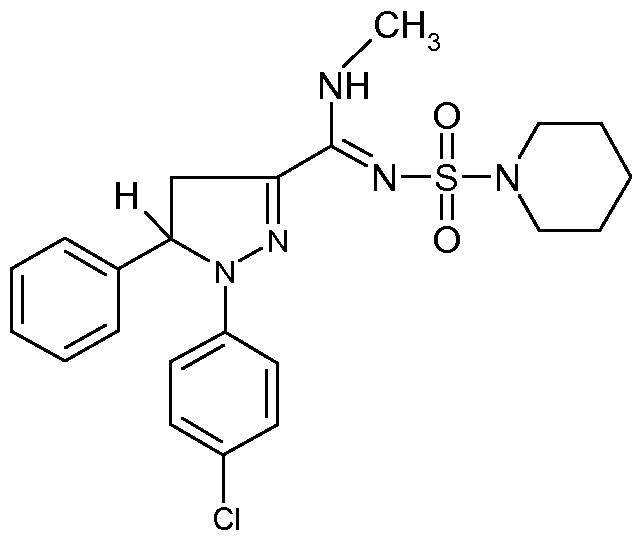
  • EP 1 713 475 (first published as WO 2005/074920) disclosed racemic 1 ,3,5-trisubsti- tuted 4,5-dihydro-1 H-pyrazole derivatives as CB 1 receptor antagonists, including N-[(piperidin-1- yl)-sulfonyl]-N'-methyl-1-(4-chlorophenyl)-5-phenyl-4,5-dihydro-(1 H)-pyrazole-3-carboxamidine:
  • Ri is a hydrogen or a fluoro atom
  • - R 2 represents a piperidinyl or a pyrrolidinyl group, optionally group is substituted with one or two fluoro atoms or a trifluoromethyl group
  • R 3 is a methyl or ethyl group
  • R 2 is a piperidin-1-yl group, substituted on its 4-position with one or two fluoro atoms or a trifluoromethyl group, and R 3 is a methyl group.
  • the invention also relates, in some embodiments, to a compound of formula (I * ):
  • the compounds of the invention of the formula (I), as well as the pharmacologically acceptable salts thereof, have cannabinoid CB 1 receptor modulating activity. They are useful in the treatment of disorders involving cannabinoid receptors, or treatable via manipulation of those receptors.
  • the compounds of the invention have considerably higher CB 1 receptor affinities and higher CB 1 antagonistic potencies than their corresponding (5S)-counterparts.
  • some of the compounds of the invention are active in CB 1 receptor mediated in vivo models after oral administration.
  • the compounds of the invention can be brought into forms suitable for administration by means of usual processes using auxiliary substances and/or liquid or solid carrier materials.
  • Other embodiments of the invention include:
  • compositions for treating for example, a disorder or condition that may be treated by modulating cannabinoid CB 1 receptors, the compositions comprising a compound of formula (I) or a pharmaceutically acceptable salt thereof, and a pharmaceutically acceptable carrier; methods of treatment of a disorder or condition that may be treated by modulating cannabinoid CB 1 receptors, the methods comprising administering to a patient in need of such treatment a compound of formula (I) or a pharmaceutically acceptable salt thereof; pharmaceutical compositions for treating, for example, a disorder or condition chosen from psychosis, anxiety, depression, attention deficits, memory disorders, cognitive disorders, appetite disorders, obesity, addiction, drug dependence, neurodegenerative disorders, dementia, dystonia, muscle spasticity, tremor, multiple sclerosis, traumatic brain injury, stroke, Parkinson's disease, Alzheimer's disease, epilepsy, Huntington's disease, Tourette's syndrome, cerebral ischaemia, cerebral apoplexy, craniocerebral trauma, stroke, spinal cord injury, neuroinflammatory disorders, plaque
  • the invention also provides the use of a compound or salt according to formula (I) for the manufacture of a medicament.
  • the invention further relates to combination therapies wherein a compound of the invention, or a pharmaceutically acceptable salt thereof, or a pharmaceutical composition or formulation comprising a compound of the invention, is administered concurrently or sequentially or as a combined preparation with another therapeutic agent or agents, for the treatment of one or more of the conditions listed.
  • Such other therapeutic agent(s) may be administered prior to, simultaneously with, or following the administration of the compounds of the invention.
  • the invention also provides compounds, pharmaceutical compositions, kits and methods for the treatment of a disorder or condition that may be treated by modulating cannabinoid CB 1 receptors, the method comprising administering to a patient in need of such treatment a compound of formula (I) or a pharmaceutically acceptable salt thereof.
  • the invention also provides methods of preparing the compounds of the invention and the intermediates used in those methods. Isolation and purification of the compounds and intermediates described herein can be affected, if desired, by any suitable separation or purification procedure such as, for example, filtration, extraction, crystallization, column chromatography, thin-layer chromatography, thick- layer chromatography, preparative low or high-pressure liquid chromatography, or a combination of these procedures. Specific illustrations of suitable separation and isolation procedures can be taken from the preparations and examples. However, other equivalent separation or isolation procedures could, of course, also be used.
  • Some of the crystalline forms for the compounds may exist as polymorphs, and as such are intended to be included in the present invention.
  • some of the compounds may form solvates with water (i.e., hydrates) or common organic solvents, and such solvates are also intended to be encompassed within the scope of this invention.
  • Isotopically-labeled compound of formula (I) or pharmaceutically acceptable salts thereof including compounds of formula (I) isotopically-labeled to be detectable by PET or SPECT, are also included within the scope of the invention, and same applies to compounds of formula (I) labeled with [ 13 C]-, [ 14 C]-, [ 3 H]-, [ 18 F]-, [ 125 I]- or other isotopically enriched atoms, suitable for receptor binding or metabolism studies.
  • N-oxides of the compounds mentioned above belong to the invention.
  • Tertiary amines may or may not give rise to N-oxide metabolites. The extent to what N-oxidation takes place varies from trace amounts to a near quantitative conversion.
  • N-oxides may be more active than their corresponding tertiary amines, or less active. Whilst N-oxides can easily be reduced to their corresponding tertiary amines by chemical means, in the human body this happens to varying degrees.
  • Some N-oxides undergo nearly quantitative reductive conversion to the corresponding tertiary amines, in other cases conversion is a mere trace reaction, or even completely absent (Bickel, 1969).
  • 'Crystal form' refers to various solid forms of the same compound, for example polymorphs, solvates and amorphous forms.
  • 'Polymorphs' are crystal structures wherein a compound can crystallize in different crystal packing arrangements, all having the same elemental composition. Polymorphism is a frequently occurring phenomenon, affected by several crystallization conditions such as temperature, level of supersaturation, the presence of impurities, polarity of solvent, rate of cooling. Different polymorphs usually have different X-ray diffraction patterns, solid state NMR spectra, infrared or Raman spectra, melting points, density, hardness, crystal shape, optical and electrical properties, stability, and solubility.
  • Recrystallization solvent, rate of crystallization, storage temperature, and other factors may cause one crystal form to dominate.
  • 'Solvates' are generally crystal forms containing either stoichiometric or non-stoichiometric amounts of a solvent. Often, during the process of crystallization some compounds have a tendency to trap a fixed molar ratio of solvent molecules in the crystalline solid state, thus forming a solvate. When the solvate is water, 'hydrates' may be formed.
  • the compound of formula (I) and pharmaceutically acceptable salts thereof may exist in the form of a hydrate or a solvate, and such a hydrate and solvate are also encompassed in the present invention. Examples thereof include % hydrate, dihydrochloride dihydrate, etc.
  • 'Amorphous' forms are noncrystalline materials with no long range order, and generally do not give a distinctive powder X-ray diffraction pattern. Crystal forms in general have been described by Byrn (1995) and Martin (1995)
  • the present invention provides a pharmaceutical composition comprising at least one compound of formula (I), at least one pharmaceutically acceptable salt or solvate thereof, or a mixture of any of the foregoing, together with one or more pharmaceutically acceptable carriers thereof, and optionally one or more other therapeutic ingredients.
  • the carrier(s) must be 'acceptable' in the sense of being compatible with the other ingredients of the formulation and not deleterious to the recipient thereof.
  • composition encompasses a product comprising specified ingredients in predetermined amounts or proportions, as well as any product resulting, directly or indirectly, from combining specified ingredients in specified amounts.
  • this term encompasses a product comprising one or more active ingredients, and an optional carrier comprising inert ingredients, as well as any product resulting, directly or indirectly, from combination, complexation or aggregation of any two or more of the ingredients, or from dissociation of one or more of the ingredients, or from other types of reactions or interactions of one or more of the ingredients.
  • compositions are prepared by uniformly and intimately bringing the active ingredient into association with a liquid carrier or a finely divided solid carrier or both, and then, if necessary, shaping the product into the desired formulation.
  • the pharmaceutical composition includes enough of the active object compound to produce the desired effect upon the progress or condition of diseases.
  • the pharmaceutical compositions of the present invention encompass any composition made by mixing a compound of the present invention and a pharmaceutically acceptable carrier.
  • pharmaceutically acceptable it is meant the carrier, diluent or excipient must be compatible with the other ingredients of the formulation and not deleterious to the recipient thereof.
  • the term 'combination preparation' comprises both true combinations, meaning a compound of formula (I) and other medicaments physically combined in one preparation such as a tablet or injection fluid, as well as 'kit-of-parts', comprising a compound of formula (I) and another medicament in separate dosage forms, together with instructions for use, optionally with further means for facilitating compliance with the administration of the component compounds, e.g. label or drawings.
  • the pharmacotherapy by definition is simultaneous.
  • the contents of 'kit-of-parts' can be administered either simultaneously or at different time intervals. Therapy being either concomitant or sequential will be dependant on the characteristics of the other medicaments used, characteristics like onset and duration of action, plasma levels, clearance, etc., as well as on the disease, its stage, and characteristics of the individual patient.
  • the affinity of the compounds of the invention for cannabinoid CB 1 receptors was determined as described below. From the binding affinity measured for a given compound of formula (I), one can estimate a theoretical lowest effective dose. At a concentration of the compound equal to twice the measured K-value, nearly 100% of the cannabinoid CB 1 receptors likely will be occupied by the compound. By converting that concentration to mg of compound per kg of patient — assuming ideal bioavailability — a theoretical lowest effective dose is obtained. Pharmacokinetic, pharmacodynamic, and other considerations may alter the dose actually administered to a higher or lower value. The dose of the compound to be administered will depend on the relevant indication, the age, weight and sex of the patient and may be determined by a physician.
  • the dosage will preferably be in the range of from 0.01 mg/kg to 10 mg/kg.
  • the typical daily dose of the active ingredients varies within a wide range and will depend on various factors such as the relevant indication, the route of administration, the age, weight and sex of the patient and may be determined by a physician.
  • total daily dose administration to a patient in single or individual doses may be in amounts, for example, from 0.001 to 10 mg/kg body weight daily, and more usually from 0.01 to 1 ,000 mg per day, of total active ingredients.
  • Such dosages will be administered to a patient in need of treatment from one to three times each day, or as often as needed for efficacy, and for periods of at least two months, more typically for at least six months, or chronically.
  • terapéuticaally effective amount refers to an amount of a therapeutic agent to treat a condition treatable by administrating a composition of the invention. That amount is the amount sufficient to exhibit a detectable therapeutic or ameliorative response in a tissue system, animal or human. The effect may include, for example, treating the conditions listed herein.
  • the precise effective amount for a subject will depend upon the subject's size and health, the nature and extent of the condition being treated, recommendations of the treating physician, and the therapeutics, or combination of therapeutics, selected for administration. Thus, it is not useful to specify an exact effective amount in advance.
  • pharmaceutically acceptable salt refers to those salts, within the scope of sound medical judgment, suitable for use in contact with the tissues of humans without undue toxicity, irritation, allergic response, etc., and are commensurate with a reasonable benefit/risk ratio.
  • Pharmaceutically acceptable salts are well-known in the art. They can be prepared in situ when finally isolating and purifying the compounds of the invention, or separately by reacting them with pharmaceutically acceptable non-toxic bases or acids, including inorganic or organic bases and inorganic or organic acids ⁇ Berge, 1977). The 'free base' form may be regenerated by contacting the salt with a base or acid, and isolating the parent compound in the conventional matter.
  • the parent form of the compound differs from the various salt forms in certain physical properties, such as solubility in polar solvents, but otherwise the salts are equivalent to the parent form of the compound for the purposes of the present invention.
  • treatment refers to any treatment of a human condition or disease, and includes: (1 ) inhibiting the disease or condition, i.e., arresting its development, (2) relieving the disease or condition, i.e., causing the condition to regress, or (3) stopping the symptoms of the disease.
  • the term 'inhibit' includes its generally accepted meaning, including restraining, alleviating, ameliorating, and slowing, stopping or reversing progression, severity, or a resultant symptom.
  • the term “medical therapy” intendeds to include diagnostic and therapeutic regimens carried out in vivo or ex vivo on humans.
  • 'obesity' refers to a condition whereby a person has a Body Mass Index (BMI), calculated as weight per height squared (km/m 2 ), of at least 25.9. Conventionally, those persons with normal weight have a BMI of 19.9 to less than 25.9.
  • BMI Body Mass Index
  • the obesity herein may be due to any cause, whether genetic of environmental.
  • a carbonyl chloride of formula (IV) can be reacted with a compound of formula R 2 SO 2 NH 2 in the presence of a base such NaH or NaOH, to give a compound of formula (V) wherein R 1 and R 2 have the abovementioned meaning.
  • the compound of formula (V) can be reacted with a halogenating agent, for example a chlorinating agent such as POCI 3 to give a compound of formula (Vl).
  • a halogenating agent for example a chlorinating agent such as POCI 3
  • Such a reaction is preferably carried out in the presence of 4- dimethylaminopyridine (DMAP).
  • DMAP 4- dimethylaminopyridine
  • Compound (Vl) can be reacted with an amine of formula NH 2 R3 to give a compound of formula (VII), wherein R 1 , R 2 and R3 have the meaning as given above.
  • Compound (VII) can be separated via chiral preparative HPLC to give compound (I), wherein R 1 , R 2 and R3 have the meaning as given above and wherein C 5 of its 4,5-dihydropyrazole moiety has the R configuration.
  • Step 2 To 1-(4-chlorophenyl)-5-phenyl-4,5-dihydro-(1 H)-pyrazole-3-carboxylic acid (18.77 g; 62.4 mmol, prepared as described in EP 1 713 475) in toluene (200 ml) was added thionyl chloride (18.00 ml; 246.8 mmol). The reaction mixture was stirred at 80 0 C for 1 hour. Volatiles were removed in vacuo. 50 ml toluene was added and again volatiles were removed in vacuo.
  • Step 3 N-[(4,4-Difluoropiperidin-1 -yl)sulfonyl]-1 -(4-chlorophenyl)-5-phenyl-4,5-dihydro-(1 H)- pyrazole-3-carboxamide (30.14 g; 62.4 mmol) was dissolved in dichloromethane (500 ml) . DMAP (33.80 g; 276.7 mmol) was added. POCI 3 (phosphorus oxychloride) (7.35 ml; 80.3 mmol) in dichloromethane (50.00 ml) was added dropwise. The reaction mixture was refluxed for 4 hours.
  • Step 4 Racemic N-[(4,4-difluoropiperidin-1 -yl)sulfonyl]-N'-methyl-1 -(4-chlorophenyl)-5-phenyl- 4,5-dihydro-(1 H)-pyrazole-3-carboxamidine (26.71g) was separated into both enantiomers by preparative chiral HPLC.
  • the analysis was carried out on a block-shaped crystal, cut out of a cluster of crystals of compound 1.
  • X-ray data were collected with a Nonius KappaCCD diffractometer on a rotating anode at a temperature of 150 K.
  • the PLATON program (Spek, 2003) was used for the analysis of the geometry, the illustrations and the validation of the results.
  • the absolute configuration at C5 was determined as R by using the Bijvoet pair analysis.
  • the "Flack x parameter" value amounted to -0.06 ⁇ 0.04.
  • Preparative chiral HPLC method A 250 x 30 mm CHIRALPAK ® AD-H 5 ⁇ m column was used. 70/30 Carbon dioxide / Ethanol + 1 % diethylamine was used as the mobile phase. Flow rate: 120 ml/minute. Temperature: 25 0 C. Detection UV 300 nm. Outlet pressure: 130 bars.
  • Preparative chiral HPLC method A 250 x 30 mm CHIRALPAK ® AD-H 5 ⁇ m column was used. 70/30 Carbon dioxide / Ethanol + 1% diethylamine was used as the mobile phase. Flow rate: 120 ml/minute. Temperature: 25 0 C. Detection: UV 250 nm. Outlet pressure: 130 bars.
  • CHO cells were grown in a Dulbecco's Modified Eagle's medium (DMEM) culture medium, supplemented with 10% heat-inactivated fetal calf serum. Medium was aspirated and replaced by DMEM, without fetal calf serum, but containing [ 3 H]-arachidonic acid and incubated overnight in a cell culture stove (5% CO 2 /95% air; 37 0 C; water-saturated atmosphere). During this period [ 3 H]-arachidonic acid was incorporated in membrane phospholipids.
  • DMEM Dulbecco's Modified Eagle's medium
  • the blood pressure signal was registered on a personal computer (Compaq Deskpro 386s), by means of a Po-Ne-Mah data-acquisition program (Po-Ne-Mah Inc., Storrs, USA). Heart rate was derived from the pulsatile pressure signal. All compounds were administered orally as a microsuspension in 1% methylcellulose, 30 minutes before induction of the anesthesia, 60 minutes prior to administration of the CB 1 receptor agonist CP-55,940. The injection volume was 10 ml/kg. After haemodynamic stabilization the CB 1 receptor agonist CP-55,940 (0.1 mg/kg i.v.) was administered and the hypotensive effect established (Wagner, 2001).
  • compounds of formula (I) are formulated into pharmaceutical compositions that are important and novel embodiments of the invention because they contain the compounds, more particularly specific compounds disclosed herein.
  • Types of pharmaceutical compositions that may be used include: tablets, chewable tablets, capsules (including microcapsules), solutions, parenteral solutions, ointments (creams and gels), suppositories, suspensions, and other types disclosed herein, or are apparent to a person skilled in the art from the specification and general knowledge in the art.
  • the active ingredient for instance, may also be in the form of an inclusion complex in cyclodextrins, their ethers or their esters.
  • compositions are used for oral, intravenous, subcutaneous, tracheal, bronchial, intranasal, pulmonary, transdermal, buccal, rectal, parenteral or other ways to administer.
  • the pharmaceutical formulation contains at least one compound of formula (I) in admixture with at least one pharmaceutically acceptable adjuvant, diluent and/or carrier.
  • the total amount of active ingredients suitably is in the range of from about 0.1 % (w/w) to about 95% (w/w) of the formulation, suitably from 0.5% to 50% (w/w) and preferably from 1 % to 25% (w/w). In some embodiments, the amount of active ingredient is greater than about 95% (w/w) or less than about 0.1% (w/w).
  • the compounds of the invention can be brought into forms suitable for administration by means of usual processes using auxiliary substances such as liquid or solid, powdered ingredients, such as the pharmaceutically customary liquid or solid fillers and extenders, solvents, emulsifiers, lubricants, flavorings, colorings and/or buffer substances.
  • auxiliary substances such as liquid or solid, powdered ingredients, such as the pharmaceutically customary liquid or solid fillers and extenders, solvents, emulsifiers, lubricants, flavorings, colorings and/or buffer substances.
  • auxiliary substances include magnesium carbonate, titanium dioxide, lactose, saccharose, sorbitol, mannitol and other sugars or sugar alcohols, talc, lactoprotein, gelatin, starch, amylopectin, cellulose and its derivatives, animal and vegetable oils such as fish liver oil, sunflower, groundnut or sesame oil, polyethylene glycol and solvents such as, for example, sterile water and mono- or polyhydric alcohols such as glycerol, as well as with disintegrating agents and lubricating agents such as magnesium stearate, calcium stearate, sodium stearyl fumarate and polyethylene glycol waxes.
  • the mixture may then be processed into granules or pressed into tablets.
  • a tablet is prepared using the ingredients below:
  • the components are blended and compressed to form tablets each weighing 230 mg.
  • the active ingredients may be separately premixed with the other non-active ingredients, before being mixed to form a formulation.
  • the active ingredients may also be mixed with each other, before being mixed with the non-active ingredients to form a formulation.
  • Soft gelatin capsules may be prepared with capsules containing a mixture of the active ingredients of the invention, vegetable oil, fat, or other suitable vehicle for soft gelatin capsules.
  • Hard gelatin capsules may contain granules of the active ingredients.
  • Hard gelatin capsules may also contain the active ingredients together with solid powdered ingredients such as lactose, saccharose, sorbitol, mannitol, potato starch, corn starch, amylopectin, cellulose derivatives or gelatin.
  • Dosage units for rectal administration may be prepared (i) in the form of suppositories containing the active substance mixed with a neutral fat base; (ii) in the form of a gelatin rectal capsule containing the active substance in a mixture with a vegetable oil, paraffin oil or other suitable vehicle for gelatin rectal capsules; (iii) in the form of a ready-made micro enema; or (iv) in the form of a dry micro enema formulation to be reconstituted in a suitable solvent just prior to administration.
  • Liquid preparations may be prepared in the form of syrups, elixirs, concentrated drops or suspensions, e.g. solutions or suspensions containing the active ingredients and the remainder consisting, for example, of sugar or sugar alcohols and a mixture of ethanol, water, glycerol, propylene glycol and polyethylene glycol. If desired, such liquid preparations may contain coloring agents, flavoring agents, preservatives, saccharine and carboxymethyl cellulose or other thickening agents.
  • Liquid preparations may also be prepared in the form of a dry powder, reconstituted with a suitable solvent prior to use. Solutions for parenteral administration may be prepared as a solution of a formulation of the invention in a pharmaceutically acceptable solvent. These solutions may also contain stabilizing ingredients, preservatives and/or buffering ingredients. Solutions for parenteral administration may also be prepared as a dry preparation, reconstituted with a suitable solvent before use.
  • formulations and 'kits of parts' comprising one or more containers filled with one or more of the ingredients of a pharmaceutical composition of the invention, for use in medical therapy.
  • container(s) can be various written materials such as instructions for use, or a notice in the form prescribed by a governmental agency regulating the manufacture, use or sale of pharmaceuticals products, noticing reflects approval by the agency of manufacture, use, or sale for human administration.
  • formulations of the invention in the manufacture of medicaments for use in the treatment of a condition wherein modulation of cannabinoid CB 1 receptors is required or desired, and methods of medical treatment or comprising the administration of a therapeutically effective total amount of at least one compound of formula (I), either as such or, in the case of prodrugs, after administration, to a patient suffering from, or susceptible to, a condition wherein modulation of cannabinoid CB 1 receptors is required or desired.
  • compositions comprising preferred active compounds for systemic use or topical application.
  • Other compounds of the invention or combinations thereof may be used in place of (or in addition to) said compounds.
  • concentration of the active ingredient may be varied over a wide range as discussed herein.
  • the amounts and types of ingredients that may be included are well known in the art.

Landscapes

  • Health & Medical Sciences (AREA)
  • Organic Chemistry (AREA)
  • Chemical & Material Sciences (AREA)
  • Bioinformatics & Cheminformatics (AREA)
  • Engineering & Computer Science (AREA)
  • Veterinary Medicine (AREA)
  • General Chemical & Material Sciences (AREA)
  • Pharmacology & Pharmacy (AREA)
  • Life Sciences & Earth Sciences (AREA)
  • Animal Behavior & Ethology (AREA)
  • General Health & Medical Sciences (AREA)
  • Public Health (AREA)
  • Chemical Kinetics & Catalysis (AREA)
  • Medicinal Chemistry (AREA)
  • Nuclear Medicine, Radiotherapy & Molecular Imaging (AREA)
  • Neurology (AREA)
  • Neurosurgery (AREA)
  • Biomedical Technology (AREA)
  • Diabetes (AREA)
  • Pulmonology (AREA)
  • Psychiatry (AREA)
  • Cardiology (AREA)
  • Heart & Thoracic Surgery (AREA)
  • Hematology (AREA)
  • Obesity (AREA)
  • Emergency Medicine (AREA)
  • Endocrinology (AREA)
  • Pain & Pain Management (AREA)
  • Vascular Medicine (AREA)
  • Child & Adolescent Psychology (AREA)
  • Addiction (AREA)
  • Psychology (AREA)
  • Hospice & Palliative Care (AREA)
  • Immunology (AREA)
  • Orthopedic Medicine & Surgery (AREA)
  • Rheumatology (AREA)
  • Physical Education & Sports Medicine (AREA)
  • Urology & Nephrology (AREA)
  • Gastroenterology & Hepatology (AREA)
  • Pharmaceuticals Containing Other Organic And Inorganic Compounds (AREA)

Abstract

This invention concerns (5R)-1,5-diaryl-4,5-dihydro-1 H-pyrazole-3-carboxamidine derivatives as cannabinoid-CB1 receptor antagonists, methods for the preparation of these compounds, novel intermediates useful for the synthesis of said dihydropyrazole derivatives, methods for the preparation of these intermediates, pharmaceutical compositions containing one or more of these dihydropyrazole derivatives as active ingredient, as well as the use of these pharmaceutical compositions for the treatment of psychiatric and neurological disorders involving cannabinoid receptors. The compounds have the formula (I) wherein the symbols have the meanings given in the specification.

Description

(5R)-1 ,5-DIARYL-4,5-DIHYDRO-1 H-PYRAZOLE-S-CARBOXAMIDINE DERIVATIVES
HAVING CB1 -ANTAGONISTIC ACTIVITY
This invention relates to the fields of pharmaceutical and organic chemistry, and provides (5R)- 1 ,5-diaryl-4,5-dihydro-1 H-pyrazole-3-carboxamidines, intermediates, formulations and methods.
BACKGROUND
SR141716A, now known as rimonabant, and other CB1 receptor modulators, including CB1ZCB2 receptor subtype selective receptor antagonists, have several potential therapeutic applications such as medicaments for treating psychosis, anxiety, depression, attention deficits, memory disorders, cognitive disorders, appetite disorders, obesity, addiction, drug dependence, neurodegenerative disorders, dementia, dystonia, muscle spasticity, tremor, epilepsy, multiple sclerosis, traumatic brain injury, stroke, Parkinson's disease, Alzheimer's disease, epilepsy, Huntington's disease, Tourette's syndrome, cerebral ischaemia, cerebral apoplexy, craniocerebral trauma, stroke, spinal cord injury, neuroinflammatory disorders, plaque sclerosis, viral encephalitis, demyelinisation related disorders, pain disorders, neuropathic pain disorders, septic shock, glaucoma, diabetes, cancer, emesis, nausea, gastrointestinal disorders, gastric ulcers, diarrhoea, sexual disorders, impulse control disorders and cardiovascular disorders (Boyd, 2005; Sorbera, 2005; Carai, 2005; Lange, 2004 & 2005; Hertzog, 2004; Smith, 2005; Thakur, 2005; Padgett, 2005; Muccioli, 2005 & 2006; Reggio, 2003; Adam, 2006; Hδgenauer, 2007).
EP 1 713 475 (first published as WO 2005/074920) disclosed racemic 1 ,3,5-trisubsti- tuted 4,5-dihydro-1 H-pyrazole derivatives as CB1 receptor antagonists, including N-[(piperidin-1- yl)-sulfonyl]-N'-methyl-1-(4-chlorophenyl)-5-phenyl-4,5-dihydro-(1 H)-pyrazole-3-carboxamidine:
Figure imgf000003_0001
compound 10 in EP 1 713 475
This compound however, as well as the other compounds disclosed, were found inactive (ID50 > 30 mg/kg) in the in vivo CB1 mediated (CP-55,940-induced) hypotension test after oral administration (see below). The present invention aims at the development of 1 ,3,5- trisubstituted 4,5-dihydro-1 H-pyrazole-derived CB1 receptor antagonists or inverse agonists with improved in vivo activities after oral administration. DISCLOSURE
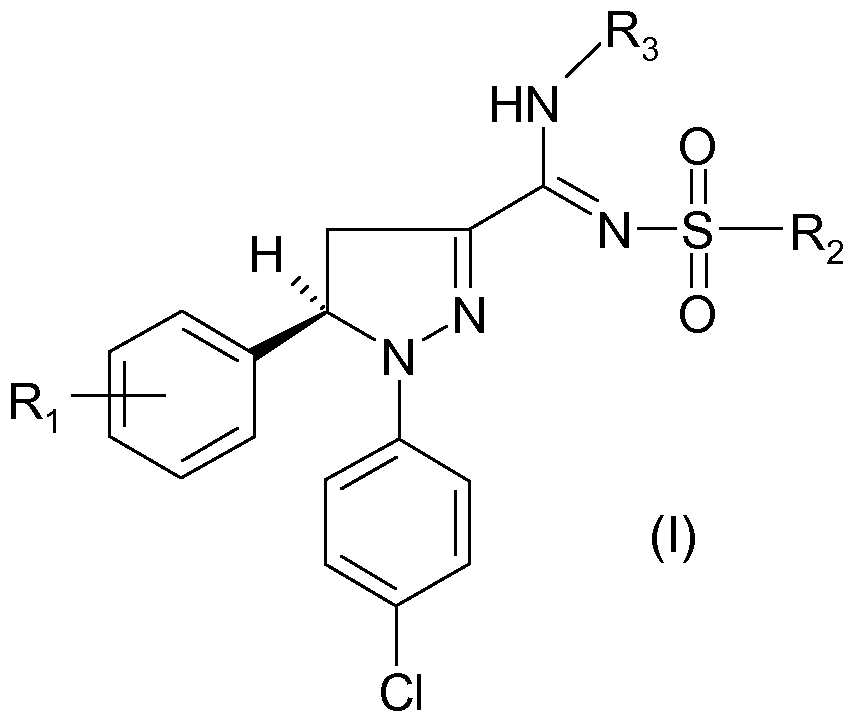
Potent and selective antagonism or inverse agonism of cannabinoid-CBi receptors was found in (5R)-1 ,5-diaryl-4,5-dihydro-1 H-pyrazole-3-carboxamidine derivatives of formula (I):
Figure imgf000004_0001
or a tautomer, stereoisomer, N-oxide, or a pharmacologically acceptable salt, of any of the foregoing, wherein:
Ri is a hydrogen or a fluoro atom, - R2 represents a piperidinyl or a pyrrolidinyl group, optionally group is substituted with one or two fluoro atoms or a trifluoromethyl group, R3 is a methyl or ethyl group
Further embodiments provide one or more a (5R)-enantiomers of compounds of formula (I) wherein: R2 is a piperidin-1-yl group, substituted on its 4-position with one or two fluoro atoms or a trifluoromethyl group, and R3 is a methyl group.
The invention also relates, in some embodiments, to a compound of formula (I*):
Figure imgf000004_0002
wherein the symbols have the meanings as given above, chosen from: N-[(4,4-difluoropiperidin-1-yl)sulfonyl]-N'-methyl-1-(4-chlorophenyl)-5-phenyl-4,5-dihydro-(1 H)- pyrazole-3-carboxamidine
N-[(4,4-difluoropiperidin-1-yl)sulfonyl]-N'-methyl-1-(4-chlorophenyl)-5-(2-fluorophenyl)-4,5- dihydro-(1 H)-pyrazole-3-carboxamidine.
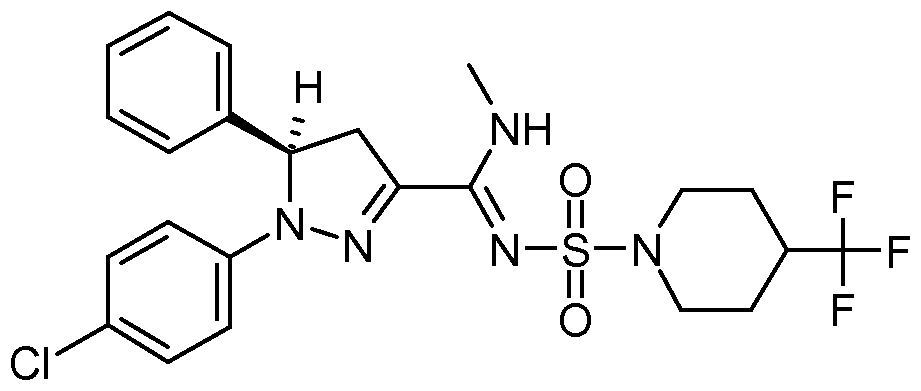
N-[(4-(trifluoromethyl)piperidin-1-yl)sulfonyl]-N'-methyl-1-(4-chlorophenyl)-5-phenyl-4,5-dihydro- (1 H)-pyrazole-3-carboxamidine
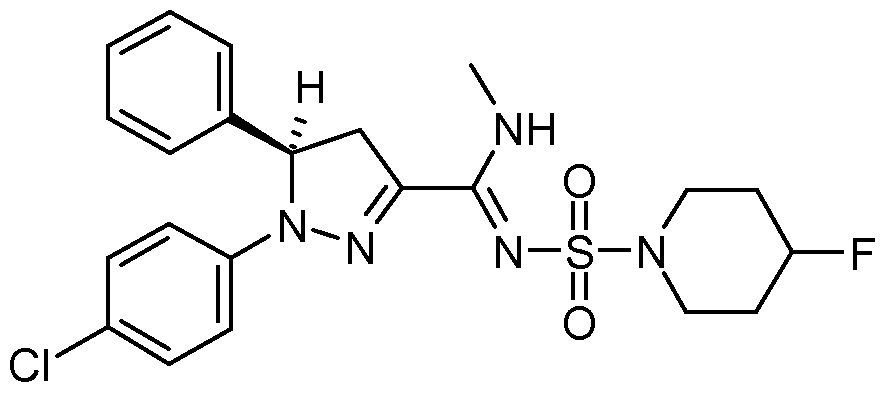
N-[(4-fluoropiperidin-1 -yl)sulfonyl]-N'-methyl-1 -(4-chlorophenyl)-5-phenyl-4,5-dihydro-(1 H)- pyrazole-3-carboxamidine
N-[(3-fluoropiperidin-1-yl)sulfonyl]-N'-methyl-1-(4-chlorophenyl)-5-phenyl-4,5-dihydro-(1 H)- pyrazole-3-carboxamidine
N-[(3,3-difluoropiperidin-1-yl)sulfonyl]-N'-methyl-1-(4-chlorophenyl)-5-phenyl-4,5-dihydro-(1 H)- pyrazole-3-carboxamidine
N-[(3,3-difluoropyrrolidin-1-yl)sulfonyl]-N'-methyl-1-(4-chlorophenyl)-5-phenyl-4,5-dihydro-(1 H)- pyrazole-3-carboxamidine
N-[(4,4-difluoropiperidin-1-yl)sulfonyl]-N'-ethyl-1-(4-chlorophenyl)-5-phenyl-4,5-dihydro-(1 H)- pyrazole-3-carboxamidine
N-[(4-fluoropiperidin-1 -yl)sulfonyl]-N'-ethyl-1 -(4-chlorophenyl)-5-phenyl-4,5-dihydro-(1 H)- pyrazole-3-carboxamidine
such compounds being useful in the preparation of compounds of formula (I).
The compounds of the invention of the formula (I), as well as the pharmacologically acceptable salts thereof, have cannabinoid CB1 receptor modulating activity. They are useful in the treatment of disorders involving cannabinoid receptors, or treatable via manipulation of those receptors. The compounds of the invention have considerably higher CB1 receptor affinities and higher CB1 antagonistic potencies than their corresponding (5S)-counterparts. In addition, some of the compounds of the invention are active in CB1 receptor mediated in vivo models after oral administration. The compounds of the invention can be brought into forms suitable for administration by means of usual processes using auxiliary substances and/or liquid or solid carrier materials. Other embodiments of the invention include:
pharmaceutical compositions for treating, for example, a disorder or condition that may be treated by modulating cannabinoid CB1 receptors, the compositions comprising a compound of formula (I) or a pharmaceutically acceptable salt thereof, and a pharmaceutically acceptable carrier; methods of treatment of a disorder or condition that may be treated by modulating cannabinoid CB1 receptors, the methods comprising administering to a patient in need of such treatment a compound of formula (I) or a pharmaceutically acceptable salt thereof; pharmaceutical compositions for treating, for example, a disorder or condition chosen from psychosis, anxiety, depression, attention deficits, memory disorders, cognitive disorders, appetite disorders, obesity, addiction, drug dependence, neurodegenerative disorders, dementia, dystonia, muscle spasticity, tremor, multiple sclerosis, traumatic brain injury, stroke, Parkinson's disease, Alzheimer's disease, epilepsy, Huntington's disease, Tourette's syndrome, cerebral ischaemia, cerebral apoplexy, craniocerebral trauma, stroke, spinal cord injury, neuroinflammatory disorders, plaque sclerosis, viral encephalitis, demyelinisation related disorders, pain disorders, chronic pain, neuropathic pain, acute pain and inflammatory pain, osteoporosis, septic shock, glaucoma, diabetes, emesis, nausea, gastrointestinal disorders, gastric ulcers, diarrhoea, sexual disorders, impulse control disorders and cardiovascular disorders; methods of treatment of a disorder or condition chosen from the disorders listed herein, the methods comprising administering to a patient in need of such treatment a compound of formula (I) or a pharmaceutically acceptable salt thereof; pharmaceutical compositions for treatment of a disorder or condition chosen from the disorders listed herein, the compositions comprising a compound of formula (I) or a pharmaceutically acceptable salt thereof, and a pharmaceutically acceptable carrier;
The invention also provides the use of a compound or salt according to formula (I) for the manufacture of a medicament. The invention further relates to combination therapies wherein a compound of the invention, or a pharmaceutically acceptable salt thereof, or a pharmaceutical composition or formulation comprising a compound of the invention, is administered concurrently or sequentially or as a combined preparation with another therapeutic agent or agents, for the treatment of one or more of the conditions listed. Such other therapeutic agent(s) may be administered prior to, simultaneously with, or following the administration of the compounds of the invention.
The invention also provides compounds, pharmaceutical compositions, kits and methods for the treatment of a disorder or condition that may be treated by modulating cannabinoid CB1 receptors, the method comprising administering to a patient in need of such treatment a compound of formula (I) or a pharmaceutically acceptable salt thereof.
The invention also provides methods of preparing the compounds of the invention and the intermediates used in those methods. Isolation and purification of the compounds and intermediates described herein can be affected, if desired, by any suitable separation or purification procedure such as, for example, filtration, extraction, crystallization, column chromatography, thin-layer chromatography, thick- layer chromatography, preparative low or high-pressure liquid chromatography, or a combination of these procedures. Specific illustrations of suitable separation and isolation procedures can be taken from the preparations and examples. However, other equivalent separation or isolation procedures could, of course, also be used.
Some of the crystalline forms for the compounds may exist as polymorphs, and as such are intended to be included in the present invention. In addition, some of the compounds may form solvates with water (i.e., hydrates) or common organic solvents, and such solvates are also intended to be encompassed within the scope of this invention.
Isotopically-labeled compound of formula (I) or pharmaceutically acceptable salts thereof, including compounds of formula (I) isotopically-labeled to be detectable by PET or SPECT, are also included within the scope of the invention, and same applies to compounds of formula (I) labeled with [13C]-, [14C]-, [3H]-, [18F]-, [125I]- or other isotopically enriched atoms, suitable for receptor binding or metabolism studies.
DEFINITIONS
General terms used in the description of compounds herein disclosed bear their usual meanings. The term "substituted" means that the specified group or moiety bears one or more substituents. Where any group may carry multiple substituents, and a variety of possible substituents is provided, the substituents are independently selected, and need not to be the same. The term "unsubstituted" means that the specified group bears no substituents. To provide a more concise description, the terms 'compound' or 'compounds' include tautomers, stereoisomers, N-oxides, isotopically-labelled analogues, or pharmacologically acceptable salts, hydrates or solvates, also when not explicitly mentioned.
N-oxides of the compounds mentioned above belong to the invention. Tertiary amines may or may not give rise to N-oxide metabolites. The extent to what N-oxidation takes place varies from trace amounts to a near quantitative conversion. N-oxides may be more active than their corresponding tertiary amines, or less active. Whilst N-oxides can easily be reduced to their corresponding tertiary amines by chemical means, in the human body this happens to varying degrees. Some N-oxides undergo nearly quantitative reductive conversion to the corresponding tertiary amines, in other cases conversion is a mere trace reaction, or even completely absent (Bickel, 1969).
'Crystal form' refers to various solid forms of the same compound, for example polymorphs, solvates and amorphous forms. 'Polymorphs' are crystal structures wherein a compound can crystallize in different crystal packing arrangements, all having the same elemental composition. Polymorphism is a frequently occurring phenomenon, affected by several crystallization conditions such as temperature, level of supersaturation, the presence of impurities, polarity of solvent, rate of cooling. Different polymorphs usually have different X-ray diffraction patterns, solid state NMR spectra, infrared or Raman spectra, melting points, density, hardness, crystal shape, optical and electrical properties, stability, and solubility. Recrystallization solvent, rate of crystallization, storage temperature, and other factors may cause one crystal form to dominate. 'Solvates' are generally crystal forms containing either stoichiometric or non-stoichiometric amounts of a solvent. Often, during the process of crystallization some compounds have a tendency to trap a fixed molar ratio of solvent molecules in the crystalline solid state, thus forming a solvate. When the solvate is water, 'hydrates' may be formed. The compound of formula (I) and pharmaceutically acceptable salts thereof may exist in the form of a hydrate or a solvate, and such a hydrate and solvate are also encompassed in the present invention. Examples thereof include % hydrate, dihydrochloride dihydrate, etc. 'Amorphous' forms are noncrystalline materials with no long range order, and generally do not give a distinctive powder X-ray diffraction pattern. Crystal forms in general have been described by Byrn (1995) and Martin (1995)
To provide a more concise description, some of the quantitative expressions given herein are not qualified with the term "about". It is understood that whether the term "about" is used explicitly or not, every quantity given herein is meant to refer to the actual given value, and it is also meant to refer to the approximation to such given value that would reasonably be inferred based on the ordinary skill in the art, including approximations due to experimental or measurement conditions for such given value.
Throughout the description and the claims of this specification the word "comprise" and variations of the word, such as "comprising" and "comprises" is not intended to exclude other additives, components, integers or steps.
While it may be possible for the compounds of formula (I) to be administered as the raw chemical, it is preferable to present them as a 'pharmaceutical composition'. According to a further aspect, the present invention provides a pharmaceutical composition comprising at least one compound of formula (I), at least one pharmaceutically acceptable salt or solvate thereof, or a mixture of any of the foregoing, together with one or more pharmaceutically acceptable carriers thereof, and optionally one or more other therapeutic ingredients. The carrier(s) must be 'acceptable' in the sense of being compatible with the other ingredients of the formulation and not deleterious to the recipient thereof. The term "composition" as used herein encompasses a product comprising specified ingredients in predetermined amounts or proportions, as well as any product resulting, directly or indirectly, from combining specified ingredients in specified amounts. In relation to pharmaceutical compositions, this term encompasses a product comprising one or more active ingredients, and an optional carrier comprising inert ingredients, as well as any product resulting, directly or indirectly, from combination, complexation or aggregation of any two or more of the ingredients, or from dissociation of one or more of the ingredients, or from other types of reactions or interactions of one or more of the ingredients. In general, pharmaceutical compositions are prepared by uniformly and intimately bringing the active ingredient into association with a liquid carrier or a finely divided solid carrier or both, and then, if necessary, shaping the product into the desired formulation. The pharmaceutical composition includes enough of the active object compound to produce the desired effect upon the progress or condition of diseases. Accordingly, the pharmaceutical compositions of the present invention encompass any composition made by mixing a compound of the present invention and a pharmaceutically acceptable carrier. By "pharmaceutically acceptable" it is meant the carrier, diluent or excipient must be compatible with the other ingredients of the formulation and not deleterious to the recipient thereof.
Within the context of this application, the term 'combination preparation' comprises both true combinations, meaning a compound of formula (I) and other medicaments physically combined in one preparation such as a tablet or injection fluid, as well as 'kit-of-parts', comprising a compound of formula (I) and another medicament in separate dosage forms, together with instructions for use, optionally with further means for facilitating compliance with the administration of the component compounds, e.g. label or drawings. With true combinations, the pharmacotherapy by definition is simultaneous. The contents of 'kit-of-parts', can be administered either simultaneously or at different time intervals. Therapy being either concomitant or sequential will be dependant on the characteristics of the other medicaments used, characteristics like onset and duration of action, plasma levels, clearance, etc., as well as on the disease, its stage, and characteristics of the individual patient.
The affinity of the compounds of the invention for cannabinoid CB1 receptors was determined as described below. From the binding affinity measured for a given compound of formula (I), one can estimate a theoretical lowest effective dose. At a concentration of the compound equal to twice the measured K-value, nearly 100% of the cannabinoid CB1 receptors likely will be occupied by the compound. By converting that concentration to mg of compound per kg of patient — assuming ideal bioavailability — a theoretical lowest effective dose is obtained. Pharmacokinetic, pharmacodynamic, and other considerations may alter the dose actually administered to a higher or lower value. The dose of the compound to be administered will depend on the relevant indication, the age, weight and sex of the patient and may be determined by a physician. The dosage will preferably be in the range of from 0.01 mg/kg to 10 mg/kg. The typical daily dose of the active ingredients varies within a wide range and will depend on various factors such as the relevant indication, the route of administration, the age, weight and sex of the patient and may be determined by a physician. In general, total daily dose administration to a patient in single or individual doses, may be in amounts, for example, from 0.001 to 10 mg/kg body weight daily, and more usually from 0.01 to 1 ,000 mg per day, of total active ingredients. Such dosages will be administered to a patient in need of treatment from one to three times each day, or as often as needed for efficacy, and for periods of at least two months, more typically for at least six months, or chronically. The term "therapeutically effective amount" as used herein refers to an amount of a therapeutic agent to treat a condition treatable by administrating a composition of the invention. That amount is the amount sufficient to exhibit a detectable therapeutic or ameliorative response in a tissue system, animal or human. The effect may include, for example, treating the conditions listed herein. The precise effective amount for a subject will depend upon the subject's size and health, the nature and extent of the condition being treated, recommendations of the treating physician, and the therapeutics, or combination of therapeutics, selected for administration. Thus, it is not useful to specify an exact effective amount in advance. The term "pharmaceutically acceptable salt" refers to those salts, within the scope of sound medical judgment, suitable for use in contact with the tissues of humans without undue toxicity, irritation, allergic response, etc., and are commensurate with a reasonable benefit/risk ratio. Pharmaceutically acceptable salts are well-known in the art. They can be prepared in situ when finally isolating and purifying the compounds of the invention, or separately by reacting them with pharmaceutically acceptable non-toxic bases or acids, including inorganic or organic bases and inorganic or organic acids {Berge, 1977). The 'free base' form may be regenerated by contacting the salt with a base or acid, and isolating the parent compound in the conventional matter. The parent form of the compound differs from the various salt forms in certain physical properties, such as solubility in polar solvents, but otherwise the salts are equivalent to the parent form of the compound for the purposes of the present invention. The term "treatment" refers to any treatment of a human condition or disease, and includes: (1 ) inhibiting the disease or condition, i.e., arresting its development, (2) relieving the disease or condition, i.e., causing the condition to regress, or (3) stopping the symptoms of the disease. The term 'inhibit' includes its generally accepted meaning, including restraining, alleviating, ameliorating, and slowing, stopping or reversing progression, severity, or a resultant symptom. As used herein, the term "medical therapy" intendeds to include diagnostic and therapeutic regimens carried out in vivo or ex vivo on humans.
As used herein 'obesity' refers to a condition whereby a person has a Body Mass Index (BMI), calculated as weight per height squared (km/m2), of at least 25.9. Conventionally, those persons with normal weight have a BMI of 19.9 to less than 25.9. The obesity herein may be due to any cause, whether genetic of environmental. Examples of disorders that may result in obesity or be the cause of obesity include overeating and bulimia, polycystic ovarian disease, craniopharyngioma, the Prader-Willi syndrome, Frohlich's syndrome, Type-ll diabetes, GH- deficient subjects, normal variant short stature, Turners syndrome, and other pathological conditions showing reduced metabolic activity or a decrease in resting energy expenditure as a percentage of total fat-free mass, e.g. children with acute lymphoblastic leukemia.
EXAMPLE 1 : GENERAL ASPECTS OF SYNTHESES
The synthesis of compounds having formula (I) is outlined in Scheme 1 :
Figure imgf000011_0001
Scheme 1
A carbonyl chloride of formula (IV) can be reacted with a compound of formula R2SO2NH2 in the presence of a base such NaH or NaOH, to give a compound of formula (V) wherein R1 and R2 have the abovementioned meaning. The compound of formula (V) can be reacted with a halogenating agent, for example a chlorinating agent such as POCI3 to give a compound of formula (Vl). Such a reaction is preferably carried out in the presence of 4- dimethylaminopyridine (DMAP). Compound (Vl) can be reacted with an amine of formula NH2R3 to give a compound of formula (VII), wherein R1, R2 and R3 have the meaning as given above. Compound (VII) can be separated via chiral preparative HPLC to give compound (I), wherein R1, R2 and R3 have the meaning as given above and wherein C5 of its 4,5-dihydropyrazole moiety has the R configuration.
Figure imgf000012_0001
Intermediates with formulae (II), (III) or (IV) were obtained according to published methods (EP 1 713 475, WO 2005/077911, EP 1 743 892, Srivastava, 2007).
Compounds described below were prepared according to these procedures. They are intended to further illustrate the invention in more detail, not to restrict the scope of the invention in any way. Other embodiments of the invention will be apparent to those skilled in the art from consideration of the specification and practice of the invention disclosed herein. The specification and examples must be considered as exemplary only.
The selection of the particular synthetic procedures depends on factors known to those skilled in the art such as the compatibility of functional groups with the reagents used, the possibility to use protecting groups, catalysts, activating and coupling reagents and the ultimate structural features present in the final compound being prepared. Pharmaceutically acceptable salts may be obtained using procedures well-known in the art, for example by mixing a compound of the present invention with a suitable acid, for instance an inorganic acid or an organic acid.
EXAMPLE 2: SYNTHESES OF SPECIFIC COMPOUNDS
(5R)-(+)-N-[(4,4-difluoropiperidin-1 -yl)sulfonyl]-N'-methyl-1 -(4-chlorophenyl)-5-phenyl-4,5- dihydro-(1H)-pyrazole-3-carboxamidine (compound 1 ) and (5S)-(-)-N-[(4,4-difluoropiperi- din-1 -yl)sulfonyl]-N'-methyl-1 -(4-chlorophenyl)-5-phenyl-4,5-dihydro-(1 H)-pyrazole-3- carboxamidine (compound 2)
Figure imgf000012_0002
Compound 1 Compound 2 Step 1 : Sulfamide (9.15 g; 95.2 mmol) was added to 4,4-difluoropiperidine hydrochloride (15.0 g; 95.2 mmol) in butyl acetate (200 ml). DIPEA (17.9 ml; 104.7 mmol) was added and the magnetically stirred reaction mixture was heated at reflux temperature overnight. The reaction mixture was allowed to attain room temperature. Volatiles were removed in vacuo. Ethyl acetate and 1 N HCI were successively added. The organic layer was separated and dried over Na2SC>4. After filtration, the filtrate was collected and volatiles were removed in vacuo. The product was washed twice with diisopropyl ether affording 4,4-difluoropiperidin-1ylsulfonamide (15.96 g; 83.8 %).1H-NMR (400 MHz, DMSOd6): δ 2.02-2.14 (m, 4H); 3.10-3.16 (m, 4H), 6.90 (br s, 2H). All 1H NMR spectra disclosed herein, were recorded on a Bruker 400 MHz instrument using CDCI3 or DMSO-dβ as solvent with tetramethylsilane as an internal standard. Chemical shifts are given in ppm (δ scale) downfield from tetramethylsilane. Coupling constants (J) are expressed in Hz.
Step 2: To 1-(4-chlorophenyl)-5-phenyl-4,5-dihydro-(1 H)-pyrazole-3-carboxylic acid (18.77 g; 62.4 mmol, prepared as described in EP 1 713 475) in toluene (200 ml) was added thionyl chloride (18.00 ml; 246.8 mmol). The reaction mixture was stirred at 80 0C for 1 hour. Volatiles were removed in vacuo. 50 ml toluene was added and again volatiles were removed in vacuo. The formed 1-(4-chlorophenyl)-5-phenyl-4,5-dihydro-(1 H)-pyrazole-3-carboxylic acid chloride was dissolved in 250 ml acetonitrile: solution A. To a solution of 4,4-difluoropiperidine-1- sulfonamide (12.50 g; 62.4 mmol) in 500 ml acetonitrile was added aqueous NaOH (8.25 ml; 157.79 mmol) . After 10 minutes solution A was slowly added. The reaction mixture was stirred overnight at room temperature. Volatiles were removed in vacuo to give crude N-[(4,4- difluoropiperidin-1 -yl)sulfonyl]-1 -(4-chlorophenyl)-5-phenyl-4,5-dihydro-(1 H)-pyrazole-3- carboxamide (39.01 g). This crude residue was extracted with CH2CI2 /1 N HCI. Layers were separated. The dichloromethane layer was sucessively dried with Na2SO4, filtered and evaporated affording N-[(4,4-difluoropiperidin-1 -yl)sulfonyl]-1 -(4-chlorophenyl)-5-phenyl-4,5- dihydro-(1 H)-pyrazole-3-carboxamide (30.41 g, quantitative yield). 1H-NMR (400 MHz, DMSO- d6): δ 1.93-2.10 (m, 4H); 2.75 (dd, J = 18 and 6 Hz, 1 H), 3.12-3.21 (m, 4H), 3.36 (br s, probably contains NH and H2O), 3.62 (dd, J = 18 and 13 Hz, 1 H), 5.42 (dd, J = 13 and 6 Hz, 1 H), 6.93 (br d, J= 8, 2H), 7.14-7.36 (m, 7H).
Step 3: N-[(4,4-Difluoropiperidin-1 -yl)sulfonyl]-1 -(4-chlorophenyl)-5-phenyl-4,5-dihydro-(1 H)- pyrazole-3-carboxamide (30.14 g; 62.4 mmol) was dissolved in dichloromethane (500 ml) . DMAP (33.80 g; 276.7 mmol) was added. POCI3 (phosphorus oxychloride) (7.35 ml; 80.3 mmol) in dichloromethane (50.00 ml) was added dropwise. The reaction mixture was refluxed for 4 hours. After cooling down to 6 0C methylamine hydrochloride(19.0 g; 281.4 mmol) was added, followed by dropwise addition of DIPEA (72.0 ml; 420.6 mmol). The reaction mixture was stirred overnight at room temperature. Water (100 ml) was added, followed by acidification with 1 N hydrochloric acid. Layers were separated. The dichloromethane layer was dried over Na2SC>4, filtered and concentrated in vacuo. Purification by flash chromatography on silicagel (silica gel 60 (0.040-0.063 mm, Merck, used for all flash chromatography disclosed herein) (diethyl ether / petroleum ether (40/60) = 1/1 (v/v)) afforded N-[(4,4-difluoropiperidin-1 -yl)sulfonyl]-N'- methyl-i ^-chlorophenylJ-S-phenyl^.S-dihydro-tiHJ-pyrazole-S-carboxamidine (27.1 g; 87.6 %, racemate 1 ). 1H-NMR (400 MHz, DMSOd6): δ 2.00-2.15 (m, 4H); 2.85 (br d, J ~ 5, 3H), 3.09-3.21 (m, 5H), 3.94 (dd, J = 18 and 13 Hz, 1 H), 5.61 (dd, J = 13 and 6 Hz, 1 H), 7.04 (br d, J= 8, 2H), 7.20-7.38 (m, 7H), 8.80-8.85 m, 1 H).
Analogously were prepared:
N-[(4,4-difluoropiperidin-1 -yl)sulfonyl]-N'-methyl-1 -(4-chlorophenyl)-5-(2-fluorophenyl)- 4,5-dihydro-(1H)-pyrazole-3-carboxamidine (racemate 2). Melting point: 166-1670C (recorded on a Bϋchi B-545 melting point apparatus, as were all melting points disclosed here).
N-^-ttrifluoromethylJpiperidin-i -ylJsulfonyll-N'-methyl-i ^-chlorophenylJ-S-phenyl^.S- dihydro-(1H)-pyrazole-3-carboxamidine (racemate 3). 1H-NMR (400 MHz, DMSOd6): δ 1.43- 1.60 (m, 2H), 1.83-1.92 (m, 2H), 2.39 - 2.48 (m, 1 H), 2.57-2.69 (m, 2H), 2.88 (br s, 3H), 3.14 (dd, J=M. Q, 6.6 Hz, 1 H), 3.60 (t, J=9.2 Hz, 2H), 3.94 (dd, J=18.1 , 12.9 Hz, 1 H), 5.60 (dd, J=12.6, 6.6 Hz, 1 H), 7.03 (d, J=9.0 Hz, 2H), 7.23 (d, J=9.0 Hz, 2H), 7.26-7.39 (m, 5H), 8.86 (br s, 1 H). Melting point: 172-173 0C.
N-^-fluoropiperidin-i -ylJsulfonyll-N'-methyM ^-chlorophenylJ-S-phenyl^.S-dihydro- (1H)-pyrazole-3-carboxamidine (racemate 4). 1H-NMR (400 MHz, DMSOd6): δ 1.73 - 2.02 (m, 4H), 2.86 (s, 3 H), 3.00-3.23 (m, 5H), 3.94 (dd, J=M.9, 12.8 Hz, 1 H), 4.80 (dd, J=48.2, 2.7 Hz, 1 H), 5.59 (dd, J=12.8, 6.5 Hz, 1 H), 7.03 (br d, J=8.7 Hz, 2H), 7.20-7.38 (m, 7H), 8.86 (br s, 1 H).
N-^S-fluoropiperidin-i -ylJsulfonylJ-N'-methyM ^-chlorophenylJ-S-phenyl^jS-dihydro- (1H)-pyrazole-3-carboxamidine (racemate 5). 1H-NMR (400 MHz, DMSOd6): δ 1.49-1.84 (m, 4H), 2.87 (d, J=4.5 Hz, 3H), 3.04-3.26 (m, 4H), 3.35-3.41 (m, 1 H), 3.88-4.01 (m, 1 H), 4.67-4.91 (m, 1 H), 5.60 (dd, J=12.8, 6.5 Hz, 1 H), 7.03 (br d, J=9.0 Hz, 2H), 7.22 (br d, J=9.0 Hz, 2 H), 7.25-7.38 (m, 5H), 8.86 (d, J=4.8 Hz, 1 H).
N-KS.S-difluoropiperidin-i -ylJsulfonyll-N'-methyl-i ^-chlorophenylJ-S-phenyM.S-dihydro- (1H)-pyrazole-3-carboxamidine (racemate 6). 1H-NMR (400 MHz, DMSOd6): δ 1.68-1.78 (m, 2H), 1.90-2.07 (m, 2H), 2.89 (s, 3H), 3.05 (t, J=5.0 Hz, 2H), 3.13 (dd, J=M.8, 6.6 Hz, 1 H), 3.24 (t, J=1 1.8 Hz, 2H), 3.93 (dd, J=M.9, 12.8 Hz, 1 H), 5.62 (dd, J=12.8, 6.5 Hz, 1 H), 7.04 (br d, J=9.0 Hz, 2H), 7.22 (br d, J=8.7 Hz, 2H), 7.26-7.39 (m, 5H), 8.94 (br s, 1 H).
Figure imgf000015_0001
-ylJsulfonylJ-N'-methyl-i
Figure imgf000015_0002
dihydro-(1H)-pyrazole-3-carboxamidine (racemate 7). 1H-NMR (400 MHz, DMSO-d6): 5 2.36 - 2.47 (m, 2H), 2.87 (s, 3H), 3.13 (dd, J=M.9, 6.5 Hz, 1 H), 3.37 (t, J=7.2 Hz, 2H), 3.54 (t, J=13.7 Hz, 2H), 3.92 (dd, J=17.8, 12.9 Hz, 1 H), 5.62 (dd, J=12.8, 6.5 Hz, 1 H), 7.04 (br d, J=8.7 Hz, 2H), 7.23 (br d, J=9.0 Hz, 2H), 7.25-7.38 (m, 5H), 8.95 (br s, 1 H).
N-^^-difluoropiperidin-i -ylJsulfonyll-N'-ethyl-i ^-chlorophenylJ-S-phenyl^.S-dihydro- (1H)-pyrazole-3-carboxamidine (racemate 8). 1H-NMR (400 MHz, CDCI3): δ 1.28-1.43 (m, 3H), 1.98-2.20 (m, 4H), 3.09 (dd, J=18, 7.2 Hz) and 3.40 (dd, J=18.5, 7.7 Hz) {both signals together integrate for 1H), 3.23-3.37 (m, 4H), 3.47 - 3.59 (m) and 3.84 - 3.99 (m) {both signals together integrate for 2H), 3.75 (dd, J=18, 13.2 Hz) and 4.19 (dd, J=18.2, 13.4 Hz) {both signals together integrate for 1H), 5.23-5.45 (m, 1 H), 6.67 (br s) and 7.77 (br s) {both signals together integrate for 1H), 6.82-7.00 (m, 2H), 7.14 (d, J=8.7 Hz, 2H), 7.19 (d, J=7.5 Hz, 2H), 1.21-1 Al (m, 3H).
N-[(4-fluoropiperidin-1 -yl)sulfonyl]-N'-ethyl-1 -(4-chlorophenyl)-5-phenyl-4,5-dihydro-(1 H)- pyrazole-3-carboxamidine (racemate 9). 1H-NMR (400 MHz, CDCI3): δ 1.28-1.42 (m, 3H), 1.83-2.07 (m, 4H), 3.05-3.46 (m, 5 H), 3.48-3.64 (m) and 3.84 - 3.95 (m) {both signals together integrate for 2H), 3.78 (dd, J=18.2, 13.1 Hz) and 4.20 (dd, J=18.1 , 13.2 Hz, 1 H) {both signals together integrate for 1H), 4.67 - 4.90 (m, 1 H), 5.22 - 5.44 (m, 1 H), 6.64 (br s) and 7.82 (br s) {both signals together integrate for 1H), 6.87-6.98 (m, 2H), 7.14 (d, J=8.7 Hz, 2H), 7.19 (d, J=7.2 Hz, 2H), 7.27-7.40 (m, 3H).
These racemates are useful for the preparation of the corresponding (5R)-enantiomers by preparative chiral HPLC analogously to the procedure described under step 4 below.
Step 4: Racemic N-[(4,4-difluoropiperidin-1 -yl)sulfonyl]-N'-methyl-1 -(4-chlorophenyl)-5-phenyl- 4,5-dihydro-(1 H)-pyrazole-3-carboxamidine (26.71g) was separated into both enantiomers by preparative chiral HPLC. This resulted in (5R)-(+)-N-[(4,4-difluoropiperidin-1-yl)sulfonyl]-N'- methyl-1-(4-chlorophenyl)-5-phenyl-4,5-dihydro-(1 H)-pyrazole-3-carboxamidine (12.82 g; 37.27 %) (first eluting enantiomer) and (5S)-(-)-N-[(4,4-difluoropiperidin-1-yl)sulfonyl]-N'-methyl-1-(4- chlorophenyl)-5-phenyl-4,5-dihydro-(1 H)-pyrazole-3-carboxamidine (12.11 g; 35.21 %) (second eluting enantiomer). In order to remove remaining aliphatic trace impurities the obtained (5R)- (+)-N-[(4,4-difluoropiperidin-1-yl)sulfonyl]-N'-methyl-1-(4-chlorophenyl)-5-phenyl-4,5-dihydro- (1 H)-pyrazole-3-carboxamidine was dissolved in DCM, washed twice with 1 N HCI and co- evaporated in the presence of diisopropyl ether, affording (5R)-(+)-N-[(4,4-difluoropiperidin-1- yl)sulfonyl]-N'-methyl-1-(4-chlorophenyl)-5-phenyl-4,5-dihydro-(1 H)-pyrazole-3-carboxamidine (Compound 1 ) (10.5 g; 30.5 %). [α25 D] = 165 °, c = 1 , methanol. This and all other optical rotations disclosed herein, were measured on a Bellingham/Stanley ADP410 polarimeter. Specific rotations ([α25 D]) are given as deg/dm, the concentration values are reported as g/100 ml of the specified solvent. Melting point: 158 0C (recrystallized twice from absolute ethanol). 1H-NMR (400 MHz, DMSO- d6): δ 2.00-2.15 (m, 4H); 2.85 (br d, J ~ 5, 3H), 3.09-3.21 (m, 5H), 3.94 (dd, J = 18 and 13 Hz, 1 H), 5.61 (dd, J = 13 and 6 Hz, 1 H), 7.04 (br d, J= 8, 2H), 7.20-7.38 (m, 7H), 8.80-8.85 m, 1 H). In order to remove remaining aliphatic trace impurities the obtained (5S)-(-)-N-[(4,4- difluoropiperidin-1-yl)sulfonyl]-N'-methyl-1-(4-chlorophenyl)-5-phenyl-4,5-dihydro-(1 H)-pyrazole- 3-carboxamidine was dissolved in DCM, washed twice with 1 N HCI and co-evaporated in the presence of diisopropyl ether, affording (5S)-(-)-N-[(4,4-difluoropiperidin-1-yl)sulfonyl]-N'-methyl- 1-(4-chlorophenyl)-5-phenyl-4,5-dihydro-(1 H)-pyrazole-3-carboxamidine (Compound 2) (9.7 g; 29.7 %). [OC25 D] = -176 °, c = 1 , methanol. 1H-NMR (400 MHz, DMSOd6): δ 2.00-2.15 (m, 4H); 2.85 (br d, J - 5, 3H), 3.09-3.21 (m, 5H), 3.94 (dd, J = 18 and 13 Hz, 1 H), 5.61 (dd, J = 13 and 6 Hz, 1 H), 7.04 (br d, J= 8, 2H), 7.20-7.38 (m, 7H), 8.80-8.85 m, 1 H).
X-Ray determination of (5R)-(+)-N-[(4,4-difluoropiperidin-1 -yl)sulfonyl]-N'-methyl-1 -(4- chlorophenyl)-5-phenyl-4,5-dihydro-(1 H)-pyrazole-3-carboxamidine (compound 1)
The analysis was carried out on a block-shaped crystal, cut out of a cluster of crystals of compound 1. X-ray data were collected with a Nonius KappaCCD diffractometer on a rotating anode at a temperature of 150 K. The PLATON program (Spek, 2003) was used for the analysis of the geometry, the illustrations and the validation of the results. The absolute configuration at C5 was determined as R by using the Bijvoet pair analysis. The "Flack x parameter" value amounted to -0.06 ± 0.04.
Preparative chiral HPLC method: A 250 x 76 mm CHIRALPAK® T101 column was used. Methanol/acetonitrile/diethylamine = 85/15/0.1 (v/v) was used as the mobile phase. Flow rate: 250 ml/minute. Temperature: 25 0C. Detection UV 220 nm
Analytical chiral HPLC method: A 250 x 4.6 mm CHIRALPAK® IB column was used, n- heptane/ ethanol/ diethylamine = 80/20/0.1 (v/v) was used as the mobile phase. Flow rate: 1 ml/minute. Temperature: 25 0C. Detection UV 360 nm.
Figure imgf000017_0001
ORTEP formula of compound 1
Data of first eluting enantiomer on preparative column: Chemical purity > 99 % (area% at 360 nm). Enantiomeric excess > 99,5 %. Data of second eluting enantiomer on preparative column: Chemical purity > 99 % (area% at 360 nm). Enantiomeric excess > 99.5 %.
SR-t+J-N-^-fluoropiperidin-i -ylJsulfonyll-N'-methyl-i ^-chlorophenylJ-S-phenyl^.S- dihydro-(1H)-pyrazole-3-carboxamidine (Compound 3)
Figure imgf000017_0002
Compound 3
Compound 3 was prepared analogously to compound 1 , using 4-fluoropiperidine instead of 4,4- difluoropiperidine. [α25 D] = 174°, c = 1 , methanol. 1H-NMR (400 MHz, DMSOd6): δ 1.73 - 2.02 (m, 4H), 2.86 (s, 3 H), 3.00-3.23 (m, 5H), 3.94 (dd, J=17.9, 12.8 Hz, 1 H), 4.80 (dd, J=48.2, 2.7 Hz, 1 H), 5.59 (dd, J=12.8, 6.5 Hz, 1 H), 7.03 (br d, J=8.7 Hz, 2H), 7.20-7.38 (m, 7H), 8.86 (br s, 1 H). Preparative chiral HPLC method: A 250 x 30 mm CHIRALPAK® AD-H 5 μm column was used. 70/30 Carbon dioxide / Ethanol + 1 % diethylamine was used as the mobile phase. Flow rate: 120 ml/minute. Temperature: 25 0C. Detection UV 300 nm. Outlet pressure: 130 bars.
Analytical chiral HPLC method: A 250 x 4.6 mm CHIRALPAK® IC 5 μm column was used, n- heptane/ ethanol/ diethylamine = 70/30/0.1 (v/v) was used as the mobile phase. Flow rate: 1 ml/minute. Temperature: 25 0C. Detection: Diode array detection (DAD) 230 nm.
Data of compound 3 on preparative column: Chemical purity > 99 % (area% at 230 nm). Enantiomeric excess > 98 %. Retention time: 8.07 min.
SR-t+J-N-^-ttrifluoromethylJpiperidin-i -ylJsulfonyll-N'-methyl-i ^-chlorophenylJ-S- phenyl-4,5-dihydro-(1 H)-pyrazole-3-carboxamidine (Compound 4)
Figure imgf000018_0001
Compound 4
Compound 4 was prepared analogously to compound 1 using 4-(trifluoromethyl)piperidine instead of 4,4-difluoropiperidine. [α25 D] = 167°, c = 1 , methanol. 1H-NMR (400 MHz, DMSOd6): δ 1.43-1.60 (m, 2H), 1.83-1.92 (m, 2H), 2.39 - 2.48 (m, 1 H), 2.57-2.69 (m, 2H), 2.88 (br s, 3H), 3.14 (dd, J=M. Q, 6.6 Hz, 1 H), 3.60 (t, J=9.2 Hz, 2H), 3.94 (dd, J=18.1 , 12.9 Hz, 1 H), 5.60 (dd, J=12.6, 6.6 Hz, 1 H), 7.03 (d, J=9.0 Hz, 2H), 7.23 (d, J=9.0 Hz, 2H), 7.26-7.39 (m, 5H), 8.86 (br s, 1 H).
Preparative chiral HPLC method: A 250 x 30 mm CHIRALPAK® AD-H 5 μm column was used. 70/30 Carbon dioxide / Ethanol + 1% diethylamine was used as the mobile phase. Flow rate: 120 ml/minute. Temperature: 25 0C. Detection: UV 250 nm. Outlet pressure: 130 bars.
Analytical chiral HPLC method: A 250 x 4.6 mm CHIRALPAK® IA 5 μm column was used, n- heptane/ ethanol/ diethylamine = 70/30/0.1 (v/v) was used as the mobile phase. Flow rate: 1 ml/minute. Temperature: 25 0C. Detection DAD 250 nm. Data of compound 4 on preparative column: Chemical purity > 98 % (area% at 250 nm). Enantiomeric excess > 98 %. Retention time: 7.22 min.
EXAMPLE 3: PHARMACOLOGICAL METHODS
In vitro affinity for cannabinoid-CE÷H receptors was determined using membrane preparations of Chinese hamster ovary (CHO) cells wherein the human cannabinoid CB1 receptor was stably transfected in conjunction with [3H]CP-55,940 as radioligand. After incubation of a freshly prepared cell membrane preparation with the [3H]-ligand, with or without addition of compounds of the invention, separation of bound and free ligand was performed by filtration over glassfiber filters. Radioactivity on the filter was measured by liquid scintillation counting. The binding data were either obtained by CEREP (128, rue Danton, 92500 Rueil- Malmaison, France) or at Solvay Pharmaceuticals B.V. (CJ. van Houtenlaan 36, 1381 CP Weesp, The Netherlands).
In vitro cannabinoid-CB.| receptor antagonism was assessed with human CB1 receptors cloned in Chinese hamster ovary (CHO) cells. CHO cells were grown in a Dulbecco's Modified Eagle's medium (DMEM) culture medium, supplemented with 10% heat-inactivated fetal calf serum. Medium was aspirated and replaced by DMEM, without fetal calf serum, but containing [3H]-arachidonic acid and incubated overnight in a cell culture stove (5% CO2/95% air; 37 0C; water-saturated atmosphere). During this period [3H]-arachidonic acid was incorporated in membrane phospholipids. On the test day, medium was aspirated and cells were washed three times using 0.5 ml. DMEM, containing 0.2% bovine serum albumin (BSA). Stimulation of the CB1 receptor by WIN 55,212-2 lead to activation of PLA2 followed by release of [3H]-arachidonic acid into the medium. This WIN 55,212-2-induced release was concentration-dependently antagonized by CB1 receptor antagonists.
In vivo cannabinoid-CE÷H receptor antagonism was assessed with the CP-55,940-induced hypotension test in rat. Male normotensive rats (225-300 g; Harlan, Horst, The Netherlands) were anaesthetized with pentobarbital (80 mg/kg ip). Blood pressure was measured, via a cannula inserted into the left carotid artery, by means of a Spectramed DTX-plus pressure transducer (Spectramed B. V., Bilthoven, The Netherlands). After amplification by a Nihon Kohden Carrier Amplifier (Type AP-621G; Nihon Kohden B. V., Amsterdam, The Netherlands), the blood pressure signal was registered on a personal computer (Compaq Deskpro 386s), by means of a Po-Ne-Mah data-acquisition program (Po-Ne-Mah Inc., Storrs, USA). Heart rate was derived from the pulsatile pressure signal. All compounds were administered orally as a microsuspension in 1% methylcellulose, 30 minutes before induction of the anesthesia, 60 minutes prior to administration of the CB1 receptor agonist CP-55,940. The injection volume was 10 ml/kg. After haemodynamic stabilization the CB1 receptor agonist CP-55,940 (0.1 mg/kg i.v.) was administered and the hypotensive effect established (Wagner, 2001).
EXAMPLE 4: PHARMACOLOGICAL TESTRESULTS
In the table below, the in vitro and in vivo pharmacological data obtained by the protocols given above are collected. The results of the compounds of the invention are compared with those of compounds disclosed in EP 1 713 475.
Figure imgf000020_0001
The affinity for human CB1 receptors was found to be 25 fold higher for compound 1 (5R) than for its (5S)-enantiomer (compound 2). As antagonist (pA2), compound 1 was found to be 40 times more potent than compound 2. In addition, compound 1 was found active after oral administration in the in vivo CB1 mediated (CP-55,940-induced) hypotension test whereas compound 2 was found inactive. It was found that the 1 ,3,5-trisubstituted 4,5-dihydro-I H-pyrazole derivatives exemplified in EP 1 713 475 (Compounds 1-1 1 ) showed poor activities in vivo in a CB1- mechanistic pharmacological model after oral administration. In contrast, compound 1 and its racemate 1 which are representatives from the present invention both have potent activities in vivo after oral administration in this model.
EXAMPLE 5: PHARMACEUTICAL PREPARATIONS
For clinical use, compounds of formula (I) are formulated into pharmaceutical compositions that are important and novel embodiments of the invention because they contain the compounds, more particularly specific compounds disclosed herein. Types of pharmaceutical compositions that may be used include: tablets, chewable tablets, capsules (including microcapsules), solutions, parenteral solutions, ointments (creams and gels), suppositories, suspensions, and other types disclosed herein, or are apparent to a person skilled in the art from the specification and general knowledge in the art. The active ingredient for instance, may also be in the form of an inclusion complex in cyclodextrins, their ethers or their esters. The compositions are used for oral, intravenous, subcutaneous, tracheal, bronchial, intranasal, pulmonary, transdermal, buccal, rectal, parenteral or other ways to administer. The pharmaceutical formulation contains at least one compound of formula (I) in admixture with at least one pharmaceutically acceptable adjuvant, diluent and/or carrier. The total amount of active ingredients suitably is in the range of from about 0.1 % (w/w) to about 95% (w/w) of the formulation, suitably from 0.5% to 50% (w/w) and preferably from 1 % to 25% (w/w). In some embodiments, the amount of active ingredient is greater than about 95% (w/w) or less than about 0.1% (w/w).
The compounds of the invention can be brought into forms suitable for administration by means of usual processes using auxiliary substances such as liquid or solid, powdered ingredients, such as the pharmaceutically customary liquid or solid fillers and extenders, solvents, emulsifiers, lubricants, flavorings, colorings and/or buffer substances. Frequently used auxiliary substances include magnesium carbonate, titanium dioxide, lactose, saccharose, sorbitol, mannitol and other sugars or sugar alcohols, talc, lactoprotein, gelatin, starch, amylopectin, cellulose and its derivatives, animal and vegetable oils such as fish liver oil, sunflower, groundnut or sesame oil, polyethylene glycol and solvents such as, for example, sterile water and mono- or polyhydric alcohols such as glycerol, as well as with disintegrating agents and lubricating agents such as magnesium stearate, calcium stearate, sodium stearyl fumarate and polyethylene glycol waxes. The mixture may then be processed into granules or pressed into tablets. A tablet is prepared using the ingredients below:
Ingredient Quantity (mg/tablet)
COMPOUND No. 1 10 Cellulose, microcrystalline 200
Silicon dioxide, fumed 10
Stearic acid 1P_
Total 230
The components are blended and compressed to form tablets each weighing 230 mg.
The active ingredients may be separately premixed with the other non-active ingredients, before being mixed to form a formulation. The active ingredients may also be mixed with each other, before being mixed with the non-active ingredients to form a formulation.
Soft gelatin capsules may be prepared with capsules containing a mixture of the active ingredients of the invention, vegetable oil, fat, or other suitable vehicle for soft gelatin capsules. Hard gelatin capsules may contain granules of the active ingredients. Hard gelatin capsules may also contain the active ingredients together with solid powdered ingredients such as lactose, saccharose, sorbitol, mannitol, potato starch, corn starch, amylopectin, cellulose derivatives or gelatin.
Dosage units for rectal administration may be prepared (i) in the form of suppositories containing the active substance mixed with a neutral fat base; (ii) in the form of a gelatin rectal capsule containing the active substance in a mixture with a vegetable oil, paraffin oil or other suitable vehicle for gelatin rectal capsules; (iii) in the form of a ready-made micro enema; or (iv) in the form of a dry micro enema formulation to be reconstituted in a suitable solvent just prior to administration.
Liquid preparations may be prepared in the form of syrups, elixirs, concentrated drops or suspensions, e.g. solutions or suspensions containing the active ingredients and the remainder consisting, for example, of sugar or sugar alcohols and a mixture of ethanol, water, glycerol, propylene glycol and polyethylene glycol. If desired, such liquid preparations may contain coloring agents, flavoring agents, preservatives, saccharine and carboxymethyl cellulose or other thickening agents. Liquid preparations may also be prepared in the form of a dry powder, reconstituted with a suitable solvent prior to use. Solutions for parenteral administration may be prepared as a solution of a formulation of the invention in a pharmaceutically acceptable solvent. These solutions may also contain stabilizing ingredients, preservatives and/or buffering ingredients. Solutions for parenteral administration may also be prepared as a dry preparation, reconstituted with a suitable solvent before use.
Also provided according to the present invention are formulations and 'kits of parts' comprising one or more containers filled with one or more of the ingredients of a pharmaceutical composition of the invention, for use in medical therapy. Associated with such container(s) can be various written materials such as instructions for use, or a notice in the form prescribed by a governmental agency regulating the manufacture, use or sale of pharmaceuticals products, noticing reflects approval by the agency of manufacture, use, or sale for human administration. The use of formulations of the invention in the manufacture of medicaments for use in the treatment of a condition wherein modulation of cannabinoid CB1 receptors is required or desired, and methods of medical treatment or comprising the administration of a therapeutically effective total amount of at least one compound of formula (I), either as such or, in the case of prodrugs, after administration, to a patient suffering from, or susceptible to, a condition wherein modulation of cannabinoid CB1 receptors is required or desired.
By way of example and not of limitation, several pharmaceutical compositions are given, comprising preferred active compounds for systemic use or topical application. Other compounds of the invention or combinations thereof, may be used in place of (or in addition to) said compounds. The concentration of the active ingredient may be varied over a wide range as discussed herein. The amounts and types of ingredients that may be included are well known in the art.
BIBLIOGRAPHY
Adam, J. et al., Progress in Med. Chem. 2006, 44, 207-329; Eds. King and Lawton, Elsevier,
Amsterdam
Berge, S. M.: "Pharmaceutical salts", J. Pharmaceutical Science, 66, 1-19 (1977).
Bickel, M. H., "The pharmacology and Biochemistry of N-oxides", Pharmacological Reviews,
21(4), 325 - 355, 1969.
Boyd, ST. and Fremming, B.A. Ann. Pharmacother. 2005, 39, 684-690
Byrn et al., Pharmaceutical Research, 12(7), 945-954, 1995. Carai, M.A.M. et al., Life Sc. 2005, 77, 2339-2350
Dwyer & Meilor,: "Chelating agents and Metal Chelates", Academic Press, chapter 7, 1964.
Hertzog, D.L. Expert Opin. Ther. Patents, 14, 1435-1452, 2004
Hogenauer, E. K. Expert Opin. Ther. Patents 2007, 17, 1457.
Lange, J. H. M. and Kruse, C. G., C. Curr. Opin. Drug Discovery Dev, 7, 498-506, 2004 Lange, J. H. M. and Kruse, CG. Drug Discov. Today, 10, 693-702, 2005
Martin, E. W. (Editor), "Remington: The Science and Practice of Pharmacy", Mack Publishing Company, 19th Edition, Easton, Pa, VoI 2., Chapter 83, 1447-1462, 1995. Muccioli, G. G. et al., Curr. Med. Chem., 12, 1361-1394, 2005
Muccioli, G. G. and Lambert, D. M.., Expert Opin. Ther. Patents, 16, 1405-1423, 2006 Padgett, L. W. Life Sc, 77, 1767-1798, 2005. Reggio, P. H. Curr. Pharm. Des. 2003, 9, 1607-1633 Smith, R.A. and Fathi, Z. Idrugs, 8, 53-66, 2005. Sorbera, LA et al. Drugs Fut. 2005, 30, 128-137
Spek, A.L., J. Appl. Cryst. 36 (2003) 7-13
Srivastava et al. (J. Med. Chem. 2007, 50, 5951-5966
Thakur, G.A. et al., Mini-Rev. Med. Chem., 5, 631-640, 2005. Wagner, J. A., et al., Hemodynamic effects of cannabinoids: coronary and cerebral vasodilation mediated by cannabinoid CB1 receptors. Eur.J.Pharmacol. 2001 , 423, 203-10).
CITED PATENTS AND PATENT APPLICATIONS EP 1 713 475 (published as WO 2005/074920) EP 1 743 892
WO 2005/077911

Claims

1. The (5R)-enantiomer of a compound of formula (I):
Figure imgf000025_0001
or a tautomer, stereoisomer, N-oxide, or a pharmacologically acceptable salt of any of the foregoing, wherein:
Ri is a hydrogen or a fluoro atom, - R2 represents a piperidinyl or a pyrrolidinyl group, optionally group is substituted with one or two fluoro atoms or a trifluoromethyl group, R3 is a methyl or ethyl group.
2. The (5R)-enantiomer of a compound as claimed in claim 1 of formula (I), or a tautomer, stereoisomer, N-oxide, or a pharmacologically acceptable salt of any of the foregoing, wherein R2 is a piperidin-1 -yl group, substituted on its 4-position with one or two fluoro atoms or a trifluoromethyl group, and R3 is a methyl group.
3. The compound according to claim 1 , or a tautomer, stereoisomer, N-oxide, or a pharmacologically acceptable salt of any of the foregoing, selected from:
(5R)-N-[(4,4-difluoropiperidin-1-yl)sulfonyl]-N'-methyl-1-(4-chlorophenyl)-5-phenyl-4,5- dihydro-(1 H)-pyrazole-3-carboxamidine
(5R)-N-[(4-fluoropiperidin-1-yl)sulfonyl]-N'-methyl-1-(4-chlorophenyl)-5-phenyl-4,5-dihydro- (1 H)-pyrazole-3-carboxamidine
(5R)-N-[(4-(trifluoromethyl)piperidin-1-yl)sulfonyl]-N'-methyl-1-(4-chlorophenyl)-5-phenyl-4,5- dihydro-(1 H)-pyrazole-3-carboxamidine
4. A medicament, comprising a compound according to any one of the claims 1-3, or a pharmacologically acceptable salt thereof.
5. A compound as claimed in any one of the claims 1-3, for use in treating psychosis, anxiety, depression, attention deficits, memory disorders, cognitive disorders, appetite disorders, obesity, juvenile obesity, drug induced obesity, addiction, drug dependence, neurological disorders, neurodegenerative disorders, dementia, traumatic brain injury, stroke,
Parkinson's disease, Alzheimer's disease, neuroinflammatory disorders, septic shock, cancer, diabetes, asthma, respiratory diseases, gastrointestinal disorders, liver cirrhosis, arthritis, gastric ulcers, diarrhoea and cardiovascular disorders.
6. Use of a compound as claimed in claims 1-3 for the preparation of a pharmaceutical composition for the treatment of psychosis, anxiety, depression, attention deficits, memory disorders, cognitive disorders, appetite disorders, obesity, juvenile obesity, drug induced obesity, addiction, drug dependence, neurological disorders, neurodegenerative disorders, dementia, traumatic brain injury, stroke, Parkinson's disease, Alzheimer's disease, neuroinflammatory disorders, septic shock, cancer, diabetes, asthma, respiratory diseases, gastrointestinal disorders, liver cirrhosis, arthritis, gastric ulcers, diarrhoea and cardiovascular disorders.
7. A pharmaceutical composition comprising, at least one pharmaceutically acceptable carrier, or at least one pharmaceutically acceptable auxiliary substance, or a combination of two or more thereof; and a pharmacologically active amount of at least one compound of any one of the claims 1-6, or a pharmacologically acceptable salt thereof.
8. The pharmaceutical composition according to claim 7, further comprising: at least one additional therapeutic agent.
9. Process to prepare compounds as claimed in claim 1 , comprising the steps of:
(i) reacting a carbonyl chloride having formula (IV):
Figure imgf000026_0001
with a compound having formula R2SO2NH2 in the presence of a base to give a compound of formula (V):
Figure imgf000027_0001
(ii) reacting a compound of formula (V) with a chlorinating agent such as POCI3, preferably in the presence of 4-dimethylaminopyridine, yielding a compound of formula (Vl):
Figure imgf000027_0002
(iii) reacting a compound of formula (Vl) with an amine of formula NH2R3 to give a compound of formula (VII):
Figure imgf000027_0003
(iv) separating a racemate of formula (VII) into its two enantiomers by preparative HPLC,
(v) determining the compound of formula (I), wherein C5 of its 4,5-dihydropyrazole moiety has the R configuration:
Figure imgf000028_0001
wherein the symbols have the meanings as given in claim 1.
10. A compound of formula (I*),
Figure imgf000028_0002
wherein the symbols have the meanings as given in claim 1 , chosen from:
N-[(4,4-difluoropiperidin-1 -yl)sulfonyl]-N'-methyl-1 -(4-chlorophenyl)-5-phenyl-4,5-dihydro-
(1 H)-pyrazole-3-carboxamidine
N-[(4,4-difluoropiperidin-1-yl)sulfonyl]-N'-methyl-1-(4-chlorophenyl)-5-(2-fluorophenyl)-4,5- dihydro-(1 H)-pyrazole-3-carboxamidine.
N-[(4-(trifluoromethyl)piperidin-1-yl)sulfonyl]-N'-methyl-1-(4-chlorophenyl)-5-phenyl-4,5- dihydro-(1 H)-pyrazole-3-carboxamidine
N-[(4-fluoropiperidin-1-yl)sulfonyl]-N'-methyl-1-(4-chlorophenyl)-5-phenyl-4,5-dihydro-(1 H)- pyrazole-3-carboxamidine
N-[(3-fluoropiperidin-1-yl)sulfonyl]-N'-methyl-1-(4-chlorophenyl)-5-phenyl-4,5-dihydro-(1 H)- pyrazole-3-carboxamidine N-[(3,3-difluoropiperidin-1-yl)sulfonyl]-N'-methyl-1-(4-chlorophenyl)-5-phenyl-4,5-dihydro- (1 H)-pyrazole-3-carboxamidine
N-[(3,3-difluoropyrrolidin-1-yl)sulfonyl]-N'-methyl-1-(4-chlorophenyl)-5-phenyl-4,5-dihydro- (1 H)-pyrazole-3-carboxamidine
N-[(4,4-difluoropiperidin-1-yl)sulfonyl]-N'-ethyl-1-(4-chlorophenyl)-5-phenyl-4,5-dihydro-(1 H)- pyrazole-3-carboxamidine
N-[(4-fluoropiperidin-1 -yl)sulfonyl]-N'-ethyl-1 -(4-chlorophenyl)-5-phenyl-4,5-dihydro-(1 H)- pyrazole-3-carboxamidine
such compounds being useful in the preparation of compounds of formula (I).
PCT/EP2009/054788 2008-04-23 2009-04-22 (5r)-1,5-diaryl-4,5-dihydro-1h-pyrazole-3-carboxamidine derivatives having cb1-antagonistic activity Ceased WO2009130234A1 (en)

Priority Applications (11)

Application Number Priority Date Filing Date Title
CA2721908A CA2721908A1 (en) 2008-04-23 2009-04-22 (5r)-1,5-diaryl-4,5-dihydro-1h-pyrazole-3-carboxamidine derivatives having cb1-antagonistic activity
EP09734602A EP2274298A1 (en) 2008-04-23 2009-04-22 (5r)-1,5-diaryl-4,5-dihydro-1h-pyrazole-3-carboxamidine derivatives having cb1-antagonistic activity
MX2010011615A MX2010011615A (en) 2008-04-23 2009-04-22 (5r)-1,5-diaryl-4,5-dihydro-1h-pyrazole-3-carboxamidine derivatives having cb1-antagonistic activity.
EA201071227A EA201071227A1 (en) 2008-04-23 2009-04-22 (5R) -1,5-DIARYL-4,5-DIHYDRO-1H-PYRAZOL-3-CARBOXAMIDINE DERIVATIVES, possessing CB1-ANTAGONISTIC ACTIVITY
US12/988,654 US20110053983A1 (en) 2008-04-23 2009-04-22 (5r)-1,5-diaryl-4,5-dihydro-1h-pyrazole-3-carboxamidine derivatives having cb1-antagonistic activity
AU2009239984A AU2009239984A1 (en) 2008-04-23 2009-04-22 (5R)-1,5-diaryl-4,5-dihydro-1H-pyrazole-3-carboxamidine derivatives having CB1-antagonistic activity
CN2009801142223A CN102112466A (en) 2008-04-23 2009-04-22 (5R)-1,5-Diaryl-4,5-dihydro-1H-pyrazole-3-carboxamidine derivatives with CB1-antagonistic activity
JP2011505495A JP2011518800A (en) 2008-04-23 2009-04-22 (5R) -1,5-diaryl-4,5-dihydro-1H-pyrazole-3-carboxyamidine derivatives having CB1 antagonist activity
BRPI0911222A BRPI0911222A2 (en) 2008-04-23 2009-04-22 compound, drug, use of a compound, pharmaceutical composition, and process for preparing compound
IL208286A IL208286A0 (en) 2008-04-23 2010-09-21 (5r)-1,5-diaryl-4,5-dihydro-1h-pyrazole-3-carboxamidine derivatives having cb1-antagonistic activity
ZA2010/07254A ZA201007254B (en) 2008-04-23 2010-10-11 (5r)-1,5-diaryl-4,5-dihydro-1h-pyrazole-3-carboxamidine derivatives having cb1-antagonistic activity

Applications Claiming Priority (4)

Application Number Priority Date Filing Date Title
US4725108P 2008-04-23 2008-04-23
US61/047,251 2008-04-23
EP08155009.7 2008-04-23
EP08155009 2008-04-23

Publications (1)

Publication Number Publication Date
WO2009130234A1 true WO2009130234A1 (en) 2009-10-29

Family

ID=39811909

Family Applications (1)

Application Number Title Priority Date Filing Date
PCT/EP2009/054788 Ceased WO2009130234A1 (en) 2008-04-23 2009-04-22 (5r)-1,5-diaryl-4,5-dihydro-1h-pyrazole-3-carboxamidine derivatives having cb1-antagonistic activity

Country Status (15)

Country Link
US (1) US20110053983A1 (en)
EP (1) EP2274298A1 (en)
JP (1) JP2011518800A (en)
KR (1) KR20110005722A (en)
CN (1) CN102112466A (en)
AR (1) AR071487A1 (en)
AU (1) AU2009239984A1 (en)
BR (1) BRPI0911222A2 (en)
CA (1) CA2721908A1 (en)
EA (1) EA201071227A1 (en)
IL (1) IL208286A0 (en)
MX (1) MX2010011615A (en)
TW (1) TW200948798A (en)
WO (1) WO2009130234A1 (en)
ZA (1) ZA201007254B (en)

Cited By (2)

* Cited by examiner, † Cited by third party
Publication number Priority date Publication date Assignee Title
WO2009140210A3 (en) * 2008-05-12 2010-08-19 The Government Of The United States Of America As Represented By The Secretary Of The Department Of Health And Human Services Radiotracers for imaging cannabinoid sub-type1 (cb1) receptor
WO2014208939A1 (en) * 2013-06-28 2014-12-31 Hanmi Pharm. Co., Ltd. 1,5-diaryl-4,5-dihydro-1h-pyrazole-3-carboxamidine derivatives as cannabinoid cb1 receptor antagonist, method for preparing same, and pharmaceutical composition comprising same

Families Citing this family (1)

* Cited by examiner, † Cited by third party
Publication number Priority date Publication date Assignee Title
KR20150113762A (en) * 2014-03-31 2015-10-08 한미약품 주식회사 4,5-dihydro-1h-pyrazol-3-carboximidamide derivatives containing sulfur groups, method for preparing same, and pharmaceutical composition comprising same

Citations (2)

* Cited by examiner, † Cited by third party
Publication number Priority date Publication date Assignee Title
WO2005074920A1 (en) * 2004-01-30 2005-08-18 Solvay Pharmaceuticals B.V. 1,3,5-trisubstituted 4,5-dihydro-1h-pyrazole derivatives having cb1-antagonistic activity
EP1743892A1 (en) * 2005-07-15 2007-01-17 Laboratorios del Dr. Esteve S.A. Substituted pyrazoline compounds, their preparation and use as medicaments

Patent Citations (2)

* Cited by examiner, † Cited by third party
Publication number Priority date Publication date Assignee Title
WO2005074920A1 (en) * 2004-01-30 2005-08-18 Solvay Pharmaceuticals B.V. 1,3,5-trisubstituted 4,5-dihydro-1h-pyrazole derivatives having cb1-antagonistic activity
EP1743892A1 (en) * 2005-07-15 2007-01-17 Laboratorios del Dr. Esteve S.A. Substituted pyrazoline compounds, their preparation and use as medicaments

Non-Patent Citations (1)

* Cited by examiner, † Cited by third party
Title
LANGE J H M ET AL: "SYNTHESIS, BIOLOGICAL PROPERTIES, AND MOLECULAR MODELING INVESTIGATIONS OF NOVEL 3,4-DIARYLPYRAZOLINES AS POTENT AND SELECTIVE CB1 CANNABINOID RECEPTOR ANTAGONISTS", JOURNAL OF MEDICINAL CHEMISTRY, US AMERICAN CHEMICAL SOCIETY. WASHINGTON, vol. 47, no. 3, 1 January 2004 (2004-01-01), pages 627 - 643, XP001188902, ISSN: 0022-2623 *

Cited By (4)

* Cited by examiner, † Cited by third party
Publication number Priority date Publication date Assignee Title
WO2009140210A3 (en) * 2008-05-12 2010-08-19 The Government Of The United States Of America As Represented By The Secretary Of The Department Of Health And Human Services Radiotracers for imaging cannabinoid sub-type1 (cb1) receptor
WO2014208939A1 (en) * 2013-06-28 2014-12-31 Hanmi Pharm. Co., Ltd. 1,5-diaryl-4,5-dihydro-1h-pyrazole-3-carboxamidine derivatives as cannabinoid cb1 receptor antagonist, method for preparing same, and pharmaceutical composition comprising same
KR20150002519A (en) * 2013-06-28 2015-01-07 한미약품 주식회사 1,5-diaryl-4,5-dihydro-1h-pyrazole-3-carboxamidine derivatives as cannabinoid cb1 receptor antagonist, method for preparing same, and pharmaceutical composition comprising same
KR101650402B1 (en) 2013-06-28 2016-08-23 한미약품 주식회사 1,5-diaryl-4,5-dihydro-1h-pyrazole-3-carboxamidine derivatives as cannabinoid cb1 receptor antagonist, method for preparing same, and pharmaceutical composition comprising same

Also Published As

Publication number Publication date
CA2721908A1 (en) 2009-10-29
TW200948798A (en) 2009-12-01
BRPI0911222A2 (en) 2016-10-18
AR071487A1 (en) 2010-06-23
US20110053983A1 (en) 2011-03-03
AU2009239984A1 (en) 2009-10-29
KR20110005722A (en) 2011-01-18
MX2010011615A (en) 2011-02-23
JP2011518800A (en) 2011-06-30
EA201071227A1 (en) 2011-04-29
EP2274298A1 (en) 2011-01-19
CN102112466A (en) 2011-06-29
IL208286A0 (en) 2010-12-30
ZA201007254B (en) 2011-06-29

Similar Documents

Publication Publication Date Title
EP1713475B1 (en) 1,3,5-trisubstituted 4,5-dihydro-1h-pyrazole derivatives having cb1-antagonistic activity
EP2091939B1 (en) Compounds with a combination of cannabinoid-cb1 antagonism and acetylcholinesterase inhibition
EP2029548A1 (en) Sulphur containing pyrazole derivatives as selective cannabinoid cb1 receptor antagonists
US20110053983A1 (en) (5r)-1,5-diaryl-4,5-dihydro-1h-pyrazole-3-carboxamidine derivatives having cb1-antagonistic activity
AU2006328483A1 (en) 4,5-dihydro- (1H)-pyrazole derivatives as cannabinoid CB1 receptor modulators
AU2004283903B2 (en) 1H-imidazole derivatives as cannabinoid receptor modulators
US8461184B2 (en) Sulphur containing pyrazole derivatives as selective cannabinoid CB1 receptor antagonists
EP1756066B1 (en) Tetrasubstituted imidazole derivatives as cannabinoid cb1 receptor modulators with a high cb1/cb2 receptor subtype selectivity
EP2111394A1 (en) Compounds with a combination of cannabinoid-cb1 antagonism and serotonin reuptake inhibition
CA2727146A1 (en) Fluoro-substituted 3,4-diaryl-4,5-dihydro-1h-pyrazole-1-carboxamidine derivatives having cb1-antagonistic activity
EP2158184A2 (en) 4,5-dihydro-(1h)-pyrazole derivatives as cannabinoid cb1 receptor modulators
HK1143587A (en) Compounds with a combination of cannabinoid-cb1 antagonism and acetylcholinesterase inhibition
HK1129104A (en) Sulphur containing pyrazole derivatives as selective cannabinoid cb1 receptor antagonists
HK1143362A (en) Compounds with a combination of cannabinoid-cb1 antagonism and serotonin reuptake inhibition

Legal Events

Date Code Title Description
WWE Wipo information: entry into national phase

Ref document number: 200980114222.3

Country of ref document: CN

121 Ep: the epo has been informed by wipo that ep was designated in this application

Ref document number: 09734602

Country of ref document: EP

Kind code of ref document: A1

WWE Wipo information: entry into national phase

Ref document number: 12010502155

Country of ref document: PH

WWE Wipo information: entry into national phase

Ref document number: PI 2010004559

Country of ref document: MY

WWE Wipo information: entry into national phase

Ref document number: 2009734602

Country of ref document: EP

WWE Wipo information: entry into national phase

Ref document number: 2009239984

Country of ref document: AU

WWE Wipo information: entry into national phase

Ref document number: 2721908

Country of ref document: CA

WWE Wipo information: entry into national phase

Ref document number: 2011505495

Country of ref document: JP

WWE Wipo information: entry into national phase

Ref document number: DZP2010000657

Country of ref document: DZ

WWE Wipo information: entry into national phase

Ref document number: MX/A/2010/011615

Country of ref document: MX

NENP Non-entry into the national phase

Ref country code: DE

ENP Entry into the national phase

Ref document number: 2009239984

Country of ref document: AU

Date of ref document: 20090422

Kind code of ref document: A

WWE Wipo information: entry into national phase

Ref document number: 7464/CHENP/2010

Country of ref document: IN

WWE Wipo information: entry into national phase

Ref document number: 201071227

Country of ref document: EA

ENP Entry into the national phase

Ref document number: 20107026202

Country of ref document: KR

Kind code of ref document: A

WWE Wipo information: entry into national phase

Ref document number: A201013906

Country of ref document: UA

REG Reference to national code

Ref country code: BR

Ref legal event code: B01E

Ref document number: PI0911222

Country of ref document: BR

Free format text: ESCLARECA A DIVERGENCIA NOS DADOS DA PRIORIDADE QUE CONSTAM NA PUBLICACAO INTERNACIONAL WO 2009/130234 DE 29/10/2009 E O CONSTANTE DA PETICAO INICIAL 020100096368 DE 14/10/2010.

ENP Entry into the national phase

Ref document number: PI0911222

Country of ref document: BR

Kind code of ref document: A2

Effective date: 20101014