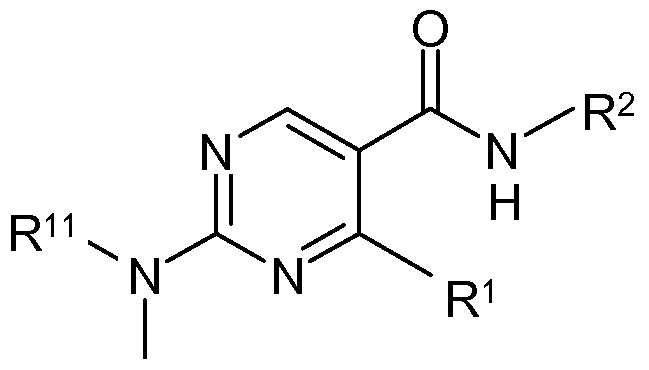
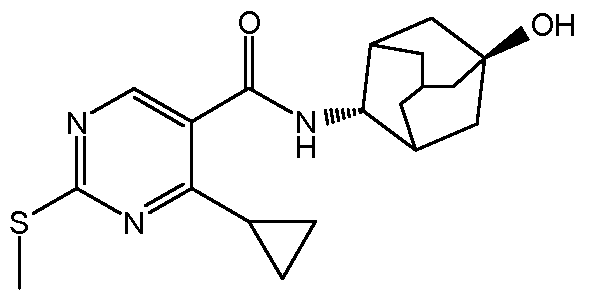
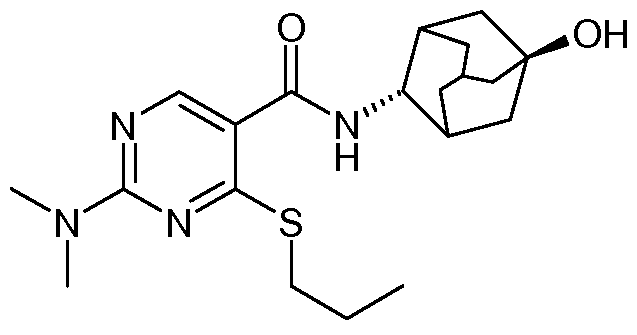
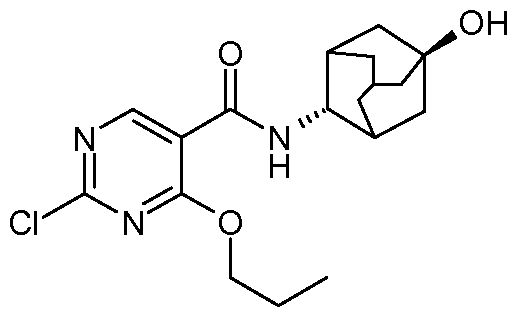
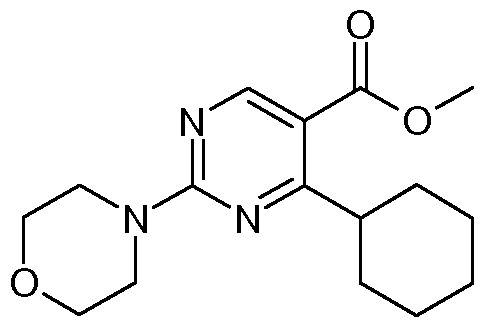
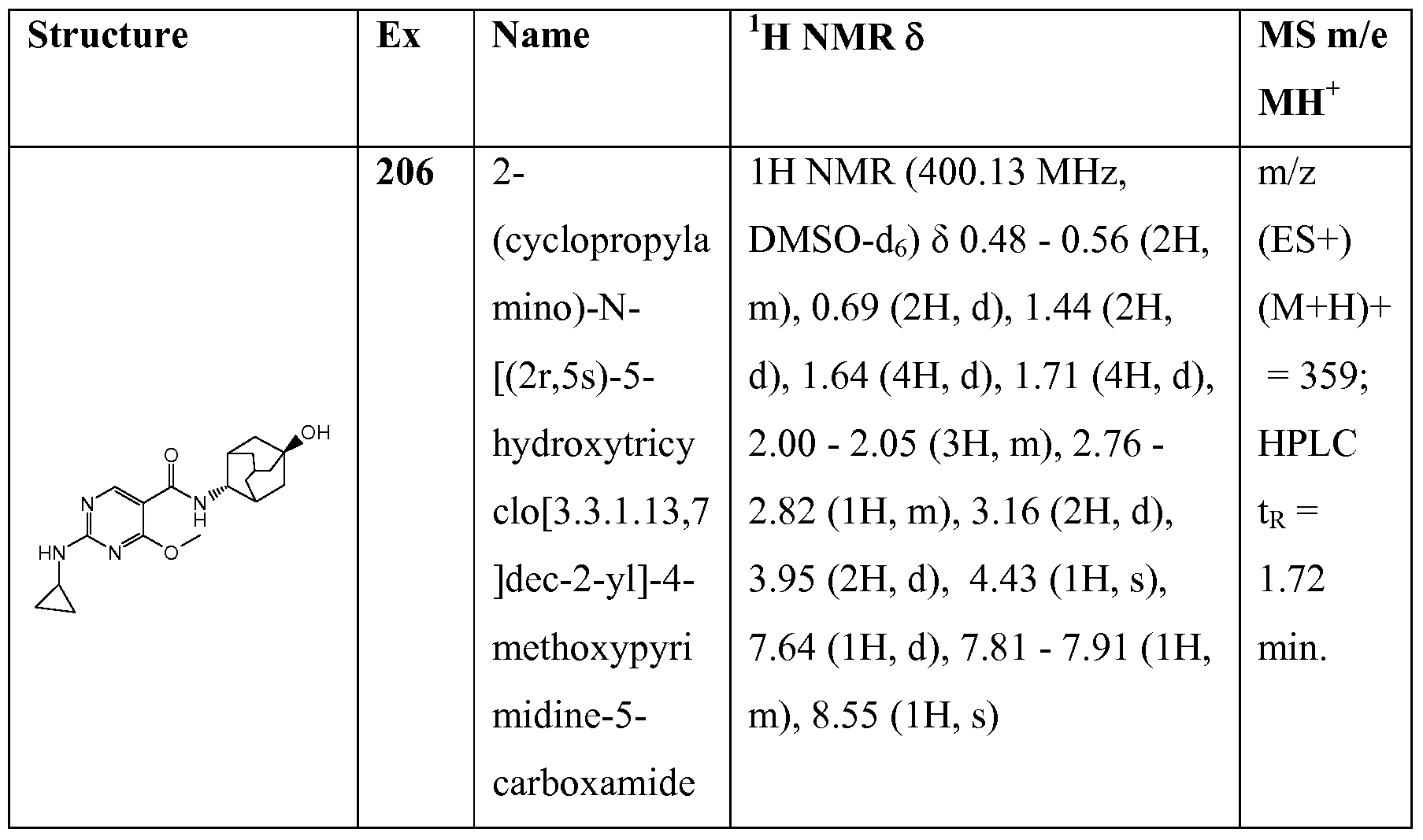
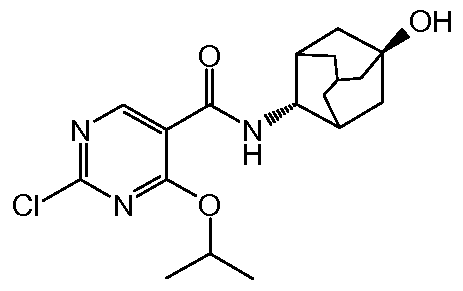
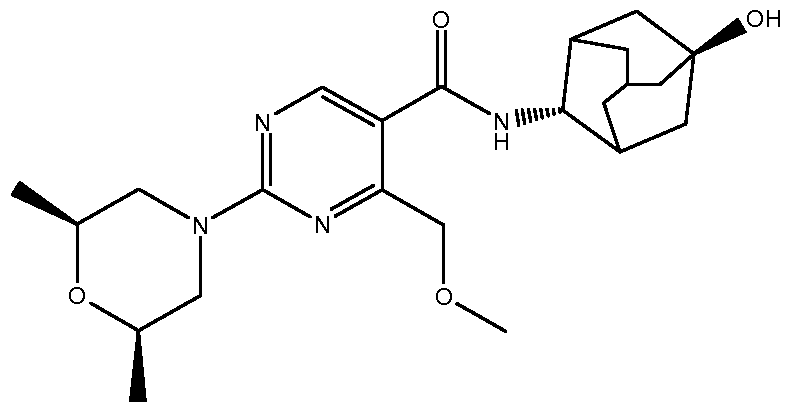
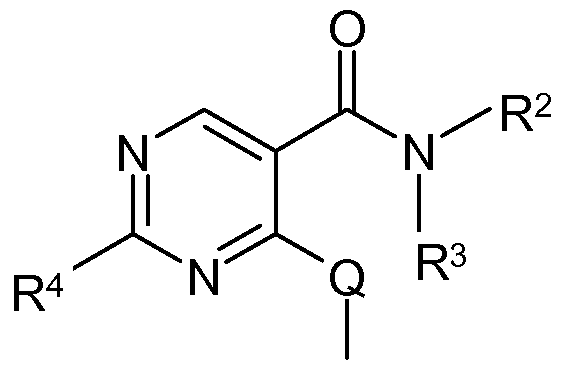
Substituted Pyrimidin-5-carboxamides 281
This invention relates to chemical compounds, or pharmaceutically-acceptable salts thereof. These compounds possess human 11-β-hydroxysteroid dehydrogenase type 1 enzyme (11 βHSD 1) inhibitory activity and accordingly have value in the treatment of disease states including metabolic syndrome and are useful in methods of treatment of a warm-blooded animal, such as man. The invention also relates to processes for the manufacture of said compounds, to pharmaceutical compositions containing them and to their use in the manufacture of medicaments to inhibit 1 lβHSDl in a warm-blooded animal, such as man.
Glucocorticoids (Cortisol in man, corticosterone in rodents) are counter regulatory hormones i.e. they oppose the actions of insulin (Dallman MF, Strack AM, Akana SF et al. 1993; Front Neuroendocrinol 14, 303-347). They regulate the expression of hepatic enzymes involved in gluconeogenesis and increase substrate supply by releasing glycerol from adipose tissue (increased lipolysis) and amino acids from muscle (decreased protein synthesis and increased protein degradation). Glucocorticoids are also important in the differentiation of pre-adipocytes into mature adipocytes which are able to store triglycerides (Bujalska IJ et al. 1999; Endocrinology 140, 3188-3196). This may be critical in disease states where glucocorticoids induced by "stress" are associated with central obesity which itself is a strong risk factor for type 2 diabetes, hypertension and cardiovascular disease (Bjorntorp P & Rosmond R 2000; Int. J. Obesity 24, S80-S85).
It is now well established that glucocorticoid activity is controlled not simply by secretion of Cortisol but also at the tissue level by intracellular interconversion of active Cortisol and inactive cortisone by the 11 -beta hydroxysteroid dehydrogenases, 1 lβHSDl (which activates cortisone) and 11 βHSD2 (which inactivates Cortisol) (Sandeep TC & Walker BR 2001 Trends in Endocrinol & Metab. 12, 446-453). That this mechanism may be important in man was initially shown using carbenoxolone (an anti-ulcer drug which inhibits both 1 lβHSDl and 2) treatment which (Walker BR et al. 1995; J. Clin. Endocrinol. Metab. 80, 3155-3159) leads to increased insulin sensitivity indicating that 1 lβHSDl may well be regulating the effects of insulin by decreasing tissue levels of active glucocorticoids (Walker BR et al. 1995; J. Clin. Endocrinol. Metab. 80, 3155-3159).
Clinically, Cushing's syndrome is associated with Cortisol excess which in turn is associated with glucose intolerance, central obesity (caused by stimulation of pre-adipocyte differentiation in this depot), dyslipidaemia and hypertension. Cushing's syndrome shows a number of clear parallels with metabolic syndrome. Even though the metabolic syndrome is not generally associated with excess circulating Cortisol levels (Jessop DS et al. 2001; J. Clin. Endocrinol. Metab. 86, 4109-4114) abnormally high 1 lβHSDl activity within tissues would be expected to have the same effect. In obese men it was shown that despite having similar or lower plasma Cortisol levels than lean controls, 1 lβHSDl activity in subcutaneous fat was greatly enhanced (Rask E et al. 2001; J. Clin. Endocrinol. Metab. 1418-1421). Furthermore, the central fat, associated with the metabolic syndrome expresses much higher levels of 1 lβHSDl activity than subcutaneous fat (Bujalska IJ et al. 1997; Lancet 349, 1210-1213). Thus there appears to be a link between glucocorticoids, 1 lβHSDl and the metabolic syndrome.
1 lβHSDl knock-out mice show attenuated glucocorticoid-induced activation of gluconeogenic enzymes in response to fasting and lower plasma glucose levels in response to stress or obesity (Kotelevtsev Y et al. 1997; Proc. Natl. Acad. Sci USA 94, 14924-14929) indicating the utility of inhibition of 1 lβHSDl in lowering of plasma glucose and hepatic glucose output in type 2 diabetes. Furthermore, these mice express an anti-atherogenic lipoprotein profile, having low triglycerides, increased HDL cholesterol and increased apo-lipoprotein AI levels. (Morton NM et al. 2001; J. Biol. Chem. 276,
41293-41300). This phenotype is due to an increased hepatic expression of enzymes of fat catabolism and PP ARa. Again this indicates the utility of 1 lβHSDl inhibition in treatment of the dyslipidaemia of the metabolic syndrome.
The most convincing demonstration of a link between the metabolic syndrome and 1 lβHSDl comes from recent studies of transgenic mice over-expressing 1 lβHSDl
(Masuzaki H et al. 2001; Science 294, 2166-2170). When expressed under the control of an adipose specific promoter, 1 lβHSDl transgenic mice have high adipose levels of corticosterone, central obesity, insulin resistant diabetes, hyperlipidaemia and hyperphagia. Most importantly, the increased levels of 1 lβHSDl activity in the fat of these mice are similar to those seen in obese subjects. Hepatic 11 βHSDl activity and plasma corticosterone levels were normal, however, hepatic portal vein levels of corticosterone
were increased 3 fold and it is thought that this is the cause of the metabolic effects in liver.
Overall it is now clear that the complete metabolic syndrome can be mimicked in mice simply by overexpressing 1 lβHSDl in fat alone at levels similar to those in obese man.
1 lβHSDl tissue distribution is widespread and overlapping with that of the glucocorticoid receptor. Thus, 1 lβHSDl inhibition could potentially oppose the effects of glucocorticoids in a number of physiological/pathological roles. 1 lβHSDl is present in human skeletal muscle and glucocorticoid opposition to the anabolic effects of insulin on protein turnover and glucose metabolism are well documented (Whorwood CB et al. 2001; J. Clin. Endocrinol. Metab. 86, 2296-2308). Skeletal muscle must therefore be an important target for 1 lβHSDl based therapy.
Glucocorticoids also decrease insulin secretion and this could exacerbate the effects of glucocorticoid induced insulin resistance. Pancreatic islets express 1 lβHSDl and carbenoxolone can inhibit the effects of 11-dehydocorticosterone on insulin release
(Davani B et al. 2000; J. Biol. Chem. 275, 34841-34844). Thus in treatment of diabetes 1 lβHSDl inhibitors may not only act at the tissue level on insulin resistance but also increase insulin secretion itself.
Skeletal development and bone function is also regulated by glucocorticoid action. 1 lβHSDl is present in human bone osteoclasts and osteoblasts and treatment of healthy volunteers with carbenoxolone showed a decrease in bone resorption markers with no change in bone formation markers (Cooper MS et al 2000; Bone 27, 375-381). Inhibition of 1 lβHSDl activity in bone could be used as a protective mechanism in treatment of osteoporosis. Glucocorticoids may also be involved in diseases of the eye such as glaucoma.
1 lβHSDl has been shown to affect intraocular pressure in man and inhibition of 1 lβHSDl may be expected to alleviate the increased intraocular pressure associated with glaucoma (Rauz S et al. 2001; Investigative Opthalmology & Visual Science 42, 2037-2042). There appears to be a convincing link between 11 βHSDl and the metabolic syndrome both in rodents and in humans. Evidence suggests that a drug which specifically inhibits 1 lβHSDl in type 2 obese diabetic patients will lower blood glucose by reducing
hepatic gluconeogenesis, reduce central obesity, improve the atherogenic lipoprotein phenotype, lower blood pressure and reduce insulin resistance. Insulin effects in muscle will be enhanced and insulin secretion from the beta cells of the islet may also be increased. Currently there are two main recognised definitions of metabolic syndrome.
1) The Adult Treatment Panel (ATP III 2001 JMA) definition of metabolic syndrome indicates that it is present if the patient has three or more of the following symptoms: Waist measuring at least 40 inches (102 cm) for men, 35 inches (88 cm) for women; Serum triglyceride levels of at least 150 mg/dl (1.69 mmol/1); HDL cholesterol levels of less than 40 mg/dl (1.04 mmol/1) in men, less than 50 mg/dl (1.29 mmol/1) in women;
Blood pressure of at least 135/80 mm Hg; and / or Blood sugar (serum glucose) of at least 110 mg/dl (6.1 mmol/1).
2) The WHO consultation has recommended the following definition which does not imply causal relationships and is suggested as a working definition to be improved upon in due course:
The patient has at least one of the following conditions: glucose intolerance, impaired glucose tolerance (IGT) or diabetes mellitus and/or insulin resistance; together with two or more of the following: Raised Arterial Pressure;
Raised plasma triglycerides
Central Obesity
Microalbuminuria
We have found that the compounds defined in the present invention, or a pharmaceutically-acceptable salt thereof, are effective 1 lβHSDl inhibitors, and accordingly have value in the treatment of disease states associated with metabolic syndrome.
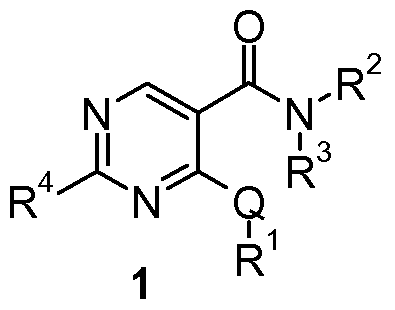
Accordingly there is provided a compound of formula (1):
(1) wherein:
Q is O, S, N(R8) or a single bond; R8 is selected from hydrogen, Ci_4alkyl, C3_scycloalkyl and C3_5cycloalkylmethyl (each of which is optionally substituted by 1, 2 or 3 fluoro atoms);
R1 is selected from Ci_6alkyl, C2-6alkenyl, C2-6alkynyl, C3_7Cycloalkyl, heterocyclyl, heteroaryl, aryl, arylCi_3alkyl, heteroarylCi_3alkyl, C3_7CycloalkylCi_3alkyl, heterocyclylCi_3alkyl, C3_7CycloalkylC2-3alkenyl and C3_7CycloalkylC2-3alkynyl, [each of which is optionally substituted, on available carbon atoms, by 1, 2 or 3 substituents independently selected from Ci_3alkyl, hydroxy, halo, oxo, cyano, trifluoromethyl, Ci_3alkoxy, Ci_3alkylS(O)n- (wherein n is 0, 1, 2 or 3), R5CON(R5')-, (R5')(R5")N-, (R5')(R5 ')NC(O)-, R5 C(O)O-, R5 OC(O)-, (R5')(R5 ")NC(0)N(R5 '")-, R5SO2N(R5")-, (R5')(R5")NSO2- and Ci_2alkyl optionally substituted by 1, 2 or 3 substituents independently selected from hydroxy, halo, carboxy and Ci_3alkoxy (wherein R5 is Ci_3alkyl optionally substituted by 1, 2 or 3 substituents independently selected from hydroxyl, halo and cyano; and
R5 , R5 and R5 are independently selected from hydrogen and Ci_3alkyl optionally substituted by 1, 2 or 3 substituents independently selected from hydroxyl, halo, Ci_3alkoxy, carboxy and cyano or R5 and R5 together with the nitrogen atom to which they are attached form a 4-7 membered saturated ring) and optionally substituted, on an available nitrogen, by a substituent independently selected from Ci_4alkyl, C2_4alkanoyl and Ci_4alkanesulphonyl each of which is optionally substituted by 1, 2 or 3 substituent independently selected from hydroxyl, halo, Ci_4alkoxy, carboxy and cyano]; or R1 and R8 together with the nitrogen atom to which they are attached form a saturated mono, bicyclic or bridged ring system optionally containing 1 or 2 additional ring heteroatoms independently selected from nitrogen, oxygen and sulphur and optionally fused to a saturated, partially saturated or unsaturated monocyclic ring wherein the
resulting ring system is optionally substituted, on available carbon atoms, by 1, 2, or 3 substituents independently selected from R9 and optionally substituted, on an available nitrogen, by a substituent independently selected from Ci_4alkyl, C2-4alkanoyl and Ci_ 4alkanesulphonyl each of which is optionally substituted by 1, 2 or 3 substituent independently selected from hydroxyl, halo, Ci_4alkoxy, carboxy and cyano;
R2 is selected from C3-7cycloalkyl(CH2)m-, and C6-i2polycycloalkyl(CH2)m- (wherein m is 0, 1 or 2 and the rings optionally contain 1 or 2 ring atoms independently selected from nitrogen, oxygen and sulphur are optionally substituted,on available carbon atoms, by 1 , 2 or 3 substituents independently selected from R6 and optionally substituted, on an available nitrogen, by a substituent independently selected from Ci_4alkyl, C2-4alkanoyl and Ci_ 4alkanesulphonyl each of which is optionally substituted by 1, 2 or 3 substituent independently selected from hydroxyl, halo, Ci_4alkoxy, carboxy and cyano); R3 is selected from hydrogen, Ci_4alkyl, C3_scycloalkyl and C3_5cycloalkylmethyl (each of which is optionally substituted by 1, 2 or 3 fluoro atoms); R2 and R3 together with the nitrogen atom to which they are attached form a saturated mono, bicyclic or bridged ring system optionally containing 1 or 2 additional ring heteroatoms independently selected from nitrogen, oxygen and sulphur and optionally fused to a saturated, partially saturated or unsaturated monocyclic ring wherein the resulting ring system is optionally substituted, on available carbon atoms, by 1, 2, or 3 substituents independently selected from R7 and optionally substituted, on an available nitrogen, by a substituent independently selected from Ci_4alkyl, C2-4alkanoyl and Ci_ 4alkanesulphonyl each of which is optionally substituted by 1, 2 or 3 substituent independently selected from hydroxyl, halo, Ci_4alkoxy, carboxy and cyano; R4 is selected from hydrogen, R10, -OR10, -SR10 and -NR11R12; R10 is selected from d_6alkyl, C2-6alkenyl, C2-6alkynyl, C3_7cycloalkyl, heterocyclyl, arylCi_3alkyl, heteroarylCi_3alkyl, heterocyclylC^alkyl, C3_7cycloalkylCi_3alkyl, C3_7cycloalkylC2-3alkenyl and C3_7cycloalkylC2-3alkynyl, [each of which is optionally substituted, on available carbon atoms, by 1, 2 or 3 substituents independently selected from Ci_3alkyl, hydroxy, halo, oxo, cyano, trifluoromethyl, C^alkoxy, Ci_3alkylS(O)p- (wherein p is 0, 1, 2 or 3), R13CON(R13')-, (R13')(R13")N-, (R13')(R13")NC(O)-, R13 C(O)O-, R13 OC(O)-, (R13')(R13 ")NC(O)N(R13 ")-, R13SO2N(R13")-, (R13')(R13")NSO2- and Ci_2alkyl optionally substituted by 1, 2 or 3 substituents independently selected from hydroxy, halo,
carboxy and Ci_3alkoxy (wherein R13 is C^alkyl optionally substituted by 1, 2 or 3 substituents selected from hydroxyl, halo and cyano; and
R13 , R13 and R13 are independently selected from hydrogen and Ci_3alkyl optionally substituted by 1, 2 or 3 substituents independently selected from hydroxyl, halo, Ci_3alkoxy, carboxy and cyano or R13 and R13 together with the nitrogen atom to which they are attached form a 4-7 membered saturated ring) and optionally substituted, on an available nitrogen, by a substituent independently selected from Ci_4alkyl, C2-4alkanoyl and Ci_4alkanesulphonyl each of which is optionally substituted by 1, 2 or 3 substituent independently selected from hydroxyl, halo, Ci_4alkoxy, carboxy and cyano]; R11 is selected from hydrogen, Ci_6alkyl, C2-6alkenyl, C2-6alkynyl, C3_7Cycloalkyl, heterocyclyl, arylCi_3alkyl, heteroarylCi_3alkyl, heterocyclylCi_3alkyl, C3_ 7CycloalkylCi_3alkyl, C3_7CycloalkylC2-3alkenyl and C3_7CycloalkylC2-3alkynyl, [each of which is optionally substituted, on available carbon atoms, by 1, 2 or 3 substituents independently selected from Ci_3alkyl, hydroxy, halo, oxo, cyano, trifluoromethyl, Ci_3alkoxy, Ci_3alkylS(O)q- (wherein q is 0, 1, 2 or 3), R14CON(R14')-, (R14')(R14")NC(O)-, R14 C(O)O-, R14 OC(O)-, (R14')(R14 ")NC(0)N(R14 ")-, R14SO2N(R14")-, (R14')(R14")NSO2- and Ci_2alkyl optionally substituted by 1, 2 or 3 substituents independently selected from hydroxy, halo, carboxy and Ci_3alkoxy (wherein R14 is Ci_3alkyl optionally substituted by 1, 2 or 3 substituents independently selected from hydroxyl, halo and cyano; and R14 , R14 and R14 are independently selected from hydrogen and Ci_3alkyl optionally substituted by 1, 2 or 3 substituents independently selected from hydroxyl, halo, Ci_3alkoxy, carboxy and cyano or R14 and R14 together with the nitrogen atom to which they are attached form a 4-7 membered saturated ring) and optionally substituted, on an available nitrogen, by a substituent independently selected from Ci_4alkyl, C2-4alkanoyl and Ci_4alkanesulphonyl each of which is optionally substituted by 1, 2 or 3 substituent independently selected from hydroxyl, halo, Ci_4alkoxy, carboxy and cyano]; and R12 is selected from hydrogen, Ci_4alkyl, C3_scycloalkyl and C3_5Cycloalkylmethyl (each of which is optionally substituted by 1, 2 or 3 fluoro atoms); or R11 and R12 together with the nitrogen atom to which they are attached form a saturated mono, bicyclic or bridged ring system optionally containing 1 or 2 additional ring heteroatoms independently selected from nitrogen, oxygen and sulphur and optionally fused to a saturated, partially saturated or unsaturated monocyclic ring (optionally
containing 1 or 2 additional ring heteroatoms independently selected from nitrogen, oxygen and sulphur) wherein the resulting ring system is optionally substituted, on available carbon atoms, by 1, 2, or 3 substituents independently selected from R15 and optionally substituted on an available nitrogen by a substituent independently selected from Ci_4alkyl, C2_4alkanoyl and Ci_4alkanesulphonyl each of which is optionally substituted by 1, 2 or 3 substituent independently selected from hydroxyl, halo, Ci_4alkoxy, carboxy and cyano;
R6, R7, R9 and R15 are independently selected from hydroxyl, halo, oxo, carboxy, cyano, trifluoromethyl, R16, R16O-, R16CO-, R16C(O)O-, R16CON(R16')-, (R16')(R16 ')NC(O)-, (R16')(R16")N-, R16S(OV wherein a is O to 2, R16 OC(O)-, (R16')(R16")NSO2-,
R16SO2N(R16")-, (R16 XR16^NC(O)N(R16'")-, phenyl and heteroaryl [wherein the phenyl and heteroaryl groups are optionally fused to a phenyl, heteroaryl or a saturated or partially-saturated 5- or 6-membered ring optionally containing 1, 2 or 3 heteroatoms independently selected from nitrogen, oxygen and sulphur and the resulting ring system is optionally substituted, on available carbon atoms, by 1, 2 or 3 substituents independently selected from Ci_4alkyl, hydroxyl, cyano, trifluoromethyl, trifluoromethoxy, halo, Ci_4alkoxy, Ci_4alkoxyCi_4alkyl, amino, N-Ci_4alkylamino, di-N,N-(Ci_4alkyl)amino, N-Ci_4alkylcarbamoyl, di-N,N-(Ci_4alkyl)carbamoyl, Ci_4alkylS(0)r- and Ci_4alkylS(O)rCi_4alkyl (wherein r is independently selected O, 1 and 2) and optionally substituted, on an available nitrogen, by a substituent independently selected from Ci_
4alkyl, C2-4alkanoyl and Ci_4alkanesulphonyl each of which is optionally substituted by 1, 2 or 3 substituent independently selected from hydroxyl, halo, Ci_4alkoxy, carboxy and cyano];
R16 is independently selected from, Ci_3alkyl optionally substituted by 1, 2 or 3 substituents independently selected from hydroxyl, halo, Ci_4alkoxy, carboxy and cyano; R16 , R16 and R16 are independently selected from hydrogen and Ci_3alkyl optionally substituted by 1, 2,or 3 substituents independently selected from hydroxyl, halo, Ci_4alkoxy, carboxy and cyano); or a pharmaceutically-acceptable salt thereof, for use as a as a medicament for producing a 11 βHSD 1 -inhibitory effect.
In another aspect the invention relates to a compound of the formula (1) as hereinabove defined or a pahrmaceutically-acceptable salt thereof, for use as a medicament for treating diabetes.
In another aspect the invention relates to a compound of the formula (1) as hereinabove defined or a pahrmaceutically-acceptable salt thereof, for use as a medicament for treating obesity.
In another aspect the invention relates to a compound of formula (1): wherein: Q is O, S, N(R8) or a single bond; R8 is selected from hydrogen, Ci_4alkyl, C3_scycloalkyl and C3_5Cycloalkylmethyl (each of which is optionally substituted by 1, 2 or 3 fluoro atoms);
R1 is selected from Ci_6alkyl, C2-6alkenyl, C2-6alkynyl, C3_7Cycloalkyl, heterocyclyl, heteroaryl, aryl, arylCi_3alkyl, heteroarylC^alkyl, C3_7cycloalkylCi_3alkyl, heterocyclylCi_3alkyl, C3-7cycloalkylC2-3alkenyl and C3-7cycloalkylC2-3alkynyl, [each of which is optionally substituted, on available carbon atoms, by 1, 2 or 3 substituents independently selected from Ci_3alkyl, hydroxy, halo, oxo, cyano, trifluoromethyl, Ci_3alkoxy, Ci_3alkylS(O)n- (wherein n is 0, 1, 2 or 3), R5CON(R5')-, (R5')(R5")N-, (R5')(R5 ')NC(O)-, R5 C(O)O-, R5 OC(O)-, (R5')(R5 ")NC(0)N(R5 '")-, R5SO2N(R5")-, (R5')(R5")NSO2- and Ci_2alkyl optionally substituted by 1, 2 or 3 substituents independently selected from hydroxy, halo, carboxy and Ci_3alkoxy (wherein R5 is Ci_3alkyl optionally substituted by 1, 2 or 3 substituents independently selected from hydroxyl, halo and cyano; and
R5 , R5 and R5 are independently selected from hydrogen and Ci_3alkyl optionally substituted by 1, 2 or 3 substituents independently selected from hydroxyl, halo, Ci_3alkoxy, carboxy and cyano or R5 and R5 together with the nitrogen atom to which they are attached form a 4-7 membered saturated ring) and optionally substituted, on an available nitrogen, by a substituent independently selected from Ci_4alkyl, C2-4alkanoyl and Ci_4alkanesulphonyl each of which is optionally substituted by 1, 2 or 3 substituent independently selected from hydroxyl, halo, Ci_4alkoxy, carboxy and cyano]; or R1 and R8 together with the nitrogen atom to which they are attached form a saturated mono, bicyclic or bridged ring system optionally containing 1 or 2 additional ring heteroatoms independently selected from nitrogen, oxygen and sulphur and optionally
fused to a saturated, partially saturated or unsaturated monocyclic ring wherein the resulting ring system is optionally substituted, on available carbon atoms, by 1, 2, or 3 substituents independently selected from R9 and optionally substituted, on an available nitrogen, by a substituent independently selected from Ci_4alkyl, C2-4alkanoyl and Ci_ 4alkanesulphonyl each of which is optionally substituted by 1, 2 or 3 substituent independently selected from hydroxyl, halo, Ci_4alkoxy, carboxy and cyano; R2 is selected from adamantyl optionally substituted,on available carbon atoms, by 1 or substituents independently selected from R6; R3 is hydrogen; R4 is selected from hydrogen, R10, -OR10, -SR10 and -NR11R12;
R10 is selected from Ci_6alkyl, C2-6alkenyl, C2-6alkynyl, C3_7Cycloalkyl, heterocyclyl, arylCi_3alkyl, heteroarylCi_3alkyl, heterocyclylCi_3alkyl, C3_7CycloalkylCi_3alkyl, C3_7cycloalkylC2_3alkenyl and C3_7cycloalkylC2_3alkynyl, [each of which is optionally substituted, on available carbon atoms, by 1, 2 or 3 substituents independently selected from Ci_3alkyl, hydroxy, halo, oxo, cyano, trifluoromethyl, Ci_3alkoxy, Ci_3alkylS(O)p-
(wherein p is 0, 1, 2 or 3), R13CON(R13')-, (R13')(R13")N-, (R13')(R13 ')NC(O)-, R13 C(O)O-, R13 OC(O)-, (R13')(R13 ")NC(O)N(R13 ")-, R13SO2N(R13")-, (R13')(R13")NSO2- and C1-2alkyl optionally substituted by 1, 2 or 3 substituents independently selected from hydroxy, halo, carboxy and Ci_3alkoxy (wherein R13 is Ci_3alkyl optionally substituted by 1, 2 or 3 substituents selected from hydroxyl, halo and cyano; and
R13 , R13 and R13 are independently selected from hydrogen and Ci_3alkyl optionally substituted by 1, 2 or 3 substituents independently selected from hydroxyl, halo, Ci_3alkoxy, carboxy and cyano or R13 and R13 together with the nitrogen atom to which they are attached form a 4-7 membered saturated ring) and optionally substituted, on an available nitrogen, by a substituent independently selected from Ci_4alkyl, C2_4alkanoyl and Ci_4alkanesulphonyl each of which is optionally substituted by 1, 2 or 3 substituent independently selected from hydroxyl, halo, Ci_4alkoxy, carboxy and cyano]; R11 is selected from hydrogen, Ci_6alkyl, C2-6alkenyl, C2-6alkynyl, C3_7Cycloalkyl, heterocyclyl, arylC^alkyl, heteroarylCi_3alkyl, heterocyclylCi_3alkyl, C3_ 7cycloalkylCi_3alkyl, C3_7CycloalkylC2-3alkenyl and C3_7CycloalkylC2-3alkynyl, [each of which is optionally substituted, on available carbon atoms, by 1, 2 or 3 substituents independently selected from Ci_3alkyl, hydroxy, halo, oxo, cyano, trifluoromethyl,
Ci_3alkoxy, Ci_3alkylS(O)q- (wherein q is 0, 1, 2 or 3), R14CON(R14')-, (R14')(R14")NC(O)-, R14 C(O)O-, R14 OC(O)-, (R14')(R14 ")NC(0)N(R14 ")-, R14SO2N(R14")-, (R14')(R14")NSO2- and Ci_2alkyl optionally substituted by 1, 2 or 3 substituents independently selected from hydroxy, halo, carboxy and Ci_3alkoxy (wherein R14 is Ci_3alkyl optionally substituted by 1, 2 or 3 substituents independently selected from hydroxyl, halo and cyano; and
R14 , R14 and R14 are independently selected from hydrogen and Ci_3alkyl optionally substituted by 1, 2 or 3 substituents independently selected from hydroxyl, halo, Ci_3alkoxy, carboxy and cyano or R14 and R14 together with the nitrogen atom to which they are attached form a 4-7 membered saturated ring) and optionally substituted, on an available nitrogen, by a substituent independently selected from Ci_4alkyl, C2_4alkanoyl and Ci_4alkanesulphonyl each of which is optionally substituted by 1, 2 or 3 substituent independently selected from hydroxyl, halo, Ci_4alkoxy, carboxy and cyano]; and R12 is selected from hydrogen, Ci_4alkyl, C3_scycloalkyl and C3_5cycloalkylmethyl (each of which is optionally substituted by 1, 2 or 3 fluoro atoms); or R11 and R12 together with the nitrogen atom to which they are attached form a saturated mono, bicyclic or bridged ring system optionally containing 1 or 2 additional ring heteroatoms independently selected from nitrogen, oxygen and sulphur and optionally fused to a saturated, partially saturated or unsaturated monocyclic ring (optionally containing 1 or 2 additional ring heteroatoms independently selected from nitrogen, oxygen and sulphur) wherein the resulting ring system is optionally substituted, on available carbon atoms, by 1, 2, or 3 substituents independently selected from R15 and optionally substituted on an available nitrogen by a substituent independently selected from Ci_4alkyl, C2_4alkanoyl and Ci_4alkanesulphonyl each of which is optionally substituted by 1, 2 or 3 substituent independently selected from hydroxyl, halo, Ci_4alkoxy, carboxy and cyano;
R6, R7, R9 and R15 are independently selected from hydroxyl, halo, oxo, carboxy, cyano, trifluoromethyl, R16, R16O-, R16CO-, R16C(O)O-, R16CON(R16')-, (R16')(R16 ')NC(O)-, (R16')(R16")N-, R16S(OV wherein a is O to 2, R16 OC(O)-, (R16')(R16")NSO2-, R16SO2N(R16")-, (R16 XR16^NC(O)N(R16'")-, phenyl and heteroaryl [wherein the phenyl and heteroaryl groups are optionally fused to a phenyl, heteroaryl or a saturated or partially-saturated 5- or 6-membered ring optionally containing 1, 2 or 3 heteroatoms independently selected from nitrogen, oxygen and sulphur and the resulting ring system is
optionally substituted, on available carbon atoms, by 1, 2 or 3 substituents independently selected from Ci_4alkyl, hydroxyl, cyano, trifluoromethyl, trifluoromethoxy, halo, Ci_4alkoxy, Ci_4alkoxyCi_4alkyl, amino, N-Ci_4alkylamino, di-N,N-(Ci_4alkyl)amino, N-Ci_4alkylcarbamoyl, di-N,N-(Ci_4alkyl)carbamoyl, Ci_4alkylS(0)r- and Ci_4alkylS(O)rCi_4alkyl (wherein r is independently selected 0, 1 and 2) and optionally substituted, on an available nitrogen, by a substituent independently selected from Ci_ 4alkyl, C2-4alkanoyl and Ci_4alkanesulphonyl each of which is optionally substituted by 1, 2 or 3 substituent independently selected from hydroxyl, halo, Ci_4alkoxy, carboxy and cyano]; R16 is independently selected from, Ci_3alkyl optionally substituted by 1, 2 or 3 substituents independently selected from hydroxyl, halo, Ci_4alkoxy, carboxy and cyano; R16 , R16 and R16 are independently selected from hydrogen and Ci_3alkyl optionally substituted by 1, 2,or 3 substituents independently selected from hydroxyl, halo, Ci_4alkoxy, carboxy and cyano); or a pharmaceutically-acceptable salt thereof.
In this specification the term "alkyl" includes both straight and branched chain alkyl groups but references to individual alkyl groups such as "propyl" are specific for the straight chain version only. For example, "Ci_4alkyl" includes propyl, isopropyl and t-butyl. However, references to individual alkyl groups such as 'propyl' are specific for the straight chain version only and references to individual branched chain alkyl groups such as 'isopropyl' are specific for the branched chain version only. A similar convention applies to other radicals therefore "arylCi_4alkyl" would include 1-arylpropyl, 2-arylethyl and 3-arylbutyl. The term "halo" refers to fluoro, chloro, bromo and iodo.
Where optional substituents are chosen from "one or more" groups it is to be understood that this definition includes all substituents being chosen from one of the specified groups or the substituents being chosen from two or more of the specified groups.
A 4-7 membered saturated ring (for example formed between R5 and R5 and the nitrogen atom to which they are attached) is a monocyclic ring containing the nitrogen atom as the only ring atom. "Heteroaryl", unless otherwise specified, is a totally unsaturated, monocyclic ring containing 5 or 6 atoms of which at least 1, 2 or 3 ring atoms are independently chosen from nitrogen, sulphur or oxygen, which may, unless otherwise specified, be carbon-
linked. A ring nitrogen atom may be optionally oxidised to form the corresponding N- oxide. Examples and suitable values of the term "heteroaryl" are thienyl, furyl, thiazolyl, pyrazolyl, isoxazolyl, imidazolyl, pyrrolyl, thiadiazolyl, isothiazolyl, triazolyl, pyrimidyl, pyrazinyl, pyridazinyl and pyridyl. Particularly "heteroaryl" refers to thienyl, furyl, thiazolyl, pyridyl, imidazolyl or pyrazolyl.
"Heterocylcyl" is a 4-7 saturated, monocyclic ring having 1-3 ring heteroatoms independently selected from nitrogen, oxygen and sulphur. The ring sulphur may be optionally oxidised to SO or SO2.
"Aryl" is an aromatic carbocyclic ring i.e. phenyl or naphthyl. A C3_7Cycloalkyl ring is a saturated carbon ring containing from 3 to 7 ring atoms.
A C6-i2polycycloalkyl ring is a ring system in which either at least 2 rings are fused together (fused or bridged) or in which 2 ring have one ring atom in common (spiro). An example of a polycycloalkyl ring is adamantly.
A "saturated mono, bicyclic or bridged ring system optionally containing 1 or 2 additional ring heteroatoms independently selected from nitrogen, oxygen and sulphur", unless otherwise specified contains 4-14 ring atoms. Particularly a mono ring contains 4 - 7 ring atoms, a bicyclic ring 6-14 ring atoms and a bridged ring system 6-14 ring atoms. Examples of mono rings include piperidinyl, piperazinyl and morpholinyl. Examples of bicyclic rings include decalin and 2,3,3a,4,5,6,7,7a-octahydro-lH-indene. Bridged ring systems are ring systems in which there are two or more bonds common to two or more constituent rings. Examples of bridged ring systems include l,3,3-trimethyl-6-azabicyclo[3.2.1]octane, 2-aza-bicyclo[2.2.1]heptane and 7- azabicyclo(2,2,l)heptane, 1- and 2-adamantanyl.
A "saturated, partially saturated or unsaturated monocyclic ring" is, unless otherwise specified, a 4-7 membered carbon ring. Examples include, cyclopropyl, cyclobutyl, cyclopentyl, cyclopentenyl, cyclohexyl, cyclohexenyl and phenyl.
Examples of "Ci_4alkoxy" include methoxy, ethoxy and propoxy. Examples of "Ci_4alkoxyCi_4alkyl" include methoxymethyl, ethoxymethyl, propoxymethyl, 2- methoxyethyl, 2-ethoxyethyl and 2-propoxyethyl. Examples of "Ci_4alkylS(O)n or p or q or r wherein n or p or q or r is 0 to 2" include methylthio, ethylthio, methylsulphinyl, ethylsulphinyl, mesyl and ethylsulphonyl. Examples of "Ci_4alkylS(O)rCi_4alkyl" wherein r is 0 to 2" include methylthio, ethylthio, methylsulphinyl, ethylsulphinyl, mesyl,
ethylsulphonyl, methylthiomethyl, ethylthiomethyl, methylsulphinylmethyl, ethylsulphinylmethyl, mesylmethyl and ethylsulphonylmethyl. Examples of "Ci_4alkanoyl" include propionyl and acetyl. Examples of W-(Ci_4alkyl)amino" include methylamino and ethylamino. Examples of W,Λ/-(Ci_4alkyl)2amino" include Λ/,N-dimethylamino, JV,jV-diethylamino and N-ethyl-N-methylamino. Examples of "C2_4alkenyl" are vinyl, allyl and 1-propenyl. Examples of "C2-4alkynyl" are ethynyl, 1-propynyl and 2-propynyl. Examples of 'W-(Ci_4alkyl)carbamoyl" are methylaminocarbonyl and ethylaminocarbonyl. Examples of 'W,iV-(Ci_4alkyl)2carbamoyl" are dimethylaminocarbonyl and methylethylaminocarbonyl. Examples of "C3_7cycloalkylCi_3alkyl" include cyclopropymethyl, 2-cyclopropylethyl, cyclobutylmethyl, cyclopentylmethyl and cyclohexylmethyl. Examples of "C3_7CycloalkylC2-3alkenyl" include 2-cyclopropylethenyl, 2-cyclopentylethenyl and 2-cyclohexylethenyl. Examples of "C3_7CycloalkylC2-3alkynyl" include 2-cyclopropylethynyl, 2-cyclopentylethynyl and 2-cyclohexylethynyl. Examples of "C3-7cycloalkyl(CH2)m-" include cyclopropymethyl, 2- cyclopropylethyl, cyclobutylmethyl, cyclopentylmethyl and cyclohexylmethyl. Examples of C6-i2polycycloalkyl(CH2)m- include norbornyl bicyclo[2.2.2]octane(CH2)m-, bicyclo[3.2.1]octane(CH2)m_ and 1- and 2-adamantanyl(CH2)m-.
A suitable pharmaceutically-acceptable salt of a compound of the invention is, for example, an acid-addition salt of a compound of the invention which is sufficiently basic, for example, an acid-addition salt with, for example, an inorganic or organic acid, for example hydrochloric, hydrobromic, sulphuric, phosphoric, trifluoroacetic, citric or maleic acid. In addition a suitable pharmaceutically-acceptable salt of a compound of the invention which is sufficiently acidic is an alkali metal salt, for example a sodium or potassium salt, an alkaline earth metal salt, for example a calcium or magnesium salt, an ammonium salt or a salt with an organic base which affords a physiologically-acceptable cation, for example a salt with methylamine, dimethylamine, trimethylamine, piperidine, morpholine or tris-(2-hydroxyethyl)amine.
Some compounds of the formula (1) may have chiral centres and/or geometric isomeric centres (E- and Z- isomers), and it is to be understood that the invention encompasses all such optical, diastereoisomers and geometric isomers that possess 1 lβHSDl inhibitory activity.
The invention relates to any and all tautomeric forms of the compounds of the formula (1) that possess 1 lβHSDl inhibitory activity.
It is also to be understood that certain compounds of the formula (1) can exist in solvated as well as unsolvated forms such as, for example, hydrated forms. It is to be understood that the invention encompasses all such solvated forms, which possess 1 lβHSDl inhibitory activity.
In another, there is provided a compound of formula (1) wherein: Q is O, S, N(R8) or a single bond; R8 is selected from hydrogen, Ci_4alkyl, C3-5cycloalkyl and Cs-scycloalkylmethyl (each of which is optionally substituted by 1, 2 or 3 fluoro atoms);
R1 is selected from Ci_6alkyl, C2-6alkenyl, C2-6alkynyl, C3-7cycloalkyl, heterocyclyl, heteroaryl, aryl, arylCi_3alkyl, heteroarylCi_3alkyl, heterocyclylCi_3alkyl, C3. 7CycloalkylCi_3alkyl, C3_7CycloalkylC2-3alkenyl and C3_7CycloalkylC2-3alkynyl, [each of which is optionally substituted, on available carbon atoms, by 1, 2 or 3 substituents independently selected from Ci_3alkyl, hydroxy, halo, oxo, cyano, trifluoromethyl, Ci_3alkoxy, Ci_3alkylS(O)n- (wherein n is 0, 1, 2 or 3), R5CON(R5')-, (R5')(R5")N-, (R5')(R5 ')NC(O)-, R5 C(O)O-, R5 OC(O)-, (R5')(R5 ")NC(0)N(R5 '")-, R5SO2N(R5")-, (R5')(R5")NSO2- and d_2alkyl optionally substituted by 1, 2 or 3 substituents independently selected from hydroxy, halo, carboxy and Ci_3alkoxy (wherein R5 is Ci_3alkyl optionally substituted by 1, 2 or 3 substituents independently selected from hydroxyl, halo and cyano; and
R5 , R5 and R5 are independently selected from hydrogen and Ci_3alkyl optionally substituted by 1, 2 or 3 substituents independently selected from hydroxyl, halo, Ci_3alkoxy, carboxy and cyano or R5 and R5 together with the nitrogen atom to which they are attached form a 4-7 membered saturated ring) and optionally substituted, on an available nitrogen, by a substituent independently selected from Ci_4alkyl, C2-4alkanoyl and Ci_4alkanesulphonyl]; or
R1 and R8 together with the nitrogen atom to which they are attached form a saturated mono, bicyclic or bridged ring system optionally containing 1 or 2 additional ring heteroatoms independently selected from nitrogen, oxygen and sulphur and optionally fused to a saturated, partially saturated or unsaturated monocyclic ring wherein the resulting ring system is optionally substituted, on available carbon atoms, by 1, 2, or 3
substituents independently selected from R9 and optionally substituted, on an available nitrogen, by a substituent independently selected from Ci_4alkyl, C2-4alkanoyl and Ci_ 4alkanesulphonyl;
R2 is selected from C3_7Cycloalkyl(CH2)m-, and C6-i2polycycloalkyl(CH2)m- (wherein m is 0, 1 or 2 and the rings optionally contain 1 or 2 ring atoms independently selected from nitrogen, oxygen and sulphur are optionally substituted,on available carbon atoms, by 1 , 2 or 3 substituents independently selected from R6 and optionally substituted, on an available nitrogen, by a substituent independently selected from Ci_4alkyl, C2-4alkanoyl and Ci_ 4alkanesulphony 1) ; R3 is selected from hydrogen, Ci_4alkyl, C3_scycloalkyl and C3_5Cycloalkylmethyl (each of which is optionally substituted by 1, 2 or 3 fluoro atoms);
R2 and R3 together with the nitrogen atom to which they are attached form a saturated mono, bicyclic or bridged ring system optionally containing 1 or 2 additional ring heteroatoms independently selected from nitrogen, oxygen and sulphur and optionally fused to a saturated, partially saturated or unsaturated monocyclic ring wherein the resulting ring system is optionally substituted, on available carbon atoms, by 1, 2, or 3 substituents independently selected from R7 and optionally substituted, on an available nitrogen, by a substituent independently selected from Ci_4alkyl, C2-4alkanoyl and Ci_ 4alkanesulphonyl; R4 is selected from hydrogen, R10, -OR10, -SR10 and -NR11R12;
R10 is selected from Ci_6alkyl, C2_6alkenyl, C2_6alkynyl, C3_7cycloalkyl, heterocyclyl, arylCi_3alkyl, heteroarylCi_3alkyl, C3_7CycloalkylCi_3alkyl, C3_7CycloalkylC2-3alkenyl and C3_7CycloalkylC2-3alkynyl, [each of which is optionally substituted, on available carbon atoms, by 1, 2 or 3 substituents independently selected from Ci_3alkyl, hydroxy, halo, oxo, cyano, trifluoromethyl, d_3alkoxy, Ci_3alkylS(O)p- (wherein p is 0, 1, 2 or 3), R13CON(R13')-, (R13')(R13 ")N-, (R13')(R13 ')NC(O)-, R13 C(O)O-, R13 OC(O)-, (R13')(R13")NC(O)N(R13'")-, R13SO2N(R13")-, (R13')(R13")NSO2- and Ci_2alkyl optionally substituted by 1, 2 or 3 substituents independently selected from hydroxy, halo, carboxy and Ci_3alkoxy (wherein R13 is Ci_3alkyl optionally substituted by 1, 2 or 3 substituents selected from hydroxyl, halo and cyano; and
R13 , R13 and R13 are independently selected from hydrogen and Ci_3alkyl optionally substituted by 1, 2 or 3 substituents independently selected from hydroxyl, halo,
Ci_3alkoxy, carboxy and cyano or R13 and R13 together with the nitrogen atom to which they are attached form a 4-7 membered saturated ring) and optionally substituted, on an available nitrogen, by a substituent independently selected from Ci_4alkyl, C2-4alkanoyl and Ci_4alkanesulphonyl]; R11 is selected from hydrogen, Ci_6alkyl, C2_6alkenyl, C2_6alkynyl, C3_7cycloalkyl, heterocyclyl, arylCi_3alkyl, heteroarylCi_3alkyl, C3_7CycloalkylCi_3alkyl, C3_7CycloalkylC2-3alkenyl and C3_7CycloalkylC2-3alkynyl, [each of which is optionally substituted, on available carbon atoms, by 1, 2 or 3 substituents independently selected from Ci_3alkyl, hydroxy, halo, oxo, cyano, trifluoromethyl, d_3alkoxy, Ci_3alkylS(O)q- (wherein q is 0, 1 , 2 or 3), R14CON(R14')-, (R14')(R14 ')NC(O)-, R14 C(O)O-, R14 OC(O)-, (R14 XR14^NC(O)N(R14'")-, R14SO2N(R14")-, (R14')(R14")NSO2- and Ci_2alkyl optionally substituted by 1, 2 or 3 substituents independently selected from hydroxy, halo, carboxy and Ci_3alkoxy (wherein R14 is Ci_3alkyl optionally substituted by 1, 2 or 3 substituents independently selected from hydroxyl, halo and cyano; and R14 , R14 and R14 are independently selected from hydrogen and Ci_3alkyl optionally substituted by 1, 2 or 3 substituents independently selected from hydroxyl, halo, Ci_3alkoxy, carboxy and cyano or R14 and R14 together with the nitrogen atom to which they are attached form a 4-7 membered saturated ring) and optionally substituted, on an available nitrogen, by a substituent independently selected from Ci_4alkyl, C2-4alkanoyl and Ci_4alkanesulphonyl]; and
R12 is selected from hydrogen, Ci_4alkyl, C3_scycloalkyl and C3_5cycloalkylmethyl (each of which is optionally substituted by 1, 2 or 3 fluoro atoms); or
R11 and R12 together with the nitrogen atom to which they are attached form a saturated mono, bicyclic or bridged ring system optionally containing 1 or 2 additional ring heteroatoms independently selected from nitrogen, oxygen and sulphur and optionally fused to a saturated, partially saturated or unsaturated monocyclic ring (optionally containing 1 or 2 additional ring heteroatoms independently selected from nitrogen, oxygen and sulphur) wherein the resulting ring system is optionally substituted, on available carbon atoms, by 1, 2, or 3 substituents independently selected from R15 and optionally substituted on an available nitrogen by a substituent independently selected from Ci_4alkyl, C2-4alkanoyl and Ci_4alkanesulphonyl;
R6, R7, R9 and R15 are independently selected from hydroxyl, halo, oxo, carboxy, cyano, trifluoromethyl, R16, R16O-, R16CO-, R16C(O)O-, R16CON(R16')-, (R16')(R16 ')NC(O)-, (R16')(R16")N-, R16S(OV wherein a is O to 2, R16 OC(O)-, (R16')(R16")NSO2-, R16SO2N(R16")-, (R16 XR16^NC(O)N(R16'")-, phenyl and heteroaryl [wherein the phenyl and heteroaryl groups are optionally fused to a phenyl, heteroaryl or a saturated or partially-saturated 5- or 6-membered ring optionally containing 1, 2 or 3 heteroatoms independently selected from nitrogen, oxygen and sulphur and the resulting ring system is optionally substituted, on available carbon atoms, by 1, 2 or 3 substituents independently selected from Ci_4alkyl, hydroxyl, cyano, trifluoromethyl, trifluoromethoxy, halo, Ci_4alkoxy, Ci_4alkoxyCi_4alkyl, amino, N-Ci_4alkylamino, di-N,N-(Ci_4alkyl)amino, N-Ci_4alkylcarbamoyl, di-N,N-(Ci_4alkyl)carbamoyl, Ci_4alkylS(0)r- and Ci_4alkylS(O)rCi_4alkyl (wherein r is independently selected O, 1 and 2) and optionally substituted, on an available nitrogen, by a substituent independently selected from C1- 4alkyl, C2-4alkanoyl and Ci_4alkanesulphonyl]; R16 is independently selected from, Ci_3alkyl optionally substituted by 1, 2 or 3 substituents independently selected from hydroxyl, halo, Ci_4alkoxy, carboxy and cyano; R16 , R16 and R16 are independently selected from hydrogen and C^alkyl optionally substituted by 1, 2,or 3 substituents independently selected from hydroxyl, halo, Ci_4alkoxy, carboxy and cyano); or a pharmaceutically-acceptable salt thereof ; provided that: i) when -QR1 is N-(3-chloro-4-methoxybenzyl)amino then -NR2R3 is not N-(4- hydroxycyclohexyl)amino; and ii) when -QR1 is 2-fluorophenyl, 4-cyanophenyl or 3-methylphenyl then R4 is not morpholino, pyrrolidino, 4-methylpiperidino, cyclohexylmethylamino, 2- methoxyethylamino, 3-methoxypropylamino or cyclopropylmethylamino; and excluding:
2-[(2,4-dichlorophenyl)amino]-N-(tetrahydro-2H-pyran-4-yl)methyl]-4-(trifluoromethyl)- 5-pyrimidinecarboxamide;
4-methyl-N-[2-(4-morpholinyl)ethyl]-2-(l-pyrrolidinyl)- 5-pyrimidinecarboxamide; N-cycloheptyl-2-(dimethylamino)-4-methyl-5-pyrimidinecarboxamide;
N-cyclopentyl-4-methyl-2-(4-morpholinyl)- 5-pyrimidinecarboxamide;
N-cyclohexyl-2-(dimethylamino)-4-methyl-5-pyrimidinecarboxamide;
N-cycloheptyl-4-methyl-2-( 1 -piperidinyl)- 5-pyrimidinecarboxamide;
N-cyclopropyl-4-methyl-2-(4-morpholinyl)- 5-pyrimidinecarboxamide; N-cyclopentyl-2-(dimethylamino)-4-methyl-5-pyrimidinecarboxamide;
4-methyl-2-(4-morpholinyl)-N-[2-(4-morpholinyl)ethyl]- 5-pyrimidinecarboxamide;
N-cycloheptyl-4-methyl-2-(4-methyl- 1 -piperazinyl)- 5-pyrimidinecarboxamide;
2-(dimethylamino)-4-methyl-N-[2-(4-morpholinyl)ethyl]- 5-pyrimidinecarboxamide;
2-(4-ethyl-l-piperazinyl)-4-methyl-N-[2-(4-morpholinyl)ethyl]- 5-pyrimidinecarboxamide; N-cyclohexyl-2-(4-ethyl- 1 -piperazinyl)-4-methyl-5-pyrimidinecarboxamide;
N-cyclopropyl-2-(4-ethyl-l-piperazinyl)-4-methyl-5-pyrimidinecarboxamide;
N-cyclohexyl-4-methyl-2-(4-methyl-l -piperazinyl)- 5-pyrimidinecarboxamide;
N-cyclohexyl-4-methyl-2-(4-morpholinyl)- 5-pyrimidinecarboxamide;
N-cyclopentyl-2-[[(2-methoxyphenyl)methyl]amino]-4-methyl-5-pyrimidinecarboxamide; N-cyclohexyl-2- [ [(4-methoxyphenyl)methyl] amino] -4-methyl-5 -pyrimidinecarboxamide;
N-cycloheptyl-2-[[(4-methoxyphenyl)methyl]amino]-4-methyl-5-pyrimidinecarboxamide;
N-cyclopentyl-2-[[(3-methoxyphenyl)methyl]amino]-4-methyl-5-pyrimidinecarboxamide;
2-ethyl-4-methyl-N-[(tetrahydro-2-furanyl)methyl]- 5-pyrimidinecarboxamide;
N-cyclopentyl-2-[[(4-methoxyphenyl)methyl]amino]-4-methyl-5-pyrimidinecarboxamide; N-cyclopropyl-2-ethyl-4-methyl-5 -pyrimidinecarboxamide;
N-cyclohexyl-2-(methylthio)-4-propyl-5-pyrimidinecarboxamide;
N-cycloheptyl-4-ethyl-2-(methylthio)- 5-pyrimidinecarboxamide;
N-cycloheptyl-2-[[(3-methoxyphenyl)methyl]amino]-4-methyl-5-pyrimidinecarboxamide;
N-cyclopentyl-2-(4-ethyl-l-piperazinyl)-4-methyl-5-pyrimidinecarboxamide; N-cyclohexyl-2- [ [(2-methoxyphenyl)methyl] amino] -4-methyl-5 -pyrimidinecarboxamide;
N-cycloheptyl-4-methyl-2-(4-morpholinyl)- 5-pyrimidinecarboxamide;
4-methyl-2-(4-morpholinyl)-N- [2-( 1 -pyrrolidinyl)ethyl] - 5 -pyrimidinecarboxamide;
N-cyclopentyl-4-methyl-2- [(phenylmethyl)amino] - 5 -pyrimidinecarboxamide;
N-cyclohexyl-2-[[(3-methoxyphenyl)methyl]amino]-4-methyl-5-pyrimidinecarboxamide; N-cyclopropyl-2-(methylthio)-4-propyl-5-pyrimidinecarboxamide;
2-(2-benzoxazolylamino)-N-cyclohexyl-N,4-dimethyl-5-pyrimidinecarboxamide;
N-cyclohexyl-4-ethyl-2-(methylthio)- 5 -pyrimidinecarboxamide;
N-cyclohexyl-4-methyl-2-(methylthio)-5-pyrimidinecarboxamide;
N-cycloheptyl-4-methyl-2-(methylthio)- 5-pyrimidinecarboxamide;
N-cyclohexyl-2-(cyclohexylamino)-4-methyl-5-pyrimidinecarboxamide;
(3α,3aβ,5α,6β,6aβ) 2-(dimethylamino)-4-methoxy-N-(octahydro-l-methyl-3,5- methanocyclopenta[b]pyrrol-6-yl)-5-pyrimidinecarboxamide;
N-[(l-ethyl-2-pyrrolidinyl)methyl]-4-methoxy-2-(methylthio)- 5-pyrimidinecarboxamide;
N-[(l-ethyl-2-pyrrolidinyl)methyl]-4-methoxy-5-pyrimidinecarboxamide;
2-amino-4-methoxy-N-[(l-methyl-2-pyrrolidinyl)methyl]- 5-pyrimidinecarboxamide;
4-ethoxy-N-[(l-ethyl-2-pyrrolidinyl)methyl]-2-methyl-5-pyrimidinecarboxamide; (3α,3aβ,5α,6β,6aβ)-4-ethoxy-2-methyl-N-(octahydro-l-methyl-3,5- methanocyclopenta[b]pyrrol-6-yl)-5-pyrimidinecarboxamide;
(R)-N-[(l-ethyl-2-pyrrolidinyl)methyl]-4-methoxy-2-methyl-5-pyrimidinecarboxamide;
N-[(l-ethyl-2-pyrrolidinyl)methyl]-2-methyl-4-(l-methylethoxy)- 5- pyrimidinecarboxamide; 2-amino-N-( 1 -ethyl-3 -pyrrolidinyl)-4-methoxy-5 -pyrimidinecarboxamide; exo-2-amino-N-8-azabicyclo[3.2.1 ]oct-3-yl-4-methoxy-5-pyrimidinecarboxamide;
(S)-4-ethoxy-N-[(l-ethyl-2-pyrrolidinyl)methyl]-2-methyl-5-pyrimidinecarboxamide;
N-[(l-ethyl-2-pyrrolidinyl)methyl]-4-methoxy-2-propyl-5-pyrimidinecarboxamide;
2-ethyl-N- [( 1 -ethyl-2-pyrrolidinyl)methyl] -4-methoxy-5 -pyrimidinecarboxamide; 4-methoxy-2-methyl-N- [( 1 -propyl-2-pyrrolidinyl)methyl] - 5 -pyrimidinecarboxamide;
N-[(l-butyl-2-pyrrolidinyl)methyl]-4-methoxy-2-methyl-5-pyrimidinecarboxamide;
4-ethoxy-2-ethyl-N-[(l-methyl-2-pyrrolidinyl)methyl]- 5-pyrimidinecarboxamide;
4-ethoxy-2-methyl-N- [( 1 -methyl-2-pyrrolidinyl)methyl] - 5 -pyrimidinecarboxamide;
4-methoxy-2-methyl-N-[(l-methyl-2-pyrrolidinyl)methyl]- 5-pyrimidinecarboxamide; N-[(l-ethyl-2-pyrrolidinyl)methyl]-4-methoxy-2-(l-methylethyl)- 5- pyrimidinecarboxamide;
4-ethoxy-2-ethyl-N- [( 1 -ethyl-2-pyrrolidinyl)methyl] - 5 -pyrimidinecarboxamide;
N-(N-ethylpyrrolidin-2-ylmethyl)-4-ethoxy-2-methyl-5-pyrimidinecarboxamide;
N-(N-ethylpyrrolidin-2-ylmethyl)-4-propoxy-2-methyl-5-pyrimidinecarboxamide; N-(N-ethylpyrrolidin-2-ylmethyl)-4-isoproxy-2-methyl-5-pyrimidinecarboxamide;
N-(N-ethylpyrrolidin-2-ylmethyl)-4-ethoxy-2-amino-5-pyrimidinecarboxamide;
N-(N-ethylpyrrolidin-2-ylmethyl)-4-propoxy-2-amino-5-pyrimidinecarboxamide;
N-(N-ethylpyrrolidin-2-ylmethyl)-4-isopropoxy-2-amino-5-pyrimidinecarboxamide;
N-(N-ethylpyrrolidin-2-ylmethyl)-4-methoxy-2-methylamino-5-pyrimidinecarboxamide;
N-(cyclohexyl)-4-methyl-2-piperazin- 1 -yl-5 -pyrimidinecarboxamide;
N-cyclooctyl-2,4-dimethyl-5-pyrimidinecarboxamide; N-cycloheptyl-2,4-dimethyl-5-pyrimidinecarboxamide;
N-cyclopropyl-2,4-dimethyl-5-pyrimidinecarboxamide;
N-cyclopentyl-2,4-dimethyl-5-pyrimidinecarboxamide;
N-cyclohexyl-2,4-dimethyl-5-pyrimidinecarboxamide;
N-cyclopentyl-4-methyl-2-(l-pyrrolidinyl)-5-pyrimidinecarboxamide; N-cycloheptyl-4-methyl-2-(4-methyl- 1 -pyrrolidinyl)-5-pyrimidinecarboxamide;
N-cycloheptyl-4-methyl-2-(l-pyrrolidinyl)-5-pyrimidinecarboxamide;
N-cyclohexyl-2-(4-ethyl-l-piperazinyl)-4-methyl-5-pyrimidinecarboxamide;
N-cyclohexyl-4-methyl-2- [(phenylmethyl)amino] -5 -pyrimidinecarboxamide;
N-cyclopentyl-2- [[(2-fluorophenyl)methyl] amino] -4-methyl-5 -pyrimidinecarboxamide; N-cycloheptyl-2-(methylthio)-4-phenyl-5 -pyrimidinecarboxamide;
N-cycloheptyl-2-(methylthio)-4-propyl-5-pyrimidinecarboxamide;
N-cyclohexyl-2-(methylthio)-4-phenyl-5-pyrimidinecarboxamide;
N-cycloheptyl-4-methyl-2- [(phenylmethyl)amino] -5 -pyrimidinecarboxamide;
N-cycloheptyl-2- [[(2-fluorophenyl)methyl] amino] -4-methyl-5 -pyrimidinecarboxamide; and
N-cyclopropyl-2-(methylthio)-4-phenyl-5-pyrimidinecarboxamide.
In another aspect, there is provided a compound of formula (1): wherein: Q is O, S, N(R8) or a single bond;
R8 is selected from hydrogen, Ci_4alkyl, C3_scycloalkyl and C3_5Cycloalkylmethyl (each of which is optionally substituted by 1, 2 or 3 fluoro atoms);
R1 is selected from Ci_6alkyl, C2-6alkenyl, C2-6alkynyl, C3_7Cycloalkyl, heterocyclyl, heteroaryl, aryl, arylCi_3alkyl, heteroarylCi_3alkyl, C3_7cycloalkylCi_3alkyl, heterocyclylCi_3alkyl, C3_7CycloalkylC2-3alkenyl and C3_7CycloalkylC2-3alkynyl, [each of which is optionally substituted, on available carbon atoms, by 1, 2 or 3 substituents independently selected from Ci_3alkyl, hydroxy, halo, oxo, cyano, trifluoromethyl,
Ci_3alkoxy, Ci_3alkylS(O)n- (wherein n is 0, 1, 2 or 3), R5CON(R5')-, (R5')(R5")N-, (R5')(R5 ')NC(O)-, R5 C(O)O-, R5 OC(O)-, (R5')(R5 ")NC(0)N(R5 '")-, R5SO2N(R5")-, (R5 )(R5 ")NSO2- and C1-2alkyl optionally substituted by 1, 2 or 3 substituents independently selected from hydroxy, halo, carboxy and Ci_3alkoxy (wherein R5 is Ci_3alkyl optionally substituted by 1, 2 or 3 substituents independently selected from hydroxyl, halo and cyano; and
R5 , R5 and R5 are independently selected from hydrogen and Ci_3alkyl optionally substituted by 1, 2 or 3 substituents independently selected from hydroxyl, halo, Ci_3alkoxy, carboxy and cyano or R5 and R5 together with the nitrogen atom to which they are attached form a 4-7 membered saturated ring) and optionally substituted, on an available nitrogen, by a substituent independently selected from Ci_4alkyl, C2-4alkanoyl and Ci_4alkanesulphonyl each of which is optionally substituted by 1, 2 or 3 substituent independently selected from hydroxyl, halo, Ci_4alkoxy, carboxy and cyano] provided that when Q is a single bond R1 is not methyl; or R1 and R8 together with the nitrogen atom to which they are attached form a saturated mono, bicyclic or bridged ring system optionally containing 1 or 2 additional ring heteroatoms independently selected from nitrogen, oxygen and sulphur and optionally fused to a saturated, partially saturated or unsaturated monocyclic ring wherein the resulting ring system is optionally substituted, on available carbon atoms, by 1, 2, or 3 substituents independently selected from R9 and optionally substituted, on an available nitrogen, by a substituent independently selected from Ci_4alkyl, C2_4alkanoyl and Ci_ 4alkanesulphonyl each of which is optionally substituted by 1, 2 or 3 substituent independently selected from hydroxyl, halo, Ci_4alkoxy, carboxy and cyano; R2 is selected from C3_7Cycloalkyl(CH2)m-, and C6-i2polycycloalkyl(CH2)m- (wherein m is 0, 1 or 2 and the rings are optionally substituted,on available carbon atoms, by 1, 2 or 3 substituents independently selected from R6 and optionally substituted, on an available nitrogen, by a substituent independently selected from Ci_4alkyl, C2_4alkanoyl and Ci_ 4alkanesulphonyl each of which is optionally substituted by 1, 2 or 3 substituent independently selected from hydroxyl, halo, Ci_4alkoxy, carboxy and cyano); R3 is selected from hydrogen, Ci_4alkyl, C3_scycloalkyl and C3_5Cycloalkylmethyl (each of which is optionally substituted by 1, 2 or 3 fluoro atoms);
R2 and R3 together with the nitrogen atom to which they are attached form a saturated mono, bicyclic or bridged ring system optionally containing 1 or 2 additional ring heteroatoms independently selected from nitrogen, oxygen and sulphur and optionally fused to a saturated, partially saturated or unsaturated monocyclic ring wherein the resulting ring system is optionally substituted, on available carbon atoms, by 1, 2, or 3 substituents independently selected from R7 and optionally substituted, on an available nitrogen, by a substituent independently selected from Ci_4alkyl, C2-4alkanoyl and Ci_ 4alkanesulphonyl each of which is optionally substituted by 1, 2 or 3 substituent independently selected from hydroxyl, halo, Ci_4alkoxy, carboxy and cyano; R4 is selected from hydrogen, R10, -OR10 and -NR11R12;
R10 is selected from Ci_6alkyl, C2-6alkenyl, C2-6alkynyl, C3_7Cycloalkyl, heterocyclyl, arylCi_3alkyl, heteroarylCi_3alkyl, heterocyclylCi_3alkyl, C3_7CycloalkylCi_3alkyl, C3_7cycloalkylC2_3alkenyl and C3_7cycloalkylC2_3alkynyl, [each of which is optionally substituted, on available carbon atoms, by 1, 2 or 3 substituents independently selected from Ci_3alkyl, hydroxy, halo, oxo, cyano, trifluoromethyl, Ci_3alkoxy, Ci_3alkylS(O)p-
(wherein p is 0, 1, 2 or 3), R13CON(R13')-, (R13')(R13")N-, (R13')(R13 ')NC(O)-, R13 C(O)O-, R13 OC(O)-, (R13')(R13 ")NC(0)N(R13 ")-, R13SO2N(R13")-, (R13')(R13")NSO2- and C1-2alkyl optionally substituted by 1, 2 or 3 substituents independently selected from hydroxy, halo, carboxy and Ci_3alkoxy (wherein R13 is Ci_3alkyl optionally substituted by 1, 2 or 3 substituents selected from hydroxyl, halo and cyano; and
R13 , R13 and R13 are independently selected from hydrogen and Ci_3alkyl optionally substituted by 1, 2 or 3 substituents independently selected from hydroxyl, halo, Ci_3alkoxy, carboxy and cyano or R13 and R13 together with the nitrogen atom to which they are attached form a 4-7 membered saturated ring) and optionally substituted, on an available nitrogen, by a substituent independently selected from Ci_4alkyl, C2_4alkanoyl and Ci_4alkanesulphonyl each of which is optionally substituted by 1, 2 or 3 substituent independently selected from hydroxyl, halo, Ci_4alkoxy, carboxy and cyano]; R11 is selected from hydrogen, Ci_6alkyl, C2-6alkenyl, C2-6alkynyl, C3_7Cycloalkyl, heterocyclyl, arylC^alkyl, heteroarylCi_3alkyl, heterocyclylCi_3alkyl, C3_ 7cycloalkylCi_3alkyl, C3_7CycloalkylC2-3alkenyl and C3_7CycloalkylC2-3alkynyl, [each of which is optionally substituted, on available carbon atoms, by 1, 2 or 3 substituents independently selected from Ci_3alkyl, hydroxy, halo, oxo, cyano, trifluoromethyl,
Ci_3alkoxy, Ci_3alkylS(O)q- (wherein q is 0, 1, 2 or 3), R14CON(R14')-, (R14')(R14")NC(O)-, R14 C(O)O-, R14 OC(O)-, (R14')(R14 ")NC(0)N(R14 ")-, R14SO2N(R14")-, (R14')(R14")NSO2- and Ci_2alkyl optionally substituted by 1, 2 or 3 substituents independently selected from hydroxy, halo, carboxy and Ci_3alkoxy (wherein R14 is Ci_3alkyl optionally substituted by 1, 2 or 3 substituents independently selected from hydroxyl, halo and cyano; and
R14 , R14 and R14 are independently selected from hydrogen and Ci_3alkyl optionally substituted by 1, 2 or 3 substituents independently selected from hydroxyl, halo, Ci_3alkoxy, carboxy and cyano or R14 and R14 together with the nitrogen atom to which they are attached form a 4-7 membered saturated ring) and optionally substituted, on an available nitrogen, by a substituent independently selected from Ci_4alkyl, C2_4alkanoyl and Ci_4alkanesulphonyl each of which is optionally substituted by 1, 2 or 3 substituent independently selected from hydroxyl, halo, Ci_4alkoxy, carboxy and cyano]; and R12 is selected from hydrogen, Ci_4alkyl, C3_scycloalkyl and C3_5cycloalkylmethyl (each of which is optionally substituted by 1, 2 or 3 fluoro atoms); or R11 and R12 together with the nitrogen atom to which they are attached form a saturated mono, bicyclic or bridged ring system optionally containing 1 or 2 additional ring heteroatoms independently selected from nitrogen, oxygen and sulphur and optionally fused to a saturated, partially saturated or unsaturated monocyclic ring (optionally containing 1 or 2 additional ring heteroatoms independently selected from nitrogen, oxygen and sulphur) wherein the resulting ring system is optionally substituted, on available carbon atoms, by 1, 2, or 3 substituents independently selected from R15 and optionally substituted on an available nitrogen by a substituent independently selected from Ci_4alkyl, C2_4alkanoyl and Ci_4alkanesulphonyl each of which is optionally substituted by 1, 2 or 3 substituent independently selected from hydroxyl, halo, Ci_4alkoxy, carboxy and cyano;
R6, R7, R9 and R15 are independently selected from hydroxyl, halo, oxo, carboxy, cyano, trifluoromethyl, R16, R16O-, R16CO-, R16C(O)O-, R16CON(R16')-, (R16')(R16 ')NC(O)-, (R16')(R16")N-, R16S(OV wherein a is O to 2, R16 OC(O)-, (R16')(R16")NSO2-, R16SO2N(R16")-, (R16 XR16^NC(O)N(R16'")-, phenyl and heteroaryl [wherein the phenyl and heteroaryl groups are optionally fused to a phenyl, heteroaryl or a saturated or partially-saturated 5- or 6-membered ring optionally containing 1, 2 or 3 heteroatoms independently selected from nitrogen, oxygen and sulphur and the resulting ring system is
optionally substituted, on available carbon atoms, by 1, 2 or 3 substituents independently selected from Ci_4alkyl, hydroxyl, cyano, trifluoromethyl, trifluoromethoxy, halo, Ci_4alkoxy, Ci_4alkoxyCi_4alkyl, amino, N-Ci_4alkylamino, di-N,N-(Ci_4alkyl)amino, N-Ci_4alkylcarbamoyl, di-N,N-(Ci_4alkyl)carbamoyl, Ci_4alkylS(0)r- and Ci_4alkylS(O)rCi_4alkyl (wherein r is independently selected 0, 1 and 2) and optionally substituted, on an available nitrogen, by a substituent independently selected from Ci_ 4alkyl, C2-4alkanoyl and Ci_4alkanesulphonyl each of which is optionally substituted by 1, 2 or 3 substituent independently selected from hydroxyl, halo, Ci_4alkoxy, carboxy and cyano]; R16 is independently selected from, Ci_3alkyl optionally substituted by 1, 2 or 3 substituents independently selected from hydroxyl, halo, Ci_4alkoxy, carboxy and cyano; R16 , R16 and R16 are independently selected from hydrogen and Ci_3alkyl optionally substituted by 1, 2,or 3 substituents independently selected from hydroxyl, halo, Ci_4alkoxy, carboxy and cyano); or a pharmaceutically-acceptable salt thereof; provided that: i) when -QR1 is N-(3-chloro-4-methoxybenzyl)amino then -NR2R3 is not N-(4- hydroxycyclohexyl)amino; and ii) when -QR1 is 2-fluorophenyl, 4-cyanophenyl or 3-methylphenyl then R4 is not morpholino, pyrrolidino, 4-methylpiperidino, cyclohexylmethylamino, 2- methoxyethylamino, 3-methoxypropylamino or cyclopropylmethylamino. In another aspect, there is provided a compound of formula (1): wherein: Q is O, S, N(R8) or a single bond; R8 is selected from hydrogen, Ci_4alkyl, C3_scycloalkyl and C3_5cycloalkylmethyl (each of which is optionally substituted by 1, 2 or 3 fluoro atoms);
R1 is selected from Ci_6alkyl, C2-6alkenyl, C2-6alkynyl, C3_7Cycloalkyl, heterocyclyl, heteroaryl, heteroarylCi_3alkyl, C3_7CycloalkylCi_3alkyl, heterocyclylCi_3alkyl, C3_7cycloalkylC2_3alkenyl and C3_7cycloalkylC2_3alkynyl, [each of which is optionally substituted, on available carbon atoms, by 1, 2 or 3 substituents independently selected from Ci_3alkyl, hydroxy, halo, oxo, cyano, trifluoromethyl, Ci_3alkoxy, Ci_3alkylS(O)n- (wherein n is 0, 1, 2 or 3), R5CON(R5')-, (R5')(R5 ")N-, (R5')(R5")NC(O)-, R5 C(O)O-,
R5 OC(O)-, (R5')(R5")NC(O)N(R5 ")-, R5SO2N(R5")-, (R5')(R5")NSO2- and C1-2alkyl optionally substituted by 1, 2 or 3 substituents independently selected from hydroxy, halo, carboxy and Ci_3alkoxy (wherein R5 is Ci_3alkyl optionally substituted by 1, 2 or 3 substituents independently selected from hydroxyl, halo and cyano; and R5 , R5 and R5 are independently selected from hydrogen and Ci_3alkyl optionally substituted by 1, 2 or 3 substituents independently selected from hydroxyl, halo, Ci_3alkoxy, carboxy and cyano or R5 and R5 together with the nitrogen atom to which they are attached form a 4-7 membered saturated ring) and optionally substituted, on an available nitrogen, by a substituent independently selected from Ci_4alkyl, C2_4alkanoyl and Ci_4alkanesulphonyl each of which is optionally substituted by 1, 2 or 3 substituent independently selected from hydroxyl, halo, Ci_4alkoxy, carboxy and cyano] provided that when Q is a single bond R1 is not methyl; or
R1 and R8 together with the nitrogen atom to which they are attached form a saturated mono, bicyclic or bridged ring system optionally containing 1 or 2 additional ring heteroatoms independently selected from nitrogen, oxygen and sulphur and optionally fused to a saturated, partially saturated or unsaturated monocyclic ring wherein the resulting ring system is optionally substituted, on available carbon atoms, by 1, 2, or 3 substituents independently selected from R9 and optionally substituted, on an available nitrogen, by a substituent independently selected from Ci_4alkyl, C2_4alkanoyl and Ci_ 4alkanesulphonyl each of which is optionally substituted by 1, 2 or 3 substituent independently selected from hydroxyl, halo, Ci_4alkoxy, carboxy and cyano; R2 is selected from C3-7cycloalkyl(CH2)m-, and C6-i2polycycloalkyl(CH2)m- (wherein m is 0, 1 or 2 and the rings are optionally substituted,on available carbon atoms, by 1, 2 or 3 substituents independently selected from R6 and optionally substituted, on an available nitrogen, by a substituent independently selected from Ci_4alkyl, C2_4alkanoyl and Ci_ 4alkanesulphonyl each of which is optionally substituted by 1, 2 or 3 substituent independently selected from hydroxyl, halo, Ci_4alkoxy, carboxy and cyano); R3 is selected from hydrogen, Ci_4alkyl, C3_scycloalkyl and C3_5Cycloalkylmethyl (each of which is optionally substituted by 1, 2 or 3 fluoro atoms); R2 and R3 together with the nitrogen atom to which they are attached form a saturated mono, bicyclic or bridged ring system optionally containing 1 or 2 additional ring heteroatoms independently selected from nitrogen, oxygen and sulphur and optionally
fused to a saturated, partially saturated or unsaturated monocyclic ring wherein the resulting ring system is optionally substituted, on available carbon atoms, by 1, 2, or 3 substituents independently selected from R7 and optionally substituted, on an available nitrogen, by a substituent independently selected from Ci_4alkyl, C2-4alkanoyl and Ci_ 4alkanesulphonyl each of which is optionally substituted by 1, 2 or 3 substituent independently selected from hydroxyl, halo, Ci_4alkoxy, carboxy and cyano; R4 is selected from hydrogen, R10, -OR10 and -NR11R12;
R10 is selected from Ci_6alkyl, C2-6alkenyl, C2-6alkynyl, C3-7cycloalkyl, heterocyclyl, arylCi_3alkyl, heteroarylCi_3alkyl, heterocyclylCi_3alkyl, C3_7cycloalkylCi_3alkyl, C3_7CycloalkylC2-3alkenyl and C3_7CycloalkylC2-3alkynyl, [each of which is optionally substituted, on available carbon atoms, by 1, 2 or 3 substituents independently selected from Ci_3alkyl, hydroxy, halo, oxo, cyano, trifluoromethyl, Ci_3alkoxy, Ci_3alkylS(O)p- (wherein p is 0, 1, 2 or 3), R13CON(R13')-, (R13')(R13")N-, (R13')(R13 ')NC(O)-, R13 C(O)O-, R13 OC(O)-, (R13')(R13 ")NC(0)N(R13 ")-, R13SO2N(R13")-, (R13')(R13")NSO2- and Ci_2alkyl optionally substituted by 1, 2 or 3 substituents independently selected from hydroxy, halo, carboxy and Ci_3alkoxy (wherein R13 is Ci_3alkyl optionally substituted by 1, 2 or 3 substituents selected from hydroxyl, halo and cyano; and
R
13 , R
13 and R
13 are independently selected from hydrogen and Ci_
3alkyl optionally substituted by 1, 2 or 3 substituents independently selected from hydroxyl, halo, Ci_
3alkoxy, carboxy and cyano or R
13 and R
13 together with the nitrogen atom to which they are attached form a 4-7 membered saturated ring) and optionally substituted, on an available nitrogen, by a substituent independently selected from Ci_
4alkyl, C
2-
4alkanoyl and Ci_
4alkanesulphonyl each of which is optionally substituted by 1, 2 or 3 substituent independently selected from hydroxyl, halo, Ci_4alkoxy, carboxy and cyano]; R
11 is selected from hydrogen, d_
6alkyl, C
2-
6alkenyl, C
2-
6alkynyl, C
3_
7cycloalkyl, heterocyclyl, arylCi_
3alkyl, heteroarylCi_
3alkyl,
C
3. 7CycloalkylCi_
3alkyl, C
3_
7CycloalkylC
2-
3alkenyl and C
3_
7CycloalkylC
2-
3alkynyl, [each of which is optionally substituted, on available carbon atoms, by 1, 2 or 3 substituents independently selected from Ci_
3alkyl, hydroxy, halo, oxo, cyano, trifluoromethyl, Ci_
3alkoxy, Ci_
3alkylS(O)
q- (wherein q is 0, 1, 2 or 3), R
14CON(R
14')-, (R
14')(R
14")NC(O)-, R
14 C(O)O-, R
14 OC(O)-, (R
14')(R
14 ")NC(0)N(R
14 ")-, R
14SO
2N(R
14")-, (R
14')(R
14")NSO
2- and Ci_
2alkyl optionally substituted by 1, 2 or 3 substituents independently selected from
hydroxy, halo, carboxy and C^alkoxy (wherein R
14 is C^alkyl optionally substituted by 1, 2 or 3 substituents independently selected from hydroxyl, halo and cyano; and R
14 , R
14 and R
14 are independently selected from hydrogen and Ci_
3alkyl optionally substituted by 1, 2 or 3 substituents independently selected from hydroxyl, halo, Ci_
3alkoxy, carboxy and cyano or R
14 and R
14 together with the nitrogen atom to which they are attached form a 4-7 membered saturated ring) and optionally substituted, on an available nitrogen, by a substituent independently selected from Ci_
4alkyl, C
2-
4alkanoyl and Ci_
4alkanesulphonyl each of which is optionally substituted by 1, 2 or 3 substituent independently selected from hydroxyl, halo, Ci_
4alkoxy, carboxy and cyano]; and R
12 is selected from hydrogen, Ci_
4alkyl, C
3_scycloalkyl and C
3_
5Cycloalkylmethyl (each of which is optionally substituted by 1, 2 or 3 fluoro atoms); or
R11 and R12 together with the nitrogen atom to which they are attached form a saturated mono, bicyclic or bridged ring system optionally containing 1 or 2 additional ring heteroatoms independently selected from nitrogen, oxygen and sulphur and optionally fused to a saturated, partially saturated or unsaturated monocyclic ring (optionally containing 1 or 2 additional ring heteroatoms independently selected from nitrogen, oxygen and sulphur) wherein the resulting ring system is optionally substituted, on available carbon atoms, by 1, 2, or 3 substituents independently selected from R15 and optionally substituted on an available nitrogen by a substituent independently selected from Ci_4alkyl, C2-4alkanoyl and Ci_4alkanesulphonyl each of which is optionally substituted by 1, 2 or 3 substituent independently selected from hydroxyl, halo, Ci_4alkoxy, carboxy and cyano;
R6, R7, R9 and R15 are independently selected from hydroxyl, halo, oxo, carboxy, cyano, trifluoromethyl, R16, R16O-, R16CO-, R16C(O)O-, R16CON(R16')-, (R16')(R16 ')NC(O)-, (R16')(R16")N-, R16S(O)a- wherein a is 0 to 2, R16 OC(O)-, (R16')(R16")NSO2-,
R16SO2N(R16")-, (R16 XR16^NC(O)N(R16'")-, phenyl and heteroaryl [wherein the phenyl and heteroaryl groups are optionally fused to a phenyl, heteroaryl or a saturated or partially-saturated 5- or 6-membered ring optionally containing 1, 2 or 3 heteroatoms independently selected from nitrogen, oxygen and sulphur and the resulting ring system is optionally substituted, on available carbon atoms, by 1, 2 or 3 substituents independently selected from Ci_4alkyl, hydroxyl, cyano, trifluoromethyl, trifluoromethoxy, halo, Ci_4alkoxy, Ci_4alkoxyCi_4alkyl, amino, N-Ci_4alkylamino, di-N,N-(Ci_4alkyl)amino,
N-Ci_4alkylcarbamoyl, di-N,N-(Ci_4alkyl)carbamoyl, Ci_4alkylS(O)r- and
Ci_4alkylS(O)rCi_4alkyl (wherein r is independently selected 0, 1 and 2) and optionally substituted, on an available nitrogen, by a substituent independently selected from Ci_
4alkyl, C2-4alkanoyl and Ci_4alkanesulphonyl each of which is optionally substituted by 1, 2 or 3 substituent independently selected from hydroxyl, halo, Ci_4alkoxy, carboxy and cyano];
R16 is independently selected from, Ci_3alkyl optionally substituted by 1, 2 or 3 substituents independently selected from hydroxyl, halo, Ci_4alkoxy, carboxy and cyano;
R16 , R16 and R16 are independently selected from hydrogen and C^alkyl optionally substituted by 1, 2,or 3 substituents independently selected from hydroxyl, halo,
Ci_4alkoxy, carboxy and cyano); or a pharmaceutically-acceptable salt thereof.
The invention also relates to in vivo hydro lysable esters of a compound of the formula (I). In vivo hydrolysable esters are those esters that are broken down in the animal body to produce the parent carboxylic acid.
In one embodiment of the invention are provided compounds of formula (1). In an alternative embodiment are provided pharmaceutically-acceptable salts of compounds of formula (1).
Definition of Q a) In one aspect, the invention relates to a compound of the formula (I) as hereinabove defined wherein Q is O. b) In another aspect Q is S. c) In another aspect Q is a single bond. d) In another aspect Q is N(R8). Definition of R1 a) In one aspect R1 is C3_6Cycloalkyl optionally substituted by 1 , 2 or 3 substituents independently selected from Ci_3alkyl, hydroxy, halo, oxo, cyano, fluoro, trifluoromethyl and Ci_3alkoxy. b) In another aspect R1 is C3_6cycloalkyl. c) In another aspect R1 is C3_6CycloalkylCi_2alkyl optionally substituted by 1, 2 or 3 substituents independently selected from Ci_3alkyl, hydroxy, halo, oxo, cyano, fluoro, trifluoromethyl and Ci_3alkoxy.
d) In another aspect R1 is C3_4cycloalkylCi_2alkyl. e) In another aspect R1 is Ci_4alkyl optionally substituted by 1, 2 or 3 substituents independently selected from Ci_3alkyl, hydroxy, halo, oxo, cyano, trifluoromethyl and Ci_3alkoxy. f) In another aspect R1 is Ci_4alkyl. g) In yet another aspect R1 is selected from Ci_6alkyl, C3-7cycloalkyl, heterocyclyl, arylCi_3alkyl, heteroarylCi_3alkyl and C3_7CycloalkylCi_3alkyl [each of which is optionally substituted, on available carbon atoms, by 1 , 2 or 3 substituents independently selected from Ci_3alkyl, halo, cyano, trifluoromethyl, C^alkoxy and Ci_2alkyl optionally substituted by 1, 2 or 3 substituents independently selected from hydroxy, halo, carboxy and Ci_3alkoxy; and optionally substituted, on an available nitrogen, by a substituent independently selected from Ci_4alkyl and C2-4alkanoyl. h) In yet another aspect R1 is selected from C3_7cycloalkyl and heterocyclyl [each of which is optionally substituted, on available carbon atoms, by 1, 2 or 3 substituents independently selected from Ci_3alkyl, halo, cyano, trifluoromethyl, Ci_3alkoxy and Ci_2alkyl optionally substituted by 1, 2 or 3 substituents independently selected from hydroxy, halo, carboxy and C^alkoxy; and optionally substituted, on an available nitrogen, by a substituent independently selected from Ci_4alkyl and C2-4alkanoyl. i) In yet another aspect R1 is selected from C3_7Cycloalkyl and heterocyclyl.
Definition of R8 a) In one aspect R8 is selected from hydrogen, Ci_3alkyl, C3-scycloalkyl and C3- 5Cycloalkylmethyl. b) In another aspect R8 is selected from hydrogen, Ci_3alkyl, propyl and propylmethyl. c) In another aspect R8 is selected from hydrogen and methyl. d) In yet another aspect R8 is hydrogen. Definition of R1 and R8 together a) In another aspect, R1 and R8 together with the nitrogen atom to which they are attached form a saturated 5 or 6-membered mono, 6-12 membered bicyclic or 6-12 membered bridged ring system optionally containing 1 or 2 additional ring heteroatoms independently selected from nitrogen, oxygen and sulphur and which is optionally fused to a saturated, partially-saturated or aryl monocyclic ring wherein the resulting ring system is
optionally substituted, on available carbon atoms, by 1, 2, or 3 substituents independently selected from R9 and optionally substituted, on an available nitrogen, by a substituent independently selected from Ci_4alkyl and C2-4alkanoyl. b) In another aspect, R1 and R8 together with the nitrogen atom to which they are attached form a pyrrolidine ring optionally substituted, on available carbon atoms, by 1 or 2 substituents independently selected from R9 and optionally substituted, on an available nitrogen, by a substituent independently selected from Ci_4alkyl and C2-4alkanoyl. Definition of R2 a) In one aspect, R2 is selected from C3_7cycloalkyl(CH2)m-, and C6- i2polycycloalkyl(CH2)m- (wherein m is 0, 1 or 2 and the rings are optionally substituted by 1, 2 or 3 substituents independently selected from R6) wherein m is 0, 1 or 2. b) In another aspect, R2 is selected from C5_7Cycloalkyl(CH2)m- and C8_i2polycycloalkyl(CH2)m- (wherein the rings are optionally substituted by 1, 2 or 3 substituents independently selected from R6) and wherein m is 0, 1 or 2. c) In another aspect, R2 is selected from C5-7cycloalkyl(CH2)m-,
C7-iobicycloalkyl(CH2)m- and Ciotricycloalkyl(CH2)m- (wherein the cycloalkyl, bicycloalkyl and tricycloalkyl rings are optionally substituted by 1 , 2 or 3 substituents independently selected from R6) and wherein m is 0, 1 or 2. d) In yet another aspect, R2 is selected from C5_7Cycloalkyl(CH2)m-, C7_iobicycloalkyl(CH2)m- and adamantyl (wherein the cycloalkyl, bicycloalkyl and tricycloalkyl rings are optionally substituted by 1 , 2 or 3 substituents independently selected from R6) and wherein m is 0, 1 or 2. e) In yet another aspect, R2 is selected from adamantyl optionally substituted by 1 or 2 substituents independently selected from R6. f) In yet another aspect , R2 is selected from adamantyl optionally substituted by 1 or
2 substituents independently selected from hydroxy and fluoro. g) In yet another aspect , R2 is selected from adamantyl optionally substituted by 1 hydroxy group. h) In yet another aspect, R2 is 5-hydroxy-2-adamantyl. i) In yet another aspect, R2 is (2r,5s)-5-hydroxyadamantyl-2-yl. j) In yet another aspect R2 is adamant-2-yl. k) In antoher aspect R2 is adamant- 1-yl.
1) In yet another aspect, R2 is cyclohexyl. Definition of m a) In one aspect, m is 0 or 1. Definition of R3 a) In one aspect, R is Ci_4alkyl. b) In another aspect, R3 is hydrogen, methyl or ethyl. c) In another aspect, R3 is hydrogen. d) In another aspect, R3 is methyl. e) In another aspect, R3 is ethyl. f) In another aspect, R is cyclopropyl. Definition of R2 and R3 together a) In another aspect, R2 and R3 together with the nitrogen atom to which they are attached form a saturated 5 or 6-membered mono, 6-12 membered bicyclic or 6-12 membered bridged ring system optionally containing 1 or 2 additional ring heteroatoms independently selected from nitrogen, oxygen and sulphur and which is optionally fused to a saturated, partially-saturated or aryl monocyclic ring wherein the resulting ring system is optionally substituted, on available carbon atoms, by 1, 2, or 3 substituents independently selected from R7 and optionally substituted, on an available nitrogen, by a substituent independently selected from Ci_4alkyl and C2-4alkanoyl. b) In another aspect, R2 and R3 together with the nitrogen atom to which they are attached form a pyrrolidine ring optionally substituted, on available carbon atoms, by 1 or 2 substituents independently selected from R7 and optionally substituted, on an available nitrogen, by a substituent independently selected from Ci_4alkyl and C2-4alkanoyl. Definition of R6 a) In one aspect, R6 is independently selected from hydroxyl, R16O-, R16CO- and R16C(O)O-. b) In another aspect, R6 is independently selected from hydroxyl, Rl 60-, Rl 6CO- and Rl 6C(O)O- wherein R16 is Ci_3alkyl optionally substituted by Ci_4alkoxy or carboxy. c) In another aspect, R6 is independently selected from Rl 6CON(Rl 6 )-, Rl 6SO2N(Rl 6")- and (R16 )(R16 ')NC(0)N(R16 >.
d) In another aspect, R6 is independently selected from Rl 6CON(Rl 6 )-, Rl 6SO2N(Rl 6")- and (R16 )(R16 ")NC(O)N(R16"')-;
R16 is Ci_3alkyl optionally substituted by Ci_4alkoxy or carboxy;
Rl 6 , Rl 6 and Rl 6 are independently selected from hydrogen and Ci_3alkyl optionally substituted by Ci_4alkoxy or carboxy). e) In another aspect, R6 is independently selected from (Rl 6 )(R16")NC(0)- and (R16 )(R16")N-. f) In another aspect, R6 is independently selected from (R16 )(R16")NC(0)- and (R16')(R16")N-; wherein Rl 6 and Rl 6 are independently selected from hydrogen and Ci_3alkyl optionally substituted by Ci_4alkoxy or carboxy. g) In one aspect R6 is independently selected from methyl, trifluoromethyl, chloro, fluoro, bromo, methoxy, ethoxy, trifluormethoxy, methanesulfonyl, ethanesulfonyl, methylthio, ethylthio, amino, N-methylamino, N-ethylamino, N-propylamino, N,N-dimethylamino, N,N-methylethylamino or N,N-diethylamino. h) In another aspect, R6 is optionally substituted phenyl, pyridyl or pyrimidyl. i) In another aspect, R6 is optionally substituted pyrid-2-yl, pyrid-3-yl or pyrid-4-yl.
Definition of R7 a) In another aspect, R7 is independently selected from hydroxyl, halo, oxo, cyano, trifluoromethyl, R16 and R16O-. b) In another aspect, R7 is independently selected from hydroxyl, halo, trifluoromethyl, R16 and R16O-.
Definition of R9 a) In another aspect, R9 is independently selected from hydroxyl, halo, oxo, cyano, trifluoromethyl, R16 and R16O- . b) In another aspect, R9 is independently selected from hydroxyl, halo, trifluoromethyl, R16 and R16O-.
Definition of R15 a) In another aspect, R15 is independently selected from hydroxyl, halo, oxo, cyano, trifluoromethyl, R16 and R16O- . b) In another aspect, R15 is independently selected from hydroxyl, halo, trifluoromethyl, R16 and R16O- .
Definition of R16 a) In one aspect, R16 is independently selected from Ci_3alkyl. Definition of R16'. R16" and R16'" a) In one aspect, R16 , R16 and R16 are independently selected from hydrogen and Ci_3alkyl.
Definition of R4 a) In one aspect, the invention relates to a compound of the formula (I) as hereinabove defined wherein R4 is R10. b) In another aspect R4 is OR10. c) In another aspect R4 is SR10. d) In another aspect R4 is -NR11R12. e) In another aspect R4 is -NHR11. f) In another aspect R4 is hydrogen. Definition of R10 a) In one aspect R10 is selected from Ci_6alkyl, C3-7cycloalkyl, heterocyclyl, arylCi_ 3alkyl, heteroarylCi_3alkyl and C3_7CycloalkylCi_3alkyl [each of which is optionally substituted, on available carbon atoms, by 1, 2 or 3 substituents independently selected from Ci_3alkyl, hydroxy, halo, oxo, cyano, trifluoromethyl, Ci_3alkoxy, Ci_3alkylS(O)p- (wherein p is 0, 1, 2 or 3), R13CON(R13')-, (R13')(R13")N-, (R13')(R13 ')NC(O)-, R13 C(O)O-, R13 OC(O)-, (R13')(R13 ')NC(0)N(R13'")-, R13SO2N(R13")-, and (R13')(R13")NSO2- (wherein R13 is Ci_3alkyl and
R13 , R13 and R13 are independently selected from hydrogen and Ci_3alkyl) and optionally substituted, on an available nitrogen, by a substituent independently selected from Ci_ 4alkyl and C2-4alkanoyl]. b) In another aspect R10 is selected from Ci_6alkyl, C3_7cycloalkyl, heterocyclyl and C3_7CycloalkylCi_3alkyl [each of which is optionally substituted, on available carbon atoms, by 1, 2 or 3 substituents independently selected from Ci_3alkyl, hydroxy, halo, oxo, cyano, trifluoromethyl, Ci_3alkoxy, Ci_3alkylS(O)p- (wherein p is 0, 1, 2 or 3) and R13CON(R13')- (wherein R13 is Ci_3alkyl and R13 , R13 and R13 are independently selected from hydrogen and Ci_3alkyl) and optionally substituted, on an available nitrogen, by a substituent independently selected from Ci_ 4alkyl and C2_4alkanoyl].
c) In another aspect R10 is selected from C3_7cycloalkyl and heterocyclyl [each of which is optionally substituted, on available carbon atoms, by 1, 2 or 3 substituents independently selected from Ci_3alkyl, hydroxy, halo, oxo, cyano, trifluoromethyl, Ci_ 3alkoxy, Ci_3alkylS(O)p- (wherein p is 0, 1, 2 or 3) and R13CON(R13')- (wherein R13 is C1. 3alkyl and
R13 , R13 and R13 are independently selected from hydrogen and Ci_3alkyl) and optionally substituted, on an available nitrogen, by a substituent independently selected from Ci_ 4alkyl and C2-4alkanoyl].
Definition of R11 a) In one aspect R11 is selected from hydrogen, Ci_6alkyl, C3_7Cycloalkyl, heterocyclyl, arylCi_3alkyl, heteroarylCi_3alkyl, C3_7CycloalkylCi_3alkyl and C3_7Cycloalkyl [each of which is optionally substituted, on available carbon atoms, by 1, 2 or 3 substituents independently selected from Ci_3alkyl, hydroxy, halo, oxo, cyano, trifluoromethyl, Ci_3alkoxy, Ci_3alkylS(O)q- (wherein q is 0, 1 , 2 or 3), R14CON(R14')-,
(R14')(R14 ')NC(O)-, R14 C(O)O-, R14 OC(O)-, (R14')(R14 ")NC(0)N(R14 ")-, R14SO2N(R14 ")- , and (R14')(R14")NSO2- (wherein R14 is Ci_3alkyl optionally substituted by 1, 2 or 3 substituents independently selected from hydroxyl, halo or cyano; and R14 , R14 and R14 are independently selected from hydrogen and Ci_3alkyl optionally substituted by 1, 2 or 3 substituents independently selected from hydroxyl, halo, Ci_
3alkoxy, carboxy and cyano or R14 and R14 together with the nitrogen atom to which they are attached form a 4-7 membered saturated ring) and optionally substituted, on an available nitrogen, by a substituent independently selected from Ci_4alkyl and C2- 4alkanoyl]. b) In another aspect R11 is selected from d_6alkyl, C3_7cycloalkyl, heterocyclyl, arylCi_3alkyl, heteroarylCi_3alkyl, C3_7CycloalkylCi_3alkyl and C3_7Cycloalkyl [each of which is optionally substituted, on available carbon atoms, by 1, 2 or 3 substituents independently selected from Ci_3alkyl, hydroxy, halo, oxo, cyano, trifluoromethyl, Ci_ 3alkoxy, Ci_3alkylS(O)q- (wherein q is 0, 1, 2 or 3), R14CON(R14')- and (R14')(R14")NC(O)-, (wherein R14 is Ci_3alkyl and
R14 , R14 and R14 are independently selected from hydrogen and Ci_3alkyl optionally substituted by 1, 2 or 3 substituents independently selected from hydroxyl, halo, Ci_
3alkoxy, carboxy and cyano or R14 and R14 together with the nitrogen atom to which they are attached form a 4-7 membered saturated ring) and optionally substituted, on an available nitrogen, by a substituent independently selected from Ci_4alkyl and C2. 4alkanoyl]. c) In another aspect R11 is selected from C3-7Cy cloalkyl and heterocyclyl, [each of which is optionally substituted, on available carbon atoms, by 1, 2 or 3 substituents independently selected from Ci_3alkyl, hydroxy, halo, oxo, cyano, trifluoromethyl, Ci_ 3alkoxy, Ci_3alkylS(O)q- (wherein q is 0, 1, 2 or 3), R14CON(R14')- and (R14')(R14")NC(O)-, (wherein R14 is Ci_3alkyl and R14 , R14 and R14 are independently selected from hydrogen and Ci_3alkyl optionally substituted by 1, 2 or 3 substituents independently selected from hydroxyl, halo, Ci_ 3alkoxy, carboxy and cyano or R14 and R14 together with the nitrogen atom to which they are attached form a 4-7 membered saturated ring) and optionally substituted, on an available nitrogen, by a substituent independently selected from Ci_4alkyl and C2. 4alkanoyl]. d) In another aspect R11 is selected from C3_7cy cloalkyl and heterocyclyl, [each of which is optionally substituted, on available carbon atoms, by 1 or 2 substituents independently selected from Ci_3alkyl, hydroxy, halo, oxo, cyano, trifluoromethyl and Ci_ 3alkoxy. e) In another aspect R11 and R12 together with the nitrogen atom to which they are attached form a saturated mono, bicyclic or bridged ring system optionally containing 1 or 2 additional ring heteroatoms independently selected from nitrogen, oxygen and sulphur and optionally fused to a saturated, partially saturated or unsaturated monocyclic ring (optionally containing 1 or 2 additional ring heteroatoms independently selected from nitrogen, oxygen and sulphur) wherein the resulting ring system is optionally substituted, on available carbon atoms, by 1, 2, or 3 substituents independently selected from R15 and optionally substituted, on an available nitrogen, by a substituent independently selected from Ci_4alkyl and C2-4alkanoyl. f) In another aspect R11 and R12 together with the nitrogen atom to which they are attached form a saturated mono, bicyclic or bridged ring system optionally containing 1 or 2 additional ring heteroatoms independently selected from nitrogen, oxygen and sulphur.
g) In another aspect R11 and R12 together with the nitrogen atom to which they are attached form a heterocyclyl group which is optionally substituted by 1 or 2 substituents independently selected from R15. h) In another aspect R11 and R12 together with the nitrogen atom to which they are attached form a heterocyclyl group which is optionally substituted by 1 or 2 substituents independently selected from hydroxyl, halo, oxo, carboxy, cyano, trifluoromethyl, R16, R16O-, R16CO-, R16C(O)O-, R16CON(R16')-, (R16')(R16 ')NC(O)-, (R16')(R16")N-, R16S(O)a- wherein a is O to 2, R16 OC(O)-, (R16')(R16")NSO2-, R16SO2N(R16")-, (R16')(R16")NC(O)N(R16'")- wherein R16 is selected from hydrogen and C^alkyl.
Definition of R12 a) In one aspect R12 is selected from hydrogen, Ci_3alkyl, C3_scycloalkyl and C3_ 5cycloalkylmethyl. b) In another aspect R12 is selected from hydrogen, Ci_3alkyl, propyl and propylmethyl. c) In another aspect R12 is selected from hydrogen and methyl. d) In yet another aspect R12 is hydrogen.
In one aspect R1 is optionally substituted by O substituents.
In one aspect R1 is optionally substituted by 1 substituent. In one aspect R1 is optionally substituted by 2 substituents.
In one aspect R1 is optionally substituted by 3 substituents.
In one aspect R2 is optionally substituted by O substituents.
In one aspect R2 is optionally substituted by 1 substituent.
In one aspect R2 is optionally substituted by 2 substituents. In one aspect R2 is optionally substituted by 3 substituents.
In one aspect R3 is optionally substituted by O substituents.
In one aspect R3 is optionally substituted by 1 substituent.
In one aspect R3 is optionally substituted by 2 substituents.
In one aspect R3 is optionally substituted by 3 substituents. In one aspect the group formed by R2 and R3 together is optionally substituted by O substituents.
In one aspect the group formed by R2 and R3 together is optionally substituted by 1 substituent.
In one aspect the group formed by R2 and R3 together is optionally substituted by 2 substituents. In one aspect the group formed by R2 and R3 together is optionally substituted by 3 substituents.
In one aspect the phenyl and heteroaryl groups in R6 and R7 are independently optionally substituted by 0 substituents.
In one aspect the phenyl and heteroaryl groups in R6 and R7 are independently optionally substituted by 1 substituent.
In one aspect the phenyl and heteroaryl groups in R6 and R7 are independently are optionally substituted by 2 substituents.
In one aspect the phenyl and heteroaryl groups in R6 and R7 are independently are optionally substituted by 3 substituents. Particular values of variable groups are as follows. Such values may be used where appropriate with any of the definitions, claims or embodiments defined hereinbefore or hereinafter, for compounds of formula (1).
Particular classes of compounds of the present invention are disclosed in Table A using combinations of the definitions described hereinabove. For example, 'a' in the column headed R2 in the table refers to definition (a) given for R2 hereinabove and ' 1 ' refers to the first definition given for the variables in the compound of formula (1) at the beginning of the description. The variables R5, R5', R5"' R5"', R13, R13', R13"' R13"', R14, R14', R14"' R14"',
R16, R16', R16" and R16'" are as hereinabove defined. Table A
A particular class of compound is that of formula (1) wherein: Q is O, S, N(R8) or a single bond;
R8 is selected from hydrogen, Ci_4alkyl, C3_scycloalkyl and C3_5Cycloalkylmethyl (each of which is optionally substituted by 1, 2 or 3 fluoro atoms);
R1 is selected from Ci_6alkyl, C2-6alkenyl, C2-6alkynyl, C3_7Cycloalkyl, heterocyclyl, arylCi_3alkyl, heteroarylCi_3alkyl, C3_7CycloalkylCi_3alkyl, C3_7CycloalkylC2-3alkenyl and C3_7cycloalkylC2_3alkynyl, [each of which is optionally substituted, on available carbon atoms, by 1, 2 or 3 substituents independently selected from Ci_3alkyl, hydroxy, halo, oxo, cyano, trifluoromethyl, Ci_3alkoxy, Ci_3alkylS(O)n- (wherein n is 0, 1, 2 or 3) and Ci_2alkyl optionally substituted by 1, 2 or 3 substituents independently selected from hydroxy, halo, carboxy and Ci_3alkoxy; and optionally substituted, on an available nitrogen, by a substituent independently selected from Ci_4alkyl, C2-4alkanoyl and Ci_4alkanesulphonyl; or
R1 and R8 together with the nitrogen atom to which they are attached form a saturated mono, bicyclic or bridged ring system optionally containing 1 or 2 additional ring heteroatoms independently selected from nitrogen, oxygen and sulphur and optionally fused to a saturated, partially saturated or unsaturated monocyclic ring wherein the resulting ring system is optionally substituted, on available carbon atoms, by 1, 2, or 3 substituents independently selected from R9 and optionally substituted, on an available nitrogen, by a substituent independently selected from Ci_4alkyl, C2-4alkanoyl and Ci_ 4alkanesulphonyl; R2 is selected from C3_7cycloalkyl(CH2)m-, and C6-i2polycycloalkyl(CH2)m- (wherein m is 0, 1 or 2 and the rings optionally contain 1 or 2 ring atoms independently selected from nitrogen, oxygen and sulphur are optionally substituted, on available carbon atoms, by 1, 2 or 3 substituents independently selected from R6 and optionally substituted, on an available nitrogen, by a substituent independently selected from Ci_4alkyl, C2-4alkanoyl and Ci_ 4alkanesulphony 1) ; R3 is selected from hydrogen, Ci_4alkyl, C3_scycloalkyl and C3_5Cycloalkylmethyl (each of which is optionally substituted by 1, 2 or 3 fluoro atoms);
R2 and R3 together with the nitrogen atom to which they are attached form a saturated mono, bicyclic or bridged ring system optionally containing 1 or 2 additional ring heteroatoms independently selected from nitrogen, oxygen and sulphur and optionally fused to a saturated, partially saturated or unsaturated monocyclic ring wherein the resulting ring system is optionally substituted, on available carbon atoms, by 1, 2, or 3 substituents independently selected from R7 and optionally substituted, on an available nitrogen, by a substituent independently selected from Ci_4alkyl, C2-4alkanoyl and Ci_ 4alkanesulphonyl; R4 is selected from hydrogen, R10, -OR10, -SR10 and -NR11R12;
R10 is selected from Ci_6alkyl, C2-6alkenyl, C2-6alkynyl, C3_7Cycloalkyl, heterocyclyl, arylCi_3alkyl, heteroarylCi_3alkyl, C3_7CycloalkylCi_3alkyl, C3_7CycloalkylC2-3alkenyl and C3_7CycloalkylC2-3alkynyl, [each of which is optionally substituted, on available carbon atoms, by 1, 2 or 3 substituents independently selected from C1-3alkyl, hydroxy, halo, oxo, cyano, trifluoromethyl, Ci_3alkoxy , Ci_3alkylS(O)p- (wherein p is 0, 1, 2 or 3) ) and Ci_2alkyl optionally substituted by 1, 2 or 3 substituents independently selected from hydroxy, halo, carboxy and Ci_3alkoxy; and optionally substituted, on an available
nitrogen, by a substituent independently selected from C1-4alkyl, C2-4alkanoyl and Ci_ 4alkanesulphonyl;
R11 is selected from hydrogen, Ci_6alkyl, C2-6alkenyl, C2-6alkynyl, C3_7Cycloalkyl, heterocyclyl, arylCi_3alkyl, heteroarylCi_3alkyl, C3_7CycloalkylCi_3alkyl, C3_7cycloalkylC2_3alkenyl and C3_7cycloalkylC2_3alkynyl, [each of which is optionally substituted, on available carbon atoms, by 1, 2 or 3 substituents independently selected from Ci_3alkyl, hydroxy, halo, oxo, cyano, trifluoromethyl, Ci_3alkoxy, Ci_3alkylS(O)q- (wherein q is 0, 1, 2 or 3), R14CON(R14')-, (R14')(R14")NC(O)-, R14 C(O)O-, R14 OC(O)-, (R14 XR14^NC(O)N(R14'")-, R14SO2N(R14")-, and (R14')(R14")NSO2- (wherein R14 is Ci_3alkyl optionally substituted by 1, 2 or 3 substituents independently selected from hydroxyl, halo and cyano; and
R14 , R14 and R14 are independently selected from hydrogen and Ci_3alkyl optionally substituted by 1, 2 or 3 substituents independently selected from hydroxyl, halo, Ci_3alkoxy, carboxy and cyano or R14 and R14 together with the nitrogen atom to which they are attached form a 4-7 membered saturated ring) and optionally substituted, on an available nitrogen, by a substituent independently selected from Ci_4alkyl, C2-4alkanoyl and Ci_4alkanesulphonyl]; and
R12 is selected from hydrogen, Ci_4alkyl, C3_scycloalkyl and C3_5Cycloalkylmethyl (each of which is optionally substituted by 1, 2 or 3 fluoro atoms); or R11 and R12 together with the nitrogen atom to which they are attached form a saturated mono, bicyclic or bridged ring system optionally containing 1 or 2 additional ring heteroatoms independently selected from nitrogen, oxygen and sulphur and optionally fused to a saturated, partially saturated or unsaturated monocyclic ring (optionally containing 1 or 2 additional ring heteroatoms independently selected from nitrogen, oxygen and sulphur) wherein the resulting ring system is optionally substituted, on available carbon atoms, by 1, 2, or 3 substituents independently selected from R15 and optionally substituted, on an available nitrogen, by a substituent independently selected from Ci_4alkyl, C2-4alkanoyl and Ci_4alkanesulphonyl; R6, R7, R9 and R15 are independently selected from hydroxyl, halo, oxo, carboxy, cyano, trifluoromethyl, R16, R16O-, R16CO-, R16C(O)O-, R16CON(R16')-, (R16')(R16")NC(O)-, (R16')(R16")N-, R16S(OV wherein a is O to 2, R16 OC(O)-, (R16')(R16")NSO2-, R16SO2N(R16")-, (R16')(R16")NC(O)N(R16'")-, phenyl and heteroaryl [wherein the phenyl
and heteroaryl groups are optionally fused to a phenyl, heteroaryl or a saturated or partially-saturated 5- or 6-membered ring optionally containing 1, 2 or 3 heteroatoms independently selected from nitrogen, oxygen and sulphur and the resulting ring system is optionally substituted, on available carbon atoms, by 1, 2 or 3 substituents independently selected from Ci_4alkyl, hydroxyl, cyano, trifluoromethyl, trifluoromethoxy, halo, Ci_4alkoxy, Ci_4alkoxyCi_4alkyl, amino, N-Ci_4alkylamino, di-N,N-(Ci_4alkyl)amino, N-Ci_4alkylcarbamoyl, di-N,N-(Ci_4alkyl)carbamoyl, Ci_4alkylS(O)r- and Ci_4alkylS(O)rCi_4alkyl (wherein r is independently selected 0, 1 and 2) and optionally substituted, on an available nitrogen, by a substituent independently selected from C1- 4alkyl, C2-4alkanoyl and Ci_4alkanesulphonyl];
R16 is independently selected from, Ci_3alkyl optionally substituted by 1, 2 or 3 substituents independently selected from hydroxyl, halo, Ci_4alkoxy, carboxy and cyano; R16 , R16 and R16 are independently selected from hydrogen and C^alkyl optionally substituted by 1, 2,or 3 substituents independently selected from hydroxyl, halo, Ci_4alkoxy, carboxy and cyano); or a pharmaceutically-acceptable salt thereof; provided that: when -QR1 is N-(3-chloro-4-methoxybenzyl)amino then -NR2R3 is not N-(4- hydroxycyclohexyl)amino . Another class of compound is that of formula (1) wherein:
Q is O, S, N(R8) or a single bond;
R8 is selected from hydrogen, Ci_4alkyl, C3-scycloalkyl and Cs-scycloalkylmethyl (each of which is optionally substituted by 1, 2 or 3 fluoro atoms); R1 is selected from Ci_6alkyl, C3-7cycloalkyl, heterocyclyl, arylCi_3alkyl, heteroarylCi_3alkyl and C3_7cycloalkylCi_3alkyl [each of which is optionally substituted, on available carbon atoms, by 1, 2 or 3 substituents independently selected from Ci_3alkyl, halo, cyano, trifluoromethyl, Ci_3alkoxy and Ci_2alkyl optionally substituted by 1, 2 or 3 substituents independently selected from hydroxy, halo, carboxy and Ci_3alkoxy; and optionally substituted, on an available nitrogen, by a substituent independently selected from Ci_4alkyl and C2-4alkanoyl; or
R1 and R8 together with the nitrogen atom to which they are attached form a saturated mono, bicyclic or bridged ring system optionally containing 1 or 2 additional ring
heteroatoms independently selected from nitrogen, oxygen and sulphur and optionally fused to a saturated, partially saturated or unsaturated monocyclic ring wherein the resulting ring system is optionally substituted, on available carbon atoms, by 1, 2, or 3 substituents independently selected from R9 and optionally substituted, on an available nitrogen, by a substituent independently selected from Ci_4alkyl and C2-4alkanoyl;
R2 is selected from C3-7cycloalkyl(CH2)m-, and C6-i2polycycloalkyl(CH2)m- (wherein m is 0, 1 or 2 and the rings optionally contain 1 or 2 ring atoms independently selected from nitrogen, oxygen and sulphur are optionally substituted by 1 , 2 or 3 substituents independently selected from R6); R3 is selected from hydrogen, Ci_4alkyl, C3_scycloalkyl and C3_5Cycloalkylmethyl (each of which is optionally substituted by 1, 2 or 3 fluoro atoms);
R2 and R3 together with the nitrogen atom to which they are attached form a saturated mono, bicyclic or bridged ring system optionally containing 1 or 2 additional ring heteroatoms independently selected from nitrogen, oxygen and sulphur and optionally fused to a saturated, partially saturated or unsaturated monocyclic ring wherein the resulting ring system is optionally substituted, on available carbon atoms, by 1, 2, or 3 substituents independently selected from R7 and optionally substituted, on an available nitrogen, by a substituent independently selected from Ci_4alkyl and C2-4alkanoyl; R4 is selected from hydrogen, R10, -OR10 and -NR11R12; R10 is selected from Ci_6alkyl, C3_7Cycloalkyl, heterocyclyl, arylCi_3alkyl, heteroarylCi_3alkyl and C3_7cycloalkylCi_3alkyl [each of which is optionally substituted, on available carbon atoms, by 1, 2 or 3 substituents independently selected from Ci_3alkyl, halo, cyano, trifluoromethyl, Ci_3alkoxy and Ci_2alkyl optionally substituted by 1, 2 or 3 substituents independently selected from hydroxy, halo, carboxy and Ci_3alkoxy; and optionally substituted, on an available nitrogen, by a substituent independently selected from Ci_4alkyl and C2-4alkanoyl;
R11 is selected from hydrogen, Ci_6alkyl, C3_7Cycloalkyl, heterocyclyl and C3_ 7CycloalkylCi_3alkyl, C3_7CycloalkylC2-3alkenyl and C3_7CycloalkylC2-3alkynyl, [each of which is optionally substituted, on available carbon atoms, by 1, 2 or 3 substituents independently selected from Ci_3alkyl, hydroxy, halo, oxo, cyano, trifluoromethyl,
Ci_3alkoxy, Ci_3alkylS(O)q- (wherein q is 0, 1, 2 or 3), R14CON(R14')-, (R14')(R14")NC(O)-, (R14 XR14^NC(O)N(R14'")-, R14SO2N(R14")- and (R14')(R14")NSO2- (wherein R14 is
Ci_3alkyl optionally substituted by 1, 2 or 3 substituents independently selected from hydroxyl, halo and cyano; and
R14 , R14 and R14 are independently selected from hydrogen and Ci_3alkyl optionally substituted by 1, 2 or 3 substituents independently selected from hydroxyl, halo, Ci_3alkoxy, carboxy and cyano or R14 and R14 together with the nitrogen atom to which they are attached form a 4-7 membered saturated ring) and optionally substituted, on an available nitrogen, by a substituent independently selected from Ci_4alkyl and C2- 4alkanoyl]; and R12 is selected from hydrogen, C1-4alkyl, C3_5cycloalkyl and C3_5cycloalkylmethyl (each of which is optionally substituted by 1, 2 or 3 fluoro atoms); or
R11 and R12 together with the nitrogen atom to which they are attached form a saturated mono, bicyclic or bridged ring system optionally containing 1 or 2 additional ring heteroatoms independently selected from nitrogen, oxygen and sulphur and optionally fused to a saturated, partially saturated or unsaturated monocyclic ring (optionally containing 1 or 2 additional ring heteroatoms independently selected from nitrogen, oxygen and sulphur) wherein the resulting ring system is optionally substituted on available carbon atoms, by 1, 2, or 3 substituents independently selected from R15 and optionally substituted, on an available nitrogen, by a substituent independently selected from Ci_4alkyl and C2_4alkanoyl; R6, R7, R9 and R15 are independently selected from hydroxyl, halo, oxo, carboxy, cyano, trifluoromethyl, R16, R16O- and R16CO-,
R16 is independently selected from, Ci_3alkyl optionally substituted by 1, 2 or 3 substituents independently selected from hydroxyl, halo, Ci_4alkoxy, carboxy and cyano; or a pharmaceutically-acceptable salt thereof; provided that: when -QR1 is N-(3-chloro-4-methoxybenzyl)amino then -NR2R3 is not N-(4- hydroxycyclohexyl)amino .
Another class of compound is that of formula (1) wherein: Q is O, S, N(R8) or a single bond;
R8 is selected from hydrogen, Ci_4alkyl;
R1 is selected from d_6alkyl, C3_7cycloalkyl, heterocyclyl, arylCi_3alkyl, heteroarylCi_3alkyl and C3_7cycloalkylCi_3alkyl [each of which is optionally substituted, on available carbon atoms, by 1, 2 or 3 substituents independently selected from Ci_3alkyl, halo, cyano, trifluoromethyl, Ci_3alkoxy and Ci_2alkyl optionally substituted by 1, 2 or 3 substituents independently selected from hydroxy, halo, carboxy and Ci_3alkoxy; and optionally substituted, on an available nitrogen, by a substituent independently selected from Ci_4alkyl and C2-4alkanoyl; provided that when Q is a single bond R1 is not methyl; or R1 and R8 together with the nitrogen atom to which they are attached form a saturated mono, bicyclic or bridged ring system optionally containing 1 or 2 additional ring heteroatoms independently selected from nitrogen, oxygen and sulphur and optionally fused to a saturated, partially saturated or unsaturated monocyclic ring wherein the resulting ring system is optionally substituted, on available carbon atoms, by 1, 2, or 3 substituents independently selected from R9 and optionally substituted, on an available nitrogen, by a substituent independently selected from Ci_4alkyl and C2-4alkanoyl;
R2 is selected from C3-7cycloalkyl(CH2)m-, and C6-i2polycycloalkyl(CH2)m- (wherein the rings are optionally substituted by 1, 2 or 3 substituents independently selected from R6); R3 is selected from hydrogen; R4 is selected from hydrogen, R10, -OR10 and -NR11R12; R10 is selected from Ci_6alkyl, C3_7cycloalkyl, heterocyclyl, arylCi_3alkyl, heteroarylCi_3alkyl and C3_7cycloalkylCi_3alkyl [each of which is optionally substituted, on available carbon atoms, by 1, 2 or 3 substituents independently selected from Ci_3alkyl, halo, cyano, trifluoromethyl, Ci_3alkoxy and Ci_2alkyl optionally substituted by 1, 2 or 3 substituents independently selected from hydroxy, halo, carboxy and Ci_3alkoxy; and optionally substituted, on an available nitrogen, by a substituent independently selected from Ci_4alkyl and C2-4alkanoyl;
R11 is selected from hydrogen, Ci_6alkyl, C3_7cycloalkyl, heterocyclyl and C3. 7cycloalkylCi_3alkyl, C3_7cycloalkylC2-3alkenyl and C3_7cycloalkylC2-3alkynyl, [each of which is optionally substituted, on available carbon atoms, by 1, 2 or 3 substituents independently selected from Ci_3alkyl, hydroxy, halo, oxo, cyano, trifluoromethyl,
Ci_3alkoxy, Ci_3alkylS(O)q- (wherein q is 0, 1, 2 or 3), R14CON(R14')-, (R14')(R14")NC(O)-, (R14 XR14^NC(O)N(R14'")-, R14SO2N(R14")- and (R14')(R14")NSO2- (wherein R14 is
Ci_3alkyl optionally substituted by 1, 2 or 3 substituents independently selected from hydroxyl, halo and cyano; and
R14 , R14 and R14 are independently selected from hydrogen and Ci_3alkyl optionally substituted by 1, 2 or 3 substituents independently selected from hydroxyl, halo, Ci_3alkoxy, carboxy and cyano or R14 and R14 together with the nitrogen atom to which they are attached form a 4-7 membered saturated ring) and optionally substituted, on an available nitrogen, by a substituent independently selected from Ci_4alkyl and C2- 4alkanoyl]; and R12 is selected from hydrogen, C1-4alkyl, C3_5cycloalkyl and C3_5cycloalkylmethyl (each of which is optionally substituted by 1, 2 or 3 fluoro atoms); or
R11 and R12 together with the nitrogen atom to which they are attached form a saturated mono, bicyclic or bridged ring system optionally containing 1 or 2 additional ring heteroatoms independently selected from nitrogen, oxygen and sulphur and optionally fused to a saturated, partially saturated or unsaturated monocyclic ring (optionally containing 1 or 2 additional ring heteroatoms independently selected from nitrogen, oxygen and sulphur) wherein the resulting ring system is optionally substituted on available carbon atoms, by 1, 2, or 3 substituents independently selected from R15 and optionally substituted, on an available nitrogen, by a substituent independently selected from Ci_4alkyl and C2_4alkanoyl; R6, R7, R9 and R15 are independently selected from hydroxyl, halo, oxo, carboxy, cyano, trifluoromethyl, R16, R16O- and R16CO-,
R16 is independently selected from, Ci_3alkyl optionally substituted by 1, 2 or 3 substituents independently selected from hydroxyl, halo, Ci_4alkoxy, carboxy and cyano; or a pharmaceutically-acceptable salt thereof; provided that: when -QR1 is N-(3-chloro-4-methoxybenzyl)amino then -NR2R3 is not N-(4- hydroxycyclohexyl)amino .
Yet another class of compound is that of formula (1) wherein: Q is a single bond; R1 is selected from Ci_6alkyl, C3-7cycloalkyl, heterocyclyl, arylCi_3alkyl, heteroarylCi_3alkyl and C3_7CycloalkylCi_3alkyl [each of which is optionally substituted, on available carbon atoms, by 1, 2 or 3 substituents independently selected from Ci_3alkyl,
halo, cyano, trifluoromethyl, C^alkoxy and Ci_2alkyl optionally substituted by 1, 2 or 3 substituents independently selected from hydroxy, halo, carboxy and Ci_3alkoxy; and optionally substituted, on an available nitrogen, by a substituent independently selected from Ci_4alkyl and C2-4alkanoyl; R2 is adamantyl optionally substituted by 1 , 2 or 3 substituents independently selected from R6; R3 is hydrogen;
R4 is selected from hydrogen, R10, -SR10, -OR10 and -NR11R12; R10 is selected from d_6alkyl, C3_7cycloalkyl, heterocyclyl, arylCi_3alkyl, heteroarylCi_3alkyl and C3_7cycloalkylCi_3alkyl [each of which is optionally substituted, on available carbon atoms, by 1, 2 or 3 substituents independently selected from Ci_3alkyl, halo, cyano, trifluoromethyl, Ci_3alkoxy and Ci_2alkyl optionally substituted by 1, 2 or 3 substituents independently selected from hydroxy, halo, carboxy and Ci_3alkoxy; and optionally substituted, on an available nitrogen, by a substituent independently selected from Ci_4alkyl and C2-4alkanoyl;
R11 is selected from hydrogen, Ci_6alkyl, C3-7cycloalkyl, heterocyclyl and C3- 7cycloalkylCi_3alkyl, C3_7cycloalkylC2-3alkenyl and C3_7cycloalkylC2-3alkynyl, [each of which is optionally substituted, on available carbon atoms, by 1, 2 or 3 substituents independently selected from Ci_3alkyl, hydroxy, halo, oxo, cyano, trifluoromethyl, Ci_3alkoxy, Ci_3alkylS(O)q- (wherein q is 0, 1, 2 or 3), R14CON(R14')-, (R14')(R14")NC(O)-, (R14 XR14^NC(O)N(R14'")-, R14SO2N(R14")- and (R14')(R14")NSO2- (wherein R14 is Ci_3alkyl optionally substituted by 1, 2 or 3 substituents independently selected from hydroxyl, halo and cyano; and R14 , R14 and R14 are independently selected from hydrogen and Ci_3alkyl optionally substituted by 1, 2 or 3 substituents independently selected from hydroxyl, halo,
Ci_3alkoxy, carboxy and cyano or R14 and R14 together with the nitrogen atom to which they are attached form a 4-7 membered saturated ring) and optionally substituted, on an available nitrogen, by a substituent independently selected from Ci_4alkyl and C2- 4alkanoyl]; and R12 is selected from hydrogen, Ci_4alkyl, C3_5Cycloalkyl and C3_5Cycloalkylmethyl (each of which is optionally substituted by 1, 2 or 3 fluoro atoms); or
R11 and R12 together with the nitrogen atom to which they are attached form a saturated mono, bicyclic or bridged ring system optionally containing 1 or 2 additional ring heteroatoms independently selected from nitrogen, oxygen and sulphur and optionally fused to a saturated, partially saturated or unsaturated monocyclic ring (optionally containing 1 or 2 additional ring heteroatoms independently selected from nitrogen, oxygen and sulphur) wherein the resulting ring system is optionally substituted on available carbon atoms, by 1, 2, or 3 substituents independently selected from R15 and optionally substituted, on an available nitrogen, by a substituent independently selected from Ci_4alkyl and C2-4alkanoyl; R6 and R15 are independently selected from hydroxyl, halo, oxo, carboxy, cyano, trifluoromethyl, R16, R16O- and R16CO-,
R16 is independently selected from, Ci_3alkyl optionally substituted by 1, 2 or 3 substituents independently selected from hydroxyl, halo, Ci_4alkoxy, carboxy and cyano; or a pharmaceutically-acceptable salt thereof. Yet another class of compound is that of formula (1) wherein:
Q is a single bond;
R1 is selected from C3_7cycloalkyl and heterocyclyl [each of which is optionally substituted, on available carbon atoms, by 1, 2 or 3 substituents independently selected from Ci_3alkyl, halo, cyano, trifluoromethyl, Ci_3alkoxy and Ci_2alkyl optionally substituted by 1, 2 or 3 substituents independently selected from hydroxy, halo, carboxy and Ci_3alkoxy; and optionally substituted, on an available nitrogen, by a substituent independently selected from Ci_4alkyl and C2-4alkanoyl;
R2 is adamantyl optionally substituted by 1 , 2 or 3 substituents independently selected from R6; R3 is hydrogen;
R4 is selected from R10 and -NR11R12;
R10 is selected from Ci_6alkyl, C3_7Cycloalkyl and heterocyclyl [each of which is optionally substituted, on available carbon atoms, by 1, 2 or 3 substituents independently selected from Ci_3alkyl, halo, cyano, trifluoromethyl, C^alkoxy and Ci_2alkyl optionally substituted by 1, 2 or 3 substituents independently selected from hydroxy, halo, carboxy and Ci_3alkoxy; and optionally substituted, on an available nitrogen, by a substituent independently selected from Ci_4alkyl and C2-4alkanoyl;
R11 is selected from hydrogen, d_6alkyl, C3_7cycloalkyl, heterocyclyl [each of which is optionally substituted, on available carbon atoms, by 1, 2 or 3 substituents independently selected from Ci_3alkyl, hydroxy, halo, oxo, cyano, trifluoromethyl, Ci_3alkoxy, Ci_3alkylS(O)q- (wherein q is 0, 1, 2 or 3), R14CON(R14')-, (R14')(R14")NC(O)-, (R14 XR14^NC(O)N(R14'")-, R14SO2N(R14")- and (R14')(R14")NSO2- (wherein R14 is Ci_3alkyl optionally substituted by 1, 2 or 3 substituents independently selected from hydroxyl, halo and cyano; and
R14 , R14 and R14 are independently selected from hydrogen and Ci_3alkyl optionally substituted by 1, 2 or 3 substituents independently selected from hydroxyl, halo, Ci_3alkoxy, carboxy and cyano or R14 and R14 together with the nitrogen atom to which they are attached form a 4-7 membered saturated ring) and optionally substituted, on an available nitrogen, by a substituent independently selected from Ci_4alkyl and C2- 4alkanoyl]; R12 is selected from hydrogen and Ci_3alkyl; or R11 and R12 together with the nitrogen atom to which they are attached form a saturated monocyclic ring system optionally containing 1 or 2 additional ring heteroatoms independently selected from nitrogen, oxygen and sulphur and optionally fused to a saturated, partially saturated or unsaturated monocyclic ring (optionally containing 1 or 2 additional ring heteroatoms independently selected from nitrogen, oxygen and sulphur) wherein the resulting ring system is optionally substituted on available carbon atoms, by 1, 2, or 3 substituents independently selected from R15 and optionally substituted, on an available nitrogen, by a substituent independently selected from Ci_4alkyl and C2_4alkanoyl; R6 and R15 are independently selected from hydroxyl, halo, oxo, carboxy, cyano, trifluoromethyl, R16, R16O- and R16CO-, R16 is independently selected from, d_3alkyl optionally substituted by 1, 2 or 3 substituents independently selected from hydroxyl, halo, Ci_4alkoxy, carboxy and cyano; or a pharmaceutically-acceptable salt thereof.
Yet another class of compound is that of formula (1) wherein: Q is a single bond; R1 is selected from C3_7cycloalkyl and heterocyclyl [each of which is optionally substituted, on available carbon atoms, by 1, 2 or 3 substituents independently selected from Ci_3alkyl, halo, cyano, trifluoromethyl, Ci_3alkoxy and Ci_2alkyl optionally
substituted by 1, 2 or 3 substituents independently selected from hydroxy, halo, carboxy and Ci_3alkoxy; and optionally substituted, on an available nitrogen, by a substituent independently selected from Ci_4alkyl and C2-4alkanoyl;
R2 is adamantyl optionally substituted by 1 , 2 or 3 substituents independently selected from R6;
R3 is hydrogen;
R4 is selected from R10 and -NR11R12;
R10 is selected from Ci_6alkyl, C3_7Cycloalkyl and heterocyclyl [each of which is optionally substituted, on available carbon atoms, by 1, 2 or 3 substituents independently selected from Ci_3alkyl, halo, cyano, trifluoromethyl, Ci_3alkoxy and Ci_2alkyl optionally substituted by 1, 2 or 3 substituents independently selected from hydroxy, halo, carboxy and Ci_3alkoxy; and optionally substituted, on an available nitrogen, by a substituent independently selected from Ci_4alkyl and C2-4alkanoyl; R11 is selected from hydrogen, Ci_6alkyl, C3-7cycloalkyl, heterocyclyl [each of which is optionally substituted, on available carbon atoms, by 1, 2 or 3 substituents independently selected from Ci_3alkyl, hydroxy, halo, oxo, cyano, trifluoromethyl, Ci_3alkoxy, Ci_3alkylS(O)q- (wherein q is 0, 1, 2 or 3), R14CON(R14')-, (R14')(R14")NC(O)-, (R14 XR14^NC(O)N(R14'")-, R14SO2N(R14")- and (R14')(R14")NSO2- (wherein R14 is Ci_3alkyl optionally substituted by 1, 2 or 3 substituents independently selected from hydroxyl, halo and cyano; and
R14 , R14 and R14 are independently selected from hydrogen and Ci_3alkyl optionally substituted by 1, 2 or 3 substituents independently selected from hydroxyl, halo, Ci_3alkoxy, carboxy and cyano or R14 and R14 together with the nitrogen atom to which they are attached form a 4-7 membered saturated ring) and optionally substituted, on an available nitrogen, by a substituent independently selected from Ci_4alkyl and C2- 4alkanoyl];
R12 is selected from hydrogen and Ci_3alkyl; or
R11 and R12 together with the nitrogen atom to which they are attached form a saturated monocyclic ring system optionally containing 1 or 2 additional ring heteroatoms independently selected from nitrogen, oxygen and sulphur and optionally fused to a saturated, partially saturated or unsaturated monocyclic ring (optionally containing 1 or 2 additional ring heteroatoms independently selected from nitrogen, oxygen and sulphur)
wherein the resulting ring system is optionally substituted on available carbon atoms, by 1, 2, or 3 substituents independently selected from R15 and optionally substituted, on an available nitrogen, by a substituent independently selected from Ci_4alkyl and C2-4alkanoyl; R6 and R15 are independently selected from hydroxyl, halo, oxo, carboxy, cyano, trifluoromethyl, R16, R16O- and R16CO-,
R16 is independently selected from, Ci_3alkyl optionally substituted by 1, 2 or 3 substituents independently selected from hydroxyl, halo, Ci_4alkoxy, carboxy and cyano; or a pharmaceutically-acceptable salt thereof.
Yet another class of compound is that of formula (1) wherein: Q is a single bond;
R1 is selected from C3_7cycloalkyl and heterocyclyl [each of which is optionally substituted, on available carbon atoms, by 1, 2 or 3 substituents independently selected from Ci_3alkyl, halo, cyano, trifluoromethyl, C^alkoxy and Ci_2alkyl optionally substituted by 1, 2 or 3 substituents independently selected from hydroxy, halo, carboxy and Ci_3alkoxy; and optionally substituted, on an available nitrogen, by a substituent independently selected from Ci_4alkyl and C2-4alkanoyl; R2 is adamantyl optionally substituted by 1 hydroxy group; R3 is hydrogen; R4 is -NR11R12; R11 is selected from hydrogen, Ci_6alkyl, C3_7Cycloalkyl, heterocyclyl [each of which is optionally substituted, on available carbon atoms, by 1, 2 or 3 substituents independently selected from Ci_3alkyl, hydroxy, halo, oxo, cyano, trifluoromethyl, Ci_3alkoxy, Ci_3alkylS(O)q- (wherein q is 0, 1, 2 or 3), R14CON(R14')-, (R14')(R14")NC(O)-, (R14 XR14^NC(O)N(R14'")-, R14SO2N(R14")- and (R14')(R14")NSO2- (wherein R14 is Ci_3alkyl optionally substituted by 1, 2 or 3 substituents independently selected from hydroxyl, halo and cyano; and
R14 , R14 and R14 are independently selected from hydrogen and Ci_3alkyl optionally substituted by 1, 2 or 3 substituents independently selected from hydroxyl, halo, Ci_3alkoxy, carboxy and cyano) and optionally substituted, on an available nitrogen, by a substituent independently selected from Ci_4alkyl and C2-4alkanoyl]; R12 is hydrogen; or
R11 and R12 together with the nitrogen atom to which they are attached form a saturated monocyclic ring system optionally containing 1 or 2 additional ring heteroatoms independently selected from nitrogen, oxygen and sulphur and wherein the ring system is optionally substituted on available carbon atoms, by 1, 2, or 3 substituents independently selected from R15 and optionally substituted, on an available nitrogen, by a substituent independently selected from Ci_4alkyl and C2-4alkanoyl;
R6 and R15 are independently selected from hydroxyl, halo, oxo, carboxy, cyano, trifluoromethyl, R16, R16O- and R16CO-,
R16 is independently selected from, d_3alkyl optionally substituted by 1, 2 or 3 substituents independently selected from hydroxyl, halo, Ci_4alkoxy, carboxy and cyano; or a pharmaceutically-acceptable salt thereof.
In another apsect the invention relates to a compound of the formula (IA):
R12 wherein R2 is adamantyl optionally substituted by hydroxy and R1, R11 and R12 are as hereinabove defined.
In another aspect, the invention relates to a compound of the formula 1 as hereinaabove defined or a pharmaceutically-acceptable salt thereof excluding any one of the Examples and pharmaceutically-aceptable salts thereof.
In another aspect of the invention, suitable compounds of the invention are any one or more of the Examples or a pharmaceutically-acceptable salt thereof.
In another aspect of the invention, suitable compounds of the invention are any one or more of the following or a pharmaceutically-acceptable salt thereof: 4-cyclopropyl-N-[(2s,5r)-5-hydroxyadamantan-2-yl]-2-morpholin-4-ylpyrimidine-5- carboxamide; 4-cyclopropyl-N-[(2r,5s)-5-hydroxyadamantan-2-yl]-2-methylpyrimidine-5-carboxamide; 4-cyclopropyl-N-[(2r,5s)-5-hydroxyadamantan-2-yl]pyrimidine-5-carboxamide; 4-tert-butyl-N- [(2r,5 s)-5 -hydroxyadamantan-2-yl]-2-morpholin-4-ylpyrimidine-5 - carboxamide;
N-[(2r,5s)-5-hydroxyadamantan-2-yl]-4-methyl-2-morpholin-4-ylpyrimidine-5- carboxamide;
4-tert-butyl-N- [(2r,5 s)-5 -hydroxyadamantan-2-yl] -2 -methylpyrimidine-5 -carboxamide;
4-tert-butyl-N- [(2r,5 s)-5 -hydroxyadamantan-2-yl]pyrimidine-5 -carboxamide; N-[(2r,5s)-5-hydroxyadamantan-2-yl]-2-morpholin-4-yl-4-propylsulfanyl-pyrimidine-5- carboxamide;
N-[(2r,5s)-5-hydroxyadamantan-2-yl]-2-methyl-4-propylsulfanylpyrimidine-5- carboxamide;
N-[(2r,5s)-5-hydroxyadamantan-2-yl]-4-propylsulfanylpyrimidine-5-carboxamide; 4-cyclopropyl-N-[(2r,5s)-5-hydroxyadamantan-2-yl]-2-methylsulfanyl-pyrimidine-5- carboxamide;
N-(2-adamantyl)-4-cyclopropyl-2-methyl-pyrimidine-5-carboxamide;
N-(2-adamantyl)-4-cyclopropyl-2-morpholino-pyrimidine-5-carboxamide;
N-(2-adamantyl)-4-tert-butyl-2-morpholin-4-ylpyrimidine-5-carboxamide; N-(2-adamantyl)-4-methyl-2-morpholin-4-y lpyrimidine-5 -carboxamide;
N-[(2r,5s)-5-hydroxyadamantan-2-yl]-2,4-bis(propylsulfanyl)pyrimidine-5-carboxamidei
2-dimethylamino-N- [(2r,5 s)-5 -hydroxyadamantan-2-yl] -4-propylsulfanylpyrimidine-5 - carboxamide;
4-dimethylamino-N- [(2r,5 s)-5 -hydroxyadamantan-2-yl] -2-propylsulfanylpyrimidine-5 - carboxamide;
{(35)- 1 -[5-(cyclohexylcarbamoyl)-4-(propylthio)pyrimidin-2-yl]piperidin-3-yl} acetic acid;
N-[(2r,5s)-5-hydroxyadamantan-2-yl]-2-methylamino-4-propylsulfanylpyrimidine-5- carboxamide;
N-[(2r,5s)-5-hydroxyadamantan-2-yl]-4-methylamino-2-propylsulfanylpyrimidine-5- carboxamide;
2-[(2S,6R)-2,6-dimethylmorpholin-4-yl]-N-[(2r,5s)-5-hydroxyadamantan-2-yl]-4- propylsulfanylpyrimidine-5-carboxamide;
4-[(2S,6R)-2,6-dimethylmorpholin-4-yl]-N-[(2r,5s)-5-hydroxyadamantan-2-yl]-2- propylsulfanylpyrimidine-5-carboxamide; 4-(4-acetylpiperazin- 1 -yl)-N-[(2r,5s)-5-hydroxyadamantan-2-yl]-2- propylsulfanylpyrimidine-5-carboxamide;
2-(4-acetylpiperazin-l-yl)-N-[(2r,5s)-5-hydroxyadamantan-2-yl]-4- propylsulfanylpyrimidine-5-carboxamide;
2-(4-acetylpiperazin- 1 -yl)-N-(2-adamantyl)-4-propylsulfanyl-pyrimidine-5 -carboxamide;
N-(2-adamantyl)-2-(4-methylsulfonylpiperazin- 1 -yl)-4-propylsulfanyl-pyrimidine-5 - carboxamide;
N-(2-adamantyl)-2- [4-(dimethylcarbamoyl)piperazin- 1 -yl] -4-propylsulfanyl-pyrimidine-5 - carboxamide;
4-cyclopentyl-N- [(2s,5r)-5 -hydroxyadamantan-2-yl] -2-morpholin-4-ylpyrimidine-5 - carboxamide; N-[(2s,5r)-5-hydroxyadamantan-2-yl]-2-morpholin-4-yl-4-propoxypyrimidine-5- carboxamide;
4-cyclopropyl-N-[(2r,5s)-5-hydroxyadamantan-2-yl]-2-[(3R)-oxolan-3- ylamino]pyrimidine-5-carboxamide;
N-[(2r,5s)-5-hydroxyadamantan-2-yl] 4-cyclopropyl-2-[(3S)-oxolan-3- yl] amino]pyrimidine-5 -carboxamide;
N-[(2s,5r)-5-hydroxyadamantan-2-yl]-2,4-dimorpholin-4-ylpyrimidine-5-carboxamide;
4-cyclopropyl-N-[(2r,5s)-5-hydroxyadamantan-2-yl]-2-methoxypyrimidine-5- carboxamide;
4-cyclopropyl-N-[(2r,5s)-5-hydroxyadamantan-2-yl]-2-methylaminopyrimidine-5- carboxamide;
4-cyclopropyl-N-[(2r,5s)-5-hydroxyadamantan-2-yl]-2-thiomorpholin-4-ylpyrimidine-5- carboxamide
4-cyclopropyl-N-[(2r,5s)-5-hydroxyadamantan-2-yl]-2-(l-oxo-l,4-thiazinan-4- yl)pyrimidine-5 -carboxamide; 4-cyclopropyl-2-(l , 1 -dioxo- 1 ,4-thiazinan-4-yl)-N-[(2r,5s)-5-hydroxyadamantan-2- yl]pyrimidine-5 -carboxamide;
4-cyclohexyl-N-[(2r,5s)-5 -hydroxyadamantan-2-yl] -2 -morpholin-4-ylpyrimidine-5- carboxamide;
4-cyclopentyl-N- [(2r,5 s)-5 -hydroxyadamantan-2-yl] -2-methylpyrimidine-5 -carboxamide; 4-cyclobutyl-N-[(2r,5s)-5 -hydroxyadamantan-2-yl] -2 -morpholin-4-ylpyrimidine-5- carboxamide;
4-cyclobutyl-N- [(2r,5 s)-5 -hydroxyadamantan-2-yl] -2-thiomorpholin-4-ylpyrimidine-5 - carboxamide
4-cyclopropyl-2-(2,6-dimethylmorpholin-4-yl)-N-[(2r,5s)-5-hydroxyadamantan-2- yl]pyrimidine-5 -carboxamide; 4-cyclopropyl-2-(3,3-difluoroazetidin-l-yl)-N-[(2r,5s)-5-hydroxyadamantan-2- yl]pyrimidine-5 -carboxamide;
2-(azetidin- 1 -yl)-4-cyclopropyl-N- [(2r,5 s)-5 -hydroxyadamantan-2-yl]pyrimidine-5 - carboxamide;
2-(cyclobutylamino)-4-cyclopropyl-N- [(2r,5 s)-5 -hydroxyadamantan-2-yl]pyrimidine-5 - carboxamide;
4-cyclopropyl-N-[(2r,5s)-5-hydroxyadamantan-2-yl]-2-[4-(2-methoxyethyl)piperazin-l- yl]pyrimidine-5 -carboxamide;
4-cyclopropyl-2-(cyclopropylamino)-N-[(2r,5s)-5-hydroxyadamantan-2-yl]pyrimidine-5- carboxamide; 2-(cyclopentylamino)-4-cyclopropyl-N- [(2r,5 s)-5 -hydroxyadamantan-2-yl]pyrimidine-5 - carboxamide;
4-cyclopropyl-N-[(2r,5s)-5-hydroxyadamantan-2-yl]-2-[(lS,4S)-2-oxa-5- azabicyclo[2.2.1 ]hept-5-yl]pyrimidine-5-carboxamide;
4-cyclopropyl-N-[(2r,5s)-5-hydroxyadamantan-2-yl]-2-[2-(hydroxymethyl)morpholin-4- yl]pyrimidine-5 -carboxamide;
4-cyclopropyl-N- [(2r,5 s)-5 -hydroxyadamantan-2-yl]-2- [3 -(hydroxymethyl)morpholin-4- yl]pyrimidine-5 -carboxamide;
4-cyclopropyl-2-(dimethylamino)-N- [(2r,5 s)-5 -hydroxyadamantan-2-yl]pyrimidine-5 - carboxamide; 4-cyclopropyl-2-[(3R,5S)-3,5-dimethylpiperazin-l-yl]-N-[(2r,5s)-5-hydroxyadamantan-2- yl]pyrimidine-5 -carboxamide;
4-cyclopropyl-2-[(2R,6R)-2,6-dimethylmorpholin-4-yl]-N-[(2r,5s)-5-hydroxyadamantan-
2-yl]pyrimidine-5 -carboxamide;
4-cyclopropyl-N-[(2r,5s)-5-hydroxyadamantan-2-yl]-2-(isopropylamino)pyrimidine-5- carboxamide;
4-cyclopropyl-N-[(2r,5s)-5-hydroxyadamantan-2-yl]-2-[(2-hydroxy- 1,1- dimethylethyl)amino]pyrimidine-5-carboxamide;
4-cyclopropyl-N-[(2r,5s)-5-hydroxyadamantan-2-yl]-2-(tetrahydro-2H-pyran-4- ylamino)pyrimidine-5-carboxamide;
4-cyclopropyl-N-[(2r,5s)-5-hydroxyadamantan-2-yl]-2-[(2-hydroxy-2- methylpropyl)amino]pyrimidine-5-carboxamide; 4-cyclopropyl-2-[(l,l-dioxidotetrahydro-2H-thiopyran-4-yl)amino]-N-[(2r,5s)-5- hydroxyadamantan-2-yl]pyrimidine-5-carboxamide;
4-cyclopropyl-N-[(2r,5s)-5-hydroxyadamantan-2-yl]-2-[(2- hydroxyethyl)amino]pyrimidine-5-carboxamide;
4-cyclopropyl-N- [(2r,5 s)-5 -hydroxyadamantan-2-yl] -2-(4-methylsulfonylpiperazin- 1 - yl)pyrimidine-5-carboxamide;
4-cyclopropyl-N- [(2r,5 s)-5 -hydroxyadamantan-2-yl]-2-(oxetan-3 -ylamino)pyrimidine-5 - carboxamide;
4-cyclopropyl-N-[(2r,5s)-5-hydroxyadamantan-2-yl]-2-[(2-morpholin-4- ylethyl)amino]pyrimidine-5-carboxamide; 4-cyclopropyl-2-({2-[(2R,6S)-2,6-dimethylmorpholin-4-yl]ethyl}amino)-N-[(2r,5s)-5- hydroxyadamantan-2-yl]pyrimidine-5-carboxamide;
4-cyclopropyl-N-[(2r,5s)-5-hydroxyadamantan-2-yl]-2-{[2-(4-methylpiperazin-l- yl)ethyl] amino } pyrimidine-5 -carboxamide;
2-(cyclobutyloxy)-4-cyclopropyl-N-[(2r,5s)-5-hydroxyadamantan-2-yl]pyrimidine-5- carboxamide;
4-cyclopropyl-N-[(2r,5s)-5-hydroxyadamantan-2-yl]-2-isopropoxypyrimidine-5- carboxamide;
2-(cyclopentyloxy)-4-cyclopropyl-N-[(2r,5s)-5-hydroxyadamantan-2-yl]pyrimidine-5- carboxamide; 4-cyclopropyl-N-[(2r,5s)-5-hydroxyadamantan-2-yl]-2-(oxetan-3-yloxy)pyrimidine-5- carboxamide;
(4-cyclopropyl-2-morpholinopyrimidin-5 -yl)(3 -(pyridin-3 -yl)pyrrolidin- 1 -yl)methanone
1 -(4-(4-cyclopropyl-5 -(3 -(pyridin-3 -yl)pyrrolidine- 1 -carbonyl)pyrimidin-2-yl)piperazin- 1 - yl)ethanone; (4-cyclopropyl-2-((2S,6R)-2,6-dimethylmorpholino)pyrimidin-5-yl)(3-(pyridin-3- yl)pyrrolidin- 1 -yl)methanone;
4-cyclobutyl-N-[(2r,5s)-5-hydroxyadamantan-2-yl]-2-(l-oxo-l,4-thiazinan-4-
yl)pyrimidine-5 -carboxamide;
4-cyclobutyl-2-(l , 1 -dioxo- 1 ,4-thiazinan-4-yl)-N-[(2r,5s)-5-hydroxyadamantan-2- yl]pyrimidine-5 -carboxamide;
2-amino-4-cyclobutyl-N- [(2r,5 s)-5 -hydroxyadamantan-2-yl]pyrimidine-5 -carboxamide; 2-azetidin- 1 -yl-4-cyclobutyl-N-[(2r,5s)-5-hydroxyadamantan-2-yl]pyrimidine-5- carboxamide;
4-cyclobutyl-2-(dimethylamino)-N- [(2r,5 s)-5 -hydroxyadamantan-2-yl]pyrimidine-5 - carboxamide;
4-cyclobutyl-N- [(2r,5 s)-5 -hydroxyadamantan-2-yl] -2- [4-(2-methoxyethyl)piperazin- 1 - yl]pyrimidine-5 -carboxamide;
4-cyclobutyl-2-(cyclopropylamino)-N- [(2r,5 s)-5 -hydroxyadamantan-2-yl]pyrimidine-5 - carboxamide;
4-cyclobutyl-2-(3,3-difluoroazetidin-l-yl)-N-[(2r,5s)-5-hydroxyadamantan-2- yl]pyrimidine-5 -carboxamide; 4-cyclobutyl-N- [(2r,5 s)-5 -hydroxyadamantan-2-yl]-2- [3 -(hydroxymethyl)morpholin-4- yl]pyrimidine-5 -carboxamide;
4-cyclobutyl-N- [(2r,5 s)-5 -hydroxyadamantan-2-yl] -2-(methy lamino)pyrimidine-5 - carboxamide;
4-cyclobutyl-2-[(2R,6S)-2,6-dimethylmorpholin-4-yl]-N-[(2r,5s)-5-hydroxyadamantan-2- yl]pyrimidine-5 -carboxamide;
4-cyclobutyl-N-[(2r,5s)-5-hydroxyadamantan-2-yl]-2-[2-(hydroxymethyl)morpholin-4- yl]pyrimidine-5 -carboxamide;
4-cyclobutyl-N- [(2r,5 s)-5 -hydroxyadamantan-2-yl] -2-(isopropylamino)pyrimidine-5 - carboxamide; 4-cyclobutyl-N-[(2r,5s)-5-hydroxyadamantan-2-yl]-2-[(2-hydroxy- 1,1- dimethylethyl)amino]pyrimidine-5-carboxamide;
4-cyclobutyl-N-[(2r,5s)-5-hydroxyadamantan-2-yl]-2-(tetrahydro-2H-pyran-4- ylamino)pyrimidine-5-carboxamide;
4-cyclobutyl-N- [(2r,5 s)-5 -hydroxyadamantan-2-yl] -2- [(2-hydroxyethyl)amino]pyrimidine- 5-carboxamide;
N-[(2r,5s)-5-hydroxyadamantan-2-yl] 4-cyclobutyl-2-(cyclobutylamino) pyrimidine-5- carboxamide;
4-cyclobutyl-2-[(3R,5S)-3,5-dimethylpiperazin-l-yl]-N-[(2r,5s)-5-hydroxyadamantan-2- yl]pyrimidine-5 -carboxamide;
4-cyclobutyl-N-[(2r,5s)-5-hydroxyadamantan-2-yl]-2-[(2-hydroxy-2- methylpropyl)amino]pyrimidine-5-carboxamide; 4-cyclobutyl-2-[(2R,6R)-2,6-dimethylmorpholin-4-yl]-N-[(2r,5s)-5-hydroxyadamantan-2- yl]pyrimidine-5 -carboxamide;
4-cyclobutyl-2-(cyclopentylamino)-N- [(2r,5 s)-5 -hydroxyadamantan-2-yl]pyrimidine-5 - carboxamide;
4-cyclobutyl-N-[(2r,5s)-5-hydroxyadamantan-2-yl]-2-[(lS,4S)-2-oxa-5- azabicyclo[2.2.1 ]hept-5-yl]pyrimidine-5-carboxamide;
4-cyclobutyl-N- [(2r,5 s)-5 -hydroxyadamantan-2-yl] -2-(oxetan-3 -ylamino)pyrimidine-5 - carboxamide;
4-cyclobutyl-2-[(l,l-dioxidotetrahydro-2H-thiopyran-4-yl)amino]-N-[(2r,5s)-5- hydroxyadamantan-2-yl]pyrimidine-5-carboxamide; 4-cyclobutyl-2-(cyclopentyloxy)-N-[(2r,5s)-5-hydroxyadamantan-2-yl]pyrimidine-5- carboxamide;
4-cyclobutyl-N- [(2r,5 s)-5 -hydroxyadamantan-2-yl]-2-isopropoxypyrimidine-5 - carboxamide;
4-cyclobutyl-2-(cyclobutyloxy)-N-[(2r,5s)-5-hydroxyadamantan-2-yl]pyrimidine-5- carboxamide;
4-cyclobutyl-N- [(2r,5 s)-5 -hydroxyadamantan-2-yl] -2-(oxetan-3 -yloxy)pyrimidine-5 - carboxamide;
4-cyclopentyl-N- [(2r,5 s)-5 -hydroxyadamantan-2-yl] -2-propan-2-yloxypyrimidine-5 - carboxamide; 2-cyclobutyloxy-4-cyclopentyl-N-[(2r,5s)-5-hydroxyadamantan-2-yl]pyrimidine-5- carboxamide;
4-cyclopentyl-2-cyclopentyloxy-N- [(2r,5 s)-5 -hydroxyadamantan-2-yl]pyrimidine-5 - carboxamide;
4-cyclopentyl-N- [(2r,5 s)-5 -hydroxyadamantan-2-yl] -2-(oxetan-3 -yloxy)pyrimidine-5 - carboxamide;
4-cyclopentyl-N-[(2s,5r)-5-hydroxyadamantan-2-yl]-2-thiomorpholin-4-ylpyrimidine-5- carboxamide;
4-cyclopentyl-N-[(2r,5s)-5-hydroxyadamantan-2-yl]-2-(l-oxo-l,4-thiazinan-4- yl)pyrimidine-5 -carboxamide;
4-cyclopentyl-2-(l,l-dioxo-l,4-thiazinan-4-yl)-N-[(2r,5s)-5-hydroxyadamantan-2- yl]pyrimidine-5 -carboxamide; 4-cyclopentyl-N- [(2r,5 s)-5 -hydroxyadamantan-2-yl] -2-methoxypyrimidine-5 - carboxamide;
4-cyclopentyl-N-[(2r,5s)-5-hydroxyadamantan-2-yl]-2-methylaminopyrimidine-5- carboxamide;
4-cyclopentyl-2-[(2S,6R)-2,6-dimethylmorpholin-4-yl]-N-[(2r,5s)-5-hydroxyadamantan-2- yl]pyrimidine-5 -carboxamide;
4-cyclopentyl-N-[(2r,5s)-5-hydroxyadamantan-2-yl]-2-[(lS,4S)-2-oxa-5- azabicyclo[2.2.1 ]heptan-5-yl]pyrimidine-5-carboxamide;
4-cyclopentyl-N- [(2r,5 s)-5 -hydroxyadamantan-2-yl] -2-(propan-2-ylamino)pyrimidine-5 - carboxamide; 4-cyclopentyl-2-(cyclopropylamino)-N-[(2r,5s)-5-hydroxyadamantan-2-yl]pyrimidine-5- carboxamide;
4-cyclopentyl-N-[(2r,5s)-5-hydroxyadamantan-2-yl]-2-[(3S)-3-methylmorpholin-4- yl]pyrimidine-5 -carboxamide;
4-cyclopentyl-2-[(2S,6S)-2,6-dimethylmorpholin-4-yl]-N-[(2r,5s)-5-hydroxyadamantan-2- yl]pyrimidine-5 -carboxamide;
4-cyclopentyl-N- [(2r,5 s)-5 -hydroxyadamantan-2-yl] -2- [4-(2-methoxyethyl)piperazin- 1 - yl]pyrimidine-5 -carboxamide;
2-(4-acetylpiperazin-l-yl)-4-cyclopentyl-N-[(2r,5s)-5-hydroxyadamantan-2-yl]pyrimidine-
5-carboxamide; 4-cyclopentyl-N- [(2r,5s)-5 -hydroxyadamantan-2-yl] -2-(3-oxo-4-propan-2-ylpiperazin-l- yl)pyrimidine-5 -carboxamide;
4-cyclopentyl-N-[(2r,5s)-5-hydroxyadamantan-2-yl]-2-(4-methyl-3-oxopiperazin-l- yl)pyrimidine-5 -carboxamide;
4-cyclopentyl-2-(cyclobutylamino)-N-[(2r,5s)-5-hydroxyadamantan-2-yl]pyrimidine-5- carboxamide;
4-cyclopentyl-2-(cyclopentylamino)-N-[(2r,5s)-5-hydroxyadamantan-2-yl]pyrimidine-5- carboxamide;
2-(azetidin- 1 -yl)-4-cyclopentyl-N- [(2r,5 s)-5 -hydroxyadamantan-2-yl]pyrimidine-5 - carboxamide;
4-cyclopentyl-N- [(2r,5 s)-5 -hydroxyadamantan-2-yl] -2-(oxetan-3 -ylamino)pyrimidine-5 - carboxamide; 4-cy clopentyl-2-dimethylamino-N- [(2r,5 s)-5 -hydroxyadamantan-2-yl]pyrimidine-5 - carboxamide;
4-cyclopentyl-2-[(3S,5R)-3,5-dimethylpiperazin-l-yl]-N-[(2r,5s)-5-hydroxyadamantan-2- yl]pyrimidine-5 -carboxamide;
2-amino-4-cyclopentyl-N- [(2r,5 s)-5 -hydroxyadamantan-2-yl]pyrimidine-5 -carboxamide; 4-cyclopentyl-2-[(l,l-dioxothian-4-yl)amino]-N-[(2r,5s)-5-hydroxyadamantan-2- yl]pyrimidine-5 -carboxamide;
4-cyclopentyl-N- [(2r,5s)-5 -hydroxyadamantan-2-yl] -2- [(2-hydroxy-2- methylpropyl)amino]pyrimidine-5-carboxamide;
4-cyclopentyl-N- [(2r,5 s)-5 -hydroxyadamantan-2-yl] -2-(2 -hydroxy ethylamino)pyrimidine- 5-carboxamide;
4-cyclopentyl-N- [(2r,5 s)-5 -hydroxyadamantan-2-yl] -2- [( 1 -hydroxy-2-methylpropan-2- yl)amino]pyrimidine-5-carboxamide;
4-cyclopentyl-N- [(2r,5 s)-5 -hydroxyadamantan-2-yl] -2-(oxan-4-ylamino)pyrimidine-5 - carboxamide; 4-cyclopentyl-N- [(2r,5 s)-5 -hydroxyadamantan-2-yl] -2-[3 -(hydroxymethyl)morpholin-4- yl]pyrimidine-5 -carboxamide;
4-cyclopentyl-N-[(2r,5s)-5-hydroxyadamantan-2-yl]-2-[[(3R)-oxolan-3- yl] amino]pyrimidine-5 -carboxamide;
4-cyclopentyl-N- [(2r,5 s)-5 -hydroxyadamantan-2-yl] -2-(4-methylsulfonylpiperazin- 1 - yl)pyrimidine-5 -carboxamide;
4-cyclopentyl-N- [(2r,5s)-5 -hydroxyadamantan-2-yl] -2- [[(3 S)-oxolan-3- yl] amino]pyrimidine-5 -carboxamide;
4-cyclopentyl-N-[(2r,5s)-5-hydroxyadamantan-2-yl]-2-[2-(hydroxymethyl)morpholin-4- yl]pyrimidine-5 -carboxamide; 4-cyclopentyl-2-(3,3-difluoroazetidin-l-yl)-N-[(2r,5s)-5-hydroxyadamantan-2- yl]pyrimidine-5 -carboxamide;
4-cyclopentyl-N- [(2r,5s)-5-hydroxytricyclo [3.3.1.13,7]dec-2-yl]-2-[(2-morpholin-4-
ylethyl)amino]pyrimidine-5-carboxamide;
4-cyclopentyl-2-({2-[(2R,6S)-2,6-dimethylmorpholin-4-yl]ethyl}amino)-N-[(2r,5s)-5- hydroxytricyclo[3.3.1.13,7]dec-2-yl]pyrimidine-5-carboxamide;
4-cyclopentyl-2-cyclopropyl-N- [(2r,5 s)-5 -hydroxyadamantan-2-yl]pyrimidine-5 - carboxamide;
4-cyclopentyl-N- [(2r,5 s)-5 -hydroxyadamantan-2-yl] -2-propan-2-ylpyrimidine-5 - carboxamide2-(l-aminocyclopropyl)-4-cyclopentyl-N-[(2r,5s)-5-hydroxyadamantan-2- yl]pyrimidine-5 -carboxamide;
2-(aminomethyl)-4-cyclopentyl-N-[(2r,5s)-5-hydroxyadamantan-2-yl]pyrimidine-5- carboxamide;
4-(3,3-difluorocyclobutyl)-N-[(2s,5r)-5-hydroxyadamantan-2-yl]-2-methylpyrimidine-5- carboxamide;
4-(3,3-difluorocyclobutyl)-N-[(2r,5s)-5-hydroxyadamantan-2-yl]-2- methylaminopyrimidine-5-carboxamide; 2-(cyclopropylamino)-4-(3,3-difluorocyclobutyl)-N-[(2r,5s)-5-hydroxyadamantan-2- yl]pyrimidine-5 -carboxamide;
4-(3,3-difluorocyclobutyl)-2-[(2S,6R)-2,6-dimethylmorpholin-4-yl]-N-[(2r,5s)-5- hydroxyadamantan-2-yl]pyrimidine-5-carboxamide;
2-cyclobutyloxy-4-(3,3-difluorocyclobutyl)-N-[(2r,5s)-5-hydroxyadamantan-2- yl]pyrimidine-5 -carboxamide;
N-[(2r,5s)-5-hydroxyadamantan-2-yl]-2-methyl-4-(oxolan-2-yl)pyrimidine-5-carboxamide;
N-[(2r,5s)-5-hydroxyadamantan-2-yl]-4-(oxolan-2-yl)-2-(propan-2-ylamino)pyrimidine-5- carboxamide;
2-(cyclopropylamino)-N-[(2r,5s)-5 -hydroxyadamantan-2-yl] -4-(oxolan-2-yl)pyrimidine-5 - carboxamide;
N-[(2r,5s)-5-hydroxyadamantan-2-yl]-2-methylamino-4-(oxolan-2-yl)pyrimidine-5- carboxamide;
2-(cyclobutylamino)-N-[(2r,5s)-5 -hydroxyadamantan-2-yl] -4-(oxolan-2-yl)pyrimidine-5 - carboxamide; 2-[(2S,6R)-2,6-dimethylmorpholin-4-yl]-N-[(2r,5s)-5-hydroxyadamantan-2-yl]-4-(oxolan-
2-yl)pyrimidine-5 -carboxamide;
N-[(2r,5s)-5-hydroxyadamantan-2-yl]-2-(oxetan-3-ylamino)-4-(oxolan-2-yl)pyrimidine-5-
carboxamide;
N-[(2r,5s)-5-hydroxyadamantan-2-yl]-4-(oxolan-2-yl)-2-propan-2-yloxypyrimidine-5- carboxamide;
N-[(2r,5s)-5-hydroxyadamantan-2-yl]-2-methylsulfanyl-4-[(2R)-oxolan-2-yl]pyrimidine-5- carboxamide;
N-[(2r,5s)-5-hydroxyadamantan-2-yl]-2-methylamino-4-[(2R)-oxolan-2-yl]pyrimidine-5- carboxamide;
2-(cyclopropylamino)-N-[(2r,5s)-5-hydroxyadamantan-2-yl]-4-[(2R)-oxolan-2- yl]pyrimidine-5 -carboxamide; N-[(2r,5s)-5-hydroxyadamantan-2-yl]-4-[(2R)-oxolan-2-yl]-2-(propan-2- ylamino)pyrimidine-5-carboxamide;
2-[(3S,5R)-3,5-dimethylpiperazin-l-yl]-N-[(2r,5s)-5-hydroxyadamantan-2-yl]-4-[(2R)- oxolan-2-yl]pyrimidine-5-carboxamide;
N-[(2r,5s)-5-hydroxyadamantan-2-yl]-2-(oxetan-3-ylamino)-4-[(2R)-oxolan-2- yl]pyrimidine-5 -carboxamide;
N-[(2r,5s)-5-hydroxyadamantan-2-yl]-2-(oxan-4-ylamino)-4-[(2R)-oxolan-2- yl]pyrimidine-5 -carboxamide;
2-(cyclobutylamino)-N-[(2r,5s)-5-hydroxyadamantan-2-yl]-4-[(2R)-oxolan-2- yl]pyrimidine-5 -carboxamide; N-[(2r,5s)-5-hydroxyadamantan-2-yl]-4-[(2R)-oxolan-2-yl]-2-propan-2-yloxypyrimidine-
5-carboxamide;
N-[(2r,5s)-5-hydroxyadamantan-2-yl]-2-methylsulfanyl-4-[(2S)-oxolan-2-yl]pyrimidine-5- carboxamide;
N-[(2r,5s)-5-hydroxyadamantan-2-yl]-2-methylamino-4-[(2S)-oxolan-2-yl]pyrimidine-5- carboxamide;
N-[(2r,5s)-5-hydroxyadamantan-2-yl]-4-[(2S)-oxolan-2-yl]-2-(propan-2- ylamino)pyrimidine-5-carboxamide;
2-(cyclopropylamino)-N-[(2r,5s)-5-hydroxyadamantan-2-yl]-4-[(2S)-oxolan-2- yl]pyrimidine-5 -carboxamide; N-[(2r,5s)-5-hydroxyadamantan-2-yl]-4-[(2S)-oxolan-2-yl]-2-propan-2-yloxypyrimidine-
5-carboxamide;
2-[(2S,6R)-2,6-Dimethylmorpholin-4-yl]-N-[(2r,5s)-5-hydroxyadamantan-2-yl]-4-[(2R)-
oxolan-2-yl]pyrimidine-5-carboxamide;
2-[(2S,6R)-2,6-Dimethylmorpholin-4-yl]-N-[(2r,5s)-5-hydroxyadamantan-2-yl]-4-[(2S)- oxolan-2-yl]pyrimidine-5-carboxamide;
4-(3 ,3 -Difluorocyclopenty^-N- [(2r,5 s)-5 -hydroxyadamantan-2-yl]-2-methylpyrimidine-5 - carboxamide;
N-[(2r,5s)-5-hydroxyadamantan-2-yl]-4-(l-methylcyclopropyl)-2-morpholin-4- ylpyrimidine-5 -carboxamide;
N-[(2r,5s)-5-hydroxyadamantan-2-yl]-4-(l-methylcyclopropyl)-2-morpholin-4- ylpyrimidine-5 -carboxamide; (Z)-3-dimethylamino-2-(l-methylcyclopropanecarbonyl)-N-(5-phenylmethoxy-2- adamantyl)prop-2-enamide;
N-[(2r,5s)-5-hydroxyadamantan-2-yl]-2-methyl-4-phenylpyrimidine-5-carboxamide;
4-(2-Chlorophenyl)-N-[(2r,5s)-5-hydroxyadamantan-2-yl]-2-methylpyrimidine-5- carboxamide; 4-(cyclopentylmethyl)-N- [(2r,5 s)-5 -hydroxyadamantan-2-yl] -2-methylpyrimidine-5 - carboxamide;
4-butyl-N-[(2r,5s)-5-hydroxyadamantan-2-yl]-2-methylpyrimidine-5-carboxamide;
N-[(2s,5r)-5-hydroxyadamantan-2-yl]-4-isobutyl-2-methylpyrimidine-5-carboxamide;
4-(2,2-dimethylpropyl)-N- [(2r,5 s)-5 -hydroxyadamantan-2-yl] -2-methylpyrimidine-5 - carboxamide;
4-(cyclopropylmethyl)-N-[(2r,5s)-5-hydroxyadamantan-2-yl]-2-methylpyrimidine-5- carboxamide
4-cyclohexyl-N- [(2r,5 s)-5 -hydroxyadamantan-2-yl] -2-(methylthio)pyrimidine-5 - carboxamide; 4-cyclohexyl-N- [(2r,5s)-5 -hydroxyadamantan-2-yl] -2 -thiomorpholin-4-ylpyrimidine-5- carboxamide;
4-cyclohexyl-N-[(2r,5s)-5-hydroxyadamantan-2-yl]-2-(l-oxidothiomorpholin-4- yl)pyrimidine-5 -carboxamide;
4-cyclohexyl-2-(l,l-dioxidothiomorpholin-4-yl)-N-[(2r,5s)-5-hydroxyadamantan-2- yl]pyrimidine-5 -carboxamide;
2,4-bis(dimethylamino)-N-[(2r,5s)-5-hydroxyadamantan-2-yl]pyrimidine-5-carboxamide;
2,4-bis(3 ,3 -difluoroazetidin- 1 -yl)-N- [(2r,5 s)-5 -hydroxyadamantan-2-yl]pyrimidine-5 - carboxamide;
2,4-bis(azetidin-l-yl)-N-[(2r,5s)-5-hydroxyadamantan-2-yl]pyrimidine-5-carboxamide;
N-[(2r,5s)-5-hydroxyadamantan-2-yl]-2-methyl-4-propan-2-yloxypyrimidine-5- carboxamide;
4-cyclobutyloxy-N- [(2r,5 s)-5 -hydroxyadamantan-2-yl] -2-methylpyrimidine-5 - carboxamide;
4-cyclopentyloxy-N- [(2r,5 s)-5 -hydroxyadamantan-2-yl] -2-methylpyrimidine-5 - carboxamide; 2-[(2R,6S)-2,6-Dimethylmorpholin-4-yl]-N-[(2r,5s)-5-hydroxytricyclo[3.3.1.13,7]dec-2- yl] -4-methoxypyrimidine-5 -carboxamide;
2-(cyclopropylamino)-N-[(2r,5s)-5-hydroxytricyclo[3.3.1.13,7]dec-2-yl]-4- methoxypyrimidine-5-carboxamide;
2-(cyclobutylamino)-N-[(2r,5s)-5-hydroxytricyclo[3.3.1.13,7]dec-2-yl]-4- methoxypyrimidine-5 -carboxamide;
2-(cyclobutyloxy)-N-[(2r,5s)-5-hydroxytricyclo[3.3.1.13,7]dec-2-yl]-4- methoxypyrimidine-5-carboxamide;
2-[(2S,6R)-2,6-dimethylmorpholin-4-yl]-4-ethoxy-N-[(2r,5s)-5-hydroxyadamantan-2- yl]pyrimidine-5 -carboxamide; 2-(cyclopropylamino)-4-ethoxy-N-[(2r,5s)-5-hydroxytricyclo[3.3.1.13,7]dec-2- yl]pyrimidine-5 -carboxamide;
4-ethoxy-N-[(2r,5s)-5-hydroxytricyclo[3.3.1.13,7]dec-2-yl]-2-(oxetan-3- ylamino)pyrimidine-5-carboxamide;
2-(cyclobutylamino)-4-ethoxy-N-[(2r,5s)-5-hydroxytricyclo[3.3.1.13,7]dec-2- yl]pyrimidine-5 -carboxamide;
2-(cyclobutyloxy)-4-ethoxy-N-[(2r,5s)-5-hydroxytricyclo[3.3.1.13,7]dec-2-yl]pyrimidine-
5-carboxamide;
2-[(2R,6S)-2,6-dimethylmorpholin-4-yl]-N-[(2r,5s)-5-hydroxytricyclo[3.3.1.13,7]dec-2- yl] -4-( 1 -methylethoxy)pyrimidine-5 -carboxamide; 2-(cyclopropylamino)-N-[(2r,5s)-5-hydroxytricyclo[3.3.1.13,7]dec-2-yl]-4-(l- methylethoxy)pyrimidine-5-carboxamide;
N-[(2r,5s)-5-hydroxytricyclo[3.3.1.13,7]dec-2-yl]-4-(l-methylethoxy)-2-(oxetan-3-
ylamino)pyrimidine-5-carboxamide;
2-(cyclobutylamino)-N-[(2r,5s)-5-hydroxytricyclo[3.3.1.13,7]dec-2-yl]-4-(l- methylethoxy)pyrimidine-5-carboxamide;
2-(cyclobutyloxy)-N-[(2r,5s)-5-hydroxytricyclo[3.3.1.13,7]dec-2-yl]-4-(l- methylethoxy)pyrimidine-5 -carboxamide;
N-[(2r,5s)-5-hydroxyadamantan-2-yl] 2-[(2S,6R)-2,6-dimethylmorpholin-4-yl]-4-[(2R)- oxolan-2-yl]pyrimidine-5-carboxamide;
4-cyclopropyl-2-[(2S,6R)-2,6-dimethylmorpholin-4-yl]-N-[(2r,5s)-5-hydroxyadamantan-2- yl]pyrimidine-5 -carboxamide; and 2-[(2S,6R)-2,6-dimethylmorpholin-4-yl]-N-[(2r,5s)-5-hydroxyadamantan-2-yl]-4-
(methoxymethyl)pyrimidine-5-carboxamide.
Another aspect of the present invention provides a process for preparing a compound of formula 1 or a pharmaceutically acceptable salt thereof which process [wherein variable groups are, unless otherwise specified, as defined in formula 1] comprises any one of the following processes; a) suitable for when Q is a single bond linked to a carbon atom:
Scheme 1 According to this method, a β-ketoester of formula 2 is converted to a compound of formula 3 where X represents dialkylamino (e.g. dimethylamino) or lower alkoxy (e.g. ethoxy). The compound of formula 3 is then treated with an appropriately substituted amidine or guanidine of formula 4. The ester protecting group in the compound of formula 5 is then cleaved and the resulting carboxylic acid is coupled with an amine of fomula NHR2R3 to give the desired compound of formula 1.
Methods for conversion of compounds of formula 2 to enamines of formula 3 (X is dialklyamino) are well known to the art and examples are described in the following references; Tetrahedron Lett, 1984, 25, 3743; Synthesis, 1983, 566; Synthesis, 1990, 70. When X=dimethylamino, the reaction typically involves treating a compound of formula 2
with N,N-dimethylformamide dimethyl acetal in an inert solvent, typically 1 ,4-dioxane or toluene, at temperature between 50-1000C.
Methods for conversion of compounds of formula 2 to enol ethers of formula 3 (X is alkoxy) and well known to the art and examples are described in the following references; Liebigs Ann. Chem., 1897, 297, 1; J. Chem. Soc, Perkin Trans. 1, 1979, 464; J. Med. Chem., 2000, 43, 3995; Tetrahedron, 2002, 58, 8581; When X is ethoxy, the reaction typically involves treating a compound of formula 2 with triethylortho formate in the presence of acetic anhydride at reflux.
Methods for conversion of compounds of formula 3 to pyrimidines of formula 5 are well known in the art and examples are described in the following references; Bioorg. Med. Chem. Lett., 2005, 15, 4898; Bioorg. Med. Chem. Lett., 2003, 13, 567; US 2005096353. The compound of formula 3 is treated with an appropriate amidine or guanidine of formula 4 in an inert solvent (e.g. methanol, ethanol) with an appropriate base (e.g. sodium ethoxide) at temperatures ranging from 50-1000C, preferably at reflux. Methods for conversion of compounds of formula 5 to pyrimidines of formula 1 are well known to the art. Cleavage of a compound of formula 5 to the corresponding carboxylic acid will be dependent on the nature of the ester group used and many procedures are outlined in the following reference; T. W. Green, Protective Groups in Organic Synthesis, John Wiley and Sons, 1991. For example, in the case where Re represents lower alkoxy (e.g. methyl or ethyl), the reaction can be carried out by hydrolysis with a suitable base such as an alkaline metal hydroxide (e.g. sodium hydroxide, potassium hydroxide or lithium hydroxide) in a suitable solvent (e.g. methanol, THF, water) at temperatures ranging from 0-500C but preferably at ambient temperature. In the case where Re is an acid labile ester (e.g. t-butyl), the reaction may be carried out by treatment with an inorganic acid (e.g. hydrochloric acid) or an organic acid (e.g. trifluoroacetic acid) in a suitable solvent (e.g. dichloromethane) at temperatures ranging from 0-ambient but preferably at ambient temperature. In the case where Re is an ester labile to hydrogenation (e.g. benzyl), the reaction may be carried out with a suitable catalyst (e.g. palladium-on-carbon) in the presence of an inert solvent (e.g. ethanol, methanol, toluene) typically at room temperature and a suitable pressure (typically atmospheric pressure) Formation of an amide from a carboxylic acid is a process well known to the art. Typical processes include, but are not limited to, formation of an acyl halide by treatment with a
suitable reagent (e.g. oxalyl chloride, POCI3) in a suitable solvent such as dichloromethane or N,Λ/-dimethylformamide for example at temperatures ranging from 0-500C but preferably at ambient temperature. Alternatively, in situ conversion of the acid to an active ester derivative may be utilised with the addition of a suitable coupling agent (or combination of agents) to form an active ester such as HATU, 1-hydroxybenzotriazole (HOBT), and l-ethyl-3-(3-dimethylaminopropyl)carbodi-imide hydrochloride (EDAC) for example, optionally in the presence of a suitable base such as triethylamine or N,N-di-iso- propylamine for example. Typically the reaction is carried out at temperatures ranging from 0-500C but preferably at ambient temperature. Direct conversions of esters to amides are known in the art with examples described in the following references; J. Med. Chem., 2007, 50, 1675; Heterocycles, 2006, 67, 519 and typically involve heating of the two components, optionally in the presence of a suitable additive (e.g. AlMes). Typically reactions are carried out in inert solvents (e.g. toluene, benzene) at elevated temperatures (e.g. 50-1500C) achieved through conventional or microwave heating. b) suitable for when Q is a single bond linked to a carbon atom:
Scheme 2
According to this method, Meldrum's acid of formula 6 is converted to a compound of formula 7. The compound of formula 7 is then treated with an amine of fomula NHR2R3 to form a β-ketoamide of formula 8. This compound of formula 8 is then converted to a compound of formula 9 where X represents dialkylamino (e.g. dimethylamino) or lower alkoxy (e.g. ethoxy). The compound of formula 9 is then treated with an appropriately substituted amidine or guanidine of formula 4 to give the desired compound of formula 1.
Methods for conversion of compounds of formula 6 to compounds of formula 7 are well known in the art and examples are described in the following references; J. Org. Chem., 2001, 26, 6756; J. Med. Chem., 1998, 41, 3186. The Meldrum's acid is treated with an acyl chloride of formula R1QCOCl in an anhydrous inert solvent (e.g. dichloromethane) in the presence of an organic base (e.g. pyridine, triethylamine, or N,N-diisopropylamine) at temperatures between 0-500C, but preferably at O0C to ambient temperature. Methods for conversion of compounds of formula 7 to compounds of formula 8 are well known in the art and examples are described in the following reference; Synthesis., 1992, 1213. The compound of formula 7 is treated with a stoichiometric amount of amine of formula HNR2R3 in an inert solvent (e.g. toluene) at elevated temperature, preferably at reflux.
Methods for conversion of compounds of formula 8 to compounds of formula 9 are analogous to those previously outlined for the conversion of compounds of formula 2 to compounds of formula 3 described above. Methods for conversion of compounds of formula 9 to compounds of formula 1 are analogous to those previously outlined for the conversion of compounds of formula 3 to compounds of formula 5. c) suitable for when Q is a single bond linked to a carbon atom:
Scheme 3 According to this method, a compound of formula 9 is converted to a compound of formula 11 by treatment with methylsulfonylformadine 10. The compound of formula 11 is then oxidised to give a sulphoxide of formula 12 which is reacted with an appropriate nucleophile to give the desired compound of formula 1.
Methods for conversion of compounds of formula 9 to pyrimidines of formula 11 are well known in the art and examples are described in the following patent reference; WO2006050476. The compound of formula 9 is treated with isothiourea sulphate 10 in an inert solvent (e.g. DMF) with an appropriate base (e.g. sodium acetate) and heated at temperatures of between 50-1000C, ideally at 80-900C to give pyrimidines of formula 11.
Methods for conversion of thioethers of formula 11 to sulphoxides of formula 12 are well known in the art and examples are described in the following patent reference; WO2006050476. The compound of formula 11 is treated with an appropriate oxidising agent (e.g. m-chloroperbenzoic acid) in an inert solvent (e.g. dichloromethane) at temperatures ranging from -780C to ambient temperature, preferably at -1O0C to ambient temperature. It will be appreciated by those skilled in the art that the potential to further oxidise the sulphur to the corresponding sulphoxide also exists and that these compounds would also be suitable for the activation of this group towards nucleophilic displacement in the subsequent step. Methods for conversion of compounds of formula 12 to compounds of formula 1 are well known in the art and examples are described in the following references; WO2006050476, Synth. Commun., 2007, 37, 2231; Bioorg. Med. Chem., 2005, 13, 5717. The compound of formula 12 is treated with an appropriate nucleophilic reagent in an inert solvent (e.g. THF, DMF, 1,4-dioxane) at temperatures ranging from from ambient temperature to 1000C dependant of the nucleophilicity of the reagent. d) suitable for when Q is O, S, N(R8) or a single bond linked to a heteroatom;
Scheme 4
According to this method, a malonate of formula 13 is converted to a compound of formula 14. The compound of formula 14 is then treated with an appropriately substituted amidine or guanidine of formula 4 to give a pyrimidone of formula 15. The pyrimidone is then coverted to a suitably reactive species and treated with a nucleophile to give pyrimidines of formula 16. The ester protecting group (Re) in the compound of formula 16
is then cleaved and the resulting carboxylic acid is coupled with an amine of fomula
NHR2R3 to give the desired compound of formula 1.
Methods for conversion of malonates of formula 13 to compounds of formula 14 where X represents dialkylamino (e.g. dimethylamino) or lower alkoxy (e.g. ethoxy) are well known in the art and examples are described in the following references; J. Org.
Chem., 1995, 60, 1900; Organic Synthesis; J.Wiley & Sons: New York, 1996: Collect. VoI
3, p395; EP 413918; EP 411417; WO 2002034710. When X is ethoxy, the reaction typically involves treating a compound of formula 13 with triethylorthoformate in the presence of acetic anhydride at reflux. Methods for conversion of compounds of formula 14 to compounds of formula 15 are analogous to those previously outlined for the conversion of compounds of formula 3 to compounds of formula 5 described above.
Methods for conversion of compounds of formula 15 to pyrimidines of formula 16 are well known in the art and examples are described in the following references; J. Med. Chem., 2007, 50, 591. The compound of formula 15 is treated with a suitable halogenating system (e.g. POC13/PC15 or Cl2P(=O)OPh) in an inert solvent (e.g. DMF) or neat with an and heated at temperatures of between 50-1900C, ideally at reflux to give halo pyrimidines which are then displaced with appropriate nucleophiles in an inert solvent (e.g. DMF, butyronitrile, DMF) in the presence of an appropriate base (e.g. potassium carbonate, sodium carbonate) at temperatures ranging from ambient temperature to 1000C dependant of the nucleophilicity of the reagent to give compounds of formula 16. Optionally, the anion of the nucleophile may be prepared by treatment with a suitable base (e.g. sodium hydride, lithium hexamethyldisilazide).
Methods for conversion of compounds of formula 16 to compounds of formula 1 are analogous to those previously outlined for the conversion of compounds of formula 5 to compounds of formula 1 described above. e) suitable for when Q is O, S, N(R
8) or a single bond linked to a heteroatom;
Scheme 5
According to this method, an acid chloride of formula 17 is coupled with an amine of fomula NHR2R3 and converted to an amide of formula 18. The amide of formula 19 is then converted to a compound of formula 19 where X represents dialkylamino (e.g. dimethylamino) or lower alkoxy (e.g. ethoxy). The amide of formula 19 is then treated with an appropriately substituted amidine or guanidine of formula 4 to give a pyrimidone of formula 20. The pyrimidone is then converted to a suitably reactive species and treated with a nucleophile to give the desired compound of formula 1. Methods for conversion of compounds of formula 17 to amides of formula 18 are well known in the art and examples are described in the following references; J. Org. Chem., 2007, 72, 7058; Bioorg. Med. Chem. Lett., 2007, 17, 1951. The compound of formula 17 is treated with an amine of fomula NHR2R3 in the presence of a suitable base (e.g.. triethylamine, pyridine) in a suitable solvent (e.g. dichloromethane) at temperatures of 0-500C, typically at O0C to ambient temperature.
Methods for conversion of compounds of formula 18 to compounds of formula 19 are analogous to those previously outlined for the conversion of compounds of formula 2 to compounds of formula 3 described above.
Methods for conversion of compounds of formula 19 to compounds of formula 20 are analogous to those previously outlined for the conversion of compounds of formula 3 to compounds of formula 5 described above.
Methods for conversion of compounds of formula 20 to compounds of formula 1 are analogous to those previously outlined for the conversion of compounds of formula 15 to compounds of formula 16 described above.
f) suitable for when Q is O, S, N(R8) or a single bond linked to a heteroatom;
According to this method, a pyrimidinedione ester of formula 21 is halogenated to give a di-halo (or equivalent) compound of formula 22 wherein X' is halo. The compound is treated with a stoichiometric quantity of an appropriate nucleophile (Q-R1) to give compounds of formula 23 and then reacted with another nucleophile (R4) to give a pyrimidine of formula 24. The ester protecting group (Re)in the compound of formula 24 is then cleaved and the resulting carboxylic acid is coupled with an amine of fomula NHR2R3 to give the desired compound of formula 1.
Methods for conversion of compounds of formula 21 to compounds of formula 22 are well known in the art and examples are described in the following references; J. Med. Chem., 2007, 50, 591. The compound of formula 21 is treated with a suitable halogenating system (e.g. POC13/PC15 or Cl2P(=O)OPh) in an inert solvent (e.g. DMF) or neat and heated at temperatures of between 50-1900C, ideally at reflux to give halo pyrimidines. Methods for conversion of compounds of formula 22 to compounds of formula 23 are well known in the art and examples are described in the following references; J. Med. Chem., 2007, 50, 591. Compounds of formula 22 are treated with appropriate nucleophiles in an inert solvent (e.g. DMF, butyronitrile, dichloromethane) in the presence of an appropriate base (e.g. potassium carbonate, sodium carbonate, N,N-diethylamine) at temperatures ranging from ambient temperature to 1000C dependant of the nucleophilicity of the reagent to give compounds of formula 23. Optionally, the anion of the nucleophile may be prepared by treatment with a suitable base (e.g. sodium hydride, lithium
hexamethyldisilazide). It will be appreciated by those skilled in the art that regioisomeric mixtures may result in this reaction and that separation techniques may be required to obtain the desired regiosiomer.
Methods for conversion of compounds of formula 23 to compounds of formula 24 are analogous to those previously outlined for the conversion of compounds of formula 22 to compounds of formula 23 described above.
Methods for conversion of compounds of formula 24 to compounds of formula 1 are analogous to those previously outlined for the conversion of compounds of formula 5 to compounds of formula 1 described above. g) suitable for when Q is O, S, N(R8) or a single bond linked to a heteroatom;
Scheme 7
According to this method, a pyrimidinedione acid of formula 25 is halogenated to give a di-halo acyl halide (or equivalent) compound of formula 26 wherein X' is halo. The compound is treated with an amine of fomula NHR2R3 to give compounds of formula 27. The di-halo amide is then treated with a stoichiometric quantity of an appropriate nucleophile (Q-R1) to give a compound of formula 28 and then reacted with another nucleophile (R4) to give the desired compound of formula 1.
Methods for conversion of compounds of formula 25 to compounds of formula 26 are analogous to those previously outlined for the conversion of compounds of formula 21 to compounds of formula 22 described above.
Methods for conversion of compounds of formula 26 to compounds of formula 27 are analogous to those previously outlined for the conversion of compounds of formula 17 to compounds of formula 18 described above.
Methods for conversion of compounds of formula 27 to compounds of formula 28 are compounds of formula 28 to compounds of formula 1 are analogous to those previously outlined for the conversion of compounds of formula 22 to compounds of formula 23 described above.
A significant number of β-ketoamides and β-ketoesters are commercially available as listed in the Available Chemicals Directory and a further number have been described in the chemical literature. A listing of many of the methods suitable for preparation of β- ketoesters is contained within ' Comprehensive Organic Transformations; A Guide to Functional Group Preparations', VCH Publishers, Inc, NY, 1989, p685, 694 & 768]. Additional methods may be found in 'Advanced Organic Chemistry', 3rd Ed, J. Wiley & Sons, Inc, NY, 1985 p437 & 823]. A sample method for the conversion of β-ketoesters to β-ketoamides has been described above in the preparation of compounds of formula 8. A number of substituted amidines and guanidines are commercially available as listed in the Available Chemicals Directory and a further number have been described in the chemical literature. A listing of many of the methods suitable for preparation of amidines and guanidines is contained within 'Comprehensive Organic Functional Group Transformations; Elsevier Publishers, Inc, Oxford, 1995, vol 5, p741 and vol 6, p639]. Additional methods may be found in 'Advanced Organic Chemistry', 4rd Ed, J. Wiley & Sons, Inc, NY, 1991 p769 & 903]. A sample method for the conversion of amines to guanidines is given in patent WO 1997045108.
It will be appreciated that certain of the various substituents in the compounds of the present invention may be introduced by standard aromatic substitution reactions or generated by conventional functional group modifications either prior to or immediately following the processes mentioned above, and as such are included in the process aspect of the invention. Such reactions and modifications include, introduction of a substituent by means of an aromatic substitution reaction, reduction of substituents, oxidation of substituents and alkylation of substituents, for example, alkylation reactions such as conversion of a secondary amide to a primary amide typically carried out using strong base (e.g. sodium hydride or lithium or potassium hexamethyldisilylazides) and a suitable
alkylating agent (e.g. methyl iodide). The reagents and reaction conditions for such procedures are well known in the chemical art. Particular examples of aromatic substitution reactions include the introduction of a nitro group using concentrated nitric acid, the introduction of an acyl group using, for example, an acyl halide and Lewis acid (e.g. aluminium trichloride) under Friedel Crafts conditions; the introduction of an alkyl group using an alkyl halide and Lewis acid (e.g. aluminium trichloride) under Friedel Crafts conditions; and the introduction of a halogeno group. Particular examples of modifications include the reduction of a nitro group to an amino group by for example, catalytic hydrogenation with a nickel catalyst or treatment with iron in the presence of hydrochloric acid with heating; oxidation of alkylthio to alkylsulphinyl or alkylsulphonyl; removal of alkylthio groups by reductive de-sulphurisation by for example treatment with a nickel catalyst.
It will also be appreciated that in some of the reactions mentioned herein it may be necessary/desirable to protect any sensitive groups in the compounds. The instances where protection is necessary or desirable and suitable methods for protection are known to those skilled in the art. Conventional protecting groups may be used in accordance with standard practice (for illustration see T. W. Green, Protective Groups in Organic Synthesis, John Wiley and Sons, 1991). Thus, if reactants include groups such as amino, carboxy or hydroxy it may be desirable to protect the group in some of the reactions mentioned herein. A suitable protecting group for an amino or alkylamino group is, for example, an acyl group, for example an alkanoyl group such as acetyl, an alkoxycarbonyl group, for example a methoxycarbonyl, ethoxycarbonyl or t-butoxycarbonyl group, an arylmethoxycarbonyl group, for example benzyloxycarbonyl, or an aroyl group, for example benzoyl. The deprotection conditions for the above protecting groups necessarily vary with the choice of protecting group. Thus, for example, an acyl group such as an alkanoyl or alkoxycarbonyl group or an aroyl group may be removed for example, by hydrolysis with a suitable base such as an alkali metal hydroxide, for example lithium or sodium hydroxide. Alternatively an acyl group such as a t-butoxycarbonyl group may be removed, for example, by treatment with a suitable acid as hydrochloric, sulphuric or phosphoric acid or trifluoroacetic acid and an arylmethoxycarbonyl group such as a benzyloxycarbonyl group may be removed, for example, by hydrogenation over a catalyst such as palladium-on-carbon, or by treatment with a Lewis acid for example boron
tris(trifluoroacetate). A suitable alternative protecting group for a primary amino group is, for example, a phthaloyl group which may be removed by treatment with an alkylamine, for example hydroxylamine, or with hydrazine.
A suitable protecting group for a hydroxy group is, for example, an acyl group, for example an alkanoyl group such as acetyl, an aroyl group, for example benzoyl, or an arylmethyl group, for example benzyl. The deprotection conditions for the above protecting groups will necessarily vary with the choice of protecting group. Thus, for example, an acyl group such as an alkanoyl or an aroyl group may be removed, for example, by hydrolysis with a suitable base such as an alkali metal hydroxide, for example lithium or sodium hydroxide. Alternatively an arylmethyl group such as a benzyl group may be removed, for example, by hydrogenation over a catalyst such as palladium-on-carbon.
A suitable protecting group for a carboxy group is, for example, an esterifying group, for example a methyl or an ethyl group which may be removed, for example, by hydrolysis with a base such as sodium hydroxide, or for example a t-butyl group which may be removed, for example, by treatment with an acid, for example an organic acid such as trifluoro acetic acid, or for example a benzyl group which may be removed, for example, by hydrogenation over a catalyst such as palladium-on-carbon. The protecting groups may be removed at any convenient stage in the synthesis using conventional techniques well known in the chemical art.
Accordingly, another aspect of the present invention provides a process for preparing a compound of formula (1) or a pharmaceutically acceptable salt thereof which process (wherein variable groups are, unless otherwise specified, as defined in formula (I)) comprises: i) reacting a compound of formula:
or a reactive derivative thereof with an amine of formula HNR
2R
3; ii) reacting together compounds of the formulae:
wherein X is dialkylamino or lower alkoxy; iii) when R
4 is -SR
10, reacting a compound of the formula:
with the appropriate nucleophile to convert -SOMe to -R 4 ; iv) reacting an activated derivative of a compound of the formula:
of the formula Q-R
1; v) reacting a compound of the formula:
wherein X' is halo with a nucleophile R ; and thereafter if necessary or desirable: i) converting a compound of the formula (1) into another compound of the formula (1); ii) removing any protecting groups; iii) resolving enantiomers; iv) forming a pharmaceutically-acceptable salt thereof.
As stated hereinbefore the compounds defined in the present invention possess
1 lβHSDl inhibitory activity. These properties may be assessed using the following assay. Assays
The conversion of cortisone to the active steroid Cortisol by 1 lβHSDl oxo- reductase activity, can be measured using a competitive homogeneous time resolved fluorescence assay (HTRF) (CisBio International, R&D, Administration and Europe
Office, In Vitro Technologies — HTRF® / Bioassays BP 84175, 30204 Bagnols/Ceze Cedex, France. Cortisol bulk HTRF kit: Cat No. 62CO2PEC).
The evaluation of compounds described herein was carried out using a baculovirus expressed N terminal 6-His tagged full length human l lβHSDl enzyme(*l). The enzyme was purified from a detergent solublised cell lysate, using a copper chelate column. Inhibitors of 1 lβHSDl reduce the conversion of cortisone to Cortisol, which is identified by an increase in signal, in the above assay.
Compounds to be tested were dissolved in dimethyl sulphoxide (DMSO) to 1OmM and diluted further in assay buffer containing 1% DMSO to 10 fold the final assay concentration. Diluted compounds were then plated into black 384 well plates (Matrix, Hudson NH, USA).
The assay was carried out in a total volume of 20μl consisting of cortisone (Sigma, Poole, Dorset, UK, 16OnM), glucose-6-phosphate (Roche Diagnostics, ImM), NADPH (Sigma, Poole, Dorset, lOOμM), glucose-6-phosphate dehydrogenase (Roche Diagnostics, 12.5μg/ml), EDTA (Sigma, Poole, Dorset, UK, ImM), assay buffer (K2HPO4/KH2PO4, 10OmM) pH 7.5, recombinant 1 lβHSDl [using an appropriate dilution to give a viable assay window - an example of a suitable dilution may be 1 in 1000 dilution of stock enzyme] plus test compound. The assay plates were incubated for 25 minutes at 37°C after which time the reaction was stopped by the addition of lOμl of 0.5mM glycerrhetinic acid plus conjugated cortisol(D2). lOμl of anti-cortisol Cryptate was then added and the plates sealed and incubated for 6 hours at room temperature. Fluorescence at 665nm and 620nm was measured and the 665nm:620nm ratio calculated using an Envision plate reader.
These data were then used to calculate IC50 values for each compound (Origin 7.5, Microcal software, Northampton MA, USA) and/or the % inhibition at 30 μM of compound. *1 The Journal of Biological Chemistry, Vol. 26, No 25, ppl6653 - 16658
Compounds of the present invention typically show an IC50 of less than 30μM, and preferably less than 5 μM. For example, the following results were obtained:
The following table displays %inhibition of human 11-βHSD at a test concentration of 30μM of compound


According to a further aspect of the invention there is provided a pharmaceutical composition, which comprises a compound of the Examples, or a pharmaceutically- acceptable salt thereof, as defined hereinbefore in association with a pharmaceutically-acceptable diluent or carrier. The compositions of the invention may be in a form suitable for oral use (for example as tablets, lozenges, hard or soft capsules, aqueous or oily suspensions, emulsions, dispersible powders or granules, syrups or elixirs), for topical use (for example as creams, ointments, gels, or aqueous or oily solutions or suspensions), for administration by inhalation (for example as a finely divided powder or a liquid aerosol), for administration by insufflation (for example as a finely divided powder) or for parenteral administration (for example as a sterile aqueous or oily solution for intravenous, subcutaneous, intramuscular or intramuscular dosing or as a suppository for rectal dosing). In general, compositions in a form suitable for oral use are preferred.
The compositions of the invention may be obtained by conventional procedures using conventional pharmaceutical excipients, well known in the art. Thus, compositions intended for oral use may contain, for example, one or more colouring, sweetening, flavouring and/or preservative agents.
Suitable pharmaceutically-acceptable excipients for a tablet formulation include, for example, inert diluents such as lactose, sodium carbonate, calcium phosphate or calcium carbonate, granulating and disintegrating agents such as corn starch or algenic acid; binding agents such as starch; lubricating agents such as magnesium stearate, stearic acid or talc; preservative agents such as ethyl or propyl p_-hydroxybenzoate, and anti-oxidants, such as ascorbic acid. Tablet formulations may be uncoated or coated either to modify their disintegration and the subsequent absorption of the active ingredient within the gastrointestinal tract, or to improve their stability and/or appearance, in either case, using conventional coating agents and procedures well known in the art.
Compositions for oral use may be in the form of hard gelatin capsules in which the active ingredient is mixed with an inert solid diluent, for example, calcium carbonate, calcium phosphate or kaolin, or as soft gelatin capsules in which the active ingredient is mixed with water or an oil such as peanut oil, liquid paraffin, or olive oil.
Aqueous suspensions generally contain the active ingredient in finely powdered form together with one or more suspending agents, such as sodium
carboxymethylcellulose, methylcellulose, hydroxypropylmethylcellulose, sodium alginate, polyvinyl-pyrrolidone, gum tragacanth and gum acacia; dispersing or wetting agents such as lecithin or condensation products of an alkylene oxide with fatty acids (for example polyoxethylene stearate), or condensation products of ethylene oxide with long chain aliphatic alcohols, for example heptadecaethyleneoxycetanol, or condensation products of ethylene oxide with partial esters derived from fatty acids and a hexitol such as polyoxyethylene sorbitol monooleate, or condensation products of ethylene oxide with long chain aliphatic alcohols, for example heptadecaethyleneoxycetanol, or condensation products of ethylene oxide with partial esters derived from fatty acids and a hexitol such as polyoxyethylene sorbitol monooleate, or condensation products of ethylene oxide with partial esters derived from fatty acids and hexitol anhydrides, for example polyethylene sorbitan monooleate. The aqueous suspensions may also contain one or more preservatives (such as ethyl or propyl p_-hydroxybenzoate, anti-oxidants (such as ascorbic acid), colouring agents, flavouring agents, and/or sweetening agents (such as sucrose, saccharine or aspartame).
Oily suspensions may be formulated by suspending the active ingredient in a vegetable oil (such as arachis oil, olive oil, sesame oil or coconut oil) or in a mineral oil (such as liquid paraffin). The oily suspensions may also contain a thickening agent such as beeswax, hard paraffin or cetyl alcohol. Sweetening agents such as those set out above, and flavouring agents may be added to provide a palatable oral preparation. These compositions may be preserved by the addition of an anti-oxidant such as ascorbic acid.
Dispersible powders and granules suitable for preparation of an aqueous suspension by the addition of water generally contain the active ingredient together with a dispersing or wetting agent, suspending agent and one or more preservatives. Suitable dispersing or wetting agents and suspending agents are exemplified by those already mentioned above. Additional excipients such as sweetening, flavouring and colouring agents, may also be present.
The pharmaceutical compositions of the invention may also be in the form of oil-in- water emulsions. The oily phase may be a vegetable oil, such as olive oil or arachis oil, or a mineral oil, such as for example liquid paraffin or a mixture of any of these.
Suitable emulsifying agents may be, for example, naturally-occurring gums such as gum acacia or gum tragacanth, naturally-occurring phosphatides such as soya bean, lecithin, an
esters or partial esters derived from fatty acids and hexitol anhydrides (for example sorbitan monooleate) and condensation products of the said partial esters with ethylene oxide such as polyoxyethylene sorbitan monooleate. The emulsions may also contain sweetening, flavouring and preservative agents. Syrups and elixirs may be formulated with sweetening agents such as glycerol, propylene glycol, sorbitol, aspartame or sucrose, and may also contain a demulcent, preservative, flavouring and/or colouring agent.
The pharmaceutical compositions may also be in the form of a sterile injectable aqueous or oily suspension, which may be formulated according to known procedures using one or more of the appropriate dispersing or wetting agents and suspending agents, which have been mentioned above. A sterile injectable preparation may also be a sterile injectable solution or suspension in a non-toxic parenterally-acceptable diluent or solvent, for example a solution in 1,3-butanediol.
Compositions for administration by inhalation may be in the form of a conventional pressurised aerosol arranged to dispense the active ingredient either as an aerosol containing finely divided solid or liquid droplets. Conventional aerosol propellants such as volatile fluorinated hydrocarbons or hydrocarbons may be used and the aerosol device is conveniently arranged to dispense a metered quantity of active ingredient.
For further information on formulation the reader is referred to Chapter 25.2 in Volume 5 of Comprehensive Medicinal Chemistry (Corwin Hansch; Chairman of Editorial Board), Pergamon Press 1990.
The amount of active ingredient that is combined with one or more excipients to produce a single dosage form will necessarily vary depending upon the host treated and the particular route of administration. For example, a formulation intended for oral administration to humans will generally contain, for example, from 0.5 mg to 2 g of active agent compounded with an appropriate and convenient amount of excipients which may vary from about 5 to about 98 percent by weight of the total composition. Dosage unit forms will generally contain about 1 mg to about 500 mg of an active ingredient. For further information on Routes of Administration and Dosage Regimes the reader is referred to Chapter 25.3 in Volume 5 of Comprehensive Medicinal Chemistry (Corwin Hansch; Chairman of Editorial Board), Pergamon Press 1990.
We have found that the compounds defined in the present invention, or a pharmaceutically-acceptable salt thereof, are effective l lβHSDl inhibitors, and accordingly have value in the treatment of disease states associated with metabolic syndrome. It is to be understood that where the term "metabolic syndrome" is used herein, this relates to metabolic syndrome as defined in 1) and/or 2) or any other recognised definition of this syndrome. Synonyms for "metabolic syndrome" used in the art include Reaven's Syndrome, Insulin Resistance Syndrome and Syndrome X. It is to be understood that where the term "metabolic syndrome" is used herein it also refers to Reaven's Syndrome, Insulin Resistance Syndrome and Syndrome X.
According to a further aspect of the present invention there is provided a compound of formula (1), or a pharmaceutically-acceptable salt thereof, as defined hereinbefore for use in a method of prophylactic or therapeutic treatment of a warm-blooded animal, such as man. Thus according to this aspect of the invention there is provided a compound of formula (1), or a pharmaceutically-acceptable salt thereof, as defined hereinbefore for use as a medicament.
According to another feature of the invention there is provided the use of a compound of formula (1), or a pharmaceutically-acceptable salt thereof, as defined hereinbefore in the manufacture of a medicament for use in the production of an 11 βHSD 1 inhibitory effect in a warm-blooded animal, such as man.
Where production of or producing an 11 βHSDl inhibitory effect is referred to suitably this refers to the treatment of metabolic syndrome. Alternatively, where production of an 11 βHSDl inhibitory effect is referred to this refers to the treatment of diabetes, obesity, hyperlipidaemia, hyperglycaemia, hyperinsulinemia or hypertension.In particularly where production of an 11 βHSD 1 inhibitory effect is referred to this refers to the treatment of diabetes and obesity. In one aspect, type 2 diabetes. In another aspect, obesity. Alternatively, where production of an 11 βHSDl inhibitory effect is referred to this refers to the treatment of glaucoma, osteoporosis, tuberculosis, dementia, cognitive disorders or depression.
Alternatively, where production of an 1 lβHSDl inhibitory effect is referred to this refers to the treatment of cognitive disorders, such as improving the cognitive ability of an individual, for example by improvement of verbal fluency, verbal memory or logical memory, or for treatment of mild cognitive disorders. See for example WO03/086410 and references contained therein, and Proceedings of National Academy of Sciences (PNAS), 2001, 98(8), 4717-4721.
Alternatively, where production of an 1 lβHSDl inhibitory effect is referred to this refers to the treatment of, delaying the onset of and/or reducing the risk of atherosclerosis - see for example J. Experimental Medicine, 2005, 202(4), 517-527. Alternatively, where production of an 1 lβHSDl inhibitory effect is referred to this refers to the treatment of Alzheimers and/or neurodegenerative disorders.
According to a further feature of this aspect of the invention there is provided a method for producing an 1 lβHSDl inhibitory effect in a warm-blooded animal, such as man, in need of such treatment which comprises administering to said animal an effective amount of a compound of formula (1), or a pharmaceutically-acceptable salt thereof.
In addition to their use in therapeutic medicine, the compounds of formula (1), or a pharmaceutically-salt thereof, are also useful as pharmacological tools in the development and standardisation of in vitro and in vivo test systems for the evaluation of the effects of inhibitors of 1 lβHSDl in laboratory animals such as cats, dogs, rabbits, monkeys, rats and mice, as part of the search for new therapeutic agents.
The inhibition of 1 lβHSDl described herein may be applied as a sole therapy or may involve, in addition to the subject of the present invention, one or more other substances and/or treatments. Such conjoint treatment may be achieved by way of the simultaneous, sequential or separate administration of the individual components of the treatment. Simultaneous treatment may be in a single tablet or in separate tablets. For example agents than might be co-administered with 1 lβHSDl inhibitors, particularly those of the present invention, may include the following main categories of treatment:
1) Insulin and insulin analogues;
2) Insulin secretagogues including sulphonylureas (for example glibenclamide, glipizide), prandial glucose regulators (for example repaglinide, nateglinide), glucagon-
like peptide 1 agonist (GLPl agonist) (for example exenatide, liraglutide) and dipeptidyl peptidase IV inhibitors (DPP-IV inhibitors);
3) Insulin sensitising agents including PPARγ agonists (for example pioglitazone and rosiglitazone); 4) Agents that suppress hepatic glucose output (for example metformin);
5) Agents designed to reduce the absorption of glucose from the intestine (for example acarbose);
6) Agents designed to treat the complications of prolonged hyperglycaemia; e.g. aldose reductase inhibitors 7) Other anti-diabetic agents including phosotyrosine phosphatase inhibitors, glucose 6 - phosphatase inhibitors, glucagon receptor antagonists, glucokinase activators, glycogen phosphorylase inhibitors, fructose 1,6 bisphosphastase inhibitors, glutamine: fructose -6-phosphate amidotransferase inhibitors 8) Anti-obesity agents (for example sibutramine and orlistat); 9) Anti- dyslipidaemia agents such as, HMG-CoA reductase inhibitors (statins, eg pravastatin); PPARα agonists (fϊbrates, eg gemfibrozil); bile acid sequestrants (cholestyramine); cholesterol absorption inhibitors (plant stanols, synthetic inhibitors); ileal bile acid absorption inhibitors (IBATi), cholesterol ester transfer protein inhibitors and nicotinic acid and analogues (niacin and slow release formulations); 10) Antihypertensive agents such as, β blockers (eg atenolol, inderal); ACE inhibitors (eg lisinopril); calcium antagonists (eg. nifedipine); angiotensin receptor antagonists (eg candesartan), α antagonists and diuretic agents (eg. furosemide, benzthiazide);
11) Haemostasis modulators such as, antithrombotics, activators of fibrinolysis and antiplatelet agents; thrombin antagonists; factor Xa inhibitors; factor Vila inhibitors; antiplatelet agents (eg. aspirin, clopidogrel); anticoagulants (heparin and Low molecular weight analogues, hirudin) and warfarin;
12) Anti-inflammatory agents, such as non-steroidal anti-inflammatory drugs (eg. aspirin) and steroidal anti-inflammatory agents (eg. cortisone); and
13) Agents that prevent the reabsorption of glucose by the kidney (SGLT inhibitors). In the above other pharmaceutical composition, process, method, use and medicament manufacture features, the alternative and preferred embodiments of the compounds of the invention described herein also apply.
Examples
The invention will now be illustrated by the following Examples in which, unless stated otherwise:
(i) temperatures are given in degrees Celsius (0C); operations were carried out at room or ambient temperature, that is, at a temperature in the range of 18-25 0C and under an atmosphere of an inert gas such as argon;
(ii) evaporation of solvent was carried out using a rotary evaporator under reduced pressure
(600-4000 Pa; 4.5-30 mmHg) with a bath temperature of up to 60 0C;
(iii) chromatography means flash chromatography on silica gel; (iv) in general, the course of reactions was followed by TLC and reaction times are given for illustration only;
(v) yields are given for illustration only and are not necessarily those which can be obtained by diligent process development; preparations were repeated if more material was required; (vi) where given, NMR data (1H) is in the form of delta values for major diagnostic protons, given in parts per million (ppm) relative to tetramethylsilane (TMS), determined at 300 or 400 MHz (unless otherwise stated) using perdeuterio dimethyl sulfoxide
(DMSO-J6) as solvent, unless otherwise stated; peak multiplicities are shown thus: s, singlet; d, doublet; dd, doublet of doublets; dt, doublet of triplets; dm, doublet of multiplets; t, triplet, m, multiplet; br, broad; protons attached to oxygen or nitrogen may give rise to very broad peaks which are not reported;
(vii) chemical symbols have their usual meanings; SI units and symbols are used;
(viii) solvent ratios are given in volume : volume (v/v) terms;
(ix) mass spectra (MS) were run with an electron energy of 70 electron volts in the chemical ionisation (CI) mode using a direct exposure probe; where indicated ionisation was effected by electron impact (EI), fast atom bombardment (FAB) or electrospray (ESP); values for m/z are given; generally, only ions which indicate the parent mass are reported;
(x) where examples are indicated by chemical name and/or structure to be an enantiomer, in some cases the product may contain a small amount of the other enantiomer; (xi) The following abbreviations may be used below or in the process section hereinbefore:
Et2O diethyl ether
DMF dimethylformamide
DCM dichloromethane
DME 1 ,2-dimethoxyethane
MeOH methanol
EtOH ethanol
H2O water
TFA trifluoroacetic acid
THF tetrahydrofuran
DMSO dimethylsulfoxide
HOBt 1 -hydroxybenzotriazole
EDCI (EDAC) 1 -ethyl-3 -(3 -dimethylaminopropyl)carbodi-imide hydrochloride
DIPEA diisopropylethylamine
DEAD diethyl azodicarboxylate
EtOAc ethyl acetate
NaHCO3 sodium bicarbonate
K3PO4 potassium phosphate
MgSO4 magnesium sulfate
PS polymer supported
BINAP 2,2 ' -bis(diphenylphosphino)- 1 , 1 'binaphthyl
Dppf 1 , 1 ' -bis(diphenylphosphino)ferrocene dba dib enzy lidineacetone
PS-CDI polymer supported carbonyldiimidazole
Example 1 4-Cyclopropyl-N-[(2s,5r)-5-hydroxyadamantan-2-yl]-2-morpholin-4-ylpyrimidine-5- carboxamide
(ls,4r)-4-Aminoadamant-l-ol (335 mg, 2.01 mmol) was added in one portion to a mixture of 4-cyclopropyl-2-morpholinopyrimidine-5-carboxylic acid (Intermediate 3, 500 mg, 2.01
mmol), 1-hydroxybenzotriazole (298 mg, 2.21 mmol), l-(3-Dimethylaminopropyl)-3- ethylcarbodiimide hydrochloride (461 mg, 2.41 mmol) and N,N-Diisopropylethylamine (1.22 mL, 7.02 mmol) in DMF (10 mL) under nitrogen. The resulting suspension was stirred at room temperature for 16 hours. The reaction mixture was diluted with water/ice (50 mL) and the resulting precipitate was extracted with EtOAc (2x25 mL). The combined extracts were washed with brine (25 mL), dried over MgSOφ filtered and evaporated to give crude product. The crude product was purified by flash silica (40 g) chromatography, elution gradient 0 to 100% 10%MeOH/EtOAc in EtOAc. Pure fractions were evaporated to dryness to afford 4-cyclopropyl-N-[(2s,5r)-5-hydroxyadamantan-2-yl]-2-morpholin-4- ylpyrimidine-5-carboxamide (115 mg, 14%) as a white solid.
IH NMR (400.13 MHz, DMSO-d6) δ 0.91 - 0.98 (2H, m), 0.99 - 1.04 (2H, m), 1.32 (2H, d), 1.62 (4H, s), 1.71 (2H, s), 1.93 (2H, d), 1.99 (IH, s), 2.04 (2H, s), 2.41 - 2.46 (IH, m), 3.61 (4H, d), 3.67 (4H, t), 3.92 (IH, t), 4.37 (IH, s), 8.05 (IH, d), 8.23 (IH, t) m/z (ESI+) (M+H)+ = 399; HPLC tR = 1.64 min.
Intermediate 1
Ethyl 2-(cyclopropanecarbonyl)-3 -(dimethy lamino)acrylate
N,N-Dimethylformamide dimethyl acetal (4.26 mL, 32.01 mmol) was added in one portion to ethyl 3-cyclopropyl-3-oxopropanoate (5.00 g, 32.01 mmol) in dioxane (50 mL) and warmed to 100
0C over a period of 5 minutes under nitrogen. The resulting solution was stirred at this temperature for 4 hours. The resulting mixture was evaporated to dryness and the residue was azeotroped with toluene to afford crude ethyl 2-(cyclopropanecarbonyl)-3- (dimethylamino)acrylate (6.70 g, 99 %), which was used without further purification. IH NMR (400.13 MHz, CDCl
3) δ 0.72 - 0.76 (2H, m), 0.92 - 0.98 (2H, m), 1.18 - 1.24 (3H, m), 2.31 (IH, s), 2.72 - 2.91 (6H, m), 4.16 (2H, q), 7.52 (IH, s) m/z (ESI+) (M+H)+ = 212; HPLC t
R = 1.38 min.
Intermediate 2
Ethyl 4-cyclopropyl-2-morpholinopyrimidine-5 -carboxylate
A solution of ethyl 2-(cyclopropanecarbonyl)-3-(dimethylamino)acrylate (Intermediate 1, 6.76 g, 32 mmol) in ethanol (25 rnL) was added dropwise to a stirred suspension of morpholine-4-carboximidamide hydrochloride (5.30 g, 32.00 mmol) and sodium ethoxide (2.18 g, 32.00 mmol) in ethanol (75 mL) over a period of 5 minutes under nitrogen. The resulting suspension was stirred at room temperature for 16 hours. The reaction mixture was evaporated to dryness and redissolved in water/ice (150 mL), The precipitate was collected by filtration, washed with water (25 mL) and dried under vacuum to afford ethyl 4-cyclopropyl-2-morpholinopyrimidine-5 -carboxylate (3.12 g, 35%) as a orange solid, which was used without further purification.
IH NMR (400.13 MHz, DMSO-d6) δ 1.01 - 1.06 (2H, m), 1.07 - 1.12 (2H, m), 1.30 (3H, t), 3.11 - 3.17 (IH, m), 3.64 (4H, d), 3.74 (4H, d), 4.26 (2H, q), 8.71 (IH, s) m/z (ESI+) (M+H)+ = 278; HPLC tR = 2.43 min.
Intermediate 3
4-cyclopropyl-2-morpholinopyrimidine-5-carboxylic acid
A solution of sodium hydroxide (9.01 mL, 18.03 mmol) was added in one portion to a stirred solution of ethyl 4-cyclopropyl-2-morpholinopyrimidine-5 -carboxylate (Intermediate 2, 2.00 g, 7.21 mmol) in methanol (50 mL) and warmed to 100
0C over a period of 5 minutes under air. The resulting solution was stirred at this temperature for 4 hours. The reaction mixture was evaporated to dryness and redissolved in water (20 mL) and acidified with 2M HCl. The precipitate was collected by filtration, washed with water (20 mL) and dried under vacuum to afford 4-cyclopropyl-2-morpholinopyrimidine-5-
carboxylic acid (1.70 g, 95%) as a cream solid, which was used without further purification.
IH NMR (400.13 MHz, DMSO-d6) δ 0.99 - 1.05 (2H, m), 1.07 - 1.10 (2H, m), 3.22 - 3.28
(IH, m), 3.62 - 3.67 (4H, m), 3.73 (4H, t), 8.71 (IH, s), 12.76 (IH, s) m/z (ESI+) (M+H)+ = 250; HPLC tR = 1.64 min.
The following Examples were prepared in a similar manner to Example 1, using
Intermediate 1 and an appropriate amidine or guanidine starting material:
The following intermediates were used and were prepared as described below.
Intermediate 4
Methyl 2-methyl-4-cyclopropylpyrimidine-5 -carboxylate
Prepared by the same process used for Intermediate 2 from methyl 2- (cyclopropanecarbonyl)-3-(dimethylamino)acrylate.
IH NMR (400.13 MHz, DMSO-d6) δ 1.09 - 1.17 (4H, m), 2.55 (3H, s), 2.96 - 3.02 (IH, m), 3.88 (3H, s), 8.88 (IH, s) m/z (ESI+) (M+H)+ = 193; HPLC tR = 1.79 min.
Intermediate 5
2-Methyl-4-cyclopropylpyrimidine-5-carboxylic acid
Prepared from methyl 2-methyl-4-cyclopropylpyrimidine-5-carboxylate (Intermediate 4) by the same process used for Intermediate 3.
IH NMR (400.13 MHz, DMSO-d6) δ 1.06 - 1.15 (4H, m), 2.54 (3H, s), 3.08 - 3.14 (IH, m), 8.87 (IH, s), 13.49 (IH, s) m/z (ESI+) (M+H)+ = 179; HPLC tR = 1.07 min.
Intermediate 6
Methyl 4-cyclopropylpyrimidine-5 -carboxylate
Prepared by the same process used for Intermediate 2 from methyl 2- (cyclopropanecarbonyl)-3-(dimethylamino)acrylate.
IH NMR (400.132 MHz, CDC13) δ 1.15 - 1.20 (2H, m), 1.29 - 1.34 (2H, m), 3.12 (IH, septet), 3.97 (3H, s), 9.02 (2H, s) m/z (ESI+) (M+H)+ = 179; HPLC tR = 1.46 min.
Intermediate 7
4-cyclopropylpyrimidine-5 -carboxylic acid
Prepared from methyl 4-cyclopropylpyrimidine-5-carboxylate (Intermediate 6) by the same process used for Intermediate 3.
IH NMR (400.132 MHz, DMSO) δ 2.49 (4H, quintet), 3.09 (IH, quintet), 8.96 (IH, s),
9.05 (1H, s), 13.10 - 14.12 (IH, m) m/z (ESI+) (M+H)+ = 165; HPLC tR = 0.93 min.
Example 4
4-tert-Butyl-N- [(2r,5 s)-5 -hydroxyadamantan-2-yl] -2-morpholin-4-ylpyrimidine-5 - carboxamide
O-(7-Azabenzotriazol-l-yl)-N,N,N',N'-tetramethyluronium hexafluorophosphate (456 mg, 1.20 mmol) was added in one portion to 4-tert-butyl-2-morpholinopyrimidine-5-carboxylic acid (Intermediate 10, 265 mg, 1.00 mmol), (ls,4r)-4-aminoadamantan-l-ol hydrochloride (203 mg, 1.00 mmol) and N-ethyldiisopropylamine (0.518 mL, 3.00 mmol) in DMF (10 mL) at 2O0C under nitrogen. The resulting suspension was stirred at 20 0C for 2 hours. The reaction mixture was diluted with EtOAc (100 mL), and washed sequentially with water (4x25 mL) and saturated brine (25 mL). The organic layer was dried over Na2SO4, filtered and evaporated to afford crude product. The crude product was purified by flash silica chromatography, elution gradient 0 to 5% MeOH in EtOAc. Pure fractions were evaporated to dryness to afford 4-tert-butyl-N-[(2r,5s)-5-hydroxyadamantan-2-yl]-2- morpholin-4-ylpyrimidine-5 -carboxamide (296 mg, 72%) as a white solid. IH NMR (300.13 MHz, DMSO-d6) δ 1.28 - 1.35 (1 IH, m), 1.61 - 1.74 (6H, m), 1.89 - 2.02 (5H, m), 3.64 - 3.74 (8H, m), 3.88 - 3.95 (IH, m), 4.39 (IH, s), 8.09 (IH, s), 8.18 (IH, d)
m/z (ESI+) (M+H)+ = 415; HPLC tR = 1.94 min.
Intermediate 8
Ethyl 2-((dimethylamino)methylene)-4,4-dimethyl-3-oxopentanoate
N,N-Dimethylformamide dimethyl acetal (3.86 niL, 29.03 mmol) was added to ethyl pivaloylacetate (5.21 mL, 29.03 mmol) in dioxane (40 mL) under nitrogen. The resulting solution was stirred at 100 0C for 9 hours. The reaction mixture was evaporated to afford the crude product as a yellow oil that was used in the following step without further purification.
IH NMR (400.13 MHz, CDCl3) δ 1.24 (9H, s), 1.26 - 1.30 (3H, m), 2.89 (6H, s), 4.18 (2H, q), 7.36 (IH, s) m/z (ESI+) (M+H)+ = 228; HPLC tR = 1.95 min.
Intermediate 9
Ethyl 4-tert-butyl-2-morpholinopyrimidine-5 -carboxylate
Morpholinoformamidine hydrobromide (2.098 g, 9.99 mmol) was added to sodium methoxide (19.97 ml, 9.99 mmol). Ethyl 2-((dimethylamino)methylene)-4,4-dimethyl-3- oxopentanoate (Intermediate 8, 2.27 g, 9.99 mmol) was then added and the resulting mixture was stirred at 70 0C for 5 hours under nitrogen. The reaction mixture was diluted with EtOAc (100 mL), and washed sequentially with water (2x50 mL) and saturated brine (50 mL). The organic layer was dried over MgSO4, filtered and evaporated to afford crude product. The crude product was purified by flash silica chromatography, elution gradient 0 to 20% EtOAc in isohexane. Pure fractions were evaporated to dryness to afford ethyl 4- tert-butyl-2-morpholinopyrimidine-5-carboxylate (1.310 g, 45%) as a colourless oil.
IH NMR (400.13 MHz, DMSO-d6) δ 1.28 (3H, t), 1.32 (9H, s), 3.64 - 3.67 (4H, m), 3.75 -
3.79 (4H, m), 4.25 (2H, q), 8.48 (IH, s) m/z (ESI+) (M+H)+ = 294; HPLC tR = 2.77 min.
Intermediate 10
4-tert-butyl-2-morpholinopyrimidine-5 -carboxylic acid
A solution of sodium hydroxide (11.16 mL, 22.33 mmol) was added to a stirred solution of ethyl 4-tert-butyl-2-morpholinopyrimidine-5-carboxylate (Intermediate 9, 1.31 g, 4.47 mmol) in methanol (20 mL) at 2O0C. The resulting mixture was stirred at 100 0C for 24 hours. The reaction mixture was concentrated and diluted with water (100 mL) and washed with ether (50 mL).The reaction mixture was acidified with 2M HCl and extracted with EtOAc (2x5 OmI). The organic layers were combined and washed sequentially with water (50 mL) and saturated brine (50 mL). The organic layer was dried over MgSO4, filtered and evaporated to afford desired product that was used without further purification.
IH NMR (400.13 MHz, DMSO-d6) δ 1.35 (9H, s), 3.64 - 3.66 (4H, m), 3.74 - 3.79 (4H, m), 8.51 (IH, s), 12.86 (IH, s) m/z (ESI+) (M+H)+ = 266; HPLC tR = 1.91 min.
Example 5
N-[(2r,5s)-5-hydroxyadamantan-2-yl]-4-methyl-2-morpholin-4-ylpyrimidine-5- carboxamide
O-(7-Azabenzotriazol-l-yl)-N,N,N',N'-tetramethyluronium hexafluorophosphate (456 mg, 1.20 mmol) was added in one portion to (ls,4r)-4-aminoadamantan-l-ol hydrochloride
(204 mg, 1.00 mmol), 4-methyl-2-morpholinopyrimidine-5-carboxylic acid (Intermediate 13, 223 mg, 1.00 mmol) and N-ethyldiisopropylamine (0.519 mL, 3.00 mmol) in DMF (10 mL) at 2O0C under nitrogen. The resulting suspension was stirred at 20 0C for 2 hours. The reaction mixture was diluted with EtOAc (100 mL), and washed sequentially with water (4x25 mL) and saturated brine (25 mL). The organic layer was dried over MgSO4, filtered and evaporated to afford crude product. The crude product was purified by preparative HPLC (Phenomenex Gemini Cl 8 HOA (axia) column, 5μ silica, 30 mm diameter, 100 mm length), using decreasingly polar mixtures of water (containing 0.1% NH3) and MeCN as eluents. Fractions containing the desired compound were evaporated to dryness to afford N-[(2r,5s)-5-hydroxyadamantan-2-yl]-4-methyl-2-morpholin-4-ylpyrimidine-5- carboxamide (114 mg, 31%) as a white solid.
IH NMR (400.13 MHz, DMSO-d6) δ 1.30 - 1.34 (2H, m), 1.60 - 1.63 (4H, m), 1.69 - 1.72 (2H, m), 1.92 (2H, d), 1.99 (IH, s), 2.03 (2H, s), 2.38 (3H, s), 3.62 - 3.64 (4H, m), 3.72 - 3.75 (4H, m), 3.90 (IH, t), 4.38 (IH, s), 7.96 - 7.98 (IH, m), 8.31 (IH, s) m/z (ESI+) (M+H)+ = 373; HPLC tR = 1.43 min.
Intermediate 11
Methyl 2-((dimethylamino)methylene)-3 -oxobutanoate
Prepared from methyl 3 -oxobutanoate by the same process used for Intermediate 8.
IH NMR (400.13 MHz, DMSO-d6) δ 2.13 (3H, s), 2.51 - 3.08 (6H, m), 3.63 (3H, s), 7.61 (IH, s)
Intermediate 12 Methyl 4-methyl-2-morpholinopyrimidine-5-carboxylate
O
Prepared from methyl 2-((dimethylamino)methylene)-3-oxobutanoate (Intermedaite 11) by the same process used for Intermediate 9.
IH NMR (400.13 MHz, DMSO-d6) δ 2.56 (3H, s), 3.62 - 3.66 (4H, m), 3.77 (3H, s), 3.80 - 3.82 (4H, m), 8.74 (IH, s) m/z (ESI+) (M+H)+ = 238; HPLC tR = 1.74 min.
Intermediate 13
4-methyl-2-morpholinopyrimidine-5 -carboxylic acid
Prepared from methyl 4-methyl-2-morpholinopyrimidine-5-carboxylate (Intermediate 12) by the same process used for Intermediate 10.
IH NMR (400.13 MHz, DMSO-d6) δ 2.56 (3H, s), 3.62 - 3.66 (4H, m), 3.79 - 3.81 (4H, m), 8.73 (IH, s), 12.63 (IH, s) m/z (ESI+) (M+H)+ = 224; HPLC tR = 1.3 min.
Example 6
4-tert-Butyl-N- [(2r,5 s)-5 -hydroxyadamantan-2-yl] -2-methylpyrimidine-5 -carboxamide
Oxalyl chloride (0.337 mL, 3.86 mmol) was added to 4-tert-butyl-2-methylpyrimidine-5- carboxylic acid (Intermediate 15, 250 mg, 1.29 mmol) in CH2C12 (25 mL). One drop of DMF was added and the resulting suspension was stirred at 20 0C for 3 hours. The resulting mixture was evaporated to dryness and the residue was azeotroped with toluene to afford crude 4-tert-butyl-2-methylpyrimidine-5-carbonyl chloride, which was dissolved in DCM (2 mL) and added dropwise to a stirred suspension of (ls,4r)-4-aminoadamantan- l-ol hydrochloride (0.263 g, 1.29 mmol) and N-ethyldiisopropylamine (0.491 mL, 2.84 mmol) in THF (4 mL). The resulting solution was stirred at 20 0C for 3 hours. The reaction
mixture was evaporated to dryness and redissolved in EtOAc (25 mL), and washed sequentially with water (5 mL), IN citric acid (5 mL), saturated NaHC03 (5 mL) and saturated brine (5 mL). The organic layer was dried over MgSO4, filtered and evaporated to afford crude product. The crude residue was triturated with Et20 to give a solid which was collected by filtration and dried under vacuum to give 4-tert-butyl-N-[(2r,5s)-5- hydroxyadamantan-2-yl]-2-methylpyrimidine-5-carboxamide (0.240 g, 54%) IH NMR (400.132 MHz, CDC13) δ 1.42 (1OH, s), 1.58 (2H, d), 1.64 - 1.72 (2H, m), 1.77 - 1.86 (4H, m), 1.95 (2H, d), 2.16 (IH, s), 2.26 (2H, s), 2.70 (3H, s), 4.22 (IH, d), 5.91 (IH, d), 8.41 (IH, s) m/z (ESI+) (M+H)+ = 344; HPLC tR = 1.63 min.
Intermediate 14
Ethyl 4-tert-butyl-2-methylpyrimidine-5 -carboxylate
Prepared from ethyl 2-((dimethylamino)methylene)-4,4-dimethyl-3-oxopentanoate (Intermediate 8) by the same process used for Intermediate 9.
IH NMR (400.132 MHz, CDC13) δ 1.39 (3H, t), 1.40 (9H, s), 2.71 (3H, s), 4.39 (2H, q), 8.54 (IH, s) m/z (ESI+) (M+H)+ = 223; HPLC tR = 2.36 min.
Intermediate 15
4-tert-butyl-2-methylpyrimidine-5 -carboxylic acid
Prepared from ethyl 4-tert-butyl-2-methylpyrimidine-5 -carboxylate (Intermediate 14) by the same process used for Intermediate 10.
IH NMR (400.132 MHz, CDC13) δ 1.46 (9H, s), 2.77 (3H, s), 8.79 (IH, s)
m/z (ESI+) (M+H)+ = 195; HPLC tR = 1.67 min.
The following Example was prepared in a similar manner to Example 6, using an appropriate carboxylic acid starting material (intermediate 17):
The following intermediates were used and were prepared as described below.
Intermediate 16
Ethyl 4-tert-butylpyrimidine-5 -carboxylate
Prepared from Methyl 2-((dimethylamino)methylene)-3-oxobutanoate (Intermediate 11) by the same process used for Intermediate 12.
IH NMR (400.132 MHz, CDC13) δ 1.41 (3H, t), 1.43 (9H, s), 4.41 (2H, q), 8.64 (IH, s), 9.15 (1H, s) m/z (ESI+) (M+HOAc)+ = 269; HPLC tR = 2.11 min.
Intermediate 17
4-tert-butylpyrimidine-5 -carboxylic acid
Prepared from ethyl 4-tert-butylpyrimidine-5-carboxylate (intermediate 16) by the same process used for Intermediate 10.
IH NMR (400.132 MHz, CDC13) δ 1.48 (9H, s), 8.85 (IH, s), 9.23 (IH, s) m/z (ESI+) (M+H)+ = 181; HPLC tR = 1.07 min.
Example 8
N-[(2r,5s)-5-hydroxyadamantan-2-yl]-2-morpholin-4-yl-4-propylsulfanyl-pyrimidine-5- carboxamide
Oxalyl chloride (0.187 mL, 2.14 mmol) was added dropwise to a stirred solution of 2- morpholino-4-(propylthio)pyrimidine-5-carboxylic acid (Intermediate 21, 303 mg, 1.07 mmol) in dichloromethane (20 mL) cooled to 50C, over a period of 5 minutes under air. The resulting solution was stirred at 20 0C for 1 hour until the gas evolution had stopped. The solution was evaporated under reduced pressure and redissolved in DCM. It was then added to a suspension of (ls,4r)-4-aminoadamantan-l-ol (179 mg, 1.07 mmol) and N- ethyldiisopropylamine (0.559 mL, 3.21 mmol) in THF (10 mL) at room temperature over a period of 20 minutes under air. The resulting solution was stirred at room temperature for 2 days. The reaction mixture was concentrated and diluted with EtOAc (75 mL), and washed sequentially with water (2 x 20 mL) and saturated brine (10 mL). The organic layer was dried over MgSO4, filtered and evaporated to afford crude product.
The crude product was purified by flash silica chromatography eluting with 10% MeOH in DCM. Pure fractions were evaporated to dryness to afford N-[(2r,5s)-5- hydroxyadamantan-2-yl]-2-morpholin-4-yl-4-propylsulfanyl-pyrimidine-5-carboxamide
(127 mg, 28%) as a white solid.
IH NMR (400.13 MHz, DMSO-d6) δ 0.96 (3H, t), 1.32 (2H, d), 1.58 - 1.66 (6H, m), 1.71 (2H, d), 1.94 - 2.03 (5H, m), 3.01 (2H, t), 3.65 - 3.67 (4H, m), 3.75 - 3.79 (4H, m), 3.84 - 3.88 (IH, m), 4.44 (IH, s), 7.87 (IH, d), 8.32 (IH, s) m/z (ESI+) (M+H)+ = 433; HPLC tR = 1.94 min.
Intermediate 18
Ethyl 2-morpholino-6-oxo- 1 ,6-dihydropyrimidine-5-carboxylate
Morpholinoformamidine hydrobromide (4.20 g, 20.0 mmol) was added portionwise to diethyl ethoxymethylenemalonate (4.04 mL, 20.0 mmol) and potassium carbonate (3.04 g, 22.0 mmol) in ethanol (80 mL) at room temperature and under air. The resulting suspension was stirred at 80
0C for 2 hours causing formation of a white slurry. The reaction mixture was evaporated to dryness and acidified to pH 4-5. A white solid precipitated and was extracted with EtOAc (100 mL) and washed with saturated brine (20 mL). The organic layer was dried over MgSO4, filtered and evaporated to afford ethyl 2- morpholino-6-oxo-l,6-dihydropyrimidine-5-carboxylate (2.13 g, 42%). IH NMR (400.13 MHz, DMSO-d
6) δ 1.24 (3H, t), 3.61 - 3.67 (4H, m), 3.69 - 3.74 (4H, m), 4.17 (2H, q), 8.45 (IH, s), 11.53 (IH, s) m/z (ESI+) (M+H)+ = 254; HPLC t
R = 1.12 min.
Intermediate 19
Ethyl 4-chloro-2-morpholinopyrimidine-5 -carboxylate
Phosphorus oxychloride (20 mL, 214 mmol) was added to ethyl 2-morpholino-6-oxo-l,6- dihydropyrimidine-5 -carboxylate (Intermediate 18, 2.130 g, 8.41 mmol), and warmed to
100
0C over a period of 5 minutes under nitrogen. The resulting suspension was stirred at 100
0C for 40 minutes and then allowed to cool down to room temperature. The reaction mixture was evaporated to dryness, redissolved in EtOAc (75 mL) and washed sequentially with water (15 mL) and saturated brine (10 mL). The organic layer was dried over MgSO4, filtered and evaporated to afford crude product.
It was then purified by flash silica chromatography, elution gradient 0 to 50% EtOAc in isohexane. Pure fractions were evaporated to dryness to afford ethyl 4-chloro-2- morpholinopyrimidine-5-carboxylate (2.04 g, 89%) as a white solid. IH NMR (400.13 MHz, DMSO-d6) δ 1.30 (3H, t), 3.67 - 3.68 (4H, m), 3.80 (4H, s), 4.27 (2H, q), 8.82 (IH, s) m/z (ESI+) (M+H)+ = 272; HPLC tR = 2.14 min.
Intermediate 20 ethyl 2-morpholino-4-(propylthio)pyrimidine-5 -carboxylate
A solution of sodium bis(trimethylsilyl)amide (2.21 mL, 2.21 mmol) in THF (IM) was added to a stirred solution of 1 -propanethiol (0.183 mL, 2.02 mmol) in DMF (10 mL) at room temperature, over a period of 3 minutes under air. The resulting suspension was stirred for 15 minutes and was added portionwise to a solution of ethyl 4-chloro-2- morpholinopyrimidine-5-carboxylate (Intermediate 19, 500 mg, 1.84 mmol) in DMF (5 mL). The resulting suspension was stirred at room temperature for 2 hours. The reaction mixture was diluted with water (50 mL), extracted with DCM (100 mL) and washed with saturated brine (20 mL). The organic layer was dried over MgSO4, filtered and evaporated to afford ethyl 2-morpholino-4-(propylthio)pyrimidine-5-carboxylate (529 mg, 92%).
IH NMR (400.13 MHz, DMSO-d6) δ 0.97 (3H, t), 1.28 (3H, t), 1.60 - 1.70 (2H, m), 3.03 (2H, t), 3.65 -3.72 (4H, m), 3.80 - 3.87 (4H, m), 4.23 (2H, q), 8.64 (IH, s) m/z (ESI+) (M+H)+ = 312; HPLC tR = 2.60 min.
Intermediate 21
2-morpholino-4-(propylthio)pyrimidine-5-carboxylic acid
A solution of aqueous 2N sodium hydroxide (8.49 mL, 16.99 mmol) was added to a stirred suspension of ethyl 2-morpholino-4-(propylthio)pyrimidine-5-carboxylate (Intermediate
20, 529 mg, 1.70 mmol) in ethanol (15 mL). The resulting suspension was stirred at room temperature for 18 hours.
The reaction mixture was evaporated to dryness and redissolved in water (10 mL). It was then acidified with 2M HCl to pH 4-5, extracted with DCM (75 mL), and washed with saturated brine (10 mL). The organic layer was dried over MgSO4, filtered and evaporated to afford 2-morpholino-4-(propylthio)pyrimidine-5-carboxylic acid (313 mg, 65%).
IH NMR (400.13 MHz, DMSO-d6) δ 0.97 (3H, t), 1.60 - 1.69 (2H, m), 3.01 (2H, t), 3.68
(4H, t), 3.83 (4H, t), 8.62 (IH, s), 12.76 (IH, s) m/z (ESI+) (M+H)+ =284; HPLC tR = 1.91 min.
Example 9
N-[(2r,5s)-5-hydroxyadamantan-2-yl]-2-methyl-4-propylsulfanylpyrimidine-5- carboxamide
Oxalyl chloride (0.20 mL, 2.36 mmol) was added dropwise to a suspension of 2-methyl-4- (propylthio)pyrimidine-5-carboxylic acid (Intermediate 24, 456 mg, 2.15 mmol) in DCM (20 mL) containing 3 drops of DMF at 2O
0C under nitrogen. The resulting mixture was stirred at 20
0C for 2 hours. The reaction mixture was evaporated, redissolved in DCM (1OmL) and added dropwise to a suspension of 4-aminoadamantan-l-ol (359 mg, 2.15 mmol) and N,N-di-isopropylamine (1.10 mL, 6.44 mmol) in tetrahydrofuran (30 mL). The
resulting mixture was stirred at 20
0C for 2 hours. The reaction mixture was diluted with EtOAc (100 mL), and then washed sequentially with water (2x100 mL). The organic layer was dried over MgSO4, filtered and evaporated to afford the crude product. The crude product was purified by flash silica chromatography, elution gradient 0 to 10% MeOH in DCM. Pure fractions were evaporated to dryness to afford N-[(2r,5s)-5- hydroxyadamantan-2-yl] -2-methyl-4-propylsulfanylpyrimidine-5 -carboxamide (578 mg, 74%) as a yellow oil.
IH NMR (400.13 MHz, CDCl3) δ 0.99 (3H, t), 1.51 (2H, d), 1.65 - 1.74 (5H, m), 1.75 (2H, s), 1.74 - 1.79 (IH, m), 1.87 (2H, d), 2.13 (IH, s), 2.20 (2H, s), 2.62 (3H, s), 3.19 (2H, t), 4.14 - 4.19 (IH, m), 6.64 (lH,d), 8.61 (IH, s) m/z (ESI+) (M+H)+ = 362; HPLC tR = 1.79 min.
Intermediate 22
Methyl 2-methyl-4-oxo-3H-pyrimidine-5-carboxylate
Diethyl 2-(ethoxymethylene)malonate (2.11 mL, 10.53 mmol) and acetimidamide (611 mg, 10.53 mmol) was added in one portion to sodium methoxide in methanol (0.5 M, 70 mL, 35 mmol) at room temperature. The resulting mixture was refluxed for 4 hours. The precipitate was collected by filtration, washed with MeOH (125 mL) and dried under vacuum to afford methyl 2-methyl-4-oxo-3H-pyrimidine-5-carboxylate (1.14 g, 64%), which was used without further purification.
IH NMR (400.13 MHz, DMSO-d6) δ 2.12 (3H, s), 3.16 (IH, s), 3.63 (3H, s), 8.27 (IH, s) m/z (ESI+) (M+H)+ = 169; HPLC tR = 0.60 min
Intermediate 23
Methyl 2-methyl-4-propylsulfanylpyrimidine-5-carboxylate
Phosphorous oxychloride (15 rnL, 6.78 mmol) was added to methyl 2-methyl-6-oxo-l,6- dihydropyrimidine-5-carboxylate (Intermediate 22, 1.14 g, 6.78 mmol). The insoluble mixture was refluxed for 3 hours. The excess POC13 was removed under vacuum. The mixture was evaporated to dryness and redissolved in EtOAc (100 mL) and washed sequentially with water (2x75 mL). The organic layer was dried over MgSO4, filtered and evaporated to afford methyl 4-chloro-2-methylpyrimidine-5-carboxylate, which was used without further purification or characterisation.
Sodium carbonate (819 mg, 7.73 mmol) was added to methyl 4-chloro-2- methylpyrimidine-5-carboxylate (490 mg, 2.63 mmol) and 1 -propane thiol (0.24 mL, 2.63 mmol) in DMF (10 mL). The resulting solution was stirred at 600C for 30 minutes. The reaction mixture was diluted with EtOAc (150 mL) and washed sequentially with water (2x100 mL). The organic layer was dried over MgSO4, filtered and evaporated to afford crude product. The crude product was purified by flash silica chromatography, elution gradient 10 to 50 % EtOAc in isohexane. Pure fractions were evaporated to dryness to afford methyl 2-methyl-4-(propylthio)pyrimidine-5-carboxylate (425 mg, 72%).
IH NMR (400.13 MHz, CDCl3) δ 0.98 (3H, t), 1.62 - 1.71 (2H, m), 2.62 (3H, s), 3.10 (2H, t), 3.85 (3H, s), 8.81 (IH, s) m/z (ESI+) (M+H)+ = 227; HPLC tR = 2.28 min
Intermediate 24
2-methyl-4-propylsulfanylpyrimidine-5 -carboxylic acid
Prepared from methyl 2-methyl-4-propylsulfanylpyrimidine-5-carboxylate (intermediate 23) by the same process used for Intermediate 21. IH NMR (400.13 MHz, CDCl3) δ 1.00 (3H, t), 1.65 - 1.74 (2H, m), 2.72 (3H, s), 3.14 (2H, t), 7.19 (IH, s), 8.99 (IH, s) m/z (ESI+) (M+H)+ = 213; HPLC tR = 1.66 min.
The following Examples were prepared in a similar manner to Example 9, using (ls,4r)-4-
aminoadamantan-1-ol and an appropriate carboxylic acid starting material (intermediate
27):
The following intermediates were used and were prepared as described below.
Intermediate 25
Ethyl 4-oxo-3H-pyrimidine-5-carboxylate
Prepared by the same process used for Intermediate 22.
IH NMR (400.13 MHz, DMSO-d6) δ 1.25 (3H, t), 3.52 (IH, s), 4.16 (2H, q), 8.27 (IH, s),
8.42 (IH, s) m/z (ESI+) (M+H)+ = 169; HPLC tR = 0.50 min.
Intermediate 26
Ethyl 4-propylsulfanylpyrimidine-5 -carboxylate
Prepared from ethyl 4-oxo-3H-pyrimidine-5-carboxylate (intermediate 25) by the same process used for Intermediate 23.
IH NMR (400.13 MHz, CDCl3) δ 0.77 (3H, t), 1.01 (3H, t), 1.67 (2H, q), 3.11 (2H, t), 4.35 (2H, q), 8.90 (IH, d), 8.92 (IH, d) m/z (ESI+) (M+H)+ = 227; HPLC tR = 2.30 min.
Intermediate 27
4-Propylsulfanylpyrimidine-5-carboxylate
Prepared from ethyl 4-propylsulfanylpyrimidine-5-carboxylate (intermediate 26) by the same process used for Intermediate 21. m/z (ESI+) (M+H)+ = 199; HPLC tR = 1.56 min.
Example 11
4-Cyclopropyl-N- [(2r,5 s)-5 -hydroxyadamantan-2-yl] -2-methylsulfanyl-pyrimidine-5 - carboxamide
O-(7-azabenzotriazol-l-yl)-N,N,N',N'-tetramethyluronium hexafluorophosphate (458 mg, 1.21 mmol) was added to 4-cyclopropyl-2-(methylthio)pyrimidine-5-carboxylic acid
(Intermediate 29, 230 mg, 1.09 mmol) and N,N-di-isopropylamine (0.375 mL, 2.19 mmol) in DMF (7 mL) . The resulting solution was stirred at room temperature for 15 minutes then (lr,4s)-4-aminoadamantan-l-ol hydrochloride (268 mg, 1.32 mmol) was added and the reaction was allowed to stir at room temperature for 2 hours. The reaction mixture was
evaporated to dryness and redissolved in EtOAc (150 rnL) and then washed sequentially with water (2x150 mL). The organic layer was dried over MgSO4, filtered and evaporated to afford the crude product. The crude product was purified by flash silica chromatography, elution gradient 0 to 10% MeOH in DCM. Pure fractions were evaporated to dryness to afford 4-cyclopropyl-N-[(2r,5s)-5-hydroxyadamantan-2-yl]-2- methylsulfanyl-pyrimidine-5-carboxamide (311 mg, 79%) as a yellow oil. IH NMR (400.13 MHz, CDCl3) δ 1.01 - 1.05 (2H, m), 1.20 - 1.22 (2H, m), 1.49 (2H, d), 1.68 - 1.75 (5H, m), 1.84 - 1.87 (2H, m), 2.08 (2H, s), 2.17 (2H, s), 2.31 - 2.37 (IH, m), 2.41 (3H, s), 4.13 - 4.18 (IH, m), 6.41 (IH, d), 8.29 (IH, s) m/z (ESI+) (M+H)+ = 360; HPLC tR = 1.89 min.
Intermediate 28
Ethyl 4-cyclopropyl-2-(methylthio)pyrimidine-5 -carboxylate
Ethyl 2-(cyclopropanecarbonyl)-3-(dimethylamino)acrylate (Intermediate 1, 557 mg, 2.64 mmol) was dissolved in DMF (10 mL). To the solution was added 2-methyl-2- thiopseudourea sulfate (850 mg, 3.05 mmol) and sodium acetate (919 mg, 11.21 mmol). The reaction was heated at 80
0C for 2 hours. Water was added to the cooled solution and the aqueous layer was washed sequentially with EtOAc (3x 200 mL). The combined organic layers were washed with saturated aqueous NaHCO3 (10OmL). The organic layer was dried over MgSO4, filtered and evaporated to afford crude product. The crude product was purified by flash silica chromatography, elution gradient 0 to 10% EtOAc in isohexane. Pure fractions were evaporated to dryness to afford ethyl 4-cyclopropyl-2- (methylthio)pyrimidine-5-carboxylate (596 mg, 95%) as a colourless oil. IH NMR (400.13 MHz, CDCl
3) δ 0.98 - 1.02 (2H, m), 1.15 - 1.19 (2H, m), 1.28 (3H, t), 2.39 (3H, s), 3.05 - 3.12 (IH, m), 4.27 (2H, q), 8.71 (IH, s) m/z (ESI+) (M+H)+ = 239; HPLC t
R = 2.77 min.
Intermediate 29.
4-cyclopropyl-2-(methylthio)pyrimidine-5 -carboxylic acid
Ethyl 4-cyclopropyl-2-(methylthio)pyrimidine-5-carboxylate (Intermediate 28, 298 mg, 1.25 mmol) was dissolved in methanol (10 mL) and 2M aqueous sodium hydroxide (2mL) was added. The resulting solution was stirred at room temperature for 3 hours. The reaction mixture was evaporated to dryness and redissolved in water (100 mL) then was acidified to pH 4 with 2N HCl. The aqueous layer was washed sequentially with DCM (2 x 75 mL). The organic layer was dried over MgSO4, filtered and evaporated to afford crude 4- cyclopropyl-2-(methylthio)pyrimidine-5-carboxylic acid (230 mg, 87 %) as a white solid, which was used without further purification and characterisation, m/z (ESI+) (M+H)+ = 211; HPLC tR = 1.96 min.
The following Examples were prepared in a similar manner to Example 1, using 2- adamantylamine and an appropriate carboxylic acid starting material (Intermediate 5 & Intermediate 3 respectively) as described previously:
Example 14
N-(2-Adamantyl)-4-tert-butyl-2-morpholin-4-ylpyrimidine-5-carboxamide
Morpholine-4-carboximidamide hydrobromide (213 mg, 1.01 mmol) and N-(2-adamantyl)- 2-(dimethylaminomethylidene)-4,4-dimethyl-3-oxopentanamide (Intermediate 30, 340 mg, 1.02 mmol) was added at room temperature to a solution of sodium methoxide (2.23 mL, 1.11 mmol) in methanol (10 mL). The mixture was refluxed for 3.5 hours. The reaction mixture was evaporated to dryness and redissolved in DCM (125 mL), and washed with saturated brine (2x75 mL). The organic layer was dried over MgSO4, filtered and evaporated to afford the crude product. The crude product was purified by flash silica chromatography, elution gradient 10 to 40% EtOAc in isohexane. Pure fractions were evaporated to dryness to afford N-(2-adamantyl)-4-tert-butyl-2-morpholin-4-ylpyrimidine-
5-carboxamide (96 mg, 24 %) as a white solid.
IH NMR (400.13 MHz, DMSO-d6) δ 1.32 (9H, s), 1.49 (2H, d), 1.70 (2H, s), 1.76 (IH, s), 1.80 (3H,s), 1.84 (IH, s), 1.90 (3H, s), 2.04 (2H, s), 3.66 (4H, d), 3.71 - 3.73 (4H, m), 8.10 (IH, s), 8.27 (IH, d) m/z (ESI+) M+ =399; HPLC tR =3.00 min
Intermediate 30
N-(2-adamantyl)-2-(dimethylaminomethylidene)-4,4-dimethyl-3-oxo-pentanamide
A IM solution of solution of lithium bis(trimethylsilyl)amide in THF (22.84 ml, 22.84 mmol) was added to THF (25mL) and cooled under nitrogen to -78
0C. A solution of 3,3- dimethyl-2-butanone (2.287 g, 22.84 mmol) in THF (25mL) was added drop wise over a period of 5 minutes. The resulting solution was stirred at -78
0C under nitrogen for 15 minutes. A solution of 2-isocyanatoadamantane (prepared from 2-adamantylamine hydrochloride by the method of R. Reck & C. Jochims, Chem. Ber., 1982, 115, 864) (3.68 g, 20.76 mmol) in THF (2OmL) was added over a period of 5 minutes. The resulting solution was stirred at -78
0C for 1 hour and then allowed to warm to 2O
0C over Ih. The reaction mixture was poured into saturated NH
4Cl (150 mL) and extracted with EtOAc (2 x 100 mL), the organic layer was washed with water (5OmL) and brine (5OmL), dried over MgSO4, filtered and evaporated to afford a yellow oil. The crude product was purified by flash silica chromatography, elution gradient 0 to 50% EtOAc in isohexane. Pure fractions were evaporated to dryness to afford N-(2-adamantyl)-4,4-dimethyl-3-oxo-pentanamide (4.64 g, 81%) as a white solid. IH NMR (400.13 MHz, DMSO-d
6) δ 1.08 - 1.09 (9H, m), 1.50 (2H, d), 1.66 - 1.89 (1OH, m), 1.95 - 2.00 (2H, m), 3.53 (1.4H, s), 3.80 - 3.94 (IH, m), 5.30 (0.3H, s), 7.77- 7.87 (IH, m), 14.43 (0.3H, s) (2:1 mixture of keto and enol forms) m/z (ESI+) (M+H)+ = 278
N,N-Dimethylformamide dimethyl acetal (3.02 mL, 22.71 mmol) was added to a stirred suspension of N-(2-adamantyl)-4,4-dimethyl-3-oxo-pentanamide (5.25 g, 18.93
mmol) in 1,4-dioxane (50 niL) under nitrogen. The resulting mixture was stirred at 100 °C for 2 hours. The reaction mixture was evaporated to dryness and the resulting pale cream solid was dried under vacuum to afford N-(2-adamantyl)-2-(dimethylaminomethylidene)-
4,4-dimethyl-3-oxo-pentanamide (5.83 g, 93 %).
IH NMR (400.13 MHz, DMSO-d6) δ 1.13 (9H, s), 1.47 (2H, d), 1.69 - 1.83 (1OH, m), 2.03
(2H, d), 2.92 (6H, s), 3.90 (IH, d), 7.24 (IH, s), 7.94 (IH, d) m/z (ESI+) (M+H)+ = 333
The following Examples were prepared in a similar manner to Example 1, using 2- adamantylamine and an appropriate carboxylic acid starting material:
Intermediate 31
N-(2-adamantyl)-2-(dimethylaminomethylidene)-3-oxo-butanamide
2-Adamantanamine hydrochloride (23.70 g, 126.23 mmol) was added to 5-acetyl-2,2- dimethyl-l,3-dioxane-4,6-dione (23.5 g, 126.23 mmol) and N-Ethyldiisopropylamine (21.84 mL, 126.23 mmol) in toluene (300 mL). The resulting suspension was stirred at 110 0C for 2 hours. The reaction mixture was diluted with EtOAc (50 mL), and washed sequentially with 2M HCl (25 mL) and water (2x50 mL). The organic layer was dried over
MgSO4, filtered and evaporated to afford crude product. The crude product was purified by flash silica chromatography, elution gradient 50 to 80% EtOAc in isohexane. Pure fractions were evaporated to dryness to afford N-(2-adamantyl)-3-oxo-butanamide (15.80 g, 53%) as an orange oil which crystallised on standing. IH NMR (400.13 MHz, DMSO-d6) δ 1.48 - 1.54 (2H, m), 1.69 - 1.85 (1OH, m), 1.92-2.00
(2H, s), 2.13 (3H, s), 3.38 (2H, s), 3.84 (IH, d), 7.95 (IH, d)
N-(2-adamantyl)-2-(dimethylaminomethylidene)-3-oxo-butanamide was then prepared from ethyl N-(2-adamantyl)-3-oxo-butanamide by the same process used for Intermediate
30 described above. IH NMR (400.13 MHz, DMSO-d6) δ 1.46 - 1.52 (2H, m), 1.65-1.70 (2H, m), 1.72 - 1.85
(8H, m), 1.92-2.00 (2H, m), 2.04 (3H, s), 2.99 (6H, s), 3.91-3.96 (IH, m), 7.44 (IH, s),
8.35 (IH, d)
Example 16 N-[(2r,5s)-5-hydroxyadamantan-2-yl]-2,4-bis(propylsulfanyl)pyrimidine-5-carboxamide
O-(7-Azabenzotriazol-l-yl)-N,N,N',N'-tetramethyluronium hexafluorophosphate (335 mg, 0.88 mmol) was added in one portion to 2,4-bis(propylthio)pyrimidine-5-carboxylic acid (Intermediate 36, 200 mg, 0.73 mmol), (ls,4r)-4-aminoadamantan-l-ol hydrochloride (150 mg, 0.73 mmol) and N-ethyldiisopropylamine (0.384 mL, 2.20 mmol) in DMF (10 mL) at 25 0C under nitrogen. The resulting solution was stirred at 25 0C for 3 hours. The reaction mixture was diluted with EtOAc (50 mL), and washed sequentially with saturated NaHCO3 (25 mL), water (2x25 mL) and saturated brine (25 mL). The organic layer was dried over MgSO4, filtered and evaporated to afford crude product. The crude product was purified by flash silica chromatography, elution gradient 0 to 25% EtOAc in isohexane. Pure fractions were evaporated to dryness dried under high vacuum to afford N- [(2r,5s)-5-hydroxyadamantan-2-yl]-2,4-bis(propylsulfanyl)pyrimidine-5-carboxamide (229 mg, 74%) as a white solid foam. IH NMR (400.13 MHz, DMSO-d6) δ 0.98 (6H, q), 1.32 (2H, d), 1.60 - 1.74 (1OH, m), 1.92
- 2.04 (5H, m), 3.07 - 3.14 (4H, m), 3.88 (IH, t), 4.39 (IH, s), 8.20 (IH, d), 8.34 (IH, s) m/z (ESI+) (M+H)+ = 422; HPLC tR = 2.47 min.
Intermediate 32 Ethyl 2,4-dichloropyrimidine-5-carboxylate
Ethyl 2,4-dioxo-l,2,3,4-tetrahydropyrimidine-5-carboxylate (5.0 g, 27.15 mmol) was added to phenyl phosphorodichloridate (32.4 ml, 217.21 mmol) under nitrogen. The resulting suspension was stirred at 180 0C for 1 hour. The reaction mixture was poured into ice/water (500 mL) and adjusted to pH 7 with saturated NaHCO3. The mixture was extracted with EtOAc (3xl00mL). The organic layers were combined and washed with water (2x100 mL), dried over Na2SO4, filtered and evaporated to afford crude product. The crude product was purified by flash silica chromatography, elution gradient 0 to 10% EtOAc in isohexane. Pure fractions were evaporated to dryness to afford ethyl 2,4- dichloropyrimidine-5-carboxylate (4.22 g, 70%) as a colourless oil which crystallised on standing. IH NMR (400.13 MHz, DMSO-d6) δ 1.33 (3H, t), 4.37 (2H, q), 9.15 (IH, s)
Intermediate 33: ethyl 2,4-bis(propylthio)pyrimidine-5-carboxylate, Intermediate 34: ethyl 2-(dimethylamino)-4-(propylthio)pyrimidine-5-carboxylate and Intermediate 35: ethyl 4-(dimethylamino)-2-(propylthio)pyrimidine-5-carboxylate
1-Propanethiol (0.408 mL, 4.51 mmol) was added in one portion to ethyl 2,4- dichloropyrimidine-5-carboxylate (Intermediate 32, 997 mg, 4.51 mmol) and sodium carbonate (1.434 g, 13.53 mmol) in DMF (10 mL) under nitrogen. The resulting suspension was stirred at 20 0C for 18 hours. The reaction mixture was diluted with EtOAc
(100 mL), and washed sequentially with water (2x25 mL) and saturated brine (20 rnL). The organic layer was dried over MgSO4, filtered and evaporated to afford crude product. The crude product was purified by flash silica chromatography, elution gradient 0 to 20% EtOAc in isohexane. Pure fractions were evaporated to dryness to afford a clear colourless 5 oil which was added to a 2M solution of dimethylamine (23.01 ml, 46.02 mmol) in THF. The resulting mixture was stirred at 22 0C for 2 hours. The reaction mixture was evaporated to dryness and redissolved in EtOAc (100 mL) and washed sequentially with water (2 x 50 mL) and saturated brine (50 mL). The organic layer was dried over MgSO4, filtered and evaporated to afford a crude product containing three components. The crudeo product was purified by flash silica chromatography, elution gradient 0 to 25% EtOAc in isohexane. Pure fractions were evaporated to dryness to afford the following products as colourless oils.
Ethyl 2,4-bis(propylthio)pyrimidine-5-carboxylate (Intermediate 33, 410mg, 30%)s IH NMR (400.13 MHz, CDCl3) δ 0.98 (6H, t), 1.30 (3H, t), 1.64 - 1.73 (4H, m), 3.05 - 3.15 (4H, m), 4.25 (2H, q), 8.72 (IH, s) m/z (ESI+) (M+H)+ = 301; HPLC tR = 3.35 min.
Ethyl 2-(dimethylamino)-4-(propylthio)pyrimidine-5-carboxylate (Intermediate 34, 200mg,0 17%)
IH NMR (400.13 MHz, CDCl3) δ 0.98 (3H, t), 1.30 (3H, t), 1.64 - 1.73 (2H, m), 3.00 - 3.04 (2H, m), 3.22 (6H, s), 4.25 (2H, q), 8.64 (IH, s) m/z (ESI+) (M+H)+ = 270; HPLC tR = 2.88 min. 5 Ethyl 4-(dimethylamino)-2-(propylthio)pyrimidine-5-carboxylate (Intermediate 35, 306mg,
25%)
IH NMR (400.13 MHz, CDCl3) δ 1.04 - 1.10 (3H, m), 1.36 - 1.42 (3H, m), 1.74 - 1.83
(2H, m), 3.11 - 3.16 (8H, m), 4.31 - 4.40 (2H, m), 8.51 (IH, s) m/z (ESI+) (M+H)+ = 270; HPLC tR = 2.54 min. o
Intermediate 36
2,4-Bis(propylthio)pyrimidine-5-carboxylic acid
A solution of sodium hydroxide (3.41 rnL, 6.82 mmol) was added to a stirred solution of ethyl 2,4-bis(propylthio)pyrimidine-5-carboxylate (Intermediate 33, 410 mg, 1.36 mmol) in MeOH (10 mL). The resulting mixture was stirred at 20 0C for 18 hours. The reaction mixture was concentrated and diluted with water (10 mL) and adjusted to pH4 with 2M HCl. The mixture was diluted with EtOAc (50 mL) and washed sequentially with water (2x25 mL) and saturated brine (25 mL). The organic layer was dried over MgSO4, filtered and evaporated to afford 2,4-bis(propylthio)pyrimidine-5-carboxylic acid (312 mg, 84%). IH NMR (400.13 MHz, DMSO-d6) δ 0.97 - 1.01 (6H, m), 1.63 - 1.75 (4H, m), 3.09 (2H, t), 3.14 (2H, t), 8.71 (IH, s) m/z (ESI+) (M+H)+ = 273; HPLC tR = 1.54 min.
Example 17
2-Dimethylamino-N-[(2r,5s)-5-hydroxyadamantan-2-yl]-4-propylsulfanylpyrimidine-5- carboxamide
O-(7-Azabenzotriazol-l-yl)-N,N,N',N'-tetramethyluronium hexafluorophosphate (248 mg, 0.65 mmol) was added in one portion to 2-(dimethylamino)-4-(propylthio)pyrimidine-5- carboxylic acid (Intermediate 37, 131 mg, 0.54 mmol), (ls,4r)-4-aminoadamantan-l-ol hydrochloride (111 mg, 0.54 mmol) and N-ethyldiisopropylamine (0.284 mL, 1.63 mmol) in DMF (5 mL) at 25 0C under nitrogen. The resulting solution was stirred at 25 0C for 3 hours.
The reaction mixture was diluted with EtOAc (50 mL), and washed sequentially with saturated NaHCO3 (25 mL), water (2x25 mL) and saturated brine (25 mL). The organic layer was dried over MgSO4, filtered and evaporated to afford crude product. The crude
product was purified by flash silica chromatography, elution gradient 0 to 100% EtOAc in isohexane. Pure fractions were evaporated to dryness to afford 2-dimethylamino-N- [(2r,5 s)-5 -hydroxyadamantan-2-yl] -4-propylsulfanylpyrimidine-5 -carboxamide (145 mg, 68%) as a white solid foam. IH NMR (400.13 MHz, DMSO-d6) δ 0.96 (3H, t), 1.31 (2H, d), 1.57 - 1.71 (8H, m), 1.93 - 2.02 (5H, m), 2.98 - 3.04 (2H, m), 3.16 (6H, s), 3.85 (IH, t), 4.37 (IH, s), 7.75 (IH, d), 8.29 (IH, s) m/z (ESI+) (M+H)+ = 391; HPLC tR = 2.13 min.
Intermediate 37
2-(Dimethylamino)-4-(propylthio)pyrimidine-5 -carboxylic acid
Prepared from ethyl 2-(dimethylamino)-4-(propylthio)pyrimidine-5-carboxylate (Intermediate 34) by the same process used for Intermediate 36. IH NMR (400.13 MHz, DMSO-d6) δ 0.97 (3H, t), 1.61 - 1.70 (2H, m), 3.00 - 3.04 (2H, m), 3.19 (6H, s), 8.58 (IH, s), 12.57 (IH, s) m/z (ESI+) (M+H)+ = 242; HPLC tR = 0.86 min.
Example 18 4-Dimethylamino-N-[(2r,5s)-5-hydroxyadamantan-2-yl]-2-propylsulfanylpyrimidine-5- carboxamide
O-(7-Azabenzotriazol-l-yl)-N,N,N',N'-tetramethyluronium hexafluorophosphate (454 mg, 1.19 mmol) was added in one portion to 4-(dimethylamino)-2-(propylthio)pyrimidine-5- carboxylic acid (Intermediate 38, 240 mg, 0.99 mmol), (ls,4r)-4-aminoadamantan-l-ol
hydrochloride (203 mg, 0.99 mmol) and N-ethyldiisopropylamine (0.520 mL, 2.98 mmol) in DMF (10 mL) at 25 0C under nitrogen. The resulting solution was stirred at 25 0C for 3 hours.
The reaction mixture was diluted with EtOAc (50 mL), and washed sequentially with saturated NaHCO3 (25 mL), water (2x25 mL) and saturated brine (25 mL). The organic layer was dried over MgSO4, filtered and evaporated to afford crude product. The crude product was purified by flash silica chromatography, elution gradient 0 to 100% EtOAc in isohexane. Pure fractions were evaporated to dryness to afford 4-dimethylamino-N- [(2r,5s)-5-hydroxyadamantan-2-yl]-2-propylsulfanylpyrimidine-5-carboxamide (163 mg, 42%) as a white solid foam.
IH NMR (400.13 MHz, DMSO-d6) δ 0.96 (3H, t), 1.32 (2H, d), 1.60 - 1.71 (8H, m), 1.89 - 2.01 (5H, m), 3.00 - 3.04 (8H, m), 3.88 (IH, t), 4.38 (IH, s), 7.91 (IH, s), 8.27 (IH, d) m/z (ESI+) (M+H)+ = 391; HPLC tR = 1.87 min.
Intermediate 38
4-(Dimethylamino)-2-(propylthio)pyrimidine-5 -carboxylic acid
Prepared from ethyl 4-(dimethylamino)-2-(propylthio)pyrimidine-5-carboxylate (Intermediate 35) by the same process used for Intermediate 36. IH NMR (400.13 MHz, DMSO-d6) δ 0.97 (3H, t), 1.63 - 1.70 (2H, m), 3.01 - 3.06 (8H, m), 8.34 (IH, s) m/z (ESI+) (M+H)+ = 242; HPLC tR = 0.71 min.
Example 19 (S)-M ethyl 2-(l -(5-(cyclohexylcarbamoyl)-4-(propylthio)pyrimidin-2-yl)piperidin-3- yl)acetate
Potassium carbonate (0.363 g, 2.63 mmol) was added in one portion to 2-chloro-N- cyclohexyl-4-(propylthio)pyrimidine-5-carboxamide (Intermediate 40, 0.275 g, 0.88 mmol) and (S)-methyl 2-(piperidin-3-yl)acetate hydrochloride (0.170 g, 0.88 mmol) in butyronitrile (5 mL) at 2O0C under nitrogen. The resulting suspension was stirred at 1200C for 24 hours. The reaction mixture was diluted with EtOAc (75 mL), and washed with saturated brine (20 mL). The organic layer was dried over MgSO4, filtered and evaporated to afford crude product. The crude product was purified by flash silica chromatography, elution gradient 0 to 50% EtOAc in DCM. Pure fractions were evaporated to dryness to afford (S)-methyl 2-( 1 -(5 -(cyclohexylcarbamoyl)-4-(propylthio)pyrimidin-2-yl)piperidin- 3-yl)acetate (0.351 g, 92%) as a white solid.
IH NMR (400.13 MHz, DMSO-d6) δ 0.95 (3H, t), 1.09 - 1.42 (7H, m), 1.55 - 1.90 (1OH, m), 2.28 (2H, d), 2.84 - 3.09 (4H, m), 3.60 - 3.65 (4H, m), 4.41 - 4.49 (IH, m), 4.51 - 4.54 (IH, m), 7.89 (IH, d), 8.29 (IH, s) m/z (ESI+) (M+H)+ = 435.36; HPLC tR = 2.95 min.
Intermediate 39
2,4-dichloro-N-cyclohexylpyrimidine-5-carboxamide
A solution of cyclohexylamine (0.951 mL, 8.32 mmol) and N-Ethyldiisopropylamine (1.44 mL, 8.32 mmol) in dichloromethane (5 mL) was added dropwise to a solution of 2,4- dichloropyrimidine-5-carbonyl chloride (CAS No. 2972-52-3; 1.76 g, 8.32 mmol) in DCM (20 mL) cooled to O
0C over a period of 5 minutes under nitrogen. The resulting suspension was stirred at 0
0C for 2 hours then the temperature was increased to 2O
0C and the reaction mixture was stirred for a further 2 hours. The reaction mixture was diluted with DCM (200 mL) and washed with water (50 mL). The organic layer was dried over MgSO4,
filtered and evaporated to afford crude product. The crude product was purified by flash silica chromatography, elution gradient 0 to 10% EtOAc in DCM. Pure fractions were evaporated to dryness to afford 2,4-dichloro-N-cyclohexylpyrimidine-5-carboxamide (1.07 g, 47%) as a white solid. IH NMR (400.13 MHz, DMSO-d6) δ 1.12 - 1.37 (5H, m), 1.53 - 1.58 (IH, m), 1.68 - 1.72 (2H, m), 1.83 - 1.85 (2H, m), 3.69 - 3.77 (IH, m), 8.57 (IH, d), 8.84 (IH, s) m/z (ESI-) (M-H)- = 272.13; HPLC t
R = 2.03 min.
Intermediate 40 2-chloro-N-cyclohexyl-4-(propylthio)pyrimidine-5-carboxamide
Sodium carbonate (0.199 g, 1.88 mmol) was added in one portion to 2,4-dichloro-N- cyclohexylpyrimidine-5-carboxamide (Intermediate 39, 0.515 g, 1.88 mmol) and 1- propanethiol (0.170 ml, 1.88 mmol) in DMF at 180C under nitrogen. The resulting suspension was stirred at 18°C for 18 hours. The reaction mixture was diluted with EtOAc (75 mL), and washed sequentially with water (20 mL) and saturated brine (20 mL). The organic layer was dried over MgSO4, filtered and evaporated to afford crude product. The crude product was purified by flash silica chromatography, elution gradient 0 to 10% EtOAc in DCM. Pure fractions were evaporated to dryness to afford 2-chloro-N- cyclohexyl-4-(propylthio)pyrimidine-5-carboxamide (0.551 g, 93%) as a white solid. IH NMR (400.13 MHz, DMSO-d6) δ 0.97 (3H, t), 1.09 - 1.35 (5H, m), 1.56 - 1.73 (5H, m), 1.80 - 1.83 (2H, m), 3.08 (2H, t), 3.65 - 3.73 (IH, m), 8.47 (IH, d), 8.50 (IH, s) m/z (ESI+) (M+H)+ = 314.17; HPLC tR = 2.60 min.
Example 20
{(35)- 1 -[5-(Cyclohexylcarbamoyl)-4-(propylthio)pyrimidin-2-yl]piperidin-3-yl} acetic acid
A solution of 2M sodium hydroxide (1.90 rnL, 3.81 mmol) was added dropwise to a stirred solution of (S)-methyl 2-(l-(5-(cyclohexylcarbamoyl)-4-(propylthio)pyrimidin-2- yl)piperidin-3-yl)acetate (Example 19, 0.331 g, 0.76 mmol) in MeOH (5 mL) at ambient temperature and stirred for 18 hours. The reaction mixture was diluted with water (10 mL) then the pH was adjusted to ~ 4.5 with IM HCl aq. The suspension was diluted with EtOAc (50 mL), and washed with saturated brine (20 mL). The organic layer was dried over MgSO4, filtered and evaporated to afford crude product. The crude product was purified by preparative HPLC (Waters Xbridge column, 5μ silica, 50 mm diameter, 150 mm length), using decreasingly polar mixtures of water (containing 0.5% NH3) and MeCN as eluents. Fractions containing the desired compound were evaporated combined and the bulk of the CH3CN removed under reduced pressure. The clear colourless solution was acidified to ~ pH 4.5 with IM HCl aq. and the white suspension extracted with EtOAc (50 mL). The organic layer was separated and dried over MgSO4, filtered and evaporated to afford (S)-2-(l -(5 -(cyclohexylcarbamoyl)-4-(propylthio)pyrimidin-2-yl)piperidin-3- yl)acetic acid (0.200 g, 62%) as a white solid.
IH NMR (400.13 MHz, DMSO-d6) δ 0.95 (3H, t), 1.07 - 1.45 (7H, m), 1.55 - 1.90 (1OH, m), 2.14 - 2.21 (2H, m), 2.82 - 3.09 (4H, m), 3.60 - 3.67 (IH, m), 4.41 - 4.50 (IH, m), 4.52 - 4.60 (IH, m), 7.89 (IH, d), 8.28 (IH, s), 12.07 (IH, s) m/z (ESI+) (M+H)+ = 421.24; HPLC ttR = 2.52 min.
Example 21
N-[(2r,5s)-5-hydroxyadamantan-2-yl]-2-methylamino-4-propylsulfanylpyrimidine-5- carboxamide
2-Chloro-N- [(2r,5 s)-5 -hydroxyadamantan-2-yl] -4-propylsulfanylpyrimidine-5 -
carboxamide (Intermediate 43, 383 mg, 1.00 mmol) was added to a solution of methylamine in ethanol (10.0 ml, 80.33 mmol). The resulting solution was stirred at 22 0C for 1 hour. The reaction mixture was evaporated to dryness to afford crude product that was purified by preparative HPLC (Waters XBridge Prep C18 OBD column, 5μ silica, 50 mm diameter, 150 mm length), using decreasingly polar mixtures of water (containing 0.5% NH3) and MeCN as eluents. Fractions containing the desired compound were evaporated to dryness to afford N-[(2r,5s)-5-hydroxyadamantan-2-yl]-2-methylamino-4- propylsulfanylpyrimidine-5 -carboxamide (260 mg, 70%) as a white solid. IH NMR (400.13 MHz, DMSO-d6) δ 0.96 (3H, t), 1.30 - 1.33 (2H, m), 1.60 - 1.71 (8H, m), 1.93 - 2.02 (5H, m), 2.84 (3H, d), 2.95 - 3.08 (2H, m), 3.85 (IH, t), 4.37 (IH, s), 7.31 - 7.52 (IH, m), 7.73 (IH, d), 8.23 (IH, s) m/z (ESI+) (M+H)+ = 377; HPLC tR = 1.89 min.
Intermediate 42 2,4-dichloro-N-[(2s,5r)-5-hydroxyadamantan-2-yl]pyrimidine-5-carboxamide
A suspension of (lr,4s)-4-aminoadamantan-l-ol .hydrochloride (2.89 g, 14.19 mmol) in THF (20 mL) was added drop wise to a stirred solution of 2,4-dichloropyrimidine-5- carbonyl chloride (3.0 g, 14.19 mmol) and N-ethyldiisopropylamine (4.91 mL, 28.38 mmol) in dichloromethane (20 mL) at -10 0C, over a period of 5 minutes under nitrogen. The resulting suspension was stirred at 0 0C for 4 hours. The reaction mixture was diluted with DCM (150 mL), and washed sequentially with 0.1M HCl (50 mL), water (50 mL) and saturated brine (75 mL). The organic layer was dried over MgSO4, filtered and evaporated to afford the desired product. The crude solid was triturated with ice-cold DCM to give a solid which was collected by filtration and dried under vacuum to give 2,4-dichloro-N- [(2s,5r)-5-hydroxyadamantan-2-yl]pyrimidine-5-carboxamide (3.20 g, 66%) as a tan solid. IH NMR (400.13 MHz, DMSO-d6) δ 1.36 (2H, d), 1.63 (4H, d), 1.71 - 1.77 (3H, m), 1.86 (2H, d), 1.98 - 2.00 (IH, m), 2.06 (2H, s), 3.95 (IH, t), 8.51 (IH, d), 8.83 - 8.85 (IH, m) HPLC tR = 1.44 min (no mass ion observed).
Intermediate 43
2-chloro-N-[(2s,5r)-5-hydroxyadamantan-2-yl]-4-(propylthio)pyrimidine-5-carboxamide.
1-Propanethiol (0.151 niL, 1.67 mmol) was added in one portion to 2,4-dichloro-N- [(2s,5r)-5-hydroxyadamantan-2-yl]pyrimidine-5-carboxamide (Intermediate 42, 570 mg, 1.67 mmol), and Sodium carbonate (0.070 mL, 1.67 mmol) in DMF (10 mL) under nitrogen. The resulting suspension was stirred at room temperature for 4 hours. The reaction mixture was diluted with EtOAc (100 mL), and washed sequentially with water (25 mL) and saturated brine (25 mL). The organic layer was dried over MgSO4, filtered and evaporated to afford crude product. The crude product was purified by flash silica (4Og) chromatography, elution gradient 50 to 100% EtOAc in isohexane. Pure fractions were evaporated to dryness to afford 2-chloro-N-[(2s,5r)-5-hydroxyadamantan-2-yl]-4- (propylthio)pyrimidine-5-carboxamide (310 mg, 49 %) as a white solid. IH NMR (400.13 MHz, DMSO-d6) δ 0.97 (3H, t), 1.33 (2H, d), 1.62 (4H, d), 1.66 (2H, t), 1.70 - 1.73 (2H, m), 1.92 (2H, d), 1.99 (IH, s), 2.05 (2H, s), 3.11 (2H, t), 3.91 (IH, t), 4.40 (IH, s), 8.37 (IH, d), 8.47 (IH, s) m/z (ESI+) (M+H)+ = 382; HPLC tR = 2.1 min.
Example 22 N-[(2r,5s)-5-hydroxyadamantan-2-yl]-4-methylamino-2-propylsulfanylpyrimidine-5- carboxamide
Prepared from 4-(methylamino)-2-(propylthio)pyrimidine-5-carboxylic acid (Intermediate 45) by the same process used for Example 16. IH NMR (400.13 MHz, DMSO-d6) δ 0.97 (3H, t), 1.30 - 1.33 (2H, m), 1.60 - 1.73 (8H,
m), 1.94 - 1.98 (3H, m), 2.05 (2H, s), 2.89 (3H, d), 3.04 (2H, t), 3.89 (IH, t), 4.38 (IH, s),
7.91 - 7.92 (IH, m), 8.38 - 8.42 (2H, m) m/z (ESI+) (M+H)+ = 377; HPLC tR = 2.18 min.
Intermediate 44
Ethyl 4-(methylamino)-2-(propylthio)pyrimidine-5 -carboxylate
Prepared from ethyl 2,4-dichloropyrimidine-5-carboxylate (Intermediate 32) and methylamine by the same process used for Intermediate 35. IH NMR (400.13 MHz, DMSO-d6) δ 0.97 (3H, t), 1.29 (3H, t), 1.64 - 1.73 (2H, m), 2.96 - 2.97 (3H, m), 3.04 - 3.08 (2H, m), 4.27 (2H, q), 8.21 - 8.22 (IH, m), 8.51 (IH, s) m/z (ESI+) (M+H)+ = 256; HPLC tR = 2.84 min.
Intermediate 45 4-methylamino-2-propylsulfanylpyrimidine-5-carboxylic acid
Prepared from ethyl 4-(methylamino)-2-(propylthio)pyrimidine-5 -carboxylate (Intermediate 44) by the same process used for Intermediate 36.
IH NMR (400.13 MHz, DMSO-d6) δ 0.97 (3H, t), 1.64 - 1.73 (2H, m), 2.96 (3H, d), 3.06 (2H, t), 8.32 - 8.33 (IH, m), 8.47 (IH, s), 13.09 (IH, s) m/z (ESI+) (M+H)+ = 228; HPLC tR = 1.33 min.
Example 23
2-[(2s,6r)-2,6-Dimethylmorpholin-4-yl]-N-[(2r,5s)-5-hydroxyadamantan-2-yl]-4- propylsulfanylpyrimidine-5 -carboxamide
Prepared from 2-((2S,6R)-2,6-dimethylmorpholino)-4-(propylthio)pyrimidine-5-carboxylic acid (Intermediate 47) by the same process used for Example 16.
IH NMR (400.13 MHz, DMSO-d6) δ 0.96 (3H, t), 1.14 (6H, d), 1.31 (2H, d), 1.60 - 1.71 (8H, m), 1.92 - 2.02 (5H, m), 2.58 - 2.67 (2H, m), 2.99 (2H, t), 3.50 - 3.57 (2H, m), 3.85 (IH, t), 4.37 (IH, s), 4.52 - 4.55 (2H, m), 7.81 (IH, d), 8.28 (IH, s) m/z (ESI+) (M+H)+ = 461; HPLC tR = 2.37 min.
Intermediate 46 Ethyl 2-((2S,6R)-2,6-dimethylmorpholino)-4-(propylthio)pyrimidine-5-carboxylate
Prepared from ethyl 2,4-dichloropyrimidine-5-carboxylate (Intermediate 32) by the same process used for Intermediate 34.
IH NMR (400.13 MHz, DMSO-d6) δ 0.97 (3H, t), 1.15 (6H, s), 1.27 (3H, t), 1.60 - 1.69 (2H, m), 2.63 - 2.69 (2H, m), 3.00 - 3.01 (2H, m), 3.54 - 3.58 (2H, m), 4.22 (2H, q), 4.56 ■ 4.60 (2H, m), 8.62 (IH, s) m/z (ESI+) (M+H)+ = 340; HPLC tR= 3.24 min.
Intermediate 47 2-((2S,6R)-2,6-dimethylmorpholino)-4-(propylthio)pyrimidine-5-carboxylic acid
Prepared from ethyl 2-((2S,6R)-2,6-dimethylmorpholino)-4-(propylthio)pyrimidine-5- carboxylate (Intermediate 46) by the same process used for Intermediate 36. IH NMR (400.13 MHz, DMSO-d6) δ 0.97 (3H, t), 1.14 (6H, d), 1.60 - 1.69 (2H, m), 2.62 - 2.67 (2H, m), 2.98 (2H, s), 3.54 - 3.58 (2H, m), 4.56 - 4.60 (2H, m), 8.59 (IH, s), 12.68 (IH, s) m/z (ESI+) (M+H)+ = 312; HPLC t
R= 1.14 min.
Example 24
4-[(2S,6R)-2,6-Dimethylmorpholin-4-yl]-N-[(2r,5s)-5-hydroxyadamantan-2-yl]-2- propylsulfanylpyrimidine-5-carboxamide
Prepared from 4-((2S,6R)-2,6-dimethylmorpholino)-2-(propylthio)pyrimidine-5-carboxylic acid (Intermediate 49) by the same process used for Example 16
IH NMR (400.13 MHz, DMSO-d6) δ 0.96 (3H, t), 1.07 (6H, d), 1.32 (2H, d), 1.60 - 1.72 (8H, m), 1.89 (2H, d), 2.00 (3H, d), 2.58 - 2.67 (2H, m), 3.00 (2H, t), 3.50 - 3.57 (2H, m), 3.85 - 3.87 (IH, m), 3.99 (2H, d), 4.40 (IH, s), 7.97 (IH, s), 8.35 (IH, d) m/z (ESI+) (M+H)+ = 461; HPLC tR= 2.13 min.
Intermediate 48 Ethyl 4-((2S,6R)-2,6-dimethylmorpholino)-2-(propylthio)pyrimidine-5-carboxylate
Prepared from ethyl 2,4-dichloropyrimidine-5-carboxylate (Intermediate 32) by the sameprocess used for Intermediate 35
IH NMR (400.13 MHz, DMSO-d6) δ 0.97 (3H, t), 1.10 (6H, d), 1.28 (3H, t), 1.63 - 1.72 (2H, m), 2.66 - 2.75 (2H, m), 3.00 - 3.04 (2H, m), 3.54 - 3.62 (2H, m), 3.85 - 3.88 (2H, m), 4.25 (2H, q), 8.43 - 8.44 (IH, m) m/z (ESI+) (M+H)+ = 340; HPLC tR= 2.82 min.
Intermediate 49
4-((2S,6R)-2,6-dimethylmorpholino)-2-(propylthio)pyrimidine-5-carboxylic acid
repared from ethyl 4-((2S,6R)-2,6-dimethylmorpholino)-2-(propylthio)pyrimidine-5- carboxylate (Intermediate 48) by the same process used for Intermediate 36.
IH NMR (400.13 MHz, DMSO-d6) δ 0.97 (3H, t), 1.09 - 1.11 (6H, m), 1.63 - 1.72 (2H, m), 2.65 - 2.74 (2H, m), 3.00 - 3.03 (2H, m), 3.54 - 3.62 (2H, m), 3.92 - 3.95 (2H, m), 8.42 (IH, s), 13.02 (IH, s) m/z (ESI+) (M+H)+ = 312; HPLC tR = 1.03 min.
Example 25
4-(4-Acetylpiperazin-l-yl)-N-[(2r,5s)-5-hydroxyadamantan-2-yl]-2- propylsulfanylpyrimidine-5-carboxamide
s °ee below Exam °ple 2r6
Example 26
2-(4-Acetylpiperazin-l-yl)-N-[(2r,5s)-5-hydroxyadamantan-2-yl]-4-
propylsulfanylpyrimidine-5-carboxamide
O-(7-Azabenzotriazol-l-yl)-N,N,N',N'-tetramethyluronium hexafluorophosphate (549 mg, 1.44 mmol) was added in one portion to a mixture of 2-(4-acetylpiperazin-l-yl)-4- (propylthio)pyrimidine-5 -carboxylic acid and 4-(4-acetylpiperazin- 1 -yl)-2-
(propylthio)pyrimidine-5-carboxylic acid (Intermediate 50) (390 mg, 0.60 mmol), (ls,4r)- 4-aminoadamantan-l-ol hydrochloride (245 mg, 1.20 mmol) and N-ethyldiisopropylamine (0.63 mL, 3.61 mmol) in DMF (10 mL) at 25 0C under nitrogen. The resulting solution was stirred at 25 0C for 3 hours. The reaction mixture was diluted with EtOAc (150 mL), and washed sequentially with saturated NaHCO3 (50 mL), water (2x50 mL) and saturated brine (50 mL). The organic layer was dried over MgSO4, filtered and evaporated to afford crude product containing two components. The crude product was purified and the products separated by preparative HPLC (Waters XBridge Prep C18 OBD column, 5μ silica, 50 mm diameter, 150 mm length), using decreasingly polar mixtures of water (containing 0.1% NH3) and MeCN as eluents. Fractions containing the desired compounds were evaporated to dryness to afford 2-(4-acetylpiperazin-l-yl)-N-[(2r,5s)-5-hydroxyadamantan-2-yl]-4- propylsulfanylpyrimidine-5-carboxamide (76 mg, 27%) as a white solid and 4-(4- acetylpiperazin- 1 -yl)-N- [(2r,5 s)-5 -hydroxyadamantan-2-yl] -2-propylsulfanylpyrimidine-5 - carboxamide (45 mg, 16 %) as a white solid.
4-(4-acetylpiperazin-l-yl)-N-[(2r,5s)-5-hydroxyadamantan-2-yl]-2- propylsulfanylpyrimidine-5-carboxamide (Example 25) :
IH NMR (400.13 MHz, DMSO-d6) δ 0.97 (3H, t), 1.33 (2H, d), 1.61 - 1.71 (8H, m), 1.85 - 2.04 (8H, m), 3.02 (2H, t), 3.50 - 3.58 (8H, m), 3.90 (IH, t), 4.39 (IH, s), 7.99 (IH, s), 8.32 (IH, d) m/z (ESI+) (M+H)+ = 474; HPLC tR = 1.75 min.
2-(4-acetylpiperazin-l-yl)-N-[(2r,5s)-5-hydroxyadamantan-2-yl]-4- propylsulfanylpyrimidine-5-carboxamide (Example 26) :
IH NMR (400.13 MHz, DMSO-d6) δ 0.97 (3H, t), 1.31 (2H, d), 1.60 - 1.71 (8H, m), 1.92 - 2.04 (8H, m), 3.01 (2H, t), 3.51 - 3.53 (4H, m), 3.76 - 3.78 (2H, m), 3.71 - 3.78 (3H, m), 4.37 (IH, s), 7.82 (IH, d), 8.31 (IH, s) m/z (ESI+) (M+H)+ = 474; HPLC tR = 1.79 min
Intermediate 50
(a) 2-(4-acetylpiperazin-l-yl)-4-(propylthio)pyrimidine-5-carboxylic acid and (b) 4-(4- acetylpiperazin- 1 -yl)-2-(propylthio)pyrimidine-5-carboxylic acid
1-Propanethiol (1.73 niL, 19.09 mmol) was added in one portion to ethyl 2,4- dichloropyrimidine-5-carboxylate (4.22 g, 19.09 mmol) and sodium carbonate (6.07 g, 57.27 mmol) in DMF (40 mL) under nitrogen. The resulting suspension was stirred at 20 0C for 18 hours. The reaction mixture was diluted with EtOAc (30OmL), and washed sequentially with water (3x100 mL) and saturated brine (50 mL). The organic layer was dried over MgSO4, filtered and evaporated to afford crude product containing both possible regioisomers together with a quantity of the bis substituted product. The crude product was purified by flash silica chromatography, elution gradient 0 to 20% EtOAc in isohexane. Fractions were evaporated to dryness to afford a clear colourless oil (3.60 g). 1-Acetylpiperazine (418 mg, 3.26 mmol) and potassium carbonate (451 mg, 3.26 mmol) added to 850 mg of the above prepared mixture of chloro pyrimidines in butyronitrile (10 mL). The resulting mixture was stirred at 20 0C for 18 hours. The reaction mixture was diluted with EtOAc (50 mL), and washed sequentially with water (2x25 mL) and saturated brine (25 mL). The organic layer was dried over MgSO4, filtered and evaporated to afford crude product that was purified by flash silica chromatography elution gradient 0 to 10% MeOH in EtOAc. Fractions were evaporated to dryness to afford a mixture of ethyl 2-(4-acetylpiperazin-l-yl)-4-(propylthio)pyrimidine-5-carboxylate and
ethyl 4-(4-acetylpiperazin- 1 -yl)-2-(propylthio)pyrimidine-5-carboxylate (818mg).
Sodium hydroxide (5.21 mL, 10.43 mmol) was added to the mixture of ethyl 2-(4- acetylpiperazin-l-yl)-4-(propylthio)pyrimidine-5-carboxylate compound with ethyl 4-(4- acetylpiperazin-l-yl)-2-(propylthio)pyrimidine-5-carboxylate (735 mg, 1.04 mmol) in methanol (20 mL). The resulting solution was stirred at 22 0C for 18 hours. The reaction mixture was concentrated and diluted with water (20 mL). The pH was adjusted to pH4 with 2M HCl and the mixture was extracted with EtOAc (2x25 mL). The combined extracts were washed sequentially with water (25 mL) and saturated brine (20 mL). The organic layer was dried over MgSO4, filtered and evaporated to afford an inseperable mixture of 2-(4-acetylpiperazin-l-yl)-4-(propylthio)pyrimidine-5-carboxylic acid and 4-(4- acetylpiperazin- 1 -yl)-2-(propylthio)pyrimidine-5-carboxylic acid (399mg). IH NMR (400.13 MHz, DMSO-d6) δ 0.96 - 1.00 (3H, m), 1.61 - 1.72 (2H, m), 2.02 (IH, s), 2.04 (2H, s), 2.99 - 3.06 (2H, m), 3.48 - 3.61 (5H, m), 3.75- 3.89 (3H, m), 8.46 (0.33H, s), 8.61 (0.66H, s), 12.56 (IH, s) (inseperable mixture) m/z (ESI+) (M+H)+ = 325; tR= 0.89 min. (inseperable mixture)
Example 27
2-(4-Acetylpiperazin- 1 -yl)-N-(2-adamantyl)-4-propylsulfanyl-pyrimidine-5 -carboxamide
1-Acetylpiperazine (219 mg, 1.71 mmol), and N-adamantan-2-yl-2-chloro-4-
(propylthio)pyrimidine-5-carboxamide (Intermediate 52, 250 mg, 0.68 mmol) were suspended in THF (3 mL) and sealed into a microwave tube. The reaction was heated using microwaves to 150 0C for 2 hours and then cooled to room temperature. The reaction mixture was diluted with EtOAc (25 mL) and washed sequentially with water (10 mL) and saturated brine (10 mL). The organic layer was dried over MgSO4, filtered and evaporated to afford crude product. The crude solid was triturated with DMSO/CH3CN/ water (7:2:1) (5 mL) to give a solid which was collected by filtration, washed with CH3CN/water (2:1) and dried under vacuum to give 2-(4-acetylpiperazin-l-yl)-N-(2-adamantyl)-4-
propylsulfanyl-pyrimidine-5-carboxamide (267 mg, 85 %) as a white solid. IH NMR (400.13 MHz, DMSO-d6) δ 0.97 (3H, t), 1.48 - 1.51 (2H, m), 1.59 - 1.66 (2H, m), 1.69 (2H, d), 1.75 - 1.83 (6H, m), 1.90 (2H, s), 2.04 (4H, s), 2.07 (IH, s), 3.02 (2H, t), 3.52 (4H, t), 3.76 - 3.78 (2H, m), 3.84 (2H, t), 3.93 - 3.95 (IH, m), 7.86 (IH, d), 8.31 (IH, S) m/z (ESI+) (M+H)+ = 458; HPLC tR = 2.71 min.
Intermediate 51
N-adamantan-2-yl-2,4-dichloropyrimidine-5-carboxamide
A suspension of 2-adamantanamine hydrochloride (1.776 g, 9.46 mmol) and N- ethyldiisopropylamine (3.27 mL, 18.92 mmol) in THF (10.00 mL) was added dropwise to a stirred solution of 2,4-dichloropyrimidine-5-carbonyl chloride (2.00 g, 9.46 mmol) in dichloromethane (20 mL) at -1O0C under an atmosphere of nitrogen. The resulting solution was stirred at O0C for 1 hour. The reaction mixture was diluted with DCM (100 mL) and washed sequentially with 0.1M HCl (25 mL), saturated NaHCO3 (25 mL) and saturated brine (25 mL). The organic layer was dried over MgSO4, filtered and evaporated to afford crude product. The crude solid was triturated with isohexane to give a solid which was collected by filtration and dried under vacuum to give N-adamantan-2-yl-2,4- dichloropyrimidine-5-carboxamide (2.50 g, 81 %) as a yellow powder.
IH NMR (400.13 MHz, DMSO-d6) δ 1.53 (2H, d), 1.71 (2H, s), 1.81 (5H, d), 1.85 (IH, s), 1.94 - 1.96 (3H, m), 2.00 (IH, s), 4.02 - 4.04 (IH, m), 8.56 (IH, d), 8.84 - 8.86 (IH, m) m/z (ESI+) (M+H)+ = 326; HPLC tR = 2.65 min.
Intermediate 52
N-adamantan-2-yl-2-chloro-4-(propylthio)pyrimidine-5-carboxamide
Sodium carbonate (0.812 g, 7.66 mmol) was added in one portion to a mixture of N- adamantan-2-yl-2,4-dichloropyrimidine-5-carboxamide (Intermediate 51, 2.5 g, 7.66 mmol) and 1-Propanethiol (0.694 mL, 7.66 mmol) in DMF (15 mL) at room temperature under nitrogen. The resulting suspension was stirred at roomtemperature for 16 hours. The reaction mixture was diluted with EtOAc (150 mL) and washed sequentially with water (50 mL) and saturated brine (50 mL). The organic layer was dried over MgSO4, filtered and evaporated to afford crude product. The crude product was purified by flash silica chromatography, elution gradient 10 to 40% EtOAc in isohexane. Pure fractions were evaporated to dryness to afford N-adamantan-2-yl-2-chloro-4-(propylthio)pyrimidine-5- carboxamide (2.60 g, 93 %) as a white solid.
IH NMR (400.13 MHz, DMSO-d6) δ 0.97 (3H, t), 1.51 (2H, d), 1.64 (2H, q), 1.69 (IH, s), 1.80 - 1.84 (7H, m), 1.93 (2H, s), 2.04 (2H, d), 3.11 (2H, t), 4.00 (IH, t), 8.42 (IH, d), 8.47 (IH, s) m/z (ESI+) (M+H)+ = 366; HPLC tR = 3.19 min.
The following Examples were prepared in a similar manner to Example 27, using Intermediate 51 and an appropriate amine starting material:
Example 30
4-Cyclopentyl-N-[(2s,5r)-5-hydroxyadamantan-2-yl]-2-morpholin-4-ylpyrimidine-5- carboxamide
O-(7-Azabenzotriazol-l-yl)-N,N,N',N'-tetramethyluronium hexafluorophosphate (0.456 g, 1.2 mmol) was added in one portion to 4-cyclopentyl-2-morpholinopyrimidine-5-
carboxylic acid (Intermediate 55, 0.277 g, 1.0 mmol) and N-ethyldiisopropylamine (0.523 ml, 3.00 mmol) in DMF (5.00 ml) at 25 0C under nitrogen. After stirring for 10 minuttes (lr,4s)-4-aminoadamantan-l-ol (0.224 g, 1.10 mmol) was added and the solution was stirred at 25 0C for 3 hours. The reaction mixture was concentrated and diluted with DCM (100 mL) and washed sequentially with saturated NaHCO3 (100 mL), saturated brine (100 mL) and water (100 mL). The organic layer was dried over MgSO4, filtered and evaporated to afford crude product. The crude product was purified by preparative HPLC (Waters XBridge Prep C18 OBD column, 5μ silica, 50 mm diameter, 150 mm length), using decreasingly polar mixtures of water (containing 0.5% NH3) and MeCN as eluents. Fractions containing the desired compound were evaporated to dryness to afford 4- cyclopentyl-N-[(2s,5r)-5-hydroxyadamantan-2-yl]-2-morpholin-4-ylpyrimidine-5- carboxamide (0.224 g, 52%) as a white solid.
IH NMR (400.13 MHz, DMSO-d6) δ 1.30 - 1.33 (2H, m), 1.52 - 1.63 (6H, m), 1.69 - 1.78 (6H, m), 1.80 - 1.83 (IH, m), 1.83 - 1.87 (IH, m), 1.90 (IH, s), 1.93 (IH, s), 1.98 (IH, s), 2.02 (2H, s), 3.41 - 3.49 (IH, m), 3.65 (4H, q), 3.70 - 3.74 (4H, m), 3.90 (IH, t), 4.38 (IH, s), 8.04 - 8.06 (IH, m), 8.22 (IH, t) m/z (ESI+) (M+H)+ = 427; HPLC tR = 2.01 min.
Intermediate 53 Methyl 2-(cyclopentanecarbonyl)-3-(dimethylamino)acrylate
N,N-Dimethylformamide dimethyl acetal (3.28 mL, 24.68 mmol) was added in one portion to methyl 3-cyclopentyl-3-oxopropanoate (3.50 g, 20.56 mmol) in dioxane (40 mL) at room temperature under nitrogen. The resulting solution was stirred at 100 0C for 4 hours. The reaction mixture was evaporated to afford crude product. The crude product was purified by flash silica (12Og) chromatography, elution gradient 50 to 80% EtOAc in isohexane. Pure fractions were evaporated to dryness to afford methyl 2- (cyclopentanecarbonyl)-3-(dimethylamino)acrylate (4.50 g, 97 %) as a yellow oil. IH NMR (400.13 MHz, DMSO-d6) δ 1.45 - 1.73 (8H, m), 2.81 - 2.86 (IH, m), 2.95 (6H,
s), 3.62 (3H, s), 7.57 (IH, s) m/z (ESI+) (M+H)+ = 226; HPLC tR= 1.66 min.
Intermediate 54 Methyl 4-cyclopentyl-2-morpholinopyrimidine-5-carboxylate
A solution of methyl 2-(cyclopentanecarbonyl)-3-(dimethylamino)acrylate (Intermediate 53, 1.50 g, 6.66 mmol) in methanol (5 mL) was added dropwise to a stirred suspension of morpholinoformamidine hydrobromide (1.399 g, 6.66 mmol) and sodium methoxide (13.32 mL, 6.66 mmol) in methanol (25 mL) under nitrogen. The resulting solution was stirred at 80 0C for 6 hours then at room temperature for 16 hours. The reaction mixture was evaporated to dryness and then dissolved in DCM (50 mL) and washed sequentially with water (2x20 mL), and saturated brine (25 mL). The organic layer was dried over MgSO4, filtered and evaporated to afford crude product. The crude product was purified by flash silica (4Og) chromatography, elution gradient 20 to 50% EtOAc in isohexane. Pure fractions were evaporated to dryness to afford methyl 4-cyclopentyl-2- morpholinopyrimidine-5-carboxylate (1.210 g, 62%) as a colourless oil which solidified on standing. IH NMR (400.13 MHz, DMSO-d6) δ 1.58 - 1.66 (2H, m), 1.70 - 1.81 (4H, m), 1.86 - 1.93 (2H, m), 3.64 - 3.67 (4H, m), 3.77 (3H, s), 3.79 - 3.81 (4H, m), 3.96 (IH, q), 8.72 (IH, s) m/z (ESI+) (M+H)+ = 292; HPLC tR= 2.78 min.
Intermediate 55
4-cyclopentyl-2-morpholinopyrimidine-5-carboxylic acid
Sodium hydroxide (10.38 mL, 20.77 mmol) was added in one portion to methyl 4-
cyclopentyl^-morpholinopyrimidine-S-carboxylate (Intermediate 54, 1.21 g, 4.15 mmol) in methanol (50 mL) under air. The resulting solution was stirred at 60 0C for 4 hours then at room temperature for 16 hours. The reaction mixture was concentrated and diluted with water (15 mL) and acidified with 2M HCl. The precipitate was collected by filtration, washed with water (25 mL) and dried under vacuum to afford 4-cyclopentyl-2- morpholinopyrimidine-5-carboxylic acid (1.10 g, 96%) as a white solid that was used without further purification.
IH NMR (400.13 MHz, DMSO-d6) δ 1.55 - 1.65 (2H, m), 1.70 - 1.80 (4H, m), 1.84 - 1.93 (2H, m), 3.64 - 3.66 (4H, m), 3.78 - 3.80 (4H, m), 4.03 - 4.11 (IH, m), 8.72 (IH, s), 12.62 (IH, s) m/z (ESI+) (M+H)+ = 278; HPLC tR= 2.31 min.
Example 31
N-[(2s,5r)-5-Hydroxyadamantan-2-yl]-2-morpholin-4-yl-4-propoxypyrimidine-5- carboxamide
Morpholine (1.047 mL, 12.00 mmol) and 2-chloro-N-[(2s,5r)-5-hydroxyadamantan-2-yl]- 4-propoxypyrimidine-5-carboxamide (Intermediate 57, 366 mg, 1.00 mmol) were suspended in THF (5 mL) and sealed into a microwave tube. The reaction was heated using microwave heating to 100 0C for 30 minutes and then cooled to room temperature. The reaction mixture was diluted with DCM (50 mL) and washed sequentially with water (25 mL) and saturated brine (25 mL). The organic layer was dried over MgSO4, filtered and evaporated to afford crude product. The crude product was purified by preparative HPLC (Waters XBridge Prep C18 OBD column, 5μ silica, 50 mm diameter, 150 mm length), using decreasingly polar mixtures of water (containing 0.5% NH3) and MeCN as eluents. Fractions containing the desired compound were evaporated to dryness to afford N- [(2s,5r)-5-hydroxyadamantan-2-yl]-2-morpholin-4-yl-4-propoxypyrimidine-5-carboxamide (140 mg, 34%) IH NMR (400.13 MHz, DMSO-d6) δ 0.98 (3H, t), 1.43 - 1.46 (2H, m), 1.63 - 1.65 (4H,
m), 1.70 - 1.75 (4H, m), 1.77 - 1.82 (2H, m), 2.02 (3H, s), 3.63 - 3.66 (4H, m), 3.75 - 3.78 (4H, m), 3.97 (IH, t), 4.40 (2H, t), 4.42 (IH, s), 7.63 (IH, d), 8.65 (IH, s) m/z (ESI+) (M+H)+ = 417; HPLC tR = 1.97 min.
Intermediate 56
2,4-dichloro-N-[(2s,5r)-5-hydroxyadamantan-2-yl]pyrimidine-5-carboxamide
A suspension of (lr,4s)-4-aminoadamantan-l-ol .hydrochloride (2.89 g, 14.19 mmol) in
THF (20.00 rnL) was added dropwise to a stirred solution of 2,4-dichloropyrimidine-5- carbonyl chloride (3.0Og, 14.19 mmol) and N-ethyldiisopropylamine (4.91 mL, 28.38 mmol) in dichloromethane (20 mL) at -1O0C, over a period of 5 minutes under nitrogen. The resulting suspension was stirred at 0 0C for 4 hours. The reaction mixture was diluted with DCM (150 mL) and washed sequentially with 0.1M HCl (50 mL), water (50 mL) and saturated brine (75 mL). The organic layer was dried over MgSO4, filtered and evaporated to afford desired product. The crude solid was triturated with ice-cold DCM to give a solid which was collected by filtration and dried under vacuum to give 2,4-dichloro-N-[(2s,5r)- 5-hydroxyadamantan-2-yl]pyrimidine-5-carboxamide (3.20 g, 66%) as a tan solid. IH NMR (400.13 MHz, DMSO-d6) δ 1.36 (2H, d), 1.63 (4H, d), 1.71 - 1.77 (3H, m), 1.86 (2H, d), 1.98 - 2.00 (IH, m), 2.06 (2H, s), 3.95 (IH, t), 8.51 (IH, d), 8.83 - 8.85 (IH, m)
m/z (ESI+) (M+H)+ = 342; HPLC tR = 1.44 min.
Intermediate 57
2-chloro-N-[(2s,5r)-5-hydroxyadamantan-2-yl]-4-propoxypyrimidine-5-carboxamide
Sodium bis(trimethylsilyl)amide (IM solution in THF, 1.00 mL, 1.00 mmol) was added in
one portion to 1-propanol (0.075 mL, 1.00 mmol), in THF (1 rnL) at room temperature under nitrogen. The resulting suspension was stirred at room temperature for 5 minutes. This suspension was added dropwise to 2,4-dichloro-N-[(2s,5r)-5-hydroxyadamantan-2- yl]pyrimidine-5-carboxamide (Intermediate 56, 0.342 g, 1 mmol) in THF (1OmL) at room temperature under nitrogen. The resulting suspension was stirred for a further 4 hours. The reaction mixture was diluted with EtOAc (75 mL) and washed sequentially with 0.1M HCl (25 mL), water (25 mL) and saturated brine (25 mL). The organic layer was dried over MgSO4, filtered and evaporated to afford crude product as yellow foam. Used directly in next stage, m/z (EI+) (M+H)+ = 366; HPLC tR = 2.03 min.
The following Examples were prepared in a similar manner to Example 31, using Intermediate 57 and an appropriate amine starting material:
Example 33
4-Cyclopropyl-N- [(2r,5 s)-5 -hydroxyadamantan-2-yl] -2-methoxypyrimidine-5 - carboxamide

[Dimethylamino-(triazolo [5 ,4-b]pyridin-3 -yloxy)methylidene] -dimethylazanium hexafluorophosphate (479 mg, 1.26 mmol) was added to 4-cyclopropyl-2- methoxypyrimidine-5-carboxylic acid (Intermediate 59, 155 mg, 0.80 mmol) and N-ethyl- N-propan-2-ylpropan-2-amine (0.274 mL, 1.60 mmol) in DMF (5 mL). The resulting solution was stirred at room temperature for 15 minutes. (ls,4r)-4-Aminoadamantan-l-ol hydrochloride (179 mg, 0.88 mmol) was added and the reaction mixture was stirred at room temperature for 2 hours. The reaction mixture was evaporated to dryness and redissolved in EtOAc (150 mL) and washed sequentially with water (2x150 mL). The organic layer was dried over MgSO4, filtered and evaporated to afford the crude product. The crude product was purified by flash silica chromatography, elution gradient 0 to 10% MeOH in DCM. Pure fractions were evaporated to dryness to afford 4-cyclopropyl-N- [(2r,5s)-5-hydroxyadamantan-2-yl]-2-methoxypyrimidine-5-carboxamide (67mg, 24%) as a white solid. IH NMR (400.13 MHz, CDCl
3) δ 1.02 - 1.06 (2H, m), 1.22 - 1.25 (2H, m), 1.50 (2H, d), 1.67 (IH, s), 1.72 (3H, d), 1.75 (IH, s), 1.87 (2H, d), 1.97 (IH, s), 2.11 (IH, s), 2.19 (2H, s), 2.37 - 2.43 (IH, m), 3.89 (3H, s), 4.13 - 4.17 (IH, m), 6.26 (IH, d), 8.37 (IH, s) m/z (ESI+) (M+H)+ = 344; HPLC t
R = 1.58 min.
Intermediate 58 Ethyl 4-cyclopropyl-2-methoxypyrimidine-5-carboxylate
Ethyl 2-(cyclopropanecarbonyl)-3-(dimethylamino)acrylate (499 mg, 2.36 mmol) was dissolved in DMF (10 mL). To this solution was added methyl carbamimidate hydrochloride (279 mg, 2.52 mmol) and sodium acetate (915 mg, 11.16 mmol). The reaction was heated at 85 0C for 8 hours and then allowed to cool to room temperature and water (50 mL) was added. The reaction mixture was diluted with EtOAc (100 mL) and washed sequentially with water (2x100 mL), saturated aqueous NaHCO3 (100 mL) and water (100 mL). The organic layer was dried over MgSO4, filtered and evaporated to afford the crude product. The crude product was purified by flash silica chromatography,
elution gradient 0 to 10% EtOAc in isohexane. Pure fractions were evaporated to dryness to afford ethyl 4-cyclopropyl-2-methoxypyrimidine-5-carboxylate (178 mg, 34 %) as a colourless oil.
IH NMR (400.13 MHz, CDCl3) δ 1.00 - 1.07 (2H, m), 1.17 - 1.24 (2H, m), 1.32 (3H, t),
3.12 - 3.19 (IH, m), 3.90 (3H, s), 4.30 (2H, q), 8.83 (IH, s) m/z (ESI+) (M+H)+ = 223; HPLC tR = 2.32 min.
Intermediate 59
4-cyclopropyl-2-methoxypyrimidine-5 -carboxylic acid
Ethyl 4-cyclopropyl-2-methoxypyrimidine-5-carboxylate (Intermediate 58, 178 mg, 0.80 mmol) was dissolved in methanol (5 mL) and 2M aqueous sodium hydroxide (2.0 mL, 4.0 mmol) was added. The resulting solution was stirred at room temperature for 3 hours. The reaction mixture was evaporated to dryness and then dissolved in water (50 mL) and then acidified to pH=4 with 2N HCl. The aqueous layer was washed sequentially with EtOAc (2x100 mL). The organic layer was dried over MgSO4, filtered and evaporated to afford crude 4-cyclopropyl-2-methoxypyrimidine-5 -carboxylic acid (107 mg, 69%) as a white solid, which was used without further purification, m/z (ESI+) (M+H)+ = 195; HPLC tR = 1.56 min.
Example 34
4-Cyclopropyl-N- [(2r,5 s)-5 -hydroxyadamantan-2-yl] -2-methylaminopyrimidine-5 - carboxamide
4-Cyclopropyl-N- [(2r,5 s)-5 -hydroxyadamantan-2-yl] -2-methylsulfinylpyrimidine-5 - carboxamide (Intermediate 60, 347 mg, 0.92 mmol) and 2M methylamine in THF (2.31
mL, 4.62 mmol) were dissolved in THF (2 mL) and sealed into a microwave tube. The reaction was heated to 110
0C for 30 min in the microwave reactor and then cooled to room temperature. The reaction mixture was evaporated to dryness and redissolved in EtOAc (75 mL) and washed sequentially with saturated brine (2x50 mL). The organic layer was dried over MgSO4, filtered and evaporated to afford crude product. The crude product was purified by flash silica chromatography, elution gradient 0 to 10 % MeOH in DCM. Pure fractions were evaporated to dryness to afford 4-cyclopropyl-N-[(2r,5s)-5- hydroxyadamantan-2-yl]-2-methylaminopyrimidine-5-carboxamide (137 mg, 43 %) as a white solid. IH NMR (400.13 MHz, CDCl
3) δ 0.91 - 0.96 (2H, m), 1.14 - 1.20 (2H, m), 1.49 (2H, d), 1.66 (2H, d), 1.71 (3H, s), 1.74 (IH, s), 1.86 (2H, d), 2.10 (IH, s), 2.17 (2H, s), 2.38 - 2.44 (IH, m), 2.89 (3H, d), 4.10 - 4.15 (lH,m), 5.31 (lH,s), 6.08 (IH, d), 8.24 (IH, s) m/z (ESI+) (M+H)+ = 343; HPLC t
R = 1.60 min.
Intermediate 60
4-Cyclopropyl-N- [(2r,5 s)-5 -hydroxyadamantan-2-yl] -2-methylsulfinylpyrimidine-5 - carboxamide
3-Chloroperoxybenzoic acid (88 mg, 0.36 mmol) was added as a solid to a cold (00C) solution of 4-cyclopropyl-N-[(2r,5s)-5-hydroxyadamantan-2-yl]-2- methylsulfanylpyrimidine-5-carboxamide (Example 11, 107 mg, 0.30 mmol) in DCM (10 mL) under an atmosphere of niitrogen. After 30 minutes the reaction had gone to completion and saturated aqueous NaHCO3 (50 mL) was added to quench the reaction.
The organic layer was separated and the aqueous layer was washed sequentially with EtOAc (5x150 mL). The combined organic layers were dried over MgSO4, filtered and evaporated to afford crude product as a colourless oil. The product was used in the next reaction step without further purification and characterisation. m/z (ESI+) (M+H)+ = 376; HPLC tR = 1.25 min.
Intermediate 80
4-cyclopropyl-N-[(2r,5s)-5-hydroxyadamantan-2-yl]-2-methylsulfonylpyrimidine-5- carboxamide
3-Chloroperoxybenzoic acid (70%) (19.20 g, 77.89 mmol) was added in one portion to 4- cyclopropyl-N- [(2r,5 s)-5 -hydroxyadamantan-2-yl] -2-methylsulfanylpyrimidine-5 - carboxamide (Example 11, 14 g, 38.94 mmol) in DCM (450 mL) at O
0C. The resulting solution was stirred at 20
0C for 24 hours. The reaction mixture was diluted with DCM (300 mL), and washed sequentially with saturated NaHCO3 (4x200 mL) and saturated brine (200 mL). The organic layer was dried over MgSO4, filtered and evaporated to afford 4-cyclopropyl-N- [(2r,5 s)-5 -hydroxyadamantan-2-yl] -2-methylsulfonylpyrimidine-5 - carboxamide (12.10 g, 79 %) as a white solid.
IH NMR (400.132 MHz, CDC13) δ 1.28 - 1.31 (2H, m), 1.39 - 1.42 (2H, m), 1.56 - 1.62 (2H, m), 1.73 - 1.85 (7H, m), 1.94 - 1.97 (2H, m), 2.19 - 2.23 (IH, m), 2.28 - 2.32 (2H, m), 2.45 - 2.52 (IH, m), 3.27 (3H, s), 4.25 - 4.31 (IH, m), 6.37 (IH, d), 8.70 (IH, s) m/z (ESI+) (M+H)+ = 392; HPLC tR = 1.41 min.
Example 35
4-Cyclopropyl-N- [(2r,5 s)-5 -hydroxyadamantan-2-yl] -2-thiomorpholin-4-ylpyrimidine-5 - carboxamide
4-cyclopropyl-N-[(2r,5s)-5-hydroxyadamantan-2-yl]-2-methylsulfonylpyrimidine-5- carboxamide (Intermediate 60, 693 mg, 1.77 mmol) and thiomorpholine (2.00 mL, 21.09 mmol) were dissolved in THF (4 mL) and sealed into a microwave tube. The reaction was heated to 150 0C for 10 hours in the microwave reactor and then cooled to room temperature. The reaction mixture was evaporated to dryness and redissolved in EtOAc (150 mL) and washed sequentially with saturated brine (2x75 mL). The organic layer was
dried over MgSO4, filtered and evaporated to afford crude product. The crude product was purified by flash silica chromatography, elution gradient 0 to 7 % MeOH in DCM. Pure fractions were evaporated to dryness to afford 4-cyclopropyl-N-[(2r,5s)-5- hydroxyadamantan-2-yl]-2-thiomorpholin-4-ylpyrimidine-5-carboxamide (444 mg, 60 %) as a colourless oil which solidified on standing.
IH NMR (400.13 MHz, DMSO-d6) δ 0.93 - 0.96 (2H, m), 0.98 - 1.03 (2H, m), 1.32 (2H, d), 1.60 - 1.63 (4H, m), 1.69 - 1.72 (2H, m), 1.94 (2H, d), 1.99 - 1.99 (IH, m), 2.04 (2H, s), 2.20 (IH, s), 2.55 - 2.57 (4H, m), 3.16 (IH, d), 3.90 - 3.94 (IH, m), 4.01 - 4.04 (4H, m), 8.07 (IH, d), 8.23 (IH, s) m/z (ESI+) (M+H)+ = 415; HPLC tR = 2.18 min.
Example 36
4-Cyclopropyl-N-[(2r,5s)-5-hydroxyadamantan-2-yl]-2-(l-oxo-l,4-thiazinan-4- yl)pyrimidine-5 -carboxamide
3-Chloroperoxybenzoic acid (153.1 mg, 0.62 mmol) was added as a solid to a cold (00C) solution of 4-cyclopropyl-N-[(2r,5s)-5-hydroxyadamantan-2-yl]-2-thiomorpholin-4- ylpyrimidine-5 -carboxamide (Example 35, 223.2 mg, 0.54 mmol) in dichloromethane (10 mL) and stirred for 15 minutes. Saturated aqueous NaHCO3 (50 mL) was added to quench the reaction and the organic layer was separated. The aqueous layer was washed with
EtOAc (3 x 10OmL) and the combined organic layers were dried over MgSO4, filtered and evaporated to afford crude product.The crude product was purified by flash silica chromatography, elution gradient 0 to 20% MeOH in DCM. Pure fractions were evaporated to dryness to afford 4-cyclopropyl-N-[(2r,5s)-5-hydroxyadamantan-2-yl]-2-(l- oxo-l,4-thiazinan-4-yl)pyrimidine-5 -carboxamide (74 mg, 32%) as a white solid.
IH NMR (400.13 MHz, CDC13) δ 0.97 - 1.02 (2H, m), 1.11 - 1.15 (2H, m), 1.50 (2H, d), 1.67 (2H, d), 1.72 (3H, s), 1.75 (IH, s), 1.86 - 1.88 (2H, m), 2.10 (IH, s), 2.17 (2H, s), 2.41 - 2.47 (IH, m), 2.61 - 2.68 (2H, m), 2.72 - 2.77 (2H, m), 4.04 - 4.11 (2H,m), 4.11 - 4.16 (lH,m), 4.43 - 4.49 (2H, m), 6.13 (IH, d), 8.30 (IH, s)
m/z (ESI+) (M+H)+ = 431; HPLC tR = 1.39 min.
Example 37
4-Cyclopropyl-2-(l , 1 -dioxo- 1 ,4-thiazinan-4-yl)-N-[(2r,5s)-5-hydroxyadamantan-2- yl]pyrimidine-5 -carboxamide
3-Chloroperoxybenzoic acid (606 mg, 2.46 mmol) was added as a solid to a cold (00C) solution of 4-cyclopropyl-N-[(2r,5s)-5-hydroxyadamantan-2-yl]-2-thiomorpholin-4- ylpyrimidine-5 -carboxamide (Example 35, 679 mg, 1.64 mmol) in dichloromethane (20 mL) and stirred for 20 minutes. Saturated aqueous NaHCO3 (150 mL) was then added to quench the reaction. The organic layer was separated. The aqueous layer was washed with EtOAc (3 x 10OmL) and the combined organic layers were dried over MgSO4, filtered and evaporated to afford crude product .The crude product was purified by preparative HPLC (Phenomenex Gemini C18 HOA (axia) column, 5μ silica, 30 mm diameter, 100 mm length), using decreasingly polar mixtures of water (containing 0.1% AcOH) and MeCN as eluents. Fractions containing the desired compound were evaporated to dryness to afford 4- cyclopropyl-2-(l , 1 -dioxo- 1 ,4-thiazinan-4-yl)-N-[(2r,5s)-5-hydroxyadamantan-2- yl]pyrimidine-5 -carboxamide (120 mg, 16%) as a white solid. IH NMR (400.13 MHz, CDCl3) δ 1.00 - 1.04 (2H, m), 1.09 - 1.12 (2H, m), 1.51 (2H, d), 1.66 (2H, d), 1.72 (3H, s), 1.75 (IH, s), 1.86 - 1.89 (2H, m), 2.11 (IH, s), 2.18 (2H, s), 2.42 - 2.46 (IH, m), 2.94 (4H, t), 4.13 - 4.17 (IH, m), 4.27 (4H, t), 6.05 (IH, d), 8.31 (IH, s) m/z (ESI+) (M+H)+ = 447; HPLC tR = 1.70 min.
Example 38 4-Cyclohexyl-N-[(2r,5s)-5-hydroxyadamantan-2-yl]-2-morpholin-4-ylpyrimidine-5- carboxamide
N-Ethyldiisopropylamine (0.285 mL, 1.65 mmol) was added in one portion to 4- aminoadamantan-1-ol hydrochloride (0.308 g, 1.51 mmol), 4-cyclohexyl-2- morpholinopyrimidine-5-carboxylic acid (Intermediate 63, 0.4 g, 1.37 mmol) and O-(7- Azabenzotriazol-l-yl)-N,N,N',N'-tetramethyluronium hexafluorophosphate (0.626 g, 1.65 mmol) in DMF (8 mL) at 18 0C under nitrogen. The resulting suspension was stirred at 18 0C for 70 hours. The reaction was incomplete and further (ls,4r)-4-aminoadamantan-l-ol hydrochloride (0.308 g, 1.51 mmol) and N-ethyldiisopropylamine (0.57 mL, 3.30 mmol) was added in one portion and the suspension was stirred at 18 0C for a further 4 hours. The reaction mixture was diluted with EtOAc (75 mL), and washed sequentially with water (25 mL) and saturated brine (25 mL). The organic layer was dried over MgSO4, filtered and evaporated to afford crude product. The crude product was purified by flash silica chromatography (4Og column), elution gradient 0 to 100% EtOAc:MeOH (9:1) in DCM. Pure fractions were evaporated to dryness to afford 4-cyclohexyl-N-[(2r,5s)-5- hydroxyadamantan-2-yl]-2-morpholin-4-ylpyrimidine-5-carboxamide (0.402 g, 66%) as a white solid.
IH NMR (400.13 MHz, DMSO-d6) δ 1.15 - 1.34 (5H, m), 1.45 - 1.57 (2H, m), 1.60 - 1.75 (HH, m), 1.90 - 2.03 (5H, m), 2.97 - 3.03 (IH, m), 3.61 - 3.67 (4H, m), 3.69 - 3.76 (4H, m), 3.88 - 3.93 (IH, m), 4.38 (IH, s), 8.06 (IH, d), 8.22 (IH, s) m/z (ESI+) (M+H)+ = 441; HPLC tR = 2.12 min.
Intermediate 61
Methyl 2-(cyclohexanecarbonyl)-3 -(dimethylamino)acrylate
N,N-Dimethylformamide dimethyl acetal (3.47 mL, 26.05 mmol) was added in one portion to methyl 3-cyclohexyl-3-oxopropanoate (4.0 g, 21.71 mmol) in dioxane (40 mL) under
nitrogen. The resulting solution was stirred at 105
0C for 6 hours. The reaction mixture was evaporated to give the product as a greenish-yellow oil. The crude product was purified by flash silica (12Og) chromatography, elution gradient 60 to 100% EtOAc in isohexane. Pure fractions were evaporated to dryness to afford methyl 2-(cyclohexanecarbonyl)-3- (dimethylamino)acrylate (4.99 g, 96%) as a yellow oil.
IH NMR (400.13 MHz, DMSO-d6) δ 1.07 - 1.27 (5H, m), 1.59 - 1.68 (5H, m), 2.78 - 2.98
(7H, m), 3.62 (3H, s), 7.57 (IH, s) m/z (ESI+) (M+H)+ = 240; HPLC tR = 1.83 min.
Intermediate 62
Methyl 4-cyclohexyl-2-morpholinopyrimidine-5 -carboxylate
A solution of methyl 2-(cyclohexanecarbonyl)-3-(dimethylamino)acrylate (Intermediate 61, 1.61 g, 6.73 mmol) in MeOH (5 mL) was added dropwise to a stirred solution of morpholinoformamidine hydrobromide (1.413 g, 6.73 mmol) and 0.5M Sodium Methoxide (13.46 mL, 6.73 mmol) at 18 0C, over a period of 3 minutes under nitrogen. The resulting solution was stirred at 80 0C for 6 hours then room temperature for 12 hours. The reaction mixture was quenched with saturated NH4C1 aq. (10 mL) then diluted with DCM (50 mL) and washed with water (20 mL). The organic layer was dried over MgSO4, filtered and evaporated to afford crude product. The crude product was purified by flash silica chromatography, elution gradient 0 to 10% EtOAc in DCM. Pure fractions were evaporated to dryness to afford methyl 4-cyclohexyl-2-morpholinopyrimidine-5- carboxylate (1.610 g, 78%) as a white solid. IH NMR (400.13 MHz, DMSO-d6) δ 1.18 - 1.38 (3H, m), 1.45 - 1.54 (2H, m), 1.67 - 1.78 (5H, m), 3.49 - 3.57 (IH, m), 3.63 - 3.67 (4H, m), 3.77 - 3.82 (7H, m), 8.73 (IH, s) m/z (ESI+) (M+H)+ = 306; HPLC tR = 2.98 min.
Intermediate 63
4-Cyclohexyl-2-morpholinopyrimidine-5-carboxylic acid
A 2M solution of sodium hydroxide in water (12.93 mL, 25.87 mmol) was added dropwise to a stirred suspension of methyl 4-cyclohexyl-2-morpholinopyrimidine-5-carboxylate (Intermediate 62, 1.58 g, 5.17 mmol) in MeOH (60 mL) at 180C, over a period of 5 minutes. The resulting suspension was stirred at 18 0C for 18 hours. The reaction was incomplete so the temperature was increased to 6O0C and the reaction mixture was stirred for a further 4 hours to give a clear colourless solution. The reaction mixture was acidified with 2M HCl to pH 4.5 and the white precipitate was filtered off and washed with water (3 x 20 mL). The combined aqueous washings and the mother liquors were extracted with DCM (3 x 20 mL) and the organic solution was combined with the original solid (DCM was used for this although the solid was only sparingly soluble in DCM). Evaporation gave a white solid that was azeotroped with toluene (30 mL) to afford 4-cyclohexyl-2- morpholinopyrimidine-5-carboxylic acid (1.430 g, 95%) as a white solid. IH NMR (400.13 MHz, DMSO-d6) δ 1.15 - 1.37 (3H, m), 1.45 - 1.54 (2H, m), 1.67 - 1.78 (5H, m), 3.59 - 3.67 (5H, m), 3.78 - 3.81 (4H, m), 8.72 (IH, s), 12.60 (IH, s) m/z (ESI+) (M+H)+ = 292; HPLC tR = 2.30 min.
Example 39
4-Cyclopentyl-N-[(2r,5s)-5-hydroxyadamantan-2-yl]-2-methylpyrimidine-5-carboxamide
Prepared from Intermediate 65 by the same process used for Example 31
IH NMR (400.132 MHz, CDC13) δ 1.56 - 1.72 (9H, m), 1.78 - 2.01 (1OH, m), 2.18 (IH, s),
2.26 (2H, s), 2.70 (3H, s), 3.41 - 3.46 (IH, m), 4.20 - 4.25 (IH, m), 5.94 (IH, d), 8.52 (IH, s) m/z (ESI+) (M+H)+ = 356; HPLC tR = 1.70 min.
Intermediate 64
Methyl 4-cyclopentyl-2-methylpyrimidine-5 -carboxylate
Prepared from Intermediate 53 by the same process used for Intermediate 54 IH NMR (400.132 MHz, CDC13) δ 1.64 - 1.73 (2H, m), 1.83 - 1.92 (4H, m), 1.97 - 2.04 (2H, m), 2.72 (3H, s), 3.93 (3H, s), 3.91 - 3.97 (IH, m), 8.94 (IH, s) m/z (ESI+) (M+H)+ = 221; HPLC tR = 2.31 min.
Intermediate 65 4-Cyclopentyl-2-methylpyrimidine-5-carboxylic acid
Prepared from Intermediate 64 by the same process used for Intermediate 2. IH NMR (400.132 MHz, CDC13) δ 1.67 - 1.76 (2H, m), 1.84 - 1.96 (4H, m), 2.01 - 2.08 (2H, m), 2.79 (3H, s), 4.05 - 4.16 (IH, m), 8.35 (IH, bs), 9.16 (IH, s) m/z (ESI+) (M+H)+ = 207; HPLC tR = 1.63 min.
Example 40
4-Cyclobutyl-N- [(2r,5 s)-5 -hydroxyadamantan-2-yl] -2-morpholin-4-ylpyrimidine-5 - carboxamide
Prepared from Intermediate 68 by the same process used for Example 38
IH NMR (400.132 MHz, CDC13) δ 1.43 (IH, s), 1.54 - 1.56 (2H, m), 1.69 (2H, d), 1.76
1.82 (4H, m), 1.86 - 2.07 (4H, m), 2.13 - 2.18 (IH, m), 2.21 - 2.28 (4H, m), 2.35 - 2.46
(2H, m), 3.77 (4H, t), 3.91 (4H, t), 3.94 - 4.03 (IH, m), 4.14 - 4.19 (IH, m), 5.81 (IH, d),
8.33 (IH, s) m/z (ESI+) (M+H)+ = 413; HPLC tR = 1.83 min.
Intermediate 66
Methyl 2-(cyclobutanecarbonyl)-3 -(dimethylamino)acrylate
N,N-Dimethylformamide dimethyl acetal (5.62 niL, 42.26 mmol) was added in one portion to methyl 3-cyclobutyl-3-oxopropanoate (5.5 g, 35.22 mmol) in dioxane (50 mL) at room temperature under nitrogen. The resulting solution was stirred at 100 0C for 4 hours. The reaction mixture was evaporated , to afford crude product. The crude product was purified by flash silica (12Og) chromatography, elution gradient 50 to 80% EtOAc in isohexane.
Pure fractions were evaporated to dryness to afford (Z)-methyl 2-(cyclobutanecarbonyl)-3-
(dimethylamino)acrylate (4.60 g, 61.8 %) as a yellow oil. IH NMR (400.132 MHz, CDC13) δ 1.72 - 1.82 (IH, m), 1.85 - 1.97 (IH, m), 2.06 - 2.13
(2H, m), 2.18 - 2.29 (2H, m), 3.02 (6H, s), 3.68 - 3.75 (IH, m), 3.73 (3H, s), 7.62 (IH, s) m/z (ESI+) (M+Na)+ = 234; HPLC tR = 1.42 min.
Intermediate 67 Methyl 4-cyclobutyl-2-morpholinopyrimidine-5-carboxylate
Prepared from Intermediate 66 by the same process used for Intermediate 2 IH NMR (400.132 MHz, CDC13) δ 1.79 - 1.90 (IH, m), 1.97 - 2.08 (IH, m), 2.23 - 2.32 (2H, m), 2.34 - 2.42 (2H, m), 3.76 - 3.79 (4H, m), 3.83 (3H, s), 3.94 - 3.99 (4H, m), 4.31 (IH, quintet), 8.78 (IH, s) m/z (ESI+) (M+H)+ = 278; HPLC tR = 2.57 min.
Intermediate 68
4-Cyclobutyl-2-morpholinopyrimidine-5-carboxylic acid
Prepared from Intermediate 67 by the same process used for Intermediate 3.
IH NMR (400.132 MHz, DMSO) δ 1.73 - 1.81 (IH, m), 1.91 - 2.01 (IH, m), 2.14 - 2.22 (2H, m), 2.25 - 2.36 (2H, m), 3.67 (4H, t), 3.82 - 3.88 (4H, m), 4.30 (IH, quintet), 8.70 (IH, s), 12.38 (IH, s) m/z (ESI+) (M+H)+ = 264; HPLC tR = 0.91 min.
Example 41
4-Cyclobutyl-N- [(2r,5 s)-5 -hydroxyadamantan-2-yl] -2-thiomorpholin-4-ylpyrimidine-5 - carboxamide
Prepared from Intermediate 72 by the same process used for Example 33.1H NMR (400.132 MHz, CDC13) δ 1.37 (IH, s), 1.54 - 1.59 (2H, m), 1.67 - 1.73 (2H, m), 1.77 - 1.82 (4H, m), 1.87 - 2.09 (4H, m), 2.16 - 2.19 (IH, m), 2.22 - 2.28 (4H, m), 2.34 - 2.44 (2H, m), 2.64 - 2.70 (4H, m), 3.98 (IH, quintet), 4.14 - 4.19 (IH, m), 4.23 - 4.26 (4H, m), 5.81 (IH, d), 8.33 (IH, s) m/z (ESI+) (M+H)+ = 429; HPLC t
R = 2.27 min.
Example 42
4-Cyclopropyl-2-(2,6-dimethylmorpholin-4-yl)-N-[(2r,5s)-5-hydroxyadamantan-2- yl]pyrimidine-5 -carboxamide (as approximately 90% 2S,6R diastereoisomer)
Prepared from Intermediate 74 by the same process used for Example 1. IH NMR (400.132 MHz, CDC13) δ 0.92 - 0.97 (2H, m), 1.11 - 1.16 (2H, m), 1.18 (6H, s), 1.32 (IH, s), 1.50 (2H, d), 1.59 - 1.77 (6H, m), 1.87 (2H, d), 2.11 (IH, s), 2.17 (2H, s), 2.40 - 2.46 (IH, m), 2.49 (2H, d), 3.47 - 3.56 (2H, m), 4.14 (IH, d), 4.47 (2H, d), 5.96 (IH, d), 8.29 (IH, s) m/z (ESI+) (M+H)+ = 427; HPLC tR = 1.97 min.
Intermediate 73 Methyl 4-cyclopropyl-2-(2,6-dimethylmorpholino)pyrimidine-5-carboxylate (as approximately 90% 2S,6R diastereoisomer)
Prepared from methyl 2-(cyclopropanecarbonyl)-3-(dimethylamino)acrylate by the same process used for Intermediate 4. IH NMR (400.132 MHz, CDC13) δ 1.00 - 1.05 (2H, m), 1.14 - 1.19 (2H, m), 1.24 (6H, d), 2.58 (2H, dd), 3.22 (IH, septet), 3.54 - 3.63 (2H, m), 3.87 (3H, s), 4.61 (2H, s), 8.75 (IH, s) m/z (ESI+) (M+H)+ = 292; HPLC tR = 2.72 min
Intermediate 74
4-cyclopropyl-2-(2,6-dimethylmorpholino)pyrimidine-5-carboxylic acid (as approximately 90% 2S,6R diastereoisomer)
Prepared from Intermediate 73 by the same process used for Intermediate 3 IH NMR (400.132 MHz, CDC13) δ 1.02 - 1.08 (2H, m), 1.17 - 1.22 (2H, m), 1.25 (6H, d), 2.61 (2H, dd), 3.23 - 3.31 (IH, m), 3.55 - 3.65 (2H, m), 4.62 (2H, d), 8.87 (IH, s) m/z (ESI+) (M+H)+ = 278; HPLC tR = 2.13 min.
Example 43
4-Cyclopropyl-N-[(2r,5s)-5-hydroxyadamantan-2-yl]-2-(l,4-thiazepan-4-yl)pyrimidine-5- carboxamide
Prepared from Intermediate 80 by the same process used for Example 36 IH NMR (400.132 MHz, CDC13) δ 0.97 - 1.03 (2H, m), 1.15 - 1.22 (2H, m), 1.41 (IH, s), 1.57 (2H, d), 1.67 - 1.84 (6H, m), 1.94 (2H, d), 2.03 - 2.15 (2H, m), 2.17 (IH, s), 2.24 (2H, s), 2.49 - 2.58 (3H, m), 2.72 - 2.80 (2H, m), 3.84 - 3.92 (2H, m), 3.97 - 4.07 (2H, m), 4.21 (IH, d), 6.03 (IH, d), 8.36 (IH, s) m/z (ESI+) (M+H)+ = 429; HPLC tR = 2.09 min.
Example 44
4-Cyclopropyl-N-[(2r,5s)-5-hydroxyadamantan-2-yl]-2-(l-oxo-l,4-thiazepan-4- yl)pyrimidine-5-carboxamide
Prepared from Example 43 by the same process used for Example 36
IH NMR (400.132 MHz, CDC13) δ 1.01 - 1.07 (2H, m), 1.15 - 1.21 (2H, m), 1.42 (IH, s),
1.58 (2H, d), 1.67 - 1.84 (6H, m), 1.94 (2H, d), 2.05 - 2.15 (IH, m), 2.18 (IH, s), 2.24 (2H,
s), 2.43 - 2.63 (3H, m), 2.85 (IH, t), 3.01 - 3.13 (IH, m), 3.15 (IH, q), 3.50 (IH, dt), 3.89 (IH, t), 4.18 - 4.44 (2H, m), 4.22 (IH, d), 6.04 (IH, d), 8.37 (IH, s) m/z (ESI+) (M+H)+ = 445; HPLC tR = 1.37 min.
Example 45
4-Cyclopropyl-2-(l , 1 -dioxo- 1 ,4-thiazepan-4-yl)-N-[(2r,5s)-5-hydroxyadamantan-2- yl]pyrimidine-5 -carboxamide
Prepared from Example 43 by the same process used for Example 37 IH NMR (400.132 MHz, CDC13) δ 1.02 - 1.09 (2H, m), 1.13 - 1.19 (2H, m), 1.41 (IH, s), 1.58 (2H, d), 1.68 - 1.85 (6H, m), 1.95 (2H, d), 2.16 - 2.28 (5H, m), 2.51 (IH, septet), 2.97 (2H, t), 3.31 (2H, s), 3.94 - 4.09 (4H, m), 4.22 (IH, d), 6.05 (IH, d), 8.37 (IH, s) m/z (ESI+) (M+H)+ = 461; HPLC tR = 1.59 min.
Example 46
4-Cyclopropyl-N-[(2r,5s)-5-hydroxyadamantan-2-yl]-2-(3-thia-6-azabicyclo[2.2.1]heptan- 6-yl)pyrimidine-5 -carboxamide
4-cyclopropyl-N-[(2r,5s)-5-hydroxyadamantan-2-yl]-2-methylsulfinylpyrimidine-5- carboxamide (Intermediate 80, 826.3 mg, 2.20 mmol) and 2-thia-5- azabicyclo[2.2.1]heptane (301.2 mg, 2.61 mmol) were dissolved in THF (4 mL) and sealed into a microwave tube. The reaction was heated to 150 0C for 60 minutes in the microwave reactor and cooled to room temperature. The reaction mixture was evaporated to dryness and redissolved in EtOAc (150 mL), and washed sequentially with saturated brine (2x 75 mL). The organic layer was dried over MgSO4, filtered and evaporated to afford crude product. The crude product was purified by preparative HPLC (Phenomenex Gemini Cl 8 HOA (axia) column, 5μ silica, 30 mm diameter, 100 mm length), using decreasingly polar
mixtures of water (containing 0.1% NH3) and MeCN as eluents. Fractions containing the desired compound were evaporated to dryness to afford 4-cyclopropyl-N-[(2r,5s)-5- hydroxyadamantan-2-yl] -2-(3 -thia-6-azabicyclo [2.2.1 ]heptan-6-yl)pyrimidine-5 - carboxamide as a white solid. IH NMR (400.13 MHz, DMSO-d6) δ 0.89 - 0.95 (2H, m), 0.98 - 1.01 (2H, m), 1.32 (2H, d), 1.60 (3H,s), 1.63 (IH, s), 1.71 (2H, d), 1.85 (IH, d), 1.93 (IH, d), 1.99 (IH, s), 2.05 (2H, s), 2.23 (IH, d), 2.43 (IH, s), 2.94 (lH,d), 3.04 - 3.07 (IH, m), 3.27 (2H,s), 3.57 (IH, s), 3.67 (IH, s), 3.78 (IH, d), 3.89 - 3.93 (IH, m), 4.94 (IH, s), 8.03 (IH, d), 8.19 (IH, s) m/z (ESI+) (M+H)+ = 427; HPLC tR = 2.03 min.
Example 47
4-Cyclopropyl-N-[(2r,5s)-5-hydroxyadamantan-2-yl]-2-(3-oxo-3?4-thia-6- azabicyclo[2.2.1 ]heptan-6-yl)pyrimidine-5-carboxamide
Prepared from Example 46 by the same process used for Example 36
IH NMR (400.13 MHz, CDC13) δ 0.95 - 0.98 (2H, m), 1.08 - 1.16 (2H, m), 1.49 (2H, d), 1.65 (2H, d), 1.70 - 1.73 (5H, m), 1.85 (2H, d), 2.09 (IH, d), 2.15 (2H, s), 2.28 - 2.32 (IH, m), 2.38 - 2.45 (IH, m), 2.66 (IH, d), 3.03 (IH, d), 3.40 (IH, d), 3.60 - 3. 69 (lH,dd) 3.79 (IH, d), 4.09 - 4.14 (IH, m), 5.05 (IH, bs), 6.12 (IH, d), 8.24 (IH, s) m/z (ESI+) (M+H)+ = 443; HPLC tR = 1.37 min.
Example 48
4-Cyclopropyl-2-(3,3-dioxo-3λ6-thia-6-azabicyclo[2.2.1]heptan-6-yl)-N-[(2r,5s)-5- hydroxyadamantan-2-yl]pyrimidine-5-carboxamide
Prepared from Example 46 by the same process used for Example 37
IH NMR (400.13 MHz, CDC13) δ 0.96 - 0.99 (2H, m), 1.15 - 1.19 (2H, m), 1.50 (2H, d),
1.66 (2H, d), 1.71 (3H, s), 1.75 (IH, s), 1.86 (2H, d), 2.10 (IH, s), 2.17 (2H, s), 2.42 (2H, d), 2.62 (IH, d), 3.07 - 3.11 (IH, m), 3.15 - 3.20 (IH, m), 3.64 (lH,s), 3.67 (IH, s), 4.11 - 4.19 (IH, m), 5.01 (IH, bs), 6.07 (IH, d), 8.28 (2H, s) m/z (ESI+) (M+H)+ = 459; HPLC tR = 1.58 min.
Example 49
2-Amino-4-cyclopropyl-N-[(2r,5s)-5-hydroxyadamantan-2-yl]pyrimidine-5-carboxamide
880 ammonia (10 ml, 168.19 mmol) was added to 4-cyclopropyl-N-[(2r,5s)-5- hydroxyadamantan-2-yl]-2-methylsulfonylpyrimidine-5-carboxamide (Intermediate 80, 1.2 g, 3.07 mmol) in dioxane (40 mL) at 20 0C. The resulting solution was stirred at 20 °C for 3 days.
The reaction mixture was evaporated to dryness. Purified by preparative HPLC (Phenomenex Gemini C18 HOA (axia) column, 5μ silica, 30 mm diameter, 100 mm length), using decreasingly polar mixtures of water (containing 0.5% NH3) and MeCN as eluents. Fractions containing the desired compound were evaporated to dryness to afford the product, which was triturated with ethyl acetate to give 2-amino-4-cyclopropyl-N- [(2r,5s)-5-hydroxyadamantan-2-yl]pyrimidine-5-carboxamide (0.420 g, 41.7 %) as a white solid. IH NMR (400.132 MHz, DMSO) δ 0.86 - 0.92 (2H, m), 0.97 - 1.00 (2H, m), 1.29 - 1.37 (2H, m), 1.60 - 1.65 (4H, m), 1.68 - 1.74 (2H, m), 1.91 - 2.02 (3H, m), 2.03 - 2.07 (2H, m), 2.38 - 2.45 (IH, m), 3.89 - 3.93 (IH, m), 4.43 (IH, s), 6.70 (2H, s), 8.07 (IH, d), 8.11 (IH, s) m/z (ES+) (M+H)+ = 329; HPLC tR = 1.18 min.
Example 50
4-Cyclopropyl-N-[(2r,5s)-5-hydroxyadamantan-2-yl]-2-[(3R)-oxolan-3- ylamino]pyrimidine-5-carboxamide
4-cyclopropyl-N-[(2r,5s)-5-hydroxyadamantan-2-yl]-2-methylsulfonylpyrimidine-5- carboxamide (Intermediate 80, 0.3 g, 0.77 mmol), (R)-tetrahydrofuran-3 -amine 4- methylbenzenesulfonate (0.298 g, 1.15 mmol) and DIPEA (0.294 mL, 1.69 mmol) were dissolved in THF (5 mL) and sealed into a microwave tube. The reaction was heated to 150 0C for 1 hour in the microwave reactor and cooled to room temperature. The reaction mixture was diluted with DCM (20ml) and washed with saturated NaHCθ3, then separated through a phase sep tube and the DCM layer evaporated. Purified by preparative HPLC (Phenomenex Gemini C18 HOA (axia) column, 5μ silica, 30 mm diameter, 100 mm length), using decreasingly polar mixtures of water (containing 0.5% NH3) and MeCN as eluents. Fractions containing the desired compound were evaporated to dryness to afford the product, 4-cyclopropyl-N-[(2r,5s)-5-hydroxyadamantan-2-yl]-2-[(3R)-oxolan-3- ylamino]pyrimidine-5-carboxamide (0.104 g, 34 %). Chiral analysis was carried out using 5μm Chiralcel OJ-H (250mm x 4.6mm) - No DG022, eluting with iso-Hexane/EtOH 80/20. The compound appears to have a chiral purity >99%.
IH NMR (400.13 MHz, DMSO-d6) δ 0.90 - 0.93 (2H, m), 0.97 - 1.02 (2H, m), 1.31 (2H, d), 1.59 (3H,s), 1.62 (IH, s), 1.70 (2H, d), 1.82 - 1.87 (IH, m), 1.91 - 2.00 (3H, m), 2.03 (2H, s), 2.07 - 2.12 (IH, m), 2.39 -2.44 (lH,m), 3.39 - 3.48 (IH, m), 3.65 - 3.71 (IH, m), 3.78 - 3.85 (2H, m), 3.88 - 3.92 (IH, m), 4.27 (lH,bs), 4.43 (IH, s), 7.52 (IH, bs), 8.07 (IH, d), 8.15 (IH, s) m/z (ES+) (M+H)+ = 399; HPLC tR = 1.50 min.
Example 51
N-[(2r,5s)-5-hydroxyadamantan-2-yl] 4-cyclopropyl-2-[(3S)-oxolan-3- yl] amino]pyrimidine-5 -carboxamide
4-cyclopropyl-N-[(2r,5s)-5-hydroxyadamantan-2-yl]-2-methylsulfonylpyrimidine-5-
carboxamide (Intermediate 80, 0.3 g, 0.77 mmol), (S)-tetrahydrofuran-3 -amine hydrochloride (0.189 g, 1.53 mmol) and DIPEA (0.294 mL, 1.69 mmol) were dissolved in THF (5 mL) and sealed into a microwave tube. The reaction was heated to 150 0C for 1 hour in the microwave reactor and cooled to room temperature. The reaction mixture was diluted with DCM (20ml) and washed with saturated NaHCO3, then separated through a phase sep tube and the DCM layer evaporated. Purified by preparative HPLC (Phenomenex Gemini C18 HOA (axia) column, 5μ silica, 30 mm diameter, 100 mm length), using decreasingly polar mixtures of water (containing 0.5% NH3) and MeCN as eluents. Fractions containing the desired compound were evaporated to dryness to afford the product, 4-cyclopropyl-N-[(2r,5s)-5-hydroxyadamantan-2-yl]-2-[[(3S)-oxolan-3- yl]amino]pyrimidine-5 -carboxamide (0.106 g, 35 %). Chiral analysis was carried out using 5μm Chiralcel OJ-H (250mm x 4.6mm) - No DG022, eluting with iso-Hexane/EtOH 80/20. The compound appears to have a chiral purity >98%.
IH NMR (400.132 MHz, CDC13) δ 1.00 - 1.03 (2H, m), 1.17 - 1.23 (2H, m), 1.55 (2H, d), 1.69 - 1.87 (8H, m), 1.94 (2H, d), 2.17 (IH, s), 2.24 - 2.34 (3H, m), 2.45 - 2.52 (IH, m), 3.67 (IH, dd), 3.81 - 3.87 (IH, m), 3.92 - 3.99 (2H, m), 4.18 - 4.23 (IH, m), 4.52 (IH, s), 5.32 (IH, d), 6.03 (IH, d), 8.32 (IH, s) m/z (ES+) (M+H)+ = 399; HPLC tR = 1.50 min.
The following Examples were prepared in a similar manner to Example 46, using Intermediate 80 and an appropriate amine starting material:
Example 75
2-(Cyclobutyloxy)-4-cyclopropyl-N-[(2r,5s)-5-hydroxyadamantan-2-yl]pyrimidine-5- carboxamide
Sodium hydride (30.6 mg, 0.77 mmol) was added to cyclobutanol (0.300 mL, 3.83 mmol) in THF (3 mL) at 2O0C under nitrogen. The resulting solution was stirred at 20 0C for 30 minutes. Then 4-cyclopropyl-N-[(2r,5s)-5-hydroxyadamantan-2-yl]-2-
(methylsulfonyl)pyrimidine-5-carboxamide (300 mg, 0.77 mmol)in THF (4 mL) was added dropwise and the solution stirred for a further 2 hrs.
The reaction mixture was diluted with DCM (10 mL), and stirred with water (10 mL) before passing through a phase separation cartridge. The organic layer was evaporated to afford crude product. The crude product was purified by preparative HPLC (Waters
XBridge Prep C18 OBD column, 5μ silica, 50 mm diameter, 150 mm length), using decreasingly polar mixtures of water (containing 0.1% NH3) and MeCN as eluents.
Fractions containing the desired compound were evaporated to dryness to afford 2-
(cyclobutyloxy)-4-cyclopropyl-N- [(2r,5 s)-5 -hydroxyadamantan-2-yl]pyrimidine-5 - carboxamide (146 mg, 49.7 %) as a white solid.
IH NMR (400.13 MHz, DMSO-d6) δ 1.02 - 1.06 (4H, m), 1.33 (2H, d), 1.61 - 1.81 (8H, m), 1.91 - 2.09 (7H, m), 2.33 - 2.39 (3H, m), 3.95 (IH, m), 4.39 (IH, s), 5.00 - 5.08 (IH, m), 8.31 (IH, d), 8.35 (IH, s) m/z (ES+) (M+H)+ = 384; HPLC tR = 2.00 min
The following Examples were prepared in a similar manner to Example 75, using Intermediate 80 and an appropriate starting material:
Structure Ex Name 1H NMR δ MS m/e
MH+
76 4-cyclopropyl- IH NMR (400.13 MHz, m/z (ES+)
N-[(2r,5s)-5- DMSO-d( 5) δ 1.00 - 1.08 (M+H)+ = hydroxyadaman (4H, m), 1.28 (6H , d), 1.33 372; tan-2-yl]-2- (2H, d), 1 .62 (4H, d), 1.72 HPLC tR = isopropoxypyri (2H, d), 1 .93 (2H, d), 1.99 1.87 min. midine-5- (IH, s), 2 06 (2H, s), 2.33 - carboxamide 2.39 (IH, m) 3.95 (IH, m),
4.39 (IH, s), 5.10 - 5.16
(lH, m), i 3.25 (IH , d), 8.35
Example 79
(4-Cyclopropyl-2-morpholinopyrimidin-5 -yl)(3 -(pyridin-3 -yl)pyrrolidin- 1 -yl)methanone
Morpholine (1.985 mL, 22.55 mmol) was added in one portion to (4-cyclopropyl-2- (methylsulfonyl)pyrimidin-5 -yl)(3 -(pyridin-3 -yl)pyrrolidin- 1 -yl)methanone (Intermediate 82 0.240 g, 0.64 mmol) in THF (2 mL) at 180C. The resulting solution was stirred at 150 0C for 12 hours. The reaction mixture was diluted with DCM (50 mL), and washed with
dil. aq. K2CO3 (20 niL). The organic layer was dried over MgSO4, filtered and evaporated to afford crude product. The crude product was purified by preparative HPLC (Waters XBridge Prep C18 OBD column, 5μ silica, 21 mm diameter, 150 mm length), using decreasingly polar mixtures of water (containing 1% NH3) and MeCN as eluents. Fractions containing the desired compounds were evaporated to dryness to afford (4- cyclopropyl-2-morpholinopyrimidin-5 -yl)(3 -(pyridin-3 -yl)pyrrolidin- 1 -yl)methanone (0.135 g, 55.2 %) and 3-(l-(4-cyclopropyl-2-morpholinopyrimidine-5-carbonyl)pyrrolidin- 3-yl)pyridine 1 -oxide (0.045 g, 17.66 %) as white solids. IH NMR (400.13 MHz, DMSO-d6) δ 0.92 - 1.10 (4H, m), 1.99 - 2.12 (2H, m), 2.24 - 2.36 (IH, m), 3.36 - 4.06 (13H, m), 7.31 - 7.37 (IH, m), 7.68 - 7.78 (IH, m), 8.22 (IH, d), 8.42 - 8.56 (2H, m) m/z (ESI+) (M+H)+ = 380.22; HPLC tR = 1.73 min.
Intermediate 81 (4-cyclopropyl-2-(methylthio)pyrimidin-5 -yl)(3 -(pyridin-3 -yl)pyrrolidin- 1 -yl)methanone
N-Ethyldiisopropylamine (0.741 mL, 4.28 mmol) was added in one portion to 4- cyclopropyl-2-(methylthio)pyrimidine-5-carboxylic acid (Intermediate 24, 1.8 g, 8.56 mmol), 3-(pyrrolidin-3-yl)pyridine (1.269 g, 8.56 mmol) and O-(7-Azabenzotriazol-l-yl)- N,N,N',N'-tetramethyluronium hexafluorophosphate (3.91 g, 10.27 mmol) in DMF (50 mL) at 180C under nitrogen. The resulting mixture was stirred at 18 0C for 18 hours. The reaction mixture was diluted with EtOAc (200 mL), and washed sequentially with water (2x50 mL), and saturated brine (50 mL). The organic layer was dried over MgSO4, filtered and evaporated to afford crude product. The crude product was purified by flash silica chromatography, elution gradient 0 to 100% (MeOH:7M NH3 in MeOH:DCM (1 :1 :18) in DCM. Pure fractions were evaporated to dryness and dried under high vaccumm to afford (4-cyclopropyl-2-(methylthio)pyrimidin-5 -yl)(3 -(pyridin-3 -yl)pyrrolidin- 1 -yl)methanone (1.920 g, 65.9 %) as a tan solid foam. IH NMR (400.13 MHz, DMSO-d6) δ 1.03 - 1.26 (6H, m), 2.02 - 2.14 (2H, m), 2.25 - 2.40 (IH, m), 2.44 - 2.47 (3H, m), 3.34 - 3.82 (4H, m), 7.31 - 7.38 (IH, m), 7.68 - 7.79 (IH, m),
8.42 - 8.57 (2H, m) m/z (ESI+) (M+H)+ = 341; HPLC tR = 1.85 min.
Intermediate 82 (4-cyclopropyl-2-(methylsulfonyl)pyrimidin-5 -yl)(3 -(pyridin-3 -yl)pyrrolidin- 1 - yl)methanone
3-Chloroperoxybenzoic acid (70%) (3.16 g, 12.82 mmol) was added in one portion to (4- cyclopropyl-2-(methylthio)pyrimidin-5 -yl)(3 -(pyridin-3 -yl)pyrrolidin- 1 -yl)methanone (Intermediate 81, 2.91 g, 8.55 mmol) in DCM (100 mL) at O0C. The resulting solution was stirred at 20 0C for 24 hours. The reaction mixture was washed sequentially with saturated NaHCO3 (50 mL), 2M NaOH (50 mL), and saturated brine (50 mL). The organic layer was dried over MgSO4, filtered and evaporated to afford crude product. EN01579-03-1, 433mg). This material was 3 spots by tic and at least 3 peaks by Lcms. Lcms suggests incorporation of 1, 2 and 3 oxygens which suggests the components are probably the sulphoxide / pyridine, the sulphone / pyridine and the sulphone / pyridine N-oxide. Further extraction of the aqueous gave after drying and evaporation a white solid. Both materials were used without further purification or characterisation, m/z (ESI+) (M+H)+ = 373; HPLC tR = 1.43 min.
The following Examples were prepared in a similar manner to Example 79, using Intermediate 82 and an appropriate amine starting material:
Example 82
4-Cyclobutyl-N-[(2r,5s)-5-hydroxyadamantan-2-yl]-2-(l-oxo-l,4-thiazinan-4- yl)pyrimidine-5 -carboxamide
Prepared from Example 41 by the same process used for Example 36.
IH NMR (400.132 MHz, CDC13) δ 1.44 (IH, s), 1.55 - 1.58 (2H, m), 1.67 - 1.73 (2H, m), 1.78 - 1.83 (4H, m), 1.87 - 1.95 (3H, m), 2.00 - 2.10 (IH, m), 2.15 - 2.29 (5H, m), 2.34 - 2.44 (2H, m), 2.71 - 2.90 (4H, m), 3.98 (IH, quintet), 4.14 - 4.29 (3H, m), 4.63 - 4.70 (2H, m), 5.87 (IH, d), 8.35 (IH, s) m/z (ESI+) (M+H)+ = 445; HPLC tR = 1.45 min
Example 83
4-Cyclobutyl-2-(l,l-dioxo-l,4-thiazinan-4-yl)-N-[(2r,5s)-5-hydroxyadamantan-2- yl]pyrimidine-5 -carboxamide
Prepared from Example 41 by the same process used for Example 37. IH NMR (400.132 MHz, CDC13) δ 1.38 (IH, s), 1.56 - 1.61 (2H, m), 1.66 - 1.74 (2H, m), 1.78 - 1.83 (4H, m), 1.87 - 1.96 (3H, m), 2.01 - 2.10 (IH, m), 2.16 - 2.29 (5H, m), 2.32 - 2.41 (2H, m), 3.03 - 3.09 (4H, m), 3.98 (IH, quintet), 4.16 - 4.21 (IH, m), 4.42 - 4.49 (4H, m), 5.83 (IH, d), 8.36 (IH, s) m/z (ESI+) (M+H)+ = 461; HPLC tR = 1.72 min
Example 84
2-Amino-4-cyclobutyl-N- [(2r,5 s)-5 -hydroxyadamantan-2-yl]pyrimidine-5 -carboxamide
Prepared from Intermediate 72 by the same process used for Example 49 IH NMR (400.13 MHz, DMSO-d6) δ 1.31 (2H, d), 1.58 - 1.64 (4H,m), 1.67 - 1.77 (3H,m), 1.84 - 1.94 (3H, m), 1.95 - 1.99 (lH,m), 2.00 - 2.12 (4H, m), 2.22 - 2.32 (2H,m), 3.80 - 3.89 (2H, m), 4.38 (IH, s), 6.77 (2H, s), 7.94 (IH, d), 8.09 (IH, s) m/z (ESI+) (M+H)+ = 343; HPLC tR = 1.42 min.
Example 85
2-Azetidin-l-yl-4-cyclobutyl-N-[(2r,5s)-5-hydroxyadamantan-2-yl]pyrimidine-5- carboxamide
4-cyclobutyl-N- [(2r,5 s)-5 -hydroxyadamantan-2-yl] -2-(methylsulfonyl)pyrimidine-5 - carboxamide (Intermediate 72, 270 mg, 0.67 mmol) and azetidine (125 mg, 1.33 mmol) were dissolved in THF (4 mL) and sealed into a microwave tube. The reaction was heated to 150
0C for 1 hour in the microwave reactor and cooled to room temperature. The reaction mixture was diluted with DCM (10 mL), and stirred with saturated NaHCO3 (10 mL) before passing through a phase separation cartridge. The organic layer was evaporated to afford crude product. The crude product was purified by preparative HPLC (Waters XBridge Prep C18 OBD column, 5μ silica, 50 mm diameter, 150 mm length), using decreasingly polar mixtures of water (containing 0.1% NH3) and MeCN as eluents. Fractions containing the desired compound were evaporated to dryness to afford 2- azetidin- 1 -yl-4-cyclobutyl-N- [(2r,5 s)-5 -hydroxyadamantan-2-yl]pyrimidine-5 - carboxamide (103 mg, 40.4 %) as a white solid.
IH NMR (400.13 MHz, DMSO-d6) δ 1.31 (2H, d), 1.61 (4H, m), 1.70 (2H, d), 1.76 (IH, m), 1.87 - 2.01 (6H, m), 2.06 - 2.13 (2H, m), 2.22 - 2.35 (4H, m), 3.80 - 3.89 (2H, m), 4.07 (4H, t), 4.37 (IH, s), 7.96 (IH, d), 8.17 (IH, s) m/z (ES+) (M+H)+ = 383; HPLC tR = 1.85 min.
Intermediate 69
Methyl 4-cyclobutyl-2-(methylthio)pyrimidine-5-carboxylate
2-Methyl-2-Thiopseudourea Sulfate (1.932 g, 13.88 mmol) was added to (Z)-methyl 2- (cyclobutanecarbonyl)-3-(dimethylamino)acrylate (Intermediate 66, 2.6 g, 12.31 mmol) and sodium acetate (4.24 g, 51.69 mmol) in DMF (10 mL) at 2O
0C. The resulting solution
was stirred at 80
0C for 2 hours. Water was added to the cooled solution. The reaction mixture was diluted with EtOAc (200 niL), and washed sequentially with water (2x100 mL).The organic layer was dried over MgSO4, filtered and evaporated to afford crude product. The crude product was purified by flash silica chromatography, elution gradient 5 to 30% EtOAc in isohexane. Pure fractions were evaporated to dryness to afford methyl 4- cyclobutyl-2-(methylthio)pyrimidine-5-carboxylate (1.300 g, 44.3 %) as a white solid. IH NMR (400.132 MHz, CDC13) δ 1.86 - 1.94 (IH, m), 2.00 - 2.10 (IH, m), 2.26 - 2.35 (2H, m), 2.41 - 2.51 (2H, m), 2.65 (3H, s), 3.90 (3H, s), 4.35 (IH, quintet), 8.86 (IH, s) m/z (ESI+) (M+H)+ = 239; HPLC t
R = 2.75 min.
Intermediate 70
4-Cyclobutyl-2-(methylthio)pyrimidine-5 -carboxylic acid
A solution of lithium hydroxide monohydrate (0.458 g, 10.91 mmol) in water (8 mL) was added to a stirred solution of methyl 4-cyclobutyl-2-(methylthio)pyrimidine-5-carboxylate (Intermediate 69, 1.3 g, 5.46 mmol) in THF (16 mL) at 2O0C. The resulting mixture was stirred at 20 0C for 24 hours. The THF was evaporated and the aqueous washed with ethyl acetate (100ml) to remove any impurities. The aqueous was acidified with IM citric acid and extracted into ethyl acetate (100ml). The organic layer was washed with brine (50ml), dried over MgSO4, filtered and evaporated to give 4-cyclobutyl-2-(methylthio)pyrimidine- 5-carboxylic acid (1.100 g, 90 %) as a white solid.
IH NMR (400.132 MHz, CDC13) δ 1.87 - 1.96 (IH, m), 2.02 - 2.13 (IH, m), 2.31 - 2.39 (2H, m), 2.44 - 2.54 (2H, m), 2.67 (3H, s), 4.42 (IH, quintet), 9.00 (IH, s) m/z (ESI+) (M+H)+ = 225; HPLC tR = 0.82 min.
Intermediate 71
4-cyclobutyl-N- [(2r,5 s)-5 -hydroxyadamantan-2-yl] -2-methylsulfanylpyrimidine-5 - carboxamide
N-Ethyldiisopropylamine (3.39 mL, 19.62 mmol) was added to 4-cyclobutyl-2- (methylthio)pyrimidine-5-carboxylic acid (Intermediate 70, 1.1 g, 4.90 mmol), A- aminoadamantan-1-ol hydrochloride (1.099 g, 5.40 mmol) and O-(7-Azabenzotriazol-l- yl)-N,N,N',N'-tetramethyluronium hexafluorophosphate (2.238 g, 5.89 mmol) in DMF (20 mL) at 2O0C under nitrogen. The resulting solution was stirred at 20 0C for 24 hours. The reaction mixture was evaporated to dryness and redissolved in EtOAc (75 mL), and washed sequentially with water (75 mL) and saturated brine (75 mL). The organic layer was dried over MgSO4, filtered and evaporated to afford crude product. The crude product was purified by flash silica chromatography, elution gradient 0 to 6% MeOH in DCM. Pure fractions were evaporated to dryness to afford 4-cyclobutyl-N-[(2r,5s)-5- hydroxyadamantan-2-yl]-2-methylsulfanylpyrimidine-5-carboxamide (1.500 g, 82 %) as a white solid. IH NMR (400.132 MHz, CDC13) δ 1.55 - 1.62 (2H, m), 1.66 - 1.71 (2H, m), 1.78 - 1.85 (5H, m), 1.91 - 1.97 (3H, m), 2.00 - 2.08 (IH, m), 2.15 - 2.19 (IH, m), 2.23 - 2.32 (4H, m), 2.43 - 2.52 (2H, m), 2.62 (3H, s), 3.92 - 4.00 (IH, m), 4.17 - 4.22 (IH, m), 5.90 (IH, d), 8.41 (IH, s) m/z (ESI+) (M+H)+ = 374; HPLC tR = 2.00 min.
Intermediate 72
4-Cyclobutyl-N- [(2r,5 s)-5 -hydroxyadamantan-2-yl] -2-methylsulfonylpyrimidine-5 - carboxamide
3-Chloroperoxybenzoic acid (70%) (0.937 g, 3.80 mmol) was added in one portion to A- cyclobutyl-N- [(2r,5 s)-5 -hydroxyadamantan-2-yl] -2-methylsulfanylpyrimidine-5 - carboxamide (Intermediate 71, 0.71 g, 1.90 mmol) in DCM (35 mL) at O0C. The resulting
solution was stirred at 20 0C for 24 hours. The reaction mixture was diluted with DCM (50 mL), and washed sequentially with saturated NaHCO3 (75 rnL), 2M NaOH (75 mL), and saturated brine (75 mL). The organic layer was dried over MgSO4, filtered and evaporated to afford crude product.The crude product was purified by flash silica chromatography, elution gradient 0 to 6% MeOH in DCM. Pure fractions were evaporated to dryness to afford 4-cyclobutyl-N-[(2r,5s)-5-hydroxyadamantan-2-yl]-2-methylsulfonylpyrimidine-5- carboxamide (0.560 g, 72.6 %) as a white solid.
IH NMR (400.132 MHz, CDC13) δ 1.44 (IH, s), 1.58 - 1.65 (2H, m), 1.74 - 1.87 (6H, m), 1.93 - 1.98 (3H, m), 2.05 - 2.15 (IH, m), 2.18 - 2.30 (3H, m), 2.32 - 2.39 (2H, m), 2.43 - 2.55 (2H, m), 3.34 (3H, s), 4.00 - 4.09 (IH, m), 4.21 - 4.28 (IH, m), 6.42 (IH, d), 8.71 (IH, s) m/z (ESI+) (M+H)+ = 406; HPLC tR = 1.59 min.
The following Examples were prepared in a similar manner to Example 46, using Intermediate 72 and an appropriate amine starting material:
Footnotes
* Example 98 may be prepared as follows:
Cyclobutylamine (4.00 mL, 46.85 mmol) was added to 4-cyclobutyl-N-[(2r,5s)-5- hydroxyadamantan-2-yl]-2-methylsulfonylpyrimidine-5-carboxamide (Intermediate 72,
3.8 g, 9.37 mmol) in THF (60 mL). The resulting solution was stirred at 20 0C for 70
hours. The reaction mixture was evaporated to dryness and redissolved in EtOAc (150 mL), and washed sequentially with water (150 mL) and saturated brine (150 mL). The organic layer was dried over MgSO4, filtered and evaporated to afford crude product. The crude gum was triturated with DCM to give a solid which was collected by filtration. The filtrate was purified by flash silica chromatography, elution gradient 0 to 5% MeOH in DCM. Pure fractions were evaporated to dryness to afford 4-cyclobutyl-2- (cyclobutylamino)-N-[(2r,5s)-5-hydroxyadamantan-2-yl]pyrimidine-5-carboxamide as a white foam. The solid from the trituration and the foam were combined and triturated with ethyl acetate to give 4-cyclobutyl-2-(cyclobutylamino)-N-[(2r,5s)-5 -hydro xyadamantan-2- yl]pyrimidine-5-carboxamide (2.125 g, 57.2 %) as a white solid.
IH NMR (400.132 MHz, CDC13) δ 1.42 (IH, s), 1.52 - 1.57 (2H, m), 1.66 - 1.71 (2H, m), 1.76 - 1.82 (6H, m), 1.88 - 2.04 (6H, m), 2.15 - 2.26 (5H, m), 2.36 - 2.48 (4H, m), 3.95 (IH, quintet), 4.14 - 4.21 (IH, m), 4.42 - 4.59 (IH, m), 5.47 (IH, s), 5.81 (IH, d), 8.28 (IH, s)
m/z (ES+) (M+H)+ = 397; HPLC tR= 2.05 min.
The following Examples were prepared in a similar manner to Example 75, using Intermediate 72 and an appropriate starting material:
The following Examples were prepared in a similar manner to Example 75, using Intermediate 86 and an appropriate starting material:
Intermediate 83 methyl 4-cyclopentyl-2-(methylthio)pyrimidine-5 -carboxylate
Prepared from Intermediate 53 by the same process used for Intermediate 28
IH NMR (400.132 MHz, CDC13) δ 1.67 - 1.72 (2H, m), 1.79 - 1.92 (4H, m), 1.99 - 2.05
(2H, m), 2.58 (3H, s), 3.91 (3H, s), 3.99 - 4.09 (IH, m), 8.85 (IH, s) m/z (ESI+) (M+H)+ = 253; HPLC tR = 3.04 min.
Intermediate 84
4-cy clopentyl-2-(methylthio)pyrimidine-5 -carboxylic acid
Prepared from Intermediate 83 by the same process used for Intermediate 21
IH NMR (400.132 MHz, CDC13) δ 1.68 - 1.75 (2H, m), 1.81 - 1.96 (4H, m), 2.00 - 2.10 (2H, m), 2.61 (3H, s), 4.13 (IH, quintet), 9.00 (IH, s), 11.21 (IH, bs) m/z (ESI+) (M+H)+ = 239; HPLC tR = 1.19 min.
Intermediate 85
4-cyclopentyl-N- [(2r,5 s)-5 -hydroxyadamantan-2-yl] -2-methylsulfanylpyrimidine-5 - carboxamide
Prepared from Intermediate 84 by the same process used for Example 4 IH NMR (400.132 MHz, CDC13) δ 1.35 - 1.42 (IH, m), 1.58 - 1.62 (2H, m), 1.65 - 1.72 (4H, m), 1.79 - 2.01 (12H, m), 2.16 - 2.21 (IH, m), 2.24 - 2.27 (2H, m), 2.56 (3H, s), 3.51 (IH, quintet), 4.18 - 4.23 (IH, m), 5.92 (IH, d), 8.42 (IH, s) m/z (ESI+) (M+H)+ = 388; HPLC tR = 2.20 min.
Intermediate 86
4-cyclopentyl-N- [(2r,5 s)-5 -hydroxyadamantan-2-yl] -2-methylsulfonylpyrimidine-5 - carboxamide
Prepared from Intermediate 85 by the same process used for Example 37 IH NMR (400.132 MHz, CDC13) δ 1.57 - 1.63 (2H, m), 1.69 - 1.99 (15H, m), 2.04 - 2.09 (2H, m), 2.17 - 2.23 (IH, m), 2.27 - 2.33 (2H, m), 3.30 (3H, s), 3.57 (IH, quintet), 4.23 - 4.27 (IH, m), 6.43 (IH, d), 8.72 (IH, s) m/z (ESI+) (M+H)+ = 420; HPLC tR = 1.75 min.
Example 114
4-Cyclopentyl-N-[(2s,5r)-5-hydroxyadamantan-2-yl]-2-thiomorpholin-4-ylpyrimidine-5-
carboxamide
Prepared from Intermediate 86 by the same process used for Example 36 IH NMR (400.13 MHz, DMSO-d6) δ 1.32 (2H, d), 1.56 (IH, d), 1.61 (5H, d), 1.69 - 1.75 (2H, m), 1.72 - 1.76 (3H, m), 1.77 - 1.79 (IH, m), 1.85 (2H, d), 1.89 (IH, d), 1.93 (IH, s), 1.98 (IH, s), 2.02 (2H, s), 2.57 - 2.60 (4H, m), 3.41 - 3.49 (IH, m), 3.90 (IH, t), 4.07 - 4.10 (4H, m), 4.37 (IH, s), 8.07 (IH, d), 8.22 (IH, s) m/z (ESI+) (M+H)+ = 443; HPLC tR = 2.41 min.
Example 115
4-Cyclopentyl-N-[(2r,5s)-5-hydroxyadamantan-2-yl]-2-(l-oxo-l,4-thiazinan-4- yl)pyrimidine-5 -carboxamide
Prepared from Example 114 by the same process used for Example 36 IH NMR (400.132 MHz, CDC13) δ 1.47 (IH, s), 1.58 (2H, d), 1.64 - 1.75 (4H, m), 1.75 - 1.90 (8H, m), 1.91 - 2.02 (4H, m), 2.18 (IH, s), 2.24 (2H, s), 2.69 - 2.78 (2H, m), 2.83 (2H, d), 3.56 (IH, quintet), 4.15 - 4.25 (3H, m), 4.58 (2H, d), 5.92 (IH, d), 8.34 (IH, s) m/z (ESI+) (M+H)+ = 459; HPLC tR = 1.59 min.
Example 116
4-Cyclopentyl-2-(l,l-dioxo-l,4-thiazinan-4-yl)-N-[(2r,5s)-5-hydroxyadamantan-2- yl]pyrimidine-5 -carboxamide
Prepared from Example 114 by the same process used for Example 37
IH NMR (400.132 MHz, CDC13) δ 1.40 (IH, s), 1.59 (2H, d), 1.64 - 1.74 (4H, m), 1.76 - 1.87 (8H, m), 1.90 - 2.03 (4H, m), 2.19 (IH, s), 2.25 (2H, s), 3.03 (4H, t), 3.55 (IH, quintet), 4.20 (IH, d), 4.37 - 4.42 (4H, m), 5.89 (IH, d), 8.35 (IH, s) m/z (ESI+) (M+H)+ = 475; HPLC tR = 1.87 min.
The following Examples were prepared in a similar manner to Example 46 , using Intermediate 86 and an appropriate starting material:
Example 149
4-Cyclopentyl-2-cyclopropyl-N-[(2r,5s)-5-hydroxyadamantan-2-yl]pyrimidine-5- carboxamide
Prepared from Intermediate 88 by the same process used for Example 4
IH NMR (400.132 MHz, CDC13) δ 0.81 - 0.91 (IH, m), 1.02 - 1.09 (2H, m), 1.11 - 1.19
(2H, m), 1.53 - 1.62 (4H, m), 1.62 - 1.73 (4H, m), 1.77 - 2.01 (HH, m), 2.12 - 2.19 (IH, m), 2.22 - 2.29 (2H, m), 3.41 - 3.54 (IH, m), 4.16 - 4.26 (IH, m), 5.85 - 5.98 (IH, m), 8.45
(IH, s) m/z (ESI+) (M+H)+ = 382.42; HPLC tR = 2.17 min.
Intermediate 87 methyl 4-cyclopentyl-2-cyclopropylpyrimidine-5 -carboxylate
Prepared by the same process used for Intermediate 2 from Methyl 2- (cyclopentanecarbonyl)-3-(dimethylamino)acrylate
IH NMR (400.132 MHz, CDC13) δ 1.06 - 1.12 (2H, m), 1.16 - 1.22 (2H, m), 1.64 - 1.74 (2H, m), 1.76 - 1.90 (4H, m), 1.91 - 2.02 (2H, m), 2.21 - 2.29 (IH, m), 3.91 (3H, s), 3.92 - 4.02 (IH, m), 8.89 (IH, s) m/z (ESI+) (M+H)+ = 247.34; HPLC tR = 2.97 min.
Intermediate 88
4-cyclopentyl-2-cyclopropylpyrimidine-5-carboxylic acid
Prepared from Intermediate 87 by the same process used for Intermediate 29 IH NMR (400.132 MHz, CDC13) δ 1.08 - 1.17 (2H, m), 1.18 - 1.29 (2H, m), 1.61 - 1.76 (2H, m), 1.76 - 1.93 (4H, m), 1.94 - 2.06 (2H, m), 2.23 - 2.34 (IH, m), 4.02 - 4.14 (IH, m), 9.03 (IH, s) m/z (ESI+) (M+H)+ = 233.33; HPLC tR = 1.07 min.
Example 150
4-Cyclopentyl-N-[(2r,5s)-5-hydroxyadamantan-2-yl]-2-propan-2-ylpyrimidine-5- carboxamide
Prepared from Intermediate 90 by the same process used for Example 4 IH NMR (400.132 MHz, CDC13) δ 1.33 (6H, d), 1.53 - 1.63 (4H, m), 1.64 - 1.74 (4H, m), 1.77 - 2.05 (HH, m), 2.14 - 2.22 (IH, m), 2.23 - 2.30 (2H, m), 3.12 - 3.25 (IH, m), 3.44 - 3.55 (IH, m), 4.18 - 4.28 (IH, m), 5.87 - 6.02 (IH, m), 8.55 (IH, s) m/z (ESI+) (M+H)+ = 384.44; HPLC tR = 2.24 min.
Intermediate 89 methyl 4-cyclopentyl-2-isopropylpyrimidine-5 -carboxylate
Prepared by the same process used for Intermediate 2 from Methyl 2-
(cyclopentanecarbonyl)-3-(dimethylamino)acrylate
IH NMR (400.132 MHz, CDC13) δ 1.34 (6H, d), 1.64 - 1.76 (2H, m), 1.79 - 2.03 (6H, m),
3.14 - 3.27 (IH, m), 3.92 (3H, s), 3.94 - 4.02 (IH, m), 8.97 (IH, s) m/z (ESI+) (M+H)+ = 249.33; HPLC tR = 3.10 min.
Intermediate 90
4-cyclopentyl-2-isopropylpyrimidine-5-carboxylic acid
Prepared from Intermediate 89 by the same process used for Intermediate 29
IH NMR (400.132 MHz, CDC13) δ 1.36 (6H, d), 1.64 - 1.77 (2H, m), 1.80 - 2.09 (6H, m),
3.19 - 3.30 (IH, m), 4.05 - 4.17 (IH, m), 9.14 (IH, s) m/z (ESI+) (M+H)+ = 235.30; HPLC tR = 1.05 min.
Example 151
2-(l-Aminocyclopropyl)-4-cyclopentyl-N-[(2r,5s)-5-hydroxyadamantan-2-yl]pyrimidine- 5-carboxamide
benzyl N-[I -[4-cyclopentyl-5-[(5-hydroxy-2-adamantyl)carbamoyl]pyrimidin-2- yl] eye lopropyl] carbamate (Intermediate 93, 174.4 mg, 0.33 mmol) and palladium, 10% wt on carbon (35.9 mg, 0.03 mmol) in ethanol (25 mL) was stirred under an atmosphere of hydrogen at room temperature and normal pressure over night.The reaction mixture was
filtered through celite and the solvent volume reduced. The crude product was purified by preparative HPLC (Phenomenex Luna Cl 8 IOOA column, 5μ silica, 30 mm diameter, 100 mm length), using decreasingly polar mixtures of water (containing 0.1% NH3) and MeCN as eluents. Fractions containing the desired compound were evaporated to dryness to afford 2-(l-aminocyclopropyl)-4-cyclopentyl-N-[(2r,5s)-5-hydroxyadamantan-2-yl]pyrimidine-5- carboxamide (60.3 mg, 46.3 %) as a white solid.
IH NMR (400.13 MHz, DMSO-d6) δ 1.05 (2H, q), 1.27 (2H, q), 1.33 (2H, d), 1.56 - 1.62 (4H, m), 1.64 (IH, s), 1.69 - 1.71 (lH,m), 1.72 - 1.89 (1OH, m), 1.91 (IH, s), 1.98 (IH, s), 2.04 (2H, s), 2.44 (IH, s), 3.34 - 3.42 (IH, m), 3.93 - 3.97 (IH, m), 4.40 (IH, s), 8.35 (IH, d), 8.45 (IH, s) m/z (ESI+) (M+H)+ = 397; HPLC tR = 1.67 min.
Intermediate 177 benzyl 1 -cyanocyclopropylcarbamate
Benzyl chloro formate (4.76 mL, 33.49 mmol) was added dropwise to 1- aminocyclopropanecarbonitrile (2.5 g, 30.45 mmol) and triethylamine (8.48 mL, 60.90 mmol) in DCM (40 mL) at O0C over a period of 10 minutes under nitrogen. The resulting solution was stirred at room temperature over night.The reaction mixture was diluted with DCM (100 mL), and washed sequentially with saturated brine (2x75 mL). The organic layer was dried over MgSO4, filtered and evaporated to afford crudeThe crude product was purified by flash silica chromatography, elution gradient 0 to 40% EtOAc in isohexane. Pure fractions were evaporated to dryness to afford benzyl 1 -cyanocyclopropylcarbamate (1.570 g, 23.84 %) as a white solid. IH NMR (400.13 MHz, CDCl3) δ 1.27 - 1.31 (2H, m), 1.51 - 1.56 (2H, m), 5.17 (2H, s), 5.38 (IH, s), 7.32 - 7.39 (5H, m) m/z (ESI-) (M-H)- = 215; HPLC tR = 1.88 min.
Intermediate 178 benzyl 1-carbamimidoylcyclopropylcarbamate hydrochloride
benzyl 1-cyanocyclopropylcarbamate (Intermediate 177, 0.84 g, 3.88 mmol) in dioxane (5 mL) was added to a 4M HCl solution of dioxane (2 mL). The reaction was stirred at room temperature over night. The intermediate was not UV active but the mass peak could be seen in LC/MS. TLC indicated the reaction had gone to completion. The solvent volume was evaporated to dryness. The residue was re dissolved in methanol (3 mL) and 7M NH3 saturated in MeOH (2 mL) was added. The reaction was stirred at room temperature for 2 hours. The solvent volume was evaporated to dryness and used in the next reaction step without further purification or characterisation.
IH NMR (400.13 MHz, DMSO-d6) δ 0.85 - 0.88 (2H, m), 1.20 - 1.23 (2H, m), 5.02 (2H, s), 7.03 (IH, s), 7.16 (IH, s), 7.27 - 7.37 (5H, m), 7.78 (IH, s) m/z (ESI+) (M+H)+ = 234; HPLC tR = 1.61 min
Intermediate 91 methyl 2-( 1 -(benzyloxycarbonylamino)cyclopropyl)-4-cyclopentylpyrimidine-5 - carboxylate
Prepared by the same process used for Intermediate 2 from Methyl 2- (cyclopentanecarbonyl)-3-(dimethylamino)acrylate and benzyl 1- carbamimidoylcyclopropylcarbamate hydrochloride (Intermediate 178) m/z (ESI+) (M+H)+ = 396; HPLC t
R = 2.93 min.
Intermediate 92
2-( 1 -(benzyloxycarbonylamino)cyclopropyl)-4-cyclopentylpyrimidine-5 -carboxylic acid
Prepared from Intermediate 91 by the same process used for Intermediate 29 IH NMR (400.13 MHz, CDCl3) δ 1.19 - 1.31 (2H,m), 1.39 - 1.44 (IH, m), 1.53 - 1.59 (IH, m), 1.68 - 1.74 (3H, m), 1.72 (3H, s), 1.85 - 1.91 (2H, m), 3.97 - 4.05 (IH, m), 5.05 (2H, s), 6.04 - 6.09 (IH, m), 7.06 (IH, s), 7.16 - 7.29 (3H, d), 8.93 (IH, s) m/z (ESI+) (M+H)+ = 382; HPLC tR = 1.87 min.
Intermediate 93 benzyl N-[I -[4-cyclopentyl-5-[(5-hydroxy-2-adamantyl)carbamoyl]pyrimidin-2- yl] cyclopropyl] carbamate
Prepared from Intermediate 92 by the same process used for Example 4 IH NMR (400.13 MHz, CDCl3) δ 1.31 - 1.39 (2H, m), 1.46 (IH, m), 1.50 (2H, m), 1.53 1.59 (lH,m), 1.61 - 1.64 (4H, m), 1.69 - 1.76 (9H, t), 1.82 - 1.85 (4H, m), 2.08 (IH, s), 2.14 (2H, s), 4.07 - 4.12 (lH,m), 5.04 (2H, s), 5.79 (IH, s), 6.04 (IH, d), 7.21 - 7.33 (5H,m), 8.37 (IH, s) m/z (ESI+) (M+H)+ = 531; HPLC tR =2.44 min.
Example 152
2-(Aminomethyl)-4-cyclopentyl-N-[(2r,5s)-5-hydroxyadamantan-2-yl]pyrimidine-5- carboxamide
Prepared by the same process used for Example 151 from Intermediate 94 IH NMR (400.13 MHz, CDCl3) δ 1.58 (2H, d), 1.65 - 1.76 (3H, m), 1.79 (3H, s), 1.83 (IH, s), 1.84 - 1.89 (4H, m), 1.90 - 2.04 (5H, d), 2.17 (IH, s), 2.25 (2H, s), 3.47 - 3.54 (IH, q), 4.06 (2H, s),4.19 - 4.24 (IH, m), 6.15 (IH, d), 8.56 (IH, s) m/z (ESI+) (M+H)+ = 371; HPLC tR = 1.46 min.
Intermediate 94 cyano; [4-cyclopentyl-5-[(5-hydroxy-2-adamantyl)carbamoyl]pyrimidin-2-yl]
Sodium cyanide (0.148 g, 3.02 mmol) was added in one portion to 4-cyclopentyl-N- [(2r,5 s)-5 -hydroxyadamantan-2-yl] -2-methylsulfinylpyrimidine-5 -carboxamide (Intermediate 86, 1.017 g, 2.52 mmol) in DMA (15 mL) at O0C under nitrogen. The resulting solution was stirred at 00C for 2 hours. The reaction mixture was quenched with saturated NaHCO3 (50 mL), extracted with DCM (2 x 100 mL), the organic layer was dried over MgSO4, filtered and evaporated to afford yellow solid. The crude product was purified by flash silica chromatography, elution gradient 0 to 100% EtOAc in isohexane. Pure fractions were evaporated to dryness to afford cyano; [4-cyclopentyl-5-[(5-hydroxy- 2-adamantyl)carbamoyl]pyrimidin-2-yl] (0.758 g, 82 %) as a yellow oil. IH NMR (400.13 MHz, CDCl3) δ 1.57 (2H, d), 1.68 - 1.77 (5H, m), 1.80 (3H, s), 1.84 (2H, s), 1.87 - 1.98 (6H, m), 2.18 (IH, s), 2.26 (2H, s), 3.48 (lH,q), 4.19 - 4.24 (IH, m), 6.59 (IH, d), 8.65 (IH, s) m/z (ESI-) (M-H)- = 365; HPLC tR = 2.10 min.
Example 153
4-(3,3-difluorocyclobutyl)-N-[(2s,5r)-5-hydroxyadamantan-2-yl]-2-methylpyrimidine-5- carboxamide
Prepared from Intermediate 102 by the same process used for Example 4
IH NMR (400.13 MHz, DMSO-d6) δ 1.35 (2H, d), 1.63 (4H, d), 1.72 (2H, d), 1.89 (2H, d),
1.99 (IH, s), 2.06 (2H, s), 2.66 (3H, s), 2.78 - 3.00 (4H, m), 3.66 - 3.71 (IH, m), 3.96 (IH, t), 4.41 (IH, s), 8.38 (IH, d), 8.58 (IH, s) m/z (ESI+) (M+H)+ = 378; HPLC tR = 1.64 min m/z (ESI+) (M+H)+ = 378; HPLC tR =
1.64 min.
Intermediate 95 methyl 3 -(3 ,3 -difluorocyclobutyl)-3 -oxopropanoate
Prepared from 5-(3,3-difluorocyclobutanecarbonyl)-2,2-dimethyl-l,3-dioxane-4,6-dione by the same process used for Intermediate 122
IH NMR (400.13 MHz, CDCl3) δ 2.69 - 2.90 (4H, m), 3.21 - 3.26 (IH, m), 3.49 (2H, s), 3.75 (3H, d)
Intermediate 96
(Z)-methyl 2-(3,3-difluorocyclobutanecarbonyl)-3-(dimethylamino)acrylate
Prepared from methyl 3-(3,3-difluorocyclobutyl)-3-oxopropanoate by the same process used for Intermediate 1 m/z (ESI+) (M+H)+ = 248; HPLC t
R =1.63 min. 5 min Base
Intermediate 97 methyl 4-(3 ,3 -difluorocyclobutyl)-2-methylpyrimidine-5 -carboxylate
(Z)-methyl 2-(3,3-difluorocyclobutanecarbonyl)-3-(dimethylamino)acrylate (Intermediate 96, 500 mg, 2.02 mmol) was added dropwise to Acetamidine hydrochloride (191 mg, 2.02 mmol), Sodium methoxide (4045 μL, 2.02 mmol) in methanol (20 mL) under nitrogen. The resulting solution was stirred at 60 0C for 4 hours then roomtemperature for a further 16 hours. The reaction mixture was evaporated to dryness and redissolved in EtOAc (50 mL), and washed sequentially with 2M HCl (25 mL), saturated brine (25 mL). The organic layer was dried over MgSO4, filtered and evaporated to afford crude product.The crude product was purified by flash silica (4Og) chromatography, elution gradient 20 to 50% EtOAc in isohexane. Pure fractions were evaporated to dryness to afford methyl 4-(3,3- difluorocyclobutyl)-2-methylpyrimidine-5 -carboxylate (388 mg, 79 %) as a colourless oil which solidified on standing. IH NMR (400.13 MHz, CDCl3) δ 2.79 (3H, s), 2.85 - 2.96 (2H, m), 2.99 - 3.12 (2H, m), 3.94 (3H, s), 4.16 - 4.21 (IH, m), 9.05 (IH, s) m/z (ESI+) (M+H)+ = 243; HPLC tR = 2.1 min.
Intermediate 98 4-(3,3-difluorocyclobutyl)-2-methylpyrimidine-5-carboxylic acid
Sodium hydroxide (2.002 mL, 4.00 mmol) was added in one portion to methyl 4-(3,3- difluorocyclobutyl)-2-methylpyrimidine-5-carboxylate (Intermediate 97, 388 mg, 1.60 mmol), in methanol (10 mL) under air. The resulting solution was stirred at 60 0C for 3
hours. The reaction mixture was evaporated to dryness and redissolved in water (10 mL), The solution was acidified with concentrated HCl. The precipitate was collected by filtration, washed with water (10 mL) and dried under vacuum to afford 4-(3,3- difluorocyclobutyl)-2-methylpyrimidine-5-carboxylic acid (330 mg, 90 %) as a white solid, which was used without further purification.
IH NMR (400.13 MHz, DMSO-d6) δ 2.69 (3H, s), 2.82 - 2.90 (2H, m), 2.94 - 3.06 (2H, m), 4.16 - 4.21 (IH, m), 9.00 (IH, s) m/z (ESI+) (M+H)+ = 229 HPLC tR = 1.63min.
Intermediate 99 methyl 4-(3,3-difluorocyclobutyl)-2-(methylthio)pyrimidine-5-carboxylate
Prepared by the same process used for Intermediate 28 from (Z)-methyl 2-(3,3- difluorocyclobutanecarbonyl)-3 -(dimethylamino)acrylate (Intermediate 96) IH NMR (400.13 MHz, CDCl3) δ 2.63 (3H, s), 2.88 - 2.98 (2H, m), 3.00 - 3.09 (2H, m), 3.92 (3H, s), 4.20 - 4.25 (IH, m), 8.94 (IH, s) m/z (ESI+) (M+H)+ = 275; HPLC tR = 2.61 min.
Intermediate 100 4-(3 ,3 -difluorocyclobutyl)-2-methylsulfanylpyrimidine-5 -carboxylic acid
Prepared from Intermediate 99 by the same process used for Intermediate 29 IH NMR (400.13 MHz, DMSO-d6) δ 2.59 (3H, s), 2.83 - 2.94 (2H, m), 2.94 - 3.04 (2H, m), 3.35 (lH,bs), 4.18 - 4.23 (IH, m), 8.92 (IH, s) m/z (ESI+) (M+H)+ = 261 ; HPLC tR = 2.13 min.
Intermediate 101
4-(3,3-difluorocyclobutyl)-N-[(2r,5s)-5-hydroxyadamantan-2-yl]-2- methylsulfanylpyrimidine-5-carboxamide
Prepared from Intermediate 100 by the same process used for Example 4 m/z (ESI+) (M+H)+ = 410; HPLC t
R = 2.03 min.
Intermediate 102
4-(3,3-difluorocyclobutyl)-N-[(2r,5s)-5-hydroxyadamantan-2-yl]-2- methylsulfϊnylpyrimidine-5-carboxamide
Prepared from Intermediate 101 by the same process used for Intermediate 60 m/z (ESI+) (M+H)+ = 426; HPLC tR = 1.41 min
The following Examples were prepared in a similar manner to Example 46, using Intermediate 102 and an appropriate amine starting material:
The following Examples were prepared in a similar manner to Example 75 , using Intermediate 102 and an appropriate amine starting material:
Example 158
N-[(2r,5s)-5-hydroxyadamantan-2-yl]-2-methyl-4-(oxolan-2-yl)pyrimidine-5-carboxamide
Prepared from Intermediate 110 by the same process used for Example 4 IH NMR (400.132 MHz, CDC13) δ 1.36 (IH, s), 1.54 - 1.59 (2H, m), 1.75 - 1.84 (6H, m), 1.92 - 1.97 (2H, m), 2.04 - 2.30 (6H, m), 2.75 (3H, s), 2.79 - 2.85 (IH, m), 3.88 - 3.93 (IH, m), 3.97 - 4.03 (IH, m), 4.21 - 4.26 (IH, m), 5.12 (IH, t), 7.73 (IH, d), 8.93 (IH, s) m/z (ESI+) (M+H)+ = 358; HPLC tR = 1.22 min.
Example 159
N-[(2r,5s)-5-hydroxyadamantan-2-yl]-4-(oxolan-2-yl)-2-(propan-2-ylamino)pyrimidine-5- carboxamide
Isopropylamine (0.303 mL, 3.56 mmol) was added to N-[(2r,5s)-5-hydroxyadamantan-2- yl]-2-methylsulfonyl-4-(oxolan-2-yl)pyrimidine-5 -carboxamide (Intermediate 110, 300 mg, 0.71 mmol) in THF (5 mL) at 2O0C. The resulting solution was stirred at 20 0C for 2 hours.
The reaction mixture was evaporated to dryness. Purified by preparative HPLC (Phenomenex Gemini C18 HOA (axia) column, 5μ silica, 30 mm diameter, 100 mm length), using decreasingly polar mixtures of water (containing 0.5% NH3) and MeCN as eluents. Fractions containing the desired compound were evaporated to dryness to afford the product, N-[(2r,5s)-5-hydroxyadamantan-2-yl]-4-(oxolan-2-yl)-2-(propan-2- ylamino)pyrimidine-5-carboxamide (143 mg, 50.2 %)
IH NMR (400.132 MHz, CDC13) δ 1.25 (6H, d), 1.42 (IH, s), 1.48 - 1.57 (2H, m), 1.75 - 1.84 (6H, m), 1.90 - 1.97 (2H, m), 2.02 - 2.08 (2H, m), 2.14 - 2.25 (4H, m), 2.76 (IH, bs), 3.86 - 3.93 (IH, m), 3.98 - 4.03 (IH, m), 4.13 - 4.24 (2H, m), 5.08 (IH, t), 5.21 (IH, d), 7.79 (IH, s), 8.69 (IH, bs) m/z (ES+) (M+H)+ = 401; HPLC tR = 1.78 min.
Intermediate 104
(Z)-methyl 3-(dimethylamino)-2-(tetrahydrofuran-2-carbonyl)acrylate
Prepared from methyl 3-oxo-3-(tetrahydrofuran-2-yl)propanoate by the same process used for Intermediate 1 ;
IH NMR (400.132 MHz, CDC13) δ 1.87 (2H, quintet), 2.00 - 2.09 (IH, m), 2.12 - 2.22 (IH, m), 3.05 (6H, s), 3.73 (3H, s), 3.83 - 3.89 (IH, m), 3.90 - 3.96 (IH, m), 4.97 (IH, t), 7.67 (IH, s) m/z (ESI+) (M+H)+ = 228; HPLC tR = 1.01 min.
Intermediate 105 methyl 2-methyl-4-(tetrahydrofuran-2-yl)pyrimidine-5-carboxylate
A solution of (Z)-methyl 3-(dimethylamino)-2-(tetrahydrofuran-2-carbonyl)acrylate (Intermediate 104, 1.4 g, 6.16 mmol) in methanol (5 mL) was added dropwise to a stirred suspension of Acetamidine hydrochloride (0.582 g, 6.16 mmol), and Sodium methoxide (0.5M in MeOH) (12.32 mL, 6.16 mmol) in methanol (25 mL) at 2O0C. The resulting solution was stirred at 80 0C for 24 hours. The reaction mixture was evaporated to dryness and redissolved in EtOAc (100 mL), and washed sequentially with water (75 mL) and saturated brine (75 mL). The organic layer was dried over MgSO4, filtered and evaporated to afford crude product. The crude product was purified by flash silica chromatography, elution gradient 40 to 70% EtOAc in isohexane. Pure fractions were evaporated to dryness to afford methyl 2-methyl-4-(tetrahydrofuran-2-yl)pyrimidine-5-carboxylate (0.600 g, 43.8 %) as a colourless oil. IH NMR (400.132 MHz, CDC13) δ 1.95 - 2.09 (3H, m), 2.40 - 2.51 (IH, m), 2.79 (3H, s),
3.94 (3H, s), 3.97 - 4.03 (IH, m), 4.13 - 4.20 (IH, m), 5.58 - 5.62 (IH, m), 8.96 (IH, s) m/z (ESI+) (M+H)+ = 223; HPLC tR = 1.27 min. Intermediate 106
2 -methyl-4-(tetrahydromran-2-yl)pyrimidine-5 -carboxylic acid
Prepared from Intermediate 105 by the same process used for Intermediate 29 IH NMR (400.132 MHz, CDC13) δ 2.00 - 2.15 (3H, m), 2.40 - 2.54 (IH, m), 2.82 (3H, s), 4.04 - 4.09 (IH, m), 4.18 - 4.25 (IH, m), 5.63 - 5.67 (IH, m), 6.48 (IH, bs), 9.15 (IH, s) m/z (ESI+) (M+H)+ = 209; HPLC tR = 0.93 min.
Intermediate 107 methyl 2-(methylthio)-4-(tetrahydrofuran-2-yl)pyrimidine-5-carboxylate
Prepared from Intermediate 104 by the same process used for Intermediate 28; IH NMR (400.132 MHz, CDC13) δ 1.94 - 2.11 (3H, m), 2.38 - 2.47 (IH, m), 2.60 (3H, s), 3.91 (3H, s), 4.00 - 4.06 (IH, m), 4.11 - 4.19 (IH, m), 5.69 - 5.74 (IH, m), 8.88 (IH, s) m/z (ESI+) (M+H)+ = 255; HPLC tR = 1.88 min.
Intermediate 108 2-methylsulfanyl-4-(oxolan-2-yl)pyrimidine-5 -carboxylic acid
Prepared from Intermediate 107 by the same process used for Intermediate 21;
IH NMR (400.132 MHz, CDC13) δ 2.00 - 2.19 (3H, m), 2.39 - 2.49 (IH, m), 2.62 (3H, s), 4.05 - 4.10 (IH, m), 4.17 - 4.23 (IH, m), 5.70 - 5.74 (IH, m), 6.13 (IH, bs), 9.03 (IH, s) m/z (ESI+) (M+H)+ = 241; HPLC tR = 0.69 min.
Intermediate 109
N-[(2r,5s)-5-hydroxyadamantan-2-yl]-2-methylsulfanyl-4-(oxolan-2-yl)pyrimidine-5- carboxamide
Prepared from Intermediate 108 by the same process used for Example ;4 IH NMR (400.132 MHz, CDC13) δ 1.50 - 1.59 (3H, m), 1.75 - 1.83 (6H, m), 1.90 - 1.97 (2H, m), 2.03 - 2.27 (6H, m), 2.59 (3H, s), 2.80 - 2.91 (IH, m), 3.89 - 3.93 (IH, m), 3.97 4.02 (IH, m), 4.20 - 4.26 (IH, m), 5.14 (IH, t), 7.91 (IH, d), 8.86 (IH, s) m/z (ESI+) (M+H)+ = 390; HPLC tR = 1.73 min.
Intermediate 110
N-[(2r,5s)-5-hydroxyadamantan-2-yl]-2-methylsulfonyl-4-(oxolan-2-yl)pyrimidine-5- carboxamide
Prepared from Intermediate 109 by the same process used for Example 37; IH NMR (400.132 MHz, CDC13) δ 1.50 - 1.60 (3H, m), 1.74 - 1.85 (6H, m), 1.90 - 1.98 (2H, m), 2.08 - 2.31 (6H, m), 2.79 - 2.90 (IH, m), 3.36 (3H, s), 3.90 - 4.04 (2H, m), 4.23 4.30 (IH, m), 5.24 (IH, t), 7.88 (IH, d), 9.17 (IH, s) m/z (ESI+) (M+H)+ = 422; HPLC tR = 1.22 min.
The following Examples were prepared in a similar manner to Example 159, using Intermediate 110 and an appropriate amine starting material:
The following Examples were prepared in a similar manner to Example 75 , using Intermediate 110 and an appropriate amine starting material:
Structure Ex Name 1HNMR δ MSm/e
MH+
165 N-[(2r,5s)-5- IHNMR (400. 132 MHz, m/z hydroxyadam CDC13) δ 1.42 (6H, d), 1.48- (ES+) antaτi-2-vll-4- 159 (2H rrΛ 1 66 riH s") 1.76 (M+H)+
(oxolan-2-yl)- - 1.82(6H,m), 1.90-1.97 (2H, = 402;
2-propan-2- m), 2.02 - 2.28 (6H,m),2. 75- HPLC yloxypyrimidi 2.86 (IH, m),3 .86-3.94(1H, tR = ne-5- m), 3.97 - 4.03 (IH, m), 4. 19- 1.78 carboxamide 4.26 (IH, m),5 .12(lH,t), 5.33 min.
(IH, septet), 7. ^4 (IH, d), 8.85
(IH, s)
Example 166
N-[(2r,5s)-5-hydroxyadamantan-2-yl]-2-methylsulfanyl-4-[(2R)-oxolan-2-yl]pyrimidine-5- carboxamide
N-Ethyldiisopropylamine (3.57 niL, 20.48 mmol) was added to (R)-2-(methylthio)-4- (tetrahydrofuran-2-yl)pyrimidine-5-carboxylic acid (Intermediate 114, 1.23 g, 5.12 mmol), 4-aminoadamantan-l-ol hydrochloride (1.043 g, 5.12 mmol) and O-(7-Azabenzotriazol-l- yl)-N,N,N',N'-tetramethyluronium hexafluorophosphate (2.336 g, 6.14 mmol) in DMF (15 mL) at ambient temperature under nitrogen. The resulting solution was stirred at ambient temperature for 16 hours. The reaction mixture was evaporated to dryness and redissolved in EtOAc (50 mL) and washed sequentially with water (10 mL) and saturated brine (1OmL). The organic layer was dried over MgSO4, filtered and evaporated to afford crude product. The crude product was purified by flash silica chromatography, elution gradient 1 to 6% DCM in MeOH. Pure fractions were evaporated to dryness to afford N-[(2r,5s)-5- hydroxyadamantan-2-yl]-2-methylsulfanyl-4-[(2R)-oxolan-2-yl]pyrimidine-5-carboxamide (1.180 g, 59.2 %) as an off-white solid;
IH NMR (400.132 MHz, CDC13) δ 1.50 - 1.59 (3H, m), 1.75 - 1.83 (6H, m), 1.90 - 1.97 (2H, m), 2.03 - 2.27 (6H, m), 2.59 (3H, s), 2.80 - 2.91 (IH, m), 3.89 - 3.93 (IH, m), 3.97 - 4.02 (IH, m), 4.20 - 4.26 (IH, m), 5.14 (IH, t), 7.91 (IH, d), 8.86 (IH, s) m/z (ES+) (M+H)+ = 390; HPLC tR = 1.69 min.
Intermediate 112
(R,Z)-methyl 3-(dimethylamino)-2-(tetrahydrofuran-2-carbonyl)acrylate
N,N-Dimethylformamide dimethyl acetal (1.668 mL, 12.55 mmol) was added in one
portion to (R)-methyl 3-oxo-3-(tetrahydrofuran-2-yl)propanoate (1.8 g, 10.45 mmol) in dioxane (25 rnL) at room temperature under nitrogen. The resulting solution was stirred at 100 0C for 2 hours. The reaction mixture was evaporated , to afford crude product. The crude product was purified by flash silica (12Og) chromatography, elution gradient 50 to 100% EtOAc in isohexane. Pure fractions were evaporated to dryness to afford (R,Z)- methyl 3-(dimethylamino)-2-(tetrahydrofuran-2-carbonyl)acrylate (1.800 g, 76 %) as a yellow oil.
IH NMR (400.132 MHz, CDC13) δ 1.83 - 1.92 (2H, m), 2.00 - 2.08 (IH, m), 2.12 - 2.21 (IH, m), 3.04 (6H, s), 3.73 (3H, s), 3.83 - 3.96 (2H, m), 4.97 (IH, t), 7.67 (IH, s) m/z (ES+) (M-H)- = 226; HPLC tR = 1.25 min.
Intermediate 113
(R)-methyl 2-(methylthio)-4-(tetrahydrofuran-2-yl)pyrimidine-5-carboxylate
2-Methyl-2-Thiopseudourea Sulfate (1.543 g, 11.09 mmol) was added to (R,Z)-methyl 3- (dimethylamino)-2-(tetrahydrofuran-2-carbonyl)acrylate (Intermediate 112, 1.8 g, 7.92 mmol) and sodium acetate (2.73 g, 33.27 mmol) in DMF (30 mL) at 2O
0C. The resulting solution was stirred at 80
0C for 3 hours. Water was added to the cooled solution. The reaction mixture was diluted with EtOAc (200 mL), and washed sequentially with water (2x100 mL).The organic layer was dried over MgSO4, filtered and evaporated to afford crude product. The crude product was purified by flash silica chromatography, elution gradient 5 to 30% EtOAc in isohexane. Pure fractions were evaporated to dryness to afford (R)-methyl 2-(methylthio)-4-(tetrahydrofuran-2-yl)pyrimidine-5-carboxylate (1.460 g, 72.5 %) as a colourless oil. IH NMR (400.132 MHz, CDC13) δ 1.96 - 2.10 (3H, m), 2.38 - 2.49 (IH, m), 2.60 (3H, s), 3.91 (3H, s), 4.00 - 4.05 (IH, m), 4.13 - 4.19 (IH, m), 5.69 - 5.74 (IH, m), 8.88 (IH, s) m/z (ES+) (M+H)+ = 255; HPLC t
R = 1.88 min.
Intermediate 114
(R)-2-(methylthio)-4-(tetrahydrofuran-2-yl)pyrimidine-5-carboxylic acid
A solution of Lithium hydroxide monohydrate (0.482 g, 11.48 mmol) in water (10 mL) was added to a stirred solution of (R)-methyl 2-(methylthio)-4-(tetrahydrofuran-2- yl)pyrimidine-5-carboxylate (Intermediate 113, 1.46 g, 5.74 mmol) in THF (20 mL) at 2O0C. The resulting mixture was stirred at 20 0C for 70 hours. The THF was evaporated and the aqueous washed with ethyl acetate (100ml) to remove any impurities. The aqueous was acidified with IM citric acid and extracted into ethyl acetate (100ml). The organic layer was washed with brine (50ml), dried over MgSO4, filtered and evaporated to give (R)-2-(methylthio)-4-(tetrahydrofuran-2-yl)pyrimidine-5-carboxylic acid (1.230 g, 89 %) as a white solid;
IH NMR (400.132 MHz, CDC13) δ 1.99 - 2.20 (3H, m), 2.39 - 2.49 (IH, m), 2.62 (3H, s), 4.03 - 4.11 (IH, m), 4.16 - 4.22 (IH, m), 5.66 - 5.70 (IH, m), 9.02 (IH, s) m/z (ES+) (M+H)+ = 241; HPLC tR = 0.59 min.
Intermediate 115
N-[(2r,5s)-5-hydroxyadamantan-2-yl]-2-methylsulfonyl-4-[(2R)-oxolan-2-yl]pyrimidine-5- carboxamide
3-Chloroperoxybenzoic acid (70%) (1.392 g, 5.65 mmol) was added in one portion to N- [(2r,5 s)-5 -hydroxyadamantan-2-yl] -2-methylsulfanyl-4- [(2R)-oxolan-2-yl]pyrimidine-5 - carboxamide (Example 166, 1.1 g, 2.82 mmol) in DCM (45 mL) at O0C. The resulting solution was stirred at 20 0C for 24 hours. The reaction mixture was diluted with DCM (50 mL), and washed sequentially with saturated NaHCO3 (4x75 mL) and saturated brine (75
mL). The organic layer was dried over MgSO4, filtered and evaporated to afford N-
[(2r,5 s)-5 -hydroxyadamantan-2-yl] -2-methylsulfonyl-4- [(2R)-oxolan-2-yl]pyrimidine-5 - carboxamide (1.180 g, 99 %) as a white solid;
IH NMR (400.132 MHz, CDC13) δ 1.50 - 1.60 (3H, m), 1.74 - 1.85 (6H, m), 1.90 - 1.98
(2H, m), 2.08 - 2.31 (6H, m), 2.79 - 2.90 (IH, m), 3.36 (3H, s), 3.90 - 4.04 (2H, m), 4.23 ■
4.30 (IH, m), 5.24 (IH, t), 7.88 (IH, d), 9.17 (IH, s) m/z (ES+) (M+H)+ = 422; HPLC tR = 1.31 min.
The following Examples were prepared in a similar manner to Example 159, using Intermediate 115 and an appropriate amine starting material:
The following Examples were prepared in a similar manner to Example 75, using Intermediate 115 and an appropriate starting material:
The following intermediates were used and were prepared as described below.
Intermediate 117
(S ,Z)-methyl 3 -(dimethylamino)-2-(tetrahydrofuran-2-carbonyl)acrylate
Prepared from (S)-methyl 3-oxo-3-(tetrahydrofuran-2-yl)propanoate by the same process used for Intermediate 1 ;
IH NMR (400.132 MHz, CDC13) δ 1.83 - 1.92 (2H, m), 2.01 - 2.08 (IH, m), 2.13 - 2.22 (IH, m), 3.05 (6H, s), 3.74 (3H, s), 3.83 - 3.96 (2H, m), 4.97 (IH, t), 7.67 (IH, s) m/z (ES+) (M+H)+ = 228; HPLC tR = 1.27 min.
Intermediate 118
(S)-methyl 2-(methylthio)-4-(tetrahydrofuran-2-yl)pyrimidine-5-carboxylate
Prepared from Intermediate 117 by the same process used for Intermediate 28 IH NMR (400.132 MHz, CDC13) δ 1.94 - 2.10 (3H, m), 2.37 - 2.46 (IH, m), 2.61 (3H, s), 3.91 (3H, s), 4.00 - 4.05 (IH, m), 4.12 - 4.19 (IH, m), 5.68 - 5.74 (IH, m), 8.88 (IH, s) m/z (ES+) (M+H)+ = 255; HPLC tR = 1.88 min.
Intermediate 119
(S)-2-(methylthio)-4-(tetrahydrofuran-2-yl)pyrimidine-5-carboxylic acid
Prepared from Intermediate 118 by the same process used for Intermediate 29;
IH NMR (400.132 MHz, CDC13) δ 2.00 - 2.17 (3H, m), 2.39 - 2.50 (IH, m), 2.62 (3H, s), 4.04 - 4.13 (IH, m), 4.17 - 4.24 (IH, m), 5.71 - 5.77 (IH, m), 7.03 (IH, bs), 9.03 (IH, s) m/z (ES+) (M+H)+ = 241; HPLC tR = 0.54 min.
Example 177
N-[(2r,5s)-5-hydroxyadamantan-2-yl]-2-methylsulfanyl-4-[(2S)-oxolan-2-yl]pyrimidine-5- carboxamide
N-Ethyldiisopropylamine (11.89 mL, 68.25 mmol) was added to (S)-2-(methylthio)-4- (tetrahydrofuran-2-yl)pyrimidine-5-carboxylic acid (Intermediate 119, 4.1 g, 17.06 mmol), 4-aminoadamantan-l-ol hydrochloride (3.48 g, 17.06 mmol) and O-(7-Azabenzotriazol-l- yl)-N,N,N',N'-tetramethyluronium hexafluorophosphate (7.79 g, 20.48 mmol) in DMF (40 mL) at ambient temperature under nitrogen. The resulting solution was stirred at ambient
temperature for 16 hours. The reaction mixture was evaporated to dryness and redissolved in EtOAc (50 mL) and washed sequentially with water (100 mL) and saturated brine
(10OmL). The organic layer was dried over MgSO4, filtered and evaporated to afford crude product. The crude product was purified by flash silica chromatography, elution gradient 1 to 6%
DCM in MeOH. Pure fractions were evaporated to dryness to afford N-[(2r,5s)-5- hydroxyadamantan-2-yl]-2-methylsulfanyl-4-[(2S)-oxolan-2-yl]pyrimidine-5-carboxamide
(3.48 g, 52.4 %) as an off-white solid;
IH NMR (400.132 MHz, CDC13) δ 1.50 - 1.59 (3H, m), 1.75 - 1.83 (6H, m), 1.90 - 1.97 (2H, m), 2.03 - 2.27 (6H, m), 2.59 (3H, s), 2.80 - 2.91 (IH, m), 3.89 - 3.93 (IH, m), 3.97 -
4.02 (IH, m), 4.20 - 4.26 (IH, m), 5.14 (IH, t), 7.91 (IH, d), 8.86 (IH, s) m/z (ES+) (M+H)+ = 390; HPLC tR = 1.69 min.
Intermediate 121 N-[(2r,5s)-5-hydroxyadamantan-2-yl]-2-methylsulfonyl-4-[(2S)-oxolan-2-yl]pyrimidine-5- carboxamide
Prepared from Example 177 by the same process used for Example 4; IH NMR (400.132 MHz, CDC13) δ 1.50 - 1.60 (3H, m), 1.74 - 1.85 (6H, m), 1.90 - 1.98 (2H, m), 2.08 - 2.31 (6H, m), 2.79 - 2.90 (IH, m), 3.36 (3H, s), 3.90 - 4.04 (2H, m), 4.23 4.30 (IH, m), 5.24 (IH, t), 7.88 (IH, d), 9.17 (IH, s) m/z (ES+) (M+H)+ = 422; HPLC tR= 1.30 min.
The following Examples were prepared in a similar manner to Example 159, using Intermediate 121 and an appropriate amine starting material:
The following Examples were prepared in a similar manner to Example 75, using Intermediate 121 and an appropriate starting material:
Example 182
N-[(2r,5s)-5-Hydroxyadamantan-2-yl] 2-[(2S,6R)-2,6-dimethylmorpholin-4-yl]-4-[(2R)- oxolan-2-yl]pyrimidine-5-carboxamide
N- [(2r,5 s)-5 -hydroxyadamantan-2-yl] -2-methylsulfonyl-4- [(2R)-oxolan-2-yl]pyrimidine- 5-carboxamide (Intermediate 115, 12.3 g, 29.18 mmol) and (2R,6S)-2,6- dimethylmorpholine (15 mL, 121.12 mmol) were dissolved in THF (150 mL) under N2. The resulting solution was stirred at 20 0C for 24 hours. The reaction mixture was evaporated to dryness and the crude product was purified by flash silica chromatography, elution gradient 1 to 5% MeOH in EtOAc. Pure fractions were evaporated to dryness and triturated with ether to afford N- [(2r,5s)-5 -hydroxyadamantan-2-yl] 2-[(2S,6R)-2,6- dimethylmorpholin-4-yl]-4-[(2R)-oxolan-2-yl]pyrimidine-5-carboxamide (7.80 g, 58.5 %) as a white solid.
The compound was further purified by chiral chromatography (Merck 100mm 20μm Chiralpak AS column, Flow: 150 ml/min) eluting with iso-Hexane/EtOH 70/30. Pure fractions were evaporated to dryness to afford N-[(2r,5s)-5-hydroxyadamantan-2-yl] 2- [(2S,6R)-2,6-dimethylmorpholin-4-yl]-4-[(2R)-oxolan-2-yl]pyrimidine-5-carboxamide 100% enantiomericlly pure;
IH NMR (400.132 MHz, CDC13) δ 1.26 (6H, d), 1.41 (IH, s), 1.48 - 1.58 (2H, m), 1.75 - 1.85 (6H, m), 1.89 - 1.96 (2H, m), 2.01 - 2.09 (2H, m), 2.14 - 2.23 (4H, m), 2.62 (2H, t), 2.74 - 2.82 (IH, m), 3.57 - 3.66 (2H, m), 3.91 (IH, q), 3.98 - 4.03 (IH, m), 4.19 - 4.26 (IH, m), 4.63 (2H, d), 5.08 (IH, t), 7.90 (IH, d), 8.75 (IH, s) m/z (ES+) (M+H)+ = 457; HPLC tR = 1.96 min.
Intermediate 173
(2R,6S)-2,6-dimethylmorpholine-4-carboximidamide
Methyl carbamimidothioate hemisulfate (148 g, 520.95 mmol) was added in one portion to
(2S,6R)-2,6-dimethylmorpholine (103 g, 868.26 mmol), in water (5 vol) (500 rnL) warmed to 100
0C. The resulting slurry was stirred at 100
0C for 1 hour. To the colourless solution was added dropwise Barium chloride dihydrate (127 g, 520.95 mmol) in water (400ml, 4 vol) and the reaction mixture left heating for another hour and the reaction was cooled to ambient and the white precipitate filtered off through Dicalite and the aqueous filtrates evaporated to dryness then azetroped with toluene. To the residue was added ethanol (400ml, 4 vol) and the the white solid filtered washed with diethyl ether (200ml, 2 vol) air dried to give (2R,6S)-2,6-dimethylmorpholine-4-carboximidamide (92 g, 55%) and the mother liquors evaporated and more ethanol (200ml, 2 vol) charged the white solid filtered off washed with ethanol (200ml, 2 vol) to give (2R,6S)-2,6-dimethylmorpholine-4- carboximidamide (3.2 g, 2%).
IH NMR (400 MHz, DMSO) δ 1.09 (6H, d), 2.63 (2H, dd), 3.63 - 3.48 (2H, m), 3.83 (2H, d), 7.68 (4H, s).
Intermediate 169 methyl 2-((2S,6R)-2,6-dimethylmorpholino)-4-((R)-tetrahydrofuran-2-yl)pyrimidine-5- carboxylate
(2R,6S)-2,6-dimethylmorpholine-4-carboximidamide (Intermediate 173, 190 mg, 0.98 mmol) was added in one portion to (R,Z)-methyl 3-(dimethylamino)-2-(tetrahydrofuran-2- carbonyl)acrylate (Intermediate 112, 223 mg, 0.98 mmol), and Sodium acetate (338 mg, 4.12 mmol) in DMF (10 mL) at 2O0C under nitrogen. The resulting suspension was stirred at 80 0C for 4 hours. LC-MS (EN01493-77-C2) shows 7% starting material so additional (2R,6S)-2,6-dimethylmorpholine-4-carboximidamide (20 mg, 0.1 eq) was charged and left stirring for an additional 2 hours LC-MS (EN01493-77-C4) shows 1.6% starting material the reaction was allowed to cool to ambient drowned out with water (100ml), extracted with ethyl acetate (2 x 50ml). The combined organic layers were washed with water (2 x 50ml) and the organic layer put down a phase separating cartridge to remove the water.
The crude product was purified by flash silica chromatography, elution gradient 30% EtOAc in isohexane. Pure fractions were evaporated to dryness to afford methyl 2- ((2S,6R)-2,6-dimethylmorpholino)-4-((R)-tetrahydrofuran-2-yl)pyrimidine-5-carboxylate (213 mg, 67.5 %) as a pale yellow oil which solidified on standing; IH NMR (400 MHz, CDCl) δ 1.19 (6H, d), 2.05 - 1.78 (3H, m), 2.45 - 2.26 (IH, m), 2.75 - 2.48 (2H, m), 3.69 - 3.46 (2H, m), 3.78 (3H, s), 4.02 - 3.93 (IH, m), 4.17 - 4.03 (IH, m), 4.79 - 4.49 (2H, m), 5.71 (IH, dd), 8.74 (IH, s). m/z (ES+) (M+H)+ = 321; HPLC tR = 2.27 min.
Intermediate 170
2-((2S,6R)-2,6-dimethylmorpholino)-4-((R)-tetrahydrofuran-2-yl)pyrimidine-5-carboxylic acid
Sodium hydroxide (0.327 mL, 0.65 mmol) was added dropwise to methyl 2-((2S,6R)-2,6- dimethylmorpholino)-4-((R)-tetrahydrofuran-2-yl)pyrimidine-5 -carboxylate (Intermediate 169, 105 mg, 0.33 mmol) in methanol (10 mL) under nitrogen. The resulting solution was stirred at 20 0C for 3 hours. LC-MS (EN01493-86-C1) shows 1% product so additional Sodium hydroxide (0.327 mL, 0.65 mmol) was charged after a further 2 hours LC-MS (EN01493-86-C2) shows 2% product so 5N NaOH (0.327ml, 5eq) was charged and the reaction stirred overnight.LC-MS (EN01493-86-C3) shows 72% product and 28% SM so the reaction was warmed to 40°Cafter 5 hours LC-MS (EN01493-86-C7) shows no starting material. The reaction mixture was evaporated taken up with water (50ml) and the solution was adjusted to pH3 with 2M HCl. The aqueous layer was extracted with ethyl acetate (2 x 50ml) dried and evaporated to provide2-((2S,6R)-2,6-dimethylmorpholino)-4- ((R)-tetrahydrofuran-2-yl)pyrimidine-5-carboxylic acid (99 mg, 99 %) as a white solid; IH NMR (400 MHz, CDC13) δ 1.20 (6H, d), 2.05 - 1.82 (3H, m), 2.47 - 2.25 (IH, m), 2.78 - 2.48 (2H, m), 3.70 - 3.47 (2H, m) , 4.04 - 3.96 (IH, m) , 4.18 - 4.04 (IH, m) , 4.66 (2H, d), 8.85 (IH, s), 5.78 - 5.58 (IH, m)
m/z (ES+) (M+H)+ = 308; HPLC tR = 0.89 min.
Example 183
2-[(2S,6R)-2,6-Dimethylmorpholin-4-yl]-N-[(2r,5s)-5-hydroxyadamantan-2-yl]-4-[(2S)- oxolan-2-yl]pyrimidine-5-carboxamide
Prepared from Intermediate 172 by the same process used for Example 182 IH NMR (400.13 MHz, CDCl3) δ 1.26 (6H, d), 1.45 - 1.60 (3H, m), 1.75 - 1.84 (6H, m), 1.90 - 1.98 (2H, m), 2.01 - 2.11 (2H, m), 2.16 - 2.20 (2H, m), 2.18 - 2.23 (2H, m), 2.63 (2H, dd), 2.76 - 2.81 (IH, m), 3.59 - 3.66 (2H, m), 3.92 (IH, q), 3.98 - 4.03 (IH, m), 4.19 4.24 (IH, m), 4.63 (2H, d), 5.08 (IH, t), 7.90 (IH, d), 8.75 (IH, s) m/z (ESI+) (M+H)+ = 457; HPLC tR = 1.93 min.
Intermediate 171 methyl 2-((2S,6R)-2,6-dimethylmorpholino)-4-((S)-tetrahydrofuran-2-yl)pyrimidine-5- carboxylate
Prepared from Intermediate 117 by the same process used for Intermediate 169; IH NMR (400.13 MHz, CDCl3) δ 1.24 - 1.28 (6H, m), 1.93 - 2.02 (3H, m), 2.37 - 2.45 (IH, m), 2.61 - 2.73 (2H, m), 3.58 - 3.67 (2H, m), 3.85 (3H, s), 4.04 - 4.19 (2H, m), 4.69 - 4.77(2H, m), 5.75 - 5.79 (IH, m), 8.80 (IH, s) m/z (ESI+) (M+H)+ = 322; HPLC tR = 2.14 min.
Intermediate 172
2-((2S,6R)-2,6-dimethylmorpholino)-4-((S)-tetrahydrofuran-2-yl)pyrimidine-5-carboxylic acid
Prepared from Intermediate 171 by the same process used for Intermediate 170
IH NMR (400.13 MHz, DMSO-d6) δ 1.15 (6H, d), 1.82 - 1.96 (3H, m), 1.82 - 1.98 (IH, m), 2.21 - 2.26 (IH, m), 2.55 - 2.64 (2H, m), 3.52 - 3.57 (2H, m), 3.86 - 3.90 (IH, m), 3.99 - 4.05 (IH, m), 4.58 (2H, d), 5.66 - 5.70 (IH, m), 8.72 (IH, s) m/z (ESI+) (M+H)+ = 308; HPLC tR = 0.93 min.
Example 184
4-(3 ,3 -Difluorocyclopenty^-N- [(2r,5 s)-5 -hydroxyadamantan-2-yl]-2-methylpyrimidine-5 - carboxamide
Prepared from Intermediate 125 by the same process used for Example 4;
IH NMR (400.132 MHz, CDC13) δ 1.55 - 1.99 (1 IH, m), 2.02 - 2.23 (4H, m), 2.24 - 2.29 (2H, m), 2.30 - 2.47 (2H, m), 2.56 - 2.72 (IH, m), 2.73 (3H, s), 3.76 - 3.89 (IH, m), 4.18 - 4.26 (IH, m), 5.91 - 6.03 (IH, m), 8.57 (IH, s) m/z (ESI+) (M+H)+ = 392; HPLC tR = 1.77 min.
Intermediate 175
5-(3,3-difluorocyclopentanecarbonyl)-2,2-dimethyl-l,3-dioxane-4,6-dione
A solution of S^-difluorocyclopentanecarbonyl chloride (2.4 g, 14.24 mmol) in dichloromethane (5 rnL) was added dropwise to a stirred solution of Isopropylidene malonate (2.257 g, 15.66 mmol) and Pyridine (2.301 mL, 28.47 mmol) in dichloromethane (50 mL) at O0C, over a period of 10 minutes under nitrogen. The resulting suspension was stirred at 0 0C for 45 minutes then 4 hours at room temperature. The reaction mixture was diluted with DCM and washed sequentially with IM citric acid, water and saturated brine. The organic layer was dried over MgSO4, filtered and evaporated to afford 5-(3,3- difluorocyclopentanecarbonyl)-2,2-dimethyl-l,3-dioxane-4,6-dione (3.20 g, 81 %) as a brown oil which was used in the next stage without further purfϊcation. m/z (ESI-) (M-H)- = 275; HPLC tR = 2.34 min.
Intermediate 122 methyl 3 -(3 ,3 -difluorocyclopentyl)-3 -oxopropanoate
Methanol (5OmL) was added in one portion to a stirred solution of 5-(3,3- difluorocyclopentanecarbonyl)-2,2-dimethyl-l,3-dioxane-4,6-dione (Intermediate 175, 3.2 g, 11.58 mmol) in toluene (lOOmL).The reaction was heated to 125 0C and maintained at this for 4 hours. The cooled reaction was evaporated to dryness to afford crude product The crude product was purified by flash silica (12Og) chromatography, elution gradient 0 to 20% EtOAc in isohexane. Pure fractions were evaporated to dryness to afford methyl 3- (3,3-difluorocyclopentyl)-3-oxopropanoate (1.040 g, 43.5 %) as a colourless oil; IH NMR (400.132 MHz, CDC13) δ 1.89 - 2.50 (6H, m), 3.20 - 3.31 (IH, m), 3.51 (2H, s), 3.75 (3H, s) m/z no obvious mass ion - no major ion peak in + or -ve = ; HPLC tR = 2.33 min
Intermediate 123
(Z)-methyl 2-(3,3-difluorocyclopentanecarbonyl)-3-(dimethylamino)acrylate
Prepared from methyl methyl 3-(3,3-difluorocyclopentyl)-3-oxopropanoate by the same process used for Intermediate 1 ;
IH NMR (400.132 MHz, CDC13) δ 1.85 - 2.49 (6H, m), 2.60 - 3.43 (7H, m), 3.75 (3H, s),
7.71 (IH, s) m/z (ESI+) (M+H)+ = 262; HPLC tR = 1.70 min.
Intermediate 124 methyl 4-(3,3-difluorocyclopentyl)-2-methylpyrimidine-5-carboxylate
Prepared by the same process used for Intermediate 2 from (Z)-methyl 2-(3,3- difluorocyclopentanecarbonyl)-3-(dimethylamino)acrylate; IH NMR (400.132 MHz, CDC13) δ 1.97 - 2.27 (3H, m), 2.28 - 2.48 (2H, m), 2.58 - 2.73 (IH, m), 2.75 (3H, s), 3.94 (3H, s), 4.25 - 4.36 (IH, m), 9.03 (IH, s) m/z (ESI+) (M+H)+ = 257; HPLC tR = 2.19 min
Intermediate 125 4-(3,3-difluorocyclopentyl)-2-methylpyrimidine-5-carboxylic acid
Prepared from Intermediate 124 by the same process used for Intermediate 29; IH NMR (400.132 MHz, CDC13) δ 2.00 - 2.14 (IH, m), 2.15 - 2.32 (2H, m), 2.33 - 2.54 (2H, m), 2.60 - 2.79 (IH, m), 2.81 (3H, s), 4.38 - 4.49 (IH, m), 7.52 - 9.12 (IH, m), 9.22 (IH, s) m/z (ESI+) (M+H)+ = 243; HPLC t
R = 1.69 min.
Example 185
N-[(2r,5s)-5-hydroxyadamantan-2-yl]-4-(l-methylcyclopropyl)-2-morpholin-4- ylpyrimidine-5 -carboxamide
4-( 1 -methylcyclopropyl)-2-morpholin-4-yl-N-(5 -phenylmethoxy-2-adamantyl)pyrimidine- 5-carboxamide (Intermediate 128, 0.45g, 0.90 mmol) and 10% Palladium on carbon (45 mg, 0.04 mmol) in ethanol (10 mL) and THF (10.00 mL) were stirred under an atmosphere of hydrogen at 1 atm and 20 0C for 20 hours. The reaction mixture was filtered through celite and evaporated to give a colourless oil. The crude product was purified by flash silica chromatography, elution gradient 0 to 6% MeOH in DCM. Pure fractions were evaporated to dryness to afford cis N-[(2r,5s)-5-hydroxyadamantan-2-yl]-4-(l- methylcyclopropyl)-2-morpholin-4-ylpyrimidine-5-carboxamide (0.087 g, 23.56 %) as a white solid and trans N-[(2r,5s)-5-hydroxyadamantan-2-yl]-4-(l-methylcyclopropyl)-2- morpholin-4-ylpyrimidine-5-carboxamide (0.042 g, 11.37 %) as a white solid.
IH NMR (400.132 MHz, CDC13) δ 0.76 - 0.79 (2H, m), 1.20 - 1.26 (2H, m), 1.46 (3H, s), 1.54 - 1.57 (IH, m), 1.69 - 1.84 (8H, m), 1.93 - 1.99 (2H, m), 2.15 - 2.20 (IH, m), 2.23 - 2.28 (2H, m), 3.75 (4H, t), 3.85 (4H, t), 4.22 - 4.27 (IH, m), 6.45 (IH, d), 8.55 (IH, s) m/z (ESI+) (M+H)+ = 413; HPLC tR = 1.71 min
Example 186
N-[(2r,5s)-5-hydroxyadamantan-2-yl]-4-(l-methylcyclopropyl)-2-morpholin-4- ylpyrimidine-5 -carboxamide
This compound was a byproduct from the synthesis of Example 185;
IH NMR (400.132 MHz, CDC13) δ 0.75 - 0.81 (2H, m), 1.21 - 1.25 (2H, m), 1.46 (3H, s),
1.49 - 1.51 (IH, m), 1.62 - 1.84 (1OH, m), 2.16 - 2.19 (IH, m), 2.29 - 2.33 (2H, m), 3.75
(4H, t), 3.85 (4H, t), 4.14 - 4.18 (IH, m), 6.48 (IH, d), 8.08 (IH, s) m/z (ESI+) (M+H)+ = 413; HPLC tR = 1.71 min.
Intermediate 176
4-isocyanato- 1 -phenylmethoxyadamantane
A solution of 20% phosgene in toluene (16.57 ml, 31.5 mmol) was added to 5- phenylmethoxyadamantan-2-amine hydrochloride (4.63 g, 15.76 mmol) and the resulting suspension was stirred at 100 0C for 6 hours with a dry ice condenser to avoid loss of phosgene from the reaction mixture. All of the solid dissolves during the course of the heating. Cooled, filtered and evaporated to give the crude product, 4-isocyanato- 1- phenylmethoxyadamantane (4.02 g, 90 %) as a red oil. Intermediate 176 was used in the next synthetic step without characterisation.
Intermediate 126 3 -( 1 -methylcyclopropyl)-3 -oxo-N-(5 -phenylmethoxy-2-adamantyl)propanamide
A solution of Lithium bis(trimethylsilyl)amide (15.61 niL, 15.61 mmol) was added to THF (15mL) and cooled under nitrogen to -780C. A solution of 1-(1- methylcyclopropyl)ethanone (1.532 g, 15.61 mmol) in THF (5mL) was added dropwise over a period of 5 minutes under nitrogen. The resulting solution was stirred at -78 0C for 15 minutes. A solution of 4-isocyanato-l-phenylmethoxyadamantane (Intermediate 176, 4.02 g, 14.19 mmol) in THF (1OmL) was added over a period of 5 minutes under nitrogen. The resulting solution was stirred at -78 0C for 1 hour and the allowed to warm to 2O0C over Ih. The reaction mixture was poured into saturated NH4C1 (25OmL) and extracted with EtOAc (2 x 15OmL), the organic layer was washed with water (5OmL) and brine (5OmL) dried over MgSO4, filtered and evaporated to afford a yellow oil. The crude product was purified by flash silica chromatography, elution gradient 20 to 60% EtOAc in isohexane. Pure fractions were evaporated to dryness to afford 3-(l-methylcyclopropyl)-3- oxo-N-(5-phenylmethoxy-2-adamantyl)propanamide (2.76 g, 51.0 %) as a colourless oil. IH NMR (400.132 MHz, CDC13) δ 0.83 - 0.89 (2H, m), 1.33 - 1.38 (5H, m), 1.71 - 2.02 (1OH, m), 2.13 - 2.24 (3H, m), 3.33 (2H, 2xs), 3.93 - 4.07 (IH, m), 4.51 (2H, 2xs), 7.22 - 7.39 (5H, m), 7.75 - 7.86 (IH, m) m/z (ESI+) (M+H)+ = 382; HPLC tR = 2.59 min.
Intermediate 127
(Z)-3 -dimethylamino-2-( 1 -methylcyclopropanecarbonyl)-N-(5 -phenylmethoxy-2- adamantyl)prop-2-enamide
Prepared from Intermediate 126 by the same process used for Intermediate 1;
IH NMR (400.132 MHz, CDC13) δ 0.62 - 0.71 (2H, m), 1.01 - 1.18 (2H, m), 1.36 (3H, s), 1.48 - 1.53 (IH, m), 1.67 - 1.79 (3H, m), 1.83 - 1.90 (4H, m), 1.98 - 2.06 (2H, m), 2.12 - 2.18 (2H, m), 2.21 - 2.26 (IH, m), 3.11 (6H, 2xs), 3.95 - 4.10 (IH, m), 4.52 (2H, 2xs), 7.21 - 7.25 (IH, m), 7.29 - 7.37 (5H, m), 7.90 (IH, d) m/z (ESI+) (M+H)+ = 437; HPLC tR = 2.23 min.
Intermediate 128
4-( 1 -methylcyclopropyl)-2-morpholin-4-yl-N-(5 -phenylmethoxy-2-adamantyl)pyrimidine- 5-carboxamide
A solution of (Z)-3 -dimethylamino-2-( 1 -methylcyclopropanecarbonyl)-N-(5 - phenylmethoxy-2-adamantyl)prop-2-enamide (Intermediate 127, 0.6 g, 1.37 mmol) in methanol (3 mL) was added dropwise to a stirred suspension of Morpholinoformamidine hydrobromide (0.289 g, 1.37 mmol), and Sodium methoxide (0.5M in MeOH) (2.75 mL, 1.37 mmol) in methanol (8 mL) at 2O0C. The resulting solution was stirred at 80 0C for 4 hours.
The reaction mixture was evaporated to dryness and redissolved in EtOAc (100 mL), and washed sequentially with water (75 mL) and saturated brine (75 mL). The organic layer was dried over MgSO4, filtered and evaporated to afford crude product. The crude product was purified by flash silica chromatography, elution gradient 40 to 70% EtOAc in isohexane. Pure fractions were evaporated to dryness to afford 4-(l- methylcyclopropyl)-2-morpholin-4-yl-N-(5-phenylmethoxy-2-adamantyl)pyrimidine-5- carboxamide (0.450 g, 65.1 %) as a colourless oil. IH NMR (400.132 MHz, CDC13) δ 0.76 - 0.81 (2H, m), 1.21 - 1.29 (2H, m), 1.46 (3H, 2xs), 1.58 - 1.64 (IH, m), 1.73 - 1.97 (7H, m), 2.06 - 2.11 (IH, m), 2.19 - 2.23 (IH, m), 2.28 - 2.37 (2H, m), 3.75 (4H, t), 3.85 (4H, t), 4.17 - 4.29 (IH, m), 4.51 (2H, 2xs), 6.44 - 6.56 (IH, m), 7.21 - 7.26 (IH, m), 7.30 - 7.35 (5H, m), 8.56 (IH, 2xs) m/z (ESI+) (M+H)+ = 503; HPLC tR = 2.98 min.
Example 187
N-[(2r,5s)-5-hydroxyadamantan-2-yl]-2-methoxy-4-(l-methylcyclopropyl)pyrimidine-5- carboxamide
2-methoxy-4-( 1 -methylcyclopropyl)-N-(5 -phenylmethoxy-2-adamantyl)pyrimidine-5 - carboxamide (Intermediate 130, 0.17 g, 0.38 mmol) and 10% Palladium on carbon (17 mg, 0.02 mmol) in ethanol (5 mL) and THF (5.00 mL) were stirred under an atmosphere of hydrogen at 1 atm and 20
0C for 20 hours. The reaction mixture was filtered through celite and evaporated and the reaction repeated for a further 24 hrs. The reaction mixture was filtered through celite and evaporated to give a colourless oil. The crude product was purified by flash silica chromatography, elution gradient 2 to 7% MeOH in DCM. Pure fractions were evaporated to dryness to afford N-[(2r,5s)-5- hydroxyadamantan-2-yl]-2-methoxy-4-(l-methylcyclopropyl)pyrimidine-5-carboxamide (0.080 g, 58.9 %) as a white solid; IH NMR (400.132 MHz, CDC13) δ 0.83 - 0.87 (2H, m), 1.25 - 1.29 (2H, m), 1.43 - 1.48 (IH, m), 1.49 (3H, s), 1.56 - 1.59 (IH, m), 1.66 - 1.87 (8H, m), 1.91 - 1.98 (IH, m), 2.17 - 2.36 (3H, m), 4.02 (3H, 2xs), 4.15 - 4.30 (IH, m), 5.90 - 6.41 (IH, m), 8.54 (IH, 2xs) m/z (ESI+) (M+H)+ = 358; HPLC t
R = 1.50 min
Intermediate 129
4-( 1 -methylcyclopropyl)-2-methylsulfanyl-N-(5 -phenylmethoxy-2-adamantyl)pyrimidine- 5 -carboxamide
Prepared from Intermediate 127 by the same process used for Intermediate 128; IH NMR (400.132 MHz, CDC13) δ 0.83 - 0.86 (2H, m), 1.26 - 1.30 (2H, m), 1.49 (3H,
2xs), 1.59 - 1.66 (IH, m), 1.71 - 1.97 (8H, m), 2.06 - 2.11 (IH, m), 2.19 - 2.24 (IH, m), 2.29 - 2.38 (2H, m), 2.56 (3H, 2xs), 4.18 - 4.31 (IH, m), 4.51 (2H, d), 6.30 - 6.38 (IH, m), 7.22 - 7.26 (IH, m), 7.30 - 7.38 (4H, m), 8.59 (IH, 2xs) m/z (ESI+) (M+H)+ = 464; HPLC tR = 2.83 min.
Intermediate 130
2-methoxy-4-( 1 -methylcyclopropyl)-N-(5 -phenylmethoxy-2-adamantyl)pyrimidine-5 - carboxamide
3-Chloroperoxybenzoic acid (70%) (1.276 g, 5.18 mmol) was added in one portion to 4-(l- methylcyclopropyl)-2-methylsulfanyl-N-(5-phenylmethoxy-2-adamantyl)pyrimidine-5- carboxamide (Intermediate 129, 1.2 g, 2.59 mmol) in DCM (50 mL) at O
0C. The resulting solution was stirred at 20
0C for 24 hours. The reaction mixture was diluted with DCM (50 mL), and washed sequentially with saturated NaHCO3 (75 mL), 2M NaOH (75 mL), and saturated brine (75 mL). The organic layer was dried over MgSO4, filtered and evaporated to afford crude product. The crude product was purified by flash silica chromatography, elution gradient 50 to 100% EtOAc in isohexane followed by 20% MeOH in DCM (to flush off the pyrimidone). Pure fractions were evaporated to dryness to afford 2-methoxy- 4-( 1 -methylcyclopropyl)-N-(5 -phenylmethoxy-2-adamantyl)pyrimidine-5 -carboxamide (0.170 g, 14.68 %) as a colourless oil and 2-hydroxy-4-(l-methylcyclopropyl)-N-(5- phenylmethoxy-2-adamantyl)pyrimidine-5-carboxamide (0.330 g, 29.4 %) as a white solid; IH NMR (400.132 MHz, CDC13) δ 0.81 - 0.88 (2H, m), 1.23 - 1.28 (2H, m), 1.49 (3H, 2xs), 1.58 - 1.61 (IH, m), 1.72 - 1.97 (8H, m), 2.06 - 2.11 (IH, m), 2.18 - 2.25 (IH, m), 2.30 - 2.38 (2H, m), 4.02 (3H, 2xs), 4.18 - 4.31 (IH, m), 4.51 (2H, 2xs), 6.37 - 6.42 (IH, m), 7.22 - 7.26 (IH, m), 7.30 - 7.35 (4H, m), 8.61 (IH, 2xs) m/z (ESI+) M+H+ = 447; HPLC t
R = 2.78 min
Example 188
N-[(2r,5s)-5-hydroxyadamantan-2-yl]-2-methyl-4-phenylpyrimidine-5-carboxamide
O-(7-Azabenzotriazol-l-yl)-N,N,N',N'-tetramethyluronium hexafluorophosphate (456 mg, 1.2 mmol) was added in one portion to 2-methyl-4-phenylpyrimidine-5-carboxylic acid (214 mg, 1.00 mmol), 4-aminoadamantan-l-ol hydrochloride (203 mg, 1.00 mmol) and N- Ethyldiisopropylamine (0.522 mL, 3.00 mmol) in DMF (10 mL) at 250C under nitrogen. The resulting solution was stirred at 25 0C for 3 hours. The reaction mixture was concentrated and diluted with EtOAc (100 mL), and washed sequentially with saturated NaHCO3 (100 mL), saturated brine (100 mL), and water (100 mL). The organic layer was dried over MgSO4, filtered and evaporated to afford crude product. The crude product was purified by preparative HPLC (Waters XBridge Prep Cl 8 OBD column, 5μ silica, 30 mm diameter, 100 mm length), using decreasingly polar mixtures of water (containing 0.1% NH3) and MeCN as eluents. Fractions containing the desired compound were evaporated to dryness to afford N-[(2r,5s)-5-hydroxyadamantan-2- yl]-2-methyl-4-phenylpyrimidine-5-carboxamide (189 mg, 52.1 %) as a white solid; IH NMR (400.13 MHz, DMSO-d6) δ 1.16 - 1.19 (2H, m), 1.47 - 1.67 (8H, m), 1.85 - 1.88 (3H, m), 2.69 (3H, s), 3.88 (IH, t), 4.36 (IH, s), 7.39 - 7.51 (3H, m), 7.69 - 7.73 (2H, m), 8.29 - 8.31 (IH, m), 8.64 (IH, s) m/z (ESI+) (M+H)+ = 364; HPLC tR = 1.42 min.
Intermediate 131 ethyl (Z)-2-benzoyl-3 -dimethylaminoprop-2-enoate
Prepared from ethyl 3-oxo-3-phenylpropanoate by the same process used for Intermediate ; m/z (ESI+) (M+H)+ = 248; HPLC t
R = 1.79 min.
Intermediate 132 methyl 2-methyl-4-phenylpyrimidine-5 -carboxylate
Prepared from Z)-methyl 2-benzoyl-3-(dimethylamino)acrylate by the same process used for Intermediate 2;
IH NMR (400.13 MHz, DMSO-d6) δ 2.72 (3H, s), 3.71 (3H, s), 7.47 - 7.55 (3H, m), 7.57
7.60 (2H, m), 9.01 (IH, s) m/z (ESI+) (M+H)+ = 229; HPLC tR = 1.76 min.
Intermediate 133
2-methyl-4-phenylpyrimidine-5 -carboxylic acid
Prepared from Intermediate 132 by the same process used for Intermediate 29;
IH NMR (400.13 MHz, DMSO-d6) δ 2.71 (3H, s), 7.45 - 7.53 (3H, m), 7.58 - 7.63 (2H, m), 8.98 (IH, s), 13.44 (IH, s) m/z (ESI+) (M+H)+ = 215; HPLC tR = 1.19 min.
Example 189
4-(2-Chlorophenyl)-N-[(2r,5s)-5-hydroxyadamantan-2-yl]-2-methylpyrimidine-5- carboxamide
Prepared from Intermediate 136 by the same process used for Example 188; IH NMR (400.13 MHz, CDC13) δ 0.95 (2H, d), 1.22 (2H, d), 1.57 -1.64 (IH, m), 1.73 (3H, d), 1.80 - 1.86 (3H, m), 1.83 (2H, d), 2.78 (3H, s), 3.94 - 3.99 (IH, m), 5.71 (IH, d), 7.38 - 7.41 (3H, m), 7.44 - 7.47 (IH, m), 9.10 (IH, s) m/z (ESI+) (M+H)+ =398; HPLC t
R = 1.53 min.
Intermediate 134
(Z)-methyl 2-(2-chlorobenzoyl)-3 -(dimethylamino)acrylate
Prepared from methyl 3-(2-chlorophenyl)-3-oxopropanoate/84745/ by the same process used for Intermediate 1 ;
IH NMR (400.13 MHz, CDCl3) δ 2.91 (3H,bs), 3.25 (3H,bs), 3.38 (3H,s), 7.17 - 7.22 (2H, m), 7.26 - 7.29 (lH,m), 7.30 - 7.33 (lH,m), 7.71 (lH,s) m/z (ESI+) (M+H)+ = 268; HPLC tR = 1.50 min.
Intermediate 135 methyl 4-(2-chlorophenyl)-2-methylpyrimidine-5 -carboxylate
Prepared from (Z)-methyl 2-(2-chlorobenzoyl)-3-(dimethylamino)acrylate by the same process used for Intermediate 2; IH NMR (400.13 MHz, CDCl
3) δ 2.84 (3H, s), 3.73 (3H, s), 7.37 - 7.43 (4H, m), 9.19 (IH, s) m/z (ESI+) (M+H)+ = 263; HPLC t
R = 1.90 min.
Intermediate 136
4-(2-chlorophenyl)-2-methylpyrimidine-5-carboxylic acid
Prepared from Intermediate 135 by the same process used for Intermediate 29; m/z (ESI+) (M+H)+ = 249; HPLC tR = 1.41 min.
Example 190
4-(Cyclopentylmethyl)-N- [(2r,5 s)-5 -hydroxyadamantan-2-yl] -2-methylpyrimidine-5 - carboxamide
Prepared from Intermediate 140 by the same process used for Example 188;
IH NMR (400.13 MHz, CDC13) δ 1.18 - 1.27 (2H, m), 1.47 - 1.56 (2H, m), 1.57 - 1.73
(9H, m), 1.81 (2H, s), 1.85 (IH, s), 1.96 (2H, d), 2.19 (IH, s), 2.27 (2H, s), 2.33 (IH, q),
2.74 (3H, s), 2.96 (2H, d), 4.21 - 4.25 (IH, m), 6.01 (IH, d), 8.57 (IH, s) m/z (ESI+) (M+H)+ = 370; HPLC tR = 1.68 min.
Intermediate 138
(E)-methyl 4-cyclopentyl-2-((dimethylamino)methylene)-3-oxobutanoate
Prepared from methyl 4-cyclopentyl-3-oxobutanoate by the same process used for Intermediate 1;
IH NMR (400.13 MHz, CDCl
3) δ 1.07 - 1.16 (2H, m), 1.46 - 1.60 (4H, m), 1.73 - 1.81 (2H, m), 2.20 - 2.28 (IH, m), 2.68 (2H, d), 3.01 (6H, bs), 3.73 (3H, s), 7.64 (IH, s) m/z (ESI+) (M+H)+ = 240; HPLC t
R = 1.90 min.
Intermediate 139 methyl 4-(cyclopentylmethyl)-2-methylpyrimidine-5 -carboxylate
Prepared from Intermediate 138 by the same process used for Intermediate 2; IH NMR (400.13 MHz, CDCl3) δ 1.13 - 1.22 (2H, m), 1.40 - 1.47 (2H, m), 1.55 - 1.64 (4H,m), 2.17 - 2.25 (IH, m), 2.67 (3H, s), 3.09 (2H, d), 3.86 (3H, s), 8.94 (IH, s) m/z (ESI+) (M+H)+ = 235; HPLC tR =2.31 min.
Intermediate 140
4-(cyclopentylmethyl)-2-methylpyrimidine-5 -carboxylic acid
Prepared from Intermediate 139 by the same process used for Intermediate 29; m/z (ESI+) (M+H)+ = 221; HPLC tR = 0.68 min.
Example 191 4-Butyl-N- [(2r,5 s)-5 -hydroxy adamantan-2-yl] -2-methylpyrimidine-5 -carboxamide
Prepared from Intermediate 144 by the same process used for Example 188; IH NMR (400.13 MHz, DMSO-d6) δ 0.85 (3H, t), 1.23 - 1.35 (4H, m), 1.55 - 1.64 (6H, m), 1.71 - 1.74 (2H, m), 1.89 - 1.92 (2H, m), 1.97 - 2.00 (IH, m), 2.02 - 2.07 (2H, m), 2.59 (3H, s), 2.75 (2H, t), 3.93 - 3.98 (IH, m), 4.40 (IH, s), 8.36 (IH, d), 8.48 (IH, s) m/z (ESI+) (M+H)+ = 344; HPLC tR = 1.45 min.
Intermediate 142
(Z)-methyl 2-((dimethylamino)methylene)-3 -oxoheptanoate
Prepared from methyl 3 -oxoheptanoate by the same process used for Intermediate 1 and used without characterisation to prepare Intermediate 143.
Intermediate 143 methyl 4-butyl-2-methylpyrimidine-5-carboxylate
Prepared from (Z)-methyl 2-((dimethylamino)methylene)-3 -oxoheptanoate by the same process used for Intermediate 2;
IH NMR (400.13 MHz, DMSO-d6) δ 0.89 (3H, t), 1.30 - 1.39 (2H, m), 1.57 - 1.65 (2H, m), 2.64 (3H, s), 3.00 (2H, t), 3.86 (3H, s), 8.96 (IH, s) m/z (ESI+) (M+H)+ = 209; HPLC tR = 1.94 min.
Intermediate 144
4-butyl-2-methylpyrimidine-5 -carboxylic acid
Prepared from Intermediate 143 by the same process used for Intermediate 29;
IH NMR (400.13 MHz, DMSO-d6) δ 0.89 (3H, t), 1.28 - 1.38 (2H, m), 1.57 - 1.64 (2H, m), 2.62 (3H, s), 3.01 - 3.05 (2H, m), 8.94 (IH, s), 13.46 (IH, s) m/z (ESI+) (M+H)+ = 195; HPLC tR = 1.35 min.
Example 192 N-[(2s,5r)-5-Hydroxyadamantan-2-yl]-4-isobutyl-2-methylpyrimidine-5-carboxamide
Prepared from Intermediate 148 by the same process used for Example 188;
IH NMR (400.13 MHz, DMSO-d6) δ 0.84 (6H, s), 1.33 (2H, d), 1.63 (4H, d), 1.71 - 1.74
(2H, m), 1.91 (2H, d), 1.98 (IH, s), 2.04 - 2.10 (3H, m), 2.60 (3H, s), 2.67 (2H, d), 3.96
(IH, t), 4.40 (IH, s), 8.36 (IH, d), 8.49 (IH, s) m/z (ESI+) (M+H)+ = 344; HPLC tR = 1.39 min.
Intermediate 146
(Z)-methyl 2-((dimethylamino)methylene)-5-methyl-3-oxohexanoate
Prepared from methyl 5-methyl-3-oxohexanoate by the same process used for Intermediate l; m/z (ESI+) (M+H)+ = 214; HPLC tR = 1.48 min.
Intermediate 147 methyl 4-isobutyl-2-methylpyrimidine-5 -carboxylate
Prepared from (Z)-methyl 2-((dimethylamino)methylene)-5-methyl-3-oxohexanoate by the same process used for Intermediate 2;
IH NMR (400.13 MHz, DMSO-d6) δ 0.87 (6H, d), 2.02 - 2.09 (IH, m), 2.63 (3H, s), 2.90
(2H, d), 3.86 (3H, s), 8.95 (IH, s) m/z (ESI+) (M+H)+ = 209; HPLC tR = 1.82 min.
Intermediate 148
4-isobutyl-2-methylpyrimidine-5 -carboxylic acid
Prepared from Intermediate 147 by the same process used for Intermediate 29; IH NMR (400.13 MHz, DMSO-d6) δ 0.86 (6H, d), 2.04 - 2.11 (IH, m), 2.63 (3H, s), 2.96 (2H, d), 8.94 (IH, s) COOH signal very diffuse and not seen, m/z (ESI+) (M+H)+ = 195; HPLC tR = 1.24min.
Example 193
4-(2,2-Dimethylpropyl)-N-[(2r,5s)-5-hydroxyadamantan-2-yl]-2-methylpyrimidine-5- carboxamide
Prepared from Intermediate 152 by the same process used for Example 188;
IH NMR (400.13 MHz, DMSO-d6) δ 0.88 (9H, s), 1.29 - 1.36 (2H, m), 1.59 - 1.66 (4H,
m), 1.70 - 1.73 (2H, m), 1.90 - 2.02 (5H, m), 2.60 (3H, s), 2.81 (2H, s), 3.92 - 3.97 (IH, m), 4.39 (IH, s), 8.37 (IH, d), 8.52 (IH, s) m/z (ESI+) (M+H)+ = 358; HPLC tR = 1.62 min
Intermediate 150
(Z)-methyl 2-((dimethylamino)methylene)-5,5-dimethyl-3-oxohexanoate
Prepared from methyl 5,5-dimethyl-3-oxohexanoate by the same process used for Intermediate 1 and used without characterisation to prepare Intermediate 151.
Intermediate 151 methyl 2-methyl-4-neopentylpyrimidine-5 -carboxylate
Prepared from (Z)-methyl 2-((dimethylamino)methylene)-5,5-dimethyl-3-oxohexanoate by the same process used for Intermediate 2;
IH NMR (400.13 MHz, DMSO-d6) δ 0.88 (9H, s), 2.64 (3H, s), 3.04 (2H, s), 3.86 (3H, s),
8.94 (IH, s) m/z (ESI+) (M+H)+ = 223; HPLC tR = 2.08 min.
Intermediate 152
2-methyl-4-neopentylpyrimidine-5-carboxylic acid
Prepared from Intermediate 151 by the same process used for Intermediate 29;
IH NMR (400.13 MHz, DMSO-d6) δ 0.90 (9H, s), 2.64 (3H, s), 3.10 (2H, s), 8.95 (IH, s),
13.56 (IH, s) m/z (ESI+) (M+H)+ = 209; HPLC tR = 0.56 min.
Example 194 4-(Cyclopropylmethyl)-N- [(2r,5 s)-5 -hydroxyadamantan-2-yl] -2-methylpyrimidine-5 - carboxamide
Prepared from Intermediate 156 by the same process used for Example 188; IH NMR (400.132 MHz, CDC13) δ 0.27 (2H, q), 0.46 - 0.51 (2H, m), 1.11 - 1.19 (IH, m), 1.37 (IH, s), 1.56 - 1.73 (4H, m), 1.78 - 1.84 (4H, m), 1.92 - 1.98 (2H, m), 2.16 - 2.27 (3H, m), 2.73 (3H, s), 2.84 (2H, d), 4.19 - 4.25 (IH, m), 5.98 (IH, d), 8.59 (IH, s) m/z (ESI+) (M+H)+ = 342; HPLC tR = 1.32 min
Intermediate 154 (Z)-ethyl 4-cyclopropyl-2-((dimethylamino)methylene)-3 -oxobutanoate
Prepared from ethyl 4-cyclopropyl-3 -oxobutanoate by the same process used for Intermediate 1;
IH NMR (400.132 MHz, CDC13) δ 0.10 - 0.15 (2H, m), 0.45 - 0.51 (2H, m), 1.00 - 1.11 (IH, m), 1.30 (3H, t), 2.60 (2H, d), 2.83 - 3.20 (6H, m), 4.21 (2H, q), 7.66 (IH, s) m/z (ESI+) (M+H)+ = 226; HPLC tR = 1.53 min.
Intermediate 155 methyl 4-(cyclopropylmethyl)-2-methylpyrimidine-5 -carboxylate
Prepared from (Z)-ethyl 4-cyclopropyl-2-((dimethylamino)methylene)-3-oxobutanoate by the same process used for Intermediate 2;
IH NMR (400.132 MHz, CDC13) δ 0.19 - 0.25 (2H, m), 0.36 - 0.42 (2H, m), 1.06 - 1.15 (IH, m), 2.69 (3H, s), 2.97 (2H, d), 3.86 (3H, s), 8.97 (IH, s) m/z (ESI+) (M+H)+ = 207; HPLC tR = 1.70 min.
Intermediate 156
4-(cyclopropylmethyl)-2-methylpyrimidine-5 -carboxylic acid
Prepared from Intermediate 155 by the same process used for Intermediate 29
IH NMR (400.132 MHz, CDC13) δ 0.30 - 0.35 (2H, m), 0.46 - 0.51 (2H, m), 1.22 - 1.28
(IH, m), 2.82 (3H, s), 3.13 (2H, d), 9.21 (IH, s) m/z (ESI+) (M+H)+ = 193; HPLC tR = 1.13 min.
Example 195
4-Cyclohexyl-N- [(2r,5 s)-5 -hydroxyadamantan-2-yl] -2-(methylthio)pyrimidine-5 - carboxamide
Prepared from Intermediate 158 by the same process used for Example 46;
IH NMR (400.13 MHz, DMSO-d6) δ 1.18 - 1.28 (3H, m), 1.31 - 1.37 (2H, m), 1.49 - 1.78 (13H, m), 1.86 - 1.93 (2H, m), 1.96 - 2.00 (IH, m), 2.02 - 2.07 (2H, m), 2.52 (3H, s), 2.88 - 2.97 (IH, m), 3.94 - 3.98 (IH, m), 4.40 (IH, s), 8.36 (IH, d), 8.41 (IH, s)
m/z (ESI+) (M+H)+ = 402; HPLC tR = 2.29 min.
Intermediate 174
4-cyclohexyl-N- [(2r,5 s)-5 -hydroxyadamantan-2-yl] -2-(methylsulfonyl)pyrimidine-5 - carboxamide
Prepared from Example 195 by the same process used for Example 37; IH NMR (400.13 MHz, DMSO-d6) δ 1.20 - 1.31 (3H, m), 1.35 - 1.39 (2H, m), 1.54 - 1.88 (15H, m), 1.97 - 2.02 (IH, m), 2.04 - 2.10 (2H, m), 2.95 - 3.01 (IH, m), 3.42 (3H, s), 3.99 - 4.04 (IH, m), 4.43 (IH, s), 8.61 (IH, d), 8.87 (IH, s) m/z (ESI+) (M+H)+ = 434; HPLC tR = 1.87 min.
Example 196
4-Cyclohexyl-N-[(2r,5s)-5-hydroxyadamantan-2-yl]-2-thiomorpholin-4-ylpyrimidine-5- carboxamide
Prepared from Intermediate 174 by the same process used for Example 46; IH NMR (400.13 MHz, DMSO-d6) δ 1.16 - 1.34 (5H, m), 1.44 - 1.53 (2H, m), 1.60 - 1.76 (1 IH, m), 1.91 - 2.03 (5H, m), 2.58 - 2.60 (4H, m), 2.97 - 3.02 (IH, m), 3.90 (IH, t), 4.07 - 4.10 (4H, m), 4.38 (IH, s), 8.08 (IH, d), 8.22 (IH, s) m/z (ESI+) (M+H)+ = 457; HPLC tR = 2.56 min.
Example 197
4-Cyclohexyl-N-[(2r,5s)-5-hydroxyadamantan-2-yl]-2-(l-oxidothiomorpholin-4- yl)pyrimidine-5 -carboxamide
Prepared from Example 196 by the same process used for Example 36; IH NMR (400.13 MHz, DMSO-d6) δ 1.17 - 1.34 (5H, m), 1.47 - 1.55 (2H, m), 1.60 - 1.77 (HH, m), 1.91 - 2.06 (5H, m), 2.70 - 2.77 (2H, m), 2.80 - 2.87 (2H, m), 2.97 - 3.05 (IH, m), 3.90 - 3.98 (3H, m), 4.38 (IH, s), 4.45 - 4.51 (2H, m), 8.11 (IH, d), 8.26 (IH, s) m/z (ESI+) (M+H)+ = 473; HPLC tR = 1.69 min.
Example 198
4-Cyclohexyl-2-(l,l-dioxidothiomorpholin-4-yl)-N-[(2r,5s)-5-hydroxyadamantan-2- yl]pyrimidine-5-carboxamide
Prepared from Example 196 by the same process used for Example 37; IH NMR (400.13 MHz, DMSO-d6) δ 1.16 - 1.34 (5H, m), 1.46 - 1.54 (2H, m), 1.61 - 1.77 (1 IH, m), 1.90 - 2.04 (5H, m), 2.95 - 3.05 (IH, m), 3.09 - 3.17 (4H, m), 3.89 - 3.94 (IH, m), 4.20 - 4.27 (4H, m), 4.39 (IH, s), 8.14 (IH, d), 8.28 (IH, s) m/z (ESI+) (M+H)+ = 489; HPLC tR = 1.98 min.
Intermediate 157 methyl 4-cyclohexyl-2-(methylthio)pyrimidine-5 -carboxylate
Prepared from Intermediate 61 by the same process used for Intermediate 2; m/z (ESI+) (M+H)+ = 267; HPLC tR = 3.11 min.
Intermediate 158
4-cyclohexyl-2-(methylthio)pyrimidine-5-carboxylic acid
Prepared from Intermediate 157 by the same process used for Intermediate 29; m/z (ESI+) (M+H)+ = 253; HPLC tR = 2.51 min.
The following Examples were prepared in a similar manner to Example 21, using Intermediate 42 and an appropriate starting material:
Example 202
N-[(2r,5s)-5-hydroxyadamantan-2-yl]-2-methyl-4-propan-2-yloxypyrimidine-5- carboxamide
Prepared from Intermediate 161 by the same process used for Example 4;
IH NMR (400.132 MHz, CDC13) δ 1.41 (IH, s), 1.46 (6H, d), 1.59 (2H, d), 1.75 - 1.84
(6H, m), 1.94 (2H, d), 2.21 (3H, s), 2.65 (3H, s), 4.26 (IH, d), 5.73 (IH, quintet), 7.96 (IH, d), 9.17 (IH, s) m/z (ESI+) (M+H)+ = 346; HPLC tR = 1.74 min.
Intermediate 174 ethyl 2-methyl-6-oxo-l ,6-dihydropyrimidine-5-carboxylate
diethyl 2-(ethoxymethylene)malonate (9.35 mL, 46.25 mmol) was added dropwise to acetimidamide hydrochloride (4.37 g, 46.25 mmol), and sodium ethoxide (17.27 mL, 46.25 mmol) in ethanol (50 mL) at roomtemperature over a period of 5 minutes under nitrogen. The resulting solution was stirred at 60
0C for 6 hours. The reaction mixture was evaporated to dryness and redissolved in EtOAc (50 mL).The precipitate was collected by filtration, washed with EtOH (10 mL) and dried under vacuum to afford ethyl 2-methyl-6- oxo-l,6-dihydropyrimidine-5-carboxylate (4.17 g, 49.5 %) as a cream solid, which was used without further purification.
IH NMR (400.13 MHz, DMSO-d6) δ 1.15 - 1.23 (3H, t), 2.21 (3H, s), 4.09 - 4.17 (2H, q), 8.31 (IH, s) m/z (ESI+) (M+H)+ = 183; HPLC tR = 0.78 min.
Intermediate 159 ethyl 4-chloro-2-methylpyrimidine-5 -carboxylate
Phosphorus oxychloride (50 mL, 23.33 mmol) was added to ethyl 2-methyl-6-oxo-l,6- dihydropyrimidine-5 -carboxylate (Intermediate 174, 4.25 g, 23.33 mmol). The insoluble mixture was refluxed for 30 minutes. The product was soluble in POC13 where as the starting material was not. The excess POC13 was removed under vacuum. The mixture was evaporated to dryness and redissolved in EtOAc (100 mL), and washed sequentially with water (75 mL) and saturated brine (75 mL). The organic layer was dried over MgSO4, filtered and evaporated to afford crude product.The crude product was purified by flash silica chromatography, elution gradient 10 to 30% EtOAc in isohexane. Pure fractions were evaporated to dryness to afford ethyl 4-chloro-2-methylpyrimidine-5 -carboxylate
(2.70 g, 57.7 %) as a colourless oil.
IH NMR (400.132 MHz, CDC13) δ 1.42 (3H, t), 2.78 (3H, s), 4.44 (2H, q), 9.05 (IH, s) m/z (ESI+) (M+H)+ = 201; HPLC tR = 2.17 min.
Intermediate 160 isopropyl 4-isopropoxy-2-methylpyrimidine-5 -carboxylate
ethyl 4-chloro-2-methylpyrimidine-5-carboxylate (Intermediate 159, 186 mg, 0.93 mmol), Isopropyl alcohol (3549 μl, 46.36 mmol) and Sodium bis(trimethylsilyl)amide (927 μl, 0.93 mmol) were mixed under nitrogen and the reaction was stirred at 20
0C for 2 hours. The reaction mixture was diluted with EtOAc (40 mL), and washed sequentially with water (10 mL), and saturated brine (10 mL). The organic layer was dried over MgSO4, filtered and evaporated to afford crude product, which was used without further purification. Because it was a mixture and had a weak chromaphore it was used straight away in the next step; m/z (ESI+) (M+H)+ = 225; HPLC t
R = 1.98 min 33% (ethyl ester with isopropyl ether plus isopropyl ester with ethyl ether), (M+H)+ =239 ; HPLC t
R = 2.24 min 67% ( isopropyl ester)
Intermediate 161
4-isopropoxy-2-methylpyrimidine-5 -carboxylic acid
Prepared from Intermediate 160 by the same process used for Intermediate 2
IH NMR (400.132 MHz, CDC13) δ 1.49 (6H, d), 2.69 (3H, s), 5.73 (IH, quintet), 9.13 (IH, S) m/z (ESI+) (M-H)- = 195; HPLC tR = 0.93 min
Example 203
4-Cyclobutyloxy-N- [(2r,5 s)-5 -hydroxyadamantan-2-yl] -2-methylpyrimidine-5 - carboxamide
Prepared from Intermediate 163 by the same process used for Example 4;
IH NMR (400.132 MHz, CDC13) δ 1.42 (IH, s), 1.60 (2H, d), 1.70 - 1.85 (7H, m), 1.90 1.99 (3H, m), 2.13 - 2.25 (5H, m), 2.53 - 2.61 (2H, m), 2.63 (3H, s), 4.27 (IH, d), 5.46 (IH, quintet), 7.95 (IH, d), 9.16 (IH, s) m/z (ESI+) (M+H)+ = 358; HPLC tR = 1.94 min.
Intermediate 162 ethyl 4-cyclobutoxy-2-methylpyrimidine-5 -carboxylate
Prepared from Intermediate 159 by the same process used for Intermediate 160; m/z (ESI+) (M+H)+ = 237; HPLC tR = 2.18 min.
Intermediate 163
4-cyclobutoxy-2-methylpyrimidine-5 -carboxylic acid
Prepared from Intermediate 162 by the same process used for Intermediate 2;
IH NMR (400.132 MHz, CDC13) δ 1.70 - 1.81 (IH, m), 1.88 - 1.99 (IH, m), 2.21 - 2.32
(2H, m), 2.51 - 2.59 (2H, m), 2.68 (3H, s), 5.47 (IH, quintet), 9.09 (IH, s) m/z (ESI+) (M+H)+ = 209; HPLC tR = 1.18 min.
Example 204 4-Cyclopentyloxy-N- [(2r,5 s)-5 -hydroxyadamantan-2-yl] -2-methylpyrimidine-5 - carboxamide
Prepared from Intermediate 165 by the same process used for Example 4; IH NMR (400.132 MHz, CDC13) δ 1.42 (IH, s), 1.59 (2H, d), 1.66 - 1.91 (12H, m), 1.94 (2H, d), 2.06 - 2.16 (2H, m), 2.17 - 2.26 (3H, m), 2.64 (3H, s), 4.25 (IH, d), 5.79 (IH, septet), 7.84 (IH, d), 9.15 (IH, s) m/z (ESI+) (M+H)+ = 372; HPLC tR = 2.04 min.
Intermediate 164 cyclopentyl 4-(cyclopentyloxy)-2-methylpyrimidine-5 -carboxylate
Prepared from Intermediate 159 by the same process used for Intermediate 160 m/z (ESI+) (M+H)+ = 291; HPLC tR = 2.94 min
Intermediate 165
4-(cyclopentyloxy)-2-methylpyrimidine-5-carboxylic acid
Prepared from Intermediate 164 by the same process used for Intermediate 2;
IH NMR (400.132 MHz, CDC13) δ 1.67 - 1.96 (6H, m), 2.02 - 2.13 (2H, m), 2.69 (3H, s),
5.81 (IH, septet), 9.10 (IH, s) m/z (ESI+) (M-H)- = 221; HPLC tR = 1.33 min
Example 205
2-[(2R,6S)-2,6-Dimethylmorpholin-4-yl]-N-[(2r,5s)-5-hydroxytricyclo[3.3.1.13,7]dec-2- yl] -4-methoxypyrimidine-5 -carboxamide
2-chloro-N-[(2r,5s)-5-hydroxytricyclo[3.3.1.13,7]dec-2-yl]-4-methoxypyrimidine-5- carboxamide (Intermediate 166, 0.215 g, 0.64 mmol), and cis-2,6-Dimethylmorpholine (0.157 mL, 1.27 mmol) were suspended in THF (4 mL) and sealed into a microwave tube. The reaction was heated to 50 0C for 30 minutes in the microwave reactor and cooled to RT. The reaction mixture was diluted with EtOAc (20 mL), and washed sequentially with saturated NH4C1 (10 mL) and saturated brine (10 mL). The organic layer was dried over MgSO4, filtered and evaporated to afford crude product. The crude product was purified by preparative HPLC (Waters XBridge Prep Cl 8 OBD column, 5μ silica, 50 mm diameter, 150 mm length), using decreasingly polar mixtures of water (containing 0.5% NH3) and MeCN as eluents. Fractions containing the desired compounds were evaporated to dryness to afford 2-[(2R,6S)-2,6-dimethylmorpholin-4-yl]-N-[(2r,5s)-5- hydroxytricyclo[3.3.1.13,7]dec-2-yl]-4-methoxypyrimidine-5-carboxamide (0.047 g, 17.73 %) as a white solid.
IH NMR (400.13 MHz, DMSO-d6) δ 1.15 (6H, d), 1.43 (2H, d), 1.63 - 1.65 (4H, m), 1.69 - 1.72 (4H, m), 2.00 (2H, s), 2.05 (IH, s), 2.56 - 2.62 (2H, m), 3.50 - 3.58 (2H, m), 3.94 (IH, t), 4.02 (3H, s), 4.42 (IH, s), 4.55 (2H, d), 7.63 - 7.65 (IH, m), 8.61 (IH, s) m/z (ES+) (M+H)+ = 417; HPLC tR = 1.90 min.
Intermediate 166
2-chloro-N-[(2r,5s)-5-hydroxytricyclo[3.3.1.13,7]dec-2-yl]-4-methoxypyrimidine-5- carboxamide
Sodium methoxide (0.050 g, 0.92 mmol) was added in one portion to a solution of 2,4- dichloro-N-[(2s,5r)-5-hydroxyadamantan-2-yl]pyrimidine-5-carboxamide (Intermediate 42, 0.3 g, 0.88 mmol) in THF (30 mL) at 00C under nitrogen. The resulting suspension was stirred for 6 hours. The reaction mixture was diluted with EtOAc (75 mL), and washed sequentially with 0.1M HCl (25 mL), water (25 mL), and saturated brine (25 mL). The organic layer was dried over MgSO4, filtered and evaporated to afford crude 2-chloro-N- [(2r,5s)-5-hydroxytricyclo[3.3.1.13,7]dec-2-yl]-4-methoxypyrimidine-5-carboxamide (0.250 g, 84 %) product as a yellow solid. Used directly in the next step without further purification.
IH NMR (400.13 MHz, DMSO-d6) δ 1.38 (2H, d), 1.62 - 1.65 (5H, m), 1.70 - 1.76 (2H, m), 1.76 (IH, m), 1.80 - 1.83 (2H, m), 1.98 (IH, s), 3.91 - 3.96 (IH, m), 4.02 (3H, s), 4.40 (IH, s), 8.03 (IH, d), 8.64 (IH, d) m/z (ES+) (M+H)+ = 338; HPLC tR = 1.62 min.
The following Examples were prepared in a similar manner to Example 205, using Intermediate 166 and an appropriate starting material:
Intermediate 167
2-chloro-4-ethoxy-N-[(2r,5s)-5-hydroxytricyclo[3.3.1.13,7]dec-2-yl]pyrimidine-5- carboxamide
Prepared from Intermediate 42 by the same process used for Intermediate 2 m/z (ES-) M- = 350; HPLC tR = 1.83 min.
The following Examples were prepared in a similar manner to Example 205, using
Intermediate 167 and an appropriate starting material:
2-chloro-N-[(2r,5s)-5-hydroxytricyclo[3.3.1.13,7]dec-2-yl]-4-(l -methylethoxy)pyrimidine- 5-carboxamide
Prepared from Intermediate 42 by the same process used for Intermediate 2; m/z (ES+) (M+H)+ = 366; HPLC t
R = 2.01 min.
The following Examples were prepared in a similar manner to Example 205, using Intermediate 168 and an appropriate starting material:
Example 219
2-[(2S,6R)-2,6-Dimethylmorpholin-4-yl]-N-[(2r,5s)-5-hydroxyadamantan-2-yl]-4- (methoxymethyl)pyrimidine-5-carboxamide
2-((2S,6R)-2,6-Dimethylmorpholino)-4-(methoxymethyl)pyrimidine-5-carboxylic acid (605.9 mg, 2.15 mmol), 2-(3H-[l,2,3]triazolo[4,5-b]pyridin-3-yl)-l, 1,3,3- tetramethylisouronium hexafluorophosphate(V) (Intermediate 170, 1.23 g, 3.23 mmol) and N-ethyl-N-isopropylpropan-2-amine (0.737 mL, 4.31 mmol) were dissolved in DMF (50 mL). The resulting solution was stirred at room temperature for 15 minutes. 4- aminoadamantan-1-ol hydrochloride (565.1 mg, 2.77 mmol) was then added and continued to stir at room temperature over night. The reaction mixture was evaporated to dryness and redissolved in EtOAc (150 mL) and washed sequentially with water (2x100 mL) and saturated brine (10OmL). The organic layer was dried over MgSO4, filtered and evaporated to afford crude product. The crude product was purified by flash silica chromatography, elution gradient 0 to 10% MeOH in DCM. Pure fractions were evaporated to dryness to afford 2-[(2S,6R)-2,6-dimethylmorpholin-4-yl]-N-[(2r,5s)-5-hydroxyadamantan-2-yl]-4- (methoxymethyl)pyrimidine-5-carboxamide as a orange solid. The crude product was purified by crystallisation from hot EtOAc to afford 2-[(2S,6R)-2,6-dimethylmorpholin-4- yl]-N-[(2r,5s)-5-hydroxyadamantan-2-yl]-4-(methoxymethyl)pyrimidine-5-carboxamide (723 mg, 78 %) as a white solid.
IH NMR (400.13 MHz, CDCl3) δ 1.27 (6H, d), 1.43 - 1.53 (2H, m), 1.55 (IH, s), 1.78 (3H, s), 1.80 (2H, s), 1.92 - 1.95 (2H, m), 2.16 (IH, s), 2.21 (2H, s), 2.63 (2H, dd), 3.48 (3H, s), 3.58 - 3.66 (2H, m), 4.19 - 4. 23 (IH, m), 4.51 (2H, s), 4.67 (2H, dd), 7.93 (IH, d), 8.84 (IH, s)
m/z (ESI+) (M+H)+ = 431; HPLC tR = 2.88 min.
Intermediate 169
Methyl 2-(Y2S,6R)-2,6-dimethylmorpholino)-4-(^ethoxymethyl)pyrimidine-5- carboxylate
(2R,6S)-2,6-dimethylmorpholine-4-carboximidamide hydrochloride (1.95 g, 10.07 mmol) was added in one portion to (Z)-methyl 2-((dimethylamino)methylene)-4-methoxy-3- oxobutanoate (2.01 g, 9.99 mmol) and sodium acetate (2.04 g, 24.87 mmol) in DMF (15mL) at 2O
0C under nitrogen. The resulting suspension was stirred at 80
0C over night. The reaction mixture was evaporated to dryness and redissolved in EtOAc (100 mL), and washed sequentially with water (2x75 mL) and saturated brine (75 mL). The organic layer was dried over MgSO4, filtered and evaporated to afford crude product. The crude product was purified by flash silica chromatography, elution gradient 0 to 50% EtOAc in isohexane. Pure fractions were evaporated to dryness to afford methyl 2- ((2S,6R)-2,6-dimethylmorpholino)-4-(methoxymethyl)pyrimidine-5-carboxylate (1.598 g, 54 %) as a colourless oil which solidified on standing. White Solid.
IH NMR (400.13 MHz, CDCl3) δ 1.27 (6H, d), 2.67 (2H, dd), 3.52 (3H, s), 3.59 - 3.67 (2H, m), 3.85 (3H, s) , 4.74 - 4.77 (2H, m), 4.81 (2H, s), 8.82 (IH, s)
m/z (ESI+) (M+H)+ = 296; HPLC tR = 2.73 min.
Intermediate 170
2-((2S,6R)-2,6-Dimethylmorpholino)-4-(methoxymethyl)pyrimidine-5-carboxylic acid
sodium hydroxide (27.1 rnL, 54.18 mmol) was added in one portion to methyl 2-((2S,6R)- 2,6-dimethylmorpholino)-4-(methoxymethyl)pyrimidine-5-carboxylate (Intermediate 169, 1.60 g, 5.42 mmol) in methanol (70 mL) at 2O
0C. The resulting suspension was stirred at room temperature over night.
The reaction mixture was evaporated to dryness and redissolved in water (150 mL), which was acidified to pH 4 with 2N HCl. The aqueous layer was washed sequentially with EtOAc (3x 100 mL). The organic layer was dried over MgSO4, filtered and evaporated to afford crude 2-((2S,6R)-2,6-dimethylmorpholino)-4-(methoxymethyl)pyrimidine-5- carboxylic acid (0.606 g, 40 %) as a white solid, which was used without further purification and characterisation.
IH NMR (400.13 MHz, DMSO-d6) δ 1.15 (6H, d), 2.62 (2H, dd), 3.35 (3H,s), 3.51 - 3.59 (2H, m), 4.63 (2H, d), 4.69 (2H, s), 8.73 (IH, s)
m/z (ESI+) (M+H)+ = 282; HPLC tR = 1.12 min.
Example 220
4-Cyclopropyl-2-[(2S,6R)-2,6-dimethylmorpholin-4-yl]-N-[(2r,5s)-5-hydroxyadamantan- 2-yl]pyrimidine-5-carboxamide
(2R,6S)-2,6-dimethylmorpholine (Intermediate 80, 4.71 g, 40.87 mmol) was added to 4- cyclopropyl-N- [(2r,5 s)-5 -hydroxyadamantan-2-yl] -2-methylsulfonylpyrimidine-5 -
carboxamide (3.2 g, 8.17 mmol) in THF (60 niL) at 2O0C under nitrogen. The resulting solution was stirred at 20 0C for 20 hours.
The reaction mixture was evaporated to dryness and redissolved in EtOAc (150 mL), and washed sequentially with water (150 mL) and saturated brine (150 mL). The organic layer was dried over MgSO4, filtered and evaporated to afford crude product. The crude product was purified by flash silica chromatography, elution gradient 1 to 5% MeOH in DCM. Pure fractions were evaporated to dryness to afford the product as a white foam which was triturated with ether to give 4-cyclopropyl-2-[(2S,6R)-2,6-dimethylmorpholin-4-yl]-N- [(2r,5s)-5-hydroxyadamantan-2-yl]pyrimidine-5-carboxamide (2.220 g, 64 %) as a white solid.
IH NMR (400.132 MHz, CDC13) δ 0.99 - 1.05 (2H, m), 1.18 - 1.21 (2H, m), 1.24 (6H, d), 1.41 (IH, s), 1.56 - 1.59 (2H, m), 1.69 - 1.73 (2H, m), 1.76 - 1.82 (4H, m), 1.90 - 1.96 (2H, m), 2.15 - 2.18 (IH, m), 2.23 - 2.26 (2H, m), 2.48 - 2.61 (3H, m), 3.53 - 3.62 (2H, m), 4.19 - 4.24 (IH, m), 4.49 - 4.56 (2H, m), 6.03 (IH, d), 8.37 (IH, s)
m/z (ES+) (M+H)+ = 427; HPLC tR= 1.98 min.
Example 221 4-Cyclopropyl-2-(2,6-dimethylmorpholin-4-yl)-N-[(2r,5s)-5-hydroxyadamantan-2- yl]pyrimidine-5 -carboxamide
O-(7-Azabenzotriazol-l-yl)-N,N,N',N'-tetramethyluronium hexafluorophosphate (811 mg, 2.13 mmol) was added to 4-cyclopropyl-2-(2,6-dimethylmorpholino)pyrimidine-5- carboxylic acid (Intermdeiate 74, 473 mg, 1.71 mmol), 4-aminoadamantan-l-ol hydrochloride (347 mg, 1.71 mmol) and N-Ethyldiisopropylamine (0.654 mL, 3.75 mmol) in DMF (5 mL) at ambient temperature under nitrogen. The resulting solution was stirred at ambient temeprature for 16 hours. The reaction mixture was evaporated to dryness and
redissolved in EtOAc (50 mL) and washed sequentially with water (10 mL), IN citric acid (10 mL), saturated NaHCO3 (5 mL) and saturated brine (1OmL). The organic layer was dried over MgSO4, filtered and evaporated to afford crude product. The crude product was purified by preparative HPLC Waters XBridge Prep C18 OBD column, 5μ silica, 50 mm diameter, 150 mm length), using decreasingly polar mixtures of water (containing 0.5% NH3) and MeCN as eluents. Fractions containing the desired compound were evaporated to dryness to afford 4-cyclopropyl-2-(2,6-dimethylmorpholin-4-yl)-N-[(2r,5s)-5- hydroxyadamantan-2-yl]pyrimidine-5-carboxamide (389 mg, 54 %) as a white solid.
IH NMR (400.132 MHz, CDC13) δ 0.92 - 0.97 (2H, m), 1.11 - 1.16 (2H, m), 1.18 (6H, s), 1.32 (IH, s), 1.50 (2H, d), 1.59 - 1.77 (6H, m), 1.87 (2H, d), 2.11 (IH, s), 2.17 (2H, s), 2.40 - 2.46 (IH, m), 2.49 (2H, d), 3.47 - 3.56 (2H, m), 4.14 (IH, d), 4.47 (2H, d), 5.96 (IH, d), 8.29 (IH, s)
m/z (ESI+) (M+H)+ = 427; HPLC tR = 1.97 min.
Intermediate 73 may be prepared as follows: methyl 4-cyclopropyl-2-(2,6- dimethylmorpholino)pyrimidine-5-carboxylate
A solution of (Z)-ethyl 2-(cyclopropanecarbonyl)-3-(dimethylamino)acrylate (0.528 g, 2.5 mmol) in methanol (10 mL) was added dropwise to a stirred suspension of 2,6- dimethylmorpholine-4-carboximidamide hydrobromide (0.595 g, 2.50 mmol) and Sodium methoxide 0.5M in methanol (5.00 mL, 2.50 mmol) in methanol (10 mL) at room temperature, over a period of 5 minutes under nitrogen. The resulting suspension was stirred at 70
0C for 4 hours. The reaction mixture was evaporated to dryness and redissolved in EtOAc (50 mL), and washed sequentially with water (10 mL) and saturated brine (10 mL). The organic layer was dried over MgSO4, filtered and evaporated to afford
methyl 4-cyclopropyl-2-(2,6-dimethylmorpholino)pyrimidine-5-carboxylate as an oil, which crystallised and was used without purification in the next step.
IH NMR (400.132 MHz, CDC13) δ 1.00 - 1.05 (2H, m), 1.14 - 1.19 (2H, m), 1.24 (6H, d), 2.58 (2H, dd), 3.22 (IH, septet), 3.54 - 3.63 (2H, m), 3.87 (3H, s), 4.61 (2H, s), 8.75 (IH, s)
m/z (ESI+) (M+H)+ = 292; HPLC tR = 2.72 min methyl ester and (M+H)+ = 306; HPLC tR = 2.98 min ethyl ester
Intermediate 74 may be prepared as follows: 4-cyclopropyl-2-(2,6- dimethylmorpholino)pyrimidine-5 -carboxylic acid
A solution of Lithium hydroxide IM (4.64 mL, 4.64 mmol)was added dropwise to a stirred solution of methyl 4-cyclopropyl-2-(2,6-dimethylmorpholino)pyrimidine-5-carboxylate (Intermediate 73, 676 mg, 2.32 mmol) in tetrahydrofuran (5 mL):methanol (1.7 mL) over a period of 5 minutes. The resulting solution was stirred at 20 0C for 16 hours. The reaction mixture was concentrated and diluted with water (15 mL), and washed sequentially with ethyl acetate (2x10 mL), the aqueous phase was acidified with 2M HCl. The precipitate was collected by filtration, washed with water (10 mL) and dried under vacuum to afford 4-cyclopropyl-2-(2,6-dimethylmorpholino)pyrimidine-5-carboxylic acid (473 mg, 74 %) as a white solid, which was used without further purification.
IH NMR (400.132 MHz, CDC13) δ 1.02 - 1.08 (2H, m), 1.17 - 1.22 (2H, m), 1.25 (6H, d), 2.61 (2H, dd), 3.23 - 3.31 (IH, m), 3.55 - 3.65 (2H, m), 4.62 (2H, d), 8.87 (IH, s)
m/z (ESI+) (M+H)+ = 278; HPLC tR = 2.13 min.