WO2009131419A2 - Non-aqueous electrolyte solution for lithium secondary battery and lithium secondary battery having the same - Google Patents
Non-aqueous electrolyte solution for lithium secondary battery and lithium secondary battery having the same Download PDFInfo
- Publication number
- WO2009131419A2 WO2009131419A2 PCT/KR2009/002167 KR2009002167W WO2009131419A2 WO 2009131419 A2 WO2009131419 A2 WO 2009131419A2 KR 2009002167 W KR2009002167 W KR 2009002167W WO 2009131419 A2 WO2009131419 A2 WO 2009131419A2
- Authority
- WO
- WIPO (PCT)
- Prior art keywords
- aqueous electrolyte
- electrolyte solution
- secondary battery
- lithium secondary
- carbonate
- Prior art date
- Legal status (The legal status is an assumption and is not a legal conclusion. Google has not performed a legal analysis and makes no representation as to the accuracy of the status listed.)
- Ceased
Links
Images


Classifications
-
- H—ELECTRICITY
- H01—ELECTRIC ELEMENTS
- H01M—PROCESSES OR MEANS, e.g. BATTERIES, FOR THE DIRECT CONVERSION OF CHEMICAL ENERGY INTO ELECTRICAL ENERGY
- H01M10/00—Secondary cells; Manufacture thereof
- H01M10/05—Accumulators with non-aqueous electrolyte
- H01M10/056—Accumulators with non-aqueous electrolyte characterised by the materials used as electrolytes, e.g. mixed inorganic/organic electrolytes
- H01M10/0564—Accumulators with non-aqueous electrolyte characterised by the materials used as electrolytes, e.g. mixed inorganic/organic electrolytes the electrolyte being constituted of organic materials only
- H01M10/0566—Liquid materials
- H01M10/0567—Liquid materials characterised by the additives
-
- H—ELECTRICITY
- H01—ELECTRIC ELEMENTS
- H01M—PROCESSES OR MEANS, e.g. BATTERIES, FOR THE DIRECT CONVERSION OF CHEMICAL ENERGY INTO ELECTRICAL ENERGY
- H01M10/00—Secondary cells; Manufacture thereof
- H01M10/05—Accumulators with non-aqueous electrolyte
- H01M10/052—Li-accumulators
-
- H—ELECTRICITY
- H01—ELECTRIC ELEMENTS
- H01M—PROCESSES OR MEANS, e.g. BATTERIES, FOR THE DIRECT CONVERSION OF CHEMICAL ENERGY INTO ELECTRICAL ENERGY
- H01M10/00—Secondary cells; Manufacture thereof
- H01M10/05—Accumulators with non-aqueous electrolyte
- H01M10/052—Li-accumulators
- H01M10/0525—Rocking-chair batteries, i.e. batteries with lithium insertion or intercalation in both electrodes; Lithium-ion batteries
-
- H—ELECTRICITY
- H01—ELECTRIC ELEMENTS
- H01M—PROCESSES OR MEANS, e.g. BATTERIES, FOR THE DIRECT CONVERSION OF CHEMICAL ENERGY INTO ELECTRICAL ENERGY
- H01M10/00—Secondary cells; Manufacture thereof
- H01M10/05—Accumulators with non-aqueous electrolyte
- H01M10/056—Accumulators with non-aqueous electrolyte characterised by the materials used as electrolytes, e.g. mixed inorganic/organic electrolytes
- H01M10/0564—Accumulators with non-aqueous electrolyte characterised by the materials used as electrolytes, e.g. mixed inorganic/organic electrolytes the electrolyte being constituted of organic materials only
- H01M10/0566—Liquid materials
-
- H—ELECTRICITY
- H01—ELECTRIC ELEMENTS
- H01M—PROCESSES OR MEANS, e.g. BATTERIES, FOR THE DIRECT CONVERSION OF CHEMICAL ENERGY INTO ELECTRICAL ENERGY
- H01M10/00—Secondary cells; Manufacture thereof
- H01M10/05—Accumulators with non-aqueous electrolyte
- H01M10/056—Accumulators with non-aqueous electrolyte characterised by the materials used as electrolytes, e.g. mixed inorganic/organic electrolytes
- H01M10/0564—Accumulators with non-aqueous electrolyte characterised by the materials used as electrolytes, e.g. mixed inorganic/organic electrolytes the electrolyte being constituted of organic materials only
- H01M10/0566—Liquid materials
- H01M10/0568—Liquid materials characterised by the solutes
-
- H—ELECTRICITY
- H01—ELECTRIC ELEMENTS
- H01M—PROCESSES OR MEANS, e.g. BATTERIES, FOR THE DIRECT CONVERSION OF CHEMICAL ENERGY INTO ELECTRICAL ENERGY
- H01M10/00—Secondary cells; Manufacture thereof
- H01M10/05—Accumulators with non-aqueous electrolyte
- H01M10/056—Accumulators with non-aqueous electrolyte characterised by the materials used as electrolytes, e.g. mixed inorganic/organic electrolytes
- H01M10/0564—Accumulators with non-aqueous electrolyte characterised by the materials used as electrolytes, e.g. mixed inorganic/organic electrolytes the electrolyte being constituted of organic materials only
- H01M10/0566—Liquid materials
- H01M10/0569—Liquid materials characterised by the solvents
-
- H—ELECTRICITY
- H01—ELECTRIC ELEMENTS
- H01M—PROCESSES OR MEANS, e.g. BATTERIES, FOR THE DIRECT CONVERSION OF CHEMICAL ENERGY INTO ELECTRICAL ENERGY
- H01M2300/00—Electrolytes
- H01M2300/0017—Non-aqueous electrolytes
- H01M2300/0025—Organic electrolyte
-
- H—ELECTRICITY
- H01—ELECTRIC ELEMENTS
- H01M—PROCESSES OR MEANS, e.g. BATTERIES, FOR THE DIRECT CONVERSION OF CHEMICAL ENERGY INTO ELECTRICAL ENERGY
- H01M2300/00—Electrolytes
- H01M2300/0017—Non-aqueous electrolytes
- H01M2300/0025—Organic electrolyte
- H01M2300/0028—Organic electrolyte characterised by the solvent
- H01M2300/0034—Fluorinated solvents
-
- H—ELECTRICITY
- H01—ELECTRIC ELEMENTS
- H01M—PROCESSES OR MEANS, e.g. BATTERIES, FOR THE DIRECT CONVERSION OF CHEMICAL ENERGY INTO ELECTRICAL ENERGY
- H01M4/00—Electrodes
- H01M4/02—Electrodes composed of, or comprising, active material
- H01M4/36—Selection of substances as active materials, active masses, active liquids
- H01M4/48—Selection of substances as active materials, active masses, active liquids of inorganic oxides or hydroxides
- H01M4/52—Selection of substances as active materials, active masses, active liquids of inorganic oxides or hydroxides of nickel, cobalt or iron
- H01M4/525—Selection of substances as active materials, active masses, active liquids of inorganic oxides or hydroxides of nickel, cobalt or iron of mixed oxides or hydroxides containing iron, cobalt or nickel for inserting or intercalating light metals, e.g. LiNiO2, LiCoO2 or LiCoOxFy
-
- H—ELECTRICITY
- H01—ELECTRIC ELEMENTS
- H01M—PROCESSES OR MEANS, e.g. BATTERIES, FOR THE DIRECT CONVERSION OF CHEMICAL ENERGY INTO ELECTRICAL ENERGY
- H01M4/00—Electrodes
- H01M4/02—Electrodes composed of, or comprising, active material
- H01M4/36—Selection of substances as active materials, active masses, active liquids
- H01M4/58—Selection of substances as active materials, active masses, active liquids of inorganic compounds other than oxides or hydroxides, e.g. sulfides, selenides, tellurides, halogenides or LiCoFy; of polyanionic structures, e.g. phosphates, silicates or borates
- H01M4/583—Carbonaceous material, e.g. graphite-intercalation compounds or CFx
- H01M4/587—Carbonaceous material, e.g. graphite-intercalation compounds or CFx for inserting or intercalating light metals
-
- Y—GENERAL TAGGING OF NEW TECHNOLOGICAL DEVELOPMENTS; GENERAL TAGGING OF CROSS-SECTIONAL TECHNOLOGIES SPANNING OVER SEVERAL SECTIONS OF THE IPC; TECHNICAL SUBJECTS COVERED BY FORMER USPC CROSS-REFERENCE ART COLLECTIONS [XRACs] AND DIGESTS
- Y02—TECHNOLOGIES OR APPLICATIONS FOR MITIGATION OR ADAPTATION AGAINST CLIMATE CHANGE
- Y02E—REDUCTION OF GREENHOUSE GAS [GHG] EMISSIONS, RELATED TO ENERGY GENERATION, TRANSMISSION OR DISTRIBUTION
- Y02E60/00—Enabling technologies; Technologies with a potential or indirect contribution to GHG emissions mitigation
- Y02E60/10—Energy storage using batteries
Definitions
- the present invention relates to a non-aqueous electrolyte solution for a lithium secondary battery, and a lithium secondary battery having the same. More particularly, the present invention relates to a non-aqueous electrolyte with excellent cycle performance and overcharging stability, and a lithium secondary battery having the same.
- a lithium secondary battery includes a cathode, an anode, an electrolyte and a separator that provides a passage for lithium ions moving between the cathode and the anode.
- the lithium ion secondary batteries generate electric energy by means of a redox reaction.
- a non-aqueous electrolyte used for lithium secondary batteries generally includes an electrolyte solvent and an electrolyte salt.
- the electrolyte solvent is decomposed on an electrode surface or co-intercalated between carbonaceous anode layers while a battery is charged or discharged, thereby collapsing the anode structure. It may damage stability of the battery.
- SEI Solid Electrolyte Interface
- the SEI film generally insufficiently serves as a film for continuously protecting the anode, and its life and performance are deteriorated as the battery repeats charging/discharging.
- a conventional SEI film for a lithium secondary battery is thermally unstable.
- the SEI film may be easily collapsed due to electrochemical energy and thermal energy increased as time goes.
- gas such as CO 2 is continuously generated due to collapse of the SEI film and decomposition of the electrolyte, which increases inner pressure and thickness of the battery.
- cyclohexylbenzene and biphenyl were frequently used as an overcharging inhibitor.
- cyclohexylbenzene and biphenyl become factors of decreasing battery capacity and deteriorating normal temperature performance though it prevents overcharging.
- Japanese Laid-open Patent Publication No. 1996-45545 discloses a method of using vinylene carbonate (VC) as an electrolyte additive for forming a SEI film on a surface of an anode.
- VC vinylene carbonate
- VC is easily decomposed to generate gas at a cathode on the condition of high temperature cycle or high temperature preservation, which deteriorates performance and stability of a battery.
- Japanese Laid-open Patent Publication No. 2002-329528 suggests controlling gas generation at a high temperature by using an unsaturated sultone-based compound.
- Japanese Laid-open Patent Publication No. 2001-006729 suggests improving high temperature preservation characteristics by using a carbonate-based compound including a vinyl group.
- these methods does not ensure a firm SEI film, so the conventional problems still remain unsolved.
- the present invention is designed to solve the above problems of the prior art, and therefore it is an objective of the present invention to provide a non-aqueous electrolyte solution for a lithium secondary battery, which may improve stability of a solid electrolyte interface film formed on a surface of an anode and prevent elution of transition metal at a cathode together with maintaining overcharging stability of a lithium secondary battery, thereby allowing improvement of normal temperature cycle performance and high temperature cycle performance of the battery.
- the present invention provides a non-aqueous electrolyte solution for a lithium secondary battery, which includes a lithium salt and an organic solvent, wherein, based on 100 parts by weight of the non-aqueous electrolyte solution, the non-aqueous electrolyte solution includes 1 to 5 parts by weight of sultone-based compound having a carbon-carbon unsaturated bond in a cyclic structure; 1 to 5 parts by weight of cyclic carbonate compound with a vinyl group; 5 to 10 parts by weight of cyclic carbonate compound that is substituted with halogen; and 1 to 5 parts by weight of dinitrile-based compound.
- the non-aqueous electrolyte solution for a lithium secondary battery according to the present invention includes a sultone-based compound having a carbon-carbon unsaturated bond in a cyclic structure, a cyclic carbonate compound with a vinyl group, a cyclic compound substituted with halogen and a dinitrile-based compound as additives in specific contents to give a remarkable synergic effect more than expected by those having ordinary skill in the art.
- the non-aqueous electrolyte solution of the present invention ensures more excellently stable SEI film than conventional non-aqueous electrolyte solutions for lithium secondary batteries, thereby improving cycle performance of a battery.
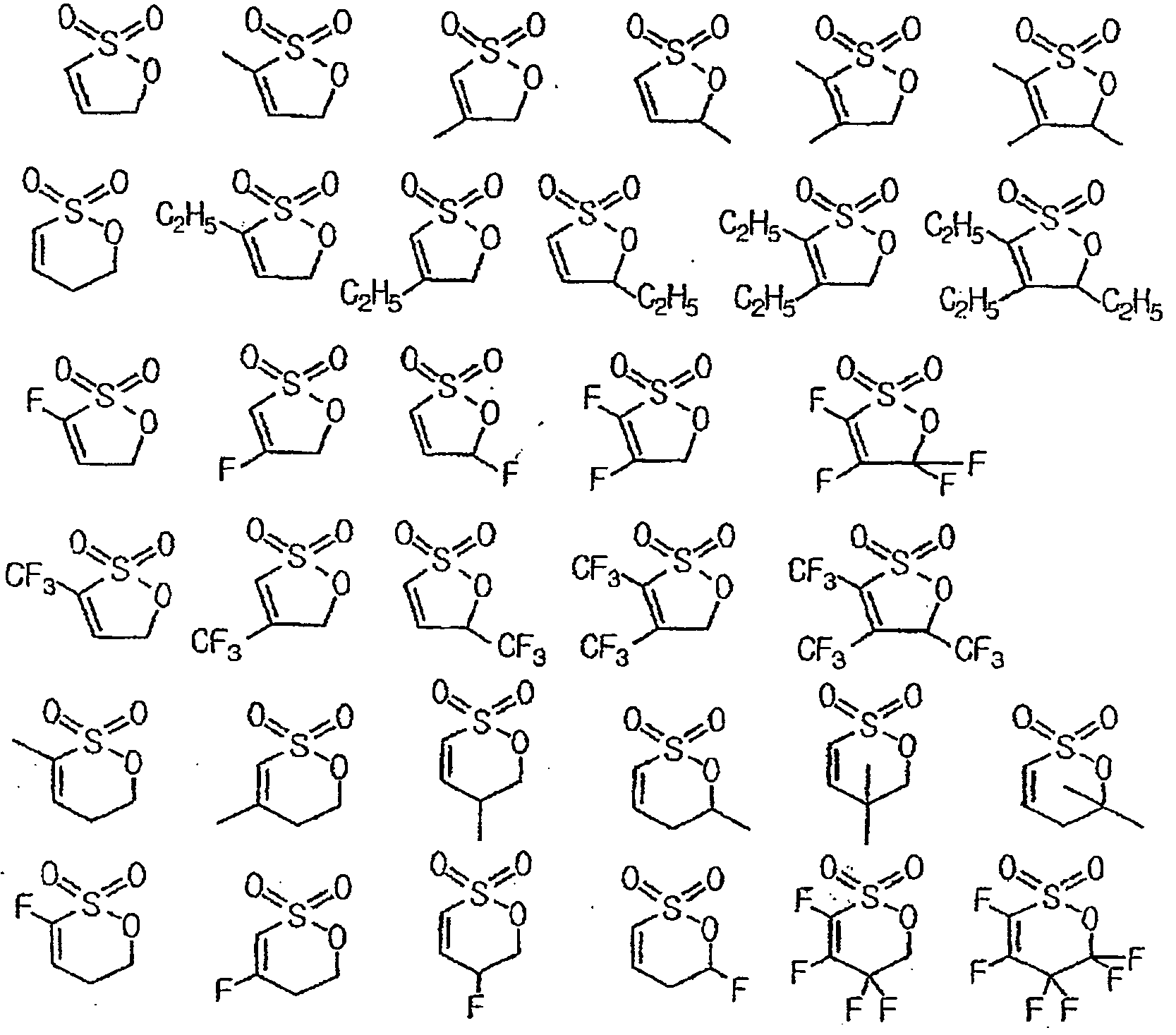
- the sultone-based compound having a carbon-carbon unsaturated bond in a cyclic structure may be any one selected from the group consisting of compounds expressed in the following Chemical Formula 1 or their mixtures, but not limitedly.
- the cyclic carbonate compound with a vinyl group may be any one selected from the group consisting of 4-ethenyl-1,3-dioxolane-2-on (vinylethylene carbonate), 4-ethenyl-4-methyl-1,3-dioxolane-2-on, 4-ethenyl-4-ethyl-1,3-dioxolane-2-on, 4-ethenyl-4-n-propyl-1,3-dioxolane-2-on, 4-ethenyl-5-methyl-1,3,-dioxolane-2-on, 4-ethenyl-5-ethyl-1,3-dioxolane-2-on and 4-ethenyl-5-n-propyl-1,3-dioxolane-2-on, or their mixtures, but not limitedly.
- the cyclic carbonate compound substituted with halogen may be fluoroethylene carbonate, but not limitedly.
- the dinitrile-based compound may be a compound expressed by the following Chemistry Figure 2.
- R is -(CH 2 ) n - and n is an integer of 1 to 10.
- the above non-aqueous electrolyte solution for a lithium secondary battery may be used for making a lithium secondary battery.
- the non-aqueous electrolyte solution for a lithium secondary battery according to the present invention has a thermally stable and firm SEI film formed on an anode and not easily collapsed in spite of repeated charging/discharging, thereby improving the life of a battery and controlling reduction of capacity of the battery without deteriorating overcharging stability. Also, a protective film is formed on a cathode to control elution of transition metal from the cathode, thereby preventing side reaction between the electrolyte and the cathode as well gas generation and thus improving high temperature characteristics.
- FIG. 1 is a graph showing measurement results of capacity (upper lines) and thickness (lower lines) according to charging/discharging cycles at 23°C of lithium secondary batteries having non-aqueous electrolyte solutions according to the examples 1 and 2 and the comparative example 1;
- FIG. 2 is a graph showing measurement results of capacity (upper lines) and thickness (lower lines) according to charging/discharging cycles at 45°C of lithium secondary batteries having non-aqueous electrolyte solutions according to the examples 1 and 2 and the comparative examples 1 to 3.
- a non-aqueous electrolyte solution for a lithium secondary battery generally includes a lithium salt and an organic solvent.
- the inventors found that, in case of a conventional lithium secondary battery containing a non-aqueous electrolyte solution using vinylene carbonate, unsaturated sultone-based compound or carbonate-based compound with a vinyl group, a SEI film formed on a surface of an anode is porous but not dense, so the SEI film is easily collapsed while repeating charging/discharging processes, thereby deteriorating the battery performance.
- a non-aqueous electrolyte solution for a lithium secondary battery according to the present invention includes a sultone-based compound having a carbon-carbon unsaturated bond in a cyclic structure, a cyclic carbonate compound with a vinyl group, a cyclic compound substituted with halogen and a dinitrile-based compound as additives in specific contents to give a remarkable synergic effect, as mentioned above.
- the sultone-based compound having a carbon-carbon unsaturated bond in a cyclic structure and the cyclic carbonate compound with a vinyl group, contained in the non-aqueous electrolyte solution of the present invention may be electrically reduced more rapidly than an electrolyte solvent and also cross- and/or repeat-polymerized to form a firmer SEI film.
- the SEI film formed on the surface of the anode is firm and dense and thus it is not easily collapsed though charging/discharging is repeated, thereby enhancing the life of battery and preventing decrease of capacity.
- the sultone-based compound having a carbon-carbon unsaturated bond in a cyclic structure may control gas generation at high temperature.
- any sultone-based compound having a double bond in a cyclic structure may give the effect aimed by the present invention.
- the sultone-based compound having a carbon-carbon unsaturated bond in a cyclic structure, included in the non-aqueous electrolyte solution for a lithium secondary battery according to the present invention may be any one selected from the group consisting of compounds expressed in the following Chemical Formula 1 or their mixtures, but not limited thereto.
- a more preferred example of the sultone-based compound having a carbon-carbon unsaturated bond in a cyclic structure according to the present invention may be (1,3-(1-propene)sultone, but the present invention is not limited thereto.
- the non-aqueous electrolyte solution of the present invention includes 1 to 5 parts by weight of sultone-based compound having a carbon-carbon unsaturated bond in a cyclic structure, based on 100 parts by weight of the non-aqueous electrolyte solution. If the content of sultone-based compound is less than 1 part by weight, the normal and high temperature performance is deteriorated. If the content exceeds 5 parts by weight, the formed SEI rather acts as a resistance, thereby deteriorating capacity of a battery.
- cyclic carbonate compound with a vinyl group employed in the present invention has excellent high temperature preservation characteristics.
- cyclic carbonate compound with a vinyl group according to the present invention cyclic carbonate has no special limitation, but ethylene carbonate or propylene carbonate may be preferably used.
- the cyclic carbonate compound with a vinyl group may be is any one selected from the group consisting of 4-ethenyl-1,3-dioxolane-2-on (vinylethylene carbonate), 4-ethenyl-4-methyl-1,3-dioxolane-2-on, 4-ethenyl-4-ethyl-1,3-dioxolane-2-on, 4-ethenyl-4-n-propyl-1,3-dioxolane-2-on, 4-ethenyl-5-methyl-1,3,-dioxolane-2-on, 4-ethenyl-5-ethyl-1,3-dioxolane-2-on and 4-ethenyl-5-n-propyl-1,3-dioxolane-2-on, or their mixtures, but not limitedly.
- the non-aqueous electrolyte solution of the present invention includes 1 to 5 parts by weight of cyclic carbonate compound with a vinyl group, based on 100 parts by weight of the non-aqueous electrolyte solution. If the content of sultone-based compound is less than 1 part by weight, the normal or high temperature performance is deteriorated. If the content exceeds 5 parts by weight, reaction with a cathode is increased, thereby increasing a cell thickness.
- the cyclic carbonate compound substituted with halogen may prevent swelling of a battery.
- Any compound of which cyclic carbonate is substituted with halogen may be used in the present invention without limitation.
- cyclic carbonate has no special limitation, but ethylene carbonate or propylene carbonate may be preferably used. Accordingly, the cyclic carbonate compound substituted with halogen may be fluoroethylene carbonate, but not limitedly.
- the non-aqueous electrolyte solution of the present invention includes 5 to 10 parts by weight of cyclic carbonate compound substituted with halogen, based on 100 parts by weight of the non-aqueous electrolyte solution. If the content of the compound is less than 5 part by weight, the performance of controlling swelling of a battery is deteriorated, thereby causing deterioration of thermal stability and life performance of the battery. If the content exceeds 10 parts by weight, the capacity of a battery is deteriorated.
- the dinitrile-based compound employed in the present invention forms a complex as a nitrile group existing in the compound and having a strong polarity is strongly combined with a surface of a cathode.
- the formed complex serves as a protective film for isolating an active site of the surface of the cathode, which may prevent transition metal from being eluted and educed at an anode.
- the complex controls side reaction or gas generation occurring between the electrolyte and the cathode, thereby improving high temperature characteristics.
- the dinitrile-based compound employed in the present invention may adopt any compound with a dinitrile group.
- the dinitrile-based group according to the present invention may be expressed by the following Chemistry Figure 2.
- R may be -(CH 2 ) n - and n may be an integer of 1 to 10.
- the non-aqueous electrolyte solution according to the present invention includes 1 to 5 parts by weight of dinitrile-based compound. If the content of dinitrile-based compound is less than 1 part by weight, high temperature life performance and stability are deteriorated. If the content exceeds 5 parts by weight, side reaction with a cathode is increased to increase gas generation, thereby increasing a cell thickness.
- any lithium salt material commonly used in an electrolyte solution for a lithium secondary battery may be used.
- the lithium salt may be any one selected from the group consisting of LiPF 6, LiBF 4, LiSbF 6, LiAsF 6, LiClO 4 , LiN(C 2 F 5 SO 2 ) 2 , LiN(CF 3 SO 2 ) 2 , CF 3 SO 3 Li and LiC(CF 3 SO 2 ) 3 , or their mixtures.
- the organic solvent included in the non-aqueous electrolyte solution according to the present invention may use any one commonly used in electrolyte solutions for lithium secondary batteries.
- the organic solvent may use any one selected from the group consisting of propylene carbonate, ethylene carbonate, diethyl carbonate, dimethyl carbonate, ethylmethyl carbonate, dipropyl carbonate, dimethyl sulfoxide, acetonitrile, dimethoxyethane, diethoxyethane, vinylene carbonate, sulfolane, ⁇ -butyrolactone, ethylene sulfite, propylene sulfite and tetrahydrofuran, or their mixtures.
- cyclic carbonates such as ethylene carbonate and propylene carbonate are high viscosity organic solvents with high dielectric constant, which easily dissociate lithium salts in an electrolyte, desirably.
- linear carbonate with as dimethyl carbonate and diethyl carbonate with low viscosity and low dielectric constant is used in mixture with such cyclic carbonate at a suitable ratio, it is possible to make an electrolyte solution with high electric conductivity, more preferably.
- the non-aqueous electrolyte solution for a lithium secondary battery according to the present invention is injected into an electrode structure having a cathode, an anode and a separator interposed between the cathode and the anode, thereby making a lithium secondary battery.
- the cathode, the anode and the separator used in the electrode structure may be formed from any kind of material commonly used in making a lithium ion secondary battery.
- An anode active material may be formed from carbon material, lithium metal, silicon or tin, into/from which lithium ions may be intercalated or disintercalated.
- carbon material is preferred.
- the carbon material may be low-crystalline carbon or high-crystalline carbon.
- the low-crystalline carbon may be soft carbon or hard carbon as representative examples, and the high-crystalline carbon may be natural graphite, Kish graphite, pyrolytic carbon, mesophase pitch based carbon fiber, meso-carbon microbeads, mesophase pitches, or high-temperature sintered carbon, such as petroleum or coal tar pitch derived cokes, as representative examples.
- the anode may contain a binding agent, which may employ various kinds of binder polymers, such as PVDF-co-HFP, polyvinylidenefluoride, polyacrylonitrile, and polymethylmethacrylate.
- the separator may be formed of common porous polymer films used as a conventional separator, such as porous polymer film made using ethylene homopolymer, propylene homopolymer, ethylene/butene copolymer, ethylene/hexene copolymer or ethylene/methacrylate copolymer, in a single layer or in laminate form.
- the separator may be formed of a common porous non-woven fabric such as a non-woven fabric made of glass fiber with a high melting point or polyethylene terephthalate fiber, but it is not limited thereto.
- the lithium secondary battery of the present invention may have a variety of shapes which are not specially limited. Examples include a cylindrical can shape, an angled shape, a pouch shape or a coin shape.
- LiPF 6 was added to a solution in which ethylene carbonate (EC), diethyl carbonate (DEC) and propylene carbonate (PC) were mixed in a volume ratio of 2:7:1 to make a 1M LiPF 6 solution. Then, 1 part by weight of 1,3-(1-propene)sultone (PRS), 1 part by weight of vinylethylene carbonate (VEC), 5.38 parts by weight of fluoroethylene carbonate (FEC) and 1 part by weight of succinonitrile (SN) were added based on 100 parts by weight of non-aqueous electrolyte, thereby preparing a non-aqueous electrolyte solution.
- PRS 1,3-(1-propene)sultone
- VEC vinylethylene carbonate
- FEC fluoroethylene carbonate
- SN succinonitrile
- a non-aqueous electrolyte solution was prepared in the same way as in the Example 1, except that a 1:1 mixture of diethyl carbonate and ethylmethyl carbonate was used instead of diethyl carbonate.
- LiPF 6 was added to a solution in which ethylene carbonate (EC), diethyl carbonate (DEC) and propylene carbonate (PC) were mixed at a volume ratio of 2:7:1 to prepare 1M LiPF 6 solution as a non-aqueous electrolyte solution.
- EC ethylene carbonate
- DEC diethyl carbonate
- PC propylene carbonate
- a non-aqueous electrolyte solution was prepared in the same way as in the Example 1, except that succinonitrile was not used.
- a non-aqueous electrolyte solution was prepared in the same way as in the Example 1, except that 1,3-1(propene)sultone (PRS) was not used.
- PRS 1,3-1(propene)sultone
- Cylindrical lithium secondary batteries including the non-aqueous electrolyte solutions prepared according to the Examples 1 and 2 and the Comparative Examples 1 to 3 were manufactured using LiCoO 2 as a cathode and artificial graphite as an anode.
- the manufactured batteries were charged and discharged 400 times at 23°C and 45°C, and then their changed capacity and changed thickness in comparison to initial values were measured.
- the measured data for changed capacity and changed thickness at 23°C are shown in a graph of FIG. 1, and the measured data at 45°C are shown in a graph of FIG. 2.
- the batteries having the non-aqueous electrolyte solutions according to the present invention maintains capacity preserving performance and thickness changing rate excellently as cycles are increased.
Landscapes
- Chemical & Material Sciences (AREA)
- Engineering & Computer Science (AREA)
- Manufacturing & Machinery (AREA)
- Chemical Kinetics & Catalysis (AREA)
- Electrochemistry (AREA)
- General Chemical & Material Sciences (AREA)
- Physics & Mathematics (AREA)
- Condensed Matter Physics & Semiconductors (AREA)
- General Physics & Mathematics (AREA)
- Inorganic Chemistry (AREA)
- Materials Engineering (AREA)
- Secondary Cells (AREA)
- Battery Electrode And Active Subsutance (AREA)
Abstract
Description


Claims (9)
- A non-aqueous electrolyte solution for a lithium secondary battery, which includes a lithium salt and an organic solvent, wherein, based on 100 parts by weight of the non-aqueous electrolyte solution, the non-aqueous electrolyte solution comprises:1 to 5 parts by weight of sultone-based compound having a carbon-carbon unsaturated bond in a cyclic structure;1 to 5 parts by weight of cyclic carbonate compound with a vinyl group;5 to 10 parts by weight of cyclic carbonate compound that is substituted with halogen; and1 to 5 parts by weight of dinitrile-based compound.
- [Corrected under Rule 26 16.07.2009]
The non-aqueous electrolyte solution for a lithium secondary battery according to claim 1, wherein the sultone-based compound having a carbon-carbon unsaturated bond in a cyclic structure is any one selected from the group consisting of compounds expressed in the following Chemical Formula 1 or their mixtures: Chemical Formula 1 - The non-aqueous electrolyte solution for a lithium secondary battery according to claim 1,wherein the sultone-based compound having a carbon-carbon unsaturated bond in a cyclic structure is (1,3-(1-propene)sultone.
- The non-aqueous electrolyte solution for a lithium secondary battery according to claim 1,wherein the cyclic carbonate compound with a vinyl group is any one selected from the group consisting of 4-ethenyl-1,3-dioxolane-2-on, 4-ethenyl-4-methyl-1,3-dioxolane-2-on, 4-ethenyl-4-ethyl-1,3-dioxolane-2-on, 4-ethenyl-4-n-propyl-1,3-dioxolane-2-on, 4-ethenyl-5-methyl-1,3,-dioxolane-2-on, 4-ethenyl-5-ethyl-1,3-dioxolane-2-on and 4-ethenyl-5-n-propyl-1,3-dioxolane-2-on, or their mixtures.
- The non-aqueous electrolyte solution for a lithium secondary battery according to claim 1,wherein the cyclic carbonate compound substituted with halogen is fluoroethylene carbonate.
- The non-aqueous electrolyte solution for a lithium secondary battery according to claim 1,wherein the dinitrile-based compound is a compound expressed by the following Chemistry Figure 2:Chemistry Figure 2
 where R is -(CH2)n- and n is an integer of 1 to 10.
 - The non-aqueous electrolyte solution for a lithium secondary battery according to claim 1,wherein the lithium salt is any one selected from the group consisting of LiPF6, LiBF4, LiSbF6, LiAsF6, LiClO4, LiN(C2F5SO2)2, LiN(CF3SO2)2, CF3SO3Li and LiC(CF3SO2)3, or their mixtures.
- The non-aqueous electrolyte solution for a lithium secondary battery according to claim 1,wherein the organic solvent is any one selected from the group consisting of propylene carbonate, ethylene carbonate, diethyl carbonate, dimethyl carbonate, ethylmethyl carbonate, dipropyl carbonate, dimethyl sulfoxide, acetonitrile, dimethoxyethane, diethoxyethane, vinylene carbonate, sulfolane, γ-butyrolactone, ethylene sulfite, propylene sulfite and tetrahydrofuran, or their mixtures.
- A lithium secondary battery, which includes a cathode made of lithium-containing oxide, an anode made of carbonaceous material capable of absorbing/desorbing lithium ions, and a non-aqueous electrolyte solution,wherein the non-aqueous electrolyte solution is a non-aqueous electrolyte solution defined in any one of the claims 1 to 8.
Priority Applications (5)
| Application Number | Priority Date | Filing Date | Title |
|---|---|---|---|
| JP2011506207A JP5827122B2 (en) | 2008-04-25 | 2009-04-24 | Nonaqueous electrolyte for lithium secondary battery and lithium secondary battery including the same |
| US12/989,360 US8697293B2 (en) | 2008-04-25 | 2009-04-24 | Non-aqueous electrolyte solution for lithium secondary battery and lithium secondary battery having the same |
| EP09735372.6A EP2274790B1 (en) | 2008-04-25 | 2009-04-24 | Non-aqueous electrolyte solution for lithium secondary battery and lithium secondary battery comprising the same |
| CN200980114055.2A CN102017270B (en) | 2008-04-25 | 2009-04-24 | Non-aqueous electrolyte solution for lithium secondary battery and lithium secondary battery containing the non-aqueous electrolyte solution |
| DK09735372.6T DK2274790T3 (en) | 2008-04-25 | 2009-04-24 | NON-ELECTROLYTE SOLUTION FOR LITHIUM SECONDARY BATTERY AND LITHIUM SECONDARY BATTERY COMPREHENSIVE |
Applications Claiming Priority (2)
| Application Number | Priority Date | Filing Date | Title |
|---|---|---|---|
| KR10-2008-0038767 | 2008-04-25 | ||
| KR20080038767 | 2008-04-25 |
Publications (2)
| Publication Number | Publication Date |
|---|---|
| WO2009131419A2 true WO2009131419A2 (en) | 2009-10-29 |
| WO2009131419A3 WO2009131419A3 (en) | 2010-02-04 |
Family
ID=41217295
Family Applications (1)
| Application Number | Title | Priority Date | Filing Date |
|---|---|---|---|
| PCT/KR2009/002167 Ceased WO2009131419A2 (en) | 2008-04-25 | 2009-04-24 | Non-aqueous electrolyte solution for lithium secondary battery and lithium secondary battery having the same |
Country Status (7)
| Country | Link |
|---|---|
| US (1) | US8697293B2 (en) |
| EP (1) | EP2274790B1 (en) |
| JP (1) | JP5827122B2 (en) |
| KR (1) | KR101495296B1 (en) |
| CN (1) | CN102017270B (en) |
| DK (1) | DK2274790T3 (en) |
| WO (1) | WO2009131419A2 (en) |
Cited By (7)
| Publication number | Priority date | Publication date | Assignee | Title |
|---|---|---|---|---|
| EP2237359A3 (en) * | 2009-04-01 | 2011-08-31 | Samsung SDI Co., Ltd. | Electrolyte including additives, and rechargeable lithium battery including the same |
| EP2367230A1 (en) * | 2010-03-16 | 2011-09-21 | Samsung SDI Co., Ltd. | Electrolyte solution for rechargeable lithium battery, and rechargeable lithium battery including the same |
| CN102231441A (en) * | 2011-05-17 | 2011-11-02 | 华南师范大学 | Sulfur-containing electrolyte with film forming function for lithium ion battery as well as preparation method and application thereof |
| CN102332607A (en) * | 2011-03-22 | 2012-01-25 | 东莞新能源科技有限公司 | A kind of electrolyte solution for non-aqueous secondary lithium battery |
| JP2013534355A (en) * | 2010-08-13 | 2013-09-02 | エルジー・ケム・リミテッド | Nonaqueous electrolyte for lithium secondary battery and lithium secondary battery including the same |
| EP2797155A4 (en) * | 2013-02-20 | 2015-02-18 | Lg Chemical Ltd | NONAQUEOUS ELECTROLYTE AND LITHIUM RECHARGEABLE BATTERY COMPRISING THE SAME |
| US9608290B2 (en) | 2013-02-20 | 2017-03-28 | Lg Chem, Ltd. | Electrolyte solution additive for lithium secondary battery, and non-aqueous electrolyte solution and lithium secondary battery including the additive |
Families Citing this family (24)
| Publication number | Priority date | Publication date | Assignee | Title |
|---|---|---|---|---|
| WO2007126068A1 (en) * | 2006-04-27 | 2007-11-08 | Mitsubishi Chemical Corporation | Nonaqueous electrolyte solution and nonaqueous electrolyte secondary battery |
| JP2014211948A (en) * | 2011-08-31 | 2014-11-13 | 三洋電機株式会社 | Nonaqueous electrolyte secondary battery |
| KR101551135B1 (en) * | 2011-10-28 | 2015-09-07 | 아사히 가세이 가부시키가이샤 | Non-aqueous secondary battery |
| US9865900B2 (en) * | 2012-02-07 | 2018-01-09 | Battelle Memorial Institute | Solid electrolyte interphase film-suppression additives |
| JP2013251204A (en) * | 2012-06-01 | 2013-12-12 | Panasonic Corp | Lithium secondary battery |
| JP6263910B2 (en) * | 2012-09-03 | 2018-01-24 | 三菱ケミカル株式会社 | Non-aqueous electrolyte and non-aqueous electrolyte battery using the same |
| KR101905246B1 (en) * | 2014-09-30 | 2018-10-05 | 주식회사 엘지화학 | Manufacturing method of lithium secondary battery |
| CN104505535B (en) * | 2014-12-29 | 2017-03-29 | 珠海市赛纬电子材料股份有限公司 | A kind of nonaqueous electrolytic solution of high-voltage lithium ion batteries |
| KR102380512B1 (en) * | 2015-01-16 | 2022-03-31 | 삼성에스디아이 주식회사 | Electrolyte solution for lithium battery and lithium battery using the same |
| KR102810661B1 (en) * | 2015-10-26 | 2025-05-22 | 사이언스코 | Non-aqueous electrolyte composition comprising fluorinated solvent and 2-furanone |
| CN105428719B (en) * | 2015-12-31 | 2018-12-18 | 石家庄圣泰化工有限公司 | Wide temperature lithium-ion battery electrolytes of high voltage and preparation method and application |
| CN105481825A (en) * | 2015-12-31 | 2016-04-13 | 石家庄圣泰化工有限公司 | Preparation method of prop-1-ene-1,3-sultone derivatives |
| CN105390742A (en) * | 2015-12-31 | 2016-03-09 | 石家庄圣泰化工有限公司 | High-voltage lithium-ion battery electrolyte as well as preparation method and application thereof |
| CN105789700A (en) * | 2016-03-29 | 2016-07-20 | 宁德时代新能源科技股份有限公司 | Electrolyte and lithium ion battery |
| KR102573627B1 (en) | 2017-03-08 | 2023-08-31 | 스미토모 세이카 가부시키가이샤 | Additives for non-aqueous electrolytes, non-aqueous electrolytes and electrical storage devices |
| CN107681198A (en) * | 2017-08-08 | 2018-02-09 | 广州鹏辉能源科技股份有限公司 | A kind of lithium-ion battery electrolytes and its lithium ion battery |
| KR102751882B1 (en) * | 2017-11-14 | 2025-01-10 | 주식회사 엘지에너지솔루션 | Electrolyte for lithium secondary battery and lithium secondary battery comprising the same |
| CN109687021B (en) * | 2018-12-18 | 2020-12-11 | 东莞市杉杉电池材料有限公司 | High-temperature-resistant non-aqueous electrolyte for lithium ion battery |
| TWI904116B (en) * | 2019-11-18 | 2025-11-11 | 美商亞比馬利股份有限公司 | Flame retardants for battery electrolytes |
| TWI912265B (en) | 2019-11-18 | 2026-01-21 | 美商亞比馬利股份有限公司 | Flame retardants for battery electrolytes |
| CN111205267A (en) * | 2020-03-05 | 2020-05-29 | 中节能万润股份有限公司 | A novel sulfone-containing lithium ion battery electrolyte additive, its preparation and application |
| CN112421109B (en) * | 2020-11-19 | 2022-04-26 | 中节能万润股份有限公司 | Cyclic sulfonate lithium ion battery electrolyte additive, preparation method and application thereof |
| JP7850969B2 (en) * | 2021-02-26 | 2026-04-24 | パナソニックIpマネジメント株式会社 | Non-aqueous secondary battery |
| CN115832433A (en) * | 2022-10-18 | 2023-03-21 | 珠海冠宇电池股份有限公司 | Electrolyte and battery comprising same |
Citations (10)
| Publication number | Priority date | Publication date | Assignee | Title |
|---|---|---|---|---|
| JPH0845545A (en) | 1994-04-22 | 1996-02-16 | Saft (Soc Accumulateurs Fixes Traction) Sa | Lithium storage battery with carbon anode |
| JP2001006729A (en) | 1999-06-18 | 2001-01-12 | Mitsubishi Chemicals Corp | Non-aqueous electrolyte secondary battery |
| JP2002329528A (en) | 2001-03-01 | 2002-11-15 | Mitsui Chemicals Inc | Nonaqueous electrolyte, secondary battery using it and additive for electrolyte |
| KR20060107410A (en) | 2005-04-08 | 2006-10-13 | 소니 가부시끼 가이샤 | Electrolyte and Battery |
| KR20060114919A (en) | 2005-05-03 | 2006-11-08 | 주식회사 엘지화학 | Non-aqueous electrolyte and lithium secondary battery comprising the same to improve the performance |
| WO2007043624A1 (en) | 2005-10-12 | 2007-04-19 | Mitsui Chemicals, Inc. | Nonaqueous electrolyte solution and lithium secondary battery using same |
| JP2007128765A (en) | 2005-11-04 | 2007-05-24 | Sony Corp | battery |
| WO2007094625A1 (en) | 2006-02-15 | 2007-08-23 | Lg Chem, Ltd. | Non-aqueous electrolyte and electrochemical device with an improved safety |
| WO2007142121A1 (en) | 2006-06-02 | 2007-12-13 | Mitsubishi Chemical Corporation | Nonaqueous electrolyte solution and nonaqueous electrolyte battery |
| KR100814827B1 (en) | 2007-04-05 | 2008-03-20 | 삼성에스디아이 주식회사 | Electrolyte for lithium secondary battery and lithium secondary battery comprising same |
Family Cites Families (11)
| Publication number | Priority date | Publication date | Assignee | Title |
|---|---|---|---|---|
| JP4151060B2 (en) * | 2001-11-14 | 2008-09-17 | 株式会社ジーエス・ユアサコーポレーション | Non-aqueous secondary battery |
| EP1276165A1 (en) | 2001-07-12 | 2003-01-15 | Japan Storage Battery Co., Ltd. | Nonaqueous secondary cell |
| JP2004063144A (en) * | 2002-07-25 | 2004-02-26 | Toshiba Corp | Non-aqueous electrolyte secondary battery |
| JP2004158213A (en) * | 2002-11-01 | 2004-06-03 | Toshiba Corp | Manufacturing method of nonaqueous electrolyte secondary battery |
| CN100486030C (en) * | 2005-04-08 | 2009-05-06 | 索尼株式会社 | Electrolyte solution and battery |
| JP5135712B2 (en) * | 2006-05-25 | 2013-02-06 | ソニー株式会社 | Secondary battery |
| JP5369391B2 (en) * | 2006-06-02 | 2013-12-18 | 三菱化学株式会社 | Non-aqueous electrolyte, non-aqueous electrolyte battery, and non-aqueous electrolyte secondary battery |
| JP4605133B2 (en) * | 2006-06-05 | 2011-01-05 | ソニー株式会社 | Nonaqueous electrolyte, nonaqueous electrolyte battery using the same, and method for producing nonaqueous electrolyte |
| JP4470917B2 (en) * | 2006-06-29 | 2010-06-02 | ソニー株式会社 | Electrode current collector, battery electrode and secondary battery |
| US20100266905A1 (en) * | 2007-09-19 | 2010-10-21 | Lg Chem, Ltd. | Non-aqueous electrolyte lithium secondary battery |
| KR100980207B1 (en) * | 2007-10-17 | 2010-09-03 | 주식회사 엘지화학 | Non-aqueous electrolyte solution for lithium secondary batteries and lithium secondary battery containing same |
-
2009
- 2009-04-24 US US12/989,360 patent/US8697293B2/en active Active
- 2009-04-24 JP JP2011506207A patent/JP5827122B2/en active Active
- 2009-04-24 CN CN200980114055.2A patent/CN102017270B/en active Active
- 2009-04-24 EP EP09735372.6A patent/EP2274790B1/en active Active
- 2009-04-24 DK DK09735372.6T patent/DK2274790T3/en active
- 2009-04-24 WO PCT/KR2009/002167 patent/WO2009131419A2/en not_active Ceased
-
2012
- 2012-02-17 KR KR20120016325A patent/KR101495296B1/en active Active
Patent Citations (10)
| Publication number | Priority date | Publication date | Assignee | Title |
|---|---|---|---|---|
| JPH0845545A (en) | 1994-04-22 | 1996-02-16 | Saft (Soc Accumulateurs Fixes Traction) Sa | Lithium storage battery with carbon anode |
| JP2001006729A (en) | 1999-06-18 | 2001-01-12 | Mitsubishi Chemicals Corp | Non-aqueous electrolyte secondary battery |
| JP2002329528A (en) | 2001-03-01 | 2002-11-15 | Mitsui Chemicals Inc | Nonaqueous electrolyte, secondary battery using it and additive for electrolyte |
| KR20060107410A (en) | 2005-04-08 | 2006-10-13 | 소니 가부시끼 가이샤 | Electrolyte and Battery |
| KR20060114919A (en) | 2005-05-03 | 2006-11-08 | 주식회사 엘지화학 | Non-aqueous electrolyte and lithium secondary battery comprising the same to improve the performance |
| WO2007043624A1 (en) | 2005-10-12 | 2007-04-19 | Mitsui Chemicals, Inc. | Nonaqueous electrolyte solution and lithium secondary battery using same |
| JP2007128765A (en) | 2005-11-04 | 2007-05-24 | Sony Corp | battery |
| WO2007094625A1 (en) | 2006-02-15 | 2007-08-23 | Lg Chem, Ltd. | Non-aqueous electrolyte and electrochemical device with an improved safety |
| WO2007142121A1 (en) | 2006-06-02 | 2007-12-13 | Mitsubishi Chemical Corporation | Nonaqueous electrolyte solution and nonaqueous electrolyte battery |
| KR100814827B1 (en) | 2007-04-05 | 2008-03-20 | 삼성에스디아이 주식회사 | Electrolyte for lithium secondary battery and lithium secondary battery comprising same |
Non-Patent Citations (1)
| Title |
|---|
| See also references of EP2274790A4 |
Cited By (13)
| Publication number | Priority date | Publication date | Assignee | Title |
|---|---|---|---|---|
| EP2237359A3 (en) * | 2009-04-01 | 2011-08-31 | Samsung SDI Co., Ltd. | Electrolyte including additives, and rechargeable lithium battery including the same |
| US8389162B2 (en) | 2009-04-01 | 2013-03-05 | Samsung Sdi Co., Ltd. | Electrolyte for rechargeable lithium battery including additives, and rechargeable lithium battery including the same |
| JP2011192632A (en) * | 2010-03-16 | 2011-09-29 | Samsung Sdi Co Ltd | Electrolytic solution for lithium secondary battery, and lithium secondary battery |
| CN102195085A (en) * | 2010-03-16 | 2011-09-21 | 三星Sdi株式会社 | Electrolyte solution for rechargeable lithium battery, and rechargeable lithium battery including the same |
| EP2367230A1 (en) * | 2010-03-16 | 2011-09-21 | Samsung SDI Co., Ltd. | Electrolyte solution for rechargeable lithium battery, and rechargeable lithium battery including the same |
| US9196928B2 (en) | 2010-03-16 | 2015-11-24 | Samsung Sdi Co., Ltd. | Electrolyte solution for rechargeable lithium battery, and rechargeable lithium battery including the same |
| JP2013534355A (en) * | 2010-08-13 | 2013-09-02 | エルジー・ケム・リミテッド | Nonaqueous electrolyte for lithium secondary battery and lithium secondary battery including the same |
| US10763541B2 (en) | 2010-08-13 | 2020-09-01 | Lg Chem, Ltd. | Non-aqueous electrolyte for lithium secondary battery and lithium secondary battery comprising the same |
| CN102332607A (en) * | 2011-03-22 | 2012-01-25 | 东莞新能源科技有限公司 | A kind of electrolyte solution for non-aqueous secondary lithium battery |
| CN102231441A (en) * | 2011-05-17 | 2011-11-02 | 华南师范大学 | Sulfur-containing electrolyte with film forming function for lithium ion battery as well as preparation method and application thereof |
| EP2797155A4 (en) * | 2013-02-20 | 2015-02-18 | Lg Chemical Ltd | NONAQUEOUS ELECTROLYTE AND LITHIUM RECHARGEABLE BATTERY COMPRISING THE SAME |
| US9590273B2 (en) | 2013-02-20 | 2017-03-07 | Lg Chem, Ltd. | Non-aqueous electrolyte solution and lithium secondary battery including the same |
| US9608290B2 (en) | 2013-02-20 | 2017-03-28 | Lg Chem, Ltd. | Electrolyte solution additive for lithium secondary battery, and non-aqueous electrolyte solution and lithium secondary battery including the additive |
Also Published As
| Publication number | Publication date |
|---|---|
| JP2011519133A (en) | 2011-06-30 |
| US8697293B2 (en) | 2014-04-15 |
| KR101495296B1 (en) | 2015-02-24 |
| WO2009131419A3 (en) | 2010-02-04 |
| CN102017270B (en) | 2014-07-16 |
| EP2274790A4 (en) | 2013-01-23 |
| DK2274790T3 (en) | 2015-03-23 |
| KR20120034698A (en) | 2012-04-12 |
| EP2274790B1 (en) | 2014-12-31 |
| CN102017270A (en) | 2011-04-13 |
| EP2274790A2 (en) | 2011-01-19 |
| US20110111306A1 (en) | 2011-05-12 |
| JP5827122B2 (en) | 2015-12-02 |
Similar Documents
| Publication | Publication Date | Title |
|---|---|---|
| WO2009131419A2 (en) | Non-aqueous electrolyte solution for lithium secondary battery and lithium secondary battery having the same | |
| US8455143B2 (en) | Non-aqueous electrolyte solution for lithium ion secondary battery and lithium ion secondary battery having the same | |
| US7678504B2 (en) | Lithium secondary battery and a method for preparing the same | |
| US9337512B2 (en) | Non-aqueous electrolyte for lithium secondary battery and lithium secondary battery comprising the same | |
| WO2015034257A1 (en) | Cathode additive for high-capacity lithium secondary battery | |
| WO2016048093A1 (en) | Nonaqueous electrolyte solution and lithium secondary battery containing same | |
| WO2010058997A2 (en) | Non-aqueous electrolytic solution and lithium secondary battery made thereof | |
| US10153518B2 (en) | Nonaqueous electrolyte lithium secondary battery | |
| KR102822729B1 (en) | Composition for gel polymer electrolyte and lithium secondary battery comprising the gel polymer electrolyte formed therefrom | |
| KR100980207B1 (en) | Non-aqueous electrolyte solution for lithium secondary batteries and lithium secondary battery containing same | |
| EP2738860B1 (en) | Electrolyte for lithium secondary battery and lithium secondary battery including same | |
| WO2011087205A2 (en) | Non-aqueous electrolyte for lithium secondary battery and lithium secondary battery comprising same | |
| WO2016048104A1 (en) | Non aqueous electrolyte and lithium secondary battery comprising same | |
| KR20090006691A (en) | Non-aqueous electrolyte solution for lithium secondary batteries and lithium secondary battery containing same | |
| EP2731188A1 (en) | Electrolyte for lithium secondary battery and lithium secondary battery including same | |
| KR20090113215A (en) | Non-aqueous electrolyte solution for lithium secondary batteries and lithium secondary battery containing same |
Legal Events
| Date | Code | Title | Description |
|---|---|---|---|
| WWE | Wipo information: entry into national phase |
Ref document number: 200980114055.2 Country of ref document: CN |
|
| 121 | Ep: the epo has been informed by wipo that ep was designated in this application |
Ref document number: 09735372 Country of ref document: EP Kind code of ref document: A2 |
|
| WWE | Wipo information: entry into national phase |
Ref document number: 2011506207 Country of ref document: JP |
|
| NENP | Non-entry into the national phase |
Ref country code: DE |
|
| WWE | Wipo information: entry into national phase |
Ref document number: 2009735372 Country of ref document: EP |
|
| WWE | Wipo information: entry into national phase |
Ref document number: 12989360 Country of ref document: US |