WO2009132739A1 - Arylpyrazinone derivatives insulin secretion stimulators, methods for obtaining them and use thereof for the treatment of diabetes - Google Patents

Arylpyrazinone derivatives insulin secretion stimulators, methods for obtaining them and use thereof for the treatment of diabetes Download PDF

Info

Publication number
WO2009132739A1
WO2009132739A1 PCT/EP2009/002328 EP2009002328W WO2009132739A1 WO 2009132739 A1 WO2009132739 A1 WO 2009132739A1 EP 2009002328 W EP2009002328 W EP 2009002328W WO 2009132739 A1 WO2009132739 A1 WO 2009132739A1
Authority
WO
WIPO (PCT)
Prior art keywords
alkyl
aryl
formula
compound
ethyl
Prior art date
Legal status (The legal status is an assumption and is not a legal conclusion. Google has not performed a legal analysis and makes no representation as to the accuracy of the status listed.)
Ceased
Application number
PCT/EP2009/002328
Other languages
French (fr)
Inventor
Gerard Botton
Eric Valeur
Christine Charon
Micheline Kergoat
Samer Elbawab
Current Assignee (The listed assignees may be inaccurate. Google has not performed a legal analysis and makes no representation or warranty as to the accuracy of the list.)
Merck Patent GmbH
Original Assignee
Merck Patent GmbH
Priority date (The priority date is an assumption and is not a legal conclusion. Google has not performed a legal analysis and makes no representation as to the accuracy of the date listed.)
Filing date
Publication date
Priority to ES09737783T priority Critical patent/ES2433210T3/en
Priority to CA2722813A priority patent/CA2722813C/en
Priority to PL09737783T priority patent/PL2268624T3/en
Priority to JP2011506584A priority patent/JP5498482B2/en
Priority to EP09737783.2A priority patent/EP2268624B1/en
Priority to AU2009242720A priority patent/AU2009242720B2/en
Priority to KR1020107026410A priority patent/KR101687419B1/en
Priority to HRP20130992AT priority patent/HRP20130992T1/en
Priority to UAA201014234A priority patent/UA103191C2/en
Priority to US12/990,098 priority patent/US8815859B2/en
Priority to NZ589555A priority patent/NZ589555A/en
Priority to EA201001688A priority patent/EA022345B1/en
Priority to SI200930752T priority patent/SI2268624T1/en
Priority to CN200980114790.3A priority patent/CN102015661B/en
Priority to MX2010011792A priority patent/MX2010011792A/en
Priority to DK09737783.2T priority patent/DK2268624T3/en
Application filed by Merck Patent GmbH filed Critical Merck Patent GmbH
Priority to BRPI0910833-5A priority patent/BRPI0910833A2/en
Publication of WO2009132739A1 publication Critical patent/WO2009132739A1/en
Priority to IL208959A priority patent/IL208959A/en
Anticipated expiration legal-status Critical
Priority to ZA2010/08505A priority patent/ZA201008505B/en
Priority to US14/337,796 priority patent/US9233937B2/en
Ceased legal-status Critical Current

Links

Classifications

    • CCHEMISTRY; METALLURGY
    • C07ORGANIC CHEMISTRY
    • C07DHETEROCYCLIC COMPOUNDS
    • C07D241/00Heterocyclic compounds containing 1,4-diazine or hydrogenated 1,4-diazine rings
    • C07D241/02Heterocyclic compounds containing 1,4-diazine or hydrogenated 1,4-diazine rings not condensed with other rings
    • C07D241/06Heterocyclic compounds containing 1,4-diazine or hydrogenated 1,4-diazine rings not condensed with other rings having one or two double bonds between ring members or between ring members and non-ring members
    • C07D241/08Heterocyclic compounds containing 1,4-diazine or hydrogenated 1,4-diazine rings not condensed with other rings having one or two double bonds between ring members or between ring members and non-ring members with oxygen atoms directly attached to ring carbon atoms
    • AHUMAN NECESSITIES
    • A61MEDICAL OR VETERINARY SCIENCE; HYGIENE
    • A61PSPECIFIC THERAPEUTIC ACTIVITY OF CHEMICAL COMPOUNDS OR MEDICINAL PREPARATIONS
    • A61P25/00Drugs for disorders of the nervous system
    • AHUMAN NECESSITIES
    • A61MEDICAL OR VETERINARY SCIENCE; HYGIENE
    • A61PSPECIFIC THERAPEUTIC ACTIVITY OF CHEMICAL COMPOUNDS OR MEDICINAL PREPARATIONS
    • A61P27/00Drugs for disorders of the senses
    • A61P27/02Ophthalmic agents
    • AHUMAN NECESSITIES
    • A61MEDICAL OR VETERINARY SCIENCE; HYGIENE
    • A61PSPECIFIC THERAPEUTIC ACTIVITY OF CHEMICAL COMPOUNDS OR MEDICINAL PREPARATIONS
    • A61P29/00Non-central analgesic, antipyretic or antiinflammatory agents, e.g. antirheumatic agents; Non-steroidal antiinflammatory drugs [NSAID]
    • AHUMAN NECESSITIES
    • A61MEDICAL OR VETERINARY SCIENCE; HYGIENE
    • A61PSPECIFIC THERAPEUTIC ACTIVITY OF CHEMICAL COMPOUNDS OR MEDICINAL PREPARATIONS
    • A61P3/00Drugs for disorders of the metabolism
    • A61P3/04Anorexiants; Antiobesity agents
    • AHUMAN NECESSITIES
    • A61MEDICAL OR VETERINARY SCIENCE; HYGIENE
    • A61PSPECIFIC THERAPEUTIC ACTIVITY OF CHEMICAL COMPOUNDS OR MEDICINAL PREPARATIONS
    • A61P3/00Drugs for disorders of the metabolism
    • A61P3/06Antihyperlipidemics
    • AHUMAN NECESSITIES
    • A61MEDICAL OR VETERINARY SCIENCE; HYGIENE
    • A61PSPECIFIC THERAPEUTIC ACTIVITY OF CHEMICAL COMPOUNDS OR MEDICINAL PREPARATIONS
    • A61P3/00Drugs for disorders of the metabolism
    • A61P3/08Drugs for disorders of the metabolism for glucose homeostasis
    • A61P3/10Drugs for disorders of the metabolism for glucose homeostasis for hyperglycaemia, e.g. antidiabetics
    • AHUMAN NECESSITIES
    • A61MEDICAL OR VETERINARY SCIENCE; HYGIENE
    • A61PSPECIFIC THERAPEUTIC ACTIVITY OF CHEMICAL COMPOUNDS OR MEDICINAL PREPARATIONS
    • A61P9/00Drugs for disorders of the cardiovascular system
    • A61P9/10Drugs for disorders of the cardiovascular system for treating ischaemic or atherosclerotic diseases, e.g. antianginal drugs, coronary vasodilators, drugs for myocardial infarction, retinopathy, cerebrovascula insufficiency, renal arteriosclerosis
    • AHUMAN NECESSITIES
    • A61MEDICAL OR VETERINARY SCIENCE; HYGIENE
    • A61PSPECIFIC THERAPEUTIC ACTIVITY OF CHEMICAL COMPOUNDS OR MEDICINAL PREPARATIONS
    • A61P9/00Drugs for disorders of the cardiovascular system
    • A61P9/12Antihypertensives
    • AHUMAN NECESSITIES
    • A61MEDICAL OR VETERINARY SCIENCE; HYGIENE
    • A61PSPECIFIC THERAPEUTIC ACTIVITY OF CHEMICAL COMPOUNDS OR MEDICINAL PREPARATIONS
    • A61P9/00Drugs for disorders of the cardiovascular system
    • A61P9/14Vasoprotectives; Antihaemorrhoidals; Drugs for varicose therapy; Capillary stabilisers
    • CCHEMISTRY; METALLURGY
    • C07ORGANIC CHEMISTRY
    • C07DHETEROCYCLIC COMPOUNDS
    • C07D241/00Heterocyclic compounds containing 1,4-diazine or hydrogenated 1,4-diazine rings
    • C07D241/02Heterocyclic compounds containing 1,4-diazine or hydrogenated 1,4-diazine rings not condensed with other rings
    • C07D241/10Heterocyclic compounds containing 1,4-diazine or hydrogenated 1,4-diazine rings not condensed with other rings having three double bonds between ring members or between ring members and non-ring members
    • C07D241/14Heterocyclic compounds containing 1,4-diazine or hydrogenated 1,4-diazine rings not condensed with other rings having three double bonds between ring members or between ring members and non-ring members with hetero atoms or with carbon atoms having three bonds to hetero atoms with at the most one bond to halogen, e.g. ester or nitrile radicals, directly attached to ring carbon atoms
    • C07D241/18Oxygen or sulfur atoms
    • CCHEMISTRY; METALLURGY
    • C07ORGANIC CHEMISTRY
    • C07DHETEROCYCLIC COMPOUNDS
    • C07D241/00Heterocyclic compounds containing 1,4-diazine or hydrogenated 1,4-diazine rings
    • C07D241/36Heterocyclic compounds containing 1,4-diazine or hydrogenated 1,4-diazine rings condensed with carbocyclic rings or ring systems
    • C07D241/38Heterocyclic compounds containing 1,4-diazine or hydrogenated 1,4-diazine rings condensed with carbocyclic rings or ring systems with only hydrogen or carbon atoms directly attached to the ring nitrogen atoms
    • CCHEMISTRY; METALLURGY
    • C07ORGANIC CHEMISTRY
    • C07DHETEROCYCLIC COMPOUNDS
    • C07D401/00Heterocyclic compounds containing two or more hetero rings, having nitrogen atoms as the only ring hetero atoms, at least one ring being a six-membered ring with only one nitrogen atom
    • C07D401/02Heterocyclic compounds containing two or more hetero rings, having nitrogen atoms as the only ring hetero atoms, at least one ring being a six-membered ring with only one nitrogen atom containing two hetero rings
    • C07D401/04Heterocyclic compounds containing two or more hetero rings, having nitrogen atoms as the only ring hetero atoms, at least one ring being a six-membered ring with only one nitrogen atom containing two hetero rings directly linked by a ring-member-to-ring-member bond
    • CCHEMISTRY; METALLURGY
    • C07ORGANIC CHEMISTRY
    • C07DHETEROCYCLIC COMPOUNDS
    • C07D403/00Heterocyclic compounds containing two or more hetero rings, having nitrogen atoms as the only ring hetero atoms, not provided for by group C07D401/00
    • C07D403/02Heterocyclic compounds containing two or more hetero rings, having nitrogen atoms as the only ring hetero atoms, not provided for by group C07D401/00 containing two hetero rings
    • C07D403/04Heterocyclic compounds containing two or more hetero rings, having nitrogen atoms as the only ring hetero atoms, not provided for by group C07D401/00 containing two hetero rings directly linked by a ring-member-to-ring-member bond
    • CCHEMISTRY; METALLURGY
    • C07ORGANIC CHEMISTRY
    • C07DHETEROCYCLIC COMPOUNDS
    • C07D405/00Heterocyclic compounds containing both one or more hetero rings having oxygen atoms as the only ring hetero atoms, and one or more rings having nitrogen as the only ring hetero atom
    • C07D405/02Heterocyclic compounds containing both one or more hetero rings having oxygen atoms as the only ring hetero atoms, and one or more rings having nitrogen as the only ring hetero atom containing two hetero rings
    • C07D405/04Heterocyclic compounds containing both one or more hetero rings having oxygen atoms as the only ring hetero atoms, and one or more rings having nitrogen as the only ring hetero atom containing two hetero rings directly linked by a ring-member-to-ring-member bond

Definitions

  • the present invention relates to arylpyrazinone derivatives of formula (I) as insulin secretion stimulators.
  • the invention also relates to the preparation and use of these pyrazinone derivatives for the prophylaxis and/or treatment of diabetes and pathologies associated.
  • Type 2 diabetes mellitus is one of the most common worldwide diseases. In 2007, its prevalence was estimated at 5.9 % (246 million people) of the adult population and is in continuous increase. This disease is even more serious since it could lead to severe micro- and macro-complications, which could become disabling or lethal, as diabetes is a major risk factor for cardiovascular disease and stroke.
  • Type 2 diabetes is characterized by a fasted and post-prandial hyperglycemia, consequence of two main defects: an insulin resistance at the level of target tissues and an altered insulin secretion from the pancreatic beta cells. This latter anomaly seems to appear very early as it is present at the Impaired Glucose Tolerance (IGT) stage (Mitrakou et al., N. Engl. J. Med. 326: 22-29, 1992). It has been observed in UK Prospective Diabetes Study (UKPDS) that 50% of the beta cell function is already lost when diabetes is diagnosed, suggesting that deterioration in beta cell function may begin 10- 12 years before diabetes diagnosis (Holman, Diabetes Res. Clin. Pract. 40 : S21, 1998 or UKPDS Group, Diabetes 44: 1249-58, 1995).
  • ITT Impaired Glucose Tolerance
  • UKPDS UK Prospective Diabetes Study
  • the defective insulin secretion is due to a quantitative and a qualitative defect of the beta cell, i.e. a decreased beta cell mass and a specific defect of insulin release in response to glucose, especially the first phase of secretion, since the response to non-glucose secretagogues is preserved 1A
  • Oral antidiabetics available for treatment of type 2 diabetic patients such as sulfonylureas or glinides, are known to induce insulin secretion, by binding to sulfonyurea receptor on the K-ATP channels of the beta cell, leading to increase in intracellular calcium and insulin exocytosis.
  • This insulin release is thus totally independent of the plasma glucose level and treatment with these molecules usually induces sustained hyperinsulinemia, which could lead to several side-effects, such as severe hypoglycemia, body weight gain, and aggravation of cardiovascular risk.
  • the prolonged hyperinsulinemia observed with sulfonylurea treatment with no preservative effect of the beta cell mass, could lead to secondary failure due to beta cell exhaustion, another deleterious side effect of these compounds.
  • New treatment of type 2 diabetes should restore a normal profile of insulin release specifically in response to glucose, while preserving or increasing the beta cell mass. This is observed with GLP-1 analogs, such as exenatide or liraglutide, but these molecules are peptides and must be administered by parenteral route.
  • the compounds of the formula (I) are insulin secretion stimulators, useful for treatment of diabetes and pathologies associated. They lower blood glucose levels by restoring the defective glucose-induced insulin secretion in type 2 diabetics.
  • chemokine mediated diseases such as, inflammatory diseases, autoimmune diseases, graft rejection, infectious diseases (e.g, tuberculoid leprosy), fixed drug eruptions, cutaneous delayed-type hypersensitivity responses, type I diabetes, viral meningitis and tumors.
  • chemokine mediated diseases such as, inflammatory diseases, autoimmune diseases, graft rejection, infectious diseases (e.g, tuberculoid leprosy), fixed drug eruptions, cutaneous delayed-type hypersensitivity responses, type I diabetes, viral meningitis and tumors.
  • CNS and other disorders particularly anxiety-related disorders and mood disorders.
  • the patent JP 63301874 describes quinoxalines that exhibit aldose reductase inhibiting activity and are effective to remedy for diabetes complication, such as corneal wound heating defect, cataract, nervous disease, cell membrane disease or renal disease.
  • Arylpyrazinone derivatives according to the invention have the following formula (I):
  • R1 is selected from Z
  • A is selected from aryl, heteroaryl, arylalkyl, wherein alkyl, aryl and heteroaryl groups can be optionally substituted by one or more substituents selected from Y;
  • Z is: alkyl, alkenyl, alkynyl, alkoxyalkyl, aryl, arylalkyl, aryloxyalkyl, arylalkoxyalkyl, arylthioalkyl, arylalkylthioalkyl, heteroarylalkyl, heteroaryloxyalkyl, heteroarylalkoxyalkyl, heteroarylthioalkyl, heteroarylalkylthioalkyl, heterocycloalkyl, heterocycloalkylalkyl, heterocycloalkyloxyalkyl, heterocycloalkylalkoxy
  • Y is: hydroxy, thio, halogen, cyano, trifluoromethoxy, trifluoromethyl, carboxy, carboxymethyl, carboxyethyl, alkyl, alkoxy, alkylamino, aryl, aryl sulfonylalkyl, aryloxy, arylalkoxy, amino, NR5R6, azido, nitro, guanidino, amidino, phosphono, oxo, carbamoyle, alkylsulfonyl, alkylsulfinyl, alkylthio, SFs, two Y groups can form a methylenedioxy;
  • R5 and R6 are independently selected from hydrogen, alkyl, aryl, arylalkyl, heteroaryl, heteroarylalkyl, wherein alkyl, aryl and heteroaryl groups can be optionally substituted by one or more substituents selected from Y,
  • R5 and R6 together can constitute an heterocycle
  • R2 and R3 can constitute a cycle which corresponds to the general formula
  • R4 represents one or more substituents selected from hydrogen, alkyl, alkoxy, cycloalkyl, aryl, wherein alkyl, cycloalkyl and aryl groups can be optionally substituted by one or more substituents, selected from hydroxy, halogen, alkyl, alkoxy, trifluoromethoxy, trifluoromethyl, alkylsulfonyl, NR7R8;
  • R7 and R8 are independently selected from hydrogen, alkyl, cycloalkyl
  • the invention provides arylpyrazinone derivatives of formula (I), wherein:
  • R1 is selected from alkyl, alkenyl, alkynyl, cycloalkyl, cycloalkylalkyl, heterocycloalkyl, heterocycloalkylalkyl, alkoxyalkyl, each of these groups can be optionally substituted by one or more substituents selected from Y;
  • R2 is selected from hydrogen, alkyl, cycloalkyl
  • R3 is selected from hydrogen, halogen, alkyl, cycloalkyl;
  • A is selected from aryl, heteroaryl, wherein aryl and heteroaryl groups can be optionally substituted by one or more substituents selected from Y;
  • Y is: hydroxy, thio, halogen, cyano, trifluoromethoxy, trifluoromethyl, carboxy, carboxymethyl, carboxyethyl, alkyl, alkoxy, alkylamino, aryl, aryl sulfonylalkyl, aryloxy, arylalkoxy, amino, NR5R6, azido, nitro, guanidino, amidino, phosphono, oxo, carbamoyle, alkylsulfonyl, alkylsulfinyl, alkylthio, SF 5 , two Y groups can form a methylenedioxy;
  • R5 and R6 are independently selected from hydrogen, alkyl, aryl, arylalkyl, heteroaryl, heteroarylalkyl; wherein alkyl, aryl and heteroaryl groups can be optionally substituted by one or more substituents selected from Y;
  • R5 and R6 together can constitute an heterocycle
  • R2 and R3 can constitute a cycle which corresponds to the general formula
  • R4 represents one or more substituents selected from hydrogen, alkyl, alkoxy, cycloalkyl, aryl; wherein alkyl, cycloalkyl and aryl groups can be optionally substituted by one or more substituents, selected from hydroxy, halogen, alkyl, alkoxy, trifluoromethoxy, trifluoromethyl, alkylsulfonyl; as well as its racemic forms, tautomers, enantiomers, diastereomers, epimers and polymorphs, and mixtures thereof, and the pharmaceutically acceptable salts thereof.
  • the invention provides pyrazinone derivatives of formula (I), wherein:
  • R1 is selected from alkyl, cycloalkyl, cycloalkylalkyl, alkoxyalkyl; each of these groups can be optionally substituted by one or more substituents selected from halogen, hydroxy; preferably, R1 is: ethyl, propyl, isopropyl, butyl; sec-butyl, tert-butyl, cyclopropyl, cyclopropylmethyl;
  • R2 is selected from hydrogen, alkyl, cycloalkyl
  • R3 is hydrogen, alkyl, cycloalkyl, halogen; preferably R2 and R3 are selected independently from hydrogen, alkyl; more preferably R2 and R3 are hydrogen;
  • A is selected from aryl, heteroaryl; wherein aryl and heteroaryl groups can be optionally substituted by one or more substituents selected from Y; preferably, A is: phenyl, indolyl, quinolinyl; each of these groups can be optionally substituted by one or more groups selected from Y;
  • Y is: hydroxy, thio, halogen, cyano, trifluoromethoxy, trifluoromethyl, carboxy, carboxymethyl, carboxyethyl, alkyl, alkoxy, alkylamino, aryl, aryl sulfonylalkyl, aryloxy, arylalkoxy, amino, NR5R6, azido, nitro, guanidino, amidino, phosphono, oxo, carbamoyle, alkylsulfonyl, alkylsulfinyl, alkylthio, SF 5 , two Y groups can form a methylenedioxy preferably, Y is: halogen, trifluoromethoxy, trifluoromethyl, carboxy, alkyl, alkoxy, alkylsulfonyl, two Y groups can form a methylenedioxy; 8
  • R5 and R6 are independently selected from hydrogen, alkyl, aryl, arylalkyl, heteroaryl, heteroarylalkyl; wherein alkyl, aryl and heteroaryl groups can be optionally substituted by one or more substituents selected from Y; R5 and R6 together can constitute an heterocycle;
  • R2 and R3 can constitute a cycle which corresponds to the general formula
  • R4 represents one or more substituents selected from hydrogen, alkyl, alkoxy, cycloalkyl, aryl; wherein alkyl, cycloalkyl and aryl groups can be optionally substituted by one or more substituents, selected from hydroxy, halogen, alkyl, alkoxy, trifluoromethoxy, trifluoromethyl, alkylsulfonyl; preferably, R2 and R3 constitute a cycle, which corresponds to tetrahydroquinoxalin-2(1 H)-one;
  • the compounds of the formula (I) may be chosen from the following compounds:
  • the compounds of the formula (I) according to the invention may be chosen from:
  • the invention also relates to the racemic forms, tautomeric forms, enantiomers, diastereoisomers, epimers and organic or mineral salts of the compounds of the general formula (I), as well as their crystalline forms, including their polymorphic forms and the polymorphic forms of the compounds of formula (I).
  • the present invention is directed not only to racemic mixtures of these compounds, but also to individual stereoisomers and/or diastereoisomers thereof, as well or as mixtures of these in all proportions.
  • the compounds of the invention of the formula (I), as defined above, containing a sufficiently acidic function or a sufficiently basic function, or both, may include the corresponding pharmaceutically acceptable salts of an organic or mineral acid, or of an organic or mineral base.
  • pharmaceutically acceptable salts refers to the relatively non-toxic mineral and organic acid-addition salts, and the base-addition salts, of the compounds of the present invention. These salts may be prepared in situ during the final isolation and purification of the compounds. 11
  • the acid-addition salts may be prepared by separately reacting the purified compound in its purified form with an organic or mineral acid and isolating the salt thus formed.
  • the resulting salts are, for example, hydrochlorides, hydrobromides, sulfates, hydrogenosulfates, dihydrogenophosphates, citrates, maleates, fumarates, trifluoroacetates, 2- naphtalenesulfonat.es, para-toluenesulfonates.
  • the invention also relates to pharmaceutically acceptable salts with organic or inorganic bases.
  • the basic-addition salts may be prepared by separately reacting the purified compound in its purified form with an organic or inorganic base and isolating the salt thus formed.
  • the resulting salts are, for example, metal salts, particularly alkali metal salts, alkaline-earth metal salts and transition metal salts (such as sodium, potassium, calcium, magnesium, aluminum), or salts obtained with bases, such as ammonia or secondary or tertiary amines (such as diethylamine, triethylamine, piperidine, piperazine, morpholine), or with basic amino-acids, or with osamines (such as meglumine), or with aminoalcohols (such as 3-aminobutanol and 2- aminoethanol).
  • bases such as ammonia or secondary or tertiary amines (such as diethylamine, triethylamine, piperidine, piperazine, morpholine), or with basic amino-acids, or with osamines (such as meglumine), or with aminoalcohols (such as 3-aminobutanol and 2- aminoethanol).
  • bases such as ammonia or secondary or ter
  • the invention also relates to the salts used for chiral resolution of the racemates.
  • the following chiral acids can be used : (+)-D-di-O- benzoyltartaric acid, (-)-L-di-O-benzoyltartaric acid, (-)-L-di-O,O'-p-toluyl-L- tartaric acid, (+)-D-di-O,O'-p-toluyl-L-tartaric acid, (R)-(+)-malic acid, (S)-(-)- malic acid, (+)-camphoric acid, (-)-camphoric acid, R-(-)1 ,1'-binaphtalen-2,2'- diyl hydrogenophosphonic, (+)-camphanic acid, (-)-camphanic acid, (S)-(+)-2- phenylpropionic acid, (R)-(+)-2-phenylpropionic acid, D-(
  • the following chiral amines can be used: quinine, brucine, (S)- 1-(benzyloxymethyl)propylamine (III), (-)-ephedrine, (4S,5R)-(+)-1 ,2,2,3,4- tetramethyl-5-phenyl-1 ,3-oxazolidine, (R)-1-phenyl-2-p-tolylethylamine, (S)- phenylglycinol, (-)-N-methylephedrine, (+)-(2S,3R)-4-dimethylamino-3- methyl-1 ,2-diphenyl-2-butanol, (S)-phenylglycinol, (S)- ⁇ -methylbenzylamine or any mixture of them. 12
  • prodrugs of the compounds of formula (I) are also included in the scope of the present invention.
  • prodrug refers to any compound that when administered to a biological system generates the "drug” substance (a biologically active compound) as a result of spontaneous chemical reaction(s), enzyme catalyzed chemical reaction(s), and/or metabolic chemical reaction(s).
  • aryl refers to aromatic groups which have 5-14 ring atoms and at least one ring having a conjugated pi ( ⁇ ) electron system and includes biaryl groups, all of which may be optionally substituted. Suitable aryl groups include phenyl, naphthyl, biphenyl, anthryl, phenanthryl, indenyl and the like.
  • heteroaryl refers to 5-14 ring atom aromatic heterocycles containing 1 to 4 heteroatoms, as ring atoms in the aromatic ring and the remainder of the ring atoms being carbon atoms. Suitable heteroatoms include O, S, N.
  • Suitable heteroaryl groups include furanyl, benzofuranyl, thienyl, pyridyl, pyridyl-N-oxide, pyrimidinyl, pyrazinyl, oxazolyl, thiazolyl, isoxazolyl, quinolinyl, triazolyl, pyridazinyl, pyrrolyl, imidazolyl, indazolyl, isothiazolyl, indolyl, oxadiazolyl and the like.
  • cycloalkyl means saturated carbocyclic rings, optionally substituted, and includes mono-, bi- and tri-cyclic compounds with 3 to 10 carbon atoms. Suitable cycloalkyl groups are: cyclopropyl, cyclobutyl, cyclopentyl, cyclohexyl, cycloheptyl, cyclooctyl, cyclodecyl, adamantyl and the like. 13
  • heterocycloalkyl refers to optionally substituted monocyclic, bicyclic or tricyclic radicals, comprising one or more heteroatoms, preferably chosen from among O, S and N, optionally in the oxidized state (for S and N), and optionally one or more double bonds. At least one of the rings preferably comprises from 1 to 4 endocyclic heteroatoms, more preferably from 1 to 3 heteroatoms. Most preferably, the heterocycloalkyl (or simply "heterocyclic” or “heterocycle”) radical comprises one or more rings, each having from 5 to 8 nodes.
  • heterocyclic radicals are: morpholinyl, piperidinyl, piperazinyl, thiazolidinyl, oxazolidinyl, tetrahydrothienyl, dihydrofuranyl, tetrahydrofuranyl, pyrazolidinyl, 1 ,3-dioxolanyl, pyrrolidinyl, pyranyl, dihydropyranyl, isoxazolidinyl, imidazolyl, imidazolidinyl and the like.
  • alkyl refers to a saturated aliphatic groups, including straight chain and branched chain groups. Suitable alkyl groups, having 1 to 20 carbon atoms, include methyl, ethyl, propyl, isopropyl, butyl, sec-butyl, tert-butyl, pentyl, hexyl, octyl, decanoyl, dodecanoyl, hexadecyl, octadecyl groups and the like.
  • alkenyl refers to unsaturated groups comprising at least one carbon-carbon double bond, and includes straight chain, branched chain and cyclic groups. Suitable alkenyl groups, having 2 to 20 carbon atoms, include ethenyl, 2-propenyl, 2-butenyl, 3-butenyl, 2-pentenyl, 3-pentenyl, 4-pentenyl and the like.
  • alkynyl refers to unsaturated groups comprising at least one carbon-carbon triple bond and includes straight chain, branched chain and cyclic groups; and optionally includes at least one carbon-carbon double bond.
  • Suitable alkynyl groups having 2 to 20 carbon atoms, include ethynyl, 2-propynyl, 2-butynyl, 3-butynyl, 2-pentynyl, 3-pentynyl, 4-pentynyl and the like. 14
  • arylalky ⁇ refers to an alkyl group, preferably an alkyl group having 1 to 20 carbon atoms, substituted with an aryl group. Suitable arylalkyl groups include benzyl, picolyl, and the like.
  • arylalkenyl refers to an alkenyl group, preferably an alkenyl group having 1 to 20 carbon atoms, substituted with an aryl group.
  • arylalkynyl refers to an alkynyl group, preferably an alkynyl group having 1 to 20 carbon atoms, substituted with an aryl group.
  • alkoxy refers to the group alk-O- wherein “alk” is an alkyl group.
  • aryloxy refers to the group aryl-O-.
  • aryloxyalkyl refers to an alkyl group substituted with an aryloxy group.
  • arylalkoxyalkyl refers to an alkyl group substituted with an arylalkoxy group.
  • arylalkoxy refers to the group aryl-Alk-O-, wherein "AIk” is an alkyl group.
  • arylthioalkyl refers to an alkyl group substituted with an arylthio group.
  • alkylsulfinyl refers to an alkyl-SO- group.
  • alkylsulfonyl refers to an alkyl-SO 2 - group.
  • aryl sulfonylalkyl refers to an alkyl group substituted with an arylsulfonyl (aryl-SO 2 -) group.
  • arylalkylthioalkyl refers to an alkyl group substituted with an arylalkylthio.
  • heteroarylalkyl refers to an alkyl group substituted with a heteroaryl group.
  • heteroaryloxyalkyl refers to an alkyl group substituted with a heteroaryloxy group.
  • heteroarylalkoxyalkyl refers to an alkyl group substituted with a heteroarylalkoxy group.
  • heteroarylthioalkyl refers to an alkyl group substituted with a heteroarylthio group.
  • heteroarylalkylthioalkyl refers to an alkyl group substituted with a heteroarylalkylthio group.
  • heterocycloalkylalkyl refers to an alkyl group substituted with a heterocycloalkyl group.
  • heterocycloalkyloxyalkyl refers to an alkyl group substituted with a heterocycloalkyloxy group.
  • heterocycloalkylalkoxyalkyl refers to an alkyl group substituted with a heterocycloalkylalkoxy group.
  • heterocycloalkylthioalkyl refers to an alkyl group substituted with a heterocycloalkylthio group.
  • heterocycloalkylalkylthioalkyl refers to an alkyl group substituted with a heterocycloalkylalkylthio group.
  • cycloalkylalkyl refers to an alkyl group substituted with a cycloalkyl group.
  • cycloalkyloxyalkyl refers to an alkyl group substituted with a cycloalkyloxy group.
  • cycloalkylalkoxyalkyl refers to an alkyl group substituted with a cycloalkylalkoxy group.
  • alkylthio refers to the group alkyl-S-.
  • cycloalkylthio refers to the group cycloalkyl-S-.
  • cycloalkylthioalkyl refers to an alkyl group substituted with a cycloalkylthio group.
  • cycloalkylalkylthioalkyl refers to an alkyl group substituted with a cycloalkylalkylthio group.
  • halogen refers to a fluorine, bromine or chlorine atom.
  • amino refers to -C(NR5)-NR5R6 where R5R6 are as defined above, all, except hydrogen, are optionally substituted.
  • carbamoyl refers to an unsubstituted aminocarbonyl group.
  • the invention's compounds according to formula (I) exhibit an hypoglycemic activity, and are useful in the treatment of pathologies associated with the syndrome of insulin resistance. 17
  • Insulin resistance is characterised by a reduction in the action of insulin (cf. "Presse Medicale”, (1997), 26(14), 671-677) and is involved in many pathological conditions, such as diabetes and more particularly non-insulin- dependent diabetes (type Il diabetes or NIDDM), dyslipidaemia, obesity, arterial hypertension, and also certain cardiac, microvascular and macrovascular complications, for instance atherosclerosis, retinopathy and neuropathy.
  • type Il diabetes or NIDDM non-insulin- dependent diabetes
  • dyslipidaemia for instance atherosclerosis, retinopathy and neuropathy.
  • atherosclerosis retinopathy and neuropathy
  • the invention also relates to pharmaceutical composition containing as active ingredient at least one compound of formula (I), as defined above, and/or a pharmaceutically acceptable salt thereof, in combination with one or several pharmaceutically acceptable carrier, adjuvant, diluent or excipient.
  • a pharmaceutically acceptable carrier for example, a pharmaceutically acceptable sulfate, a pharmaceutically acceptable sulfate, a pharmaceutically acceptable sulfate, a pharmaceutically acceptable sulfate, as defined above, and/or a pharmaceutically acceptable salt thereof, in combination with one or several pharmaceutically acceptable carrier, adjuvant, diluent or excipient.
  • carrier, adjuvant, diluent or excipient compounds suitable to formulate a pharmaceutical composition.
  • the pharmaceutical compositions of the present invention can be administered by a variety of routes including oral, parenteral, intravenous, intramuscular, rectal, permucous or percutaneous.
  • excipients that are suitable for such administrations are pharmaceutically acceptable excipients, such as cellulose or microcrystalline cellulose derivatives, alkaline-earth metal carbonates, magnesium phosphate, starches, modified starches, lactose and the like for solid forms.
  • cocoa butter or polyethylene glycol stearates are the preferred excipients.
  • a suitable posology of the compounds is between about 0.1 mg/kg and about 100 mg/kg, preferably between about 0.5 mg/kg and about 50 mg/kg, more preferably between about 1 mg/kg and about 10 mg/kg and most preferably between about 2 mg/kg and about 5 mg/kg of body weight per day.
  • suitable dosages of the compounds of the formula (I) will be between about 1-10 mg/per day and 1000-10000 mg/per day, preferably between about 5-50 mg/per day and 500-5000 mg/per day, more preferably between 10-100 mg and 100-1000 mg/per day and most preferably between 20-200 mg and 50-500 mg/per day.
  • the specific dose level for any particular patient will depend on a variety of factors including the activity of the specific compound employed; the age, body weight, general health, sex and diet of the individual being treated; the time and route of administration; the rate of excretion; other drugs which have previously been administered; and the severity of the particular disease undergoing therapy, as is well understood by those skilled in the art.
  • formulations of the present invention suitable for oral administration may be presented as discrete units, such as capsules, cachets or tablets, each containing a predetermined amount of the active ingredient; as a powder or granules; as a solution or a suspension in an aqueous or nonaqueous liquid; or as an oil-in-water liquid emulsion or a water-in-oil liquid emulsion.
  • the active ingredient may also be administered as a bolus, electuary or paste.
  • the hyperglycemia is the results of two main defects: an alteration of the insulin secretion and a reduction in the effectiveness of insulin at level of three sites to knowing the liver, the muscles and adipose tissue. 19
  • the present invention also relates to compound of general formula (I) as well as its racemic forms, tautomers, enantiomers, diastereomers, epimers and polymorphs, and mixtures thereof, and the pharmaceutically acceptable salts thereof, for the preparation of a medicament for the prevention and/or treatment of pathologies associated with hyperglycaemia; for the preparation of a medicament that induces insulin secretion in response of glucose concentration, preferably for the treatment of diabetes, more preferably for the prevention and/or treatment of type Il diabetes and pathologies associated to metabolic disorders, hypercholesteremia, hyperlipidemia, which are increased by hyperinsulinemia and hyperglycemia; for the treatment of diseases chosen from diabetes related microvascular and macrovascular complications, such as arterial hypertension, inflammatory processes, microangiopathy, macroangiopathy, retinopathy and neuropathy; for reducing hyperglycaemia, for the treatment of dyslipidaemia and obesity; or diseases such as cardiovascular diseases, comprising atherosclerosis, myocardial ischemia.
  • the present invention also relates to the use of at least a compound of the general formula (I), as well as its racemic forms, tautomers, enantiomers, diastereomers, epimers and polymorphs, and mixtures thereof, and the pharmaceutically acceptable salts, and pro-drugs thereof, for the preparation of a medicament for the prevention and/or treatment of pathologies associated with hyperglycaemia, preferably for the treatment of diabetes, more preferably for the prevention and/or treatment of type Il diabetes and pathologies associated to metabolic disorders, hypercholesteremia, hyperlipidemia, which are increased by hyperinsulinemia and hyperglycemia; for the treatment of diseases chosen from diabetes related microvascular and macrovascular complications, such as arterial hypertension, inflammatory processes, microangiopathy, macroangiopathy, retinopathy and neuropathy; for reducing hyperglycaemia, for the treatment of dyslipidaemia and obesity; 20
  • cardiovascular diseases comprising atherosclerosis, myocardial ischemia.
  • the present invention also relates to manufacturing process of compounds of formula (I), as defined above, according to the following representative methods shown in Scheme 1 (Preparation of the intermediates); Scheme 2 (Preparation of arylpyrazinone derivatives, Method A) or Scheme 3 (Preparation of arylpyrazinone derivatives, Method B).
  • R1 is as above defined in formula (I).
  • Compounds (2) are prepared by reacting diethyloxalate (1) with an amine in the presence of a quaternary ammonium salt, such as aliquat 336, in an inert solvent, such as chloroform, toluene or dichloromethane, at a temperature between 20 0 C and the reflux for 24 to 10Oh.
  • a quaternary ammonium salt such as aliquat 336
  • an inert solvent such as chloroform, toluene or dichloromethane
  • Intermediates (3) with a side chain containing a protected aldehyde in the form of an acetal, are prepared by reacting compounds of formula (2) with a protected aminoacetaldehyde dialkyl-acetate, such as (2,2- dimethoxyethyl)amine.
  • a protected aminoacetaldehyde dialkyl-acetate such as (2,2- dimethoxyethyl)amine.
  • the reaction is carried out in a solvent, such as an alcohol, for example 2-propanol, at a temperature between 20 0 C and the reflux, for 1 to 24h.
  • Pyrazinones (4) can be prepared by cyclization of compound (3) under acidic conditions, for example in a solvent, such as acetic acid, and catalytic amount of concentrated hydrochloric acid, at a temperature between 20 0 C and the reflux for 1 to 24h.
  • a solvent such as acetic acid
  • concentrated hydrochloric acid at a temperature between 20 0 C and the reflux for 1 to 24h.
  • 3-bromo pyrazinones (5) are prepared by bromination of the corresponding 3-hydroxypyrazinones (4), using a brominating agent, such as P0Br 3 , in an inert solvent, such as 1,2-dichloroethane, at a temperature between 20°C and the reflux, more preferably reflux, for 1 to 24h.
  • a brominating agent such as P0Br 3
  • an inert solvent such as 1,2-dichloroethane
  • Aryl pyrazinones (I) are prepared in reacting the 3-bromopyrazinones (5) with suitable boronic acids or esters (cyclic or not) of boronic acids in the presence of a base, such as sodium carbonate or potassium carbonate, and a catalyst, such as bis(triphenylphosphine) palladium(ll)chloride, in an inert solvent, such as dimethylformamide or toluene, at a temperature between 20 0 C and the reflux, more preferably reflux, for 1 to 24h.
  • a base such as sodium carbonate or potassium carbonate
  • a catalyst such as bis(triphenylphosphine) palladium(ll)chloride
  • R1 , R2, R3 and A are as above defined in formula (I). Amino acid derivative is protected using the methods known.
  • Pg are known protecting groups used for the protection of amines.
  • Pg is a protecting group of the amine function, such as those described by T. W. Greene, Protective groups in Organic Synthesis, J. Wiley-lnterscience Publication (1991), preferably a tert- butoxycarbonyl radical or a benzyloxycarbonyl (Cbz) radical.
  • aminoacid (7) can be protected using di-tert-butyldicarbonate to give compounds (8) in which Pg is a tert-butoxycarbonyl radical.
  • Amides (9) are prepared in reacting compounds (8) with selected amines.
  • coupling agents such as 1- hydroxybenzotriazole (HOBt) or benzotriazol-1-yl-oxytripyrrolidino phosphonium hexafluoro phosphate (PyBOP) can be used.
  • Carbonyldiimidazole (CDI) or dicyclohexylcarbodiimide (DCC) can also be used as coupling agents.
  • Amides (9) can also be prepared directly from corresponding carboxylic acids (8) by in situ generation of mixed anhydride.
  • the coupling reaction is usually carried out in the presence of a tertiary amine, such as N-methylmorpholine (NMM), triethylamine (TEA) or diisopropylethylamine (DIPEA), in an organic solvent chosen from those generally used for amide preparation.
  • a tertiary amine such as N-methylmorpholine (NMM), triethylamine (TEA) or diisopropylethylamine (DIPEA
  • Preferred solvents for the coupling reaction are ethylacetate (AcOEt), dimethylformamide (DMF), N-methylpyrrolidone (NMP) or tetrahydrofurane (THF).
  • the mixed anhydride prepared, for example, by treating compounds (8) with isobutyl chloroformate in the presence of 4-methylmorpholine on reaction with amines give compound (9).
  • the reaction can be carried out in a solvent, such as tetrahydrofurane, at
  • Compound (10) is prepared from compound (9) using the methods of deprotection known by those skilled in the art and particularly those described by T. W. Greene, Protective groups in Organic Synthesis, J. Wiley- lnterscience Publication (1991). Deprotection of BOC-protected amines can 24
  • organic acid such as trifluoroacetic acid (CF 3 COOH)
  • mineral acid such as hydrochloric acid (HCI).
  • amino function of (9) can be deprotected in using hydrochloric acid in dioxane, at a temperature of 0 0 C to reflux, preferably at room temperature.
  • Deprotection reactions can also be carried out by means of catalytic hydrogenation.
  • Compounds (I) are prepared by reacting compounds (10) with 1 ,2-dicarbonyl derivatives, such as oxaldehyde, or cyclic 1,2-dione derivatives, such as cyclohexane-1 ,2-dione or cyclopentane-1 ,2-dione, optionally substituted. Cyclization can be carried out in a solvent, such as methanol, in the presence of a mineral base, such as sodium hydroxide, at a temperature between - 50 0 C to 0 0 C, for 1 to 10h, preferably between -40 0 C and -20°C.
  • 1 ,2-dicarbonyl derivatives such as oxaldehyde
  • cyclic 1,2-dione derivatives such as cyclohexane-1 ,2-dione or cyclopentane-1 ,2-dione, optionally substituted. Cyclization can be carried out in a solvent, such as methanol, in the presence of
  • the starting materials used are known products or products prepared according to known procedures. The percentages are expressed on a weight basis, unless otherwise mentioned.
  • the compounds were characterised especially via the following analytical techniques.
  • the NMR spectra were acquired using a Bruker Avance DPX 300 MHz NMR spectrometer.
  • the masses were determined by HPLC coupled to an Agilent Series 1100 mass detector.
  • the melting points (m.p.) were measured on a Stuart
  • Example 5-2 1 -ethy l-3-[4-(methylsulfonyl)pheny l]py razin-2(1 H)-one
  • Example 5-3 1 -ethy l-3-(1 H-indol-5-yl)pyrazin-2(1 W)-one 29
  • Example 5-6 1 -ethy l-3-[4-(trifluoromethoxy)phenyl]pyrazin-2(1 H)-one
  • Example 5-7 1-ethyl-3-(5-fluoro-2-methoxyphenyl)pyrazin-2(1H)-one 30
  • Example 5-16 1-ethyl-3-(1H-indol-6-yl)pyrazin-2(1H)-one
  • Example 8-2 2-amino-N-cyclopropyl-2-phenylacetamide, hydrochloride
  • Example 8-4 2-amino-N-(tert-butyl)-2-(4-chlorophenyl)acetamide, hydrochloride
  • Example 9-8 3-(4-chlorophenyl)-1 -(cyclopropylmethyl)pyrazin-2(1 H)- one
  • the INS-1 cells were selected to evaluate our compounds for their superior response to glucose and other physiological and pharmacological insulin secretagogues.
  • INS-1 cells were cultured in complete medium, RPM11640 containing 1mM sodium pyruvate, 50 ⁇ M 2-mercaptoethanol, 2mM glutamine, 1OmM HEPES, 100IU/mL penicillin, and 100 ⁇ g/mL streptomycin (CM), supplemented with 1OmM glucose, and 10% (vol/vol) heat-inactivated fetal calf serum (FCS), as described by Asfari et al. (Endocrinology 130: 167-178, 1992). 39
  • INS-1 cells were plated and cultured in 48-well plates. After 2 days of culture, the medium was removed and cells were cultured for 24h with a medium change to 5mM glucose, 1% FCS. The cells were then washed with Krebs- Ringer Bicarbonate HEPES buffer (KRBH; 135mM NaCI; 3.6mM KCI; 5mM NaHCO3; 0.5mM NaH2PO4; 0.5mM MgCI2; 1.5mM CaCI2 and 1OmM HEPES; pH 7.4) 0,1% BSA containing 2.8 mM glucose and preincubated for 30min at 37°C in the same buffer.
  • Krebs- Ringer Bicarbonate HEPES buffer KRBH; 135mM NaCI; 3.6mM KCI; 5mM NaHCO3; 0.5mM NaH2PO4; 0.5mM MgCI2; 1.5mM CaCI2 and 1OmM HEPES; pH 7.4
  • the cells were then washed twice and incubated for 1h in KRBH 0.1% BSA containing 4.2mM glucose and different concentrations of the tested molecule. Insulin concentration in the collected supernatants was measured with ELISA using rat insulin antibody (Insulin Rat Elit PLUS, cat. ref 10-1145-01). Insulin secretion results are expressed in % of control (glucose 4.2mM).
  • Insulin secretion in INS-1 cells insulin at 4.2 mM

Landscapes

  • Chemical & Material Sciences (AREA)
  • Organic Chemistry (AREA)
  • Health & Medical Sciences (AREA)
  • Engineering & Computer Science (AREA)
  • Bioinformatics & Cheminformatics (AREA)
  • Public Health (AREA)
  • Pharmacology & Pharmacy (AREA)
  • Chemical Kinetics & Catalysis (AREA)
  • General Chemical & Material Sciences (AREA)
  • Medicinal Chemistry (AREA)
  • Nuclear Medicine, Radiotherapy & Molecular Imaging (AREA)
  • Veterinary Medicine (AREA)
  • General Health & Medical Sciences (AREA)
  • Life Sciences & Earth Sciences (AREA)
  • Animal Behavior & Ethology (AREA)
  • Diabetes (AREA)
  • Hematology (AREA)
  • Cardiology (AREA)
  • Obesity (AREA)
  • Heart & Thoracic Surgery (AREA)
  • Vascular Medicine (AREA)
  • Endocrinology (AREA)
  • Emergency Medicine (AREA)
  • Urology & Nephrology (AREA)
  • Child & Adolescent Psychology (AREA)
  • Pain & Pain Management (AREA)
  • Rheumatology (AREA)
  • Biomedical Technology (AREA)
  • Neurology (AREA)
  • Neurosurgery (AREA)
  • Ophthalmology & Optometry (AREA)
  • Pharmaceuticals Containing Other Organic And Inorganic Compounds (AREA)
  • Nitrogen Condensed Heterocyclic Rings (AREA)
  • Plural Heterocyclic Compounds (AREA)

Abstract

The present invention relates to arylpyrazinone derivatives of formula (I), wherein R1, R2, R3 and A are as defined in claim 1, as insulin secretion stimulators. The invention also relates to the preparation and use of these pyrazinone derivatives for the prophylaxis and/or treatment of diabetes and pathologies associated.

Description
Arylpyrazinone derivatives insulin secretion stimulators, methods for obtaining them and use thereof for the treatment of diabetes
Field of the invention The present invention relates to arylpyrazinone derivatives of formula (I) as insulin secretion stimulators. The invention also relates to the preparation and use of these pyrazinone derivatives for the prophylaxis and/or treatment of diabetes and pathologies associated.
Background of the invention
Type 2 diabetes mellitus is one of the most common worldwide diseases. In 2007, its prevalence was estimated at 5.9 % (246 million people) of the adult population and is in continuous increase. This disease is even more serious since it could lead to severe micro- and macro-complications, which could become disabling or lethal, as diabetes is a major risk factor for cardiovascular disease and stroke.
Type 2 diabetes is characterized by a fasted and post-prandial hyperglycemia, consequence of two main defects: an insulin resistance at the level of target tissues and an altered insulin secretion from the pancreatic beta cells. This latter anomaly seems to appear very early as it is present at the Impaired Glucose Tolerance (IGT) stage (Mitrakou et al., N. Engl. J. Med. 326: 22-29, 1992). It has been observed in UK Prospective Diabetes Study (UKPDS) that 50% of the beta cell function is already lost when diabetes is diagnosed, suggesting that deterioration in beta cell function may begin 10- 12 years before diabetes diagnosis (Holman, Diabetes Res. Clin. Pract. 40 : S21, 1998 or UKPDS Group, Diabetes 44: 1249-58, 1995).
The defective insulin secretion is due to a quantitative and a qualitative defect of the beta cell, i.e. a decreased beta cell mass and a specific defect of insulin release in response to glucose, especially the first phase of secretion, since the response to non-glucose secretagogues is preserved 1A
(Pfeifer et al., Am. J. Med. 70: 579-88, 1981). The importance of restoring a normal profile of insulin release in response to glucose to maintain the glycemic control within a normal range was supported by studies in non
diabetic volunteers showing that delaying the first phase of insulin secretion in response to glucose led to glucose intolerance (Calles-Escandon et al., Diabetes 36: 1167-72,1987).
Oral antidiabetics available for treatment of type 2 diabetic patients, such as sulfonylureas or glinides, are known to induce insulin secretion, by binding to sulfonyurea receptor on the K-ATP channels of the beta cell, leading to increase in intracellular calcium and insulin exocytosis. This insulin release is thus totally independent of the plasma glucose level and treatment with these molecules usually induces sustained hyperinsulinemia, which could lead to several side-effects, such as severe hypoglycemia, body weight gain, and aggravation of cardiovascular risk. In addition, the prolonged hyperinsulinemia observed with sulfonylurea treatment, with no preservative effect of the beta cell mass, could lead to secondary failure due to beta cell exhaustion, another deleterious side effect of these compounds.
New treatment of type 2 diabetes should restore a normal profile of insulin release specifically in response to glucose, while preserving or increasing the beta cell mass. This is observed with GLP-1 analogs, such as exenatide or liraglutide, but these molecules are peptides and must be administered by parenteral route.
Such characteristics for a new oral small molecule would be a great advantage over the other antidiabetic drugs.
According to the present invention, the compounds of the formula (I) are insulin secretion stimulators, useful for treatment of diabetes and pathologies associated. They lower blood glucose levels by restoring the defective glucose-induced insulin secretion in type 2 diabetics.
The patent application US 2007082913 describes piperidinylpiperazine compounds for treating chemokine mediated diseases, such as, inflammatory diseases, autoimmune diseases, graft rejection, infectious diseases (e.g, tuberculoid leprosy), fixed drug eruptions, cutaneous delayed-type hypersensitivity responses, type I diabetes, viral meningitis and tumors.
The patent application WO 2004099161 describes pyrazinones as corticotropin releasing factor (CRF1) receptor antagonists for the treatment of
CNS and other disorders, particularly anxiety-related disorders and mood disorders.
The patent JP 63301874 describes quinoxalines that exhibit aldose reductase inhibiting activity and are effective to remedy for diabetes complication, such as corneal wound heating defect, cataract, nervous disease, cell membrane disease or renal disease.
Summary of the invention The present invention is directed towards arylpyrazinone derivatives of formula (I). Said derivatives are useful for treating diabetes and pathologies associated therewith. Arylpyrazinone derivatives according to the invention have the following formula (I):
Figure imgf000005_0001
(I) wherein:
R1 is selected from Z;
R2 is selected from hydrogen, alkyl, cycloalkyl; R3 is selected from hydrogen, halogen, alkyl, cycloalkyl; A is selected from aryl, heteroaryl, arylalkyl, wherein alkyl, aryl and heteroaryl groups can be optionally substituted by one or more substituents selected from Y; Z is: alkyl, alkenyl, alkynyl, alkoxyalkyl, aryl, arylalkyl, aryloxyalkyl, arylalkoxyalkyl, arylthioalkyl, arylalkylthioalkyl, heteroarylalkyl, heteroaryloxyalkyl, heteroarylalkoxyalkyl, heteroarylthioalkyl, heteroarylalkylthioalkyl, heterocycloalkyl, heterocycloalkylalkyl, heterocycloalkyloxyalkyl, heterocycloalkylalkoxyalkyl, heterocycloalkylthioalkyl, heterocycloalkylalkylthioalkyl, arylalkenyl, arylalkynyl, cycloalkyl, cycloalkylalkyl, cycloalkyloxyalkyl, cycloalkylalkoxyalkyl, cycloalkylthioalkyl, cycloalkylalkylthioalkyl, each of these groups can be optionally substituted by one or more substituents selected from Y;
Y is: hydroxy, thio, halogen, cyano, trifluoromethoxy, trifluoromethyl, carboxy, carboxymethyl, carboxyethyl, alkyl, alkoxy, alkylamino, aryl, aryl sulfonylalkyl, aryloxy, arylalkoxy, amino, NR5R6, azido, nitro, guanidino, amidino, phosphono, oxo, carbamoyle, alkylsulfonyl, alkylsulfinyl, alkylthio, SFs, two Y groups can form a methylenedioxy;
R5 and R6 are independently selected from hydrogen, alkyl, aryl, arylalkyl, heteroaryl, heteroarylalkyl, wherein alkyl, aryl and heteroaryl groups can be optionally substituted by one or more substituents selected from Y,
R5 and R6 together can constitute an heterocycle;
R2 and R3 can constitute a cycle which corresponds to the general formula
(II)
Figure imgf000007_0001
R4
OD wherein:
R1 and A are defined as above; n = 3, 4, 5;
R4 represents one or more substituents selected from hydrogen, alkyl, alkoxy, cycloalkyl, aryl, wherein alkyl, cycloalkyl and aryl groups can be optionally substituted by one or more substituents, selected from hydroxy, halogen, alkyl, alkoxy, trifluoromethoxy, trifluoromethyl, alkylsulfonyl, NR7R8;
R7 and R8 are independently selected from hydrogen, alkyl, cycloalkyl;
as well as its racemic forms, tautomers, enantiomers, diastereomers, epimers and polymorphs, and mixtures thereof, and the pharmaceutically acceptable salts thereof;
In another preferred embodiment, the invention provides arylpyrazinone derivatives of formula (I), wherein:
R1 is selected from alkyl, alkenyl, alkynyl, cycloalkyl, cycloalkylalkyl, heterocycloalkyl, heterocycloalkylalkyl, alkoxyalkyl, each of these groups can be optionally substituted by one or more substituents selected from Y;
R2 is selected from hydrogen, alkyl, cycloalkyl;
R3 is selected from hydrogen, halogen, alkyl, cycloalkyl; A is selected from aryl, heteroaryl, wherein aryl and heteroaryl groups can be optionally substituted by one or more substituents selected from Y;
Y is: hydroxy, thio, halogen, cyano, trifluoromethoxy, trifluoromethyl, carboxy, carboxymethyl, carboxyethyl, alkyl, alkoxy, alkylamino, aryl, aryl sulfonylalkyl, aryloxy, arylalkoxy, amino, NR5R6, azido, nitro, guanidino, amidino, phosphono, oxo, carbamoyle, alkylsulfonyl, alkylsulfinyl, alkylthio, SF5, two Y groups can form a methylenedioxy;
R5 and R6 are independently selected from hydrogen, alkyl, aryl, arylalkyl, heteroaryl, heteroarylalkyl; wherein alkyl, aryl and heteroaryl groups can be optionally substituted by one or more substituents selected from Y;
R5 and R6 together can constitute an heterocycle;
R2 and R3 can constitute a cycle which corresponds to the general formula
(II),
Figure imgf000008_0001
R4
(N) wherein:
R1 and A are defined as above; n = 3, 4, 5;
R4 represents one or more substituents selected from hydrogen, alkyl, alkoxy, cycloalkyl, aryl; wherein alkyl, cycloalkyl and aryl groups can be optionally substituted by one or more substituents, selected from hydroxy, halogen, alkyl, alkoxy, trifluoromethoxy, trifluoromethyl, alkylsulfonyl; as well as its racemic forms, tautomers, enantiomers, diastereomers, epimers and polymorphs, and mixtures thereof, and the pharmaceutically acceptable salts thereof.
In another preferred embodiment, the invention provides pyrazinone derivatives of formula (I), wherein:
R1 is selected from alkyl, cycloalkyl, cycloalkylalkyl, alkoxyalkyl; each of these groups can be optionally substituted by one or more substituents selected from halogen, hydroxy; preferably, R1 is: ethyl, propyl, isopropyl, butyl; sec-butyl, tert-butyl, cyclopropyl, cyclopropylmethyl;
R2 is selected from hydrogen, alkyl, cycloalkyl;
R3 is hydrogen, alkyl, cycloalkyl, halogen; preferably R2 and R3 are selected independently from hydrogen, alkyl; more preferably R2 and R3 are hydrogen;
A is selected from aryl, heteroaryl; wherein aryl and heteroaryl groups can be optionally substituted by one or more substituents selected from Y; preferably, A is: phenyl, indolyl, quinolinyl; each of these groups can be optionally substituted by one or more groups selected from Y;
Y is: hydroxy, thio, halogen, cyano, trifluoromethoxy, trifluoromethyl, carboxy, carboxymethyl, carboxyethyl, alkyl, alkoxy, alkylamino, aryl, aryl sulfonylalkyl, aryloxy, arylalkoxy, amino, NR5R6, azido, nitro, guanidino, amidino, phosphono, oxo, carbamoyle, alkylsulfonyl, alkylsulfinyl, alkylthio, SF5, two Y groups can form a methylenedioxy preferably, Y is: halogen, trifluoromethoxy, trifluoromethyl, carboxy, alkyl, alkoxy, alkylsulfonyl, two Y groups can form a methylenedioxy; 8
R5 and R6 are independently selected from hydrogen, alkyl, aryl, arylalkyl, heteroaryl, heteroarylalkyl; wherein alkyl, aryl and heteroaryl groups can be optionally substituted by one or more substituents selected from Y; R5 and R6 together can constitute an heterocycle;
R2 and R3 can constitute a cycle which corresponds to the general formula
(H).
Figure imgf000010_0001
R4 (II) wherein:
R1 and A are defined as above; n = 3, 4, 5;
R4 represents one or more substituents selected from hydrogen, alkyl, alkoxy, cycloalkyl, aryl; wherein alkyl, cycloalkyl and aryl groups can be optionally substituted by one or more substituents, selected from hydroxy, halogen, alkyl, alkoxy, trifluoromethoxy, trifluoromethyl, alkylsulfonyl; preferably, R2 and R3 constitute a cycle, which corresponds to tetrahydroquinoxalin-2(1 H)-one;
other preferred compounds are compounds of general formula (I) wherein, when A is a phenyl group, the phenyl group is not substituted in meta position with a phenyl group optionally substituted;
other preferred compounds are compounds of general formula (I) wherein, when R1 is a methyl, A is not 4-substituted-piperidinemethyl; as well as its racemic forms, tautomers, enantiomers, diastereomers, epimers and polymorphs, and mixtures thereof, and the pharmaceutically acceptable salts thereof.
The compounds of the formula (I) may be chosen from the following compounds:
1 -cyclopropyl-β-phenylpyrazin^O H)-one;
1 -(cyclopropylmethyl)-3-phenylpyrazin-2(1 H)-one;
1 -ethyl-3-(4-fluorophenyl)pyrazin-2(1 H)-one; 1 -ethyl-3-(4-methoxyphenyl)pyrazin-2(1 H)-one;
1-ethyl-3-(4-methylphenyl)pyrazin-2(1/-/)-one;
1 -ethyl-3-(5-fluoro-2-methoxyphenyl)pyrazin-2(1 /-/)-one;
1-ethyl-3-[4-(methylsulfonyl)phenyl]pyrazin-2(1H)-one;
1-ethyl-3-[4-(trifluoromethoxy)phenyl]pyrazin-2(1/-/)-one; 1-ethyl-3-[4-(trifluoromethyl)phenyl]pyrazin-2(1H)-one;
1 -ethyl-3-phenylpyrazin-2(1 H)-one;
1-ethyl-3-(1 H-indol-5-yl)pyrazin-2(1H)-one;
1 -ethyl-3-(1 H-indol-6-yl)pyrazin-2(1 H)-one;
1 -ethyl-3-quinolin-6-ylpyrazin-2(1 H)-one; 1 -isopropyl-3-phenylpyrazin-2(1 H)-one;
1 -butyl-3-phenylpyrazin-2(1 H)-one;
1 -isobutyl-3-phenylpyrazin-2(1 /-/)-one;
3-(1,3-benzodioxol-5-yl)-1-ethylpyrazin-2(1/7)-one;
3-(2-ethoxyphenyl)-1 -ethylpyrazin-2(1 H)-one; 3-(4-chlorophenyl)-1-(cyclopropylmethyl)pyrazin-2(1AV)-one;
3-(4-chlorophenyl)-1-ethyl-5,6,7,8-tetrahydroquinoxalin-2(1 /-/)-one;
3-(4-chlorophenyl)-1 -ethylpyrazin-2(1 H)-one;
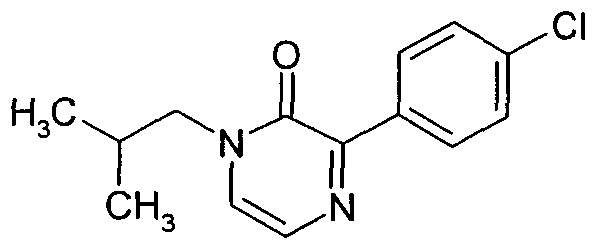
3-(4-chlorophenyl)-1 -isobutylpyrazin-2(1 H)-one;
3-(4-tert-butylphenyl)-1 -ethylpyrazin-2(1 H)-one; 3-phenyl-1-propylpyrazin-2(1/-/)-one;
4-(4-ethyl-3-oxo-3,4-dihydropyrazin-2-yl)benzoic acid; 10
as well as its racemic forms, tautomers, enantiomers, diastereomers, epimers and polymorphs, and mixtures thereof, and the pharmaceutically acceptable salts thereof.
More preferably, the compounds of the formula (I) according to the invention may be chosen from:
3-(1 ,3-benzodioxol-5-yl)-1 -ethylpyrazin-2(1 H)-one; 3-(4-chlorophenyl)-1 -(cyclopropylmethyl)pyrazin-2(1 H)-one; 3-(4-chlorophenyl)-1-ethyl-5,6,7,8-tetrahydroquinoxalin-2(1/-/)-one; 3-(4-chlorophenyl)-1 -isobutylpyrazin-2(1 H)-one; 3-phenyl-1-propylpyrazin-2(1AV)-one; as well as its racemic forms, tautomers, enantiomers, diastereomers, epimers and polymorphs, and mixtures thereof, and the pharmaceutically acceptable salts thereof.
The invention also relates to the racemic forms, tautomeric forms, enantiomers, diastereoisomers, epimers and organic or mineral salts of the compounds of the general formula (I), as well as their crystalline forms, including their polymorphic forms and the polymorphic forms of the compounds of formula (I).
The present invention is directed not only to racemic mixtures of these compounds, but also to individual stereoisomers and/or diastereoisomers thereof, as well or as mixtures of these in all proportions. The compounds of the invention of the formula (I), as defined above, containing a sufficiently acidic function or a sufficiently basic function, or both, may include the corresponding pharmaceutically acceptable salts of an organic or mineral acid, or of an organic or mineral base. The expression "pharmaceutically acceptable salts" refers to the relatively non-toxic mineral and organic acid-addition salts, and the base-addition salts, of the compounds of the present invention. These salts may be prepared in situ during the final isolation and purification of the compounds. 11
In particular, the acid-addition salts may be prepared by separately reacting the purified compound in its purified form with an organic or mineral acid and isolating the salt thus formed. The resulting salts are, for example, hydrochlorides, hydrobromides, sulfates, hydrogenosulfates, dihydrogenophosphates, citrates, maleates, fumarates, trifluoroacetates, 2- naphtalenesulfonat.es, para-toluenesulfonates.
The invention also relates to pharmaceutically acceptable salts with organic or inorganic bases. In particular, the basic-addition salts may be prepared by separately reacting the purified compound in its purified form with an organic or inorganic base and isolating the salt thus formed. The resulting salts are, for example, metal salts, particularly alkali metal salts, alkaline-earth metal salts and transition metal salts (such as sodium, potassium, calcium, magnesium, aluminum), or salts obtained with bases, such as ammonia or secondary or tertiary amines (such as diethylamine, triethylamine, piperidine, piperazine, morpholine), or with basic amino-acids, or with osamines (such as meglumine), or with aminoalcohols (such as 3-aminobutanol and 2- aminoethanol).
The invention also relates to the salts used for chiral resolution of the racemates. As examples, the following chiral acids can be used : (+)-D-di-O- benzoyltartaric acid, (-)-L-di-O-benzoyltartaric acid, (-)-L-di-O,O'-p-toluyl-L- tartaric acid, (+)-D-di-O,O'-p-toluyl-L-tartaric acid, (R)-(+)-malic acid, (S)-(-)- malic acid, (+)-camphoric acid, (-)-camphoric acid, R-(-)1 ,1'-binaphtalen-2,2'- diyl hydrogenophosphonic, (+)-camphanic acid, (-)-camphanic acid, (S)-(+)-2- phenylpropionic acid, (R)-(+)-2-phenylpropionic acid, D-(-)-mandelic acid, L- (+)-mandelic acid, D-tartaric acid, L-tartaric acid, or any mixture of them. As examples, the following chiral amines can be used: quinine, brucine, (S)- 1-(benzyloxymethyl)propylamine (III), (-)-ephedrine, (4S,5R)-(+)-1 ,2,2,3,4- tetramethyl-5-phenyl-1 ,3-oxazolidine, (R)-1-phenyl-2-p-tolylethylamine, (S)- phenylglycinol, (-)-N-methylephedrine, (+)-(2S,3R)-4-dimethylamino-3- methyl-1 ,2-diphenyl-2-butanol, (S)-phenylglycinol, (S)-α-methylbenzylamine or any mixture of them. 12
Also included in the scope of the present invention are prodrugs of the compounds of formula (I).
The term "prodrug" as used herein refers to any compound that when administered to a biological system generates the "drug" substance (a biologically active compound) as a result of spontaneous chemical reaction(s), enzyme catalyzed chemical reaction(s), and/or metabolic chemical reaction(s).
In accordance with the present invention and as used herein, the following terms are defined with the following meanings, unless explicitly stated otherwise.
The term "aryl" refers to aromatic groups which have 5-14 ring atoms and at least one ring having a conjugated pi (π) electron system and includes biaryl groups, all of which may be optionally substituted. Suitable aryl groups include phenyl, naphthyl, biphenyl, anthryl, phenanthryl, indenyl and the like.
The term "heteroaryl" refers to 5-14 ring atom aromatic heterocycles containing 1 to 4 heteroatoms, as ring atoms in the aromatic ring and the remainder of the ring atoms being carbon atoms. Suitable heteroatoms include O, S, N. Suitable heteroaryl groups include furanyl, benzofuranyl, thienyl, pyridyl, pyridyl-N-oxide, pyrimidinyl, pyrazinyl, oxazolyl, thiazolyl, isoxazolyl, quinolinyl, triazolyl, pyridazinyl, pyrrolyl, imidazolyl, indazolyl, isothiazolyl, indolyl, oxadiazolyl and the like.
The term "cycloalkyl" means saturated carbocyclic rings, optionally substituted, and includes mono-, bi- and tri-cyclic compounds with 3 to 10 carbon atoms. Suitable cycloalkyl groups are: cyclopropyl, cyclobutyl, cyclopentyl, cyclohexyl, cycloheptyl, cyclooctyl, cyclodecyl, adamantyl and the like. 13
The term "heterocycloalkyl" refers to optionally substituted monocyclic, bicyclic or tricyclic radicals, comprising one or more heteroatoms, preferably chosen from among O, S and N, optionally in the oxidized state (for S and N), and optionally one or more double bonds. At least one of the rings preferably comprises from 1 to 4 endocyclic heteroatoms, more preferably from 1 to 3 heteroatoms. Most preferably, the heterocycloalkyl (or simply "heterocyclic" or "heterocycle") radical comprises one or more rings, each having from 5 to 8 nodes. Examples of heterocyclic radicals are: morpholinyl, piperidinyl, piperazinyl, thiazolidinyl, oxazolidinyl, tetrahydrothienyl, dihydrofuranyl, tetrahydrofuranyl, pyrazolidinyl, 1 ,3-dioxolanyl, pyrrolidinyl, pyranyl, dihydropyranyl, isoxazolidinyl, imidazolyl, imidazolidinyl and the like.
The term "alkyl" refers to a saturated aliphatic groups, including straight chain and branched chain groups. Suitable alkyl groups, having 1 to 20 carbon atoms, include methyl, ethyl, propyl, isopropyl, butyl, sec-butyl, tert-butyl, pentyl, hexyl, octyl, decanoyl, dodecanoyl, hexadecyl, octadecyl groups and the like.
The term "alkenyl" refers to unsaturated groups comprising at least one carbon-carbon double bond, and includes straight chain, branched chain and cyclic groups. Suitable alkenyl groups, having 2 to 20 carbon atoms, include ethenyl, 2-propenyl, 2-butenyl, 3-butenyl, 2-pentenyl, 3-pentenyl, 4-pentenyl and the like.
The term "alkynyl" refers to unsaturated groups comprising at least one carbon-carbon triple bond and includes straight chain, branched chain and cyclic groups; and optionally includes at least one carbon-carbon double bond. Suitable alkynyl groups, having 2 to 20 carbon atoms, include ethynyl, 2-propynyl, 2-butynyl, 3-butynyl, 2-pentynyl, 3-pentynyl, 4-pentynyl and the like. 14
The term "arylalkyϊ" refers to an alkyl group, preferably an alkyl group having 1 to 20 carbon atoms, substituted with an aryl group. Suitable arylalkyl groups include benzyl, picolyl, and the like.
The term "arylalkenyl" refers to an alkenyl group, preferably an alkenyl group having 1 to 20 carbon atoms, substituted with an aryl group.
The term "arylalkynyl" refers to an alkynyl group, preferably an alkynyl group having 1 to 20 carbon atoms, substituted with an aryl group.
The term "alkoxy" refers to the group alk-O- wherein "alk" is an alkyl group.
The term "aryloxy" refers to the group aryl-O-.
The term "aryloxyalkyl" refers to an alkyl group substituted with an aryloxy group.
The term "arylalkoxyalkyl" refers to an alkyl group substituted with an arylalkoxy group.
The term "arylalkoxy" refers to the group aryl-Alk-O-, wherein "AIk" is an alkyl group.
The term "arylthioalkyl" refers to an alkyl group substituted with an arylthio group.
The term "alkylsulfinyl" refers to an alkyl-SO- group.
The term "alkylsulfonyl" refers to an alkyl-SO2- group.
The term "aryl sulfonylalkyl" refers to an alkyl group substituted with an arylsulfonyl (aryl-SO2-) group. 15
The term "arylalkylthioalkyl" refers to an alkyl group substituted with an arylalkylthio.
The term "heteroarylalkyl" refers to an alkyl group substituted with a heteroaryl group.
The term "heteroaryloxyalkyl" refers to an alkyl group substituted with a heteroaryloxy group.
The term "heteroarylalkoxyalkyl" refers to an alkyl group substituted with a heteroarylalkoxy group.
The term "heteroarylthioalkyl" refers to an alkyl group substituted with a heteroarylthio group.
The term "heteroarylalkylthioalkyl" refers to an alkyl group substituted with a heteroarylalkylthio group.
The term "heterocycloalkylalkyl" refers to an alkyl group substituted with a heterocycloalkyl group.
The term "heterocycloalkyloxyalkyl" refers to an alkyl group substituted with a heterocycloalkyloxy group.
The term "heterocycloalkylalkoxyalkyl" refers to an alkyl group substituted with a heterocycloalkylalkoxy group.
The term "heterocycloalkylthioalkyl" refers to an alkyl group substituted with a heterocycloalkylthio group. 16
The term "heterocycloalkylalkylthioalkyl" refers to an alkyl group substituted with a heterocycloalkylalkylthio group.
The term "cycloalkylalkyl" refers to an alkyl group substituted with a cycloalkyl group.
The term "cycloalkyloxyalkyl" refers to an alkyl group substituted with a cycloalkyloxy group.
The term "cycloalkylalkoxyalkyl" refers to an alkyl group substituted with a cycloalkylalkoxy group.
The terms "alkylthio" refers to the group alkyl-S-.
The term "cycloalkylthio" refers to the group cycloalkyl-S-.
The term "cycloalkylthioalkyl" refers to an alkyl group substituted with a cycloalkylthio group.
The term "cycloalkylalkylthioalkyl" refers to an alkyl group substituted with a cycloalkylalkylthio group.
The term "halogen" refers to a fluorine, bromine or chlorine atom.
The term "amidino" refers to -C(NR5)-NR5R6 where R5R6 are as defined above, all, except hydrogen, are optionally substituted.
The term "carbamoyl" refers to an unsubstituted aminocarbonyl group.
The invention's compounds according to formula (I) exhibit an hypoglycemic activity, and are useful in the treatment of pathologies associated with the syndrome of insulin resistance. 17
Insulin resistance is characterised by a reduction in the action of insulin (cf. "Presse Medicale", (1997), 26(14), 671-677) and is involved in many pathological conditions, such as diabetes and more particularly non-insulin- dependent diabetes (type Il diabetes or NIDDM), dyslipidaemia, obesity, arterial hypertension, and also certain cardiac, microvascular and macrovascular complications, for instance atherosclerosis, retinopathy and neuropathy. In this respect, reference will be made, for Example, to Diabetes, 37, (1988), 1595-1607; Journal of Diabetes and its complications, 12, (1998), 110-119; Horm. Res., 38, (1992), 28-32.
The invention also relates to pharmaceutical composition containing as active ingredient at least one compound of formula (I), as defined above, and/or a pharmaceutically acceptable salt thereof, in combination with one or several pharmaceutically acceptable carrier, adjuvant, diluent or excipient. A person skilled in the art is aware of a whole variety of such carrier, adjuvant, diluent or excipient compounds suitable to formulate a pharmaceutical composition. The pharmaceutical compositions of the present invention can be administered by a variety of routes including oral, parenteral, intravenous, intramuscular, rectal, permucous or percutaneous. They will thus be presented in the form of injectable solutions or suspensions or multi-dose bottles, in the form of plain or coated tablets, sugar-coated tablets, wafer capsules, gel capsules, pills, sachets, powders, suppositories or rectal capsules, solutions or suspensions, for percutaneous use in a polar solvent, or for permucous use. The excipients that are suitable for such administrations are pharmaceutically acceptable excipients, such as cellulose or microcrystalline cellulose derivatives, alkaline-earth metal carbonates, magnesium phosphate, starches, modified starches, lactose and the like for solid forms. For rectal use, cocoa butter or polyethylene glycol stearates are the preferred excipients.
For parenteral use, water, aqueous solutions, physiological saline and isotonic solutions are the vehicles most appropriately used. 18
For example, in the case of an oral administration, for example in the form of granules, tablets or coated tablets, pills, capsules, gel capsules, gels, cachets or powders, a suitable posology of the compounds is between about 0.1 mg/kg and about 100 mg/kg, preferably between about 0.5 mg/kg and about 50 mg/kg, more preferably between about 1 mg/kg and about 10 mg/kg and most preferably between about 2 mg/kg and about 5 mg/kg of body weight per day.
If representative body weights of 10 kg and 100 kg are considered, in order to illustrate the daily oral dosage range that can be used and as described above, suitable dosages of the compounds of the formula (I) will be between about 1-10 mg/per day and 1000-10000 mg/per day, preferably between about 5-50 mg/per day and 500-5000 mg/per day, more preferably between 10-100 mg and 100-1000 mg/per day and most preferably between 20-200 mg and 50-500 mg/per day. It will be understood, however, that the specific dose level for any particular patient will depend on a variety of factors including the activity of the specific compound employed; the age, body weight, general health, sex and diet of the individual being treated; the time and route of administration; the rate of excretion; other drugs which have previously been administered; and the severity of the particular disease undergoing therapy, as is well understood by those skilled in the art.
As noted above, formulations of the present invention suitable for oral administration may be presented as discrete units, such as capsules, cachets or tablets, each containing a predetermined amount of the active ingredient; as a powder or granules; as a solution or a suspension in an aqueous or nonaqueous liquid; or as an oil-in-water liquid emulsion or a water-in-oil liquid emulsion. The active ingredient may also be administered as a bolus, electuary or paste. In the non-insulin-dependent diabetes, for the man, the hyperglycemia is the results of two main defects: an alteration of the insulin secretion and a reduction in the effectiveness of insulin at level of three sites to knowing the liver, the muscles and adipose tissue. 19
The present invention also relates to compound of general formula (I) as well as its racemic forms, tautomers, enantiomers, diastereomers, epimers and polymorphs, and mixtures thereof, and the pharmaceutically acceptable salts thereof, for the preparation of a medicament for the prevention and/or treatment of pathologies associated with hyperglycaemia; for the preparation of a medicament that induces insulin secretion in response of glucose concentration, preferably for the treatment of diabetes, more preferably for the prevention and/or treatment of type Il diabetes and pathologies associated to metabolic disorders, hypercholesteremia, hyperlipidemia, which are increased by hyperinsulinemia and hyperglycemia; for the treatment of diseases chosen from diabetes related microvascular and macrovascular complications, such as arterial hypertension, inflammatory processes, microangiopathy, macroangiopathy, retinopathy and neuropathy; for reducing hyperglycaemia, for the treatment of dyslipidaemia and obesity; or diseases such as cardiovascular diseases, comprising atherosclerosis, myocardial ischemia.
The present invention also relates to the use of at least a compound of the general formula (I), as well as its racemic forms, tautomers, enantiomers, diastereomers, epimers and polymorphs, and mixtures thereof, and the pharmaceutically acceptable salts, and pro-drugs thereof, for the preparation of a medicament for the prevention and/or treatment of pathologies associated with hyperglycaemia, preferably for the treatment of diabetes, more preferably for the prevention and/or treatment of type Il diabetes and pathologies associated to metabolic disorders, hypercholesteremia, hyperlipidemia, which are increased by hyperinsulinemia and hyperglycemia; for the treatment of diseases chosen from diabetes related microvascular and macrovascular complications, such as arterial hypertension, inflammatory processes, microangiopathy, macroangiopathy, retinopathy and neuropathy; for reducing hyperglycaemia, for the treatment of dyslipidaemia and obesity; 20
or diseases such as cardiovascular diseases, comprising atherosclerosis, myocardial ischemia.
The present invention also relates to manufacturing process of compounds of formula (I), as defined above, according to the following representative methods shown in Scheme 1 (Preparation of the intermediates); Scheme 2 (Preparation of arylpyrazinone derivatives, Method A) or Scheme 3 (Preparation of arylpyrazinone derivatives, Method B).
The following schemes are given for representative purposes, and solely for the purpose of facilitating the representation. Needless to say, depending on the nature of the compounds of the formula (I) to be obtained, the methodologies presented may be adapted by a person skilled in the art by selecting the appropriate starting materials, in which the nature of the substituents R1 , R2 and R3 may be modified, especially as a function of the nature and length of the desired chain.
The compounds useful according to the invention may be prepared, unless specifically specified, by the application or adaptation of known methods, by which are meant methods used heretofore or described in the literature, patents or patent applications, the Chemical Abstracts and on the Internet.
Preparation of the intermediates
Scheme 1 :
21
Figure imgf000023_0001
(1) (2)
Figure imgf000023_0002
(3) (4)
wherein R1 is as above defined in formula (I).
Compounds (2) are prepared by reacting diethyloxalate (1) with an amine in the presence of a quaternary ammonium salt, such as aliquat 336, in an inert solvent, such as chloroform, toluene or dichloromethane, at a temperature between 200C and the reflux for 24 to 10Oh.
Intermediates (3), with a side chain containing a protected aldehyde in the form of an acetal, are prepared by reacting compounds of formula (2) with a protected aminoacetaldehyde dialkyl-acetate, such as (2,2- dimethoxyethyl)amine. The reaction is carried out in a solvent, such as an alcohol, for example 2-propanol, at a temperature between 200C and the reflux, for 1 to 24h.
Pyrazinones (4) can be prepared by cyclization of compound (3) under acidic conditions, for example in a solvent, such as acetic acid, and catalytic amount of concentrated hydrochloric acid, at a temperature between 200C and the reflux for 1 to 24h.
Preparation of arylpyrazinone derivatives.
Scheme 2: Method A 22
Figure imgf000024_0001
(4) (5) (I) wherein R1 and A are as above defined in formula (I).
3-bromo pyrazinones (5) are prepared by bromination of the corresponding 3-hydroxypyrazinones (4), using a brominating agent, such as P0Br3, in an inert solvent, such as 1,2-dichloroethane, at a temperature between 20°C and the reflux, more preferably reflux, for 1 to 24h.
Aryl pyrazinones (I) are prepared in reacting the 3-bromopyrazinones (5) with suitable boronic acids or esters (cyclic or not) of boronic acids in the presence of a base, such as sodium carbonate or potassium carbonate, and a catalyst, such as bis(triphenylphosphine) palladium(ll)chloride, in an inert solvent, such as dimethylformamide or toluene, at a temperature between 200C and the reflux, more preferably reflux, for 1 to 24h.
Scheme 3: Method B:
Figure imgf000024_0002
wherein R1 , R2, R3 and A are as above defined in formula (I). Amino acid derivative is protected using the methods known.
Pg are known protecting groups used for the protection of amines. 23
Amino function of amino acid derivatives (7) is protected using the methods known in the art. In these formula Pg is a protecting group of the amine function, such as those described by T. W. Greene, Protective groups in Organic Synthesis, J. Wiley-lnterscience Publication (1991), preferably a tert- butoxycarbonyl radical or a benzyloxycarbonyl (Cbz) radical.
For example, aminoacid (7) can be protected using di-tert-butyldicarbonate to give compounds (8) in which Pg is a tert-butoxycarbonyl radical.
Amides (9) are prepared in reacting compounds (8) with selected amines. In order to activate the carboxylic acids, coupling agents, such as 1- hydroxybenzotriazole (HOBt) or benzotriazol-1-yl-oxytripyrrolidino phosphonium hexafluoro phosphate (PyBOP) can be used. Carbonyldiimidazole (CDI) or dicyclohexylcarbodiimide (DCC) can also be used as coupling agents. Amides (9) can also be prepared directly from corresponding carboxylic acids (8) by in situ generation of mixed anhydride. The coupling reaction is usually carried out in the presence of a tertiary amine, such as N-methylmorpholine (NMM), triethylamine (TEA) or diisopropylethylamine (DIPEA), in an organic solvent chosen from those generally used for amide preparation. Preferred solvents for the coupling reaction are ethylacetate (AcOEt), dimethylformamide (DMF), N-methylpyrrolidone (NMP) or tetrahydrofurane (THF). The mixed anhydride prepared, for example, by treating compounds (8) with isobutyl chloroformate in the presence of 4-methylmorpholine on reaction with amines give compound (9). The reaction can be carried out in a solvent, such as tetrahydrofurane, at a temperature between -5O0C to 00C, for 1 to 6h.
Compound (10) is prepared from compound (9) using the methods of deprotection known by those skilled in the art and particularly those described by T. W. Greene, Protective groups in Organic Synthesis, J. Wiley- lnterscience Publication (1991). Deprotection of BOC-protected amines can 24
be achieved by using organic acid, such as trifluoroacetic acid (CF3COOH), or mineral acid, such as hydrochloric acid (HCI).
For example amino function of (9) can be deprotected in using hydrochloric acid in dioxane, at a temperature of 00C to reflux, preferably at room temperature.
Deprotection reactions can also be carried out by means of catalytic hydrogenation.
Compounds (I) are prepared by reacting compounds (10) with 1 ,2-dicarbonyl derivatives, such as oxaldehyde, or cyclic 1,2-dione derivatives, such as cyclohexane-1 ,2-dione or cyclopentane-1 ,2-dione, optionally substituted. Cyclization can be carried out in a solvent, such as methanol, in the presence of a mineral base, such as sodium hydroxide, at a temperature between - 500C to 00C, for 1 to 10h, preferably between -400C and -20°C.
The examples that follow illustrate the invention without, however, limiting it.
The starting materials used are known products or products prepared according to known procedures. The percentages are expressed on a weight basis, unless otherwise mentioned.
The compounds were characterised especially via the following analytical techniques.
The NMR spectra were acquired using a Bruker Avance DPX 300 MHz NMR spectrometer. The masses were determined by HPLC coupled to an Agilent Series 1100 mass detector. The melting points (m.p.) were measured on a Stuart
Scientific block.
Examples:
Example 1 : ethyl(ethylamino)(oxo)acetate 25
Figure imgf000027_0001
To 135,8 ml (1000 mM) of diethyloxalate and 1g of aliquat 336, in 1000 ml of dichloromethane, were added 64 ml (1000 mM) of ethylamine at 70% in water. The reaction mixture was stirred at room temperature for 72h. The reaction mixture was dried over anhydrous sodium sulfate and the solvent was removed under vacuum to give an oil, wich was further purified by silica gel column chromatography, using dichloromethane/dimethylketone (95/5) as eluant, to give 59.9g of ethyl(ethyl amino)(oxo)acetate as an oil. Yield: 41.3%.
NMR 1H (300 MHz / DMSO-d6) δ (ppm): 1.06(t, 3H), 1.28(t, 3H), 3.17(m, 2H), 4.22(q, 2H), 8.92(s, 1 H)
Example 2: N-(2,2-dimethoxyethyl)-N'-ethylethanediamide
Figure imgf000027_0002
59.9 g (412.6 mM) of ethyl(ethylamino)(oxo)acetate and 45 ml (412.6 mM) of (2,2-dimethoxyethyl)amine, in 480 ml of 2-propanol, were stirred at room temperature for 16 h. A white precipitate was filtered, washed with 2-propanol and dried under vacuum to give 67.8 g of N-(2,2-dimethoxyethyl)-N'- ethylethanediamide. Yield: 80.5%.
NMR 1H (300 MHz / DMSO-d6) δ (ppm): 1.07(t, 3H), 3.15(m, 2H), 3.27(m, 8H), 4.51 (m, 1 H), 8.62(m, 1 H), 8.81(m, 1H)
Example 3: 1-ethyl-3-hydroxypyrazine-2(1H)-one 26
Figure imgf000028_0001
67.5 g (330 mM) of N-(2,2-dimethoxyethyl)-N'-ethylethanediannide and 2 ml of concentrated hydrochloric acid, in 390 ml of acetic acid, were refluxed under stirring for 1 h. The solvent was removed under vacuum to give an oil, wich was further purified by silica gel column chromatography, using dichloromethane/methanol (95/5) as eluant to give 37 g of 1-ethyl-3-hydroxy pyrazine-2(1H)-one as an oil. Yield: 79.5%.
NMR 1H (300 MHz / DMSO-d6) δ (ppm): 1.20(t, 3H), 3.73(q, 2H), 6.34(d, 1H), 6.56(d, 1H), 11.22(s, 1 H)
Method A:
Example 4: 3-bromo-1-ethylpyrazin-2(1H)-one
Figure imgf000028_0002
10.5 g (75 mM) of 1-ethyl-3-hydroxypyrazine-2(1H)-one and 23.1 g (80.5 mM) of phosphorous oxybromide in 75 ml of dichloroethane were refluxed under stirring for 2h. The reaction mixture was then neutralized to pH 7-8 with a saturated aqueous solution of sodium carbonate, while maintaining the temperature at 100C. The reaction mixture was then stirred at room temperature for 1 h. Water was added and the organic phase was extracted with dichloromethane. The combined organic layer was washed with water, dried on anhydrous sodium sulfate and the solvent was removed under vacuum. The compound was further purified by silica gel column chromatography using dichloromethane as eluant to give 6.1 g of 3-bromo-1- ethylpyrazin-2(1H)-one as a solid. 27
Yield: 40.2 %.
NMR 1H (300 MHz / DMSO-d6) δ (ppm): 1.18(t, 3H)1 3.87(q, 2H), 7.13(d, 1H), 7.75(d, 1H)
The following compounds were obtained using the same procedure as in Example 4:
Example 4-2: 3-bromo-1-methylpyrazin-2(1H)-one
Figure imgf000029_0001
NMR 1H (300 MHz / DMSO-d6) δ (ppm): 3.51(s, 3H), 7.18(d, 1 H), 7.,80(d, 1 H)
Example 4-3: 3-bromo-1-butylpyrazin-2(1H)-one
Figure imgf000029_0002
NMR 1H (300 MHz / DMSO-d6) δ (ppm): 0.90(t, 3H), 1.30(m, 2H), 1.65(m, 2H), 3.93(t, 2H), 7.20(d, 1 H), 7.79(d, 1H)
Example 4-4: 3-bromo-1-propylpyrazin-2(1W)-one
Figure imgf000029_0003
C7H9BrN2O = 217.06 Mass 218.0 (M+1)
Example 5: 3-(4-chlorophenyl)-1-ethylpyrazin-2(1H)-one 28
Figure imgf000030_0001
To 200 mg (0.98 mM) of 3-bromo-1-ethylpyrazin-2(1H)-one and 57 mg (0.05 mM) of palladium tetrakis triphenylphosphine in 4 ml of toluene were added, under nitrogen, 231.0 mg (1.48 mM) of 4-chlorophenylboronic acid and 2.9 ml of 2M sodium carbonate aqueous solution The mixture was stirred for 3h at reflux under nitrogen atmosphere, and then at room temperature overnight. Water was added and the mixture was extracted with ethyl acetate. The organic phase was separated, dried over anhydrous sodium sulfate, and concentrated. The compound was purified through a silica plug, eluting with dichloromethane, which afforded 110 mg of 3-(4-chlorophenyl)-1- ethylpyrazin-2(1H)-one as a solid. Yield: 56%.
NMR 1H (300 MHz / DMSO-d6) δ (ppm): 1.31(t, 3H), 4.03(q, 2H), 7.50(m, 3H), 7.81 (d, 1H), 8.30(m, 2H) Ci2Hi1CIN2O = 234.68 Mass 235.0 (M+1)
Example 5-2: 1 -ethy l-3-[4-(methylsulfonyl)pheny l]py razin-2(1 H)-one
Figure imgf000030_0002
NMR 1H (300 MHz / DMSO-d6) δ (ppm): 1.31(t, 3H), 3.01(s, 3H), 4.03(q, 2H), 6.52(d, 1 H), 7.94(d, 2H), 8.06(d, 2H), 8.38(d, 1 H) m.p.: 108-1100C
Example 5-3: 1 -ethy l-3-(1 H-indol-5-yl)pyrazin-2(1 W)-one 29
Figure imgf000031_0001
C14Hi3N3O = 239.27 Mass 240.1 (M+1)
Example 5-4: 3-(2-ethoxyphenyl)-1-ethylpyrazin-2(1H)-one
Figure imgf000031_0002
C14Hi6N2O2 = 244.29 Mass 245.1 (M+1) Example 5-5: 3-(1,3-benzodioxol-5-yl)-1-ethylpyrazin-2(1H)-one
Figure imgf000031_0003
C13H12N2O3 = 244.25 Mass 245.1 (M+1)
Example 5-6: 1 -ethy l-3-[4-(trifluoromethoxy)phenyl]pyrazin-2(1 H)-one
Figure imgf000031_0004
C13H11F3N2O2 = 284.23 Mass 285.1 (M+1)
Example 5-7: 1-ethyl-3-(5-fluoro-2-methoxyphenyl)pyrazin-2(1H)-one 30
Figure imgf000032_0001
C13Hi3FN2O2 = 248.25 Mass 249.1 (M+1)
Example 5-8: 3-(4-tert-butylphenyl)-1-ethylpyrazin-2(1H)-one
Figure imgf000032_0002
C16H20N2O = 256.34 Mass 257.1 (M+1)
Example 5-9: 1-ethyl-3-(4-methoxyphenyl)pyrazin-2(1H)-one
Figure imgf000032_0003
C13H14N2O2 = 230.26 Mass 231.1 (M+1)
Example 5-10: 1-ethyl-3-[4-(trifluoromethyl)phenyl]pyrazin-2(1H)-one
Figure imgf000032_0004
C13H1 IF3N2O = 268.23 Mass 269.0 (M+1)
Example 5-11 : 1-ethyl-3-(4-fluorophenyl)pyrazin-2(1H)-one 31
Figure imgf000033_0001
Ci2HnFN2O = 218.23 Mass 219.0 (M+1)
Example 5-12: 1-ethyl-3-(4-methylphenyl)pyrazin-2(1H)-one
Figure imgf000033_0002
Ci3H14N2O = 214.26 Mass 215.1 (M+1)
Example 5-13: 1-ethyl-3-phenylpyrazin-2(1H)-one
Figure imgf000033_0003
Ci2H12N2O = 200.24 Mass 201.1 (M+1)
Example 5-14: 1-ethyl-3-quinolin-6-ylpyrazin-2(1H)-one
Figure imgf000033_0004
C15H13N3O = 251.28 Mass 252.1 (M+1)
Example 5-15: 4-(4-ethyl-3-oxo-3,4-dihydropyrazin-2-yl)benzoic acid
Figure imgf000033_0005
32
NMR 1H (300 MHz / CDCh) δ (ppm): 1.38(t, 3H), 3.99(q, 2H), 7.18(d, 1 H), 7.47(d, 1H), 8.10(m, 2H), 8.39(m, 2H) m.p.: 1700C
Example 5-16: 1-ethyl-3-(1H-indol-6-yl)pyrazin-2(1H)-one
Figure imgf000034_0001
C14Hi3N3O = 239.27 Mass 240.1 (M+1) m.p.: 1700C
Example 6: [(tert-butoxycarbonyl)amino](4-chlorophenyl)acetic acid
Figure imgf000034_0002
To 25g (134.6 mM) of amino(4-chlorophenyl)acetic in 270ml of a 1 N aqueous solution of sodium hydroxide were added 34 g (156 mM) of di-tert- butyldicarbonate. The mixture was stirred at room temperature for 16h. The reaction mixture was extracted twice with ethyl acetate. The combined organic layer was washed with water and dried over anhydrous sodium sulfate. The solvent was removed under vacuum to give 34.3 g of [(tert- butoxycarbonyl)amino](4-chlorophenyl)acetic acid as a yellow oily compound. Yield: 89.2%.
NMR 1H (300 MHz / DMSO-d6) δ (ppm): 1.40(s, 9H), 5.14(d, 1H), 7.42(m, 4H), 7.62(d, 1 H)
Example 7: tert-butyl 1-(4-chlorophenyl)-2-(ethylamino)-2- oxoethylcarbamate 33
Figure imgf000035_0001
To 1.1g (3.85 mM) of [(tert-butoxycarbonyl)amino](4-chlorophenyl)acetic acid in 10 ml of tetrahydrofurane were added, under stirring at -25°C, 0.5 ml (4.6 mM) of 4-methyl morpholine and 0.52 ml (4.0 mM) of isobutyl chloroformate. After 10 mn were then added, at -25°C under stirring, 1.9 ml (3.85 mM) of ethylamine 2M in tetrahydrofurane. The reaction mixture was stirred at -25°C for 1 h, and at room temperature for 16h. The reaction mixture was filtered and the filtrate was concentrated under vacuum to give an oil, which was further purified by silica gel column chromatography, using dichloromethane/cyclohexane (75/25) as eluant, to give 520 mg of tert-butyl 1-(4-chlorophenyl)-2-(ethylamino)-2-oxoethylcarbamate as a white solid. Yield: 43%.
NMR 1H (300 MHz / DMSO-d6) δ (ppm): 0.99(t, 3H), 1.39(s, 9H), 3.08(m, 2H), 5.14(d, 1H), 7.35(d, 1H), 7.42(s, 4H), 8.19(t, 1H)
Example 8: 2-amino-2-(4-chlorophenyl)-N-ethylacetamide
Figure imgf000035_0002
A solution of 516 mg (1.65 mM) of tert-butyl 1-(4-chlorophenyl)-2- (ethylamino)-2-oxoethylcarbamate in 2 ml of 4N hydrochloric acid-dioxane solution were stirred at room temperature for 2 h. The reaction mixture was neutralized with an aqueous solution of sodium hydrogenocarbonate and was extracted twice with ethyle acetate. The combined organic layer was washed with water and dried over anhydrous sodium sulfate. The solvent was 34
removed under vacuum to give 350 mg of 2-amino-2-(4-chlorophenyl)-N- ethylacetamide as an oil. Yield: 99.8%.
NMR 1H (300 MHz / DMSO-d6) δ (ppm): 1.01(t, 3H), 2.27,(s, 2H)1 3.08(m,
2H), 4.32(s, 1H), 4.32(s, 1 H), 7.39(m, 4H), 8.09(m, 1 H)
The following compounds were obtained using the same procedure as in Example 8
Example 8-2: 2-amino-N-cyclopropyl-2-phenylacetamide, hydrochloride
Figure imgf000036_0001
NMR 1H (300 MHz / DMSO-d6) δ (ppm): 0.24(m, 4H), 2.46(m, 1 H), 4.72(s, 1 H), 7.22(m, 3H), 7.39(m, 2H), 8.62(s, 3H), 8.85(d, 1 H)
Example 8-3: 2-amino-N-(cyclopropylmethyl)-2-pheny!acetamide, hydrochloride
Figure imgf000036_0002
NMR 1H (300 MHz / DMSO-d6) δ (ppm): 0.10(m, 2H), 0.35(m, 2H), 0.83(m, 1 H), 2.95(m, 2H), 4.99(s, 1 H), 7.39(m, 3H), 7.49(m, 2H), 8.72(m, 4H)
Example 8-4: 2-amino-N-(tert-butyl)-2-(4-chlorophenyl)acetamide, hydrochloride
Figure imgf000036_0003
35
NMR 1H (300 MHz / DMSO-d6) δ fppm): 1.24(s, 9H), 4.97(s, 1 H), 7.56(s, 4H), 8.40(s, 1 H), 8.72(s, 3H)
Example 8-5: 2-amino-2-(4-chlorophenyl)-N-isobutylacetamide, hydrochloride
Figure imgf000037_0001
NMR 1H (300 MHz / DMSO-d6) δ (ppm): 0.75(dd, 6H), 1.68(m, 1H), 2.94(m, 2H), 3.59(s, 1 H), 7.57(s, 4H), 8.60(m, 1 H), 8.70(s, 3H)
Example 8-6: 2-amino-N-isopropyl-2-phenylacetamide, hydrochloride
Figure imgf000037_0002
NMR 1H (300 MHz / DMSO-d6) δ (ppm): 0.96(d, 3H), 1.13(d, 3H), 3.85(m, 1 H), 4.95(m, 1 H), 7.42(m, 3H), 7.57(m, 2H), 8.82(m, 4H)
Example 9: 3-(4-chloropheny l)-1 -ethy l-5,6,7,8-tetrahydroquinoxalin- 2(1H)-one
Figure imgf000037_0003
To 330 mg (1.55 mM) of 2-amino-2-(4-chlorophenyl)-N-ethylacetamide in 3.5 ml of methanol at -35°C were added 174.1 mg (1.55 mM) of cyclohexane- 1 ,2-dione and 310 μl of a 10N aqueous solution of sodium hydroxide. After stirring at -35°C for one hour, the reaction mixture was then stirred at 5°C for 36
3 h and at room temperature for 16h. After addition of water, the reaction mixture was acidified with hydrochloric acid and extracted twice with dichloromethane. The combined organic layer was separated, washed with water, dried over anhydrous sodium sulfate, and the solvent was then removed under vacuum to give a brown solid, which was further purified by silica gel column chromatography, using dichloromethane/cyclohexane (75/25) as eluant, to give 192 mg of 3-(4-chlorophenyl)-1-ethyl-5,6,7,8- tetrahydroquinoxalin-2(1H)-one as a yellow solid. Yield: 42.8%.
NMR 1H (300 MHz / DMSO-d6) δ (ppm): 1.24(t, 3H), 1.78(m, 4H), 2.70(t, 2H), 2.83(t, 2H), 4.08(q, 2H), 7.48(d, 2H), 8.37(d, 2H)
C16H17CIN2O = 288.77 Mass 289.1 (M+1) m.p.: 110-1130C
The following compounds were obtained using the same procedure as in Example 9:
Example 9-2: 1-cyc!opropyl-3-phenylpyrazin-2(1H)-one
Figure imgf000038_0001
C13H12 N2O = 212.25 Mass 213.1 (M+1)
Example 9-3: 3-phenyl-1-propylpyrazin-2(1H)-one
Figure imgf000038_0002
C13H14 N2O = 214.26 Mass 215.1 (M+1)
Example 9-4: 1-butyl-3-phenylpyrazin-2(1H)-one 37
Figure imgf000039_0001
NMR 1H (300 MHz / DMSO-d6) δ (ppm): 0.86(t, 3H), 1.42(m, 2H), 1.82(m,
2H), 4.97(m, 2H), 7.49(m, 3H), 7.60(d, 1 H), 7.79(d, 1H), 8.31 (m, 2H)
Example 9-5: 1-isobutyl-3-phenylpyrazin-2(1H)-one
Figure imgf000039_0002
C14H16 N2O = 228.29 Mass 229.1 (M+1)
Example 9-6: 1-(cyclopropylmethyl)-3-phenylpyrazin-2(1H)-one
Figure imgf000039_0003
NMR 1H (300 MHz / DMSO-d6) δ (ppm): 0.21 (m, 2H), 0.30(m, 2H), 1.,04(m, 1 H), 3.62(d, 2H), 7.21(m, 3H), 7.28(d, 1 H), 7.58(d, 1 H), 8.05(m, 2H)
Example 9-7: 3-(4-chlorophenyl)-1-isobutylpyrazin-2(1H)-one
Figure imgf000039_0004
C14Hi5CI N2O = 262.73 Mass 263.1 (M+1) 38
Example 9-8: 3-(4-chlorophenyl)-1 -(cyclopropylmethyl)pyrazin-2(1 H)- one
Figure imgf000040_0001
Ci4Hi3CI N2O = 260.72 Mass 261.1 (M+1)
Example 9-9: 1-isopropyl-3-phenylpyrazin-2(1H)-one
Figure imgf000040_0002
NMR 1H (300 MHz / DMSO-d6) δ (ppm): 1.43(d, 6H), 5.15(m, 1H), 7.49(m, 3H), 7.59(d, 1H), 7.84(d, 1 H), 8.30(m, 2H)
BIOLOGICAL ASSAYS
The INS-1 cells were selected to evaluate our compounds for their superior response to glucose and other physiological and pharmacological insulin secretagogues.
Culture of pancreatic INS-1 cells
INS-1 cells were cultured in complete medium, RPM11640 containing 1mM sodium pyruvate, 50μM 2-mercaptoethanol, 2mM glutamine, 1OmM HEPES, 100IU/mL penicillin, and 100μg/mL streptomycin (CM), supplemented with 1OmM glucose, and 10% (vol/vol) heat-inactivated fetal calf serum (FCS), as described by Asfari et al. (Endocrinology 130: 167-178, 1992). 39
Insulin secretion assay
INS-1 cells were plated and cultured in 48-well plates. After 2 days of culture, the medium was removed and cells were cultured for 24h with a medium change to 5mM glucose, 1% FCS. The cells were then washed with Krebs- Ringer Bicarbonate HEPES buffer (KRBH; 135mM NaCI; 3.6mM KCI; 5mM NaHCO3; 0.5mM NaH2PO4; 0.5mM MgCI2; 1.5mM CaCI2 and 1OmM HEPES; pH 7.4) 0,1% BSA containing 2.8 mM glucose and preincubated for 30min at 37°C in the same buffer. The cells were then washed twice and incubated for 1h in KRBH 0.1% BSA containing 4.2mM glucose and different concentrations of the tested molecule. Insulin concentration in the collected supernatants was measured with ELISA using rat insulin antibody (Insulin Rat Elit PLUS, cat. ref 10-1145-01). Insulin secretion results are expressed in % of control (glucose 4.2mM).
Insulin secretion in INS-1 cells (glucose at 4.2 mM)
Figure imgf000041_0001

Claims

40Claims
1. A compound of the general formula (I)
Figure imgf000042_0001
(I) wherein: R1 is selected from Z;
R2 is selected from hydrogen, alkyl, cycloalkyl;
R3 is selected from hydrogen, halogen, alkyl, cycloalkyl;
A is selected from aryl, heteroaryl, arylalkyl, wherein alkyl, aryl and heteroaryl groups can be optionally substituted by one or more substituents selected from Y;
Z is: alkyl, alkenyl, alkynyl, alkoxyalkyl, aryl, arylalkyl, aryloxyalkyl, arylalkoxyalkyl, arylthioalkyl, arylalkylthioalkyl, heteroarylalkyl, heteroaryloxyalkyl, heteroarylalkoxyalkyl, heteroarylthioalkyl, heteroarylalkylthioalkyl, heterocycloalkyl, heterocycloalkylalkyl, heterocycloalkyloxyalkyl, heterocycloalkylalkoxyalkyl, heterocycloalkylthioalkyl, heterocycloalkylalkylthioalkyl, arylalkenyl, arylalkynyl, cycloalkyl, cycloalkylalkyl, cycloalkyloxyalkyl, cycloalkylalkoxyalkyl, cycloalkylthioalkyl, cycloalkylalkylthioalkyl, each of these groups can be optionally substituted by one or more substituents selected from Y;
Y is: hydroxy, thio, halogen, cyano, trifluoromethoxy, trifluoromethyl, carboxy, carboxymethyl, carboxyethyl, alkyl, alkoxy, alkylamino, aryl, aryl sulfonylalkyl, aryloxy, arylalkoxy, amino, NR5R6, azido, nitro, guanidino, amidino, 41
phosphono, oxo, carbamoyle, alkylsulfonyl, alkylsulfinyl, alkylthio, SF5, two Y groups can form a methylenedioxy;
R5 and R6 are independently selected from hydrogen, alkyl, aryl, arylalkyl, heteroaryl, heteroarylalkyl, wherein alkyl, aryl and heteroaryl groups can be optionally substituted by one or more substituents selected from Y,
R5 and R6 together can constitute an heterocycle;
R2 and R3 can constitute a cycle which corresponds to the general formula (II)
Figure imgf000043_0001
R4
OD wherein: R1 and A are defined as above; n = 3, 4, 5;
R4 represents one or more substituents selected from hydrogen, alkyl, alkoxy, cycloalkyl, aryl, wherein alkyl, cycloalkyl and aryl groups can be optionally substituted by one or more substituents, selected from hydroxy, halogen, alkyl, alkoxy, trifluoromethoxy, trifluoromethyl, alkylsulfonyl, NR7R8;
R7 and R8 are independently selected from hydrogen, alkyl, cycloalkyl;
as well as its racemic forms, tautomers, enantiomers, diastereomers, epimers and polymorphs, and mixtures thereof, and the pharmaceutically acceptable salts thereof. 42
2. A compound according to claim 1 , wherein: R1 is selected from alkyl, alkenyl, alkynyl, cycloalkyl, cycloalkylalkyl, heterocycloalkyl, heterocycloalkylalkyl, alkoxyalkyl, each of these groups can be optionally substituted by one or more substituents selected from Y;
R2 is selected from hydrogen, alkyl, cycloalkyl; R3 is selected from hydrogen, halogen, alkyl, cycloalkyl; A is selected from aryl, heteroaryl, wherein aryl and heteroaryl groups can be optionally substituted by one or more substituents selected from Y;
Y is: hydroxy, thio, halogen, cyano, trifluoromethoxy, trifluoromethyl, carboxy, carboxymethyl, carboxyethyl, alkyl, alkoxy, alkylamino, aryl, aryl sulfonylalkyl, aryloxy, arylalkoxy, amino, NR5R6, azido, nitro, guanidino, amidino, phosphono, oxo, carbamoyle, alkylsulfonyl, alkylsulfinyl, alkylthio, SF5, two Y groups can form a methylenedioxy;
R5 and R6 are independently selected from hydrogen, alkyl, aryl, arylalkyl, heteroaryl, heteroarylalkyl; wherein alkyl, aryl and heteroaryl groups can be optionally substituted by one or more substituents selected from Y;
R5 and R6 together can constitute an heterocycle;
R2 and R3 can constitute a cycle which corresponds to the general formula
(II),
Figure imgf000044_0001
R4 43
(H) wherein:
R1 and A are defined as above; n = 3, 4, 5; R4 represents one or more substituents selected from hydrogen, alkyl, alkoxy, cycloalkyl, aryl; wherein alkyl, cycloalkyl and aryl groups can be optionally substituted by one or more substituents, selected from' hydroxy, halogen, alkyl, alkoxy, trifluoromethoxy, trifluoromethyl, alkylsulfonyl;
as well as its racemic forms, tautomers, enantiomers, diastereomers, epimers and polymorphs, and mixtures thereof, and the pharmaceutically acceptable salts thereof.
3. A compound according to claims 1 or 2, wherein:
R1 is selected from alkyl, cycloalkyl, cycloalkylalkyl, alkoxyalkyl; each of these groups can be optionally substituted by one or more substituents selected from halogen, hydroxy;
R2 is selected from hydrogen, alkyl, cycloalkyl; R3 is hydrogen, alkyl, cycloalkyl, halogen;
A is selected from aryl, heteroaryl; wherein aryl and heteroaryl groups can be optionally substituted by one or more substituents selected from Y;
Y is: hydroxy, thio, halogen, cyano, trifluoromethoxy, trifluoromethyl, carboxy, carboxymethyl, carboxyethyl, alkyl, alkoxy, alkylamino, aryl, aryl sulfonylalkyl, aryloxy, arylalkoxy, amino, NR5R6, azido, nitro, guanidino, amidino, phosphono, oxo, carbamoyle, alkylsulfonyl, alkylsulfinyl, alkylthio, SF5, two Y groups can form a methylenedioxy 44
R5 and R6 are independently selected from hydrogen, alkyl, aryl, arylalkyl, heteroaryl, heteroarylalkyl; wherein alkyl, aryl and heteroaryl groups can be optionally substituted by one or more substituents selected from Y;
R5 and R6 together can constitute an heterocycle;
R2 and R3 can constitute a cycle which corresponds to the general formula
(II),
Figure imgf000046_0001
R4
(H) wherein:
R1 and A are defined as above; n = 3, 4, 5;
R4 represents one or more substituents selected from hydrogen, alkyl, alkoxy, cycloalkyl, aryl; wherein alkyl, cycloalkyl and aryl groups can be optionally substituted by one or more substituents, selected from hydroxy, halogen, alkyl, alkoxy, trifluoromethoxy, trifluoromethyl, alkylsulfonyl;
as well as its racemic forms, tautomers, enantiomers, diastereomers, epimers and polymorphs, and mixtures thereof, and the pharmaceutically acceptable salts thereof.
4. A compound according to claim 3, wherein R1 is: ethyl, propyl, isopropyl, butyl; sec-butyl, tert-butyl, cyclopropyl, cyclopropylmethyl. 45
5. A compound according to claim 3, wherein R2 and R3 are selected independently from hydrogen, alkyl or constitute a cycle, which corresponds to tetrahydroquinoxalin-2(1H)-one.
6. A compound according to claim 3, wherein R2 and R3 are hydrogen, or constitute a cycle, which corresponds to tetrahydroquinoxalin-2(1/-/)-one.
7. A compound according to claim 3, wherein A is: phenyl, indolyl, quinolinyl; each of these groups can be optionally substituted by one or more groups selected from Y, as defined in claim 1.
8. A compound according to claim 3, wherein Y is: halogen, trifluoromethoxy, trifluoromethyl, carboxy, alkyl, alkoxy, alkylsulfonyl, two Y groups can form a methylenedioxy.
9. A compound according to any of the preceding claims, selected from the following compounds:
1 -cyclopropyl-3-phenylpyrazin-2( 1 H)-one;
1 -(cyclopropylmethyl)-3-phenylpyrazin-2(1 H)-one; 1-ethyl-3-(4-fluorophenyl)pyrazin-2(1H)-one;
1 -ethyl-3-(4-methoxyphenyl)pyrazin-2(1 H)-one;
1 -ethyl-3-(4-methylphenyl)pyrazin-2(1 H)-one;
1-ethyl-3-(5-fluoro-2-methoxyphenyl)pyrazin-2(1/-/)-one;
1-ethyl-3-[4-(methylsulfonyl)phenyl]pyrazin-2(1H)-one; 1 -ethyl-3-[4-(trifluoromethoxy)phenyl]pyrazin-2(1 H)-one;
1 -ethyl-3-[4-(trifluoromethyl)phenyl]pyrazin-2( 1 H)-one;
1 -ethyl-3-phenylpyrazin-2(1 H)-one;
1-ethyl-3-(1 H-indol-5-yl)pyrazin-2(1H)-one;
1 -ethyl-3-(1 H-indol-6-yl)pyrazin-2(1 H)-one; 1-ethyl-3-quinolin-6-ylpyrazin-2(1/V)-one;
1 -isopropyl-3-phenylpyrazin-2(1 H)-one;
1-butyl-3-phenylpyrazin-2(1H)-one; 46
1-isobutyl-3-phenylpyrazin-2(1H)-one;
3-(1 ,3-benzodioxol-5-yl)-1-ethylpyrazin-2(1H)-one;
3-(2-ethoxyphenyl)-1-ethylpyrazin-2(1H)-one;
3-(4-chlorophenyl)-1-(cyclopropylmethyl)pyrazin-2(1W)-one; 3-(4-chlorophenyl)-1-ethyl-5,6,7,8-tetrahydroquinoxalin-2(1H)-one;
3-(4-chlorophenyl)-1 -ethylpyrazin-2(1 /-/)-one;
3-(4-chlorophenyl)-1 -isobutylpyrazin-2(1 H)-one;
3-(4-tert-butylphenyl)-1-ethylpyrazin-2(1H)-one;
3-phenyl-1-propylpyrazin-2(1/-/)-one; 4-(4-ethyl-3-oxo-3,4-dihydropyrazin-2-yl)benzoic acid; as well as its racemic forms, tautomers, enantiomers, diastereomers, epimers and polymorphs, and mixtures thereof, and the pharmaceutically acceptable salts thereof.
10. A compound according to claim 9, selected from the following compounds:
3-(1 ,3-benzodioxol-5-yl)-1 -ethylpyrazin-2(1 H)-one;
3-(4-chlorophenyl)-1-(cyclopropylmethyl)pyrazin-2(1/7)-one;
3-(4-chlorophenyl)-1-ethyl-5,6,7,8-tetrahydroquinoxa!in-2(1H)-one; 3-(4-chlorophenyl)-1-isobutylpyrazin-2(1H)-one;
3-phenyl-1 -propylpyrazin-2(1 H)-one; as well as its racemic forms, tautomers, enantiomers, diastereomers, epimers and polymorphs, and mixtures thereof, and the pharmaceutically acceptable salts thereof.
11. Process for the preparation of the compounds of general formula (I) according to any one of the preceding claims, the process comprising: a) reacting a compound of formula (1) 47
Figure imgf000049_0001
(1) (2)
(3) (4)
with an amine RI-NH2, wherein R1 is as defined in claim 1 , in the presence of a quaternary ammonium salt, such as aliquat 336, in an inert solvent, to give a compound of formula (2); reacting a compound of formula (2) with a protected aminoacetaldehyde dialkylacetate, such as (2,2-dimethoxyethyl)amine, in an alcohol such as 2- propanol, to give a compound of formula (3); cyclizating a compound of formula (3) under acidic conditions, in a solvent, such as acetic acid, and catalytic amount of concentrated hydrochloric acid, to give a compound of formula (4); b)brominating the compound of formula (4), wherein R1 is as defined in claim
1 , using a brominating agent, such as POBr3, in an inert solvent to give a compound of formula (5);
Figure imgf000049_0003
C) (4) (5) (I)
reacting a compound of formula (5) with boronic acids or esters of boronic acids, wherein A is as defined in claim 1 , in the presence of a base, such as sodium carbonate or potassium carbonate, and a catalyst, such as bis(triphenylphosphine) palladium(ll)chloride, in an inert solvent, to give compounds of formula (I) as well as its racemic forms, tautomers, 48
enantiomers, diastereomers, epimers and polymorphs, and mixtures thereof, and the pharmaceutically acceptable salts thereof.
12. Process for the preparation of the compounds of general formula (I) according to any one of the preceding claims, the process comprising: protecting the amino function of amino acid derivatives of formula (7), wherein A is as defined in claim 1 ,
Figure imgf000050_0001
Deprotection
Figure imgf000050_0002
with a protecting group of the amine function, Pg, preferably a tert- butoxycarbonyl group or a benzyloxycarbonyl group, to give a compound of formula (8); reacting a compound of formula (8) with an amine RI-NH2, wherein R1 is as defined in claim 1 , in the presence of coupling agents, such as 1- hydroxybenzotriazole, benzotriazol-1 -yl-oxytripyrrolidino phosphonium hexafluoro phosphate, carbonyldiimidazole or dicyclohexylcarbodiimide, or by in situ generation of mixed anhydride, by reaction e.g. with isobutyl chloroformate, in the presence of a tertiary amine, such as N- methylmorpholine, triethylamine or diisopropylethylamine, in an organic solvent, to give an amide of formula (9); deprotecting the amino function of compounds of formula (9), by using organic acid, such as trifluoroacetic acid, or mineral acid, such as hydrochloric acid, or by catalytic hydrogenation, in a solvent, to give a compound of formula (10); cyclizating a compound of formula (10) with 1 ,2-dicarbonyl derivatives, such as oxaldehyde, or cyclic 1 ,2-dione derivatives, such as cyclohexane-1 ,2- 49
dione or cyclopentane-1 ,2-dione, optionally substituted, wherein R2 and R3 are as defined in claim 1 , in a solvent, in the presence of a mineral base, such as sodium hydroxide, to give compounds of formula (I) as well as its racemic forms, tautomers, enantiomers, diastereomers, epimers and polymorphs, and mixtures thereof, and the pharmaceutically acceptable salts thereof.
13. A pharmaceutical composition containing at least a compound of general formula (I), and/or a pharmaceutically acceptable salt thereof, according to claims 1 to 10 and a pharmaceutically acceptable excipient.
14. A compound of general formula (I), wherein R1 , R2, R3 and A are as defined in claim 1 , as well as its racemic forms, tautomers, enantiomers, diastereomers, epimers and polymorphs, and mixtures thereof, and the pharmaceutically acceptable salts thereof, for the preparation of a medicament for the prevention and/or treatment of pathologies associated with hyperglycaemia.
15. A compound according to claim 14, for the preparation of a medicament that induces insulin secretion in response of glucose concentration.
16. A compound according to claims 14 or 15, for the preparation of a medicament suitable for the treatment of diabetes.
17. A compound according to claim 16, for the preparation of a medicament suitable for the treatment of type Il diabetes.
18. A compound according to claims 14 or 15, for the preparation of a medicament suitable for the treatment of diseases chosen from dyslipidaemia and obesity. 50
19. A compound according to claims 14 to 17, for the preparation of a medicament suitable for the treatment of diseases chosen from diabetes related microvascular and macrovascular complications.
20. A compound according to claim 19, for which the said complications include arterial hypertension, atherosclerosis, inflammatory processes, microangiopathy, macroangiopathy, retinopathy and neuropathy.
21. A compound according to claim 14, for the preparation of a medicament suitable for reducing hyperglycaemia.
22. Use of a compound of general formula (I) according to any one of claims 1 to 10, wherein R1 , R2, R3 and A are as defined in claim 1 , as well as its racemic forms, tautomers, enantiomers, diastereomers, epimers and polymorphs, and mixtures thereof, and the pharmaceutically acceptable salts thereof, for the preparation of a medicament, for the prevention and/or treatment of pathologies associated with hyperglycaemia
PCT/EP2009/002328 2008-04-29 2009-03-31 Arylpyrazinone derivatives insulin secretion stimulators, methods for obtaining them and use thereof for the treatment of diabetes Ceased WO2009132739A1 (en)

Priority Applications (20)

Application Number Priority Date Filing Date Title
NZ589555A NZ589555A (en) 2008-04-29 2009-03-31 Arylpyrazinone derivatives insulin secretion stimulators, methods for obtaining them and use thereof for the treatment of diabetes
PL09737783T PL2268624T3 (en) 2008-04-29 2009-03-31 Arylpyrazinone derivatives insulin secretion stimulators, methods for obtaining them and use thereof for the treatment of diabetes
JP2011506584A JP5498482B2 (en) 2008-04-29 2009-03-31 Arylpyrazinone derivative insulin secretagogues, methods of obtaining the same, and their use for the treatment of diabetes
EP09737783.2A EP2268624B1 (en) 2008-04-29 2009-03-31 Arylpyrazinone derivatives insulin secretion stimulators, methods for obtaining them and use thereof for the treatment of diabetes
AU2009242720A AU2009242720B2 (en) 2008-04-29 2009-03-31 Arylpyrazinone derivatives insulin secretion stimulators, methods for obtaining them and use thereof for the treatment of diabetes
CA2722813A CA2722813C (en) 2008-04-29 2009-03-31 Arylpyrazinone derivatives insulin secretion stimulators, methods for obtaining them and use thereof for the treatment of diabetes
HRP20130992AT HRP20130992T1 (en) 2008-04-29 2009-03-31 ARYLPYRAZINONE DERIVATIVES AS INSULIN-STIMULATING STIMULATORS, PROCEDURES FOR THEIR PREPARATION AND THEIR USE FOR THE TREATMENT OF DIABETES
UAA201014234A UA103191C2 (en) 2008-04-29 2009-03-31 Arylpyrazinone derivatives insulin secretion stimulators, processes for the preparation and use thereof for the treatment of diabetes
US12/990,098 US8815859B2 (en) 2008-04-29 2009-03-31 Substituted pyrazin-2-ones and substituted 5,6,7,8-tetrahydroquinoxalin-2-ones and methods of use thereof
EA201001688A EA022345B1 (en) 2008-04-29 2009-03-31 Arylpyrazinone derivatives insulin secretion stimulators, methods for obtaining them and use thereof for the treatment of diabetes
KR1020107026410A KR101687419B1 (en) 2008-04-29 2009-03-31 Arylpyrazinone derivatives insulin secretion stimulators, methods for obtaining them and use thereof for the treatment of diabetes
ES09737783T ES2433210T3 (en) 2008-04-29 2009-03-31 Arylpyrazinone derivatives insulin secretion stimulators, methods to obtain them and use them for the treatment of diabetes
CN200980114790.3A CN102015661B (en) 2008-04-29 2009-03-31 Arylpyrazinone derivatives insulin secretion stimulators, processes for obtaining them and their use for the treatment of diabetes
MX2010011792A MX2010011792A (en) 2008-04-29 2009-03-31 Arylpyrazinone derivatives insulin secretion stimulators, methods for obtaining them and use thereof for the treatment of diabetes.
DK09737783.2T DK2268624T3 (en) 2008-04-29 2009-03-31 ARYLPYRAZINON DERIVATIVES, AS INSULIN SECRETARY STIMULATORS, PROCEDURE FOR GETTING THEREFORE AND USE IT FOR THE TREATMENT OF DIABETES
SI200930752T SI2268624T1 (en) 2008-04-29 2009-03-31 Arylpyrazinone derivatives insulin secretion stimulators, methods for obtaining them and use thereof for the treatment of diabetes
BRPI0910833-5A BRPI0910833A2 (en) 2008-04-29 2009-03-31 Arylpyrazinone derivative as insulin secretion enhancers, methods for obtaining them and using them to treat diabetes
IL208959A IL208959A (en) 2008-04-29 2010-10-26 Arylpyrazinone derivatives, insulin secretion stimulators, methods for obtaining them and use thereof for the treatment of diabetes
ZA2010/08505A ZA201008505B (en) 2008-04-29 2010-11-26 Arylpyrazinone derivatives insulin secretion stimulators, methods for obtaining them and use thereof for the treatment of diabetes
US14/337,796 US9233937B2 (en) 2008-04-29 2014-07-22 Method of stimulating insulin secretion and/or modulating INS-1 kinase with substituted pyrazinones and/or substituted tetrahydroquinoxalinones

Applications Claiming Priority (2)

Application Number Priority Date Filing Date Title
EP08008165.6 2008-04-29
EP08008165 2008-04-29

Related Child Applications (2)

Application Number Title Priority Date Filing Date
US12/990,098 A-371-Of-International US8815859B2 (en) 2008-04-29 2009-03-31 Substituted pyrazin-2-ones and substituted 5,6,7,8-tetrahydroquinoxalin-2-ones and methods of use thereof
US14/337,796 Division US9233937B2 (en) 2008-04-29 2014-07-22 Method of stimulating insulin secretion and/or modulating INS-1 kinase with substituted pyrazinones and/or substituted tetrahydroquinoxalinones

Publications (1)

Publication Number Publication Date
WO2009132739A1 true WO2009132739A1 (en) 2009-11-05

Family

ID=40589704

Family Applications (1)

Application Number Title Priority Date Filing Date
PCT/EP2009/002328 Ceased WO2009132739A1 (en) 2008-04-29 2009-03-31 Arylpyrazinone derivatives insulin secretion stimulators, methods for obtaining them and use thereof for the treatment of diabetes

Country Status (25)

Country Link
US (2) US8815859B2 (en)
EP (1) EP2268624B1 (en)
JP (1) JP5498482B2 (en)
KR (1) KR101687419B1 (en)
CN (1) CN102015661B (en)
AR (1) AR071518A1 (en)
AU (1) AU2009242720B2 (en)
BR (1) BRPI0910833A2 (en)
CA (1) CA2722813C (en)
CO (1) CO6310997A2 (en)
CY (1) CY1114531T1 (en)
DK (1) DK2268624T3 (en)
EA (1) EA022345B1 (en)
EC (1) ECSP10010642A (en)
ES (1) ES2433210T3 (en)
HR (1) HRP20130992T1 (en)
IL (1) IL208959A (en)
MX (1) MX2010011792A (en)
NZ (1) NZ589555A (en)
PL (1) PL2268624T3 (en)
PT (1) PT2268624E (en)
SI (1) SI2268624T1 (en)
UA (1) UA103191C2 (en)
WO (1) WO2009132739A1 (en)
ZA (1) ZA201008505B (en)

Cited By (2)

* Cited by examiner, † Cited by third party
Publication number Priority date Publication date Assignee Title
WO2010034671A1 (en) * 2008-09-26 2010-04-01 F. Hoffmann-La Roche Ag Pyrine or pyrazine derivatives for treating hcv
EP2567959A1 (en) 2011-09-12 2013-03-13 Sanofi 6-(4-Hydroxy-phenyl)-3-styryl-1H-pyrazolo[3,4-b]pyridine-4-carboxylic acid amide derivatives as kinase inhibitors

Families Citing this family (3)

* Cited by examiner, † Cited by third party
Publication number Priority date Publication date Assignee Title
WO2013066838A1 (en) * 2011-10-31 2013-05-10 Glaxosmithkline Llc Compounds and methods
CN104628661A (en) * 2015-02-05 2015-05-20 北京理工大学 Structure of quinoxalinone derivatives as aldose reductase inhibitor, preparation method and use
CN114907323B (en) * 2022-05-31 2023-08-15 内蒙古民族大学 Quinoxalinone compounds, preparation method and application thereof

Citations (5)

* Cited by examiner, † Cited by third party
Publication number Priority date Publication date Assignee Title
EP0242957A1 (en) * 1986-02-25 1987-10-28 Toyo Jozo Kabushiki Kaisha 1-Substituted Alkyl-1, 2-Dihydro-2-Pyrazinone derivatives
WO2002092090A1 (en) * 2001-05-14 2002-11-21 Bristol-Myers Squibb Pharma Company Substituted pyrazinones, pyridines and pyrimidines as corticotropin releasing factor ligands
WO2004009586A1 (en) * 2002-07-19 2004-01-29 Biovitrum Ab Novel piperazinyl-pyrazinone derivatives for the treatment of 5-ht2a receptor-related disorders
WO2005097136A1 (en) * 2004-03-29 2005-10-20 Merck & Co., Inc. Biaryl substituted pyrazinones as sodium channel blockers
WO2007071646A1 (en) * 2005-12-21 2007-06-28 Janssen Pharmaceutica N.V. Novel substituted pyrazinone derivatives for use in mch-1 mediated diseases

Family Cites Families (4)

* Cited by examiner, † Cited by third party
Publication number Priority date Publication date Assignee Title
FR2857867B1 (en) * 2003-07-25 2005-10-14 Oreal USE IN CAPILLARY COLORATION OF NINHYDRINE DERIVATIVES CARRYING A HETEROALKYL GROUP
EP1807074B1 (en) * 2004-11-03 2013-10-23 Curis, Inc. Mediators of hedgehog signaling pathways, compositions and uses related thereto
TW200640881A (en) * 2005-02-15 2006-12-01 Du Pont Fungicidal pyrazine derivatives
MX2008015648A (en) * 2006-06-21 2009-01-09 Du Pont Pyrazinones as cellular proliferation inhibitors.

Patent Citations (5)

* Cited by examiner, † Cited by third party
Publication number Priority date Publication date Assignee Title
EP0242957A1 (en) * 1986-02-25 1987-10-28 Toyo Jozo Kabushiki Kaisha 1-Substituted Alkyl-1, 2-Dihydro-2-Pyrazinone derivatives
WO2002092090A1 (en) * 2001-05-14 2002-11-21 Bristol-Myers Squibb Pharma Company Substituted pyrazinones, pyridines and pyrimidines as corticotropin releasing factor ligands
WO2004009586A1 (en) * 2002-07-19 2004-01-29 Biovitrum Ab Novel piperazinyl-pyrazinone derivatives for the treatment of 5-ht2a receptor-related disorders
WO2005097136A1 (en) * 2004-03-29 2005-10-20 Merck & Co., Inc. Biaryl substituted pyrazinones as sodium channel blockers
WO2007071646A1 (en) * 2005-12-21 2007-06-28 Janssen Pharmaceutica N.V. Novel substituted pyrazinone derivatives for use in mch-1 mediated diseases

Non-Patent Citations (13)

* Cited by examiner, † Cited by third party
Title
AZZAM, RASHA ET AL: "Expanding the substitution pattern of 2(1H)-pyrazinones via Suzuki and Heck reactions", TETRAHEDRON , 61(16), 3953-3962 CODEN: TETRAB; ISSN: 0040-4020, 2005, XP025383160 *
BERGMAN, JAN ET AL: "Synthesis of 5H-pyrazino[2,3-b]indoles from indole-2,3-dione derivatives", ACTA CHEMICA SCANDINAVICA , 51(6/7), 742-752 CODEN: ACHSE7; ISSN: 0904-213X, 1997, XP002533410 *
BUYSENS K J ET AL: "GENERATION OF 6-ALKYLIDENE/BENZYLIDENE-3,6-2(1H)-ONES Y REACTION OF 6-BROMOMETHYLPYRAZIN-2(1H)-ONES WITH METHOXIDE AND FURTHER CONVERSION INTO SPECIFIC PIPERAZINE-2,5-DIONES AND PYRAZIN-2(1H)-ONES", JOURNAL OF THE CHEMICAL SOCIETY, PERKIN TRANSACTIONS 1, CHEMICAL SOCIETY. LETCHWORTH, GB, vol. 3, 1 January 1996 (1996-01-01), pages 231 - 238, XP009034546, ISSN: 0300-922X *
BUYSENS K J ET AL: "Synthesis of New Pyrrolo[3,4-b]- and [3,4-c]pyridin(on)es and Related 1,7-Naphthyridinones and 2,7-Naphthyridines via Intramolecular Diels-Alder Reactions of 2(1H)-Pyrazinones", TETRAHEDRON, ELSEVIER SCIENCE PUBLISHERS, AMSTERDAM, NL, vol. 52, no. 27, 1 July 1996 (1996-07-01), pages 9161 - 9178, XP004104003, ISSN: 0040-4020 *
CHEESEMAN ET AL: "Pyrazines. IV. 2,6-Dihydroxy-3,5-diphenylpyrazine and related compounds", JOURNAL OF THE CHEMICAL SOCIETY, CHEMICAL SOCIETY, LETCHWORTH., GB, vol. 18, 1 January 1971 (1971-01-01), pages 2977 - 2979, XP002077515, ISSN: 0368-1769 *
DATABASE CA [online] CHEMICAL ABSTRACTS SERVICE, COLUMBUS, OHIO, US; HABIB, M. S. ET AL: "Rearrangement of certain quinoxalinecarboxanilides. Isolation of an intermediate in a related N-oxido rearrangement", XP002533412, retrieved from STN Database accession no. 1962:46026 *
DATABASE CA [online] CHEMICAL ABSTRACTS SERVICE, COLUMBUS, OHIO, US; KOCEVAR, M. ET AL: "Syntheses and transformations of some 1,2,4-oxadiazolylpyrazines", XP002533411, retrieved from STN Database accession no. 1983:143377 *
HABIB, M. S. ET AL: "Mechanism and scope of an N-oxide rearrangement", JOURNAL OF THE CHEMICAL SOCIETY 3371-83 CODEN: JCSOA9; ISSN: 0368-1769, 1960, XP000615499 *
JOURNAL OF HETEROCYCLIC CHEMISTRY , 19(6), 1397-402 CODEN: JHTCAD; ISSN: 0022-152X, 1982 *
NISHIO T: "[4+2]Cycloaddition of 2(1H)-pyrazinones and 1,2,4-triazoline-3,5-diones", JOURNAL OF HETEROCYCLIC CHEMISTRY, HETEROCORPORATION. PROVO, US, vol. 35, 1 January 1998 (1998-01-01), pages 655 - 658, XP002290218, ISSN: 0022-152X *
NISHIO, TAKEHIKO ET AL: "Photochemical reactions of tetrahydroquinoxalin-2(1H)-ones and related compounds", HELVETICA CHIMICA ACTA , 74(1), 225-31 CODEN: HCACAV; ISSN: 0018-019X, 1991, XP002533409 *
PROCEEDINGS OF THE CHEMICAL SOCIETY, LONDON 167-8 CODEN: PCSLAW; ISSN: 0369-8718, 1961 *
ROMBOUTS, FREDERIK J. R. ET AL: "Synthesis and conformational analysis of Substance P antagonist analogues based on a 1,7-naphthyridine scaffold", TETRAHEDRON , 59(26), 4721-4731 CODEN: TETRAB; ISSN: 0040-4020, 2003, XP004431645 *

Cited By (2)

* Cited by examiner, † Cited by third party
Publication number Priority date Publication date Assignee Title
WO2010034671A1 (en) * 2008-09-26 2010-04-01 F. Hoffmann-La Roche Ag Pyrine or pyrazine derivatives for treating hcv
EP2567959A1 (en) 2011-09-12 2013-03-13 Sanofi 6-(4-Hydroxy-phenyl)-3-styryl-1H-pyrazolo[3,4-b]pyridine-4-carboxylic acid amide derivatives as kinase inhibitors

Also Published As

Publication number Publication date
US9233937B2 (en) 2016-01-12
CO6310997A2 (en) 2011-08-22
DK2268624T3 (en) 2013-11-04
PL2268624T3 (en) 2014-01-31
ECSP10010642A (en) 2010-12-30
US20140329837A1 (en) 2014-11-06
UA103191C2 (en) 2013-09-25
HRP20130992T1 (en) 2013-11-22
AU2009242720A1 (en) 2009-11-05
EA022345B1 (en) 2015-12-30
CN102015661A (en) 2011-04-13
IL208959A0 (en) 2011-01-31
CA2722813C (en) 2017-03-21
KR20100135313A (en) 2010-12-24
CA2722813A1 (en) 2009-11-05
CY1114531T1 (en) 2016-10-05
EP2268624B1 (en) 2013-07-31
MX2010011792A (en) 2010-11-25
AU2009242720B2 (en) 2014-03-27
US8815859B2 (en) 2014-08-26
BRPI0910833A2 (en) 2015-08-11
IL208959A (en) 2015-09-24
ES2433210T3 (en) 2013-12-09
PT2268624E (en) 2013-11-07
NZ589555A (en) 2012-08-31
AR071518A1 (en) 2010-06-23
JP2011518847A (en) 2011-06-30
EA201001688A1 (en) 2011-06-30
KR101687419B1 (en) 2016-12-19
JP5498482B2 (en) 2014-05-21
ZA201008505B (en) 2012-01-25
CN102015661B (en) 2014-05-14
US20110046159A1 (en) 2011-02-24
SI2268624T1 (en) 2013-12-31
EP2268624A1 (en) 2011-01-05

Similar Documents

Publication Publication Date Title
AU2009221327B2 (en) Quinoxalinone derivatives as insulin secretion stimulators, methods for obtaining them and use thereof for the treatment of diabetes
US9102632B2 (en) Pyrazinone derivatives as insulin secretion stimulators, methods for obtaining them and use thereof for the treatment of diabetes
US9233937B2 (en) Method of stimulating insulin secretion and/or modulating INS-1 kinase with substituted pyrazinones and/or substituted tetrahydroquinoxalinones
CA2718402C (en) Pyridopyrazinones derivatives insulin secretion stimulators, methods for obtaining them and use thereof for the treatment of diabetes
HK1151026A (en) Arylpyrazinone derivatives insulin secretion stimulators, methods for obtaining them and use thereof for the treatment of diabetes
HK1153193A (en) Pyrazinone derivatives as insulin secretion stimulators, methods for obtaining them and use thereof for the treatmentof diabetes

Legal Events

Date Code Title Description
WWE Wipo information: entry into national phase

Ref document number: 200980114790.3

Country of ref document: CN

121 Ep: the epo has been informed by wipo that ep was designated in this application

Ref document number: 09737783

Country of ref document: EP

Kind code of ref document: A1

WWE Wipo information: entry into national phase

Ref document number: 2009737783

Country of ref document: EP

WWE Wipo information: entry into national phase

Ref document number: 10131722

Country of ref document: CO

WWE Wipo information: entry into national phase

Ref document number: 2722813

Country of ref document: CA

Ref document number: MX/A/2010/011792

Country of ref document: MX

WWE Wipo information: entry into national phase

Ref document number: 12990098

Country of ref document: US

Ref document number: 12010502445

Country of ref document: PH

WWE Wipo information: entry into national phase

Ref document number: 2011506584

Country of ref document: JP

NENP Non-entry into the national phase

Ref country code: DE

WWE Wipo information: entry into national phase

Ref document number: 201001688

Country of ref document: EA

WWE Wipo information: entry into national phase

Ref document number: 2009242720

Country of ref document: AU

ENP Entry into the national phase

Ref document number: 20107026410

Country of ref document: KR

Kind code of ref document: A

WWE Wipo information: entry into national phase

Ref document number: 4453/KOLNP/2010

Country of ref document: IN

WWE Wipo information: entry into national phase

Ref document number: 589555

Country of ref document: NZ

WWE Wipo information: entry into national phase

Ref document number: A201014234

Country of ref document: UA

ENP Entry into the national phase

Ref document number: 2009242720

Country of ref document: AU

Date of ref document: 20090331

Kind code of ref document: A

ENP Entry into the national phase

Ref document number: PI0910833

Country of ref document: BR

Kind code of ref document: A2

Effective date: 20101028