WO2009139420A1 - 耐高圧水素環境脆化特性に優れた高強度低合金鋼およびその製造方法 - Google Patents
耐高圧水素環境脆化特性に優れた高強度低合金鋼およびその製造方法 Download PDFInfo
- Publication number
- WO2009139420A1 WO2009139420A1 PCT/JP2009/058933 JP2009058933W WO2009139420A1 WO 2009139420 A1 WO2009139420 A1 WO 2009139420A1 JP 2009058933 W JP2009058933 W JP 2009058933W WO 2009139420 A1 WO2009139420 A1 WO 2009139420A1
- Authority
- WO
- WIPO (PCT)
- Prior art keywords
- mass
- steel
- alloy steel
- strength
- pressure hydrogen
- Prior art date
- Legal status (The legal status is an assumption and is not a legal conclusion. Google has not performed a legal analysis and makes no representation as to the accuracy of the status listed.)
- Ceased
Links
Images


Classifications
-
- C—CHEMISTRY; METALLURGY
- C22—METALLURGY; FERROUS OR NON-FERROUS ALLOYS; TREATMENT OF ALLOYS OR NON-FERROUS METALS
- C22C—ALLOYS
- C22C38/00—Ferrous alloys, e.g. steel alloys
- C22C38/18—Ferrous alloys, e.g. steel alloys containing chromium
- C22C38/40—Ferrous alloys, e.g. steel alloys containing chromium with nickel
- C22C38/54—Ferrous alloys, e.g. steel alloys containing chromium with nickel with boron
-
- C—CHEMISTRY; METALLURGY
- C21—METALLURGY OF IRON
- C21D—MODIFYING THE PHYSICAL STRUCTURE OF FERROUS METALS; GENERAL DEVICES FOR HEAT TREATMENT OF FERROUS OR NON-FERROUS METALS OR ALLOYS; MAKING METAL MALLEABLE, e.g. BY DECARBURISATION OR TEMPERING
- C21D1/00—General methods or devices for heat treatment, e.g. annealing, hardening, quenching or tempering
- C21D1/18—Hardening; Quenching with or without subsequent tempering
-
- C—CHEMISTRY; METALLURGY
- C21—METALLURGY OF IRON
- C21D—MODIFYING THE PHYSICAL STRUCTURE OF FERROUS METALS; GENERAL DEVICES FOR HEAT TREATMENT OF FERROUS OR NON-FERROUS METALS OR ALLOYS; MAKING METAL MALLEABLE, e.g. BY DECARBURISATION OR TEMPERING
- C21D1/00—General methods or devices for heat treatment, e.g. annealing, hardening, quenching or tempering
- C21D1/26—Methods of annealing
- C21D1/28—Normalising
-
- C—CHEMISTRY; METALLURGY
- C21—METALLURGY OF IRON
- C21D—MODIFYING THE PHYSICAL STRUCTURE OF FERROUS METALS; GENERAL DEVICES FOR HEAT TREATMENT OF FERROUS OR NON-FERROUS METALS OR ALLOYS; MAKING METAL MALLEABLE, e.g. BY DECARBURISATION OR TEMPERING
- C21D6/00—Heat treatment of ferrous alloys
- C21D6/004—Heat treatment of ferrous alloys containing Cr and Ni
-
- C—CHEMISTRY; METALLURGY
- C21—METALLURGY OF IRON
- C21D—MODIFYING THE PHYSICAL STRUCTURE OF FERROUS METALS; GENERAL DEVICES FOR HEAT TREATMENT OF FERROUS OR NON-FERROUS METALS OR ALLOYS; MAKING METAL MALLEABLE, e.g. BY DECARBURISATION OR TEMPERING
- C21D6/00—Heat treatment of ferrous alloys
- C21D6/005—Heat treatment of ferrous alloys containing Mn
-
- C—CHEMISTRY; METALLURGY
- C21—METALLURGY OF IRON
- C21D—MODIFYING THE PHYSICAL STRUCTURE OF FERROUS METALS; GENERAL DEVICES FOR HEAT TREATMENT OF FERROUS OR NON-FERROUS METALS OR ALLOYS; MAKING METAL MALLEABLE, e.g. BY DECARBURISATION OR TEMPERING
- C21D6/00—Heat treatment of ferrous alloys
- C21D6/008—Heat treatment of ferrous alloys containing Si
-
- C—CHEMISTRY; METALLURGY
- C21—METALLURGY OF IRON
- C21D—MODIFYING THE PHYSICAL STRUCTURE OF FERROUS METALS; GENERAL DEVICES FOR HEAT TREATMENT OF FERROUS OR NON-FERROUS METALS OR ALLOYS; MAKING METAL MALLEABLE, e.g. BY DECARBURISATION OR TEMPERING
- C21D8/00—Modifying the physical properties of ferrous metals or ferrous alloys by deformation combined with, or followed by, heat treatment
- C21D8/02—Modifying the physical properties of ferrous metals or ferrous alloys by deformation combined with, or followed by, heat treatment during manufacturing of plates or strips
-
- C—CHEMISTRY; METALLURGY
- C21—METALLURGY OF IRON
- C21D—MODIFYING THE PHYSICAL STRUCTURE OF FERROUS METALS; GENERAL DEVICES FOR HEAT TREATMENT OF FERROUS OR NON-FERROUS METALS OR ALLOYS; MAKING METAL MALLEABLE, e.g. BY DECARBURISATION OR TEMPERING
- C21D9/00—Heat treatment, e.g. annealing, hardening, quenching or tempering, adapted for particular articles; Furnaces therefor
- C21D9/0081—Heat treatment, e.g. annealing, hardening, quenching or tempering, adapted for particular articles; Furnaces therefor for slabs; for billets
-
- C—CHEMISTRY; METALLURGY
- C22—METALLURGY; FERROUS OR NON-FERROUS ALLOYS; TREATMENT OF ALLOYS OR NON-FERROUS METALS
- C22C—ALLOYS
- C22C38/00—Ferrous alloys, e.g. steel alloys
- C22C38/001—Ferrous alloys, e.g. steel alloys containing N
-
- C—CHEMISTRY; METALLURGY
- C22—METALLURGY; FERROUS OR NON-FERROUS ALLOYS; TREATMENT OF ALLOYS OR NON-FERROUS METALS
- C22C—ALLOYS
- C22C38/00—Ferrous alloys, e.g. steel alloys
- C22C38/02—Ferrous alloys, e.g. steel alloys containing silicon
-
- C—CHEMISTRY; METALLURGY
- C22—METALLURGY; FERROUS OR NON-FERROUS ALLOYS; TREATMENT OF ALLOYS OR NON-FERROUS METALS
- C22C—ALLOYS
- C22C38/00—Ferrous alloys, e.g. steel alloys
- C22C38/04—Ferrous alloys, e.g. steel alloys containing manganese
-
- C—CHEMISTRY; METALLURGY
- C22—METALLURGY; FERROUS OR NON-FERROUS ALLOYS; TREATMENT OF ALLOYS OR NON-FERROUS METALS
- C22C—ALLOYS
- C22C38/00—Ferrous alloys, e.g. steel alloys
- C22C38/18—Ferrous alloys, e.g. steel alloys containing chromium
- C22C38/40—Ferrous alloys, e.g. steel alloys containing chromium with nickel
- C22C38/42—Ferrous alloys, e.g. steel alloys containing chromium with nickel with copper
-
- C—CHEMISTRY; METALLURGY
- C22—METALLURGY; FERROUS OR NON-FERROUS ALLOYS; TREATMENT OF ALLOYS OR NON-FERROUS METALS
- C22C—ALLOYS
- C22C38/00—Ferrous alloys, e.g. steel alloys
- C22C38/18—Ferrous alloys, e.g. steel alloys containing chromium
- C22C38/40—Ferrous alloys, e.g. steel alloys containing chromium with nickel
- C22C38/44—Ferrous alloys, e.g. steel alloys containing chromium with nickel with molybdenum or tungsten
-
- C—CHEMISTRY; METALLURGY
- C22—METALLURGY; FERROUS OR NON-FERROUS ALLOYS; TREATMENT OF ALLOYS OR NON-FERROUS METALS
- C22C—ALLOYS
- C22C38/00—Ferrous alloys, e.g. steel alloys
- C22C38/18—Ferrous alloys, e.g. steel alloys containing chromium
- C22C38/40—Ferrous alloys, e.g. steel alloys containing chromium with nickel
- C22C38/46—Ferrous alloys, e.g. steel alloys containing chromium with nickel with vanadium
-
- C—CHEMISTRY; METALLURGY
- C22—METALLURGY; FERROUS OR NON-FERROUS ALLOYS; TREATMENT OF ALLOYS OR NON-FERROUS METALS
- C22C—ALLOYS
- C22C38/00—Ferrous alloys, e.g. steel alloys
- C22C38/18—Ferrous alloys, e.g. steel alloys containing chromium
- C22C38/40—Ferrous alloys, e.g. steel alloys containing chromium with nickel
- C22C38/48—Ferrous alloys, e.g. steel alloys containing chromium with nickel with niobium or tantalum
-
- C—CHEMISTRY; METALLURGY
- C22—METALLURGY; FERROUS OR NON-FERROUS ALLOYS; TREATMENT OF ALLOYS OR NON-FERROUS METALS
- C22C—ALLOYS
- C22C38/00—Ferrous alloys, e.g. steel alloys
- C22C38/18—Ferrous alloys, e.g. steel alloys containing chromium
- C22C38/40—Ferrous alloys, e.g. steel alloys containing chromium with nickel
- C22C38/50—Ferrous alloys, e.g. steel alloys containing chromium with nickel with titanium or zirconium
-
- C—CHEMISTRY; METALLURGY
- C21—METALLURGY OF IRON
- C21D—MODIFYING THE PHYSICAL STRUCTURE OF FERROUS METALS; GENERAL DEVICES FOR HEAT TREATMENT OF FERROUS OR NON-FERROUS METALS OR ALLOYS; MAKING METAL MALLEABLE, e.g. BY DECARBURISATION OR TEMPERING
- C21D2211/00—Microstructure comprising significant phases
- C21D2211/005—Ferrite
Definitions
- the present invention relates to a high-strength low-alloy steel that is used for a high-pressure hydrogen storage pressure accumulator and the like and is manufactured by quenching and tempering (hereinafter referred to as tempering) and its manufacture.
- austenitic stainless steels are generally more expensive than low alloy steels and have an austenitic phase that is stable up to room temperature, so that the strength cannot be adjusted by heat treatment. Therefore, high strength low alloy steel is desired as a pressure accumulator material for storing higher pressure hydrogen gas.
- Patent Document 1 Conventionally, in order to meet such a demand, carbon steel and low alloy steel in a high-pressure hydrogen environment, a seamless steel pipe manufactured from the steel, and a manufacturing method thereof have been proposed (for example, Patent Document 1).
- the steel proposed in Patent Document 1 is intended to improve the high-pressure hydrogen environment embrittlement resistance by reducing the amount of diffusible hydrogen in the steel by controlling the Ca / S ratio of the constituent components.
- JIS G 3128 SHY685NS is a material with high hydrogen environment embrittlement resistance, which shows a large drawing in hydrogen.
- the tensile strength in the atmosphere does not reach the current target strength of 900 MPa to 950 MPa.
- the present invention evaluates the hydrogen environment embrittlement characteristics in a 45 MPa hydrogen environment in view of the current development status of the high strength steel excellent in the high pressure hydrogen environment embrittlement resistance described above, and based on the evaluation, the tensile strength in the atmosphere is 900 to 950 MPa.
- An object of the present invention is to provide a high-strength low-alloy steel having excellent hydrogen environment embrittlement resistance in a range and a method for producing the same.
- the present invention relates to a high-strength low-alloy steel having the high-pressure hydrogen environment embrittlement resistance described below and a method for producing the same.
- C 0.10 to 0.20 mass%, Si: 0.10 to 0.40 mass%, Mn: 0.50 to 1.20 mass%, Ni: 0.75 to 1.75 mass% Cr: 0.20 to 0.80 mass%, Cu: 0.10 to 0.50 mass%, Mo: 0.10 to 1.00 mass%, V: 0.01 to 0.10 mass%, B : 0.0005 to 0.005% by mass, N: 0.01% by mass or less, Nb: 0.01 to 0.10% by mass and Ti: 0.005 to 0.050% by mass
- a high-strength low-alloy steel having high-pressure hydrogen environment embrittlement resistance characterized in that it contains one or two kinds, and the balance is composed of Fe and inevitable impurities.
- a high-pressure hydrogen pressure accumulator can be manufactured at a lower cost than austenitic stainless steel.
- the design pressure can be increased or the design wall thickness can be reduced.
- the hydrogen filling amount can be increased by increasing the design pressure.
- the container manufacturing cost can be reduced by thinning the container.
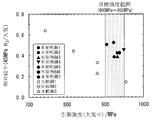
- FIG. 1 is a graph showing the relationship between the tensile strength in the atmosphere and the relative restriction (ratio of the 45 MPa hydrogen restriction and the atmospheric restriction) of the inventive steel and the comparative steel in the examples.
- FIG. 2 is a diagram showing the relationship between the tensile strength in air and the drawing of the steels of the present invention and the comparative steel in the examples.
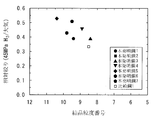
- FIG. 3 is a graph showing the relationship between the grain size number of the steel of the present invention and the comparative steel and the relative drawing in the examples.
- FIG. 4 is a diagram showing the relationship between the average grain size of the steel of the present invention and the comparative steel and the relative drawing in the examples.
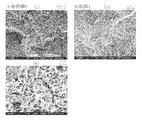
- 5 (a) and 5 (b) are diagrams showing the fracture surfaces of the 45 MPa hydrogen tensile test piece of the steel 6 of the present invention and (c) of the comparative steel 1 in the examples.
- C (carbon): 0.10 to 0.20%
- C is an effective component for improving the strength of steel, and its lower limit is set to 0.10% in order to ensure the strength as a steel for welding.
- the excessive content significantly deteriorates the weldability of the steel material, so the upper limit is made 0.20%.
- the lower limit is 0.14% and the upper limit is 0.16%.
- Si (silicon): 0.10 to 0.40% Si is a component necessary for securing the strength of the base material, deoxidation and the like, and the lower limit is made 0.10% in order to obtain the effect. However, excessive content causes a reduction in the toughness of the welded part, so the upper limit is made 0.40%. Desirably, the lower limit is 0.18%, and the upper limit is 0.32%.
- Mn manganese: 0.50 to 1.20%
- Mn is an effective component for strengthening steel and its lower limit is set to 0.50%.
- the upper limit is made 1.20%.
- the lower limit is 0.80% and the upper limit is 0.84%.
- Cr chromium: 0.20 to 0.80% Cr improves the strength of the steel, but excessive content decreases weldability, so the lower limit is made 0.200% and the upper limit is made 0.80%. Desirably, the lower limit is 0.47% and the upper limit is 0.57%.
- Ni nickel: 0.75 to 1.75%
- Ni is an element effective for improving the strength and hardenability of steel, but if it is too much, the hydrogen environment embrittlement characteristic is lowered, so here the lower limit is 0.75% and the upper limit is l. 75%. Desirably, the lower limit is 0.70% and the upper limit is 1.55%.
- the lower limit is 0.10% and the upper limit is 0.50%. Desirably, the lower limit is 0.20% and the upper limit is 0.40%, and more desirably, the lower limit is 0.31% and the upper limit is 0.33%.
- Mo molybdenum
- Mo molybdenum
- the lower limit is made 0.10% and the upper limit made 1.00%.
- the lower limit is 0.45% and the upper limit is 0.55%.
- V vanadium
- V vanadium
- the lower limit is made 0.01% and the upper limit is made 0.10%.
- the lower limit is 0.04%
- the upper limit is 0.06%.
- B (boron): 0.0005 to 0.005% Since B is an element effective for strengthening steel and also effective for improving hardenability, its lower limit is set to 0.0005%. On the other hand, since excessive inclusion causes deterioration of weldability, the upper limit is set to 0.005%. Desirably, the upper limit is 0.002%.
- N nitrogen: 0.01% or less
- the upper limit is set to 0.05%.
- the lower limit of Nb is 0.02% and the upper limit is 0.06%
- the lower limit of Ti is 0.01%
- the upper limit is 0.04%.
- Remainder Fe and inevitable impurities
- the remainder consists of Fe and inevitable impurities.
- Inevitable impurities include P and S.
- P Phosphorus
- S sulfur
- the content of S is preferably as small as possible from the viewpoint of preventing hot workability deterioration and toughness deterioration, and the upper limit is 0.002% in consideration of industrial properties.
- Grain size number 8.4 or more It is desirable that the grain size after tempering measured by a comparative method based on the ferrite crystal grain size test method of steel defined in JIS G0552 is 8.4 or more. When the particle size is 8.4 or more, hydrogen embrittlement resistance superior to that of conventional steel can be exhibited. If it is less than 8.4, the particle size is about the same as or smaller than that of conventional steel, and improvement in hydrogen embrittlement resistance cannot be expected.
- Tensile strength 900-950 MPa
- the tensile strength in the air after tempering is set to 900 MPa or more.
- the upper limit is set to 950 MPa. This tensile strength is the strength at room temperature.
- tempering conditions for alloy steel having the above composition.
- Normalizing temperature 1000 ° C to 1100 ° C
- the normalizing temperature is set to 1000 ° C. to 1100 ° C.
- Quenching temperature 880-900 ° C
- the quenching temperature is set to 880 to 900 ° C.
- Tempering temperature 560 ° C to 580 ° C
- the tempering temperature is set to 560 ° C. to 580 ° C.
- An alloy steel material adjusted to the composition of the present invention is melted to obtain an ingot.
- the method for melting the alloy steel material is not particularly limited in the present invention, and an ingot can be obtained by a conventional method.
- the ingot can be subjected to hot working (hot rolling, hot forging, etc.) by a conventional method, and the conditions and the like in hot working are not particularly limited in the present invention.
- the hot work material is preferably normalized to make the structure uniform. The normalization can be performed, for example, by heating at 1100 ° C. for 2 hours and then cooling in a furnace.
- quenching and tempering can be performed as a tempering. Quenching can be performed, for example, by heating to 880 to 900 ° C. and quenching. After quenching, for example, tempering by heating at 560 ° C. to 580 ° C. can be performed. In the tempering, it is desirable to adjust the tempering parameter represented by T (logt + 20) ⁇ 10 ⁇ 3 within the range of 18.0 to 18.5 at the tempering temperature T (K) and the time t (hr.). .
- the steel of the present invention can set the tensile strength in the atmosphere to 900 to 950 MPa by tempering, and the crystal grain size is 8.4 or more in the comparison method of JIS G 0552 (steel ferrite grain size test method). can do.
- the low alloy high strength steel exhibits excellent drawing and elongation characteristics even in a 45 MPa hydrogen atmosphere.
- Example No. Ti amount in Examples 1 and 2 Example No. The amount of Nb in 3 and 4 is below the lower limit of analysis (Ti ⁇ 0.0005%, Nb ⁇ 0.01%).
- the normalizing temperatures of the inventive steels 1 to 7 were 950 ° C., the quenching temperature was 880 ° C. to 900 ° C., and tempering was performed at 580 ° C.
- the tempering temperature T (K) and the time t (h) are adjusted, and the tempering parameter represented by T (log + 20) ⁇ 10 ⁇ 3 is varied in the range of 17.3 to 18.7, and the tension in the atmosphere
- the strength was adjusted to be in the range of 900 MPa to 950 MPa.
- the quenching temperature in the comparative steel 1 was 920 ° C., and tempering was performed at 600 ° C.
- the tempering time was adjusted to 11 hours 50 minutes, 34 hours, and 97 hours 30 minutes.
- the normalizing temperature in the comparative steel 2 was 1200 ° C.
- the quenching temperature was 950 ° C.
- tempering was performed at 660 ° C. for 6 hours.
- the normalizing temperature in the comparative steel 3 was 900 ° C.
- the quenching temperature was 840 ° C.
- tempering was performed at 600 ° C. for 35 hours.
- test material was processed into a No. 14 smooth tensile test piece defined by JISZ2201.
- the tensile test in hydrogen was performed in a 45 MPa hydrogen environment using a high-pressure hydrogen environment fatigue tester.
- the tensile test was performed under conditions of normal temperature and a stroke speed of 0.0015 mm / s.
- the crystal grain size was measured based on a comparative method defined in JISG0552.
- FIG. 1 shows the relationship between the tensile strength in air and the relative restriction (ratio of 45 MPa hydrogen drawing and atmospheric drawing) of the inventive steels 1 to 7 and comparative steels 1 to 3.
- the relative drawing of the steel of the present invention showed a large relative drawing even when compared with other steel types in the target strength range of 900 MPa to 950 MPa. This indicates that the steel of the present invention has higher strength than the comparative steel and is excellent in hydrogen environment embrittlement susceptibility.
- FIG. 2 shows the relationship between the tensile strength in the atmosphere and the drawing of the inventive steels 1 to 7 and the comparative steels 1 to 3.
- the steel of the present invention showed a larger value than the conventional steel in the absolute value of the drawing.
- FIG. 3 shows the relationship between the grain size numbers of the inventive steels 1 to 7 and the comparative steel 1 and the relative drawing
- FIG. 4 shows the relationship between the average particle size of the inventive steels 1 to 7 and the comparative steel 1 and the relative drawing.
- the steel of the present invention has a particle size substantially equal to or smaller than that of the comparative steel 1 and has a large relative drawing. It is thought that the effect of fine graining by adding Nb and Ti appeared.
- FIG. 5 (a) and 5 (b) show views of the fracture surface of the 45 MPa hydrogen tensile test piece in the steel 6 of the present invention observed with a scanning electron microscope (SEM).
- FIG. 5C also shows a fracture surface observation view of the comparative steel 1 after a 45 MPa hydrogen tensile test.
- Comparative Steel 1 a pseudo-cleavage surface was observed on the entire fracture surface, whereas in the invention steel 6, fine dimples having a diameter of 1 ⁇ m or less were observed, and it was considered that the fracture behavior was ductile even in a 45 MPa hydrogen environment. It is done.
- a high-pressure hydrogen pressure accumulator can be manufactured at a lower cost than austenitic stainless steel.
- the design pressure can be increased or the design wall thickness can be reduced.
- the hydrogen filling amount can be increased by increasing the design pressure.
- the container manufacturing cost can be reduced by thinning the container.
Landscapes
- Chemical & Material Sciences (AREA)
- Engineering & Computer Science (AREA)
- Materials Engineering (AREA)
- Mechanical Engineering (AREA)
- Metallurgy (AREA)
- Organic Chemistry (AREA)
- Physics & Mathematics (AREA)
- Thermal Sciences (AREA)
- Crystallography & Structural Chemistry (AREA)
- Heat Treatment Of Steel (AREA)
Abstract
本発明の課題は高圧水素環境下において高強度で優れた耐高圧水素環境脆化特性を有する低合金鋼を安価に提供することである。本発明は、C:0.10~0.20質量%、Si:0.10~0.40質量%、Mn:0.50~1.20質量%、Ni:0.75~1.75質量%、Cr:0.20~0.80質量%、Cu:0.10~0.50質量%、Mo:0.10~1.00質量%、V:0.01~0.10質量%、B:0.0005~0.005質量%、N:0.01質量%以下を含有し、さらに、Nb:0.0l~0.10質量%及びTi:0.005~0.050質量%のうち1種または2種を含有し、残部がFeおよび不可避的不純物からなる組成を有することを特徴とする耐高圧水素環境脆化特性を有する高強度低合金鋼である。
Description
この発明は、高圧水素貯蔵用蓄圧器などに使用され、焼入れ焼戻し処理(以下調質という)によって製造される高強度低合金鋼及びその製造に関するものである。
水素社会構築のための水素インフラ整備事業において、高圧水素を貯蔵、供給する水素スタンドの普及は重要である。高信頼性を有する水素スタンドの構成には高圧水素ガス蓄圧器の開発が必須であり、優れた蓄圧器用材料の開発が望まれている。ここで、金属材料、特に鉄鋼材料はコストやリサイクル性の観点から蓄圧器材料として有望である。
技術的な趨勢として、水素自動車の航続距離延伸のため貯蔵ガスの圧力は、より高圧化することが望まれており、水素スタンドの蓄圧器には35MPa以上の高圧水素ガスを貯蔵することが考えられている。しかしながら、従来の炭素鋼や高強度低合金鋼においては高圧水素ガス環境下において水素環境脆化が生じるとされており、現在まででは35MPa以上の高圧水素環境で使用できる鉄鋼材料はオーステナイト系ステンレス鋼にほぼ限定されている。オーステナイト系ステンレス鋼は一般的に低合金鋼よりも高価であり、また室温まで安定なオーステナイト相を有することから熱処理による強度調整ができない。そのため、より高圧の水素ガスを貯蔵するための蓄圧器材料として高強度低合金鋼が望まれている。
技術的な趨勢として、水素自動車の航続距離延伸のため貯蔵ガスの圧力は、より高圧化することが望まれており、水素スタンドの蓄圧器には35MPa以上の高圧水素ガスを貯蔵することが考えられている。しかしながら、従来の炭素鋼や高強度低合金鋼においては高圧水素ガス環境下において水素環境脆化が生じるとされており、現在まででは35MPa以上の高圧水素環境で使用できる鉄鋼材料はオーステナイト系ステンレス鋼にほぼ限定されている。オーステナイト系ステンレス鋼は一般的に低合金鋼よりも高価であり、また室温まで安定なオーステナイト相を有することから熱処理による強度調整ができない。そのため、より高圧の水素ガスを貯蔵するための蓄圧器材料として高強度低合金鋼が望まれている。
従来このような要請に応えるため、高圧水素環境下における炭素鋼や低合金鋼、それより製造するシームレス鋼管、そしてその製造方法が提案されている(例えば特許文献1)。特許文献1で提案されている鋼は、構成成分のCa/S比を制御することにより鋼中の拡散性水素量を低減して耐高圧水素環境脆化特性を改善しようとするものである。
しかし、上記提案技術は、電解水素チャージにより高圧水素環境を模擬した試験データに基づいており、間接的に水素環境脆化特性を評価したものに過ぎない。さらに実機の設計や製作に不可欠である機械的特性、特に水素環境脆化の影響を受けた状態での機械的特性に関してはデータが示されていない。
また、各種低合金鋼におけるこれまでの45MPa水素環境中引張試験の結果からは、溶接構造用高降伏点鋼板JIS G 3128 SHY685NSが大きな水素中絞りを示し、耐水素環境脆化特性に優れた材料であったが、大気中引張強度が現状の目標強度である900MPa~950MPaに至っていない。
また、各種低合金鋼におけるこれまでの45MPa水素環境中引張試験の結果からは、溶接構造用高降伏点鋼板JIS G 3128 SHY685NSが大きな水素中絞りを示し、耐水素環境脆化特性に優れた材料であったが、大気中引張強度が現状の目標強度である900MPa~950MPaに至っていない。
本発明は、上述した耐高圧水素環境脆化特性に優れた高強度鋼開発の現状を鑑み、45MPa水素環境における水素環境脆化特性を評価し、それに基づき大気中の引張強度が900~950MPaの範囲において優れた耐水素環境脆化特性を有する高強度低合金鋼およびその製造方法を提供することを目的としている。
この発明の構成においては、ASMESA517Fで提供される鋼種をベースとする試験材を用いて、45MPa水素雰囲気における引張特性の詳細な検討を実施した。その結果、目標強度範囲である900MPa~950MPaの大気中引張強度範囲において、従来の低合金鋼よりも45MPa水素雰囲気中での相対絞りの値が大きく、水素環脆化感受性が小さい新規な合金組成を見出し、本発明に至った。
すなわち、本発明の下記に示す耐高圧水素環境脆化特性を有する高強度低合金鋼およびその製造方法に関する。
[1]C:0.10~0.20質量%、Si:0.10~0.40質量%、Mn:0.50~1.20質量%、Ni:0.75~1.75質量%、Cr:0.20~0.80質量%、Cu:0.10~0.50質量%、Mo:0.10~1.00質量%、V:0.01~0.10質量%、B:0.0005~0.005質量%、N:0.01質量%以下を含有し、さらに、Nb:0.0l~0.10質量%及びTi:0.005~0.050質量%のうち1種または2種を含有し、残部がFeおよび不可避的不純物からなる組成を有することを特徴とする耐高圧水素環境脆化特性を有する高強度低合金鋼。
[2]調質後の大気中の引張強度が900MPa~950MPaであることを特徴とする上記[1]に記載の耐高圧水素環境脆化特性を有する高強度低合金鋼。
[3]JISG0552に規定された鋼のフェライト結晶粒度試験方法に基づく比較法により測定した、調質後の結晶粒度番号が8.4以上の粒度を有することを特徴とする上記[1]または[2]に記載の耐高圧水素環境脆化特性を有する高強度低合金鋼。
[4]C:0.10~0.20質量%、Si:0.10~0.40質量%、Mn:0.50~1.20質量%、Ni:0.75~1.75質量%、Cr:0.20~0.80質量%、Cu:0.10~0.50質量%、Mo:0.10~1.00質量%、V:0.01~0.10質量%、B:0.0005~0.005質量%、N:0.01質量%以下を含有し、さらに、Nb:0.0l~0.10質量%及びTi:0.005~0.050質量%のうち1種または2種を含有し、残部がFeおよび不可避的不純物からなる組成を有する合金鋼素材を、溶製して鋼塊とし、熱間加工後、1000℃~1100℃で焼ならし、880℃~900℃の温度範囲から焼入れを行い、その後560℃~580℃で焼戻しを行うことを特徴とする耐高圧水素環境脆化特性を有する高強度低合金鋼の製造方法。
[1]C:0.10~0.20質量%、Si:0.10~0.40質量%、Mn:0.50~1.20質量%、Ni:0.75~1.75質量%、Cr:0.20~0.80質量%、Cu:0.10~0.50質量%、Mo:0.10~1.00質量%、V:0.01~0.10質量%、B:0.0005~0.005質量%、N:0.01質量%以下を含有し、さらに、Nb:0.0l~0.10質量%及びTi:0.005~0.050質量%のうち1種または2種を含有し、残部がFeおよび不可避的不純物からなる組成を有することを特徴とする耐高圧水素環境脆化特性を有する高強度低合金鋼。
[2]調質後の大気中の引張強度が900MPa~950MPaであることを特徴とする上記[1]に記載の耐高圧水素環境脆化特性を有する高強度低合金鋼。
[3]JISG0552に規定された鋼のフェライト結晶粒度試験方法に基づく比較法により測定した、調質後の結晶粒度番号が8.4以上の粒度を有することを特徴とする上記[1]または[2]に記載の耐高圧水素環境脆化特性を有する高強度低合金鋼。
[4]C:0.10~0.20質量%、Si:0.10~0.40質量%、Mn:0.50~1.20質量%、Ni:0.75~1.75質量%、Cr:0.20~0.80質量%、Cu:0.10~0.50質量%、Mo:0.10~1.00質量%、V:0.01~0.10質量%、B:0.0005~0.005質量%、N:0.01質量%以下を含有し、さらに、Nb:0.0l~0.10質量%及びTi:0.005~0.050質量%のうち1種または2種を含有し、残部がFeおよび不可避的不純物からなる組成を有する合金鋼素材を、溶製して鋼塊とし、熱間加工後、1000℃~1100℃で焼ならし、880℃~900℃の温度範囲から焼入れを行い、その後560℃~580℃で焼戻しを行うことを特徴とする耐高圧水素環境脆化特性を有する高強度低合金鋼の製造方法。
本発明によれば、主たる効果として、オーステナイト系ステンレス鋼よりも安価に高圧水素蓄圧器の製作が可能になる。また従来鋼よりも高強度であり、かつ水素環境脆化感受性が小さいため、設計圧力の高圧化ないしは設計肉厚の薄肉化を図ることができる。また従たる効果として、設計圧力の高圧化により水素充填量の増大が図れる。また容器の薄肉化により容器製造コストが低減できる。
以下、本発明における成分の限定範囲等について詳細に説明する。以下の成分含有量は、いずれも質量%で示されている。
C(炭素):0.10~0.20%
Cは鋼の強度を向上させる有効な成分であり、溶接用鋼としての強度を確保するためその下限値を0.10%と定める。過剰の含有は鋼材の溶接性を著しく劣化させるため上限値を0.20%とする。望ましくは下限が0.14%、上限が0.16%である。
Cは鋼の強度を向上させる有効な成分であり、溶接用鋼としての強度を確保するためその下限値を0.10%と定める。過剰の含有は鋼材の溶接性を著しく劣化させるため上限値を0.20%とする。望ましくは下限が0.14%、上限が0.16%である。
Si(ケイ素):0.10~0.40%
Siは母材の強度確保、脱酸等に必要な成分であり、その効果を得るため下限値を0.10%とする。しかしながら過剰な含有は溶接部の靭性低下を引き起こすため上限を0.40%とする。望ましくは下限が0.18%、上限が0.32%である。
Siは母材の強度確保、脱酸等に必要な成分であり、その効果を得るため下限値を0.10%とする。しかしながら過剰な含有は溶接部の靭性低下を引き起こすため上限を0.40%とする。望ましくは下限が0.18%、上限が0.32%である。
Mn(マンガン):0.50~1.20%
Mnは鋼の強化に有効な成分として、その下限を0.50%に定める。しかし過剰な含有は溶接部の靭性低下や割れ引き起こすので上限値を1.20%とする。望ましくは下限が0.80%、上限が0.84%である。
Mnは鋼の強化に有効な成分として、その下限を0.50%に定める。しかし過剰な含有は溶接部の靭性低下や割れ引き起こすので上限値を1.20%とする。望ましくは下限が0.80%、上限が0.84%である。
Cr(クロム):0.20~0.80%
Crは鋼の強度を向上させるが、過剰な含有は溶接性を低下させるため下限を0.200%、上限を0.80%とする。望ましくは下限が0.47%、上限が0.57%である。
Crは鋼の強度を向上させるが、過剰な含有は溶接性を低下させるため下限を0.200%、上限を0.80%とする。望ましくは下限が0.47%、上限が0.57%である。
Ni(ニッケル):0.75~1.75%
Niは鋼の強度や焼入性向上に有効な元素であるが、多すぎると水素環境脆化特性の低下を招くため、ここでは下限を0.75%、上限をl.75%とする。望ましくは下限が0.70%、上限が1.55%である。
Niは鋼の強度や焼入性向上に有効な元素であるが、多すぎると水素環境脆化特性の低下を招くため、ここでは下限を0.75%、上限をl.75%とする。望ましくは下限が0.70%、上限が1.55%である。
Cu(銅):0.10~0.50%
Cuは鋼の強度を向上させるが、過剰な含有は溶接時の割れ感受性を高める。従って下限を0.10%、上限を0.50%とする。望ましくは、下限0.20%、上限0.40%であり、さらに望ましくは下限が0.31%、上限が0.33%である。
Cuは鋼の強度を向上させるが、過剰な含有は溶接時の割れ感受性を高める。従って下限を0.10%、上限を0.50%とする。望ましくは、下限0.20%、上限0.40%であり、さらに望ましくは下限が0.31%、上限が0.33%である。
Mo(モリブデン):0.10~1.00%
Moは鋼の強化に有効な元素であるが、過剰な含有は溶接性を損ない、またコスト高を招くので、下限を0.10%、上限を1.00%とする。望ましくは下限が0.45%、上限が0.55%である。
Moは鋼の強化に有効な元素であるが、過剰な含有は溶接性を損ない、またコスト高を招くので、下限を0.10%、上限を1.00%とする。望ましくは下限が0.45%、上限が0.55%である。
V(バナジウム):0.01~0.10%
Vは鋼の強度を確保するために重要な元素であるが、多すぎると靭性に悪影響を及ぼすことから下限を0.01%、上限を0.10%とする。望ましくは下限が0.04%、上限が0.06%である。
Vは鋼の強度を確保するために重要な元素であるが、多すぎると靭性に悪影響を及ぼすことから下限を0.01%、上限を0.10%とする。望ましくは下限が0.04%、上限が0.06%である。
B(ホウ素):0.0005~0.005%
Bは鋼の強化に有効であり、また焼入性の向上にも有効な元素あるため、その下限値を0.0005%とする。一方で過剰な含有は溶接性の低下をもたらすので、その上限値を0.005%とする。望ましくは、上限が0.002%である。
Bは鋼の強化に有効であり、また焼入性の向上にも有効な元素あるため、その下限値を0.0005%とする。一方で過剰な含有は溶接性の低下をもたらすので、その上限値を0.005%とする。望ましくは、上限が0.002%である。
N(窒素):0.01%以下
Nは0.01%を超えると固溶Nが増大し溶接部の靭性低下をもたらすため、その上限値を0.01%とする。
Nは0.01%を超えると固溶Nが増大し溶接部の靭性低下をもたらすため、その上限値を0.01%とする。
Nb(ニオブ):0.01~0.10%
Ti(チタン):0.005~0.050%
Nb、Tiは鋼の細粒化に有効な元素であるので、その1種または2種を含有させる。ただし、Nbでは0.01%未満、Tiでは0.005%未満では十分な作用を得られないため、Nbの下限を0.01%、Tiの下限を0.005%に定める。なお、一方の成分を下限量以上含んでいれば、他方の成分を下限未満で不純物として含むものであってもよい。一方、Nbを過剰に含有すると効果が飽和する上、鍛造性の低下を招くため、その上限を0.10%に定める。また、Tiを過剰に含有するとTiCの過剰析出による靭性の低下を招くため、その上限を0.05%に定める。望ましくはNbの下限が0.02%、上限が0.06%であり、Tiの下限が0.0l%、上限が0.04%である。
Ti(チタン):0.005~0.050%
Nb、Tiは鋼の細粒化に有効な元素であるので、その1種または2種を含有させる。ただし、Nbでは0.01%未満、Tiでは0.005%未満では十分な作用を得られないため、Nbの下限を0.01%、Tiの下限を0.005%に定める。なお、一方の成分を下限量以上含んでいれば、他方の成分を下限未満で不純物として含むものであってもよい。一方、Nbを過剰に含有すると効果が飽和する上、鍛造性の低下を招くため、その上限を0.10%に定める。また、Tiを過剰に含有するとTiCの過剰析出による靭性の低下を招くため、その上限を0.05%に定める。望ましくはNbの下限が0.02%、上限が0.06%であり、Tiの下限が0.0l%、上限が0.04%である。
残部:Feおよび不可避的不純物
本発明の高強度低合金鋼は、残部がFeおよび不可避的不純物からなる。不可避的不純物としてはP、Sが挙げられる。
P(リン):0.005%以下
Pは熱間加工性低下防止の面からその含有量は少ないほど望ましく、工業性を考慮して0.005%を上限とする。
S(硫黄):0.002%以下
Sは熱間加工性低下および靭性低下を防止する面からその含有量は少ないほど望ましく、工業性を考慮して0.002%を上限とする。
本発明の高強度低合金鋼は、残部がFeおよび不可避的不純物からなる。不可避的不純物としてはP、Sが挙げられる。
P(リン):0.005%以下
Pは熱間加工性低下防止の面からその含有量は少ないほど望ましく、工業性を考慮して0.005%を上限とする。
S(硫黄):0.002%以下
Sは熱間加工性低下および靭性低下を防止する面からその含有量は少ないほど望ましく、工業性を考慮して0.002%を上限とする。
結晶粒度番号:8.4以上
JISG0552に規定された鋼のフェライト結晶粒度試験方法に基づく比較法により測定した、調質後の粒度が8.4以上であることが望ましい。該粒度が8.4以上であることにより、従来鋼に比して優れた耐水素環境脆化特性を発現させることができる。8.4未満であると、従来鋼と同程度かそれより小さい粒度にとどまり、耐水素環境脆化特性の向上が期待できない。
JISG0552に規定された鋼のフェライト結晶粒度試験方法に基づく比較法により測定した、調質後の粒度が8.4以上であることが望ましい。該粒度が8.4以上であることにより、従来鋼に比して優れた耐水素環境脆化特性を発現させることができる。8.4未満であると、従来鋼と同程度かそれより小さい粒度にとどまり、耐水素環境脆化特性の向上が期待できない。
引張強度:900~950MPa
目標強度として調質後の大気中の引張強度を900MPa以上とする。ただし、950MPaを超えると水素環境脆化感受性が増大するため、上限を950MPaとする。なお、この引張強度は室温における強度である。
目標強度として調質後の大気中の引張強度を900MPa以上とする。ただし、950MPaを超えると水素環境脆化感受性が増大するため、上限を950MPaとする。なお、この引張強度は室温における強度である。
上記組成の合金鋼に対する調質条件として下記条件を示す。
焼ならし温度:1000℃~1100℃
鍛造時のひずみを除去するため、焼ならし温度を1000℃~1100℃に定める。
焼入れ温度:880~900℃
最適な結晶粒度を付与するため、焼入れ温度を880~900℃に定める。
焼戻し温度:560℃~580℃
最適な大気中室温引張強度を付与するため、焼戻し温度を560℃~580℃に定める。
焼ならし温度:1000℃~1100℃
鍛造時のひずみを除去するため、焼ならし温度を1000℃~1100℃に定める。
焼入れ温度:880~900℃
最適な結晶粒度を付与するため、焼入れ温度を880~900℃に定める。
焼戻し温度:560℃~580℃
最適な大気中室温引張強度を付与するため、焼戻し温度を560℃~580℃に定める。
以下に、本発明の一実施形態を説明する。
本発明の組成に調整した合金鋼素材を溶製し、鋳塊を得る。該合金鋼素材の溶製方法は本発明としては特に限定をされるものではなく、常法により鋳塊を得ることができる。
該鋳塊は、常法により熱間加工(熱間圧延や熱間鍛造など)を行うことができ、本発明としては熱間加工における条件等が特に限定をされるものではない。
熱間加工後には、熱間加工材に対し、好適には焼ならしを行って組織の均一化を図る。該焼ならしは、例えば1100℃で2時間の加熱を行い、その後、炉冷することにより行うことができる。
本発明の組成に調整した合金鋼素材を溶製し、鋳塊を得る。該合金鋼素材の溶製方法は本発明としては特に限定をされるものではなく、常法により鋳塊を得ることができる。
該鋳塊は、常法により熱間加工(熱間圧延や熱間鍛造など)を行うことができ、本発明としては熱間加工における条件等が特に限定をされるものではない。
熱間加工後には、熱間加工材に対し、好適には焼ならしを行って組織の均一化を図る。該焼ならしは、例えば1100℃で2時間の加熱を行い、その後、炉冷することにより行うことができる。
さらに、調質として焼き入れ焼戻しの処理を行うことができる。
焼き入れは、例えば880~900℃に加熱し、急冷することにより行うことができる。焼き入れ後は、例えば、560℃~580℃で加熱する焼戻しを行うことができる。該焼戻しでは、焼戻し温度T(K)と時間t(hr.)において、T(logt+20)×10-3で表される焼戻しパラメータを、18.0~18.5の範囲で調整するのが望ましい。
本発明鋼は調質によって大気中の引張強度を900~950MPaに設定することができ、結晶粒度を、JISG0552(鋼のフェライト結晶粒度試験方法)の比較法において、8.4以上の粒度番号とすることができる。該低合金高強度鋼は、45MPa水素雰囲気中でも優れた絞り、伸び特性を示す。
焼き入れは、例えば880~900℃に加熱し、急冷することにより行うことができる。焼き入れ後は、例えば、560℃~580℃で加熱する焼戻しを行うことができる。該焼戻しでは、焼戻し温度T(K)と時間t(hr.)において、T(logt+20)×10-3で表される焼戻しパラメータを、18.0~18.5の範囲で調整するのが望ましい。
本発明鋼は調質によって大気中の引張強度を900~950MPaに設定することができ、結晶粒度を、JISG0552(鋼のフェライト結晶粒度試験方法)の比較法において、8.4以上の粒度番号とすることができる。該低合金高強度鋼は、45MPa水素雰囲気中でも優れた絞り、伸び特性を示す。
以下に、本発明の実施例を詳細に説明する。
表1に示す組成(残部がその他不可避不純物)の供試材を真空誘導溶解炉により50kg丸型鋼塊に溶製し、熱間鍛造により35mm厚さとした。今回の試験では製造方法として熱間鍛造後の35mm厚さで調質した。なお、実施例No.1、2におけるTi量、実施例No.3、4におけるNb量は分析下限値以下(Ti<0.0005%、Nb<0.01%)である。
本発明鋼1~7における焼きならし温度は950℃とし、焼入温度は880℃~900℃とし、焼き戻しは580℃にて行った。焼き戻し温度T(K)と時間t(h)を調整し、T(log+20)×10-3にて表される焼戻しパラメータを17.3から18.7の範囲で変動させ、大気中の引張強度が900MPaから950MPaの範囲となるように調整した。
比較鋼1における焼入温度は920℃とし、焼き戻しは600℃にて行った。なお、焼き戻し時間は、11時間50分、34時間、97時間30分として調整した。
比較鋼2における焼きならし温度は1200℃とし、焼入温度は950℃とし、焼き戻しは660℃、6時間にて行った。
比較鋼3における焼きならし温度は900℃とし、焼入温度は840℃とし、焼き戻しは600℃、35時間にて行った。
表1に示す組成(残部がその他不可避不純物)の供試材を真空誘導溶解炉により50kg丸型鋼塊に溶製し、熱間鍛造により35mm厚さとした。今回の試験では製造方法として熱間鍛造後の35mm厚さで調質した。なお、実施例No.1、2におけるTi量、実施例No.3、4におけるNb量は分析下限値以下(Ti<0.0005%、Nb<0.01%)である。
本発明鋼1~7における焼きならし温度は950℃とし、焼入温度は880℃~900℃とし、焼き戻しは580℃にて行った。焼き戻し温度T(K)と時間t(h)を調整し、T(log+20)×10-3にて表される焼戻しパラメータを17.3から18.7の範囲で変動させ、大気中の引張強度が900MPaから950MPaの範囲となるように調整した。
比較鋼1における焼入温度は920℃とし、焼き戻しは600℃にて行った。なお、焼き戻し時間は、11時間50分、34時間、97時間30分として調整した。
比較鋼2における焼きならし温度は1200℃とし、焼入温度は950℃とし、焼き戻しは660℃、6時間にて行った。
比較鋼3における焼きならし温度は900℃とし、焼入温度は840℃とし、焼き戻しは600℃、35時間にて行った。

調質後、試験材をJISZ2201で規定された14号平滑引張試験片に加工した。水素中引張試験は高圧水素環境疲労試験機を用い、45MPa水素環境下で行った。引張試験は常温、ストローク速度0.0015mm/sの条件で行った。結晶粒度はJISG0552に規定された比較法に基づき測定した。
図1に、本発明鋼1~7と比較鋼1~3の大気中引張強度と相対絞り(45MPa水素中絞りと大気中絞りの比)の関係を示す。本発明鋼の相対絞りは、目標強度範囲である900MPa~950MPaにおいて他鋼種と比較しても大きな相対絞りを示した。これは、本発明鋼が比較鋼よりも強度が高く、かつ水素環境脆化感受性に優れることを示している。
図2に、本発明鋼1~7と比較鋼1~3の大気中引張強度と絞りの関係を示す。本発明鋼は絞りの絶対値においても従来鋼よりも大きい値を示した。
図3に本発明鋼1~7と比較鋼1の粒度番号と相対絞りの関係、図4に本発明鋼1~7と比較鋼1の平均粒径と相対絞りの関係を示す。本発明鋼は比較鋼1と比べて粒径がほぼ同等か小さく、相対絞りが大きい。NbおよびTi添加による細粒化の効果が表れたものと考えられる。
図5(a)および(b)に本発明鋼6における45MPa水素中引張試験片の破面を走査型電子顕微鏡(SEM)で観察した図を示す。比較のため図5(c)に比較鋼1の45MPa水素中引張試験後の破面観察図も示す。比較鋼1では破面全体において擬へき開破面がみられるのに対し、本発明鋼6では直径1μm以下の微細なディンプルが観察され、45MPa水素環境下においても延性的な破壊挙動であったと考えられる。
図3に本発明鋼1~7と比較鋼1の粒度番号と相対絞りの関係、図4に本発明鋼1~7と比較鋼1の平均粒径と相対絞りの関係を示す。本発明鋼は比較鋼1と比べて粒径がほぼ同等か小さく、相対絞りが大きい。NbおよびTi添加による細粒化の効果が表れたものと考えられる。
図5(a)および(b)に本発明鋼6における45MPa水素中引張試験片の破面を走査型電子顕微鏡(SEM)で観察した図を示す。比較のため図5(c)に比較鋼1の45MPa水素中引張試験後の破面観察図も示す。比較鋼1では破面全体において擬へき開破面がみられるのに対し、本発明鋼6では直径1μm以下の微細なディンプルが観察され、45MPa水素環境下においても延性的な破壊挙動であったと考えられる。
以上、本発明について上記実施形態および実施例に基づいて説明を行ったが、本発明は上記実施形態および実施例の説明に限定をされるものではなく、当然に本発明の範囲を逸脱しない限りは適宜の変更が可能である。
本発明を詳細にまた特定の実施態様を参照して説明したが、本発明の精神と範囲を逸脱することなく様々な変更や修正を加えることができることは当業者にとって明らかである。本出願は2008年5月13日出願の日本特許出願(特願2008-125838)、に基づくものであり、その内容はここに参照として取り込まれる。
以上説明したように、本発明によれば、主たる効果として、オーステナイト系ステンレス鋼よりも安価に高圧水素蓄圧器の製作が可能になる。また従来鋼よりも高強度であり、かつ水素環境脆化感受性が小さいため、設計圧力の高圧化ないしは設計肉厚の薄肉化を図ることができる。また従たる効果として、設計圧力の高圧化により水素充填量の増大が図れる。また容器の薄肉化により容器製造コストが低減できる。
Claims (4)
- C:0.10~0.20質量%、Si:0.10~0.40質量%、Mn:0.50~1.20質量%、Ni:0.75~1.75質量%、Cr:0.20~0.80質量%、Cu:0.10~0.50質量%、Mo:0.10~1.00質量%、V:0.01~0.10質量%、B:0.0005~0.005質量%、N:0.01質量%以下を含有し、さらに、Nb:0.0l~0.10質量%及びTi:0.005~0.050質量%のうち1種または2種を含有し、残部がFeおよび不可避的不純物からなる組成を有することを特徴とする耐高圧水素環境脆化特性を有する高強度低合金鋼。
- 調質後の大気中の引張強度が900MPa~950MPaであることを特徴とする請求項1記載の耐高圧水素環境脆化特性を有する高強度低合金鋼。
- JISG0552に規定された鋼のフェライト結晶粒度試験方法に基づく比較法により測定した、調質後の結晶粒度番号が8.4以上の粒度を有することを特徴とする請求項1または2に記載の耐高圧水素環境脆化特性を有する高強度低合金鋼。
- C:0.10~0.20質量%、Si:0.10~0.40質量%、Mn:0.50~1.20質量%、Ni:0.75~1.75質量%、Cr:0.20~0.80質量%、Cu:0.10~0.50質量%、Mo:0.10~1.00質量%、V:0.01~0.10質量%、B:0.0005~0.005質量%、N:0.01質量%以下を含有し、さらに、Nb:0.0l~0.10質量%及びTi:0.005~0.050質量%のうち1種または2種を含有し、残部がFeおよび不可避的不純物からなる組成を有する合金鋼素材を、溶製して鋼塊とし、熱間加工後、1000℃~1100℃で焼ならし、880℃~900℃の温度範囲から焼入れを行い、その後560℃~580℃で焼戻しを行うことを特徴とする耐高圧水素環境脆化特性を有する高強度低合金鋼の製造方法。
Priority Applications (5)
| Application Number | Priority Date | Filing Date | Title |
|---|---|---|---|
| EP09746626.2A EP2278035B1 (en) | 2008-05-13 | 2009-05-13 | High strength low alloy steel with excellent environmental embrittlement resistance in high pressure hydrogen environments, and method of manufacture thereof |
| US12/991,981 US8974612B2 (en) | 2008-05-13 | 2009-05-13 | High-strength low-alloy steel excellent in high-pressure hydrogen environment embrittlement resistance characteristics and method for producing the same |
| DK09746626.2T DK2278035T3 (en) | 2008-05-13 | 2009-05-13 | Low alloy HIGH STRENGTH WITH EXCELLENT ENVIRONMENTAL brittle RESISTANCE IN HIGH PRESSURE HYDROGEN ENVIRONMENTS AND MANUFACTURING METHOD THEREOF |
| ES09746626.2T ES2548453T3 (es) | 2008-05-13 | 2009-05-13 | Acero de baja aleación y alta resistencia con excelente resistencia a la fragilización ambiental en medios de hidrógeno a alta presión y método para la fabricación del mismo |
| US14/616,064 US10227682B2 (en) | 2008-05-13 | 2015-02-06 | High-strength low-alloy steel excellent in high-pressure hydrogen environment embrittlement resistance characteristics and method for producing the same |
Applications Claiming Priority (2)
| Application Number | Priority Date | Filing Date | Title |
|---|---|---|---|
| JP2008-125838 | 2008-05-13 | ||
| JP2008125838A JP5201625B2 (ja) | 2008-05-13 | 2008-05-13 | 耐高圧水素環境脆化特性に優れた高強度低合金鋼およびその製造方法 |
Related Child Applications (2)
| Application Number | Title | Priority Date | Filing Date |
|---|---|---|---|
| US12/991,981 A-371-Of-International US8974612B2 (en) | 2008-05-13 | 2009-05-13 | High-strength low-alloy steel excellent in high-pressure hydrogen environment embrittlement resistance characteristics and method for producing the same |
| US14/616,064 Division US10227682B2 (en) | 2008-05-13 | 2015-02-06 | High-strength low-alloy steel excellent in high-pressure hydrogen environment embrittlement resistance characteristics and method for producing the same |
Publications (1)
| Publication Number | Publication Date |
|---|---|
| WO2009139420A1 true WO2009139420A1 (ja) | 2009-11-19 |
Family
ID=41318786
Family Applications (1)
| Application Number | Title | Priority Date | Filing Date |
|---|---|---|---|
| PCT/JP2009/058933 Ceased WO2009139420A1 (ja) | 2008-05-13 | 2009-05-13 | 耐高圧水素環境脆化特性に優れた高強度低合金鋼およびその製造方法 |
Country Status (6)
| Country | Link |
|---|---|
| US (2) | US8974612B2 (ja) |
| EP (1) | EP2278035B1 (ja) |
| JP (1) | JP5201625B2 (ja) |
| DK (1) | DK2278035T3 (ja) |
| ES (1) | ES2548453T3 (ja) |
| WO (1) | WO2009139420A1 (ja) |
Cited By (2)
| Publication number | Priority date | Publication date | Assignee | Title |
|---|---|---|---|---|
| JP2012047629A (ja) * | 2010-08-27 | 2012-03-08 | Japan Steel Works Ltd:The | 高強度低合金鋼の高圧水素環境脆化感受性の評価方法 |
| CN115449706A (zh) * | 2022-08-15 | 2022-12-09 | 建湖县鸿达阀门管件有限公司 | 一种耐高压合金材料及高强度阀门件 |
Families Citing this family (20)
| Publication number | Priority date | Publication date | Assignee | Title |
|---|---|---|---|---|
| CN103114254A (zh) * | 2013-03-15 | 2013-05-22 | 济钢集团有限公司 | 一种核电站机械模块支撑件用高强韧钢板及其制造方法 |
| EP2980247B1 (en) | 2013-03-29 | 2023-10-18 | JFE Steel Corporation | Method for producing a steel structure for hydrogen gas |
| US10106875B2 (en) | 2013-03-29 | 2018-10-23 | Jfe Steel Corporation | Steel material, hydrogen container, method for producing the steel material, and method for producing the hydrogen container |
| JP6179977B2 (ja) * | 2013-05-22 | 2017-08-16 | 株式会社日本製鋼所 | 耐高圧水素環境脆化特性に優れた高強度鋼およびその製造方法 |
| CN103469116B (zh) * | 2013-08-07 | 2016-03-02 | 安徽蓝博旺机械集团合诚机械有限公司 | 一种叉车转向节用铸钢材料 |
| WO2016147594A1 (ja) | 2015-03-16 | 2016-09-22 | Jfeスチール株式会社 | 複合容器蓄圧器ライナー用鋼材、複合容器蓄圧器ライナー用鋼管、および複合容器蓄圧器ライナー用鋼管の製造方法 |
| JP6554844B2 (ja) * | 2015-03-18 | 2019-08-07 | 日本製鉄株式会社 | 高圧水素用容器の製造方法 |
| CA3077926C (en) | 2015-09-17 | 2021-10-26 | Jfe Steel Corporation | Steel structure for hydrogen gas with excellent hydrogen embrittlement resistance in high pressure hydrogen gas and method of producing the same |
| BR102016001063B1 (pt) * | 2016-01-18 | 2021-06-08 | Amsted Maxion Fundição E Equipamentos Ferroviários S/A | liga de aço para componentes ferroviários, e processo de obtenção de uma liga de aço para componentes ferroviários |
| WO2018055937A1 (ja) | 2016-09-21 | 2018-03-29 | Jfeスチール株式会社 | 蓄圧器用鋼管、蓄圧器用鋼管の製造方法、および複合容器蓄圧器用ライナー |
| WO2020137812A1 (ja) | 2018-12-26 | 2020-07-02 | Jfeスチール株式会社 | 高圧水素ガス環境用鋼材および高圧水素ガス環境用鋼構造物ならびに高圧水素ガス環境用鋼材の製造方法 |
| US20240027022A1 (en) | 2020-10-30 | 2024-01-25 | Jfe Steel Corporation | Steel pipe or tube for hydrogen gas, method for manufacturing steel pipe or tube for hydrogen gas, pressure vessel for hydrogen gas, and method for manufacturing pressure vessel for hydrogen gas |
| CN112553525B (zh) * | 2020-11-17 | 2021-12-21 | 天津重型装备工程研究有限公司 | 一种中碳低合金高强钢及其制备方法 |
| EP4415084A3 (de) | 2021-01-20 | 2024-11-13 | Poppe & Potthoff GmbH | Wasserstoffverteilsystem und bauteile mit niedrigem gewicht |
| CN113528968A (zh) * | 2021-07-19 | 2021-10-22 | 苏州雷格姆海洋石油设备科技有限公司 | 深海天然气管线测试压力帽及对接毂用f65m特大壁厚高强度锻件 |
| AU2023352243B2 (en) | 2022-09-29 | 2026-08-13 | Jfe Steel Corporation | Steel material with good fatigue property in hydrogen and method for producing the same, and steel pipe and method for producing the same |
| JP7838629B2 (ja) | 2022-09-29 | 2026-04-01 | Jfeスチール株式会社 | 耐水素脆化特性に優れたラインパイプ用鋼材、その製造方法、耐水素脆化特性に優れたラインパイプ用鋼管およびその製造方法 |
| EP4578565A4 (en) | 2022-09-29 | 2025-12-10 | Jfe Steel Corp | STEEL TUBE WITH EXCELLENT HYDROGEN FATIGUE CHARACTERISTICS AND METHOD FOR MANUFACTURED THEREOF, AND STEEL MATERIAL AND METHOD FOR MANUFACTURED THEREOF |
| CN119923486A (zh) | 2022-09-29 | 2025-05-02 | 杰富意钢铁株式会社 | 管线管用钢材和其制造方法、管线管用钢管及其制造方法 |
| JP7754273B2 (ja) | 2022-09-29 | 2025-10-15 | Jfeスチール株式会社 | 耐水素脆化特性に優れたラインパイプ用鋼管、その製造方法、ラインパイプ用鋼材およびその製造方法 |
Citations (8)
| Publication number | Priority date | Publication date | Assignee | Title |
|---|---|---|---|---|
| JPH02213411A (ja) * | 1989-02-13 | 1990-08-24 | Kawasaki Steel Corp | 低降伏比高張力鋼の製造方法 |
| JPH0551694A (ja) * | 1991-08-20 | 1993-03-02 | Nkk Corp | 低降伏比高張力鋼およびその製造方法 |
| JP2002327235A (ja) * | 2001-04-26 | 2002-11-15 | Nippon Steel Corp | 耐水素疲労破壊特性に優れた機械構造用鋼およびその製造方法 |
| JP2005002386A (ja) | 2003-06-10 | 2005-01-06 | Sumitomo Metal Ind Ltd | 高圧水素環境用鋼、鋼管およびその製造方法 |
| JP2007063608A (ja) * | 2005-08-31 | 2007-03-15 | Jfe Steel Kk | 歪脆化の少ない構造用高張力鋼材 |
| JP2008125838A (ja) | 2006-11-21 | 2008-06-05 | Samii Kk | スロットマシン |
| JP2009046737A (ja) * | 2007-08-21 | 2009-03-05 | Japan Steel Works Ltd:The | 耐高圧水素環境脆化特性に優れた低合金高強度鋼およびその製造方法 |
| JP2009074122A (ja) * | 2007-09-19 | 2009-04-09 | Sumitomo Metal Ind Ltd | 高圧水素ガス環境用低合金鋼および高圧水素用容器 |
Family Cites Families (15)
| Publication number | Priority date | Publication date | Assignee | Title |
|---|---|---|---|---|
| US4001052A (en) * | 1971-09-30 | 1977-01-04 | Kawasaki Steel Corporation | Hot-rolled low-carbon steel strip with an excellent press-workability capable of forming smooth pressed surface and a method of making the same |
| JP3982781B2 (ja) * | 1998-05-01 | 2007-09-26 | 新日本製鐵株式会社 | 延性に優れた高強度鋼 |
| JP2000129392A (ja) * | 1998-10-20 | 2000-05-09 | Nippon Steel Corp | 耐疲労き裂進展特性に優れた高強度鋼材及びその製造方法 |
| JP4213833B2 (ja) * | 1999-10-21 | 2009-01-21 | 新日本製鐵株式会社 | 溶接部靱性に優れた高靱性高張力鋼とその製造方法 |
| JP4405026B2 (ja) * | 2000-02-22 | 2010-01-27 | 新日本製鐵株式会社 | 結晶粒の微細な高靱性高張力鋼の製造方法 |
| CA2368504C (en) * | 2000-02-29 | 2007-12-18 | Kawasaki Steel Corporation | High tensile strength cold rolled steel sheet having excellent strain age hardening characteristics and the production thereof |
| JP2001288512A (ja) * | 2000-04-05 | 2001-10-19 | Nippon Steel Corp | 靱性と延性に優れた高張力鋼の製造方法 |
| US7459033B2 (en) * | 2002-06-19 | 2008-12-02 | Nippon Steel Corporation | Oil country tubular goods excellent in collapse characteristics after expansion and method of production thereof |
| DE602004032273D1 (de) * | 2003-02-20 | 2011-05-26 | Nippon Steel Corp | Hochfestes Stahlmaterial mit hervorragender Beständigkeit gegen Wasserstoffversprödung |
| US20050000601A1 (en) * | 2003-05-21 | 2005-01-06 | Yuji Arai | Steel pipe for an airbag system and a method for its manufacture |
| US20050199322A1 (en) * | 2004-03-10 | 2005-09-15 | Jfe Steel Corporation | High carbon hot-rolled steel sheet and method for manufacturing the same |
| EP1731627B1 (en) * | 2004-03-31 | 2013-08-21 | JFE Steel Corporation | High-rigidity high-strength thin steel sheet and method for producing same |
| JP4696570B2 (ja) * | 2005-01-26 | 2011-06-08 | Jfeスチール株式会社 | 耐水素脆性特性に優れた高張力鋼材の製造方法 |
| CN101208441A (zh) * | 2005-06-29 | 2008-06-25 | 杰富意钢铁株式会社 | 高碳冷轧钢板的制造方法 |
| US20070068607A1 (en) * | 2005-09-29 | 2007-03-29 | Huff Philip A | Method for heat treating thick-walled forgings |
-
2008
- 2008-05-13 JP JP2008125838A patent/JP5201625B2/ja not_active Expired - Fee Related
-
2009
- 2009-05-13 WO PCT/JP2009/058933 patent/WO2009139420A1/ja not_active Ceased
- 2009-05-13 US US12/991,981 patent/US8974612B2/en not_active Expired - Fee Related
- 2009-05-13 DK DK09746626.2T patent/DK2278035T3/en active
- 2009-05-13 EP EP09746626.2A patent/EP2278035B1/en not_active Not-in-force
- 2009-05-13 ES ES09746626.2T patent/ES2548453T3/es active Active
-
2015
- 2015-02-06 US US14/616,064 patent/US10227682B2/en not_active Expired - Fee Related
Patent Citations (8)
| Publication number | Priority date | Publication date | Assignee | Title |
|---|---|---|---|---|
| JPH02213411A (ja) * | 1989-02-13 | 1990-08-24 | Kawasaki Steel Corp | 低降伏比高張力鋼の製造方法 |
| JPH0551694A (ja) * | 1991-08-20 | 1993-03-02 | Nkk Corp | 低降伏比高張力鋼およびその製造方法 |
| JP2002327235A (ja) * | 2001-04-26 | 2002-11-15 | Nippon Steel Corp | 耐水素疲労破壊特性に優れた機械構造用鋼およびその製造方法 |
| JP2005002386A (ja) | 2003-06-10 | 2005-01-06 | Sumitomo Metal Ind Ltd | 高圧水素環境用鋼、鋼管およびその製造方法 |
| JP2007063608A (ja) * | 2005-08-31 | 2007-03-15 | Jfe Steel Kk | 歪脆化の少ない構造用高張力鋼材 |
| JP2008125838A (ja) | 2006-11-21 | 2008-06-05 | Samii Kk | スロットマシン |
| JP2009046737A (ja) * | 2007-08-21 | 2009-03-05 | Japan Steel Works Ltd:The | 耐高圧水素環境脆化特性に優れた低合金高強度鋼およびその製造方法 |
| JP2009074122A (ja) * | 2007-09-19 | 2009-04-09 | Sumitomo Metal Ind Ltd | 高圧水素ガス環境用低合金鋼および高圧水素用容器 |
Non-Patent Citations (1)
| Title |
|---|
| See also references of EP2278035A1 * |
Cited By (2)
| Publication number | Priority date | Publication date | Assignee | Title |
|---|---|---|---|---|
| JP2012047629A (ja) * | 2010-08-27 | 2012-03-08 | Japan Steel Works Ltd:The | 高強度低合金鋼の高圧水素環境脆化感受性の評価方法 |
| CN115449706A (zh) * | 2022-08-15 | 2022-12-09 | 建湖县鸿达阀门管件有限公司 | 一种耐高压合金材料及高强度阀门件 |
Also Published As
| Publication number | Publication date |
|---|---|
| US8974612B2 (en) | 2015-03-10 |
| JP5201625B2 (ja) | 2013-06-05 |
| EP2278035A4 (en) | 2014-07-02 |
| JP2009275249A (ja) | 2009-11-26 |
| ES2548453T3 (es) | 2015-10-16 |
| US20110067787A1 (en) | 2011-03-24 |
| US10227682B2 (en) | 2019-03-12 |
| EP2278035A1 (en) | 2011-01-26 |
| EP2278035B1 (en) | 2015-09-02 |
| US20150152532A1 (en) | 2015-06-04 |
| DK2278035T3 (en) | 2015-09-21 |
Similar Documents
| Publication | Publication Date | Title |
|---|---|---|
| JP5201625B2 (ja) | 耐高圧水素環境脆化特性に優れた高強度低合金鋼およびその製造方法 | |
| JP5094272B2 (ja) | 耐高圧水素環境脆化特性に優れた低合金高強度鋼およびその製造方法 | |
| JP6693217B2 (ja) | 極低温用高Mn鋼材 | |
| EP1445342B1 (en) | Austenitic stainless steel and manufacturing method thereof | |
| JP3315702B2 (ja) | フェライト系鉄基合金の製造方法及びフェライト系耐熱鋼 | |
| JP5786830B2 (ja) | 高圧水素ガス用高強度オーステナイトステンレス鋼 | |
| JP5574061B2 (ja) | 低温靭性と耐食性に優れたプレス加工用溶融めっき高強度鋼板とその製造方法 | |
| JP5755153B2 (ja) | 高耐食オーステナイト鋼 | |
| JP2004323937A (ja) | オーステナイト系ステンレス鋼 | |
| JP2011219848A (ja) | 極低温用厚鋼板およびその製造方法 | |
| JP5196934B2 (ja) | 高疲労寿命焼入れ・焼戻し鋼管およびその製造方法 | |
| CN101565798B (zh) | 一种铁素体系耐热钢及其制造方法 | |
| JP2008221222A (ja) | 高強度高靭性鋼用溶接ワイヤ | |
| JPWO2019044928A1 (ja) | 高Mn鋼およびその製造方法 | |
| JP2017202494A (ja) | オーステナイト系耐熱鋼溶接金属およびそれを有する溶接継手 | |
| JP2009133001A (ja) | 耐水素脆化特性に優れたオーステナイト系ステンレス鋼 | |
| JP2006110581A (ja) | 高強度高靭性ガスシールドアーク溶接用ワイヤ。 | |
| CN111788325A (zh) | 高Mn钢及其制造方法 | |
| JP2016172909A (ja) | 高圧水素用容器およびその製造方法 | |
| JP7024877B2 (ja) | 鋼材およびその製造方法、ならびにタンク | |
| JP2025522617A (ja) | オーステナイト系ステンレス鋼、及びそのストリップ製品の製造方法 | |
| WO2019168172A1 (ja) | 高Mn鋼およびその製造方法 | |
| JP4816642B2 (ja) | 低合金鋼 | |
| KR20140042101A (ko) | 형강 및 그 제조 방법 | |
| JP7765706B2 (ja) | オーステナイト系ステンレス鋼管 |
Legal Events
| Date | Code | Title | Description |
|---|---|---|---|
| 121 | Ep: the epo has been informed by wipo that ep was designated in this application |
Ref document number: 09746626 Country of ref document: EP Kind code of ref document: A1 |
|
| WWE | Wipo information: entry into national phase |
Ref document number: 12991981 Country of ref document: US |
|
| WWE | Wipo information: entry into national phase |
Ref document number: 2009746626 Country of ref document: EP |
|
| NENP | Non-entry into the national phase |
Ref country code: DE |