WO2009140205A2 - Therapeutic substituted cyclopentanes - Google Patents

Therapeutic substituted cyclopentanes Download PDF

Info

Publication number
WO2009140205A2
WO2009140205A2 PCT/US2009/043480 US2009043480W WO2009140205A2 WO 2009140205 A2 WO2009140205 A2 WO 2009140205A2 US 2009043480 W US2009043480 W US 2009043480W WO 2009140205 A2 WO2009140205 A2 WO 2009140205A2
Authority
WO
WIPO (PCT)
Prior art keywords
compound
alkyl
mmol
formula
replaced
Prior art date
Legal status (The legal status is an assumption and is not a legal conclusion. Google has not performed a legal analysis and makes no representation as to the accuracy of the status listed.)
Ceased
Application number
PCT/US2009/043480
Other languages
French (fr)
Other versions
WO2009140205A3 (en
Inventor
David W. Old
Vinh X. Ngo
Todd S. Gac
Current Assignee (The listed assignees may be inaccurate. Google has not performed a legal analysis and makes no representation or warranty as to the accuracy of the list.)
Allergan Inc
Original Assignee
Allergan Inc
Priority date (The priority date is an assumption and is not a legal conclusion. Google has not performed a legal analysis and makes no representation as to the accuracy of the date listed.)
Filing date
Publication date
Application filed by Allergan Inc filed Critical Allergan Inc
Priority to CA2724271A priority Critical patent/CA2724271A1/en
Priority to AU2009246573A priority patent/AU2009246573B2/en
Priority to EP09747289A priority patent/EP2291346A2/en
Priority to US12/992,160 priority patent/US8592413B2/en
Publication of WO2009140205A2 publication Critical patent/WO2009140205A2/en
Publication of WO2009140205A3 publication Critical patent/WO2009140205A3/en
Anticipated expiration legal-status Critical
Ceased legal-status Critical Current

Links

Classifications

    • CCHEMISTRY; METALLURGY
    • C07ORGANIC CHEMISTRY
    • C07DHETEROCYCLIC COMPOUNDS
    • C07D333/00Heterocyclic compounds containing five-membered rings having one sulfur atom as the only ring hetero atom
    • C07D333/02Heterocyclic compounds containing five-membered rings having one sulfur atom as the only ring hetero atom not condensed with other rings
    • C07D333/04Heterocyclic compounds containing five-membered rings having one sulfur atom as the only ring hetero atom not condensed with other rings not substituted on the ring sulphur atom
    • C07D333/26Heterocyclic compounds containing five-membered rings having one sulfur atom as the only ring hetero atom not condensed with other rings not substituted on the ring sulphur atom with hetero atoms or with carbon atoms having three bonds to hetero atoms with at the most one bond to halogen, e.g. ester or nitrile radicals, directly attached to ring carbon atoms
    • C07D333/38Carbon atoms having three bonds to hetero atoms with at the most one bond to halogen, e.g. ester or nitrile radicals
    • C07D333/40Thiophene-2-carboxylic acid
    • AHUMAN NECESSITIES
    • A61MEDICAL OR VETERINARY SCIENCE; HYGIENE
    • A61PSPECIFIC THERAPEUTIC ACTIVITY OF CHEMICAL COMPOUNDS OR MEDICINAL PREPARATIONS
    • A61P17/00Drugs for dermatological disorders
    • AHUMAN NECESSITIES
    • A61MEDICAL OR VETERINARY SCIENCE; HYGIENE
    • A61PSPECIFIC THERAPEUTIC ACTIVITY OF CHEMICAL COMPOUNDS OR MEDICINAL PREPARATIONS
    • A61P27/00Drugs for disorders of the senses
    • A61P27/02Ophthalmic agents
    • AHUMAN NECESSITIES
    • A61MEDICAL OR VETERINARY SCIENCE; HYGIENE
    • A61PSPECIFIC THERAPEUTIC ACTIVITY OF CHEMICAL COMPOUNDS OR MEDICINAL PREPARATIONS
    • A61P27/00Drugs for disorders of the senses
    • A61P27/02Ophthalmic agents
    • A61P27/06Antiglaucoma agents or miotics
    • CCHEMISTRY; METALLURGY
    • C07ORGANIC CHEMISTRY
    • C07CACYCLIC OR CARBOCYCLIC COMPOUNDS
    • C07C59/00Compounds having carboxyl groups bound to acyclic carbon atoms and containing any of the groups OH, O—metal, —CHO, keto, ether, groups, groups, or groups
    • C07C59/40Unsaturated compounds
    • C07C59/58Unsaturated compounds containing ether groups, groups, groups, or groups
    • C07C59/72Unsaturated compounds containing ether groups, groups, groups, or groups containing six-membered aromatic rings and other rings

Definitions

  • Y is and is: an organic acid functional group, or an amide or ester thereof; hydroxymethyl or an ether thereof; or a tetrazolyl functional group;
  • Ar is aryl of a formula Cs.joHo ⁇ sNo ⁇ Oo ⁇ So ⁇ Fo-sClo-sBro-sIo-s,
  • B is aryl of a formula C3. 2 oHo.45No ⁇ Oo-4So-4Fo. 5 Clo-3Bro.3lo-3.
  • Y is and is: an organic acid functional group, or an amide or ester thereof; hydroxymethyl or an ether thereof; or a tetrazolyl functional group;
  • Ar is aryl of a formula C 3-1 OHO -23 No -4 Oa 4 Sa 4 Fo -5 CIo -3 BrO -3 IoJ,
  • B is aryl of a formula C 3-20 H 0-45 N 04 O 0-4 So 4 F 0-5 Cl 0-3 Br 0-3 I 0-3 .
  • Y is Co -14 H 1-30 O 14 So -2 Na 4 Po -1 and is: an organic acid functional group, or an amide or ester thereof; hydroxymethyl or an ether thereof; or a tetrazolyl functional group;
  • B is aryl of a formula C 3-2O Ho -45 No 4 Oo -4 S 04 F 0-5 Cl 0-3 Br 0-3 I 0-3 .
  • These compounds are useful for reducing intraocular pressure, treating glaucoma or intraocular pressure, growing hair, or improving the appearance of hair.
  • Growing hair includes increasing the length or radius of individual hairs as well as increasing the number of hairs present in a given area.
  • Improving the appearance of hair includes improving the color, such as darkening, or improving its gloss, shine, or other properties related to the reflection or dispersion of light.
  • reference to a compound should be construed broadly to include pharmaceutically acceptable salts, prodrugs, tautomers, alternate solid forms, non-covalent complexes, and combinations thereof, of a chemical entity of a depicted structure or chemical name.
  • any description of a compound made herein is not intended to encompass compounds having structural features that violate the basic principles of chemistry such as containing an atom having too many or too few electrons in its valence shell (see Francis A. Carey, Organic Chemistry, McGraw-Hill Book Company: New York, 1987, pp. 11-13). It is also not intended to encompass compounds that are too reactive or otherwise too unstable to be useful as described herein. For example, it is not intended to encompass compounds that cannot either: 1) be put into a bottle with an excipient for subsequent use in treating a mammal as disclosed herein, or 2) be put into a bottle as a salt or a prodrug of the compound with an excipient for subsequent use in treating a mammal as disclosed herein. Unless otherwise indicated, if a term is used to describe more than one structural feature of the compounds disclosed herein, it should be assumed that the term has the same meaning for all of those features. Similarly, a subgroup of that term applies to every structural feature described by that term.
  • Treating refers to the use of a compound, composition, therapeutically active agent, or drug in the diagnosis, cure, mitigation, treatment, or prevention of disease or other undesirable condition.
  • a pharmaceutically acceptable salt is any salt of the parent compound that is suitable for administration to an animal or human.
  • a pharmaceutically acceptable salt also refers to any salt which may form in vivo as a result of administration of an acid, another salt, or a prodrug which is converted into an acid or salt.
  • a salt comprises one or more ionic forms of the compound, such as a conjugate acid or base, associated with one or more corresponding counter-ions. Salts can form from or incorporate one or more deprotonated acidic groups (e.g. carboxylic acids), one or more protonated basic groups (e.g. amines), or both (e.g. zwitterions).
  • a prodrug is a compound which is converted to a therapeutically active compound after administration. For example, conversion may occur by hydrolysis of an ester group or some other biologically labile group.
  • Prodrug preparation is well known in the art. For example, "Prodrugs and Drug Delivery Systems,” which is a chapter in Richard B. Silverman, Organic Chemistry of Drug Design and Drug Action, 2d Ed., Elsevier Academic Press: Amsterdam, 2004, pp. 496-557, provides further detail on the subject. In particular, alkyl esters having such as methyl, ethyl, isopropyl, and the like are contemplated. Also contemplated are prodrugs containing a polar group such as hydroxyl or morpholine. Examples of such
  • prodrugs include compounds containing the moieties -C ⁇ 2 (CH 2 ) 2 ⁇ H, and the like.
  • Tautomers are isomers that are in rapid equilibrium with one another.
  • tautomers may be related by transfer of a proton, hydrogen atom, or hydride ion.
  • Alternate solid forms are different solid forms than those that may result from practicing the procedures described herein.
  • alternate solid forms may be polymorphs, different kinds of amorphous solid forms, glasses, and the like.
  • Non-covalent complexes are complexes that may form between the compound and one or more additional chemical species.
  • the compound and the additional chemical species have attractive interactions that are not covalent bonds. Examples include solvates, hydrates, charge transfer complexes, and the like.
  • organic acid functional group is an acidic functional group on an organic molecule.
  • organic acid functional groups may comprise an oxide of carbon, sulfur, or phosphorous, such as a carboxylic acid, sulfonic acid, or phosphonic acid functional group.
  • An amide is a functional group where an -OH of an organic acid is replaced by a nitrogen atom which is directly attached to: 1) two carbon atoms, 2) two hydrogen atoms, 3) a carbon atom and a hydrogen atom, or 4) a sulfur atom of a sulfonyl (-SO 2 -) and hydrogen atom.
  • An ester is a functional group where an -OH of an organic acid is replaced by an oxygen atom which is directly attached to a carbon atom.
  • R could be alkyl, another hydrocarbyl, or a species such as -CH 2 CH 2 OH.
  • R 1 and R 2 could be hydrogen, alkyl, another hydrocarbyl, or alkyl sulfonyl (i.e. -SO 2 -alkyl).
  • Hydrocarbyl is a moiety consisting only of hydrogen atoms and carbon atoms. Examples include:
  • alkyl which is hydrocarbyl that contains no double or triple bonds, such as: a. linear alkyl, e.g. methyl, ethyl, «-propyl, «-butyl, «-pentyl, «-hexyl, etc., b. branched alkyl, e.g. zso-propyl, 7-butyl and other branched butyl isomers, branched pentyl isomers, etc., c. cycloalkyl, e.g. cyclopropyl, cyclobutyl, cyclopentyl, cyclohexyl, etc., and d.
  • linear alkyl e.g. methyl, ethyl, «-propyl, «-butyl, «-pentyl, «-hexyl, etc.
  • branched alkyl e.g. zso-propyl, 7-butyl and other
  • Ci_ 3 alkyl is alkyl having from 1 to 3 carbon atoms such as methyl, ethyl, propyl, isopropyl, cyclopropyl, etc.
  • Ci_ 6 alkyl is alkyl having from 1 to 6 carbon atoms such as methyl, ethyl, propyl isomers, butyl isomers, pentyl isomers, hexyl isomers, cyclopropyl, cyclobutyl, cyclopentyl, cyclohexyl, etc.
  • Ci_io alkyl is alkyl having from 1 to 10 carbon atoms.
  • alkenyl which is hydrocarbyl having 1 or more double bonds, including linear, branched, or cycloalkenyl
  • alkynyl which is hydrocarbyl having 1 or more triple bonds, including linear, branched, or cycloalkynyl;
  • Hydroxyalkyl is alkyl-OH.
  • hydroxymethyl is -CH 2 OH.
  • Ci_ 6 hydroxyalkyl is hydroxyalkyl having from 1 to 6 carbon atoms, such as hydroxymethyl, hydroxyethyl isomers, hydroxypropyl isomers, hydroxybutyl isomers, hydroxypentyl isomers, hydroxyhexyl isomers, etc.
  • Ci_io hydroxyalkyl is hydroxyalkyl having from 1 to 10 carbon atoms.
  • An ether is a moiety comprising an oxygen attached to two different carbon atoms.
  • an ether of hydroxymethyl is -CH 2 -O-hydrocarbyl.
  • Another example is -O-alkyl.
  • Cu -O-alkyl is -O-alkyl having 1, 2, or 3 carbon atoms such as -O-methyl, -O-ethyl, -O-C 3 H 7 .
  • Ci-io -O-allkyl is -O-alkyl having from 1-10 carbon atoms.
  • Cu -S-alkyl is -S-alkyl having 1, 2, or 3 carbon atoms such as -S-methyl, -S-ethyl, -S-C 3 H 7 .
  • Ci-io -S-allkyl is -S-alkyl having from 1-10 carbon atoms. 0
  • Ci-io acyl is acyl having from 1-10 carbon atoms, such as formyl, acetyl, propionyl, butyryl, pentanoyl, hexanoyl, benzoyl, etc.
  • a tetrazolyl functional group has one of the tautomeric ring structures below:
  • Aryl is an unsubstituted or substituted aromatic ring or aromatic ring system.
  • the ring or ring system atoms could all be carbon.
  • heteroaryl, a subgenus of aryl has one or more oxygen, sulfur, or nitrogen atoms in the ring or ring system.
  • Monocyclic aryl is aryl having only one ring.
  • Unsubstituted aryl refers to aryl with no substituents. Substituted aryl refers to aryl with one or more substituents. If a group is indicated as "aryl" the bond or bonds to that group must directly attach to a carbon atom of an aromatic ring, and not to a substituent.
  • Any group may be a substituent subject to any restrictions placed upon the moiety that the aryl group is a part of.
  • substituents include:
  • alkyl-CN such as -CH 2 -CN, -(CH 2 ) 2 -CN; -(CH 2 ) 3 -CN, and the like; • Hydroxy, -OH
  • hydroxyalkyl i.e. alkyl-OH, such as hydroxymethyl, hydroxyethyl, and the like;
  • amine substituents including -NH 2 , -NH-alky ⁇ -N-alky ⁇ alkyl 2 (i.e., alkyl 1 and alkyl 2 are the same or different, and both are attached to N), alkyl-NH 2 , alkyl-NH-alkyl, alkyl-N-alkyl 1 alkyl 2 , and the like;
  • aminoalkyl meaning alkyl-amine, such as aminomethyl (-CH 2 -amine), aminoethyl, and the like;
  • ester substituents including -CO 2 -alkyl, -CO 2 .phenyl, etc.; • other carbonyl substituents, including aldehydes; ketones, such as acyl, including, acetyl, propionyl, and benzoyl substituents;
  • a substituent may be -F, -Cl, -Br, or -I.
  • imidazolyl, pyrrolyl, furanyl, oxazolyl, thiazolyl, thienyl, pyridinyl, and phenyl refer to both the unsubstituted and substituted versions of the monocyclic aryl rings below.
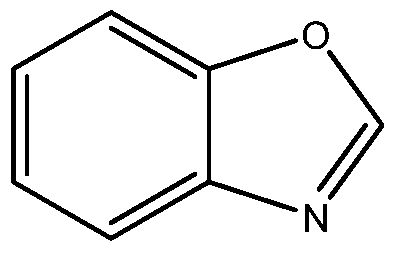
  • biphenyl, naphthyl, benzothionyl, indolyl, benzofuranyl, benzothiazolyl, benzooxazolyl, quinolinyl, and isoquinolinyl refer to both the unsubstituted and substituted versions of the bicyclic aryl ring systems below.
  • a dashed line in a structure herein represents the presence or absence of a bond.
  • Y is and is: an organic acid functional group, or an amide or ester thereof; hydroxymethyl or an ether thereof; or a tetrazolyl functional group.
  • the formula C O - M H ⁇ O O ⁇ S O ⁇ N O J 3 O - I means that Y consists of from 0-14 carbon atoms, from 1-30 hydrogen atoms, from 1-4 oxygen atoms, from 0-2 sulfur atoms, from 0-4 nitrogen atoms, and from 0-1 phosphorus atoms.
  • Y is -CO 2 R 4 , -CONR 5 R 6 , -CON(CH 2 CH 2 OH) 2 , -CONH(CH 2 CH 2 OH), - CH 2 OH, -P(O)(OH) 2 , -CONHSO 2 R 4 , -SO 2 NR 5 R 6 , - wherein R 4 R 5 and R 6 are independently H, Ci-Cg alkyl, Ci_s hydroxyalkyl, unsubstituted phenyl, or unsubstituted biphenyl.
  • Y is -CO 2 R 4 .
  • Y is -CO 2 H, -CO 2 CH 3 , -CO 2 CH 2 CH 3 , or -CO 2 -C 3 H 7 .
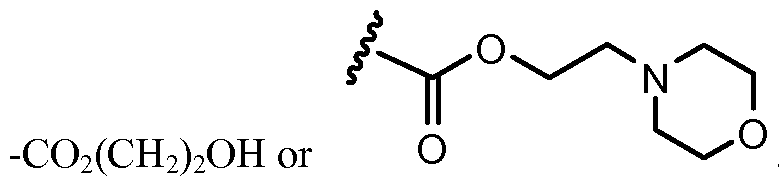
  • Y is -CO 2 (CH 2 ) 2 OH or In another embodiment Y is -CONR 5 R 6 .
  • Ar is aryl of a formula C 3- ioHo_23No-4 ⁇ (MS(MFo-5Clo-3Bro-3l ⁇ )-3.
  • a or A 1 may be a group which is related to one of these three moieties in that any carbon is replaced with S or O.
  • A may be a moiety where S replaces one or two carbon atoms such as one of the following or the like.
  • a or A 1 may be a moiety where O replaces one or two carbon atoms such as one of the following or the like.
  • a or A 1 may have an O replacing one carbon atom and an S replacing another carbon atom, such as one of the following or the like.
  • Ar is aryl of a formula C3_ioHo- 23 No-4 ⁇ o-4So-4Fo- 5 Clo-3Bro-3lo-3.
  • the formula C3_ioHo- 2 3No- 4 Oo-4So-4Fo- 5 Cl o . 3 Br o . 3 lo- 3 means that Ar consists of from 3-10 carbon atoms, 0-23 hydrogen atoms, 0-4 nitrogen atoms, 0- 4 oxygen atoms, 0-4 sulfur atoms, 0-5 fluorine atoms, 0-3 chlorine atoms, 0-3 bromine atoms, and 0-3 iodine atoms.
  • a or A 0 comprises:
  • a or A 0 comprises:
  • a or A 0 comprises:
  • Ar is imidazolyl, pyrrolyl, furanyl, oxazolyl, thiazolyl, thienyl, pyridinyl, or phenyl with 1 or 2 substituents selected from: Ci -3 alkyl, -OH, -SH, Ci -3 -O-alkyl, Ci -3 -S-alkyl, -F, -Cl, -Br, or -CF 3 .
  • Ar is thienyl
  • a or A 0 has one of the following structures, wherein Y attaches to the ring.
  • a or A 0 is -CH 2 OCH 2 Ar-.
  • a or A 0 is
  • a or A 1 is -CH 2 O(CH 2 ) 4 -.
  • a or A 1 is -CH 2 S(CH 2 ) 4 -.
  • a or A 1 is -(CH 2 ) 6 -.
  • a or A 1 is -CH 2 C ⁇ C-(CH 2 ) 3 -.
  • a or A 1 is -S(CH 2 ) 3 S(CH 2 ) 2 -.
  • a or A 1 is -(CH 2 ) 4 OCH 2 -.
  • a or A 1 is -(CH 2 ) 2 S(CH 2 ) 3 -.
  • a or A 1 is -CH 2 -O-(CH 2 ) ⁇ .
  • a or A 1 is 6-hexyl.
  • a or A 1 is (Z)-6-hex-4-enyl.
  • G is -H, such as in the examples below.
  • G is -OH, such as in the examples below.
  • G O, such as in the examples below.
  • G is -Cl, such as in the examples below.
  • G is -F, such as in the examples below.
  • G is -CN, such as in the examples below.
  • R x is -(CH 2 ) 3 -, such as in the examples below.
  • R x is -CH 2 OCH 2 -, such as in the examples below.
  • R x is -CH 2 SCH 2 -, such as in the examples below.
  • R x is -CH 2 NHCH 2 -, such as in the examples below.
  • R x is -(CH 2 ⁇ O-, such as in the examples below.
  • R x is -(CH ⁇ S-, such as in the examples below.
  • R x is -(CH 2 ) 2 NH-, such as in the examples below.
  • B is aryl of a formula C 3 _ 2 oHo_ 45 No ⁇ Oo- 4 So- 4 Fo_ 5 Clo- 3 Bro_ 3 Io- 3 .
  • the formula C 3 _ 20 Ho_ 45 No ⁇ Oo- 4 So- 4 F 0 _ 5 Cl o . 3 Br o . 3 lo- 3 means that B consists of from 3-20 carbon atoms, 0-45 hydrogen atoms, 0-4 nitrogen atoms, 0-4 oxygen atoms, 0-4 sulfur atoms, 0-5 fluorine atoms, 0-3 chlorine atoms, 0-3 bromine atoms, and 0-3 iodine atoms.
  • B is imidazolyl, pyrrolyl, furanyl, oxazolyl, thiazolyl, thienyl, pyridinyl, or phenyl with 1 or 2 substituents selected from: Ci -I0 alkyl, -OH, -SH, Ci -I0 -O-alkyl, Ci -I0 -S-alkyl, Ci -I0 hydroxyalkyl, d_ 10 acyl, -F, -Cl, -Br, I, or -CF 3 .
  • B is phenyl with from 1 to 4 substituents independently selected from: hydrocarbyl, alkyl, acyl, ether substituents, -O-alkyl, thioether substituents, -S-alkyl, amine substituents, aminoalkyl, ester substituents, hydroxyalkyl, fluorocarbons, -CF 3 , -CN, -F, -Cl, -Br, and -I.
  • B is phenyl substituted with from 1 to 4 substituents selected from: C 2 _g alkyl, C L8 -O-alkyl, Ci -8 hydroxyalkyl, -OH, -F, -Cl, -Br, or -CF 3 .
  • B is pyridinyl with from 1 to 3 substituents independently selected from: hydrocarbyl, alkyl, acyl, ether substituents, -O-alkyl, thioether substituents, -S-alkyl, amine substituents, aminoalkyl, ester substituents, hydroxyalkyl, fluorocarbons, -CF 3 , -CN, -F, -Cl, -Br, and -I.
  • B is thienyl with from 1 to 2 substituents independently selected from: hydrocarbyl, alkyl, acyl, ether substituents, -O-alkyl, thioether substituents, -S-alkyl, amine substituents, aminoalkyl, ester substituents, hydroxyalkyl, fluorocarbons, -CF 3 , -CN, -F, -Cl, -Br, and -I.
  • B is furyl with from 1 to 2 substituents independently selected from: hydrocarbyl, alkyl, acyl, ether substituents, -O-alkyl, thioether substituents, -S-alkyl, amine substituents, aminoalkyl, ester substituents, hydroxyalkyl, fluorocarbons, -CF 3 , -CN, -F, -Cl, -Br, and -I.
  • substituents independently selected from: hydrocarbyl, alkyl, acyl, ether substituents, -O-alkyl, thioether substituents, -S-alkyl, amine substituents, aminoalkyl, ester substituents, hydroxyalkyl, fluorocarbons, -CF 3 , -CN, -F, -Cl, -Br, and -I.
  • the compound is not:
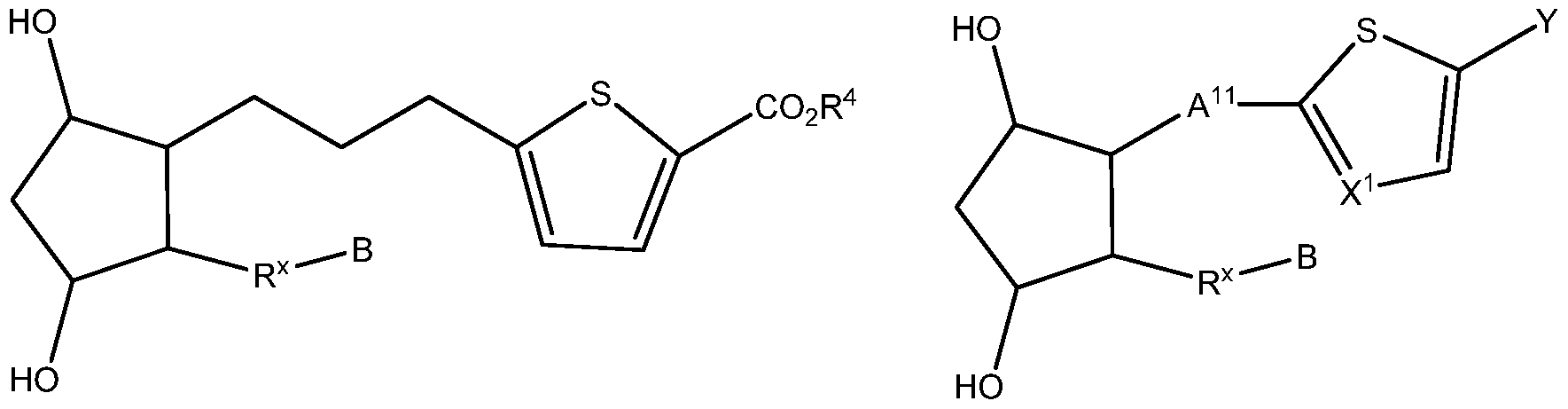
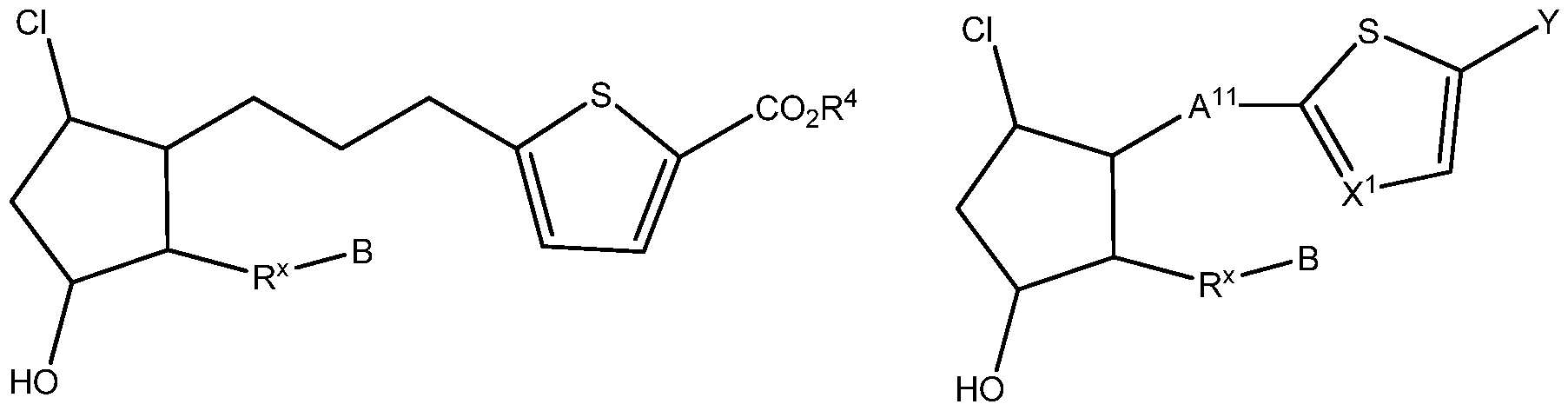
  • a 11 is -(CH 2 ) 3 -, -O(CH 2 ) 2 -, -CH 2 OCH 2 -, -(CH 2 ) 2 O-, -S(CH 2 ) 2 -, -CH 2 SCH 2 -, or -(CH 2 ) 2 S-, and X 1 is N or CH.
  • the compound is not:
  • Another embodiment is a method of: reducing intraocular pressure, treating glaucoma or intraocular pressure, growing hair, or improving the appearance of hair, comprising administering a compound disclosed herein to a mammal in need thereof.
  • Another embodiment is use of a compound disclosed herein in the manufacture of a medicament for: reducing intraocular pressure, treating glaucoma or intraocular pressure, growing hair, or improving the appearance of hair.
  • Step 1 Alkylation of 5 with 6 to give 7
  • Step 2 Reduction of methyl 3-ethylbenzoate to form (3-ethylphenyl)methanol
  • Step 3 Bromination of (3-ethylphenyl)methanol to form l-(bromomethyl)-3-ethylbenzene
  • Lithium aluminum hydride (3.1 mL of 1.0 M solution in THF, 3.1 mmol) was added to a solution of methyl 3- ethylbenzoate (500 mg, 3.05 mmol) in THF (12 mL) at 0 0 C. After 2 h at 0 0 C, the reaction was quenched by the addition of saturated aqueous Rochelle's salt (50 mL) and stirred vigorously overnight at room temperature. The reaction mixture was extracted with Et 2 O (3x100 mL).
  • Lithium hydroxide (0.2 mL of a 1.0 M aqueous solution, 0.2 mmol) was added to a solution of 14a (10 mg, 0.02 mmol) in THF (0.2 mL). After stirring 3 days at room temperature, the mixture was acidified with 1 N HCl (0.2 mL) concentrated in vacuo. The crude residue was absorbed onto silica and purified by chromatography on 4 g silica gel (CH 2 Cl 2 ⁇ 20% MeOH/CH 2 Cl 2 , gradient) to afford 3 mg (31%) of the title compound (15a).
  • step 1 alkyne 11 (100 mg, 0.24 mmol) and 3-ethylbenzyl bromide (33 mg, 0.17 mmol) were converted into 86 mg (87%) of 12b.
  • step 2 THP ether 12b (86 mg, 0.16 mmol) was converted into 44 mg (61%) of 13b.
  • Step 3 Hydrogenation of 13b to give 14b
  • step 3 13b (22 mg, 0.05 mmol) was converted into 4 mg
  • Lithium hydroxide (0.1 mL of a 1.0 M aqueous solution, 0.1 mmol) was added to a solution of 14b (4 mg,
  • MeCN 0.5 mL
  • step 2 THP ether 16 (79 mg, 0.14 mmol) was converted into
  • Step 3 Hydrogenation of 17 to give 18 Allene 17 (10 mg, 0.02 mmol) was dissolved in ethanol and converted into 3 mg (30%) of saturated compound 18 using an H-Cube hydrogenation reactor from Thalesnano, Inc, using a Pd/C catalyst cartridge.
  • Lithium hydroxide (0.1 mL of a 1.0 M aqueous solution, 0.1 mmol) was added to a solution of 18 (3 mg,
  • Lithium hydroxide (0.2 mL of a 1.0 M aqueous solution, 0.2 mmol) was added to a solution of 17 (from example 5, step 2, 20 mg, 0.041 mmol) in THF (0.2 mL). After stirring 3 days at room temperature, the mixture was acidified with 1 N HCl (0.3 mL) and extracted with CH 2 Cl 2 (20 mL). The organic phase was dried (MgSO 4 ), filtered and concentrated in vacuo. Purification of the crude residue two times by flash column chromatography on 4 g silica gel (CH 2 Cl 2 ⁇ 10% MeOH/CH 2 Cl 2 , gradient) afforded 17 mg (88%) of the title compound (20).
  • Step 1 Reaction of 11 with benzyl chloride to give 12c
  • step 1 11 (150 mg, 0.37 mmol) and benzyl chloride (39 ⁇ L,
  • step 2 THP ether 12c (120 mg, 0.24 mmol) was converted into 80 mg (80%) of 13c. Step 3. Hydrogenation of 13c to give 14c
  • step 3 alkyne 13c (40 mg, 0.096 mmol) was converted into
  • Lithium hydroxide (0.4 mL of a 1.0 M aqueous solution, 0.4 mmol) was added to a solution of 14c (20 mg, 0.048 mmol) in THF (0.4 mL). After stirring overnight at room temperature, the mixture was acidified with 1
  • step 2 THP ether 21 (45 mg, 0.09 mmol) was converted into
  • step 4 ester 22 (10 mg, 0.024 mmol) was converted into 2 mg (21%) of the title compound (23).
  • Step 1 Oxidation of 5 to give 10 DMSO (177 ⁇ L, 2.5 mmol) was added to a solution of oxalyl chloride (600 ⁇ L of a 2.0 M solution in CH 2 Cl 2 ,
  • Step 2 Reaction of 10 to give 11 (in accordance with the procedures of Roth, et al., Synthesis 2004, 59-62).

Landscapes

  • Chemical & Material Sciences (AREA)
  • Organic Chemistry (AREA)
  • Health & Medical Sciences (AREA)
  • Pharmacology & Pharmacy (AREA)
  • Animal Behavior & Ethology (AREA)
  • Chemical Kinetics & Catalysis (AREA)
  • General Chemical & Material Sciences (AREA)
  • Medicinal Chemistry (AREA)
  • Nuclear Medicine, Radiotherapy & Molecular Imaging (AREA)
  • Engineering & Computer Science (AREA)
  • Ophthalmology & Optometry (AREA)
  • Life Sciences & Earth Sciences (AREA)
  • Bioinformatics & Cheminformatics (AREA)
  • General Health & Medical Sciences (AREA)
  • Public Health (AREA)
  • Veterinary Medicine (AREA)
  • Dermatology (AREA)
  • Pharmaceuticals Containing Other Organic And Inorganic Compounds (AREA)
  • Organic Low-Molecular-Weight Compounds And Preparation Thereof (AREA)
  • Acyclic And Carbocyclic Compounds In Medicinal Compositions (AREA)

Abstract

Disclosed herein are compounds represented by a formula: Therapeutic methods, compositions, and medicaments related thereto are also disclosed.

Description

THERAPEUTIC SUBSTITUTED CYCLOPENTANES
CROSS-REFERENCE
This application claims the benefit of U.S. Provisional Patent Application serial number 61/053,354, filed on May 15, 2008, the entire disclosure of which is incorporated herein by this specific reference.
DESCRIPTION OF THE INVENTION
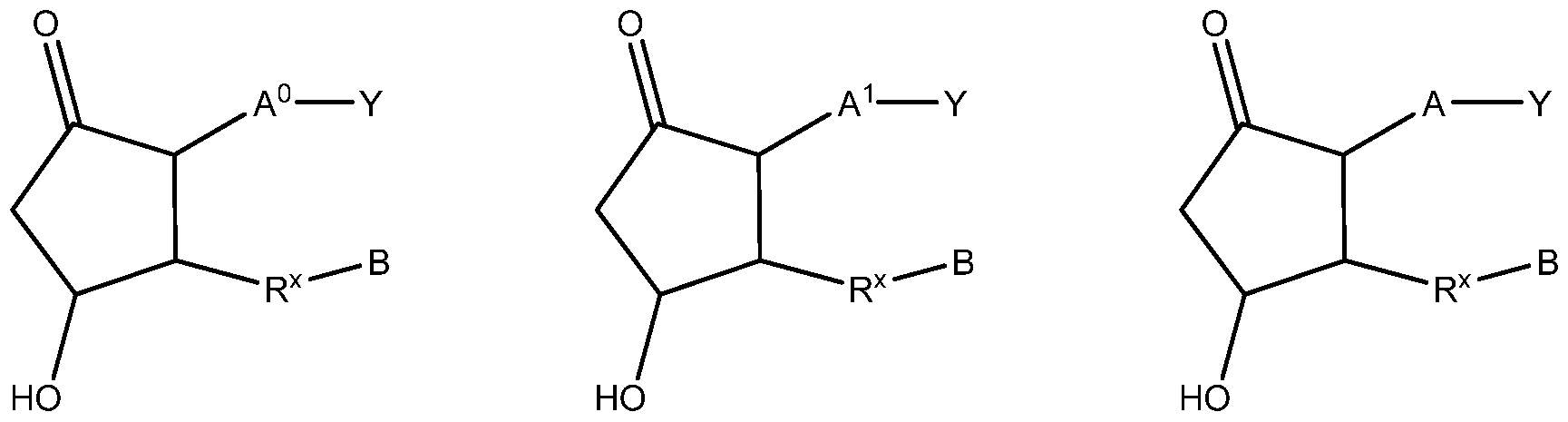
Disclosed herein are compounds represented by a formula:
Figure imgf000002_0001
wherein a dashed line represents the presence or absence of a bond;
Y is
Figure imgf000002_0002
and is: an organic acid functional group, or an amide or ester thereof; hydroxymethyl or an ether thereof; or a tetrazolyl functional group;
A is -(CH2)6-, cis -CH2CH=CH-(CH2)3-, or -CH2C≡C-(CH2)3-, wherein 1 or 2 carbon atoms may be replaced by S or O; or A is -(CH2)m-Ar-(CH2)0-, wherein the sum of m and o is 1, 2, 3, or 4, and wherein 1 -CH2- may be replaced by S or O, and 1 -CH2-CH2-may be replaced by -CH=CH- or -C=C-;
Ar is aryl of a formula Cs.joHo^sNo^Oo^So^Fo-sClo-sBro-sIo-s,
G is -H, -OH, =O, -Cl, -F, -CN;
Rx is -(CH2)3-, -CH=CHCH2-, -CH=C=CH-, -CH2OCH2-, CH2SCH2-, -CH2NHCH2-, -(CH2)2O-, -(CH2)2S-, or
-(CH2)2NH-; and
B is aryl of a formula C3.2oHo.45No^Oo-4So-4Fo.5Clo-3Bro.3lo-3.
Also disclosed herein are compounds represented by a formula:
Figure imgf000002_0003
wherein a dashed line represents the presence or absence of a bond;
Y is
Figure imgf000002_0004
and is: an organic acid functional group, or an amide or ester thereof; hydroxymethyl or an ether thereof; or a tetrazolyl functional group; A0 is -(CH2)m-Ar-(CH2)0-, wherein the sum of m and o is 1, 2, 3, or 4, and wherein 1 -CH2- may be replaced by S or O, and 1 -CH2-CH2-may be replaced by -CH=CH- or -C=C-;
Ar is aryl of a formula C3-1OHO-23No-4Oa4Sa4Fo-5CIo-3BrO-3IoJ,
G is -H, -OH, =O, -Cl, -F, -CN;
Rx is -(CH2)3-, -CH=CHCH2-, -CH=C=CH-, -CH2OCH2-, CH2SCH2-, -CH2NHCH2-, -(CH2)2O-, -(CH2)2S-, or
-(CH2)2NH-; and
B is aryl of a formula C3-20H0-45N04O0-4So4F0-5Cl0-3Br0-3I0-3.
Also disclosed herein are compounds represented by a formula:
Figure imgf000003_0001
wherein a dashed line represents the presence or absence of a bond;
Y is Co-14H1-30O14So-2Na4Po-1 and is: an organic acid functional group, or an amide or ester thereof; hydroxymethyl or an ether thereof; or a tetrazolyl functional group;
A1 is -(CH2)(S-, cis -CH2CH=CH-(CH2)3-, or -CH2C≡C-(CH2)3-, wherein 1 or 2 carbon atoms may be replaced by S or O; G is -H, -OH, =O, -Cl, -F, -CN;
Rx is -(CH2)3-, -CH=CHCH2-, -CH=C=CH-, -CH2OCH2-, CH2SCH2-, -CH2NHCH2-, -(CH2)2O-, -(CH2)2S-, or
-(CH2)2NH-; and
B is aryl of a formula C3-2OHo-45No4Oo-4S04F0-5Cl0-3Br0-3I0-3.
These compounds are useful for reducing intraocular pressure, treating glaucoma or intraocular pressure, growing hair, or improving the appearance of hair. Growing hair includes increasing the length or radius of individual hairs as well as increasing the number of hairs present in a given area. Improving the appearance of hair includes improving the color, such as darkening, or improving its gloss, shine, or other properties related to the reflection or dispersion of light.
Unless otherwise indicated, reference to a compound should be construed broadly to include pharmaceutically acceptable salts, prodrugs, tautomers, alternate solid forms, non-covalent complexes, and combinations thereof, of a chemical entity of a depicted structure or chemical name.
Any description of a compound made herein is not intended to encompass compounds having structural features that violate the basic principles of chemistry such as containing an atom having too many or too few electrons in its valence shell (see Francis A. Carey, Organic Chemistry, McGraw-Hill Book Company: New York, 1987, pp. 11-13). It is also not intended to encompass compounds that are too reactive or otherwise too unstable to be useful as described herein. For example, it is not intended to encompass compounds that cannot either: 1) be put into a bottle with an excipient for subsequent use in treating a mammal as disclosed herein, or 2) be put into a bottle as a salt or a prodrug of the compound with an excipient for subsequent use in treating a mammal as disclosed herein. Unless otherwise indicated, if a term is used to describe more than one structural feature of the compounds disclosed herein, it should be assumed that the term has the same meaning for all of those features. Similarly, a subgroup of that term applies to every structural feature described by that term.
Unless stereochemistry is explicitly and unambiguously depicted, a structure is intended to include every possible stereoisomer, both pure or in any possible mixture.
"Treat," "treating," or "treatment" refer to the use of a compound, composition, therapeutically active agent, or drug in the diagnosis, cure, mitigation, treatment, or prevention of disease or other undesirable condition.
A pharmaceutically acceptable salt is any salt of the parent compound that is suitable for administration to an animal or human. A pharmaceutically acceptable salt also refers to any salt which may form in vivo as a result of administration of an acid, another salt, or a prodrug which is converted into an acid or salt. A salt comprises one or more ionic forms of the compound, such as a conjugate acid or base, associated with one or more corresponding counter-ions. Salts can form from or incorporate one or more deprotonated acidic groups (e.g. carboxylic acids), one or more protonated basic groups (e.g. amines), or both (e.g. zwitterions).
A prodrug is a compound which is converted to a therapeutically active compound after administration. For example, conversion may occur by hydrolysis of an ester group or some other biologically labile group. Prodrug preparation is well known in the art. For example, "Prodrugs and Drug Delivery Systems," which is a chapter in Richard B. Silverman, Organic Chemistry of Drug Design and Drug Action, 2d Ed., Elsevier Academic Press: Amsterdam, 2004, pp. 496-557, provides further detail on the subject. In particular, alkyl esters having such as methyl, ethyl, isopropyl, and the like are contemplated. Also contemplated are prodrugs containing a polar group such as hydroxyl or morpholine. Examples of such
prodrugs include compounds containing the moieties -Cθ2(CH2)2θH,
Figure imgf000004_0001
and the like.
Tautomers are isomers that are in rapid equilibrium with one another. For example, tautomers may be related by transfer of a proton, hydrogen atom, or hydride ion.
Alternate solid forms are different solid forms than those that may result from practicing the procedures described herein. For example, alternate solid forms may be polymorphs, different kinds of amorphous solid forms, glasses, and the like.
Non-covalent complexes are complexes that may form between the compound and one or more additional chemical species. In these complexes, the compound and the additional chemical species have attractive interactions that are not covalent bonds. Examples include solvates, hydrates, charge transfer complexes, and the like.
An organic acid functional group is an acidic functional group on an organic molecule. For example, organic acid functional groups may comprise an oxide of carbon, sulfur, or phosphorous, such as a carboxylic acid, sulfonic acid, or phosphonic acid functional group.
An amide is a functional group where an -OH of an organic acid is replaced by a nitrogen atom which is directly attached to: 1) two carbon atoms, 2) two hydrogen atoms, 3) a carbon atom and a hydrogen atom, or 4) a sulfur atom of a sulfonyl (-SO2-) and hydrogen atom. An ester is a functional group where an -OH of an organic acid is replaced by an oxygen atom which is directly attached to a carbon atom.
The structures below depict examples different organic acid functional groups and their associated amides and esters. Acids Esters Amides
Figure imgf000005_0001
carboxylic acid carboxylic acid ester carboxylic acid amide
Figure imgf000005_0002
sulfonic acid sulfonic acid ester sulfonic acid amide
Figure imgf000005_0003
phosphonic acid phosphonic acid ester phosphonic acid amide
In these examples, R could be alkyl, another hydrocarbyl, or a species such as -CH2CH2OH. R1 and R2 could be hydrogen, alkyl, another hydrocarbyl, or alkyl sulfonyl (i.e. -SO2-alkyl).
Hydrocarbyl is a moiety consisting only of hydrogen atoms and carbon atoms. Examples include:
1. alkyl, which is hydrocarbyl that contains no double or triple bonds, such as: a. linear alkyl, e.g. methyl, ethyl, «-propyl, «-butyl, «-pentyl, «-hexyl, etc., b. branched alkyl, e.g. zso-propyl, 7-butyl and other branched butyl isomers, branched pentyl isomers, etc., c. cycloalkyl, e.g. cyclopropyl, cyclobutyl, cyclopentyl, cyclohexyl, etc., and d. combinations of linear, branched, and/or cycloalkyl; • Ci_3 alkyl is alkyl having from 1 to 3 carbon atoms such as methyl, ethyl, propyl, isopropyl, cyclopropyl, etc. • Ci_6 alkyl is alkyl having from 1 to 6 carbon atoms such as methyl, ethyl, propyl isomers, butyl isomers, pentyl isomers, hexyl isomers, cyclopropyl, cyclobutyl, cyclopentyl, cyclohexyl, etc. • Ci_io alkyl is alkyl having from 1 to 10 carbon atoms.
2. alkenyl, which is hydrocarbyl having 1 or more double bonds, including linear, branched, or cycloalkenyl;
3. alkynyl, which is hydrocarbyl having 1 or more triple bonds, including linear, branched, or cycloalkynyl;
4. unsubstituted phenyl, naphthyl, etc.; and 5. combinations of alkyl, alkenyl, akynyl; and unsubstituted phenyl, naphthyl, etc. Hydroxyalkyl is alkyl-OH. For example, hydroxymethyl is -CH2OH. Ci_6 hydroxyalkyl is hydroxyalkyl having from 1 to 6 carbon atoms, such as hydroxymethyl, hydroxyethyl isomers, hydroxypropyl isomers, hydroxybutyl isomers, hydroxypentyl isomers, hydroxyhexyl isomers, etc. Ci_io hydroxyalkyl is hydroxyalkyl having from 1 to 10 carbon atoms.
An ether is a moiety comprising an oxygen attached to two different carbon atoms. For example, an ether of hydroxymethyl is -CH2-O-hydrocarbyl. Another example is -O-alkyl.
Cu -O-alkyl is -O-alkyl having 1, 2, or 3 carbon atoms such as -O-methyl, -O-ethyl, -O-C3H7. Ci-io -O-allkyl is -O-alkyl having from 1-10 carbon atoms. Cu -S-alkyl is -S-alkyl having 1, 2, or 3 carbon atoms such as -S-methyl, -S-ethyl, -S-C3H7.
Ci-io -S-allkyl is -S-alkyl having from 1-10 carbon atoms. 0
N
Acyl iΛ hydrocarby' .
Ci-io acyl is acyl having from 1-10 carbon atoms, such as formyl, acetyl, propionyl, butyryl, pentanoyl, hexanoyl, benzoyl, etc. A tetrazolyl functional group has one of the tautomeric ring structures below:
Figure imgf000006_0001
The hydrogen on either tautomeric form may be replaced by a substituent as well. These moieties are also considered to be tetrazolyl functional groups.
Aryl is an unsubstituted or substituted aromatic ring or aromatic ring system. The ring or ring system atoms could all be carbon. Alternatively, heteroaryl, a subgenus of aryl, has one or more oxygen, sulfur, or nitrogen atoms in the ring or ring system.
Monocyclic aryl is aryl having only one ring.
Unsubstituted aryl refers to aryl with no substituents. Substituted aryl refers to aryl with one or more substituents. If a group is indicated as "aryl" the bond or bonds to that group must directly attach to a carbon atom of an aromatic ring, and not to a substituent.
Any group may be a substituent subject to any restrictions placed upon the moiety that the aryl group is a part of. Examples of substituents include:
• hydrocarbyl, as described above
• alkyl-CN, such as -CH2-CN, -(CH2)2-CN; -(CH2)3-CN, and the like; • Hydroxy, -OH
• hydroxyalkyl, i.e. alkyl-OH, such as hydroxymethyl, hydroxyethyl, and the like;
• ether substituents, including -O-alkyl, alkyl-O-alkyl, and the like;
• thioether substituents, including -S-alkyl, alkyl-S-alkyl, and the like;
• amine substituents, including -NH2, -NH-alky^-N-alky^alkyl2 (i.e., alkyl1 and alkyl2 are the same or different, and both are attached to N), alkyl-NH2, alkyl-NH-alkyl, alkyl-N-alkyl1 alkyl2, and the like;
• aminoalkyl, meaning alkyl-amine, such as aminomethyl (-CH2-amine), aminoethyl, and the like;
• ester substituents, including -CO2-alkyl, -CO2.phenyl, etc.; • other carbonyl substituents, including aldehydes; ketones, such as acyl, including, acetyl, propionyl, and benzoyl substituents;
• fluorocarbons or hydroflourocarbons such as -CF3 .CH2CF3, etc.; and
• other nitrogen containing substituents such as -CN and -NO2,
• other sulfur containing subsitutents such as sulfide, sulfonyl or sulfoxide;
• aryl;
• combinations of the above are also possible, subject to the constraints defined;
• Alternatively, a substituent may be -F, -Cl, -Br, or -I.
The terms imidazolyl, pyrrolyl, furanyl, oxazolyl, thiazolyl, thienyl, pyridinyl, and phenyl refer to both the unsubstituted and substituted versions of the monocyclic aryl rings below.
Figure imgf000007_0001
oxazolyl
Figure imgf000007_0003
Figure imgf000007_0002
phenyl pyridinyl
The terms biphenyl, naphthyl, benzothionyl, indolyl, benzofuranyl, benzothiazolyl, benzooxazolyl, quinolinyl, and isoquinolinyl and refer to both the unsubstituted and substituted versions of the bicyclic aryl ring systems below.
Figure imgf000007_0004
biphenyl naphthyl benzothienyl
Figure imgf000007_0005
Figure imgf000007_0006
indolyl benzothiazolyl
Figure imgf000007_0008
Figure imgf000007_0007
Figure imgf000007_0009
benzooxazolyl quinolinyl isoquinolinyl
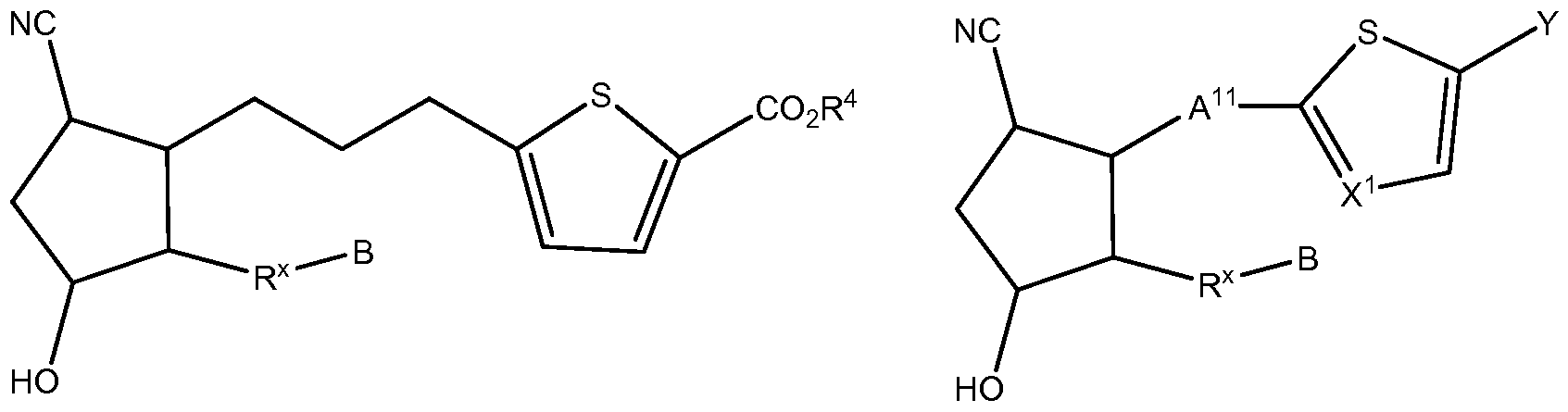
A dashed line in a structure herein represents the presence or absence of a bond. Thus, compounds according to any of the formulas below are possible.
Figure imgf000008_0001
Y is
Figure imgf000008_0002
and is: an organic acid functional group, or an amide or ester thereof; hydroxymethyl or an ether thereof; or a tetrazolyl functional group. The formula CO-MH^OO^SO^NO J3 O-I means that Y consists of from 0-14 carbon atoms, from 1-30 hydrogen atoms, from 1-4 oxygen atoms, from 0-2 sulfur atoms, from 0-4 nitrogen atoms, and from 0-1 phosphorus atoms.
In one embodiment, Y is -CO2R4, -CONR5R6, -CON(CH2CH2OH)2, -CONH(CH2CH2OH), - CH2OH, -P(O)(OH)2, -CONHSO2R4, -SO2NR5R6,
Figure imgf000009_0001
- wherein R4 R5 and R6 are independently H, Ci-Cg alkyl, Ci_s hydroxyalkyl, unsubstituted phenyl, or unsubstituted biphenyl.
In another embodiment, Y is -CO2R4.
In another embodiment, Y is -CO2H, -CO2CH3, -CO2CH2CH3, or -CO2-C3H7.
In another embodiment Y is -CO2(CH2)2OH or
Figure imgf000009_0002
In another embodiment Y is -CONR5R6.
A is -(CH2V, cis -CH2CH=CH-(CH2)3-, or -CH2C≡C-(CH2)3-, wherein 1 or 2 carbon atoms may be replaced by S or O; or A is -(CH2)m-Ar-(CH2)0-, wherein the sum of m and o is 1, 2, 3, or 4, and wherein 1 - CH2- may be replaced by S or O, and 1 -CH2-CH2-may be replaced by -CH=CH- or -C≡C-. Ar is aryl of a formula C3-ioHo_23No-4θ(MS(MFo-5Clo-3Bro-3l<)-3.
A1 is -(CH2)(S-, cis -CH2CH=CH-(CH2)3-, or -CH2C≡C-(CH2)3-, wherein 1 or 2 carbon atoms may be replaced by S or O;
Thus, A or A1 may be -(CH2)6-, cis -CH2CH=CH-(CH2)3-, or -CH2C≡C-(CH2)3-. Alternatively, A or A1 may be a group which is related to one of these three moieties in that any carbon is replaced with S or O. For example, A may be a moiety where S replaces one or two carbon atoms such as one of the following or the like.
Figure imgf000009_0003
Figure imgf000009_0004
Alternatively, A or A1 may be a moiety where O replaces one or two carbon atoms such as one of the following or the like.
Figure imgf000010_0001
Y y
Alternatively, A or A1 may have an O replacing one carbon atom and an S replacing another carbon atom, such as one of the following or the like.
Figure imgf000010_0002
Alternatively, in certain embodiments A is -(CH2)m-Ar-(CH2)0-, wherein the sum of m and o is 1, 2, 3, or 4, and wherein 1 -CH2- may be replaced by S or O, and 1 -CH2-CH2-may be replaced by -CH=CH- or - C=C-. A0 is -(CH2)m-Ar-(CH2)0-, wherein the sum of m and o is 1, 2, 3, or 4, and wherein 1 -CH2- may be replaced by S or O, and 1 -CH2-CH2-may be replaced by -CH=CH- or -C=C-.
Ar is aryl of a formula C3_ioHo-23No-4θo-4So-4Fo-5Clo-3Bro-3lo-3. The formula C3_ioHo-23No-4Oo-4So-4Fo- 5Clo.3Bro.3lo-3 means that Ar consists of from 3-10 carbon atoms, 0-23 hydrogen atoms, 0-4 nitrogen atoms, 0- 4 oxygen atoms, 0-4 sulfur atoms, 0-5 fluorine atoms, 0-3 chlorine atoms, 0-3 bromine atoms, and 0-3 iodine atoms.
In other words, in one embodiment A or A0 comprises:
1) a) 1, 2, 3, or 4 -CH2- moieties, or b) 0, 1 or 2 -CH2- moieties and -CH=CH- or -C=C-; and 2) Ar; e.g. -CH2-Ar-, -(CH2)2-Ar-, -CH=CH-Ar-, -C=C-Ar-, -CH2-Ar-CH2-, -CH2Ar-(CH2)2-, -CH2Ar-CH=CH- , -CH2Ar-C=C-, -(CH2)2-Ar-(CH2)2-, and the like; in another embodiment A or A0 comprises:
1) a) O; and 0, 1, 2, or 3 -CH2- moieties; or b) O; and 0 or 1 -CH2- moieties and -CH=CH- or -C=C-; and
2) Ar; e.g., -OAr-, -Ar-CH2-O-, -O-Ar-(CH2)2-, -OAr-CH=CH-, -O-Ar-C≡C-,-O-CH2-Ar-, -O-CH2-Ar-(CH2)2, -0-CH2Ar-CH=CH-, -O-CH2Ar-C≡C-,and the like; or in another embodiment A or A0 comprises:
1) a) S; and O, 1, 2, or 3 -CH2- moieties; or b) S; and O or 1 -CH2- moieties and -CH=CH- or -C=C-; and
2) Ar; e.g., -S-Ar-, -Ar-CH2-S-, -S-Ar-(CH2)2-, -SAr-CH=CH-, -S-Ar-C≡C-,-S-CH2-Ar-, -S-CH2-Ar-(CH2)2, - S-CH2Ar-CH=CH-, -S-CH2Ar-C=C-, and the like.
In another embodiment, the sum of m and 0 is 2, 3, or 4 wherein one CH2 may be replaced with S or O and 1 -CH2-CH2- may be replaced by -CH=CH- or -C=C-.
In another embodiment, the sum of m and 0 is 3 wherein one CH2 may be replaced with S or O and 1 -CH2-CH2- may be replaced by -CH=CH- or -C=C-.
In another embodiment, the sum of m and 0 is 2 wherein one CH2 may be replaced with S or O or 1 - CH2-CH2- may be replaced by -CH=CH- or -C=C-. In another embodiment, the sum of m and 0 is 4 wherein one CH2 may be replaced with S or O and 1
-CH2-CH2- may be replaced by -CH=CH- or -C=C-.
In another embodiment, Ar is imidazolyl, pyrrolyl, furanyl, oxazolyl, thiazolyl, thienyl, pyridinyl, or phenyl with 1 or 2 substituents selected from: Ci-3 alkyl, -OH, -SH, Ci-3 -O-alkyl, Ci-3 -S-alkyl, -F, -Cl, -Br, or -CF3.
In another embodiment, Ar is thienyl.
In other embodiments, A or A0 has one of the following structures, wherein Y attaches to the ring.
Figure imgf000011_0001
Figure imgf000012_0001
In another embodiment A or A0 is -CH2OCH2Ar-.
In another embodiment A or A0 is
Figure imgf000012_0002
In another embodiment A or A o i •s -(CH2)3Ar-.
In another embodiment A or A1 is -CH2O(CH2)4-.
In another embodiment A or A1 is -CH2S(CH2)4-.
In another embodiment A or A1 is -(CH2)6-.
In another embodiment A or A1 is cis -CH2CH=CH-(CH2)3-.
In another embodiment A or A1 is -CH2C≡C-(CH2)3-.
In another embodiment A or A1 is -S(CH2)3S(CH2)2-.
In another embodiment A or A1 is -(CH2)4OCH2-.
In another embodiment A or A1 is cis -CH2CH=CH-CH2OCH2-.
In another embodiment A or A1 is -CH2CH=CH-CH2OCH2-.
In another embodiment A or A1 is -(CH2)2S(CH2)3-.
In another embodiment A or A1 is -CH2-O-(CH2)^.
In another embodiment A or A1 is 6-hexyl.
In another embodiment A or A1 is (Z)-6-hex-4-enyl.
G is -H, -OH, =O, -Cl, -F, -CN.
In one embodiment, G is -H, such as in the examples below.
Figure imgf000013_0001
Figure imgf000013_0002
In one embodiment, G is -OH, such as in the examples below.
Figure imgf000013_0003
Figure imgf000013_0004
In one embodiment, G is =O, such as in the examples below.
Figure imgf000014_0001
Figure imgf000014_0002
In one embodiment, G is -Cl, such as in the examples below.
Figure imgf000014_0003
Figure imgf000014_0004
In one embodiment, G is -F, such as in the examples below.
Figure imgf000015_0001
Figure imgf000015_0002
In one embodiment, G is -CN, such as in the examples below.
Figure imgf000015_0003
Figure imgf000015_0004
In another embodiment, G is -F, -Cl, or =O.
Rx is -(CH2)3-, -CH=CHCH2-, -CH=C=CH-, -CH2OCH2-, -CH2SCH2-, -CH2NHCH2-, -(CH2)2O- (CH2)2S-, or -(CH2)2NH-.
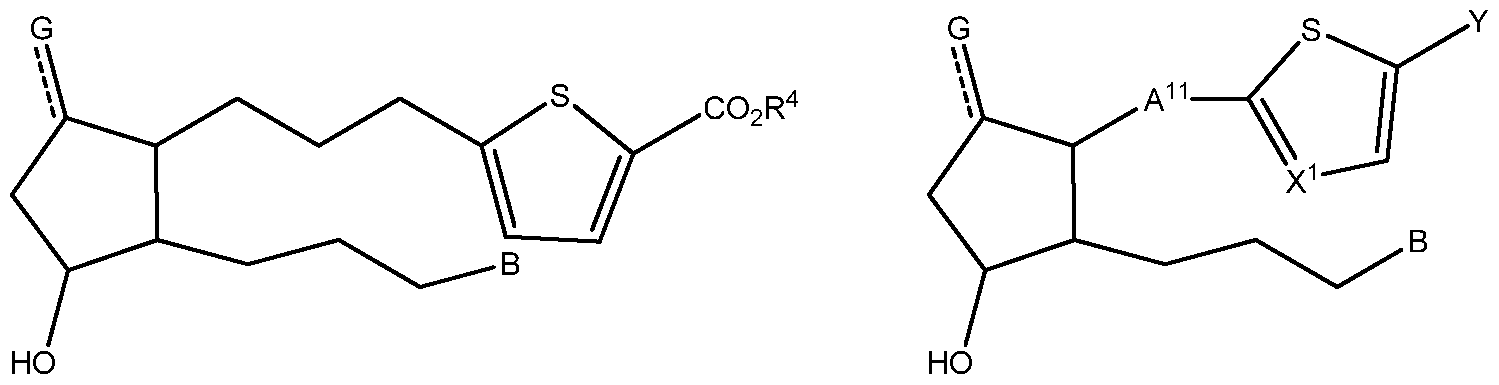
In one embodiment, Rx is -(CH2)3-, such as in the examples below.
Figure imgf000016_0001
Figure imgf000016_0002
In one embodiment, Rx is -CH=CHCH2-, such as in the examples below.
Figure imgf000017_0001
Figure imgf000017_0002
Figure imgf000017_0003
In one embodiment, Rx is -CH=C=CH-, such as in the examples below.
Figure imgf000018_0001
Figure imgf000018_0002
In one embodiment, Rx is -CH2OCH2-, such as in the examples below.
Figure imgf000018_0003
Figure imgf000018_0004
In one embodiment, Rx is -CH2SCH2-, such as in the examples below.
Figure imgf000019_0001
Figure imgf000019_0002
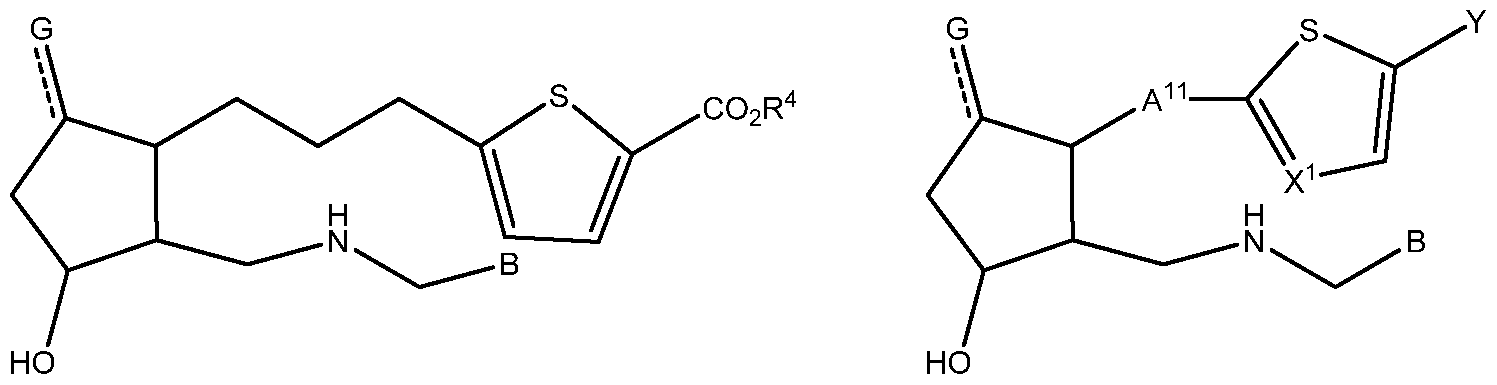
In one embodiment, Rx is -CH2NHCH2-, such as in the examples below.
Figure imgf000019_0003
Figure imgf000019_0004
In one embodiment, Rx is -(CH2^O-, such as in the examples below.
Figure imgf000020_0001
Figure imgf000020_0002
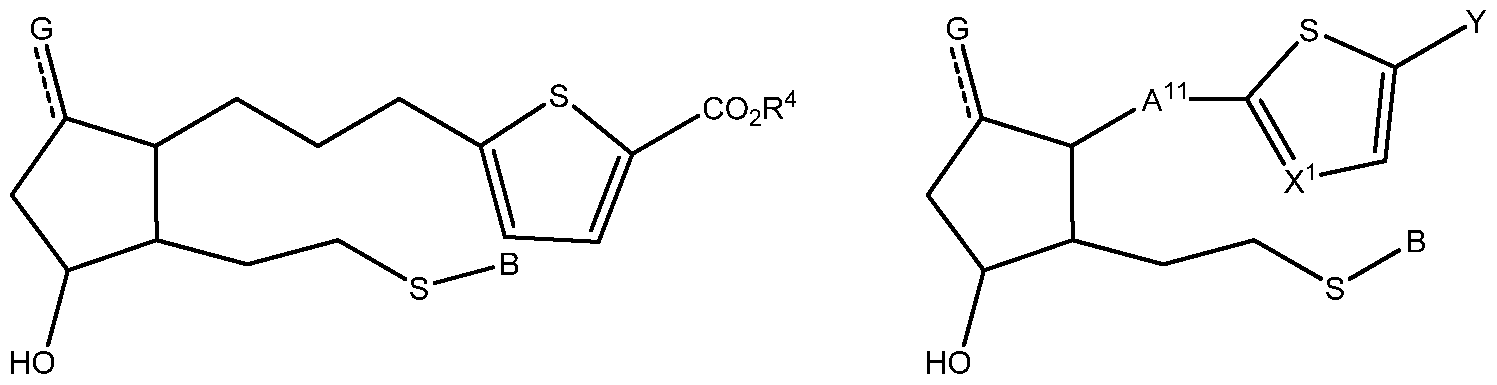
In one embodiment, Rx is -(CH^S-, such as in the examples below.
Figure imgf000020_0003
Figure imgf000020_0004
In one embodiment, Rx is -(CH2)2NH-, such as in the examples below.
Figure imgf000021_0001
Figure imgf000021_0002
In another embodiment, Rx is -(CH2)3-, -CH=CHCH2-, -CH=C=CH-, -CH2OCH2-, CH2SCH2-, or - CH2NHCH2-.
B is aryl of a formula C3_2oHo_45No^Oo-4So-4Fo_5Clo-3Bro_3Io-3. The formula C3_20Ho_45No^Oo-4So-4F0_ 5Clo.3Bro.3lo-3 means that B consists of from 3-20 carbon atoms, 0-45 hydrogen atoms, 0-4 nitrogen atoms, 0-4 oxygen atoms, 0-4 sulfur atoms, 0-5 fluorine atoms, 0-3 chlorine atoms, 0-3 bromine atoms, and 0-3 iodine atoms. In one embodiment, B is imidazolyl, pyrrolyl, furanyl, oxazolyl, thiazolyl, thienyl, pyridinyl, or phenyl with 1 or 2 substituents selected from: Ci-I0 alkyl, -OH, -SH, Ci-I0 -O-alkyl, Ci-I0 -S-alkyl, Ci-I0 hydroxyalkyl, d_10 acyl, -F, -Cl, -Br, I, or -CF3.
In one embodiment B is phenyl with from 1 to 4 substituents independently selected from: hydrocarbyl, alkyl, acyl, ether substituents, -O-alkyl, thioether substituents, -S-alkyl, amine substituents, aminoalkyl, ester substituents, hydroxyalkyl, fluorocarbons, -CF3, -CN, -F, -Cl, -Br, and -I.
In one embodiment, B is phenyl substituted with from 1 to 4 substituents selected from: C2_g alkyl, CL8 -O-alkyl, Ci-8 hydroxyalkyl, -OH, -F, -Cl, -Br, or -CF3.
In one embodiment B is pyridinyl with from 1 to 3 substituents independently selected from: hydrocarbyl, alkyl, acyl, ether substituents, -O-alkyl, thioether substituents, -S-alkyl, amine substituents, aminoalkyl, ester substituents, hydroxyalkyl, fluorocarbons, -CF3, -CN, -F, -Cl, -Br, and -I.
In one embodiment B is thienyl with from 1 to 2 substituents independently selected from: hydrocarbyl, alkyl, acyl, ether substituents, -O-alkyl, thioether substituents, -S-alkyl, amine substituents, aminoalkyl, ester substituents, hydroxyalkyl, fluorocarbons, -CF3, -CN, -F, -Cl, -Br, and -I.
In one embodiment B is furyl with from 1 to 2 substituents independently selected from: hydrocarbyl, alkyl, acyl, ether substituents, -O-alkyl, thioether substituents, -S-alkyl, amine substituents, aminoalkyl, ester substituents, hydroxyalkyl, fluorocarbons, -CF3, -CN, -F, -Cl, -Br, and -I.
In one embodiment, the compound is not:
Figure imgf000022_0001
Another embodiment is a compound represented by a formula:
Figure imgf000022_0002
wherein A11 is -(CH2)3-, -O(CH2)2-, -CH2OCH2-, -(CH2)2O-, -S(CH2)2-, -CH2SCH2-, or -(CH2)2S-, and X1 is N or CH.
Another embodiment is a compound represented by a formula:
Figure imgf000022_0003
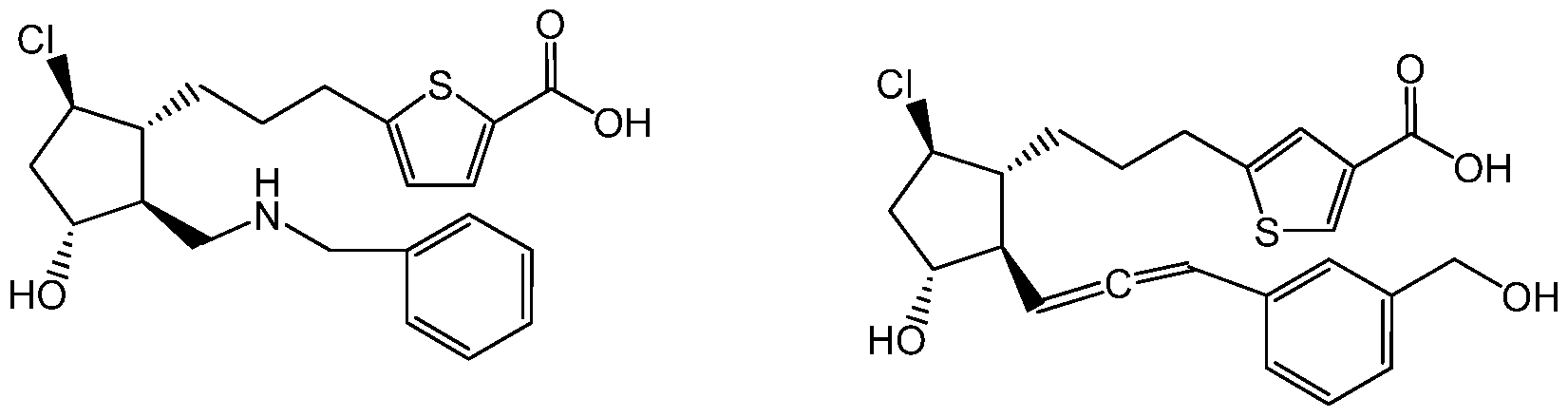
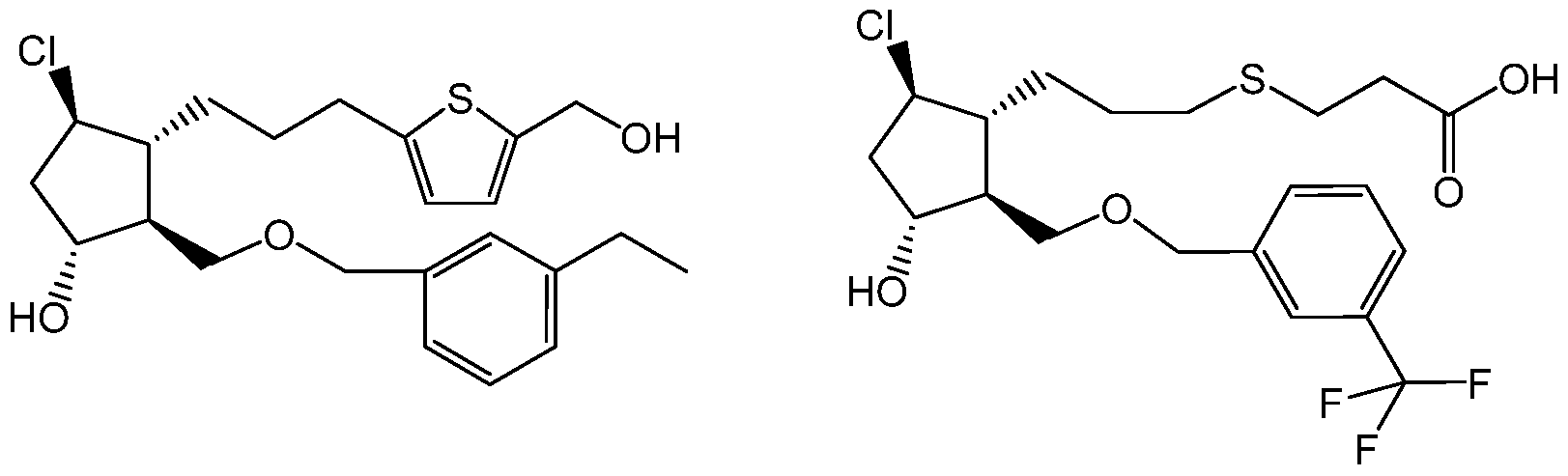
Another embodiment is a compound selected from:
Figure imgf000023_0001
Figure imgf000024_0001
Figure imgf000025_0001
In another embodiment, the compound is not:
Figure imgf000025_0002
Figure imgf000025_0003
Figure imgf000025_0004
Figure imgf000025_0005
Another embodiment is a method of: reducing intraocular pressure, treating glaucoma or intraocular pressure, growing hair, or improving the appearance of hair, comprising administering a compound disclosed herein to a mammal in need thereof.
Another embodiment is use of a compound disclosed herein in the manufacture of a medicament for: reducing intraocular pressure, treating glaucoma or intraocular pressure, growing hair, or improving the appearance of hair.
Some hypothetical examples of useful compounds are shown below.
Figure imgf000026_0001
Figure imgf000026_0002
Figure imgf000026_0003
Figure imgf000026_0004
Figure imgf000027_0001
Figure imgf000027_0002
Figure imgf000027_0003
Figure imgf000027_0004
Synthetic Examples
Although the compound disclose herein may be prepared by any of a number of potential methods, the methods are below are examples of useful methods that may be used. Scheme 1 AgOTf, CH2CI2 2,6-dι-f-butylpyrιdιne PPTs, MθOH
Figure imgf000028_0002
Figure imgf000028_0003
Figure imgf000028_0001
Figure imgf000028_0004
Example 1
(Z)-7-((lR,2S,3R,5R)-5-chloro-3-hydroxy-2-((3-(trifluoromethyl)benzyloxy)methyl)cyclopentyl)hept-5- enoic acid (4) Step 1 : Alkylation of 1 to give 2
A solution of (Z)-7-[(lR,2S,3R,5R)-5-chloro-2-hydroxymethyl-3-(tetrahydropyran-2-yloxy)-cyclopentyl]- hept-5-enoic acid allyl ester (1, see WO2006/076370, 146 mg, 0.36 mmol), silver Inflate (103 mg, 0.40 mmol) and 2,6-di-^-butylpyridine (122 μL, 0.54 mmol) in CH2Cl2 (1.0 mL) was cooled to 0 0C. 3-
(Trifluoromethyl)benzyl bromide (67 μL, 0.44 mmol) was added and a slight precipitate formed. After several hours the reaction was filtered through celite and the filtrate was washed with 1 N HCl, saturated aqueous NaHCOs and brine then dried (MgSC^), filtered and concentrated in vacuo. Purification of the crude residue by flash column chromatography on silica gel (20% EtOAc/hexanes) afforded 41 mg (20%) of 2.
Step 2: Deprotection of 2 to give 3
Pyridinium/>-toluenesulfonate (PPTs, 5 mg, 0.020 mmol) was added to a solution of 2 (41 mg, 0.073 mmol) in methanol (2.0 mL) at room temperature. The solution stirred at room temperature for 16 h then concentrated in vacuo. Purification of the crude residue by flash column chromatography on silica gel (30%
EtOAc/hexane) afforded 27 mg (78%) of 3.
Step 3. Saponification of 3 to give 4
Lithium hydroxide (0.2 mL of a 1.0 M aqueous solution, 0.2 mmol) was added to a solution of 3 (27 mg, 0.057 mmol) in THF (1.0 mL). After stirring overnight at room temperature, 10% citric acid and brine were added and the mixture was extracted with EtOAc (3x20 mL). The combined extracts were dried (MgSC^), filtered and concentrated in vacuo. Purification of the crude residue by flash column chromatography on silica gel (8% MeOH/CH2Cl2) afforded 15 mg (61%) of the title compound (4). Scheme 2
Figure imgf000029_0001
Figure imgf000029_0002
Example 2
5-(3-((lR,2S,3R,5R)-5-chloro-2-((3-ethylbenzyloxy)methyl)-3-hydroxycyclopentyl)propyl)thiophene-2- carboxylic acid (9)
Step 1 : Alkylation of 5 with 6 to give 7
Sodium hydride (60% dispersion in mineral oil, 14.4 mg, 0.36 mmol) was added to a solution of methyl 5-(3-
((lR,2S,3R,5R)-5-chloro-2-(hydroxymethyl)-3-(tetrahydro-2H-pyran-2-yloxy)cyclopentyl)propyl)thiophene-
2-carboxylate (5, see US 2007/0293561, 100 mg, 0.24 mmol) in DMF (0.6 mL) at 0 0C, and the reaction was allowed to warm to room temperature. After 30 min, the reaction was cooled to - 40 0C and a solution of 1- (bromomethyl)-3-ethylbenzene (preparation 1, 60 mg, 0.30 mmol) in DMF (0.6 mL) was added via cannula. After 45 min at - 40 0C, the reaction was allowed to warm to room temperature. After 18 h, the reaction was quenched by the addition of saturated aqueous NH4Cl, diluted with water (5 mL) and extracted with EtOAc (40 mL). The organic phase was washed with water (2x15 mL) and brine (15 mL) then dried (Na2SO4), filtered and concentrated in vacuo. Purification of the crude residue by chromatography on silica gel (hexanes — > 50% EtOAc/hexanes, gradient) afforded 26 mg (-18%) of an inseparable mixture of methyl and 3- ethylbenzyl esters 7. Step 2: Deprotection of 7 to give 8 PPTs (2 mg, 0.008 mmol) was added to a solution of 7 (26 mg, -0.04 mmol) in methanol (0.43 mL) at room temperature. The solution stirred 40 0C for 18 h, then cooled and concentrated in vacuo. Purification of the crude residue by flash column chromatography on silica gel (hexanes — > 50% EtOAc/hexanes, gradient) afforded 24 mg (quant.) of an inseparable mixture of methyl and 3-ethylbenzyl esters 8 (approximately 3:2 in favor of the 3-ethylbenzyl ester). Step 3. Saponification of 8 to give 9 Lithium hydroxide (0.2 mL of a 1.0 M aqueous solution, 0.2 mmol) was added to a solution of 8 (24 mg,
-0.04 mmol) in THF (0.4 mL). The mixture was heated at 40 0C for 4 days then cooled to room temperature. Water (2 mL) was added and the mixture was acidified with 1 N HCl (1 mL) and extracted with EtOAc (3x10 mL). The combined organic phase was dried (Na2SO4), filtered and concentrated in vacuo. Purification of the crude residue by chromatography on silica gel (CH2Cl2 — > 10% MeOH/CH2Cl2, gradient) afforded 13.5 mg (75%) of the title compound (9).
Step 2. Reduction of methyl 3-ethylbenzoate to form (3-ethylphenyl)methanol Step 3. Bromination of (3-ethylphenyl)methanol to form l-(bromomethyl)-3-ethylbenzene
Preparation 1 l-(bromomethyl)-3-ethylbenzene (for an alternative synthesis, see Kindon et al.: WO98/54180) Step 1. Alkylation of 3-ethylbenzoic acid to form methyl 3-ethylbenzoate Concentrated H2SO4 (1.0 mL) was added to a solution of 3-ethylbenzoic acid (500 mg, 3.33 mmol) in MeOH (10 mL). The mixture was heated at reflux for 18 h then cooled to room temperature. The mixture was diluted with water (50 mL) and extracted with Et2O (3x100 mL). The combined organic phase was dried (Na2SO4), filtered and concentrated in vacuo. Purification of the crude residue by chromatography on silica gel (hexanes — > 20% EtOAc/hexanes, gradient) afforded 500 mg (91%) of methyl 3-ethylbenzoate. Step 2. Reduction of methyl 3-ethylbenzoate to form (3-ethylphenyl)methanol
Lithium aluminum hydride (3.1 mL of 1.0 M solution in THF, 3.1 mmol) was added to a solution of methyl 3- ethylbenzoate (500 mg, 3.05 mmol) in THF (12 mL) at 0 0C. After 2 h at 0 0C, the reaction was quenched by the addition of saturated aqueous Rochelle's salt (50 mL) and stirred vigorously overnight at room temperature. The reaction mixture was extracted with Et2O (3x100 mL). The combined organic phase was dried (Na2SO4), filtered and concentrated in vacuo to afford (3-ethylphenyl)methanol which was shown to be ~ 90% pure by 1H NMR analysis and was taken on without further purification. Step 3. Bromination of (3-ethylphenyl)methanol to form l-(bromomethyl)-3-ethylbenzene Bromine (0.21 mL, 4.08 mmol) was added dropwise to a solution of triphenylphosphine (1.08 g, 4.12 mmol) and imidazole (280 mg, 4.11 mmol) in CH2Cl2 (13.5 mL) at 0 0C. The mixture was allowed to warm to room temperature and then a solution of (3-ethylphenyl)methanol (-3.05 mmol) in CH2Cl2 (3.5 mL) was added.
After 1 h, the mixture was diluted with hexanes and filtered through celite, washing with excess hexanes. The filtrate was concentrated in vacuo. Purification of the crude residue by chromatography on silica gel (hexanes — > 10% EtOAc/hexanes, gradient) afforded 530 mg (87% over two steps) of l-(bromomethyl)-3- ethylbenzene.
Scheme 3
Figure imgf000031_0001
10
Figure imgf000031_0002
Figure imgf000031_0003
Example 3 5-(3-((lR,2S,3R,5R)-5-chloro-2-(3-(3,5-dichlorophenyl)propyl)-3-hydroxycyclopentyl)propyl)thiophene-2- carboxylic acid (15a)
Step 1. Reaction of 11 with 3,5-dichlorobenzyl chloride to give 12a in accordance with the procedures of
Larson, Anderson, Tundel and Buchwald: Synlett 2006, 2941-2946.
Cesium carbonate (53 mg, 0.16 mmol), bis(acetonitrile)palladium (II) chloride (2.7 mg, 0.010 mmol) and 2- dicyclohexylphosphino-2',4',6'-triisopropylbiphenyl (XPhos, 12.2 mg, 0.026 mmol) were combined in a 1 dram vial. The mixture was purged with nitrogen then 3,5-dichlorobenzyl chloride (30 mg, 0.15 mmol) and a solution of alkyne 11 (see preparation 2, 70 mg, 0.17 mmol) in THF (0.3 mL) were added sequentially. The vial was sealed under nitrogen and heated at 65 0C overnight. The mixture was then cooled, diluted with
EtOAc and filtered through celite. The filtrate was concentrated in vacuo. Purification of the crude residue by flash column chromatography on 4 g silica gel (hexanes — > EtOAc, gradient) afforded 79 mg (90%) of
12a.
Step 2. Deprotection of 12a to give 13a
PPTs (22 mg, 0.09 mmol) was added to a solution of 12a (79 mg, 0.14 mmol) in methanol (4 mL) at room temperature. The solution was stirred 40 0C for 18 h, then cooled and concentrated in vacuo. Purification of the crude residue two times by flash column chromatography on 4 g silica gel (hexanes — > EtOAc, gradient) afforded 20 mg (30%) of 13a.
Step 3. Hydrogenation of 13a to give 14a
Palladium on carbon (10 wt.%, 2 mg) was added to a solution of alkyne 13a (10 mg, 0.021 mmol) in EtOAc
(0.7 mL). A hydrogen atmosphere was established by evacuating and refilling with hydrogen (3x) and the reaction mixture was stirred under a balloon of hydrogen. After 18 h, the reaction mixture was filtered through celite, washing with EtOAc, and the filtrate was concentrated in vacuo to afford 10 mg (99%) of saturated compound 14a. Step 4. Saponification of 14a to give 15a
Lithium hydroxide (0.2 mL of a 1.0 M aqueous solution, 0.2 mmol) was added to a solution of 14a (10 mg, 0.02 mmol) in THF (0.2 mL). After stirring 3 days at room temperature, the mixture was acidified with 1 N HCl (0.2 mL) concentrated in vacuo. The crude residue was absorbed onto silica and purified by chromatography on 4 g silica gel (CH2Cl2 → 20% MeOH/CH2Cl2, gradient) to afford 3 mg (31%) of the title compound (15a).
Example 4
5-(3-((lR,2R,3R,5R)-5-chloro-2-(3-(3-ethylphenyl)propyl)-3-hydroxycyclopentyl)propyl)thiophene-2- carboxylic acid (15b)
Step 1. Reaction of 11 with 3-ethylbenzyl bromide to give 12b
In accordance with the procedure of example 3, step 1, alkyne 11 (100 mg, 0.24 mmol) and 3-ethylbenzyl bromide (33 mg, 0.17 mmol) were converted into 86 mg (87%) of 12b.
Step 2. Deprotection of 12b to give 13b
In accordance with the procedures of example 3, step 2, THP ether 12b (86 mg, 0.16 mmol) was converted into 44 mg (61%) of 13b.
Step 3. Hydrogenation of 13b to give 14b In accordance with the procedures of example 3, step 3, 13b (22 mg, 0.05 mmol) was converted into 4 mg
(18%) of saturated compound 14b after purification by preparative thin layer chromatography.
Step 4. Saponification of 14b to give 15b
Lithium hydroxide (0.1 mL of a 1.0 M aqueous solution, 0.1 mmol) was added to a solution of 14b (4 mg,
0.009 mmol) in THF (0.1 mL). After stirring 2 days at room temperature, the mixture was acidified with 1 N HCl (0.2 mL) and extracted with CH2Cl2 (20 mL). The organic phase was washed with brine (1 mL) then dried (MgSO4), filtered and concentrated in vacuo. Purification of the crude residue two times by flash column chromatography on 4 g silica gel (CH2Cl2 → 20% MeOH/CH2Cl2, gradient) afforded 2 mg (52%) of the title compound (15b).
Scheme 4
Figure imgf000033_0001
Figure imgf000033_0002
LiOH
H2O, THF
Figure imgf000033_0003
Example 5
5-(3-((lR,2R,3R,5R)-5-chloro-3-hydroxy-2-(3-(3-
(trifluoromethyl)phenyl)propyl)cyclopentyl)propyl)thiophene-2-carboxylic acid (19)
Step 1. Reaction of 11 with 3-trifluoromethylbenzyl bromide to give 16
Cesium carbonate (163 mg, 0.50 mmol), bis(acetonitrile)palladium (II) chloride (1.0 mg, 0.004 mmol) and XPhos (5.2 mg, 0.011 mmol) were combined in a 1 dram vial. The mixture was purged with nitrogen then 3- trifluoromethylbenzyl chloride (39 mg, 0.20 mmol) and a solution of alkyne 11 (100 mg, 0.24 mmol) in
MeCN (0.5 mL) were added sequentially. The vial was sealed under nitrogen and heated at 85 0C overnight.
The mixture was then cooled, diluted with EtOAc and filtered through celite. The filtrate was concentrated in vacuo. Purification of the crude residue two times by flash column chromatography on 12 g silica gel (hexanes — > EtOAc, gradient) afforded 79 mg (69%) of allene 16.
Step 2. Deprotection of 16 to give 17
In accordance with the procedures of example 3, step 2, THP ether 16 (79 mg, 0.14 mmol) was converted into
49 mg (73%) of 17.
Step 3. Hydrogenation of 17 to give 18 Allene 17 (10 mg, 0.02 mmol) was dissolved in ethanol and converted into 3 mg (30%) of saturated compound 18 using an H-Cube hydrogenation reactor from Thalesnano, Inc, using a Pd/C catalyst cartridge.
Step 4. Saponification of 18 to give 19
Lithium hydroxide (0.1 mL of a 1.0 M aqueous solution, 0.1 mmol) was added to a solution of 18 (3 mg,
0.006 mmol) in THF (0.1 mL). After stirring 2 days at room temperature, the mixture was acidified with 1 N HCl (0.2 mL) and extracted with CH2CI2 (10 rnL). The organic phase was washed with brine (1 niL) then dried (MgSO4), filtered and concentrated in vacuo. Purification of the crude residue by flash column chromatography on 4 g silica gel (CH2Cl2 → 15% MeOH/CH2Cl2, gradient) afforded 2 mg (69%) of the title compound (19).
Example 6
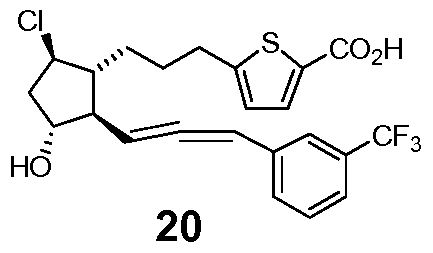
5-(3-((lR,2R,3R,5R)-5-chloro-3-hydroxy-2-((R)-3-(3-(trifluoromethyl)phenyl)propa-l,2- dienyl)cyclopentyl)propyl)thiophene-2-carboxylic acid (20)
Lithium hydroxide (0.2 mL of a 1.0 M aqueous solution, 0.2 mmol) was added to a solution of 17 (from example 5, step 2, 20 mg, 0.041 mmol) in THF (0.2 mL). After stirring 3 days at room temperature, the mixture was acidified with 1 N HCl (0.3 mL) and extracted with CH2Cl2 (20 mL). The organic phase was dried (MgSO4), filtered and concentrated in vacuo. Purification of the crude residue two times by flash column chromatography on 4 g silica gel (CH2Cl2 → 10% MeOH/CH2Cl2, gradient) afforded 17 mg (88%) of the title compound (20).
Example 7
5-(3-((lR,2R,3R,5R)-5-chloro-3-hydroxy-2-(3-phenylpropyl)cyclopentyl)propyl)thiophene-2-carboxylic acid
(15c)
Step 1. Reaction of 11 with benzyl chloride to give 12c In accordance with the procedure of example 3, step 1, 11 (150 mg, 0.37 mmol) and benzyl chloride (39 μL,
0.34 mmol) were converted into 150 mg (88%) of 12c.
Step 2. Deprotection of 12c to give 13c
In accordance with the procedures of example 3, step 2, THP ether 12c (120 mg, 0.24 mmol) was converted into 80 mg (80%) of 13c. Step 3. Hydrogenation of 13c to give 14c
In accordance with the procedures of example 3, step 3, alkyne 13c (40 mg, 0.096 mmol) was converted into
20 mg (50%) of saturated compound 14c.
Step 4. Saponification of 14c to give 15c
Lithium hydroxide (0.4 mL of a 1.0 M aqueous solution, 0.4 mmol) was added to a solution of 14c (20 mg, 0.048 mmol) in THF (0.4 mL). After stirring overnight at room temperature, the mixture was acidified with 1
N HCl (0.5 mL) and extracted with CH2Cl2 (20 mL). The organic phase was washed with brine (1 mL) then dried (MgSO4), filtered and concentrated in vacuo. Purification of the crude residue by flash column chromatography on 4 g silica gel (CH2Cl2 → 10% MeOH/CH2Cl2, gradient) afforded 14 mg (72%) of the title compound (15c).
Figure imgf000035_0001
Figure imgf000035_0002
Example 8
5-(3-((lR,2R,3R,5R)-5-chloro-3-hydroxy-2-((R)-3-phenylpropa-l,2-dienyl)cyclopentyl)propyl)thiophene-2- carboxylic acid (23)
Step 1. Reaction of 12c to give 21
Cesium carbonate (82 mg, 0.25 mmol) was added to a solution of alkyne 12c (from example 7, step 1, 50 mg,
0.10 mmol) in MeCN (0.3 mL) in a 1 dram vial. The vial was sealed and heated at 90 0C. After 18 h, the mixture was cooled and filtered through celite. The filtrate was concentrated in vacuo to afford 45 mg (90%) of allene 21.
Step 2. Deprotection of 21 to give 22
In accordance with the procedures of example 3, step 2, THP ether 21 (45 mg, 0.09 mmol) was converted into
10 mg (27%) of 22.
Step 3. Saponification of 22 to give 23
In accordance with the procedures of example 7, step 4, ester 22 (10 mg, 0.024 mmol) was converted into 2 mg (21%) of the title compound (23).
Scheme 6
Figure imgf000036_0001
10 24a, 24b
Figure imgf000036_0002
25a, 25b 26a, 26b
Example 9
5-(3-((lR,2S,3R,5R)-2-((benzyl(methyl)amino)methyl)-5-chloro-3-hydroxycyclopentyl)propyl)thiophene-2- carboxylic acid (26a)
Step 1. Reduction animation to give 24a
A solution of aldehyde 10 (see preparation 2, step 1, 0.437 mmol) in CH2Cl2 (3.5 niL) was added to a vial charged with N-methylbenzylamine (0.874 mmol) and the resulting solution was agitated on an orbital shaker at room temperature for 1.5 h. NaBH(OAc)3 (190 mg, 0.874 mmol) was added and the reaction mixture was agitated on an orbital shaker at room temperature for a further 16 h. Saturated aqueous NaHCO3 solution (3 mL) was added and the resulting solution extracted with CH2Cl2 (2x4 mL). The combined organic phase was concentrated in vacuo to yield crude intermediate 24a, which was used in the next step without further purification.
Step 2. Deprotection of 24a to give 25a
Crude intermediate 24a (0.437 mmol theoretical) was dissolved in MeOH (1 mL) and decanted into a 4-mL vial. A solution of TsOH (91 mg, 0.44 mmol, 1 eq.) in MeOH (1 mL) was added and the resulting solution was agitated on an orbital shaker at room temperature for 40 h. Saturated aqueous NaHCO3 solution (3 mL) was added and the resulting mixture extracted with DCM (2x4 mL). The combined organic extractions were concentrated in vacuo to yield intermediate 25a. The intermediate was used in the next step without further purification.
Step 3. Saponification of 25a to give 26a
Lithium hydroxide (2 mL of a 1.0 aqueous solution, 2.0 mmol) was added to a solution of the crude intermediate 25a (assumed to be 0.437 mmol) in MeOH (8 mL). The resulting solution was agitated on an orbital shaker at room temperature for 110 h. The pH of the reaction was adjusted to less than 7 by addition of aqueous 2 M HCl solution (0.8 mL) and the reaction mixture was then concentrated in vacuo to yield an oil suspended in residual water. The water was decanted, the residue dissolved in DMSO (3 mL), and DSMO solution filtered. Product x was purified by reversed phase preparative HPLC eluting with 0.1% formic acid in HPLC grade water and acetonitrile to afford 84.5 mg (46% over 3 steps) of the title compound (26a).
Example 10 5-(3-((lR,2S,3R,5R)-2-((benzylamino)methyl)-5-chloro-3-hydroxycyclopentyl)propyl)thiophene-2- carboxylic acid (26b)
In accordance with the procedures of example 9, benzylamine and aldehyde 10 were converted into 23 mg
(13%) of the title compound (26b) after using 60 mM ammonium carbonate and neat acetonitrile for the reverse phase preparative HPLC purification.
Preparation 2
Methyl 5-(3-((lR,2S,3R,5R)-5-chloro-2-ethynyl-3-(tetrahydro-2H-pyran-2- yloxy)cyclopentyl)propyl)thiophene-2-carboxylate (11)
Step 1. Oxidation of 5 to give 10 DMSO (177 μL, 2.5 mmol) was added to a solution of oxalyl chloride (600 μL of a 2.0 M solution in CH2Cl2,
1.2 mmol) in CH2Cl2 (8.5 mL) at - 78 0C. After 15 min, a solution of alcohol 5 (417 mg, 1.0 mmol) in
CH2Cl2 (2.9 mL) was added via cannula. After 15 min at - 78 0C, triethylamine (1.11 mL, 8.0 mmol) was added and the reaction was allowed to warm to 0 0C. After 1.5 h at 0 0C, the reaction mixture was diluted with saturated aqueous NaHCO3 (50 mL) and extracted with CH2Cl2 (3x70 mL). The combined extracts were washed with brine (50 mL), dried (Na2SO^, filtered and concentrated in vacuo to afford aldehyde 10, which was used without further purification.
Step 2. Reaction of 10 to give 11 (in accordance with the procedures of Roth, et al., Synthesis 2004, 59-62).
To a mixture of tosyl azide (240 mg, 1.22 mmol) and potassium carbonate (415 mg, 3.0 mmol) in MeCN (15 mL) was added dimethyl-2-oxopropylphosphonate (166 μL, 1.20 mmol). After 2 h of stirring at room temperature, a solution of crude aldehyde 10 from step 1 (~1.0 mmol) in MeOH (3 mL) was added by cannula. The mixture was allowed to stir overnight at room temperature then was concentrated in vacuo.
Water (10 mL) was added and the mixture was extracted with EtOAc (20 mL). The organic phase was washed with water (10 mL) and brine (10 mL), then dried (Na2SO^, filtered and concentrated in vacuo.
Purification of the crude residue by chromatography on 40 g silica gel (hexanes — > EtOAc, gradient) afforded 203 mg (49%, slightly contaminated with tosyl amide) of the title compound (11).
In vitro testing
US 2007/0129552, incorporated by reference herein, describes the methods used to obtain the in vitro data in the table below.
Table 1
Figure imgf000038_0001
The foregoing description details specific methods and compositions that can be employed to practice the present invention, and represents the best mode contemplated. However, it is apparent for one of ordinary skill m the art that further compounds with the desired pharmacological properties can be prepared in an analogous manner, and that the disclosed compounds can also be obtained from different starting compounds via different chemical reactions. Similarly, different pharmaceutical compositions may be prepared and used with substantially the same result. Thus, however detailed the foregoing may appear in text, it should not be construed as limiting the overall scope hereof; rather, the ambit of the present invention is to be governed only by the lawful construction of the appended claims.

Claims

What is claimed is:
by a formula:
Figure imgf000040_0001
wherein a dashed line represents the presence or absence of a bond;
Y is
Figure imgf000040_0002
and is: an organic acid functional group, or an amide or ester thereof; hydroxymethyl or an ether thereof; or a tetrazolyl functional group;
A0 is -(CH2)m-Ar-(CH2)0-, wherein the sum of m and o is 1, 2, 3, or 4, and wherein 1 -CH2- may be replaced by S or O, and 1 -CH2-CH2-may be replaced by -CH=CH- or -C=C-;
Ar is aryl of a formula C3_ioHo-23No-4θo-4So-4Fo-5Clo-3Bro-3lo-3,
G is -H, -OH, =O, -Cl, -F, -CN;
Rx is -(CH2)3-, -CH=CHCH2-, -CH=C=CH-, -CH2OCH2-, -CH2SCH2-, -CH2NHCH2-, -(CH2)2O-, -(CH2)2S-, or -(CH2)2NH-; and
B is aryl of a formula C3_2oHo_45N(MOo-4So-4Fo_5Clo-3Bro_3lo-3.
CLAIM 2. The compound of claim 1 which is not:
Figure imgf000040_0003
CLAIM 3. The compound of claim 2 wherein Rx is -(CH2)3-, -CH=CHCH2-, -CH=C=CH-, -
CH2OCH2-, CH2SCH2-, or -CH2NHCH2-.
CLAIM 4. The compound of claim 3 wherein Y is -CO2R4, -CONR5R6, -CON(CH2CH2OH)2, ■
CONH(CH2CH2OH), -CH2OH, -P(O)(OH)2, -CONHSO2R4, -SO2NR5R6,
Figure imgf000041_0001
wherein R4 R5 and R6 are independently H, Ci-Cg alkyl, Ci_s hydroxyalkyl, unsubstituted phenyl, or unsubstituted biphenyl.
CLAIM 5. The compound of claim 4 wherein Ar is imidazolyl, pyrrolyl, furanyl, oxazolyl, thiazolyl, thienyl, pyridinyl, or phenyl with 1 or 2 substituents selected from: Q_3 alkyl, -OH, -SH, Q_3 -O-alkyl, Q_3 - S-alkyl, -F, -Cl, -Br, or -CF3.
CLAIM 6. The compound of claim 5 wherein B is imidazolyl, pyrrolyl, furanyl, oxazolyl, thiazolyl, thienyl, pyridinyl, or phenyl with 1 or 2 substituents selected from: Q.io alkyl, -OH, -SH, CMO -O-alkyl, Ci_io -S-alkyl, C1-10 hydroxyalkyl, C1-10 acyl, -F, -Cl, -Br, I, or -CF3. CLAIM 7. The compound of claim 4, which is further represented by a formula:
Figure imgf000041_0002
wherein A11 is -(CH2)3-, -O(CH2)2-, -CH2OCH2-, -(CH2)2O-, -S(CH2)2-, -CH2SCH2-, or -(CH2)2S-, and X1 is
N or CH.
CLAIM 8. The compound of claim 7 wherein G is -F, -Cl, or =O.
CLAIM 9. The compound of claim 6, further represented by a formula:
Figure imgf000041_0003
CLAIM lO. The compound of claim 9, selected from:
Figure imgf000042_0001
Figure imgf000043_0001
by a formula:
Figure imgf000043_0002
wherein a dashed line represents the presence or absence of a bond;
Y is
Figure imgf000043_0003
and is: an organic acid functional group, or an amide or ester thereof; hydroxymethyl or an ether thereof; or a tetrazolyl functional group;
A1 is -(CH2V, cis -CH2CH=CH-(CH2)3-, or -CH2C≡C-(CH2)3-, wherein 1 or 2 carbon atoms may be replaced by S or O;
G is -H, -OH, =O, -Cl, -F, -CN;
Rx is -(CH2)3-, -CH=CHCH2-, -CH=C=CH-, -CH2OCH2-, -CH2SCH2-, -CH2NHCH2-, -(CH2)2O-, -(CH2)2S- or -(CH2)2NH-; and
B is aryl of a formula C3_2oHo-45No^Oo-44Fo_5Clo-3Br0_3Io_3.
CLAIM 12. The compound of claim 11 which is not:
Figure imgf000044_0001
Figure imgf000044_0002
Figure imgf000044_0003
Figure imgf000044_0004
CLAIM 13. The compound of claim 12 wherein Rx is -(CH2)3-, -CH=CHCH2-, -CH=C=CH-, -
CH2OCH2-, CH2SCH2-, or -CH2NHCH2-.
CLAIM 14. The compound of claim 13 wherein B is phenyl substituted with from 1 to 4 substituents selected from: C2.8 alkyl, C1-8 -O-alkyl, C1-8 hydroxyalkyl, -OH, -F, -Cl, -Br, or -CF3.
CLAIM 15. The compound of claim 14 wherein Y is -CO2R4, -CONR5R6, -CON(CH2CH2OH)2, -
CONH(CH2CH2OH), -CH2OH, -P(O)(OH)2, -CONHSO2R4, -SO2NR5R6,
Figure imgf000045_0001
wherein R4 R5 and R6 are independently H, Ci-Cg alkyl, Ci_6 hydroxyalkyl, unsubstituted phenyl, or unsubstituted biphenyl.
CLAIM 16. The compound of claim 15, further represented by the structure: cιn
Figure imgf000045_0002
CLAIM 17. A method of: reducing intraocular pressure, treating glaucoma or intraocular pressure, growing hair, or improving the appearance of hair, comprising administering a compound to a mammal in need thereof, said compound being represented by a formula:
Figure imgf000045_0003
wherein a dashed line represents the presence or absence of a bond;
Y is
Figure imgf000045_0004
and is: an organic acid functional group, or an amide or ester thereof; hydroxymethyl or an ether thereof; or a tetrazolyl functional group;
A is -(CH2V, cis -CH2CH=CH-(CH2)3-, or -CH2C≡C-(CH2)3-, wherein 1 or 2 carbon atoms may be replaced by S or O; or A is -(CH2)m-Ar-(CH2)0-, wherein the sum of m and o is 1, 2, 3, or 4, and wherein 1 -CH2- may be replaced by S or O, and 1 -CH2-CH2-may be replaced by -CH=CH- or -C=C-;
Ar is aryl of a formula C3_ioHo-23No-4θo-4So-4Fo-5Clo-3Bro-3lo-3,
G is -H, -OH, =O, -Cl, -F, -CN; Rx is -(CH2)3-, -CH=CHCH2-, -CH=C=CH-, -CH2OCH2-, -CH2SCH2-, -CH2NHCH2-, -(CH2)2O-, -(CH2)2S- or -(CH2)2NH-; and
B is aryl of a formula C3.2oHo.45No^Oo-4So-4Fo.5Clo-3Bro.3lo-3.
CLAIM 18. The compound of claim 1 wherein Y is:
Figure imgf000046_0001
CLAIM 19. The compound of claim 18 selected from:
Figure imgf000046_0002
CLAIM 20. The compound of claim 11 wherein Y is:
Figure imgf000047_0001
PCT/US2009/043480 2008-05-15 2009-05-11 Therapeutic substituted cyclopentanes Ceased WO2009140205A2 (en)

Priority Applications (4)

Application Number Priority Date Filing Date Title
CA2724271A CA2724271A1 (en) 2008-05-15 2009-05-11 Therapeutic substituted cyclopentanes
AU2009246573A AU2009246573B2 (en) 2008-05-15 2009-05-11 Therapeutic substituted cyclopentanes
EP09747289A EP2291346A2 (en) 2008-05-15 2009-05-11 Therapeutic substituted cyclopentanes
US12/992,160 US8592413B2 (en) 2008-05-15 2009-05-11 Therapeutic substituted cyclopentanes

Applications Claiming Priority (2)

Application Number Priority Date Filing Date Title
US5335408P 2008-05-15 2008-05-15
US61/053,354 2008-05-15

Publications (2)

Publication Number Publication Date
WO2009140205A2 true WO2009140205A2 (en) 2009-11-19
WO2009140205A3 WO2009140205A3 (en) 2010-01-14

Family

ID=41228297

Family Applications (1)

Application Number Title Priority Date Filing Date
PCT/US2009/043480 Ceased WO2009140205A2 (en) 2008-05-15 2009-05-11 Therapeutic substituted cyclopentanes

Country Status (5)

Country Link
US (1) US8592413B2 (en)
EP (1) EP2291346A2 (en)
AU (1) AU2009246573B2 (en)
CA (1) CA2724271A1 (en)
WO (1) WO2009140205A2 (en)

Cited By (2)

* Cited by examiner, † Cited by third party
Publication number Priority date Publication date Assignee Title
KR20150046269A (en) * 2012-08-27 2015-04-29 알레간 인코포레이티드 Reduced central corneal thickening by use of hydrophilic ester prodrugs of beta-chlorocyclopentanes
US10329284B2 (en) 2014-10-02 2019-06-25 Allergan, Inc. Ester prodrugs of gamma-lactams and their use

Families Citing this family (2)

* Cited by examiner, † Cited by third party
Publication number Priority date Publication date Assignee Title
EP2300412A1 (en) * 2008-05-27 2011-03-30 Allergan, Inc. Prostaglandin produgs as hypotensive agents
US9540357B1 (en) 2014-07-31 2017-01-10 Allergan, Inc. 15-aryl prostaglandins as EP4 agonists, and methods of use thereof

Family Cites Families (19)

* Cited by examiner, † Cited by third party
Publication number Priority date Publication date Assignee Title
US3980700A (en) * 1971-10-07 1976-09-14 G. D. Searle & Co. Prostaglandin intermediates and optically active isomers thereof
SE436037B (en) * 1976-04-30 1984-11-05 Roussel Uclaf SET TO MAKE NEW 11-DESOXI-PROSTAGLANDIN-F? 712 DERIVATIVE
US4403100A (en) * 1981-10-30 1983-09-06 The Upjohn Company (11R)-11-Deoxy-11-alkyl-6-oxo-prostaglandins
DE4024347A1 (en) * 1990-07-27 1992-01-30 Schering Ag CYCLOPENTANE DERIVATIVES, METHOD FOR THE PRODUCTION THEREOF AND THEIR PHARMACEUTICAL USE
US5510383A (en) * 1993-08-03 1996-04-23 Alcon Laboratories, Inc. Use of cloprostenol, fluprostenol and their salts and esters to treat glaucoma and ocular hypertension
ATE390917T1 (en) * 1996-12-20 2008-04-15 Pfizer PREVENTION AND TREATMENT OF SKELETON DISEASES USING EP2 SUBTYPE SELECTIVE PROSTAGLANDIN E2 AGONISTS
SE9702002D0 (en) 1997-05-28 1997-05-28 Astra Pharma Prod Novel compounds
WO1998058911A2 (en) 1997-06-23 1998-12-30 Pfizer Inc. Prostaglandin agonists
US6437146B1 (en) * 1998-09-25 2002-08-20 Fujisawa Pharmaceutical Co., Ltd. Oxazole compounds as prostaglandin e2 agonists or antagonists
IL139941A0 (en) 1999-12-02 2002-02-10 Pfizer Prod Inc Use of prostaglandin agonists to treat erectile dysfunction or impotence
US6291522B1 (en) 2000-09-27 2001-09-18 Allergan Sales, Inc. Cyclopentane heptan(ENE)oic acid, 2-thiocarbamoyloxy and 2-carbamoyloxy compounds as therapeutic agents
BR0213911A (en) * 2001-11-05 2004-09-28 Allergan Inc Omega-cycloalkyl 17-heteroaryl prostaglandin e2 analogues as ep2 receptor agonists
JP4547912B2 (en) 2002-03-05 2010-09-22 小野薬品工業株式会社 8-Azaprostaglandin derivative compound and drug containing the compound as an active ingredient
US20070167403A1 (en) 2003-04-03 2007-07-19 Yoshifumi Takenobu Remedy for spinal canal stenosis
US7427685B2 (en) * 2005-12-06 2008-09-23 Allergan, Inc. Therapeutic substituted cyclopentanes
US7323591B2 (en) * 2006-01-10 2008-01-29 Allergan, Inc. Substituted cyclopentanes or cyclopentanones as therapeutic agents
EP2046714B1 (en) * 2006-06-20 2015-12-09 Allergan, Inc. Cyclopentane derivatives as antiglaucoma agents
CA2657625C (en) * 2006-07-10 2016-06-21 Allergan, Inc. Therapeutic compounds
US20080015219A1 (en) * 2006-07-11 2008-01-17 Allergan, Inc. Therapeutic compounds

Cited By (4)

* Cited by examiner, † Cited by third party
Publication number Priority date Publication date Assignee Title
KR20150046269A (en) * 2012-08-27 2015-04-29 알레간 인코포레이티드 Reduced central corneal thickening by use of hydrophilic ester prodrugs of beta-chlorocyclopentanes
JP2015528463A (en) * 2012-08-27 2015-09-28 アラーガン、インコーポレイテッドAllergan,Incorporated Reduction of central corneal thickening by the use of hydrophilic ester prodrugs of beta-chlorocyclopentane
KR102304111B1 (en) * 2012-08-27 2021-09-23 알레간 인코포레이티드 Reduced central corneal thickening by use of hydrophilic ester prodrugs of beta-chlorocyclopentanes
US10329284B2 (en) 2014-10-02 2019-06-25 Allergan, Inc. Ester prodrugs of gamma-lactams and their use

Also Published As

Publication number Publication date
AU2009246573B2 (en) 2014-04-24
CA2724271A1 (en) 2009-11-19
EP2291346A2 (en) 2011-03-09
US20110172299A1 (en) 2011-07-14
US8592413B2 (en) 2013-11-26
AU2009246573A1 (en) 2009-11-19
WO2009140205A3 (en) 2010-01-14

Similar Documents

Publication Publication Date Title
TWI836124B (en) Urea compounds that antagonize LPA1 receptors
CN106573902A (en) Novel aminoalkylbenzothiazepine* derivatives and uses thereof
KR100250922B1 (en) Ethanolamine derivatives having sympathomimetic and anti-pollakiuria activities
CN101868455B (en) Therapeutic substituted lactams
WO2009140205A2 (en) Therapeutic substituted cyclopentanes
EP1511722B1 (en) Phenylcyclohexylpropanolamine derivatives, preparation and therapeutic application thereof
ES2432058T3 (en) Substituted cyclopentanes that have prostaglandin activity
FR2831884A1 (en) NEW HETEROAROMATIC AMIDE DERIVATIVES OF 3 BETA-AMINO AZABICYCLOOCTANE, THEIR PREPARATION PROCESS AND THEIR THERAPEUTIC APPLICATIONS
FI73206C (en) FOERFARANDE FOER FRAMSTAELLNING AV TERAPEUTISKT ANVAENDBARA ALKYLTIOFENOXIPROPYLAMINER.
US8546603B2 (en) Substituted cyclopentanes having prostaglandin activity
JP2022542613A (en) Inhibitors of human ATGL
US7985765B2 (en) Therapeutic substituted pyrroles
JP2014139175A (en) Therapeutic compounds
AU2002221632B8 (en) 5-amino-1-pentene-3-ol substituted derivatives
CN109593068B (en) Intermediate of ROR gamma inhibitor and preparation method thereof
FR2766819A1 (en) NOVEL SULFONAMIDE DERIVATIVES OF SUBSTITUTED ANILINES USEFUL AS MEDICAMENTS
FR2745572A1 (en) New benzylamine sulphonamide derivatives
RU2481342C2 (en) Therapeutic substituted lactams
KR101823271B1 (en) Novel chiral phase transfer catalyst and method for producing alpha-amino acid using the same
RU2481342C9 (en) Therapeutic substituted lactams
WO2021227439A1 (en) Aryl glucoside derivative
WO2010087244A1 (en) Cyclic amino alcohol compound
JPS62132845A (en) N,n-disubstituted phenylserine derivative and agent for central nervous system containing said compound as active component

Legal Events

Date Code Title Description
121 Ep: the epo has been informed by wipo that ep was designated in this application

Ref document number: 09747289

Country of ref document: EP

Kind code of ref document: A2

WWE Wipo information: entry into national phase

Ref document number: 2724271

Country of ref document: CA

NENP Non-entry into the national phase

Ref country code: DE

WWE Wipo information: entry into national phase

Ref document number: 2009246573

Country of ref document: AU

WWE Wipo information: entry into national phase

Ref document number: 2009747289

Country of ref document: EP

ENP Entry into the national phase

Ref document number: 2009246573

Country of ref document: AU

Date of ref document: 20090511

Kind code of ref document: A

WWE Wipo information: entry into national phase

Ref document number: 12992160

Country of ref document: US