WO2009148016A1 - ハロゲン化合物、多環系化合物及びそれを用いた有機エレクトロルミネッセンス素子 - Google Patents
ハロゲン化合物、多環系化合物及びそれを用いた有機エレクトロルミネッセンス素子 Download PDFInfo
- Publication number
- WO2009148016A1 WO2009148016A1 PCT/JP2009/059981 JP2009059981W WO2009148016A1 WO 2009148016 A1 WO2009148016 A1 WO 2009148016A1 JP 2009059981 W JP2009059981 W JP 2009059981W WO 2009148016 A1 WO2009148016 A1 WO 2009148016A1
- Authority
- WO
- WIPO (PCT)
- Prior art keywords
- group
- substituted
- carbon atoms
- ring
- unsubstituted
- Prior art date
- Legal status (The legal status is an assumption and is not a legal conclusion. Google has not performed a legal analysis and makes no representation as to the accuracy of the status listed.)
- Ceased
Links
- 0 C=*(c(cccc1)c1-c1c2)c1cc1c2[o]c2c1cccc2 Chemical compound C=*(c(cccc1)c1-c1c2)c1cc1c2[o]c2c1cccc2 0.000 description 9
- KKALOHGWDNBBEE-UHFFFAOYSA-N C(C(C=C1)c2ccc3[o]c(c(-c4ccccc4)c4[o]c(ccc(-c(cc5)ccc5-c5ccccc5)c5)c5c4c4)c4c3c2)C=C1c1ccccc1 Chemical compound C(C(C=C1)c2ccc3[o]c(c(-c4ccccc4)c4[o]c(ccc(-c(cc5)ccc5-c5ccccc5)c5)c5c4c4)c4c3c2)C=C1c1ccccc1 KKALOHGWDNBBEE-UHFFFAOYSA-N 0.000 description 1
- XJLZPBKLPPLBAK-UHFFFAOYSA-N C(C1)C=Cc2c1c(-c(cc1)cc3c1[o]c1c3cc(c(cc(cc3)C4=CC5C=CC=CC5c5ccccc45)c3[o]3)c3c1-c1ccccc1)cc1c2cccc1 Chemical compound C(C1)C=Cc2c1c(-c(cc1)cc3c1[o]c1c3cc(c(cc(cc3)C4=CC5C=CC=CC5c5ccccc45)c3[o]3)c3c1-c1ccccc1)cc1c2cccc1 XJLZPBKLPPLBAK-UHFFFAOYSA-N 0.000 description 1
- CYMHHROEQKRPAL-UHFFFAOYSA-N C(CC1)CCC1(c1ccccc1)c(cc1)cc2c1[o]c1c2cc2[o]c(ccc(C3(CCCCC3)c3ccccc3)c3)c3c2c1 Chemical compound C(CC1)CCC1(c1ccccc1)c(cc1)cc2c1[o]c1c2cc2[o]c(ccc(C3(CCCCC3)c3ccccc3)c3)c3c2c1 CYMHHROEQKRPAL-UHFFFAOYSA-N 0.000 description 1
- MEJZYVCVCWBAJI-UHFFFAOYSA-N C(Cc1ccccc1)C1c(ccc(-c2cccc3c2[o]c2c3cc(c(cccc3-c4ccccc4)c3[o]3)c3c2-c2ccccc2)c2)c2-c2cc(-c3ccccc3)ccc12 Chemical compound C(Cc1ccccc1)C1c(ccc(-c2cccc3c2[o]c2c3cc(c(cccc3-c4ccccc4)c3[o]3)c3c2-c2ccccc2)c2)c2-c2cc(-c3ccccc3)ccc12 MEJZYVCVCWBAJI-UHFFFAOYSA-N 0.000 description 1
- GCUPUVHTVMGEQA-UHFFFAOYSA-N CC(C(c1ccc2[o]c(cccc3)c3c2c1)c(cccc1)c1-c1c2)c1cc1c2c(cccc2)c2[n]1-c(cc1)cc2c1[o]c1ccccc21 Chemical compound CC(C(c1ccc2[o]c(cccc3)c3c2c1)c(cccc1)c1-c1c2)c1cc1c2c(cccc2)c2[n]1-c(cc1)cc2c1[o]c1ccccc21 GCUPUVHTVMGEQA-UHFFFAOYSA-N 0.000 description 1
- SXZYOMKJCUELLI-UHFFFAOYSA-N CC1(C)c(cc(cc2)-c3ccc4[o]c(ccc(-c5ccccc5)c5)c5c4c3)c2-c2c1cc(c(cc(cc1)-c(cc3)cc4c3[o]c(cc3)c4cc3-c3ccccc3)c1[o]1)c1c2 Chemical compound CC1(C)c(cc(cc2)-c3ccc4[o]c(ccc(-c5ccccc5)c5)c5c4c3)c2-c2c1cc(c(cc(cc1)-c(cc3)cc4c3[o]c(cc3)c4cc3-c3ccccc3)c1[o]1)c1c2 SXZYOMKJCUELLI-UHFFFAOYSA-N 0.000 description 1
- MNJJVCIAVDGKAY-UHFFFAOYSA-N CC1(C)c2cc(-c3ccc4[o]c(ccc(-c5ccccc5)c5)c5c4c3)ccc2-c2c1cc(c(cc(cc1)-c3ccc4[o]c(ccc(-c5ccccc5)c5)c5c4c3)c1[n]1-c3ccccc3)c1c2 Chemical compound CC1(C)c2cc(-c3ccc4[o]c(ccc(-c5ccccc5)c5)c5c4c3)ccc2-c2c1cc(c(cc(cc1)-c3ccc4[o]c(ccc(-c5ccccc5)c5)c5c4c3)c1[n]1-c3ccccc3)c1c2 MNJJVCIAVDGKAY-UHFFFAOYSA-N 0.000 description 1
- GUZCBLOFKVRJMU-UHFFFAOYSA-N CCC(C1)C1N=O Chemical compound CCC(C1)C1N=O GUZCBLOFKVRJMU-UHFFFAOYSA-N 0.000 description 1
- YTVOWCSVGGIFOS-UHFFFAOYSA-N CCC(c1nc2ccccc2[n]1C)c(c(-c1c(C)cc(c(cc(cc2)-c3ccccc3)c2[N]2(C)C3=C(CC)Cc(cccc4)c4N3C)c2c1)c1)ccc1-c1ccccc1 Chemical compound CCC(c1nc2ccccc2[n]1C)c(c(-c1c(C)cc(c(cc(cc2)-c3ccccc3)c2[N]2(C)C3=C(CC)Cc(cccc4)c4N3C)c2c1)c1)ccc1-c1ccccc1 YTVOWCSVGGIFOS-UHFFFAOYSA-N 0.000 description 1
- NCXGTCMQLZEWOE-QLKFWGTOSA-N CC[C@@H](c1ccc2[o]c(cccc3)c3c2c1)c(c(-c1c(C)cc(c(cc(cc2)-c3ccccc3)c2[n]2-c3ccc4[o]c(cccc5)c5c4c3)c2c1)c1)ccc1-c1ccccc1 Chemical compound CC[C@@H](c1ccc2[o]c(cccc3)c3c2c1)c(c(-c1c(C)cc(c(cc(cc2)-c3ccccc3)c2[n]2-c3ccc4[o]c(cccc5)c5c4c3)c2c1)c1)ccc1-c1ccccc1 NCXGTCMQLZEWOE-QLKFWGTOSA-N 0.000 description 1
- GPZSRVSUSDOPPW-UHFFFAOYSA-N CCc1ccccc1-c(cc(c(-c(cccc1)c1OC)c1)F)c1F Chemical compound CCc1ccccc1-c(cc(c(-c(cccc1)c1OC)c1)F)c1F GPZSRVSUSDOPPW-UHFFFAOYSA-N 0.000 description 1
- DKFCALVEWKIHDT-UHFFFAOYSA-N C[Si+](C)(c1ccccc1)c(cc1)cc2c1[o]c1c2cc2[o]c(ccc([Si+](C)(C)c3ccccc3)c3)c3c2c1 Chemical compound C[Si+](C)(c1ccccc1)c(cc1)cc2c1[o]c1c2cc2[o]c(ccc([Si+](C)(C)c3ccccc3)c3)c3c2c1 DKFCALVEWKIHDT-UHFFFAOYSA-N 0.000 description 1
- KBFIGEHLRYIYQM-UHFFFAOYSA-N c(cc1)ccc1-[n](c(c(c1c2)c3)ccc3-c3ccc4[o]c(cc(c5ccccc5[o]5)c5c5)c5c4c3)c1ccc2-c(cc1)cc(c2c3)c1[o]c2cc1c3[o]c2c1cccc2 Chemical compound c(cc1)ccc1-[n](c(c(c1c2)c3)ccc3-c3ccc4[o]c(cc(c5ccccc5[o]5)c5c5)c5c4c3)c1ccc2-c(cc1)cc(c2c3)c1[o]c2cc1c3[o]c2c1cccc2 KBFIGEHLRYIYQM-UHFFFAOYSA-N 0.000 description 1
- KKXAZBVYAHNOPJ-UHFFFAOYSA-N c(cc1)ccc1-[n]1c(ccc(-c(cc2)cc3c2[o]c2c3cc(c3cc(-c4cccc(-[n]5c6ccccc6c6c5cccc6)c4)ccc3[o]3)c3c2)c2)c2c2ccccc12 Chemical compound c(cc1)ccc1-[n]1c(ccc(-c(cc2)cc3c2[o]c2c3cc(c3cc(-c4cccc(-[n]5c6ccccc6c6c5cccc6)c4)ccc3[o]3)c3c2)c2)c2c2ccccc12 KKXAZBVYAHNOPJ-UHFFFAOYSA-N 0.000 description 1
- OIVZSIYQNFSYAZ-UHFFFAOYSA-N c(cc1)ccc1-[n]1c(ccc(-c(cc2)cc3c2[o]c2c3cc(c3cccc(-c(cc4)cc(c5c6cccc5)c4[n]6-c4ccccc4)c3[o]3)c3c2)c2)c2c2ccccc12 Chemical compound c(cc1)ccc1-[n]1c(ccc(-c(cc2)cc3c2[o]c2c3cc(c3cccc(-c(cc4)cc(c5c6cccc5)c4[n]6-c4ccccc4)c3[o]3)c3c2)c2)c2c2ccccc12 OIVZSIYQNFSYAZ-UHFFFAOYSA-N 0.000 description 1
- FNKZHPMQKDQERX-UHFFFAOYSA-N c(cc1)ccc1-[n]1c(ccc(-c(cc2-c(cc3)cc(c4ccccc44)c3[n]4-c3ccccc3)cc(c3c4)c2[o]c3cc2c4c(cccc3)c3[o]2)c2)c2c2ccccc12 Chemical compound c(cc1)ccc1-[n]1c(ccc(-c(cc2-c(cc3)cc(c4ccccc44)c3[n]4-c3ccccc3)cc(c3c4)c2[o]c3cc2c4c(cccc3)c3[o]2)c2)c2c2ccccc12 FNKZHPMQKDQERX-UHFFFAOYSA-N 0.000 description 1
- SBPBIDWFNUBTMB-UHFFFAOYSA-N c(cc1)ccc1-[n]1c(ccc(-c2ccc3[o]c(cc4[o]c(ccc(-c5ccc6[o]c7ccccc7c6c5)c5)c5c4c4)c4c3c2)c2)c2c2ccccc12 Chemical compound c(cc1)ccc1-[n]1c(ccc(-c2ccc3[o]c(cc4[o]c(ccc(-c5ccc6[o]c7ccccc7c6c5)c5)c5c4c4)c4c3c2)c2)c2c2ccccc12 SBPBIDWFNUBTMB-UHFFFAOYSA-N 0.000 description 1
- UPEJIVWKAJMUOD-UHFFFAOYSA-N c(cc1)ccc1-c(c1c(cc2c3c4)c(cc(cc5)-c6ccc(c7ccccc7c7ccccc77)c7c6)c5[o]1)c2[o]c3ccc4-c(cc1)cc2c1c1ccccc1c1ccccc21 Chemical compound c(cc1)ccc1-c(c1c(cc2c3c4)c(cc(cc5)-c6ccc(c7ccccc7c7ccccc77)c7c6)c5[o]1)c2[o]c3ccc4-c(cc1)cc2c1c1ccccc1c1ccccc21 UPEJIVWKAJMUOD-UHFFFAOYSA-N 0.000 description 1
- JVCWZIZBPUQRAX-UHFFFAOYSA-N c(cc1)ccc1-c(c1c(cc2c3c4)c5cc(-c6cccc7c6cccc7)ccc5[o]1)c2[o]c3ccc4-c1c(cccc2)c2ccc1 Chemical compound c(cc1)ccc1-c(c1c(cc2c3c4)c5cc(-c6cccc7c6cccc7)ccc5[o]1)c2[o]c3ccc4-c1c(cccc2)c2ccc1 JVCWZIZBPUQRAX-UHFFFAOYSA-N 0.000 description 1
- CKOWGXLUWVMVDW-UHFFFAOYSA-N c(cc1)ccc1-c(c1c(cc2c3ccc4)c5cccc(-c(cc6c7ccccc77)ccc6[n]7-c6ccccc6)c5[o]1)c2[o]c3c4-c(cc1)cc(c2ccccc22)c1[n]2-c1ccccc1 Chemical compound c(cc1)ccc1-c(c1c(cc2c3ccc4)c5cccc(-c(cc6c7ccccc77)ccc6[n]7-c6ccccc6)c5[o]1)c2[o]c3c4-c(cc1)cc(c2ccccc22)c1[n]2-c1ccccc1 CKOWGXLUWVMVDW-UHFFFAOYSA-N 0.000 description 1
- RXMWQXDHDZDRRL-UHFFFAOYSA-N c(cc1)ccc1-c(c1c(cc2c3ccc4)c5cccc(-c6cccc(-[n]7c8ccccc8c8c7cccc8)c6)c5[o]1)c2[o]c3c4-c1cccc(-[n]2c3ccccc3c3c2cccc3)c1 Chemical compound c(cc1)ccc1-c(c1c(cc2c3ccc4)c5cccc(-c6cccc(-[n]7c8ccccc8c8c7cccc8)c6)c5[o]1)c2[o]c3c4-c1cccc(-[n]2c3ccccc3c3c2cccc3)c1 RXMWQXDHDZDRRL-UHFFFAOYSA-N 0.000 description 1
- JVIGQHRKQKXCBE-UHFFFAOYSA-N c(cc1)ccc1-c(c1c2[o]c3ccccc13)c(c1cc(-c(cc3c4c5cccc4)ccc3[n]5-c3ccccc3)ccc1[o]1)c1c2-c1ccccc1 Chemical compound c(cc1)ccc1-c(c1c2[o]c3ccccc13)c(c1cc(-c(cc3c4c5cccc4)ccc3[n]5-c3ccccc3)ccc1[o]1)c1c2-c1ccccc1 JVIGQHRKQKXCBE-UHFFFAOYSA-N 0.000 description 1
- HCPCDIOJYHNKNF-UHFFFAOYSA-N c(cc1)ccc1-c(cc1c2c3)ccc1[o]c2cc1c3c(cc(cc2)-c(cc3)cc(c4ccccc44)c3[n]4-c3ccccc3)c2[o]1 Chemical compound c(cc1)ccc1-c(cc1c2c3)ccc1[o]c2cc1c3c(cc(cc2)-c(cc3)cc(c4ccccc44)c3[n]4-c3ccccc3)c2[o]1 HCPCDIOJYHNKNF-UHFFFAOYSA-N 0.000 description 1
- JINCZCLTDDYYSY-UHFFFAOYSA-N c(cc1)ccc1-c1c2[o]c(c(-c3ccccc3)c(c(c3ccc4)c5)[o]c3c4-c3cc(-c4ccccc4)nc(-c4ccccc4)n3)c5c2ccc1 Chemical compound c(cc1)ccc1-c1c2[o]c(c(-c3ccccc3)c(c(c3ccc4)c5)[o]c3c4-c3cc(-c4ccccc4)nc(-c4ccccc4)n3)c5c2ccc1 JINCZCLTDDYYSY-UHFFFAOYSA-N 0.000 description 1
- OATUTXHUMLRKJN-UHFFFAOYSA-N c(cc1)ccc1-c1cc(-c(cc2)cc(c3ccccc33)c2[n]3-c2ccccc2)cc(c2c3)c1[o]c2cc1c3c(cccc2)c2[o]1 Chemical compound c(cc1)ccc1-c1cc(-c(cc2)cc(c3ccccc33)c2[n]3-c2ccccc2)cc(c2c3)c1[o]c2cc1c3c(cccc2)c2[o]1 OATUTXHUMLRKJN-UHFFFAOYSA-N 0.000 description 1
- IGGJZJHQQLWEDH-UHFFFAOYSA-N c(cc1)ccc1-c1ccc2[o]c(c(-c3ccccc3)c3[o]c(ccc(-c4ccccc4)c4)c4c3c3)c3c2c1 Chemical compound c(cc1)ccc1-c1ccc2[o]c(c(-c3ccccc3)c3[o]c(ccc(-c4ccccc4)c4)c4c3c3)c3c2c1 IGGJZJHQQLWEDH-UHFFFAOYSA-N 0.000 description 1
- XWURREUFWVFUJT-UHFFFAOYSA-N c(cc1)ccc1-c1ccc2[o]c(ccc(-c(cc3)cc(c4c5cc(c6cc(-c(cc7)cc8c7[o]c(cc7)c8cc7-c7ccccc7)ccc6[o]6)c6c4)c3[n]5-c3ccccc3)c3)c3c2c1 Chemical compound c(cc1)ccc1-c1ccc2[o]c(ccc(-c(cc3)cc(c4c5cc(c6cc(-c(cc7)cc8c7[o]c(cc7)c8cc7-c7ccccc7)ccc6[o]6)c6c4)c3[n]5-c3ccccc3)c3)c3c2c1 XWURREUFWVFUJT-UHFFFAOYSA-N 0.000 description 1
- ODOCXIAWSYVSTG-UHFFFAOYSA-N c(cc1)ccc1-c1nc(-c2ccccc2)nc(-c2c3[o]c(c(-c4ccccc4)c4[o]c(c(-c5nc(-c6ccccc6)nc(-c6ccccc6)c5)ccc5)c5c4c4)c4c3ccc2)c1 Chemical compound c(cc1)ccc1-c1nc(-c2ccccc2)nc(-c2c3[o]c(c(-c4ccccc4)c4[o]c(c(-c5nc(-c6ccccc6)nc(-c6ccccc6)c5)ccc5)c5c4c4)c4c3ccc2)c1 ODOCXIAWSYVSTG-UHFFFAOYSA-N 0.000 description 1
- PPHPWXJJGNWUGY-UHFFFAOYSA-N c(cc1c2c3)ccc1[o]c2cc(c1c2)c3[o]c1ccc2-c(cc1c2c3)ccc1[o]c2ccc3-c(cc1)cc(c2c3)c1[o]c2cc1c3[o]c2c1cccc2 Chemical compound c(cc1c2c3)ccc1[o]c2cc(c1c2)c3[o]c1ccc2-c(cc1c2c3)ccc1[o]c2ccc3-c(cc1)cc(c2c3)c1[o]c2cc1c3[o]c2c1cccc2 PPHPWXJJGNWUGY-UHFFFAOYSA-N 0.000 description 1
Classifications
-
- C—CHEMISTRY; METALLURGY
- C09—DYES; PAINTS; POLISHES; NATURAL RESINS; ADHESIVES; COMPOSITIONS NOT OTHERWISE PROVIDED FOR; APPLICATIONS OF MATERIALS NOT OTHERWISE PROVIDED FOR
- C09K—MATERIALS FOR MISCELLANEOUS APPLICATIONS, NOT PROVIDED FOR ELSEWHERE
- C09K11/00—Luminescent materials, e.g. electroluminescent or chemiluminescent
- C09K11/06—Luminescent materials, e.g. electroluminescent or chemiluminescent containing organic luminescent materials
-
- C—CHEMISTRY; METALLURGY
- C07—ORGANIC CHEMISTRY
- C07D—HETEROCYCLIC COMPOUNDS
- C07D487/00—Heterocyclic compounds containing nitrogen atoms as the only ring hetero atoms in the condensed system, not provided for by groups C07D451/00 - C07D477/00
- C07D487/02—Heterocyclic compounds containing nitrogen atoms as the only ring hetero atoms in the condensed system, not provided for by groups C07D451/00 - C07D477/00 in which the condensed system contains two hetero rings
- C07D487/04—Ortho-condensed systems
-
- C—CHEMISTRY; METALLURGY
- C07—ORGANIC CHEMISTRY
- C07D—HETEROCYCLIC COMPOUNDS
- C07D491/00—Heterocyclic compounds containing in the condensed ring system both one or more rings having oxygen atoms as the only ring hetero atoms and one or more rings having nitrogen atoms as the only ring hetero atoms, not provided for by groups C07D451/00 - C07D459/00, C07D463/00, C07D477/00 or C07D489/00
- C07D491/02—Heterocyclic compounds containing in the condensed ring system both one or more rings having oxygen atoms as the only ring hetero atoms and one or more rings having nitrogen atoms as the only ring hetero atoms, not provided for by groups C07D451/00 - C07D459/00, C07D463/00, C07D477/00 or C07D489/00 in which the condensed system contains two hetero rings
- C07D491/04—Ortho-condensed systems
- C07D491/044—Ortho-condensed systems with only one oxygen atom as ring hetero atom in the oxygen-containing ring
- C07D491/048—Ortho-condensed systems with only one oxygen atom as ring hetero atom in the oxygen-containing ring the oxygen-containing ring being five-membered
-
- C—CHEMISTRY; METALLURGY
- C07—ORGANIC CHEMISTRY
- C07D—HETEROCYCLIC COMPOUNDS
- C07D493/00—Heterocyclic compounds containing oxygen atoms as the only ring hetero atoms in the condensed system
- C07D493/02—Heterocyclic compounds containing oxygen atoms as the only ring hetero atoms in the condensed system in which the condensed system contains two hetero rings
- C07D493/04—Ortho-condensed systems
-
- C—CHEMISTRY; METALLURGY
- C07—ORGANIC CHEMISTRY
- C07F—ACYCLIC, CARBOCYCLIC OR HETEROCYCLIC COMPOUNDS CONTAINING ELEMENTS OTHER THAN CARBON, HYDROGEN, HALOGEN, OXYGEN, NITROGEN, SULFUR, SELENIUM OR TELLURIUM
- C07F7/00—Compounds containing elements of Groups 4 or 14 of the Periodic Table
- C07F7/02—Silicon compounds
- C07F7/08—Compounds having one or more C—Si linkages
- C07F7/0803—Compounds with Si-C or Si-Si linkages
- C07F7/081—Compounds with Si-C or Si-Si linkages comprising at least one atom selected from the elements N, O, halogen, S, Se or Te
- C07F7/0812—Compounds with Si-C or Si-Si linkages comprising at least one atom selected from the elements N, O, halogen, S, Se or Te comprising a heterocyclic ring
- C07F7/0814—Compounds with Si-C or Si-Si linkages comprising at least one atom selected from the elements N, O, halogen, S, Se or Te comprising a heterocyclic ring said ring is substituted at a C ring atom by Si
-
- H—ELECTRICITY
- H05—ELECTRIC TECHNIQUES NOT OTHERWISE PROVIDED FOR
- H05B—ELECTRIC HEATING; ELECTRIC LIGHT SOURCES NOT OTHERWISE PROVIDED FOR; CIRCUIT ARRANGEMENTS FOR ELECTRIC LIGHT SOURCES, IN GENERAL
- H05B33/00—Electroluminescent light sources
- H05B33/12—Light sources with substantially two-dimensional [2D] radiating surfaces
- H05B33/22—Light sources with substantially two-dimensional [2D] radiating surfaces characterised by the chemical or physical composition or the arrangement of auxiliary dielectric or reflective layers
-
- H—ELECTRICITY
- H10—SEMICONDUCTOR DEVICES; ELECTRIC SOLID-STATE DEVICES NOT OTHERWISE PROVIDED FOR
- H10K—ORGANIC ELECTRIC SOLID-STATE DEVICES
- H10K85/00—Organic materials used in the body or electrodes of devices covered by this subclass
- H10K85/60—Organic compounds having low molecular weight
- H10K85/649—Aromatic compounds comprising a hetero atom
- H10K85/654—Aromatic compounds comprising a hetero atom comprising only nitrogen as heteroatom
-
- H—ELECTRICITY
- H10—SEMICONDUCTOR DEVICES; ELECTRIC SOLID-STATE DEVICES NOT OTHERWISE PROVIDED FOR
- H10K—ORGANIC ELECTRIC SOLID-STATE DEVICES
- H10K85/00—Organic materials used in the body or electrodes of devices covered by this subclass
- H10K85/60—Organic compounds having low molecular weight
- H10K85/649—Aromatic compounds comprising a hetero atom
- H10K85/657—Polycyclic condensed heteroaromatic hydrocarbons
- H10K85/6572—Polycyclic condensed heteroaromatic hydrocarbons comprising only nitrogen in the heteroaromatic polycondensed ring system, e.g. phenanthroline or carbazole
-
- H—ELECTRICITY
- H10—SEMICONDUCTOR DEVICES; ELECTRIC SOLID-STATE DEVICES NOT OTHERWISE PROVIDED FOR
- H10K—ORGANIC ELECTRIC SOLID-STATE DEVICES
- H10K85/00—Organic materials used in the body or electrodes of devices covered by this subclass
- H10K85/60—Organic compounds having low molecular weight
- H10K85/649—Aromatic compounds comprising a hetero atom
- H10K85/657—Polycyclic condensed heteroaromatic hydrocarbons
- H10K85/6574—Polycyclic condensed heteroaromatic hydrocarbons comprising only oxygen in the heteroaromatic polycondensed ring system, e.g. cumarine dyes
-
- Y—GENERAL TAGGING OF NEW TECHNOLOGICAL DEVELOPMENTS; GENERAL TAGGING OF CROSS-SECTIONAL TECHNOLOGIES SPANNING OVER SEVERAL SECTIONS OF THE IPC; TECHNICAL SUBJECTS COVERED BY FORMER USPC CROSS-REFERENCE ART COLLECTIONS [XRACs] AND DIGESTS
- Y10—TECHNICAL SUBJECTS COVERED BY FORMER USPC
- Y10S—TECHNICAL SUBJECTS COVERED BY FORMER USPC CROSS-REFERENCE ART COLLECTIONS [XRACs] AND DIGESTS
- Y10S428/00—Stock material or miscellaneous articles
- Y10S428/917—Electroluminescent
Definitions
- the present invention relates to a halogen compound, a polycyclic compound, and an organic electroluminescence device using the same, and in particular, an organic electroluminescence device having high emission efficiency and a long lifetime, a polycyclic compound that realizes the organic electroluminescence device, and an intermediate thereof Is a halogen compound.
- An organic electroluminescence element (hereinafter, electroluminescence may be abbreviated as EL) is such that a fluorescent substance is generated by recombination energy of holes injected from an anode and electrons injected from a cathode by applying an electric field. It is a self-luminous element utilizing the principle of light emission. Since the report of low-voltage driven stacked organic EL elements, research on organic EL elements using organic materials as constituent materials has been actively conducted. In this multilayer device, tris (8-quinolinolato) aluminum is used for the light emitting layer and a triphenyldiamine derivative is used for the hole transport layer.
- the element structure of the organic EL element includes a hole transport (injection) layer, a two-layer type of an electron transport light emitting layer, or a hole transport (injection) layer, a light emitting layer, and an electron transport (injection) layer.
- a hole transport (injection) layer a two-layer type of an electron transport light emitting layer, or a hole transport (injection) layer, a light emitting layer, and an electron transport (injection) layer.
- a three-layer type is well known.
- the element structure and the formation method are devised in order to increase the recombination efficiency of injected holes and electrons.
- chelate complexes such as tris (8-quinolinolato) aluminum complex
- luminescent materials such as coumarin derivatives, tetraphenylbutadiene derivatives, distyrylarylene derivatives and oxadiazole derivatives
- coumarin derivatives such as coumarin derivatives, tetraphenylbutadiene derivatives, distyrylarylene derivatives and oxadiazole derivatives
- coumarin derivatives such as coumarin derivatives, tetraphenylbutadiene derivatives, distyrylarylene derivatives and oxadiazole derivatives
- coumarin derivatives such as coumarin derivatives, tetraphenylbutadiene derivatives, distyrylarylene derivatives and oxadiazole derivatives
- oxadiazole derivatives such as coumarin derivatives, tetraphenylbutadiene derivatives, distyrylarylene derivatives and oxadiazole derivatives
- high emission efficiency is achieved by utilizing the singlet state and the triplet state of the excited state of the organic phosphorescent light emitting material in the light emitting layer of the organic EL element.
- electrons and holes are recombined in an organic EL device, it is considered that singlet excitons and triplet excitons are generated at a ratio of 1: 3 due to the difference in spin multiplicity. If a light emitting material is used, it can be considered that the light emission efficiency is 3 to 4 times that of an element using only fluorescence.
- Patent Documents 1 to 7 can be cited as inventions in which such materials for organic EL elements are described.
- Patent Document 1 describes a compound having a structure obtained by crosslinking a terphenylene skeleton with a carbon atom, a nitrogen atom, an oxygen atom, or the like as a mother skeleton.
- data as a hole transport material is mainly disclosed, there is a description that it is used as a host material of a phosphorescent material in a light emitting layer.
- Patent Document 2 describes an indolocarbazole compound having a substituent on a nitrogen atom or an aromatic ring.
- Patent Document 3 describes an indolocarbazole compound having a substituent on a nitrogen atom or an aromatic ring. Data on a green light-emitting element using these as the host material of the phosphorescent material in the light-emitting layer is disclosed, but the applied voltage is high and the light emission efficiency is low, which is insufficient for practical use.
- Patent Document 4 describes an indolocarbazole compound having a substituent, and describes that it functions as a host material of a phosphorescent material in a light emitting layer. However, these compounds are characterized by having a dimer or trimer structure via a linking group, and tend to have a large molecular weight. Data on green phosphorescent light emitting devices using these is disclosed, but all of those used have a large molecular weight of 800 or more. A material with a large molecular weight is inefficient in vacuum deposition, and may be decomposed by heating for a long time.
- Patent Documents 5 and 6 describe an indenofluorene compound having a substituent on an aromatic ring and describe that it functions as a fluorescent material in a light emitting layer.
- Patent Document 7 describes a compound having a structure obtained by crosslinking a terphenylene skeleton with a sulfur atom, a boron atom, and a phosphorus atom as a mother skeleton. There is a description that these compounds have excellent oxidation resistance and can form an organic semiconductor active layer by a coating method. However, data showing the effectiveness as a host material or an electron transport material used with a fluorescent material or a phosphorescent material is not described.
- the present invention has been made to solve the above-described problems, and provides an organic EL device having high emission efficiency and a long lifetime, a polycyclic compound that realizes the organic EL device, and a halogen compound that is an intermediate thereof. With the goal.
- the present inventors have used the polycyclic compound represented by the following formula (1) or (2) as a material for an organic EL device.
- the present invention has been completed by finding out to achieve the object.
- the present invention provides a polycyclic compound represented by the following formula (1) or (2).
- X 1 and X 2 each independently represents oxygen (O), N—R 1 or CR 2 R 3 . However, there is no case where both X 1 and X 2 are CR 2 R 3 .
- R 1 , R 2 and R 3 are each independently an alkyl group having 1 to 20 carbon atoms, a substituted or unsubstituted cycloalkyl group having 3 to 20 ring carbon atoms, an aralkyl group having 7 to 24 carbon atoms, A silyl group or a substituted silyl group having 3 to 20 carbon atoms, a substituted or unsubstituted aromatic hydrocarbon group having 6 to 24 ring carbon atoms, or a substituted or unsubstituted aromatic heterocyclic ring having 3 to 24 ring atoms Represents a group.
- R 1 represents a monovalent fused aromatic heterocyclic group having 8 to 24 ring atoms that are substituted or unsubstituted.
- n represents 2, 3 or 4 and is a dimer, trimer or tetramer each having L 3 as a linking group.
- L 1 is a single bond, an alkylene group having 1 to 20 carbon atoms, a substituted or unsubstituted cycloalkylene group having 3 to 20 ring carbon atoms, a divalent silyl group, or a carbon number.
- a substituted or unsubstituted divalent aromatic heterocyclic group connected by a bond is represented.
- L 2 is a single bond, an alkylene group having 1 to 20 carbon atoms, a substituted or unsubstituted cycloalkylene group having 3 to 20 ring carbon atoms, a divalent silyl group, or a group having 2 to 20 carbon atoms.
- a substituted or unsubstituted divalent aromatic hydrocarbon group having 6 to 24 ring carbon atoms, or a benzene ring c having 3 to 24 ring atoms with a carbon-carbon bond A substituted or unsubstituted divalent aromatic heterocyclic group is represented.
- L 3 is a single bond, an alkylene group having 1 to 20 carbon atoms, a substituted or unsubstituted cycloalkylene group having 3 to 20 ring carbon atoms, or a divalent silyl group.
- a divalent substituted silyl group having 2 to 20 carbon atoms a substituted or unsubstituted divalent aromatic hydrocarbon group having 6 to 24 ring carbon atoms, or a benzene ring c and carbon having 3 to 24 ring atoms.
- a trivalent cyclic saturated hydrocarbon group having 3 to 20 carbon atoms, a trivalent silyl group, a trivalent substituted silyl group having 1 to 20 carbon atoms, a substituted or unsubstituted trivalent aromatic group having 6 to 24 ring carbon atoms Hydrocarbon group, or benzene ring c and carbon-carbon with 3 to 24 atoms Represents a substituted or unsubstituted trivalent aromatic heterocyclic group linked by a bond, and when n is 4, a tetravalent saturated hydrocarbon group having 1 to 20 carbon atoms, a substituted or unsubstituted ring-forming carbon number of 3
- a substituted or unsubstituted tetravalent aromatic heterocyclic group linked by a carbon-carbon bond represents a hydrogen atom, a substituted or unsubstituted cycloalkyl group having 3 to 20 ring carbon atoms, a silyl group, or a substituted silyl group having 3 to 20 carbon atoms, substituted or unsubstituted. It represents a substituted aromatic hydrocarbon group having 6 to 24 ring carbon atoms or an aromatic heterocyclic group having 3 to 24 ring atoms and linked to L 1 by a carbon-carbon bond. However, when L 1 is an alkylene group having 1 to 20 carbon atoms, A 1 is not necessarily a hydrogen atom.
- a 2 represents a hydrogen atom, a substituted or unsubstituted ring-forming cycloalkyl group having 3 to 20 carbon atoms, a silyl group, or a substituted silyl group having 3 to 20 carbon atoms, a substituted or unsubstituted ring formation. It represents an aromatic hydrocarbon group having 6 to 24 carbon atoms or an aromatic heterocyclic group having 3 to 24 ring atoms and connected to L 2 through a carbon-carbon bond. However, when L 2 is an alkylene group having 1 to 20 carbon atoms, A 2 is not necessarily a hydrogen atom.
- Y 1 , Y 2 and Y 3 are each an alkyl group having 1 to 20 carbon atoms, a substituted or unsubstituted cycloalkyl group having 3 to 20 ring carbon atoms, or 1 to 20 alkoxy groups, aralkyl groups having 7 to 24 carbon atoms, silyl groups or substituted silyl groups having 3 to 20 carbon atoms, substituted or unsubstituted aromatic hydrocarbon groups having 6 to 24 ring carbon atoms, or substituted or unsubstituted It represents an aromatic heterocyclic group having 3 to 24 substituted ring atoms and connected to the benzene rings a, b and c by a carbon-carbon bond.
- d and f are 0, 1, 2 or 3, and e is 0, 1 or 2.
- X 1 and X 2 are oxygen (O) or CR 2 R 3
- both L 1 and L 2 are single bonds
- both A 1 and A 2 are hydrogen atoms
- the benzene ring b has one or two of Y 2, not if Y 2 is a methyl group or an unsubstituted phenyl group.
- a 1 , A 2 , L 1 , L 2 and L 3 do not contain a carbonyl group.
- this invention provides the halogen compound represented by following formula (18) which can be used for the said polycyclic compound.
- Y 1 , Y 2 and Y 3 are each independently a hydrogen atom, an alkyl group having 1 to 20 carbon atoms, a substituted or unsubstituted cycloalkyl group having 3 to 20 ring carbon atoms, An alkoxy group having 1 to 20 carbon atoms, an aralkyl group having 7 to 24 carbon atoms, a silyl group or a substituted silyl group having 3 to 20 carbon atoms, a substituted or unsubstituted aromatic hydrocarbon group having 6 to 24 ring carbon atoms, Alternatively, it represents an aromatic heterocyclic group having a substituted or unsubstituted ring-forming atom number of 3 to 24 and connected to the benzene rings a, b and c by a carbon-carbon bond.
- d and f are 0, 1, 2 or 3, and e is 0, 1 or 2.
- Z is a halogen atom and represents a fluorine atom, a chlorine atom, a bromine atom or an iodine atom.
- t, u, and v represent 0 or 1. However, t + u + v ⁇ 1. ]
- the present invention provides an organic EL device having one or more organic thin film layers including a light emitting layer between a cathode and an anode, wherein at least one of the organic thin film layers contains the polycyclic compound. It is. Furthermore, this organic EL element material is also effective as an organic solar cell, an organic semiconductor laser, a sensor using an organic substance, and an organic electronic element material for an organic TFT.
- an organic EL device having high luminous efficiency and a long lifetime, and a polycyclic compound that realizes the organic EL device.
- the organic EL device material of the present invention is represented by the following formula (1) or (2).
- X 1 and X 2 each independently represents oxygen (O), N—R 1 or CR 2 R 3 . However, there is no case where both X 1 and X 2 are CR 2 R 3 .
- R 1 , R 2 and R 3 are each independently an alkyl group having 1 to 20 carbon atoms, a substituted or unsubstituted cycloalkyl group having 3 to 20 ring carbon atoms, an aralkyl group having 7 to 24 carbon atoms, A silyl group or a substituted silyl group having 3 to 20 carbon atoms, a substituted or unsubstituted aromatic hydrocarbon group having 6 to 24 ring carbon atoms, or a substituted or unsubstituted aromatic heterocyclic ring having 3 to 24 ring atoms Represents a group.
- R 1 represents a monovalent fused aromatic heterocyclic group having 8 to 24 ring atoms that are substituted or unsubstituted.
- n represents 2, 3 or 4 and is a dimer, trimer or tetramer each having L 3 as a linking group.
- L 1 is a single bond, an alkylene group having 1 to 20 carbon atoms, a substituted or unsubstituted cycloalkylene group having 3 to 20 ring carbon atoms, a divalent silyl group, or a carbon number.
- a substituted or unsubstituted divalent aromatic heterocyclic group connected by a bond is represented.
- L 2 is a single bond, an alkylene group having 1 to 20 carbon atoms, a substituted or unsubstituted cycloalkylene group having 3 to 20 ring carbon atoms, a divalent silyl group, or a group having 2 to 20 carbon atoms.
- a substituted or unsubstituted divalent aromatic hydrocarbon group having 6 to 24 ring carbon atoms, or a benzene ring c having 3 to 24 ring atoms with a carbon-carbon bond A substituted or unsubstituted divalent aromatic heterocyclic group is represented.
- L 3 is a single bond, an alkylene group having 1 to 20 carbon atoms, a substituted or unsubstituted cycloalkylene group having 3 to 20 ring carbon atoms, or a divalent silyl group.
- a divalent substituted silyl group having 2 to 20 carbon atoms a substituted or unsubstituted divalent aromatic hydrocarbon group having 6 to 24 ring carbon atoms, or a benzene ring c and carbon having 3 to 24 ring atoms.
- a trivalent cyclic saturated hydrocarbon group having 3 to 20 carbon atoms, a trivalent silyl group, a trivalent substituted silyl group having 1 to 20 carbon atoms, a substituted or unsubstituted trivalent aromatic group having 6 to 24 ring carbon atoms Hydrocarbon group, or benzene ring c and carbon-carbon with 3 to 24 atoms Represents a substituted or unsubstituted trivalent aromatic heterocyclic group linked by a bond, and when n is 4, a tetravalent saturated hydrocarbon group having 1 to 20 carbon atoms, a substituted or unsubstituted ring-forming carbon number of 3
- a substituted or unsubstituted tetravalent aromatic heterocyclic group linked by a carbon-carbon bond represents a hydrogen atom, a substituted or unsubstituted cycloalkyl group having 3 to 20 ring carbon atoms, a silyl group, or a substituted silyl group having 3 to 20 carbon atoms, substituted or unsubstituted. It represents a substituted aromatic hydrocarbon group having 6 to 24 ring carbon atoms or an aromatic heterocyclic group having 3 to 24 ring atoms and linked to L 1 by a carbon-carbon bond. However, when L 1 is an alkylene group having 1 to 20 carbon atoms, A 1 is not necessarily a hydrogen atom.
- a 2 represents a hydrogen atom, a substituted or unsubstituted ring-forming cycloalkyl group having 3 to 20 carbon atoms, a silyl group, or a substituted silyl group having 3 to 20 carbon atoms, a substituted or unsubstituted ring formation. It represents an aromatic hydrocarbon group having 6 to 24 carbon atoms or an aromatic heterocyclic group having 3 to 24 ring atoms and connected to L 2 through a carbon-carbon bond. However, when L 2 is an alkylene group having 1 to 20 carbon atoms, A 2 is not necessarily a hydrogen atom.
- Y 1 , Y 2 and Y 3 are each an alkyl group having 1 to 20 carbon atoms, a substituted or unsubstituted cycloalkyl group having 3 to 20 ring carbon atoms, or 1 to 20 alkoxy groups, aralkyl groups having 7 to 24 carbon atoms, silyl groups or substituted silyl groups having 3 to 20 carbon atoms, substituted or unsubstituted aromatic hydrocarbon groups having 6 to 24 ring carbon atoms, or substituted or unsubstituted It represents an aromatic heterocyclic group having 3 to 24 substituted ring atoms and connected to the benzene rings a, b and c by a carbon-carbon bond.
- d and f are 0, 1, 2 or 3, and e is 0, 1 or 2.
- X 1 and X 2 are oxygen (O) or CR 2 R 3
- both L 1 and L 2 are single bonds
- both A 1 and A 2 are hydrogen atoms
- the benzene ring b has one or two of Y 2, not if Y 2 is a methyl group or an unsubstituted phenyl group.
- a 1 and / or A 2 is a pyrimidyl group, a dibenzofuranyl group or a carbazolyl group
- these substituents are further substituted with at least one aryl group (preferably phenyl Group, biphenyl group, terphenyl group or quarterphenyl group, particularly preferably phenyl group, metabiphenyl group, metaterphenyl group) as a substituent, the stability of the molecule is improved, and the polycyclic compound is The lifetime of the element used can be expected to be extended.
- the pyrimidyl group, dibenzofuranyl group or carbazolyl group is not particularly limited, but specific examples include the following.
- a 1 and / or A 2 when A 1 and / or A 2 is a substituted or unsubstituted aromatic hydrocarbon group having 6 to 24 ring carbon atoms, a carrier having a ⁇ -conjugated heteroacene skeleton as a mother skeleton Maintaining the characteristics of transportability, Tg is increased, and appropriate deposition characteristics can be obtained. Furthermore, when A 1 and / or A 2 is an aromatic hydrocarbon group having a structure in which two or more benzene rings are bonded to each other at the meta position, expansion of the conjugated system can be prevented and triplet energy can be expanded. . In the present invention, the triplet energy is an energy difference between the lowest excited triple state and the ground state.
- An example having a structure in which two or more benzene rings are bonded to each other at the meta position is not particularly limited, but specific examples include the following, Among these, the following structures are particularly preferable.
- the compounds represented by the formulas (1) and (2) are each preferably a polycyclic compound represented by any one of the following formulas (1a), (1b), (2a), and (2b).
- the bonding position of the substituents such as L 1 -A 1 -and L 2 -A 2- is in the meta position, because the expansion of the conjugated system can be prevented and the triplet energy can be increased.
- the polycyclic compound represented by the formula (1) is preferably a polycyclic compound represented by any of the following formulas (3) to (6), (11) and (13). Is preferably a polycyclic compound represented by any of the following formulas (7) to (10), (12) and (14).
- R 1 , R 2 and R 3 each independently represents an alkyl group having 1 to 20 carbon atoms or a substituted or unsubstituted cycloalkyl group having 3 to 20 ring carbon atoms.
- An aralkyl group having 7 to 24 carbon atoms, a silyl group or a substituted silyl group having 3 to 20 carbon atoms, a substituted or unsubstituted ring-forming aromatic hydrocarbon group having 6 to 24 carbon atoms, or a substituted or unsubstituted ring formation Represents an aromatic heterocyclic group having 3 to 24 atoms.
- At least one R 1 represents a monovalent condensed aromatic heterocyclic group having 8 to 24 ring-forming atoms that are substituted or unsubstituted.
- n represents 2, 3 or 4, and is a dimer, trimer or tetramer each having L 3 as a linking group.
- L 1 represents a single bond, an alkylene group having 1 to 20 carbon atoms, a substituted or unsubstituted cycloalkylene group having 3 to 20 ring carbon atoms, a divalent silyl group, or a carbon number.
- a substituted or unsubstituted divalent aromatic heterocyclic group connected by a bond is represented.
- L 2 represents a single bond, an alkylene group having 1 to 20 carbon atoms, a substituted or unsubstituted cycloalkylene group having 3 to 20 ring carbon atoms, a divalent silyl group, or a carbon number.
- a substituted or unsubstituted divalent aromatic heterocyclic group connected by a bond is represented.
- L 3 is a single bond, an alkylene group having 1 to 20 carbon atoms, a substituted or unsubstituted cycloalkylene group having 3 to 20 ring carbon atoms, 2 A divalent silyl group, a divalent substituted silyl group having 2 to 20 carbon atoms, a substituted or unsubstituted divalent aromatic hydrocarbon group having 6 to 24 ring carbon atoms, or benzene having 3 to 24 ring atoms.
- a trivalent aromatic hydrocarbon group or a benzene ring with 3 to 24 atoms Represents a substituted or unsubstituted trivalent aromatic heterocyclic group linked by a carbon-carbon bond, and when n is 4, a tetravalent saturated hydrocarbon group having 1 to 20 carbon atoms, substituted or unsubstituted ring formation
- a tetravalent saturated hydrocarbon group having 3 to 20 carbon atoms, a silicon atom, a substituted or unsubstituted tetravalent aromatic hydrocarbon group having 6 to 24 ring carbon atoms, or benzene having 3 to 24 ring atoms A substituted or unsubstituted tetravalent aromatic heterocyclic group connected to ring c with a carbon-carbon bond.
- a 1 represents a hydrogen atom, a substituted or unsubstituted cycloalkyl group having 3 to 20 ring carbon atoms, a silyl group, or a substituted silyl group having 3 to 20 carbon atoms, substituted or unsubstituted. It represents a substituted aromatic hydrocarbon group having 6 to 24 ring carbon atoms or an aromatic heterocyclic group having 3 to 24 ring atoms and linked to L 1 by a carbon-carbon bond.
- L 1 is an alkylene group having 1 to 20 carbon atoms
- a 1 is not necessarily a hydrogen atom.
- a 2 represents a hydrogen atom, a substituted or unsubstituted cycloalkyl group having 3 to 20 ring carbon atoms, a silyl group, or a substituted silyl group having 3 to 20 carbon atoms, substituted or unsubstituted. It represents a substituted aromatic hydrocarbon group having 6 to 24 ring carbon atoms, or an aromatic heterocyclic group having 3 to 24 ring atoms and linked to L 2 by a carbon-carbon bond. However, when L 2 is an alkylene group having 1 to 20 carbon atoms, A 2 is not necessarily a hydrogen atom.
- Y 1 , Y 2 and Y 3 are each an alkyl group having 1 to 20 carbon atoms, a substituted or unsubstituted cycloalkyl group having 3 to 20 ring carbon atoms, or 1 to 20 alkoxy groups, aralkyl groups having 7 to 24 carbon atoms, silyl groups or substituted silyl groups having 3 to 20 carbon atoms, substituted or unsubstituted aromatic hydrocarbon groups having 6 to 24 ring carbon atoms, or substituted or unsubstituted It represents an aromatic heterocyclic group having 3 to 24 substituted ring atoms and connected to the benzene rings a, b and c by a carbon-carbon bond.
- d and f are 0, 1, 2 or 3, and e is 0, 1 or 2.
- L 1, L 2 are both single bonds, and if A 1 and A 2 are both hydrogen atoms, the benzene ring b has one or two of Y 2, Y 2 is a methyl group or an unsubstituted In the case of the phenyl group of In the formulas (3) to (10), A 1 , A 2 , L 1 , L 2 and L 3 do not contain a carbonyl group.
- Formula (11) and (12) are following formula (13) and (14).
- n 2, 3 or 4 and is a dimer, trimer or tetramer each having L 3 as a linking group.
- L 1 represents a single bond, an alkylene group having 1 to 20 carbon atoms, a substituted or unsubstituted cycloalkylene group having 3 to 20 ring carbon atoms, a divalent silyl group, or a carbon number.
- a carbon-carbon bond with a divalent silyl group having 2 to 20 carbon atoms, a substituted or unsubstituted divalent aromatic hydrocarbon group having 6 to 24 ring carbon atoms, or a benzene ring a having 3 to 24 ring atoms Represents a substituted or unsubstituted divalent aromatic heterocyclic group linked by.
- L 2 represents a single bond, an alkylene group having 1 to 20 carbon atoms, a substituted or unsubstituted cycloalkylene group having 3 to 20 ring carbon atoms, a divalent silyl group, or a carbon number.
- 2 to 20 divalent silyl group, substituted or unsubstituted divalent aromatic hydrocarbon group having 6 to 24 ring carbon atoms, or benzene ring c having 3 to 24 ring atoms and a carbon-carbon bond Represents a substituted or unsubstituted divalent aromatic heterocyclic group linked by.
- L 3 is a single bond, an alkylene group having 1 to 20 carbon atoms, a substituted or unsubstituted cycloalkylene group having 3 to 20 ring carbon atoms, 2 A divalent silyl group, a divalent substituted silyl group having 2 to 20 carbon atoms, a substituted or unsubstituted divalent aromatic hydrocarbon group having 6 to 24 ring carbon atoms, or benzene having 3 to 24 ring atoms.
- Trivalent aromatic hydrocarbon group or benzene ring with 3 to 24 atoms A substituted or unsubstituted trivalent aromatic heterocyclic group linked to each other by a carbon-carbon bond, and when n is 4, a tetravalent saturated hydrocarbon group having 1 to 20 carbon atoms, a substituted or unsubstituted ring A tetravalent saturated hydrocarbon group having 3 to 20 carbon atoms, a silicon atom, a substituted or unsubstituted tetravalent aromatic hydrocarbon group having 6 to 24 ring carbon atoms, or 3 to 24 ring atoms.
- a 1 is a hydrogen atom, a substituted or unsubstituted cycloalkyl group having 3 to 20 ring carbon atoms, a silyl group, or a substituted silyl group having 3 to 20 carbon atoms, substituted or unsubstituted. It represents a substituted aromatic hydrocarbon group having 6 to 24 ring carbon atoms or an aromatic heterocyclic group having 3 to 24 ring atoms and linked to L 1 by a carbon-carbon bond.
- a 1 is not necessarily a hydrogen atom.
- a 2 represents a hydrogen atom, a substituted or unsubstituted cycloalkyl group having 3 to 20 ring carbon atoms, a silyl group, or a substituted silyl group having 3 to 20 carbon atoms, substituted or unsubstituted. It represents a substituted aromatic hydrocarbon group having 6 to 24 ring carbon atoms, or an aromatic heterocyclic group having 3 to 24 ring atoms and linked to L 2 by a carbon-carbon bond.
- Y 1 , Y 2 and Y 3 are each an alkyl group having 1 to 20 carbon atoms, a substituted or unsubstituted cycloalkyl group having 3 to 20 ring carbon atoms, or 1 to 20 alkoxy groups, aralkyl groups having 7 to 24 carbon atoms, silyl groups or substituted silyl groups having 3 to 20 carbon atoms, substituted or unsubstituted aromatic hydrocarbon groups having 6 to 24 ring carbon atoms, or substituted or unsubstituted It represents an aromatic heterocyclic group having 3 to 24 substituted ring atoms and connected to the benzene rings a, b and c by a carbon-carbon bond.
- d and f are 0, 1, 2 or 3, and e is 0, 1 or 2.
- L 1, L 2 are both single bonds, and if A 1 and A 2 are both hydrogen atoms, the benzene ring b has one or two of Y 2, Y 2 is a methyl group or an unsubstituted In the case of the phenyl group of In the formulas (11) to (14), A 1 , A 2 , L 1 , L 2 and L 3 do not contain a carbonyl group.
- the present invention also provides a polycyclic compound represented by the following formula (15).
- X 1 and X 2 each independently represents oxygen (O), N—R 1 or CR 2 R 3 . However, there is no case where both X 1 and X 2 are CR 2 R 3 .
- R 1 , R 2 and R 3 are each independently an alkyl group having 1 to 20 carbon atoms, a substituted or unsubstituted cycloalkyl group having 3 to 20 ring carbon atoms, an aralkyl group having 7 to 24 carbon atoms, A silyl group or a substituted silyl group having 3 to 20 carbon atoms, a substituted or unsubstituted aromatic hydrocarbon group having 6 to 24 ring carbon atoms, or a substituted or unsubstituted aromatic heterocyclic ring having 3 to 24 ring atoms Represents a group.
- R 1 represents a monovalent fused aromatic heterocyclic group having 8 to 24 ring atoms that are substituted or unsubstituted.
- n represents 2, 3 or 4 and is a dimer, trimer or tetramer each having L 3 as a linking group.
- L 1 is a single bond, an alkylene group having 1 to 20 carbon atoms, a substituted or unsubstituted cycloalkylene group having 3 to 20 ring carbon atoms, a divalent silyl group, or a group having 2 to 20 carbon atoms.
- L 2 represents a single bond, an alkylene group having 1 to 20 carbon atoms, a substituted or unsubstituted cycloalkylene group having 3 to 20 ring carbon atoms, a divalent silyl group, or a group having 2 to 20 carbon atoms.
- a substituted or unsubstituted divalent aromatic hydrocarbon group having 6 to 24 ring carbon atoms, or a benzene ring c having 3 to 24 ring atoms with a carbon-carbon bond A substituted or unsubstituted divalent aromatic heterocyclic group is represented.
- L 3 is a single bond, an alkylene group having 1 to 20 carbon atoms, a substituted or unsubstituted cycloalkylene group having 3 to 20 ring carbon atoms, or a divalent silyl group.
- a divalent substituted silyl group having 2 to 20 carbon atoms a substituted or unsubstituted divalent aromatic hydrocarbon group having 6 to 24 ring carbon atoms, or a benzene ring b and carbon having 3 to 24 ring atoms.
- Group hydrocarbon group or benzene ring b and carbon with 3 to 24 atoms A substituted or unsubstituted trivalent aromatic heterocyclic group linked by an elementary bond
- n is 4
- a tetravalent saturated hydrocarbon group having 1 to 20 carbon atoms, a substituted or unsubstituted carbon number of ring formation A tetravalent saturated hydrocarbon group having 3 to 20 carbon atoms, a silicon atom
- a 1 represents a hydrogen atom, a substituted or unsubstituted ring-forming cycloalkyl group having 3 to 20 carbon atoms, a silyl group or a substituted silyl group having 3 to 20 carbon atoms, a substituted or unsubstituted ring formation. It represents an aromatic hydrocarbon group having 6 to 24 carbon atoms or an aromatic heterocyclic group having 3 to 24 ring atoms and connected to L 1 through a carbon-carbon bond. However, when L 1 is an alkylene group having 1 to 20 carbon atoms, A 1 is not necessarily a hydrogen atom.
- a 2 represents a hydrogen atom, a substituted or unsubstituted ring-forming cycloalkyl group having 3 to 20 carbon atoms, a silyl group or a substituted silyl group having 3 to 20 carbon atoms, a substituted or unsubstituted ring formation. It represents an aromatic hydrocarbon group having 6 to 24 carbon atoms or an aromatic heterocyclic group having 3 to 24 ring atoms and connected to L 2 through a carbon-carbon bond. However, when L 2 is an alkylene group having 1 to 20 carbon atoms, A 2 is not necessarily a hydrogen atom.
- Y 1 , Y 2 and Y 3 are each an alkyl group having 1 to 20 carbon atoms, a substituted or unsubstituted cycloalkyl group having 3 to 20 ring carbon atoms, or an alkoxy group having 1 to 20 carbon atoms.
- d and f are 0, 1, 2 or 3, and e is 0 or 1.
- a 1 , A 2 , L 1 , L 2 and L 3 do not contain a carbonyl group.
- the polycyclic compound represented by the formula (15) is preferably a polycyclic compound represented by the following formula (16).
- n represents 2, 3 or 4 and is a dimer, trimer or tetramer each having L 3 as a linking group.
- L 1 is a single bond, an alkylene group having 1 to 20 carbon atoms, a substituted or unsubstituted cycloalkylene group having 3 to 20 ring carbon atoms, a divalent silyl group, or a group having 2 to 20 carbon atoms.
- a substituted or unsubstituted divalent aromatic heterocyclic group is represented.
- L 2 represents a single bond, an alkylene group having 1 to 20 carbon atoms, a substituted or unsubstituted cycloalkylene group having 3 to 20 ring carbon atoms, a divalent silyl group, or a group having 2 to 20 carbon atoms.
- a substituted or unsubstituted divalent aromatic heterocyclic group is represented.
- L 3 is a single bond, an alkylene group having 1 to 20 carbon atoms, a substituted or unsubstituted cycloalkylene group having 3 to 20 ring carbon atoms, or a divalent silyl group. Or a divalent substituted silyl group having 2 to 20 carbon atoms, a substituted or unsubstituted divalent aromatic hydrocarbon group having 6 to 24 ring carbon atoms, or a benzene ring b and carbon having 3 to 24 ring atoms.
- a 1 represents a hydrogen atom, a substituted or unsubstituted ring-forming cycloalkyl group having 3 to 20 carbon atoms, a silyl group, or a substituted silyl group having 3 to 20 carbon atoms, a substituted or unsubstituted ring formation. It represents an aromatic hydrocarbon group having 6 to 24 carbon atoms or an aromatic heterocyclic group having 3 to 24 ring atoms and connected to L 1 via a carbon-carbon bond. However, when L 1 is an alkylene group having 1 to 20 carbon atoms, A 1 is not necessarily a hydrogen atom.
- a 2 represents a hydrogen atom, a substituted or unsubstituted ring-forming cycloalkyl group having 3 to 20 carbon atoms, a silyl group or a substituted silyl group having 3 to 20 carbon atoms, a substituted or unsubstituted ring formation. It represents an aromatic hydrocarbon group having 6 to 24 carbon atoms or an aromatic heterocyclic group having 3 to 24 ring atoms and linked to L 2 by a carbon-carbon bond. However, when L 2 is an alkylene group having 1 to 20 carbon atoms, A 2 is not necessarily a hydrogen atom.
- Y 1 , Y 2 and Y 3 are each an alkyl group having 1 to 20 carbon atoms, a substituted or unsubstituted cycloalkyl group having 3 to 20 ring carbon atoms, or an alkoxy group having 1 to 20 carbon atoms.
- d and f are 0, 1, 2 or 3, and e is 0 or 1.
- a 1 , A 2 , L 1 , L 2 and L 3 do not contain a carbonyl group.
- the present invention also provides a polycyclic compound represented by the following formula (17).
- X 7 represents oxygen (O) or CR 2 R 3 .
- R 2 and R 3 each independently represents an alkyl group having 1 to 20 carbon atoms, a substituted or unsubstituted cycloalkyl group having 3 to 20 ring carbon atoms, an aralkyl group having 7 to 24 carbon atoms, a silyl group, or Represents a substituted silyl group having 3 to 20 carbon atoms, a substituted or unsubstituted aromatic hydrocarbon group having 6 to 24 ring carbon atoms, or a substituted or unsubstituted aromatic heterocyclic group having 3 to 24 ring atoms.
- n represents 2, 3 or 4, and is a dimer, trimer or tetramer each having L 3 as a linking group.
- L 1 is a single bond, an alkylene group having 1 to 20 carbon atoms, a substituted or unsubstituted cycloalkylene group having 3 to 20 ring carbon atoms, a divalent silyl group, or a group having 2 to 20 carbon atoms. Linked to a divalent substituted silyl group, a substituted or unsubstituted divalent aromatic hydrocarbon group having 6 to 24 ring carbon atoms, or a benzene ring a having 3 to 24 ring atoms with a carbon-carbon bond.
- a substituted or unsubstituted divalent aromatic heterocyclic group is represented.
- L 2 represents a single bond, an alkylene group having 1 to 20 carbon atoms, a substituted or unsubstituted cycloalkylene group having 3 to 20 ring carbon atoms, a divalent silyl group, or a group having 2 to 20 carbon atoms.
- a substituted or unsubstituted divalent aromatic heterocyclic group is represented.
- L 3 is a single bond, an alkylene group having 1 to 20 carbon atoms, a substituted or unsubstituted cycloalkylene group having 3 to 20 ring carbon atoms, or a divalent silyl group. Or a divalent substituted silyl group having 2 to 20 carbon atoms, a substituted or unsubstituted divalent aromatic hydrocarbon group having 6 to 24 ring carbon atoms, or a benzene ring b and carbon having 3 to 24 ring atoms.
- a 1 represents a hydrogen atom, a substituted or unsubstituted ring-forming cycloalkyl group having 3 to 20 carbon atoms, a silyl group, or a substituted silyl group having 3 to 20 carbon atoms, a substituted or unsubstituted ring formation. It represents an aromatic hydrocarbon group having 6 to 24 carbon atoms or an aromatic heterocyclic group having 3 to 24 ring atoms and connected to L 1 via a carbon-carbon bond. However, when L 1 is an alkylene group having 1 to 20 carbon atoms, A 1 is not necessarily a hydrogen atom.
- a 2 represents a hydrogen atom, a substituted or unsubstituted ring-forming cycloalkyl group having 3 to 20 carbon atoms, a silyl group, or a substituted silyl group having 3 to 20 carbon atoms, a substituted or unsubstituted ring formation. It represents an aromatic hydrocarbon group having 6 to 24 carbon atoms or an aromatic heterocyclic group having 3 to 24 ring atoms and connected to L 2 through a carbon-carbon bond. However, when L 2 is an alkylene group having 1 to 20 carbon atoms, A 2 is not necessarily a hydrogen atom.
- Y 1 , Y 2 and Y 3 are each an alkyl group having 1 to 20 carbon atoms, a substituted or unsubstituted cycloalkyl group having 3 to 20 ring carbon atoms, or an alkoxy group having 1 to 20 carbon atoms.
- d and f are 0, 1, 2 or 3
- e is 0, 1 or 2.
- a 1 , A 2 , L 1 , L 2 and L 3 do not contain a carbonyl group.
- a 1 is a silyl group, a substituted silyl group having 3 to 20 carbon atoms, or an aromatic heterocyclic ring having 3 to 24 ring-forming atoms and linked to L 1 by a carbon-carbon bond.
- a group is preferred.
- a 1 is a pyridazine, pyrimidine, pyrazine, 1,3,5-triazine, carbazole, dibenzofuran, dibenzothiophene, phenoxazine, which is linked to L 1 through a carbon-carbon bond.
- An aromatic heterocyclic group selected from phenothiazine and dihydroacridine is preferred.
- the present invention also provides a halogen compound represented by the following formula (18), which is an intermediate suitable for use in the synthesis of the polycyclic compound of the present invention.
- X 8 and X 9 each independently represent oxygen (O) or N—R 1 .
- R 1 is an alkyl group having 1 to 20 carbon atoms, a substituted or unsubstituted cycloalkyl group having 3 to 20 ring carbon atoms, an aralkyl group having 7 to 24 carbon atoms, a silyl group, or a substituted silyl group having 3 to 20 carbon atoms.
- R 1 represents a monovalent fused aromatic heterocyclic group is a ring atoms 8 to 24 substituted or unsubstituted.
- Y 1 , Y 2 and Y 3 are each an alkyl group having 1 to 20 carbon atoms, a substituted or unsubstituted cycloalkyl group having 3 to 20 ring carbon atoms, an alkoxy group having 1 to 20 carbon atoms, or 7 to 24 carbon atoms.
- d and f are 0, 1, 2 or 3
- e is 0, 1 or 2.
- Z is a halogen atom and represents a fluorine atom, a chlorine atom, a bromine atom or an iodine atom.
- t, u, and v represent 0 or 1. However, t + u + v ⁇ 1. ]
- the halogen compound represented by the formula (18) is preferably represented by the following formula (19).
- Y 1 , Y 2 and Y 3 are each independently a hydrogen atom, an alkyl group having 1 to 20 carbon atoms, a substituted or unsubstituted cycloalkyl group having 3 to 20 ring carbon atoms, An alkoxy group having 1 to 20 carbon atoms, an aralkyl group having 7 to 24 carbon atoms, a silyl group or a substituted silyl group having 3 to 20 carbon atoms, a substituted or unsubstituted aromatic hydrocarbon group having 6 to 24 ring carbon atoms, Alternatively, it represents an aromatic heterocyclic group having a substituted or unsubstituted ring-forming atom number of 3 to 24 and connected to the benzene rings a, b and c by a carbon-carbon bond.
- d and f are 0, 1, 2 or 3, and e is 0, 1 or 2.
- Z is a halogen atom and represents a fluorine atom, a chlorine atom, a bromine atom or an iodine atom.
- t, u, and v represent 0 or 1. However, t + u + v ⁇ 1. ]
- the halogen compound represented by the formula (19) can be obtained by intramolecular cyclization reaction of an aromatic halogen compound represented by the following formula (28).
- Y 1 , Y 2 and Y 3 each independently represent a hydrogen atom, an alkyl group having 1 to 20 carbon atoms, a substituted or unsubstituted cycloalkyl group having 3 to 20 ring carbon atoms, An alkoxy group having 1 to 20 carbon atoms, an aralkyl group having 7 to 24 carbon atoms, a silyl group or a silyl group having 3 to 20 carbon atoms, a substituted or unsubstituted aromatic hydrocarbon group having 6 to 24 ring carbon atoms, or It represents an aromatic heterocyclic group having a substituted or unsubstituted ring-forming atom number of 3 to 24 and connected to the benzene rings a, b and c by a carbon-carbon bond.
- the number of d and f is 0, 1, 2 or 3, and the number of e is 0, 1 or 2.
- Z is a halogen atom and represents a fluorine atom, a chlorine atom, a bromine atom or an iodine atom.
- t, u, and v represent 0 or 1. However, t + u + v ⁇ 1. ]
- the reaction of the aromatic halogen compound represented by the above formula (28) is usually performed in the presence of a basic catalyst.
- Basic catalysts include sodium amide, triethylamine, tributylamine, trioctylamine, pyridine, N, N-dimethylaniline, 1,5-diazabicyclo [4,3,0] nonene-5 (DBN), 1,8- Diazabicyclo [5,4,0] undecene-7 (DBU), sodium hydroxide, potassium hydroxide, sodium hydride, sodium phosphate, potassium phosphate, sodium carbonate, potassium carbonate, sodium methoxide, potassium t-butoxide, etc. It is done.
- the use ratio of the basic catalyst to the aromatic halogen compound represented by the formula (28) as the reaction raw material is such that the basic catalyst / aromatic halogen compound (molar ratio) is about 2 to 10, preferably Is an amount of 2-5.
- a solvent can be used as necessary.
- the solvent include toluene, DMF (dimethylformamide), DMAc (N, N-dimethylacetamide), DMSO (dimethylsulfoxide), NMP (N-methylpyrrolidone), tetrahydrofuran and dimethoxyethane. These can be used individually by 1 type or in combination of 2 or more types.
- the reaction of the aromatic halogen compound represented by the above formula (28) is usually performed at a temperature of about 0 to 250 ° C., preferably 150 to 200 ° C.
- the reaction temperature is 150 ° C. or higher, the reaction rate does not decrease and becomes moderate, so the reaction time is shortened. Moreover, coloring of a product is suppressed as reaction temperature is 200 degrees C or less.
- the reaction time is usually about 1 minute to 24 hours, preferably 1 to 10 hours.
- a halogen compound in which X 8 and X 9 are both N—R 1 is an intramolecular cyclization of an aromatic halogen compound represented by the following formula (29) as described above. It can be obtained by reacting.
- Y 1 in the formula (29), Y 2, Y 3, Z, d, e, f, t, u and v are, Y 1 in the formula (28), Y 2, Y 3, Z, d, e , F, t, u and v.
- substituted or unsubstituted aromatic hydrocarbon group having 6 to 24 ring carbon atoms represented by Y 1 to Y 3 , R 1 to R 3 , L 1 to L 3 and A 1 to A 2 include substituted or unsubstituted Residues with corresponding valences such as unsubstituted benzene, naphthalene, biphenyl, terphenyl, fluorene, phenanthrene, triphenylene, perylene, chrysene, fluoranthene, benzofluorene, benzotriphenylene, benzochrysene, anthracene, and the like are listed, such as benzene, naphthalene, Biphenyl, terphenyl, fluorene and phenanthrene are preferred.
- Examples of the substituted or unsubstituted aromatic heterocyclic group having 3 to 24 ring atoms represented by Y 1 to Y 3 , R 1 to R 3 , L 1 to L 3 and A 1 to A 2 include pyridine,
- the corresponding valence residues of pyridazine, pyrimidine, pyrazine, 1,3,5-triazine, carbazole, dibenzofuran, dibenzothiophene, phenoxazine, phenothiazine, dihydroacridine are mentioned, such as pyridine, pyridazine, pyrimidine, pyrazine, carbazole, Dibenzofuran, dibenzothiophene, phenoxazine and dihydroacridine are preferred.
- examples of the monovalent condensed aromatic heterocyclic group having 8 to 24 ring-forming atoms having at least one substituted or unsubstituted ring represented by R 1 include examples having a condensed structure among examples of aromatic heterocyclic groups. Is mentioned.
- alkyl group having 1 to 20 carbon atoms, alkylene group, trivalent or tetravalent saturated hydrocarbon group represented by Y, Y 1 to Y 3 , L 1 to L 3 and R 1 to R 3 include, for example, methyl group Ethyl group, propyl group, isopropyl group, n-butyl group, s-butyl group, t-butyl group, isobutyl group, n-pentyl group, n-hexyl group, n-heptyl group, n-octyl group, n- Nonyl group, n-decyl group, n-undecyl group, n-dodecyl group, n-tridecyl group, n-tetradecyl group, n-pentadecyl group, n-hexadecyl group, n-heptadecyl group, n-octade
- the valent cyclic saturated hydrocarbon group include a cyclopropyl group, a cyclobutyl group, a cyclopentyl group, a cyclohexyl group, and the like, or a group in which these are divalent to tetravalent, and a cyclobutyl group, a cyclopentyl group, and a cyclohexyl group are preferable.
- Examples of the alkoxy group having 1 to 20 carbon atoms represented by Y 1 to Y 3 include methoxy group, ethoxy group, methoxy group, i-propoxy group, n-propoxy group, n-butoxy group, s-butoxy group, t -Butoxy group and the like, and methoxy group, ethoxy group, methoxy group, i-propoxy group, and n-propoxy group are preferable.
- Examples of the substituted silyl group having 1 to 20 carbon atoms represented by Y 1 to Y 3 , L 1 to L 3 , R 1 to R 3 and A 1 to A 2 include a trimethylsilyl group, a triethylsilyl group, a tributylsilyl group, Trioctylsilyl group, triisobutylsilyl group, dimethylethylsilyl group, dimethylisoproylsilyl group, dimethylpropylsilyl group, dimethylbutylsilyl group, dimethyltertiarybutylsilyl group, diethylisopropylsilyl group, phenyldimethylsilyl group, diphenylmethyl
- Examples thereof include a silyl group, a diphenyl tertiary butyl group, a triphenylsilyl group, and the like, or a group in which these are divalent to trivalent, and a trimethylsily
- Examples of the substituent that may be substituted for each of the groups of formulas (1) to (19), (28), and (29) include an alkyl group having 1 to 10 carbon atoms (methyl group, ethyl group, propyl group). , Isopropyl, n-butyl, s-butyl, isobutyl, t-butyl, n-pentyl, n-hexyl, n-heptyl, n-octyl, hydroxymethyl, 1-hydroxyethyl Group, 2-hydroxyethyl group, 2-hydroxyisobutyl group, 1,2-dihydroxyethyl group, 1,3-dihydroxyisopropyl group, 2,3-dihydroxy-t-butyl group, 1,2,3-trihydroxypropyl Group, chloromethyl group, 1-chloroethyl group, 2-chloroethyl group, 2-chloroisobutyl group, 1,2-dichloroethyl group, 1,
- an alkyl group having 1 to 6 carbon atoms a phenyl group, a pyridyl group, a carbazolyl group, and a dibenzofuranyl group are preferable, and the number of substituents is preferably 1 to 2.
- n is preferably 2.
- the total number of substituents represented by Y 1 , Y 2 and Y 2 is 3 or less
- the formulas (2), (7 ) To (10), (12), (14), (15) to (17) the total number of substituents represented by Y 1 , Y 2 and Y 3 for one [] n internal structure is 3 or less Is preferable.
- Equation (1), (2) or (15) X 1 and X 2 is represented by N-R 1, respectively, when the N-R 1 of N-R 1 and X 2 X 1 'are different preferable.
- N-R 1 the N-R 1 of N-R 1 and X 2 X 1 'are different preferable.
- X 1 and X 2 are preferably both compounds represented by NR 1 .
- R 1 is preferably a dibenzofuran residue or a carbazole residue, and all of R 1 is more preferably a dibenzofuran residue or a carbazole residue.
- R 1 is preferably a dibenzofuran residue or a carbazole residue.
- the benzene rings a and c are bonded to the benzene ring b in the para position, so that the electron transport property can be improved and the voltage of the device can be reduced.
- at least one of X 1 and X 2 is an oxygen atom, It is more preferable that both are oxygen atoms as in (14) and (16).
- Oxygen atoms have a high electrical negative system and can improve electron transport properties, whereby the voltage of the device can be reduced.
- oxygen atoms can be suitably used as a host material or an electron transport material.
- a 1 , A 2 , L 1 , L 2 and L 3 do not contain a carbonyl group, that is, the terminal structure does not contain a carbonyl group, thereby shortening the lifetime. Is suppressed.
- organic EL device material represented by the formulas (1) to (17) of the present invention are shown below, but the present invention is not limited to these exemplified compounds.
- halogen compound represented by the formula (18) of the present invention is shown below, but the present invention is not limited to these exemplified compounds.
- the organic EL device of the present invention has one or more organic thin film layers including a light emitting layer between a cathode and an anode, and at least one of the organic thin film layers is cross-linked with a carbon atom, a nitrogen atom, an oxygen atom or a sulfur atom. Containing a polycyclic compound having a ⁇ -conjugated heteroacene skeleton. Specific examples of the ⁇ -conjugated heteroacene skeleton are shown below.
- Indenofluorene cross-linked with carbon atoms
- Indolocarbazole crosslinked with nitrogen atom
- Benzofuranodibenzofuran cross-linked with oxygen atom
- Benzothiophenodibenzothiophene bridged with sulfur atoms
- a ⁇ -conjugated heteroacene skeleton that is bridged by combining carbon atoms, nitrogen atoms, oxygen atoms, or sulfur atoms may be used. Specific examples are shown below. These examples can be combined to adjust electron and hole transportability. In particular, by combining oxygen atoms and nitrogen atoms, both electron and hole transport properties can be achieved, and the voltage of the device can be reduced.
- the aforementioned polycyclic compound of the present invention is used in the organic EL device of the present invention.
- An electron transport layer may be provided between the light emitting layer and the cathode, and the electron transport layer may contain the polycyclic compound. Furthermore, it is preferable that both the light emitting layer and the electron transport layer contain the polycyclic compound. Further, a hole transport layer may be provided between the light emitting layer and the anode, and the hole transport layer may contain the polycyclic compound.
- the polycyclic compound of the present invention is preferably contained at least in the light emitting layer, and when used in the light emitting layer, it can have a long lifetime, and when used in the electron transport layer or the electron injection layer, it has a low voltage. It is preferable that the light emitting layer and the electron transporting layer or the electron injecting layer are simultaneously contained in two or more layers because the voltage can be lowered and the life can be extended.
- the light emitting layer preferably contains the polycyclic compound of the present invention as a host material, and is represented by any of the following formulas (20) to (27) An element material is preferably contained as a host material.
- X 3 , X 4 , X 5 and X 6 each independently represent oxygen (O), sulfur (S), N—R 1 or CR 2 R 3 .
- R 1 , R 2 and R 3 are each independently an alkyl group having 1 to 20 carbon atoms, a substituted or unsubstituted cycloalkyl group having 3 to 20 ring carbon atoms, an aralkyl group having 7 to 24 carbon atoms, A silyl group or a substituted silyl group having 3 to 20 carbon atoms, a substituted or unsubstituted aromatic hydrocarbon group having 6 to 24 ring carbon atoms, or a substituted or unsubstituted aromatic heterocyclic ring having 3 to 24 ring atoms Represents a group.
- n 2, 3 or 4, and is a dimer, trimer or tetramer each having L 3 as a linking group.
- L 1 represents a single bond, an alkylene group having 1 to 20 carbon atoms, a substituted or unsubstituted cycloalkylene group having 3 to 20 ring carbon atoms, a divalent silyl group, or a carbon number.
- a carbon-carbon bond with a divalent substituted silyl group having 2 to 20 carbon atoms, a substituted or unsubstituted divalent aromatic hydrocarbon group having 6 to 24 ring carbon atoms, or a benzene ring a having 3 to 24 ring atoms Represents a substituted or unsubstituted divalent aromatic heterocyclic group linked by.
- L 2 represents a single bond, an alkylene group having 1 to 20 carbon atoms, a substituted or unsubstituted cycloalkylene group having 3 to 20 ring carbon atoms, a divalent silyl group, or a carbon number.
- a substituted or unsubstituted divalent aromatic heterocyclic group connected by a bond is represented.
- X 3 and X 4 , or X 5 and X 6 are both CR 2 R 3
- L 1 and L 2 are both substituted or unsubstituted, and the divalent aromatic having 6 to 24 ring carbon atoms.
- L 1 and L 2 are not simultaneously connected to the benzene ring b at the para position.
- L 3 is a single bond, an alkylene group having 1 to 20 carbon atoms, a substituted or unsubstituted cycloalkylene group having 3 to 20 ring carbon atoms, 2 A divalent silyl group, a divalent substituted silyl group having 2 to 20 carbon atoms, a substituted or unsubstituted divalent aromatic hydrocarbon group having 6 to 24 ring carbon atoms, or benzene having 3 to 24 ring atoms.
- Trivalent aromatic hydrocarbon group or benzene with 3 to 24 atoms Represents a substituted or unsubstituted trivalent aromatic heterocyclic group linked to ring c by a carbon-carbon bond, and when n is 4, a tetravalent saturated hydrocarbon group having 1 to 20 carbon atoms, substituted or unsubstituted A tetravalent saturated hydrocarbon group having 3 to 20 ring carbon atoms, a silicon atom, a substituted or unsubstituted tetravalent aromatic hydrocarbon group having 6 to 24 ring carbon atoms, or 3 to 3 ring forming atoms.
- X 24 represents a substituted or unsubstituted tetravalent aromatic heterocyclic group connected to the benzene ring c by a carbon-carbon bond.
- X 3 and X 4 , or X 5 and X 6 are both CR 2 R 3
- L 1 and L 3 are both substituted or unsubstituted.
- L 1 and L 3 are not simultaneously linked to the benzene ring b at the para position.
- a 1 represents a hydrogen atom, a substituted or unsubstituted cycloalkyl group having 3 to 20 ring carbon atoms, a silyl group, or a substituted silyl group having 3 to 20 carbon atoms, substituted or unsubstituted. It represents a substituted aromatic hydrocarbon group having 6 to 24 ring carbon atoms or an aromatic heterocyclic group having 3 to 24 ring atoms and linked to L 1 by a carbon-carbon bond.
- L 1 is an alkylene group having 1 to 20 carbon atoms
- a 1 is not necessarily a hydrogen atom.
- a 2 represents a hydrogen atom, a substituted or unsubstituted cycloalkyl group having 3 to 20 ring carbon atoms, a silyl group, or a substituted silyl group having 3 to 20 carbon atoms, substituted or unsubstituted. It represents a substituted aromatic hydrocarbon group having 6 to 24 ring carbon atoms, or an aromatic heterocyclic group having 3 to 24 ring atoms and linked to L 2 by a carbon-carbon bond. However, when L 2 is an alkylene group having 1 to 20 carbon atoms, A 2 is not necessarily a hydrogen atom.
- Y 1 , Y 2 and Y 3 are each an alkyl group having 1 to 20 carbon atoms, a substituted or unsubstituted cycloalkyl group having 3 to 20 ring carbon atoms, or 1 to 20 alkoxy groups, aralkyl groups having 7 to 24 carbon atoms, silyl groups or substituted silyl groups having 3 to 20 carbon atoms, substituted or unsubstituted aromatic hydrocarbon groups having 6 to 24 ring carbon atoms, or substituted or unsubstituted It represents an aromatic heterocyclic group having 3 to 24 substituted ring atoms and connected to the benzene rings a, b and c by a carbon-carbon bond.
- d and f are 0, 1, 2 or 3, and e is 0, 1 or 2.
- X 3 and X 4 , or X 5 and X 6 are oxygen (O), sulfur (S), or CR 2 R 3 , L 1 and L 2 are both single bonds, and A 1 and If a 2 are both hydrogen atoms, having one or two benzene rings b is Y 2, not if Y 2 is a methyl group or an unsubstituted phenyl group.
- a 1 , A 2 , L 1 , L 2 and L 3 do not contain a carbonyl group.
- n 2, 3 or 4, and is a dimer, trimer or tetramer each having L 3 as a linking group.
- L 1 is a single bond, an alkylene group having 1 to 20 carbon atoms, a substituted or unsubstituted cycloalkylene group having 3 to 20 ring carbon atoms, a divalent silyl group, or a carbon number.
- a carbon-carbon bond with a divalent substituted silyl group having 2 to 20 carbon atoms, a substituted or unsubstituted divalent aromatic hydrocarbon group having 6 to 24 ring carbon atoms, or a benzene ring a having 3 to 24 ring atoms Represents a substituted or unsubstituted divalent aromatic heterocyclic group linked by.
- L 2 represents a single bond, an alkylene group having 1 to 20 carbon atoms, a substituted or unsubstituted cycloalkylene group having 3 to 20 ring carbon atoms, a divalent silyl group, or a carbon number.
- a substituted or unsubstituted divalent aromatic heterocyclic group connected by a bond is represented.
- L 3 is a single bond, an alkylene group having 1 to 20 carbon atoms, a substituted or unsubstituted cycloalkylene group having 3 to 20 ring carbon atoms, 2 A divalent silyl group, a divalent substituted silyl group having 2 to 20 carbon atoms, a substituted or unsubstituted divalent aromatic hydrocarbon group having 6 to 24 ring carbon atoms, or benzene having 3 to 24 ring atoms.
- Trivalent aromatic hydrocarbon group or benzene with 3 to 24 atoms Represents a substituted or unsubstituted trivalent aromatic heterocyclic group linked to ring c by a carbon-carbon bond, and when n is 4, a tetravalent saturated hydrocarbon group having 1 to 20 carbon atoms, substituted or unsubstituted A tetravalent saturated hydrocarbon group having 3 to 20 ring carbon atoms, a silicon atom, a substituted or unsubstituted tetravalent aromatic hydrocarbon group having 6 to 24 ring carbon atoms, or 3 to 3 ring forming atoms.
- a 1 is a hydrogen atom, a substituted or unsubstituted cycloalkyl group having 3 to 20 ring carbon atoms, a silyl group, or a substituted silyl group having 3 to 20 carbon atoms, substituted or unsubstituted. It represents a substituted aromatic hydrocarbon group having 6 to 24 ring carbon atoms or an aromatic heterocyclic group having 3 to 24 ring atoms and linked to L 1 by a carbon-carbon bond.
- a 1 is not necessarily a hydrogen atom.
- a 2 represents a hydrogen atom, a substituted or unsubstituted cycloalkyl group having 3 to 20 ring carbon atoms, a silyl group, or a substituted silyl group having 3 to 20 carbon atoms, substituted or unsubstituted. It represents a substituted aromatic hydrocarbon group having 6 to 24 ring carbon atoms, or an aromatic heterocyclic group having 3 to 24 ring atoms and linked to L 2 by a carbon-carbon bond.
- Y 1 , Y 2 and Y 3 are each an alkyl group having 1 to 20 carbon atoms, a substituted or unsubstituted cycloalkyl group having 3 to 20 ring carbon atoms, or 1 to 20 alkoxy groups, aralkyl groups having 7 to 24 carbon atoms, silyl groups or substituted silyl groups having 3 to 20 carbon atoms, substituted or unsubstituted aromatic hydrocarbon groups having 6 to 24 ring carbon atoms, or substituted or unsubstituted It represents an aromatic heterocyclic group having 3 to 24 substituted ring atoms and connected to the benzene rings a, b and c by a carbon-carbon bond.
- d and f are 0, 1, 2 or 3, and e is 0, 1 or 2.
- L 1, L 2 are both single bonds, and if A 1 and A 2 are both hydrogen atoms, the benzene ring b has one or two of Y 2, Y 2 is a methyl group or an unsubstituted In the case of the phenyl group of In the formulas (24) to (27), A 1 , A 2 , L 1 , L 2 and L 3 do not contain a carbonyl group.
- the light emitting layer contains the polycyclic compound as a host material.
- the light emitting layer is preferably composed of a host material and a phosphorescent material, and the host material is the polycyclic compound.
- the polycyclic compound may be a host material used with a phosphorescent material or an electron transport material used with a phosphorescent material, and preferably has a triplet energy of 2.2 to 3.2 eV. 2.5 to 3.2 eV is more preferable.
- iridium (Ir), osmium (Os), ruthenium (Ru) or platinum (Pt) is used in that the phosphorescent quantum yield is high and the external quantum efficiency of the light-emitting element can be further improved.
- a metal complex such as an iridium complex, an osmium complex, a ruthenium complex, or a platinum complex, more preferably an iridium complex or a platinum complex, and most preferably an orthometalated iridium complex.
- metal complexes such as iridium complex, osmium complex, ruthenium complex and platinum complex are shown below.
- the light emitting layer contains a host material and a phosphorescent material, and contains a metal complex having a maximum emission wavelength of 500 nm or less.
- the material can also be used with fluorescent emitting dopants. It can be used with blue, green and red fluorescent dopants. In particular, it can be used more preferably together with blue and green fluorescent dopants. Furthermore, it can be preferably used as an electron transport material for a fluorescent organic EL device.
- the organic EL device of the present invention preferably has a reducing dopant in an interface region between the cathode and the organic thin film layer (for example, an electron injection layer or a light emitting layer).
- the reducing dopant is at least selected from alkali metals, alkali metal complexes, alkali metal compounds, alkaline earth metals, alkaline earth metal complexes, alkaline earth metal compounds, rare earth metals, rare earth metal complexes, rare earth metal compounds, and the like. One kind is mentioned.
- the alkali metal has a work function of 2.9 eV or less, Na (work function: 2.36 eV), K (work function: 2.28 eV), Rb (work function: 2.16 eV), Cs (work function: 1.95 eV) and the like are preferable. Among these, K, Rb, and Cs are more preferable, Rb or Cs is more preferable, and Cs is most preferable.
- the work function is 2.9 eV or less, Ca (work function: 2.9 eV), Sr (work function: 2.0 to 2.5 eV), Ba (work function: 2.52 eV) Etc. are preferable.
- the rare earth metal Sc, Y, Ce, Tb, Yb and the like having a work function of 2.9 eV or less are preferably exemplified.
- preferred metals are particularly high in reducing ability, and by adding a relatively small amount to the electron injection region, it is possible to improve the light emission luminance and extend the life of the organic EL element.
- alkali metal compound examples include alkali oxides such as Li 2 O, Cs 2 O, and K 2 O, and alkali halides such as LiF, NaF, CsF, and KF. Among these, LiF, Li 2 O, NaF is preferred.
- alkaline earth metal compound examples include BaO, SrO, CaO, and Ba m Sr 1-m O (0 ⁇ m ⁇ 1), Ba m Ca 1-m O (0 ⁇ m ⁇ 1), and the like obtained by mixing these. Of these, BaO, SrO, and CaO are preferable.
- the alkali metal complex, alkaline earth metal complex, and rare earth metal complex are not particularly limited as long as each metal ion contains at least one of an alkali metal ion, an alkaline earth metal ion, and a rare earth metal ion.
- the ligands include quinolinol, benzoquinolinol, acridinol, phenanthridinol, hydroxyphenyloxazole, hydroxyphenylthiazole, hydroxydiaryloxadiazole, hydroxydiarylthiadiazole, hydroxyphenylpyridine, hydroxyphenylbenzimidazole, hydroxybenzotriazole, Hydroxyfulborane, bipyridyl, phenanthroline, phthalocyanine, porphyrin, cyclopentadiene, ⁇ -diketones, azomethines, and derivatives thereof are preferred, but not limited thereto.
- the reducing dopant it is preferable to form a layered or island-like shape in the interface region.
- a forming method a method in which a reducing dopant is deposited by a resistance heating vapor deposition method, an organic material as a light emitting material or an electron injection material for forming an interface region is simultaneously deposited, and the reducing dopant is dispersed in the organic material.
- the reducing dopant in layers, after forming the light emitting material or electron injecting material that is the organic layer at the interface in layers, the reducing dopant is vapor-deposited alone by resistance heating vapor deposition, preferably the layer thickness is 0. Formed at 1-15 nm.
- the reducing dopant is vapor-deposited by resistance heating vapor deposition alone, preferably the thickness of the island It is formed at 0.05 to 1 nm.
- the electron transport material used for the electron injection layer is an aromatic heterocycle containing one or more heteroatoms in the molecule.
- Compounds are preferred, and nitrogen-containing ring derivatives are particularly preferred.
- nitrogen-containing ring derivative for example, a nitrogen-containing ring metal chelate complex represented by the following formula (A) is preferable.
- R 2 to R 7 each independently represents a hydrogen atom, a halogen atom, an amino group, a hydrocarbon group having 1 to 40 carbon atoms, an alkoxy group, an aryloxy group, an alkoxycarbonyl group, or a heterocyclic group, May be substituted.
- M is aluminum (Al), gallium (Ga) or indium (In), and is preferably indium.
- L 4 in the formula (A) is a group represented by the following formula (A ′) or (A ′′).
- R 8 to R 12 each independently represents a hydrogen atom or a substituted or unsubstituted hydrocarbon group having 1 to 40 carbon atoms, and groups adjacent to each other may form a cyclic structure.
- R 13 to R 27 each independently represent a hydrogen atom or a substituted or unsubstituted hydrocarbon group having 1 to 40 carbon atoms, and groups adjacent to each other may form a cyclic structure.
- nitrogen-containing heterocyclic derivative examples include nitrogen-containing heterocyclic derivatives composed of organic compounds having the following formula, which are not metal complexes.
- nitrogen-containing heterocyclic derivatives composed of organic compounds having the following formula, which are not metal complexes.
- a 5-membered or 6-membered ring containing the skeleton shown in (a) and a structure shown in the formula (b) can be mentioned.
- X represents a carbon atom or a nitrogen atom.
- Z 1 and Z 2 each represents an atomic group capable of independently forming a nitrogen-containing heterocycle.
- an organic compound having a nitrogen-containing aromatic polycyclic group consisting of a 5-membered ring or a 6-membered ring. Furthermore, in the case of such a nitrogen-containing aromatic polycyclic group having a plurality of nitrogen atoms, the nitrogen-containing aromatic polycyclic organic compound having a skeleton obtained by combining the above (a) and (b) or (a) and (c) .
- the nitrogen-containing group of the nitrogen-containing organic compound is selected from, for example, nitrogen-containing heterocyclic groups represented by the following formulas.
- R 28 represents an aryl group having 6 to 40 carbon atoms, an alkoxy group of the heteroaryl group, an alkyl group or 1 to 20 carbon atoms having 1 to 20 carbon atoms having 3 to 40 carbon atoms, R 28 A plurality of R 28 s may be the same or different from each other.
- preferred specific compounds include nitrogen-containing heterocyclic derivatives represented by the following formula.
- HAr a is a nitrogen-containing heterocyclic ring optionally 3 carbon atoms which may be ⁇ 40 substituted
- L 6 is a single bond, to 6 carbon atoms which may have a substituent 40
- Ar b is a divalent aromatic hydrocarbon having 6 to 40 carbon atoms which may have a substituent
- Ar c is an optionally substituted aryl group having 6 to 40 carbon atoms or an optionally substituted heteroaryl group having 3 to 40 carbon atoms.
- HAr a is selected from, for example, the following group.
- L 6 is selected from the following group, for example.
- Ar c is exemplarily selected from the following group.
- Ar b is, for example, selected from the following arylanthranyl groups.
- R 29 to R 42 each independently represents a hydrogen atom, a halogen atom, an alkyl group having 1 to 20 carbon atoms, an alkoxy group having 1 to 20 carbon atoms, an aryloxy group having 6 to 40 carbon atoms, An aryl group having 6 to 40 carbon atoms or a heteroaryl group having 3 to 40 carbon atoms which may have a substituent, and Ar d is an aryl having 6 to 40 carbon atoms which may have a substituent Or a heteroaryl group having 3 to 40 carbon atoms.
- each of R 29 to R 36 is preferably a nitrogen-containing heterocyclic derivative which is a hydrogen atom.
- R 43 to R 46 are each independently a hydrogen atom, a substituted or unsubstituted aliphatic group, a substituted or unsubstituted aliphatic cyclic group, or a substituted or unsubstituted carbocyclic aromatic ring group.
- X 1 and X 2 each independently represents an oxygen atom, a sulfur atom or a dicyanomethylene group.
- R 47 , R 48 , R 49 and R 50 are the same or different groups and are aryl groups represented by the following formulae.
- R 51 , R 52 , R 53 , R 54 and R 55 are the same or different from each other, and a hydrogen atom or at least one of them is a saturated or unsaturated alkoxyl group, alkyl group, amino group Or an alkylamino group.
- a polymer compound containing the nitrogen-containing heterocyclic group or nitrogen-containing heterocyclic derivative may be used.
- the electron transport layer preferably contains at least one of nitrogen-containing heterocyclic derivatives represented by the following formulas (201) to (203).
- R 56 represents a hydrogen atom, an aryl group having 6 to 60 carbon atoms which may have a substituent, a pyridyl group which may have a substituent, or a substituent.
- R 58 and R 59 each independently have a hydrogen atom or a substituent.
- Good quinolyl group optionally, an alkoxy group an alkyl group or 1 carbon atoms which may have a substituent to 20 substituents to 1 carbon atoms which may have a 20,
- L 7 represents a single A bond, an arylene group having 6 to 60 carbon atoms which may have a substituent, a pyridinylene group which may have a substituent, a quinolinylene group which may have a substituent or a substituent.
- Ar e may be an optionally substituted arylene group having 6 to 60 carbon atoms, an optionally substituted pyridinylene group or a substituent.
- Ar f is a good quinolinylene group, and Ar f has a hydrogen atom, an aryl group having 6 to 60 carbon atoms which may have a substituent, a pyridyl group which may have a substituent, or a substituent.
- a quinolyl group, which may have a substituent, 1 carbon atom Have an alkyl group or a substituent of 20 is also an alkoxy group which may having 1 to 20 carbon atoms.
- Ar g has an aryl group having 6 to 60 carbon atoms which may have a substituent, a pyridyl group which may have a substituent, a quinolyl group which may have a substituent, and a substituent.
- nitrogen-containing ring derivative examples include nitrogen-containing 5-membered ring derivatives.
- nitrogen-containing 5-membered ring examples include an imidazole ring, a triazole ring, a tetrazole ring, an oxadiazole ring, a thiadiazole ring, an oxatriazole ring, and a thiatriazole ring.
- nitrogen-containing 5-membered ring derivative include benzimidazole.
- a ring, a benzotriazole ring, a pyridinoimidazole ring, a pyrimidinoimidazole ring, and a pyridazinoimidazole ring particularly preferably represented by the following formula (B).
- L B represents a divalent or higher linking group, for example, carbon atom, a silicon atom, a nitrogen atom, a boron atom, an oxygen atom, a sulfur atom, a metal atom (e.g., barium atom, a beryllium atom), An aromatic hydrocarbon ring, an aromatic heterocyclic ring, etc. are mentioned.
- R B71 , R B72 and R B73 are the same as R B2 in formula (B), respectively.
- Z B71 , Z B72 and Z B73 are the same as Z B2 in the formula (B), respectively.
- L B71, L B72 and L B73 each represent a linking group, those divalent examples of L B in the formula (B) can be mentioned, preferably a single bond, a divalent aromatic hydrocarbon ring group , A divalent aromatic heterocyclic group, and a linking group composed of a combination thereof, more preferably a single bond.
- L B71, L B72 and L B73 may have a substituent, examples of the substituent are the same as those of the substituent of the group represented by L B in the formula (B).
- Y B represents a nitrogen atom, a 1,3,5-benzenetriyl group or a 2,4,6-triazinetriyl group.
- an electron-deficient nitrogen-containing 5-membered ring or an electron-deficient nitrogen-containing 6-membered ring skeleton, and a substituted or unsubstituted indole examples thereof also include a compound having a structure in which a skeleton, a substituted or unsubstituted carbazole skeleton, and a substituted or unsubstituted azacarbazole skeleton are combined.
- Suitable electron-deficient nitrogen-containing 5-membered ring or electron-deficient nitrogen-containing 6-membered ring skeleton includes, for example, pyridine, pyrimidine, pyrazine, triazine, triazole, oxadiazole, pyrazole, imidazole, quinoxaline, pyrrole skeleton, and Examples thereof include molecular skeletons such as benzimidazole and imidazopyridine in which they are condensed with each other. Among these combinations, pyridine, pyrimidine, pyrazine, triazine skeleton, and carbazole, indole, azacarbazole, and quinoxaline skeleton are preferable.
- the aforementioned skeleton may be substituted or unsubstituted.
- the electron injection layer and the electron transport layer may have a single layer structure composed of one or more of the above materials, or may have a multilayer structure composed of a plurality of layers having the same composition or different compositions.
- the material of these layers preferably has a ⁇ -electron deficient nitrogen-containing heterocyclic group.
- an insulator or a semiconductor as an inorganic compound as a constituent of the electron injection layer. If the electron injection layer is made of an insulator or a semiconductor, current leakage can be effectively prevented and the electron injection property can be improved.
- an insulator it is preferable to use at least one metal compound selected from the group consisting of alkali metal chalcogenides, alkaline earth metal chalcogenides, alkali metal halides and alkaline earth metal halides. If the electron injection layer is composed of these alkali metal chalcogenides or the like, it is preferable in that the electron injection property can be further improved.
- preferable alkali metal chalcogenides include, for example, Li 2 O, K 2 O, Na 2 S, Na 2 Se, and Na 2 O
- preferable alkaline earth metal chalcogenides include, for example, CaO, BaO, and SrO. , BeO, BaS and CaSe
- preferable alkali metal halides include, for example, LiF, NaF, KF, LiCl, KCl, and NaCl.
- preferable alkaline earth metal halides include fluorides such as CaF 2 , BaF 2 , SrF 2 , MgF 2 and BeF 2 , and halides other than fluorides.
- the semiconductor for example, an oxide containing at least one element selected from the group consisting of Ba, Ca, Sr, Yb, Al, Ga, In, Li, Na, Cd, Mg, Si, Ta, Sb, and Zn. Products, nitrides, oxynitrides and the like, and these may be used alone or in combination of two or more.
- the inorganic compound constituting the electron injection layer is preferably a microcrystalline or amorphous insulating thin film. If the electron injection layer is composed of these insulating thin films, a more uniform thin film is formed, and pixel defects such as dark spots can be reduced.
- the above-mentioned reducing dopant can be preferably contained in the electron injection layer in the present invention.
- the thickness of the electron injection layer or the electron transport layer is not particularly limited, but is preferably 1 to 100 nm.
- an aromatic amine compound such as an aromatic amine derivative represented by the formula (I) is preferably used.
- Ar 1 to Ar 4 represent a substituted or unsubstituted aryl group having 6 to 50 ring carbon atoms or a substituted or unsubstituted heteroaryl group having 5 to 50 ring atoms.
- L is a linking group. Specifically, a substituted or unsubstituted arylene group having 6 to 50 ring carbon atoms, a substituted or unsubstituted heteroarylene group having 5 to 50 ring atoms, or two or more arylene groups or heteroarylene groups A divalent group obtained by bonding with a single bond, an ether bond, a thioether bond, an alkylene group having 1 to 20 carbon atoms, an alkenylene group having 2 to 20 carbon atoms, or an amino group.
- An aromatic amine represented by the following formula (II) is also preferably used for forming the hole injection layer or the hole transport layer.
- the compound of the present invention is a compound that transports holes and electrons, it can also be used for a hole injection layer or a transport layer, an electron injection layer, or a transport layer.
- the anode of the organic EL element plays a role of injecting holes into the hole transport layer or the light emitting layer, and it is effective to have a work function of 4.5 eV or more.
- Specific examples of the anode material used in the present invention include indium tin oxide alloy (ITO), tin oxide (NESA), gold, silver, platinum, copper, and the like.
- the cathode is preferably a material having a low work function for the purpose of injecting electrons into the electron injection layer or the light emitting layer.
- the cathode material is not particularly limited, and specifically, indium, aluminum, magnesium, magnesium-indium alloy, magnesium-aluminum alloy, aluminum-lithium alloy, aluminum-scandium-lithium alloy, magnesium-silver alloy and the like can be used.
- each layer of the organic EL element of the present invention is not particularly limited. Conventionally known methods such as vacuum deposition and spin coating can be used.
- the organic thin film layer containing the compound represented by the formula (1) used in the organic EL device of the present invention is formed by vacuum evaporation, molecular beam evaporation (MBE), a solution dipping method dissolved in a solvent, spin It can be formed by a known method such as a coating method, a casting method, a bar coating method, a roll coating method or the like.
- the film thickness of each organic layer of the organic EL device of the present invention is not particularly limited. Generally, if the film thickness is too thin, defects such as pinholes are likely to occur. Conversely, if it is too thick, a high applied voltage is required and the efficiency is deteriorated. Therefore, the range of several nm to 1 ⁇ m is usually preferable.
- DMF is dimethylformamide
- THF is tetrahydrofuran
- DME is dimethoxyethane
- NBS is N-bromosuccinimide
- Ph is a phenyl group
- AcOEt is ethyl acetate
- NMP is N-methylpyrrolidone.
- compound 6 In a three-necked flask, compound 6 (2.6 g, 10 mmol), 2-bromodibenzofuran (5.0 g, 20 mmol), CuI (1.9 g, 10 mmol), transcyclohexane 1,2-diamine (3.4 g, 30 mmol), K 3 PO 4 ( 8.5 g, 40 mmol) and 1,4-dioxane (10 mL) were added and refluxed for 10 hours under an argon atmosphere. After completion of the reaction, it was cooled to room temperature. The sample was transferred to a separatory funnel, water (50 mL) was added and extracted with CH 2 Cl 2 . The sample was purified by column chromatography.
- compound 12 In a three-necked flask, compound 12 (8.3 g, 21.9 mmol), 1,3,5-tribromobenzene (2.3 g, 7.3 mmol), 2M Na 2 CO 3 aqueous solution (22.5 mL, 45 mmol), DME (15 mL), toluene ( 15 mL) and Pd [PPh 3 ] 4 (0.63 g, 0.56 mmol) were added and refluxed for 8 hours under Ar atmosphere. After completion of the reaction, it was cooled to room temperature. The sample was transferred to a separatory funnel, water (150 mL) was added, and extracted with CH 2 Cl 2 . After drying over MgSO 4 , filtration and concentration were performed.
- 1,4-dibromo-2,5-difluorobenzene (5.4 g, 20.0 mmol), compound 16 (12.8 g, 42.0 mmol), 2M Na 2 CO 3 aqueous solution (40 mL, 80.0 mmol), DME (40 mL) , Toluene (40 mL) and Pd [PPh 3 ] 4 (1.2 g, 1.0 mmol) were added and refluxed for 8 hours under Ar atmosphere. After completion of the reaction, it was cooled to room temperature. The sample was transferred to a separatory funnel, water (100 mL) was added and extracted with CH 2 Cl 2 .
- 1,4-dibromo-2,5-difluorobenzene (37.5 g, 138.0 mmol), 2-nitrophenylboronic acid (23.0 g, 138.0 mmol), 2M Na 2 CO 3 aqueous solution (138 mL, 276 mmol), DME (275 mL), toluene (275 mL), and Pd [PPh 3 ] 4 (8.0 g, 6.9 mmol) were added, and the mixture was refluxed for 8 hours under an Ar atmosphere. After completion of the reaction, it was cooled to room temperature. The sample was transferred to a separatory funnel, water (250 mL) was added, and extracted with CH 2 Cl 2 .
- 1,3-diiodobenzene (2.1 g, 6.5 mmol), compound 26 (4.0 g, 15.6 mmol), CuI (1.3 g, 6.5 mmol), transcyclohexane 1,2-diamine (2.2 g, 19.5 mmol) ), K 3 PO 4 (5.5 g, 25.9 mmol) and 1,4-dioxane (7.5 mL) were added, and the mixture was refluxed for 10 hours under an Ar atmosphere. After completion of the reaction, it was cooled to room temperature. The sample was transferred to a separatory funnel, water (100 mL) was added and extracted with CH 2 Cl 2 . The sample was purified by column chromatography.
- 1,4-dibromo-2,5-difluorobenzene (5.4 g, 20.0 mmol), compound 27 (16.1 g, 42.0 mmol), 2M Na 2 CO 3 aqueous solution (40 mL, 80.0 mmol), DME (40 mL) , Toluene (40 mL) and Pd [PPh 3 ] 4 (1.2 g, 1.0 mmol) were added and refluxed for 8 hours under Ar atmosphere. After completion of the reaction, it was cooled to room temperature. The sample was transferred to a separatory funnel, water (100 mL) was added and extracted with CH 2 Cl 2 .
- Example 1 (Production of organic EL element) A 25 mm ⁇ 75 mm ⁇ 1.1 mm glass substrate with an ITO transparent electrode (manufactured by Geomatic) was subjected to ultrasonic cleaning for 5 minutes in isopropyl alcohol, and further subjected to UV (Ultraviolet) ozone cleaning for 30 minutes. The glass substrate with the transparent electrode thus cleaned is attached to the substrate holder of the vacuum evaporation apparatus, and first, on the surface of the glass substrate on which the transparent electrode line is formed, the transparent electrode is covered, Compound A was deposited at a thickness of 30 nm to obtain a hole transport layer. On this hole transport layer, compound No. 1 which is a phosphorescent host is used.
- Ir (Ph-ppy) 3 which is a phosphorescent dopant were co-evaporated at a thickness of 30 nm to obtain a phosphorescent light emitting layer.
- the concentration of Ir (Ph-ppy) 3 was 5% by mass.
- a compound B having a thickness of 10 nm, a compound C having a thickness of 20 nm, a LiF having a thickness of 1 nm, and a metal Al having a thickness of 80 nm were sequentially laminated on the phosphorescent light emitting layer to obtain a cathode.
- LiF which is an electron injecting electrode, was formed at a rate of 1 ⁇ / min.
- the organic EL device produced as described above was caused to emit light by direct current drive, and the luminance (L) and current density were measured to obtain the current efficiency (L / J) at a luminance of 1000 cd / m 2 . Further, the device lifetime at a luminance of 20000 cd / m 2 was obtained. The results are shown in Table 1.
- Example 2-12 host compound no. An organic EL device was prepared and evaluated in the same manner as in Example 1 except that the host material shown in Table 1 was used instead of 1. The light emission performance evaluation results are shown in Table 1. Comparative Examples 1 and 2 In Example 1, host compound no. An organic EL device was prepared and evaluated in the same manner as in Example 1 except that the following compounds (a) and (b) described in International Publication No. EP09090887 were used as a host material instead of 1. The light emission performance evaluation results are shown in Table 1. Comparative Examples 3 and 4 In Example 1, host compound no. An organic EL device was prepared and evaluated in the same manner as in Example 1 except that the following compounds (c) and (d) described in International Publication No. WO2006-122630 were used as the host material instead of 1.
- Example 1 The light emission performance evaluation results are shown in Table 1. Comparative Example 5 In Example 1, host compound no. An organic EL device was produced and evaluated in the same manner as in Example 1 except that the following compound (e) described in International Publication No. WO2007-063754 was used as a host material instead of 1. The light emission performance evaluation results are shown in Table 1. Comparative Example 6 In Example 1, host compound no. An organic EL device was prepared and evaluated in the same manner as in Example 1 except that the following compound (f) described in JP-A-2008-81494 was used as a host material instead of 1. The light emission performance evaluation results are shown in Table 1. Comparative Example 7 In Example 1, host compound no.
- An organic EL device was produced and evaluated in the same manner as in Example 1 except that the following compound (g) described in International Patent Publications US2002-0132134 and US2003-0044646 was used instead of 1 as a host material.
- the light emission performance evaluation results are shown in Table 1.
- Example 13 (Production of organic EL element)
- the glass substrate with the transparent electrode cleaned in the same manner as described above is attached to the substrate holder of the vacuum evaporation apparatus, and first, the transparent electrode is covered on the surface of the glass substrate where the transparent electrode line is formed.
- Compound A was deposited with a thickness of 30 nm to obtain a hole transport layer.
- compound No. 1 which is a phosphorescent host is used.
- 198 and Ir (Ph-ppy) 3, which is a phosphorescent dopant were co-evaporated at a thickness of 30 nm to obtain a phosphorescent light emitting layer.
- the concentration of Ir (Ph-ppy) 3 was 10% by mass. Subsequently, a compound No.
- the organic EL device produced as described above was caused to emit light by direct current drive, and the luminance (L) and current density were measured to obtain the current efficiency (L / J) at a luminance of 1000 cd / m 2 . Further, the device lifetime at a luminance of 20000 cd / m 2 was obtained. The results are shown in Table 2.
- Example 14-22 host compound no. 198 and electron transport compound No. An organic EL device was produced and evaluated in the same manner as in Example 13 except that the host compound and the electron transporting compound shown in Table 2 were used instead of 20. The light emission performance evaluation results are shown in Table 2.
- Example 13 Comparative Example 8 In Example 13, host compound no. Instead of using 198, CBP was replaced with an electron transporting compound no. An organic EL device was produced and evaluated in the same manner as in Example 13 except that BAlq was used instead of 20. The light emission performance evaluation results are shown in Table 2.
- the polycyclic compound of the present invention when used as a material for an organic EL device, an organic EL device having high luminous efficiency and a long lifetime can be obtained. For this reason, the organic EL element of the present invention is extremely useful as a light source for various electronic devices.
- the halogen compound of the present invention is suitable as an intermediate for the polycyclic compound.
- the polycyclic compound of the present invention can also be effectively used as a material for organic electronic devices, and is extremely useful in organic solar cells, organic semiconductor lasers, sensors using organic substances, and organic TFTs.
Landscapes
- Chemical & Material Sciences (AREA)
- Organic Chemistry (AREA)
- Engineering & Computer Science (AREA)
- Materials Engineering (AREA)
- Physics & Mathematics (AREA)
- Spectroscopy & Molecular Physics (AREA)
- Heterocyclic Carbon Compounds Containing A Hetero Ring Having Oxygen Or Sulfur (AREA)
- Electroluminescent Light Sources (AREA)
- Nitrogen Condensed Heterocyclic Rings (AREA)
- Nitrogen And Oxygen Or Sulfur-Condensed Heterocyclic Ring Systems (AREA)
Abstract
Description
また、近年、有機EL素子の発光層に蛍光材料の他に、りん光発光材料を利用することも提案されている。このように有機EL素子の発光層において有機りん光発光材料の励起状態の一重項状態と三重項状態とを利用し、高い発光効率が達成されている。有機EL素子内で電子と正孔が再結合する際にはスピン多重度の違いから一重項励起子と三重項励起子とが1:3の割合で生成すると考えられているので、りん光発光性の発光材料を用いれば蛍光のみを使った素子に比べて3~4倍の発光効率の達成が考えられる。
特許文献1には、ターフェニレン骨格を炭素原子、窒素原子、酸素原子等で架橋させた構造を母骨格とする化合物が記載されている。主に正孔輸送材料としてのデータが開示されているが、発光層におけるりん光発光性材料のホスト材料として用いる記載もある。しかしながらその記述は赤色りん光発光素子に限定されており、また発光効率も低く実用としては不十分である。
特許文献2には、窒素原子上あるいは芳香環上に置換基を有するインドロカルバゾール化合物が記載されている。正孔輸送材料としての使用が推奨されており、熱的、形態的に安定な薄膜正孔輸送層の調製可能な記載がある。しかしながらりん光発光性材料とともに用いるホスト材料または電子輸送材料としての有効性を示すデータは記載されていない。
特許文献3には、窒素原子上あるいは芳香環上に置換基を有するインドロカルバゾール化合物が記載されている。これらを発光層におけるりん光発光性材料のホスト材料に用いた緑色発光素子のデータが開示されているが、印加電圧が高く、また発光効率も低く、実用としては不十分である。
特許文献4には、置換基を有するインドロカルバゾール化合物が記載されており、発光層におけるりん光発光性材料のホスト材料として機能することが記載されている。しかしながらこれらの化合物は連結基を介して二量体や三量体構造を有することが特徴であり、分子量が大きい傾向がある。これらを用いた緑色りん光発光素子のデータが開示されているが、用いられているものは全て分子量が800以上と大きい。分子量の大きい材料は真空蒸着の効率が悪く、長時間の加熱による分解も懸念されるため、実用上の観点では不十分と考えられる。
特許文献5および6には、芳香環上に置換基を有するインデノフルオレン化合物が記載されており、発光層における蛍光発光性材料として機能することが記載されている。しかしながらりん光発光性材料とともに用いるホスト材料または電子輸送材料としての有効性を示すデータは記載されていない。
特許文献7には、ターフェニレン骨格を硫黄原子、ホウ素原子、リン原子で架橋させた構造を母骨格とする化合物が記載されている。これらの化合物は優れた耐酸化性を有し、塗布法による有機半導体活性層形成が可能であるとの記載がある。しかしながら、蛍光発光性材料もしくは燐光発光性材料とともに用いるホスト材料または電子輸送材料としての有効性を示すデータは記載されていない。
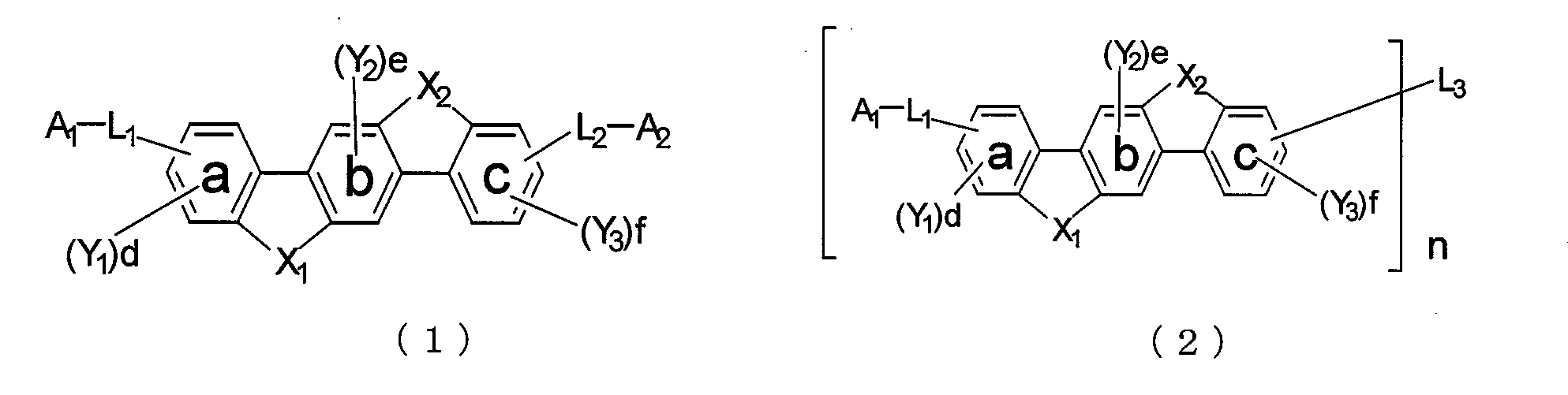
前記R1、R2およびR3は、それぞれ独立に、炭素数1~20のアルキル基、置換もしくは無置換の環形成炭素数3~20のシクロアルキル基、炭素数7~24のアラルキル基、シリル基もしくは炭素数3~20の置換シリル基、置換もしくは無置換の環形成炭素数6~24の芳香族炭化水素基、または置換もしくは無置換の環形成原子数3~24の芳香族複素環基を表す。但し、X1とX2が共にN-R1の場合は、R1の少なくとも1つは置換もしくは無置換の環形成原子数8~24である1価の縮合芳香族複素環基を表す。
式(2)において、nは2、3または4を表し、それぞれL3を連結基とした2量体、3量体、4量体である。
式(1)および(2)において、L1は単結合、炭素数1~20のアルキレン基、置換もしくは無置換の環形成炭素数3~20のシクロアルキレン基、2価のシリル基もしくは炭素数2~20の2価の置換シリル基、置換もしくは無置換である環形成炭素数6~24の2価の芳香族炭化水素基、または環形成原子数3~24のベンゼン環aと炭素-炭素結合で連結する置換もしくは無置換の2価の芳香族複素環基を表す。
式(1)において、L2は単結合、炭素数1~20のアルキレン基、置換もしくは無置換の環形成炭素数3~20のシクロアルキレン基、2価のシリル基もしくは炭素数2~20の2価の置換シリル基、置換もしくは無置換である環形成炭素数6~24の2価の芳香族炭化水素基、または環形成原子数3~24のベンゼン環cと炭素-炭素結合で連結する置換もしくは無置換の2価の芳香族複素環基を表す。
式(2)において、L3は、nが2の場合、単結合、炭素数1~20のアルキレン基、置換もしくは無置換の環形成炭素数3~20のシクロアルキレン基、2価のシリル基もしくは炭素数2~20の2価の置換シリル基、置換もしくは無置換の環形成炭素数6~24の2価の芳香族炭化水素基、または環形成原子数3~24でベンゼン環cと炭素-炭素結合で連結する置換もしくは無置換の2価の芳香族複素環基を表し、nが3の場合、炭素数1~20の3価の飽和炭化水素基、置換もしくは無置換の環形成炭素数3~20の3価の環状飽和炭化水素基、3価のシリル基もしくは炭素数1~20の3価の置換シリル基、置換もしくは無置換で環形成炭素数6~24の3価の芳香族炭化水素基、または原子数3~24でベンゼン環cと炭素-炭素結合で連結する置換もしくは無置換の3価の芳香族複素環基を表し、nが4の場合、炭素数1~20の4価の飽和炭化水素基、置換もしくは無置換の環形成炭素数3~20の4価の環状飽和炭化水素基、ケイ素原子、置換もしくは無置換の環形成炭素数6~24の4価の芳香族炭化水素基、または環形成原子数3~24でベンゼン環cと炭素-炭素結合で連結する置換もしくは無置換の4価の芳香族複素環基を表す。
式(1)および(2)において、A1は、水素原子、置換もしくは無置換の環形成炭素数3~20のシクロアルキル基、シリル基もしくは炭素数3~20の置換シリル基、置換もしくは無置換の環形成炭素数6~24の芳香族炭化水素基、または環形成原子数3~24でL1と炭素-炭素結合で連結する芳香族複素環基を表す。但し、L1が炭素数1~20のアルキレン基である場合、A1は水素原子である場合はない。
式(1)において、A2は、水素原子、置換もしくは無置換の環形成炭素数3~20のシクロアルキル基、シリル基もしくは炭素数3~20の置換シリル基、置換もしくは無置換の環形成炭素数6~24の芳香族炭化水素基、または環形成原子数3~24でL2と炭素-炭素結合で連結する芳香族複素環基を表す。但し、L2が炭素数1~20のあるいはアルキレン基である場合、A2は水素原子である場合はない。
式(1)および(2)において、Y1、Y2およびY3は、炭素数1~20のアルキル基、置換もしくは無置換の環形成炭素数3~20のシクロアルキル基、炭素数1~20のアルコキシ基、炭素数7~24のアラルキル基、シリル基もしくは炭素数3~20の置換シリル基、置換もしくは無置換の環形成炭素数6~24の芳香族炭化水素基、または置換もしくは無置換の環形成原子数3~24でベンゼン環a、b、cと炭素-炭素結合で連結する芳香族複素環基を表す。d、fは0、1、2または3、eは0、1または2である。
但し、X1とX2が、酸素(O)もしくはCR2R3であり、L1、L2が共に単結合であり、かつA1とA2が共に水素原子である場合、ベンゼン環bはY2を一個または二個有し、Y2がメチル基または無置換のフェニル基である場合は無い。
式(1)および(2)において、A1、A2、L1、L2およびL3は、カルボニル基を含まない。]

Zはハロゲン原子であり、フッ素原子、塩素原子、臭素原子、ヨウ素原子を表す。
t、u、vは0または1を表す。但しt+u+v≧1である。]
さらに、この有機EL素子用材料は、有機太陽電池、有機半導体レーザー、有機物を用いるセンサー、有機TFT用の有機電子素子用材料としても有効である。
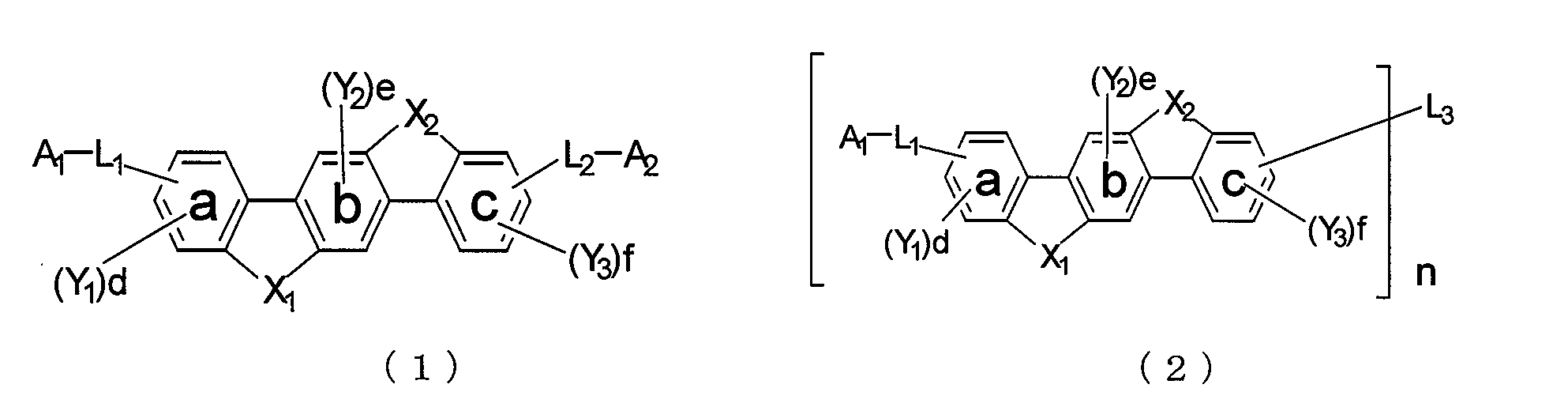
前記R1、R2およびR3は、それぞれ独立に、炭素数1~20のアルキル基、置換もしくは無置換の環形成炭素数3~20のシクロアルキル基、炭素数7~24のアラルキル基、シリル基もしくは炭素数3~20の置換シリル基、置換もしくは無置換の環形成炭素数6~24の芳香族炭化水素基、または置換もしくは無置換の環形成原子数3~24の芳香族複素環基を表す。但し、X1とX2が共にN-R1の場合は、R1の少なくとも1つは置換もしくは無置換の環形成原子数8~24である1価の縮合芳香族複素環基を表す。
式(2)において、nは2、3または4を表し、それぞれL3を連結基とした2量体、3量体、4量体である。
式(1)および(2)において、L1は単結合、炭素数1~20のアルキレン基、置換もしくは無置換の環形成炭素数3~20のシクロアルキレン基、2価のシリル基もしくは炭素数2~20の2価の置換シリル基、置換もしくは無置換である環形成炭素数6~24の2価の芳香族炭化水素基、または環形成原子数3~24のベンゼン環aと炭素-炭素結合で連結する置換もしくは無置換の2価の芳香族複素環基を表す。
式(1)において、L2は単結合、炭素数1~20のアルキレン基、置換もしくは無置換の環形成炭素数3~20のシクロアルキレン基、2価のシリル基もしくは炭素数2~20の2価の置換シリル基、置換もしくは無置換である環形成炭素数6~24の2価の芳香族炭化水素基、または環形成原子数3~24のベンゼン環cと炭素-炭素結合で連結する置換もしくは無置換の2価の芳香族複素環基を表す。
式(2)において、L3は、nが2の場合、単結合、炭素数1~20のアルキレン基、置換もしくは無置換の環形成炭素数3~20のシクロアルキレン基、2価のシリル基もしくは炭素数2~20の2価の置換シリル基、置換もしくは無置換の環形成炭素数6~24の2価の芳香族炭化水素基、または環形成原子数3~24でベンゼン環cと炭素-炭素結合で連結する置換もしくは無置換の2価の芳香族複素環基を表し、nが3の場合、炭素数1~20の3価の飽和炭化水素基、置換もしくは無置換の環形成炭素数3~20の3価の環状飽和炭化水素基、3価のシリル基もしくは炭素数1~20の3価の置換シリル基、置換もしくは無置換で環形成炭素数6~24の3価の芳香族炭化水素基、または原子数3~24でベンゼン環cと炭素-炭素結合で連結する置換もしくは無置換の3価の芳香族複素環基を表し、nが4の場合、炭素数1~20の4価の飽和炭化水素基、置換もしくは無置換の環形成炭素数3~20の4価の環状飽和炭化水素基、ケイ素原子、置換もしくは無置換の環形成炭素数6~24の4価の芳香族炭化水素基、または環形成原子数3~24でベンゼン環cと炭素-炭素結合で連結する置換もしくは無置換の4価の芳香族複素環基を表す。
式(1)および(2)において、A1は、水素原子、置換もしくは無置換の環形成炭素数3~20のシクロアルキル基、シリル基もしくは炭素数3~20の置換シリル基、置換もしくは無置換の環形成炭素数6~24の芳香族炭化水素基、または環形成原子数3~24でL1と炭素-炭素結合で連結する芳香族複素環基を表す。但し、L1が炭素数1~20のアルキレン基である場合、A1は水素原子である場合はない。
式(1)において、A2は、水素原子、置換もしくは無置換の環形成炭素数3~20のシクロアルキル基、シリル基もしくは炭素数3~20の置換シリル基、置換もしくは無置換の環形成炭素数6~24の芳香族炭化水素基、または環形成原子数3~24でL2と炭素-炭素結合で連結する芳香族複素環基を表す。但し、L2が炭素数1~20のあるいはアルキレン基である場合、A2は水素原子である場合はない。
式(1)および(2)において、Y1、Y2およびY3は、炭素数1~20のアルキル基、置換もしくは無置換の環形成炭素数3~20のシクロアルキル基、炭素数1~20のアルコキシ基、炭素数7~24のアラルキル基、シリル基もしくは炭素数3~20の置換シリル基、置換もしくは無置換の環形成炭素数6~24の芳香族炭化水素基、または置換もしくは無置換の環形成原子数3~24でベンゼン環a、b、cと炭素-炭素結合で連結する芳香族複素環基を表す。d、fは0、1、2または3、eは0、1または2である。
但し、X1とX2が、酸素(O)もしくはCR2R3であり、L1、L2が共に単結合であり、かつA1とA2が共に水素原子である場合、ベンゼン環bはY2を一個または二個有し、Y2がメチル基または無置換のフェニル基である場合は無い。
式(1)および(2)において、A1及び/又はA2がカルバゾリル基である場合、正孔輸送性が向上し、該多環系化合物を用いた素子の低電圧化が期待できる。
式(1)および(2)において、A1及び/又はA2がピリミジル基、ジベンゾフラニル基又はカルバゾリル基である場合、これらの置換基がさらに少なくとも一つ以上のアリール基(好ましくは、フェニル基、ビフェニル基、ターフェニル基又はクオーターフェニル基、特に好ましくはフェニル基、メタビフェニル基、メタターフェニル基)を置換基として有することにより、分子の安定性が向上し、該多環系化合物を用いた素子の長寿命化が期待できる。前記ピリミジル基、ジベンゾフラニル基又はカルバゾリル基は、特に限定されるものではないが、具体例として、以下の例が挙げられる。


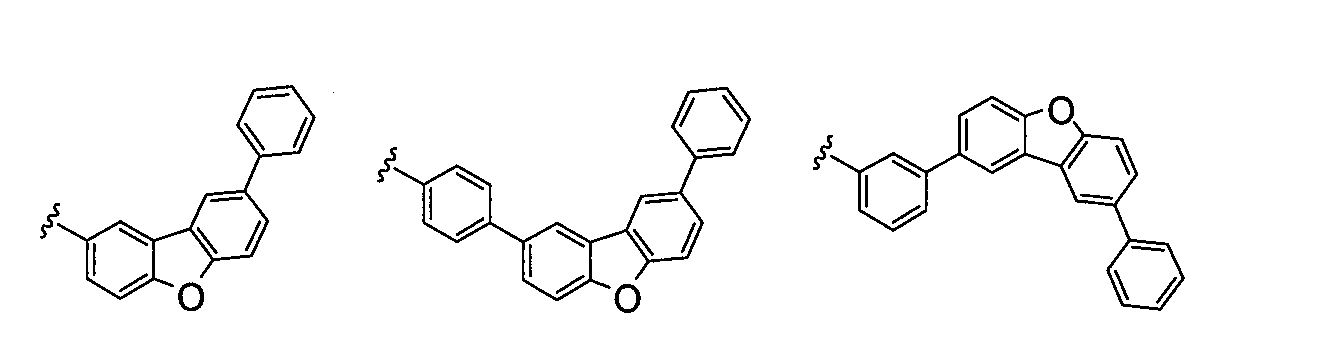
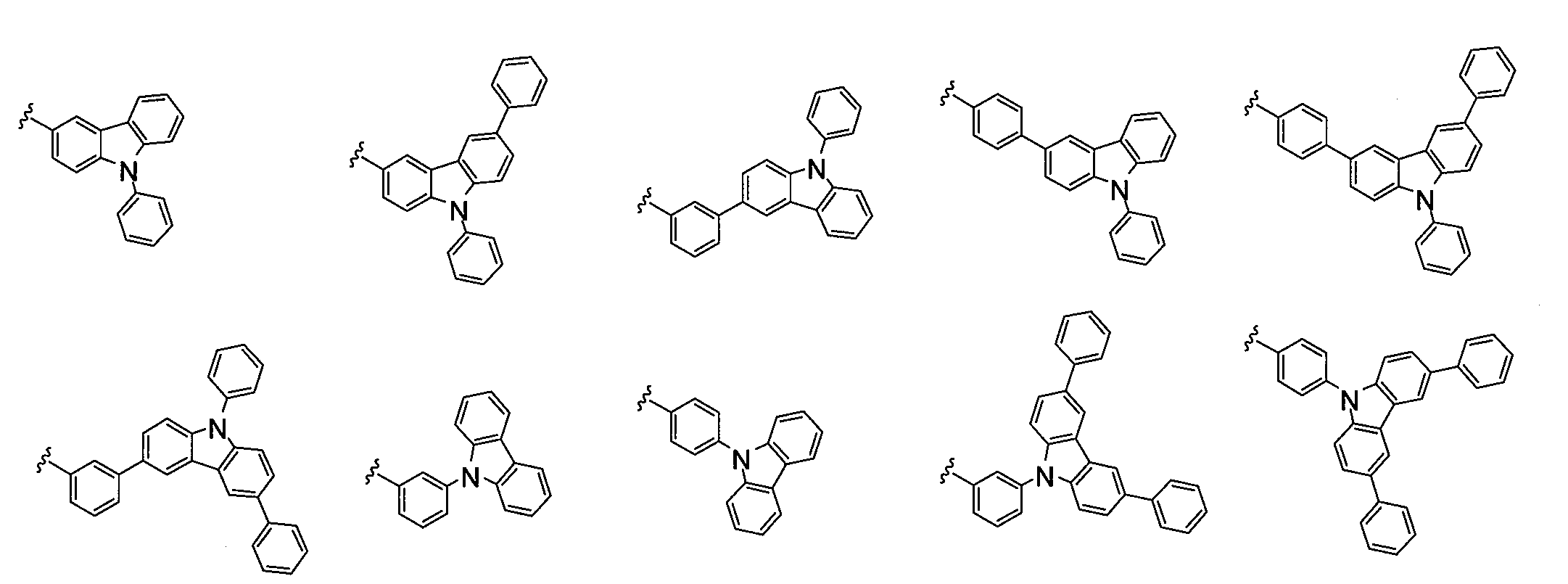
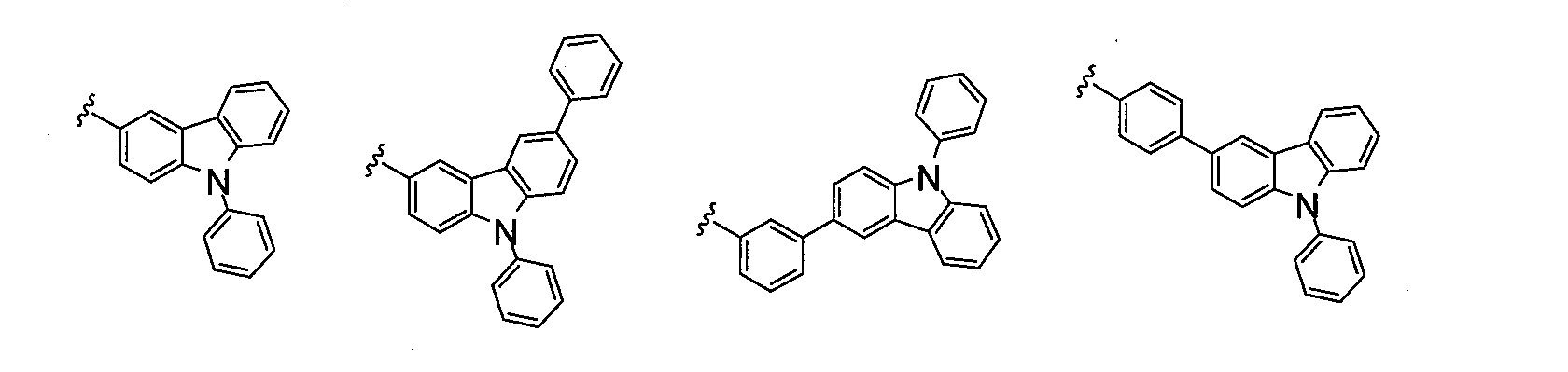
2以上のベンゼン環が互いにメタ位で結合する構造を有する例としては特に限定されるものではないが、具体例として、以下の例が挙げられ、

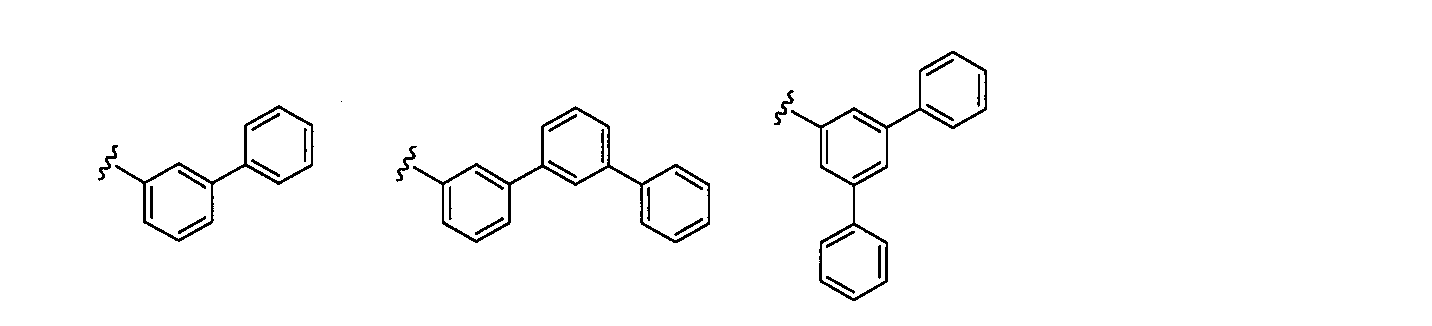
このように、L1-A1-、L2-A2-等の置換基の結合位置がメタ位であると、共役系の拡大を防ぎ、三重項エネルギーを広げることができるため、好ましい。
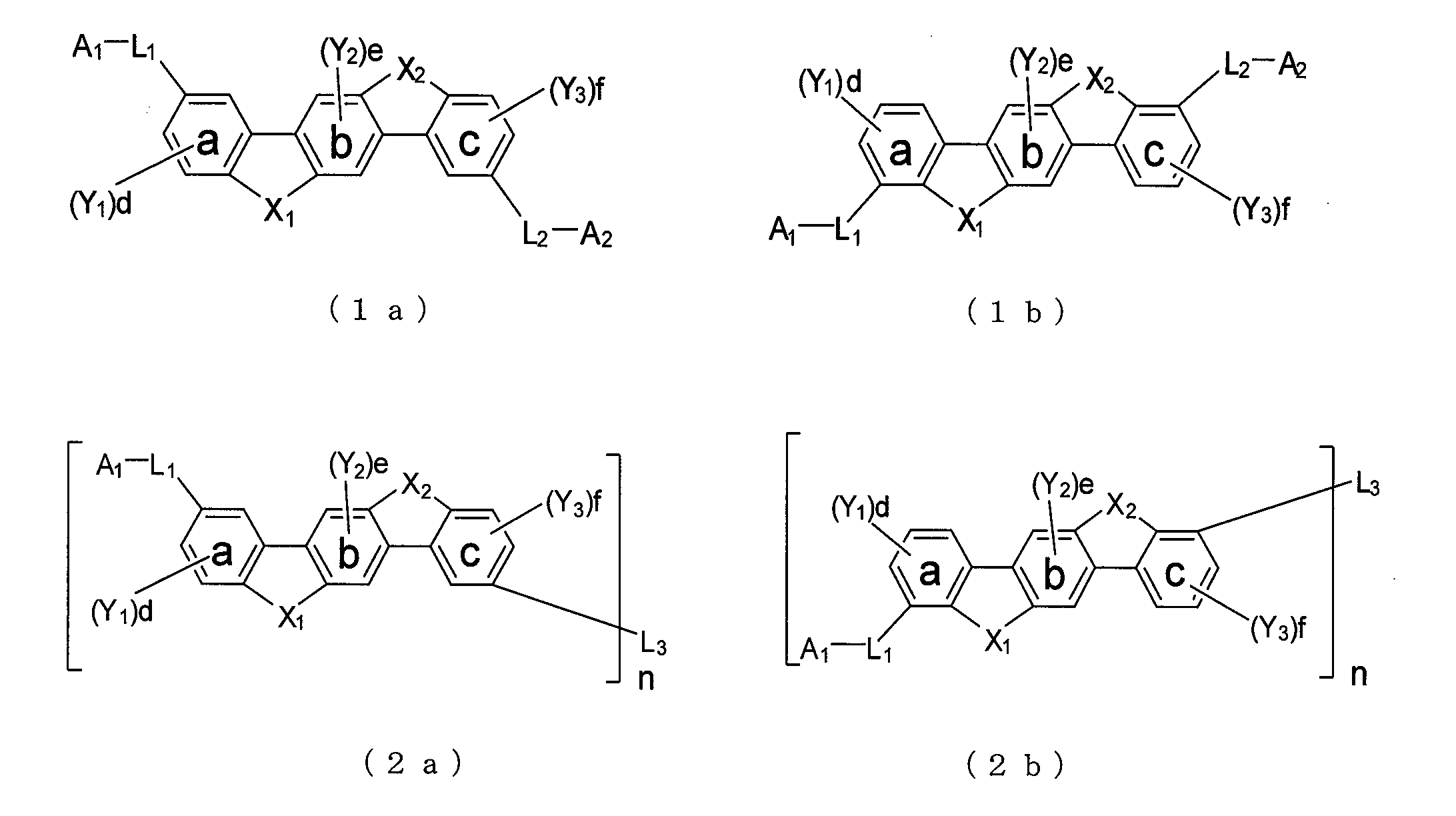

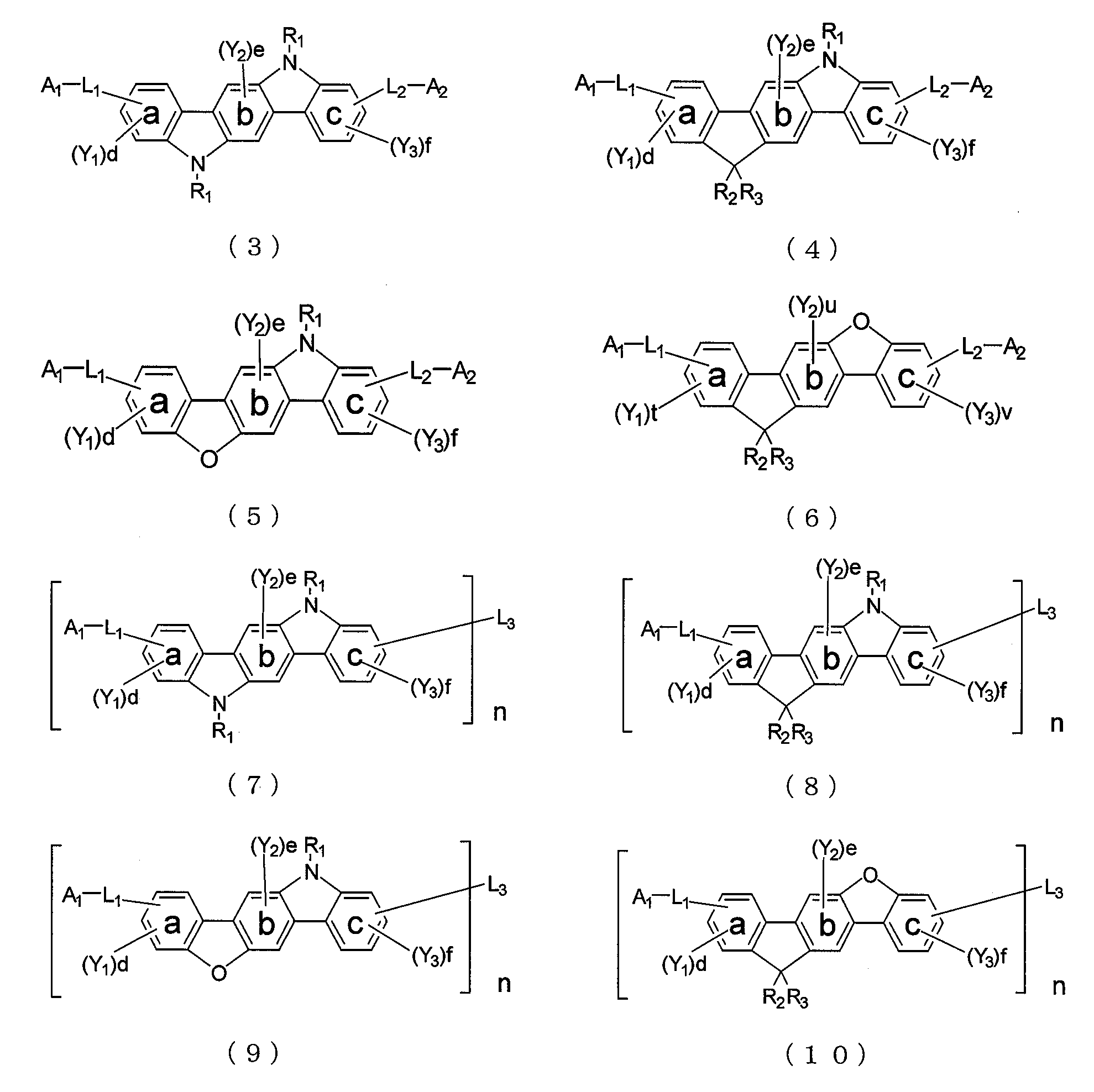
式(7)~(10)において、nは2、3または4を表し、それぞれL3を連結基とした2量体、3量体、4量体である。
式(3)~(10)において、L1は単結合、炭素数1~20のアルキレン基、置換もしくは無置換の環形成炭素数3~20のシクロアルキレン基、2価のシリル基もしくは炭素数2~20の2価の置換シリル基、置換もしくは無置換である環形成炭素数6~24の2価の芳香族炭化水素基、または環形成原子数3~24のベンゼン環aと炭素-炭素結合で連結する置換もしくは無置換の2価の芳香族複素環基を表す。
式(3)~(6)において、L2は単結合、炭素数1~20のアルキレン基、置換もしくは無置換の環形成炭素数3~20のシクロアルキレン基、2価のシリル基もしくは炭素数2~20の2価の置換シリル基、置換もしくは無置換である環形成炭素数6~24の2価の芳香族炭化水素基、または環形成原子数3~24のベンゼン環cと炭素-炭素結合で連結する置換もしくは無置換の2価の芳香族複素環基を表す。
式(7)~(10)において、L3は、nが2の場合、単結合、炭素数1~20のアルキレン基、置換もしくは無置換の環形成炭素数3~20のシクロアルキレン基、2価のシリル基もしくは炭素数2~20の2価の置換シリル基、置換もしくは無置換の環形成炭素数6~24の2価の芳香族炭化水素基、または環形成原子数3~24でベンゼン環cと炭素-炭素結合で連結する置換もしくは無置換の2価の芳香族複素環基を表し、nが3の場合、炭素数1~20の3価の飽和炭化水素基、置換もしくは無置換の環形成炭素数3~20の3価の環状飽和炭化水素基、3価のシリル基もしくは炭素数1~20の3価の置換シリル基、置換もしくは無置換で環形成炭素数6~24の3価の芳香族炭化水素基、または原子数3~24でベンゼン環cと炭素-炭素結合で連結する置換もしくは無置換の3価の芳香族複素環基を表し、nが4の場合、炭素数1~20の4価の飽和炭化水素基、置換もしくは無置換の環形成炭素数3~20の4価の環状飽和炭化水素基、ケイ素原子、置換もしくは無置換の環形成炭素数6~24の4価の芳香族炭化水素基、または環形成原子数3~24でベンゼン環cと炭素-炭素結合で連結する置換もしくは無置換の4価の芳香族複素環基を表す。
式(3)~(10)において、A1は、水素原子、置換もしくは無置換の環形成炭素数3~20のシクロアルキル基、シリル基もしくは炭素数3~20の置換シリル基、置換もしくは無置換の環形成炭素数6~24の芳香族炭化水素基、または環形成原子数3~24でL1と炭素-炭素結合で連結する芳香族複素環基を表す。但し、L1が炭素数1~20のアルキレン基である場合、A1は水素原子である場合はない。
式(3)~(6)において、A2は、水素原子、置換もしくは無置換の環形成炭素数3~20のシクロアルキル基、シリル基もしくは炭素数3~20の置換シリル基、置換もしくは無置換の環形成炭素数6~24の芳香族炭化水素基、または環形成原子数3~24でL2と炭素-炭素結合で連結する芳香族複素環基を表す。但し、L2が炭素数1~20のアルキレン基である場合、A2は水素原子である場合はない。
式(3)~(10)において、Y1、Y2およびY3は、炭素数1~20のアルキル基、置換もしくは無置換の環形成炭素数3~20のシクロアルキル基、炭素数1~20のアルコキシ基、炭素数7~24のアラルキル基、シリル基もしくは炭素数3~20の置換シリル基、置換もしくは無置換の環形成炭素数6~24の芳香族炭化水素基、または置換もしくは無置換の環形成原子数3~24でベンゼン環a、b、cと炭素-炭素結合で連結する芳香族複素環基を表す。d、fは0、1、2または3、eは0、1または2である。但し、L1、L2が共に単結合であり、かつA1とA2が共に水素原子である場合、ベンゼン環bはY2を一個または二個有し、Y2がメチル基または無置換のフェニル基である場合は無い。
式(3)~(10)において、A1、A2、L1、L2およびL3は、カルボニル基を含まない。]
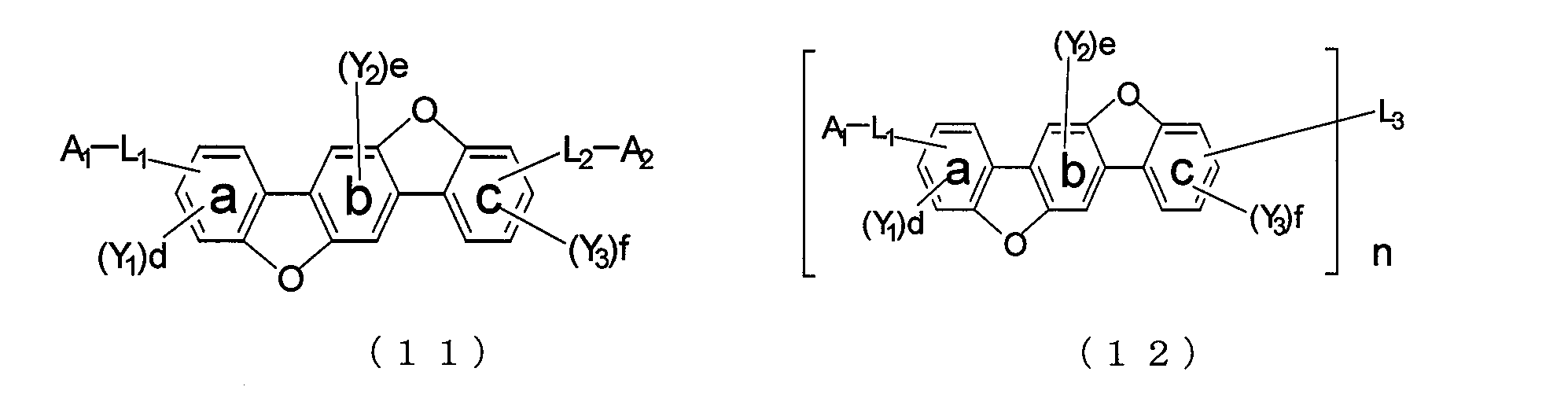

式(11)~(14)において、L1は単結合、炭素数1~20のアルキレン基、置換もしくは無置換の環形成炭素数3~20のシクロアルキレン基、2価のシリル基もしくは炭素数2~20の2価のシリル基、置換もしくは無置換である環形成炭素数6~24の2価の芳香族炭化水素基、または環形成原子数3~24のベンゼン環aと炭素-炭素結合で連結する置換もしくは無置換の2価の芳香族複素環基を表す。
式(11)、(13)において、L2は単結合、炭素数1~20のアルキレン基、置換もしくは無置換の環形成炭素数3~20のシクロアルキレン基、2価のシリル基もしくは炭素数2~20の2価のシリル基、置換もしくは無置換である環形成炭素数6~24の2価の芳香族炭化水素基、または環形成原子数3~24のベンゼン環cと炭素-炭素結合で連結する置換もしくは無置換の2価の芳香族複素環基を表す。
式(12)、(14)において、L3は、nが2の場合、単結合、炭素数1~20のアルキレン基、置換もしくは無置換の環形成炭素数3~20のシクロアルキレン基、2価のシリル基もしくは炭素数2~20の2価の置換シリル基、置換もしくは無置換の環形成炭素数6~24の2価の芳香族炭化水素基、または環形成原子数3~24でベンゼン環cと炭素-炭素結合で連結する置換もしくは無置換の2価の芳香族複素環基を表し、nが3の場合、炭素数1~20の3価の飽和炭化水素基、置換もしくは無置換の環形成炭素数3~20の3価の環状飽和炭化水素基、3価のシリル基もしくは炭素数1~20の3価の置換シリル基、置換もしくは無置換で環形成炭素数6~24の3価の芳香族炭化水素基、または原子数3~24でベンゼン環cと炭素-炭素結合で連結する置換もしくは無置換の3価の芳香族複素環基を表し、nが4の場合、炭素数1~20の4価の飽和炭化水素基、置換もしくは無置換の環形成炭素数3~20の4価の環状飽和炭化水素基、ケイ素原子、置換もしくは無置換の環形成炭素数6~24の4価の芳香族炭化水素基、または環形成原子数3~24でベンゼン環cと炭素-炭素結合で連結する置換もしくは無置換の4価の芳香族複素環基を表す。
式(11)~(14)において、A1は、水素原子、置換もしくは無置換の環形成炭素数3~20のシクロアルキル基、シリル基もしくは炭素数3~20の置換シリル基、置換もしくは無置換の環形成炭素数6~24の芳香族炭化水素基、または環形成原子数3~24でL1と炭素-炭素結合で連結する芳香族複素環基を表す。但し、L1が炭素数1~20のアルキレン基である場合、A1は水素原子である場合はない。
式(11)、(13)において、A2は、水素原子、置換もしくは無置換の環形成炭素数3~20のシクロアルキル基、シリル基もしくは炭素数3~20の置換シリル基、置換もしくは無置換の環形成炭素数6~24の芳香族炭化水素基、または環形成原子数3~24でL2と炭素-炭素結合で連結する芳香族複素環基を表す。但し、L2が炭素数1~20のアルキレン基である場合、A2は水素原子である場合はない。
式(11)~(14)において、Y1、Y2およびY3は、炭素数1~20のアルキル基、置換もしくは無置換の環形成炭素数3~20のシクロアルキル基、炭素数1~20のアルコキシ基、炭素数7~24のアラルキル基、シリル基もしくは炭素数3~20の置換シリル基、置換もしくは無置換の環形成炭素数6~24の芳香族炭化水素基、または置換もしくは無置換の環形成原子数3~24でベンゼン環a、b、cと炭素-炭素結合で連結する芳香族複素環基を表す。d、fは0、1、2または3、eは0、1または2である。但し、L1、L2が共に単結合であり、かつA1とA2が共に水素原子である場合、ベンゼン環bはY2を一個または二個有し、Y2がメチル基または無置換のフェニル基である場合は無い。
式(11)~(14)において、A1、A2、L1、L2およびL3は、カルボニル基を含まない。]
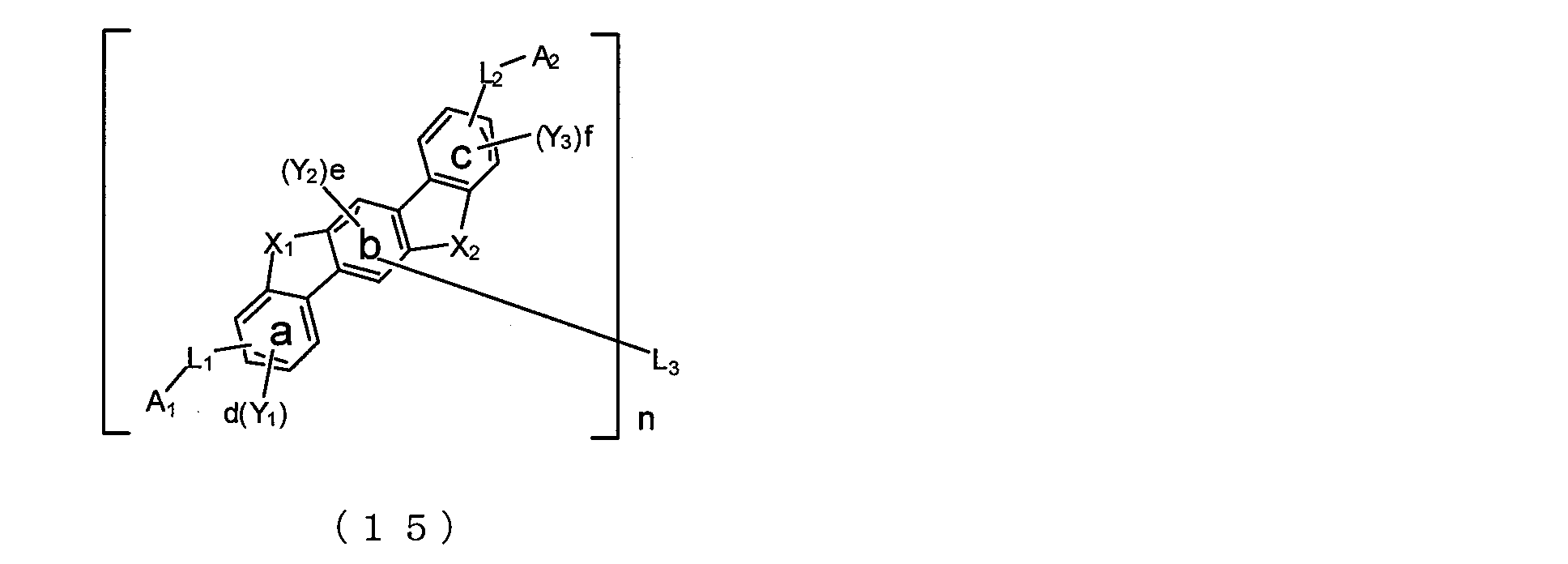
前記R1、R2およびR3は、それぞれ独立に、炭素数1~20のアルキル基、置換もしくは無置換の環形成炭素数3~20のシクロアルキル基、炭素数7~24のアラルキル基、シリル基もしくは炭素数3~20の置換シリル基、置換もしくは無置換の環形成炭素数6~24の芳香族炭化水素基、または置換もしくは無置換の環形成原子数3~24の芳香族複素環基を表す。但し、X1とX2が共にN-R1の場合は、R1の少なくとも1つは置換もしくは無置換の環形成原子数8~24である1価の縮合芳香族複素環基を表す。
式(15)において、nは2、3または4を表し、それぞれL3を連結基とした2量体、3量体、4量体である。
式(15)において、L1は単結合、炭素数1~20のアルキレン基、置換もしくは無置換の環形成炭素数3~20のシクロアルキレン基、2価のシリル基もしくは炭素数2~20の2価の置換シリル基、置換もしくは無置換である環形成炭素数6~24の2価の芳香族炭化水素基、または環形成原子数3~24のベンゼン環aと炭素-炭素結合で連結する置換もしくは無置換の2価の芳香族複素環基を表す。
式(15)において、L2は単結合、炭素数1~20のアルキレン基、置換もしくは無置換の環形成炭素数3~20のシクロアルキレン基、2価のシリル基もしくは炭素数2~20の2価の置換シリル基、置換もしくは無置換である環形成炭素数6~24の2価の芳香族炭化水素基、または環形成原子数3~24のベンゼン環cと炭素-炭素結合で連結する置換もしくは無置換の2価の芳香族複素環基を表す。
式(15)において、L3は、nが2の場合、単結合、炭素数1~20のアルキレン基、置換もしくは無置換の環形成炭素数3~20のシクロアルキレン基、2価のシリル基もしくは炭素数2~20の2価の置換シリル基、置換もしくは無置換の環形成炭素数6~24の2価の芳香族炭化水素基、または環形成原子数3~24でベンゼン環bと炭素-炭素結合で連結する置換もしくは無置換の2価の芳香族複素環基を表し、nが3の場合、炭素数1~20の3価の飽和炭化水素基、置換もしくは無置換の環形成炭素数3~20の3価の環状飽和炭化水素基、3価のシリル基もしくは炭素数1~20の3価の置換シリル基、置換もしくは無置換で環形成炭素数6~24の3価の芳香族炭化水素基、または原子数3~24でベンゼン環bと炭素-炭素結合で連結する置換もしくは無置換の3価の芳香族複素環基を表し、nが4の場合、炭素数1~20の4価の飽和炭化水素基、置換もしくは無置換の環形成炭素数3~20の4価の環状飽和炭化水素基、ケイ素原子、置換もしくは無置換の環形成炭素数6~24の4価の芳香族炭化水素基、または環形成原子数3~24でベンゼン環bと炭素-炭素結合で連結する置換もしくは無置換の4価の芳香族複素環基を表す。
式(15)において、A1は、水素原子、置換もしくは無置換の環形成炭素数3~20のシクロアルキル基、シリル基もしくは炭素数3~20の置換シリル基、置換もしくは無置換の環形成炭素数6~24の芳香族炭化水素基、または環形成原子数3~24でL1と炭素-炭素結合で連結する芳香族複素環基を表す。但し、L1が炭素数1~20のアルキレン基である場合、A1は水素原子である場合はない。
式(15)において、A2は、水素原子、置換もしくは無置換の環形成炭素数3~20のシクロアルキル基、シリル基もしくは炭素数3~20の置換シリル基、置換もしくは無置換の環形成炭素数6~24の芳香族炭化水素基、または環形成原子数3~24でL2と炭素-炭素結合で連結する芳香族複素環基を表す。但し、L2が炭素数1~20のアルキレン基である場合、A2は水素原子である場合はない。
式(15)において、Y1、Y2およびY3は、炭素数1~20のアルキル基、置換もしくは無置換の環形成炭素数3~20のシクロアルキル基、炭素数1~20のアルコキシ基、炭素数7~24のアラルキル基、シリル基もしくは炭素数3~20の置換シリル基、置換もしくは無置換の環形成炭素数6~24の芳香族炭化水素基、または置換もしくは無置換の環形成原子数3~24でベンゼン環a、b、cと炭素-炭素結合で連結する芳香族複素環基を表す。d、fは0、1、2または3、eは0または1である。
式(15)において、A1、A2、L1、L2およびL3は、カルボニル基を含まない。]
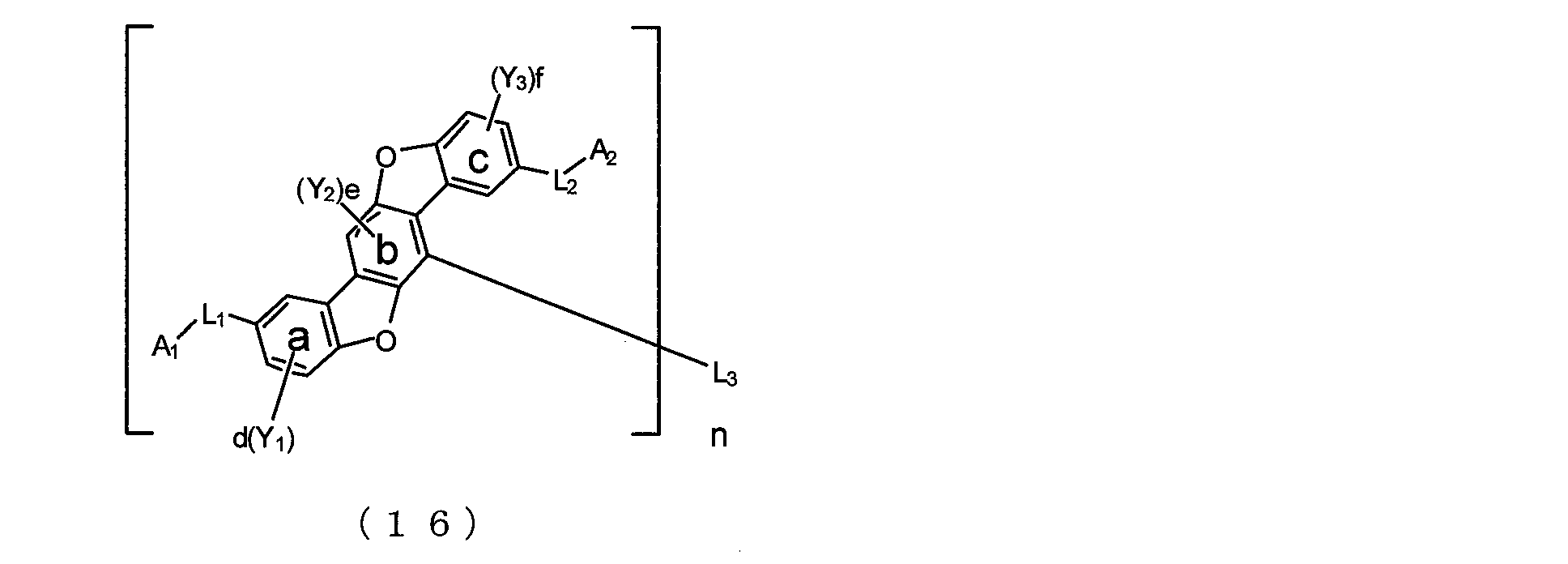
式(16)において、L1は単結合、炭素数1~20のアルキレン基、置換もしくは無置換の環形成炭素数3~20のシクロアルキレン基、2価のシリル基もしくは炭素数2~20の2価の置換シリル基、置換もしくは無置換である環形成炭素数6~24の2価の芳香族炭化水素基、または環形成原子数3~24のベンゼン環aと炭素-炭素結合で連結する置換もしくは無置換の2価の芳香族複素環基を表す。
式(16)において、L2は単結合、炭素数1~20のアルキレン基、置換もしくは無置換の環形成炭素数3~20のシクロアルキレン基、2価のシリル基もしくは炭素数2~20の2価の置換シリル基、置換もしくは無置換である環形成炭素数6~24の2価の芳香族炭化水素基、または環形成原子数3~24のベンゼン環cと炭素-炭素結合で連結する置換もしくは無置換の2価の芳香族複素環基を表す。
式(16)において、L3は、nが2の場合、単結合、炭素数1~20のアルキレン基、置換もしくは無置換の環形成炭素数3~20のシクロアルキレン基、2価のシリル基もしくは炭素数2~20の2価の置換シリル基、置換もしくは無置換の環形成炭素数6~24の2価の芳香族炭化水素基、または環形成原子数3~24でベンゼン環bと炭素-炭素結合で連結する置換もしくは無置換の2価の芳香族複素環基を表し、nが3の場合、炭素数1~20の3価の飽和炭化水素基、置換もしくは無置換の環形成炭素数3~20の3価の環状飽和炭化水素基、3価のシリル基もしくは炭素数1~20の3価の置換シリル基、置換もしくは無置換で環形成炭素数6~24の3価の芳香族炭化水素基、または原子数3~24でベンゼン環bと炭素-炭素結合で連結する置換もしくは無置換の3価の芳香族複素環基を表し、nが4の場合、炭素数1~20の4価の飽和炭化水素基、置換もしくは無置換の環形成炭素数3~20の4価の環状飽和炭化水素基、ケイ素原子、置換もしくは無置換の環形成炭素数6~24の4価の芳香族炭化水素基、または環形成原子数3~24でベンゼン環bと炭素-炭素結合で連結する置換もしくは無置換の4価の芳香族複素環基を表す。
式(16)において、A1は、水素原子、置換もしくは無置換の環形成炭素数3~20のシクロアルキル基、シリル基もしくは炭素数3~20の置換シリル基、置換もしくは無置換の環形成炭素数6~24の芳香族炭化水素基、または環形成原子数3~24でL1と炭素-炭素結合で連結する芳香族複素環基を表す。但し、L1が炭素数1~20のアルキレン基である場合、A1は水素原子である場合はない。
式(16)において、A2は、水素原子、置換もしくは無置換の環形成炭素数3~20のシクロアルキル基、シリル基もしくは炭素数3~20の置換シリル基、置換もしくは無置換の環形成炭素数6~24の芳香族炭化水素基、または環形成原子数3~24でL2と炭素-炭素結合で連結する芳香族複素環基を表す。但し、L2が炭素数1~20のアルキレン基である場合、A2は水素原子である場合はない。
式(16)において、Y1、Y2およびY3は、炭素数1~20のアルキル基、置換もしくは無置換の環形成炭素数3~20のシクロアルキル基、炭素数1~20のアルコキシ基、炭素数7~24のアラルキル基、シリル基もしくは炭素数3~20の置換シリル基、置換もしくは無置換の環形成炭素数6~24の芳香族炭化水素基、または置換もしくは無置換の環形成原子数3~24でベンゼン環a、b、cと炭素-炭素結合で連結する芳香族複素環基を表す。d、fは0、1、2または3、eは0または1である。
式(16)において、A1、A2、L1、L2およびL3は、カルボニル基を含まない。]
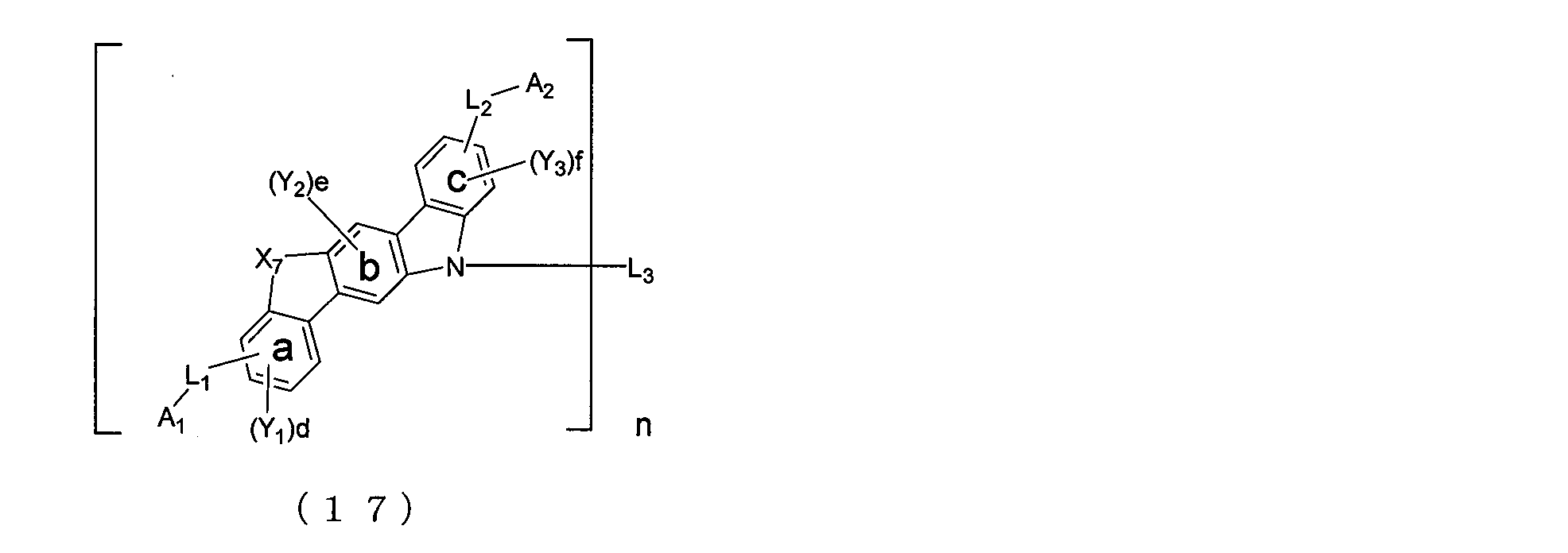
前記R2およびR3は、それぞれ独立に、炭素数1~20のアルキル基、置換もしくは無置換の環形成炭素数3~20のシクロアルキル基、炭素数7~24のアラルキル基、シリル基もしくは炭素数3~20の置換シリル基、置換もしくは無置換の環形成炭素数6~24の芳香族炭化水素基、または置換もしくは無置換の環形成原子数3~24の芳香族複素環基を表す。
式(17)において、nは2、3または4を表し、それぞれL3を連結基とした2量体、3量体、4量体である。
式(17)において、L1は単結合、炭素数1~20のアルキレン基、置換もしくは無置換の環形成炭素数3~20のシクロアルキレン基、2価のシリル基もしくは炭素数2~20の2価の置換シリル基、置換もしくは無置換である環形成炭素数6~24の2価の芳香族炭化水素基、または環形成原子数3~24のベンゼン環aと炭素-炭素結合で連結する置換もしくは無置換の2価の芳香族複素環基を表す。
式(17)において、L2は単結合、炭素数1~20のアルキレン基、置換もしくは無置換の環形成炭素数3~20のシクロアルキレン基、2価のシリル基もしくは炭素数2~20の2価の置換シリル基、置換もしくは無置換である環形成炭素数6~24の2価の芳香族炭化水素基、または環形成原子数3~24のベンゼン環cと炭素-炭素結合で連結する置換もしくは無置換の2価の芳香族複素環基を表す。
式(17)において、L3は、nが2の場合、単結合、炭素数1~20のアルキレン基、置換もしくは無置換の環形成炭素数3~20のシクロアルキレン基、2価のシリル基もしくは炭素数2~20の2価の置換シリル基、置換もしくは無置換の環形成炭素数6~24の2価の芳香族炭化水素基、または環形成原子数3~24でベンゼン環bと炭素-炭素結合で連結する置換もしくは無置換の2価の芳香族複素環基を表し、nが3の場合、炭素数1~20の3価の飽和炭化水素基、置換もしくは無置換の環形成炭素数3~20の3価の環状飽和炭化水素基、3価のシリル基もしくは炭素数1~20の3価の置換シリル基、置換もしくは無置換で環形成炭素数6~24の3価の芳香族炭化水素基、または原子数3~24でベンゼン環bと炭素-炭素結合で連結する置換もしくは無置換の3価の芳香族複素環基を表し、nが4の場合、炭素数1~20の4価の飽和炭化水素基、置換もしくは無置換の環形成炭素数3~20の4価の環状飽和炭化水素基、ケイ素原子、置換もしくは無置換の環形成炭素数6~24の4価の芳香族炭化水素基、または環形成原子数3~24でベンゼン環bと炭素-炭素結合で連結する置換もしくは無置換の4価の芳香族複素環基を表す。
式(17)において、A1は、水素原子、置換もしくは無置換の環形成炭素数3~20のシクロアルキル基、シリル基もしくは炭素数3~20の置換シリル基、置換もしくは無置換の環形成炭素数6~24の芳香族炭化水素基、または環形成原子数3~24でL1と炭素-炭素結合で連結する芳香族複素環基を表す。但し、L1が炭素数1~20のアルキレン基である場合、A1は水素原子である場合はない。
式(17)において、A2は、水素原子、置換もしくは無置換の環形成炭素数3~20のシクロアルキル基、シリル基もしくは炭素数3~20の置換シリル基、置換もしくは無置換の環形成炭素数6~24の芳香族炭化水素基、または環形成原子数3~24でL2と炭素-炭素結合で連結する芳香族複素環基を表す。但し、L2が炭素数1~20のアルキレン基である場合、A2は水素原子である場合はない。
式(17)において、Y1、Y2およびY3は、炭素数1~20のアルキル基、置換もしくは無置換の環形成炭素数3~20のシクロアルキル基、炭素数1~20のアルコキシ基、炭素数7~24のアラルキル基、シリル基もしくは炭素数3~20の置換シリル基、置換もしくは無置換の環形成炭素数6~24の芳香族炭化水素基、または置換もしくは無置換の環形成原子数3~24でベンゼン環a、b、cと炭素-炭素結合で連結する芳香族複素環基を表す。d、fは0、1、2または3、eは0、1または2である。
式(17)において、A1、A2、L1、L2およびL3は、カルボニル基を含まない。]
また、式(11)~(17)において、A1が、L1と炭素-炭素結合で連結するピリダジン、ピリミジン、ピラジン、1,3,5-トリアジン、カルバゾール、ジベンゾフラン、ジベンゾチオフェン、フェノキサジン、フェノチアジン、ジヒドロアクリジンから選ばれる芳香族複素環基であると好ましい。

R1は、炭素数1~20のアルキル基、置換もしくは無置換の環形成炭素数3~20のシクロアルキル基、炭素数7~24のアラルキル基、シリル基もしくは炭素数3~20の置換シリル基、置換もしくは無置換の環形成炭素数6~24の芳香族炭化水素基、または置換もしくは無置換の環形成原子数3~24の芳香族複素環基を表す。但しX1とX2が共にN-R1の場合は、R1の少なくとも1つは置換もしくは無置換の環形成原子数8~24である1価の縮合芳香族複素環基を表す。
Y1、Y2およびY3は、炭素数1~20のアルキル基、置換もしくは無置換の環形成炭素数3~20のシクロアルキル基、炭素数1~20のアルコキシ基、炭素数7~24のアラルキル基、シリル基もしくは炭素数3~20の置換シリル基、置換もしくは無置換の環形成炭素数6~24の芳香族炭化水素基、または置換もしくは無置換の環形成原子数3~24でベンゼン環a、b、cと炭素-炭素結合で連結する芳香族複素環基を表す。d、fは0、1、2または3、eは0、1または2である。
Zはハロゲン原子であり、フッ素原子、塩素原子、臭素原子、ヨウ素原子を表す。
t、u、vは0または1を表す。但しt+u+v≧1である。]

Zはハロゲン原子であり、フッ素原子、塩素原子、臭素原子、ヨウ素原子を表す。
t、u、vは0または1を表す。但しt+u+v≧1である。]
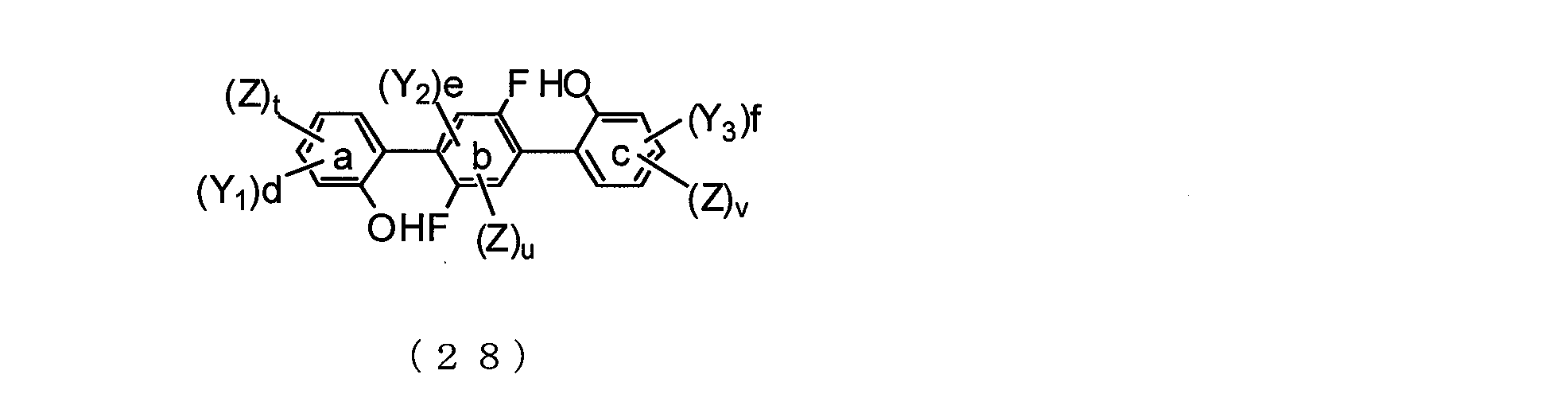
Zはハロゲン原子であり、フッ素原子、塩素原子、臭素原子、ヨウ素原子を表す。
t、u、vは0または1を表す。但しt+u+v≧1である。]
反応原料である式(28)で表される芳香族ハロゲン化合物に対する塩基性触媒の使用割合は、塩基性触媒/芳香族ハロゲン化合物(モル比)が、2~10程度となる量であり、好ましくは2~5となる量である。
反応の際には、必要に応じて溶媒を用いることができる。溶媒として具体的には、トルエン、DMF(ジメチルホルムアミド)、DMAc(N,N-ジメチルアセトアミド)、DMSO(ジメチルスルホキシド)、NMP(N-メチルピロリドン)、テトラヒドロフランおよびジメトキシエタンなどが挙げられる。これらは一種を単独で又は二種以上を組み合わせて使用することができる。
上記式(28)で表される芳香族ハロゲン化合物の反応は、通常0~250℃程度、好ましくは150~200℃の温度において行う。反応温度が150℃以上であると、反応速度が低下せず適度のものとなるため、反応時間が短縮される。また、反応温度が200℃以下であると、生成物の着色が抑制される。反応時間は、通常1分~24時間程度、望ましくは1~10時間である。
また、上記式(18)において、X8、X9が、共にN-R1であるハロゲン化合物は、下記式(29)で表される芳香族ハロゲン化合物を、前記と同様に分子内環化反応させることにより得ることができる。
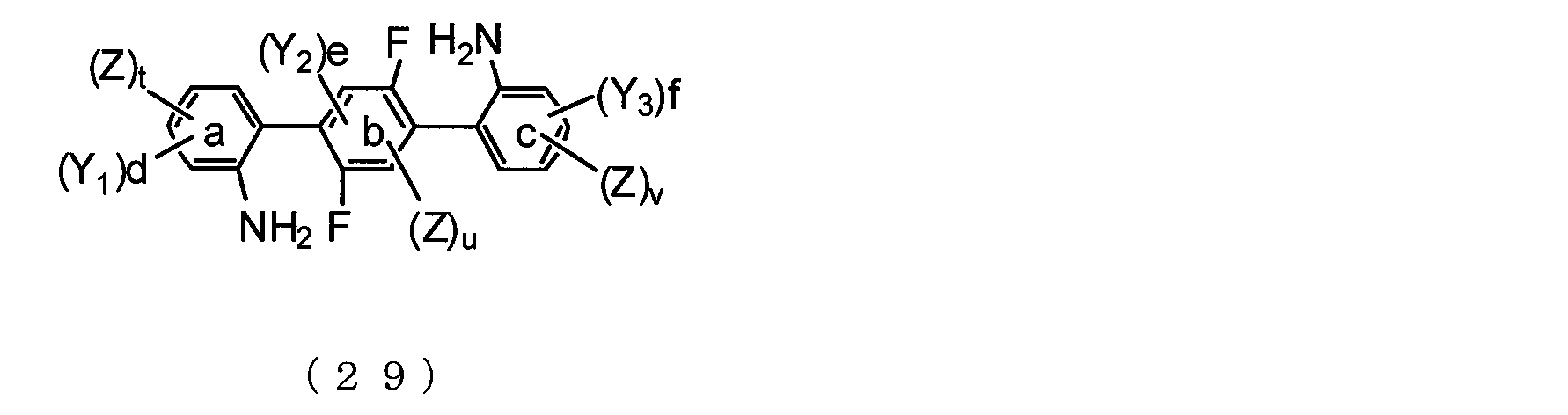
Y1~Y3、R1~R3、L1~L3およびA1~A2の示す置換もしくは無置換の環形成炭素数6~24の芳香族炭化水素基としては、例えば、置換もしくは無置換のベンゼン、ナフタレン、ビフェニル、ターフェニル、フルオレン、フェナントレン、トリフェニレン、ペリレン、クリセン、フルオランテン、ベンゾフルオレン、ベンゾトリフェニレン、ベンゾクリセン、アントラセン等の対応する価数の残基が挙げられ、ベンゼン、ナフタレン、ビフェニル、ターフェニル、フルオレン、フェナントレンが好ましい。
Y1~Y3、R1~R3、L1~L3およびA1~A2の示す置換もしくは無置換の環形成原子数3~24の芳香族複素環基としては、例えば、ピリジン、ピリダジン、ピリミジン、ピラジン、1,3,5-トリアジン、カルバゾール、ジベンゾフラン、ジベンゾチオフェン、フェノキサジン、フェノチアジン、ジヒドロアクリジンの対応する価数の残基が挙げられ、ピリジン、ピリダジン、ピリミジン、ピラジン、カルバゾール、ジベンゾフラン、ジベンゾチオフェン、フェノキサジン、ジヒドロアクリジンが好ましい。また、R1の示す少なくとも1つの置換もしくは無置換の環形成原子数8~24である1価の縮合芳香族複素環基としては、芳香族複素環基の例の中から縮合構造を有する例が挙げられる。
Y、Y1~Y3、L1~L3およびR1~R3の示す炭素数1~20のアルキル基、アルキレン基、3価あるいは4価の飽和炭化水素基としては、例えば、メチル基、エチル基、プロピル基、イソプロピル基、n-ブチル基、s-ブチル基、t-ブチル基、イソブチル基、n-ペンチル基、n-ヘキシル基、n-ヘプチル基、n-オクチル基、n-ノニル基、n-デシル基、n-ウンデシル基、n-ドデシル基、n-トリデシル基、n-テトラデシル基、n-ペンタデシル基、n-ヘキサデシル基、n-ヘプタデシル基、n-オクタデシル基、ネオペンチル基、1-メチルペンチル基、2-メチルペンチル基、1-ペンチルヘキシル基、1-ブチルペンチル基、1-ヘプチルオクチル基、3-メチルペンチル基等またはこれらを2~4価とした基が挙げられ、メチル基、エチル基、プロピル基、イソプロピル基、n-ブチル基、s-ブチル基、イソブチル基、t-ブチル基、n-ペンチル基、n-ヘキシル基、n-ヘプチル基、n-オクチル基、n-ノニル基、n-デシル基、n-ウンデシル基、n-ドデシル基、n-トリデシル基、n-テトラデシル基、n-ペンタデシル基、n-ヘキサデシル基、n-ヘプタデシル基、n-オクタデシル基、ネオペンチル基、1-メチルペンチル基、1-ペンチルヘキシル基、1-ブチルペンチル基、1-ヘプチルオクチル基が好ましい。
Y1~Y3、L1~L3、R1~R3およびA1~A2の示す置換もしくは無置換の環形成炭素数3~20のシクロアルキル基、シクロアルキレン基、3価あるいは4価の環状飽和炭化水素基としては、例えば、シクロプロピル基、シクロブチル基、シクロペンチル基、シクロヘキシル基等またはこれらを2~4価とした基が挙げられ、シクロブチル基、シクロペンチル基、シクロヘキシル基が好ましい。
Y1~Y3の示す炭素数1~20のアルコキシ基としては、例えば、メトキシ基、エトキシ基、メトキシ基、i-プロポキシ基、n-プロポキシ基、n-ブトキシ基、s-ブトキシ基、t-ブトキシ基等が挙げられ、メトキシ基、エトキシ基、メトキシ基、i-プロポキシ基、n-プロポキシ基が好ましい。
Y1~Y3、L1~L3、R1~R3およびA1~A2の示す炭素数1~20の置換シリル基としては、例えば、トリメチルシリル基、トリエチルシリル基、トリブチルシリル基、トリオクチルシリル基、トリイソブチルシリル基、ジメチルエチルシリル基、ジメチルイソプロイルシリル基、ジメチルプロピルシリル基、ジメチルブチルシリル基、ジメチルターシャリーブチルシリル基、ジエチルイソプロピルシリル基、フェニルジメチルシリル基、ジフェニルメチルシリル基、ジフェニルターシャリーブチル基、トリフェニルシリル基等またはこれらを2~3価とした基が挙げられ、トリメチルシリル基、トリエチルシリル基、トリブチルシリル基が好ましい。
Y1~Y3およびR1~R3の示す炭素数7~24のアラルキル基としては、例えば、ベンジル基、フェネチル基、フェニルプロピル基等が挙げられる。
これらの中でも、炭素数1~6のアルキル基、フェニル基、ピリジル基、カルバゾリル基、ジベンゾフラニル基が好ましく、置換基の数は1~2が好ましい。
式(1)、(3)~(6)、(11)または(13)において、Y1、Y2およびY2で表される置換基の合計数が3以下、式(2)、(7)~(10)、(12)、(14)、(15)~(17)における[]n内構造1つに対するY1、Y2およびY3で表される置換基の合計数が3以下であると好ましい。
式(3)または(7)のように式(1)または(2)において、さらには式(15)において、X1とX2が、共にN-R1で表される化合物であると好ましい。Nにより架橋することで、化合物の正孔輸送性が向上し、素子の低電圧化を促すことができる。特に、ホスト材料、正孔輸送材料として好適に用いることができる。
また、式(3)または(7)において、R1の少なくとも1つがジベンゾフラン残基またはカルバゾール残基であると好ましく、R1の全てがジベンゾフラン残基またはカルバゾール残基であるとさらに好ましい。同様に、式(4)、(5)、(8)、(9)、(15)において、R1がジベンゾフラン残基またはカルバゾール残基であると好ましい。
ジベンゾフランおよびカルバゾールのような電子輸送性の縮合芳香族複素環を結合させることで、ピリミジンのような縮環ではない含窒素複素環に比べて、正孔に対する安定性(耐酸化性)が増加し、長寿命化につながる。また、ジベンゾフランおよびカルバゾールのような、エネルギーギャップが大きく、電子輸送性の縮合芳香族複素環をNに結合させることで、 燐光発光素子として用いた場合の効率低下を防ぎ、正孔に対する安定性(耐酸化性)が増加する。
式(5)、(6)、(9)または(10)のように、式(1)または(2)において、X1とX2の少なくとも1つが酸素原子であると好ましく、(11)~(14)、(16)のように、共に酸素原子であるとさらに好ましい。酸素原子は、電気陰制度が高く、電子輸送性を向上させることができ、これにより素子の低電圧化を図ることができ、特に、ホスト材料又は電子輸送材料として好適に用いることができる。また、共に酸素原子である場合には、三重項エネルギーを広げることができるので、発光効率を向上させることができる。
また、式(1)~(17)において、A1、A2、L1、L2およびL3がカルボニル基を含まない、すなわち末端構造がカルボニル基を含まないことにより、寿命が短くなるのを抑制される。
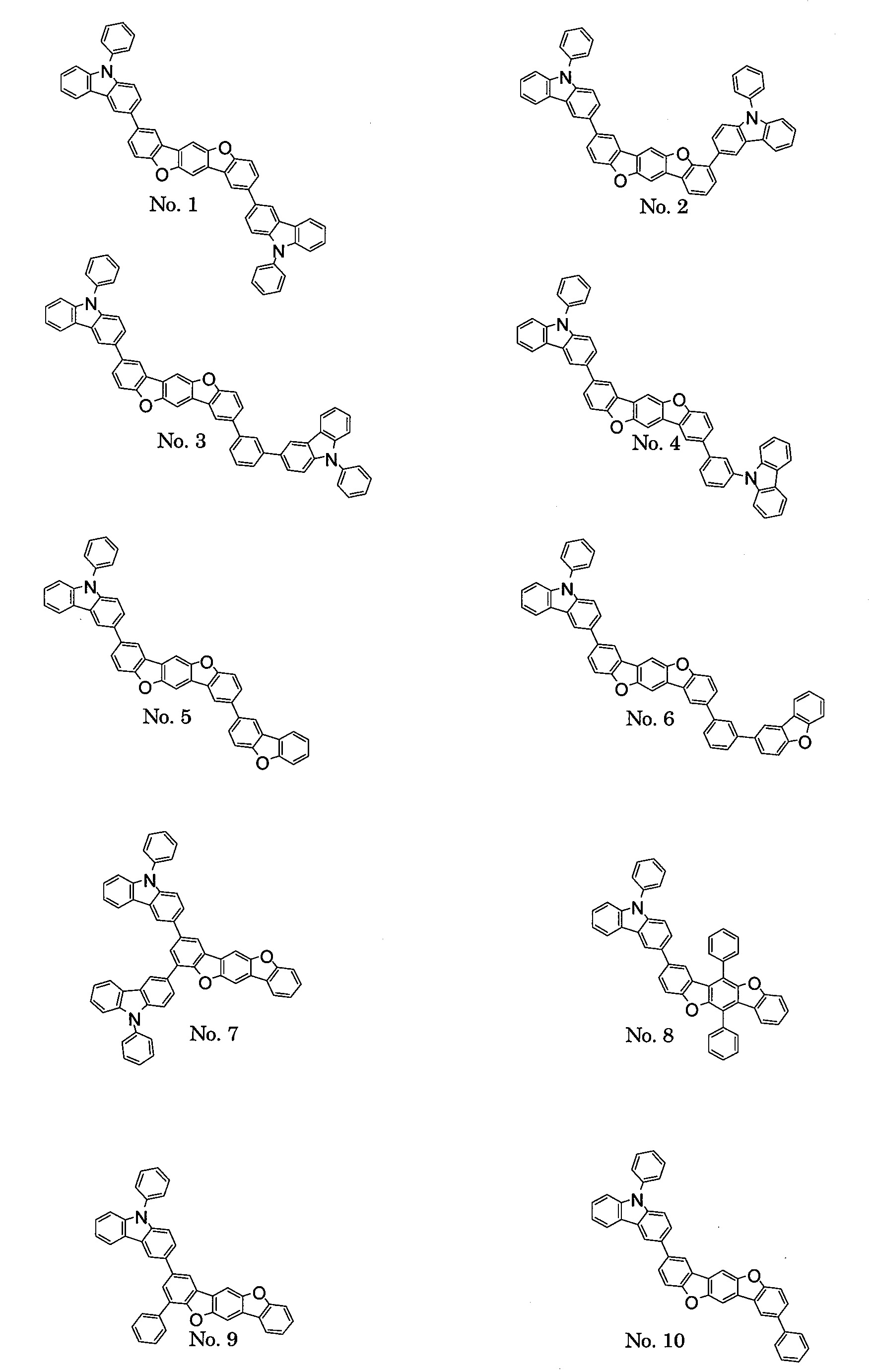
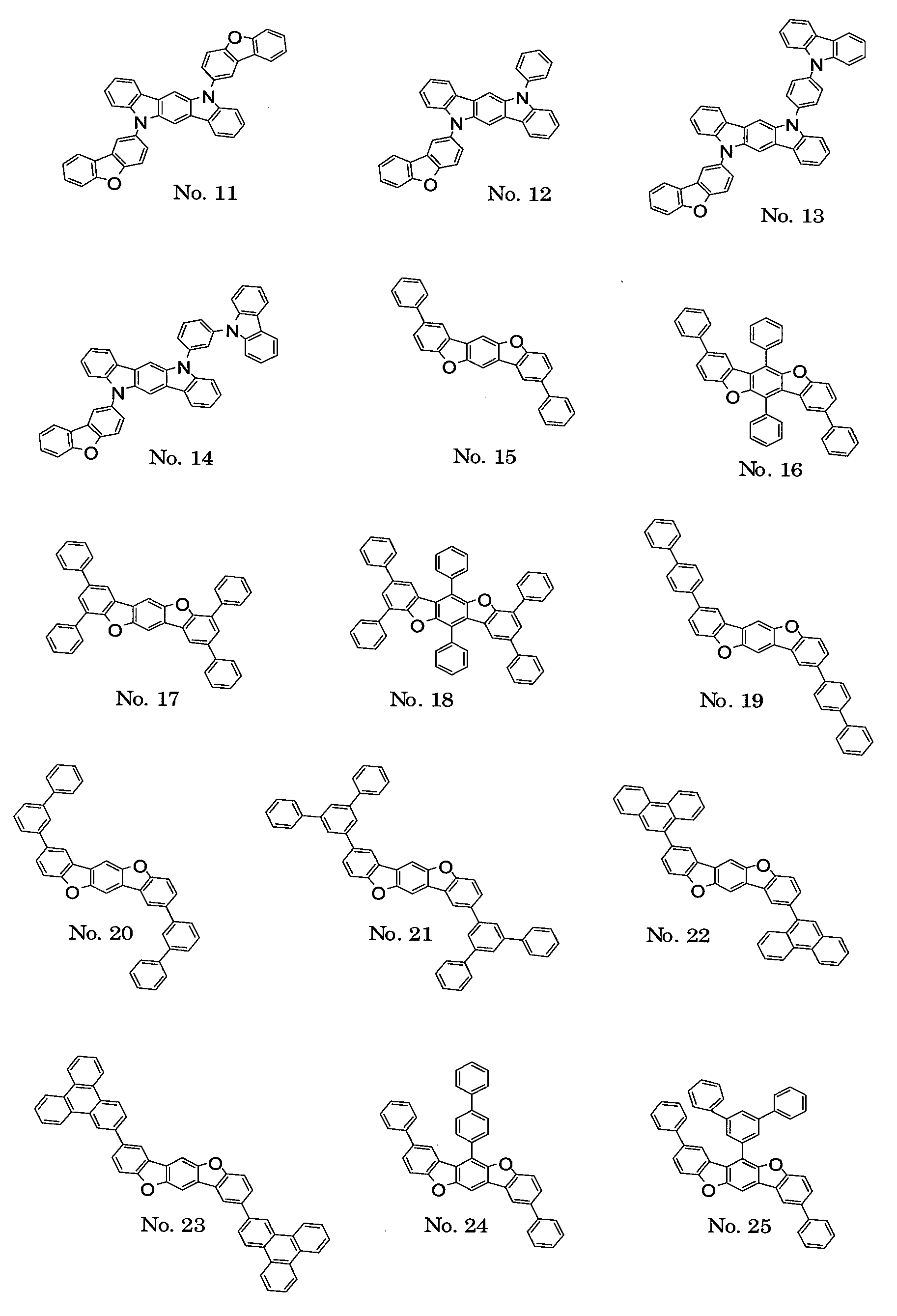

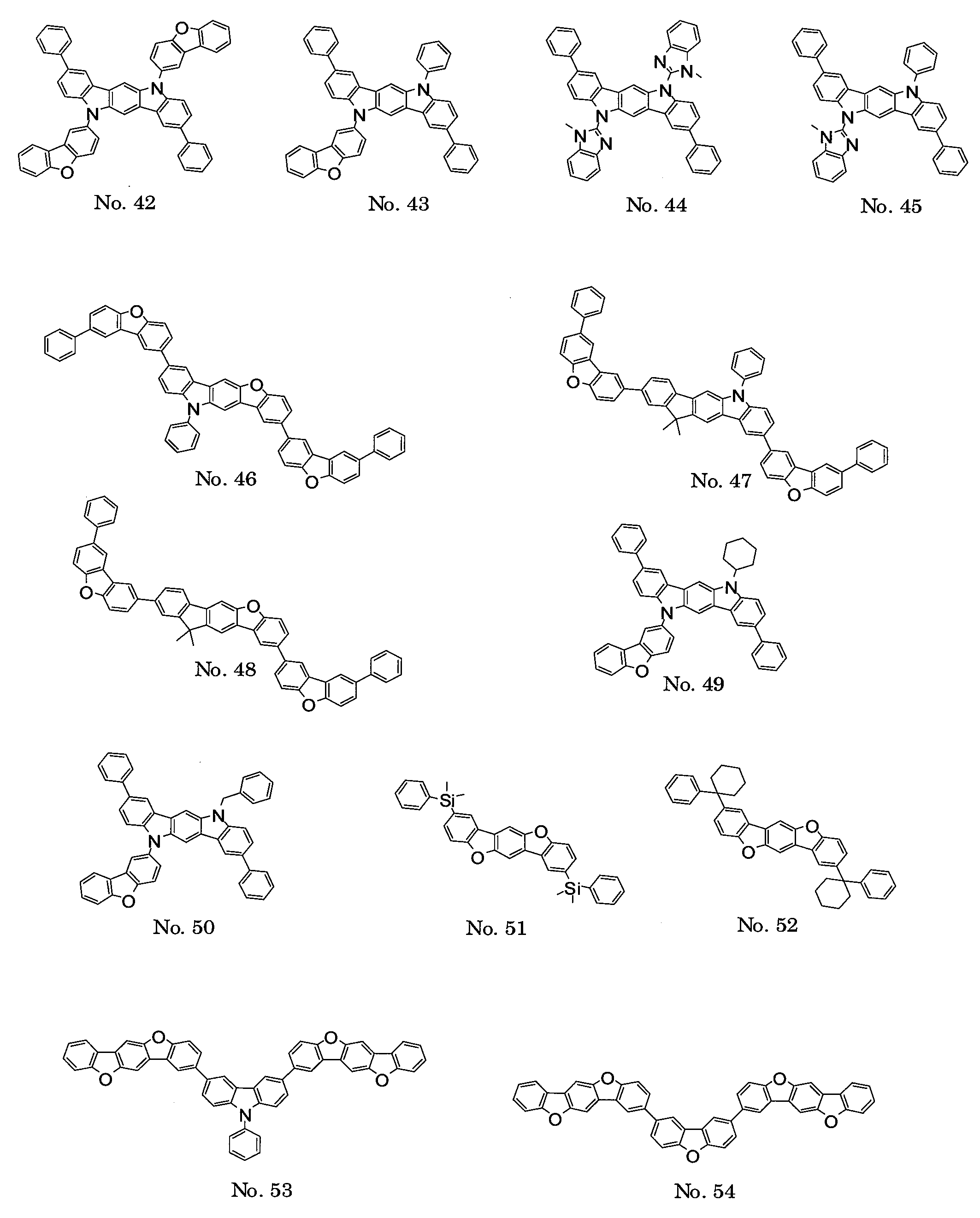

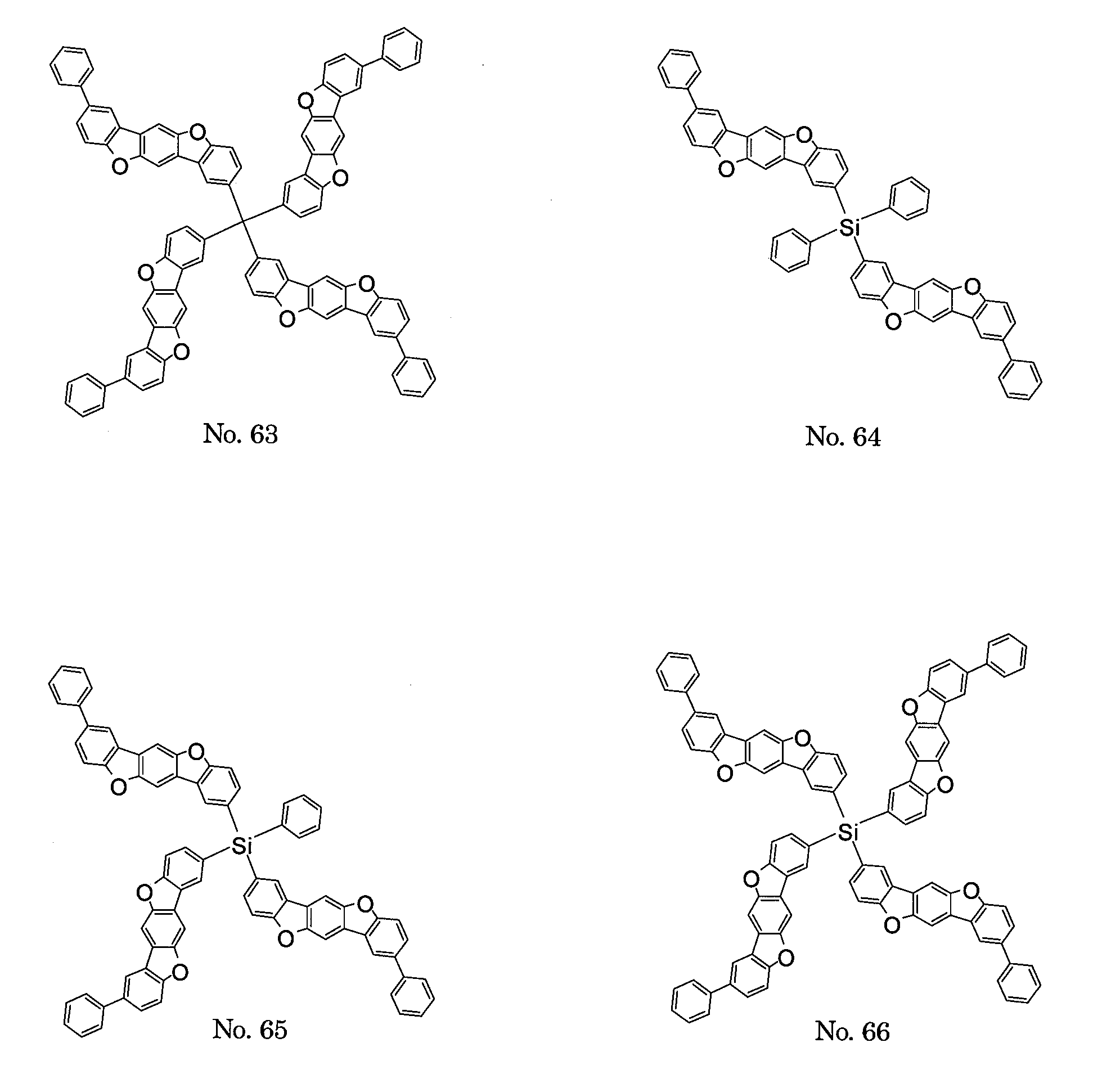
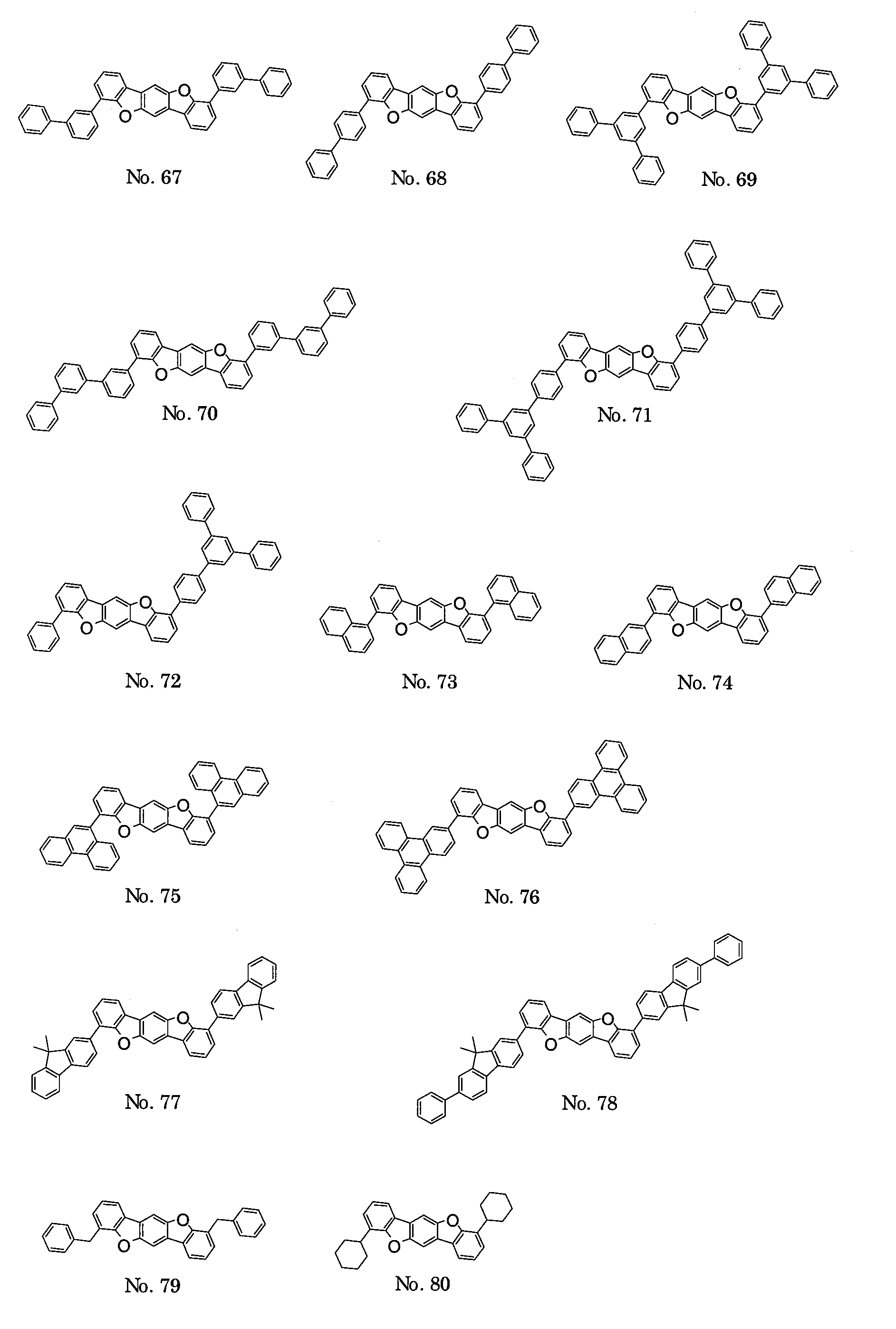

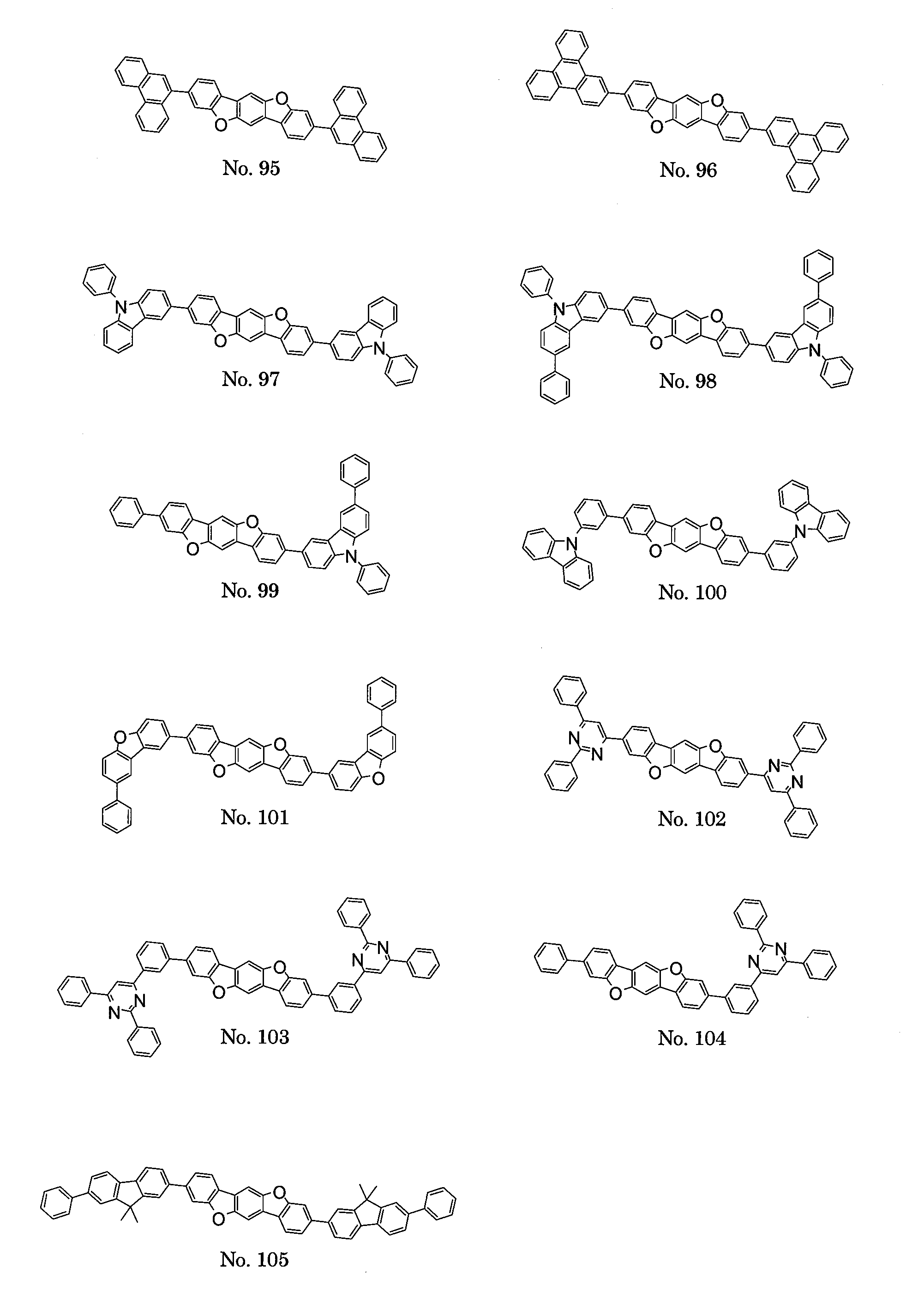
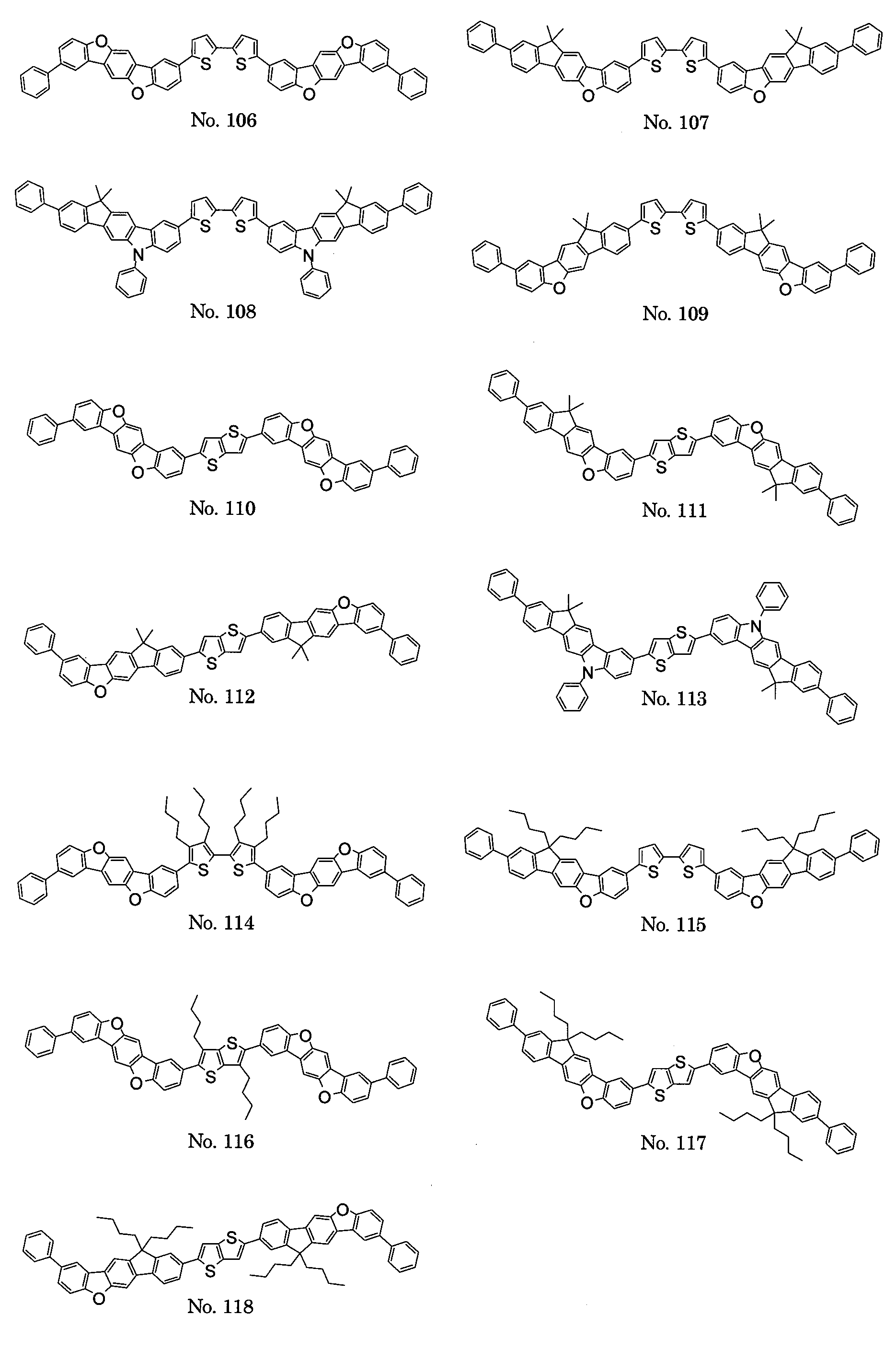
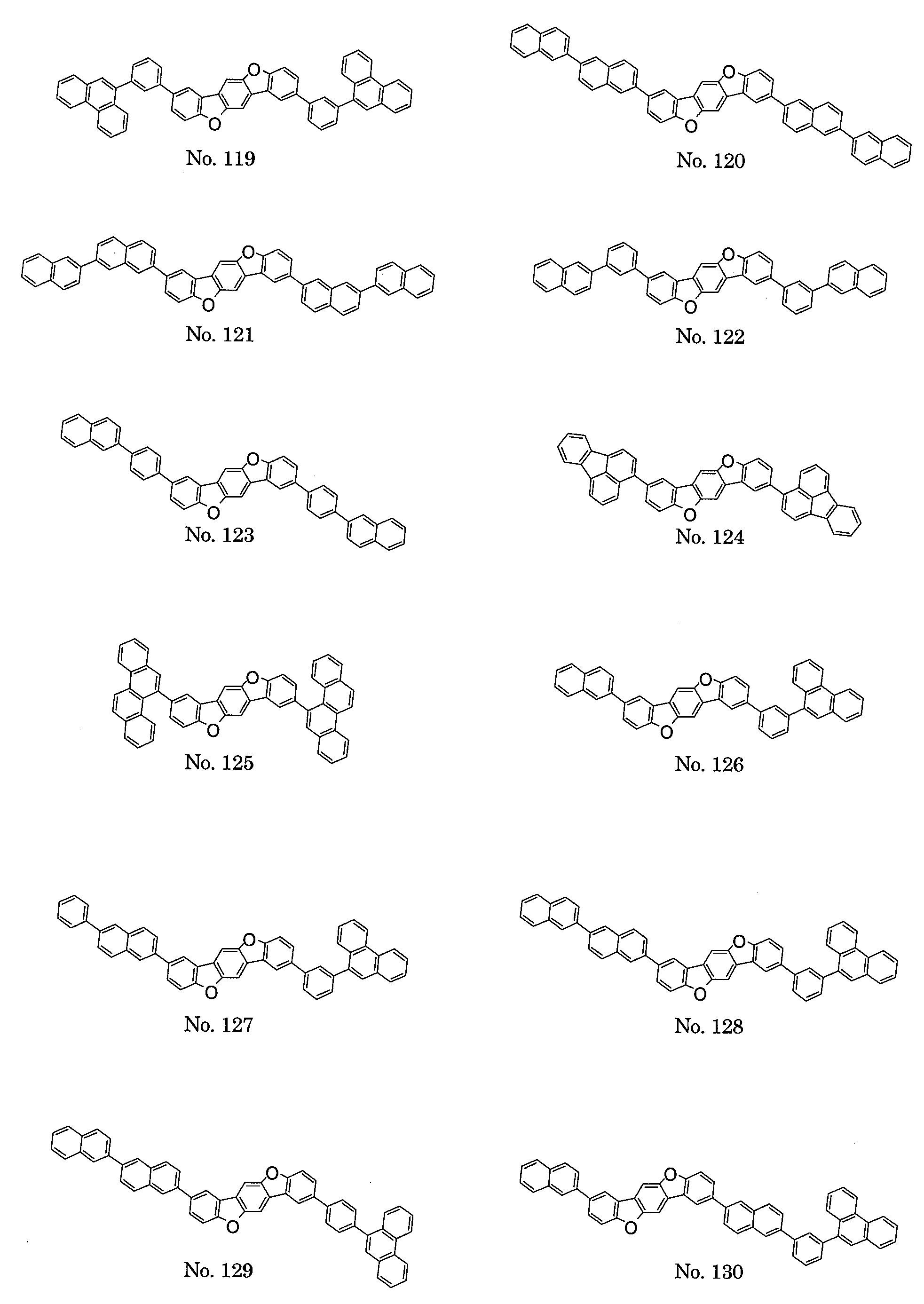
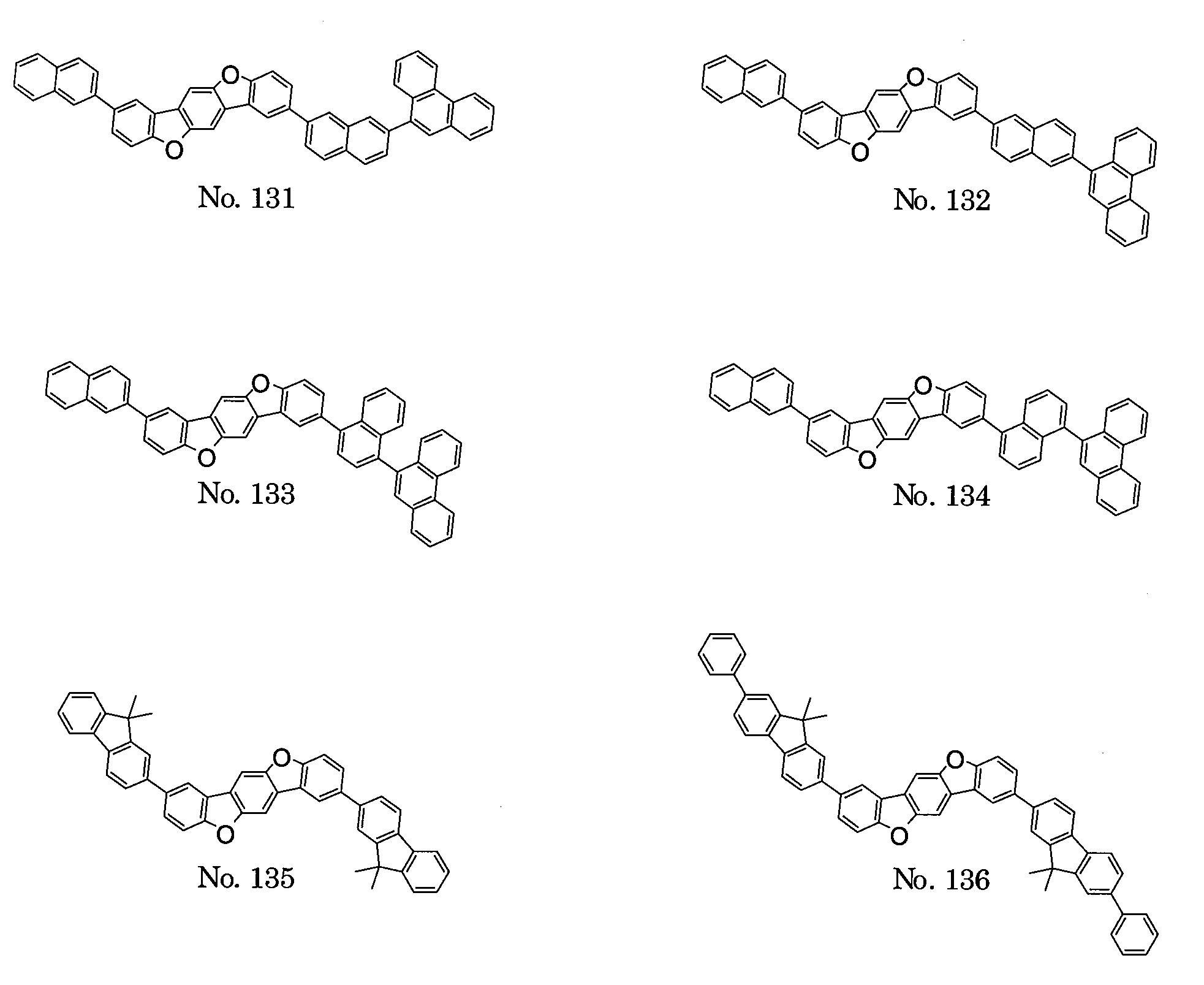

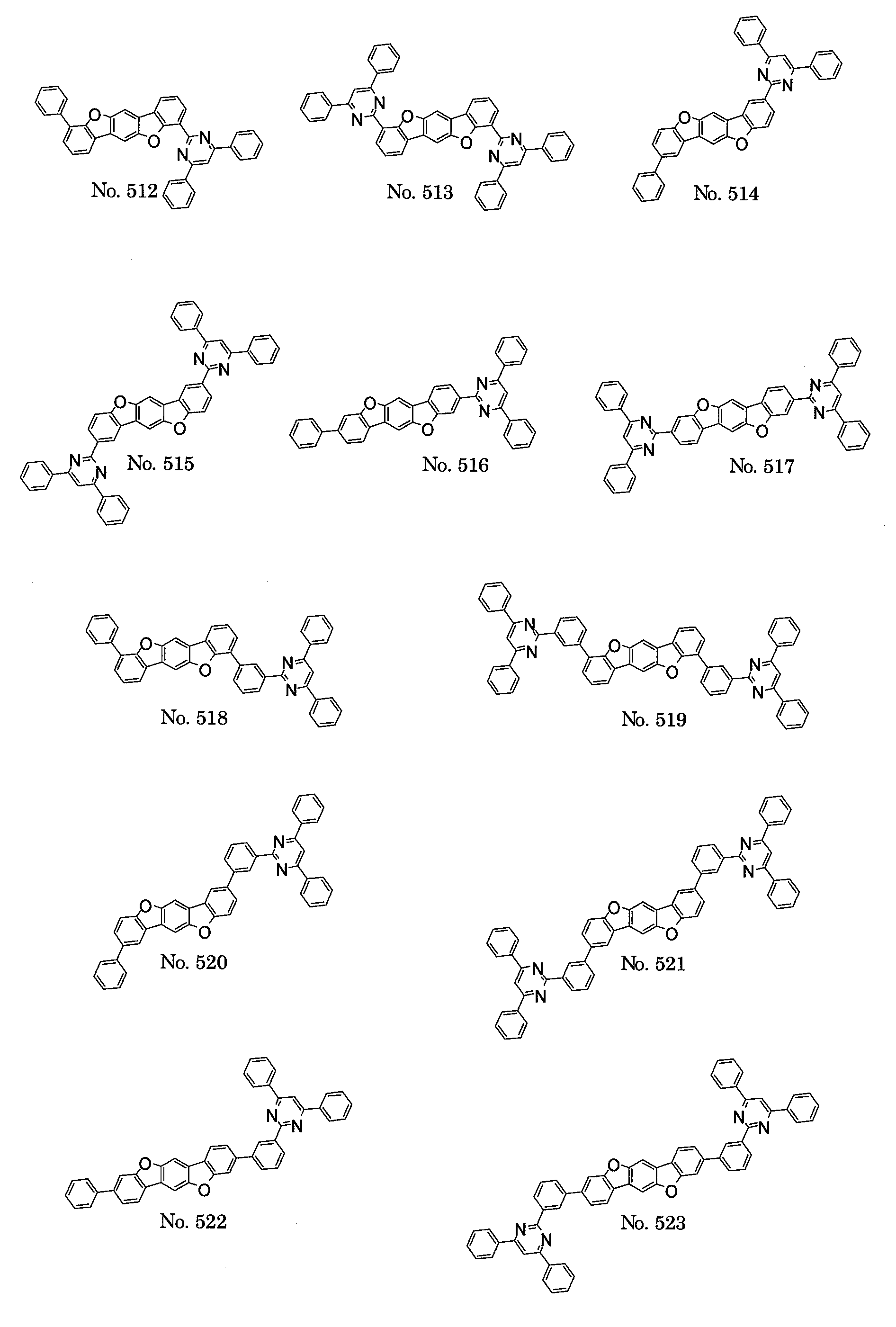

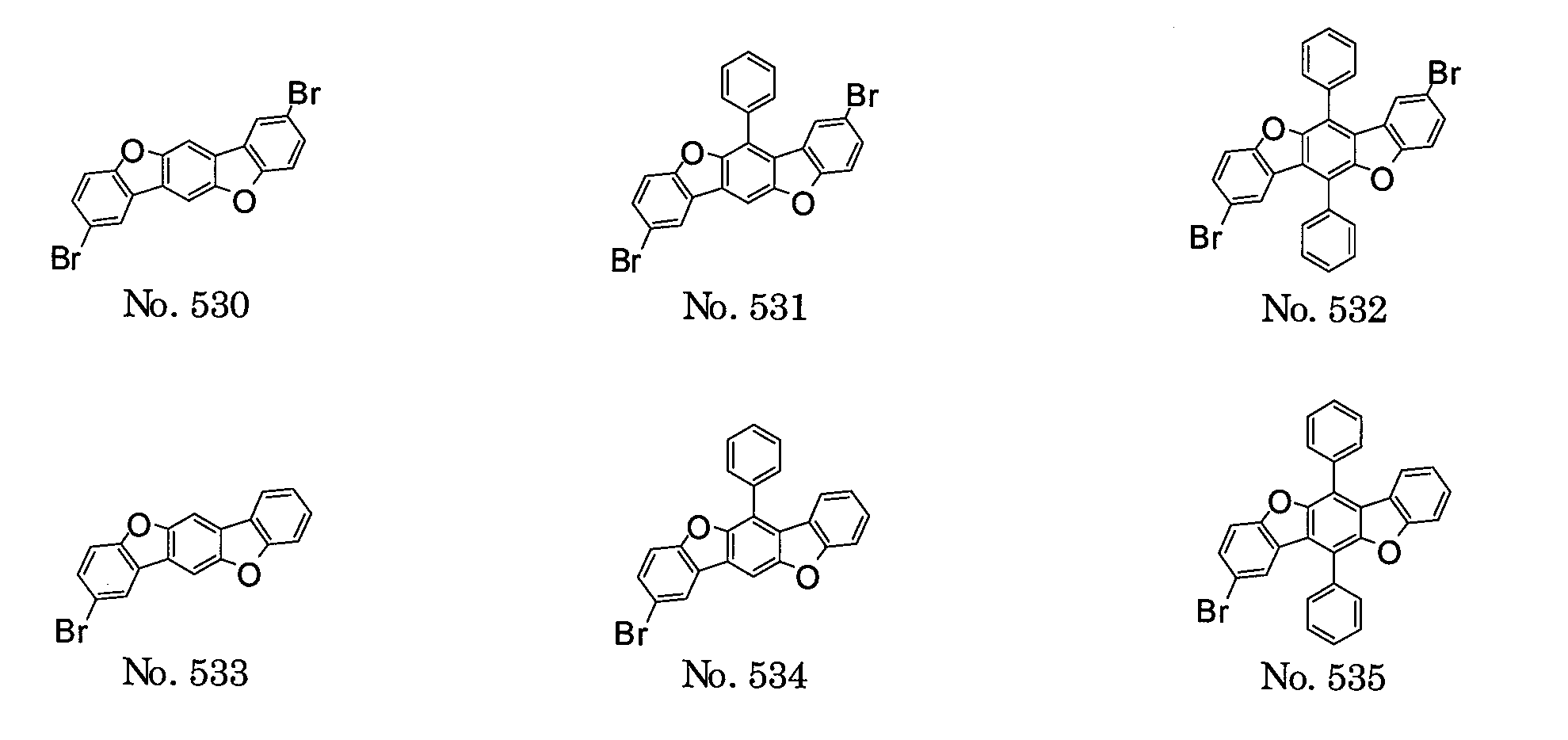
本発明の有機EL素子は、陰極と陽極間に、発光層を含む一層以上の有機薄膜層を有し、この有機薄膜層の少なくとも一層が、炭素原子、窒素原子、酸素原子または硫黄原子で架橋したπ共役ヘテロアセン骨格を有する多環系化合物を含有する。π共役ヘテロアセン骨格の具体例を以下に示す。





前記発光層と陰極との間に電子輸送層を有し、該電子輸送層が前記多環系化合物を含有しても良い。さらに、前記発光層と前記電子輸送層が共に前記多環系化合物を含有すると好ましい。
また、前記発光層と陽極との間に正孔輸送層を有し、該正孔輸送層が前記多環系化合物を含有しても良い。
さらに、本発明の多環系化合物は、少なくとも発光層に含有されていると好ましく、発光層に用いた場合は長寿命化が可能で、電子輸送層または電子注入層に用いた場合は低電圧化が可能で、発光層と電子輸送層または電子注入層との2つ以上の層に同時に含有されると低電圧化及び長寿命化が可能であることから好ましい。
特に、電子輸送層または電子注入層に加え、前記発光層が、本発明の多環系化合物をホスト材料として含有すると好ましく、下記式(20)~(27)のいずれかで表される有機EL素子用材料をホスト材料として含有すると好ましい。

前記R1、R2およびR3は、それぞれ独立に、炭素数1~20のアルキル基、置換もしくは無置換の環形成炭素数3~20のシクロアルキル基、炭素数7~24のアラルキル基、シリル基もしくは炭素数3~20の置換シリル基、置換もしくは無置換の環形成炭素数6~24の芳香族炭化水素基、または置換もしくは無置換の環形成原子数3~24の芳香族複素環基を表す。但し、X3とX4、またはX5とX6が共にN-R1の場合は、R1の少なくとも1つは置換もしくは無置換の環形成原子数8~24である1価の縮合芳香族複素環基を表す。
式(21)および(23)において、nは2、3または4を表し、それぞれL3を連結基とした2量体、3量体、4量体である。
式(20)~(23)において、L1は単結合、炭素数1~20のアルキレン基、置換もしくは無置換の環形成炭素数3~20のシクロアルキレン基、2価のシリル基もしくは炭素数2~20の2価の置換シリル基、置換もしくは無置換の環形成炭素数6~24の2価の芳香族炭化水素基、または環形成原子数3~24のベンゼン環aと炭素-炭素結合で連結する置換もしくは無置換の2価の芳香族複素環基を表す。
式(20)および(22)において、L2は単結合、炭素数1~20のアルキレン基、置換もしくは無置換の環形成炭素数3~20のシクロアルキレン基、2価のシリル基もしくは炭素数2~20の2価の置換シリル基、置換もしくは無置換である環形成炭素数6~24の2価の芳香族炭化水素基、または環形成原子数3~24のベンゼン環cと炭素-炭素結合で連結する置換もしくは無置換の2価の芳香族複素環基を表す。但し、X3とX4、またはX5とX6が共にCR2R3であり、かつL1、L2が共に置換もしくは無置換である環形成炭素数6~24の2価の芳香族炭化水素基である場合、L1、L2は同時にベンゼン環bに対してパラ位置に連結する場合は無い。
式(21)および(23)において、L3は、nが2の場合、単結合、炭素数1~20のアルキレン基、置換もしくは無置換の環形成炭素数3~20のシクロアルキレン基、2価のシリル基もしくは炭素数2~20の2価の置換シリル基、置換もしくは無置換の環形成炭素数6~24の2価の芳香族炭化水素基、または環形成原子数3~24でベンゼン環cと炭素-炭素結合で連結する置換もしくは無置換の2価の芳香族複素環基を表し、nが3の場合、炭素数1~20の3価の飽和炭化水素基、置換もしくは無置換の環形成炭素数3~20の3価の環状飽和炭化水素基、3価のシリル基もしくは炭素数1~20の3価の置換シリル基、置換もしくは無置換で環形成炭素数6~24の3価の芳香族炭化水素基、または原子数3~24でベンゼン環cと炭素-炭素結合で連結する置換もしくは無置換の3価の芳香族複素環基を表し、nが4の場合、炭素数1~20の4価の飽和炭化水素基、置換もしくは無置換の環形成炭素数3~20の4価の環状飽和炭化水素基、ケイ素原子、置換もしくは無置換の環形成炭素数6~24の4価の芳香族炭化水素基、または環形成原子数3~24でベンゼン環cと炭素-炭素結合で連結する置換もしくは無置換の4価の芳香族複素環基を表す。但し、X3とX4、またはX5とX6が共にCR2R3であり、かつL1、L3が共に置換もしくは無置換である環形成炭素数6~24の2価、3価あるいは4価の芳香族炭化水素基である場合、L1、L3は同時にベンゼン環bに対してパラ位置に連結する場合は無い。
式(20)~(23)において、A1は、水素原子、置換もしくは無置換の環形成炭素数3~20のシクロアルキル基、シリル基もしくは炭素数3~20の置換シリル基、置換もしくは無置換の環形成炭素数6~24の芳香族炭化水素基、または環形成原子数3~24でL1と炭素-炭素結合で連結する芳香族複素環基を表す。但し、L1が炭素数1~20のアルキレン基である場合、A1は水素原子である場合はない。
式(20)および(22)において、A2は、水素原子、置換もしくは無置換の環形成炭素数3~20のシクロアルキル基、シリル基もしくは炭素数3~20の置換シリル基、置換もしくは無置換の環形成炭素数6~24の芳香族炭化水素基、または環形成原子数3~24でL2と炭素-炭素結合で連結する芳香族複素環基を表す。但し、L2が炭素数1~20のアルキレン基である場合、A2は水素原子である場合はない。
式(20)~(23)において、Y1、Y2およびY3は、炭素数1~20のアルキル基、置換もしくは無置換の環形成炭素数3~20のシクロアルキル基、炭素数1~20のアルコキシ基、炭素数7~24のアラルキル基、シリル基もしくは炭素数3~20の置換シリル基、置換もしくは無置換の環形成炭素数6~24の芳香族炭化水素基、または置換もしくは無置換の環形成原子数3~24でベンゼン環a、b、cと炭素-炭素結合で連結する芳香族複素環基を表す。d、fは0、1、2または3、eは0、1または2である。但し、X3とX4、またはX5とX6が、酸素(O)、硫黄(S)、もしくはCR2R3であり、L1、L2が共に単結合であり、かつA1とA2が共に水素原子である場合、ベンゼン環bはY2を一個または二個有し、Y2がメチル基または無置換のフェニル基である場合は無い。
式(20)~(23)において、A1、A2、L1、L2およびL3は、カルボニル基を含まない。]
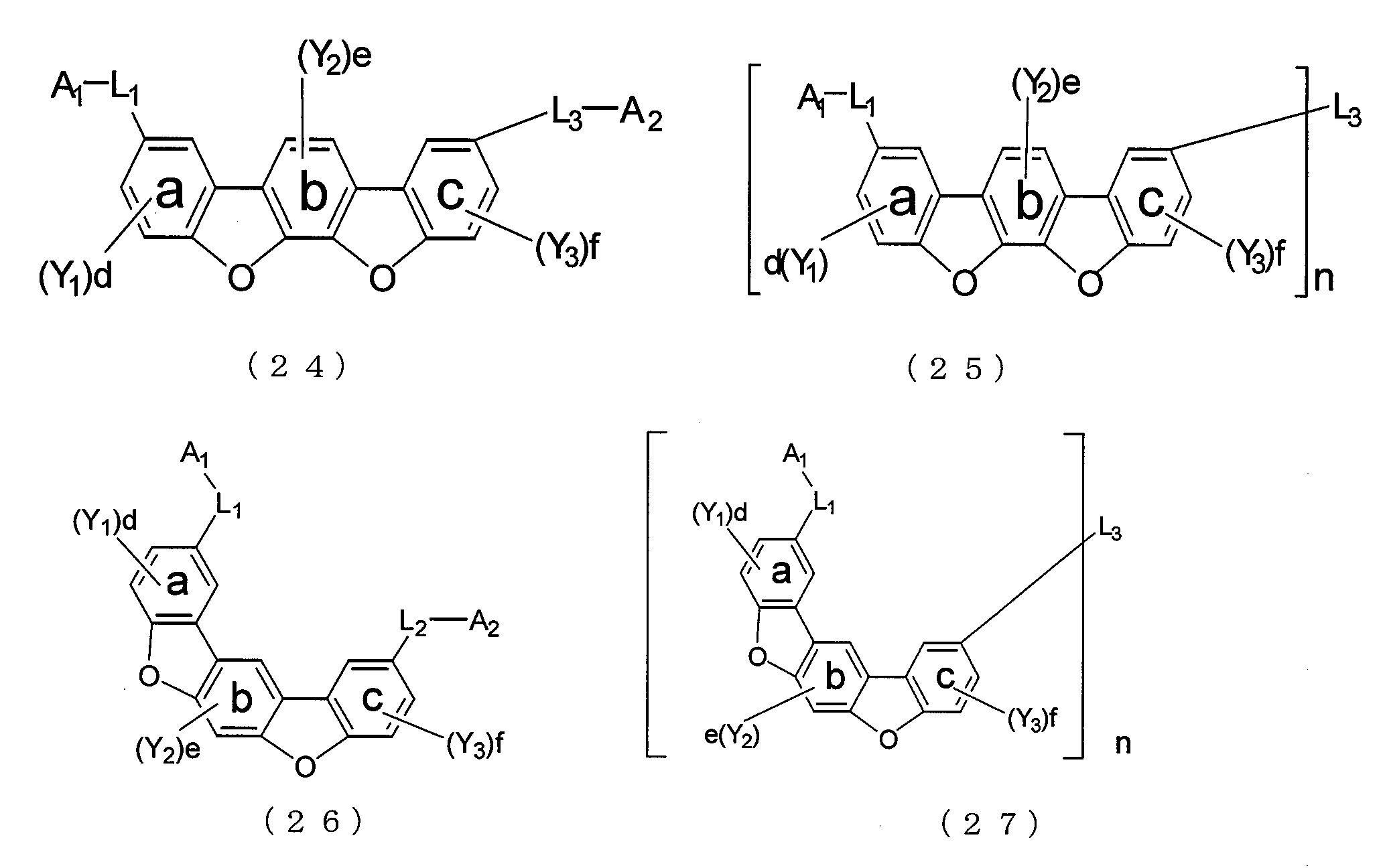
式(24)~(27)において、L1は単結合、炭素数1~20のアルキレン基、置換もしくは無置換の環形成炭素数3~20のシクロアルキレン基、2価のシリル基もしくは炭素数2~20の2価の置換シリル基、置換もしくは無置換の環形成炭素数6~24の2価の芳香族炭化水素基、または環形成原子数3~24のベンゼン環aと炭素-炭素結合で連結する置換もしくは無置換の2価の芳香族複素環基を表す。
式(24)および(26)において、L2は単結合、炭素数1~20のアルキレン基、置換もしくは無置換の環形成炭素数3~20のシクロアルキレン基、2価のシリル基もしくは炭素数2~20の2価の置換シリル基、置換もしくは無置換である環形成炭素数6~24の2価の芳香族炭化水素基、または環形成原子数3~24のベンゼン環cと炭素-炭素結合で連結する置換もしくは無置換の2価の芳香族複素環基を表す。
式(25)および(27)において、L3は、nが2の場合、単結合、炭素数1~20のアルキレン基、置換もしくは無置換の環形成炭素数3~20のシクロアルキレン基、2価のシリル基もしくは炭素数2~20の2価の置換シリル基、置換もしくは無置換の環形成炭素数6~24の2価の芳香族炭化水素基、または環形成原子数3~24でベンゼン環cと炭素-炭素結合で連結する置換もしくは無置換の2価の芳香族複素環基を表し、nが3の場合、炭素数1~20の3価の飽和炭化水素基、置換もしくは無置換の環形成炭素数3~20の3価の環状飽和炭化水素基、3価のシリル基もしくは炭素数1~20の3価の置換シリル基、置換もしくは無置換で環形成炭素数6~24の3価の芳香族炭化水素基、または原子数3~24でベンゼン環cと炭素-炭素結合で連結する置換もしくは無置換の3価の芳香族複素環基を表し、nが4の場合、炭素数1~20の4価の飽和炭化水素基、置換もしくは無置換の環形成炭素数3~20の4価の環状飽和炭化水素基、ケイ素原子、置換もしくは無置換の環形成炭素数6~24の4価の芳香族炭化水素基、または環形成原子数3~24でベンゼン環cと炭素-炭素結合で連結する置換もしくは無置換の4価の芳香族複素環基を表す。
式(24)~(27)において、A1は、水素原子、置換もしくは無置換の環形成炭素数3~20のシクロアルキル基、シリル基もしくは炭素数3~20の置換シリル基、置換もしくは無置換の環形成炭素数6~24の芳香族炭化水素基、または環形成原子数3~24でL1と炭素-炭素結合で連結する芳香族複素環基を表す。但し、L1が炭素数1~20のアルキレン基である場合、A1は水素原子である場合はない。
式(24)および(26)において、A2は、水素原子、置換もしくは無置換の環形成炭素数3~20のシクロアルキル基、シリル基もしくは炭素数3~20の置換シリル基、置換もしくは無置換の環形成炭素数6~24の芳香族炭化水素基、または環形成原子数3~24でL2と炭素-炭素結合で連結する芳香族複素環基を表す。但し、L2が炭素数1~20のアルキレン基である場合、A2は水素原子である場合はない。
式(24)~(27)において、Y1、Y2およびY3は、炭素数1~20のアルキル基、置換もしくは無置換の環形成炭素数3~20のシクロアルキル基、炭素数1~20のアルコキシ基、炭素数7~24のアラルキル基、シリル基もしくは炭素数3~20の置換シリル基、置換もしくは無置換の環形成炭素数6~24の芳香族炭化水素基、または置換もしくは無置換の環形成原子数3~24でベンゼン環a、b、cと炭素-炭素結合で連結する芳香族複素環基を表す。d、fは0、1、2または3、eは0、1または2である。但し、L1、L2が共に単結合であり、かつA1とA2が共に水素原子である場合、ベンゼン環bはY2を一個または二個有し、Y2がメチル基または無置換のフェニル基である場合は無い。
式(24)~(27)において、A1、A2、L1、L2およびL3は、カルボニル基を含まない。]
本発明の式(20)~(27)で表される有機EL素子用材料の具体例を以下に示すが、本発明は、これら例示化合物に限定されるものではない。
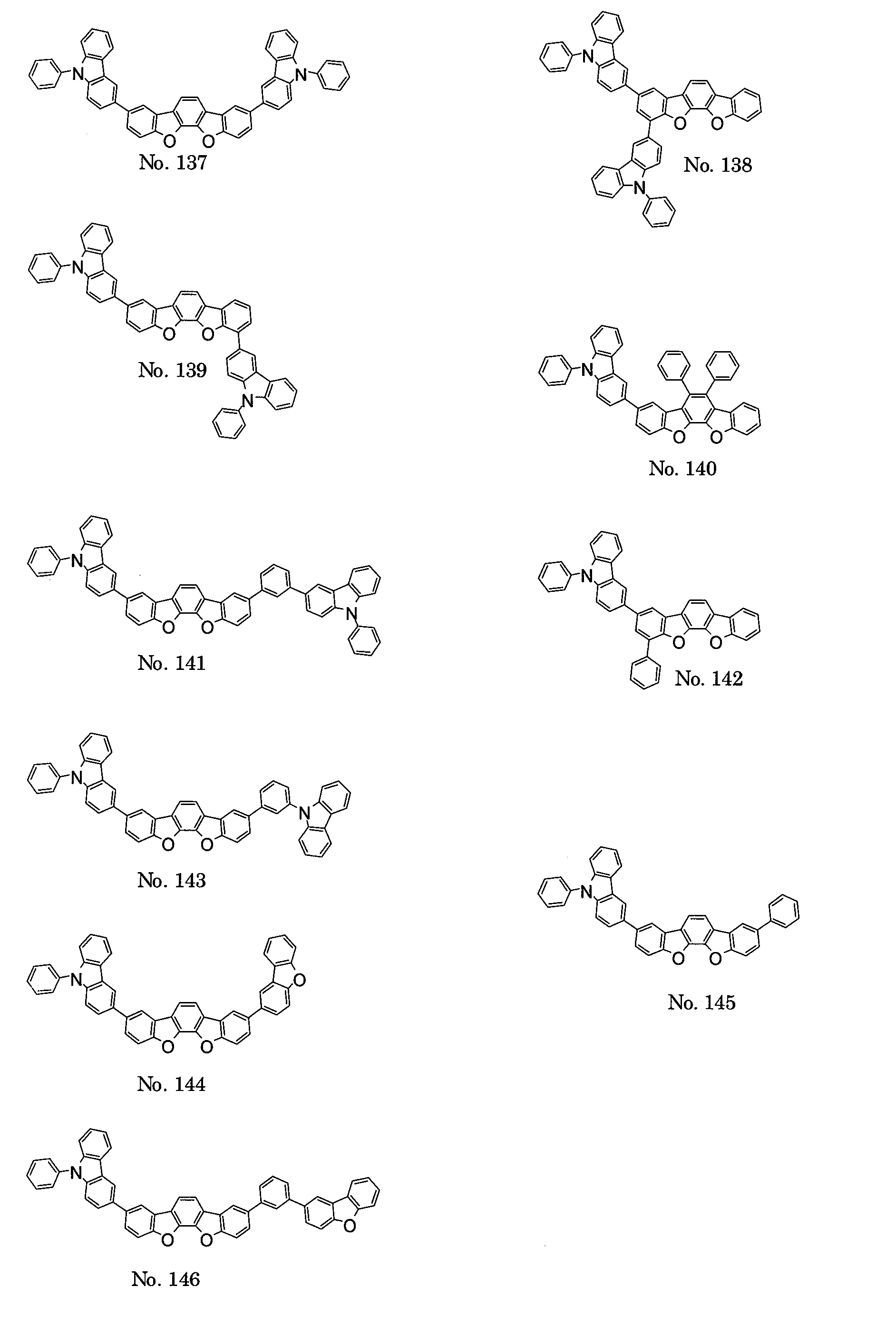

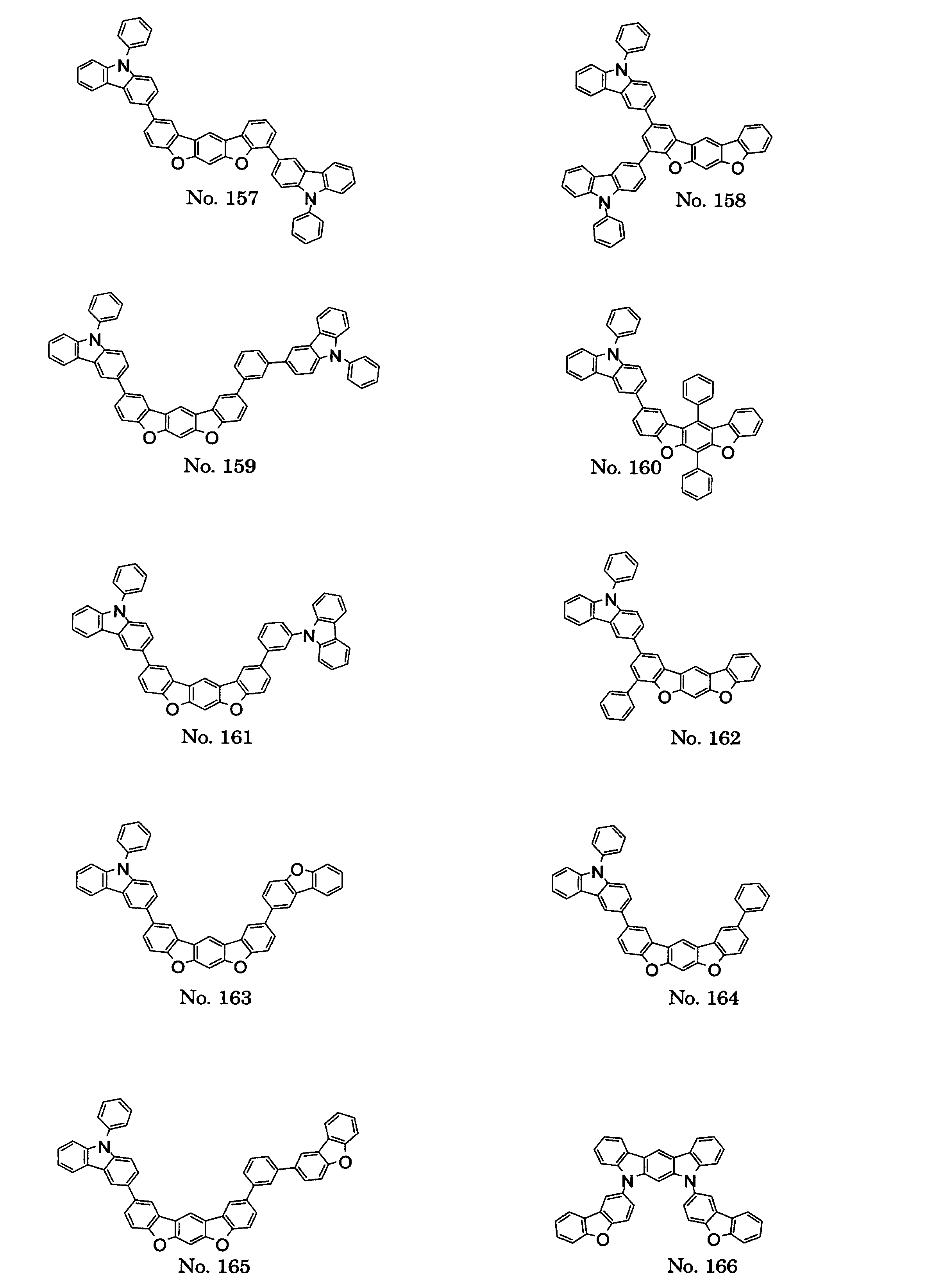

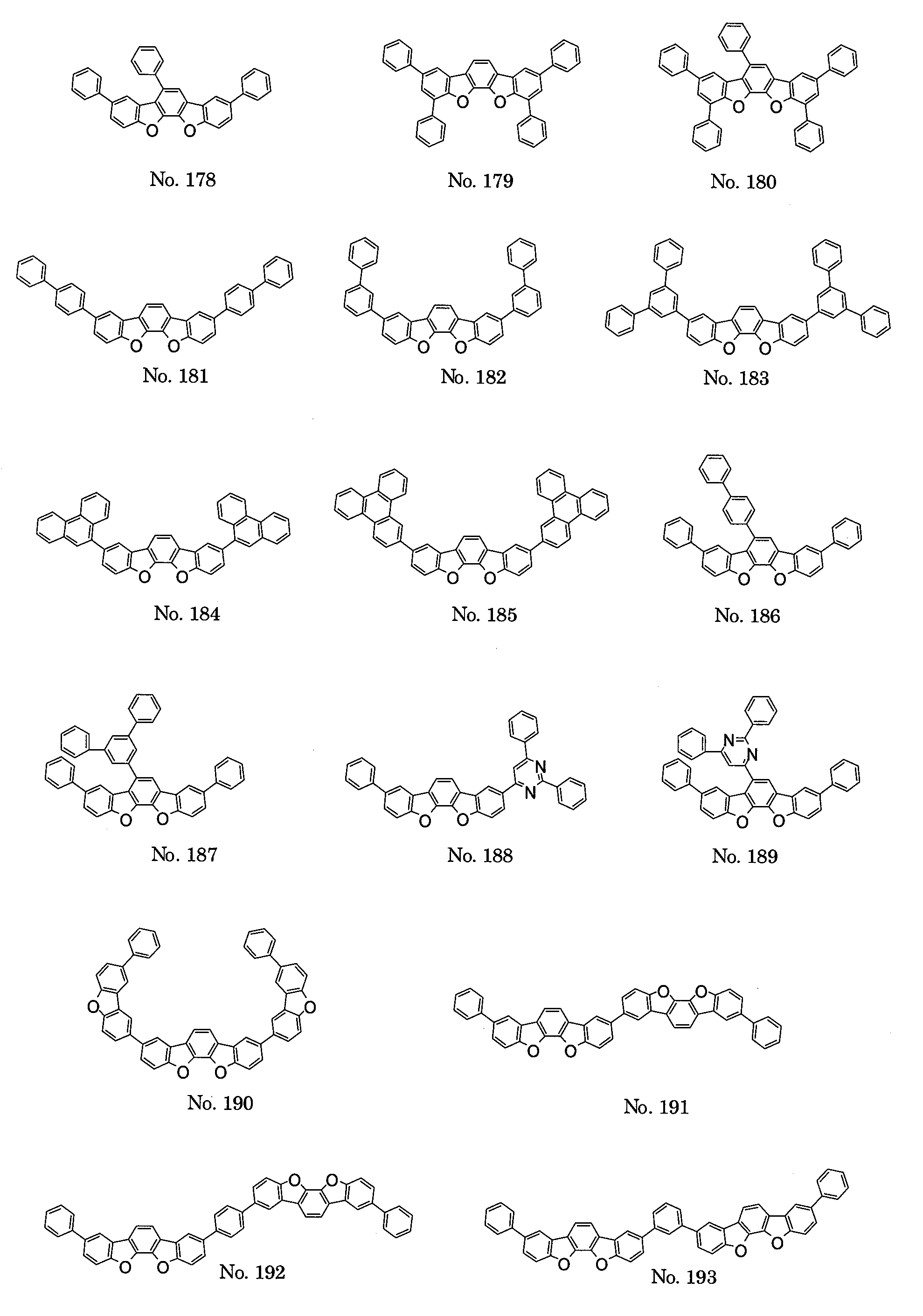

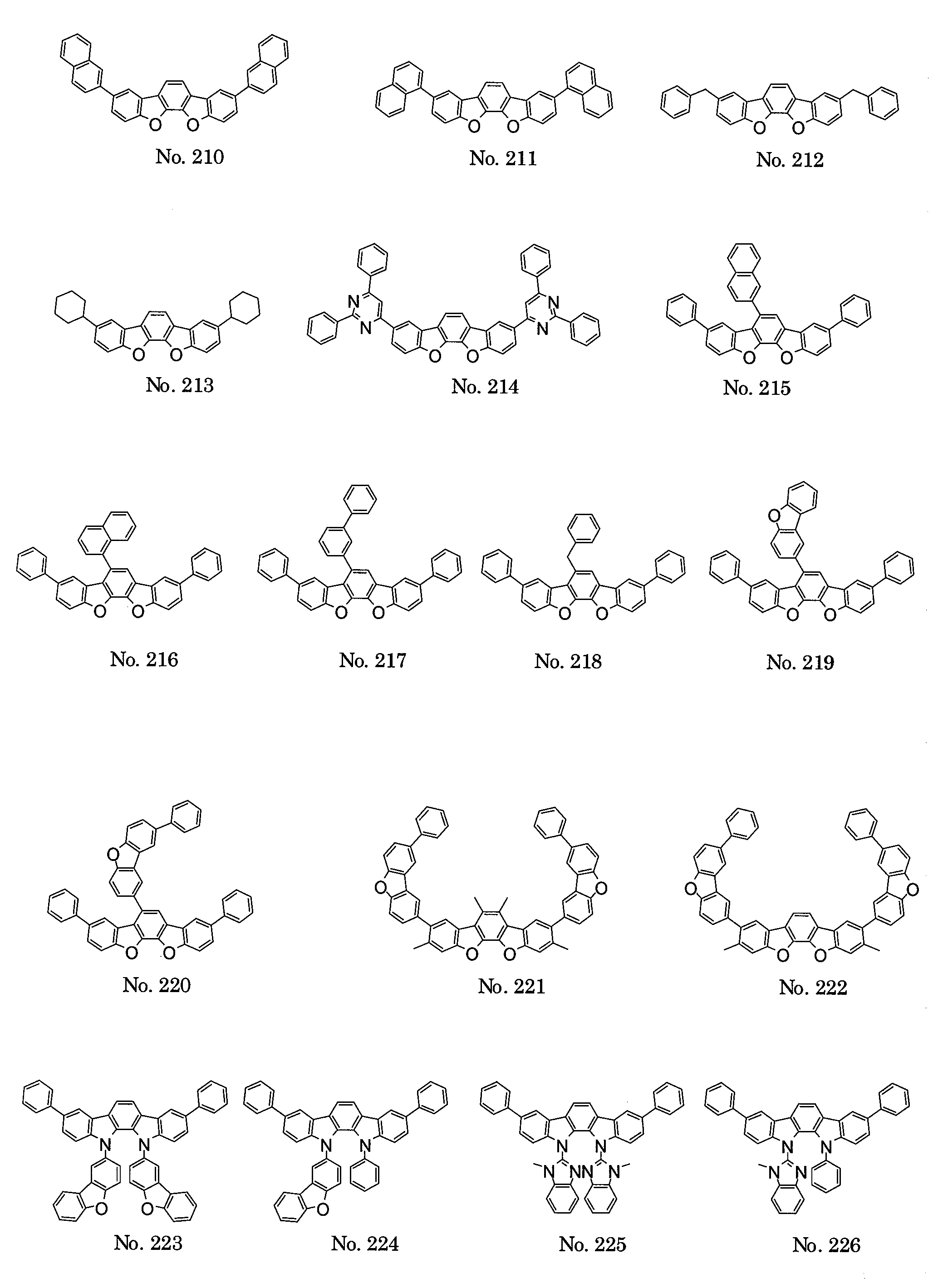

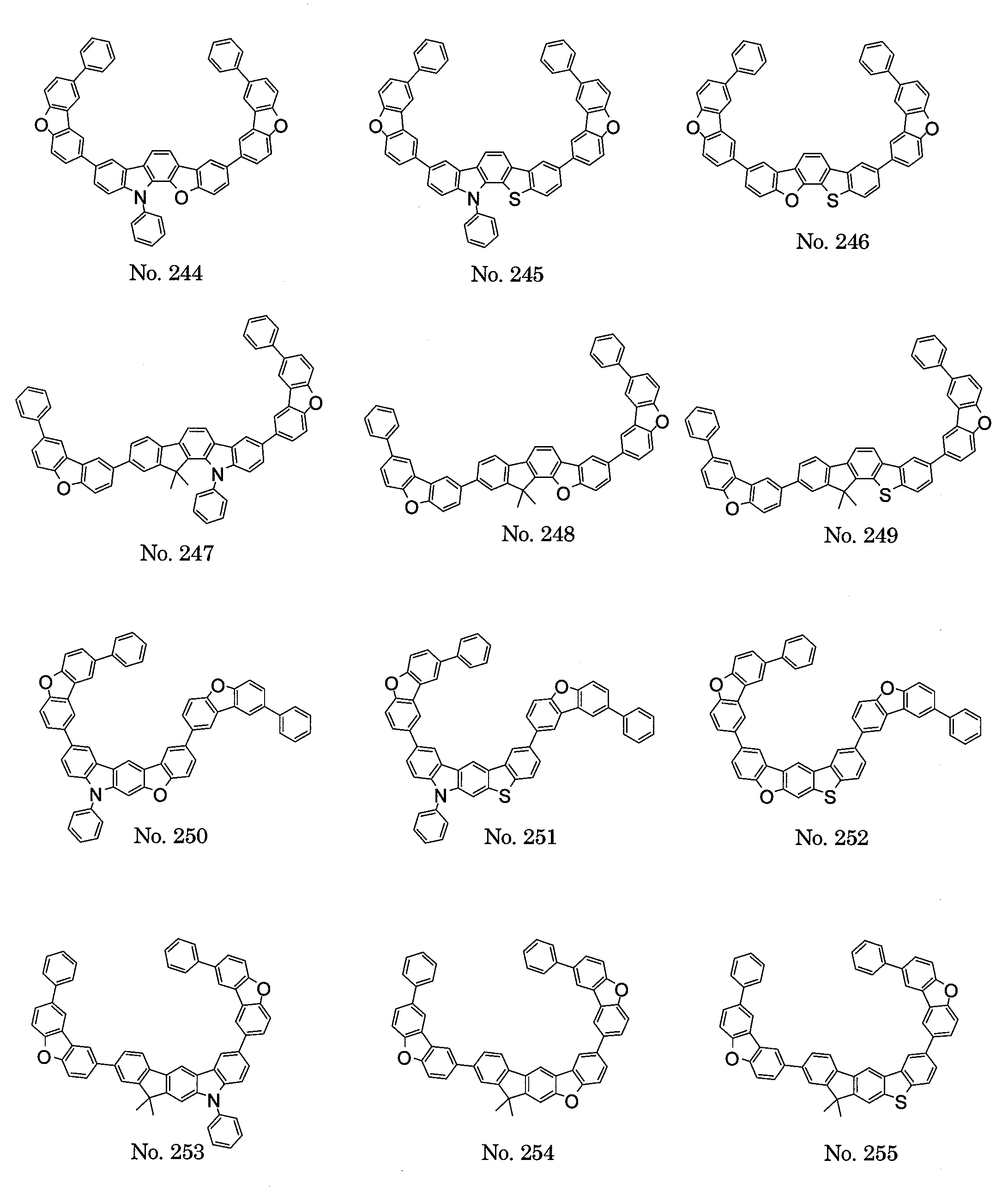
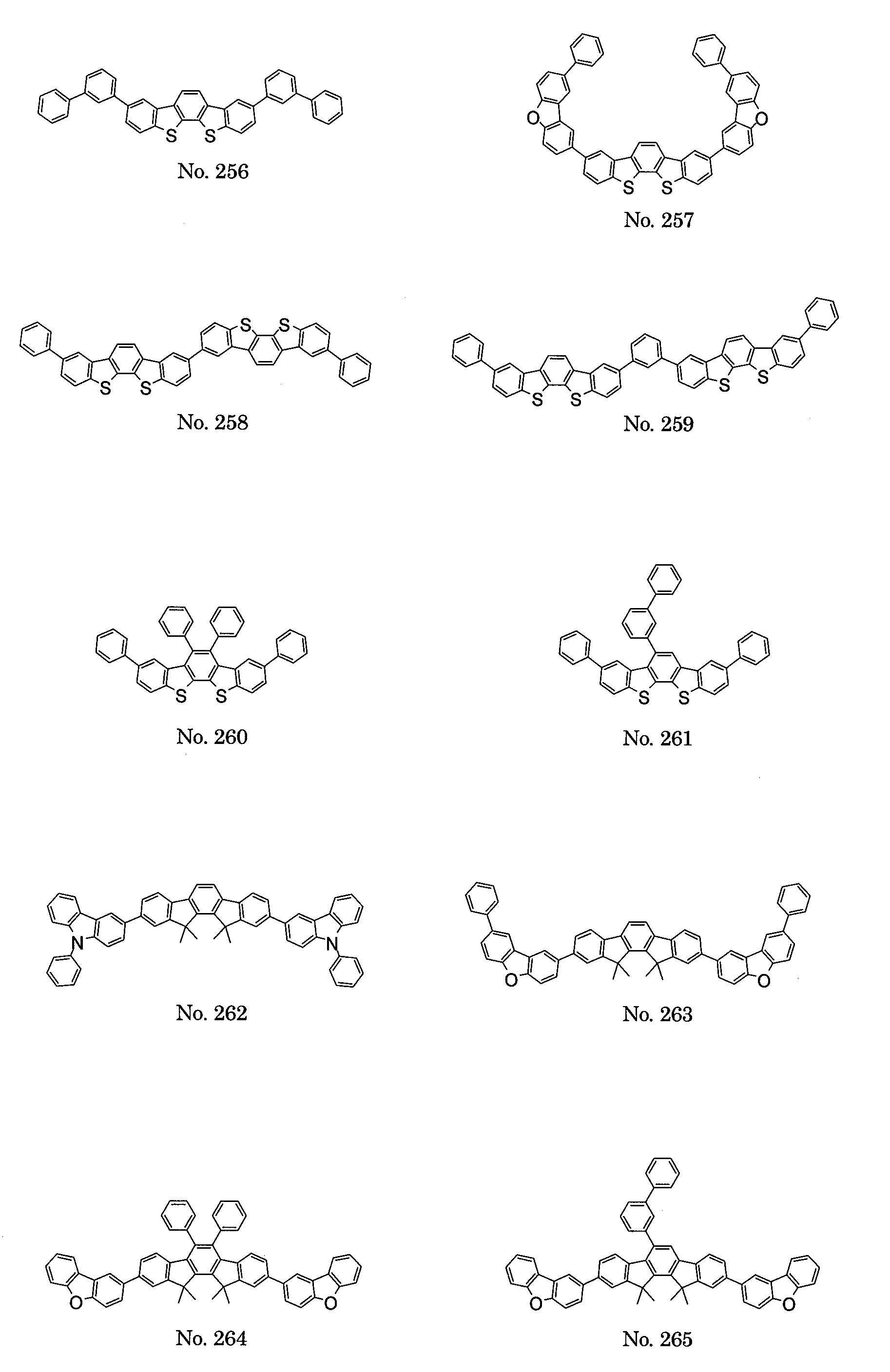
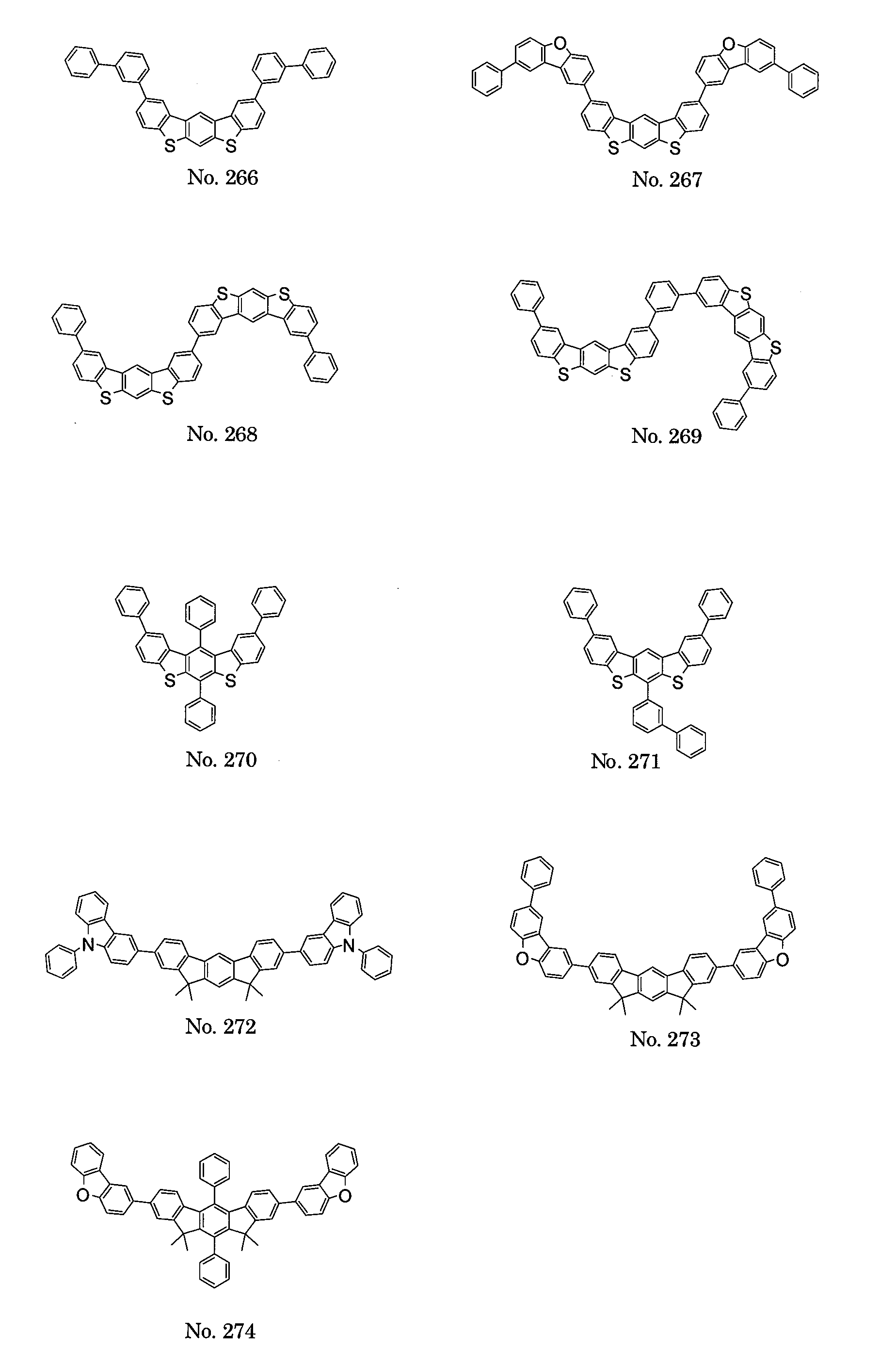


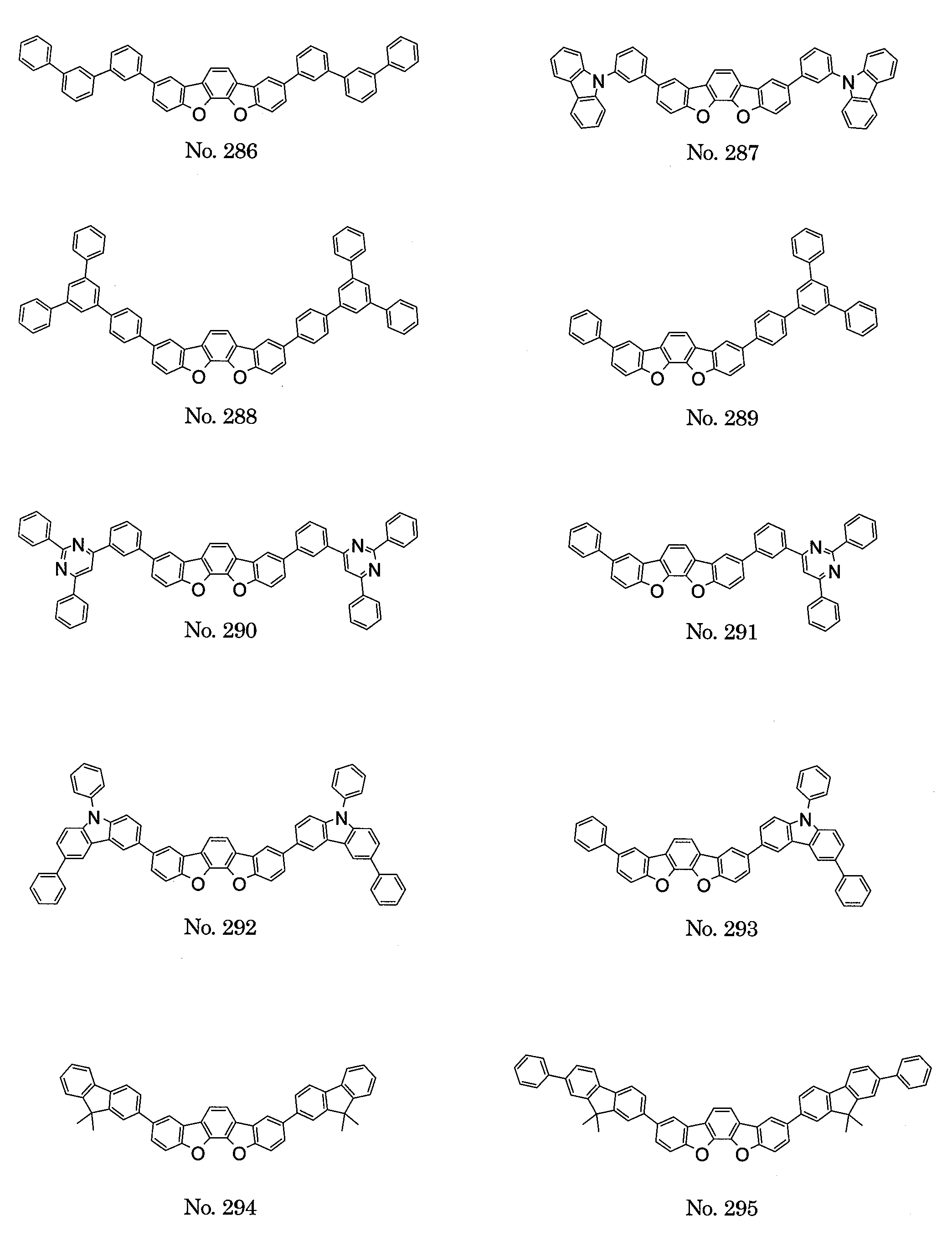
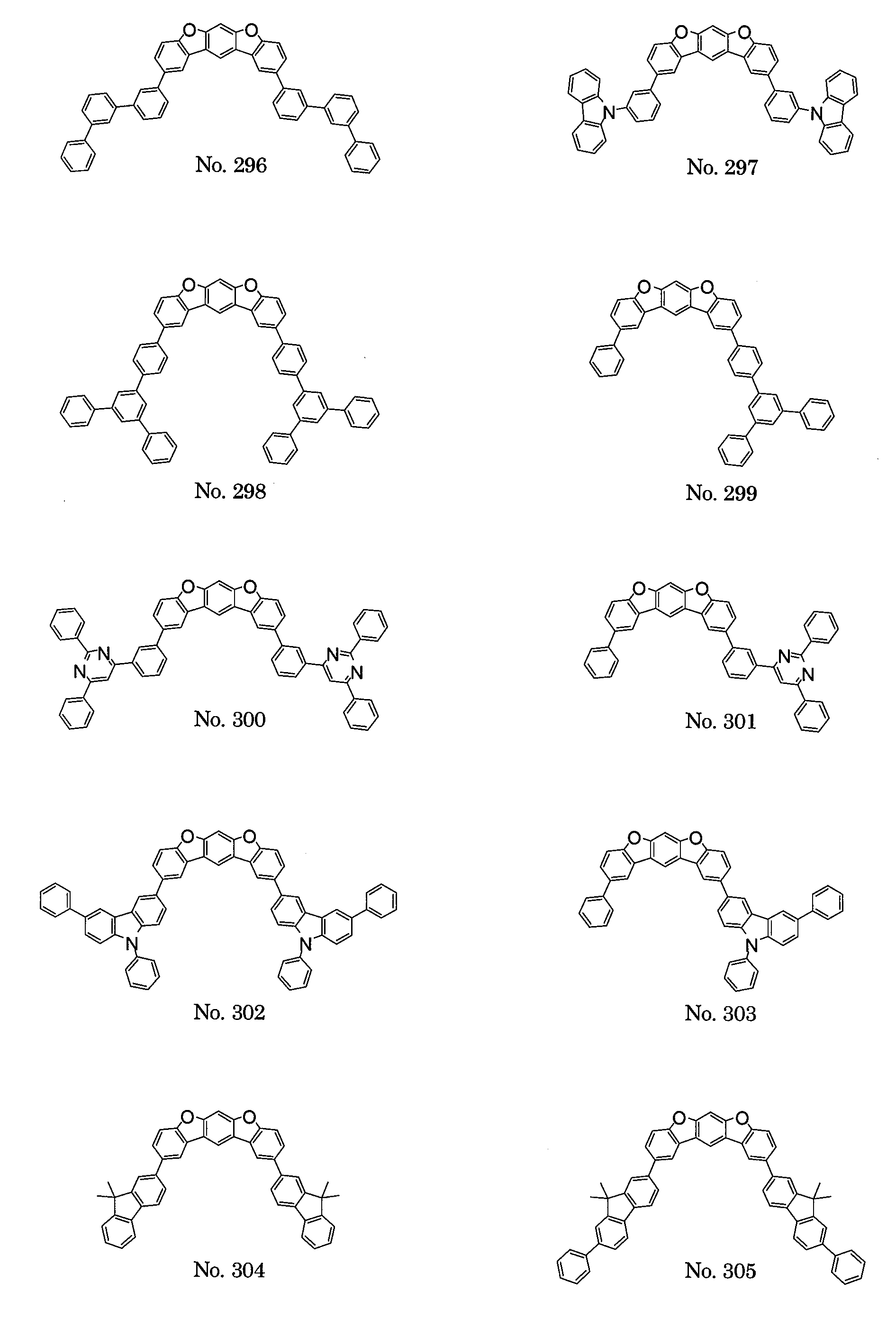


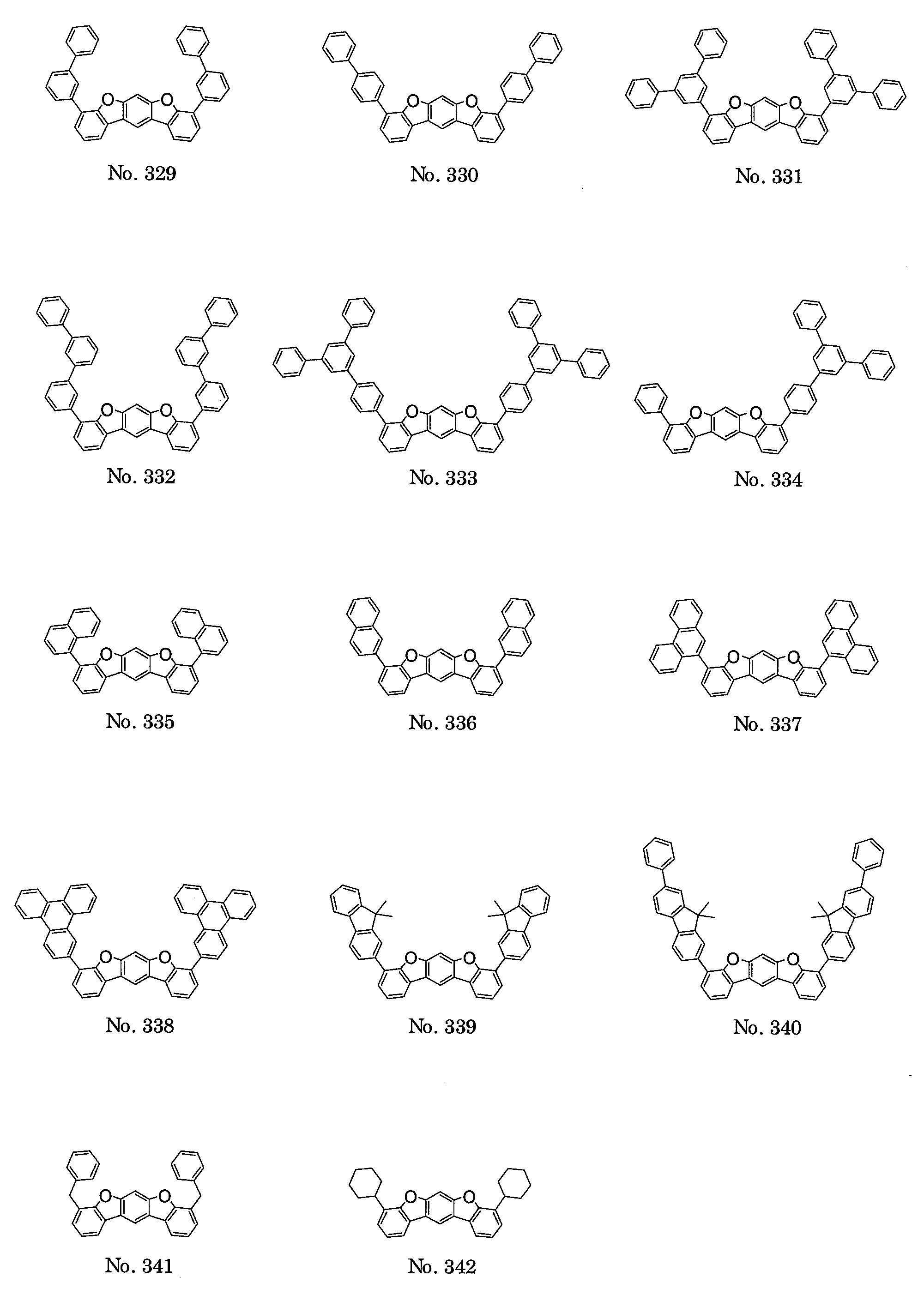
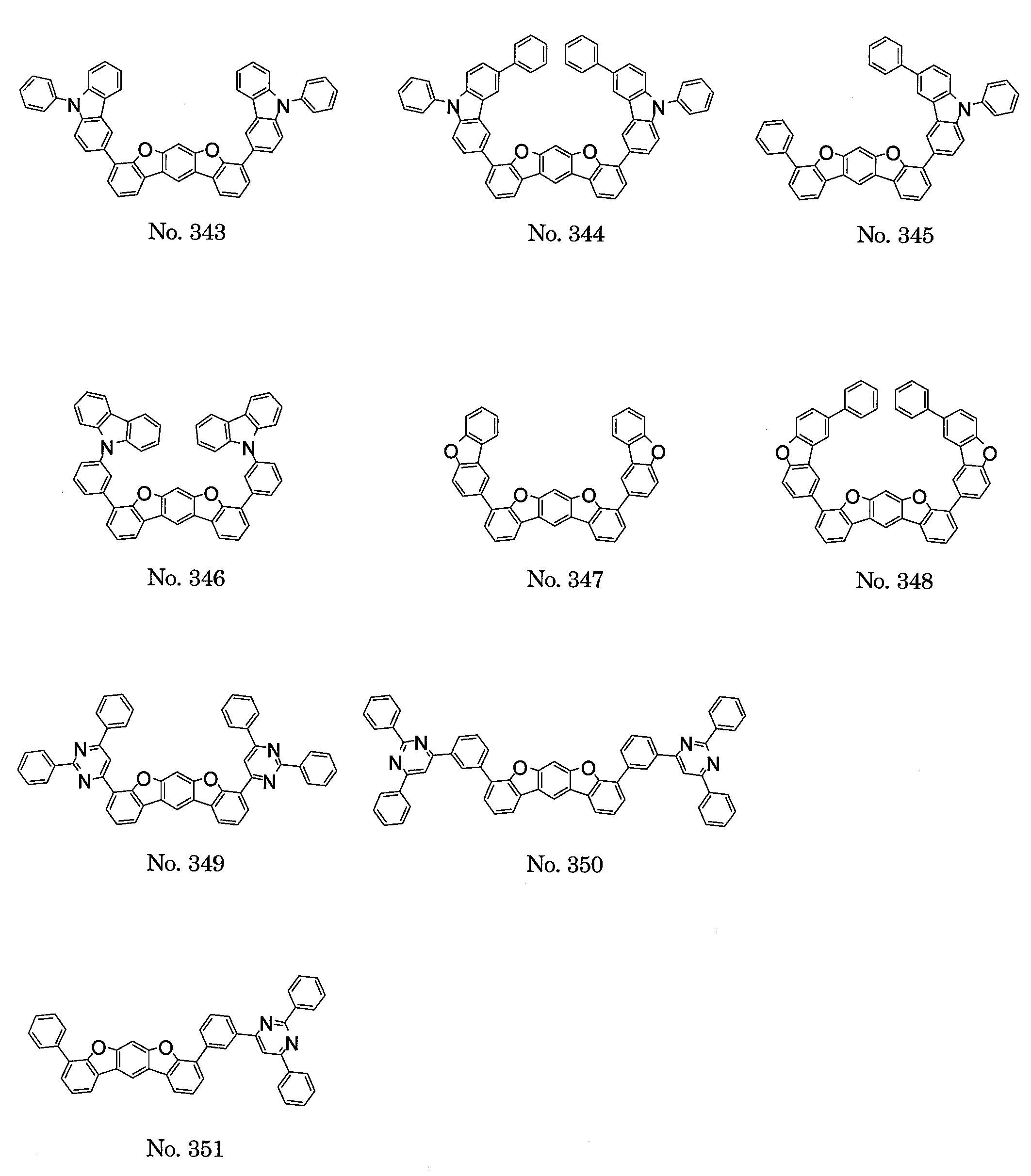
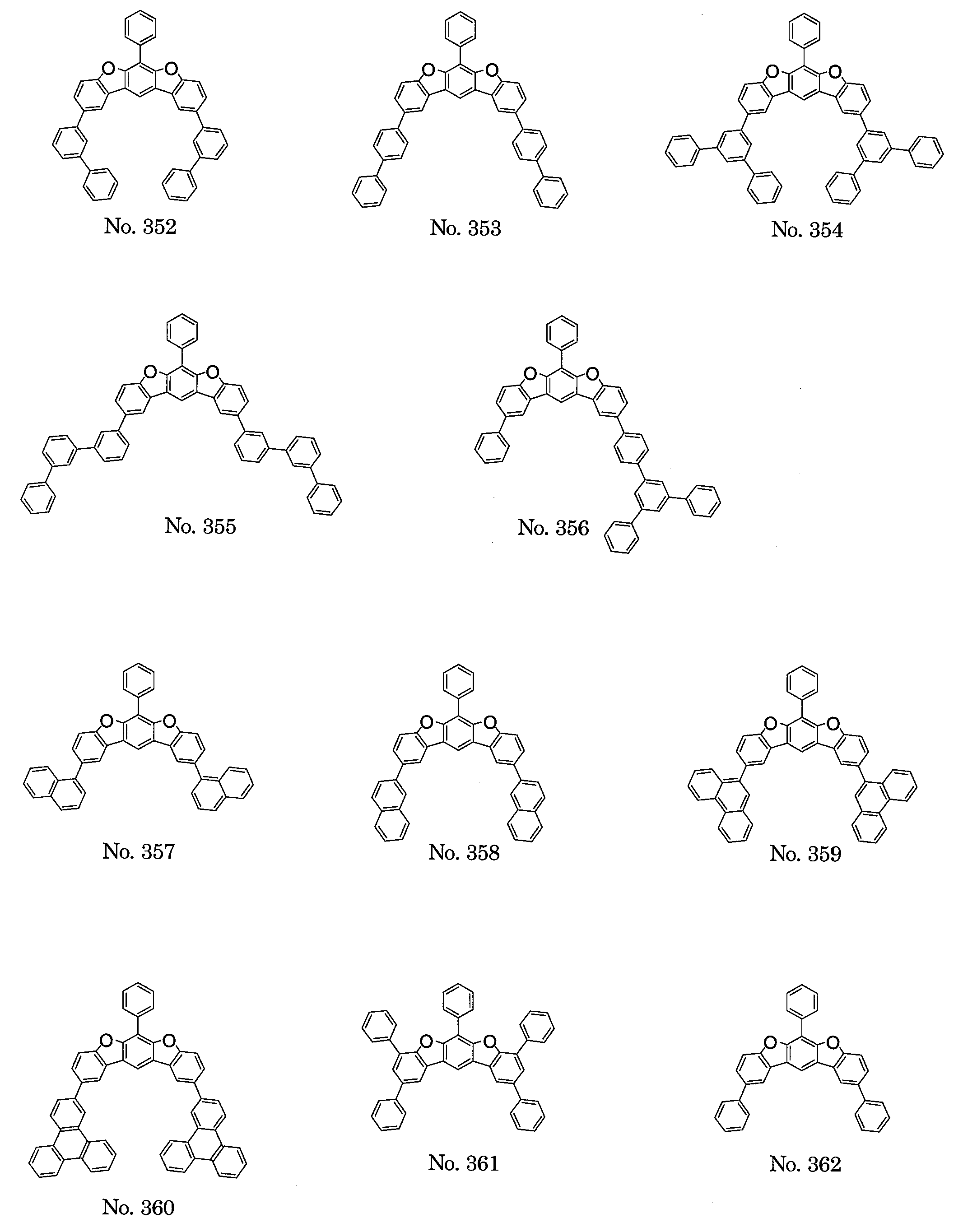

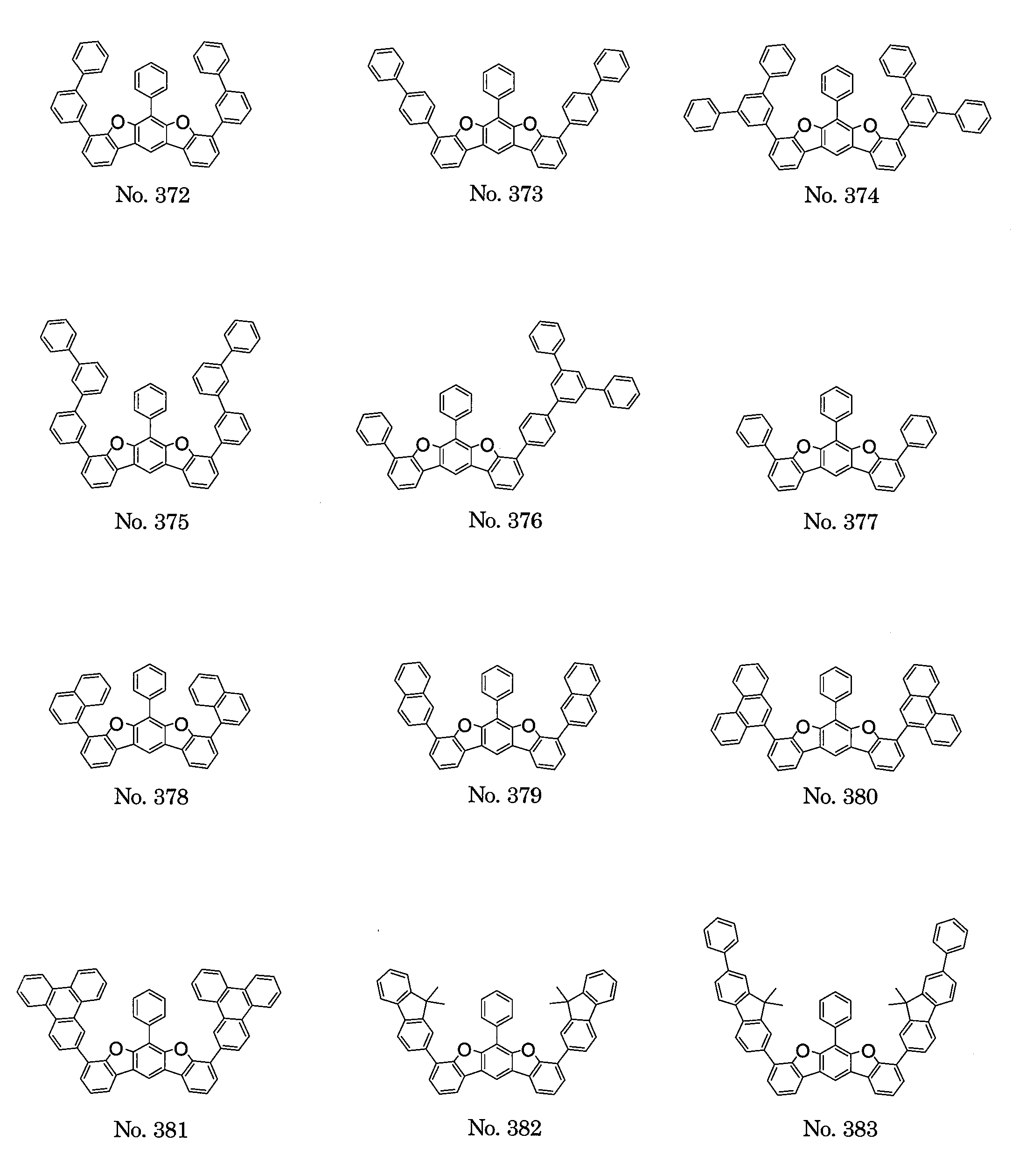
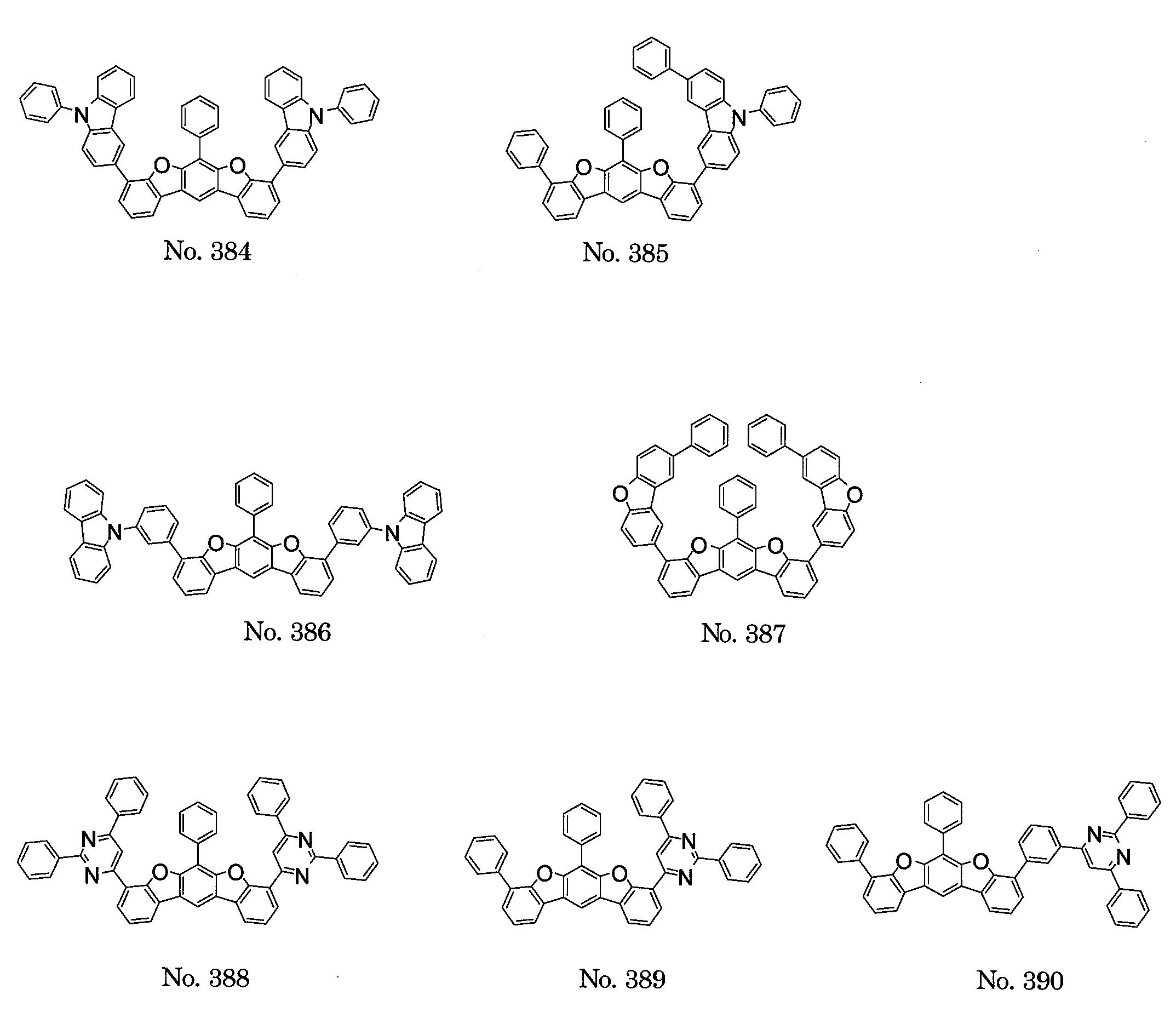

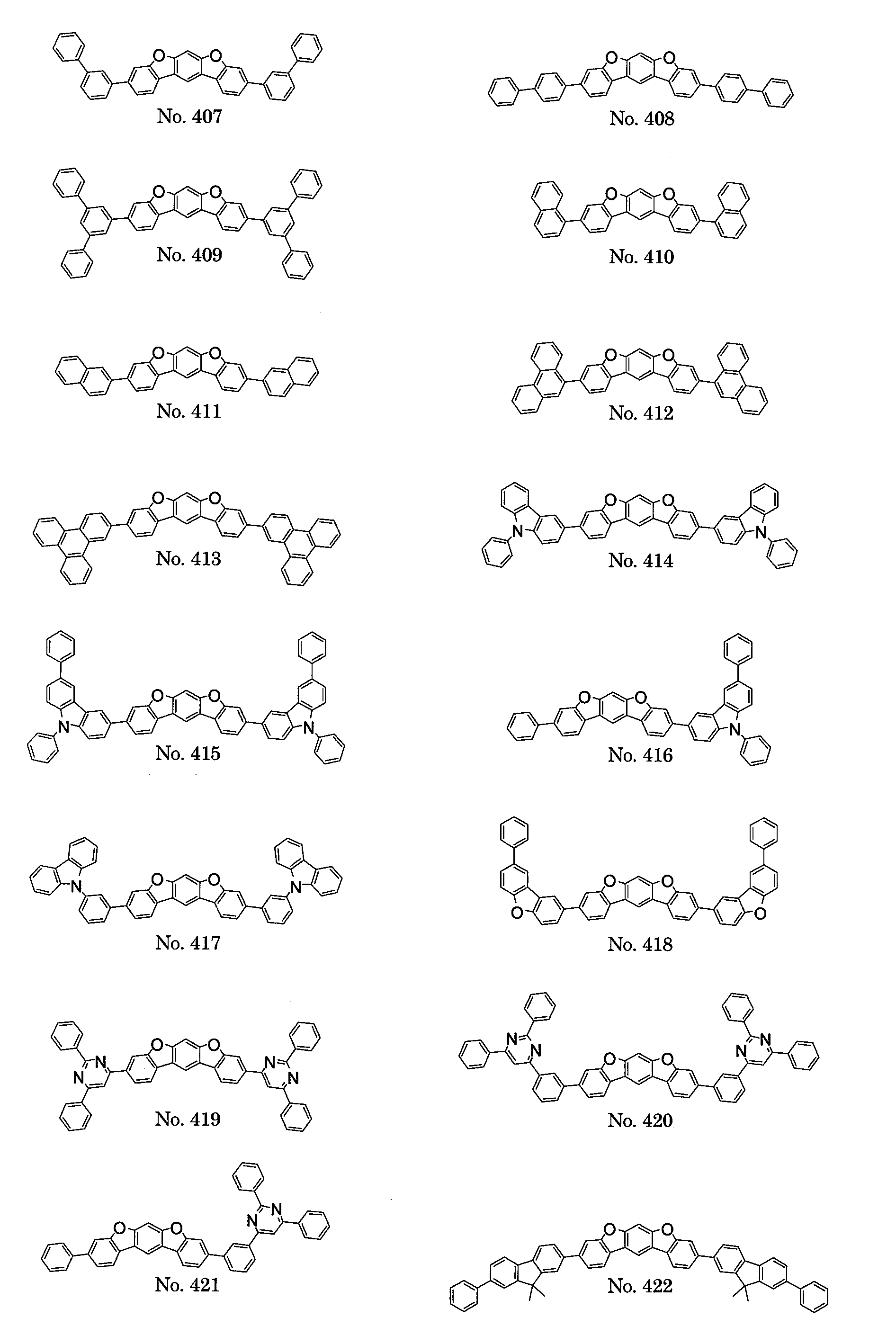
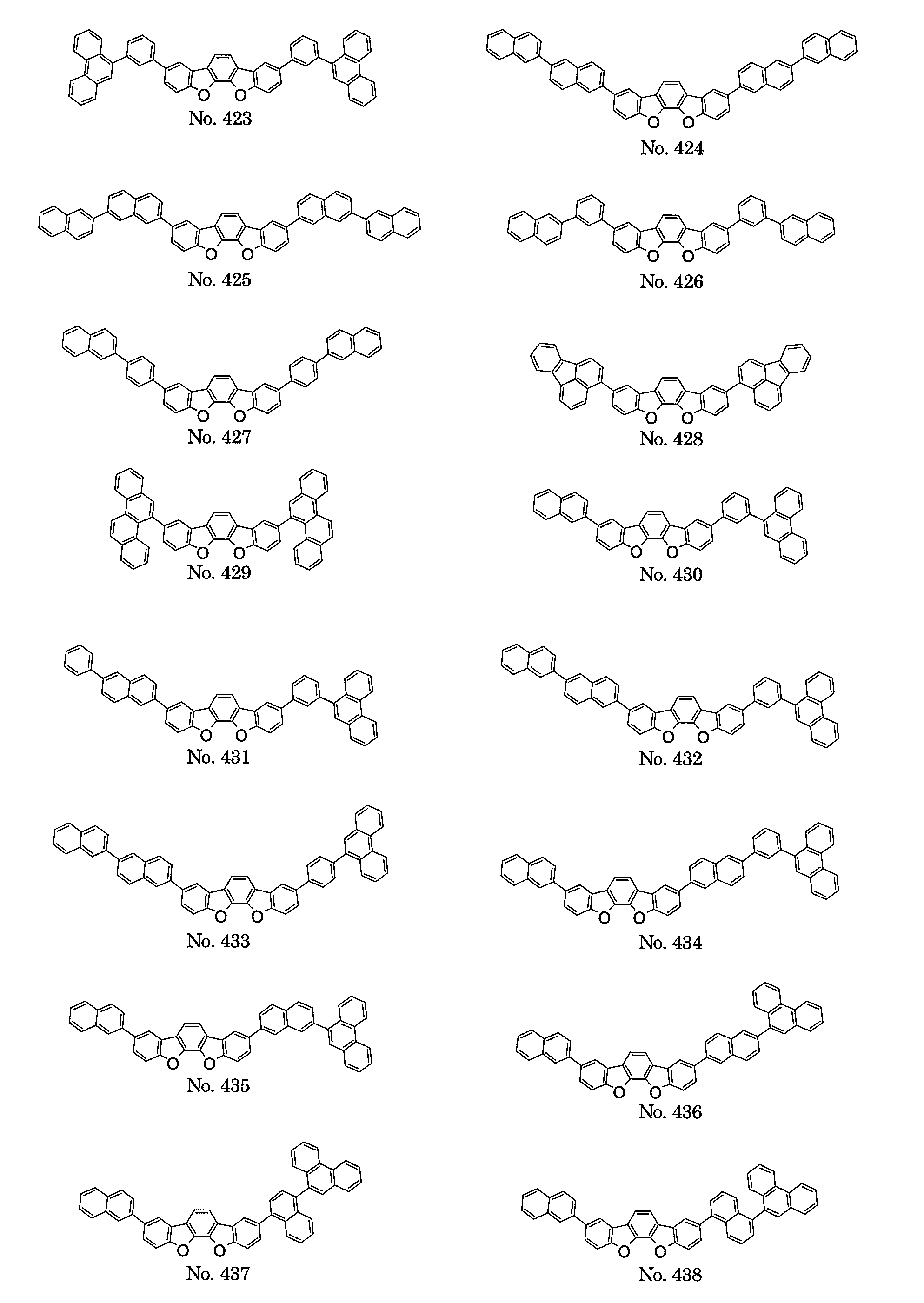
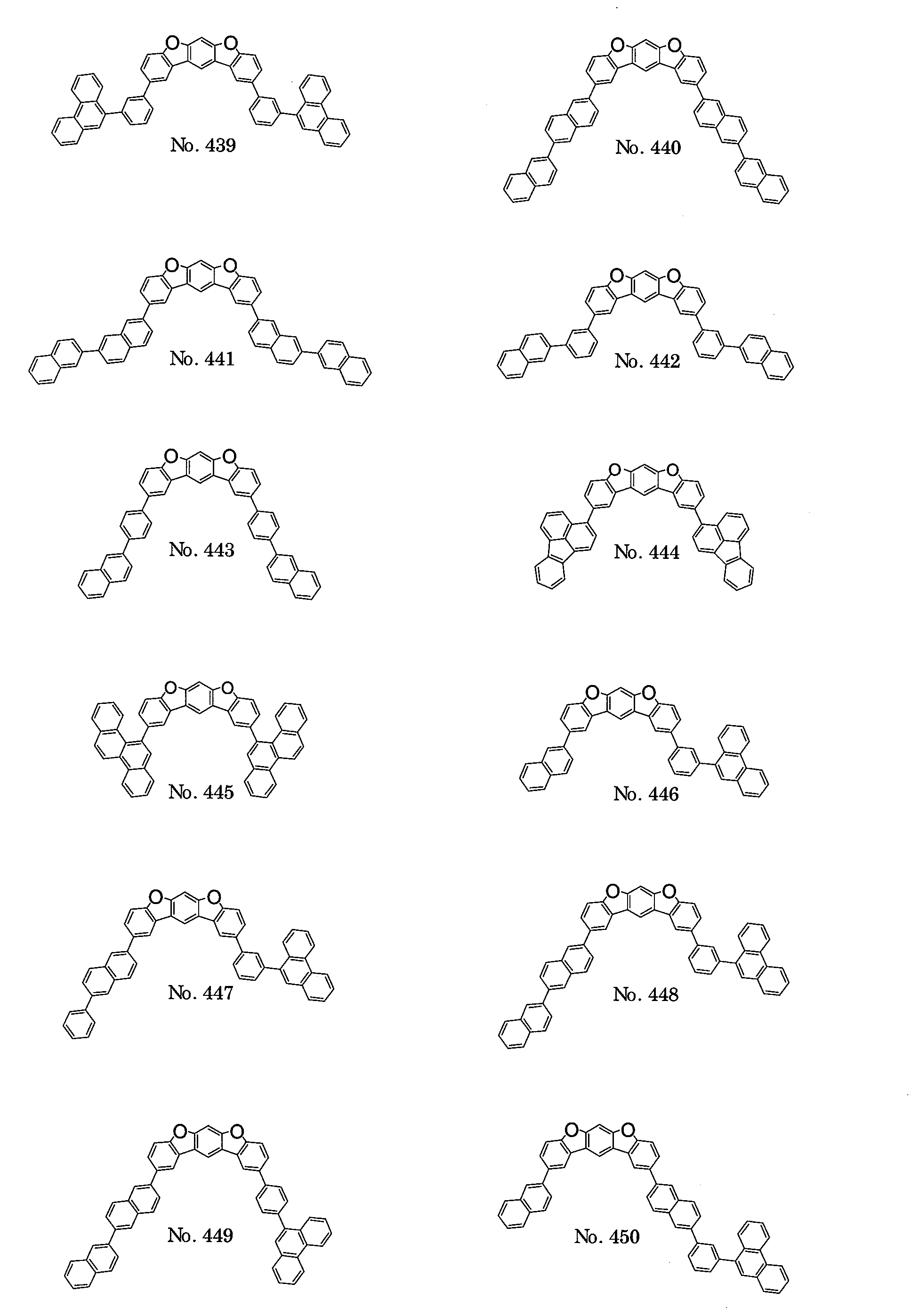
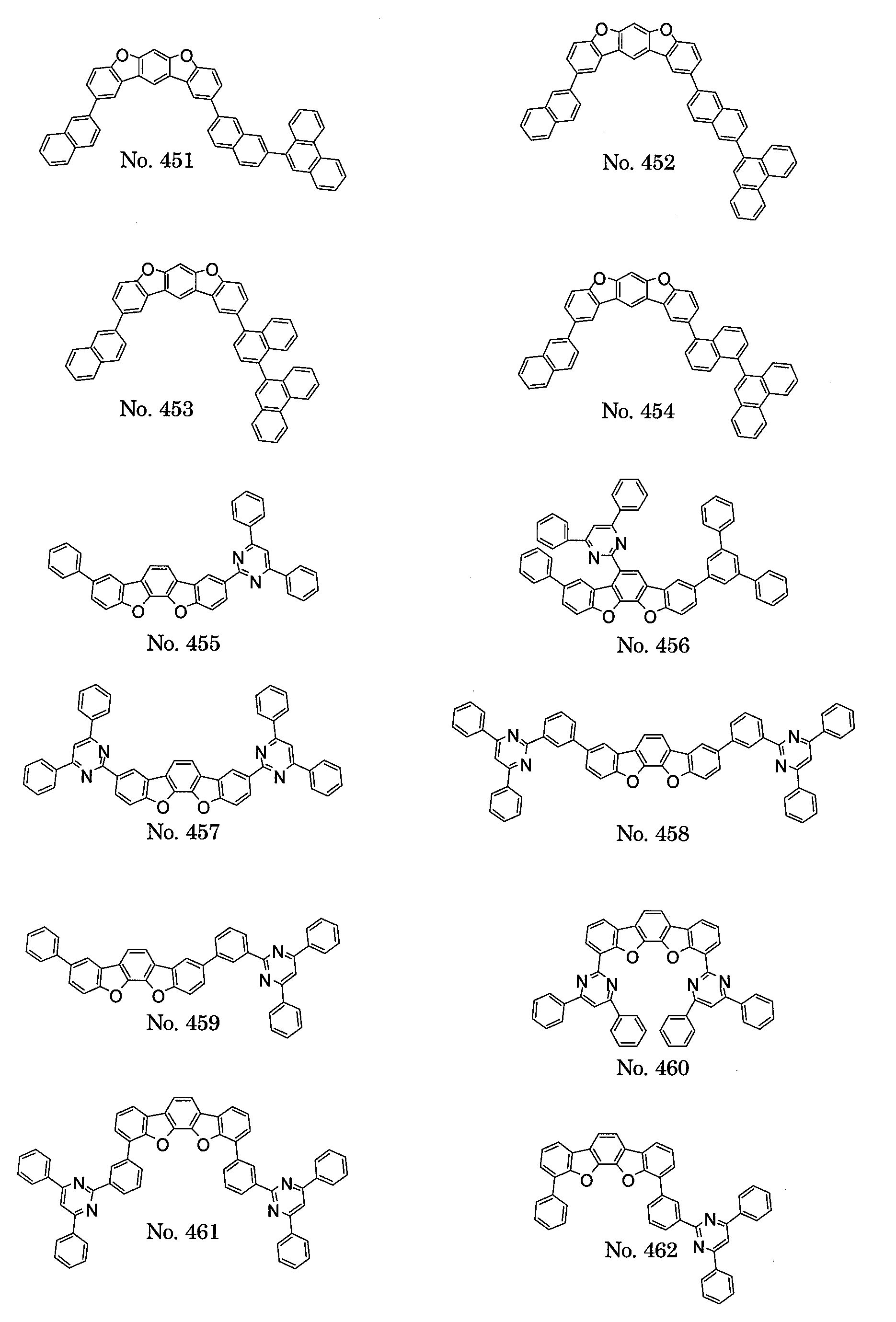

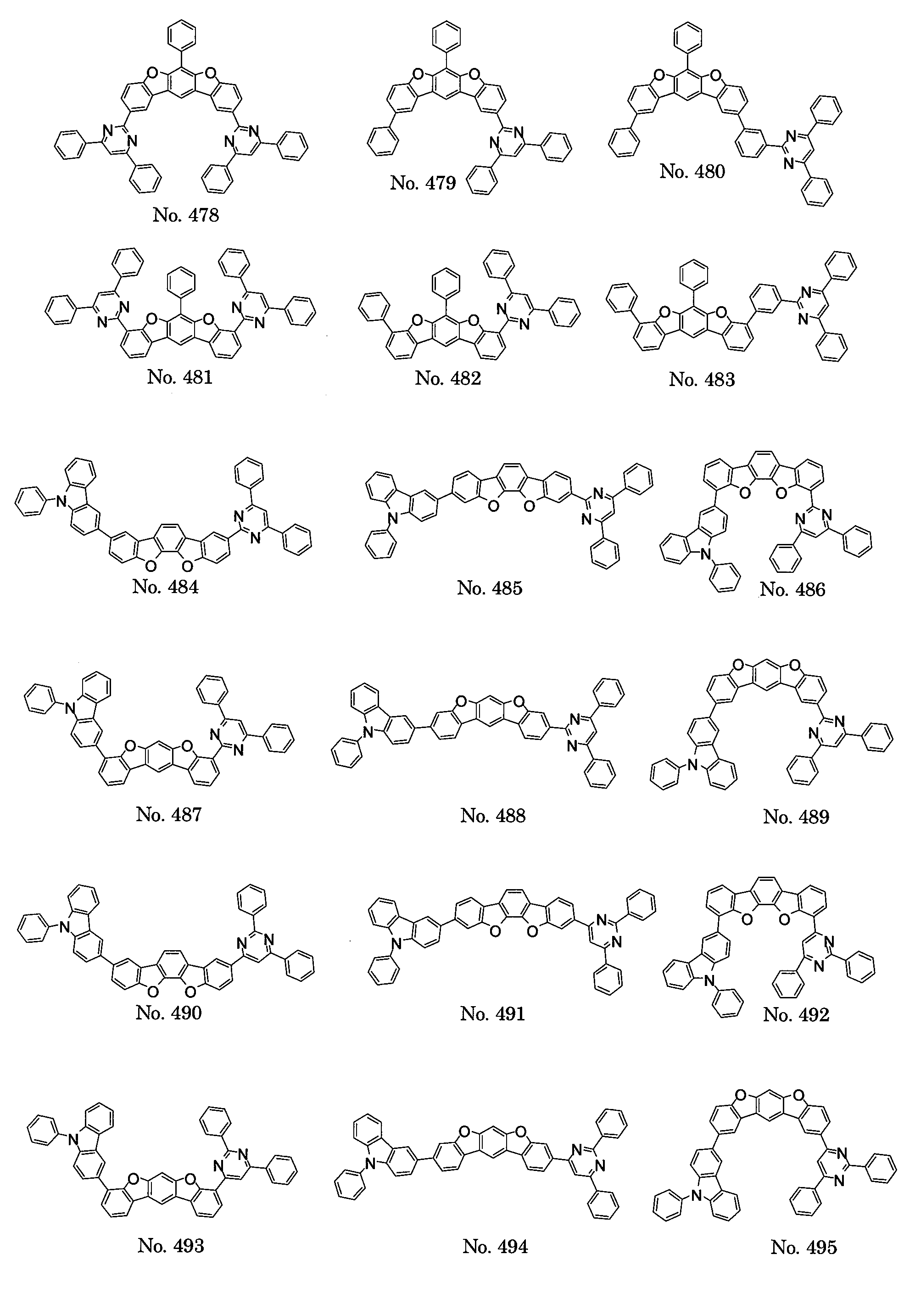
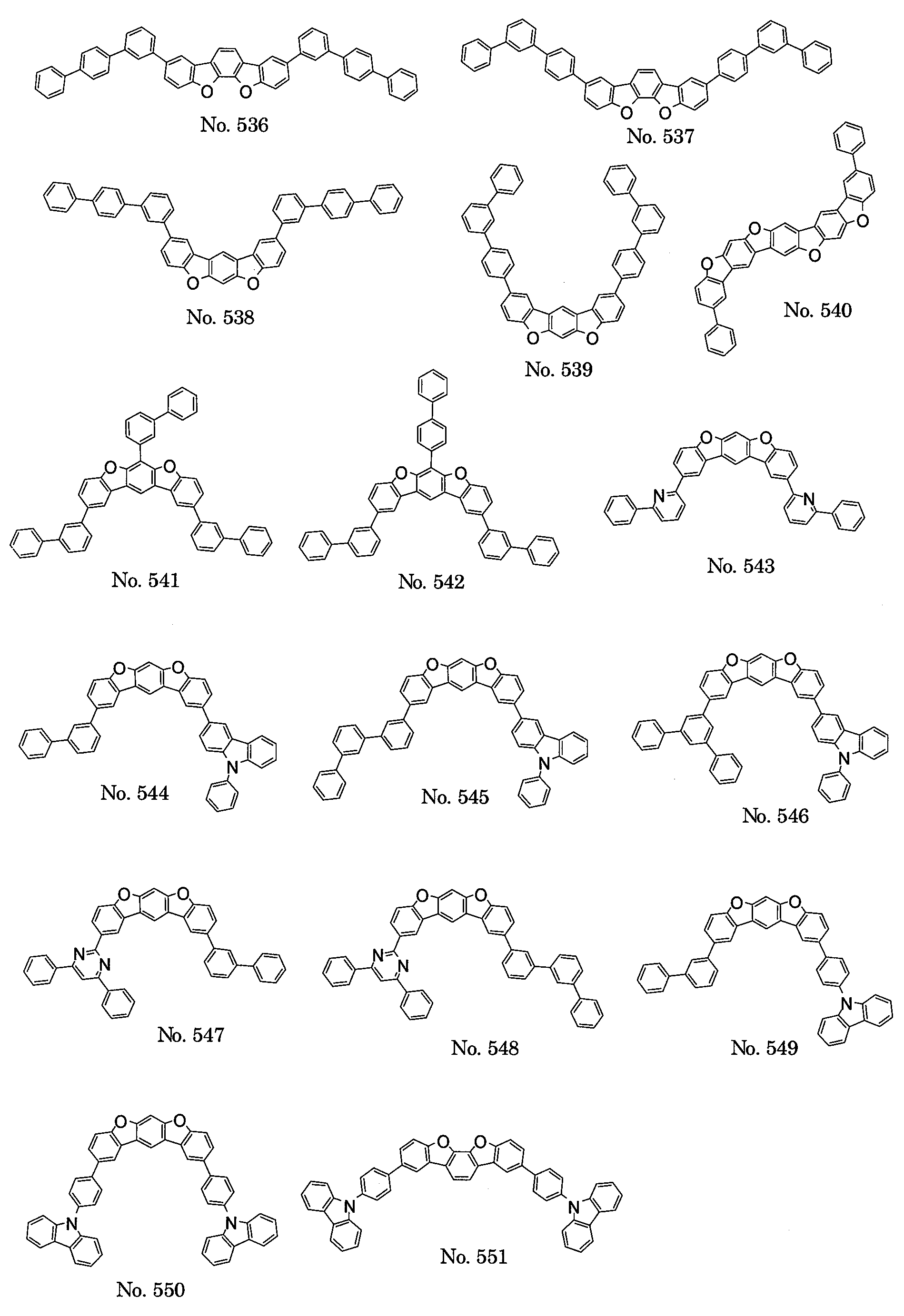
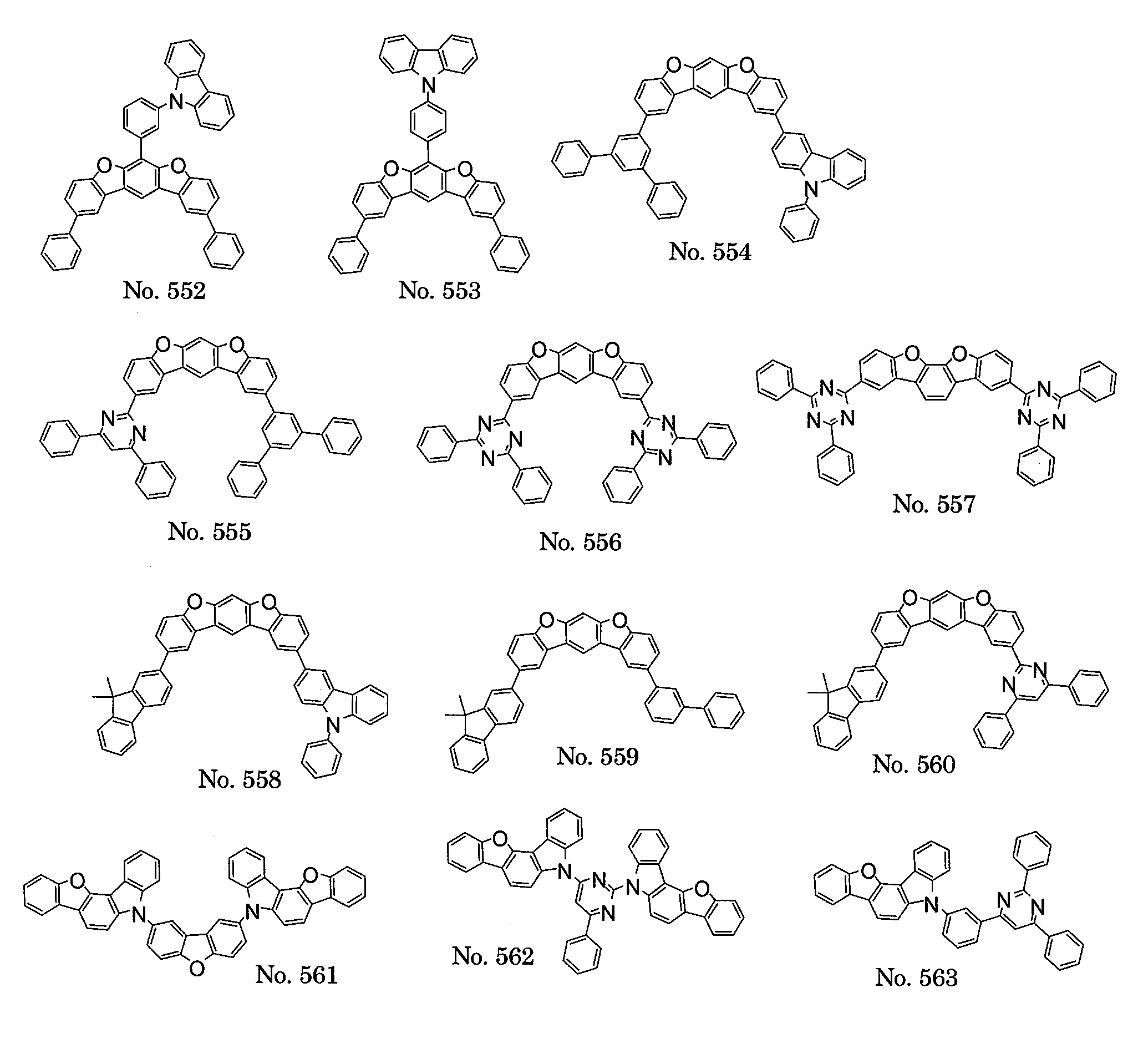
りん光発光性材料としては、りん光量子収率が高く、発光素子の外部量子効率をより向上させることができるという点で、イリジウム(Ir)、オスミウム(Os)、ルテニウム(Ru)又は白金(Pt)を含有する化合物であると好ましく、イリジウム錯体、オスミウム錯体、ルテニウム錯体、白金錯体等の金属錯体であるとさらに好ましく、中でもイリジウム錯体及び白金錯体がより好ましく、オルトメタル化イリジウム錯体が最も好ましい。イリジウム錯体、オスミウム錯体、ルテニウム錯体、白金錯体等の金属錯体の具体例を以下に示す。
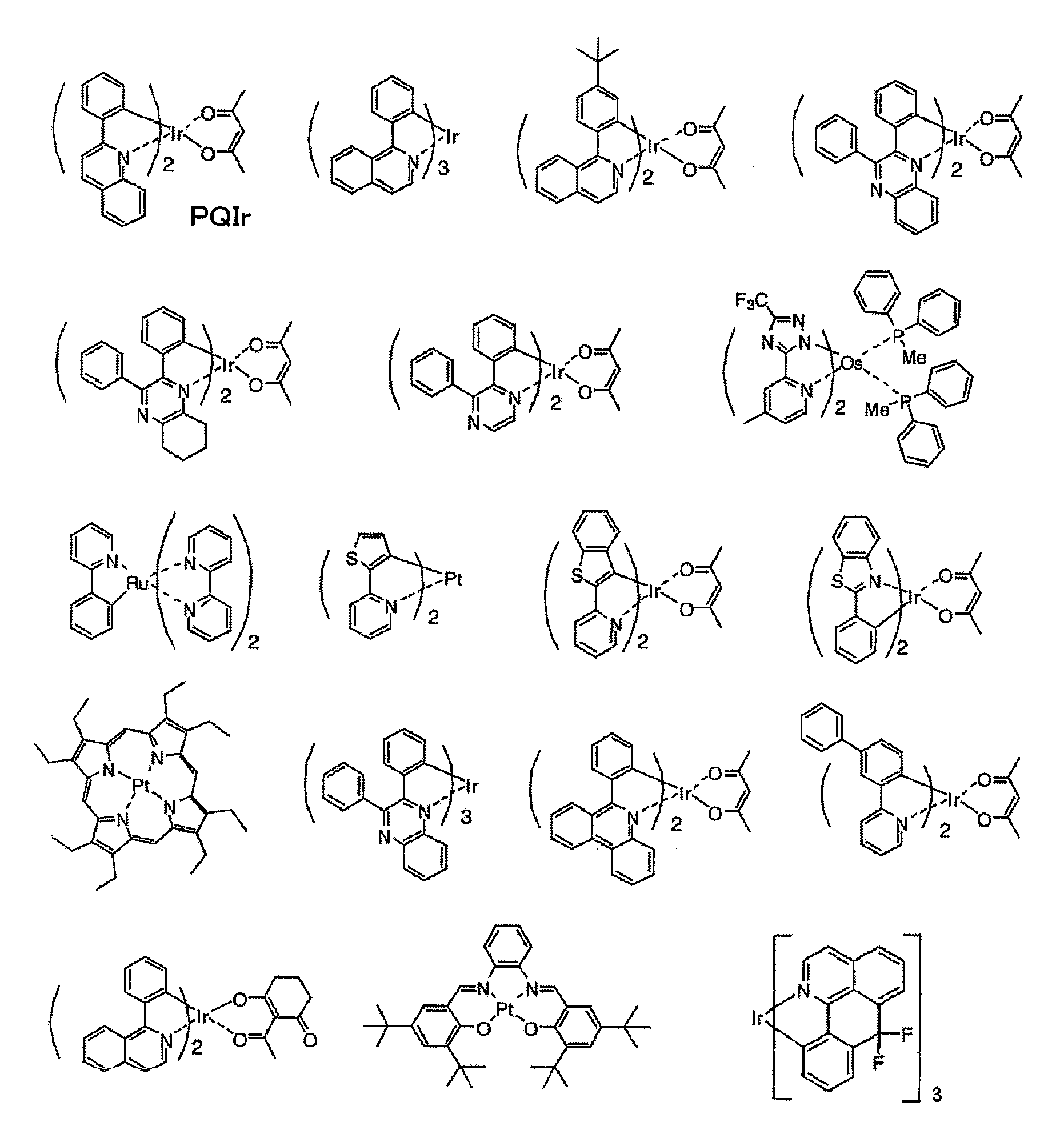

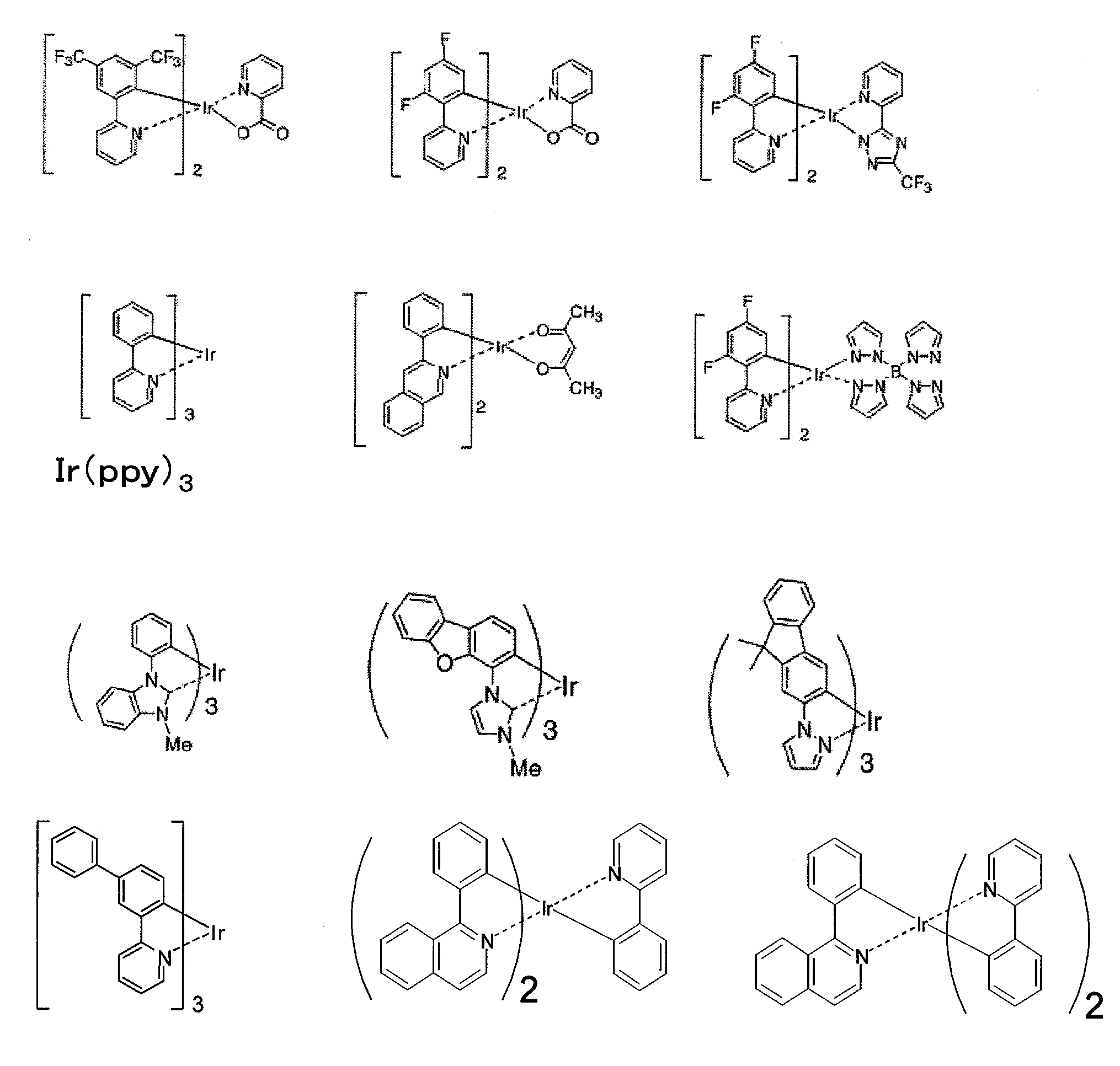

アルカリ土類金属としては、仕事関数が2.9eV以下である、Ca(仕事関数:2.9eV)、Sr(仕事関数:2.0~2.5eV)、Ba(仕事関数:2.52eV)等が好ましく挙げられる。
希土類金属としては、仕事関数が2.9eV以下である、Sc、Y、Ce、Tb、Yb等が好ましく挙げられる。
以上の金属のうち好ましい金属は、特に還元能力が高く、電子注入域への比較的少量の添加により、有機EL素子における発光輝度の向上や長寿命化が可能である。
アルカリ土類金属化合物としては、BaO、SrO、CaO及びこれらを混合したBamSr1-mO(0<m<1)、BamCa1-mO(0<m<1)等が挙げられ、これらの中でも、BaO、SrO、CaOが好ましい。
希土類金属化合物としては、YbF3、ScF3、ScO3、Y2O3、Ce2O3、GdF3、TbF3等が挙げられ、これらの中でも、YbF3、ScF3、TbF3が好ましい。
還元性ドーパントを層状に形成する場合は、界面の有機層である発光材料や電子注入材料を層状に形成した後に、還元ドーパントを単独で抵抗加熱蒸着法により蒸着し、好ましくは層の厚み0.1~15nmで形成する。
還元性ドーパントを島状に形成する場合は、界面の有機層である発光材料や電子注入材料を島状に形成した後に、還元ドーパントを単独で抵抗加熱蒸着法により蒸着し、好ましくは島の厚み0.05~1nmで形成する。

式(A)のL4は、下記式(A’)又は(A’’)で表される基である。
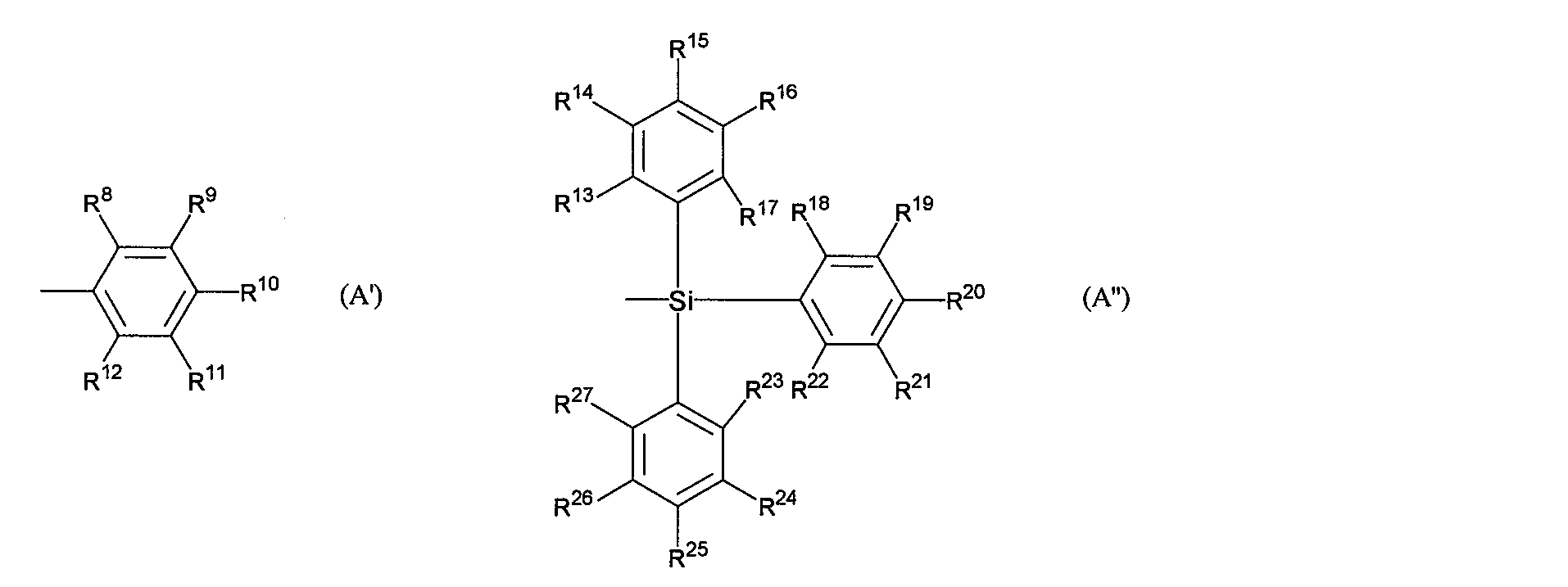
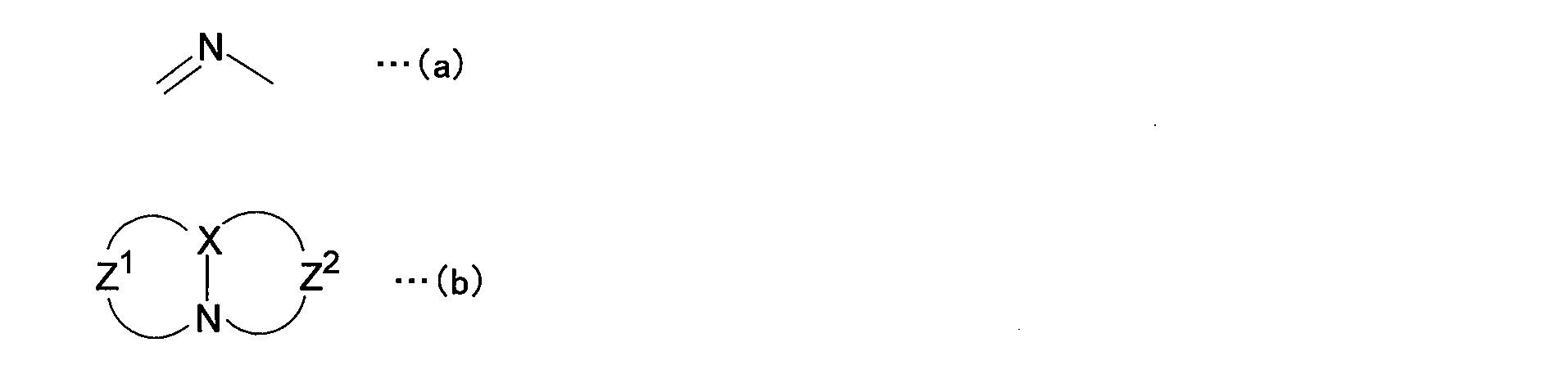

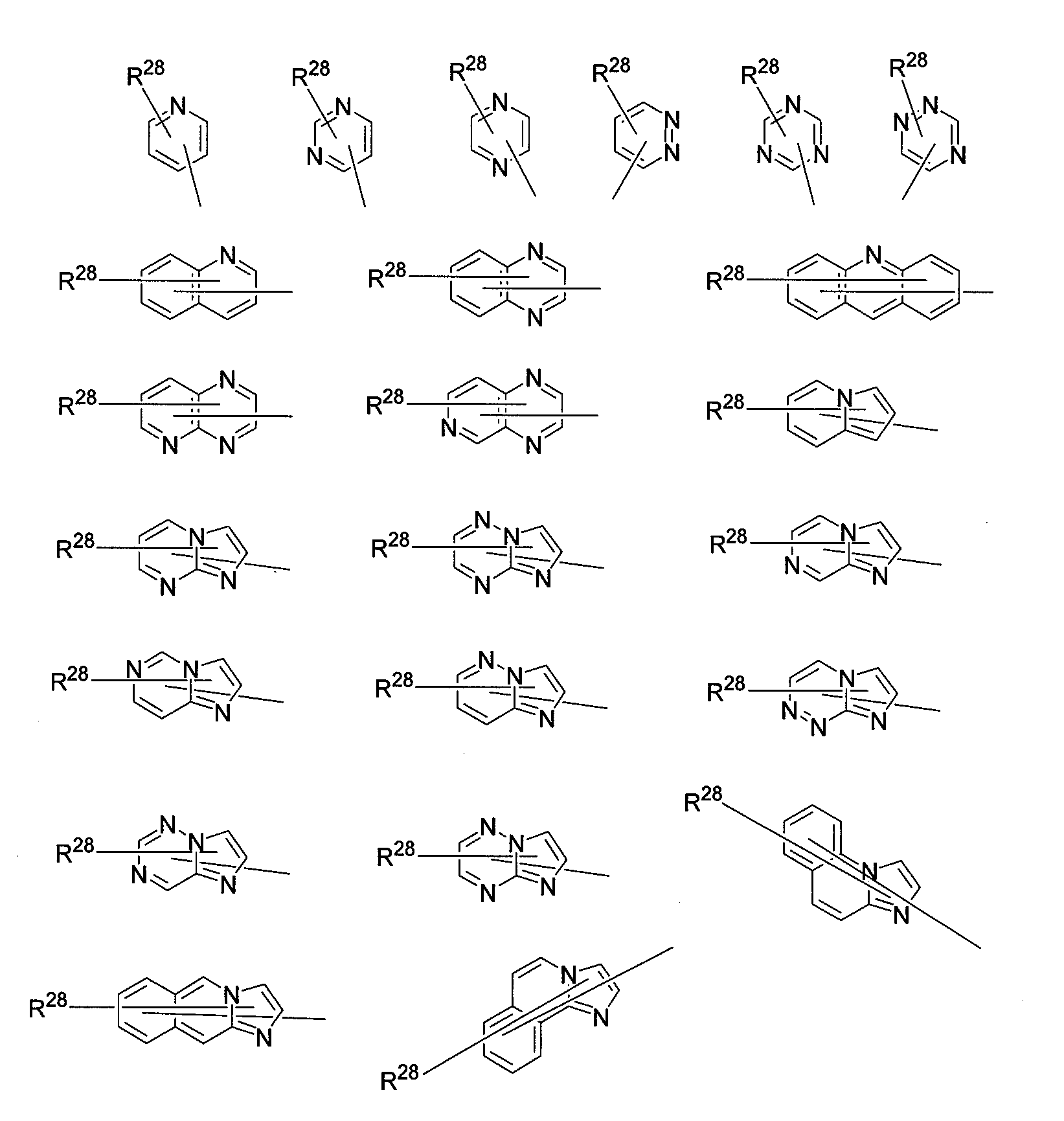



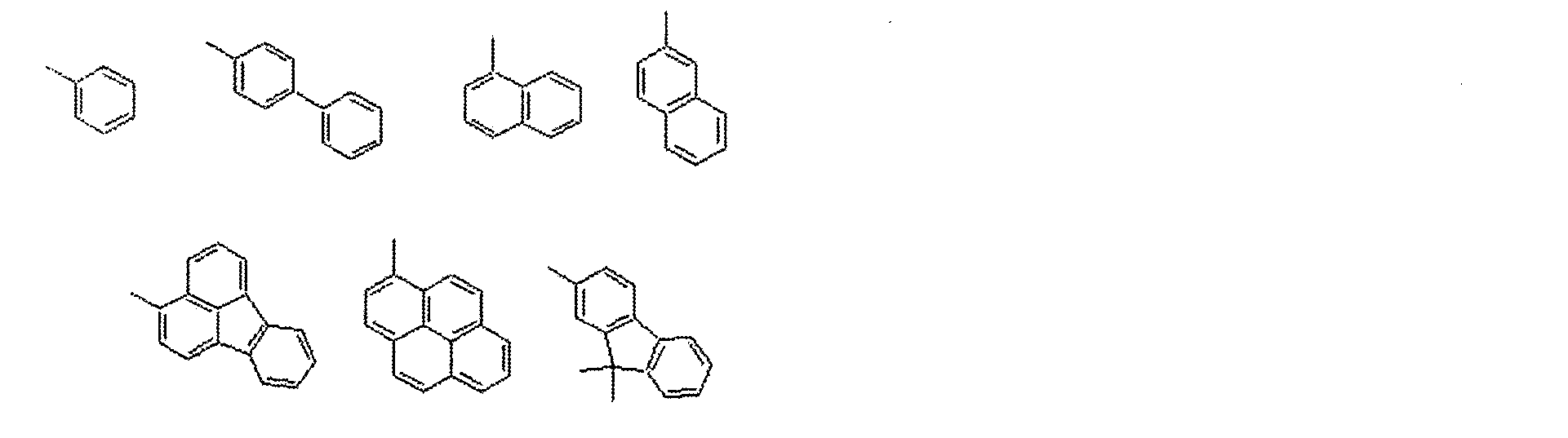
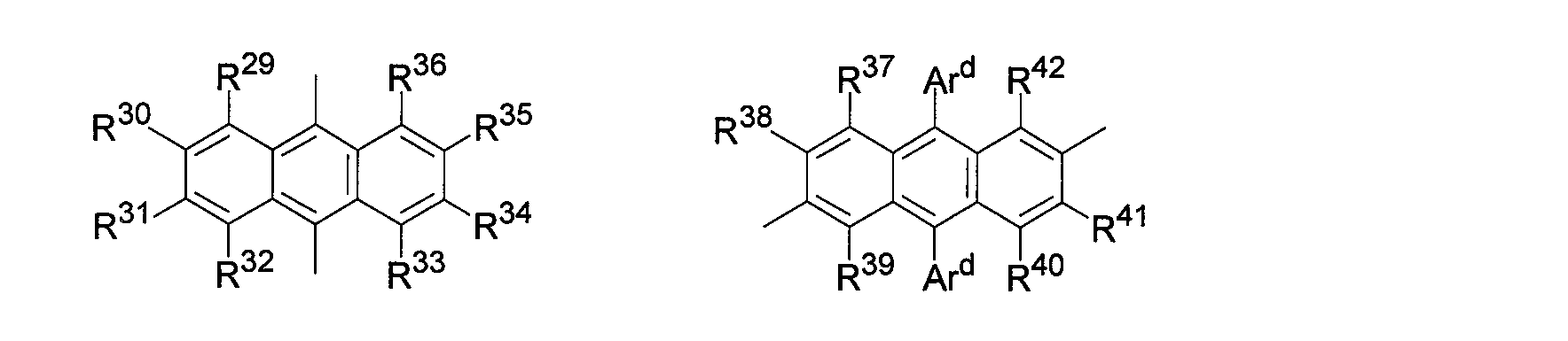
また、上記式で表されるArbにおいて、R29~R36は、いずれも水素原子である含窒素複素環誘導体が好ましい。
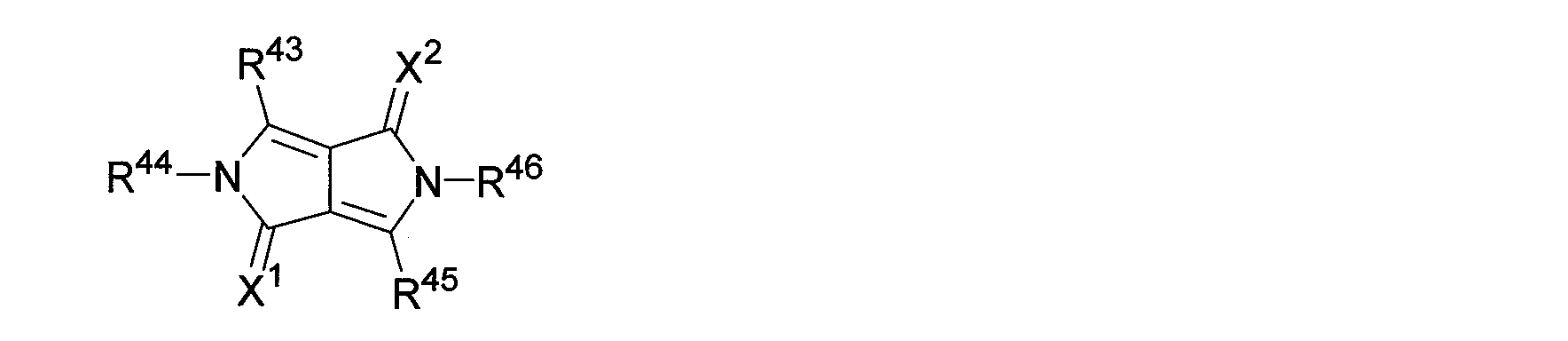
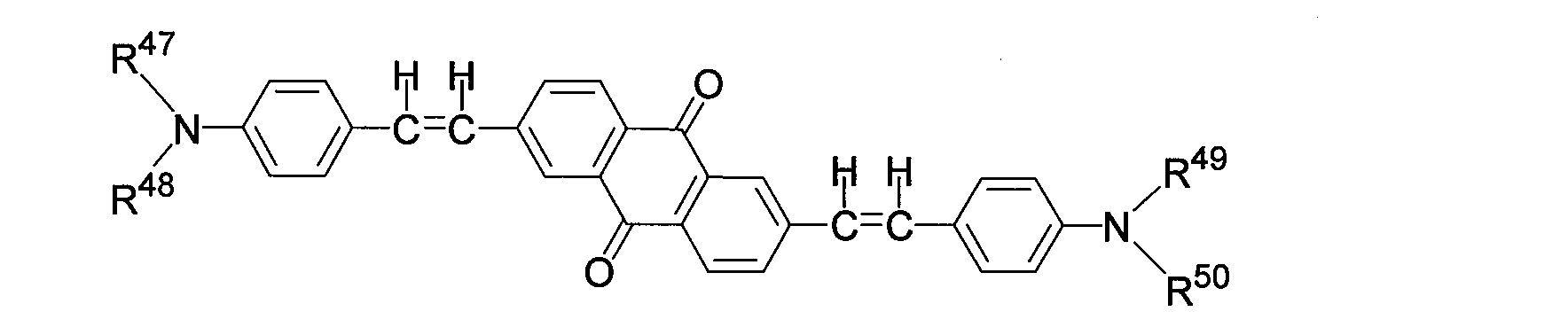

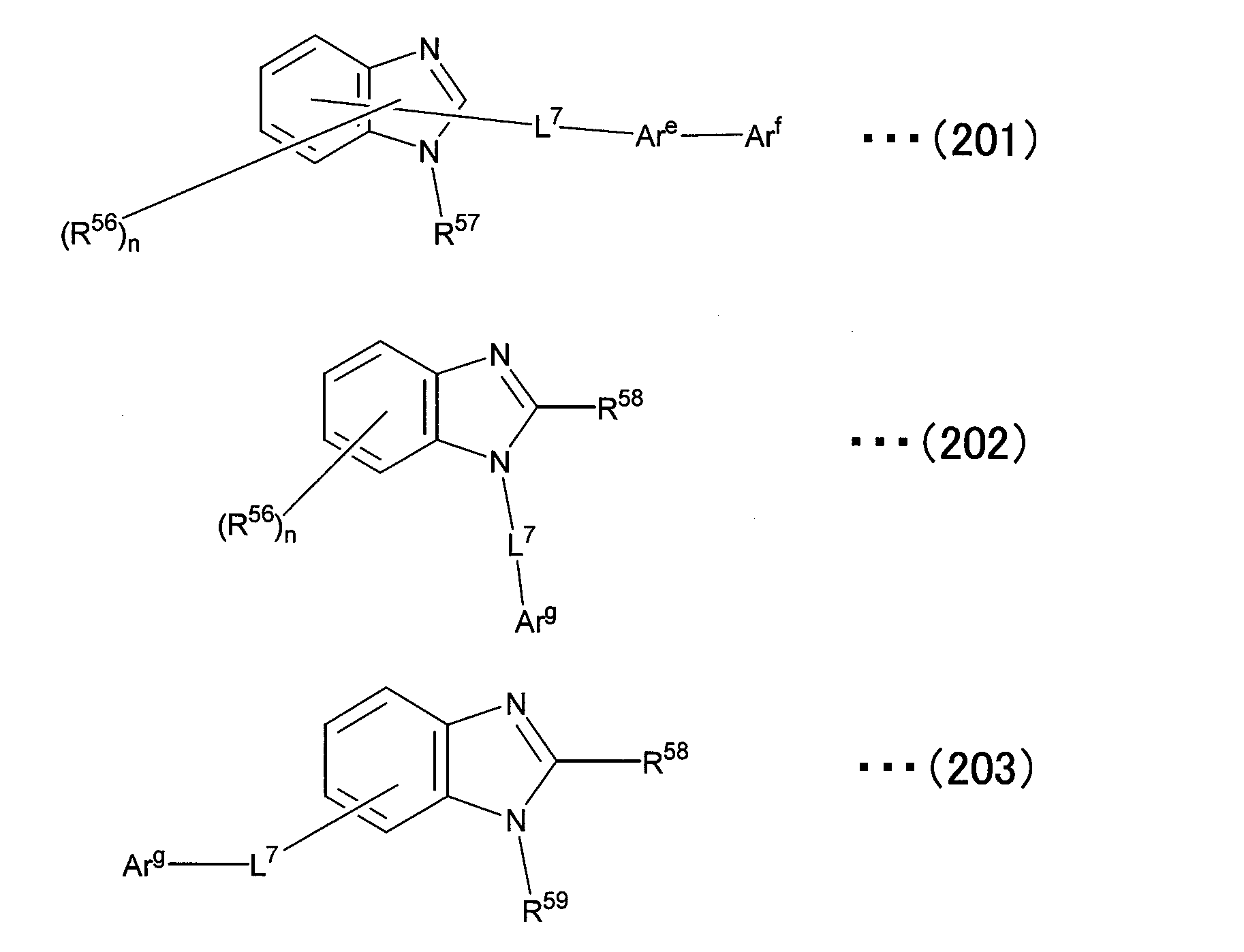
Argは、置換基を有していてもよい炭素数6~60のアリール基、置換基を有していてもよいピリジル基、置換基を有していてもよいキノリル基、置換基を有していてもよい炭素数1~20のアルキル基、置換基を有していてもよい炭素数1~20のアルコキシ基、又は-Are-Arfで表される基(Are及びArfは、それぞれ前記と同じ)である。

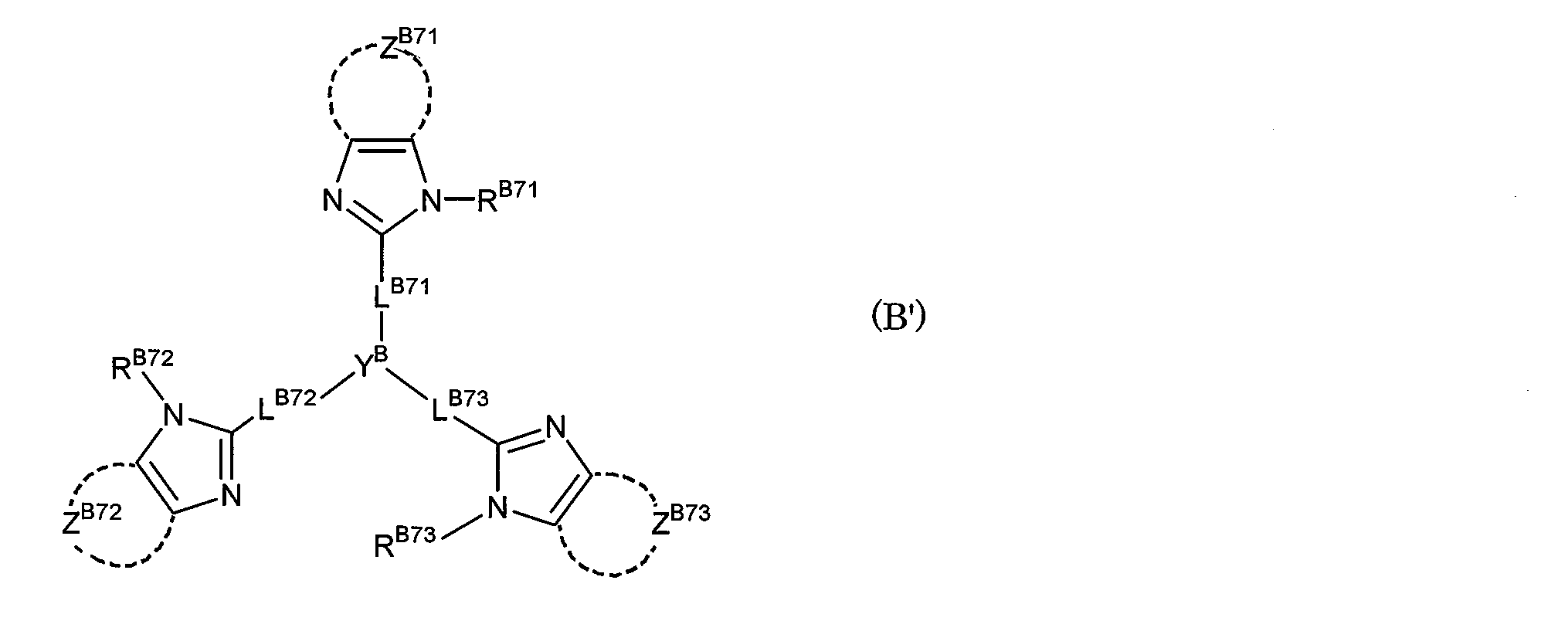
ZB71、ZB72及びZB73は、それぞれ式(B)におけるZB2と同様である。
LB71、LB72及びLB73は、それぞれ連結基を表し、式(B)におけるLBの例を二価としたものが挙げられ、好ましくは、単結合、二価の芳香族炭化水素環基、二価の芳香族複素環基、及びこれらの組み合わせからなる連結基であり、より好ましくは単結合である。LB71、LB72及びLB73は置換基を有していてもよく、置換基としては前記式(B)におけるLBで表される基の置換基として挙げたものと同様である。
YBは、窒素原子、1,3,5-ベンゼントリイル基又は2,4,6-トリアジントリイル基を表す。
このような絶縁体としては、アルカリ金属カルコゲニド、アルカリ土類金属カルコゲニド、アルカリ金属のハロゲン化物及びアルカリ土類金属のハロゲン化物からなる群から選択される少なくとも一つの金属化合物を使用するのが好ましい。電子注入層がこれらのアルカリ金属カルコゲニド等で構成されていれば、電子注入性をさらに向上させることができる点で好ましい。具体的に、好ましいアルカリ金属カルコゲニドとしては、例えばLi2O、K2O、Na2S、Na2Se及びNa2Oが挙げられ、好ましいアルカリ土類金属カルコゲニドとしては、例えばCaO、BaO、SrO、BeO、BaS及びCaSeが挙げられる。また、好ましいアルカリ金属のハロゲン化物としては、例えばLiF、NaF、KF、LiCl、KCl及びNaCl等が挙げられる。また、好ましいアルカリ土類金属のハロゲン化物としては、例えばCaF2、BaF2、SrF2、MgF2及びBeF2等のフッ化物や、フッ化物以外のハロゲン化物が挙げられる。
また、半導体としては、例えばBa、Ca、Sr、Yb、Al、Ga、In、Li、Na、Cd、Mg、Si、Ta、Sb及びZnからなる群から選択される少なくとも一つの元素を含む酸化物、窒化物又は酸化窒化物等が挙げられ、これらは一種を単独で使用してもよいし、二種以上を組み合わせて使用してもよい。また、電子注入層を構成する無機化合物が、微結晶又は非晶質の絶縁性薄膜であることが好ましい。電子注入層がこれらの絶縁性薄膜で構成されていれば、より均質な薄膜が形成されるために、ダークスポット等の画素欠陥を減少させることができる。なお、このような無機化合物としては、例えばアルカリ金属カルコゲニド、アルカリ土類金属カルコゲニド、アルカリ金属のハロゲン化物及びアルカリ土類金属のハロゲン化物等が挙げられる。
また、本発明における電子注入層には、前述の還元性ドーパントを好ましく含有させることができる。
なお、電子注入層又は電子輸送層の膜厚は、特に限定されないが、好ましくは、1~100nmである。


本発明の有機EL素子の各有機層の膜厚は特に制限されないが、一般に膜厚が薄すぎるとピンホール等の欠陥が生じやすく、逆に厚すぎると高い印加電圧が必要となり効率が悪くなるため、通常は数nmから1μmの範囲が好ましい。
(1)化合物1の合成

反応終了後、室温まで冷却した。試料を分液ロートに移し、水(500mL)を加え、CH2Cl2にて抽出した。MgSO4で乾燥後、ろ過、濃縮した。試料をシリカゲルカラムクロマトグラフィーで精製し、白色の固体を得た。収量38.5g、収率65%
FD-MS分析 C20H16F2O2:理論値326、観測値326
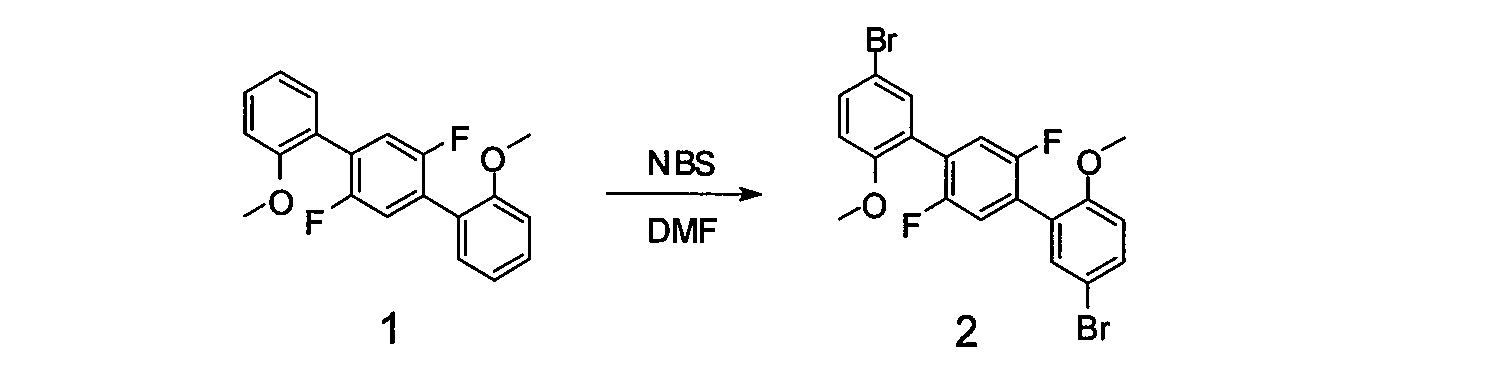
FD-MS分析 C20H14Br2F2O2:理論値484、観測値484
FD-MS分析 C18H10Br2F2O2:理論値456、観測値456
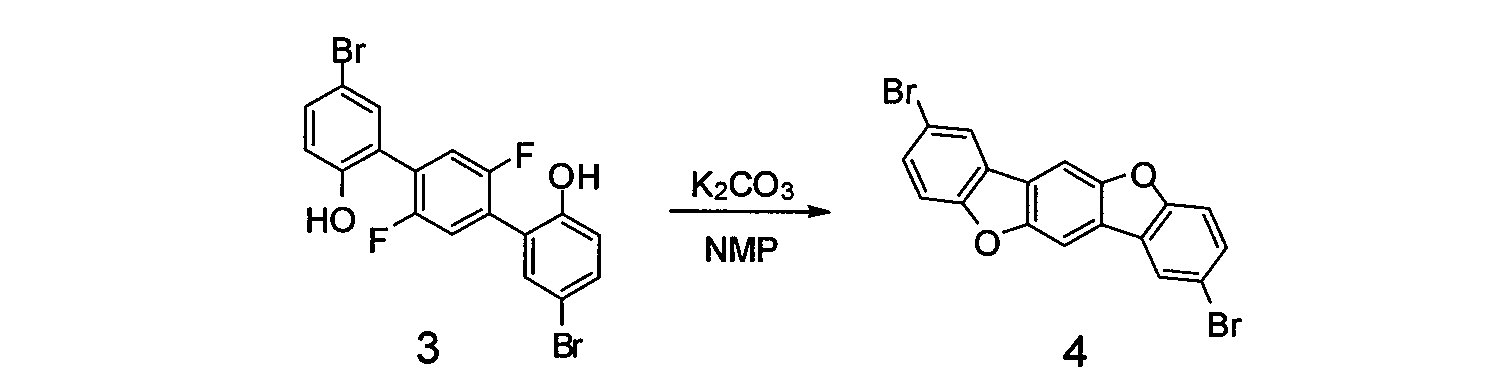
FD-MS分析 C18H8Br2O2:理論値416、観測値416
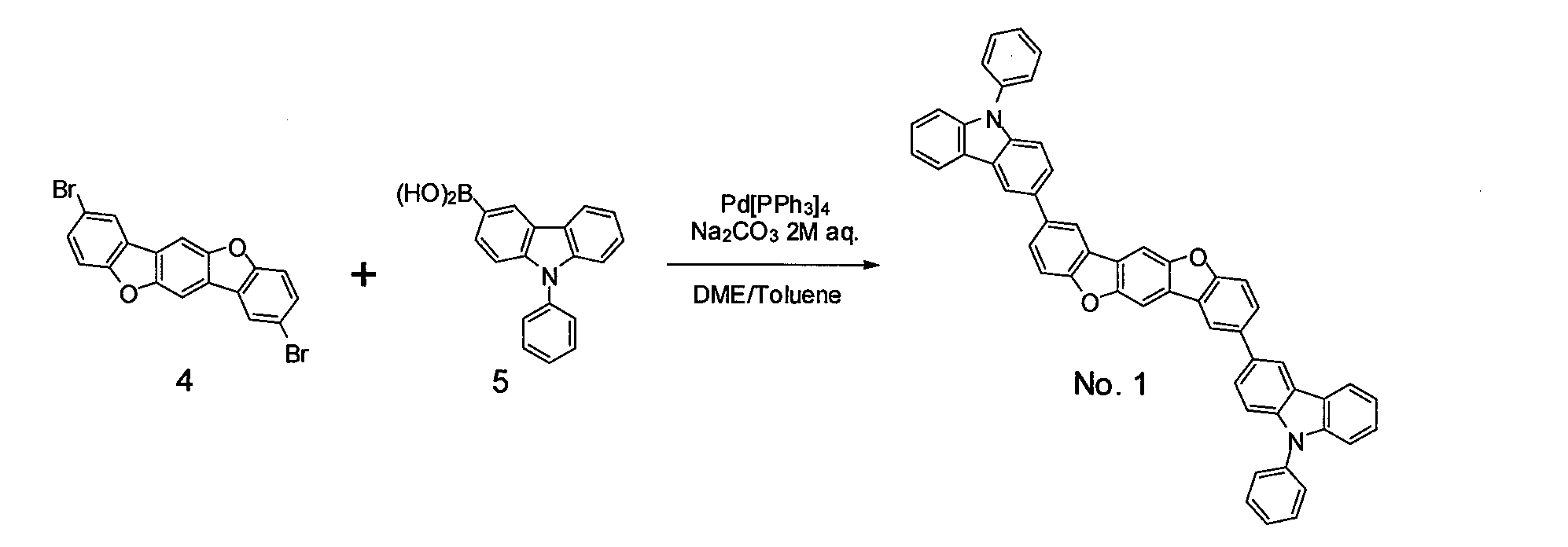
反応終了後、室温まで冷却した。試料を分液ロートに移し、水(50mL)を加え、CH2Cl2にて抽出した。MgSO4で乾燥後、ろ過、濃縮した。試料をシリカゲルカラムクロマトグラフィーで精製した。濃縮・乾固の後、再結晶を2回行い白色の粉末(化合物No.1)を得た。これを昇華精製して白色の固体を得た。収量2.0g、収率45%
FD-MS分析 C54H32N2O2:理論値740、観測値740
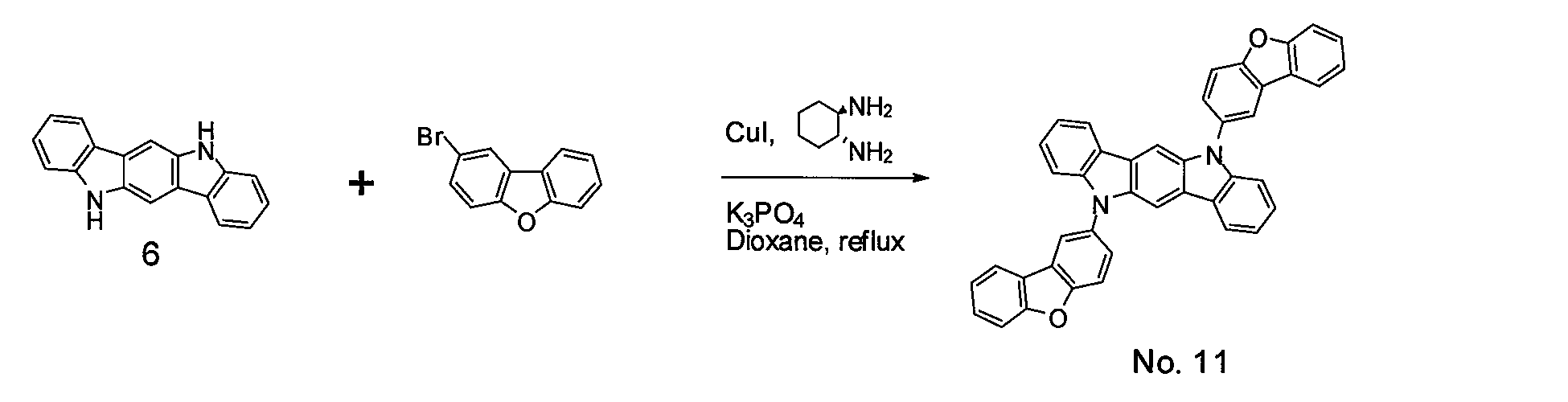
反応終了後、室温まで冷却した。試料を分液ロートに移し、水(50mL)を加え、CH2Cl2にて抽出した。試料をカラムクロマトグラフィーで精製した。濃縮・乾固の後、再結晶を2回行い白色の粉末(化合物No.11)を得た。これを昇華精製して白色の固体を得た。収量2.1g、収率35%
FD-MS分析 C42H24N2O2:理論値588、観測値588
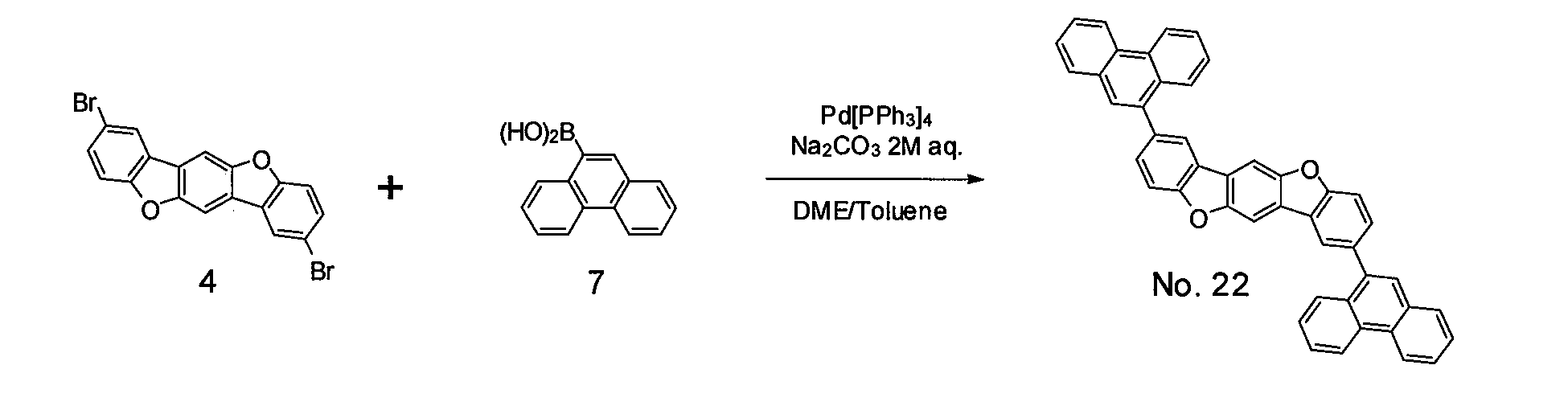
反応終了後、室温まで冷却した。試料を分液ロートに移し、水(50mL)を加え、CH2Cl2にて抽出した。MgSO4で乾燥後、ろ過、濃縮した。試料をシリカゲルカラムクロマトグラフィーで精製した。濃縮・乾固の後、再結晶を2回行い白色の粉末(化合物No.22)を得た。これを昇華精製して白色の固体を得た。収量1.3g、収率35%
FD-MS分析 C46H26O2:理論値610、観測値610
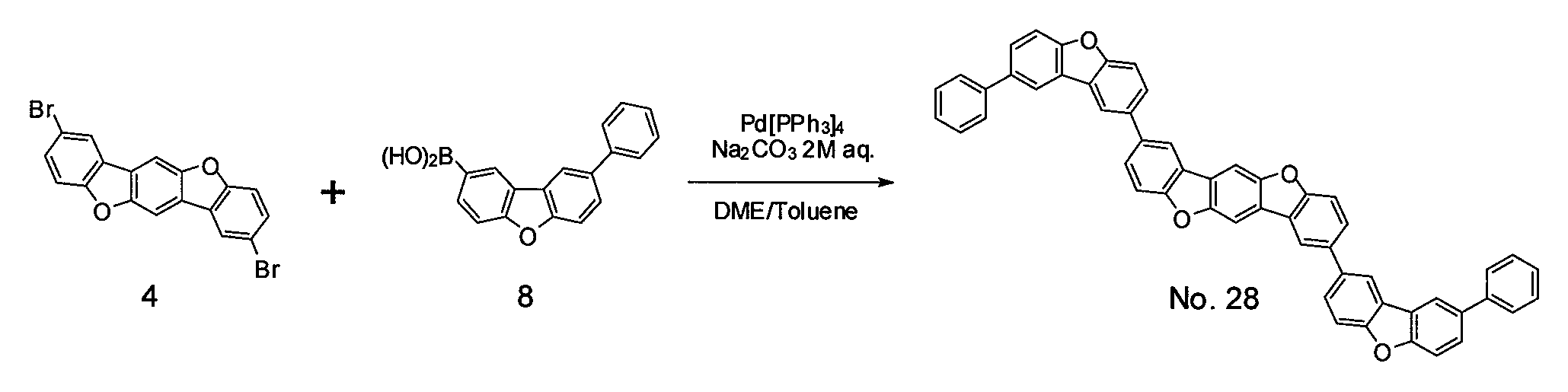
反応終了後、室温まで冷却した。試料を分液ロートに移し、水(50mL)を加え、CH2Cl2にて抽出した。MgSO4で乾燥後、ろ過、濃縮した。試料をシリカゲルカラムクロマトグラフィーで精製した。濃縮・乾固の後、再結晶を2回行い白色の粉末(化合物No.28)を得た。これを昇華精製して白色の固体を得た。収量2.1g、収率47%
FD-MS分析 C54H30O4:理論値742、観測値742
(1)化合物9の合成

反応終了後、室温まで冷却した。試料を分液ロートに移し、水(300mL)を加え、CH2Cl2にて抽出した。MgSO4で乾燥後、ろ過、濃縮した。試料をシリカゲルカラムクロマトグラフィーで精製し、白色の固体を得た。収量7.5g、収率76%
FD-MS分析 C30H18O2:理論値410、観測値410

FD-MS分析 C30H17BrO2:理論値489、観測値489

反応終了後、室温まで冷却した。試料を分液ロートに移し、水(100mL)を加え、CH2Cl2にて抽出した。MgSO4で乾燥後、ろ過、濃縮した。試料をシリカゲルカラムクロマトグラフィーで精製した。濃縮・乾固の後、再結晶を2回行い白色の粉末(化合物No.39)を得た。これを昇華精製して白色の固体を得た。収量1.8g、収率28%
FD-MS分析 C48H28O3:理論値652、観測値652
(1)化合物11の合成
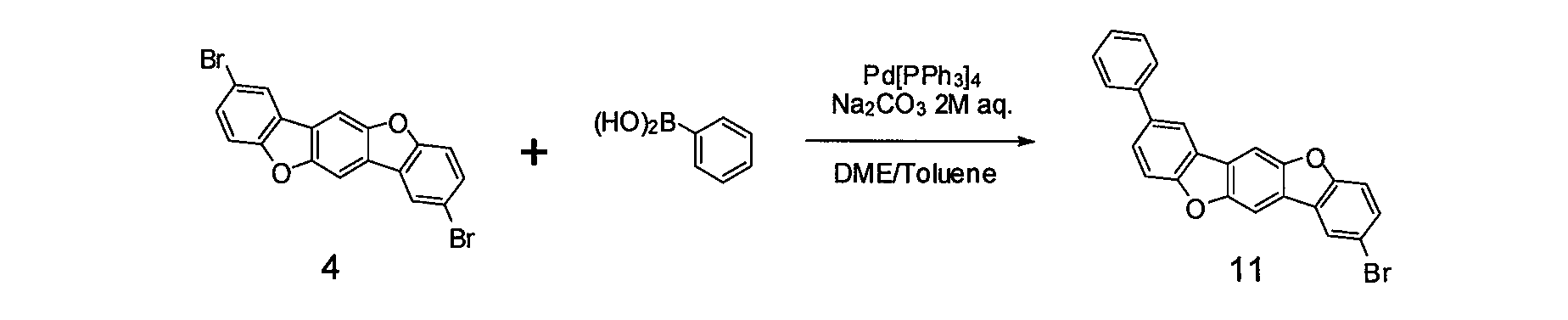
反応終了後、室温まで冷却した。試料を分液ロートに移し、水(300mL)を加え、CH2Cl2にて抽出した。MgSO4で乾燥後、ろ過、濃縮した。試料をシリカゲルカラムクロマトグラフィーで精製し、白色の固体を得た。収量10.7g、収率65%
FD-MS分析 C24H13BrO2:理論値413、観測値413
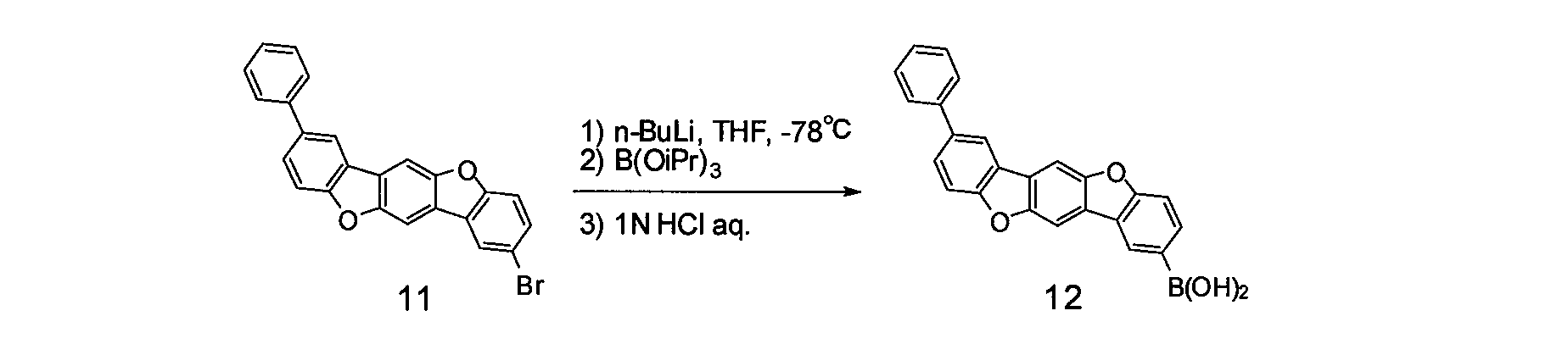

反応終了後、室温まで冷却した。試料を分液ロートに移し、水(100mL)を加え、CH2Cl2にて抽出した。MgSO4で乾燥後、ろ過、濃縮した。試料をシリカゲルカラムクロマトグラフィーで精製した。濃縮・乾固の後、再結晶を2回行い白色の粉末(化合物No.57)を得た。これを昇華精製して白色の固体を得た。収量1.6g、収率40%
FD-MS分析 C48H26O4:理論値666、観測値666
(1)化合物14の合成
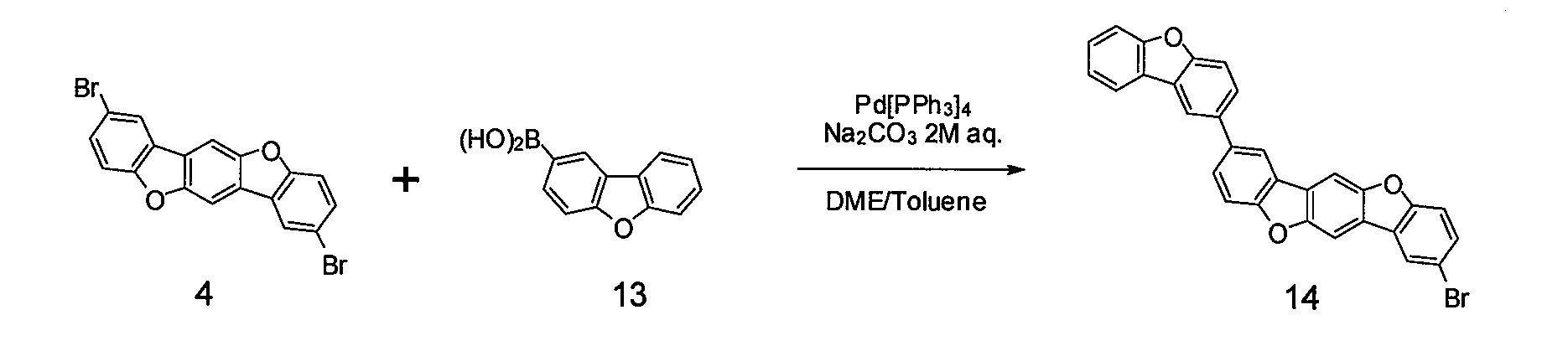
反応終了後、室温まで冷却した。試料を分液ロートに移し、水(300mL)を加え、CH2Cl2にて抽出した。MgSO4で乾燥後、ろ過、濃縮した。試料をシリカゲルカラムクロマトグラフィーで精製し、白色の固体を得た。収量11.1g、収率55%
FD-MS分析 C30H15BrO3:理論値503、観測値503
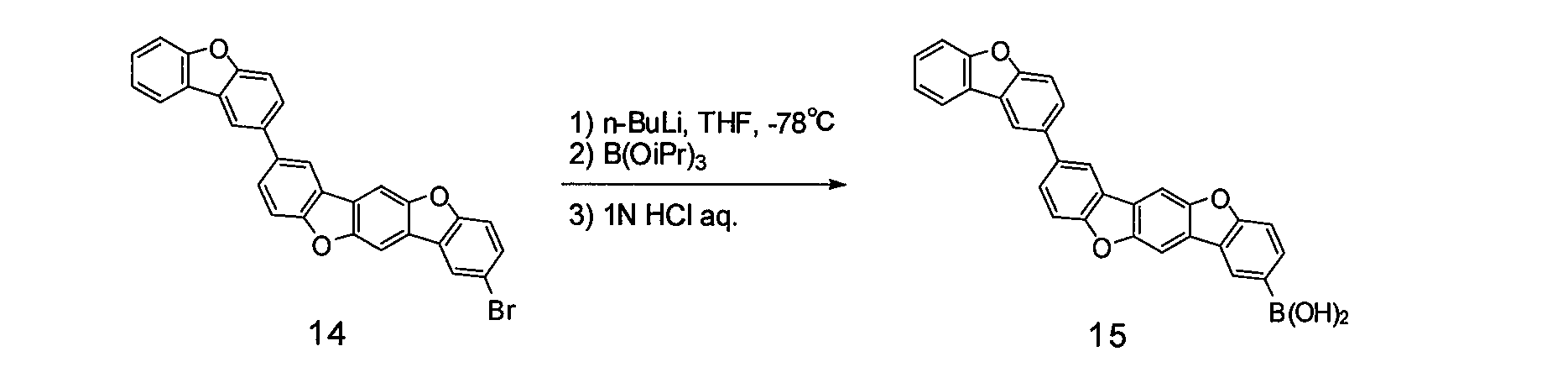
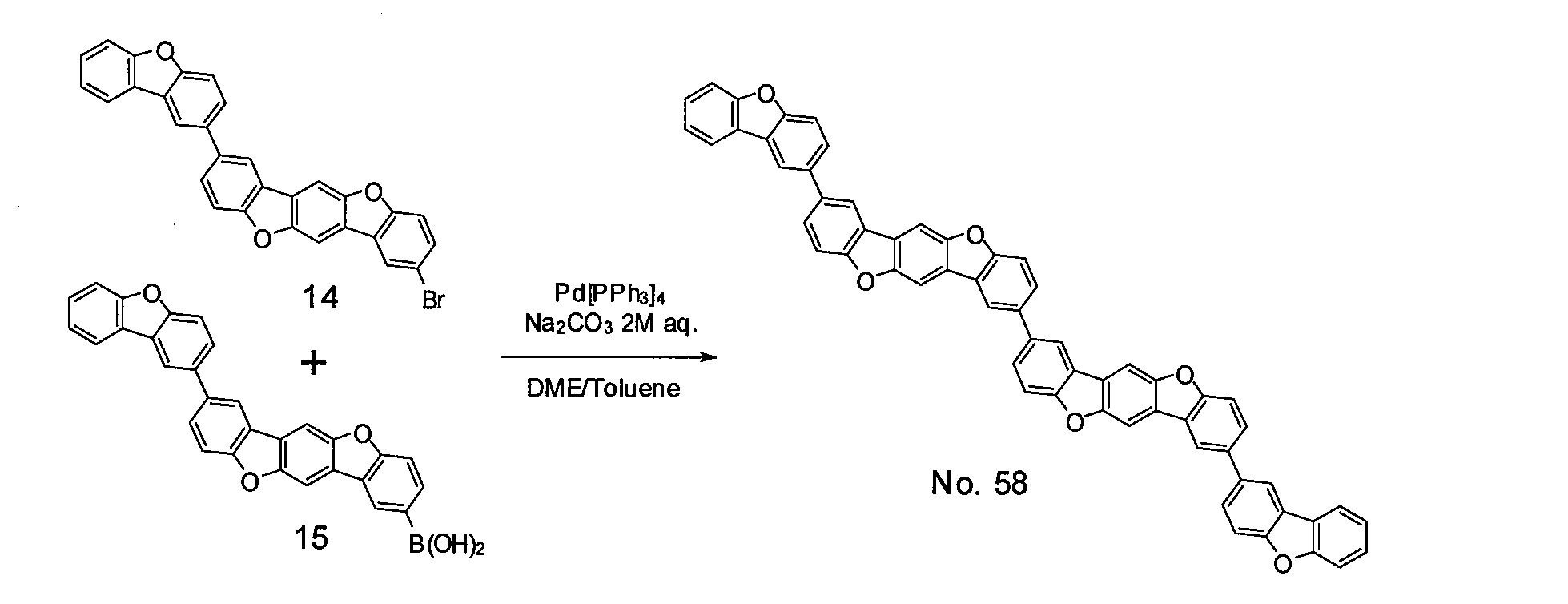
反応終了後、室温まで冷却した。試料を分液ロートに移し、水(100mL)を加え、CH2Cl2にて抽出した。MgSO4で乾燥後、ろ過、濃縮した。試料をシリカゲルカラムクロマトグラフィーで精製した。濃縮・乾固の後、再結晶を2回行い白色の粉末(化合物No.58)を得た。これを昇華精製して白色の固体を得た。収量1.3g、収率26%
FD-MS分析 C60H30O6:理論値846、観測値846
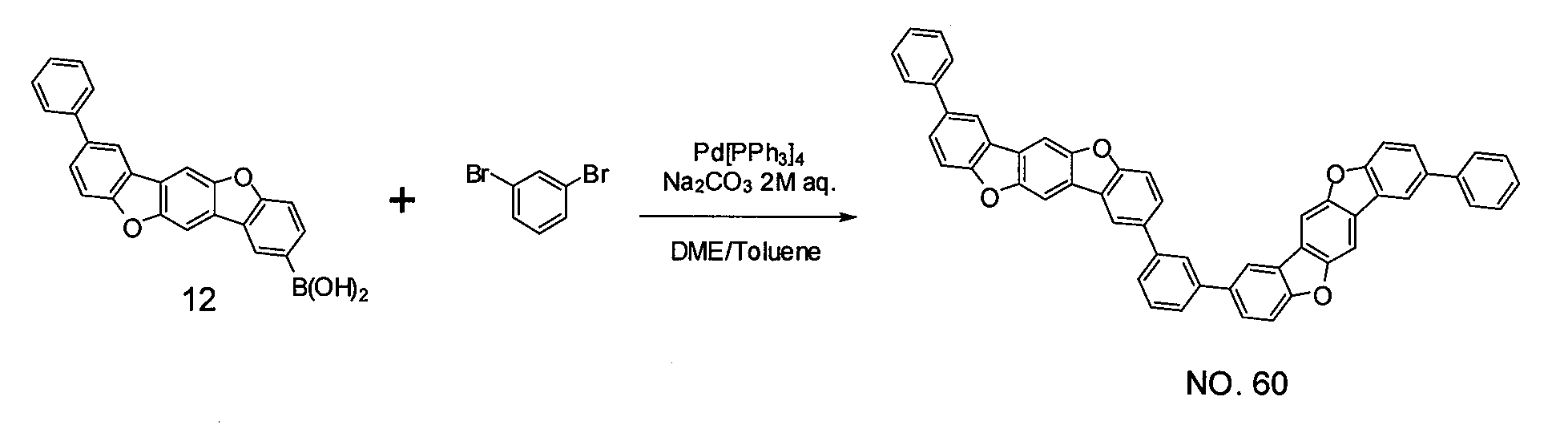
反応終了後、室温まで冷却した。試料を分液ロートに移し、水(50mL)を加え、CH2Cl2にて抽出した。MgSO4で乾燥後、ろ過、濃縮した。試料をシリカゲルカラムクロマトグラフィーで精製した。濃縮・乾固の後、再結晶を2回行い白色の粉末(化合物No.60)を得た。これを昇華精製して白色の固体を得た。収量1.6g、収率29%
FD-MS分析 C54H30O4:理論値742、観測値742

反応終了後、室温まで冷却した。試料を分液ロートに移し、水(150mL)を加え、CH2Cl2にて抽出した。MgSO4で乾燥後、ろ過、濃縮した。試料をシリカゲルカラムクロマトグラフィーで精製した。濃縮・乾固の後、再結晶を2回行い白色の粉末(No.62)を得た。これを昇華精製して白色の固体を得た。収量1.1g、収率14%
FD-MS分析 C78H42O6:理論値1075、観測値1075
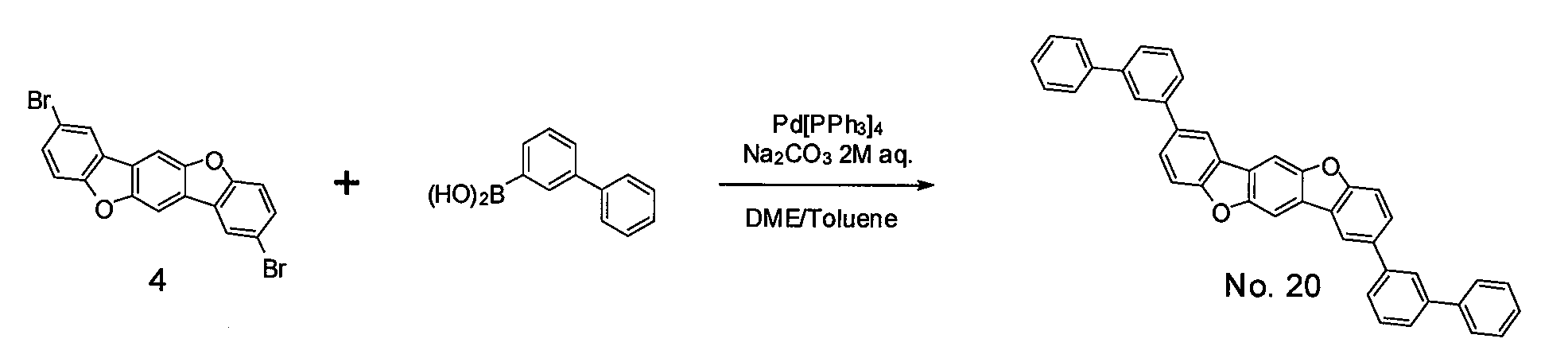
反応終了後、室温まで冷却した。試料を分液ロートに移し、水(50mL)を加え、CH2Cl2にて抽出した。MgSO4で乾燥後、ろ過、濃縮した。試料をシリカゲルカラムクロマトグラフィーで精製した。濃縮・乾固の後、再結晶を2回行い白色の粉末(化合物No.20)を得た。これを昇華精製して白色の固体を得た。収量1.3g、収率39%
FD-MS分析 C42H26O2:理論値562、観測値562
(1)化合物17の合成
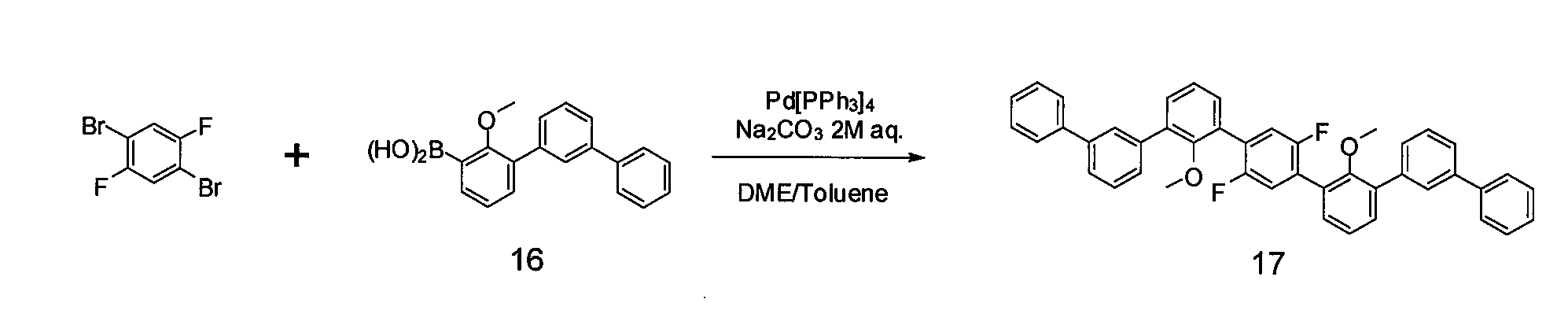
反応終了後、室温まで冷却した。試料を分液ロートに移し、水(100mL)を加え、CH2Cl2にて抽出した。MgSO4で乾燥後、ろ過、濃縮した。試料をシリカゲルカラムクロマトグラフィーで精製し、白色の固体を得た。収量8.8g、収率70%
FD-MS分析 C44H32F2O2:理論値630、観測値630
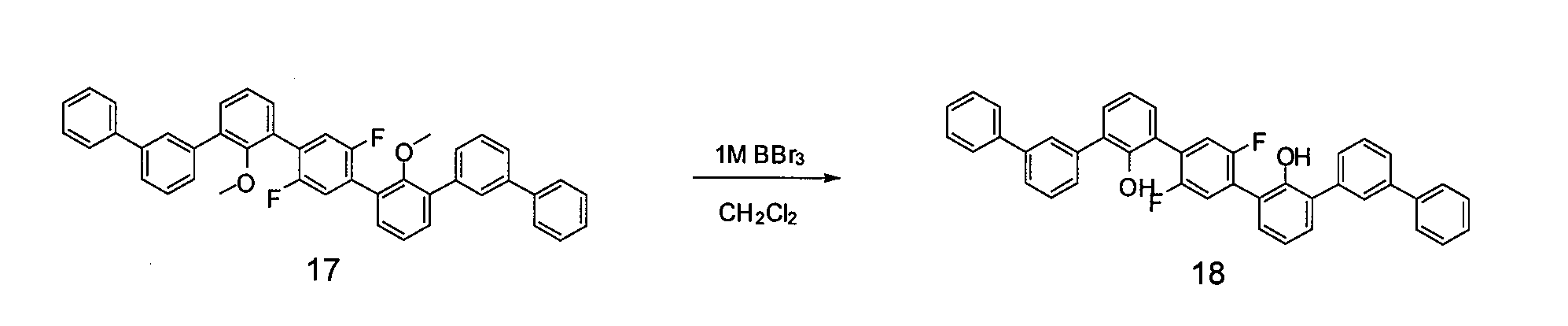
FD-MS分析 C42H28F2O2:理論値602、観測値602
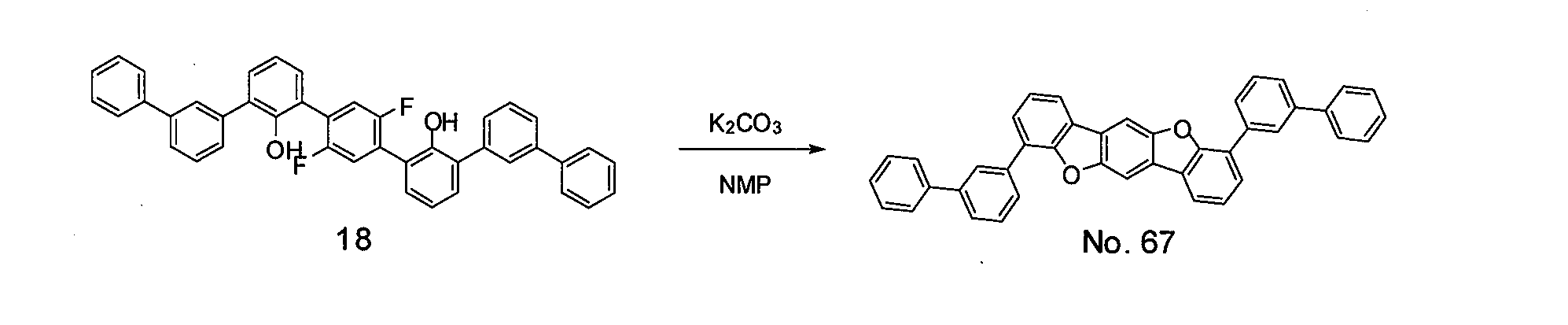
FD-MS分析 C42H26O2:理論値562、観測値562
(1)化合物19の合成

反応終了後、溶液を-78℃に冷却し、メタノール(50mL)、水(100mL)で失活した。試料を分液ロートに移し、CH2Cl2にて抽出した。MgSO4で乾燥後、ろ過、濃縮した。試料をシリカゲルカラムクロマトグラフィーで精製した。濃縮・乾固し、白色の固体を得た。収量24.7g、収率90%
FD-MS分析 C18H12F2O2:理論値298、観測値298
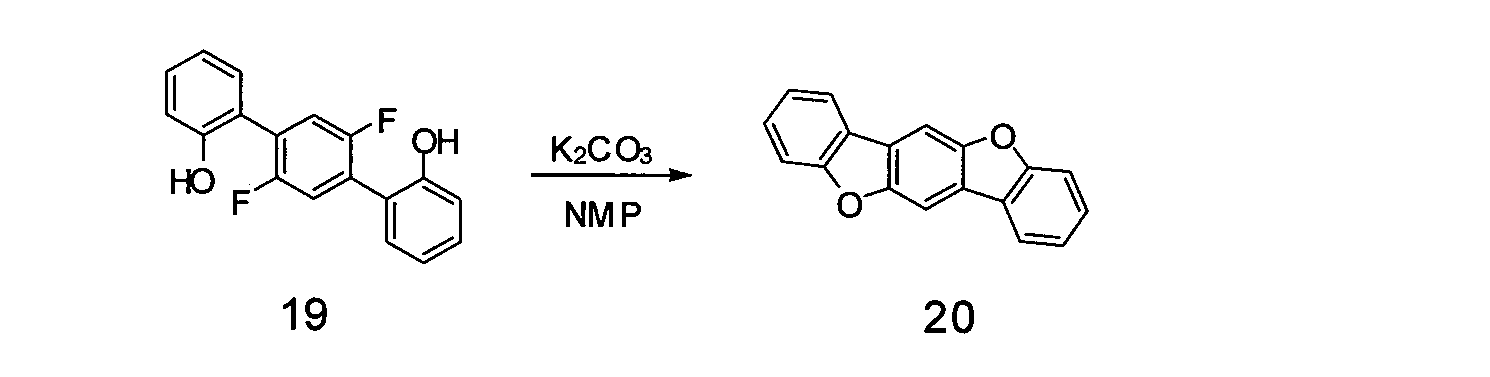
反応終了後、溶液を室温まで冷却した。試料を分液ロートに移し、トルエン(2L)を加え、水で洗浄した。濃縮・乾固の後、再結晶を行い、白色の固体を得た。収量12.7g、収率73%
FD-MS分析 C18H10O2:理論値258、観測値258

反応終了後、半分程度の容量に濃縮した。1N HCl(200mL)を加え、室温で1時間撹拌した。試料を分液ロートに移し、酢酸エチルにて抽出した。この溶液をMgSO4で乾燥した後、濃縮し、トルエン/ヘキサン混合溶媒で分散洗浄し、白色の固体を得た。収量12.6g、収率90%
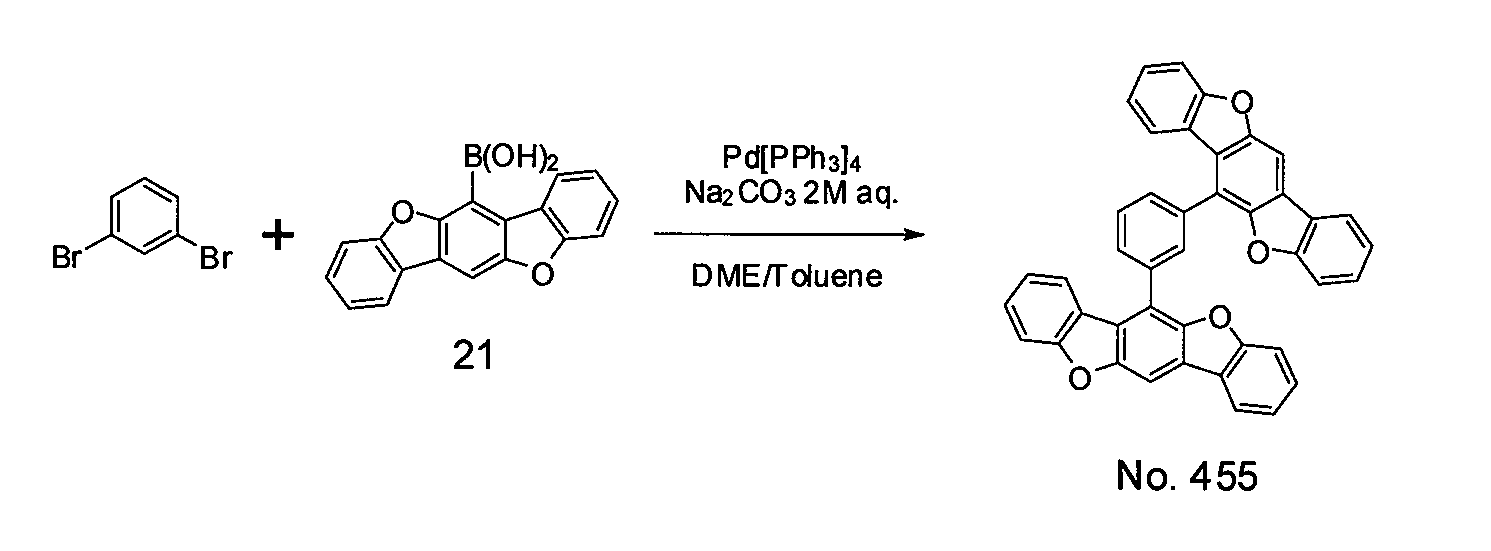
反応終了後、溶液を室温まで冷却し、試料を分液ロートに移し、水(50mL)を加え、CH2Cl2にて抽出した。MgSO4で乾燥後、ろ過、濃縮した。試料をシリカゲルカラムクロマトグラフィーで精製した。濃縮・乾固の後、再結晶を2回行い白色の粉末(化合物No.455)を得た。これを昇華精製して白色の固体を得た。収量1.8g、収率52%
FD-MS分析 C42H22O4:理論値590、観測値590
(1)化合物22の合成
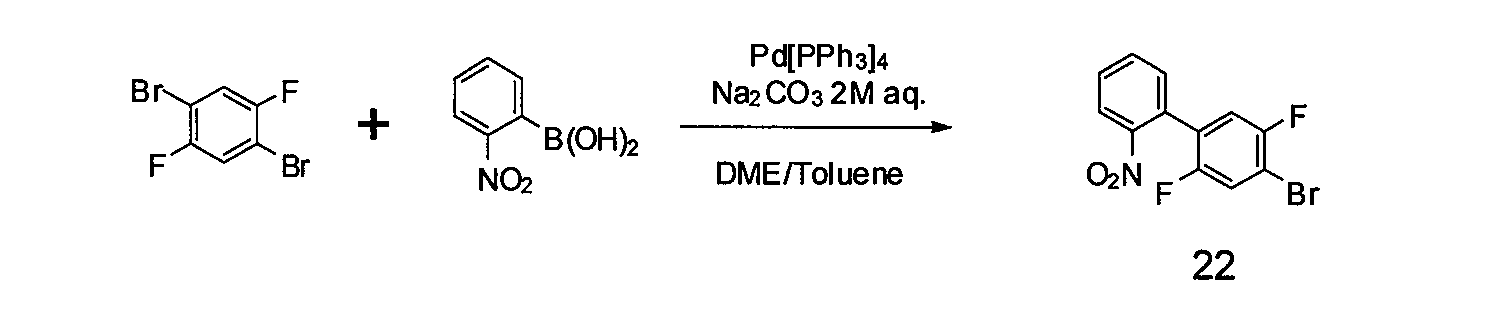
反応終了後、室温まで冷却した。試料を分液ロートに移し、水(250mL)を加え、CH2Cl2にて抽出した。MgSO4で乾燥後、ろ過、濃縮した。試料をシリカゲルカラムクロマトグラフィーで精製し、白色の固体を得た。収量26.1g、収率60%
FD-MS分析 C12H6BrF2NO2:理論値314、観測値314

反応終了後、室温まで冷却した。試料を分液ロートに移し、水(200mL)を加え、CH2Cl2にて抽出した。MgSO4で乾燥後、ろ過、濃縮した。試料をシリカゲルカラムクロマトグラフィーで精製し、白色の固体を得た。収量22.1g、収率78%
FD-MS分析 C19H13F2NO3:理論値341、観測値341

FD-MS分析 C18H11F2NO3:理論値327、観測値327
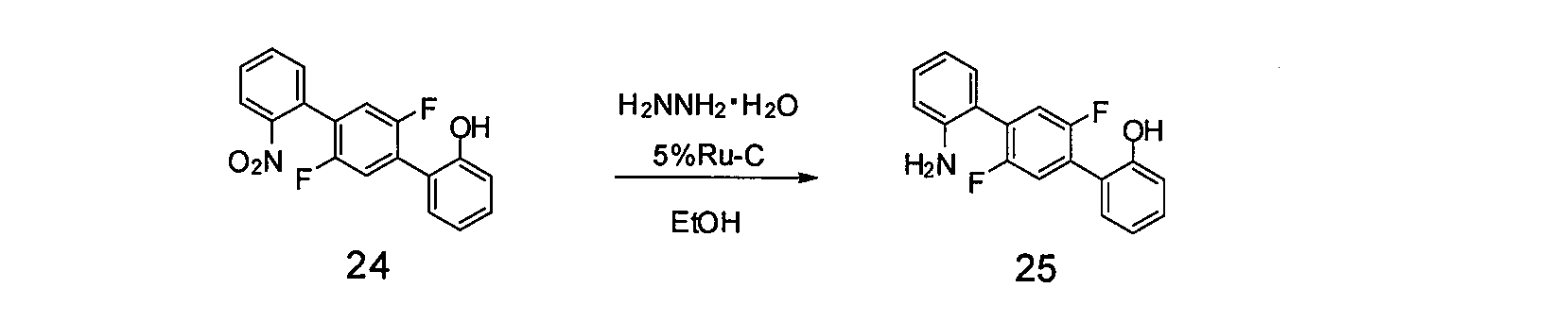
FD-MS分析 C18H13F2NO:理論値297、観測値297
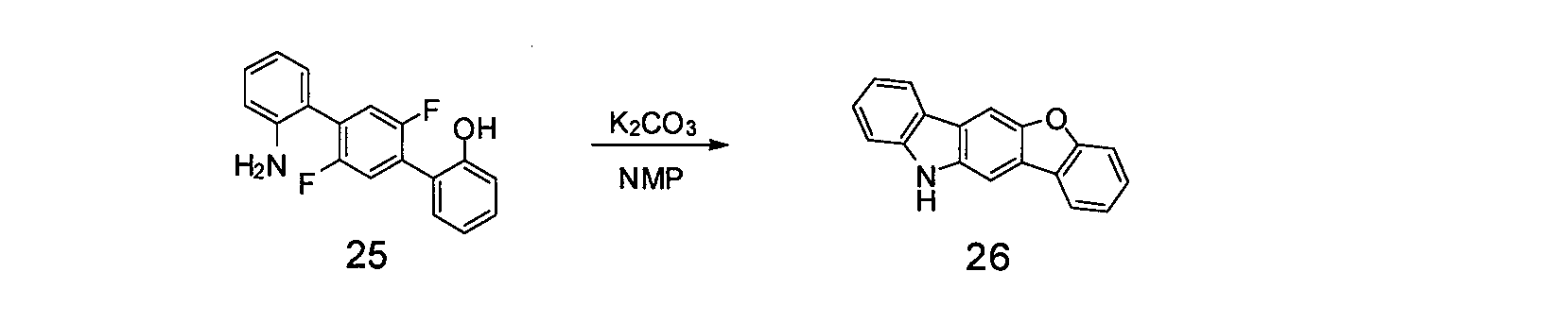
FD-MS分析 C18H11NO:理論値257、観測値257
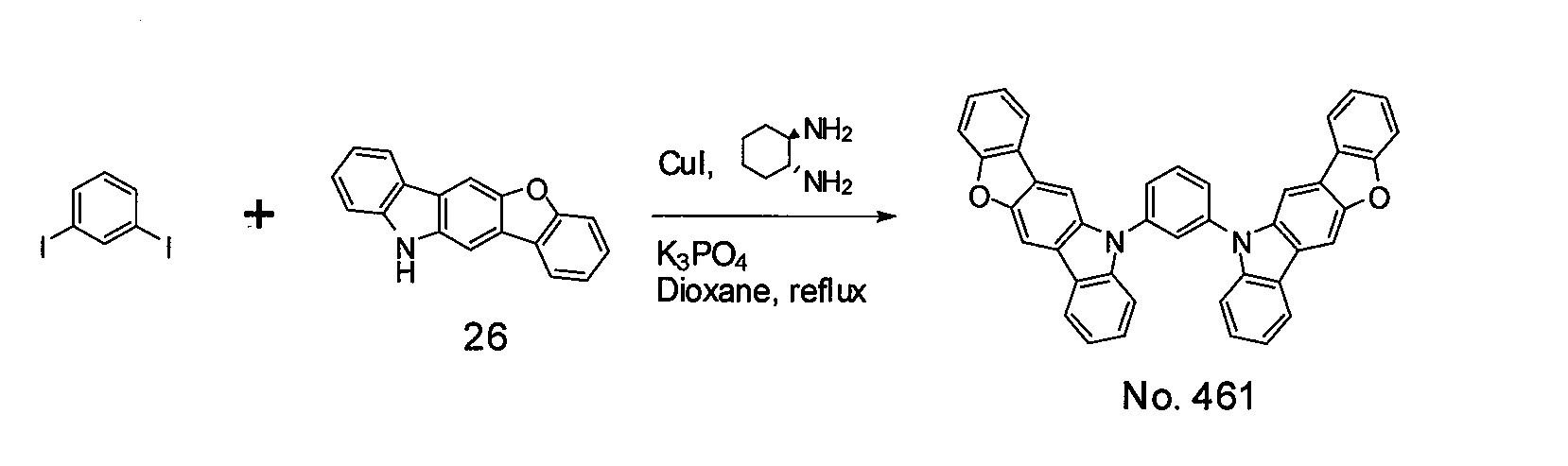
反応終了後、室温まで冷却した。試料を分液ロートに移し、水(100mL)を加え、CH2Cl2にて抽出した。試料をカラムクロマトグラフィーで精製した。濃縮・乾固の後、再結晶を2回行い白色の粉末(化合物No.461)を得た。これを昇華精製して白色の固体を得た。収量1.3g、収率35%
FD-MS分析 C42H24N2O2:理論値588、観測値588
(1)化合物28の合成
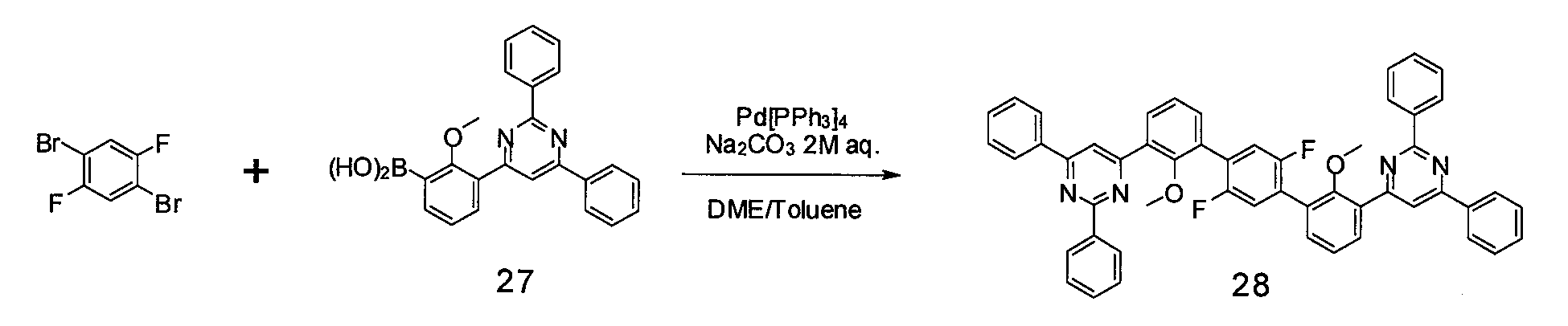
反応終了後、室温まで冷却した。試料を分液ロートに移し、水(100mL)を加え、CH2Cl2にて抽出した。MgSO4で乾燥後、ろ過、濃縮した。試料をシリカゲルカラムクロマトグラフィーで精製し、白色の固体を得た。収量11.8g、収率75%
FD-MS分析 C52H36F2N4O2:理論値786、観測値786
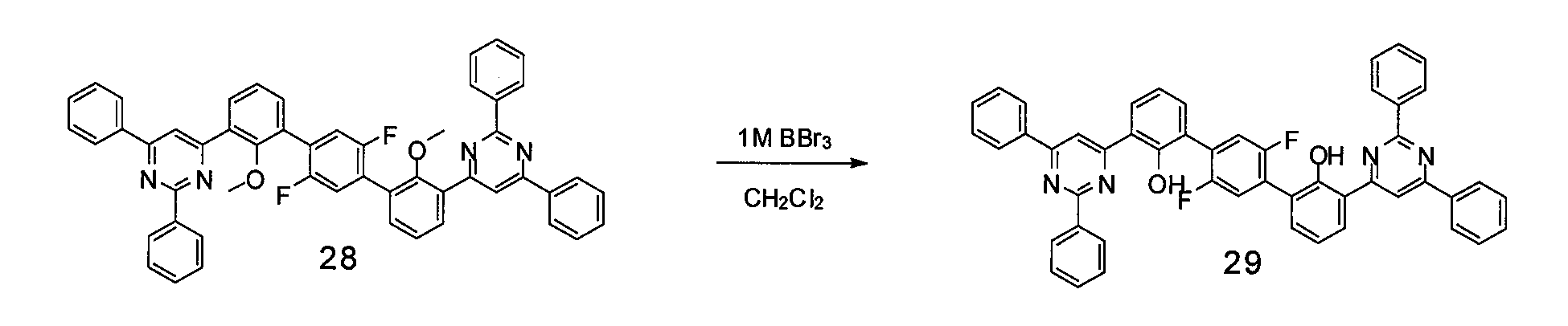
FD-MS分析 C50H32F2N4O2:理論値758、観測値758

FD-MS分析 C50H30N4O2:理論値718、観測値718
装置:HX110(日本電子社製)
条件:加速電圧 8kV
スキャンレンジ m/z=50~1500
エミッタ種:カーボン
エミッタ電流:0mA→2mA/分→40mA(10分保持)
(有機EL素子の作製)
25mm×75mm×1.1mmのITO透明電極付きガラス基板(ジオマティック社製)に、イソプロピルアルコール中で5分間の超音波洗浄を施し、さらに、30分間のUV(Ultraviolet)オゾン洗浄を施した。
このようにして洗浄した透明電極付きガラス基板を、真空蒸着装置の基板ホルダーに装着し、まず、ガラス基板の透明電極ラインが形成されている側の面上に、透明電極を覆うようにして、化合物Aを厚さ30nmで蒸着し、正孔輸送層を得た。
この正孔輸送層上に、りん光用ホストである化合物No.1とりん光用ドーパントであるIr(Ph-ppy)3とを厚さ30nmで共蒸着し、りん光発光層を得た。Ir(Ph-ppy)3の濃度は、5質量%であった。
続いて、このりん光発光層上に、厚さ10nmの化合物B、更に厚さ20nmの化合物C、厚さ1nmのLiF、厚さ80nmの金属Alを順次積層し、陰極を得た。なお、電子注入性電極であるLiFについては、1Å/minの速度で形成した。
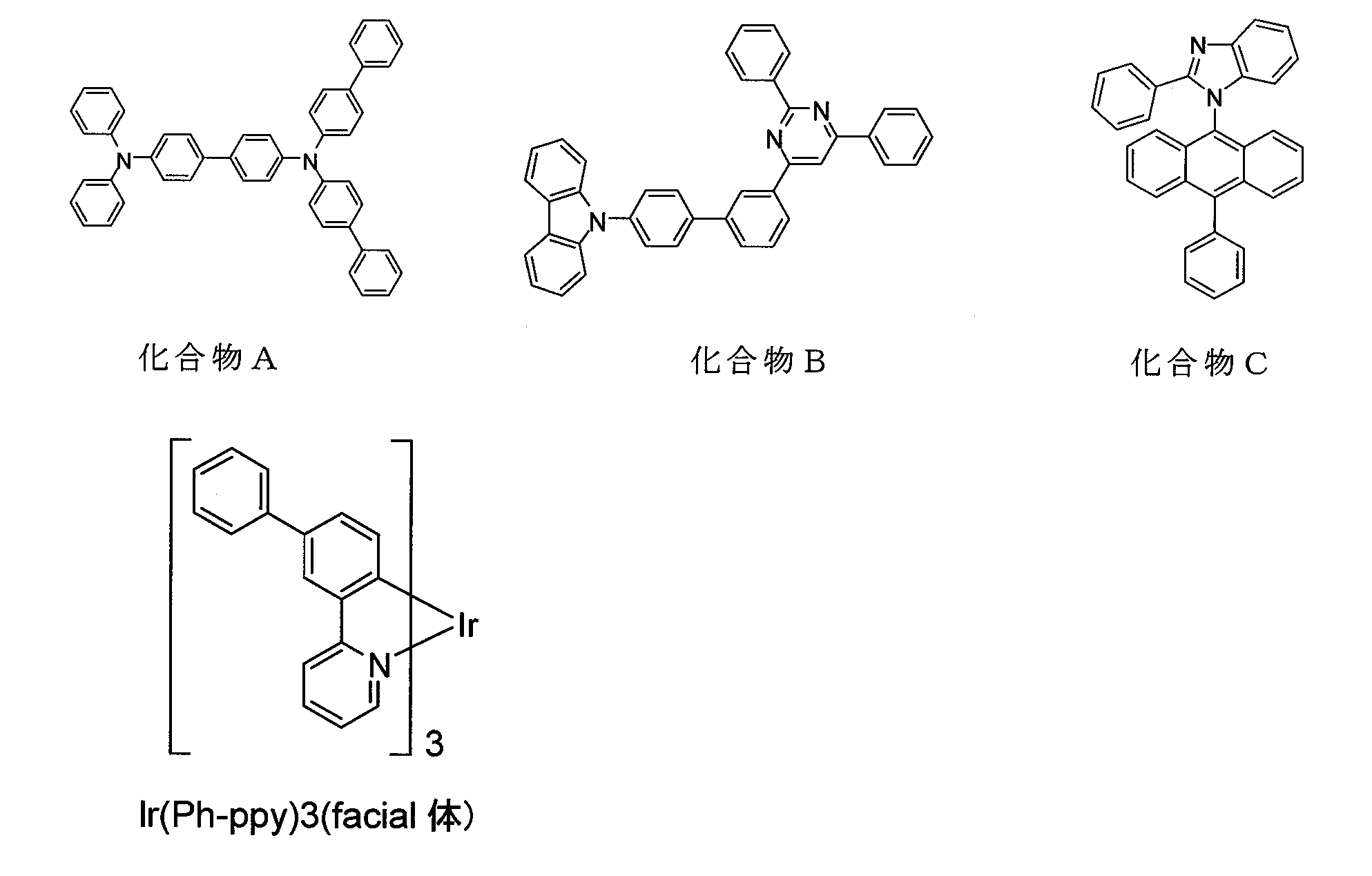
以上のように作製した有機EL素子を直流電流駆動により発光させ、輝度(L)、電流密度を測定し、輝度1000cd/m2における電流効率(L/J)を求めた。さらに輝度20000cd/m2における素子寿命を求めた。結果を表1に示す。
実施例1においてホスト化合物No.1を用いる代わりに表1に記載のホスト材料を用いた以外は実施例1と同様にして有機EL素子を作製、評価した。発光性能評価結果を表1に示す。
比較例1、2
実施例1においてホスト化合物No.1を用いる代わりにホスト材料として国際公開特許EP0908787号公報記載の下記化合物(a)、(b)を用いた以外は実施例1と同様にして有機EL素子を作製、評価した。発光性能評価結果を表1に示す。
比較例3、4
実施例1においてホスト化合物No.1を用いる代わりにホスト材料として国際公開特許WO2006-122630号公報記載の下記化合物(c)、(d)を用いた以外は実施例1と同様にして有機EL素子を作製、評価した。発光性能評価結果を表1に示す。
比較例5
実施例1においてホスト化合物No.1を用いる代わりにホスト材料として国際公開特許WO2007-063754号公報記載の下記化合物(e)を用いた以外は実施例1と同様にして有機EL素子を作製、評価した。発光性能評価結果を表1に示す。
比較例6
実施例1においてホスト化合物No.1を用いる代わりにホスト材料として公開特許公報2008-81494号公報記載の下記化合物(f)を用いた以外は実施例1と同様にして有機EL素子を作製、評価した。発光性能評価結果を表1に示す。
比較例7
実施例1においてホスト化合物No.1を用いる代わりにホスト材料として国際公開特許US2002-0132134およびUS2003-0044646号公報記載の下記化合物(g)を用いた以外は実施例1と同様にして有機EL素子を作製、評価した。発光性能評価結果を表1に示す。
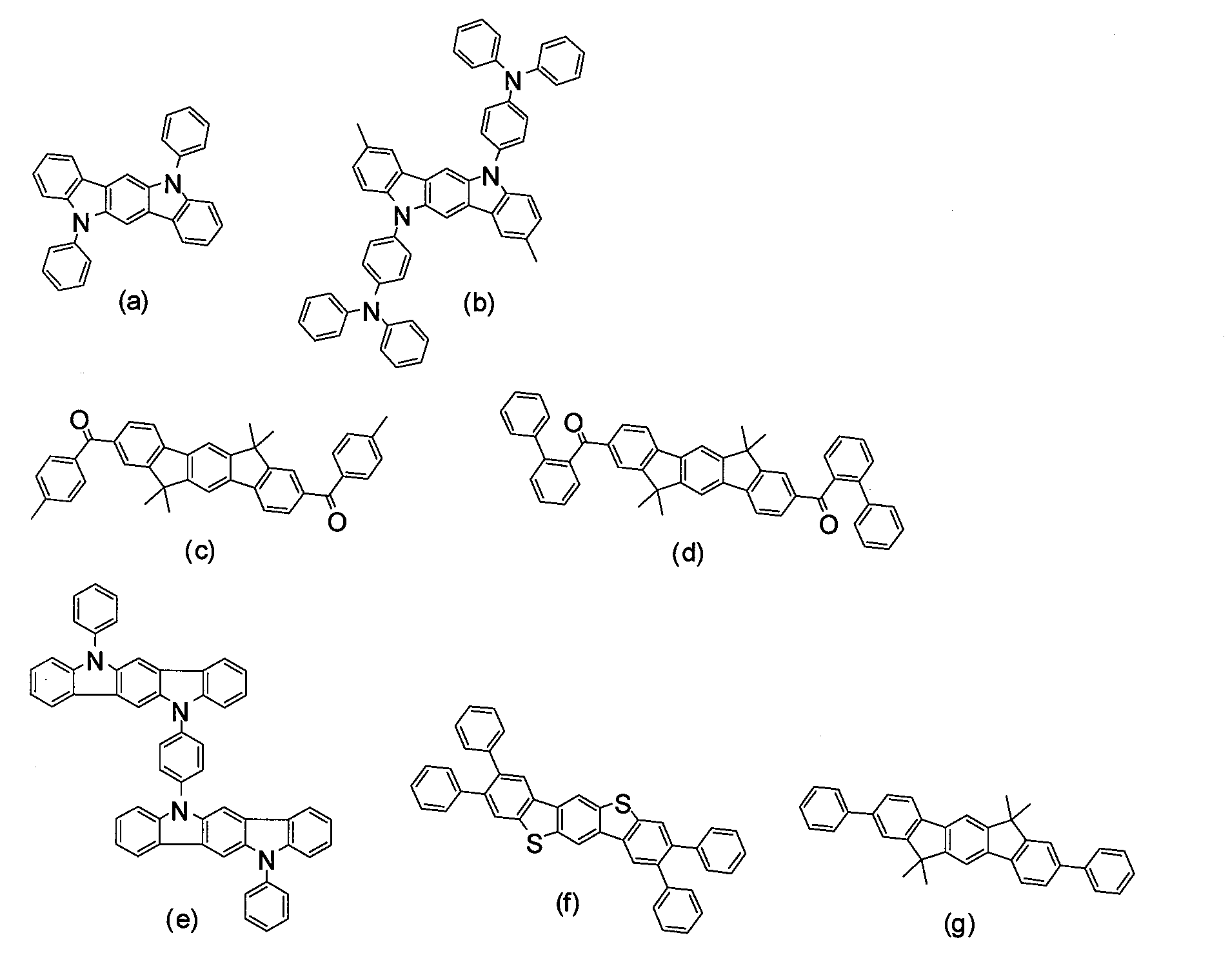
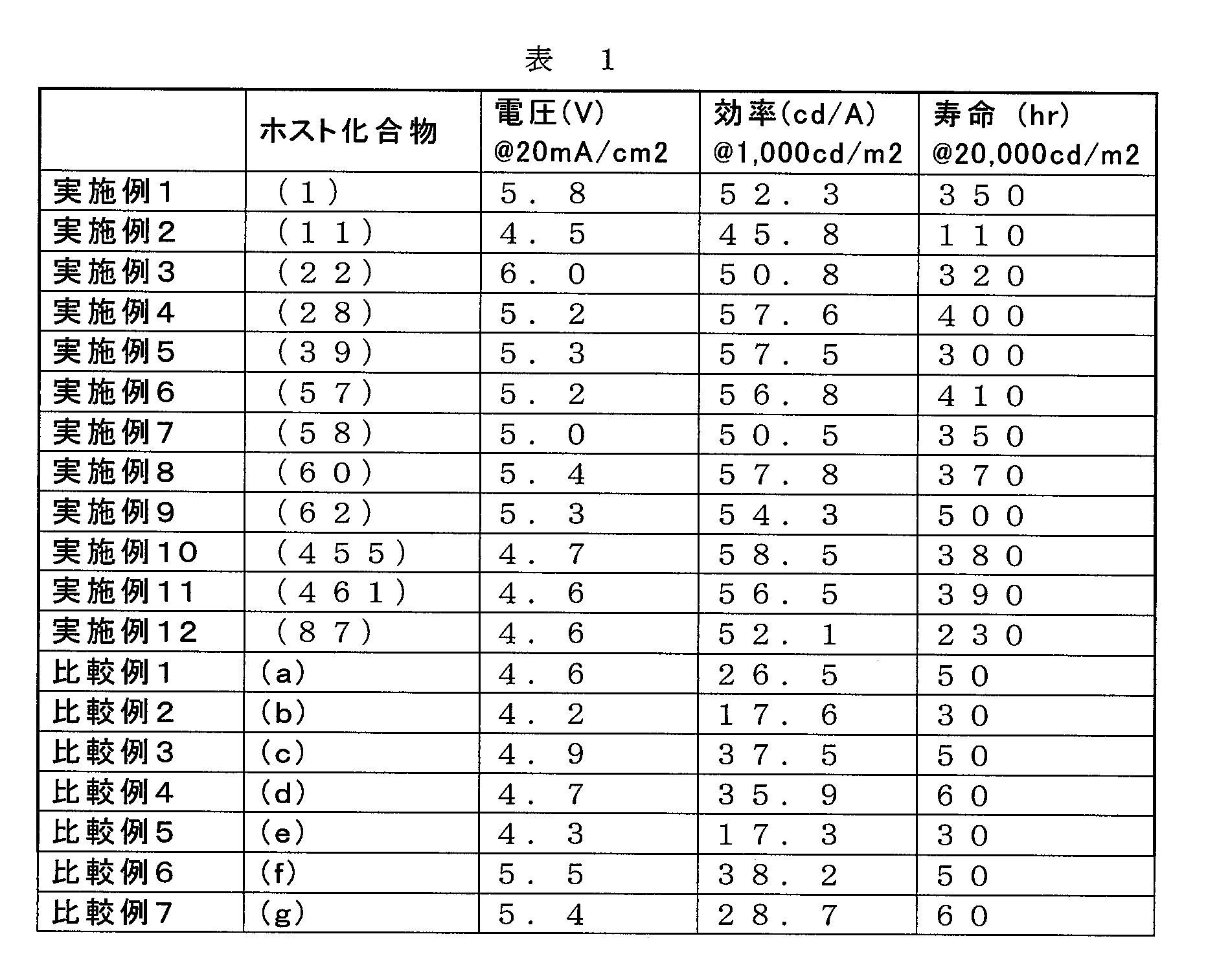
(有機EL素子の作製)
前述と同様にして洗浄した透明電極付きガラス基板を、真空蒸着装置の基板ホルダーに装着し、まず、ガラス基板の透明電極ラインが形成されている側の面上に、透明電極を覆うようにして、化合物Aを厚さ30nmで蒸着し、正孔輸送層を得た。
この正孔輸送層上に、りん光用ホストである化合物No.198とりん光用ドーパントであるIr(Ph-ppy)3とを厚さ30nmで共蒸着し、りん光発光層を得た。Ir(Ph-ppy)3の濃度は、10質量%であった。
続いて、このりん光発光層上に、厚さ10nmの化合物No.20、更に厚さ20nmの化合物C、厚さ1nmのLiF、厚さ80nmの金属Alを順次積層し、陰極を得た。なお、電子注入性電極であるLiFについては、1Å/minの速度で形成した。
以上のように作製した有機EL素子を直流電流駆動により発光させ、輝度(L)、電流密度を測定し、輝度1000cd/m2における電流効率(L/J)を求めた。さらに輝度20000cd/m2における素子寿命を求めた。結果を表2に示す。
実施例13においてホスト化合物No.198および電子輸送性化合物No.20を用いる代わりに表2に記載のホスト化合物および電子輸送性化合物を用いた以外は実施例13と同様にして有機EL素子を作製、評価した。発光性能評価結果を表2に示す。
実施例13においてホスト化合物No.198を用いる代わりにCBPを、電子輸送性化合物No.20を用いる代わりにBAlqを用いた以外は実施例13と同様にして有機EL素子を作製、評価した。発光性能評価結果を表2に示す。
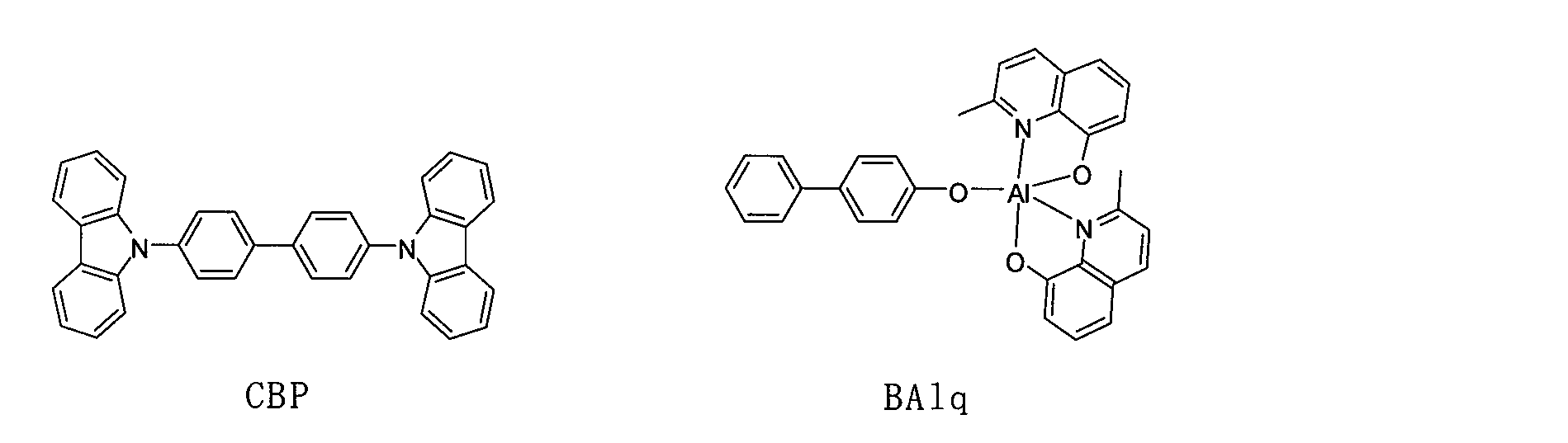

Claims (38)
- 下記式(1)または(2)で表される多環系化合物。

前記R1、R2およびR3は、それぞれ独立に、炭素数1~20のアルキル基、置換もしくは無置換の環形成炭素数3~20のシクロアルキル基、炭素数7~24のアラルキル基、シリル基もしくは炭素数3~20の置換シリル基、置換もしくは無置換の環形成炭素数6~24の芳香族炭化水素基、または置換もしくは無置換の環形成原子数3~24の芳香族複素環基を表す。但し、X1とX2が共にN-R1の場合は、R1の少なくとも1つは置換もしくは無置換の環形成原子数8~24である1価の縮合芳香族複素環基を表す。
式(2)において、nは2、3または4を表し、それぞれL3を連結基とした2量体、3量体、4量体である。
式(1)および(2)において、L1は単結合、炭素数1~20のアルキレン基、置換もしくは無置換の環形成炭素数3~20のシクロアルキレン基、2価のシリル基もしくは炭素数2~20の2価の置換シリル基、置換もしくは無置換である環形成炭素数6~24の2価の芳香族炭化水素基、または環形成原子数3~24のベンゼン環aと炭素-炭素結合で連結する置換もしくは無置換の2価の芳香族複素環基を表す。
式(1)において、L2は単結合、炭素数1~20のアルキレン基、置換もしくは無置換の環形成炭素数3~20のシクロアルキレン基、2価のシリル基もしくは炭素数2~20の2価の置換シリル基、置換もしくは無置換である環形成炭素数6~24の2価の芳香族炭化水素基、または環形成原子数3~24のベンゼン環cと炭素-炭素結合で連結する置換もしくは無置換の2価の芳香族複素環基を表す。
式(2)において、L3は、nが2の場合、単結合、炭素数1~20のアルキレン基、置換もしくは無置換の環形成炭素数3~20のシクロアルキレン基、2価のシリル基もしくは炭素数2~20の2価の置換シリル基、置換もしくは無置換の環形成炭素数6~24の2価の芳香族炭化水素基、または環形成原子数3~24でベンゼン環cと炭素-炭素結合で連結する置換もしくは無置換の2価の芳香族複素環基を表し、nが3の場合、炭素数1~20の3価の飽和炭化水素基、置換もしくは無置換の環形成炭素数3~20の3価の環状飽和炭化水素基、3価のシリル基もしくは炭素数1~20の3価の置換シリル基、置換もしくは無置換で環形成炭素数6~24の3価の芳香族炭化水素基、または原子数3~24でベンゼン環cと炭素-炭素結合で連結する置換もしくは無置換の3価の芳香族複素環基を表し、nが4の場合、炭素数1~20の4価の飽和炭化水素基、置換もしくは無置換の環形成炭素数3~20の4価の環状飽和炭化水素基、ケイ素原子、置換もしくは無置換の環形成炭素数6~24の4価の芳香族炭化水素基、または環形成原子数3~24でベンゼン環cと炭素-炭素結合で連結する置換もしくは無置換の4価の芳香族複素環基を表す。
式(1)および(2)において、A1は、水素原子、置換もしくは無置換の環形成炭素数3~20のシクロアルキル基、シリル基もしくは炭素数3~20の置換シリル基、置換もしくは無置換の環形成炭素数6~24の芳香族炭化水素基、または環形成原子数3~24でL1と炭素-炭素結合で連結する芳香族複素環基を表す。但し、L1が炭素数1~20のアルキレン基である場合、A1は水素原子である場合はない。
式(1)において、A2は、水素原子、置換もしくは無置換の環形成炭素数3~20のシクロアルキル基、シリル基もしくは炭素数3~20の置換シリル基、置換もしくは無置換の環形成炭素数6~24の芳香族炭化水素基、または環形成原子数3~24でL2と炭素-炭素結合で連結する芳香族複素環基を表す。但し、L2が炭素数1~20のあるいはアルキレン基である場合、A2は水素原子である場合はない。
式(1)および(2)において、Y1、Y2およびY3は、炭素数1~20のアルキル基、置換もしくは無置換の環形成炭素数3~20のシクロアルキル基、炭素数1~20のアルコキシ基、炭素数7~24のアラルキル基、シリル基もしくは炭素数3~20の置換シリル基、置換もしくは無置換の環形成炭素数6~24の芳香族炭化水素基、または置換もしくは無置換の環形成原子数3~24でベンゼン環a、b、cと炭素-炭素結合で連結する芳香族複素環基を表す。d、fは0、1、2または3、eは0、1または2である。
但し、X1とX2が、酸素(O)もしくはCR2R3であり、L1、L2が共に単結合であり、かつA1とA2が共に水素原子である場合、ベンゼン環bはY2を一個または二個有し、Y2がメチル基または無置換のフェニル基である場合は無い。
式(1)および(2)において、A1、A2、L1、L2およびL3は、カルボニル基を含まない。] - A1及び/又はA2が、フェニル基、ビフェニル基、ターフェニル基又はクオーターフェニル基から選ばれる少なくとも一つ以上の置換基を有するピリミジル基であることを特徴とする請求項1に記載の多環系化合物。
- A1及び/又はA2が、フェニル基、ビフェニル基、ターフェニル基又はクオーターフェニル基から選ばれる少なくとも一つ以上の置換基を有するカルバゾリル基であることを特徴とする請求項1に記載の多環系化合物。
- A1及び/又はA2が、フェニル基、ビフェニル基、ターフェニル基又はクオーターフェニル基から選ばれる少なくとも一つ以上の置換基を有するジベンゾフラニル基であることを特徴とする請求項1に記載の多環系化合物。
- A1及び/又はA2が、2以上のベンゼン環が互いにメタ位で結合する構造を有する芳香族炭化水素基であることを特徴とする請求項1に記載の多環系化合物。
- 前記式(1)、(2)が、それぞれ下記式(1a)、(1b)、(2a)、(2b)のいずれかで表される請求項1に記載の多環系化合物。
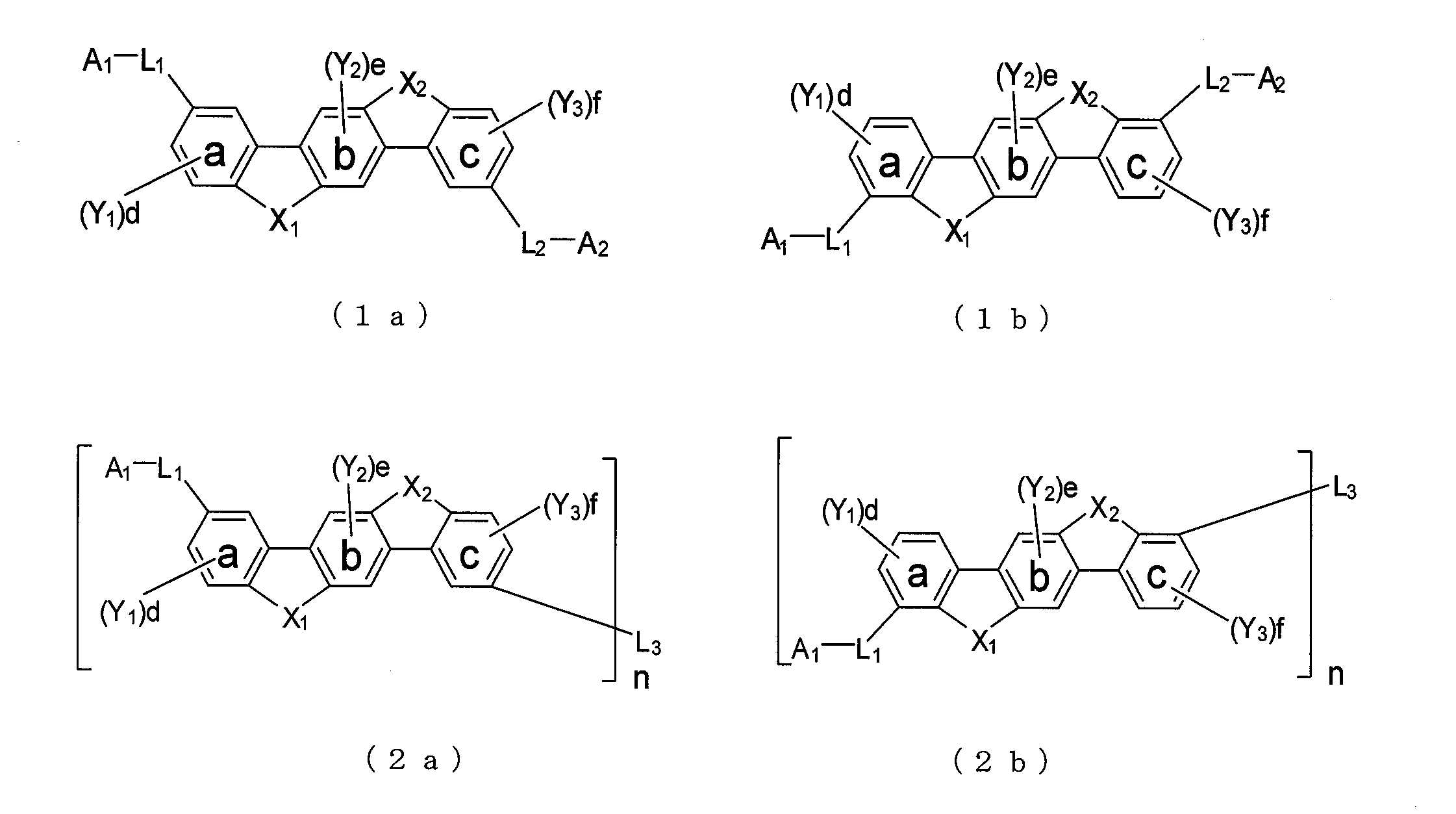
- 式(1)または(2)において、X1とX2が、共にN-R1で表され、R1の少なくとも1つがジベンゾフラン残基またはカルバゾール残基である請求項1記載の多環系化合物。
- 式(1)または(2)において、X1とX2が、共にN-R1で表され、X1のN-R1とX2のN-R1が異なっている請求項1記載の多環系化合物。
- 式(1)または(2)において、X1とX2の少なくとも一つが酸素原子である請求項1記載の多環系化合物。
- 下記式(3)~(10)のいずれかで表される請求項1記載の多環系化合物。
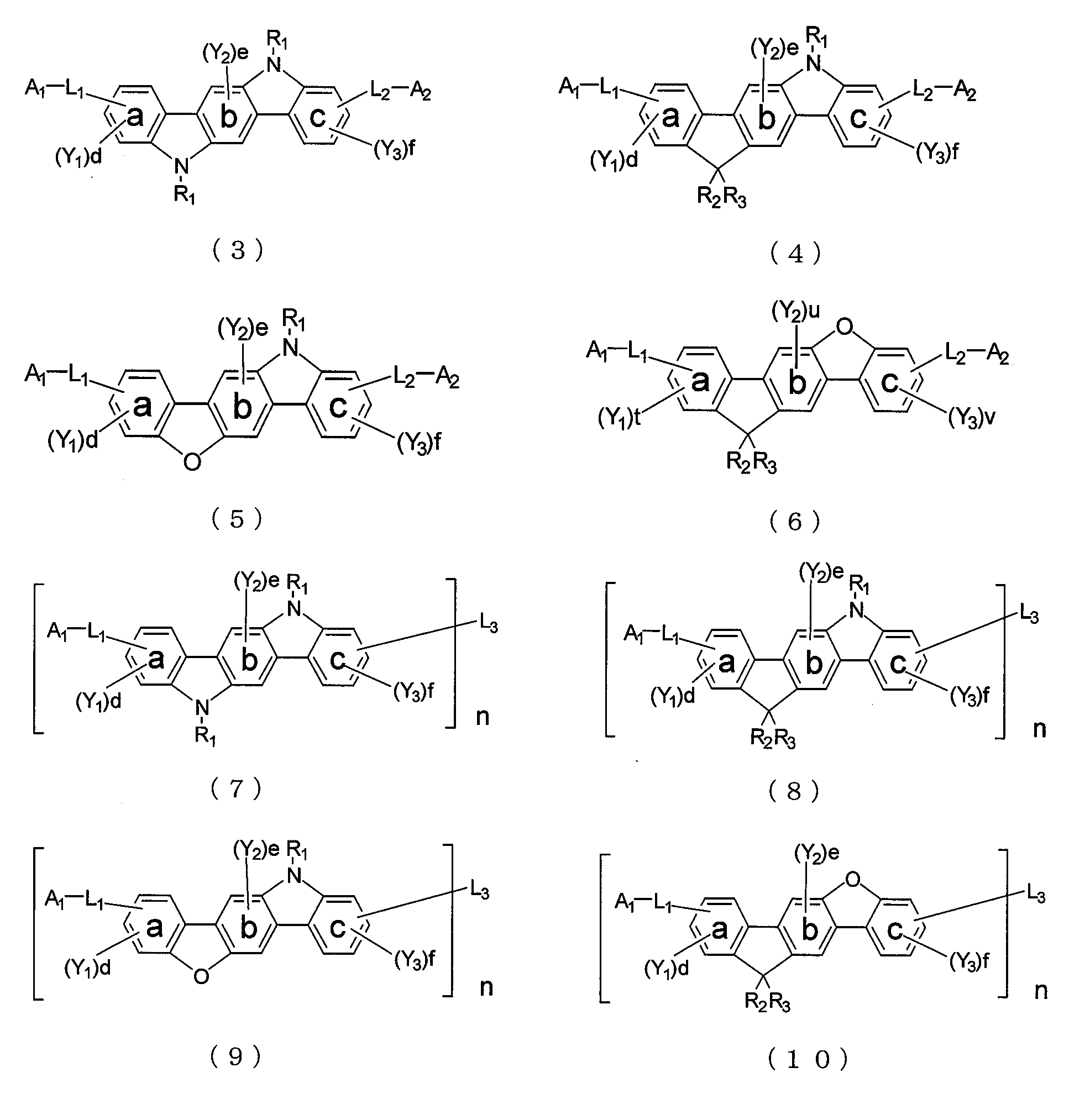
式(7)~(10)において、nは2、3または4を表し、それぞれL3を連結基とした2量体、3量体、4量体である。
式(3)~(10)において、L1は単結合、炭素数1~20のアルキレン基、置換もしくは無置換の環形成炭素数3~20のシクロアルキレン基、2価のシリル基もしくは炭素数2~20の2価の置換シリル基、置換もしくは無置換である環形成炭素数6~24の2価の芳香族炭化水素基、または環形成原子数3~24のベンゼン環aと炭素-炭素結合で連結する置換もしくは無置換の2価の芳香族複素環基を表す。
式(3)~(6)において、L2は単結合、炭素数1~20のアルキレン基、置換もしくは無置換の環形成炭素数3~20のシクロアルキレン基、2価のシリル基もしくは炭素数2~20の2価の置換シリル基、置換もしくは無置換である環形成炭素数6~24の2価の芳香族炭化水素基、または環形成原子数3~24のベンゼン環cと炭素-炭素結合で連結する置換もしくは無置換の2価の芳香族複素環基を表す。
式(7)~(10)において、L3は、nが2の場合、単結合、炭素数1~20のアルキレン基、置換もしくは無置換の環形成炭素数3~20のシクロアルキレン基、2価のシリル基もしくは炭素数2~20の2価の置換シリル基、置換もしくは無置換の環形成炭素数6~24の2価の芳香族炭化水素基、または環形成原子数3~24でベンゼン環cと炭素-炭素結合で連結する置換もしくは無置換の2価の芳香族複素環基を表し、nが3の場合、炭素数1~20の3価の飽和炭化水素基、置換もしくは無置換の環形成炭素数3~20の3価の環状飽和炭化水素基、3価のシリル基もしくは炭素数1~20の3価の置換シリル基、置換もしくは無置換で環形成炭素数6~24の3価の芳香族炭化水素基、または原子数3~24でベンゼン環cと炭素-炭素結合で連結する置換もしくは無置換の3価の芳香族複素環基を表し、nが4の場合、炭素数1~20の4価の飽和炭化水素基、置換もしくは無置換の環形成炭素数3~20の4価の環状飽和炭化水素基、ケイ素原子、置換もしくは無置換の環形成炭素数6~24の4価の芳香族炭化水素基、または環形成原子数3~24でベンゼン環cと炭素-炭素結合で連結する置換もしくは無置換の4価の芳香族複素環基を表す。
式(3)~(10)において、A1は、水素原子、置換もしくは無置換の環形成炭素数3~20のシクロアルキル基、シリル基もしくは炭素数3~20の置換シリル基、置換もしくは無置換の環形成炭素数6~24の芳香族炭化水素基、または環形成原子数3~24でL1と炭素-炭素結合で連結する芳香族複素環基を表す。但し、L1が炭素数1~20のアルキレン基である場合、A1は水素原子である場合はない。
式(3)~(6)において、A2は、水素原子、置換もしくは無置換の環形成炭素数3~20のシクロアルキル基、シリル基もしくは炭素数3~20の置換シリル基、置換もしくは無置換の環形成炭素数6~24の芳香族炭化水素基、または環形成原子数3~24でL2と炭素-炭素結合で連結する芳香族複素環基を表す。但し、L2が炭素数1~20のアルキレン基である場合、A2は水素原子である場合はない。
式(3)~(10)において、Y1、Y2およびY3は、炭素数1~20のアルキル基、置換もしくは無置換の環形成炭素数3~20のシクロアルキル基、炭素数1~20のアルコキシ基、炭素数7~24のアラルキル基、シリル基もしくは炭素数3~20の置換シリル基、置換もしくは無置換の環形成炭素数6~24の芳香族炭化水素基、または置換もしくは無置換の環形成原子数3~24でベンゼン環a、b、cと炭素-炭素結合で連結する芳香族複素環基を表す。d、fは0、1、2または3、eは0、1または2である。但し、L1、L2が共に単結合であり、かつA1とA2が共に水素原子である場合、ベンゼン環bはY2を一個または二個有し、Y2がメチル基または無置換のフェニル基である場合は無い。
式(3)~(10)において、A1、A2、L1、L2およびL3は、カルボニル基を含まない。] - 下記式(11)または(12)で表される請求項1記載の多環系化合物。
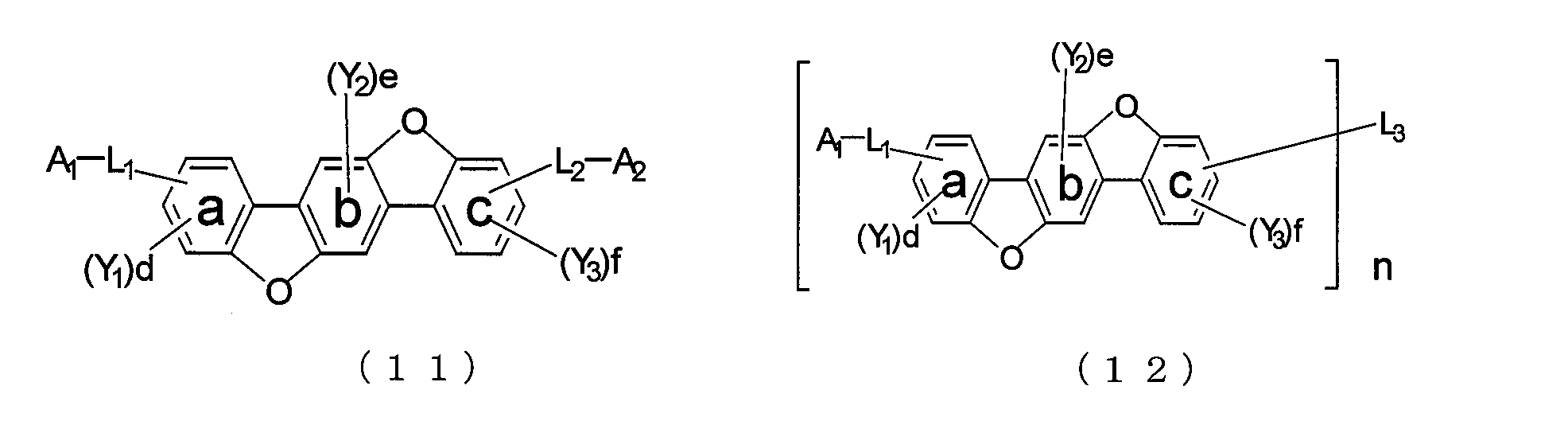
式(11)および(12)において、L1は単結合、炭素数1~20のアルキレン基、置換もしくは無置換の環形成炭素数3~20のシクロアルキレン基、2価のシリル基もしくは炭素数2~20の2価のシリル基、置換もしくは無置換である環形成炭素数6~24の2価の芳香族炭化水素基、または環形成原子数3~24のベンゼン環aと炭素-炭素結合で連結する置換もしくは無置換の2価の芳香族複素環基を表す。
式(11)において、L2は単結合、炭素数1~20のアルキレン基、置換もしくは無置換の環形成炭素数3~20のシクロアルキレン基、2価のシリル基もしくは炭素数2~20の2価のシリル基、置換もしくは無置換である環形成炭素数6~24の2価の芳香族炭化水素基、または環形成原子数3~24のベンゼン環cと炭素-炭素結合で連結する置換もしくは無置換の2価の芳香族複素環基を表す。
式(12)において、L3は、nが2の場合、単結合、炭素数1~20のアルキレン基、置換もしくは無置換の環形成炭素数3~20のシクロアルキレン基、2価のシリル基もしくは炭素数2~20の2価の置換シリル基、置換もしくは無置換の環形成炭素数6~24の2価の芳香族炭化水素基、または環形成原子数3~24でベンゼン環cと炭素-炭素結合で連結する置換もしくは無置換の2価の芳香族複素環基を表し、nが3の場合、炭素数1~20の3価の飽和炭化水素基、置換もしくは無置換の環形成炭素数3~20の3価の環状飽和炭化水素基、3価のシリル基もしくは炭素数1~20の3価の置換シリル基、置換もしくは無置換で環形成炭素数6~24の3価の芳香族炭化水素基、または原子数3~24でベンゼン環cと炭素-炭素結合で連結する置換もしくは無置換の3価の芳香族複素環基を表し、nが4の場合、炭素数1~20の4価の飽和炭化水素基、置換もしくは無置換の環形成炭素数3~20の4価の環状飽和炭化水素基、ケイ素原子、置換もしくは無置換の環形成炭素数6~24の4価の芳香族炭化水素基、または環形成原子数3~24でベンゼン環cと炭素-炭素結合で連結する置換もしくは無置換の4価の芳香族複素環基を表す。
式(11)および(12)において、A1は、水素原子、置換もしくは無置換の環形成炭素数3~20のシクロアルキル基、シリル基もしくは炭素数3~20の置換シリル基、置換もしくは無置換の環形成炭素数6~24の芳香族炭化水素基、または環形成原子数3~24でL1と炭素-炭素結合で連結する芳香族複素環基を表す。但し、L1が炭素数1~20のアルキレン基である場合、A1は水素原子である場合はない。
式(11)において、A2は、水素原子、置換もしくは無置換の環形成炭素数3~20のシクロアルキル基、シリル基もしくは炭素数3~20の置換シリル基、置換もしくは無置換の環形成炭素数6~24の芳香族炭化水素基、または環形成原子数3~24でL2と炭素-炭素結合で連結する芳香族複素環基を表す。但し、L2が炭素数1~20のアルキレン基である場合、A2は水素原子である場合はない。
式(11)および(12)において、Y1、Y2およびY3は、炭素数1~20のアルキル基、置換もしくは無置換の環形成炭素数3~20のシクロアルキル基、炭素数1~20のアルコキシ基、炭素数7~24のアラルキル基、シリル基もしくは炭素数3~20の置換シリル基、置換もしくは無置換の環形成炭素数6~24の芳香族炭化水素基、または置換もしくは無置換の環形成原子数3~24でベンゼン環a、b、cと炭素-炭素結合で連結する芳香族複素環基を表す。d、fは0、1、2または3、eは0、1または2である。但し、L1、L2が共に単結合であり、かつA1とA2が共に水素原子である場合、ベンゼン環bはY2を一個または二個有し、Y2がメチル基または無置換のフェニル基である場合は無い。
式(11)および(12)において、A1、A2、L1、L2およびL3は、カルボニル基を含まない。] - 式(11)および(12)において、A1が、シリル基もしくは炭素数3~20の置換シリル基、または環形成原子数3~24でL1と炭素-炭素結合で連結する芳香族複素環基である請求項11記載の多環系化合物。
- 式(11)および(12)において、A1が、L1と炭素-炭素結合で連結するピリダジン、ピリミジン、ピラジン、1,3,5-トリアジン、カルバゾール、ジベンゾフラン、ジベンゾチオフェン、フェノキサジン、フェノチアジン、ジヒドロアクリジンから選ばれる芳香族複素環基である請求項11記載の多環系化合物。
- 下記式(13)または(14)で表される請求項1記載の多環系化合物。
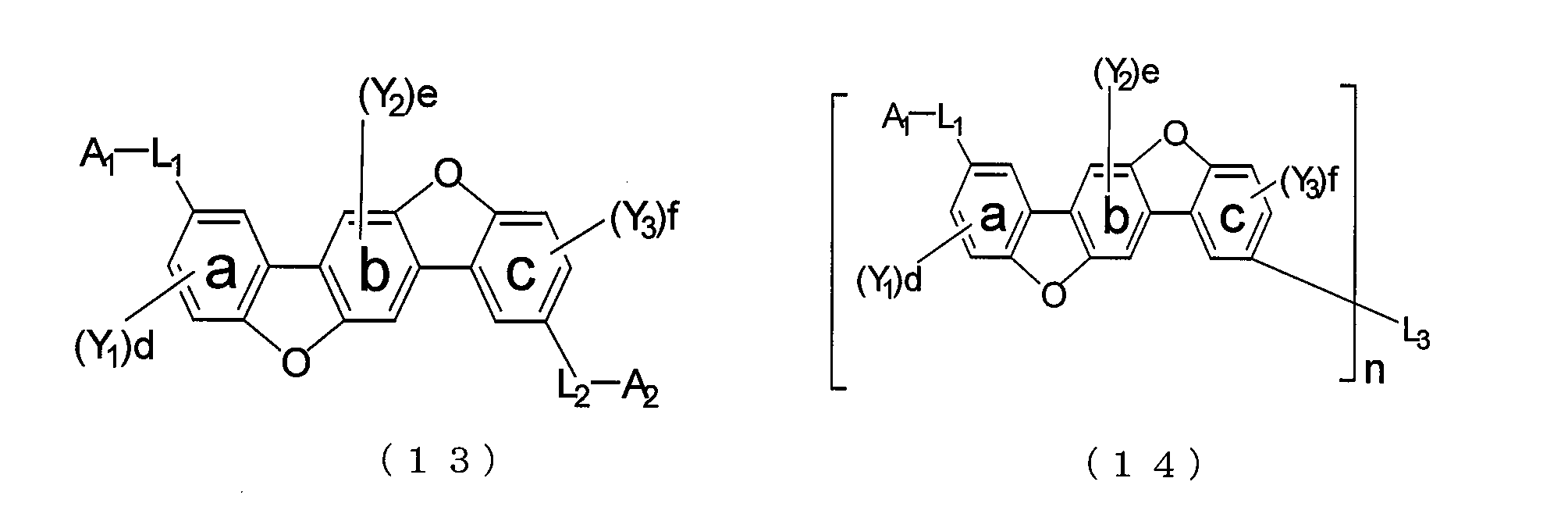
式(13)および(14)において、L1は単結合、炭素数1~20のアルキレン基、置換もしくは無置換の環形成炭素数3~20のシクロアルキレン基、2価のシリル基もしくは炭素数2~20の2価のシリル基、置換もしくは無置換である環形成炭素数6~24の2価の芳香族炭化水素基、または環形成原子数3~24のベンゼン環aと炭素-炭素結合で連結する置換もしくは無置換の2価の芳香族複素環基を表す。
式(13)において、L2は単結合、炭素数1~20のアルキレン基、置換もしくは無置換の環形成炭素数3~20のシクロアルキレン基、シリル基もしくは炭素数2~20の2価の置換シリル基、置換もしくは無置換である環形成炭素数6~24の2価の芳香族炭化水素基、または環形成原子数3~24のベンゼン環cと炭素-炭素結合で連結する置換もしくは無置換の2価の芳香族複素環基を表す。
式(14)において、L3は、nが2の場合、単結合、炭素数1~20のアルキレン基、置換もしくは無置換の環形成炭素数3~20のシクロアルキレン基、2価のシリル基もしくは炭素数2~20の2価の置換シリル基、置換もしくは無置換の環形成炭素数6~24の2価の芳香族炭化水素基、または環形成原子数3~24でベンゼン環cと炭素-炭素結合で連結する置換もしくは無置換の2価の芳香族複素環基を表し、nが3の場合、炭素数1~20の3価の飽和炭化水素基、置換もしくは無置換の環形成炭素数3~20の3価の環状飽和炭化水素基、3価のシリル基もしくは炭素数1~20の3価の置換シリル基、置換もしくは無置換で環形成炭素数6~24の3価の芳香族炭化水素基、または原子数3~24でベンゼン環cと炭素-炭素結合で連結する置換もしくは無置換の3価の芳香族複素環基を表し、nが4の場合、炭素数1~20の4価の飽和炭化水素基、置換もしくは無置換の環形成炭素数3~20の4価の環状飽和炭化水素基、ケイ素原子、置換もしくは無置換の環形成炭素数6~24の4価の芳香族炭化水素基、または環形成原子数3~24でベンゼン環cと炭素-炭素結合で連結する置換もしくは無置換の4価の芳香族複素環基を表す。
式(13)および(14)において、A1は、水素原子、置換もしくは無置換の環形成炭素数3~20のシクロアルキル基、シリル基もしくは炭素数3~20の置換シリル基、置換もしくは無置換の環形成炭素数6~24の芳香族炭化水素基、または環形成原子数3~24でL1と炭素-炭素結合で連結する芳香族複素環基を表す。但し、L1が炭素数1~20のアルキレン基である場合、A1は水素原子である場合はない。
式(13)において、A2は、水素原子、置換もしくは無置換の環形成炭素数3~20のシクロアルキル基、シリル基もしくは炭素数3~20の置換シリル基、置換もしくは無置換の環形成炭素数6~24の芳香族炭化水素基、または環形成原子数3~24でL2と炭素-炭素結合で連結する芳香族複素環基を表す。但し、L2が炭素数1~20のアルキレン基である場合、A2は水素原子である場合はない。
式(13)および(14)において、Y1、Y2およびY3は、炭素数1~20のアルキル基、置換もしくは無置換の環形成炭素数3~20のシクロアルキル基、炭素数1~20のアルコキシ基、炭素数7~24のアラルキル基、シリル基もしくは炭素数3~20の置換シリル基、置換もしくは無置換の環形成炭素数6~24の芳香族炭化水素基、または置換もしくは無置換の環形成原子数3~24でベンゼン環a、b、cと炭素-炭素結合で連結する芳香族複素環基を表す。d、fは0、1、2または3、eは0、1または2である。但し、L1、L2が共に単結合であり、かつA1とA2が共に水素原子である場合、ベンゼン環bはY2を一個または二個有し、Y2がメチル基または無置換のフェニル基である場合は無い。
式(13)および(14)において、A1、A2、L1、L2およびL3は、カルボニル基を含まない。] - 式(13)および(14)において、A1が、シリル基もしくは炭素数3~20の置換シリル基、または環形成原子数3~24でL1と炭素-炭素結合で連結する芳香族複素環基である請求項14記載の多環系化合物。
- 式(13)および(14)において、A1が、L1と炭素-炭素結合で連結するピリダジン、ピリミジン、ピラジン、1,3,5-トリアジン、カルバゾール、ジベンゾフラン、ジベンゾチオフェン、フェノキサジン、フェノチアジン、ジヒドロアクリジンから選ばれる芳香族複素環基である請求項14記載の多環系化合物。
- 下記式(15)で表される多環系化合物。
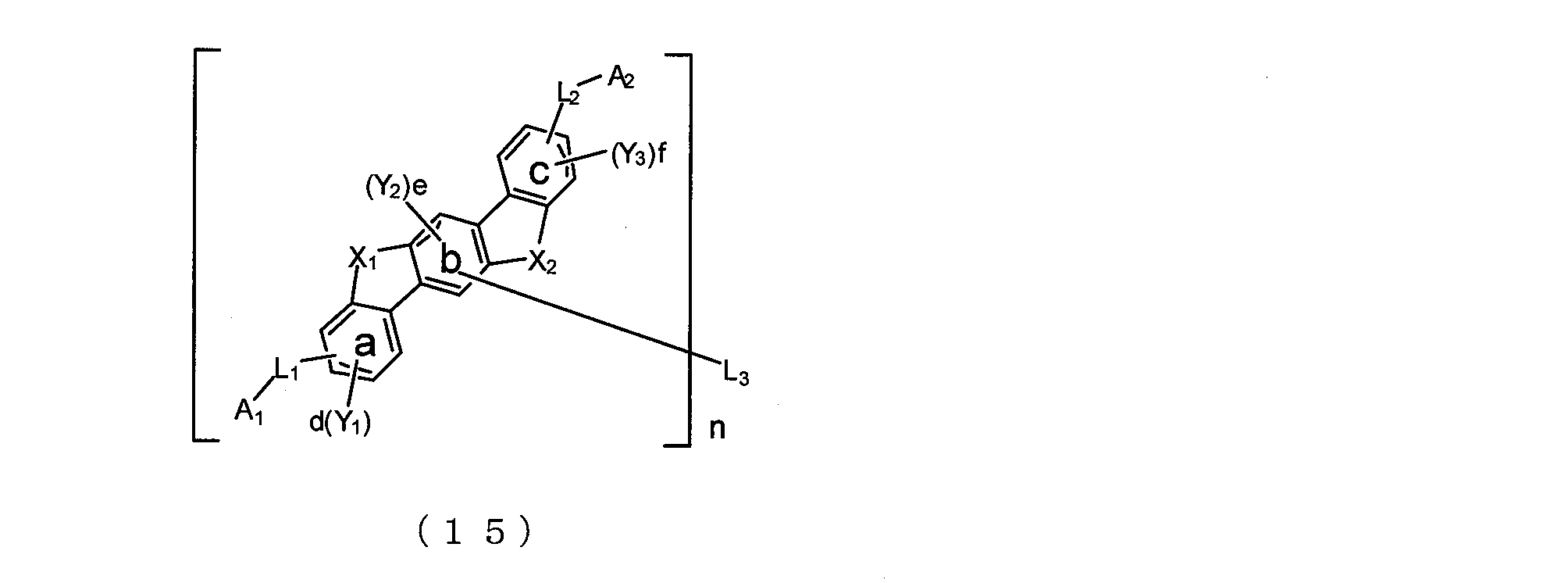
前記R1、R2およびR3は、それぞれ独立に、炭素数1~20のアルキル基、置換もしくは無置換の環形成炭素数3~20のシクロアルキル基、炭素数7~24のアラルキル基、シリル基もしくは炭素数3~20の置換シリル基、置換もしくは無置換の環形成炭素数6~24の芳香族炭化水素基、または置換もしくは無置換の環形成原子数3~24の芳香族複素環基を表す。但し、X1とX2が共にN-R1の場合は、R1の少なくとも1つは置換もしくは無置換の環形成原子数8~24である1価の縮合芳香族複素環基を表す。
式(15)において、nは2、3または4を表し、それぞれL3を連結基とした2量体、3量体、4量体である。
式(15)において、L1は単結合、炭素数1~20のアルキレン基、置換もしくは無置換の環形成炭素数3~20のシクロアルキレン基、2価のシリル基もしくは炭素数2~20の2価の置換シリル基、置換もしくは無置換である環形成炭素数6~24の2価の芳香族炭化水素基、または環形成原子数3~24のベンゼン環aと炭素-炭素結合で連結する置換もしくは無置換の2価の芳香族複素環基を表す。
式(15)において、L2は単結合、炭素数1~20のアルキレン基、置換もしくは無置換の環形成炭素数3~20のシクロアルキレン基、2価のシリル基もしくは炭素数2~20の2価の置換シリル基、置換もしくは無置換である環形成炭素数6~24の2価の芳香族炭化水素基、または環形成原子数3~24のベンゼン環cと炭素-炭素結合で連結する置換もしくは無置換の2価の芳香族複素環基を表す。
式(15)において、L3は、nが2の場合、単結合、炭素数1~20のアルキレン基、置換もしくは無置換の環形成炭素数3~20のシクロアルキレン基、2価のシリル基もしくは炭素数2~20の2価の置換シリル基、置換もしくは無置換の環形成炭素数6~24の2価の芳香族炭化水素基、または環形成原子数3~24でベンゼン環bと炭素-炭素結合で連結する置換もしくは無置換の2価の芳香族複素環基を表し、nが3の場合、炭素数1~20の3価の飽和炭化水素基、置換もしくは無置換の環形成炭素数3~20の3価の環状飽和炭化水素基、3価のシリル基もしくは炭素数1~20の3価の置換シリル基、置換もしくは無置換で環形成炭素数6~24の3価の芳香族炭化水素基、または原子数3~24でベンゼン環bと炭素-炭素結合で連結する置換もしくは無置換の3価の芳香族複素環基を表し、nが4の場合、炭素数1~20の4価の飽和炭化水素基、置換もしくは無置換の環形成炭素数3~20の4価の環状飽和炭化水素基、ケイ素原子、置換もしくは無置換の環形成炭素数6~24の4価の芳香族炭化水素基、または環形成原子数3~24でベンゼン環bと炭素-炭素結合で連結する置換もしくは無置換の4価の芳香族複素環基を表す。
式(15)において、A1は、水素原子、置換もしくは無置換の環形成炭素数3~20のシクロアルキル基、シリル基もしくは炭素数3~20の置換シリル基、置換もしくは無置換の環形成炭素数6~24の芳香族炭化水素基、または環形成原子数3~24でL1と炭素-炭素結合で連結する芳香族複素環基を表す。但し、L1が炭素数1~20のアルキレン基である場合、A1は水素原子である場合はない。
式(15)において、A2は、水素原子、置換もしくは無置換の環形成炭素数3~20のシクロアルキル基、シリル基もしくは炭素数3~20の置換シリル基、置換もしくは無置換の環形成炭素数6~24の芳香族炭化水素基、または環形成原子数3~24でL2と炭素-炭素結合で連結する芳香族複素環基を表す。但し、L2が炭素数1~20のアルキレン基である場合、A2は水素原子である場合はない。
式(15)において、Y1、Y2およびY3は、炭素数1~20のアルキル基、置換もしくは無置換の環形成炭素数3~20のシクロアルキル基、炭素数1~20のアルコキシ基、炭素数7~24のアラルキル基、シリル基もしくは炭素数3~20の置換シリル基、置換もしくは無置換の環形成炭素数6~24の芳香族炭化水素基、または置換もしくは無置換の環形成原子数3~24でベンゼン環a、b、cと炭素-炭素結合で連結する芳香族複素環基を表す。d、fは0、1、2または3、eは0または1である。
式(15)において、A1、A2、L1、L2およびL3は、カルボニル基を含まない。] - 式(15)において、A1が、シリル基もしくは炭素数3~20の置換シリル基、または環形成原子数3~24でL1と炭素-炭素結合で連結する芳香族複素環基である請求項17記載の多環系化合物。
- 式(15)において、A1が、L1と炭素-炭素結合で連結するピリダジン、ピリミジン、ピラジン、1,3,5-トリアジン、カルバゾール、ジベンゾフラン、ジベンゾチオフェン、フェノキサジン、フェノチアジン、ジヒドロアクリジンから選ばれる芳香族複素環基である請求項17記載の多環系化合物。
- 下記式(16)で表される請求項17に記載の多環系化合物。

式(16)において、L1は単結合、炭素数1~20のアルキレン基、置換もしくは無置換の環形成炭素数3~20のシクロアルキレン基、2価のシリル基もしくは炭素数2~20の2価の置換シリル基、置換もしくは無置換である環形成炭素数6~24の2価の芳香族炭化水素基、または環形成原子数3~24のベンゼン環aと炭素-炭素結合で連結する置換もしくは無置換の2価の芳香族複素環基を表す。
式(16)において、L2は単結合、炭素数1~20のアルキレン基、置換もしくは無置換の環形成炭素数3~20のシクロアルキレン基、2価のシリル基もしくは炭素数2~20の2価の置換シリル基、置換もしくは無置換である環形成炭素数6~24の2価の芳香族炭化水素基、または環形成原子数3~24のベンゼン環cと炭素-炭素結合で連結する置換もしくは無置換の2価の芳香族複素環基を表す。
式(16)において、L3は、nが2の場合、単結合、炭素数1~20のアルキレン基、置換もしくは無置換の環形成炭素数3~20のシクロアルキレン基、2価のシリル基もしくは炭素数2~20の2価の置換シリル基、置換もしくは無置換の環形成炭素数6~24の2価の芳香族炭化水素基、または環形成原子数3~24でベンゼン環bと炭素-炭素結合で連結する置換もしくは無置換の2価の芳香族複素環基を表し、nが3の場合、炭素数1~20の3価の飽和炭化水素基、置換もしくは無置換の環形成炭素数3~20の3価の環状飽和炭化水素基、3価のシリル基もしくは炭素数1~20の3価の置換シリル基、置換もしくは無置換で環形成炭素数6~24の3価の芳香族炭化水素基、または原子数3~24でベンゼン環bと炭素-炭素結合で連結する置換もしくは無置換の3価の芳香族複素環基を表し、nが4の場合、炭素数1~20の4価の飽和炭化水素基、置換もしくは無置換の環形成炭素数3~20の4価の環状飽和炭化水素基、ケイ素原子、置換もしくは無置換の環形成炭素数6~24の4価の芳香族炭化水素基、または環形成原子数3~24でベンゼン環bと炭素-炭素結合で連結する置換もしくは無置換の4価の芳香族複素環基を表す。
式(16)において、A1は、水素原子、置換もしくは無置換の環形成炭素数3~20のシクロアルキル基、シリル基もしくは炭素数3~20の置換シリル基、置換もしくは無置換の環形成炭素数6~24の芳香族炭化水素基、または環形成原子数3~24でL1と炭素-炭素結合で連結する芳香族複素環基を表す。但し、L1が炭素数1~20のアルキレン基である場合、A1は水素原子である場合はない。
式(16)において、A2は、水素原子、置換もしくは無置換の環形成炭素数3~20のシクロアルキル基、シリル基もしくは炭素数3~20の置換シリル基、置換もしくは無置換の環形成炭素数6~24の芳香族炭化水素基、または環形成原子数3~24でL2と炭素-炭素結合で連結する芳香族複素環基を表す。但し、L2が炭素数1~20のアルキレン基である場合、A2は水素原子である場合はない。
式(16)において、Y1、Y2およびY3は、炭素数1~20のアルキル基、置換もしくは無置換の環形成炭素数3~20のシクロアルキル基、炭素数1~20のアルコキシ基、炭素数7~24のアラルキル基、シリル基もしくは炭素数3~20の置換シリル基、置換もしくは無置換の環形成炭素数6~24の芳香族炭化水素基、または置換もしくは無置換の環形成原子数3~24でベンゼン環a、b、cと炭素-炭素結合で連結する芳香族複素環基を表す。d、fは0、1、2または3、eは0または1である。
式(16)において、A1、A2、L1、L2およびL3は、カルボニル基を含まない。] - 式(16)において、A1が、シリル基もしくは炭素数3~20の置換シリル基、または環形成原子数3~24でL1と炭素-炭素結合で連結する芳香族複素環基である請求項20記載の多環系化合物。
- 式(16)において、A1が、L1と炭素-炭素結合で連結するピリダジン、ピリミジン、ピラジン、1,3,5-トリアジン、カルバゾール、ジベンゾフラン、ジベンゾチオフェン、フェノキサジン、フェノチアジン、ジヒドロアクリジンから選ばれる芳香族複素環基である請求項20記載の多環系化合物。
- 下記式(17)で表される多環系化合物。
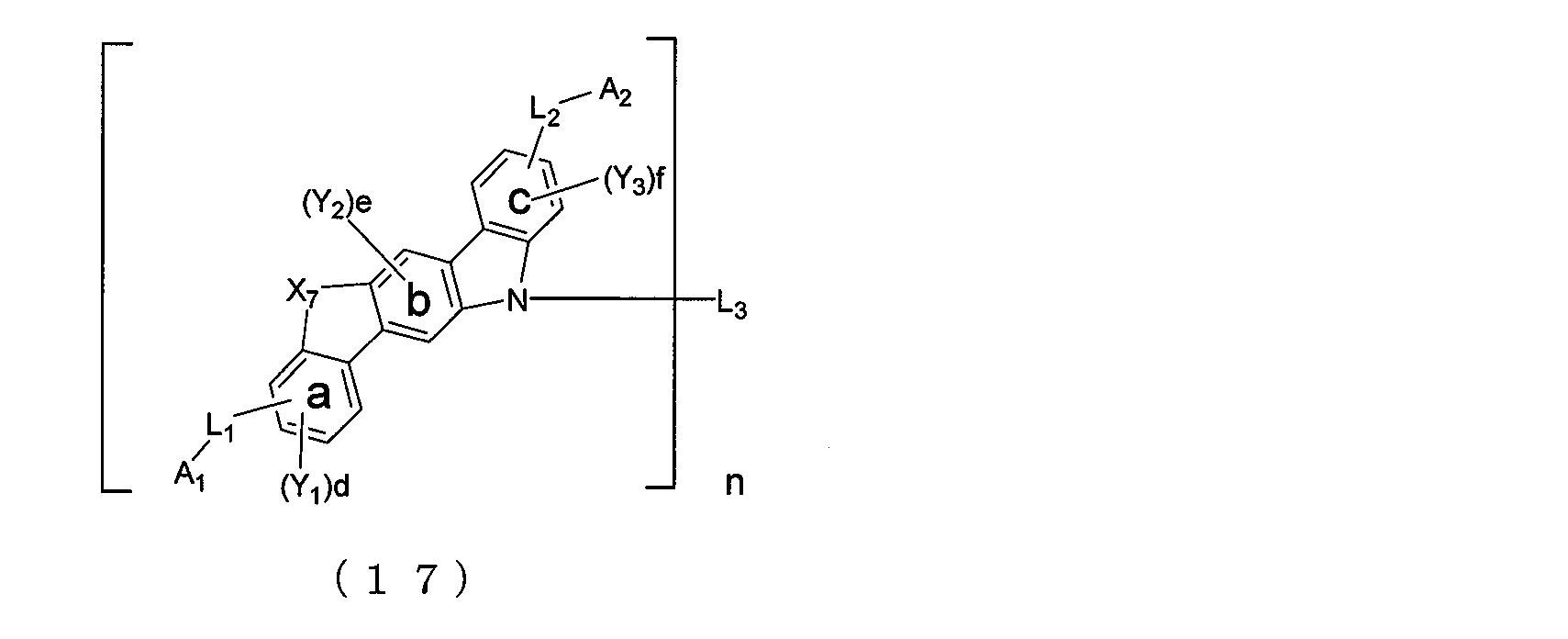
前記R2およびR3は、それぞれ独立に、炭素数1~20のアルキル基、置換もしくは無置換の環形成炭素数3~20のシクロアルキル基、炭素数7~24のアラルキル基、シリル基もしくは炭素数3~20の置換シリル基、置換もしくは無置換の環形成炭素数6~24の芳香族炭化水素基、または置換もしくは無置換の環形成原子数3~24の芳香族複素環基を表す。
式(17)において、nは2、3または4を表し、それぞれL3を連結基とした2量体、3量体、4量体である。
式(17)において、L1は単結合、炭素数1~20のアルキレン基、置換もしくは無置換の環形成炭素数3~20のシクロアルキレン基、2価のシリル基もしくは炭素数2~20の2価の置換シリル基、置換もしくは無置換である環形成炭素数6~24の2価の芳香族炭化水素基、または環形成原子数3~24のベンゼン環aと炭素-炭素結合で連結する置換もしくは無置換の2価の芳香族複素環基を表す。
式(17)において、L2は単結合、炭素数1~20のアルキレン基、置換もしくは無置換の環形成炭素数3~20のシクロアルキレン基、2価のシリル基もしくは炭素数2~20の2価の置換シリル基、置換もしくは無置換である環形成炭素数6~24の2価の芳香族炭化水素基、または環形成原子数3~24のベンゼン環cと炭素-炭素結合で連結する置換もしくは無置換の2価の芳香族複素環基を表す。
式(17)において、L3は、nが2の場合、単結合、炭素数1~20のアルキレン基、置換もしくは無置換の環形成炭素数3~20のシクロアルキレン基、2価のシリル基もしくは炭素数2~20の2価の置換シリル基、置換もしくは無置換の環形成炭素数6~24の2価の芳香族炭化水素基、または環形成原子数3~24でベンゼン環bと炭素-炭素結合で連結する置換もしくは無置換の2価の芳香族複素環基を表し、nが3の場合、炭素数1~20の3価の飽和炭化水素基、置換もしくは無置換の環形成炭素数3~20の3価の環状飽和炭化水素基、3価のシリル基もしくは炭素数1~20の3価の置換シリル基、置換もしくは無置換で環形成炭素数6~24の3価の芳香族炭化水素基、または原子数3~24でベンゼン環bと炭素-炭素結合で連結する置換もしくは無置換の3価の芳香族複素環基を表し、nが4の場合、炭素数1~20の4価の飽和炭化水素基、置換もしくは無置換の環形成炭素数3~20の4価の環状飽和炭化水素基、ケイ素原子、置換もしくは無置換の環形成炭素数6~24の4価の芳香族炭化水素基、または環形成原子数3~24でベンゼン環bと炭素-炭素結合で連結する置換もしくは無置換の4価の芳香族複素環基を表す。
式(17)において、A1は、水素原子、置換もしくは無置換の環形成炭素数3~20のシクロアルキル基、シリル基もしくは炭素数3~20の置換シリル基、置換もしくは無置換の環形成炭素数6~24の芳香族炭化水素基、または環形成原子数3~24でL1と炭素-炭素結合で連結する芳香族複素環基を表す。但し、L1が炭素数1~20のアルキレン基である場合、A1は水素原子である場合はない。
式(17)において、A2は、水素原子、置換もしくは無置換の環形成炭素数3~20のシクロアルキル基、シリル基もしくは炭素数3~20の置換シリル基、置換もしくは無置換の環形成炭素数6~24の芳香族炭化水素基、または環形成原子数3~24でL2と炭素-炭素結合で連結する芳香族複素環基を表す。但し、L2が炭素数1~20のアルキレン基である場合、A2は水素原子である場合はない。
式(17)において、Y1、Y2およびY3は、炭素数1~20のアルキル基、置換もしくは無置換の環形成炭素数3~20のシクロアルキル基、炭素数1~20のアルコキシ基、炭素数7~24のアラルキル基、シリル基もしくは炭素数3~20の置換シリル基、置換もしくは無置換の環形成炭素数6~24の芳香族炭化水素基、または置換もしくは無置換の環形成原子数3~24でベンゼン環a、b、cと炭素-炭素結合で連結する芳香族複素環基を表す。d、fは0、1、2または3、eは0、1または2である。
式(17)において、A1、A2、L1、L2およびL3は、カルボニル基を含まない。] - 式(17)において、A1が、シリル基もしくは炭素数3~20の置換シリル基、または環形成原子数3~24でL1と炭素-炭素結合で連結する芳香族複素環基である請求項23記載の多環系化合物。
- 式(17)において、A1が、L1と炭素-炭素結合で連結するピリダジン、ピリミジン、ピラジン、1,3,5-トリアジン、カルバゾール、ジベンゾフラン、ジベンゾチオフェン、フェノキサジン、フェノチアジン、ジヒドロアクリジンから選ばれる芳香族複素環基である請求項23記載の多環系化合物。
- 下記式(18)で表されるハロゲン化合物。

R1は、炭素数1~20のアルキル基、置換もしくは無置換の環形成炭素数3~20のシクロアルキル基、炭素数7~24のアラルキル基、シリル基もしくは炭素数3~20の置換シリル基、置換もしくは無置換の環形成炭素数6~24の芳香族炭化水素基、または置換もしくは無置換の環形成原子数3~24の芳香族複素環基を表す。但しX1とX2が共にN-R1の場合は、R1の少なくとも1つは置換もしくは無置換の環形成原子数8~24である1価の縮合芳香族複素環基を表す。
Y1、Y2およびY3は、炭素数1~20のアルキル基、置換もしくは無置換の環形成炭素数3~20のシクロアルキル基、炭素数1~20のアルコキシ基、炭素数7~24のアラルキル基、シリル基もしくは炭素数3~20の置換シリル基、置換もしくは無置換の環形成炭素数6~24の芳香族炭化水素基、または置換もしくは無置換の環形成原子数3~24でベンゼン環a、b、cと炭素-炭素結合で連結する芳香族複素環基を表す。d、fは0、1、2または3、eは0、1または2である。
Zはハロゲン原子であり、フッ素原子、塩素原子、臭素原子、ヨウ素原子を表す。
t、u、vは0または1を表す。但しt+u+v≧1である。] - 下記式(19)で表される請求項26に記載のハロゲン化合物。

Zはハロゲン原子であり、フッ素原子、塩素原子、臭素原子、ヨウ素原子を表す。
t、u、vは0または1を表す。但しt+u+v≧1である。] - 陰極と陽極間に、発光層を含む一層以上の有機薄膜層を有し、前記有機薄膜層の少なくとも一層が、請求項1、17又は23に記載の多環系化合物を含有する有機エレクトロルミネッセンス素子。
- 前記発光層が、前記多環系化合物をホスト材料として含有する請求項28記載の有機エレクトロルミネッセンス素子。
- 前記発光層が、さらにりん光発光性材料を含有する請求項28記載の有機エレクトロルミネッセンス素子。
- 前記発光層がホスト材料とりん光性の発光材料を含有し、該りん光性の発光材料がイリジウム(Ir),オスミウム(Os)又は白金(Pt)金属のオルトメタル化錯体である請求項28記載の有機エレクトロルミネッセンス素子。
- 前記発光層と陰極との間に電子注入層を有し、該電子注入層が含窒素環誘導体を含有する請求項28記載の有機エレクトロルミネッセンス素子。
- 前記発光層と陰極との間に電子輸送層を有し、該電子輸送層が前記多環系化合物を含有する請求項28記載の有機エレクトロルミネッセンス素子。
- 前記発光層が、炭素原子、窒素原子、酸素原子または硫黄原子で架橋したπ共役ヘテロアセン骨格を有する化合物である有機エレクトロルミネッセンス素子用材料をホスト材料として含有する請求項33記載の有機エレクトロルミネッセンス素子。
- 前記発光層が、下記式(20)~(23)のいずれかで表される有機エレクトロルミネッセンス素子用材料をホスト材料として含有する請求項33記載の有機エレクトロルミネッセンス素子。
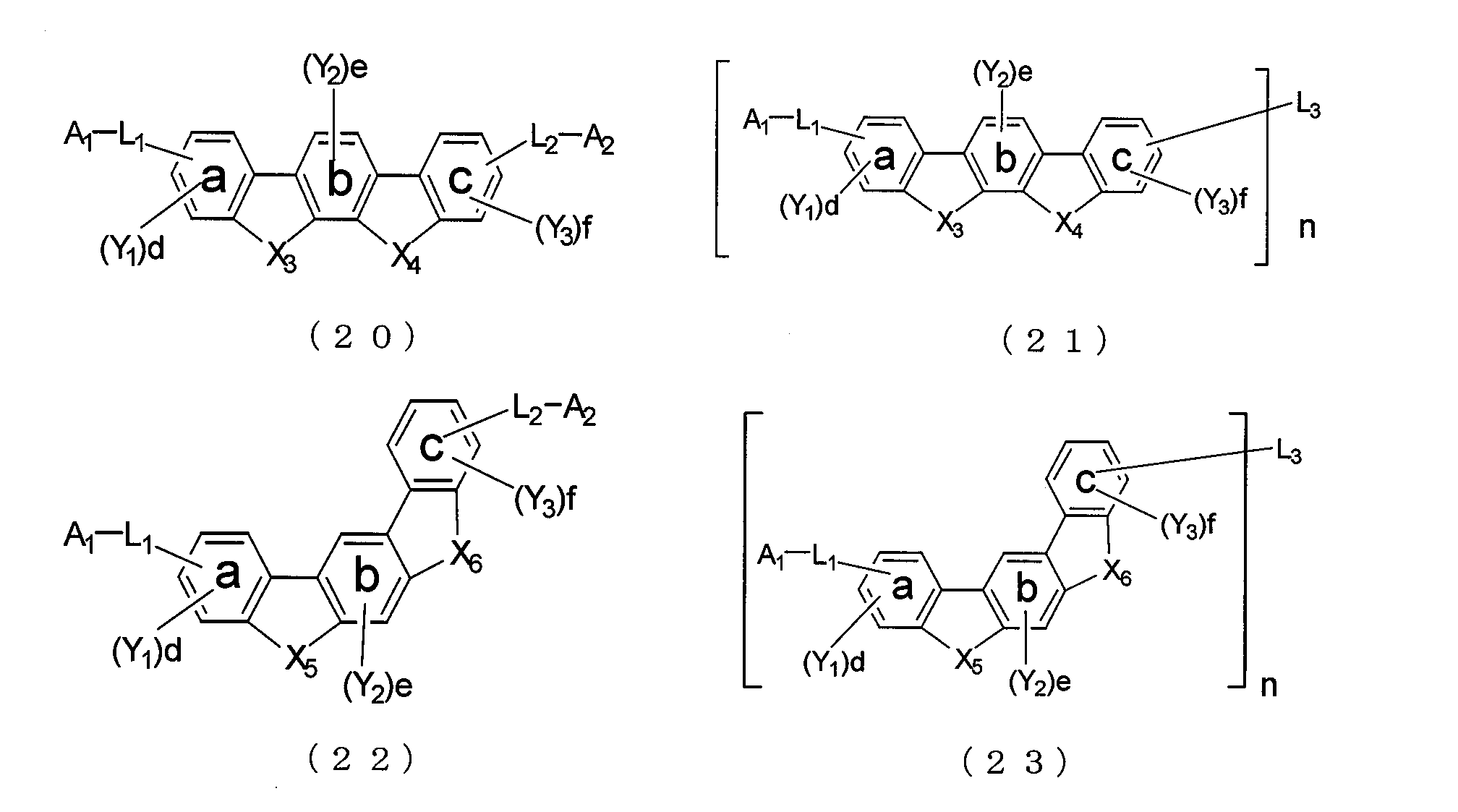
前記R1、R2およびR3は、それぞれ独立に、炭素数1~20のアルキル基、置換もしくは無置換の環形成炭素数3~20のシクロアルキル基、炭素数7~24のアラルキル基、シリル基もしくは炭素数3~20の置換シリル基、置換もしくは無置換の環形成炭素数6~24の芳香族炭化水素基、または置換もしくは無置換の環形成原子数3~24の芳香族複素環基を表す。但し、X3とX4、またはX5とX6が共にN-R1の場合は、R1の少なくとも1つは置換もしくは無置換の環形成原子数8~24である1価の縮合芳香族複素環基を表す。
式(21)および(23)において、nは2、3または4を表し、それぞれL3を連結基とした2量体、3量体、4量体である。
式(20)~(23)において、L1は単結合、炭素数1~20のアルキレン基、置換もしくは無置換の環形成炭素数3~20のシクロアルキレン基、2価のシリル基もしくは炭素数2~20の2価の置換シリル基、置換もしくは無置換の環形成炭素数6~24の2価の芳香族炭化水素基、または環形成原子数3~24のベンゼン環aと炭素-炭素結合で連結する置換もしくは無置換の2価の芳香族複素環基を表す。
式(20)および(22)において、L2は単結合、炭素数1~20のアルキレン基、置換もしくは無置換の環形成炭素数3~20のシクロアルキレン基、2価のシリル基もしくは炭素数2~20の2価の置換シリル基、置換もしくは無置換である環形成炭素数6~24の2価の芳香族炭化水素基、または環形成原子数3~24のベンゼン環cと炭素-炭素結合で連結する置換もしくは無置換の2価の芳香族複素環基を表す。但し、X3とX4、またはX5とX6が共にCR2R3であり、かつL1、L2が共に置換もしくは無置換である環形成炭素数6~24の2価の芳香族炭化水素基である場合、L1、L2は同時にベンゼン環bに対してパラ位置に連結する場合は無い。
式(21)および(23)において、L3は、nが2の場合、単結合、炭素数1~20のアルキレン基、置換もしくは無置換の環形成炭素数3~20のシクロアルキレン基、2価のシリル基もしくは炭素数2~20の2価の置換シリル基、置換もしくは無置換の環形成炭素数6~24の2価の芳香族炭化水素基、または環形成原子数3~24でベンゼン環cと炭素-炭素結合で連結する置換もしくは無置換の2価の芳香族複素環基を表し、nが3の場合、炭素数1~20の3価の飽和炭化水素基、置換もしくは無置換の環形成炭素数3~20の3価の環状飽和炭化水素基、3価のシリル基もしくは炭素数1~20の3価の置換シリル基、置換もしくは無置換で環形成炭素数6~24の3価の芳香族炭化水素基、または原子数3~24でベンゼン環cと炭素-炭素結合で連結する置換もしくは無置換の3価の芳香族複素環基を表し、nが4の場合、炭素数1~20の4価の飽和炭化水素基、置換もしくは無置換の環形成炭素数3~20の4価の環状飽和炭化水素基、ケイ素原子、置換もしくは無置換の環形成炭素数6~24の4価の芳香族炭化水素基、または環形成原子数3~24でベンゼン環cと炭素-炭素結合で連結する置換もしくは無置換の4価の芳香族複素環基を表す。但し、X3とX4、またはX5とX6が共にCR2R3であり、かつL1、L3が共に置換もしくは無置換である環形成炭素数6~24の2価、3価あるいは4価の芳香族炭化水素基である場合、L1、L3は同時にベンゼン環bに対してパラ位置に連結する場合は無い。
式(20)~(23)において、A1は、水素原子、置換もしくは無置換の環形成炭素数3~20のシクロアルキル基、シリル基もしくは炭素数3~20の置換シリル基、置換もしくは無置換の環形成炭素数6~24の芳香族炭化水素基、または環形成原子数3~24でL1と炭素-炭素結合で連結する芳香族複素環基を表す。但し、L1が炭素数1~20のアルキレン基である場合、A1は水素原子である場合はない。
式(20)および(22)において、A2は、水素原子、置換もしくは無置換の環形成炭素数3~20のシクロアルキル基、シリル基もしくは炭素数3~20の置換シリル基、置換もしくは無置換の環形成炭素数6~24の芳香族炭化水素基、または環形成原子数3~24でL2と炭素-炭素結合で連結する芳香族複素環基を表す。但し、L2が炭素数1~20のアルキレン基である場合、A2は水素原子である場合はない。
式(20)~(23)において、Y1、Y2およびY3は、炭素数1~20のアルキル基、置換もしくは無置換の環形成炭素数3~20のシクロアルキル基、炭素数1~20のアルコキシ基、炭素数7~24のアラルキル基、シリル基もしくは炭素数3~20の置換シリル基、置換もしくは無置換の環形成炭素数6~24の芳香族炭化水素基、または置換もしくは無置換の環形成原子数3~24でベンゼン環a、b、cと炭素-炭素結合で連結する芳香族複素環基を表す。d、fは0、1、2または3、eは0、1または2である。但し、X3とX4、またはX5とX6が、酸素(O)、硫黄(S)、もしくはCR2R3であり、L1、L2が共に単結合であり、かつA1とA2が共に水素原子である場合、ベンゼン環bはY2を一個または二個有し、Y2がメチル基または無置換のフェニル基である場合は無い。
式(20)~(23)において、A1、A2、L1、L2およびL3は、カルボニル基を含まない。] - 前記発光層が、下記式(24)~(27)のいずれかで表される有機エレクトロルミネッセンス素子用材料をホスト材料として含有する請求項33記載の有機エレクトロルミネッセンス素子。
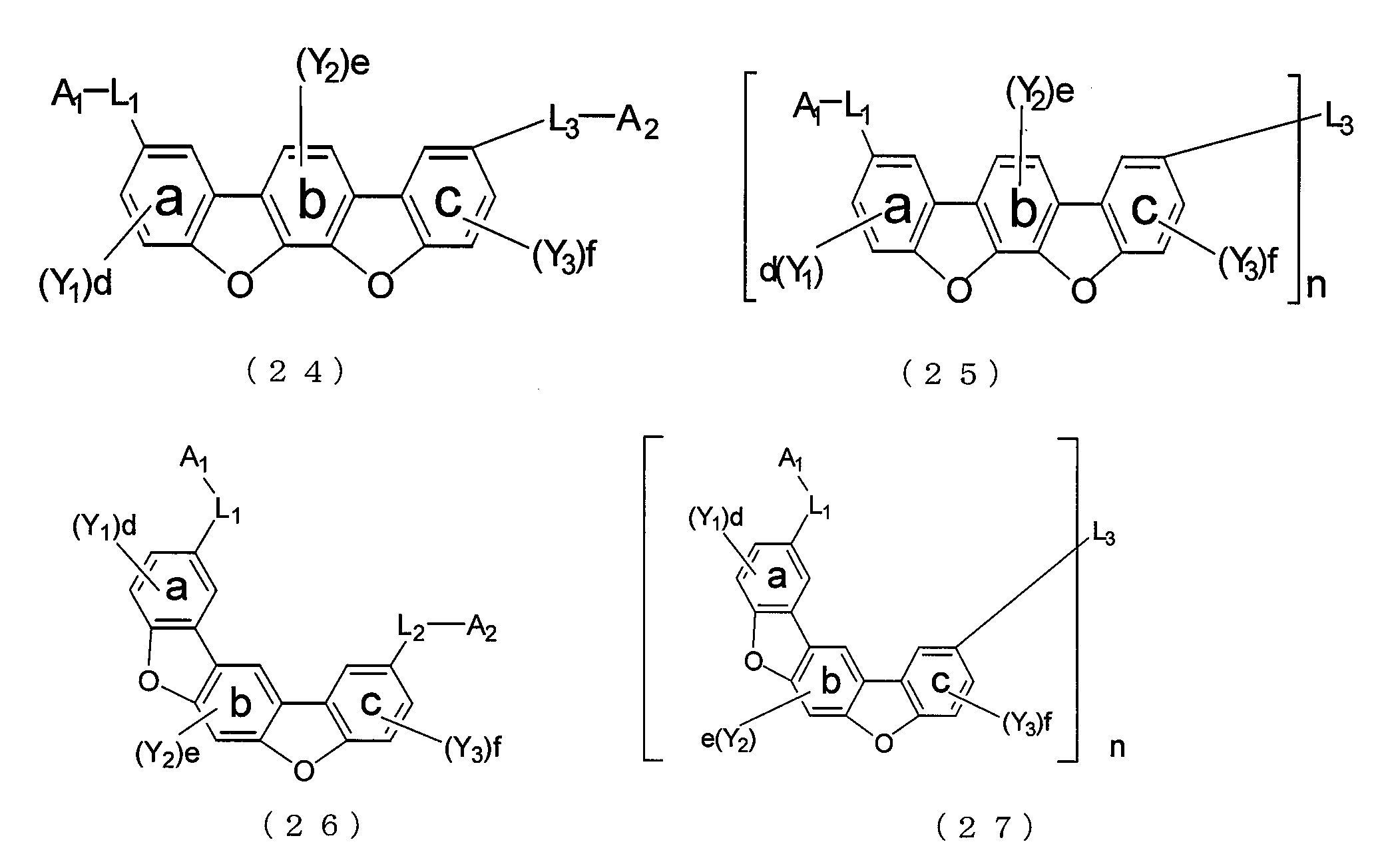
式(24)~(27)において、L1は単結合、炭素数1~20のアルキレン基、置換もしくは無置換の環形成炭素数3~20のシクロアルキレン基、2価のシリル基もしくは炭素数2~20の2価の置換シリル基、置換もしくは無置換の環形成炭素数6~24の2価の芳香族炭化水素基、または環形成原子数3~24のベンゼン環aと炭素-炭素結合で連結する置換もしくは無置換の2価の芳香族複素環基を表す。
式(24)および(26)において、L2は単結合、炭素数1~20のアルキレン基、置換もしくは無置換の環形成炭素数3~20のシクロアルキレン基、2価のシリル基もしくは炭素数2~20の2価の置換シリル基、置換もしくは無置換である環形成炭素数6~24の2価の芳香族炭化水素基、または環形成原子数3~24のベンゼン環cと炭素-炭素結合で連結する置換もしくは無置換の2価の芳香族複素環基を表す。
式(25)および(27)において、L3は、nが2の場合、単結合、炭素数1~20のアルキレン基、置換もしくは無置換の環形成炭素数3~20のシクロアルキレン基、2価のシリル基もしくは炭素数2~20の2価の置換シリル基、置換もしくは無置換の環形成炭素数6~24の2価の芳香族炭化水素基、または環形成原子数3~24でベンゼン環cと炭素-炭素結合で連結する置換もしくは無置換の2価の芳香族複素環基を表し、nが3の場合、炭素数1~20の3価の飽和炭化水素基、置換もしくは無置換の環形成炭素数3~20の3価の環状飽和炭化水素基、3価のシリル基もしくは炭素数1~20の3価の置換シリル基、置換もしくは無置換で環形成炭素数6~24の3価の芳香族炭化水素基、または原子数3~24でベンゼン環cと炭素-炭素結合で連結する置換もしくは無置換の3価の芳香族複素環基を表し、nが4の場合、炭素数1~20の4価の飽和炭化水素基、置換もしくは無置換の環形成炭素数3~20の4価の環状飽和炭化水素基、ケイ素原子、置換もしくは無置換の環形成炭素数6~24の4価の芳香族炭化水素基、または環形成原子数3~24でベンゼン環cと炭素-炭素結合で連結する置換もしくは無置換の4価の芳香族複素環基を表す。
式(24)~(27)において、A1は、水素原子、置換もしくは無置換の環形成炭素数3~20のシクロアルキル基、シリル基もしくは炭素数3~20の置換シリル基、置換もしくは無置換の環形成炭素数6~24の芳香族炭化水素基、または環形成原子数3~24でL1と炭素-炭素結合で連結する芳香族複素環基を表す。但し、L1が炭素数1~20のアルキレン基である場合、A1は水素原子である場合はない。
式(24)および(26)において、A2は、水素原子、置換もしくは無置換の環形成炭素数3~20のシクロアルキル基、シリル基もしくは炭素数3~20の置換シリル基、置換もしくは無置換の環形成炭素数6~24の芳香族炭化水素基、または環形成原子数3~24でL2と炭素-炭素結合で連結する芳香族複素環基を表す。但し、L2が炭素数1~20のアルキレン基である場合、A2は水素原子である場合はない。
式(24)~(27)において、Y1、Y2およびY3は、炭素数1~20のアルキル基、置換もしくは無置換の環形成炭素数3~20のシクロアルキル基、炭素数1~20のアルコキシ基、炭素数7~24のアラルキル基、シリル基もしくは炭素数3~20の置換シリル基、置換もしくは無置換の環形成炭素数6~24の芳香族炭化水素基、または置換もしくは無置換の環形成原子数3~24でベンゼン環a、b、cと炭素-炭素結合で連結する芳香族複素環基を表す。d、fは0、1、2または3、eは0、1または2である。但し、L1、L2が共に単結合であり、かつA1とA2が共に水素原子である場合、ベンゼン環bはY2を一個または二個有し、Y2がメチル基または無置換のフェニル基である場合は無い。
式(24)~(27)において、A1、A2、L1、L2およびL3は、カルボニル基を含まない。] - 前記発光層と陽極との間に正孔輸送層を有し、該正孔輸送層が前記多環系化合物を含有する請求項28記載の有機エレクトロルミネッセンス素子。
- 陰極と有機薄膜層との界面領域に還元性ドーパントを有する請求項28記載の有機エレクトロルミネッセンス素子。
Priority Applications (4)
| Application Number | Priority Date | Filing Date | Title |
|---|---|---|---|
| JP2010515859A JP5666907B2 (ja) | 2008-06-05 | 2009-06-01 | ハロゲン化合物、多環系化合物及びそれを用いた有機エレクトロルミネッセンス素子 |
| CN2009801207020A CN102056929A (zh) | 2008-06-05 | 2009-06-01 | 卤素化合物、多环系化合物及使用其的有机电致发光元件 |
| KR1020107027255A KR101500796B1 (ko) | 2008-06-05 | 2009-06-01 | 할로젠 화합물, 다환계 화합물 및 그것을 이용한 유기 전기발광 소자 |
| EP09758283A EP2298774A4 (en) | 2008-06-05 | 2009-06-01 | HALOGEN COMPOUND, POLYCYCLIC COMPOUND AND ORGANIC ELECTROLUMINESCENT ELEMENT USING THE POLYCYCLIC COMPOUND |
Applications Claiming Priority (6)
| Application Number | Priority Date | Filing Date | Title |
|---|---|---|---|
| JP2008148515 | 2008-06-05 | ||
| JP2008-148515 | 2008-06-05 | ||
| US12/253,627 US8057919B2 (en) | 2008-06-05 | 2008-10-17 | Material for organic electroluminescence device and organic electroluminescence device using the same |
| US12/253,627 | 2008-10-17 | ||
| JP2009100320 | 2009-04-16 | ||
| JP2009-100320 | 2009-04-16 |
Publications (1)
| Publication Number | Publication Date |
|---|---|
| WO2009148016A1 true WO2009148016A1 (ja) | 2009-12-10 |
Family
ID=43596931
Family Applications (1)
| Application Number | Title | Priority Date | Filing Date |
|---|---|---|---|
| PCT/JP2009/059981 Ceased WO2009148016A1 (ja) | 2008-06-05 | 2009-06-01 | ハロゲン化合物、多環系化合物及びそれを用いた有機エレクトロルミネッセンス素子 |
Country Status (6)
| Country | Link |
|---|---|
| EP (1) | EP2298774A4 (ja) |
| JP (1) | JP5666907B2 (ja) |
| KR (1) | KR101500796B1 (ja) |
| CN (1) | CN102056929A (ja) |
| TW (1) | TW201006910A (ja) |
| WO (1) | WO2009148016A1 (ja) |
Cited By (24)
| Publication number | Priority date | Publication date | Assignee | Title |
|---|---|---|---|---|
| WO2011099374A1 (ja) * | 2010-02-12 | 2011-08-18 | 新日鐵化学株式会社 | 有機電界発光素子 |
| WO2012073888A1 (ja) * | 2010-12-02 | 2012-06-07 | 新日鐵化学株式会社 | ヘテロアセン型化合物、有機半導体材料、及び有機電子デバイス |
| JP2012520872A (ja) * | 2009-03-20 | 2012-09-10 | ローム・アンド・ハース・エレクトロニック・マテリアルズ・コリア・リミテッド | 新規有機電界発光化合物およびこれを使用する有機電界発光素子 |
| JP2012531383A (ja) * | 2009-06-30 | 2012-12-10 | メルク パテント ゲーエムベーハー | 有機エレクトロルミネセンス素子のための材料 |
| WO2013011891A1 (ja) * | 2011-07-15 | 2013-01-24 | 出光興産株式会社 | 含窒素芳香族複素環誘導体およびそれを用いた有機エレクトロルミネッセンス素子 |
| JP2013525424A (ja) * | 2010-04-30 | 2013-06-20 | ローム・アンド・ハース・エレクトロニック・マテリアルズ・コリア・リミテッド | 新規有機電界発光化合物およびこれを使用する有機電界発光素子 |
| US8637857B2 (en) | 2010-04-06 | 2014-01-28 | Basf Se | Substituted carbazole derivatives and use thereof in organic electronics |
| JP2014503497A (ja) * | 2010-11-16 | 2014-02-13 | ローム・アンド・ハース・エレクトロニック・マテリアルズ・コリア・リミテッド | 有機電子材料のための新規化合物およびこれを使用する有機電界発光素子 |
| WO2014076917A1 (ja) * | 2012-11-15 | 2014-05-22 | ソニー株式会社 | 有機el多色発光装置 |
| JP2014513047A (ja) * | 2011-02-17 | 2014-05-29 | メルク パテント ゲーエムベーハー | 電子素子のための材料 |
| WO2015004896A1 (ja) * | 2013-07-11 | 2015-01-15 | 出光興産株式会社 | 化合物、及びそれを用いた有機エレクトロルミネッセンス素子 |
| JP2015092574A (ja) * | 2014-11-17 | 2015-05-14 | コニカミノルタ株式会社 | 有機エレクトロルミネッセンス素子材料、有機エレクトロルミネッセンス素子、表示装置及び照明装置 |
| US9586972B2 (en) | 2012-08-27 | 2017-03-07 | Fujifilm Corporation | Organic thin film transistor, organic semiconductor thin film, and organic semiconductor material |
| JP2017075140A (ja) * | 2015-09-09 | 2017-04-20 | 三星電子株式会社Samsung Electronics Co., Ltd. | 縮合環化合物及びそれを含む有機発光素子 |
| WO2017093958A1 (en) | 2015-12-04 | 2017-06-08 | Idemitsu Kosan Co., Ltd. | Benzimidazolo[1,2-a]benzimidazole derivatives for organic light emitting diodes |
| US9714253B2 (en) | 2012-08-27 | 2017-07-25 | Fujifilm Corporation | Organic thin film transistor, organic semiconductor thin film, and organic semiconductor material |
| US11245080B2 (en) | 2015-04-06 | 2022-02-08 | Universal Display Corporation | Organic electroluminescent materials and devices |
| US11495749B2 (en) | 2015-04-06 | 2022-11-08 | Universal Display Corporation | Organic electroluminescent materials and devices |
| JP2023010718A (ja) * | 2015-06-25 | 2023-01-20 | 株式会社半導体エネルギー研究所 | 発光素子 |
| JP2023520870A (ja) * | 2020-04-07 | 2023-05-22 | エルティー・マテリアルズ・カンパニー・リミテッド | ヘテロ環化合物およびそれを含む有機発光素子 |
| US11818949B2 (en) | 2015-04-06 | 2023-11-14 | Universal Display Corporation | Organic electroluminescent materials and devices |
| US11834459B2 (en) | 2018-12-12 | 2023-12-05 | Universal Display Corporation | Host materials for electroluminescent devices |
| US12274160B2 (en) | 2020-06-02 | 2025-04-08 | Samsung Sdi Co., Ltd. | Composition for organic optoelectronic device and organic optoelectronic device and display device |
| US12473256B2 (en) | 2020-06-09 | 2025-11-18 | Samsung Sdi Co., Ltd. | Composition for organic optoelectronic device and organic optoelectronic device and display device |
Families Citing this family (19)
| Publication number | Priority date | Publication date | Assignee | Title |
|---|---|---|---|---|
| CN102056911B (zh) * | 2008-06-05 | 2015-07-22 | 出光兴产株式会社 | 卤素化合物、多环系化合物及使用其的有机电致发光元件 |
| US8049411B2 (en) | 2008-06-05 | 2011-11-01 | Idemitsu Kosan Co., Ltd. | Material for organic electroluminescence device and organic electroluminescence device using the same |
| KR20110009920A (ko) * | 2009-07-23 | 2011-01-31 | 다우어드밴스드디스플레이머티리얼 유한회사 | 신규한 유기 발광 화합물 및 이를 포함하는 유기 전계 발광 소자 |
| KR101972831B1 (ko) * | 2011-11-23 | 2019-04-26 | 덕산네오룩스 주식회사 | 유기전기 소자용 화합물, 이를 이용한 유기전기소자 및 그 전자 장치 |
| EP2889296A4 (en) | 2012-08-21 | 2016-06-15 | Cheil Ind Inc | CONNECTION FOR AN ORGANIC OPTOELECTRONIC DEVICE, ORGANIC LIGHT EMITTING DIODE THEREFOR AND DISPLAY DEVICE WITH THE ORGANIC LIGHT EMITTING DIODE |
| WO2014196556A1 (ja) | 2013-06-06 | 2014-12-11 | 保土谷化学工業株式会社 | インデノインドール誘導体および有機エレクトロルミネッセンス素子 |
| CN105636959B (zh) * | 2013-10-08 | 2019-10-18 | 默克专利有限公司 | 用于电子器件的材料 |
| KR102385230B1 (ko) | 2014-11-19 | 2022-04-12 | 삼성디스플레이 주식회사 | 유기 발광 소자 |
| KR102363260B1 (ko) | 2014-12-19 | 2022-02-16 | 삼성디스플레이 주식회사 | 유기 발광 소자 |
| KR102398064B1 (ko) | 2014-12-26 | 2022-05-16 | 삼성디스플레이 주식회사 | 유기 발광 소자 |
| EP3141550B1 (en) * | 2015-09-09 | 2020-03-18 | Samsung Electronics Co., Ltd. | Condensed cyclic compound and organic light-emitting device including the same |
| KR102696804B1 (ko) | 2016-06-22 | 2024-08-21 | 삼성디스플레이 주식회사 | 유기 발광 소자 |
| WO2018116152A1 (en) * | 2016-12-19 | 2018-06-28 | Idemitsu Kosan Co., Ltd. | Specifically substituted ladder type compounds for organic light emitting devices |
| EP3617210A1 (en) | 2018-08-31 | 2020-03-04 | Idemitsu Kosan Co., Ltd. | Polycyclic compound, and an organic electroluminescence device comprising the polycyclic compound |
| WO2020116800A1 (ko) | 2018-12-05 | 2020-06-11 | 주식회사 엘지화학 | 신규한 화합물 및 이를 포함하는 유기발광 소자 |
| KR102853709B1 (ko) * | 2018-12-06 | 2025-09-02 | 삼성디스플레이 주식회사 | 유기 발광 소자 |
| KR102354500B1 (ko) | 2019-01-15 | 2022-01-21 | 주식회사 엘지화학 | 신규한 화합물 및 이를 이용한 유기 발광 소자 |
| JP6827135B2 (ja) * | 2019-03-29 | 2021-02-10 | 住友化学株式会社 | 発光素子及び発光素子用組成物 |
| KR102554747B1 (ko) | 2020-11-17 | 2023-07-12 | 엘티소재주식회사 | 헤테로 고리 화합물, 이를 포함하는 유기전계발광소자, 및 유기물층용 조성물 |
Citations (13)
| Publication number | Priority date | Publication date | Assignee | Title |
|---|---|---|---|---|
| JPH093448A (ja) | 1995-06-23 | 1997-01-07 | Toyo Ink Mfg Co Ltd | 有機エレクトロルミネッセンス素子用電子輸送材料およびそれを用いた有機エレクトロルミネッセンス素子 |
| EP0908787A2 (en) | 1997-10-02 | 1999-04-14 | Xerox Corporation | Indolocarbazole Photoconductors |
| JPH11176578A (ja) * | 1997-10-02 | 1999-07-02 | Xerox Corp | インドロカルバゾールを用いたエレクトロルミネセントデバイス |
| JP2000173774A (ja) | 1998-12-09 | 2000-06-23 | Sony Corp | 有機電界発光素子 |
| US20020132134A1 (en) | 2001-01-26 | 2002-09-19 | Xerox Corporation | Electroluminescent (EL) devices |
| JP2004204234A (ja) * | 2002-12-24 | 2004-07-22 | Samsung Sdi Co Ltd | 青色発光高分子及びこれを採用した有機el素子 |
| JP2006083386A (ja) * | 2004-09-18 | 2006-03-30 | Samsung Sdi Co Ltd | 青色発光ポリマー及びこれを用いた有機電界発光素子 |
| WO2006122630A1 (de) | 2005-05-20 | 2006-11-23 | Merck Patent Gmbh | Verbindungen für organische elektronische vorrichtungen |
| JP2007019294A (ja) * | 2005-07-08 | 2007-01-25 | Konica Minolta Holdings Inc | 有機半導体材料、有機半導体膜、有機半導体素子及び有機薄膜トランジスタ |
| WO2007063754A1 (ja) | 2005-12-01 | 2007-06-07 | Nippon Steel Chemical Co., Ltd. | 有機電界発光素子用化合物及び有機電界発光素子 |
| WO2007063796A1 (ja) | 2005-12-01 | 2007-06-07 | Nippon Steel Chemical Co., Ltd. | 有機電界発光素子 |
| JP2008081494A (ja) | 2006-08-28 | 2008-04-10 | Tosoh Corp | ヘテロアセン誘導体、テトラハロターフェニル誘導体及びそれらの製造方法 |
| WO2008056746A1 (en) * | 2006-11-09 | 2008-05-15 | Nippon Steel Chemical Co., Ltd. | Compound for organic electroluminescent device and organic electroluminescent device |
Family Cites Families (4)
| Publication number | Priority date | Publication date | Assignee | Title |
|---|---|---|---|---|
| KR100763818B1 (ko) * | 2000-04-10 | 2007-10-05 | 허니웰 인터내셔날 인코포레이티드 | 퀴논의 아릴화에 의해 제조되는 올리고머 및 폴리머oled 물질 |
| JP2007088016A (ja) * | 2005-09-20 | 2007-04-05 | Konica Minolta Holdings Inc | 有機半導体材料、有機半導体膜、有機半導体デバイス、有機薄膜トランジスタ及び有機エレクトロルミネッセンス素子 |
| JP4819181B2 (ja) * | 2008-05-08 | 2011-11-24 | 新日鐵化学株式会社 | 有機電界発光素子用化合物及び有機電界発光素子 |
| KR101511072B1 (ko) * | 2009-03-20 | 2015-04-10 | 롬엔드하스전자재료코리아유한회사 | 신규한 유기 발광 화합물 및 이를 포함하는 유기 전계 발광소자 |
-
2009
- 2009-06-01 EP EP09758283A patent/EP2298774A4/en not_active Withdrawn
- 2009-06-01 JP JP2010515859A patent/JP5666907B2/ja active Active
- 2009-06-01 KR KR1020107027255A patent/KR101500796B1/ko active Active
- 2009-06-01 CN CN2009801207020A patent/CN102056929A/zh active Pending
- 2009-06-01 WO PCT/JP2009/059981 patent/WO2009148016A1/ja not_active Ceased
- 2009-06-05 TW TW098118795A patent/TW201006910A/zh unknown
Patent Citations (14)
| Publication number | Priority date | Publication date | Assignee | Title |
|---|---|---|---|---|
| JPH093448A (ja) | 1995-06-23 | 1997-01-07 | Toyo Ink Mfg Co Ltd | 有機エレクトロルミネッセンス素子用電子輸送材料およびそれを用いた有機エレクトロルミネッセンス素子 |
| EP0908787A2 (en) | 1997-10-02 | 1999-04-14 | Xerox Corporation | Indolocarbazole Photoconductors |
| JPH11176578A (ja) * | 1997-10-02 | 1999-07-02 | Xerox Corp | インドロカルバゾールを用いたエレクトロルミネセントデバイス |
| JP2000173774A (ja) | 1998-12-09 | 2000-06-23 | Sony Corp | 有機電界発光素子 |
| US20020132134A1 (en) | 2001-01-26 | 2002-09-19 | Xerox Corporation | Electroluminescent (EL) devices |
| US20030044646A1 (en) | 2001-01-26 | 2003-03-06 | Xerox Corporation | Electroluminescent (EL) devices |
| JP2004204234A (ja) * | 2002-12-24 | 2004-07-22 | Samsung Sdi Co Ltd | 青色発光高分子及びこれを採用した有機el素子 |
| JP2006083386A (ja) * | 2004-09-18 | 2006-03-30 | Samsung Sdi Co Ltd | 青色発光ポリマー及びこれを用いた有機電界発光素子 |
| WO2006122630A1 (de) | 2005-05-20 | 2006-11-23 | Merck Patent Gmbh | Verbindungen für organische elektronische vorrichtungen |
| JP2007019294A (ja) * | 2005-07-08 | 2007-01-25 | Konica Minolta Holdings Inc | 有機半導体材料、有機半導体膜、有機半導体素子及び有機薄膜トランジスタ |
| WO2007063754A1 (ja) | 2005-12-01 | 2007-06-07 | Nippon Steel Chemical Co., Ltd. | 有機電界発光素子用化合物及び有機電界発光素子 |
| WO2007063796A1 (ja) | 2005-12-01 | 2007-06-07 | Nippon Steel Chemical Co., Ltd. | 有機電界発光素子 |
| JP2008081494A (ja) | 2006-08-28 | 2008-04-10 | Tosoh Corp | ヘテロアセン誘導体、テトラハロターフェニル誘導体及びそれらの製造方法 |
| WO2008056746A1 (en) * | 2006-11-09 | 2008-05-15 | Nippon Steel Chemical Co., Ltd. | Compound for organic electroluminescent device and organic electroluminescent device |
Cited By (43)
| Publication number | Priority date | Publication date | Assignee | Title |
|---|---|---|---|---|
| JP2015122508A (ja) * | 2009-03-20 | 2015-07-02 | ローム・アンド・ハース・エレクトロニック・マテリアルズ・コリア・リミテッド | 新規有機電界発光化合物およびこれを使用する有機電界発光素子 |
| JP2012520872A (ja) * | 2009-03-20 | 2012-09-10 | ローム・アンド・ハース・エレクトロニック・マテリアルズ・コリア・リミテッド | 新規有機電界発光化合物およびこれを使用する有機電界発光素子 |
| JP2017008061A (ja) * | 2009-03-20 | 2017-01-12 | ローム・アンド・ハース・エレクトロニック・マテリアルズ・コリア・リミテッド | 新規有機電界発光化合物およびこれを使用する有機電界発光素子 |
| JP2016001749A (ja) * | 2009-03-20 | 2016-01-07 | ローム・アンド・ハース・エレクトロニック・マテリアルズ・コリア・リミテッド | 新規有機電界発光化合物およびこれを使用する有機電界発光素子 |
| JP2012531383A (ja) * | 2009-06-30 | 2012-12-10 | メルク パテント ゲーエムベーハー | 有機エレクトロルミネセンス素子のための材料 |
| WO2011099374A1 (ja) * | 2010-02-12 | 2011-08-18 | 新日鐵化学株式会社 | 有機電界発光素子 |
| US8637857B2 (en) | 2010-04-06 | 2014-01-28 | Basf Se | Substituted carbazole derivatives and use thereof in organic electronics |
| JP2013525424A (ja) * | 2010-04-30 | 2013-06-20 | ローム・アンド・ハース・エレクトロニック・マテリアルズ・コリア・リミテッド | 新規有機電界発光化合物およびこれを使用する有機電界発光素子 |
| JP2014503497A (ja) * | 2010-11-16 | 2014-02-13 | ローム・アンド・ハース・エレクトロニック・マテリアルズ・コリア・リミテッド | 有機電子材料のための新規化合物およびこれを使用する有機電界発光素子 |
| WO2012073888A1 (ja) * | 2010-12-02 | 2012-06-07 | 新日鐵化学株式会社 | ヘテロアセン型化合物、有機半導体材料、及び有機電子デバイス |
| JP2014513047A (ja) * | 2011-02-17 | 2014-05-29 | メルク パテント ゲーエムベーハー | 電子素子のための材料 |
| WO2013011891A1 (ja) * | 2011-07-15 | 2013-01-24 | 出光興産株式会社 | 含窒素芳香族複素環誘導体およびそれを用いた有機エレクトロルミネッセンス素子 |
| US10043977B2 (en) | 2011-07-15 | 2018-08-07 | Idemitsu Kosan Co., Ltd. | Nitrogenated aromatic heterocyclic derivative, and organic electroluminescent element using same |
| US12063851B2 (en) | 2011-07-15 | 2024-08-13 | Idemitsu Kosan Co., Ltd. | Nitrogenated aromatic heterocyclic derivative and organic electroluminescent element using same |
| JP2013040105A (ja) * | 2011-07-15 | 2013-02-28 | Idemitsu Kosan Co Ltd | 含窒素芳香族複素環誘導体およびそれを用いた有機エレクトロルミネッセンス素子 |
| US9586972B2 (en) | 2012-08-27 | 2017-03-07 | Fujifilm Corporation | Organic thin film transistor, organic semiconductor thin film, and organic semiconductor material |
| US9714253B2 (en) | 2012-08-27 | 2017-07-25 | Fujifilm Corporation | Organic thin film transistor, organic semiconductor thin film, and organic semiconductor material |
| WO2014076917A1 (ja) * | 2012-11-15 | 2014-05-22 | ソニー株式会社 | 有機el多色発光装置 |
| US9647220B2 (en) | 2012-11-15 | 2017-05-09 | Sony Corporation | Organic multicolor light-emitting apparatus |
| JPWO2014076917A1 (ja) * | 2012-11-15 | 2017-01-05 | ソニー株式会社 | 有機el多色発光装置 |
| WO2015004896A1 (ja) * | 2013-07-11 | 2015-01-15 | 出光興産株式会社 | 化合物、及びそれを用いた有機エレクトロルミネッセンス素子 |
| US10505123B2 (en) | 2013-07-11 | 2019-12-10 | Idemitsu Kosan Co., Ltd. | Compound and organic electroluminescent device using same |
| JP2015092574A (ja) * | 2014-11-17 | 2015-05-14 | コニカミノルタ株式会社 | 有機エレクトロルミネッセンス素子材料、有機エレクトロルミネッセンス素子、表示装置及び照明装置 |
| US11818949B2 (en) | 2015-04-06 | 2023-11-14 | Universal Display Corporation | Organic electroluminescent materials and devices |
| US11245080B2 (en) | 2015-04-06 | 2022-02-08 | Universal Display Corporation | Organic electroluminescent materials and devices |
| US11495749B2 (en) | 2015-04-06 | 2022-11-08 | Universal Display Corporation | Organic electroluminescent materials and devices |
| US12295262B2 (en) | 2015-04-06 | 2025-05-06 | Universal Display Corporation | Organic electroluminescent materials and devices |
| US12284913B2 (en) | 2015-04-06 | 2025-04-22 | Universal Display Corporation | Organic electroluminescent materials and devices |
| US11672175B2 (en) | 2015-04-06 | 2023-06-06 | Universal Display Corporation | Organic electroluminescent materials and devices |
| JP7807524B2 (ja) | 2015-06-25 | 2026-01-27 | 株式会社半導体エネルギー研究所 | 化合物 |
| JP2023010718A (ja) * | 2015-06-25 | 2023-01-20 | 株式会社半導体エネルギー研究所 | 発光素子 |
| JP7442597B2 (ja) | 2015-06-25 | 2024-03-04 | 株式会社半導体エネルギー研究所 | 発光素子、発光装置、電子機器、および照明装置 |
| JP2024061724A (ja) * | 2015-06-25 | 2024-05-08 | 株式会社半導体エネルギー研究所 | 複素環化合物 |
| JP7610052B2 (ja) | 2015-06-25 | 2025-01-07 | 株式会社半導体エネルギー研究所 | 複素環化合物 |
| JP2025031809A (ja) * | 2015-06-25 | 2025-03-07 | 株式会社半導体エネルギー研究所 | 化合物 |
| JP2017075140A (ja) * | 2015-09-09 | 2017-04-20 | 三星電子株式会社Samsung Electronics Co., Ltd. | 縮合環化合物及びそれを含む有機発光素子 |
| US12225817B2 (en) | 2015-09-09 | 2025-02-11 | Samsung Electronics Co., Ltd. | Condensed cyclic compound and organic light-emitting device including the same |
| WO2017093958A1 (en) | 2015-12-04 | 2017-06-08 | Idemitsu Kosan Co., Ltd. | Benzimidazolo[1,2-a]benzimidazole derivatives for organic light emitting diodes |
| US11834459B2 (en) | 2018-12-12 | 2023-12-05 | Universal Display Corporation | Host materials for electroluminescent devices |
| JP7766350B2 (ja) | 2020-04-07 | 2025-11-10 | エルティー・マテリアルズ・カンパニー・リミテッド | ヘテロ環化合物およびそれを含む有機発光素子 |
| JP2023520870A (ja) * | 2020-04-07 | 2023-05-22 | エルティー・マテリアルズ・カンパニー・リミテッド | ヘテロ環化合物およびそれを含む有機発光素子 |
| US12274160B2 (en) | 2020-06-02 | 2025-04-08 | Samsung Sdi Co., Ltd. | Composition for organic optoelectronic device and organic optoelectronic device and display device |
| US12473256B2 (en) | 2020-06-09 | 2025-11-18 | Samsung Sdi Co., Ltd. | Composition for organic optoelectronic device and organic optoelectronic device and display device |
Also Published As
| Publication number | Publication date |
|---|---|
| KR101500796B1 (ko) | 2015-03-09 |
| TW201006910A (en) | 2010-02-16 |
| EP2298774A4 (en) | 2012-12-19 |
| KR20110013445A (ko) | 2011-02-09 |
| EP2298774A1 (en) | 2011-03-23 |
| JP5666907B2 (ja) | 2015-02-12 |
| CN102056929A (zh) | 2011-05-11 |
| JPWO2009148016A1 (ja) | 2011-10-27 |
Similar Documents
| Publication | Publication Date | Title |
|---|---|---|
| JP5666907B2 (ja) | ハロゲン化合物、多環系化合物及びそれを用いた有機エレクトロルミネッセンス素子 | |
| JP5357150B2 (ja) | ハロゲン化合物、多環系化合物及びそれを用いた有機エレクトロルミネッセンス素子 | |
| JP5238025B2 (ja) | 多環系化合物及びそれを用いた有機エレクトロルミネッセンス素子 | |
| KR102240991B1 (ko) | 신규 화합물, 유기 일렉트로 루미네선스 소자용 재료, 유기 일렉트로 루미네선스 소자 및 전자 기기 | |
| TWI591154B (zh) | Biscarbazole derivatives and organic electroluminescent devices using the same | |
| CN104871332B (zh) | 有机电致发光元件及电子设备 | |
| CN107108585B (zh) | 新颖化合物及包含其的有机发光器件 | |
| JP5756288B2 (ja) | 縮合多環化合物、有機エレクトロルミネッセンス素子用材料、及びそれを用いた有機エレクトロルミネッセンス素子 | |
| WO2014024880A1 (ja) | 有機エレクトロルミネッセンス素子、および電子機器 | |
| WO2007069569A1 (ja) | 有機エレクトロルミネッセンス素子用材料及びそれを用いた有機エレクトロルミネッセンス素子 | |
| KR20140108637A (ko) | 유기 전기발광 소자용 재료 및 유기 전기발광 소자 | |
| WO2007142083A1 (ja) | 有機エレクトロルミネッセンス素子用材料及びそれを用いた有機エレクトロルミネッセンス素子 | |
| JP2012056880A (ja) | インドロカルバゾール化合物、有機エレクトロルミネッセンス素子用材料、及びそれを用いた有機エレクトロルミネッセンス素子 | |
| JP2014216576A (ja) | 有機エレクトロルミネッセンス素子および電子機器 | |
| EP3569603A1 (en) | Polycyclic compound, and organic electroluminescence element comprising the polycyclic compound |
Legal Events
| Date | Code | Title | Description |
|---|---|---|---|
| WWE | Wipo information: entry into national phase |
Ref document number: 200980120702.0 Country of ref document: CN |
|
| 121 | Ep: the epo has been informed by wipo that ep was designated in this application |
Ref document number: 09758283 Country of ref document: EP Kind code of ref document: A1 |
|
| ENP | Entry into the national phase |
Ref document number: 20107027255 Country of ref document: KR Kind code of ref document: A |
|
| WWE | Wipo information: entry into national phase |
Ref document number: 2010515859 Country of ref document: JP |
|
| NENP | Non-entry into the national phase |
Ref country code: DE |
|
| WWE | Wipo information: entry into national phase |
Ref document number: 2009758283 Country of ref document: EP |