WO2009150154A1 - Photocurable acrylic coating compositions having good adhesion properties to a subsequent coating and corresponding coated substrates - Google Patents
Photocurable acrylic coating compositions having good adhesion properties to a subsequent coating and corresponding coated substrates Download PDFInfo
- Publication number
- WO2009150154A1 WO2009150154A1 PCT/EP2009/057102 EP2009057102W WO2009150154A1 WO 2009150154 A1 WO2009150154 A1 WO 2009150154A1 EP 2009057102 W EP2009057102 W EP 2009057102W WO 2009150154 A1 WO2009150154 A1 WO 2009150154A1
- Authority
- WO
- WIPO (PCT)
- Prior art keywords
- groups
- compound
- coating
- weight
- abrasion resistant
- Prior art date
- Legal status (The legal status is an assumption and is not a legal conclusion. Google has not performed a legal analysis and makes no representation as to the accuracy of the status listed.)
- Ceased
Links
Classifications
-
- C—CHEMISTRY; METALLURGY
- C09—DYES; PAINTS; POLISHES; NATURAL RESINS; ADHESIVES; COMPOSITIONS NOT OTHERWISE PROVIDED FOR; APPLICATIONS OF MATERIALS NOT OTHERWISE PROVIDED FOR
- C09D—COATING COMPOSITIONS, e.g. PAINTS, VARNISHES OR LACQUERS; FILLING PASTES; CHEMICAL PAINT OR INK REMOVERS; INKS; CORRECTING FLUIDS; WOODSTAINS; PASTES OR SOLIDS FOR COLOURING OR PRINTING; USE OF MATERIALS THEREFOR
- C09D133/00—Coating compositions based on homopolymers or copolymers of compounds having one or more unsaturated aliphatic radicals, each having only one carbon-to-carbon double bond, and at least one being terminated by only one carboxyl radical, or of salts, anhydrides, esters, amides, imides, or nitriles thereof; Coating compositions based on derivatives of such polymers
- C09D133/04—Homopolymers or copolymers of esters
- C09D133/06—Homopolymers or copolymers of esters of esters containing only carbon, hydrogen and oxygen, the oxygen atom being present only as part of the carboxyl radical
- C09D133/08—Homopolymers or copolymers of acrylic acid esters
-
- C—CHEMISTRY; METALLURGY
- C09—DYES; PAINTS; POLISHES; NATURAL RESINS; ADHESIVES; COMPOSITIONS NOT OTHERWISE PROVIDED FOR; APPLICATIONS OF MATERIALS NOT OTHERWISE PROVIDED FOR
- C09D—COATING COMPOSITIONS, e.g. PAINTS, VARNISHES OR LACQUERS; FILLING PASTES; CHEMICAL PAINT OR INK REMOVERS; INKS; CORRECTING FLUIDS; WOODSTAINS; PASTES OR SOLIDS FOR COLOURING OR PRINTING; USE OF MATERIALS THEREFOR
- C09D4/00—Coating compositions, e.g. paints, varnishes or lacquers, based on organic non-macromolecular compounds having at least one polymerisable carbon-to-carbon unsaturated bond ; Coating compositions, based on monomers of macromolecular compounds of groups C09D183/00 - C09D183/16
- C09D4/06—Organic non-macromolecular compounds having at least one polymerisable carbon-to-carbon unsaturated bond in combination with a macromolecular compound other than an unsaturated polymer of groups C09D159/00 - C09D187/00
-
- C—CHEMISTRY; METALLURGY
- C08—ORGANIC MACROMOLECULAR COMPOUNDS; THEIR PREPARATION OR CHEMICAL WORKING-UP; COMPOSITIONS BASED THEREON
- C08K—Use of inorganic or non-macromolecular organic substances as compounding ingredients
- C08K5/00—Use of organic ingredients
- C08K5/04—Oxygen-containing compounds
- C08K5/15—Heterocyclic compounds having oxygen in the ring
- C08K5/151—Heterocyclic compounds having oxygen in the ring having one oxygen atom in the ring
- C08K5/1515—Three-membered rings
-
- C—CHEMISTRY; METALLURGY
- C08—ORGANIC MACROMOLECULAR COMPOUNDS; THEIR PREPARATION OR CHEMICAL WORKING-UP; COMPOSITIONS BASED THEREON
- C08K—Use of inorganic or non-macromolecular organic substances as compounding ingredients
- C08K5/00—Use of organic ingredients
- C08K5/54—Silicon-containing compounds
- C08K5/541—Silicon-containing compounds containing oxygen
- C08K5/5435—Silicon-containing compounds containing oxygen containing oxygen in a ring
-
- Y—GENERAL TAGGING OF NEW TECHNOLOGICAL DEVELOPMENTS; GENERAL TAGGING OF CROSS-SECTIONAL TECHNOLOGIES SPANNING OVER SEVERAL SECTIONS OF THE IPC; TECHNICAL SUBJECTS COVERED BY FORMER USPC CROSS-REFERENCE ART COLLECTIONS [XRACs] AND DIGESTS
- Y10—TECHNICAL SUBJECTS COVERED BY FORMER USPC
- Y10T—TECHNICAL SUBJECTS COVERED BY FORMER US CLASSIFICATION
- Y10T428/00—Stock material or miscellaneous articles
- Y10T428/26—Web or sheet containing structurally defined element or component, the element or component having a specified physical dimension
- Y10T428/263—Coating layer not in excess of 5 mils thick or equivalent
- Y10T428/264—Up to 3 mils
- Y10T428/265—1 mil or less
-
- Y—GENERAL TAGGING OF NEW TECHNOLOGICAL DEVELOPMENTS; GENERAL TAGGING OF CROSS-SECTIONAL TECHNOLOGIES SPANNING OVER SEVERAL SECTIONS OF THE IPC; TECHNICAL SUBJECTS COVERED BY FORMER USPC CROSS-REFERENCE ART COLLECTIONS [XRACs] AND DIGESTS
- Y10—TECHNICAL SUBJECTS COVERED BY FORMER USPC
- Y10T—TECHNICAL SUBJECTS COVERED BY FORMER US CLASSIFICATION
- Y10T428/00—Stock material or miscellaneous articles
- Y10T428/31504—Composite [nonstructural laminate]
- Y10T428/31652—Of asbestos
- Y10T428/31663—As siloxane, silicone or silane
Definitions
- the invention relates to an abrasion resistant photocurable acrylic coating composition that can provide good adhesion to subsequent coatings deposited thereon, and a hard coated article, especially an optical article such as an ophthalmic lens, comprising a substrate coated with a coating obtained from the above abrasion resistant acrylic coating composition providing good subsequent adhesion.
- a lens substrate such as an ophthalmic lens
- several coatings for imparting to the lens substrate additional or improved optical or mechanical properties. These coatings are designated in general as functional coatings.
- a lens substrate typically made of an organic material
- an abrasion- and/or scratch-resistant coating hard coat
- an anti-reflection coating anti-reflection top coat.
- the coatings deposited above the abrasion and/or scratch resistant coatings must have a good adhesion, whatever their deposition process is.
- Photocurable acrylic coatings especially UV curable acrylic coatings used as anti- abrasion coatings are known in the art.
- acrylic coatings in general is that they can be polymerized in a short amount of time.
- Acrylic coatings are well known.
- US 6,100,313 describes a UV curable abrasion resistant coating composition having good tintability and abrasion resistance at the same time.
- the coating composition described in this patent is substantially free of volatiles and comprise at least 10% by weight, solids basis of the hydrolysis product of an epoxy-functional alkoxysilane, a polymerizable ether selected from the group consisting of glycidyl ethers, allyl ethers and vinyl ethers and an ethylenically unsaturated monomer other than said polymerizable ether.
- US 6,780,232 and US 7,037,585 also describe similar UV curable coating compositions comprising the hydrolysis product of an epoxy-functional alkoxysilane, an unhydrolyzed epoxy-functional alkoxysilane, an ethylenically unsaturated monomer.
- the ethylenically unsaturated monomer is generally an acrylate monomer.
- the required acrylate has an acrylate functionality not greater than 2.
- a first object of the invention is to provide a photocurable, preferably UV curable abrasion resistant coating composition that has good abrasion resistance and adhesion to a wide range of substrates, whether such substrates have been pretreated or not, and especially to substrates made of PC materials (polycarbonate of Bisphenol A such as the Lexan® type).
- a second object of the invention is to provide a photocurable, preferably UV curable abrasion resistant coating composition, which provides, once cured, a good adhesion of subsequent coatings deposited thereon, and especially of sol/gel coatings, including sol/gel antireflective coatings, without requiring additional pretreatment steps, such as soap wash, caustic treatment, corona or plasma pretreatment.
- This coating composition comprises: -15 to 30 parts by weight of at least one monomeric compound A having from 5 to 7 acrylate groups;
- the invention also relates to an article comprising a transparent substrate, comprising a cured abrasion resistant coating applied thereon which has been obtained by applying and curing the above composition.
- the invention further relates to the article having a cured abrasion resistant coating according to the invention and at least one subsequent coating deposited thereon.
- lens means an organic or mineral glass lens, comprising a lens substrate which may be coated with one or more coatings of various natures.
- the abrasion resistant UV curable coating composition according to the invention comprises and preferably consists in the mixture of monomers A, A', A", B, C and D as defined hereafter, and used in the following respective amounts: -15 to 30 parts by weight of at least one monomeric compound A having from 5 to 7 acrylate groups;
- the total weight of compounds A, A' and A" in the curable composition represents at least 80% of the total weight of the polymerizable compounds comprised in said coating composition, preferably at least 90%.
- the UV curable abrasion resistant coating composition comprises 15 to 30 parts by weight of at least one monomeric compound A, having from 5 to 7 acrylate groups.
- the monomeric compound A can be chosen from pentafunctional acrylates, hexafunctional acrylates, heptafunctional acrytates. Preferably, compound A has 5 acrylate groups.
- Examples of such monomers are: dipentaerythritol pentaacrylate, pentaacrylate esters.
- the UV curable abrasion resistant composition comprises 7 to 20 parts by weight of at least one monomeric or oligomeric compound A' selected from monomers or oligomers having from 3 to 4 acrylate groups.
- monomeric or oligomeric compound A' selected from monomers or oligomers having from 3 to 4 acrylate groups.
- trifunctional acrylates are: trimethylolpropane triacrylate, pentaerythritol triacrylate, ethoxylated trimethylolpropane triacrylate.
- tetraacrylates are: pentaerythritol tetraacrylate, ethoxylated pentaerythritol tetraacrylate.
- the inventor has found that the combined presence of the compounds A and A' in the claimed proportions allows to get a good abrasion resistance of the cured coating composition along with a limited (or no) tendency to cracking.
- compound A' comprises a mixture of tri and tetra functional acrylates. More preferably, compound A' consists in a mixture of tri and tetra functional acrylates.
- tri and tetrafunctional acrylates are used in equivalent ratios.
- compound A' is a mixture of pentaerythritol tri and tetra acrylates.
- the UV curable abrasion resistant composition comprises 10 to 25 parts by weight, preferably 18 to 22, of an oligomeric or monomeric compound A" having 2 acrylate groups.
- difunctional acrylates are 1 ,4-butanediol diacrylate, 1 ,6-hexanediol diacrylate, polyethylene glycol diacrylate, tetraethylene glycol diacrylate, polyethylene glycol diacrylate, ethoxylated bisphenol A diacrylate, tetraethylene glycol diacrylate, tripropylene glycol diacrylate, neopentyl glycol diacrylate, diethylene glycol diacrylate.
- the compound A" comprises at least one polyoxyalkyleneglycol diacrylate.
- the compounds A" are used i.a as reactive diluents, to adjust the properties. They have a low viscosity but may reduce the abrasion resistance properties due to lower capabilities of cross-linking, compared to compounds A and A'. It is recommended to use them at low concentrations, in the range required above.
- the coating composition comprises less than 5 % by weight of monoacrylate compounds relative to the total weight of the composition, more preferably less than 2% by weight, and even better 0%.
- Example of monofunctional acrylates that can be used are: 2-ethoxyethyl acrylate, 2- ethoxyethyl acrylate, caprolactone acrylate, isobornyl acrylate, lauryl acrylate, polypropylene glycol monoacrylate.
- the epoxy compounds B used in the composition according to the invention are compounds comprising at least two epoxy groups.
- Compound B does not comprise any silicon atom bearing hydrolysable groups or hydroxy groups.
- the compounds having epoxy groups include bisphenol A diglycidylether, novolac-type epoxy resins, 1 ,4-butanediol diglycidylether, 1 ,6-hexanediol diglycidylether, propylene glycol diglycidylether, trisphenol methane triglycidylether, glycerin triglycidylether, trimethylolpropane triglycidylether.
- the compound having alicyclic epoxy group examples include 2,4- epoxycyclohexylmethyl-3,4-epoxycyclohexanecarboxylate, bis(3,4- epoxycyclohexylmethyl)adipate, 2-(3,4-epoxycyclohexyl-5,5-spiro-3,4-epoxy) cyclohexanone- meta-dioxane, bis(2,3-epoxycyclopentyl)ether, and EHPE-3150 (alicyclic epoxy resin, manufactured by DAICEL CHEMICAL INDUSTRIES, LTD.).
- Bisphenol F epoxy (PY306, GY281 from Ciba-Geigy), Epoxy phenol novolac (PY 307 from Ciba-Geigy), Alicyclic diepoxy carboxylate (CY-179 from Ciba-Geigy), 3, 4 Epoxycyclohexylmethyl-3,4 epoxycyclohexane Carboxylate (Union Carbide UVR-6105 and UVR 61 10),Bis-(3,4-epoxycyclohexyl) Adipate (Union Carbide UVR-6128).
- the amount of epoxy compound B ranges from 2 to 10 parts by weight, preferably 2 to 5 parts by weight in the abrasion resistant coating composition.
- compounds B do not contain other reactive function than the epoxy group, capable of reacting with other polymerizable functions present in the composition and that would be linked to the polymer matrix of the coating.
- preferred epoxy compounds B are "pure” epoxy compounds.
- compounds A, A', A" and B do not bear additional reactive function than their respectively described polymerizable functions, capable of reacting with other polymerizable functions present in the composition.
- the abrasion resistant curable composition comprises 1 to 7 parts by weight of a compound C which is a hydrolyzate of a specific epoxysilane as described hereafter.
- the amount of epoxysilane will be conventionally defined as the weight of the initial precursor (typically epoxyalkoxysilane) before its hydrolysis.
- the epoxysilane(s) used in the coating composition of the invention has from 2 to 6 functional groups generating a silanol group under hydrolysis.
- said epoxysilane has the following formula:
- R groups identical or different, are monovalent organic groups linked to the
- X groups, identical or different, are hydrolyzable groups;
- the preferred R groups have the following formulas V and Vl:
- R 2 is an alkyl group, preferably a methyl group or a hydrogen atom, more preferably a hydrogen atom ; a and c are integers ranging from 1 to 6 and b is representing 0, 1 or 2 .
- Many epoxy-functional alkoxysilanes are suitable as hydrolysis precursors, including epoxydialkoxysilanes such as ⁇ -glycidoxypropylmethyldimethoxysilane, ⁇ - glycidoxypropylmethyldiethoxysilane, ⁇ -glycidoxypropyl-methyl-diisopropenoxysilane, and ⁇ - glycidoxyethoxypropylmethyldimethoxysilane; Epoxytrialkoxysilane such as glycidoxymethyl-trimethoxysilane, glycidoxymethyltriethoxysilane, glycidoxymethyl-tripropoxysilane, glycidoxymethyl- tributoxysilane, beta-glycidoxyethyltrimethoxysilane, beta-g
- epoxysilanes are chosen within the group consisting of ⁇ -glycidoxypropyl triethoxysilane, ⁇ -glycidoxypropyl trimethoxysilane, 2-(3,4-epoxycyclohexyl) ethyl trimethoxysilane and 2-(3,4-epoxycyclohexyl) ethyltriethoxysilane or a mixture of two or more thereof.
- GLYMO ⁇ -glycidoxypropyltrimethoxysilane
- the epoxysilane having from 2 to 6 functional groups generating a silanol group under hydrolysis is hydrolyzed before being mixed to the other components of the composition.
- the hydrolysis may be performed as known in the art, by using acidic catalysts (hydrochloric acid, acetic acid), in presence of water. Hydrolysis of the alkoxy groups liberates the associated alcohol to form silanol groups which will condense spontaneously.
- the alkoxysilane is reacted with a stoichiometric amount of water to hydrolyze the hydrolysable groups, typically the alkoxy groups.
- the abrasion resistant curable composition comprises 20 to 60 parts by weight of a non polymerizable ether compound D.
- the non polymerizable ether compound is an alcohol ether compound.
- the alcohol ether compound comprises at least one glycol ether.
- the at least one glycol ether comprises a mixture of 1 -methoxy-2-propanol and 2-methoxy-1 -propanol.
- a compound is sold commercially by Dow Chemical under the name Dowanol PM ® .
- Glycol ethers generally exhibit low surface tensions.
- compound D contributes to the improvement of adhesion to the substrate and to subsequent coatings applied later on.
- the photocurable abrasion resistant coating composition according to the invention comprises at least one cationic polymerization photoinitiator.
- cationic polymerization photoinitiator it is meant a photoinitiator capable of inducing a cationic polymerization when irradiated with an appropriate radiation.
- cationic photoinitiators examples include onium salts, such as diazonium salts, sulfonium salts, and iodonium salts.
- onium salts such as diazonium salts, sulfonium salts, and iodonium salts.
- Aromatic onium salts are particularly preferred.
- iron-arene complexes such as ferrocene derivatives, and arylsilanol-aluminum complexes and the like.
- Example of commercially available cationic photoinitiators are CYRACURE UVI-6970, CYRACURE TMUVI-6974, and CYRACURETM UVI-6990 (each manufactured by Dow Chemical, USA), IRGACURETM 264 (manufactured by Ciba Specialty Chemicals Inc.), and CIT-1682 (manufactured by Nippon Soda).
- the amount of the cationic photoinitiator in the UV curable abrasion resistant coating composition usually ranges from about 0.01 to about 15% by weight, preferably 0.1 to 5 % by weight (relative to the weight of monomers comprising an epoxy group in the composition).
- the hard coating composition also comprises one or more radical initiators, preferably one or more radical photoinitiators.
- radical photo initiators examples include DAROCURE 1 173, IRGACURE 184, IRGACURE 500, IRGACURE 651 , IRGACURE 819 and IRGACURE 907 (each manufactured by Ciba Specialty Chemicals Inc.).
- the amount of the radical photo initiator in the hard coat agent composition (as solid component) is for example in the range of from about 0.5 to about 5% by weight to the weight of ethylenically unsaturated monomers, especially acrylate monomers.
- the abrasion resistant coating composition may comprise additional additives, such as dyes, surfactants.
- additional additives such as dyes, surfactants.
- One preferred surfactant is a monocarbinol terminated polydimethyl siloxane that contains primary hydroxyl groups which react with the epoxies and silanol in both the UV curable abrasion resistant coating composition and any subsequent coating applied to yield excellent inter-coating adhesion.
- surfactants are those commercialized under the trade name SilwetTM.
- the cationic polymerization initiator used for achieving the partial polymerization step is photoactivated, preferably under UV irradiation.
- the energy that is applied to the hard coating for achieving polymerization ranges from 2.65 to 3.05 J/cm 2 (UV-B).
- the irradiation is typically applied during a time ranging from 5 seconds to 30 seconds, preferably from 15 to 18 seconds.
- the thickness of the cured coating may be adapted to the specific application required and ranges preferably from 2 to 20 microns, more preferably from 5 ⁇ m to 15 ⁇ m, even better from 8 to 10 microns, typically from 8.5 to 9.5 ⁇ m.
- the substrate on which the UV curable abrasion resistant coating composition according to the invention is applied may be made of mineral glass or organic glass, preferably organic glass.
- the organic glass substrate can be made of any material currently used for organic ophthalmic lenses, e.g., either thermoplastic materials such as thermoplastic polycarbonates and polyurethanes, or thermosetting (cross-linked) materials, such as: those obtained by polymerization of allyl derivatives such as the allyl carbonates of linear or branched aliphatic or aromatic polyols, such as ethylene glycol bis(allyl carbonate), diethylene glycol bis(2-methyl carbonate), diethylene glycol bis(allyl carbonate), ethylene glycol bis(2- chloroallyl carbonate), triethylene glycol bis(allyl carbonate), 1 ,3-propanediol bis(allyl carbonate), propylene glycol bis(2-ethylallyl carbonate), 1 ,3-butenediol bis(allyl carbonate), 1 ,4-butenediol bis(2-bromoallyl carbonate), dipropylene glycol bis(allyl carbonate), trimethylene glycol bis(2-ethylallyl
- substrates obtained by polymerization of thio(meth)acrylic monomers such as those disclosed in the French patent application FR 2734827 and substrates made of polythiourethane materials.
- the substrates may obviously be obtained by polymerising mixtures of the above monomers.
- the substrate is an ophthalmic lens.
- the inventive hard coating may be applied directly on the naked surface of the substrate, either pretreated or not or on a surface that has previously been coated by a functional coating, such as an impact resistant and or adhesion promoting primer coating, the thickness of which ranges generally from 0.5 to 3 microns, preferably 0.8 to 1.2 microns.
- a functional coating such as an impact resistant and or adhesion promoting primer coating
- abrasion resistant curable coating compositions have the feature to confer good adhesion properties to subsequent coatings deposited thereon, whatever the nature of the subsequent coating, and preferably to a subsequent coating which has been obtained from a liquid composition.
- Subsequent coatings include, but are not limited to sol-gel anti-reflective coatings, other UV curable coatings containing epoxies or silanols, classical thermally cured polysiloxane hard coatings or any coating containing free hydroxyl groups.
- such coatings are obtained by hydrolysis of a precursor containing hydrolysable groups, such as an alkoxysilane or a metal alkoxide, which is partially condensed to make a sol.
- the precursor can be one or more epoxyalkoxysilanes.
- the precursor can be chosen between the same epoxysilanes as previously described for compound B of the abrasion resistant curable composition of the invention.
- the epoxysilane hydrolyzate contains a colloidal filler.
- Antireflective stacks that give the best adhesion properties with the abrasion resistant coating composition of the invention are described in US patent application n°20060275627, the content of which is incorporated herein by reference.
- the first layer of the sol/gel AR which is adjacent to the abrasion resistant coating of the invention is made of a high refractive index or mean refractive index layer, having a refractive index n ⁇ of, respectively, 1.70 to 2 and 1.50 to 1.80 and resulting from the hardening of a first hardenable composition and comprising
- an organic-inorganic hybrid matrix resulting from the hydrolysis and condensation of at least one precursor compound containing an epoxy or (meth)acryloxy group and at least two functions hydrolysable to silanol groups, and
- At least one colloidal metal oxide or at least one colloidal chalcogenide or mixtures of these compounds in the form of particles from 1 to 100 nm in diameter, and preferably from 2 to 50 nm.
- the mineral particles dispersed in the matrix of the high or mean refractive index layer contain at least one oxide or colloidal chalcogenide selected from the following group: TiO2, ZnO, ZnS, ZnTe, CdS, CdSe, lrO2, W03, Fe2O3, FeTiO3, BaT ⁇ 4O9, SrTiO3, ZrTiO4, MoO3, Co3O4, SnO2, bismuth-based ternary oxide, MoS2, RuO2, Sb2O4, BaT ⁇ 4O9, MgO, CaTiO3, V2O5, Mn2O3, CeO2, Nb2O5, RuS2, and mixtures of these compounds.
- the high refractive index layer may also contain silica SiO2.
- the metal oxide dispersed in the high index layer is preferably a composite titanium oxide in the form of rutile.
- the mineral particles dispersed in the organic-inorganic matrix of the high or mean index layer have a composite structure based on TiO2, SnO2, ZrO 2 and SiO2. Such particles are described in the Japanese patent application JP-1 1310755.
- the first layer of the AR coating has a thickness ranging from 10 to 200 nm, preferably from 80 to 150 nm.
- a low refractive index layer (refractive index of 1.38 to 1.44) having preferably a thickness ranging from 40 to 150 nm, if the AR coating is a bi-layer coating, or a high refractive index layer followed by a low refractive index layer if the AR coating is a 3-layered stack.
- compositions are prepared:
- the amount of each component is expressed in parts by weight.
- GLYMO is separately hydrolyzed and added to a mix of the other components.
- the abrasion resistant coating compositions are applied on polycarbonate (PC) lenses in the following conditions: After surfacing stock hard coated semi-finished polycarbonate lenses having production vacuum deposited anti-reflective coatings on the convex side, the abrasion resistant coating is spin coated on the concave side and UV cured as described below:
- the abrasion resistant coating is applied to the concave side of a spinning lens over a period of four (4) seconds at a spin rate of 1200 rpm. After application the lens accelerates to 1300 rpm in less than one (1 ) second and spins at 1300 rpm for four (4) seconds.
- UV Curing conditions The abrasion resistant coatings were cured using a Lesco "EZ-CURE
- UV UV" Curing module
- a Fusion system H+ Bulb with an exposure time of approximately 15 seconds, leaving an average of 14.2% unsaturated monomer versus 100% unsaturation for the liquid coating.
- the obtained thickness ranges from 8 to 10 microns for compositions 1 to 3 and compositions T, U and V.
- the lenses were then allowed to cool prior to application of the spin AR coating.
- the spin AR sol/gel coatings were applied using an AIO spin coating machine and cured to a tack-free state using IR heaters in the AIO machine.
- the coated lenses underwent a final cure of 130 Q C for twenty (20) minutes in a DIMA conveyer oven.
- CCIC CCIC were weighed, 160 g of methanol were added to the colloid solution and stirred at ambient temperature for 15 min.
- the value was equal to 20%.
- the diluent was isopropanol (Carlo-Erba).
- the quantity of solvent to be weighed and added to the solution must correspond to a dilution of 6% of dry extract. This new 6% solution was stirred for 5 hours, filtered through a cartridge of porosity 3 ⁇ m, then stored in the freezer at -18° C. For deposition, 1 ml_ of this solution is deposited by spin coating onto the lenses.
- the lens substrate with the abrasion resistant coating resulting from 1 was fixed to a rotating support of adjustable speed.
- a volume ranging from 0.5 to 5 ml_ of the (HI) solution was deposited in 0.3 s at the centre of the substrate,
- the speed of rotation of the support was then adjusted to 1750-2300 rev/min, so as to obtain by spin the coating of the substrate with a film of material of high refractive index (spin time: 15 s),
- the substrate thus coated was then subjected for 16 s to an infrared heat pre-treatment such that the temperature of the coated substrate surface was 80 to 9O 0 C.
- the coated substrate was then cooled for 10 to 50 s with a stream of air at a temperature equal to or less than ambient temperature, a volume ranging from 0.5 and 5 ml_ of the (Ll) solution was then deposited in 0.3 s onto the coated substrate, the speed of rotation of the support is then fixed at 1 900-2 000 rev/min, so as to obtain by spin the coating with a film of material of low refractive index (spin time: 15 s).
- a substrate coated with an abrasion resistant coating and an anti-reflection stack according to the invention was thus obtained, comprising successively the abrasion resistant coating, a film of material of high refractive index and a film of material of low refractive index, which was then subjected for 8 s to an infrared heat pretreatment.
- the pre-baking carried out was the same at each step: it consisted of heating the surface of the lens with an infrared (IR) device. An infrared ceramic material with 450 W power was brought near the lens surface. The temperature of the surface of the lens passed from 25°C.to 70-80 0 C at the end of the pre-baking step. Cooling consisted in directing a stream of air at ambient temperature onto the surface of the lens.
- optical glass coated with the abrasion resistant coating according to the invention and the anti-reflection stack was then subjected to a final heat treatment at 130 ⁇ € for 20 minutes in a DIMA Conveyor oven.
- Dry adhesion of the transferred coatings was measured using the cross-hatch adhesion test according to ASTM D3359-93, by cutting through the coatings a series of 5 lines, spaced 1 mm apart with a razor, followed by a second series of 5 lines, spaced 1 mm apart, at right angles to the first series, forming a Crosshatch pattern comprising 25 squares.
- clear cellophane tape (3M SCOTCH ® n 0 600) was then applied over the Crosshatch pattern, pressed down firmly, and then rapidly pulled away from coating in a direction perpendicular to the coating surface. Application and removal of fresh tape was then repeated two additional times. Adhesion is rated as follows (0 is the best adhesion, 1 -4 is in the middle, and 5 is the poorest adhesion):
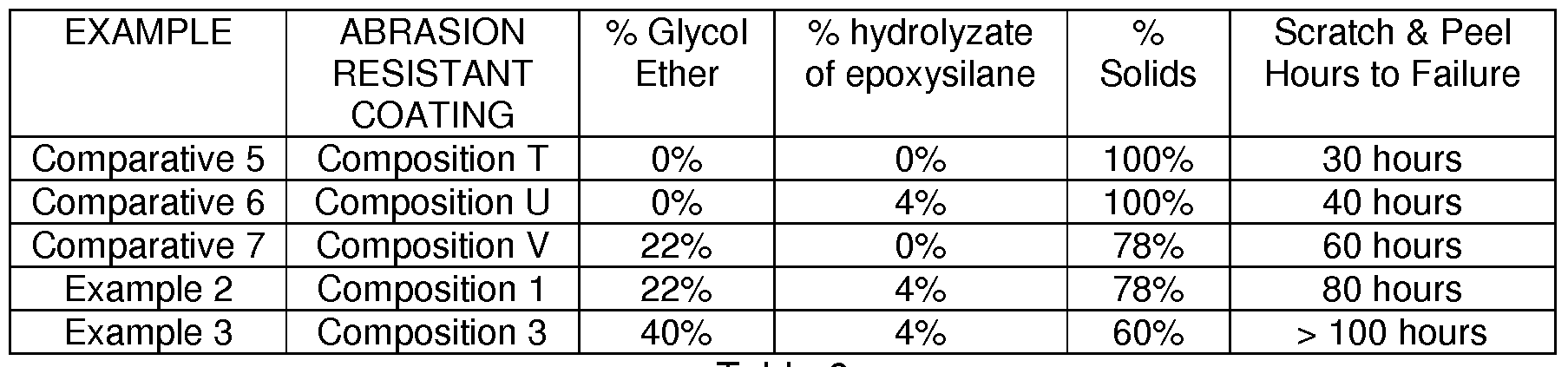
- the lenses of the examples were subjected to a durability test (called QUV S&P(Scratch and
- the test was performed on a device Q PANELTM, model QUV.
- the lens was placed for two hours in a chamber at 45° C and in an atmosphere saturated with water (condensation of water on the surface of the lens).
- the condensation of water was then stopped and the lens was subjected to UV radiation (0.75 W/m 2 /mm) for two hours at 45° C.
- the lens was then left for three hours without irradiation at 45 0 C with renewed condensation of water.
- the lens was subjected to UV irradiation (0.75 W/m 2 /mm) for three hours at 45 0 C, without condensation.
- the above test was repeated several times. A mechanical stress was exerted on this lens every 10 hours. The test was stopped when the mechanical stress induced an appreciable degradation of the anti-reflection stacking.
- the mechanical test performed was the following:
- a synthetic microfibre cloth that can be obtained from an optician, was used for cleaning optical lenses.
- the cloth constituted of polyamide and Nylon ® filaments, must have the following minimal dimensions: 30 mm x 30 mm, a thickness of 0.35 mm to 0.45 mm with a minimal fibre density of 10000/cm 2 .
- An example of such a cloth is the one manufactured by KANEBO company under the trade name Savina Minimax TM.
- the cloth was immersed in deionised water for at least two minutes, until it was impregnated with water.
- the cloth was then recovered, folded in three superimposed layers and placed on the central area of the lens.
- An eraser 6.5 to 7 mm in diameter was then applied to the centre of the cloth.
- a force of 5+-1 N was applied to this eraser and a forwards-and-backwards movement was made over a distance of 30 mm (the midpoint of the movement being centred on the centre of the lens) by performing one cycle (one to-and-fro movement) per second.
- a total of 25 cycles were performed, then the lens was turned through 90° around its axis. A further 25 cycles were performed.
- the lens was then examined visually by the naked eye.
- the lens was examined in reflection.
- the source of the reflected beam was a 200 lux source.
- a lens was considered as having appreciable degradation of the anti-reflection if more than 5% of the surface of the lens in the central area 20 mm in diameter was delaminated by being subjected to the mechanical stress.
- Example 1 and Comparative examples 1 -4 Example 1 and Comparative examples 1 -4:
- UV-33 TM Ultra Optics / LTI Solvent borne UV
- abrasion resistant commercial coatings as examples 1 to 4 were compared to the invention (coating composition 3) by first coating polycarbonate lenses with each of these coatings, followed by application of a thermally curable polysiloxane coating composition described in example 3 of EP614957 by dip coating at a thickness of 3.5 to 4.0 ⁇ m and cured at 75 Q C for 15 min followed by a final cure of 100 Q C for 3 hours using a convection oven. Each group of lenses was then compared for cosmetics and tested for adhesion of the organosilane coating to the UV curable coating both dry and after being exposed to boiling water for thirty (30) minutes.
Landscapes
- Chemical & Material Sciences (AREA)
- Life Sciences & Earth Sciences (AREA)
- Engineering & Computer Science (AREA)
- Materials Engineering (AREA)
- Wood Science & Technology (AREA)
- Organic Chemistry (AREA)
- Surface Treatment Of Optical Elements (AREA)
- Paints Or Removers (AREA)
- Application Of Or Painting With Fluid Materials (AREA)
- Eyeglasses (AREA)
- Coating Of Shaped Articles Made Of Macromolecular Substances (AREA)
Abstract
Description



Claims

Priority Applications (7)
| Application Number | Priority Date | Filing Date | Title |
|---|---|---|---|
| BRPI0914888A BRPI0914888B1 (en) | 2008-06-13 | 2009-06-09 | abrasion resistant photocurable coating composition, and, article |
| PL09761717T PL2291461T3 (en) | 2008-06-13 | 2009-06-09 | Photocurable acrylic coating compositions having good adhesion properties to a subsequent coating and corresponding coated substrates |
| JP2011512962A JP5894793B2 (en) | 2008-06-13 | 2009-06-09 | Photo-curable acrylic resin coating composition with good adhesion properties to subsequent coatings and applicable coated substrates |
| CA2727618A CA2727618C (en) | 2008-06-13 | 2009-06-09 | Photocurable acrylic coating compositions having good adhesion properties to a subsequent coating and corresponding coated substrates |
| CN2009801218218A CN102056993B (en) | 2008-06-13 | 2009-06-09 | Photocurable acrylic coating compositions having good adhesion properties to a subsequent coating and corresponding coated substrates |
| EP20090761717 EP2291461B1 (en) | 2008-06-13 | 2009-06-09 | Photocurable acrylic coating compositions having good adhesion properties to a subsequent coating and corresponding coated substrates |
| AT09761717T ATE540088T1 (en) | 2008-06-13 | 2009-06-09 | PHOTOHARDABLE ACRYLIC PAINTS WITH GOOD ADHESIVE PROPERTIES TOWARDS A SUBSEQUENT PAINT APPLICATION AND CORRESPONDING PAINTED SUBSTRATES |
Applications Claiming Priority (2)
| Application Number | Priority Date | Filing Date | Title |
|---|---|---|---|
| US12/138,621 US8268907B2 (en) | 2008-06-13 | 2008-06-13 | Photocurable acrylic coating compositions having good adhesion properties to a subsequent coating and corresponding coated substrates |
| US12/138,621 | 2008-06-13 |
Publications (1)
| Publication Number | Publication Date |
|---|---|
| WO2009150154A1 true WO2009150154A1 (en) | 2009-12-17 |
Family
ID=40908785
Family Applications (1)
| Application Number | Title | Priority Date | Filing Date |
|---|---|---|---|
| PCT/EP2009/057102 Ceased WO2009150154A1 (en) | 2008-06-13 | 2009-06-09 | Photocurable acrylic coating compositions having good adhesion properties to a subsequent coating and corresponding coated substrates |
Country Status (10)
| Country | Link |
|---|---|
| US (1) | US8268907B2 (en) |
| EP (1) | EP2291461B1 (en) |
| JP (1) | JP5894793B2 (en) |
| KR (1) | KR101635857B1 (en) |
| CN (1) | CN102056993B (en) |
| AT (1) | ATE540088T1 (en) |
| BR (1) | BRPI0914888B1 (en) |
| CA (1) | CA2727618C (en) |
| PL (1) | PL2291461T3 (en) |
| WO (1) | WO2009150154A1 (en) |
Cited By (2)
| Publication number | Priority date | Publication date | Assignee | Title |
|---|---|---|---|---|
| JP2012518045A (en) * | 2009-02-17 | 2012-08-09 | エシロール アンテルナシオナル (コンパニー ジェネラル ドプティック) | Abrasion resistant colorable coating |
| CN103429650A (en) * | 2011-03-18 | 2013-12-04 | 埃西勒国际通用光学公司 | Method for producing antistatic UV-curable hardcoats on optical articles |
Families Citing this family (21)
| Publication number | Priority date | Publication date | Assignee | Title |
|---|---|---|---|---|
| US20120177928A1 (en) * | 2010-08-16 | 2012-07-12 | Honeywell International Inc. | Hydrophilic and self cleaning uv nano-epoxy/acrylate cationic hybrid coating compositions for transparent polymeric materials, methods for forming coated transparent polymeric materials using such coating compositions, and coated transparent polymeric materials |
| WO2012030945A2 (en) * | 2010-09-01 | 2012-03-08 | Honeywell International Inc. | Ophthalmic lenses, ophthalmic lens coating compositions, and methods for manufacturing ophthalmic lenses |
| JP2013537857A (en) * | 2010-09-07 | 2013-10-07 | スリーエム イノベイティブ プロパティズ カンパニー | Curable resin composition and multilayer laminate produced using the same |
| JP5864298B2 (en) * | 2011-02-21 | 2016-02-17 | Hoya株式会社 | Manufacturing method of spectacle lens |
| CN103874730B (en) * | 2011-10-05 | 2016-03-23 | 株式会社钟化 | Acrylic resin film with excellent resistance to whitening and cracking at bending |
| JP6224639B2 (en) * | 2014-03-31 | 2017-11-01 | 富士フイルム株式会社 | Photopolymerizable hard coating composition, hard coat film, method for producing hard coat film, and article comprising hard coat film |
| KR20150113858A (en) | 2014-03-31 | 2015-10-08 | 후지필름 가부시키가이샤 | Photo polymerizable hard coating composition, hard coat film, method of manufacturing hard coat film, and article comprising hard coat film |
| KR101748009B1 (en) * | 2014-10-20 | 2017-06-16 | 삼성에스디아이 주식회사 | Display fim and display divice comprising thereof |
| JP6623121B2 (en) * | 2016-06-08 | 2019-12-18 | デクセリアルズ株式会社 | Photo-curable resin composition, image display device, and manufacturing method thereof |
| EP3327096A1 (en) | 2016-11-23 | 2018-05-30 | Essilor International | Heat-curable hybrid epoxy functional composition and transparent heat-cured caustic-resistant coatings prepared therefrom |
| PL3327091T3 (en) | 2016-11-23 | 2023-07-03 | Essilor International | Epoxy functional composition protecting dyes from photo-degradation and cured coatings prepared therefrom |
| EP3382429A1 (en) | 2017-03-28 | 2018-10-03 | Essilor International | Optical article comprising an abrasion- and/or scratch-resistant coating having a low sensitivity to cracks |
| EP3489270A1 (en) | 2017-11-28 | 2019-05-29 | Essilor International (Compagnie Generale D'optique) | Heat-curable hybrid epoxy functional composition and transparent heat-cured abrasion-resistant coatings prepared therefrom |
| EP3632950B1 (en) | 2018-10-05 | 2024-07-17 | Essilor International | Storage-stable heat-curable hybrid epoxy functional composition and transparent heat-cured coatings prepared therefrom |
| EP4069793B1 (en) | 2019-12-05 | 2026-06-24 | PPG Industries Ohio, Inc. | Curable compositions |
| EP3923038A1 (en) | 2020-06-09 | 2021-12-15 | Essilor International | Optical article with a durability improved hard coating |
| JP6966014B1 (en) * | 2021-05-17 | 2021-11-10 | 東洋インキScホールディングス株式会社 | Photo-curable topcoat paint, laminate and its manufacturing method, packaging container member and its manufacturing method, and packaging container |
| CN115337472B (en) * | 2022-08-30 | 2023-08-29 | 中国科学院长春应用化学研究所 | Coating composition, coating and preparation method thereof, and medical device |
| EP4636012A1 (en) | 2024-04-19 | 2025-10-22 | Essilor International | Optical article comprising a high refractive index abrasion- and/or scratch-resistant coating having a low sensitivity to environmental conditions |
| WO2026120299A1 (en) | 2024-12-06 | 2026-06-11 | Essilor International | Myopia control lens having photochromic properties |
| CN121136099A (en) * | 2025-09-12 | 2025-12-16 | 纳电(广东)材料科技有限公司 | A high-transmittance POSS resin solution, a composite coating, and its preparation method |
Family Cites Families (15)
| Publication number | Priority date | Publication date | Assignee | Title |
|---|---|---|---|---|
| JPH01263162A (en) | 1988-04-14 | 1989-10-19 | Seiko Epson Corp | Coating composition |
| JPH0228267A (en) | 1988-04-14 | 1990-01-30 | Seiko Epson Corp | Coating composition |
| JPH0314879A (en) | 1989-06-13 | 1991-01-23 | Seiko Epson Corp | Coating composition |
| JPH05179160A (en) * | 1991-12-26 | 1993-07-20 | Mitsubishi Rayon Co Ltd | Antistatic covering material composition |
| CA2141515A1 (en) * | 1994-02-08 | 1995-08-09 | John D. Blizzard | Abrasion-resistant coating |
| CA2141516A1 (en) * | 1994-06-13 | 1995-12-14 | John D. Blizzard | Radiation-curable oligomer-based coating composition |
| US5619288A (en) * | 1995-01-23 | 1997-04-08 | Essilor Of America, Inc. | Impact resistant plastic ophthalmic lens |
| FR2734827B1 (en) | 1995-05-31 | 1997-07-11 | Essilor Int | POLYMERIZABLE COMPOSITIONS BASED ON THIO (METH) ACRYLATE MONOMERS, LOW YELLOW INDEX POLYMERS OBTAINED FROM SUCH COMPOSITIONS AND OPHTHALMIC LENSES THEREOF |
| US6100313A (en) | 1997-03-07 | 2000-08-08 | The Walman Optical Company | UV-curable abrasion-resistant coating composition |
| US6780232B2 (en) * | 1999-08-20 | 2004-08-24 | The Walman Optical Company | Coating composition yielding abrasion-resistant tiniable coating |
| ATE334809T1 (en) * | 2001-05-29 | 2006-08-15 | Essilor Int | METHOD FOR PRODUCING A COATED OPTICAL OBJECT |
| ES2320773T3 (en) * | 2003-08-12 | 2009-05-28 | Tokuyama Corporation | ENDURECIBLE COMPOSITION. |
| US7439278B2 (en) | 2004-05-04 | 2008-10-21 | Essilor International Compagnie Generale D'optique | Curable adhesive composition and its use in the optical field |
| US7972656B2 (en) * | 2006-03-31 | 2011-07-05 | Sdc Technologies, Inc. | Coating compositions, articles, and methods of coating articles |
| CN101045833B (en) * | 2007-04-11 | 2010-09-08 | 江苏工业学院 | Preparation method of UV-cured wood coating modified by in-situ method |
-
2008
- 2008-06-13 US US12/138,621 patent/US8268907B2/en active Active
-
2009
- 2009-06-09 BR BRPI0914888A patent/BRPI0914888B1/en not_active IP Right Cessation
- 2009-06-09 CA CA2727618A patent/CA2727618C/en active Active
- 2009-06-09 EP EP20090761717 patent/EP2291461B1/en active Active
- 2009-06-09 KR KR1020107027847A patent/KR101635857B1/en not_active Expired - Fee Related
- 2009-06-09 PL PL09761717T patent/PL2291461T3/en unknown
- 2009-06-09 JP JP2011512962A patent/JP5894793B2/en not_active Expired - Fee Related
- 2009-06-09 AT AT09761717T patent/ATE540088T1/en active
- 2009-06-09 WO PCT/EP2009/057102 patent/WO2009150154A1/en not_active Ceased
- 2009-06-09 CN CN2009801218218A patent/CN102056993B/en active Active
Non-Patent Citations (3)
| Title |
|---|
| DATABASE CAPLUS CHEMICAL ABSTRACTS SERVICE, COLUMBUS, OHIO, US; XP002540303 * |
| DATABASE CAPLUS CHEMICAL ABSTRACTS SERVICE, COLUMBUS, OHIO, US; XP002540304 * |
| DATABASE CAPLUS CHEMICAL ABSTRACTS SERVICE, COLUMBUS, OHIO, US; XP002540305 * |
Cited By (3)
| Publication number | Priority date | Publication date | Assignee | Title |
|---|---|---|---|---|
| JP2012518045A (en) * | 2009-02-17 | 2012-08-09 | エシロール アンテルナシオナル (コンパニー ジェネラル ドプティック) | Abrasion resistant colorable coating |
| CN103429650A (en) * | 2011-03-18 | 2013-12-04 | 埃西勒国际通用光学公司 | Method for producing antistatic UV-curable hardcoats on optical articles |
| CN103429650B (en) * | 2011-03-18 | 2015-07-01 | 埃西勒国际通用光学公司 | Method for producing antistatic UV-curable hardcoats on optical articles |
Also Published As
| Publication number | Publication date |
|---|---|
| US8268907B2 (en) | 2012-09-18 |
| BRPI0914888A2 (en) | 2015-11-24 |
| JP2011522941A (en) | 2011-08-04 |
| CA2727618A1 (en) | 2009-12-17 |
| CN102056993B (en) | 2013-10-16 |
| JP5894793B2 (en) | 2016-03-30 |
| KR20110028585A (en) | 2011-03-21 |
| ATE540088T1 (en) | 2012-01-15 |
| CA2727618C (en) | 2016-10-18 |
| CN102056993A (en) | 2011-05-11 |
| PL2291461T3 (en) | 2012-06-29 |
| US20090311518A1 (en) | 2009-12-17 |
| KR101635857B1 (en) | 2016-07-04 |
| EP2291461B1 (en) | 2012-01-04 |
| BRPI0914888B1 (en) | 2018-11-27 |
| EP2291461A1 (en) | 2011-03-09 |
Similar Documents
| Publication | Publication Date | Title |
|---|---|---|
| US8268907B2 (en) | Photocurable acrylic coating compositions having good adhesion properties to a subsequent coating and corresponding coated substrates | |
| EP2021423B1 (en) | Process for obtaining a hard coated article having anti-fouling properties | |
| EP1226219B1 (en) | Coating composition yielding abrasion-resistant tintable coatings | |
| CN101553743B (en) | Optical article comprising a double-layer abrasion and scratch resistant coating and method for production thereof | |
| CN102421863B (en) | Antistatic sol/gel compositions and optical articles coated therewith | |
| US20100190010A1 (en) | Optical coating composition | |
| CN104039901A (en) | Curable coating composition | |
| JP5441891B2 (en) | Curable coating composition providing articles coated with antistatic and abrasion resistance | |
| JP2010031090A (en) | Coating composition for optical member and method for producing the same, and method for producing optical member | |
| US8033663B2 (en) | Abrasion-resistant tintable coating | |
| WO2014031404A1 (en) | Coating composition and method | |
| US20220098439A1 (en) | Glycidyl ether based optical coating compositions | |
| EP1963448A1 (en) | Coatings for optical elements | |
| US20240022849A1 (en) | Radiation-Curable Hard Coating Composition | |
| CN109963916B (en) | Thermally curable hybrid epoxy functional compositions and transparent thermally cured corrosion resistant coatings prepared therefrom | |
| JP2004314468A (en) | Transparent substrate having cured film formed thereon and curable composition therefor | |
| EP3608370B1 (en) | Radiation-curable hard coating compositions |
Legal Events
| Date | Code | Title | Description |
|---|---|---|---|
| WWE | Wipo information: entry into national phase |
Ref document number: 200980121821.8 Country of ref document: CN |
|
| 121 | Ep: the epo has been informed by wipo that ep was designated in this application |
Ref document number: 09761717 Country of ref document: EP Kind code of ref document: A1 |
|
| WWE | Wipo information: entry into national phase |
Ref document number: 8274/DELNP/2010 Country of ref document: IN |
|
| WWE | Wipo information: entry into national phase |
Ref document number: 2009761717 Country of ref document: EP |
|
| ENP | Entry into the national phase |
Ref document number: 20107027847 Country of ref document: KR Kind code of ref document: A |
|
| WWE | Wipo information: entry into national phase |
Ref document number: 2011512962 Country of ref document: JP Ref document number: 2727618 Country of ref document: CA |
|
| NENP | Non-entry into the national phase |
Ref country code: DE |
|
| ENP | Entry into the national phase |
Ref document number: PI0914888 Country of ref document: BR Kind code of ref document: A2 Effective date: 20101208 |