WO2009154063A1 - 鱗片状ガラス及び被覆鱗片状ガラス - Google Patents
鱗片状ガラス及び被覆鱗片状ガラス Download PDFInfo
- Publication number
- WO2009154063A1 WO2009154063A1 PCT/JP2009/059765 JP2009059765W WO2009154063A1 WO 2009154063 A1 WO2009154063 A1 WO 2009154063A1 JP 2009059765 W JP2009059765 W JP 2009059765W WO 2009154063 A1 WO2009154063 A1 WO 2009154063A1
- Authority
- WO
- WIPO (PCT)
- Prior art keywords
- glass
- mass
- temperature
- oxide
- scale
- Prior art date
- Legal status (The legal status is an assumption and is not a legal conclusion. Google has not performed a legal analysis and makes no representation as to the accuracy of the status listed.)
- Ceased
Links
Images


Classifications
-
- A—HUMAN NECESSITIES
- A61—MEDICAL OR VETERINARY SCIENCE; HYGIENE
- A61K—PREPARATIONS FOR MEDICAL, DENTAL OR TOILETRY PURPOSES
- A61K8/00—Cosmetics or similar toiletry preparations
- A61K8/18—Cosmetics or similar toiletry preparations characterised by the composition
- A61K8/19—Cosmetics or similar toiletry preparations characterised by the composition containing inorganic ingredients
- A61K8/25—Silicon; Compounds thereof
-
- A—HUMAN NECESSITIES
- A61—MEDICAL OR VETERINARY SCIENCE; HYGIENE
- A61K—PREPARATIONS FOR MEDICAL, DENTAL OR TOILETRY PURPOSES
- A61K8/00—Cosmetics or similar toiletry preparations
- A61K8/02—Cosmetics or similar toiletry preparations characterised by special physical form
-
- A—HUMAN NECESSITIES
- A61—MEDICAL OR VETERINARY SCIENCE; HYGIENE
- A61K—PREPARATIONS FOR MEDICAL, DENTAL OR TOILETRY PURPOSES
- A61K8/00—Cosmetics or similar toiletry preparations
- A61K8/18—Cosmetics or similar toiletry preparations characterised by the composition
- A61K8/19—Cosmetics or similar toiletry preparations characterised by the composition containing inorganic ingredients
- A61K8/26—Aluminium; Compounds thereof
-
- A—HUMAN NECESSITIES
- A61—MEDICAL OR VETERINARY SCIENCE; HYGIENE
- A61Q—SPECIFIC USE OF COSMETICS OR SIMILAR TOILETRY PREPARATIONS
- A61Q1/00—Make-up preparations; Body powders; Preparations for removing make-up
- A61Q1/02—Preparations containing skin colorants, e.g. pigments
-
- C—CHEMISTRY; METALLURGY
- C03—GLASS; MINERAL OR SLAG WOOL
- C03B—MANUFACTURE, SHAPING, OR SUPPLEMENTARY PROCESSES
- C03B37/00—Manufacture or treatment of flakes, fibres, or filaments from softened glass, minerals, or slags
- C03B37/005—Manufacture of flakes
-
- C—CHEMISTRY; METALLURGY
- C03—GLASS; MINERAL OR SLAG WOOL
- C03C—CHEMICAL COMPOSITION OF GLASSES, GLAZES OR VITREOUS ENAMELS; SURFACE TREATMENT OF GLASS; SURFACE TREATMENT OF FIBRES OR FILAMENTS MADE FROM GLASS, MINERALS OR SLAGS; JOINING GLASS TO GLASS OR OTHER MATERIALS
- C03C12/00—Powdered glass; Bead compositions
-
- C—CHEMISTRY; METALLURGY
- C03—GLASS; MINERAL OR SLAG WOOL
- C03C—CHEMICAL COMPOSITION OF GLASSES, GLAZES OR VITREOUS ENAMELS; SURFACE TREATMENT OF GLASS; SURFACE TREATMENT OF FIBRES OR FILAMENTS MADE FROM GLASS, MINERALS OR SLAGS; JOINING GLASS TO GLASS OR OTHER MATERIALS
- C03C17/00—Surface treatment of glass, not in the form of fibres or filaments, by coating
-
- C—CHEMISTRY; METALLURGY
- C03—GLASS; MINERAL OR SLAG WOOL
- C03C—CHEMICAL COMPOSITION OF GLASSES, GLAZES OR VITREOUS ENAMELS; SURFACE TREATMENT OF GLASS; SURFACE TREATMENT OF FIBRES OR FILAMENTS MADE FROM GLASS, MINERALS OR SLAGS; JOINING GLASS TO GLASS OR OTHER MATERIALS
- C03C3/00—Glass compositions
- C03C3/04—Glass compositions containing silica
- C03C3/076—Glass compositions containing silica with 40% to 90% silica, by weight
- C03C3/083—Glass compositions containing silica with 40% to 90% silica, by weight containing aluminium oxide or an iron compound
- C03C3/085—Glass compositions containing silica with 40% to 90% silica, by weight containing aluminium oxide or an iron compound containing an oxide of a divalent metal
- C03C3/087—Glass compositions containing silica with 40% to 90% silica, by weight containing aluminium oxide or an iron compound containing an oxide of a divalent metal containing calcium oxide, e.g. common sheet or container glass
-
- C—CHEMISTRY; METALLURGY
- C03—GLASS; MINERAL OR SLAG WOOL
- C03C—CHEMICAL COMPOSITION OF GLASSES, GLAZES OR VITREOUS ENAMELS; SURFACE TREATMENT OF GLASS; SURFACE TREATMENT OF FIBRES OR FILAMENTS MADE FROM GLASS, MINERALS OR SLAGS; JOINING GLASS TO GLASS OR OTHER MATERIALS
- C03C3/00—Glass compositions
- C03C3/04—Glass compositions containing silica
- C03C3/076—Glass compositions containing silica with 40% to 90% silica, by weight
- C03C3/089—Glass compositions containing silica with 40% to 90% silica, by weight containing boron
- C03C3/091—Glass compositions containing silica with 40% to 90% silica, by weight containing boron containing aluminium
-
- C—CHEMISTRY; METALLURGY
- C09—DYES; PAINTS; POLISHES; NATURAL RESINS; ADHESIVES; COMPOSITIONS NOT OTHERWISE PROVIDED FOR; APPLICATIONS OF MATERIALS NOT OTHERWISE PROVIDED FOR
- C09C—TREATMENT OF INORGANIC MATERIALS, OTHER THAN FIBROUS FILLERS, TO ENHANCE THEIR PIGMENTING OR FILLING PROPERTIES ; PREPARATION OF CARBON BLACK ; PREPARATION OF INORGANIC MATERIALS WHICH ARE NO SINGLE CHEMICAL COMPOUNDS AND WHICH ARE MAINLY USED AS PIGMENTS OR FILLERS
- C09C1/00—Treatment of specific inorganic materials other than fibrous fillers; Preparation of carbon black
- C09C1/0015—Pigments exhibiting interference colours, e.g. transparent platelets of appropriate thinness or flaky substrates, e.g. mica, bearing appropriate thin transparent coatings
- C09C1/0018—Pigments exhibiting interference colours, e.g. transparent platelets of appropriate thinness or flaky substrates, e.g. mica, bearing appropriate thin transparent coatings uncoated and unlayered plate-like particles
-
- C—CHEMISTRY; METALLURGY
- C09—DYES; PAINTS; POLISHES; NATURAL RESINS; ADHESIVES; COMPOSITIONS NOT OTHERWISE PROVIDED FOR; APPLICATIONS OF MATERIALS NOT OTHERWISE PROVIDED FOR
- C09C—TREATMENT OF INORGANIC MATERIALS, OTHER THAN FIBROUS FILLERS, TO ENHANCE THEIR PIGMENTING OR FILLING PROPERTIES ; PREPARATION OF CARBON BLACK ; PREPARATION OF INORGANIC MATERIALS WHICH ARE NO SINGLE CHEMICAL COMPOUNDS AND WHICH ARE MAINLY USED AS PIGMENTS OR FILLERS
- C09C1/00—Treatment of specific inorganic materials other than fibrous fillers; Preparation of carbon black
- C09C1/0015—Pigments exhibiting interference colours, e.g. transparent platelets of appropriate thinness or flaky substrates, e.g. mica, bearing appropriate thin transparent coatings
- C09C1/0021—Pigments exhibiting interference colours, e.g. transparent platelets of appropriate thinness or flaky substrates, e.g. mica, bearing appropriate thin transparent coatings comprising a core coated with only one layer having a high or low refractive index
-
- C—CHEMISTRY; METALLURGY
- C09—DYES; PAINTS; POLISHES; NATURAL RESINS; ADHESIVES; COMPOSITIONS NOT OTHERWISE PROVIDED FOR; APPLICATIONS OF MATERIALS NOT OTHERWISE PROVIDED FOR
- C09D—COATING COMPOSITIONS, e.g. PAINTS, VARNISHES OR LACQUERS; FILLING PASTES; CHEMICAL PAINT OR INK REMOVERS; INKS; CORRECTING FLUIDS; WOODSTAINS; PASTES OR SOLIDS FOR COLOURING OR PRINTING; USE OF MATERIALS THEREFOR
- C09D11/00—Inks
-
- C—CHEMISTRY; METALLURGY
- C03—GLASS; MINERAL OR SLAG WOOL
- C03C—CHEMICAL COMPOSITION OF GLASSES, GLAZES OR VITREOUS ENAMELS; SURFACE TREATMENT OF GLASS; SURFACE TREATMENT OF FIBRES OR FILAMENTS MADE FROM GLASS, MINERALS OR SLAGS; JOINING GLASS TO GLASS OR OTHER MATERIALS
- C03C2217/00—Coatings on glass
- C03C2217/70—Properties of coatings
- C03C2217/72—Decorative coatings
-
- C—CHEMISTRY; METALLURGY
- C09—DYES; PAINTS; POLISHES; NATURAL RESINS; ADHESIVES; COMPOSITIONS NOT OTHERWISE PROVIDED FOR; APPLICATIONS OF MATERIALS NOT OTHERWISE PROVIDED FOR
- C09C—TREATMENT OF INORGANIC MATERIALS, OTHER THAN FIBROUS FILLERS, TO ENHANCE THEIR PIGMENTING OR FILLING PROPERTIES ; PREPARATION OF CARBON BLACK ; PREPARATION OF INORGANIC MATERIALS WHICH ARE NO SINGLE CHEMICAL COMPOUNDS AND WHICH ARE MAINLY USED AS PIGMENTS OR FILLERS
- C09C2200/00—Compositional and structural details of pigments exhibiting interference colours
- C09C2200/10—Interference pigments characterized by the core material
- C09C2200/102—Interference pigments characterized by the core material the core consisting of glass or silicate material like mica or clays, e.g. kaolin
-
- Y—GENERAL TAGGING OF NEW TECHNOLOGICAL DEVELOPMENTS; GENERAL TAGGING OF CROSS-SECTIONAL TECHNOLOGIES SPANNING OVER SEVERAL SECTIONS OF THE IPC; TECHNICAL SUBJECTS COVERED BY FORMER USPC CROSS-REFERENCE ART COLLECTIONS [XRACs] AND DIGESTS
- Y10—TECHNICAL SUBJECTS COVERED BY FORMER USPC
- Y10T—TECHNICAL SUBJECTS COVERED BY FORMER US CLASSIFICATION
- Y10T428/00—Stock material or miscellaneous articles
- Y10T428/29—Coated or structually defined flake, particle, cell, strand, strand portion, rod, filament, macroscopic fiber or mass thereof
- Y10T428/2982—Particulate matter [e.g., sphere, flake, etc.]
- Y10T428/2991—Coated
- Y10T428/2993—Silicic or refractory material containing [e.g., tungsten oxide, glass, cement, etc.]
- Y10T428/2996—Glass particles or spheres
Definitions
- the present invention relates to scaly glass and coated scaly glass that can be used by blending, for example, in resin compositions, paints, inks (inks), cosmetics, etc., and exhibiting excellent color tone and gloss.
- the strength and dimensional accuracy of the resin molded body obtained from the resin composition can be improved.
- scale-like glass is mix
- This scaly glass comes to exhibit a metallic color when its surface is coated with a metal, and the scaly glass exhibits an interference color due to interference of reflected light by coating the surface of the scaly glass with a metal oxide. It becomes like this. That is, the glass flakes coated with a metal film or metal oxide film are suitably used as a luster pigment. Bright pigments using such glass flakes are preferably used in applications where color tone and gloss are important, such as paints and cosmetics.
- the glass flakes are produced by, for example, inflating a molten glass substrate into a balloon shape with a blow nozzle to form a hollow glass film, and pulverizing the hollow glass film with a pressure roller.
- the glass flakes have excellent meltability and good moldability, have an appropriate temperature-viscosity characteristic, and have a devitrification temperature lower than the working temperature. Desired.
- the working temperature is a temperature at which the viscosity of the glass is 100 Pa ⁇ s (1000 P).
- the devitrification temperature is a temperature at which crystals start to grow in the molten glass substrate and begin to grow.
- the working temperature is 1300 ° C. or lower because the glass flakes are difficult to be formed particularly when the working temperature is too high.
- the thermal damage which the manufacturing apparatus of a melting kiln or scale-like glass receives becomes small, the lifetime of a melting kiln or a manufacturing apparatus can be extended.
- the glass flakes may be subjected to a high temperature treatment.
- the glass flakes or the coated glass flakes are blended in a paint, and may be used for applications such as baking painting and subjected to high temperature treatment. Therefore, sufficient heat resistance is also required for the glass flakes.
- a soda lime glass generally used as a so-called plate glass composition contains a large amount of an alkali metal oxide and has insufficient heat resistance.
- the coating film and coating film require acid resistance, alkali resistance, etc., and scaly glass requires high chemical durability.
- Patent Document 1 the content of silicon dioxide (SiO 2 ), the total content of silicon dioxide and aluminum oxide (Al 2 O 3 ), the total of magnesium oxide (MgO) and calcium oxide (CaO). content and suggested a total specified glass flake content of sodium oxide and lithium oxide (Li 2 O) (Na 2 O) and potassium oxide (K 2 O).
- Patent Document 2 the content of silicon dioxide, the total content of magnesium oxide and calcium oxide, the total content of lithium oxide, sodium oxide, and potassium oxide, and the content of titanium dioxide (TiO 2 ) were specified. A flaky glass was proposed.
- silicon dioxide and aluminum oxide are components that form a skeleton of glass. If the content of silicon dioxide and aluminum oxide is not sufficient, the glass transition temperature does not increase and heat resistance is insufficient. Moreover, since silicon dioxide tends to improve acid resistance and aluminum oxide tends to deteriorate acid resistance, the balance between silicon dioxide and aluminum oxide is important. Magnesium oxide and calcium oxide are components that favorably adjust the devitrification temperature and viscosity of the glass.
- Patent Documents 1 and 2 describe that the content of aluminum oxide is preferably 5% or less.
- the content of aluminum oxide is 3.20% by mass or less in Patent Document 1.
- Patent Document 2 it is 4.84% by mass or less.
- the content of silicon dioxide is set excessively compared with the content of aluminum oxide. For this reason, there existed a problem that the heat resistance of scale-like glass was insufficient and chemical durability, such as water resistance, also deteriorated.
- the total content of lithium oxide, sodium oxide, and potassium oxide (Li 2 O + Na 2 O + K 2 O) is 13% by mass or more.
- the content of (Li 2 O + Na 2 O + K 2 O) is 13% by mass or more, particularly when the content of Na 2 O is large, there is a problem that the heat resistance of the glass flakes is insufficient. .
- An object of the present invention is to provide glass flakes and coated glass flakes having improved heat resistance and chemical durability.
- the present inventors have intensively studied on a suitable glass composition of scaly glass.
- a suitable glass composition of scaly glass As a result, by controlling the content of silicon dioxide (SiO 2 ) and aluminum oxide (Al 2 O 3 ) and the total content of alkali metal oxides (Li 2 O + Na 2 O + K 2 O), The present invention was completed by finding that scaly glass having improved durability (particularly acid resistance) and ease of molding was obtained.
- the scaly glass according to the first aspect of the present invention is expressed in mass%, 65 ⁇ SiO 2 ⁇ 70, 5 ⁇ Al 2 O 3 ⁇ 15, 1 ⁇ MgO ⁇ 10, 10 ⁇ CaO ⁇ 25, 0.1 ⁇ (Li 2 O + Na 2 O + K 2 O) ⁇ 4 It is formed from the glass substrate which is the composition of this.
- the temperature difference ⁇ T obtained by subtracting the devitrification temperature from the working temperature of the glass substrate is 0 to 200 ° C.
- the glass substrate has a glass transition temperature of 580 to 800 ° C.
- ⁇ W which is an index of acid resistance of the glass substrate, is 0.05 to 0.8 mass%.
- the coated flaky glass according to one aspect of the present invention comprises the flaky glass according to the first aspect and a coating mainly comprising a metal or a metal oxide that covers the surface of the flaky glass.
- the glass substrate forming the scaly glass according to the first aspect of the present invention is set so as to satisfy 65 ⁇ SiO 2 ⁇ 70 and 5 ⁇ Al 2 O 3 ⁇ 15. For this reason, the contents of silicon dioxide and aluminum oxide are sufficiently ensured, the function of forming a glass skeleton by silicon dioxide and aluminum oxide can be sufficiently expressed, the glass transition temperature is high, and the meltability is good. Acid resistance and water resistance can be increased. Further, the contents of magnesium oxide and calcium oxide are set to 1 ⁇ MgO ⁇ 10 and 10 ⁇ CaO ⁇ 25. For this reason, the devitrification temperature and viscosity at the time of glass formation can be made favorable, maintaining the heat resistance of glass.
- the total amount of lithium oxide, sodium oxide and potassium oxide is set to 0.1 ⁇ (Li 2 O + Na 2 O + K 2 O) ⁇ 4. For this reason, the glass transition temperature of a glass substrate can be raised and heat resistance can be made favorable. According to the glass substrate having the above composition, the heat resistance and chemical durability of the glass flakes can be improved.
- the temperature difference ⁇ T obtained by subtracting the devitrification temperature from the working temperature of the glass substrate is 0 to 200 ° C., the devitrification at the time of glass formation can be suppressed, and more uniform scaly glass can be obtained.
- the heat resistance of the glass flakes can be improved.
- ⁇ W which is an index of acid resistance of the glass substrate, is 0.05 to 0.8% by mass, the acid resistance of the glass flakes can be increased.
- the coated glass flakes in which the surface of the glass flakes is coated with a coating containing a metal or a metal oxide as a main component can develop a metal color, an interference color, or the like.
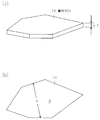
- (A) is a perspective view which shows typically the scale-like glass in embodiment
- (b) is a top view which shows scale-like glass.
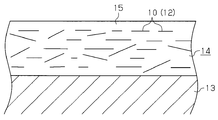
- Sectional drawing which shows covering scale-like glass typically.
- composition of the glass substrate that forms the scaly glass of the present embodiment is set as follows, expressed in mass%.
- SiO 2 is silicon dioxide (silicic acid)
- Al 2 O 3 is aluminum oxide (alumina)
- MgO magnesium oxide
- CaO calcium oxide
- Li 2 O lithium oxide
- Na 2 O sodium oxide
- K 2 O means potassium oxide.
- FIG. 1A is a perspective view showing the scaly glass 10
- FIG. 1B is a plan view showing the scaly glass 10.
- the average thickness t of the glass flakes 10 of this embodiment is 0.1 to 15 ⁇ m.
- the aspect ratio (average particle diameter a / average thickness t) of the glass flakes 10 is 2 to 1000. Therefore, the glass flakes 10 are flaky particles.
- composition of the glass flake 10 the method for producing the glass flake 10
- physical properties of the glass flake 10 the coated glass flakes and the uses (resin composition, paint, ink composition and cosmetic) will be described in this order.
- SiO 2 Silicon dioxide
- the main component means a component having the largest content.
- SiO 2 is a component that adjusts the devitrification temperature and viscosity when forming glass while maintaining the heat resistance of the glass, is also a component improving the acid resistance.
- the content of SiO 2 is 65% by mass or less, the devitrification temperature is excessively increased, and it becomes difficult to form the glass flakes 10 and the acid resistance of the glass flakes 10 is also deteriorated.
- the content of SiO 2 exceeds 70% by mass, the melting point of the glass becomes too high, and it becomes difficult to uniformly melt the raw material.
- the lower limit of SiO 2 is larger than 65% by mass
- the upper limit of SiO 2 is 70% by mass or less, preferably 69% by mass or less, more preferably 68% by mass or less, and most preferably 67% by mass or less. Therefore, the range of the content of SiO 2 is selected from any combination of these upper and lower limits, and is preferably greater than 65% by mass and not greater than 67% by mass, for example.
- B 2 O 3 Diboron trioxide
- B 2 O 3 is a component that forms a glass skeleton, and is also a component that adjusts the devitrification temperature and viscosity during glass formation.
- the content of the B 2 O 3 is preferably 0 ⁇ B 2 O 3 ⁇ 6 .
- the upper limit of B 2 O 3 is preferably 6% by mass or less, more preferably less than 2% by mass, particularly preferably less than 1% by mass, and most preferably not substantially contained.
- Aluminum oxide (Al 2 O 3 ) is a component that forms the skeleton of the glass flake 10, and is also a component that adjusts the devitrification temperature and viscosity during glass formation while maintaining heat resistance.
- Al 2 O 3 is a component that improves water resistance, while it is also a component that deteriorates acid resistance.
- Al 2 O 3 is less than 5% by mass, the devitrification temperature and viscosity cannot be adjusted sufficiently, or the water resistance cannot be improved sufficiently.
- the content of Al 2 O 3 exceeds 15% by mass, the melting point of the glass becomes too high, and it becomes difficult to melt the raw material uniformly, and the acid resistance is also deteriorated.
- the lower limit of Al 2 O 3 is 5% by mass or more, preferably 6% by mass or more, more preferably 8% by mass or more, and most preferably 10% by mass or more.
- the upper limit of Al 2 O 3 is 15% by mass or less, preferably 13% by mass or less, and more preferably less than 12% by mass. Therefore, the range of the content of Al 2 O 3 is selected from any combination of these upper and lower limits, but is preferably 6 to 13% by mass, for example.
- MgO, CaO Magnesium oxide (MgO) and calcium oxide (CaO) are components that adjust the devitrification temperature and viscosity during glass formation while maintaining the heat resistance of the glass.
- the content of MgO is 1 ⁇ MgO ⁇ 10.
- the content of MgO is less than 1% by mass, a sufficient effect for adjusting the devitrification temperature and the viscosity cannot be obtained.
- the content of MgO exceeds 10% by mass, the devitrification temperature rises too much, and it becomes difficult to form the scaly glass 10. Therefore, the lower limit of MgO is 1% by mass or more, and preferably 2% by mass or more.
- the upper limit of MgO is 10% by mass or less, preferably 8% by mass or less, more preferably 5% by mass or less, and most preferably 4% by mass or less. Accordingly, the range of the content of MgO is selected from any combination of these upper and lower limits, but is preferably 2 to 8% by mass, for example.
- the content of CaO is 10 ⁇ CaO ⁇ 25.
- the lower limit of CaO is 10% by mass or more, preferably 12% by mass or more, more preferably 14% by mass or more, and most preferably greater than 15% by mass.
- the upper limit of CaO is 25% by mass or less, preferably 23% by mass or less, more preferably 21% by mass or less, and most preferably 20% by mass or less. Therefore, the range of the CaO content is determined by any combination of these upper and lower limits, but is preferably 14 to 21% by mass, for example.
- SrO Strontium oxide
- SrO Strontium oxide
- the upper limit of SrO is preferably 10% by mass or less, more preferably 5% by mass or less, still more preferably 2% by mass or less, and most preferably not substantially contained.
- BaO Barium oxide
- BaO is a component that adjusts the devitrification temperature and viscosity during glass formation.
- BaO is also a component that deteriorates the acid resistance of the glass.
- BaO is not essential, but you may use it as a component for adjusting the devitrification temperature and viscosity at the time of glass formation.
- the upper limit of BaO is preferably 10% by mass or less, more preferably 5% by mass or less, still more preferably 2% by mass or less, and most preferably not contained.
- Zinc oxide (ZnO) is a component that adjusts the devitrification temperature and viscosity during glass formation. On the other hand, since ZnO is easily volatilized, it may be scattered during melting. When the content of ZnO exceeds 10% by mass, the fluctuation of the component ratio due to volatilization becomes remarkable, making it difficult to manage the content in the glass. Accordingly, the upper limit of ZnO is preferably 10% by mass or less, more preferably 5% by mass or less, still more preferably 2% by mass or less, and most preferably not substantially contained.
- Alkali metal oxides (Li 2 O, Na 2 O, K 2 O) are components that adjust the devitrification temperature and viscosity during glass formation.
- the total content of alkali metal oxides (Li 2 O + Na 2 O + K 2 O) is 0.1 ⁇ (Li 2 O + Na 2 O + K 2 O) ⁇ 4.
- (Li 2 O + Na 2 O + K 2 O) is less than 0.1% by mass, the melting point of the glass becomes too high, and it becomes difficult to uniformly melt the raw material, and the glass flake 10 is formed. Becomes difficult.
- the lower limit of (Li 2 O + Na 2 O + K 2 O) is 0.1% by mass or more, preferably 1% by mass or more, more preferably 1.5% by mass or more, and most preferably 2% by mass or more.
- the upper limit of (Li 2 O + Na 2 O + K 2 O) is 4% by mass or less, preferably less than 3.5% by mass, and more preferably 3% by mass or less.
- the range of (Li 2 O + Na 2 O + K 2 O) is selected from any combination of these upper and lower limits, but is preferably 1 to 3.5% by mass, for example.
- Lithium oxide (Li 2 O) is not essential, it is desirable to use as a component for adjusting the devitrification temperature and viscosity when forming glass. Since it has the effect of lowering the melting point of the glass, the glass raw material can be easily melted uniformly by containing it. In addition, Li 2 O has an effect of lowering the working temperature, so that the glass flakes 10 are easily formed. On the other hand, when the content of Li 2 O exceeds 4% by mass, the glass transition temperature is lowered and the heat resistance of the glass is deteriorated. Moreover, the working temperature becomes too low with respect to the devitrification temperature, and it becomes difficult to form the glass flakes 10.
- the lower limit of Li 2 O is preferably 0% by mass or more, more preferably 0.1% by mass or more, further preferably 0.5% by mass or more, and most preferably 1% by mass or more.
- the upper limit of Li 2 O is preferably 4% by mass or less, more preferably 3% by mass or less, and still more preferably less than 2% by mass.
- the range of Li 2 O is selected from any combination of these upper and lower limits, but is preferably 0.1 to 3% by mass, for example.
- the lower limit of Na 2 O is preferably 0% by mass or more, more preferably 0.1% by mass or more, and further preferably 0.2% by mass or more.
- the upper limit of Na 2 O is preferably 4% by mass or less, more preferably 3% by mass or less, still more preferably less than 2% by mass, and most preferably 1% by mass or less.
- any combination of these upper and lower limits is selected. For example, it is preferably 0.1% by mass or more and less than 2% by mass.
- Potassium oxide (K 2 O) is not essential, but it is desirable to use it as a component for adjusting the devitrification temperature and viscosity during glass formation.
- the lower limit of K 2 O is preferably 0% by mass or more, and more preferably 0.1% by mass or more.
- the upper limit of K 2 O is preferably 4% by mass or less, more preferably 3% by mass or less, still more preferably less than 2% by mass, and most preferably 1% by mass or less.
- the content of K 2 O is selected from any combination of these upper and lower limits, but is preferably 0.1% by mass or more and less than 2% by mass, for example.
- Titanium dioxide (TiO 2 ) is a component that improves the meltability of the glass, the chemical durability of the glass flake 10 and the ultraviolet absorption characteristics. Accordingly, TiO 2 is not an essential component, but is preferably included as a component for adjusting the meltability of glass and the chemical durability and optical properties of the glass flake 10. However, when the content of TiO 2 exceeds 5% by mass, the devitrification temperature of the glass is excessively increased, and it becomes difficult to form the scaly glass 10. Therefore, the lower limit of Ti 2 O is preferably 0% by mass or more, and more preferably 0.1% by mass or more. The upper limit of TiO 2 is preferably 5% by mass or less, more preferably 2% by mass or less, and still more preferably less than 1% by mass.
- ZrO 2 Zirconium oxide
- ZrO 2 Zirconium oxide
- Such ZrO 2 is not an essential component, but may be used as a component for adjusting the devitrification temperature, viscosity, and chemical durability during glass formation.
- the upper limit of ZrO 2 is preferably 5% by mass or less, more preferably 2% by mass or less, and further preferably 1% by mass or less. More preferably, ZrO 2 is not substantially contained.
- iron (Fe) in glass exists in a state of Fe 2+ or Fe 3+ .
- Fe 3+ is a component that enhances the ultraviolet absorption characteristics of the glass flake 10
- Fe 2+ is a component that enhances the heat ray absorption characteristics. Therefore, iron (Fe) is not an essential component, but may be included as a component for adjusting the optical properties of the glass flake 10. Moreover, even if iron (Fe) is not intentionally included, it may be inevitably mixed with industrial raw materials. On the other hand, when the content of iron (Fe) increases, the scaly glass 10 is markedly colored. This coloring may not be preferable in applications where the color tone and gloss of the glass flake 10 are regarded as important.
- the upper limit of iron (Fe) is preferably 5% by mass or less, more preferably 2% by mass or less, further preferably 0.5% by mass or less, and particularly preferably 0.1% by mass or less in terms of Fe 2 O 3.
- sulfur trioxide (SO 3 ) is not an essential component, it may be included as a fining agent. When a sulfate raw material is used, it may be contained at a content of 0.5% by mass or less.
- fluorine (F) Since fluorine (F) is easily volatilized, there is a possibility that the fluorine (F) may be scattered at the time of melting, and it is difficult to control the content in the glass. Therefore, it is preferable that F is not substantially contained.
- the lower limit of (SiO 2 —Al 2 O 3 ) is preferably greater than 50% by mass, more preferably 51% by mass or more, still more preferably 52% by mass or more, and most preferably greater than 53% by mass.
- the upper limit of (SiO 2 —Al 2 O 3 ) is preferably 60% by mass or less, more preferably 59% by mass or less, still more preferably 58% by mass or less, and most preferably 57% by mass or less.
- the range of the content of (SiO 2 —Al 2 O 3 ) is selected from any combination of these upper and lower limits, and is, for example, 52 to 58% by mass.
- substantially not containing a substance means that the substance is not intentionally included unless, for example, it is inevitably mixed with an industrial raw material.
- the content is preferably less than 0.1% by mass, more preferably 0.05% by mass or less, and particularly preferably 0.03% by mass or less.
- the glass substrate that forms the scaly glass 10 in the present embodiment includes SiO 2 , Al 2 O 3 , MgO, and CaO as essential components, and further Li 2 O, Na 2 O, and K 2 O. contains at least one selected from the group consisting of, SrO optionally, BaO, ZnO, TiO 2, ZrO 2 and iron oxide (FeO or Fe 2 O 3), also contain sO 3 and the like Good.
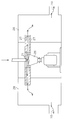
- the scale-like glass 10 of this embodiment can be manufactured, for example using the manufacturing apparatus shown in FIG. As shown in FIG. 4, the glass substrate 21 having the glass composition melted in the refractory furnace 20 is swelled into a balloon shape by the gas 23 fed into the blow nozzle 22, and becomes a hollow glass film 24. By pulverizing the obtained hollow glass film 24 with a pair of pressing rollers 25, the scale-like glass 10 is obtained.
- the scale-like glass 10 of this embodiment can be manufactured also using the manufacturing apparatus shown, for example in FIG.
- the glass substrate 21 having the molten glass composition poured into the rotating cup 26 flows out radially from the upper edge of the rotating cup 26 by centrifugal force, and is annularly arranged vertically. The air is sucked through the gap between the plates 27 and introduced into the annular cyclone collector 28. While passing through the gap between the annular plates 27, the glass substrate 21 is cooled and solidified in the form of a thin film, and further crushed into fine pieces, whereby the glass flake 10 is obtained.
- the temperature when the viscosity of the molten glass is 100 Pa ⁇ s (1000 P) is called the working temperature and is the most suitable temperature for forming the glass flake 10.
- the working temperature is preferably 1100 ° C. or higher, and more preferably 1150 ° C. or higher.
- the working temperature is preferably 1300 ° C. or lower, more preferably 1280 ° C. or lower, and further preferably 1260 ° C. or lower.
- the devitrification temperature is about 1100 to 1250 ° C. In the present specification, devitrification refers to white turbidity caused by crystals formed and grown in the molten glass substrate 21. In the glass produced from such a molten glass substrate 21, a crystallized lump may exist, which is not preferable as the glass flake 10.
- ⁇ T is preferably 0 ° C. or higher, more preferably 20 ° C. or higher, further preferably 40 ° C. or higher, and most preferably 50 ° C. or higher.
- ⁇ T is 200 ° C. or less, it is preferable because the glass composition can be easily adjusted, more preferably ⁇ T is 180 ° C. or less, and particularly preferably 150 ° C. or less.
- the scaly glass 10 has higher heat resistance as the glass transition temperature (glass transition point, Tg) is higher, and is less likely to be deformed with respect to processing involving high-temperature heating. If the glass transition temperature is 560 ° C. or higher, there is little possibility that the shape of the flaky glass 10 changes in the step of forming a coating mainly containing a metal or metal oxide on the surface of the flaky glass 10. Moreover, the glass flakes 10 or the coated glass flakes can be blended in a paint and suitably used for applications such as baking painting. If it is a glass composition prescribed
- the glass transition temperature of the glass flakes 10 is preferably 580 ° C. or higher, more preferably 600 ° C. or higher, and further preferably 620 ° C. or higher.
- the upper limit of the glass transition temperature is preferably about 800 ° C.
- the glass flake 10 of this embodiment is excellent in chemical durability such as acid resistance, water resistance, and alkali resistance. Therefore, the scale-like glass 10 of this embodiment can be used suitably for uses, such as a resin molding, a coating material, cosmetics, and ink.
- the acid resistance index is such that the glass substrate forming the glass flake 10 is crushed and passes through the auxiliary mesh sieve 710 ⁇ m and the standard mesh sieve 590 ⁇ m specified in JIS Z 8801, but not through the standard mesh sieve 420 ⁇ m.
- the glass powder is taken in the same gram quantity as the specific gravity of the glass, and the mass reduction rate ⁇ W when immersed in 100 mL of a 10% by mass sulfuric acid aqueous solution at 80 ° C. for 72 hours is used. It shows that acid resistance is so high that this mass reduction rate (DELTA) W is low.
- This measuring method is based on “Optical Glass Chemical Durability Measuring Method (Powder Method) 06-1975” of Japan Optical Glass Industry Association Standard (JOGIS).
- 10 mass% sulfuric acid aqueous solution is used instead of the 0.01N (mol / L) nitric acid aqueous solution used with the measuring method of JOGIS.
- the temperature of sulfuric acid aqueous solution shall be 80 degreeC, and the liquid quantity is 100 mL instead of 80 mL in the measuring method of JOGIS.
- the processing time is 72 hours instead of 60 minutes in the measuring method of JOGIS.
- the glass substrate forming the scale-like glass 10 is a glass sample produced by melting a normal glass raw material.
- the acid resistance of the glass in the above index is preferably a small value.
- mass reduction rate (DELTA) W shows a large value, the corrosion resistance of the anticorrosion lining material in an acidic environment becomes low. Accordingly, the mass reduction rate ⁇ W is preferably 0.8% by mass or less, more preferably 0.5% by mass or less, further preferably 0.3% by mass or less, and most preferably 0.2% by mass or less.
- the lower limit of the mass reduction rate ⁇ W is usually about 0.05% by mass.
- the coated flaky glass 12 is produced by forming the above-mentioned flaky glass 10 as a core and forming a coating 11 containing a metal or a metal oxide as a main component on the surface thereof. Can do.
- the coating 11 is preferably formed substantially from at least one of a metal and a metal oxide.
- the form of the film 11 may be any of a single layer, a mixed layer, or a multilayer.
- the coating 11 is formed of at least one metal selected from the group consisting of silver, gold, platinum, palladium, and nickel.
- the film 11 is formed of at least one metal oxide selected from the group consisting of titanium oxide, aluminum oxide, iron oxide, cobalt oxide, zirconium oxide, zinc oxide, tin oxide, and silicon dioxide.
- titanium dioxide having high refractive index and transparency and good interference color development and iron oxide capable of developing characteristic interference colors are preferable.
- the film 11 may be a laminated film including a first film mainly containing metal and a second film mainly containing metal oxide.
- the film 11 may be formed on the entire surface of the glass flake 10 serving as the core, or the film 11 may be formed on a part of the surface of the glass flake 10.
- the thickness of the coating 11 can be appropriately set depending on the application.
- a method for forming the coating 11 on the surface of the glass flake 10 any method such as a generally known method can be employed.
- a known method such as a sputtering method, a sol-gel method, a CVD method (chemical vapor deposition method), an LPD method, or a liquid phase deposition method in which an oxide is deposited on the surface from a metal salt can be employed.
- the LPD method Liquid Phase Deposition Method
- FIG. 3 is a schematic cross-sectional view for explaining an example in which the glass flake 10 is blended with a paint and applied to the surface of the substrate 13. As shown in FIG. 3, the glass flakes 10 or the coated glass flakes 12 are dispersed in the resin matrix 15 of the coating film 14.
- Resin compositions, paints, ink compositions and cosmetics can be appropriately selected and used depending on the application as long as they are generally known.
- the mixing ratio of the scaly glass 10 and these materials can also be set as appropriate.
- the method of mixing the scaly glass 10 and these materials can be applied as long as it is a generally known method. For example, when the glass flakes 10 or the coated glass flakes 12 are blended in the paint, a thermosetting resin, a thermoplastic resin, or a curing agent can be appropriately selected and blended with the base material resin.
- thermosetting resin is not particularly limited, and is an acrylic resin, polyester resin, epoxy resin, phenol resin, urea resin, fluorine resin, polyester-urethane curing resin, epoxy-polyester curing resin, acrylic-polyester resin, Examples thereof include acrylic-urethane curable resins, acrylic-melamine curable resins, and polyester-melamine curable resins.
- thermoplastic resin is not particularly limited.
- the curing agent is not particularly limited, and examples thereof include polyisocyanate, amine, polyamide, polybasic acid, acid anhydride, polysulfide, trifluoroboric acid, acid dihydrazide, and imidazole.
- the above-mentioned various thermosetting resins or thermoplastic resins can be used for base material resin.
- the ink composition include writing instrument inks such as various ballpoint pens and felt pens, and printing inks such as gravure inks and offset inks, and can be applied to any ink composition.
- the vehicle constituting the ink composition serves to disperse the pigment and fix the ink to the paper.
- the vehicle is composed of resins, oil and solvent.
- Vehicles for writing instrument inks include acrylic resins, styrene-acrylic copolymers, polyvinyl alcohol, polyacrylic acid salts, acrylic monomer-vinyl acetate copolymers, polysaccharides produced by microorganisms such as xanthan gum, and guar gum. Examples include water-soluble plant polysaccharides. Further, examples of the solvent include water, alcohol, hydrocarbon, ester and the like.
- Vehicles for gravure inks are resins such as gum rosin, wood rosin, tall oil rosin, lime rosin, rosin sell, maleic acid resin, polyamide resin, vinyl resin, nitrocellulose, cellulose acetate, ethyl cellulose, chlorinated rubber, cyclized rubber, ethylene-acetic acid
- resins such as gum rosin, wood rosin, tall oil rosin, lime rosin, rosin sell, maleic acid resin, polyamide resin, vinyl resin, nitrocellulose, cellulose acetate, ethyl cellulose, chlorinated rubber, cyclized rubber, ethylene-acetic acid
- examples thereof include a vinyl copolymer resin, a urethane resin, a polyester resin, an alkyd resin, a mixture of resins such as gilsonite, dammar, and shellac, and a water-soluble resin or an aqueous emulsion resin obtained by water-solubilizing the resin.
- the solvent include hydrocarbon
- the vehicle for offset ink includes rosin-modified phenolic resin, petroleum resin, alkyd resin, or these dry-modified resins as the resin, and examples of the oil include vegetable oils such as linseed oil, tung oil, and soybean oil. Further, examples of the solvent include n-paraffin, isoparaffin, aromatech, naphthene, ⁇ -olefin, water and the like. Conventional additives such as dyes, pigments, surfactants, lubricants, antifoaming agents, and leveling agents may be appropriately selected and blended with the various vehicle components described above.
- Cosmetics include a wide range of cosmetics such as facial cosmetics, makeup cosmetics, and hair cosmetics. Among these, it is suitably applied to makeup cosmetics such as foundations, white powder, eye shadows, blushers, makeup bases, nail enamels, eye liners, mascaras, lipsticks, and fancy powders.
- the glass flake 10 can be appropriately subjected to a hydrophobic treatment.
- the following five methods can be mentioned as the method of hydrophobizing treatment.
- Nylon polymethyl methacrylate, polyethylene, various fluororesins [polytetrafluoroethylene resin (PTFE), tetrafluoroethylene-perfluoroalkyl vinyl ether copolymer (PFA), tetrafluoroethylene-hexafluoropropylene copolymer ( FEP), tetrafluoroethylene-ethylene copolymer (ETFE), polyvinylidene fluoride (PVDF), polychlorotrifluoroethylene (PCTFE), etc.], a treatment method with a polymer compound such as polyamino acid.
- PTFE polytetrafluoroethylene resin
- PFA tetrafluoroethylene-perfluoroalkyl vinyl ether copolymer
- FEP tetrafluoroethylene-hexafluoropropylene copolymer
- ETFE tetrafluoroethylene-ethylene copolymer
- PVDF polyvinylidene fluoride
- any method other than those described above can be used as long as it is generally applicable to powder hydrophobization treatment.
- other materials usually used in cosmetics can be appropriately blended with the cosmetic as needed.
- inorganic powders include talc, kaolin, sericite, muscovite, phlogopite, saucite, biotite, lithia mica, vermiculite, magnesium carbonate, calcium carbonate, diatomaceous earth, magnesium silicate, calcium silicate, aluminum silicate, Examples thereof include barium sulfate, metal tungstate, silica, hydroxyapatite, zeolite, boron nitride, and ceramic powder.
- organic powder examples include nylon powder, polyethylene powder, polystyrene powder, benzoguanamine powder, polytetrafluoroethylene powder, (distyrenebenzene polymer powder), epoxy resin powder, acrylic resin powder, and microcrystalline cellulose.
- Pigments are roughly classified into inorganic pigments and organic pigments.
- Inorganic white pigment Titanium oxide, zinc oxide, etc.
- Inorganic red pigment Iron oxide (Bengara), iron titanate, etc.
- Inorganic brown pigment ⁇ iron oxide, etc.
- Inorganic yellow pigment Yellow iron oxide, ocher, etc.
- inorganic Black pigments black iron oxide, carbon black, etc.
- inorganic purple pigments mango violet, cobalt violet, etc.
- inorganic green pigments cobalt titanate, etc.
- inorganic blue pigments ultramarine blue, bitumen, etc.
- examples of the pearl pigment include titanium oxide coated mica, titanium oxide coated bismuth oxychloride, bismuth oxychloride, titanium oxide coated talc, fish scale foil, and colored titanium oxide coated mica.
- examples of the metal powder pigment include aluminum powder and copper powder.
- red 201, red 202, red 204, red 205, red 220, red 226, red 228, red 405, orange 203, orange 204, yellow 205, yellow 401 and Blue 404 etc. are mentioned.
- organic pigments obtained by rakeizing the following dyes are used as extender pigments such as talc, calcium carbonate, barium sulfate, zirconium oxide, and aluminum white. That is, as the dye, Red No. 3, Red No. 104, Red No. 106, Red No. 227, Red No. 230, Red No. 401, Red No. 505, Orange No. 205, Yellow No. 4, Yellow No. 5, Yellow No. 202, Yellow 203, green 3 and blue 1 are listed. Furthermore, examples of the pigment include natural pigments such as chlorophyll and ⁇ -carotene.
- hydrocarbons As hydrocarbons, squalane, liquid paraffin, petrolatum, microcrystalline wax, okezolite, ceresin, myristic acid, palmitic acid, stearic acid, oleic acid, isostearic acid, cetyl alcohol, hexadecyl alcohol, oleyl alcohol, 2-ethyl Cetyl hexanoate, 2-ethylhexyl palmitate, 2-octyldodecyl myristate, neopentyl glycol di-2-ethylhexanoate, glycerol tri-2-ethylhexanoate, 2-octyldodecyl oleate, isopropyl myristate, tris
- Examples include glycerol isostearate, tricoconut oil fatty acid glycerol, olive oil, avocado oil, beeswax, myristyl myristate, mink oil,
- esters such as silicone oil, higher fatty acids and oils, and oily components such as higher alcohols and waxes.
- organic solvents such as acetone, toluene, butyl acetate, and acetate, resins such as alkyd resin and urea resin, and plasticizers such as camphor and acetyltributyl citrate can be used.
- ultraviolet absorbers, antioxidants, preservatives, surfactants, humectants, fragrances, water, alcohols, thickeners and the like can be mentioned.
- this cosmetic is not particularly limited, and examples thereof include powder, cake, pencil, stick, ointment, liquid, emulsion, and cream. The effect exhibited by the above embodiment is described collectively below.
- the composition of the glass substrate forming the flaky glass 10 is set to 65 ⁇ SiO 2 ⁇ 70 and 5 ⁇ Al 2 O 3 ⁇ 15. Content of silicon dioxide and aluminum oxide is sufficiently ensured, silicon dioxide and aluminum oxide can fully express the function of forming a glass skeleton, glass transition temperature is high, meltability is good, acid resistance and Water resistance can be increased. Further, the total content of lithium oxide, sodium oxide and potassium oxide is 0.1 ⁇ (Li 2 O + Na 2 O + K 2 O) ⁇ 4, thereby favorably adjusting the devitrification temperature and viscosity during glass formation. be able to.
- magnesium oxide and calcium oxide are set to 1 ⁇ MgO ⁇ 10 and 10 ⁇ CaO ⁇ 25. For this reason, the devitrification temperature and viscosity at the time of glass formation can be made favorable, maintaining the heat resistance of glass.
- the heat resistance and chemical durability of the glass flake 10 can be improved.
- By being excellent in heat resistance deformation when the glass flakes 10 are heated to a high temperature can be suppressed.
- it is excellent in acid resistance while being able to apply the scaly glass 10 to the anticorrosion lining material in an acidic environment, for example, as a base material of the film formed by the liquid phase method using an acidic solution Useful.
- the working temperature can be controlled to a relatively low temperature, the glass flake 10 can be easily formed.
- the temperature difference ⁇ T obtained by subtracting the devitrification temperature from the working temperature of the glass substrate forming the glass flake 10 is 0 to 200 ° C., devitrification at the time of glass formation can be suppressed and more uniform.
- the scaly glass 10 can be obtained.
- the acid resistance of the glass flakes 10 can be improved when the glass transition temperature of the glass substrate forming the glass flakes 10 is 580 to 800 ° C. -The acid resistance of the glass flakes can be increased when ⁇ W, which is an acid resistance index of the glass substrate forming the glass flakes 10, is 0.05 to 0.8% by mass.
- the surface of the glass flakes 12 is covered with a film 11 whose main component is a metal or metal oxide. Based on the coating 11, a metal color, an interference color or the like can be developed. Accordingly, the coated scale-like glass 12 can be suitably used as a bright pigment.
- Examples 1 to 20 and Comparative Examples 1 to 5 Batches of glass bodies were prepared for each of Examples and Comparative Examples by blending ordinary glass raw materials such as silica sand so as to have the compositions shown in Tables 1 to 3. Each batch was heated to 1400-1600 ° C. using an electric furnace and melted, and maintained for about 4 hours until the composition became uniform. Thereafter, the molten glass substrate was poured out on an iron plate and gradually cooled to room temperature in an electric furnace to obtain a glass sample.
- the thermal expansion coefficient was measured using a commercially available dilatometer (Rigaku Corporation, thermomechanical analyzer, TMA8510), and the glass transition temperature was determined from the thermal expansion curve. Further, the relationship between the viscosity and the temperature was examined by a normal platinum ball pulling method, and the working temperature was obtained from the result.
- the platinum ball pulling method is a method of measuring the relationship between the load (resistance) and the gravity and buoyancy acting on the platinum ball when the platinum ball is immersed in molten glass and pulling the platinum ball at a constant speed. This is a method of measuring the viscosity by applying the Stokes law, which shows the relationship between the viscosity and the falling speed when the particles of particles settle in the fluid.
- a glass sample is pulverized, glass that passes through a standard mesh sieve 1.0 mm specified in JIS Z 8801 and that does not pass through a standard mesh sieve 2.8 mm is placed in a platinum boat, and a temperature gradient (900 to 1400 ° C)
- the devitrification temperature was determined from the maximum temperature of the electric furnace corresponding to the appearance position of the crystal. In order to compensate for variations in temperature behavior depending on the location in the electric furnace, the temperature behavior at a predetermined location in the electric furnace was measured in advance. A glass sample was placed in the predetermined place, and the devitrification temperature was measured.
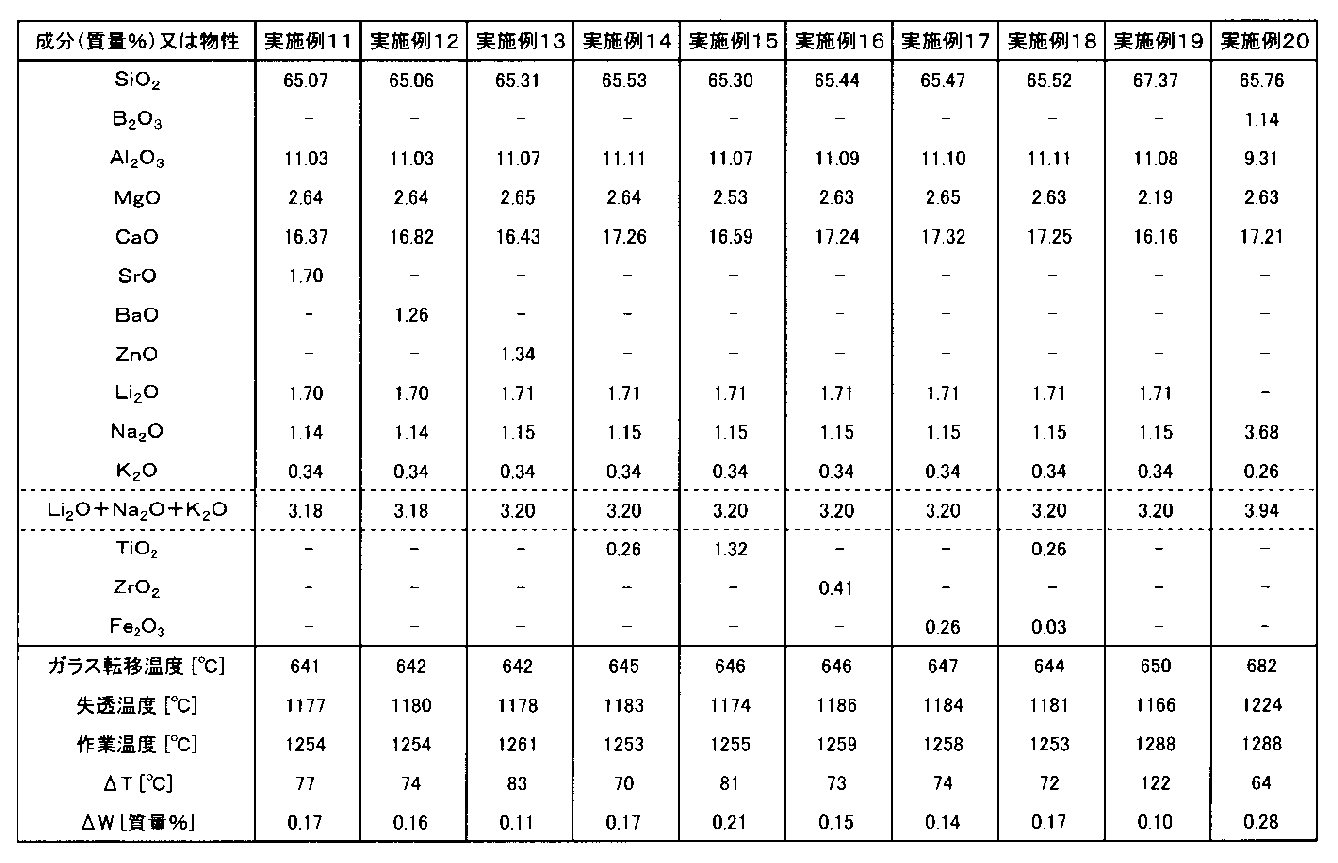
- Tables 1 to 3 The glass compositions in Tables 1 to 3 are all values expressed in mass%.
- ⁇ T is a temperature difference obtained by subtracting the devitrification temperature from the working temperature as described above.
- ⁇ W is an index of acid resistance as described above, and the glass sample is crushed and passes through the auxiliary mesh sieve 710 ⁇ m and the standard mesh sieve 590 ⁇ m specified in JIS Z 8801, and does not pass through the standard mesh sieve 420 ⁇ m.
- the glass powder was measured in the same weight as the specific gravity of the glass and expressed in terms of a mass reduction rate when immersed in 100 mL of a 10% by mass sulfuric acid aqueous solution at 80 ° C. for 72 hours.
- the glass of Comparative Example 1 has a conventional plate glass composition, and the total content of SiO 2 , Al 2 O 3 , CaO and the alkali metal oxide (Li 2 O + Na 2 O + K 2 O) is Out of range.
- the glass of Comparative Example 2 is a conventional C glass, and the total content of Al 2 O 3 , CaO and alkali metal oxide (Li 2 O + Na 2 O + K 2 O) is outside the scope of the present invention.
- the glass of Comparative Example 3 is a conventional E glass, and the contents of SiO 2 and MgO are outside the scope of the present invention.
- the glass of Comparative Example 4 has a SiO 2 content outside the scope of the present invention.
- the total content of alkali metal oxides (Li 2 O + Na 2 O + K 2 O) is outside the scope of the present invention.
- the glass transition temperatures of the glasses of Examples 1 to 20 were 635 to 682 ° C. This indicates that these glasses have excellent heat resistance.
- the working temperature of these glasses was 1232-1288 ° C. This is a suitable temperature for producing the scaly glass 10.
- ⁇ T (working temperature ⁇ devitrification temperature) of these glasses was 45 to 122 ° C. This is a temperature difference that does not cause devitrification in the manufacturing process of the glass flakes 10.
- the mass reduction rate ⁇ W which is an index of acid resistance in the glasses of Examples 1 to 20, was 0.10 to 0.28 mass%. This indicated that the scaly glass 10 had good acid resistance.
- Comparative Example 2 the content of Al 2 O 3 , CaO and the total content of alkali metal oxides (Li 2 O + Na 2 O + K 2 O) is outside the scope of the present invention.
- the temperature is as low as 549 ° C. and is inferior in heat resistance.
- Comparative Example 3 the content of SiO 2 and MgO is outside the range of the present invention, so the mass reduction rate ⁇ W is as large as 7.40% by mass, and the acid resistance is poor.
- Comparative Example 4 since the content of SiO 2 is outside the range of the present invention, the mass reduction rate ⁇ W is as large as 1.64% by mass, and the acid resistance is poor.
- the glass having a content of SiO 2 , Al 2 O 3 , MgO, CaO and (Li 2 O + Na 2 O + K 2 O) within the scope of the present invention has excellent heat resistance and chemical durability ( Acid resistance) and moldability.
- a glass flake 10 and a coated glass flake 12 were prepared using the glasses of Examples 1 to 20 and Comparative Example 5. That is, after remelting the glass of each composition with an electric furnace, it was formed into pellets while being cooled. This pellet was put into the production apparatus shown in FIG. 4 to produce a glass flake 10 having an average thickness of 0.5 to 1 ⁇ m. The average thickness of the glass flakes was measured by measuring the thickness of the glass flakes from the cross section of 100 glass flakes using an electron microscope (Keyence Corporation, Real Surface View Microscope, VE-7800). Obtained on average.
- Example 21 to 40 From the glass flakes 10 having the compositions of Examples 1 to 20 produced as described above, the coated glass flakes 12 of Examples 21 to 40 were produced by the following procedure. First, after scaly glass 10 was pulverized to a predetermined particle size, the surface of scaly glass 10 was coated with titanium dioxide by a liquid phase method.
- This liquid phase method is a method in which titanium dioxide is deposited on the surface of the glass flake 10 from a metal salt. That is, stannous chloride dihydrate as a metal salt was dissolved in ion-exchanged water, and diluted hydrochloric acid was added to adjust the pH to 2.0 to 2.5. To this solution, the glass flakes 10 were added with stirring, and filtered after 10 minutes.
- hexachloroplatinic acid hexahydrate was dissolved in ion-exchanged water, and the filtered glass flake 10 was added thereto while stirring, followed by filtration after 10 minutes.
- a hydrochloric acid solution (35% by mass) was added to ion-exchanged water to obtain a hydrochloric acid acidic solution having a pH of 0.7.
- the glass flakes 10 were added to this acidic solution while stirring, and the solution temperature was raised to 75 ° C.
- TiCl 4 titanium tetrachloride
- sodium hydroxide was added simultaneously so that the pH did not change
- titanium dioxide The treatment was performed for 2 hours by a method in which TiO 2 ) or a hydrate thereof was deposited on the surface of the glass flake 10. Thereafter, the glass flakes 10 having the film 11 formed on the surface was filtered and dried at 180 ° C. for 2 hours.
- the coated scaly glass 12 produced in this way was observed with an electron microscope, and it was confirmed that a titanium oxide film 11 was formed on the surface of the scaly glass 10.
- Examples 41 to 60 From the glass flakes 10 having the compositions of Examples 1 to 20, the coated glass flakes 12 of Examples 41 to 60 were respectively produced by the following procedure. First, after scaly glass 10 was pulverized to a predetermined particle size, the surface of scaly glass 10 was coated with silver by a normal electroless plating method. This normal electroless plating method will be described. First, the scaly glass 10 was pretreated with stannous chloride and hexachloroplatinic acid hexahydrate in the same manner as in Examples 21 to 40. Subsequently, 200 g of silver nitrate and an appropriate amount of aqueous ammonia were added to 10 L of ion-exchanged water to produce a silver solution.
- the coated scaly glass 12 thus prepared was observed with an electron microscope, and it was confirmed that the silver coating 11 was formed on the surface of the scaly glass 10.
- the polyester resin compositions of Examples 61 to 80 were produced from the glass flakes 10 having the compositions of Examples 1 to 20 by the following procedure. First, after scaly glass 10 was pulverized to a predetermined particle size, it was mixed with a polyester resin to obtain a polyester resin composition containing scaly glass 10. The polyester resin compositions of Examples 61 to 80 had good dispersibility of the scaly glass 10 and good appearance.
- the polyester resin composition of Comparative Example 6 was obtained by pulverizing the glass flakes 10 having the composition of Comparative Example 5 to a predetermined particle diameter and then mixing with the polyester resin. Since the scale-like glass 10 of Comparative Example 5 was devitrified, the appearance of this polyester resin composition was not preferable.
- Examples 81 to 100 The coated glass flakes 12 of Examples 21 to 40 were mixed with epoxy acrylate to obtain vinyl ester paints of Examples 81 to 100 containing the coated glass flakes 12, respectively. This vinyl ester paint had good dispersibility of the coated scale-like glass 12 and good appearance.
- Example 101 to 120 The coated flaky glass 12 of Examples 21 to 40 was mixed with a foundation which is a facial cosmetic, and the cosmetics of Examples 101 to 120 containing the coated flaky glass 12 were obtained. This cosmetic was good as a cosmetic because the dispersibility of the coated scale-like glass 12 was good.
- Examples 121 to 140 The coated flaky glass 12 of Examples 21 to 40 was mixed with an ink composition containing a predetermined amount of a colorant, a resin, and an organic solvent, and the ink compositions of Examples 121 to 140 containing the coated flaky glass 12 were mixed. I got each. This ink composition had good dispersibility of the coated scale-like glass 12, and was good as an ink composition.
- the range of MgO + CaO can be prescribed
- the alkali metal oxide Li 2 O + Na 2 O + K 2 O
- cesium oxide Ce 2 O
- rubidium oxide Rb 2 O
- etc. which are monovalent alkali metal oxides, can be added.
- composition of the glass substrate specify the range of two or one component among the alkali metal oxides Li 2 O, Na 2 O and K 2 O, and clarify the range of the components forming the glass skeleton. You can also.
- the cross-sectional shape in the thickness direction of the scaly glass 10 may be a shape in which two main surfaces are parallel to each other, or another shape such as a shape in which the two main surfaces are inclined (tapered). Good.
- the glass substrate is set so as to satisfy 50 ⁇ (SiO 2 —Al 2 O 3 ) ⁇ 60.
- the acid resistance of scale-like glass can be improved.
- the working temperature of the glass substrate is 1100-1300 ° C.
- the metal as the main component of the coated glass flake is at least one selected from the group consisting of nickel, gold, silver, platinum and palladium.
- the metal oxide as the main component of the coated glass flake is at least one selected from the group consisting of titanium oxide, iron oxide, cobalt oxide, zirconium oxide, zinc oxide, tin oxide and silicon oxide.
- a resin composition comprising the scale-like glass or the coated scale-like glass. According to such a resin composition, a resin molded body having improved physical properties such as strength and dimensional accuracy can be obtained.
- a paint characterized by containing the glass flakes or the coated glass flakes. When comprised in this way, a metallic color and gloss can be provided to the coating film formed from a coating material.
- An ink composition comprising the glass flakes or the coated glass flakes.
- a metal color and gloss can be provided to the character, figure, etc. which are formed with an ink composition.
- a cosmetic comprising the glass flakes or the coated glass flakes.
- the glass flakes or the coated glass flakes When comprised in this way, after applying cosmetics to a face etc., favorable color tone and glossiness can be provided.
Landscapes
- Chemical & Material Sciences (AREA)
- Life Sciences & Earth Sciences (AREA)
- Organic Chemistry (AREA)
- Engineering & Computer Science (AREA)
- Health & Medical Sciences (AREA)
- Materials Engineering (AREA)
- Geochemistry & Mineralogy (AREA)
- General Health & Medical Sciences (AREA)
- General Chemical & Material Sciences (AREA)
- Animal Behavior & Ethology (AREA)
- Chemical Kinetics & Catalysis (AREA)
- Public Health (AREA)
- Veterinary Medicine (AREA)
- Epidemiology (AREA)
- Birds (AREA)
- Inorganic Chemistry (AREA)
- Manufacturing & Machinery (AREA)
- General Life Sciences & Earth Sciences (AREA)
- Wood Science & Technology (AREA)
- Glass Compositions (AREA)
- Cosmetics (AREA)
- Pigments, Carbon Blacks, Or Wood Stains (AREA)
Abstract
Description
65<SiO2≦70、
5≦Al2O3≦15、
1≦MgO≦10、
10≦CaO≦25、
0.1≦(Li2O+Na2O+K2O)≦4
の組成であるガラス素地から形成されることを特徴とする。
一例では、前記ガラス素地のガラス転移温度が580~800℃である。
本発明の一側面に係る被覆鱗片状ガラスは、第1の側面に係る鱗片状ガラスと前記鱗片状ガラスの表面を被覆する、金属又は金属酸化物を主成分とする被膜とを備えることを特徴とする。
ガラス素地の耐酸性の指標であるΔWが0.05~0.8質量%である場合、鱗片状ガラスの耐酸性を高めることができる。
鱗片状ガラスの表面が金属又は金属酸化物を主成分とする被膜により被覆されている被覆鱗片状ガラスは、被膜により金属色、干渉色などを発色することができる。
本明細書において、組成を示す数値は質量%を表す。本実施形態の鱗片状ガラスを形成するガラス素地の組成は、質量%で表して次のように設定される。
5≦Al2O3≦15、
1≦MgO≦10、
10≦CaO≦25、
0.1≦(Li2O+Na2O+K2O)≦4。
鱗片状ガラス10を形成するガラス素地の組成について説明する。
(SiO2)
二酸化ケイ素(SiO2)は、鱗片状ガラス10の骨格となる主成分である。本明細書において、主成分とは、含有量が最も多い成分であることを意味する。また、SiO2は、ガラスの耐熱性を保持しながらガラス形成時の失透温度及び粘度を調整する成分であり、耐酸性を向上させる成分でもある。このSiO2の含有量が65質量%以下の場合には、失透温度が上昇し過ぎて、鱗片状ガラス10を形成することが難しくなると共に、鱗片状ガラス10の耐酸性も悪化する。SiO2の含有量が70質量%を超える場合には、ガラスの融点が高くなり過ぎて、原料を均一に溶融することが困難になる。
三酸化二ホウ素(B2O3)は、ガラスの骨格を形成する成分であり、ガラス形成時の失透温度及び粘度を調整する成分でもある。このB2O3の含有量は、0≦B2O3≦6であることが好ましい。B2O3の含有量が6質量%を超えると、ガラスを溶融する際に溶融窯や蓄熱窯の炉壁を浸食して窯の寿命を著しく低下させる。従って、B2O3の上限は、6質量%以下が好ましく、2質量%未満がより好ましく、1質量%未満が特に好ましく、実質的に含有しないことが最も好ましい。
酸化アルミニウム(Al2O3)は、鱗片状ガラス10の骨格を形成する成分であり、耐熱性を保ちながらガラス形成時の失透温度及び粘度を調整する成分でもある。また、Al2O3は、耐水性を向上させる成分である一方で、耐酸性を悪化させる成分でもある。Al2O3が5質量%未満の場合には、失透温度及び粘性の調整を十分に行うことができず、或いは耐水性を十分に改善することができない。一方、Al2O3の含有量が15質量%を超える場合、ガラスの融点が高くなり過ぎて、原料を均一に溶融することが困難になり、耐酸性も悪化する。従って、Al2O3の下限は、5質量%以上であり、6質量%以上が好ましく、8質量%以上がより好ましく、10質量%以上が最も好ましい。Al2O3の上限は、15質量%以下であり、13質量%以下が好ましく、12質量%未満がより好ましい。よって、Al2O3の含有量の範囲は、これら上限と下限の任意の組み合わせから選ばれるが、例えば6~13質量%であることが好ましい。
酸化マグネシウム(MgO)と酸化カルシウム(CaO)は、ガラスの耐熱性を保持しつつ、ガラス形成時の失透温度及び粘度を調整する成分である。このMgOの含有量は、1≦MgO≦10である。MgOの含有量が1質量%未満の場合には、失透温度及び粘度を調整するのに十分な効果を得ることができない。MgOの含有量が10質量%を超える場合には、失透温度が上昇し過ぎて、鱗片状ガラス10を形成することが難しくなる。従って、MgOの下限は、1質量%以上であり、2質量%以上が好ましい。MgOの上限は、10質量%以下であり、8質量%以下が好ましく、5質量%以下がより好ましく、4質量%以下が最も好ましい。よって、MgOの含有量の範囲は、これら上限と下限の任意の組み合わせから選ばれるが、例えば2~8質量%であることが好ましい。
酸化ストロンチウム(SrO)は、ガラス形成時の失透温度及び粘度を調整する成分である。一方で、SrOはガラスの耐酸性を悪化させる成分でもある。SrOは必須ではないが、ガラス形成時の失透温度及び粘度を調整するための成分として使用してもよい。しかし、SrOの含有量が10質量%を超えると、耐酸性が悪化する。従って、SrOの上限は10質量%以下が好ましく、5質量%以下がより好ましく、2質量%以下がさらに好ましく、実質的に含有しないことが最も好ましい。
酸化バリウム(BaO)は、ガラス形成時の失透温度及び粘度を調整する成分である。その一方で、BaOはガラスの耐酸性を悪化させる成分でもある。BaOは、必須ではないが、ガラス形成時の失透温度及び粘度を調整するための成分として使用してもよい。しかし、BaOの含有量が10質量%を超えると、耐酸性が悪化する。従って、BaOの上限は、10質量%以下が好ましく、5質量%以下がより好ましく、2質量%以下がさらに好ましく、実質的に含有しないことが最も好ましい。
酸化亜鉛(ZnO)は、ガラス形成時の失透温度及び粘度を調整する成分である。その一方で、ZnOは揮発し易いため、溶融時に飛散する可能性がある。ZnOの含有量が10質量%を超えると、揮発による成分比の変動が顕著となり、ガラス中の含有量を管理し難くなる。従って、ZnOの上限は、10質量%以下が好ましく、5質量%以下がより好ましく、2質量%以下がさらに好ましく、実質的に含有しないことが最も好ましい。
アルカリ金属酸化物(Li2O、Na2O、K2O)は、ガラス形成時の失透温度及び粘度を調整する成分である。アルカリ金属酸化物の合計含有量(Li2O+Na2O+K2O)は、0.1≦(Li2O+Na2O+K2O)≦4である。(Li2O+Na2O+K2O)が0.1質量%未満であるとき、ガラスの融点が高くなりすぎて、原料を均一に溶融することが困難になり、また鱗片状ガラス10を形成することが難しくなる。他方、(Li2O+Na2O+K2O)が4質量%を超えると、ガラス転移温度が低くなり、ガラスの耐熱性が悪くなる。従って、(Li2O+Na2O+K2O)の下限は、0.1質量%以上であり、1質量%以上が好ましく、1.5質量%以上がより好ましく、2質量%以上が最も好ましい。(Li2O+Na2O+K2O)の上限は、4質量%以下であり、3.5質量%未満が好ましく、3質量%以下がより好ましい。(Li2O+Na2O+K2O)の範囲は、これら上限と下限の任意の組み合わせから選ばれるが、例えば1~3.5質量%が好ましい。
(TiO2)
二酸化チタン(TiO2)は、ガラスの溶融性及び鱗片状ガラス10の化学的耐久性及び紫外線吸収特性を向上させる成分である。従って、TiO2は必須成分ではないが、ガラスの溶融性及び鱗片状ガラス10の化学的耐久性及び光学特性を調整するための成分として含むことが好ましい。しかし、TiO2の含有量が5質量%を超えると、ガラスの失透温度が上昇し過ぎて、鱗片状ガラス10を形成することが難しくなる。従って、Ti2Oの下限は、0質量%以上が好ましく、0.1質量%以上がより好ましい。TiO2の上限は、5質量%以下が好ましく、2質量%以下がより好ましく、1質量%未満がさらに好ましい。
酸化ジルコニウム(ZrO2)は、ガラス形成時の失透温度、粘度及び化学的耐久性を調整する成分である。係るZrO2は必須成分ではないが、ガラス形成時の失透温度、粘度及び化学的耐久性を調整するための成分として使用してもよい。しかし、ZrO2の含有量が5質量%を超えると、ガラスの失透成長を速めるため、しばしば鱗片状ガラス10を安定して作製することを難しくなる。従って、ZrO2の上限は、5質量%以下が好ましく、2質量%以下がより好ましく、1質量%以下であることがさらに好ましい。ZrO2は実質的に含有しないことがさらに好ましい。
通常、ガラス中の鉄(Fe)は、Fe2+又はFe3+の状態で存在する。Fe3+は鱗片状ガラス10の紫外線吸収特性を高める成分であり、Fe2+は熱線吸収特性を高める成分である。従って、鉄(Fe)は必須成分ではないが、鱗片状ガラス10の光学特性を調整するための成分として含まれていてもよい。また、鉄(Fe)は、意図的に含ませなくとも、工業用原料により不可避的に混入する場合がある。他方、鉄(Fe)の含有量が多くなると、鱗片状ガラス10の着色が顕著になる。この着色は鱗片状ガラス10の色調や光沢が重要視される用途においては、好ましくないことがある。従って、鉄(Fe)の上限は、Fe2O3換算にて5質量%以下が好ましく、2質量%以下がより好ましく、0.5質量%以下がさらに好ましく、0.1質量%以下が特に好ましく、実質的に含有しないことが最も好ましい。
三酸化硫黄(SO3)は必須成分ではないが、清澄剤として含まれていてもよい。硫酸塩の原料を使用すると、0.5質量%以下の含有量で含まれることがある。
フッ素(F)は、揮発し易いため、溶融時に飛散する可能性があると共に、ガラス中の含有量を管理し難いという問題もある。従って、Fは、実質的に含有しないことが好ましい。
鱗片状ガラス10の耐酸性を重視する場合、鱗片状ガラス10の耐酸性を向上させるSiO2の含有量と、耐酸性を悪化させるAl2O3の含有量の差(SiO2-Al2O3)が重要である。この差は50<(SiO2-Al2O3)≦60であることが好ましい。(SiO2-Al2O3)が50質量%以下の場合、鱗片状ガラス10の耐酸性が不十分となる。(SiO2-Al2O3)が60質量%を超える場合、失透温度が上昇し過ぎて、鱗片状ガラス10を形成することが困難になる。従って、(SiO2-Al2O3)の下限は、50質量%より大きいことが好ましく、51質量%以上がより好ましく、52質量%以上がさらに好ましく、53質量%より大きいことが最も好ましい。(SiO2-Al2O3)の上限は、60質量%以下が好ましく、59質量%以下がより好ましく、58質量%以下がさらに好ましく、57質量%以下が最も好ましい。(SiO2-Al2O3)の含有量の範囲は、これら上限と下限の任意の組み合わせから選択され、例えば52~58質量%である。
本実施形態の鱗片状ガラス10は、例えば図4に示した製造装置を用いて製造することができる。図4に示すように、耐火窯槽20内で溶融された前記ガラス組成を有するガラス素地21は、ブローノズル22に送り込まれたガス23によって、風船状に膨らみ、中空状ガラス膜24となる。得られた中空状ガラス膜24を一対の押圧ローラ25によって粉砕することにより、鱗片状ガラス10が得られる。
本実施形態の鱗片状ガラス10の各物性について、以下詳細に説明する。
(温度特性)
溶融ガラスの粘度が100Pa・s(1000P)のときの温度は、作業温度と呼ばれ、鱗片状ガラス10の成形に最も適した温度とされている。例えば、図4の製造装置によると、中空状ガラス膜24の平均厚さすなわち鱗片状ガラス10の平均厚さは、0.1~15μmである。このような薄肉の中空状ガラス膜24を形成する場合、ガラスの温度低下が著しい。この温度低下のため、中空状ガラス膜24の可塑性が急激に低下し、引き延ばし難くなる。可塑性の低下により、中空状ガラス膜24が均一に成長し難くなり、ガラス膜厚にばらつきが発生することがある。そこで、作業温度は、1100℃以上であることが好ましく、1150℃以上であることがより好ましい。
鱗片状ガラス10は、ガラス転移温度(ガラス転移点、Tg)が高いほど耐熱性が高く、高温加熱を伴う加工に対して変形し難くなる。ガラス転移温度が560℃以上であれば、鱗片状ガラス10の表面に金属又は金属酸化物を主成分とする被膜を形成する工程において、鱗片状ガラス10の形状が変化するおそれが小さい。また、鱗片状ガラス10又は被覆鱗片状ガラスを塗料に配合し、焼き付け塗装等の用途に好適に用いることができる。本実施形態で規定したガラス組成であれば、580℃以上のガラス転移温度を有するガラスを容易に得ることができる。鱗片状ガラス10のガラス転移温度は、580℃以上であることが好ましく、600℃以上であることがより好ましく、620℃以上であることがさらに好ましい。ガラス転移温度の上限は、800℃程度であることが好ましい。
本実施形態の鱗片状ガラス10は、耐酸性、耐水性、耐アルカリ性等の化学的耐久性に優れるものである。そのため、本実施形態の鱗片状ガラス10は、樹脂成形体、塗料、化粧料、インキ等の用途に好適に使用することができる。
図2に模式的に示すように、前述した鱗片状ガラス10をコアとして、その表面に金属又は金属酸化物を主成分とする被膜11を形成することにより、被覆鱗片状ガラス12を製造することができる。この被膜11は、実質的に、金属及び金属酸化物の少なくとも1種から形成されることが好ましい。被膜11の形態は、単層、混合層又は複層のいずれであってもよい。
コアとなる鱗片状ガラス10の表面全体に被膜11を形成してもよく、鱗片状ガラス10の表面の一部に被膜11を形成してもよい。
鱗片状ガラス10や被覆鱗片状ガラス12は、公知の手段により、顔料として又は補強用充填材として、樹脂組成物、塗料、インキ組成物及び化粧料等に配合される。その結果、これらの色調や光沢を高めることができると共に、樹脂組成物、塗料及びインキ組成物においては、寸法精度及び強度等を改善することができる。図3は、この鱗片状ガラス10を塗料に配合して、基材13の表面に塗布した例を説明するための模式的な断面図である。この図3に示すように、鱗片状ガラス10又は被覆鱗片状ガラス12は、塗膜14の樹脂マトリックス15中に分散されている。
インキ組成物としては、各種ボールペン、フェルトペン等の筆記具用インキ及びグラビアインキ、オフセットインキ等の印刷インキがあるが、いずれのインキ組成物にも適用することができる。インキ組成物を構成するビヒクルは、顔料を分散させ、紙にインキを固着させる働きをする。ビヒクルは、樹脂類、油分と溶剤等から構成される。
(1)メチルハイドロジェンポリシロキサン、高粘度シリコーンオイル及びシリコーン樹脂等のシリコーン化合物による処理方法。
(2)アニオン界面活性剤、カチオン界面活性剤等の界面活性剤による処理方法。
(3)ナイロン、ポリメチルメタクリレート、ポリエチレン、各種フッ素樹脂〔ポリテトラフルオロエチレン樹脂(PTFE)、テトラフルオロエチレン-パーフルオロアルキルビニルエーテル共重合体(PFA)、テトラフルオロエチレン-ヘキサフルオロプロピレン共重合体(FEP)、テトラフルオロエチレン-エチレン共重合体(ETFE)、ポリビニリデンフルオライド(PVDF)、ポリクロロトリフルオロエチレン(PCTFE)等〕、ポリアミノ酸等の高分子化合物による処理方法。
(4)パーフルオロ基含有化合物、レシチン、コラーゲン、金属石鹸、親油性ワックス、多価アルコール部分エステル又は完全エステル等による処理方法。
(5)これらを複合した処理方法。
また、この化粧料には、通常化粧料に用いられる他の材料を必要に応じて適宜配合することができる。例えば、無機粉末、有機粉末、顔料や色素、炭化水素、エステル類、油性成分、有機溶媒、樹脂、可塑剤、紫外線吸収剤、酸化防止剤、防腐剤、界面活性剤、保湿剤、香料、水、アルコール、増粘剤等が挙げられる。
無機顔料としては、各種色別に以下のものが挙げられる。無機白色顔料:酸化チタン、酸化亜鉛等、無機赤色系顔料:酸化鉄(ベンガラ)、チタン酸鉄等、無機褐色系顔料:γ酸化鉄等、無機黄色系顔料:黄酸化鉄、黄土等、無機黒色系顔料:黒酸化鉄、カーボンブラック等、無機紫色系顔料:マンゴバイオレット、コバルトバイオレット等、無機緑色系顔料:チタン酸コバルト等、無機青色系顔料:群青、紺青等。
以上の実施形態によって発揮される効果を以下にまとめて記載する。
・ 鱗片状ガラス10を形成するガラス素地の耐酸性の指標であるΔWが0.05~0.8質量%であることにより、鱗片状ガラスの耐酸性を高めることができる。
(実施例1~20及び比較例1~5)
表1~表3に示した組成となるように、珪砂等の通常のガラス原料を調合して、実施例及び比較例毎にガラス素地のバッチを作製した。各バッチについて、電気炉を用いて1400~1600℃まで加熱して溶融させ、組成が均一になるまで約4時間そのまま維持した。その後、溶融したガラス素地を鉄板上に流し出して、電気炉中で常温まで徐冷し、ガラスサンプルを得た。
比較例3のガラスは従来のEガラスであり、SiO2及びMgOの含有量が本発明の範囲外である。
比較例5のガラスは、アルカリ金属酸化物の合計含有量(Li2O+Na2O+K2O)が本発明の範囲外である。

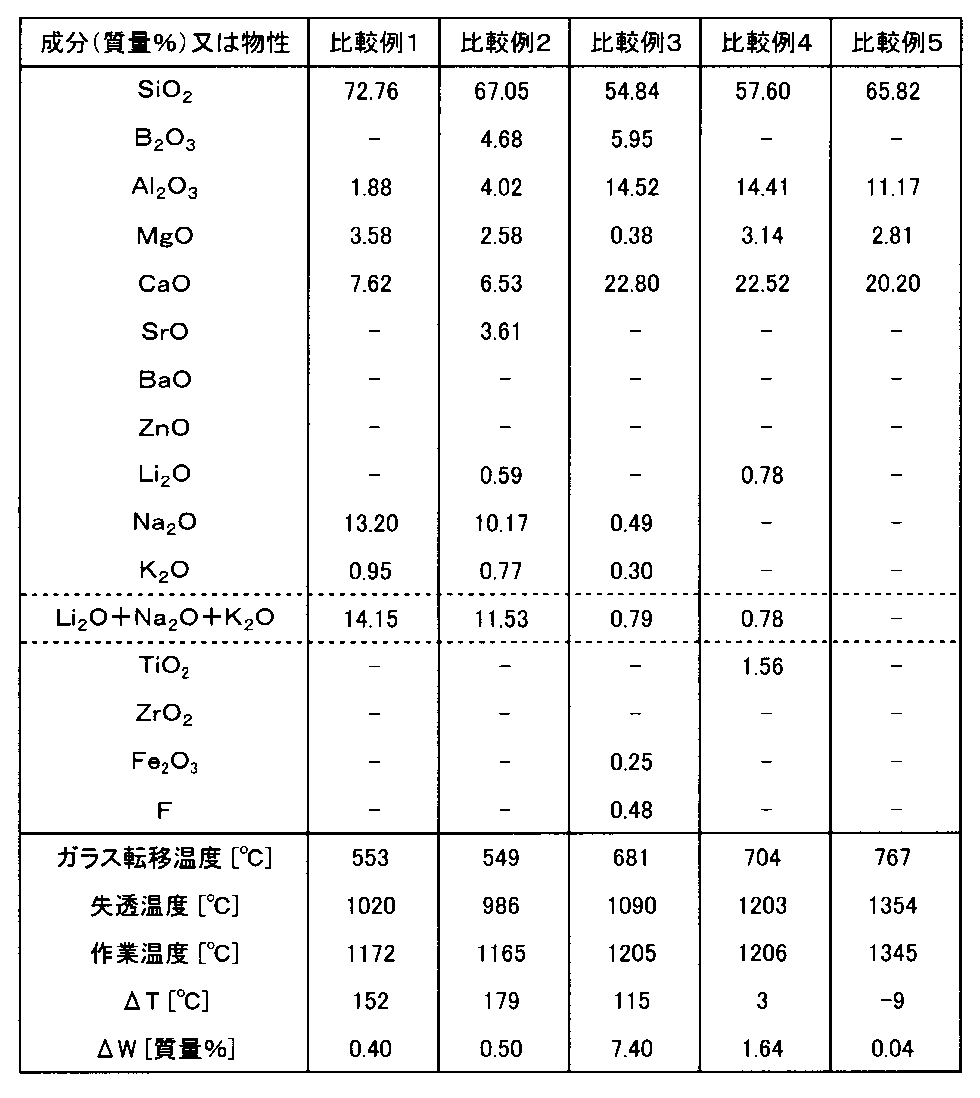
比較例4ではSiO2の含有量が本発明の範囲外であることから、その質量減少率ΔWが1.64質量%と大きく、耐酸性に劣る。
このようにして作製した実施例1~20の組成をもつ鱗片状ガラス10から、以下の手順で実施例21~40の被覆鱗片状ガラス12をそれぞれ製造した。まず、鱗片状ガラス10を粉砕して所定の粒子径とした後、液相法により鱗片状ガラス10表面を二酸化チタンで被覆した。この液相法は、金属塩から二酸化チタンを鱗片状ガラス10の表面に析出させる方法である。すなわち、イオン交換水に金属塩として塩化第一スズ・二水和物を溶かし、それに希塩酸を加えてpH2.0~2.5に調整した。この溶液に、鱗片状ガラス10を撹拌しながら加え、10分後に濾過した。続いて、イオン交換水にヘキサクロロ白金酸・六水和物を溶かし、そこへ前記濾過した鱗片状ガラス10を撹拌しつつ投入し10分後に濾過した。次いで、イオン交換水に塩酸溶液(35質量%)を加え、pH0.7の塩酸酸性溶液を得た。この酸性溶液に鱗片状ガラス10を撹拌しつつ投入し、溶液温度を75℃まで昇温した。
実施例1~20の組成を有する鱗片状ガラス10から、以下の手順で実施例41~60の被覆鱗片状ガラス12をそれぞれ製造した。まず、鱗片状ガラス10を粉砕して所定の粒子径とした後、通常の無電解めっき法により鱗片状ガラス10表面を銀で被覆した。この通常の無電解めっき法について説明する。まず、鱗片状ガラス10について塩化第一スズとヘキサクロロ白金酸・六水和物による前処理を前記実施例21~40と同様に行った。続いて、イオン交換水10Lに硝酸銀200gとアンモニア水を適当量加え、銀液を製造した。この銀液に、前処理を施した鱗片状ガラス1kgを撹拌しつつ投入し、さらに14質量%の酒石酸ナトリウムカリウム溶液を還元液として添加し、銀を鱗片状ガラス10表面に被覆した。その後、この鱗片状ガラス10を濾過し、400℃で2時間乾燥させた。このようにして、鱗片状ガラス10の表面に銀の被膜11を有する被覆鱗片状ガラス12を得た。
(実施例61~80及び比較例6)
実施例1~20の組成を有する鱗片状ガラス10から、以下の手順で実施例61~80のポリエステル樹脂組成物をそれぞれ製造した。まず、鱗片状ガラス10を粉砕して所定の粒子径とした後、ポリエステル樹脂と混合し、鱗片状ガラス10を含有するポリエステル樹脂組成物を得た。実施例61~80のポリエステル樹脂組成物は、鱗片状ガラス10の分散性が良く、外観が良好であった。
実施例21~40の被覆鱗片状ガラス12を、エポキシアクリレートと混合し、被覆鱗片状ガラス12を含有する実施例81~100のビニルエステル系塗料をそれぞれ得た。このビニルエステル系塗料は、被覆鱗片状ガラス12の分散性が良く、外観も良好であった。
実施例21~40の被覆鱗片状ガラス12を、フェーシャル化粧料であるファンデーションと混合し、被覆鱗片状ガラス12を含有する実施例101~120の化粧料をそれぞれ得た。この化粧料は、被覆鱗片状ガラス12の分散性が良く、化粧料として良好であった。
実施例21~40の被覆鱗片状ガラス12を、着色剤、樹脂及び有機溶剤を所定量配合したインキ組成物と混合し、被覆鱗片状ガラス12を含有する実施例121~140のインキ組成物をそれぞれ得た。このインキ組成物は、被覆鱗片状ガラス12の分散性が良く、インキ組成物として良好であった。
・ 前記ガラス素地の組成として、SiO2+Al2O3の範囲を規定し、ガラスの骨格を形成する成分の範囲を明らかにすることもできる。
・ アルカリ金属酸化物(Li2O+Na2O+K2O)として、一価のアルカリ金属の酸化物である酸化セシウム(Ce2O)、酸化ルビジウム(Rb2O)等を加えることができる。
次に、前記実施形態より把握できる技術的思想について以下に記載する。
〇 前記ガラス素地が50<(SiO2-Al2O3)≦60を満たすように設定されている。このように構成した場合、鱗片状ガラスの耐酸性を向上させることができる。
〇 被覆鱗片状ガラスの被膜の主成分としての前記金属は、ニッケル、金、銀、白金及びパラジウムからなる群より選ばれた少なくとも1種である。
〇 前記鱗片状ガラス又は前記被覆鱗片状ガラスを含有することを特徴とする樹脂組成物。このような樹脂組成物によれば、強度、寸法精度等の物性の向上した樹脂成形体を得ることができる。
Claims (7)
- 質量%で表して、
65<SiO2≦70、
5≦Al2O3≦15、
1≦MgO≦10、
10≦CaO≦25、
0.1≦(Li2O+Na2O+K2O)≦4
の組成であるガラス素地から形成されることを特徴とする鱗片状ガラス。 - 前記ガラス素地の作業温度から失透温度を差し引いた温度差ΔTが0~200℃であることを特徴とする請求項1に記載の鱗片状ガラス。
- 前記ガラス素地のガラス転移温度が580~800℃であることを特徴とする請求項1又は請求項2に記載の鱗片状ガラス。
- 前記ガラス素地の耐酸性の指標であるΔWが0.05~0.8質量%であることを特徴とする請求項1から請求項3のいずれか1項に記載の鱗片状ガラス。
- 請求項1から請求項4のいずれか1項に記載の鱗片状ガラスと、前記鱗片状ガラスの表面を被覆する金属又は金属酸化物を主成分とする被膜とを備えることを特徴とする被覆鱗片状ガラス。
- 質量%で表して、
65<SiO2≦70、
5≦Al2O3≦15、
1≦MgO≦10、
10≦CaO≦25、
0.1≦(Li2O+Na2O+K2O)≦4
の組成であるガラス素地を溶融した後、ガラス素地を粉砕することを備える、請求項1に記載の鱗片状ガラスを製造する方法。 - 請求項1に記載の鱗片状ガラスを形成するためのガラス素地であって、
質量%で表して、
65<SiO2≦70、
5≦Al2O3≦15、
1≦MgO≦10、
10≦CaO≦25、
0.1≦(Li2O+Na2O+K2O)≦4
の組成であるガラス素地。
Priority Applications (4)
| Application Number | Priority Date | Filing Date | Title |
|---|---|---|---|
| US12/993,074 US20110070444A1 (en) | 2008-06-18 | 2009-05-28 | Scale-like glass and coated scale-like glass |
| EP09766511A EP2287123A4 (en) | 2008-06-18 | 2009-05-28 | SCALED GLASS AND COATED SCALED GLASS |
| JP2010517830A JP5399386B2 (ja) | 2008-06-18 | 2009-05-28 | 鱗片状ガラス及び被覆鱗片状ガラス |
| CN200980118510.6A CN102026930B (zh) | 2008-06-18 | 2009-05-28 | 玻璃鳞片及涂覆的玻璃鳞片 |
Applications Claiming Priority (2)
| Application Number | Priority Date | Filing Date | Title |
|---|---|---|---|
| JP2008159195 | 2008-06-18 | ||
| JP2008-159195 | 2008-06-18 |
Publications (1)
| Publication Number | Publication Date |
|---|---|
| WO2009154063A1 true WO2009154063A1 (ja) | 2009-12-23 |
Family
ID=41433979
Family Applications (1)
| Application Number | Title | Priority Date | Filing Date |
|---|---|---|---|
| PCT/JP2009/059765 Ceased WO2009154063A1 (ja) | 2008-06-18 | 2009-05-28 | 鱗片状ガラス及び被覆鱗片状ガラス |
Country Status (5)
| Country | Link |
|---|---|
| US (1) | US20110070444A1 (ja) |
| EP (1) | EP2287123A4 (ja) |
| JP (1) | JP5399386B2 (ja) |
| CN (1) | CN102026930B (ja) |
| WO (1) | WO2009154063A1 (ja) |
Cited By (2)
| Publication number | Priority date | Publication date | Assignee | Title |
|---|---|---|---|---|
| US10533089B2 (en) | 2010-03-08 | 2020-01-14 | Ube Industries, Ltd. | Polyamide resin composition |
| CN112876080A (zh) * | 2021-02-04 | 2021-06-01 | 中国科学院合肥物质科学研究院 | 一种铅基反应堆泵叶轮用玻璃陶瓷涂层及其制备方法 |
Families Citing this family (5)
| Publication number | Priority date | Publication date | Assignee | Title |
|---|---|---|---|---|
| CN103570222B (zh) * | 2013-11-04 | 2015-10-28 | 北京交通大学 | 一种不同大小且内壁厚度均匀的玻璃鳞片的制备方法 |
| IT201700040155A1 (it) * | 2017-04-11 | 2018-10-11 | Luca Toncelli | Procedimento per la realizzazione di manufatti in forma di lastra o blocco con un legante induribile, e manufatti così ottenuti |
| CN108911479B (zh) * | 2018-07-27 | 2021-03-19 | 成都源永科技发展有限公司 | 一种工业污泥玻璃化添加药剂 |
| JP2022512405A (ja) | 2018-12-12 | 2022-02-03 | コーニング インコーポレイテッド | イオン交換可能なリチウム含有アルミノケイ酸塩ガラス |
| CN114195382B (zh) * | 2021-12-29 | 2023-07-21 | 湖南旗滨医药材料科技有限公司 | 硼硅酸盐玻璃组合物、硼硅酸盐玻璃制备方法和药用玻璃 |
Citations (6)
| Publication number | Priority date | Publication date | Assignee | Title |
|---|---|---|---|---|
| JPH10198028A (ja) * | 1996-11-18 | 1998-07-31 | Toray Ind Inc | 感光性グレーズペーストおよびグレーズ基板 |
| JP2001213639A (ja) * | 2000-01-31 | 2001-08-07 | Nippon Sheet Glass Co Ltd | ガラスフレーク |
| JP2003020291A (ja) * | 2001-07-05 | 2003-01-24 | Matsushita Electric Works Ltd | 釉薬組成物及び防汚陶磁器 |
| WO2006068255A1 (ja) * | 2004-12-24 | 2006-06-29 | Nippon Sheet Glass Company, Limited | 鱗片状ガラス |
| JP2007145699A (ja) | 2005-10-31 | 2007-06-14 | Nippon Sheet Glass Co Ltd | 鱗片状ガラス |
| JP2007145700A (ja) | 2005-10-31 | 2007-06-14 | Nippon Sheet Glass Co Ltd | 鱗片状ガラス |
Family Cites Families (10)
| Publication number | Priority date | Publication date | Assignee | Title |
|---|---|---|---|---|
| US6508083B1 (en) * | 1996-08-21 | 2003-01-21 | Nippon Electric Glass Co., Ltd. | Alkali-free glass and method for producing the same |
| US6858553B2 (en) * | 2000-10-03 | 2005-02-22 | Nippon Sheet Glass Co., Ltd. | Glass composition |
| US7285508B2 (en) * | 2003-08-29 | 2007-10-23 | Nippon Sheet Glass Company, Limited | Glass flake |
| JP2005097080A (ja) * | 2003-08-29 | 2005-04-14 | Nippon Sheet Glass Co Ltd | 鱗片状ガラス |
| JP5013798B2 (ja) * | 2005-11-11 | 2012-08-29 | 旭ファイバーグラス株式会社 | ポリカーボネート樹脂用ガラスフィラー及びポリカーボネート樹脂組成物 |
| ATE399820T1 (de) * | 2006-06-09 | 2008-07-15 | Eckart Gmbh | Effektpigmente mit titanoxyd enthaltenden glasschuppen |
| EP2042474B1 (en) * | 2006-06-23 | 2013-03-20 | Nippon Sheet Glass Company, Limited | Glass flake |
| JPWO2008140059A1 (ja) * | 2007-05-09 | 2010-08-05 | 日本板硝子株式会社 | ガラスフィラーとそれを用いた光硬化型塗料組成物および光硬化型樹脂組成物、並びに光硬化型接着剤 |
| CN101646629B (zh) * | 2007-06-18 | 2013-06-05 | 日本板硝子株式会社 | 玻璃组合物 |
| WO2009145254A1 (ja) * | 2008-05-28 | 2009-12-03 | 日本板硝子株式会社 | 鱗片状ガラス及び被覆鱗片状ガラス |
-
2009
- 2009-05-28 WO PCT/JP2009/059765 patent/WO2009154063A1/ja not_active Ceased
- 2009-05-28 CN CN200980118510.6A patent/CN102026930B/zh not_active Expired - Fee Related
- 2009-05-28 EP EP09766511A patent/EP2287123A4/en not_active Ceased
- 2009-05-28 JP JP2010517830A patent/JP5399386B2/ja active Active
- 2009-05-28 US US12/993,074 patent/US20110070444A1/en not_active Abandoned
Patent Citations (6)
| Publication number | Priority date | Publication date | Assignee | Title |
|---|---|---|---|---|
| JPH10198028A (ja) * | 1996-11-18 | 1998-07-31 | Toray Ind Inc | 感光性グレーズペーストおよびグレーズ基板 |
| JP2001213639A (ja) * | 2000-01-31 | 2001-08-07 | Nippon Sheet Glass Co Ltd | ガラスフレーク |
| JP2003020291A (ja) * | 2001-07-05 | 2003-01-24 | Matsushita Electric Works Ltd | 釉薬組成物及び防汚陶磁器 |
| WO2006068255A1 (ja) * | 2004-12-24 | 2006-06-29 | Nippon Sheet Glass Company, Limited | 鱗片状ガラス |
| JP2007145699A (ja) | 2005-10-31 | 2007-06-14 | Nippon Sheet Glass Co Ltd | 鱗片状ガラス |
| JP2007145700A (ja) | 2005-10-31 | 2007-06-14 | Nippon Sheet Glass Co Ltd | 鱗片状ガラス |
Non-Patent Citations (2)
| Title |
|---|
| GALAL EL ABD: "Refiring of sanitaryware and its problems", THE THE AMERICAN CERAMICS SOCIETY BULLETIN, vol. 76, no. 9, September 1997 (1997-09-01), pages 71 - 75, XP008145733 * |
| See also references of EP2287123A4 * |
Cited By (3)
| Publication number | Priority date | Publication date | Assignee | Title |
|---|---|---|---|---|
| US10533089B2 (en) | 2010-03-08 | 2020-01-14 | Ube Industries, Ltd. | Polyamide resin composition |
| CN112876080A (zh) * | 2021-02-04 | 2021-06-01 | 中国科学院合肥物质科学研究院 | 一种铅基反应堆泵叶轮用玻璃陶瓷涂层及其制备方法 |
| CN112876080B (zh) * | 2021-02-04 | 2022-02-15 | 中国科学院合肥物质科学研究院 | 一种铅基反应堆泵叶轮用玻璃陶瓷涂层及其制备方法 |
Also Published As
| Publication number | Publication date |
|---|---|
| US20110070444A1 (en) | 2011-03-24 |
| CN102026930B (zh) | 2014-12-03 |
| JP5399386B2 (ja) | 2014-01-29 |
| EP2287123A1 (en) | 2011-02-23 |
| EP2287123A4 (en) | 2012-01-04 |
| CN102026930A (zh) | 2011-04-20 |
| JPWO2009154063A1 (ja) | 2011-11-24 |
Similar Documents
| Publication | Publication Date | Title |
|---|---|---|
| JP5399387B2 (ja) | 鱗片状ガラス及び被覆鱗片状ガラス | |
| JP5629579B2 (ja) | 鱗片状ガラス及び被覆鱗片状ガラス | |
| JP5307541B2 (ja) | 鱗片状ガラス | |
| JP4842839B2 (ja) | 鱗片状ガラス | |
| EP1510506A1 (en) | Glass flake | |
| JP5399386B2 (ja) | 鱗片状ガラス及び被覆鱗片状ガラス | |
| JP2005097080A (ja) | 鱗片状ガラス | |
| JP5331110B2 (ja) | 鱗片状ガラス及び被覆鱗片状ガラス | |
| JP2007145700A (ja) | 鱗片状ガラス | |
| JP2007145699A (ja) | 鱗片状ガラス | |
| JP5399385B2 (ja) | 鱗片状ガラス及び被覆鱗片状ガラス | |
| JP2011132109A (ja) | 鱗片状ガラス及びその製造方法 |
Legal Events
| Date | Code | Title | Description |
|---|---|---|---|
| WWE | Wipo information: entry into national phase |
Ref document number: 200980118510.6 Country of ref document: CN |
|
| 121 | Ep: the epo has been informed by wipo that ep was designated in this application |
Ref document number: 09766511 Country of ref document: EP Kind code of ref document: A1 |
|
| DPE1 | Request for preliminary examination filed after expiration of 19th month from priority date (pct application filed from 20040101) | ||
| WWE | Wipo information: entry into national phase |
Ref document number: 2010517830 Country of ref document: JP |
|
| WWE | Wipo information: entry into national phase |
Ref document number: 12993074 Country of ref document: US Ref document number: 2009766511 Country of ref document: EP |
|
| NENP | Non-entry into the national phase |
Ref country code: DE |