WO2009157555A1 - Ni基単結晶超合金とこれを基材とする合金部材 - Google Patents
Ni基単結晶超合金とこれを基材とする合金部材 Download PDFInfo
- Publication number
- WO2009157555A1 WO2009157555A1 PCT/JP2009/061762 JP2009061762W WO2009157555A1 WO 2009157555 A1 WO2009157555 A1 WO 2009157555A1 JP 2009061762 W JP2009061762 W JP 2009061762W WO 2009157555 A1 WO2009157555 A1 WO 2009157555A1
- Authority
- WO
- WIPO (PCT)
- Prior art keywords
- mass
- less
- single crystal
- crystal superalloy
- based single
- Prior art date
- Legal status (The legal status is an assumption and is not a legal conclusion. Google has not performed a legal analysis and makes no representation as to the accuracy of the status listed.)
- Ceased
Links
Images



Classifications
-
- C—CHEMISTRY; METALLURGY
- C22—METALLURGY; FERROUS OR NON-FERROUS ALLOYS; TREATMENT OF ALLOYS OR NON-FERROUS METALS
- C22C—ALLOYS
- C22C19/00—Alloys based on nickel or cobalt
- C22C19/03—Alloys based on nickel or cobalt based on nickel
- C22C19/05—Alloys based on nickel or cobalt based on nickel with chromium
- C22C19/051—Alloys based on nickel or cobalt based on nickel with chromium and Mo or W
- C22C19/057—Alloys based on nickel or cobalt based on nickel with chromium and Mo or W with the maximum Cr content being less 10%
Definitions
- the present invention relates to a Ni-based single crystal superalloy containing Al, Ta, W, Re, Cr, Ru and Nb as main additive elements and an alloy member based on the Ni-based single crystal superalloy.
- the present invention relates to technology for improving environmental resistance such as safety.
- Examples of typical compositions of Ni-based single crystal superalloys that have been developed as materials for moving and stationary blades at high temperatures such as aircraft and gas turbines include those shown in Table 1.
- Ni-based single crystal superalloy In the Ni-based single crystal superalloy, a solution treatment is performed at a predetermined temperature, and then an aging treatment is performed to obtain a Ni-based single crystal superalloy.
- This alloy is called a so-called precipitation hardening type alloy and has a form in which a ⁇ ′ phase as a precipitation phase is precipitated in a ⁇ phase as a parent phase.
- CMSX-2 (manufactured by Canon Muskegon, see Patent Document 1) is the first generation alloy
- CMSX-4 (Canon Maskegon, see Patent Document 2) is the second generation alloy
- Rene'N6 manufactured by General Electric, see Patent Document 3
- CMSX-10K (Canon Maskegon, see Patent Document 4) are third generation alloys
- 3B and MX-4 (manufactured by General Electric, Patent Document 5) is called a fourth generation alloy.
- the above-mentioned first generation alloy CMSX-2 and the second generation alloy CMSX-4 are not inferior in creep strength at low temperatures, but have a large amount of eutectic ⁇ 'phase even after high temperature solution treatment.
- the creep strength at high temperatures is inferior to that of the third generation alloy.
- the above-mentioned third generation Rene'N6 and CMSX-10K are alloys aiming at improving the creep strength at higher temperatures than the second generation alloys.
- the composition ratio of Re 5% by mass or more exceeds the amount of Re solid solution in the parent phase ( ⁇ phase)
- excess Re combines with other elements to form a so-called TCP phase (Topologically Close Packed) at high temperatures.
- Phase Phase
- the amount of the TCP phase increases due to long-term use at high temperatures, resulting in a decrease in creep strength.
- Fig. 1 is a plot of the creep rupture life at 1100 ° C and 137MP and the oxidation resistance at 1100 ° C of various typical existing alloys.
- Rene'N5 and CMSX-4 show quite good oxidation resistance properties, these existing alloys have improved oxidation resistance due to their high Cr content, but their lifetime at high temperatures is insufficient.
- MX-4 alloy is known as a 4th generation alloy that is considerably superior in heat resistance at high temperatures, but its oxidation resistance at high temperatures is poor.
- Patent Document 6 General Electric has proposed a coating system including a diffusion barrier coating for improving the oxidation resistance of MX-4 (Patent Document 6). As seen in these examples, it is difficult to develop a Ni-based single crystal superalloy that has both life and strength at high temperatures and oxidation resistance, and will continue to be an important technical issue for the practical application of heat-resistant alloys. ing.
- an object of the present invention is to provide a high-performance Ni-based single crystal superalloy that is balanced in terms of both high-temperature strength and high-temperature oxidation resistance in practical use.
- a further object of the present invention is to provide a Ni-based single crystal superalloy having a characteristic that has sufficient characteristics even in a “heat treatment window” that cannot be overlooked in practical use.
- the present invention employs the following configuration.
- the components are in mass ratio, Al: 5.0% by mass or more and 7.0% by mass or less, Ta: 4.0% by mass or more and 8.0% by mass or less, Mo: 0% by mass or more and 2.0% by mass or less. % Or less, W: 3.0 mass% or more and 8.0 mass% or less, Re: 3.0 mass% or more and 8.0 mass% or less, Hf: 0 mass% or more and 0.50 mass% or less, Cr: 3.
- Invention 2 is a mass ratio of components: Al: 5.0% by mass or more and 7.0% by mass or less, Ta: 4.0% by mass or more and 10.0% by mass or less, Mo: 0% by mass or more and 1.1% by mass %: W: 3.0% by mass or more and 6.0% by mass or less, Re: 3.0% by mass or more and 8.0% by mass or less, Hf: 0% by mass or more and 0.50% by mass or less, Cr: 3.% by mass. 0 mass% to 7.0 mass%, Co: 0 mass% to 9.9 mass%, Ru: 1.0 mass% to 8.0 mass%, Nb: 0.1 mass% to 4.0 mass% It is characterized by containing a mass% or less, with the balance being composed of Ni and inevitable impurities.
- Invention 3 is a mass ratio of components: Al: 5.0% by mass or more and 7.0% by mass or less, Ta: 4.0% by mass or more and 8.0% by mass or less, Mo: 0% by mass or more and 1.1% by mass %: W: 3.0% by mass or more and less than 6.0% by mass, Re: 3.0% by mass or more and 8.0% by mass or less, Hf: 0% by mass or more and less than 0.12% by mass, Cr: 3.% by mass. 0 mass% to 7.0 mass%, Co: 0 mass% to 9.9 mass%, Ru: 1.0 mass% to 8.0 mass%, Nb: 0.1 mass% to 4.0 mass% It is characterized by containing a mass% or less, with the balance being composed of Ni and inevitable impurities.
- Invention 4 is a mass ratio of components: Al: 5.0% by mass to 7.0% by mass, Ta: 4.0% by mass to 8.0% by mass, Mo: 0% by mass to 1.1% by mass %, W: 3.0% by mass or more and less than 6.0% by mass, Re: 5.8% by mass or more and 8.0% by mass or less, Hf: 0% by mass or more and less than 0.12% by mass, Cr: 3.% by mass. 0 mass% to 7.0 mass%, Co: 0 mass% to 9.9 mass%, Ru: 1.0 mass% to 8.0 mass%, Nb: 0.1 mass% to 4.0 mass% It is characterized by containing a mass% or less, with the balance being composed of Ni and inevitable impurities.
- Invention 5 is a mass ratio of components: Al: 5.0% by mass or more and 7.0% by mass or less, Ta: 4.0% by mass or more and 8.0% by mass or less, Mo: 0% by mass or more and 1.1% by mass %, W: 3.0% by mass or more and less than 6.0% by mass, Re: 5.8% by mass or more and 8.0% by mass or less, Hf: 0% by mass or more and less than 0.12% by mass, Cr: 3.% by mass. 0% by mass to 7.0% by mass, Co: 0% by mass to 9.9% by mass, Ru: 4.1% by mass to 8.0% by mass, Nb: 0.1% by mass to 4.0% by mass It is characterized by containing a mass% or less, with the balance being composed of Ni and inevitable impurities.
- Invention 6 has components in mass ratios of Al: 5.0% by mass or more and 7.0% by mass or less, Ta: 4.0% by mass or more and less than 6.0% by mass, Mo: 0% by mass or more and 1.1% by mass %, W: 3.0% by mass or more and less than 6.0% by mass, Re: 5.8% by mass or more and 8.0% by mass or less, Hf: 0% by mass or more and less than 0.12% by mass, Cr: 3.% by mass. 0% by mass to 7.0% by mass, Co: 0% by mass to 9.9% by mass, Ru: 4.1% by mass to 8.0% by mass, Nb: 0.1% by mass to 4.0% by mass It is characterized by containing a mass% or less, with the balance being composed of Ni and inevitable impurities.
- Invention 7 has components in mass ratios of Al: 5.0% by mass to 7.0% by mass, Ta: 4.0% by mass to less than 6.0% by mass, Mo: 0% by mass to 1.1% by mass %: W: 3.0% by mass or more and less than 6.0% by mass, Re: 5.8% by mass or more and 8.0% by mass or less, Hf: 0.0% by mass or more and less than 0.12% by mass, Cr: 3.0 mass% or more and 7.0 mass% or less, Co: 0 mass% or more and 9.9 mass% or less, Ru: 4.1 mass% or more and 8.0 mass% or less, Nb: more than 1.0 mass% 3 It is characterized by containing 0.0 mass% or less, with the balance being composed of Ni and inevitable impurities.
- Invention 8 is a mass ratio of components: Al: 5.0% by mass or more and 7.0% by mass or less, Ta: 4.0% by mass or more and less than 6.0% by mass, Mo: 0% by mass or more and 1.1% by mass %, W: 4.0% by mass or more and less than 5.0% by mass, Re: 5.8% by mass or more and 8.0% by mass or less, Hf: 0.0% by mass or more and less than 0.12% by mass, Cr: 3.0 mass% or more and 7.0 mass% or less, Co: 0 mass% or more and 9.9 mass% or less, Ru: 4.1 mass% or more and 8.0 mass% or less, Nb: more than 1.0 mass% 3 It is characterized by containing 0.0 mass% or less, with the balance being composed of Ni and inevitable impurities.
- Invention 9 is characterized in that the Ni-based single crystal superalloy according to any one of Inventions 1 to 8 further contains 2.0% by mass or less of Ti by mass ratio.
- Invention 10 is the Ni-based single crystal superalloy according to any one of Inventions 1 to 9, characterized in that it contains at least one of B, C, Si, Y, La, Ce, V, and Zr. And
- Invention 11 is the Ni-based single crystal superalloy according to any one of Inventions 1 to 10, wherein the relationship between a1 and a2 is 0 when the lattice constant of the parent phase is a1 and the lattice constant of the precipitated phase is a2. .992a1 ⁇ a2 ⁇ a1.
- Invention 12 is an alloy member based on a Ni-based single crystal superalloy, wherein the Ni-based single crystal superalloy is the Ni-based single crystal superalloy according to any one of Inventions 1 to 11. To do.
- the control of TCP phase precipitation during high temperature use which causes a decrease in strength, is possible in principle by adding Ru, and other constituent elements as described above.
- the composition ratio in the optimal range, the lattice constant of the parent phase ( ⁇ phase) and the lattice constant of the precipitation phase ( ⁇ 'phase) are controlled to an optimal value, thereby producing an alloy with excellent high-temperature strength. It becomes possible.
- Ru is also known to reduce oxidation resistance and corrosion resistance at high temperatures.
- the present invention further optimizes the composition ratio of Ru and other constituent elements with the aim of improving the oxidation resistance of the Ni-based single crystal superalloy base material itself in addition to the composition optimization for improving the high temperature strength described above.
- the present inventors have found a practical Ni-based single crystal superalloy that is balanced in both strength and oxidation resistance at high temperatures.
- the components are in mass ratio, Al: 5.6 mass%, Ta: 5.6 mass%, Mo: 1.0 mass%, W: 4.8. % By mass, Re: 6.4% by mass, Hf: 0.10% by mass, Cr: 4.6% by mass, Co: 5.6% by mass, Ru: 5.0% by mass, Nb: 1.1% by mass
- the creep rupture life at 1,100 ° C. and 137 MPa is about 1,400 hours, and the high temperature due to the 1,100 ° C., 1.0 hour cycle In the oxidation acceleration test, the mass change can be extremely small up to 50 cycles.
- Ni-based single crystal superalloy system described above may further contain 0% by mass or more and 2.0% by mass or less of Ti by mass ratio.
- At least one of B, C, Si, Y, La, Ce, V, and Zr may be included.
- the individual components are, by mass ratio, B: 0.05% by mass or less, C: 0.15% by mass or less, Si: 0.1% by mass or less, Y: 0.1% by mass or less, La: It is preferable that they are 0.1 mass% or less, Ce: 0.1 mass% or less, V: 1 mass% or less, Zr: 0.1 mass% or less.
- Ni-based single crystal superalloy of the present invention is the Ni-based single crystal superalloy described above, wherein the lattice constant of the parent phase is a1 and the lattice constant of the precipitated phase is a2, and 0.992a1. ⁇ a2 ⁇ a1.
- Ni-based single crystal superalloy of the present invention is an alloy using Al, Ta, W, Re, Cr, Ru and Nb as main additives and using Mo, Hf and Co as adjusting additive elements.
- the components are in mass ratio, Al: 5.0% by mass to 7.0% by mass, Ta: 4.0% by mass to 8.0% by mass, Mo: 0 % By mass to 2.0% by mass, W: 3.0% by mass to 8.0% by mass, Re: 3.0% by mass to 8.0% by mass, Hf: 0% by mass to 0.50% by mass %: Cr: 3.0% to 7.0%, Co: 0% to 9.9%, Ru: 1.0% to 14.0%, Nb: 0.0% or less. It contains 1% by mass or more and 4.0% by mass or less, and the balance is composed of Ni and inevitable impurities.
- the components are in mass ratio, Al: 5.0% by mass to 7.0% by mass, Ta: 4.0% by mass to 10.0% by mass, Mo: 0 % By mass to less than 1.1% by mass, W: 3.0% by mass to 6.0% by mass, Re: 3.0% by mass to 8.0% by mass, Hf: 0% by mass to 0.50% by mass %: Cr: 3.0% to 7.0% by mass, Co: 0% to 9.9% by mass, Ru: 1.0% to 8.0% by mass, Nb: 0.0% or less. It contains 1% by mass or more and 4.0% by mass or less, and the balance is composed of Ni and inevitable impurities.
- the components are in mass ratio, Al: 5.0% by mass to 7.0% by mass, Ta: 4.0% by mass to 8.0% by mass, Mo: 0 % By mass to less than 1.1% by mass, W: 3.0% by mass to less than 6.0% by mass, Re: 3.0% by mass to 8.0% by mass, Hf: 0% by mass to 0.12% by mass %: Cr: 3.0% by mass or more and 7.0% by mass or less, Co: 0% by mass or more and 9.9% by mass or less, Ru: 1.0% by mass or more and 8.0% by mass or less, Nb: 0.0% by mass or less. It contains 1% by mass or more and 4.0% by mass or less, and the balance is composed of Ni and inevitable impurities.
- the components are in mass ratio, Al: 5.0% by mass to 7.0% by mass, Ta: 4.0% by mass to 8.0% by mass, Mo: 0 % By mass to less than 1.1% by mass, W: 3.0% by mass to less than 6.0% by mass, Re: 5.8% by mass to 8.0% by mass, Hf: 0% by mass to 0.12% by mass %: Cr: 3.0% by mass or more and 7.0% by mass or less, Co: 0% by mass or more and 9.9% by mass or less, Ru: 1.0% by mass or more and 8.0% by mass or less, Nb: 0.0% by mass or less. It contains 1% by mass or more and 4.0% by mass or less, and the balance is composed of Ni and inevitable impurities.
- the components are in mass ratio, Al: 5.0% by mass to 7.0% by mass, Ta: 4.0% by mass to 8.0% by mass, Mo: 0 % By mass to less than 1.1% by mass, W: 3.0% by mass to less than 6.0% by mass, Re: 5.8% by mass to 8.0% by mass, Hf: 0% by mass to 0.12% by mass %: Cr: 3.0 mass% or more and 7.0 mass% or less, Co: 0 mass% or more and 9.9 mass% or less, Ru: 4.1 mass% or more and 8.0 mass% or less, Nb: 0.0 mass% or less. It contains 1% by mass or more and 4.0% by mass or less, and the balance is composed of Ni and inevitable impurities.
- the components are in mass ratio, Al: 5.0% by mass or more and 7.0% by mass or less, Ta: 4.0% by mass or more and less than 6.0% by mass, Mo: 0 % By mass to less than 1.1% by mass, W: 3.0% by mass to less than 6.0% by mass, Re: 5.8% by mass to 8.0% by mass, Hf: 0% by mass to 0.12% by mass %: Cr: 3.0 mass% or more and 7.0 mass% or less, Co: 0 mass% or more and 9.9 mass% or less, Ru: 4.1 mass% or more and 8.0 mass% or less, Nb: 0.0 mass% or less.
- Ni-based single crystal superalloy of the present invention contains 1% by mass or more and 4.0% by mass or less, and the balance is composed of Ni and inevitable impurities.
- the components are in mass ratio, Al: 5.0% by mass or more and 7.0% by mass or less, Ta: 4.0% by mass or more and less than 6.0% by mass, Mo: 0 % By mass to less than 1.1% by mass, W: 3.0% by mass to less than 6.0% by mass, Re: 5.8% by mass to 8.0% by mass, Hf: 0.0% by mass to 0.0% by mass.
- Nb It is characterized by containing more than 1.0 mass% and 3.0 mass% or less, with the balance being composed of Ni and inevitable impurities.
- the components are in mass ratio, Al: 5.0% by mass or more and 7.0% by mass or less, Ta: 4.0% by mass or more and less than 6.0% by mass, Mo: 0 % By mass to less than 1.1% by mass, W: 4.0% by mass to less than 5.0% by mass, Re: 5.8% by mass to 8.0% by mass, Hf: 0.0% by mass to 0.0% by mass.
- Nb It is characterized by containing more than 1.0 mass% and 3.0 mass% or less, with the balance being composed of Ni and inevitable impurities.
- Each of the above alloys has a ⁇ phase (matrix) that is an austenite phase and a ⁇ ′ phase (precipitation phase) that is an intermediate ordered phase dispersed and precipitated in the matrix.
- the ⁇ ′ phase is mainly composed of an intermetallic compound represented by Ni 3 Al, and the ⁇ ′ phase improves the high-temperature strength of the Ni-based single crystal superalloy.
- Cr is an element excellent in oxidation resistance, and improves the high temperature corrosion resistance of the Ni-based single crystal superalloy.
- the composition ratio of Cr is preferably in a range of Cr: 3.0% by mass or more and 7.0% by mass or less, more preferably in a range of 3.5% by mass or more and 6.5% by mass or less, and 4.0% by mass or more and 6% by mass or less. The most preferable range is 0.0 mass% or less. If the Cr composition ratio is less than 3.0% by mass, the desired high-temperature corrosion resistance cannot be secured, which is not preferable. If the Cr composition ratio exceeds 7.0% by mass, precipitation of the ⁇ ′ phase is suppressed. A harmful phase such as a ⁇ phase or ⁇ phase may be generated and a high temperature strength may be decreased, which is not preferable.
- Mo dissolves in the ⁇ phase, which is the parent phase, to increase the high temperature strength and contribute to the high temperature strength by precipitation hardening. Further, Mo greatly contributes to lattice misfit and dislocation network spacing (described later), which are characteristics of this alloy.
- the composition ratio of Mo is preferably in the range of 0.0% by mass to 2.0% by mass, and more preferably in the range of 0.0% by mass to less than 1.1% by mass. If the Mo composition ratio exceeds 2.0 mass%, the desired oxidation resistance characteristics at high temperatures cannot be ensured in the composition range of the Ni-based single crystal superalloy exemplified above, which is not preferable.
- W improves the high-temperature strength by the action of solid solution strengthening and precipitation hardening in the presence of Ta and Mo as described above. If the W composition ratio is less than 3.0% by mass, the desired high-temperature strength cannot be ensured, which is not preferable. If the W composition ratio is too large, the high-temperature corrosion resistance decreases, which is not preferable.
- the composition ratio of W is preferably in the range of 3.0% by mass or more and 8.0% by mass or less, more preferably in the range of 3.0% by mass or more and 6.0% by mass or less, and 4.0% by mass or more and 5.0% by mass or less. The range of mass% or less is most preferable.
- Ta improves the high temperature strength by the action of solid solution strengthening and precipitation hardening in the presence of W and Mo as described above, and partly precipitates and hardens against the ⁇ 'phase to improve the high temperature strength.
- the composition ratio of Ta is preferably in the range of 4.0% by mass to 8.0% by mass. If the Ta composition ratio is less than 4.0% by mass, it is not preferable because the desired high-temperature strength cannot be ensured. If the Ta composition ratio exceeds 10.0% by mass, a ⁇ phase or ⁇ phase is generated. Since the high temperature strength is lowered, it is not preferable. In practice, when the Ta composition ratio is 8.0% by mass or more, the density of the Ni-based single crystal superalloy is also increased. The most preferable composition ratio of Ta is in the range of 4.0% by mass or more and less than 6.0% by mass.
- Al is combined with Ni to form an intermetallic compound represented by (Ni3Al) constituting a ⁇ ′ phase that is finely and uniformly dispersed and precipitated in the matrix at a volume fraction of 60 to 70%, Improve high temperature strength.
- the composition ratio of Al is preferably in the range of 5.0% by mass or more and 7.0% by mass or less. If the Al composition ratio is less than 5.0% by mass, the amount of precipitation of the ⁇ ′ phase becomes insufficient, and the desired high-temperature strength cannot be ensured, which is not preferable. If the Al composition ratio exceeds 7.0% by mass, This is not preferable because a large amount of coarse ⁇ ′ phase called eutectic ⁇ ′ phase is formed, solution treatment is impossible, and high temperature strength cannot be secured.
- Hf is an element for improving oxidation resistance.
- the composition ratio of Hf is preferably in the range of 0.00 mass% to 0.50 mass%, and most preferably 0.01 mass% to less than 0.12 mass%. If the Hf composition ratio is less than 0.01% by mass, the effect of improving oxidation resistance cannot be ensured, which is not preferable. However, depending on the content of Al or / and Cr, the composition ratio of Hf may be 0 mass% or more and less than 0.01 mass%. On the other hand, if the composition ratio of Hf is too large, it is not preferable because it may cause local melting and lower the high-temperature strength.
- Co increases the solid solution limit of Al, Ta, and other parent phases at high temperatures, disperses and precipitates fine ⁇ ′ phases by heat treatment, and improves high-temperature strength.
- the composition ratio of Co is preferably in the range of 0.0% by mass to 9.9% by mass, and more preferably in the range of 0.1% by mass to 9.9% by mass. If the Co composition ratio is less than 0.1% by mass, the amount of precipitation of the ⁇ ′ phase becomes insufficient, and the desired high-temperature strength may not be ensured. However, depending on the content of Al or / and Ta, the composition ratio of Co may be 0 mass% or less than 0.1 mass%. If the Co composition ratio exceeds 9.9% by mass, the balance with other elements such as Al, Ta, Mo, W, Hf, and Cr will be lost, and a harmful phase will precipitate to lower the high temperature strength. It is not preferable.
- Re dissolves in the ⁇ phase, which is the parent phase, and improves high-temperature strength by solid solution strengthening. It also has the effect of improving corrosion resistance.
- a TCP phase which is a harmful phase, precipitates at a high temperature, and the high-temperature strength may be reduced.
- the composition ratio of Re is preferably in the range of 3.0% by mass or more and 8.0% by mass or less, and more preferably 5.8% by mass or more and 8.0% by mass or less. If the Re composition ratio is less than 3.0% by mass, the solid solution strengthening of the ⁇ phase is insufficient, and a desired high-temperature strength cannot be ensured. If the Re composition ratio exceeds 8.0% by mass, the TCP phase precipitates at high temperatures, lowering the high temperature strength performance, and increasing the amount of expensive Re increases the raw material price of the alloy. Absent.
- the composition ratio of Ru is preferably in the range of 1.0% by mass to 14.0% by mass, and more preferably in the range of 1.0% by mass to 8.0% by mass.
- the composition ratio of Ru is particularly preferably in the range of 4.1% by mass to 8.0% by mass.
- the composition ratio of Nb is preferably in the range of 0.1% by mass or more and 4.0% by mass or less, and more preferably in the range of more than 1.0% by mass and 3.0% by mass or less.
- Nb is a preferable element in terms of reducing the density of the Ni-based single crystal superalloy.
- the composition ratio of Nb is 3.0% by mass or more, a harmful phase is easily generated at a high temperature, which is not preferable.
- the calculation is performed based on the lattice constant of the ⁇ phase and the lattice constant of the ⁇ ′ phase.
- addition of Ru can suppress the precipitation of the TCP phase.
- the composition ratio of Al, Cr, Ta, and Mo can be set to the composition range described above, the manufacturing cost of the alloy can be suppressed. Furthermore, the specific strength can be improved, and lattice misfit and dislocation network spacing can be set to optimum values.
- the lattice constant of the crystal constituting the ⁇ phase as the parent phase is set to a 1 to constitute the ⁇ ′ phase as the precipitated phase.
- the lattice constant of the crystal is a2
- the relationship between a1 and a2 is a2 ⁇ a1.
- the percentage ⁇ (a2-a1) / a1 ⁇ 100 (%) ⁇ of the difference between the lattice constant a1 of the parent phase crystal and the lattice constant a2 of the precipitated phase crystal with respect to a1 is expressed as “lattice misfit”. It is called.
- the lattice misfit range As far as the lattice misfit range is concerned, as long as the consistency of the ⁇ phase that is the parent phase and the ⁇ ′ phase that is the precipitated phase is maintained, it is more negative, thereby reducing the dislocation network spacing and reducing the creep strength. An improving effect is obtained.
- This lattice misfit is less than 0%, preferably ⁇ 0.1% or less, more preferably ⁇ 0.15% or less.
- the maximum is ⁇ 1%, preferably ⁇ 0.8%, more preferably ⁇ 0.7%. It is desirable to do.
- the relationship between the lattice constant a2 of the crystal of the precipitated phase and the lattice constant a1 of the crystal of the parent phase is 0.990a1 ⁇ a2 ⁇ a1, preferably 0.992a1 ⁇ a2 ⁇ 0.999a1, and more preferably 0.993a1. ⁇ a2 ⁇ 0.9985a1.
- both lattice constants have such a relationship, when the precipitated phase precipitates in the matrix by heat treatment, the precipitated phase precipitates so as to continuously extend in the direction perpendicular to the load direction. Therefore, dislocation defects are less likely to move in the alloy structure, and the creep strength is increased.
- the lattice constant a1 and the lattice constant a2 as described above, it is necessary to appropriately adjust the composition of the constituent elements constituting the Ni-based single crystal superalloy.
- the Ni-based single crystal superalloy described above may further contain Ti.
- the composition ratio of Ti is preferably in the range of 0% by mass to 2.0% by mass. If the composition ratio of Ti exceeds 2.0% by mass, a harmful phase precipitates and the high-temperature strength decreases, which is not preferable.
- the high-temperature strength can also be improved by setting the composition ratio of Ta, Nb, and Ti to 4.0% by mass or more and 10.0% by mass or less in the total of both (Ta + Nb + Ti).
- the Ni-based single crystal superalloy described above may contain, for example, B, C, Si, Y, La, Ce, V, Zr, etc. in addition to the inevitable impurities.
- the composition ratio of each component is B: 0.05% by mass or less, C: 0.15% by mass or less Si: 0.1 mass% or less, Y: 0.1 mass% or less, La: 0.1 mass% or less, Ce: 0.1 mass% or less, V: 1 mass% or less, Zr: 0.1 mass % Or less is preferable. If the composition ratio of the individual components exceeds the above range, a harmful phase precipitates and the high-temperature strength decreases, which is not preferable.
- Ni-based single crystal superalloy there are alloys that cause reverse distribution, but the Ni-based single crystal superalloy according to the present invention does not cause reverse distribution.
- the creep rupture life and oxidation resistance of the Ni-based single crystal superalloy according to the present invention described above are shown in FIG. 1 together with the characteristics of various typical existing alloys. It is apparent that the Ni-based single crystal superalloy according to the present invention has extremely superior characteristics in terms of life and oxidation resistance at high temperatures compared to Rene'N5, CMSX-4 and MX-4 alloys.
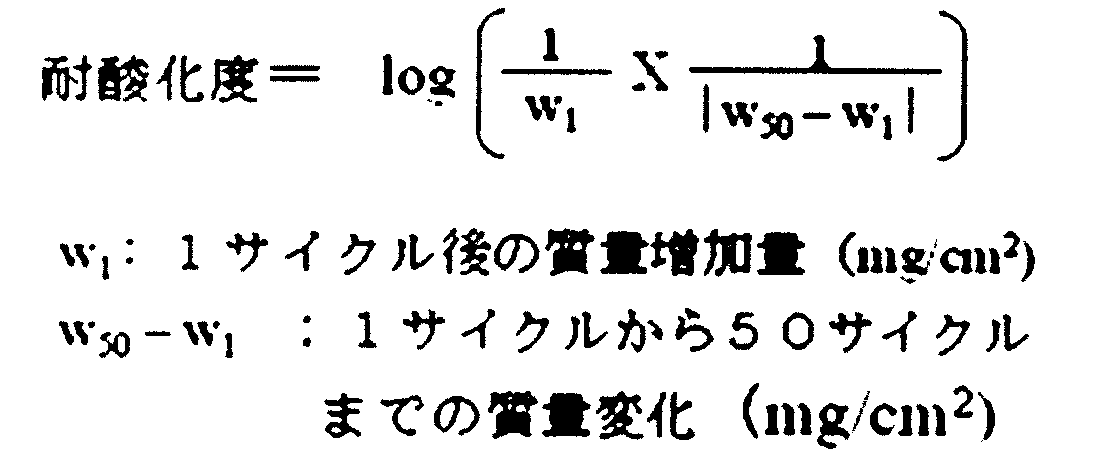
- shaft in FIG. 1 is defined by the following formula.
- oxidation resistance in general, when a sample of a Ni-based single crystal superalloy is oxidized at a high temperature, there are those in which the mass temporarily increases due to oxidation and then begins to decrease, or the mass gradually decreases after the start of oxidation. This equation can express oxidation resistance in any case.
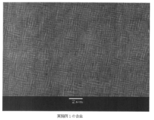
- FIG. 2 is a transmission electron micrograph of a Ni-based single crystal alloy obtained by subjecting the alloy of Example 1 to a solution treatment at 1335 ° C. for 18 hours followed by an aging treatment at 1150 ° C. Dislocations formed in a network shape are observed, and the interval between the networks is about 0.32 m ⁇ , which indicates that this is desirable as a Ni-based single crystal alloy.
- oxidation resistance test was performed on each sample subjected to solution treatment and aging treatment.
- the test conditions for oxidation resistance were as follows: the sample was exposed to a high temperature of 1150 ° C. in a 1 hour cycle in air, and the change in mass was measured. The oxidation resistance after 50 cycles is also shown in Table 3.
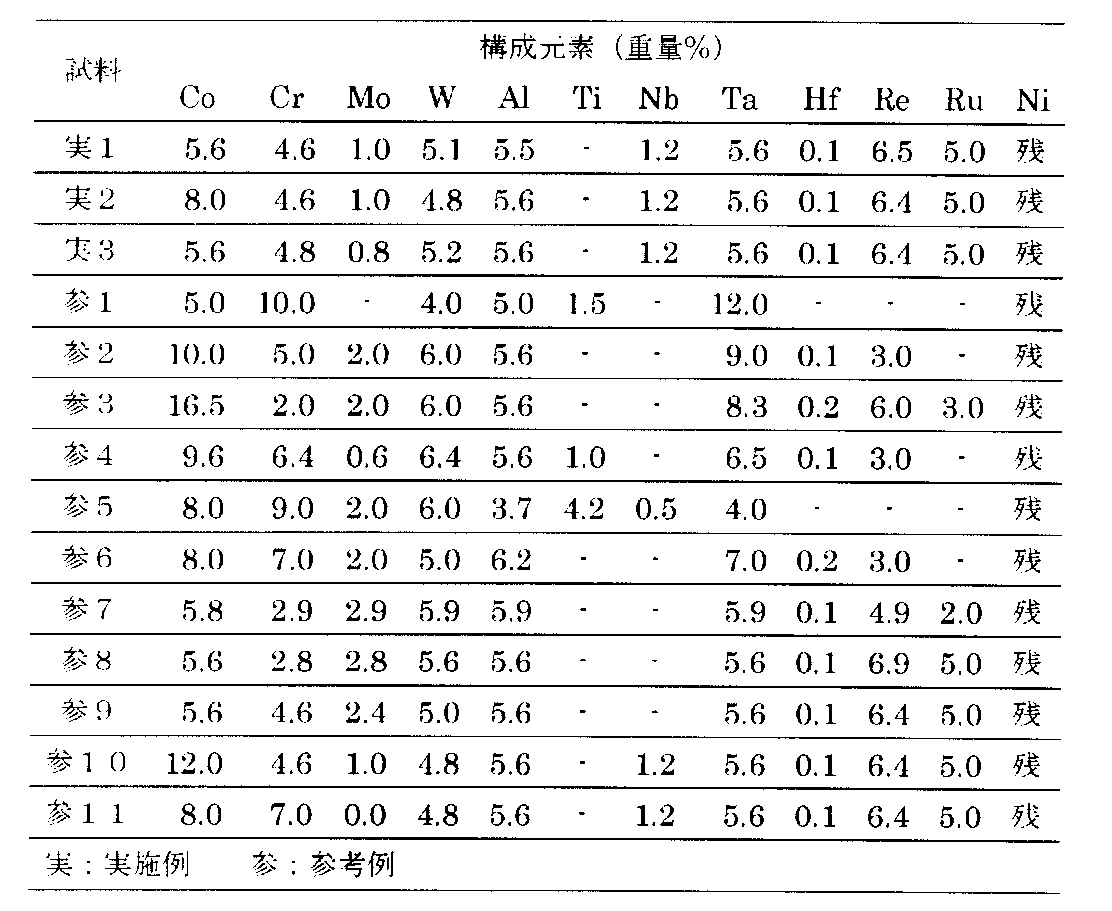
- FIG. 1 shows the creep rupture life at 1100 ° C., 137MP, and the oxidation resistance at 1150 ° C., the heat-resistant alloy of the present invention (Example 1-3), typical existing practical alloys (Reference Examples 1-6) and the present This is a comparison of the performance of the heat-resistant alloy (Reference Example 7-11) (Patent Documents 6 and 7) already proposed by the inventors.
- Typical existing practical alloys are inferior in heat resistance, and the alloys already proposed by the present inventors are clearly superior in terms of heat resistance compared to practical alloys, but in terms of oxidation resistance. Some are not necessarily sufficient.
- the degree of oxidation of the existing alloy MX-4 of Reference Example 3 is not plotted in the drawing, the degree of oxidation is 0.01 or less, which is significantly lower than other alloy systems.
- the results shown in FIG. 1 suggest that the alloy system of the present invention is an alloy system having extremely excellent heat resistance and oxidation resistance as compared with the above-described existing alloys.
- FIG. 3 shows a comparison of the change in mass of the alloy of Example 1 and the alloy of Reference Example 4 when repeated exposure tests are performed up to about 600 cycles in air at a high temperature of 1100 ° C. for 1 hour. It is shown. This result shows that the alloy of the present invention has an even higher oxidation resistance than the existing alloy CMSX-4, which is generally known to be excellent in oxidation resistance.
- FIG. 4 shows the surface of the alloy of Example 1 exposed to air at 1100 ° C. for 1 hour.
- the surface of the alloy has a plurality of dense thin multi-layer structures including an alumina oxide layer, and has a feature excellent in oxidation resistance.
- Example 1 The lattice misfit values (%) of Example 1 and a typical existing alloy CMSX-4 (Reference Example 4) were calculated to be -0.28 and -0.14, respectively.
- the alloy No. 1 was desirable in order to maintain the consistency between the ⁇ phase as a parent phase and the ⁇ ′ phase as a precipitation phase.
- FIG. 5 shows the heat-treatment window measured for the alloy of Example 1 and the alloy of Reference Example 4, which is a practical alloy.
- the heat-treatment window of the alloys of Example 1 and Reference Example 4 were 47 ° C. and 28 ° C., respectively.
- the heat-treatment window of the alloy of the present invention has a wider window than that of Reference Example 4, which is a practical alloy, and has no process problems even in the industrial blade casting process. The blade yield was also expected to be very high.
- FIG. 6 is a diagram comparing the performance of the application alloy (Reference Example 7-11).
- 2 is a transmission electron micrograph of a Ni-based single crystal alloy after solution treatment and aging treatment of the alloy of Example 1.
- FIG. The figure which showed the change of the mass when the sample of the alloy of Example 1 and the alloy of Reference Example 4 which is a practical alloy was exposed to a sample repeatedly at a high temperature of 1100 ° C. in a 1 hour cycle in air for about 600 cycles. is there.
- FIG. 1 It is the photograph which observed the surface, after exposing in the air about 1100 degreeC for 1 hour about the alloy of Example 1.
- FIG. It is the thermal analysis result which measured heat-treatment-window about the alloy of Example 1, and the alloy of the reference example 4 which is a practical alloy.
Landscapes
- Chemical & Material Sciences (AREA)
- Engineering & Computer Science (AREA)
- Materials Engineering (AREA)
- Mechanical Engineering (AREA)
- Metallurgy (AREA)
- Organic Chemistry (AREA)
- Turbine Rotor Nozzle Sealing (AREA)
- Crystals, And After-Treatments Of Crystals (AREA)
Abstract
Description

発明1は、成分が質量比で、Al:5.0質量%以上7.0質量%以下、Ta:4.0質量%以上8.0質量%以下、Mo:0質量%以上2.0質量%以下、W:3.0質量%以上8.0質量%以下、Re:3.0質量%以上8.0質量%以下、Hf:0質量%以上0.50質量%以下、Cr:3.0質量%以上7.0質量%以下、Co:0質量%以上9.9質量%以下、Ru:1.0質量%以上14.0質量%以下、Nb:0.1質量%以上4.0質量%以下を含有し、残部がNiと不可避的不純物からなる組成を有することを特徴とする。
この場合、個々の成分は、質量比で、B:0.05質量%以下、C:0.15質量%以下、Si:0.1質量%以下、Y:0.1質量%以下、La:0.1質量%以下、Ce:0.1質量%以下、V:1質量%以下、Zr:0.1質量%以下であるのが好ましい。
本発明のNi基単結晶超合金は、Al、Ta、W、Re、Cr、Ru及びNbを主添加物とし、Mo、Hf及びCoを調整添加元素として使用した合金である。
本発明のNi基単結晶超合金は、成分が質量比で、Al:5.0質量%以上7.0質量%以下、Ta:4.0質量%以上10.0質量%以下、Mo:0質量%以上1.1質量%未満、W:3.0質量%以上6.0質量%以下、Re:3.0質量%以上8.0質量%以下、Hf:0質量%以上0.50質量%以下、Cr:3.0質量%以上7.0質量%以下、Co:0質量%以上9.9質量%以下、Ru:1.0質量%以上8.0質量%以下、Nb:0.1質量%以上4.0質量%以下を含有し、残部がNiと不可避的不純物からなる組成を有することを特徴とする。
本発明のNi基単結晶超合金は、成分が質量比で、Al:5.0質量%以上7.0質量%以下、Ta:4.0質量%以上8.0質量%以下、Mo:0質量%以上1.1質量%未満、W:3.0質量%以上6.0質量%未満、Re:3.0質量%以上8.0質量%以下、Hf:0質量%以上0.12質量%未満、Cr:3.0質量%以上7.0質量%以下、Co:0質量%以上9.9質量%以下、Ru:1.0質量%以上8.0質量%以下、Nb:0.1質量%以上4.0質量%以下を含有し、残部がNiと不可避的不純物からなる組成を有することを特徴とする。
本発明のNi基単結晶超合金は、成分が質量比で、Al:5.0質量%以上7.0質量%以下、Ta:4.0質量%以上8.0質量%以下、Mo:0質量%以上1.1質量%未満、W:3.0質量%以上6.0質量%未満、Re:5.8質量%以上8.0質量%以下、Hf:0質量%以上0.12質量%未満、Cr:3.0質量%以上7.0質量%以下、Co:0質量%以上9.9質量%以下、Ru:1.0質量%以上8.0質量%以下、Nb:0.1質量%以上4.0質量%以下を含有し、残部がNiと不可避的不純物からなる組成を有することを特徴とする。
本発明のNi基単結晶超合金は、成分が質量比で、Al:5.0質量%以上7.0質量%以下、Ta:4.0質量%以上8.0質量%以下、Mo:0質量%以上1.1質量%未満、W:3.0質量%以上6.0質量%未満、Re:5.8質量%以上8.0質量%以下、Hf:0質量%以上0.12質量%未満、Cr:3.0質量%以上7.0質量%以下、Co:0質量%以上9.9質量%以下、Ru:4.1質量%以上8.0質量%以下、Nb:0.1質量%以上4.0質量%以下を含有し、残部がNiと不可避的不純物からなる組成を有することを特徴とする。
本発明のNi基単結晶超合金は、成分が質量比で、Al:5.0質量%以上7.0質量%以下、Ta:4.0質量%以上6.0質量%未満、Mo:0質量%以上1.1質量%未満、W:3.0質量%以上6.0質量%未満、Re:5.8質量%以上8.0質量%以下、Hf:0質量%以上0.12質量%未満、Cr:3.0質量%以上7.0質量%以下、Co:0質量%以上9.9質量%以下、Ru:4.1質量%以上8.0質量%以下、Nb:0.1質量%以上4.0質量%以下を含有し、残部がNiと不可避的不純物からなる組成を有することを特徴とする。
本発明のNi基単結晶超合金は、成分が質量比で、Al:5.0質量%以上7.0質量%以下、Ta:4.0質量%以上6.0質量%未満、Mo:0質量%以上1.1質量%未満、W:3.0質量%以上6.0質量%未満、Re:5.8質量%以上8.0質量%以下、Hf:0.0質量%以上0.1質量%未満、Cr:3.0質量%以上7.0質量%以下、Co:0質量%以上9.9質量%以下、Ru:4.1質量%以上8.0質量%以下、Nb:1.0質量%超3.0質量%以下を含有し、残部がNiと不可避的不純物からなる組成を有することを特徴とする。
本発明のNi基単結晶超合金は、成分が質量比で、Al:5.0質量%以上7.0質量%以下、Ta:4.0質量%以上6.0質量%未満、Mo:0質量%以上1.1質量%未満、W:4.0質量%以上5.0質量%未満、Re:5.8質量%以上8.0質量%以下、Hf:0.0質量%以上0.1質量%未満、Cr:3.0質量%以上7.0質量%以下、Co:0質量%以上9.9質量%以下、Ru:4.1質量%以上8.0質量%以下、Nb:1.0質量%超3.0質量%以下を含有し、残部がNiと不可避的不純物からなる組成を有することを特徴とする。
Crの組成比は,Cr:3.0質量%以上7.0質量%以下の範囲が好ましく、3.5質量%以上6.5質量%以下の範囲がより好ましく、4.0質量%以上6.0質量%以下の範囲とすることが最も好ましい。
Crの組成比が3.0質量%未満であると、所望の高温耐食性を確保できないので好ましくなく、Crの組成比が7.0質量%を越えると、γ’相の析出が抑制されるとともにσ相やμ相などの有害相が生成して高温強度が低下する傾向が認められることもあるので好ましくない。
Moの組成比は、0.0質量%以上2.0質量%以下の範囲が好ましく、0.0質量%以上1.1質量%未満の範囲がより好ましい。
Moの組成比が2.0質量%超となると、上記に例示したNi基単結晶超合金の組成域においては、高温における所望の耐酸化特性が確保できないので好ましくない。
Taの組成比は、4.0質量%以上8.0質量%以下の範囲が好ましい。
Taの組成比が4.0質量%未満であると、所望の高温強度を確保できないので好ましくなく、Taの組成比が10.0質量%を越えると、σ相やμ相が生成するようになって高温強度が低下するので好ましくなく、また、実用上、Taの組成比が8.0質量%以上となるとNi基単結晶超合金の密度も上昇するので好ましくない。最も好ましいTaの組成比は、4.0質量%以上6.0質量%未満の範囲である。
Alの組成比は、5.0質量%以上7.0質量%以下の範囲が好ましい。
Alの組成比が5.0質量%未満であると、γ’相の析出量が不十分となり、所望の高温強度を確保できないので好ましくなく、Alの組成比が7.0質量%を越えると、共晶γ’相と呼ばれる粗大なγ’相が多く形成され、溶体化処理が不可能となり、高い高温強度を確保できなくなるので好ましくない。
Coの組成比は、0.0質量%以上9.9質量%以下の範囲が好ましく、0.1質量%以上9.9質量%以下の範囲がより好ましい。Coの組成比が0.1質量%未満であると、γ’相の析出量が不十分となり、所望の高温強度を確保できないこともあるので好ましくない。但し、Al又は/及びTaの含有量によっては、Coの組成比を0質量%あるいは0.1質量%未満とする場合もある。また、Coの組成比が9.9質量%を越えると、Al、Ta、Mo、W、Hf、Cr等の他の元素とのバランスがくずれ、有害相が析出して高温強度が低下するので好ましくない。
Reの組成比は、3.0質量%以上8.0質量%以下の範囲が好ましく、5.8質量%以上8.0質量%以下とすることがより好ましい。
Reの組成比が3.0質量%未満であると、γ相の固溶強化が不十分となって所望の高温強度を確保できないので好ましくない。Reの組成比が8.0質量%を越えると、高温時にTCP相が析出して高温強度の性能を下げ、また高価なReの量が増えると合金原材料価格が上昇することとなるので、好ましくない。
Ruの組成比は、1.0質量%以上14.0質量%以下の範囲が好ましく、1.0質量%以上8.0質量%以下の範囲がより好ましい。Ruの組成比は、4.1質量%以上8.0質量%以下の範囲が特に好ましい。
Ruの組成比が1.0質量%未満であると、高温時にTCP相が析出し、高い高温強度を確保できなくなる。さらに、Ruの組成比が4.1質量%未満であると、Ruの組成比が4.1質量%以上の場合に比べて、高温強度が低くなる。Ruの組成比が8.0質量%を越えると、ε相が析出して高温強度が低下するので好ましくない。また、高価なRuの量が増えると合金原材料価格が上昇することとなり、実用性の面においても好ましくない。
なお、以下の記載中、母相の結晶の格子定数a1と析出相の結晶の格子定数a2との差のa1に対するパーセンテージ{(a2-a1)/a1x100(%)}を、「格子ミスフィット」と呼称する。
この格子ミスフィットの範囲については、母相であるγ相と析出相であるγ’相の整合性が保たれる限りにおいて、より負であることによって、転位網間隔が小さくなり、クリープ強度を向上する効果が得られる。
この格子ミスフィットが0%未満、好ましくは-0.1%以下、より好ましくは-0.15%以下とする。
しかし、格子ミスフィットの数値があまり負に偏り過ぎると整合性が維持できずに性能が低下するので、最大でも-1%、好ましくは-0.8%、より好ましくは-0.7%とすることが望ましい。
つまり、析出相の結晶の格子定数a2と母相の結晶の格子定数a1との関係は、0.990a1≦a2<a1、好ましくは0.992a1≦a2≦0.999a1、さらに好ましくは0.993a1≦a2≦0.9985a1ということになる。
また、上記のNi基単結晶超合金において、不可避的不純物以外に、例えば、B、C、Si、Y、La、Ce、V、Zrなどを含んでもよい。B、C、Si、Y、La、Ce、V、Zrのうちの少なくとも一つを含む場合、個々の成分の組成比は、B:0.05質量%以下、C:0.15質量%以下、Si:0.1質量%以下、Y:0.1質量%以下、La:0.1質量%以下、Ce:0.1質量%以下、V:1質量%以下、Zr:0.1質量%以下であるのが好ましい。上記個々の成分の組成比が上記範囲を超えると、有害相が析出して高温強度が低下するので好ましくない。
真空溶解炉を用いて各種のNi基単結晶超合金の溶湯を調整し、この合金溶湯を用いて組成の異なる複数の合金インゴットを鋳造した。本発明の合金(実施例1-3)とともに、6種類の代表的な既存耐熱合金(参考例1-6)および本出願人が既に出願済みの第4および第5世代の耐熱合金4種類の(参考例7-11)(特許文献6および7)の組成比を表2に示す。

Claims (12)
- Al,Ta,W、Re、Cr、Ru及びNbを主添加元素とするNi基単結晶超合金であって、成分が質量比で、Al:5.0質量%以上7.0質量%以下、Ta:4.0質量%以上8.0質量%以下、Mo:0質量%以上2.0質量%以下、W:3.0質量%以上8.0質量%以下、Re:3.0質量%以上8.0質量%以下、Hf:0質量%以上0.50質量%以下、Cr:3.0質量%以上7.0質量%以下、Co:0質量%以上9.9質量%以下、Ru:1.0質量%以上14.0質量%以下、Nb:0.1質量%以上4.0質量%以下を含有し、残部がNiと不可避的不純物からなる組成を有することを特徴とするNi基単結晶超合金。
- Al,Ta,W、Re、Cr、Ru及びNbを主添加元素とするNi基単結晶超合金であって、成分が質量比で、Al:5.0質量%以上7.0質量%以下、Ta:4.0質量%以上10.0質量%以下、Mo:0質量%以上1.1質量%未満、W:3.0質量%以上6.0質量%以下、Re:3.0質量%以上8.0質量%以下、Hf:0質量%以上0.50質量%以下、Cr:3.0質量%以上7.0質量%以下、Co:0質量%以上9.9質量%以下、Ru:1.0質量%以上8.0質量%以下、Nb:0.1質量%以上4.0質量%以下を含有し、残部がNiと不可避的不純物からなる組成を有することを特徴とするNi基単結晶超合金。
- Al,Ta,W、Re、Cr、Ru及びNbを主添加元素とするNi基単結晶超合金であって、成分が質量比で、Al:5.0質量%以上7.0質量%以下、Ta:4.0質量%以上8.0質量%以下、Mo:0質量%以上1.1質量%未満、W:3.0質量%以上6.0質量%未満、Re:3.0質量%以上8.0質量%以下、Hf:0質量%以上0.12質量%未満、Cr:3.0質量%以上7.0質量%以下、Co:0質量%以上9.9質量%以下、Ru:1.0質量%以上8.0質量%以下、Nb:0.1質量%以上4.0質量%以下を含有し、残部がNiと不可避的不純物からなる組成を有することを特徴とするNi基単結晶超合金。
- Al,Ta,W、Re、Cr、Ru及びNbを主添加元素とするNi基単結晶超合金であって、成分が質量比で、Al:5.0質量%以上7.0質量%以下、Ta:4.0質量%以上8.0質量%以下、Mo:0質量%以上1.1質量%未満、W:3.0質量%以上6.0質量%未満、Re:5.8質量%以上8.0質量%以下、Hf:0質量%以上0.12質量%未満、Cr:3.0質量%以上7.0質量%以下、Co:0質量%以上9.9質量%以下、Ru:1.0質量%以上8.0質量%以下、Nb:0.1質量%以上4.0質量%以下を含有し、残部がNiと不可避的不純物からなる組成を有することを特徴とするNi基単結晶超合金。
- Al,Ta,W、Re、Cr、Ru及びNbを主添加元素とするNi基単結晶超合金であって、成分が質量比で、Al:5.0質量%以上7.0質量%以下、Ta:4.0質量%以上8.0質量%以下、Mo:0質量%以上1.1質量%未満、W:3.0質量%以上6.0質量%未満、Re:5.8質量%以上8.0質量%以下、Hf:0質量%以上0.12質量%未満、Cr:3.0質量%以上7.0質量%以下、Co:0質量%以上9.9質量%以下、Ru:4.1質量%以上8.0質量%以下、Nb:0.1質量%以上4.0質量%以下を含有し、残部がNiと不可避的不純物からなる組成を有することを特徴とするNi基単結晶超合金。
- Al,Ta,W、Re、Cr、Ru及びNbを主添加元素とするNi基単結晶超合金であって、成分が質量比で、Al:5.0質量%以上7.0質量%以下、Ta:4.0質量%以上6.0質量%未満、Mo:0質量%以上1.1質量%未満、W:3.0質量%以上6.0質量%未満、Re:5.8質量%以上8.0質量%以下、Hf:0質量%以上0.12質量%未満、Cr:3.0質量%以上7.0質量%以下、Co:0質量%以上9.9質量%以下、Ru:4.1質量%以上8.0質量%以下、Nb:0.1質量%以上4.0質量%以下を含有し、残部がNiと不可避的不純物からなる組成を有することを特徴とするNi基単結晶超合金。
- Al,Ta,W、Re、Cr、Ru及びNbを主添加元素とするNi基単結晶超合金であって、成分が質量比で、Al:5.0質量%以上7.0質量%以下、Ta:4.0質量%以上6.0質量%未満、Mo:0質量%以上1.1質量%未満、W:3.0質量%以上6.0質量%未満、Re:5.8質量%以上8.0質量%以下、Hf:0.0質量%以上0.12質量%未満、Cr:3.0質量%以上7.0質量%以下、Co:0質量%以上9.9質量%以下、Ru:4.1質量%以上8.0質量%以下、Nb:1.0質量%超3.0質量%以下を含有し、残部がNiと不可避的不純物からなる組成を有することを特徴とするNi基単結晶超合金。
- Al,Ta,W、Re、Cr、Ru及びNbを主添加元素とするNi基単結晶超合金であって、成分が質量比で、Al:5.0質量%以上7.0質量%以下、Ta:4.0質量%以上6.0質量%未満、Mo:0質量%以上1.1質量%未満、W:4.0質量%以上5.0質量%未満、Re:5.8質量%以上8.0質量%以下、Hf:0.0質量%以上0.12質量%未満、Cr:3.0質量%以上7.0質量%以下、Co:0質量%以上9.9質量%以下、Ru:4.1質量%以上8.0質量%以下、Nb:1.0質量%超3.0質量%以下を含有し、残部がNiと不可避的不純物からなる組成を有することを特徴とするNi基単結晶超合金。
- 請求項1から請求項8のいずれか一項に記載のNi基単結晶超合金において、質量比で、2.0質量%以下のTiをさらに含有することを特徴とするNi基単結晶超合金。
- 請求項1から請求項9のいずれか一項に記載のNi基単結晶超合金において、B、C、Si、Y、La、Ce、V、Zrのうちの少なくとも一つを含有することを特徴とするNi基単結晶超合金
- 請求項1から請求項10のいずれか一項に記載のNi基単結晶超合金において、母相の格子定数をa1とし、析出相の格子定数をa2としたとき、a1とa2の関係が0.992a1≦a2<a1であることを特徴とするNi基単結晶超合金。
- Ni基単結晶超合金を基材とする合金部材であって、前記Ni基単結晶超合金が請求項1から請求項11のいずれかに記載のNi基単結晶超合金であることを特徴とする合金部材。
Priority Applications (4)
| Application Number | Priority Date | Filing Date | Title |
|---|---|---|---|
| EP09770265.8A EP2305845B1 (en) | 2008-06-26 | 2009-06-26 | Ni-BASED SINGLE CRYSTAL SUPERALLOY AND ALLOY MEMBER USING THE SAME AS BASE |
| US13/000,111 US20110262299A1 (en) | 2008-06-26 | 2009-06-26 | Ni-BASED SINGLE CRYSTAL SUPERALLOY AND COMPONENT USING THE SAME AS SUBSTRATE |
| CN200980124221.7A CN102076877B (zh) | 2008-06-26 | 2009-06-26 | Ni基单晶超合金及以其为基材的合金构件 |
| CA2728167A CA2728167C (en) | 2008-06-26 | 2009-06-26 | Ni-based single crystal superalloy and component using the same as substrate |
Applications Claiming Priority (4)
| Application Number | Priority Date | Filing Date | Title |
|---|---|---|---|
| JP2008167341 | 2008-06-26 | ||
| JP2008-167341 | 2008-06-26 | ||
| JP2008-168451 | 2008-06-27 | ||
| JP2008168451A JP5467306B2 (ja) | 2008-06-26 | 2008-06-27 | Ni基単結晶超合金とこれを基材とする合金部材 |
Publications (1)
| Publication Number | Publication Date |
|---|---|
| WO2009157555A1 true WO2009157555A1 (ja) | 2009-12-30 |
Family
ID=41444615
Family Applications (1)
| Application Number | Title | Priority Date | Filing Date |
|---|---|---|---|
| PCT/JP2009/061762 Ceased WO2009157555A1 (ja) | 2008-06-26 | 2009-06-26 | Ni基単結晶超合金とこれを基材とする合金部材 |
Country Status (6)
| Country | Link |
|---|---|
| US (1) | US20110262299A1 (ja) |
| EP (1) | EP2305845B1 (ja) |
| JP (1) | JP5467306B2 (ja) |
| CN (2) | CN103498077A (ja) |
| CA (1) | CA2728167C (ja) |
| WO (1) | WO2009157555A1 (ja) |
Cited By (2)
| Publication number | Priority date | Publication date | Assignee | Title |
|---|---|---|---|---|
| CN102418147A (zh) * | 2010-09-27 | 2012-04-18 | 中国科学院金属研究所 | 高强度且完全抗氧化的第三代单晶高温合金及制备方法 |
| CN117431432A (zh) * | 2023-12-20 | 2024-01-23 | 北京北冶功能材料有限公司 | 一种长时氧化性能好的镍基高温合金箔材及其制备方法 |
Families Citing this family (17)
| Publication number | Priority date | Publication date | Assignee | Title |
|---|---|---|---|---|
| US8992699B2 (en) | 2009-05-29 | 2015-03-31 | General Electric Company | Nickel-base superalloys and components formed thereof |
| JP5919980B2 (ja) * | 2012-04-06 | 2016-05-18 | 新日鐵住金株式会社 | Ni基耐熱合金 |
| US8858876B2 (en) * | 2012-10-31 | 2014-10-14 | General Electric Company | Nickel-based superalloy and articles |
| WO2015012888A1 (en) * | 2013-07-23 | 2015-01-29 | General Electric Company | Superalloys and components formed thereof |
| CN105200521B (zh) * | 2014-05-28 | 2018-05-25 | 中国科学院金属研究所 | 一种无铼低密度高性能镍基单晶高温合金及其热处理工艺 |
| CN104404614A (zh) * | 2014-12-29 | 2015-03-11 | 中南大学 | 一种Al-Cu-Mg系铝合金单晶制备方法 |
| CN104745888A (zh) * | 2015-04-20 | 2015-07-01 | 中南大学 | 镍基合金与由合金形成的物品 |
| CN106191527B (zh) * | 2015-04-20 | 2018-08-24 | 中南大学 | 镍基合金与由合金形成的物品 |
| CN106191528B (zh) * | 2015-04-20 | 2018-08-24 | 中南大学 | 镍基合金与由合金形成的物品 |
| CN106191529B (zh) * | 2015-04-20 | 2018-01-02 | 中南大学 | 镍基合金与由合金形成的物品 |
| GB2540964A (en) * | 2015-07-31 | 2017-02-08 | Univ Oxford Innovation Ltd | A nickel-based alloy |
| TWI595098B (zh) * | 2016-06-22 | 2017-08-11 | 國立清華大學 | 高熵超合金 |
| KR102340057B1 (ko) * | 2017-11-21 | 2021-12-17 | 한국재료연구원 | 니켈기 단결정 초내열합금 및 이의 제조방법 |
| CN110640152A (zh) * | 2018-06-26 | 2020-01-03 | 中南大学 | 一种镍基合金、其制备方法与一种制造物品 |
| CN110640151A (zh) * | 2018-06-26 | 2020-01-03 | 中南大学 | 一种镍基合金、其制备方法与一种制造物品 |
| CN109554584A (zh) * | 2018-08-28 | 2019-04-02 | 中南大学 | 一种镍基合金、其制备方法与制造物品 |
| CN109797433B (zh) * | 2019-01-23 | 2021-05-25 | 深圳市万泽中南研究院有限公司 | 单晶高温合金、热端部件及设备 |
Citations (10)
| Publication number | Priority date | Publication date | Assignee | Title |
|---|---|---|---|---|
| US4582548A (en) | 1980-11-24 | 1986-04-15 | Cannon-Muskegon Corporation | Single crystal (single grain) alloy |
| US4643782A (en) | 1984-03-19 | 1987-02-17 | Cannon Muskegon Corporation | Single crystal alloy technology |
| US5151249A (en) | 1989-12-29 | 1992-09-29 | General Electric Company | Nickel-based single crystal superalloy and method of making |
| US5366695A (en) | 1992-06-29 | 1994-11-22 | Cannon-Muskegon Corporation | Single crystal nickel-based superalloy |
| US5455120A (en) | 1992-03-05 | 1995-10-03 | General Electric Company | Nickel-base superalloy and article with high temperature strength and improved stability |
| JPH11310839A (ja) * | 1998-04-28 | 1999-11-09 | Hitachi Ltd | 高強度Ni基超合金方向性凝固鋳物 |
| EP1262569A1 (en) | 2001-05-30 | 2002-12-04 | Ishikawajima-Harima Heavy Industries Co., Ltd. | Ni-based single crystal super alloy |
| US6921586B2 (en) | 2002-02-05 | 2005-07-26 | General Electric Company | Ni-Base superalloy having a coating system containing a diffusion barrier layer |
| US6966956B2 (en) | 2001-05-30 | 2005-11-22 | National Institute For Materials Science | Ni-based single crystal super alloy |
| WO2008032751A1 (fr) * | 2006-09-13 | 2008-03-20 | National Institute For Materials Science | SUPERALLIAGE MONOCRISTALLIN À BASE DE Ni |
Family Cites Families (9)
| Publication number | Priority date | Publication date | Assignee | Title |
|---|---|---|---|---|
| US5113583A (en) * | 1990-09-14 | 1992-05-19 | United Technologies Corporation | Integrally bladed rotor fabrication |
| US6007645A (en) * | 1996-12-11 | 1999-12-28 | United Technologies Corporation | Advanced high strength, highly oxidation resistant single crystal superalloy compositions having low chromium content |
| FR2780982B1 (fr) * | 1998-07-07 | 2000-09-08 | Onera (Off Nat Aerospatiale) | Superalliage monocristallin a base de nickel a haut solvus |
| US6444057B1 (en) * | 1999-05-26 | 2002-09-03 | General Electric Company | Compositions and single-crystal articles of hafnium-modified and/or zirconium-modified nickel-base superalloys |
| US6673308B2 (en) * | 2000-08-30 | 2004-01-06 | Kabushiki Kaisha Toshiba | Nickel-base single-crystal superalloys, method of manufacturing same and gas turbine high temperature parts made thereof |
| WO2003080882A1 (en) * | 2002-03-27 | 2003-10-02 | National Institute For Materials Science | Ni-BASE DIRECTIONALLY SOLIDIFIED SUPERALLOY AND Ni-BASE SINGLE CRYSTAL SUPERALLOY |
| JP3944582B2 (ja) * | 2003-09-22 | 2007-07-11 | 独立行政法人物質・材料研究機構 | Ni基超合金 |
| JP5344453B2 (ja) * | 2005-09-27 | 2013-11-20 | 独立行政法人物質・材料研究機構 | 耐酸化性に優れたNi基超合金 |
| WO2007119404A1 (ja) * | 2006-03-20 | 2007-10-25 | National Institute For Materials Science | Ni基超合金とその製造方法およびタービンブレードまたはタービンベーン部品 |
-
2008
- 2008-06-27 JP JP2008168451A patent/JP5467306B2/ja active Active
-
2009
- 2009-06-26 CA CA2728167A patent/CA2728167C/en active Active
- 2009-06-26 WO PCT/JP2009/061762 patent/WO2009157555A1/ja not_active Ceased
- 2009-06-26 US US13/000,111 patent/US20110262299A1/en not_active Abandoned
- 2009-06-26 CN CN201310426315.8A patent/CN103498077A/zh active Pending
- 2009-06-26 EP EP09770265.8A patent/EP2305845B1/en active Active
- 2009-06-26 CN CN200980124221.7A patent/CN102076877B/zh not_active Expired - Fee Related
Patent Citations (11)
| Publication number | Priority date | Publication date | Assignee | Title |
|---|---|---|---|---|
| US4582548A (en) | 1980-11-24 | 1986-04-15 | Cannon-Muskegon Corporation | Single crystal (single grain) alloy |
| US4643782A (en) | 1984-03-19 | 1987-02-17 | Cannon Muskegon Corporation | Single crystal alloy technology |
| US5151249A (en) | 1989-12-29 | 1992-09-29 | General Electric Company | Nickel-based single crystal superalloy and method of making |
| JPH055143A (ja) * | 1989-12-29 | 1993-01-14 | General Electric Co <Ge> | ニツケル基単結晶超合金 |
| US5455120A (en) | 1992-03-05 | 1995-10-03 | General Electric Company | Nickel-base superalloy and article with high temperature strength and improved stability |
| US5366695A (en) | 1992-06-29 | 1994-11-22 | Cannon-Muskegon Corporation | Single crystal nickel-based superalloy |
| JPH11310839A (ja) * | 1998-04-28 | 1999-11-09 | Hitachi Ltd | 高強度Ni基超合金方向性凝固鋳物 |
| EP1262569A1 (en) | 2001-05-30 | 2002-12-04 | Ishikawajima-Harima Heavy Industries Co., Ltd. | Ni-based single crystal super alloy |
| US6966956B2 (en) | 2001-05-30 | 2005-11-22 | National Institute For Materials Science | Ni-based single crystal super alloy |
| US6921586B2 (en) | 2002-02-05 | 2005-07-26 | General Electric Company | Ni-Base superalloy having a coating system containing a diffusion barrier layer |
| WO2008032751A1 (fr) * | 2006-09-13 | 2008-03-20 | National Institute For Materials Science | SUPERALLIAGE MONOCRISTALLIN À BASE DE Ni |
Non-Patent Citations (1)
| Title |
|---|
| See also references of EP2305845A4 * |
Cited By (3)
| Publication number | Priority date | Publication date | Assignee | Title |
|---|---|---|---|---|
| CN102418147A (zh) * | 2010-09-27 | 2012-04-18 | 中国科学院金属研究所 | 高强度且完全抗氧化的第三代单晶高温合金及制备方法 |
| CN117431432A (zh) * | 2023-12-20 | 2024-01-23 | 北京北冶功能材料有限公司 | 一种长时氧化性能好的镍基高温合金箔材及其制备方法 |
| CN117431432B (zh) * | 2023-12-20 | 2024-03-12 | 北京北冶功能材料有限公司 | 一种长时氧化性能好的镍基高温合金箔材及其制备方法 |
Also Published As
| Publication number | Publication date |
|---|---|
| EP2305845A4 (en) | 2015-05-13 |
| CA2728167A1 (en) | 2009-12-30 |
| CN103498077A (zh) | 2014-01-08 |
| CN102076877B (zh) | 2015-12-16 |
| CA2728167C (en) | 2014-10-28 |
| CN102076877A (zh) | 2011-05-25 |
| US20110262299A1 (en) | 2011-10-27 |
| JP5467306B2 (ja) | 2014-04-09 |
| EP2305845B1 (en) | 2017-05-10 |
| JP2010031298A (ja) | 2010-02-12 |
| EP2305845A1 (en) | 2011-04-06 |
Similar Documents
| Publication | Publication Date | Title |
|---|---|---|
| JP5467306B2 (ja) | Ni基単結晶超合金とこれを基材とする合金部材 | |
| JP5467307B2 (ja) | Ni基単結晶超合金とそれよりえられた合金部材 | |
| JP3814662B2 (ja) | Ni基単結晶超合金 | |
| US7169241B2 (en) | Ni-based superalloy having high oxidation resistance and gas turbine part | |
| JP5177559B2 (ja) | Ni基単結晶超合金 | |
| CN101680059B (zh) | Ni基单晶超合金及使用其的涡轮叶片 | |
| JP3892831B2 (ja) | 単結晶タービンベーン用の超合金 | |
| CN101946015A (zh) | 具有优良的不易产生偏析的性能的Ni基高温合金 | |
| US6966956B2 (en) | Ni-based single crystal super alloy | |
| JP5252348B2 (ja) | Ni基超合金とその製造方法およびタービンブレードまたはタービンベーン部品 | |
| JP2007162041A (ja) | 高強度高延性Ni基超合金と、それを用いた部材及び製造方法 | |
| EP3121298B1 (en) | Ni-base alloy for structural applications | |
| JP5393829B2 (ja) | クリープ特性が向上された単結晶ニッケル基超耐熱合金 |
Legal Events
| Date | Code | Title | Description |
|---|---|---|---|
| WWE | Wipo information: entry into national phase |
Ref document number: 200980124221.7 Country of ref document: CN |
|
| 121 | Ep: the epo has been informed by wipo that ep was designated in this application |
Ref document number: 09770265 Country of ref document: EP Kind code of ref document: A1 |
|
| WWE | Wipo information: entry into national phase |
Ref document number: 2728167 Country of ref document: CA |
|
| NENP | Non-entry into the national phase |
Ref country code: DE |
|
| REEP | Request for entry into the european phase |
Ref document number: 2009770265 Country of ref document: EP |
|
| WWE | Wipo information: entry into national phase |
Ref document number: 2009770265 Country of ref document: EP |
|
| WWE | Wipo information: entry into national phase |
Ref document number: 13000111 Country of ref document: US |