WO2010001679A1 - フッ素化ナノダイヤモンドとその分散液、およびその作製方法 - Google Patents
フッ素化ナノダイヤモンドとその分散液、およびその作製方法 Download PDFInfo
- Publication number
- WO2010001679A1 WO2010001679A1 PCT/JP2009/060119 JP2009060119W WO2010001679A1 WO 2010001679 A1 WO2010001679 A1 WO 2010001679A1 JP 2009060119 W JP2009060119 W JP 2009060119W WO 2010001679 A1 WO2010001679 A1 WO 2010001679A1
- Authority
- WO
- WIPO (PCT)
- Prior art keywords
- fluorinated
- dispersion
- nanodiamond
- alcohol
- fluorinated nanodiamond
- Prior art date
- Legal status (The legal status is an assumption and is not a legal conclusion. Google has not performed a legal analysis and makes no representation as to the accuracy of the status listed.)
- Ceased
Links
Classifications
-
- C—CHEMISTRY; METALLURGY
- C01—INORGANIC CHEMISTRY
- C01B—NON-METALLIC ELEMENTS; COMPOUNDS THEREOF; METALLOIDS OR COMPOUNDS THEREOF NOT COVERED BY SUBCLASS C01C
- C01B32/00—Carbon; Compounds thereof
- C01B32/25—Diamond
- C01B32/28—After-treatment, e.g. purification, irradiation, separation or recovery
-
- C—CHEMISTRY; METALLURGY
- C09—DYES; PAINTS; POLISHES; NATURAL RESINS; ADHESIVES; COMPOSITIONS NOT OTHERWISE PROVIDED FOR; APPLICATIONS OF MATERIALS NOT OTHERWISE PROVIDED FOR
- C09K—MATERIALS FOR MISCELLANEOUS APPLICATIONS, NOT PROVIDED FOR ELSEWHERE
- C09K3/00—Materials not provided for elsewhere
- C09K3/14—Anti-slip materials; Abrasives
- C09K3/1454—Abrasive powders, suspensions and pastes for polishing
- C09K3/1472—Non-aqueous liquid suspensions
-
- C—CHEMISTRY; METALLURGY
- C01—INORGANIC CHEMISTRY
- C01B—NON-METALLIC ELEMENTS; COMPOUNDS THEREOF; METALLOIDS OR COMPOUNDS THEREOF NOT COVERED BY SUBCLASS C01C
- C01B9/00—General methods of preparing halides
- C01B9/08—Fluorides
-
- C—CHEMISTRY; METALLURGY
- C01—INORGANIC CHEMISTRY
- C01P—INDEXING SCHEME RELATING TO STRUCTURAL AND PHYSICAL ASPECTS OF SOLID INORGANIC COMPOUNDS
- C01P2006/00—Physical properties of inorganic compounds
- C01P2006/80—Compositional purity
Definitions
- the present invention relates to a fluorinated nanodiamond, a dispersion thereof, and a production method thereof, which are useful as precision abrasives, lubricants, heat exchange fluid media, and the like.
- Diamonds obtained by the impact-pressure explosion method (impact method) using oxygen-deficient explosives such as trinitrotoluene (TNT) and hexogen (RDX) are nanodiamonds (primary particles are extremely small, 4-5 nm).
- ND depends on its nanoscale particle size, abrasive, lubricant, heat exchange fluid medium, resin, composite material with metal, low dielectric constant film, electronic material such as emitter material, DNA carrier, virus capture carrier, etc. It is expected to be used in a wide range of applications other than normal diamond applications such as in the medical field.
- ND When ND is industrially used for such a purpose, provision as a dispersion liquid in which ND is dispersed in a liquid with fine particles having an ND of less than 100 nm is required.
- impurity carbon layers such as non-graphitic and graphite films are fused on the surface of ND fine particles, and ND usually has secondary and tertiary particle sizes of 50 to 7500 nm as called cluster diamond (CD). Since it is manufactured as an aggregate, it is necessary to remove the impurity carbon layer and to crush the aggregate. Further, when handling nano-level order particles dispersed in a solution, the smaller the particles, the easier the aggregation of the particles, and the aggregated particles settle, so it is very difficult to obtain a stable dispersion.
- CD cluster diamond
- Non-Patent Document 4 This is because the ND lattice pattern by TEM observation is clear, the non-graphitic carbon on the ND surface is removed by the reaction at high temperature, and the CF group on the ND surface is further removed. It is reported that the surface energy is reduced due to the formation of CF 2 group, CF 3 group and the like.
- the fluorine content is 5 to 8 by fluorine treatment of reaction temperature: 150, 310, 410, 470 ° C., F 2 / H 2 flow rate ratio: 3/1, reaction time: 48 hours. .6 at. % (Analyzed by EDX) of fluorinated ND has been reported to improve the solubility (dispersibility) in polar solvents such as ethanol as compared to ND before fluorine treatment. (See Patent Document 3 and Non-Patent Document 6.)
- fluorinated ND has improved dispersibility in a polar solvent than ND before fluorination.
- the fluorinated ND synthesized at a reaction temperature of 410 ° C. or more Differently, it was mixed and stirred in alcohols such as ethanol, but it was hardly dispersed and it was confirmed that the dispersibility was lower than that of ND before fluorination.
- fluorinated ND was synthesized by the fluorination method used in Non-Patent Document 3, fluorinated ND synthesized at a reaction temperature of 400 ° C.
- the present invention is stable without causing precipitation over a long period of at least 120 hours and without increasing the average particle diameter from 20 nm even when alcohols such as ethanol are used as a dispersion medium. It is an object to provide a fluorinated ND that can be dispersed in a dispersion medium and a dispersion of the fluorinated ND.
- the inventors have adjusted the element ratio of the fluorine element and the oxygen element bonded to the surface of the fluorinated ND within a certain range, so that the fluorine content is higher than that of the conventional fluorinated ND.
- the dispersibility of fluorinated ND in alcohols such as ethanol is improved, and a dispersion of fluorinated ND that is stable for at least 120 hours or more can be provided without increasing the average particle size.
- the present inventors have found that the dispersion concentration of can be freely adjusted in the range of 0.01 to 15% by mass, and have reached the present invention.
- a fluorinated nanodiamond for producing a fluorinated nanodiamond dispersion by dispersing in an alcohol-containing dispersion medium, wherein the element ratio of oxygen to fluorine (O / F)
- the fluorinated nanodiamond is characterized in that the fluorinated nanodiamond is 0.06 to 0.20.
- a fluorinated nanodiamond dispersion liquid in which the fluorinated nanodiamond is dispersed in a dispersion medium containing alcohols.
- a fluorination step of producing fluorinated nanodiamond by reacting nanodiamond with a fluorinating agent, and oxygen and fluorine by oxidizing the fluorinated nanodiamond obtained in the fluorination step The suspension is obtained by mixing an oxidation step of adjusting the element ratio (O / F) to 0.06 to 0.20, a fluorinated nanodiamond obtained in the oxidation step, and a dispersion medium containing alcohols.
- a method for producing a fluorinated nanodiamond dispersion which is produced by a suspension step to be produced and a classification step for classifying the suspension obtained in the suspension step.
- the fluorinated ND of the present invention is produced by reacting ND with a fluorinating agent (fluorination step), and the element ratio O / F of oxygen to fluorine is 0.06 or more and 0.20 or less. It is characterized by being.
- Fluorinating agents include fluorine gas, or gas obtained by diluting fluorine gas with nitrogen, hydrogen, etc., nitrogen trifluoride, dinitrogen tetrafluoride, chlorine trifluoride, bromine trifluoride, iodine pentafluoride, tetrafluoride Carbon, metal fluorides, etc. are selected.
- the fluorinated ND is generated by a direct reaction with the fluorinating agent or a reaction by fluorine plasma generated from the fluorinating agent.
- the fluorination reaction of diamond occurs only on the outermost surface of the primary diamond particles, and generates a fluorinated diamond whose surface is covered with fluorine atoms.
- oxygen-containing functional groups such as oxygen atoms, hydroxyl groups and carboxyl groups.
- the element ratio O / F of the fluorinated ND is a value calculated by the integrated intensity ratio of the peaks attributed to oxygen and fluorine obtained by X-ray photoelectron spectroscopy (XPS) measurement.
- XPS X-ray photoelectron spectroscopy
- the fluorine content of fluorinated ND depends on the primary particle size of ND, so it cannot be generally stated.
- the primary particle size is all 4 nm and the crystal structure of diamond is an octahedral single crystal.
- the maximum fluorine content is about 30% by mass relative to the total mass of the diamond particles, and is calculated to be 25% by mass when the particle size is 5 nm.
- at least about 20% of the surface is preferably fluorinated, and the fluorine content is preferably at least 5% by mass or more.
- the element ratio O / F and fluorine content of fluorinated ND vary depending on the reaction method and reaction conditions (reaction temperature, reaction time, fluorine gas concentration, etc.), the production conditions cannot be generally specified.
- reaction temperature is preferably 250 ° C. or higher.
- the reaction temperature is lower than 250 ° C., only fluorinated ND having an element ratio O / F of 0.20 or more may be obtained. Further, since the reaction time affects the purity of the obtained fluorinated ND, the reaction time is preferably at least 50 hours or more. Since the element ratio O / F decreases as the reaction temperature increases and the reaction time increases, the element ratio O / F of the fluorinated ND obtained by fluorination becomes less than 0.06 (or the element ratio O / F is a value lower than a predetermined value), the element ratio O / F can be adjusted by performing an oxidation treatment after fluorination.
- oxidation treatment examples include heat treatment in an oxygen-containing atmosphere (for example, dry air), hot water treatment, ultrasonic treatment in an oxidizing agent such as hydrogen peroxide, and the like. It is not specified in order to obtain the effects of the present invention.
- an oxygen-containing atmosphere for example, dry air
- hot water treatment hot water treatment
- ultrasonic treatment in an oxidizing agent such as hydrogen peroxide, and the like.
- an oxidizing agent such as hydrogen peroxide, and the like.
- alcohols may be used alone, but they may be used by mixing alcohols as main components with other dispersion media.
- the effect of the present invention is not limited by the type of alcohol used as a dispersion medium for fluorinated ND.
- the alcohol selected is preferably liquid at room temperature, and an alcohol having a viscosity at 20 ° C. of 4 cP or less is particularly preferable.
- a lower alcohol having 5 or less carbon atoms is selected.
- the lower alcohol having 5 or less carbon atoms include methanol, ethanol, isopropyl alcohol, butanol and the like, and fluorine-containing alcohols such as tetrafluoropropanol. These alcohols can be used alone or in combination of two or more.
- the dispersion of fluorinated ND can be prepared by a mixing process in which fluorinated ND and alcohol are mixed and subjected to ultrasonic irradiation with an ultrasonic homogenizer. Depending on the fluorination conditions, aggregates contained in ND before fluorination may not be completely removed, which causes an increase in the average particle size. In this case, fluorinated ND and alcohol are mixed, A dispersion can be prepared by preparing a suspension (suspension step) by mixing by ultrasonic irradiation with an ultrasonic homogenizer, and then classifying (classifying step) by centrifugation or the like.
- the ultrasonic irradiation output is preferably 400 W or more. Although it is considered possible to disperse or suspend fluorinated ND even when the irradiation power is less than 400 W, it is necessary to lengthen the treatment time when the irradiation power is reduced. In order not to cause precipitation, it is necessary to irradiate for 10 hours or more, and for an irradiation output of 80 W, irradiation for 48 hours is required. In addition, if the processing time of an ultrasonic wave is 400 W or more of irradiation output, the objective of this invention can fully be achieved by ultrasonic processing for 1 hour.
- the suspension after ultrasonic irradiation is classified by centrifugation at a relative centrifugal acceleration of 3500 G to 6000 G. Is preferred.
- the relative centrifugal acceleration is less than 3500 G, the aggregate of fluorinated ND cannot be completely removed, and the average particle size may increase.
- fluorinated ND having a particle size of 20 nm or less is also precipitated and removed, which may reduce the dispersion concentration of fluorinated ND.
- the processing time for centrifugation varies depending on the relative centrifugal acceleration, the capacity of the centrifuge tube to be used, and the like. However, for example, when a 50 ml centrifuge tube is used, the relative centrifugal acceleration is 4500G and the relative centrifugal speed is 0.5 h. An acceleration of 6000 G is sufficient for 0.1 h.
- Heated ND manufactured by Gansu Lingyun Material Co., Ltd., nano diamond refined powder, particle size: 3-20 nm, distributor: New Metals End Chemicals Corporation
- the water contained in was removed.
- 20 g of ND that had been subjected to the drying treatment was placed in a nickel reaction tube, and fluorine gas was supplied at a flow rate of 20 ml / min and argon gas at a flow rate of 380 ml / min.
- the sample was heated to a target temperature, and the circulation of argon gas and fluorine gas was continued for a certain time, and ND and fluorine gas were reacted to produce fluorinated ND.
- the O / F of the produced fluorinated ND was measured using an X-ray photoelectron spectrometer (JPS-9010, manufactured by JEOL Ltd., X-ray source: MgK ⁇ , acceleration voltage: 10 kV, emission current: 10 mA) and oxygen (527 to 543 eV) and fluorine (677 to 695 eV), and the fluorine content was measured by elemental analysis.
- Table 1 shows the conditions for the fluorination treatment, the element ratio O / F of the fluorinated ND, and the fluorine content.
- VCX-750 homogenizer
- the obtained suspension was allowed to stand for 48 hours, and then subjected to a classification treatment with a centrifuge (CN-2060, manufactured by HSIANGTAI) at a rotation speed of 4000 rpm for 20 minutes, and the supernatant after centrifugation was collected and dispersed. A liquid was obtained.
- a centrifuge CN-2060, manufactured by HSIANGTAI
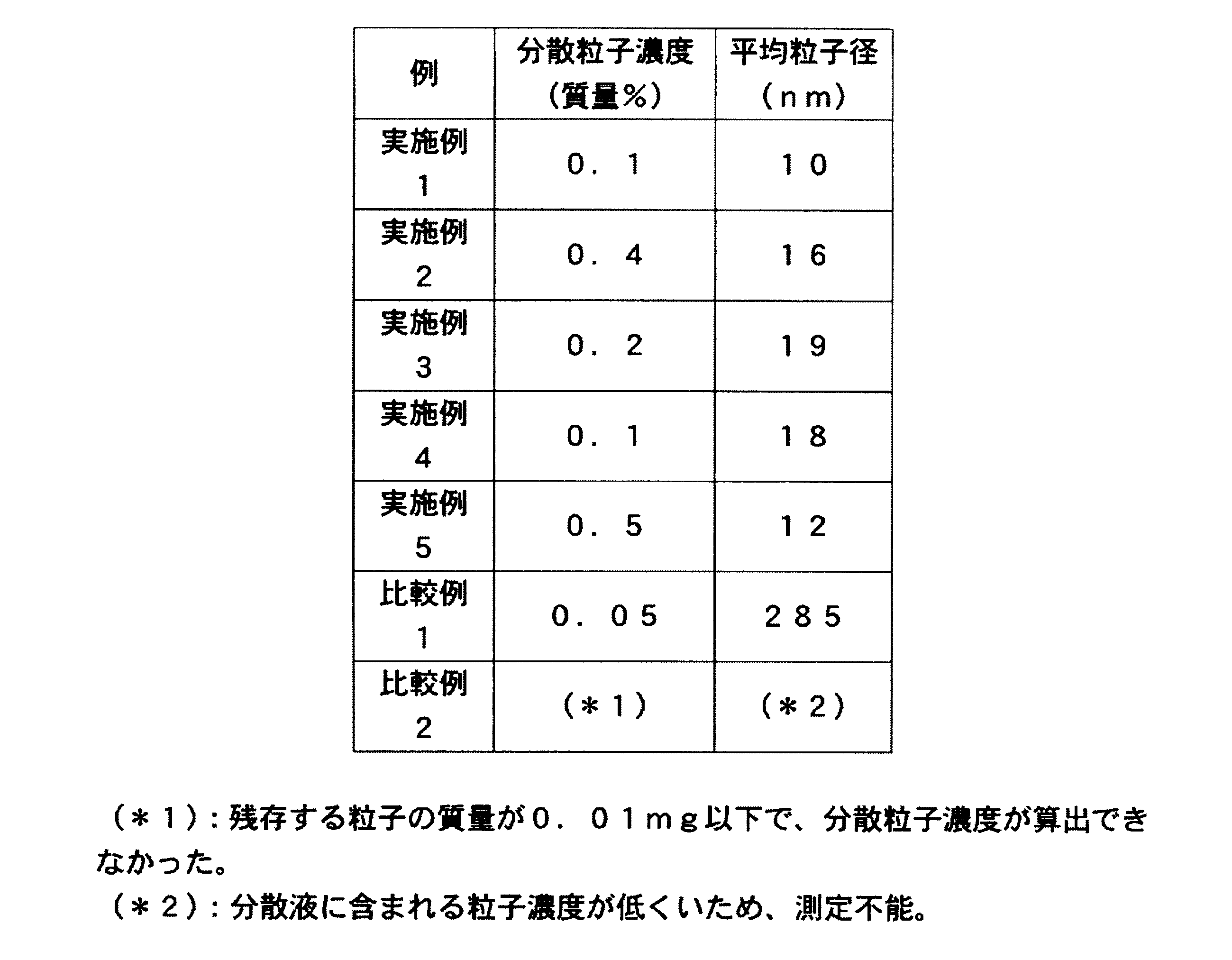
- ⁇ Performance evaluation> The obtained dispersion was allowed to stand for 120 hours, and then particle size distribution measurement and concentration measurement were performed.
- Table 2 shows the measurement results of the average particle diameter and the dispersion particle concentration of the dispersion.
- the average particle size is measured using a particle size distribution measuring instrument (FPAR1000, manufactured by Otsuka Electronics Co., Ltd.) by a dynamic light scattering method, and the frequency for each particle size is converted from the mass converted particle size distribution converted by the mass of the dispersed particles.
- the calculated value was adopted, and the dispersion particle concentration was measured by weighing 10 g of the dispersion, drying at 50 ° C. with a dryer to remove the dispersion medium, and then weighing the mass of the remaining particles to calculate the dispersion particle concentration.
- the element ratio O / F of the fluorinated ND is 0.06 or more and 0.20 or less, and even in the dispersion liquid after standing for 120 hours.
- the average particle diameter of the fluorinated ND was 20 nm or less, and the content was in the range of 0.01 to 15% by mass. Therefore, it can be said that the fluorinated NDs of Examples 1 to 5 were stably dispersed in ethanol at a dispersion concentration of 0.01 to 15% by mass without impairing the characteristics as a nanoscale material due to an increase in the average particle diameter. .
- Comparative Example 1 the elemental ratio O / F of fluorinated ND was as large as 0.38, aggregation of fluorinated ND occurred, and the average particle size of fluorinated ND in the dispersion after standing for 120 hours was 285 nm. The content was 0.05% by mass.
- Comparative Example 2 the element ratio O / F of the fluorinated ND is as small as 0.02, the fluorinated ND is not dispersed in ethanol, and the average particles of the fluorinated ND in the dispersion after standing for 120 hours Neither diameter nor content was detectable.
- the fluorinated ND can convert alcohols over a long period of at least 120 hours.
- a dispersion liquid stably dispersed in the contained dispersion medium can be prepared and stored, and the content of fluorinated ND in the dispersion liquid can be freely adjusted in the range of 0.01 to 15% by mass.
Landscapes
- Chemical & Material Sciences (AREA)
- Organic Chemistry (AREA)
- Inorganic Chemistry (AREA)
- Engineering & Computer Science (AREA)
- Materials Engineering (AREA)
- Health & Medical Sciences (AREA)
- General Health & Medical Sciences (AREA)
- Life Sciences & Earth Sciences (AREA)
- General Life Sciences & Earth Sciences (AREA)
- Geology (AREA)
- Carbon And Carbon Compounds (AREA)
Abstract
Description
ND(甘粛凌云納米材料有限公司製、ナノダイヤモンド精製粉、粒径:3~20nm、販売代理店:(株)ニューメタルス エンド ケミカルス コーポレーション)を圧力1kPaで3時間、400℃に加熱して、NDに含まれる水分を除去した。乾燥処理を行ったNDを20g、ニッケル製の反応管に入れ、これに20℃で、フッ素ガスを流量20ml/min、アルゴンガスを流量380ml/minで流通した。そして、試料を目的の温度に加熱し、一定時間アルゴンガスとフッ素ガスの流通を継続し、NDとフッ素ガスを反応させ、フッ素化NDを作製した。作製したフッ素化NDのO/Fは、X線光電子分光装置(JPS-9010、日本電子株式会社製、X線源:MgKα、加速電圧:10kV、エミッション電流:10mA)を用い、酸素(527~543eV)、フッ素(677~695eV)に出現するピークの積分強度比により算出し、フッ素含有量は元素分析により測定した。フッ素化処理の条件及び、フッ素化NDの元素比O/F、フッ素含有量を表1に示す。
元素比O/Fを調整するため、高温電気炉(ETR-11K、いすゞ製作所社製)で実施例2、3、5の試料に熱処理を施した。熱処理は、窒素を流量3L/min、空気を流量0.6L/minでフローさせ、処理温度:400℃(実施例2、3)及び450℃(実施例5)、処理時間:12時間で行った。熱処理後のフッ素化NDの元素比O/F及びフッ素含有量を表1に示す。

フッ素化後の試料(実施例1、4、比較例1、2)及びフッ素化後に熱処理を行った試料(実施例2、3、5)をそれぞれ、エタノール300mlに2.4g投入し、超音波ホモジナイザー(VCX-750、Sonics&materials社製)によって、出力700Wの超音波照射を0.5時間行い、フッ素化NDが分散した懸濁液を作製した。次に、得られた懸濁液を48時間静置した後、遠心機(CN-2060、HSIANGTAI社製)により、回転数4000rpmで20min分級処理し、遠心分離後の上澄み液を採取して分散液を得た。
得られた分散液を120時間静置した後、粒度分布測定と濃度測定を行った。分散液の平均粒子径および、分散粒子濃度の測定結果を表2に示す。なお、平均粒子径は、動的光散乱法による粒度分布測定器(FPAR1000、大塚電子製)を用いて測定を行い、粒子径毎の頻度を分散粒子の質量によって換算した質量換算粒度分布から、算出される値を採用し、分散粒子濃度は、分散液を10g秤量し、乾燥機により50℃で乾燥して分散媒を除去後、残存した粒子の質量を秤量し分散粒子濃度を算出した。
Claims (6)
- アルコール類を含有する分散媒に分散させてフッ素化ナノダイヤモンド分散液を作製するためのフッ素化ナノダイヤモンドであって、酸素とフッ素との元素比(O/F)が0.06~0.20であることを特徴とするフッ素化ナノダイヤモンド。
- 請求項1に記載のフッ素化ナノダイヤモンドを、アルコール類を含有する分散媒に分散させたフッ素化ナノダイヤモンド分散液。
- 分散媒はアルコール類単独であることを特徴とする請求項2に記載のフッ素化ナノダイヤモンド分散液。
- アルコール類は、常温で液体であり、20℃における粘度が4cP以下である、炭素数5以下の低級アルコール類及び/又は含フッ素系アルコール類であることを特徴とする、請求項2又は3に記載のフッ素化ナノダイヤモンド分散液。
- ナノダイヤモンドとフッ素化剤を反応させてフッ素化ナノダイヤモンドを作製するフッ素化工程と、該フッ素化工程で得られるフッ素化ナノダイヤモンドを酸化処理することにより酸素とフッ素との元素比(O/F)を0.06~0.20に調整する酸化工程と、該酸化工程で得られるフッ素化ナノダイヤモンドとアルコール類を含有する分散媒を混合して懸濁液を作製する懸濁工程と、該懸濁工程で得られる懸濁液を分級する分級工程で作製されることを特徴とする、請求項2に記載のフッ素化ナノダイヤモンド分散液の作製方法。
- 酸化処理は、酸素含有雰囲気下での熱処理、熱水処理、酸化剤中での超音波処理のいずれかであることを特徴とする、請求項5に記載のフッ素化ナノダイヤモンド分散液の作製方法。
Priority Applications (4)
| Application Number | Priority Date | Filing Date | Title |
|---|---|---|---|
| KR1020117002255A KR101246801B1 (ko) | 2008-06-30 | 2009-06-03 | 불소화 나노 다이아몬드와 그 분산액 및 그 제작방법 |
| US12/990,925 US20110124541A1 (en) | 2008-06-30 | 2009-06-03 | Fluorinated Nano Diamond and Dispersion Thereof, and Process for Production of the Same |
| EP09773257.2A EP2298700B1 (en) | 2008-06-30 | 2009-06-03 | Fluorinated nano diamond and dispersion thereof, and process for production of the same |
| CN2009801239360A CN102066246B (zh) | 2008-06-30 | 2009-06-03 | 氟化纳米金刚石和其分散液、及其制作方法 |
Applications Claiming Priority (2)
| Application Number | Priority Date | Filing Date | Title |
|---|---|---|---|
| JP2008170823A JP5326381B2 (ja) | 2008-06-30 | 2008-06-30 | フッ素化ナノダイヤモンドとその分散液および、その作製方法 |
| JP2008-170823 | 2008-06-30 |
Publications (1)
| Publication Number | Publication Date |
|---|---|
| WO2010001679A1 true WO2010001679A1 (ja) | 2010-01-07 |
Family
ID=41465782
Family Applications (1)
| Application Number | Title | Priority Date | Filing Date |
|---|---|---|---|
| PCT/JP2009/060119 Ceased WO2010001679A1 (ja) | 2008-06-30 | 2009-06-03 | フッ素化ナノダイヤモンドとその分散液、およびその作製方法 |
Country Status (6)
| Country | Link |
|---|---|
| US (1) | US20110124541A1 (ja) |
| EP (1) | EP2298700B1 (ja) |
| JP (1) | JP5326381B2 (ja) |
| KR (1) | KR101246801B1 (ja) |
| CN (1) | CN102066246B (ja) |
| WO (1) | WO2010001679A1 (ja) |
Cited By (2)
| Publication number | Priority date | Publication date | Assignee | Title |
|---|---|---|---|---|
| JP2012017225A (ja) * | 2010-07-08 | 2012-01-26 | Vision Development Co Ltd | ケイ素及び/又はフッ素を有するダイヤモンド微粒子 |
| JP2012096950A (ja) * | 2010-11-01 | 2012-05-24 | Vision Development Co Ltd | ガラス複合体、ガラス複合材料及びそれを形成する方法 |
Families Citing this family (5)
| Publication number | Priority date | Publication date | Assignee | Title |
|---|---|---|---|---|
| JP5417116B2 (ja) * | 2009-10-17 | 2014-02-12 | 国立大学法人福井大学 | 有機溶媒系塗料 |
| JP2012161965A (ja) * | 2011-02-04 | 2012-08-30 | Vision Development Co Ltd | ダイヤモンド微粒子を含有するダイヤモンド−樹脂複合材料の製造方法 |
| US10167674B2 (en) | 2013-03-01 | 2019-01-01 | Baker Hughes Incorporated | Methods of fabricating polycrystalline diamond by functionalizing diamond nanoparticles, green bodies including functionalized diamond nanoparticles, and methods of forming polycrystalline diamond cutting elements |
| CN105480972B (zh) * | 2015-12-25 | 2017-10-13 | 山东重山光电材料股份有限公司 | 一种氟化金刚石的连续制备方法 |
| JP2018058735A (ja) * | 2016-10-07 | 2018-04-12 | 株式会社Kri | フルオロアルキル基で修飾されたダイアモンド微粒子及びその製造方法 |
Citations (5)
| Publication number | Priority date | Publication date | Assignee | Title |
|---|---|---|---|---|
| JP2005001983A (ja) | 2003-05-20 | 2005-01-06 | Futaba Corp | 超分散状態ナノ炭素およびその製造方法 |
| JP2005097375A (ja) | 2003-09-24 | 2005-04-14 | Okamoto Machine Tool Works Ltd | ナノダイヤモンド非水分散液およびその調製方法 |
| US20050158549A1 (en) | 2003-11-26 | 2005-07-21 | William Marsh Rice University | Functionalization of nanodiamond powder through fluorination and subsequent derivatization reactions |
| JP2007308351A (ja) * | 2006-05-22 | 2007-11-29 | Central Glass Co Ltd | フッ素含有ナノダイヤモンド分散液、およびその作製方法 |
| WO2007142213A1 (ja) * | 2006-06-05 | 2007-12-13 | Central Glass Co., Ltd. | フッ素化ナノダイヤモンド分散液の調製方法 |
Family Cites Families (8)
| Publication number | Priority date | Publication date | Assignee | Title |
|---|---|---|---|---|
| US5674621A (en) * | 1996-01-29 | 1997-10-07 | Eastman Kodak Company | Fuser members with an outermost layer of a fluorinated diamond like carbon |
| WO2007027655A1 (en) * | 2005-08-30 | 2007-03-08 | International Technology Center | Uv protective coatings |
| JP2006131845A (ja) * | 2004-11-09 | 2006-05-25 | Asahi Glass Co Ltd | 新規な光学樹脂組成物 |
| US7867467B2 (en) * | 2005-12-30 | 2011-01-11 | Federal State Institution “Federal Agency for Legal Protection of Military, Special and Dual Use Intellectual Activity Results” Under Ministry of Justics of the Russian Federation | Nanodiamond and a method for the production thereof |
| US20100028675A1 (en) * | 2006-05-15 | 2010-02-04 | Yury Gogotsi | Process of purifying nanodiamond compositions and applications thereof |
| JP5167696B2 (ja) * | 2006-06-05 | 2013-03-21 | セントラル硝子株式会社 | フッ素化ナノダイヤモンド分散液の作製方法 |
| US20080111102A1 (en) * | 2006-11-13 | 2008-05-15 | Central Glass Company, Limited | Chemical Mechanical Polishing Slurry |
| JP5359166B2 (ja) * | 2007-10-15 | 2013-12-04 | セントラル硝子株式会社 | フッ素化ナノダイヤモンド分散液の作製方法 |
-
2008
- 2008-06-30 JP JP2008170823A patent/JP5326381B2/ja not_active Expired - Fee Related
-
2009
- 2009-06-03 CN CN2009801239360A patent/CN102066246B/zh not_active Expired - Fee Related
- 2009-06-03 EP EP09773257.2A patent/EP2298700B1/en not_active Not-in-force
- 2009-06-03 KR KR1020117002255A patent/KR101246801B1/ko not_active Expired - Fee Related
- 2009-06-03 US US12/990,925 patent/US20110124541A1/en not_active Abandoned
- 2009-06-03 WO PCT/JP2009/060119 patent/WO2010001679A1/ja not_active Ceased
Patent Citations (5)
| Publication number | Priority date | Publication date | Assignee | Title |
|---|---|---|---|---|
| JP2005001983A (ja) | 2003-05-20 | 2005-01-06 | Futaba Corp | 超分散状態ナノ炭素およびその製造方法 |
| JP2005097375A (ja) | 2003-09-24 | 2005-04-14 | Okamoto Machine Tool Works Ltd | ナノダイヤモンド非水分散液およびその調製方法 |
| US20050158549A1 (en) | 2003-11-26 | 2005-07-21 | William Marsh Rice University | Functionalization of nanodiamond powder through fluorination and subsequent derivatization reactions |
| JP2007308351A (ja) * | 2006-05-22 | 2007-11-29 | Central Glass Co Ltd | フッ素含有ナノダイヤモンド分散液、およびその作製方法 |
| WO2007142213A1 (ja) * | 2006-06-05 | 2007-12-13 | Central Glass Co., Ltd. | フッ素化ナノダイヤモンド分散液の調製方法 |
Non-Patent Citations (7)
| Title |
|---|
| "Nanocarbon Handbook", NTS INC., pages: 716 - 726 |
| H. TOUHARA; K. KOMATSU; T. OHI; A. YONEMOTO; S. KAWASAKI; F. OKINO; H. KATAURA, THIRD FRENCH-JAPANESE SEMINAR ON FLUORINE IN INORGANIC CHEMISTRY AND ELECTROCHEMISTRY, April 2003 (2003-04-01) |
| OSAWA EIJI, BULLETIN OF THE ABRASIVE GRAIN-PROCESSION SOCIETY OF JAPAN, vol. 47, 2003, pages 414 |
| See also references of EP2298700A4 |
| TATSUMI; YONEMOTO AKIKO; KAWASAKI SHINJI; OKINO FUJIO; HIGASHIBARA HIDEKAZU, THE COLLECTED MAIN PURPORTS OF THE 26TH MEETING ON FLUORINE CHEMISTRY, November 2002 (2002-11-01), pages 24 - 25 |
| Y. LIU; Z. GU; J. L. MARGRAVE; V. KHABASHESKU, CHEM. MATER., vol. 16, 2004, pages 3924 |
| YONEMOTO AKIKO; 01 TATSUMI; KAWASAKI SHINJI; OKINO FUJIO; KATAOKA FUMIAKI; OSAWA EIJI; HIGASHIBARA HIDEKAZU, THE COLLECTED RESUMES OF THE 83TH ANNUAL SPRING MEETING OF THE CHEMICAL SOCIETY OF JAPAN, March 2003 (2003-03-01), pages 101 |
Cited By (2)
| Publication number | Priority date | Publication date | Assignee | Title |
|---|---|---|---|---|
| JP2012017225A (ja) * | 2010-07-08 | 2012-01-26 | Vision Development Co Ltd | ケイ素及び/又はフッ素を有するダイヤモンド微粒子 |
| JP2012096950A (ja) * | 2010-11-01 | 2012-05-24 | Vision Development Co Ltd | ガラス複合体、ガラス複合材料及びそれを形成する方法 |
Also Published As
| Publication number | Publication date |
|---|---|
| US20110124541A1 (en) | 2011-05-26 |
| EP2298700A4 (en) | 2011-08-24 |
| JP2010006671A (ja) | 2010-01-14 |
| EP2298700A1 (en) | 2011-03-23 |
| KR101246801B1 (ko) | 2013-03-26 |
| CN102066246A (zh) | 2011-05-18 |
| EP2298700B1 (en) | 2013-10-23 |
| JP5326381B2 (ja) | 2013-10-30 |
| KR20110034657A (ko) | 2011-04-05 |
| CN102066246B (zh) | 2013-11-06 |
Similar Documents
| Publication | Publication Date | Title |
|---|---|---|
| JP5326381B2 (ja) | フッ素化ナノダイヤモンドとその分散液および、その作製方法 | |
| JP5359166B2 (ja) | フッ素化ナノダイヤモンド分散液の作製方法 | |
| JP5364588B2 (ja) | ナノダイヤモンド有機溶媒分散体およびその製造法 | |
| RU2668437C2 (ru) | Порошок дзета-положительных гидрированных наноалмазов, дисперсия дзета-положительных гидрированных алмазов одноцифрового нанометрового размера и способы их получения | |
| JP5167696B2 (ja) | フッ素化ナノダイヤモンド分散液の作製方法 | |
| Kovářík et al. | Particle size analysis and characterization of nanodiamond dispersions in water and dimethylformamide by various scattering and diffraction methods | |
| WO2007142213A1 (ja) | フッ素化ナノダイヤモンド分散液の調製方法 | |
| EP4077214A1 (en) | Direct gas fluorination of boron nitrides and compositions including fluorinated boron nitrides | |
| WO2020035705A1 (en) | Methods for producing boron nitride containing fluids | |
| JP5029189B2 (ja) | 化学機械的研磨スラリー | |
| JP2007308351A (ja) | フッ素含有ナノダイヤモンド分散液、およびその作製方法 | |
| CN114057182A (zh) | 一种纳米材料的分散方法 | |
| US20230227705A1 (en) | Thermal conductivity enhancement of nanofluids using functionalized or emulsified carbide derived carbon nanoparticles | |
| WO2021049557A1 (ja) | 精製シリコン微粒子の製造方法 | |
| Yao et al. | Synthesis and evaluation of fluorinated nano diamond for application of polymer composite | |
| KR20230029005A (ko) | 고성능 나노다이아몬드 연마재 및 그 제조 방법 |
Legal Events
| Date | Code | Title | Description |
|---|---|---|---|
| WWE | Wipo information: entry into national phase |
Ref document number: 200980123936.0 Country of ref document: CN |
|
| 121 | Ep: the epo has been informed by wipo that ep was designated in this application |
Ref document number: 09773257 Country of ref document: EP Kind code of ref document: A1 |
|
| WWE | Wipo information: entry into national phase |
Ref document number: 12990925 Country of ref document: US |
|
| WWE | Wipo information: entry into national phase |
Ref document number: 2009773257 Country of ref document: EP |
|
| NENP | Non-entry into the national phase |
Ref country code: DE |
|
| ENP | Entry into the national phase |
Ref document number: 20117002255 Country of ref document: KR Kind code of ref document: A |