WO2010003891A1 - Kautschukmodifizierte flammgeschützte formmassen - Google Patents

Kautschukmodifizierte flammgeschützte formmassen Download PDF

Info

Publication number
WO2010003891A1
WO2010003891A1 PCT/EP2009/058390 EP2009058390W WO2010003891A1 WO 2010003891 A1 WO2010003891 A1 WO 2010003891A1 EP 2009058390 W EP2009058390 W EP 2009058390W WO 2010003891 A1 WO2010003891 A1 WO 2010003891A1
Authority
WO
WIPO (PCT)
Prior art keywords
component
weight
molding compositions
thermoplastic molding
compositions according
Prior art date
Legal status (The legal status is an assumption and is not a legal conclusion. Google has not performed a legal analysis and makes no representation as to the accuracy of the status listed.)
Ceased
Application number
PCT/EP2009/058390
Other languages
English (en)
French (fr)
Inventor
Maarten Staal
Piyada Charoensirisomboon
Norbert Güntherberg
Hartmut Heinen
Günter KEHR
Michel Pepers
Current Assignee (The listed assignees may be inaccurate. Google has not performed a legal analysis and makes no representation or warranty as to the accuracy of the list.)
BASF SE
Original Assignee
BASF SE
Priority date (The priority date is an assumption and is not a legal conclusion. Google has not performed a legal analysis and makes no representation as to the accuracy of the date listed.)
Filing date
Publication date
Application filed by BASF SE filed Critical BASF SE
Priority to US13/002,948 priority Critical patent/US20110118371A1/en
Priority to EP09780122A priority patent/EP2297240B1/de
Publication of WO2010003891A1 publication Critical patent/WO2010003891A1/de
Anticipated expiration legal-status Critical
Ceased legal-status Critical Current

Links

Classifications

    • CCHEMISTRY; METALLURGY
    • C09DYES; PAINTS; POLISHES; NATURAL RESINS; ADHESIVES; COMPOSITIONS NOT OTHERWISE PROVIDED FOR; APPLICATIONS OF MATERIALS NOT OTHERWISE PROVIDED FOR
    • C09KMATERIALS FOR MISCELLANEOUS APPLICATIONS, NOT PROVIDED FOR ELSEWHERE
    • C09K21/00Fireproofing materials
    • C09K21/02Inorganic materials
    • C09K21/04Inorganic materials containing phosphorus
    • CCHEMISTRY; METALLURGY
    • C08ORGANIC MACROMOLECULAR COMPOUNDS; THEIR PREPARATION OR CHEMICAL WORKING-UP; COMPOSITIONS BASED THEREON
    • C08LCOMPOSITIONS OF MACROMOLECULAR COMPOUNDS
    • C08L23/00Compositions of homopolymers or copolymers of unsaturated aliphatic hydrocarbons having only one carbon-to-carbon double bond; Compositions of derivatives of such polymers
    • C08L23/26Compositions of homopolymers or copolymers of unsaturated aliphatic hydrocarbons having only one carbon-to-carbon double bond; Compositions of derivatives of such polymers modified by chemical after-treatment
    • C08L23/28Compositions of homopolymers or copolymers of unsaturated aliphatic hydrocarbons having only one carbon-to-carbon double bond; Compositions of derivatives of such polymers modified by chemical after-treatment by reaction with halogens or halogen-containing compounds
    • CCHEMISTRY; METALLURGY
    • C08ORGANIC MACROMOLECULAR COMPOUNDS; THEIR PREPARATION OR CHEMICAL WORKING-UP; COMPOSITIONS BASED THEREON
    • C08LCOMPOSITIONS OF MACROMOLECULAR COMPOUNDS
    • C08L51/00Compositions of graft polymers in which the grafted component is obtained by reactions only involving carbon-to-carbon unsaturated bonds; Compositions of derivatives of such polymers
    • C08L51/04Compositions of graft polymers in which the grafted component is obtained by reactions only involving carbon-to-carbon unsaturated bonds; Compositions of derivatives of such polymers grafted on to rubbers
    • CCHEMISTRY; METALLURGY
    • C08ORGANIC MACROMOLECULAR COMPOUNDS; THEIR PREPARATION OR CHEMICAL WORKING-UP; COMPOSITIONS BASED THEREON
    • C08LCOMPOSITIONS OF MACROMOLECULAR COMPOUNDS
    • C08L55/00Compositions of homopolymers or copolymers, obtained by polymerisation reactions only involving carbon-to-carbon unsaturated bonds, not provided for in groups C08L23/00 - C08L53/00
    • C08L55/02ABS [Acrylonitrile-Butadiene-Styrene] polymers
    • CCHEMISTRY; METALLURGY
    • C09DYES; PAINTS; POLISHES; NATURAL RESINS; ADHESIVES; COMPOSITIONS NOT OTHERWISE PROVIDED FOR; APPLICATIONS OF MATERIALS NOT OTHERWISE PROVIDED FOR
    • C09KMATERIALS FOR MISCELLANEOUS APPLICATIONS, NOT PROVIDED FOR ELSEWHERE
    • C09K21/00Fireproofing materials
    • C09K21/06Organic materials
    • C09K21/12Organic materials containing phosphorus
    • CCHEMISTRY; METALLURGY
    • C08ORGANIC MACROMOLECULAR COMPOUNDS; THEIR PREPARATION OR CHEMICAL WORKING-UP; COMPOSITIONS BASED THEREON
    • C08KUse of inorganic or non-macromolecular organic substances as compounding ingredients
    • C08K3/00Use of inorganic substances as compounding ingredients
    • C08K3/02Elements
    • C08K3/04Carbon
    • CCHEMISTRY; METALLURGY
    • C08ORGANIC MACROMOLECULAR COMPOUNDS; THEIR PREPARATION OR CHEMICAL WORKING-UP; COMPOSITIONS BASED THEREON
    • C08KUse of inorganic or non-macromolecular organic substances as compounding ingredients
    • C08K5/00Use of organic ingredients
    • C08K5/49Phosphorus-containing compounds
    • CCHEMISTRY; METALLURGY
    • C08ORGANIC MACROMOLECULAR COMPOUNDS; THEIR PREPARATION OR CHEMICAL WORKING-UP; COMPOSITIONS BASED THEREON
    • C08KUse of inorganic or non-macromolecular organic substances as compounding ingredients
    • C08K7/00Use of ingredients characterised by shape
    • C08K7/22Expanded, porous or hollow particles
    • C08K7/24Expanded, porous or hollow particles inorganic
    • CCHEMISTRY; METALLURGY
    • C08ORGANIC MACROMOLECULAR COMPOUNDS; THEIR PREPARATION OR CHEMICAL WORKING-UP; COMPOSITIONS BASED THEREON
    • C08LCOMPOSITIONS OF MACROMOLECULAR COMPOUNDS
    • C08L2666/00Composition of polymers characterized by a further compound in the blend, being organic macromolecular compounds, natural resins, waxes or and bituminous materials, non-macromolecular organic substances, inorganic substances or characterized by their function in the composition
    • C08L2666/02Organic macromolecular compounds, natural resins, waxes or and bituminous materials
    • CCHEMISTRY; METALLURGY
    • C08ORGANIC MACROMOLECULAR COMPOUNDS; THEIR PREPARATION OR CHEMICAL WORKING-UP; COMPOSITIONS BASED THEREON
    • C08LCOMPOSITIONS OF MACROMOLECULAR COMPOUNDS
    • C08L2666/00Composition of polymers characterized by a further compound in the blend, being organic macromolecular compounds, natural resins, waxes or and bituminous materials, non-macromolecular organic substances, inorganic substances or characterized by their function in the composition
    • C08L2666/02Organic macromolecular compounds, natural resins, waxes or and bituminous materials
    • C08L2666/04Macromolecular compounds according to groups C08L7/00 - C08L49/00, or C08L55/00 - C08L57/00; Derivatives thereof

Definitions

  • the invention relates to thermoplastic molding compositions containing
  • B2) a phosphorus-containing flameproofing compound, and B3) a fluorine-containing polymer,
  • weight percentages are based on the total weight of components A) to
  • the present invention relates to methods for producing such
  • Molding compounds the use of such molding compositions for the production of moldings, fibers, foams and films as well as the moldings, fibers, foams and films obtainable in this case.
  • Expandable graphite which is also referred to as expandable graphite, as a flame retardant in polystyrene ("PS") or to use impact modified polystyrene (“HIPS”) is known for example from WO 03/046071 A1.
  • a halogen-containing compound in amounts of 2 to 1 1%, calculated as halogen required. For toxicological reasons, for example, it is desirable to avoid the use of halogenated flame retardants as much as possible.
  • Halogen-free flame-retardant styrene polymers containing expandable graphite and a phosphorus compound as flame retardant components are disclosed in WO 00/34367 and WO 00/34342.
  • molding compositions based on such flame-retardant styrene polymers are in terms of their dripping behavior in case of fire in need of improvement.
  • WO 2005/103136 discloses flame-retardant styrene polymers which, in addition to expandable graphite and a phosphorus compound, contain a further co-additive which is intended to suppress the migration of the phosphorus-containing flame retardant to the polymer surface.
  • Polycarbonate is explicitly mentioned as a co-additive.
  • KR1996-0001006 discloses flame-retardant polystyrene wherein the flame retardant components include expandable graphite, a phosphorus compound, and Teflon.
  • the mean particle size of the expandable graphite is 5 ⁇ m.
  • the teflon added as an anti-dripping agent is used in amounts of from 1 to 5% by weight.
  • the halogen-free flameproofed molding compositions obtained in this way have good heat resistance and impact resistance.
  • ASA acrylonitrile-styrene-acrylate polymers
  • ABS acrylonitrile-butadiene-styrene polymers
  • the molding compositions defined above were found, it being essential to the invention that they contain from 1 to 20% by weight, based on the total weight of components A) to D), of a polar group-containing, non-particulate rubber.
  • novel flame-retardant molding compositions based on vinylaromatic copolymers impact-modified with particulate graft rubbers show, in comparison. known molding compositions an improved combination of flame retardant, mechanical and rheological properties.
  • component D 0 to 40% by weight, preferably 0 to 30% by weight, particularly preferably 0 to 25% by weight of component D, wherein the weight percentages are based on the total weight of components A) to D) and together give 100 wt .-%.
  • the flame retardant component B) comprises in particular
  • component B1) from 20 to 79.99% by weight, preferably from 30 to 69.9% by weight, particularly preferably from 40 to 59.5% by weight, of component B1),
  • component B3) from 0.01 to 4% by weight, preferably from 0.1 to 3% by weight, particularly preferably from 0.5 to 2% by weight, of component B3),
  • weight percentages are based in each case on the total weight of the components B1) to B3) and together give 100% by weight.
  • component A in principle all vinylaromatic copolymers impact-modified with a particulate graft rubber are suitable. These vinylaromatic copolymers impact-modified with a particulate graft rubber and their preparation are known to the person skilled in the art, described in the literature (for example in A. Echte, Handbuch der ischen Polymerchemie, VCH Verlagsgesellschaft, Weinheim, 1993, and Saechtling, Kunststoff Taschenbuch, Carl Hanser Verlag. lag, Kunststoff, 29th edition, 2004) and commercially available.
  • Preferred components A) comprise as the rubber phase a particulate graft rubber and as thermoplastic hard phase copolymers of vinyl aromatic monomers and vinyl cyanides (SAN), in particular of ⁇ -methylstyrene and acrylonitrile, more preferably of styrene and acrylonitrile.
  • SAN vinyl cyanides
  • the component A) generally contains 15 to 60 wt .-%, preferably 25 to 55 wt .-%, in particular 30 to 50 wt .-%, particulate graft rubber and 40 to 85 wt .-%, preferably 45 to 75 wt % by weight, in particular 50 to 70% by weight, of vinylaromatic copolymers, the percentages by weight being based in each case on the total weight of particulate graft rubber and vinylaromatic copolymer and together amount to 100% by weight.
  • Acrylic nitrile-styrene-acrylate polymers (“ASA") and / or acrylonitrile-butadiene-styrene polymers (“ABS”) are preferably used as impact-modified SAN with a particulate graft rubber, and (meth) acrylate-acrylonitrile-butadiene- Styrene polymers ("MABS", transparent ABS), but also blends of SAN, ABS, ASA and MABS with other thermoplastics such as polycarbonate, polyamide, polyethylene terephthalate, polybutylene terephthalate, polyvinyl chloride, polyolefins, most preferably with polycarbonate.
  • ASA nitrile-styrene-acrylate polymers
  • ABS ASA and MABS
  • other thermoplastics such as polycarbonate, polyamide, polyethylene terephthalate, polybutylene terephthalate, polyvinyl chloride, polyolefins, most preferably with polycarbonate.
  • ASA polymers are generally understood as meaning impact-modified SAN polymers which comprise rubber-elastic graft copolymers of vinylaromatic compounds, in particular styrene, and vinyl cyanides, in particular acrylonitrile, on polyalkyl acrylate rubbers in a copolymer matrix of, in particular, styrene and / or .alpha.-methylstyrene and acrylonitrile available.
  • ASA polymers and their preparation are known to the person skilled in the art and described in the literature, for example in DIN EN ISO 6402-1 DE of February 2003, WO 02/00745, WO 00/1 1080, EP-A 450 485 and WO 2007/031445 ,
  • ABS polymers are generally understood to be impact-modified SAN polymers in which diene polymers, in particular 1,3-polybutadiene, are present in a copolymer matrix of, in particular, styrene and / or ⁇ -methylstyrene and acrylonitrile. ABS polymers and their preparation are known to the person skilled in the art and described in the literature, for example in DIN EN ISO 2580-1 DE of February 2003, WO 02/00745 and WO 2008/020012.
  • thermoplastic molding compositions contain as component B) according to the invention containing a flame retardant mixture
  • the molding compositions according to the invention contain as component B1) known to the expert and described in the literature expandable graphite, so-called expandable graphite (heat or heat expandable graphite). This is usually derived from natural or artificial graphite.
  • the expandable graphite is obtainable, for example, by oxidation of natural and / or artificial graphite.
  • oxidation agents H2O2 or nitric acid in sulfuric acid can be used.
  • the expandable graphite can be prepared by reduction, for example with sodium naphthalenide in an aprotic organic solvent. Due to its layered lattice structure, graphite is able to form special forms of intercalation compounds. In these so-called interstitial compounds, foreign atoms or molecules have been taken up in some cases in stoichiometric ratios in the spaces between the carbon atoms.
  • the surface of the expanded graphite may be better for compatibility.
  • the thermoplastic matrix may be coated with a coating agent, for example with silane sizes known to those skilled in the art.
  • the expandable graphite by o.g. Oxidation it may be necessary to add an alkaline compound, since the expandable graphite (by containing acid) may otherwise cause corrosion of the molding compositions and / or storage and manufacturing apparatuses of such molding compositions.
  • alkali metal compounds and Mg (OH) 2 or Al hydroxides can be added in amounts of up to 10, preferably up to 5 wt .-% (based on 100 wt .-% B1). The mixture is advantageously carried out before the components are compounded.
  • the heat expansion of the expandable graphite with rapid heating from room temperature to 800 ° C. is preferably at least 100 ml / g, preferably at least 110 ml / g (so-called specific volume change).
  • the expandable graphite does not expand to a greater extent at temperatures below 270 0 C, preferably below 280 0 C.
  • the coefficient of expansion usually means the difference between the specific volume (ml / g) after heating and the specific volume at 20 ° C. room temperature. This is generally measured by the following method: A quartz vessel is heated to 1000 0 C in an electric melting furnace. 2 g of expandable graphite are quickly added to the quartz container and this 10 sec. Left in the furnace.
  • the average particle size D50 of the expandable graphite should preferably be between 10 ⁇ m and 1000 ⁇ m, preferably between 30 ⁇ m and 850 ⁇ m, particularly preferably between see 200 microns and 700 microns, lie. If the mean particle sizes are lower, as a rule no sufficient flameproofing effect is achieved; If they are larger, usually the mechanical properties of the thermoplastic molding compositions are adversely affected.
  • the mean particle size and the particle size distribution of the expanded graphite B1) can be determined from the integral volume distribution.
  • the mean particle sizes are in all cases the volume average of the particle sizes, as determined by means of laser light diffraction on a Malvern Mastersizer 2000 on the dry powder.
  • the laser light diffraction provides the integral distribution of the particle diameter of a sample. From this it can be seen how many percent of the particles have a diameter equal to or smaller than a certain size.
  • the average particle diameter which is also referred to as the Dso value of the integral volume distribution, is defined as the particle diameter at which 50% by weight of the particles have a smaller diameter than the diameter corresponding to the Dso value. Likewise, then 50 wt .-% of the particles have a larger diameter than the D 5 o value.
  • the density of the expandable graphite is usually in the range of 0.4 to 2 g / cm 3 .
  • the phosphorus-containing compounds of component B2) are organic and inorganic phosphorus-containing compounds in which the phosphorus has the valence state -3 to +5.
  • the term "level of oxidation” is understood to mean the term "oxidation state” as used in the textbook of inorganic chemistry by A.F. Hollemann and E. Wiberg, Walter des Gruyter and Co. (1964, 57th to 70th edition), pages 166 to 177, is reproduced.
  • Phosphorus compounds of valence levels -3 to +5 are derived from phosphine (-3), diphosphine (-2), phosphine oxide (-1), elemental phosphorus (+0), hypophosphorous acid (+1), phosphorous acid (+3), Hypophosphoric acid (+4) and phosphoric acid (+5).
  • phosphorus-containing compounds suitable as component B2 in particular the inorganic or organic phosphates, phosphites, phosphonates, phosphate esters, red phosphorus and triphenylphosphine oxide, only a few examples are mentioned.
  • Examples of phosphorus compounds of the phosphine class which have the valence state -3 are aromatic phosphines, such as triphenylphosphine, tritolylphosphine, trinonylphosphine, trinaphthylphosphine and trisnonylphenylphosphine, among others. Triphenylphosphine is particularly suitable.
  • Examples of phosphorus compounds of the diphosphine class which have the valence state -2 are tetraphenyldiphosphine, tetranaphthyldiphosphine and others. Particularly suitable is tetranaphthyldiphosphine.
  • Phosphorus compounds of valence state -1 are derived from the phosphine oxide.
  • R 1, R 2 and R 3 are the same in formula I or different alkyl, aryl, alkylaryl or cycloalkyl groups mean with 8 to 40 C-atoms.
  • phosphine oxides are triphenylphosphine oxide, tritolylphosphine oxide, trisynylphenylphosphine oxide, tricyclohexylphosphine oxide, tris (n-butyl) phosphine oxide, tris (n-hexyl) phosphine oxide, tris (n-octyl) phosphine oxide, tris (cyanoethyl) - phosphine oxide, benzyl bis (cyclohexyl) phosphine oxide, benzyl bisphenyl phosphine oxide, phenyl bis (n-hexyl) phosphine oxide.
  • oxidized reaction products of phosphine with aldehydes especially from t-butylphosphine with glyoxal.
  • Particular preference is given to using triphenylphosphine oxide, tricyclohexlyphosphine oxide, tris (n-octyl) phosphine oxide and tris (cyanoethyl) phosphine oxide, in particular triphenylphosphine oxide.
  • triphenylphosphine sulfide and its derivates of the phosphine oxides as described above.
  • Phosphorus of the valence state +0 is the elemental phosphorus. Eligible are red and black phosphorus. Preference is given to red phosphorus, in particular surface-coated red phosphorus, as known to the person skilled in the art, described in the literature and commercially available as a flame retardant for polymers.
  • Phosphorus compounds of the "oxidation state" +1 are, for example, hypophosphites of purely organic nature, for example organic hypophosphites, such as cellulose hypophosphite esters, esters of hypophosphorous acids with diols, for example of 1,10-dodecyldiol.
  • organic hypophosphites such as cellulose hypophosphite esters, esters of hypophosphorous acids with diols, for example of 1,10-dodecyldiol.
  • Substituted phosphinic acids and their anhydrides, such as diphenylphosphinic acid can also be used.
  • diphenylphosphinic acid di-p-tolylphosphinic acid, di-cresylphosphinic anhydride
  • compounds such as hydroquinone, ethylene glycol, propylene glycol bis (diphenylphosphinic) - esters, inter alia, in question.
  • aryl (alkyl) phosphinic acid amides such as Diphenylphosphinic acid dimethylamide and sulfonamidoaryl (alkyl) phosphinic acid derivatives, such as p-Tolylsulfonamidodiphenylphosphinklare.
  • Hydroquinone and ethylene glycol bis (diphenylphosphinic) esters and the bis-diphenylphosphinate of hydroquinone are preferably used.
  • Phosphorus compounds of the oxidation state +3 are derived from the phosphorous acid. Suitable are cyclic phosphonates derived from pentaerythritol, neopentyl glycol or catechol, e.g. Compounds according to formula II
  • +3 valence phosphorous is in triaryl (alkyl) phosphites, e.g.
  • Triphenyl phosphite tris (4-decylphenyl) phosphite, tris (2,4-di-tert-butylphenyl) phosphite or phenyldidecyl phosphite and the like. contain. But there are also diphosphites, such. Propylene glycol-1, 2-bis (diphosphite) or cyclic phosphites derived from pentaerythritol, neopentyl glycol or catechol, in question.
  • methyl neopentyl glycol phosphonate and phosphite and dimethyl pentaerythritol diphosphonate and phosphite are particularly preferred.
  • hypodiphosphates such as. Tetraphenyl hypodiphosphate or Bisneopentylhypodiphosphat into consideration.
  • Suitable phosphorus compounds of the oxidation state +5 are, in particular, alkyl- and aryl-substituted phosphates.
  • Examples are phenylbisdodecylphosphate, phenylethylhydrogenphosphate, phenylbis (3,5,5-trimethylhexyl) phosphate, ethyldiphenylphosphate, 2-ethylhexyldi (tolyl) phosphate, diphenylhydrogenphosphate, bis (2-ethylhexyl) -p-tolylphosphate, tritolylphosphate, bis (2-ethylhexyl) phenyl phosphate, di (nonyl) phenyl phosphate, phenylmethyl hydrogen phosphate, di (dodecyl) p-tolyl phosphate, p-tolylbis (2,5,5-trimethylhexyl) phosphate or 2-ethylhexy
  • phosphorus compounds in which each radical is an aryloxy radical are particularly suitable.
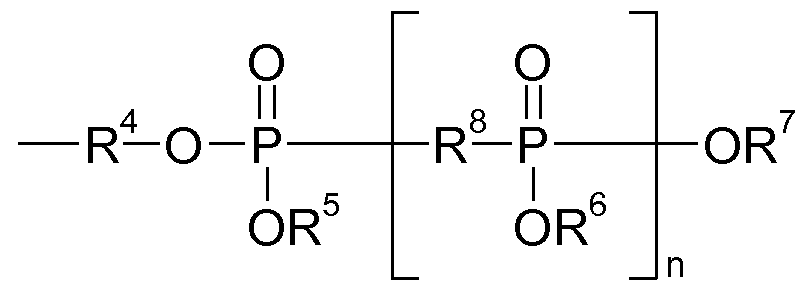
  • R 4 -R 7 is an aromatic radical having 6 to 20 C atoms, preferably a phenyl radical which may be substituted by alkyl groups having 1 to 4 C atoms, preferably methyl,
  • R 8 is a divalent phenol radical, preferred
  • n an average value between 0.1 to 100, preferably 0.5 to 50, in particular 0.8 to 10 and very particularly 1 to 5.
  • cyclic phosphates can also be used. Particularly suitable here is diphenylpentaerythritol diphosphate and phenylneopentyl phosphate.
  • Such polymeric, halogen-free organic phosphorus compounds containing phosphorus in the polymer chain are formed, for example, in the preparation of pentacyclic, unsaturated phosphine dihalides, as described, for example, in DE-A 20 36 173.
  • the molecular weight measured by vapor pressure osmometry in dimethylformamide, the Polyphospholinoxide should be in the range of 500 to 7000, preferably in the range of 700 to 2000.
  • the phosphorus here has the oxidation state -1.
  • inorganic coordination polymers of aryl (alkyl) phosphinic acids such as poly-ß-sodium (l) -methylphenylphosphinat be used. Their preparation is given in DE-A 31 40 520. The phosphorus has the oxidation number +1.
  • halogen-free polymeric phosphorus compounds may be prepared by the reaction of a phosphonic acid chloride, such as a phosphonic acid chloride.
  • a phosphonic acid chloride such as a phosphonic acid chloride.
  • Phenyl, methyl, propyl, styryl and vinylphosphonic dichloride with bifunctional phenols, e.g. Hydroquinone, resorcinol, 2,3,5-trimethylhydroquinone, bisphenol-A, tetramethylbiphenol-A arise.
  • polymeric phosphorus compounds which may be present in the molding compositions according to the invention are prepared by reaction of phosphorus oxytrichloride or phosphoric ester dichlorides with a mixture of mono-, bi- and trifunctional phenols and compounds carrying other hydroxyl groups (see Houben-Weyl-Chem. Müller, Thieme-Verlag Stuttgart, Organic Phosphorus Compounds Part II (1963)).
  • polymeric phosphonates can be prepared by transesterification reactions of phosphonic acid esters with bifunctional phenols (cf., DE-A 29 25 208) or by reactions of phosphonic acid esters with diamines or diamides or hydrazides (cf., US Patent 4,403,075).
  • inorganic poly ammonium phosphate
  • R 1, R 2 is hydrogen, d- to C ⁇ -alkyl, optionally containing a hydroxyl group, preferably d- to C 4 -alkyl, linear or branched, for example methyl, ethyl, n-propyl, iso-propyl, n-butyl, tert-butyl, n-pentyl; phenyl; wherein preferably at least one radical R 1 or R 2 , in particular R 1 and R 2 is hydrogen; R 3 is C 1 -C 10 -alkylene, linear or branched, for example methylene, ethylene, n-propylene, iso-propylene, n-butylene, tert-butylene, n-pentylene, n-octylene, n-dodecylene; Arylene, eg phenylene, naphthylene; Alkylarylene, for example methylphenylene, ethylphenylene,
  • M is an alkaline earth, alkali metal, Al, Zn, Fe, boron;
  • n is an integer of 1 to 3;
  • n is an integer of 1 and 3 and
  • Such products are commercially available e.g. available as calcium phosphinate.
  • Suitable salts of the formula IV or V in which only one radical R 1 or R 2 is hydrogen are, for example, salts of phenylphosphinic acid, their Na and / or Ca salts being preferred.
  • Further preferred salts have a hydroxyl-containing alkyl radical R 1 and / or R 2 . These are obtainable, for example, by hydroxymethylation.
  • Preferred compounds are Ca, Zn and Al salts.
  • the average particle size D50 (measured by the above-described method for particle size determination of component B1)) of component B2) is preferably less than 10 ⁇ m, preferably less than 7 ⁇ m and in particular less than 5 ⁇ m.
  • the Dio value is preferably less than 4 ⁇ m, in particular 3 ⁇ m and very particularly preferably less than 2 ⁇ m.
  • Preferred Dgo values are less than 40 ⁇ m and in particular less than 30 ⁇ m and very particularly preferably less than 20 ⁇ m.
  • R 1 to R 20 independently of one another hydrogen, a linear or branched alkyl group up to 6 C atoms
  • n an average of 0.5 to 50
  • X is a single bond
  • C O, S, SO 2 , C (CH 3 ) 2
  • Preferred compounds B2) are those of the formula VI in which R 1 to R 20 independently of one another are hydrogen and / or a methyl radical.
  • R 1 to R 20 independently of one another are methyl
  • such compounds are preferred in which the radicals R 1 , R 5 , R 6 , R 10 , R 11 , R 15 , R 16 , R 20 in ortho position to the oxygen of the phosphate group represent at least one methyl radical.
  • n in the above formula (VI) is preferably 0.5 to 5, in particular 0.7 to 2 and in particular ⁇ 1 as the average value.
  • n as an average value results from the preparation of the compounds listed above, so that the degree of oligomerization is usually less than 10 and small proportions (usually ⁇ 5 wt .-%) of triphenyl phosphate are contained, this being different from batch to batch.
  • Such compounds B2) are commercially available as CR-741 from Daihachi.
  • a particularly preferred as component B2) mixture consists of red phosphorus and at least one inorganic or organic phosphate, phosphite, phosphonate, phosphate ester or triphenylphosphine oxide.
  • Particularly advantageous are mixtures of red phosphorus and ammonium polyphosphate, of red phosphorus and bisphenol A bis-diphenyl phosphate or of red phosphorus and triphenyl phosphate.
  • a particularly preferred mixture as component B2) comprises red phosphorus and ammonium polyphosphate.
  • Another mixture particularly preferred as component B2) consists of red phosphorus and ammonium polyphosphate and triphenyl phosphate.
  • these molding compositions according to the invention have an improved combination of flame-retardant, mechanical and rheological properties, in particular also a high heat resistance (Vicat). Temperature).
  • the component B2) generally contains from 10 to 90% by weight, preferably from 20 to 80% by weight. %, more preferably 30 to 70% by weight, red phosphorus and
  • the molding compositions contain a fluorine-containing polymer.
  • a fluorine-containing polymer Preference is given to fluorine-containing ethylene polymers. These are polymers of ethylene with a fluorine content of 55 to 76 wt .-%, preferably 70 to 76% by weight.
  • PTFE polytetrafluoroethylene
  • tetrafluoroethylene-hexafluoropropylene copolymers or tetrafluoroethylene copolymers with relatively small proportions (generally up to 50% by weight) of copolymerizable ethylenically unsaturated monomers.
  • fluorine-containing ethylene polymers are homogeneously distributed in the molding compositions and preferably have an average particle size D 5 o in the range of 0.05 to 10 .mu.m, in particular from 0.1 to 5 .mu.m. These small particle sizes can be achieved particularly preferably by using aqueous dispersions of fluorine-containing ethylene polymers and their incorporation into a polymer melt.
  • the proportion by weight of the fluorine-containing polymer B3) based on the total weight of components A) to D) is from 0.01 to 0.5% by weight, preferably from 0.1 to 0.45% by weight. %, more preferably from 0.2 to 0.4 wt .-%.
  • Suitable components C) according to the invention are, for example, polar group-containing, non-particulate rubbers which are crosslinked.
  • preferred components C) are uncrosslinked rubbers containing polar groups, in particular linear rubbers containing polar groups.
  • Polar groups for the purposes of this invention are preferably O- and / or N-containing functional groups, in particular hydroxyl, alkoxy, amino, imino, alkoxycarbonyl, carboxamide and / or carboxy groups, more preferably derived from acrylic acid or maleic acid Acid or ester groups.
  • component C Particularly suitable as component C) are ethylene-acrylate rubbers.
  • Preferred ethylene-acrylate rubbers are copolymers of ethylene and methyl acrylate or, in particular, terpolymers of ethylene, methyl acrylate and an unsaturated carboxylic acid; as the unsaturated carboxylic acid, maleic acid or its half ester, but preferably acrylic acid, are suitable for the preparation of these terpolymers.
  • the ethylene-acrylate rubbers can be used as component C) in an example, with diamines, especially with hexane-1, 6-diamine or 4,4'-methylenedianiline, crosslinked form.
  • ethylene-acrylate rubbers sold under the name Elvaloy ® 1330 EAC (Fa. DuPont) commercially available.
  • thermoplastic molding compositions may contain one or more additives other than components A), B) and C) as component D).
  • plastic additives known to the person skilled in the art and described in the literature are suitable.
  • Plastic additives for the purposes of the present invention are, for example, stabilizers and antioxidants, agents against heat decomposition and decomposition by ultraviolet light, lubricants and mold release agents, dyes and pigments and plasticizers and fibers, for example glass fibers or carbon fibers.
  • Oxidation retarders and heat stabilizers that can be added to the thermoplastic molding composition according to the invention are, for. B. halides of metals of Group I of the Periodic Table, z. For example, sodium, potassium, lithium halides. Furthermore, zinc fluoride and zinc chloride can be used. Further, sterically hindered phenols, hydroquinones, substituted members of this group, secondary aromatic amines, optionally in conjunction with phosphorus-containing acids or their salts, and mixtures of these compounds, preferably in concentrations up to 1 wt .-%, by weight the thermoplastic molding compounds, can be used.
  • UV stabilizers are various substituted resorcinols, salicylates, benzotriazoles and benzophenones, which are generally used in amounts of up to 2 wt .-%, based on the weight of the thermoplastic molding compositions.
  • Lubricants and mold release agents which can generally be added in amounts of up to 1% by weight, based on the weight of the thermoplastic molding compositions, are stearic acid, stearyl alcohol, stearic acid alkyl esters and amides and esters of pentaerythritol with long-chain fatty acids.
  • stearic acid stearyl alcohol
  • stearic acid alkyl esters and amides and esters of pentaerythritol with long-chain fatty acids There may also be salts of calcium, zinc or aluminum of stearic acid and dialkyl ketones, eg. B. distearyl ketone used. Zinc, magnesium and calcium stearates and N, N'-ethylene-bis-stearamide are particularly suitable according to the invention.
  • Suitable glass fibers in the molding compositions according to the invention are all glass fibers known to the person skilled in the art and described in the literature (see, for example, Milewski, JV, Katz, HS "Handbook of Reinforcements for Plastics", p. 233 et seq., Van Nostrand Reinholt Company Ine, 1987 ).
  • thermoplastic molding compositions according to the invention can be prepared by processes known per se, in which the starting components in customary Mixing devices such as screw extruders, Brabender mills or Banbury mills and then extruded. After extrusion, the extrudate can be cooled and comminuted. It is also possible to premix individual components and then to add the remaining starting materials individually and / or likewise mixed. The mixing temperatures are usually 200 to 280 0 C.
  • components B) and C) can be premixed in a first step.
  • the premixing of the entire component B) with at least part of the component C) in melt on a screw extruder can either be formulated and granulated, for example, but they can also be melt blended directly as a melt, for example on the same extruder, in a subsequent second step with component A) and, if appropriate, D).
  • the flame-retardant molding compositions according to the invention based on the vinylaromatic copolymers impact-modified with particulate graft rubbers show, by comparison with the known molding compositions an improved combination of flame retardant, mechanical and rheological properties.
  • the notched impact strength ak was determined according to ISO 179 IeA (F) at 23 ° C.
  • Impact strength a n [kJ / m 2] The notched impact strength a n was determined according to ISO 179 1eU at 23 ° C.
  • melt volume rate MVR 200/5 As a measure of the flowability was the melt volume rate MVR 200/5 according to DIN EN
  • the heat resistance was determined as Vicat softening temperature of standard small bars at a heating rate of 50 K / hour and a force of 49.05 N according to DIN 53460, method B.
  • Afterburn time tN [s]: In the fire test based on UL 94, vertical burning standard, the first afterburner time t1 was measured on bars with a thickness of 1.6 mm after a first flame duration of 10 seconds. After a second flame duration of 10 seconds directly following the extinguishment of the flames, the second afterburn time t2 was measured. The sum of the afterburning times t1 and t2 gives the afterburning time .N (in each case the mean value of the afterburning times determined on two bars .N) is indicated.
  • ABS acrylonitrile-butadiene-styrene copolymer
  • Terluran ® HM O acrylonitrile-butadiene-styrene copolymer
  • BASF SE acrylonitrile-butadiene-styrene copolymer
  • b1-l expanded graphite Nord- Min® 503 from Nordmann, Rassmann, GmbH, with a mean particle size D50 of 465 ⁇ m, a free expansion (starting at about 300 ° C.) of at least 150 ml / g and a bulk density of 0 , 5 g / ml at 20 ° C.
  • b2-l Disflammol ® TP, a triphenyl Lanxess Aktiengesellschaft.
  • b2-ll Nord- Min® JLS, an ammonium polyphosphate from Nordmann, Rassmann, GmbH.
  • b2-lll Exolit ® RP 607, a red phosphorus from Clariant Kunststoff GmbH.
  • Vc-II A commercial BASF SE elastomeric styrene-butadiene-styrene block copolymer, sold under the brand Styroflex® ®.
  • dl Acrawax ® C, a ⁇ commercial h-N'-bis-Ethyien steararnid the company Lonza ine.. d-II: Black Pearls® 880, a commercial carbon black from Cabot Corp.
  • the components A) to D) (respective parts by weight of s. Table 1) were homogenized for determination of the products listed in Table 1 mechanical and rheological properties in a twin-screw extruder ZSK30 of Fa.Werner & Pfleiderer at 220 0 C and injection molded into standard moldings.
  • the components A) to D) were homogenized on a DSM Midiextruder and with an injection molding at 240 0 C melt temperature and 80 0 C mold surface temperature to test specimens according to UL 94, vertical burning standard, extruded with a thickness of 1, 6 mm.
  • the examples show that the novel flame-retardant molding compositions based on impact-modified with particulate graft rubbers vinyl aromatic copolymers compared. known molding compositions have an improved combination of flame retardant, mechanical and rheological properties.

Landscapes

  • Chemical & Material Sciences (AREA)
  • Organic Chemistry (AREA)
  • Health & Medical Sciences (AREA)
  • Chemical Kinetics & Catalysis (AREA)
  • Medicinal Chemistry (AREA)
  • Polymers & Plastics (AREA)
  • Engineering & Computer Science (AREA)
  • Materials Engineering (AREA)
  • Inorganic Chemistry (AREA)
  • General Chemical & Material Sciences (AREA)
  • Compositions Of Macromolecular Compounds (AREA)

Abstract

Die Erfindung betrifft thermoplastische Formmassen enthaltend A) 55 bis 98 Gew.-% mindestens eines mit einem partikelförmigen Pfropfkautschuk schlagzäh modifizierten vinylaromatischen Copolymers, B) 1 bis 44 Gew.-% eines Flammschutzmittels enthaltend B1) einen expandierbaren Graphit, B2) eine Phosphor enthaltende Flammschutz-Verbindung und B3) ein fluorhaltiges Polymer, C) 1 bis 20 Gew.-% eines polare Gruppen enthaltenden, nicht-partikelförmigen Kautschuks, und D) 0 bis 40 Gew.-% weiterer Zusatzstoffe, wobei die Gewichtsprozente jeweils auf das Gesamtgewicht der Komponenten A) bis D) bezogen sind und zusammen 100 Gew.-% ergeben, sowie Verfahren zur Herstellung derartiger Formmassen, die Verwendung derartiger Formmassen zur Herstellung von Formkörpern, Fasern, Schäumen und Folien sowie die hierbei erhältlichen Formkörpern, Fasern, Schäume und Folien.

Description

Kautschukmodifizierte flammgeschützte Formmassen
Beschreibung
Die Erfindung betrifft thermoplastische Formmassen enthaltend
A) 55 bis 98 Gew.-% mindestens eines mit einem partikelförmigen Pfropfkautschuk schlagzäh modifizierten vinylaromatischen Copolymers,
B) 1 bis 44 Gew.-% eines Flammschutzmittels enthaltend B1 ) einen expandierbaren Graphit,
B2) eine Phosphor enthaltende Flammschutz-Verbindung, und B3) ein fluorhaltiges Polymer,
C) 1 bis 20 Gew.-% eines polare Gruppen enthaltenden, nicht-partikelförmigen Kautschuks, und D) 0 bis 40 Gew.-% weiterer Zusatzstoffe,
wobei die Gewichtsprozente jeweils auf das Gesamtgewicht der Komponenten A) bis
D) bezogen sind und zusammen 100 Gew.-% ergeben.
Außerdem betrifft die vorliegende Erfindung Verfahren zur Herstellung derartiger
Formmassen, die Verwendung derartiger Formmassen zur Herstellung von Formkörpern, Fasern, Schäumen und Folien sowie die hierbei erhältlichen Formkörpern, Fasern, Schäume und Folien.
Expandierbaren Graphit, der auch als Blähgraphit bezeichnet wird, als Flammschutzmittel in Polystyrol („PS") oder schlagzäh modifiziertem Polystyrol („HIPS") einzusetzen ist beispielsweise aus WO 03/046071 A1 bekannt. Darüberhinaus wird laut dieser Schrift als weitere Flammschutzmittelkomponente eine halogenhaltige Verbindung in Mengen von 2 bis 1 1 %, gerechnet als Halogen, benötigt. Aus beispielsweise toxikologischen Gründen ist es jedoch wünschenswert, den Einsatz halogenhaltiger Flammschutzmittel möglichst weitgehend zu vermeiden.
Halogenfrei flammgeschützte Styrolpolymerisate, die expandierbaren Graphit und eine Phosphorverbindung als Flammschutzkomponenten enthalten werden in WO 00/34367 und WO 00/34342 offenbart. Formmassen auf Basis solcherart flammgeschützter Styrolpolymerisate sind bzgl. ihres Abtropfverhaltens im Brandfall aber verbesserungswürdig.
WO 2005/103136 offenbart flammgeschützte Styrolpolymere die neben expandierba- rem Graphit und einer Phosphorverbindung ein weiteres Coadditiv enthalten, welches die Migration des phosphorhaltigen Flammschutzmittels an die Polymeroberfläche unterdrücken soll. Explizit als Coadditiv genannt wird Polycarbonat. Die KR1996-0001006 offenbart flammgeschütztes Polystyrol, wobei die Flammschutzmittelkomponenten expandierbaren Graphit, eine Phosphorverbindung und Teflon umfassen. Die mittlere Teilchengröße des expandierbaren Graphits beträgt 5 μm. Das als Antitropfmittel zugesetzte Teflon wird in Mengen von 1 bis 5 Gewichtsprozent einge- setzt. Die so erhaltenen halogenfrei flammgeschützten Formmassen besitzen eine gute Wärmebeständigkeit und Stoßfestigkeit.
Die Patentanmeldung EP 07112183.4 (Aktenzeichen) beschreibt Acrylnitril-Styrol- Acrylat-Polymerisate („ASA") und Acrylnitril-Butadien-Styrol-Polymerisate („ABS"), die mit einem Flammschutzmittelsystem enthaltend expandierbaren Graphit, eine Phosphorverbindung und Teflon ausgerüstet sind, und die darüberhinaus lineare Styrol- Butadien-Blockcopolymere enthalten.
Aufgabe der vorliegenden Erfindung war es, flammhemmend ausgerüstete Formmas- sen bereitzustellen, die auf mit partikelförmigen Pfropfkautschuken schlagzäh modifizierten vinylaromatischen Copolymeren basieren, insbesondere auf ASA und/oder ABS, und die gegenüber bekannten Formmassen eine verbesserte Kombination von flammhemmenden, mechanischen und rheologischen Eigenschaften besitzen.
Demgemäß wurden die eingangs definierten Formmassen gefunden, wobei erfindungswesentlich ist, daß diese 1 bis 20 Gew.-%, bezogen auf das Gesamtgewicht der Komponenten A) bis D), eines polare Gruppen enthaltenden, nicht-partikelförmigen Kautschuks enthalten.
Die erfindungsgemäßen flammhemmend ausgerüsteten Formmassen basierend auf mit partikelförmigen Pfropfkautschuken schlagzäh modifizierten vinylaromatischen Copolymeren weisen ggü. bekannten Formmassen eine verbesserte Kombination von flammhemmenden, mechanischen und rheologischen Eigenschaften auf.
Die erfindungsgemäßen Formmassen sowie die weiteren erfindungsgemäßen Verfahren und Gegenstände werden im folgenden beschrieben.
Die erfindungsgemäßen Formmassen enthalten
A) 55 bis 98 Gew.-%, bevorzugt 57 bis 92 Gew.-%, besonders bevorzugt 60 bis 85 Gew.-%, Komponente A,
B) 1 bis 44 Gew.-%, bevorzugt 5 bis 40 Gew.-%, besonders bevorzugt 10 bis 35 Gew.-%, Komponente B,
C) 1 bis 20 Gew.-%, bevorzugt 3 bis 18 Gew.-%, besonders bevorzugt 5 bis 15 Gew.-% Komponente C, und
D) 0 bis 40 Gew.-%, bevorzugt 0 bis 30 Gew.-%, besonders bevorzugt 0 bis 25 Gew.-% Komponente D, wobei die Gewichtsprozente jeweils auf das Gesamtgewicht der Komponenten A) bis D) bezogen sind und zusammen 100 Gew.-% ergeben.
Die Flammschutzmittelkomponente B) umfaßt insbesondere
B1 ) 20 bis 79,99 Gew.-%, bevorzugt 30 bis 69,9 Gew.-%, besonders bevorzugt 40 bis 59,5 Gew.-%, der Komponente B1 ),
B2) 20 bis 79,99 Gew.-%, bevorzugt 30 bis 69,9 Gew.-%, besonders bevorzugt 40 bis 59,5 Gew.-%, der Komponente B2) und
B3) 0,01 bis 4 Gew.-%, bevorzugt 0,1 bis 3 Gew.-%, besonders bevorzugt 0,5 bis 2 Gew.-%, der Komponente B3),
wobei die Gewichtsprozente jeweils auf das Gesamtgewicht der Komponenten B1) bis B3) bezogen sind und zusammen 100 Gew.-% ergeben.
Komponente A):
Als Komponente A sind grundsätzlich alle mit einem partikelförmigen Pfropfkautschuk schlagzäh modifizierte vinylaromatische Copolymere geeignet. Diese mit einem partikelförmigen Pfropfkautschuk schlagzäh modifizierten vinylaromatischen Copolymere und ihre Herstellung sind dem Fachmann bekannt, in der Literatur beschrieben (beispielsweise in A. Echte, Handbuch der technischen Polymerchemie, VCH Verlagsgesellschaft, Weinheim, 1993; und Saechtling, Kunststoff Taschenbuch, Carl Hanser Ver- lag, München, 29. Ausgabe, 2004) und kommerziell verfügbar.
Bevorzugte Komponenten A) enthalten als Kautschukphase einen partikelförmigen Pfropfkautschuk und als thermoplastische Hartphase Copolymerisate aus vinylaromatischen Monomeren und Vinylcyaniden (SAN), insbesondere aus α-Methylstyrol und Acrylnitril, besonders bevorzugt aus Styrol und Acrylnitril.
Die Komponente A) enthält in der Regel 15 bis 60 Gew.-%, bevorzugt 25 bis 55 Gew.- %, insbesondere 30 bis 50 Gew.-%, partikelförmigen Pfropfkautschuk und 40 bis 85 Gew.-%, bevorzugt 45 bis 75 Gew.-%, insbesondere 50 bis 70 Gew.-%, vinylaromati- sehe Copolymere, wobei die Gewichtsprozente jeweils auf das Gesamtgewicht aus partikelförmigen Pfropfkautschuk und vinylaromatischem Copolymer bezogen sind und zusammen 100 Gew.-% ergeben.
Bevorzugt werden als mit einem partikelförmigen Pfropfkautschuk schlagzähmodifizier- tes SAN Acrylnitril-Styrol-Acrylat-Polymerisate („ASA") und/oder Acrylnitril-Butadien- Styrol-Polymerisate („ABS") eingesetzt, sowie (Meth)acrylat-Acrylnitril-Butadien-Styrol- Polymerisate ("MABS", transparentes ABS), aber auch Blends von SAN, ABS, ASA und MABS mit anderen Thermoplasten wie Polycarbonat, Polyamid, Polyethylente- rephthalat, Polybutylenterephthalat, Polyvinylchlorid, Polyolefinen, ganz besonders bevorzugt mit Polycarbonat.
Unter ASA-Polymerisaten werden im allgemeinen mit einem partikelförmigen Pfropfkautschuk schlagzähmodifizierte SAN-Polymerisate verstanden, bei denen kautschukelastische Pfropfcopolymerisate von vinylaromatischen Verbindungen, insbesondere Styrol, und Vinylcyaniden, insbesondere Acrylnitril, auf Polyalkylacrylatkautschuken in einer Copolymermatrix aus insbesondere Styrol und/oder α-Methylstyrol und Acrylnitril vorliegen. ASA-Polymerisate und ihre Herstellung sind dem Fachmann bekannt und in der Literatur beschriebenen, beispielsweise in DIN EN ISO 6402-1 DE vom Februar 2003, WO 02/00745, WO 00/1 1080, EP-A 450 485 und WO 2007/031445.
Unter ABS-Polymerisaten werden im allgemeinen schlagzähmodifizierte SAN- Polymerisate verstanden, bei denen Dien-Polymerisate, insbesondere 1 ,3- Polybutadien, in einer Copolymermatrix aus insbesondere Styrol und/oder α- Methylstyrol und Acrylnitril vorliegen. ABS-Polymerisate und ihre Herstellung sind dem Fachmann bekannt und in der Literatur beschriebenen, beispielsweise in DIN EN ISO 2580-1 DE vom Februar 2003, WO 02/00745 und WO 2008/020012.
Komponente B):
Die thermoplastischen Formmassen enthalten als Komponente B) erfindungsgemäß eine Flammschutzmittelmischung enthaltend
B1 ) expandierbaren Graphit,
B2) eine Phosphor enthaltende Flammschutzverbindung und
B3) ein fluorhaltiges Polymer.
Die erfindungsgemäßen Formmassen enthalten als Komponente B1) dem Fachmann bekannten und in der Literatur beschriebenen expandierbaren Graphit, sogenannten Blähgraphit (wärme- bzw. hitzeexpandierbarer Graphit). Dieser leitet sich in der Regel von natürlichem oder künstlichem Graphit ab.
Der Blähgraphit ist beispielsweise erhältlich durch Oxidation von natürlichem und/oder künstlichem Graphit. Als Oxidationsagentien können H2O2 oder Salpetersäure in Schwefelsäure eingesetzt werden.
Weiterhin kann der Blähgraphit durch Reduktion, z.B. mit Natriumnaphthalenid in ei- nem aprotischen organischen Lösungsmittel hergestellt werden. Aufgrund seiner Schichtgitterstruktur ist Graphit in der Lage, spezielle Formen von Einlagerungsverbindungen zu bilden. In diesen so genannten Zwischengitterverbindungen sind Fremdatome oder -moleküle in z.T. stöchiometrischen Verhältnissen in die Räume zwischen den Kohlenstoffatomen aufgenommen worden.
Die Oberfläche des Blähgraphits kann zur besseren Verträglichkeit ggü. der Thermoplastmatrix mit einem Beschichtungsmittel beschichtet sein, beispielsweise mit dem Fachmann bekannten Silanschlichten.
Für den Fall, dass der Blähgraphit durch o.g. Oxidation erhalten wurde, kann es notwendig sein, eine alkalische Verbindung zuzusetzen, da der Blähgraphit (durch die enthaltende Säure) ansonsten Korrosion der Formmassen und/oder Lager- und Herstellapparate derartiger Formmassen verursachen kann. Insbesondere Alkaliverbindungen sowie Mg(OH)2 oder AI-Hydroxide können in Mengen bis zu 10, vorzugsweise bis zu 5 Gew.-% (bezogen auf 100 Gew.-% B1 ) zugegeben werden. Vorteilhaft erfolgt die Mischung bevor die Komponenten compoundiert werden.
Vorzugsweise beträgt die Hitze-Ausdehnung des Blähgraphits bei schnellem Aufheizen von Raumtemperatur auf 8000C (in Richtung der c-Achse des Kristalls) mindestens 100 ml/g, vorzugsweise mindestens 1 10 ml/g (sog. spezifische Volumenänderung).
Wesentlich für die Eignung als Flammschutzmittel ist es, dass der Blähgraphit sich nicht in größerem Ausmaß ausdehnt bei Temperaturen unter 2700C, bevorzugt unter 2800C. Darunter versteht der Fachmann, dass der Blähgraphits bei den genannten Temperaturen in einem Zeitraum von 10 min eine Volumenexpansion von weniger als 20 % erfährt.
Der Ausdehnungskoeffizient (als spezifische Kerngröße) bedeutet in der Regel die Differenz zwischen dem spezifischen Volumen (ml/g) nach Erhitzen und dem spezifischen Volumen bei 200C Raumtemperatur. Dies wird allgemein gemessen nach folgender Vorschrift: Ein Quarzbehälter wird auf 10000C in einem elektrischen Schmelzeofen erhitzt. 2 g des Blähgraphits werden schnell in den Quarzbehälter gegeben und dieser 10 sec. im Schmelzeofen belassen.
Das Gewicht von 100 ml des expandierten Graphits wird gemessen, um die sog. „loo- sened apparent specific gravity" zu bestimmen. Der Kehrwert bildet dann das spezifische Volumen bei dieser Temperatur. Das spezifische Volumen bei Raumtemperatur wird entsprechend bei 20°C gemessen. (Ausdehnungskoeffizient = spez. Volumen nach Erhitzen - spezifisches Volumen bei 20°C).
Die mittlere Teilchengröße D50 des Blähgraphits soll vorzugsweise zwischen 10 μm und 1000 μm, bevorzugt zwischen 30 μm und 850 μm, insbesondere bevorzugt zwi- sehen 200 μm und 700 μm, liegen. Sind die mittleren Teilchengrößen niedriger, wird in der Regel keine ausreichend Flammschutzwirkung erzielt; sind sie größer, werden üblicherweise die mechanischen Eigenschaften der thermoplastischen Formmassen nachteilig beeinflußt.
Die mittlere Teilchengröße und die Teilchengrößenverteilung des Blähgraphits B1 ) kann aus der integralen Volumenverteilung bestimmt werden. Bei den mittleren Teilchengrößen handelt es sich in allen Fällen um das Volumenmittel der Teilchengrößen, wie sie mittels Laserlichtbeugung an einem Malvern-Mastersizer 2000 am Trockenpul- ver ermittelt werden. Die Laserlichtbeugung liefert die integrale Verteilung des Teilchendurchmessers einer Probe. Hieraus läßt sich entnehmen, wieviel Prozent der Teilchen einen Durchmesser gleich oder kleiner einer bestimmten Größe haben. Der mittlere Teilchendurchmesser, der auch als Dso-Wert der integralen Volumenverteilung bezeichnet wird, ist dabei als der Teilchendurchmesser definiert, bei dem 50 Gew.-% der Teilchen einen kleineren Durchmesser haben als der Durchmesser, der dem Dso- Wert entspricht. Ebenso haben dann 50 Gew.-% der Teilchen einen größeren Durchmesser als der D5o-Wert.
Die Dichte des Blähgraphits liegt üblicherweise im Bereich von 0,4 bis 2 g/cm3.
Bei den phosphorhaltigen Verbindungen der Komponente B2) handelt es sich um organische und anorganische Phosphor enthaltende Verbindungen, in denen der Phosphor die Wertigkeitsstufe -3 bis +5 besitzt. Unter der Wertigkeitsstufe soll der Begriff "Oxidationsstufe" verstanden werden, wie er im Lehrbuch der Anorganischen Chemie von A.F. Hollemann und E. Wiberg, Walter des Gruyter und Co. (1964, 57. bis 70. Auflage), Seite 166 bis 177, wiedergegeben ist. Phosphorverbindungen der Wertigkeitsstufen -3 bis +5 leiten sich von Phosphin (-3), Diphosphin (-2), Phosphinoxid (-1 ), elementarem Phosphor (+0), hypophosphoriger Säure (+1), phosphoriger Säure (+3), Hy- podiphosphorsäure (+4) und Phosphorsäure (+5) ab.
Aus der großen Zahl von als Komponente B2) geeigneten phosphorhaltigen Verbindungen, insbesondere den anorganischen oder organischen Phosphaten, Phosphiten, Phosphonaten, Phosphatestern, rotem Phosphor und Triphenylphosphinoxid, seien nur einige Beispiele erwähnt.
Beispiele für Phosphorverbindungen der Phosphin-Klasse, die die Wertigkeitsstufe -3 aufweisen, sind aromatische Phosphine, wie Triphenylphosphin, Tritolylphosphin, Tri- nonylphosphin, Trinaphthylphosphin und Trisnonylphenylphosphin u.a. Besonders geeignet ist Triphenylphosphin. Beispiele für Phosphorverbindungen der Diphosphinklasse, die die Wertigkeitsstufe -2 aufweisen, sind Tetraphenyldiphosphin, Tetranaphthyldiphosphin u.a.. Besonders geeignet ist Tetranaphthyldiphosphin.
Phosphorverbindungen der Wertigkeitsstufe -1 leiten sich vom Phosphinoxid ab.
Geeignet sind Phosphinoxide der allgemeinen Formel I j
R1
Rz— P =O
/
R3
wobei R1, R2 und R3 in Formel I gleiche oder verschiedene Alkyl-, Aryl-, Alkylaryl- oder Cycloalkylgruppen mit 8 bis 40 C-Atomen bedeuten.
Beispiele für Phosphinoxide sind Triphenylphosphinoxid, Tritolylphosphinoxid, Trisno- nylphenylphosphinoxid, Tricyclohexylphosphinoxid, Tris-(n-butyl)-phosphinoxid, Tris- (n-hexyl)-phosphinoxid, Tris-(n-octyl)-phosphinoxid, Tris-(cyanoethyl)-phosphinoxid, Benzylbis-(cyclohexyl)-phosphinoxid, Benzylbisphenylphosphinoxid, Phenylbis-(n- hexyl)-phosphinoxid. Bevorzugt sind weiterhin oxidierte Umsetzungsprodukte aus Phosphin mit Aldehyden, insbesondere aus t-Butylphosphin mit Glyoxal. Besonders bevorzugt eingesetzt werden Triphenylphosphinoxid, Tricyclohexlyphosphinoxid, Tris- (n-octyl)-phosphinoxid und Tris-(cyanoethyl)-phosphinoxid, insbesondere Triphenylphosphinoxid.
Ebenso geeignet ist Triphenylphosphinsulfid und dessen wie oben beschriebene Deri- vate der Phosphinoxide.
Phosphor der Wertigkeitsstufe +0 ist der elementare Phosphor. In Frage kommen roter und schwarzer Phosphor. Bevorzugt ist roter Phosphor, insbesondere oberflächenbeschichteter roter Phosphor, wie er dem Fachmann bekannt, in der Literatur beschrie- ben und als Flammschutzmittel für Polymere kommerziell verfügbar ist.
Phosphorverbindungen der "Oxidationsstufe" +1 sind z.B. Hypophosphite rein organischer Natur, z.B. organische Hypophosphite, wie Cellulosehypophosphitester, Ester der hypophosphorigen Säuren mit Diolen, wie z.B. von 1 ,10-Dodecyldiol. Auch substi- tuierte Phosphinsäuren und deren Anhydride, wie z.B. Diphenylphosphinsäure, können eingesetzt werden. Des weiteren kommen in Frage Diphenylphosphinsäure, Di-p- Tolylphosphinsäure, Di-Kresylphosphinsäureanhydrid, Es kommen aber auch Verbindungen wie Hydrochinon-, Ethylenglykol-, Propylenglykol-bis(diphenylphosphinsäure)- ester u.a. in Frage. Ferner sind geeignet Aryl(Alkyl)phosphinsäureamide, wie z.B. Diphenylphosphinsäure-dimethylamid und Sulfonamidoaryl(alkyl)phosphinsäure- derivate, wie z.B. p-Tolylsulfonamidodiphenylphosphinsäure. Bevorzugt eingesetzt werden Hydrochinon- und Ethylenglykol-bis-(diphenylphosphinsäure)ester und das Bisdiphenylphosphinat des Hydrochinons.
Phosphorverbindungen der Oxidationsstufe +3 leiten sich von der phosphorigen Säure ab. Geeignet sind cyclische Phosphonate, die sich vom Pentaerythrit, Neopentylglykol oder Brenzkatechin ableiten wie z.B. Verbindungen gemäß Formel Il
Figure imgf000009_0001
wobei R einen Ci bis C4-Alkylrest, bevorzugt Methylrest, x=0 oder 1 bedeutet (Am- gard® P 45 der Firma Albright & Wilson).
Ferner ist Phosphor der Wertigkeitsstufe +3 in Triaryl(alkyl)phosphiten, wie z.B.
Triphenylphosphit, Tris(4-decylphenyl)phosphit, Tris(2,4-di-tert.-butylphenyl)phosphit oder Phenyldidecylphosphit u.a. enthalten. Es kommen aber auch Diphosphite, wie z.B. Propylenglykol-1 ,2-bis(diphosphit) oder cyclische Phosphite, die sich vom Pentaerythrit, Neopentylglykol oder Brenzkatechin ableiten, in Frage.
Besonders bevorzugt werden Methylneopentylglycolphosphonat und -phosphit sowie Dimethylpentaerythritdiphosphonat und -phosphit.
Als Phosphorverbindungen der Oxidationsstufe +4 kommen vor allem Hypodiphospha- te, wie z.B. Tetraphenylhypodiphosphat oder Bisneopentylhypodiphosphat in Betracht.
Als Phosphorverbindungen der Oxidationsstufe +5 kommen vor allem alkyl- und aryl- substituierte Phosphate in Betracht. Beispiele sind Phenylbisdodecylphosphat, Pheny- lethylhydrogenphosphat, Phenyl-bis(3,5,5-trimethylhexyl)phosphat, Ethyldiphe- nylphosphat, 2-Ethylhexyldi(tolyl)phosphat, Diphenylhydrogenphosphat, Bis(2- ethylhexyl)-p-tolylphosphat, Tritolylphosphat, Bis(2-ethylhexyl)-phenylphosphat, Di(nonyl)phenylphosphat, Phenylmethylhydrogenphosphat, Di(dodecyl)-p- tolylphosphat, p-Tolyl-bis(2,5,5-trimethylhexyl)phosphat oder 2-Ethylhexyldiphenyl- phosphat. Besonders geeignet sind Phosphorverbindungen, bei denen jeder Rest ein Aryloxi-Rest ist. Ganz besonders geeignet ist Triphenylphosphat und Resorcinol-bis- (diphenylphosphat) und dessen kernsubstituierten Derivate der allgemeinen Formel III (RDP):
Figure imgf000010_0001
in der die Substituenten in Formel III folgende Bedeutung haben:
R4-R7 ein aromatischer Rest mit 6 bis 20 C-Atomen, bevorzugt ein Phenylrest, welcher mit Alkylgruppen mit 1 bis 4 C-Atomen bevorzugt Methyl, substituiert sein kann,
R8 ein zweiwertiger Phenolrest, bevorzugt
Figure imgf000010_0002
und n einen Durchschnittswert zwischen 0,1 bis 100, bevorzugt 0,5 bis 50, insbesonde- re 0,8 bis 10 und ganz besonders 1 bis 5.
Die im Handel erhältlichen RPD-Produkte unter dem Warenzeichen Fyroflex®oder Fyrol®-RDP (Akzo) sowie CR 733-S (Daihachi) sind bedingt durch das Herstellungsverfahren Gemische aus ca. 85 % RDP (n=1 ) mit ca. 2,5 % Triphenylphosphat sowie ca. 12,5 % oligomeren Anteilen, in denen der Oligomerisierungsgrad meist kleiner 10 beträgt.
Des weiteren können auch cyclische Phosphate eingesetzt werden. Besonders geeignet ist hierbei Diphenylpentaerythritdiphosphat und Phenylneopentylphosphat.
Außer den oben angeführten niedermolekularen Phosphorverbindungen kommen noch oligomere und polymere Phosphorverbindungen in Frage.
Solche polymeren, halogenfreien organischen Phosphorverbindungen mit Phosphor in der Polymerkette entstehen beispielsweise bei der Herstellung von pentacyclischen, ungesättigten Phosphindihalogeniden, wie beispielsweise in der DE-A 20 36 173 beschrieben ist. Das Molekulargewicht gemessen durch Dampfdruckosmometrie in Di- methylformamid, der Polyphospholinoxide soll im Bereich von 500 bis 7000, vorzugsweise im Bereich von 700 bis 2000 liegen.
Das Phosphor besitzt hierbei die Oxidationsstufe -1. Ferner können anorganische Koordinationspolymere von Aryl(alkyl)-phosphinsäuren wie z.B. Poly-ß-natrium(l)-methylphenylphosphinat eingesetzt werden. Ihre Herstellung wird in DE-A 31 40 520 angegeben. Der Phosphor besitzt die Oxidationszahl +1.
Weiterhin können solche halogenfreien polymeren Phosphorverbindungen durch die Reaktion eines Phosphonsäurechlorids, wie z.B. Phenyl-, Methyl-, Propyl-, Styryl- und Vinylphosphonsäuredichlorid mit bifunktionellen Phenolen, wie z.B. Hydrochinon, Re- sorcin, 2,3,5-Trimethylhydrochinon, Bisphenol-A, Tetramethylbiphenol-A entstehen.
Weitere halogenfreie polymere Phosphorverbindungen, die in den erfindungsgemäßen Formmassen enthalten sein können, werden durch Reaktion von Phosphoroxidtrichlo- rid oder Phosphorsäureesterdichloriden mit einem Gemisch aus mono-, bi- und trifunk- tionellen Phenolen und anderen Hydroxylgruppen tragenden Verbindungen hergestellt (vgl. Houben-Weyl-Müller, Thieme-Verlag Stuttgart, Organische Phosphorverbindungen Teil Il (1963)). Ferner können polymere Phosphonate durch Umesterungsreaktio- nen von Phosphonsäureestern mit bifunktionellen Phenolen (vgl. DE-A 29 25 208) oder durch Reaktionen von Phosphonsäureestern mit Diaminen oder Diamiden oder Hydraziden (vgl. US-PS 4 403 075) hergestellt werden. In Frage kommt aber auch das anorganische Poly(ammoniumphosphat).
Es können auch oligomere Pentaerythritphosphite, -phosphate und -phosphonate gemäß EP-B 8 486, z.B. Mobil Antiblaze® 19 (eingetragene Marke der Firma Mobil OiI), verwendet werden (s. Formeln IV und V):
Figure imgf000011_0001
O O
— O-P-R-P-O M. V
R' K
wobei die Substituenten in den Formeln IV und V folgende Bedeutung haben:
R1, R2 Wasserstoff, d- bis Cβ-Alkyl, der gegebenenfalls eine Hydroxylgruppe enthält, vorzugsweise d- bis C4-AIkVl, linear oder verzweigt, z.B. Methyl, Ethyl, n-Propyl, iso-Propyl, n-Butyl, tert.-Butyl, n-Pentyl; Phenyl; wobei bevorzugt mindestens ein Rest R1 oder R2, insbesondere R1 und R2 Wasserstoff ist; R3 Cr bis C-io-Alkylen, linear oder verzweigt, z.B. Methylen, Ethylen, n-Propylen, iso-Propylen, n-Butylen, tert.-Butylen, n-Pentylen, n-Octylen, n-Dodecylen; Arylen, z.B. Phenylen, Naphthylen; Alkylarylen, z.B. Methyl-phenylen, Ethyl-phenylen, tert.-Butyl-phenylen, Methyl- naphthylen, Ethyl-naphthylen, tert.-Butyl-naphthylen; Arylalkylen, z.B. Phenyl-methylen, Phenyl-ethylen, Phenyl-propylen, Phenyl-butylen;
M ein Erdalkali-, Alkalimetall, AI, Zn, Fe, Bor;
m eine ganze Zahl von 1 bis 3;
n eine ganze Zahl von 1 und 3 und
x 1 oder 2.
Besonders bevorzugt sind Verbindungen der Formel IV, in denen R1 und R2 Wasserstoff ist, wobei M vorzugsweise Ca, Zn oder AI ist und Calciumphosphinat als Verbindung ganz besonders bevorzugt ist.
Derartige Produkte sind im Handel z.B. als Calciumphosphinat erhältlich.
Geeignete Salze der Formel IV oder V, in denen nur ein Rest R1 oder R2 Wasserstoff bedeutet, sind z.B. Salze der Phenylphosphinsäure, wobei deren Na- und/oder Ca- Salze bevorzugt sind.
Weiterhin bevorzugte Salze weisen einen hydroxylgruppenhaltigen Alkylrest R1 und/oder R2 auf. Diese sind beispielsweise durch Hydroxymethylierung erhältlich. Bevorzugte Verbindungen sind Ca, Zn und AI-Salze.
Die mittlere Teilchengröße D50 (gemessen nach der oben beschriebenen Methode zur Teilchengrößenbestimmung der Komponente B1)) der Komponente B2) ist vorzugsweise kleiner 10 μm, vorzugsweise kleiner 7 μm und insbesondere kleiner 5 μm. Der Dio-Wert ist vorzugsweise kleiner 4 μm, insbesondere 3 μm und ganz besonders bevorzugt kleiner 2 μm.
Bevorzugte Dgo-Werte sind kleiner 40 μm und insbesondere kleiner 30 μm und ganz besonders bevorzugt kleiner 20 μm.
Weiterhin bevorzugt sind Phosphorverbindungen der allgemeinen Formel VI:
Figure imgf000013_0001
wobei die Substituenten in Formel VI folgende Bedeutung haben:
R1 bis R20 unabhängig voneinander Wasserstoff, eine lineare oder verzweigte Al- kylgruppe bis zu 6 C-Atomen
n einen Durchschnittswert von 0,5 bis 50 und
X eine Einfachbindung, C=O, S, SO2, C(CH3)2
Bevorzugte Verbindungen B2) sind solche der Formel VI, in denen R1 bis R20 unabhängig voneinander Wasserstoff und/oder einen Methylrest bedeuten. Für den Fall, daß R1 bis R20 unabhängig voneinander einen Methylrest bedeuten, sind solche Ver- bindungen bevorzugt, in welchen die Reste R1, R5, R6, R10, R11, R15, R16, R20 in ortho Stellung zum Sauerstoff der Phosphatgruppe mindestens einen Methylrest darstellen. Weiterhin bevorzugt sind Verbindungen B2) in denen pro aromatischem Ring eine Methylgruppe, vorzugsweise in ortho-Stellung vorhanden ist und die anderen Reste Wasserstoff bedeuten.
Insbesondere bevorzugt sind als Substituenten SO2 und S, sowie ganz besonders bevorzugt C(CHs)2 für X in obiger Formel (VI).
n beträgt in obiger Formel (VI) vorzugsweise als Durchschnittswert 0,5 bis 5, insbeson- dere 0,7 bis 2 und insbesondere « 1.
Die Angabe von n als Durchschnittswert ergibt sich durch das Herstellverfahren der oben aufgeführten Verbindungen, so daß der Oligomerisierungsgrad meist kleiner 10 beträgt und geringe Anteile (meist < 5 Gew.-%) an Triphenylphosphat enthalten sind, wobei dies von Charge zu Charge unterschiedlich ist. Solche Verbindungen B2) sind als CR - 741 der Firma Daihachi im Handel erhältlich.
Als ganz besonders bevorzugte Ausführungsform der Erfindung hat sich der Einsatz einer Mischung aus rotem Phosphor und mindestens einer der oben beschriebenen, von rotem Phosphor verschiedenen Phosphorverbindungen als Komponente B2) erwiesen. Eine insbesonders als Komponente B2) bevorzugte Mischung besteht aus rotem Phosphor und mindestens einem anorganischen oder organischen Phosphat, Phosphit, Phosphonat, Phosphatester oder Triphenylphosphinoxid. Besonders vorteil- haft sind Mischungen aus rotem Phosphor und Ammoniumpolyphosphat, aus rotem Phosphor und Bisphenol-A-bis-diphenylphosphat oder aus rotem Phosphor und Triphe- nylphosphat. Eine ganz besonders als Komponente B2) bevorzugte Mischung umfaßt roten Phosphor und Ammoniumpolyphosphat. Eine weitere ganz besonders als Komponente B2) bevorzugte Mischung besteht aus rotem Phosphor und Ammoniumpo- lyphosphat und Triphenylphosphat.
Wenn als Komponente B2) die genannte Mischung aus rotem Phosphor und aus mindestens einer der oben beschriebenen, von rotem Phosphor verschiedenen Phosphorverbindungen eingesetzt wird, weisen diese erfindungsgemäßen Formmassen eine verbesserte Kombination von flammhemmenden, mechanischen und rheologischen Eigenschaften, insbesondere auch eine hohe Wärmeformbeständigkeit (Vicat- Temperatur), auf.
Wenn als Komponente B2) die genannten Mischungen aus rotem Phosphor und min- destens einer der oben beschriebenen, von rotem Phosphor verschiedenen Phosphorverbindungen eingesetzt werden, enthält die Komponente B2) in der Regel 10 bis 90 Gew.-%, bevorzugt 20 bis 80 Gew.-%, besonders bevorzugt 30 bis 70 Gew.- %, roten Phosphor und
10 bis 90 Gew.-%, bevorzugt 20 bis 80 Gew.-%, besonders bevorzugt 30 bis 70 Gew.- %, mindestens einer der oben beschriebenen, von rotem Phosphor verschiedenen Phosphorverbindungen wobei die Gewichtsprozente von rotem Phosphor und der mindestens einen oben beschriebenen, von rotem Phosphor verschiedenen Phosphorverbindung jeweils auf das Gesamtgewicht der Komponente B2) bezogen sind und zusammen 100 Gew.-% erge- ben.
Als Komponente B3) enthalten die Formmassen ein fluorhaltiges Polymer. Bevorzugt sind fluorhaltige Ethylenpolymerisate. Hierbei handelt es sich um Polymerisate des Ethylens mit einem Fluorgehalt von 55 bis 76 Gew.-%, vorzugsweise 70 bis 76 Gew.- %.
Beispiele hierfür sind Polytetrafluorethylen (PTFE), Tetrafluorethylen-hexafluor- propylen-Copolymere oder Tetrafluorethylen-Copolymerisate mit kleineren Anteilen (in der Regel bis zu 50 Gew.-%) copolymerisierbarer ethylenisch ungesättigter Mono- merer. Diese werden z.B. von Schildknecht in "Vinyl and Related Polymers", Wiley- Verlag, 1952, Seite 484 bis 494 und von Wall in "Fluorpolymers" (Wiley Interscience, 1972) beschrieben. Diese fluorhaltigen Ethylenpolymerisate liegen homogen verteilt in den Formmassen vor und weisen bevorzugt eine mittlere Teilchengröße D5o im Bereich von 0,05 bis 10 μm, insbesondere von 0,1 bis 5 μm auf. Diese geringen Teilchengrößen lassen sich besonders bevorzugt durch Verwendung von wässrigen Dispersionen von fluorhaltigen Ethylenpolymerisaten und deren Einarbeitung in eine Polymerschmelze erzielen.
In einer bevorzugten Ausführungsform der Erfindung beträgt der Gewichtsanteil des fluorhaltigen Polymers B3) bezogen auf das Gesamtgewicht der Komponenten A) bis D) von 0,01 bis 0,5 Gew.-%, bevorzugt von 0,1 bis 0,45 Gew.-%, besonders bevorzugt von 0,2 bis 0,4 Gew.-%.
Komponente C):
Als Komponente C) sind grundsätzlich alle dem Fachmann bekannten und in der Literatur beschriebenen polaren Gruppen enthaltende, nicht-partikelförmige Kautschuke geeignet. Als erfindungsgemäß geeignete Komponenten C) sind beispielsweise polare Gruppen enthaltende, nicht-partikelförmige Kautschuke einsetzbar, die vernetzt sind. Bevorzugte Komponenten C) sind aber polare Gruppen enthaltende unvernetzte Kau- tschuke, insbesondere polare Gruppen enthaltende lineare Kautschuke.
Polare Gruppen im Sinne dieser Erfindung sind bevorzugt O- und/oder N-haltige funktionelle Gruppen, insbesondere Hydroxy-, Alkoxy-, Amino-, Imino-, Alkoxycarbonyl-, Carboxamid- und/oder Carboxygruppen, besonders bevorzugt sich von Acrylsäure oder Maleinsäure ableitende Säure- oder Estergruppen.
Insbesondere als Komponente C) geeignet sind Ethylen-Acrylat-Kautschuke.
Bevorzugte Ethylen-Acrylat-Kautschuke sind Copolymere aus Ethylen und Methylacry- lat oder insbesondere Terpolymere aus Ethylen, Methylacrylat und einer ungesättigten Carbonsäure; als ungesättigte Carbonsäure sind zur Herstellung dieser Terpolymere Maleinsäure oder deren Halbester, bevorzugt aber Acrylsäure geeignet.
Die Ethylen-Acrylat-Kautschuke lassen sich auch in einer beispielsweise mit Diaminen, insbesondere mit Hexan-1 ,6-diamin oder 4,4 '-Methylendianilin, vernetzten Form als Komponente C) einsetzen.
Im Rahmen der vorliegenden Erfindung besonders geeignete Ethylen-Acrylat- Kautschuke sind unter der Bezeichnung Elvaloy® 1330 EAC (Fa. DuPont) kommerziell verfügbar. Komponente D):
Die thermoplastischen Formmassen können ein oder mehrere - von den Komponenten A), B) und C) verschiedene - Zusatzstoffe als Komponente D) enthalten. Geeignet sind grundsätzlich alle dem Fachmann bekannten und in der Literatur beschriebenen kunststoffüblichen Zusatzstoffe. Kunststoffübliche Zusatzstoffe im Sinne der vorliegenden Erfindung sind beispielsweise Stabilisatoren und Oxidationsverzögerer, Mittel gegen Wärmezersetzung und Zersetzung durch ultraviolettes Licht, Gleit- und Entformungs- mittel, Farbstoffe und Pigmente und Weichmacher sowie Fasern, beispielsweise Glas- fasern oder Kohlenstofffasern.
Oxidationsverzögerer und Wärmestabilisatoren, die der thermoplastischen Formmasse gemäß der Erfindung zugesetzt werden können, sind z. B. Halogenide von Metallen der Gruppe I des Periodensystems, z. B. Natrium-, Kalium-, Lithium-Halogenide. Wei- terhin können Zinkfluorid und Zinkchlorid verwendet werden. Ferner sind sterisch gehinderte Phenole, Hydrochinone, substituierte Vertreter dieser Gruppe, sekundäre a- romatische Amine, gegebenenfalls in Verbindung mit phosphorhaltigen Säuren bzw. deren Salze, und Mischungen dieser Verbindungen, vorzugsweise in Konzentrationen bis zu 1 Gew.-%, bezogen auf das Gewicht der thermoplastischen Formmassen, ein- setzbar.
Beispiele für UV-Stabilisatoren sind verschiedene substituierte Resorcine, Salicylate, Benzotriazole und Benzophenone, die im Allgemeinen in Mengen bis zu 2 Gew.-%, bezogen auf das Gewicht der thermoplastischen Formmassen, eingesetzt werden.
Gleit- und Entformungsmittel, die in der Regel in Mengen bis zu 1 Gew.-%, bezogen auf das Gewicht der thermoplastischen Formmassen, zugesetzt werden können, sind Stearinsäure, Stearylalkohol, Stearinsäurealkylester und -amide sowie Ester des Pen- taerythrits mit langkettigen Fettsäuren. Es können auch Salze des Calciums, Zinks oder Aluminiums der Stearinsäure sowie Dialkylketone, z. B. Distearylketon, eingesetzt werden. Erfindungsgemäß geeignet sind insbesondere Zink-, Magnesium- und Calci- umstearat sowie N,N'-Ethylen-bis-stearamid.
Als Glasfasern können in den erfindungsgemäßen Formmassen alle dem Fachmann bekannten und in der Literatur beschriebenen Glasfasern eingesetzt werden (siehe beispielsweise Milewski, J.V., Katz, H. S. „Handbook of Reinforcements for Plastics", S. 233 ff., Van Nostrand Reinholt Company Ine, 1987).
Herstellverfahren:
Die erfindungsgemäßen thermoplastischen Formmassen können nach an sich bekannten Verfahren hergestellt werden, in dem man die Ausgangskomponenten in üblichen Mischvorrichtungen wie Schneckenextrudern, Brabender-Mühlen oder Banbury-Mühlen mischt und anschließend extrudiert. Nach der Extrusion kann das Extrudat abgekühlt und zerkleinert werden. Es können auch einzelne Komponenten vorgemischt werden und dann die restlichen Ausgangsstoffe einzeln und/oder ebenfalls gemischt hinzuge- geben werden. Die Mischtemperaturen liegen in der Regel bei 200 bis 2800C.
Nach einer bevorzugten Arbeitsweise können in einem ersten Schritt die Komponenten B) und C) vorvermischt werden. Bevorzugt erfolgt die Vormischung der gesamten Komponente B) mit zumindest einem Teil der Komponente C) in Schmelze auf einem Schneckenextruder. Die vorgemischten Komponenten B) und C) können entweder konfektioniert und beispielsweise granuliert werden, sie können aber auch direkt als Schmelze, beispielsweise auf dem gleichen Extruder, in einem nachfolgenden zweiten Schritt mit Komponente A) und ggf. D) schmelzevermischt werden.
Die erfindungsgemäßen flammhemmend ausgerüsteten Formmassen basierend auf die auf mit partikelförmigen Pfropfkautschuken schlagzäh modifizierten vinylaromati- schen Copolymeren weisen ggü. bekannten Formmassen eine verbesserte Kombination von flammhemmenden, mechanischen und rheologischen Eigenschaften auf.
Die Erfindung wird nachstehend anhand von Beispielen näher erläutert.
Beispiele:
Meßmethoden:
Kerbschlagzähigkeit ak [kJ/m2]:
Die Kerbschlagzähigkeit ak wurde gemäß ISO 179 IeA(F) bei 23°C bestimmt.
Schlagzähigkeit an [kJ/m2]: Die Kerbschlagzähigkeit an wurde gemäß ISO 179 1 eU bei 23°C bestimmt.
Fließfähigkeit MVR [ml/10 min]:
Als Maß für die Fließfähigkeit wurde die Melt-Volume-Rate MVR 200/5 gemäß DIN EN
ISO 1133 bestimmt.
Wärmeformbeständigkeit, Vicat B, [0C]:
Die Wärmeformbeständigkeit wurde als Vicat-Erweichungstemperatur an Normkleinstäben bei einer Heizrate von 50 K/Stunde und einer Kraft von 49,05 N nach DIN 53460, Verfahren B, bestimmt.
Nachbrennzeit t.N [s]: Im Brandtest in Anlehnung an UL 94, vertical burning Standard, wurde an Stäben mit einer Dicke von 1 ,6 mm nach einer ersten Beflammungsdauer von 10 Sekunden die erste Nachbrennzeit t1 gemessen. Nach einer sich an das Verlöschen der Flammen direkt anschließenden zweiten Beflammungsdauer von 10 Sekunden wurde die zweite Nachbrennzeit t2 gemessen. Die Summe der Nachbrennzeiten t1 und t2 ergibt die Nachbrennzeit .N (angegeben wird jeweils der Mittelwert der an zwei Stäben bestimmten Nachbrennzeiten .N).
Einsatzstoffe
Komponenten oder Versuche mit vorangestelltem "V-" sind nicht erfindungsgemäß und dienen zum Vergleich.
Polymer-Komponente A):
Als Komponenten A wurde eingesetzt:
a-l: ein handelsübliches Acrylnitril-Butadien-Styrol-Copolymer (ABS), Terluran® HM O, der BASF SE, enthaltend eine Styrol-Acrylnitril-Copolymer-Hartphase und einen parti- kelförmigen Butadien-Pfropfkautschuk.
Flammschutzmittelkomponente B):
Als Komponente B1) wurde eingesetzt:
b1-l: Blähgraphit Nord-Min® 503 der Firma Nordmann, Rassmann, GmbH, mit einer mittleren Teilchengröße D50 von 465 μm, einer freien Expansion (beginnend bei ca. 3000C) von mindestens 150 ml/g und einer Schüttdichte von 0,5 g/ml bei 200C.
Als Komponente B2) wurde eingesetzt:
b2-l: Disflammol® TP, ein Triphenylphosphat der Lanxess Aktiengesellschaft. b2-ll: Nord-Min® JLS, ein Ammoniumpolyphosphat der Firma Nordmann, Rassmann, GmbH. b2-lll:Exolit® RP 607, ein roter Phosphor der Clariant Produkte GmbH.
Als Komponente B3) wurde eingesetzt:
b3-l: Polytetrafluorethylen PTFE TE-3893, Teflon® Dispersion der Fa. C. H. Erbslöh mit einem PTFE-Gehalt von 60 Gew.-% (bezogen auf das Gesamtgewicht der Dispersion). Kautschuk-Komponente C):
Als Komponente C) wurde eingesetzt:
c-l: Ein handelsübliches lineares Etylen-Methacrylat-Copolymer, Elvaloy® 1330 EAC, der Fa. DuPont.
Als Vergleichskomponente V-C) wurde eingesetzt:
V-c-ll: Ein handelsübliches kautschukelastisches Styrol-Butadien-Styrol- Blockcopolymer der BASF SE, vertrieben unter der Marke Styroflex®.
Weitere Zusatzstoffe D):
Als Komponente D) wurde eingesetzt:
d-l: Acrawax® C, ein handelsübliches h^N'-Ethyien-bis-steararnid der Fa. Lonza ine. d-ll: Black Pearls® 880, ein handelsüblicher Ruß (carbon black) der Fa. Cabot Corp.
Herstellung der Formmassen und Formkörper:
Die Komponenten A) bis D) (jeweilige Gew.-teile s. Tabelle 1 ) wurden zur Bestimmung der in Tabelle 1 genannten mechanischen und rheologischen Eigenschaften in einem Zweischneckenextruder ZSK30 von Fa.Werner & Pfleiderer bei 2200C homogenisiert und zu Standardformkörpern spritzgegossen.
Zur Bestimmung der in Tabelle 1 genannten Brandeigenschaften wurden die Komponenten A) bis D) (jeweilige Gew.-teile s. Tabelle 1 ) auf einem DSM Midiextruder homogenisiert und mit einem Spritzgußaufsatz bei 2400C Schmelzetemperatur und 800C Werkzeugoberflächentemperatur zu Prüfkörpern gemäß UL 94, vertical burning Standard, mit einer Dicken von 1 ,6 mm extrudiert.
Tabelle 1 : Zusammensetzung und Eigenschaften der Formmassen (vorangestelltes V: zum Vergleich, nb: nicht bestimmt)
Figure imgf000020_0001
Tabelle 1 (Fortsetzung): Zusammensetzung und Eigenschaften der Formmassen (vorangestelltes V: zum Vergleich, nb: nicht bestimmt)
Figure imgf000021_0001
Die Beispiele belegen, daß die erfindungsgemäßen flammhemmend ausgerüsteten Formmassen basierend auf mit partikelförmigen Pfropfkautschuken schlagzäh modifizierten vinylaromatischen Copolymeren ggü. bekannten Formmassen eine verbesserte Kombination von flammhemmenden, mechanischen und rheologischen Eigenschaften aufweisen.

Claims

Patentansprüche
1. Thermoplastische Formmassen enthaltend
A) 55 bis 98 Gew.-% mindestens eines mit einem partikelförmigen Pfropfkautschuk schlagzäh modifizierten vinylaromatischen Copolymers,
B) 1 bis 44 Gew.-% eines Flammschutzmittels enthaltend B1 ) einen expandierbaren Graphit,
B2) eine Phosphor enthaltende Flammschutz-Verbindung und B3) ein fluorhaltiges Polymer,
C) 1 bis 20 Gew.-% eines polare Gruppen enthaltenden, nicht-partikelförmigen Kautschuks, und
D) 0 bis 40 Gew.-% weiterer Zusatzstoffe,
wobei die Gewichtsprozente jeweils auf das Gesamtgewicht der Komponenten A) bis D) bezogen sind und zusammen 100 Gew.-% ergeben.
2. Thermoplastische Formmassen nach Anspruch 1 , enthaltend als Komponente C) einen Ethylen-Acrylat-Kautschuk.
3. Thermoplastische Formmassen nach den Ansprüchen 1 bis 2, enthaltend als Komponente A) Acrylnitril-Styrol-Acrylat-Polymerisate („ASA") und/oder Acryl- nitril-Butadien-Styrol-Polymerisate („ABS").
4. Thermoplastische Formmassen nach den Ansprüchen 1 bis 3, enthaltend als Komponente B2) mindestens eine Verbindung ausgewählt aus anorganischen oder organischen Phosphaten, Phosphiten, Phosphonaten, Phosphatestern, rotem Phosphor und Triphenylphosphinoxid.
5. Thermoplastische Formmassen nach den Ansprüchen 1 bis 4, enthaltend als
Komponente B2) eine Mischung aus rotem Phosphor und aus mindestens einem anorganischen oder organischen Phosphat, Phosphit, Phosphonat, Phosphatester oder Triphenylphosphinoxid.
6. Thermoplastische Formmassen nach den Ansprüchen 1 bis 5, enthaltend als Komponente B2) eine Mischung aus rotem Phosphor und Ammoniumpolyphosphat.
7. Thermoplastische Formmassen nach den Ansprüchen 1 bis 6, enthaltend als Komponente B2) eine Mischung aus rotem Phosphor und Ammoniumpolyphosphat und Triphenylphosphat.
8. Thermoplastische Formmassen nach den Ansprüchen 1 bis 7, enthaltend als Komponente B3) ein fluoriertes Ethylenpolymerisat.
9. Thermoplastische Formmassen nach den Ansprüchen 1 bis 8, enthaltend
20 bis 79,99 Gew.-% der Komponente B1 ), 20 bis 79,99 Gew.-% der Komponente B2) und 0,01 bis 4 Gew.-% der Komponente B3),
wobei die Gewichtsprozente jeweils auf das Gesamtgewicht der Komponenten
B1) bis B3) bezogen sind und zusammen 100 Gew.-% ergeben.
10. Verfahren zur Herstellung der thermoplastischen Formmassen gemäß den Ansprüchen 1 bis 9, dadurch gekennzeichnet, dass die Komponenten A), B), C) und, falls vorhanden, D) schmelzevermischt werden.
1 1. Verwendung der thermoplastischen Formmassen gemäß den Ansprüchen 1 bis 9 zur Herstellung von Fasern, Folien, Formkörpern und Schäumen.
12. Fasern, Folien, Formkörper und Schäume erhältlich aus den thermoplastischen Formmassen gemäß den Ansprüchen 1 bis 9.
PCT/EP2009/058390 2008-07-07 2009-07-03 Kautschukmodifizierte flammgeschützte formmassen Ceased WO2010003891A1 (de)

Priority Applications (2)

Application Number Priority Date Filing Date Title
US13/002,948 US20110118371A1 (en) 2008-07-07 2009-07-03 Rubber-modified flame-retardant molding compounds
EP09780122A EP2297240B1 (de) 2008-07-07 2009-07-03 Kautschukmodifizierte flammgeschützte formmassen

Applications Claiming Priority (4)

Application Number Priority Date Filing Date Title
EP08159798.1 2008-07-07
EP08159798 2008-07-07
EP08166227 2008-10-09
EP08166227.2 2008-10-09

Publications (1)

Publication Number Publication Date
WO2010003891A1 true WO2010003891A1 (de) 2010-01-14

Family

ID=41168674

Family Applications (1)

Application Number Title Priority Date Filing Date
PCT/EP2009/058390 Ceased WO2010003891A1 (de) 2008-07-07 2009-07-03 Kautschukmodifizierte flammgeschützte formmassen

Country Status (4)

Country Link
US (1) US20110118371A1 (de)
EP (1) EP2297240B1 (de)
KR (1) KR20110031218A (de)
WO (1) WO2010003891A1 (de)

Cited By (4)

* Cited by examiner, † Cited by third party
Publication number Priority date Publication date Assignee Title
WO2012080388A1 (de) 2010-12-16 2012-06-21 Basf Se Kautschukmodifizierte flammgeschützte formmassen und deren herstellung
CN103053028A (zh) * 2010-07-30 2013-04-17 国立大学法人东北大学 光电转换构件
US8648143B2 (en) 2010-01-18 2014-02-11 Styrolution GmbH Process for producing thermoplastic molding compositions based on styrene copolymers and polyamide with improved toughness
WO2015135958A1 (de) * 2014-03-14 2015-09-17 Bayer Materialscience Ag Thermisch leitfähige thermoplastische zusammensetzungen mit ausgewogener verarbeitbarkeit

Families Citing this family (8)

* Cited by examiner, † Cited by third party
Publication number Priority date Publication date Assignee Title
WO2009121821A1 (de) * 2008-04-01 2009-10-08 Basf Se Flammgeschützte thermoplastische formmassen
JP5849842B2 (ja) * 2011-12-21 2016-02-03 ソニー株式会社 給電装置、給電システムおよび電子機器
US9725907B2 (en) * 2013-03-15 2017-08-08 Owens Corning Intellectual Capital, Llc Fire retardant roofing system, shingle and layer
RU2585630C2 (ru) * 2014-06-02 2016-05-27 Общество с ограниченной ответственностью "ВР-Пласт" (ООО ВР-Пласт") Терморасширяющийся компаунд с высокими эластическими свойствами и способ его изготовления
US9242432B1 (en) 2014-12-30 2016-01-26 Owens Corning Intellectual Capital, Llc Roofing material with locally applied fire resistant material
US10774535B2 (en) 2016-11-14 2020-09-15 Owens Corning Intellectual Capital, Llc Asphalt shingles with a fire-retardant additive
JP7243103B2 (ja) * 2018-09-26 2023-03-22 富士フイルムビジネスイノベーション株式会社 樹脂組成物、及び樹脂成形体
KR102606516B1 (ko) 2020-06-30 2023-11-24 롯데케미칼 주식회사 폴리포스포네이트 수지 조성물 및 이로부터 제조된 성형품

Citations (3)

* Cited by examiner, † Cited by third party
Publication number Priority date Publication date Assignee Title
WO2003097743A2 (en) * 2002-05-14 2003-11-27 E.I. Du Pont De Nemours And Company Polycarbonate and acrylonitrile-butadiene-styrene polymeric blends with improved impact resistance
EP1783170A1 (de) * 2005-10-24 2007-05-09 Basf Aktiengesellschaft Thermoplastische Formmasse enthaltend feingeteilte Inertmaterialien
US20070135570A1 (en) * 2005-12-14 2007-06-14 General Electric Company Thermoplastic polycarbonate compositions with low gloss, articles made therefrom and method of manufacture

Family Cites Families (17)

* Cited by examiner, † Cited by third party
Publication number Priority date Publication date Assignee Title
DE2036173C3 (de) * 1970-07-21 1978-05-11 Bayer Ag, 5090 Leverkusen Verfahren zur Herstellung von ungesättigten isomeren Phospholindihalogeniden
US4115349A (en) * 1977-08-03 1978-09-19 Phillips Petroleum Company Triphenylphosphine oxide as a promoter for phosphorus-containing flame retardant
DE2925208A1 (de) * 1979-06-22 1981-01-29 Bayer Ag Verfahren zur herstellung von aromatischen thermoplastischen polyphosphonatocarbonaten
US4403075A (en) * 1980-09-25 1983-09-06 Mcdonnell Douglas Corporation Flame resistant composition containing polymeric phosphorylated amides
DE4011162A1 (de) * 1990-04-06 1991-10-10 Basf Ag Thermoplastische formmasse
GB9119795D0 (en) * 1991-09-17 1991-10-30 Albright & Wilson Flame retardant plastics material
JPH05255598A (ja) * 1992-03-11 1993-10-05 Asahi Chem Ind Co Ltd 難燃耐衝撃性樹脂組成物
KR100203633B1 (ko) * 1994-06-16 1999-06-15 유현식 비할로겐화 난연제를 함유한 난연성 스티렌계 수지조성물
WO1997017382A1 (en) * 1995-11-09 1997-05-15 Daikin Industries, Ltd. Fine polytetrafluoroethylene powder and production and uses thereof
JPH1030045A (ja) * 1996-07-15 1998-02-03 Mitsubishi Chem Corp 難燃性熱可塑性樹脂組成物の製造方法
US6124394A (en) * 1996-08-13 2000-09-26 Tosoh Corporation Fire-retardant tablet, and fire-retarding method, fire-retardant polymer composition and molded article employing the same
DE19837854A1 (de) * 1998-08-20 2000-02-24 Basf Ag Thermoplastische Formmassen
JP2000063619A (ja) * 1998-08-26 2000-02-29 Sekisui Chem Co Ltd 難燃性樹脂組成物
ATE251196T1 (de) * 1998-12-09 2003-10-15 Basf Ag Verfahren zur herstellung von expandierbaren polystyrolteilchen
DE19856759A1 (de) * 1998-12-09 2000-06-15 Basf Ag Flammgeschützte Polystyrolschaumstoffe
EP2949699A1 (de) * 2006-08-18 2015-12-02 Styrolution Europe GmbH Verfahren zur herstellung thermoplastischer formmassen auf basis von acrylnitiril, styrol und butadien enthaltend ein thermoplastisches copolymer und ein pfropfcopolymer
KR20100085075A (ko) * 2007-09-28 2010-07-28 바스프 에스이 난연성 열가소성 성형 화합물의 제조 방법

Patent Citations (3)

* Cited by examiner, † Cited by third party
Publication number Priority date Publication date Assignee Title
WO2003097743A2 (en) * 2002-05-14 2003-11-27 E.I. Du Pont De Nemours And Company Polycarbonate and acrylonitrile-butadiene-styrene polymeric blends with improved impact resistance
EP1783170A1 (de) * 2005-10-24 2007-05-09 Basf Aktiengesellschaft Thermoplastische Formmasse enthaltend feingeteilte Inertmaterialien
US20070135570A1 (en) * 2005-12-14 2007-06-14 General Electric Company Thermoplastic polycarbonate compositions with low gloss, articles made therefrom and method of manufacture

Non-Patent Citations (1)

* Cited by examiner, † Cited by third party
Title
ANONYMOUS: "Modification of ABS by A crystalline polyolefin and a graft oopolymer", 1 August 1993, RESEARCH DISCLOSURE, MASON PUBLICATIONS, HAMPSHIRE, GB, ISSN: 0374-4353, XP007119268 *

Cited By (7)

* Cited by examiner, † Cited by third party
Publication number Priority date Publication date Assignee Title
US8648143B2 (en) 2010-01-18 2014-02-11 Styrolution GmbH Process for producing thermoplastic molding compositions based on styrene copolymers and polyamide with improved toughness
CN103053028A (zh) * 2010-07-30 2013-04-17 国立大学法人东北大学 光电转换构件
US20130118568A1 (en) * 2010-07-30 2013-05-16 National University Corporation Tohoku University Photoelectric conversion member
WO2012080388A1 (de) 2010-12-16 2012-06-21 Basf Se Kautschukmodifizierte flammgeschützte formmassen und deren herstellung
US20140323606A1 (en) * 2010-12-16 2014-10-30 Basf Se Rubber-modified flame-retardant moulding compositions and production thereof
WO2015135958A1 (de) * 2014-03-14 2015-09-17 Bayer Materialscience Ag Thermisch leitfähige thermoplastische zusammensetzungen mit ausgewogener verarbeitbarkeit
US9617457B2 (en) 2014-03-14 2017-04-11 Covestro Deutschland Ag Thermally conductive thermoplastic compositions featuring balanced processability

Also Published As

Publication number Publication date
KR20110031218A (ko) 2011-03-24
US20110118371A1 (en) 2011-05-19
EP2297240A1 (de) 2011-03-23
EP2297240B1 (de) 2012-10-24

Similar Documents

Publication Publication Date Title
EP2297240B1 (de) Kautschukmodifizierte flammgeschützte formmassen
EP0896023B1 (de) Synergistiche Flammschutzmittel-Kombination für Polymere
US8481624B2 (en) Methods for producing flameproofed thermoplastic moulding compounds
EP3665219B1 (de) Flammhemmende polyamidzusammensetzungen und deren verwendung
DE102010026973A1 (de) Flammschutzmittel-Stabilisator-Kombination für thermoplastische Polymere
EP2942367B1 (de) Polyester Zusammensetzungen
EP2678388A1 (de) Flammschutzmittel-stabilisator-kombination für thermoplastische polymere
EP2262854B1 (de) Flammgeschützte thermoplastische formmassen
WO2019048307A1 (de) Flammhemmende polyesterzusammensetzungen und deren verwendung
WO2011039301A1 (de) Funktionalisierte expandierbare graphiteinlagerungsverbindungen
WO2009037236A1 (de) Flammgeschütztes polystyrol und schlagzäh modifiziertes polystyrol
EP2627491B1 (de) Verfahren zur herstellung flammgeschützter thermoplastischer formmassen
EP2652037B1 (de) Kautschukmodifizierte flammgeschützte formmassen und deren herstellung
DE112017003897T5 (de) Flammhemmende Polyesterzusammensetzung
WO2011039292A1 (de) Verfahren zur herstellung funktionalisierter expandierbarer graphiteinlagerungsverbindungen
KR20100031733A (ko) 난연성 탄성 블록 공중합체
EP0496120B1 (de) Selbstverlöschende, halogenfrei flammgeschützte Formmasse mit verbessertem Brandwiderstandsverhalten
DE3920995A1 (de) Halogenfreie, flammgeschuetzte thermoplastische formmasse
DE102008038411A1 (de) Flammgeschützte Polyamide
WO2025032000A1 (en) Flame-resistant material
DE69912483T2 (de) Flammgeschützte thermoplastische zusammensetzung aus vinylaromatischem polymer
EP4352184A1 (de) Flammgeschützte polymerzusammensetzung

Legal Events

Date Code Title Description
121 Ep: the epo has been informed by wipo that ep was designated in this application

Ref document number: 09780122

Country of ref document: EP

Kind code of ref document: A1

WWE Wipo information: entry into national phase

Ref document number: 2009780122

Country of ref document: EP

WWE Wipo information: entry into national phase

Ref document number: 13002948

Country of ref document: US

NENP Non-entry into the national phase

Ref country code: DE

ENP Entry into the national phase

Ref document number: 20117002674

Country of ref document: KR

Kind code of ref document: A