WO2010004392A1 - Utilisation de polymères (méth)acryliques dans un procédé de fabrication d'une suspension aqueuse de carbonate de calcium - Google Patents
Utilisation de polymères (méth)acryliques dans un procédé de fabrication d'une suspension aqueuse de carbonate de calcium Download PDFInfo
- Publication number
- WO2010004392A1 WO2010004392A1 PCT/IB2009/006003 IB2009006003W WO2010004392A1 WO 2010004392 A1 WO2010004392 A1 WO 2010004392A1 IB 2009006003 W IB2009006003 W IB 2009006003W WO 2010004392 A1 WO2010004392 A1 WO 2010004392A1
- Authority
- WO
- WIPO (PCT)
- Prior art keywords
- meth
- mol
- acrylic acid
- homopolymer
- copolymer
- Prior art date
- Legal status (The legal status is an assumption and is not a legal conclusion. Google has not performed a legal analysis and makes no representation as to the accuracy of the status listed.)
- Ceased
Links
Classifications
-
- C—CHEMISTRY; METALLURGY
- C08—ORGANIC MACROMOLECULAR COMPOUNDS; THEIR PREPARATION OR CHEMICAL WORKING-UP; COMPOSITIONS BASED THEREON
- C08F—MACROMOLECULAR COMPOUNDS OBTAINED BY REACTIONS ONLY INVOLVING CARBON-TO-CARBON UNSATURATED BONDS
- C08F20/00—Homopolymers and copolymers of compounds having one or more unsaturated aliphatic radicals, each having only one carbon-to-carbon double bond, and only one being terminated by only one carboxyl radical or a salt, anhydride, ester, amide, imide or nitrile thereof
- C08F20/02—Monocarboxylic acids having less than ten carbon atoms, Derivatives thereof
- C08F20/10—Esters
-
- C—CHEMISTRY; METALLURGY
- C01—INORGANIC CHEMISTRY
- C01F—COMPOUNDS OF THE METALS BERYLLIUM, MAGNESIUM, ALUMINIUM, CALCIUM, STRONTIUM, BARIUM, RADIUM, THORIUM, OR OF THE RARE-EARTH METALS
- C01F11/00—Compounds of calcium, strontium, or barium
- C01F11/18—Carbonates
- C01F11/185—After-treatment, e.g. grinding, purification, conversion of crystal morphology
-
- C—CHEMISTRY; METALLURGY
- C09—DYES; PAINTS; POLISHES; NATURAL RESINS; ADHESIVES; COMPOSITIONS NOT OTHERWISE PROVIDED FOR; APPLICATIONS OF MATERIALS NOT OTHERWISE PROVIDED FOR
- C09C—TREATMENT OF INORGANIC MATERIALS, OTHER THAN FIBROUS FILLERS, TO ENHANCE THEIR PIGMENTING OR FILLING PROPERTIES ; PREPARATION OF CARBON BLACK ; PREPARATION OF INORGANIC MATERIALS WHICH ARE NO SINGLE CHEMICAL COMPOUNDS AND WHICH ARE MAINLY USED AS PIGMENTS OR FILLERS
- C09C1/00—Treatment of specific inorganic materials other than fibrous fillers; Preparation of carbon black
- C09C1/02—Compounds of alkaline earth metals or magnesium
-
- C—CHEMISTRY; METALLURGY
- C01—INORGANIC CHEMISTRY
- C01P—INDEXING SCHEME RELATING TO STRUCTURAL AND PHYSICAL ASPECTS OF SOLID INORGANIC COMPOUNDS
- C01P2004/00—Particle morphology
- C01P2004/54—Particles characterised by their aspect ratio, i.e. the ratio of sizes in the longest to the shortest dimension
-
- C—CHEMISTRY; METALLURGY
- C01—INORGANIC CHEMISTRY
- C01P—INDEXING SCHEME RELATING TO STRUCTURAL AND PHYSICAL ASPECTS OF SOLID INORGANIC COMPOUNDS
- C01P2004/00—Particle morphology
- C01P2004/60—Particles characterised by their size
- C01P2004/61—Micrometer sized, i.e. from 1-100 micrometer
-
- C—CHEMISTRY; METALLURGY
- C01—INORGANIC CHEMISTRY
- C01P—INDEXING SCHEME RELATING TO STRUCTURAL AND PHYSICAL ASPECTS OF SOLID INORGANIC COMPOUNDS
- C01P2006/00—Physical properties of inorganic compounds
- C01P2006/12—Surface area
-
- C—CHEMISTRY; METALLURGY
- C01—INORGANIC CHEMISTRY
- C01P—INDEXING SCHEME RELATING TO STRUCTURAL AND PHYSICAL ASPECTS OF SOLID INORGANIC COMPOUNDS
- C01P2006/00—Physical properties of inorganic compounds
- C01P2006/60—Optical properties, e.g. expressed in CIELAB-values
Definitions
- Crushed natural calcium carbonate - or GCC - is a mineral pigment commonly used in coating coatings intended to cover the paper sheet, and to impart to it certain optical properties such as opacity.
- This calcium carbonate is initially used in the form of an aqueous suspension, which is easier to transport, handle and transfer than a dry powder. Said suspension then enters into the composition of a coating color, the latter being used to coat the sheet of paper.
- One method for producing such a suspension consists in grinding said calcium carbonate in water in the presence of a grinding aid agent, until a certain particle size is obtained, that is to say a certain distribution. particle sizes.
- grinding aid is used, the function of which is to facilitate the mechanical action of grinding. It is generally a homopolymer or a copolymer of acrylic acid, obtained by conventional polymerization processes in emulsion or in solution (see in particular the documents
- this step the dry extract of this suspension (or quantity by dry weight of calcium carbonate relative to the total weight of the suspension) is increased by removal of the water: this step, without any effect on the granulometry of the carbonate of calcium, aims to deliver a richest possible final product in mineral matter.
- the other constraint integrated by the present invention is to obtain a suspension of calcium carbonate leading to the highest possible opacity, this property being sought at the level of the coated paper sheet.
- the opacity is related to a certain distribution of individual particle sizes of calcium carbonate, within the aqueous suspension. This distribution must be as "narrow” as possible; we also speak of a "vertical” particle size distribution, with regard to the shape of the curve obtained (percentage by weight of particles having a given diameter as a function of diameter).
- the “verticality” or “narrowness” of the particle size distribution is reflected by the “slope factor,” f, a parameter well known to those skilled in the art.
- WO 03/089524 which, even if it refers to aqueous kaolin suspensions, indicates a slope factor 100 * (d 30 / d 70 ) of at least 39, which leads to a coated paper from a sauce made with said kaolin, having improved optical properties.
- the document EP 0 894 836 describes an aqueous suspension of GCC 5 , one of whose characteristics resides in a slope factor (d 50 / d 2 o) of between 1.5 and 2, preferably between 1.5 and 1, 75. Given the particular definition given At the slope factor, this invention is oriented towards a narrow particle size distribution: it is also indicated that the opacity of the end products is improved.
- the document EP 1 579 070 describes a mixture of two carbonate pigments, at least one of which is a GCC having a slope factor 100 * (d 30 / d 70 ) of between 30 and 45, preferably between 35 and 45, and very preferably between 37 and 45; the opacity of a coated paper containing these mixtures is then improved (see Table 5).
- the document WO 2007/031870 describes the grinding of a precipitated calcium carbonate or PCC with a GCC in an aqueous medium, the co-milled pigment obtained having a slope factor 100 * (d 30 / d 70 ) greater than 30, preferentially 40, very preferably 45; the opacity of the final paper is then accentuated (see Table X).
- the skilled person seeks to maximize the final dry extract through the second step of removing the water; however, the latter is particularly expensive in terms of energy.
- the calcium carbonate should be milled to obtain the highest possible solids content to minimize the water evaporation step, while maintaining a high slope factor in order to boost the opacity of the water. coated paper.
- the Applicant has developed the use in a manufacturing process of an aqueous suspension of natural calcium carbonate through a grinding step and a concentration step in an aqueous medium, a homopolymer and / or a copolymer (meth) acrylic acid characterized:
- opacity activating agent an agent which, when used in the process described above, to manufacture an aqueous suspension of calcium carbonate, itself even used to formulate a Sleeping sauce, the latter being intended to be applied on a sheet of paper, leads to a sheet whose opacity is improved.
- a parameter which, measured at the calcium carbonate suspension, evolves in the same direction as the opacity of the coated paper sheet it is the coefficient of light diffusion of the suspension (S expressed in m 2 / kg), the latter being applied to a support.
- S the coefficient of light diffusion of the suspension
- homopolymers and copolymers of (meth) acrylic acid according to the invention allow:
- One of the merits of the Applicant is to be able to identify that the choice of a particular molecular weight range, in combination with a limited fraction of low molecular weight polymer chains, was the optimal combination to obtain an aqueous suspension at a time. stable and with a significant slope factor, synonymous with improved opacity.
- the former are relatively old methods (early 80s), which aim to "purify” the polymer as obtained after its synthesis. They put in steps to isolate populations of polymeric molecular chains having a given molecular weight (through a choice of solvents and suitable temperatures) and lead to obtaining a given molecular weight on the one hand, and to the selected content for polymeric chains having, for example, a molecular weight below a certain limit.
- the skilled person may in particular refer to US 4,507,422.
- Seconds are manufacturing techniques which make it possible, in particular by the use of particular catalysts, to control the distribution of molecular weights during the polymerization reaction.
- the choice of synthesis conditions (such as in particular the catalyst / monomer ratio used) enables the skilled person to achieve both a given molecular weight, as well as a content of polymer chains whose molecular weight is below a certain limit.
- Those skilled in the art may notably refer to the documents WO 02/070571, WO 2004/014967 and WO 2005/095466 (the contents of which are incorporated by reference in the present application, and in particular in relation to claim 4 of the present application).
- a first object of the invention is the use, in a method of manufacturing an aqueous suspension of natural calcium carbonate through:
- this use is also characterized in that said homopolymer and / or copolymer of (meth) acrylic acid is obtained by radical polymerization in emulsion or in solution, followed by at least one static or dynamic separation step, said separation step using one or more polar solvents preferentially belonging to the group consisting of water, methanol, ethanol, propanol, isopropanol, butanols, acetone, tetrahydrofuran or their mixtures.
- this use is also characterized in that said homopolymer and / or copolymer of (meth) acrylic acid is obtained by controlled radical polymerization, preferably by reversible transfer addition fragmentation polymerization (RAFT).
- RAFT reversible transfer addition fragmentation polymerization
- this use is also characterized in that the reversible transfer addition polymerization (RAFT) implements at least one chain transfer agent, as claimed in the documents WO 02/070571, WO 2004 / 014967 and WO 2005/095466 (the content of which is incorporated by reference in the present application, and in particular in relation to claim 4 of the present application).
- RAFT reversible transfer addition polymerization
- this use is also characterized in that said homopolymer and / or copolymer of (meth) acrylic acid is completely acidic, or totally or partially neutralized by a neutralization agent chosen from hydroxides of sodium, of potassium, the hydroxides and / or oxides of calcium, magnesium, ammonia, or mixtures thereof, preferably with a neutralizing agent chosen from sodium hydroxide, potassium hydroxide, ammonia, or mixtures thereof, very preferably with an agent neutralization which is sodium hydroxide.
- a neutralization agent chosen from hydroxides of sodium, of potassium, the hydroxides and / or oxides of calcium, magnesium, ammonia, or mixtures thereof, preferably with a neutralizing agent chosen from sodium hydroxide, potassium hydroxide, ammonia, or mixtures thereof, very preferably with an agent neutralization which is sodium hydroxide.
- said (meth) acrylic acid copolymer contains another monomer chosen from (meth) acrylic anhydride, (meth) acrylamide (meth) acrylic esters and preferably from methyl, ethyl, isopropyl, n-propyl, isobutyl, n-butyl, tert-butyl, 2-ethylhexyl acrylates, methacrylates of methyl, ethyl, hydroxylated methacrylates, styrene, alpha- methylstyrene, styrene sulfonate, or acrylamido-2-methyl-2-propanesulfonic acid, ethylene glycol acrylate and methacrylate phosphates, and mixtures thereof, and that this other monomer is preferably acrylamide.
- This use is also characterized in that said homoporymer and / or copolymer of (meth) acrylic acid is used in a proportion of 0.1 to 1.0%, preferably 0.2 to 0.6% by weight. dry, based on the dry weight of calcium carbonate.
- This use is also characterized in that, in addition to said homopolymer and / or copolymer of (meth) acrylic acid, another homopolymer and / or copolymer of (meth) acrylic acid is used jointly during the step of concentration b).
- This use is also characterized in that the concentration by dry weight of calcium carbonate of the aqueous suspension obtained at the end of the grinding step a) is between 35% and 60% of the total weight of said suspension.
- concentration by dry weight of calcium carbonate of the aqueous suspension obtained at the end of the concentration step b) is between 61% and 78%, preferably between 70% and 75%. of the total weight of said suspension.
- the particle size characteristics relating to calcium carbonate are determined from a Sedigraph TM 5100 device, sold by MICROMERITICS TM.
- the diffusion factor S of the light is determined according to the method given in the document FR 2 885 906.
- the molecular weights, the molar contents of polymer chains whose molecular weight is lower than a given value, are determined according to the following method.
- a test portion of the polymer solution corresponding to 90 mg of dry matter is introduced into a 10 ml flask.
- Mobile phase supplemented with 0.04% DMF, is added to a total mass of 10 g.
- the composition of this mobile phase is as follows: NaHCO3: 0.05 mol / L, NaNC ⁇ : 0.1 mol / L, triethanolamine: 0.02 mol / L, NaN3 0.03% by weight.
- the CES chain is composed of a Waters TM 510 type isocratic pump, the flow rate of which is set to 0.8 mL / min, a Waters 717+ sample changer, an oven containing a "Guard” precolumn Column Ultrahydrogel Waters TM “, followed by a linear column of the type” Ultrahydrogel Waters TM “of 30 cm long and 7.8 mm inside diameter.
- the detection is ensured by a differential refractometer of Waters TM 410 type.
- the temperature is raised to 60 ° C., and the refractometer is heated to a temperature of 45 ° C.
- the CES is calibrated with a series of sodium polyacrylate standards supplied by Polymer Standard Service with a peak molecular weight of between 2,000 and 1.10 6 g / mol and of polymolecularity index of between 1.4 and 1.7, as well as with a sodium polyacrylate with a molecular weight of 5,600 g / mol and with a polymolecularity index equal to 2, 4.
- the calibration curve is of linear type and takes into account the correction obtained thanks to the flow rate marker (DMF).
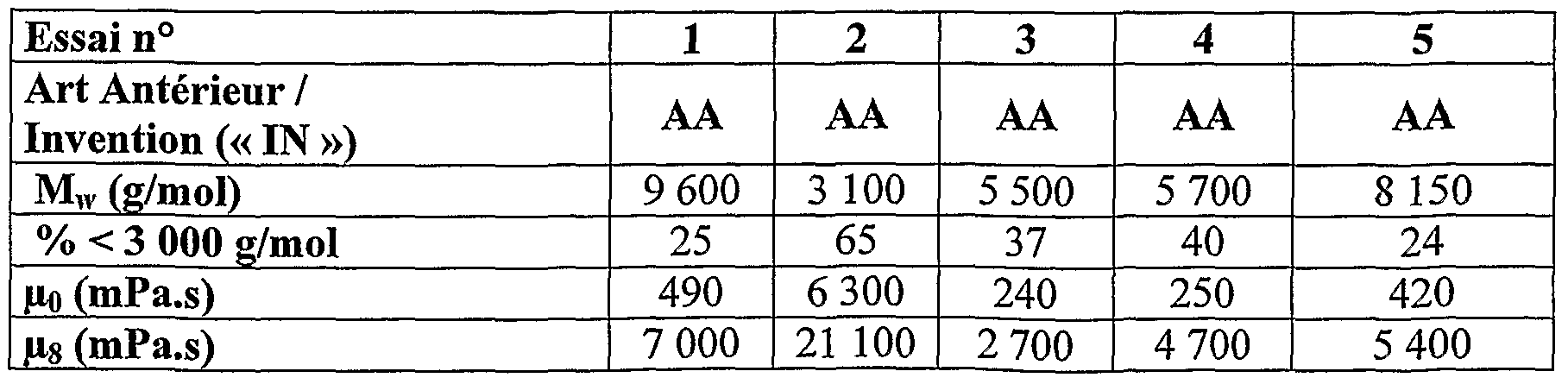
- This first grinding step aims to obtain a dry weight content of calcium carbonate equal to 50% of the total weight of the suspension. It is carried out in the presence of 0.45% by dry weight of a polymer according to tests Nos. 1 to 10, relative to the total dry weight of calcium carbonate.
- the suspension is concentrated (removal of water with an EPCON TM brand laboratory heat evaporator).
- This second concentration step aims to obtain a dry weight content of calcium carbonate equal to 71% of the total weight of the suspension.
- This concentration step is carried out in the presence of 0.25% by dry weight relative to the dry weight of calcium carbonate, a mixture (70/30 ratio by dry weight) of homopolymer of acrylic acid, weight molecular weight equal to 10 400 g / mol, of which 100 mol% of the carboxylic sites are neutralized with sodium hydroxide and with phosphoric acid.
- This test illustrates the prior art and uses a homopolymer of acrylic acid (according to WO 02/49765) obtained by conventional free radical polymerization followed by separation, of which 50 mol% of the carboxylic sites are neutralized by sodium, 15% by calcium and 15% by magnesium, with a molecular weight equal to 9600 g / mol, and 25 mol% of the polymer chains have a molecular weight of less than 3000 g / mol.
- Test No. 2 This test illustrates the prior art and uses a homopolymer of acrylic acid obtained by conventional radical polymerization not followed by a separation, completely neutralized with sodium hydroxide, of molecular weight equal to 3100 g / mol and of which 65 mol% of the polymer chains have a molecular weight of less than 3,000 g / mol.
- This test illustrates the prior art and uses a homopolymer of acrylic acid obtained by conventional radical polymerization followed by a separation, completely neutralized with sodium hydroxide, of molecular weight equal to 5,500 g / mol, and of which 37% in mol of the polymer chains have a molecular weight of less than 3000 g / mol.
- This test illustrates the prior art and uses a homopolymer of acrylic acid obtained by conventional radical polymerization, not followed by separation, totally neutralized with sodium hydroxide, of molecular weight equal to 5,700 g / mol, and 40 mol% of the polymer chains have a molecular weight of less than 3,000 g / mol.
- This test illustrates the prior art and uses a homopolymer of acrylic acid obtained by the RAFT route, completely neutralized with sodium hydroxide, with a molecular weight of 8 150 g / mol, and of which 24 mol% of the polymeric chains exhibit a molecular weight of less than 3000 g / mol.
- This test illustrates the prior art and uses a homopolymer of acrylic acid obtained by conventional radical polymerization not followed by a separation, completely neutralized with sodium hydroxide, of molecular weight equal to 9,400 g / mol, and of which 27 mol% of the polymer chains have a molecular weight of less than 3000 g / mol.
- This test illustrates the prior art and uses a homopolymer of acrylic acid obtained by conventional radical polymerization not followed by a separation, completely neutralized with sodium hydroxide, with a molecular weight of 33,100 g / mol, and of which 17 mol% of the polymer chains have a molecular weight of less than 3000 g / mol.
- This test illustrates the prior art and uses a homopolymer of acrylic acid obtained by the RAFT route, completely neutralized with sodium hydroxide, with a molecular weight of 31,000 g / mol, and of which 12 mol% of the polymeric chains exhibit a molecular weight of less than 3000 g / mol.
- Test No. 9 This test illustrates the invention and uses a homopolymer of acrylic acid obtained by conventional radical polymerization followed by a separation, completely neutralized with sodium hydroxide, of molecular weight equal to 11,500 g / mol, and of which 17 mol% of the polymer chains have a molecular weight of less than 3000 g / mol. Test n ° 10
- This test illustrates the invention and uses a homopolymer of acrylic acid obtained by the RAFT route, completely neutralized with sodium hydroxide, of molecular weight equal to 10 800 g / mol, and of which 18 mol% of the polymer chains exhibit a molecular weight less than 3000 g / mol.
- This test illustrates the invention and uses an acrylic acid / methacrylic acid (90/10% by weight) copolymer obtained by conventional radical polymerization followed by separation, completely neutralized with sodium hydroxide, with a molecular weight of 11,000. g / mol, and 16 mol% of the polymer chains have a molecular weight of less than 3000 g / mol.
- Test No. 12 This test illustrates the invention and uses an acrylic acid / methacrylic acid (90/10% by weight) copolymer obtained by the RAFT route, totally neutralized with sodium hydroxide, with a molecular weight of 9000 g / mol, and 16 mol% of the polymer chains have a molecular weight of less than 3000 g / mol.
- Table 3 clearly demonstrates that only tests Nos. 9 to 12 corresponding to the invention lead to a significant improvement in the slope factor and therefore in the opacity.
Landscapes
- Chemical & Material Sciences (AREA)
- Organic Chemistry (AREA)
- Life Sciences & Earth Sciences (AREA)
- Geology (AREA)
- Inorganic Chemistry (AREA)
- Chemical Kinetics & Catalysis (AREA)
- Health & Medical Sciences (AREA)
- Medicinal Chemistry (AREA)
- Polymers & Plastics (AREA)
- Paper (AREA)
- Compositions Of Macromolecular Compounds (AREA)
- Compounds Of Alkaline-Earth Elements, Aluminum Or Rare-Earth Metals (AREA)
- Addition Polymer Or Copolymer, Post-Treatments, Or Chemical Modifications (AREA)
- Pigments, Carbon Blacks, Or Wood Stains (AREA)
Abstract
Description




Claims
Priority Applications (9)
| Application Number | Priority Date | Filing Date | Title |
|---|---|---|---|
| PL09794049T PL2303971T3 (pl) | 2008-07-07 | 2009-06-16 | Zastosowanie polimerów (met)akrylowych w sposobie wytwarzania wodnej zawiesiny węglanu wapnia |
| CA2726474A CA2726474C (fr) | 2008-07-07 | 2009-06-16 | Utilisation de polymeres (meth)acryliques dans un procede de fabrication d'une suspension aqueuse de carbonate de calcium |
| US13/000,094 US8258229B2 (en) | 2008-07-07 | 2009-06-16 | Use of (meth)acrylic polymers in a method for manufacture of an aqueous suspension of calcium carbonate |
| EP09794049A EP2303971B1 (fr) | 2008-07-07 | 2009-06-16 | Utilisation de polymères (méth)acryliques dans un procédé de fabrication d'une suspension aqueuse de carbonate de calcium |
| KR1020117002835A KR101664509B1 (ko) | 2008-07-07 | 2009-06-16 | 탄산칼슘 수성 현탁액 제조 방법에 있어서 (메트)아크릴 중합체의 용도 |
| SI200930408T SI2303971T1 (sl) | 2008-07-07 | 2009-06-16 | Uporaba (met)akrilnih polimerov pri postopku za pridobivanje vodne suspenzije kalcijevega karbonata |
| CN2009801265100A CN102089391B (zh) | 2008-07-07 | 2009-06-16 | (甲基)丙烯酸类聚合物在碳酸钙的水性悬浮液的制造方法中的用途 |
| ES09794049T ES2397277T3 (es) | 2008-07-07 | 2009-06-16 | Uso de polímeros (met)acrílicos en un método para fabricar una suspensión acuosa de carbonato de calcio |
| DK09794049.8T DK2303971T3 (da) | 2008-07-07 | 2009-06-16 | Anvendelse af (meth)acrylpolymerer i en fremgangsmåde til fremstilling af en vandig suspension af calciumcarbonat |
Applications Claiming Priority (2)
| Application Number | Priority Date | Filing Date | Title |
|---|---|---|---|
| FR0803855 | 2008-07-07 | ||
| FR0803855A FR2933419B1 (fr) | 2008-07-07 | 2008-07-07 | Utilisation de polymeres(meth) acryliques dans un procede de fabrication d'une suspension aqueuse de carbonate de calcium |
Publications (1)
| Publication Number | Publication Date |
|---|---|
| WO2010004392A1 true WO2010004392A1 (fr) | 2010-01-14 |
Family
ID=40365333
Family Applications (1)
| Application Number | Title | Priority Date | Filing Date |
|---|---|---|---|
| PCT/IB2009/006003 Ceased WO2010004392A1 (fr) | 2008-07-07 | 2009-06-16 | Utilisation de polymères (méth)acryliques dans un procédé de fabrication d'une suspension aqueuse de carbonate de calcium |
Country Status (11)
| Country | Link |
|---|---|
| US (1) | US8258229B2 (fr) |
| EP (1) | EP2303971B1 (fr) |
| KR (1) | KR101664509B1 (fr) |
| CN (1) | CN102089391B (fr) |
| CA (1) | CA2726474C (fr) |
| DK (1) | DK2303971T3 (fr) |
| ES (1) | ES2397277T3 (fr) |
| FR (1) | FR2933419B1 (fr) |
| PL (1) | PL2303971T3 (fr) |
| SI (1) | SI2303971T1 (fr) |
| WO (1) | WO2010004392A1 (fr) |
Families Citing this family (6)
| Publication number | Priority date | Publication date | Assignee | Title |
|---|---|---|---|---|
| CN102504608A (zh) * | 2011-10-20 | 2012-06-20 | 张家界恒亮新材料科技有限公司 | 一种微纳级表面改性重质碳酸钙的制备方法及其产品 |
| ES2587504T3 (es) * | 2012-09-26 | 2016-10-25 | Omya International Ag | Suspensiones acuosas de material mineral reológicamente estables que comprenden polímeros orgánicos que tienen contenido reducido de compuestos orgánicos volátiles (COV) |
| FR3060419B1 (fr) | 2016-12-16 | 2018-11-30 | Coatex | Methode de broyage de matiere minerale |
| KR102858549B1 (ko) | 2019-02-26 | 2025-09-12 | 옴야 인터내셔널 아게 | 표면-처리된 탄산칼슘 물질을 제조하는 방법 |
| KR102849861B1 (ko) * | 2019-02-26 | 2025-08-26 | 옴야 인터내셔널 아게 | 분쇄된 탄산칼슘-포함 물질을 포함하는 수성 현탁액을 제조하는 방법 |
| EP3931265B1 (fr) * | 2019-02-26 | 2025-06-25 | Omya International AG | Procédé de préparation d'une matière de carbonate de calcium traitée en surface |
Citations (4)
| Publication number | Priority date | Publication date | Assignee | Title |
|---|---|---|---|---|
| JP2000239595A (ja) * | 1998-12-21 | 2000-09-05 | Nippon Paper Industries Co Ltd | 顔料分散剤 |
| WO2002049766A2 (fr) * | 2000-12-20 | 2002-06-27 | Coatex S.A.S. | Agent d'aide au broyage de materiaux mineraux en suspension aqueuse, suspensions et leurs utilisations |
| FR2842814A1 (fr) * | 2002-07-26 | 2004-01-30 | Coatex Sas | Procede de polymerisation radicalaire controlee de l'acide acrylique et de ses sels, les polymeres obtenus, et leurs applications. |
| US20070197747A1 (en) * | 2005-03-23 | 2007-08-23 | Coatex S.A.S. | Polymers Produced By Using Sulphur Compounds In The Form Of Transfer Agents For Controlled Radical Polymerisation Of Acrylic Acid And The Use Thereof |
Family Cites Families (6)
| Publication number | Priority date | Publication date | Assignee | Title |
|---|---|---|---|---|
| GB9627002D0 (en) * | 1996-12-27 | 1997-02-12 | Ecc Int Ltd | Dispersed aqueous suspensions |
| DE10311617A1 (de) * | 2003-03-14 | 2004-09-23 | Basf Ag | Verwendung von Polyacrylsäuren als Mahlhilfsmittel für Calciumcarbonat |
| JP5028565B2 (ja) * | 2004-12-16 | 2012-09-19 | サンノプコ株式会社 | 重質炭酸カルシウムスラリーの製造方法 |
| FR2895686B1 (fr) * | 2005-12-30 | 2008-05-30 | Coatex Sas | Utilisation d'agents de co-broyage dans un procede de fabrication de carbonates de calcium naturel et precipite co-broyes, suspensions et pigments secs obtenus et leurs utilisations |
| JP4873691B2 (ja) * | 2006-03-22 | 2012-02-08 | ハイモ株式会社 | 炭酸カルシウム分散液およびその調製方法 |
| FR2903618B1 (fr) * | 2006-07-12 | 2008-10-31 | Coatex Sas | Agent de dispersion et/ou d'aide au broyage pour dispersion et suspension aqueuse de matieres minerales, dispersion et suspension obtenues et leurs utilisations. |
-
2008
- 2008-07-07 FR FR0803855A patent/FR2933419B1/fr not_active Expired - Fee Related
-
2009
- 2009-06-16 EP EP09794049A patent/EP2303971B1/fr active Active
- 2009-06-16 KR KR1020117002835A patent/KR101664509B1/ko active Active
- 2009-06-16 US US13/000,094 patent/US8258229B2/en not_active Expired - Fee Related
- 2009-06-16 SI SI200930408T patent/SI2303971T1/sl unknown
- 2009-06-16 WO PCT/IB2009/006003 patent/WO2010004392A1/fr not_active Ceased
- 2009-06-16 PL PL09794049T patent/PL2303971T3/pl unknown
- 2009-06-16 CN CN2009801265100A patent/CN102089391B/zh active Active
- 2009-06-16 CA CA2726474A patent/CA2726474C/fr not_active Expired - Fee Related
- 2009-06-16 DK DK09794049.8T patent/DK2303971T3/da active
- 2009-06-16 ES ES09794049T patent/ES2397277T3/es active Active
Patent Citations (4)
| Publication number | Priority date | Publication date | Assignee | Title |
|---|---|---|---|---|
| JP2000239595A (ja) * | 1998-12-21 | 2000-09-05 | Nippon Paper Industries Co Ltd | 顔料分散剤 |
| WO2002049766A2 (fr) * | 2000-12-20 | 2002-06-27 | Coatex S.A.S. | Agent d'aide au broyage de materiaux mineraux en suspension aqueuse, suspensions et leurs utilisations |
| FR2842814A1 (fr) * | 2002-07-26 | 2004-01-30 | Coatex Sas | Procede de polymerisation radicalaire controlee de l'acide acrylique et de ses sels, les polymeres obtenus, et leurs applications. |
| US20070197747A1 (en) * | 2005-03-23 | 2007-08-23 | Coatex S.A.S. | Polymers Produced By Using Sulphur Compounds In The Form Of Transfer Agents For Controlled Radical Polymerisation Of Acrylic Acid And The Use Thereof |
Non-Patent Citations (1)
| Title |
|---|
| ANONYMOUS: "Technical Information - Targeted Dispersants for Bulk Calcium Carbonate Slurry", APPLIED CHEMICAL ANWENDUNGS TECHNIK, 24 August 2007 (2007-08-24), pages 1 - 3, XP002516974, Retrieved from the Internet <URL:http://www.acat.com/_files/datasheets/722/Dispersants_for_CCS(TMB-EN).pdf> * |
Also Published As
| Publication number | Publication date |
|---|---|
| PL2303971T3 (pl) | 2013-03-29 |
| CN102089391B (zh) | 2013-11-13 |
| KR20110052601A (ko) | 2011-05-18 |
| FR2933419A1 (fr) | 2010-01-08 |
| DK2303971T3 (da) | 2012-12-17 |
| EP2303971A1 (fr) | 2011-04-06 |
| CN102089391A (zh) | 2011-06-08 |
| ES2397277T3 (es) | 2013-03-06 |
| CA2726474A1 (fr) | 2010-01-14 |
| FR2933419B1 (fr) | 2010-08-20 |
| US20110092629A1 (en) | 2011-04-21 |
| EP2303971B1 (fr) | 2012-10-17 |
| SI2303971T1 (sl) | 2013-01-31 |
| US8258229B2 (en) | 2012-09-04 |
| KR101664509B1 (ko) | 2016-10-11 |
| CA2726474C (fr) | 2016-08-23 |
Similar Documents
| Publication | Publication Date | Title |
|---|---|---|
| EP2143688B1 (fr) | Procédé de fabrication de suspensions aqueuses de carbonate de calcium et suspensions obtenues ainsi que leurs utilisations | |
| EP2044159B1 (fr) | Agent de dispersion et/ou d'aide au broyage pour dispersion et suspension aqueuse de matieres minerales, dispersion et suspension obtenues et leurs utilisations | |
| EP1979419B1 (fr) | Utilisation d'agents de co-broyage dans un procede de fabrication de carbonates de calcium naturel et precipite co-broyes, suspensions et pigments secs obtenus et leurs utilisations | |
| EP0100948B1 (fr) | Agent de broyage à base de polymères et/ou copolymères acryliques pour suspensions aqueuses de matériaux minéraux grossiers en vue d'applications pigmentaires | |
| EP0100947B1 (fr) | Agent de broyage à base de polymères et/ou copolymères neutralisés pour suspensions aqueuses de matériaux minéraux grossiers en vue d'applications pigmentaires | |
| EP1773950B1 (fr) | Procede de fabrication de particules pigmentaires auto-liantes, seches ou en suspension ou dispersion aqueuses, contenant des matieres inorganiques et des liants | |
| CA2726474C (fr) | Utilisation de polymeres (meth)acryliques dans un procede de fabrication d'une suspension aqueuse de carbonate de calcium | |
| EP2125966B1 (fr) | Procede de fabrication d'une dispersion ou d'une suspension aqueuse contenant du carbonate de calcium et du kaolin et son utilisation dans la fabrication de sauces de couchage | |
| WO2007072168A1 (fr) | Utilisation de dispersants pour concentrer des matieres minerales dans l'eau, dispersions obtenues et leurs utilisations | |
| WO2014006291A1 (fr) | Utilisation de nouveaux additifs, dans une formulation de peinture comprenant des particules de dioxyde de titane, comme agents ameliorant l'opacite du film sec ou en cours de sechage | |
| FR2683539A1 (fr) | Procede de broyage en suspension aqueuse en presence d'un agent de broyage neutralise en partie par du magnesium. | |
| FR2683538A1 (fr) | Procede de broyage en suspension aqueuse en presence d'un agent de broyage neutralise en partie par du magnesium. | |
| EP1888657A2 (fr) | Utilisation de polymeres hydrosolubles obtenus par polymerisation radicalaire controlee comme agent ameliorant l'opacite et / ou la brillance de produits secs les contenant | |
| FR2759611A1 (fr) | Nouvelle utilisation de sels d'acides polyaspartiques comme agent d'aide au broyage |
Legal Events
| Date | Code | Title | Description |
|---|---|---|---|
| WWE | Wipo information: entry into national phase |
Ref document number: 200980126510.0 Country of ref document: CN |
|
| 121 | Ep: the epo has been informed by wipo that ep was designated in this application |
Ref document number: 09794049 Country of ref document: EP Kind code of ref document: A1 |
|
| WWE | Wipo information: entry into national phase |
Ref document number: 2726474 Country of ref document: CA |
|
| WWE | Wipo information: entry into national phase |
Ref document number: 13000094 Country of ref document: US |
|
| NENP | Non-entry into the national phase |
Ref country code: DE |
|
| WWE | Wipo information: entry into national phase |
Ref document number: 2009794049 Country of ref document: EP |
|
| ENP | Entry into the national phase |
Ref document number: 20117002835 Country of ref document: KR Kind code of ref document: A |