DERIVATIVES OF TRIAZINES AND URACILS, THEIR PREPARATION AND THEIR APPLICATION IN HUMAN THERAPEUTICS
The object of the present invention is derivatives of triazines and uracils inhibiting the activity of the SCD-I enzyme and their application in human therapeutics.
The metabolic syndrome is the result of increased peripheral resistance to insulin, and is characterized by obesity, intolerance to glucose, certain dyslipidemias which may be associated with arterial hypertension and vascular inflammation. The conjunction of these multiple risk factors promotes development of atheromatous pathology at the origin of thrombotic episodes and to the development of peripheral, coronary, cerebrovascular and arterial diseases (Grundy, S. M. Drug therapy of the metabolic syndrome: minimizing the emerging crisis in polypharmacy. Nat Rev Drug Discov 5, 295- 309 (2006) ) .
Stearoyl-CoA Desaturase-1 (SCD-I), also called Δ9- desaturase, is an enzyme which limits the synthesis of mono-unsaturated fatty acids under the control of the transcription factor SREBPic (Miyazaki, M., Kim, Y. C, Ntambi, J. M. A lipogenic diet in mice with a disruption of the stearoyl-CoA desaturase-1 gene reveals a stringent requirement of endogenous monounsaturated fatty acids for triglyceride synthesis. J Lipid Res 42, 1018-1024 (2001)) . Invalidation of the SCD-I gene in mice makes it resistant to genetic obesity or obesity induced by diet; the peripheral effect of leptin on the increase of energy expense, weight loss and sensitivity to insulin are inversely correlated with the expression of the SCD-I gene and with the enzymatic activity (Cohen, P., Miyazaki, M., Socci, N. D. et al . Role for stearoyl-CoA desaturase-1 in leptin-mediated weight loss. Science 297, 240-243 (2002), Ntambi, J. M., Miyazaki, M., Stoehr, J. P. et al. Loss of stearoyl-CoA desaturase-1 function protects mice against adiposity. Proc Natl Acad Sci 99, 11482-11486 (2002),
Biddinger, S. B., Miyazaki, M., Boucher, J. et al. Leptin suppresses stearoyl-CoA desaturase-1 by mechanisms independent of insulin and sterol regulatory element- binding protein-lc. Diabetes 55, 2032-2041 (2006)) . The involvement of SCD-I in the pathogenesis of obesity is reinforced by the correlation between plasma concentration of palmitoleic acid and abdominal adiposity in children (Okada, T., Furuhashi, N., Kuromori, Y. et al. Plasma palmitoleic acid content and obesity in children. Am J Clin Nutr 82, 747-750 (2005)), the association of over- expression of SCD-I in the skeletal muscle in obese adults with a bad distribution of fatty acids which causes inhibition of hepatic β-oxidation (Hulver, M. W., Berggren, J. R., Carper, M.J. et al. Elevated stearoyl-CoA desaturase-1 expression in skeletal muscle contributes to abnormal fatty acid partitioning in obese humans. Cell Metab 2, 251-261 (2005)) . The plasma ratio 18:1/18:0, also called the "desaturation index", appears as the biomarker of SCD-I activity in humans and correlates with the plasma triglyceride level and in an inversely proportional way with the level of HDL (Attie, A. D., Krauss, R. M., Gray-Keller, M. P. et al. Relationship between stearoyl-CoA desaturase activity and plasma triglycerides in human and mouse hypertriglyceridemia. J Lipid Res 43, 1899-1907 (2002)) . Accordingly, inhibition of SCD-I appears as a therapeutic target of choice in the treatment of obesity, of type 2 diabetes and of lipid disorders related to the metabolic syndrome .
The compounds of the invention are characterized by their property of inhibiting the activity of the SCD-I enzyme and by their pharmacological profile.
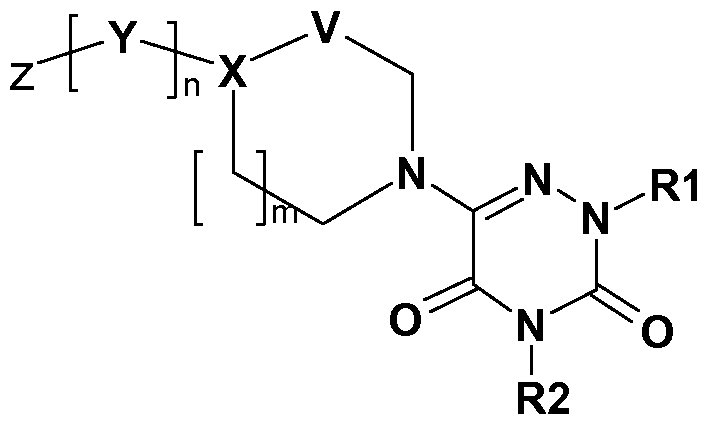
The compounds of the invention correspond to the general formula I .
The invention relates to the derivatives of 2H- [1,2,4] triazine-3, 5-dione and of H-pyrimidine-2, 4-dione for
their use as inhibitors of the activity of the SCD-I enzyme and corresponding to the general formula I :
- W represents nitrogen or CH
- Ri and R2 represent independently of each other: • a hydrogen or
• a linear or branched C1-C7 alkyl or alkenyl radical or
• a C1-C3 alkyl radical substituted with groups such as:
- trifluoromethyl, nitrile, hydroxy, C1-C3 alcoxy, C3-C6 alkoxyalkoxy, indolyl, thiophenyl, oxothiophenyl, Ci- C3 N-alkyl or N-dialkylcarbamoyl or,
-phenyl or aroyl or benzyloxy or N-arylcarbamoyl (for which the phenyl ring is optionally substituted with one or more groups such as a linear or branched Ci-C4 alkyl, nitro group, a halogen atom) , • a phenyl or pyridyl or naphthyl, or thiophenyl group optionally substituted with one or more groups such as a halogen, a nitro, nitrile, trifluoromethyl, vinyl, methylsulfanyl, linear branched C1-C4, alkyl, linear or branched C1-C3 alkoxy, phenyl, Ci-C3N-mono- or di- alkylcarbamoyl ou dialkylcarbamoyle, Ci-C4 alkylcarboxamido group,
• a C5-C6 2-oxocycloalkyl radical optionally fused with a phenyl group,
- m is equal to 0 or 1 - V represents CH2, CHCH3 or C=O -when n=l
X-Y represents -N-(C=O)-, -N-CH2-, -CH-CH2-, -CH-O-, -CH- (C=O)-,
Z represents a phenyl group optionally substituted with one or more trifluoromethyl groups, halogens, linear or branched Ci-C4 alkyl, linear or branched C1-C3 alkoxy groups, -when n=0
X represents N,
Z represents a phenyl or cinnamyl or aryloxycarbonyl or 2-phenylacetyl group (the position 2 of which is optionally substituted with a linear or branched C1-C4 alkyl) for which the aromatic group is optionally substituted with one or more trifluoromethyl groups, halogens, linear or branched Ci-C4 alkyl, linear or branched
C1-C3 alkoxy, nitro groups, as well as addition salts with pharmaceutically acceptable bases and acids, and the different enantiomers of the compounds having asymmetrical carbons, as well as their mixtures in any proportions notably including the racemic mixtures .
The present invention also relates to novel derivatives of 2H- [ 1, 2, 4 ] triazine-3, 5-dione and of H- pyrimidine-2 , 4-dione, to their preparation and to their application in human therapeutics.
These compounds correspond to the general formula I .
- W represents nitrogen or CH
- Ri and R2 represent:
• a hydrogen in a non-simultaneous way or a linear or branched Ci-C7 alkyl or alkenyl radical or,
• a C1-C3 alkyl radical substituted with groups such as:
- trifluoromethyl, nitrile, hydroxy, C1-C3 alkoxy, C3-C6 alkoxyalkoxy, indolyl, thiophenyl, oxothiophenyl, C1-C3 N-alkyl or N- dialkylcarbamoyl or,
- phenyl or aroyl or benzyloxy or N- arylcarbamoylr (for which the phenyl ring is possibly substituted with one or more groups such as linear or branched C1-C4 alkyl, nitro groups, halogen atoms) ,
• a phenyl or pyridyl or naphthyl or thiophenyl group, possibly substituted with one or more groups such as halogen atoms, nitro, nitrile, trifluoromethyl, vinyl, methylsulfanyl, linear or branched Ci-C4 alkyl, linear or branched C1-C3 alkoxy, phenyl, C1-C3 N-mono- or dialkylcarbamoyl, C1-C4 alkylcarboxamido groups,
• a C5-C6 2-oxocycloalkyl radical optionally fused with a phenyl group,
- m is equal to 0 or 1 - V represents CH2, CHCH3 or C=O -when n=l
X-Y represents -N-(C=O)-, -N-CH2-, -CH-CH2-, -CH-O-,
-CH- (C=O) -,
Z represents a phenyl group substituted with one or more trifluoromethyl groups, halogen atoms, linear or branched Ci-C4 alkyl, linear or branched C1-C3 alkoxy groups except for the compounds 6- [4- (4-isopropyl-benzyl) -piperazin-1-yl] -2, 4- dimethyl-2H- [ 1 , 2 , 4 ] triazine-3, 5-dione and 2,4-
dimethyl-6- [4- (3-trifluoro-methyl-benzyl) - piperazin-1-yl] -2H- [ 1, 2, 4] triazine-3, 5-dione, -when n=0
X represents N, Z represents a phenyl or cinnamyl or aryloxycarbonyl or 2-phenylacetyl group (the position 2 of which is optionally substituted with a linear or branched C1-C4 alkyl) for which the aromatic group is substituted with one or more trifluoromethyl groups, halogen atoms, linear or branched Ci-C4 alkyl, linear or branched Ci or C3 alkoxy, nitro groups, and this except for the following compounds:
6- [4- (4-fluoro-phenyl) -piperazin-1-yl] -2, 4- dimethyl -2H- [1,2,4] triazine-3, 5-dione
6- [4- (4-methoxy-phenyl) -piperazin-1-yl] -2, 4- dimethyl-2H- [1, 2, 4] triazine-3, 5-dione 6- [4- (2-chloro-phenyl) -piperazin-1-yl] -2, 4- dimethyl-2H- [1, 2, 4] triazine-3, 5-dione as well as the addition salts with pharmaceutically acceptable bases and acids, and the different enantiomers of the compounds having asymmetrical carbons, as well as their mixtures in any proportions notably including racemic mixtures . The present invention more particularly relates to derivatives of 2H- [ 1, 2, 4 ] triazine-3, 5-dione and of H- pyrimidine-2, 4-dione corresponding to the general formula I
R2
wherein :
- W represents nitrogen or CH
- Ri and R2 represent:
• a hydrogen (in a non-simultaneous way) or a linear or branched Ci-C7 alkyl or alkenyl radical or,
• a C1-C3 alkyl radical substituted with groups such as:
- trifluoromethyl, nitrile, hydroxy, C1-C3 alkoxy, C3-C6 alkoxyalkoxy, indolyl, thiophenyl, oxothiophenyl, Ci- C3 N-alkyl or N-dialkylcarbamoyl groups or, -phenyl or aroyl or benzyloxy or N-arylcarbamoyl (for which the phenyl ring is optionally substituted with one or more groups such as a linear or branched Ci-C4 alkyl, nitro groups, halogen atoms) ,
• a phenyl or pyridyl or naphthyl or thiophenyl group optionally substituted with one or more groups such as halogen atoms, nitro, nitrile, trifluoromethyl, vinyl, methylsulfanyl, linear or branched Ci-C4 alkyl, linear or branched C1-C3 alkoxy, phenyl, C1-C3 N-mono- or di- alkylcarbamoyl, Ci-C4 alkylcarboxamido groups, • a C5-C6 2-oxocycloalkyl radical optionally fused with a phenyl group,
- m, n are equal to 1
- V represents CH2
- X-Y represents -N-(C=O)-, - -CH-CH2-, -CH-O-, -CH- (C=O)-,
- Z represents a phenyl group substituted with one or more trifluoromethyl groups, halogen atoms, linear or branched Ci-C4 alkyl, linear or branched C1-C3 alkoxy groups. The present invention still more particularly relates to the derivatives of 2H- [ 1, 2, 4 ] triazine-3, 5-dione and of H-pyrimidine-2 , 4-dione corresponding to the general formula I
- W represents nitrogen or CH
- Ri and R2 represent: • a hydrogen (in a non-simultaneous way) or a linear or branched Ci-C7 alkyl radical or,
• a C1-C3 alkyl radical substituted with groups such as: trifluoromethyl, nitrile, hydroxy, C1-C3 alkoxy, C3-C6 alkoxyalkoxy, indolyl, oxothiophenyl, C1-C3 N-alkyl or N-dialkylcarbamoyl groups,
• a phenyl or pyridyl or naphthyl or thiophenyl group optionally substituted with one or more groups such as halogen atoms, nitro, nitrile, trifluoromethyl, vinyl, methylsulfanyl, linear or branched C1-C4 alkyl, linear or branched C1-C3 alkoxy, C1-C3 N-mono- or di-alkylcarbamoyl, Ci-C4 alkylcarboxamido groups,
• a C5-C6 2-oxocycloalkyl radical optionally fused with a phenyl group,
- m, n are equal to 1 - V represents CH2
- X-Y represents -N-(C=O)-, -CH-O-,
- Z represents a phenyl group substituted with one or more trifluoromethyl groups, halogen atoms, linear or branched Ci-C4 alkyl groups, The present invention particularly relates to the derivatives of 2H- [ 1, 2, 4 ] triazine-3, 5-dione corresponding to the general formula I wherein:
- W represents nitrogen,
- Ri represents:
• a hydrogen or a linear or branched Ci-C5 alkyl radical or,
• a C1-C3 alkyl radical substituted with groups such as trifluoromethyl, nitrile, hydroxy, C1-C3 alkoxy, C3-C6 alkoxyalkoxy, indolyl, oxothiophenyl, C1-C3 N- alkylcarbamoyl groups,
• a phenyl or pyridyl or naphthyl or thiophenyl group optionally substituted with one or more groups such as halogen atoms, nitro, nitrile, trifluoromethyl, vinyl, methylsulfanyl, linear or branched C1-C4 alkyl, linear or branched C1-C3 alkoxy, phenyl, C1-C3 N-mono- or di- alkylcarbamoyl, Ci-C4 alkylcarboxamido groups,
• a C5-C6 2-oxocycloalkyl radical,
- R2 represents: a linear or branched Ci-C7 alkyl radical, and preferably a methyl,
- m, n are equal to 1,
- V represents CH2,
- X-Y represents -N- (C=O) -, -CH-O-,
- Z represents a phenyl group substituted with one or more trifluoromethyl groups, halogen atoms, or linear Ci-C4 alkyl groups.
The present invention still more particularly relates to the derivatives of 2H- [ 1, 2, 4 ] triazine-3, 5-dione corresponding to the general formula I wherein: - W represents nitrogen,
- Ri represents:
• a hydrogen or a linear or branched Ci-C5 alkyl radical or,
• a C1-C3 alkyl radical substituted with groups such as trifluoromethyl, nitrile, hydroxy, C1-C3 alkoxy, C3-C6 alkoxyalkoxy, indolyl, oxothiophenyl, C1-C3 N- alkylcarbamoyl groups,
• a phenyl or pyridyl or thiophenyl group possibly substituted with one or more groups such as halogen
atoms, nitrile, linear or branched Ci-C4 alky, linear or branched C1-C3 alkoxy groups, • a Ce 2-oxocycloalkyl radical,
- R2 represents a methyl or heptyl, - m, n are equal to 1,
- V represents CH2,
- X-Y represents -N- (C=O) -, -CH-O-,
- Z represents a phenyl group substituted with one or more trifluoromethyl groups, halogen atoms or linear Ci-C4 alkyl groups.
The present invention relates to the compounds of the general formula I characterized in that they are selected from:
■ 4-heptyl-2-methyl-6- [4- (2-trifluoromethyl-benzoyl) - piperazin-1-yl] -2H- [1, 2, 4] triazine-3, 5-dione
■ 2 -methyl-6- [ 4- (2-trifluoromethyl-benzoyl) -piperazin-1-yl ] - 2H- [1, 2, 4] triazine-3, 5-dione
■ 4 -methyl-2- (4,4, 4-trifluoro-butyl) -6- [4- (2- trifluoromethyl-benzoyl) -piperazin-1-yl] -2H- [ 1, 2, 4 ] triazine-3, 5-dione
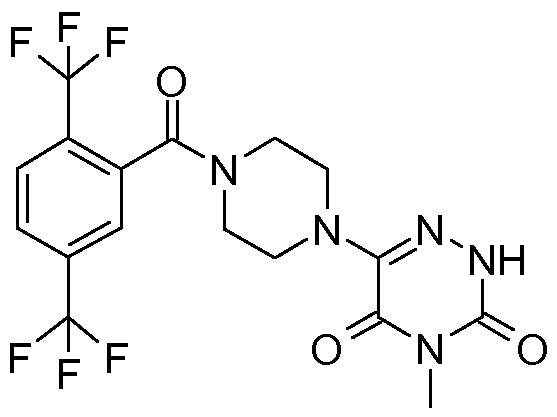
■ 4 -methyl-6- [4- (2-trifluoromethyl-benzoyl) -piperazin-1-yl] - 2H- [1,2, 4] triazine-3, 5-dione
■ 2, 4 -dimethyl-6- [4- (2-trifluoromethyl-benzoyl) -piperazin- 1- yl] -2H- [1,2, 4] triazine-3, 5-dione "2, 4 -dimethyl-6- [4- (2-trifluoromethyl-phenoxy) -piperidin-1- yl] -2H- [1,2, 4] triazine-3, 5-dione
■ 3- { 4-heptyl-3, 5-dioxo-6- [4- (2-trifluoromethyl-phenoxy) - piperidin-1-yl ] -4 , 5-dihydro-3H- [1, 2, 4] triazin-2-yl}- propionitrile ■ 2 -butyl-4 -methyl-6- [ 4- (2-trifluoromethyl-phenoxy) - piperidin-1-yl] -2H- [1, 2, 4] triazine-3, 5-dione ■ N-methyl-2- { 4-methyl-3, 5-dioxo-6- [4- (2-trifluoromethyl- phenoxy) -piperidin-1-yl] -4, 5-dihydro-3H- [1, 2, 4] triazin-2- yl } -acetamide
■ 2- (2-ethoxy-ethyl) -4-methyl-6- [4- (2-trifluoromethyl- phenoxy) -piperidin-1-yl ]-2H-[l,2,4] triazine-3, 5-dione ■2- [2- (lH-indol-3-yl) -ethyl] -4-methyl-6- [4- (2- trifluoromethyl-phenoxy) -piperidin-1-yl] -2H- [ 1, 2, 4 ] triazine-3, 5-dione
■ 4-methyl-2- (4-oxo-4-thiophen-2-yl-butyl) -6- [4- (2- trifluoromethyl-phenoxy) -piperidin-1-yl] -2H- [ 1, 2, 4] triazine-3, 5-dione
■ 3- { 6- [4- (2-chloro-phenoxy) -piperidin-1-yl] -4-methyl-3, 5- dioxo-4, 5-dihydro-3H- [1, 2, 4] triazin-2-yl} -propionitrile
■ 6- [4- (2-chloro-phenoxy) -piperidin-1-yl] -4-methyl-2- (4,4,4- trifluoro-butyl) -2H- [1, 2, 4] triazine-3, 5-dione
■ 6- [4- (2-chloro-phenoxy) -piperidin-1-yl] -2, 4-dimethyl-2H- [1, 2, 4] triazine-3, 5-dione ■ 6- [4- (2-fluoro-phenoxy) -piperidin-1-yl] -2, 4-dimethyl-2H- [1, 2, 4] triazine-3, 5-dione
■ 6- [4- (2-chloro-5-trifluoromethyl-phenoxy) -piperidin-1-yl] - 2, 4 -dimethyl-2H- [1,2,4] triazine-3, 5-dione
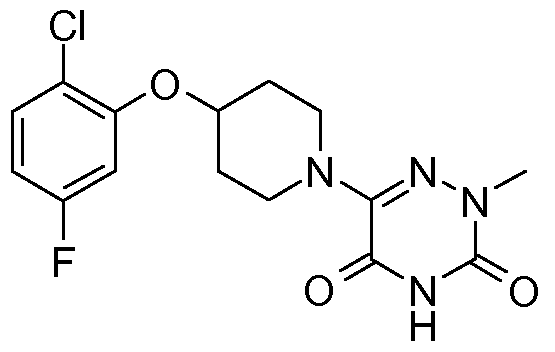
■ 6- [4- (2-chloro-5-fluoro-phenoxy) -piperidin-1-yl] -2, 4- dimethyl-2H- [1,2,4] triazine-3, 5-dione
■2, 4 -dimethyl-6- (4-o-tolyloxy-piperidin-l-yl) -2H- [1, 2, 4] triazine-3, 5-dione
■ 6- [4- (4-fluoro-phenoxy) -piperidin-1-yl] -2, 4-dimethyl-2H- [1, 2, 4] triazine-3, 5-dione ■ 6- [4- (5-fluoro-2-trifluoromethyl-benzoyl) -piperazin-1-yl] - 2, 4 -dimethyl-2H- [1,2,4] triazine-3, 5-dione
■ 6- [4- (5-fluoro-2-trifluoromethyl-benzoyl) -piperazin-1-yl] - 4 -methyl-2- (4,4, 4 -trifluoro-butyl) -2H- [1, 2, 4] triazine-3, 5- dione ■ 6- [4- (5-fluoro-2-trifluoromethyl-benzoyl) -piperazin-1-yl] - 4-methyl-2- (3-methyl-butyl) -2H- [1,2,4] triazine-3, 5-dione
■ 2 , 4 -dimethyl-6- [ 4- (2-trifluoromethyl-benzyl) -piperazin- 1- yl] -2H- [1,2, 4] triazine-3, 5-dione
■4 -methyl-2- (4,4, 4-trifluoro-butyl) -6- [4- (2- trifluoromethyl-benzyl) -piperazin-1-yl ]-2H-[l,2,4] triazine-
3, 5-dione
■ 4 -methyl-6- [4- (2-trifluoromethyl-benzyl) -piperazin-1-yl] - 2H- [1,2, 4] triazine-3, 5-dione
■ 6- [4- (5-fluoro-2-trifluoromethyl-benzoyl) -piperazin-1-yl] - 4 -methyl-2H- [1,2,4] triazine-3, 5-dione
■ 6- [4- (4-fluoro-2-trifluoromethyl-benzoyl) -piperazin-1-yl] - 4 -methyl-2H- [1,2,4] triazine-3, 5-dione ■ 6- [4- (4-fluoro-2-trifluoromethyl-benzyl) -piperazin-1-yl] - 4 -methyl-2H- [1,2,4] triazine-3, 5-dione
■ 2 -butyl-4 -methyl-6- [ 4- (2-trifluoromethyl-benzoyl) - piperazin-1-yl] -2H- [1, 2, 4] triazine-3, 5-dione
■ 6- [4- (2-chloro-phenoxy) -piperidin-1-yl] -4-heptyl-2H- [ 1, 2, 4 ] triazine-3, 5-dione
■ 4-methyl-2-o-tolyl-6- [4- (2-trifluoromethyl-phenoxy) - piperidin-1-yl] -2H- [1, 2, 4] triazine-3, 5-dione
■ 2- (4-fluoro-phenyl) -4 -methyl-6- [ 4- (2-trifluoromethyl- phenoxy) -piperidin-1-yl] -2H- [1, 2, 4] triazine-3, 5-dione ■ 4-methyl-2-pyridin-3-yl-6- [4- (2-trifluoromethyl-phenoxy) - piperidin-1-yl] -2H- [1, 2, 4] triazine-3, 5-dione ■ 4-methyl-2-thiophen-3-yl-6- [4- (2-trifluoromethyl-phenoxy) - piperidin-1-yl] -2H- [1, 2, 4] triazine-3, 5-dione
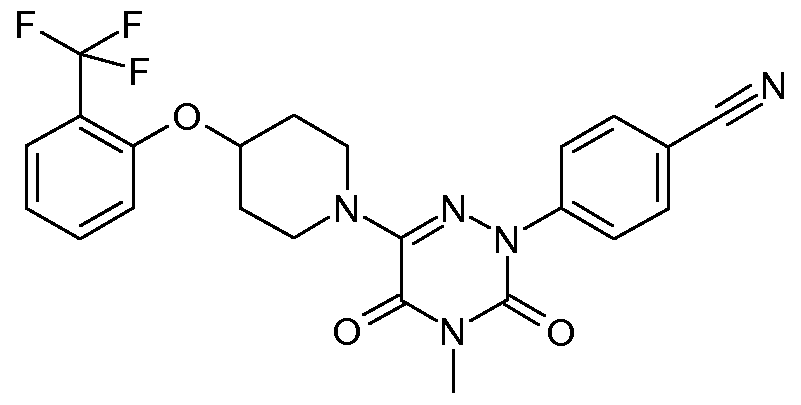
■ 4- { 4-methyl-3, 5-dioxo-6- [4- (2-trifluoromethyl-phenoxy) - piperidin-1-yl] -4, 5-dihydro-3H- [1,2,4] triazin-2-yl } - benzonitrile
■ 2- (2-methoxy-phenyl) -4 -methyl-6- [4- (2-trifluoromethyl- phenoxy) -piperidin-1-yl ]-2H-[l,2,4] triazine-3, 5-dione
■ 4-methyl-6- [4- (2-trifluoromethyl-phenoxy) -piperidin-1-yl] - 2H- [1,2,4] triazine-3, 5-dione
■ 4-methyl-2- (2-oxo-cyclohexyl) -6- [4- (2-trifluoromethyl- phenoxy) -piperidin-1-yl ]-2H-[l,2,4] triazine-3, 5-dione ■2- [2- (2-ethoxy-ethoxy) -ethyl] -4 -methyl-6- [4- (2- trifluoromethyl-phenoxy) -piperidin-1-yl] -2H- [ 1, 2, 4 ] triazine-3, 5-dione
■ 2- (2-hydroxy-ethyl) -4-methyl-6- [4- (2-trifluoromethyl- phenoxy) -piperidin-1-yl ]-2H-[l,2,4] triazine-3, 5-dione SYNTHESIS
The compounds of the present invention may be synthesized by using the synthesis routes described below or by using synthesis methods known to one skilled in the art . Method 1
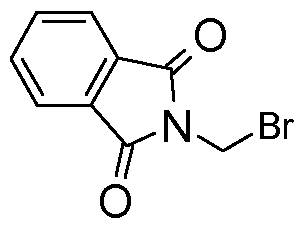
The synthesis of compounds of general formula I is characterized (Scheme 1) in that a derivative of general formula II
RKN,W Br
I I cΛhAo
R2 wherein W, Ri and R2 represent the groups as described earlier in formula I is fused with a derivative of general formula III
wherein m, n, X, Y, V, and Z are as described earlier in formula I. This reaction may be conducted in the presence of a base such as triethylamine in n-butanol or toluene or dimethylformamide;
Et3N, nBuOH (or toluene or DMF)
Method 2
This synthesis method for compounds of general formula I (Scheme 2) for which X represents a nitrogen, is characterized in that a derivative of general formula IV
wherein m, V, W, Ri and R2 are as described earlier in formula I, is fused with a compound of general formula V
wherein Hal represents a halogen such as Cl, Br or I, when n=l, Y represents -(C=O)-, -CH2- and Z is as described earlier in formula I,
and when n=0, Z represents a cinnamyl or aryloxycarbonyl or 2-phenylethyl group (the position 2 of which is optionally substituted with a linear or branched Ci-C4 alkyl) for which the aromatic group is substituted with one or more trifluoromethyl groups, halogen atoms, linear or branched Ci-C4 alkyl, linear or branched C1-C3 alkoxy, nitro groups.
This reaction may be carried out in the presence of triethylamine in dichloromethane or in toluene (when Y is - CH2- ) .
NEt3, CH2CI2 NEt3, toluene if Y= -CH2-
Scheme 2 Method 3
This synthesis method of the compounds of general formula I for which W represents a nitrogen (Scheme 3) is characterized in that the nitrogen is alkylated in the position 2 of the compound VI, obtained according to the synthesis method 1 (for Ri representing a hydrogen)
VI
wherein X, Y, V, Z, m, n and R2 are as described earlier in formula I, by a halogenated derivative of general formula RiHaI, wherein Hal represents a halogen such as Cl, Br or I and Ri is as described earlier in general formula I, under operating conditions such as NaH or tBuOK in dimethylformamide .
Scheme 3
The intermediate and final compounds may if desired by purified according to one or several purification methods selected from extraction, filtration, silica gel chromatography, preparative normal or reverse phase HPLC, crystallization.
The raw materials used in the methods described earlier are commercial or easily accessible to one skilled in the art according to methods described in the literature .
The following Examples illustrate the invention without limiting the scope thereof.
Elementary analyses and mass and NMR spectra confirm the structures of the compounds. Intermediates 1 : a) 6-bromo-2H- [1, 2, 4] triazine-3, 5-dione (Ia)
H
2H- [1,2, 4] triazin-3, 5-dione (20 g, 177 mmol) is placed in the presence of pyridinium perbromide in 200 mL of water at 900C for 4 h. The reaction medium is then extracted with ethyl acetate and the organic phases are dried on MgSO4. After filtration and dry concentration, Ia is isolated as a white solid (27 g, yield=80%) . TLC silica gel 60 F 254 Merck, CH2Cl2-MeOH: 90-10, Rf = 0.32. b) 6-bromo-2, 4 -dimethyl-2H- [1,2,4] triazine-3, 5- dione ( Ib)
CΛNAO
11, 8g (295mmol) of NaH (at 60% in paraffin) are placed in suspension at 0
0C in 25OmL of DMF under nitrogen. 25.8Og (135mmol) of intermediate Ia diluted in 15OmL of DMF are poured dropwise. This solution is then placed at room temperature, and then 18.4mL (296mmol) of methyl iodide are poured dropwise. After one night of stirring and dry concentration of the reaction medium, the obtained residue is taken up with water and extracted with ethyl acetate. The organic phases are washed with brine, dried on magnesium sulfate and then dry concentrated. The obtained residue, taken up with ether, crystallizes and a first fraction of crystals is isolated. The filtrate is dry concentrated and then purified by flash chromatography on silica (heptane-AcOEt : 50-50) . 24g of intermediate Ib as a solid are thereby isolated (yield 81%) .
TLC s i l ica gel 60 F 254 Merck, CH
2Cl
2-AcOEt : 80 -20 , Rf = 0 . 59 . c) 5-bromo-l, 3-dimethyl-lH-pyrimidine-2, 4-dione (Ic)
Synthesis of the intermediate Ic is achieved from 5-bromo- lH-pyrimidine-2, 4-dione according to the operating procedure described for the synthesis of Ib (solid, yield 82%) . TLC silica gel 60 F 254 Merck, CH
2Cl
2-MeOH: 90-10, Rf=0.8. Intermediates 2 : a) 6-bromo-4-methyl-2H- [1,2,4] triazine-3, 5-dione (2a)
20.3 g (105.7mmol) of triazine Ia are placed in 15OmL of acetic anhydride under reflux for 4.5 h. After dry concentration of the reaction medium, a precipitate is isolated and then recrystallized from ether: 24.3 g of crystals are isolated (yield=98%) . 4.5 g (114.2 mmol) of NaH (60% in paraffin) are placed in 5OmL of DMF under nitrogen. A solution of 24.3 g (103.8 mmol) of crystals isolated earlier, in 15OmL of DMF is poured dropwise. The reaction medium is stirred for 45 min at room temperature and then 7 mL (114.2 mmol) of methyl iodide are added, and stirring then continues for 21 h at room temperature. After dry concentration, the obtained residue is taken up with H
2O and extracted with ethyl acetate. After drying on MgSO
4, the organic phases are evaporated and the obtained clear oil is purified by flash chromatography on silica (CH
2Cl
2-AcOEt: 90-10) . 22.9 g of crystals (yield=89%) are isolated, which are placed in 300 mL of ethanol in the
presence of 0.6 g of paratoluene-sulfonic acid. This mixture is heated with reflux for 4.5h and then dry concentrated. The residue is taken up with H
2O and then extracted with ethyl acetate. After drying and evaporation of the organic phases, 17 g of intermediate 2a are isolated as a solid (yield=89%) .
TLC silica gel 60 F 254 Merck, CH2Cl2-AcOEt: 90 - 10 , Rf = 0.29. b) Intermediates 2b-2d
Ia 2b-2d
The synthesis of the 2b-2d intermediates is achieved from Ia according to the operating procedure described for the synthesis of 2a by using various alkylation agents RX . Table 1 intermediates 2b-2d
TLC : s i l ica gel 60 F 254 Merck, EP=petroleum ether c) 6-bromo-2 -methyl -2H- [ 1 , 2 , 4 ] triazine-3 , 5-dione
10 g (88mmol) of 2H- [ 1, 2, 4 ] triazine-3, 5-dione are placed in 177 mL of hexamethyldisilazane at room temperature. 17.7mL (132mmol) of trimethylsilyl chloride are added. The mixture is heated to 125°C for 2.5 h and then placed at 600C and 55mL (880mmol) of methyl iodide are
added. The medium is stirred at 600C for 15h. After cooling to 00C, 40OmL of acetic acid are slowly added. The mixture is left under stirring for 30 min. After dry concentration of the reaction medium, the obtained residue is purified by flash chromatography on silica (CH2Cl2-MeOH: 95-5) . 4.7 g of crystals (yield=43%) are isolated. 4.7g (37.2 mmol) of the obtained solid are placed in 5OmL of water in the presence of 7.6mL of bromine (148.8mmol) . The medium is heated to 600C for 14h. The reaction medium is then slowly poured onto a Na2SOs 10% solution cooled to 00C, up to a pH=7. It is then extracted with ethyl acetate and the organic phases are dried on MgSθ4. After filtration and dry concentration, 2e is isolated as a white powder (6,6g, yield=85%) . TLC silica gel 60 F 254 Merck, CH2Cl2-MeOH: 90-10, Rf = 0.75. Intermediates 3: a ) 3 - ( 6-bromo- 4 -methyl - 3 , 5 -dioxo- 4 , 5 -dihydro- 3H- [ l , 2 , 4 ] triaz in-2 -yl ) -propionitri le ( 3a )
2.4 g (ll.δmmol) of the triazine 2a and 7mL (lOδmmol) of acrylonitrile are placed in 24mL of a solution of pyridine and water (1/1) under reflux for 3h. After concentration, the reaction medium is extracted with AcOEt and then after drying on MgSO4, the organic phases are dry concentrated.
After washing the obtained solid with ether, 2.8 g of intermediate 3a are obtained (yield=93%) .
TLC silica gel 60 F 254 Merck, petroleum ether-AcOEt: 70- 30, Rf=O.18.
b) Intermediates 3b and 3c:
R= (CH2) ' 3CF3 2b 3b
R= (CH2) > eCH3 2c 3c
The synthesis of the intermediates 3b and 3c is achieved from the intermediates 2b and 2c respectively according to the operating procedure described for the synthesis of 3a. Table 2 intermediates 3b and 3c
TLC: silica gel 60 F 254 Merck, EP=petroleum ether
Intermediates 4 : a) 6-bromo-4-methyl-2- (4, 4, 4-trif luoro-butyl) -2H-
0.85 g (21.3 mmol) of NaH (at 60% in paraffin) are placed in 10 mL of DMF under nitrogen. A solution of 4 g (19.4mmol) of intermediate 2a in 4OmL of DMF is poured dropwise. The reaction medium is stirred for Ih at room temperature and then 5g (21.3 mmol) of 1, 1, 1-trifluoro-4- iodo-butane are added dropwise, and stirring is then continued for 3h at room temperature. After dry concentration, the obtained residue is taken up with H2O and extracted with ethyl acetate. After drying on MgSO4, the organic phases are evaporated and the obtained oil is purified by flash chromatography on silica (petroleum
ether-AcOEt : 80-20) . 5.3 g of crystals corresponding to the compound 4a (yield=87%) are isolated.
TLC silica gel 60 F 254 Merck, petroleum ether-AcOEt: 70-
30, Rf=O.58. b) Intermediates 4b-4j
2a 4b-4j
The synthesis of the intermediates 4b-4j is achieved from 2a according to the operating procedure described for the synthesis of 4a by using various alkylation agents RX. Table 3 intermediates 4b-4j
RX Total TLC state Intermediates 4b-4j yield
EP-AcOEt: 50- solid 4b: 2- (6-bromo-4-methyl-3, 5- 50 dioxo-4, 5-dihydro-3H- Rf=O.37 [1,2,4] tπazin-2-ylmethyl) - isoindole-1, 3-dione
90^ CH2Cl2-MeOH: solid 4c: 6-bromo-2-butyl-4-methyl-2H-
95-5 [1, 2, 4] triazine-3, 5-dione Rf=O.82
O 65^ CH2Cl2-MeOH: solid 4d: 2- (6-bromo-4-methyl-3, 5-
90-10 dioxo4, 5-dihydro-3H-
Br Rf =0.49 [1,2, 4] triazin-2-yl) -N-methyl- acetamide
^\^Br CH2Cl2-MeOH: 95- oil 4e: 6-bromo-2- (2-ethoxy-ethyl) -
^O 80^ 5 4-methyl-2H- [1 , 2 , 4 ] triazine-3, 5- Rf =0.76 dione
CH2Cl2-AcOEt: solid 4f: 6-bromo-2- [2- (lH-indol-3-
54
£ 95-5 yl) -ethyl] -4-methyl-2H- Rf=O.72 [1,2,4] tπazine-3, 5-dione
CH2Cl2-AcOEt: oil 4g: 6-bromo-4-methyl-2- (3-
86^ 95-5 methyl-butyl) -2H- Rf =0.79 [1,2,4] tπazine-3, 5-dione
CH2Cl2-AcOEt: solid 4h: 6-bromo-4-methyl-2- [2- (2-
42
£ 95-5 nitro-phenyl) -2-oxo-ethyl] -2H- Rf=O.61 [1,2,4] tπazine-3, 5-dione
TLC: silica gel 60 F 254 Merck, EP=petroleum ether c) 6-bromo-4-methyl-2- (2-thiophen-2-yl-ethyl) -2H- [1,2, 4] triazine-3, 5-dione (4k)
0.4g (1.94 mmol) of intermediate 2a are placed in the presence of 0.24 mL (2.14mmol) of 2-thiophen-2-yl-ethanol, O.βlg (2.33mmol) of triphenylphosphine in 4 mL of THF. At 00C, 0.54 mL (2.33mmol) of DEAD in solution in toluene are added dropwise. The reaction medium is heated for 7h at 700C. After concentration, the obtained residue is taken up with ethyl acetate and washed with water. After drying on MgSO4, the organic phase is dry concentrated. The obtained residue is purified by flash chromatography on silica (CH2Cl2/Me0H, gradient 100/0 to 97/3 over 30 min) . 0.48g of crystals corresponding to the compound 4k are obtained (yield: 79%) . d) 6-bromo-4-methyl-2-o-tolyl-2H- [1,2,4] triazine-3, 5-dione (41)
0.5g (2.43mmol) of intermediate 2a are placed in the presence of 0.4 mL (4.85 mmol) of pyridine, 0.66g (4.85mmol) of o-tolyl boronic acid, 0.66g (3.64mmol) of copper acetate in 50 mL of CH2Cl2. The reaction medium is
stirred for 24h at room temperature and then filtered on celite. The filtrate is washed with water, and then with 0.01N hydrochloric acid. After drying on MgSO4, the organic phase is dry concentrated. After washing the obtained residue with diethyl ether, 0.54g of a white solid corresponding to the compound 41 are isolated (yield 75%) e) Intermediates 4m-4q
2a 4m-4q The synthesis of intermediates 4m-4q is achieved from 2a according to the operating procedure described for the synthesis of 41 by using various boronic acids RB(OH)2.
Table 4: intermediates 4m-4q
TLC : silica gel 60 F 254 Merck, EP=petroleum ether
Intermediates 5
R= (CH2) 3CF3 2b 5a
R= (CH2) 6CH3 2c 5b
R= CH2OCH2Ph 2d 5c
The synthesis of the intermediates 5a-5c is achieved from
2b-2d respectively according to the operating procedure described for the synthesis of 4a by using iodomethane as an alkylation agent.
Table 5: intermediates 5a-5c
TLC : silica gel 60 F 254 Merck, EP=petroleum ether Intermediates 6 a ) piperaz in- 1 -yl - ( 2 -tri f luoromethyl -phenyl ) - methanone hydrochloride ( 6a )
23.44g (125mmol) of BOC-piperazine are placed in the presence of 26mL (186mmol) of triethylamine in 25OmL de dichloromethane at 00C. 25g (119.8 mmol) of 2- trifluoromethyl-benzoyl chloride are added dropwise, the reaction medium is stirred for 30min at 00C, and then left with stirring at room temperature for lh30min. After concentration, the obtained residue is taken up with AcOEt, washed with water, and then with water saturated with NaCl.
After drying on MgSO4, the organic phases are dry concentrated. After washing the obtained residue with petroleum ether, 40.5 g of a beige solid are isolated
(yield=94%) . TLC silica gel 60 F 254 Merck, petroleum ether- AcOEt: 50-50 Rf=O.4. The obtained solid is placed in
10OmL of dichloromethane in the presence of 65mL (877 mmol) of trifluoroacetic acid at room temperature for Ih. After concentration, the obtained residue is taken up with water and then brought to pH 7 by adding NaHCθ3. The medium is extracted with AcOEt and then with dichloromethane. After drying on MgSO4, the organic phases are dry concentrated. The obtained residue is taken up with EtOH, salified by adding a 2.3N HCl solution in isopropanol. The medium is saturated by adding ether, the formed crystals are filtered. 29.45 g of intermediate 4a are thereby isolated as a white powder (yield 88%) .
TLC silica gel 60 F 254 Merck, CH
2Cl
2/Me0H 85/15, Rf=O.43. b) intermediates 6b-6d
6b- 6d
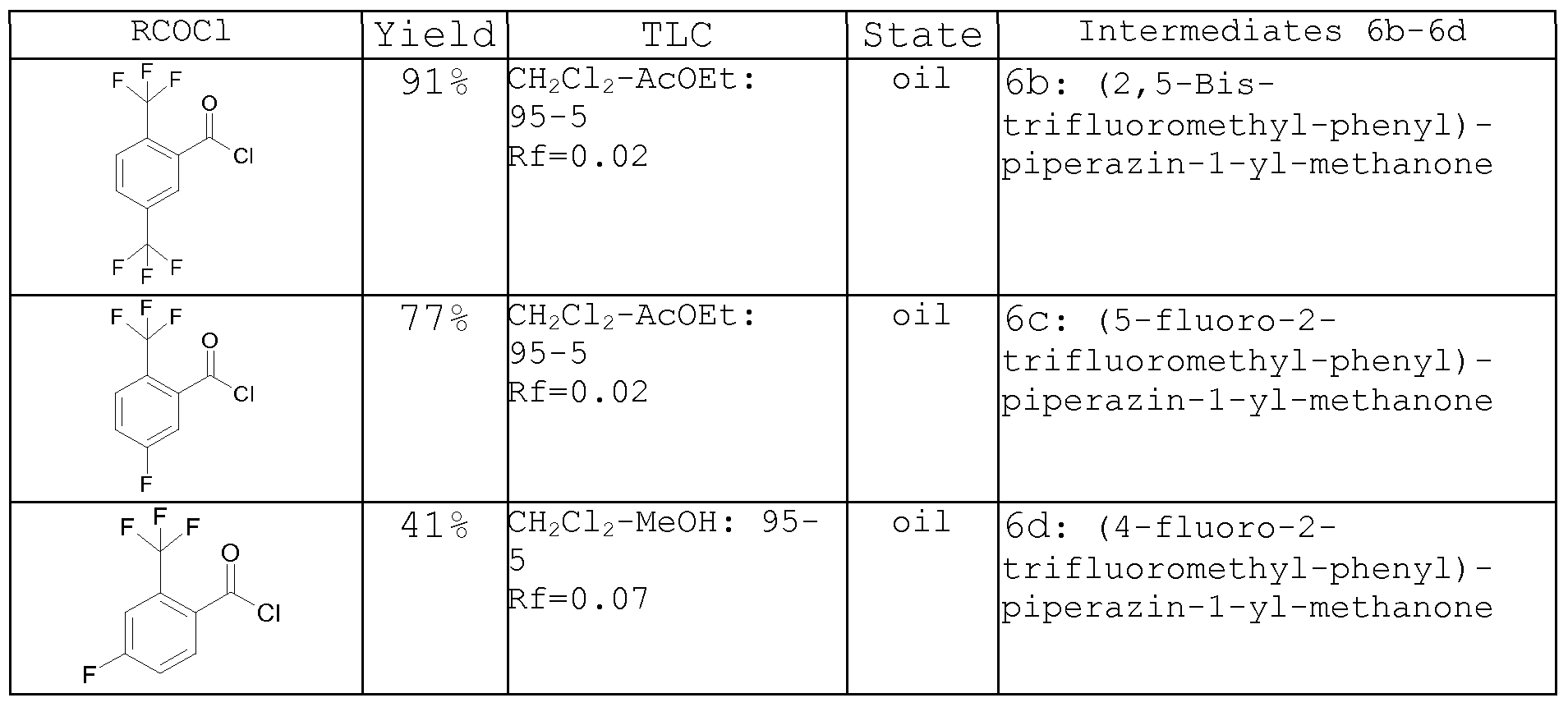
The synthesis of the intermediates 6b-6d is achieved from BOC-piperazine according to the operating procedure described for the synthesis of 6a by using various acid chlorides RCOCl, but without carrying out the final step for salifying the amine.
Table 6: intermediates 6b-6d
TLC : silica gel 60 F 254 Merck . Intermediates 7
1- (2-trifluoromethyl-benzyl) -piperazine (7a)
1.08g (12.5mmol) of piperazine are placed in the presence of Ig (4.2 mmol) of l-bromomethyl-2-trifluoromethyl-benzene and 0.64mL (4.6mmol) of triethylamine in 10 mL of toluene. The reaction medium is stirred for 30min at room temperature and then heated to 1100C for 6h. After dry concentration, the obtained residue is taken up with AcOEt and washed with water. After drying on MgSO4, the organic phases are dry concentrated, the obtained residue is purified by flash chromatography on silica (CH2C^-MeOH- NH4OH: 90-9-1) . 0.7 g of intermediate 7a are thereby isolated as a clear oil (yield 68%) .
TLC silica gel 60 F 254 Merck, CH2Cl2-MeOH-NH4OH: 90-9-1, Rf=O.27.
b) 1- (4-fluoro-2-trifluoromethyl-benzyl) - piperazine (7b)
The synthesis of intermediate 7b is achieved from 1- bromomethyl-4-fluoro-2-trifluoromethyl-benzene according to the operating procedure described for synthesis of 4a (clear oil, yield 70%) .
TLC silica gel 60 F 254 Merck, CH
2Cl
2-MeOH: 95-5, Rf=O.15. Intermediates 8 a) 4- (2-chloro-phenoxy) -piperidine (8a)
1Og (49.68mmol) of BOC-4-hydroxy-piperidine are placed in the presence of 5.5mL (54.65mmol) of 2-chlorophenol, 15.6g (59.62mmol) of triphenylphosphine in 160 mL of THF. At 0
0C, 2OmL (59.62mmol) of DEAD (55% solution in toluene) are added dropwise. The reaction medium is heated for 8h at 65°C, and then stirred for 16h at room temperature. After concentration, the obtained residue is taken up with ether, washed with a soda (IN) solution and then with a NaCl saturated solution. After drying on MgSO
4, the organic phases are dry concentrated, and then taken up with a petroleum ether-Et
2O mixture: 65-35 in order to remove triphenylphosphine oxide. After filtration, the filtrate is concentrated, the obtained residue is purified by flash chromatography on silica (petroleum ether-Et
2O, gradient 100-0 to 65-35 over 30 min) . 9.1 g of clear oil are obtained (yield 59%) . TLC silica gel 60 F 254 Merck, CH
2Cl
2-AcOEt: 90-10, Rf=O.75. This oil is placed in 8OmL of dichloromethane in the presence of 8.67mL (116.7mmol) of TFA, and this solution is then stirred for 24h at room temperature. The medium is concentrated, the obtained
residue is taken up with AcOEt, washed with a soda (IN) solution and then with NaCl saturated water. After drying on MgSO
4, the organic phases are dry concentrated. 6.5 g of intermediate 8a are thus isolated as a clear oil (quantitative yield) . TLC silica gel 60 F 254 Merck, CH
2Cl
2-MeOH-NH
4OH: 90-9-1, Rf=O.24. b) 4- (2-chloro-5-fluoro-phenoxy) -piperidine (8b)
9g (44.7mmol) of BOC-4-hydroxy-piperidine are placed in 3OmL of dichloromethane at 0
0C. 3.5 mL (44.7mmol) of mesyl chloride and 8mL (58.1mmol) of triethylamine are slowly added. The reaction medium is stirred for 3h at 0
0C, and then filtered on a frit. The filtrate is washed with water. After drying on MgSO
4, the organic phase is concentrated. 12.48g of oil are obtained (quantitative yield) . TLC silica gel 60 F 254 Merck, CH
2Cl
2-MeOH: 95-5, Rf=O.60. 1.34 g (4.78mmol) of this oil is placed in the presence of 0.50 mL (2.48 mmol) of 2-chloro-5-fluorophenol and of 3g (4.78mmol) of cesium carbonate in 5mL of DMF. This solution is stirred for 24h at 70
0C. After concentration of the reaction medium, the obtained residue is purified by flash chromatography (petroleum ether-AcOEt, gradient 100-0 to 85-15 over 60 min) . 0.84g of clear oil is obtained (yield: 53%) . TLC silica gel 60 F 254 Merck, CH
2Cl
2-AcOEt: 95-5, Rf=O.72. This oil is placed in 5mL of CH
2Cl
2 in the presence of 0.76 mL (10.2mmol) of TFA. The solution is stirred for 6h at room temperature. After concentration of the reaction medium, the residue is taken up with AcOEt, washed with a soda (IN) solution and then with NaCl saturated water. After drying the organic phase on MgSO
4, 0.4g of intermediate 8b is obtained as a clear oil (yield 69%) . TLC silica gel 60 F 254 Merck, CH
2Cl
2-MeOH: 95-5, Rf=O.19.
c) intermediates 8c and 8d
8c, 8d
The synthesis of the intermediates 8c and 8d is achieved according to the operating procedure described for synthesis of 8a by using various phenols R-OH.
Table 7: intermediates 8c-8d
TLC: silica gel 60 F 254 Merck. d) intermediates 8e-8i
8e-8i
The synthesis of the intermediates 8e-8i is achieved according to the operating procedure described for the synthesis of 8b by using various phenols R-OH. Table 8: intermediates 8e-8i
TLC : silica gel 60 F 254 Merck . Intermediates 9 : a) 4- (2-fluoro-5-trifluoromethyl-benzyl) - piperidine (9a)
0.8g (3.1mmol) of 2-bromomethyl-l-fluoro-4-trifluoro- methylbenzene is placed in the presence of 0.9mL (5.36mmol) of triethylphosphite at 1500C for 24h. The reaction medium is purified by flash chromatography on silica (CH2Cl2-MeOH, gradient 100-0 to 95-5 over 45 min) . 0.96 g of a clear oil is obtained (quantitative yield) . TLC silica gel 60 F 254 Merck, CH2Cl2-MeOH: 95-5, Rf=O.75. This oil is placed in the presence of few drops of 15-crown-5 crown ether in 1OmL of THF at 00C and 0.15g (3.98mmol) of NaH (60% in paraffin) are added. The reaction medium is stirred for 30min at 00C and then 0.55mL (3.06mmol) of benzyl-piperidin-4-one are added at 00C. The mixture is then stirred at room temperature for 24h, and then poured into water at 00C and extracted with AcOEt. The organic phase is washed with a saturated NaHCθ3 solution, and then with a saturated NaCl solution. After drying on MgSO4, the organic phases are dry concentrated. The obtained residue is purified by flash chromatography on silica (petroleum ether-AcOEt, gradient 100-0 to 90-10 over 45min) . 0.64g of a clear oil is obtained (yield 60%) . TLC silica gel 60 F 254 Merck petroleum ether-AcOEt: 90-10, Rf: 0,32. This oil is placed in 5mL of MeOH in the presence of 0.12g of palladium on
charcoal under 5 bars of hydrogen, and this solution is then stirred 3 days at room temperature. After filtration on celite, the reaction medium is concentrated. The obtained residue is purified by flash chromatography on silica (CH2Cl2-MeOH, gradient 100-0 to 90-10 over 30min, and then CH2Cl2-MeOH-NH4OH, gradient 100-0 to 90-9-1) . 0.3Og of intermediate 9a is obtained as a clear oil (yield 63%) . TLC silica gel 60 F 254 Merck CH2Cl2-AcOEt: 90-10, Rf= 0, 14. b) 4- (4-fluoro-2-trifluoromethyl-benzyl) - piperidine (9b)
The synthesis of the intermediate 9b is achieved from 1- bromomethyl-4-fluoro-2-trifluoromethylbenzene according to the operating procedure described for the synthesis of 9a
(solid, yield 11%) .
TLC si lica gel 60 F 254 Merck, CH2Cl2-MeOH-NH4OH : 90 - 9- 1 ,
Rf=O . 26 .
Intermediate 10: (4-fluoro-phenyl) -piperidin-4-yl-methanone (10)
6.4g (49.5mmol) of isonipecotic acid are placed in the presence of 40ml of acetic anhydride. The reaction medium is heated to 1300C for 5h and then dry concentrated. After triturating with petroleum ether, the formed crystals are filtered. 7.79g of solid are obtained (92%) . 0.5g (2.92mmol) of the obtained solid are placed in ImL of 1,2- dichloroethane in the presence of 0.92mL (12.56mmol) of thionyl chloride, and this solution is then stirred for Ih at room temperature. The medium is dry concentrated and
then the residue is taken up with 2mL of 1,2- dichloroethane . This solution is added to a mixture of 0.9Og (6.72 mmol) of AlCl3 and 1.29mL (13.73 mmol) of fluorobenzene in ImL of 1, 2-dichloroethane . The reaction medium is heated to 800C for 3h. After the solution has returned to room temperature, it is poured on ice water, then the medium is extracted with dichloromethane . After drying on MgSO4, the organic phases are dry concentrated, the obtained residue is purified by flash chromatography on silica (CH2Cl2-MeOH: 95-5) . 0.44 g of an oil are isolated
(60%) . TLC silica gel 60 F 254 Merck, CH2Cl2-MeOH: 95-5,
Rf=O .38. The obtained oil is placed in 6mL of 6N hydrochloric acid and the mixture is heated to 1000C for
18h. The medium is neutralized by adding a concentrated soda solution and extracted with ethyl acetate. After drying on MgSO4, the organic phases are dry concentrated. 0.23 g of intermediate 10 are obtained as an oil (62%) . TLC silica gel 60 F 254 Merck, CH2Cl2-MeOH: 95-5, Rf=O.13. Intermediates 11 a) 3- (2-trifluoromethyl-phenoxy) -pyrrolidine
(Ha)
0.67mL (4mmol) of l-benzyl-pyrrolidin-3-ol are placed in the presence of 0.1Iq (4.4mmol) of 2-trifluoromethyl-phenol and of 1.26 g (4.8mmol) of triphenylphosphine in 10 mL of THF. At 0°C, 2mL (4.8mmol) of DEAD (a 40% solution in toluene), are added dropwise. The reaction medium is heated for 6h at 65°C, and then stirred for 16h at room temperature. After concentration, the obtained residue is taken up with ether, washed with a soda (IN) solution and then with a NaCl solution. After drying on MgSO
4, the organic phases are dry concentrated, and then the residue
is taken up with a petroleum ether-Et2<0 65-35 mixture for removing triphenylphosphine oxide. After filtration, the filtrate is concentrated, the obtained residue is purified by flash chromatography on silica (petroleum ether-Et
2<0, gradient 100-0 to 60-40 over 45 min) . 1.06 g of clear oil are obtained (yield 82%) . TLC silica gel 60 F 254 Merck, petroleum ether-Et∑O 65-35, Rf=O .18. This oil is placed in 1OmL of a ethanol/THF 50/50 mixture in the presence of palladium on charcoal and under a pressure of 5bars of hydrogen at room temperature for 18h. The reaction medium is filtered on celite, the filtrate is dry concentrated. The obtained residue is purified by flash chromatography on silica (CH
2Cl
2-MeOH-NH
4OH, 90-9-1) . 0.51 g of intermediate 11a are obtained as a clear oil (yield 83%) . TLC silica gel 60 F 254 Merck, CH
2Cl
2/Me0H 90/10, Rf=O.13. b) 3-phenoxy-pyrrolidine (lib)
The synthesis of intermediate lib is achieved from phenol according to the operating procedure described for the synthesis of 11a (solid, yield 24%) .
TLC silica gel 60 F 254 Merck, CH2Cl2-MeOH: 90-10, Rf=O.21. Intermediates 12 a) 2, 4 -dimethyl-6-piperazin- 1-yl-2H- [1, 2, 4] triazine-3, 5-dione (12a)
4.75g (55.15mmol) of piperazine are placed in the presence of 4.05g (18.4mmol) of intermediate Ib in toluene at room temperature for 30min. 2.8mL (20.1mmol) of triethylamine are added and the mixture is heated for 18h at 1100C. After concentration of the reaction medium, the obtained residue
is taken up with dichloromethane and washed with water. After drying on MgSC^, the organic phase is dry concentrated. The obtained residue is purified by flash chromatography (CH2Cl2-MeOH: 60-40) . 3.3g of intermediate 12a is obtained as a white powder (yield: 79%) .
TLC silica gel 60 F 254 Merck, CH2Cl2-MeOH: 50-50, Rf=O.4. b) 2, 4-dimethyl-6- (3-oxo-piperazin-l-yl) -2H-
[1,2, 4] triazine-3, 5-dione (12b)
The synthesis of the intermediate 12b is achieved from piperazin-2-one according to the operating procedure described in the synthesis of 12a, in n-butanol at 120
0C for 24h (solid, yield 55%) .
TLC silica gel 60 F 254 Merck, CH2Cl2-MeOH: 90-10, Rf=O.44.
c) 2, 4-dimethyl-6- (3-methyl-piperazin-l-yl) -2H- [1, 2, 4] triazine-3, 5-dione (12c)
The synthesis of the intermediate 12c is achieved from 2- methyl-piperazine according to the operating procedure described for the synthesis of 12a (solid, yield: 58%) . TLC silica gel 60 F 254 Merck, CH2Cl2-MeOH: 90-10, Rf=O.19. d) Intermediates 12d-12f
R= (CH2) 3CH3 4c 12e
R= (CH2) 2CH (CH3) 2 4g 12f
The synthesis of the intermediates 12d-12f is achieved from the intermediates 4a, 4c and 4g respectively according to the operating procedure described for the synthesis of 12a.
TLC: silica gel 60 F 254 Merck Intermediates 13
5- (4-benzyl-piperazin-l-yl) -1, 3-dimethyl-lH- pyrimidine-2, 4-dione (13a)
9.6g (33.53mmol) of 5- (4-benzyl-piperazin-l-yl) -IH- pyrimidine-2, 4-dione are placed at 00C in 1OmL of dimethylformamide . 2.95g (73.56mmol) of sodium hydride (at 60% in paraffin) are added portion wise. The mixture is stirred for 40min at 00C. 5mL (80.5mmol) of methyl iodide are added, the medium is stirred at room temperature for 7h. After concentration of the reaction medium, the obtained residue is taken up with AcOEt and washed with water. After drying on MgSO4, the organic phase is concentrated. The obtained residue is triturated with ether, and then a precipitate is isolated by filtration. 4g
of intermediate 13a are obtained as a beige powder (yield: 38%) .
TLC silica gel 60 F 254 Merck, CH2Cl2-MeOH-NH4OH: 90-9-1, Rf=0.64. b) 1, 3-dimethyl-5-piperazin-l-yl-lH-pyrimidine-2, 4- dione (13b)
CANAO
2.6g (8.26mmol) of compound 13a are placed in the presence of 1.3g of palladium and of 13OmL of formic acid in 30OmL of acetic acid at room temperature for 4h. The mixture is heated to 100°C° for 2h30min. After neutralization with a 10% soda solution, the reaction medium is extracted with CHCI3. The organic phase is washed with water and then with a saturated NaCl solution. After drying on MgSO4, the organic phase is concentrated. The obtained residue is purified by flash chromatography (CH2Cl2-MeOH-NH4OH, gradient 90-10-0 to 90-9-1 over 30min) . 1.05g of intermediate 13b is obtained as a beige solid (yield: 56%) . TLC silica gel 60 F 254 Merck, CH2Cl2-MeOH-NH4OH: 90-9-1, Rf=O.07. EXAMPLES
Example 1: 4-heptyl-2-methyl-6- [4- (2-trifluoromethyl- benzoyl) -piperazin-1-yl] -2H- [1, 2, 4] triazine-3, 5-dione (1)
The compound 1 is prepared according to the synthesis method 1: 0.33 g (1.12mmol) of derivative 6a and 0.41g
(1.35mmol) of the triazine 5b are placed in 1OmL of
butanol-1 in the presence of 0.55mL (3.93mmol) of NEt3. This mixture is stirred at 1200C for 24 h. After dry concentration of the reaction medium, the obtained residue is taken up with AcOEt and washed with water and with an NaCl saturated solution. After drying on MgSO4, the organic phase is concentrated. The obtained residue is purified by flash chromatography on silica (petroleum ether-AcOEt: 60- 40) . 0.53g of a clear oil are isolated (yield: 98%) . TLC silica gel 60 F 254 Merck, petroleum ether-AcOEt: 50- 50, Rf=O.43.
1H NMR (CDCl3) ppm: 0.87 (t, 3H, J=6.57Hz) 1.21-1.38 (m, 8H), 1.57-1.66 (m, 2H), 3.23-3.34 (m, 4H), 3.40-3.47 (m, IH), 3.46-3.57 (m, 4H), 3.82-3.95 (m, 3H), 3.98-4.05 (m, IH), 7.35 (d, IH, J=7.83Hz), 7.54 (t, IH, J=8.08Hz) 7.62 (t, IH, J=7.07Hz), 7.72 (d, IH, J=7.33Hz) . MS (+ESI) m/z 482 (MH+)
Example 2: 2 -methyl-6- [4- (2-trifluoromethyl-benzoyl) - piperazin-1-yl] -2H- [1, 2, 4] triazine-3, 5-dione (2)
CANAO H
The compound 2 (yellow powder) is prepared from the triazine 2e and from the intermediate 6a according to the synthesis method 1 in toluene (yield: 25%) .
TLC silica gel 60 F 254 Merck, petroleum ether-AcOEt: 80- 20, Rf=O.2.
MP= 1460C
1H NMR (CDCl3) ppm: 3.24-3.42 (m, 4H), 3.42-3.52 (m, 4H),
3.52-3.61 (m, IH), 3.80-3.89 (m, IH), 4.06-3.97 (m, IH),
7.35 (d, IH, J=7.32Hz), 7,54 (t, IH, J=7.57Hz) 7.61 (t, IH, J=7.57Hz), 7.72 (d, IH, J=7.83Hz), 8.58 (s, IH) .
MS (+ESI) m/z 384 (MH+)
Example 3: 4-methyl-2- (4,4, 4-trifluoro-butyl) -6- [4- (2- trifluoromethyl-benzoyl) -piperazin-1-yl] -2H- [ 1, 2, 4 ] triazine-3, 5-dione (3]
The compound 3 (oil) is prepared from the triazine 4a and from the intermediate 6a according to the synthesis method 1 in n-butanol (yield: 19%) .
TLC silica gel 60 F 254 Merck, CH2Cl2-AcOEt: 95-5, Rf=O.28. 1H NMR (CDCl3) ppm: 1.95-2.05 (m, 2H), 2.08-2.22 , (m, 2H), 3.26-3.32 (m, 4H), 3.35 (s, 3H), 3.41-3.50 (m, IH), 3.50- 3.58 (m, IH), 3.82-3.90 (m, IH), 3.95 (t, 2H, J=6.82Hz), 3.98-4.08 (m, IH), 7.35 (d, IH, J=7.83Hz), 7.55 (t, IH, J=7.83Hz), 7.62 (t, IH, J=7.83Hz), 7.73 (d, IH, J=7.32Hz) . MS (+APCI) m/z 494 (MH+) Example 4 : 4 -methyl - 6- [ 4 - ( 2 -trif luoromethyl-benzoyl ) - piperazin- 1 -yl ] -2H- [ 1 , 2 , 4 ] triazine-3 , 5-dione ( 4 )
The compound 4 (solid) is prepared from the triazine 2a and the intermediate 6a according to the synthesis method 1 in toluene (yield: 27%) .
TLC silica gel 60 F 254 Merck, CH2Cl2-AcOEt: 70-30,
Rf=O.26.
MP= 235°C
1H NMR (CDCl3) ppm: 2.28-3.34 (m, 4H), 3.34 (s, 3H), 3.39- 3.48 (m, IH), 3.48-3.57 (m, IH), 3.80-3.91 (m, IH), 3.96-
4.07 (m, IH), 7.35 (d, IH, J=7.58Hz), 7.54 (t, IH,
J=7.83Hz) 7.62 (t, IH, J=7.58Hz) , 7.72 (d, IH, J=7.58Hz) , 8.77 (s, IH) . MS (+ESI) m/z 384 (MH+)
Example 5 : 2, 4-dimethyl-6- [4- (2-trifluoromethyl-benzoyl) - piperazin-1-yl] -2H- [ 1, 2, 4 ] triazine-3, 5-dione (5)
The compound 5 (solid) is prepared from the triazine Ib and the intermediate 6a according to the synthesis method 1 in toluene (yield: 55%) . TLC silica gel 60 F 254 Merck, AcOEt: 100, Rf=O.37.
MP= 760C
1H NMR (CDCl3) ppm: 3.26-3.33 (m, 4H), 3.34 (s, 3H), 3.40-
3.49 (m, IH), 3.49-3.58 (m, 3H), 3.81-3.90 (m, IH), 3.97-
4.06 (m, IH), 7.35 (d, IH, J=7.07Hz), 7.54 (t, IH, J=7.83Hz) 7.61 (t, IH, J=7.83Hz), 7.73 (d, IH, J=8.08Hz) .
MS (+ESI) m/z 398 (MH+)
Example 6: 5- [4- (2-trifluoromethyl-benzoyl) -piperazin-1- yl] -lH-pyrimidine-2, 4-dione (6)
The compound 6 (solid) is prepared from 5-bromo-lH- pyrimidine-2, 4-dione and from the intermediate 6a according to the synthesis method 1 in dimethylformamide (yield: 47%) . TLC silica gel 60 F 254 Merck, CH
2Cl
2-MeOH: 90-10, Rf=O.3. MP= 285
0C
1H NMR (DMSO) ppm: 2.59-2.69 (m, IH), 2.72-2.87 (m, 2H), 2.88-2.98 (m, IH), 3.05-3.16 (m, IH), 3.16-3.25 (m, IH), 3.63-3.79 (m, 2H), 6.79 (s, IH), 7.49 (d, IH, J=7.07Hz), 7.66 (t, IH, J=7.83Hz) 7.76 (t, IH, J=7.58Hz), 7.82 (d, IH, J=7.58Hz), 10.53 (s, IH), 11.10 (s, IH) . MS (+APCI) m/z 369 (MH+)
Example 7: 2, 4-dimethyl-6- [4- (3-trifluoromethyl-phenyl) - piperazin-1-yl] -2H- [1, 2, 4] triazine-3, 5-dione (7)
O
The compound 7 (solid) is prepared from the triazine Ib and from 1- (3-trifluoromethyl-phenyl) -piperazine according to the synthesis method 1 in n-butanol (yield: 63%) . TLC silica gel 60 F 254 Merck, CH
2Cl
2-MeOH: 95-5, Rf=O.78. MP= 163°C MS (+ESI) m/z 370 (MH+)
Example 8: 4-methyl-2- (4,4, 4-trifluoro-butyl) -6- [4- (3- trifluoromethyl-phenyl) -piperazin-1-yl] -2H- [1, 2, 4] triazine- 3, 5-dione (8)
The compound 8 (oil) is prepared from the triazine 4a and from 1- (3-trifluoromethyl-phenyl) -piperazine according to the synthesis method 1 in n-butanol (yield: 76%) .
TLC silica gel 60 F 254 Merck, CH
2Cl
2-AcOEt: 90-10, Rf=O.59.
MS (+ESI) m/z 466 (MH+)
Example 9: 4-methyl-2- (4,4, 4-trifluoro-butyl) -6- [4- (2- trifluoromethy1-phenyl) -piperazin-1-yl] -2H- [1, 2, 4] triazine- 3,5-dione (9)
The compound 9 (solid) is prepared from the triazine 4a and from 1- (2-trifluoromethyl-phenyl) -piperazine according to the synthesis method 1 in n-butanol (yield: 82%) .
TLC silica gel 60 F 254 Merck, CH2Cl2-AcOEt: 90-10,
Rf=0.54.
MS (+ESI) m/z 466 (MH+)
Example 10: 6- (4-benzyl-piperidin-l-yl) -2, 4-dimethyl-2H- [1,2, 4] triazine-3, 5-dione (10)
The compound 10 (oil) is prepared from the triazine Ib and from 4-benzyl-piperidine according to the synthesis method 1 in n-butanol (yield: 93%) . TLC silica gel 60 F 254 Merck, CH2Cl2-AcOEt: 95-5, Rf=O.28. MS (+ESI) m/z 315 (MH+)
Example 11: 2, 4-dimethyl-6- [4- (2-trifluoromethyl-phenoxy) - piperidin-1-yl] -2H- [1,2, 4] triazine-3, 5-dione (11)
The compound 11 (oil) is prepared from the triazine Ib and from the intermediate 8c according to the synthesis method 1 in n-butanol (yield: 56%) . TLC silica gel 60 F 254 Merck, CH2Cl2-AcOEt: 95-5, Rf=O.27. 1H NMR (CDCl3) ppm: 1.95-2.11 (m, 4H), 3.36 (s, 3H), 3.49- 3.57 (m, 7H), 4.70 (m, IH), 6.99 (t, IH, J=7.07Hz) 7.00 (d, IH, J=7.07Hz), 7.47 (t, IH, J=8.08Hz), 7.58 (d, IH, J=7.58Hz) . MS (+ESI) m/z 385 (MH+)
Example 12: 3- { 4-heptyl-3, 5-dioxo-6- [4- (2-trifluoromethyl- phenoxy) -piperidin-1-yl] -4, 5-dihydro-3H- [1, 2, 4] triazin-2- yl } -propionitrile (12)
The compound 12 (oil) is prepared from the triazine 3c and from the intermediate 8c according to the synthesis method 1 in n-butanol (yield: 46%) .
1H NMR (CDCl3) ppm: 0.87 (t, 3H, J=6.31Hz), 1.24-1.36 (m, 8H), 1.58-1.67 (m, 2H), 1.97-2.10 (m, 4H), 2.80 (t, 2H, J=7.83Hz), 3.48-3.56 (m, 2H), 3.59-3.65 (m, 2H), 3.91 (t, 2H, J=7.07Hz), 4.18 (t, 2H, J=6.57Hz), 4.72 (m, IH), 6.97- 7.02 (m, 2H), 7.47 (t, IH, J=7.83Hz), 7.58 (d, IH, J=7.07Hz) . MS (+ESI) m/z 508 (MH+)
Example 13 : 2 -butyl-4 -methyl- 6- [ 4 - ( 2 -trif luoromethyl- phenoxy) -piperidin- 1 -yl ] -2H- [ l , 2 , 4 ] triazine-3 , 5-dione ( 13 )
The compound 13 (oil) is prepared from the triazine 4c and from the intermediate 8c according to the synthesis method 1 in n-butanol (yield: 44%) .
1H NMR (CDCl3) ppm: 0.95 (t, 3H, J=7.58Hz), 1.31-1.41 (m, 2H), 1.66-1.75 (m, 2H), 1.96-2.10 (m, 4H), 3.35 (s, 3H), 3.47-3.55 (m, 4H), 3.89 (t, 2H, J=7.58Hz), 4.70 (m, IH), 6.99 (t, IH, J=7.58Hz), 7.00 (d, IH, J=7.32Hz), 7.47 (t, IH, J=8.08Hz), 7.58 (d, IH, J=7.32Hz) . MS (+ESI) m/z 427 (MH+)
Example 14: N-methyl-2- { 4-methyl-3, 5-dioxo-6- [4- (2- trifluoromethyl-phenoxy) -piperidin-1-yl] -4, 5-dihydro-3H- [1,2, 4] triazin-2-yl}-acetamide (14)
The compound 14 (oil) is prepared from the triazine 4d and from the intermediate 8c according to the synthesis method 1 in n-butanol (yield: 52%) . 1H NMR (CDCl3) ppm: 1.94-2.09 (m, 4H), 2.85 (d, 3H, J=5.05Hz), 3.36 (s, 3H), 3.48-3.63 (m, 4H), 4.51 (s, 2H), 4.70 (m, IH), 5.90 (m, IH), 6.99 (d, IH, J=7.32Hz), 7.00 (t, IH, J=6.82Hz), 7.47 (t, IH, J=7.83Hz), 7.58 (d, IH, J=7.83Hz) . MS (+ESI) m/z 442 (MH+)
Example 15: 2- (2-ethoxy-ethyl) -4-methyl-6- [4- (2- trifluoromethyl-phenoxy) -piperidin-1-yl] -2H- [1,2, 4] triazine-3, 5-dione (15)
The compound 15 (oil) is prepared from the triazine 4e and from the intermediate 8c according to the synthesis method
1 in n-butanol (yield: 47%) .
1H NMR (CDCl3) ppm: 1.18 (t, 3H, J=7.07Hz), 1.95-2.10 (m,
4H), 3.35 (s, 3H), 3.47-3.58 (m, 6H), 3.74 (t, 2H,
J=5.81Hz), 4.08 (t, 2H, J=5.81Hz), 4.71 (m, IH), 6.99 (t,
IH, J=7.07Hz), 7.00 (d, IH, J=7.83Hz), 7.47 (t, IH,
J=7.58Hz), 7.58 (d, IH, J=7.07Hz) .
MS (+ESI) m/z 443 (MH+)
Example 16: 2- [2- (lH-Indol-3-yl) -ethyl] -4-methyl-6- [4- (2- trifluoromethyl-phenoxy) -piperidin-1-yl] -2H-
[1, 2, 4] triazine-3, 5-dione (16)
The compound 16 (oil) is prepared from the triazine 4f and from the intermediate 8c according to the synthesis method 1 in n-butanol (yield: 20%) .
1H NMR (CDCl3) ppm: 1.84-2.00 (m, 4H), 3.21 (t, 2H, J=7.32Hz), 3.34 (s, 3H), 3.36-3.46 (m, 4H), 4.22 (t, 2H, J=7.32Hz), 4.63 (m, IH), 6.99 (d, IH, J=8.34Hz), 7.00 (t, IH, J=8.34Hz), 7.06 (s br, IH), 7.10 (t, 3H, J=7.83Hz), 7.17 (t, IH, J=7.32Hz), 7.34 (d, IH, J=8.08Hz), 7.48 (t, IH, J=7.83Hz), 7.57-7.65 (m, 2H), 7.99 (s br, IH) .
MS (+ESI) m/z 514 (MH+)
Example 17: 4-methyl-2- (3-methyl-butyl) -6- [4- (2- trifluoromethyl-phenoxy) -piperidin-1-yl] -2H-
[1,2, 4] triazine-3, 5-dione (17)
The compound 17 (oil) is prepared from the triazine 4g and from the intermediate 8c according to the synthesis method 1 in n-butanol (yield: 42%) . MS (+ESI) m/z 441 (MH+)
Example 18: 4-methyl-2- [2- (3-nitro-phenyl) -2-oxo-ethyl] -6- [4- (2-trifluoromethyl-phenoxy) -piperidin-1-yl] -2H- [1, 2, 4] triazine-3, 5-dione (18)
The compound 18 (oil) is prepared from the triazine 4h and of the intermediate 8c according to the synthesis method 1 in n-butanol (yield: 32%) .
MS (+ESI) m/z 534 (MH+)
Example 19: 4-methyl-2- (4-oxo-4-thiophen-2-yl-butyl) -6- [4-
(2-trifluoromethyl-phenoxy) -piperidin-1-yl] -2H-
[1,2, 4] triazine-3, 5-dione (19)
The compound 19 (oil) is prepared from the triazine 4i and from the intermediate 8c according to the synthesis method 1 in n-butanol (yield: 51%) .
1H NMR (CDCl3) ppm: 1.91-2.07 (m, 4H), 2.21 (m, 2H,
J=6 .82Hz , 3.00 (t, 2H, J=7.32Hz), 3.31 (s, 3H), 3.42-3.54 ((mm,, 44HH)),, 4.01 (t, 2H, J=6.31Hz), 4.67 (m, IH), 6.98 (d, IH,
J=8 .08Hz 6.99 (t, IH, J=7.59Hz), 7.11 (m, IH), 7.47 (t,
IH, J=7 53Hz), 7.58 (d, IH, J=7.83Hz), 7.61 (d, IH,
J=5 .30Hz 7.69 (m, IH) . MMSS ((++EESSII) m/z 523 (MH+)
Example 20: 2- { 4-methyl-3, 5-dioxo-6- [4- (2-trifluoromethyl- phenoxy) -piperidin-1-yl ] -4 , 5-dihydro-3H- [1, 2, 4] triazin-2- yl } -N- (3-nitro-phenyl) -acetamide (20)
The compound 20 (oil) is prepared from the triazine 4j and from the intermediate 8c according to the synthesis method
1 in n-butanol (yield: 67%) .
MS (+ESI) m/z 549 (MH+)
Example 21: 4-benzyloxymethyl-6- [4- (2-chloro-phenoxy) - piperidin-1-yl] -2-methyl-2H- [1,2, 4] triazine-3, 5-dione (21)
The compound 21 (oil) is prepared from the triazine 5c and from the intermediate 8a according to the synthesis method 1 in n-butanol (yield: 60%) . MS (+ESI) m/z 457 (MH+) Example 22: 6- [4- (2-chloro-phenoxy) -piperidin-1-yl] -2- methyl-4- (4,4, 4-trifluoro-butyl) -2H- [1,2, 4] triazine-3, 5- dione (22)
The compound 22 (oil) is prepared from the triazine 5a and from the intermediate 8a according to the synthesis method
1 in n-butanol (yield: 39%) .
TLC silica gel 60 F 254 Merck, CH2Cl2-AcOEt: 95-5, Rf=O.71.
MS (+APCI) m/z 447 (MH+)
Example 23: 3- { 6- [4- (2-chloro-phenoxy) -piperidin-1-yl] -4- methyl-3, 5-dioxo-4, 5-dihydro-3H- [1,2,4] triazin-2-yl } - propionitrile
CANAO
The compound 23 (oil) is prepared from the triazine 3a and from the intermediate 8a according to the synthesis method 1 in n-butanol (yield: 58%) .
TLC silica gel 60 F 254 Merck, petroleum ether-AcOEt: 80- 20, Rf=O.36.
1H NMR (CDCl3) ppm: 1.94-2.11 (m, 4H), 2.81 (t, 2H,
J=6.57Hz), 3.36 (s, 3H), 3.49-3.58 (m, 2H), 3.64-3.73 (m, 2H), 4.19 (t, 2H, J=7.07Hz), 4.56-4.63 (m, IH), 6.92 (t,
IH, J=7.07Hz) , 6.97 (d, IH, J=8.33Hz) , 7.20 (t, IH, J=8.34Hz) , 7.38 (d, IH, J=7.32Hz) , MS (+APCI) m/z 390 (MH+)
Example 24: 3- [ 6- [4- (2-chloro-phenoxy) -piperidin-1-yl] -3, 5- dioxo-4- (4, 4, 4-trif luoro-butyl) -4, 5-dihydro-3H-
[1, 2, 4] triazin-2-yl] -propionitrile (24 )
The compound 24 (oil) is prepared from the triazine 3b and from the intermediate 8a according to the synthesis method 1 in n-butanol (yield: 76%) .
TLC silica gel 60 F 254 Merck, petroleum ether-AcOEt: 80-
20, Rf=O.11.
MS (+APCI) m/z 486 (MH+)
Example 25: 6- [4- (2-chloro-phenoxy) -piperidin-1-yl] -4- methyl-2- (4,4, 4-trifluoro-butyl) -2H- [1,2, 4] triazine-3, 5- dione (25)
The compound 25 (oil) is prepared from the triazine 4a and the intermediate 8a according to the synthesis method 1 in n-butanol (yield: 77%) .
TLC silica gel 60 F 254 Merck, CH2Cl2-AcOEt: 95-5, Rf=O.69. 1H NMR (CDCl3) ppm: 1.95-2.10 (m, 6H) , 2.10-2.24 (m, 2H) , 3.36 (s, 3H) , 3.43-3.51 (m, 2H) , 3.60-3.69 (m, 2H) , 3.96 (t, 2H, J=7.32Hz) , 4.56-4.62 (m, IH) , 6.92 (t, IH, J=7.58Hz) , 6.97 (d, IH, J=8.33Hz) , 7.20 (t, IH, J=8.33Hz) , 7.38 (d, IH, 7.83Hz) .
MS (+APCI) m/z 447 (MH+)
Example 26: 2-butyl-6- [4- (2-chloro-phenoxy) -piperidin-1- yl] -4 -methyl-2H- [1,2,4] triazine-3, 5-dione (26)
O
The compound 26 (oil) is prepared from the triazine 4c and from the intermediate 8a according to the synthesis method 1 in n-butanol (yield: 44%) .
TLC silica gel 60 F 254 Merck, CH2Cl2-AcOEt: 95-5, Rf=0.62. MS (+APCI) m/z 393 (MH+) Example 27: 6- [4- (2-chloro-phenoxy) -piperidin-1-yl] -2, 4- dimethyl-2H- [1,2,4] triazine-3, 5-dione (27)
The compound 27 (solid) is prepared from the triazine Ib and from the intermediate 8a according to the synthesis method 1 in n-butanol (yield: 60%) .
TLC silica gel 60 F 254 Merck, CH2Cl2-AcOEt: 95-5, Rf=O.51.
F= 1090C
1H NMR (CDCl3) ppm: 1.96-2.08 (m, 4H), 3.35 (s, 3H), 3.35-
3.46 (m, 2H), 3.54 (s, 3H), 3.61-3.64 (m, 2H), 4.58 (m, IH), 6.92 (t, IH, J=7.6Hz), 6.97 (d, IH, J=8.2Hz), 7.2 (t,
IH, J=7.8Hz), 7.37 (d, IH, J=7.88Hz) .
MS (+ESI) m/z 351 (MH+)
Example 28: 6- [4- (2-fluoro-phenoxy) -piperidin-1-yl] -2, 4- dimethyl-2H- [1,2,4] triazine-3, 5-dione (28)
The compound 28 (oil) is prepared from the triazine Ib and from the intermediate 8e according to the synthesis method 1 in n-butanol (yield: 63%) . TLC silica gel 60 F 254 Merck, CH2Cl2-AcOEt: 95-5, Rf=O.29. 1H NMR (CDCl3) ppm: 1.94-1.99 (m, 2H), 2.02-2.09 (m, 2H), 3.26-3.38 (m, 2H), 3.35 (s, 3H), 3.54 (s, 3H), 3.67-3.74
(m, 2H), 4.48 (m, IH), 6.92-6.97 (m, IH), 6.99-7.12 (m, 3H) . MS (+ESI) m/z 335 (MH+)
Example 29: 6- [4- (2-chloro-5-trifluoromethyl-phenoxy) - piperidin-1-yl ] -2 , 4 -dimethyl-2H- [1,2,4] triazine-3, 5-dione
(29)
The compound 29 (solid) is prepared from hte triazine Ib and from the intermediate 8f according to the synthesis method 1 in n-butanol (yield: 58%) .
TLC silica gel 60 F 254 Merck, CH2Cl2-AcOEt: 95-5, Rf=O .44.
MP= 1600C 1H NMR (CDCl3) ppm: 1.98-2.03 (m, 2H) , 2.05-2.12 (m, 2H) ,
3.36 (s, 3H) , 3.43-3.51 (m, 2H) , 3.54 (s, 3H) , 3.58-3.65
(m, 2H) , 4.65 (m, IH) , 7.16-7.19 (m, 2H) , 7.49 (d, IH,
J=8.08Hz) .
MS (+ESI) m/z 419 (MH+) Example 30: 6- [4- (2-chloro-5-fluoro-phenoxy) -piperidin-1- yl] -2, 4 -dimethyl-2H- [1,2,4] triazine-3, 5-dione (30)
The compound 30 (solid) is prepared from the triazine Ib and from the intermediate 8b according to the synthesis method 1 in n-butanol (yield: 77%) . TLC silica gel 60 F 254 Merck, CH2Cl2-AcOEt: 95-5, Rf=O.55. MP= 168°C
1H NMR (CDCl3) ppm: 1.99-2.11 (m, 4H), 3.36 (s, 3H), 3.42- 3.49 (m, 2H), 3.54 (s, 3H), 3.61-3.3,67 (m, 2H), 4.55 (m, IH), 6.62-6.72 (m, 2H), 7.29-7.34 (m, IH) . MS (+ESI) m/z 369 (MH+)
Example 31: 2, 4-dimethyl-6- (4-o-tolyloxy-piperidin-l-yl) - 2H- [1,2, 4] triazine-3, 5-dione (31)
The compound 31 (solid) is prepared from the triazine Ib and from the intermediate 8g according to the synthesis method 1 in n-butanol (yield: 56%) .
TLC silica gel 60 F 254 Merck, CH2Cl2-AcOEt: 95-5, Rf=0.67.
MP= 1020C
1H NMR (CDCl3) ppm: 1.93-1.98 (m, 2H), 2.03-2.09 (m, 2H), 2.24 (s, 3H), 3.36 (s, 3H), 3.36-3.44 (m, 2H), 3.54 (s,
3H), 3.55-3.64 (m, 2H), 4.54 (m, IH), 6.84-6.89 (m, 2H),
7.12-7.17 (m, 2H) .
MS (+ESI) m/z 331 (MH+)
Example 32 : 2, 4-dimethyl-6- [4- (4-trifluoromethyl-phenoxy) - piperidin-1-yl] 2H- [1,2, 4] triazine-3, 5-dione (32)
The compound 32 (oil) is prepared from the triazine Ib and from the intermediate 8h according to the synthesis method 1 in n-butanol (yield: 51%) . TLC silica gel 60 F 254 Merck, CH2Cl2-AcOEt: 95-5, Rf=O.49. MS (+ESI) m/z 385 (MH+)
Example 33: 6- [4- (4-fluoro-phenoxy) -piperidin-1-yl] -2, 4- dimethyl-2H- [1,2,4] triazine-3, 5-dione (33)
The compound 33 (solid) is prepared from the triazine Ib and from the intermediate 8d according to the synthesis method 1 in n-butanol (yield: 35%) .
TLC silica gel 60 F 254 Merck, CH2Cl2-AcOEt: 90-10,
Rf=0.35. MP= 700C
1H NMR (CDCl3) ppm: 1.83-1.94 (m, 2H), 1.99-2.09 (m, 2H),
3.26-3.34 (m, 2H), 3.36 (s, 3H), 3.54 (s, 3H), 3.63-3.73
(m, 2H), 4.37-4.44 (m, IH), 6.83-6.90 (m, 2H), 6.98 (t, 2H,
J=8.08Hz) . MS (+ESI) m/z 335 (MH+)
Example 34: 6- [4- (2-methoxy-phenoxy) -piperidin-1-yl] -2, 4- dimethyl-2H- [1,2,4] triazine-3, 5-dione (34)
O
The compound 34 (solid) is prepared from the triazine Ib and from the intermediate 8i according to the synthesis method 1 in n-butanol (yield: 77%) .
TLC silica gel 60 F 254 Merck, CH2Cl2-AcOEt: 95-5, Rf=O.45. MP= 780C
1H NMR (CDCl3) ppm: 1.90-1.98 (m, 2H), 2.02-2.09 (m, 2H), 3.20-3.27 (m, 2H), 3.35 (s, 3H), 3.53 (s, 3H), 3.76-3.83 (m, 2H), 3.85 (s, 3H), 4.41-4.44 (m, IH), 6.87-6.91 (m, 2H), 6.93-7.01 (m, 2H) . MS (+ESI) m/z 347 (MH+)
Example 35: 5- [4- (2-chloro-phenoxy) -piperidin-1-yl] -1, 3- dimethyl-lH-pyrimidine-2, 4-dione (35)
The compound 35 (oil) is prepared from the uracil Ic and from the intermediate 8a according to the synthesis method
1 in n-butanol (yield: 17%) .
TLC silica gel 60 F 254 Merck, CH2Cl2-MeOH-NH4OH : 90 - 9- 1 ,
Rf=O . 25 .
MS (+ESI) m/z 350 (MH+) Example 36: 6- [4- (4-fluoro-benzoyl) -piperidin-1-yl] -2, 4- dimethyl-2H- [1,2,4] triazine-3, 5-dione (36)
The compound 36 (solid) is prepared from the triazine Ib and from the intermediate 10 according to the synthesis method 1 in n-butanol (yield: 50%) .
TLC silica gel 60 F 254 Merck, CH2Cl2-MeOH: 90-10, Rf=O.78.
MP= 129°C
MS (+ESI) m/z 347 (MH+)
Example 37: 2, 4-dimethyl-6- [3- (2-trifluoromethyl-phenoxy) pyrrolidin-1-yl] -2H- [ 1, 2, 4] triazine-3, 5-dione (37)
The compound 37 (solid) is prepared from the triazine Ib and from the intermediate 11a according to the synthesis method 1 in n-butanol (yield: 60%) .
TLC silica gel 60 F 254 Merck, CH2Cl2-AcOEt: 90-10, Rf=O.4. MP= 840C
MS (+ESI) m/z 371 (MH+) Example 38: 2, 4-dimethyl-6- (3-phenoxy-pyrrolidin-l-yl) -2H- [1,2, 4] triazine-3, 5-dione (38)
The compound 38 (solid) is prepared from the triazine Ib and from the intermediate lib according to the synthesis method 1 in n-butanol (yield: 72%) .
TLC silica gel 60 F 254 Merck, CH2Cl2-AcOEt: 90-10, Rf=O.4.
MP= 800C
MS (+ESI) m/z 303 (MH+)
Example 39: 6- [4- (2-fluoro-5-trifluoromethyl-benzyl) - piperidin-1-yl] -2, 4 -dimethyl-2H- [1,2,4] triazine-3, 5-dione
(39)
The compound 39 (oil) is prepared from the triazine Ib and from the intermediate 9 according to the synthesis method 1 in n-butanol (yield: 78%) .
TLC silica gel 60 F 254 Merck, CH2Cl2-AcOEt: 95-5, Rf=O.46. MP= 116°C
1H NMR (CDCl3) ppm: 1.39-1.47 (m, 2H), 1.66-1,71 (m, 2H), 1.74-1.80 (m, IH), 2.59-2.68 (m, 4H), 3.34 (s, 3H), 3.52
(s, 3H), 4.05 (d, 2H, J= 12.76Hz), 7.13 (t, IH, J= 8.90Hz), 7.43 (d, IH, J= 6.48Hz), 7.45-7.48 (m, IH) . MS (+ESI) m/z 401 (MH+)
Example 40: 6- [4- (2, 5-Bis-trifluoromethyl-benzoyl) - piperazin-1-yl ] -2 , 4 -dimethyl-2H- [1,2,4] triazine-3, 5-dione
(40)
The compound 40 is prepared according to the synthesis method 2: 0.16 g (0.72 mmol) of derivative 12a is placed in ImL of dichloromethane in the presence of 0.15mL (1.08 mmol) of NEt
3 at 0
0C. 0.2g (0.72 mmol) of 2,5-bis- trifluoromethyl-benzoyl chloride is added. This mixture is stirred for 15min at 0
0C, and then for Ih at room temperature. The medium is taken up with water and extracted with CH
2Cl
2. After drying on MgSO
4, the organic phase is concentrated. The obtained residue is purified by flash chromatography on silica (CH
2Cl
2-AcOEt: 90-10) . 0.24g of white crystals are isolated (yield: 71%) .
TLC silica gel 60 F 254 Merck, CH2Cl2-AcOEt: 95-5, Rf=O.19.
MP= 90°C
MS (+ESI) m/z 466 (MH+)
Example 41: 6- [4- (4-fluoro-2-trifluoromethyl-benzoyl) - piperazin-1-yl ] -2 , 4 -dimethyl-2H- [1,2,4] triazine-3, 5-dione (41)
The compound 41 (solid) is prepared from 4-fluoro-2- trifluoromethyl-benzoyl chloride and from the intermediate 12a according to the synthesis method 2 under the operating conditions described for Example 40 (yield: 61%) . TLC silica gel 60 F 254 Merck, CH
2Cl
2-AcOEt: 95-5, Rf=O.23. MP= 128°C
MS (+ESI) m/z 416 (MH+)
Example 42: 6- [4- (5-fluoro-2-trifluoromethyl-benzoyl) - piperazin-1-yl] -2, 4 -dimethyl-2H- [1, 2, 4] triazine-3, 5-dione (42)
The compound 42 (solid) is prepared from 5-fluoro-2- trifluoromethyl-benzoyl chloride and from the intermediate 12a according to the synthesis method 2 under the operating conditions described for Example 40 (yield: 86%) . TLC silica gel 60 F 254 Merck, CH2Cl2-AcOEt: 95-5, Rf=O.10. MP= 870C
1H NMR (CDCl3) ppm: 3.32 (s br, 4H), 3.35 (s, 3H), 3.41- 3.49 (m, IH), 3.49-3.57 (m, 4H), 3.81-3.89 (m, IH), 3.95- 4.02 (m, IH), 7.07 (d, IH, J=8.08Hz), 7.23 (t, IH, J=8.34Hz), 7.74 (dd, IH, J=8.59Hz and J=5.30Hz) . MS (+ESI) m/z 416 (MH+)
Example 43 : 2 , 4 -dimethyl- 6- [ 4 - ( 2 -methyl-benzoyl ) -piperazin-
1 -yl ] -2H- [ 1 , 2 , 4 ] triazine-3 , 5-dione ( 43 )
The compound 43 (solid) is prepared from 2-methyl-benzoyl chloride and from the intermediate 12a according to the synthesis method 2 under the operating conditions described for Example 40 (yield: 70%) .
TLC silica gel 60 F 254 Merck, CH2Cl2-AcOEt: 70-30, Rf=O.30. MP= 600C MS (+ESI) m/z 344 (MH+)
Example 44: 2, 4-dimethyl-6- [4- (3-trifluoromethyl-benzoyl) - piperazin-1-yl ]-2H-[l,2,4] triazine-3, 5-dione (44 )
The compound 44 (solid) is prepared from 3-trifluoromethyl- benzoyl chloride and from the intermediate 12a according to the synthesis method 2 under the operating conditions described for Example 40 (yield: 75%) .
TLC silica gel 60 F 254 Merck, CH2Cl2-AcOEt: 70-30, Rf=O.30.
MP= 92°C MS (+APCI) m/z 398 (MH+)
Example 45: 6- [4- (2-bromo-benzoyl) -piperazin-1-yl] -2, 4- dimethyl-2H- [1,2,4] triazine-3, 5-dione (45)
The compound 45 (solid) is prepared from 2-bromo-benzoyl chloride and from the intermediate 12a according to the synthesis method 2 under the operating conditions described for Example 40 (yield: 87%) . TLC silica gel 60 F 254 Merck, CH
2Cl
2-AcOEt: 70-30, Rf=O.30. MP= 119°C
MS (+APCI) m/z 408 (MH+)
Example 46: 6- (4-benzoyl-piperazin-l-yl) -2, 4-dimethyl-2H- [1, 2, 4] triazine-3, 5-dione (46;
The compound 46 (solid) is prepared from benzoyl chloride and from the intermediate 12a according to the synthesis method 2 under the operating conditions described for
Example 40 (quantitative yield) . TLC silica gel 60 F 254 Merck, CH2Cl2-AcOEt: 70-30, Rf=O.26.
MP= 132°C
MS (+APCI) m/z 330 (MH+)
Example 47: 6- [4- (5-fluoro-2-trifluoromethyl-benzoyl) - piperazin-1-yl] -4-methyl-2- (4,4, 4-trifluoro-butyl) -2H- [1,2,4] triazine-3, 5-dione (47)
The compound 47 (solid) is prepared from 5-fluoro-2- trifluoromethyl-benzoyl chloride and from the intermediate 12d according to the synthesis method 2 under the operating conditions described for Example 40 (yield: 91%) .
TLC silica gel 60 F 254 Merck, CH2Cl2-MeOH: 90-10, Rf=O.78.
1H NMR (CDCl3) ppm: 1.95-2.07 (m, 2H) , 2.07-2.22 (m, 2H) , 3.28-3.34 (m, 4H) , 3.34 (s, 3H) , 3.43-3.59 (m, 2H) , 3.81- 3.91 (m, IH) , 3.91-4.03 (m, 3H) , 7.07 (d, IH, J=7.58Hz) , 7.23 (t, IH, J=8.83Hz) , 7.74 (dd, IH, J=8.84Hz and J=5.05Hz) .
MS (+ESI) m/z 512 (MH+)
Example 48: 6- [4- (5-f luoro-2-trif luoromethyl-benzoyl) - piperazin-1-yl] -4 -methyl -2- (3-methyl-butyl) -2H- [1, 2, 4] triazine-3, 5-dione (48)
The compound 48 (oil) is prepared from 5-fluoro-2- trifluoromethyl-benzoyl chloride and from the intermediate 12f according to the synthesis method 2 under the operating conditions described for Example 40 (yield: 58%) . TLC silica gel 60 F 254 Merck, CH2Cl2-MeOH: 90-10, Rf=O.28. 1H NMR (CDCl3) ppm: 0.93-0.97 (m, 6H), 1.56-1.63 (m, 3H), 3.29-3.33 (m, 4H), 3.35 (s, 3H), 3.43-3.56 (m, 2H), 3.82- 3.93 (m, 3H), 4.02-3.93 (m, IH), 7.07 (d, IH, J=7.83 Hz), 7.23 (t, IH, J=8.34Hz), 7.73 (dd, IH, J=8.33Hz and J=5.05Hz)
MS (+ESI) m/z 472 (MH+)
Example 49: 6-{4- [2- (4-chloro-phenyl) -3-methyl-butyryl] - piperazin-1-yl } -2, 4 -dimethyl-2H- [1, 2, 4] triazine-3, 5-dione (49)
The compound 49 (solid) is prepared from 2- (4-chloro- phenyl) -3-methyl-butyryl chloride and from the intermediate 12a according to the synthesis method 2 under the operating conditions described for Example 40 (yield: 90%) . TLC silica gel 60 F 254 Merck, petroleum ether-AcOEt: 60-40, Rf=O.36. MP= 58
0C
MS (+APCI) m/z 420 (MH+) Example 50: 2, 4-dimethyl-6- { 4- [ (E) -3- (4-nitro-phenyl) - acryloyl] -piperazin-1-yl } -2H- [ 1, 2, 4 ] triazine-3, 5-dione (50)
The compound 50 (solid) is prepared from (E) -3- (4-nitro- phenyl) -acryloyl chloride and from the intermediate 12a according to the synthesis method 2 under the operating conditions described for Example 40 (yield: 8%) .
TLC silica gel 60 F 254 Merck, CH2Cl2-AcOEt: 80-20, Rf=O.19.
MP= 198°C
MS (+ESI) m/z 401 (MH+)
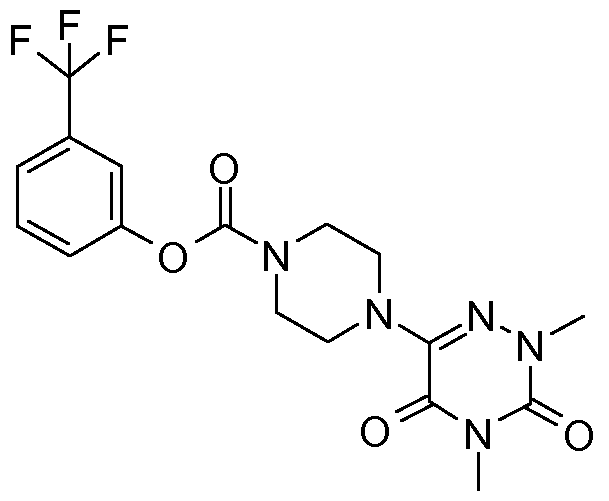
Example 51: 4- (2, 4-dimethyl-3, 5-dioxo-2, 3, 4, 5-tetrahydro- [ 1 , 2 , 4 ] triazin-6-yl) -piperazine-1-carboxylic acid 3- trifluoromethyl-phenyl ester (51)
The compound 51 (solid) is prepared from 3-trifluoromethyl- phenylchloroformate and from the intermediate 12a according
to the synthesis method 2 under the operating conditions described for Example 40 (yield: 27%) .
TLC silica gel 60 F 254 Merck, CH2Cl2-MeOH-NH4OH: 90-9-1, Rf=O.9. MP= 93°C
MS (+ESI) m/z 414 (MH+)
Example 52: 6-{4- [ (E) -3- (2-bromo-phenyl) -acryloyl] - piperazin-1-yl } -2 , 4 -dimethyl-2H- [1,2,4] triazine-3, 5-dione (52)
The compound 52 ( glassy solid) is prepared from the acrylic acid of (E) -3- (2-bromo-phenyl) converted into an acid chloride (SOCl2, toluene, 1000C, 3h) , and from the intermediate 12a according to the synthesis method 2 under the operating conditions described for Example 40 (yield: 90%) .
TLC silica gel 60 F 254 Merck, CH2Cl2-AcOEt: 80-20, Rf=O.7. MS (+ESI) m/z 546 (MH+) Example 53: 2, 4-dimethyl-6- [3-oxo-4- (2-trifluoromethyl- benzoyl) -piperazin-1-yl] -2H- [ 1, 2, 4 ] triazine-3, 5-dione (53)
The compound 53 (solid) is prepared from 2-trifluoromethyl- benzoyl chloride and from the intermediate 12b according to the synthesis method 2 under the operating conditions described for Example 40 (yield: 77%) .
TLC silica gel 60 F 254 Merck, CH2Cl2-MeOH: 90-10, Rf=O.83. MP= 900C
MS ( +ES I ) m/ z 412 (MH+ )
Example 54: 6- [4- (4-fluoro-2-trifluoromethyl-benzyl) piperazin-1-yl] -2, 4 -dimethyl-2H- [ 1, 2, 4] triazine-3, 5-dione (54)
The compound 54 is prepared according to the synthesis method 2: 0.26g (1.17 mmol) of derivative 12a is placed in 3mL of toluene in the presence of 0.24mL (1.75mmol) of NEt3 and of 0.3g (1.17mmol) of l-bromomethyl-4-fluoro-2- trifluoromethyl-benzene . This mixture is stirred 2h at 1100C. The medium is taken up with water and extracted with AcOEt. After drying on MgSO4, the organic phase is dry concentrated. The obtained residue is purified by flash chromatography on silica (CH2Cl2-AcOEt : 95-5) . 0.37g of a yellow oil are isolated (yield: 79%) .
TLC silica gel 60 F 254 Merck, CH2Cl2-AcOEt: 95-5, Rf=O.29. MS (+ESI) m/z 402 (MH+)
Example 55: 2, 4-dimethyl-6- [4- (2-trifluoromethyl-benzyl) - piperazin-1-yl] -2H- [1, 2, 4] triazine-3, 5-dione (55)
The compound 55 (solid) is prepared from l-bromomethyl-2- trifluoromethyl-benzene and from the intermediate 12a according to the synthesis method 2 under the operating conditions described for Example 54 (yield: 92%) . TLC silica gel 60 F 254 Merck, petroleum ether-AcOEt: 80-20, Rf=O.25.
MP= 92°C
1H NMR (CDCl3) ppm: 2.56-2.64 (m, 4H) , 3.34 (s, 3H) , 3.39-
3.47 (m, 4H) , 3.53 (s, 3H) , 3.70 (s, 2H) , 7.34 (t, IH,
J=7.58Hz) , 7.52 (t, IH, J=7.83Hz) 7.63 (d, IH, J=7.83Hz) ,
7.80 (d, IH, J=7.58Hz)
MS (+APCI) m/z 384 (MH+)
Example 56: 2-butyl-4-methyl-6- [4- (2-trifluoromethyl- benzyl) -piperazin-1-yl] -2H- [1, 2, 4] triazine-3, 5-dione (56)
The compound 56 (oil) is prepared from l-bromomethyl-2- trifluoromethyl-benzene and from the intermediate 12e according to the synthesis method 2 under the operating conditions described for Example 54 (yield: 84%) .
TLC silica gel 60 F 254 Merck, CH2Cl2-AcOEt: 95-5, Rf=O.36.
MS (+ESI) m/z 426 (MH+)
Example 57: 4-methyl-2- (4,4, 4-trifluoro-butyl) -6- [4- (2- trifluoromethyl-benzyl) -piperazin-1-yl ]-2H-[l,2,4] triazine-
3, 5-dione (57)
The compound 57 (solid) is prepared from l-bromomethyl-2- trifluoromethyl-benzene and from the intermediate 12d according to the synthesis method 2 under the operating conditions described for Example 54 (yield: 66%) . TLC silica gel 60 F 254 Merck, CH2Cl2-MeOH: 90-10, Rf=O.65. 1H NMR (CDCl3) ppm: 1.95-2.06 (m, 2H), 2.09-2.23 (m, 2H), 2.56-2.63 (m, 4H), 3.34 (s, 3H), 3.42-3.48 (m, 4H), 3.70
(s, 2H) , 3.95 (t, 2H, J=6.57Hz) , 7.35 (t, IH, J=7.58Hz) , 7.52 (t, IH, J=7.58Hz) , 7.62 (d, IH, J=7.58Hz) , 7.79 (d, IH, J=8.08Hz) . MS (+ESI) m/z 480 (MH+) Example 58: 2, 4-dimethyl-6- [3-methyl-4- (2-trif luoromethyl- benzyl) -piperazin-1-yl] -2H- [1, 2, 4] triazine-3, 5-dione (58)
The compound 58 (oil) is prepared from l-bromomethyl-2- trifluoromethyl-benzene and from the intermediate 12c according to the synthesis method 2 under the operating conditions described for Example 54 (yield: 76%) .
TLC silica gel 60 F 254 Merck, CH2Cl2-AcOEt: 95-5, Rf=O.40.
MS (+ESI) m/z 398 (MH+)
Example 59: 5- (4-benzyl-piperazin-l-yl) -1, 3-dimethyl-lH- pyrimidine-2, 4-dione (59)
The compound 59 (solid) is prepared according to the synthesis method described in the intermediate paragraph
13a (yield: 54%) . TLC silica gel 60 F 254 Merck, CH2Cl2-MeOH-NH4OH: 90-9-1,
Rf=0.64.
MP= 162°C
MS (+ESI) m/z 315 (MH+)
Example 60: 5- [4- (4-fluoro-2-trifluoromethyl-benzoyl) - piperazin-1-yl] -1, 3-dimethyl-lH-pyrimidine-2, 4-dione (60)
The compound 60 (solid) is prepared from 4-fluoro-2- trifluoromethyl-benzoyl chloride and from the intermediate 13b according to the synthesis method 2 under the operating conditions described for Example 40 (yield: 65%) .
TLC silica gel 60 F 254 Merck, CH2Cl2-MeOH-NH4OH: 90-9-1, Rf=0.57.
MS (+ESI) m/z 415 (MH+)
Example 61: 5- [4- (5-fluoro-2-trifluoromethyl-benzoyl) - piperazin-1-yl] -1, 3-dimethyl-lH-pyrimidine-2, 4-dione (61)
The compound 61 (solid) is prepared from 5-fluoro-2- trifluoromethyl-benzoyl chloride and from the intermediate
13b according to the synthesis method 2 under the operating conditions described for Example 40 (yield: 80%) .
TLC silica gel 60 F 254 Merck, CH2Cl2-MeOH-NH4OH: 90-9-1,
Rf=0.60.
MS (+ESI) m/z 415 (MH+)
Example 62: 1, 3-dimethyl-5- [4- (2-trifluoromethyl-benzoyl) - piperazin-1-yl] -lH-pyrimidine-2, 4-dione (62)
The compound 62 (solid) is prepared from 2-trifluoromethyl- benzoyl chloride and from the intermediate 13b according to the synthesis method 2 under the operating conditions described for Example 40 (yield: 59%) . TLC silica gel 60 F 254 Merck, CH
2Cl
2-MeOH: 98-2, Rf=O.2. MP= 163°C
MS (+APCI) m/z 397 (MH+)
Example 63: 5- [4- (4-fluoro-2-trifluoromethyl-benzyl) - piperazin-1-yl] -1, 3-dimethyl-lH-pyrimidine-2, 4-dione (63)
The compound 63 (oil) is prepared from l-bromomethyl-4- fluoro-2-trifluoromethyl-benzene and from the intermediate 13b according to the synthesis method 2 under the operating conditions described for Example 54 (yield: 67%) . TLC silica gel 60 F 254 Merck, CH2Cl2-MeOH: 90-10, Rf=O.60. MS (+ESI) m/z 401 (MH+)
Example 64: 4 -methyl-6- [4- (2-trifluoromethyl-benzyl) - piperazin-1-yl] -2H- [1, 2, 4] triazine-3, 5-dione (64)
The compound 64 is prepared from the triazine 4b and from the intermediate 7a according to the synthesis method 1 in n-butanol. After deprotection of the nitrogen in position 2 (NH
2NH
2. H
2O, EtOH, 78°C, 3h) , the compound 64 is obtained as a solid (yield: 64%) . TLC silica gel 60 F 254 Merck, CH
2Cl
2-AcOEt: 90-10, Rf=0.15.
MP= 2 05 ° C
1H NMR (CDCl3) ppm: 2.56-2.63 (m, 4H), 3.34 (s, 3H), 3.39- 3.47 (m, 4H), 3.70 (s, 2H), 7.34 (t, IH, J=7.58Hz), 7.52 (t, IH, J=7.58Hz), 7.63 (d, IH, J=7.58Hz), 7.79 (d, IH, J=8.08Hz) , 8.65 (s, IH) . MS (+ESI) m/z 370 (MH+) Example 65: 6- [4- (3-fluoro-phenyl) -piperazin-1-yl] -4- methyl-2H- [1,2,4] triazine-3, 5-dione (65)
O
The compound 65 is prepared from the triazine 4b and from 1- (3-fluoro-phenyl) -piperazine according to the synthesis method 1 in n-butanol. After deprotection of the nitrogen in position 2 (NH
2NH
2-H
2O, EtOH, 78°C, 3h) , the compound 65 is obtained as a solid (yield: 17%) . TLC silica gel 60 F 254 Merck, CH
2Cl
2-AcOEt: 90-10, Rf=O.14.
MS (+ESI) m/z 306 (MH+)
Example 66: 4 -methyl-6- [4- (3-trifluoromethyl-phenyl) - piperazin-1-yl] -2H- [1, 2, 4] triazine-3, 5-dione (66)
The compound 66 is prepared from the triazine 4b and from
1- (3-trifluoromethyl-phenyl) -piperazine according to the synthesis method 1 in n-butanol. After deprotection of the
nitrogen in position 2 (NH2NH2-H2O, EtOH, 78°C, 3h) , the compound 66 is obtained as a solid (yield: 73%) . TLC silica gel 60 F 254 Merck, CH2Cl2-MeOH: 95-5, Rf=O.55. MS (+ESI) m/z 356 (MH+) Example 67: 6- [4- (3-chloro-phenyl) -piperazin-1-yl] -4- methyl-2H- [1,2,4] triazine-3, 5-dione (67)
The compound 67 is prepared from the triazine 4b and from
1- (3-chloro-phenyl) -piperazine according to the synthesis method 1 in n-butanol. After deprotecdtion of the nitrogen in position 2 (NH2NH2. H2O, EtOH, 78°C, 3h) , the compound 67 is obtained as a solid (yield: 77%) .
TLC silica gel 60 F 254 Merck, CH2Cl2-MeOH: 95-5, Rf=O.53.
MS (+ESI) m/z 322 (MH+) Example 68: 6- [4- (2, 5-Bis-trifluoromethyl-benzoyl) - piperazin-1-yl] -4 -methyl-2H- [l,2,4]triazine-3,5-dione (68)
The compound 68 is prepared from the triazine 4b and from the intermediate 6a according to the synthesis method 1 in n-butanol. After deprotection of the nitrogen in position 2 (NH2NH2. H2O, EtOH, 78°C, 3h) , the compound 68 is obtained as a solid (yield: 86%) .
TLC silica gel 60 F 254 Merck, CH2Cl2-MeOH: 95-5, Rf=0.62. MS (+ESI) m/z 452 (MH+)
Example 69: 6- [4- (5-f luoro-2-trif luoromethyl-benzoyl) piperazin-1-yl ] -4 -methyl -2H- [1,2,4] triazine-3, 5-dione (69)
The compound 69 is prepared from the triazine 4b and from the intermediate 6c according to the synthesis method 1 in n-butanol. After deprotection of the nitrogen in position 2 (NH2NH2-H2O, EtOH, 78°C, 3h) , the compound 69 is obtained as a solid (yield: 63%) . TLC silica gel 60 F 254 Merck, CH2Cl2-MeOH: 95-5, Rf=O.17. 1H NMR (CDCl3) ppm: 3.30-3.32 (m, 4H), 3.34 (s, 3H), 3.40- 3.48 (m, IH), 3.47-3.55 (m, IH), 3.81-3.88 (m, IH), 3.95- 4.02 (m, IH), 7.07 (dd, IH, J=2.05Hz and J=8.34Hz), 7.20- 7.26 (m, IH), 7.74 (dd, IH, J=5.05Hz and J=8.84Hz), 8.62 (s, br, IH) . MS (+ESI) m/z 402 (MH+)
Example 70: 6- [4- (4-fluoro-2-trifluoromethyl-benzoyl) - piperazin-1-yl] -4 -methyl-2H- [l,2,4]triazine-3,5-dione (70)
The compound 70 is prepared from the triazine 4b and from the intermediate 6d according to the synthesis method 1 in n-butanol. After deprotection of thenitrogen in position 2
(NH2NH2. H2O, EtOH, 78°C, 3h) , the compound 70 is obtained as a solid (yield: 66%) .
TLC silica gel 60 F 254 Merck, CH2Cl2-MeOH: 95-5, Rf=O .36. 1H NMR (CDCl3) ppm: 3.28-3.31 (m, 4H) , 3.34 (s, 3H) , 3.38-
3.46 (m, IH) , 3.49-3.56 (m, IH) , 3.79-3.86 (m, IH) , 3.97-
4.04 (m, IH) , 7.29-7.38 (m, 2H) , 7.44 (dd, IH, J=2.52Hz and J=8.84Hz) , 8.62 (s, br, IH) . MS (+APCI) m/z 402 (MH+)
Example 71: 6- [4- (4-fluoro-2-trifluoromethyl-benzyl) - piperazin-1-yl] -4-methyl-2H- [ 1, 2, 4 ] triazine-3, 5-dione (71)
The compound 71 is prepared from the triazine 4b and from the intermediate 7b according to the synthesis method 1 in n-butanol. After deprotection of the nitrogen in position 2 (NH2NH2-H2O, EtOH, 78°C, 3h) , the compound 71 is obtained as a solid (yield: 34%) .
TLC silica gel 60 F 254 Merck, CH2Cl2-MeOH: 95-5, Rf=0.64. 1H NMR (CDCl3) ppm: 2.56-2.62 (m, 4H), 3.33 (s, 3H), 3.39- 3.42 (m, 4H), 3.65 (s, 2H), 7.22 (m, IH), 7.34 (d, IH, J=8.96Hz), 7.78 (t, IH, J=6.56Hz), 8.60 (s, br, IH) . MS (+ESI) m/z 388 (MH+)
Example 72: 4- (4, 4, 4-trifluoro-butyl) -6- [4- (2- trifluoromethyl-phenoxy) -piperidin-1-yl] -2H- [1,2, 4] triazine-3, 5-dione (72)
The compound 72 is prepared from the triazine 3b and from the intermediate 8c according to the synthesis method 1 in n-butanol. After deprotection of the nitrogen in position 2
(Na, EtOH, 80°C, 5h) , the compound 72 is obtained as a solid (yield: 38%) .
TLC silica gel 60 F 254 Merck, CH2Cl2-AcOEt: 90-10, Rf=O.5. MP=102°C MS (+ESI) m/z 467 (MH+)
Example 73: 2-heptyl-4-methyl-6- [4- (2-trifluoromethyl- benzoyl) -piperazin-1-yl] -2H- [1, 2, 4] triazine-3, 5-dione (73)
The compound 73 is prepared according to the synthesis method 3: 0.2Og (0.52 mmol) of the compound described for
Example 4 is placed in 2 mL of dimethylformamide at 00C.
0.023g (0.57 mmol) of NaH are added. The mixture is stirred for 30min at room temperature. 0.12g (0.57 mmol) of 1- bromo-heptane in ImL of dimethylformamide are added. This mixture is stirred for 4h30min at room temperature. After concentration, the residue is taken up with water and extracted with AcOEt. After drying on MgSθ4, the organic phase is concentrated. The obtained residue is purified by flash chromatography on silica (CH2Cl2-AcOEt: 90-10) . 0.2 Ig of a yellow oil are isolated (yield: 84%) .
TLC silica gel 60 F 254 Merck, CH2Cl2-MeOH: 95-5, Rf=O.5. MS (+ESI) m/z 482 (MH+)
Example 74: 2-butyl-4-methyl-6- [4- (2-trifluoromethyl- benzoyl) -piperazin-1-yl] -2H- [1, 2, 4] triazine-3, 5-dione (74)
The compound 74 (oil) is prepared from 1-bromo-butane and from the compound described for Example 4 according to the synthesis method 3 (yield: 70%) .
TLC silica gel 60 F 254 Merck, petroleum ether-AcOEt: 50- 50, Rf=O.35.
1H NMR (CDCl3) ppm: 0.93-0.96 (t, 3H, J=7.6Hz) 1.29-1.40
(m, 2H), 1.64-1.73 (m, 2H), 3.26-3.32 (m, 4H), 3.34 (s, 3H), 3.40-3.60 (m, 2H), 3.82-3.91 (m, 3H), 3.97-4.06 (m, IH), 7.35 (d, IH, J=7.83Hz), 7.54 (t, IH, J=7.83Hz) 7.62 (t, IH, J=7.07Hz), 7.72 (d, IH, J=8.08Hz) MS (+ESI) m/z 440 (MH+)
Example 75: 4-methyl-2- (3-methyl-butyl) -6- [4- (2- trifluoromethyl-benzoyl) -piperazin-1-yl] -2H-
[1,2, 4] triazine-3, 5-dione (75)
The compound 75 (oil) is prepared from l-bromo-3-methyl- butane and from the compound described for Example 4 according to the synthesis method 3 (yield: 79%) . TLC silica gel 60 F 254 Merck, petroleum ether-AcOEt: 50- 50, Rf=O.35.
MS (+ESI) m/z 454 (MH+)
Example 76: 6- [4- (2-chloro-phenoxy) -piperidin-1-yl] -4- heptyl-2H- [1,2, 4] triazine-3, 5-dione (76)
The compound 76 is prepared from the triazine 3c and from the intermediate 8a according to the synthesis method 1 in
n-butanol. After deprotection of the nitrogen in position 2 (NaH, DMF, 20°C, 3h) , the compound 76 is obtained as a solid (yield: 67%) .
TLC silica gel 60 F 254 Merck, CH2Cl2-AcOEt: 90-10, Rf=0.55. MP=95°C
1H NMR (CDCl3) ppm: 0.88 (t, 3H, J=6.82Hz), 1.22-1.38 (m, 8H), 1.60-1.69 (m, 2H), 1.94-2.09 (m, 4H), 3.38-3.46 (m, 2H) . 3.57-3.65 (m, 2H), 3.91 (t, 2H, J=6.56Hz), 4.58 (m, IH), 6.91 (t, IH, J=7.32Hz), 7.00 (d, IH, J=8.59Hz), 7.20 (t, IH, J=8.08Hz), 7.37 (d, IH, J=8.08Hz), 8.72 (s br, IH) . MS (+ESI) m/z 421 (MH+)
Example 77: 6- [4- (4-fluoro-2-trifluoromethyl-benzyl) - piperidin-1-yl ] -2 , 4 -dimethyl-2H- [1,2,4] triazine-3, 5-dione (77)
The compound 77 (oil) is prepared from the triazine Ib and from the intermediate9b according to the synthesis method 1 in n-butanol (yield: 43%) . TLC silica gel 60 F 254 Merck, CH2Cl2-AcOEt: 95-5, Rf=O.48. 1H NMR (CDCl3) ppm: 1.38-1.50 (m, 2H), 1.64-1.79 (m, 3H), 2.60 (t, 2H, J=12.6Hz), 2.72 (d, 2H, J=6.82Hz), 3.34 (s, 3H), 3.52 (s, 3H), 4.05 (d, 2H, J=12.3Hz), 7.17 (t, IH, J=8.33Hz), 7.25-7.30 (m, IH), 7.32-7.38 (m, IH) . MS (+ESI) m/z 401 (MH+)
Example 78: 4-methyl-2- (2-thiophen-2-yl-ethyl) -6- [4- (2- trifluoromethyl-phenoxy) -piperidin-1-yl] -2H- [1,2, 4] triazine-3, 5-dione (78)
The compound 78 (solid) is prepared from the triazine 4k and from the intermediate 8c according to the synthesis method 1 in n-butanol (yield: 41%) .
1H NMR (CDCl3) ppm: 1.93-2.07 (m, 4H), 3.27 (t, 2H, J=7.32Hz), 3.43 (s, 3H), 3.43-3.54 (m, 4H), 4.17 (t, 2H, J=7.20Hz), 4.69 (m, IH), 6.83 (dd, IH, J=3.53Hz and J=LOlHz), 6.92 (dd, IH, J=5.18Hz and J=3.16Hz), 7.00 (d,
IH, J=8.46Hz), 7.00 (t IH, J=7.58Hz), 7.14 (dd, IH, J=5.18Hz and J=I.26 Hz), 7.48 (t, IH, J=7.7Hz), 7.59 (d, IH, J=7.7Hz) . MS (+ESI) m/z 481 (MH+)
Example 79: 4-methyl-2-o-tolyl-6- [4- (2-trifluoromethyl- phenoxy) -piperidin-1-yl] -2H- [1, 2, 4] triazine-3, 5-dione (79)
The compound 79 (solid) is prepared from the triazine 41 and from the intermediateδc according to the synthesis method 1 in n-butanol (yield: 51%) . TLC silica gel 60 F 254 Merck, CH2Cl2-AcOEt: 90-10, Rf=0.52. MP=106°C
1H NMR (CDCl3) ppm: 1.95-2.10 (m, 4H), 2.22 (s, 3H), 3.43 (s, 3H), 3.52-3.57 (m, 4H), 4.69 (m, IH), 6.98 (d, IH, J=8.56Hz), 6.99 (d, IH, J=7.45Hz), 7.27-7.34 (m, 4H), 7.46 (t, IH, J=7.96Hz), 7.57 (d, IH, J=7.32Hz) . MS (+ESI) m/z 461 (MH+)
Example 80: 2- (4-fluoro-phenyl) -4-methyl-6- [4- (2- trifluoromethyl-phenoxy) -piperidin-1-yl] -2H- [1,2, 4] triazine-3, 5-dione (80)
The compound 80 (solid) is prepared from the triazine 4m and from the intermediateδc according to the synthesis method 1 in n-butanol (yield: 48%) .
TLC silica gel 60 F 254 Merck, CH2Cl2-AcOEt: 95-5, Rf =0.64.
MP=Hl0C 1H NMR (CDCl3) ppm: 1.99-2.12 (m, 4H) , 3.42 (s, 3H) , 3.51-
3.60 (m, 2H) , 3.60-3.69 (m, 2H) , 4.72 (m, IH) , 6.97-7.02
(m, 2H) , 7.11 (t, 2H, J=8.21Hz) , 7.47 (t, IH, J=7.32Hz) ,
7.53-7.60 (m, 3H) .
MS (+ESI) m/z 465 (MH+) Example 81: 4-methyl-2-pyridin-3-yl-6- [4- (2- trifluoromethyl-phenoxy) -piperidin-1-yl] -2H-
[1,2, 4] triazine-3, 5-dione (81)
The compound 81 (solid) is prepared from the triazine 4n and from the intermediateδc according to the synthesis method 1 in n-butanol (yield: 56%) .
TLC silica gel 60 F 254 Merck, CH2Cl2-MeOH: 90-10, Rf =0.62.
MP=63°C
1H NMR (CDCl3) ppm: 1.99-2.13 (m, 4H) , 3.44 (s, 3H) , 3.56- 3.64 (m, 2H) , 3.67-3.74 (m, 2H) , 4.74 (m, IH) , 6.97-7.02
(m, 2H), 7.37 (ddd, IH, J=O .6Hz and J=4.67Hz and J=8.21Hz),
7.48 (dt. IH. J=I .40Hz and J=7.20Hz) , 7.59 (dd, IH,
J=I.40Hz and J=8.08Hz), 8.01 (ddd. IH. J=I.51Hz and
J=2.65Hz and J=7.96Hz), 8.53 (dd, IH, J=I.51Hz and
J=4.92Hz), 8.93 (d, IH, J=2.65Hz) .
MS (+ESI) m/z 448 (MH+)
Example 82: 4-methyl-2-thiophen-3-yl-6- [4- (2- trifluoromethyl-phenoxy) -piperidin-1-yl] -2H-
[1,2, 4] triazine-3, 5-dione (82)
The compound 82 (solid) is prepared from the triazine 4o and from the intermediateδc according to the synthesis method 1 in n-butanol (yield: 57%) .
TLC silica gel 60 F 254 Merck, CH2Cl2- AcOEt: 95-5, Rf=0.72. MP=85°C
1H NMR (CDCl3) ppm: 2.00-2.14 (m, 4H), 3.43 (s, 3H), 3.56- 3.64 (m, 2H), 3.67-3.73 (m, 2H), 4.74 (m, IH), 7.00 (t, IH, J=6.69Hz), 7.01 (d, IH, J=8.46Hz), 7.29 (dd, IH, J=3.28Hz and J=5.30Hz), 7.48 (dt, IH, J=I .64Hz and J=7.83Hz), 7.52 (dd, IH, J=I.40Hz and J=5.43Hz), 7.59 (dd, IH, J=I.51Hz and J=8.08Hz), 7.69 (dd, IH, J=I.51Hz and J=3.28Hz) . MS (+ESI) m/z 453 (MH+)
Example 83: 4- { 4-methyl-3, 5-dioxo-6- [4- (2-trifluoromethyl- phenoxy) -piperidin-1-yl] -4, 5-dihydro-3H- [1, 2, 4] triazin-2- yl}-benzonitrile (83)
The compound 83 (solid) is prepared from the triazine 4p and from the intermediateδc according to the synthesis method 1 in n-butanol (yield: 60%) .
TLC silica gel 60 F 254 Merck, CH2Cl2- AcOEt: 95-5,
Rf=O.18.
MP=72°C
1H NMR (CDCl3) ppm: 2.04-2.10 (m, 4H), 3.43 (s, 3H), 3.54-
3.62 (m, 2H), 3.70-3.77 (m, 2H), 4.75 (m, IH), 7.00 (d, IH,
J=7.58Hz), 7.01 (t, IH, J=6.06Hz), 7.48 (t, IH, J=7.70Hz),
7.59 (d, IH, J=7.95Hz), 7.71 (d, 2H, J=8.84Hz), 7.86 (d,
2H, J=8.84Hz) .
MS (+ESI) m/z 472 (MH+)
Example 84: 2- (2-methoxy-phenyl) -4-methyl-6- [4- (2- trifluoromethyl-phenoxy) -piperidin-1-yl] -2H- [1, 2, 4] triazine-3, 5-dione (84)
The compound 84 (solid) is prepared from the triazine 4q and from the intermediateδc according to the synthesis method 1 in n-butanol (yield: 74%) . TLC silica gel 60 F 254 Merck, CH2Cl2- AcOEt: 95-5,
Rf=0.32.
MP=128°C
1H NMR (CDCl3) ppm: 1.94-2.10 (m, 4H), 3.41 :s, 3H), 3.45-
3.59 (m, 4H), 3.84 (s, 3H), 4.67 (m, IH), 6.95-7.05 (m, 4H), 7.31 (dd, IH, J=I .64Hz and J=7,58Hz), 7.39 (td, IH,
J=I.89Hz and J=7.70Hz), 7.45 (td, IH, J=I .64Hz and
J=7.96Hz), 7.57 (dd, IH, J=I.26Hz and J=7.95Hz) .
MS (+ESI) m/z 477 (MH+)
Example 85: 4 -methyl-6- [4- (2-trifluoromethyl-phenoxy) - piperidin-1-yl] -2H- [1,2, 4] triazine-3, 5-dione (85)
The compound 85 is prepared from the triazine 3a and from the intermediate 8c according to the synthesis method 1 in n-butanol. After deprotection of the nitrogen in position 2 (NaH, DMF, 20°C, 2Oh), the compound 85 is obtained as a solid (yield: 77%) .
TLC silica gel 60 F 254 Merck, CH2Cl2-AcOEt: 95-5, Rf=O.16.
MP=150°C
1H NMR (CDCl3) ppm: 1.96-2.09 (m, 4H), 3.35 (s, 3H), 3.46- 3.57 (m, 4H), 4.71 (m, IH), 6.99 (t, IH, J=7.32Hz), 7.00
(d, IH, J=8.59Hz), 7.47 (t, IH, J=7,56Hz), 7.58 (d, IH,
J=8.08Hz), 8.99 (s br, IH) .
MS (+ESI) m/z 371 (MH+)
Example 86: 4-methyl-2- (2-oxo-cyclohexyl) -6- [4- (2- trifluoromethyl-phenoxy) -piperidin-1-yl] -2H-
[1, 2, 4] triazine-3, 5-dione (86;
The compound 86 (solid) is prepared from 2-chloro- cyclohexanone and from the compound described for Example 85 according to the synthesis method 3 (yield: 31%) .
TLC silica gel 60 F 254 Merck, CH2Cl2-MeOH: 95-5, Rf=O.63.
MP=65°C
1H NMR (CDCl3) ppm: 1.64-1.90 (m, 2H), 1.93-2.18 (m, 6H),
2.19-2.49 (m, 3H), 2.54-2.62 (m, IH), 3.34 (s, 3H), 3.46 (t, 2H, J=6.95Hz), 3.48-3.61 (m, 2H), 4.68 (m, IH), 5.14
(dd, IH, J=5.93Hz and J=12.88Hz) , 6.97-7.01 (m, 2H) , 7.46
(t, IH, J=7.32Hz) , 7.58 (d, IH, J=8.46Hz) . MS (+ESI) m/z 467 (MH+)
Example 87: 4-methyl-2- (l-oxo-indan-2-yl) -6- [4- (2- trifluoromethyl-phenoxy) -piperidin-1-yl] -2H-
[1,2, 4] triazine-3, 5-dione (87)
The compound 87 (solid) is prepared from 2-bromo-indan-l- one and from the compound described for Example 85 according to the synthesis method 3 (yield: 38%) .
TLC silica gel 60 F 254 Merck, CH2Cl2-MeOH: 95-5, Rf=O.63.
MP=IlO0C
1H NMR (CDCl3) ppm: 1.86-2.04 (m, 4H), 3.37 (s, 3H), 3.38-
3.51 (m, 4H), 3.55-3.65 (m, 2H), 4.64 (m, IH), 5.37 (m, IH), 6.93-7.00 (m, 2H), 7.41-7.47 (m, 2H), 7.51 (d, IH,
J=8.21Hz), 7.56 (d, IH, J=7.96Hz), 7.66 (td, IH, J=I.40Hz and J=7.58Hz) , 7.82 (d, IH, J=7.70Hz) .
MS (+ESI) m/z 501 (MH+)
Example 88: 2- [2- (2-ethoxy-ethoxy) -ethyl] -4-methyl-6- [4- (2- trifluoromethyl-phenoxy) -piperidin-1-yl] -2H-
[1,2, 4] triazine-3, 5-dione (88)
The compound 88 (solid) is prepared from l-bromo-2- (2- ethoxy-ethoxy) -ethane and from the compound described for Example 85 according to the synthesis method 3 (yield: 77%) .
TLC silica gel 60 F 254 Merck, CH2Cl2-MeOH: 95-5, Rf=O .85. MP=44°C
1H NMR (CDCl3) ppm: 1.19 (t, 3H, J=7.07Hz) , 1.95-2.01 (m,
4H) , 3.34 (s, 3H) , 3.46-3.58 (m, 8H) , 3.63-3.67 (m, 2H) , 3.82 (t, 2H, J=5.81Hz) , 4.10 (t, 2H, J=5.81Hz) , 4.70 (m,
IH) , 6.99 (t, IH, J=7.20Hz) , 7.00 (d, IH, J=7.07Hz) , 7.47
(t, IH, J=7.96Hz) , 7.58 (d, IH, J=7.83Hz) . MS (+ESI) m/z 487 (MH+)
Example 89: 2- (2-hydroxy-ethyl) -4-methyl-6- [4- (2- trifluoromethyl-phenoxy) -piperidin-1-yl] -2H-
[1,2, 4] triazine-3, 5-dione (89;
The compound 89 (solid) is prepared from 2-bromo-ethyl acetate and from the compound described for Example 85 according to the synthesis method 3 (yield: 68%) .
TLC silica gel 60 F 254 Merck, CH2Cl2-MeOH: 95-5, Rf=O.85.
MP=112°C
1H NMR (CDCl3) ppm: 1.97-2.10 (m, 4H), 2.41 (m, IH), 3.36
(s, 3H), 3.46-3.54 (m, 2H), 3.54-3.62 (m, 2H), 3.94-3.99 (m, 2H), 4.11 (t, 2H, J=4.56Hz), 4.71 (m, IH), 7.00 (d, IH,
J=8.58Hz), 7.00 (t, IH, J=7.56Hz), 7.48 (t, IH, J=8.08Hz),
7.59 (d, IH, J=I .96Hz) .
MS (+ESI) m/z 415 (MH+)
Example 90: 6- (4- (2-chloro-5-fluorophenoxy) piperidin-1-yl) - 2-methyl-l,2,4-triazine-3,5 (2H,4H) -dione (90)
The compound 90 (white powder) is prepared from the triazine 2e and from the intermediate 8b according to the synthesis method 1 in toluene.
TLC silica gel 60 F 254 Merck, CH2Cl2-MeOH: 95-5, Rf=O.66. MP= 172°C
1H NMR (CDCl3) ppm: 1.95-2.00 (m, 2H), 2.02-2.08 (m, 2H), 3.54 (s, 3H) 3.50-3.55 (m, 2H), 3.60-3.67 (m, 2H), 4.56 (m, IH), 6.64 (m, IH), 6.7 (dd, IH), 7.32 (dd, IH), 8.91 (s, IH) . MS (+ESI) m/z 355 (MH+)
Example 91: 6- (4- (2, 5-dichlorophenoxy) piperidin-1-yl) -2- methyl- 1 , 2 , 4 -triazine-3 , 5 ( 2H, 4H) -dione ( 91 )
The compound 91 (white solid) is prepared from the triazine 2e and from 4- (2, 5-dichlorophenoxy) piperidine (obtained as under the preparative methods of intermediate 8a) according to the synthesis method 1 in toluene.
1H NMR (CDCl3) ppm: 1.95-2.08 (m, 4H), 3.50 (s, 3H), 3.50-
3.53 (m, 2H), 3.61-3.67 (m, 2H), 4.57 (s, IH), 6.90 (d, IH, J=8.4Hz), 6.94 (s, IH), 7.29 (d, IH, J=8.4Hz), 8.75 (s,
IH) .
MS (+ESI) m/z 371 (MH+)
Example 92 : 6- (4- (5-bromo-2-chlorophenoxy) piperidin-1-yl) -
2 -methyl- 1, 2, 4-triazine-3, 5 (2H, 4H) -dione (92)
The compound 92 (yellow powder) is prepared from the triazine 2e and from 4- (5-bromo-2-chlorophenoxy) piperidine (obtained as under the preparative conditions of
intermediate 8a) according to the synthesis method 1 in toluene .
1H NMR (CDCl3) ppm: 1.95-2.08 (m, 4H), 3.50 (s, 3H), 3.50- 3.53 (m, 2H), 3.59-3.62 (m, 2H), 4.57 (s, IH), 7.05 (d, IH, J=8.8Hz), 7.09 (s, IH), 7.22-7.26 (m, IH), 8.52 (s, IH) . MS (+ESI) m/z 416 (MH+) Example 93: 6- (4- (2-bromo-4, 5-difluorophenoxy) piperidin- 1- yl) -2-methyl-l, 2, 4-triazine-3, 5 (2H, 4H) -dione (93)
The compound 93 (white solid) is prepared from the triazine 2e and from 4- (2-bromo-4, 5-difluorophenoxy) piperidine (obtained as under the preparative conditions of intermediate 8a) according to the synthesis method 1 in toluene . 1H NMR (CDCl
3) ppm: 1.94-2.09 (m, 4H), 3.51 (s, 3H), 3.51- 3.58 (m, 2H), 3.61-3.67 (m, 2H), 4.48-4.52 (m, IH), 6.78- 6.83 (m, IH), 7.39-7.44 (m, IH), 8.22-8.29 (m, IH) . MS (+ESI) m/z 418 (MH+) Example 94: 2-methyl-6- (4- (3- ( trifluoromethyl) phenoxy) piperidin-1-yl) -1,2, 4-triazine- 3,5 (2H, 4H) -dione
The compound 94 (white solid) is prepared from the triazine 2e and from 4- (3- (trifluoromethyl) phenoxy) piperidine (obtained as under the preparative conditions of intermediate 8a) according to the synthesis method 1 in toluene .
1H NMR (CDCl3) ppm: 1.88-1.98 (m, 2H), 2.03-2.13 (m, 2H), 3.39-3.45 (m, 2H), 3.51 (s, 3H), 3.68-3.73 (m, 2H), 4.57- 4.59 (m, IH), 7.09 (d, IH, J=8.4Hz), 7.22 (d, IH, J=7.2Hz), 7.41 (t, IH, J=8Hz), 8.34-8.37 (m, IH) . MS (+ESI) m/z 371 (MH+)
PHARMACOLOGICAL EVALUATION
In vi tro : Human SCD-I enzymatic activity from microsomes of HepG2 cells after treatment with inhibitory compounds (inhibition %) . Human hepatocarcinoma HepG2 cells (ATCC, HB-8065) are grown to confluence and then trypsinized. The cell pellet is taken up in 10 mM Tris buffer (pH 7.4), saccharose (250 mM) DTT (1 mM) and then the cells are lyzed by sonication. The microsomes are obtained after centrifugation at 10,000 g for 20 minutes a 4°C followed by centrifugation of the supernatant at 100,000 g for 60 minutes a 4°C. The pellet is taken up in 10 mM Tris buffer (pH 7.4) saccharose (250 mM) at 4°C and the microsomal proteins are assayed and stored at -196°C (liquid nitrogen) . The enzymatic reaction measures the conversion of stearic acid (a C18:0 fatty acid) into oleic acid (C18:l fatty acid) by SCD-I. The enzymatic reaction is started by adding 125 μg of microsomal fraction of HepG2 cells to tubes (total reaction volume of 500 μl) containing 62 μM of stearic acid (45 μM of stearic acid and 17 μM of [14C] stearic acid) in a phosphate buffer at 100 mM (pH 7.16) with 7.2 mM of ATP, 0.54 mM of CoA, 6 mM of MgCl2, 0.8 mM of NADH and the inhibitory compound or the carrier (0.1% DMSO) . The tubes are incubated fro 20 minutes at 370C and the enzymatic reaction is then stopped by adding KOH (12%) and saponification for 30 minutes at 800C. After acidification (3N HCl) , the fatty acids are extracted twice with ethyl ether, evaporated under nitrogen before being taken up with a methanol/dichloromethane (3:1) mixture. The product of the reaction (C18:l) is separated from the
substrate of the reaction (C18:0) by HPLC (Perkin Elmer, C18 reverse phase column) coupled to a on-line radioactivity detector (FlowOne) . Enzymatic activity is calculated in picomoles of stearic acid converted into oleic acid per minute and per mg of protein. For each inhibitory compound, an inhibition % is determined relatively to the reference enzymatic activity (carrier 0.1% DMSO) Sterculic acid is the reference inhibitory compound (Gomez F. E., Bauman D. E., Ntambi J. M., Fox B. G. Effects of sterculic acid on stearoyl-CoA desaturase in differentiating 3T3-L1 adipocytes. Biochem Biophys Res Commun. 300 316-326 (2003)) .
Table 10: Human SCD-I enzymatic activity inhibition % at 10 μM) .
The invention also relates to the compounds of general formula (I) for their use as drugs intended for treating diseases requiring inhibitors of SCD-I enzyme activity.
The invention also relates to compounds of general formula (I) for their use as drugs intended for treating diseases such as obesity, diabetic dyslipidemia, hypertriglyceridemia, hypercholesterolemia, the metabolic syndrome, atherosclerosis, hepatic steatosis, cardiovascular risks.
The invention also extends to compounds of general formula (I) for their use as drugs intended for treating pathologies related to lipid disorders of the skin.
The invention also relates to compounds of general formula (I) for their use as drugs intended for treating diseases such as acne, psoriasis, hirsutism.