TITLE OF THE INVENTION
[0001] IMAGING AGENTS USEFUL FOR IDENTIFYING AD PATHOLOGY
CLAIM TO PRIORITY
[0002] The present application is based on and claims the priority of U.S. provisional application No. 61/083,501 , filed July 24, 2008, which is incorporated herein by reference.
[0003] The foregoing applications, and all documents cited therein or during their prosecution ("appln cited documents") and all documents cited or referenced in the appln cited documents, and all documents cited or referenced herein ("herein cited documents"), and all documents cited or referenced in herein cited documents, together with any manufacturer's instructions, descriptions, product specifications, and product sheets for any products mentioned herein or in any document incorporated by reference herein, are hereby incorporated herein by reference, and may be employed in the practice of the invention.
FIELD OF THE INVENTION
[0004] Embodiments of the present invention are directed to amyloid binding compounds, pharmaceutical compositions comprising the amyloid binding compounds, and methods of using the amyloid binding compounds. The present invention also includes embodiments that are further directed to methods of preparing the amyloid binding compounds. Such compounds, as disclosed herein, may be used in imaging studies, such as Positron Emitting Tomography (PET) or Single Photon Emission Computed Tomography (SPECT), to detect and treat neurological disorders.
BACKGROUND OF THE INVENTION
[0005] Alzheimer's disease (AD) is the most common form of neurodegeneration and has become a major healthcare issue with the aging population in the United States.
[0006] As people advance past the age of 65, the risk for developing Alzheimer's disease increases. As the leading cause of dementia, clinical AD symptomology includes both cognitive impairment and deficits in memory function.
[0007] AD patients exhibit heavy senile plaque burden in the cerebral cortex, verified by post mortem histopathological examination. Interestingly, despite the development and presence
of senile plaques in elderly persons with normal cognitive function, the severity of neurofibrillary tangles (NFT) and senile plaque deposition purportedly correlates with a loss of cognitive function and neuronal circuitry deterioration. Mature senile plaques consist of intracellular neurofibrillary tangles derived from filaments of hyperphosphorylated tau proteins, and extracellular β-amyloid peptides derived from enzymatic processing of amyloid precursor protein.
[0008] Amyloidosis is characterized by the progressive, bulk accumulation of insoluble fibrillary proteins in the patient tissue, leading ultimately to morbidity. Deposition of amyloid occurs via aggregation of the fibrillary proteins, followed by further combination or aggregation thereof. With respect to AD, accumulation of aggregates of amyloid peptides Aβ4o and Aβ42 are the major peptides found in senile plaque and cerebrovascular deposits in patents (see Xia, et al., J. Proc. Natl. Acad. ScL USA, 97: 9299 (2000) and Hardy, et al, Science 2002, 297, 353). Prevention of the deposition of these peptide fragments, which are derived from amyloid precursor proteins, continues to be a primary therapeutic research goal. Due to the central role of γ-secretase in the generation of the Aβ peptides via cleavage of amyloid precursor protein (APP), inhibition of γ-secretase has been identified as an important target in the discovery of novel AD treatments (see, for example, Ziani-Cherif, et al, Curr. Pharm. Design 2006, 12, 4313-4335; Evin, et a), CNS Drugs 2006, 20, 351-372; and Lahiri, et al., Drug Dev. Res. 2002, 56, 267-281 ).
[0009] Diagnosis of AD has been traditionally performed via post-mortem tissue studies, brain biopsies or clinical evaluation [see, for example, McKhann, et al., Neurology, 34: 939 (1984) and Khachaturian, Arch. Neurol., 42: 1097 (1985)]. AD is clinically characterized by the presence of neurotic plaques (NP), neurofibrillary tangles (NFT) and neuronal loss (see. Mann, Mech. Aging Dev. 31 : 213 (1985). Neurotic plaques are a ubiquitous aspect of the disease (Mann et al., J. Neurol. ScL, 89: 169), the assessment of which must be performed in postmortem studies.
[0010] Unfortunately, at the stage of presentation of symptoms in the clinic, the patients have developed significant amyloid deposition in the neurological tissue. More recently, earlier diagnosis has been the subject of research efforts aimed at immunoassay techniques, genetic testing and radiological imaging technologies.
[0011] Discovery of point mutations in amyloid precursor protein (APP) in several rare
families with an autosomal dominant form of AD provided evidence that abnormalities in Aβ metabolism are necessary and sufficient for the development of AD (see, for example, Hardy, Nature Genetics, 1 : 233 (1992); and Hardy, et al., Science, 256: 184 (1992). Heterogeneous evidence of AD has also been demonstrated via analysis of a large number of families of AD (see, St. George-Hyslop, et al., Nature, 347: 194
(1990). In particular, a gene on chromosome 14 has been identified which may account for up to 70% of early-onset AD, as mutation of which may significantly increase production of the Aβ peptide (Sherrington, et al., Nature, 375: 754 (1995)).
[0012) Immunoassay methods have been developed for detecting the presence of neurochemical markers in AD patients and to detect an AD related amyloid protein in
cerebral spinal fluid, however such methods have not proven reliable in all patients and require invasive procedures such as a spinal tap.
[0013] Monoclonal antibodies and radiolabeled peptides have been used as probes for imaging of Aβ, however these macromolecular structures provide inherently poor brain penetration (see, for example, Majocha, et al., J. Nucl. Med., 33: 2184 (1992)). Additionally, the peptide probes may lack specificity for AD as they tend to react with diffuse plaques.
[0014] In addition to AD, amyloid deposits have also been associated with other diseases such as, for example, glaucoma, Mediterranean fever, idiopathic myeloma, amyloid polyneuropathy, amyloid cardiomyopathy, systemic senile amyloidosis, hereditary cerebral hemorrhage, Muckle- Wells syndrome, Down's syndrome, Gerstmann-Straussler-Scheinker syndrome, Creutzfeldt-Jacob disease, scrapie, kuru, Islets of Langerhans, isolated atrial amyloid, medullary carcinoma of the thyroid and inclusion body myositis to name a few.
[0015] Though treatments exist, efficacy is observed in a palliative sense rather than halting the progression of AD, providing the patient with only a temporarily improved quality of life. It has been reported that delaying AD onset by five years is sufficient to reduce the number of AD cases by half. To this end, there are a number of therapies that delay full onset AD. Typically, clinicians prescribe cholinesterase inhibitors to cognitively impaired patients to help delay AD progression. Rivastigmine, a therapeutic treatment for both AD and Parkinson's disease patients, inhibits both acetylcholinesterase and butyrylcholinesterase, preventing the breakdown of acetyl- and butyrylcholine. Galantamine, a naturally derived
acetylcholinesterase inhibitor, increases nicotinic cholinergic receptors' release of acetylcholine into the brain. Finally, the acetylcholinesterase inhibitor Aricept slows progression of AD in patients by inhibiting acetylcholinesterase and thus increasing cortical acetylcholine. In a recent clinical trial, Aricept slowed AD progression in patients, but the therapeutic effects disappeared after 36 months. The effect of treating AD patients with a therapeutic combination of both Aricept and memantine caused an increased cognitive function in those AD patients relative to those treated only with Aricept. Despite the utility of cholinesterase inhibitors, the current array of AD therapeutics merely serves to delay full- onset AD by approximately two to three years, after which they are therapeutically ineffective in inhibiting cognitive decline.
[0016) Neurological imaging of AD has seen the emergence of imaging tracers that appear to confirm the presence of AD based on plaque and fibril mediated tracer uptake and, subsequently, are currently undergoing extensive clinical examination. Many of these tracers contain chemotypes that derive from fluorescent dyes or Aβ peptides. For example, increased uptake and binding of the napthylaniline derivative 18F-FDDNP in living brains correlates well with the presence of AD when compared to cognitively functional normals of similar age {High-Yield, Automated Radiosynthesis of2-(l-{6-[(2-
[l8F]Fluoroethyl)(methyl)amino]-2-naphthyl}ethylidene)malonitrile ([18F]FDDNP) Ready for Animal or Human Administration, Liu, J., et al., Molecular Imaging and Biology, 2007. 9: p. 6-16). The thioflavin derived AD imaging agent, 11C-PIB, shows enhanced uptake in frontotemporal and hippocampal brain regions in AD patients compared to healthy age- matched normals.
[0017] Several other chemotypes have been identified as plaque imaging agents. These chemotypes are radiolabeled for use as PET or SPECT imaging agents. The scaffolds include compounds derived from benzothiazoles, naphthyl amines, flavones, aurones, isoindoles and styrenes. The chemotypes bind to plaques and fibrils with varying affinities and differing binding sites (see, for example, US 2007/0258887). Disclosed in this application are additional scaffolds that bind to AD plaques and fibrils.
[0018] A number of medical diagnostic procedures, including PET and SPECT utilize radiolabeled compounds, are well known in the art. PET and SPECT are very sensitive techniques and require small quantities of radiolabeled compounds, called tracers. The labeled compounds are transported, accumulated and converted in vivo in exactly the same
way as the corresponding non-radioactively compound. Tracers, or probes, can be radiolabeled with a radionuclide useful for PET imaging, such as 1 1C, 13N, ISO, 18F, 64Cu and 124I, or with a radionuclide useful for SPECT imaging, such as 99Tc, 77Br, 61Cu, 1S3Gd, 123I, 125I5 131I aHd 32P.
[0019] PET creates images based on the distribution of molecular imaging tracers carrying positron-emitting isotopes in the tissue of the patient. The PET method has the potential to detect malfunction on a cellular level in the investigated tissues or organs. PET has been used in clinical oncology, such as for the imaging of rumors and metastases, and has been used for diagnosis of certain brain diseases, as well as mapping brain and heart function. Similarly, SPECT can be used to complement any gamma imaging study, where a true 3D representation can be helpful, for example, imaging tumor, infection (leukocyte), thyroid or bones.
[0020] Citation or identification of any document in this application is not an admission that such document is available as prior art to the present invention.
SUMMARY OF THE INVENTION
[0021] The present invention relates to compounds and compositions which comprise the formulae as disclosed herein, wherein the compound is an amyloid binding compound. An amyloid binding compound of the invention may be administered to a patient in amounts suitable for in vivo imaging of amyloid deposits, and distinguish between neurological tissue with amyloid deposits and normal neurological tissue. Amyloid probes of the invention may be used to detect and quantitate amyloid deposits in diseases including, for example, Down's syndrome, familial Alzheimer's Disease. In another embodiment, the compounds may be used in the treatment or prophylaxis of neurodegenerative disorders. Also provided herein are methods of allowing the compound to distribute into the brain tissue, and imaging the brain tissue, wherein an increase in binding of the compound to the brain tissue compared to a normal control level of binding indicates that the mammal is suffering from or is at risk of developing a neurodegenerative disease.
[0022] The compounds and probes of the invention preferably exhibit low toxicity at dosages effective to treat or image (including diagnostic, detection, quantification and evaluation) amyloid related afflictions.
[0023] Accordingly, it is an object of the invention to not encompass within the invention
any previously known product, process of making the product, or method of using the product such that Applicants reserve the right and hereby disclose a disclaimer of any previously known product, process, or method. It is further noted that the invention does not intend to encompass within the scope of the invention any product, process, or making of the product or method of using the product, which does not meet the written description and enablement requirements of the USPTO (35 U.S.C. §112, first paragraph) or the EPO (Article 83 of the EPC), such that Applicants reserve the right and hereby disclose a disclaimer of any previously described product, process of making the product, or method of using the product.
[0024] It is noted that in this disclosure and particularly in the claims and/or paragraphs, terms such as "comprises", "comprised", "comprising" and the like can have the meaning attributed to it in U.S. Patent law; e.g., they can mean "includes", "included", "including", and the like; and that terms such as "consisting essentially of and "consists essentially of have the meaning ascribed to them in U.S. Patent law, e.g., they allow for elements not explicitly recited, but exclude elements that are found in the prior art or that affect a basic or novel characteristic of the invention.
[0025] These and other embodiments are disclosed or are obvious from and encompassed by, the following Detailed Description.
BRIEF DESCRIPTION OF THE DRAWINGS
[0026] The following detailed description, given by way of example, but not intended to limit the invention solely to the specific embodiments described, may best be understood in conjunction with the accompanying drawings, in which:
Figure 1 is an exemplary process flow diagram for the radiolabeling procedure.
Figure 2 shows the amyloid fibril binding results for 18F-PiB.
Figure 3 shows the amyloid fibril binding results for 18F-W372.
Figure 4 compares the specific binding of 18F-W372 with 18F-PiB.
Figures 5a and 5b detail the AD brain tissue staining comparison with 18F-PiB.
Figures 6a and 6b show AD brain tissue staining with 18F-W372.
Figures 7a and 7b show the brain uptake of 18F-W372.
Figures 8a and 8b show the kidney uptake of 18F-W372.
Figures 9a and 9b show the liver uptake of 18F-W372.
Figures 1 Oa and 1 Ob show the plasma uptake of 18F-W372. Figures 1 1 a and 1 Ib show the brain uptake of 18F-W372 in WT and APP mice. Figures 12a and 12b show the 18F-W372 brain/muscle ratios in WT and APP mice. Figure 13 shows the brain micro-PET imaging of 18F-W372 in APP mice.
Figures 14a and 14b compare the micro-PET uptake of 18F-W372 with 18F-PiB in WT and APP mice.
DETAILED DESCRIPTION
[0027) The present invention provides for radiolabeled amyloid binding compounds of any of the formula
(I) (H) (III)
A1-A4 are independently CH or N, provided that no more than two A groups are simultaneously N;
Ri is H, halogen, alkyl, haloalkyl, alkenyl, haloalkenyl, alkynyl, haloalkynyl, cycloalky], OH, OR8, OR9, R8-C(O)-, R9-C(O)-, R8-OC(O), R9-OC(O), R8-N(Ri0)C(O), R9- N(Ri0)C(O), R8-S(Op-, R9-S(OV;
R2 is H, CN, alkyl, haloalkyl, alkenyl, haloalkenyl, alkynyl, haloalkynyl, cycloalkyl, halocycloalkynyl, alkoxy, haloalkoxy, thioalkyl, halothioalkyl, NH2, NHR8, alkoxyalkyl, haloalkoxyalkyl, cycloalkoxyalkyl, aryl, substituted aryl, heteroaryl, substituted heteroaryl;
R3, R4, R5, Re and R7 are independently H, halogen, OH, CN, NO2, R8, R9, CH2R9, CHCHR9, OR8, OR9, NH2, NHR8, N(R8)Z1-C(O)NHR8, -C(O)N(Rg)2, R8-C(O)-, R9-C(O)-, R8-C(O)O-, R9-C(O)O-, R8-C(O)N-, R9-C(O)N-, R8-OC(O)-, R9-OC(O)-, R8-OC(O)-, R9-
OC(O)O-, R8-OC(O)N(R10)-, R9-OC(O)N(R10)-, R8-N(R10)C(O)-, R9-N(R10)C(O)-, R8- N(R10)C(O)-, R9-N(R10)C(O)O-, R8-N(R10)C(O)N(R10)-, R9-N(R10)C(O)N(R10)-, R8-S(O)P-, R9-S(O)P-, R8-S(0)pN(Rlo)-, R9-S(0)pN(Rlo)-, R8-N(R10)S(O)n-, R9-N(R lo)S(0)p-;
R8 is H, alkyl, haloalkyl, alkenyl, haloalkenyl, alkynyl, haloalkynyl, cycloalkyl, halocycloalky], alkoxyalkyl, haloalkoxyalkyl, cycloalkoxyalkyl, thioalkoxyalkyl, halothioalkoxyalkyl, cyclothioalkoxyalkyl, aryl, arylalkyl, substituted aryl, substituted arylalkyl, heteroaryl, heteroarylalkyl, substituted heteroaryl, substituted heteroarylalkyl;
R9 is aryl, substituted aryl, heteroaryl, substituted heteroaryl;
Rio is H, alkyl, haloalkyl, alkenyl, haloalkenyl, alkynyl, haloalkynyl, cycloalkyl, halocycloalkyl, alkoxyalkyl, haloalkoxyalkyl, cycloalkoxyalkyl, arylalkyl, substituted arylalkyl, heteroarylalkyl, substituted heteroarylalkyl;
W = N or CH;
U = Y or a bond;
X = OH, OR8, aryl, substituted aryl, heteroaryl, substituted heteroaryl;
Y = NR1, O, S;
Z1-Z5 are independently CH or N, provided that no more than two Z groups are simultaneously N; m is 0-4; n is 0-5; and p is 0-2; provided that at least one of X, or R1 to R10 comprises a radiolabel, as defined herein; wherein the radiolabel comprises a radionuclide selected from the group consisting of 11C, 13N, 15O, 18F, 1231, 124I, 125I, 131I and 77Br; or a pharmaceutically acceptable salt thereof.
[0028] The present invention also provides for a radiolabeled amyloid binding compound of any of the formula
(VII) (VIII) (IX) wherein
A5 is CH or N;
Rn is Rio, Ri0O-, Ri0S-;
Ri2 and R^ are independently H, alkyl, haloalkyl, alkenyl, haloalkenyl, alkynyl, hajoalkynyl, cycloalkyl, halocycloalkyl, alkoxyalkyl, haloalkoxyalkyl, cycloalkoxyalkyl, arylalkyl, substituted arylalkyl, heteroarylalkyl, substituted heteroarylalkyl;
X = aryl, substituted aryl, heteroaryl, substituted heteroaryl; and q is 1 or 2; provided that at least one of X, or R1 ' to R13 comprises a radiolabel, as defined herein; wherein the radiolabel comprises a radionuclide selected from the group consisting of 11C, 13N, 15O, 18F, 1231, 124I, 1251, 131I and 77Br; or a pharmaceutically acceptable salt thereof.
[0029] The present invention further provides for a radiolabeled amyloid binding compound of any of the formula
(XIV) (XV) (XVl) , or (XVII) wherein
Vis O or S;
Ri4 is aryl, substituted aryl, heteroaryl, substituted heteroaryl, alkenylaryl, alkenyl substituted aryl, alkenylheteroaryl;
Ri5 is NH2, N(Rio)2, aryl, substituted aryl, heteroaryl, substituted heteroaryl;
Ri6 is heteroaryl or substituted heteroaryl;
Rn is Ri0O- or Ri0S-;
R
J8 is H, Ri
0O- or R
8-C(O)N-;
r is 1-3; provided that at least one of X, or R
14 to R
18 comprises a radiolabel, as defined herein; wherein the radiolabel comprises a radionuclide selected from the group consisting of "C
5 13N,
150,
18F,
1231,
124I,
1251,
131I and
77Br; or a pharmaceutically acceptable salt thereof. [0030J In one embodiment of the compound of formula (I), Ai and A
3 are independently CH or N; Ri is H, halogen, alkyl, haloalkyl, OH, OR
8, OR
9; W = N or CH;
X = aryl, substituted aryl, heteroaryl, substituted heteroaryl; and Y = N-alkyl, N-haloalkyl, O, S. [0031] In another embodiment of the compound of formula (I), Y is S,
A] and A3 are independently CH or N;
Ri is halogen, OH, OR8;
W = N or CH; and
X = aryl, substituted aryl, heteroaryl, substituted heteroaryl. [0032] In another embodiment of the compound of formula (I), Y is N-alkyl,
Ai - A3 are independently CH;
Ri is H, halogen, alkyl or haloalkyl;
W = N; and
X = aryl, substituted aryl.
[0033] In another embodiment of the compound of formula (I), Y is O, A1 is N or CH;
A2 - A3 are independently CH; Ri is halogen, alkyl, haloalkyl or Oalkyl; W = N; and X = substituted aryl or substituted heteroaryl.
[0034] In still another embodiment, the invention relates to a radiolabeled amyloid binding compound of the formula (Ia)
(Ia) wherein:
A] and A3 are independently CH or N;
Ri is halogen, OR8, OR9;
R8 is H, alkyl, haloalkyl, alkenyl, haloalkenyl, alkynyl, haloalkynyl, cycloalkyl, halocycloalkyl, alkoxyalkyl, haloalkoxyalkyl, cycloalkoxyalkyl, thioalkoxyalkyl, halothioalkoxyalkyl, cyclothioalkoxyalkyl, aryl, arylalkyl, substituted aryl, substituted arylalkyl, heteroaryl, heteroarylalkyl, substituted heteroaryl, substituted heteroarylalkyl;
R9 is aryl, substituted aryl, heteroaryl, substituted heteroaryl;
W = N or CH; and
X = OH, aryl, substituted aryl, heteroaryl, substituted heteroaryl; provided that at least one of X and Ri comprises a radiolabel; wherein the radiolabel comprises a radionuclide selected from the group consisting of 11C, 13N, 150, 18F, 1231, 1241, 1251, 131I and 77Br; or a pharmaceutically acceptable salt thereof.
[0035] In one embodiment of the compound of formula (Ia), Ai is N; A3 is CH;
Ri is halogen, OR8, OR9;
R8 is H, alkyl, haloalkyl, alkenyl, haloalkenyl, alkynyl, haloalkynyl, cycloalkyl, halocycloalkyl, alkoxyalkyl, haloalkoxyalkyl, cycloalkoxyalkyl, thioalkoxyalkyl, halothioalkoxyalkyl, cyclothioalkoxyalkyl, aryl, arylalkyl, substituted aryl, substituted arylalkyl, heteroaryl, heteroarylalkyl, substituted heteroaryl, substituted heteroarylalkyl;
R9 is aryl, substituted aryl, heteroaryl, substituted heteroaryl;
W = N; and
X = aryl, substituted aryl, heteroaryl, substituted heteroaryl. [0036] In another embodiment of the compound of formula (Ia),
A1 is N;
A3 is CH;
Ri is OR8;
R8 is H, alkyl, haloalkyl;
W = N;
X = aryl, substituted aryl, heteroaryl, substituted heteroaryl; and the radionucleide is 18F. [0037] In a further embodiment of the compound of formula (Ia),
Ai is N;
A3 is CH;
Ri is OR8;
R8 is alkyl, haloalkyl;
W = N; and
X is selected from the group consisting of phenyl, 3 -F phenyl, 3-hydroxyphenyl, 3- alkoxyphenyl, 3-haloalkoxyphenyl, 4-F phenyl, 4-CN phenyl, 4-alkoxyphenyl, 4- haloalkoxyphenyl, 4-aminophenyl, 4-nitrophenyl, 4-alkylaminophenyl, 4- dialkylaminophenyl, 4-pyrrolidinylphenyl, 3-OH,4-F phenyl, 3,4,5-trifluorophenyl, 2-furyl, 2-thienyl, 2-halo-4-thienyl, 4-haloalkyl-2-furyl, 2-thiazolyl, 2-oxazolyl, 2-pyridyl, 4-halo-2- pyridyl, 5-halo-2-pyridyl, 6-halo-2-pyridyl, 2-halo-5-pyridyl, 3-halo-5-pyridyl, 4-halo-5-
pyridyl, 2-dialkylamino-5-pyridyl, pyrazinyl, 2-halo-5-pyrazinyl, pyrimidyl, naphthyl, qυinolinyl, benzimidazolyl, N-alkylbenzimidazolyl, thiobenzimidazolyl, 5-benzofuranyl, 5- oxindolyl, 2-(2-pyridyl)-5-thienyl; and the radionucleide is 18F.
[0038] In still another embodiment, the invention relates to a radiolabeled amyloid binding compound of the formula (Ib)
(Ib) wherein:
A) and A3 are independently CH or N; R, is halogen, OR8, OR9;
R8 is H, alkyl, haloalkyl, alkenyl, haloalkenyl, alkynyl, haloalkynyl, cycloalkyl, halocycloalkyl, alkoxyalkyl, haloalkoxyalkyl, cycloalkoxyalkyl, thioalkoxyalkyl, halothioalkoxyalkyl, cyclothioalkoxyalkyl, aryl, arylalkyl, substituted aryl, substituted arylalkyl, heteroaryl, heteroarylalkyl, substituted heteroaryl, substituted heteroarylalkyl;
R9 is aryl, substituted aryl, heteroaryl, substituted heteroaryl; W = N or CH; and
X = OH, aryl, substituted aryl, heteroaryl, substituted heteroaryl; provided that at least one of X and Ri comprises a radiolabel;
• wherein the radiolabel comprises a radionuclide selected from the group consisting of 11C, 13N, 150, 18F, 1231, 124I, 1251, 131I and 77Br; or a pharmaceutically acceptable salt thereof.
[0039] In one embodiment of the compound of formula (Ib), A] is N; A3 is CH; Ri is OR8;
R8 is alkyl, haloalkyl; W = N; and
X is selected from the group consisting of phenyl, 3-F phenyl, 3-hydroxyphenyl, 3- alkoxyphenyl, 3-haloalkoxyphenyl, 4-F phenyl, 4-CN phenyl, 4-alkoxyphenyl, 4- haloalkoxyphenyl, 4-aminophenyl, 4-nitrophenyl, 4-alkylaminophenyl, 4- dialkylaminophenyl, 4-pyrτolidinylphenyl, 3-OH,4-F phenyl, 3,4,5-trifluorophenyl, 2-furyl, 2-thienyl, 2-halo-4-thienyl, 4-haloalkyl-2-fliryl, 2-thiazolyl, 2-oxazolyl, 2-pyridyl, 4-halo-2- pyridyl, 5-halo-2-pyridyl, 6-halo-2-pyridyl, 2-halo-5-pyridyl, 3-halo-5-pyridyl, 4-halo-5- pyridyl, 2-dialkylamino-5-pyridyl, pyrazinyl, 2-halo-5-pyrazinyl, pyrimidyl, naphthyl, quinolinyl, benzimidazolyl, N-alkylbenzimidazolyl, thiobenzimidazolyl, 5-benzofiiranyl, 5- oxindolyl, 2-(2-pyridyl)-5-thienyl; and the radionucleide is 18F.
[0040J In one embodiment of the compound of formula (II), '
A2, A3 and A4 are independently CH or N;
R.2 is H, CN, alkyl, haloalkyl, alkenyl, haloalkenyl, alkynyl, haloalkynyl, cycloalkyl, halocycloalkynyl, alkoxy, haloalkoxy, thioalkyl, halothioalkyl, NH2, NHR8, alkoxyalkyl, haloalkoxyalkyl, cycloalkoxyalkyl, aryl, substituted aryl, heteroaryl, substituted heteroaryl;
X = OH, aryl, substituted aryl, heteroaryl, substituted heteroaryl; and m = l-3.
[0041] In another embodiment of the compound of formula (II), A2, A3 and A4 are independently CH or N;
R2 is H, CN, alkyl, haloalkyl, alkoxy, haloalkoxy, halothioalkyl, NH2, NHR8, aryl, substituted aryl, heteroaryl, substituted heteroaryl;
U is NH, O, S or a bond;
X = OH, aryl, substituted aryl, heteroaryl, substituted heteroaryl; and
Hi = I .
[0042] In yet another embodiment, the invention relates to a radiolabeled amyloid binding compound of the formula (Ha)
(Ha)
wherein:
A], A3 and A4 are independently CH or N, provided that no more than two A groups are simultaneously N;
R2 is H, CN, alkyl, haloalkyl, alkoxy, haloalkoxy, NH2, NHR8, alkoxyalkyl, haloalkoxyalkyl, aryl, substituted aryl, heteroaryl, substituted heteroaryl;
R8 is H, alkyl, haloalkyl, alkenyl, haloalkenyl, alkynyl, haloalkynyl, cycloalkyl, halocycloalkyl, alkoxyalkyl, haloalkoxyalkyl, cycloalkoxyalkyl, thioalkoxyalkyl, halothioalkoxyalkyl, cyclothioalkoxyalkyl, aryl, arylalkyl, substituted aryl, substituted arylalkyl, heteroaryl, heteroarylalkyl, substituted heteroaryl, substituted heteroarylalkyl;
X = OH, alkoxy, haloalkoxy, aryl, substituted aryl, heteroaryl, substituted heteroaryl; provided that at least one of X and R| comprises a radiolabel; and the radiolabel comprises a radionuclide selected from the group consisting of ' 1C, 13N, 150, 18F, 1231, 1241, 1251, 131I and 77Br; or a pharmaceutically acceptable salt thereof. [0043] In one embodiment of the compound of the formula (Ib), Ai, A3 and A4 are CH;
R2 is H, CN, alkyl, haloalkyl, alkoxy, haloalkoxy, NH-alkyl, NHhaloalkyl, N(alkyl)2, N(alkyl)(haloalkyl), N(haloalkyl)2, 4-aminomethylphenyl, 2-aminomethylphenyl, 2- aminomethyl-5-pyridyl, 4-(NHalkyl)-3-(halophenyl), 2-amino-5-thiazolyl;
X = OH, alkoxy, haloalkoxy, phenyl, 4-alkylphenyl, 4-F phenyl, 4-CN phenyl, 4- alkoxyphenyl, 4-aminophenyl, 4-alkylaminophenyl, 4-dialkylaminophenyl; provided that at least one of X and R2 comprises a radiolabel; and
I R the radiolabel is F; or a pharmaceutically acceptable salt thereof. [0044] In one embodiment of the compound of formula (III), A] and A2 are independently CH or N; R3 is halogen, OH, OR8, OR9, -C(O)NHR8, -C(O)N(Rs)2; R4 is halogen, OH, CN, NO2, NH2, OR8, OR9, NHR8, N(R8)2;
m = 0-2; and n = l-2. [0045] In another embodiment of the compound of formula (III),
Ai and A2 are independently CH or N;
R3 is halogen, OH, Oalkyl, -C(O)NHR8, -C(O)N(Rg)2;
R4 is halogen, OH, CN, NO2, NH2, Oalkyl, Ohaloalkyl; m = 1 ; and n = l . [0046] In one embodiment of the compound of formula (IV),
A2 is CH or N; and
R5 and R6 are independently H, halogen, OH, NO2, R8, R9, CH2R9, CHCHR9, OR8, OR9, R8-C(O)-, R9-C(O)-.
[0047] In another embodiment of the compound of formula (FV),
A2 is CH or N;
R5 is H, OH, Oalkyl, Ohaloalkyl, NO2, -C(O)alkyl; and
R6 is H, benzyl, aryl, heteroaryl, substituted aryl, CHCHR9. [0048] In one embodiment of the compound of formula (V),
X is H or aryl, wherein the aryl group is optionally substituted with halogen, CN, OH, OR8, -NHR8, or -N(Rg)2;
R7 is H, halogen, CN, -NO2; and R8 is H, alkyl, haloalkyl.
[0049] In another embodiment of the compound of formula (V),
X is H or aryl, wherein the aryl group is optionally substituted with CN, OH, -NH2, -N(alkyl)2, -N(alkyl)(haloalkyl), -Oalkyl; R7 is H, halogen, CN, -NO2; and R8 is H.
[0050] In one embodiment of the compound of formula (VI), Ai and A3 are independently CH or N; R, is H, halogen, alkyl, haloalkyl, OH, OR8, OR9; and X = aryl, substituted aryl, heteroaryl, substituted heteroaryl.
[0051] In another embodiment of the compound of formula (VI), A] and A3 are independently CH or N; Ri is halogen, OH, OR8; and X = aryl, substituted aryl, heteroaryl, substituted heteroaryl .
[0052] In one embodiment of the compound of formula (VII), A5 is CH or N; Rn is OR8; R12 is H;
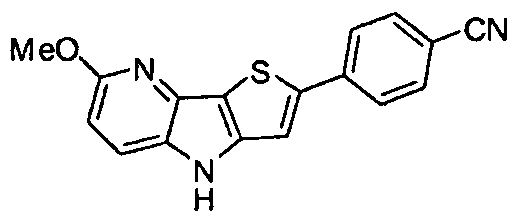
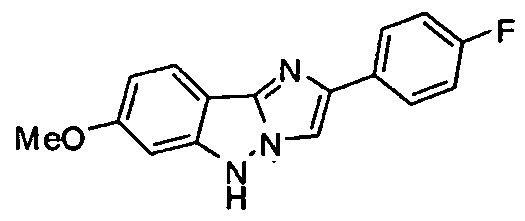
X = 4-fluorophenyl, 4-cyanophenyl, heteroaryl, substituted heteroaryl; and q is 1.
[0053] In one embodiment of the compound of formula (VIII), Rii is OR8; Rn is H; and q is 1.
[0054] In one embodiment of the compound of formula (IX), Ri 1 is OR8; and q is 1.
[0055] In one embodiment of the compound of formula (X), R]4 is aryl, CHCHaryl; and Ri5 is NH2, N(RiO)2, aryl, substituted aryl.
[0056] In one embodiment of the compound of formula (XI), Ri6 is heteroaryl; and R17 is Ri0O-.
[0057] In one embodiment of the compound of formula (XII): V is O or S;
Ri8 is H, Ri0O- or R8-C(O)N-; and Rig is H or NH2.
[0058] In one embodiment of the compound of formulas (XV) or (XVI): r is 1-3.
[0059] In one embodiment, the compounds of the invention allow for safe and specific methods of detecting and diagnosing pre-mortem AD via in vivo imaging of amyloid in the brain. The methods delineated herein further provide for imaging of plaques using compounds which traverse the blood-brain barrier and provide low toxicity. The compound probes of the invention may further be suitable for imaging amyloid, tau or synuclein aggregates or similar aggregates.
[0060] The inventive compounds may further bind or interact with amyloid precursor protein (APP), other amyloid proteins and protein fragments as well as deposits comprised of APP, other amyloid proteins or protein fragments.
[0061] The inventive probes may be further used to detect, diagnose, quantitate or otherwise identify or treat amyloid deposits in diseases such as, by way of non-limiting example, AD, glaucoma, type II diabetes mellitus, Mediterranean fever, idiopathic myeloma, amyloid polyneuropathy, amyloid cardiomyopathy, systemic senile amyloidosis, hereditary cerebral hemorrhage, Muckle- Wells syndrome, Down's syndrome, Gerstmann-Straussler-Scheinker syndrome, Creutzfeldt- Jacob disease, scrapie, kuru, Islets of Langerhans, isolated atrial amyloid, medullary carcinoma of the thyroid and inclusion body myositis.
[0062] The inventive probes may also be used in a prophylaxis of diseases characterized by amyloid deposition, which may thereby decrease the predisposition or tendency of the individual to develop disorders related to amyloid deposition. It will be appreciated that treatment may refer to situations wherein the progression of the disease, or amyloid deposition is delayed.
[0063] Administration of the compounds of the invention may be performed in conjunction with other probes or therapeutic agents which may further be useful in the identification, prophylaxis or treatment of such amyloid-related diseases.
[0064] In one embodiment, the compounds or compositions of the invention may be administered to diagnose, or identify a predisposition to a disease characterized by amyloidosis.
[0065] In another embodiment, the compounds or compositions of the invention may be administered in order to treat a disease state characterized by amyloidosis.
[0066] The methods of administration may be further combined with other conventional therapeutic agents which may provide synergistic efficacy or other synergistic results. Examples of such agents may include other neurodegenerative therapeutic agents including, but not limited to, those which delay or otherwise disrupt the processing of APP and/or generation of Aβ peptides. Specific examples include, flurbiprofen, beta-secretase inhibitors, gamma-secretase inhibitors, tau inhibitors and gamma secretase modulators. Further examples of therapeutic agents include anti-inflammatory drugs, antibodies and cholesterol-
lowering drugs.
[0067] For the purposes of this application, unless otherwise stated in the specification, the following terms have the terminology cited below:
(1) Alkyl refers to both straight and branched carbon chains; references to individual alkyl groups are specific for the straight chain (e.g. butyl = n-butyl). In one embodiment of alkyl, the number of carbons atoms is 1-20, in another embodiment of alkyl, the number of carbon atoms is 1-8 carbon atoms and in yet another embodiment of alkyl, the number of carbon atoms is 1-4 carbon atoms. Other ranges of carbon numbers are also contemplated depending on the location of the alkyl moiety on the molecule;
(2) Alkenyl refers to both straight and branched carbon chains which have at least one carbon-carbon double bond. In one embodiment of alkenyl, the number of double bonds is 1-3, in another embodiment of alkenyl, the number of double bonds is one. In one embodiment of alkenyl, the number of carbons atoms is 2-20, in another embodiment of alkenyl, the number of carbon atoms is 2-8 and in yet another embodiment of alkenyl, the number of carbon atoms is 2-4. Other ranges of carbon-carbon double bonds and carbon numbers are also contemplated depending on the location of the alkenyl moiety on the molecule;
(3) Alkynyl refers to both straight and branched carbon chains which have at least one carbon-carbon triple bond. In one embodiment of alkynyl, the number of triple bonds is 1-3; in another embodiment of alkynyl, the number of triple bonds is one. In one embodiment of alkynyl, the number of carbons atoms is 2-20, in another embodiment of alkynyl, the number of carbon atoms is 2-8 and in yet another embodiment of alkynyl, the number of carbon atoms is 2-4. Other ranges of carbon-carbon double bonds and carbon numbers are also contemplated depending on the location of the alkenyl moiety on the molecule;
(4) Aryl refers to a Cβ-Cio aromatic ring structure. In one embodiment of aryl, the moiety is phenyl, naphthyl, tetrahydronapthyl, phenylcyclopropyl and indanyl; in another embodiment of aryl, the moiety is phenyl. Arylo refers to an aryl substituted at two adjacent sites.
(5) Alkoxy refers to -O-alkyl, wherein alkyl is as defined in (1);
(6) Alkanoyl refers to formyl (-C(=O)H) and -C(=O)-alkyl, wherein alkyl is as defined in (1);
(7) Alkanoyloxy refers to -O-C(=O)-alkyl, wherein alkanoyl is as defined in (6);
(8) Alkanoylamino refers to -NH2-C(=O)-alkyl, wherein alkanoyl is as defined in (6) and the amino (NH2) moiety can be substituted by alkyl as defined in (1);
(9) Aminocarbonyl refers to -NH2-C-X=O), wherein the amino (NH2) moiety can be substituted by alkyl as defined in (1);
(10) Alkoxycarbonyl refers to -C(=O)-O-alkyl, wherein alkoxy is as defined in (5);
(11) Alkenoyl refers to -C(=O)-alkenyl, wherein alkenyl is as defined in (2);
(12) Alkynoyl refers to -C(=O)-alkynyl, wherein alkynyl is as defined in (3);
(13) Aroyl refers to -C(=O)-aryl, wherein aryl is as defined above;
(14) Cyclo as a prefix (e.g. cycloalkyl, cycloalkenyl, cycloalkynyl) refers to a saturated or unsaturated cyclic ring structure having from three to eight carbon atoms in the ring the scope of which is intended to be separate and distinct from the definition of aryl above. In one embodiment of cyclo, the range of ring sizes is 4-7 carbon atoms; in another embodiment of cyclo the range of ring sizes is 3-4. Other ranges of carbon numbers are also contemplated depending on the location of the cyclo- moiety on the molecule;
(15) Halogen means the atoms fluorine, chlorine, bromine and iodine. The designation of "halo" (e.g. as illustrated in the term haloalkyl) refers to all degrees of substitutions from a single substitution to a perhalo substitution (e.g. as illustrated with methyl as chloromethyl (-CH2Cl), dichloromethyl (-CHCl2), trichloromethyl (-CCl3));
(16) Heterocycle, heterocyclic or heterocyclo refer to fully saturated or unsaturated, including aromatic (i.e. "hetaryl") cyclic groups, for example, 4 to 7 membered monocyclic, 7 to 11 membered bicyclic, or 10 to 15 membered tricyclic ring systems, which have at least one heteroatom in at least one carbon atom-containing ring. Each ring of the heterocyclic group containing a heteroatom may have 1, 2, 3 or 4 heteroatoms selected from nitrogen atoms, oxygen atoms and/or sulfur atoms, where the nitrogen and sulfur heteroatoms may optionally be oxidized and the nitrogen heteroatoms may optionally be quaternized. The heterocyclic group may be attached at any heteroatom or carbon atom of the ring or ring system.
[0068] Exemplary monocyclic heterocyclic groups include, but are not limited to, pyrrolidinyl, pyrrolyl, pyrazolyl, oxetanyl, pyrazolinyl, imidazolyl, imidazolinyl, imidazolidinyl, oxazolyl, oxazolidinyl, isoxazolinyl, isoxazolyl, thiazolyl, thiadiazolyl, thiazolidinyl, isothiazolyl, isothiazolidinyl, furyl, tetrahydrofuryl, thienyl, oxadiazolyl, piperidinyl, piperazinyl, 2-oxopiperazinyl, 2-oxopiperidinyl, 2-oxopyrrolodinyl, 2- oxoazepinyl, azepinyl, 4-piperidonyl, pyridinyl, pyrazinyl, pyrimidinyl, pyridazinyl, tetrahydropyranyl, moφholinyl, thiamorpholinyl, thiamorpholinyl sulfoxide, thiamorpholinyl sulfone, 1,3-dioxolane and tetrahydro-l,l-dioxothienyl, triazolyl, triazinyl, and the like.
[0069] Exemplary bicyclic heterocyclic groups include, but are not limited to, indolyl, benzothiazolyl, benzoxazolyl, benzodioxolyl, benzothienyl, quinuclidinyl, quinolinyl, tetra- hydroisoquinolinyl, isoquinolinyl, benzimidazolyl, benzopyranyl, indolizinyl, benzofuryl, chromonyl, coumarinyl, benzopyranyl, cinnolinyl, quinoxalinyl, indazolyl, pyrrolopyridyl, furopyridinyl (such as furo[2,3-c]pyridinyl, furo[3,2-b]pyridinyl]or furo[2,3-b]pyridinyl), dihydroisoindolyl, dihydroquinazolinyl (such as 3,4-dihydro-4-oxo-quinazolinyl), tetrahydroquinolinyl and the like.
[0070] Exemplary tricyclic heterocyclic groups include, but are not limited to, carbazolyl, benzidolyl, phenanthrolinyl, acridinyl, phenanthridinyl, xanthenyl and the like.
[0071] Unless otherwise noted, a compound represented as being substituted by an atom, such as the generic representation by the atom fluorine in fluoroalkyl, F-aryl or F-CH2- for example, is intended to cover both the naturally occurring element 19F (fluorine- 19) as well as the 18F (fluorine- 18) isotope(s) of the element itself. Isotopes may be designated via any notation used in the art such as, by way of non-limiting example, fluorine- 18, 18-F, ' F F-18, etc.
[0072] The term "optionally substituted" or "substituted" refers to the specific substituents or groups wherein one to four hydrogen atoms in the group may be replaced by one to four substituents, for example, independently selected from the substituents amino, halo, cyano, nitro, hydroxyl, -SH, -SC1.6alkyl, -C(O)NH2, -C(S)NH2, haloCr6alkyl, perhaloC|-6alkyl, Ci^alkyl, C3-6cycloalkyl, C3.12cycloa.kyl, Cβ-Haryl and heteroaryl, or as specifically disclosed herein. In addition, the substituents may also include alkyl, aryl, alkylene-aryl, hydroxy, alkoxy, aryloxy, perhaloalkoxy, heterocyclyl, azido, amino, guanidino, amidino, halo, alkylthio, oxo, acylalkyl, carboxy esters, carboxyl, carboxamido, acyloxy, aminoalkyl, alkylaminoaryl, alkylaminoalkyl, alkoxyaryl, arylamino, phosphono, sulfonyl,
carboxamidoaryl, hydroxyalkyl, haloalkyl, alkoxyalkyl and perhaloalkyl. In addition, the term "optionally substituted" or "substituted" in reference to the variables R1 through R18 and X, includes groups substituted by one to four substituents, as identified above, which further comprise a positron or gamma emitter. Such positron emitters include, but are not limited to, 11C, 13N, 15O, 18F, 1231, 124I, 125I, 131I and 77Br.
[0073J The term "radiolabeled compound" as used herein refers to compounds having an atom or group that may provide a radiolabel or may be converted to a radiolabel, such as from a non-radioactive atom to a radionuclide that is active, such as for example, ' 1C, 13N, 150, 18F, 1231, 1241, 125I, 131I and 77Br. In addition, for the purpose of the present application, such "radiolabeled compound" may also refer to an atom or a group, that comprises a non- active nuclide, such as a halogen, such as 19F for example, wherein the compound may be used and administered in a therapeutically effective amount.
[0074J As used herein, the term "radiolabel," "radioactive isotope" or "radioactive element" refers to isotopes exhibiting radioactive decay (i.e., emitting positrons) and radiolabeling agents comprising a radioactive isotope. Non-limiting examples may include ["C]methane, [nC]carbon monoxide, [nC]carbon dioxide, ["C]phosgene, [πC]urea, [πC]cyanogen bromide, as well as various acid chlorides, carboxylic acids, alcohols, aldehydes and ketones containing carbon- 11. Such isotopes or elements are also referred to in the art as radioisotopes or radionuclides. Radioactive isotopes are named herein using various commonly used combinations of the name or symbol of the element and its mass number (e.g., 18F, F-18, or fluorine-18). Exemplary radioactive isotopes include 1-124, F-18 fluoride, C-I l, N- 13, and 0-15, which have half-lives of 4.2 days, 110 minutes, 20 minutes, 10 minutes, and 2 minutes, respectively. The radioactive isotope is preferably dissolved in an organic solvent, such as a polar aprotic solvent. Preferably, the radioactive isotopes used in the present method include F-18, C-I l, 1-123, 1-124, 1-127, 1-131, Br-76, Cu-64, Tc-99m, Y- 90, Ga-67, Cr-51, Ir-192, Mo-99, Sm-153 and Tl-201. Preferably, the radioactive isotope used in the present method is F-18. Other radioactive isotopes that may be employed include: As-72, As-74, Br-75, Co-55, Cu-61, Cu-67, Ga-68, Ge-68, 1-125, 1-132, In-111, Mn-52, Pb- 203 and Ru-97.
[0075] Compounds of the formulae (I) - (XII) may have optical centers and therefore may occur in different enantiomeric and diastereomeric configurations. The present invention includes all enantiomers, diastereomers, and other stereoisomers of such compounds of formulae (I) - (XII), as well as racemic compounds and racemic mixtures and other mixtures
of stereoisomers thereof.
[0076] The compounds of the present application may be in the form of free bases or pharmaceutically acceptable acid addition salts thereof. The term "pharmaceutically- acceptable salts" are salts commonly used to form alkali metal salts and to form addition salts of free acids or free bases. The nature of the salt may vary, provided that it is pharmaceutically acceptable. Suitable pharmaceutically acceptable acid addition salts of compounds for use in the present methods may be prepared from an inorganic acid or from an organic acid. Non-limiting examples of such inorganic acids are hydrochloric, hydrobromic, hydroiodic, nitric, carbonic, sulfuric and phosphoric acid. Appropriate organic acids may be selected from aliphatic (or alkyl), cycloalkyl, aromatic, arylalkyl, heterocyclic, carboxylic and sulfonic classes of organic acids, non-limiting examples of which are formic, acetic, propionic, succinic, glycolic, gluconic, lactic, malic, tartaric, citric, ascorbic, glucuronic, maleic, fumaric, pyruvic, aspartic, glutamic, benzoic, anthranilic, mesylic, 4-hydroxybenzoic, phenylacetic, mandelic, embonic (pamoic), methanesulfonic, ethanesulfonic, benzenesulfonic, pantothenic, 2-hydroxyethanesulfonic, toluenesulfonic, sulfanilic, cyclohexylaminosulfonic, stearic, algenic, hydroxybutyric, salicylic, galactaric and galacturonic acid. Suitable pharmaceutically-acceptable base addition salts of compounds of use in the present methods include, but are not limited to, metallic salts made from aluminum, calcium, lithium, magnesium, potassium, sodium and zinc or organic salts made from amino acids, benzathine, N, NT-dibenzylethylenediamine, chloroprocaine, choline, diethanolamine, diethylamine, diolamine, ethylenediamine, meglumine-(N-methylglucamine), procaine and tromethamine. Ascorbic acid may also be used as an excipient. Hemisalts of acids and bases may also be formed, for example, hemisulphate and hemicalcium salts. Suitable formulations for each of these methods of administration may be found in, for example, Remington: The Science and Practice of Pharmacy, A. Gennaro, ed., 20th edition, Lippincott, Williams & Wilkins, Philadelphia, Pa. and/or Handbook of Pharmaceutical Salts: Properties, Selection, and Use by Stahl and Wermuth (Wiley-VCH, 2002).
[0077] Pharmaceutically acceptable salts of compounds of formulae (I) - (XVII) maybe prepared by one or more of three methods: (i) by reacting the compound of formulae (I) - (XVII) with the desired acid or base; (ii) by removing an acid- or base-labile protecting group from a suitable precursor of the compound of formulae (I) - (XVII); or (iii) by converting one salt of the compound of formulae (I) - (XVII) to another salt by the reaction with an appropriate acid or base or by means of a suitable ion exchange column.
[0078] In another embodiment, there is provided a pharmaceutical composition for in vivo imaging of amyloid deposits, comprising (a) a compound of any one of the above, and (b) a pharmaceutically acceptable carrier.
[0079] The compounds of the invention, inventive compounds, compositions of the invention and inventive compositions as referred to herein is intended to encompass the compounds of formulae (I) to formulae (XVII), isomers thereof, their pharmaceutically acceptable salts, prodrugs, racemic mixtures, crystalline forms, tautomeric forms and pharmaceutical compositions thereof.
[0080] Pharmaceutical compositions of the compounds of the invention, or derivatives thereof, may be foπnulated as solutions or lyophilized powders for parenteral administration. Powders may be reconstituted by addition of a suitable diluent or other pharmaceutically acceptable carrier prior to use. The liquid formulation is generally a buffered, isotonic, aqueous solution. Non-limiting examples of suitable diluents are normal isotonic saline solution, 5% dextrose in water or buffered sodium or ammonium acetate solution. Such formulations are especially suitable for parenteral administration but may also be used for oral administration. Excipients, such as, for example, ascorbic acid, polyvinylpyrrolidinone, gelatin, hydroxycellulose, acacia, polyethylene glycol, mannitol, sodium chloride, or sodium citrate, may also be added. Alternatively, these compounds may be encapsulated, tableted, or prepared in an emulsion or syrup for oral administration. Pharmaceutically acceptable solid or liquid carriers may be added to enhance or stabilize the composition, or to facilitate preparation of the composition. Liquid carriers may include, but are not limited to, syrup, peanut oil, olive oil, glycerin, saline, alcohols, or water. Solid carriers may include, but are not limited to, starch, lactose, calcium sulfate, dihydrate, terra alba, magnesium stearate or stearic acid, talc, pectin, acacia, agar, or gelatin. The carrier may also include a sustained release material such as glyceryl monostearate or glyceryl distearate, alone or with a wax. The pharmaceutical preparations may be made following the any of the conventional techniques of pharmacy involving, by way of non-limiting example, milling, mixing, granulation, and compressing, when necessary, for tablet forms; or milling, mixing, and filling for hard gelatin capsule forms. When a liquid carrier is used, the preparation may be in the form of a syrup, elixir, emulsion, or an aqueous or non-aqueous suspension. Such a liquid formulation may be administered directly, by way of non-limiting example, orally or subcutaneous] y, or filled into a soft gelatin capsule. Suitable formulations for each of these methods of administration may be found in, for example, REMINGTON: THE SCIENCE AND
PRACTICE OF PHARMACY, A. Gennaro, ed., 20th edition, Lippincott, Williams & Wilkins, Philadelphia, Pa.
[0081] The pharmaceutical compositions of the invention may also be in the form of a sterile injectable preparation. Formulations suitable for parenteral administration include, by way of non-limiting example, aqueous and non-aqueous isotonic sterile injection solutions which may contain antioxidants, buffers, bacteriostats and solutes which render the formulation isotonic with the blood of the intended recipient; and aqueous and non-aqueous sterile suspensions which may include suspending agents and thickening agents.
[0082] The compounds of the invention may be synthesized and/or radiolabeled using techniques known in the art.
[0083] In one embodiment, the compounds of the invention maybe radiolabeled. [0084] In another embodiment, the compounds are not comprised of a radioisotope.
[0085] In another embodiment, there is provided a method of diagnosing Alzheimer's Disease or a predisposition thereto in a mammal, the method comprising: a) administering to the mammal a diagnostically effective amount of a radiolabeled compound, wherein the compound passes the blood-brain barrier and preferentially binds to a soluble AD oligomers, polymers and fibrils in a brain tissue and wherein the compound is selected from the group consisting of radiolabeled compounds of the invention and their derivatives; b) allowing the compound to distribute into the brain tissue; and c) imaging the brain tissue, wherein an increase in binding of the compound to the brain tissue compared to a normal control level of binding indicates that the mammal is suffering from or is at risk of developing Alzheimer's Disease.
[0086] In another embodiment, there is provided a method of diagnosing Alzheimer's Disease or a predisposition thereto in a mammal, the method comprising: a) administering to the mammal a diagnostically effective amount of a radiolabeled compound or composition of the invention, wherein the compound passes the blood-brain barrier and preferentially binds to a soluble AD oligomers, polymers and fibrils in a brain tissue; b) allowing the compound to distribute into the brain tissue; and c) imaging the brain tissue, wherein an increase in binding of the compound to the brain tissue compared to a normal control level of binding indicates that the mammal is suffering from or is at risk of developing Alzheimer's Disease.
[0087] In one embodiment of the above method, the radiolabeled compound preferentially binds to fibrils.
[0088] In another embodiment of the above method, the brain tissue comprises a frontotemporal region or the hippocampal region.
[0089] In a yet another embodiment of the above method, the increase in binding is at least 10% greater than said normal control value.
[0090] In still another embodiment of each of the above methods, the compound is administered by intravenous injection.
[0091] In another embodiment, there is provided a method for detecting Alzheimer's Disease or a predisposition thereto in a living brain of a mammal, the method comprising: a) administering the mammal with a diagnostically effective amount of a radiolabeled compound that passes the blood-brain barrier and preferentially binds to a soluble AD oligomers, polymers and fibrils in the brain, wherein the detectably-labeled compound is a compound of the invention; b) allowing the compound to distribute into the brain tissue; and c) imaging the brain tissue, wherein an increase in binding of the compound to the brain tissue compared to a normal control level of binding indicates that the mammal is suffering from or is at risk of developing Alzheimer's Disease.
[0092] In another embodiment, there is provided a method for detecting Alzheimer's Disease or a predisposition thereto in a living brain of a mammal, the method comprising: a) administering the mammal with a diagnostically effective amount of a radiolabeled compound of the invention, wherein the compound passes the blood-brain barrier and preferentially binds to a soluble AD oligomers, polymers and fibrils in the brain; b) allowing the compound to distribute into the brain tissue; and c) imaging the brain tissue, wherein an increase in binding of the compound to the brain tissue compared to a normal control level of binding indicates that the mammal is suffering from or is at risk of developing Alzheimer's Disease.
[0093] In another embodiment, there is provided a method of diagnosing Alzheimer's Disease or a predisposition thereto in a mammal, the method comprising: a) administering to the mammal a diagnostically effective amount of a radiolabeled compound of the invention, wherein the compound passes the blood-brain barrier and preferentially binds to a soluble or insoluble AD oligomers, polymers, fibrils, hyperphosphorylated tau, neurofibrillary tangles, paired helical filaments and/or neurotoxic soluble oligomers in a brain; and (b) employing a
nuclear imaging technique selected from the group consisting of positron emission tomography (PET) and single photon emission computed tomography (SPECT) for monitoring or visualizing a distribution of the radiolabeled compound within the brain or within a portion thereof.
[0094] In one embodiment of the above method, the radiolabeled compound or a derivative thereof, is a compound of any one of the above compounds.
[0095J In yet another embodiment, there is provided a method for treating a disease or condition, in a mammal in need thereof, selected from the group consisting of anxiety, depression, schizophrenia, Alzheimer's Disease, stress-related disease, panic, a phobia, obsessive compulsive disorder, obesity, post-traumatic stress syndrome, or epilepsy comprising administering to the mammal a therapeutically effective amount of a compound of the invention.
[0096] In still a further embodiment, there is a method comprising administering to a subject a quantity of a compound of the invention.
[0097] In another embodiment, the compound or composition of the invention binds to the amyloid deposit.
[0098] In another embodiment, the subject may be irradiated and imaging data emitted by the compound may be collected, which may further be processed in order to diagnose or study the disease state or lack thereof in the subject.
[0099] In one embodiment, the compound is a non-radiolabeled compound of the invention.
[00100] In one embodiment, for the methods of detection that accurately detect early onset AD prior to clinical symptomology, the focus may be directed to targeting senile plaque precursors, rather than the plaques and/or fibrils themselves. Accordingly, a potentially more effective strategy for detecting and possibly treating AD, would rely on the detection of biomarkers such as neurotoxic soluble oligomers, which are linked to AD-related synaptic and neuronal damage, rather than the late-stage plaque, and fibril biomarkers associated with fully advanced AD.
[00101] Amyloid deposits may also be formed in tissue or organs other than that of the brain such as, by way of non-limiting example, joints, aortic tissue, pituitary tissue, thyroid tissue, cardiac tissue, ocular tissue (lens, cornea, retina, etc.), pancreatic tissue, and mesodermal tissue. Non-limiting examples of detection of amyloid deposits can be found in
U.S. Patent Nos. 6,849,249 and 7,107,092. Agents and compositions of the invention may be used in the study, detection, imaging, prophylaxis or therapeutic treatment of amyloid deposits in any tissue in which such deposits may be formed.
[00102] In one embodiment, the compound or composition of the invention is administered to a mammalian subject in an amount or dosage suitable for in vivo imaging or therapeutic use. A unit dosage generally will vary according to the specific patient characteristics such as, but not limited to, age, overall health, weight, sex, and regimen of other medications. The unit dosage will also vary according to the site of administration or target site.
[00103] In one embodiment, the compound is administered from about 0.001 to about 100 mg/kg of body weight of the mammal per day.
[00104] In another embodiment, the compound is administered from about 0.1 to about 50 mg/kg of body weight of the mammal per day.
[00105] Administration may occur via systemic or local methods, and proceed intradermally, intravenously, intraarterially, or intrathecally, for example.
[00106] In one embodiment, the compound is administered rectally, topically, orally, sublingually, subcutaneously or parenterally.
[00107] The invention will now be further described by way of the following non-limiting examples.
Examples: Synthesis of UG-4-69
UG-4-69
Preparation of 2-(4-(dimethylamino)phenyl)thiazole-5-carbaldehyde (3).
[00108] To a 10 mL round bottomed flask equipped with a magnetic stir bar and reflux condenser containing dioxane (3 mL) was placed 1 (0.1 g, 0.61 mmol) and 2 (0.14 g, 0.73 mmol). To this solution sat. NaHCO3 (3 mL) and Pd(Ph3P)4 (0.07 g, 0.06 mmol) were added and the reaction was heated to 100° C for 4 hrs. The reaction was cooled to RT, filtered through celite, then poured into water (20 mL) and extracted into EtOAc (3 x 15 mL). The combined organic extracts were washed with water (15 mL), brine (15 mL), dried over MgSO4 and concentrated in vacuo. The residue was purified over silica gel using DCM:Hexanes (4:1) as an eluent to afford 3 (0.1 g, 71%) as a white solid. LC/MS: Expected for C2H12N2OS: 232.0; found: 233.0 (M+H+).
Preparation of (£)-4-(5-(4-methoxystyryl)thiazol-2-yl)-N,N-dimethylaniiine (264).
[00109] To a 10 mL round bottomed flask equipped with a magnetic stir bar and reflux condenser containing DMF (2 mL) was placed 3 (0.1 g, 0.43 mmol), NaOMe (0.05 g, 0.86 mmol) and 18-crown-6 were added and stirred for 5 mins. The reaction mixture was cooled to 0° C, 4 (0.13 g, 0.52 mmol) in DMF (1 mL) was added drop wise and stirred for 1 hr at RT and then at 120° C for 5 hrs. The reaction was cooled to RT, poured into water (20 mL) and extracted into DCM (3 x 15 mL). The combined organic extracts were washed with water (15 mL), brine (15 mL), dried over MgSO4 and concentrated in vacuo. The residue was purified over silica gel using EtOAc:Hexanes (3:2) as an eluent to afford 264 (0.1 g, 69%) as a yellow solid. LC/MS: Expected for C20H20N2OS: 336.1 ; found 337.1 (M+H*).
Preparation of (j_t)-4-(2-(2-(4-(diraethylamino)phenyl)thiazoI-5-yl)vinyl)phenoI (UG-4- 69).
[00110] To a 10 mL round bottomed flask equipped with a magnetic stir bar containing DCM (5 mL) was placed 264 (0.1 g, 0.3 mmol), the reaction mixture was cooled to 0° C, BBr3 (0.8 mL of IM in DCM) was added drop wise and was stirred at RT for 3 hrs. The reaction was neutralized with sat. NaHCO3, extracted into DCM (3 x 15 mL). The combined organic extracts were washed with water (15 mL), brine (15 mL), dried over MgSO4 and concentrated in vacuo. The residue was purified over silica gel using THF:Hexanes (3:2) as an eluent to afford UG-4-69 (0.01 g, 10%) as a white solid. LC/MS: Expected for C19Hi8N2OS: 322.1 ; found 323.1 (M+H+).
Synthesis of UG-4-73
'SV--0 BBr3 In DCM
UG^»70
Preparation of 3-(4-methoxyphenyl)benzo[d]thiazol-2(3H)-one (UG-470).
[0011 IJ To a 25 mL round bottomed flask equipped with a magnetic stir bar, added sequentially MS (4A°, 0.066 g), 2 (0.2 g, 1.32 mmol), DCM (6.6 mL), TEA (0.2 mL, 1.32 mmol), 1 (0.1 g, 0.66 mmol), Cu(OAc)2 (0.13 g, 0.73 mmol) and TEMPO (0.11 g, 0.73 mmol). The reaction mixture was stirred in air at RT for 12 hrs. The reaction was quenched with 7 N ammonia in MeOH (0.1 mL), added silica and concentrated in vacuo. The residue was purified over silica gel using EtOAc:Hexanes (1 : 10) as an eluent to afford UG-470 (0.1 g, 59%) as a white solid. LC/MS: Expected for C14HHNO2S: 257.0; found: 258.0 (M+H+).
Preparation of 3-(4-hydroxyphenyl)benzo[d]thiazol-2(3H)-one (4).
[00112] To a 10 mL round bottomed flask equipped with a magnetic stir bar containing DCM (4 mL) was placed UG-470 (0.1 g, 0.39 mmol), the reaction mixture was cooled to 0° C, BBr3 (1.0 mL of IM in DCM) was added drop wise and was stirred at RT for 3 hrs. The
reaction was neutralized with sat. NaHCC>3, extracted into DCM (3 x 15 mL). The combined organic extracts were washed with water (15 mL), brine (15 mL), dried over MgSO4 and concentrated in vacuo. The residue was purified over silica gel using EtOAc:Hexanes (1 :4) as an eluent to afford 4 (0.09 g, 95%) as a white solid. LC/MS: Expected for C13H9NO2S: 243.0; found 244.0 (M+H+).
Synthesis of UG-4-83
Preparation of (£)-3-(4-methoxystyryl)benzo[d]thiazol-2(3H)-one (6).
[00113] To a 25 mL round bottomed flask equipped with a magnetic stir bar, added sequentially MS (4A°, 0.066 g), 5 (0.24 g, 1.32 mmol), DCM (6.6 mL), TEA (0.2 mL, 1.32 mmol), 1 (0.1 g, 0.66 mmol), Cu(OAc)2 (0.13 g, 0.73 mmol) and TEMPO (0.11 g, 0.73 mmol). The reaction mixture was stirred in air at RT for 12 hrs. The reaction was quenched with 7 N ammonia in MeOH (0.1 mL), added silica and concentrated in vacuo. The residue was purified over silica gel using EtOAc:Hexanes (1 : 10) as an eluent to afford 6 (0.1 g, 53%) as a white solid. LC/MS: Expected for Cj6H13NO2S: 283.0; found: 284.0 (M+H+).
Preparation of (£)-3-(4-hydroxystyryl)benzo[d]thiazol-2(3H)-one (7).
[00114] To a 10 mL round bottomed flask equipped with a magnetic stir bar containing DCM (4 mL) was placed 6 (0.1 g, 0.39 mmol), the reaction mixture was cooled to 0° C, BBr3 (1.0 mL of IM in DCM) was added drop wise and was stirred at RT for 3 hrs. The reaction was neutralized with sat. NaHCO3, extracted into DCM (3 x 15 mL). The combined organic extracts were washed with water (15 mL), brine (15 mL), dried over MgSO4 and concentrated in vacuo. The residue was purified over silica gel using EtOAc:Hexanes (1 :4) as an eluent to afford 7 (0.09 g, 95%) as a white solid. LC/MS: Expected for Ci5HnNO2S: 269.0; found 269.0 (M+H*).
W136
Preparation of (£)-3-(4-methoxystyryl)thiazolo[4,5-c]pyridin-2(3H)-one (W136).
[00115] To a 10 mL round bottomed flask equipped with a magnetic stir bar, added sequentially MS (4A°, 0.066 g), 5 (0.14 g, 0.79 mmol), DCM (6.6 mL), TEA (0.2 mL, 1.32 mrnol), 8 (0.1 g, 0.66 mmol), Cu(OAc)2 (0.13 g, 0.73 mmol) and TEMPO (0.11 g, 0.73 mmol). The reaction mixture was stirred in air at RT for 12 hrs. The reaction was quenched with 7 N ammonia in MeOH (0.1 mL), added silica and concentrated in vacuo. The residue was purified over silica gel using EtOAc:Hexanes (2:3) as an eluent to afford W136 (0.01 g, 5%) as a white solid. LC/MS: Expected for Ci5Hi2N2O2S: 284.3; found: 285.3 (M+H+).
Synthesis of W137
Preparation of 6-hydroxybenzo[d]thiazol-2(3H)-one (11).
[00116] To a 50 mL round bottomed flask equipped with a magnetic stir bar containing
DCM (14 mL) was placed 10 (0.5 g, 2.76 mmol), the reaction mixture was cooled to 0° C5 BBr3 (6.9 mL of 1 M in DCM) was added drop wise and was stirred at RT for 3 hrs. The reaction was neutralized with sat. NaHCO3. The solvent evaporated, product dissolved in DMF, filtered through celite and used for the next step. LC/MS: Expected for C7H5NO2S: 167.0; found 168.0 (M+H+).
Preparation of (6-(2-fluoroethoxy)benzo[d]thiazoI-2(3H)-one (12).
[00117] To the DMF (15 mL) solution from the above step in a 50 mL round bottomed flask equipped with a magnetic stir bar, rubber septum and argon inlet was added K2CO3 (0.46 g, 3.3 mmol) and l-bromo-2-fluoroethane (0.42 g, 3.3 mmol) were added and the reaction was allowed to stir at 60° C for 12 hrs. The reaction was then poured into water (50 mL) and extracted into EtOAc (3 x 20 mL). The combined organic extracts were washed with water (20 mL), brine (20 mL), dried over MgSO4 and concentrated in vacuo. The residue was purified over silica gel using EtOAc:Hexanes (1 :3) as an eluent to afford 12 (0.13 g, 22%) as a white solid. LC/MS: Expected for C9H8FNO2S: 213.0; found: 214.0 (M+H+).
Preparation of (fJ)-6-(2-fluoroethoxy)-3-(4-methoxystyryl)benzo [d] thiazol-2(3H)-one
(W137).
[00118] To a 25 mL round bottomed flask equipped with a magnetic stir bar, added sequentially MS (4A°, 0.061 g), 5 (0.162 g, 0.92 mmol), DCM (6.0 mL), TEA (0.2 mL, 1.22 mmol), 9 (0.13 g, 0.61 mmol), Cu(OAc)2 (0.12 g, 0.67 mmol) and TEMPO (0.1 g, 0.67 mmol). The reaction mixture was stirred in air at RT for 12 hrs. The reaction was quenched with 7 N ammonia in MeOH (0.1 mL), added silica and concentrated in vacuo. The residue was purified over silica gel using EtOAc:Hexanes (1 :4) as an eluent to afford W137 (0.016 g, 9%) as a white solid. LC/MS: Expected for C18Hi6FNO3S: 345.0; found: 346.0 (M+H+).
Benzothiazolinone compounds:
General Procedure for N-Arylation
[00119J To a 50 mL round bottomed flask equipped with a magnetic stir bar containing DCM (100 vol) was placed benzothiazolinone (1 equiv). To this solution was added boronic
acid (2 equiv). Cu(OAc)2 (1.1 equiv), TEMPO (1.1 equiv), MS O, Et3N (2 equiv) and the reaction was allowed to stir at RT for 24-48 h. After the reaction was complete, DCM was removed in vacuo. The residue was purified over silica gel using Hexanes:EtOAC as the eluent to afford the final compound.
Preparation of 3-(4-(dimethylamino)phenyl)benzo[d]thiazol-2(3H)-one: DHK-4-61 TEA
DHK-4-61
[00120] General experimental procedure for N-arylation was followed. Reaction was performed on a 0.1 g scale. Product eluted out in 20-30% EtOAc:Hexanes mixture in a gradient elution on a Combiflash purification system. Isolated 0.12 g (67%) of DHK-4-61 as colorless oil. MS: 271.0 (M+H+).
Preparation of 3-(pyridin-2-yl)benzo[d]thiazol-2(3H)-one: DHK-4-62
DHK-4-62
[00121] General experimental procedure for N-arylation was followed. Reaction was performed on a 0.1 g scale. Product eluted out in 20-30% EtOAc:Hexanes mixture in a gradient elution on a Combiflash purification system. Isolated 0.004 g (3%) of DHK-4-62 as white solid. MS: 229.0 (M+H+)
Synthesis of CB-18 Std:
h
Preparation of l-chloro-4-(2-(2-(2-fluoroethoxy)ethoxy)ethoxy)-2-nitrobenzene: DHK-4- 51
[00122] General experimental procedure for phenolic alkylation was followed. Reaction was performed on a 0.25 g scale. Product eluted out in 20-30% EtOAc:Hexanes mixture in a gradient elution on a Combiflash purification system. Isolated 0.44 g (99%) of DHK-4-51 as yellow oil. MS: 308.0 (NH-H+).
Preparation of 3-(4-(2-(2-(2-fluoroethoxy)ethoxy)ethoxy)-2- nitrophenyl)benzo[b]thiophene: DHK-4-53
[00123] General experimental procedure for Suzuki coupling reaction was followed. Reaction was performed on a 0.10 g scale. Product eluted out in 40-50% EtOAc:Hexanes mixture in a gradient elution on a Combiflash purification system. Isolated 0.08 g (61%) of DHK-4-53 as yellow oil. MS: 406.0 (M+H+).
Preparation of DHK-4-55: CB-18
[00124] General experimental procedure for carbazole formation using P(OEt)3 was followed. Reaction was performed on a 0.07 g scale. Product eluted out in 40% EtOAc:Hexanes mixture in a gradient elution on a Combiflash purification system. Isolated 0.05 g (78%) of CB-18 as colorless oil. MS: 374.0 (M+H+).
Synthesis of CB-22 Std:
Preparation of l-chloro-4-(2-(2-(2-fIuoroethoxy)ethoxy)ethoxy)-2-nitrobenzene: DHK-4- 51
[00125] General experimental procedure for phenolic alkylation was followed. Reaction was performed on a 0.25 g scale. Product eluted out in 20-30% EtOAc:Hexanes mixture in a gradient elution on a Combiflash purification system. Isolated 0.44 g (99%) of DHK-4-51 as
yellow oil. MS: 308 0 (M+H+).
Preparation of 3-(4-(2-(2-(2-fluoroethoxy)ethoxy)ethoxy)-2- nitrophenyl)benzo [b] thiophene : DHK-4-54
[00126] General experimental procedure for Suzuki coupling reaction was followed.
Reaction was performed on a 0.10 g scale. Product eluted out in 40-50% EtOAc.Ηexanes mixture in a gradient elution on a Combiflash purification system. Isolated 0.07 g (53%) of
DHK-4-54 as yellow oil. MS: 406 0 (M+H+).
Preparation of DHK-4-57: CB-22
[00127] General experimental procedure for carbazole formation using P(OEt)3 was followed. Reaction was performed on a 0.07 g scale. Product eluted out in 50% EtOAc:Hexanes mixture in a gradient elution on a Combiflash purification system. Isolated 0.01 g (16%) of CB-22 as white solid. MS: 374.0 (M+H+).
AD-OX-001S-WZ02005
AD-OX-001 S-WZ02005
[00128] A general procedure for the preparation of 3-benzylideneindolin-2-ones: A mixture of 5-fluoroindolin-2-one (151 mg, 1 mmol), 4-(dimethylamino)benzaldehyde (149 mg, 1 mmol), and piperidine (12.7 mg, 0.15 mmol) in 4 mL EtOH was heated at reflux for 15 h and cooled to rt. The solid was collected via filtration and washed with ether (10 mL), and dried under vacuum. The crude product was further purified with silica chromatography (hexane/EtOAc) to afford 3-(4-(dimethylamino)benzylidene)-5-fluoroindolin-2-one as a orange solid (220 mg, 78%, E/Z ratio 7;1). For the major E/Z isomer:
1H NMR (400 MHz, acetone-d6) δ 9.41 (s, 1 H), 7.68-7.64 (m, 3 H), 7.58 (dd, J = 9.6, 2.4 Hz, 1 H), 6.98-6.86 (m, 4 H), 3.09 (s, 6 H); MS(ESI) m/z 283 (M+H
+).
AD-OX-OOl P-WZ02007
AD-OX-001P-WZ02007
[00129] Compound 3-(4-(dimethylamino)benzylidene)-5-nitroindolin-2-one (AD-OX- 001P-WZ02007) was prepared using the general procedure for the preparation of 3- benzylideneindolin-2-ones. For the major E/Z isomer: 1H NMR (400 MHz, acetone-d6) δ 11.13 (s, 1 H), 8.56 (d, J = 2.4 Hz, 1 H), 8.50 (d, J = 8.8 Hz, 2 H), 8.03 (dd, J = 8.4, 2.0 Hz, 1 H), 8.00 (s, 1 H), 6.93 (d, J =8.4 Hz, 1 H), 6.77 (d, J = 8.8 Hz, 2 H), 3.04 (s, 6 H); MS(ESI) m/z 310 (M+H+).
AD-OX-003S-WZ02017
AD-OX-003S-WZ02017
[00130] Compound 4-((5-fluoro-2-oxoindolin-3-ylidene)methyl)benzonitrile (AD-OX- 003S-WZ02017) was prepared using the general procedure for the preparation of 3- benzylideneindolin-2-ones. For the major E/Z isomer: 1H NMR (400 MHz, acetone-d6) δ 9.63 (s, 1 H), 7.94 (m, 4 H), 7.73 (s, 1 H), 7.17 (dd, J = 9.2, 2.8 Hz, 1 H), 7.06 (td, J = 8.8, 2.4 Hz, 1 H), 6.95 (dd, J =8.8, 4.8 Hz, 1 H); MS(ESI) m/z 265 (M+H+).
AD-OX-003P-WZ02031
AD-OX-003P-WZ02031
[00131] Compound 4-((5-nitro-2-oxoindolin-3-ylidene)methyl)benzonitrile (AD-OX- 003P-WZ02031) was prepared using the general procedure for the preparation of 3- benzylideneindolin-2-ones. 1H NMR (400 MHz, DMSO-dό) δ 11.39 (s, 1 H), 8.72 (d, J = 2.4 Hz, 0.5 H), 8.49 (d, J = 8.4 Hz, 1 H), ), 8.28 (s, 0.5 H), 8.21 (td, J = 8.8, 2.4 Hz, 1 H), 8.14 (d, J =2.4 Hz, 0.5 H), 8.05 (d, J = 8.0 Hz, 1 H), 7.96 (m, 2 H), 7.87 (s, 0.5 H), 7.03 (d, J = 8.8 Hz,
0.5 H), 7.02 (d, J = 8.4 Hz, 0.5 H); MS(ESI) m/z 292 (M+H+).
AD-OX-004S-WZ02021
AD-OX-004S-WZ02021
[00132J Compound 5-fluoro-3-(4-methoxybenzylidene)indolin-2-one (AD-OX-004S- WZ02021) was prepared using the general procedure for the preparation of 3- benzylideneindolin-2-ones. For the major E/Z isomer: 1H NMR (400 MHz, acetone-d6) δ 9.52 (s, 1 H), 7.71 (m, 3 H), 7.43 (dd, J = 9.6, 2.4 Hz, 1 H), 7.11 (m, 2 H), 7.02-6.97 (m, 1 H), 6.94-6.90 (m, 1 H), 3.90 (s, 3 H); MS(ESI) m/z 270 (M+H+).
AD-OX-004P-WZ02023
AD-OX-004P-WZ02023
[00133] Compound 3-(4-methoxybenzylidene)-5-nitroindolin-2-one (AD-OX-004P- WZ02023) was prepared using the general procedure for the preparation of 3- benzylideneindolin-2-ones. For the major E/Z isomer: 1H NMR (400 MHz, DMSO-dό) δ 11.32 (s, 1 H), 8.48 (d, J = 2.0 Hz, 1 H), 8.18 (dd, J = 8.4, 2.4 Hz, 1 H), 7.81-7.78 9 (m, 3 H), 7.14 (d, J = 8.8 Hz, 2 H), 7.06 (d, J = 8.8 Hz, 1 H), 3.88 (s, 3 H); MS(ESI) m/z 297 (M+H*).
AD-TZ-001S-WZ02019
AD-TZ-O 01 S-WZO 2019
[00134] A solution of 2-bromo-l-(naphthalen-2-yl)ethanone (498 mg, 2 mmol) and thiourea (144 mg, 2.4 mmol) in 8 mL of MeOH was stirred at rt for 1 h and then heated at reflux for 30 min. After cooling to rt, solid was collected via filtration and washed with water (2x10 mL) and dried under high vacuum to afford 4-(naphthalen-2-yl)thiazol-2-amine hydrochloride salt as a white solid (410 mg, 78%). 1H NMR (400 MHz, DMSO-d6) δ 8.25
(d, J = 2.0 Hz, 1 H), 7.98 (d, J = 8.8 Hz, 1 H), 7.93-7.91 (m, 2 H), 7.84 (dd, J = 8.4, 2.0 Hz, 1 H), 7.57-7.55 (m, 2 H), 7.33 (s, 1 H); MS(ESI) m/z 227 (M+H+). A mixture of 4-(naphthalen-2-yl)thiazol-2-amine hydrochloride (113 mg, 0.5 mmol), 1- bromo-2-fluoroethane (127 mg, 1 mmol), Cs2CO3 (326 mg, 1 mmol), and 15 mg KI in 2 mL of NMP was heated at 80 C for 20 min in a microwave reactor. After cooling to rt, the mixture was taken up to 50 mL EtOAc and washed with water (3x80 mL) and dried over MgSO4 and concentrated. The residue was chromatographed (hexane/EtOAc) to afford N-(2- fluoroethyl)-4-(naphthalen-2-yl)thiazol-2-amine as a white solid (10 mg, 18%). 1H NMR (400 MHz, CDC13) δ 12.32 (s, 1 H), 8.29 (d, J = 1.6 Hz, 1 H), 7.95-7.91 (m, 2 H), 7.86-7.83 (m, 1 H), 7.67 (dd, J = 8.4, 2.0 Hz, 1 H), 7.57-7.54 (m, 2 H), 6.70 (s, 1 H), 4.79 (t, J = 4.8 Hz, 1 H), 4.67(t, J = 4.8 Hz, 1 H), 3.71 (m, 1 H), 3.65 (m, 1 H); MS(ESI) m/z 273 (M+H+).
Synthetic Scheme of OX-02:
OX-02
2-((4-formylphenyl)(methyl)amino)ethyl 4-methylbenzenesulfonate (Compound 11)
OHC.
,-~^OTs
[00135] To a round bottom flask containing 4-((2- hydroxyethyl)(methyl)amino)benzaldehyde (7.0 g, 39 mmol) and tosyl anhydride (15.3 g,47 mmol) in DCM (50 ml) at ice bath temperature, was added triethylamine (13.7 mL, 98 mmol) dropwise. The reaction was allowed to rt and stirred for 72 h. The reaction was diluted with brine (150 mL) and extracted with DCM (100 mL X 3). The combined organic layer was concentrated in vacuo. The residue was purified on a silica gel column to afford Compound 11 as a red solid (1.5 g, 4.5 mmol, 12 % yield). 1H-NMR (400 MHz, CDCl3) δ: 9.75 (s, IH), 7.70-7.67 (m, 4H), 7.24 (d, 7 = 8.0 Hz, 2H), 6.59 (d, = 5.6 Hz, IH), 4.21 (t, J = 5.6 Hz, 2H), 3.74 (t, J = 5.6 Hz, 2H), 3.01 (s, 3H), 2.40 (s, 3H).
4-((2-fluoroethyl)(methyI)amino)benzaldehyde(Compound 12)
[00136J To a round bottom flask containing Compound 11 (150 mg, 0.45 mmol) in THF (1 mL), was added tetrabutylammonium fluride (1.0 M solution in THF, 0.54 mL, 0.54 mmol). The reaction mixture was heated at 100 0C for 30 min. The reaction was then concentrated in vacou and purified on a silica gel column to afford Compound 12 as a white solid (72 mg, 0.40 mmol, 88 % yield). 1H-NMR (400 MHz, CDCl3) δ: 9.76 (s, IH), 7.75 (d, J = 8.8 Hz, 2H), 6.73 (d, J= 8.8 Hz, 2H), 4.70 (m, IH), 4.58 (m, IH), 3-80-3.74 (m, 2H), 3.14 (s, 3H).
(E)-3-(4-((2-fluoroethyl)(methyl)amino)benzylidene)indoIin-2-one (OX-02)
[00137] To a round bottom flask containing Compound 12 (72 mg, 0.40 mmol) and 2- oxoindole (54 mg, 0.40 mmol) in ethanol (2 mL), was added piperidine (39 uL, 0.40 mL). The reaction was heated at 800C for 15 min and then allowed to rt for 72 h. A yellow precipitate formed in the solution and was collected via vacuum filtration. The yellow solid was dried via lypholyzation to afford OX-02 (94 mg, 0.32 mmol, 80 % yield). 1H NMR (400 MHz, CDCl3) δ: 10.41 (br, IH), 7.73 (d, J = 8.40 Hz, IH), 7.59 (d, J = 8.40 Hz, 2H), 7.46 (s, IH), 7.15-7.11 (m, IH), 6.85-6.80 (m, 4H), 4.65-4.62 (m, IH), 4.53-4.50 (m, IH), 3.77-3.69 (m, 2H), 3.00 (s, 3H); LRMS for Ci8HnN2CH-H+, calc'd: 297.1, found: 297.1 (M+H+)
Experimental section for indolizine derivatives
[00138] General procedures for the preparation of indolizine derivatives: A mixture of 2-picoline (1 eq) and α-bromoketones (1 eq.) in acetone (50 mL) was refluxed for 3 h, then cooled and filtered. The solid was washed with acetone and dried. It was redissolved in water (50 mL). To this solution was added K2CO3 (1 eq.). The resulting mixture was heated
at 800C for 4 hrs, then cooled and filtered. The solid collected was washed with H2O (2 x 30 mL) and dried in vacuo to give the desired indolizine derivatives.
2-(3-Methoxyphenyl)indolizine: (1.84 g, 86%). 1H NMR (CDCl3, 400 MHz) 7.89 (dd, J = 6.8, 1.2 Hz, IH), 7.57 (d, J = 1.2 Hz, IH), 7.18-7.36 (m, 4H), 6.82 (dq, J = 8, 2.4, 1.2 Hz, IH), 6.68 (s, IH), 6.61-6.68 (m, IH), 6.45 (td, J = 6.8, 1.2 Hz, IH ), 3.87 (s, 3H). MS: m/z = 224 (M+H+).
2-(4-Nitrophenyl)indoIizine: (0.2 g, 10%). 1H NMR (Acetone-^, 400 MHz) δ: 8.13 (d, J = 8.8 Hz, 2H), 8.09 (dd, J = 6.8, 0.8 Hz, IH), 7.97 (d, J = 0.8 Hz, IH), 7.87 (d, J = 9.2 Hz, 2H), 7.31 (d, J = 8.8 Hz, IH), 6.78 (s, IH), 6.62 (dd, J = 4.6, 1.2 Hz, IH), 6.46 (td, J = 6.8, 1.2 Hz, lH). MS: m/z = 239 (M+H+).
2-(4-Methoxyphenyl)indolizine: (0.8 g, 36%). 1H NMR (CDCl3, 400 MHz) δ: 7.88 J[dd, J = 6.8, 0.8 Hz, IH), 7.58 (d, J = 8.8 Hz, 2H), 7.51 (d, J = 1.6 Hz, IH), 7.33 (d, J = 4.4 Hz, IH), 6.94 (d, J = 8.8 Hz, 2H), 6.63 (t, J = 4.8 Hz, 2H), 6.43 (td, J = 6.8, 1.2 Hz, IH), 3.84 (s, 3H). MS: m/z = 224 (MH-H+).
2-(4-Cyanophenyl)indolizine: (0.92 g, 67%). 1H NMR (CDCl3, 400 MHz) δ: 7.90~(dd, J = 6.8, 0.8 Hz, IH), 7.72 (d, J = 8.4 Hz, 2H), 7.65 (d, J = 8.4 Hz, 2H), 7.61 (d, J = 1.2 Hz, IH), 7.36 (d, J = 9.2 Hz, IH), 6.70 (t, J = 6.8 Hz, IH), 6.50 (td, J = 6.8, 1.2 Hz, IH). MS: m/z = 219 (M+H+).
2-(3-Nitrophenyl)indolizine-6-carboxamide: (0.76 g, 64%). 1H NMR (CDCl3, 400 MHz) δ: 8.69 (s, IH), 8.50 (s, IH), 8.13 (d, J = 8.4 Hz, IH), 7.97 (d, J = 8.8 Hz, IH), 7.76 (s, IH), 7.58 (t, J = 8.0 Hz, IH), 7.42 (d, J = 8.4 Hz, IH), 6.92 (d, J = 7.6 Hz, IH), 6.84 (s, IH). MS: m/z = 282 (M+H+).
2-(4-Methoxyphenyl)indolizine-6-carboxamide: (1.8 g, 87%).
1H NMR (DMSO-J
6, 400 MHz) δ: 8.79 (s, IH), 7.97 (d, J = 1.2 Hz, IH), 7.84 (br s, IH), 7.63 (d, J = 8.8 Hz, 2H), 7.36 (d, J = 9.2 Hz, IH), 7.26 (br s, IH), 7.10 (dd, J = 9.2, 1.6 Hz, IH), 6.96 (d, J = 8.8 Hz, 2H), 6.75 (s, IH), 3.76 (s, 3H). MS: m/z = 282 (M+H
+).
[00139] General procedures for the demethylation reaction: To a cooled solution of 2- (4-methoxyphenyl)indolizine (1.0 mmol) in dichloromethane (20 mL) was added dropwise a solution Of BBr3 in dichloromethane (1.0 M, 4.0 mL, 4.0 mmol). The resulting mixture was stirred under Ar at 0°C and warmed gradually to room temperature. After stirring at room temperature overnight, LCMS results show that no starting material was present. It was cooled in an ice-bath. Water was added slowly. The resulting mixture was transferred to a separatory funnel. The layers were separated. The organic layer was washed with H2O (2 x 20 mL), dried (MgSO4), and filtered. The filtrate was concentrated in vacuo to give the desired product.
2-(3-Hydroxyphenyl)indolizine: (1.0 g, 97%). 1H NMR (acetone-^, 400 MHz) δ: 8.14 (d, J = 7.2 Hz, IH), 7.82 (d, J = 1.6 Hz, IH), 7.46 (d, J = 8.8 Hz, IH), 7.24-7.34 (m, 2H), 7.22- 7.25 (m, IH), 7.03 (br s, IH), 6.75-6.83 (m, 3H), 6.60 (td, J = 7.6, 1.2 Hz, IH). MS: m/z = 210 (IvH-H+).
2-(4-Hydroxyphenyl)indolizine: (0.58 g, 77%). 1H NMR (CDCl3, 400 MHz) 5; 7.88 (d, J = 6.8 Hz, IH), 7.54 (d, J = 8.4 Hz, 2H), 7.50 (d, J = 1.6 Hz, IH), 7.33 (d, J = IO Hz, IH), 6.87 (d, J = 8.4 Hz, 2H), 6.63-6.66 (m, IH), 6.62 (s, IH), 6.44 (t, J = 6.8 Hz, IH). MS: m/z = 210 (M+H+).
[00140] 2-(4-Aminophenyl)indolizine: To a suspension of 2-(4-nitrophenyl)indolizine (0.2 g, 0.84 mmol) and Cu(OAc)
2 (0.16 g, 0.88 mmol) in EtOH (50 mL) was added NaBH
4 (0.64 g, 16.8 mmol). The resulting mixture was stirred at room temperature for 3 hrs and concentrated in vacuo. The residue was dissolved in H
2O (20 mL) and extracted with EtOAc (3 x 20 mL). The combined organic layers were dried (MgSO4), filtered. The filtrate was concentrated in vacuo to give a solid (0.092 g, 53%).
1H NMR (CDCl
3, 400 MHz) δ: 7.87 (dd, J = 6.8, 1.2 Hz, IH), 7.44-7.95 (m, 3H), 7.31 (d, J = 8.4 Hz, IH), 6.73 (d, J = 8.4 Hz, 2H), 6.59-6.64 (m, 2H), 6.42 (td, J = 6.8, 1.2 Hz, IH), 3.67 (br s, 2H). MS: m/z = 209
(M+H
+).
[00141] N-Methyl-2-(3-nitrophenyl)indolizine-6-carboxamide: To a cooled solution of 2-(3-nitrophenyl)indolizine-6-carboxamide (0.4 g, 1.42 mmol) in DMF/THF (20/10 ml) was added NaH (60% in mineral oil, 58 mg, 1.45 mmol). The resulting mixture was stirred under Ar at 00C for 5 min, and then MeI (0.13 mL, 2.08 mmol) was added. The reaction mixture was stirred under Ar at O0C and warmed gradually to room temperature and stirred at room temperature overnight. It was concentrated in vacuo. The residue was recrystallized from CH2Cl2/acetone/EtOAc to give a white solid (0.1 g, 24%). 1H NMR (CDCl3, 400 MHz) δ: 8.78 (s, IH), 8.48 (t, J = 2.0 Hz, IH), 8.42 (br s, IH), 8.30 (d, J = 1.6 Hz, IH), 8.18 (d, J = 7.6 Hz, IH), 8.09 (dd, J = 8.0, 1.6 Hz, IH), 7.69 (t, J = 8.0 Hz, IH), 7.45 (d, J = 9.2 Hz, I H), 7.13 (dd, J = 9.6, 1.6 Hz, IH), 6.99 (s, IH), 2.77 (d, J = 4.4 Hz, 3H). MS: m/z = 296 (M+H+).
[00142] N-(2-Fluoroethyl)-N-methyl-2-(3-nitrophenyl)indolizine-6-carboxamide: To a cooled solution of N-methyl-2-(3-nitrophenyl)indolizine-6-carboxarnide (100 mg, 0.34 mmol) in DMF (4 mL) was added NaH ( 60% in mineral oil, 20 mg, 0.5 mmol). After stirring at O0C under Ar for 5 min, 2-fluoroethyl bromide (excess) was added. The resulting mixture was stirred under Ar at O0C and warmed gradually to room temperature, then stirred at room temperature overnight. It was concentrated in vacuo. The residue was purified via column chromatography (silica gel, 0-5% EtOAcZCH2Cl2) to give an orange solid (59 mg, 51%). 1H NMR (acetone-ck, 400 MHz) δ: 8.53 (t, J = 2.4 Hz, IH), 8.42 (s, IH), 8.17-8.22 (m, 2H), 8.12 (dd, J = 7.6, 1.6 Hz, IH), 7.71 (t, J = 8.0 Hz, IH), 7.50 (d, J = 9.6 Hz, IH), 7.00 (s, IH), 6.83 (d, J = 8.0 Hz, IH), 4.69 (dt, J = 47.6, 4.8 Hz, 2H), 3.83 (dt, J = 26.4, 4.8 Hz, 2H), 3.18 (s, 3H). MS: m/z = 342 (M+H+).
[00143] General procedures for the preparation of O-alkylated indolizine derivatives: To a solution of 2-(hydroxyphenyl)indolizine (1.0 eq.) and Cs2CO3 (1.0 eq) in DMF (4 mL) was added ω-fluoroalkyl bromide (1.1 eq.). The reaction mixture was stirred at room temperature overnight, and then concentrated in vacuo. The residue was purified via
column chromatography (silica gel, 0-5%, EtOAcZCH2Cl2) to give the desired compound.
2-[3-(2-Fluoroethoxyphenyl)]indolizine: (150 mg, 95%). 1H NMR (CDCl3, 400 MHz) δ: 7.88 (d, J = 6.8 Hz, IH), 7.56 (s, IH), 7.21-7.36 (m, 4H), 6.82 (dt, J = 8.0, 1.8 Hz, IH), 6.67 (s, IH), 6.62-6.66 (m, IH), 6.45 (td, J = 6.8, 1.2 Hz, IH), 4.79 (dt, J = 47.6, 4.0 Hz, 2H), 4.28 (dt, J = 28.0, 4.0 Hz, 2H). MS: m/z = 256 (M+H+).
2-[3-(4-FIuorobutoxyphenyl)]indolizine: (90 mg, 59%). 1H NMR (CDCl3, 400 MHz) δ:
7.87 (d, J = 6.8 Hz, IH), 7.55 (d, J = 1.2 Hz, IH), 7.16-7.38 (m, 4H), 6.79 (d, J = 7.6 Hz, IH), 6.67 (IH), 6.60-6.67 (m, IH), 6.44 (t, J = 6.8 Hz, IH), 4.54 (dt, J = 47.2, 5.6 Hz, 2H), 4.07 (t, J = 5.6 Hz, 2H), 1.85-2.01 (m, 4H). MS: m/z = 284 (M+H1").
2-{3-[2-(2-(2-Fluoroethoxy)ethoxy)ethoxy]phenyl}indolizine: (150 mg, 88%). 1H NMR (acetone-^, 400 MHz) δ: 8.45 (d, J = 6.8 Hz, IH), 8.14 (d, J = 1.6 Hz, IH), 7.81-7.94 (m, 4H), 7.40 (dt, J = 7.6, 1.6 Hz, IH), 7.26 (s, IH), 7.19-7.24 (m, IH), 7.02 (td, J = 6.8, 1.2 Hz, IH), 5.15 (dt, J = 47.6, 4.4 Hz, 2H), 4.79 (t, J = 4.8 Hz, 2H), 4.48 (t, J = 4.8 Hz, 2H), 4.29- 4.42 (m, 6H). MS: m/z = 344 (M+H+).
2-[4-(2-FluoroethoxyphenyI)]indolizine: (30 mg, 27%). 1H NMR (CDCl3, 400 MHz) δ:
7.88 (d, J = 7.2 Hz, IH), 7.58 (d, J = 8.8 Hz, 2H), 7.51 (s, IH), 7.32 (d, J = 8.8 Hz, IH), 6.96 (d, J = 8.8 Hz, 2H), 6.60-6.68 (m, 2H), 6.44 (t, J = 3.2 Hz, IH), 4.78 (dt, J = 47.6, 4.0 Hz, 2H), 4.25 (dt, J = 28, 4.4 Hz, 2H). MS: m/z = 256 (M+H+).
2-[4-(4-Fluorobutoxyphenyl)]indolizine: (16 mg, ). 1H NMR (CDCl3, 400 MHz) δ: 7.88 (dd, J = 6.8, 1.2 Hz, IH), 7.57 (d, J = 8.8 Hz, 2H), 7.50 (d, J = 1.2 Hz, IH), 7.32 (d, J = 9.2 Hz, IH), 6.93 (d, J = 8,8 Hz, 2H), 6.60-6.67 (m, 2H), 6.43 (td, J = 6.8, 1.2 Hz, IH), 4.54 (dt, J = 47.2, 5.6 Hz, 2H), 4.04 (t, J = 5.6 Hz, 2H), 1.84-2.01 (m, 4H). MS: m/z = 284 (MH-H+).
[00144] Compound Wl 19 was prepared using the general procedure for cyclization between 6-methoxybenzo[d]thiazol-2-amine (90 mg, 0.5 mmol) and 2-bromo-l-(4-
fluorophenyl)ethanone (119 mg, 0.55 mmol), as a white solid (132 mg, 69%). 1H NMR (400 MHz, DMSO-d6) δ 8.74 (s, 1 H), 7.91 (d, J = 8.8 Hz, 1 H), 7.85 (m, 2 H), 7.70 (d, J = 2.4 Hz, 1 H), 7.27 (t, J = 9.2 Hz, 2 H), 7.17 (m, J = 8.8, 2.4 Hz, 1 H), 3.82 (s, 3 H); MS(ESI) m/z 299 (M+H+).
[00145] Compound Wl 20 was prepared using the general procedure for cyclization between 6-fluorobenzo[d]thiazol-2-amine (84 mg, 0.5 mmol) and 2-bromo-l-(4- methoxyphenyl)ethanone (1 15 mg, 0.55 mmol), as a white solid (82 mg, 43%). 1H NMR (400 MHz, DMSO-d6) δ 8.60 (s, 1 H), 8.00-7.94 (m, 2 H), 7.75 (d, J = 8.8 Hz, 2 H), 7.42 (td, J = 9.2 Hz, 1 H), 6.98 (d, J = 8.8 Hz, 1 H), 3.76 (s, 3 H); MS(ESI) m/z 299 (M+H+).
Preparation of 4-(benzo[d]thiazoI-5-yl)-2-fluorophenoI: W121
[00146] Compound 4-(benzo[d]thiazol-5-yl)-2-fluorophenol (W 121) was prepared using the general procedure for Suzuki coupling reaction between 4-bromo-2-fluorophenol (57 mg, 0.3 mmol) and 5-(4,4,5,5-tetramethyl-l ,3,2-dioxaborolan-2-yl)benzo[d]thiazoIe (78 mg, 0.3 mmol), as a white solid (45 mg, 61 %).Η NMR (400 MHz, acetone-d6) δ 9.27 (s, 1 H), 8.85 (s, 1 H), 8.28 (d, J = 1.6 Hz, 1 H), 8.15 (d, J = 8.4 Hz, 1 H), 7.75 (dd, J = 8.4, 1.6 Hz,, 1 H), 7.55 (dd, J = 12.4, 2.4 Hz, 1 H), 7.45 (m, 1 H), 7.12 (t, 9.2 Hz, 1 H); MS(ESI) m/z 246 (MH-H+).
Preparation of 6-(3-fluoro-4-methoxyphenyI)benzo[d]thiazol-2-amine: W143
[00147] Compound 6-(3-fluoro-4-methoxyphenyl)benzo[d]thiazol-2-amine (W143) was prepared using the general procedure for Suzuki coupling reaction between 6- bromobenzo[d]thiazol-2-amine (75 mg, 0.3 mmol) and 2-(3-fluoro-4-methoxyphenyl)- 4,4,5,5-tetramethyl-l,3,2-dioxaborolane (69 mg, 0.3 mmol), as a white solid (30 mg, 36%).
1H NMR (400 MHz, acetone-d6) δ 7.92 (d, J = 2.0 Hz, 1 H), 7.52 (dd, J = 8.4, 2.0 Hz, 1 H), 7.47-7.24 (m, 3 H), 7.20 (t, J = 8.4 Hz, 1 H), 6.86 (brs, 2 H), 3.92 (s, 3 H); MS(ESI) m/z 275 (M+H+).
Preparation of 6-(4-(benzyloxy)-3-fluorophenyI)benzo[d]thiazol-2-amine (W146)
[00148] Compound 6-(4-(benzyloxy)-3-fluorophenyl)benzo[d]thiazol-2-amine (W146) was prepared using the general procedure for Suzuki coupling reaction between 4- (benzyloxy)-3-fluorophenylboronic acid (100 mg, 0.4 mmol) and 6-bromobenzo[d]thiazol-2- arnine (92 mg, 0.4 mmol), as a white solid (65 mg, 58%). 1H NMR (400 MHz, acetone-d6) δ 7.92 (d, J = 2.0 Hz, 1 H), 7.54-7.51 (m, 3 H), 7.49-7.46 (m, 1 H), 7.46-7.40 (m, 4 H), 7.37- 7.33 (m, 1 H), 7.30-7.26 (m, 1 H), 6.86 (brs, 2 H), 5.25 (s, 2 H); MS(ESI) m/z 351 (M+H+).
Preparation of 3-(benzo[d]thiazol-5-yl)-5-fluorophenoI: W190
[00149] Compound 3-(benzo[d]thiazol-5-yl)-5-fluorophenol (W190) was prepared using the general procedure for Suzuki coupling reaction between 3-bromo-5-fluorophenol (57 mg, 0.3 mmol) and 5-(4,4,5,5-tetramethyl-l,3,2-dioxaborolan-2-yl)benzo[d]thiazole (78 mg, 0.3 mmol), as a white solid (60 mg, 81%). 1H NMR (400 MHz, acetone-d6) δ 9.30 (s, 1 H), 9.02 (brs, 1 H), 8.30 (d, J = 1.6 Hz, 1 H), 8.19 (d, J = 8.4 Hz, 1 H), 7.45 (dd, J = 8.4, 2.0 Hz, 1 H), 7.07 (t, J = 1.6 Hz, 1 H), 7.02 (dt, J = 10.0, 2.0 Hz, 1 H), 6.64 (dt, J = 10.4, 2.4 Hz, 1 H); MS(ESI) m/z 275 (M+H÷).
Preparation of 4-(benzo[d]thiazol-5-yl)-N-methylaniline: W189
[00150] Compound 4-(benzo[d]thiazol-5-yl)-N-methylaniline (Wl 89) was prepared using the general procedure for Suzuki coupling reaction between 4-bromo-N-methylaniline (56
mg, 0.3 mmol) and 5-(4,4J5,5-tetramethyl-l,3,2-dioxaborolan-2-yl)benzo[d]thiazole (78 mg, 0.3 mmol), as a white solid (20 mg, 28%). 1H NMR (400 MHz, acetone-d6) δ 9.22 (s, 1 H), 8.22 (d, J = 1.6 Hz, 1 H), 8.08 (d, J = 8.4 Hz, 1 H), 7.71 (dd, J = 8.4, 1.6 Hz, 1 H), 7.56 (m, 2 H), 6.72 (m, 2 H), 5.14 (brs, 1 H), 2.83 (s, 0.5 H), 2.82 (s, 0.5 H); MS(ESI) m/z 241 (M+H+).
[00151] Compound W200 was prepared using the general procedure for cyclization between 6-methoxybenzo[d]thiazol-2-amine (90 mg, 0.5 mmol) and 4-(2- bromoacetyl)benzonitrile (123 mg, 0.55 mmol), as an off-white solid (60 mg, 39%). 1H NMR (400 MHz, DMSO-d6) δ 8.89 (s, 1 H), 7.97 (d, J = 8.4 Hz, 1 H), 7.87-7.83 (m, 3 H), 7.66 (d, J = 2.8 Hz, 1 H), 7.14 (dd, J = 9.2, 2.4 Hz, 1 H), 3.79 (s, 3 H); MS(ESI) m/z 305 (M+H+).
Preparation of (E)-6-(4-methoxystyryl)benzo[d]thiazol-2-amine: W201
[00152] Compound (E)-6-(4-methoxystyryl)benzo[d]thiazol-2-amine (W201 ) was prepared using the general procedure for Suzuki coupling reaction between 6- bromobenzo[d]thiazol-2 -amine (69 mg, 0.3 mmol) and (E)-4-methoxystyrylboronic acid (53 mg, 0.3 mmol), as a white solid (80 mg, 94%). 1H NMR (400 MHz, DMSO-d6) δ 7.80 (d, J= 1.6 Hz, 1 H), 7.46 (s, 2 H), 7.45 (d, J = 8.8 Hz, 2 H), 7.36 (dd, J = 8.4, 1.6 Hz, 1 H), 7.24 (d, J = 8.0 Hz, 1 H), 7.03 (d, J = 2.0 Hz, 2 H), 6.89 (d, J = 9.2 Hz, 1 H), 3.71 (s, 3 H); MS(ESI) m/z 283 (M+H+). Preparation of 5-(5-fIuoropyridin-2-yl)benzo[d]thiazole: W208
[00153] Compound 5-(5-fluoropyridin-2-yl)benzo[d]thiazole (W208) was prepared using the general procedure for Suzuki coupling reaction between 2-bromo-5-fluoropyridine (39 mg, 0.22 mmol) and 5-(4,4,5,5-tetramethyl-l,3,2-dioxaborolan-2-yl)benzo[d]thiazole (53 mg, 0.2 mmol), as a white solid (20 mg, 43%). 1H NMR (400 MHz, CDC13) δ 9.05 (s, 1 H), 8.65 (d, J = 1.6 Hz, 1 H)5 8.59 (d, J = 2.8 Hz, 1 H), 8.14 (dd, J = 8.4, 2.0 Hz, 1 H), 8.06 (d, J = 8.4
Hz, 1 H), 7.85 (dd, J = 8.8, 4.0 Hz, 1 H), 7.52 (td, J = 8.4, 2.8 Hz, 1 H); MS(ESI) m/z 231 (M+H+).
[00154] Compound W209 was prepared using the general procedure for cyclization between 6-fluorobenzo[d]thiazol-2-amine (84 mg, 0.5 mmol) and 2-bromo-l-(3- hydroxyphenyl)ethanone (113 mg, 0.55 mmol), as an off-white solid (100 mg, 70%). 1H NMR (400 MHz, DMSO-d6) δ 8.77 (s, 1 H), 8.10-8.04 (m, 2 H), 7.49 (td, J = 8.8, 2.8 Hz, 1 H), 7.28-7.22 (m, 3 H), 6.73 (dt, J = 7.6, 2.0 Hz, 1 H); MS(ESI) m/z 284 (M+H+).
[00155] Compound W210 was prepared using the general procedure for cyclization between 6-methoxybenzo[d]thiazol-2-amine (90 mg, 0.5 mmol) and 2-bromo-l-(3- hydroxyphenyl)ethanone (113 mg, 0.55 mmol), as an off-white solid (100 mg, 67%).
1H NMR (400 MHz, DMSO-d6) δ 8.67 (s, 1 H), 7.95 (d, J = 8.8 Hz, 1 H) 7.70 (d, J = 2.8 Hz, 1 H), 7.27-7.25 (m, 2 H), 7.22 (t, J = 8.0 Hz, 1 H), 7.17 (dd, J = 8.8 Hz, 1 H), 6.71-6.68 (m, 1 H), 3.84 (s, 3 H); MS(ESI) m/z 297 (M+H
+). Preparation of W239:
[00156] Compound W239 was prepared using the general procedure for cyclization between 6-methoxybenzo[d]thiazol-2-amine (54 mg, 0.3 mmol) and 2-bromo-l-(furan-2- yl)ethanone (63 mg, 0.33 mmol), as a white solid (3 mg, 4%).
1H NMR (400 MHz, CDC13) δ 7.84 (s, 1 H), 7.51 (d, J = 8.8 Hz, 1 H), 7.43 (dd, J = 1.6, 0.8 Hz, 1 H), 7.22 (d, J = 2.0 Hz, 1 H), 7.03 (dd, J = 8.8, 2.4 Hz, 1 H), 6.77 (d, J = 3.2 Hz, 1 H), 6.49 (dd, J = 3.6, 2.0 Hz, 1 H), 3.88 (s, 3 H); MS(ESI) m/z 271 (MH-H
+).
Preparation of W247:
[00157] Compound W247 was prepared using the general procedure for cyclization between 6-methoxybenzo[d]thiazol-2-amine (54 mg, 0.3 mmol) and 2-bromo-l-(thiophen-2- yl)ethanone (68 mg, 0.33 mmol), as a white solid (50 mg, 58%).Η NMR (400 MHz, DMSO- d6) δ 8.62 (s, 1 H), 7.95 (d, J = 8.8 Hz, 1 H), 7.70 (d, J = 2.4 Hz, 1 H), 7.48 (dd, J = 5.2, 1.2 Hz, 1 H), 7.40 (dd, J = 3.6, 1.2 Hz, 1 H), 7.17 (dd, J = 9.2, 2.8 Hz, 1 H), 7.12 (dd, J = 4.8, 3.2 Hz, 1 H), 3.84 (s, 3 H); MS(ESI) m/z 286 (M+H+).
Preparation of W248:
[00158] Compound W248 was prepared using the general procedure for cyclization between 6-methoxybenzo[d]thiazol-2-amine (90 mg, 0.5 mmol) and 2-bromo-l-(4- (dimethylamino)phenyl)ethanone (127 mg, 0.52 mmol), as an off-white solid (150 mg, 74%). 1H NMR (400 MHz, DMSO-d6) δ 8.69 (s, 1 H), 7.95 (d, J = 8.8 Hz, 1 H), 7.75 (d, J = 7.76- 7.73 (m, 3 H), 7.21 (dd, J = 8.8, 2.4 Hz, 1 H), 7.08 (m, 2 H), 3.85 (s, 3 H), 3.03 (s, 6 H); MS(ESI) m/z 324 (M+H+).
Preparation of W270:
W270
Preparation of 2-(5-(4-fluorophenyl)thiophen-2-yl)-6-methoxy-3-nitropyridine
(WZ02103)
[00159] A suspension of 2-chloro-6-methoxy-3-nitropyridine (94 mg, 0.5 mmol), 2,5-
bis(4,4,5,5-tetramethyl-l,3,2-dioxaborolan-2-yl)thiophene (168 mg, 0.5 mmol), l-bromo-4- fluorobenzene (105 mg, 0.6 mmol), 1.5 mL of dioxane, 1.5 mL of 1 M Na2COs, and tetrakis(triphenylphosphine)palladium (29 mg, 0.025 mmol) was heated in a microwave reactor at 95 C for 10 min. It was concentrated under reduced pressure and the residue was chromatographed (EtOAc/hexane) to afford 2-(5-(4-fluorophenyl)thiophen-2-yl)-6-methoxy- 3-nitropyridine (WZ02103) as a yellow solid (20 mg, 12%). MS(ESI) m/z 330 (IVH-H+).
Preparation of W270:
[00160] The above compound (20 mg, 0.6 mmol) in 0.5 mL of triethyl phosphite was heated at 147 C for 5 h and cooled to rt. The volatiles were removed under reduced pressure and the crude product was purified by silica chromatography (EtOAc/hexane) to afford W270 as a yellow solid (6 mg, 33%). 1H NMR (400 MHz, acetone-d6) δ 10.22 (brs, 1 H), 7.71-7.67 9m, 3 H), 7.34 (s, 1 H), 7.13 (t, J = 8.4 Hz, 2 H), 6.63 (d, J= 8.8 Hz, 1 H), 3.99 (s, 3 H); MS(ESI) m/z 299 (M+H+).
Preparation of W281:
[00161] Compound W281 was synthesized using the same procedure for the preparation of W270 from 2-chloro-6-methoxy-3-nitropyridine (94 mg, 0.5 mmol), 2,5-bis(4,4,5,5- tetramethyl-l,3,2-dioxaborolan-2-yl)thiophene (168 mg, 0.5 mmol), and 4-bromobenzonitrile (91 mg, 0.6 mmol), as a yellow solid (5 mg, total yield 3.2%). 1H NMR (400 MHz, acetone- d6) δ 10.34 (brs, 1 H), 7.86-7.84 (m, 2 H), 7.43-7.72 (m, 3 H), 7.65 (s, 1 H), 6.68 (d, J = 8.8 Hz, 1 H), 4.00 (s, 3 H); MS(ESI) m/z 306 (M+H+).
Preparation of 2-(4-fluorophenyl)-7-methoxy-5H-imidazo[l,2-b]indazole (W289)
[00162J Compound 2-(4-fiuorophenyl)-7-methoxy-5H-imidazo[l ,2-b]indazole (W289) was prepared using the general procedure for cyclization between 6-methoxy-lH-indazol-3- amine (80 mg, 0.5 mmol) and 2-bromo-l-(4-fluorophenyl)ethanone (119 mg, 0.55 mmol), as an off-white solid (30 mg, 16%). 1H NMR (400 MHz, DMSO-d6) δ 8.64 (s, 1 H), 7.94-7.91
(m 2 H), 7.83 (d, J = 8.8 Hz, 1 H), 7.44 (m, 2 H), 7.11 (d, J = 2.4 Hz, 1 H), 6.96 (dd, J = 9.2, 2.0 Hz, 1 H), 3.89 (s, 3 H); MS(ESI) m/z 282 (M+H+).
Preparation of 3-(7-methoxy-5H-imidazo[l,2-b]indazol-2-yl)phenoI: W298
[00163] Compound 3-(7-methoxy-5H-imidazo[l ,2-b]indazol-2-yl)phenol (W298) was prepared using the general procedure for cyclization between 6-methoxy-lH-indazol-3-amine (80 mg, 0.5 mmol) and 2-bromo-l -(3-hydroxyphenyl)ethanone (107 mg, 0.55 mmol), as a white solid (40 mg, 22%). 1H NMR (400 MHz, DMSO-dό) δ 9.84 (brs, 1 H), 8.63 (s, 1 H), 7.85 (d, J = 9.2 Hz, 1 H), 7.36 (t, J = 8.0 Hz, 1 H), 7.31-7.29 (m, 1 H), 7.24 (t, J = 2.0 Hz, 1 H), 7.13 (d, J = 2.0 Hz, 1 H), 6.99 (dd, J = 9.2, 2.0 Hz, 1 H), 6.88 (m, 1 H), 3.90 (s, 3 H); MS(ESI) m/z 280 (M+H+).
Preparation of 7-methoxy-2-(4-methoxyphenyl)-5H-imidazo[l,2-b]-ndazole (W302)
[00164] Compound 7-methoxy-2-(4-methoxyphenyl)-5H-imidazo[l,2-b]indazole (W302) was prepared using the general procedure for cyclization between 6-methoxy- 1 H-indazol-3- amine (90 mg, 0.3 mmol) and 2-bromo-l-(4-methoxyphenyl)ethanone (72 mg, 0.31 mmol), as white solid (50 mg, 57%). 1H NMR (400 MHz, DMSO-d6) δ 8.57 (s, 1 HO, 7.85-7.81 (m, 3 H), 7.16-7.12 (m, 3 H), 6.99 (dd, J = 8.8, 2.4 Hz, 1 H), 3.90 (s, 3 H), 3.84 (s, 3 H); MS(ESI) m/z 294 (M+H+).
Preparation of 2-(5-fluoropyridin-3-yl)-6-methoxy-4H-thieno[3,2-b]indole: W309
[00165] Compound 2-(5-fluoropyridin-3-yl)-6-methoxy-4H-thieno[3,2-b]indole (W309) was synthesized using the same procedure for the preparation of W270 from l-bromo-4- methoxy-2-nitrobenzene (104 mg, 0.45 mmol), 2,5-bis(4,4,5,5-tetramethyl-l,3,2-
dioxaborolan-2-yl)thiophene (168 mg, 0.5 mmol), and 3-bromo-5-fluoropyridine (105 mg, 0.6 mmol), as a yellow solid (10 mg, total yield 6.7%). 1H NMR (400 MHz, acetone-d6) δ 10.36 (brs, 1 H), 8.76 (s, 1 H), 8.33 (s, 1 H), 7.83 (m, 2 H), 7.77 (m, 1 H), 7.62-7.60 (m, 1 H), 7.02 (s, 1 H), 6.80 (d, J = 8.8 Hz, 1 H), 3.86 (s, 3 H); MS(ESI) m/z 299 (M+H+).
[001661 Compound W328 was prepared using the general procedure for cyclization between 6-methoxybenzo[d]thiazol-2-amine (54 mg, 0.3 mmol) and l-(4-azidophenyl)-2- bromoethanone (74 mg, 0.31 mmol), as an off-white solid (35 mg, 29%). 1H NMR (400 MHz, DMSO-d6) δ 8.78 (s, 1 H), 7.92 (d, J = 8.8 Hz, 1 H), 7.87 (d, J = 8.4 Hz, 2 H), 7.72 (d, J = 2.0 Hz, 1 H), 7.21 (d, J = 8.4 Hz, 2 H), 7.19 (dd, J = 8.8, 2.8 Hz, 1 H), 3.84 (s, 3 H); MS(ESI) m/z 322 (M+H+).
Preparation of W331:
[00167] Compound W331 was prepared using the general procedure for cyclization between 6-methoxybenzo[d]thiazol-2-amine (90 mg, 0.5 mmol) and 2-bromo- 1 -(3,4,5- trifluorophenyl)ethanone (134 mg, 0.52 mmol), as an off-white solid (45 mg, 21%). 1H NMR (400 MHz, DMSO-d6) δ 8.80 (s, 1 H), 7.80 (d, J = 8.8 Hz, 1 H), 7.70 (m, 3 H), 7.17 (dd, J = 8.8 Hz, 1 H), 3.83 (s, 1 H); MS(ESI) m/z 335 (M+H+).
Preparation of W332
MeO ---
ΛV N.*- ' A Λ-cnOuH M MeeOO N N S S>
WZ02129 W332
Preparation of WZ02129
[00168] A solution of 6-methoxypyridin-3 -amine (2.5 g, 20 mmol) in 5 mL of AcOH was slowly added to a solution of KSCN in 50 mL of AcOH with vigorously stirring at 0 C,
followed by a solution of bromine in 3 mL of AcOH. The mixture was stirring at 0 C for 1 h and slowly warmed to rt and stirring was continued for 30 min at rt. Solid was collected via filtration and washed with AcOH (2x20 mL), and partitioned between EtOAc (100 mL) and NaHCO3 (sat. 80 mL). Organic phase was dried over MgSO4 and filtered and the filtrate was concentrated to afford 5-methoxythiazolo[5,4-b]pyridin-2-amine (WZ02129) as a tan solid (2.5 g, 69%). MS(ESI) m/z 182 (M+H+).
Preparation of W332
[00169] A mixture of the above compound (90 mg, 0.5 mmol) and 2-bromo-l -(4- fluorophenyl)ethanone (1 14 mg, 0.52 mmol) in 1.5 mL of EtOH was heated at 85 C for 5 h and cooled to rt. Solid was collected via filtration and washed with EtOAc (4 mL), and dried under high vacuum to afford W332 as a white solid (70 mg, 37%). 1H NMR (400 MHz, DMSO-d6) δ 8.73 (s, 1 H), 8.34 (d, J = 8.8 H, 1 H), 7.89-7.85 (m, 2 H), 7.28 (m, 2 H), 7.08 (d, J = 8.8 Hz, 1 H), 3.94 (s, 3 H); MS(ESI) m/z 300 (M+H+).
[00170] Compound W333 was prepared using the general procedure for the synthesis of W332 from 5-methoxythiazolo[5,4-b]pyridin-2-amine (90 mg, 0.5 mmol) and 4-(2- bromoacetyl)benzonitrile (117 mg, 0.52 mmol), as a white solid (73 mg, 38%). 1H NMR (400 MHz, DMSO-d6) δ 8.93 (s, 1 H), 8.33 (d, J = 8.8 Hz, 1 H), 8.01-7.99 (m, 2 H), 7.90-7.88 (m, 2 H), 7.08 (d, J = 8.8 Hz, 1 H), 3.95 (s, 3 H); MS(ESI) m/z 307 (M+H+).
[00171] Compound W353 was prepared using the general procedure for the synthesis of W332 from 5-methoxythiazolo[5,4-b]pyridin-2-amine (90 mg, 0.5 mmol) and 2-bromo-l -(4- methoxyphenyl)ethanone (119 mg, 0.52 mmol), as a white solid (62 mg, 31%).
1H NMR (400 MHz, DMSO-d6) δ 8.62 (s, 1 H), 8.33 (d, J = 8.8 Hz, 1 H), 7.77 (m, 2 H), 7.07 (d, J = 8.8 Hz
3 1 H), 7.02 (m, 2 H), 3.94 (s, 3 H), 3.79 (s, 3 H); MS(ESI) m/z 312 (MH-H
+).
Preparation of W354
[00172J Compound W354 was prepared using the general procedure for the synthesis of W332 from 5-methoxythiazolo[5,4-b]pyridin-2-amine (90 mg, 0.5 mmol) and 2-bromo-l-(3- hydroxyphenyl)ethanone (112 mg, 0.52 mmol), as a white solid (70 mg, 37%). 1H NMR (400 MHz, DMSO-d6) δ 8.70 (s, 1 H), 8.38 (d, J = 8.8 Hz, 1 H), 7.27-7.21 (m, 3 H), 7.09 (d, J = 8.8 Hz, 1 H), 6.71 (dt, J = 8.0, 2.0 Hz1 1 H), 3.95 (s, 3 H); MS(ESI) m/z 298 (M+H+).
Preparation of W355
[00173] To W354 (38 mg, 0.1 mmol) and 1 -bromo-2-fluoroethane (50 mg, 0.4 mmol) in 0.4 mL of NMP was added Cs2CO3 (98 mg, 0.3 mmol). The mixture was stirred at rt for 5 hours and quenched by adding 10 mL water. Solid was collected by filtration and washed with ether (2x3 mL) and dried under high vacuum to afford a white solid. (31 mg, 90%). 1H NMR (400 MHz, DMSO-d6) δ 8.75 (s, 1 H), 8.31 (d, J = 8.8 Hz, 1 H), 7.46-7.44 (m, 2 H), 7.36 (t, J = 8.4 Hz, 1 H), 7.08 (d, J = 8.8 Hz, 1 H), 6.90 (m, 1 H), 4.84 (m, 1 H), 4.72 (m, 1 H), 4.34 (m, 1 H), 4.26 (m, 1 H)3.95 (s, 3 H); MS(ESI) m/z 344 (M+H+).
Preparation of W356
[00174] Compound W354 was prepared using the general procedure for the synthesis of W332 from 5-methoxythiazolo[5,4-b]pyridin-2-amine (90 mg, 0.5 mmol) and 2-bromo-l-(5- chlorothiophen-2-yl)ethanone (124 mg, 0.52 mmol), as a yellow solid (60 mg, 30%). 1H NMR (400 MHz, DMSO-d6) δ 8.63 (s, 1 H), 8.34 (d, J = 8.8 Hz, 1 H), 7.25 (d, J = 4.0 1 H), 7.13 (d, J = 4.0 Hz, 1 H), 7.07 (d, J = 8.8 Hz, 1 H), 3.94 (s, 3 H); MS(ESI) m/z 322 (M+H+).
Preparation of W357
[00175] Compound W357 was prepared using the general procedure for the synthesis of W332 from 5-methoxythiazolo[5,4-b]pyridin-2-amine (90 mg, 0.5 mmol) and 2-bromo-l-(5- bromothiophen-2-yl)ethanone (48 mg, 0.52 mmol), as a yellow solid (73 mg, 32%). 1H NMR (400 MHz, DMSO-d6) δ 8.63 (s, 1 H), 8.34 (d, J = 8.8 Hz, 1 H), 7.22 (s, 2 H), 7.07 (d, J = 8.8 Hz, 1 H), 3.94 (s, 3 H); MS(ESI) m/z 367.9 (M+H+).
[00176] Compound W357 was prepared using the general procedure for the synthesis of W332 from 5-fluorothiazolo[5,4-b]pyridin-2-amine (60 mg, 0.35 mmol) and 2-bromo-l-(3- hydroxyphenyl)ethanone (80 mg, 0.37 mmol), as a yellow solid (33 mg, 29%). 1H NMR (400 MHz, DMSO-d6) δ 9.51 (brs, 1 H), 8.73 (s, 1 H), 8.58 (dd, J = 8.8, 6.8 Hz, 1 H), 7.47 (dd, J = 8.8, 1.6 Hz, 1 H), 7.29-7.21 (m, 3 H), 6.70 (m, 1 H); MS(ESI) m/z 286 (M+H+).
N-(2-fluoroethyl)-6-(4-(methyIamino)phenyl)benzo[d]thiazol-2-amine (W368)
6-Bromo-N-(2-fluoroethyl)benzo [d] thiazol-2-amine
[00177] A mixture of 6-bromo-2-chlorobenzo[d]thiazole (248 mg, 1 mmol), 2- fluoroethanamine hydrochloride (200 mg, 2 mmol), and TEA (303 mg, 3 mmol) in 3 mL MeOH was heated at 120°C.in a microwave reactor for 20 min. After cooling to rt, the mixture was concentrated and chromatographed (6% to 60% EtOAc in hexane) to afford 6- bromo-N-(2-fluoroethyl)benzo[d]thiazol-2-amine as a white solid (150 mg, 54%). MS(ESI)
m/z 276.9 (IvH-H+).
tert-butyl 4-(2-(2-fluoroethylamino)benzo [d] thiazol-6-yl)phenyl(raethyl)carbamate [00178] A mixture of afford 6-bromo-N-(2-fluoroethyl)benzo[d]thiazol-2-amine (55 mg, 0.2 mmol), tert-butyl methyl(4-(4,4,5,5-tetramethyl-l,3,2-dioxaborolan-2- yl)phenyl)carbamate (66 mg, 0.2 mmol), and tetrakis(triphenylphosphine)palladium (7 mg, 0.006 mmol) in 2 niL dioxane and 0.5 raL of a 1 M Na2COs aqueous solution was heated at 1000C in a microwave reactor for 10 min. After cooling to rt, it was diluted with EtOAc (30 mL) and washed with brine (30 mL), dried over MgSO4 and concentrated. The crude product was purified with silica chromatography (5% to 30 % EtOAc in hexane) to afford tert-butyl 4-(2-(2-fluoroethylamino)benzo[d]thiazol-6-yl)phenyl(methyl)carbamate as a clear wax (25 mg, 31%). MS(ESI) m/z 402 (M+H+).
N-(2-Fluoroethyl)-6-(4-(methylamino)phenyl)benzo[d]thiazol-2-amine hydrochloride (W368)
[00179] Tert-butyl 4-(2-(2-fluoroethylamino)benzo[d]thiazol-6- yl)phenyl(methyl)carbamate (25 mg, 0.06 mmol) was treated with 4 mL of 4 M HCl dioxane solution for 2 h and concentrated. The residue was washed with ether (2x3 mL) and dried under high vacuum to afford N-(2-fluoroethyl)-6-(4-(methylamino)phenyl)benzo[d]thiazol-2- amine hydrochloride as a yellow solid (15 mg, 74%). 1H NMR (400 MHz, methanol-d4) δ 8.18 (s, 1 H), 7.91-7.88 (m, 2 H), 7.86-7.84 (m, 1 H), 7.67 (m, 3 H), 4.82 (t, J = 4.8 Hz, 1 H), 4.70 (t, J = 4/8 Hz, 1 H), 3.99 (t, J = 4.4 Hz, 1 H), 3.93 (t, J = 4.4 Hz, 1 H), 3.13 (s, 3 H); MS(ESI) m/z 302 (M+H+).
Preparation of 4-(2-(2-fluoroethylthio)benzo[d]thiazol-6-yl)-N-methylaniline (W382)
6-Bromobenzo [d] thiazole-2-thiol
[00180] A mixture of 6-bromo-2-chlorobenzo[d]thiazole (250 mg, 1 ramol) and thiourea (228 rag, 3 mmol) in 2 mL of MeOH in a microwave tube was heated in a microwave reactor for 10 min at 12O0C. The mixture was concentrated and the solid was collected through filtration and washed with water and dried under high vacuum to afford 6- bromobenzo[d]thiazole-2-thiol as a yellow solid (200mg, 81%). MS(ESI) m/z 247.9 (M+HT1"). 6-Bromo-2-(2-fluoroethylthio)benzo[d]thiazole
[00181] To 6-bromobenzo[d]thiazole-2-thiol (160 mg, 0.65 mmol) and l-bromo-2- fluoroethane (165 mg, 1.3 mmol) in 5 mL of NMP was added Cs2CO3 (635 mg, 1.95 mmol). The mixture was stirred at rt for 5 hours. It was added water (20 mL) and precipitate was collected through filtration and washed with water (10 mL) and dried under high vacuum. The crude product was purified with silica chromatography (5% to 30 % EtOAc in hexane) to afford 6-Bromo-2-(2-fluoroethylthio)benzo[d]thiazole as a yellow solid (88 mg, 46%). MS(ESI) m/z 291.9, 293.9 (M+H+).
Tert-butyI 4-(2-(2-fluoroethylthio)benzo[d]thiazol-6-yl)phenyl(methyI)carbamate [00182] A mixture of 6-Bromo-2-(2-fluoroethylthio)benzo[d]thiazole (60 mg, 0.2 mmol), tert-butyl methyl(4-(4,4,5,5-tetramethyl-l,3,2-dioxaborolan-2-yl)phenyl)carbamate (68 mg, 0.2 mmol), and tetrakis(triphenylphosphine)palladium (11 mg, 0.01 mmol) in 2 mL dioxane and 0.5 mL of a 1 M Na2CO3 aqueous solution was heated at 95°C in a microwave reactor for 10 min. After cooling to rt, it was diluted with EtOAc (30 mL) and washed with brine (30 mL), dried over MgSO4 and concentrated. The crude product was purified with silica chromatography (5% to 30 % EtOAc in hexane) to afford tert-butyl 4-(2-(2- fluoroethylthio)benzo[d]thiazol-6-yl)phenyl(methyl)carbamate as a clear wax (15 mg, 18%). MS(ESI) m/z 419 (M+H+).
4-(2-(2-FluoroethyIthio)benzo[d]thiazol-6-yl)-N-methyIaniline (W382) [00183] Tert-butyl 4-(2-(2-fluoroethylthio)benzo[d]thiazol-6-yl)phenyl(methyl)carbamate (15 mg, 0.036 mmol) was treated with 3 mL of 4 M HCl dioxane solution for 2 h and concentrated. The crude product was purified with RP-HPLC (20% to 80% TFA buffered MeCN in water) to afford 4-(2-(2-fluoroethylthio)benzo[d]thiazol-6-yl)-N-methylaniline as a yellow wax (4 mg, 25%). 1H NMR (400 MHz, CDC13) δ 7.84 (d, J = 8.4 Hz, 1 H), 7.81 (d, J = 1.6 Hz, 1 H), 7.58-7.56 (m, 2 H), 7.53 (dd, J = 8.8, 2.0 Hz, 1 H), 7.34-7.32 (m, 2 H), 4.86
(t, J = 6.4 Hz, 11 H), 4.74 (t, J = 6.4 Hz, 1 H), 3.73 (t, J = 6.4 Hz, 1 H), 3.68 (t, J = 6.4 Hz, 1 H), 3.02 (s, 3 H); MS(ESI) m/z 319 (M+H+).
N-(2-fluoroethyl)-5-(4-(methylamino)phenyl)benzo[d]thiazol-2-amine hydrochloride (W390)
5-bromo-2-chlorobenzo[d]thiazole
[00184] To sulfuryl dichloride (5 mL) was added 5-bromobenzo[d]thiazole-2-thiol (450 mg, 1.8 mmol) portionwise. The mixture was stirred at rt for 1 hour and heated at 50°C for 15 min. After cooling to rt, the reaction mixture was slowly poured onto ice (50 g) and the resulting suspension was stirred for 30 min. Solid was collected through filtration and washed with water (10 mL) and dried under high vacuum to afford 5-bromo-2- chlorobenzo[d]thiazole as a pink solid (470 mg, 100%). MS(ESI) m/z 248 (M+H+).
5-Bromo-N-(2-fluoroethyl)benzo[d]thiazol-2-amine
[00185] To bromo-2-chlorobenzo[d]thiazole (400 mg, 1.6 mmol) and 2-fluoroethanamine hydrochloride (318 mg, 3.2 mmol), and TEA (565 mg, 5.6 mmol) in 3 mL MeOH was heated at 1200C in a microwave reactor for 20 min. After cooling to rt, the mixture was concentrated and chromatographed (6% to 60% EtOAc in hexane) to afford 5-Bromo-N-(2- fluoroethyl)benzo[d]thiazol-2-amine as a yellow solid (140 mg, 32%). MS(ESI) m/z 274.9
(M+H*).
Tert-butyl 4-(2-(2-fluoroethylaøιino)benzo[d]thiazol-5-yl)phenyl(methyl)carbamate [00186] A mixture of 5-Bromo-N-(2-fluoroethyl)benzo[d]thiazol-2-amine (60 mg, 0.2 mmol), tert-butyl methyl(4-(4,4,5,5-tetramethyl-l ,3,2-dioxaborolan-2-yl)phenyl)carbamate
(68 mg, 0.2 mmol), and tetrakis(triphenylphosphine)palladium (11 mg, 0.01 mmol) in 2 mL dioxane and 0.5 mL of a 1 M Na2CO3 aqueous solution was heated at 95°C in a microwave reactor for 10 min. After cooling to rt, it was diluted with EtOAc (30 mL) and washed with brine (30 mL), dried over MgSO4 and concentrated. The crude product was purified with silica chromatography (5% to 50 % EtOAc in hexane) to afford tert-butyl 4-(2-(2- fluoroethylamino)benzo[d]thiazol-5-yl)phenyl(methyl)carbamate as a white solid (60 mg, 75%). MS(ESI) m/z 402 (M+H+).
N-(2-fluoroethyl)-5-(4-(methyJamino)phenyl)benzo[d]thiazol-2-amine hydrochloride (W390)
[00187] Tert-butyl tert-butyl 4-(2-(2-fluoroethylamino)benzo[d]thiazol-5- yl)phenyl(methyl)carbamate (60 mg, 0.15 mmol) was treated with 5 mL of 4 M HCl dioxane solution for 2Ji and concentrated. The residue was washed with ether (2x5 mL) and dried under high vacuum to afford N-(2-fluoroethyl)-5-(4-(methylamino)phenyl)benzo[d]thiazol-2- amine hydrochloride (W390) as a yellow solid (40 mg, 88%). 1H NMR (400 MHz, methanol- d4) δ 7.94 (d, J = 8.4 Hz, 1 H), ), 7.91-7.87 (m, 2 H), 7.79 (d, J = 1.6 Hz5 1 H), 7.79 (dd, J = 8.4, 1.6 Hz, 1 H), 7.64-7.61 (m, 2 H), 4.81 (t, J = 4.8 Hz, 1 H), 4.69 (t, J = 4.8 Hz, 1 H), 3.97 (t, J = 4.8 Hz, 1 H), 3.91 (t, J = 4.8 Hz, 1 H), 3.13 (s, 3 H); MS(ESI) m/z 302 (M+H+).
General Procedure for N-Arylation
[00188J To a 50 mL round bottomed flask equipped with a magnetic stir bar containing DCM (100 vol) was placed benzothiazolinone (1 equiv). To this solution was added boronic acid (2 equiv). Cu(OAc)2 (1.1 equiv), TEMPO (1.1 equiv), MS (), Et3N (2 equiv) and the reaction was allowed to stir at RT for 24-48 h. After the reaction was complete, DCM was removed in vacuo. The residue was purified over silica gel using Hexanes-EtOAC as the eluent to afford the final compound
General Procedure for Demethylation
[00189] To a 50 mL round bottomed flask equipped with a magnetic stir bar containing DCM (100 vl) was placed methoxy compound (1 equiv). To this reaction mixture at O0C, added 1.0 M BBr3 in DCM (4-5 equiv) and stir from O0C to room temp for 1-2 h. After reaction was complete, DCM was removed in vacuo. The residue was neutralized with sat NaHCO3 solution and extracted with EtOAC. The EtOAc layer was dried over Na2SO4 and evaporated to dryness. To this residue, ether and hexane was added and demethylated
compounds as a solid was filtered.
3-Benzyl-6-methoxybenzothiazol-2(3H)-one W-124
[00190] A solution of 6-methoxybenzthiazol-2-one (1, 0,036 g, 0.2 mmol), anhydrous K2CO3 (0.110 g, 0.8 mmol, 4eq,) and benzyl bromide (0.035 L, 0.3 mmol, 1.5 eq) was stirred in anhydrous DMF (2 mL) at 12O0C for 2h. The reaction mixture was cooled and poured in to water, extracted with EtOAc. The EtOAc layer washed with water (2x10 mL), dried over Na2Sθ4 and evaporated to dryness. The crude mixture was purified by Combiflash, using hexane-ethyl acetate (7:3) as a solvent afforded W-124 as a solid (0.037g, 68%) as colorless oil; 1H NMR (CDCl3): δ 7.36-7.25 (5H, m), 7.0 (IH, d, J= 2.4 Hz), 6.85 (IH, d, J= 8.8 Hz), 6.77 (IH, dd, J= 8.8 and 2.8 Hz), 5.12 (2H, s), 3.79 (3H, s); MS: 274.0 (M+H+).
3-Benzyl-6-hydroxybenzothiazol-2(3H)-one W-128
[00191] General experimental procedure for demethylation was followed. Reaction was performed on a 0.030 g. Isolated 0.015 g (52%) of W-128 as off white solid. 1H NMR (Acetone-d6): δ 8.44 (IH, br s), 7.33 (2H, d, J= 4.8 Hz), 7.29 (IH, m), 7.09 (IH, d, J= 2.8 Hz), 7.0 (IH, d, J= 8.0 Hz), 6.76 (IH, dd. J= 8.8 and 3.2 Hz), 5.18 (2H, s), 2.82 (3H, s); MS: 258 (M+H+).
3-(4-Dimethylamino)-phenyl-6-methoxybenzothiazole-2(3H)-one W-125
[00192] General experimental procedure for N-arylation was followed. Reaction was performed on a 0.1 g scale. Product eluted out in 20-30% EtOAc:Hexanes mixture in a
gradient elution on a Combiflash purification system. Isolated 0.117 g (70%) of W-125 as off white solid. 1H NMR (CDCl3): δ 7.26 (IH, br s), 7.21 (2H5 dt, J= 9.2 and 2.4 Hz), 7.05 (IH, d, J= 2.8 Hz), 6.82 (2H, dt, J= 9.2 and 2.4 Hz), 6.76 (IH, dd, J= 9.2 and 2.4 Hz), 6.71 (IH, d, J= 9.2 Hz), 3.81 (3H, s), 3.03 (6H, s); MS: 301 (M+H+).
(E)-3-(4-Fluorostyryl)-6-methoxybenzo[d]thiazol-2(3H)-one W-147
[00193] General experimental procedure for N-arylation was followed. Reaction was performed on a 0.1 g scale. Product eluted out in 20-30% EtOAc:hexanes mixture in a gradient elution on a Combiflash purification system. Isolated 0.068 g (41%) of W-147 as of white solid. 1H NMR (CDCl3): δ 7.44 (2H, tt, J= 8.8 and 2.4 Hz), 7.2 (2H, dd, J= 4.8 and 4.0 Hz), 7.07 (2H, td, J= 8.8 and 2.4 Hz), 7.05 (IH, d, J= 6.8 Hz), 7.01 (IH, d, J= 2.4 Hz), 6.90 (IH, dd, J= 8.8 and 2.4 Hz), 3.85 (3H, s); MS: 302 (M+H+).
(E)-3-(3-Fluorostyryl)-6-methoxybenzo[d]thiazol-2(3H)-one W-149
[00194] General experimental procedure for N-arylation was followed. Reaction was performed on a 0.053 g scale. Product eluted out in 20-30% EtOAc:hexanes mixture in a gradient elution on a Combiflash purification system. Isolated 0.047 g (96%) of W-149 as solid. 1H NMR (CDCl3): δ 7.3 (2H, m), 7.24 (3H, m), 7.16 (IH, dt, J= 11.6 and 2.4 Hz), 7.15 (IH, d, J= 14.8 Hz), 6.91 (IH, dd, J= 8.8 and 2.4 Hz), 3.84 (3H, s); 302 (M+H+).
(E)-3-(4-Methoxystyryl)-6-nitrobenzo[d]thiazol-2(3H)-one W 129
[00195] General experimental procedure for N-arylation was followed. Reaction was performed on a 0.1 g scale. Product eluted out in 20-30% EtOAc-hexanes mixture in a gradient elution on a Combiflash purification system. Isolated 0.12 g (45%) of W-129 as yellow solid. 1H NMR (Acetone-d6): δ 8.39 (IH, d, J= 2.4 Hz), 8.24 (IH, dd, J= 9.2 and 2.4), 7.44 (I H, m). 7.43 (IH, d, J= 8.8 Hz), 7.38 (IH, d, J= 8.8 Hz), 7.17 (IH, d, J= 14.4 Hz), 6.93 (IH, d, J = 14.4 Hz), 6.93 (IH, m), 6.92 (IH, d, J= 8.0 Hz), 3.86 (3H, s); MS: 329 (M+H+).
(E)-6-Nitro-3-styrylbenzo[d]thiazol-2(3H)-one W-148
[00196] General experimental procedure for N-arylation was followed. Reaction was performed on a 0.185 g scale. Product eluted out in 20-40% EtOAc-hexanes mixture in a gradient elution on a Combiflash purification system. Isolated 0.088 g (60%) of W-148 as yellow solid; 1H NMR (CDCl3): δ 8.40 (IH, t, J= 2.0 Hz), 8.27 (IH, dt, J= 9.2 and 2.0 Hz), 7.50 (2H, d, J= 8.0 Hz), 7.45-7.35 (4H, m), 7.26 (IH, d, J= 14.4 Hz), 7.08 (IH, d, J= 14.4 Hz); MS: 299 (M+H*).
(E)-6-Methoxy-3-styrylbenzo[d]thiazol-2(3H)-one W-161
[00197] General experimental procedure for N-arylation was followed. Reaction was performed on a 0.185 g scale. Product eluted out in 20-30% EtOAc-hexanes mixture in a gradient elution on a Combiflash purification system. Isolated 0.267 g (92%) of W-161 as white solid. 1H NMR (CDCl3): δ 7.47 (IH, dq, J = 7.2 and 1.6 Hz), 7.38 (IH, tt, J= 8.0 and 1.6 Hz), 7.30 (IH, tt, J = 8.0 and 1.6 Hz), 7.24 (IH, d, J- 6.0 Hz), 7.135 (IH, d, J= 14.4 Hz), 7.01 (IH, d, J= 2.8 Hz), 6.90 (IH, dd, J= 8.8 and 2.4 Hz), 3.84 (3H, s); MS: 284 (M+H+).
3-(4-Dimethylamino)phenyl)-6-hydroxybenzold]thiazol-2(3H)-one W-127
[00198] Genera] experimental procedure for demethylation was followed. Reaction was performed on a 0.040 g. Isolated 0.023 g (80%) of W-127 as white solid. 1H NMR (CDCl3): δ 8.04 (IH, s), 7.20 (2H, dt, J= 8.8 and 3.6 Hz), 7.07 (IH, d, J= 2.4 Hz), 6.86 (2H, dt, J = 8.8 and 3.6 Hz), 6.75 (IH, dd, J = 8.8 and 2.8 Hz), 6.57 (IH, d, J= 8.8 Hz), 3.01 (6H, s); MS: 287 (M+H+).
(E)-3-(4-Fluorostyryl)-6-hydroxybenzo[d]thiazol-2(3H)-one W 150
[001991 Genera] experimental procedure for demethylation was followed. Reaction was performed on a 0.058 g. Isolated 0.030 g (55%) of W-150 as white solid.
1H NMR (Acetone- d
6): δ 8.57 (IH, s), 7.65 (2H, dd, J= 8.8 and 5.6 Hz), 7.44 (IH, d, J = 4.8 Hz), 7.41 (IH, d, J = 14.8 Hz), 7.34 (IH, d, J = 14.8 Hz), 7.15 (2H, X, J= 8.8 Hz), 7.11 (IH, d, J= 2.8 Hz), 6.90 (IH, dd, J= 8.8 and 2.4 Hz); MS: 288 (M+H
+).
(E)-3-(3-Fluorostyryl)-6-hydroxybenzo[d]thiazol-2(3H)-one W 151
[00200] General experimental procedure for demethylation was followed. Reaction was performed on a 0.053 g. Isolated 0.047 g (96%) of W-151 as white solid. 1H NMR (Acetone- d6): δ 8.60 (IH, s), 7.51 (IH, d, J= 8.8 Hz), 7.48-7.39 (5H, m), 7.13 (IH, d, J= 2.4 Hz), 7.08-7.02 (IH, m), 6.90 (IH, dd, J= 9.2 and 2.8 Hz); MS: 288 (MH-H+).
(E)-6-Hydroxy-3-styrylbenzo[d] thiazol-2(3H)-one W-152
[00201] General experimental procedure for demethylation was followed. Reaction was performed on a 0.267 g. Isolated 0.187 g (74%) of W-152 as off-white solid. 1H NMR (CDCl3): δ 8.57 (IH, s), 7.60 (2H, dq, J= 7.2 and 1.6 Hz), 7.45 (IH, d, J= 8.8 Hz), 7.42-7.35 (4H, m), 7.30 (IH, tt, J= 7.2 and 2.0 Hz), 7.12 (IH, d, J= 2.4 Hz), 6.90 (IH, dd, J= 8.8 and 2.4 Hz); MS: 270 (M+H+).
General Experimental Procedure for Suzuki Coupling:
[00202] A 5 mL microwave tube was charged with aryl halide (1 equiv), boronic acid or ester (1-1.1 equiv) Pd(PPh3)4 (0.01-0.03 equiv) and K2CO3 Or NaHCO3 (2-3 equiv) in isopropanol or 1,4-dioxane (10 vol) and H2O (10 vol). The suspension was irradiated in a
Biotage Emrys Optimizer microwave reactor (250 W) at 100 0C for 10-30 min. After cooling to room temperature the solvent was evaporated in vacuo. The residue was purified over silica gel using Hexanes:EtOAc as the eluent to afford the biaryl.
General Experimental Procedure for Cyclization:
[00203] A 5 mL microwave tube was charged with benzothiazolylamine (1 equiv), and bromoketone (1-2 equiv) in ethanol (20 vol). The suspension was irradiated in a Biotage Emrys Optimizer microwave reactor (250 W) at 100 0C for 10-30 min. After cooling to room temperature the solid was filtered, washed with EtOH and ether, dried in vacuo to afford the desired cyclized product.
Method B for cyclization:
[00204] A 50 mL flask was charged with pyridinothiazolylamine (1 equiv), and bromoketone (1-2 equiv) in ethanol (20 vol). The suspension was refluxed at 850C for 16 h. After cooling to room temperature the solid was filtered, washed with EtOH and ether, dried in vacuo to afford the desired cyclized product.
General experimental procedure for N-alkylation of benzimidazole: Method A [00205] A 5 mL microwave tube was charged with 2-chloro-5-methoxy-l H- benzo[d]imidazole (1 equiv), bromoketone (1.1 equiv), CS2CO3 (1 equiv) in DMF (20 vol). The suspension was irradiated in a Biotage Emrys Optimizer microwave reactor (250 W) at 100 0C for 15 min. After cooling to room temperature water was added and the yellow solid was filtered, washed with water and ether, dried in vacuo to afford the desired N-alkylated product.
General experimental procedure for thiourea reaction: Method B
[00206] The N-alkylated-benzo[d]imidazol- 1 -yl)ethanone (1 equiv), thiourea (1.2 equiv) in MeOH (20 vol) was stirred at 5O0C for 2.5 h, After cooling to room temperature, the solid was filtered, washed with MeOH and ether, dried in vacuo.
General experimental procedure for acid catalyzed cyclization: Method C
[00207] A mixture of benzo[d]imidazo-l-yl)ethanonethiol (1 equiv) and Ac2O (25 vol) was refluxed for 30 min, to that 2-3 drops of concentrated H2SO4 was added and mixture was refluxed for 30 min. The residue was cooled, added to ICe-H2O and extracted with EtOAc.
IMAGING AGENTS USEFUL FOR IDENTIFYING AD PATHOLOGY
Specification Part II: pages 67 - 134
The EtOAc layer was washed with aq. NaHCC>3 and water, dried over Na2SO4 and evaporated. The residue was purified by Combiflash to afford the cyclized product.
General experimental procedure for Sonogashira coupling: [00208] A 5 mL microwave tube was charged with aryl halide (1-2 equiv), alkyne (1 equiv) [Pd(PPh3)4] (0.1 equiv), CuI (0.15 equiv) and NH(C2H5)2 or TEA (3 equiv) in DMF or ACN (1-5 vol). The suspension was either irradiated in a Biotage Emrys Optimizer microwave reactor (250 W) at 100-130 0C for 10-30 min or the reaction is carried out at RT for 2-4 hrs. After cooling to room temperature the solvent was evaporated in vacuo. The residue was purified over silica gel using hexanes:EtOAc as the eluent to afford the coupling product.
General experimental procedure for desilylation:
[00209] To a round bottomed flask equipped with a magnetic stir bar and TMS protected alkyne (1 equiv), MeOH (10 vol) and K2CO3 (1.2 equiv) were added and was stirred at RT for 30 min. To the reaction mixture silica added and concentrated in vacuo. The residue was purified over silica gel using EtOAc:Hexanes as an eluent to afford alkyne.
2-(2-Chloro-5-methoxy-lH-benzo[d]imidazo-l-yl)-l-(4-fluorophenyI)ethanone W253.
[00210] General experimental procedure for N-alkylation (Method A) was followed. Reaction performed on a 0.092 g scale. Isolated 0.120 g (75%) W 253 as yellow solid. NMR is assigned as a mixture of two isomer. 1H NMR (DMSO-d6): δ 8.09 (2H, m), 7.61 and 7.0 (IH, d, 7= 8.8 Hz), 7.25 (3H, m), 6.90 (IH, m), 5.52 and 5.51 (2H, s each), 3.85 and 3.80 (3H, s each); MS: 319 (M+H+).
67 of 190
l-(4-Fluorophenyl)-2-(2-mercapto-5-methoxy-lH-benzo[d]imidazo-l-yl)ethanone:
W299
[00211] General experimental procedure for thiourea reaction (Method B) was followed. Reaction performed on a 0.115 g scale. Isolated 0.100 g (88%) W299 as yellow solid. NMR is assigned as a mixture of two isomer. 1H NMR (DMSOd6): δ 10.45 (IH, br s), 8.27 (2H, m), 7.37 (2H, m), 7.28 (IH, d, J = 8.8 Hz), 6.91 (2H, m), 5.83 and 5.81 (2H, s each), 3.91 and 3.86 (3H, s each); MS: 317 (M+H+).
2-(4-Fluorophenyl)-6-methoxybenzo[d]thiazolo[3,2-a]imidazole: W25S
[00212] General experimental procedure for acid catalyzed cyclization reaction (Method C) was followed. Reaction performed on a 0.0.023 g scale. Isolated 0.0.08 g (37%) W255 as yellow solid. NMR is assigned as a mixture of two isomer. 1H NMR (DMSOd6): δ 7.78 (IH, d, J= 4.0 Hz), 7.67 (IH, d, J= 9.2 Hz), 7.54 (2H, m), 7.26 (IH, d, J= 3.2 Hz), 7.15 (2H, m), 7.01 (IH, dd, J= 8.8 and 2.4 Hz), 6.91 (IH, dd, J= 8.8 and 2.4 Hz), 3.90 and 3.89 (3H, s each); MS: 299 [(M+H+).
l-(2-Chloro-5-methoxy-lH-benzo[d]imidazol-lyl-2-(4-nitophenyl)ethanone: AS-119
68 of 190
[00213] General experimental procedure for N-alkylation (Method A) was followed. Reaction performed on a 0.092 g scale. Isolated 0.128 g (74%) of AS-119 as yellow solid: MS: 346 (M+H*).
l-(2-Mercapto-5-raethoxy-lH-benzo[d]imidazol-lyl-2-(4-nitophenyl)ethanone: AS-134
[00214] General experimental procedure for thiourea reaction (Method B) was followed. Reaction performed on a 0.1 10 g scale. Isolated 0.094 g (86%) of AS-134 as yellow solid: MS: 344 (M+H+).
6-Methoxy-2-(4-nitophenyl)benzolo[d]thiazoIo[3,2-a]imidazole: AS-135
[00215] General experimental procedure for acid catalyzed cyclization reaction (Method C) was followed. Reaction performed on a 0.0.062 g scale. Isolated 0.060 g (100%) of AS- 135 as yellow solid: MS: 326 (M+H+). l-(2-Chloro-5-methoxy-lH-benzo[d]imidazol-lyl-2-(4-(dimethylamino)phenyl) ethanone: AS-125
69 of 190
[00216] General experimental procedure for alkylation (Method A) was followed. Reaction performed on a 0.092 g scale and purified by combiflash (Hex-EtOAc (55:45) yielded AS-125 0.104 g (60%) as yellow solid. NMR is assigned as mixture of isomer. NMR is assigned as a mixture of two isomer. 1H NMR (DMSOd6): δ 7.92 (2H, m), 7.58 (IH, d, J = 8.8 Hz), 7.20 (IH, d, J= 2.4 Hz), 7.02 (IH, d, J= 8.8 Hz), 6.88 (IH, dt, J= 8.4, 4.4 and 2.4 Hz), 6.69 (IH, dd, J= 8.8 and 3.6 Hz), 6.59 (IH, d, J= 2.4 Hz), 5.44 (2H, s), 3.83 and 3.782 (3H, s each); MS: 344 (M+H+).
2-(4-DimethylaraJno)phenyI)-l-(2-mercapto-5-methoxy-lH-benzo[d]imidazol-l-yI) ethanone: AS-127A
[00217] General experimental procedure for thiourea reaction (Method B) was followed. Reaction performed on a 0.052 g scale. Isolated 0.050 g (100%) of AS-127A as yellow solid. NMR is assigned as a mixture of two isomer. 1H NMR (CDCl3): δ 9.56 and 9.50 (IH, br s each), 8.08 (IH, br s), 8.0 (IH, m), 7.09 (IH, d, J= 8.8 Hz), 6.90 (IH, t, J= 4.8 Hz), 6.76 (IH1 m), 6.68 (IH, dd, J= 8.8 and 3.6 Hz), 6.64 (IH, d, J = 4.0 Hz), 5.65 and 5.64 (2H s each), 3.08 and 3.77 (3H, s each); MS: 342 (M+H+).
4-(6-Methoxy-benzolo[d]thiazolo[3,2-a]imidazol-2-yl)-N,N-dimethylaniline: W274
[00218] General experimental procedure for acid catalyzed cyclization reaction (Method C) was followed. Reaction performed on a 0.054 g scale. Isolated 0.04 g (8 %) of W274 as light yellow solid after purification through Combiflash (hexane-EtOAc (6:4). NMR is assigned as a mixture of two isomer. 1H NMR (CDCl3): δ 7.65 (IH, s), 7.64 (IH, dd, J = 2.4 Hz), 7.50 (IH, d, J= 8.8 Hz), 7.42 (2H, m), 7.24 (IH, d, J= 2.4 Hz)7.12 (IH, d, J = 2.4 Hz),
70 of 190
6.98 and 6.88 (IH, dd, J = 8.4 and 2.4 Hz), 6.75 (2H, dt, J = 8.8 and 1.6 Hz), 3.90 and 3.89 (3H s each); MS: 324 (M+H+).
4-(6-Methoxy-benzolo [d] thiazolo [3,2-a] imidazol-2-yl)-N-methyIaniline: W334
[00219] Compound AS-134 (0.0.060 g, 0.18 mmol) was reduced with SnCl2.2H2O (0.250 g, 1.08, 6.0 eq) in EtOH (10 ml) for 4h. After usual work-up it yielded the amine 0.041 g, (77%). To a solution amine (0.041 g, 0.14 mmol) in MeOH (2 ml), paraformaldehyde (0.025 mg, 0.83 mmol, 6 eq) and NaOMe (0.070 g, 10 eq) was added heated at 650C for Ih. The reaction mixture was cooled to ice-bath and NaBH4 (0.032 g, 0.86 mmol, 6.0 eq) was added and heated for another 650C for 2h. The reaction mixture was adsorbed over SiO2 gel and Combiflash. The compound W334 was eluted with hexane-EtOAc (4:6) 0.07g, (16 %). NMR is assigned as mix of two isomers. 1H NMR (DMSO-d6): δ 8.20 (IH, s), 7.52 (IH, d, J = 8.8 Hz), 7.43 (2H, dd, J= 5.2 and 2.4 Hz), 7.40 (IH, t, J = 2.4 Hz), 6.97 MS: 310 (M+H+).
Synthesis of W256:
l-(4-Fluorophenyl)-2-(l-methyI-lH[d]imidazo-2-ylaminoethanone: W253
[00220J A solution of 1 -methyl-1 H-benzo[d]imidazole-2-amine (6, 0.074 g, 0.5 mmol) and 2-bromo-4-fluoroacetophenone (0.130 g, 0.6 mmol, 1.2 eq) in EtOH (2 mL) stirred at rt for 30 min, the off white hydro bromide salt W253 was filtered and washed with EtOH (0.182 g, 100%). NMR is assigned as a mixture of two isomer. 1H NMR (DMSO-d6): δ 8.83 (IH, s), 8.15 (2H, m), 7.58 (2H, d, J= 8.8 Hz), 7.46 (2H, t, J= 8.8 Hz), 7.33 (IH, t, J = 8.0 Hz), 7.26 (IH, t, J= 8.0 Hz), MS: 284 (M+H+).
71 of 190
Preparation of W256:
[00221] A solution of compound W253 (0.072 g, 0.19 mmol), NaHCO3 (0.032 g, 0.38 mmol) in EtOH (2 ml) was irradiated in a Biotage Emrys Optimizer microwave reactor (250 W) at 100 0C for 15 min. After cooling the reaction mixture, was adsorbed over SiO2 gel and Combiflash. The W256 was eluted with hexane-EtOAC (1 :1) (0.024 g, 47%) as white colorless solid. NMR is assigned as a mixture of two isomer. 1H NMR (CDCl3): δ 7.81 (2H, m), 7.57 (IH5 s), 7.52 (IH, d J= 8.0 Hz), 7.29 (2H, m), 7.18 (IH, m), 7.07 (IH, Xt, J= 8.8 and 2.0 Hz), 3.01 (3H, s); MS: 266 (M+H+).
7-Methoxy-2(furanyI-2-yl)imidazo[2,l-b]8-pyridinothiazole: W335
[00222] General experimental procedure for cyclization was followed. Reaction was performed on a 0.045 g scale. Isolated 0.045g (70%) of W335 as a colorless solid after purification through Combiflash (hexane-EtOAc (6:4). 1H NMR (DMSO-d6): δ 8.30 (IH, d, J = 8.8 Hz), 8.29 (IH, s), 7.57 (IH, t, J = 0.8 Hz), 6.99 (IH, d, J= 8.8 Hz), 6.71 (IH, d, J= 3.6 Hz), 6.54 (IH, dd, J = 3.6 and 2.0 Hz), 3.99 (3H, s); MS: 272 (M+H+)
7-Methoxy-2(thiophen-2-yl)imidazo[2,l-b]8-pyridinothiazole: W336
[00223] General experimental procedure for cyclization was followed. Reaction was performed on a 0.050 g scale. Isolated 0.013g (17%) after purification through Combiflash (hexane-EtOAc (6:4) of W336 as a colorless solid. 1H NMR (DMSO-d6): δ 8.38 (IH, s), 8.26 (IH, d, J= 8.8 Hz), 7.42 (IH, dd, J= 3.2 and 1.2 Hz), 7.38 (IH, dd, J= 5.2 and 1.2 Hz), 7.08 (IH, dd, J= 9.2 and 0.4 Hz) 3.99 (3H, s); MS: 288 (M+H+)
72 of 190
7-Methoxy-2(4-dimethylaminophenyl)imidazo[2,l-b]8-pyridinothiazole: W337
[00224] General experimental procedure for cyclization was followed. Reaction was performed on a 0.091 g scale. Isolated 0.035g (20%) of W337 as a off white solid. 1H NMR (DMSOd6): δ 8.53 (IH, s), 8.28 (IH, d, 7 = 8.8 Hz), 7.70 (2H, d, J= 8.8 Hz), 7.03 (IH, d, J = 8.8 Hz), 6.95 (IH, br d, J= 8.4 Hz) 3.91 (3H, s), 2.96 (6H, s); MS: 325 (M+H+).
7-Methoxy-2(4-nitrophenyl)imidazo[2,l-b)8-pyridinothiazole: W347 (W332 precursor)
[00225] General experimental procedure for cyclization was followed. Reaction was performed on a 0.138 g scale. Isolated 0.086 g (34%) of W347 as a yellow solid. 1H NMR (DMSOd6): δ 8.79 (IH, s), 8.30 (3H, dd, J= 9.2 and 2.4 Hz), 8.17 (IH, dd, J= 9.2 Hz), 4.0 (3H, s); MS: 327 (M+H+).
7-Fluoro-2(4-methoxyphenyl)imidazo[2,l-b]8-pyridinothiazole:W348
[00226] General experimental procedure for cyclization was followed. Reaction was performed on a 0.085 g scale. Isolated 0.039 g (26%) of W348 as a yellow solid. 1H NMR (DMSO-d6): δ 8.65 (IH, s), 8.52 (IH, dd J= 8.8 and 6.8 Hz), 7.75 (IH, d, J= 8.8 Hz), 7.43 (IH, dd, J= 8.8 and 1.6 Hz), 6.99 (IH, dd, J= 8.8 Hz), 3.76 (3H, s); MS: 300 (M+H+).
73 of 190
7-Fluoro-2(furanyl-2-yl)imidazo[2,l-b]8-pyridinothiazole: W349
[00227] General experimental procedure for cyclization was followed. Reaction was performed on a 0.095 g scale. Isolated 0.018 g (12%) after purification through Combiflash (hexane-EtOAc (6:4) of W349 as a brown solid. 1HNMR (DMSOd6): δ 8.56 (IH, dd, J = 8. and 6.8 Hz), 8.39 (IH, s), 7.59 (IH, dd, J= 2.0 and 0.8 Hz), 7.34 (IH, dd, J = 8.8 and 2.0 Hz), 6.75 (IH, dd, J= 3.2 and 0.4 Hz), MS: 260 (M+H+).
7-Fluoroethyl-2(furanyl-2-yl)imidazo[2,l-b]8-pyridinothiazole: W 350
JPT VNH2 48%HBrιnH,Q |fVVNH F^^Br jfV N^_NH2
^O^N S 45% HBr in AcOH HO^tsT ^S Cs2CO^DMF r"~"'"vxr xN^S
9 135°C for 2h x 2 HBr 6O0C1 Ih 11
10
W
Preparation of 2-aminothiazolo[5,4-b]pyridine-5-ol-dihydrobromide 10: [00228] 5-Methoxythiazolo[5,4-b]pyridin-2-arnine (9, 1.0 g, 5.5 mmol) was hydrolyzed with mixture of 48% HBr in water and 45% HBr in acetic acid (4 ml, 1 : 1) at 1350C in a pressure bottle for 2 h. The white dihydrobromide salt 10 was filtered and washed with diethyl ether, dried in vacuo 1.7 g (92%).Η NMR (DMSOd6): δ 7.64 (IH, m), 6.64 (IH, m); MS: 168 (MfH+).
Preparation of 5-(2-fluoroethoxy)thiazolo[5,4-b]pyridine-2-amine 11:
[00229] General experimental procedure for phenolic alkylation was followed to prepare compound 11. Reaction was performed on 0.130 g scale. Isolated crude brown oily product 0.085 g (100%) used as is for next step. MS: 214 (M+H+).
7-Fluoroethyl-2(furanyl-2-yl)imidazo[2,l-b]8-pyridinothiazole: W350
[00230] General experimental procedure for cyclization of 11 to W350 was followed. Reaction was performed on a 0.085 g scale. Isolated 0.08 g (7%) of W350 as white solid after
74 of 190
Combiflash (hexane-EtOAc, 6:4). 1H NMR (DMSO-d6): δ 8.34 (IH, d, J= 8.8 Hz), 8.31 (IH, s), 7.57 (IH, dd, J = 2.0 and 0.8 Hz), 7.05 (IH, ά, J = 8.8 Hz), 6.72 (IH, d, J= 3.2 Hz), 6.54 (IH, dd, J = 3.2 and 1.6 Hz), 4.88 (IH, t, J = 4.0 Hz), 4.76 (IH, t, J = 4.0 Hz), 4.69 (IH, t, J= 4.0 Hz), 4.61 (IH, t, J = 4.0 Hz); MS: 304 (M+H+).
7-Fluoro-2(4-fluorophenyl)imidazo[2,l-b]8-pyridinotbiazole: W358
[00231] General experimental procedure for cyclization was followed. Reaction was performed on a 0.169 g scale. Isolated 0.060 g (20%) of W 358 as a off white solid. 1H NMR (DMSOd6): δ 8.76 (IH, s), 8.53 (IH, dd, /= 6.8 and 8.8 Hz), 7.85 (IH, m), 7.43 (IH, dd, J = 8.8 and 1.6 Hz), 7.25 (IH, tt, /= 8.8 and 2.0 Hz); MS: 288 (M+H+).
7-Fluoro-2(thiophen-2-yl)imidazo[2,l-b]8-pyridinothiazole: W364
[00232] General experimental procedure for cyclization was followed. Reaction was performed on a 0.085 g scale. Isolated 0.008 g (6%) of W 364 as brown solid after Combiflash (hexane-EtOAc, 2:3); 1H NMR (DMSOd6): δ 8.33 (IH, s), 8.31 (IH, dd, J= 8.4 and 6.4 Hz), 7.51 (IH, dd, J= 3.6 and 1.2 Hz), 7.29 (IH, dd, J= 8.8 and 1.6 Hz), 7.20 (IH, dd, J= 5.4 and 3.6 Hz); MS: 277 (M+H+).
7-Methoxy-2(6-fluoropyridin-3-yI)imidazo[2,l-b]8-pyridinothiazole: W372
[00233] General experiment pro Xcedure forr cyclization B was followed. Reaction was performed on a 0.033 g scale. Isolated 0.007g (15%) of W372 as off white solid; 1H NMR (DMSOd6): δ 8.79 (IH, s), 8.66 (IH, d, J= 2.4 Hz), 8.31 (IH, dt, J = 2.4 and 8.4 Hz), 8.29
75 of 190
(IH, d, J = 8.8 Hz), 7.25 (IH, dd, J= 8.8 and 2.8 Hz), 7.05 (IH, d, J = 8.8 Hz), 3.91 (3H, s), Calcd for C14H9FN4OS: C; 55.99, H; 3.02, N; 18.66, S; 10.68. Found: C; 56.01. H; 3.34, N; 18.64, S; 10.31. MS: 301 (M+H*).
7-Chloro-2(furanyl-2-yl)imidazo[2,l-b]8-pyridinothiazole: W376
[00234] General experimental procedure for cyclization was followed. Reaction was performed on a 0.169 g scale. Isolated 0.060 g (20%) of W376 as a brown solid. 1H NMR (DMSOd6): δ 8.59 (IH, s), 8.47 (IH, d J = 8.4 Hz), 7.74 (IH, d, J= 0.8 Hz), 6.70 (IH, dd, J = 3.2 and 0.8 Hz), 6.56 (IH, dd, J= 3.2 and 1.6 Hz); MS: 277 (M+H+)..
7-Methoxy-2(6-chloropyridin-3-yl)imidazo[2,l-b]8-pyridinothiazole: W384
[00235] General experimental procedure for cyclization B was followed. Reaction was performed on a 0.070 g scale. Isolated 0.030 g (32%) of W384 as off white solid; 1H NMR (DMSOd6): δ 8.85 (IH, s), 8.44 (IH, dt, J= 3.6 and 7.2 Hz), 8.29 (IH, d J= 8.4 Hz), 8.20 (IH, dd, J= 8.4 and 2.8 Hz), 7.56 (IH, d, J = 8.8 Hz), 7.05 (IH, d, J= 8.8 Hz), 3.91 (3H, s); MS: 317 (M+H+).
7-Methoxy-2(6-fluoro-2-methyIpyridin-3-yl)imidazo[2,l-b]8-pyridinothiazole: W385
[00236] General experimental procedure for cyclization B was followed. Reaction was performed on a 0.182 g scale. Isolated 0.030 g (9.5%) of W385 as off white solid; 1H NMR (DMSOd6): δ 8.61 (IH, s), 8.41 (IH, d, J= 8.8 Hz), 8.35 (IH, m), 7.06 (IH, m), 7.04 (IH, d, J= 8.8 Hz), 3.91 (3H, s), 2.65 (3H, s); MS: 315 (M+H*).
76 of 190
7-Methoxy-2(4-fluorophenyl)imidazo[2,l-b]8-pyridino-oxazole W386
[00237] General experimental pr ,o-cedurOe for= ox'azole synthesis was followed. was performed on a 0.020 g scale. Isolated 0.0012 g (8 %) of W386 as off white solid after combiflash (hexane:EtOAc 7:3); 1H NMR (CDCl3): δ 7.80 (2H, dd, J= 9.2 and 5.6 Hz), 7.74 (IH, at, J= 8.4 Hz), 7.46 (IH, s), 7.09 (2H, t, J= 8.0 Hz), 6.78 (IH, d, J= 8.4 Hz), 4.01 (3H, s); MS: 284 (M+H+).
7-Chloro-2(4-fluorophenyl)imidazo[2,l-b]8-pyridinothiazole: W387
[00238] General experimental procedure for cyclization B was followed. Reaction was performed on a 0.070 g scale. Isolated 0.030 g (32%) of W387 as off white solid; 1H NMR (DMSOd6): δ 8.77 (IH, s), 8.38 (IH, d, J= 8.8 Hz), 7.86 (2H, d, J = 8.8 and 5.6 Hz), 7.74 (IH, d, J= 8.4 Hz), 7.26 (2H, t, J= 9.2 Hz); MS: 304 (M+H*).
7-Methoxy-2 (6-dimethylaminopyridin-3-yl)imidazo[2,l-b]8-pyridinothiazoIe: AS-184
[00239] General experimental procedure for cyclization B was followed. Reaction was performed on a 0.182 g scale. Isolated 0.180 g (55%) of AS-184 as off white solid; 1H NMR (DMSOd6): δ 8.62 (IH, d, J= 2.0 Hz), 7.98 (IH, dd, J= 8.8 and 2.8 Hz), 7.77 (2H, t, J= 5.2 Hz), 6.82 (IH, d, J= 8.8 Hz), 6.60 (IH, d, J= 9.2 Hz), 4.00 (3H, s), 3.14 (6H, s); MS: 326
77 of 190
(M+H+).
7-Methoxy-2 (6-nitropyridin-3-yl)imidazo[2,l-b]8-pyridinothiazole: AS-168
[00240] General experimental procedure for cyclization B was followed. Reaction was performed on a 0.181 g scale. Isolated 0.118 g (36%) of AS-168 as yellow solid; 1H NMR (DMSOd6): δ 9.087 and 9.081(1H, s each), 8.53 (IH, dd, 7= 8.8 and 4.0 Hz), 8.39 (IH, ά, J = 8.8 Hz), 8.33 (I H, d, / = 8.8 Hz), 7.08 (IH, d, J= 8.8 Hz), 3.93 (3H, s); MS: 328 (M+H+).
5-(5-Fluoropyridin-3-yl)benzo[</]thiazole: W234
[00241] General experimental procedure for Suzuki coupling was followed. Reaction was performed on a 65 mg scale. Product was purified on a Biotage purification system eluting out in 40% EtOAc:Hexanes mixture in a gradient elution to give title compound (15 mg, 26%). 1H NMR (Acetone-^, 400 MHz) δ 9.36 (s, IH), 8.90 (t, J = 1.6 Hz, IH), 8.55 (d, J =
2.4 Hz, IH), 8.47 (d, J = 1.6 Hz, IH), 8.31 (d, J = 8.4 Hz, IH), 8.05 (dt, J = 10.4, 1.6 Hz, IH), t
7.90 (dd, J = 8.0, 2.0 Hz, IH). MS: m/z = 231 (M+H+).
5-(5-C yanopyridin-2-yl)benzo [d] thiazole : W243
[00242] General experimental procedure for Suzuki coupling was followed. Reaction was performed on a 65 mg scale. Product was purified on a Biotage purification system eluting out in 40% EtOAc:Hexanes mixture in a gradient elution to give title compound (30 mg, 51%). 1H NMR (Acetone-^, 400 MHz) δ 9.37 (s, IH), 9.09 (t, J = 1.2 Hz, IH), 8.90 (d, J = 2.0 Hz, IH), 8.34-8.38 (m, 3H), 8.31 (d, J = 8.4 Hz, IH). MS: m/z = 238 (M+H+).
78 of 190
2-Methyl-5,5'-bibenzo[</]thiazole: W244
[00243] General experimental procedure for Suzuki coupling was followed. Reaction was performed on a 65 mg scale. Product was purified on a Biotage purification system eluting out in 40% EtOAc:Hexanes mixture in a gradient elution to give title compound (41 mg, 58%). 1H NMR (Acetone-<4 400 MHz) δ 9.33 (s, IH), 8.44 (d, J = 1.2 Hz, IH), 8.28 (d, J = 2.0 Hz, IH), 8.26 (d, J = 8.0 Hz, IH), 8.11 (d, J = 8.4 Hz, IH), 7.91 (dd, J = 8.4, 1.6 Hz, 1 H), 7.83 (dd, J = 8.0, 1.6 Hz, IH). MS: m/z = 283 (M+H+).
5-(6-(lH-Pyrrol-l-y])pyridin-3-yl)benzo[tflthiazole: W245
[00244] General experimental procedure for Suzuki coupling was followed. Reaction was performed on a 65 mg scale. Product was purified on a Biotage purification system eluting out in 40% EtOAcrHexanes mixture in a gradient elution to give title compound (30 mg, 43%). 1H NMR (CDCl3, 400 MHz) δ 9.08 (s, IH), 8.75 (d, J = 2.0 Hz, IH), 8.36 (d, J = 1 .6 Hz, IH), 8.07 (d, J = 8.4 Hz, IH), 8.04 (dd, J = 8.8, 2.4 Hz, IH), 7.69 (dd, J = 8.4, 1.6 Hz, IH), 7.58 (t, J = 2.4 Hz, 2H), 7.44 (d, J = 8.4 Hz, IH), 6.40 (t, J = 2.4 Hz, 2H). MS: m/z = 278 (M+H*).
5-(6-Cyanopyridin-3-yl)benzo[rf]thiazole: W250
[00245] General experimental procedure for Suzuki coupling was followed. Reaction was performed on a 65 mg scale. Product was purified on a Biotage purification system eluting out in 40% EtOAc:Hexanes mixture in a gradient elution to give title compound (31 mg, 54%). 1H NMR (DMSO-rftf, 400 MHz) δ 9.50 (s, IH), 9.26 (d, J = 2.0 Hz, IH), 8.60 (d, J = 1.6 Hz, IH), 8.51 (dd, J = 8.0, 2.4 Hz, IH), 8.37 (d, J = 8.4 Hz, IH), 8.17 (d, J = 8.4 Hz, IH), 7.97 (dd, J = 8.4, 2.0 Hz, IH). MS: m/z = 231 (M+H4).
79 of 190
5-(7-Nitro-lH-indol-5-yl)benzo[</]thiazole: W251
[00246J General experimental procedure for Suzuki coupling was followed. Reaction was performed on a 65 mg scale. Product was purified on a Biotage purification system eluting out in 40% EtOAc:Ηexanes mixture in a gradient elution to give title compound (35 mg, 47%). 1H NMR (CDCl3, 400 MHz) δ 9.96 (br s, IH), 9.08 (s, IH), 8.51 (d, J = 1.6 Hz, IH), 8.42 (d, J = 2.0 Hz, IH), 8.29 (d, J = 1.2 Hz, IH), 8.07 (d, J = 8.4 Hz, IH), 7.78 (dd, J = 8.4, 2.0 Hz, IH), 7.47 (t, J = 2.4 Hz, IH), 6.80 (dd, J = 3.2, 2.0 Hz, IH). MS: m/z = 296 (M+H*).
5-[4-Nitro-3-(trifluoromethyl)phenyl]benzo[^thiazole: W252
[00247] General experimental procedure for Suzuki coupling was followed. Reaction was performed on a 65 mg scale. Product was purified on a Biotage purification system eluting out in 40% EtOAc:Hexanes mixture in a gradient elution to give title compound (37 mg, 46%). 1H NMR (CDCl3, 400 MHz) δ 9.11 (s, IH), 8.39 (d, J = 1.2 Hz, IH), 8.09-8.16 (m, 2H), 8.06 (d, J = 8.4 Hz, IH), 8.00 (dd, J = 8.4, 1.6 Hz, IH), 7.71 (dd, J = 8.4, 2.0 Hz, IH). MS: m/z = 325 (M+H+).
5-(7-NitroindoIin-5-yl)benzo[<flthiazole: W276
[00248] General experimental procedure for Suzuki coupling was followed. Reaction was performed on a 65 mg scale. Product was purified on a Biotage purification system eluting out in 40% EtOAc:Hexanes mixture in a gradient elution to give title compound (32 mg, 43%). 1H NMR (Acetone-^, 400 MHz) δ 9.29 (s, IH), 8.31 (d, J = 2.0 Hz, IH), 8.19 (d, J = 8.4 Hz, IH), 8.09 (d, J = 1.2 Hz, IH), 7.76-8.11 (m, 2H), 7.49 (br s, IH), 3.98 (t, J = 8.4 Hz, 2H), 3.30 (t, J = 8.4 Hz, 2H). MS: m/z = 298 (M+H+).
80 of 190
5-(5-Cyanopyridin-3-yl)benzo[</]thiazole: W277
[00249] General experimental procedure for Suzuki coupling was followed. Reaction was performed on a 65 mg scale. Product was purified on a Biotage purification system eluting out in 40% EtOAc:Hexanes mixture in a gradient elution to give title compound (30 mg, 51%). 1H NMR (CDCl3, 400 MHz) δ 9.13 (d, J = 2.4 Hz, IH), 9.12 (s, IH), 8.91 (d, J = 2.0 Hz, 2H), 8.35 (d, J = 2.0 Hz, IH), 8.23 (t, J = 2.0 Hz, IH), 8.13 (d, J = 8.4 Hz, IH), 7.66 (dd, J = 8.0, 2.0 Hz, IH). MS: m/z = 238 (M+H+).
5-(2-Nitropyridin-5-yl)benzo[</]thiazole: W278
[00250] General experimental procedure for Suzuki coupling was followed. Reaction was performed on a 65 mg scale. Product was purified on a Biotage purification system eluting out in 40% EtOAc:Hexanes mixture in a gradient elution to give title compound (31 mg, 48%). 1H NMR (DMSO-J15, 400 MHz) δ 9.52 (s, IH), 9.16 (d, J = 2.4 Hz, IH), 8.68 (dd, J = 8.4, 2.0 Hz, IH), 8.65 (d, J = 2.0 Hz, IH), 8.43 (d, J = 8.4 Hz, IH), 8.39 (d, J = 8.4 Hz, IH), 8.01 (dd, J = 8.0, 1.6 Hz, IH). MS: m/z = 258 (M+H+).
5-(Pyrimidin-5-yl)benzo[</]thiazoIe: W290
[00251] General experimental procedure for Suzuki coupling was followed. Reaction was performed on a 65 mg scale. Product was purified on a Biotage purification system eluting out in 40% EtOAc:Hexanes mixture in a gradient elution to give title compound (38 mg, 71%). 1H NMR (Acetone- d6, 400 MHz) δ 9.37 (s, IH), 9.21 (s, 2H), 9.19 (s, IH), 8.50 (d, J = 1.6 Hz, IH), 8.34 (d, J = 8.4 Hz, IH), 7.92 (dd, J = 8.4, 2.0 Hz, IH). MS: m/z = 214 (M+H+).
81 of 190
4-(Benzo[</] thiazol-5-yl)benzenesulfonamide: W306
[00252J General experimental procedure for Suzuki coupling was followed. Reaction was performed on a 65 mg scale. Product was purified on a Biotage purification system eluting out in 40% EtOAc:Hexanes mixture in a gradient elution to give title compound (55 mg, 76%). 1H NMR (CDCl3, 400 MHz) δ 9.30 (s, IH), 8.35 (d, J = 1.6 Hz, IH), 8.17 (d, J = 8.4 Hz, IH), 8.01 (d, J = 2.0 Hz, IH), 8.00 (d, J = 1.6 Hz, IH), 7.90 (d, J = 8.4 Hz, IH), 7.82 (dd, J = 8.4, 2.0 Hz, IH). MS: m/z = 291 (M+H+).
5-(4-Cyanopyridin-2-yl)benzo[rfJthiazoIe: W291
[00253J General experimental procedure for Suzuki coupling was followed. Reaction was performed on a 65 mg scale. Product was purified on a Biotage purification system eluting out in 40% EtOAc:Hexanes mixture in a gradient elution to give title compound (45 mg, 76%). 1H NMR (CDCl3, 400 MHz) δ 9.09 (s, IH), 8.91 (dd, J = 6.0, 0.8 Hz, IH), 8.75 (d, J = 1.6 Hz, IH), 8.16 (dd, J = 8.4, 1.6 Hz, IH), 8.10 (d, J = 8.4 Hz, IH), 8.06 (t, J = 0.8 Hz, IH), 7.50 (dd, J = 4.8, 1.6 Hz, IH). MS: m/z = 238 (M+H+).
5-(4-(Benzo[</]thiazol-5-yl)phenyl)furan-2-carbonitrile: W292
[00254] General experimental procedure for Suzuki coupling was followed. Reaction was performed on a 65 mg scale. Product was purified on a Biotage purification system eluting out in 40% EtOAc:Hexanes mixture in a gradient elution to give title compound (37 mg, 49 %). 1H NMR (CDCl3, 400 MHz) δ 9.06 (s, IH), 8.38 (d, J = 1.6 Hz, IH), 8.05 (d, J = 8.4 Hz, IH), 7.68-7.88 (m, 5H), 7.20 (d, J = 4.0 Hz, IH), 6.79 (d, J = 4.0 Hz, IH). MS: m/z = 303 (M+H+).
82 of 190
5-(4-(Imidazo[l,2-c]pyridin-2-yl)phenyl)benzo[<|thiazole: W307
[00255] General experimental procedure for Suzuki coupling was followed. Reaction was performed on a 65 mg scale. Product was purified on a Biotage purification system eluting out in 40% EtOAc:Hexanes mixture in a gradient elution to give title compound (15 mg, 26%). 1H NMR (CDCl3, 400 MHz) δ 9.05 (s, IH), 8.42 (d, J = 1.2 Hz, IH), 8.15 (dt, J = 6.8, 1.2 Hz, IH), 8.09 (dd, J = 6.8, 2.0 Hz, 2H), 8.04 (d, J = 8.4 Hz, IH), 7.94 (s, IH), 7.74-7.81 (m, 3H), 7.66 (d, J = 9.2 Hz, IH), 7.16-7.21 (m, IH), 6.81 (td, J = 6.8, 1.2 Hz, IH). MS: m/z = 328 (M+H+).
5-(4-Trifluoromethylpyridin-2-yl)benzo[<f]thiazole: W319
[00256] General experimental procedure for Suzuki coupling was followed. Reaction was performed on a 65 mg scale. Product was purified on a Biotage purification system eluting out in 40% EtOAc:Hexanes mixture in a gradient elution to give title compound (35 mg, 50%). 1H NMR (CDCl3, 400 MHz) δ 9.08 (s, IH), 8.92 (d, J = 4.8 Hz, IH), 8.78 (d, J = 2.4 Hz, IH), 8.20 (dd, J = 8.4, 1.6 Hz, IH), 8.10 (d, J = 8.4 Hz, IH), 8.05 (br s, IH), 7.50 (dd, J = 5.2, 0.8 Hz, IH). MS: m/z = 281 (M+H+).
5-(5-Trifluoromethylpyridin-3-yl)benzo[rf]thiazole: W293
[00257] General experimental procedure for Suzuki coupling was followed. Reaction was performed on a 65 mg scale. Product was purified on a Biotage purification system eluting out in 40% EtOAc:Hexanes mixture in a gradient elution to give title compound (50 mg, 67%). 1H NMR (CDCl3, 400 MHz) δ 9.13 (d, J = 2.4 Hz, IH), 9.10 (s, IH), 8.92 (d, J = 1.2 Hz, IH), 8.38 (d, J = 1.6 Hz, IH), 8.20 (br s, IH), 8.13 (d, J = 8.4 Hz, IH), 7.70 (dd, J = 8.4, 2.0 Hz, IH). MS: m/z = 281 (M+H+).
83 of 190
5-(6-Trifluoromethylpyridin-3-yl)benzo[</] thiazole: W320
[00258] General experimental procedure for Suzuki coupling was followed. Reaction was performed on a 65 mg scale. Product was purified on a Biotage purification system eluting out in 40% EtOAc:Hexanes mixture in a gradient elution to give title compound (57 mg, 76%). 1H NMR (CDCl3, 400 MHz) δ 9.11 (s, IH), 9.05 (d, J = 2.0 Hz, IH), 8.39 (d, J = 1.6 Hz, IH), 8.13-8.17 (m, IH), 8.12 (d, J = 8.4 Hz, IH), 7.82 (d, J = 8.4 Hz, IH), 7.70 (dd, J = 8.4, 1.6 Hz, IH). MS: m/z = 2Sl (IvM-H+).
5-(6-Trifluoromethylpyridin-2-yl)benzo [d] thiazole : W321
[00259] General experimental procedure for Suzuki coupling was followed. Reaction was performed on a 65 mg scale. Product was purified on a Biotage purification system eluting out in 40% EtOAc:Hexanes mixture in a gradient elution to give title compound (54 mg, 75%). 1H NMR (CDCl3, 400 MHz) 5 9.08 (s, IH), 8.78 (d, J = 1.2 Hz, IH), 8.27 (dd, J = 8.4, 1.6 Hz, IH), 8.08 (d, J = 8.4 Hz, IH), 8.04 (d, J = 7.6 Hz, IH), 7.97 (t, J = 7.6 Hz, IH), 7.65 (d, J = 8.4 Hz, IH). MS: m/z = 281 (M+H+).
5-(5-Trifluoromethylpyridin-2-yl)benzo[</] thiazole: W322
[00260] General experimental procedure for Suzuki coupling was followed. Reaction was performed on a 65 mg scale. Product was purified on a Biotage purification system eluting out in 40% EtOAc:Hexanes mixture in a gradient elution to give title compound (68 mg, 91%). 1H NMR (CDCl3, 400 MHz) δ 9.09 (s, IH), 8.99 (br s, IH), 8.23 (dd, J = 8.4, 1.6 Hz, IH), 8.10 (d, J = 8.4 Hz, IH), 8.04 (dd, J = 8.4, 2.4 Hz, IH). MS: m/z = 281 (M+H+).
84 of 190
5-(4-(Methylsulfonyl)phenyl)benzo|</]thiazole: W308
[00261] General experimental procedure for Suzuki coupling was followed. Reaction was performed on a 65 mg scale. Product was purified on a Biotage purification system eluting out in 40% EtOAc:Hexanes mixture in a gradient elution to give title compound (30 mg, 41 %). 1H NMR (CDCl3, 400 MHz) δ 9.18 (s, IH), 8.38 (d, J = 1.6 Hz, IH), 8.05-8.12 (m, 3H), 7.88 (d, J = 8.8 Hz, 2H), 7.71 (dd, J = 8.4, 1.6 Hz, 2H), 3.13 (s, 3H). MS: m/z = 290 (M+H+).
5-(3,4-DichlorophenyI)benzo[rf]thiazole: W323
[00262J General experimental procedure for Suzuki coupling was followed. Reaction was performed on a 65 mg scale. Product was purified on a Biotage purification system eluting out in 40% EtOAc:Hexanes mixture in a gradient elution to give title compound (55 mg, 79%). 1H NMR (CDCl3, 400 MHz) δ 9.66 (s, IH), 8.33 (s, IH), 8.03 (d, J = 8.4 Hz, IH), 7.76 (d, J = 2.0 Hz, IH), 7.63 (dd, J = 8.4, 1.6 Hz, IH), 7.45-7.58 (m, 2H). MS: m/z = 279.9 (M+H+).
2-[4-(4-(Benzo[</]thiazol-5-yl)phenyl)thiazol-2-yl]acetonitrile: W351
[00263] General experimental procedure for Suzuki coupling was followed. Reaction was performed on a 65 mg scale. Product was purified on a Biotage purification system eluting out in 40% EtOAc:Hexanes mixture in a gradient elution to give title compound (48 mg, 58%). 1H NMR (CDCl3, 400 MHz) δ 9.05 (s, IH), 8.40 (d, J = 1.2 Hz, IH), 7.98-8.09 (m, 3H), 7.71-7.82 (m, 3H), 7.55 (s, IH), 4.21 (s, 2H). MS: m/z = 334 (M+H+).
85 of 190
5-(3,5-Difluorophenyl)benzo[(/]thiazoIe: W352
[00264] General experimental procedure for Suzuki coupling was followed. Reaction was performed on a 65 mg scale. Product was purified on a Biotage purification system eluting out in 40% EtOAc:Hexanes mixture in a gradient elution to give title compound (54 mg, 87%). 1H NMR (CDCl3, 400 MHz) δ 9.07(s, IH), 8.31 (d, J = 2.0 Hz, IH), 8.04 (d, J = 8.4 Hz, IH), 7.64 (dd, J = 8.4, 1.6 Hz, IH), 7.16-7.25 (m, 2H), 6.79-6.88 (m, IH). MS: mJz = 248 (M+H+).
5-(2,3,5,6-Tetrafluoro-4-trifluoromethylphenyI)benzo[«/JthiazoIe: W324
[00265] General experimental procedure for Suzuki coupling was followed. Reaction was performed on a 65 mg scale. Product was purified on a Biotage purification system eluting out in 40% EtOAc:Hexanes mixture in a gradient elution to give title compound (68 mg, 77%). 1H NMR (CDCl3, 400 MHz) δ 9.11 (s, IH), 9.05 (d, J = 2.0 Hz, IH), 8.27 (s, IH), 8.13 (d, J = 8.0 Hz, IH), 7.54 (d, J = 8.0 Hz, IH). MS: m/z = 352 (M+H+).
5-[3-(4-Fluorophenoxy)phenyI]benzo[d]thiazole: W325
[00266] General experimental procedure for Suzuki coupling was followed. Reaction was performed on a 65 mg scale. Product was purified on a Biotage purification system eluting out in 10% EtOAc:Hexanes mixture in a gradient elution to give title compound (20 mg, 25%). 1H NMR (CDCl3, 400 MHz) δ 9.03 (s, IH), 9.31 (d, J = 1.2 Hz, IH), 8.00 (d, J = 8.4 Hz, IH), 7.65 (dd, J = 8.4, 1.2 Hz, IH), 7.36-7.46 (m, 2H), 7.27 (d, J = 9.2 Hz, IH), 6.94-7.12 (m, 5H). MS: m/z = 322 (M+H+).
86 of 190
5-(2,4-DichIoropyrimidin-5-yl)benzo[</]thiazole: W326
[00267] Genera] experimental procedure for Suzuki coupling was followed. Reaction was performed on a 65 mg scale. Product was purified on a Biotage purification system eluting out in 0-20% EtOAc:Hexanes mixture in a gradient elution to give title compound (32 mg, 46%). 1H NMR (CDCl3, 400 MHz) δ 9.12 (s, IH), 8.64 (s, IH), 8.23 (d, J = 1.2 Hz, IH), 8.12 (d, J = 8.4 Hz, IH), 8.12 (d, J = 8.4 Hz, IH), 7.54 (dd, J = 8.4, 1.6 Hz, IH). MS: m/z = 281 (M+H+).
5,5'-(4-Chloropyrimidine-2,5-diyl)dibenzo[</]thiazole: W327
[00268] General experimental procedure for Suzuki coupling was followed. Reaction was performed on a 65 mg scale. Product was purified on a Biotage purification system eluting out in 0-20% EtOAc:Hexanes mixture in a gradient elution to give title compound (32 mg, 46%). 1H NMR (CDCl3, 400 MHz) δ 9.05 (s, IH), 8.98 (s, IH), 8.73 (s, IH), 8.24 (s, J = 1.6 Hz, IH), 8.11 (d, J = 2.0 Hz, IH), 7.90 (d, J = 8.4 Hz, IH), 7.88 (d, J = 8.4 Hz, IH), 7.60 (dd, J = 8.8, 1.6 Hz, IH), 7.23 (dd, J = 8.8, 1.6 Hz, IH). MS: m/z = 281 (M+H+).
5-(4-Fluoro-5-trifluoromethylphenyl)benzo[</]thiazole: W338
[00269] General experimental procedure for Suzuki coupling was followed. Reaction was performed on a 65 mg scale. Product was purified on a Biotage purification system eluting out in 0-20% EtOAc: Hexanes mixture in a gradient elution to give title compound (60 mg, 81%). 1H NMR (CDCl3, 400 MHz) δ 9.07 (s, IH), 8.30 (d, J = 1.2 Hz, IH), 8.05 (d, J = 8.4 Hz, IH), 7.78-7.82 (m, 2H), 7.64 (dd, J = 8.4, 1.6 Hz, IH), 7.31 (t, J = 9.2 Hz, IH). MS: m/z = 298 (M+H+).
87 of 190
5-(3-Fluoro-5-trifluoromethylphenyl)benzo[(/]thiazole: W339
[00270] General experimental procedure for Suzuki coupling was followed. Reaction was performed on a 65 mg scale. Product was purified on a Biotage purification system eluting out in 0-20% EtOAc: Hexanes mixture in a gradient elution to give title compound (54 mg, 73%). 1H NMR (CDCl3, 400 MHz) δ 9.09 (s, IH), 8.35 (d, J = 1.6 Hz, IH), 8.07 (d, J = 8.4 Hz, IH), 7.73 (s, IH), 7.68 (dd, J = 8.4, 2.0 Hz, IH), 7.57 (d, J = 9.2 Hz, IH), 7.35 (d, J = 8.4 Hz, IH). MS: m/z = 298 (M+H+).
5-(3-Fluoro-4-trifluoromethylphenyI)benzo[d]thiazole: \V340
[00271] General experimental procedure for Suzuki coupling was followed. Reaction was performed on a 65 mg scale. Product was purified on a Biotage purification system eluting out in 0-20% EtOAc:Hexanes mixture in a gradient elution to give title compound (58 mg, 78%). 1H NMR (CDCl3, 400 MHz) δ 9.08 (s, IH), 8.35 (d, J = 1.2 Hz, IH), 8.07 (d, J = 8.0 Hz, IH), 7.62-7.78 (m, 2H), 7.44-7.58 (m, 2H). MS: m/z = 298 (M+H+).
5-(2,3,5,6-Tetranuoropyridin-4-yl)benzo[</]thiazole: W341
[00272] General experimental procedure for Suzuki coupling was followed. Reaction was performed on a 65 mg scale. Product was purified on a Biotage purification system eluting out in 0-20% EtOAc:Hexanes mixture in a gradient elution to give title compound (54 mg, 46%). 1H NMR (CDCl3, 400 MHz) δ 9.13 (s, IH), 8.34 (d, J = 0.8 Hz, IH), 8.15 (d, J = 8.4 Hz, IH), 7.60 (dd, J = 8.4, 1.2 Hz, IH). MS: m/z = 285 (MH-H+).
[00273] General experimental procedure for the preparation of 6-methoxybenzo[d]oxazol- 2-amine: A mixture of 5-methoxy-2-nitrophenol (0.51 g, 3.02 mmol), Pd/C (10% by weight, 70 mg), and HOAc (cat. amount) in MeOH (30 mL) was hydrogenated under H2 at room temperature for 2 hrs, and then was filtered through a short Celite pad. The filtrate was concentrated in vacuo to provide 2-amino-5-methoxyphenol as a brown solid (0.42 g, 100%). 1H NMR (CDCl3, 400 MHz) δ 6.79 (d, J = 8.4 Hz, IH), 6:44 (d, J = 2.8 Hz, IH), 6.35 (dd, J = 8.4, 2.8 Hz, IH), 3.74 (s, 3H). This product was used directly in the next step without any further purification.
[00274] A mixture of 2-amino-5-methoxyphenol (0.42 g, 3.17 mmol) and cyanogen bromide (0.34 g, 3.17 mmol) in MeOH (40 mL) was refluxed for 1 h, and concentrated in vacuo. The residue was neutralized with sat. NaHCO3 aqueous solution and diluted with H2O (20 mL). The resulting mixture was extracted with EtOAc (3 x 20 mL). The combined organic layers were dried (MgSO4) and decolorized with activated carbon, filtered and concentrated. The residue was purified on column chromatography (silica gel, 0-40% EtOAc/hexanes) to give a light red solid (0.25 g, 50%). 1H NMR (CDCl3, 400 MHz) δ 7.24 (d, J = 8.4 Hz, IH), 6.89 (d, J = 2.4 Hz, IH), 6.78 (dd, J = 8.4, 2.4 Hz, IH), 5.26 (br s, 2H), 3.82 (s, 3H).
BrCN/MeOH refluxing )^N^~~O
Genera] procedures for the preparation of 5-methoxyoxazolo [5,4-6] pyridin-2-amine
[00275] Preparation of 2-hydroxy-6-methoxy-3-nitropyridine: To a cooled suspension of Na /-OBu (6.24 g, 64.9 mmol) in liquid ammonia was added dropwise a solution of 6- methoxy:3-nitropyridine (2.0 g, 12.98 mmol) and t-butyl hydrogenperoxide (1.53 mL, 14.31 mmol) in THF (20 mL). After the completion of addition, the resulting mixture was stirred at
89 of 190
-78°C under Ar and warmed gradually to room temperature, and then stirred at room temperature overnight, which gave a yellow solid. It was diluted with H2O (30 mL). The resulting mixture was neutralized with the addition of IN HCl solution. The solid formed was collected and washed with H2O and DCM, and then dried (1.18 g). The filtrate was extracted with DCM (2 x 20 mL). The combined organic layers were dried (MgSO4), filtered and concentrated to give the second portion (0.59g, total 1.77 g, 80%). 1H NMR (MeOD-Λj, 400 MHz) D 8.20 (d, J = 8.8 Hz, IH), 5.79 (d, J = 8.8 Hz, IH), 4.87 (s, 3H). MS: m/z = 171 (M+H+).
[00276] Preparation of 3-amino-2-hydroxy-6-methoxypyridine: A mixture of 2-hydroxy- 6-methoxy-3-nitropyridine (0.59 g, 3.44 mmol), Pd/C (10%, 80 mg), and HOAc (cat. amount) in MeOH (40 mL) was hydrogenated under H2 at room temperature for 2 hrs. It was passed through a short Celite pad. The filtrate was concentrated in vacuo to give a brown solid (0.473 g, 98%). 1H NMR (CDCl3, 400 MHz) D 6.65 (d, J = 8.0 Hz, IH), 5.37 (d, J = 8.0 Hz, IH), 3.77 (s, 3H). This product was used directly in the next step without any further purification.
[00277] A mixture of 3-amino-2-hydroxy-6-methoxypyridine (0.473 g, 3.38 mmol) and cyanogen bromide (0.37 g, 3.49 mmol) in MeOH (30 mL) was refluxed for 1 hr, and cooled to room temperature and neutralized with sat. NaHCO3 aqueous solution, and then concentrated. The residue was diluted with H2O, filtered, and dried (0.325 g, 58%). 1H NMR (MeOD-d3, 400 MHz) d 7.49 (d, J = 8.0 Hz, IH), 6.61 (d, J = 8.0 Hz, IH), 3.87 (s, 3H). MS: m/z = 166 (M+H+).
X = Y = C1 W370 X = Y = N, W381
General procedures for the preparation of 6-methoxy-2-aryl- imidazo[2',l':2,3]oxazolo[5, 4-6] pyridine:
[00278] A mixture of 2-aminooxazole derivative (1.0 eq.) and a proper α-bromoketone ( 1.0 eq.) in EtOH (2.0 mL) was microwaved at 1000C for 1.5 hrs, cooled to room temperature,
90 of 190
and filtered. The solid collected was washed with H2O, EtOH, EtOAc, DCM, and ether to give the desired product as HBr salt. The salt was stirred with 5% Na2Cθ3 solution overnight. The mixture was filtered, washed with H2O, ether. The solid collected was then dried to give the desired product.
7-methoxy-2-(4-fluorophenyl)-iπiidazo[2,l-b]benzoxa2θle: W 370
[00279] General experimental procedure for the preparation of oxazolopyridine derivatives was followed. Reaction was performed on a 53 mg scale. A solid (3.5 mg, 5%) was obtained.
1H NMR (CDCl
3, 400 MHz) d 7.79 (d, J = 8.8 Hz, IH), 7.78 (d, J = 8.8 Hz, IH), 7.45 (s, IH), 7.38 (d, J = 8.8 Hz, IH), 7.06-7.14 (m, 3H), 6.89 (d, J = 8.8, 2.4 Hz, IH), 3.88 (s, 3H). MS: m/z = 283 (M+H
+).
6-methoxy-2-(5-nuoro-2-pyridyI)-imidazo[2',l':2,3]oxazolo[5, 4-6]pyridine: W 381
[00280] General experimental procedure for the preparation of oxazolopyridine derivatives was followed. Reaction was performed on a 57 mg scale. A solid (3.6 mg, 4%) was obtained. 1H NMR (CDCl3, 400 MHz) d 7.79 (d, J = 8.8 Hz, IH), 7.78 (d, J = 8.8 Hz, IH), 7.45 (s, IH), 7.38 (d, J = 8.8 Hz, IH), 7.06-7.14 (m, 3H), 6.89 (d, J = 8.8, 2.4 Hz, IH), 3.88 (s, 3H). MS: m/z = 285 (M+H+).
7-methoxy-2-(5-fluoro-2-pyridyl)-iinidazo[2,l-b]benzoxazole: W 380
[00281] General procedure for the preparation of W380: A mixture of 2-amino-6- methoxybenzoxazole (75 mg, 0.46 mmol) and 2-bromo-l-(5-fluoropyridin-2-yl)ethanone (102 mg, 0.47 mmol) was stirred at room temperature for 3 days, and then filtered. The solid
91 of 190
was washed with ether and dried in vacuo (70 mg, 50%). This product was used directly in the next step without any further purification.
[00282 J To a heated solution of PPA ( 1.9 g) at 125°C was added the intermediate obtained above (60 mg). The resulting mixture was heated at 1250C for 2 hrs. The mixture was cooled and neutralized with NaHCC>3 solution, extracted with EtOAc (2 x 10 mL). The combined organic layers were dried (MgSO4), filtered, and concentrated. The residue was purified on column chromatography (silica gel, 5-30% EtOAc/hexanes) to give the desired product (7.0 mg, 12%). 1H NMR (CDCl3, 400 MHz) δ 8.42 (d, J = 2.1 Hz, IH), 7.99 (dd, J = 8.8, 0.8 Hz, IH), 7.85 (s, IH), 7.46 (dd, J = 8.4, 2.8 Hz, IH), 7.43 (d, J = 8.8 Hz, IH), 7.13 (d, J = 2.4 Hz, IH), 6.91 (dd, J = 8.4, 2.0 Hz, IH), 3.89 (s, 3H). MS: m/z = 284 (M+H+).
Synthesis of OX-02 Synthetic Scheme of OX-02:
OX-02
Preparation of 2-((4-formyIphenyl)(methyl)amino)ethyl 4-methyIbenzenesulfonate (Compound 11)
OHCv
.^v^.OTs
[00283] To a round bottom flask containing 4-((2- hydroxyethyl)(methyl)amino)benzaldehyde (7.0 g, 39 mmol) and tosyl anhydride (15.3 g,47 mmol) in DCM (50 ml) at ice bath temperature, was added triethylamine (13.7 mL, 98 mmol) dropwise. The reaction was allowed to rt and stirred for 72 h. The reaction was diluted with brine (150 mL) and extracted with DCM (100 mL X 3). The combined organic layer was concentrated in vacuo. The residue was purified on a silica gel column to afford Compound 11 as a red solid (1.5 g, 4.5 mmol, 12 % yield). 1H-NMR (400 MHz1 CDCl3) δ: 9.75 (s, IH), 7.70-7.67 (m, 4H), 7.24 (d, J = 8.0 Hz, 2H), 6.59 (d, = 5.6 Hz, IH), 4.21 (t, J = 5.6 Hz, 2H), 3.74 (t, J = 5.6 Hz, 2H), 3.01 (s, 3H), 2.40 (s, 3H).
92 of 190
Preparation of 4-((2-fluoroethyl)(methyl)amino)benzaldehyde(Compound 12)
[00284] To a round bottom flask containing Compound 11 (150 mg, 0.45 mmol) in THF (1 mL), was added tetrabutylammonium fluride (1.0 M solution in THF, 0.54 mL, 0.54 mmol). The reaction mixture was heated at 100 0C for 30 min. The reaction was then concentrated in vacuo and purified on a silica gel column to afford Compound 12 as a white solid (72 mg, 0.40 mmol, 88 % yield). 1H-NMR (400 MHz, CDCl3) δ: 9.76 (s, IH), 7.75 (d, J = 8.8 Hz, 2H), 6.73 (d, J= 8.8 Hz, 2H), 4.70 (m, IH), 4.58 (m, IH), 3-80-3.74 (m, 2H), 3.14 (s, 3H).
Preparation of (E)-3-(4-((2-fluoroethyI)(methyl)amino)benzylidene)indolin-2-one (OX- 02)
[00285] To a round bottom flask containing Compound 12 (72 mg, 0.40 mmol) and 2- oxoindole (54 mg, 0.40 mmol) in ethanol (2 mL), was added piperidine (39 uL, 0.40 mL). The reaction was heated at 80 0C for 15 min and then allowed to rt for 72 h. A yellow precipitate formed in the solution and was collected via vacuum filtration. The yellow solid was dried via lypholyzation to afford OX-02 (94 mg, 0.32 mmol, 80 % yield). 1H NMR (400 MHz, CDCl3) δ: 10.41 (br, IH), 7.73 (d, J = 8.40 Hz, IH), 7.59 (d, J = 8.40 Hz, 2H), 7.46 (s, IH), 7.15-7.11 (m, IH), 6.85-6.80 (m, 4H), 4.65-4.62 (m, IH), 4.53-4.50 (m, IH), 3.77-3.69 (m, 2H), 3.00 (s, 3H); LRMS for Ci8HnN2OH+, calc'd: 297.1, found: 297.1 (M+H+)
Synthesis of W213, W279, W280, W283, W342 and W343:
Synthesis of W213
93 of 190
Preparation of 7-hydroxy-(2-(4-fluorophenyl)imidazo[2,l-b]8-benzothiazole) (W198)
[00286] To a vial equipped with a magnetic stir bar, was added Wl 19 (0.023 g, 0.077 mmol, 1.0 equiv). To the vial, was added 48% HBr in AcOH (0.3 mL) and 45% HBr aqueous solution (0.3 mL). The vial was sealed and heated to 135 0C for 5 h until LCMS indicated completion of the reaction. The mixture was allowed to rt and cooled in the ice bath. The solid precipitate was filtered, washed with diethyl ether (2 mL X 2) and dried in vacuo to afford an off white solid W198 (0.012 g, 55 %). 1H-NMR (400 MHz, DMSO) δ: 8.59 (s, IH), 7.85-7.81 (m, 2H), 7.73 (d, J = 8.8 Hz, IH), 7.34 (d, J = 2.4 Hz, IH), 7.25-7.22 (m, 2H), 6.93 (dd, J = 8.8 Hz, 2.0 Hz, 2H); MS: 285 [M+H+-HBr].
Preparation of 7-(2-fluoroethoxy)-(2-(4-fluorophenyl)imidazo[2,l-b]8- benzothiazole)(W213)
[00287] To a vial equipped with a magnetic stir bar, was added W198 (0.056 g, 0.15 mmol, 1.0 equiv). To the vial, was added cesium carbonate (0.150 g, 0.46 mmol, 3 equiv) and DMF (0.5 mL). To the solution, was added 2-bromofluoroethane (195 mg, 1.53 mmol, 10 equiv). The mixture was stirred at rt for 15 h. LCMS indicated completion of the reaction. The mixture was diluted with water (15 mL). The solid precipitates were collected via vacuum filtration. The product was washed with water (5 mL) and ether (5 mL X 2) and dried in vacuo to afford W213 (50 mg, 99%) as a white solid. 1H-NMR (400 MHz, Acetone-D6) δ: 8.47 (s, IH), 7.96 (dd, , J = 8.8 Hz, 5.6 Hz, 2H), 7.85 (d, J = 8.8 Hz, IH), 7.63 (d, J = 2.4 Hz, IH), 7.21-7.18 (m, 2H), 4.87-4.75 (m, 2H), 4.44-4.37 (m, 2H),; MS: 331.0 (M+H+).
94 of 190
Synthesis of W279, W280, W283
Preparation of 2-aminobenzo[d]thiazol-6-ol: GC-4-49
[00288] To a vial equipped with a magnetic stir bar, was added 2-amino-6- methoxybenzthiazole (1.0 g, 5.55 mmol, 1.0 equiv). To the vial, was added 48% HBr in AcOH (1.5 mL) and 45% HBr aqueous solution (1.5 mL). The vial was sealed and heated to 135 0C for 3 h until LCMS indicated completion of the reaction. The mixture was allowed to rt. The solid precipitate was filtered, washed with water (2 mL), diethyl ether (2 mL X 2) and dried in vacuo to afford an off white solid GC-4-49 (1.0 g, 73 %). 1H-NMR (400 MHz, DMSO) δ: 9.42 (br, 2H), 7.31 (m, 2H), 6.87 (dd, J = 8.8 Hz, 2.4 Hz, IH); MS: 248.1 [M+H+- HBr].
Preparation of 6-(2-fluoroethoxy)benzo[d]thiazol-2-amine: GC-4-51
H
>-NH2 -0- ^^ ~S
[00289] To a vial equipped with a magnetic stir bar, was added GC-4-49 (0.400 g, 1.62 mmol, 1.0 equiv). To the vial, was added cesium carbonate (1.06 g, 3.32 mmol, 2 equiv) and DMF (2 mL). To the solution, was added 2-bromofluoroethane (1.03 g, 8.07 mmol, 5 equiv). The mixture was stirred at rt for 48 h until LCMS indicated completion of the reaction. The mixture was diluted with water (20 mL), extracted with EtOAc (15 mL X 2). The combined organic layers were dried and concentrated. The residue was purified on a Biotage silica gel
95 of 190
column (Hexanes : EtOAc = 3 : 1) to afford GC-4-51 (250 mg, 73%) as a white solid.
1H- NMR (400 MHz, DMSO) δ: 7.32 (d, J = 2.8 Hz, IH), 7.24 (br, 2H), 7.23 (d, J = 8.8 Hz, IH), 6.84 (d, J= 8.8 Hz, 2.4 Hz, IH), 4.80-4.68 (m, 2H), 4.24-4.16 (, 2H); MS: 213.2 (M+H
+). Preparation of 7-(2-fluoroethoxy)-2-(thiophene-2-yl)imidazo[2,l-b]8-benzothiazole (W279):
[00290] General experimental procedure for cyclization was followed. Reaction was performed on a 0.01 g scale. The reaction mixture was concentrated and loaded onto a silica gel column on a Biotage purification system. The product eluted out in 50% EtOAc:Hexanes mixture in a gradient elution. Isolated 0.007 g (45%) of W279 as a white solid. 1H-NMR (400 MHz, Acetone-D6) δ: 8.31 (s, IH), 7.84 (d, J = 8.8 Hz, IH), 7.61 (d, J = 2.4 Hz, IH), 7.40 (dd, y = 3.6, 1.2 Hz, lH), 7.35(dd, J = 5.2, 1.2 Hz, IH) 7.18 (dd, J = 8.8 Hz, 2.4 Hz, IH), 7.06 (dd, J = 5.2 Hz, 3.6 Hz, IH), 4.87-4.73 (m, 2H), 4.42-4.35 (m, 2H); MS: 318.9 (M+H+).
Preparation of 7-(2-fluoroethoxy)-2-(furan-2-yl)imidazo[2,l-b]8-benzothiazole (W280):
[002911 General experimental procedure for cyclization was followed. Reaction was performed on a 0.015 g scale. The reaction mixture was concentrated, diluted with water/MeOH (1 :1, 20 mL). The product was purified on HPLC using MeCN / Water mixture in a gradient elution on a Phenomenex-Luna column to afford W280 as a white solid. MS: 1H-NMR (400 MHz, Acetone-D6) δ: 8.24 (s, IH), 7.89 (d, J = 8.8 Hz, IH), 7.61 (d, J = 2.4 Hz, IH), 7.54 (dd, J = 2.0 Hz, 0.8 Hz, IH), 7.19 (d, J = 1.6 Hz, IH), 7.18 (dd, J = 8.8 Hz, 2.4 Hz, IH), 7.06 (dd, J = 5.2 Hz, 3.6 Hz, IH), 4.87-4.73 (m, 2H), 4.42-4.35 (m, 2H); MS: 303.0 (M+H+).
96 of 190
Preparation of 7-(2-fluoroethoxy)-2-(4-dimethylaminophenyl)imidazo[2,l-b]8- benzothiazole W283:
[00292] General experimental procedure for cyclization was followed. Reaction was performed on a 0.018 g scale. The reaction mixture was concentrated and loaded onto a silica gel column on a Biotage purification system. The product eluted out in 50% EtOAc : Hexanes mixture in a gradient elution. Isolated 0.005 g (17 %) of W283 as a white solid. 1H- NMR (400 MHz, Acetone-D6) δ: 8.25 (s, IH), 7.80 (d, J = 8.8 Hz, IH), 7.75 (s, IH), 7.72 (s, IH), 7.58 (d, J = 2.4 Hz, IH), 7.15 (dd, J = 8.8 Hz, 2.8 Hz, IH), 6.77 (d, J = 8.8 Hz, IH), 4.87-4.72 (m, 2H), 4.42-4.35 (m, 2H), 2.96 (s, 6H); MS: 356.1 (M+H+).
Synthesis of W342 and W343
W332 W342 W343
Preparation of2-hydroxy-2-(4-fluorophenyl)itnidazo[2,l-b]8-pyridinothiazole W342:
[00293] To a vial equipped with a magnetic stir bar, was added W332 (0.050 g, 0.17 mmol, 1.0 equiv). To the vial, was added 48% HBr in AcOH (0.5 mL) and 45% HBr aqueous solution (0.5 mL). The vial was sealed and heated to 135 0C for 3 h until LCMS indicated completion of the reaction. The mixture was allowed to rt and cooled in the ice bath. The solid precipitate was filtered, washed with diethyl ether (2 mL X 2) and dried in vacuo to afford an off white solid W342 (0.049 g, 80%). 1H-NMR (400 MHz, DMSO) δ: 8.63 (s, IH), 7.84-7.74 (m, 3H), 7.37 (d, J = 2.4 Hz, IH), 7.27-7.24 (m, 3H), 6.90 (d, J = 8.8 Hz, IH); MS: 286.0 [M+flT-HBr].
97 of 190
Preparation of 7-(2-fluoroethoxy)-2-(4-fluorophenyl)imidazo[2,l-b]8-pyridinothiazole W343:
[00294] To a vial equipped with a magnetic stir bar, was added W342 (0.040 g, 0.11 mmol, 1.0 equiv). To the vial, was added cesium carbonate (0.107 g, 0.33 mmol, 3 equiv) and DMF (0.5 mL). To the solution, was added 2-bromofluoroethane (111 mg, 0.87mmol, 8 equiv). The mixture was stirred at rt for 1 h until LCMS indicated completion of the reaction. The mixture was diluted with water (20 mL). The solid precipitates were collected via vacuum filtration. The product was washed with water (5 mL) and ether (5 mL X 2) and dried in vacuo to afford W343 (30 mg, 83%) as a white solid. 1H-NMR (400 MHz, DMSO-D6) δ: 8.71 (s, IH), 8.34 (d, J = 8.8 Hz, IH), 7.89-7.86 (m, 2H), 7.30-7.27 (m, 2H), 7.12 (d, J = 8.8 Hz, IH), 4.92-4.73 (m, 2H), 4.60-4.50 (m, 2H); MS: 332.0 (M+H+).
Synthesis ofbi-aryl compounds (W305, W284, W268, W231, W239, W240, W241, W246, W238, W232, W222, W216, W237, W212, W215, W217, W214, W193, W194, W199, W181, W203)
Synthesis ofS-(benzo[d]thiazol-S-yl)-N-methylpyridin-2-amine TFA salt: W305
Preparation of5-bromo-N-methylpyridin-2-amine: GC-4-63
[00295J To a round bottomed flask equipped with a magnetic stir bar and a condenser, was placed 2-amino-4-bromo-pyridine (0.100 g, 0.578 mmol, 1.0 equiv). To this solution was added paraformaldehyde (0.104 g, 3.47 mmol, 6 equiv) and 25% NaOMe solution in MeOH (1.25 g, 5.78 mmol, 10 equiv). The reaction was allowed to stir at 65 0C for 1 h. The mixture
98 of 190
was allowed to rt. To this reaction was added NaBH4 (0.131 g, 3.47 mmol, 6 equiv) and the reaction was allowed to stir at 70 0C for 2 h. After the reaction was complete by LCMS, the reaction mixture was concentrated, diluted with brine (20 mL) and extracted with EtOAc (10 mL X 2). The combined organic layers was dried, concentrated and purified on a Biotage silica gel column (Hexanes / EtOAc = 4 : 1) to afford GC-4-63 (70 mg, 65%) as a white solid. 1H-NMR (400 MHz, CDCl3) δ: 8.11 (d, J = 2.0 Hz, IH), 7.48 (dd, J = 8.8 Hz, 2.8 Hz, IH), 6.30 (dd, J = 8.8 Hz, 0.8 Hz, IH), 4.60 (br, IH)5 2.89 (d, J = 5.2 Hz, 3H); MS: 187.0 (M+H+).
Preparation of5-(benzo[d]thiazol-5-yl)-N-methylpyridin-2-amine TFA salt : W305
[00296] General experimental procedure for Suzuki coupling was followed. The reaction was performed on a 0.070 g scale. The reaction was concentrated, diluted with MeOH / water ( 1 : 1 , 20 mL) and filtered through micro filter. The product was purified on HPLC using MeCN / Water mixture in a gradient elution on a Phenomenex-Luna column to afford W305 as TFA salt (0.020 g, 22%). 1H-NMR (400 MHz, Acetone-D6) δ: 9.31 (s, IH), 8.44 (d, J = 2.4 Hz, IH), 8.39 (s, IH), 8.38 (s, IH), 8.23 (d, J = 8.4 Hz, IH), 7.83 (dd, J = 8.4 Hz, 2.0 Hz, IH), 7.14 (d, J = 8.4 Hz , IH), 3.10 (br, IH), 3.05 (s, J = 5.2 Hz, 3H); MS: 242.0 [M+H+- TFA].
Preparation of5-(3-fluoro-4-methoxyphenyl)-2-(lH-pyrrol-l-yl)pyridine TFA salt: W284
[00297] General experimental procedure for Suzuki coupling was followed. Reaction was performed on a 0.10 g scale. Product eluted out in EtOAc and Hexanes (1 : 1) mixture in a gradient elution on a Biotage purification system. Isolated 0.50 g (50 %) of W284 as a white solid. %). 1H-NMR (400 MHz, Acetone-D6) δ: 8.69 (d, J = 2.0 Hz, IH), 8.13 (dd, J = 8.8 Hz, 2.8 Hz, IH), 7.68-7.66 (m, 3H), 7.56-7.53 (m, 2H), 7.28 (t, J = 8.8 Hz, IH), 6.30 (m, 2H), 3.94 (s, 3H); MS: 269.1 (MH-H+).
99 of 190
Preparation of 5-(6-(lH-pyrrol-l-yl)pyridin-3-yl)-2-methylbenzo[d]thiazole: W268
[00298] To a microwave reaction vial equipped with a magnetic stir bar, were added 5- bromo-2-methylbenzo[<f|thiazole (100 mg, 0.44 mmol, 1.0 equiv), potassium acetate (129 mg, 1.32 mmol, 3 equiv), pinacol diborane (117 mg, 0.46 mmol, 1.05 equiv) and palladium acetate (20 mg, 0.04 mmol, 0.1 equiv) in DMF (2 mL). The mixture was stirred at 800C for 3 h. 5-iodo-2-(lH-pyrrol-l-yl)pyridine (118 mg, 0.44 mmol, 1.0 equiv), Pd(PPh3)4 (36 mg, 0.04 mmol, 0.1 equiv) and cesium carbonate (280 mg, 0.88 mmol, 2 equiv). The mixture was heated in microwave at 100 0C for 10 min. The mixture was diluted with water (20 mL), extracted with EtOAc (15 mL X 2). The combined organic layers were dried and concentrated. The residue was diluted with MeOH/water (1 : 1 , 20 mL). The product was purified on HPLC using MeCN / Water mixture in a gradient elution on a Phenomenex-Luna column to afford W268 (5 mg, 4 %) as the TFA salt. 1H-NMR (400 MHz, CDCl3) δ: 8.73 (d, J = 2.0 Hz, IH), 8.16 (d, J = 2.0 Hz, IH), 8.03 (dd, J = 8.4 Hz, 2.4 Hz, IH), 7.93 (dd, J = 8.4 Hz, IH), 7.59-7.57 (m, 3H), 7.44 (d, J = 8.4 Hz, IH), 6.39 (m, 2H), 2.88 (s, 3H); MS: 292.0 (M+H+).
Preparation of5-(benzo(d]thiazol-5-yl)-N-benzyl-N-methylpyridin-2-amine: W249
[00299] General experimental procedure for Suzuki coupling was followed. Reaction was performed on a 0.09 g scale. Product eluted out in 30% EtOAc:Hexanes mixture in a gradient elution on a Biotage purification system. Isolated 0.070 g (51%) of W249 as a white solid. 1H-NMR (400 MHz, CDCl3) δ: 9.02(s, IH), 8.54 (d, J = 2.0 Hz, IH), 8.27 (d, J = 1.6 Hz, IH), 7.98 (d, J = 8.4 Hz, IH), 7.90-7.65 (m, 2H), 7.33-7.26 (m, 5H), 6.63 (dd, J = 8.8 Hz, 0.8 Hz, IH), 4.87 (s, 2H), 3.15 (s, 3H); MS: 332.2 (M+H+).
100 of 190
Synthesis of3-(benzo[d]thiazol-5-yl)-N-methylaniline TFA salt: W240
Preparation oftert-butyl 3-(benzo[d]thiazol-5-yl)phenylcarbamate: GC-4-11
[00300] General experimental procedure for Suzuki coupling was followed. Reaction was performed on a 0.067 g scale. Product eluted out in 50% EtOAc:Hexanes mixture in a gradient elution on a Combiflash purification system. Isolated 0.066 g (65%) of GC-4-11 as a white solid. 1H-NMR (400 MHz, CDCl3) δ: 9.03 (s, IH), 8.33 (s, J = 1.6 Hz, IH), 7.97 (d, J = 8.4 Hz, IH), 7.96-7.68 (m, 2H), 7.38-7.34 (m, 3H), 6.79 (br, IH), 1.54 (s, 9H); MS: 327.0 (M+H+).
Preparation of3-(benzo[d]thiazol-5-yl)aniline hydrochloride: W231
[00301] To a 50 mL round bottomed flask equipped with a magnetic stir bar was placed GC-4-11 (0.07 g, 0.213 mmol, 1 equiv). To this compound was added HCl (4M solution in dioxane) (3 mL) and the reaction was allowed to stir at room temperature for 16 h. After the reaction was complete, the product was collected via filtration. The solid was washed with ether (5 mL) and dried in vacuo to afford W231 (0.05 g, 89 %) as a yellow solid. 1H-NMR (400 MHz, DMSO-D6) δ: 9.44 (s, IH), 8.31 (s, IH), 8.26 (d, J = 8.4 Hz, IH), 7.76 (dd, J= 8.4 Hz, 1.6 Hz, IH), 7.74 (s, IH), 7.58 (t, J= 8.0 Hz, IH), 7.55 (d, J = 8.0 Hz, IH); MS:
101 of 190
263.0 [M+H+-HC1].
Preparation of3-(benzo[d]thiazol-5-yl)-N-methylaniline TFA salt: W240
[00302J To a round bottomed flask equipped with a magnetic stir bar, was placed W231 (0.030 g, 0.13 mmol, 1.0 equiv) and 25% NaOMe solution in MeOH (286 mg, 1.32 mmol, 10 equiv). To this solution was added parafomaldehyde (0.024 g, 0.80 mmol, 6 equiv). The reaction was allowed to stir at 70 0C for 1 h. After allowed to rt, this reaction was added NaBH4 (0.030 g, 0.80 mmol, 6 equiv) and the reaction was allowed to stir at 70 0C for 2 h. After the reaction was complete by LCMS, the reaction mixture was diluted with MeOH/H2O (1 : 1 , 5 ml) and purified by HPLC to afford 0.025 g (78 %) of the methylamine W240 as a white solid, the TFA salt. 1H-NMR (400 MHz, Aceton-D6) δ: 9.28 (s, IH), 8.29 (s, IH), 8.17 (d, J = 8.4 Hz, IH), 7.77 (dd, J= 8.4 Hz, 1.6 Hz, IH), 7.25 (td, J = 8.0 Hz, 1.6 Hz, IH), 7.02 (s, IH), 7.01 (d, J=1.6 Hz, IH), 6.70 (dd, J= 8.8 Hz, 1.6 Hz, IH), 3.61 (br, IHO, 2.89 (3H); MS: 241.0 [M+H+-TFA].
Synthesis of W246
W246
Preparation of5-(lH-pyrrolo[2,3-b]pyridin-5-yl)benzo[d]thiazole: W241
102 of 190
[00303] General experimental procedure for Suzuki coupling was followed. Reaction was performed on a 45 mg scale. Product eluted out in 30% EtOAc:Hexanes mixture in a gradient elution on a Biotage purification system. Isolated 50 mg (88%) of W241 as a white solid. 1H-NMR (400 MHz, CD3CN) δ: 12.00 (s, IH), 9.20 (s, IH), 8.69 (s, 2H), 8.42 (d, J = 2.0 Hz, IH), 8.21 (d, J = 8.4 Hz, IH), 7.83 (t, J= 1.6 Hz, IH), 7.63 (d, J= 1.6 Hz, IH), 6.76 (d, J =2.8 Hz, IH); MS: 252.0 (M+H+).
Preparation of5-(l-methyl-lH-pyrrolo[2,3-b]pyridin-5-yl)benzo[d]thiazole TFA salt: W246
[00304] To an oven-dried vial equipped with a magnetic stir bar, was added sodium hydride 60% suspension in mineral oil (2.4 mg, 0.06 mmol, 1 equiv). To the solid, was added W241 (15 mg, 0.060 mmol, 1 equiv) in DMF (0.5 mL). After stirred at rt for 30 min, was added iodomethane (8.5 mg, 0.06 mmol, 1 equiv). The reaction was stirred overnight, diluted with water (5 mL), extracted with EtOAc (5 mL X 3). The combined organic layers was dried, concentrated and re-diluted with MeOH/Water (1 :1, 10 mL). The solution was filtered through a micro filter. The product was purified on HPLC using MeCN / Water mixture in a gradient elution on a Phenomenex-Luna column to afford W246 (8 mg, 51 %) as the TFA salt. 1H-NMR (400 MHz, CD3CN) δ: 9.17 (s, IH), 8.66 (d, /= 2.0 Hz, IH), 8.39 (d, J = 1.6 Hz, IH), 8.30 (d, J= 2.0 Hz, IH), 8.17 (d, 7= 8.0 Hz, IH), 7.85 (d, J= 8.0 Hz, IH), 7.41 (d, J = 3.6 Hz, IH), 6.56 (d, J = 3.6 Hz, IH), 3.89 (s, 3H); MS: 266 [M+H+-TFA].
103 of 190
Synthesis of 6-(benzo[d]thιazol-S-yl)-N-methylpyndιn-3-amιne TFA salt: W238
GC4-1
HCI
W238 W232
Preparation oftert-butyl 6-(benzo[d]thiazol-5-yl)pyridin-3-ylcarbamate: GC-4-1
[00305] General experimental procedure for Suzuki coupling was followed. Reaction was performed on a 60 mg scale. Product eluted out in 20-80% EtOAc:Hexanes mixture in a gradient elution on a Biotage purification system. Isolated 0.018 g (24 %) of GC-4-1 as a white solid. 1H-NMR (400 MHz, CDCl3) δ: 9.04 (s, IH), 8.67 (d, J = 2.0 Hz, IH), 8.52 (d, J = 2.4 Hz, IH), 8.14 (s, IH), 8.12 (s, IH), 8.04 (d, J = 8.4 Hz, IH), 7.84 (d, J = 8.4 Hz, IH), 6.76 (br, IH), 1.55 (s, 9H); MS: 328.1 (M+H*).
Preparation of6-(benzo[d]thiazol-5-yl)pyridin-3-amine hydrochloride: W232
[00306] To a 10 mL round bottomed flask equipped with a magnetic stir bar was placed GC-4-1 (18 mg, 0.055 mmol, 1 equiv). To this compound was added HCl (4M solution in dioxane) (4 mL) and the reaction was allowed to stir at room temperature for 16 h. After the reaction was complete, the reaction was concentrated. The solid was washed with ether (2 mL) and dried in vacuo to afford W232 (0.015 g, 100 %) as a yellow solid. 1H-NMR (400 MHz, CDCl3) δ: 9.50 (s, IH), 8.62 (d, J = 1.6 Hz, IH), 8.35 (d, J= 8.4 Hz, IH), 8.17 (d, J = 8.8 Hz, IH), 8:08 (s, IH), 8.00 (d, J = 1.6 H, IH), 7.71 (dd, J= 8.8 Hz, 2.4 Hz, IH); MS: 228.0 [M+H+-HC1].
104 of 190
Preparation of6-(benzo[d]thiazol-5-yl)-N-methylpyridin-3-amine TFA salt: W238
[00307] To a round bottomed flask equipped with a magnetic stir bar, was placed W232 (0.010 g, 0.044 mmol, 1.0 equiv) and 25% NaOMe solution in MeOH (95 mg, 0.44 mmol, 10 equiv). To this solution was added parafomaldehyde (8 mg, 0.264 mmol, 6 equiv). The reaction was allowed to stir at 65 0C for 1 h. After allowed to rt, to the reaction was added NaBHU (10 mg, 0.264 mmol, 6 equiv) and the reaction was allowed to stir at 65 0C for 2 h. After the reaction was complete by LCMS, the reaction mixture was diluted with MeOH/H2O (1 :1, 5 ml). The product was purified on HPLC using MeCN / Water mixture in a gradient elution on a Phenomenex-Luna column to afford W238 (10 mg, 94 %) as the TFA salt. 1H-NMR (400 MHz, CDCl3) δ: 9.34 (s, IH), 8.64 (d, J = 1.6 Hz, IH), 8.36 (d, J= 2.8 Hz, IH), 8.25 (d, J = 8.4 Hz, IH), 8.11 (d, J = 2.0 Hz, IH), 8.09 (s, IH), 7.58 (dd, J = 8.4 Hz, 1.6 Hz, IH), 2.99 (s, 3H); MS: 242.1 [M+H+-TFA].
Synthesis of 4-(benzo[d]thiazol-5-yl)-N-(2-fluoroethyl)aniline TFA salt: W237
W237 W222
Preparation oftert-butyl 4-(benzo[d]thiazol-5-yl)phenylcarbamate: W216
[00308] General experimental procedure for Suzuki coupling was followed. Reaction was performed on a 67 mg scale. Product eluted out in 10-50% EtOAc:Hexanes mixture in a gradient elution on a Biotage purification system. Isolated 0.11 g (73%) of W216 as a white
105 of 190
solid. 1H-NMR (400 MHz, CDCl3) δ: 9.02 (s, IH), 8.32 (s, IH), 7.99 (d, J = 8.4 Hz, IH), 7.68-7.70 (m, 3H), 7.48 (d, J = 8.4 Hz, 2H), 6.63 (br, IH), 1.54 (s, 9H); MS: 327.0 (M+H+).
Preparation of4-(benzo[d]thiazol-5-yl)aniline hydrochloride: W222
HCI
[003091 To a 25 mL round bottomed flask equipped with a magnetic stir bar was placed W216 (60 mg, 0.184 mmol, 1 equiv). To this compound was added HCl (4M solution in dioxane) (4 mL) and the reaction was allowed to stir at room temperature for 16 h. After the reaction was complete, the reaction was concentrated. The solid was washed with ether (2 mL) and dried in vacuo to afford W222 (50 mg, 100 %) as a yellow solid. 1H-NMR (400 MHz, CDCl3) δ: 9.02 (s, IH), 8.32 (s, IH), 7.99 (d, J = 8.4 Hz, IH), 7.68-7.70 (m, 3H), 7.48 (d, J = 8.4 Hz, 2H); MS: 263.0 [M+H+-HC1].
Preparation of4-(benzo[d]thiazol-5-yl)-N-(2-fluoroethyl)aniline TFA salt: W237
[00310] To a vial equipped with a magnetic stir bar, was added W222 (0.030 g, 0.11 mmol, 1.0 equiv). To the vial, was added cesium carbonate (0.074 g, 0.228 mmol, 2 equiv) and DMF (0.5 mL). To the solution, was added 2-bromofluoroethane (73 mg, 0.571 mmol, 5 equiv). The mixture was stirred at 950C for 15 h. LCMS indicated 60% of conversion. No selectivity between the monoalkylation and dialkylation reaction. The mixture was diluted with water (5 mL), extracted with EtOAc (5 mL X 3). Organic layers were concentrated and diluted with MeOH/water (1 :1, 15 mL). The product was purified on HPLC using MeCN / Water mixture in a gradient elution on a Phenomenex-Luna column to afford W237 (8 mg, 26 %) as the TFA salt. 1H-NMR (400 MHz, CDCl3) δ: 9.24 (s, IH), 8.24 (d, / = 2.0 Hz, IH), 8.13 (d, J = 8.4 Hz, IH), 7.74 (d, J = 8.4 Hz, IH), 7.59 (d, J = 8.4 Hz, 2H), 6.84 (d, J= 8.4 Hz, 2H), 4.71-4.59 (m, 2H), 3.57-3.51 (m, 2H), 3.10 (br, IH); MS: 273.0 [M+H+-TFA].
106 of 190
Preparation of4-(benzo[d]thiazol-5-yl)benzonitrile: W217
[00311] General experimental procedure for Suzuki coupling was followed. Reaction was performed on a 0.067 g scale. Product eluted out in 10-60% EtOAc:Hexanes mixture in a gradient elution on a Biotage purification system. Isolated 0.018 g (25%) of W217 as a white solid. 1H-NMR (400 MHz, CDCl3) δ: 9.08 (s, IH), 8.36 (d, J = 2.0 Hz, IH), 8.07 (d, J = 8.4 Hz, IH), 7.74 (s, 4H), 7.68 (d, J = 8.4 Hz, IH), MS: 237.0 (M+H+).
Synthesis of 6-(4-(2-fluoroethoxy)phenyl)benzo[d]thiazol-2-amine: W215
Preparation of4-(2-aminobenzo[d]thiazol-6-yl)phenol: W212
[00312] General experimental procedure for Suzuki coupling was followed. Reaction was performed on a 0.080 g scale. Product eluted out in 10-60% EtOAc:Hexanes mixture in a gradient elution on a Biotage purification system. Isolated 0.035 g (40%) of W212 as a white solid. 1H-NMR (400 MHz, Acetone-D6) δ: 9.78 (br, 2H), 8.00 (s, IH), 7.45 (d, J= 8.4 Hz, IH), 7.54-7.48 (m, 3H), 6.95-6.93 (m, 2H); MS: 243.0 (M+H+).
Preparation of 6-(4-(2-fluoroethoxy)phenyl)benzo[d]thiazol-2-amine: W215
[00313] To a vial equipped with a magnetic stir bar, was added W212 (5 mg, 0.021 mmol, 1.0 equiv). To the vial, was added cesium carbonate (7 mg, 0.021 mmol, 1 equiv) and DMF (0.2 mL). To the solution, was added 2-bromofluoroethane (13 mg, 0.10 mmol, 5 equiv). The mixture was stirred at rt for 15 h. LCMS indicated completion of the reaction. The mixture was diluted with water (5 mL), extracted with EtOAc (5 mL X 3). Organic layers were
107 of 190
concentrated and diluted with MeOH/water (1 :1, 10 mL). The product was purified on HPLC using MeCN / Water mixture in a gradient elution on a Phenomenex-Luna column to afford W215 (2 mg, 34 %) as the TFA salt. 1H-NMR (400 MHz, CDCl3) δ: 7.93 (s, IH), 7.62-7.45 (m, 4H), 7.06 (d, J = 8.8 Hz, IH), 4.87-4.72 (m, 2H), 4.38-4.28 (m, 2H); MS: 289.0 [M-I-H+- TFA].
Preparation of4-(benzo[d]thiazol-S-yl)-N-(2-fluoroethyl)-N-methylaniline TFA salt: W214
[00314] To a vial equipped with a magnetic stir bar, was added W189 (0.020 g, 0.083 mmol, 1.0 equiv). To the vial, was added cesium carbonate (0.027 g, 0.083 mmol, 1.0 equiv) and DMF (0.5 mL). To the solution, was added 2-bromofluoroethane (106 mg, 0.83 mmol, 10.0 equiv). The mixture was stirred at 95°C for 4 h. LCMS indicated 40% of conversion. The mixture was diluted with water (5 mL), extracted with EtOAc (5 mL X 3). Organic layers were concentrated and diluted with MeOH/water (1 :1, 15 mL). The product was purified on HPLC using MeCN / Water mixture in a gradient elution on a Phenomenex-Luna column to afford W237 (4 mg, 17 %) as the TFA salt. 1H-NMR (400 MHz, CDCl3) δ: 9.25 (s, IH), 8.26 (d, J = 1.6 Hz, IH), 8.12 (d, J = 8.4 Hz, IH), 7.75 (d, J= 8.8Hz, IH), 7.65 (d, J = 8.4 Hz5 IH), 6.91 (d, J= 8.8 Hz, IH), 4.74-4.62 (m, 2H), 3.81-3.72 (m 2H), 3.08 (s, 3H); MS: 287.0 [M+H+-TFA].
Preparation of5,6'-bibenzo[d]thiazol-2'-amine: W203
[00315] General experimental procedure for Suzuki coupling was followed. Reaction was performed on a 0.068 g scale. Product was purified by recrystalized from DCM/Hexanes. Isolated 0.015 g (20%) of W203 as a white solid. 1H-NMR (400 MHz, DMSO) δ: 9.35 (s, IH), 8.26 (d, J= 1.2 Hz, IH), 8.14 (d, J = 8.8 Hz, IH), 8.06 (d, J = 1.6 Hz, IH), 7.65 (ά, J = 8.4 Hz, IH), 7.57 (d, J= 8.4 Hz, IH), 7.35 (d, J= 8.4 Hz, 1H);MS: 284.0 (MH-H+).
108 of 190
Preparation of 6-(6-(benzyloxy)naphthaIen-2-yl)benzo[rf] thiazol-2-amine: W199
[00316] Genera] experimental procedure for Suzuki coupling was followed. Reaction was performed on a 0.050 g scale. Product eluted out in 5-20% MeOH:DCM mixture in a gradient elution on a Biotage purification system. Isolated 0.11 g (6%) of W199 as a white solid. 1H-NMR (400 MHz, DMSO) δ: 8.08 (d, J= 11.6 Hz, 2H), 7.88-7.78 (m, 3H), 7.54 (d, J = 8.4 Hz, IH), 7.53-7.38 (m, 8H), 7.35 (d, J= 5.4 Hz, IH), 7.23 (d, J= 8.8 Hz, IH), 5.21 (s, 2H); MS: 383.0 (M+H+).
Synthesis of 6-(6-(benzyloxy)pyridin-3-yl)-N-methylbenzo[d]thiazol-2-amine: Wl 94
Preparation of 6-(6-(benzyloxy)pyridin-3-yl)benzo[d]thiazol-2-amine: Wl 81
[00317] General experimental procedure for Suzuki coupling was followed. Reaction was performed on a 0.074 g scale. Product was purified by recrystalization from EtOAc/DCM. Isolated 0.065 g (61%) of W181 as a yellow solid. 1H-NMR (400 MHz, DMSO) δ: 8.44 (d, J = 2.0 Hz, IH), 8.00-7.95 (m, 2H), 7.52-7.35 (m, 10H), 6.92 (d, J= 8.8 Hz, IH), 5.37 (s, 2H); MS: 268.1 (IvH-H+).
Preparation of6-(6-(benzyloxy)pyridin-3-yl)-N-methylbenzo[d]thiazol-2-amine: W194
[00318] To a 10 mL round bottomed flask equipped with a magnetic stir bar, was placed W232 (0.010 g, 0.030 mmol, 1.0 equiv) and 25% NaOMe solution in MeOH (130 mg, 0.60 mmol, 20 equiv). To this solution was added parafomaldehyde (9 mg, 0.3 mmol, 10 equiv). The reaction was allowed to stir at 65 0C for 1 h. After allowed to rt, to the reaction was
109 of 190
added NaBH4 (11 mg, 0.30 mmol, 10 equiv) and the reaction was allowed to stir at 65 0C for 1 h. After the reaction was complete by LCMS, the reaction mixture was diluted with water (5 ml) and extracted with EtOAc (5 mL X 3). The organic layers were dried and concentrated to afford 194 (8 mg, 77 %). 1H-NMR (400 MHz, DMSO) δ: 8.44 (d, J = 2.8 Hz, IH), 8.00 (dd, J = 8.4 Hz, 2.4 Hz, IH), 7.93 (d, J= 2.0 Hz, IH), 7.53-7.50 (m, 4H), 7.39-7.34 (m, 3H), 7.06 (br, IH), 6.92 (d, J = 8.8 Hz1 IH), 5.44 (s, 2H), 3.09 (d, J= 4.4 Hz, 3H); MS: 348.0 (M+H+).
Preparation of 6-(6-(benzyloxy)pyridin-3-yl)benzo[d]thiazol-2(3H)-one: Wl 93
[00319] General experimental procedure for Suzuki coupling was followed. Reaction was performed on a 0.074 g scale. Product was purified by recrystalization from Hexanes/EtOAc. Isolated 0.035 g (33 %) of W193 as a white solid. 1H-NMR (400 MHz, DMSO) δ: 11.90, (br, IH), 8.42 (d, J = 2.8 Hz, IH), 8.00 (dd, J= 8.4 Hz, 2.4 Hz, IH), 7.90 (d, J= 2.4 Hz, IH), 7,53 (d, J= 8.8 Hz, IH), 7.50-7.30 (m, 5H), 7.17 (d, J= 8.4 Hz, IH), 6.95 (d, J= 8.4 Hz, IH), 5.37 (s, 2H); MS: 335.0 (M+H+).
Synthesis of W369, W379 and W392: Synthesis of W369 and W379:
1 10 Of 190
Preparation of l-(5-bromofuran-2-yl)ethanone (GC-4-89)
Br^ „0
[00320] To a one-neck-flask charged with 2-acetylfuran (5.51 g, 50 mmol) in DMF (40 ml) at 0 0C, was added N-Broraosuccinimide (9.79 g, 55.0 mmol) portionwise with stirring. The reaction mixture was stirred at rt overnight. The reaction mixture was poured into water (400 mL), extracted with ether (150 mL X 3). The combined organic layers was dried, concentrated and purified on a silica gel column (Hexanes: EtOAc = 4 : 1) to afford a white solid GC-4-89 (3 g, 31.7 %). 1H-NMR (400 MHz, CDCl3) δ: 7.12 (d, J = 3.6 Hz, IH), 6.49 (d, J = 3.2 Hz, IH), 2.46 (s, 3H)
Preparation of2-bromo-l-(5-bromofuran-2-yl)ethanone (GC-4-91)
Br-v-o P
[00321] To a one-neck-flask containing GC-4-89 (1.5 g, 7.94 mmol) in AcOH (15 ml), was added hydrobromic acid (30%, 1.586 ml, 7.94 mmol). The mixture was cooled down to 5-10 0C; Bromine (0.409 ml, 7.94 mmol) was added dropwise with vigorous stirring. The mixture was stirred over 1.5 h. neutralized with NaHCO3 (aq, 100 mL). The solid was filtered, washed with water, redissloved in EtOAc, washed with brine. The organic layer was concentrated to afford GC-4-91 (2.2 g, 6.57 mmol, 83 % yield, purity 80%) as a orange-pink solid. 1H-NMR (400 MHz, CDCl3) δ: 7.25 (d, J = 3.6 Hz, IH), 6.51 (d, J = 3.2 Hz, IH), 4.29 (s, 2H).
Preparation of 7-methoxy-2(5-bromofuran-2-yl)imidazo[2,l-b]8-pyridinothiazole (W369)
[00322] General experimental procedure for cyclization was followed. Reaction was performed on a 2 g scale. Product was isolated via filtration after precipitation from the reaction mixture and free based using NaHCO3 (57% yield) of W369 as an off-white solid. 1H-NMR (400 MHz, CDCl3) δ: 7.85 (s, IH), 7.76 (d, J = 8.8 Hz, IH), 6.84 (d, J = 8.4 Hz, IH), 6.72 (d, J = 3.2 Hz, IH), 6.41 (d, J = 3.2 Hz, IH), 4.00 (s, IH). MS: 351.9 (M+H+).
111 of 190
Preparation of (E)-ethyl 3-(5-(7-methoxy-imidazo[2,l-b]8-pyridinothiazol-2-yl)furan-2- yljacrylate (GC-4-107)
[00323] To a vial charged with tetrakis(triphenylphosphine) palladium(O) (46.2 mg, 0.040 mmol), was added W389 (200 mg, 0.571 mmol) and (E)-ethyl 3-(4,4,5,5-tetramethyl-l ,3,2- dioxaborolan-2-yl)acrylate (387 mg, 1.713 mmol) and Dioxane (4 ml). Sodium carbonate (IM, 1.713 ml, 1.713 mmol) solution was added with stirring at rt. The reaction mixture was heated to 90 0C in microwave for 50 min. The reaction top layer was diluted with EtOAc/DCM/MeCN (20 mL), filtered through a filter pad. The organic layer was concentrated to afford a yellow solid. The solid was washed with hexanes (30 mL) throughly filtered again and dried to afford GC-4-107 (185mg, 88 % yield). 1H-NMR (400 MHz, DMSO) δ: 8.75 (s, IH), 8.38 (d, / = 8.8 Hz, IH), 7.49 (d, J = 15.6 Hz, IH), 7.11-7.08 (m, 2H), 6.85 (d, J = 3.6 Hz, IH), 6.32 (d, J = 15.6 Hz, IH), 4.18 (q, J = 7.2 Hz, 2H), 3.95 (s, 3H), 1.26 (t, J = 7.2 Hz, 3H). MS: 370.1 (M+H+).
Preparation of 3-(5-(7-methoxy-imidazo[2,l-b]8-pyridinothiazol-2-yl)furan-2-yl)propan-l- ol (GC-4-109) H
[00324] To a vial charged with GC-4-107 (65 mg, 0.176 mmol), was added THF (3 ml). The mixture was cooled down to 00C. LiAlH4 (IM, 0.387 ml, 0.387 mmol) in solution (THF) was added to the solution dropwise. The reaction was diluted with water (15 mL), extracted with EtOAc (30 mL X 3), the organic layers were concentrated and purified on a silica gel column to afford GC-4-109 (15 mg, 26 % yield) as yellow oil. 1H-NMR (400 MHz, CDCl3) δ: 7.75 (s, IH), 7.76 (d, J = 8.8 Hz, IH), 6.81 (d, J = 8.8 Hz, IH), 6.60 (d, J = 3.2 Hz, IH), 6.10 (d, J = 3.2 Hz, IH), 3.97 (s, 3H). 3.70 (t, J = 6.8 Hz, 2H), 2.80 (t, J= 7.2 Hz, 2H), 1.95 (m, 2H); MS: 330.2 (M+H4).
112 of 190
Preparation of 3-(5-(7-methoxy-imidazo[2,l-b]8-pyridinothizol-2-yl)furan-2-yl)prop-l-yl toluenesulfonate (GC-4-115)
[00325] To a vial containing GC-4-109 (25 mg, 0.076 mmol in DCM (2 ml), was added triethylamine (0.023 ml, 0.167 mmol) and tosylate anhydride (29.7 mg, 0.091 mmol).The reaction was stirred overnight. LCMS indicates completion of the reaction. The reaction was concentrated, dried in vacuo and loaded onto a silica gel column (DCM : EtOAc = 10 : 1) to afford a colorless oil GC-4-115 (22 mg, 59.9 % yield) 1H-NMR (400 MHz, CDCl3) δ: 7.79- 7.71 (m, 4H), 7.31 (d, J = 8.0 Hz, 2H), 6.80 (d, J = 8.8 Hz, IH), 6.60 (d, J = 3.2 Hz, IH), 5.99 (d, J = 3.2 Hz, IH), 4.10 (t, J = 6.8 Hz, 2H), 3.98 (s, 3H), 2.73 (t, J = 7.2 Hz, 2H), 2.42 (s, 3H), 1.95 (m, 2H); MS: 484.0 (M+H+).
Preparation of 7-methoxy-2(5-(3-fluoropropyl)furan-2-yl)imidazo[2,l-b]8-pyridinothiazole (W379)
[00326] To a vial containing GC-4-115 (10 mg, 0.021 mmol) in THF (0.5 ml), was added TBAF (Tetrabutyl ammonium fluoride IM THF) (0.030 ml, 0.103 mmol). The reaction was heated at 500C overnight. The reaction mixture was diluted with water (10 mL), extracted with DCM (15 mL) and washed with brine (10 mL). The organic layer was dried and concentrated. The residue mixture was purified on HPLC (phanomax LUNA, MeCN/H2O w/0.05% TFA, gradient elusion 12% to 85% in 30 min) to afford W379 as a white solid (3 mg, 9.05 μmol, 43.8 % yield) ) 1H-NMR (400 MHz, Acetone-D6) δ: 8.31 (d, J = 8.8 Hz, IH), 8.25 (s, IH), 6.99 (d, J = 8.8 Hz, IH), 6.61 (d, J = 3.2 Hz, IH), 6.13 (d, J = 3.2 Hz, IH), 4.58 (dt, J = 48.8, 6.8 Hz, 2H), 3.99 (s, 3H), 2.82 (t, J= 7.2 Hz, 2H), 2.05 (m, 2H); MS: 332.0 (M+H1").
1 13 of 190
Synthesis of W392:
Preparation of 3-chloropyrazine 1-oxide (GC-4-129)
C N L Cl
[00327] To a solution of 2-chloropyrazine (13.8 g, 120 inmol) in AcOH (36 ml), was added hydrogen peroxide 30% (23.26 ml, 759 mmol). The reaction mixture was stirred at 750C for 5 hour then at 55 0C overnight. The reaction was concentrated, diluted with water (20 mL) and concentrated again. The reaction was diluted with NaHCθ3 (aq, 150 mL), The pH was adjusted to 9.0. The aqueous layers were extracted with DCM (50 mL X 3). The organic layer was concentrated, washed with hexanes/Ether. GC-4-129 was isolated as a white solid (4 g, 30.6 mmol, 25.4 % yield) 1H-NMR (400 MHz, CDCl3) δ: 8.25 (d, J = 4.0 Hz, IH), 8.15 (s, IH), 8.02 (d, J = 4.0 Hz, IH) MS: 131.0 (M+H+).
Preparation of 2,5-dichloropyrazine (GC-4-131b)
N^Cl
[00328] The solution of GC-4-129 (2.6 g, 19.92 mmol) in phosphorus oxychloride (8.7 g, 56.7 mmol) was heated to reflux for 1 h. The reaction mixture was allowed to rt and poured into ice (80 g) in a beaker (500 mL). The mixture was stirred vigorously to allow all of the oil dissolved in water. The solution was then extracted with DCM (50 mL X3). The organic layers was washed with Water (20 mL), Sodium Bicarbonate (aq, 20 mL), and water (20 mL) again. The extracts was dried, concentrated and purified in a silica gel column (EtOAc : Hex
114 of 190
= 1 : 10). GC-4-131b (480 mg, 3.22 mmol, 16.18 % yield) was isolated as colorless oil. 1H-: NMR (400 MHz, CDCl3) δ: 8.52 (s, IH).
Preparation of2-chloro-5-(l-ethoxyvinyl)pyrazine (GC-4-133)
[00329] To flask charged with Tetrakis(triphenylphosphine) palladium(O) (298 mg, 0.258 mmol), was added Tributyl(l-ethoxyvinyl)tin (1.471 ml, 4.32 mmol) and GC-4-131b (480 mg, 3.22 mmol). The reaction was heated in Toluene (7 ml) at 1000C for 4 h. The reaction was concentrated, diluted with hexane (50 mL), washed with water (25 mL), brine (25 mL) and water (25 mL) again. The organic layers were concentrated and purified on a silica gel column (Hexane : EtOAc = 9 : 1) to afford a white solid GC-4-133 (360mg, 60 % yield) 1H- NMR (400 MHz, CDCl3) δ: 8.80 (s, IH), 8.48 (s, IH), 5.45 (s, IH), 4.50 (s, IH), 3.97 (q, J = 6.8 Hz, 2H), 1.40 (t, J= 6.8 Hz, 3H).
Preparation of2-bromo-l-(5-chloropyrazin-2-yl)ethanone (GC-4-137)
[00330] NBS (N-Bromosuccinimide) (297 mg, 1.667 mmol) was added into a solution of GC-4-133 (360 mg, 1.852 mmol) in THF (6 ml) and Water (1.200 ml) at 00C. After addition, the solution was stirred at for 5 min. The reaction was concentrated in vacuo, extracted with Hexanes (25 mL), washed with water (25 mL). The organic layer was concentrated and loaded onto a silica gel column (Hex : EtOAc= 9 : 1) to afford GC-4-137 (360 mg, 1.529 mmol, 83 % yield) as a yellow liquid. 1H-NMR (400 MHz, CDCl3) δ: 9.19 (s, IH), 8.80 (s, IH), 4.70 (s, 2H).
Preparation of 7-methoxy-2(2-chloropyrazin-5-yl)imidazo[2,l-b]8-pyridinothiazole (GC-4- 139/W392 precursor)
[00331] GC-4-137 (360 mg, 1. and 2-amino-6-methoxy-7-azabenzothiazole (277 mg, 1.529 mmol) was dissolved in EtOH (5 ml). The solution was added into a sealed vial and heated to 9O0C for 2 h. The reaction mixture was allowed to rt. Solid was filtered and
115 of 190
washed with Ether (2 mLX2) to afford a brown solid GC-4-139 (160 mg, 0.504 mmol, 32.9 % yield) as HBr salt. The crude product was stirred in NaHCO3 (aq, 15 mL) overnight at rt. The solid was filtered and dried to afford free base product as an off-white solid (78 mg). 1H- NMR (400 MHz, CDCl3) δ: 9.13 (d, J= 6.0 Hz, IH), 8.68 (s, IH), 8.53 (d, J= 8.8 Hz, IH), 7.11 (d, J = 8.8 Hz, 2H), 3.96 (s, 3H). MS: 318.0 (M+H4).
Preparation of 7-methoxy-2(2-fluoropyrazin-5-yl)imidazo[2,l-b]8-pyridinothiazole (W392)
[00332] To a solution of GC-4-139 (30 mg, 0.094 mmol) in DMSO (2 ml), was added potassium fluoride (110 mg, 1.888 mmol). The mixture was heated in microwave reaction to 140-145 0C for 45 min. Water (10 mL) was added to the reaction solution, solid ppt was collected via filtration. The solid was washed with water and ether, dried in vacuo to afford a brown solid as W392 (20 mg, 0.066 mmol, 70.3 % yield). 1H-NMR (400 MHz, CDCl3) δ: 9.15 (d, J= 6.0 Hz, IH), 9.05 (s, IH), 8.55 (d, J= 6.0 Hz, IH), 8.50 (d, J= 8.8 Hz, IH), 7.11 (d, J= 8.8 Hz, 2H), 3.96 (s, 3H). MS: 302.0 (M+H+).
General Procedure for Carbazole N-Boc Protection:
[00333] To a round bottomed flask equipped with a magnetic stir bar, rubber septum, and argon inlet containing THF (40 vol) was placed carbazole (1.0 equiv). To this solution was added NaH (60% dispersion in oil, 3 equiv) at 0 0C and the reaction was allowed to stir at 0 0C for 30 min. To this reaction was added (Boc)20 (1.2 equiv) at 0 °C and the reaction was allowed to stir for 1 h. After the reaction was complete by LCMS, poured into water (25 vol) and extracted into EtOAc (3 x 20 vol). The combined organic extracts were washed with water (2 x 25 vol), dried (Na2SO4) and concentrated in vacuo. The residue was purified over silica gel using Hexanes:EtOAc as an eluent to afford the final product.
General Procedure for Carbazole N-methylation:
[00334] To a round bottomed flask equipped with a magnetic stir bar, rubber septum, and argon inlet containing THF (50 vol) was placed carbazole (1.0 equiv). To this solution was added NaH (60% dispersion in oil, 3 equiv) at 0 0C and the reaction was allowed to stir at 0 0C for 30 min. To this reaction was added MeOTf(LO equiv) at 0 0C and the reaction was
116 of 190
allowed to stir for 1 h. After the reaction was complete by LCMS, poured into water (25 vol) and extracted into EtOAc (3 x 20 vol). The combined organic extracts were washed with water (2 x 25 vol), dried (Na2SO4) and concentrated in vacuo. The residue was purified over silica gel using Hexanes:EtOAc as an eluent to afford the final product.
General experimental procedure for phenolic alkylation:
[00335J To a round bottomed flask equipped with a magnetic stir bar containing DMF (20 vol) was placed phenol (1 equiv). To this solution was added alkylating agent (1.0 equiv), Cs2Cθ3 (1.2 equiv) and the reaction was allowed to stir at 60 0C for 16 h. The reaction was then poured into water (25 vol) and extracted into EtOAc (3 x 20 vol). The combined organic extracts were washed with water (2 x 25 vol), dried (Na2SO4) and concentrated in vacuo. The residue was purified over silica gel using Hexanes:EtOAc as an eluent to afford the final product.
General experimental procedure for Suzuki coupling reaction:
[00336] To a round bottomed flask equipped with a magnetic stir bar rubber septum, and argon inlet containing toluene:H2θ (1 :1, 40 vol) was placed chloro compound (1 equiv). To this solution was added boronic acid (1.5 equiv), Pd(PPlVj)4 (0.02 equiv), K2CO3 and the reaction was allowed to stir at 110 9C for 16 h. The reaction was then poured into water (25 vol) and extracted into EtOAc (3 x 20 vol). The combined organic extracts were washed with water (2 x 25 vol), dried (Na2SO4) and concentrated in vacuo. The residue was purified over silica gel using Hexanes:EtOAc as an eluent to afford the final product.
General experimental procedure for Carbazole formation using P(OEt)3:
[00337] To a round bottomed flask equipped with a magnetic stir bar containing P(OEt)3 (25 vol) was placed biaryl (1 equiv). The reaction was allowed to stir at 150 °C for 16 h. After the reaction was complete, P(0Et)3 was removed in vacuo. The residue was purified over silica gel using Hexanes: EtOAc as the eluent to afford the final compound.
Benzothiazolinone compounds: General Procedure for N-Arylation
[00338] To a 50 mL round bottomed flask equipped with a magnetic stir bar containing DCM (100 vol) was placed benzothiazolinone (1 equiv). To this solution was added boronic acid (2 equiv). Cu(OAc)2 (1.1 equiv), TEMPO (1.1 equiv), MS (), Et3N (2 equiv) and the
117 of 190
reaction was allowed to stir at RT for 24-48 h. After the reaction was complete, DCM was removed in vacuo. The residue was purified over silica gel using Hexanes:EtOAc as the eluent to afford the final compound.
Preparation of 3-(4-(dimethylamino)phenyl)benzo[d)thiazol-2(3H)-one: DHK-4-61
[00339] General experimental procedure for N-arylation was followed. Reaction was performed on a 0.1 g scale. Product eluted out in 20-30% EtOAc:Hexanes mixture in a gradient elution on a Combiflash purification system. Isolated 0.12 g (67%) of DHK-4-61 as colorless oil.
1H NMR (400 MHz, CDCl3) δ: 7.44-7.42 (m, IH), 7.23-7.12 (m, 4H), 6.83-6.77 (m, 3H), 3.01 (s, 6H). MS: 271.0 (M+H+).
Preparation of 3-(pyridin-2-yl)benzo[d]thiazol-2(3H)-one: DHK-4-62
DHK-4-62
[00340] General experimental procedure for N-arylation was followed. Reaction was performed on a 0.1 g scale. Product eluted out in 20-30% EtOAc:Hexanes mixture in a gradient elution on a Combiflash purification system. Isolated 0.004 g (3%) of DHK-4-62 as white solid. 1H NMR (400 MHz, CDCl3) δ: 8.67 (dd, J = 4.8, 1.6 Hz, IH), 7.94 (dd, J = 7.6, 2 Hz, IH), 7.61 (d, J = 8.4 Hz, IH), 7.44 (d, J = 7.2 Hz, IH), 7.40 (dddd, J = 12.4, 7.2, 4.8, 0.4 Hz, IH), 7.24-7.17 (m, 3H). MS: 229.0 (M+H+).
Preparation of (E)-5-(4-methoxystyryl)benzo[d]thiazole: W205
[00341] General experimental procedure for Suzuki coupling was followed. Reaction was performed on a 0.1 g scale. Product eluted out in 30% EtOAc:Hexanes mixture in a gradient elution on a Combiflash purification system. Isolated 0.11 g (88%) of W205 as a white solid. 1H NMR (400 MHz, CDCl3) δ: 8.90 (s, IH), 8.21 (d, J = 8.2 Hz, IH), 7.92 (d, J = 8.0 Hz, IH), 7.64 (dd, J = 7.6, 1.6 Hz, IH), 7.50 (d, J = 8.8 Hz, IH), 7.19 (d, J = 16.4 Hz, IH), 7.12 (d, J = 16.4 Hz, IH), 6.93 (d, J = 8.8 Hz, 2H), 3.85 (s, 3H). MS: 268.1 (M+H+). Preparation of (E)-5-(4-fluorostyryl)benzo[d]thiazole: W206
[00342] General experimental procedure for Suzuki coupling was followed. Reaction was performed on a 0.1 g scale. Product eluted out in 25% EtOAc:Hexanes mixture in a gradient elution on a Combiflash purification system. Isolated 0.05 g (42%) of W206 as a white solid. 1H NMR (400 MHz, CDCl3) δ: 9.01 (s, IH), 8.22 (d, J = 1.6 Hz, IH), 7.94 (d, J = 8.4 Hz, IH), 7.64 (dd, J = 8.4, 1.6 Hz, IH), 7.55-7.51 (m, 2H), 7.18 (d, J = 1.2 Hz, 2H), 7.08 (t, J = 8.4 Hz, 2H). MS: 256.0 (M+H+).
Preparation of (E)-3-fluoro-5-(4-methoxystyryl)pyridine: W207
[00343] General experimental procedure for Suzuki coupling was followed. Reaction was performed on a 0.11 g scale. Product eluted out in 25% EtOAc:Hexanes mixture in a gradient elution on a Combiflash purification system. Isolated 0.135 g (94%) of W207 as a white solid. MS: 230.1 (M+H+).
119 of 190
Preparation of 4-(benzo[d]thiazol-5-yl)phenol: W261
[00344] General experimental procedure for Suzuki coupling was followed. Reaction was performed on a 0.1 g scale. Product eluted out in 37% EtOAc:Hexanes mixture in a gradient elution on a Combiflash purification system. Isolated 0.066 g (62%) of W261 as a white solid. MS: 228.0 (M+H+).
Preparation of 5-(6-fluoropyridin-3-yl)benzo[d]thiazole: W262
[00345] General experimental procedure for Suzuki coupling was followed. Reaction was performed on a 0.1 g scale. Product eluted out in 30% EtOAc:Hexanes mixture in a gradient elution on a Combiflash purification system. Isolated 0.09 g (84%) of W262 as a white solid. 1H NMR (400 MHz, Acetone-^) δ: 9.33 (s, IH), 8.62 (d, J = 2.8 Hz, IH), 8.38-8.34 (m, 2H), 8.26 (d, J = 8.4 Hz, IH), 7.82 (dd, J = 8.4, 1.6 Hz, IH), 7.22 (dd, J = 8.4, 2.8 Hz, IH). MS: 231.0 (M+H+).
Preparation of 5-(5-methoxypyridin-3-yl)benzo[d]thiazole: W263
[00346] General experimental procedure for Suzuki coupling was followed. Reaction was performed on a 0.1 g scale. Product eluted out in 50% EtOAc:Hexanes mixture in a gradient elution on a Combiflash purification system. Isolated 0.11 g (97%) of W263 as a white solid. 1H NMR (400 MHz, Acetone-^) δ: 9.33 (s, IH), 8.57 (d, J = 2.0 Hz, IH), 8.40 (d, J = 1.6 Hz, IH), 8.31 (d, J = 3.2 Hz, IH), 8.25 (d, J = 8.4 Hz, IH), 7.85 (dd, J = 8.4, 2.0 Hz, IH), 7.70 (dd, J = 2.8, 2.0 Hz, IH), 3.99 (s, 3H). MS: 243.0 (M+H+).
120 of 190
Preparation of 5-(5-methoxypyridin-3-yl)-2-methylbenzo[d)thiazole: W264
[00347] General experimental procedure for Suzuki coupling was followed. Reaction was performed on a 0.1 g scale. Product eluted out in 40% EtOAc:Hexanes mixture in a gradient elution on a Combiflash purification system. Isolated 0.092 g (82%) of W264 as a white solid. 1H NMR (400 MHz, Acetone-40 δ: 8.56 (d, J = 1.6 Hz, IH), 8.31 (d, J = 2.8 Hz, IH), 8.22 (d, J = 1.6 Hz, IH), 8.10 (d, J = 8.4 Hz, IH), 7.75 (dd, J = 8.4, 2.0 Hz, IH), 7.68 (dd, J = 2.8, 2.0 Hz, IH), 4.00 (s, 3H), 2.79 (s, 3H). MS: 257.0 (M+H+).
Preparation of 4-(2-methylbenzo[d)thiazol-5-yl)phenol: W266
[00348] General experimental procedure for Suzuki coupling was followed. Reaction was performed on a 0.15 g scale. Product eluted out in 30% EtOAc:Hexanes mixture in a gradient elution on a Combiflash purification system. Isolated 0.16 g (100%) of W266 as a white solid. 1H NMR (400 MHz, CDCl3) δ: 8.49 (s, IH), 8.08 (d, J = 1.6 Hz, IH), 8.00 (d, J = 8.8 Hz, IH), 7.63 (dd, J = 8.4, 1.9 Hz, IH), 7.60 (d, J = 8.4 Hz, 2H), 6.97 (d, J = 8.8 Hz, 2H), 2.82 (s, 3H). MS: 242.0 (M+H+).
Preparation of 5-(6-fiuoropyridin-3-yI)-2-methylbenzo[d]thiazole: W267
[00349] General experimental procedure for Suzuki coupling was followed. Reaction was performed on a 0.11 g scale. Product eluted out in 30% EtOAc:Hexanes mixture in a gradient elution on a Combiflash purification system. Isolated 0.11 g (100%) of W267 as a white solid. 1H NMR (400 MHz, Acetone-^) δ: 8.49 (s, IH), 8.60 (d, J = 1.6 Hz, IH), 8.34 (dt, J = 8.3, 2.8 Hz, IH), 8.21 (d, J = 2.0 Hz, IH), 8.11 (d, J = 8.4 Hz, IH), 7.73 (dd, J = 8.4, 2 Hz, 2H), 7.22 (dd, J = 8.4, 3.2 Hz, IH), 2.82 (s, 3H). MS: 245.0 (M+H+).
121 of 190
Preparation of 4-(2-methyIbenzo[d]thiazol-5-yl)benzonitrile: W285
[00350] General experimental procedure for Suzuki coupling was followed. Reaction was performed on a 0.1 g scale. Product eluted out in 30% EtOAc:Hexanes mixture in a gradient elution on a Combiflash purification system. Isolated 0.1 g (92%) of W285 as a white solid. 1H NMR (400 MHz, Acetone-^) δ: 8.25 (d, J = 2 Hz, IH), 8.13 (d, J = 8.4 Hz, IH), 8.00 (d, J = 8.0 Hz, 2H), 7.92 (d, J = 8.0 Hz, 2H), 7.78 (dd, J = 8.4, 1.6 Hz, IH), 2.85 (s, 3H). MS: 251.0 (M+H+).
Preparation of N,N-dimethyI-4-(2-methylbenzo[d]thiazol-5-yl)aniline: W362
[00351] General experimental procedure for Suzuki coupling was followed. Reaction was performed on a 0.1 g scale. Product eluted out in 50% EtOAc:Hexanes mixture in a gradient elution on a Combiflash purification system. Isolated 0.12 g (100%) of W362 as a white solid. 1H NMR (400 MHz, CDCl3) δ: 8.12 (d, J = 1.6 Hz, IH), 7.82 (d, J = 8.4 Hz, TH), 7.58 (d, J = 8.4 Hz, 2H), 7.56 (s, IH), 6.84 (d, J = 8.8, 2 H), 3.01 (s, 6H), 2.85 (s, 3H). MS: 269.1 (M+H*).
Preparation of 4-(benzo[d]thiazol-5-yl)-N,N-dimethylaniline: W363
[00352] General experimental procedure for Suzuki coupling was followed. Reaction was performed on a 0.1 g scale. Product eluted out in 59% EtOAc:Hexanes mixture in a gradient elution on a Combiflash purification system. Isolated 0.11 g (93%) of W363 as a white solid. MS: 255.1 (M+H*). Preparation of 5-(4-(2-fluoroethoxy)phenyl)benzo[d]thiazole: W265
122 of 190
[00353] General experimental procedure for phenolic alkylation was followed. Reaction was performed on a 0.05 g scale at room temperature. Isolated 0.06 g (100%) of W265 as a white solid. 1H NMR (400 MHz, CDCl3) δ: 9.03 (s, IH), 8.31 (d, J = 2.0 Hz, IH), 8.00 (d, J = 8.4 Hz, IH), 7.66 (dd, J = 8.4, 2.0 Hz, IH), 7.63 (d, J = 8.8 Hz, 2H), 7.05 (dd, J = 8.8 Hz, 2H), 4.86 (t, J = 4.0 Hz, IH), 4.74 (t, J = 4.4 Hz1 IH), 4.32 (t, J = 4.4 Hz, IH), 4.26 (t, J = 4.0 Hz, IH). MS: 274.0 (M+H+).
Preparation of 5-(4-(2-fluoroethoxy)phenyI)-2-methylbenzo[d]thiazole: W288
[00354J General experimental procedure for phenolic alkylation was followed. Reaction was performed on a 0.09 g scale at room temperature. Isolated 0.105 g (98%) of W288 as a white solid. 1H NMR (400 MHz, Acetone-^) δ: 8.1 1 (d, J = 2.0 Hz, IH), 8.02 (d, J = 8.4 Hz, IH), 7.71 (d, J = 8.8 Hz, 2H), 7.66 (dd, J = 8.4, 2.0 Hz, IH), 7.11 (d, J = 8.8 Hz, 2H), 4.87 (t, J = 5.2 Hz, IH), 4.75 (t, J = 3.6 Hz, IH), 4.39 (t, J = 4.0 Hz, IH), 4.32 (t, J = 4.0 Hz, IH), 2.83 (s, 3H). MS: 288.0 (M+H+).
Preparation of N-(2-fluoroethyI)-4-(2-methylbenzo[d]thiazol-5-yl)aniIine: W317
W317
[00355] General experimental procedure for phenolic alkylation was followed for the N- alkylation reaction. Reaction was performed on a 0.077 g scale at 70 0C. Isolated 0.035 g (44%) of W317 as a white solid. MS: 287.1 (M+H4).
123 of 190
Synthesis of N-methyl-4-(2-methylbenzo[d]thiazol-5-yl)aniline: W287
Preparation of tert-butyl 4-(2-methylbenzo[d]thiazol-5-yl)phenylcarbamate: DHK-4- 114
[00356] General experimental procedure for Suzuki coupling was followed. Reaction was performed on a 0.15 g scale. Product eluted out in 30-40% EtOAc:Hexanes mixture in a gradient elution on a Combiflash purification system. Isolated 0.2 g (93%) of DHK-4-114 as a tan solid. 1H NMR (400 MHz, Acetone-^) δ: 8.54 (s, IH), 8.13 (d, J = 2.0 Hz, IH), 8.02 (d, J = 8.4 Hz, IH), 7.68 (s, 5H), 7.67 (d, J =.2.0 Hz, IH), 2.82 (s, 3H), 1.51 (s, 9H). MS: 341.1 (M+H").
Preparation of 4-(2-methyIbenzo[d]thiazol-5-yl)aniline hydrochloride: DHK-4-115
[00357] To a 50 mL round bottomed flask equipped with a magnetic stir bar was placed DHK-4-114 (0.2 g, 0.59 mmol, 1 equiv). To this compound was added HCl (4M solution in dioxane) (2 mL) and the reaction was allowed to stir at room temperature for 16 h. After the reaction was complete, solvent was removed in vacuo to afford DHK-4-115 (0.18 g, 100%) as a white solid. MS: 241.0 (M+H+).
Preparation of N-methyl-4-(2-methylbenzo[d]thiazol-5-yl)aniline: DHK-4-117
[00358] To a round bottomed flask equipped with a magnetic stir bar, rubber septum, and argon inlet containing MeOH (2 mL) was placed DHK-4-115 (0.046 g, 0.17 mmol, 1.0 equiv). To this solution was added HCHO (0.025 g, 0.83 mmol, 5 equiv) and NaOMe (0.054 g, 1.0 mmol, 6 equiv) and the reaction was allowed to stir at 70 0C for 1 h. To this reaction was added NaBH4 (0.063 g, 1.6 mmol, 10 equiv) and the reaction was allowed to stir at 70 0C for 16 h. After the reaction was complete by LCMS, the reaction mixture was diluted with MeOH/H2O (1 :1, 2 ml) and purified by HPLC to afford 0.04 g (100%) of the methylamine
124 of 190
W287 as a white solid. MS: 255.1 (M+H+).
Preparation of W228:
[00359] General experimental procedure for cyclization was followed. Reaction was performed on a 0.1 g scale. Isolated 0.05 g (26%) of W228 as a tan colored solid. 1H NMR (400 MHz, DMSO-rftf) δ: 8.58 (s, IH), 7.94 (d, J = 8.8 Hz, IH), 7.72 (d, / = 2.4 Hz, IH), 7.60 (d, J = 8.8 Hz, 2H), 7.19 (dd, J = 9.2, 2.8 Hz, IH), 6.62 (d, J = 8.8 Hz, 2H), 3.82 (s, 3H), 3.25 (t, J = 6.4 Hz, 4H), 1.94 (t, J = 6.4 Hz, 4H). MS: 350.1 (M+H+).
Preparation of W229:
[00360] General experimental procedure for cyclization was followed. Reaction was performed on a 0.1 g scale. Isolated 0.084 g (45%) of W229 as a tan colored solid. 1H NMR (400 MHz, DMSO-^5) δ: 8.53 (s, IH), 7.85 (dd, J = 8.0, 1.6 Hz, 2H), 7.80 (s, 2H), 7.65-7.63 (m, IH), 6.90 (d, J = 8.0 Hz, 2H), 5.05 (s, 2H), 3.54 (s, 3H). MS: 336.0 (M+H+).
Preparation of W230:
[00361] Genera] experimental procedure for cyclization was followed. Reaction was performed on a 0.1 g scale. Isolated 0.13 g (65%) of W230 as a yellow solid. 1H NMR (400 MHz, DMS(Ms) δ: 8.63 (s, IH), 8.51-8.50 (m, IH), 7.89 (d, J = 8.4 Hz, 2H), 7.2 (dt, J =
125 of 190
7.2, 1.6 Hz, IH), 7.75 (d, J = 3.6 Hz, IH), 7.66 (d, J = 2.4 Hz, IH), 7.39 (d, J = 4.0 Hz, IH), 7.25-7.22 (m, IH), 7.13 (dd, J = 9.2, 2.8 Hz, IH), 3.81 (s, 3H). MS: 364.0 (M+tT).
Preparation of W318:
[00362] General experimental procedure for cyclization was followed. Reaction was performed on a 0.1 g scale. Isolated 0.18 g (97%) of W318 as a white solid. MS: 335.0 (M+H+).
Preparation of W360:
[00363] General experimental procedure for cyclization was followed. Reaction was performed on a 0.1 g scale. Isolated 0.1 g (53%) of W360 as an yellow solid. MS: 338.0 (M+H+).
Preparation of W361 :
[00364] General experimental procedure for cyclization was followed. Reaction was performed on a 0.1 g scale. Isolated 0.11 g (62%) of W361 as a white solid. MS: 321.0 (M+H+).
126 of 190
Preparation of W388:
[00365] General experimental procedure for cyclization was followed. Reaction was performed on a 0.1 g scale. Isolated 0.095 g (57%) of W388 as a brown solid. 1H NMR (400 MHz, DMSO-rfd) δ: 8.77 (d, J = 0.8 Hz, IH), 8.65 (s, IH), 8.32 (dt, J = 8.8, 2.0 Hz, IH), 7.67 (d, J = 1.6 Hz, IH), 7.84 (dd, J = 8.8, 0.8 Hz, IH), 7.24 (dd, J = 8.8, 2.4 Hz, IH), 7.14 (ddd, J = 8.8, 2.4, 0.8 Hz, IH) 3.80 (s, 3H). MS: 300.0 (M+H+).
Preparation of DHK-4-157:
[00366] General experimental procedure for cyclization was followed. Reaction was performed on a 0.1 g scale. Isolated 0.08 g (44%) of DHK-4-157 as an yellow solid. MS: 327.0 (M+H+). Preparation of W393:
[00367] General experimental procedure for cyclization was followed. Reaction was performed on a 0.1 g scale. Isolated 0.08 g (44%) of W393 as a white solid. . 1H NMR (400 MHz, CDCl3) δ: 8.63 (s, IH), 8.25 (dt, J = 8.4, 2.8 Hz, IH), 8.32 (dt, J = 8.8, 2.0 Hz, IH), 7.78 (d, J = 8.4 Hz, IH), 7.57 (s,lH), 6.99 (dd, J = 8.8, 2.4 Hz, IH), 6.81 (d, J = 8.4 Hz, IH) , 4.03 (s, 3H). MS: 285.1 (M+H+).
127 of 190
Synthesis of W286:
DHK-4-100
Preparation of DHK-4-100:
[00368] General experimental procedure for cyclization was followed. Reaction was performed on a 1 g scale. Isolated 0.7 g (39%) of DHK-4-123 as a white solid. 1H NMR (400 MHz, DMSO-Jn) δ: 8.98 (s, IH), 8.27 (d, J = 8.8 Hz, 2H), 8.05 (d, J = 9.2 Hz, 2H), 7.89 (d, J = 8.8 Hz, IH), 7.68 (d, J = 2.4 Hz, IH), 7.15 (dd, J = 8.8, 2.4 Hz, 2H), 3.81 (s, 3H). MS: 326.0 (M+H+).
Preparation of DHK-4-108:
[00369] To a 250 mL round bottomed flask equipped with a magnetic stir bar containing EtOH (200 mL) was placed DHK-4-100 (0.2 g, 0.61 mmol). To this solution was added Pd/C (10%, 20 mg) and the reaction was allowed to stir under H2 (1 atm) at RT for 16 h. After the reaction was complete, the reaction mixture was filtered through celite and the volatiles were removed in vacuo to afford DHK-4-108 (0.04 g, 22%) as a brown solid. 1H NMR (400 MHz, Acetone-^) δ: 8.21 (s, IH), 7.79 (d, J = 8.8 Hz, IH), 7.63 (d, J = 8.4 Hz, 2H), 7.54 (d, J = 2.8 Hz, IH), 7.11 (d, J = 9.2, 2.8 Hz, IH), 6.71 (d, J = 8.4 Hz, 2H), 3.90 (s, 3H). MS: 296.0 (M+H+).
Preparation of W286:
[00370] To a round bottomed flask equipped with a magnetic stir bar, rubber septum, and argon inlet containing MeOH (2 mL) was placed DHK-4-108 (0.038 g, 0.13 mmol, 1.0 equiv). To this solution was added HCHO (0.019 g, 0.64 mmol, 5 equiv) and NaOMe (0.035 g, 0.64 mmol, 5 equiv) and the reaction was allowed to stir at 70 0C for 1 h. To this reaction
128 of 190
was added NaBH4 (0.024 g, 0.64 mmol, 5 equiv) and the reaction was allowed to stir at 70 0C for 16 h. After the reaction was complete by LCMS, the reaction mixture was diluted with MeOH/H2O (1 :1, 2 ml) and purified by HPLC to afford 0.02 g (50%) of the methylamine W286 as a white solid. MS: 310.1 (M+H+).
Synthesis of W204 and W211:
Preparation of KC-93
[00371] A mixture of 6-methylpyridin-3-ol (10 mmol, 1.09 g), benzyl bromide (10.5 mmol, 1.8 g), and sodium hydroxide (20 mmol, 0.8 g) was refluxed in acetone (30 mL) for 2h, then cooled to room temperature. After evaporating the solvent, water (50 mL) was added into the residue. The mixture was extracted with dichloromethane (2 x 30 mL), dried over Na2SO4, and concentrated in vacuo. The residue was purified on a silica gel column (EtOAc : Hexanes = 3 : 7) to afford KC-93 as a yellow oil (1.39 g, 70% yield). 1H NMR (CDCl3, 400 MHz), δ: 8.25 (s, IH), 7.33-7.43 (m, 5H), 7.14-7.17 (dd, J = 3.2 Hz, J= 8.4 Hz, IH), 7.03-7.05 (d, J= 8.8 Hz, IH), 5.07 (s, 2H), 2.48 (s, 3H). MS: 200.1 (M+H+).
Preparation of W204
[00372] A mixture of KC-93 (1.26 mmol, 0.25 g) and 4-(2-bromoacetyl)benzonitrile (1.32 mmol, 0.3 g) in acetone (25 mL) was refluxed for 3 h, then cooled and filtered. The solid was washed with acetone and dried. It was redissolved in water (25 mL). To this solution was added K2CO3 (1.18 mmol, 0.164 g). The resulting mixture was heated at 8O0C for 4 h, then cooled and filtered. The solid collected was washed with H2O (2 x 15 mL) and dried in vacuo to give W204 (0.326 g, 80%) as a brown solid. 1H NMR (CDCl3, 400 MHz), δ: 7.63-7.70 (q, J= 2 Hz, J= 6.4 Hz, 4H), 7.52-7.55 (dd, J= 1.6 Hz, J= 10.4 Hz, 2H), 7.34- 7.46 (m, 6H), 7.27-7.30 (d, J= 10 Hz, 2H), 6.66 (s, IH), 6.61-6.64 (dd, J= 2 Hz, J= 9.6 Hz, IH). MS: 325.0 (M+H*).
129 of 190
Preparation of W211
[00373] To a cooled solution of W204 (0.309 mmol, 0.1 g) in dichloromethane (10 mL) was added dropwise a solution of BBr3 in dichloromethane (1.0 M, 1.23 mL). The resulting mixture was stirred under Ar at O0C and warmed gradually to room temperature. After stirring at room temperature overnight, LCMS results show that no starting material was present. It was cooled in an ice-bath. Water was added slowly. The resulting mixture was transferred to a separatory funnel. The layers were separated. The organic layer was washed with H2O (2 x 20 mL), dried (MgSO4), and filtered. The filtrate was concentrated in vacuo. The residue was purified on a silica gel column (EtOAc : Hexanes = 1 : 3) to afford W211 as a red brown solid (47 mg, 65% yield). 1H NMR (CD3OD, 400 MHz), δ: 8.73-8.74 (t, J= 1.6 Hz, IH), 7.97 (d, J= 1.6 Hz, 2H), 7.94 (s, IH), 7.92 (d, J= 2.4 Hz, 2H), 7.88-7.89 (d, J= 2.4 Hz, 2H), 7.86 (s, IH). MS: 235.0 (M+H+).
General Experimental Procedure for Suzuki Coupling:
[00374] A 5 mL microwave tube was charged with aryl halide (1 equiv), boronic acid or ester (1-1.1 equiv) [Pd(PPh)3]4 (0.01-0.03 equiv) and Na2CO3 Or NaHCO3 (2-3 equiv) in isopropanol or 1,4-dioxane (10 vol) and H2O (10 vol). The suspension was irradiated in a Biotage Emrys Optimizer microwave reactor (250 W) at 1000C for 10-30 min. After cooling to room temperature the solvent was evaporated in vacuo. The residue was purified over silica gel using Hexanes:EtOAc as the eluent to afford the biaryl derivatives.
Synthesis of W223:
130 Of 190
Preparation of KC-109
[00375J General experimental procedure for Suzuki coupling was followed. Reaction was performed on a 54 mg scale. Product eluted out in 25% EtOAc:Hexanes mixture in a gradient elution on a Combiflash purification system. Isolated 71 mg (70%) of KC-109 as a light yellow syrup. MS: 407.1 (M+H+).
Preparation of W223
[00376] To a round bottom flask equipped with a magnetic stir bar, rubber septum, and argon inlet containing THF (5 mL) was placed KC-109 (0.1 g, 0.246 mmol). To this solution was added TBAF (IM in THF, 0.49 mL) and the reaction was allowed to stir at room temperature for 2 h. After the reaction was completed, the solvent was evaporated. To the residue, water (15 mL) was added. The mixture was extracted with dichloromethane (3 x 20 mL), dried over Na2SO4, and concentrated in vacuo. The residue was purified on a silica gel column (EtOAc : Hexanes = 1 : 4) to afford W223 as a white solid (40 mg, 65% yield). 1H NMR (CDCl3, 400 MHz), δ: 9.03 (s, IH), 8.41 (d, J= 2.0 Hz, IH), 8.25 (s, IH), 8.00-8.02 (d, J= 8.4 Hz, IH), 7.96 (s, IH), 7.77-7.79 (dd, J= 1.6 Hz, J= 8 Hz, IH), 7.50-7.57 (qq, J= 1.6 Hz, J= 8.8 Hz, 2H), 7.27-7.29 (t, J= 3.2 Hz, IH), 6.64-6.66 (q, J= 2.8 Hz, IH). MS: 251.0 (M+H+).
Synthesis of W224, W225, and KC-181:
131 of 190
Preparation of KC-117
[00377] General experimental procedure for Suzuki coupling was followed. Reaction was performed on a 73 mg scale. Product eluted out in 25% EtOAc:Hexanes mixture in a gradient elution on a Combiflash purification system. Isolated 56 mg (65%) of KC-117 as a white solid. 1H NMR (CDCl3, 400 MHz), δ: 9.04 (s, IH), 8.30 (q, J= 1.6 Hz, J = 0.4 Hz, IH), 8.18-8.22 (t, J= 7.6 Hz, IH), 7.99-8.01 (dd, J= 0.4 Hz, J= 8.4 Hz, IH), 7.64-7.66 (dd, J= 1.2 Hz, J= 8 Hz, IH), 7.43-7.46 (dd, J= 2.0 Hz, J= 8.4 Hz, IH), 7.38-7.42 (dd, J= 1.6 Hz, J= 12 Hz, 2H), 6.77 (s, IH). 19F NMR (CDCl3, 376 MHz), δ: -132.61. MS: 345.0 (M+H+).
Preparation of W224
[00378] To a round bottom flask equipped with a magnetic stir bar, rubber septum, and argon inlet containing 1,4-dioxane (5 mL) was placed KC-117 (50 mg, 0.145 mmol). To this solution was added HCl in 1 ,4-dioxane (4M, 5 mL) and the reaction was allowed to stir at room temperature for 5 h. After the reaction was completed, the precipitate was washed with ether (10 mL). The solid was then suspended in EtOAc (10 mL). To the solution wss added saturated NaHCO3 solution (5 mL) and stirred for 10 min. The mixture was extracted with EtOAc (2 x 20 mL), dried over Na2SO4, and concentrated in vacuo to afford W224 as a white solid (34 mg, 97% yield). 1H NMR (CDCl3, 400 MHz), δ: 9.02 (s, IH), 8.27 (d, J= 1.6 Hz, IH), 7.97-7.99 (d, J= 8.4 Hz, IH), 7.61-7.64 (dd, J= 1.6 Hz, J= 8.8 Hz, IH), 7.33-7.36 (dd, J= 2.0 Hz, J= 12 Hz, IH), 7.28-7.31 (dd, J= 2.0 Hz, J= 8.0 Hz, IH), 6.86-6.91 (q, J= 1.2 Hz, J= 8 Hz, IH), 3.83 (s, 2H). 19F NMR (CDCl3, 376 MHz), δ: -135.29. MS: 245.0 (M+H+).
Preparation of W225
[00379] To a round bottom flask equipped with a magnetic stir bar, rubber septum, and argon inlet containing CH3OH (5 mL) was placed W224 (28 mg, 0.115 mmol). To this solution was added HCHO (17 mg, 0.574 mmol) and sodium methoxide solution (25% wt.% in methanol, 200 mg). The reaction was allowed to stir at 700C for 1 h. To the solution was then added NaBH4 (22 mg, 0.574 mmol). The reaction was allowed stir at 700C for 12 h. After the reaction was completed, the solvent was evaporated. The residue was purified on a silica gel column (EtOAc : Hexanes = 1 : 3) to afford W225 as a yellow solid (15 mg, 50% yield). 1H NMR (CDCl3, 400 MHz), δ: 9.01 (s, IH), 8.27 (d, J= 1.6 Hz, IH), 7.96-7.98 (d, J = 8.8 Hz, IH), 7.62-7.65 (dd, J= 2.0 Hz, J= 8.4 Hz, IH), 7.38-7.40 (dt, J= 2.4 Hz, J= 7.6
132 of 190
Hz, IH), 7.26-7.36 (dd, J = 2.0 Hz, J = 12.8 Hz, IH), 6.78-6.81 (t, J = 8.8 Hz, IH), 4.05 (s, IH), 2.94-2.95 (d, J = 4.8 Hz, 3H). 19F NMR (CDCl3, 376 MHz), δ: -137.20. MS: 259.0 (M+H+).
Preparation of KC-181
[00380] To a round bottom flask equipped with a magnetic stir bar, rubber septum, and argon inlet containing THF (5 mL) was placed NaH (8 mg, 0.194 mmol) and W225 (50 mg, 0.194 mmol). The reaction was allowed to stir at room temperature for 30 min. To this solution was added CH3I (30 mg, 0.213 mmol) dropwise and the reaction was allowed to stir at room temperature for 3 h. After the reaction was completed, the solvent was evaporated. The residue was purified on a silica gel column (EtOAc : Hexanes = 1 : 3) to afford KC-181 as a brown solid (36 mg, 68% yield). 1H NMR (CDCl3, 400 MHz), δ: 9.03 (s, IH), 8.30 (d, J = 1.6 Hz, IH), 7.98-8.00 (d, J= 8.4 Hz, IH), 7.63-7.66 (dd, J= 1.6 Hz, J= 8.4 Hz, IH), 7.35- 7.41 (m, 2H), 7.00 (s, IH), 2.93 (s, 6H). 19F NMR (CDCl3, 376 MHz), δ: -122.44. MS: 273.0 (M+H+).
Synthesis of W226:
[00381] General experimental procedure for Suzuki coupling was followed. Reaction was performed on a 54 mg scale. Product eluted out in 25% EtOAc:Hexanes mixture in a gradient elution on a Combiflash purification system. Isolated 35 mg (52%) of W226 as a yellow solid. 1H NMR (CDCl3, 400 MHz), δ: 9.06 (s, IH), 8.48 (d, J= 2.0 Hz, IH), 8.31- 8.32 (q, J= 1.2 Hz, IH), 8.01-8.04 (d, J= 8.4 Hz, IH), 7.74-7.76 (dd, J= 2.4 Hz, J= 8.4 Hz, IH), 7.67-7.69 (dd, J= 1.6 Hz, J= 8.4 Hz, IH), 6.94-6.97 (d, J= 8.4 Hz, IH), 6.17 (s, 2H). MS: 272.0 (M+H+).
133 of 190
Synthesis of W257 and W275:
Preparation of W257
[00382] General experimental procedure for Suzuki coupling was followed. Reaction was performed on a 54 mg scale. Product eluted out in 25% EtOAc:Hexanes mixture in a gradient elution on a Combiflash purification system. Isolated 32 mg (51%) of W257 as a white solid. 1H NMR (d6-DMSO, 400 MHz), δ: 13.15 (s, IH), 9.44 (s, IH), 8.37 (d, J= 2.0 Hz, IH), 8.24-8.26 (d, J= 8.4 Hz, IH), 8.15-8.16 (m, 2H), 7.84-7.86 (dd, J = 1.6 Hz, J= 8.4 Hz, IH), 7.78-7.81 (dd, J= 2.0 Hz, J= 8.4 Hz, IH), 7.65-7.67 (d, J= 8.4 Hz, IH). MS: 252.0 (M+H+).
Preparation of W275
[00383] To a round bottom flask equipped with a magnetic stir bar, rubber septum, and argon inlet containing THF (3 mL) was placed NaH (2 mg, 0.048 mmol) and W257 (10 mg, 0.04 mmol). The reaction was allowed to stir at room temperature for 30 min. To this solution was added CH3I (7 mg, 0.048 mmol) and the reaction was allowed to stir at room temperature for 3 h. After the reaction was completed, the solvent was evaporated. The residue was purified on a silica gel column (EtOAc : Hexanes = 2 : 3) to afford W275 as a light yellow solid (5 mg, 43% yield). 1H NMR (CD2Cl2, 400 MHz), δ: 9.05 (s, IH), 8.38 (s, IH), 8.05-8.07 (d, J= 8.4 Hz, IH), 8.03 (s, 2H), 7.76-7.79 (d, J= 8.8 Hz, 2H), 7.53-7.55 (d, J = 8.8 Hz, IH), 5.32 (s, 3H). MS: 266.0 (M+H+).
134 of 190
IMAGING AGENTS USEFUL FOR IDENTIFYING AD PATHOLOGY
Specification Part III: pages 135 - 190
Synthesis of W258:
W258
[00384] General experimental procedure for Suzuki coupling was followed. Reaction was performed on a 54 mg scale. Product eluted out in 25% EtOAc:Hexanes mixture in a gradient elution on a Combiflash purification system. Isolated 56 mg (85%) of W258 as a white solid. 1H NMR (CDCl3, 400 MHz), δ: 9.02 (s, IH), 8.40-8.41 (d, J = 1.6 Hz, IH), 8.00-8.02 (d, J = 8.4 Hz, IH), 7.93-7.94 (d, J= 1.6 Hz, IH), 7.76-7.79 (dd, J = 2.0 Hz, 7 = 8.4 Hz, IH), 7.56-7.59 (dd, J = 2.0 Hz, J = 8.4 Hz, IH), 7.42-7.44 (d, J= 8.4 Hz, IH), 7.11 (d, J= 3.2 Hz, IH), 6.57-6.58 (d, J= 3.2 Hz, IH), 3.85 (s, 3H). MS: 265.0 (M+H4).
Synthesis of W259:
[00385] General experimental procedure for Suzuki coupling was followed. Reaction was performed on a 54 mg scale. Product eluted out in 30% EtOAc:Hexanes mixture in a gradient elution on a Combiflash purification system. Isolated 46 mg (72%) of W259 as a light yellow solid. 1H NMR (CDCl3, 400 MHz), δ: 9.02 (s, IH), 8.53 (d, J= 2.4 Hz, IH), 8.27-8.28 (d, J = 2.0 Hz, IH), 7.98-8.00 (d, J= 8.4 Hz, I H)1 7.78-7.81 (dd, J= 2.4 Hz, J= 8.8 Hz, IH), 7.62-7.64 (dd, J= 2.0 Hz, J= 8.4 Hz, IH), 6.63-6.65 (d, J= 8.8 Hz, IH), 3.16 (s, 6H). MS: 256.0 (M+H+).
135 of 190
Synthesis of W260:
W260
Preparation of KC-131
[00386] 6-Bromobenzo[d]thiazol-2-amine (1.0 g, 4.36 mmol) was suspended in 50% KOH (4.65 g KOH dissolved in 5 mL water) and ethylene glycol (10 mL). The suspension was heated to reflux for 48 h. Upon cooling to room temperature, toluene (30 mL) was added and the reaction mixture was neutralized with acetic acid. The organic layer was separated, and the aqueous layer was extracted with toluene (2 x 30 mL). The toluene layers were combined and washed with water and dried over MgSO4. Evaporation of the solvent gave 0.63 g of KC-131 as a light yellow solid (72%). MS: 203.9 (M+H*).
Preparation of KC-133
[00387] 4-(Methylamino)benzoic acid (151 mg, 1 mmol) and KC-131 (203 mg, 1 mmol) were mixed together with PPA (4 g) and heated to 1700C under Argon atmosphere for 2 h. The reaction mixture was cooled to room temperature and neutralized with ammonium hydroxide solution to basic condition. The mixture was extracted with EtOAc (3 x 30 mL), dried over Na2SO4, and concentrated in vacuo. The residue was purified on a silica gel column (EtOAc : Hexanes = 2 : 3) to afford KC-133 as a red brown solid (165 mg, 52% yield). MS: 318.9 (M^-H+).
Preparation of W260
[00388] General experimental procedure for Suzuki coupling was followed. Reaction was performed on a 20 mg scale. Product eluted out in 30% EtOAc:Hexanes mixture in a gradient elution on a Combifiash purification system. Isolated 11 mg (48%) of W260 as a light yellow solid. 1H NMR (CD2Cl2, 400 MHz), δ: 8.46-8.47 (d, J = 2.0 Hz, IH), 7.99-7.80 (d, J = 1.6 Hz, IH), 7.95 (s, IH), 7.90-7.93 (m, 2H), 7.77-7.80 (dd, J= 2.4 Hz, J= 8.8 Hz,
136 of 190
IH), 7.59-7.62 (dd, J = 2.0 Hz, J= 8.4 Hz, IH), 6.63-6.69 (m, 3H), 4.25 (s, IH), 3.13 (s, 6H), 2.91 (s, 3H). MS: 361.0 (M+H+).
Synthesis of W269:
Preparation of KC-139
[00389] General experimental procedure for Suzuki coupling was followed. Reaction was performed on a 54 mg scale. Product eluted out in 30% EtOAc:Hexanes mixture in a gradient elution on a Combiflash purification system. Isolated 46 mg (53%) of KC-139 as a white solid. 1H NMR (CDCl3, 400 MHz), δ: 9.04 (s, IH), 8.24 (s, IH), 8.22 (s, IH), 7.96- 7.98 (d, 7= 8.4 Hz, IH), 7.57-7.59 (d, J = 8.4 Hz, IH), 7.50-7.53 (dd, J= 1.6 Hz, J= 8.4 Hz, IH), 7.34-7.38 (t, J= 8.4 Hz, IH), 7.25-7.29 (t, J= 8.4 Hz, IH), 6.65 (s, IH), 1.29 (s, 9H). MS: 351.0 (M+H^.
Preparation of W269
[00390] To a round bottom flask equipped with a magnetic stir bar, rubber septum, and argon inlet containing 1,4-dioxane (5 mL) was placed KC-139 (45 mg, 0.129 mmol). To this solution was added HCl in 1 ,4-dioxane (4M, 4 mL) and the reaction was allowed to stir at room temperature for 5 h. After the reaction was completed, the precipitate was washed with ether (10 mL). The solid was then suspended in EtOAc (10 mL). To the solution wss added saturated NaHCO3 solution (5 mL) and stirred for 10 min. The mixture was extracted with EtOAc (2 x 20 mL), dried over Na2SO4, and concentrated in vacuo to afford W269 as a white solid (28 mg, 87% yield). 1H NMR (CD3OD, 400 MHz), δ: 9.27 (s, IH), 8.46 (d, J= 1.6 Hz, IH), 8.09-8.11 (d, J= 8.8 Hz, IH), 7.95-7.98 (dd, J= 1.6 Hz, J= 8.4 Hz, IH), 7.55-7.57 (d, J = 8.0 Hz, IH)5 7.41-7.43 (d, J= 8.0 Hz, IH), 7.10-7.12 (t, J= 8.0 Hz, IH), 7.01-7.04 (t, J= 8.0 Hz, IH), 6.93 (s, IH). MS: 251.0 (M+H+).
137 of 190
Synthesis of W282:
[00391] General experimental procedure for Suzuki coupling was followed. Reaction was performed on a 54 mg scale. Product eluted out in 30% EtOAc:Hexanes mixture in a gradient elution on a Combiflash purification system. Isolated 53 mg (69%) of W282 as a white solid. 1H NMR (CDCl3, 400 MHz), δ: 9.03 (s, IH), 8.38-9.39 (d, J = 2.0 Hz, IH), 7.99-8.03 (m, 3H), 7.73-7.75 (m, 3H), 7.38 (s, IH), 2.82 (s, 3H). MS: 309.0 (M+H+).
Synthesis of W310:
W310
Preparation of KC-149
[00392] A mixture of KC-131 (203 mg, 1.0 mmol) and 2-aminothiazole-5-carbaldehyde (128 mg, 1.0 mmol) in DMSO (1 mL) was heated to 17O0C for 30 min. The reaction mixture was cooled to room temperature and poured into water. The organic component was extracted with ethyl acetate (3 x 10 mL). The combined organic layers were washed with water and dried over MgSO4. Evaporation of the solvent gave a residue that was purified by a silica gel column ((EtOAc : Hexanes = 2 : 3) to give 124 mg of KC-149 as a red brown solid (40%). MS: 311.8 (M+H+).
Preparation of W310
[00393] General experimental procedure for Suzuki coupling was followed. Reaction was performed on a 46 mg scale. Product eluted out in 30% EtOAc:Hexanes mixture in a
138 of 190
gradient elution on a Combiflash purification system. Isolated 21 mg (44%) of W310 as a brown solid. 1H NMR (4-DMSO, 400 MHz), δ: 8.63-8.64 (d, J= 2.8 Hz, IH), 8.42 (d, J = 2.0 Hz, IH), 8.35-8.40 (dt, J= 2.4 Hz, J = 8.4 Hz, IH), 7.94-7.96 (d, J= 8.4 Hz, IH), 7.87 (s, 3H), 7.80-7.82 (dd, J = 2.0 Hz, J= 8.4 Hz, IH), 7.31-7.34 (dd, J= 2.8 Hz, J= 8.8 Hz5 IH). MS: 329.0 (M+H+).
Synthesis of W311:
[00394] General experimental procedure for Suzuki coupling was followed. Reaction was performed on a 57 mg scale. Product eluted out in 30% EtOAc:Hexanes mixture in a gradient elution on a Combiflash purification system. Isolated 48 mg (72%) of W311 as a light yellow solid. 1H NMR (CDCl3, 400 MHz), δ: 8.51 (d, J= 2.4 Hz, IH), 8.08 (d, J= 1.6 Hz, IH), 7.83-7.86 (d, J= 8.4 Hz, IH), 7.75-7.78 (dd, J= 2.8 Hz, J= 8.8 Hz, IH), 7.51-7.54 (dd, J= 1.6 Hz, J= 8.4 Hz, IH), 6.62-6.64 (d, J= 8.8 Hz, IH), 3.16 (s, 6H), 2.82 (s, 3H). MS: 270.0 (M+H+).
Synthesis of W344, W345, and KC-185:
Preparation of W344
[00395] General experimental procedure for Suzuki coupling was followed. Reaction was performed on a 114 mg scale. Product eluted out in 30% EtOAc:Hexanes mixture in a
139 of 190
gradient elution on a Combiflash purification system. Isolated 88 mg (68%) of W344 as a white solid. 1H NMR (CDCl3, 400 MHz), δ: 8.08-8.09 (d, J = 1.6 Hz, IH), 7.82-7.84 (d, J = 8.8 Hz, IH), 7.51-7.54 (dd, J= 1.6 Hz, J= 8.4 Hz, IH), 7.30-7.34 (dd, J= 2.0 Hz, J= 12.4 Hz, IH), 7.25-7.28 (dd, J= 2.0 Hz, J= 8.4 Hz, IH), 6.85-6.89 (q, J= 1.2 Hz, J= 8.0 Hz, IH), 2.86 (s, 3H). 19F NMR (CDCl3, 376 MHz), δ: -135.32. MS: 259.0 (M+H*).
Preparation of W345
[00396] To a round bottom flask equipped with a magnetic stir bar, rubber septum, and argon inlet containing CH3OH (5 raL) was placed W344 (54 mg, 0.21 mmol). To this solution was added HCHO (38 mg, 1.26 mmol) and sodium methoxide solution (25% wt.% in methanol, 452 mg). The reaction was allowed to stir at 700C for 1 h. To the solution was then added NaBH4 (47 mg, 1.26 mmol). The reaction was allowed stir at 700C for 12 h. After the reaction was completed, the solvent was evaporated. The residue was purified on a silica gel column (EtOAc : Hexanes = 1 : 3) to afford W345 as a white solid (55 mg, 96% yield). 1H NMR (CDCl3, 400 MHz), δ: 8.08-8.09 (d, J= 1.2 Hz, IH), 7.81-7.84 (d, J= 8.4 Hz, IH), 7.52-7.54 (dd, J= 1.6 Hz, J= 8.4 Hz, IH), 7.35-7.38 (dd, J= 2.0 Hz, J= 8.4 Hz, IH), 7.29-7.33 (dd, J= 2.0 Hz, J= 13.2 Hz, IH), 6.76-6.80 (t, J= 8.8 Hz, IH), 2.94 (s, 3H), 2.86 (s, 3H). 19F NMR (CDCl3, 376 MHz), δ: -137.20. MS: 273.0 (M+H+).
Synthesis of W346:
W346
Preparation of KC-169
[00397] 6-Methoxybenzo[d]thiazol-2-amine (1 g, 5.55 mmol) was dissolved in hydrobromic acid (48%, 1.507 mL, 27.7 mmol) and hydrobromic acid (1.507 raL, 27.7 mmol) in acetic acid. The reaction was heated in a sealed tube at 135°C for 3 h. After the reaction was completed, the mixture was cooled to room temperature. The precipitate was
140 of 190
filtered, washed with water/ether, and dried under vacuum to afford KC-169 as a brown solid (1 g, 73%). MS: 167.0 (M+H+).
Preparation of KC-175
[00398] To a round bottom flask equipped with a magnetic stir bar, rubber septum, and argon inlet containing DMF (5 raL) was placed Cs2CO3 (264 mg, 0.809 mmol) and KC-169 (100 mg, 0.405 mmol). To this solution was added l-bromo-2-fluoroethane (257 mg, 2.02 mmol) and the reaction was allowed to stir at room temperature for 6 h. After the reaction was completed, the solvent was evaporated. To the residue, water (10 mL) was added. The mixture was extracted with EtOAc (3 x 15 mL), dried over Na2SO4, and concentrated in vacuo. The residue was purified on a silica gel column (EtOAc : Hexanes = 2 : 3) to afford KC-175 as a light brown solid (63 mg, 73% yield). MS: 213.0 (M+H+).
Preparation of W346
[003991 To a round bottom flask equipped with a magnetic stir bar, rubber septum, and argon inlet containing EtOH (2 mL) was placed 2-bromo-l-(3-hydroxyphenyl)ethanone (51 mg, 0.236 mmol) and KC-175 (50 mg, 0.236 mmol). The reaction was allowed to stir at 700C for 6 h. After the reaction was completed, the reaction was cooled to room temperature. The precipitate was filtered and washed with ether to afford W346 as a white solid (33 mg, 43% yield). 1H NMR tø-DMSO, 400 MHz), δ: 8.71 (s, IH), 7.95-7.98 (d, J= 8.8 Hz, IH), 7.74-7.75 (d, J= 2.4 Hz, IH), 7.21-7.27 (m, 4H), 6.70-6.72 (dd, J= 2.0 Hz, J= 7.6 Hz, IH), 4.84-4.86 (t, J= 7.6 Hz, IH), 4.72-4.74 (t, J= 3.6 Hz, IH), 4.35-4.37 (t, J= 3.6 Hz, IH), 4.28-4.30 (t, J= 3.6 Hz, IH). 19F NMR (CDCl3, 376 MHz), δ: -222.54. MS: 329.0 (M+H+).
Experimental Section for Fused-ring Derivatives General Experimental Procedure for Cyclization:
[00400] A 50 mL flask was charged with 2-amino-6-methoxy-7-azabenzothiazole (1 equiv), and α-bromoketone (1-2 equiv) in ethanol (20 vol). The suspension was refluxed at 850C for 16 h. After cooling to room temperature the solid was filtered, washed with EtOH and ether, dried in vacuo to afford the desired cyclized product as HBr salt. The crude product was stirred in NaHCO3 solution (5%, 5 mL) overnight at room temperature. The solid was filtered and dried to afford the desired free base product.
141 of 190
Synthesis of W373:
W373
Preparation of W373
[00401] Genera] experimental procedure for cyclization reaction was followed. Reaction performed on a 134 mg scale. Isolated 93 mg (42%) of W 373 as a grey solid. 1H NMR (db- DMSO, 400 MHz), δ: 8.84 (s, IH), 8.58-8.59 (d, J = 3.2 Hz, IH), 8.48-8.50 (d, J = 8.8 Hz, IH), 8.01-8.03 (q, J= 4.4 Hz, IH), 7.80-7.83 (dt, J= 3.2 Hz, J= 8.8 Hz, IH), 7.07-7.09 (d, J = 8.8 Hz, IH)1 3.95 (s, 3H). 19F NMR (CDCl3, 376 MHz), δ: -129.64. MS: 301.0 (M+H+).
Synthesis of W377:
W377
Preparation of W377
[00402J General experimental procedure for cyclization reaction was followed. Reaction performed on a 134 mg scale. Isolated 100 mg (43%) of W377 as a white solid. 1H NMR (^6-DMSO, 400 MHz), δ: 8.90 (s, IH), 8.62 (d, J= 1.6 Hz, IH), 8.47-8.49 (d, J= 8.8 Hz, IH), 7.97-7.98 (m, 2H), 7.07-7.09 (d, J= 8.8 Hz, IH), 3.95 (s, 3H). MS: 317.0 (M+H+).
142 of 190
Synthesis of W383:
W383
Preparation of W383
[00403J Genera] experimental procedure for cyclization reaction was followed. Reaction performed on a 209 mg scale. Isolated 145 mg (42%) of W383 as a brown solid. 1H NMR 04-DMSO, 400 MHz), δ: 8.90 (s, IH), 8.47-8.49 (d, J= 8.8 Hz, IH), 8.01-8.08 (q, J= 8.4 Hz, IH), 7.85-7.88 (dd, J = 2.4 Hz, J = 7.6 Hz, IH), 7.05-7.08 (m, 2H), 3.94 (s, 3H). '9F NMR (CDCl3, 376 MHz), δ: -68.45. MS: 301.0 (M+H+).
Synthesis of W391:
W391
[00404] Tetrakis(triphenylphosphine) palladium(O) (0.439 g, 0.380 mmol) was added to a solution containing 2-chloro-4-fhioropyridine (1 g, 7.60 mmol) and tributyl(l- ethoxyvinyl)tin (2.59 ml, 7.60 mmol) in Toluene (15.21 ml). In a capped vial, the reaction was heated to 110 0C for overnight. LC/MS verified that the vinyl enolate intermediate formed. The reaction was cooled to room temperature, filtered thru a plug of Celite and the filtrate concentrated. The resulting residue was diluted with THF (20 mL) and water (2 mL). The reaction mixture was cooled to O0C and N-bromosuccinimide (1.624 g, 9.12 mmol) was added. The reaction was stirring for 1 hour and warmed to room temperature. The reaction was diluted with ethyl acetate and washed with water. Separated organics, dried with
143 of 190
MgSOφ filtered and concentrated. Purified using Combiflash using 0% to 20% ethyl acetate in hexanes to afford 2-bromo-l-(4-fluoropyridin-2-yl)ethanone (1.4 g, 6.42 mmol, 84 % yield) as a light purple oil. 1H NMR (CDCl3, 400 MHz), δ: 4.81 (s, 2H), 7.24 (m, IH), 7.79 (m, IH), 8.65 (m, IH).
5-methoxythiazolo[5,4-b]pyridin-2-amine (0.34 g, 1.876 mmol) and 2-bromo-l-(4- fluoropyridin-2-yl)ethanone (0.409 g, 1.876 mmol) were heated to 85°C in EtOH (9.38 ml) for 3 hours. The reaction was cooled to room temperature and filtered. The solid was washed with ether to remove tin. The HBr salt was diluted with ethyl acetate and washed with saturated sodium bicarbonate. The layers were separated. The organics were dried with MgSO4, filtered, and concentrated to afford W391 (0.1 g, 0.333 mmol, 17.75 % yield). 1H NMR (DMSO-Jn, 400 MHz), δ: 3.91 (s, 3H), 7.05 (m, IH), 7.21 (m, IH), 7.67 (m, IH), 8.46 (m, IH), 8.58 (m, IH), 8.90 (s, IH). MS: 301.0 (MH-H+).
Preparation of W273 :
[00405J General experimental procedure for cyclization was followed. Reaction was performed on a 0.05 g scale. Isolated 0.015 g (20%)*of W273 as a light yellow solid. 1H NMR (CDCl3, 400 MHz) δ: 8.58 (s,lH), 8.06 (d, J = 8.00 Hz, IH), 7.94 (d, J = 7.8 Hz, IH), 7.60 (d, J = 8.8 Hz, IH), 7.51 (t, J = 8.4 Hz, IH), 7.41 (t, J = 8.2 Hz, IH), 7.24 (d, J = 2.4 Hz, IH), 7.06 (dd, J = 8.8 Hz, 2.4 Hz, IH), 3.73 (q, J = 7.1 Hz, IH), 1.25 (t, J = 6.8 Hz, 2H). MS: m/z = 338 (M+H+).
Preparation of W272:
144 of 190
[00406] General experimental procedure for cyclization was followed. Reaction was performed on a 0.05 g scale. Isolated 0.017 g (19%) of W272 as a light yellow solid. 1H NMR ((CDj)2SO, 400 MHz) δ: 8.58 (s,lH), 7.82 (d, J = 8.80 Hz, IH), 7.66 (d, J = 2.5 Hz, IH), 7.33 - 7.31 (m, 2H), 7.13 (dd, J = 8.8 Hz, 2.5 Hz, IH), 6.95 (d, J = 8.4 Hz, IH), 6.01 (s, 2H), 3.80 (s, 3H). MS: m/z = 325 (M+H+).
Preparation of W271:
[00407] General experimental procedure for cyclization was followed. Reaction was performed on a 0.05 g scale. Isolated 0.016 g (19%) of W271 as a light yellow solid. 1H NMR (CDCl3, 400 MHz) δ: 8.13 (d, J = 1.5 Hz, IH), 7.91 (s, IH), 7.80 (dd, J = 8.6 Hz, 1.7 Hz, IH), 7.64 (d, J = 2.1 Hz, IH), 7.53 (d, J = 8.6 Hz, IH), 7.52 (d, J = 8.8 Hz, IH), 7.23 (d, J = 2.3 Hz, IH), 7.02 (dd, J = 8.8 Hz, 2.3 Hz, IH), 6.80 (dd, J = 2.1 Hz, 1 Hz, IH), 3.89 (s, 3H). MS: m/z = 321 (M+H+).
Preparation of W296:
[00408] General experimental procedure for cyclization was followed. Reaction was performed on a 0.01 g scale. Isolated 0.004 g (3%) of W296 as a TFA salt after HPLC purification. MS: 321.0 [M+H+-TFA]. 1H NMR (CD3OD, 400 MHz) δ: 8.66 (dd, J= 1.4 Hz, 8.0 Hz, IH), 8.54 (s, IH), 8.37 (dd, J=
5.1 Hz, 1.2 Hz, IH), 7.94 (t, J = 4.5 Hz, 2H), 7.56 (d, J = 2.6 Hz, IH), 7.41 (dd, J = 8.0 Hz,
5.2 Hz, IH), 7.20 (dd, J= 9.0 Hz, 2.5 Hz, IH)3 3.91 (s, 3H). MS: m/z = 321 (M+H+).
145 of 190
Preparation of W297:
[00409] General experimental procedure for cyclization was followed. Reaction was performed on a 0.05 g scale. Isolated 0.015 g (24%) of W297 as light brown solid after chromatography on silica gel column. MS: 412.9 (M+H+).
Preparation of W312:
[00410] General experimental procedure for cyclization was followed. Reaction was performed on a 0.05 g scale. Isolated 0.012 g (17%) of W312 as light brown solid. MS: 288 (M+H+).
Preparation of W371:
[00411] General experimental procedure for cyclization was followed for the synthesis of the phenol. Reaction was performed on 0.1 g scale. Isolated 0.05g (30%) of the phenol as an off white solid. The phenol (0.05 g, 0.168 mmol) was reacted with epifluorohydrin (0.025 g, 0.337 mmol) in DMF (1 mL) in the presence OfCs2CO3 (0.137 g, 0.421 mmol) at about 80 0C. After 4 hrs when LCMS showed no starring material, the reaction was cooled, DMF was removed and chromatographed. After isolation, the product was obtained as off white solid (0.02 g, 32%). MS: 374 (M+HT).
1H NMR ((CDs)2CO, 400 MHz) δ: 8.53 (s, IH), 8.24 (d, J = 8.8 Hz, 2H), 7.55-7.50 (m, 2H), 7.33 (t, 7= 8.0 Hz, IH), 6.98 (d, J= 8.8 Hz, IH), 6.88-6.91 (m, IH), 4.71-4.62 (m, IH), 4.59 (d, J= 5.5 Hz, IH), 4.59 - 4.50 (m, IH), 4.28 - 4.17 (m, IH), 4.15 - 4.12 (m, 2H), 3.99 (s, 3H). MS: m/z = 374 (M+H*).
146 of 190
Preparation of W389:
HBr
[00412] General experimental procedure for cyclization was followed. Reaction was performed on a 0.06 g scale. Isolated 0.012 g (11%) of W389 as light brown solid after filtration. MS: 316.1 (M+H+).
1H NMR ((CD3)2SO, 400 MHz) δ: 9.95 (s, IH), 8.59 (s, IH), 8.30 (d, J = 8.8 Hz, IH), 8.42 (dd, J= 8.6 Hz, 1.9 Hz, IH), 7.21-7.12 (m, 2H), 7.03 (d, J = 8.8 Hz, IH), 3.91 (s, 3H). MS: m/z = 316.1 (M+H+).
Synthesis of W372 Precursor:
NH2
KSCN, Br2, HOAc l| I V-NH2
J& 00C - rt, 3 h
Synthesis of 5-methoxythiazolo[5,4-b]pyridin-2-amine (2):
[00413] To a cooled solution of KSCN (20.2 g, 208 mmol, 5 equiv) in HOAc (80 mL) was added dropwise a solution of 3-amino-6-methoxypyridine 1 (5 g, 40.3 mmol, 1.2 equiv) in HOAc (10 mL), followed by a solution OfBr2 (2.5 mL, 48.5 mmol) in HOAc (10 mL). The resulting mixture was stirred at 0 0C for 1 h, and then at room temperature for 2 h. It was concentrated in vacuo. The residue was diluted with EtOAc (40 mL), neutralized with sat. NaHCθ3 solution. The mixture was filtered. The layers of filtrate were separated. The organic layer was washed with brine (30 mL), dried (MgSO4), filtered and concentrated to
147 of 190
give a light red solid (6.8 g, 93%). 1H NMR (400 MHz, OMSO-d6) δ: 7.61 (d, J = 8.4 Hz, IH), 7.43 (s, IH), 6.69 (d, J= 8.4 Hz, IH), 3.83 (s, 3H). MS: 182 (NM-H+).
Synthesis of 2-bromo-l-(6-nitropyridin-3-yl)ethanone (S):
[00414] A 100 rnL was charged with 2-nitro-5-bromo pyridine 3 (3 g, 14.78 mmol) and tributyl(l-ethoxyvinyl)tin 4 (5.4 mL, 15.89 mmol) in anhydrous toluene (20 mL), tetrakis- (triphenylphosphine)palladium(O) (1.0 g, 0.0865 mmol) was added and the reaction mixture was stirred at 110 0C for 16 h. The reaction mixture was cooled, passed through a Celite® pad and evaporated. The crude residue was re-dissolved in THF-H2O (50:10) and NBS (2.90 g, 16.29 mmol) was added portion wise at 0 0C over the period of 40 min. The resulting mixture was stirred at RT for 2 h then concentrated to 10 ml. The mixture was extracted with ethyl acetate (2 x 50 mL) and washed with water (2 x 50 mL) and brine (1 x 50 mLO) dried over Na2SO4. The oily residue was purified by on a Combiflash unit. The column was eluted with hexane: DCM (0-80%). The 2-bromo-l-(6-nitropyridin-3-yl)ethanone 5 eluted out with 65-70% of DCM in hexane. After evaporation, a white solid 1.64 g (44%) was isolated. 1H NMR (CDCl3) δ: 9.23 (IH, dd, J- 2.4 and 0.8 Hz), 8.79 (IH, dd, J= 8.4 and 2.4 Hz), 8.45 (IH, dd, J= 8.4 and 0.8 Hz), 4.97 (2H, s); MS: 245 (M+H+).
Synthesis of 7-Methoxy-2 (6-nitropyridin-3-yl)imidazo[2,l-b]-8-pyridinothiazole (6) [W372 Precursor):
[00415) A 250 mL flask was charged with 5-methoxythiazolo-[5,4-b]pyridine-2-amine 4 (1.025 g, 5.66 mmol), 2-bromo-l-(6-nitropyridin-3-yl)ethanone 3 (1.64 g, 6.69 rnmol) and Na2CO3 ( 0.599 g, 5.66 mmol) in 2-propanol (20 mL) and was stirred at 800C for 4 h. The reaction mixture was cooled and quenched with water and the reddish brown solid was filtered. The solid was sequentially washed with MeOH (10 mL), DCM (10 mL) and Et2O (10 mL) and yellow solid was filtered and air and vacuum dried. 1H NMR (DMSO-ύk) δ: 9.087 (s, IH), 9.081((s, IH), 8.53 (dd, J= 8.8, 4.0 Hz, IH), 8.39 (d, J= 8.8 Hz, IH), 8.33 (d, J = 8.8 Hz, IH), 7.08 (d, J= 8.8 Hz, IH), 3.93 (s, 3H); MS: 328 (M+H+).
Preparation of W355 precursor (W355P)
148 Of 190
[00416] To W354 (38 mg, 0.1 mmol) and ethane- 1 ,2-diyl bis(4-methylbenzenesulfonate) (74 mg, 0.2 mmol) in 1 mL of NMP was added Cs2CO3 (33 mg, 0.1 mmol). The mixture was stirred at rt for 15 hours and diluted with EtOAc (30 mL). It was washed with water (3x30 mL) and dried over MgSO4. The crude product was purified with silica chromatography (EtOAc in hexane) to afford W355P as a yellow solid (26 mg, 53%). 1H NMR (400 MHz, DMSO-d6) 8 8.73 (s, 1 H), 8.31 (d, J = 8.4 Hz, 1 H), 7.82 (d, J = 8.4 Hz, 2 H), 7.46-7.42 (m, 1 H), 7.34-7.30 (m, 1 H), 7.08 (d, J = 8.8 Hz, 1 H), 6.77 (dd, J = 7.8, 2.0 Hz, 1 H), 4.39-4.37 (m, 2 H), 4.23-4.21 (m, 2 H), 3.95 (s, 3 H); MS(ESI) m/z 496 (M+H+). W391 Precursor
2-bromo-1-(4-nitropyridin-2- yl)ethanone
Preparation:
[00417] Tetrakis(triphenylphosphine) palladium(O) (0.364 g, 0.315 mmol) was added to a solution containing 2-chloro-4-nitropyridine (I g, 6.31 mmol) and Tributyl(l-ethoxyvinyl)tin (2.149 ml, 6.31 mmol) inToluene (12.61 ml). In a capped vial, the reaction was heated to 110 0C for overnight. LC/MS verified that the vinyl enolate intermediate formed. The reaction was cooled to room temperature, filtered thru a plug of Celite and the filtrate concentrated. The resulting residue was diluted with THF (20 mL) and water (2 mL). The reaction mixture was cooled to 00C and N-Bromosuccinimide (1.347 g, 7.57 mmol) was added. The reaction was stirring for 1 hour and warmed to room temperature. The reaction was diluted with ethyl acetate and washed with water. Separated organics, dried with MgSOφ filtered and concentrated. Purified using combiflash using 0% to 20% ethyl acetate in hexanes to afford 2-bromo-l-(4-nitropyridin-2-yI)ethanone (1.1 g, 4.49 mmol, 71.2 % yield) as a light purple oil. 1H NMR (CDCl3) δ: 4.81 (s, 2H), 7.24 (m, IH), 7.80 (m, IH), 8.66 (m,lH).
149 of 190
[00418J 5-methoxythiazolo[5,4-b]pyridin-2-amine (0.740 g, 4.08 mmol) and 2-bromo-l- (4-nitropyridin-2-yl)ethanone (1 g, 4.08 mmol) in Ethanol (20.41 ml) were heated to 85 0C for 3 hours. The reaction was cooled to rt. The solid was filtered and washed with diethyl ether. The solid was diluted with ethyl acetate and washed with saturated NaHCOβ.
Combined organics, dried with MgSOφ filtered and concentrated to afford W391 Precursor
(0.8 g, 2.444 mmol, 59.9 % yield) as a yellow solid. 1H NMR (DMSO-^5) δ: 3.92 (s, 3H), 7.06 (m, IH), 7.97 (m, IH), 8.45 (m, IH), 8.47 (m, IH), 8.90 (m, IH), 9.00 (s, IH).
Preparation of W388 precursor
W388 precursor
[00419] General experimental procedure for cyclization was followed. Reaction was performed on a 0.1 g scale. Isolated 0.08 g (57%) of W388 precursor as a brown solid. 1H NMR (400 MHz, CDCl3) δ: 9.06 (dd, J = 2.0, 0.4 Hz, IH), 8.51 (dd, J = 8.8, 2.4 Hz, IH), 8.33 (dd, J = 8.8, 0.8 Hz, IH), 8.16 (s, IH), 7.61 (d, J = 8.8 Hz, IH), 7.08 (dd , J = 8.8, 2.4 Hz, IH), 3.91 (s, 3H).
Preparation of W329 precursor:
W329 precursor
[00420] General experimental procedure for alkylation was followed as described for the preparation of W355 precursor. Reaction was performed on a 0.1 g scale. Isolated 0.066 g (46%) of W329 precursor as a solid. 1H NMR (400 MHz, CDCl3) δ: 9.04 (s, 1 H), 8.28 (d, J = 1.2 Hz, IH), 7.93 (d, J = 8.0 Hz, IH), 7.82 (d, J = 8.4 Hz, 2H), 7.58 (dd, J = 8.4, 1.6 Hz,
150 of 190
1 H), 7.48 (d, J = 9.2 Hz, 2H), 7.35 (d, J = 8.0 Hz, 2H), 6.78 (d, J = 8.8 Hz1 2H), 4.39 (t, J = 4.4 Hz, 2H), 4.18 (t, J = 4.8 Hz, 2H), 2.46 (s, 3H).
[00421] Description of Radiolabeling Manufacturing Process and Process Controls
A process flow diagram for the preparation of [F-18]W372 as the example of radio labeling is illustrated in Figure 1. A general discussion of each step follows the flow chart.
General Process for the production of [F- 18] fluoride ion
[00422] Fluorine-18 [F-18] is produced by proton bombardment of the stable isotope, oxygen- 18 (0-18) in water.
[00423] For bombardment, the chemical form of the enriched O-l 8 is [O-l 8]H2O. The
[F-18]Fluorine produced is aqueous [F-18]fluoride ion. The target water is loaded into an approximately 1-2 mL target and pressurized to approximately 350 psi. The tantalum target body is outfitted with a high strength, durable metal foil. The foil is an alloy referred to as, "Havar®". The major components of Havar® are cobalt, nickel, chromium, and iron. This thin Havar® foil window permits entry of the protons, yet is sufficiently durable to withstand the pressurized water and proton irradiation. The facility utilizes two Siemens RDS-111 Eclipse cyclotron that produces 11 MeV protons with a 40-60 microamp beam current. Either one or two targets may be irradiated to make sufficient [F-18]Fluoride to prepare [F-18]W372 needed for clinical use. The choice to use one target or two targets is determined by the quantity of [F-18]W372 needed for clinical use. Both targets are made of tantalum metal and are used exclusively for the production of F-18.
[00424] After proton bombardment, the [O- 18]H2O containing the [F- 18]fluoride ion is transferred to a shielded enclosure ("hot cell"). The aqueous [F-18]Fluoride is then separated from the [O-18]H2O.
Extraction of [F-18]Fluoride and Conversion to Anhydrous Form
[00425] Aqueous [F-18]Fluoride ion produced in the cyclotron target, as described in the preceding Section, is passed through an anion exchange resin cartridge. The [O-18]H2O readily passes through the anion exchange resin while [F-18] fluoride is retained. The [F-18]fluoride is eluted from the column using a solution of potassium carbonate (3 mg) in water (0.4 mL) and is collected in a reaction vessel. Kryptofix® 222 (20 mg) dissolved in acetonitrile (1 mL) is added to the aqueous [F-18]fluoride mixture in the reaction vessel. The
151 of 190
Kryptofix sequesters the potassium ions preventing the formation of strong K+/F ion-pairs. This increases the chemical reactivity of the [F-18]fluoride ions.
[00426] The mixture is dried by heating between 70-115°C under a stream of inert gas and/or reduced pressure (250 mbar) and additional aliquots of acetonitrile may added to insure the fluoride mixture is completely dry. This evaporation step removes the water and converts the [F-18] to an anhydrous form, which is much more reactive than aqueous [F-18]fluoride.
Reaction of Anhydrous [F-18] Fluoride with W372 Precursor
[00427] A solution of the nitro precursor, (2.0 mg ± 1.5 mg, 11.7 - 1.7 μmol) dissolved in anhydrous DMSO (1.0 ± 0.5 πiL) is added to the reaction vessel containing the anhydrous [F-18]Fluoride. The vessel is heated to approximately 150 ± 100C for 10 ± 5 minutes to induce displacement of the aromatic nitro leaving group by [F-18] fluoride as illustrated in following scheme.
Anhydrous [F-18]Fluoride Displacement Reaction with W372 precursor
HPLC Purification of [F-18JW372
[00428] The reaction mixture containing crude [F-18]W372 is cooled to 37°C and passed through an AI2O3 cartridge followed by passing H2O (3.5 ± 0.5 mL) through the same AI2O3 cartridge. The solution is then transferred to the HPLC sample loop (4.0 mL) and purified via chromatographic separation using a semi-preparative HPLC column (Either ACE Cl 8 Pyramid, 7μ, 250 x 10 mm, Phenomenex Luna,C18, 5μ, 10 X 250 mm or Phenomenex Synergi Hydro-RP C18, 250 x 10 mm, using an isocratic mobile phase system, 5.0 mL/min, however lower flow rates may be used if there is a high backpressure, or the system may start at a lower flow rate and then increase to the maximum flow rate). The column uses an isocratic solvent system of 40% MeCN: 60% H2O containing 0.85 mL of 12N HCl per 1000 mL of water. The column effluent is monitored using UV (254 ran) and radiometric detectors
152 of 190
connected in series. The purified [F-18]W372 is collected from the column at the retention time window determined for the.W372 reference standard which coincides with the time that the radiometric detectors begin showing the main peak. The retention time of the [F-18]W372 in this system is approximately 30 ± 5 minutes.
Formulation, Sterile Filtration and Aseptic Filling of Purified [F-18]W372 [00429] The purified [F-18]W372 fraction eluted from the HPLC purification column is diluted with water (50 ± 10 mL) containing 250 ± 25 mg of ascorbic acid and captured onto a C18 SepPak cartridge. The C18 SepPak cartridge is washed with water (10 mL) followed by elution of the product with 0.5-0.9 mL of EtOH. The sample is then diluted with sterile water (9.2 - 9.5 mL of water) containing 15 ± 5 mg/mL of ascorbic acid to afford a final formulation of [F-18]W372 in a maximum of 10% EtOH:water. The solution is then processed through a 0.22 μm sterile filter into the preloaded collection vial.
[00430] The following compounds were also radiolabelled using the general procedures described above starting from 1.0 Ci of [F-18].
Table 1. Radiolabeling results of aromatic nitro and chloro compounds
* ND: not determined
Procedures for the preparation of other F-18 radiolabeled compounds
General Procedure for [18F] Labeling of Aliphatic Tosylate
[00431 J [18F]Fluoride was prepared using K2CO3 and Kτyptofix-2.2.2 according to the general procedure described above. After cooling, a solution of tosylate precursor (4 ± 1 mg) in anhydrous DMSO (0.5-0.9 mL) was added to the residue of "dry" reactive [18F] -fluoride ion in the reaction vessel of the Explora RN synthesis module and the reaction was heated at
154 of 190
1 15 ± 5 0C for 10 min. The reaction was then cooled to room temperature, and purified by semi-preparative HPLC (column: 10.0 mm x 250.0 mm Phenomenex ACE-Cl 8, mobile phase: 5% MeCN (+0.05% v/v TFA) : 95% water (+0.05% v/v TFA) - 95% MeCN (+0.05% v/v TFA) : 5% water (+0.05% v/v TFA) over 40 min.
[00432] The following compounds were labeled with the general procedures described above starting from 1.0 Ci of [F-18].
Table 2. Radiolabeling results of aliphatic tosylates
* ND: not determined.
Amyloid Fibril (synthetic A-beta42) Binding Assay
[00433] Incubation of various concentration of [Fl 8]-compound (starting with 200 nM cold compound and 100 μCi of F18-compound) with or without 10 μM of synthetic beta- Amyloid-42 for 90 min Filter through G/F glass fiber, wash filter 2 times with 20% ethanol/PBS at room temperature, count the radioactivity, and measure the KD value.
[00434] Amyloid fibril binding results are shown in Figure 2 for the known tracer 18F-
PiB. Amyloid fibril binding results are shown in Figure 3 for 18F-W372. The result shows that 18F-W372 has lower KD value compared with the known compound 18F-PiB, suggesting 18F-W372 has higher binding affinity with synthetic amyloid fibril.
Human Brain Slice Competition Assay Using Autoradiography
[00435] Summary of compounds that compete off tracers that bind to AD plaques and fibrils: The following table discloses molecules that successfully compete off a reporter that binds to amyloid plaques and fibrils. Briefly, 5 micron thick human brain slices from regions of the brain bearing high amyloid plaque and fibril burden were incubated with approximately 20 uCi of a radiolabeled tracer in 2.5%:2.5%:95% DMSO:EtOH:PBS in the
155 of 190
presence of blocker (2.5 and 0.25 uM total concentration) or absence of blocker (control). The slices were incubated at it for 90 min. The slices were then quickly washed in PBS, followed by 70% EtOH:PBS for 2 min, then 30% EtOH:PBS for 2 min and then quickly washed with PBS. The slices were dried for 30 min and then exposed on autoradiographic film for 20 min. The brain slices were then removed from the slide and the radioactivity counted in a gamma counter. The percent dose remaining, relative to a control with no blocker, at 0.25 uM is represented in the "_max low dose" column. The percent dose remaining, relative to a control with no blocker, at 2.5 uM is represented in the "_max high dose" column. The lower the number, the more effective the compounds displaced the tracer.
Table 3. Autoradiography Competition Assay Results.
157 Of 190
Comparison of Specific Binding of [18FJ-W372 with [18F]-PiB
[00436] The 5 micron thick human brain slices from regions of the brain bearing high amyloid plaque and fibril burden were incubated with approximately 20 μCi of a known radiolabeled tracer (such as 18F-PiB) in 2.5%:2.5%:95% DMSO:EtOH:PBS in the presence of blocker (concentration from 0.01 μM to 10 μM) or absence of blocker (control). The slices were incubated at room temperature for 90 min. The slices were then quickly washed in PBS, followed by 70% EtOH:PBS for 2 min, then 30% EtOH:PBS for 2 min and then quickly washed with PBS. The slices were dried for 30 min and then exposed on autoradiographic film for 20 min. The brain slices were then removed from the slide and the radioactivity counted in a gamma counter. The percentage of blocking versus the concentrations of blocker was then plotted, and IC50 was calculated based on the curve.
[00437] Figure 4 details the specific binding ofl 8F-W372 compared with the known compound 18F-PiB.
Washing Conditions
D 2) 3) 4) 5)
IX PBS 1 min IX PBS 1 min IX PBS 1 min IX PBS 1 min IX PBS 1 min
70% EtOH 2 min 50% EtOH 2 min 50% EtOH 2 min 40% EtOH 2 min 30% EtOH 2 min
30% EtOH 1 min 50% EtOH 1 min 30% EtOH 1 min 30% EtOH 1 min 20% EtOH 1 min
IX PBS 1 min IX PBS 1 min IX PBS 1 min IX PBS 1 min IX PBS 1 min
[00438] A study was conducted to examine the grey to white matter binding ratios for 2 different tracers: 18F-W372 and 18F-PiB. After the human brain slices from AD patients
160 of 190
were incubated with a given tracer for lhr, the slices were washed with various EtOH:water solutions in an attempt to optimize the grey to white matter ratios. The results were surprising and unexpected in view of previous work performed by other researchers. 18F- W372 displayed excellent grey to white matter binding ratios that are far superior to the result taken from 18F-PiB. More specifically, the white matter binding of 18F-PiB is several shades darker than 18F-W372's white matter binding, indicating low non-specific binding of 18F-W372. The washing data strongly suggests that the 18F-W372 is a viable tracer for imaging AD-related targets due to its unique binding and washout properties. These favorable and unique results also suggest that 18F-W372 would have a more favorable brain washout in living systems, leading to more specific uptake and lowered non-specific binding, leading to a clear advantage over 18F-PiB imaging. In addition, 18F-W372 gives intense, specific stains with excellent white matter wash out, indicating 18F-W372 has lower nonspecific binding than 18F-PiB.
[00439] Figures 5 a and 5b detail the staining comparisons of several compounds compared with 18F-PiB.
Compound IC50 (18F-PiB)/nM
PiB 38
W372 73
W380 73
W332 79
W389 130
W386 210
[00440] Figures 6a and 6b detail the staining comparisons of several compounds compared with 18F-PiB.
Compound IC50 (18F-W372)/nM
PiB 32
W372 37
W386 71
W388 150
W393 170
W392 210
[00441] W372 and its analogs compete directly against 18F-PiB for the same binding sites in human AD brains. This surprising result could not have been predicted given their
161 of 190
dissimilar structures and W372's lack of a phenolic OH and terminal NH-Me group, which are deemed essential for binding to AD plaques. Despite W372 lacking both of these functional groups, it still strongly competes with 18F-PiB for binding sites in human AD brains. The results clearly show that W372 and its analogs are as potent as PiB regarding to binding affinity. In addition, 18F-W372 gives nice, strong stains with excellent white matter wash out, indicating 18F-W372 has lower non-specific binding than 18F-PiB.
Mouse Metabolism Studies
[00442] Approximately 400μCi of [F-18]W372 (at a volume of 200μL) was injected via tail-vein into mice. The animals were sacrificed at 5 minutes (n=3) and 30 minutes (n=3) post-injection. Whole blood was obtained, weighed, and centrifiiged at 13,000RPM (3 minutes) to isolate plasma. The brain, kidneys, and liver were harvested, weighed, and homogenized in lysis buffer. 400 μL of each sample was subsequently removed, mixed with an equal volume of chloroform/methanol (1 :1), vigorously vortexed, and placed on dry ice for 3 minutes. After thawing, another centrifugation step at 13,000RPM (7 minutes) allowed for the separation of lipid (CHCI3) and aqueous (MeOHZH2O) phases. The hydrophobic and hydrophilic fractions were then removed, counted for radioactivity in a PerkinElmer Wizard gamma counter, and finally analyzed by Radio-HPLC (Raytest GmbH/Agilent).
[00443] Figures 7-10 show the uptake in various organs for 18F-W372. [18F]W372 is taken up in the brain (3.8 %ID/g) at 5 minutes and washes out to 0.47%ID/g at 30 minutes. [18F]W372 forms two polar metabolites, but very little (0% at 5 min) of the metabolites enter the brain (ratio unchanged : metabolite = 2.6 :1 at 30 min). The tracer are quickly cleared from the plasma, so that most of the 18F in the plasma is the parent tracer (ratio unchanged : metabolite = 1.8 :1 at 5 min).
Mouse Brain microPET Imaging
[00444] Figures 1 1 and 12 show the results of mouse brain imaging with 18F-W372 in
WT and APP mice. [18F]W372 showed very good brain uptake (%ID/g >9%) and wash out. The young WT mouse showed a much higher brain uptake than the old mice. There is not much difference between APP and WT mice, but both App mice do appear to be slightly better retained after 13 min (App: WT = 1.5 : 1).
162 of 190
Brain microPET Imaging of U8F1W372 in 19 months ADD mouse
[004445] Figure 13 shows the results of mouse brain imaging with 18F-W372 in APP mice.
Comparison of brain uptake of [18F1W372 with known AD tracer [18FlPiB (30 minute dynamic microPET scans in young/old. WT/App mice)
[00446] Figures 14a and 14b show a comparison of brain uptake between 18F-PiB and
18F-W372 using dynamic microPET scanning in young and old mice. [18F]W372 displays both a surprising high uptake in mice brains (both WT and APP) and sufficiently slow washout such that one can distinguish WT from APP mice. Without being bound by any theory proposed herein, we speculate that the reason behind these results may be that [18FJW372 possesses a faster washout rate than 18F-PiB, which is consistent with the staining data: 18F-PiB requires harsher wash conditions in order to give reasonable grey to white matter ratios. The rapid washout of [18FJW372 is presumably a major factor for its low non-specific binding, yet the washout is slow enough to distinguish WT from APP. This suggests that the W372 displays a unique combination of excellent washout and retention properties in human AD brains that are not obvious from previously reported data.
[00447] The invention is further described by the following numbered paragraphs:
[00448] 1. A radiolabeled amyloid binding compound of any of the formula
(I) (H) (ill)
Ai-A4 are independently CH or N, provided that no more than two A groups are simultaneously N;
163 of 190
Ri is H, halogen, alkyl, haloalkyl, alkenyl, haloalkenyl, alkynyl, haloalkynyl, cycloalkyl, OH, OR8, OR9, R8-C(O)-, R9-C(O)-, R8-OC(O), R9-OC(O), R8-N(R10)C(O), R9- N(R10)C(O), R8-S(O)P-, R9-S(O)p-;
R2 is H, CN, alkyl, haloalkyl, alkenyl, haloalkenyl, alkynyl, haloalkynyl, cycloalkyl, halocycloalkynyl, alkoxy, haloalkoxy, thioalkyl, halothioalkyl, NH2, NHR8, alkoxyalkyl, haloalkoxyalkyl, cycloalkoxyalkyl, aryl, substituted aryl, heteroaryl, substituted heteroaryl;
R3, R4, R5, Re and R7 are independently H, halogen, OH, CN, NO2, R8, R9, CH2R9, CHCHR9, OR8, OR9, NH2, NHR8, N(Rg)21-C(O)NHR8, -C(O)N(Rg)2, R8-C(O)-, R9-C(O)-, R8-C(O)O-, R9-C(O)O-, R8-C(O)N-, R9-C(O)N-, R8-OC(O)-, R9-OC(O)-, R8-OC(O)-, R9- OC(O)O-, R8-OC(O)N(R10)-, R9-OC(O)N(R10)-, R8-N(R10)C(O)-, R9-N(R10)C(O)-, R8- N(R10)C(O)-, R9-N(R10)C(O)O-, R8-N(R10)C(O)N(R10)-, R9-N(R10)C(O)N(R10)-, R8-S(O)P-, R9-S(O)P-, Rg-S(O)pN(R,0)-, R9-S(O)pN(R10)-, R8-N(R10)S(O)p-, R9-N(R10)S(O)15-;
R8 is H, alky], haloalkyl, alkenyl, haloalkenyl, alkynyl, haloalkynyl, cycloalkyl, halocycloalkyl, alkoxyalkyl, haloalkoxyalkyl, cycloalkoxyalkyl, thioalkoxyalkyl, halothioalkoxyalkyl, cyclothioalkoxyalkyl, aryl, arylalkyl, substituted aryl, substituted arylalkyl, heteroaryl, heteroarylalkyl, substituted heteroaryl, substituted heteroarylalkyl;
R9 is aryl, substituted aryl, heteroaryl, substituted heteroaryl;
Ri0 is H, alkyl, haloalkyl, alkenyl, haloalkenyl, alkynyl, haloalkynyl, cycloalkyl, halocycloalkyl, alkoxyalkyl, haloalkoxyalkyl, cycloalkoxyalkyl, arylalkyl, substituted arylalkyl, heteroarylalkyl, substituted heteroarylalkyl;
W = N or CH;
U = Y or a bond;
X = OH, OR8, aryl, substituted aryl, heteroaryl, substituted heteroaryl;
Y = NR1, O, S;
Z1-Z5 are independently CH or N, provided that no more than two Z groups are simultaneously N; m is 0-4; n is 0-5; and p is 0-2; provided that at least one of X, or R1 to R10 comprises a radiolabel, as defined herein; wherein the radiolabel comprises a radionuclide selected from the group consisting of 11C, 13N, 150, 18F, 1231, 1241, 1251, 131I and 77Br; or a pharmaceutically acceptable salt thereof.
164 of 190
[00449] 2. A radiolabeled amyloid binding compound of any of the formula
(VII) (VIII) (IX) wherein
A5 is CH or N;
Rn is Ri0, Ri0O-, Ri0S-;
Ri2 and Rn are independently H, alkyl, haloalkyl, alkenyl, haloalkenyl, alkynyl, haloalkynyl, cycloalkyl, halocycloalkyl, alkoxyalkyl, haloalkoxyalkyl, cycloalkoxyalkyl, arylalkyl, substituted arylalkyl, heteroarylalkyl, substituted heteroarylalkyl;
X = aryl, substituted aryl, heteroaryl, substituted heteroaryl; and q is 1 or 2; provided that at least one of X, or R1 ' to R13 comprises a radiolabel, as defined herein; wherein the radiolabel comprises a radionuclide selected from the group consisting of 11C, 13N, 150, 18F, 1231, 1241, 1251, 131I and 77Br; or a pharmaceutically acceptable salt thereof.
[00450J 3. A radiolabeled amyloid binding compound of any of the formula
(XIV) (XV) (XVI) . or (XVII) wherein
Vis O or S;
Ri4 is aryl, substituted aryl, heteroaryl, substituted heteroaryl, alkenylaryl, alkenyl substituted aryl, alkenylheteroaryl;
165 of 190
Ris is NH
2, N(Rio)2, aryl, substituted aryl, heteroaryl, substituted heteroaryl; Ri
6 is heteroaryl or substituted heteroaryl;
Ri
8 is H, Ri
0O- or R
8-C(O)N-; Ri
9 is H or NH
2; and r is 1-3; provided that at least one of X, or R
14 to R
18 comprises a radiolabel, as defined herein; wherein the radiolabel comprises a radionuclide selected from the group consisting of
1 1C,
13N,
150,
18F,
1231,
1241,
1251,
131I and
77Br; or a pharmaceutically acceptable salt thereof.
[00451] 4. The radiolabeled amyloid binding compound of paragraph 1 wherein, for formula (I):
Ai and A3 are independently CH or N;
R1 is H, halogen, alkyl, haloalkyl, OH, OR8, OR9;
W = N or CH;
X = aryl, substituted aryl, heteroaryl, substituted heteroaryl;
Y = N-alkyl, N-haloalkyl, O, S; for formula (II):
A2, A3 and A4 are independently CH or N;
R2 is H, CN, alkyl, haloalkyl, alkenyl, haloalkenyl, alkynyl, haloalkynyl, cycloalkyl, halocycloalkynyl, alkoxy, haloalkoxy, thioalkyl, halothioalkyl, NH2, NHR8, alkoxyalkyl, haloalkoxyalkyl, cycloalkoxyalkyl, aryl, substituted aryl, heteroaryl, substituted heteroaryl;
X = OH, aryl, substituted aryl, heteroaryl, substituted heteroaryl; m = l-3; for formula (III):
Ai and A2 are independently CH or N;
R3 is halogen, OH, OR8, OR9, -C(O)NHR8, -C(O)N(Rg)2;
R4 is halogen, OH, CN, NO2, NH2, OR8, OR9, NHR8, N(R8)2; m = 0-2; n = l-2; for formula (IV):
A2 is CH or N;
166 of 190
R5 and R6 are independently H, halogen, OH, NO2, R8, R9, CH2R9, CHCHR9, OR8, OR9, R8-C(O)-, R9-C(O)-; for formula (V):
X is H or aryl, wherein the aryl group is optionally substituted with halogen, CN, OH,
OR8, -NHR8, or -N(Re)2;
R7 is H, halogen, CN, -NO2;
R8 is H, alkyl, haloalkyl; for formula (VI):
Ai and A3 are independently CH or N;
Ri is H, halogen, alkyl, haloalkyl, OH, OR8, OR9;
X = aryl, substituted aryl, heteroaryl, substituted heteroaryl; or a pharmaceutically acceptable salt thereof.
[00452] 5. The radiolabeled amyloid binding compound of paragraph 2 wherein, for formula (VII):
A5 is CH or N;
Rn is OR8;
Rι2 is H;
X = 4-fluorophenyl, 4-cyanophenyl, heteroaryl, substituted heteroaryl; and q is 1 ; for formula (VIII):
Rn is OR8;
Rn is H; and q is l; for formula (IX):
Rn is OR8; and q is 1; or a pharmaceutically acceptable salt thereof.
[00453] 6. The radiolabeled amyloid binding compound of paragraph 3 wherein, for formula (X):
Ri4 is aryl, CHCHaryl;
Ri5 is NH2, N(Rio)2> aryl, substituted aryl;
167 of 190
for formula (XI):
Rj6 is heteroaryl;
Ri7 is Ri0O-; for formula (XII):
V is O or S;
Ri8 is H, Ri0O- or R8-C(O)N-;
Ri9 is H or NH2; for formulas (XV) or (XVI): r is 1-3; or a pharmaceutically acceptable salt thereof.
[00454] 7. The radiolabeled amyloid binding compound of paragraphs 1 or 4 wherein, for formula (I): when Y is S,
Ai and A3 are independently CH or N; Ri is halogen, OH1 OR8; W = N or CH;
X = aryl, substituted aryl, heteroaryl, substituted heteroaryl; when Y = N-alkyl,
Ai - A3 are independently CH; Ri is H, halogen, alkyl or haloalkyl; W = N;
X = aryl, substituted aryl; when Y = O,
Ai is N or CH;
A2 - A3 are independently CH; Ri is halogen, alkyl, haloalkyl or Oalkyl; W = N;
X = substituted aryl or substituted heteroaryl; for formula (II):
A2, A3 and A4 are independently CH or N;
R2 is H, CN, alkyl, haloalkyl, alkoxy, haloalkoxy, halothioalkyl, NH2, NHR8, aryl, substituted aryl, heteroaryl, substituted heteroaryl;
168 of 190
U is NH, O, S or a bond;
X = OH, aryl, substituted aryl, heteroaryl, substituted heteroaryl; m = 1; for formula (III):
A] and A2 are independently CH or N;
R3 is halogen, OH, Oalkyl, -C(O)NHR8, -C(O)N(R8)2;
R4 is halogen, OH, CN, NO2, NH2, Oalkyl, Ohaloalkyl; m = 1; n = l; for formula (IV):
A2 is CH or N;
R5 is H, OH, Oalkyl, Ohaloalkyl, NO2, -C(O)alkyl;
R6 is H, benzyl, aryl, heteroaryl, substituted aryl, CHCHR9; for formula (V):
X is H or aryl, wherein the aryl group is optionally substituted with halogen, CN, OH, -NH2, -N(alkyl)2, -N(alkyl)(haloalkyl), -Oalkyl;
R7 is H, halogen, CN, -NO2;
R8 is H; for formula (VI):
Ai and A3 are independently CH or N;
Ri is halogen, OH, OR8;
X = aryl, substituted aryl, heteroaryl, substituted heteroaryl; or a pharmaceutically acceptable salt thereof.
[00455] 8. A radiolabeled amyloid binding compound of the formula (Ia)
(Ia) wherein:
A] and A3 are independently CH or N;
Ri is halogen, OR8, OR9;
R8 is H, alkyl, haloalkyl, alkenyl, haloalkenyl, alkynyl, haloalkynyl, cycloalkyl, halocycloalkyl, alkoxyalkyl, haloalkoxyalkyl, cycloalkoxyalkyl, thioalkoxyalkyl,
169 of 190
halothioalkoxyalkyl, cyclothioalkoxyalkyl, aryl, arylalkyl, substituted aryl, substituted arylalkyl, heteroaryl, heteroarylalkyl, substituted heteroaryl, substituted heteroarylalkyl;
R9 is aryl, substituted aryl, heteroaryl, substituted heteroaryl;
W = N or CH; and
X = OH, aryl, substituted aryl, heteroaryl, substituted heteroaryl; provided that at least one of X and Rj comprises a radiolabel; wherein the radiolabel comprises a radionuclide selected from the group consisting of 11C, 13N, 150, 18F, 1231, 1241, 1251, 131I and 77Br; or a pharmaceutically acceptable salt thereof.
[00456] 9. The radiolabeled amyloid binding compound of paragraph 8, wherein:
A, is N;
A3 is CH;
Ri is halogen, OR8, OR9;
R8 is H, alkyl, haloalkyl, alkenyl, haloalkenyl, alkynyl, haloalkynyl, cycloalkyl, halocycloalkyl, alkoxyalkyl, haloalkoxyalkyl, cycloalkoxyalkyl, thioalkoxyalkyl, halothioalkoxyalkyl, cyclothioalkoxyalkyl, aryl, arylalkyl, substituted aryl, substituted arylalky], heteroaryl, heteroarylalkyl,. substituted heteroaryl, substituted heteroarylalkyl;
R9 is aryl, substituted aryl, heteroaryl, substituted heteroaryl;
W = N; and
X = aryl, substituted aryl, heteroaryl, substituted heteroaryl.
[00457J 10. The radiolabeled amyloid binding compound of paragraphs 8 or 9, wherein:
A, is N; •
A3 is CH;
Ri is OR8;
R8 is H, alkyl, haloalkyl;
W = N; and
X = aryl, substituted aryl, heteroaryl, substituted heteroaryl; and the radionucleide is 18F.
[00458] 11. The radiolabeled amyloid binding compound of any of paragraphs 8-
10, wherein:
170 of 190
A, is N;
Ri is OR8;
R8 is alkyl, haloalkyl;
W = N; and
X is selected from the group consisting of phenyl, 3-F phenyl, 3-hydroxyphenyl, 3- alkoxyphenyl, 3-haloalkoxyphenyl, 4-F phenyl, 4-CN phenyl, 4-alkoxyphenyl, 4- haloalkoxyphenyl, 4-aminophenyl, 4-nitrophenyl, 4-alkylaminophenyl, 4- dialkylaminophenyl, 4-pyrrolidinylphenyl, 3-OH,4-F phenyl, 3,4,5-trifluorophenyl, 2-furyl, 2-thienyl, 2-halo-4-thienyl, 4-haloalkyl-2-furyl, 2-thiazolyl, 2-oxazolyl, 2-pyridyl, 4-halo-2- pyridyl, 5-halo-2-pyridyl, 6-halo-2-pyridyl, 2-halo-5-pyridyl, 3-halo-5-pyridyl, 4-halo-5- pyridyl, 2-dialkylamino-5-pyridyl, pyrazinyl, 2-halo-5-pyrazinyl, pyrimidyl, naphthyl, quinolinyl, benziraidazolyl, N-alkylbenzimidazolyl, thiobenzimidazolyl, 5-benzofuranyl, 5- oxindolyl, 2-(2-pyridyl)-5-thienyl; and the radionucleide is 18F.
[00459] 12. A radiolabeled amyloid binding compound of the formula (Ib)
(Ib) wherein:
A] and A3 are independently CH or N;
Ri is halogen, OR8, OR9;
R8 is H, alkyl, haloalkyl, alkenyl, haloalkenyl, alkynyl, haloalkynyl, cycloalkyl, halocycloalkyl, alkoxyalkyl, haloalkoxyalkyl, cycloalkoxyalkyl, thioalkoxyalkyl, halothioalkoxyalkyl, cyclothioalkoxyalkyl, aryl, arylalkyl, substituted aryl, substituted arylalkyl, heteroaryl, heteroarylalkyl, substituted heteroaryl, substituted heteroarylalkyl;
R9 is aryl, substituted aryl, heteroaryl, substituted heteroaryl;
W = N or CH; and
X = OH, aryl, substituted aryl, heteroaryl, substituted heteroaryl; provided that at least one of X and Ri comprises a radiolabel; wherein the radiolabel comprises a radionuclide selected from the group consisting of 11C, 13N, 150, 18F, 1231, 1241, 1251, 131I and 77Br;
171 of 190
or a pharmaceutically acceptable salt thereof.
[00460] 13. The radiolabeled amyloid binding compound of paragraph 12, wherein:
A, is N;
A3 is CH;
R8 is alkyl, haloalkyl;
W = N; and
X is selected from the group consisting of phenyl, 3-F phenyl, 3-hydroxyphenyl, 3- alkoxyphenyl, 3-haloalkoxyphenyl, 4-F phenyl, 4-CN phenyl, 4-alkoxyphenyl, 4- haloalkoxyphenyl, 4-aminophenyl, 4-nitrophenyl, 4-alkylaminophenyl, 4- dialkylaminophenyl, 4-pyrrolidinylphenyl, 3-OH.4-F phenyl, 3,4,5-trifluorophenyl, 2-furyl, 2-thienyl, 2-halo-4-thienyl, 4-haloalkyl-2-furyl, 2-thiazolyl, 2-oxazolyl, 2-pyridyl, 4-halo-2- pyridyl, 5-halo-2-pyridyl, 6-halo-2-pyridyl, 2-halo-5-pyridyl, 3-halo-5-pyridyl, 4-halo-5- pyridyl, 2-dialkylamino-5-pyridyl, pyrazinyl, 2-halo-5-pyrazinyl, pyrimidyl, naphthyl, quinolinyl, benzimidazolyl, N-alkylbenzimidazolyl, thiobenzimidazolyl, 5-benzofuranyl, 5- oxindolyl, 2-(2-pyridyl)-5-thienyl; and the radionucleide is 18F.
[00461 J 14. A radiolabeled amyloid binding compound of formula (Ha)
(Ha) wherein:
Ai, A3 and A4 are independently CH or N, provided that no more than two A groups are simultaneously N;
R2 is H, CN, alkyl, haloalkyl, alkoxy, haloalkoxy, NH2, NHR8, alkoxyalkyl, haloalkoxyalkyl, aryl, substituted aryl, heteroaryl, substituted heteroaryl;
R8 is H, alkyl, haloalkyl, alkenyl, haloalkenyl, alkynyl, haloalkynyl, cycloalkyl, halocycloalkyl, alkoxyalkyl, haloalkoxyalkyl, cycloalkoxyalkyl, thioalkoxyalkyl, halothioalkoxyalkyl, cyclothioalkoxyalkyl, aryl, arylalkyl, substituted aryl, substituted arylalkyl, heteroaryl, heteroarylalkyl, substituted heteroaryl, substituted heteroarylalkyl;
172 of 190
X = OH, alkoxy, haloalkoxy, aryl, substituted aryl, heteroaryl, substituted heteroaryl; provided that at least one of X and Ri comprises a radiolabel; and wherein the radiolabel comprises a radionuclide selected from the group consisting of "C, 13N, 150, 18F, 1231, 1241, 1251, 131I and 77Br; or a pharmaceutically acceptable salt thereof.
[00462] 15. The radiolabeled amyloid binding compound of paragraph 14, wherein:
A], A3 and A4 are CH;
R2 is H, CN, alkyl, haloalkyl, alkoxy, haloalkoxy, NH-alkyl, NHhaloalkyl, N(alkyl)2, N(alkyl)(haloalkyl), N(haloalkyl)2, 4-aminomethylphenyl, 2-aminomethylphenyl, 2- aminomethyl-5-pyridyl, 4-(NHalkyl)-3-(halophenyl), 2-amino-5-thiazolyl;
X = OH, alkoxy, haloalkoxy, phenyl, 4-alkylphenyl, 4-F phenyl, 4-CN phenyl, 4- alkoxyphenyl, 4-aminophenyl, 4-alkylaminophenyl, 4-dialkylaminophenyl; provided that at least one of X and R2 comprises a radiolabel; and wherein the radiolabel is 18F; or a pharmaceutically acceptable salt thereof.
[00463] 16. A pharmaceutical composition for in vivo imaging of amyloid deposits, comprising a compound of any one of paragraphs 1 to 15.
[00464] 17. A method for inhibiting a condition associated with amyloidosis related diseases, the method comprising administering to a patient a therapeutically effective amount of a compound of any of paragraphs 1-15.
[00465] 18. The method of paragraph 17, wherein the condition is cell degeneration.
[00466] 19. The method of paragraph 17, wherein the condition is toxicity associated with fibril formation.
[00467] 20. A method of diagnosing neurodegenerative conditions or a predisposition thereto in a mammal, the method comprising:
173 of 190
a) administering to the mammal a diagnostically effective amount of a radiolabeled compound, wherein the compound passes the blood-brain barrier and preferentially binds to a soluble oligomers, polymers and fibrils in a brain tissue and wherein the compound is selected from the group consisting of compounds of formulae (I) - (XVII); b) allowing the compound to distribute into the brain tissue; and c) imaging the brain tissue, wherein an increase in binding of the compound to the brain tissue compared to a normal control level of binding indicates that the mammal is suffering from or is at risk of developing neurodegenerative disease.
[00468] 21. The method of any of paragraphs 17-20, wherein the compound is a compound of any of paragraphs 1 to 15.
[00469] 22. The method of any of paragraphs 17-21, wherein the neurodegenerative condition is Alzheimer's Disease.
[00470] 23. A method of diagnosing Alzheimer's Disease (AD) or a predisposition thereto in a mammal, the method comprising: a) administering to the mammal a diagnostically effective amount of a radiolabeled compound or composition of any of paragraphs 1-16, wherein the compound passes the blood-brain barrier and preferentially binds to a soluble AD oligomers, polymers and fibrils in a brain tissue; b) allowing the compound to distribute into the brain tissue; and c) imaging the brain tissue, wherein an increase in binding of the compound to the brain tissue compared to a normal control level of binding indicates that the mammal is suffering from or is at risk of developing Alzheimer's Disease.
[00471 ] 24. The method of any of paragraphs 20-23 , wherein the radiolabeled compound preferentially binds to fibrils.
[00472] 25. The method of any of paragraphs 20-24, wherein the increase in binding is at least 10% greater than said normal control value.
[00473] 26. The method of any of paragraphs 20-25, wherein the compound is administered via intravenous injection.
174 of 190
[00474] ' 27. A method for detecting Alzheimer's Disease or a predisposition thereto in the brain of a live mammal, the method comprising: a) administering the mammal with a diagnostically effective amount of a radiolabeled compound that passes the blood-brain barrier and preferentially binds to a soluble AD oligomers, polymers and fibrils in the brain, wherein the detectably-labeled compound is a compound of any of paragraphs 1-15; b) allowing the compound to distribute into the brain tissue; and c) imaging the brain tissue, wherein an increase in binding of the compound to the brain tissue compared to a normal control level of binding indicates that the mammal is suffering from or is at risk of developing Alzheimer's Disease.
[00475] 28. A method for detecting Alzheimer's Disease or a predisposition thereto in the brain of a live mammal, the method comprising: a) administering the mammal with a diagnostically effective amount of a radiolabeled compound of any of paragraphs 1-15, wherein the compound passes the blood-brain barrier and preferentially binds to a soluble AD oligomers, polymers and fibrils in the brain; b) allowing the compound to distribute into the brain tissue; and c) imaging the brain tissue, wherein an increase in binding of the compound to the brain tissue compared to a normal control level of binding indicates that the mammal is suffering from or is at risk of developing Alzheimer's Disease.
[00476] 29. The method of paragraph 28, wherein the detection is performed using gamma imaging, magnetic resonance imaging, magnetic resonance spectroscopy or fluorescence spectroscopy.
[00477] 30. The method of paragraphs 28 or 29, wherein the detection by gamma imaging is PET or SPECT.
[00478] 31. A method of diagnosing Alzheimer's Disease or a predisposition thereto in a mammal, the method comprising: a) administering to the mammal a diagnostically effective amount of a radiolabeled compound, wherein the compound passes the blood-brain barrier and preferentially binds to a soluble or insoluble AD oligomers, polymers, fibrils, hyperphosphorylated tau,
175 of 190
neurofibrillary tangles, paired helical filaments and/or neurotoxic soluble oligomers in a brain, and wherein the radiolabeled compound is a compound of any of paragraphs 1-15; and
(b) employing a nuclear imaging technique selected from the group consisting of positron emission tomography (PET) and single photon emission computed tomography (SPECT) for monitoring or visualizing a distribution of the radiolabeled compound within the brain or within a portion thereof.
[00479] 32. A method of detecting amyloid deposits in tissue from subject comprising incubating the tissue from the subject with a solution comprising a compound of any of paragraphs 1-15 or a pharmaceutical composition of paragraph 16 and detecting the binding of the probe to at least one amyloid deposit in the tissue.
* * *
[00480] Having thus described in detail preferred embodiments of the present invention, it is to be understood that the invention defined by the above paragraphs is not to be limited to particular details set forth in the above description as many apparent variations thereof are possible without departing from the spirit or scope of the present invention.
176 of 190