WO2010018800A1 - Acetyl pyrrolidinyl indole derivative - Google Patents

Acetyl pyrrolidinyl indole derivative Download PDF

Info

Publication number
WO2010018800A1
WO2010018800A1 PCT/JP2009/064073 JP2009064073W WO2010018800A1 WO 2010018800 A1 WO2010018800 A1 WO 2010018800A1 JP 2009064073 W JP2009064073 W JP 2009064073W WO 2010018800 A1 WO2010018800 A1 WO 2010018800A1
Authority
WO
WIPO (PCT)
Prior art keywords
group
formula
indole
groups
title compound
Prior art date
Legal status (The legal status is an assumption and is not a legal conclusion. Google has not performed a legal analysis and makes no representation as to the accuracy of the status listed.)
Ceased
Application number
PCT/JP2009/064073
Other languages
French (fr)
Inventor
Hideaki Imamura
Takuya Suga
Hiroyuki Takahashi
Hideki Jona
Etsuko Hirose
Norikazu Ohtake
Current Assignee (The listed assignees may be inaccurate. Google has not performed a legal analysis and makes no representation or warranty as to the accuracy of the list.)
MSD KK
Original Assignee
Banyu Phamaceutical Co Ltd
Priority date (The priority date is an assumption and is not a legal conclusion. Google has not performed a legal analysis and makes no representation as to the accuracy of the date listed.)
Filing date
Publication date
Application filed by Banyu Phamaceutical Co Ltd filed Critical Banyu Phamaceutical Co Ltd
Priority to EP09806692.1A priority Critical patent/EP2328889B1/en
Priority to CA2733646A priority patent/CA2733646A1/en
Priority to JP2011505316A priority patent/JP2012500181A/en
Priority to US13/058,626 priority patent/US8592428B2/en
Priority to AU2009280579A priority patent/AU2009280579A1/en
Publication of WO2010018800A1 publication Critical patent/WO2010018800A1/en
Anticipated expiration legal-status Critical
Ceased legal-status Critical Current

Links

Classifications

    • CCHEMISTRY; METALLURGY
    • C07ORGANIC CHEMISTRY
    • C07DHETEROCYCLIC COMPOUNDS
    • C07D401/00Heterocyclic compounds containing two or more hetero rings, having nitrogen atoms as the only ring hetero atoms, at least one ring being a six-membered ring with only one nitrogen atom
    • C07D401/14Heterocyclic compounds containing two or more hetero rings, having nitrogen atoms as the only ring hetero atoms, at least one ring being a six-membered ring with only one nitrogen atom containing three or more hetero rings
    • AHUMAN NECESSITIES
    • A61MEDICAL OR VETERINARY SCIENCE; HYGIENE
    • A61KPREPARATIONS FOR MEDICAL, DENTAL OR TOILETRY PURPOSES
    • A61K31/00Medicinal preparations containing organic active ingredients
    • A61K31/33Heterocyclic compounds
    • A61K31/395Heterocyclic compounds having nitrogen as a ring hetero atom, e.g. guanethidine or rifamycins
    • A61K31/435Heterocyclic compounds having nitrogen as a ring hetero atom, e.g. guanethidine or rifamycins having six-membered rings with one nitrogen as the only ring hetero atom
    • A61K31/44Non condensed pyridines; Hydrogenated derivatives thereof
    • A61K31/4427Non condensed pyridines; Hydrogenated derivatives thereof containing further heterocyclic ring systems
    • A61K31/4439Non condensed pyridines; Hydrogenated derivatives thereof containing further heterocyclic ring systems containing a five-membered ring with nitrogen as a ring hetero atom, e.g. omeprazole
    • AHUMAN NECESSITIES
    • A61MEDICAL OR VETERINARY SCIENCE; HYGIENE
    • A61KPREPARATIONS FOR MEDICAL, DENTAL OR TOILETRY PURPOSES
    • A61K31/00Medicinal preparations containing organic active ingredients
    • A61K31/33Heterocyclic compounds
    • A61K31/395Heterocyclic compounds having nitrogen as a ring hetero atom, e.g. guanethidine or rifamycins
    • A61K31/435Heterocyclic compounds having nitrogen as a ring hetero atom, e.g. guanethidine or rifamycins having six-membered rings with one nitrogen as the only ring hetero atom
    • A61K31/44Non condensed pyridines; Hydrogenated derivatives thereof
    • A61K31/4427Non condensed pyridines; Hydrogenated derivatives thereof containing further heterocyclic ring systems
    • A61K31/444Non condensed pyridines; Hydrogenated derivatives thereof containing further heterocyclic ring systems containing a six-membered ring with nitrogen as a ring heteroatom, e.g. amrinone
    • AHUMAN NECESSITIES
    • A61MEDICAL OR VETERINARY SCIENCE; HYGIENE
    • A61KPREPARATIONS FOR MEDICAL, DENTAL OR TOILETRY PURPOSES
    • A61K31/00Medicinal preparations containing organic active ingredients
    • A61K31/33Heterocyclic compounds
    • A61K31/395Heterocyclic compounds having nitrogen as a ring hetero atom, e.g. guanethidine or rifamycins
    • A61K31/495Heterocyclic compounds having nitrogen as a ring hetero atom, e.g. guanethidine or rifamycins having six-membered rings with two or more nitrogen atoms as the only ring heteroatoms, e.g. piperazine or tetrazines
    • A61K31/4965Non-condensed pyrazines
    • A61K31/497Non-condensed pyrazines containing further heterocyclic rings
    • AHUMAN NECESSITIES
    • A61MEDICAL OR VETERINARY SCIENCE; HYGIENE
    • A61KPREPARATIONS FOR MEDICAL, DENTAL OR TOILETRY PURPOSES
    • A61K45/00Medicinal preparations containing active ingredients not provided for in groups A61K31/00 - A61K41/00
    • A61K45/06Mixtures of active ingredients without chemical characterisation, e.g. antiphlogistics and cardiaca
    • AHUMAN NECESSITIES
    • A61MEDICAL OR VETERINARY SCIENCE; HYGIENE
    • A61PSPECIFIC THERAPEUTIC ACTIVITY OF CHEMICAL COMPOUNDS OR MEDICINAL PREPARATIONS
    • A61P13/00Drugs for disorders of the urinary system
    • A61P13/12Drugs for disorders of the urinary system of the kidneys
    • AHUMAN NECESSITIES
    • A61MEDICAL OR VETERINARY SCIENCE; HYGIENE
    • A61PSPECIFIC THERAPEUTIC ACTIVITY OF CHEMICAL COMPOUNDS OR MEDICINAL PREPARATIONS
    • A61P25/00Drugs for disorders of the nervous system
    • A61P25/02Drugs for disorders of the nervous system for peripheral neuropathies
    • AHUMAN NECESSITIES
    • A61MEDICAL OR VETERINARY SCIENCE; HYGIENE
    • A61PSPECIFIC THERAPEUTIC ACTIVITY OF CHEMICAL COMPOUNDS OR MEDICINAL PREPARATIONS
    • A61P27/00Drugs for disorders of the senses
    • A61P27/02Ophthalmic agents
    • AHUMAN NECESSITIES
    • A61MEDICAL OR VETERINARY SCIENCE; HYGIENE
    • A61PSPECIFIC THERAPEUTIC ACTIVITY OF CHEMICAL COMPOUNDS OR MEDICINAL PREPARATIONS
    • A61P3/00Drugs for disorders of the metabolism
    • A61P3/04Anorexiants; Antiobesity agents
    • AHUMAN NECESSITIES
    • A61MEDICAL OR VETERINARY SCIENCE; HYGIENE
    • A61PSPECIFIC THERAPEUTIC ACTIVITY OF CHEMICAL COMPOUNDS OR MEDICINAL PREPARATIONS
    • A61P3/00Drugs for disorders of the metabolism
    • A61P3/08Drugs for disorders of the metabolism for glucose homeostasis
    • A61P3/10Drugs for disorders of the metabolism for glucose homeostasis for hyperglycaemia, e.g. antidiabetics
    • AHUMAN NECESSITIES
    • A61MEDICAL OR VETERINARY SCIENCE; HYGIENE
    • A61PSPECIFIC THERAPEUTIC ACTIVITY OF CHEMICAL COMPOUNDS OR MEDICINAL PREPARATIONS
    • A61P43/00Drugs for specific purposes, not provided for in groups A61P1/00-A61P41/00
    • AHUMAN NECESSITIES
    • A61MEDICAL OR VETERINARY SCIENCE; HYGIENE
    • A61PSPECIFIC THERAPEUTIC ACTIVITY OF CHEMICAL COMPOUNDS OR MEDICINAL PREPARATIONS
    • A61P9/00Drugs for disorders of the cardiovascular system
    • A61P9/10Drugs for disorders of the cardiovascular system for treating ischaemic or atherosclerotic diseases, e.g. antianginal drugs, coronary vasodilators, drugs for myocardial infarction, retinopathy, cerebrovascula insufficiency, renal arteriosclerosis

Definitions

  • the present invention relates to a glucokinase activator comprising an acetyl pyrrolidinyl indole derivative as the active ingredient thereof. Further, it relates to a novel acetyl pyrrolidinyl indole derivatives.
  • Glucokinase (ATP: D-hexose 6-phosphotransferaze, EC 2.7.1.1) is one (hexokinase IV) of four mammal hexokinases.
  • Hexokinase is a first-stage enzyme in glycolysis and catalyzes a reaction from glucose to glucose hexaphosphate.
  • glucokinase is limited essentially in liver and pancreas beta cells, and it controls the rate-limiting step of glucose metabolism in these cells thereby playing an important role in systemic saccharometabolism.
  • Glucokinase in liver and that in pancreas beta cells differ from each other in point of the N- terminal 15-amino acid sequence owing to the difference in splicing therebetween, but they are the same in point of the enzymatic property.
  • the enzymatic activity of the other three hexokinases (I, II, III) except glucokinase is saturated at a glucose concentration of at most 1 mM, but Km of glucokinase to glucose is 8 mM and is near to a physiological blood-glucose level.
  • mice in which the glucokinase gene was disrupted die soon after their birth (for example, see Grupe A. et al., " Transgenic knockouts reveal a critical requirement for pancreatic beta cell glucokinase in maintaining glucose homeostasis", Cell, Vol. 83, 1995, pp. 69-78), but on the other hand, normal or diabetic mice in which glucokinase was excessively expressed have a lowered blood- glucose level (for example, see Ferre T. et al., "Correction of diabetic alterations by glucokinase", Proceedings of the National Academy of Sciences of the U.S.A., Vol. 93, 1996, pp. 7225-7230).
  • pancreas beta cells and that of liver cells are both toward the reduction in a blood- glucose level, though differing from each other.
  • Pancreas beta cells come to secrete more insulin, and liver takes up sugar to store it as glycogen therein and simultaneously reduces glucose release.
  • glucokinase plays an important role in mammal glucose homeostasis via liver and pancreas beta cells.
  • M0DY2 juvenile diabetic case that is referred to as M0DY2 (maturity-onset diabetes of the young)
  • mutation of a glucokinase gene has been found, and the glucokinase activity reduction causes the blood- glucose level increase (for example, see Vionnet N. et al., "Nonsense mutation in the glucokinase gene causes early-onset non-insulin-dependent diabetes mellitus", Nature Genetics, Vol. 356, 1992, pp. 721-722).
  • glucokinase acts as a glucose sensor and plays an important role in glucose homeostasis also in humans.
  • blood- glucose level control by utilizing a glucokinase sensor system may be possible in many type-II diabetes patients.
  • a glucokinase- activating substance may be expected to have an insulin secretion promoting effect in pancreas beta cells and have a sugar take-up accelerating and sugar release inhibiting activity in liver, and therefore it may be useful as a remedy for type-II diabetes patients.
  • pancreas beta cell-type glucokinase is limitedly expressed locally in rat brains, especially in ventromedial hypothalamus (VMH) thereof.
  • VMH ventromedial hypothalamus
  • About 20 % neurocytes in VMH are referred to as glucose-responsive neutrons, and heretofore it has been considered they may play an important role in body weight control.
  • glucose is administered to a rat brain, then it reduces the amount of ingestion; but when glucose metabolism is retarded through intracerebral administration of glucosamine, a glucose analogue, then it causes hyperphagia.
  • glucose- responsive neurons are activated in accordance with a physiological glucose concentration change (5 to 20 mM), but when glucose metabolisms is inhibited by glucosamine or the like, then their activity is retarded.
  • a glucose- mediated mechanism is anticipated like the insulin secretion in pancreas beta cells. Accordingly, there may be a possibility that a substance for glucokinase activation in VMH, in addition to liver and pancreas beta cells, may be effective not only for blood- glucose level correction but also for solution of obesity that is problematic in many type-II diabetes patients.
  • a compound having a glucokinase-activating effect is useful for remedies and/or preventives for diabetes, or for remedies and/or preventives for chronic complications of diabetes such as retinopathy, nephropathy, neurosis, ischemic cardiopathy, arteriosclerosis, and further for remedies and/or preventives for obesity.
  • Compounds that have glucokinase-activating effects and an indole skeleton, including a compound of Formula (1) shown below, are disclosed in WO 2007/037534.
  • the present invention provides compounds of the following formula (I), and pharmaceutically acceptable salts, which have a strong GK activating effect and high solubility in water. Specifically, the present invention is:
  • R 1 represents a group selected from the group consisting of: a lower alkylsulfonyl group; a lower alkyl groups substituted with a hydroxy or a lower alkoxy group; a lower alkoxy group substituted with a hydroxy groups; and a group of Formula (II): wherein R 3 and R 4 each independently represent a hydrogen atom or a lower alkyl group optionally substituted with a hydroxy group, or R 3 and R 4 together with a nitrogen atom to which they are attached, represent a four- to seven-membered nitrogen-containing aliphatic ring;
  • R 2 represents a hydrogen atom
  • R 20 independently represents a group selected from the group consisting of hydrogen atoms, lower alkyl groups optionally substituted with hydroxy groups, lower alkoxy groups, and groups of Formula (III):
  • R 5 and R 6 each indendently represent a hydrogen atom, or a lower alkyl group, or R 5 and RR 66 ttooggeetthheerr wwiitthh aa nniittrrooggeenn aattoomm tt ⁇ o which they are attached represent a four- to seven-membered nitrogen-containing aliphatic ring;
  • n an integer of from 1 to 3;
  • n zero or 1 ;
  • Formula (IV) represents a heteroaryl group selected from the group consisting of pyridinyl, pyrazinyl, and pyrazolyl groups (except that R 1 is an ethane sulfonyl group; the group represented by the aforementioned formula (FV) is a pyridinyl group; R 20 is a hydrogen atom; and m is 3).
  • the present invention is also:
  • compositions including the following ( ⁇ ) to ( ⁇ ) to be used for treating, preventing and/or delaying the onset of type 2 diabetes mellitus:
  • the compounds presented in the aforementioned formula (I) has glucokinase-activating effects, they are further useful as therapeutic and/or prophylactic agents for diabetes mellitus, as therapeutic and/or prophylactic agents for chronic complications of diabetes mellitus, such as retinopathy, nephropathy, neurosis, ischemic heart disease and arteriosclerosis, and further as therapeutic and/or prophylactic agents for obesity.
  • the compounds presented in the aforementioned formula (I) are useful preferably as therapeutic or prophylactic agents for diabetes mellitus, further preferably as therapeutic agents for diabetes mellitus.
  • “Lower alkyl group” means a linear or branched alkyl group having from 1 to 6 carbon atoms, including, for example, a methyl group, an ethyl group, a propyl group, an isopropyl group, a butyl group, an isobutyl group, a sec-butyl group, a tert-butyl group, a pentyl group, an isoamyl group, a neopentyl group, an isopentyl group, a 1,1-dimethylpropyl group, a 1- methylbutyl group, a 2-methylbutyl group, a 1,2-dimethylpropyl group, a hexyl group, an isohexyl group, a 1-methylpentyl group, a 2-methylpentyl group, a 3-methylpentyl group
  • Alkoxy group means a hydroxyl group of which the hydrogen atom is substituted with the above-mentioned lower alkyl group, and includes, for example, a methoxy group, an ethoxy group, a propoxy group, an isopropoxy group, a butoxy group, a sec-butoxy group, a tert-butoxy group, a pentyloxy group, an isopentyloxy group, a hexyloxy group, an isohexyloxy group.
  • Example of four- to seven-membered nitrogen-containing aliphatic ring includes azetidinyl group, pyrrolidinyl group, piperidinyl group or homopiperidinyl group.
  • R 1 represents a group selected from the group consisting of: a lower alkylsulfonyl group; a lower alkyl group substituted with hydroxy or lower alkoxy group; a lower alkoxy group substituted with hydroxy group; and a group of Formula (II):
  • R 3 and R 4 independently represent a hydrogen atom or a lower alkyl group optionally substituted with a hydroxy group, or R 3 and R 4 together with a nitrogen atom to which they are attached, represent a four- to seven-membered nitrogen-containing aliphatic ring.
  • “Lower alkylsulfonyl group” for R 1 means a sulfonyl group substituted with the lower alkyl group, specifically, examples of which include a methylsulfonyl, an ethylsulfonyl, a n-propylsulfonyl, a cyclopropylsulfonyl, a n-butylsulfonyl, and a tert-butylsulfonyl group.
  • “Lower alkyl group substituted with a hydroxy or a lower alkoxy group” for R 1 means a lower alkyl group substituted with a hydroxy group or a lower alkyl group substituted with the lower alkoxy group.
  • Examples of "lower alkyl group substituted with a hydroxy group” include a hydroxymethyl, a 1-hydroxyethyl, a 2-hydroxyethyl, and a 3-hydroxypropyl group.
  • Example of "a lower alkoxy group substituted with a hydroxy group" for R 1 includes, specifically, a hydroxy methoxy, a 1 -hydroxy ethoxy, a 2-hydroxy ethoxy, and a 3- hydroxy propoxy group.
  • R 1 includes a lower alkylsulfonyl group and a lower alkoxy group substituted with a hydroxy or lower alkyl group.
  • R 2 represents a hydrogen atom.
  • R 20 represents a group selected from the group consisting of: a hydrogen atoms; a lower alkyl group optionally substituted with a hydroxy group, a lower alkoxy group, and a groups of Formula (III): O R 5
  • R 5 and R 6 independently represent a hydrogen atom, or a lower alkyl group optionally substituted with a hydroxy group), or R 5 and R 6 together with a nitrogen atom to which they are attached represent a four- to seven-membered nitrogen-containing aliphatic ring.
  • "Lower alkyl group optionally substituted with a hydroxy group” for R 20 represents an unsubstituted lower alkyl group or a lower alkyl group substituted with a hydroxy group.
  • Unsubstituted lower alkyl group have the same meanings the as “lower alkyl group” defined above, specifically, examples of which include a methyl, an ethyl, and an isopropyl group.
  • “Lower alkyl group substituted with a hydroxy group” means the lower alkyl group substituted with a hydroxy group, defined above, specifically, examples of which include a hydroxymethyl, a 1-hydroxyethyl, a 2-hydroxyethyl, a 3-hydroxypropyl, and a 1 -hydroxy- 1- methylethyl group.
  • “Lower alkyl group optionally substituted with a hydroxy group for R 20 is preferably a lower alkyl group substituted with a hydroxy group.
  • “Lower alkoxy group” for R 20 have the same meanings as “lower alkoxy group” defined above, specifically, examples of which include a methoxy, an ethoxy, a propoxy, and an isopropoxy group.
  • Example of a group of Formula (III) for R 20 isopropoxy group.
  • ⁇ % 6 01 wherein the symbols have the same meanings as above, include, specifically, a methylcarbamoyl, an ethylcarbamoyl, an isopropylcarbamoyl, a n-propylcarbamoyl, a dimethylcarbamoyl, a diethylcarbamoyl, an ethylmethylcarbamoyl, an 1-azetidinylcarbamoyl, a 1- pyrrolidinylcarbamoyl, a 1-piperidinylcarbamoyl, and a 2-hydroxyethyl-methylcarbamoyl group.
  • R 20 is preferably a hydrogen atom or a lower alkyl group substituted with a hydroxy group, more preferably a lower alkyl group substituted with a hydroxy group.
  • a group of Formula (IV) means a heteroaryl group selected from the group consisting of a pyridinyl, a pyrazinyl, and a pyrazolyl group, specifically, including a group selected from the group consisting of Formula: wherein Formula
  • m represents an integer of from 1 to 3, preferably 2 or 3.
  • n represents zero or 1 , preferably zero.
  • R 1 , R 2 , R 20 , R 3 , R 4 , R 5 , R 6 , m, n, and preferred embodiments of Formula (IV) may be combined.
  • a preferred embodiment of a compound of the present invention is a compound or a pharmaceutically acceptable salt thereof of the aforementioned formula (I) wherein n is zero.
  • a compound of the present invention is a compound or a pharmaceutically acceptable salt thereof, of the aforementioned formula (I), wherein R 20 represents a group selected from the group consisting of a lower alkyl group optionally substituted with a hydroxy group, a lower alkoxy group, and a group of Formula (III):
  • R 5 and R 6 independently represent a hydrogen atom, or a lower alkyl group, or R 5 , R 6 , and a nitrogen atom, to which they are attached represent a four- to seven-membered nitrogen- containing aliphatic ring; and n is zero.
  • a compound according to the present invention is a compound or a pharmaceutically acceptable salt thereof, of the aforementioned formula (I), wherein R 20 represents a lower alkyl group optionally substituted with a hydroxy group, and n is zero.
  • a compound according to the present invention is a compound or a pharmaceutically acceptable salt thereof, of the aforementioned formula (I), wherein R 2 represents a group of Formula (III): wherein the symbols have the same meanings as above, and n is zero.
  • Another preferred embodiment of a compound according to the present invention is a compound or a pharmaceutically acceptable salt thereof of the aforementioned formula (I), wherein R 20 represents a lower alkoxy group and n is zero.
  • another preferred embodiment of a compound according to the present invention is a compound or a pharmaceutically acceptable salt thereof of the aforementioned formula (I), wherein R 20 represents a lower alkyl group substituted with a hydroxy group and n is zero.
  • another preferred embodiment of a compound according to the present invention is a compound according to any one of (B) to (F) described above or a pharmaceutically acceptable salt thereof, wherein R 1 represents a lower alkylsulfonyl group.
  • a compound according to the present invention is a compound according to any one of (B) to (F) described above or a pharmaceutically acceptable salt thereof, wherein a group of the aforementioned formula (IV) is a group of Formula (IV-I): w erein:form -ula * ⁇ (
  • a compound according to the present invention is a compound according to any one of (B) to (F) described above or a pharmaceutically acceptable salt thereof, wherein R 1 represents a lower alkylsulfonyl group and a group of the aforementioned formula (IV) is a group of the aforementioned formula (IV-I).
  • Another preferred embodiment of a compound according to the present invention is a compound or a pharmaceutically acceptable salt thereof of the aforementioned formula (I), wherein R 20 represents a hydrogen atom and n is zero.
  • a compound according to the present invention is a compound according to (J) described above or a pharmaceutically acceptable salt thereof of the aforementioned formula (I), wherein R 1 represents a lower alkylsulfonyl group.
  • a compound according to the present invention is a compound according to (K) described above or a pharmaceutically acceptable salt thereof, wherein a group of the aforementioned formula (IV) is a group of the aforementioned formula (IV-I).
  • a compound of the aforementioned formula (I) is also a compound selected from the group consisting of 6-[(R)-I -acetylpyrrolidin-2-yl]-2-(4-hydroxymethylpyridin-2-yl)-5-(6- methylsulfonylpyridin-3-yloxy)-lH-indole, 6-[(R)-l-acetylpyrrolidin-2-yl]-5-(6- methylsulfonylpyridin-3-yloxy)-2-(5-methylpyrazin-2-yl)-lH-indole, 6-[(R)-l-acetylpyrrolidin-2- yl]-2-( 1 -methyl- 1 H-pyrazol-3-yl)-5-(6-methylsulfonylpyridin-3-yloxy)- 1 H-indole, 6-[(R)- 1 -
  • a compound of the aforementioned formula (I) is also a compound selected from the group consisting of 6-[(R)-I -acetylpyrrolidin-2-yl]-5-(6-methylsulfonylpyridin-3-yloxy)-2- (pyrazin-2-yl)-l H-indole, 6-[(R)-l-acetylpyrrolidin-2-yl]-5-(6-hydroxymethylpyridin-3-yloxy)-2- (pyrazin-2-yl)-l H-indole, 6-[(R)-l-acetylpyrrolidin-2-yl]-5-[6-(2-hydroxyethoxy)pyridin-3- yloxy] -2-(pyridin-2-yl)- 1 H-indole, 6- [(R)- 1 -acetylpyrrolidin-2-yl] -5-[6-(2-aminole)-2- 1 H-indole, 6-
  • Ac represents an acetyl group
  • R represents a lower alkyl group
  • Pro represents a protective group
  • L represents a leaving group
  • the weight ratio of the compound of Formula (I) to the PPAR agonist is generally from about 1000:1 to 1 :1000, preferably from about 200:1 to 1 :200.
  • Combinations of the compound of Formula (I) and other active ingredients are also within the aforementioned range, but in each case, an effective dose of each active ingredient should be used.
  • glucokinase-activating effect of a compound according to the present invention and antihyperglycemic effect based thereon are proved by, for example, pharmacological test examples described below.
  • the excellent glucokinase-activating effect of the compounds of formula (I) may be determined by a method described in literature (for example, Diabetes, Vol. 45, pp. 1671-1677, 1996), or in accordance with it.
  • the glucokinase activity may be determined not by directly measuring glucose-6- phosphate but by measuring the level of Thio-NADH, which is produced when a reporter enzyme, glucose-6-phosphate dehydrogenase produces phosphogluconolactone from glucose-6-phosphate, and based on the level, the degree of glucokinase activation by the compound tested may be determined.
  • a recombinant human liver GK which was expressed by E. coli as a FLAG fusion protein therein and was purified by ANTIFLAG M2 AFFINITY GEL (Sigma).
  • the increase in the absorbance at 405 nm was measured for 12 minutes at intervals of 30 seconds, and the increase for the first 5 minutes was used for assessing the compound tested.
  • FLAG-GK was added so that the absorbance increase after 5 minutes in the presence of 1 % DMSO could be from 0.04 to 0.06.
  • the OD level of the DMSO control was set as 100 %; and the OD level of the test compound at different concentrations was determined. From the OD level at each concentration, Emax (%) and EC50 ( ⁇ M) were computed and used as the index of the GK-activating potency of the compound.
  • the compounds of the invention have an excellent GK activating potency indicated by E max and EC 50 , as in the above Table.
  • E max and EC 50 as in the above Table.
  • the antihyperglycemic effect of the compound according to the present invention, and a test method therefor will now be explained.
  • solubility in water the solubility of a compound in water was determined by a solution precipitation method.
  • Agilent HPLCl 100 system was used.
  • Agilent Zorbax Eclipse Cl 8 inside diameter of 4.6 mm, length of 50 mm, and particle diameter of 1.8 ⁇ m
  • Microincubator M-36 (Taitec) was used.
  • a plate a 96- deep well plate (Nunc. 260252) was used.
  • Pre-Slit Well Cap for 96 Well PP (NALGENE. 276011) was used.
  • MultiScreen Solubility MultiScreen Solubility (Millipore; MSSLBPClO) was used.
  • Detection was performed using a multi-wavelength detector (190-370 nm).
  • a column the above-mentioned column was used at 40°C.
  • a flow rate was set at 1.2 ml/min, and an amount of an injected sample at 20 ⁇ L.
  • a 0.1% aqueous phosphoric acid solution as a liquid A and acetonitrile as a liquid B were used to carry out analyses in accordance with a time schedule described below.
  • the compounds according to the present invention notably improves the compounds disclosed in WO 2007/037534 in solubility in water and are excellent as medicines.
  • An acetyl pyrrolidinyl indole derivative according to the present invention presented in Formula (1) or a pharmaceutically acceptable salt thereof has a strong glucokinase- activating effect, and are useful for treatment and/or prevention of diabetes mellitus, diabetes mellitus complications, or obesity.
  • a compound according to the present invention also has adequate solid state properties, in particular, solubility in water, and is excellent as a medicine.
  • a compound according to the present invention is suitable for both types of diabetes mellitus, insulin-dependent diabetes mellitus (IDDM) and non-insulin dependent diabetes mellitus (NIDDM).
  • IDDM insulin-dependent diabetes mellitus
  • NIDDM non-insulin dependent diabetes mellitus
  • a diabetes mellitus complication refers to a disease accompanying due to the onset of diabetes mellitus.
  • examples of diabetes mellitus complications include diabetic nephropathy, diabetic retinopathy, diabetic neuropathy, and diabetic arteriosclerosis.
  • Formulation Example 1 Ten parts of the compound of Example 1, 15 parts of heavy magnesium oxide, and 75 parts of lactose were uniformly mixed to prepare a pulverulent or subtle granular powder with a size of no greater than 350 ⁇ m. The powder was placed in capsule containers to prepare capsules.
  • 60F245 (Merck) as a plate, in which amine thin-layer chromatography employed PLC05 NH (FUJI Silysia) as a plate and a UV detector was used as a detection method.
  • the column silica gel used was Wakogel TMC-300 (Wako Pure Chemical Industries), and the reverse-phase column silica gel used was LC-SORBTMSP-B-ODS (Chemco) or YMC-GELTMODS-AQ120- S50 (Yamamura Kagaku Kenkyujo).
  • CD3OD heavy methanol
  • DMSO-d6 heavy dimethylsulfoxide
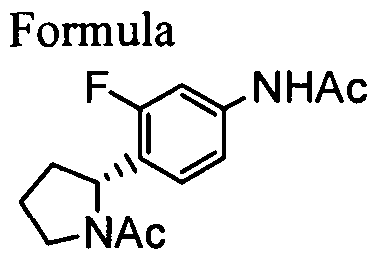
  • Step 3 Formula A white solid obtained in step 2 was added to fuming nitric acid (25 ml) for 30 minutes with stirring under ice cooling, and this mixture was stirred for 30 minutes at room temperature.
  • the reaction liquid was neutralized with a saturated aqueous sodium carbonate solution, follwed by adding chloroform to the liquid.
  • the organic layer was washed with a saturated saline solution and dried with anhydrous magnesium sulfate, follwed by being concentrated under reduced pressure to obtain a yellow oily matter containing (R)-l-acetyl-2-(4- acetylamino-2-fluoro-5nitrophenyl)pyrrolidine, which was used in the subsequent step without being further purified.
  • a 5N aqueous sodium hydroxide solution (32.1 ml, 160 mmol) was added to the mixed solution of the yellow oily matter, obtained in step 3, with tetrahydrofuran (60 ml), methanol (60 ml), and water (60 ml) with stirring under ice cooling, and this mixture was stirred for 1 hour at room temperature.
  • a 5N aqueous hydrochloric acid solution (321 ml, 160 mmol) was added to the reaction liquid, this mixture was concentrated under reduced pressure, and chloroform and a saturated aqueous sodium bicarbonate solution were added to a provided residue.
  • aqueous solution (60 ml) of sodium nitrite (7.25 g, 105 mmol) was dropped to a mixed solution of the compound (23.4 g, 88 mmol), obtained in step 4, with dioxan (300 ml), water (220 ml), and a 4N dioxan hydrochloride solution (22 ml) for 20 minutes with stirring under ice cooling, and this mixture was stirred for 30 minutes under ice cooling.
  • a 50% aqueous hypophosphorous acid solution (60 ml) was dropped to the reaction liquid for 15 minutes with stirring under ice cooling, and this mixture was stirred for 30 minutes under ice cooling, follwed by being stirred for 1 hour at room temperature.
  • 6-(methylsulfonyl)-3-pyridinol(12.7 g, 73.3 mmol) and potassium carbonate (17.15 g, 124 mmol) are added to a N,N-dimethylformamide (150 ml) solution of a compound (14.23 g, 56.4 mmol) obtained in step 5, and this mixture was stirred for 2 hours at 120°C.
  • a 10% palladium carbon catalyst (3 g) was added to the mixed solution of the yellow oily matter (14.23 g, 56.4 mmol), obtained in step 6, with tetrahydrofuran (120 ml) and methanol (120 ml), and this mixture was stirred for 14 hours at room temperature under hydrogen atmosphere. Following filtration of the catalyst, a filtrate was concentrated under reduced pressure to obtain a yellow oily matter containing (R)-l-acetyl-2-[5-amino-2-(6- methylsulfonylpyridin-3-yloxy)phenyl]pyrrolidine, which is used matter in the subsequent step without being further purified.
  • Potassium iodide (8.73 g, 52.6 mmol), potassium iodate (5.63 g, 26.3 mmol), and a 5N aqueous hydrochloric acid solution (16 ml) were sequentially added to the mixed solution of a yellow oily matter, obtained in step7, with methanol (300 ml), dioxan (240 ml), and water (240 ml) at 50°C, and this mixture was stirred for 4 hours at 50°C.
  • Chloroform was added to the reaction liquid, sequentially washed with a 20% aqueous sodium thiosulfate solution and a saturated saline solution, and dried with aanhydrous magnesium sulfate, followed by being concentrated under reduced pressure to obtain a yellow oily matter.
  • Ethyl chlorocarbonate (10.06 ml, 105 mmol) was added to a pyridine (100 ml) solution of the yellow oily matter with stirring under ice cooling, and this mixture was stirred overnight at room temperature. The residue was concentrated under reduced pressure, and chloroform and a saturated aqueous sodium bicarbonate solution were added to it.
  • a bis(triphenylphosphine)palladium(II)dichloride complex (12.2 mg, 0.017 mol) and cuprous iodide (6.6 mg, 0.035 mmol) were added to the mixed solution of the compound (100 mg,0.174 mmol), obtained in step 8, with tetrahydrofuran (1.5 ml) and triethylamine (2 ml), and a tetrahydrofuran (2 ml) solution of (6-ethynylpyridin-3-yl)methanol (27.9 mg, 0.209 mmol) was dropped with stirring for 5 minutes at 40 0 C in nitrogen gas stream. Water and chloroform were added to the reaction liquid under ice cooling to filter insoluble matters.
  • Tetrabutylammonium fluoride (IN tetrahydrofuran solution, 500 ⁇ l, 0.5 mmol) were added to a tetrahydrofuran (2 ml) solution of the compound (81 mg, 0.14 mmol) obtained in step 9, and this mixture was stirred for 18 hours at 50 0 C. Water and chloroform were added to the reaction liquid under ice cooling. The organic layer was washed with a saturated saline solution and dried with anhydrous magnesium sulfate, follwed by being concentrated under reduced pressure.
  • the title compound (32 mg) was obtained as a pale yellow noncrystal solid by the same method as in Example 1, a method similar thereto, or combinations of them and usual methods, using 3-ethynyl-l -methyl- lH-pyrazole instead of (6-ethynylpyridin-3-yl)methanol.
  • the title compound (45 mg) was obtained as a pale yellow noncrystal solid by the same method as in Example 1, a method similar thereto, or combinations of them and usual methods, using 6-ethynyl-N-methylnicotinamide instead of (6-ethynylpyridin-3-yl)methanol.
  • the title compound (20 mg) was obtained as a pale yellow noncrystal solid by the same method as in Example 1, a method similar thereto, or combinations of them and usual methods, using 5-hydroxy-2-pyridinemethanol instead of 6-(methylsulfonyl)-3-pyridinol and 2- ethynylpyrazine instead of (6-ethynylpyridin-3-yl)methanol.
  • the title compound (52 mg) was obtained as a pale yellow noncrystal solid by the same method as in Example 1, a method similar thereto, or combinations of them and usual methods, using 5-hydroxy-2-pyridinemethanol instead of 6-(methylsulfonyl)-3-pyridinol and 2- ethynyl-5-methylpyrazine instead of (6-ethynylpyridin-3-yl)methanol.
  • the title compound (37 mg) was obtained as a pale yellow noncrystal solid by the same method as in Example 1, a method similar thereto, or combinations of them and usual methods, using 2-(6-ethynylpyridin-3-yl)propan-2-ol instead of (6-ethynylpyridin-3-yl)methanol.
  • the title compound (44 mg) was obtained as a pale yellow noncrystal solid by the same method as in Example 1, a method similar thereto, or combinations of them and usual methods, using 2-ethynyl-5-hydroxymethylpyrazine instead of (6-ethynylpyridin-3-yl)methanol.
  • the title compound (111 mg) was obtained as a pale yellow solid by the same method as in Example 1, a method similar thereto, or combinations of them and usual methods, using 6-(2-hydroxyethoxy)-pyridin-3-ol instead of 6-(methylsulfonyl)-3-pyridinol and 2-ethynyl- pyridine instead of (6-ethynylpyridin-3-yl)methanol.
  • the title compound (34.2 mg) was obtained as a pale brown solid by the same method as in Example 1, a method similar thereto, or combinations of them and usual methods, using 6-(2-hydroxyethoxy)pyridin-3-ol instead of 6-(methylsulfonyl)-3-pyridinol and 2-ethynyl- 5-methylpyrazine instead of (6-ethynylpyridin-3-yl)methanol.
  • the title compound (31.2 mg) was obtained as a pale brown solid by the same method as in Example 1, a method similar thereto, or combinations of them and usual methods, using 6-(2-hydroxyethoxy)pyridin-3-ol instead of 6-(methylsulfonyl)-3-pyridinol and 2-ethynyl- 5-hydroxymethylpyrazine instead of (6-ethynylpyridin-3-yl)methanol.
  • the title compound (42 mg) was obtained as a pale yellow noncrystal solid by the same method as in Example 1, a method similar thereto, or combinations of them and usual methods, using 6-methoxymethylpyridin-3-ol instead of 6-(methylsulfonyl)-3-pyridinol.
  • the title compound (18 mg) was obtained as a pale yellow noncrystal solid by the same method as in Example 1, a method similar thereto, or combinations of them and usual methods, using 6-methoxymethylpyridin-3-ol instead of 6-(methylsulfonyl)-3-pyridinol and 2- ethynyl-5-hydroxymethylpyrazine instead of (6-ethynylpyridin-3-yl)methanol.
  • the title compound (30 mg) was obtained as a pale yellow noncrystal solid by the same method as in Example 1, a method similar thereto, or combinations of them and usual methods, using 6-methoxymethylpyridin-3-ol instead of 6-(methylsulfonyl)-3-pyridinol and 2- ethynyl-pyrazine instead of (6-ethynylpyridin-3-yl)methanol.
  • the title compound (35 mg) was obtained as a pale yellow noncrystal solid by the same method as in Example 1, a method similar thereto, or combinations of them and usual methods, using 6-methoxymethylpyridin-3-ol instead of 6-(methylsulfonyl)-3-pyridinol and 2- ethynyl-pyridin instead of (6-ethynylpyridin-3-yl)methanol.
  • the title compound (37 mg) was obtained as a pale yellow noncrystal solid by the same method as in Example 1, a method similar thereto, or combinations of them and usual methods, using 6-(2-triisopropylsiloxyethyl)pyridin-3-ol instead of 6-(methylsulfonyl)-3- pyridinol and 2-ethynyl-pyrazine instead of (6-ethynylpyridin-3-yl)methanol.
  • the title compound (75 mg) was obtained as a pale brown solid by the same method as in Example 1, a method similar thereto, or combinations of them and usual methods, using 6-(azetidin-l-ylcarbonyl)pyridin-3-ol instead of 6-(methylsulfonyl)-3-pyridinol and 2- ethynyl-pyrazine instead of (6-ethynylpyridin-3-yl)methanol.
  • the title compound (78.5 mg) was obtained as a pale brown solid by the same method as in Example 1, a method similar thereto, or combinations of them and usual methods, using 6-(azetidin-l-ylcarbonyl)pyridin-3-ol instead of 6-(methylsulfonyl)-3-pyridinol and 2-(6- ethynylpyrazin-3-yl)propan-2-ol instead of (6-ethynylpyridin-3-yl)methanol.
  • the title compound (140 mg) was obtained as a pale yellow noncrystal solid by the same method as in Example 1, a method similar thereto, or combinations of them and usual methods, using 2-(6-ethynylpyrazin-3-yl)propan-2-ol instead of (6-ethynylpyridin-3-yl)methanol.
  • the title compound (24.5 mg) was obtained as a yellow solid by the same method as in Example 1, a method similar thereto, or combinations of them and usual methods, using 6- (azetidin-l-ylcarbonyl)pyridin-3-ol instead of 6-(methylsulfonyl)-3-pyridinol and 2-(6- ethynylpyridin-3-yl)propan-2-ol instead of (6-ethynylpyridin-3-yl)methanol.
  • 6- (azetidin-l-ylcarbonyl)pyridin-3-ol instead of 6-(methylsulfonyl)-3-pyridinol
  • 2-(6- ethynylpyridin-3-yl)propan-2-ol instead of (6-ethynylpyridin-3-yl)methanol.
  • the analytical data of the title compound are shown below.
  • the title compound (33 mg) was obtained as a yellow solid by the same method as in Example 1, a method similar thereto, or combinations of them and usual methods, using 6- methoxycarbonylpyridin-3-ol instead of 6-(methylsulfonyl)-3-pyridinol and 2-ethynyl-pyrazine instead of (6-ethynylpyridin-3-yl)methanol.
  • the title compound (1.9 mg) was obtained as a yellow solid by the same method as in Example 1, a method similar thereto, or combinations of them and usual methods, using 6- methoxycarbonylpyridin-3-ol instead of 6-(methylsulfonyl)-3-pyridinol and 2-ethynyl-pyrazine instead of (6-ethynylpyridin-3-yl)methanol.
  • the title compound (22.5 mg) was obtained as a yellow solid by the same method as in Example 1, a method similar thereto, or combinations of them and usual methods, using 6- methoxycarbonylpyridin-3-ol instead of 6-(methylsulfonyl)-3-pyridinol and 2-ethynyl-pyrazine instead of (6-ethynylpyridin-3-yl)methanol.
  • the title compound (14.9 mg) was obtained as a yellow solid by the same method as in Example 1, a method similar thereto, or combinations of them and usual methods, using 6- methoxycarbonylpyridin-3-ol instead of 6-(methylsulfonyl)-3-pyridinol and 2-ethynyl-pyrazine instead of (6-ethynylpyridin-3-yl)methanol.
  • An acetyl pyrrolidinyl indole derivative according to the present invention presented in Formula (I) or a pharmaceutically acceptable salt thereof is useful in treatment and/or prevention of diabetes mellitus, diabetes mellitus complications or obesity in the pharmaceutical field because of exhibiting an excellent glucokinase-activating effect.

Landscapes

  • Health & Medical Sciences (AREA)
  • Chemical & Material Sciences (AREA)
  • Animal Behavior & Ethology (AREA)
  • Veterinary Medicine (AREA)
  • Public Health (AREA)
  • General Health & Medical Sciences (AREA)
  • Pharmacology & Pharmacy (AREA)
  • Medicinal Chemistry (AREA)
  • Life Sciences & Earth Sciences (AREA)
  • Organic Chemistry (AREA)
  • Epidemiology (AREA)
  • Bioinformatics & Cheminformatics (AREA)
  • Engineering & Computer Science (AREA)
  • Chemical Kinetics & Catalysis (AREA)
  • General Chemical & Material Sciences (AREA)
  • Nuclear Medicine, Radiotherapy & Molecular Imaging (AREA)
  • Diabetes (AREA)
  • Hematology (AREA)
  • Urology & Nephrology (AREA)
  • Obesity (AREA)
  • Vascular Medicine (AREA)
  • Endocrinology (AREA)
  • Emergency Medicine (AREA)
  • Cardiology (AREA)
  • Ophthalmology & Optometry (AREA)
  • Child & Adolescent Psychology (AREA)
  • Biomedical Technology (AREA)
  • Neurology (AREA)
  • Neurosurgery (AREA)
  • Heart & Thoracic Surgery (AREA)
  • Pharmaceuticals Containing Other Organic And Inorganic Compounds (AREA)
  • Plural Heterocyclic Compounds (AREA)

Abstract

The present invention relates to compounds, which are useful for treatment and/or prevention of diabetes mellitus, diabetes mellitus complications or obesity, since the compounds have glucokinase-activating effects, and are presented in Formula (I): wherein R1 represents a lower alkylsulfonyl group; R2 represents a hydrogen atom; R20 represents, e.g., a hydrogen atom; m represents an integer of from 1 to 3; and n represents zero or 1, or relates to a pharmaceutically acceptable salts thereof.

Description

DESCRIPTION
ACETYL PYRROLIDINYL INDOLE DERIVATIVE
TECHNICAL FIELD
The present invention relates to a glucokinase activator comprising an acetyl pyrrolidinyl indole derivative as the active ingredient thereof. Further, it relates to a novel acetyl pyrrolidinyl indole derivatives.
BACKGROUND ART
Glucokinase (GK) (ATP: D-hexose 6-phosphotransferaze, EC 2.7.1.1) is one (hexokinase IV) of four mammal hexokinases. Hexokinase is a first-stage enzyme in glycolysis and catalyzes a reaction from glucose to glucose hexaphosphate. hi its expression, glucokinase is limited essentially in liver and pancreas beta cells, and it controls the rate-limiting step of glucose metabolism in these cells thereby playing an important role in systemic saccharometabolism. Glucokinase in liver and that in pancreas beta cells differ from each other in point of the N- terminal 15-amino acid sequence owing to the difference in splicing therebetween, but they are the same in point of the enzymatic property. The enzymatic activity of the other three hexokinases (I, II, III) except glucokinase is saturated at a glucose concentration of at most 1 mM, but Km of glucokinase to glucose is 8 mM and is near to a physiological blood-glucose level. Therefore, in accordance with the blood- glucose level change from a normal blood- glucose level (5 mM) to an increased blood- glucose level after meals (10 to 15 mM), intercellular glucose metabolism is accelerated via glucokinase. Since ten years ago, a hypothesis that glucokinase may act as a glucose sensor in pancreas beta cells and liver has been proposed (for example, see Garfinkel D, et al., "Computer modeling identifies glucokinase as glucose sensor of pancreatic beta-cells", American Journal Physiology, Vol. 247 (3Pt2), 1984, pp.527-536). A result of recent glucokinase gene-manipulated mice has confirmed that glucokinase actually plays an important role in systemic glucose homeostasis. Mice in which the glucokinase gene was disrupted die soon after their birth (for example, see Grupe A. et al., " Transgenic knockouts reveal a critical requirement for pancreatic beta cell glucokinase in maintaining glucose homeostasis", Cell, Vol. 83, 1995, pp. 69-78), but on the other hand, normal or diabetic mice in which glucokinase was excessively expressed have a lowered blood- glucose level (for example, see Ferre T. et al., "Correction of diabetic alterations by glucokinase", Proceedings of the National Academy of Sciences of the U.S.A., Vol. 93, 1996, pp. 7225-7230).
With the increase in glucose concentration therein, the reaction of pancreas beta cells and that of liver cells are both toward the reduction in a blood- glucose level, though differing from each other. Pancreas beta cells come to secrete more insulin, and liver takes up sugar to store it as glycogen therein and simultaneously reduces glucose release.
To that effect, the change in the enzymatic activity of glucokinase plays an important role in mammal glucose homeostasis via liver and pancreas beta cells. In a juvenile diabetic case that is referred to as M0DY2 (maturity-onset diabetes of the young), mutation of a glucokinase gene has been found, and the glucokinase activity reduction causes the blood- glucose level increase (for example, see Vionnet N. et al., "Nonsense mutation in the glucokinase gene causes early-onset non-insulin-dependent diabetes mellitus", Nature Genetics, Vol. 356, 1992, pp. 721-722). On the other hand, a pedigree having mutation of increasing glucokinase activity has been found, and those of the family line show low blood- glucose level symptoms (for example, Glaser B. et al., "Familial hyperinsulinism caused by an activating glucokinase mutation", New England Journal Medicine, Vol. 338, 1998, pp. 226-230).
From these, glucokinase acts as a glucose sensor and plays an important role in glucose homeostasis also in humans. On the other hand, blood- glucose level control by utilizing a glucokinase sensor system may be possible in many type-II diabetes patients. A glucokinase- activating substance may be expected to have an insulin secretion promoting effect in pancreas beta cells and have a sugar take-up accelerating and sugar release inhibiting activity in liver, and therefore it may be useful as a remedy for type-II diabetes patients.
Recently, it has become clarified that pancreas beta cell-type glucokinase is limitedly expressed locally in rat brains, especially in ventromedial hypothalamus (VMH) thereof. About 20 % neurocytes in VMH are referred to as glucose-responsive neutrons, and heretofore it has been considered they may play an important role in body weight control. When glucose is administered to a rat brain, then it reduces the amount of ingestion; but when glucose metabolism is retarded through intracerebral administration of glucosamine, a glucose analogue, then it causes hyperphagia. From an electrophysiological experiment, it is admitted that glucose- responsive neurons are activated in accordance with a physiological glucose concentration change (5 to 20 mM), but when glucose metabolisms is inhibited by glucosamine or the like, then their activity is retarded. In the glucose concentration-sensitive system in VMH, a glucose- mediated mechanism is anticipated like the insulin secretion in pancreas beta cells. Accordingly, there may be a possibility that a substance for glucokinase activation in VMH, in addition to liver and pancreas beta cells, may be effective not only for blood- glucose level correction but also for solution of obesity that is problematic in many type-II diabetes patients.
From the above description, a compound having a glucokinase-activating effect is useful for remedies and/or preventives for diabetes, or for remedies and/or preventives for chronic complications of diabetes such as retinopathy, nephropathy, neurosis, ischemic cardiopathy, arteriosclerosis, and further for remedies and/or preventives for obesity. Compounds that have glucokinase-activating effects and an indole skeleton, including a compound of Formula (1) shown below, are disclosed in WO 2007/037534.
Figure imgf000004_0001
It is desirable for use as pharmaceutical preparations that compounds with glucokinase-activating effects have high solubility in water as well as adequate glucokinase- activating effects.
However, although WO 2007/037534 discloses that the above-mentioned compounds having an indole skeleton or the like have adequate glucokinase-activating effects, it does not mention the solubility of the compounds having an indole skeleton in water at all.
DISCLOSURE OF THE INVENTION
The present invention provides compounds of the following formula (I), and pharmaceutically acceptable salts, which have a strong GK activating effect and high solubility in water. Specifically, the present invention is:
(1) to provide a compound of Formula (I) shown below, or a pharmaceutically acceptable salt thereof (hereinafter also referred to as "compound according to the present
Figure imgf000004_0002
wherein: R1 represents a group selected from the group consisting of: a lower alkylsulfonyl group; a lower alkyl groups substituted with a hydroxy or a lower alkoxy group; a lower alkoxy group substituted with a hydroxy groups; and a group of Formula (II):
Figure imgf000004_0003
wherein R3 and R4 each independently represent a hydrogen atom or a lower alkyl group optionally substituted with a hydroxy group, or R3 and R4 together with a nitrogen atom to which they are attached, represent a four- to seven-membered nitrogen-containing aliphatic ring;
R2 represents a hydrogen atom; R20 independently represents a group selected from the group consisting of hydrogen atoms, lower alkyl groups optionally substituted with hydroxy groups, lower alkoxy groups, and groups of Formula (III):
O R5
-1LN'R (III) wherein R5 and R6 each indendently represent a hydrogen atom, or a lower alkyl group, or R5 and RR66 ttooggeetthheerr wwiitthh aa nniittrrooggeenn aattoomm tt<o which they are attached represent a four- to seven-membered nitrogen-containing aliphatic ring;
m represents an integer of from 1 to 3;
n represents zero or 1 ; and
Formula (IV):
Figure imgf000005_0001
represents a heteroaryl group selected from the group consisting of pyridinyl, pyrazinyl, and pyrazolyl groups (except that R1 is an ethane sulfonyl group; the group represented by the aforementioned formula (FV) is a pyridinyl group; R20 is a hydrogen atom; and m is 3).
Furthermore, the present invention is also:
(2) to provide pharmaceutical compositions including the following (α) to (γ) to be used for treating, preventing and/or delaying the onset of type 2 diabetes mellitus:
(α) compounds presented in the aforementioned formula (I);
(β) one or more compounds selected from the group consisting of the following (a) to (i): (a) other glucokinase activators;
(b) biguanides; (c) PPAR agonists; (d) insulin; (e) somatostatins; (f) α-glucosidase inhibitors; (g) insulin secretagogues; (h) DPP-IV inhibitors (dipeptidyl peptidase inhibitors); and (i) glucose uptake facilitators; and
(γ) pharmacologically acceptable carriers;
(3) to provide glucokinase activators containing the compounds, presented in the aforementioned formula (I), or the pharmaceutically acceptable salts thereof as active principles;
(4) to provide prophylactic or therapeutic agents for diabetes mellitus containing the compounds, presented in the aforementioned formula (I), or the pharmaceutically acceptable salts thereof as active principles; and (5) to provide pharmaceutical compositions containing the compounds, presented in the aforementioned formula (I), or the pharmaceutically acceptable salts thereof as active principles.
Since the compounds presented in the aforementioned formula (I) has glucokinase-activating effects, they are further useful as therapeutic and/or prophylactic agents for diabetes mellitus, as therapeutic and/or prophylactic agents for chronic complications of diabetes mellitus, such as retinopathy, nephropathy, neurosis, ischemic heart disease and arteriosclerosis, and further as therapeutic and/or prophylactic agents for obesity. The compounds presented in the aforementioned formula (I) are useful preferably as therapeutic or prophylactic agents for diabetes mellitus, further preferably as therapeutic agents for diabetes mellitus.
The meanings of the terms as used herein will be described, and the compounds according to the present invention will be described in more detail. "Lower alkyl group" means a linear or branched alkyl group having from 1 to 6 carbon atoms, including, for example, a methyl group, an ethyl group, a propyl group, an isopropyl group, a butyl group, an isobutyl group, a sec-butyl group, a tert-butyl group, a pentyl group, an isoamyl group, a neopentyl group, an isopentyl group, a 1,1-dimethylpropyl group, a 1- methylbutyl group, a 2-methylbutyl group, a 1,2-dimethylpropyl group, a hexyl group, an isohexyl group, a 1-methylpentyl group, a 2-methylpentyl group, a 3-methylpentyl group, a 1,1- dimethylbutyl group, a 1 ,2-dimethylbutyl group, a 2,2-dimethylbutyl group, a 1,3-dimethylbutyl group, a 2,3-dimethylbutyl group, a 3,3-dimethylbutyl group, a 1-ethylbutyl group, a 2-ethylbutyl group, a 1 ,2,2-trimethylpropyl group, a l-ethyl-2-methylpropyl group. [0019] "Alkoxy group" means a hydroxyl group of which the hydrogen atom is substituted with the above-mentioned lower alkyl group, and includes, for example, a methoxy group, an ethoxy group, a propoxy group, an isopropoxy group, a butoxy group, a sec-butoxy group, a tert-butoxy group, a pentyloxy group, an isopentyloxy group, a hexyloxy group, an isohexyloxy group.
Example of four- to seven-membered nitrogen-containing aliphatic ring includes azetidinyl group, pyrrolidinyl group, piperidinyl group or homopiperidinyl group. In order to more specifically disclose compounds of Formula (I) according to the present invention:
Figure imgf000006_0001
wherein the symbols have the same meanings as above and the symbols used in Formula (I) are described with reference to specific examples.
R1 represents a group selected from the group consisting of: a lower alkylsulfonyl group; a lower alkyl group substituted with hydroxy or lower alkoxy group; a lower alkoxy group substituted with hydroxy group; and a group of Formula (II):
O R3
wherein R3 and R4 independently represent a hydrogen atom or a lower alkyl group optionally substituted with a hydroxy group, or R3 and R4 together with a nitrogen atom to which they are attached, represent a four- to seven-membered nitrogen-containing aliphatic ring.
"Lower alkylsulfonyl group" for R1 means a sulfonyl group substituted with the lower alkyl group, specifically, examples of which include a methylsulfonyl, an ethylsulfonyl, a n-propylsulfonyl, a cyclopropylsulfonyl, a n-butylsulfonyl, and a tert-butylsulfonyl group. "Lower alkyl group substituted with a hydroxy or a lower alkoxy group" for R1 means a lower alkyl group substituted with a hydroxy group or a lower alkyl group substituted with the lower alkoxy group. Examples of "lower alkyl group substituted with a hydroxy group" include a hydroxymethyl, a 1-hydroxyethyl, a 2-hydroxyethyl, and a 3-hydroxypropyl group.
Example of "a lower alkoxy group substituted with a hydroxy group" for R1 includes, specifically, a hydroxy methoxy, a 1 -hydroxy ethoxy, a 2-hydroxy ethoxy, and a 3- hydroxy propoxy group.
Example of a group of Formula (II) for R1 :
O R3
^%4 00 wherein the symbols have the same meanings as above, include, specifically, a methylcarbamoyl, an ethylcarbamoyl, an isopropylcarbamoyl, a n-propylcarbamoyl, a dimethylcarbamoyl, a diethylcarbamoyl, an ethylmethylcarbamoyl, an 1-azetidinylcarbamoyl, a 1- pyrrolidinylcarbamoyl, a 1-piperidinylcarbamoyl, and a 2-hydroxyethyl-methylcarbamoyl group. A group of R1 includes a lower alkylsulfonyl group and a lower alkoxy group substituted with a hydroxy or lower alkyl group. R2 represents a hydrogen atom.
R20 represents a group selected from the group consisting of: a hydrogen atoms; a lower alkyl group optionally substituted with a hydroxy group, a lower alkoxy group, and a groups of Formula (III): O R5
-^%β on wherein R5 and R6 independently represent a hydrogen atom, or a lower alkyl group optionally substituted with a hydroxy group), or R5 and R6 together with a nitrogen atom to which they are attached represent a four- to seven-membered nitrogen-containing aliphatic ring. "Lower alkyl group optionally substituted with a hydroxy group" for R20 represents an unsubstituted lower alkyl group or a lower alkyl group substituted with a hydroxy group.
"Unsubstituted lower alkyl group" have the same meanings the as "lower alkyl group" defined above, specifically, examples of which include a methyl, an ethyl, and an isopropyl group.
"Lower alkyl group substituted with a hydroxy group" means the lower alkyl group substituted with a hydroxy group, defined above, specifically, examples of which include a hydroxymethyl, a 1-hydroxyethyl, a 2-hydroxyethyl, a 3-hydroxypropyl, and a 1 -hydroxy- 1- methylethyl group. "Lower alkyl group optionally substituted with a hydroxy group for R20 is preferably a lower alkyl group substituted with a hydroxy group.
"Lower alkoxy group" for R20 have the same meanings as "lower alkoxy group" defined above, specifically, examples of which include a methoxy, an ethoxy, a propoxy, and an isopropoxy group. Example of a group of Formula (III) for R20:
O R5
^%6 01) wherein the symbols have the same meanings as above, include, specifically, a methylcarbamoyl, an ethylcarbamoyl, an isopropylcarbamoyl, a n-propylcarbamoyl, a dimethylcarbamoyl, a diethylcarbamoyl, an ethylmethylcarbamoyl, an 1-azetidinylcarbamoyl, a 1- pyrrolidinylcarbamoyl, a 1-piperidinylcarbamoyl, and a 2-hydroxyethyl-methylcarbamoyl group.
R20 is preferably a hydrogen atom or a lower alkyl group substituted with a hydroxy group, more preferably a lower alkyl group substituted with a hydroxy group.
A group of Formula (IV):
Figure imgf000008_0001
means a heteroaryl group selected from the group consisting of a pyridinyl, a pyrazinyl, and a pyrazolyl group, specifically, including a group selected from the group consisting of Formula:
Figure imgf000008_0002
wherein Formula
shows a site attached to an indole ring. m represents an integer of from 1 to 3, preferably 2 or 3. n represents zero or 1 , preferably zero.
Any of R1, R2, R20, R3, R4, R5, R6, m, n, and preferred embodiments of Formula (IV) may be combined.
(A) A preferred embodiment of a compound of the present invention is a compound or a pharmaceutically acceptable salt thereof of the aforementioned formula (I) wherein n is zero.
(B) Also, another preferred embodiment of a compound of the present invention is a compound or a pharmaceutically acceptable salt thereof, of the aforementioned formula (I), wherein R20 represents a group selected from the group consisting of a lower alkyl group optionally substituted with a hydroxy group, a lower alkoxy group, and a group of Formula (III):
9 R5
wherein R5 and R6 independently represent a hydrogen atom, or a lower alkyl group, or R5, R6, and a nitrogen atom, to which they are attached represent a four- to seven-membered nitrogen- containing aliphatic ring; and n is zero.
(C) Also, another preferred embodiment of a compound according to the present invention is a compound or a pharmaceutically acceptable salt thereof, of the aforementioned formula (I), wherein R20 represents a lower alkyl group optionally substituted with a hydroxy group, and n is zero.
(D) Also, another preferred embodiment of a compound according to the present invention is a compound or a pharmaceutically acceptable salt thereof, of the aforementioned formula (I), wherein R2 represents a group of Formula (III):
Figure imgf000009_0001
wherein the symbols have the same meanings as above, and n is zero.
(E) Also, another preferred embodiment of a compound according to the present invention is a compound or a pharmaceutically acceptable salt thereof of the aforementioned formula (I), wherein R20 represents a lower alkoxy group and n is zero.
(F) Also, another preferred embodiment of a compound according to the present invention is a compound or a pharmaceutically acceptable salt thereof of the aforementioned formula (I), wherein R20 represents a lower alkyl group substituted with a hydroxy group and n is zero. (G) Also, another preferred embodiment of a compound according to the present invention is a compound according to any one of (B) to (F) described above or a pharmaceutically acceptable salt thereof, wherein R1 represents a lower alkylsulfonyl group.
(G) Also, another preferred embodiment of a compound according to the present invention is a compound according to any one of (B) to (F) described above or a pharmaceutically acceptable salt thereof, wherein a group of the aforementioned formula (IV) is a group of Formula (IV-I):
Figure imgf000010_0001
w erein:form -ula *~ (|V'1) * has the same meaning as above.
(I) Also, another preferred embodiment of a compound according to the present invention is a compound according to any one of (B) to (F) described above or a pharmaceutically acceptable salt thereof, wherein R1 represents a lower alkylsulfonyl group and a group of the aforementioned formula (IV) is a group of the aforementioned formula (IV-I).
(J) Also, another preferred embodiment of a compound according to the present invention is a compound or a pharmaceutically acceptable salt thereof of the aforementioned formula (I), wherein R20 represents a hydrogen atom and n is zero.
(K) Also, another preferred embodiment of a compound according to the present invention is a compound according to (J) described above or a pharmaceutically acceptable salt thereof of the aforementioned formula (I), wherein R1 represents a lower alkylsulfonyl group.
(L) Also, another preferred embodiment of a compound according to the present invention is a compound according to (K) described above or a pharmaceutically acceptable salt thereof, wherein a group of the aforementioned formula (IV) is a group of the aforementioned formula (IV-I).
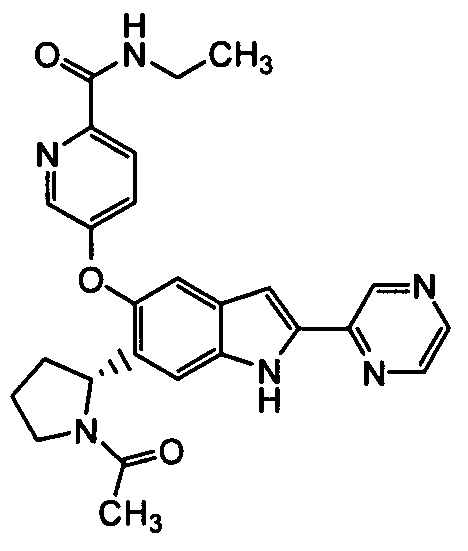
(M) In another preferred embodiment of a compound according to the present invention, a compound of the aforementioned formula (I) is also a compound selected from the group consisting of 6-[(R)-I -acetylpyrrolidin-2-yl]-2-(4-hydroxymethylpyridin-2-yl)-5-(6- methylsulfonylpyridin-3-yloxy)-lH-indole, 6-[(R)-l-acetylpyrrolidin-2-yl]-5-(6- methylsulfonylpyridin-3-yloxy)-2-(5-methylpyrazin-2-yl)-lH-indole, 6-[(R)-l-acetylpyrrolidin-2- yl]-2-( 1 -methyl- 1 H-pyrazol-3-yl)-5-(6-methylsulfonylpyridin-3-yloxy)- 1 H-indole, 6-[(R)- 1 - acetylpyrrolidin-2-yl]-2-[5-(N-methylcarbamoyl)pyridin-2-yl]-5-(6-methylsulfonylpyridin-3- yloxy)-l H-indole, 6-[(R)-I -acetylpyrrolidin-2-yl]-5-(6-hydroxymethylpyridin-3-yloxy)-2-(5- methylpyrazin-2-yl)-l H-indole, 6-[(R)-l-acetylpyrrolidin-2-yl]-2-[5-(l,l- dimethylhydroxymethyl)pyridin-2-yl]-5-(6-hydroxymethylpyridin-3-yloxy)- 1 H-indole, 6-[(R)- 1 - acetylpyrrolidin-2-yl]-2-[5-(l,l-dimethylhydroxymethyl)pyridin-2-yl]-5-(6- methylsulfonylpyridin-3-yloxy)-lH-indole, 6-[(R)-l-acetylpyrrolidin-2-yl]-2-(5- hydroxymethylpyrazin-2-yl)-5 -(6-methylsulfonylpyridin-3 -yloxy)- 1 H-indole, 6- [(R)- 1 - acetylpyrrolidin-2-yl]-5-[6-(2-hydroxyethoxy)pyridin-3-yloxy]-2-(5-methylpyrazin-2-yl)-lH- indole, 6- [(R)- 1 -acetylpyrrolidin-2-yl] -5 - [6-(2-hydroxyethoxy)pyridin-3 -yloxy] -2-(5 - hydroxymethylpyrazin-2-yl)- 1 H-indole, 6-[(R)- 1 -acetylpyrrolidin-2-yl]-2-(5- hydroxymethylpyridin-2-yl)-5 -(6-methoxymethylpyridin-3 -yloxy)- 1 H-indole, 6- [(R)- 1 - acetylpyrrolidin-2-yl]-2-(5-hydroxymethylpyrazin-2-yl)-5-(6-methoxymethylpyridin-3-yloxy)- lH-indole, 6-[(R)-I -acetylpyrrolidin-2-yl]-5-[6-(azetidin-l-ylcarbonyl)pyridin-3-yloxy]-2-[5- (1,1 -dimethylhydroxymethyl)pyrazin-2-yl] - 1 H-indole, 6- [(R)- 1 -acetylpyrrolidin-2-yl]-2-[5-( 1,1- dimethylhydroxymethyl)pyrazin-2-yl]-5-(6-methylsulfonylpyridin-3-yloxy)- 1 H-indole, 6-[(R)- 1 - acetylpyrrolidin-2-yl]-5-[6-(azetidin-l-ylcarbonyl)pyridin-3-yloxy]-2-(5-hydroxymethylpyridin- 2-yl)-l H-indole, and 6-[(R)-l-acetylpyrrolidin-2-yl]-5-[6-(azetidin-l-ylcarbonyl)pyridin-3- yloxy]-2-[5-(l,l-dimethylhydroxymethyl)pyridin-2-yl]-lH-indole; or a pharmaceutically acceptable salt thereof. (N) In another preferred embodiment of a compound according to the present invention, a compound of the aforementioned formula (I) is also a compound selected from the group consisting of 6-[(R)-I -acetylpyrrolidin-2-yl]-5-(6-methylsulfonylpyridin-3-yloxy)-2- (pyrazin-2-yl)-l H-indole, 6-[(R)-l-acetylpyrrolidin-2-yl]-5-(6-hydroxymethylpyridin-3-yloxy)-2- (pyrazin-2-yl)-l H-indole, 6-[(R)-l-acetylpyrrolidin-2-yl]-5-[6-(2-hydroxyethoxy)pyridin-3- yloxy] -2-(pyridin-2-yl)- 1 H-indole, 6- [(R)- 1 -acetylpyrrolidin-2-yl] -5-[6-(2- hydroxyethoxy)pyridin-3-yloxy]-2-(pyrazin-2-yl)-l H-indole, 6-[(R)-l-acetylpyrrolidin-2-yl]-5- (6-methoxymethylpyridin-3-yloxy)-2-(pyrazin-2-yl)-l H-indole, 6-[(R)-l-acetylpyrrolidin-2-yl]-5- (6-methoxymethylpyridin-3-yloxy)-2-(pyridin-2-yl)-l H-indole, 6-[(R)-I -acetylpyrrolidin-2-yl]-5- [6-(2-hydroxyethyl)pyridin-3-yloxy] -2-(pyrazin-2-yl)- 1 H-indole, 6- [(R)- 1 -acetylpyrrolidin-2-yl] - 5-[6-(azetidin-l-ylcarbonyl)pyridin-3-yloxy]-2-(pyrazin-2-yl)-lH-indole, 6-[(R)-I- acetylpyrrolidin-2-yl]-5-[6-(N,N-dimethylcarbamoyl)pyridin-3-yloxy]-2-(pyrazin-2-yl)-lH-indole, 6-[(R)-I -acetylpyrrolidin-2-yl]-5-[6-(N-ethylcarbamoyl)pyridin-3-yloxy]-2-(pyrazin-2-yl)-lH- indole, 6-[(R)-I -acetylpyrrolidin-2-yl]-5-[6-(N,N-diethylcarbamoyl)pyridin-3-yloxy]-2-(pyrazin- 2-yl)-lH-indole, and 6-[(R)-l-acetylpyrrolidin-2-yl]-5-{6-[N-(2-hydroxyethyl)]-N- methylcarbamoyl]pyridin-3-yloxy}-2-(pyrazin-2-yl)-l H-indole; or a pharmaceutically acceptable salt thereof.
A compound of Formula (I) according to the present invention:
Figure imgf000011_0001
wherein the symbols have the same meanings as above, respectively, may be produced, e.g., by the following process:
Figure imgf000012_0001
(D (2) (3)
Figure imgf000012_0002
wherein Ac represents an acetyl group; R represents a lower alkyl group; Pro represents a protective group; L represents a leaving group; and the other symbols have the same meanings as above.
Accordingly, for example, where a compound of Formula (I) is used in combination with a PPAR agonist, the weight ratio of the compound of Formula (I) to the PPAR agonist is generally from about 1000:1 to 1 :1000, preferably from about 200:1 to 1 :200. Combinations of the compound of Formula (I) and other active ingredients are also within the aforementioned range, but in each case, an effective dose of each active ingredient should be used.
The glucokinase-activating effect of a compound according to the present invention and antihyperglycemic effect based thereon are proved by, for example, pharmacological test examples described below.
Pharmacological Test Example 1 (glucokinase-activating effect) The glucokinase-activating potency of the compounds of formula (I) of the invention and a test method for it are described below.
The excellent glucokinase-activating effect of the compounds of formula (I) may be determined by a method described in literature (for example, Diabetes, Vol. 45, pp. 1671-1677, 1996), or in accordance with it.
The glucokinase activity may be determined not by directly measuring glucose-6- phosphate but by measuring the level of Thio-NADH, which is produced when a reporter enzyme, glucose-6-phosphate dehydrogenase produces phosphogluconolactone from glucose-6-phosphate, and based on the level, the degree of glucokinase activation by the compound tested may be determined.
In this assay, used was a recombinant human liver GK, which was expressed by E. coli as a FLAG fusion protein therein and was purified by ANTIFLAG M2 AFFINITY GEL (Sigma).
Using a flat-bottomed 96-well plate, the assay was carried out at 30°C. 69 μl of an assay buffer (25 mM Hepes Buffer/pH = 7.2, 2 mM MgCl2, 1 mM ATP, 0.5 mM TNAD, 1 mM dithiothreitol) was put into the plate, and 1 μl of a DMSO solution of the compound or DMSO alone as a control was added thereto. Next, 20 μl of an enzyme mixture (FLAG-GK, 2OLVmI G6PDH) cooled in ice was added to it, and 10 μl of a substrate, 25 mM glucose was added to it, and the reaction was initiated (final glucose concentration = 2.5 mM).
After the start of the reaction, the increase in the absorbance at 405 nm was measured for 12 minutes at intervals of 30 seconds, and the increase for the first 5 minutes was used for assessing the compound tested. FLAG-GK was added so that the absorbance increase after 5 minutes in the presence of 1 % DMSO could be from 0.04 to 0.06.
The OD level of the DMSO control was set as 100 %; and the OD level of the test compound at different concentrations was determined. From the OD level at each concentration, Emax (%) and EC50 (μM) were computed and used as the index of the GK-activating potency of the compound.
The GK activating potency of the compounds of the invention was measured according to the method as above, and the results are shown in Table 5 below. Table 5
Figure imgf000014_0001
Accordingly, the compounds of the invention have an excellent GK activating potency indicated by Emax and EC50, as in the above Table. The antihyperglycemic effect of the compound according to the present invention, and a test method therefor will now be explained.
Pharmacological Test Example 2 (antihyperglycemic effect) Six-week-old male C57BL/6J mice were fed a high-fat diet (RESEARCH DIETS, D 12492) for >9 weeks to produce the high-fat diet loaded mice (>160 mg/dl). The slight tail tips of the high-fat diet loaded mice (13 weeks old, n=6) under the conditions of free-feeding and water intake were cut with scissors to collect their blood. The collected blood was used to determine blood glucose levels prior to the administration of a compound by a blood glucose level measuring apparatus (One Touch Ultra (Johnson Johnson)), followed by oral administration of the compound suspended in a 0.5% methyl cellulose solution at 10 mg/kg, while a 0.5% methyl cellulose solution was orally administered to the control group. The blood glucose levels were determined using the blood glucose level measuring apparatus every 1 hour after the administration of the test drug solutions. The values of the decreases in blood glucose (differences between the control group and the compound-treated group) at 1 hour after administration were shown in Table 6 described below.
The values of the decreases in blood glucose (differences between the control group and the compound-treated group) at 1 hour after administration of the compounds according to Example 1 were shown in Table 6 described below.
Table 6
Example No. Difference in blood glucose level from control group (Δmg/dl)
Example 1 -72
Pharmacological Test Example 3 (antihyperglycemic effect)
From the cephalic vein of male beagles fasted overnight (10.0-14.6 kg body weight), blood was collected prior to administration, followed by oral administration of the test drug suspended in a 0.5% methyl cellulose solution (0.3 and 1 mg/kg), while a 0.5% methyl cellulose solution was orally administered to the control group. The blood was collected at 0.5, 1, 2, and 4 hours after the administration of the test drug. Plasma was separated from the obtained blood to determine a plasma glucose level using Determina-GL-E (Kyowa Medics).
Percentage reduction in plasma glucose level AUC compared to the control group up to 4 hours after the administration of the compounds according to Example 1 was described below.
Table 7
Figure imgf000015_0001
These reveal that the compounds according to the present invention have excellent antihyperglycemic effect.
The solubilities of the compounds according to the present invention in water and a testing method thereof will now be explained.
Solubility in water
For solubility in water, the solubility of a compound in water was determined by a solution precipitation method.
For an HPLC system, Agilent HPLCl 100 system was used. For a column, Agilent Zorbax Eclipse Cl 8 (inside diameter of 4.6 mm, length of 50 mm, and particle diameter of 1.8 μm) was used. For a shaker, Microincubator M-36 (Taitec) was used. For a plate, a 96- deep well plate (Nunc. 260252) was used. For a well cap, Pre-Slit Well Cap for 96 Well PP (NALGENE. 276011) was used. For a filtration plate, MultiScreen Solubility (Millipore; MSSLBPClO) was used. For dispensation, an 8-channel electronic multipipette, Biohit Proline (Biohit), and a 96-well automatic pipetting device, Biomeck 2000 (Biomeck) were used. For a reagent used, a pure solvent for DMSO ultraviolet absorption spectrum (Dojindo 349-01025) and water (MiIiQ water, manufactured by Millipore). Procedures are described below.
1. Preparation of DMSO solution
For a DMSO solution, a sample was prepared with DMSO to be precisely 10 mM.
2. Preparation of sample solution
Precise dispensation of 10 μL of a DMSO solution into each well of a 96-well plate was performed. Following addition of 490 μL of water to each of the wells and plate- sealing with 96-well Cap (Agilent No. 5042-1389), intense stirring processing of the plate was performed for 60 minutes at room temperature on a shaker. Subsequently, 200 μL of a treatment sample was added to a plate for centrifugal filtration, and centrifugal filtration of the sample was performed to obtain a filtrate. A sample solution was made by adding 200 μL of a 50% aqueous acetonitrile solution to the provided filtrate.
3. Preparation of sample for creating calibration curve
Precise dispensation of 10 μL of a DMSO solution into each well of a 96-well plate was performed. An appropriate amount of a 50% aqueous acetonitrile solution was added to each DMSO solution, and this mixture, prepared to have a concentration of 1 μm to 200 μM, was used as a standard solution.
Settings for HPLC measurement are described below.
Detection was performed using a multi-wavelength detector (190-370 nm). For a column, the above-mentioned column was used at 40°C. A flow rate was set at 1.2 ml/min, and an amount of an injected sample at 20 μL. For a moving phase, a 0.1% aqueous phosphoric acid solution as a liquid A and acetonitrile as a liquid B were used to carry out analyses in accordance with a time schedule described below.
Table 8
Time (min) A% B%
0.0 95 5
4.0 20 80
4.1 95 5
7.0 stop
For the analyses, the data of UV 275 nm were adopted. Obtained chromatography levels were integrated to create a calibration curve from Area of samples (1, 10, 50, and 200 μM) for creating a calibration curve. Using the calibration curve, regression calculation of concentrations in water was carried out from Area of sample solutions (water). The solubilities of compounds according to the present invention in water were determined by this method.
The results are shown below. Table 9-1
. Example No, Solubility (μMJ
Example 1 >170
Example 2 >170
Example 3 >170
Example 4 >170
Example 5 111.5
Example 6 >170
Example 7 >170
Example 8 >170
Example 9 151.8
Example 10 95.1
Table 9-2
Example 11 48.6
Example 12 128
Example 13 93.7
Example 14 >170
Example 15 168
Example 16 >170
Example 17 >170
Example 18 132.9
Example 19 >170
Example 20 122.5
Example 21 >170
Example 22 >170
: Example 23 77.6
Example 24 141.9
Example 25 >170
Example 26 128.9
Example 27 >170
Example 28 >170
Also, the solubilities of example compounds, disclosed in WO 2007/037534, in water were determined by this method. The results are shown below. Table 10 Example No. Solubility (μM)
Example 1 <1.0
Example 2 4.6
Example 3 16.9
Example 5 29.9
Example 7 10.4
Example e 1.2
As is apparent from tables 9-1, 9-2, and 10, described above, the compounds according to the present invention notably improves the compounds disclosed in WO 2007/037534 in solubility in water and are excellent as medicines.
An acetyl pyrrolidinyl indole derivative according to the present invention presented in Formula (1) or a pharmaceutically acceptable salt thereof has a strong glucokinase- activating effect, and are useful for treatment and/or prevention of diabetes mellitus, diabetes mellitus complications, or obesity. A compound according to the present invention also has adequate solid state properties, in particular, solubility in water, and is excellent as a medicine.
A compound according to the present invention is suitable for both types of diabetes mellitus, insulin-dependent diabetes mellitus (IDDM) and non-insulin dependent diabetes mellitus (NIDDM).
As used herein, a diabetes mellitus complication refers to a disease accompanying due to the onset of diabetes mellitus. Specifically, examples of diabetes mellitus complications include diabetic nephropathy, diabetic retinopathy, diabetic neuropathy, and diabetic arteriosclerosis.
The present invention will now be explained in more detail referring to Formulation Examples, Examples, and Reference Examples, with the understanding that the invention is in no way limited to these examples.
Examples
Formulation Example 1 Ten parts of the compound of Example 1, 15 parts of heavy magnesium oxide, and 75 parts of lactose were uniformly mixed to prepare a pulverulent or subtle granular powder with a size of no greater than 350 μm. The powder was placed in capsule containers to prepare capsules.
Formulation Example 2
Following uniform mixing of 45 parts of the compound according to Example 1, 15 parts of starch, 16 parts of lactose, 21 parts of microcrystalline cellulose, 3 parts of polyvinyl alcohol, and 30 parts of distilled water, the mixture was crushed, granulated, dried, and then filtered to prepare granules having sizes with diameters of 1,410 to 177 μm.
Formulation Example 3
Following production of granules by the same method as in Formulation Example 2, 3 parts of calcium stearate was added with respect to 96 parts of the granules and the mixture was compressively formed to prepare tablets with diameters of 10 mm.
Formulation Example 4
Ten parts of microcrystalline cellulose and 3 parts of calcium stearate were added with respect to 90 parts of the granules obtained by the method in Formulation Example 2, and the mixture was compressively formed to produce tablets with diameters of 8 mm, follwed by adding a mixed suspension of syrup gelatin and sedimentary calcium carbonate to the tablets to prepare sugar-coated tablets.
[0103] The thin-layer chromatography carried out in the examples employed Silicagel
60F245 (Merck) as a plate, in which amine thin-layer chromatography employed PLC05 NH (FUJI Silysia) as a plate and a UV detector was used as a detection method. The column silica gel used was Wakogel TMC-300 (Wako Pure Chemical Industries), and the reverse-phase column silica gel used was LC-SORBTMSP-B-ODS (Chemco) or YMC-GELTMODS-AQ120- S50 (Yamamura Kagaku Kenkyujo).
The abbreviations in the examples described below are described below. i-Bu: isobutyl n-Bu: n-butyl t-Bu: t-butyl
Me: methyl
Et: ethyl Ph: phenyl i-Pr: isopropyl n-Pr: n-propyl
CDC 13: heavy chloroform
CD3OD: heavy methanol DMSO-d6: heavy dimethylsulfoxide
Example 1
Formula
Figure imgf000021_0001
Synthesis of 6-[(R)- 1 -acetylpyrrolidin-2-yl]-2-(4-hvdroxymethylpyridin-2-vπ-5-(6- methylsulfonylpyridin-3-yloxy)- 1 H-indole (Step 1) Formula
Figure imgf000021_0002
A 4N dioxan hydrochloride solution (200 ml) was added to a methanol solution (100 ml) of (R)- 2-(4-amino-2-fluorophenyl)pyrrolidin-l-carboxylic acid tert-butyl ester (30g, 107 mmol) adjusted by a method described in the literature (Artis, K.; KeVin, R. C; Jacob, H. W.; Daniel, Z.; Peter, G. D.; Cheng-yi, C. J. Org! Chem. 2008, 73, 4986), and this mixture was stirred for 1 hour at room temperature. The reaction liquid was concentrated under reduced pressure to obtain a white solid containing (R)-2-(4-amino-2-fluorophenyl)pyrrolidine, which was used in the subsequent step without being purified. (Step 2)
Figure imgf000021_0003
Acetic anhydride (25.4 ml, 269 mmol) was added to a white solid pyridine (100 ml) solution, obtained in step 1 , with stirring under ice cooling, and this mixture was stirred for 1 hour at room temperature. Chloroform and a saturated aqueous sodium bicarbonate solution were added to a residue provided by concentrating the reaction liquid under reduced pressure. The organic layer was washed with a saturated saline solution and dried with anhydrous magnesium sulfate, follwed by being concentrated under reduced pressure to obtain a white solid containing (R)-l-acetyl-2-(4-acetylamino-2-fluorophenyl)pyrrolidine, which was used in the subsequent step without being purified. (Step 3) Formula
Figure imgf000021_0004
A white solid obtained in step 2 was added to fuming nitric acid (25 ml) for 30 minutes with stirring under ice cooling, and this mixture was stirred for 30 minutes at room temperature. The reaction liquid was neutralized with a saturated aqueous sodium carbonate solution, follwed by adding chloroform to the liquid. The organic layer was washed with a saturated saline solution and dried with anhydrous magnesium sulfate, follwed by being concentrated under reduced pressure to obtain a yellow oily matter containing (R)-l-acetyl-2-(4- acetylamino-2-fluoro-5nitrophenyl)pyrrolidine, which was used in the subsequent step without being further purified.
The analytical data of the title compound are shown below. lH-NMR(CD3OD)δ:1.90
(2H,s),1.98(3H,m),2.03(2H,s),2.18(2H,s),2.43(lH,m),3.72(1.3H,m),3.91(0.7H,m),5.22(1.3H,m),
5.38(0.7H,m),7.90(lH,m),8.15(1.3H,d,J=12.7Hz),8.26(0.7H,d,J=12.7Hz).
ESI-MS(m/e):310[M+H]+
Figure imgf000022_0001
A 5N aqueous sodium hydroxide solution (32.1 ml, 160 mmol) was added to the mixed solution of the yellow oily matter, obtained in step 3, with tetrahydrofuran (60 ml), methanol (60 ml), and water (60 ml) with stirring under ice cooling, and this mixture was stirred for 1 hour at room temperature. A 5N aqueous hydrochloric acid solution (321 ml, 160 mmol) was added to the reaction liquid, this mixture was concentrated under reduced pressure, and chloroform and a saturated aqueous sodium bicarbonate solution were added to a provided residue. The organic layer was washed with a saturated saline solution and dried with anhydrous magnesium sulfate, followed by being concentrated under reduced pressure to obtain a residue and purifying the residue by silica gel column chromatography (MORITEX, Purif-pack SI, chloroform: ethyl acetate=l :l) to obtain (R)-I -acetyl-2-(4-amino-2-fluoro-5- nitrophenyl)pyrrolidine (23.45 g, yield: 81.9%) as a pale yellow solid.
The analytical data of the title compound are shown below. lH-NMR(CD3OD)δ:1.88
(lH,s),1.91(3H,m),2.11(2H,s),2.29(lH,m),3.62(1.5H,m),3.79(0.5H,m),5.12(lH,m),6.67(lH,m),7
.73(lH,m).
ESI-MS(m/e):268[M+H]+
(Step 5) Formula
Figure imgf000023_0001
An aqueous solution (60 ml) of sodium nitrite (7.25 g, 105 mmol) was dropped to a mixed solution of the compound (23.4 g, 88 mmol), obtained in step 4, with dioxan (300 ml), water (220 ml), and a 4N dioxan hydrochloride solution (22 ml) for 20 minutes with stirring under ice cooling, and this mixture was stirred for 30 minutes under ice cooling. A 50% aqueous hypophosphorous acid solution (60 ml) was dropped to the reaction liquid for 15 minutes with stirring under ice cooling, and this mixture was stirred for 30 minutes under ice cooling, follwed by being stirred for 1 hour at room temperature. Chloroform and a saturated aqueous sodium bicarbonate solution were added to the reaction liquid, and the organic layer was washed with a saturated saline solution and dried with anhydrous magnesium sulfate, follwed by being concentrated under reduced pressure. The obtained residue was purified by silica gel column chromatography (MORITEX, Purif-pack SI, hexan:ethyl acetate=l :3) to obtain (R)-l-acetyl-2-(2- fluoro-5-nitrophenyl)pyrrolidine (18.81 g, yield: 85.1%) as a yellow oily matter. The analytical data of the title compound are shown below. 1 H-NMR(CD3OD)δ: 1.93
(lH,s),1.96(3H,m),2.15(2H,s),2.33(lH,m),3.73(2H,m),5.26(lH,m),7.22(lH,mX7.94(lH,m),8.13( lH,m).
ESI-MS(m/e):253[M+H]+
(Step 6) Formula
Figure imgf000023_0002
6-(methylsulfonyl)-3-pyridinol(12.7 g, 73.3 mmol) and potassium carbonate (17.15 g, 124 mmol) are added to a N,N-dimethylformamide (150 ml) solution of a compound (14.23 g, 56.4 mmol) obtained in step 5, and this mixture was stirred for 2 hours at 120°C. Ethyl acetate and water were added to the reaction liquid, and the organic layer was washed with a saturated saline solution and dried with anhydrous magnesium sulfate, follwed by being concentrated under reduced pressure to obtain a yellow oily matter containing (R)-l-acetyl-2-[2-(6- methylsulfonylpyridin-3-yloxy)-5-nitrophenyl]pyrrolidine and using the matter in the subsequent step without being further purified. (Step 7) Formula
Figure imgf000024_0001
A 10% palladium carbon catalyst (3 g) was added to the mixed solution of the yellow oily matter (14.23 g, 56.4 mmol), obtained in step 6, with tetrahydrofuran (120 ml) and methanol (120 ml), and this mixture was stirred for 14 hours at room temperature under hydrogen atmosphere. Following filtration of the catalyst, a filtrate was concentrated under reduced pressure to obtain a yellow oily matter containing (R)-l-acetyl-2-[5-amino-2-(6- methylsulfonylpyridin-3-yloxy)phenyl]pyrrolidine, which is used matter in the subsequent step without being further purified.
The analytical data of the title compound are shown below. lH-NMR(CD3OD)δ:1.83
(1.5H,s),1.96(3H,m),2.03(1.5H,s),2.36(lH,m),3.22(3H,s),3.73(2H,m),5.08(lH,m),6.58(lH,m),6.
73(lH,m),6.88(lH,m), 7.49(lH,m),8.06(lH,m),8.46(lH,m).
ESI-MS(m/e):376[M+H]+
(Step 8) Formula
Figure imgf000024_0002
Potassium iodide (8.73 g, 52.6 mmol), potassium iodate (5.63 g, 26.3 mmol), and a 5N aqueous hydrochloric acid solution (16 ml) were sequentially added to the mixed solution of a yellow oily matter, obtained in step7, with methanol (300 ml), dioxan (240 ml), and water (240 ml) at 50°C, and this mixture was stirred for 4 hours at 50°C. Chloroform was added to the reaction liquid, sequentially washed with a 20% aqueous sodium thiosulfate solution and a saturated saline solution, and dried with aanhydrous magnesium sulfate, followed by being concentrated under reduced pressure to obtain a yellow oily matter. Ethyl chlorocarbonate (10.06 ml, 105 mmol) was added to a pyridine (100 ml) solution of the yellow oily matter with stirring under ice cooling, and this mixture was stirred overnight at room temperature. The residue was concentrated under reduced pressure, and chloroform and a saturated aqueous sodium bicarbonate solution were added to it. The organic layer was washed with a saturated saline solution and dried with anhydrous magnesium sulfate, followed by being concentrated under reduced pressure to obtain a residue and purifying the residue by silica gel column chromatography (MORITEX, Purif-pack SI, chloroform :acetone=3:l) to obtain (R)-l-acetyl-2-[5-ethoxycarbonylamino-4-iodine-2-(6- methylsulfonylpyridin-3-yloxy)phenyl]pyrrolidine (20.1 g, yield: 66.5%) as a yellow oily matter.
The analytical data of the title compound are shown below. lH-NMR(CD3OD)δ:l,34(3H,t,J=7.2Hz),1.87
(lH,s),1.99(3H,m),2.04(2H,s),2.38(lH,m),3.23(3H,s),3.73(2H,m),4.22(2H,q, J=7.2Hz),5.17(lH,m),7.43(lH,m),7.54(lH,m), 7.62(lH,m),8.04(lH,m),8.58(lH,m). ESI-MS(m/e):574[M+H]+ (Step 9) Formula
Figure imgf000025_0001
A bis(triphenylphosphine)palladium(II)dichloride complex (12.2 mg, 0.017 mol) and cuprous iodide (6.6 mg, 0.035 mmol) were added to the mixed solution of the compound (100 mg,0.174 mmol), obtained in step 8, with tetrahydrofuran (1.5 ml) and triethylamine (2 ml), and a tetrahydrofuran (2 ml) solution of (6-ethynylpyridin-3-yl)methanol (27.9 mg, 0.209 mmol) was dropped with stirring for 5 minutes at 400C in nitrogen gas stream. Water and chloroform were added to the reaction liquid under ice cooling to filter insoluble matters. The filtrate was washed with a saturated saline solution and dried with anhydrous magnesium sulfate, followed by being concentrated under reduced pressure. The obtained residue was purified by silica gel column chromatography (MORITEX, Purif-pack NH, hexan:acetone=l : 1) to obtain (R)-l-acetyl- 2-[5-ethoxycarbonylamino-4-(5-hydroxymethylpyridin-2-ylethynyl)-2-(6-methylsulfonylpyridin- 3-yloxy)phenyl]pyrrolidine (81 mg, yield: 80.1%) as a pale yellow noncrystal solid.
The analytical data of the title compound are shown below. lH-NMR(CD3OD)δ:l,28(3H,t,J=7.2Hz),1.89
(lH,s),2.06(3H,m),2.07(2H,s),2.39(lH,m),3.23(3H,s),3.77(2H,m),4.23(2H,q,J=7.2Hz),4.70(2H,s ),5.22(lH,m),7.30(0.7H,s),7.38(0.3H,s),7.63(2H,m),7.88(lH,m), 7.96(lH,m),8.06(lH,m),8.59(lH,m). ESI-MS(m/e):579[M+H]+
(Step 10)
Tetrabutylammonium fluoride (IN tetrahydrofuran solution, 500 μl, 0.5 mmol) were added to a tetrahydrofuran (2 ml) solution of the compound (81 mg, 0.14 mmol) obtained in step 9, and this mixture was stirred for 18 hours at 500C. Water and chloroform were added to the reaction liquid under ice cooling. The organic layer was washed with a saturated saline solution and dried with anhydrous magnesium sulfate, follwed by being concentrated under reduced pressure. The obtained residue was purified by amine-based silica gel column chromatography (MORITEX, Purif-pack NH, hexan:acetone=2:3) to obtain the title compound (34 mg, yield: 47.9%) as a pale yellow noncrystal solid.
The analytical data of the title compound are shown below. IH- NMR(CD3OD)δ:1.26(lH,s),1.86(lH,s),2.03(3H,m),2.09(lH,s),2.37(lH,m),3.22(3H,s),3.68(lH, m),3.74(lH,m),4.70(2H,s),5.23(lH,m),7.06(0.5H,s),7.11(0.5H,s),7.38(2H,m),7.56(lH,m),7.84(l H,m),7.92(lH,m),8.07(lH,m),8.58(lH,m),8.61(lH,m). ESI-MS(m/e):507[M+H]+
Example 2 Formula
Figure imgf000026_0001
Synthesis of 6-[(R)- 1 -acetylpyrrolidin-2-yl1-5-(6-methylsulfonylpyridin-3-yloxy)-
2-(5-methylpyrazin-2-yl)- 1 H-indole The title compound (48 mg) was obtained as a pale yellow noncrystal solid by the same method as in Example 1, a method similar thereto, or combinations of them and usual methods, using 2-ethynylpyrazine instead of (6-ethynylpyridin-3-yl)methanol. The analytical data of the title compound are shown below.
IH- NMRNMR(CD3OD)δ:1.27(lH,s),1.83(lH,s),2.03(3H,m),2.09(lH,s),2.38(lH,m),3.22(3H,s),3.70
(lH,m),3.82(lH,m),5.23(lH,m),7.24(0.5H,s),7.28(0.5H,s),7.40(2H,m),7.58(lH,m),8.07(lH,m),8
.40(lH,m),8.58(lH,m),8.66(lH,m),9.18(lH,m)
ESI-MS(m/e):478[M+H]+
Figure imgf000026_0002
Synthesis of 6-[(R)-I -acetylpyrrolidin-2-yl]-5-(6-methylsulfonylpyridin-3-yloxy)- 2-(5-methylpyrazin-2-yl)- 1 H-indole The title compound (50 mg) was obtained as a pale yellow noncrystal solid by the same method as in Example 1, a method similar thereto, or combinations of them and usual methods, using 2-ethynyl-5-methylpyrazine instead of (6-ethynylpyridin-3-yl)methanol.
The analytical data of the title compound are shown below. lH-NMR(CD3OD)δ:1.26(lH,s),1.86(lH,s),2.04(3H,m),2.09(lH,s),2.38(lH,m),2.59(2.5H, s), 2.64(0.5H, s),3.22(1.5H,s),3.23(1.5H,s),3.70(lH,m),3.82(lH,m),5.22(lH,m),7.16(0.5H,s),7.20(0.5H,s),7.39( 2H,m),7.58(lH,m),8.08(lH,m),8.59(2H,m),9.01(lH,m). ESI-MS(m/e):492[M+H]+
Example 4 Formula
Figure imgf000027_0001
Synthesis of 6-[(R)- 1 -acetylpyrrolidin-2-yl1-2-( 1 -methyl- 1 H-pyrazol-3-yl)-5-(6- methylsulfonylpyridin-3-yloxy)- 1 H-indole
The title compound (32 mg) was obtained as a pale yellow noncrystal solid by the same method as in Example 1, a method similar thereto, or combinations of them and usual methods, using 3-ethynyl-l -methyl- lH-pyrazole instead of (6-ethynylpyridin-3-yl)methanol.
The analytical data of the title compound are shown below. IH-
NMR(CD3OD)δ: 1.85(1.5H,s),l .99(3H,m),2.07(l .5H,s),2.34(lH,m),3.21(l .5H,s),3.23(l .5H,s),3. 64(lH,m),3.80(lH,m),3.96(1.5H,s),
3.97(1.5H,s),5.22(lH,m),6.63(lH,m),6.64(0.5H,s),6.77(0.5H,s),7.23(1.5H,m),7.33(0.5H,m),7.53 (lH,m),7.65(lH,m),8.06(lH,m),8.56(lH,m). ESI-MS(m/e):480[M+H]+
Example 5 Formula
Figure imgf000027_0002
Synthesis of 6-f(RVl-acetylpyrrolidin-2-yl]-2-[5-rNf-methylcarbamoyl)pyridin-2- yl]-5-(6-methylsulfonylpyridin-3-yloxy)- 1 H-indole
The title compound (45 mg) was obtained as a pale yellow noncrystal solid by the same method as in Example 1, a method similar thereto, or combinations of them and usual methods, using 6-ethynyl-N-methylnicotinamide instead of (6-ethynylpyridin-3-yl)methanol.
The analytical data of the title compound are shown below. IH-
NMR(CD3OD)δ: 1.26(lH,s),1.85(lH,s),2.03(3H,m),2.06(lH,s),2.38(lH,m),2.98(3H,s),3.22(1.5H ,s),3.23(1.5H,s),3.68(lH,m)3.88(lH,m),5.23(lH^)J.18(0.5H,s),7.23(0.5H,s),7.36(1.5H,m),7.4 2(0.5H,s),7.58(lH,m),8.00(lH,m),8.06(lH,m), 8.22(lH,m),8.58(lH,m),9.03(lH,m). ESI-MS(m/e):534[M+H]+
Example 6 Formula
Figure imgf000028_0001
Synthesis of 6-[(R)-l-acetylpyrrolidin-2-yl1-5-(6-hvdroxymethylpyridin-3-yloxy)-
2-(pyrazin-2-yl )- 1 H-indole
The title compound (20 mg) was obtained as a pale yellow noncrystal solid by the same method as in Example 1, a method similar thereto, or combinations of them and usual methods, using 5-hydroxy-2-pyridinemethanol instead of 6-(methylsulfonyl)-3-pyridinol and 2- ethynylpyrazine instead of (6-ethynylpyridin-3-yl)methanol.
The analytical data of the title compound are shown below.
IH-
NMR(CD3OD)δ:1.83(lH,s),2.03(3H,m),2.14(lH,s),2.20(lH,s),2.38(lH,m),3.69(lH,m),3.85(lH, m),4.69(2H,s) ,5.37(lH,m),7.23(3H,m),7.51(2H,m),8.33(lH,m),8.43(lH,m),8.62(lH,m),9.17(lH
,m).
ESI-MS(m/e):430[M+H]+
Figure imgf000028_0002
Synthesis of 6-r(R)-l-acetylpyrrolidin-2-yl1-5-(6-hvdroxymethylpyridin-3-yloxy)- 2-(5-methylpyrazin-2-yl )- 1 H-indole
The title compound (52 mg) was obtained as a pale yellow noncrystal solid by the same method as in Example 1, a method similar thereto, or combinations of them and usual methods, using 5-hydroxy-2-pyridinemethanol instead of 6-(methylsulfonyl)-3-pyridinol and 2- ethynyl-5-methylpyrazine instead of (6-ethynylpyridin-3-yl)methanol.
The analytical data of the title compound are shown below. IH-
NMR(CDC13)δ:1.89(lH,s),1.98(3H,m),2.10(lH,s),2.18(lH,s),2.38(lH,m),2.60(3H,s),3.73(2H,m ),4.72(0.5H,s) ,4.76(1.5H,s),5.21(0.7H,m),5.39(0.3H,m),6.98
(lH,m),7.24(3H,m),8.42(2H,m),8.94(lH,m),9.38(0.3H, br-s),9.51(0.7H, br-s). ESI-MS(m/e):444[M+H]+
Example 8 Formula
Figure imgf000029_0001
Synthesis of 6-[(R)- 1 -acetylpyrrolidin-2-yll-2-r5-( 1.1- dimethylhydroxymethyl)pyridin-2-yl1-5-(6-hydroxymethylpyridin-3-yloxy)-l H-indole
The title compound (35 mg) was obtained as a pale yellow noncrystal solid by the same method as in Example 1, a method similar thereto, or combinations of them and usual methods, using 5-hydroxy-2-pyridinemethanol instead of 6-(methylsulfonyl)-3-pyridinol and 2-
(6-ethynylpyridin-3-yl)propan-2-ol instead of (6-ethynylpyridin-3-yl)methanol. The analytical data of the title compound are shown below.
IH- NMR(CDC13)δ:1.23(lH,s),1.63(6H,s),1.82(lH,s),1.83(3H,m),1.91(lH,s),2.21(lH,m),3.50(2H,m
),4.76
(2H,s) ,5.22(lH,m),6.91(lH,m),7.16(lH,m),7.35(3H,m),7.81(lH,m),8.04(lH,m),8.41(lH,m),8.9
0(lH,m),11.27(lH.m).
ESI-MS(m/e):487[M+H]+
Example 9
Formula
Figure imgf000030_0001
Synthesis of 6-[(R)-I -acetylpyrrolidin-2-yll-2-r5-( 1.1- dimethylhydroxymethyl)pyridin-2-yll-5-(6-methylsulfonylpyridin-3-yloxy)-lH-indole
The title compound (37 mg) was obtained as a pale yellow noncrystal solid by the same method as in Example 1, a method similar thereto, or combinations of them and usual methods, using 2-(6-ethynylpyridin-3-yl)propan-2-ol instead of (6-ethynylpyridin-3-yl)methanol.
The analytical data of the title compound are shown below. IH-
NMR(CD3OD)δ:1.23(lH,s),1.62(6H,s),1.84(lH,s),2.03(3H,m),2.09(lH,s),2.38(lH,m),3.22(1.5H ,s),3.23(1.5H,s),3.70(lH,m),3.83(lH,m),5.23(lH,m),7.05(0.5H,s),7.09(0.5H,s),7.33(1.5H,m),7.4 0(0.5H,s),7.58(lH,m),7.86(lH,m),7.98(lH,m), 8.05(lH,m),8.57(lH,m),8.79(lH,m). ESI-MS(m/e):535[M+H]+
Example 10 Formula
Figure imgf000030_0002
Synthesis of 6-[(R)- 1 -acetylpyrrolidin-2-yl1-2-(5-hvdroxymethylpyrazin-2-ylV5- (6-methylsulfonylpyridin-3-yloxy)- 1 H-indole
The title compound (44 mg) was obtained as a pale yellow noncrystal solid by the same method as in Example 1, a method similar thereto, or combinations of them and usual methods, using 2-ethynyl-5-hydroxymethylpyrazine instead of (6-ethynylpyridin-3-yl)methanol.
The analytical data of the title compound are shown below. IH-
NMR(CD3OD)δ: 1.23(lH,s),l .83(lH,s),l .99(3H,m),2.09(lH,s),2.38(lH,m),3.22(l .5H,s),3.23(l . 5H,s),3.69(lH,m),3.84(lH,m),4.80(2H,s),5.22(lH,m),7.21(0.5H,s),7.25(0.5H,s),7.37(1.5H,m),7. 43(0.5H,s),7.68(lH,m),8.06(lH,m),8.56(lH,m),8.79(lH,m),9.07(lH,m). ESI-MS(m/e):508[M+H]+
Example 11 Formula
Figure imgf000031_0001
Synthesis of 6-[(R)- 1 -acetylpyπOlidin-2-yl]-5-[6-(2-hvdroxyethoxy)pyridin-3- yloxy]-2-(pyridin-2-yl)- 1 H-indole
The title compound (111 mg) was obtained as a pale yellow solid by the same method as in Example 1, a method similar thereto, or combinations of them and usual methods, using 6-(2-hydroxyethoxy)-pyridin-3-ol instead of 6-(methylsulfonyl)-3-pyridinol and 2-ethynyl- pyridine instead of (6-ethynylpyridin-3-yl)methanol.
The analytical data of the title compound are shown below.
IH-NMR (CDC13) δ: 1.86(1.5H,s),1.83-2.03(3H,m),2.14(1.5H,s),2.21-2.38(lH,m),3.36- 3.84(3H,m),3.90-3.96(2H,m),4.37-4.46(2H,m),5.18-5.46( 1 H,m),6.70-6.79( 1 H,m),6.80- 6.85(lH,m),6.99-7.18(3H,m),7.28-7.37(lH,m),7.63-7.73(2H,m),7.86-7.95(lH,m),8.49- 8.57(lH,m), 9.51-9.68(lH,m). ESI-MS(m/e):459[M+H]+
Example 12 Formula
Figure imgf000031_0002
Synthesis of 6-|"(RVl-acetylpyrrolidin-2-yl1-5-|"6-(2-hvdroxyethoxy)pyridin-3- yloxy] -2-(pyrazin-2-yiy 1 H-indole The title compound (23.2 mg) was obtained as a pale brown solid by the same method as in Example 1, a method similar thereto, or combinations of them and usual methods, using 6-(2-hydroxyethoxy)pyridin-3-ol instead of 6-(methylsulfonyl)-3-pyridinol and 2-ethynyl- pyrazine instead of (6-ethynylpyridin-3-yl)methanol.
The analytical data of the title compound are shown below. IH-NMR (CDC13) δ:1.81-2.05(3H,m),1.87(3H,s),2.10(lH,s),2.20-2.43(lH,m),3.36(lH, br- s),3.53-3.86(2H,m),3.89-3.95(2H,m),4.38-4.44(2H,m),5.23-5.47(lH,m),6.73-6.78(lH,m),7.00-
7.09(lH,m),7.16(lH,s),7.28-7.36(lH,m),7.85-7.94(lH,m),8.34-8.40(lH,m),8.43-
8.49(lH,m),8.95-9.01(lH,m),9.65-9.26(lH,m).
ESI-MS(m/e):460[M+H]+
Example 13 Formula
Figure imgf000032_0001
Synthesis of 6-[(R)- 1 -acetylpyrroIidin-2-yI]-5-f 6-(2-hydroxyethoxy)pyridin-3- yloxy]-2-(5-methylpyrazin-2-yl)-lH-indole
The title compound (34.2 mg) was obtained as a pale brown solid by the same method as in Example 1, a method similar thereto, or combinations of them and usual methods, using 6-(2-hydroxyethoxy)pyridin-3-ol instead of 6-(methylsulfonyl)-3-pyridinol and 2-ethynyl- 5-methylpyrazine instead of (6-ethynylpyridin-3-yl)methanol.
The analytical data of the title compound are shown below.
IH-NMR(CDCB) δ:1.82-2.05(3H,m),1.87(1.5H,s),2.14(1.5H,s),2.21-2.41(lH,m),2.50- 2.62(3H,m),3.41-3.43(lH,m),3.54-3.86(2H,m),3.89-3.97(2H,m),4.38-4.46(2H,m),5.23- 5.47(lH,m),6.71-6.81(lH,m),6.87-6.93(lH,m),6.99-7.16(2H,m),7.28-7.37(lH,m),7.86- 7.95(lH,m),8.31-8.40(lH,m),8.84-8.92(lH,m),9.29-9.57(lH,m). ESI-MS(m/e):474[M+H]+
Example 14 Formula
Figure imgf000032_0002
Synthesis of 6-[(RV 1 -acetylpyrrolidin-2-yll-5-[6-(2-hvdroxyethoxy)pyridin-3- yloxy1-2-(5-hvdroxymethylpyrazin-2-yl)-lH-indole
The title compound (31.2 mg) was obtained as a pale brown solid by the same method as in Example 1, a method similar thereto, or combinations of them and usual methods, using 6-(2-hydroxyethoxy)pyridin-3-ol instead of 6-(methylsulfonyl)-3-pyridinol and 2-ethynyl- 5-hydroxymethylpyrazine instead of (6-ethynylpyridin-3-yl)methanol.
The analytical data of the title compound are shown below.
IH-NMR(CDCB) δ:1.57(1.5H,s),1.78-2.07(3H,m),1.95(1.5H,s),2.18-2.40(lH,m),3.28- 3.78(4H,m),3.87-3.97(2H,m), 4.39-4.44(2H,m),4.77-4.89(2H,m),5.21-5.42(lH,m),6.69- 6.82(lH,m),6.92-7.10(3H,m),7.28-7.35(lH,m),7.84-7.94(lH,m),8.50-8.60(lH,m),8.91- 9.00(lH,m), 9.73-9.93(lH,m). ESI-MS(m/e):490[M+H]+
Example 15 Formula
Figure imgf000033_0001
Synthesis of 6-[(R)- 1 -acetylpyπOlidin-2-yl]-2-(5-hvdroxymethylpyridin-2-vπ-5- (6-methoxymethylpyridin-3-yloxyV 1 H-indole
The title compound (42 mg) was obtained as a pale yellow noncrystal solid by the same method as in Example 1, a method similar thereto, or combinations of them and usual methods, using 6-methoxymethylpyridin-3-ol instead of 6-(methylsulfonyl)-3-pyridinol.
The analytical data of the title compound are shown below. lH-NMR(CDC13)δ:1.23-1.36(lH,s),1.64-1.93(5H,m),2.18-2.31(lH,m),3.41-3.56(5H,m),3.93- 4.35(2H,m),4.54-4.58(2H,m),4.66-4.81(2H,m),5.11-5.16(lH,m),6.66-6.73(lH,m),6.91- 7.00(lH,m),7.18(lH,s),7.20-7.30(lH,m),7.33-7.37(lH,m),7.87-7.92(lH,m),7.94- 8.00(lH,m),8.36-8.38(lH,m),8.61(lH,s). ESI-MS(m/e):473 [M+H]+
Example 16 Formula
Figure imgf000034_0001
Synthesis of 6-[(R)- 1 -acetylpyrrolidin-2-yl1-2-(5-hydroxymethylpyrazin-2-yl)-5- (6-methoxymethylpyridin-3-yloxy)- 1 H-indole
The title compound (18 mg) was obtained as a pale yellow noncrystal solid by the same method as in Example 1, a method similar thereto, or combinations of them and usual methods, using 6-methoxymethylpyridin-3-ol instead of 6-(methylsulfonyl)-3-pyridinol and 2- ethynyl-5-hydroxymethylpyrazine instead of (6-ethynylpyridin-3-yl)methanol.
The analytical data of the title compound are shown below. lH-NMR(CDC13)δ:1.24-1.30(lH,m),1.83-2.16(5H,m),2.27-2.41(lH,m),2.96- 3.08(2H,m),3.50(3H,s),3.64-3.89(2H,m),4.58(2H,s),4.88(2H,d,J=5.6Hz),5.20-
5.24(lH,m),7.04(lH,s),7.16-7.40(4H,m),8.39(lH,d,J=2.7Hz),8.60(lH,br-s),9.00(lH,br-s). ESI-MS(m/e):474[M+H]+
Example 17 Formula
Figure imgf000034_0002
Synthesis of 6-[(R)-l-acetylpyrrolidin-2-yl1-5-(6-methoxymethylpyridin-3-yloxyV 2-( pyrazin-2-vD- 1 H-indole
The title compound (30 mg) was obtained as a pale yellow noncrystal solid by the same method as in Example 1, a method similar thereto, or combinations of them and usual methods, using 6-methoxymethylpyridin-3-ol instead of 6-(methylsulfonyl)-3-pyridinol and 2- ethynyl-pyrazine instead of (6-ethynylpyridin-3-yl)methanol.
The analytical data of the title compound are shown below. lH-NMR(CDC13)δ:1.26(lH,s),1.84-2.07(5H,m),2.25-2.41(lH,m),3.50(3H,s),3.63- 3.89(2H,m),4.58(2H,s),5.22(lH,d,J=8.0Hz),7.03-7.05(lH,m),7.16-7.40(3H,m),8.38- 8.41(lH,m),8.43-8.45(lH,m),8.53-8.55(lH,m),9.06-9.05(lH,m),9.43(lH,s). ESI-MS(m/e):444[M+H]+
Example 18 Formula
Figure imgf000035_0001
Synthesis of 6-[(R)- 1 -acetylpyrrolidin-2-yll-5-(6-methoxymethylpyridin-3-yloxy)- 2-(pyridin-2-yl)- 1 H-indole
The title compound (35 mg) was obtained as a pale yellow noncrystal solid by the same method as in Example 1, a method similar thereto, or combinations of them and usual methods, using 6-methoxymethylpyridin-3-ol instead of 6-(methylsulfonyl)-3-pyridinol and 2- ethynyl-pyridin instead of (6-ethynylpyridin-3-yl)methanol.
The analytical data of the title compound are shown below. 1 H-NMR(CDC13)δ: 1.26( 1 H,s), 1.85-2.04(7H,m),2.28-2.40( 1 H,m),3.49(3H,s),3.64- 3.90(2H,m),4.57(2H,s),5.18-5.22(lH,m)56.90-6.92(lH,m),7.12-7.42(4H,m),7.67- 7.80(2H,m),8.40(lH,d,J=2.7Hz),8.58-8.61(lH,m),9.54-9.61(lH,m). ESI-MS(m/e):443[M+H]+
Example 19 Formula
Figure imgf000035_0002
Synthesis of 6-[(R)- 1 -aceMpyπOlidin-2-yl1-5-[6-(2-hvdroxyethyl)pyridin-3- yloxy|-2-(pyrazin-2-yl)- 1 H-indole
The title compound (37 mg) was obtained as a pale yellow noncrystal solid by the same method as in Example 1, a method similar thereto, or combinations of them and usual methods, using 6-(2-triisopropylsiloxyethyl)pyridin-3-ol instead of 6-(methylsulfonyl)-3- pyridinol and 2-ethynyl-pyrazine instead of (6-ethynylpyridin-3-yl)methanol.
The analytical data of the title compound are shown below. IH- NMR(CDC13)δ: 1.63(2H,s), 1.91 (1 H,s), 1.92(3H,m),2.32(l H,m),3.01 (2H,s),3.86(2H,m),4.02(2H,s ),5.23(lH,m),7.19(4H,m),8.52(3H,m),9.06(lH,m),9.43(lH,m). ESI-MS(m/e):444[M+H]+
Example 20 Formula
Figure imgf000036_0001
Synthesis of ό-fCRVl-acetylpyrrolidin^-yli-S-fό-razetidin-l-ylcarbonvDpyridin-S- yloxy] -2-(pyrazin-2-yl V 1 H-indole
The title compound (75 mg) was obtained as a pale brown solid by the same method as in Example 1, a method similar thereto, or combinations of them and usual methods, using 6-(azetidin-l-ylcarbonyl)pyridin-3-ol instead of 6-(methylsulfonyl)-3-pyridinol and 2- ethynyl-pyrazine instead of (6-ethynylpyridin-3-yl)methanol.
The analytical data of the title compound are shown below.
IH-NMR (CDC13) δ:1.69-2.43(9H,m),3.44-3.91(2H,m),4.17-4.28(2H,m),4.61-4.75(2H,m),5.09- 5.37(lH,m),6.97-7.10(lH,m),7.14-7.37(3H,m),7.99-8.14(lH,m),8.30-8.56(3H,m),8.96- 9.1 l(lH,m),9.45-9.95(lH,m). ESI-MS(m/e):483[M+H]+
Example 21 Formula
Figure imgf000036_0002
Synthesis of 6-[(R)-l-acetylpyrrolidin-2-yl1-5-[6-(azetidin-l-ylcarbonyl')pyridin-3- yloxy|-2-f 5-( 1 , 1 -dimethylhydroxymethvOpyrazin-2-yli- 1 H-indole
The title compound (78.5 mg) was obtained as a pale brown solid by the same method as in Example 1, a method similar thereto, or combinations of them and usual methods, using 6-(azetidin-l-ylcarbonyl)pyridin-3-ol instead of 6-(methylsulfonyl)-3-pyridinol and 2-(6- ethynylpyrazin-3-yl)propan-2-ol instead of (6-ethynylpyridin-3-yl)methanol.
The analytical data of the title compound are shown below. IH-NMR (CDC13) δ:1.59-1.64(6H,m),1.78-2.08(6H,m),2.19-2.39(3H,m),3.42-3.81(2H,m),4.01- 4.12(lH,m),4.17-4.25(2H,m),4.60-4.72(2H,m),5.08-5.30(lH,m),6.95-7.05(lH,m),7.14- 7.21(lH,m),7.22-7.29(2H,m),7.94-8.09(lH,m),8.30-8.34(lH,m),8.69-8.77(lH,m),8.90- 8.96(lH,m),9.97-10.34(lH,m). ESI-MS(m/e):541[M+H]+
Figure imgf000037_0001
Synthesis of 6-frRVl -acetylpyrrolidin-2-vn-2-[5-f 1,1 - dimethylhvdroxymethyl)pyrazin-2-yll-5-(6-methylsulfonylpyridin-3-yloxyVlH-indole
The title compound (140 mg) was obtained as a pale yellow noncrystal solid by the same method as in Example 1, a method similar thereto, or combinations of them and usual methods, using 2-(6-ethynylpyrazin-3-yl)propan-2-ol instead of (6-ethynylpyridin-3-yl)methanol.
The analytical data of the title compound are shown below. IH-
NMR(CD3OD)δ: 1.23(1 H,s), 1.60(6H,s), 1.84(1 H,s),2.00(3H,m),2.11(1 H,s),2.37( 1 H,m),3.22( 1.5H ,s),3.24(1.5H,s),3.67(lH,m),3.82(lH,m),5.23(lH,m),7.19(0.5H,s),7.23(0.5H,s),7.38(1.5H,m),7.4 3(0.5H,s),7.58(lH,m),8.07(lH,m),8.57(lH,m), 8.94(lH,m),9.01(lH,m). ESI-MS(m/e):536[M+H]+
Example 23 Formula
Figure imgf000037_0002
Synthesis of 6-[(R)- 1 -acetylpyrrolidin-2-yl1-5-[6-(a2etidin- 1 -ylcarbonvDpyridin-3- yloxy1-2-(5-hydroxymethylpyridin-2-yπ- 1 H-indole The title compound (12.3 mg) was obtained as a yellowish-brown solid by the same method as in Example 1, a method similar thereto, or combinations of them and usual methods, using 6-(azetidin-l-ylcarbonyl)pyridin-3-ol instead of 6-(methylsulfonyl)-3-pyridinol.
The analytical data of the title compound are shown below. lH-NMR(DMSO-dό) δ: 1.61-1.90(3H,m),l .63(1.5H,s),l .87(1.5H,s),2.05-2.29(3H,m),3.38-
3.66(2H,m),3.96-4.03(2H,m),4.50(4H,s),4.99-5.07(lH,m),5.30(lH, br-s),6.98-7.05(lH,m),7.15- 7.27(2H, m),7.30-7.36(lH,m),7.70-7.76(lH,m),7.83-7.89(2H,m),8.26-8.34(lH,m),8.45- 8.53(lH,m),l 1.51-11.74(lH,m). ESI-MS(m/e):512[M+H]+
Example 24 Formula
Figure imgf000038_0001
Synthesis of ό-ffRVl-acetylpyrrolidin^-yli-S-fό-fazetidin-l-ylcarbonvDpyridin-S- yloxy] -2-[5-(U -dimethylhydroxymethyl')pyridin-2-yl1 - 1 H-indole
The title compound (24.5 mg) was obtained as a yellow solid by the same method as in Example 1, a method similar thereto, or combinations of them and usual methods, using 6- (azetidin-l-ylcarbonyl)pyridin-3-ol instead of 6-(methylsulfonyl)-3-pyridinol and 2-(6- ethynylpyridin-3-yl)propan-2-ol instead of (6-ethynylpyridin-3-yl)methanol. The analytical data of the title compound are shown below.
1 H-NMR (DMSO-d6) δ: 1.43(6H,s), 1.60- 1.93(6H,m),2.06-2.28(3H,m),3.34-3.70(2H,m),3.97- 4.03(2H,m),4.46-4.56(2H,m),4.95-5.29(2H,m),6.84-7.05(lH,m),7.15-7.28(2H,m),7.30- 7.45(lH,m),7.72-7.92(3H,m),8.25-8.39(lH,m),8.42-8.71(lH,m),l 1.51-11.69(lH,m). ESI-MS(m/e):540[M+H]+
Example 25 Formula
Figure imgf000039_0001
Synthesis of 6-r(RVl-acetylpyrrolidin-2-yll-5-r6-(N.N- dimethylcarbamoyl)pyridin-3 -yloxyl -2-(pyrazin-2-ylV 1 H-indole
The title compound (33 mg) was obtained as a yellow solid by the same method as in Example 1, a method similar thereto, or combinations of them and usual methods, using 6- methoxycarbonylpyridin-3-ol instead of 6-(methylsulfonyl)-3-pyridinol and 2-ethynyl-pyrazine instead of (6-ethynylpyridin-3-yl)methanol.
The analytical data of the title compound are shown below.
IH-NMR (DMSO-d6) δ: 1.63-1.96(3H,m),l .66(1.5H,s),l .90(1.5H,s),2.05-2.32(lH,m),2.93- 2.97(6H,m),3.40-3.69(2H,m),5.02-5.16(lH,m),7.19-7.32(3H,m),7.33-7.39(lH,m),7.49- 7.55(lH,m),8.28-8.32(lH,m),8.45-8.49(lH,m),8.58-8.64(lH,m),9.17-9.22(lH,m),11.67- 11.89(lH,m). ESI-MS(m/e):471 [M+H]+
Example 26
Formula
Figure imgf000039_0002
Synthesis of 6-[(RVl -acetylpyrrolidin^-yll-S-fό-rN-ethylcarbamoyDpyridin-S- yloxy1-2-(pyrazin-2-yl)- 1 H-indole
The title compound (1.9 mg) was obtained as a yellow solid by the same method as in Example 1, a method similar thereto, or combinations of them and usual methods, using 6- methoxycarbonylpyridin-3-ol instead of 6-(methylsulfonyl)-3-pyridinol and 2-ethynyl-pyrazine instead of (6-ethynylpyridin-3-yl)methanol.
The analytical data of the title compound are shown below. IH-NMR (DMSO-d6) δ: 1.06(3H,t,J=7.0Hz),1.63-1.95(3H,m),1.66(1.5H,s),1.90(1.5H,s),2.09- 2.30(lH,m),3.15-3.70(4.0H,m),5.01-5.13(lH,m),7.19-7.42(4H,m),7.91-7.97(lH,m),8.32- 8.39(lH,m),8.45-8.51(lH,m),8.59-8.66(2H,m),9.17-9.24(lH,m),l 1.75-11.92(lH,m). ESI-MS(m/e):471 [M+H]+
Figure imgf000040_0001
Synthesis of 6-r(RVl-acetylpyπOlidin-2-yll-5-r6-rN,N- dimethylcarbamovDpyridin-S-yloxyi-Σ-Cpyrazin-Σ-vD-lH-indole
The title compound (22.5 mg) was obtained as a yellow solid by the same method as in Example 1, a method similar thereto, or combinations of them and usual methods, using 6- methoxycarbonylpyridin-3-ol instead of 6-(methylsulfonyl)-3-pyridinol and 2-ethynyl-pyrazine instead of (6-ethynylpyridin-3-yl)methanol.
The analytical data of the title compound are shown below.
IH-NMR (DMSO-dό) δ: 1.00-1.15(6H,m),1.63-1.95(3H,m),1.65(1.5H,s),1.90(1.5H,s),2.08- 2.31(lH,m),3.19-3.69(6H,m), 5.04-5.12(lH,m),7.19-7.39(4H,m),7.47-7.52(lH,m),8.26- 8.31(lH,m),8.45-8.50(lH,m),8.60-8.63(lH,m),9.18-9.23(lH,m),l 1.70-11.87(lH,m). ESI-MS(m/e):499[M+H]+
Example 28 Formula
Figure imgf000040_0002
Synthesis of ό-rfRVl-acetylpyrrolidin^-vn-S-lό-rN-α-hvdroxyethvni-N- methylcarbamoyllpyridin-3-yloxy } -2-(pyrazin-2-yl)- 1 H-indole
The title compound (14.9 mg) was obtained as a yellow solid by the same method as in Example 1, a method similar thereto, or combinations of them and usual methods, using 6- methoxycarbonylpyridin-3-ol instead of 6-(methylsulfonyl)-3-pyridinol and 2-ethynyl-pyrazine instead of (6-ethynylpyridin-3-yl)methanol.
The analytical data of the title compound are shown below. IH-NMR (DMSO-d6) δ:1.63-1.95(3H,m),1.65(1.5H,s),1.91(1.5H,s),2.08- 2.31(lH,m),2.95(1.5H,s),2.99(1.5H,s),3.17-3.72(6H,m),4.73(lH,br-s),5.04-5.12(lH,m),7.19- 7.41(4H,m),7.47-7.54(lH,m),8.24-8.33(lH,m),8.46-8.49(lH,m),8.60-8.64(lH,m),9.19- 9.22(lH,m),l 1.74-11.93(lH,m). ESI-MS(m/e):501 [M+H]+
Industrial applicability An acetyl pyrrolidinyl indole derivative according to the present invention presented in Formula (I) or a pharmaceutically acceptable salt thereof is useful in treatment and/or prevention of diabetes mellitus, diabetes mellitus complications or obesity in the pharmaceutical field because of exhibiting an excellent glucokinase-activating effect.
While the invention has been described and illustrated in reference to certain preferred embodiments thereof, those skilled in the art will appreciate that various changes, modifications and substitutions can be made therein without departing from the spirit and scope of the invention. For example, effective dosages other than the preferred doses as set forth hereinabove may be applicable as a consequence of variations in the responsiveness of the subject or mammal being treated obesity, diabetes, obesity-related disorders, or for other indications for the compounds of the invention indicated above. Likewise, the specific pharmacological responses observed may vary according to and depending upon the particular active compound selected or whether there are present pharmaceutical carriers, as well as the type of formulation and mode of administration employed, and such expected variations or differences in the results are contemplated in accordance with the objects and embodiments of the present invention. It is intended, therefore, that the invention be limited only by the scope of the claims which follow and that such claims be interpreted as broadly as is reasonable.

Claims

Figure imgf000042_0001
wherein R1 represents a group selected from the group consisting of lower alkylsulfonyl groups; lower alkyl groups substituted by hydroxy or lower alkoxy groups; lower alkoxy groups substituted by hydroxy groups; and groups presented in Formula (II):
Figure imgf000042_0002
wherein R3 and R4 each independently represent a hydrogen atom or a lower alkyl group optionally substituted with a hydroxy group, or R3 and R4 together with a nitrogen atom to which they are attached, represent a four- to seven-membered nitrogen-containing aliphatic ring;
R2 represents a hydrogen atom;
R20 independently represents a group selected from the group consisting of hydrogen atoms, lower alkyl groups optionally substituted with hydroxy groups, lower alkoxy groups, and groups of Formula (III):
O R5
_LN;R R5 ((H, wherein R5 and R6 each independently represent a hydrogen atom, or a lower alkyl group, or R5 and R6 together with a nitrogen atom to which they are attached represent a four- to seven- membered nitrogen-containing aliphatic ring;
m represents an integer of from 1 to 3;
n represents zero or 1 ; and
Formula (IV):
Figure imgf000042_0003
represents a heteroaryl group selected from the group consisting of pyridinyl, pyrazinyl, and pyrazolyl groups (except that R1 is an ethane sulfonyl group; the group represented by the aforementioned formula (IV) is a pyridinyl group; R2 is a hydrogen atom; and m is 3).
2. The compound according to claim 1 or the pharmaceutically acceptable salt thereof, wherein n represents zero.
3. The compound according to claim 1 or the pharmaceutically acceptable salt thereof, wherein R20 represents a group selected from the group consisting of lower alkyl groups optionally substituted with hydroxy groups, lower alkoxy groups, and groups of Formula (III): O R5
^%6 TO wherein R5 and R6 each independently represent a hydrogen atom, or a lower alkyl group, or R5 and R6 together with a nitrogen atom to which they are attached, represent a four- to seven-membered nitrogen- containing aliphatic ring; and n represents zero.
4. The compound according to claim 1 or the pharmaceutically acceptable salt thereof, wherein n represents zero.
5. The compound according to claim 1 or the pharmaceutically acceptable salt thereof, wherein n represents zero.
6. The compound according to claim 1 or the pharmaceutically acceptable salt thereof, wherein n represents zero.
7. The compound according to claim 1 or the pharmaceutically acceptable salt thereof, wherein n represents zero.
PCT/JP2009/064073 2008-08-15 2009-08-03 Acetyl pyrrolidinyl indole derivative Ceased WO2010018800A1 (en)

Priority Applications (5)

Application Number Priority Date Filing Date Title
EP09806692.1A EP2328889B1 (en) 2008-08-15 2009-08-03 Acetyl pyrrolidinyl indole derivative
CA2733646A CA2733646A1 (en) 2008-08-15 2009-08-03 Acetyl pyrrolidinyl indole derivative
JP2011505316A JP2012500181A (en) 2008-08-15 2009-08-03 Acetylpyrrolidinylindole derivatives
US13/058,626 US8592428B2 (en) 2008-08-15 2009-08-03 Acetyl pyrrolidinyl indole derivative
AU2009280579A AU2009280579A1 (en) 2008-08-15 2009-08-03 Acetyl pyrrolidinyl indole derivative

Applications Claiming Priority (2)

Application Number Priority Date Filing Date Title
JP2008-209153 2008-08-15
JP2008209153 2008-08-15

Publications (1)

Publication Number Publication Date
WO2010018800A1 true WO2010018800A1 (en) 2010-02-18

Family

ID=41668945

Family Applications (1)

Application Number Title Priority Date Filing Date
PCT/JP2009/064073 Ceased WO2010018800A1 (en) 2008-08-15 2009-08-03 Acetyl pyrrolidinyl indole derivative

Country Status (6)

Country Link
US (1) US8592428B2 (en)
EP (1) EP2328889B1 (en)
JP (1) JP2012500181A (en)
AU (1) AU2009280579A1 (en)
CA (1) CA2733646A1 (en)
WO (1) WO2010018800A1 (en)

Cited By (7)

* Cited by examiner, † Cited by third party
Publication number Priority date Publication date Assignee Title
WO2011161030A1 (en) 2010-06-21 2011-12-29 Sanofi Heterocyclic substituted methoxyphenyl derivatives having an oxo group, method for producing same, and use thereof as gpr40 receptor modulators
WO2012004269A1 (en) 2010-07-05 2012-01-12 Sanofi (2-aryloxy-acetylamino)-phenyl-propionic acid derivatives, method for producing same and use thereof as pharmaceuticals
WO2012004270A1 (en) 2010-07-05 2012-01-12 Sanofi Spirocyclically substituted 1,3-propane dioxide derivatives, methods for the production thereof and use of the same as medicament
WO2012010413A1 (en) 2010-07-05 2012-01-26 Sanofi Aryloxy-alkylene substituted hydroxyphenyl hexynoic acids, methods for the production thereof and use of the same as medicament
WO2013037390A1 (en) 2011-09-12 2013-03-21 Sanofi 6-(4-hydroxy-phenyl)-3-styryl-1h-pyrazolo[3,4-b]pyridine-4-carboxylic acid amide derivatives as kinase inhibitors
WO2013045413A1 (en) 2011-09-27 2013-04-04 Sanofi 6-(4-hydroxy-phenyl)-3-alkyl-1h-pyrazolo[3,4-b]pyridine-4-carboxylic acid amide derivatives as kinase inhibitors
WO2014099578A1 (en) * 2012-12-17 2014-06-26 Merck Sharp & Dohme Corp. Novel glucokinase activator compounds, compositions containing such compounds, and methods of treatment

Citations (2)

* Cited by examiner, † Cited by third party
Publication number Priority date Publication date Assignee Title
WO2005063738A1 (en) * 2003-12-29 2005-07-14 Banyu Pharmaceutical Co.,Ltd Novel 2-heteroaryl-substituted benzimidazole derivative
WO2007037534A1 (en) * 2005-09-30 2007-04-05 Banyu Pharmaceutical Co., Ltd. 2-heteroaryl-substituted indole derivative

Family Cites Families (5)

* Cited by examiner, † Cited by third party
Publication number Priority date Publication date Assignee Title
EP1598349B1 (en) 2003-02-13 2011-07-27 Msd K.K. Novel 2-pyridinecarboxamide derivatives
NZ541824A (en) 2003-02-26 2010-04-30 Banyu Pharma Co Ltd Heteroarylcarbamoylbenzene derivatives as glucokinase activators
CA2586056C (en) 2004-11-02 2012-03-13 Banyu Pharmaceutical Co., Ltd. Aryloxy-substituted benzimidazole derivative
AR063028A1 (en) 2006-10-06 2008-12-23 Banyu Pharma Co Ltd HETEROCICLIC DERIVATIVES OF PIRIDIN-2-CARBOXAMIDE GLUCOKINASE ACTIVATORS, USEFUL FOR THE TREATMENT OF DIABETES AND OBESITY AND PHARMACEUTICAL COMPOSITIONS CONTAINING THEM.
WO2010107610A1 (en) 2009-03-17 2010-09-23 Merck Sharp & Dohme Corp. Method for treatment of diabetes and related conditions with combination therapy and compositions containing such compounds

Patent Citations (2)

* Cited by examiner, † Cited by third party
Publication number Priority date Publication date Assignee Title
WO2005063738A1 (en) * 2003-12-29 2005-07-14 Banyu Pharmaceutical Co.,Ltd Novel 2-heteroaryl-substituted benzimidazole derivative
WO2007037534A1 (en) * 2005-09-30 2007-04-05 Banyu Pharmaceutical Co., Ltd. 2-heteroaryl-substituted indole derivative

Non-Patent Citations (2)

* Cited by examiner, † Cited by third party
Title
KLAPARS A. ET AL.: "Enantioselective Pd-Catalyzed alpha -Arylation ··· Synthesis of a Glucokinase Activator", JOURNAL OF ORGANIC CHEMISTRY, vol. 73, no. 13, 4 July 2008 (2008-07-04), pages 4986 - 4993, XP008144730 *
See also references of EP2328889A4 *

Cited By (8)

* Cited by examiner, † Cited by third party
Publication number Priority date Publication date Assignee Title
WO2011161030A1 (en) 2010-06-21 2011-12-29 Sanofi Heterocyclic substituted methoxyphenyl derivatives having an oxo group, method for producing same, and use thereof as gpr40 receptor modulators
WO2012004269A1 (en) 2010-07-05 2012-01-12 Sanofi (2-aryloxy-acetylamino)-phenyl-propionic acid derivatives, method for producing same and use thereof as pharmaceuticals
WO2012004270A1 (en) 2010-07-05 2012-01-12 Sanofi Spirocyclically substituted 1,3-propane dioxide derivatives, methods for the production thereof and use of the same as medicament
WO2012010413A1 (en) 2010-07-05 2012-01-26 Sanofi Aryloxy-alkylene substituted hydroxyphenyl hexynoic acids, methods for the production thereof and use of the same as medicament
WO2013037390A1 (en) 2011-09-12 2013-03-21 Sanofi 6-(4-hydroxy-phenyl)-3-styryl-1h-pyrazolo[3,4-b]pyridine-4-carboxylic acid amide derivatives as kinase inhibitors
WO2013045413A1 (en) 2011-09-27 2013-04-04 Sanofi 6-(4-hydroxy-phenyl)-3-alkyl-1h-pyrazolo[3,4-b]pyridine-4-carboxylic acid amide derivatives as kinase inhibitors
WO2014099578A1 (en) * 2012-12-17 2014-06-26 Merck Sharp & Dohme Corp. Novel glucokinase activator compounds, compositions containing such compounds, and methods of treatment
US9453038B2 (en) * 2012-12-17 2016-09-27 Merck Sharp & Dohme Corp. Glucokinase activator compounds, compositions containing such compounds, and methods of treatment

Also Published As

Publication number Publication date
EP2328889A1 (en) 2011-06-08
JP2012500181A (en) 2012-01-05
AU2009280579A1 (en) 2010-02-18
CA2733646A1 (en) 2010-02-18
US8592428B2 (en) 2013-11-26
US20120108817A1 (en) 2012-05-03
EP2328889A4 (en) 2012-08-15
EP2328889B1 (en) 2016-01-06

Similar Documents

Publication Publication Date Title
EP1935890B1 (en) 2-heteroaryl-substituted indole derivative
EP2328889B1 (en) Acetyl pyrrolidinyl indole derivative
EP2077266B1 (en) 2-pyridinecarboxamide derivative having gk-activating activity
EP1905769B1 (en) Heterocycle-substituted benzimidazole derivative
CA2705370C (en) Heteroaryloxy quinazoline derivatives
WO2018191587A1 (en) Tam kinase inhibitors
KR20220056219A (en) Method for treating or preventing diabetes by a concomitant drug
EP2328892B1 (en) Oxotetrahydrofuran-2-yl-benzimidazole derivative
EP2902390B1 (en) Novel phenylacetamide compound and pharmaceutical containing same
HK1135394A (en) 2-pyridinecarboxamide derivative having gk-activating activity
HK1116769A1 (en) Heteroaryl benzamide derivatives for use as glk activators in the treatment of diabetes
HK1116769B (en) Heteroaryl benzamide derivatives for use as glk activators in the treatment of diabetes

Legal Events

Date Code Title Description
121 Ep: the epo has been informed by wipo that ep was designated in this application

Ref document number: 09806692

Country of ref document: EP

Kind code of ref document: A1

ENP Entry into the national phase

Ref document number: 2011505316

Country of ref document: JP

Kind code of ref document: A

ENP Entry into the national phase

Ref document number: 2733646

Country of ref document: CA

WWE Wipo information: entry into national phase

Ref document number: 2009280579

Country of ref document: AU

NENP Non-entry into the national phase

Ref country code: DE

ENP Entry into the national phase

Ref document number: 2009280579

Country of ref document: AU

Date of ref document: 20090803

Kind code of ref document: A

WWE Wipo information: entry into national phase

Ref document number: 2009806692

Country of ref document: EP

WWE Wipo information: entry into national phase

Ref document number: 13058626

Country of ref document: US