WO2010026759A1 - ポリアセタール樹脂組成物、樹脂成形品、ポリアセタール樹脂原料組成物の改質方法及び改質剤 - Google Patents
ポリアセタール樹脂組成物、樹脂成形品、ポリアセタール樹脂原料組成物の改質方法及び改質剤 Download PDFInfo
- Publication number
- WO2010026759A1 WO2010026759A1 PCT/JP2009/004351 JP2009004351W WO2010026759A1 WO 2010026759 A1 WO2010026759 A1 WO 2010026759A1 JP 2009004351 W JP2009004351 W JP 2009004351W WO 2010026759 A1 WO2010026759 A1 WO 2010026759A1
- Authority
- WO
- WIPO (PCT)
- Prior art keywords
- weight
- polyacetal resin
- parts
- resin
- resin composition
- Prior art date
- Legal status (The legal status is an assumption and is not a legal conclusion. Google has not performed a legal analysis and makes no representation as to the accuracy of the status listed.)
- Ceased
Links
- 0 C*C(C)(C)*C(*)=CC(C)(C)CN* Chemical compound C*C(C)(C)*C(*)=CC(C)(C)CN* 0.000 description 1
Images

Classifications
-
- C—CHEMISTRY; METALLURGY
- C08—ORGANIC MACROMOLECULAR COMPOUNDS; THEIR PREPARATION OR CHEMICAL WORKING-UP; COMPOSITIONS BASED THEREON
- C08L—COMPOSITIONS OF MACROMOLECULAR COMPOUNDS
- C08L59/00—Compositions of polyacetals; Compositions of derivatives of polyacetals
- C08L59/02—Polyacetals containing polyoxymethylene sequences only
-
- C—CHEMISTRY; METALLURGY
- C08—ORGANIC MACROMOLECULAR COMPOUNDS; THEIR PREPARATION OR CHEMICAL WORKING-UP; COMPOSITIONS BASED THEREON
- C08K—Use of inorganic or non-macromolecular organic substances as compounding ingredients
- C08K5/00—Use of organic ingredients
- C08K5/0008—Organic ingredients according to more than one of the "one dot" groups of C08K5/01 - C08K5/59
- C08K5/0041—Optical brightening agents, organic pigments
-
- C—CHEMISTRY; METALLURGY
- C08—ORGANIC MACROMOLECULAR COMPOUNDS; THEIR PREPARATION OR CHEMICAL WORKING-UP; COMPOSITIONS BASED THEREON
- C08L—COMPOSITIONS OF MACROMOLECULAR COMPOUNDS
- C08L59/00—Compositions of polyacetals; Compositions of derivatives of polyacetals
-
- C—CHEMISTRY; METALLURGY
- C08—ORGANIC MACROMOLECULAR COMPOUNDS; THEIR PREPARATION OR CHEMICAL WORKING-UP; COMPOSITIONS BASED THEREON
- C08L—COMPOSITIONS OF MACROMOLECULAR COMPOUNDS
- C08L77/00—Compositions of polyamides obtained by reactions forming a carboxylic amide link in the main chain; Compositions of derivatives of such polymers
-
- C—CHEMISTRY; METALLURGY
- C08—ORGANIC MACROMOLECULAR COMPOUNDS; THEIR PREPARATION OR CHEMICAL WORKING-UP; COMPOSITIONS BASED THEREON
- C08L—COMPOSITIONS OF MACROMOLECULAR COMPOUNDS
- C08L77/00—Compositions of polyamides obtained by reactions forming a carboxylic amide link in the main chain; Compositions of derivatives of such polymers
- C08L77/12—Polyester-amides
-
- C—CHEMISTRY; METALLURGY
- C09—DYES; PAINTS; POLISHES; NATURAL RESINS; ADHESIVES; COMPOSITIONS NOT OTHERWISE PROVIDED FOR; APPLICATIONS OF MATERIALS NOT OTHERWISE PROVIDED FOR
- C09B—ORGANIC DYES OR CLOSELY-RELATED COMPOUNDS FOR PRODUCING DYES, e.g. PIGMENTS; MORDANTS; LAKES
- C09B67/00—Influencing the physical, e.g. the dyeing or printing properties of dyestuffs without chemical reactions, e.g. by treating with solvents grinding or grinding assistants, coating of pigments or dyes; Process features in the making of dyestuff preparations; Dyestuff preparations of a special physical nature, e.g. tablets, films
- C09B67/006—Preparation of organic pigments
- C09B67/0063—Preparation of organic pigments of organic pigments with only macromolecular substances
Definitions
- the present invention relates to a polyacetal resin composition and a resin molded product comprising the same. Specifically, the present invention relates to a colored polyacetal resin composition excellent in thermal stability and suppressed in formaldehyde generation and mechanical strength reduction, and a molded article comprising the same. The present invention also relates to a method for modifying a polyacetal resin raw material composition and a modifier.
- Polyacetal resin has an excellent balance of mechanical properties (friction resistance / abrasion resistance, creep resistance, dimensional stability, etc.) and has extremely excellent fatigue resistance. In addition, this resin is excellent in chemical resistance and has low water absorption. Therefore, polyacetal resin takes advantage of these characteristics, and as an engineering plastic, automotive interior parts, house interior parts (hot water mixing taps, etc.), clothing parts (fasteners, belt buckles, etc.), building materials applications (piping / pump parts) Etc.) and machine parts (gears, etc.), and demand is growing.
- the polyacetal resin is thermally decomposed slightly due to the heat history during the production of the resin and during the processing and molding.
- formaldehyde is generated in a very small amount, and the mold is contaminated and the working (hygiene) environment during molding is deteriorated.
- Formaldehyde generated from resin products may cause sick house syndrome and the like.
- the Ministry of Health, Labor and Welfare has issued a guideline value for formaldehyde concentration in the building (upper limit 0.08 ppm), and further reduction of the amount of formaldehyde generated from the polyacetal resin molded product is required.
- Patent Document 1 polyamine reactant obtained by reacting a reaction product of polyamine and cyanuric chloride with ammonia or a derivative thereof
- Patent Document 2 polyamine reactant obtained by reacting a reaction product of polyamine and cyanuric chloride with ammonia or a derivative thereof
- Patent Document 3 dicyandiamide compound
- Patent Document 4 silane compound
- Patent document 5 nitrogen-containing compound-borate
- Patent document 6 glyoxydiureide compound
- Patent Document 7 urea derivative and / or amidine derivative
- Patent Document 8 triazine ring-containing spiro compounds
- Patent Document 10 a method for suppressing generation of formaldehyde by producing a polyacetal resin using a strong protonic acid such as trifluoromethanesulfonic acid as a catalyst has also been proposed.
- formaldehyde adsorbents aliphatic dihydrazide compounds such as adipic acid dihydrazide and 1,2,3,4-butanetetracarboxylic acid hydrazide compounds (Patent Document 11), a combination of these nitrogen-containing compounds and fatty acid metal salts (Patent Document 12) has also been proposed.
- inorganic pigments and organic pigments are used for coloring the polyacetal resin.
- Japanese Patent Laid-Open No. 5-271516 Japanese Patent Laid-Open No. 7-207118 JP-A-8-208946 JP-A-9-235447 JP-A-10-36630 Japanese Patent Laid-Open No. 10-182928 JP 2000-34417 A JP 2002-212384 A JP 2003-113289 A JP 2000-86738 A Japanese Patent Laid-Open No. 6-80619 Japanese translation of PCT publication No. 2004-522810
- An object of the present invention is a polyacetal resin composition which is colored by blending of pigments, has excellent moldability, and suppresses the generation of formaldehyde from pellets and molded products and the deterioration of mechanical properties of the molded products, and a resin comprising the same It is to provide a molded article.
- the inventors of the present invention blended polyacetal resin colored with a conventional pigment with at least three kinds of specific additive components, which are excellent in moldability, and formaldehyde generation from pellets and resin molded products is remarkably suppressed,
- the present inventors have found that the deterioration of mechanical properties can be suppressed and completed the present invention. Specifically, the above object was achieved by the following means.
- a dihydrazide compound selected from the group consisting of: (E) 0.01 to 1 part by weight of the following (E1) or 0.01 to 1 part of the following (E2) A combination of 5 parts by weight and the following (E3) 0.01 to 5 parts by weight (E1) Sterically hindered phenol compound (E2) A hindered amine light stabilizer having a structure represented by the following general formula (1) (E3) Ultraviolet A polyacetal resin composition comprising an absorbent.
- (C1) a polyamide resin having at least one of a physical property that a melting point or a softening point is 180 ° C. or less or a physical property that an amine value is 2 mgKOH / g or more; and (E1) a sterically hindered phenol compound
- (C1) a polyamide resin having at least one of a physical property that a melting point or a softening point is 180 ° C.
- the (C1) polyamide resin has a melting point or softening point of 180 ° C. or lower and an amine value of 2 mgKOH / g or higher. object.
- (C1) Polyamide resin is polyamide 12, polyamide 6/66 copolymer, polyamide 6/12 copolymer, polyamide 6/66/610 terpolymer, polyamide 6/66/610/12
- the hindered amine light stabilizer is at least one selected from compounds represented by the following formulas (4) to (12): [1], [3], [5] or [12]
- the ultraviolet absorber has a vapor pressure at 20 ° C. of 1 ⁇ 10 ⁇ 8 Pa or less.
- the ultraviolet absorber is 2- (2H-benzotriazol-2-yl) -4,6-bis (1-methyl-1-phenylethyl) phenol or 2,2′-methylenebis [6- (2H-benzotriazol-2-yl) -4- (1,1,3,3-tetramethylbutyl) phenol], [1], [3], [5], [14] or [15]
- the polyacetal resin composition according to any one of the above.
- the (B) colorant is selected from the group consisting of titanium yellow, titanium white, perinone pigments, phthalocyanine pigments, and carbon black.
- the polyacetal resin composition as described.
- the dihydrazide compound is selected from the group consisting of naphthalenedicarboxylic acid dihydrazide, terephthalic acid dihydrazide, isophthalic acid dihydrazide, sebacic acid dihydrazide and dodecanedioic acid dihydrazide.
- the polyacetal resin composition according to any one of the above. [19] The polyacetal resin according to any one of [1] to [18], further comprising 0.01 to 10 parts by weight of (F) an amino-substituted triazine compound based on 100 parts by weight of the (A) polyacetal resin. Composition.
- [20] The polyacetal resin composition according to any one of [1] to [19], which has a tensile strength of 60 MPa or more.
- [21] A polyacetal resin molded product obtained by molding the polyacetal resin composition according to any one of [1] to [20].
- (A) A polyacetal resin raw material composition containing 100 parts by weight of a polyacetal resin, (B) 0.01 to 5 parts by weight of a colorant selected from inorganic and organic pigments, (C) 0.01 to 3 parts by weight of the following (C1) or 0.01 to 3 parts by weight of the following (C2) (C1)
- the physical property that the melting point or softening point is 180 ° C.
- Polyamide resin having at least one of physical properties of not less than mgKOH / g (C2)
- Polyether ester amide resin (D) From an aromatic dihydrazide compound and an aliphatic dihydrazide compound having a solubility in 100 g of water at 20 ° C.
- a dihydrazide compound selected from the group consisting of: (E) 0.01 to 1 part by weight of the following (E1) or 0.01 to 1 part of the following (E2) 5 parts by weight and a combination of the following (E3) 0.01 to 5 parts by weight (E1) Sterically hindered phenol compound (E2) Hindered amine light stabilizer having the structure represented by the above general formula (1) (E3) Ultraviolet light
- E1 Sterically hindered phenol compound
- E3 Hindered amine light stabilizer having the structure represented by the above general formula (1)
- Ultraviolet light A method for modifying a polyacetal resin raw material composition comprising mixing an absorbent. With respect to this reforming method, the above limitations [2] to [19] can be preferably added.
- a dihydrazide compound selected from the group consisting of: (E) 0.01 to 1 part by weight of the following (E1) or 0.01 to 1 part of the following (E2) 5 parts by weight and a combination of the following (E3) 0.01 to 5 parts by weight (E1) Sterically hindered phenol compound (E2) Hindered amine light stabilizer having the structure represented by the above general formula (1) (E3) Ultraviolet light
- E1 Sterically hindered phenol compound
- E3 Hindered amine light stabilizer having the structure represented by the above general formula (1)
- E3 Ultraviolet light
- the modifier for polyacetal resin raw material compositions characterized by containing an absorber. With respect to this modifier, the above limitations [2] to [19] can be preferably added.
- [27] The modifier for a polyacetal resin raw material composition according to [26], which suppresses a decrease in tensile strength and formaldehyde generation.
- (E1) The modifier for a polyacetal resin raw material composition according to [26] or [27], which contains a sterically hindered phenol compound.
- (E2) The hindered amine light stabilizer having the structure represented by the general formula (1) and (E3) an ultraviolet absorber are contained, and the weather resistance is improved, according to [26] or [27]
- a modifier for a raw material composition of polyacetal resin A modifier for a raw material composition of polyacetal resin.
- the polyacetal resin composition of the present invention is excellent in thermal stability, and since generation of formaldehyde and mold contamination during molding processing are suppressed, not only the working environment is improved, but also the amount of formaldehyde generated from the molded product and There is little decrease in mechanical strength of the molded product. Therefore, as a countermeasure against so-called sick house syndrome, automobile interior parts, interior parts such as houses (hot water mixing taps, etc.), clothing parts (fasteners, belt buckles, etc.) and building materials (piping, pump parts, etc.), machine parts (gears, etc.) ) Can be suitably used.
- FIG. 1 is a schematic diagram of a drop mold used in the evaluation of mold contamination of the embodiment of the present application.
- G is a gate and P is a tip.
- the polyacetal resin used in the present invention is a polymer having a repeating acetal structure represented by — (— O—CRH—) n — (wherein R represents a hydrogen atom or an organic group).
- the main structural unit is an oxymethylene group (—CH 2 O—) in which R is a hydrogen atom.
- the polyacetal resin used in the present invention may be a copolymer (block copolymer) or a terpolymer containing a structural unit other than the oxymethylene unit in addition to the homopolymer consisting of only the oxymethylene unit, and only a linear structure. Alternatively, it may have a branched or crosslinked structure.
- an oxyethylene group (—CH 2 CH 2 O—), an oxypropylene group (—CH 2 CH 2 CH 2 O—), an oxybutylene group (—CH 2 CH 2 CH 2 CH)
- an optionally branched oxyalkylene group such as 2 O—
- an oxyalkylene group having 2 to 4 carbon atoms which may be branched is preferable, and an oxyethylene group is particularly preferable.
- the content of oxyalkylene groups other than oxymethylene groups in the polyacetal resin is usually 0.1 to 20% by weight.
- a number of methods for producing a polyacetal resin are known, but in the present invention, a polyacetal resin produced by any method can be used.
- a polyacetal resin produced by any method for example, as a method for producing a polyacetal resin having an oxymethylene group and an oxyalkylene group having 2 to 4 carbon atoms as a structural unit, an oxymethylene group such as formaldehyde trimer (trioxane) or tetramer (tetraoxane) is used.
- the melt index of the polyacetal resin is usually 1 to 100 g / 10 minutes, preferably 0.5 to 80 g / 10 minutes.
- (B) Colorant As the inorganic and organic pigments constituting the colorant (B), general inorganic pigments and organic pigments described in “Pigment Handbook (edited by the Japan Pigment Technical Association)” can be used.
- the inorganic pigments include (complex) metal oxides containing titanium such as titanium oxide and titanium yellow, zinc oxide, iron oxide, carbon black, ultramarine blue, zinc sulfide, and antimony trioxide.
- the organic pigment include phthalocyanine, anthraquinone, quinacridone, azo, isoindolinone, quinophthalone, perinone, and perylene pigments.
- the content of the inorganic and organic pigments in the polyacetal resin composition of the present invention is 0.01 to 5 parts by weight with respect to 100 parts by weight of the (A) polyacetal resin. If the content is less than 0.01 part by weight, it cannot be colored significantly.
- the pigment content is preferably 0.05 parts by weight or more, more preferably 0.1 parts by weight or more.
- the upper limit of the content is 5 parts by weight, preferably 3 parts by weight or less, and more preferably 2 parts by weight or less.
- production of formaldehyde can be suppressed by making a pigment into 5 weight part or less.
- a dispersion aid or a spreading agent may be blended. Examples of the dispersion aid include amide wax, ester wax, and olefin wax, and examples of the spreading agent include liquid paraffin.
- a pigment may be used in combination with a dye to achieve a desired color.
- (C1) Polyamide resin In the present invention, (C1) a polyamide resin having at least one of the physical property that the melting point or softening point is 180 ° C. or lower or the physical property that the amine value is 2 mgKOH / g or higher is blended. By blending such a polyamide resin, the generation of formaldehyde can be effectively suppressed.
- the polyamide resin having a melting point or softening point of 180 ° C. or lower any of an aliphatic polyamide resin, an alicyclic polyamide resin, and an aromatic polyamide resin can be used.
- the polyamide resin may be composed of one type of structural unit or may be composed of a plurality of types of structural units.
- the raw material of the polyamide resin is an ⁇ -amino acid, preferably a linear ⁇ -amino acid having 6 to 12 carbon atoms and its lactam; dicarboxylic acids such as adipic acid, sebacic acid, dodecanedicarboxylic acid, heptadecanedicarboxylic acid, isophthalic acid, terephthalic acid, etc.
- Examples include acids and dimethyl esters thereof; diamines such as hexamethylenediamine.
- the copolymerization ratio, copolymerization form (random copolymer, block copolymer, cross-linked polymer) and the like can be arbitrarily selected.
- the (C1) polyamide resin polyamide 12, polyamide 6/12 copolymer, polyamide 6/66/610 copolymer, polyamide 6/66/610/12 copolymer, or the like is used.
- the melting point or softening point is preferably 175 ° C. or lower, more preferably 170 ° C. or lower.
- the melting point in the present invention is the temperature at the peak top of the endothermic peak observed by the differential scanning calorimetry (DSC) method.
- the endothermic peak is defined as an endothermic peak that is observed when the sample is heated and melted once to remove the influence of the thermal history on the crystallinity and then heated again.
- polyamide 12 for example, it can be determined in the following manner. The temperature is raised from 30 to 210 ° C. at a rate of 10 ° C./min, held at 210 ° C. for 2 minutes, and then lowered to 50 ° C. at a rate of 20 ° C./min. Further, the temperature is raised to 210 ° C.
- the melting point in the present invention is a temperature measured in accordance with JIS K2207 standard.
- (C1) a polyamide resin having an amine value of 2 mgKOH / g or more is also preferable.
- a polyamide resin having many amino groups at the terminal has an effect of neutralizing acidity caused by formic acid generated by oxidation of formaldehyde and suppressing decomposition of the polyacetal resin.
- the amine value is preferably 2.5 mgKOH / g or more, more preferably 3 mgKOH / g or more, still more preferably 5 mgKOH / g or more, and particularly preferably 8 mgKOH / g or more.
- the upper limit of the amine value is not particularly defined, but is usually 100 mgKOH / g or less, preferably 80 mgKOH / g or less.
- the amine value is defined by the mass of calcium hydroxide (KOH) equivalent to perchloric acid necessary for neutralizing all basic components contained in the molecule per unit mass. .
- KOH calcium hydroxide
- the amine value can be determined, for example, by dissolving 1 g of a sample in m-cresol, titrating with a perchloric acid methanol solution by potentiometric titration method, and converting to mg of KOH.
- the polyacetal resin When a pigment is blended with the polyacetal resin, the polyacetal resin is easily decomposed and formaldehyde is easily generated. When this formaldehyde is oxidized, it becomes formic acid, and the acidity due to this formic acid further promotes the decomposition of the polyacetal resin.
- a polyamide resin having many amino groups at the terminal it is possible to neutralize the acidity caused by formic acid generated by oxidation of formaldehyde and to suppress the decomposition of the polyacetal resin, and it is surprising. In addition, there is an effect that the formaldehyde supplementation effect by the component (D) is not inhibited.
- Adjustment of the amine value of the polyamide resin is carried out by adjusting the charging ratio of dicarboxylic acid and diamine, or by heating and reacting the polyamide resin obtained by polymerization and a terminal adjusting agent such as amine.
- a terminal adjusting agent such as amine.
- the amine used as a terminal adjuster preferably has 6 to 22 carbon atoms.
- aliphatic amines such as hexylamine, octylamine, decylamine, laurylamine, myristylamine, palmitylamine, stearylamine, and behenylamine. Primary amines are mentioned.
- dimer acid is a dimerization of unsaturated fatty acids such as oleic acid, linoleic acid, and erucic acid, one of which is a dibasic acid having 36 carbon atoms and / or a hydrogenated product. In addition, it contains a small amount of a monobasic acid (monomer) having 18 carbon atoms and a tribasic acid (trimer) having 54 carbon atoms.
- the dimer acid polyamide resin obtained by reacting dimer acid and diamine has a softening point of 180 ° C. or less and can be suitably used.
- the weight average molecular weight of the polyamide resin is arbitrary, but is usually 500 to 100,000, preferably 1,000 to 50,000.
- a weight average molecular weight means the value of polystyrene conversion measured by the gel permeation chromatography (GPC) measurement.
- the (C1) polyamide resin in the present invention is preferably a polyamide resin having a melting point or softening point of 180 ° C. or lower and an amine value of 2 mgKOH / g or higher.
- the content of the polyamide resin is 0.01 to 3 parts by weight with respect to 100 parts by weight of the (A) polyacetal resin. When using 2 or more types, the total amount becomes the said range. If the content is less than 0.01 parts by weight, the effect of reducing the amount of formaldehyde generated from the molded product is too low. Conversely, if it exceeds 3 parts by weight, the mechanical strength of the molded article of the polyacetal resin composition will be reduced.
- the content of the polyamide resin is usually 0.05 parts by weight, particularly preferably 0.1 parts by weight or more with respect to 100 parts by weight of the polyacetal resin. Further, the upper limit is preferably 2 parts by weight or less, more preferably 1 part by weight or less.
- (C2) Polyetheresteramide resin In the present invention, (C2) polyetheresteramide resin is blended. By blending such a polyetheresteramide resin, generation of formaldehyde can be effectively suppressed.
- the polyether ester amide resin is typically mainly composed of polyamide units and polyoxyalkylene glycol units. Usually, it is mainly composed of 15 to 90% by weight of polyamide units and 85 to 10% by weight of polyoxyalkylene glycol units.
- the (C2) polyetheresteramide resin used in the present invention is preferably a segmented copolymer.
- the polyamide unit constituting the polyether ester amide resin is a polymer having an amide bond, and (1) a ring-opening polycondensate of lactam, (2) an aminocarboxylic acid polycondensate, (3) dicarboxylic acid Any of polycondensates of acid and diamine may be used.
- lactam of (1) include caprolactam, enantolactam, laurolactam, undecanolactam and the like.
- Examples of the aminocarboxylic acid (2) include ⁇ -aminocaproic acid, ⁇ -aminoenanthic acid, ⁇ -aminocaprylic acid, ⁇ -aminopentagonic acid, ⁇ -aminocapric acid, 11-aminoundecanoic acid, 12-aminododecanoic acid, etc. Is mentioned.
- Examples of the dicarboxylic acid (3) include adipic acid, azelaic acid, sebacic acid, undecanediic acid, dodecanediic acid, isophthalic acid, polymerized fatty acid, and the like. , Decamethylenediamine, metaxylylenediamine and the like.
- the molecular weight of these polyamide units is 300 to 15,000, preferably 800 to 5,000.
- two or more types exemplified as the amide unit-forming monomer may be used in combination.
- the polyamide unit is preferably a polyamide obtained by ring-opening polycondensation of laurolactam (polyamide 12) or a dimer acid polyamide obtained mainly by a polycondensation reaction between a polymerized fatty acid and a diamine.
- the polymerized fatty acid is a polymer of an unsaturated fatty acid, or one obtained by hydrogenating such a polymer to reduce the degree of unsaturation.
- Examples of the polymerized fatty acid used in the present invention include, for example, a dimer (dimer acid) of a monobasic fatty acid having about 10 to 24 carbon atoms and having one or more double bonds or triple bonds and / or hydrogen thereof. Additives are preferred.
- Examples of the dimer acid include dimers such as oleic acid, linoleic acid, and erucic acid.
- One of the typical examples is a dibasic acid having 36 carbon atoms and / or a hydrogenated substance, and a small amount of a monobasic acid (monomer) having 18 carbon atoms or a tribasic acid having 54 carbon atoms (trimer). ).
- the polyoxyalkylene glycol unit constituting the (C2) polyether ester amide resin is composed of oxyalkylene units having 2 to 4 carbon atoms and having a molecular weight of 200 to 8,000.
- Examples thereof include oxyethylene glycol, polyoxypropylene glycol, and polyoxybutylene glycol. Among these, polyoxyethylene glycol is preferable.
- the polyether ester amide resin preferably has a melting point or softening point of 175 ° C. or lower, more preferably 170 ° C. or lower.
- the polyether ester amide resin is in a molten state at a temperature at which it is kneaded with the polyacetal resin, so that the dispersibility of the polyether ester amide resin is further improved.
- a polyetheresteramide resin having an amine value of 2 mgKOH / g or more is also preferable.
- Such a polyether ester amide resin having many amino groups at the terminal has an effect of neutralizing acidity caused by formic acid generated by oxidation of formaldehyde and suppressing decomposition of the polyacetal resin.
- the amine value is preferably 2.5 mgKOH / g or more, more preferably 3 mgKOH / g or more, still more preferably 5 mgKOH / g or more, and particularly preferably 8 mgKOH / g or more.
- the upper limit of the amine value is not particularly defined, but is usually 100 mgKOH / g or less, preferably 80 mgKOH / g or less.
- the amine value is defined by the mass of calcium hydroxide (KOH) equivalent to perchloric acid necessary for neutralizing all basic components contained in the molecule per unit mass. .
- KOH calcium hydroxide
- the amine value can be determined, for example, by dissolving 1 g of a sample in m-cresol, titrating with a perchloric acid methanol solution by potentiometric titration method, and converting to mg of KOH.
- the polyacetal resin When a pigment is blended with the polyacetal resin, the polyacetal resin is easily decomposed and formaldehyde is easily generated. When this formaldehyde is oxidized, it becomes formic acid, and the acidity due to this formic acid further promotes the decomposition of the polyacetal resin.
- a polyether ester amide resin having many amino groups at the terminal by blending a polyether ester amide resin having many amino groups at the terminal, the acidity due to formic acid produced by oxidation of formaldehyde can be neutralized, and the decomposition of the polyacetal resin can be suppressed, Surprisingly, there is also an effect that the formaldehyde supplementation effect by the component (D) is not inhibited.
- the adjustment of the amine value of the polyether ester amide resin can be carried out by adjusting the charge ratio of the reaction components to polymerize, or the polyamide unit constituting the polyether ester amide resin can be reacted by heating with a terminal adjusting agent such as amine.
- the polymerization can be carried out by heating and reacting a polyether ester amide resin obtained by polymerization with a terminal adjusting agent such as an amine.
- the amine used as a terminal adjuster preferably has 6 to 22 carbon atoms.
- aliphatic amines such as hexylamine, octylamine, decylamine, laurylamine, myristylamine, palmitylamine, stearylamine, and behenylamine.
- Primary amines are mentioned.
- Examples of the (C2) polyether ester amide resin that can be preferably used in the present invention include a polyether ester amide resin having a high amine value produced by a method disclosed in, for example, Japanese Patent Application Laid-Open No. 11-228691. .
- the polyether ester amide resin described in JP-A No. 2002-146212 can also be preferably used as the (C2) polyether ester amide resin.
- the weight average molecular weight of the polyetheresteramide resin is arbitrary, but is usually 500 to 100,000, preferably 1,000 to 50,000.
- a weight average molecular weight means the value of polystyrene conversion measured by the gel permeation chromatography (GPC) measurement.
- the content of the polyetheresteramide resin is 0.01 to 3 parts by weight with respect to 100 parts by weight of the (A) polyacetal resin. When using 2 or more types, the total amount becomes the said range. If the content is less than 0.01 parts by weight, the effect of reducing the amount of formaldehyde generated from the molded product is too low. Conversely, if it exceeds 3 parts by weight, the mechanical strength of the molded article of the polyacetal resin composition will be reduced.
- the content of the polyetheresteramide resin is usually 0.05 parts by weight, particularly preferably 0.1 parts by weight or more with respect to 100 parts by weight of the polyacetal resin. Further, the upper limit is preferably 2 parts by weight or less, more preferably 1 part by weight or less.
- (D) Dihydrazide compound a dihydrazide compound selected from the group consisting of an aromatic dihydrazide compound and an aliphatic dihydrazide compound having a solubility in 100 g of water at 20C of less than 1 g. Is used.
- An aromatic dihydrazide compound is a compound in which hydrazine reacts with each acid group of an aromatic compound having two carboxylic acid groups or sulfonic acid groups.
- Examples of the aliphatic dihydrazide compound having a solubility in 100 g of water at 20 ° C. (hereinafter sometimes referred to as water solubility) of less than 1 g include oxalic acid dihydrazide (water solubility of 0.2 g or less), sebacic acid dihydrazide (same as above). 0.01 g or less), 1,12-dodecanedicarbohydrazide (0.01 g or less), 1,18-octadecanedicarbohydrazide (0.1 g or less), and the like.
- An aliphatic dihydrazide compound having a water solubility of 1 g or more has an insufficient effect of suppressing the generation of formaldehyde from the polyacetal resin composition.
- dihydrazide compounds include 2,6-naphthalenedicarbohydrazide, terephthalic acid dihydrazide, isophthalic acid dihydrazide, sebacic acid dihydrazide, 1,12-dodecanedicarbohydrazide and the like.
- sebacic acid dihydrazide, 1,12-dodecanedicarbohydrazide, terephthalic acid dihydrazide and the like are preferably used.
- the content of the dihydrazide compound is 0.01 to 1 part by weight with respect to 100 parts by weight of the polyacetal resin.
- the preferred content of the dihydrazide compound is 0.03 to 0.3 parts by weight, and more preferably 0.05 to 0.15 parts by weight.
- E1 Sterically hindered phenol compound (E1) A sterically hindered phenol (hindered phenol) compound has at least a structure having a substituent at the ortho position of a phenolic hydroxyl group represented by the following general formula (13) in the molecule. A compound having one.
- R 1 and R 2 each independently represent a substituted or unsubstituted alkyl group. Moreover, you may have arbitrary substituents R in a meta position and / or para position with respect to a phenolic hydroxyl group.
- n is an integer of 0 to 3, preferably 0 or 1.
- the alkyl group represented by R 1 and R 2 include those having 1 to 6 carbon atoms such as methyl, ethyl, propyl, butyl, and amyl groups. Of these, a bulky branched alkyl group such as a t-butyl group is preferable, and at least one of R 1 and R 2 is preferably such a branched alkyl group.
- substituent for the alkyl group examples include halogen atoms such as chlorine.
- R preferably has 4 or more carbon atoms.
- the substituent R may be bonded to a carbon atom of the aromatic ring through a carbon-carbon bond, or may be bonded via an atom other than carbon.
- Examples of the (E1) sterically hindered phenol compound used in the present invention include 2,2′-methylene-bis (4-methyl-6-tert-butylphenol), 4,4′-methylene-bis (2,6-di-). -T-butylphenol), 1,3,5-trimethyl-2,4,6-tris (3,5-di-t-butyl-4-hydroxybenzyl) benzene, 3,5-di-t-butyl-4 -Hydroxybenzyldimethylamine, distearyl-3,5-di-t-butyl-4-hydroxybenzylphosphonate, diethyl-3,5-di-t-butyl-4-hydroxybenzylphosphonate, 2,6,7-trioxa -1-phospha-bicyclo [2,2,2] -oct-4-yl-methyl-3,5-di-tert-butyl-4-hydroxyhydrocinnamate, 3,5-di-tert-butyl -4-hydroxy
- R ⁇ 1 > and R ⁇ 2 > are respectively synonymous with General formula (13), and its preferable range is also synonymous.
- 1,6-hexanediol-bis [3- (3,5-di-t-butyl-4-hydroxyphenyl) propionate], pentaerythritol-tetrakis [3- (3,5-di-t-butyl- 4-hydroxyphenyl) propionate], triethylene glycol-bis [3- (3,5-dimethyl-4-hydroxyphenyl) propionate], triethylene glycol-bis [3- (3-t-butyl-5-methyl- 4-hydroxyphenyl) propionate], triethylene glycol-bis [3- (3,5-di-t-butyl-4-hydroxyphenyl) propionate], 2,2′-thiodiethyl-bis [3- (3,5 -Di-t-butyl-4-hydroxyphenyl) propionate], etc.
- An ester of propionic acid having a droxyphenyl group and a polyhydric alcohol is also preferred.
- the content of the sterically hindered phenol compound is 0.01 to 1 part by weight based on 100 parts by weight of the (A) polyacetal resin.
- the content is less than 0.01 parts by weight, the effect of suppressing thermal decomposition is low, and as a result, the effect of suppressing the generation of formaldehyde from the molded product is small.
- the amount exceeds 1 part by weight, bleeding from the surface of the molded product becomes prominent.
- the preferred content is 0.1 to 0.5 parts by weight.
- the mechanical properties of pellets and molded products are also reduced. Can be suppressed. Especially, a tensile strength fall can be suppressed effectively.
- a hindered amine light stabilizer (E2)
- the hindered amine light stabilizer is an amine having a piperidine structure represented by the general formula (1).
- X is an organic group bonded to the nitrogen atom and carbon atom of the piperidyl group.
- Preferred examples of X include an alkyl group having 1 to 10 carbon atoms and a group represented by the above formula (2) or (3).
- X is an alkyl group
- a linear or branched alkyl group having 1 to 10 carbon atoms such as a methyl group, an ethyl group, a propyl group, a t-butyl group, a hexyl group, an octyl group, and a decyl group can be mentioned.
- a methyl group is particularly preferable.
- the (E2) hindered amine light stabilizer used in the present invention can have a plurality of piperidine structures in the molecule, but all the piperidine structures are N-carbon atoms-2, 2, 6, 6 A tetramethyl-4-piperidyl structure is preferred.
- E2 hindered amine light stabilizers include the following compounds.
- Formula (4) Bis (1,2,2,6,6-pentamethyl-4-piperidinyl) sebacate
- Formula (5) 1- [2- [3- (3,5-di-t-butyl- 4-hydroxyphenyl) propionyloxy] ethyl] -4- [3- (3,5-di-tert-butyl-4-hydroxyphenyl) propionyloxy] -2,2,6,6-tetramethylpiperidine 6): Tetrakis (1,2,2,6,6-pentamethyl-4-piperidyl) -1,2,3,4-butanetetracarboxylate
- Formula (7) 1,2,2,6,6- Pentamethyl-4-piperidyl and tridecyl-1,2,3,4-butanetetracarboxylate (part of the four R of butanetetracarboxylate is 1,2,2,6,6-pentamethyl-4-piperidyl group A mixture of
- the hindered amine compounds may be used alone or in combination of two or more. Particularly preferred among the hindered amines are hindered amines represented by formulas (5), (6), (7), (8), (9), (10) and (12).
- the content of the hindered amine light stabilizer is 0.01 to 5 parts by weight with respect to 100 parts by weight of the polyacetal resin. If the content is less than 0.01 parts by weight, sufficient weather resistance (cracking time delay effect) cannot be obtained. On the other hand, when the amount exceeds 5 parts by weight, the mechanical properties are remarkably deteriorated and the mold contamination increases.
- the preferred content of the hindered amine light stabilizer is 0.01 to 3 parts by weight, more preferably 0.03 to 2 parts by weight.
- the (E3) ultraviolet absorber used in the present invention is a compound having an action of absorbing ultraviolet rays.
- it is selected from benzotriazole compounds, benzophenone compounds, aromatic benzoate compounds, cyanoacrylate compounds, and oxalic anilide ultraviolet absorbers.
- UV absorber examples include 2- (2′-hydroxy-5′-methyl-phenyl) benzotriazole, 2,2′-methylenebis [6- (2H-benzotriazol-2-yl)- 4- (1,1,3,3-tetramethylbutyl) phenol], 2- (2H-benzotriazol-2-yl) -4,6-bis (1-methyl-1-phenylethyl) phenol, 2- (2′-hydroxy-3 ′, 5′-di-isoamyl-phenyl) benzotriazole, 2- [2′-hydroxy-3 ′, 5′-bis- ( ⁇ , ⁇ -dimethylbenzyl) phenyl] benzotriazole, 2- (2′-hydroxy-4′-octoxyphenyl) benzotriazole, 2,4-dihydroxybenzophenone, 2-hydroxy-4-methoxybenzophenone, 2-hydroxy-4-octoxy Benzophenone, 2-hydroxy-4-dodecyloxybenzophenone, 2,2′-methylenebis
- a preferable ultraviolet absorber is a benzotriazole-based compound, and a benzotriazole-based ultraviolet absorber having a vapor pressure of 1 ⁇ 10 ⁇ 8 Pa or less at 20 ° C. is particularly preferable.
- the content of the ultraviolet absorber is 0.01 to 5 parts by weight with respect to 100 parts by weight of the polyacetal resin. If the content is less than 0.01 parts by weight, sufficient weather resistance cannot be obtained. On the other hand, when the amount exceeds 5 parts by weight, the deterioration of mechanical properties becomes remarkable.
- the preferable content of the ultraviolet absorber is 0.01 to 3 parts by weight, and more preferably 0.03 to 2 parts by weight.
- the polyacetal resin composition of the present invention comprises the above-mentioned components (B) to (E) as essential components in a polyacetal resin. It is preferable to add a compound.
- the amino-substituted triazine compound is an amino-substituted triazine having a structure represented by the following general formula (15), or an initial polycondensate of this with formaldehyde.
- R 3 , R 4 and R 5 may each independently be substituted with a hydrogen atom, a halogen atom, a hydroxyl group, a mercapto group, an alkyl group having 1 to 10 carbon atoms, or an alkyl group.
- An amino group is shown.
- amino-substituted triazine compound examples include, for example, guanamine, melamine, N-butylmelamine, N-butylmelamine, N-phenylmelamine, N, N-diphenylmelamine, N, N-diallylmelamine, N, N ′, N ′′ -Triphenylmelamine, N, N ′, N ′′ -trimethylolmelamine, benzoguanamine, 2,4-diamino-6-methyl-sym-triazine, 2,4-diamino-6-butyl-sym-triazine, 2,4-diamino-6-benzyloxy-sym-triazine, 2,4-diamino-6-butoxy-sym-triazine, 2,4-diamino-6-cyclohexyl-sym-triazine, 2,4-diamino-6 -Chloro-sym-triazin
- amino-substituted triazine compounds may be used as an initial polycondensate (prepolymer) with formaldehyde.
- prepolymer polycondensate
- the content is preferably 0.01 to 10 parts by weight, more preferably 7 parts by weight or less, and particularly preferably 5 parts by weight or less with respect to 100 parts by weight of the polyacetal resin. If the content is too large, the resin composition may be poorly dispersed during the preparation of the resin composition, and may aggregate in the polyacetal resin composition, resulting in so-called foreign matter.
- the polyacetal resin composition of the present invention may further contain an alkali metal or alkaline earth metal hydroxide, inorganic acid salt or alkoxide.
- hydroxides such as sodium, potassium, calcium and magnesium
- inorganic acid salts such as carbonate, phosphate, silicate and borate
- alkoxides such as methoxide and ethoxide are blended.
- an alkaline earth metal compound is preferably blended, and calcium hydroxide, magnesium hydroxide, calcium carbonate, or magnesium carbonate is particularly blended.
- the polyacetal resin composition of the present invention may be blended with various known additives and fillers within a range that does not impair the object of the present invention.
- the additive include a lubricant, a release agent, an antistatic agent, a flame retardant, and the like.
- the filler include glass fiber, glass flake, glass bead, talc, mica, and potassium titanate whisker. .
- the content of components other than the above (A) to (E) in the polyacetal resin composition of the present invention is 100 wt.% When the components other than the above (A) to (E) are flame retardants and fillers.
- the amount is preferably 0 to 50 parts by weight, more preferably 5 to 40 parts by weight, and particularly preferably 10 to 30 parts by weight.
- the components other than the above (A) to (E) are a lubricant and a mold release agent, 0 to 20 parts by weight is preferable with respect to 100 parts by weight of the polyacetal resin, more preferably 0.05 to 10 parts by weight, 1 to 5 parts by weight is particularly preferred.
- the component other than the above (A) to (E) is an antistatic agent, it is preferably 0 to 10 parts by weight, more preferably 0.05 to 5 parts by weight, and more preferably 0.1 to 100 parts by weight of the polyacetal resin. -3 parts by weight are particularly preferred.
- the method for producing the polyacetal resin composition of the present invention is not particularly limited, and the above-mentioned components (A) to (E) and other components added as necessary are added. It can be produced by mixing and kneading in any order. Conditions such as mixing and kneading temperature and pressure may be appropriately selected in view of a conventionally known method for producing a polyacetal resin composition. For example, the kneading may be performed at a temperature higher than the melting temperature of the polyacetal resin, but usually it is preferably performed at 180 ° C or higher. As a manufacturing apparatus, a mixing and kneading apparatus conventionally used for manufacturing this type of resin composition may be used.
- polyacetal resin for example, for (A) polyacetal resin, (B) colorant, (C) polyamide resin or polyetheresteramide resin, (D) dihydrazide compound, and (E) sterically hindered phenol compound or A predetermined amount of a combination of a hindered amine light stabilizer and an ultraviolet absorber is blended simultaneously or in any order, and (F) an amino-substituted triazine compound or other additives are blended as desired, and then a tumbler type blender. Mix by etc. Next, the obtained mixture is melt-kneaded with a single-screw or twin-screw extruder, extruded into a strand, and pelletized to obtain a polyacetal resin composition having a desired composition.
- a polyacetal resin composition having a desired color tone can also be obtained by adding a colorant selected from (B) inorganic and organic pigments to this, and then mixing, melting and kneading again to form pellets.
- the polyacetal resin composition of the present invention thus obtained has high weather resistance, and has a mechanical strength, for example, a tensile strength measured according to the ISO 527 standard of 60 MPa or more, preferably 62 MPa or more can be achieved, the amount of formaldehyde generated and mold contamination is small, and the balance of these performances is excellent compared to conventional polyacetal resin compositions.
- a mechanical strength for example, a tensile strength measured according to the ISO 527 standard of 60 MPa or more, preferably 62 MPa or more can be achieved, the amount of formaldehyde generated and mold contamination is small, and the balance of these performances is excellent compared to conventional polyacetal resin compositions.
- the method for modifying a polyacetal resin material composition of the present invention is a method for modifying a polyacetal resin material composition containing a polyacetal resin.
- this is a method of modifying the polyacetal resin raw material composition so as to color the polyacetal resin raw material composition and suppress the decrease in tensile strength and formaldehyde generation of the molded product.
- it is a method of modifying the polyacetal resin raw material composition so as to improve the weather resistance.
- a composition containing a polyacetal resin to be modified is particularly referred to as a polyacetal resin raw material composition.
- a colorant selected from (B) inorganic and organic pigments with respect to 100 parts by weight of (A) polyacetal resin contained in the polyacetal resin raw material composition, C) 0.01-3 parts by weight of a polyamide resin or a polyether ester amide resin having at least one of a physical property that a melting point or a softening point is 180 ° C.
- the polyacetal resin raw material composition may contain components other than the components (A) to (E) as long as the object of the present invention is not impaired. In addition, components other than the components (A) to (E) may be added to the polyacetal resin raw material composition as long as the object of the present invention is not impaired. For details of each component, reference can be made to the above description of each component.
- the modifier of the polyacetal resin raw material composition comprises (B) 0.01 to 5 parts by weight of a colorant selected from inorganic and organic pigments, and (C) a melting point or softening point of 180 ° C. or less. 0.01-3 parts by weight of a polyamide resin or a polyetheresteramide resin having at least one of the physical properties or an amine value of 2 mgKOH / g or more, (D) an aromatic dihydrazide compound and water at 20 ° C.
- a dihydrazide compound selected from the group consisting of aliphatic dihydrazide compounds having a solubility of less than 1 g with respect to 100 g, and (E) 0.01 to 1 part by weight of a sterically hindered phenol compound, or the above general formula It contains 0.01 to 5 parts by weight of a hindered amine light stabilizer having the structure represented by (1) and 0.01 to 5 parts by weight of an ultraviolet absorber.
- the modifier of this invention is added with respect to the polyacetal resin raw material composition containing polyacetal resin.
- the polyacetal resin raw material composition can be colored, and at the same time, in particular, the polyacetal resin raw material composition can be modified so as to suppress the decrease in tensile strength and formaldehyde generation of the molded product.
- the modifier of the present invention contains (E2) a hindered amine light stabilizer having the structure represented by the general formula (1) and (E3) an ultraviolet absorber, the weather resistance is also improved.
- the polyacetal resin raw material composition can be modified.
- the modifier of the present invention may contain components other than the components (A) to (E) as long as the object of the present invention is not impaired.
- the details of each component of the modifier of the present invention can also be referred to the above description of each component.
- the addition amount of the modifier of the present invention is such that the amount of (B) colorant contained in the modifier is 0.01 to 5 with respect to 100 parts by weight of (A) polyacetal resin contained in the polyacetal resin raw material composition.
- the amount to be parts by weight is preferred.
- the lower limit of the amount of the colorant is preferably 0.05 parts by weight or more, more preferably 0.1 parts by weight or more, and the upper limit is preferably 3 parts by weight or less. It is more preferable that the amount is not more than parts by weight.
- the resin composition of the present invention can be molded according to a known polyacetal resin molding method. From the viewpoint of fluidity and workability, injection molding is preferred.
- a molded article made of the resin composition of the present invention materials such as pellets, round bars, thick plates, sheets, tubes, various containers, machines, electricity, automobiles, building materials, and other various parts have been conventionally used. There are various products known as applications.
- ⁇ Raw material> Acetal copolymer produced using 1,3-dioxolane as a polyacetal resin comonomer so as to be 4.2% by weight based on the resin, melt index (ASTM-D1238 standard: 190 ° C., 2.16 Kg) 5g / 10min
- Inorganic pigment-1 Titanium white; Pigment White 6 (manufactured by Ishihara Sangyo Co., Ltd., trade name: Taipei CR-63)
- Inorganic pigment-2 Titanium yellow; Pigment Yellow 53 (manufactured by Ishihara Sangyo Co., Ltd., trade name: Taipei Yellow TY-70S)
- Inorganic pigment-3 Carbon black; Pigment Black 7 (product name: Printex, manufactured by Evonik Degussa Japan)
- Organic Pigment Organic Pigment-1 Perinone Orange
- Pigment Orange 43 (manufactured by Clariant Japan, trade name: PV Fast Orange GRL)
- Organic pigment-2 phthalocyanine blue
- Pigment Blue 15 3 (manufactured by Sumika Color Co., Ltd., trade name: Sumitocyanin Blue GH)
- Polyamide resin 1 Polyamide 6/66/610 terpolymer (manufactured by Toray Industries, Inc., trade name: Amilan CM4000, melting point 140 ° C., amine value 3.0 mgKOH / g)
- Polyamide resin-2 Polyamide 12 (manufactured by EMS Japan, trade name: Grillamide L20G, melting point 175 ° C., amine value 2.5 mgKOH / g)
- Polyamide resin-3 Polyamide 6 (manufactured by Mitsubishi Engineering Plastics, trade name: Novamid (registered trademark) 1010C2, melting point 220 ° C., amine value 1.5 mgKOH / g), this is not a polyamide resin defined in the present invention .
- Polyamide resin-4 Dimer acid polyamide resin (trade name: Rheamide FT-409, melting point 115 ° C., amine value 10.4 mg KOH / g, manufactured by Kao Corporation)
- Polyamide resin-5 Dimer acid polyamide resin (trade name: Rheamide FT-410, melting point 105 ° C., amine value 24.0 mgKOH / g, manufactured by Kao Corporation)
- Dihydrazide compound Dihydrazide compound-1: terephthalic acid dihydrazide; solubility in water of 100 g (20 ° C.) is 0.01 g or less (manufactured by Nippon Finechem, product number: TDH)
- Dihydrazide compound-2 1,10-dodecanedioic acid dihydrazide; solubility in water of 100 g (20 ° C.) is 0.01 g or less (Nippon Finechem Co., Ltd., product number: N-12)
- Sterically hindered phenol compound Sterically hindered phenol-1: triethylene glycol-bis [3- (3-tert-butyl-5-methyl-4-hydroxyphenyl) propionate] (manufactured by Ciba Specialty Chemicals) Product name: Irganox 245)
- Sterically hindered phenol-2 N, N′-hexamethylenebis (3,5-di-t-butyl-4-hydroxy-hydrocinnamamide) (manufactured by Ciba Specialty Chemicals, Inc., trade name: Irganox) 1098)
- Hindered amine light stabilizer Hindered amine light stabilizer-1: 1,2,3,4-butanetetracarboxylate mixed with 1,2,2,6,6-pentamethyl-4-piperidyl- and tridecyl- ADEKA, product name: ADK STAB LA-62)
- Hindered amine light stabilizer-2 condensate of dimethyl succinate and 4-hydroxy-2,2,6,6-tetramethyl-1-piperidineethanol (Ciba Specialty Chemicals Co., Ltd., trade name: Tinuvin 622)
- Hindered amine light stabilizer-4 bis (2,2,6,6-tetramethyl-4-piperidinyl) sebacate, manufactured by Sankyo Lifetech Co., Ltd., trade name: Sanol LS
- test piece After leaving at room temperature for 60 minutes, the test piece was taken out.
- amount of formaldehyde absorbed in distilled water in a polyethylene container was measured by an acetylacetone colorimetric method using a UV spectrometer.
- the drop mold shown in FIG. 1 is a mold designed so that the generated gas is easily collected at the tip P portion by introducing the resin composition from the gate G.
- the width of the gate G is 1 mm
- the thickness is 1 mm
- h1 in FIG. 1 is 14.5 mm
- h2 is 7 mm
- h3 is 27 mm
- the thickness of the molded part is 3 mm.
- ⁇ Mold adhesion is small and mold contamination is good.
- X There are many mold deposits and the mold contamination is poor.
- Examples 1 to 9, Comparative Examples 1 to 9 Each component is blended according to the weight blending formulation shown in Tables 1 and 2 below with respect to 100 parts by weight of the polyacetal resin, 0.1 parts by weight of ethylenebisstearylamide as a dispersion aid, and 0 liquid paraffin as a spreading agent. .1 part by weight was mixed and mixed with a tumbler type blender. The obtained mixture was melt-kneaded and pelletized with a 40 mm ⁇ single-screw extruder (manufactured by Tanabe Plastics, model: VS-40) at a cylinder temperature of 200 ° C. and a discharge rate of 13 kg / hr to obtain a polyacetal resin composition. It was.
- This resin composition was dried at 80 ° C. for 4 hours and then injection molded, and the amount of formaldehyde generated, mold fouling and tensile strength were measured. The results are shown in Tables 1 and 2. The formaldehyde generation amount was displayed as a relative value when the value of Comparative Example 1 was used as a reference (1.00).
- the polyacetal resin composition of the present invention has the formaldehyde generation suppression effect, the mold contamination suppression effect and the mechanical strength decrease suppression effect at the same time, despite being colored with a pigment. It turns out that it is excellent.
- the effect of suppressing the generation of formaldehyde is high.
- Comparative Example 1 not containing the polyamide resin of the present invention the amount of formaldehyde generated was large, and in Comparative Examples 2 and 9 where the content of the dihydrazide compound was increased without containing the polyamide resin, the amount of formaldehyde generated was reduced.
- Comparative Example 3 is an example in which polyamide 6 (polyamide resin-3), which is a polyamide resin having a melting point exceeding 180 ° C., was contained instead of polyamide 12 (polyamide resin-2) in Example 2. The amount of formaldehyde generated is also high.
- Comparative Example 4 is an example in which an aliphatic dihydrazide (dihydrazide compound-3) having high water solubility is contained, and the amount of formaldehyde generated is large.
- the comparative example 5 is an example which does not contain a sterically hindered phenol compound, and the amount of formaldehyde generated is also large.
- Comparative Examples 6, 7, and 8 are examples that do not contain a polyamide resin in Examples 4, 6, and 7, respectively, and all generate a large amount of formaldehyde.
- Examples 1 to 9 with respect to 100 parts by weight of the polyacetal resin, if the amount of the colorant added is less than 0.01 parts by weight, the coloring effect is greatly reduced, and if it exceeds 5 parts by weight, the formaldehyde generation suppressing effect is greatly reduced. To do.
- the amount of the polyamide resin that satisfies the conditions of the present invention is less than 0.01 parts by weight relative to 100 parts by weight of the polyacetal resin, the effect of suppressing the generation of formaldehyde is greatly reduced. If it is too high, the mechanical strength of the molded product is greatly reduced.
- Examples 1 to 9 when the amount of the dihydrazide compound that satisfies the conditions of the present invention is less than 0.01 parts by weight with respect to 100 parts by weight of the polyacetal resin, the effect of suppressing the generation of formaldehyde is greatly reduced. If it is too high, the effect of suppressing mold contamination is greatly reduced. In Examples 1 to 9, when the addition amount of the sterically hindered phenol compound is less than 0.01 parts by weight with respect to 100 parts by weight of the polyacetal resin, the effect of suppressing formaldehyde generation is greatly reduced, and when it exceeds 1 part by weight. The mold contamination control effect is greatly reduced.
- the polyacetal resin composition of the present invention has all the coloring effects, formaldehyde generation suppression effects, mold contamination suppression effects, and mechanical strength reduction suppression effects by controlling the amount of each component added to the polyacetal resin within a specific range. Can be satisfied.
- Examples 21 to 30, Comparative Examples 21 to 32 Each component is blended according to the weight blending formulation shown in Tables 3 and 4 below with respect to 100 parts by weight of the polyacetal resin, 0.1 parts by weight of ethylenebisstearylamide as a dispersion aid, and 0 liquid paraffin as a spreading agent. .1 part by weight was mixed and mixed by a tumbler type blender. The obtained mixture was melt-kneaded and pelletized with a 40 mm ⁇ single screw extruder (manufactured by Tanabe Plastics, model: VS-40) at a cylinder temperature of 200 ° C. and a discharge rate of 13 kg / hr to obtain a polyacetal resin composition. It was. This resin composition was dried at 80 ° C.
- the polyacetal resin composition of the present invention has a formaldehyde generation suppression effect, a weather resistance improvement effect, a mold contamination suppression effect, and a mechanical strength decrease suppression despite being colored with a pigment. It turns out that it is an excellent one that plays an effect at the same time.
- a polyamide resin having a high amine value of the polyamide resin is contained, the effect of suppressing the generation of formaldehyde is high.
- Comparative Examples 21 to 25, 28, 29, 31, and 32 not containing the polyamide resin of the present invention the amount of formaldehyde generated was large, and the comparative example 26 in which the content of the dihydrazide compound was increased without containing the polyamide resin.
- Comparative Example 27 containing no dihydrazide compound of the present invention and Comparative Example 30 containing aliphatic dihydrazide (dihydrazide compound-3) having high water solubility have a large amount of formaldehyde generated.
- Comparative Examples 21 and 23 containing no UV absorber have a short crack generation time and poor weather resistance.
- Examples 21 to 30 with respect to 100 parts by weight of the polyacetal resin, if the amount of the colorant added is less than 0.01 parts by weight, the coloring effect is greatly reduced, and if it exceeds 5 parts by weight, the formaldehyde generation suppressing effect is greatly reduced. To do.
- the amount of the polyamide resin that satisfies the conditions of the present invention is less than 0.01 parts by weight with respect to 100 parts by weight of the polyacetal resin, the effect of suppressing the generation of formaldehyde is greatly reduced. If it is too high, the mechanical strength of the molded product is greatly reduced.
- Examples 21 to 30 when the amount of the dihydrazide compound that satisfies the conditions of the present invention is less than 0.01 parts by weight based on 100 parts by weight of the polyacetal resin, the effect of suppressing the generation of formaldehyde is greatly reduced. If it is too high, the effect of suppressing mold contamination is greatly reduced.
- the weather resistance is greatly reduced when the amount of the hindered amine light stabilizer added is less than 0.01 parts by weight with respect to 100 parts by weight of the polyacetal resin, and the mechanical resistance when the amount exceeds 5 parts by weight. The strength is greatly reduced and mold contamination is increased.
- the weather resistance is greatly reduced when the addition amount of the ultraviolet absorber is less than 0.01 parts by weight with respect to 100 parts by weight of the polyacetal resin, and the mechanical properties are increased when the amount exceeds 5 parts by weight. descend.
- the polyacetal resin composition of the present invention has a coloring effect, formaldehyde generation suppression effect, weather resistance improvement effect, mold contamination suppression effect, and mechanical strength by controlling the amount of each component added to the polyacetal resin within a specific range. All of the reduction suppressing effects can be satisfied.
- Examples 41 to 52, Comparative Examples 41 to 49 Each component is blended according to the weight blending formulation shown in Tables 5 and 6 below with respect to 100 parts by weight of the polyacetal resin, 0.1 parts by weight of ethylenebisstearylamide as a dispersion aid, and 0 liquid paraffin as a spreading agent. .1 part by weight was mixed and mixed with a tumbler type blender. The obtained mixture was melt-kneaded and pelletized with a 40 mm ⁇ single-screw extruder (manufactured by Tanabe Plastics, model: VS-40) at a cylinder temperature of 200 ° C. and a discharge rate of 13 kg / hr to obtain a polyacetal resin composition. It was.
- This resin composition was dried at 80 ° C. for 4 hours and then injection molded, and the amount of formaldehyde generated, mold fouling and tensile strength were measured. The results are shown in Tables 5 and 6. In addition, the amount of formaldehyde generated was displayed as a relative value when the value of Comparative Example 41 was used as a reference (1.00).
- the polyacetal resin composition of the present invention simultaneously exhibits a formaldehyde generation suppression effect, a mold contamination suppression effect, and a mechanical strength decrease suppression effect, despite being colored with a pigment. It turns out that it is excellent.
- Comparative Example 41 which does not contain the polyether ester amide resin of the present invention, the amount of formaldehyde generated is large, and in Comparative Example 42 in which the content of the dihydrazide compound is increased without containing the polyether ester amide resin, The amount generated is reduced, but mold contamination is significant.
- Comparative Examples 43 and 44 are examples in which an aliphatic dihydrazide (dihydrazide compound-3) having high water solubility was contained instead of the dihydrazide compound (dihydrazide compound-1) of the present invention in Examples 41 and 43. There is a lot of generation. Comparative Examples 45 and 46 are examples that do not contain a sterically hindered phenol compound, and the amount of formaldehyde generated is also large. Comparative Examples 47, 48, and 49 are examples that do not contain the polyetheresteramide resin in Examples 45, 49, 51, and 52, respectively, and all of them generate a large amount of formaldehyde.
- Examples 41 to 52 when 100 parts by weight of the polyacetal resin is added, the coloring effect is greatly reduced when the addition amount of the colorant is less than 0.01 parts by weight, and the formaldehyde generation inhibitory effect is greatly reduced when the amount exceeds 5 parts by weight. To do.
- the addition amount of the polyetheresteramide resin satisfying the conditions of the present invention when the addition amount of the polyetheresteramide resin satisfying the conditions of the present invention is less than 0.01 parts by weight with respect to 100 parts by weight of the polyacetal resin, the formaldehyde generation suppressing effect is greatly reduced. If it exceeds 3 parts by weight, the mechanical strength of the molded product is greatly reduced.
- Examples 41 to 52 when the amount of the dihydrazide compound that satisfies the conditions of the present invention is less than 0.01 parts by weight with respect to 100 parts by weight of the polyacetal resin, the effect of suppressing the generation of formaldehyde is greatly reduced. If it is too high, the effect of suppressing mold contamination is greatly reduced. In Examples 41 to 52, when the addition amount of the sterically hindered phenol compound is less than 0.01 parts by weight with respect to 100 parts by weight of the polyacetal resin, the effect of suppressing formaldehyde generation is greatly reduced, and when it exceeds 1 part by weight. The mold contamination control effect is greatly reduced.
- the polyacetal resin composition of the present invention has all the coloring effects, formaldehyde generation suppression effects, mold contamination suppression effects, and mechanical strength reduction suppression effects by controlling the amount of each component added to the polyacetal resin within a specific range. Can be satisfied.
- Examples 61 to 73, Comparative Examples 61 to 71 Each component is blended according to the weight blending formulation shown in Table 7 and Table 8 below with respect to 100 parts by weight of the polyacetal resin, 0.1 parts by weight of ethylene bisstearylamide as a dispersion aid, and 0 liquid paraffin as a spreading agent. .1 part by weight was mixed and mixed by a tumbler type blender. The obtained mixture was melt-kneaded and pelletized with a 40 mm ⁇ single screw extruder (manufactured by Tanabe Plastics, model: VS-40) at a cylinder temperature of 200 ° C. and a discharge rate of 13 kg / hr to obtain a polyacetal resin composition. It was.
- This resin composition was dried at 80 ° C. for 4 hours and then subjected to injection molding, and the amount of formaldehyde generated, crack generation time, mold contamination, and tensile strength were measured. The results are shown in Tables 7 and 8. In addition, the amount of formaldehyde generated was displayed as a relative value when the value of Comparative Example 61 was used as a reference (1.00).
- the polyacetal resin composition of the present invention is not colored with a pigment, but suppresses formaldehyde generation, improves weather resistance, suppresses mold contamination, and reduces mechanical strength. It turns out that it is an excellent one that plays an effect at the same time.
- Comparative Examples 61 to 65, 68, 70 and 71 not containing the polyetheresteramide resin of the present invention the amount of formaldehyde generated is large, and the content of the dihydrazide compound is increased without containing the polyetheresteramide resin.
- Comparative Example 66 the amount of formaldehyde generated decreases, but the mold contamination is significant and the tensile strength also decreases.
- Comparative Examples 65 and 67 not containing the dihydrazide compound of the present invention and Comparative Examples 68 and 69 containing aliphatic dihydrazide (dihydrazide compound-3) having high water solubility have a large amount of formaldehyde.
- Comparative Examples 61 and 62 containing no ultraviolet absorber have a short crack generation time and poor weather resistance.
- Examples 61 to 73 with respect to 100 parts by weight of the polyacetal resin, when the amount of the colorant added is less than 0.01 parts by weight, the coloring effect is greatly reduced, and when it exceeds 5 parts by weight, the formaldehyde generation suppressing effect is greatly reduced. To do.
- the addition amount of the polyetheresteramide resin satisfying the conditions of the present invention is less than 0.01 parts by weight with respect to 100 parts by weight of the polyacetal resin, the effect of suppressing formaldehyde generation is greatly reduced. If it exceeds 3 parts by weight, the mechanical strength of the molded product is greatly reduced.
- Examples 61 to 73 when the amount of the dihydrazide compound that satisfies the conditions of the present invention is less than 0.01 parts by weight with respect to 100 parts by weight of the polyacetal resin, the effect of suppressing the generation of formaldehyde is greatly reduced. If it is too high, the effect of suppressing mold contamination is greatly reduced. In Examples 61 to 73, when 100% by weight of the polyacetal resin is added, the weather resistance is greatly lowered when the amount of the hindered amine light stabilizer is less than 0.01 parts by weight, and when it exceeds 5 parts by weight, the mechanical properties are increased. Greatly reduces mold contamination.
- the polyacetal resin composition of the present invention has a coloring effect, formaldehyde generation suppression effect, weather resistance improvement effect, mold contamination suppression effect, and mechanical strength by controlling the amount of each component added to the polyacetal resin within a specific range. All of the reduction suppressing effects can be satisfied.
Landscapes
- Chemical & Material Sciences (AREA)
- Chemical Kinetics & Catalysis (AREA)
- Organic Chemistry (AREA)
- Health & Medical Sciences (AREA)
- Medicinal Chemistry (AREA)
- Polymers & Plastics (AREA)
- Compositions Of Macromolecular Compounds (AREA)
Abstract
Description
この様な状況に対して、厚生労働省からは建物室内におけるホルムアルデヒド濃度指針値(上限0.08ppm)が出されており、ポリアセタール樹脂成形品からのホルムアルデヒド発生量の一層の低減が求められている。
また、ポリアセタール樹脂の着色には一般に無機顔料や有機顔料が用いられているが、これらの顔料を配合すると、ポリアセタール樹脂ペレットやその成形品からのホルムアルデヒド発生が増加する傾向がある。従って顔料で着色されたポリアセタール樹脂では、ホルムアルデヒドの発生を抑制することは、極めて重要な問題である。
また、顔料の配合は、ポリアセタール樹脂の熱安定性を低下させるばかりか、他の添加剤によるホルムアルデヒドの発生抑制効果を低下させる。従って顔料で着色したポリアセタール樹脂のホルムアルデヒド発生を抑制するには、従来の方法では多量の添加剤を配合する必要がある。しかし、本願発明者が検討した結果、添加剤を多量に配合すると、樹脂の機械的物性を低下させ、かつ、成形時の金型汚染による成形性の低下を招くという問題があることが分かった。従って、顔料によるポリアセタール樹脂の着色と、ホルムアルデヒド発生抑制と機械的特性低下抑制及び成形性の向上とを両立させる方法が求められている。
(B)無機及び有機顔料から選ばれた着色剤 0.01~5重量部、
(C)下記の(C1)0.01~3重量部、又は下記の(C2)0.01~3重量部
(C1)融点又は軟化点が180℃以下であるという物性か、アミン価が2
mgKOH/g以上であるという物性の少なくとも一方を備えるポ
リアミド樹脂
(C2)ポリエーテルエステルアミド樹脂
(D)芳香族ジヒドラジド化合物及び20℃における水100gに対する溶
解度が1g未満の脂肪族ジヒドラジド化合物より成る群から選ばれた
ジヒドラジド化合物 0.01~1重量部、及び
(E)下記の(E1)0.01~1重量部、又は下記の(E2)0.01~
5重量部及び下記の(E3)0.01~5重量部の組み合わせ
(E1)立体障害性フェノール化合物
(E2)下記一般式(1)で示される構造を有するヒンダードアミン系光安定剤
(E3)紫外線吸収剤
を含有することを特徴とするポリアセタール樹脂組成物。

[2](C1)融点又は軟化点が180℃以下であるという物性か、アミン価が2mgKOH/g以上であるという物性の少なくとも一方を備えるポリアミド樹脂と、(E1)立体障害性フェノール化合物とを含有する、[1]に記載のポリアセタール樹脂組成物。
[3](C1)融点又は軟化点が180℃以下であるという物性か、アミン価が2mgKOH/g以上であるという物性の少なくとも一方を備えるポリアミド樹脂と、(E2)前記一般式(1)で示される構造を有するヒンダードアミン系光安定剤及び(E3)紫外線吸収剤とを含有する、[1]に記載のポリアセタール樹脂組成物。
[4](C2)ポリエーテルエステルアミド樹脂と、(E1)立体障害性フェノール化合物とを含有する、[1]に記載のポリアセタール樹脂組成物。
[5](C2)ポリエーテルエステルアミド樹脂と、(E2)前記一般式(1)で示される構造を有するヒンダードアミン系光安定剤及び(E3)紫外線吸収剤とを含有する、[1]に記載のポリアセタール樹脂組成物。
[6](C1)ポリアミド樹脂が、融点又は軟化点が180℃以下のポリアミド樹脂である、[1]~[3]のいずれか1項に記載のポリアセタール樹脂組成物。
[7](C1)ポリアミド樹脂が、融点又は軟化点が180℃以下であり、かつ、アミン価2mgKOH/g以上である、[1]~[3]のいずれか1項に記載のポリアセタール樹脂組成物。
[8](C1)ポリアミド樹脂が、ポリアミド12、ポリアミド6/66共重合体、ポリアミド6/12共重合体、ポリアミド6/66/610三元共重合体、ポリアミド6/66/610/12四元共重合体及びダイマー酸ポリアミド樹脂より成る群から選ばれたものである、[1]~[3]、[6]又は[7]のいずれか1項に記載のポリアセタール樹脂組成物。
[9](C1)ポリアミド樹脂が、ダイマー酸ポリアミド樹脂である、[1]~[3]、[6]又は[7]のいずれか1項に記載のポリアセタール樹脂組成物。
[10](C2)ポリエーテルエステルアミド樹脂のアミド部分が、ポリアミド12又はダイマー酸ポリアミド樹脂である、[1]、[4]又は[5]のいずれか1項に記載のポリアセタール樹脂組成物。
[11](C2)ポリエーテルエステルアミド樹脂のエーテル部分がポリオキシエチレングリコールである、[1]、[4]、[5]又は[10]のいずれか1項に記載のポリアセタール樹脂組成物。
[12](E2)ヒンダードアミン系光安定剤が、前記一般式(1)におけるXが、炭素数1~10のアルキル基、下記式(2)又は(3)で示される基から選ばれる基である、[1]、[3]又は[5]のいずれか1項に記載のポリアセタール樹脂組成物。


[15](E3)紫外線吸収剤が、20℃における蒸気圧が1×10⁻⁸Pa以下のものである、[1]、[3]、[5]又は[14]のいずれか1項に記載のポリアセタール樹脂組成物。
[16](E3)紫外線吸収剤が、2-(2H-ベンゾトリアゾール-2-イル)-4,6-ビス(1-メチル-1-フェニルエチル)フェノール又は2,2'-メチレンビス[6-(2H-ベンゾトリアゾール-2-イル)-4-(1,1,3,3-テトラメチルブチル)フェノール]である、[1]、[3]、[5]、[14]又は[15]のいずれか1項に記載のポリアセタール樹脂組成物。
[17](B)着色剤が、チタンイエロー、チタンホワイト、ペリノン系顔料、フタロシアニン系顔料及びカーボンブラックより成る群から選ばれたものである、[1]~[16]のいずれか1項に記載のポリアセタール樹脂組成物。
[18](D)ジヒドラジド化合物が、ナフタレンジカルボン酸ジヒドラジド、テレフタル酸ジヒドラジド、イソフタル酸ジヒドラジド、セバシン酸ジヒドラジド及びドデカン二酸ジヒドラジドより成る群から選ばれたものである、[1]~[17]のいずれか1項に記載のポリアセタール樹脂組成物。
[19](A)ポリアセタール樹脂100重量部に対し、さらに(F)アミノ置換トリアジン化合物を0.01~10重量部含有する、[1]~[18]のいずれか1項に記載のポリアセタール樹脂組成物。
[20]引張強度が60MPa以上である、[1]~[19]のいずれか1項に記載のポリアセタール樹脂組成物。
[21][1]~[20]のいずれか1項に記載のポリアセタール樹脂組成物を成形して成るポリアセタール樹脂成形品。
[22](A)ポリアセタール樹脂100重量部を含有するポリアセタール樹脂原料組成物に、
(B)無機及び有機顔料から選ばれた着色剤 0.01~5重量部、
(C)下記の(C1)0.01~3重量部、又は下記の(C2)0.01~3重量部
(C1)融点又は軟化点が180℃以下であるという物性か、アミン価が2
mgKOH/g以上であるという物性の少なくとも一方を備えるポ
リアミド樹脂
(C2)ポリエーテルエステルアミド樹脂
(D)芳香族ジヒドラジド化合物及び20℃における水100gに対する溶
解度が1g未満の脂肪族ジヒドラジド化合物より成る群から選ばれた
ジヒドラジド化合物 0.01~1重量部、及び
(E)下記の(E1)0.01~1重量部、又は下記の(E2)0.01~
5重量部及び下記の(E3)0.01~5重量部の組み合わせ
(E1)立体障害性フェノール化合物
(E2)上記一般式(1)で示される構造を有するヒンダードアミン系光安定剤
(E3)紫外線吸収剤
を混合することを特徴とするポリアセタール樹脂原料組成物の改質方法。この改質方法については、上記各[2]~[19]の限定を好ましく加えることができる。
[23]引張強度低下とホルムアルデヒド発生を抑制する、[22]に記載の改質方法。
[24](E1)立体障害性フェノール化合物を添加する、[22]又は[23]に記載の改質方法。
[25](E2)一般式(1)で示される構造を有するヒンダードアミン系光安定剤及び(E3)紫外線吸収剤を添加し、耐候性を向上させる、[22]又は[23]に記載の改質方法。
[26](B)無機及び有機顔料から選ばれた着色剤 0.01~5重量部、
(C)下記の(C1)0.01~3重量部、又は下記の(C2)0.01~3重量部
(C1)融点又は軟化点が180℃以下であるという物性か、アミン価が2
mgKOH/g以上であるという物性の少なくとも一方を備えるポ
リアミド樹脂
(C2)ポリエーテルエステルアミド樹脂
(D)芳香族ジヒドラジド化合物及び20℃における水100gに対する溶
解度が1g未満の脂肪族ジヒドラジド化合物より成る群から選ばれた
ジヒドラジド化合物 0.01~1重量部、及び
(E)下記の(E1)0.01~1重量部、又は下記の(E2)0.01~
5重量部及び下記の(E3)0.01~5重量部の組み合わせ
(E1)立体障害性フェノール化合物
(E2)上記一般式(1)で示される構造を有するヒンダードアミン系光安定剤
(E3)紫外線吸収剤
を含有することを特徴とするポリアセタール樹脂原料組成物用改質剤。この改質剤については、上記各[2]~[19]の限定を好ましく加えることができる。
[27]引張強度低下とホルムアルデヒド発生を抑制する、[26]に記載のポリアセタール樹脂原料組成物用改質剤。
[28](E1)立体障害性フェノール化合物を含有する、[26]又は[27]に記載のポリアセタール樹脂原料組成物用改質剤。
[29](E2)前記一般式(1)で示される構造を有するヒンダードアミン系光安定剤及び(E3)紫外線吸収剤を含有し、耐候性を向上させる、[26]又は[27]に記載のポリアセタール樹脂原料組成物用改質剤。
本発明に用いるポリアセタール樹脂は、-(-O-CRH-)n-(但し、Rは水素原子、有機基を示す。)で示されるアセタール構造の繰り返しを有する高分子であり、通常はRが水素原子であるオキシメチレン基(-CH2O-)を主たる構成単位とするものである。本発明に用いるポリアセタール樹脂は、このオキシメチレン単位のみからなるホモポリマー以外に、オキシメチレン単位以外の構成単位を含むコポリマー(ブロックコポリマー)やターポリマー等であってもよく、更には線状構造のみならず分岐、架橋構造を有していてもよい。
オキシメチレン単位以外の構成単位としては、オキシエチレン基(-CH2CH2O-)、オキシプロピレン基(-CH2CH2CH2O-)、オキシブチレン基(-CH2CH2CH2CH2O-)等の炭素数2~10の、分岐していてもよいオキシアルキレン基が挙げられる。これらのなかでも、炭素数2~4の分岐していてもよいオキシアルキレン基が好ましく、特にオキシエチレン基が好ましい。ポリアセタール樹脂に占めるオキシメチレン基以外のオキシアルキレン基の含有量は、通常は0.1~20重量%である。
(B)着色剤を構成する無機及び有機顔料としては、「顔料便覧(日本顔料技術協会編)」に記載されている一般的な無機顔料や有機顔料を用いることができる。そのいくつかを例示すると、無機顔料としては酸化チタン、チタンイエロー等のチタンを含む(複合)金属酸化物、酸化亜鉛、酸化鉄、カーボンブラック、群青、硫化亜鉛、三酸化アンチモン等が挙げられる。有機顔料はフタロシアニン系、アンスラキノン系、キナクリドン系、アゾ系、イソインドリノン系、キノフタロン系、ペリノン系、ペリレン系等の顔料が挙げられる。
なお顔料の配合に際しては、分散助剤や展着剤を配合してもよい。分散助剤としては、アミドワックス、エステルワックス、オレフィンワックス等が、また展着剤としては、流動パラフィン等が挙げられる。また顔料に染料を併用して所望の色目に仕上げてもよい。
本発明においては、(C1)融点又は軟化点が180℃以下であるという物性か、アミン価が2mgKOH/g以上であるという物性の少なくとも一方を備えるポリアミド樹脂を配合する。このようなポリアミド樹脂を配合することにより、ホルムアルデヒドの発生を効果的に抑制することができる。
また、ポリアミド樹脂は一種類の構成単位から成るものでも、複数種の構成単位から成るものであってもよい。ポリアミド樹脂の原料としてはω-アミノ酸、好ましくは炭素数6~12の直鎖ω-アミノ酸及びそのラクタム;アジピン酸、セバシン酸、ドデカンジカルボン酸、ヘプタデカンジカルボン酸、イソフタル酸、テレフタル酸等のジカルボン酸やそのジメチルエステル;ヘキサメチレンジアミン等のジアミン類が挙げられる。複数種の構成単位から成る共重合ポリアミドの場合には、共重合比率、共重合形態(ランダムコポリマー、ブロックコポリマー、架橋ポリマー)等は任意に選択することができる。本発明においては、(C1)ポリアミド樹脂としては、ポリアミド12、ポリアミド6/12共重合体、ポリアミド6/66/610共重合体、ポリアミド6/66/610/12共重合体等を用いるのが好ましい。
融点又は軟化点は、好ましくは175℃以下であり、より好ましくは170℃以下である。このようなポリアミド樹脂を用いることにより、ポリアセタール樹脂と混練する温度においてポリアミド樹脂が溶融状態となるため、ポリアミド樹脂の分散性がより向上するという利点がある。
また、本発明における軟化点とは、JIS K2207規格に準拠して測定される温度である。
本発明においては、(C2)ポリエーテルエステルアミド樹脂を配合する。このようなポリエーテルエステルアミド樹脂を配合することにより、ホルムアルデヒドの発生を効果的に抑制することができる。
本発明においては、(D)ジヒドラジド化合物として、芳香族ジヒドラジド化合物及び20℃における水100gに対する溶解度が1g未満の脂肪族ジヒドラジド化合物より成る群から選ばれたジヒドラジド化合物を用いる。
芳香族ジヒドラジド化合物とは、2個のカルボン酸基やスルホン酸基を有する芳香族化合物のそれぞれの酸基にヒドラジンが反応した化合物で、例えば、イソフタル酸ジヒドラジド、テレフタル酸ジヒドラジド、1,5-ナフタレンジカルボヒドラジド、1,8-ナフタレンジカルボヒドラジド、2,6-ナフタレンジカルボヒドラジド、1,5-ジフェニルカルボノヒドラジド、2,4-トルエンジスルホニルヒドラジド、4,4'-オキシビスベンゼンスルホニルヒドラジド等が挙げられる。
(E1)立体障害性フェノール(ヒンダードフェノール)化合物とは、下記一般式(13)で示されるフェノール性水酸基のオルト位に置換基を有する構造を分子内に少なくとも一個有する化合物をいう。
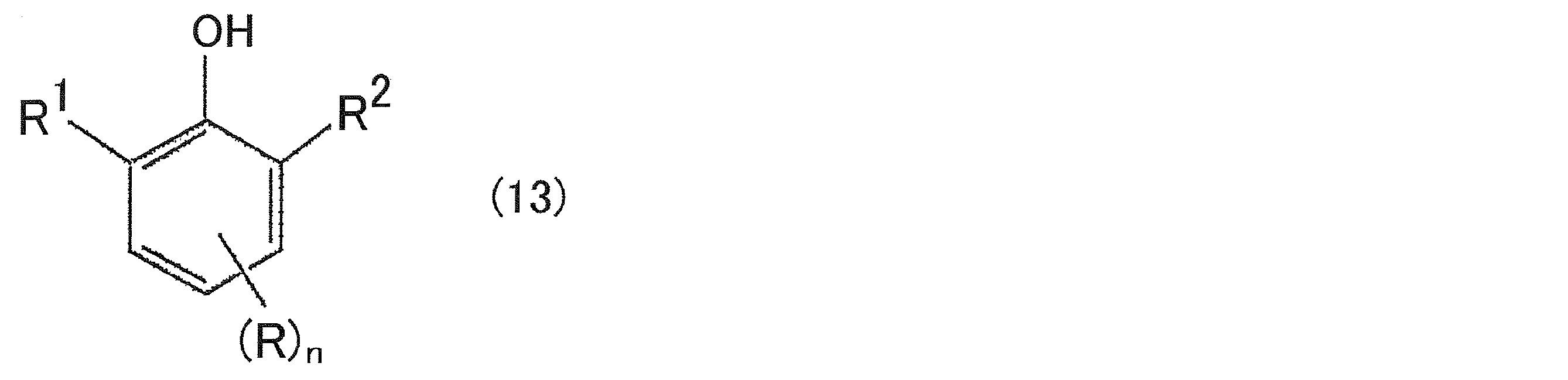
R1、R2が示すアルキル基としては、メチル基、エチル基、プロピル基、ブチル基、アミル基等炭素数1~6のものが挙げられる。なかでもt-ブチル基のような嵩高い分岐アルキル基が好ましく、R1、R2のうちの少なくとも一つはこのような分岐アルキル基であるのが好ましい。アルキル基の置換基としては塩素等のハロゲン原子が挙げられる。
Rとしては、炭素数4以上のものが好ましい。また、この置換基Rは、芳香環の炭素原子と炭素-炭素結合により結合していてもよく、炭素以外の原子を介して結合していてもよい。

(E2)ヒンダードアミン系光安定剤は、前記一般式(1)で示されるピペリジン構造を有するアミンである。一般式(1)において、Xはピペリジル基の窒素原子と炭素原子で結合している有機基である。好ましいXとしては炭素数1~10のアルキル基、前記式(2)または(3)で示される基が挙げられる。Xがアルキル基の場合は、例えばメチル基、エチル基、プロピル基、t-ブチル基、ヘキシル基、オクチル基、デシル基等の炭素数1~10の直鎖もしくは分岐鎖アルキル基が挙げられ、特にメチル基が好ましい。また、本発明に使用される(E2)ヒンダードアミン系光安定剤は、分子中に複数のピペリジン構造を有することができるが、全てのピペリジン構造が、N-炭素原子-2,2,6,6-テトラメチル-4-ピペリジル構造であることが好ましい。
上式(4):ビス(1,2,2,6,6-ペンタメチル-4-ピペリジニル)セバケート
上式(5):1-[2-[3-(3,5-ジ-t-ブチル-4-ヒドロキシフェニル)プロピオニルオキシ]エチル]-4-[3-(3,5-ジ-t-ブチル-4-ヒドロキシフェニル)プロピオニルオキシ]-2,2,6,6-テトラメチルピペリジン
上式(6):テトラキス(1,2,2,6,6-ペンタメチル-4-ピペリジル)-1,2,3,4-ブタンテトラカルボキシレート
上式(7):1,2,2,6,6-ペンタメチル-4-ピペリジル及びトリデシル-1,2,3,4ブタンテトラカルボキシレート(ブタンテトラカルボキシレートの4つのRの一部が1,2,2,6,6-ペンタメチル-4-ピペリジル基で他がトリデシル基である化合物の混合物)
上式(8):1,2,3,4-ブタンテトラカルボン酸と1,2,2,6,6-ペンタメチル-4-ピペリジノールとβ,β,β,β-テトラメチル-3,9(2,4,8,10-テトラオキサスピロ[5,5]ウデンカン)-ジエタノールとの縮合物(pは1~3)
上式(9):コハク酸ジメチルと4-ヒドロキシ-2,2,6,6-テトラメチル-1-ピペリジンエタノールの縮合物(nは10~14)
上式(10)で示される1,2,2,6,6-ペンタメチル-4-ピペリジルメタクリレート
上式(11):N,N',N’’,N’’’-テトラキス-(4,6-ビス-(ブチル-(N-メチル-2,2,6,6-テトラメチルピペリジン-4-イル)アミノ)-トリアジン-2-イル)-4,7-ジアザデカン-1,10-ジアミン
上式(12):ビス(1,2,2,6,6-ペンタメチル-4-ピペリジル)[[3,5-ビス(1,1ジメチルエチル)-4-ヒドロキシフェニル]メチル]ブチルマロネート
本発明において使用される(E3)紫外線吸収剤は、紫外線を吸収する作用を有する化合物である。好ましくは、ベンゾトリアゾール系化合物、ベンゾフェノン系化合物、芳香族ベンゾエート系化合物、シアノアクリレート系化合物、及び、シュウ酸アニリド系紫外線吸収剤の中から選ばれる。
本発明のポリアセタール樹脂組成物は、ポリアセタール樹脂に必須成分として、上記の(B)~(E)の各成分を配合したものであるが、更に(F)アミノ置換トリアジン化合物を配合するのが好ましい。アミノ置換トリアジン化合物とは、下記一般式(15)で示される構造を有するアミノ置換トリアジン類、又はこれとホルムアルデヒドとの初期重縮合物である。
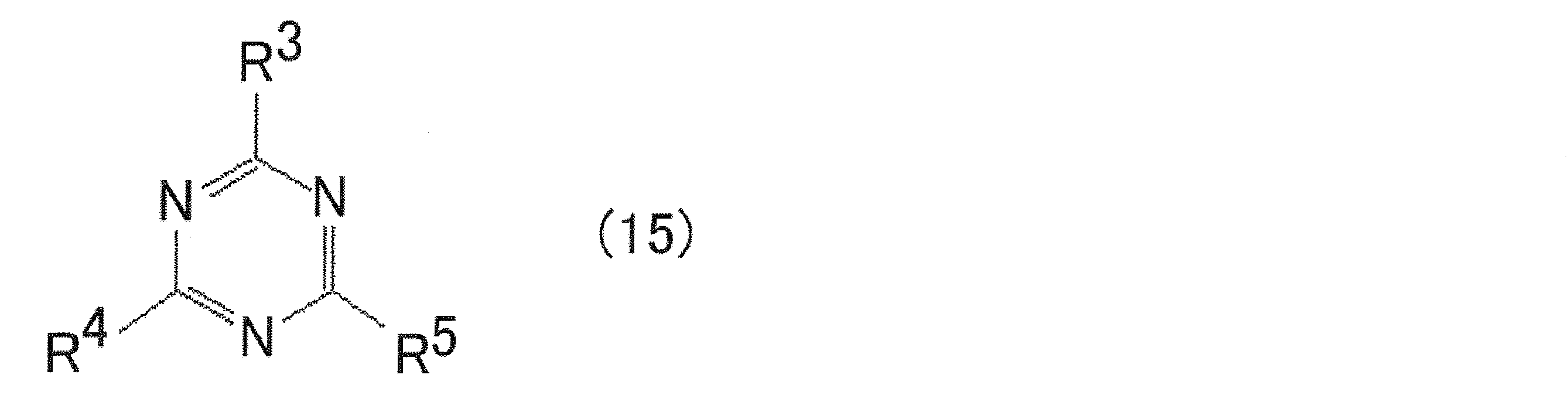
本発明のポリアセタール樹脂組成物には、更にアルカリ金属又はアルカリ土類金属の水酸化物、無機酸塩又はアルコキシド等を配合してもよい。例えばナトリウム、カリウム、カルシウム、マグネシウム等の水酸化物、炭酸塩、燐酸塩、ケイ酸塩、ほう酸塩等の無機酸塩、メトキシド、エトキシド等のアルコキシドを配合する。特に、アルカリ土類金属化合物を配合するのが好ましく、なかでも水酸化カルシウム、水酸化マグネシウム、炭酸カルシウム、又は炭酸マグネシウムを配合するのが好ましい。
本発明のポリアセタール樹脂組成物における上記(A)~(E)以外の成分の含有量は、上記(A)~(E)以外の成分が難燃剤、充填材である場合は、ポリアセタール樹脂100重量部に対し、0~50重量部が好ましく、5~40重量部がより好ましく、10~30重量部が特に好ましい。上記(A)~(E)以外の成分が滑剤、離型剤である場合は、ポリアセタール樹脂100重量部に対し、0~20重量部が好ましく、0.05~10重量部がより好ましく、0.1~5重量部が特に好ましい。上記(A)~(E)以外の成分が帯電防止剤である場合は、ポリアセタール樹脂100重量部に対し、0~10重量部が好ましく、0.05~5重量部がより好ましく、0.1~3重量部が特に好ましい。
本発明のポリアセタール樹脂組成物の製造方法は、特に限定されるものではなく、上記の(A)~(E)成分、及び必要に応じて添加されるその他の成分を、任意の順序で混合、混練することによって製造することができる。混合・混練の温度、圧力等の条件は、従来公知のポリアセタール樹脂組成物の製造方法に鑑みて適宜選択すればよい。例えば、混練はポリアセタール樹脂の溶融温度以上で行えばよいが、通常は180℃以上で行うのが好ましい。製造装置としても従来からこの種の樹脂組成物の製造に用いられている混合、混練装置を用いればよい。
このようにして得られた本発明のポリアセタール樹脂組成物は、高い耐候性を有しており、しかも、機械的強度、例えば、ISO527規格に準拠して測定された引張強度が60MPa以上、好ましくは62MPa以上を達成することが可能であり、ホルムアルデヒド発生量及び金型汚染が少なく、従来のポリアセタール樹脂組成物に比べ、これらの性能のバランスに優れている。
本発明のポリアセタール樹脂原料組成物の改質方法は、ポリアセタール樹脂を含有するポリアセタール樹脂原料組成物を改質する方法である。特に、ポリアセタール樹脂原料組成物を着色するとともに、成形品の引張強度低下とホルムアルデヒド発生を抑制するようにポリアセタール樹脂原料組成物を改質する方法である。また、耐候性を向上させるようにポリアセタール樹脂原料組成物を改質する方法である。本発明では、改質の対象となるポリアセタール樹脂を含有する組成物を、特にポリアセタール樹脂原料組成物という。
本発明の改質剤は、(B)無機及び有機顔料から選ばれた着色剤0.01~5重量部、(C)融点又は軟化点が180℃以下であるという物性か、アミン価が2mgKOH/g以上であるという物性の少なくとも一方を備えるポリアミド樹脂、又はポリエーテルエステルアミド樹脂0.01~3重量部、(D)芳香族ジヒドラジド化合物及び20℃における水100gに対する溶解度が1g未満の脂肪族ジヒドラジド化合物より成る群から選ばれたジヒドラジド化合物0.01~1重量部、及び、(E)立体障害性フェノール化合物0.01~1重量部、又は上記一般式(1)で示される構造を有するヒンダードアミン系光安定剤0.01~5重量部及び紫外線吸収剤0.01~5重量部を含有することを特徴とする。本発明の改質剤は、ポリアセタール樹脂を含有するポリアセタール樹脂原料組成物に対して添加する。本発明の改質剤を添加することによって、ポリアセタール樹脂原料組成物を着色すると同時に、特に、成形品の引張強度低下とホルムアルデヒド発生を抑制するようにポリアセタール樹脂原料組成物を改質することができる。また、本発明の改質剤に(E2)上記一般式(1)で示される構造を有するヒンダードアミン系光安定剤及び(E3)紫外線吸収剤を含有する場合は、耐候性をも向上させるようにポリアセタール樹脂原料組成物を改質することができる。なお、本発明の改質剤には、本発明の目的を損なわない範囲内で、(A)~(E)の成分以外の成分が含まれていてもよい。本発明の改質剤の各成分の詳細についても、上記の各成分の説明の欄を参照することができる。
本発明の樹脂組成物は、公知のポリアセタール樹脂の成形加工法に従って、成形加工することができる。流動性、加工性の観点から、射出成形が好ましい。本発明の樹脂組成物からなる成形品としては、ペレット、丸棒、厚板等の素材、シート、チューブ、各種容器、機械、電気、自動車、建材その他の各種部品等の、従来からポリアセタール樹脂の用途として知られる種々の製品が挙げられる。
実施例及び比較例で使用した原料、及び測定法を以下に示す。
(1)ポリアセタール樹脂
コモノマーとして1,3-ジオキソランを樹脂に対して4.2重量%となるように用いて製造したアセタールコポリマー、メルトインデックス(ASTM-D1238規格:190℃、2.16Kg)10.5g/10分
無機顔料-1:チタンホワイト;Pigment White 6(石原産業社製、商品名:タイペークCR-63)
無機顔料-2:チタンイエロー;Pigment Yellow 53(石原産業社製、商品名:タイペークイエローTY-70S)
無機顔料-3:カーボンブラック;Pigment Black 7(エボニックデグサジャパン社製、商品名:プリンテックス)
有機顔料-1:ペリノン系オレンジ;Pigment Orange 43(クラリアントジャパン社製、商品名:PVファストオレンジGRL)
有機顔料-2:フタロシアニンブルー;Pigment Blue 15:3(住化カラー社製、商品名:スミトシアニンブルーGH)
ポリアミド樹脂-1:ポリアミド6/66/610三元共重合体(東レ社製、商品名:アミランCM4000、融点140℃、アミン価3.0mgKOH/g)
ポリアミド樹脂-2:ポリアミド12(エムスジャパン社製、商品名:グリルアミドL20G、融点175℃、アミン価2.5mgKOH/g)
ポリアミド樹脂-3:ポリアミド6(三菱エンジニアリングプラスチックス社製、商品名:ノバミッド(登録商標)1010C2、融点220℃、アミン価1.5mgKOH/g)、このものは本発明で規定するポリアミド樹脂ではない。
ポリアミド樹脂-4:ダイマー酸ポリアミド樹脂(花王社製、商品名:レオマイドFT-409、融点115℃、アミン価10.4mgKOH/g)
ポリアミド樹脂-5:ダイマー酸ポリアミド樹脂(花王社製、商品名:レオマイドFT-410、融点105℃、アミン価24.0mgKOH/g)
ポリエーテルエステルアミド樹脂-1:ポリアミド12/ポリオキシエチレングリコール共重合体(三洋化成工業社製、ペレスタットN1200)、融点=150℃
ポリエーテルエステルアミド樹脂-2:ダイマー酸ポリアミド/ポリオキシエチレングリコール共重合体(富士化成工業社製、商品名:TPAE-10HP、アミン価4.4mgKOH/g、融点=146,180℃)
ジヒドラジド化合物-1:テレフタル酸ジヒドラジド;水100g(20℃)に対する溶解度0.01g以下(日本ファインケム社製、品番:TDH)
ジヒドラジド化合物-2:1,10-ドデカン二酸ジヒドラジド;水100g(20℃)に対する溶解度0.01g以下(日本ファインケム社製、品番:N-12)
ジヒドラジド化合物-3:アジピン酸ジヒドラジド;水100g(20℃)に対する溶解度9.1g(日本ファインケム社製、品番:ADH)、このものは本発明で規定するジヒドラジド化合物ではない。
立体障害性フェノール-1:トリエチレングリコール-ビス〔3-(3-t-ブチル-5-メチル-4-ヒドロキシフェニル)プロピオネート〕、(チバ・スペシャルティ・ケミカルズ社製、商品名:イルガノックス245)
立体障害性フェノール-2:N,N’-ヘキサメチレンビス(3,5-ジ-t-ブチル-4-ヒドロキシ-ヒドロシンナマミド)、(チバ・スペシャルティ・ケミカルズ社製、商品名:イルガノックス1098)
ヒンダードアミン系光安定剤-1:1,2,2,6,6-ペンタメチル-4-ピペリジル-及びトリデシル-が混合した1,2,3,4ブタンテトラカルボキシレート(ADEKA社製、商品名:アデカスタブLA-62)
ヒンダードアミン系光安定剤-2:コハク酸ジメチルと4-ヒドロキシ-2,2,6,6-テトラメチル-1-ピペリジンエタノールの縮合物、(チバ・スペシャルティ・ケミカルズ(株)社製、商品名:Tinuvin622)
ヒンダードアミン系光安定剤-3:ビス(1,2,2,6,6-ペンタメチル-4-ピペリジニル)セバケート、(三共ライフテック(株)製、商品名:サノールLS-765)
ヒンダードアミン系光安定剤-4:ビス(2,2,6,6-テトラメチル-4-ピペリジニル)セバケート、三共ライフテック(株)製、商品名:サノールLS-770)、このものは本発明で規定するヒンダードアミン系光安定剤ではない。
2-(2H-ベンゾトリアゾール-2-イル)-4,6-ビス(1-メチル-1-フェニルエチル)フェノール、(チバ・スペシャルティ・ケミカルズ(株)製、商品名:Tinuvin234、20℃における蒸気圧2.0×10⁻¹⁰Pa)
メラミン(三井化学社製、品番:メラミン)
測定及び評価は以下の方法で行った。
(a)アミン価
ポリアミド樹脂-1~ポリアミド樹脂-5とポリエーテルエステルアミド樹脂-2をそれぞれ3g秤量し、m-クレゾール80mlに溶解した。電位差適定には、京都電子工業社製AT-500Nを用い、滴定液として0.05mol/lの過塩素酸メタノール溶液を用いて電位差法により滴定を行い、KOHのmgに換算しアミン価を求めた。
日精樹脂工業社製PS-40E5ASE成形機を用いて、試験片として100mm×40mm×2mmの平板をシリンダー温度215℃で成形した。成形翌日に、この試験片につき、ドイツ自動車工業組合規格VDA275(自動車室内部品-改訂フラスコ法によるホルムアルデヒド放出量の定量)に記載された方法に準拠して、下記の方法によりホルムアルデヒド量を測定した。
(i)ポリエチレン容器中に蒸留水50mlを入れ、試験片を空中に吊るした状態で蓋を閉め、密閉状態で60℃にて、3時間加熱した。
(ii)室温で60分間放置後、試験片を取り出した。
(iii)ポリエチレン容器内の蒸留水中に吸収されたホルムアルデヒド量を、UVスペクトロメーターにより、アセチルアセトン比色法で測定した。
住友重機械工業社製ミニマットM8/7A成形機を用い、図1に示すようなしずく型金型を用いて、成形温度230℃、金型温度35℃で3000ショット連続成形し、終了後金型付着物の状態を肉眼で観察し、以下の2水準の基準で評価した。図1のしずく型金型は、ゲートGから樹脂組成物を導入し、尖端P部分に発生ガスが溜まり易くなるように設計した金型である。ゲートGの幅は1mm、厚みは1mmであり、図1のh1は14.5mm、h2は7mm、h3は27mmであり、成形部の厚みは3mmである。
○:金型付着物が少なく、金型汚染性は良好。
×:金型付着物が多く、金型汚染性は不良。
住友重機械工業社製SG-75射出成形機を用いて、ISO9988-2規格に準拠し、ISO引張試験用試験片を作成した。得られた試験片を用い、ISO527規格に準拠して、引張強度の測定を行った。
日精樹脂工業社製PS-40E5ASE成形機を用いて、試験片として100mm×40mm×2mmの平板を、シリンダー温度215℃で成形した。得られた成形品を、スガ試験機社製 サンシャインウェザオメーター「WEL-SUN-DCH-B」により、83℃に暴露し、成形品表面に白化やクラックなどの劣化現象が、光学顕微鏡で観察され始めるまでの時間をクラック発生時間とした。クラック発生時間が長いほど耐候性に優れていることを示す。
ポリアセタール樹脂100重量部に対し、下記表1、表2に示す重量配合処方で各成分を配合し、更に分散助剤としてエチレンビスステアリルアミドを0.1重量部、展着剤として流動パラフィンを0.1重量部配合し、タンブラー型ブレンダーによって混合した。得られた混合物を40mmφ単軸押出機(田辺プラスチックス社製、型式:VS-40)にて、シリンダー温度200℃、吐出速度13kg/hrで溶融混練してペレット化し、ポリアセタール樹脂組成物を得た。この樹脂組成物を80℃で4時間乾燥した後射出成形を行い、成形品の発生ホルムアルデヒド量、金型汚染性及び引張強度を測定した。
結果を表1、表2に示す。尚、ホルムアルデヒド発生量は、比較例1の値を基準(1.00)とした場合の相対値として表示した。


ポリアセタール樹脂100重量部に対し、下記表3、表4に示す重量配合処方で各成分を配合し、更に分散助剤としてエチレンビスステアリルアミドを0.1重量部、展着剤として流動パラフィンを0.1重量部配合し、タンブラー型ブレンダーによって混合した。得られた混合物を40mmφ単軸押出機(田辺プラスチックス社製、型式:VS-40)にて、シリンダー温度200℃、吐出速度13kg/hrで溶融混練してペレット化し、ポリアセタール樹脂組成物を得た。この樹脂組成物を80℃で4時間乾燥した後射出成形を行い、成形品の発生ホルムアルデヒド量、クラック発生時間、金型汚染性及び引張強度を測定した。
結果を表3、表4に示す。尚、ホルムアルデヒド発生量は、比較例21の値を基準(1.00)とした場合の相対値として表示した。
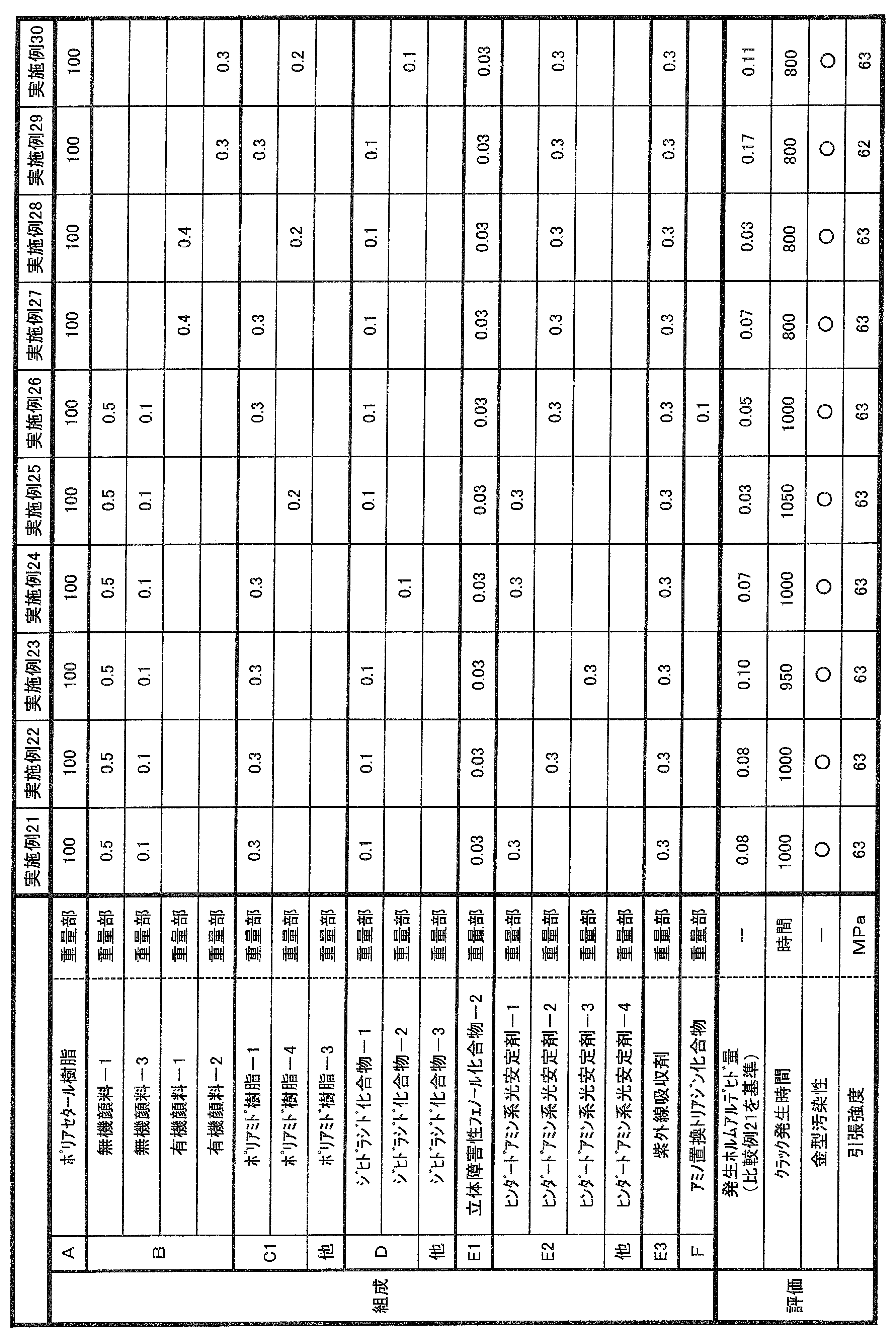

ポリアセタール樹脂100重量部に対し、下記表5、表6に示す重量配合処方で各成分を配合し、更に分散助剤としてエチレンビスステアリルアミドを0.1重量部、展着剤として流動パラフィンを0.1重量部配合し、タンブラー型ブレンダーによって混合した。得られた混合物を40mmφ単軸押出機(田辺プラスチックス社製、型式:VS-40)にて、シリンダー温度200℃、吐出速度13kg/hrで溶融混練してペレット化し、ポリアセタール樹脂組成物を得た。この樹脂組成物を80℃で4時間乾燥した後射出成形を行い、成形品の発生ホルムアルデヒド量、金型汚染性及び引張強度を測定した。
結果を表5、表6に示す。尚、ホルムアルデヒド発生量は、比較例41の値を基準(1.00)とした場合の相対値として表示した。
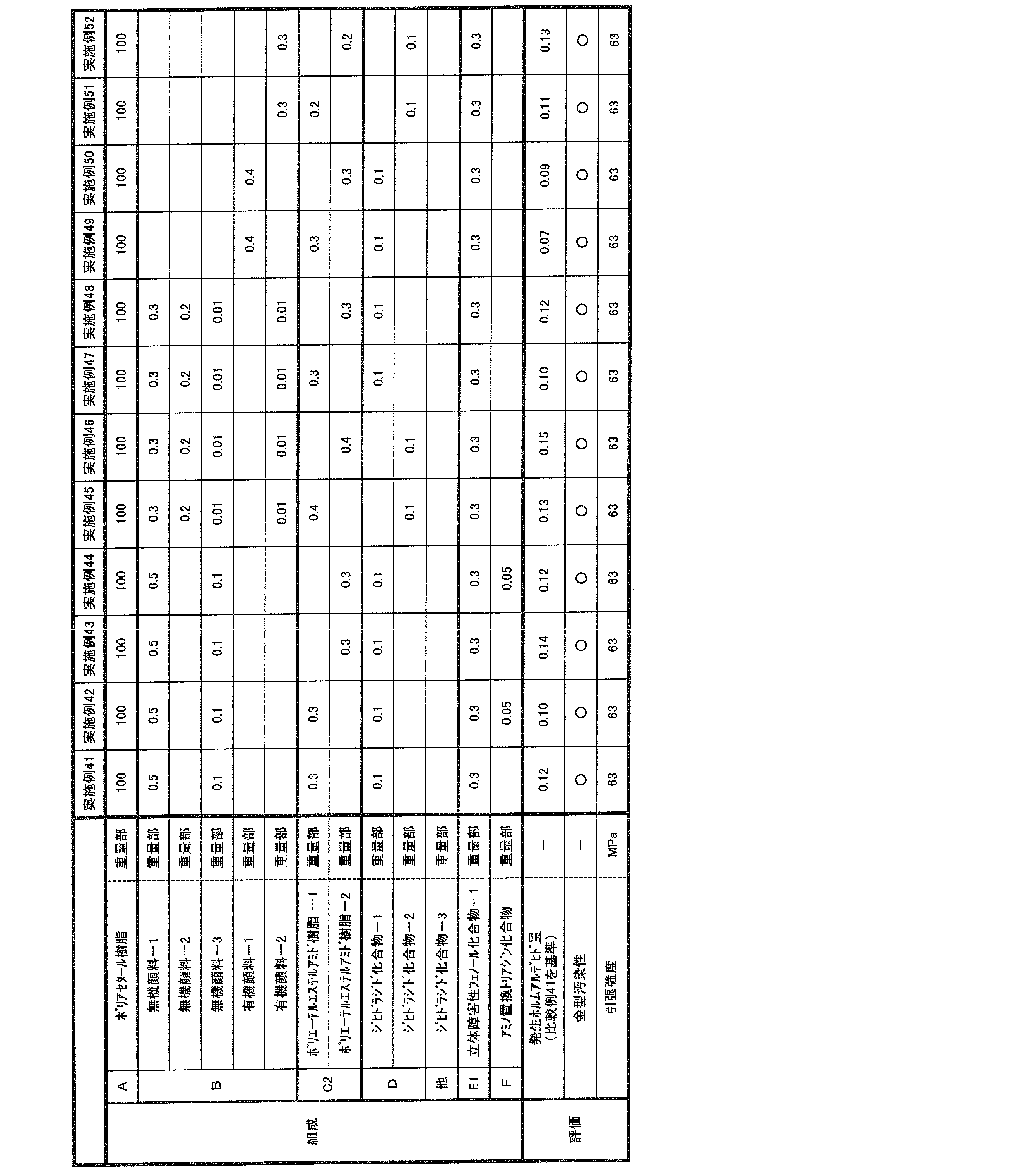
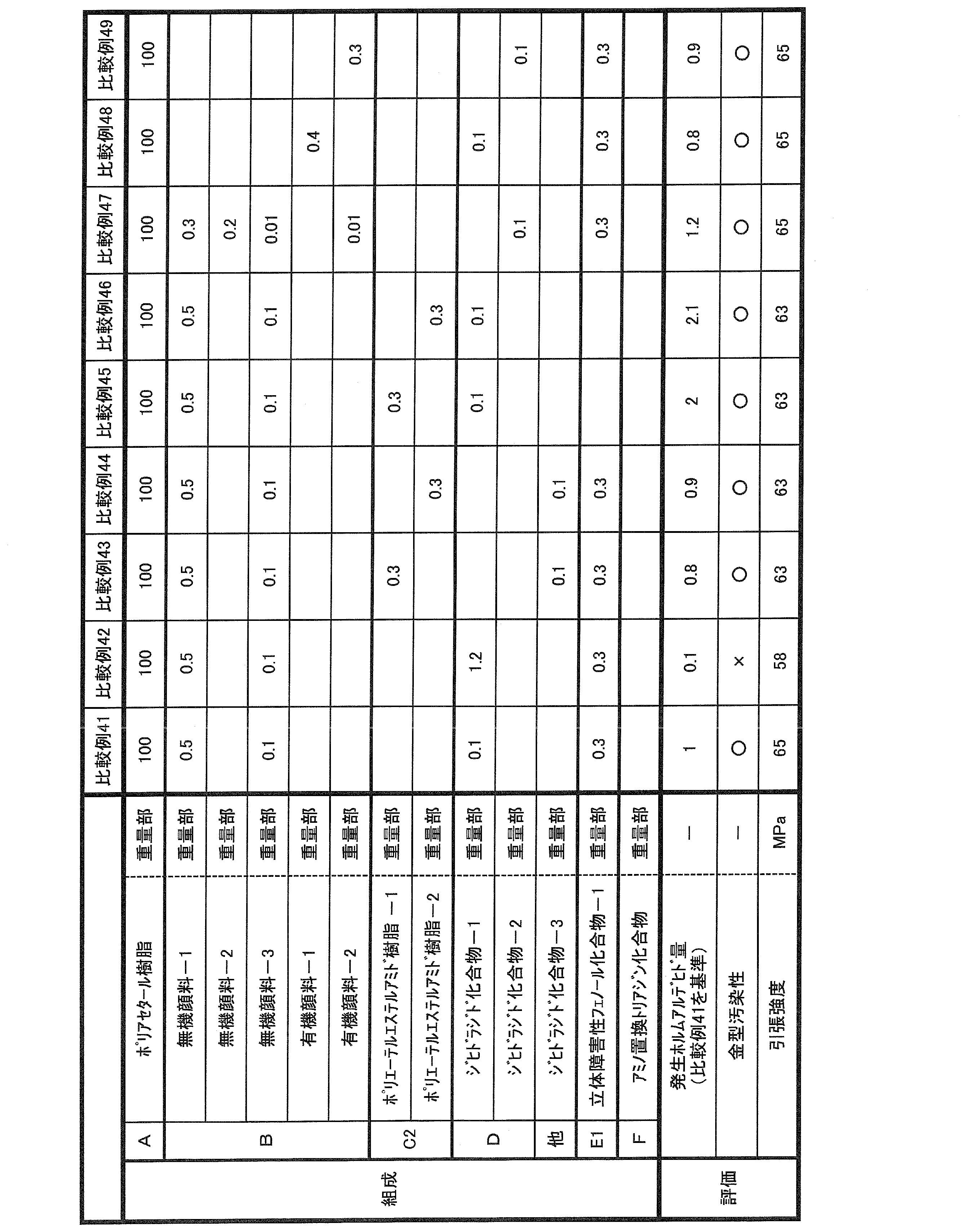
ポリアセタール樹脂100重量部に対し、下記表7、表8に示す重量配合処方で各成分を配合し、更に分散助剤としてエチレンビスステアリルアミドを0.1重量部、展着剤として流動パラフィンを0.1重量部配合し、タンブラー型ブレンダーによって混合した。得られた混合物を40mmφ単軸押出機(田辺プラスチックス社製、型式:VS-40)にて、シリンダー温度200℃、吐出速度13kg/hrで溶融混練してペレット化し、ポリアセタール樹脂組成物を得た。この樹脂組成物を80℃で4時間乾燥した後射出成形を行い、成形品の発生ホルムアルデヒド量、クラック発生時間、金型汚染性及び引張強度を測定した。
結果を表7、表8に示す。尚、ホルムアルデヒド発生量は、比較例61の値を基準(1.00)とした場合の相対値として表示した。


Claims (29)
- (A)ポリアセタール樹脂100重量部に、
(B)無機及び有機顔料から選ばれた着色剤 0.01~5重量部、
(C)下記の(C1)0.01~3重量部、又は下記の(C2)0.01~3重量部
(C1)融点又は軟化点が180℃以下であるという物性か、アミ
ン価が2mgKOH/g以上であるという物性の少なくと
も一方を備えるポリアミド樹脂
(C2)ポリエーテルエステルアミド樹脂
(D)芳香族ジヒドラジド化合物及び20℃における水100gに対
する溶解度が1g未満の脂肪族ジヒドラジド化合物より成る群
から選ばれたジヒドラジド化合物 0.01~1重量部、及び
(E)下記の(E1)0.01~1重量部、又は下記の(E2)0.
01~5重量部及び下記の(E3)0.01~5重量部の組み
合わせ
(E1)立体障害性フェノール化合物
(E2)下記一般式(1)で示される構造を有するヒンダードアミン系光安定剤
(E3)紫外線吸収剤
を含有することを特徴とするポリアセタール樹脂組成物。

- (C1)融点又は軟化点が180℃以下であるという物性か、アミン価が2mgKOH/g以上であるという物性の少なくとも一方を備えるポリアミド樹脂と、(E1)立体障害性フェノール化合物とを含有する、請求項1に記載のポリアセタール樹脂組成物。
- (C1)融点又は軟化点が180℃以下であるという物性か、アミン価が2mgKOH/g以上であるという物性の少なくとも一方を備えるポリアミド樹脂と、(E2)前記一般式(1)で示される構造を有するヒンダードアミン系光安定剤及び(E3)紫外線吸収剤とを含有する、請求項1に記載のポリアセタール樹脂組成物。
- (C2)ポリエーテルエステルアミド樹脂と、(E1)立体障害性フェノール化合物とを含有する、請求項1に記載のポリアセタール樹脂組成物。
- (C2)ポリエーテルエステルアミド樹脂と、(E2)前記一般式(1)で示される構造を有するヒンダードアミン系光安定剤及び(E3)紫外線吸収剤とを含有する、請求項1に記載のポリアセタール樹脂組成物。
- (C1)ポリアミド樹脂が、融点又は軟化点が180℃以下のポリアミド樹脂である、請求項1~3のいずれか1項に記載のポリアセタール樹脂組成物。
- (C1)ポリアミド樹脂が、融点又は軟化点が180℃以下であり、かつ、アミン価2mgKOH/g以上である、請求項1~3のいずれか1項に記載のポリアセタール樹脂組成物。
- (C1)ポリアミド樹脂が、ポリアミド12、ポリアミド6/66共重合体、ポリアミド6/12共重合体、ポリアミド6/66/610三元共重合体、ポリアミド6/66/610/12四元共重合体及びダイマー酸ポリアミド樹脂より成る群から選ばれたものである、請求項1~3、6又は7のいずれか1項に記載のポリアセタール樹脂組成物。
- (C1)ポリアミド樹脂が、ダイマー酸ポリアミド樹脂である、請求項1~3、6又は7のいずれか1項に記載のポリアセタール樹脂組成物。
- (C2)ポリエーテルエステルアミド樹脂のアミド部分が、ポリアミド12又はダイマー酸ポリアミド樹脂である、請求項1、4又は5のいずれか1項に記載のポリアセタール樹脂組成物。
- (C2)ポリエーテルエステルアミド樹脂のエーテル部分がポリオキシエチレングリコールである、請求項1、4、5又は10のいずれか1項に記載のポリアセタール樹脂組成物。
- (E2)ヒンダードアミン系光安定剤が、前記一般式(1)におけるXが、炭素数1~10のアルキル基、下記式(2)又は(3)で示される基から選ばれる基である、請求項1、3又は5のいずれか1項に記載のポリアセタール樹脂組成物。

- (E2)ヒンダードアミン系光安定剤が、下記式(4)~(12)で示される化合物から選ばれる少なくとも1種である、請求項1、3、5又は12のいずれか1項に記載のポリアセタール樹脂組成物。


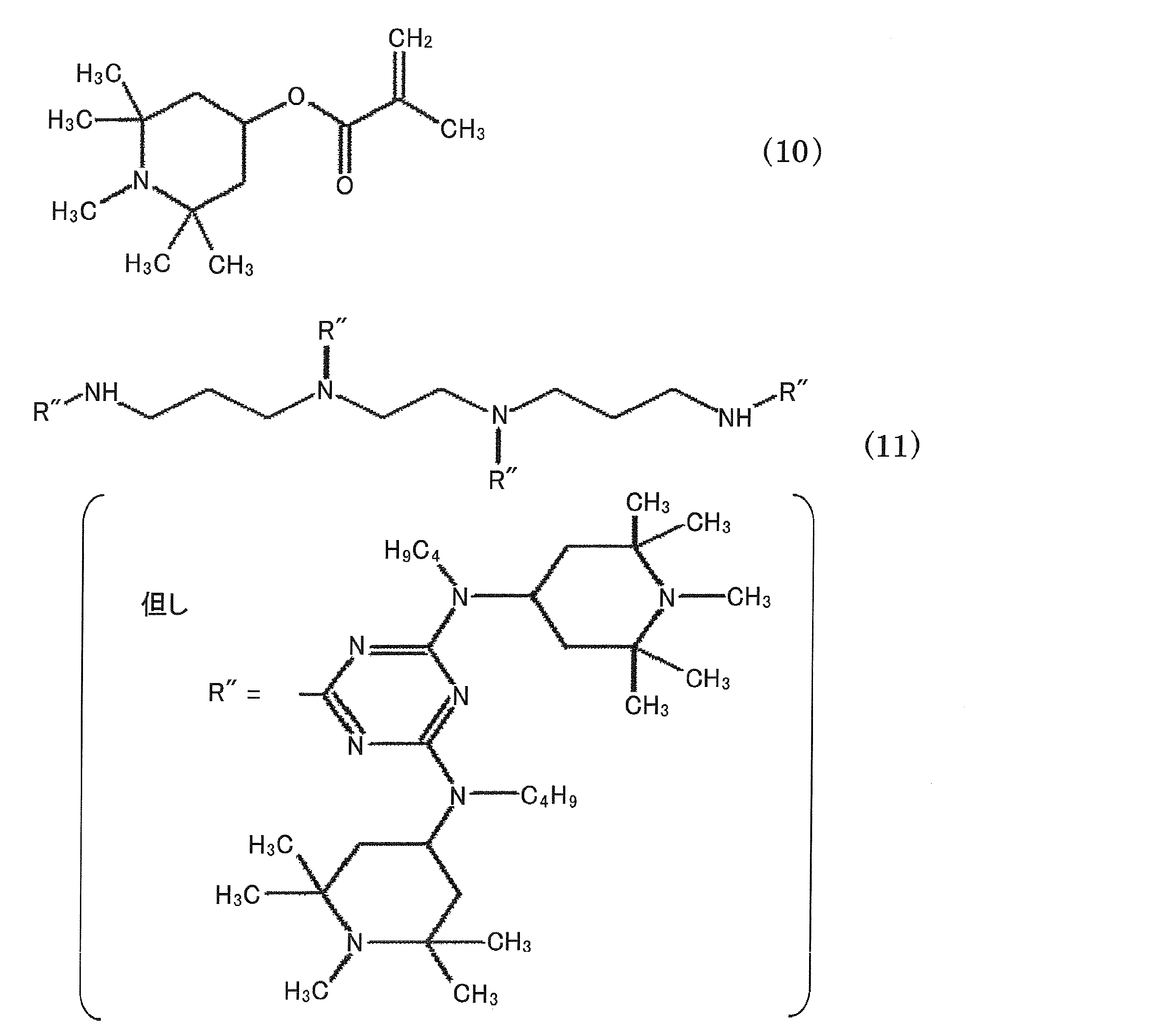

- (E3)紫外線吸収剤がベンゾトリアゾール系化合物である、請求項1、3又は5のいずれか1項に記載のポリアセタール樹脂組成物。
- (E3)紫外線吸収剤が、20℃における蒸気圧が1×10⁻⁸Pa以下のものである、請求項1、3、5又は14のいずれか1項に記載のポリアセタール樹脂組成物。
- (E3)紫外線吸収剤が、2-(2H-ベンゾトリアゾール-2-イル)-4,6-ビス(1-メチル-1-フェニルエチル)フェノール又は2,2'-メチレンビス[6-(2H-ベンゾトリアゾール-2-イル)-4-(1,1,3,3-テトラメチルブチル)フェノール]である、請求項1、3、5、14又は15のいずれか1項に記載のポリアセタール樹脂組成物。
- (B)着色剤が、チタンイエロー、チタンホワイト、ペリノン系顔料、フタロシアニン系顔料及びカーボンブラックより成る群から選ばれたものである、請求項1~16のいずれか1項に記載のポリアセタール樹脂組成物。
- (D)ジヒドラジド化合物が、ナフタレンジカルボン酸ジヒドラジド、テレフタル酸ジヒドラジド、イソフタル酸ジヒドラジド、セバシン酸ジヒドラジド及びドデカン二酸ジヒドラジドより成る群から選ばれたものである、請求項1~17のいずれか1項に記載のポリアセタール樹脂組成物。
- (A)ポリアセタール樹脂100重量部に対し、さらに(F)アミノ置換トリアジン化合物を0.01~10重量部含有する、請求項1~18のいずれか1項に記載のポリアセタール樹脂組成物。
- 引張強度が60MPa以上である、請求項1~19のいずれか1項に記載のポリアセタール樹脂組成物。
- 請求項1~20のいずれか1項に記載のポリアセタール樹脂組成物を成形して成るポリアセタール樹脂成形品。
- (A)ポリアセタール樹脂100重量部を含有するポリアセタール樹脂原料組成物に、
(B)無機及び有機顔料から選ばれた着色剤 0.01~5重量部、
(C)下記の(C1)0.01~3重量部、又は下記の(C2)0.01~3重量部
(C1)融点又は軟化点が180℃以下であるという物性か、アミ
ン価が2mgKOH/g以上であるという物性の少なくと
も一方を備えるポリアミド樹脂
(C2)ポリエーテルエステルアミド樹脂
(D)芳香族ジヒドラジド化合物及び20℃における水100gに対
する溶解度が1g未満の脂肪族ジヒドラジド化合物より成る群
から選ばれたジヒドラジド化合物 0.01~1重量部、及び
(E)下記の(E1)0.01~1重量部、又は下記の(E2)0.
01~5重量部及び下記の(E3)0.01~5重量部の組み
合わせ
(E1)立体障害性フェノール化合物
(E2)下記一般式(1)で示される構造を有するヒンダードアミン系光安定剤
(E3)紫外線吸収剤
を混合することを特徴とするポリアセタール樹脂原料組成物の改質方法。

- 引張強度低下とホルムアルデヒド発生を抑制する、請求項22に記載の改質方法。
- (E1)立体障害性フェノール化合物を添加する、請求項22又は23に記載の改質方法。
- (E2)前記一般式(1)で示される構造を有するヒンダードアミン系光安定剤及び(E3)紫外線吸収剤を添加し、耐候性を向上させる、請求項22又は23に記載の改質方法。
- (B)無機及び有機顔料から選ばれた着色剤 0.01~5重量部、
(C)下記の(C1)0.01~3重量部、又は下記の(C2)0.01~3重量部
(C1)融点又は軟化点が180℃以下であるという物性か、アミ
ン価が2mgKOH/g以上であるという物性の少なくと
も一方を備えるポリアミド樹脂
(C2)ポリエーテルエステルアミド樹脂
(D)芳香族ジヒドラジド化合物及び20℃における水100gに対
する溶解度が1g未満の脂肪族ジヒドラジド化合物より成る群
から選ばれたジヒドラジド化合物 0.01~1重量部、及び
(E)下記の(E1)0.01~1重量部、又は下記の(E2)0.
01~5重量部及び下記の(E3)0.01~5重量部の組み
合わせ
(E1)立体障害性フェノール化合物
(E2)下記一般式(1)で示される構造を有するヒンダードアミン系光安定剤
(E3)紫外線吸収剤
を含有することを特徴とするポリアセタール樹脂原料組成物用改質剤。

- 引張強度低下とホルムアルデヒド発生を抑制する、請求項26に記載のポリアセタール樹脂原料組成物用改質剤。
- (E1)立体障害性フェノール化合物を含有する、請求項26又は27に記載のポリアセタール樹脂原料組成物用改質剤。
- (E2)前記一般式(1)で示される構造を有するヒンダードアミン系光安定剤及び(E3)紫外線吸収剤を含有し、耐候性を向上させる、請求項26又は27に記載のポリアセタール樹脂原料組成物用改質剤。
Priority Applications (4)
| Application Number | Priority Date | Filing Date | Title |
|---|---|---|---|
| KR1020117007569A KR101563388B1 (ko) | 2008-09-03 | 2009-09-03 | 폴리아세탈 수지 조성물, 수지 성형품, 폴리아세탈 수지 원료 조성물의 개질 방법 및 개질제 |
| US13/061,854 US8846788B2 (en) | 2008-09-03 | 2009-09-03 | Polyacetal resin composition, resin molded article, and method and agent for improving polyacetal resin raw material composition |
| CN2009801436227A CN102203182B (zh) | 2008-09-03 | 2009-09-03 | 聚缩醛树脂组合物、树脂成形品、聚缩醛树脂原料组合物的改性方法及改性剂 |
| EP09811289.9A EP2330155B1 (en) | 2008-09-03 | 2009-09-03 | Polyacetal resin composition, resin molded article, and method and agent for improving polyacetal resin raw material composition |
Applications Claiming Priority (2)
| Application Number | Priority Date | Filing Date | Title |
|---|---|---|---|
| JP2008-225461 | 2008-09-03 | ||
| JP2008225461 | 2008-09-03 |
Publications (1)
| Publication Number | Publication Date |
|---|---|
| WO2010026759A1 true WO2010026759A1 (ja) | 2010-03-11 |
Family
ID=41796940
Family Applications (1)
| Application Number | Title | Priority Date | Filing Date |
|---|---|---|---|
| PCT/JP2009/004351 Ceased WO2010026759A1 (ja) | 2008-09-03 | 2009-09-03 | ポリアセタール樹脂組成物、樹脂成形品、ポリアセタール樹脂原料組成物の改質方法及び改質剤 |
Country Status (6)
| Country | Link |
|---|---|
| US (1) | US8846788B2 (ja) |
| EP (1) | EP2330155B1 (ja) |
| JP (1) | JP5320222B2 (ja) |
| KR (1) | KR101563388B1 (ja) |
| CN (1) | CN102203182B (ja) |
| WO (1) | WO2010026759A1 (ja) |
Cited By (2)
| Publication number | Priority date | Publication date | Assignee | Title |
|---|---|---|---|---|
| JP2011246566A (ja) * | 2010-05-26 | 2011-12-08 | Mitsubishi Engineering Plastics Corp | ポリアセタール樹脂組成物及びそれからなる樹脂成形品 |
| JP2014005384A (ja) * | 2012-06-25 | 2014-01-16 | Mitsubishi Engineering Plastics Corp | ポリアセタール樹脂組成物 |
Families Citing this family (16)
| Publication number | Priority date | Publication date | Assignee | Title |
|---|---|---|---|---|
| JP5770530B2 (ja) * | 2011-05-25 | 2015-08-26 | ポリプラスチックス株式会社 | ポリオキシメチレン重合体ペレット、ポリオキシメチレン重合体ペレットの製造方法、及びポリオキシメチレン重合体ペレットの品質評価方法 |
| JP2013100393A (ja) * | 2011-11-08 | 2013-05-23 | Mitsubishi Engineering Plastics Corp | ポリアセタール樹脂組成物 |
| TWI488911B (zh) * | 2014-04-18 | 2015-06-21 | Fdc Lees Chemical Industry Co | 用於聚甲醛之無三聚氰胺複合式添加劑 |
| WO2016104255A1 (ja) * | 2014-12-22 | 2016-06-30 | 三菱瓦斯化学株式会社 | ポリアセタール樹脂組成物及びその成形体 |
| US20160222202A1 (en) * | 2015-02-04 | 2016-08-04 | E I Du Pont De Nemours And Company | Polyoxymethylene Compositions |
| JP6529373B2 (ja) * | 2015-07-27 | 2019-06-12 | 三菱エンジニアリングプラスチックス株式会社 | ポリアセタール樹脂組成物及びポリアセタール樹脂成形品 |
| KR102074478B1 (ko) | 2016-02-09 | 2020-02-06 | 도요보 가부시키가이샤 | 내그리스성이 우수한 폴리에스테르 엘라스토머 수지 조성물 |
| WO2017150668A1 (ja) | 2016-03-04 | 2017-09-08 | 東洋紡株式会社 | ブロー成形用ポリエステルエラストマ樹脂組成物 |
| KR102355529B1 (ko) * | 2017-08-07 | 2022-01-26 | 삼성디스플레이 주식회사 | 유기 전계 발광 표시 장치 |
| JP6965102B2 (ja) * | 2017-10-27 | 2021-11-10 | 旭化成株式会社 | ポリアセタール樹脂組成物 |
| JP6931321B2 (ja) * | 2017-12-07 | 2021-09-01 | 三菱エンジニアリングプラスチックス株式会社 | 接着性樹脂組成物および複合成形体 |
| WO2020013185A1 (ja) * | 2018-07-11 | 2020-01-16 | 三菱エンジニアリングプラスチックス株式会社 | ポリアセタール樹脂組成物、および、成形品 |
| KR102240966B1 (ko) * | 2018-12-28 | 2021-04-15 | 롯데첨단소재(주) | 폴리아미드 수지 조성물 및 이를 포함하는 성형품 |
| JP7301561B2 (ja) * | 2019-03-08 | 2023-07-03 | 旭化成株式会社 | ポリアセタール樹脂組成物 |
| JP7628407B2 (ja) * | 2019-12-25 | 2025-02-10 | ポリプラスチックス株式会社 | 酸性液体接触部材および部材の酸性液体耐性を向上させる方法 |
| CN113372615A (zh) * | 2020-03-10 | 2021-09-10 | 双键化工股份有限公司 | 稳定剂的用途、塑料组合物及其塑料产品 |
Citations (27)
| Publication number | Priority date | Publication date | Assignee | Title |
|---|---|---|---|---|
| US3993709A (en) | 1974-06-24 | 1976-11-23 | Monsanto Company | Polyester initiated anionic catalyzed polymerization of lactam |
| DE2712987A1 (de) | 1977-03-24 | 1978-10-05 | Huels Chemische Werke Ag | Verfahren zur herstellung von polyetheresteramiden mit statistisch in der polymerkette verteilten einheiten der ausgangskomponenten |
| US4230838A (en) | 1974-05-31 | 1980-10-28 | Ato Chimie | Mouldable and extrudable polyether-ester-amide block copolymers |
| DE2936976A1 (de) | 1979-09-13 | 1981-04-02 | Chemische Werke Hüls AG, 4370 Marl | Verfahren zur herstellung von polyether(ester)amiden |
| JPH05271516A (ja) | 1992-03-26 | 1993-10-19 | Polyplastics Co | ポリオキシメチレン組成物 |
| JPH0680619A (ja) | 1992-08-31 | 1994-03-22 | Otsuka Chem Co Ltd | 1,2,3,4−ブタンテトラカルボン酸ヒドラジド |
| JPH07207118A (ja) | 1994-01-12 | 1995-08-08 | Polyplastics Co | ポリオキシメチレン組成物 |
| JPH07233307A (ja) * | 1994-02-24 | 1995-09-05 | Mitsubishi Gas Chem Co Inc | ポリアセタール樹脂組成物 |
| JPH08208946A (ja) | 1995-02-03 | 1996-08-13 | Dainichiseika Color & Chem Mfg Co Ltd | 加工性が改善されたポリアセタール樹脂組成物 |
| JPH09235447A (ja) | 1996-02-28 | 1997-09-09 | Polyplastics Co | ポリオキシメチレン組成物 |
| JPH1036630A (ja) | 1996-07-30 | 1998-02-10 | Polyplastics Co | ポリオキシメチレン組成物 |
| JPH10182928A (ja) | 1996-11-07 | 1998-07-07 | Polyplastics Co | ポリアセタール樹脂組成物およびその製造方法 |
| JPH11228691A (ja) | 1998-02-10 | 1999-08-24 | Fuji Kasei Kogyo Kk | 分子中にアミノ基を有するポリエーテルエステルアミドブロック共重合体及びその製造方法 |
| JP2000034417A (ja) | 1998-05-13 | 2000-02-02 | Polyplastics Co | 消臭性樹脂組成物および消臭性樹脂成形品 |
| JP2000086738A (ja) | 1998-09-08 | 2000-03-28 | Ticona Gmbh | ポリアセタ―ルコポリマ―の製造方法 |
| JP2001081281A (ja) * | 1999-09-13 | 2001-03-27 | Asahi Kasei Corp | ポリアセタール樹脂組成物及び成形体 |
| JP2002501098A (ja) * | 1998-01-27 | 2002-01-15 | ティコナ ゲゼルシャフト ミット ベシュレンクテル ハフツング | ポリオキシメチレン成形用組成物を着色するための着色剤濃縮物 |
| JP2002146212A (ja) | 2000-08-30 | 2002-05-22 | Sanyo Chem Ind Ltd | 帯電防止剤及びこれを用いた樹脂組成物 |
| JP2002212384A (ja) | 2001-01-16 | 2002-07-31 | Polyplastics Co | ポリアセタール系樹脂組成物及びその製造方法 |
| JP2003113289A (ja) | 2001-10-05 | 2003-04-18 | Polyplastics Co | ポリアセタール樹脂組成物及びその製造方法 |
| JP2003160710A (ja) * | 2001-11-28 | 2003-06-06 | Mitsubishi Engineering Plastics Corp | ポリアセタール樹脂組成物 |
| JP2003220667A (ja) * | 2002-01-31 | 2003-08-05 | Mitsubishi Engineering Plastics Corp | 複合成形体及びその製造方法 |
| JP2004522810A (ja) | 2000-09-26 | 2004-07-29 | ティコナ ゲゼルシャフト ミット ベシュレンクテル ハフツング | 着色ポリオキシメチレン成形用組成物およびこれにより製造された成形部品 |
| JP2005220254A (ja) * | 2004-02-06 | 2005-08-18 | Toray Ind Inc | ポリオキシメチレン樹脂組成物およびそれからなる成形体 |
| JP2006232937A (ja) * | 2005-02-23 | 2006-09-07 | Mitsubishi Engineering Plastics Corp | ポリアセタール樹脂組成物およびそれからなる成形品 |
| JP2007070575A (ja) * | 2005-09-09 | 2007-03-22 | Polyplastics Co | ポリアセタール樹脂組成物及び成形品 |
| JP2007145980A (ja) * | 2005-11-28 | 2007-06-14 | Polyplastics Co | ポリアセタール樹脂組成物及び成形品 |
Family Cites Families (7)
| Publication number | Priority date | Publication date | Assignee | Title |
|---|---|---|---|---|
| US4863981A (en) * | 1986-06-30 | 1989-09-05 | Ciba-Geigy Corporation | Synergistic mixture of stabilizers |
| US5149723A (en) | 1991-03-22 | 1992-09-22 | E. I. Du Pont De Nemours And Company | Stabilized polyacetal compositions containing a mixture of hals having tertiary functionality |
| DE10047488B4 (de) * | 2000-09-26 | 2006-12-07 | Ticona Gmbh | Eingefärbte Polyoxymethylen-Formmassen und daraus hergestellte Formteile |
| EP1674526B9 (en) * | 2003-10-01 | 2013-05-29 | Polyplastics Co., Ltd. | Polyacetal resin composition |
| KR101121398B1 (ko) * | 2003-10-01 | 2012-03-14 | 폴리플라스틱스 가부시키가이샤 | 폴리아세탈 수지 조성물 |
| JP2005325225A (ja) * | 2004-05-14 | 2005-11-24 | Mitsubishi Engineering Plastics Corp | ポリアセタール樹脂組成物およびそれからなる成形品 |
| TW200912108A (en) * | 2007-03-15 | 2009-03-16 | Ansuta Pty Ltd | A door operating device and method of use |
-
2009
- 2009-09-02 JP JP2009202537A patent/JP5320222B2/ja active Active
- 2009-09-03 CN CN2009801436227A patent/CN102203182B/zh active Active
- 2009-09-03 WO PCT/JP2009/004351 patent/WO2010026759A1/ja not_active Ceased
- 2009-09-03 EP EP09811289.9A patent/EP2330155B1/en active Active
- 2009-09-03 US US13/061,854 patent/US8846788B2/en active Active
- 2009-09-03 KR KR1020117007569A patent/KR101563388B1/ko active Active
Patent Citations (27)
| Publication number | Priority date | Publication date | Assignee | Title |
|---|---|---|---|---|
| US4230838A (en) | 1974-05-31 | 1980-10-28 | Ato Chimie | Mouldable and extrudable polyether-ester-amide block copolymers |
| US3993709A (en) | 1974-06-24 | 1976-11-23 | Monsanto Company | Polyester initiated anionic catalyzed polymerization of lactam |
| DE2712987A1 (de) | 1977-03-24 | 1978-10-05 | Huels Chemische Werke Ag | Verfahren zur herstellung von polyetheresteramiden mit statistisch in der polymerkette verteilten einheiten der ausgangskomponenten |
| DE2936976A1 (de) | 1979-09-13 | 1981-04-02 | Chemische Werke Hüls AG, 4370 Marl | Verfahren zur herstellung von polyether(ester)amiden |
| JPH05271516A (ja) | 1992-03-26 | 1993-10-19 | Polyplastics Co | ポリオキシメチレン組成物 |
| JPH0680619A (ja) | 1992-08-31 | 1994-03-22 | Otsuka Chem Co Ltd | 1,2,3,4−ブタンテトラカルボン酸ヒドラジド |
| JPH07207118A (ja) | 1994-01-12 | 1995-08-08 | Polyplastics Co | ポリオキシメチレン組成物 |
| JPH07233307A (ja) * | 1994-02-24 | 1995-09-05 | Mitsubishi Gas Chem Co Inc | ポリアセタール樹脂組成物 |
| JPH08208946A (ja) | 1995-02-03 | 1996-08-13 | Dainichiseika Color & Chem Mfg Co Ltd | 加工性が改善されたポリアセタール樹脂組成物 |
| JPH09235447A (ja) | 1996-02-28 | 1997-09-09 | Polyplastics Co | ポリオキシメチレン組成物 |
| JPH1036630A (ja) | 1996-07-30 | 1998-02-10 | Polyplastics Co | ポリオキシメチレン組成物 |
| JPH10182928A (ja) | 1996-11-07 | 1998-07-07 | Polyplastics Co | ポリアセタール樹脂組成物およびその製造方法 |
| JP2002501098A (ja) * | 1998-01-27 | 2002-01-15 | ティコナ ゲゼルシャフト ミット ベシュレンクテル ハフツング | ポリオキシメチレン成形用組成物を着色するための着色剤濃縮物 |
| JPH11228691A (ja) | 1998-02-10 | 1999-08-24 | Fuji Kasei Kogyo Kk | 分子中にアミノ基を有するポリエーテルエステルアミドブロック共重合体及びその製造方法 |
| JP2000034417A (ja) | 1998-05-13 | 2000-02-02 | Polyplastics Co | 消臭性樹脂組成物および消臭性樹脂成形品 |
| JP2000086738A (ja) | 1998-09-08 | 2000-03-28 | Ticona Gmbh | ポリアセタ―ルコポリマ―の製造方法 |
| JP2001081281A (ja) * | 1999-09-13 | 2001-03-27 | Asahi Kasei Corp | ポリアセタール樹脂組成物及び成形体 |
| JP2002146212A (ja) | 2000-08-30 | 2002-05-22 | Sanyo Chem Ind Ltd | 帯電防止剤及びこれを用いた樹脂組成物 |
| JP2004522810A (ja) | 2000-09-26 | 2004-07-29 | ティコナ ゲゼルシャフト ミット ベシュレンクテル ハフツング | 着色ポリオキシメチレン成形用組成物およびこれにより製造された成形部品 |
| JP2002212384A (ja) | 2001-01-16 | 2002-07-31 | Polyplastics Co | ポリアセタール系樹脂組成物及びその製造方法 |
| JP2003113289A (ja) | 2001-10-05 | 2003-04-18 | Polyplastics Co | ポリアセタール樹脂組成物及びその製造方法 |
| JP2003160710A (ja) * | 2001-11-28 | 2003-06-06 | Mitsubishi Engineering Plastics Corp | ポリアセタール樹脂組成物 |
| JP2003220667A (ja) * | 2002-01-31 | 2003-08-05 | Mitsubishi Engineering Plastics Corp | 複合成形体及びその製造方法 |
| JP2005220254A (ja) * | 2004-02-06 | 2005-08-18 | Toray Ind Inc | ポリオキシメチレン樹脂組成物およびそれからなる成形体 |
| JP2006232937A (ja) * | 2005-02-23 | 2006-09-07 | Mitsubishi Engineering Plastics Corp | ポリアセタール樹脂組成物およびそれからなる成形品 |
| JP2007070575A (ja) * | 2005-09-09 | 2007-03-22 | Polyplastics Co | ポリアセタール樹脂組成物及び成形品 |
| JP2007145980A (ja) * | 2005-11-28 | 2007-06-14 | Polyplastics Co | ポリアセタール樹脂組成物及び成形品 |
Non-Patent Citations (1)
| Title |
|---|
| See also references of EP2330155A4 |
Cited By (2)
| Publication number | Priority date | Publication date | Assignee | Title |
|---|---|---|---|---|
| JP2011246566A (ja) * | 2010-05-26 | 2011-12-08 | Mitsubishi Engineering Plastics Corp | ポリアセタール樹脂組成物及びそれからなる樹脂成形品 |
| JP2014005384A (ja) * | 2012-06-25 | 2014-01-16 | Mitsubishi Engineering Plastics Corp | ポリアセタール樹脂組成物 |
Also Published As
| Publication number | Publication date |
|---|---|
| EP2330155A4 (en) | 2013-11-27 |
| JP5320222B2 (ja) | 2013-10-23 |
| JP2010084140A (ja) | 2010-04-15 |
| CN102203182A (zh) | 2011-09-28 |
| US8846788B2 (en) | 2014-09-30 |
| EP2330155B1 (en) | 2016-08-24 |
| CN102203182B (zh) | 2013-10-16 |
| US20110230602A1 (en) | 2011-09-22 |
| KR101563388B1 (ko) | 2015-10-26 |
| EP2330155A1 (en) | 2011-06-08 |
| KR20110046582A (ko) | 2011-05-04 |
Similar Documents
| Publication | Publication Date | Title |
|---|---|---|
| JP5320222B2 (ja) | ポリアセタール樹脂組成物、樹脂成形品、ポリアセタール樹脂原料組成物の改質方法及び改質剤 | |
| EP3330317B1 (en) | Polyacetal resin composition and polyacetal resin molded article | |
| JP5449029B2 (ja) | ポリアセタール樹脂組成物及びそれからなる樹脂成形品 | |
| JP6267478B2 (ja) | 自動車内装部品 | |
| JP2012092185A (ja) | ポリアセタール樹脂組成物及びそれからなる成形品 | |
| JP5320223B2 (ja) | ポリアセタール樹脂組成物、樹脂成形品、ポリアセタール樹脂原料組成物の改質方法及び改質剤 | |
| JP7368946B2 (ja) | ポリアセタール樹脂組成物および成形品 | |
| JP2023014027A (ja) | 耐候性の良好な透明ポリアミド | |
| JP5252518B2 (ja) | ポリアセタール樹脂組成物およびそれからなる成形品 | |
| JP2005325225A (ja) | ポリアセタール樹脂組成物およびそれからなる成形品 | |
| JP2011052128A (ja) | ポリアセタール樹脂組成物、樹脂成形品、ポリアセタール樹脂原料組成物の改質方法及び改質剤 | |
| JP5530891B2 (ja) | ポリアセタール樹脂組成物及びそれからなる成形品 | |
| JP2011052127A (ja) | ポリアセタール樹脂組成物、樹脂成形品、ポリアセタール樹脂原料組成物の改質方法及び改質剤 | |
| JP4676167B2 (ja) | ポリアセタール樹脂組成物およびそれからなる成形品 | |
| JP2005263921A (ja) | ポリアセタール樹脂組成物およびそれからなる成形品 | |
| JP4845174B2 (ja) | ポリアセタール樹脂組成物およびそれを含む樹脂成形品 | |
| JP2005171158A (ja) | ポリアセタール樹脂組成物及びそれからなる成形品 | |
| JP2005162909A (ja) | ポリアセタール樹脂組成物およびそれからなる成形品 | |
| JP2011178918A (ja) | ポリアセタール樹脂組成物、樹脂成形品、ポリアセタール樹脂原料組成物の改質方法及び改質剤 | |
| JP2006045331A (ja) | ポリアセタール樹脂組成物およびそれからなる成形品 | |
| JP2013213146A (ja) | ポリアセタール樹脂組成物及びそれからなる成形品 | |
| JP2006045333A (ja) | ポリアセタール樹脂組成物およびそれからなる成形品 | |
| JP2005179593A (ja) | ポリアセタール樹脂組成物およびそれからなる成形品 | |
| JP2006045332A (ja) | ポリアセタール樹脂組成物およびそれからなる成形品 | |
| JPH04331258A (ja) | 安定化ポリオキシメチレン樹脂組成物 |
Legal Events
| Date | Code | Title | Description |
|---|---|---|---|
| WWE | Wipo information: entry into national phase |
Ref document number: 200980143622.7 Country of ref document: CN |
|
| 121 | Ep: the epo has been informed by wipo that ep was designated in this application |
Ref document number: 09811289 Country of ref document: EP Kind code of ref document: A1 |
|
| NENP | Non-entry into the national phase |
Ref country code: DE |
|
| REEP | Request for entry into the european phase |
Ref document number: 2009811289 Country of ref document: EP |
|
| WWE | Wipo information: entry into national phase |
Ref document number: 2009811289 Country of ref document: EP |
|
| ENP | Entry into the national phase |
Ref document number: 20117007569 Country of ref document: KR Kind code of ref document: A |
|
| WWE | Wipo information: entry into national phase |
Ref document number: 13061854 Country of ref document: US |