WO2010029678A1 - 無水銀アルカリ乾電池 - Google Patents
無水銀アルカリ乾電池 Download PDFInfo
- Publication number
- WO2010029678A1 WO2010029678A1 PCT/JP2009/003405 JP2009003405W WO2010029678A1 WO 2010029678 A1 WO2010029678 A1 WO 2010029678A1 JP 2009003405 W JP2009003405 W JP 2009003405W WO 2010029678 A1 WO2010029678 A1 WO 2010029678A1
- Authority
- WO
- WIPO (PCT)
- Prior art keywords
- zinc
- almond
- negative electrode
- particles
- zinc particles
- Prior art date
- Legal status (The legal status is an assumption and is not a legal conclusion. Google has not performed a legal analysis and makes no representation as to the accuracy of the status listed.)
- Ceased
Links
Images





Classifications
-
- H—ELECTRICITY
- H01—ELECTRIC ELEMENTS
- H01M—PROCESSES OR MEANS, e.g. BATTERIES, FOR THE DIRECT CONVERSION OF CHEMICAL ENERGY INTO ELECTRICAL ENERGY
- H01M4/00—Electrodes
- H01M4/02—Electrodes composed of, or comprising, active material
- H01M4/36—Selection of substances as active materials, active masses, active liquids
- H01M4/38—Selection of substances as active materials, active masses, active liquids of elements or alloys
- H01M4/42—Alloys based on zinc
-
- H—ELECTRICITY
- H01—ELECTRIC ELEMENTS
- H01M—PROCESSES OR MEANS, e.g. BATTERIES, FOR THE DIRECT CONVERSION OF CHEMICAL ENERGY INTO ELECTRICAL ENERGY
- H01M4/00—Electrodes
- H01M4/02—Electrodes composed of, or comprising, active material
- H01M4/06—Electrodes for primary cells
-
- H—ELECTRICITY
- H01—ELECTRIC ELEMENTS
- H01M—PROCESSES OR MEANS, e.g. BATTERIES, FOR THE DIRECT CONVERSION OF CHEMICAL ENERGY INTO ELECTRICAL ENERGY
- H01M4/00—Electrodes
- H01M4/02—Electrodes composed of, or comprising, active material
- H01M4/36—Selection of substances as active materials, active masses, active liquids
- H01M4/38—Selection of substances as active materials, active masses, active liquids of elements or alloys
- H01M4/46—Alloys based on magnesium or aluminium
-
- H—ELECTRICITY
- H01—ELECTRIC ELEMENTS
- H01M—PROCESSES OR MEANS, e.g. BATTERIES, FOR THE DIRECT CONVERSION OF CHEMICAL ENERGY INTO ELECTRICAL ENERGY
- H01M6/00—Primary cells; Manufacture thereof
- H01M6/04—Cells with aqueous electrolyte
- H01M6/06—Dry cells, i.e. cells wherein the electrolyte is rendered non-fluid
-
- H—ELECTRICITY
- H01—ELECTRIC ELEMENTS
- H01M—PROCESSES OR MEANS, e.g. BATTERIES, FOR THE DIRECT CONVERSION OF CHEMICAL ENERGY INTO ELECTRICAL ENERGY
- H01M4/00—Electrodes
- H01M4/02—Electrodes composed of, or comprising, active material
- H01M2004/021—Physical characteristics, e.g. porosity, surface area
-
- H—ELECTRICITY
- H01—ELECTRIC ELEMENTS
- H01M—PROCESSES OR MEANS, e.g. BATTERIES, FOR THE DIRECT CONVERSION OF CHEMICAL ENERGY INTO ELECTRICAL ENERGY
- H01M4/00—Electrodes
- H01M4/02—Electrodes composed of, or comprising, active material
- H01M2004/026—Electrodes composed of, or comprising, active material characterised by the polarity
- H01M2004/027—Negative electrodes
Definitions
- the present invention relates to a mercury-free alkaline battery.
- An alkaline manganese dry battery using manganese dioxide for the positive electrode, zinc for the negative electrode, and an alkaline aqueous solution for the electrolyte is widely used as a power source for various devices because it is versatile and inexpensive.
- an amorphous zinc powder obtained by a gas atomizing method or the like is used as a negative electrode active material.
- mercury was added to the negative electrode to form amalgam on the surface of the zinc powder in order to ensure sufficient contact between the zinc powders and contact between the zinc powder and the current collector to increase current collection efficiency.
- the dryness of alkaline dry batteries progressed, and as a result, the corrosion resistance and discharge characteristics of alkaline dry batteries deteriorated.
- the present invention has been made in view of the above points, and an object of the present invention is to provide a mercury-free alkaline battery having improved discharge characteristics by increasing the utilization factor of zinc, which is a negative electrode active material. is there.
- a mercury-free alkaline dry battery of the present invention includes a positive electrode, a negative electrode, and a separator, and the negative electrode includes almond-shaped zinc particles that are a negative electrode active material, and the almond-shaped
- the zinc particles had a length in the major axis direction of 0.5 mm or more and 50 mm or less, and at least one of both ends in the major axis direction had a sharp tip shape.
- the particle is a particle.
- At least one of the both ends in the major axis direction of the almond-shaped zinc particles has an acute tip shape means that at least one end of the major axis directions of the almond-shaped zinc particles has the major axis
- the angle formed by the tip portion cut out by the containing surface in the surface is an acute angle.
- the almond-shaped zinc particles in the negative electrode may exist as they are, or may be bent or spirally present.
- the specific surface area of the zinc particles almond shape is less 160cm 2 / g or more 1500 cm 2 / g.
- the crystal grain size of the almond-shaped zinc particles is 1 ⁇ m or more and 50 ⁇ m or less.
- a relationship of 0.1 ⁇ minor axis / major axis ⁇ 1 is established in a cross section perpendicular to the major axis of almond-shaped zinc particles.
- the negative electrode includes a gel alkaline electrolyte that is a dispersion medium.
- zinc fine particles having a maximum diameter of 500 ⁇ m or less are also included as the negative electrode active material, and the amount of the almond-like zinc particles is 2% by mass or more and 80% by mass or less in the total negative electrode active material.
- the fine particles refer to particles smaller than the particles in comparison with the above-mentioned particles, and preferably refer to particles smaller by one digit or more in comparison with the maximum diameter.
- the density of the negative electrode is 2.3 g / cm 3 or more 3.8 g / cm 3 or less.
- almond-shaped zinc particles are added with at least one substance selected from the group consisting of Al, Bi, In, Ca, and Mg.
- At least one substance selected from the group consisting of Al, Bi, In, Ca, and Mg is added to the almond-shaped zinc particles and zinc fine particles.
- the negative electrode active material has almond-shaped zinc particles having at least one acute angle at both ends in the major axis direction, the small pieces of zinc of the negative electrode active material can be reliably Since the electrolytic solution is easily diffused while being brought into electrical contact, the utilization factor of the negative electrode is increased and the discharge characteristics are improved.
- FIG. 1 It is a schematic diagram of almond-shaped zinc particles.
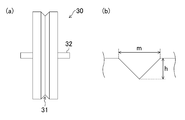
- (A) is an external view of the roll used for a melt spinning method
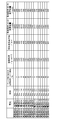
- (b) is an enlarged view of a groove part. It is the chart which described the property of the produced zinc blob.
- 3 is a chart showing evaluation results of Example 1 and Comparative Examples 1 to 3.
- 6 is a chart showing evaluation results of Examples 2 to 8.
- 10 is a chart showing evaluation results of Examples 9 to 16.
- 6 is a chart showing evaluation results of Examples 17 to 25.
- 6 is a chart showing evaluation results of Examples 26 to 41.
- 10 is a chart showing evaluation results of Examples 42 to 49.
- 10 is a chart showing evaluation results of Examples 50 to 58. It is a partially broken view of the alkaline dry battery according to the embodiment.
- the small zinc lumps are small lumps and small pieces of zinc used as a negative electrode active material having a maximum diameter of several ⁇ m to 10 mm regardless of the shape. It is a concept that includes The zinc here includes a zinc alloy containing a small amount of metal other than zinc (excluding mercury).
- Zinc lumps filled in a conventional commercially available alkaline battery are powders produced by the gas atomization method, and the shapes are irregular lumps such as potato, and the average particle size is around 180 ⁇ m. Thus, it is classified with a sieve.
- An example is zinc powder manufactured by Mitsui Kinzoku Co., Ltd. (lot No. 70SA-H, Al 50 ppm, Bi 50 ppm, In 200 ppm contained).
- almond-shaped zinc particles were produced by a melt spinning method.
- the melt spinning method is a method in which molten metal is ejected and dropped onto a rotating single roll and blown off by centrifugal force to form a metal blob.
- Various shapes of metal from strip metal to powder can be produced by adjusting the amount of molten metal ejected and the rotational speed of the roll.
- the preparation method of the zinc particle of this application is not limited to the melt spinning method.
- the shape of the almond-shaped zinc particles is the shape shown in FIG.
- the almond-shaped zinc particle 21 has an acute-angled tip portion 22 with one end in the long axis direction 23 pointed. The other end is an obtuse tip 24.
- the surface of the zinc particles may be smooth or rough.
- Such almond-shaped zinc particles 21 can be produced using a normal cylindrical or disc-shaped roll, but can also be produced using the roll 30 shown in FIG.
- the groove 31 is formed on the side surface of the cylinder farthest from the rotation shaft 32, and the value of the minor axis / major axis in the cross section perpendicular to the major axis direction 23 is obtained by ejecting molten metal into the groove 31.
- Large almond-shaped zinc particles 21 can be produced.
- the minor axis / major axis value is determined by both the width m and the depth h of the groove 31.
- the shape of the groove 31 is not limited to a triangular cross section, and the cross section may be rectangular or U
- the maximum diameter is in the range of 0.5 mm to 50 mm.
- the shape of potato (No. 1) is the raw material zinc powder itself.
- the rectangular plate shape (No. 2) is obtained by cutting off both end portions of almond-shaped zinc particles to make the outer shape rectangular.
- the specific surface area of the zinc nodule was measured using a gas adsorption method.
- ASAP-2010 manufactured by Shimadzu Corporation was used as the measuring device.
- About 7g of zinc lumps are collected and placed in a measurement cell, vacuum degassed at 120 ° C for 2 hours, and then the amount of gas adsorbed is measured using Kr as the adsorbed gas.
- Kr as the adsorbed gas.
- the crystal grain size of the zinc lumps was measured from a micrograph. That is, the surface or cross section of the produced zinc block is magnified with an optical microscope or an electron microscope, a photograph is taken, and the crystal grain size in the photograph is measured. The magnification of the microscope was adjusted so that several tens or more of the area surrounded by the grain boundaries appeared in one photograph.
- Draw a plurality of straight lines arbitrarily in the micrograph select straight lines having intersections with 10 or more grain boundaries, and from the intersections of the straight lines and the first grain boundaries in 10 consecutive grain boundaries, The distance to the intersection of the straight line and the tenth grain boundary was measured, and a value r obtained by dividing the distance by 9 was obtained. Two or more such straight lines were selected to obtain r, and the average value of these r was taken as the crystal grain size of the zinc block.
- this mercury-free alkaline battery has a positive electrode mixture pellet 3 and a gelled negative electrode 6.
- the positive electrode mixture pellet 3 and the gelled negative electrode 6 are separated by a separator 4.
- the positive electrode case 1 is made of a nickel-plated steel plate.
- a graphite coating film 2 is formed inside the positive electrode case 1.
- the mercury-free alkaline battery shown in FIG. 11 can be produced as follows. That is, first, a plurality of hollow cylindrical positive electrode mixture pellets 3 containing a positive electrode active material such as manganese dioxide are inserted into the positive electrode case 1 and are brought into close contact with the inner surface of the positive electrode case 1 by pressurization.
- a positive electrode active material such as manganese dioxide
- the gelled negative electrode 6 is filled inside the separator 4.
- the gelled negative electrode 6 is prepared by previously mixing and dispersing a zinc blob as a negative electrode active material in a gelled alkaline electrolyte (dispersion medium). This zinc blob is produced as described above.
- an anionic surfactant, a quaternary ammonium salt type cationic surfactant and, if necessary, an indium compound are added to the alkaline electrolyte of the gelled negative electrode.
- the negative electrode current collector 10 in which the resin sealing plate 7, the bottom plate 8 also serving as the negative electrode terminal, and the insulating washer 9 are integrated is inserted into the gelled negative electrode 6. Then, the opening end of the positive electrode case 1 is crimped to the peripheral edge portion of the bottom plate 8 via the end portion of the sealing plate 7 to closely contact the opening portion of the positive electrode case 1.
- the anhydrous mercury alkaline battery in this embodiment can be obtained.
- the positive electrode was produced as follows. Electrolytic manganese dioxide and graphite are mixed at a weight ratio of 94: 6, and 1 part by weight of an electrolyte (39% by weight potassium hydroxide aqueous solution containing 2% by weight of ZnO) is mixed with 100 parts by weight of the mixed powder. Then, the mixture was uniformly stirred and mixed with a mixer to regulate the particle size. And the obtained granular material was pressure-molded using the hollow cylinder type
- electrolytic manganese dioxide used was HH-TF manufactured by Tosoh Corporation, and graphite used was SP-20 manufactured by Nippon Graphite Industries Co., Ltd.
- a separator and a bottom paper were further inserted.
- a vinylon-lyocell composite nonwoven fabric manufactured by Kuraray Co., Ltd. was used as the separator.
- 33% by weight aqueous potassium hydroxide solution (containing 2% by weight of ZnO) was injected inside the separator, the negative electrode was filled, and the bottom plate was caulked to prepare AA alkaline batteries.
- the dry batteries thus produced were evaluated under the following two types of discharge conditions.
- the temperature condition is 20 ° C. This condition is for determining so-called low rate discharge characteristics.
- Discharge condition (B) The discharge was performed at a constant current of 1000 mA, and the discharge capacity until the discharge voltage reached 0.9 V was evaluated.
- the temperature condition is 20 ° C. This condition is for determining so-called high rate discharge characteristics.
- FIG. 4 shows the evaluation results of the dry batteries A1 to A4 of Example 1 and Comparative Examples 1 to 3.
- the zinc blob is in the shape of an almond as in Example 1 as compared to being in the shape of a potato, a rectangular plate, or a disc as in the comparative example, either of the discharge conditions (A) and (B) It can be seen that the discharge capacity is large and the discharge characteristics are excellent. This is thought to be due to the electronic conductivity between the zinc lumps and the ease of diffusion of the electrolyte. That is, when it is almond-shaped, at least one sharp end at the end in the major axis direction and the other end are stuck in adjacent zinc lumps (particles) or aggregates of zinc lumps.
- the electrolytic solution is easy to diffuse because of low flow resistance at and near the almond-shaped tip.
- the reaction proceeds uniformly in time throughout the aggregate of zinc lumps, so there is almost no zinc lumps left without reaction.
- the discharge capacity increases.
- the diffusion of the electrolyte is hindered, the discharge voltage drops and the discharge capacity is reduced even if an unreacted active material is present, but if almond-shaped zinc particles are used as the negative electrode active material, Things can be avoided.
- At least one end of the almond-shaped zinc particles in the major axis direction has an acute angle, but the other end may have an acute angle or an obtuse angle.
- the effect of improving the discharge characteristics is greater when both ends are acute angles, but the effect of improving the discharge characteristics is sufficiently observed even when only one end has an acute angle.
- Comparative Example 1 since it is difficult to keep the zinc lumps in contact with each other in the entire aggregate in the aggregate of zinc lumps, the electron conductivity between the zinc lumps is poor, and the isolated zinc lumps are small. There are a lot of lumps and they are delayed in reaction.
- Comparative Example 2 compared to Comparative Example 1, the electron conduction network can be made tighter, but since there is no sharp tip portion, the effect of sticking to adjacent zinc lumps (particles) or aggregates of zinc lumps is small, and the implementation was carried out. The tightness is not as high as in Example 1, and the rectangular plate shape compared to the almond shape prevents the electrolyte from diffusing.
- Comparative Example 3 the electronic conductivity between the zinc lumps is poor as in Comparative Example 1, and the diffusion of the electrolyte is hindered as in Comparative Example 2.
- the zinc lumps of Comparative Examples 2 and 3 which are plate-like (thin pieces) have a shape close to the shape even when they are rounded, so the tightness of the electron conduction network is reduced, but the almond shape is less likely to be rounded. Network tightness does not decrease.
- Examples 2 to 8 are No. 1 in FIG.
- Batteries B1 to B7 were produced in the same manner as in Example 1 except that 5 to 11 almond-shaped zinc particles were used as the negative electrode active material.
- the evaluation results under the discharge conditions (A) and (B) of these dry batteries are as shown in FIG.
- Example 2 the specific surface area of almond-shaped zinc particles is slightly small at 150 cm 2 / g, so the number of contact points between the zinc particles is small, and the degree of improvement in discharge characteristics is so high compared to Comparative Examples 1 to 3. There is no.
- Example 8 since the specific surface area of the almond-shaped zinc particles is slightly large as 1700 cm 2 / g, it is easy to hold the electrolytic solution on the surface of the zinc particles, and the ease of diffusing the electrolytic solution is reduced. Compared with Comparative Examples 1 to 3, the degree of improvement in discharge characteristics is not so high. Therefore, the specific surface area of the almond-shaped zinc particles is preferably 160 cm 2 / g or more and 1500 cm 2 / g or less.
- the dry batteries of Example 2 and Example 8 also have a practically sufficient improvement in discharge characteristics as compared with the dry battery of the comparative example.
- Examples 9 to 16 are No. 1 in FIG.
- Batteries C1 to C8 were produced in the same manner as in Example 1 except that 12 to 19 almond-shaped zinc particles were used as the negative electrode active material.
- the evaluation results under the discharge conditions (A) and (B) of these dry batteries are as shown in FIG.
- Example 9 since the crystal grain size of the almond-shaped zinc particles is slightly small as 0.5 ⁇ m, the amount of gas generated from the grain boundary is increased, and the degree of improvement in the discharge characteristics as compared with Comparative Examples 1 to 3 is so high. There is no.
- the crystal grain size of the almond-shaped zinc particles is slightly large at 60 ⁇ m, so that the reactivity of zinc is somewhat suppressed, and the degree of improvement in discharge characteristics is not so high as compared with Comparative Examples 1 to 3. Therefore, the crystal grain size of the almond-shaped zinc particles is preferably 1 ⁇ m or more and 50 ⁇ m or less.
- the dry batteries of Example 9 and Example 16 also have a practically sufficient improvement in discharge characteristics when compared with the comparative example.
- Examples 17 to 25 are No. 1 in FIG.
- Batteries D1 to D9 were produced in the same manner as in Example 1 except that 20 to 28 almond-shaped zinc particles were used as the negative electrode active material.
- the evaluation results under the discharge conditions (A) and (B) of these dry batteries are as shown in FIG.
- the value of the minor axis / major axis in the cross section perpendicular to the major axis direction of the almond-shaped zinc particles changes in order from 0.1 to 1, but 0.5 has the best discharge characteristics. It is. That is, if the value of the minor axis / major axis of the cross section is 0.1 or more and 1 or less, deformation such as rounding hardly occurs, and an excellent discharge characteristic can be obtained because a diffusion path of the electrolytic solution is easily secured. . It is more preferable that the value of the minor axis / major axis of the cross section is 0.15 or more and 1 or less because the discharge characteristics are better.
- Examples 26 to 41> As shown in FIG. 14 or No. No. 23 almond-shaped zinc particles were used as the negative electrode active material. Dry batteries E1 to E16 were produced in the same manner as in Example 1 except that 1 sprinkled zinc blob (granular zinc) was also added as the negative electrode active material. The amount of almond-shaped zinc particles is variously changed as shown in FIG. 8 with respect to the total negative electrode active material (zinc). The evaluation results under the discharge conditions (A) and (B) of these dry batteries are as shown in FIG.
- Example 26 to 33 No. 1 in FIG. No. 14 is used, and the mixing ratio of almond-shaped zinc particles in all negative electrode active materials is 1% by mass (battery E1) to 70% by mass (battery E8).
- Examples 34 to 41 No. 1 in FIG. 23, and the mixing ratio of almond-shaped zinc particles in all negative electrode active materials is 3 mass% (battery E9) to 85 mass% (battery E16).
- the battery E1 having a mixing ratio of almond-shaped zinc particles of 1% by mass has better discharge characteristics of both high rate and low rate than Comparative Examples 1 to 3, but both discharge characteristics are compared with those of the batteries E2 to E8. Slightly low. Further, the battery E16 in which the mixing ratio of almond-shaped zinc particles is 85% by mass has better high-rate and low-rate discharge characteristics than Comparative Examples 1 to 3, but the high-rate discharge is higher than those of the batteries E9 to E15. The characteristics are slightly low.
- the mixing ratio of almond-shaped zinc particles in all negative electrode active materials is more preferably 2% by mass or more and 80% by mass or less.
- Examples 42 to 49 are No. 4 in FIG. No. 20, 21, 24, 26 and 28 almond-shaped zinc particles were used as the negative electrode active material.
- Dry batteries F1 to F8 were prepared in the same manner as in Example 1 except that 1 sprinkled zinc blob (granular zinc) was also added as the negative electrode active material.
- the amount of almond-shaped zinc particles in the total negative electrode active material (zinc) was 5% by mass, and batteries F1-F4 and F8 having a granular zinc size (maximum diameter) of 0.25 mm or less and 0.25 mm.
- Two types of batteries F5 to F7 are used. The evaluation results under the discharge conditions (A) and (B) of these dry batteries are as shown in FIG.
- the maximum diameter of the granular zinc is larger than 0.25 mm
- the discharge characteristics are improved as compared with the comparative examples 1 to 3.
- the degree of improvement is small. This is presumably because when the maximum diameter of granular zinc is larger than 0.25 mm, the function of forming an electron conduction network closely and the function of diffusion of the electrolyte are small. Therefore, the maximum diameter of the granular zinc to be mixed is preferably 0.25 mm or less.
- Examples 50 to 58 are No. 5 in FIG. No. 24 almond-shaped zinc particles were used as the negative electrode active material.
- Example 1 No. 1 sprinkled zinc blob (granular zinc, maximum diameter of 0.25 mm or less) is added as a negative electrode active material, and the density of the negative electrode is changed by adjusting the degree of filling of the negative electrode.
- dry batteries G1 to G9 were produced.
- the amount of almond-shaped zinc particles in the entire negative electrode active material (zinc) was 7% by mass.
- the evaluation results under the discharge conditions (A) and (B) of these dry batteries are as shown in FIG.
- the batteries G1 and G9 have improved discharge characteristics as compared with Comparative Examples 1 to 3, but the degree of improvement is smaller than those of the batteries G2 to G8.
- the negative electrode density is 2.3 g / cm 3 or more 3.8 g / cm 3 or less, it is considered that the action of the diffusion effect as the electrolytic solution to tightly form the electron conductive network is increased.
- the mercury-free alkaline battery according to the present invention has a large negative electrode utilization rate and improved discharge characteristics, and is useful for devices that require a long-life battery.
Landscapes
- Chemical & Material Sciences (AREA)
- Chemical Kinetics & Catalysis (AREA)
- Electrochemistry (AREA)
- General Chemical & Material Sciences (AREA)
- Engineering & Computer Science (AREA)
- Manufacturing & Machinery (AREA)
- Battery Electrode And Active Subsutance (AREA)
- Primary Cells (AREA)
Abstract
Description
-亜鉛の小塊の作製-
アルカリ乾電池を作製するために、上述の三井金属株式会社製の亜鉛粉末を用いて、メルトスピニング法によって種々の形状の亜鉛の小塊を作製した。作製条件と出来上がった亜鉛の小塊の形状・性質を図3の図表に示す。ノズルというのは、亜鉛粉末を加熱してロールに噴出する際に用いるものである。溝形状h/mがゼロであるのは、溝がなくフラットなロールを用いたことを示している。なお、作製条件が一定であっても出来上がった亜鉛の小塊の形状は一定ではないので、図表に示す形状は当該作製条件においてもっとも多くできた小塊の平均を示している。また、亜鉛の小塊の最大径も同様に平均を示しており、No.4~28のアーモンド形状の亜鉛粒子では最大径は、0.5mm以上50mm以下の範囲内にある。ここで形状がいも状(No.1)とあるのは原料の亜鉛粉末そのもののことである。矩形板状(No.2)とあるのは、アーモンド形状の亜鉛粒子の両端部を切り落として外形を矩形としたものである。
亜鉛の小塊の比表面積は、ガス吸着法を用いて測定した。測定装置には、島津製作所株式会社製のASAP-2010を用いた。亜鉛の小塊を約7g採取して測定セルに入れて、120℃、2時間の条件で真空脱ガス処理を行い、その後吸着ガスとしてKrを使用してガスの吸着量を測定して比表面積を換算した。
亜鉛の小塊の結晶粒径は、顕微鏡写真から測定した。すなわち、作製された亜鉛小塊の表面または断面を、光学顕微鏡や電子顕微鏡で拡大して写真を撮影し、その写真に写った結晶粒径を測定したものである。1枚の写真には粒界で囲まれた領域が数十個以上写るように顕微鏡の倍率を調整した。顕微鏡写真に任意に複数の直線を引いて、10個以上の粒界と交点を有する直線を選び、連続して並ぶ10個の粒界において前記直線と1個目の粒界との交点から、前記直線と10個目の粒界との交点までの距離を測定し、その距離を9で除した値rを求めた。このような直線をさらに2つ以上選んでrを求めて、これらのrの平均値を亜鉛小塊の結晶粒径とした。
以下、本発明の一実施の形態である、無水銀アルカリ乾電池について説明する。図11に示すように、この無水銀アルカリ乾電池は、正極合剤ペレット3と、ゲル状負極6とを有する。正極合剤ペレット3とゲル状負極6とはセパレータ4により隔てられている。正極ケース1は、ニッケルメッキされた鋼板からなる。この正極ケース1の内部には、黒鉛塗装膜2が形成されている。
上で説明した無水銀アルカリ乾電池において、負極活物質である亜鉛小塊の検討を行った実施例を以下に示す。なお、以下の実施例は本発明の例示であり、本発明はこれらの実施例に限定されるものではない。
ゲル状負極6を以下の手順で作製した。
図5に示すように、実施例2乃至8は、図3のNo.5乃至11のアーモンド形状の亜鉛粒子をそれぞれ負極活物質として用い、それ以外は実施例1と同様にして乾電池B1~B7を作製したものである。これらの乾電池の放電条件(A)、(B)による評価結果は図5に示す通りである。
図6に示すように、実施例9乃至16は、図3のNo.12乃至19のアーモンド形状の亜鉛粒子をそれぞれ負極活物質として用い、それ以外は実施例1と同様にして乾電池C1~C8を作製したものである。これらの乾電池の放電条件(A)、(B)による評価結果は図6に示す通りである。
図7に示すように、実施例17乃至25は、図3のNo.20乃至28のアーモンド形状の亜鉛粒子をそれぞれ負極活物質として用い、それ以外は実施例1と同様にして乾電池D1~D9を作製したものである。これらの乾電池の放電条件(A)、(B)による評価結果は図7に示す通りである。
図8に示すように、実施例26乃至41は、図3のNo.14あるいはNo.23のアーモンド形状の亜鉛粒子を負極活物質として用い、さらにNo.1のいも状の亜鉛小塊(粒状亜鉛)も負極活物質として加えて、それ以外は実施例1と同様にして乾電池E1~E16を作製したものである。なお、アーモンド形状の亜鉛粒子の量を全負極活物質(亜鉛)に対して図8に示すように種々に変更している。これらの乾電池の放電条件(A)、(B)による評価結果は図8に示す通りである。
図9に示すように、実施例42乃至49は、図3のNo.20,21,24,26,28のアーモンド形状の亜鉛粒子を負極活物質として用い、さらにNo.1のいも状の亜鉛小塊(粒状亜鉛)も負極活物質として加えて、それ以外は実施例1と同様にして乾電池F1~F8を作製したものである。なお、全負極活物質(亜鉛)中におけるアーモンド形状の亜鉛粒子の量は5質量%とし、粒状亜鉛の大きさ(最大径)を0.25mm以下である電池F1-F4,F8と0.25mm超である電池F5-F7の2種類とした。これらの乾電池の放電条件(A)、(B)による評価結果は図9に示す通りである。
図10に示すように、実施例50乃至58は、図3のNo.24のアーモンド形状の亜鉛粒子を負極活物質として用い、No.1のいも状の亜鉛小塊(粒状亜鉛、最大径が0.25mm以下)も負極活物質として加えて、さらに負極の充填度合いを調節して負極の密度を変更しながら、それ以外は実施例1と同様にして乾電池G1~G9を作製したものである。なお、全負極活物質(亜鉛)中のアーモンド形状の亜鉛粒子の量は7質量%とした。これらの乾電池の放電条件(A)、(B)による評価結果は図10に示す通りである。
22 先端部分(鋭角)
24 先端部分(鈍角)
Claims (10)
- 正極と、負極と、セパレータと、を備え、
前記負極は、負極活物質であるアーモンド形状の亜鉛粒子を含み、
前記アーモンド形状の亜鉛粒子は、長軸方向の長さが0.5mm以上50mm以下であり、長軸方向の両端のうち少なくとも一つが鋭角な先端形状である、無水銀アルカリ乾電池。 - 前記アーモンド形状の亜鉛粒子の比表面積は、160cm2/g以上1500cm2/g以下である、請求項1に記載されている無水銀アルカリ乾電池。
- 前記アーモンド形状の亜鉛粒子の結晶粒径は、1μm以上50μm以下である、請求項1又は2に記載されている無水銀アルカリ乾電池。
- 前記アーモンド形状の亜鉛粒子の長軸に垂直な断面において、0.1≦短径/長径≦1という関係を有する、請求項1から3のいずれか一つに記載されている無水銀アルカリ乾電池。
- 前記負極は、分散媒であるゲル状アルカリ電解液を含む、請求項1から4のいずれか一つに記載されている無水銀アルカリ乾電池。
- 前記負極活物質として最大径が500μm以下の亜鉛微粒子も含まれており、前記アーモンド状の亜鉛粒子の量は全負極活物質中の2質量%以上80質量%以下である、請求項1から5のいずれか一つに記載されている無水銀アルカリ乾電池。
- 前記アーモンド形状の亜鉛粒子の長軸に垂直な断面において、3/20≦短径/長径≦1という関係を有し、前記亜鉛微粒子の最大径が250μm以下である、請求項6に記載されている無水銀アルカリ乾電池。
- 前記負極の密度は、2.3g/cm3以上3.8g/cm3以下である、請求項1から7のいずれか一つに記載されている無水銀アルカリ乾電池。
- 前記アーモンド形状の亜鉛粒子には、Al、Bi、In、CaおよびMgからなる群から選ばれた少なくとも1種類の物質が添加されている、請求項1から8のいずれか一つに記載されている無水銀アルカリ乾電池。
- 前記アーモンド形状の亜鉛粒子および前記亜鉛微粒子には、Al、Bi、In、CaおよびMgからなる群から選ばれた少なくとも1種類の物質が添加されている、請求項6または7に記載されている無水銀アルカリ乾電池。
Priority Applications (4)
| Application Number | Priority Date | Filing Date | Title |
|---|---|---|---|
| EP09812827A EP2323205A1 (en) | 2008-09-12 | 2009-07-21 | Mercury-free alkaline dry battery |
| JP2010528596A JPWO2010029678A1 (ja) | 2008-09-12 | 2009-07-21 | 無水銀アルカリ乾電池 |
| CN2009801354693A CN102150308A (zh) | 2008-09-12 | 2009-07-21 | 无汞碱性干电池 |
| US13/058,989 US20110151334A1 (en) | 2008-09-12 | 2009-07-21 | Mercury-free alkaline dry battery |
Applications Claiming Priority (2)
| Application Number | Priority Date | Filing Date | Title |
|---|---|---|---|
| JP2008235311 | 2008-09-12 | ||
| JP2008-235311 | 2008-09-12 |
Publications (1)
| Publication Number | Publication Date |
|---|---|
| WO2010029678A1 true WO2010029678A1 (ja) | 2010-03-18 |
Family
ID=42004944
Family Applications (1)
| Application Number | Title | Priority Date | Filing Date |
|---|---|---|---|
| PCT/JP2009/003405 Ceased WO2010029678A1 (ja) | 2008-09-12 | 2009-07-21 | 無水銀アルカリ乾電池 |
Country Status (5)
| Country | Link |
|---|---|
| US (1) | US20110151334A1 (ja) |
| EP (1) | EP2323205A1 (ja) |
| JP (1) | JPWO2010029678A1 (ja) |
| CN (1) | CN102150308A (ja) |
| WO (1) | WO2010029678A1 (ja) |
Cited By (1)
| Publication number | Priority date | Publication date | Assignee | Title |
|---|---|---|---|---|
| WO2023228800A1 (ja) * | 2022-05-24 | 2023-11-30 | パナソニックIpマネジメント株式会社 | アルカリ乾電池 |
Families Citing this family (1)
| Publication number | Priority date | Publication date | Assignee | Title |
|---|---|---|---|---|
| US9252430B2 (en) | 2013-07-30 | 2016-02-02 | Spectrum Brands, Inc. | Alkaline cell with improved high rate capability |
Citations (10)
| Publication number | Priority date | Publication date | Assignee | Title |
|---|---|---|---|---|
| JPS6269463A (ja) * | 1985-09-20 | 1987-03-30 | Toshiba Battery Co Ltd | アルカリ電池 |
| JPH0371737B2 (ja) | 1984-09-21 | 1991-11-14 | Mitsui Kinzoku Kogyo Kk | |
| JPH06196155A (ja) * | 1992-12-22 | 1994-07-15 | Fuji Elelctrochem Co Ltd | 電池の負極亜鉛缶 |
| JPH07254406A (ja) * | 1994-03-15 | 1995-10-03 | Toshiba Battery Co Ltd | 無汞化亜鉛アルカリ電池 |
| JP2000503467A (ja) | 1996-11-01 | 2000-03-21 | エヴァレディー バッテリー カンパニー インコーポレイテッド | 電気化学電池の亜鉛アノード |
| JP2001524254A (ja) * | 1997-05-02 | 2001-11-27 | エヴァレディー バッテリー カンパニー インコーポレイテッド | 電気化学電池のアノード用亜鉛形材 |
| JP2004095512A (ja) * | 2002-09-04 | 2004-03-25 | Dowa Mining Co Ltd | アルカリ電池用亜鉛合金粉末及びその製造方法並びにそれを用いたアルカリ電池 |
| JP2004179044A (ja) * | 2002-11-28 | 2004-06-24 | Hitachi Maxell Ltd | アルカリ一次電池用負極活物質、およびそれを用いたアルカリ一次電池 |
| JP2005537624A (ja) * | 2002-08-28 | 2005-12-08 | ザ ジレット カンパニー | オキシ水酸化ニッケルの正極および亜鉛の負極を含むアルカリ電池 |
| JP2008181891A (ja) * | 2000-11-17 | 2008-08-07 | Toshiba Battery Co Ltd | 密閉形ニッケル亜鉛一次電池、その正極及びそれらの製造方法 |
Family Cites Families (6)
| Publication number | Priority date | Publication date | Assignee | Title |
|---|---|---|---|---|
| US6284410B1 (en) * | 1997-08-01 | 2001-09-04 | Duracell Inc. | Zinc electrode particle form |
| US6652676B1 (en) * | 1999-10-18 | 2003-11-25 | Big River Zinc Corporation | Zinc alloy containing a bismuth-indium intermetallic compound for use in alkaline batteries |
| US7045253B2 (en) * | 2002-01-07 | 2006-05-16 | Eveready Battery Company, Inc. | Zinc shapes for anodes of electrochemical cells |
| DE60313334T2 (de) * | 2002-08-05 | 2008-01-03 | Noranda Inc., Toronto | Verwendung eines zinkpulvers in elektrochemischen zellen |
| US7273680B2 (en) * | 2002-08-28 | 2007-09-25 | The Gillette Company | Alkaline battery including nickel oxyhydroxide cathode and zinc anode |
| US20070248879A1 (en) * | 2002-08-28 | 2007-10-25 | Durkot Richard E | Alkaline battery including nickel oxyhydroxide cathode and zinc anode |
-
2009
- 2009-07-21 JP JP2010528596A patent/JPWO2010029678A1/ja not_active Withdrawn
- 2009-07-21 EP EP09812827A patent/EP2323205A1/en not_active Withdrawn
- 2009-07-21 CN CN2009801354693A patent/CN102150308A/zh active Pending
- 2009-07-21 WO PCT/JP2009/003405 patent/WO2010029678A1/ja not_active Ceased
- 2009-07-21 US US13/058,989 patent/US20110151334A1/en not_active Abandoned
Patent Citations (10)
| Publication number | Priority date | Publication date | Assignee | Title |
|---|---|---|---|---|
| JPH0371737B2 (ja) | 1984-09-21 | 1991-11-14 | Mitsui Kinzoku Kogyo Kk | |
| JPS6269463A (ja) * | 1985-09-20 | 1987-03-30 | Toshiba Battery Co Ltd | アルカリ電池 |
| JPH06196155A (ja) * | 1992-12-22 | 1994-07-15 | Fuji Elelctrochem Co Ltd | 電池の負極亜鉛缶 |
| JPH07254406A (ja) * | 1994-03-15 | 1995-10-03 | Toshiba Battery Co Ltd | 無汞化亜鉛アルカリ電池 |
| JP2000503467A (ja) | 1996-11-01 | 2000-03-21 | エヴァレディー バッテリー カンパニー インコーポレイテッド | 電気化学電池の亜鉛アノード |
| JP2001524254A (ja) * | 1997-05-02 | 2001-11-27 | エヴァレディー バッテリー カンパニー インコーポレイテッド | 電気化学電池のアノード用亜鉛形材 |
| JP2008181891A (ja) * | 2000-11-17 | 2008-08-07 | Toshiba Battery Co Ltd | 密閉形ニッケル亜鉛一次電池、その正極及びそれらの製造方法 |
| JP2005537624A (ja) * | 2002-08-28 | 2005-12-08 | ザ ジレット カンパニー | オキシ水酸化ニッケルの正極および亜鉛の負極を含むアルカリ電池 |
| JP2004095512A (ja) * | 2002-09-04 | 2004-03-25 | Dowa Mining Co Ltd | アルカリ電池用亜鉛合金粉末及びその製造方法並びにそれを用いたアルカリ電池 |
| JP2004179044A (ja) * | 2002-11-28 | 2004-06-24 | Hitachi Maxell Ltd | アルカリ一次電池用負極活物質、およびそれを用いたアルカリ一次電池 |
Cited By (1)
| Publication number | Priority date | Publication date | Assignee | Title |
|---|---|---|---|---|
| WO2023228800A1 (ja) * | 2022-05-24 | 2023-11-30 | パナソニックIpマネジメント株式会社 | アルカリ乾電池 |
Also Published As
| Publication number | Publication date |
|---|---|
| CN102150308A (zh) | 2011-08-10 |
| US20110151334A1 (en) | 2011-06-23 |
| EP2323205A1 (en) | 2011-05-18 |
| JPWO2010029678A1 (ja) | 2012-02-02 |
Similar Documents
| Publication | Publication Date | Title |
|---|---|---|
| CN100565984C (zh) | 正极材料和锂二次电池 | |
| US6916577B2 (en) | Alkaline cell with polymer electrolyte | |
| JP4161400B2 (ja) | 非水電解質リチウム二次電池およびその製造方法 | |
| CN101154725B (zh) | 非水可再充电电池用负极活性材料及其非水可再充电电池 | |
| JP5827103B2 (ja) | 小型非水電解質二次電池及びその製造方法 | |
| KR20030063374A (ko) | 밀폐형 니켈 아연 일차 전지, 그 양극 및 이의 제조 방법 | |
| JP2013041818A (ja) | ブレンドされた亜鉛粉体を用いたアルカリ化学セル | |
| CN101385166A (zh) | 碱性电池 | |
| WO2010029679A1 (ja) | 無水銀アルカリ乾電池 | |
| CN110024183B (zh) | 碱性干电池 | |
| CN102210051A (zh) | 碱性干电池 | |
| WO2010029678A1 (ja) | 無水銀アルカリ乾電池 | |
| US6221527B1 (en) | Electrode for an electrochemical cell including ribbons | |
| CN103258989A (zh) | 用于锂二次电池的电极、制造方法及锂二次电池 | |
| US20110189517A1 (en) | Alkaline battery | |
| CN116598439A (zh) | 锂二次电池用负极活性物质及包含该负极活性物质的锂二次电池 | |
| JP7454462B2 (ja) | 扁平形アルカリ二次電池 | |
| CN102210052A (zh) | 碱性干电池 | |
| US20250385253A1 (en) | Alkaline dry battery | |
| US20250323284A1 (en) | Alkaline dry cell | |
| CN118266100A (zh) | 运行时间增加且内部短路减少的电化学电池单元 | |
| JP5097357B2 (ja) | アルカリ電池用亜鉛粉末の製造方法、アルカリ電池用負極ゲルの製造方法 | |
| TW202419404A (zh) | 核殼粒子與鋰離子電池 |
Legal Events
| Date | Code | Title | Description |
|---|---|---|---|
| WWE | Wipo information: entry into national phase |
Ref document number: 200980135469.3 Country of ref document: CN |
|
| 121 | Ep: the epo has been informed by wipo that ep was designated in this application |
Ref document number: 09812827 Country of ref document: EP Kind code of ref document: A1 |
|
| WWE | Wipo information: entry into national phase |
Ref document number: 2010528596 Country of ref document: JP |
|
| WWE | Wipo information: entry into national phase |
Ref document number: 2009812827 Country of ref document: EP |
|
| WWE | Wipo information: entry into national phase |
Ref document number: 13058989 Country of ref document: US |
|
| NENP | Non-entry into the national phase |
Ref country code: DE |