WO2010036392A1 - Organic acid free effervescent formulation - Google Patents
Organic acid free effervescent formulation Download PDFInfo
- Publication number
- WO2010036392A1 WO2010036392A1 PCT/US2009/040938 US2009040938W WO2010036392A1 WO 2010036392 A1 WO2010036392 A1 WO 2010036392A1 US 2009040938 W US2009040938 W US 2009040938W WO 2010036392 A1 WO2010036392 A1 WO 2010036392A1
- Authority
- WO
- WIPO (PCT)
- Prior art keywords
- composition
- water
- dissolved
- tablet
- organic acid
- Prior art date
- Legal status (The legal status is an assumption and is not a legal conclusion. Google has not performed a legal analysis and makes no representation as to the accuracy of the status listed.)
- Ceased
Links
Classifications
-
- C—CHEMISTRY; METALLURGY
- C11—ANIMAL OR VEGETABLE OILS, FATS, FATTY SUBSTANCES OR WAXES; FATTY ACIDS THEREFROM; DETERGENTS; CANDLES
- C11D—DETERGENT COMPOSITIONS; USE OF SINGLE SUBSTANCES AS DETERGENTS; SOAP OR SOAP-MAKING; RESIN SOAPS; RECOVERY OF GLYCEROL
- C11D3/00—Other compounding ingredients of detergent compositions covered in group C11D1/00
- C11D3/0005—Other compounding ingredients characterised by their effect
- C11D3/0052—Gas evolving or heat producing compositions
-
- C—CHEMISTRY; METALLURGY
- C11—ANIMAL OR VEGETABLE OILS, FATS, FATTY SUBSTANCES OR WAXES; FATTY ACIDS THEREFROM; DETERGENTS; CANDLES
- C11D—DETERGENT COMPOSITIONS; USE OF SINGLE SUBSTANCES AS DETERGENTS; SOAP OR SOAP-MAKING; RESIN SOAPS; RECOVERY OF GLYCEROL
- C11D3/00—Other compounding ingredients of detergent compositions covered in group C11D1/00
- C11D3/02—Inorganic compounds ; Elemental compounds
- C11D3/04—Water-soluble compounds
- C11D3/10—Carbonates ; Bicarbonates
-
- C—CHEMISTRY; METALLURGY
- C11—ANIMAL OR VEGETABLE OILS, FATS, FATTY SUBSTANCES OR WAXES; FATTY ACIDS THEREFROM; DETERGENTS; CANDLES
- C11D—DETERGENT COMPOSITIONS; USE OF SINGLE SUBSTANCES AS DETERGENTS; SOAP OR SOAP-MAKING; RESIN SOAPS; RECOVERY OF GLYCEROL
- C11D3/00—Other compounding ingredients of detergent compositions covered in group C11D1/00
- C11D3/02—Inorganic compounds ; Elemental compounds
- C11D3/12—Water-insoluble compounds
- C11D3/124—Silicon containing, e.g. silica, silex, quartz or glass beads
- C11D3/1246—Silicates, e.g. diatomaceous earth
- C11D3/128—Aluminium silicates, e.g. zeolites
-
- C—CHEMISTRY; METALLURGY
- C11—ANIMAL OR VEGETABLE OILS, FATS, FATTY SUBSTANCES OR WAXES; FATTY ACIDS THEREFROM; DETERGENTS; CANDLES
- C11D—DETERGENT COMPOSITIONS; USE OF SINGLE SUBSTANCES AS DETERGENTS; SOAP OR SOAP-MAKING; RESIN SOAPS; RECOVERY OF GLYCEROL
- C11D7/00—Compositions of detergents based essentially on non-surface-active compounds
- C11D7/02—Inorganic compounds
- C11D7/04—Water-soluble compounds
- C11D7/10—Salts
- C11D7/12—Carbonates bicarbonates
-
- C—CHEMISTRY; METALLURGY
- C11—ANIMAL OR VEGETABLE OILS, FATS, FATTY SUBSTANCES OR WAXES; FATTY ACIDS THEREFROM; DETERGENTS; CANDLES
- C11D—DETERGENT COMPOSITIONS; USE OF SINGLE SUBSTANCES AS DETERGENTS; SOAP OR SOAP-MAKING; RESIN SOAPS; RECOVERY OF GLYCEROL
- C11D7/00—Compositions of detergents based essentially on non-surface-active compounds
- C11D7/02—Inorganic compounds
- C11D7/04—Water-soluble compounds
- C11D7/10—Salts
- C11D7/14—Silicates
-
- C—CHEMISTRY; METALLURGY
- C11—ANIMAL OR VEGETABLE OILS, FATS, FATTY SUBSTANCES OR WAXES; FATTY ACIDS THEREFROM; DETERGENTS; CANDLES
- C11D—DETERGENT COMPOSITIONS; USE OF SINGLE SUBSTANCES AS DETERGENTS; SOAP OR SOAP-MAKING; RESIN SOAPS; RECOVERY OF GLYCEROL
- C11D2111/00—Cleaning compositions characterised by the objects to be cleaned; Cleaning compositions characterised by non-standard cleaning or washing processes
- C11D2111/10—Objects to be cleaned
- C11D2111/14—Hard surfaces
- C11D2111/24—Mineral surfaces, e.g. stones, frescoes, plasters, walls or concretes
Definitions
- the intent of the present invention is to create a composition that, while effervescing, will increase the temperature of the water that it is in by about 20 0 C for 200 grams of water.
- the composition is preferably n the form of a tablet, but might conveniently be presented as a water soluble capsule, granule, or dense flowing powder, using established technology.
- the inventive composition is particularly characterized in that it is free of organic acid effervescing components.
- U.S. Patent 5,993,854 describes an exothermic effervescent tablet that is designed to improve the dispersion of volatile materials.
- the invention described in that patent uses the combination of an exothermic material (a material that has positive heat of solution when placed in water) and a conventional effervescent couple.
- a conventional effervescent couple is defined as the combination of a carbonate salt and an organic acid.
- Typical carbonate salts are bicarbonates or carbonates.
- the sodium, potassium, magnesium and calcium forms are most common.
- Organic acids such as citric acid, fumaric acid, tartaric acid, adipic acid, succinic acid and malic acid are frequently used as the organic acid component.
- compositions within the technology of the '854 patent may be able to be used to achieve the invention's goal of warming water while effervescing, they are not optimal solutions for the purpose of specifically warming the water or liquid. This is because the effervescent reaction is endothermic (as shown by data in that patent) and thus a significant fraction of the heat generated by the exothermic material goes to warming the water or liquid cooled by the endothermic effervescent reaction.
- target heat elevation of 20 0 C in five minutes is the goal of this invention. While various commercial and non-commercial applications will call for various heating regimens, a heat increase of from room temperature 30 or 35°C within 5 minutes for 150 or 200 ml of water is achievable using the same formulations.
- This invention overcomes the drawback of using and endothermic effervescence reaction, and achieves the targets for this application, by using exothermic materials which are capable of initiating the effervescent reaction with a carbonate salt in the absence of the organic acid which is typically used for that purpose.
- 1 calorie is the amount of heat needed to raise 1 gram of water 1°C. Therefore 6000 calories (6 kcal) are needed to heat 200 grams of water by 30 0 C. Obviously, all things being equal, a lesser amount is required to elevate the temperature of the same water by at least 20 0 C, which is the general target of the invention. More broadly, the invention addresses compositions, preferably tablets, which cause water of aqueous liquids in which they are placed to warm and effervesce, without the aid or presence of an organic acid.
- Amount needed 6 kcal/(kcal/gm-mole liberated) x molecular weight
- the generated effervescence drives an improved heat release, or exothermic release.
- the effervescence aids in breaking up the exothermic component in the tablet, Attorney Docket No.: PHYZ-OOW-PCT/Customer No.: 22506
- the inventive composition may be in the form of a tablet, granule or powder.
- the tablet forming process starts with powders, and both MgCl and e.g., sodium bicarbonate, are available as free flowing powders. Combined as powders and dissolved together, they will raise the temperature of water they are dissolved in.
- the composition of the invention may preferably be used in the form of granules.
- Granules are prepared from thoroughly mixed appropriate weight amounts of the various powdered starting materials (e.g, magnesium chloride and sodium bicarbonate). Methods of preparing granules are known to those of skill in the art, and are generally categorized into dry granulation (typically applied to free flowing powders), wet granulation (where typically the lubricant, glidant, possibly an antiadherent and binder are added in the granulation process, which may include a binder) and fluidized bed granulation, which may offer more control. Granules also come in a large range of densities.
- dry granulation typically applied to free flowing powders
- wet granulation where typically the lubricant, glidant, possibly an antiadherent and binder are added in the granulation process, which may include a binder
- fluidized bed granulation which may offer more control. Granules also come in a large range of densities.
- materials of materials that may be combined with exothermic/effervescent mixture are: binders, lubricants, flow aides, surfactants, bleaches, enzymes, fragrances and colorants.
- Some common binders include, but are not limited to: sorbitol, mannitol, dextrose, sucrose, maltodextrin, corn syrup solids, dicalcium phosphate, and microcrystalline cellulose.
- Potential lubricants include, but are not limited to: polyethylene glycol, magnesium stearate, sodium benzoate, leucine, talc, fumaric acid, and corn starch.
- Typical flow aides include, but are not limited to, fumed silica and calcium silicate.
- Surfactants may include, but are not limited to: sodium lauryl sulfate, sodium lauryl ethoxy sulfates, sodium lauryl sulfoacetate, sodium dodecyl benzene sulfonate, alpha olefin sulfonate, sodium lauryl sulfosuccinate, various fatty alcohols and fatty alcohol ethoxylates, and nonylphenol ethoxylates.
- Bleaches that may be used include, but are not limited to: sodium perborate, potassium caroate (OxoneTM), sodium percarbonate, urea peroxide and calcium peroxide.
- Enzymes may include, but are not limited to: protease, amylase, lipase, and cellulase.
- Example 1 Water Heating Tablet (could be used to warm food contained in a pouch) Attorney Docket No.: PHYZ-OOW-PCT/Customer No.: 22506
- Example 3 Jewelry Cleaning Tablet
- the choice of an appropriate carbonate for the generation of CO 2 is not particularly limited.
- the CO 2 release is tied to the ability to rapidly raise the temperature of the liquid in which the composition is immersed.
- bicarbonates are more effective, weight for weight, than carbonates.
- the sodium, potassium, magnesium and calcium bicarbonates are preferable for the applications envisioned.
- the amount of bicarbonate called for can be calculated.
- the tablet may be used in large scale commercial operations - everything from jewelry cleaning to cleaning the interior of boilers and other surfaces where scaling may occur, notably constricted passageways and similar applications.
- Aroma therapy particularly the use of aromas to fill a constrained space, such as a room in a dwelling, is supported by the disclosed invention.
- the tablet is far more portable than a variety of heating alternatives, and can, for example, be used to raise the temperature of water when camping or otherwise cut off from sources of electricity. This may be convenient for, e.g., hand washing or skin cleansing. These are conventional applications.
- the heart of the invention resides in a composition, preferably a tablet, which comprises an exothermic component, preferably MgCl or a zeolite, and a bicarbonate salt, but is free of an organic acid component yet effervesces when placed in an aqueous liquid with an accompanying heat rise which may be as much as 20 0 C or more when placed in 200 grams of liquid.
Landscapes
- Chemical & Material Sciences (AREA)
- Life Sciences & Earth Sciences (AREA)
- Engineering & Computer Science (AREA)
- Chemical Kinetics & Catalysis (AREA)
- Oil, Petroleum & Natural Gas (AREA)
- Wood Science & Technology (AREA)
- Organic Chemistry (AREA)
- Inorganic Chemistry (AREA)
- Cosmetics (AREA)
- Detergent Compositions (AREA)
Abstract
This invention provides a tablet that effervesces and significantly warms the water that it is dissolved in. The effervescence acts to break up the tablet allowing an exothermic material to rapidly dissolve releasing its heat of solution. The invention is unique in that no organic acid is required to form a conventional effervescent couple.
Description
Attorney Docket No.: PHYZ-OOW-PCT/Customer No.: 22506
TITLE OF THE INVENTION
ORGANIC ACID FREE EFFERVESCENT FORMULATION
BACKGROUND OF THE INVENTION Priority Data and Incorporation by Reference
[0001] This application claims benefit of priority to U.S. Provisional Patent Application No. 61/099,221 filed September 23, 2008, which is incorporated by reference in its entirety.
Field of the Invention
[0002] The intent of the present invention is to create a composition that, while effervescing, will increase the temperature of the water that it is in by about 200C for 200 grams of water. The composition is preferably n the form of a tablet, but might conveniently be presented as a water soluble capsule, granule, or dense flowing powder, using established technology. The inventive composition is particularly characterized in that it is free of organic acid effervescing components. [0003] U.S. Patent 5,993,854 describes an exothermic effervescent tablet that is designed to improve the dispersion of volatile materials. The invention described in that patent uses the combination of an exothermic material (a material that has positive heat of solution when placed in water) and a conventional effervescent couple. A conventional effervescent couple is defined as the combination of a carbonate salt and an organic acid. Typical carbonate salts are bicarbonates or carbonates. The sodium, potassium, magnesium and calcium forms are most common. Organic acids such as citric acid, fumaric acid, tartaric acid, adipic acid, succinic acid and malic acid are frequently used as the organic acid component.
[0004] While certain compositions within the technology of the '854 patent may be able to be used to achieve the invention's goal of warming water while effervescing, they are not optimal solutions for the purpose of specifically warming the water or liquid. This is because the effervescent reaction is endothermic (as shown by data in that patent) and thus a significant fraction of the heat generated by the exothermic material goes to warming the water or liquid cooled by the endothermic effervescent reaction.
[0005] It would be desirable to provide a simple composition that can provide a rapid and significant heat increase to water or a water-based liquid in which it is dissolved. In general, a
Attorney Docket No.: PHYZ-OOW-PCT/Customer No.: 22506
target heat elevation of 200C in five minutes is the goal of this invention. While various commercial and non-commercial applications will call for various heating regimens, a heat increase of from room temperature 30 or 35°C within 5 minutes for 150 or 200 ml of water is achievable using the same formulations. This invention overcomes the drawback of using and endothermic effervescence reaction, and achieves the targets for this application, by using exothermic materials which are capable of initiating the effervescent reaction with a carbonate salt in the absence of the organic acid which is typically used for that purpose.
DETAILED DESCRIPTION
[0006] By definition, 1 calorie is the amount of heat needed to raise 1 gram of water 1°C. Therefore 6000 calories (6 kcal) are needed to heat 200 grams of water by 300C. Obviously, all things being equal, a lesser amount is required to elevate the temperature of the same water by at least 200C, which is the general target of the invention. More broadly, the invention addresses compositions, preferably tablets, which cause water of aqueous liquids in which they are placed to warm and effervesce, without the aid or presence of an organic acid.
[0007] The amount of a given exothermic material needed to generate 6 kcal is easily calculated from the heat of solution data found in Lange's Handbook of Chemistry, 11th edition, Table 9-6:
[0008] Amount needed = 6 kcal/(kcal/gm-mole liberated) x molecular weight
[0009] This amount was calculated for several commercially important materials:

[0010] Each of these materials was combined individually with various carbonate salts. Tablets were formed by compressing the binary mixtures using a hand operated hydraulic (Carver) press at approximately 3000 psi. Density is not a critical aspect of the invention, low density tablets of at least 1.0g/cc and above will be suitable. The resulting tablets were placed in approximately 200 g of water. The temperature change and effervescent properties were noted. Note: in some cases the size of the tablet and amount of water used was scaled
Attorney Docket No.: PHYZ-OOW-PCT/Customer No.: 22506
up or down in appropriate ratio in order to accommodate the availability of materials and/or to physically be able to press a tablet. Data are:

[0011] The finding that effervescence could be generated without the use of an organic acid was very surprising, and contrary to a vast amount of literature which assumes that effervescence is produced by combining a carbonate salt with an acid, particularly an organic acid. The effervescence is clearly important as it helps the tablet dissolve. In experiments where the effervescence was minimal or non-existent, the temperature rise is much lower than where the tablet is broken up by carbon dioxide gas generation. Viewed at from the 0 point of view of the exothermic release - it is clear that the heat provided drives the effervescence to at least some degree. Thus, full effervescence can be observed in the absence of an organic acid component. In turn, the generated effervescence drives an improved heat release, or exothermic release. Without wishing to be bound by this explanation, it is theorized that the effervescence aids in breaking up the exothermic component in the tablet,
Attorney Docket No.: PHYZ-OOW-PCT/Customer No.: 22506
exposing more surface area and improving/accelerating its dissolution. The two components of this composition synergistically improve performance. Clearly, the performance of the tablet or composition of the invention, and its use as a composition to elevate the temperature of liquid with effervescence, balances the properties and characteristics of the exothermic agent and the carbonate/bicarbonate salt.
[0012] These appearance of effervescence is especially surprising given that the pH of each of the tested exothermic materials is at most very weakly acidic (one familiar with the art and technology of effervescence would not expect carbonate salts to react with alkaline or very weakly acid materials to liberate carbon dioxide):

[0013] Although these examples are aimed at generating temperature rises of about 20 - 300C in 200 grams of water, it is clear that the amounts and ratios of the exothermic material and carbonate salt can be adjusted and balanced to give just about any temperature increase in just about any amount of water. The inventive composition may be in the form of a tablet, granule or powder. The tablet forming process starts with powders, and both MgCl and e.g., sodium bicarbonate, are available as free flowing powders. Combined as powders and dissolved together, they will raise the temperature of water they are dissolved in. Similarly, since tableting is a step typically performed by compressing granules, the composition of the invention may preferably be used in the form of granules. Granules are prepared from thoroughly mixed appropriate weight amounts of the various powdered starting materials (e.g, magnesium chloride and sodium bicarbonate). Methods of preparing granules are known to those of skill in the art, and are generally categorized into dry granulation (typically applied to free flowing powders), wet granulation (where typically the lubricant, glidant, possibly an antiadherent and binder are added in the granulation process, which may include a binder) and fluidized bed granulation, which may offer more control. Granules also come in a large range of densities. For the purposes of this invention, densities in excess of 1.0 g/cc, and specifically of about 1.2 g/cc or greater, are preferable .For a comparison of granulation
Attorney Docket No.: PHYZ-OOW-PCT/Customer No.: 22506
technologies, the granules produced and resulting tablets, see Kristensen et al, AAPS PharmSciTech 2006:7(l)pp. El - ElO (2006) incorporated herein by reference.
[0014] It must be noted that the binary compositions shown above are not intended to be used as consumer products "as is". Additional materials will need to be added to allow commercial production, deliver functional benefits, and to have acceptable aesthetics for their intended use.
[0015] Some examples of materials of materials that may be combined with exothermic/effervescent mixture are: binders, lubricants, flow aides, surfactants, bleaches, enzymes, fragrances and colorants.
[0016] Some common binders include, but are not limited to: sorbitol, mannitol, dextrose, sucrose, maltodextrin, corn syrup solids, dicalcium phosphate, and microcrystalline cellulose.
[0017] Potential lubricants include, but are not limited to: polyethylene glycol, magnesium stearate, sodium benzoate, leucine, talc, fumaric acid, and corn starch.
[0018] Typical flow aides include, but are not limited to, fumed silica and calcium silicate.
[0019] Surfactants may include, but are not limited to: sodium lauryl sulfate, sodium lauryl ethoxy sulfates, sodium lauryl sulfoacetate, sodium dodecyl benzene sulfonate, alpha olefin sulfonate, sodium lauryl sulfosuccinate, various fatty alcohols and fatty alcohol ethoxylates, and nonylphenol ethoxylates.
[0020] Bleaches that may be used include, but are not limited to: sodium perborate, potassium caroate (Oxone™), sodium percarbonate, urea peroxide and calcium peroxide.
[0021] Enzymes may include, but are not limited to: protease, amylase, lipase, and cellulase.
[0022] Given the above possibilities, it is clear that the invention may be used in place of existing technologies wherever effervescence is an important or essential aspect of the composition, either functionally or aesthetically, and the resulting liquid is suitably warmed for use. Examples include the following formulations:
[0023] Example 1: Water Heating Tablet (could be used to warm food contained in a pouch)
Attorney Docket No.: PHYZ-OOW-PCT/Customer No.: 22506

Evaluation: When dissolved in 200 ml water temperature rise was 29°C [0024] Example 2: Aroma Diffusing Tablet
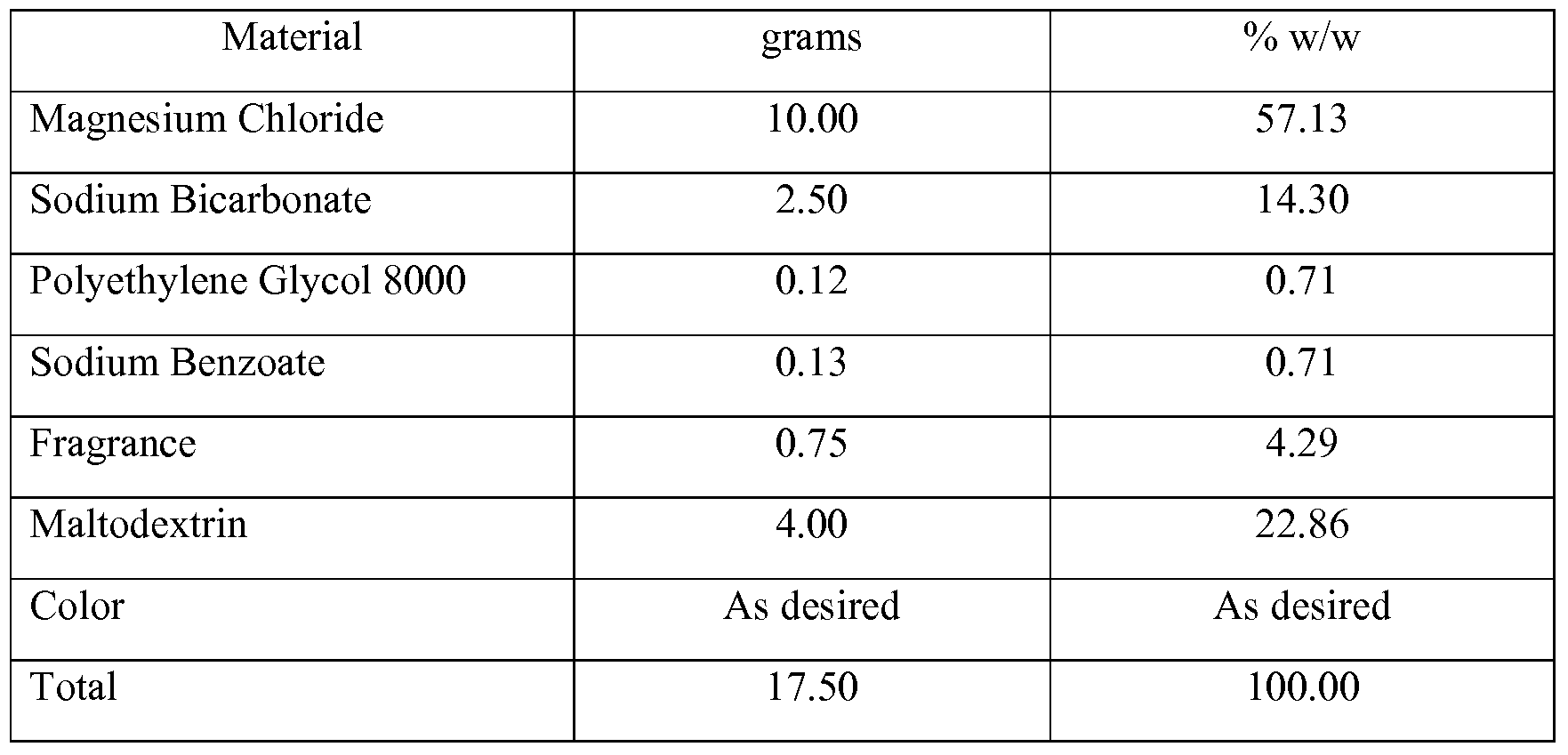
Evaluation: When dissolved in 100 ml water temperature rise was 25°C
Attorney Docket No.: PHYZ-OOW-PCT/Customer No.: 22506
[0025] Example 3 : Jewelry Cleaning Tablet

Evaluation: When dissolved in 50 ml water temperature rise was 23°C [0026] Example 4: Cleaning Tablet with Oxygen Bleach

Evaluation: When dissolved in 200 ml water temperature rise was 26°C
Attorney Docket No.: PHYZ-OOW-PCT/Customer No.: 22506
Example 5: Enzymatic Cleaning Tablet

Evaluation: When dissolved in 100 ml water temperature rise was 21°C.
[0027] Clearly, those of ordinary skill in the art will recognize that there are combinations of carbonate salt and exothermic material that will achieve the desired goal, in addition to the formulations advanced. As one example, reference may be had to the use of zeolites. These sodium alumino silicates generate a large degree of heat when contacted with water. They are also capable of storing large amounts of water, so that compositions prepared from zeolite- based exothermic reactants should not be as liquid sensitive as others. Zeolites, particularly Class 3 and 4, but 5 and X as well, are put to a vast range of commercial uses.
[0028] By the same token, the choice of an appropriate carbonate for the generation of CO2 is not particularly limited. As noted above, the CO2 release is tied to the ability to rapidly raise the temperature of the liquid in which the composition is immersed. To this end bicarbonates are more effective, weight for weight, than carbonates. The sodium, potassium, magnesium and calcium bicarbonates are preferable for the applications envisioned. Given adequate exothermic content (generally, the amount of MgCl or zeolite included) the amount of bicarbonate called for can be calculated.
Attorney Docket No.: PHYZ-OOW-PCT/Customer No.: 22506
[0029] A variety of applications are described above. The tablet may be used in large scale commercial operations - everything from jewelry cleaning to cleaning the interior of boilers and other surfaces where scaling may occur, notably constricted passageways and similar applications. Aroma therapy, particularly the use of aromas to fill a constrained space, such as a room in a dwelling, is supported by the disclosed invention. The tablet is far more portable than a variety of heating alternatives, and can, for example, be used to raise the temperature of water when camping or otherwise cut off from sources of electricity. This may be convenient for, e.g., hand washing or skin cleansing. These are conventional applications. The heart of the invention resides in a composition, preferably a tablet, which comprises an exothermic component, preferably MgCl or a zeolite, and a bicarbonate salt, but is free of an organic acid component yet effervesces when placed in an aqueous liquid with an accompanying heat rise which may be as much as 200C or more when placed in 200 grams of liquid.
[0030] While the present invention has been disclosed with references to certain embodiments, numerous modification, alterations, and changes to the described embodiments are possible without departing from the sphere and scope of the present invention. Accordingly, it is intended that the present invention not be limited to the described embodiments, but that it has the full scope as would be understood by those of skill in the art.
Claims
1. A composition which, when dissolved in an aqueous liquid, effervesces and raises the temperature of said liquid, comprising an exothermic component selected from the group consisting of magnesium chloride, a zeolite and mixtures thereof, and an effervescent component selected from the group of sodium bicarbonate, potassium bicarbonate, magnesium bicarbonate, calcium bicarbonate and mixtures thereof, said exothermic component and effervescent component being present in amounts sufficient to increase the temperature of 200 ml of water in which said composition is placed by at least 200C, wherein said composition is free of an organic acid.
2. The composition of Claim 1, wherein said composition further comprises at least one of a binder, lubricant, flow aide, surfactant, bleach, enzyme, fragrance, colorant or flavorant.
3. The composition of Claim 2, wherein said composition, when dissolved, is effective as a cleaning agent.
4. The composition of Claim 2, wherein said composition, when dissolved, is effective as an aroma diffuser.
5. The composition of Claim 2, wherein said composition, when dissolved in water, is safe for human topical application.
6. The composition of Claim 1, wherein said composition is in the form of a tablet.
7. The composition of Claim 1, wherein said composition is in the form of granules.
Priority Applications (2)
| Application Number | Priority Date | Filing Date | Title |
|---|---|---|---|
| EP09816612.7A EP2331081B1 (en) | 2008-09-23 | 2009-04-17 | Organic acid free effervescent formulation |
| CA2735822A CA2735822C (en) | 2008-09-23 | 2009-04-17 | Organic acid free effervescent formulation |
Applications Claiming Priority (2)
| Application Number | Priority Date | Filing Date | Title |
|---|---|---|---|
| US9922108P | 2008-09-23 | 2008-09-23 | |
| US61/099,221 | 2008-09-23 |
Publications (1)
| Publication Number | Publication Date |
|---|---|
| WO2010036392A1 true WO2010036392A1 (en) | 2010-04-01 |
Family
ID=42037888
Family Applications (1)
| Application Number | Title | Priority Date | Filing Date |
|---|---|---|---|
| PCT/US2009/040938 Ceased WO2010036392A1 (en) | 2008-09-23 | 2009-04-17 | Organic acid free effervescent formulation |
Country Status (4)
| Country | Link |
|---|---|
| US (1) | US8206686B2 (en) |
| EP (1) | EP2331081B1 (en) |
| CA (1) | CA2735822C (en) |
| WO (1) | WO2010036392A1 (en) |
Families Citing this family (6)
| Publication number | Priority date | Publication date | Assignee | Title |
|---|---|---|---|---|
| WO2012048104A1 (en) | 2010-10-06 | 2012-04-12 | Taris Biomedical, Inc. | Implantable drug delivery device with bladden retention feature |
| JP6640481B2 (en) * | 2015-07-30 | 2020-02-05 | 花王株式会社 | Solid foaming bath agent |
| USD848596S1 (en) | 2017-08-30 | 2019-05-14 | Remarkably Well, Inc | Aromatherapy shower tablet dissolver |
| US10010643B1 (en) | 2017-08-30 | 2018-07-03 | Remarkably Well, Inc | Apparatus for dissolving a fragrance carrier |
| USD838826S1 (en) | 2017-08-30 | 2019-01-22 | Remarkably Well, Inc | Aromatherapy shower tablet |
| US10165906B1 (en) | 2017-08-30 | 2019-01-01 | Remarkably Well, Inc | Apparatus for dissolving a fragrance carrier |
Citations (2)
| Publication number | Priority date | Publication date | Assignee | Title |
|---|---|---|---|---|
| WO1997002014A1 (en) * | 1995-07-05 | 1997-01-23 | Smithkline Beecham Laboratoires Pharmaceutiques | Therapeutic effervescent compositions |
| US5993854A (en) * | 1997-09-17 | 1999-11-30 | Phyzz, Inc. | Exothermic effervescent composition for improved fragrance dispersion |
Family Cites Families (5)
| Publication number | Priority date | Publication date | Assignee | Title |
|---|---|---|---|---|
| US4409118A (en) * | 1981-04-03 | 1983-10-11 | Warner-Lambert Company | Tablet forming cleanser composition and method of preparation |
| DE10006306A1 (en) * | 2000-02-12 | 2001-08-23 | Buck Chemie Gmbh | Active ingredient tablet, in particular as a cleaner and / or decalcifying tablet |
| ATE327306T1 (en) * | 2000-06-19 | 2006-06-15 | Procter & Gamble | METHOD FOR TREATING TISSUES BY HEAT GENERATION |
| WO2007007699A1 (en) * | 2005-07-12 | 2007-01-18 | Kao Corporation | Detergent granule and process for production thereof |
| US20080146487A1 (en) * | 2006-12-13 | 2008-06-19 | O'connor Amanda L | Multiphase bathing tablets |
-
2009
- 2009-04-17 EP EP09816612.7A patent/EP2331081B1/en not_active Not-in-force
- 2009-04-17 WO PCT/US2009/040938 patent/WO2010036392A1/en not_active Ceased
- 2009-04-17 US US12/425,458 patent/US8206686B2/en not_active Expired - Fee Related
- 2009-04-17 CA CA2735822A patent/CA2735822C/en active Active
Patent Citations (2)
| Publication number | Priority date | Publication date | Assignee | Title |
|---|---|---|---|---|
| WO1997002014A1 (en) * | 1995-07-05 | 1997-01-23 | Smithkline Beecham Laboratoires Pharmaceutiques | Therapeutic effervescent compositions |
| US5993854A (en) * | 1997-09-17 | 1999-11-30 | Phyzz, Inc. | Exothermic effervescent composition for improved fragrance dispersion |
Non-Patent Citations (1)
| Title |
|---|
| See also references of EP2331081A4 * |
Also Published As
| Publication number | Publication date |
|---|---|
| EP2331081B1 (en) | 2016-03-30 |
| US20100074849A1 (en) | 2010-03-25 |
| CA2735822A1 (en) | 2010-04-01 |
| EP2331081A1 (en) | 2011-06-15 |
| EP2331081A4 (en) | 2013-04-03 |
| US8206686B2 (en) | 2012-06-26 |
| CA2735822C (en) | 2016-01-05 |
Similar Documents
| Publication | Publication Date | Title |
|---|---|---|
| CA2735822C (en) | Organic acid free effervescent formulation | |
| US4767559A (en) | Process for producing contact lens cleaning tablets with a disinfecting action for one-step cleaning | |
| US6121215A (en) | Foaming effervescent bath product | |
| US8652434B2 (en) | Expanded percarbonate salts, methods of production and uses thereof | |
| ES2299579T3 (en) | METHODS AND FORMULATIONS TO IMPROVE THE DISSOLUTION OF A SOLID MATERIAL IN A LIQUID. | |
| MXPA05001989A (en) | Extruded cleansing product. | |
| CA2731180A1 (en) | Effervescent tablets/granules | |
| JP2005501929A5 (en) | ||
| EP0133354A1 (en) | Denture cleansing compositions | |
| US5486304A (en) | Fragrant denture cleanser composition | |
| JP6664884B2 (en) | Bleaching detergent composition and method for suppressing temperature rise | |
| JPH04100900A (en) | Composite solid material and production thereof | |
| JP2002275051A (en) | Solid cosmetic | |
| US20240124807A1 (en) | Methods for reducing water consumption, carbon emissions and chemical usage | |
| CN106472563A (en) | A kind of chlorine dioxide solid compositionss of pair of Controlled release | |
| JPS59106415A (en) | Bathing agent | |
| JP2003246998A (en) | Foaming detergent | |
| JP2019205615A (en) | Production method and production machine of microbubble mixture water | |
| JP2019187898A (en) | Microbubble mixed water manufacturing method and manufacturing apparatus | |
| CN109777634A (en) | A kind of chance Water blown capsule and preparation method thereof | |
| JPS63101313A (en) | Enzyme-containing false teeth cleaner | |
| KR950016698A (en) | Foamable Density Cleaner Composition | |
| JP2004211073A (en) | Tablet type detergent composition for automatic dishwasher | |
| US20250387337A1 (en) | Consumer product tablet using direct compression | |
| AU706126B2 (en) | Denture cleansing |
Legal Events
| Date | Code | Title | Description |
|---|---|---|---|
| 121 | Ep: the epo has been informed by wipo that ep was designated in this application |
Ref document number: 09816612 Country of ref document: EP Kind code of ref document: A1 |
|
| WWE | Wipo information: entry into national phase |
Ref document number: 2735822 Country of ref document: CA |
|
| NENP | Non-entry into the national phase |
Ref country code: DE |
|
| WWE | Wipo information: entry into national phase |
Ref document number: 2009816612 Country of ref document: EP |