WO2010044676A1 - Method for minimizing the diameter of droplets of a urea solution by use of a surfactant mixture of alkoxylated compounds - Google Patents
Method for minimizing the diameter of droplets of a urea solution by use of a surfactant mixture of alkoxylated compounds Download PDFInfo
- Publication number
- WO2010044676A1 WO2010044676A1 PCT/NO2009/000358 NO2009000358W WO2010044676A1 WO 2010044676 A1 WO2010044676 A1 WO 2010044676A1 NO 2009000358 W NO2009000358 W NO 2009000358W WO 2010044676 A1 WO2010044676 A1 WO 2010044676A1
- Authority
- WO
- WIPO (PCT)
- Prior art keywords
- urea solution
- surfactants
- mixture
- degree
- proportion
- Prior art date
- Legal status (The legal status is an assumption and is not a legal conclusion. Google has not performed a legal analysis and makes no representation as to the accuracy of the status listed.)
- Ceased
Links
Classifications
-
- B—PERFORMING OPERATIONS; TRANSPORTING
- B01—PHYSICAL OR CHEMICAL PROCESSES OR APPARATUS IN GENERAL
- B01D—SEPARATION
- B01D53/00—Separation of gases or vapours; Recovering vapours of volatile solvents from gases; Chemical or biological purification of waste gases, e.g. engine exhaust gases, smoke, fumes, flue gases, aerosols
- B01D53/34—Chemical or biological purification of waste gases
- B01D53/74—General processes for purification of waste gases; Apparatus or devices specially adapted therefor
- B01D53/86—Catalytic processes
- B01D53/8621—Removing nitrogen compounds
- B01D53/8625—Nitrogen oxides
-
- B—PERFORMING OPERATIONS; TRANSPORTING
- B01—PHYSICAL OR CHEMICAL PROCESSES OR APPARATUS IN GENERAL
- B01D—SEPARATION
- B01D53/00—Separation of gases or vapours; Recovering vapours of volatile solvents from gases; Chemical or biological purification of waste gases, e.g. engine exhaust gases, smoke, fumes, flue gases, aerosols
- B01D53/34—Chemical or biological purification of waste gases
- B01D53/74—General processes for purification of waste gases; Apparatus or devices specially adapted therefor
- B01D53/86—Catalytic processes
- B01D53/90—Injecting reactants
-
- F—MECHANICAL ENGINEERING; LIGHTING; HEATING; WEAPONS; BLASTING
- F01—MACHINES OR ENGINES IN GENERAL; ENGINE PLANTS IN GENERAL; STEAM ENGINES
- F01N—GAS-FLOW SILENCERS OR EXHAUST APPARATUS FOR MACHINES OR ENGINES IN GENERAL; GAS-FLOW SILENCERS OR EXHAUST APPARATUS FOR INTERNAL-COMBUSTION ENGINES
- F01N3/00—Exhaust or silencing apparatus having means for purifying, rendering innocuous, or otherwise treating exhaust
- F01N3/08—Exhaust or silencing apparatus having means for purifying, rendering innocuous, or otherwise treating exhaust for rendering innocuous
- F01N3/10—Exhaust or silencing apparatus having means for purifying, rendering innocuous, or otherwise treating exhaust for rendering innocuous by thermal or catalytic conversion of noxious components of exhaust
- F01N3/18—Exhaust or silencing apparatus having means for purifying, rendering innocuous, or otherwise treating exhaust for rendering innocuous by thermal or catalytic conversion of noxious components of exhaust characterised by methods of operation; Control
- F01N3/20—Exhaust or silencing apparatus having means for purifying, rendering innocuous, or otherwise treating exhaust for rendering innocuous by thermal or catalytic conversion of noxious components of exhaust characterised by methods of operation; Control specially adapted for catalytic conversion
- F01N3/206—Adding periodically or continuously substances to exhaust gases for promoting purification, e.g. catalytic material in liquid form, NOx reducing agents
- F01N3/2066—Selective catalytic reduction [SCR]
-
- B—PERFORMING OPERATIONS; TRANSPORTING
- B01—PHYSICAL OR CHEMICAL PROCESSES OR APPARATUS IN GENERAL
- B01D—SEPARATION
- B01D2251/00—Reactants
- B01D2251/20—Reductants
- B01D2251/206—Ammonium compounds
- B01D2251/2067—Urea
-
- B—PERFORMING OPERATIONS; TRANSPORTING
- B01—PHYSICAL OR CHEMICAL PROCESSES OR APPARATUS IN GENERAL
- B01D—SEPARATION
- B01D2251/00—Reactants
- B01D2251/20—Reductants
- B01D2251/21—Organic compounds not provided for in groups B01D2251/206 or B01D2251/208
-
- F—MECHANICAL ENGINEERING; LIGHTING; HEATING; WEAPONS; BLASTING
- F01—MACHINES OR ENGINES IN GENERAL; ENGINE PLANTS IN GENERAL; STEAM ENGINES
- F01N—GAS-FLOW SILENCERS OR EXHAUST APPARATUS FOR MACHINES OR ENGINES IN GENERAL; GAS-FLOW SILENCERS OR EXHAUST APPARATUS FOR INTERNAL-COMBUSTION ENGINES
- F01N2610/00—Adding substances to exhaust gases
- F01N2610/02—Adding substances to exhaust gases the substance being ammonia or urea
-
- Y—GENERAL TAGGING OF NEW TECHNOLOGICAL DEVELOPMENTS; GENERAL TAGGING OF CROSS-SECTIONAL TECHNOLOGIES SPANNING OVER SEVERAL SECTIONS OF THE IPC; TECHNICAL SUBJECTS COVERED BY FORMER USPC CROSS-REFERENCE ART COLLECTIONS [XRACs] AND DIGESTS
- Y02—TECHNOLOGIES OR APPLICATIONS FOR MITIGATION OR ADAPTATION AGAINST CLIMATE CHANGE
- Y02T—CLIMATE CHANGE MITIGATION TECHNOLOGIES RELATED TO TRANSPORTATION
- Y02T10/00—Road transport of goods or passengers
- Y02T10/10—Internal combustion engine [ICE] based vehicles
- Y02T10/12—Improving ICE efficiencies
Definitions
- Combustion devices and incinerators have to be run with a slight surplus of air for 5 avoiding or keeping low the proportion of non-burnt components like soot or carbon monoxide.
- Nitrogen and the surplus of oxygen react at the high temperature of combustion with each other forming NO und NO 2 , the so-called nitrous gases.
- Ammonia by itself is a volatile, corrosive and poisonous substance; therefore in 5 general urea is used, which is broken down to ammonia and carbon dioxide.
- aqueous urea solution is therefore atomized with the help of a narrow nozzle and sprayed into the exhaust stream.
- the diameter of the droplets has to be very small to achieve a high temperature in a short time in the exhaust stream, thus leading to a thorough hydrolysis of urea.
- Bigger droplets may stick to the wall or material of the catalyst if the droplets are not evenly distributed. In this case the water evaporates quickly in the hot exhaust stream and other reactions will take place. 5 Dimerisation of urea is the first step, biuret is formed and ammonia is split off.
- Biuret can be hydrolyzed to NH 3 und CO 2 too. This reaction however, will not take 0 place in practice because there is no more any water in the internal part of the dried droplets. Instead melamine is formed in a consequent reaction.
- the urea solution has to be sprayed into the exhaust stream in a very fine distribution. The technical conditions are often a compromise due to a compact construction and technologic parameters like spraying pressure and nozzle diameter. Therefore, the urea solution has to possess optimal properties for being used in different types of vehicles and different exhaust systems.
- the urea solution has to be kept soluble even at temperatures below 0 °C.
- the freezing point of a 32.5 % urea solution is about -11°C.
- the additive should not precipitate under such conditions.
- the surfactant is selected from C 11 -Ci 5 secondary alcohol ethoxylates, Ci 2 -Ci 5 linear primary alcohol ethoxylates, alkylated diphenyl oxide disulfonates and nonyl phenol ethoxylated ethanol and having an HLB (hydrophilic/lipophilic balance) from about 10-20. No mixtures are disclosed. These products show a measureable depression in the state of equilibrium.
- French patent application 2912932 describes an aqueous solution for the treatment of diesel engine exhaust gases by selective catalytic reduction (SCR).
- SCR selective catalytic reduction
- deposits in the exhaust pipes which can plug the pipe.
- deposits are mainly made up of cyanuric acid of the incomplete decomposition of urea.
- an aqueous solution of urea and its derivates In order to strongly limit the deposits it is used an aqueous solution of urea and its derivates.
- the poly-functional additive is preferably selected among surface-active neutral, ionic and the amphoteric soluble ones in water.
- the poly- functional additive should have a HLB between 7 and 17.
- the object of the invention is to obtain a urea solution to be used for reducing the amount of nitrogen oxides in exhaust gases by SCR.
- Another object of this invention is to achieve an even distribution of urea droplets with extraordinary small diameters by influencing the spraying conditions by supplying an additive to the urea solution. In this way all drops are swept along with the exhaust stream undergoing a fast hydrolysis. It is also important to be able to use an additive efficient in small concentrations to avoid deposits.
- the additive should not be aggressive to the catalytic material and be able to be stored down to -11 °C without precipitation.
- nozzles for atomizing a liquid.
- the liquid is torn to fine droplets by a fast stream of air or other gases
- the stream of the liquid itself is pressed through a narrow nozzle with high speed and thus swirled into fine droplets.
- This principle is used for spraying of paints and varnishes.
- a fine spray followed by a quick rise of the viscosity by evaporation of a part of the diluents to achieve a tough sticking of the paint to the surface can be reached by a special composition of the diluents.
- An even wetting of the surface and fast spreading of the paint is controlled by a low surface tension of the paint or varnish.
- Water possesses a relative high surface tension of ca. 73 mN/m at room temperature. Addition of surfactants to water or aqueous solutions gives a strong depression of the surface tension. Hydrophobic particles and hydrophobic droplets, e.g. soot or oil, are locked in the inner part of the micelles formed by the surfactants.
- the desired effect can be reached at relative low concentrations of 10 "5 to 10 "3 mol/1 of surfactant dependent on the surface-active agent used.
- These substances are called 'surface active agents' or surfactants because they tend to move to the surface driven by energetic reasons.
- concentration in the layers near to the surface can run up to 1000 times the bulk concentration.
- the transport of the surface active molecules to the surface is however a function of time, contrary to the depression of the surface tension by addition of organic solvents to water like methanol or ethanol (22,6 mN/m) or aceton (23,6 mN/m).
- the surface tension in the equilibrium is controlled by the transport of the surfactants to the surface by Brown's molecular movement, which means the value is controlled by diffusion. Therefore, the surface tension occurring immediately after forming of a new surface is the decisive not the much lower value in the equilibrium. This means that a very fast reduction of the dynamic surface tension is important.
- the volume of a liquid coming out of a nozzle will tear off by forming a droplet when the weight of the drop will overcome the surface tension that tries to minimize the surface. In that way the radius of the drop is directly controlled by the surface tension of the liquid immediately after leaving the nozzle.
- effectiveness and solubility of a surfactant in a concentrated urea solution show relevant differences compared to the solution of a surfactant in water.
- the present invention relates to a method of minimizing the diameter of droplets of a urea solution by supplying an additive (called mixture of surfactants in the following) to the urea solution, thus achieving a significantly finer atomization than atomizing the same urea solution without any additive using the same spraying device.
- the invention also relates to the urea solution with surfactants and the use of the mixture of surfactants in a urea solution for minimizing the diameter of droplets of a urea solution added to an exhaust stream.
- the mixture of surfactants consists of nonionic surfactants of different degrees of alko oxxyyllaattiioonn aanndd iiss aaddddeedd ttoo tthhee u urea solution in a proportion of 50 g/m 3 to 2000 g/ ⁇ .r3, pre ffer vigorousa1b.1l.y, 115 en0 * to ⁇ 300 g ⁇ //_m J .
- the said mixture of surfactants is formed from fatty alcohol ethylene oxide adducts and/or fatty amine ethylene oxide adducts and/or the responding propylene oxide adducts and/or so-called block polymers, achieved by reaction of ethylene oxide and propylene oxide, and/or ethoxylated alkyl phenols.
- the said mixture of surfactants contains a proportion of 10 % to 40 % of low alkoxylated compounds, possessing a fast rate of diffusion, e.g. a tridecanol with 2-5 groups of poly glycol, and a proportion of 60 % to 90 % with a higher degree of alkoxylation, e.g.
- the mixture of surfactants are made from ethylene oxide adducts of alcohols with an alkyl chain of 12-15 C-atoms and where the higher degree of alkoxylation is 10-15.
- a preferred mixture of surfactants contains a proportion of 40 % of an ethoxylated oxo alcohol with an alkyl chain of 13 C-atoms and a degree of ethoxylation of 5 and a proportion of 60 % of an ethoxylated oxo alcohol with an alkyl chain of 13 C- atoms and a degree of ethoxylation of 10.
- Another mixture of surfactants contains a proportion of 33 % of an ethoxylated oxo alcohol with an alkyl chain of 13 C-atoms and a degree of ethoxylation of 3 and a proportion of 67 % of an ethoxylated oxo alcohol with an alkyl chain of 13 C-atoms and a degree of ethoxylation of 12.
- the mixture of surfactants can furthermore contain glycerol or 100-2000 g/m 3 polyglycols with a relative molecular mass of 1000 to 10000 for dissolving or melting existing or arising deposits.
- a low alkoxylated compound has a low dynamic surface tension, but is unfortunately not sufficiently soluble neither in water nor in urea solution. A cloudy solution is obtained. During storage it will separate into two phases, especially at low temperatures. We have found that an addition of a higher ethoxylated compound will act as a solubilizer. The insoluble parts will form the core of micelles and these micelles will be transported to the phase border, the surface. Compounds with branched alkyl chains show an even better solubility in urea solution. Lowering of the surface tension occurs by a monolayer of surfactants, whether they are soluble or not, in the bulk phase.
- *Marlipal is a trademark from Sasol.
- 013 stands for a mean alkyl chain length of alcohols from the so-called oxo-synthesis.
- the last number after the slash stands for the concentration with 0 for 100 % and 9 for 90 %.
- the numbers 3 to 12 after the slash stand for the mean number of added ethylene oxide (EO) per molecule.
- EO ethylene oxide
- the products of the Marlipal ® 013 series are alkylpolyethylene glycol ethers and belong to the class of nonionic surfactants.
- Isotridecanol a C 13 -oxo alcohol prepared from a C 12 -olefin mixture, is the synthetic alcohol on which these products are based.
- the individual grades differ in the number n of added moles of ethylene oxide and, accordingly, in the length of the polyethylene glycol ether chain.
- the letter n denotes the average degree of ethoxylation, since a whole range of ethoxylation stages during the preparation.
- the Marlipal ® O13 grades are thus, like all alcohol ethoxylates, mixtures of homologous alkylpolyethylene glycol ethers.
- the Maprimal ® range is classified by a code system which is descriptive of the composition of the surfactant. Accordingly, the extension Ol 3 denotes the C ⁇ -oxo alcohol (isotridecanol).
- MAPRIMAL ® O13 products are given in copies of current data sheets from the provider following the Examples of this description.
- urea solutions with surfactants suitable for removal of NOx by selective catalytic reduction have been obtained.
- the surfactants are harmless to the catalyst and will evaporate or be burned to gaseous compounds harmless to the catalyst.
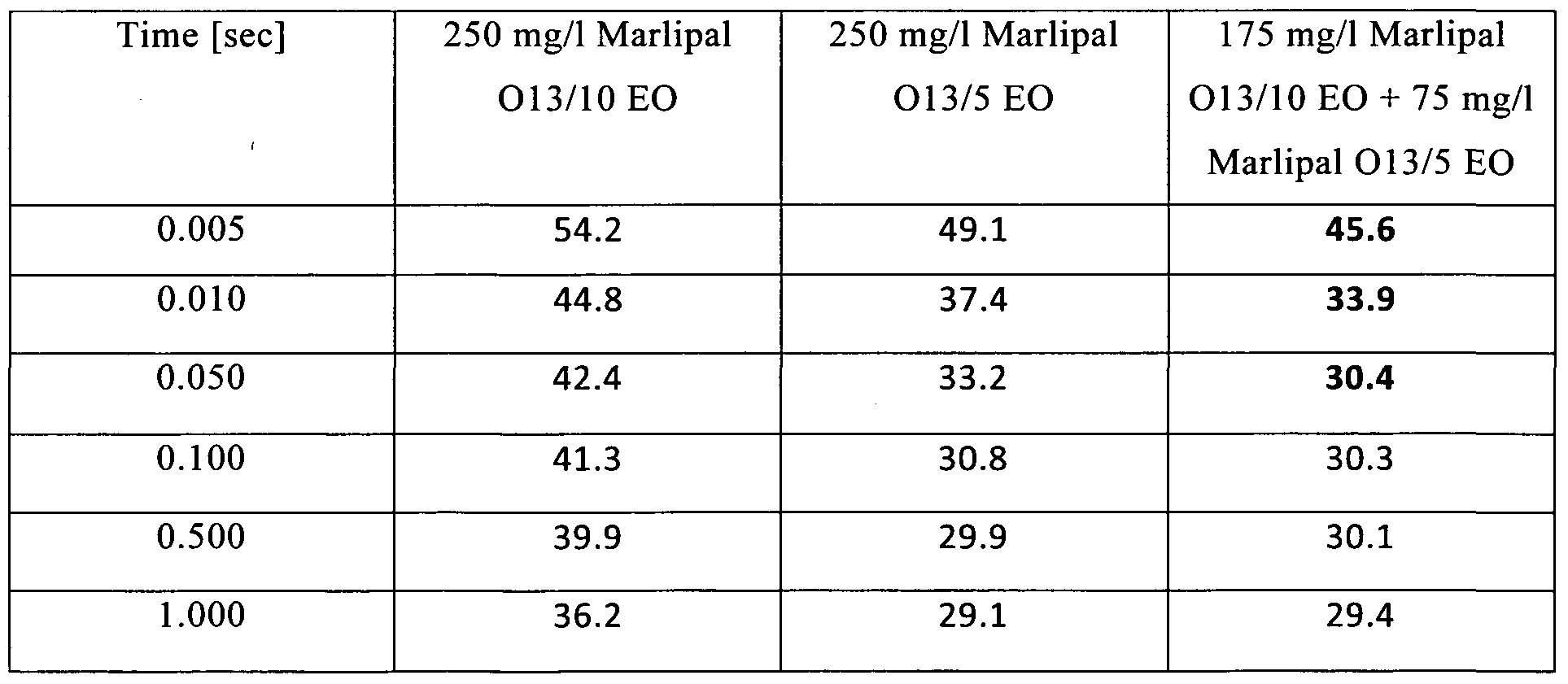
- An outstanding strong reduction of the dynamic surface tension is obtained milliseconds after a new surface is formed by spraying, using a synergetic effect between low and high ethoxylated compounds of the same species.
- a strong reduction of the surface tension is obtained already at low concentrations of the additive.
- a narrow distribution of droplet size is obtained because no bigger droplets will occur.
- the surfactants have a good solubility during storage at low temperatures down to -11 0 C. Use of substances dangerous to the environment is also avoided.
- 175 g of ethoxylated oxo alcohol with an alkyl chain of 13 C-atoms and a degree of ethoxylation of 12 and 75 g of ethoxylated oxo alcohol with an alkyl chain of 13 C- atoms and a degree of ethoxylation of 3 are added to 1 m 3 of an aqueous urea solution of the concentration of 32.5 mass % of urea.
- the solution remains optical clear even at a temperature of -11 °C.
- the surface tension of the urea solution is lowered from 67 mN/m to 28 mN/m.
- a spraying pattern test shows a strong reduction of the diameters of the droplets compared to a urea solution without the additive and even a finer distribution than an urea solution with 250 mg/1 of an ethoxylated oxo alcohol with an alkyl chain of 13 C-atoms and a degree of ethoxylation of 12.
- 15O g of ethoxylated oxo alcohol with an alkyl chain of 13 C-atoms and a degree of ethoxylation of 10 and 100 g of ethoxylated fatty amine with an alkyl chain of 13 C- atoms and a degree of ethoxylation of 5 are added to 1 m 3 of an aqueous urea solution of the concentration of 32.5 mass % of urea.
- the solution remains optical clear even at a temperature of -11 0 C.
- the surface tension of the urea solution is lowered from 67 mN/m to 29 mN/m.
- a spraying pattern test shows a strong reduction of the diameters of the droplets compared to an urea solution without the additive and even a finer distribution than an urea solution with 250 mg/1 of an ethoxylated oxo alcohol with an alkyl chain of 13 C-atoms and a degree of ethoxylation of 10.
- 250 g of ethoxylated oxo alcohol with an alkyl chain of 13 C-atoms and a degree of ethoxylation of 12 and 50 g of ethoxylated oxo alcohol with an alkyl chain of 13 C- atoms and a degree of ethoxylation of 5 are added to 1 m 3 of an aqueous urea solution of the concentration of 32.5 mass % of urea.
- the solution remains optical clear even at a temperature of -11 °C.
- the surface tension of the urea solution is lowered from 70 mN/m to 29 mN/m.
- a spraying pattern test shows a strong reduction of the diameters of the droplets compared to a urea solution without the additive.
- Example 5 200 g of ethoxylated oxo alcohol with an alkyl chain of 13 C-atoms and a degree of ethoxylation of 12 and 50 g of ethoxylated fatty amine with an alkyl chain of 12 C- atoms and a degree of ethoxylation of 5 are added to 1 m 3 of an aqueous urea solution of the concentration of 32.5 mass % of urea. The solution remains optical clear even at a temperature of -11 °C. The surface tension of the urea solution is lowered from 70 mN/m to 32 mN/m. A spraying pattern test shows a strong reduction of the diameters of the droplets compared to a urea solution without the additive.
Landscapes
- Engineering & Computer Science (AREA)
- Chemical & Material Sciences (AREA)
- Chemical Kinetics & Catalysis (AREA)
- Environmental & Geological Engineering (AREA)
- Health & Medical Sciences (AREA)
- Biomedical Technology (AREA)
- Analytical Chemistry (AREA)
- General Chemical & Material Sciences (AREA)
- Oil, Petroleum & Natural Gas (AREA)
- Toxicology (AREA)
- Combustion & Propulsion (AREA)
- Mechanical Engineering (AREA)
- General Engineering & Computer Science (AREA)
- Agricultural Chemicals And Associated Chemicals (AREA)
- Detergent Compositions (AREA)
- Organic Low-Molecular-Weight Compounds And Preparation Thereof (AREA)
- Treating Waste Gases (AREA)
Abstract
Description


Claims
Priority Applications (10)
| Application Number | Priority Date | Filing Date | Title |
|---|---|---|---|
| AU2009303997A AU2009303997B2 (en) | 2008-10-14 | 2009-10-13 | Method for minimizing the diameter of droplets of a urea solution by use of a surfactant mixture of alkoxylated compounds |
| EP09752000.1A EP2337625B1 (en) | 2008-10-14 | 2009-10-13 | Method for minimizing the diameter of droplets of a urea solution by use of a surfactant mixture of alkoxylated compounds |
| US13/123,947 US9050560B2 (en) | 2008-10-14 | 2009-10-13 | Method for minimizing the diameter of a urea solution, urea solution and use of a surfactant in urea solution |
| ES09752000.1T ES2439191T3 (en) | 2008-10-14 | 2009-10-13 | Procedure for minimizing the diameter of the droplets of a urea solution by using a mixture of surfactants of alkoxylated compounds |
| CN2009801400390A CN102176956B (en) | 2008-10-14 | 2009-10-13 | Method for minimizing droplet diameter of urea solutions by using surfactant mixtures of alkoxylated compounds |
| BRPI0920383A BRPI0920383B1 (en) | 2008-10-14 | 2009-10-13 | method to minimize the diameter of a urea solution, urea solution and use of a surfactant in urea solution |
| NZ589187A NZ589187A (en) | 2008-10-14 | 2009-10-13 | Method for minimizing the diameter of droplets of a urea solution by use of a surfactant mixture of alkoxylated compounds |
| CA2724781A CA2724781C (en) | 2008-10-14 | 2009-10-13 | Method for minimizing the diameter of droplets of a urea solution by use of a surfactant mixture of alkoxylated compounds |
| PL09752000T PL2337625T3 (en) | 2008-10-14 | 2009-10-13 | Method for minimizing the diameter of droplets of a urea solution by use of a surfactant mixture of alkoxylated compounds |
| DK09752000.1T DK2337625T3 (en) | 2008-10-14 | 2009-10-13 | Process for minimizing the diameter of droplets of a urea solution using a mixture of surfactants of alkoxylated compounds |
Applications Claiming Priority (2)
| Application Number | Priority Date | Filing Date | Title |
|---|---|---|---|
| NO20084298 | 2008-10-14 | ||
| NO20084298 | 2008-10-14 |
Publications (1)
| Publication Number | Publication Date |
|---|---|
| WO2010044676A1 true WO2010044676A1 (en) | 2010-04-22 |
Family
ID=41467285
Family Applications (1)
| Application Number | Title | Priority Date | Filing Date |
|---|---|---|---|
| PCT/NO2009/000358 Ceased WO2010044676A1 (en) | 2008-10-14 | 2009-10-13 | Method for minimizing the diameter of droplets of a urea solution by use of a surfactant mixture of alkoxylated compounds |
Country Status (11)
| Country | Link |
|---|---|
| US (1) | US9050560B2 (en) |
| EP (1) | EP2337625B1 (en) |
| CN (1) | CN102176956B (en) |
| AU (1) | AU2009303997B2 (en) |
| BR (1) | BRPI0920383B1 (en) |
| CA (1) | CA2724781C (en) |
| DK (1) | DK2337625T3 (en) |
| ES (1) | ES2439191T3 (en) |
| NZ (1) | NZ589187A (en) |
| PL (1) | PL2337625T3 (en) |
| WO (1) | WO2010044676A1 (en) |
Cited By (4)
| Publication number | Priority date | Publication date | Assignee | Title |
|---|---|---|---|---|
| US20120219485A1 (en) * | 2009-10-16 | 2012-08-30 | Proppabort Ab | Additive to urea solutions |
| US10399035B2 (en) | 2015-12-02 | 2019-09-03 | Total Marketing Services | Composition made from urea for treating exhaust gases |
| EP4122584A1 (en) | 2021-07-23 | 2023-01-25 | Basf Se | Reductant fluid for the after-treatment of exhaust gas |
| CN116036860A (en) * | 2022-12-28 | 2023-05-02 | 江苏可兰素环保科技有限公司 | A kind of vehicle urea solution for preventing crystallization of SCR system and preparation method thereof |
Families Citing this family (16)
| Publication number | Priority date | Publication date | Assignee | Title |
|---|---|---|---|---|
| WO2015176984A1 (en) * | 2014-05-23 | 2015-11-26 | Basf Se | Multi purpose additive for floor coating formulation |
| EP3075436B1 (en) * | 2015-04-02 | 2018-08-01 | Afton Chemical Limited | Diesel exhaust fluid solutions and methods of using the same |
| FR3064495B1 (en) | 2017-03-31 | 2021-04-02 | Total Marketing Services | UREA-BASED COMPOSITION FOR THE TREATMENT OF EXHAUST GASES |
| US11391190B2 (en) | 2020-03-20 | 2022-07-19 | Southwest Research Institute | Combined catalyst precursor/surfactant mixture for reductant urea solution for selective catalytic reduction |
| WO2021188117A1 (en) * | 2020-03-20 | 2021-09-23 | Southwest Research Institute | Combined catalyst precursor/surfactant mixture for reductant urea solution for selective catalytic reduction |
| FR3108526B1 (en) * | 2020-03-30 | 2022-09-09 | Total Marketing Services | Use of a composition comprising a reducing agent, a surfactant and a metal compound to prevent deposits in exhaust lines comprising an SCR catalyst |
| FR3108529A1 (en) | 2020-03-30 | 2021-10-01 | Total Marketing Services | Use of a composition comprising a reducing agent, at least one paraffin and a metal compound to prevent deposits in the exhaust lines comprising an SCR catalyst |
| FR3108527B1 (en) | 2020-03-30 | 2022-09-09 | Total Marketing Services | Use of a composition comprising a reducing agent and a metal compound to prevent deposits in exhaust lines comprising an SCR catalyst |
| US11732628B1 (en) | 2020-08-12 | 2023-08-22 | Old World Industries, Llc | Diesel exhaust fluid |
| WO2022125449A1 (en) | 2020-12-09 | 2022-06-16 | Jsip, Llc | Urea based diesel exhaust fluid with additive |
| FR3124598A1 (en) | 2021-06-25 | 2022-12-30 | Total Marketing Services | Method for detecting the presence of an additive in an exhaust gas treatment composition |
| EP4115970A1 (en) | 2021-07-05 | 2023-01-11 | TUNAP GmbH & Co. KG | Additive for cleaning scr systems |
| FR3125535B1 (en) | 2021-07-23 | 2023-07-28 | Totalenergies Marketing Services | Aqueous composition for the treatment of exhaust gases with improved antifoam properties |
| WO2023118397A1 (en) * | 2021-12-22 | 2023-06-29 | Xenum Nv/Sa | Additive for nox reducing solution |
| FR3138048A1 (en) | 2022-07-19 | 2024-01-26 | Totalenergies Onetech | Aqueous composition for exhaust gas treatment with improved properties |
| JP2025531045A (en) | 2022-08-30 | 2025-09-19 | トタルエナジーズ・ワンテック | Aqueous compositions for treating exhaust gases having improved properties |
Citations (3)
| Publication number | Priority date | Publication date | Assignee | Title |
|---|---|---|---|---|
| WO2000030733A1 (en) * | 1998-11-23 | 2000-06-02 | Mobil Oil Corporation | Liquid urea exhaust gas treatment additive |
| FR2912932A1 (en) * | 2007-02-23 | 2008-08-29 | Total France Sa | AQUEOUS SOLUTION FOR THE TREATMENT OF EXHAUST GASES FROM DIESEL ENGINES |
| FR2914688A1 (en) * | 2007-04-04 | 2008-10-10 | Jean Claude Fayard | ADDITIVE TO IMPROVE THE FUNCTIONING OF NITROGEN OXIDE REDUCTION SYSTEMS THROUGH THE EXHAUST GAS UHEATION OF DIESEL ENGINES |
Family Cites Families (8)
| Publication number | Priority date | Publication date | Assignee | Title |
|---|---|---|---|---|
| FR701305A (en) | 1930-07-18 | 1931-03-14 | Niezoldi & Kramer G M B H | Spring-operated cinematographic camera |
| US5441713A (en) * | 1988-04-29 | 1995-08-15 | Nalco Fuel Tech | Hardness suppression in urea solutions |
| US5489419A (en) | 1992-10-13 | 1996-02-06 | Nalco Fuel Tech | Process for pollution control |
| US5536482A (en) * | 1992-10-13 | 1996-07-16 | Nalco Fuel Tech | Process for pollution control |
| EP0748203A1 (en) | 1994-03-11 | 1996-12-18 | The Procter & Gamble Company | LOW pH, HYDROLYTICALLY STABLE, COSMETIC COMPOSITIONS CONTAINING ACIDIC ACTIVES |
| CA2393157A1 (en) * | 1999-11-23 | 2001-05-31 | Tomah Products, Inc. | Fuel additive, additive-containing fuel compositions and method of manufacture |
| FR2911932B1 (en) | 2007-01-31 | 2009-04-24 | Hispano Suiza Sa | DEVICE FOR CONTROLLING A VARIABLE GEOMETRY ORGAN IN A TURBOJET. |
| CN101255383B (en) * | 2008-03-27 | 2010-12-01 | 中国石油化工股份有限公司 | Highly effective ferrous sulfide deactivation cleaning agent |
-
2009
- 2009-10-13 EP EP09752000.1A patent/EP2337625B1/en active Active
- 2009-10-13 ES ES09752000.1T patent/ES2439191T3/en active Active
- 2009-10-13 CA CA2724781A patent/CA2724781C/en active Active
- 2009-10-13 DK DK09752000.1T patent/DK2337625T3/en active
- 2009-10-13 US US13/123,947 patent/US9050560B2/en active Active
- 2009-10-13 CN CN2009801400390A patent/CN102176956B/en active Active
- 2009-10-13 PL PL09752000T patent/PL2337625T3/en unknown
- 2009-10-13 AU AU2009303997A patent/AU2009303997B2/en active Active
- 2009-10-13 BR BRPI0920383A patent/BRPI0920383B1/en active IP Right Grant
- 2009-10-13 NZ NZ589187A patent/NZ589187A/en unknown
- 2009-10-13 WO PCT/NO2009/000358 patent/WO2010044676A1/en not_active Ceased
Patent Citations (3)
| Publication number | Priority date | Publication date | Assignee | Title |
|---|---|---|---|---|
| WO2000030733A1 (en) * | 1998-11-23 | 2000-06-02 | Mobil Oil Corporation | Liquid urea exhaust gas treatment additive |
| FR2912932A1 (en) * | 2007-02-23 | 2008-08-29 | Total France Sa | AQUEOUS SOLUTION FOR THE TREATMENT OF EXHAUST GASES FROM DIESEL ENGINES |
| FR2914688A1 (en) * | 2007-04-04 | 2008-10-10 | Jean Claude Fayard | ADDITIVE TO IMPROVE THE FUNCTIONING OF NITROGEN OXIDE REDUCTION SYSTEMS THROUGH THE EXHAUST GAS UHEATION OF DIESEL ENGINES |
Cited By (4)
| Publication number | Priority date | Publication date | Assignee | Title |
|---|---|---|---|---|
| US20120219485A1 (en) * | 2009-10-16 | 2012-08-30 | Proppabort Ab | Additive to urea solutions |
| US10399035B2 (en) | 2015-12-02 | 2019-09-03 | Total Marketing Services | Composition made from urea for treating exhaust gases |
| EP4122584A1 (en) | 2021-07-23 | 2023-01-25 | Basf Se | Reductant fluid for the after-treatment of exhaust gas |
| CN116036860A (en) * | 2022-12-28 | 2023-05-02 | 江苏可兰素环保科技有限公司 | A kind of vehicle urea solution for preventing crystallization of SCR system and preparation method thereof |
Also Published As
| Publication number | Publication date |
|---|---|
| CN102176956A (en) | 2011-09-07 |
| EP2337625B1 (en) | 2013-09-11 |
| AU2009303997A1 (en) | 2010-04-22 |
| BRPI0920383A2 (en) | 2016-03-22 |
| US9050560B2 (en) | 2015-06-09 |
| CN102176956B (en) | 2013-11-06 |
| US20110233461A1 (en) | 2011-09-29 |
| DK2337625T3 (en) | 2013-12-09 |
| ES2439191T3 (en) | 2014-01-21 |
| EP2337625A1 (en) | 2011-06-29 |
| PL2337625T3 (en) | 2014-02-28 |
| BRPI0920383B1 (en) | 2019-12-17 |
| CA2724781A1 (en) | 2010-04-22 |
| NZ589187A (en) | 2011-10-28 |
| CA2724781C (en) | 2012-08-07 |
| AU2009303997B2 (en) | 2015-04-30 |
Similar Documents
| Publication | Publication Date | Title |
|---|---|---|
| AU2009303997B2 (en) | Method for minimizing the diameter of droplets of a urea solution by use of a surfactant mixture of alkoxylated compounds | |
| ES2728802T3 (en) | Use of an aqueous solution in SCR devices for the treatment of exhaust gases from diesel engines and SCR procedure | |
| US10399035B2 (en) | Composition made from urea for treating exhaust gases | |
| US9878288B2 (en) | Ammonia gas generator, method for producing ammonia and use of the same for reducing nitrogen oxides in exhaust gases | |
| WO1994008895A1 (en) | Process and composition for pollution control | |
| ES2870105T3 (en) | Composition for exhaust gas treatment | |
| EP3075436B1 (en) | Diesel exhaust fluid solutions and methods of using the same | |
| US10774709B2 (en) | Fluid for purifying heat engines and methods for preparing said fluids by emulsification | |
| EP4122584A1 (en) | Reductant fluid for the after-treatment of exhaust gas | |
| KR100374291B1 (en) | Method for reducing the content of nitrogen oxides in gas exhausted from combustion reactor | |
| CN118369150B (en) | Aqueous compositions with improved properties for treating exhaust gases | |
| US12378505B2 (en) | Additive for cleaning SCR systems | |
| JP2025531045A (en) | Aqueous compositions for treating exhaust gases having improved properties | |
| DE4446773B4 (en) | Process for denitrification of exhaust gases from diesel and lean burn engines | |
| JP2024528325A (en) | Aqueous compositions for treating exhaust gases having improved antifoam properties - Patents.com | |
| PL243193B1 (en) | A method of producing a preparation supporting the cleaning of exhaust gases from nitrogen oxides, especially exhaust gases emitted by diesel engines | |
| JP2003260331A (en) | Reducing agent composition for flue gas denitration |
Legal Events
| Date | Code | Title | Description |
|---|---|---|---|
| WWE | Wipo information: entry into national phase |
Ref document number: 200980140039.0 Country of ref document: CN |
|
| 121 | Ep: the epo has been informed by wipo that ep was designated in this application |
Ref document number: 09752000 Country of ref document: EP Kind code of ref document: A1 |
|
| WWE | Wipo information: entry into national phase |
Ref document number: 2009303997 Country of ref document: AU |
|
| WWE | Wipo information: entry into national phase |
Ref document number: 7593/DELNP/2010 Country of ref document: IN Ref document number: 2009752000 Country of ref document: EP |
|
| WWE | Wipo information: entry into national phase |
Ref document number: 589187 Country of ref document: NZ |
|
| WWE | Wipo information: entry into national phase |
Ref document number: 2724781 Country of ref document: CA |
|
| ENP | Entry into the national phase |
Ref document number: 2009303997 Country of ref document: AU Date of ref document: 20091013 Kind code of ref document: A |
|
| NENP | Non-entry into the national phase |
Ref country code: DE |
|
| WWE | Wipo information: entry into national phase |
Ref document number: 13123947 Country of ref document: US |
|
| ENP | Entry into the national phase |
Ref document number: PI0920383 Country of ref document: BR Kind code of ref document: A2 Effective date: 20110407 |