WO2010047338A1 - 農業用光散乱フッ素樹脂フィルム及びその製造方法 - Google Patents
農業用光散乱フッ素樹脂フィルム及びその製造方法 Download PDFInfo
- Publication number
- WO2010047338A1 WO2010047338A1 PCT/JP2009/068081 JP2009068081W WO2010047338A1 WO 2010047338 A1 WO2010047338 A1 WO 2010047338A1 JP 2009068081 W JP2009068081 W JP 2009068081W WO 2010047338 A1 WO2010047338 A1 WO 2010047338A1
- Authority
- WO
- WIPO (PCT)
- Prior art keywords
- light
- film
- fluororesin film
- scattering
- fluororesin
- Prior art date
- Legal status (The legal status is an assumption and is not a legal conclusion. Google has not performed a legal analysis and makes no representation as to the accuracy of the status listed.)
- Ceased
Links
Images
Classifications
-
- A—HUMAN NECESSITIES
- A01—AGRICULTURE; FORESTRY; ANIMAL HUSBANDRY; HUNTING; TRAPPING; FISHING
- A01G—HORTICULTURE; CULTIVATION OF VEGETABLES, FLOWERS, RICE, FRUIT, VINES, HOPS OR SEAWEED; FORESTRY; WATERING
- A01G9/00—Cultivation in receptacles, forcing-frames or greenhouses; Edging for beds, lawn or the like
- A01G9/14—Greenhouses
- A01G9/1438—Covering materials therefor; Materials for protective coverings used for soil and plants, e.g. films, canopies, tunnels or cloches
-
- A—HUMAN NECESSITIES
- A01—AGRICULTURE; FORESTRY; ANIMAL HUSBANDRY; HUNTING; TRAPPING; FISHING
- A01G—HORTICULTURE; CULTIVATION OF VEGETABLES, FLOWERS, RICE, FRUIT, VINES, HOPS OR SEAWEED; FORESTRY; WATERING
- A01G9/00—Cultivation in receptacles, forcing-frames or greenhouses; Edging for beds, lawn or the like
- A01G9/14—Greenhouses
-
- A—HUMAN NECESSITIES
- A01—AGRICULTURE; FORESTRY; ANIMAL HUSBANDRY; HUNTING; TRAPPING; FISHING
- A01G—HORTICULTURE; CULTIVATION OF VEGETABLES, FLOWERS, RICE, FRUIT, VINES, HOPS OR SEAWEED; FORESTRY; WATERING
- A01G9/00—Cultivation in receptacles, forcing-frames or greenhouses; Edging for beds, lawn or the like
- A01G9/22—Shades or blinds for greenhouses, or the like
-
- C—CHEMISTRY; METALLURGY
- C08—ORGANIC MACROMOLECULAR COMPOUNDS; THEIR PREPARATION OR CHEMICAL WORKING-UP; COMPOSITIONS BASED THEREON
- C08J—WORKING-UP; GENERAL PROCESSES OF COMPOUNDING; AFTER-TREATMENT NOT COVERED BY SUBCLASSES C08B, C08C, C08F, C08G or C08H
- C08J5/00—Manufacture of articles or shaped materials containing macromolecular substances
- C08J5/18—Manufacture of films or sheets
-
- Y—GENERAL TAGGING OF NEW TECHNOLOGICAL DEVELOPMENTS; GENERAL TAGGING OF CROSS-SECTIONAL TECHNOLOGIES SPANNING OVER SEVERAL SECTIONS OF THE IPC; TECHNICAL SUBJECTS COVERED BY FORMER USPC CROSS-REFERENCE ART COLLECTIONS [XRACs] AND DIGESTS
- Y02—TECHNOLOGIES OR APPLICATIONS FOR MITIGATION OR ADAPTATION AGAINST CLIMATE CHANGE
- Y02A—TECHNOLOGIES FOR ADAPTATION TO CLIMATE CHANGE
- Y02A40/00—Adaptation technologies in agriculture, forestry, livestock or agroalimentary production
- Y02A40/10—Adaptation technologies in agriculture, forestry, livestock or agroalimentary production in agriculture
- Y02A40/25—Greenhouse technology, e.g. cooling systems therefor
-
- Y—GENERAL TAGGING OF NEW TECHNOLOGICAL DEVELOPMENTS; GENERAL TAGGING OF CROSS-SECTIONAL TECHNOLOGIES SPANNING OVER SEVERAL SECTIONS OF THE IPC; TECHNICAL SUBJECTS COVERED BY FORMER USPC CROSS-REFERENCE ART COLLECTIONS [XRACs] AND DIGESTS
- Y10—TECHNICAL SUBJECTS COVERED BY FORMER USPC
- Y10T—TECHNICAL SUBJECTS COVERED BY FORMER US CLASSIFICATION
- Y10T428/00—Stock material or miscellaneous articles
- Y10T428/24—Structurally defined web or sheet [e.g., overall dimension, etc.]
- Y10T428/24355—Continuous and nonuniform or irregular surface on layer or component [e.g., roofing, etc.]
-
- Y—GENERAL TAGGING OF NEW TECHNOLOGICAL DEVELOPMENTS; GENERAL TAGGING OF CROSS-SECTIONAL TECHNOLOGIES SPANNING OVER SEVERAL SECTIONS OF THE IPC; TECHNICAL SUBJECTS COVERED BY FORMER USPC CROSS-REFERENCE ART COLLECTIONS [XRACs] AND DIGESTS
- Y10—TECHNICAL SUBJECTS COVERED BY FORMER USPC
- Y10T—TECHNICAL SUBJECTS COVERED BY FORMER US CLASSIFICATION
- Y10T428/00—Stock material or miscellaneous articles
- Y10T428/24—Structurally defined web or sheet [e.g., overall dimension, etc.]
- Y10T428/24355—Continuous and nonuniform or irregular surface on layer or component [e.g., roofing, etc.]
- Y10T428/24372—Particulate matter
-
- Y—GENERAL TAGGING OF NEW TECHNOLOGICAL DEVELOPMENTS; GENERAL TAGGING OF CROSS-SECTIONAL TECHNOLOGIES SPANNING OVER SEVERAL SECTIONS OF THE IPC; TECHNICAL SUBJECTS COVERED BY FORMER USPC CROSS-REFERENCE ART COLLECTIONS [XRACs] AND DIGESTS
- Y10—TECHNICAL SUBJECTS COVERED BY FORMER USPC
- Y10T—TECHNICAL SUBJECTS COVERED BY FORMER US CLASSIFICATION
- Y10T428/00—Stock material or miscellaneous articles
- Y10T428/24—Structurally defined web or sheet [e.g., overall dimension, etc.]
- Y10T428/24355—Continuous and nonuniform or irregular surface on layer or component [e.g., roofing, etc.]
- Y10T428/24372—Particulate matter
- Y10T428/24421—Silicon containing
- Y10T428/2443—Sand, clay, or crushed rock or slate
-
- Y—GENERAL TAGGING OF NEW TECHNOLOGICAL DEVELOPMENTS; GENERAL TAGGING OF CROSS-SECTIONAL TECHNOLOGIES SPANNING OVER SEVERAL SECTIONS OF THE IPC; TECHNICAL SUBJECTS COVERED BY FORMER USPC CROSS-REFERENCE ART COLLECTIONS [XRACs] AND DIGESTS
- Y10—TECHNICAL SUBJECTS COVERED BY FORMER USPC
- Y10T—TECHNICAL SUBJECTS COVERED BY FORMER US CLASSIFICATION
- Y10T428/00—Stock material or miscellaneous articles
- Y10T428/25—Web or sheet containing structurally defined element or component and including a second component containing structurally defined particles
- Y10T428/251—Mica
Definitions
- the present invention relates to an agricultural light-scattering fluororesin film and a method for producing the same.
- ⁇ Coating materials for agricultural houses and the like are required to have excellent transparency and that the strength and transmittance of visible light do not change even when exposed outdoors for more than 10 years. Therefore, fluororesin films represented by ETFE (ethylene-tetrafluoroethylene copolymer) are widely used.
- ETFE ethylene-tetrafluoroethylene copolymer
- the color of the fruit, flower, or vegetable, sugar content, yield improvement, or prevention of disease is affected by the scattering of transmitted light in the film of the agricultural house. That is, when there is a lot of direct light among the light transmitted through the film, leaf burning due to direct sunlight irradiation and seedling withering due to a rapid rise in house temperature may occur. In addition, because there is less scattered light, there are more shaded parts due to aggregates such as crops and house posts, so that the crops in the shaded parts will not grow well, the coloration of the crops will be uneven, It was difficult to manage the cultivation / harvest time due to the difference in growth rate between crops.
- Patent Document 1 discloses a method of scattering light by dispersing composite particles made of silica, talc, mica, and the like in a fluororesin.
- Patent Document 2 discloses a method of scattering light by providing a rough surface on at least one surface of a film.
- the present invention is a film that can be used as a covering material for agricultural houses, etc., can reduce the occurrence of leaf burning, seedling wilt, etc., and cultivate crops with excellent color uniformity with high productivity It aims at providing the light-scattering fluororesin film for agriculture which can do.
- This invention provides the agricultural light-scattering film which has the following structures, and its manufacturing method.
- [3] The agricultural light-scattering fluororesin film according to [1] or [2], wherein the ratio of scattered light having a scattering angle of 30 ° or more is 1% or less with respect to all transmitted light.
- the fluororesin film has irregularities on the surface, and the surface roughness expressed by arithmetic mean roughness Ra is 1.6 ⁇ m to 3 ⁇ m in both the TD direction (width direction) and the MD direction (flow direction).
- the agricultural light-scattering fluororesin film according to any one of [1] to [3].
- the fluororesin film has irregularities on the surface, and the surface roughness expressed by a ten-point average roughness Rz is 13 to 25 ⁇ m in both the TD direction and the MD direction.
- the light scattering fluororesin film for agriculture according to any one of the above.
- the agricultural light according to any one of [1] to [5], wherein the fluororesin film has irregularities on the surface, and an average interval Sm between the irregularities is 40 to 100 ⁇ m in both the MD direction and the TD direction.
- Scattered fluororesin film [7]
- the fluororesin film contains synthetic mica particles having an average particle diameter of 3 to 15 ⁇ m, and the content thereof is 3 to 5 parts by mass with respect to 100 parts by mass of the fluororesin.
- the light scattering fluororesin film for agriculture according to any one of the above.
- [8] A method for producing an agricultural light-scattering fluororesin film having irregularities on the surface thereof according to any one of [4] to [7], a step of extruding the fluororesin from a die using an extruder, The manufacturing method of the agricultural light-scattering fluororesin film which has an unevenness
- the agricultural light-scattering film of the present invention is a film that can be used as a covering material for agricultural houses, etc., can reduce the occurrence of leaf burning, seedling wilt, etc., and has a high crop with excellent color uniformity Can be cultivated with productivity.
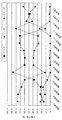
- FIG. 6 is a view showing the emission distribution of transmitted light in the fluororesin films of Production Examples 1 to 11 and the agricultural films of Reference Examples 1 to 3.
- the agricultural light-scattering fluororesin film of the present invention (hereinafter sometimes simply referred to as “fluororesin film”) is a film that can be used as a covering material for agricultural houses, etc. To do.
- fluororesin used for the base material examples include polyvinylidene fluoride, polytetrafluoroethylene, polychlorotrifluoroethylene, polyhexafluoropropylene, polyvinyl fluoride, vinylidene fluoride-tetrafluoroethylene-hexafluoropropylene copolymer, Examples include vinylidene fluoride-hexafluoropropylene copolymer, ethylene-tetrafluoroethylene copolymer (ETFE), tetrafluoroethylene-hexafluoropropylene copolymer, and perfluoro (alkyl vinyl ale) -tetrafluoroethylene copolymer. It is done.
- ETFE tetrafluoroethylene-hexafluoropropylene copolymer
- perfluoro (alkyl vinyl ether) -tetrafluoroethylene copolymer are preferable, and ETFE is particularly preferable.
- the number average molecular weight of the fluororesin is not particularly limited, but is preferably 10,000 to 1,000,000, and more preferably 100,000 to 700,000. When the number average molecular weight of the fluororesin is 10,000 or more, the strength of the film becomes higher. If the number average molecular weight of the fluororesin is 1,000,000 or less, it is more excellent in moldability.
- the thickness of the fluororesin film is not particularly limited, but it is preferably 10 to 500 ⁇ m, more preferably 20 to 200 ⁇ m, as a covering material for agricultural houses. If the thickness is 10 ⁇ m or more, physical strength such as tear strength tends to be sufficient as a covering material for agricultural houses. Moreover, if thickness is 500 micrometers or less, sufficient light transmittance will be easy to be obtained. Since the fluororesin film of the present invention is a film for agricultural use, the total light transmittance through the film is preferably 85% or more.
- the ratio of scattered light having a scattering angle of 5.5 to 10 ° is 5% or more, preferably 10% or more, and preferably 20% or more with respect to the total transmitted light. It is more preferable. If the ratio of scattered light with a scattering angle of 5.5 to 10 ° is 5% or more, it is possible to reduce the occurrence of diseases such as leaf burning and seedling dying, and to produce crops with excellent uniformity in color and sugar content. It can be cultivated with high productivity.
- the upper limit of the ratio of scattered light having a scattering angle of 5.5 to 10 ° is not particularly limited, but is preferably 40% or less.
- the scattered light in the present invention means light scattered through the film.
- the scattering angle is an angle formed by the traveling direction of incident light incident on the film and the traveling direction of scattered light.
- the fluororesin film of the present invention since the ratio of scattered light with a scattering angle of 5.5 to 10 ° is 5% or more, it is possible to prevent the formation of shaded parts due to aggregate in the house, Uniformity of sugar content is improved, and diseases caused by direct sunlight are suppressed. In addition, although the amount of light reaching the top leaf is less than when there is a lot of direct light, it can reach the bottom leaf of the crop in the house sufficiently, resulting in the total amount of photosynthesis in the entire crop. Increases crop productivity.
- the relationship between scattered light and the color of crops, sugar content, yield, degree of disease occurrence in agricultural house covering materials has not been known in detail, and the ratio of scattering sources is also evaluated using haze values. It was only done.
- the scattering angle is measured with an automatic goniophotometer, and the scattering angle of 5.5 to 10 ° is examined by examining the influence of the scattered light having a specific scattering angle on the crop cultivated in the house. Has been found to be particularly important for crop color, sugar content, yield improvement, and disease reduction.
- the ratio of scattered light having a scattering angle of 1 to 10 ° to the total transmitted light transmitted through the film is preferably 50% or more, more preferably 60% or more, and 70% or more. Most preferably it is. If the ratio of scattered light with a scattering angle of 1 to 10 ° is 50% or more, it will be easier for the crops cultivated in the house to have enough light to reach evenly in a state where the ratio of direct light is suppressed. In addition, it is easy to cultivate crops with excellent uniformity in color and sugar content with high productivity by reducing the occurrence of diseases such as seedling wilt.
- the upper limit of the ratio of scattered light having a scattering angle of 1 to 10 ° is not particularly limited, but is preferably 90% or less.
- the ratio of the scattered light having a scattering angle of 30 ° or more to the total transmitted light transmitted through the film is preferably 1% or less. If the scattered light with a scattering angle of 30 ° or more is 1% or less, the light that has passed through the film and entered the house is prevented from going out as it is because the scattering angle is too large. It will be easier to get enough light to reach the crop.
- direct light ratio of light having a scattering angle of 0 to 0.5 °
- the total transmitted light transmitted through the film is preferably 40% or less, more preferably 30% or less. preferable. If the scattered light with a scattering angle of 0 to 0.5 ° is 40% or less, it is easy to prevent the shade from being formed by the aggregate in the house and the temperature in the house from rising rapidly. Therefore, it is easy to reduce diseases of crops, improve the uniformity of color and sugar content, and improve productivity.
- the form for scattering the light transmitted through the film As the form for scattering the light transmitted through the film, the form in which the film surface is roughened, the form in which the light-scattering agent is contained in the fluororesin forming the film, and The form which compounded them is mentioned.
- the surface roughness Ra (arithmetic mean roughness) is 1.6 ⁇ m or more in both the TD direction (width direction) and MD direction (flow direction), and 3 ⁇ m or less. Is preferably 1.7 to 3 ⁇ m, and most preferably 1.8 to 2.5 ⁇ m. If Ra is 1.6 ⁇ m or more, the fluororesin film tends to have a ratio of scattered light having a scattering angle of 5.5 to 10 ° out of the total transmitted light transmitted through the film of 5% or more.
- the ratio of the scattered light having a scattering angle of 5.5 to 10 ° out of the total transmitted light transmitted through the film is 5% or more and the scattering light having a scattering angle of 1 to 10 °. It is easy to obtain a fluororesin film having a light ratio of 50% or more. Moreover, if Ra is 3 micrometers or less, it will become easy to make the ratio of the scattered light with a scattering angle of 30 degrees or more out of the total transmitted light which permeate
- the Rz (10-point average roughness) of the fluororesin film is 13 ⁇ m or more and preferably 25 ⁇ m or less in both the TD direction and the MD direction, more preferably 15 to 25 ⁇ m, and more preferably 18 to 22 ⁇ m. Is more preferable.
- the ratio of the scattered light having a scattering angle of 5.5 to 10 ° is 5% or more and the ratio of the scattered light having a scattering angle of 1 to 10 ° in the total transmitted light transmitted through the film. It is easy to obtain a fluororesin film of 50% or more.
- Rz is 25 ⁇ m or less, it becomes easy to make the ratio of scattered light having a scattering angle of 30 ° or more out of total transmitted light transmitted through the film 1% or less.
- Sm (average interval of irregularities) formed on the surface of the fluororesin film tends to be smaller as the Ra and Rz values are higher, and is preferably 40 to 100 ⁇ m in both the MD direction and the TD direction. It is more preferably 50 to 95 ⁇ m, and further preferably 60 to 90 ⁇ m. If Sm is 40 ⁇ m or more, it is easy to prevent the film surface from becoming smoother and too much scattered light. Further, if Sm is 100 ⁇ m or less, it is easy to increase the ratio of scattered light having a scattering angle of 5.5 to 10 ° and the ratio of scattered light having a scattering angle of 1 to 10 ° in the total transmitted light.
- Ra, Rz, and Sm in the present invention mean values measured according to JIS B 0601 (2001 edition). Further, Ra, Rz, and Sm can be measured by a stylus type surface roughness measuring instrument (manufactured by Kosaka Laboratory, Surfcoder SE-30H).
- the fluororesin film of the present invention may scatter light transmitted through the film by containing a light scattering agent.
- a light scattering agent for example, commercially available products such as silica, talc and mica can be used as appropriate.
- synthetic mica particles are preferable because they do not excessively reduce the total light transmittance of the fluororesin film and suppress deterioration of the fluororesin.
- synthetic mica KMg 2.5 Si synthesized by solid-phase reaction of talc represented by Mg 3 Si 4 O 10 (OH) 2 and potassium silicofluoride represented by K 2 SiF 6 is used. Examples thereof include potassium tetrasilicon mica represented by 4 O 10 F 2 .
- the average particle diameter is preferably 3 to 15 ⁇ m, more preferably 6 to 10 ⁇ m. If the average particle diameter of the synthetic mica particles is 3 ⁇ m or more, the light scattering ability will be higher, so that it becomes easy to obtain a sufficient light transmittance by reducing the addition amount. If the average particle diameter of the synthetic mica particles is 15 ⁇ m or less, it is easy to suppress that the synthetic mica particles are exposed on the surface of the fluororesin film and the good stain resistance, which is a characteristic of the fluororesin film itself, is impaired.
- the average particle size is obtained by measuring the particle size distribution by a laser diffraction scattering method, obtaining a cumulative curve with the total volume of particles as 100%, and determining the particle size at the point where the cumulative volume is 50% on the cumulative curve, It means the value of 50% diameter (cumulative median diameter).
- a microtrack particle size distribution measuring device manufactured by Nikkiso Co., Ltd., product name: HRA X-100 can be used.
- the content of the synthetic mica particles is preferably 3 to 5 parts by mass with respect to 100 parts by mass of the fluororesin forming the fluororesin film.
- the content of the synthetic mica particles is 3 parts by mass or more, it is easy to improve the ratio of scattered light having a scattering angle of 5.5 to 10 ° with respect to the total transmitted light transmitted through the film.
- the content of the synthetic mica particles is 5 parts by mass or less, the synthetic mica particles are exposed on the surface of the fluororesin film, and the contamination resistance, which is a characteristic of the fluororesin film itself, is prevented from being impaired. Cheap.
- the synthetic mica particles are contained in the fluororesin film, it is preferable to contain the synthetic mica particles and a treatment agent having a function of hydrophobizing the surface of the particles.
- a treatment agent having a function of hydrophobizing the surface of the particles it is not so difficult to disperse synthetic mica particles having an average particle size of 3 ⁇ m or more in the fluororesin, the compound of fluororesin and synthetic mica particles can be obtained by making the treatment agent present on the surface of the synthetic mica particles. In the process and the film forming process, the dispersibility of the synthetic mica particles is improved and it becomes easy to suppress the coloring of the fluororesin.
- the treating agent a silane coupling agent having an alkyl group or a silicone compound is preferable.
- the fluororesin film of the present invention forms a film from a fluororesin containing a light scattering agent and, if necessary, a treatment agent having a function of hydrophobizing the surface of the light scattering agent, and the surface of the film.
- a treatment agent having a function of hydrophobizing the surface of the light scattering agent
- the ratio of scattered light having a scattering angle of 5.5 to 10 ° may be 5% or more of the total transmitted light.
- the fluororesin film of the present invention may contain known additives as necessary. Examples of the additive include inorganic ultraviolet absorbers such as cerium oxide, zinc oxide, and iron oxide, and commercially available organic ultraviolet absorbers.
- the fluororesin film of the present invention is for agriculture, and is suitably used for horticultural houses and agricultural houses.
- it can be suitably used for the cultivation of crops that dislike direct sunlight such as melons, crops such as tomatoes and strawberries that require coloration of crops, and seedlings that dislike rapid temperature changes.
- the ratio of direct light and scattered light is the optimum condition for cultivating crops in an agricultural house. That is to say, the direct burning of sunlight is moderated, so that the leaf burning and seedling withering of the plant can be reduced. Moreover, it becomes difficult to make shadows due to the aggregates of agricultural houses, so that partial growth failure of crops can be prevented. Moreover, since the light is evenly irradiated to the crops, the crop yield is improved and the harvest rate of high-grade crops is also improved.
- the melt-extruded film molding method is preferably a T-die type extrusion method from the viewpoint of the uniformity of the thickness of the formed film and the flatness.
- the roughening method can be used also when the surface is roughened.
- inorganic fine particles such as silica fine particles and alumina fine particles are applied to the treated surface, and further, the inorganic fine particles are adhered to the film surface in order to adhere to the film surface.
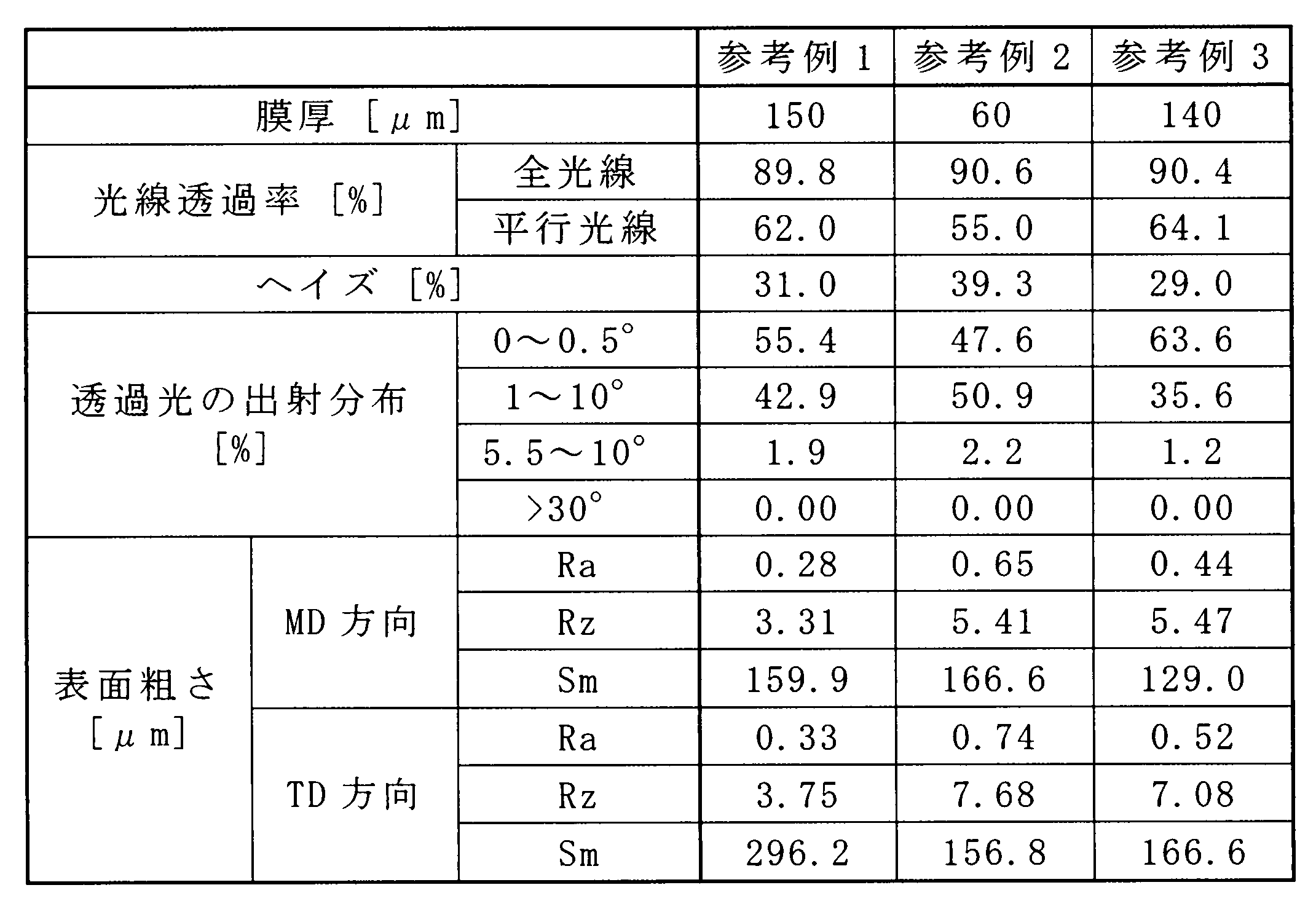
- Table 1 shows the results of measurement of surface roughness ( ⁇ 10 °, 5.5-10 °, distribution of 30 ° or more).
- content of the light-scattering agent in Table 1 is content with respect to 100 mass parts of fluororesins.
- “Composite fine particles” in Table 1 means zinc oxide / silica composite fine particles.
- the emission distribution of the transmitted light of the film is shown in FIG.
- the ratio of scattered light having a scattering angle of 5.5 to 10 ° was 5% or more.
- the ratio of scattered light with a scattering angle of 1 to 10 ° was 50% or more.
- the ratio of scattered light having a scattering angle of 0 to 0.5 ° is lowered, and the ratio of scattered light having a scattering angle of 1 to 10 ° is further reduced.
- the ratio of scattered light with a scattering angle of 1 to 10 ° was 50% or more, and the ratio of scattered light with a scattering angle of 5.5 to 10 ° was 5% or more.
- the fluororesin film of Production Example 5 in which the film surface Ra is less than 1.6 ⁇ m and the surface is a mirror-type clear film has a high ratio of scattered light with a scattering angle of 0 to 0.5 °, and the scattering angle The ratio of scattered light at 1 to 10 ° was 50% or less, the light transmitted through the film was hardly scattered, and the ratio of scattered light at a scattering angle of 5.5 to 10 ° was 0%.
- the fluororesin film of Production Example 6 in which the Ra on the film surface was adjusted to less than 1.6 ⁇ m the light transmitted through the film was not scattered so much and the ratio of scattered light having a scattering angle of 5.5 to 10 °. was 0%.
- the existing agricultural films of Reference Examples 1 to 3 that are commercially available have a high ratio of scattered light with a scattering angle of 0 to 0.5 °, and a scattering angle of 1 to 10 Although the ratio of scattered light at ° exceeded 50%, the ratio of scattered light at a scattering angle of 5.5 to 10 ° was low.
- Example 1 The fluororesin film obtained in Production Example 1 was subjected to corona discharge treatment, and a dropping agent was applied to a thickness of 0.2 ⁇ m. Strawberries were grown in a house where the film was spread on an agricultural roof type house. In the house, four rows of cocoons with a width of 130 cm and a length of 10.5 m were made, and the strawberry “Sachinoka” was planted in a row of 45 strains per row and 20 cm between the strains. The conditions for compost and basic fertilizer were 4 t per 10a for bark compost, 10 kg per 1 a using CDU chemical lime as a nitrogen component, and 120 kg per 10 a for bitter lime. During the cultivation period, cultivation was performed without heating.
- the survey period for yield was from January 23 to March 26, and the survey period for sugar content was from January 23 to April 12.
- cucumbers were cultivated in the same house. On September 6, cucumber “Summer Suzumi” was sown, and on September 11, transplanted to a 9 cm pot containing a seedling bark. And 10 nursery pots were installed in the house and cultivated. In the house, no material to block sunlight, such as cold shielding, was installed, and the cultivation period was from September 11 to September 23.
- the fluororesin film of the present invention the amount of direct sunlight that causes leaf burning of crops is reduced, the light in the house is softened by the scattered light, and it is difficult to shadow house aggregates and the like. This makes it difficult for crops to grow badly.
- the use of the fluororesin film of the present invention allows light to reach the entire plant evenly, improving the efficiency of photosynthesis and improving the growth of crops. Can contribute. Furthermore, by setting the ratio of scattered light with a scattering angle of 30 ° or more to 1% or less, light entering the house due to scattering can be prevented from going out as it is. It is used for photosynthesis efficiently.
- the fluororesin film of the present invention can be suitably used for horticultural houses, agricultural houses, etc., because it can reduce the occurrence of leaf burning, seedling wilt, etc., and can cultivate crops with excellent color and sugar uniformity with high productivity. be able to.
Landscapes
- Life Sciences & Earth Sciences (AREA)
- Chemical & Material Sciences (AREA)
- Engineering & Computer Science (AREA)
- Environmental Sciences (AREA)
- Materials Engineering (AREA)
- Soil Sciences (AREA)
- Manufacturing & Machinery (AREA)
- Organic Chemistry (AREA)
- Polymers & Plastics (AREA)
- Medicinal Chemistry (AREA)
- Chemical Kinetics & Catalysis (AREA)
- Health & Medical Sciences (AREA)
- Manufacture Of Macromolecular Shaped Articles (AREA)
- Protection Of Plants (AREA)
- Compositions Of Macromolecular Compounds (AREA)
- Greenhouses (AREA)
Abstract
Description
[1]散乱角が5.5~10°の散乱光の割合が全透過光に対して5%以上である、農業用光散乱フッ素樹脂フィルム。
[2]散乱角が1~10°の散乱光の割合が全透過光に対して50%以上である、[1]に記載の農業用光散乱フッ素樹脂フィルム。
[3]散乱角が30°以上の散乱光の割合が全透過光に対して1%以下である、[1]または[2]に記載の農業用光散乱フッ素樹脂フィルム。
[4]フッ素樹脂フィルムが表面に凹凸を有し、算術平均粗さRaで表されるその表面粗さが、TD方向(幅方向)、MD方向(流れ方向)ともに、1.6μm~3μmである、[1]~[3]のいずれかに記載の農業用光散乱フッ素樹脂フィルム。
[5]フッ素樹脂フィルムが表面に凹凸を有し、十点平均粗さRzで表されるその表面粗さが、TD方向、MD方向ともに13~25μmである、[1]~[4]のいずれかに記載の農業用光散乱フッ素樹脂フィルム。
[6]フッ素樹脂フィルムが表面に凹凸を有し、該凹凸の平均間隔Smが、MD方向、TD方向ともに40~100μmである、[1]~[5]のいずれかに記載の農業用光散乱フッ素樹脂フィルム。
[7]フッ素樹脂フィルムが、平均粒子径3~15μmの合成マイカ粒子を含有し、その含有量がフッ素樹脂100質量部に対して3~5質量部である、[1]~[6]のいずれかに記載の農業用光散乱フッ素樹脂フィルム。
[8][4]~[7]のいずれかに記載の表面に凹凸を有する農業用光散乱フッ素樹脂フィルムの製造方法であって、押出機を用いて、フッ素樹脂をダイスより押し出す工程、押し出されたフィルムを鏡面キャスティングロールと凹凸エンボス加工が施されたバックロールとで挟持して冷却・固化する工程を含む、表面に凹凸を有する農業用光散乱フッ素樹脂フィルムの製造方法。
本発明の農業用光散乱フッ素樹脂フィルム(以下、単に「フッ素樹脂フィルム」ということがある。)は、農業用ハウスの被覆材等として用いることができるフィルムであって、フッ素樹脂を基材とする。
基材に用いるフッ素樹脂としては、例えば、ポリフッ化ビニリデン、ポリテトラフルオロエチレン、ポリクロロトリフルオロエチレン、ポリヘキサフルオロプロピレン、ポリフッ化ビニル、フッ化ビニリデン-テトラフルオロエチレン-ヘキサフルオロプロピレン共重合体、フッ化ビニリデン-ヘキサフルオロプロピレン共重合体、エチレン-テトラフルオロエチレン共重合体(ETFE)、テトラフルオロエチレン-ヘキサフルオロプロピレン共重合体、パーフルオロ(アルキルビニルエール)-テトラフルオロエチレン共重合体が挙げられる。なかでも、ETFE、テトラフルオロエチレン-ヘキサフルオロプロピレン共重合体、パーフルオロ(アルキルビニルエーテル)-テトラフルオロエチレン共重合体が好ましく、ETFEが特に好ましい。
本発明のフッ素樹脂フィルムは農業用途のフィルムであるため、フィルムを透過する全光線透過率が85%以上であることが好ましい。
ただし、本発明における散乱光とは、フィルムを透過して散乱した光を意味する。また散乱角は、フィルムに入射する入射光の進行方向と、散乱光の進行方向とがなす角度である。
本発明のフッ素樹脂フィルムでは、散乱角5.5~10°の散乱光の割合が5%以上であるため、ハウス内に骨材による日陰部分が形成されることを防止でき、作物の色や糖度の均一性が向上して、太陽光線の直射による病害も抑制される。また、最上部の葉に届く光量は直達光が多い場合よりも少なくなるものの、ハウス内の作物の下部の葉にまで充分に光を到達させることができるため、結果的に作物全体の光合成量が多くなり、作物の生産性が向上する。
フッ素樹脂フィルムの表面を凹凸粗面化する場合、その表面粗さは、Ra(算術平均粗さ)が、TD方向(幅方向)、MD方向(流れ方向)ともに1.6μm以上であり3μm以下が好ましく、1.7~3μmであることがより好ましく、1.8~2.5μmであることが最も好ましい。Raが1.6μm以上であれば、フィルムを透過する全透過光のうち散乱角5.5~10°の散乱光の割合が5%以上のフッ素樹脂フィルムとなりやすい。また、Raが1.7μm以上であれば、フィルムを透過する全透過光のうち、散乱角5.5~10°の散乱光の割合が5%以上で、かつ散乱角1~10°の散乱光の割合が50%以上のフッ素樹脂フィルムが得られやすい。また、Raが3μm以下であれば、フィルムを透過する全透過光のうち散乱角30°以上の散乱光の割合を1%以下とすることが容易になる。
本発明におけるRa、Rz、Smは、JIS B 0601(2001年度版)に従って測定した値を意味する。また、これらRa、Rz、Smは、触針式表面粗さ測定器(小坂研究所製、サーフコーダSE-30H)等により測定することができる。
本発明のフッ素樹脂フィルムは、光散乱剤を含有させることによりフィルムを透過する光を散乱させるものであってもよい。
光散乱剤としては、例えば、シリカ、タルク、マイカ等の市販品を適宜用いることができる。光散乱剤としては、フッ素樹脂フィルムの全光線透過率を低下させすぎず、かつフッ素樹脂の劣化が抑えられる点から、合成マイカ粒子が好ましい。合成マイカとしては、Mg3Si4O10(OH)2で表されるタルクと、K2SiF6で表されるケイフッ化カリウムとを固相反応させることにより合成される、KMg2.5Si4O10F2で表されるカリウム四珪素雲母等が挙げられる。
該処理剤としては、アルキル基を有するシランカップリング剤またはシリコーン化合物が好ましい。シランカップリング剤としては、イソブチルトリメトキシシラン、ヘキシルトリメトキシシラン等が挙げられる。シリコーン化合物としては、ジメチルシリコーンオイル、フェニルメチルシリコーンオイル等が挙げられる。これらはいずれも市販品を使用することもできる。
本発明のフッ素樹脂フィルムには、必要に応じて公知の添加剤が含有されていてもよい。添加剤としては、例えば、酸化セリウム、酸化亜鉛、酸化鉄等の無機紫外線吸収剤や、市販の有機紫外線吸収剤が挙げられる。
以下、本発明のフッ素樹脂フィルムの製造方法の一例について説明する。
フッ素樹脂フィルムの成型方法としては、フッ素樹脂を溶融押出フィルム成型する方法が挙げられる。溶融押出フィルム成型方法には特に制限はなく、例えば、単軸押出機または多軸押出機を用いるTダイ式押出法、インフレーション法、カレンダ法等が挙げられる。形成されるフィルムの厚みの均一性の点から、Tダイ式押出法が好ましい。
このように、フィルム成型時に表面を凹凸粗面化する方法は、樹脂の押し出しからエンボス加工まで連続して実施することができるため生産性に優れる。
<フッ素樹脂フィルムの評価>
本実施例で得られたフッ素樹脂フィルムは、以下に示す全光線透過率、ヘイズ(曇度)、平行光線透過率、透過光の出射分布、表面粗さにより評価した。また、評価に用いた光源は、JIS Z8720(2001年度版)に準処し、300~830nmに分布した標準光である。
[全光線透過率・ヘイズ(曇度)・平行光線透過率の測定]
フッ素樹脂フィルムについて、カラーコンピューター(スガ試験機社製、MS-5)を用い、JIS K7105「プラスチックの光学的特性試験方法」(2001年度版)に従って全光線透過率(単位:%)、ヘイズ(曇度、単位:%)、平行光線透過率(単位:%)を測定した。
フッ素樹脂フィルムを透過する光の出射分布は、自動変角光度計(GONIO PHOTOMATER)(村上色彩研究所製、GP-1R)にて、フィルム面に垂直に光線を入射した際の出射分布の相対透過率を0~60°の範囲で0.5°毎に測定することにより求めた。
フッ素樹脂フィルムの表面粗さについては、触針式表面粗さ測定器(小坂研究所製、サーフコーダSE-30H)にて、JIS B 0601(2001年度版)に従って、Ra(算術平均粗さ)、Rz(十点平均粗さ)、Sm(凹凸の平均間隔)をそれぞれ測定した。
[製造例1]
フッ素樹脂として、ETFE(旭硝子社製、製品名:FluonETFE C-88AX)を用いた。表面エンボスバックロールを用いたTダイ式押出成型法により、厚さ100μmの表面エンボスフッ素樹脂フィルムを製造した。成型条件は、ダイ温度330℃、エアギャップ50mmとし、第1ロールの温度を120℃、第2ロール(エンボスロール)の温度を90℃、引取り速度を7m/分とした。
引取り速度を6m/分とした以外は、製造例1と同様の方法で厚さ100μmの表面エンボスフッ素樹脂フィルムを製造した。
フッ素樹脂として、ETFE(旭硝子社製、製品名:FluonETFE C-88AX)を用いた。該フッ素樹脂100質量部に対して、合成マイカ(コープケミカル社製、製品名:MK200、平均粒子径6.2μm)の5質量部、およびフェニルメチルシリコーンオイル(東レダウコーニング社製、製品名:SH510)の0.1質量部、を配合し、二軸押出機にてコンパウンドを行ってペレットを製造した。その後、該ペレットを用いて、フィルム成型時に表面エンボスバックロールを用いないTダイ式押出成型法により、製造例1と同様の条件で厚さ80μmのフッ素樹脂フィルムを製造した。
合成マイカの使用量をフッ素樹脂100質量部に対して3質量部とした以外は、製造例3と同様にしてフッ素樹脂フィルムを製造した。
成型時に表面エンボスバックロールを用いない以外は、製造例1と同様の方法で、表面が鏡面タイプであるフッ素樹脂フィルムを製造した。
引取り速度を5m/分とした以外は、製造例1と同様の方法で厚さ100μmの表面エンボスフッ素樹脂フィルムを製造した。
合成マイカの使用量をフッ素樹脂100質量部に対して1質量部とした以外は、製造例3と同様にしてフッ素樹脂フィルムを製造した。
合成マイカの代わりに、フッ素樹脂100質量部に対して扁平状顔料(不定形シリカ-酸化セリウム-シリカ複合体、大東化成工業社製、製品名:セリガードT-3018-02)の3質量部を用いた以外は、製造例5と同様にしてフッ素樹脂フィルム(膜厚80μm)を製造した。
合成マイカの代わりに、フッ素樹脂100質量部に対してLi-Al層状化合物の3質量部を用いた以外は、製造例5と同様にしてフッ素樹脂フィルムを製造した。
合成マイカの代わりに、フッ素樹脂100質量部に対して酸化亜鉛・シリカ複合微粒子の1.7質量部を用いた以外は、製造例5と同様にしてフッ素樹脂フィルムを製造した。
合成マイカの使用量をフッ素樹脂100質量部に対して3質量部とし、製造例2と同様の方法で厚さ80μmの表面エンボスマイカ入りフィルムを製造した。

既存の光散乱性の農業用フィルムとして、市場で販売されているパールメイト・農PO(シーアイ化成社製)(参考例1)、パールメイト・農ビ(シーアイ化成社製)(参考例2)、ソフトソーラー(みかど加工社製)(参考例3)の各フィルムについて、製造例1~10と同様にして全光線透過率、平行光線透過率、ヘイズ(曇度)、フィルムの透過光の出射光分布(0~0.5°、1~10°、5.5~10°、30°以上の分布)、表面粗さを測定した結果を表2に示す。また、フィルムの透過光の出射分布を図1に示す。
また、合成マイカを含有させた製造例3、4および11のフッ素樹脂フィルムは、散乱角0~0.5°の散乱光の割合が低くなり、さらに散乱角1~10°の散乱光の割合が向上した。散乱角1~10°の散乱光の割合が50%以上であり、かつ散乱角5.5~10°の散乱光の割合が5%以上であった。
また、合成マイカの含有量が少ない製造例7および扁平状顔料を用いた製造例8でも、フィルムを透過した光があまり散乱しておらず、散乱角5.5~10°の散乱光の割合が1.7%、0.1%と低かった。
また、Li-Al層状化合物、および酸化亜鉛・シリカ複合微粒子を用いた製造例9および10では、散乱角0~0.5°の散乱光の割合が高く、散乱角1~10°の散乱光の割合は50%以上であるものの、散乱角5.5~10°の散乱光の割合がほぼ0%であった。
特定の散乱角の散乱光が作物の栽培に与える影響について検討するため、製造例1~11で得られたフッ素樹脂フィルム、および参考例1~3の農業用フィルムを用いて、ハウスによるイチゴおよびキュウリの栽培を行った。各フッ素樹脂フィルムを用いた栽培の評価は以下のように行なった。
実施例および比較例で栽培した各々のイチゴの収量は、10a(アール)あたりで収穫されるイチゴの果重(t)を測定することにより調査した。
[イチゴの糖度]
実施例および比較例で得られたイチゴの糖度(Brix、単位%)は、デジタル糖度計(屈折計)により測定した。計器はATAGO REFRACTOMETER PR-1(ATAGO社製)を用いた。
キュウリの栽培においては、各例について10個のポットを用いて、各ポットの苗枯れの発生を目視により確認し、以下の基準で評価した。
A:苗枯れが起きたポットが0個である。
B:苗枯れが起きたポットが1~3個である。
C:苗枯れが起きたポットが4~7個である。
D:苗枯れが起きたポットが8個以上である。
製造例1で得られたフッ素樹脂フィルムをコロナ放電処理し、流滴剤を0.2μmの厚みに塗工し、そのフィルムを農業用屋根型ハウスに展張したハウスでイチゴを栽培した。
ハウス内に幅130cm×長さ10.5mの畝を4列作り、1列あたり45株×2条、株間20cmでイチゴ「さちのか」を定植した。堆肥と基肥の条件はバーク堆肥を10aあたり4t、CDU化成石灰を窒素成分として1aあたり10kg、苦土石灰を10aあたり120kgとした。栽培期間中は無加温で栽培を行った。収量の調査時期は1月23日~3月26日で、糖度の調査時期は1月23日~4月12日まで行った。
また、同じハウス内できゅうりの栽培を行った。9月6日にきゅうり「夏すずみ」の播種を行い、9月11日に育苗バークが入った9cmポットに移植した。そして、ハウスに10個の育苗ポットを設置し、栽培を行った。ハウス内には、寒冷遮等の日光を遮る資材は設置せず、栽培期間は9月11日~9月23日とした。
用いたフッ素樹脂フィルムを表3に示すように変更した以外は、実施例1と同様にしてイチゴおよびキュウリを栽培した。
用いたフッ素樹脂フィルムを表3に示すように変更した以外は、実施例1と同様にしてイチゴおよびキュウリを栽培した。
実施例1~5および比較例1~9におけるイチゴの収量および糖度、ならびにキュウリの苗枯れ発生頻度の調査結果を表3に示す。また、表3においては、比較例1におけるイチゴの収量および糖度を100%として、比較例1に対する各実施例および比較例におけるそれらの割合を示した。
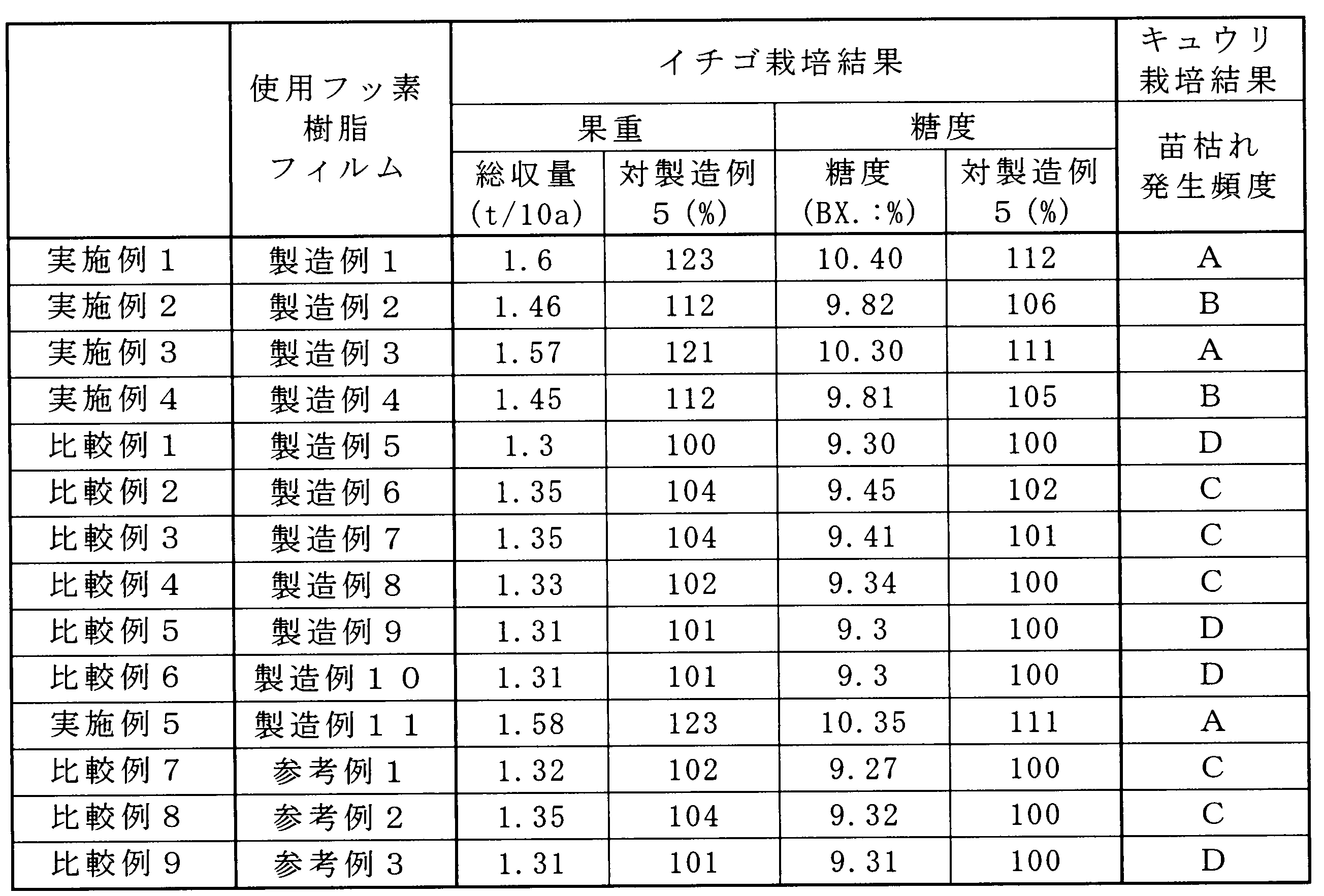
一方、比較例2~9では、イチゴの収量および糖度は比較例1で栽培した結果と大きな差異がなかった。
これらの結果は、実施例1~5において、フィルムを透過した光が散乱し、散乱角5.5~10°の散乱光の割合が5%以上に増大したことにより、イチゴの光合成が促進されたためであると判断された。
一方、比較例1~9では、多くのポットで苗枯れが起きた。
これらの結果は、実施例1~5において、フィルムを透過した光が散乱し、散乱角5.5~10°の散乱光の割合が5%以上に増大したことにより、ハウス内の光が充分に和らげられたためであると判断された。
本出願は、2008年10月21日出願の日本特許出願2008-271050に基づくものであり、その内容はここに参照として取り込まれる。
Claims (8)
- 散乱角が5.5~10°の散乱光の割合が全透過光に対して5%以上である、農業用光散乱フッ素樹脂フィルム。
- 散乱角が1~10°の散乱光の割合が全透過光に対して50%以上である、請求項1に記載の農業用光散乱フッ素樹脂フィルム。
- 散乱角が30°以上の散乱光の割合が全透過光に対して1%以下である、請求項1または2に記載の農業用光散乱フッ素樹脂フィルム。
- フッ素樹脂フィルムが表面に凹凸を有し、算術平均粗さRaで表されるその表面粗さが、TD方向(幅方向)、MD方向(流れ方向)ともに、1.6μm~3μmである、請求項1~3のいずれかに記載の農業用光散乱フッ素樹脂フィルム。
- フッ素樹脂フィルムが表面に凹凸を有し、十点平均粗さRzで表されるその表面粗さが、TD方向、MD方向ともに13~25μmである、請求項1~4のいずれかに記載の農業用光散乱フッ素樹脂フィルム。
- フッ素樹脂フィルムが表面に凹凸を有し、該凹凸の平均間隔Smが、MD方向、TD方向ともに40~100μmである、請求項1~5のいずれかに記載の農業用光散乱フッ素樹脂フィルム。
- フッ素樹脂フィルムが、平均粒子径3~15μmの合成マイカ粒子を含有し、その含有量がフッ素樹脂100質量部に対して3~5質量部である、請求項1~6のいずれかに記載の農業用光散乱フッ素樹脂フィルム。
- 請求項4~7のいずれかに記載の表面に凹凸を有する農業用光散乱フッ素樹脂フィルムの製造方法であって、押出機を用いて、フッ素樹脂をダイスより押し出す工程、押し出されたフィルムを鏡面キャスティングロールと凹凸エンボス加工が施されたバックロールとで挟持して冷却・固化する工程を含む、表面に凹凸を有する農業用光散乱フッ素樹脂フィルムの製造方法。
Priority Applications (5)
| Application Number | Priority Date | Filing Date | Title |
|---|---|---|---|
| CN2009801424041A CN102186333B (zh) | 2008-10-21 | 2009-10-20 | 农用光散射氟树脂薄膜及其制造方法 |
| JP2010534821A JP5263298B2 (ja) | 2008-10-21 | 2009-10-20 | 農業用光散乱フッ素樹脂フィルム及びその製造方法 |
| EP09822035.3A EP2351481B1 (en) | 2008-10-21 | 2009-10-20 | Light-scattering fluororesin film for agricultural applications, and method for producing same |
| KR1020117009096A KR101660998B1 (ko) | 2008-10-21 | 2009-10-20 | 농업용 광산란 불소 수지 필름 및 그 제조 방법 |
| US13/090,423 US8980400B2 (en) | 2008-10-21 | 2011-04-20 | Light-scattering fluororesin film for agricultural applications, and method for producing same |
Applications Claiming Priority (2)
| Application Number | Priority Date | Filing Date | Title |
|---|---|---|---|
| JP2008-271050 | 2008-10-21 | ||
| JP2008271050 | 2008-10-21 |
Related Child Applications (1)
| Application Number | Title | Priority Date | Filing Date |
|---|---|---|---|
| US13/090,423 Continuation US8980400B2 (en) | 2008-10-21 | 2011-04-20 | Light-scattering fluororesin film for agricultural applications, and method for producing same |
Publications (1)
| Publication Number | Publication Date |
|---|---|
| WO2010047338A1 true WO2010047338A1 (ja) | 2010-04-29 |
Family
ID=42119375
Family Applications (1)
| Application Number | Title | Priority Date | Filing Date |
|---|---|---|---|
| PCT/JP2009/068081 Ceased WO2010047338A1 (ja) | 2008-10-21 | 2009-10-20 | 農業用光散乱フッ素樹脂フィルム及びその製造方法 |
Country Status (6)
| Country | Link |
|---|---|
| US (1) | US8980400B2 (ja) |
| EP (1) | EP2351481B1 (ja) |
| JP (1) | JP5263298B2 (ja) |
| KR (1) | KR101660998B1 (ja) |
| CN (1) | CN102186333B (ja) |
| WO (1) | WO2010047338A1 (ja) |
Cited By (8)
| Publication number | Priority date | Publication date | Assignee | Title |
|---|---|---|---|---|
| JP2012070707A (ja) * | 2010-09-29 | 2012-04-12 | Mkv Dream Co Ltd | 農業用フィルム |
| CN104441869A (zh) * | 2014-11-25 | 2015-03-25 | 北京华盾雪花塑料集团有限责任公司 | 光散射型农膜、其的制造方法和用途 |
| JP2018102181A (ja) * | 2016-12-26 | 2018-07-05 | 積水フィルム株式会社 | 農業用フィルム |
| JP2018164435A (ja) * | 2017-03-28 | 2018-10-25 | 住化積水フィルム株式会社 | 農業用フィルム、及び、農業用ハウス、農業用カーテン又は農業用トンネル |
| WO2019031173A1 (ja) * | 2017-08-09 | 2019-02-14 | 富士フイルム株式会社 | 農業ハウス用フィルムおよび農業ハウス |
| CN113412052A (zh) * | 2019-02-08 | 2021-09-17 | W.L.戈尔及同仁股份有限公司 | 用于农业环境的光漫射反射幕 |
| JP2022190669A (ja) * | 2021-06-14 | 2022-12-26 | 恵和株式会社 | 農業用ハウスの換気用シート |
| WO2024219397A1 (ja) * | 2023-04-18 | 2024-10-24 | Agc株式会社 | 接着フィルム及び接着フィルムを備える物品 |
Families Citing this family (5)
| Publication number | Priority date | Publication date | Assignee | Title |
|---|---|---|---|---|
| CN105073868A (zh) * | 2013-03-13 | 2015-11-18 | 塞拉尼斯醋酸纤维有限公司 | 用于游戏牌的纤维素二酯膜 |
| JP6760404B2 (ja) | 2017-01-31 | 2020-09-23 | ダイキン工業株式会社 | フッ素樹脂フィルム |
| KR102626069B1 (ko) * | 2017-09-26 | 2024-01-16 | 에이지씨 가부시키가이샤 | 농업용 불소 수지 필름 및 농업용 하우스 |
| CN114845545B (zh) * | 2019-12-25 | 2023-09-22 | 富士胶片株式会社 | 农用采光部件及农产用箱体 |
| KR102793831B1 (ko) * | 2024-06-21 | 2025-04-14 | (주)상아프론테크 | 농업용 불소수지필름 및 그를 포함하는 농업용 온실 |
Citations (9)
| Publication number | Priority date | Publication date | Assignee | Title |
|---|---|---|---|---|
| JPH0851871A (ja) | 1994-08-10 | 1996-02-27 | Toyo Polymer Kk | 温室用シボ付き弗素樹脂フイルム |
| JPH10292056A (ja) | 1997-04-18 | 1998-11-04 | Asahi Glass Co Ltd | フッ素樹脂フィルム |
| JPH1160838A (ja) * | 1997-08-20 | 1999-03-05 | Okura Ind Co Ltd | 農業用梨地フィルム |
| JP2000139244A (ja) * | 1998-11-11 | 2000-05-23 | Mikado Kako Kk | 作物栽培用被覆フィルム及びその使用方法 |
| JP2002069258A (ja) * | 2000-08-25 | 2002-03-08 | Asahi Glass Co Ltd | フッ素樹脂フィルム |
| JP2006075047A (ja) * | 2004-09-08 | 2006-03-23 | Mkv Platech Co Ltd | 農業用フィルム |
| JP2006115838A (ja) * | 2004-09-01 | 2006-05-11 | Jts Kk | 農業用光散乱性複合フイルム |
| JP2006248043A (ja) * | 2005-03-10 | 2006-09-21 | Sekisui Film Kk | 農業用フィルム |
| JP2008271050A (ja) | 2007-04-18 | 2008-11-06 | Hitachi Ltd | 通信負荷取得装置および通信負荷取得方法 |
Family Cites Families (9)
| Publication number | Priority date | Publication date | Assignee | Title |
|---|---|---|---|---|
| KR940018419A (ko) * | 1993-01-18 | 1994-08-18 | 이마무라 가즈수케 | 발수성을 향상시킨 불소 함유 고분자 성형체 및 이로 부터 제조된 세정용 지그 |
| JP2001149855A (ja) * | 1999-09-14 | 2001-06-05 | Toto Ltd | 光触媒性被覆着色物品及びその製造方法 |
| DE10292319B4 (de) * | 2001-06-01 | 2012-03-08 | Daicel Chemical Industries, Ltd. | Lichtstreuender Film, ebene Lichtquellen-Einrichtung und Flüssigkristall-Anzeige-Vorrichtung, in denen er verwendet wird |
| DE10160054A1 (de) * | 2001-12-06 | 2003-06-18 | Degussa | Lichtstreuende Werkstoffe die selbstreinigende Oberflächen aufweisen |
| JP4217097B2 (ja) * | 2003-04-03 | 2009-01-28 | ダイセル化学工業株式会社 | 防眩性フィルム |
| US20060057343A1 (en) * | 2004-09-01 | 2006-03-16 | Hideoki Tsuji | Light-scattering composite agricultural film |
| KR100744676B1 (ko) * | 2005-08-24 | 2007-08-01 | 제이티에스 가부시키가이샤 | 농업용 광산란성 복합필름 |
| CN101652249A (zh) | 2007-04-06 | 2010-02-17 | 旭硝子株式会社 | 波长转换膜、农业用膜、结构物及涂膜形成用组合物 |
| EP2301325B1 (en) | 2008-07-11 | 2013-09-11 | Asahi Glass Company, Limited | Fluororesin film for agricultural use |
-
2009
- 2009-10-20 CN CN2009801424041A patent/CN102186333B/zh active Active
- 2009-10-20 JP JP2010534821A patent/JP5263298B2/ja active Active
- 2009-10-20 EP EP09822035.3A patent/EP2351481B1/en active Active
- 2009-10-20 WO PCT/JP2009/068081 patent/WO2010047338A1/ja not_active Ceased
- 2009-10-20 KR KR1020117009096A patent/KR101660998B1/ko active Active
-
2011
- 2011-04-20 US US13/090,423 patent/US8980400B2/en active Active
Patent Citations (9)
| Publication number | Priority date | Publication date | Assignee | Title |
|---|---|---|---|---|
| JPH0851871A (ja) | 1994-08-10 | 1996-02-27 | Toyo Polymer Kk | 温室用シボ付き弗素樹脂フイルム |
| JPH10292056A (ja) | 1997-04-18 | 1998-11-04 | Asahi Glass Co Ltd | フッ素樹脂フィルム |
| JPH1160838A (ja) * | 1997-08-20 | 1999-03-05 | Okura Ind Co Ltd | 農業用梨地フィルム |
| JP2000139244A (ja) * | 1998-11-11 | 2000-05-23 | Mikado Kako Kk | 作物栽培用被覆フィルム及びその使用方法 |
| JP2002069258A (ja) * | 2000-08-25 | 2002-03-08 | Asahi Glass Co Ltd | フッ素樹脂フィルム |
| JP2006115838A (ja) * | 2004-09-01 | 2006-05-11 | Jts Kk | 農業用光散乱性複合フイルム |
| JP2006075047A (ja) * | 2004-09-08 | 2006-03-23 | Mkv Platech Co Ltd | 農業用フィルム |
| JP2006248043A (ja) * | 2005-03-10 | 2006-09-21 | Sekisui Film Kk | 農業用フィルム |
| JP2008271050A (ja) | 2007-04-18 | 2008-11-06 | Hitachi Ltd | 通信負荷取得装置および通信負荷取得方法 |
Non-Patent Citations (1)
| Title |
|---|
| See also references of EP2351481A4 |
Cited By (11)
| Publication number | Priority date | Publication date | Assignee | Title |
|---|---|---|---|---|
| JP2012070707A (ja) * | 2010-09-29 | 2012-04-12 | Mkv Dream Co Ltd | 農業用フィルム |
| CN104441869A (zh) * | 2014-11-25 | 2015-03-25 | 北京华盾雪花塑料集团有限责任公司 | 光散射型农膜、其的制造方法和用途 |
| JP2018102181A (ja) * | 2016-12-26 | 2018-07-05 | 積水フィルム株式会社 | 農業用フィルム |
| JP2018164435A (ja) * | 2017-03-28 | 2018-10-25 | 住化積水フィルム株式会社 | 農業用フィルム、及び、農業用ハウス、農業用カーテン又は農業用トンネル |
| WO2019031173A1 (ja) * | 2017-08-09 | 2019-02-14 | 富士フイルム株式会社 | 農業ハウス用フィルムおよび農業ハウス |
| JPWO2019031173A1 (ja) * | 2017-08-09 | 2020-03-26 | 富士フイルム株式会社 | 農業ハウス用フィルムおよび農業ハウス |
| CN113412052A (zh) * | 2019-02-08 | 2021-09-17 | W.L.戈尔及同仁股份有限公司 | 用于农业环境的光漫射反射幕 |
| CN113412052B (zh) * | 2019-02-08 | 2023-02-03 | W.L.戈尔及同仁股份有限公司 | 用于农业环境的光漫射反射幕 |
| JP2022190669A (ja) * | 2021-06-14 | 2022-12-26 | 恵和株式会社 | 農業用ハウスの換気用シート |
| JP7817882B2 (ja) | 2021-06-14 | 2026-02-19 | 恵和株式会社 | 農業用ハウスの換気用シート |
| WO2024219397A1 (ja) * | 2023-04-18 | 2024-10-24 | Agc株式会社 | 接着フィルム及び接着フィルムを備える物品 |
Also Published As
| Publication number | Publication date |
|---|---|
| KR101660998B1 (ko) | 2016-09-28 |
| KR20110083630A (ko) | 2011-07-20 |
| JP5263298B2 (ja) | 2013-08-14 |
| EP2351481A4 (en) | 2012-04-11 |
| US20110195227A1 (en) | 2011-08-11 |
| JPWO2010047338A1 (ja) | 2012-03-22 |
| CN102186333B (zh) | 2012-12-12 |
| CN102186333A (zh) | 2011-09-14 |
| EP2351481A1 (en) | 2011-08-03 |
| US8980400B2 (en) | 2015-03-17 |
| EP2351481B1 (en) | 2016-08-10 |
Similar Documents
| Publication | Publication Date | Title |
|---|---|---|
| JP5263298B2 (ja) | 農業用光散乱フッ素樹脂フィルム及びその製造方法 | |
| US6441059B1 (en) | Agricultural method and materials for screening solar radiation | |
| CN108570178B (zh) | 一种漫散射薄膜及其制备方法和用途 | |
| EP3054761B1 (en) | Use of particulate titanium dioxide for reducing the transmission of near-infrared radiation | |
| CN110978700A (zh) | 一种漫散射膜及其制备方法 | |
| CN107258407A (zh) | 一种地膜及其制备方法 | |
| CN102250410A (zh) | 一种生姜专用大棚膜 | |
| CN106541662A (zh) | 一种银黑地膜及其制备工艺 | |
| TWI668256B (zh) | 基於保留特定波長之透光材料,其隔熱複合材料及其複合載體 | |
| CN212065077U (zh) | 温室用隔热农膜 | |
| JP2011217681A (ja) | 農業用被覆材 | |
| JP3776350B2 (ja) | 農業用フィルム | |
| CN109593245B (zh) | 高反射农用聚烯烃合成纸及其组合物 | |
| CN104441869A (zh) | 光散射型农膜、其的制造方法和用途 | |
| KR101468141B1 (ko) | 광확산필름 조성물, 및 이로부터 제조된 농업용 광확산필름 | |
| CN101062986A (zh) | 适于作果树套袋的聚乙烯塑料膜 | |
| JP2001045880A (ja) | 農業用フィルム | |
| EP1517777B1 (en) | Radiation screening materials | |
| CN106479079B (zh) | 煅烧高岭土和钛白粉组合物在pvc压延薄膜中的应用 | |
| CN110818988A (zh) | 一种农用散射薄膜及其制备方法 | |
| TW202022028A (zh) | 農業用隧道、溫室等之用膜及其製造方法 | |
| Allan | Light and Heat Selective Polymer Nanocomposite Films for Sustainable Greenhouses | |
| JPS6030485B2 (ja) | 農業用アクリル系樹脂被覆材 | |
| HUT73047A (en) | Composite material for the screening of radiation | |
| JPS6232221B2 (ja) |
Legal Events
| Date | Code | Title | Description |
|---|---|---|---|
| WWE | Wipo information: entry into national phase |
Ref document number: 200980142404.1 Country of ref document: CN |
|
| 121 | Ep: the epo has been informed by wipo that ep was designated in this application |
Ref document number: 09822035 Country of ref document: EP Kind code of ref document: A1 |
|
| WWE | Wipo information: entry into national phase |
Ref document number: 2010534821 Country of ref document: JP |
|
| REEP | Request for entry into the european phase |
Ref document number: 2009822035 Country of ref document: EP |
|
| WWE | Wipo information: entry into national phase |
Ref document number: 2009822035 Country of ref document: EP |
|
| ENP | Entry into the national phase |
Ref document number: 20117009096 Country of ref document: KR Kind code of ref document: A |
|
| NENP | Non-entry into the national phase |
Ref country code: DE |