WO2010053271A2 - 인삼으로부터 진세노사이드 Rg1 또는 Rb1이 강화된 추출물 분획을 제조하는 방법 - Google Patents
인삼으로부터 진세노사이드 Rg1 또는 Rb1이 강화된 추출물 분획을 제조하는 방법 Download PDFInfo
- Publication number
- WO2010053271A2 WO2010053271A2 PCT/KR2009/006311 KR2009006311W WO2010053271A2 WO 2010053271 A2 WO2010053271 A2 WO 2010053271A2 KR 2009006311 W KR2009006311 W KR 2009006311W WO 2010053271 A2 WO2010053271 A2 WO 2010053271A2
- Authority
- WO
- WIPO (PCT)
- Prior art keywords
- ginseng
- extract
- alcohol
- ginsenoside
- adsorption resin
- Prior art date
- Legal status (The legal status is an assumption and is not a legal conclusion. Google has not performed a legal analysis and makes no representation as to the accuracy of the status listed.)
- Ceased
Links
Images
Classifications
-
- A—HUMAN NECESSITIES
- A61—MEDICAL OR VETERINARY SCIENCE; HYGIENE
- A61K—PREPARATIONS FOR MEDICAL, DENTAL OR TOILETRY PURPOSES
- A61K36/00—Medicinal preparations of undetermined constitution containing material from algae, lichens, fungi or plants, or derivatives thereof, e.g. traditional herbal medicines
- A61K36/18—Magnoliophyta (angiosperms)
- A61K36/185—Magnoliopsida (dicotyledons)
- A61K36/25—Araliaceae (Ginseng family), e.g. ivy, aralia, schefflera or tetrapanax
- A61K36/258—Panax (ginseng)
-
- A—HUMAN NECESSITIES
- A61—MEDICAL OR VETERINARY SCIENCE; HYGIENE
- A61P—SPECIFIC THERAPEUTIC ACTIVITY OF CHEMICAL COMPOUNDS OR MEDICINAL PREPARATIONS
- A61P25/00—Drugs for disorders of the nervous system
- A61P25/20—Hypnotics; Sedatives
-
- A—HUMAN NECESSITIES
- A61—MEDICAL OR VETERINARY SCIENCE; HYGIENE
- A61K—PREPARATIONS FOR MEDICAL, DENTAL OR TOILETRY PURPOSES
- A61K2236/00—Isolation or extraction methods of medicinal preparations of undetermined constitution containing material from algae, lichens, fungi or plants, or derivatives thereof, e.g. traditional herbal medicine
- A61K2236/30—Extraction of the material
- A61K2236/37—Extraction at elevated pressure or temperature, e.g. pressurized solvent extraction [PSE], supercritical carbon dioxide extraction or subcritical water extraction
-
- A—HUMAN NECESSITIES
- A61—MEDICAL OR VETERINARY SCIENCE; HYGIENE
- A61K—PREPARATIONS FOR MEDICAL, DENTAL OR TOILETRY PURPOSES
- A61K2236/00—Isolation or extraction methods of medicinal preparations of undetermined constitution containing material from algae, lichens, fungi or plants, or derivatives thereof, e.g. traditional herbal medicine
- A61K2236/50—Methods involving additional extraction steps
- A61K2236/55—Liquid-liquid separation; Phase separation
Definitions
- the present invention relates to a method for preparing an extract fraction in which a particular saponin component is fortified from ginseng, and more specifically, ginsenoside Rg1 known to have anti-fatigue function in saponins present in ginseng or known to have sedation.
- Ginseng (Panax ginseng CA Mayer) is botanically belonging to the genus Araliaceae ginseng, which has been used for medicinal purposes in China since BC, and has been used for trade and medicinal use in Korea since the Three Kingdoms. It is widely used as a herbal medicine or health food.
- Ginseng contains about 3-6% of ginsenoside-like saponin-like substance as a species-specific component, which is a representative physiologically active substance of ginseng, depending on the structure of panaxadiol (PD). ), And panaxhatriol (PT) and oleanane (Oleanane) divided into about 33 species have been reported.
- PD panaxadiol
- PT And panaxhatriol
- Ole oleanane
- PD-based saponins and PT-based saponins have different functions in the body.
- PD-based saponins represented by ginsenoside Rb1
- GSenoside Rg1 have been shown to exhibit inhibitory effects on the central nervous system, resulting in mental stability, neuroleptic relaxation, analgesia, anticonvulsions, lowering blood pressure, papaverine and the like.
- PT-based saponins represented by ginsenoside Rg1
- GSenoside Rg1 are known to have an anti-fatigue effect by acting excitably on the central nerve. Therefore, it is possible to obtain more efficient pharmacological action of ginseng by separating or strengthening saponins that exhibit opposite effects in ginseng.
- Korean Patent Registration 620107 discloses a method of obtaining ginsenoside Rg2, a specific component of ginseng saponin, by treating water or alcohol extract of ginseng with citric acid or lactic acid.
- Korean Patent Registration Nos. 517128 and 192678 disclose changes in the yield of saponins depending on the extraction temperature and the concentration of alcohol in consideration of thermal stability when extracting saponins from ginseng. There were disadvantages that were unsuitable for medicinal use. Moreover, none of the above patents discloses a method for obtaining an extract fraction with enhanced components of ginsenoside Rg1 or Rb1.
- Korean Patent Registration 0444394 discloses a method for preparing a saponin-containing extract by adsorption using an adsorptive resin, but does not disclose a method for obtaining an extract fraction enhanced with a specific saponin component.
- ginseng may have different effects in the body depending on the ratio of PD-based saponins and PT-based saponins.
- different actions may occur depending on the ratio of ginsenoside Rb1 / Rg1 present in the extract, and the ginsenoside Rb1 and Rg1 may have different effects.
- the present inventors have studied a method of preparing a saponin extract fraction of ginseng with a high content of ginseng saponin components (Rb1 or Rg1) as well as a high content of ginseng in order to compensate for the disadvantages of the ginseng saponin extract.
- a method for sufficiently extracting saponin of ginseng and a fraction obtained by enriching a specific saponin component (Rb1 or Rg1) therefrom the present invention has been completed.
- Still another object of the present invention is to provide a functional beverage composition with enhanced sedation of ginseng saponin, which comprises an extract fraction of which ginsenoside Rb1 obtained from ginseng is fortified.
- Distilled water is passed through the adsorption resin to elute and remove the unadsorbed components;
- It provides a method for producing a ginsenoside Rg1-enriched extract fraction from ginseng comprising the step of obtaining an eluate by adding 30-40 v / v% alcohol to the adsorption resin.
- Distilled water is passed through the adsorption resin to elute and remove the unadsorbed components;
- It provides a method for producing a ginsenoside Rb1-enriched extract fraction from ginseng comprising the step of eluting 50-80 v / v% alcohol to the adsorption resin.
- Ginsenoside Rg1 or Rb1-enriched extract fraction of ginseng prepared by the above method may be included as an active ingredient of a functional beverage.
- the present invention provides a functional beverage composition having enhanced anti-fatigue function of ginseng saponin, comprising an extract fraction enhanced by ginsenoside Rg1 prepared according to the above method.
- the present invention provides a functional beverage composition for enhanced sedation of ginseng saponin comprising the extract fraction of the ginsenoside Rb1 enhanced by the above method.
- the present inventors can obtain a ginsenoside Rg1-enhanced extract when the ginseng extract of ginseng is removed from the non-saponin component using an adsorptive resin and eluted with 30-40 v / v% alcohol, 50-80 v / v. It was found that ginsenoside Rb1 enhanced extract can be obtained when eluted with% alcohol, so that ginseng extract with enhanced ginsenoside Rg1 or ginsenoside Rb1 can be obtained.
- Distilled water is passed through the adsorption resin to elute and remove the unadsorbed components;
- It provides a method for producing a ginsenoside Rg1-enriched extract fraction from ginseng comprising the step of obtaining an eluate by adding 30-40 v / v% alcohol to the adsorption resin.
- Distilled water is passed through the adsorption resin to elute and remove the unadsorbed components;
- It provides a method for producing a ginsenoside Rb1-enriched extract fraction from ginseng comprising the step of obtaining an eluate by adding 50-80 v / v% alcohol to the adsorption resin.
- the ginseng extract of ginseng may be any extract obtained by treating ginseng with alcohol, preferably an extract with a higher content of ginsenosides Rg1 and Rb1. Extracts having a higher content of ginsenosides Rg1 and Rb1 may be obtained by adding 60-80% alcohol to ginseng and stirring extraction at 40-80 ° C for 24-36 hours.
- This extraction method was developed by the present inventors as a result of the extraction method having a high content of ginsenosides Rg1 and Rb1.
- the thermal stability of ginsenosides Rg1 and Rb1 is reduced, and thus the content of ginsenosides Rg1 and Rb1 extracted is reduced.
- a spirit extract obtained by adding 65-75 v / v% of alcohol to ginseng and stirring extraction at 65-75 ° C. for 24-36 hours may be used, and most preferably 70 v / v% of ginseng.
- the alcohol extract obtained by adding alcohol and stirring and extracting at 70 ° C. for 24 hours may be used.
- the extract is preferably used to extract three times or more combined extraction.
- the process of heat-concentrating the alcohol extract of ginseng is carried out, and the concentration is preferably performed in the range of 70-90 brix, most preferably about 80 brix.
- water is added to the concentrated alcohol extract, followed by dilution.
- the degree of dilution with water is not particularly limited as long as the concentrate of the alcohol extract reacts with the entire adsorbent resin to adsorb the saponin, but is preferably about 4-6 times the weight of the concentrated extract, and more Preferably, about 5 times of water can be added and diluted.
- the adsorption resin diion HP-20 (Mitsubishi, Japan) may be used, and may be used as a column-filled form for adsorption and fractionation.
- distilled water is passed through the adsorbent resin to elute and remove the unadsorbed components.
- components other than saponin present in the spirit extract of ginseng can be eluted and removed.
- the amount of distilled water used to remove unadsorbed components only needs to be sufficient to elute and remove the non-saponin components.
- distilled water of about 5 times the capacity of the adsorption resin can be used. More preferably, about 20 v / v% of alcohol can be added to elute and remove additional nonsaponin components.
- saponin fractions can be obtained by eluting saponins using alcohols of different concentrations.
- the adsorbent resin may be eluted with 30-40 v / v% of alcohol to obtain an extract fraction in which ginsenoside Rg1 is strengthened, and in the case of ginsenoside Rb1, the adsorption resin is 50-80. Elution with v / v% alcohol may yield an extract fraction with enhanced ginsenoside Rb1.
- the ginsenoside Rg1-enriched extract fraction obtained by the above method may have a ratio of ginsenoside Rg1 to Rb1 of 0.5 or more, and the ginsenoside Rb1-enriched extract fraction has a ratio of ginsenoside Rb1 to Rg1 of 2 It may be abnormal.
- Ginseng used in the preparation of the ginseng extract may be any ginseng containing saponin Rb1 or Rg1, for example, white ginseng, ginseng, red ginseng, taegeuk ginseng, black ginseng, purified ginseng (puffed ginseng), or enzymes Processed ginseng or concentrates thereof may be used.
- the saponin extract fraction of ginseng with increased content and increased content of ginsenoside Rg1 or Rb1 among saponin components of ginseng may be prepared.
- a functional food with enhanced saponin content of ginseng prepared by such a method can be provided.
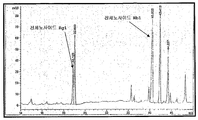
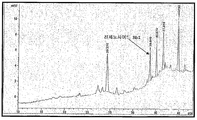
- FIG. 1 is an HPLC chromatogram of alcohol extract extracted from rice ginseng at 70 ° C. for 24 hours with 70 v / v% alcohol.
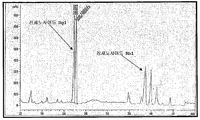
- Figure 2 is obtained by adsorbing the alcohol extract extracted at 70 °C for 24 hours at 70 °C / 70% alcohol by using a dia HP-20 adsorption resin, eluted with 30-40 v / v% alcohol HPLC chromatogram of fractions enriched for cenoside Rg1.
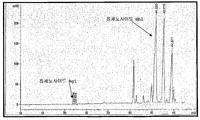
- Figure 3 is obtained by adsorbing alcohol extract extracted at 70 °C for 24 hours at 70 °C / 70% alcohol by using a dia HP-20 adsorption resin, eluted with 50-80 v / v% alcohol HPLC chromatogram of fractions enriched for cenoside Rb1.
- the extract of 60-80 v / v% of the alcohol extract was found to have a high sum of the content of ginsenosides Rg1 and Rb1, and in particular 60-70 v / v% alcohol It was found that it had the highest content of ginsenosides Rg1 and Rb1.
- the content of ginsenosides Rg1 and Rb1 varies slightly depending on the temperature conditions during extraction using a 70 v / v% alcohol, in particular, the content of Rb1 was significantly high at about 70 °C . And, the sum of the contents of ginsenosides Rg1 and Rb1 was found to be the highest at 70 °C.
- ginsenosides Rg1 and Rb1 were significantly higher when treated for more than 24 hours in treatment time, but at 80 ° C, the treatment time tended to decrease as the treatment time increased, which may be due to temperature instability. .
- a 20 v / v% alcohol of about 5 times the volume of the resin was passed through, and then the concentration of the alcohol was adjusted to obtain a fraction of the ginsenoside to be fractionated. Elution was started at a concentration of 30 v / v% alcohol and eluted to a concentration of 40 v / v% alcohol to obtain a fraction enriched for ginsenoside Rg1. In addition, eluting at a concentration of 50 v / v% alcohol and eluting at a concentration of 80 v / v% alcohol was obtained to obtain a fraction enriched with ginsenoside Rb1.
- the content of ginsenosides Rg1 and Rb1 from each fraction was determined by high performance liquid chromatography (HPLC) and the results are shown in Tables 3 and 4 below.
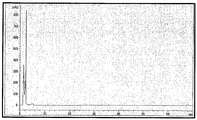
- FIGS. 4 and 5 HPLC chromatograms obtained by eluting with alcohols of 30-40 v / v%, 50-80 v / v%, 10-20 v / v% and 80-100 v / v% were shown in FIGS. 4 and 5 are shown. 2 to 5, when ginsenoside Rg1 eluted at 30-40 v / v% alcohol, ginsenoside Rb1 when eluted at 50-80 v / v% alcohol Rg1, Rb1 is It was confirmed that an enhanced fraction could be obtained.
- fractions with enhanced ginsenoside Rg1 or Rb1 can be obtained by elution with an adsorptive resin.
Landscapes
- Health & Medical Sciences (AREA)
- Natural Medicines & Medicinal Plants (AREA)
- Life Sciences & Earth Sciences (AREA)
- Chemical & Material Sciences (AREA)
- General Health & Medical Sciences (AREA)
- Veterinary Medicine (AREA)
- Public Health (AREA)
- Animal Behavior & Ethology (AREA)
- Engineering & Computer Science (AREA)
- Pharmacology & Pharmacy (AREA)
- Medicinal Chemistry (AREA)
- Alternative & Traditional Medicine (AREA)
- Epidemiology (AREA)
- Mycology (AREA)
- Microbiology (AREA)
- Medical Informatics (AREA)
- Botany (AREA)
- Biotechnology (AREA)
- Bioinformatics & Cheminformatics (AREA)
- Anesthesiology (AREA)
- Neurology (AREA)
- Neurosurgery (AREA)
- Biomedical Technology (AREA)
- Nuclear Medicine, Radiotherapy & Molecular Imaging (AREA)
- Chemical Kinetics & Catalysis (AREA)
- General Chemical & Material Sciences (AREA)
- Organic Chemistry (AREA)
- Medicines Containing Plant Substances (AREA)
- Steroid Compounds (AREA)
- Pharmaceuticals Containing Other Organic And Inorganic Compounds (AREA)
Abstract
Description


Claims (5)
- 인삼의 주정 추출물을 농축한 다음 물로 희석한 추출액을 흡착 수지에 가하여 흡착시키는 단계;상기 흡착 수지에 증류수를 통과시켜 흡착되지 않은 성분을 용출시켜 제거하는 단계; 및상기 흡착 수지에 30-40 v/v%의 주정을 가하여 용출물을 획득하는 단계를 포함하는 인삼으로부터 진세노사이드 Rg1이 강화된 추출물 분획을 제조하는 방법.
- 인삼의 주정 추출물을 농축한 다음 물로 희석한 추출액을 흡착 수지에 가하여 흡착시키는 단계;상기 흡착 수지에 증류수를 통과시켜 흡착되지 않은 성분을 용출시켜 제거하는 단계; 및상기 흡착 수지에 50-80 v/v%의 주정을 가하여 용출시키는 단계를 포함하는 인삼으로부터 진세노사이드 Rb1이 강화된 추출물 분획을 제조하는 방법.
- 제1항 또는 제2항에 있어서, 상기 인삼의 주정 추출물은 인삼에 60-80 v/v% 주정을 가하고 65-75℃에서 24-36 시간 동안 교반 추출한 것을 특징으로 하는 방법.
- 제1항 또는 제2항에 있어서, 상기 인삼의 주정 추출물을 70-90 브릭스(brix)로 농축하는 것을 특징으로 하는 방법.
- 제1항 또는 제2항에 있어서, 상기 흡착 수지는 다이아이온 HP-20인 것을 특징으로 하는 방법.
Priority Applications (5)
| Application Number | Priority Date | Filing Date | Title |
|---|---|---|---|
| CN200980142817XA CN102196814B (zh) | 2008-11-04 | 2009-10-30 | 用人参制备强化了人参皂苷Rg1或Rb1的提取物片段的方法 |
| US13/127,371 US8623425B2 (en) | 2008-11-04 | 2009-10-30 | Method for preparing extract fracton reinforced with ginsenosides RG1 or RB1 from ginseng |
| HK12100245.9A HK1159522B (en) | 2008-11-04 | 2009-10-30 | Method for preparing extract fraction reinforced with ginsenosides rg1 or rb1 from ginseng |
| EP09824954A EP2359839A4 (en) | 2008-11-04 | 2009-10-30 | PROCESS FOR THE PREPARATION OF A REINFORCED EXTRACT FRACTION WITH RG1 OR RB1 GINSENOSIDES FROM GINSENG |
| JP2011533117A JP5524971B2 (ja) | 2008-11-04 | 2009-10-30 | 高麗人参からジンセノサイドRg1またはRb1が強化された抽出物分画を製造する方法 |
Applications Claiming Priority (2)
| Application Number | Priority Date | Filing Date | Title |
|---|---|---|---|
| KR1020080109038A KR101052574B1 (ko) | 2008-11-04 | 2008-11-04 | 인삼으로부터 진세노사이드 Rg1 또는 Rb1이 강화된 추출물 분획을 제조하는 방법 |
| KR10-2008-0109038 | 2008-11-04 |
Publications (2)
| Publication Number | Publication Date |
|---|---|
| WO2010053271A2 true WO2010053271A2 (ko) | 2010-05-14 |
| WO2010053271A3 WO2010053271A3 (ko) | 2010-08-12 |
Family
ID=42153371
Family Applications (1)
| Application Number | Title | Priority Date | Filing Date |
|---|---|---|---|
| PCT/KR2009/006311 Ceased WO2010053271A2 (ko) | 2008-11-04 | 2009-10-30 | 인삼으로부터 진세노사이드 Rg1 또는 Rb1이 강화된 추출물 분획을 제조하는 방법 |
Country Status (6)
| Country | Link |
|---|---|
| US (1) | US8623425B2 (ko) |
| EP (1) | EP2359839A4 (ko) |
| JP (1) | JP5524971B2 (ko) |
| KR (1) | KR101052574B1 (ko) |
| CN (1) | CN102196814B (ko) |
| WO (1) | WO2010053271A2 (ko) |
Cited By (1)
| Publication number | Priority date | Publication date | Assignee | Title |
|---|---|---|---|---|
| WO2013012180A3 (ko) * | 2011-07-21 | 2013-03-14 | 대동고려삼 주식회사 | 진세노사이드 Rg3 및 Rh2가 강화된 홍삼농축액 제조방법 |
Families Citing this family (7)
| Publication number | Priority date | Publication date | Assignee | Title |
|---|---|---|---|---|
| KR101682564B1 (ko) | 2014-02-14 | 2016-12-05 | 주식회사 한국인삼공사 | 진세노사이드 Rg1 및 Rb1이 강화된 홍삼 및 이의 제조 방법 |
| KR101670444B1 (ko) * | 2016-05-10 | 2016-11-09 | 자이글주식회사 | 적외선 가열 조리기 |
| KR101993623B1 (ko) | 2017-06-28 | 2019-06-28 | 남해군흑마늘 주식회사 | 숙성인삼 제조방법 |
| KR102043433B1 (ko) | 2018-04-12 | 2019-11-12 | 주식회사 한국인삼공사 | 홍삼 추출물의 제조 방법 |
| CN114989238A (zh) * | 2022-05-30 | 2022-09-02 | 泰州医药城国科化物生物医药科技有限公司 | 一种高纯无农残人参皂苷Rb1单体化合物的制备方法 |
| CN116655722A (zh) * | 2023-06-02 | 2023-08-29 | 仁寿县人民医院 | 一种人参皂苷Rg1的提取方法及应用 |
| CN116889583B (zh) | 2023-08-26 | 2024-07-23 | 琛蓝(美国)营养制品股份有限公司 | 一种富含稀有人参皂苷的人参提取物的制备方法及其应用 |
Citations (6)
| Publication number | Priority date | Publication date | Assignee | Title |
|---|---|---|---|---|
| KR100192678B1 (ko) | 1995-06-07 | 1999-06-15 | 손경식 | 약효가 증강된 가공인삼 제품 |
| WO2001056585A1 (en) | 2000-01-31 | 2001-08-09 | Digital Biotech Co., Ltd | Cognitive enhancer comprising ginseng extract |
| KR100444394B1 (ko) | 1998-05-07 | 2004-12-29 | 주식회사 케이티앤지 | 사포닌고함유인삼추출물제조방법 |
| KR100517128B1 (ko) | 2003-02-13 | 2005-09-27 | 주식회사 홍삼닷컴 | 인삼 및 홍삼으로부터 유효성분의 추출방법 |
| KR100620107B1 (ko) | 2004-12-24 | 2006-09-20 | 소망화장품주식회사 | 진세노사이드 Rg2의 제조방법 |
| US7371416B2 (en) | 2005-04-12 | 2008-05-13 | You-Sup Chung | Method for preparing processed ginseng to obtain increased amount of ginsenoside RG5 |
Family Cites Families (6)
| Publication number | Priority date | Publication date | Assignee | Title |
|---|---|---|---|---|
| JPS59118053A (ja) * | 1982-12-24 | 1984-07-07 | Hayashibara Biochem Lab Inc | 飲食物とその製造方法 |
| KR100325778B1 (ko) * | 1999-07-20 | 2002-03-06 | 심건섭 | 파핑처리에 의해 가공된 인삼의 유효성분 추출방법 및 이를 유효성분으로 하는 건강식품 |
| KR100444369B1 (ko) * | 2001-05-16 | 2004-08-16 | 주식회사 한국인삼공사 | 인삼 모상근을 이용한 기억력 증강 신규조성물진세노-제이케이와 그 제조방법 |
| WO2003010216A1 (en) * | 2001-07-24 | 2003-02-06 | Radicispandex Corporation | Improved spandex compositions |
| KR100678490B1 (ko) * | 2005-10-14 | 2007-02-02 | 주식회사 비티진 | 파낙사디올과 파낙사트리올 분리방법 |
| WO2008083461A1 (en) * | 2007-01-08 | 2008-07-17 | Her Majesty The Queen In Right Of Canada, As Represented By The Minister Of Agriculture And Agri-Food | Plant compositions enriched in dehydrosoyasaponin i (d-i) and methods of producing such compositions |
-
2008
- 2008-11-04 KR KR1020080109038A patent/KR101052574B1/ko active Active
-
2009
- 2009-10-30 US US13/127,371 patent/US8623425B2/en active Active
- 2009-10-30 CN CN200980142817XA patent/CN102196814B/zh active Active
- 2009-10-30 EP EP09824954A patent/EP2359839A4/en not_active Withdrawn
- 2009-10-30 JP JP2011533117A patent/JP5524971B2/ja active Active
- 2009-10-30 WO PCT/KR2009/006311 patent/WO2010053271A2/ko not_active Ceased
Patent Citations (6)
| Publication number | Priority date | Publication date | Assignee | Title |
|---|---|---|---|---|
| KR100192678B1 (ko) | 1995-06-07 | 1999-06-15 | 손경식 | 약효가 증강된 가공인삼 제품 |
| KR100444394B1 (ko) | 1998-05-07 | 2004-12-29 | 주식회사 케이티앤지 | 사포닌고함유인삼추출물제조방법 |
| WO2001056585A1 (en) | 2000-01-31 | 2001-08-09 | Digital Biotech Co., Ltd | Cognitive enhancer comprising ginseng extract |
| KR100517128B1 (ko) | 2003-02-13 | 2005-09-27 | 주식회사 홍삼닷컴 | 인삼 및 홍삼으로부터 유효성분의 추출방법 |
| KR100620107B1 (ko) | 2004-12-24 | 2006-09-20 | 소망화장품주식회사 | 진세노사이드 Rg2의 제조방법 |
| US7371416B2 (en) | 2005-04-12 | 2008-05-13 | You-Sup Chung | Method for preparing processed ginseng to obtain increased amount of ginsenoside RG5 |
Cited By (1)
| Publication number | Priority date | Publication date | Assignee | Title |
|---|---|---|---|---|
| WO2013012180A3 (ko) * | 2011-07-21 | 2013-03-14 | 대동고려삼 주식회사 | 진세노사이드 Rg3 및 Rh2가 강화된 홍삼농축액 제조방법 |
Also Published As
| Publication number | Publication date |
|---|---|
| US8623425B2 (en) | 2014-01-07 |
| CN102196814B (zh) | 2013-07-31 |
| WO2010053271A3 (ko) | 2010-08-12 |
| EP2359839A2 (en) | 2011-08-24 |
| KR101052574B1 (ko) | 2011-07-29 |
| JP2012506422A (ja) | 2012-03-15 |
| KR20100049975A (ko) | 2010-05-13 |
| CN102196814A (zh) | 2011-09-21 |
| JP5524971B2 (ja) | 2014-06-18 |
| HK1159522A1 (en) | 2012-08-03 |
| US20110268823A1 (en) | 2011-11-03 |
| EP2359839A4 (en) | 2012-08-22 |
Similar Documents
| Publication | Publication Date | Title |
|---|---|---|
| KR101052574B1 (ko) | 인삼으로부터 진세노사이드 Rg1 또는 Rb1이 강화된 추출물 분획을 제조하는 방법 | |
| CN101554409A (zh) | 荜茇生物碱及其制备方法、制剂和用途 | |
| CN102718817A (zh) | 一种从黑豆皮中制备花色苷提取物的方法 | |
| WO2011059265A2 (en) | Process for preparing extract fraction enriched with ginsenoside rg3 from ginseng radix | |
| US6596321B1 (en) | Pharmaceutical composition for treating angiocardiopathy and the method of producing thereof | |
| WO2016060394A1 (ko) | 인삼의 쓴맛 억제제 및 이를 포함하는 인삼 조성물 | |
| CN103705594B (zh) | 治疗高脂血症的中药组合物及其制备方法 | |
| CN105250366B (zh) | 香青兰提取物及其制备方法和用途 | |
| CN101524488B (zh) | 复方竹叶总黄酮滴丸的制备方法 | |
| CN103372034A (zh) | 银杏叶提取物的制备方法 | |
| CN104873570A (zh) | 一种夏枯草总黄酮的提取纯化方法及其应用 | |
| CN101538297A (zh) | 荠菜高纯度单体黄酮及其总黄酮的制备方法及其用途 | |
| CN101190906B (zh) | 红花黄色素b的制备方法及其应用 | |
| CN112778323A (zh) | 一种从光果甘草渣制备光甘草定和甘草多糖的方法 | |
| CN103304522B (zh) | 一种具有抑制神经炎症活性的化合物及其制备方法与应用 | |
| CN100464766C (zh) | 一种治疗急、慢性充血性心力衰竭的药物组合物及制备方法和应用 | |
| WO2013109051A1 (ko) | 인삼유래의 진세노사이드 rg3의 함량이 증강된 추출분획물을 유효성분으로 함유하는 기억력 또는 집중력 증진용 조성물 | |
| CN107468761A (zh) | 一种女贞子总三萜酸提取物的制备方法及用途 | |
| CN102078400B (zh) | 一种枇杷叶总三萜酸提取物的制备方法 | |
| CN114478661A (zh) | 一种由肉苁蓉萃取物中富集及分离苯乙醇苷类化合物的方法 | |
| CN108530505A (zh) | 一种黄酮苷类化合物及其制备方法和应用 | |
| CN101322734A (zh) | 具有抗炎免疫作用的轮叶党参总皂苷及其制备方法 | |
| WO2014046347A1 (ko) | 스미자임 AC를 이용한 진세노사이드 Rg2의 제조방법 | |
| CN104983789A (zh) | 异叶青兰活性精细组分的分离方法及其应用 | |
| CN102379973A (zh) | 一种茄科酸浆属植物有效部位的制备方法及应用 |
Legal Events
| Date | Code | Title | Description |
|---|---|---|---|
| WWE | Wipo information: entry into national phase |
Ref document number: 200980142817.X Country of ref document: CN |
|
| 121 | Ep: the epo has been informed by wipo that ep was designated in this application |
Ref document number: 09824954 Country of ref document: EP Kind code of ref document: A2 |
|
| WWE | Wipo information: entry into national phase |
Ref document number: 2011533117 Country of ref document: JP |
|
| WWE | Wipo information: entry into national phase |
Ref document number: 812/MUMNP/2011 Country of ref document: IN |
|
| NENP | Non-entry into the national phase |
Ref country code: DE |
|
| WWE | Wipo information: entry into national phase |
Ref document number: 2009824954 Country of ref document: EP |
|
| WWE | Wipo information: entry into national phase |
Ref document number: 13127371 Country of ref document: US |