WO2010059717A2 - Formulations comprising ceftiofur and ketoprofen or ceftiofur and benzyl alcohol - Google Patents
Formulations comprising ceftiofur and ketoprofen or ceftiofur and benzyl alcohol Download PDFInfo
- Publication number
- WO2010059717A2 WO2010059717A2 PCT/US2009/064978 US2009064978W WO2010059717A2 WO 2010059717 A2 WO2010059717 A2 WO 2010059717A2 US 2009064978 W US2009064978 W US 2009064978W WO 2010059717 A2 WO2010059717 A2 WO 2010059717A2
- Authority
- WO
- WIPO (PCT)
- Prior art keywords
- formulation
- amount
- present
- ceftiofur
- benzyl alcohol
- Prior art date
- Legal status (The legal status is an assumption and is not a legal conclusion. Google has not performed a legal analysis and makes no representation as to the accuracy of the status listed.)
- Ceased
Links
Classifications
-
- A—HUMAN NECESSITIES
- A61—MEDICAL OR VETERINARY SCIENCE; HYGIENE
- A61K—PREPARATIONS FOR MEDICAL, DENTAL OR TOILETRY PURPOSES
- A61K9/00—Medicinal preparations characterised by special physical form
- A61K9/0012—Galenical forms characterised by the site of application
- A61K9/0019—Injectable compositions; Intramuscular, intravenous, arterial, subcutaneous administration; Compositions to be administered through the skin in an invasive manner
-
- A—HUMAN NECESSITIES
- A61—MEDICAL OR VETERINARY SCIENCE; HYGIENE
- A61K—PREPARATIONS FOR MEDICAL, DENTAL OR TOILETRY PURPOSES
- A61K31/00—Medicinal preparations containing organic active ingredients
- A61K31/185—Acids; Anhydrides, halides or salts thereof, e.g. sulfur acids, imidic, hydrazonic or hydroximic acids
- A61K31/19—Carboxylic acids, e.g. valproic acid
- A61K31/192—Carboxylic acids, e.g. valproic acid having aromatic groups, e.g. sulindac, 2-aryl-propionic acids, ethacrynic acid
-
- A—HUMAN NECESSITIES
- A61—MEDICAL OR VETERINARY SCIENCE; HYGIENE
- A61K—PREPARATIONS FOR MEDICAL, DENTAL OR TOILETRY PURPOSES
- A61K31/00—Medicinal preparations containing organic active ingredients
- A61K31/33—Heterocyclic compounds
- A61K31/395—Heterocyclic compounds having nitrogen as a ring hetero atom, e.g. guanethidine or rifamycins
- A61K31/54—Heterocyclic compounds having nitrogen as a ring hetero atom, e.g. guanethidine or rifamycins having six-membered rings with at least one nitrogen and one sulfur as the ring hetero atoms, e.g. sulthiame
- A61K31/542—Heterocyclic compounds having nitrogen as a ring hetero atom, e.g. guanethidine or rifamycins having six-membered rings with at least one nitrogen and one sulfur as the ring hetero atoms, e.g. sulthiame ortho- or peri-condensed with heterocyclic ring systems
- A61K31/545—Compounds containing 5-thia-1-azabicyclo [4.2.0] octane ring systems, i.e. compounds containing a ring system of the formula:, e.g. cephalosporins, cefaclor, or cephalexine
-
- A—HUMAN NECESSITIES
- A61—MEDICAL OR VETERINARY SCIENCE; HYGIENE
- A61K—PREPARATIONS FOR MEDICAL, DENTAL OR TOILETRY PURPOSES
- A61K47/00—Medicinal preparations characterised by the non-active ingredients used, e.g. carriers or inert additives; Targeting or modifying agents chemically bound to the active ingredient
- A61K47/06—Organic compounds, e.g. natural or synthetic hydrocarbons, polyolefins, mineral oil, petrolatum or ozokerite
- A61K47/08—Organic compounds, e.g. natural or synthetic hydrocarbons, polyolefins, mineral oil, petrolatum or ozokerite containing oxygen, e.g. ethers, acetals, ketones, quinones, aldehydes, peroxides
- A61K47/10—Alcohols; Phenols; Salts thereof, e.g. glycerol; Polyethylene glycols [PEG]; Poloxamers; PEG/POE alkyl ethers
-
- A—HUMAN NECESSITIES
- A61—MEDICAL OR VETERINARY SCIENCE; HYGIENE
- A61K—PREPARATIONS FOR MEDICAL, DENTAL OR TOILETRY PURPOSES
- A61K47/00—Medicinal preparations characterised by the non-active ingredients used, e.g. carriers or inert additives; Targeting or modifying agents chemically bound to the active ingredient
- A61K47/06—Organic compounds, e.g. natural or synthetic hydrocarbons, polyolefins, mineral oil, petrolatum or ozokerite
- A61K47/08—Organic compounds, e.g. natural or synthetic hydrocarbons, polyolefins, mineral oil, petrolatum or ozokerite containing oxygen, e.g. ethers, acetals, ketones, quinones, aldehydes, peroxides
- A61K47/14—Esters of carboxylic acids, e.g. fatty acid monoglycerides, medium-chain triglycerides, parabens or PEG fatty acid esters
-
- A—HUMAN NECESSITIES
- A61—MEDICAL OR VETERINARY SCIENCE; HYGIENE
- A61K—PREPARATIONS FOR MEDICAL, DENTAL OR TOILETRY PURPOSES
- A61K47/00—Medicinal preparations characterised by the non-active ingredients used, e.g. carriers or inert additives; Targeting or modifying agents chemically bound to the active ingredient
- A61K47/06—Organic compounds, e.g. natural or synthetic hydrocarbons, polyolefins, mineral oil, petrolatum or ozokerite
- A61K47/24—Organic compounds, e.g. natural or synthetic hydrocarbons, polyolefins, mineral oil, petrolatum or ozokerite containing atoms other than carbon, hydrogen, oxygen, halogen, nitrogen or sulfur, e.g. cyclomethicone or phospholipids
-
- A—HUMAN NECESSITIES
- A61—MEDICAL OR VETERINARY SCIENCE; HYGIENE
- A61K—PREPARATIONS FOR MEDICAL, DENTAL OR TOILETRY PURPOSES
- A61K47/00—Medicinal preparations characterised by the non-active ingredients used, e.g. carriers or inert additives; Targeting or modifying agents chemically bound to the active ingredient
- A61K47/06—Organic compounds, e.g. natural or synthetic hydrocarbons, polyolefins, mineral oil, petrolatum or ozokerite
- A61K47/26—Carbohydrates, e.g. sugar alcohols, amino sugars, nucleic acids, mono-, di- or oligo-saccharides; Derivatives thereof, e.g. polysorbates, sorbitan fatty acid esters or glycyrrhizin
-
- A—HUMAN NECESSITIES
- A61—MEDICAL OR VETERINARY SCIENCE; HYGIENE
- A61K—PREPARATIONS FOR MEDICAL, DENTAL OR TOILETRY PURPOSES
- A61K47/00—Medicinal preparations characterised by the non-active ingredients used, e.g. carriers or inert additives; Targeting or modifying agents chemically bound to the active ingredient
- A61K47/44—Oils, fats or waxes according to two or more groups of A61K47/02-A61K47/42; Natural or modified natural oils, fats or waxes, e.g. castor oil, polyethoxylated castor oil, montan wax, lignite, shellac, rosin, beeswax or lanolin
-
- A—HUMAN NECESSITIES
- A61—MEDICAL OR VETERINARY SCIENCE; HYGIENE
- A61K—PREPARATIONS FOR MEDICAL, DENTAL OR TOILETRY PURPOSES
- A61K9/00—Medicinal preparations characterised by special physical form
- A61K9/10—Dispersions; Emulsions
-
- A—HUMAN NECESSITIES
- A61—MEDICAL OR VETERINARY SCIENCE; HYGIENE
- A61P—SPECIFIC THERAPEUTIC ACTIVITY OF CHEMICAL COMPOUNDS OR MEDICINAL PREPARATIONS
- A61P11/00—Drugs for disorders of the respiratory system
-
- A—HUMAN NECESSITIES
- A61—MEDICAL OR VETERINARY SCIENCE; HYGIENE
- A61P—SPECIFIC THERAPEUTIC ACTIVITY OF CHEMICAL COMPOUNDS OR MEDICINAL PREPARATIONS
- A61P29/00—Non-central analgesic, antipyretic or antiinflammatory agents, e.g. antirheumatic agents; Non-steroidal antiinflammatory drugs [NSAID]
-
- A—HUMAN NECESSITIES
- A61—MEDICAL OR VETERINARY SCIENCE; HYGIENE
- A61P—SPECIFIC THERAPEUTIC ACTIVITY OF CHEMICAL COMPOUNDS OR MEDICINAL PREPARATIONS
- A61P31/00—Antiinfectives, i.e. antibiotics, antiseptics, chemotherapeutics
-
- A—HUMAN NECESSITIES
- A61—MEDICAL OR VETERINARY SCIENCE; HYGIENE
- A61P—SPECIFIC THERAPEUTIC ACTIVITY OF CHEMICAL COMPOUNDS OR MEDICINAL PREPARATIONS
- A61P31/00—Antiinfectives, i.e. antibiotics, antiseptics, chemotherapeutics
- A61P31/04—Antibacterial agents
-
- A—HUMAN NECESSITIES
- A61—MEDICAL OR VETERINARY SCIENCE; HYGIENE
- A61P—SPECIFIC THERAPEUTIC ACTIVITY OF CHEMICAL COMPOUNDS OR MEDICINAL PREPARATIONS
- A61P43/00—Drugs for specific purposes, not provided for in groups A61P1/00-A61P41/00
Definitions
- Ceftiofur is a Cephalosporin antibiotic, which is administered to cattle and swine for control of bacterial infections of the respiratory tract. It is used in veterinary medicine as both the sodium salt and the hydrochloride salt. It is administered intramuscularly to cattle and swine. It is also intended to be used as crystalline free acid for intramuscular and subcutaneous administration in cattle and swine. Ceftiofur is poorly absorbed after oral administration while rapidly absorbed after intramuscular administration. The Ceftiofur hydrochloride intramuscular injection is an oily suspension.
- a suspension is a particular class or type of dispersion system in which the internal or suspended phase is dispensed uniformly with mechanical agitation through out the external phase, called the suspending medium or vehicle.
- the internal phase consisting of a homogenous or heterogeneous distribution of solid particles having a specific range of sizes, these particles are maintained uniformly in time throughout the suspending vehicle with the aid of a single, or a particular combination of suspending agents.
- the three general classes of pharmaceutical suspensions are orally administered suspensions, externally applied suspensions (topical) and injectable (parenterals) suspensions (Ref: A Martin & P Bustamante, Coarse Dispersion in physical pharmacy 45th edn. Lea and Febiger, Philadelphia, 1993, PP 117-124).
- Parenteral suspensions are designed for intramuscular, intradermal, intralesional, intraarticular or subcutaneous administration.
- Common vehicles for parenteral suspensions include preserved sodium chloride solution or a parenterally acceptable vegetable oil.(Ref: J B Partnoff, E M Cohen & M H Henlay, Development of Parenteral and Sterile ophthalmic suspensions - The R&D Approach, Bull. Parenter. Drug Assoc 31: 136-143 (1977)).
- the chemical stability of pharmaceutical suspensions is complicated by the factors that affect the physical stability of such suspensions. Since a suspension exists in more than one state (liquid and solid), there are different ways in which the system can undergo either chemical or physical change (Ref: T Higuchi, some physical chemical aspects of suspension formulation, J. Am. Pharm.
- Flocculation refers to the formation of a loose aggregation of discrete particles held together in a network-like structure either by physical absorption of macro molecules, bridging during chemical interaction, or when the longer range Van der Waals forces of attraction exceeds the shorter range force of repulsion.
- agglomeration a large number of particles are closely bound together as aggregates either in a dry or liquid state.
- Coagulation or flocculation refers to the massing of particles in a liquid state alone and sometimes in the form of a fluid gel structure. The main advantages of the stable flocculated systems are as follows.
- the aggregates tend to break up easily under the application of a small amount of shear stress such as gentle agitation of a bottle or vial or by the flow through a small orifice (hypodermic needle and syringe).
- a small amount of shear stress such as gentle agitation of a bottle or vial or by the flow through a small orifice (hypodermic needle and syringe).
- the stable flocculation will settle rapidly and may be easily resuspended even after standing for prolonged time period of storage.
- the stable flocculation can be produced if required by employing aseptic techniques using vehicle components that are safe for intramuscular injection.
- flocculated pharmaceutical suspensions There are several methods of producing flocculated pharmaceutical suspensions. The choice of method depends on the properties of the drug and the class of suspension desired. One aspect of the present invention is based on Applicants' observation that when a resuspendability enhancer is added to the oily suspension the resuspendability of the suspended particles is improved dramatically, thus giving an improved physical stability to the oily suspension.
- BTD bovine respiratory disease
- BRD Bovine Rhino-tracheitis
- BBD Bovine Viral Diarrhea
- BRSV Bovine Respiratory Syncytial Virus
- Ply Parainfluenza Virus
- the bacteria involved in BRD include Pasteurella hemolytica, Pasteurella multo-cida, Haemophilus somnus, Mycoplasma and Actinomyces pyogenes. A complex series of events occurs which is typically associated with BRD. Calves are stressed by weaning, shipping, processing, adverse weather, and over-crowding. This stress compromises the defense mechanisms of the immune system. Viruses invade the nose and lungs because of weakened immune barriers.
- Viruses damage the epithelium of the upper airways and compromise the effectiveness of the mucociliary apparatus, which sweeps particles (bacteria, dust, mold, and pollen) up and away from the lungs. This lack of ciliary clearance allows overgrowth of normal respiratory inhabitants as well as bacterial pathogens. Secondary bacterial invaders move in, proliferate, and may potentially cause death if the disease is not detected and treated properly.
- An ideal processing protocol should include vaccination of these calves two weeks before shipping to allow development of an adequate immune response, and to minimize pre- shipping stress. Calves should receive a booster vaccination once they reach their destination. Vaccination will merely prime an immune response in a healthy immune system. Animals that are immuno-compromised have severely hampered this response. Identifying the causative agents of BRD can often be difficult and frustrating.
- Necropsy usually reveals lesions characteristic of secondary bacterial infection, i.e. Pasteurella hemolytica. Lesions characteristic of a primary viral agent are often absent due to the lesions of the bacterial agent at the time of death. Viral isolation attempts are usually negative. Antibiotic treatment of these animals prior to death hampers both the ability to isolate bacteria and may affect sensitivity testing.
- the invention provides formulations comprising ceftiofur in combination with benzyl alcohol or a combination of ceftiofur and ketoprofen that are useful for the treating or preventing bovine respiratory disorders.
- the present invention is based, in part, on Applicants' discovery that addition of benzyl alcohol to an oily ceftiofur HCl formulation resulted in a flocculated suspension that may be resuspended more easily as compared to an oily ceftiofur HCl formulation without benzyl alcohol.
- the present invention relates to a formulation which may comprise (a) ceftiofur, (b) at least one wetting or dispersing agent, (c) at least one flocculating agent or at least one resuspendability enhancer and (e) a biocompatible oil vehicle, wherein the flocculating agent or resuspendability enhancer comprises benzyl alcohol.
- the ceftiofur is advantageously ceftiofur HCl.
- the ceftiofur may be present in an amount of about 0.01% to about 10% w/v. In a more advantageous embodiment, the ceftiofur may be present in an amount of about 5% w/v as the HCl salt. Preferably, the ceftiofur may be present in an amount of about 5.35% w/v as the HCl salt.
- the wetting or dispersing agent may comprise a hydrogenated phosphatidylcholine, a hydrogenated lysophosphatidylcholine, a mono-diglyceride, propylene glycol, a triglyceride or combinations thereof.
- the wetting or dispersing age may be present in an amount of about 0.01% (w/v) to about 1% (w/v) based on the total volume of the formulation. More typically, the wetting or dispersing agent may be present in an amount of about 0.01% (w/v) to about 0.5% (w/v), about 0.01% (w/v) to about 0.1% (w/v), or about 0.05% (w/v) to about 0.2% (w/v).
- the wetting or dispersing agent may be present in an amount of about 0.05% w/v.
- the wetting or dispersing agent may comprise PHOSPHOLIPON 9OH.
- PHOSPHOLIPON 9OH may present in an amount of about 0.01 % to about 0.10% w/v, and even more advantageously, about 0.05% w/v.
- the wetting or dispersing agent may comprise sorbitan monooleate.
- the formulations may comprise sorbitan monooleate in an amount of about 0.01% w/v to about 1% w/v, about 0.01% to about 0.3%, and more advantageously about 0.15% w/v..
- the flocculating agent or resuspendability enhancer may comprise propylene glycol.
- the propylene glycol is typically present in an amount of about 0.01% (w/v) to about 5% (w/v). More typically, the propylene glycol may be present in an amount of about 0.01% to about 1% (w/v) or about 0.01% to about 0.5% (w/v).
- the propylene glycol may be present in an amount of about 0.25% w/v..
- the benzyl alcohol may be present in an amount of about 0.05% to about 10% w/v, more advantageously about 0.5% to about 5% w/v.
- the benzyl alcohol may be present in an amount of about 1%, about 2% or about 3% w/v.
- the formulations of the invention may comprise chlorobutanol.
- the chlorobutanol may be present in an amount of about 0.01% to about 10% w/v. More typically, the formulations may include chlorobutanol in an amount of about 0.1% to about 5%, about 0.1% to about 1% w/v. Preferably, the formulations may contain chlorobutanol in an amount of about 0.5% w/v.
- the biocompatible oil vehicle may comprise cottonseed oil.
- the invention pertains to a formulation which may comprise: (a) ceftiofur HCl, (b) benzyl alcohol (c) PHOSPHOLIPON 9OH, (d) sorbitan monooleate, (e) propylene glycol and (f) cottonseed oil.
- the invention relates to a formulation wherein (a) ceftiofur HCl may be present in an amount of about 5.35% w/v, (b) benzyl alcohol may be present in an amount of about 1% to about 3% w/v, (c) PHOSPHOLIPON 9OH may be present in an amount of about 0.05% w/v, (d) sorbitan monooleate may be present in an amount of about 0.15% w/v, (e) propylene glycol may be present in an amount of about 0.25% w/v and (f) cottonseed oil may be present in an amount of up to about 100% w/v.
- the invention also relates to a method of improving resuspendability of an oil based formulation which comprises adding benzyl alcohol to the oil based formulation, thereby improving resuspendability.
- the oil based formulation may be a ceftiofur formulation.
- the present invention is based, in part, on Applicants' discovery that a formulation comprising an effective amount of ceftiofur and ketoprofen is effective in cattle for the treatment and/or prevention of bovine respiratory disease (BRD).
- the present invention relates to a formulation which may comprise (a) ceftiofur and (b) ketoprofen.
- the present invention relates to a formulation which may comprise (a) ceftiofur, (b) ketoprofen, (c) wetting and/or dispersing agent(s), (d) a preservative, (e) a flocculating agent or resuspendability enhancer and (f) a biocompatible oil vehicle.
- the ceftiofur is ceftiofur HCl.
- the ceftiofur may be present in an amount of about 0.01% w/v to about 10% w/v, about 1% w/v to about 8% w/v, advantageously about 2% w/v to about 7% w/v, and more advantageously, about 5% w/v.
- the ketoprofen may be present in an amount of about 0.01% w/v to about 30% w/v, about 5% w/v to about 25% w/v, advantageously about 10% w/v to about 20% w/v, and more advantageously, about 15% w/v.
- the wetting or dispersing agent may comprise a hydrogenated phosphatidylcholine, a hydrogenated lysophosphatidylcholine, a mono-diglyceride, propylene glycol, a triglyceride or combinations thereof.
- one of the wetting or dispersing agents may comprise sorbitan monooleate.
- the wetting or dispersing agents may be present in amounts according to those described above for the first aspect of the invention.
- the preservative may comprise benzyl alcohol or chlorobutanol.
- the flocculating agent or resuspendability enhancer may comprise propylene glycol.
- the biocompatible oil vehicle may comprise an ester of caprylic acid, an ester of capric fatty acids, propylene glycol or a combination thereof.
- the biocompatible oil may be MIGLYOL 840.
- the benzyl alcohol, chlorobutanol, propylene glycol, caprylic acid or capric fatty acid esters and MIGLYOL 840 may be present in the formulation in the same amounts as described above for the first aspect of the invention.
- the present invention pertains to a formulation which may comprise: (a) ceftiofur, (b) ketoprofen, (c) PHOSPHOLIPON 9OH, (d) benzyl alcohol or chlorobutanol, (e) sorbitan monooleate, (f) propylene glycol and (g) MIGLYOL 840.
- the invention in another embodiment, relates to a formulation wherein (a) ceftiofur may be present in an amount of about 5% w/v, (b) ketoprofen may be present in an amount of about 15% w/v, (c) PHOSPHOLIPON 9OH may be present in an amount of about 0.05% w/v, (d) benzyl alcohol may be present in an amount of about 1% w/v and/or chlorobutanol may be present in an amount of about 0.5% w/v, (e) sorbitan monooleate may be present in an amount of about 0.15% w/v, (f) propylene glycol may be present in an amount of about 0.25% w/v and (g) MIGLYOL 840 may be present in an amount of up to about 100% w/v.
- the present invention also relates to a method of treating a livestock animal to prevent or treat bovine respiratory disease, or other related respiratory disorders, which may comprise administering
- the administration may be injectable.
- the formulation may be administered in an amount of up to about 1 mg per kg of ceftiofur and an amount of up to about 3 mg per kg of ketoprofen.
- the administration may be once daily for three to five days, and then as required.
- terms such as “comprises”, “comprised”, “comprising” and the like can have the meaning attributed to it in U.S. Patent law; e.g., they can mean “includes”, “included”, “including”, and the like; and that terms such as “consisting essentially of and “consists essentially of have the meaning ascribed to them in U.S. Patent law, e.g., they allow for elements not explicitly recited, but exclude elements that are found in the prior art or that affect a basic or novel characteristic of the invention.
- FIG. 1 depicts a schematic diagram of a manufacturing process.
- the instant invention provides formulations comprising ceftiofur, ceftiofur in combination with ketoprofen, and formulations comprising ceftiofur in combination with benzyl alcohol.
- the formulations comprising ceftiofur or ceftiofur and ketoprofen in combination with benzyl alcohol have improved flocculation properties and are substantially easier to resuspend.
- Formulations comprising ceftiofur and ketoprofen provide improved efficacy in treating and/or preventing bovine respiratory disorders, particularly, bovine respiratory disease (BRD).
- Ceftiofur is a cephalosporin antibiotic, which may be administered, for example, by intramuscular or subcutaneous injection to cattle and swine for control of bacterial infections of the respiratory tract. Ceftiofur may be administered as a neutral compound or as a pharmaceutically or veterinarily acceptable salt. In a preferred embodiment, the formulations of the invention comprise ceftiofur HCl.
- the dosage of ceftiofur administered to cattle by intramuscular injection may be about 0.1 mg/kg to about 5 mg/kg according to the weight of the animal. In certain other embodiments, the dosage of ceftiofur administered to cattle by this mode of administration may be about 0.1 mg/kg, about 0.2 mg/kg, about 0.3 mg/kg, about 0.4 mg/kg, about 0.5 mg/kg, about 0.6 mg/kg, about 0.7 mg/kg, about 0.8 mg/kg, about 0.9 mg/kg, about
- Ceftiofur HCl is commercially available and may be supplied by various suppliers including, for example, Orchid Chemical or Pharmaceuticals Ltd or Hisun Pharmaceutical
- compositions of ceftiofur include, but are not limited to, the sodium, hydrochloride or hydrobromide salts.
- Ketoprofen is a non-steroidal anti-inflammatory agent which may be used as an adjunct to the ceftiofur cephalosporin antibiotic in the treatment of bovine respiratory disease.
- Ketoprofen may be administered, for example, by intravenous or intramuscular injection in cattle.
- This application contemplates all pharmaceutically or veterinary acceptable acid or base salt forms of the ceftiofur and ketoprofen.
- the term "acid” contemplates all pharmaceutically or veterinary acceptable inorganic or organic acids.
- Inorganic acids include mineral acids such as hydrohalic acids, such as hydrobromic and hydrochloric acids, sulfuric acids, phosphoric acids and nitric acids.
- Organic acids include all pharmaceutically or veterinary acceptable aliphatic, alicyclic and aromatic carboxylic acids, dicarboxylic acids tricarboxylic acids and fatty acids.
- Preferred acids are straight chain or branched, saturated or unsaturated C 1 -C 20 aliphatic carboxylic acids, which are optionally substituted by halogen or by hydroxyl groups, or C 6 -Ci 2 aromatic carboxylic acids.
- Examples of such acids are carbonic acid, formic acid, fumaric acid, acetic acid, propionic acid, isopropionic acid, valeric acid, ⁇ -hydroxy acids, such as glycolic acid and lactic acid, chloroacetic acid, benzoic acid, methane sulfonic acid, and salicylic acid.
- dicarboxylic acids include oxalic acid, malic acid, succinic acid, tataric acid and maleic acid.
- a tricarboxylic acid is citric acid.
- Fatty acids include all pharmaceutically or veterinary acceptable saturated or unsaturated aliphatic or aromatic carboxylic acids having 4 to 24 carbon atoms. Examples include butyric acid, isobutyric acid, sec-butyric acid, lauric acid, palmitic acid, stearic acid, oleic acid, linoleic acid, linolenic acid, and phenylsteric acid. Other acids include gluconic acid, glycoheptonic acid and lactobionic acid.
- base contemplates all pharmaceutically or veterinary acceptable inorganic or organic bases.
- Such bases include, for example, the alkali metal and alkaline earth metal salts, such as the lithium, sodium, potassium, magnesium or calcium salts.
- Organic bases include the common hydrocarbyl and heterocyclic amine salts, which include, for example, the morpholine and piperidine salts. The ester and amide derivatives of these compounds, where applicable, are also contemplated.
- the ceftiofur may be present in the formulation in an amount of about 0.01% w/v to about 10% w/v, about 1% w/v to about 8% w/v, advantageously about 2% w/v to about 7% w/v, and more advantageously, about 5% w/v.
- the dosage of ketoprofen administered to cattle by intramuscular injection is about 0.1 mg/kg to about 10 mg/kg according to the weight of the animal.
- the dosage of ketoprofen administered to cattle by intramuscular injection may be about 1.0 mg/kg, about 1.1 mg/kg, about 1.2 mg/kg, about 1.3 mg/kg, about 1.4 mg/kg, about 1.5 mg/kg, about 1.6 mg/kg, about 1.7 mg/kg, about 1.8 mg/kg, about 1.9 mg/kg, about 2.0 mg/kg, about 2.1 mg, about 2.2 mg/kg, about 2.3 mg/kg, about 2.4 mg/kg, about 2.5 mg/kg, about 2.6 mg/kg, about 2.7 mg/kg, about 2.8 mg/kg, about 2.9 mg/kg, about 3.0 mg/kg, about 3.1 mg/kg, about 3.2mg/kg , about 3.3mg/kg , about 3.4mg/kg , about 3.5mg/kg , about 3.6mg/kg , about 3.7mg/kg , about 3.8mg/kg , about 3.9mg/kg , about 4.0mg/kg, about 4.1m
- Ketoprofen is commercially available, and may be supplied, for example, by Zhejang Jiuzhou Pharmaceutical Company, Jinan Haohua Industry Co., Ltd., King Tang Chemical Group Industry Co., Ltd, Greatvista Chemicals, Boehringer Ingelheim- Biopharmaceuticals, LKT Laboratories, Sigma- Aldrich, Difco Microbiology Products, Glaxo smithkline Pharmaceuticals S.A., or other sources.
- the present invention provides improved oil-based formulations comprising ceftiofur and benzyl alcohol that exhibit superior resuspendability compared to formulations of the prior art.
- the present invention relates to a formulation which may comprise (a) ceftiofur, (b) at least one wetting or dispersing agent, (c) at least one flocculating agent and/or at least one resuspendability enhancer and (e) a biocompatible oil vehicle, wherein the flocculating agent(s) or resuspendability enhancer(s) comprises benzyl alcohol.
- Benzyl alcohol is a useful solvent due to its polarity, low toxicity and low vapor pressure and is commonly added to intravenous medication solutions as a preservative due to its bacteriostatic and antipruritic properties.
- aromatic alcohol compounds contain a hydroxyl group bonded to an aromatic moiety.
- the hydroxyl group may be bonded directly to the aromatic group including, but not limited to, phenyl or substituted phenyl groups, naphthyl and substituted naphthyl groups, and the like.
- the hydroxyl group may be bonded to the aromatic ring by a linker moiety such as an alkylene group.
- Suitable aromatic alcohols of both types are encompassed by the present invention. Even though phenol is technically an aromatic alcohol, it is not contemplated for the present invention.
- Ceftiofur hydrochloride oily suspension is a flocculated suspension.
- flocculation occurs when the zeta potential is reduced and attractive forces exceed repulsive forces.
- Benzyl alcohol may be involved in the flocculation process (US patent 3,457,348). This patent relates to an interaction of hydroxy preservatives with nonionic surfactants and is silent to the involvement of benzyl alcohol in the flocculation process in oil based formulations.
- the formulations of the present invention that comprise benzyl alcohol exhibit improved flocculation a reduced rate of sedimentation.
- Factors known to affect sedimentation rate are: -Particle size and shape
- the benzyl alcohol may be present in an amount of about 0.05% to about 10% w/v, more advantageously about 0.5% to about 5% (w/v). In particular, the benzyl alcohol may be present in an amount of about 1%, about 2% or about 3% w/v in the formulations of the invention.
- the formulations of the invention include wetting or dispersing agents known in the art.
- the wetting or dispersing agent(s) include, but are not limited to, a hydrogenated phosphatidylcholine, a hydrogenated lysophosphatidylcholine, a mono-diglyceride, propylene glycol, a triglyceride or combinations thereof.
- the wetting or dispersing age may be present in an amount of about 0.01% (w/v) to about 1% (w/v) based on the total volume of the formulation.
- the wetting or dispersing agent may be present in an amount of about 0.01% (w/v) to about 0.5% (w/v), about 0.01% (w/v) to about 0.1% (w/v), or about 0.05% (w/v) to about 0.2% (w/v).
- the wetting or dispersing agent may be present in an amount of about 0.05% w/v.
- the wetting or dispersing agent may comprise PHOSPHOLIPON 9OH, in one embodiment of the invention.
- the lecithin PHOSPHOLIPON 9OH may be supplied by Phospholipid GmbH and contains a minimum of 90.0% hydrogenated phosphatidylcholine, a maximum of 4.0% hydrogenated lysophosphatidylcholine, and a maximum of 2% oil or triglycerides.
- PHOSPHOLIPON ® Series manufactured by the American Lecithin Company
- PHOSPHOLIPON 9OG PHOSPHOLIPON 80H
- PHOSPHOLIPON 85G PHOSPHOLIPON 85G
- one of the wetting or dispersing agents may comprise sorbitan monooleate, which may be present in an amount of about 0.01% w/v to about 1% w/v, about 0.01% to about 0.3%, and more advantageously about 0.15% w/v.
- suitable sorbitan monooleate include, for example, ARLACEL 80 and CRILL 4.
- the formulations may include a flocculating agent or resuspendability enhancer that comprises propylene glycol.
- the propylene glycol is typically present in an amount of about 0.01% (w/v) to about 5% (w/v). More typically, the propylene glycol may be present in an amount of about 0.01% to about 1% (w/v) or about 0.01% to about 0.5% (w/v).
- the propylene glycol may be present in an amount of about 0.25% w/v.
- flocculating agents or resuspendability enhancers including, but not limited to, polyoxyl hydrogenated castor oil, polyoxyl castor oil, glycerol, polyoxyl hydrogenated vegetable oil, polyoxyl vegetable oil, glycerol, polyethylene glycol, alcohols and the like are also contemplated for the present invention.
- the biocompatible oil vehicle may comprise an ester of caprylic acid, an ester of capric fatty acids, propylene glycol or a combination thereof.
- the biocompatible oil may be MIGLYOL 840.
- MIGLYOL 840 is a clear, neutral oil consisting of the esters of caprylic and capric fatty acids (obtained from coconut and palm kernel oils) and propylene glycol. It is a particularly low viscosity oil with a specification of 9 to 12 mPas at 20 0 C and obtained from Sasol GmbH.
- the biocompatible oil vehicle may comprise cottonseed oil.
- biocompatible oils which are contemplated by the present invention include, but are not limited to, monoglyceride, diglyceride, triglyceride medium chain succinic acid triglyceride, corn oil, cottonseed oil, olive oil, sesame oil, soybean oil, safflower oil, coconut oil, sunflower oil, palm oil, peanut oil, corn oil, an ester of caprylic acid, or an ester of capric fatty acids, propylene glycol, or combinations thereof.
- the formulations may comprise chlorobutanol.
- the chlorobutanol may be present in an amount of about 0.01% to about 10% w/v. More typically, the formulations may include chlorobutanol in an amount of about 0.1% to about 5%, about 0.1% to about 1% w/v.
- the formulations may contain chlorobutanol in an amount of about 0.5% w/v.
- the invention pertains to a formulation which may comprise: (a) ceftiofur HCl, (b) benzyl alcohol (c) PHOSPHOLIPON 9OH, (d) sorbitan monooleate, (e) propylene glycol and (f) cottonseed oil.
- the invention relates to a formulation wherein (a) ceftiofur HCl may be present in an amount of about 5.35% w/v, (b) benzyl alcohol may be present in an amount of about 1% to about 3% w/v, (c) PHOSPHOLIPON 9OH may be present in an amount of about 0.05% w/v, (d) sorbitan monooleate may be present in an amount of about 0.15% w/v, (e) propylene glycol may be present in an amount of about 0.25% w/v and (f) cottonseed oil may be present in an amount to complement the volume of the formulation to 100%.
- the invention also relates to a method of improving resuspendability of an oil based formulation comprising adding benzyl alcohol to the formulation, thereby improving resuspendability.
- the oil based formulation may be a ceftiofur formulation.
- the method may comprise adding the benzyl alcohol to the formulation in an amount of about 0.05% to about 10% w/v, more advantageously about 0.5% to about 5% (w/v). In other embodiments, the method comprises adding benzyl alcohol to the formulation in an amount of about 1%, about 2% or about 3% w/v.
- the present invention provides a formulation comprising a combination of ceftiofur and ketoprofen that is effective in cattle for the treatment and/or prevention of bovine respiratory disease (BRD). It has been surprisingly found that certain combinations of ceftiofur and ketoprofen provide superior efficacy in the treatment and/or prevention of BRD.
- BRD bovine respiratory disease
- the present invention relates to a formulation which may comprise (a) ceftiofur, (b) ketoprofen, (c) wetting and/or dispersing agent(s), (d) a preservative, (e) a flocculating agent or resuspendability enhancer and (f) a biocompatible oil vehicle.
- the ceftiofur is ceftiofur HCl.
- the ceftiofur may be present in an amount of about 0.01% w/v to about 10% w/v, about 1% w/v to about 8% w/v, advantageously about 2% w/v to about 7% w/v, and more advantageously, about 5% w/v.
- the ketoprofen may be present in an amount of about 0.01% w/v to about 30% w/v, about 5% w/v to about 25% w/v, advantageously about 10% w/v to about 20% w/v, and more advantageously, about 15% w/v.
- the wetting or dispersing agent in the formulations may comprise the same wetting or dispersing agents used in formulations comprising ceftiofur and benzyl alcohol described above for the first aspect of the invention.
- the wetting or dispersing agents may be used in the same amounts as described above for the first aspect of the invention.
- the formulations may comprise a hydrogenated phosphatidylcholine, a hydrogenated lysophosphatidylcholine, a biocompatible oil, triglycerides, PHOSPHOLIPON 9OH, sorbitan monooleate, or combinations thereof.
- the wetting or dispersing agent may be present in an amount of about 0.01% (w/v) to about 1% (w/v) based on the total volume of the formulation. More typically, the wetting or dispersing agent may be present in an amount of about 0.01% (w/v) to about 0.5% (w/v), about 0.01% (w/v) to about 0.1% (w/v), or about 0.05% (w/v) to about 0.2% (w/v). Preferably, the wetting or dispersing agent may be present in an amount of about 0.05% w/v.
- one of the wetting or dispersing agents may comprise sorbitan monooleate, which may be present in an amount of about 0.01% w/v to about 1% w/v, about 0.01% to about 0.3%, and more advantageously about 0.15% w/v.
- the formulation may comprise benzyl alcohol or chlorobutanol.
- the benzyl alcohol may be present in an amount of about 0.01% w/v to about 10% w/v, or about 0.5% to about 5% w/v. More typically, the benzyl alcohol may be present in an amount of about 1%, about 2%, or about 3% w/v.
- the chlorobutanol may be present in an amount of about
- the formulations may include chlorobutanol in an amount of about 0.1% to about 5%, about 0.1% to about 1% w/v.
- the formulations may contain chlorobutanol in an amount of about 0.5% w/v.
- the flocculating agent or resuspendability enhancer may comprise propylene glycol.
- the propylene glycol may be present in an amount of about 0.01% w/v to about 2% w/v, about 0.05% w/v to about 1% w/v, and more advantageously about 0.25% w/v.
- the biocompatible oil vehicle may comprise an ester of caprylic acid, an ester of capric fatty acids, propylene glycol or a combination thereof.
- the biocompatible oil may be MIGLYOL 840.
- the formulations may comprise other components that are described above for formulations comprising ceftiofur and benzyl alcohol of the first aspect of the invention.
- the present invention pertains to a formulation which may comprise: (a) ceftiofur, (b) ketoprofen, (c) PHOSPHOLIPON 9OH, (d) benzyl alcohol or chlorobutanol, (e) sorbitan monooleate, (f) propylene glycol and (g) MIGLYOL 840.
- the invention in another embodiment, relates to a formulation wherein (a) ceftiofur may be present in an amount of about 5% w/v, (b) ketoprofen may be present in an amount of about 15% w/v, (c) PHOSPHOLIPON 9OH may be present in an amount of about 0.05% w/v, (d) benzyl alcohol may be present in an amount of about 1% w/v or chlorobutanol may be present in an amount of about 0.5% w/v, (e) sorbitan monooleate may be present in an amount of about 0.15% w/v, (f) propylene glycol may be present in an amount of about 0.25% w/v and (g) MIGLYOL 840 may be present in an amount of up to about 100% w/v.
- the present invention provides a method for the treatment and/or prevention of bovine respiratory disease, or other related respiratory disorders, in an animal, including livestock animals, which comprises administering an effective amount of a formulation of the invention to the animal.
- the formulations described herein can be formulated for injectable, oral or topical (pour-on) administration.
- the formulation may be administered by injection.
- the finished product may be an injectable product in a multi- use vial, it needs to be both sterile and capable of maintaining its sterility with multiple challenges.
- As an oily suspension the alternative techniques to produce a sterile product are either by aseptic manufacture or gamma irradiation.
- the present invention also contemplates administering the formulations using a needlefree injector such as PIGJET ® , AVIJET ® , DERMOJET ® or BIOJECTOR ® (Bioject, Oregon, USA).
- a needlefree injector such as PIGJET ® , AVIJET ® , DERMOJET ® or BIOJECTOR ® (Bioject, Oregon, USA).
- a person of ordinary skill in the art is able to adjust the specifications of the injector as required with regard to factors such as the species of the animal to be treated; the age and weight of the animal, and the like without undue experimentation.
- the treatment is via a direct topical administration such as a paste, pour-on, ready-to-use, spot-on, etc. type formulation. Higher amounts may be provided for very prolonged release in or on the body of the animal.
- the solutions according to the invention may be applied using any means known per se, e.g. using an applicator gun or a metering flask.
- the formulation may be administered in an amount of up to about 1 mg per kg of ceftiofur and an amount of up to about 3 mg per kg of ketoprofen.
- the administration may be once daily for three to five days, and then as required.
- the invention provides a composition formulated for injectable administration, wherein the dosage rate may be about lmg of ceftiofur and 3mg of ketoprofen per kg of the animal's live weight. If the ceftiofur and ketoprofen is present in an amount of about 1% w/v, for example, an injectable formulation can be administered in an amount of 1 ml per 50 kg of the animal's live weight. It is well within the routine skill of the practitioner to determine a particular dosing regimen for a specific host and parasite.
- composition containing the ceftiofur of the invention may be administered continuously, for treatment or prophylaxis, by known methods.
- a dose of from about 0.001 to about 50 mg per kg of body weight given as a single dose or in divided doses for a period of from 1 to 5 days will be satisfactory but, of course, there can be instances where higher or lower dosage ranges are indicated, and such are within the scope of this invention. It is well within the routine skill of the practitioner to determine a particular dosing regimen for a specific host and parasite.
- the treatment is carried out so as to administer to the animal, on a single occasion, a dose containing between about 0.001 and about 100 mg/kg of the ceftiofur or between about 0.1 and about 200 ⁇ g/kg or about 100 ⁇ g/kg of the compound.
- the composition containing the ceftiofur and ketoprofen of the invention may be administered continuously, for treatment or prophylaxis, by known methods.
- a dose of from about 1 to about 20 mg of ceftiofur and of ketoprofen per kg of body weight given as a single dose or in divided doses for a period of from 1 to 5 days will be satisfactory but, of course, there can be instances where higher or lower dosage ranges are indicated, and such are within the scope of this invention.
- the dosage of ceftiofur administered to cattle by intramuscular injection may be about 0.1 mg/kg to about 5 mg/kg according to the weight of the animal.
- the dosage of ceftiofur administered to cattle by this mode of administration may be about 0.1 mg/kg, about 0.2 mg/kg, about 0.3 mg/kg, about 0.4 mg/kg, about 0.5 mg/kg, about 0.6 mg/kg, about 0.7 mg/kg, about 0.8 mg/kg, about 0.9 mg/kg, about 1.0 mg/kg, about 1.1 mg/kg, about 1.2 mg/kg, about 1.3 mg/kg, about 1.4 mg/kg, about 1.5 mg/kg, about 1.6 mg/kg, about 1.7 mg/kg, about 1.8 mg/kg, about 1.9 mg/kg, about 2.0 mg/kg, about 2.1 mg or about 2.2 mg/kg once daily for three days.
- the dosage of ketoprofen administered to cattle by intramuscular injection is about 0.1 mg/kg to about 10 mg/kg according to the weight of the animal.
- the dosage of ketoprofen administered to cattle by intramuscular injection may be about 1.0 mg/kg, about 1.1 mg/kg, about 1.2 mg/kg, about 1.3 mg/kg, about 1.4 mg/kg, about 1.5 mg/kg, about 1.6 mg/kg, about 1.7 mg/kg, about 1.8 mg/kg, about 1.9 mg/kg, about 2.0 mg/kg, about 2.1 mg/kg, about 2.2 mg/kg, about 2.3 mg/kg, about 2.4 mg/kg, about 2.5 mg/kg, about 2.6 mg/kg, about 2.7 mg/kg, about 2.8 mg/kg, about 2.9 mg/kg, about 3.0 mg/kg, about 3.1 mg/kg, about 3.2mg/kg , about 3.3mg/kg , about 3.4 mg/kg , about 3.5 mg/kg , about 3.6 mg/kg ,
- the proposed packaging format may be 100 mL clear, type I glass vials with stoppers.
- the present invention also contemplates the administration of the ceftiofur and ketoprofen in separate compartments, to be admixed upon administration to the animal.
- the sedimentation volume, F is the ratio of the equilibrium volume of the sediment, Vu, to the total volume of the suspension, Vo.
- F V u / Vo.
- F 0.75, for example, 75% of the total volume in the container is apparently occupied by the loose, porous floes forming the sediment.
- the Sedimentation Volume (%) is equal to: [(Volume of Sediment x 100) / (Total Volume)].
- TABLE 4 depicts flow rate, as measured by determining the flow rate through an orifice at the base of a Ford cup No. 4 loaded with a specified volume of suspension.
- the results of TABLE 5 demonstrate that the presence of the benzyl alcohol has no effect on viscosity of the suspension.
- Sedimentation Volume (%) [(Volume of Sediment x 100) / (Total Volume)]:
- a centrifuge-resuspension test was conducted as follows: 8 mL was introduced into a 10 mL round bottom tube. The tube was placed in the centrifuge at 1000 rpm for 15 minutes. The following measurements were recorded: volume of sediment and the time to resuspend the product (leaving no trace of residue on the bottom of the tube). After sedimentation, resuspension was performed in 5 second intervals, holding the tube horizontally and allowing 3 back and forward movements per second.
- Syringeability and injectability tests were also conducted. 2 rnL of sample was drawn from an inverted injection vial through an 18 gauge needle into a 3 mL syringe. The contents of the syringe were then discharged. Syringeability and injectability were acceptable. The test was repeated with a glass syringe. Both syringeability and injectability improved with glass.
- Sedimentation Volume (%) [(Volume of Sediment x 100) / (Total Volume)]
- a centrifuge-resuspension test was conducted as follows. 8 mL was introduced into a 10 mL round bottom tube. The tube was placed in the centrifuge at 1000 rpm for 15 minutes. The following measurements were recorded: volume of sediment and time to resuspend the formulation (leaving no trace of residue on the bottom of the tube). Following sedimentation, resuspension was performed in 5 second intervals, holding the tube horizontally and allowing 3 back and forward movements per second. The results are summarized in TABLE 10.
- Syringeability and injectability tests were also conducted. 2 rnL of sample was drawn from an inverted injection vial through an 18 gauge needle into a 3 mL syringe. The contents of the syringe were then discharged. Syringeability and injectability were acceptable, as indicated by TABLE 11.
- sedimentation is faster when no benzyl alcohol is included in the formulations according to the present invention.
- the sedimentation volume is also smaller when no benzyl alcohol is included in the formulations according to the present invention.
- Centrifuge and resuspension testing shows resuspension time was quicker in formulations with benzyl alcohol. There was no significant difference in viscosity value with the addition of benzyl alcohol to the formulation. Syringeability and injectability of all formulations were acceptable.
- Ceftiofur Hydrochloride Oily Suspension is a flocculated suspension.
- a flocculated suspension includes, but is not limited to, the following characteristics: 1) particles in the suspension are in the form of loose agglomerates, 2) the sediment is formed relatively rapidly, 3) the sediment is loosely packed, particles are not bound to each other tightly, 4) a hard cake is not formed, 5) the sediment is easily redispersed by a small amount of agitation, and 6) pressure distribution and viscosity are consistent throughout the depth of the product.
- Benzyl alcohol has a surprising and unexpected effect on the flocculation. Benzyl alcohol reduces the rate of sedimentation and improves the rate of resuspension.
- Formulation development of a combination ceftiofur HCl and ketoprofen oily suspension The following summarizes the development of a stable, easily resuspendable combination ceftiofur HCl and ketoprofen oily suspension for injection, containing 5.0 % w/v ceftiofur and 15.0% w/v ketoprofen suitable for intramuscular and subcutaneous injection.
- the desired formulation comprises 5.0% ceftiofur HCL and the excipients; PHOSPHOLIPON 9OH, sorbitan monooleate, propylene glycol and benzyl alcohol in a refined cottonseed oil vehicle. Attempts were made to incorporate ethanol as an excipient into the original ceftiofur HCL injection formulation.
- Formulation 1 Purpose: Comparing the addition of various concentrations of benzyl alcohol and ethanol. NB - no ketoprofen.
- Sub-batches had the following amounts of benzyl alcohol and ethanol: 1: 15% benzyl alcohol / 0% ethanol 2: 10% benzyl alcohol / 0% ethanol 3: 0% benzyl alcohol / 0% ethanol
- Formulation 3 was prepared according to the method of Formulation 2, but with the addition of ketoprofen at the same time as the ceftiofur HCl. Component amounts are summarized in TABLE 14.
- Formulation 4 was prepared according to the method of Formulation 3, but with either ceftiofur HCl only or ceftiofur HCl and ketoprofen added after the sorbitan monooleate. Component amounts are summarized in TABLE 15.
- Formulation 5 was prepared according to the method of Formulation 3, but cottonseed oil was replaced with MIGLYOL 810. Component amounts are summarized in TABLE 16.
- MIGLYOL 810 had been added to try to reduce the viscosity of previous formulations.
- Sub-batch 1 no ketoprofen, TABLE 17
- sub- batch 2 (15% ketoprofen, TABLE 18) was a very viscous, nearly solidified, suspension.
- Formulation 7 was prepared according to the method of Formulation 2, with Ethyl oleate and some cottonseed oil were heated to 95 -100 0 C in the first step. Component amounts are summarized in TABLE 19.
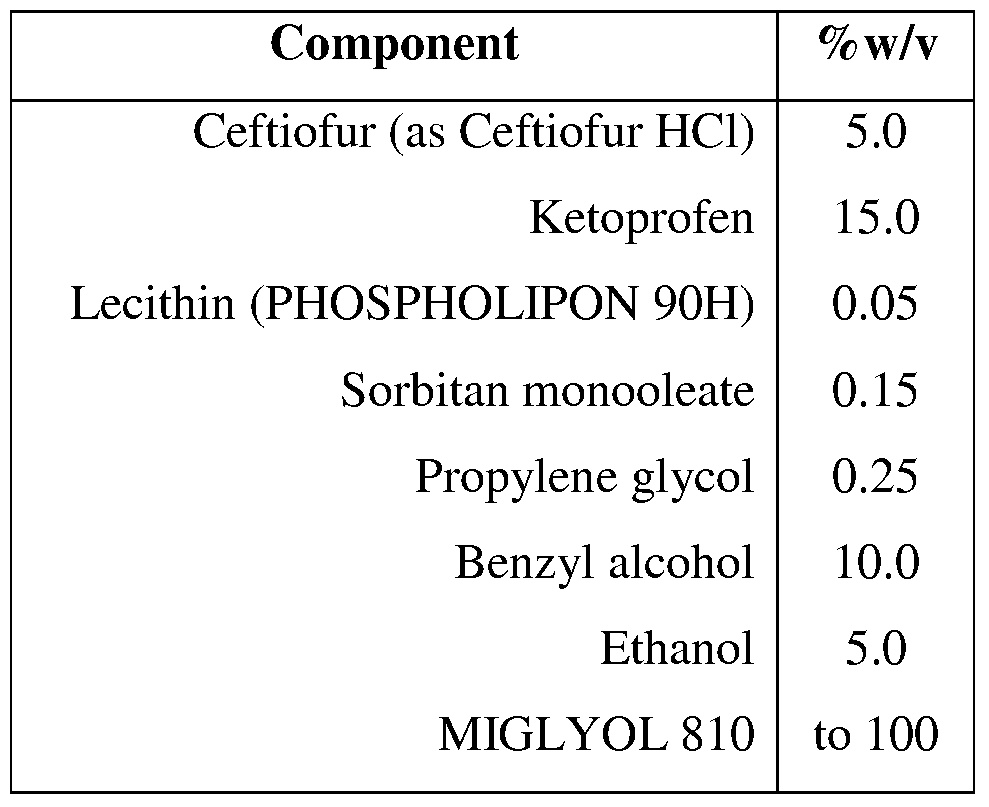
- Formulation 8 was prepared according to the following steps: 1) Filtered refined cottonseed oil, 2) heated oil to 95 0 C - 100 0 C, 3) added lecithin with constant stirring until a clear solution developed, 4) cooled the oil/lecithin mixture to 30 0 C, 5) added sorbitan monooleate and stirred continuously for 10 minutes, 6) added ceftiofur HCl and ketoprofen with continuous stirring for 15 minutes until completely dispersed, 7) added propylene glycol, benzyl alcohol and ethanol and continuously stirred for 10 minutes, 8) brought to volume with refined cotton seed oil, and 9) homogenized for 5 minutes. Component amounts are summarized in TABLE 20 and density measurements are summarized in TABLE 21.
- Formulation 9 was prepared as per the 10% benzyl alcohol, 5% ethanol and cottonseed oil batches, but the cottonseed oil was replaced with MIGLYOL 810 (NB oil not filtered prior to heating). Component amounts are summarized in TABLE 22 and density measurements are summarized in TABLE 23.
- Formulation 10 Purpose: Prepare batch with 10% benzyl alcohol, 5% ethanol and Ethyl oleate / refined cottonseed oil for stability.
- Formulation 10 was prepared as per the 10% benzyl alcohol, 5% ethanol and cottonseed oil batches, but the cottonseed oil in step 2 was replaced with ethyl oleate and refined cottonseed oil (NB oil not filtered prior to heating). Component amounts are summarized in TABLE 24 and density measurements are summarized in TABLE 25.
- Formulation 11 was prepared as per the 10% benzyl alcohol, 5% ethanol and
- Formulation 12 was prepared as per the 1% benzyl alcohol, 0% ethanol and
- MIGLYOL 810 batches but MIGLYOL 810 was replaced with ethyl oleate. Component amounts are summarized in TABLE 27.
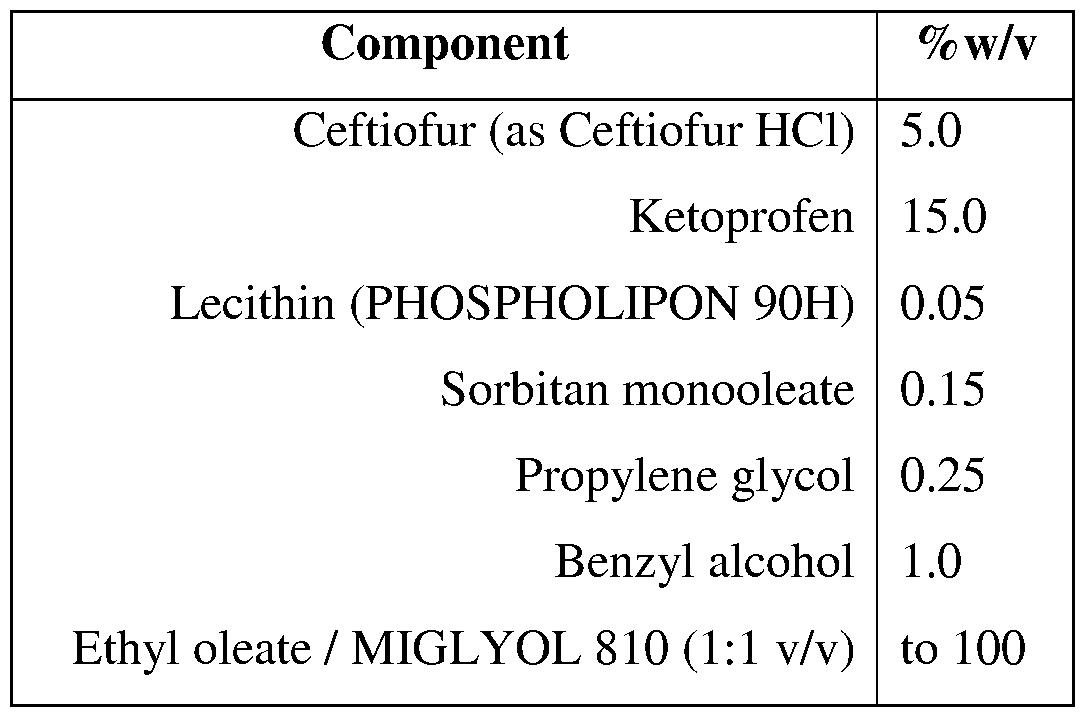
- Formulation 13 Purpose: Prepare batch with 1% benzyl alcohol, 0% ethanol and ethyl oleate/ cottonseed oil (1:1) for physical stability. Method: Formulation 13 was prepared as per the 1% benzyl alcohol, 0% ethanol and MIGLYOL 810 batches, but MIGLYOL 810 was replaced with ethyl oleate/refined cottonseed oil (1:1 v/v). Component amounts are summarized in TABLE 28.
- Formulation 13 was prepared as per the 1% benzyl alcohol, 0% ethanol and MIGLYOL 810 batches, but MIGLYOL 810 was replaced with ethyl oleate / MIGLYOL 810 (1:1 v/v). Component amounts are summarized in TABLE 29.
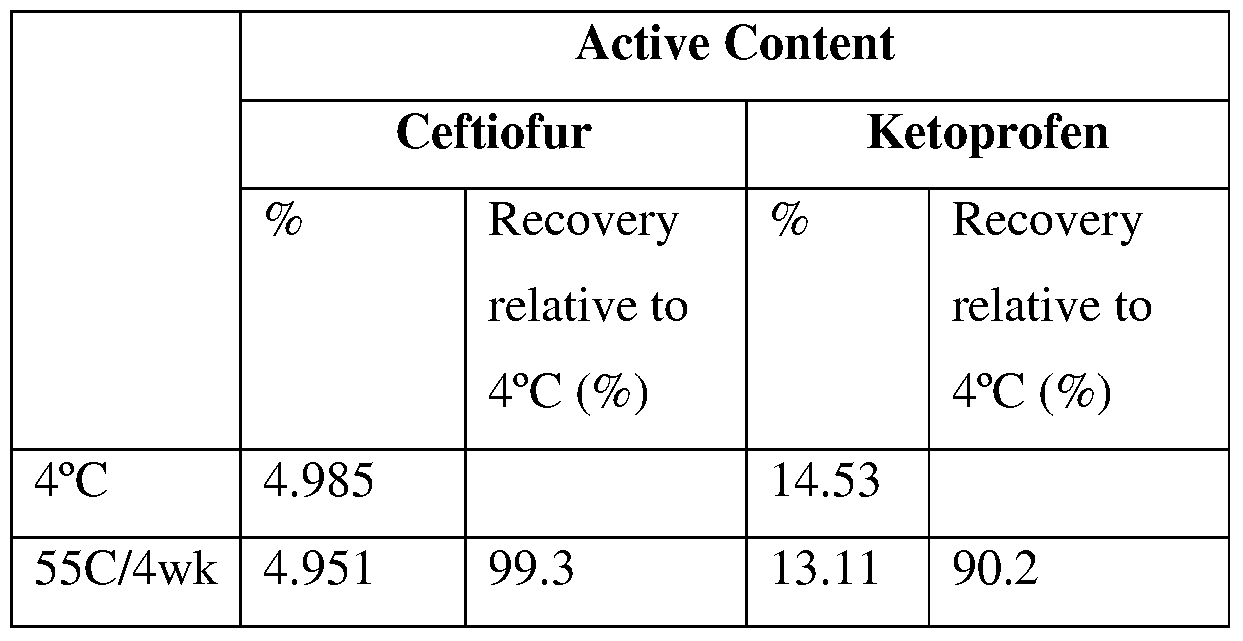
- Formulation 16 Purpose: Prepare batch with 1% benzyl alcohol, 0% ethanol and MIGLYOL 810 for chemical stability.
- Formulation 16 was prepared as per the 1% benzyl alcohol, 0% ethanol and MIGLYOL 810 batches. Component amounts are summarized in TABLE 32.
- Formulation 17 was prepared as per the 1% benzyl alcohol, 0% ethanol and MIGLYOL 810 batches. Component amounts are summarized in TABLE 34
- Formulation 17 was acceptable, the sedimentation volume was 6.8 mL / 9.0 mL, and the number of inversions to resuspend was less than 30. Data are summarized in TABLE 35.
- Formulation 18 was not well- suspended; the sedimentation volume was 3.7 mL / 9.0 mL, and the number of inversions to resuspend was greater than 300.
- Purpose Prepare batch with 1% benzyl alcohol, using IPM / refined cottonseed oil (1:1 v/v) as oil vehicle.
- Formulation 19 was prepared as per the 1% benzyl alcohol, 0% ethanol and MIGLYOL 810 batches, with an additional first step wherein the MIGLYOL 810 was filtered through a 0.2 ⁇ m filter. Component amounts are summarized in TABLE 37.
- Formulation 19 was not well- suspended; the sedimentation volume was 4.1 mL / 9.0 mL, and the number of inversions to resuspend was greater than 300.
- Formulation 20 was prepared as per the 1% benzyl alcohol, 0% ethanol and MIGLYOL 810 batches, with an additional first step wherein the MIGLYOL 810 was filtered through a 0.2 ⁇ m filter. Component amounts are summarized in TABLE 38 and the results of the stress study are summarized in TABLE 39.
- Density of Formulation 20 was 0.972 g / rnL.
- Formulation 21 was solid after overnight storage at 2-8°C, on shaking begins to move but not mobile. Viscosity (Ford cup No.4) was 38 seconds and the sedimentation after 1000 rpm for 15 minutes (8 mL) was 98% sediment. Formulation 21 resuspended in 10 seconds. The number of inversions to resuspend was 1.
- Formulation 22 was prepared as per the refined cottonseed oil batch with the these modifications: benzyl alcohol was added before heating, but ethyl oleate was used in place of cottonseed oil. Components are summarized in TABLE 42.
- Formulation 22 resuspended easily.
- the formulation was very viscous (but mobile) when stored at 2-8°C.
- the viscosity (Brookfield spindle 2 @ 100 rpm) was 102 cP and the viscosity (Ford cup No.4) was 17 seconds.
- the sedimentation after 1000 rpm for 15 minutes (8 mL) was 79% sediment, and the time to resuspend was 30 seconds.
- the seven day separation data are presented in TABLE 43.
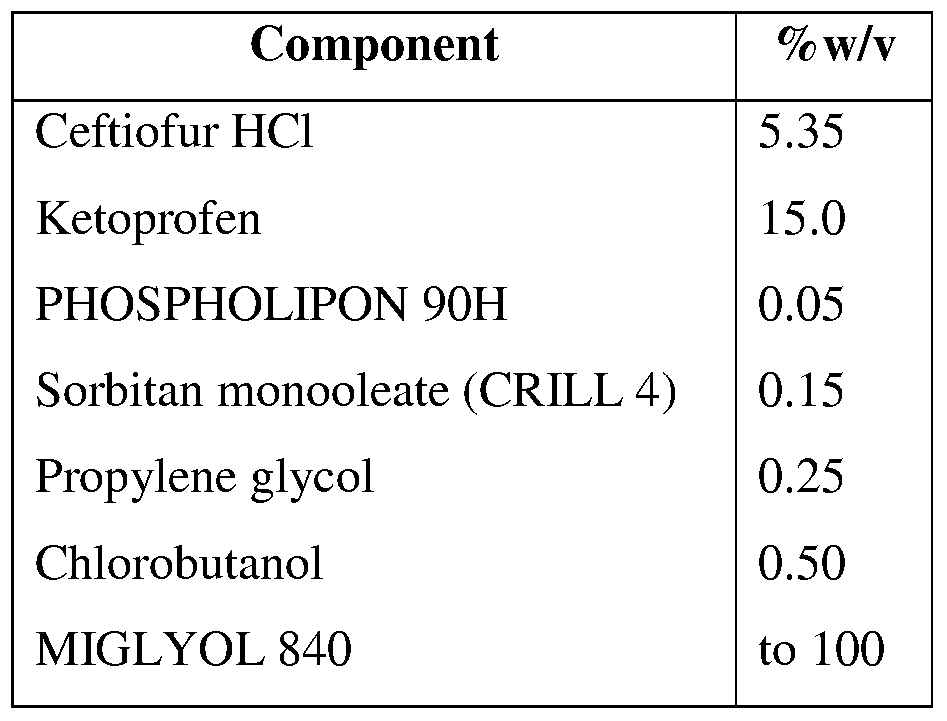
- MIGLYOL 810 may have potential as a replacement for cottonseed oil. Further investigation into the lower viscosity MIGLYOL 840 resulted in MIGLYOL 840 becoming a preferred oil for further formulation development. Even though MIGLYOL 840 is preferred, MIGLYOL 810 is still contemplated as a potential replacement for cottonseed oil in formulations according to the present invention.
- Formulation 23 was prepared as per the refined cottonseed oil batch with minor modifications: benzyl alcohol added before heating, MIGLYOL 840 was used in place of cottonseed oil. Components are summarized in TABLE 44.
- Formulation 23 was solid after overnight storage at 2-8°C, and on shaking began to move with moderate mobility. Viscosity was 18 seconds; sedimentation after 1000 rpm for 15 minutes (8 mL) was 90% sediment; resuspension occurred within 5 seconds; and the number of inversions to resuspend was 3.
- the seven day separation data is summarized in TABLE 45 and the stress study data is summarized in TABLE 46..
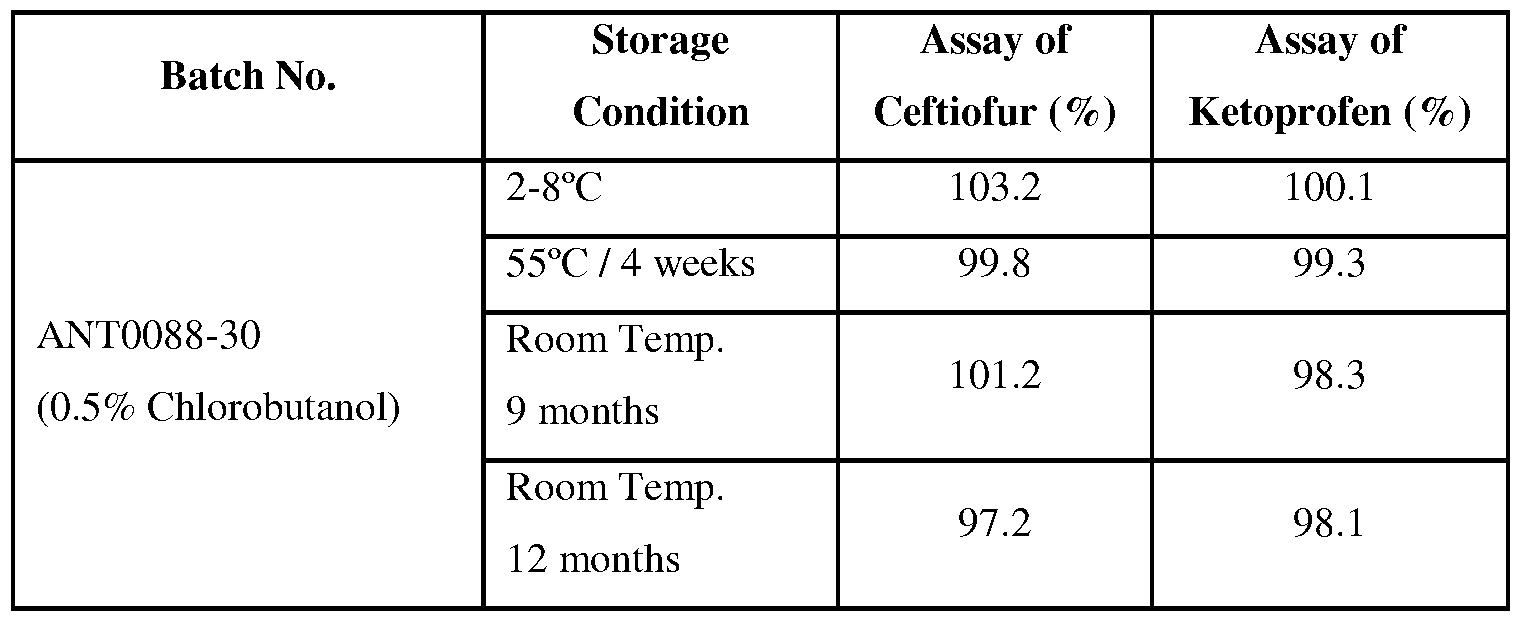
- a formulation trial batch was produced using 0.50%w/v chlorobutanol as preservative, rather than benzyl alcohol.
- Viscosity (Brookfield, spindle 2, 100 rpm) was 112 cP, the sedimentation after 1000 rpm for 15 minutes (8 mL) was 91% sediment.
- Syringeability and injectability studies involving the withdrawal and discharge of a 2 mL sample using an 18 gauge needle and 3 mL syringes have been carried out on formulation batches containing 0 to 5.0% benzyl alcohol.
- Syringeability time using a plastic syringe ranged from six to eight seconds.
- the syringeability of the 1.0% benzyl alcohol formulation was 7 seconds which was considered acceptable.
Landscapes
- Health & Medical Sciences (AREA)
- Chemical & Material Sciences (AREA)
- Life Sciences & Earth Sciences (AREA)
- Medicinal Chemistry (AREA)
- Public Health (AREA)
- Veterinary Medicine (AREA)
- Pharmacology & Pharmacy (AREA)
- Animal Behavior & Ethology (AREA)
- General Health & Medical Sciences (AREA)
- Epidemiology (AREA)
- Chemical Kinetics & Catalysis (AREA)
- General Chemical & Material Sciences (AREA)
- Engineering & Computer Science (AREA)
- Oil, Petroleum & Natural Gas (AREA)
- Organic Chemistry (AREA)
- Nuclear Medicine, Radiotherapy & Molecular Imaging (AREA)
- Molecular Biology (AREA)
- Bioinformatics & Cheminformatics (AREA)
- Biochemistry (AREA)
- Communicable Diseases (AREA)
- Oncology (AREA)
- Dermatology (AREA)
- Biophysics (AREA)
- Rheumatology (AREA)
- Pain & Pain Management (AREA)
- Pulmonology (AREA)
- Dispersion Chemistry (AREA)
- Acyclic And Carbocyclic Compounds In Medicinal Compositions (AREA)
- Medicinal Preparation (AREA)
- Pharmaceuticals Containing Other Organic And Inorganic Compounds (AREA)
Abstract
Description










Claims
Priority Applications (11)
| Application Number | Priority Date | Filing Date | Title |
|---|---|---|---|
| BRPI0922041A BRPI0922041A8 (en) | 2008-11-19 | 2009-11-18 | FORMULATIONS INCLUDING CEFTIOFUR AND KETOPROFENE OR CETIOFUR AND BENZYL ALCOHOL. |
| AU2009316708A AU2009316708B2 (en) | 2008-11-19 | 2009-11-18 | Formulations comprising ceftiofur and ketoprofen or ceftiofur and benzyl alcohol |
| NZ592984A NZ592984A (en) | 2008-11-19 | 2009-11-18 | Formulations comprising ceftiofur and ketoprofen or ceftiofur and benzyl alcohol |
| EP09764376.1A EP2367572B1 (en) | 2008-11-19 | 2009-11-18 | Formulations comprising ceftiofur and benzyl alcohol |
| CA2743551A CA2743551C (en) | 2008-11-19 | 2009-11-18 | Formulations comprising ceftiofur and ketoprofen or ceftiofur and benzyl alcohol |
| JP2011537581A JP5685193B2 (en) | 2008-11-19 | 2009-11-18 | Formulation containing ceftiofur and ketoprofen or ceftiofur and benzyl alcohol |
| ES09764376.1T ES2693700T3 (en) | 2008-11-19 | 2009-11-18 | Formulations comprising ceftiofur and benzyl alcohol |
| KR1020117014061A KR101748890B1 (en) | 2008-11-19 | 2009-11-18 | Formulations comprising ceftiofur and ketoprofen or ceftiofur and benzyl alcohol |
| MX2011005217A MX2011005217A (en) | 2008-11-19 | 2009-11-18 | FORMULATIONS THAT INCLUDE CEFTIOFUR AND CETOPROFEN OR CEFTIOFUR AND BENCILIC ALCOHOL. |
| CN200980152552.1A CN102341125B (en) | 2008-11-19 | 2009-11-18 | Formulations comprising ceftiofur and ketoprofen or ceftiofur and benzyl alcohol |
| ZA2011/03479A ZA201103479B (en) | 2008-11-19 | 2011-05-12 | Formulations comprising ceftiofur and ketoprofen or ceftiofur and benzyl alcohol |
Applications Claiming Priority (4)
| Application Number | Priority Date | Filing Date | Title |
|---|---|---|---|
| US11603108P | 2008-11-19 | 2008-11-19 | |
| US61/116,031 | 2008-11-19 | ||
| US11976408P | 2008-12-04 | 2008-12-04 | |
| US61/119,764 | 2008-12-04 |
Publications (2)
| Publication Number | Publication Date |
|---|---|
| WO2010059717A2 true WO2010059717A2 (en) | 2010-05-27 |
| WO2010059717A3 WO2010059717A3 (en) | 2011-09-09 |
Family
ID=41682851
Family Applications (1)
| Application Number | Title | Priority Date | Filing Date |
|---|---|---|---|
| PCT/US2009/064978 Ceased WO2010059717A2 (en) | 2008-11-19 | 2009-11-18 | Formulations comprising ceftiofur and ketoprofen or ceftiofur and benzyl alcohol |
Country Status (15)
| Country | Link |
|---|---|
| US (1) | US20100125060A1 (en) |
| EP (1) | EP2367572B1 (en) |
| JP (1) | JP5685193B2 (en) |
| KR (1) | KR101748890B1 (en) |
| CN (1) | CN102341125B (en) |
| AU (1) | AU2009316708B2 (en) |
| BR (1) | BRPI0922041A8 (en) |
| CA (1) | CA2743551C (en) |
| CL (1) | CL2011001177A1 (en) |
| CO (1) | CO6390043A2 (en) |
| ES (1) | ES2693700T3 (en) |
| MX (1) | MX2011005217A (en) |
| NZ (1) | NZ592984A (en) |
| WO (1) | WO2010059717A2 (en) |
| ZA (1) | ZA201103479B (en) |
Cited By (15)
| Publication number | Priority date | Publication date | Assignee | Title |
|---|---|---|---|---|
| GB2477590A (en) * | 2010-02-05 | 2011-08-10 | Biocopea Ltd | A non-steroidal anti-inflammatory drug (NSAID) formulation comprising a lipid carrier |
| GB2487808A (en) * | 2010-10-29 | 2012-08-08 | Biocopea Ltd | Oral adjuvant or formulation comprising a lipid and an alcohol |
| WO2014102679A1 (en) | 2012-12-27 | 2014-07-03 | Virbac | Novel veterinary pharmaceutical compositions and method for the production thereof |
| US8895537B2 (en) | 2010-10-29 | 2014-11-25 | Infirst Healthcare Ltd. | Compositions and methods for treating cardiovascular diseases |
| US9271950B2 (en) | 2010-10-29 | 2016-03-01 | Infirst Healthcare Limited | Compositions for treating chronic inflammation and inflammatory diseases |
| US9308213B2 (en) | 2010-10-29 | 2016-04-12 | Infirst Healthcare Limited | Solid solution compositions and use in chronic inflammation |
| US9504664B2 (en) | 2010-10-29 | 2016-11-29 | Infirst Healthcare Limited | Compositions and methods for treating severe pain |
| US9737500B2 (en) | 2010-10-29 | 2017-08-22 | Infirst Healthcare Limited | Compositions and methods for treating severe pain |
| US9744132B2 (en) | 2010-10-29 | 2017-08-29 | Infirst Healthcare Limited | Solid solution compositions and use in chronic inflammation |
| US10695431B2 (en) | 2010-10-29 | 2020-06-30 | Infirst Healthcare Limited | Solid solution compositions and use in cardiovascular disease |
| US10695432B2 (en) | 2010-10-29 | 2020-06-30 | Infirst Healthcare Limited | Solid solution compositions and use in severe pain |
| US11202831B2 (en) | 2010-10-29 | 2021-12-21 | Infirst Healthcare Limited | Solid solution compositions and use in cardiovascular disease |
| US11224659B2 (en) | 2010-10-29 | 2022-01-18 | Infirst Healthcare Limited | Solid solution compositions and use in severe pain |
| US11730709B2 (en) | 2010-10-29 | 2023-08-22 | Infirst Healthcare Limited | Compositions and methods for treating severe pain |
| US12018091B2 (en) | 2012-05-18 | 2024-06-25 | Genentech, Inc. | High-concentration monoclonal antibody formulations |
Families Citing this family (9)
| Publication number | Priority date | Publication date | Assignee | Title |
|---|---|---|---|---|
| AR090775A1 (en) * | 2012-04-23 | 2014-12-03 | Otsuka Pharma Co Ltd | INJECTABLE PREPARATION |
| TWI631948B (en) * | 2012-07-17 | 2018-08-11 | 拜爾紐西蘭有限公司 | Injectable antibiotic formulations and their methods of use |
| KR101586789B1 (en) * | 2012-12-28 | 2016-01-19 | 주식회사 종근당 | Sustained-release lipid pre-concentrate of cationic pharmacologically active substance and pharmaceutical composition comprising the same |
| KR101586791B1 (en) | 2012-12-28 | 2016-01-19 | 주식회사 종근당 | Sustained-release lipid pre-concentrate of GnRH analogues and pharmaceutical composition comprising the same |
| MX373714B (en) * | 2013-12-16 | 2020-05-08 | Zoetis Services Llc | LONG-ACTING KETOPROFEN COMPOSITIONS. |
| WO2017119928A1 (en) * | 2016-01-08 | 2017-07-13 | Abon Pharmaceuticals, Llc | Long acting injectable formulations |
| CN107049943B (en) * | 2017-05-10 | 2020-02-14 | 郑州百瑞动物药业有限公司 | Ceftiofur hydrochloride injection for dairy cattle and preparation method thereof |
| MA55205A (en) * | 2019-03-06 | 2022-01-12 | Zoetis Services Llc | READY TO USE INJECTABLE FORMULATIONS |
| CN117530920B (en) * | 2023-12-08 | 2025-09-23 | 艾美科健(中国)生物医药有限公司 | Ceftiofur compound injection and preparation method thereof |
Citations (2)
| Publication number | Priority date | Publication date | Assignee | Title |
|---|---|---|---|---|
| US5736151A (en) | 1996-12-09 | 1998-04-07 | Pharmacia & Upjohn Company | Antibiotic oil suspensions |
| US20040022815A1 (en) | 2002-08-05 | 2004-02-05 | Orchid Health Care | Novel pharmaceutical composition of ceftiofur |
Family Cites Families (10)
| Publication number | Priority date | Publication date | Assignee | Title |
|---|---|---|---|---|
| IT1181672B (en) * | 1984-10-25 | 1987-09-30 | Upjohn Co | CRYSTALLINE HALOGENHYDRATE CEPHALOSPORINE |
| AU617377B2 (en) * | 1987-11-10 | 1991-11-28 | Pharmacia & Upjohn Company | Cephalosporin antibiotics |
| US5721359A (en) * | 1993-03-12 | 1998-02-24 | Pharmacia & Upjohn Company | Crystalline ceftiofur free acid |
| US6074657A (en) * | 1997-03-20 | 2000-06-13 | Pharmacia & Upjohn Company | Administration of an injectable antibiotic in the ear of an animal |
| EP1318787A2 (en) * | 2000-07-26 | 2003-06-18 | Alcon Inc. | Pharmaceutical suspension compositions lacking a polymeric suspending agent |
| WO2002022171A2 (en) * | 2000-09-12 | 2002-03-21 | Pharmacia & Upjohn Company | Pharmaceutical composition having specific water activity |
| WO2002022107A2 (en) * | 2000-09-12 | 2002-03-21 | Pharmacia & Upjohn Company | Pharmaceutical composition having modified carrier |
| KR100423895B1 (en) * | 2001-02-19 | 2004-03-24 | 주식회사 엘지생명과학 | Compositions of suspensions of ceftiofur hydrochloride |
| KR20040015622A (en) * | 2002-08-13 | 2004-02-19 | 대한뉴팜(주) | Injectable Composition Comprising Ceftiofur Sodium as Active Ingredient |
| CN100534433C (en) * | 2005-12-12 | 2009-09-02 | 浙江升华拜克生物股份有限公司 | Ceftiofur-containing powder injection for beast |
-
2009
- 2009-11-18 EP EP09764376.1A patent/EP2367572B1/en active Active
- 2009-11-18 ES ES09764376.1T patent/ES2693700T3/en active Active
- 2009-11-18 BR BRPI0922041A patent/BRPI0922041A8/en not_active Application Discontinuation
- 2009-11-18 WO PCT/US2009/064978 patent/WO2010059717A2/en not_active Ceased
- 2009-11-18 US US12/621,208 patent/US20100125060A1/en not_active Abandoned
- 2009-11-18 CA CA2743551A patent/CA2743551C/en active Active
- 2009-11-18 AU AU2009316708A patent/AU2009316708B2/en active Active
- 2009-11-18 MX MX2011005217A patent/MX2011005217A/en active IP Right Grant
- 2009-11-18 KR KR1020117014061A patent/KR101748890B1/en active Active
- 2009-11-18 JP JP2011537581A patent/JP5685193B2/en active Active
- 2009-11-18 NZ NZ592984A patent/NZ592984A/en unknown
- 2009-11-18 CN CN200980152552.1A patent/CN102341125B/en active Active
-
2011
- 2011-05-12 ZA ZA2011/03479A patent/ZA201103479B/en unknown
- 2011-05-19 CL CL2011001177A patent/CL2011001177A1/en unknown
- 2011-06-07 CO CO11069892A patent/CO6390043A2/en not_active Application Discontinuation
Patent Citations (2)
| Publication number | Priority date | Publication date | Assignee | Title |
|---|---|---|---|---|
| US5736151A (en) | 1996-12-09 | 1998-04-07 | Pharmacia & Upjohn Company | Antibiotic oil suspensions |
| US20040022815A1 (en) | 2002-08-05 | 2004-02-05 | Orchid Health Care | Novel pharmaceutical composition of ceftiofur |
Non-Patent Citations (1)
| Title |
|---|
| A MARTIN; P BUSTAMANTE: "physical pharmacy", 1993, LEA AND FEBIGER, article "Coarse Dispersion", pages: 117 - 124 |
Cited By (55)
| Publication number | Priority date | Publication date | Assignee | Title |
|---|---|---|---|---|
| GB2477590A (en) * | 2010-02-05 | 2011-08-10 | Biocopea Ltd | A non-steroidal anti-inflammatory drug (NSAID) formulation comprising a lipid carrier |
| US10188619B2 (en) | 2010-10-29 | 2019-01-29 | Infirst Healthcare Limited | Solid solution compositions and use in chronic inflammation |
| US11918654B2 (en) | 2010-10-29 | 2024-03-05 | Infirst Healthcare Limited | Solid solution compositions and use in severe pain |
| US8895536B2 (en) | 2010-10-29 | 2014-11-25 | Infirst Healthcare Ltd. | Compositions and methods for treating chronic inflammation and inflammatory diseases |
| US9265742B2 (en) | 2010-10-29 | 2016-02-23 | Infirst Healthcare Limited | Compositions and methods for treating inflammatory pain |
| US9271950B2 (en) | 2010-10-29 | 2016-03-01 | Infirst Healthcare Limited | Compositions for treating chronic inflammation and inflammatory diseases |
| US9308213B2 (en) | 2010-10-29 | 2016-04-12 | Infirst Healthcare Limited | Solid solution compositions and use in chronic inflammation |
| US9326958B2 (en) | 2010-10-29 | 2016-05-03 | Infirst Healthcare Limited | Compositions for treating chronic inflammation and inflammatory diseases |
| US9381180B2 (en) | 2010-10-29 | 2016-07-05 | Infirst Healthcare Limited | Compositions and methods for treating chronic inflammation and inflammatory diseases |
| US9427422B2 (en) | 2010-10-29 | 2016-08-30 | Infirst Healthcare Limited | Compositions for treating cardiovascular diseases |
| US10363232B2 (en) | 2010-10-29 | 2019-07-30 | Infirst Healthcare Limited | Compositions and methods for treating severe pain |
| US9693980B2 (en) | 2010-10-29 | 2017-07-04 | Infirst Healthcare Limited | Compositions and methods for treating chronic inflammation and inflammatory diseases |
| US9737500B2 (en) | 2010-10-29 | 2017-08-22 | Infirst Healthcare Limited | Compositions and methods for treating severe pain |
| US9744132B2 (en) | 2010-10-29 | 2017-08-29 | Infirst Healthcare Limited | Solid solution compositions and use in chronic inflammation |
| US9750810B2 (en) | 2010-10-29 | 2017-09-05 | Infirst Healthcare Limited | Compositions and methods for treating chronic inflammation and inflammatory diseases |
| US9775820B2 (en) | 2010-10-29 | 2017-10-03 | Infirst Healthcare Limited | Solid solution compositions and use in chronic inflammation |
| US9789075B2 (en) | 2010-10-29 | 2017-10-17 | Infirst Helathcare Limited | Compositions and methods for treating cardiovascular diseases |
| US9795577B2 (en) | 2010-10-29 | 2017-10-24 | Infirst Healthcare Limited | Compositions and methods for treating severe pain |
| US9820952B2 (en) | 2010-10-29 | 2017-11-21 | Infirst Healthcare Limited | Solid solution compositions and use in chronic inflammation |
| US9827215B2 (en) | 2010-10-29 | 2017-11-28 | Infirst Healthcare Limited | Solid solution compositions and use in chronic inflammation |
| US10004704B2 (en) | 2010-10-29 | 2018-06-26 | Infirst Healthcare Limited | Compositions and methods for treating chronic inflammation and inflammatory diseases |
| US10143671B2 (en) | 2010-10-29 | 2018-12-04 | Infirst Healthcare Limited | Solid solution compositions and use in chronic inflammation |
| US10155042B2 (en) | 2010-10-29 | 2018-12-18 | Infirst Healthcare Limited | Compositions and methods for treating chronic inflammation and inflammatory diseases |
| US12533332B2 (en) | 2010-10-29 | 2026-01-27 | Infirst Healthcare Limited | Compositions and methods for treating chronic inflammation and inflammatory diseases |
| US11992555B2 (en) | 2010-10-29 | 2024-05-28 | Infirst Healthcare Limited | Solid solution compositions and use in chronic inflammation |
| US10154975B2 (en) | 2010-10-29 | 2018-12-18 | Infirst Healthcare Limited | Solid solution compositions and use in chronic inflammation |
| GB2487808A (en) * | 2010-10-29 | 2012-08-08 | Biocopea Ltd | Oral adjuvant or formulation comprising a lipid and an alcohol |
| US8895537B2 (en) | 2010-10-29 | 2014-11-25 | Infirst Healthcare Ltd. | Compositions and methods for treating cardiovascular diseases |
| US10213381B2 (en) | 2010-10-29 | 2019-02-26 | Infirst Healthcare Limited | Solid solution compositions and use in chronic inflammation |
| US9504664B2 (en) | 2010-10-29 | 2016-11-29 | Infirst Healthcare Limited | Compositions and methods for treating severe pain |
| US10426748B2 (en) | 2010-10-29 | 2019-10-01 | Infirst Healthcare Limited | Compositions and methods for treating chronic inflammation and inflammatory diseases |
| US10588878B2 (en) | 2010-10-29 | 2020-03-17 | Infirst Healthcare Limited | Solid solution compositions and use in chronic inflammation |
| US10596132B2 (en) | 2010-10-29 | 2020-03-24 | Infirst Healthcare Limited | Solid solution compositions and use in chronic inflammation |
| US10653778B2 (en) | 2010-10-29 | 2020-05-19 | Infirst Healthcare Limited | Compositions and methods for treating chronic inflammation and inflammatory diseases |
| US10695431B2 (en) | 2010-10-29 | 2020-06-30 | Infirst Healthcare Limited | Solid solution compositions and use in cardiovascular disease |
| US10695432B2 (en) | 2010-10-29 | 2020-06-30 | Infirst Healthcare Limited | Solid solution compositions and use in severe pain |
| US10835490B2 (en) | 2010-10-29 | 2020-11-17 | Infirst Healthcare Limited | Solid solution compositions and use in chronic inflammation |
| US10849869B2 (en) | 2010-10-29 | 2020-12-01 | Infirst Healthcare Limited | Compositions and methods for treating chronic inflammation and inflammatory diseases |
| US10857114B2 (en) | 2010-10-29 | 2020-12-08 | Infirst Healthcare Limited | Compositions and methods for treating severe pain |
| US11000493B2 (en) | 2010-10-29 | 2021-05-11 | Infirst Healthcare Limited | Solid solution compositions and use in chronic inflammation |
| US11065218B2 (en) | 2010-10-29 | 2021-07-20 | Infirst Healthcare Limited | Compositions and methods for treating chronic inflammation and inflammatory diseases |
| US11103472B2 (en) | 2010-10-29 | 2021-08-31 | Infirst Healthcare Limited | Oral suspensions comprising a non-steroidal anti-inflammatory drug (NSAID) |
| US11154500B2 (en) | 2010-10-29 | 2021-10-26 | Infirst Healthcare Limited | Solid solution compositions and use in chronic inflammation |
| US11202831B2 (en) | 2010-10-29 | 2021-12-21 | Infirst Healthcare Limited | Solid solution compositions and use in cardiovascular disease |
| US11224659B2 (en) | 2010-10-29 | 2022-01-18 | Infirst Healthcare Limited | Solid solution compositions and use in severe pain |
| US11660276B2 (en) | 2010-10-29 | 2023-05-30 | Infirst Healthcare Limited | Compositions and methods for treating chronic inflammation and inflammatory diseases |
| US11730709B2 (en) | 2010-10-29 | 2023-08-22 | Infirst Healthcare Limited | Compositions and methods for treating severe pain |
| US11826428B2 (en) | 2010-10-29 | 2023-11-28 | Infirst Healthcare Limited | Solid solution compositions comprising cannabidiols |
| US11844773B2 (en) | 2010-10-29 | 2023-12-19 | Infirst Healthcare Limited | Solid solution compositions and use in chronic inflammation |
| US10231943B2 (en) | 2010-10-29 | 2019-03-19 | Infirst Healthcare Limited | Compositions and methods for treating cardiovascular diseases |
| US12018091B2 (en) | 2012-05-18 | 2024-06-25 | Genentech, Inc. | High-concentration monoclonal antibody formulations |
| FR3000392A1 (en) * | 2012-12-27 | 2014-07-04 | Virbac | NOVEL VETERINARY PHARMACEUTICAL COMPOSITIONS AND PROCESS FOR THEIR PREPARATION |
| WO2014102679A1 (en) | 2012-12-27 | 2014-07-03 | Virbac | Novel veterinary pharmaceutical compositions and method for the production thereof |
| US9974736B2 (en) | 2012-12-27 | 2018-05-22 | Virbac | Veterinary pharmaceutical compositions and method for the production thereof |
| AU2013368956B2 (en) * | 2012-12-27 | 2018-08-09 | Virbac | Novel veterinary pharmaceutical compositions and method for the production thereof |
Also Published As
| Publication number | Publication date |
|---|---|
| KR20110092312A (en) | 2011-08-17 |
| WO2010059717A3 (en) | 2011-09-09 |
| BRPI0922041A8 (en) | 2022-08-16 |
| MX2011005217A (en) | 2011-06-01 |
| EP2367572B1 (en) | 2018-08-29 |
| KR101748890B1 (en) | 2017-06-19 |
| CO6390043A2 (en) | 2012-02-29 |
| AU2009316708A1 (en) | 2010-05-27 |
| ES2693700T3 (en) | 2018-12-13 |
| BRPI0922041A2 (en) | 2015-12-22 |
| CA2743551C (en) | 2017-08-15 |
| ZA201103479B (en) | 2012-02-29 |
| CA2743551A1 (en) | 2010-05-27 |
| AU2009316708B2 (en) | 2014-07-17 |
| US20100125060A1 (en) | 2010-05-20 |
| CL2011001177A1 (en) | 2011-09-16 |
| CN102341125B (en) | 2014-02-12 |
| NZ592984A (en) | 2012-12-21 |
| CN102341125A (en) | 2012-02-01 |
| JP5685193B2 (en) | 2015-03-18 |
| JP2012509337A (en) | 2012-04-19 |
| EP2367572A2 (en) | 2011-09-28 |
Similar Documents
| Publication | Publication Date | Title |
|---|---|---|
| CA2743551C (en) | Formulations comprising ceftiofur and ketoprofen or ceftiofur and benzyl alcohol | |
| EP1569693B1 (en) | Pharmaceutical compositions having a modified vehicle | |
| JP4188084B2 (en) | A parenterally administrable dosage form containing a suspension of tramadol and diclofenac salt | |
| US20040022815A1 (en) | Novel pharmaceutical composition of ceftiofur | |
| EP3934618B1 (en) | Ready-to-use injectable formulations | |
| RU2777360C9 (en) | Ready-to-use dosage forms for injection | |
| BR112014031083B1 (en) | NON-AQUEOUS INJECTABLE VETERINARY PHARMACEUTICAL COMPOSITION, SYRINGE CONTAINING SUCH COMPOSITION AND MANUFACTURING METHOD | |
| DK1569693T3 (en) | Pharmaceutical compositions with a modified vehicle | |
| EP2934524B1 (en) | Penethamate veterinary injectable formulations | |
| EP2874623A1 (en) | Injectable antibiotic formulations and their methods of use | |
| NZ538144A (en) | Novel pharmaceutical composition of ceftiofur |
Legal Events
| Date | Code | Title | Description |
|---|---|---|---|
| WWE | Wipo information: entry into national phase |
Ref document number: 200980152552.1 Country of ref document: CN |
|
| 121 | Ep: the epo has been informed by wipo that ep was designated in this application |
Ref document number: 09764376 Country of ref document: EP Kind code of ref document: A2 |
|
| WWE | Wipo information: entry into national phase |
Ref document number: 2743551 Country of ref document: CA |
|
| WWE | Wipo information: entry into national phase |
Ref document number: MX/A/2011/005217 Country of ref document: MX |
|
| NENP | Non-entry into the national phase |
Ref country code: DE |
|
| WWE | Wipo information: entry into national phase |
Ref document number: 2011001177 Country of ref document: CL Ref document number: 2011537581 Country of ref document: JP |
|
| WWE | Wipo information: entry into national phase |
Ref document number: 2009316708 Country of ref document: AU Ref document number: 592984 Country of ref document: NZ |
|
| WWE | Wipo information: entry into national phase |
Ref document number: 3880/DELNP/2011 Country of ref document: IN |
|
| WWE | Wipo information: entry into national phase |
Ref document number: 2009764376 Country of ref document: EP |
|
| WWE | Wipo information: entry into national phase |
Ref document number: 11069892 Country of ref document: CO |
|
| ENP | Entry into the national phase |
Ref document number: 2009316708 Country of ref document: AU Date of ref document: 20091118 Kind code of ref document: A |
|
| ENP | Entry into the national phase |
Ref document number: 20117014061 Country of ref document: KR Kind code of ref document: A |
|
| ENP | Entry into the national phase |
Ref document number: PI0922041 Country of ref document: BR Kind code of ref document: A2 Effective date: 20110519 |