WO2010060816A2 - Oral care composition - Google Patents
Oral care composition Download PDFInfo
- Publication number
- WO2010060816A2 WO2010060816A2 PCT/EP2009/065174 EP2009065174W WO2010060816A2 WO 2010060816 A2 WO2010060816 A2 WO 2010060816A2 EP 2009065174 W EP2009065174 W EP 2009065174W WO 2010060816 A2 WO2010060816 A2 WO 2010060816A2
- Authority
- WO
- WIPO (PCT)
- Prior art keywords
- source
- fluoride
- oral care
- potassium
- care composition
- Prior art date
- Legal status (The legal status is an assumption and is not a legal conclusion. Google has not performed a legal analysis and makes no representation as to the accuracy of the status listed.)
- Ceased
Links
Classifications
-
- A—HUMAN NECESSITIES
- A61—MEDICAL OR VETERINARY SCIENCE; HYGIENE
- A61K—PREPARATIONS FOR MEDICAL, DENTAL OR TOILETRY PURPOSES
- A61K8/00—Cosmetics or similar toiletry preparations
- A61K8/18—Cosmetics or similar toiletry preparations characterised by the composition
- A61K8/19—Cosmetics or similar toiletry preparations characterised by the composition containing inorganic ingredients
-
- A—HUMAN NECESSITIES
- A61—MEDICAL OR VETERINARY SCIENCE; HYGIENE
- A61Q—SPECIFIC USE OF COSMETICS OR SIMILAR TOILETRY PREPARATIONS
- A61Q11/00—Preparations for care of the teeth, of the oral cavity or of dentures; Dentifrices, e.g. toothpastes; Mouth rinses
-
- A—HUMAN NECESSITIES
- A61—MEDICAL OR VETERINARY SCIENCE; HYGIENE
- A61K—PREPARATIONS FOR MEDICAL, DENTAL OR TOILETRY PURPOSES
- A61K8/00—Cosmetics or similar toiletry preparations
- A61K8/18—Cosmetics or similar toiletry preparations characterised by the composition
- A61K8/19—Cosmetics or similar toiletry preparations characterised by the composition containing inorganic ingredients
- A61K8/20—Halogens; Compounds thereof
- A61K8/21—Fluorides; Derivatives thereof
-
- A—HUMAN NECESSITIES
- A61—MEDICAL OR VETERINARY SCIENCE; HYGIENE
- A61K—PREPARATIONS FOR MEDICAL, DENTAL OR TOILETRY PURPOSES
- A61K8/00—Cosmetics or similar toiletry preparations
- A61K8/18—Cosmetics or similar toiletry preparations characterised by the composition
- A61K8/19—Cosmetics or similar toiletry preparations characterised by the composition containing inorganic ingredients
- A61K8/24—Phosphorous; Compounds thereof
-
- A—HUMAN NECESSITIES
- A61—MEDICAL OR VETERINARY SCIENCE; HYGIENE
- A61K—PREPARATIONS FOR MEDICAL, DENTAL OR TOILETRY PURPOSES
- A61K8/00—Cosmetics or similar toiletry preparations
- A61K8/18—Cosmetics or similar toiletry preparations characterised by the composition
- A61K8/19—Cosmetics or similar toiletry preparations characterised by the composition containing inorganic ingredients
- A61K8/27—Zinc; Compounds thereof
-
- A—HUMAN NECESSITIES
- A61—MEDICAL OR VETERINARY SCIENCE; HYGIENE
- A61K—PREPARATIONS FOR MEDICAL, DENTAL OR TOILETRY PURPOSES
- A61K8/00—Cosmetics or similar toiletry preparations
- A61K8/18—Cosmetics or similar toiletry preparations characterised by the composition
- A61K8/30—Cosmetics or similar toiletry preparations characterised by the composition containing organic compounds
- A61K8/33—Cosmetics or similar toiletry preparations characterised by the composition containing organic compounds containing oxygen
- A61K8/36—Carboxylic acids; Salts or anhydrides thereof
- A61K8/365—Hydroxycarboxylic acids; Ketocarboxylic acids
-
- A—HUMAN NECESSITIES
- A61—MEDICAL OR VETERINARY SCIENCE; HYGIENE
- A61K—PREPARATIONS FOR MEDICAL, DENTAL OR TOILETRY PURPOSES
- A61K2800/00—Properties of cosmetic compositions or active ingredients thereof or formulation aids used therein and process related aspects
- A61K2800/40—Chemical, physico-chemical or functional or structural properties of particular ingredients
- A61K2800/52—Stabilizers
Definitions
- the present invention relates to an oral care composition comprising hydroxyapatite and a source of fluoride.
- the invention also relates to the stabilisation of the fluoride in such products.
- US 4,244,931 discloses dentifrice abrasives comprising dicalcium phosphate dihydrate having improved fluoride stability.
- US 5,037,636 discloses dentifrice abrasives comprising dicalcium phosphate dihydrate and small amounts of zinc salts having improved fluoride stability.
- WO 03/059303 discloses oral care compositions comprising complexes of amorphous calcium phosphates and phosphopeptides, with a specific pH and buffer system, having enhanced fluoride stability.
- an oral care composition comprising particulate hydroxyapatite, a source of fluoride, a source of potassium cations, and a source of citrate anions.
- a method of improving the stability of fluoride in an oral care composition also comprising particulate hydroxyapatite comprising the inclusion of a source of potassium cations, and a source of citrate anions in the oral care composition.
- a third aspect of the present invention there is provided a method of manufacture of an oral care composition according to the first aspect of the invention.
- a fourth aspect of the present invention there is provided the use of particulate hydroxyapatite, a source of fluoride, a source of potassium cations, and a source of citrate anions in the manufacture of an oral care composition for the treatment of the teeth in the oral cavity.
- the treatment referred to in the fourth aspect of the invention may be for anticaries benefits, for remineralisation of the teeth, or for reducing hypersensitivity.
- the oral care compositions of the present invention are typically used to treat the teeth in the human mouth.
- the composition may be a mouthwash or a gum, but is more typically a toothpaste.
- the hydroxyapatite used in the present invention may be of any of the forms suitable for inclusion in the composition in which it is incorporated. Finely divided hydroxyapatite is particularly suitable, such material having been previously used as a dentifrice abrasive (see CA-A-999,238, US-A-4,634,589 and US-A-4, 327,079).
- the average particle size of such finely divided hydroxyapatite is usually in the range from about 0.5 micron to about 15 microns, preferably from 1 to 10 and particularly from about 2 to about 5 microns.
- Preferred particulate hydroxyapatites are synthetic and are of high purity consisting of at least 92% by weight of Caio(PO 4 )6(OH) 2 . The remainder will comprise mainly bound water (typically 6% by weight maximum) and a minor amount of calcium carbonate.
- Preferred particulate hydroxyapatites have needle-shaped primary crystallites, typically of length from 100 to 200 nm and width and thickness from 10 to 20 nm. These primary crystallites are typically agglomerated into larger particles having the particle size distributions indicated above.
- the particulate hydroxyapatite is typically incorporated at from 0.1 to 20% by weight, preferably at from 0.25 to 10% and more preferably at from 0.5 to 5% by weight of the composition of which it is a part.
- the source of fluoride is typically a complex fluoride salt such as sodium monofluorophosphate (SMFP) or potassium monofluorophoshate.
- Complex fluoride salts should be understood to be salts in which the fluorine atom is bound to another atom in the anion of the salt, rather than being present as a free fluoride anion.
- SMFP is the most preferred source of fluoride.
- the fluoride source is preferably present at such a level as to provide fluoride at from 100 to 2000 ppm, and preferably from 900 to 1500 ppm in the composition.
- the source of fluoride is SMFP, it is typically incorporated at from 0.1 % to 10%, preferably at from 0.25 to 5% and more preferably at from 0.5 to 2.5% by weight of the composition of which it is a part.
- the source of potassium cations is typically a simple salt.
- Potassium citrate is the most preferred source of potassium ions because this is also a source of citrate ions (vide infra).
- the source of citrate anions is typically a simple salt. Typically the citrate ion is present in its tri-basic form; however, acid salts may be contemplated. Potassium citrate is the most preferred source of citrate ions because this is also a source of potassium ions (vide supra).
- potassium citrate i.e. tripotassium citrate
- compositions of the invention it is typically used at from 0.1 to 30%, preferably at from 0.5 to 20% and more preferably at from 1 to 10% by weight of the composition of which it is a part.
- potassium citrate may enhance the desensitising benefit of the composition.
- a preferred additional component is a source of zinc ions, in particular zinc citrate.
- zinc citrate is typically present at from 0.1 to 10%, preferably from 0.5 to 5%, and more preferably 1 to 3%, by weight of the composition of which it is part.
- compositions of the invention comprise one or more types of silica.
- a thickening silica is one such silica, by which is meant a silica that causes an increase in viscosity of the composition.
- An abrasive silica is another preferred additional component, such silicas being particulate materials that are relative hard and abrasive.
- the composition may contain other particulate abrasive materials such as alumina, dicalcium phosphate, calcium pyrophosphate, thmetaphosphate, or insoluble hexametaphosphate.
- the total amount of particulate abrasive material is typically from 3 to 60% by weight of the composition.
- composition may comprise other anti-caries agents such as sodium trimetaphosphate or casein.
- the toothpaste composition according to the invention may comprise further ingredients which are common in the art, such as: antimicrobial agents, e.g. chlorhexidine, sanguinarine extract, metronidazole, quaternary ammonium compounds, such as cetylpyhdinium chloride; bis- guanides, such as chlorhexidine digluconate, hexetidine, octenidine, alexidine; and halogenated bisphenolic compounds, such as 2,2' methylenebis-(4-chloro-6- bromophenol);
- antimicrobial agents e.g. chlorhexidine, sanguinarine extract, metronidazole, quaternary ammonium compounds, such as cetylpyhdinium chloride
- bis- guanides such as chlorhexidine digluconate, hexetidine, octenidine, alexidine
- halogenated bisphenolic compounds such as 2,2' methylenebis-(4-chloro-6- bromophenol
- anti-inflammatory agents such as ibuprofen, flurbiprofen, aspirin, indomethacin etc.;
- plaque buffers such as urea, calcium lactate, calcium glycerophosphate and strontium polyacrylates
- vitamins such as Vitamins A, C and E;
- desensitising agents e.g. potassium citrate, potassium chloride, potassium tartrate, potassium bicarbonate, potassium oxalate, potassium nitrate and strontium salts;
- anti-calculus agents e.g. alkali-metal pyrophosphates, hypophosphite-containing polymers, organic phosphonates and phosphocitrates etc.;
- biomolecules e.g. bactehocins, antibodies, enzymes, etc.
- flavours e.g. peppermint and spearmint oils
- proteinaceous materials such as collagen; preservatives; opacifying agents; colouring agents;
- pharmaceutically acceptable carriers e.g. starch, sucrose, water or water/alcohol systems etc.;
- surfactants such as anionic, nonionic, cationic and zwittehonic or amphoteric surfactants
- Humectants such as glycerol, sorbitol, propyleneglycol, xylitol, lactitol etc.;
- binders and thickeners such as sodium carboxymethyl-cellulose, hydroxyethyl cellulose (Natrosol®), xanthan gum, gum arabic etc. as well as synthetic polymers such as polyacrylates and carboxyvinyl polymers such as Carbopol®; polymeric compounds which can enhance the delivery of active ingredients such as antimicrobial agents can also be included;
- bleaching agents such as peroxy compounds e.g. potassium peroxydiphosphate, effervescing systems such as sodium bicarbonate/citric acid systems, colour change systems, and so on.
- Liposomes may also be used to improve delivery or stability of active ingredients. Except in the operating and comparative examples, or where otherwise explicitly indicated, all numbers in this description indicating amounts of material ought to be understood as modified by the word 'about'.
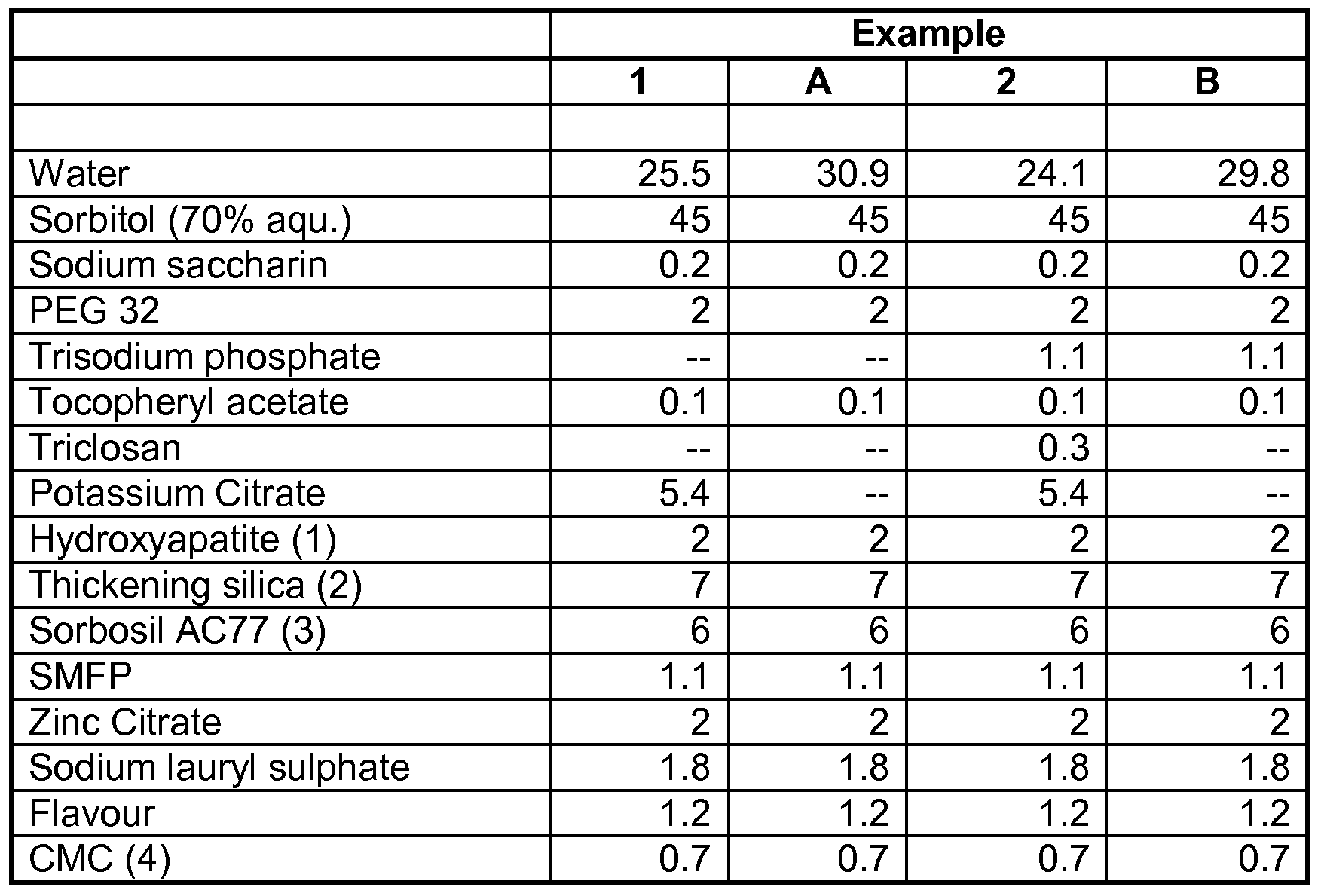
- Carboxymethylcellulose CMC 9H, ex dansico.
- compositions comprising potassium citrate have higher remaining fluoride levels than the corresponding compositions not comprising potassium citrate after storage.
Landscapes
- Health & Medical Sciences (AREA)
- Life Sciences & Earth Sciences (AREA)
- Veterinary Medicine (AREA)
- Animal Behavior & Ethology (AREA)
- General Health & Medical Sciences (AREA)
- Public Health (AREA)
- Birds (AREA)
- Epidemiology (AREA)
- Inorganic Chemistry (AREA)
- Chemical & Material Sciences (AREA)
- Oral & Maxillofacial Surgery (AREA)
- Emergency Medicine (AREA)
- Cosmetics (AREA)
Abstract
Description


Claims
Priority Applications (3)
| Application Number | Priority Date | Filing Date | Title |
|---|---|---|---|
| BRPI0916486A BRPI0916486B1 (en) | 2008-11-28 | 2009-11-13 | oral care composition |
| EP09748820.9A EP2349187B1 (en) | 2008-11-28 | 2009-11-13 | Oral care composition |
| CN200980147523.6A CN102227204B (en) | 2008-11-28 | 2009-11-13 | Oral care composition |
Applications Claiming Priority (2)
| Application Number | Priority Date | Filing Date | Title |
|---|---|---|---|
| EP08170278 | 2008-11-28 | ||
| EP08170278.9 | 2008-11-28 |
Publications (2)
| Publication Number | Publication Date |
|---|---|
| WO2010060816A2 true WO2010060816A2 (en) | 2010-06-03 |
| WO2010060816A3 WO2010060816A3 (en) | 2011-07-07 |
Family
ID=40568433
Family Applications (1)
| Application Number | Title | Priority Date | Filing Date |
|---|---|---|---|
| PCT/EP2009/065174 Ceased WO2010060816A2 (en) | 2008-11-28 | 2009-11-13 | Oral care composition |
Country Status (4)
| Country | Link |
|---|---|
| EP (1) | EP2349187B1 (en) |
| CN (1) | CN102227204B (en) |
| BR (1) | BRPI0916486B1 (en) |
| WO (1) | WO2010060816A2 (en) |
Cited By (3)
| Publication number | Priority date | Publication date | Assignee | Title |
|---|---|---|---|---|
| WO2023003941A1 (en) * | 2021-07-20 | 2023-01-26 | Colgate-Palmolive Company | Oral care compositions comprising hydroxyapatite |
| WO2023003940A1 (en) * | 2021-07-20 | 2023-01-26 | Colgate-Palmolive Company | Oral care compositions comprising hydroxyapatite |
| US12517024B2 (en) | 2021-07-20 | 2026-01-06 | Colgate-Palmolive Company | Method of evaluating the enamel microcrack resistance efficacy of compositions |
Families Citing this family (7)
| Publication number | Priority date | Publication date | Assignee | Title |
|---|---|---|---|---|
| CN103120623B (en) * | 2012-12-01 | 2014-10-01 | 云南白药集团股份有限公司 | Dentin sensitivity preventing oral hygiene nursing preparation |
| CN104490624A (en) * | 2014-12-17 | 2015-04-08 | 杭州纳美科技有限公司 | Chitosan toothpaste capable of inhibiting gingiva porphyromonsginglivlis |
| CN105726441A (en) * | 2016-02-25 | 2016-07-06 | 安徽万春日化有限公司 | Toothpaste capable of caring tooth enamel and improving gingivae |
| PH12018501957B1 (en) * | 2016-04-18 | 2024-03-27 | Unilever Ip Holdings B V | Oral care composition |
| WO2021059215A2 (en) | 2019-09-25 | 2021-04-01 | Church & Dwight Co., Inc. | Oral care composition |
| CN110721099B (en) * | 2019-10-24 | 2022-09-27 | 好维股份有限公司 | Oral care compositions |
| CN117398297B (en) * | 2023-10-31 | 2026-06-09 | 重庆登康口腔护理用品股份有限公司 | Oral care composition with long-acting breath freshening and fluorine stabilizing effects and preparation method thereof |
Family Cites Families (2)
| Publication number | Priority date | Publication date | Assignee | Title |
|---|---|---|---|---|
| GB8811828D0 (en) * | 1988-05-19 | 1988-06-22 | Unilever Plc | Oral compositions |
| BRPI0710369A2 (en) * | 2006-04-26 | 2011-08-09 | Unilever Nv | toothpaste composition and process for preparing a toothpaste composition |
-
2009
- 2009-11-13 CN CN200980147523.6A patent/CN102227204B/en active Active
- 2009-11-13 BR BRPI0916486A patent/BRPI0916486B1/en active IP Right Grant
- 2009-11-13 EP EP09748820.9A patent/EP2349187B1/en active Active
- 2009-11-13 WO PCT/EP2009/065174 patent/WO2010060816A2/en not_active Ceased
Cited By (8)
| Publication number | Priority date | Publication date | Assignee | Title |
|---|---|---|---|---|
| WO2023003941A1 (en) * | 2021-07-20 | 2023-01-26 | Colgate-Palmolive Company | Oral care compositions comprising hydroxyapatite |
| WO2023003940A1 (en) * | 2021-07-20 | 2023-01-26 | Colgate-Palmolive Company | Oral care compositions comprising hydroxyapatite |
| US20230038764A1 (en) * | 2021-07-20 | 2023-02-09 | Colgate-Palmolive Company | Oral Care Compositions |
| US20230039655A1 (en) * | 2021-07-20 | 2023-02-09 | Colgate-Palmolive Company | Oral Care Compositions |
| CN117750936A (en) * | 2021-07-20 | 2024-03-22 | 高露洁-棕榄公司 | Oral care compositions comprising hydroxyapatite |
| AU2022316128B2 (en) * | 2021-07-20 | 2025-01-30 | Colgate-Palmolive Company | Oral care compositions comprising hydroxyapatite |
| US12517024B2 (en) | 2021-07-20 | 2026-01-06 | Colgate-Palmolive Company | Method of evaluating the enamel microcrack resistance efficacy of compositions |
| US12521336B2 (en) | 2021-07-20 | 2026-01-13 | Colgate-Palmolive Company | Oral care compositions |
Also Published As
| Publication number | Publication date |
|---|---|
| EP2349187B1 (en) | 2017-09-06 |
| BRPI0916486B1 (en) | 2016-12-13 |
| BRPI0916486A2 (en) | 2016-02-16 |
| CN102227204A (en) | 2011-10-26 |
| CN102227204B (en) | 2014-10-01 |
| EP2349187A2 (en) | 2011-08-03 |
| WO2010060816A3 (en) | 2011-07-07 |
Similar Documents
| Publication | Publication Date | Title |
|---|---|---|
| EP2349187B1 (en) | Oral care composition | |
| US6106811A (en) | Oral care composition | |
| EP2131806B1 (en) | Dental care composition comprising particulate zinc oxide | |
| EP2046454A1 (en) | Toothpaste composition | |
| EP1843741B1 (en) | Opaque toothpaste composition | |
| JP2000154127A (en) | Oral composition | |
| AU2025202808A1 (en) | Oral care compositions comprising hydroxyapatite | |
| EP1183006B1 (en) | Oral composition containing perlite | |
| EP2275084A1 (en) | Oral care composition | |
| MX2012009042A (en) | Antimicrobial silica composites. | |
| WO2006012977A1 (en) | Composition | |
| EP1762215A1 (en) | Oral care composition | |
| WO2006050777A1 (en) | Toothpaste composition | |
| EP4114344B1 (en) | Transparent dentifrice comprising zinc | |
| US6436372B2 (en) | Oral composition with abrasive mixture of chalk and carbide | |
| WO2025031689A1 (en) | Oral care composition | |
| WO2026027104A1 (en) | Oral care composition | |
| WO2026021848A1 (en) | Oral care composition comprising locust bean gum | |
| WO2003017965A1 (en) | Oral composition comprising an alkylhydroxybenzoate | |
| EP4420737A1 (en) | Oral care composition | |
| WO2026032621A1 (en) | Oral care composition containing a zinc salt | |
| WO2023186746A1 (en) | An oral care composition | |
| WO2023186583A1 (en) | An oral care composition |
Legal Events
| Date | Code | Title | Description |
|---|---|---|---|
| WWE | Wipo information: entry into national phase |
Ref document number: 200980147523.6 Country of ref document: CN |
|
| 121 | Ep: the epo has been informed by wipo that ep was designated in this application |
Ref document number: 09748820 Country of ref document: EP Kind code of ref document: A2 |
|
| REEP | Request for entry into the european phase |
Ref document number: 2009748820 Country of ref document: EP |
|
| WWE | Wipo information: entry into national phase |
Ref document number: 2009748820 Country of ref document: EP |
|
| NENP | Non-entry into the national phase |
Ref country code: DE |
|
| ENP | Entry into the national phase |
Ref document number: PI0916486 Country of ref document: BR Kind code of ref document: A2 Effective date: 20110527 |