WO2010065902A2 - Technetium- and rhenium-bis(heteroaryl) complexes and methods of use thereof for inhibiting psma - Google Patents

Technetium- and rhenium-bis(heteroaryl) complexes and methods of use thereof for inhibiting psma Download PDF

Info

Publication number
WO2010065902A2
WO2010065902A2 PCT/US2009/066836 US2009066836W WO2010065902A2 WO 2010065902 A2 WO2010065902 A2 WO 2010065902A2 US 2009066836 W US2009066836 W US 2009066836W WO 2010065902 A2 WO2010065902 A2 WO 2010065902A2
Authority
WO
WIPO (PCT)
Prior art keywords
compound
integer
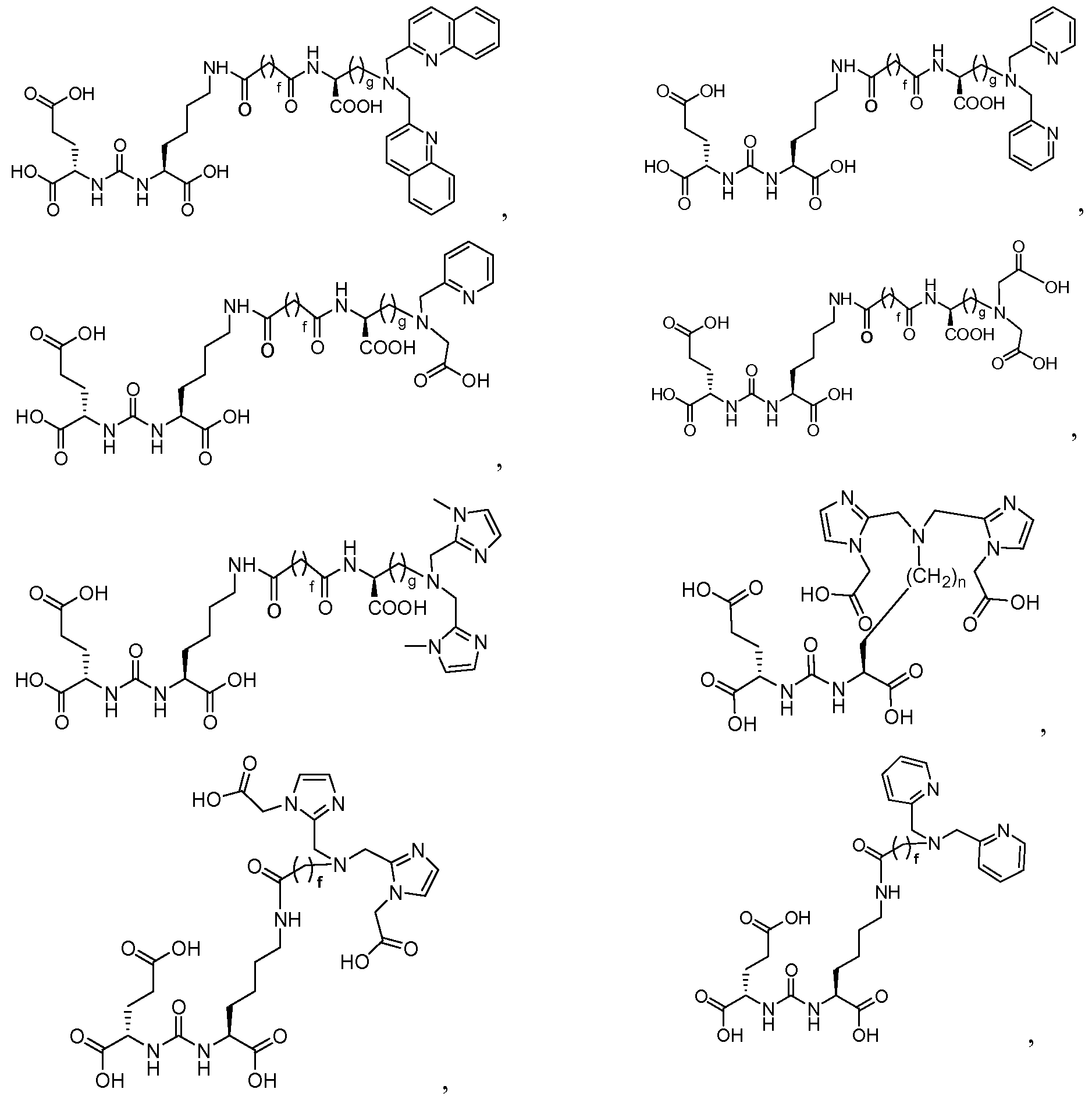
wash
tert
amino
Prior art date
Legal status (The legal status is an assumption and is not a legal conclusion. Google has not performed a legal analysis and makes no representation as to the accuracy of the status listed.)
Ceased
Application number
PCT/US2009/066836
Other languages
French (fr)
Other versions
WO2010065902A3 (en
Inventor
John W. Babich
Craig Zimmerman
John Joyal
Kevin P. Maresca
Genliang Lu
Shawn Hillier
Current Assignee (The listed assignees may be inaccurate. Google has not performed a legal analysis and makes no representation or warranty as to the accuracy of the list.)
Molecular Insight Pharmaceuticals Inc
Original Assignee
Molecular Insight Pharmaceuticals Inc
Priority date (The priority date is an assumption and is not a legal conclusion. Google has not performed a legal analysis and makes no representation as to the accuracy of the date listed.)
Filing date
Publication date
Application filed by Molecular Insight Pharmaceuticals Inc filed Critical Molecular Insight Pharmaceuticals Inc
Priority to RU2011127468/04A priority Critical patent/RU2532912C2/en
Priority to CA2745955A priority patent/CA2745955C/en
Priority to AU2009322167A priority patent/AU2009322167B2/en
Priority to BRPI0922779A priority patent/BRPI0922779A8/en
Priority to ES09775429.5T priority patent/ES2595128T3/en
Priority to JP2011539755A priority patent/JP5220203B2/en
Priority to EP09775429.5A priority patent/EP2389361B1/en
Priority to CN200980153722.8A priority patent/CN102272100B/en
Publication of WO2010065902A2 publication Critical patent/WO2010065902A2/en
Publication of WO2010065902A3 publication Critical patent/WO2010065902A3/en
Anticipated expiration legal-status Critical
Ceased legal-status Critical Current

Links

Classifications

    • CCHEMISTRY; METALLURGY
    • C07ORGANIC CHEMISTRY
    • C07DHETEROCYCLIC COMPOUNDS
    • C07D213/00Heterocyclic compounds containing six-membered rings, not condensed with other rings, with one nitrogen atom as the only ring hetero atom and three or more double bonds between ring members or between ring members and non-ring members
    • C07D213/02Heterocyclic compounds containing six-membered rings, not condensed with other rings, with one nitrogen atom as the only ring hetero atom and three or more double bonds between ring members or between ring members and non-ring members having three double bonds between ring members or between ring members and non-ring members
    • C07D213/04Heterocyclic compounds containing six-membered rings, not condensed with other rings, with one nitrogen atom as the only ring hetero atom and three or more double bonds between ring members or between ring members and non-ring members having three double bonds between ring members or between ring members and non-ring members having no bond between the ring nitrogen atom and a non-ring member or having only hydrogen or carbon atoms directly attached to the ring nitrogen atom
    • C07D213/24Heterocyclic compounds containing six-membered rings, not condensed with other rings, with one nitrogen atom as the only ring hetero atom and three or more double bonds between ring members or between ring members and non-ring members having three double bonds between ring members or between ring members and non-ring members having no bond between the ring nitrogen atom and a non-ring member or having only hydrogen or carbon atoms directly attached to the ring nitrogen atom with substituted hydrocarbon radicals attached to ring carbon atoms
    • C07D213/36Radicals substituted by singly-bound nitrogen atoms
    • C07D213/38Radicals substituted by singly-bound nitrogen atoms having only hydrogen or hydrocarbon radicals attached to the substituent nitrogen atom
    • AHUMAN NECESSITIES
    • A61MEDICAL OR VETERINARY SCIENCE; HYGIENE
    • A61KPREPARATIONS FOR MEDICAL, DENTAL OR TOILETRY PURPOSES
    • A61K31/00Medicinal preparations containing organic active ingredients
    • A61K31/16Amides, e.g. hydroxamic acids
    • A61K31/18Sulfonamides
    • AHUMAN NECESSITIES
    • A61MEDICAL OR VETERINARY SCIENCE; HYGIENE
    • A61KPREPARATIONS FOR MEDICAL, DENTAL OR TOILETRY PURPOSES
    • A61K31/00Medicinal preparations containing organic active ingredients
    • A61K31/33Heterocyclic compounds
    • A61K31/395Heterocyclic compounds having nitrogen as a ring hetero atom, e.g. guanethidine or rifamycins
    • A61K31/41Heterocyclic compounds having nitrogen as a ring hetero atom, e.g. guanethidine or rifamycins having five-membered rings with two or more ring hetero atoms, at least one of which being nitrogen, e.g. tetrazole
    • A61K31/41921,2,3-Triazoles
    • AHUMAN NECESSITIES
    • A61MEDICAL OR VETERINARY SCIENCE; HYGIENE
    • A61KPREPARATIONS FOR MEDICAL, DENTAL OR TOILETRY PURPOSES
    • A61K31/00Medicinal preparations containing organic active ingredients
    • A61K31/33Heterocyclic compounds
    • A61K31/395Heterocyclic compounds having nitrogen as a ring hetero atom, e.g. guanethidine or rifamycins
    • A61K31/435Heterocyclic compounds having nitrogen as a ring hetero atom, e.g. guanethidine or rifamycins having six-membered rings with one nitrogen as the only ring hetero atom
    • A61K31/44Non condensed pyridines; Hydrogenated derivatives thereof
    • A61K31/4427Non condensed pyridines; Hydrogenated derivatives thereof containing further heterocyclic ring systems
    • A61K31/444Non condensed pyridines; Hydrogenated derivatives thereof containing further heterocyclic ring systems containing a six-membered ring with nitrogen as a ring heteroatom, e.g. amrinone
    • AHUMAN NECESSITIES
    • A61MEDICAL OR VETERINARY SCIENCE; HYGIENE
    • A61KPREPARATIONS FOR MEDICAL, DENTAL OR TOILETRY PURPOSES
    • A61K31/00Medicinal preparations containing organic active ingredients
    • A61K31/33Heterocyclic compounds
    • A61K31/555Heterocyclic compounds containing heavy metals, e.g. hemin, hematin, melarsoprol
    • AHUMAN NECESSITIES
    • A61MEDICAL OR VETERINARY SCIENCE; HYGIENE
    • A61KPREPARATIONS FOR MEDICAL, DENTAL OR TOILETRY PURPOSES
    • A61K51/00Preparations containing radioactive substances for use in therapy or testing in vivo
    • A61K51/02Preparations containing radioactive substances for use in therapy or testing in vivo characterised by the carrier, i.e. characterised by the agent or material covalently linked or complexing the radioactive nucleus
    • A61K51/04Organic compounds
    • A61K51/0402Organic compounds carboxylic acid carriers, fatty acids
    • AHUMAN NECESSITIES
    • A61MEDICAL OR VETERINARY SCIENCE; HYGIENE
    • A61KPREPARATIONS FOR MEDICAL, DENTAL OR TOILETRY PURPOSES
    • A61K51/00Preparations containing radioactive substances for use in therapy or testing in vivo
    • A61K51/02Preparations containing radioactive substances for use in therapy or testing in vivo characterised by the carrier, i.e. characterised by the agent or material covalently linked or complexing the radioactive nucleus
    • A61K51/04Organic compounds
    • A61K51/041Heterocyclic compounds
    • AHUMAN NECESSITIES
    • A61MEDICAL OR VETERINARY SCIENCE; HYGIENE
    • A61KPREPARATIONS FOR MEDICAL, DENTAL OR TOILETRY PURPOSES
    • A61K51/00Preparations containing radioactive substances for use in therapy or testing in vivo
    • A61K51/02Preparations containing radioactive substances for use in therapy or testing in vivo characterised by the carrier, i.e. characterised by the agent or material covalently linked or complexing the radioactive nucleus
    • A61K51/04Organic compounds
    • A61K51/0474Organic compounds complexes or complex-forming compounds, i.e. wherein a radioactive metal (e.g. 111In3+) is complexed or chelated by, e.g. a N2S2, N3S, NS3, N4 chelating group
    • AHUMAN NECESSITIES
    • A61MEDICAL OR VETERINARY SCIENCE; HYGIENE
    • A61KPREPARATIONS FOR MEDICAL, DENTAL OR TOILETRY PURPOSES
    • A61K51/00Preparations containing radioactive substances for use in therapy or testing in vivo
    • A61K51/02Preparations containing radioactive substances for use in therapy or testing in vivo characterised by the carrier, i.e. characterised by the agent or material covalently linked or complexing the radioactive nucleus
    • A61K51/04Organic compounds
    • A61K51/0474Organic compounds complexes or complex-forming compounds, i.e. wherein a radioactive metal (e.g. 111In3+) is complexed or chelated by, e.g. a N2S2, N3S, NS3, N4 chelating group
    • A61K51/0478Organic compounds complexes or complex-forming compounds, i.e. wherein a radioactive metal (e.g. 111In3+) is complexed or chelated by, e.g. a N2S2, N3S, NS3, N4 chelating group complexes from non-cyclic ligands, e.g. EDTA, MAG3
    • AHUMAN NECESSITIES
    • A61MEDICAL OR VETERINARY SCIENCE; HYGIENE
    • A61KPREPARATIONS FOR MEDICAL, DENTAL OR TOILETRY PURPOSES
    • A61K51/00Preparations containing radioactive substances for use in therapy or testing in vivo
    • A61K51/02Preparations containing radioactive substances for use in therapy or testing in vivo characterised by the carrier, i.e. characterised by the agent or material covalently linked or complexing the radioactive nucleus
    • A61K51/04Organic compounds
    • A61K51/0497Organic compounds conjugates with a carrier being an organic compounds
    • AHUMAN NECESSITIES
    • A61MEDICAL OR VETERINARY SCIENCE; HYGIENE
    • A61PSPECIFIC THERAPEUTIC ACTIVITY OF CHEMICAL COMPOUNDS OR MEDICINAL PREPARATIONS
    • A61P13/00Drugs for disorders of the urinary system
    • A61P13/08Drugs for disorders of the urinary system of the prostate
    • AHUMAN NECESSITIES
    • A61MEDICAL OR VETERINARY SCIENCE; HYGIENE
    • A61PSPECIFIC THERAPEUTIC ACTIVITY OF CHEMICAL COMPOUNDS OR MEDICINAL PREPARATIONS
    • A61P25/00Drugs for disorders of the nervous system
    • A61P25/18Antipsychotics, i.e. neuroleptics; Drugs for mania or schizophrenia
    • AHUMAN NECESSITIES
    • A61MEDICAL OR VETERINARY SCIENCE; HYGIENE
    • A61PSPECIFIC THERAPEUTIC ACTIVITY OF CHEMICAL COMPOUNDS OR MEDICINAL PREPARATIONS
    • A61P29/00Non-central analgesic, antipyretic or antiinflammatory agents, e.g. antirheumatic agents; Non-steroidal antiinflammatory drugs [NSAID]
    • AHUMAN NECESSITIES
    • A61MEDICAL OR VETERINARY SCIENCE; HYGIENE
    • A61PSPECIFIC THERAPEUTIC ACTIVITY OF CHEMICAL COMPOUNDS OR MEDICINAL PREPARATIONS
    • A61P35/00Antineoplastic agents
    • CCHEMISTRY; METALLURGY
    • C07ORGANIC CHEMISTRY
    • C07CACYCLIC OR CARBOCYCLIC COMPOUNDS
    • C07C275/00Derivatives of urea, i.e. compounds containing any of the groups, the nitrogen atoms not being part of nitro or nitroso groups
    • C07C275/04Derivatives of urea, i.e. compounds containing any of the groups, the nitrogen atoms not being part of nitro or nitroso groups having nitrogen atoms of urea groups bound to acyclic carbon atoms
    • C07C275/06Derivatives of urea, i.e. compounds containing any of the groups, the nitrogen atoms not being part of nitro or nitroso groups having nitrogen atoms of urea groups bound to acyclic carbon atoms of an acyclic and saturated carbon skeleton
    • C07C275/16Derivatives of urea, i.e. compounds containing any of the groups, the nitrogen atoms not being part of nitro or nitroso groups having nitrogen atoms of urea groups bound to acyclic carbon atoms of an acyclic and saturated carbon skeleton being further substituted by carboxyl groups
    • CCHEMISTRY; METALLURGY
    • C07ORGANIC CHEMISTRY
    • C07CACYCLIC OR CARBOCYCLIC COMPOUNDS
    • C07C311/00Amides of sulfonic acids, i.e. compounds having singly-bound oxygen atoms of sulfo groups replaced by nitrogen atoms, not being part of nitro or nitroso groups
    • C07C311/15Sulfonamides having sulfur atoms of sulfonamide groups bound to carbon atoms of six-membered aromatic rings
    • C07C311/16Sulfonamides having sulfur atoms of sulfonamide groups bound to carbon atoms of six-membered aromatic rings having the nitrogen atom of at least one of the sulfonamide groups bound to hydrogen atoms or to an acyclic carbon atom
    • CCHEMISTRY; METALLURGY
    • C07ORGANIC CHEMISTRY
    • C07DHETEROCYCLIC COMPOUNDS
    • C07D403/00Heterocyclic compounds containing two or more hetero rings, having nitrogen atoms as the only ring hetero atoms, not provided for by group C07D401/00
    • C07D403/02Heterocyclic compounds containing two or more hetero rings, having nitrogen atoms as the only ring hetero atoms, not provided for by group C07D401/00 containing two hetero rings
    • C07D403/06Heterocyclic compounds containing two or more hetero rings, having nitrogen atoms as the only ring hetero atoms, not provided for by group C07D401/00 containing two hetero rings linked by a carbon chain containing only aliphatic carbon atoms
    • CCHEMISTRY; METALLURGY
    • C07ORGANIC CHEMISTRY
    • C07DHETEROCYCLIC COMPOUNDS
    • C07D403/00Heterocyclic compounds containing two or more hetero rings, having nitrogen atoms as the only ring hetero atoms, not provided for by group C07D401/00
    • C07D403/02Heterocyclic compounds containing two or more hetero rings, having nitrogen atoms as the only ring hetero atoms, not provided for by group C07D401/00 containing two hetero rings
    • C07D403/12Heterocyclic compounds containing two or more hetero rings, having nitrogen atoms as the only ring hetero atoms, not provided for by group C07D401/00 containing two hetero rings linked by a chain containing hetero atoms as chain links
    • CCHEMISTRY; METALLURGY
    • C07ORGANIC CHEMISTRY
    • C07FACYCLIC, CARBOCYCLIC OR HETEROCYCLIC COMPOUNDS CONTAINING ELEMENTS OTHER THAN CARBON, HYDROGEN, HALOGEN, OXYGEN, NITROGEN, SULFUR, SELENIUM OR TELLURIUM
    • C07F13/00Compounds containing elements of Groups 7 or 17 of the Periodic Table
    • C07F13/005Compounds without a metal-carbon linkage

Definitions

  • the present invention relates generally to the field of radiopharmaceuticals and their use in nuclear medicine as tracers, imaging agents and for the treatment of various disease states. It is well known that tumors may express unique proteins associated with their malignant phenotype or may over-express normal constituent proteins in greater number than normal cells. The expression of distinct proteins on the surface of tumor cells offers the opportunity to diagnose and characterize disease by probing the phenotypic identity and biochemical composition and activity of the tumor. Radioactive molecules that selectively bind to specific tumor cell surface proteins provide an attractive route for imaging and treating tumors under non-invasive conditions. In particular, the present inventors have found that radiolabeled ligands to the PSMA protein, often over expressed on many cancer cells provide an attractive route for non-invasive imaging and selective targeting of cancer cells.
  • N-acetylated alpha-linked acidic dipeptidase also known as glutamate carboxypeptidase II (GCPII) is a neuropeptidase which cleaves N-acetylaspartyl-glutamate (NAAG) into N-acetylaspartate and glutamate in the nervous system, see below, depicting hydrolytic cleavage of NAAG by NAALDase through the tetrahedral intermediate.
  • the enzyme is a type II protein of the co- catalytic class of metallopeptidases, containing two zinc atoms in the active site.
  • NAALADase was shown to be expressed at high levels in human prostatic adenocarcinomas and was designated the prostate-specific membrane antigen (PSMA).
  • PSMA prostate-specific membrane antigen
  • the NAALADase/PSMA gene is known to produce multiple mRNA splice forms and based on previous immunohistochemical evidence, it has been assumed that the human brain and prostate expressed different isoforms of the enzyme.
  • PSMA Human prostate-specific membrane antigen
  • FOLHl folate hydrolase I
  • PSMA is a trans-membrane, 750 amino acid type II glycoprotein which is primarily expressed in normal human prostate epithelium but is upregulated in prostate cancer, including metastatic disease.
  • PSMA is a unique exopeptidase with reactivity toward poly-gamma-glutamated folates, capable of sequentially removing the poly-gamma-glutamyl termini. Since PSMA is expressed by virtually all prostate cancers and its expression is further increased in poorly differentiated, metastatic and hormone-refractory carcinomas, it is a very attractive target for prostate imaging and therapy.
  • Developing ligands that interact with PSMA and carry appropriate radionuclides may provide a promising and novel targeting option for the detection, treatment and management of prostate cancer.
  • Tc-99m The preferred radioisotope for medical imaging is Tc-99m, because it has a short (6 hour) half life, is readily available at relatively low cost and emits gamma- photons of 140 keV.
  • Tc-99m complexes such as, water and air stable Tc(I) complex [ 99m Tc(OH 2 ) 3 (CO) 3 ] + complex can be readily prepared in saline under 1 atm of carbon monoxide (CO).
  • R is H, an ammonium ion, an alkylammonium ion, an alkaline earth metal ion, a rare earth metal ion, or an alkyl group
  • W is a bond, -NHC(O)-, -CH(NH 2 )-, -NH- C(O)-NH-, -C(O)-NH-, -C(O)-NH-CH(COOH)-, -O-(CH 2 ) n -O-(CH 2 ) n -, -(CH 2 )n0(CH2)n0(CH 2 )n-, -CH(NHFmoc)-;
  • Z is a bond, -CO(O)-, -NH-, -NHC(O)-,
  • NR a a rR > b D is a chelator group of Formula:
  • R 1 is H, a C 1 -C 8 alkyl group, an ammonium ion, an alkylammonium ion, or an alkali or alkaline earth metal ion;
  • R v is alkyl alkyl, substituted aminoalkyl, aminoalkyl, or, acetamidoalkyl;
  • e is an integer from O to 15;
  • f is an integer from O to 15;
  • g is an integer from O to 15; and
  • n is an integer from O to 10; with the proviso that where NR a R b is:
  • WASH 6626575.1 then where W is a bond, Z are other than a bond, -C(O)-NH-, or -NHC(O)-; and where Z is a bond, W is other than a bond, -C(O)-NH-, or -NHC(O)-.
  • R v is methyl, ethyl, n-propyl, iso-propyl, n- butyl, iso-butyl, tert-butyl, aminoalkyl, hydroxyalkyl, or carboxyalkyl. In some embodiments, R v is methyl. In some embodiments, each R 1 is independently H or tert-butyl. In some embodiments, R 1 is H. In some embodiments, e is an integer from 0 to 4, f is an integer from 0 to 12, and g is an integer from 0 to 6. In some embodiments, W is -C(O)-NH-.
  • the compound of Formula I is:
  • WASH 6626575.1 a pharmaceutically acceptable salt, or solvate thereof; e is an integer from O to 10; f is an integer from O to 12; g is an integer from O to 12; and n is an integer from O to 10.
  • Z is -NH-C(O)-. In some embodiments, Z is
  • Z is -NH-C(O)-CH(NH 2 )-.
  • a complex including a metal a metal and a compound of Formula I.
  • the metal is Re, Tc, Y, Lu, Ga, In, or Cu.
  • the metal is a radionuclide.
  • the metal is technetium-99m, rhenium-186, or rhenium-188.
  • the metal in the complex is Y, Lu, Ga, In, or Cu where the complex includes NR a R b as being a group of formula
  • the complex is:
  • WASH 6626575.1 a pharmaceutically acceptable salts and solvates thereof; Re, Tc, Y, Lu, Ga, Cu; e is an integer from O to 10; f is an integer from O to 12; g is an integer from O to 12; and n is an integer from O to 10.
  • a pharmaceutical formulation including the compound of Formula I, a pharmaceutically acceptable salt or solvate thereof, and a pharmaceutically acceptable excipient.
  • a method of imaging a region in a patient including administering to a patient a diagnostically effective amount of a compound of Formula I, a pharmaceutically acceptable salt or solvate thereof, and obtaining an image of the region of the patient.
  • a method of imaging tissue such as spleen tissue, kidney tissue, or PSMA-expressing tumor tissue is provided including contacting the tissue with a complex including a radioactive metal and a compound including a group of formula:
  • the tissue is PSMA-expressing tumor tissue.
  • the PSMA-expressing tumor tissue is prostate cancer.
  • FIG. 1 is a graph of tissue distribution for a 99m Tc complex of the compound of Example 3 in LNCaP Xenograft mice in %DPO.
  • FIG. 2 shows competition binding curves for comparative and illustrative compounds according to Formula I for PSMA protein.
  • FIG. 3 is a graph of the tissue biodistribution of a 99m Tc complex of the compound of Example 8, expressed as %ID/g.
  • FIG. 4 is a graph of the tissue biodistribution of a 99m Tc complex of the compound of Example 7, expressed as %ID/g.
  • FIG. 5 is a graph comparing the tissue biodistribution for 99m Tc complexes in LNCaP Xenograft mice in %ID/g.
  • FIG. 6 is an image illustrating the tissue biodistribution for a 99m Tc complex of the compound of Example 6 in LNCaP Xenograft mice at various time intervals, and according to some embodiments.
  • the inventive radiopharmaceuticals belong to the second category and are synthesized by conjugating the radionuclide coordination complex to a biologically active molecule selective for a particular protein or receptor of interest.
  • BAM biologically active molecules
  • small molecules and small peptides have advantages over antibodies or proteins. For example, small molecules and small peptides exhibit enhanced diffusion, faster blood clearance, and lower background radiation. These carrier allow the facile synthesis of analogs in a high-throughput manner. Additionally, small peptides can be readily converted into peptide mimetics or small molecular analogs that have enhanced stability and improved affinity for the target enzyme or receptor.
  • the synthesis and methods for using PSMA selective technetium and rhenium complexes according to Formulae I - IV, as novel radiopharmaceuticals for the treatment and imaging of cancer cells are provided.
  • the compounds can be used to target carcinoma of the prostate.
  • lipophilic group and “lipophilic moiety” as used herein refer to a group, moiety or substituent that has a greater affinity for non-polar or nonaqueous environments versus polar or aqueous environments.
  • lipophilic as “having an affinity for lipids (as fats).”
  • Exemplary lipophilic moieties include aliphatic hydrocarbon radicals, e.g., alkyl radicals, aromatic hydrocarbon radicals, and long-chain acyl radicals; all of them have increasing lipophilicity as the number of constituent carbons increases.
  • WASH 6626575.1 general, addition of a lipophilic moiety to a particular compound will increase the compound's affinity for octanol in the standard octano I/water partition-coefficient- determination protocol; this protocol may be used to gauge a compound's relative hydrophobicity (lipophilicity) and hydrophilicity.
  • Lewis base and “Lewis basic” refer to a chemical moiety capable of donating a pair of electrons under certain reaction conditions. It may be possible to characterize a Lewis base as donating a single electron in certain complexes, depending on the identity of the Lewis base and the metal ion, but for most purposes, however, a Lewis base is best understood as a two electron donor. Examples of Lewis basic moieties include uncharged compounds such as alcohols, thiols, and amines, and charged moieties such as alkoxides, thiolates, carbanions, and a variety of other organic anions. In certain examples, a Lewis base may consist of a single atom, such as oxide (O 2 " ). In certain, less common circumstances, a Lewis base or ligand may be positively charged. A Lewis base, when coordinated to a metal ion, is often referred to as a ligand.
  • ligand refers to a species that interacts in some fashion with another species.
  • a ligand may be a Lewis base that is capable of forming a coordinate bond with a Lewis Acid.
  • a ligand is a species, often organic, that forms a coordinate bond with a metal ion.
  • Ligands, when coordinated to a metal ion, may have a variety of binding modes know to those of skill in the art, which include, for example, terminal (i.e., bound to a single metal ion) and bridging (i.e., one atom of the Lewis base bound to more than one metal ion).
  • chelating agent refers to a molecule, often an organic one, and often a Lewis base, having two or more unshared electron pairs available for donation to a metal ion.
  • the metal ion is usually coordinated by two or more electron pairs to the chelating agent.
  • identityate chelating agent tridentate chelating agent
  • tetradentate chelating agent are art-recognized and refer to chelating agents having, respectively, two, three, and four electron pairs readily available for simultaneous donation to a metal ion coordinated by the chelating agent.
  • the electron pairs of a chelating agent forms coordinate bonds with a single metal ion; however, in certain examples, a chelating agent may form coordinate bonds with more than one metal ion, with a variety of binding modes being possible.
  • complex refers to a compound formed by the union of one or more electron-rich and electron-poor molecules or atoms capable of independent existence with one or more electronically poor molecules or atoms, each of which is also capable of independent existence.
  • Fmoc is an abbreviation for the chemical group: fluorenylmethyloxycarbonyl.
  • terapéuticaally-effective amount means that amount of a compound, material, or composition comprising a compound which is effective for producing some desired therapeutic effect in at least a sub-population of cells in an animal at a reasonable benefit/risk ratio applicable to any medical treatment.
  • treating or “treatment” is intended to encompass also diagnosis, prophylaxis, therapy and cure.
  • the patient receiving this treatment is any animal in need, including primates, in particular humans, and other mammals such as equines, cattle, swine and sheep; and poultry and pets in general.
  • phrases "pharmaceutically acceptable” is employed herein to refer to those compounds, materials, compositions, and/or dosage forms which are, within the scope of sound medical judgment, suitable for use in contact with the tissues of human beings and animals without excessive toxicity, irritation, allergic response, or other problem or complication, commensurate with a reasonable benefit/risk ratio.
  • pharmaceutically-acceptable carrier means a pharmaceutically-acceptable material, composition or vehicle, such as a liquid or solid filler, diluent, excipient, or solvent encapsulating material, involved in carrying or transporting the subject compound from one organ, or portion of the body, to another organ, or portion of the body.
  • a pharmaceutically-acceptable material such as a liquid or solid filler, diluent, excipient, or solvent encapsulating material, involved in carrying or transporting the subject compound from one organ, or portion of the body, to another organ, or portion of the body.
  • Each carrier must be “acceptable” in the sense of being compatible with the other ingredients of the formulation and not injurious to the patient.
  • materials which can serve as pharmaceutically- acceptable carriers include: (1) sugars, such as lactose, glucose and sucrose; (2)
  • WASH 6626575.1 starches such as corn starch and potato starch; (3) cellulose, and its derivatives, such as sodium carboxymethyl cellulose, ethyl cellulose and cellulose acetate; (4) powdered tragacanth; (5) malt; (6) gelatin; (7) talc; (8) excipients, such as cocoa butter and suppository waxes; (9) oils, such as peanut oil, cottonseed oil, safflower oil, sesame oil, olive oil, corn oil and soybean oil; (10) glycols, such as propylene glycol; (11) polyols, such as glycerin, sorbitol, mannitol and polyethylene glycol; (12) esters, such as ethyl oleate and ethyl laurate; (13) agar; (14) buffering agents, such as magnesium hydroxide and aluminum hydroxide; (15) alginic acid; (16) pyrogen-free water; (17) isotonic
  • parenteral administration and “administered parenterally” as used herein means modes of administration other than enteral and topical administration, usually by injection, and includes, without limitation, intravenous, intramuscular, intraarterial, intrathecal, intracapsular, intraorbital, intracardiac, intradermal, intraperitoneal, transtracheal, subcutaneous, subcuticular, intraarticulare, subcapsular, subarachnoid, intraspinal and intrasternal injection and infusion.
  • peripheral administration and “administered peripherally” as used herein mean the administration of a compound, drug or other material other than directly into the central nervous system, such that it enters the patient's system and, thus, is subject to metabolism and other like processes, for example, subcutaneous administration.
  • amino acid refers to all compounds, whether natural or synthetic, which include both an amino functionality and an acid functionality, including amino acid analogs and derivatives.
  • heteroatom refers to an atom of any element other than carbon or hydrogen.
  • Illustrative heteroatoms include boron, nitrogen, oxygen, phosphorus, sulfur and selenium.
  • substituted refers to an alkyl or alkenyl group, as defined below (e.g., an alkyl group) in which one or more bonds to a hydrogen atom
  • WASH 6626575.1 contained therein are replaced by a bond to non-hydrogen or non-carbon atoms.
  • Substituted groups also include groups in which one or more bonds to a carbon(s) or hydrogen(s) atom are replaced by one or more bonds, including double or triple bonds, to a heteroatom.
  • a substituted group will be substituted with one or more substituents, unless otherwise specified.
  • a substituted group is substituted with 1, 2, 3, 4, 5, or 6 substituents.
  • substituent groups include: halogens (i.e., F, Cl, Br, and I); hydroxyls; alkoxy, alkenoxy, alkynoxy, aryloxy, aralkyloxy, heterocyclyloxy, and heterocyclylalkoxy groups; carbonyls (oxo); carboxyls; esters; urethanes; oximes; hydroxylamines; alkoxyamines; aralkoxyamines; thiols; sulfides; sulfoxides; sulfones; sulfonyls; sulfonamides; amines; N-oxides; hydrazines; hydrazides; hydrazones; azides; amides; ureas; amidines; guanidines; enamines; imides; isocyanates; isothiocyanates; cyanates; thiocyanates; imines; nitro groups; nitriles (i.
  • Alkyl groups include straight chain and branched chain alkyl groups having from 1 to 12 carbon atoms, and typically from 1 to 10 carbons or, in some embodiments, from 1 to 8, 1 to 6, or 1 to 4 carbon atoms.
  • straight chain alkyl groups include groups such as methyl, ethyl, n-propyl, n-butyl, n-pentyl, n-hexyl, n-heptyl, and n-octyl groups.
  • branched alkyl groups include, but are not limited to, isopropyl, iso-butyl, sec-butyl, tert-butyl, neopentyl, isopentyl, and 2,2-dimethylpropyl groups.
  • Alkyl groups may be substituted or unsubstituted. Unless the number of carbons is otherwise specified, "lower alkyl” refers to an alkyl group, as defined above, but having from one to about ten carbons, alternatively from one to about six carbon atoms in its backbone structure. Likewise, “lower alkenyl” and “lower alkynyl” have similar chain lengths.
  • alkylcarbonyl denotes an -(C 1 -C 8 )alkyl-C(O) group in which one or more methylenes in the C 1 -C 8 alkyl group is replaced with a C(O) group.
  • Representative examples include, but are not limited to, acetyl, propionyl, and CH 3 (CH 2 ) 2 C(O)- group.
  • cyclic alkyl or “cycloalkyl” refers to a saturated or partially saturated non-aromatic cyclic alkyl groups of from 3 to 14 carbon atoms and no ring heteroatoms and having a single ring or multiple rings including fused and bridged ring systems. Cycloalkyl groups may be substituted or unsubstituted.
  • Cycloalkyl or cyclic alkyl groups include mono-, bi- or tricyclic alkyl groups having from 3 to 14 carbon atoms in the ring(s), or, in some embodiments, 3 to 12, 3 to 10, 3 to 8, or 3 to 4, 5, 6 or 7 carbon atoms.
  • Exemplary monocyclic cycloalkyl groups include, but not limited to, cyclopropyl, cyclobutyl, cyclopentyl, cyclohexyl, cycloheptyl, and cyclooctyl groups.
  • Bi- and tricyclic ring systems include both bridged cycloalkyl groups and fused rings, such as, but not limited to, bicyclo[2.1.1]hexane, adamantyl, decalinyl, and the like.
  • Alkenyl groups include straight and branched chain and cycloalkyl groups as defined above, except that at least one double bond exists between two carbon atoms.
  • alkenyl groups have from 2 to about 12 carbon atoms in some embodiments, from 2 to 10 carbon atoms in other embodiments, and from 2 to 8 carbon atoms in other embodiments. Examples include, but are not limited to vinyl, allyl,
  • Alkenyl groups may be substituted or unsubstituted. Representative substituted alkenyl groups may be mono-substituted or substituted more than once, such as, but not limited to, mono-, di- or tri-substituted with substituents such as those listed above.
  • Alkynyl groups include straight and branched chain and cycloalkyl groups as defined above, except that at least one triple bond exists between two carbon atoms.
  • Examples of a (C 2 -Cg)alkynyl group include, but are not limited to, acetylene, propyne, 1-butyne, 2-butyne, 1-pentyne, 2-pentyne, 1-hexyne, 2-hexyne, 3- hexyne, 1-heptyne, 2-heptyne, 3-heptyne, 1-octyne, 2-octyne, 3-octyne and 4-octyne.
  • An alkynyl group can be unsubstituted or optionally substituted with one or more substituents as described herein below.
  • Aryl groups are cyclic aromatic hydrocarbons that do not contain heteroatoms.
  • Aryl groups include monocyclic, bicyclic and polycyclic ring systems.
  • aryl groups include, but are not limited to, phenyl, azulenyl, heptalenyl, biphenylenyl, indacenyl, fluorenyl, phenanthrenyl, triphenylenyl, pyrenyl, naphthacenyl, chrysenyl, biphenyl, anthracenyl, indenyl, indanyl, pentalenyl, and naphthyl groups.
  • aryl groups contain 6-14 carbons, and in
  • Aryl group includes both substituted and unsubstituted aryl groups.
  • Substituted aryl groups may be mono-substituted or substituted more than once.
  • monosubstituted aryl groups include, but are not limited to, 2-, 3-, A-, 5-, or 6- substituted phenyl or naphthyl groups, which may be substituted with substituents such as those listed above.
  • Aralkyl groups are alkyl groups as defined above in which a hydrogen or carbon bond of an alkyl group is replaced with a bond to an aryl group as defined above.
  • aralkyl groups contain 7 to 20 carbon atoms, 7 to 14 carbon atoms or 7 to 10 carbon atoms.
  • Heterocyclyl groups includes non-aromatic ring compounds containing
  • heterocyclyl groups include 3 to 20 ring members, whereas other such groups have 3 to 6, 3 to 10, 3 to 12, or 3 to 15 ring members.
  • Heterocyclyl groups encompass unsaturated, partially saturated and saturated ring systems, such as, for example, imidazolyl, imidazolinyl and imidazolidinyl groups. Heterocyclyl groups may be substituted or unsubstituted.
  • Heterocyclyl groups include, but are not limited to, aziridinyl, azetidinyl, pyrrolidinyl, imidazolidinyl, pyrazolidinyl, thiazolidinyl, tetrahydrothiophenyl, tetrahydrofuranyl, dioxolyl, furanyl, thiophenyl, pyrrolyl, pyrrolinyl, imidazolyl, imidazolinyl, pyrazolyl, pyrazolinyl, triazolyl, tetrazolyl, oxazolyl, isoxazolyl, thiazolyl, thiazolinyl, isothiazolyl, thiadiazolyl, oxadiazolyl, piperidyl, piperazinyl, morpholinyl, thiomorpholinyl, tetrahydropyranyl, tetrahydrothiopyranyl,
  • Heterocyclyl groups may be substituted or unsubstituted.
  • substituted heterocyclyl groups may be mono-substituted or substituted more than once, such as, but not limited to, pyridyl or morpholinyl groups, which are 2-, 3-, 4-, 5-, or 6- substituted, or disubstituted with various substituents such as those listed above.
  • Heteroaryl groups are aromatic ring compounds containing 5 or more ring members, of which, one or more is a heteroatom such as, but not limited to, N, O, and S. Heteroaryl groups may be substituted or unsubstituted.
  • Heteroaryl groups include, but are not limited to, groups such as pyrrolyl, pyrazolyl, triazolyl, tetrazolyl, oxazolyl, isoxazolyl, thiazolyl, pyridyl, pyridazinyl, pyrimidinyl, pyrazinyl, thiophenyl, benzothiophenyl, furanyl, benzofuranyl, indolyl, azaindolyl (pyrrolopyridyl), indazolyl, benzimidazolyl, imidazopyridyl (azabenzimidazolyl), pyrazolopyridyl, triazolopyridyl, benzotriazolyl, benzoxazolyl, benzothiazolyl, benzothiadiazolyl, imidazopyridyl, isoxazolopyridyl, thianaphthalenyl, purinyl, xanthiny
  • Alkoxy groups are hydro xyl groups (-OH) in which the bond to the hydrogen atom is replaced by a bond to a carbon atom of a substituted or unsubstituted alkyl group as defined above.
  • linear alkoxy groups include but are not limited to methoxy, ethoxy, propoxy, butoxy, pentoxy, hexoxy, and the like.
  • branched alkoxy groups include but are not limited to isopropoxy, sec-butoxy, tert-butoxy, isopentoxy, isohexoxy, and the like.
  • cycloalkoxy groups include but are not limited to cyclopropyloxy, cyclobutyloxy, cyclopentyloxy, cyclohexyloxy, and the like.
  • Alkoxy groups may be substituted or unsubstituted.
  • Representative substituted alkoxy groups may be substituted one or more times with substituents such as those listed above.
  • polycyclyl or “polycyclic group” refer to two or more rings (e.g., cycloalkyls, cycloalkenyls, cycloalkynyls, aryls and/or heterocyclyls) in which two or more carbons are common to two adjoining rings, e.g., the rings are
  • WASH 6626575.1 Rings that are joined through non-adjacent atoms are termed "bridged” rings.
  • Each of the rings of the polycycle may be substituted with such substituents as described above, as for example, halogen, alkyl, aralkyl, alkenyl, alkynyl, cycloalkyl, hydroxyl, amino, monoalkylamino, dialkylamino, nitro, sulfhydryl, imino, amido, phosphonate, phosphinate, carbonyl, carboxyl, silyl, ether, alkylthio, sulfonyl, ketone, aldehyde, ester, a heterocyclyl, an aromatic or heteroaromatic moiety, -CF 3 , -CN, or the like.
  • carrier refers to an aromatic or non-aromatic ring in which each atom of the ring is carbon.
  • nitro refers to -NO 2 ;
  • halogen is art-recognized and refers to -F, -Cl, -Br or -I;
  • sulfhydryl is art-recognized and refers to - SH;
  • hydroxyl means -OH;
  • sulfonyl is art-recognized and refers to -SO 2 " .
  • Halide designates the corresponding anion of the halogens, and "pseudohalide” has the definition set forth on 560 of "Advanced Inorganic Chemistry" by Cotton and Wilkinson.
  • amine or amino refers to an -NR c R d group wherein R c and
  • R d each independently refer to a hydrogen, (Ci-Cs ⁇ lkyl, aryl, heteroaryl, and heterocycloalkyl group.
  • R c and R d are attached to the same nitrogen atom, they can be combined with the nitrogen atom to form a 5-, 6- or 7-membered ring.
  • -NR c R d is meant to include 1-pyrrolidinyl, pyridinyl or a 4-morpholinyl ring.
  • amide is art recognized as an amino-substituted carbonyl and includes a moiety that may be represented by the general formula, -C(O)NR c R d group wherein R c and R d are as defined above. According to some embodiments, the amide does not include imides which may be unstable.
  • E is a bond or represents O or S
  • R and R individually is H, alkyl, alkenyl, aryl, or a pharmaceutically acceptable salt.
  • E is O
  • R is as defined above
  • the moiety is referred to herein as a carboxyl group, and particularly when R f is a hydrogen, the formula represents a "carboxylic acid”.
  • the formula represents a "thiocarbonyl" group.
  • alkoxyl refers to an alkyl group, as defined above, having an oxygen radical attached thereto.
  • Representative alkoxyl groups include methoxy, ethoxy, propoxy, butyoxy, ter t-butoxy and the like.
  • An "ether” is two hydrocarbons covalently linked by an oxygen.
  • Ether also encompasses polyethers where more than one ether group, or linkage, may be present in a given group.
  • “Ether” also encompasses cyclic ethers, and crown ethers, where the ether linkage is within a cyclic group.
  • sulfonate refers to a moiety that may be represented by the general formula, -S(O) 2 OR 8 , in which R g is an electron pair, hydrogen, alkyl, cycloalkyl, or aryl.
  • sulfate includes a moiety that may be represented by the general formula, -OS(O) 2 OR 8 , in which R g is as defined above.
  • sulfonamido includes a moiety that may be represented by the general formula: -N(R f )S(O) 2 OR f , in which R f and R f are as defined above.
  • sulfamide refers to a moiety that may be represented by the general formula, -S(O) 2 NR e R f , in which in which R e and R f are hydrogen, (Ci-Cs ⁇ lkyl or aryl.
  • sulfonyl refers to a moiety that may be represented by the general formula: -S(O) 2 R h , in which R h is one of the following: hydrogen, alkyl, alkenyl, alkynyl, cycloalkyl, heterocyclyl, aryl or heteroaryl.
  • each expression e.g. alkyl, m, n, and the like, when it occurs more than once in any structure, is intended to be independent of its definition elsewhere in the same structure.
  • triflyl, tosyl, mesyl, and nonaflyl refer to trifluoromethanesulfonyl, /?-toluenesulfonyl, methanesulfonyl, and nonafluorobutanesulfonyl groups, respectively.
  • triflate, tosylate, mesylate, and nonaflate are art-recognized and refer to trifluoromethanesulfonate ester, p-
  • compositions may exist in particular geometric or stereoisomeric forms.
  • compounds may also be optically active.
  • the compounds may also include cis- and trans-isomers, R- and S- enantiomers, diastereomers, (D)-isomers, (L)-isomers, the racemic mixtures thereof, and other mixtures thereof. Additional asymmetric carbon atoms may be present in a substituent such as an alkyl group.
  • a particular enantiomer of compound may be prepared by asymmetric synthesis, or by derivation with a chiral auxiliary, where the resulting diastereomeric mixture is separated and the auxiliary group cleaved to provide the pure desired enantiomers.
  • the molecule contains a basic functional group, such as amino, or an acidic functional group, such as carboxyl, diastereomeric salts are formed with an appropriate optically-active acid or base, followed by resolution of the diastereomers thus formed by fractional crystallization or chromatographic means well known in the art, and subsequent recovery of the pure enantiomers.
  • protecting group means temporary substituents which protect a potentially reactive functional group from undesired chemical transformations.
  • protecting groups include esters of carboxylic acids, silyl ethers of alcohols, and acetals and ketals of aldehydes and ketones, respectively.
  • the field of protecting group chemistry has been reviewed (Greene, T. W.; Wuts, P. G. M. Protective Groups in Organic Synthesis, 3 rd ed.; Wiley: New York, 1999).
  • stereoisomer means one stereoisomer of a compound that is substantially free of other stereoisomers of that compound.
  • a stereomerically pure compound having one chiral center will be substantially free of
  • a stereomerically pure compound having two chiral centers will be substantially free of other diastereomers of the compound.
  • a typical stereomerically pure compound comprises greater than about 80% by weight of one stereoisomer of the compound and less than about 20% by weight of other stereoisomers of the compound, for example greater than about 90% by weight of one stereoisomer of the compound and less than about 10% by weight of the other stereoisomers of the compound, or greater than about 95% by weight of one stereoisomer of the compound and less than about 5% by weight of the other stereoisomers of the compound, or greater than about 97% by weight of one stereoisomer of the compound and less than about 3% by weight of the other stereoisomers of the compound.
  • R is H, an ammonium ion, an alkylammonium ion, an alkaline earth metal ion, a rare earth metal ion, or an alkyl group
  • W is a bond, -NHC(O)-, -CH(NH 2 )-, -NH- C(O)-NH-, -C(O)-NH-, -C(O)-NH-CH(COOH)-, -O-(CH 2 ) n -O-(CH 2 ) n -, -(CH 2 ) n O(CH 2 ) n O(CH 2 ) n -, -CH(NHFmoc)-;
  • Z is a bond, -CO(O)-, -NH-, -NHC(O)-, -NH-C(O)-NH-, -NH-C(O)-(CH 2 ) n -, -NH-C(O)-CH(NH 2 )
  • R 1 is H, a C 1 -C 8 alkyl group, an ammonium ion, an alkylammonium ion, or an alkali or alkaline earth metal ion;
  • R v is alkyl; e is an integer from 0 to 15; f is an integer from 0 to 15; g is an integer from 0 to 15; and n is an integer from 0 to 10; with the proviso that where NR a R b is:
  • R is alkyl.
  • R v is methyl, ethyl, n-propyl, iso- propyl, n-butyl, iso-butyl, or tert-butyl. In yet other embodiments, R v is methyl.
  • each R 1 is independently H or tert-butyl. In yet other embodiments, R 1 is H.
  • Example compounds according to Formula I include, but are not limited to:
  • WASH 6626575.1 pharmaceutically acceptable salts and solvates thereof; where e is an integer from O to 10; f is an integer from 0 to 12; g is an integer from 0 to 12; and n is an integer from 0 to 10.
  • the NR a R b group of the compound may further be chelated to a metal.
  • the metal is a radioactive nuclide.
  • the metal may be technetium-99m, or rhenium- 186m/l 88m.
  • Complexes such as [NEt 4 J 2 [MBr 3 (CO)S]; M is Tc or Re, may be reacted with a compound of Formula I in an alcoholic solvent. Such a reaction provides the chelated complex of Formula I-M, as further described below:
  • Illustrative compounds according to Formula I-M include, but are not limited to any one of the following:
  • WASH 6626575.1 pharmaceutically acceptable salts and solvates thereof; where, M is Re or Tc; e is an integer from O to 10; f is an integer from O to 12; g is an integer from O to 12; and n is an integer from O to 10.
  • the compounds include not only pharmaceutically acceptable salts and solvates thereof, but also stereoisomers, tautomers, and prodrugs of such compounds.
  • complexes of the compound of Formula I may contain one or more a radionuclides which are suitable for use as radio-imaging agents and as therapeutics for the treatment of rapidly proliferating cells.
  • a pharmaceutical composition including a complex that includes a metal and the compound of Formula I a salt, solvate, stereoisomer, or tautomer thereof, and a pharmaceutically acceptable carrier.
  • metal complexes of the compound Formula I or pharmaceutical compositions thereof may be administered orally, or via a parenteral route, usually by injection.
  • Parenteral routes include, but are not limited to, intravenous, intramuscular, intraarterial, intrathecal, intracapsular, intraorbital, intracardiac, intradermal, intraperitoneal, transtracheal, subcutaneous, subcuticular, intraarticulare, subcapsular, subarachnoid, intraspinal and intrasternal injection and infusion.
  • the compound, or pharmaceutical composition thereof is administered orally.
  • Such compositions may take the form of tablets, pills, capsules, semisolids, powders, solutions, suspensions, elixirs, aerosols, or any other appropriate compositions.
  • a pharmaceutical composition which is suitable for in vivo imaging.
  • imaging pharmaceutical compositions contain an imaging agent that has a radionuclide either as an element, i.e. radioactive iodine, or a radioactive metal chelate complex of the
  • the radiological vehicle should be suitable for injection or aspiration, such as human serum albumin; aqueous buffer solutions, e.g., tris(hydromethyl) aminomethane (and its salts), phosphate, citrate, bicarbonate, etc; sterile water; physiological saline; and balanced ionic solutions containing chloride and or dicarbonate salts or normal blood plasma cations such as calcium, potassium, sodium, and magnesium.
  • the concentration of the imaging agent in the radiological vehicle should be sufficient to provide satisfactory imaging.
  • the dosage is about 1.0 to 50 millicuries.
  • the imaging agent should be administered so as to remain in the patient for about 1 to 24 hours, although both longer and shorter time periods are acceptable. Therefore, convenient ampoules containing 1 to 10 mL of aqueous solution may be prepared.
  • Imaging may be carried out in the normal manner, for example by injecting a sufficient amount of the imaging composition to provide adequate imaging and then scanning with a suitable machine, such as a gamma camera.
  • a method of imaging a region in a patient includes the steps of: administering to a patient a diagnostically effective amount of a compound complexed with a radionuclide; exposing a region of the patient to radiation; and obtaining an image of the region of the patient.
  • the region imaged is the head or thorax.
  • the compounds and complexes of Formula I target the PSMA protein.
  • a method of imaging tissue such as spleen tissue, kidney tissue, or PSMA-expressing tumor tissue is provided including contacting the tissue with a complex including a radioactive metal and a compound including a group of formula:
  • WASH 6626575.1 a pharmaceutically acceptable salt or solvate thereof.
  • the tissue is PSMA-expressing tumor tissue. The specificity of such compounds, are illustrated in FIG. 5.
  • rhenium is used as the metal in consideration of the availability of non-radioactive isotopes and the safety of workers.
  • similar synthetic procedures may be followed using the technetium analogs, as technetium and rhenium have similar reaction chemistry and are of a similar size due to the lanthanide contraction. Therefore, where Re may be specifically shown, it is understood to include Tc complexes as well.
  • the rhenium/technetium complexes of the compounds of Formula I are conveniently isolated from the reactions of the readily available precursor [NEt 4 J 2 [Re(CO) 3 Br S ] with the compound. Since the donor sets provided by the SAAC terminus are well documented as effective chelators for the (M(CO) 3 ) 1 core and have been designed to adopt the required ⁇ cz ⁇ / arrangement about the metal site, the preparations of the complexes are unexceptional.
  • the (Re(I)(CO) 3 I + system follows similar reaction chemistry to that of the 99m Tc-tricarbonyl core.
  • the use of [NEt 4 J 2 [ReBr 3 (CO) 3 ], as the starting material leads to facile formation of the fac- (Re(CO) 3 (L) 3 ) core.
  • the [NEt 4 J 2 [ReBr 3 (CO) 3 ] is readily derived from the [ReBr(CO)s].
  • the synthesis of the Re(I) complexes is accomplished by reacting [NEt 4 ] 2 [ReBr 3 (CO) 3 ] with the appropriate chelating ligand in the ratio of 1 : 1.2 in 10 ml of methanol.
  • the reaction mixture is allowed to heat at 80 0 C for 4 hours. After cooling all of the reaction products are all purified using C18 Sep Pak columns with yields ranging from 20-50%.
  • Radiolabeling of the compounds of Formula I was accomplished to form complexes on either the free ⁇ -amino acids or as the appropriately TV-protected amino acid derivative utilizing similar methodology.
  • the 99m Tc(I)(CO) 3 + radiolabeling was accomplished in two steps using the commercially available IsoLinkTM kits (Covidien) to form the [ 99m Tc(CO) 3 (H 2 O) 3 ] + intermediate, which was reacted with the appropriate compound of Formula 1 (10 "6 M -IO "4 M) in an equal volume mixture of 1 : 1 acetonitrile and phosphate buffer.
  • the sealed vial was heated at 100 0 C for 30 minutes. Upon cooling, the reaction was analyzed for purity via RP- HPLC.
  • Scheme 1 is an illustration of the general synthetic route for Glu-urea- imidazole based compounds.
  • the first step, depicted in Scheme 1, is performed at 0 0C under inert conditions using the di-t-butyl ester of Glutamic acid with CDI in the presence of base to form the intermediate Glu-urea-imidazole derivative 2.
  • This intermediate is activated with MeOTf under basic conditions to afford the methylated imidazole, which under inert conditions reacts readily with amines.
  • the tert-hvXy ⁇ ester protecting groups are removed using 20% TFA in DCM for 1 to 4 hour at room temperature.
  • the reaction mixture is concentrated on a rotary evaporator or blown dry with nitrogen and purified on a silica column or recrystallized.
  • the derivatized amine was coupled to 2- [3 -(5 -Amino- 1- tert-butoxycarbonyl-pentyl)-ureido]-pentanedioic acid ester (A) using the terminal carboxylic acid, HATU (2-(lH-7-Azabenzotriazol-l-yl) ⁇ l,l,3,3-tetramethyl uranium hexafluorophosphate Methanaminium) and base to form the protected intermediate C.
  • the synthesis of the Re(I) complexes (D) was accomplished by reacting [NEt 4 J 2 [ReBr 3 (CO)S] with the appropriate ligand in the ratio of 1 : 1.2 in 10 ml of methanol. The reaction was allowed to heat at 80 0 C for 4 hours. After cooling all of the following reaction products were all purified using Cl 8 Sep Pak columns with yields ranging from 20-50%.
  • Example 1 [Re(CO) 3 ⁇ (S)-2-(3-((R)-5-(bis((l-(carboxymethyl)-lH- imidazol-2-yl)methyl)amino)-l-carboxypentyl)ureido)pentanedioic add ⁇ ].
  • Example 2 [Re(CO) 3 ⁇ (14R,18S)-l-(l-(carboxymethyl)-lH- imidazol-2-yl)-2-((l-(carboxymethyl)-lH-imidazol-2-yl)methyl)-8,16-dioxo-
  • the rhenium ester complex was prepared employing the same procedure as described in the general rhenium experimental. The compound was deprotected using the previously described methods employing TFA to yield the desired product (8.0 mg, 13%) as an off-white solid.
  • 1 H NMR 400 MHz, DMSO-de) ⁇ 7.9 (s, H), 7.2 (s, 2H), 7.0 (2, 2H), 6.3 (s, 2H), 4.85 (s, 4H), 4.55 (d, 2H), 4.4 (d, 2H), 4.1 (m, 2H), 3.5 (s, 2H), 2.9 (s, 4H), 2.2 (m, 2H), 2.05 (m, 2H), 1.85 (m, 2H), 1.6 (m, 6H), 1.3 (m, 4H).
  • ESMS m/z: 979 (M+H) + .
  • Example 3 [Re(CO) 3 ⁇ (19R,23S)-l-(l-(carboxymethyl)-lH- imidazol-2-yl)-2-((l-(carboxymethyl)-lH-imidazol-2-yl)methyl)-13,21-dioxo-
  • the rhenium ester complex was prepared employing the same procedure as described in the general rhenium experimental. The compound was deprotected using the previously described methods employing TFA to yield the desired product (7.0 mg, 24%) as an off-white solid.
  • 1 H NMR 400 MHz, DMSO-d 6 ) ⁇ 7.8 (s, H), 7.2 (s, 2H), 7.0 (2, 2H), 6.3 (s, 2H), 4.8 (s, 4H), 4.55 (d, 2H), 4.4 (d, 2H), 4.1 (m, 2H), 3.5 (m, 2H), 2.9 (m, 2H), 2.2 (m, 2H), 2.05 (m, 4H), 1.9 (m, 4H), 1.6 (m, 4H), 1.4 (m, 2H) 1.3 (m, 16H).
  • ESMS m/z: 525 (Mil).
  • Example 4 [Re(CO) 3 ⁇ (17R,21S)-l-(l-(carboxymethyl)-lH- imidazol-2-yl)-2-((l-(carboxymethyl)-lH-imidazol-2-yl)methyl)-ll,19-dioxo-5,8- dioxa-2, 12, 18,20-tetraazatricosane- 17,21 ,23-tricarboxylic add ⁇ ] .
  • the rhenium ester complex was prepared employing the same procedure as described in the general rhenium experimental. The compound was deprotected using the previously described methods employing TFA to yield the desired product (6.0 mg, 38%) as an off-white solid.
  • 1 H NMR 400 MHz, DMSO-de) ⁇ 7.9 (s, H), 7.2 (s, 2H), 7.0 (s, 2H), 6.3 (s, 2H), 4.85 (s, 4H), 4.6 (d, 2H), 4.5 (d, 2H), 3.80 (m, 12H), 3.5 (m, 10H), 2.4 (m, 4H).
  • the PEG8 dipyridyl compound, (35R,39S)-29,37-dioxo-l- (pyridin-2-yl)-2-(pyridin-2-ylmethyl)-5,8,l l,14,17,20,23,26-octaoxa-2,30,36,38- tetraazahentetracontane-35,39,41-tricarboxylic acid was prepared employing the same general procedure as for Example 6a, using previously prepared and protected 2-[3- (5-Amino-l-carboxy-pentyl)-ureido]-pentanedioic acid di t-butyl ester.
  • the rhenium ester complex was prepared employing the same procedure as described in the general rhenium experimental. The compound was deprotected using the previously described methods to yield the desired product (8.0 mg, 30.4%) as a white solid. ESMS m/z: 1195 (M+H) + .
  • Example 6 [Re(CO) 3 ] [ (19S,23S)-2-((l-(carboxymethyl)-lH- imidazol-2-yl)methyl)-13,21-dioxo-2,14,20,22-tetraazapentacosane-l,19,23,25- tetracarboxylic acid]
  • Step 2 (19S,23S)-tetra-tert-butyl 2-((l-(2-tert-butoxy-2-oxoethyl)-lH- imidazol-2-yl)-methyl)- 13 ,21 -dioxo-2, 14,20,22-tetraazapentacosane- 1,19,23 ,25- tetracarboxylate :
  • reaction mixture was purified by biotage eluting with 1% to 10% MeOH in DCM to afford (19S,23S)-tetra-tert-butyl 2- (( 1 -(2-tert-butoxy-2-oxoethyl)- 1 H-imidazol-2-yl)methyl)- 13,21 -dioxo-2, 14,20,22- tetraazapentacosane-l,19,23,25-tetracarboxylate (111 mg, 65%) as a yellow oil.
  • Step 3 [Re(CO) 3 ][ (19S,23S)-2-((l-(carboxymethyl)-lH-imidazol-2- yl)methyl)- 13 ,21 -dioxo-2, 14,20,22-tetraazapentacosane- 1,19,23 ,25 -tetracarboxylic acid] (221).
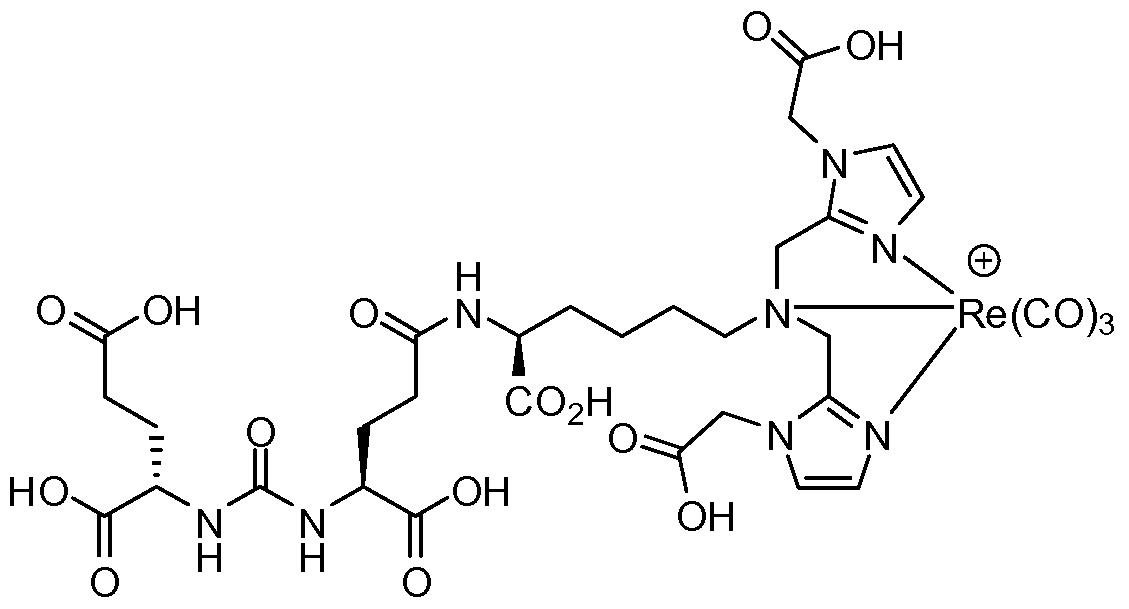
  • Example 7 [Re(CO) 3 ] [ (7S,14S,18S)-7-amino-l-(l-
  • Step 1 (5S,12S,16S)-tri-terf-butyl 5-(4-(bis((l-(2-tert-butoxy-2- oxoethyl)- 1 H-imidazol-2-yl)methyl)amino)butyl)- 1 -(9H-fluoren-9-yl)-3 ,6, 14-trioxo- 2-oxa-4,7, 13 , 15-tetraaza-octadecane- 12,16, 18-tricarboxylate
  • reaction mixture was purified by biotage eluting with 1% to 10% MeOH in DCM to afford (5S,12S,16S)-tri-terf-butyl 5-(4- (bis(( 1 -(2-tert-butoxy-2-oxoethyl)- 1 H-imidazol-2-yl)methyl)amino)butyl)- 1 -(9H- fluoren-9-yl)-3 ,6, 14-trioxo-2-oxa-4,7, 13 , 15-tetraazaoctadecane- 12, 16,18- tricarboxylate (85.7 mg, 35%) as a white solid.
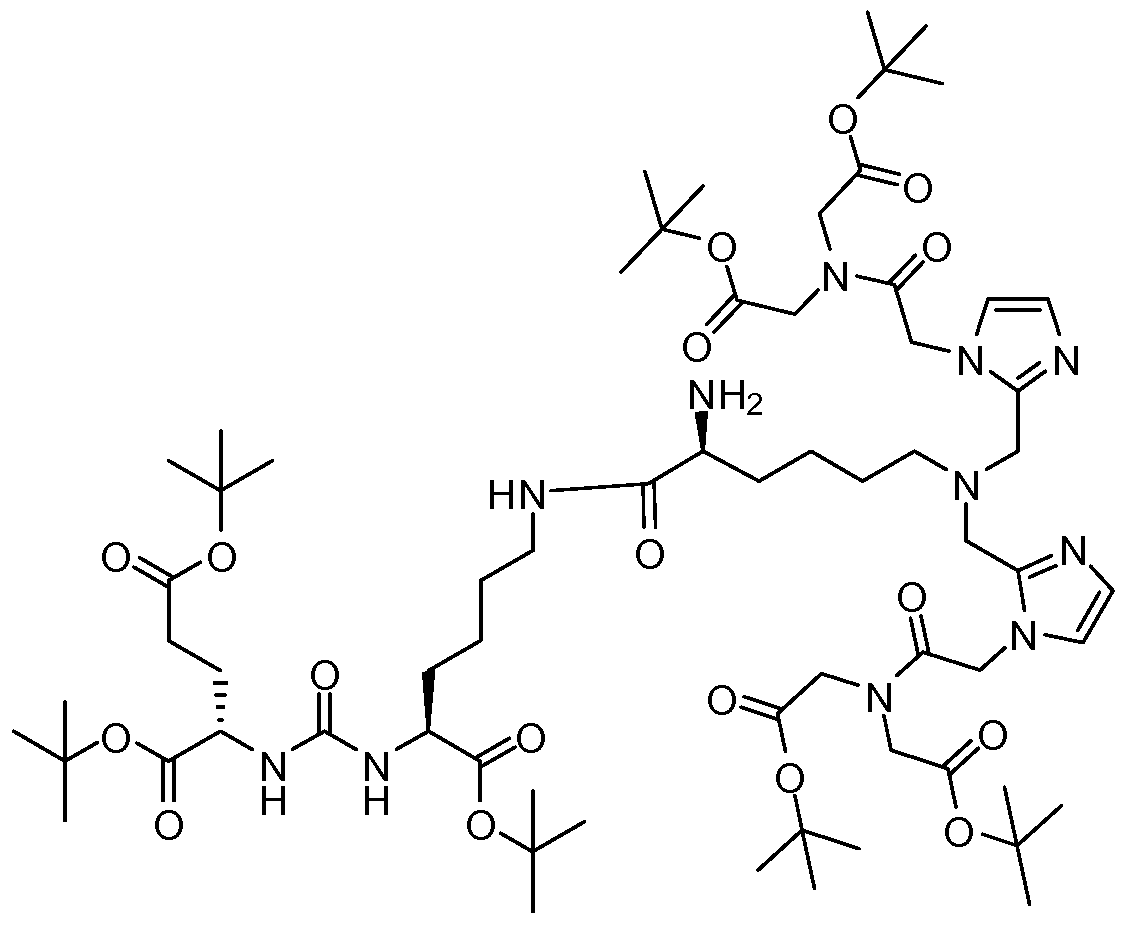
  • Step 2 (7S,14S,18S)-tri-terf-butyl 7-amino-l-(l-(2-tert-butoxy-2- oxoethyl)- 1 H-imidazol-2-yl)-2-(( 1 -(2-tert-butoxy-2-oxoethyl)- 1 H-imidazol-2- yl)methyl)-8, 16-dioxo-2,9, 15, 17-tetraazaicosane- 14, 18,20-tricarboxylate.
  • Step 3 [Re(CO) 3 ][(7S,14S,18S)-7-amino-l-(l-(carboxymethyl)-lH- imidazol-2-yl)-2-(( 1 -(carboxymethyl)- 1 H-imidazol-2-yl)methyl)-8 , 16-dioxo- 2,9,15, 17-tetraazaicosane-14,18,20-tricarboxylic acid].
  • Step 1 tert-butyl 2,2'-(2-bromoacetylazanediyl)diacetate.
  • tert-butyl 2,2'-azanediyldiacetate 3.00 g, 12.24 mmol
  • 2-bromoacetyl bromide 1.39 mL, 3.23 g, 16.00 mmol
  • Et 3 N 2.0 mL
  • the reaction mixtures were stirred at room temperature for 2 hrs.
  • the reaction mixtures were diluted with DCM (300 mL), washed with water, and dried over Na 2 SO 4 .
  • Step 3 l l-(bis((l-(2-(bis(2-tert-butoxy-2-oxoethyl)amino)-2- oxoethyl)- 1 H-imidazol-2-yl)methyl)amino)undecanoic acid
  • Step 4 (19S,23S)-tri-tert-butyl l-(l-(2-(bis(2-tert-butoxy-2- oxoethyl)amino)-2-oxoethyl)- 1 H-imidazol-2-yl)-2-(( 1 -(2-(bis(2-ter£-butoxy-2- oxoethyl)amino)-2-oxoethyl)- 1 H-imidazol-2-yl)methyl)- 13 ,21 -dioxo-2, 14,20,22- tetraazapentacosane-19,23,25-tricarboxylate
  • reaction mixture was purified by biotage eluting with 1% to 10% MeOH in DCM to afford (19S,23S)-tri- tert-butyl l-(l-(2-(bis(2-tert-butoxy-2-oxoethyl)amino)-2-oxoethyl)-lH-imidazol-2- yl)-2-(( 1 -(2-(bis(2-tert-butoxy-2-oxoethyl)amino)-2-oxoethyl)- 1 H-imidazol-2- yl)methyl)- 13 ,21 -dioxo-2, 14,20,22-tetraazapentacosane- 19,23 ,25-tricarboxylate (38 mg, 21%) as a colorless oil.
  • reaction mixture was purified by biotage eluting with 1% MeOH in DCM to afford (5S,12S,16S)-tri-tert-butyl 5-(4-(bis((l-(2-(bis(2-tert- butoxy-2-oxoethyl)amino)-2-oxoethyl)- 1 H-imidazol-2-yl)methyl)amino)butyl)- 1 - (9H-fluoren-9-yl)-3,6,14-trioxo-2-oxa-4,7,13,15-tetraazaoctadecane-12,16,18- tricarboxylate (impure) as an oil.
  • Example 10 Re(CO) 3 ] [ (7S,12S,16S)-l-(l-(carboxymethyl)-lH- imidazol-2-yl)-2-((l-(carboxymethyl)-lH-imidazol-2-yl)methyl)-9,14-dioxo- 2,8,13, 15-tetraazaoctadecane-7,12,16,18-tetracarboxylic acid]
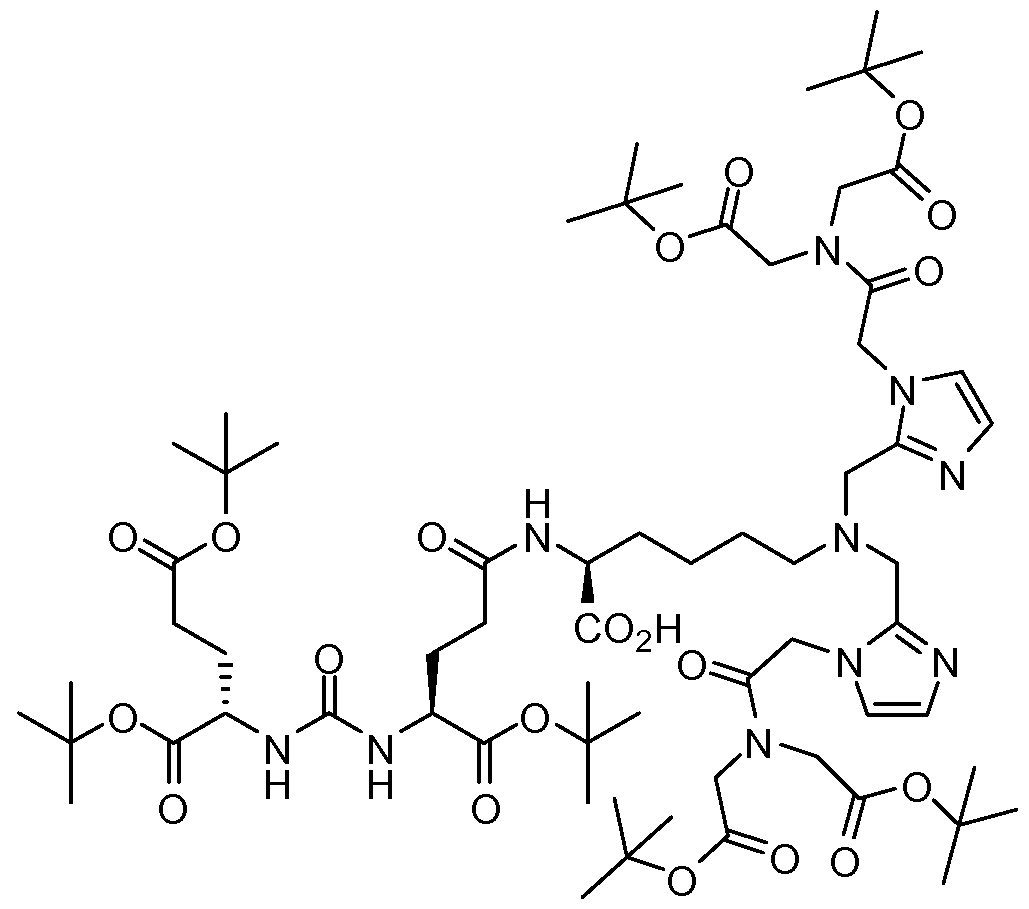
  • Step 2 (2S,7S,l lS)-2-(4-(bis((l-(2-tert-butoxy-2-oxoethyl)-lH-imidazol-2- yl)methyl)amino) butyl)-7, 11 -bis(tert-butoxycarbonyl)- 16,16-dimethyl-4,9, 14-trioxo- 15-oxa-3,8, 10-triazaheptadecan- 1 -oic acid
  • Example 11 [Re(CO) 3 ] [(7S,12S,16S)-l-(l-(2-(bis(carboxymethyl) amino)-2-oxoethyl)-lH-imidazol-2-yl)-2-((l-(2-(bis(carboxymethyl)amino)-2- oxoethyl)-lH-imidazol-2-yl)methyl)-9,14-dioxo-2,8,13,15-tetraazaoctadecane- 7,12,16,18-tetracarboxylic acid]
  • Step 2 (2S,7S,1 lS)-2-(4-(bis((l-(2-(bis(2-tert-butoxy-2- oxoethyl)amino)-2-oxoethyl)- 1 H-imidazol-2-yl)methyl)amino)butyl)-7, 11 -bis(tert- butoxycarbonyl)- 16,16-dimethyl-4,9, 14-trioxo- 15-oxa-3 ,8, 10-triazaheptadecan- 1 -oic acid.
  • Example 12 (7S,22S,26S)-9,16,24-trioxo-l-(quinolin-2-yl)-2-
  • Example 13 (7S,22S,26S)-9,16,24-trioxo-l-(pyridin-2-yl)-2-
  • Example 16 (19S,23S)-l-(l-(carboxymethyl)-lH-imidazol-2-yl)-2-
  • Example 17 (7S,llS,26S)-26-(4-(bis((l-methyl-lH-imidazol-2- yl)methyl) amino)butyl)-7,ll-bis(tert-butoxycarbonyl)-2,2-dimethyl-4,9,17,24- tetraoxo-S-oxa- ⁇ O ⁇ S-tetraazaheptacosan-lT-oic acid
  • DOTA-based chelators may be used for the cheation of a imaging metals including, but not limited to yttrium, lutetium, gallium, and indium.
  • the DOTA-based chelators may be prepared as outlined above, exploiting one of the acid groups of DOTA to link to the other R-groups.
  • Exemplary DOTA-based compounds include, but are not limited to, where M is Y, Lu, Ga, or In; and n is from 0 to 20:
  • Example 18 Re(CO) 3 complex of (7S,22S,26S)-l-(l-methyl-lH- imidazol-2-yl)-2-((l-methyl-lH-imidazol-2-yl)methyl)-9,16,24-trioxo-2,8,17,23,25- pentaazaoctacosane-7,22,26,28-tetracarboxylic acid.
  • LNCaP and PC3 human prostate cancer cells were obtained from
  • LNCaP cells were maintained in RPMI- 1640 medium supplemented with 10% fetal bovine serum (FBS). Binding of the radiolabeled compound and competition with cold derivatives to LNCaP cells was
  • WASH 6626575.1 performed according known procedures with appropriate modifications.
  • Cells were plated in 12-well plates at approximately 4 x 10 5 cells/well and incubated for 48 hours in a humidified incubator at 37 °C/5% carbon dioxide prior to addition of compound.
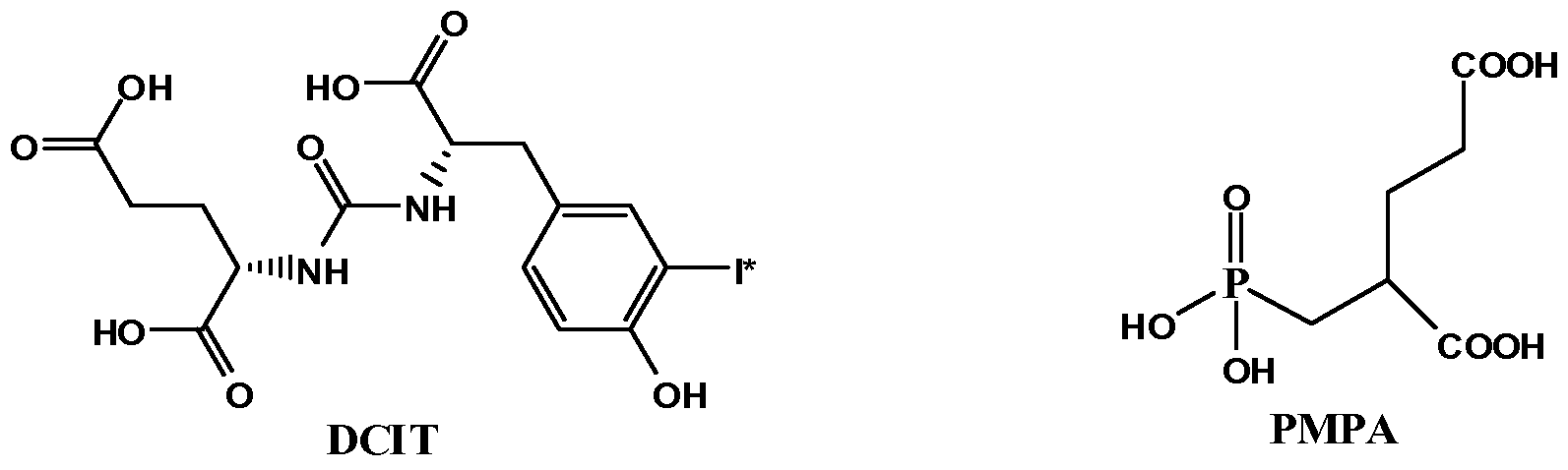
  • Each Glu-urea-X derivative was prepared and diluted in serum-free cell culture medium containing 0.5% bovine serum albumin (BSA) in combination with 3nM 123 I DCIT (known inhibitor). Total binding was determined by incubating 123 I-DCIT without test compound. Plates were incubated at room temperature for 1 hour. Cells were removed from the plates and transferred to Eppendorff tubes. Samples were micro centrifuged for 15 seconds at 1OK x g.
  • BSA bovine serum albumin
  • the medium was aspirated and the pellet was washed twice by dispersal in fresh assay medium followed by micro- centrifugation.
  • Cell binding of 123 I DCIT was determined by counting the cell pellet in an automated gamma counter. Nonspecific binding was determined as the counts associated with the cells after incubating with 2 uM nonradiolabeled compound or 2-phosphonomethyl-pentanedioic acid (PMPA).
  • PMPA 2-phosphonomethyl-pentanedioic acid
  • PSMA is determined as follows:
  • reaction mixture is prepared by combining LNCaP cell lysate (200 ⁇ g) with 600 uL Reaction buffer (Reaction Buffer: 50 mM Tris-HCl, pH 7.4, 20 mM CoCl 2 , 32 mM NaCl). The mixture is allowed to pre -incubate at 37 0 C for 3 min prior to use.
  • Reaction Buffer 50 mM Tris-HCl, pH 7.4, 20 mM CoCl 2 , 32 mM NaCl.
  • the mixture is allowed to pre -incubate at 37 0 C for 3 min prior to use.
  • Reaction Buffer 50 mM Tris-HCl, pH 7.4, 20 mM CoCl 2 , 32 mM NaCl
  • (c) Assay The assay is conducted by adding 6 ⁇ L of 1 mM NAAG (for 1 ⁇ M final cone) spiked with 1,000,000 CPM of 3H-NAAG (100 ⁇ L of 1 mM NAAG + lO ⁇ L of 3H-NAAG (10 ⁇ Ci)), to the reaction mixture.
  • PMPA [...what concentration...] and incubate the resultant solution for 30 min 37°C.
  • the reaction is stopped at specific time points by removing 100 uL of the reaction-mix and adding an equal volume of ice cold 0.25 M KH 2 PO 4 , pH 4.3.
  • Approximately one-half of the buffered mixture is loaded onto a 250 mg AG 50W-X4 cation exchange column (200-400 mesh, H + form, swell resin with DI H2O prior to use).
  • the loaded column is washed with 500 ⁇ L 1:1 Rxn Buffer/0.25MKH 2 PO 4 and eluted with 3M KCl (1.5 mL).
  • the concentration of radiolabel bound to the column is determined using a scintillation counter and 100 ⁇ L of the eluent (diluted 1 :6) to minimize quenching.
  • Compounds of the present can be used to inhibit NAALADase for therapeutic treatments.
  • Diseases that could be receptive to NAALADase treatment include painful and sensory diabetic neuropathy, neuronal damage and prostate cancer, schizophrenia, colorectal cancer, inflammation, amyotrophic lateral sclerosis, or diabetic neuropathy.
  • the present compounds can also be used an analgesic.
  • Guidance for the modeling of such therapeutic treatments can be found in Goodman & Gilman's The Pharmacological Basis of Therapeutics, McGraw Hill, 10 edition, 2001, Pharmaceutical Preformulation and Formulation: A Practical Guide from
  • FIG. 6 is a radioimage illustrating the tissue biodistribution for a 99m Tc complex of the compound of Example 6.

Landscapes

  • Health & Medical Sciences (AREA)
  • Chemical & Material Sciences (AREA)
  • Organic Chemistry (AREA)
  • Life Sciences & Earth Sciences (AREA)
  • Medicinal Chemistry (AREA)
  • Pharmacology & Pharmacy (AREA)
  • Animal Behavior & Ethology (AREA)
  • General Health & Medical Sciences (AREA)
  • Public Health (AREA)
  • Veterinary Medicine (AREA)
  • Epidemiology (AREA)
  • Proteomics, Peptides & Aminoacids (AREA)
  • Physics & Mathematics (AREA)
  • Optics & Photonics (AREA)
  • General Chemical & Material Sciences (AREA)
  • Nuclear Medicine, Radiotherapy & Molecular Imaging (AREA)
  • Chemical Kinetics & Catalysis (AREA)
  • Bioinformatics & Cheminformatics (AREA)
  • Engineering & Computer Science (AREA)
  • Neurosurgery (AREA)
  • Urology & Nephrology (AREA)
  • Pain & Pain Management (AREA)
  • Neurology (AREA)
  • Biomedical Technology (AREA)
  • Psychiatry (AREA)
  • Rheumatology (AREA)
  • Medicines Containing Antibodies Or Antigens For Use As Internal Diagnostic Agents (AREA)
  • Pharmaceuticals Containing Other Organic And Inorganic Compounds (AREA)
  • Pyridine Compounds (AREA)
  • Plural Heterocyclic Compounds (AREA)
  • Quinoline Compounds (AREA)
  • Organic Low-Molecular-Weight Compounds And Preparation Thereof (AREA)
  • Medicines That Contain Protein Lipid Enzymes And Other Medicines (AREA)
  • Acyclic And Carbocyclic Compounds In Medicinal Compositions (AREA)
  • Other In-Based Heterocyclic Compounds (AREA)
  • Peptides Or Proteins (AREA)
  • Thiazole And Isothizaole Compounds (AREA)
  • Heterocyclic Carbon Compounds Containing A Hetero Ring Having Nitrogen And Oxygen As The Only Ring Hetero Atoms (AREA)

Abstract

A compound of Formula (I), a pharmaceutically acceptable salt, or solvate thereof, complexes with metals such as rhenium, technetium, and others to provide a complex for imaging tissues or treating disease, particularly where the metal is radioactive. Such complexes are specific to PSMA protein and can therefore be used in imaging or treating cancer of the prostate and other tissue where the protein is expressed.

Description

TECHNETIUM- AND RHENIUM- BIS (HETEROARYL) COMPLEXES AND METHODS OF USE THEREOF FOR
INHIBITING PSMA
CROSS-REFERENCE TO RELATED PATENT APPLICATIONS
[0001] This application claims the benefit of U.S. Provisional Patent
Applications 61/120,226 filed on December 5, 2008, and 61/180,341, filed on May 21, 2009, both of which are incorporated herein by reference in their entirety, for any and all purposes.
BACKGROUND OF THE INVENTION
[0002] The present invention relates generally to the field of radiopharmaceuticals and their use in nuclear medicine as tracers, imaging agents and for the treatment of various disease states. It is well known that tumors may express unique proteins associated with their malignant phenotype or may over-express normal constituent proteins in greater number than normal cells. The expression of distinct proteins on the surface of tumor cells offers the opportunity to diagnose and characterize disease by probing the phenotypic identity and biochemical composition and activity of the tumor. Radioactive molecules that selectively bind to specific tumor cell surface proteins provide an attractive route for imaging and treating tumors under non-invasive conditions. In particular, the present inventors have found that radiolabeled ligands to the PSMA protein, often over expressed on many cancer cells provide an attractive route for non-invasive imaging and selective targeting of cancer cells.
[0003] At least 1 million men suffer from prostate cancer and it's estimated that the disease will strike one in six U.S. men between the ages of 60 and 80. There are more than 300,000 new cases of prostate cancer diagnosed each year. Prostate cancer will affect one in six men in the United States, and the mortality from the disease is second only to lung cancer. An estimated $2 billion is currently spent worldwide on surgical, radiation, drug therapy and minimally invasive treatments, $1 billion of the spending in the U.S. There is presently no effective therapy for
WASH 6626575.1 relapsing, metastatic, androgen-independent prostate cancer. New agents that will enable rapid visualization of prostate cancer and specific targeting to allow radiotherapy present are needed.
[0004] N-acetylated alpha-linked acidic dipeptidase (NAALADase), also known as glutamate carboxypeptidase II (GCPII) is a neuropeptidase which cleaves N-acetylaspartyl-glutamate (NAAG) into N-acetylaspartate and glutamate in the nervous system, see below, depicting hydrolytic cleavage of NAAG by NAALDase through the tetrahedral intermediate. The enzyme is a type II protein of the co- catalytic class of metallopeptidases, containing two zinc atoms in the active site.
Figure imgf000004_0001
[0005] Independent of its characterization in the nervous system, one form of
NAALADase was shown to be expressed at high levels in human prostatic adenocarcinomas and was designated the prostate-specific membrane antigen (PSMA). The NAALADase/PSMA gene is known to produce multiple mRNA splice forms and based on previous immunohistochemical evidence, it has been assumed that the human brain and prostate expressed different isoforms of the enzyme.
[0006] Human prostate-specific membrane antigen (PSMA), also known as folate hydrolase I (FOLHl), is a trans-membrane, 750 amino acid type II glycoprotein which is primarily expressed in normal human prostate epithelium but is upregulated in prostate cancer, including metastatic disease. PSMA is a unique exopeptidase with reactivity toward poly-gamma-glutamated folates, capable of sequentially removing the poly-gamma-glutamyl termini. Since PSMA is expressed by virtually all prostate cancers and its expression is further increased in poorly differentiated, metastatic and hormone-refractory carcinomas, it is a very attractive target for prostate imaging and therapy. Developing ligands that interact with PSMA and carry appropriate radionuclides may provide a promising and novel targeting option for the detection, treatment and management of prostate cancer.
WASH 6626575.1 [0007] The radio-immunoconjugate form of the anti-PSMA monoclonal antibody (mAb) 7El 1, known as the PROSTASCINT scan, is currently being used to diagnose prostate cancer metastasis and recurrence. More recently, monoclonal antibodies have been developed that bind to the extracellular domain of PSMA and have been radiolabeled and shown to accumulate in PSMA-positive prostate tumor models in animals.
[0008] While monoclonal antibodies hold promise for tumor detection and therapy, there have been limited clinical successes outside of lymphoma because of their low permeability in solid tumors. Low molecular weight mimetics, with higher permeability in solid tumors will have a definite advantage in obtaining high percent per gram and a high percentage of specific binding.
[0009] The selective targeting of cancer cells with radiopharmaceuticals, either for imaging or therapeutic purposes is challenging. A variety of radionuclides are known to be useful for radio-imaging, including Ga-67, Tc-99m, In-111, 1-123, and 1-131. The preferred radioisotope for medical imaging is Tc-99m, because it has a short (6 hour) half life, is readily available at relatively low cost and emits gamma- photons of 140 keV. Moreover, Tc-99m complexes, such as, water and air stable Tc(I) complex [99mTc(OH2)3(CO)3]+ complex can be readily prepared in saline under 1 atm of carbon monoxide (CO).
SUMMARY OF THE INVENTION
[0010] In one aspect, a compound of Formula I or a pharmaceutically acceptable salt, or solvate thereof is provided:
Figure imgf000005_0001
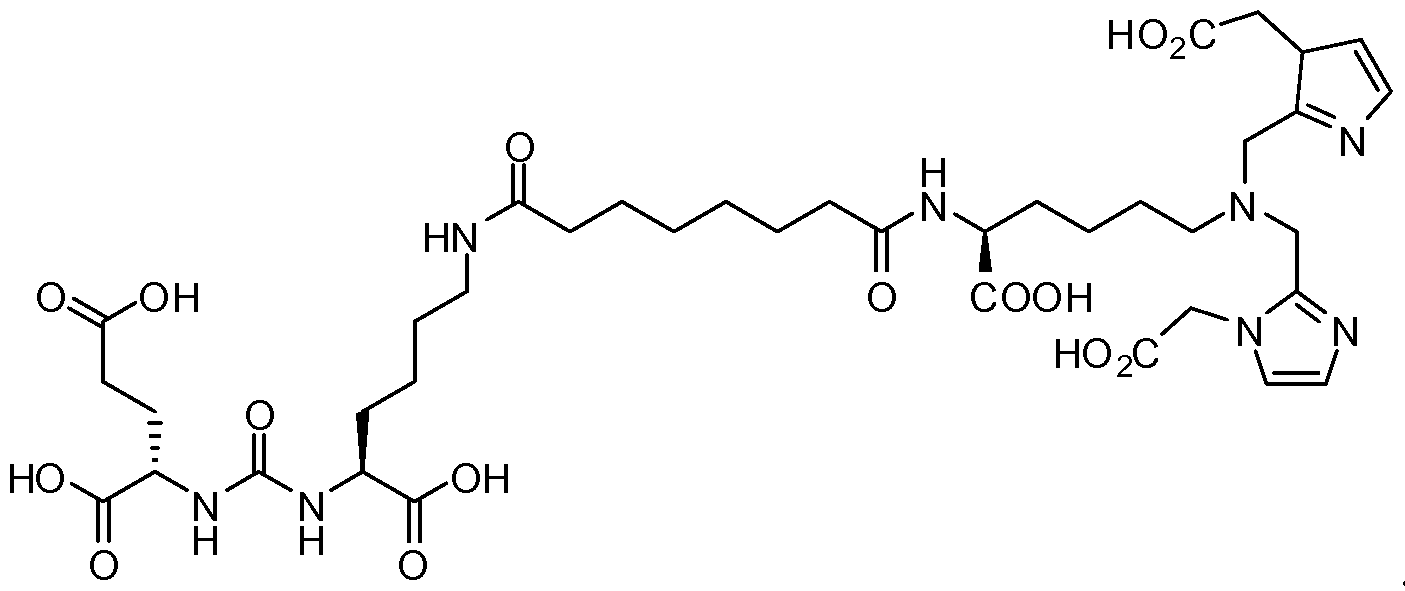
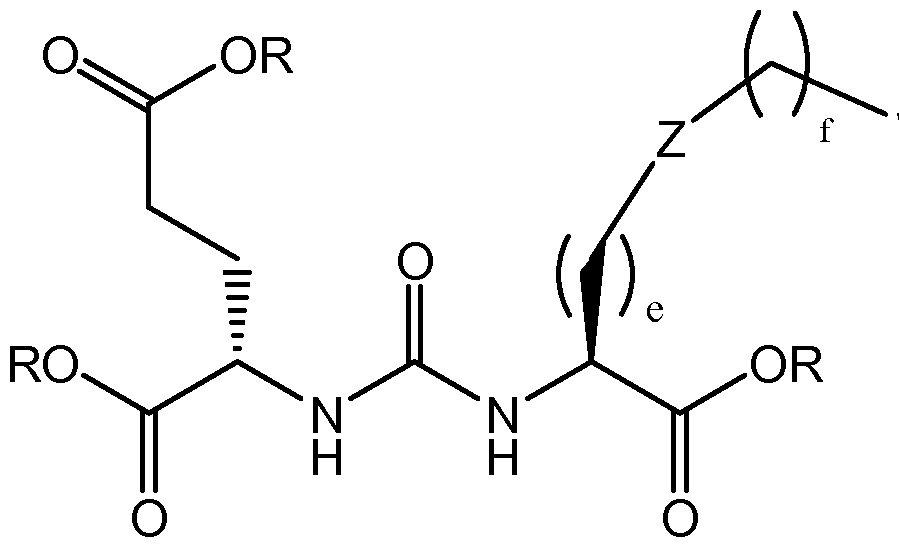
where: R is H, an ammonium ion, an alkylammonium ion, an alkaline earth metal ion, a rare earth metal ion, or an alkyl group; W is a bond, -NHC(O)-, -CH(NH2)-, -NH- C(O)-NH-, -C(O)-NH-, -C(O)-NH-CH(COOH)-, -O-(CH2)n-O-(CH2)n-, -(CH2)n0(CH2)n0(CH2)n-, -CH(NHFmoc)-; Z is a bond, -CO(O)-, -NH-, -NHC(O)-,
WASH 6626575.1 -NH-C(O)-NH-, -NH-C(O)-(CH2)n-, -NH-C(O)-CH(NH2)-, -C(O)-NH-CH(COOH)-; or -NH-C(O)-C6H4-(CH2)n-NH-; NR aarR> bD is a chelator group of Formula:
Figure imgf000006_0001
or
R1 is H, a C1-C8 alkyl group, an ammonium ion, an alkylammonium ion, or an alkali or alkaline earth metal ion; Rv is alkyl alkyl, substituted aminoalkyl, aminoalkyl, or, acetamidoalkyl; e is an integer from O to 15; f is an integer from O to 15; g is an integer from O to 15; and n is an integer from O to 10; with the proviso that where NRaRb is:
Figure imgf000006_0002
WASH 6626575.1 then where W is a bond, Z are other than a bond, -C(O)-NH-, or -NHC(O)-; and where Z is a bond, W is other than a bond, -C(O)-NH-, or -NHC(O)-.
[0011] In some embodiments, Rv is methyl, ethyl, n-propyl, iso-propyl, n- butyl, iso-butyl, tert-butyl, aminoalkyl, hydroxyalkyl, or carboxyalkyl. In some embodiments, Rv is methyl. In some embodiments, each R1 is independently H or tert-butyl. In some embodiments, R1 is H. In some embodiments, e is an integer from 0 to 4, f is an integer from 0 to 12, and g is an integer from 0 to 6. In some embodiments, W is -C(O)-NH-.
[0012] In some embodiments, the compound of Formula I is:
Figure imgf000007_0001
WASH 6626575.1
Figure imgf000008_0001
WASH 6626575.1
Figure imgf000009_0001
a pharmaceutically acceptable salt, or solvate thereof; e is an integer from O to 10; f is an integer from O to 12; g is an integer from O to 12; and n is an integer from O to 10.
[0013] In some embodiments, Z is -NH-C(O)-. In some embodiments, Z is
-C(O)-NH-CH(COOH)-. In some embodiments, Z is -NH-C(O)-CH(NH2)-.
[0014] In another aspect a complex is provided including a metal a metal and a compound of Formula I. In some embodiments, the metal is Re, Tc, Y, Lu, Ga, In, or Cu. In some embodiments, the metal is a radionuclide. In some embodiments, the metal is technetium-99m, rhenium-186, or rhenium-188.
[0015] In some embodiments, the metal in the complex is Y, Lu, Ga, In, or Cu where the complex includes NRaRb as being a group of formula
Figure imgf000009_0002
[0016] In some embodiments, the complex is:
Figure imgf000009_0003
WASH 6626575.1
Figure imgf000010_0001
WASH 6626575.1
Figure imgf000011_0001
a pharmaceutically acceptable salts and solvates thereof; Re, Tc, Y, Lu, Ga, Cu; e is an integer from O to 10; f is an integer from O to 12; g is an integer from O to 12; and n is an integer from O to 10.
[0017] In another aspect, a pharmaceutical formulation is provided including the compound of Formula I, a pharmaceutically acceptable salt or solvate thereof, and a pharmaceutically acceptable excipient.
WASH 6626575.1 [0018] In another aspect, a method of imaging a region in a patient is provided including administering to a patient a diagnostically effective amount of a compound of Formula I, a pharmaceutically acceptable salt or solvate thereof, and obtaining an image of the region of the patient.
[0019] In another aspect, a method of imaging tissue such as spleen tissue, kidney tissue, or PSMA-expressing tumor tissue is provided including contacting the tissue with a complex including a radioactive metal and a compound including a group of formula:
Figure imgf000012_0001
a pharmaceutically acceptable salt or solvate thereof. In some embodiments, the tissue is PSMA-expressing tumor tissue. In other embodiments, the PSMA- expressing tumor tissue is prostate cancer.
BRIEF DESCRIPTION OF THE DRAWINGS
[0020] FIG. 1 is a graph of tissue distribution for a 99mTc complex of the compound of Example 3 in LNCaP Xenograft mice in %DPO.
[0021] FIG. 2 shows competition binding curves for comparative and illustrative compounds according to Formula I for PSMA protein.
[0022] FIG. 3 is a graph of the tissue biodistribution of a 99mTc complex of the compound of Example 8, expressed as %ID/g.
[0023] FIG. 4 is a graph of the tissue biodistribution of a 99mTc complex of the compound of Example 7, expressed as %ID/g.
WASH 6626575.1 [0024] FIG. 5 is a graph comparing the tissue biodistribution for 99mTc complexes in LNCaP Xenograft mice in %ID/g.
[0025] FIG. 6 is an image illustrating the tissue biodistribution for a 99mTc complex of the compound of Example 6 in LNCaP Xenograft mice at various time intervals, and according to some embodiments.
DETAILED DESCRIPTION OF THE PREFERRED EMBODIMENTS
[0026] The are two categories of radiopharmaceuticals: (i) those with biological distribution determined strictly by blood flow, or perfusion, and targeting high capacity systems such as glomerular filtration, phagocytosis, hepatocyte clearance and bone absorption and (ii) those with distribution determined by specific enzymatic or receptor binding interactions, which are low-capacity sites. The inventive radiopharmaceuticals belong to the second category and are synthesized by conjugating the radionuclide coordination complex to a biologically active molecule selective for a particular protein or receptor of interest.
[0027] While a variety of biologically active molecules (BAM) can be used as the carriers, small molecules and small peptides have advantages over antibodies or proteins. For example, small molecules and small peptides exhibit enhanced diffusion, faster blood clearance, and lower background radiation. These carrier allow the facile synthesis of analogs in a high-throughput manner. Additionally, small peptides can be readily converted into peptide mimetics or small molecular analogs that have enhanced stability and improved affinity for the target enzyme or receptor.
[0028] In one aspect, the synthesis and methods for using PSMA selective technetium and rhenium complexes according to Formulae I - IV, as novel radiopharmaceuticals for the treatment and imaging of cancer cells, are provided. Specifically, the compounds can be used to target carcinoma of the prostate.
Figure imgf000013_0001
WASH 6626575.1 Definitions
[0029] For convenience, certain terms employed herein and within the appended claims are collected here.
[0030] As used herein, "about" will be understood by persons of ordinary skill in the art and will vary to some extent depending upon the context in which it is used. If there are uses of the term which are not clear to persons of ordinary skill in the art, given the context in which it is used, "about" will mean up to plus or minus 10% of the particular term.
[0031] The embodiments, illustratively described herein may suitably be practiced in the absence of any element or elements, limitation or limitations, not specifically disclosed herein. Thus, for example, the terms "comprising," "including," "containing," etc. shall be read expansively and without limitation. Additionally, the terms and expressions employed herein have been used as terms of description and not of limitation, and there is no intention in the use of such terms and expressions of excluding any equivalents of the features shown and described or portions thereof, but it is recognized that various modifications are possible within the scope of the claimed technology. Additionally, the phrase "consisting essentially of will be understood to include those elements specifically recited and those additional elements that do not materially affect the basic and novel characteristics of the claimed technology. The phrase "consisting of excludes any element not specified.
[0032] The use of the terms "a" and "an" and "the" and similar referents in the context of describing the elements (especially in the context of the following claims) are to be construed to cover both the singular and the plural, unless otherwise indicated herein or clearly contradicted by context.
[0033] The terms "lipophilic group" and "lipophilic moiety" as used herein refer to a group, moiety or substituent that has a greater affinity for non-polar or nonaqueous environments versus polar or aqueous environments. For example, Merriam Webster's online dictionary defines "lipophilic" as "having an affinity for lipids (as fats)." Exemplary lipophilic moieties include aliphatic hydrocarbon radicals, e.g., alkyl radicals, aromatic hydrocarbon radicals, and long-chain acyl radicals; all of them have increasing lipophilicity as the number of constituent carbons increases. In
WASH 6626575.1 general, addition of a lipophilic moiety to a particular compound will increase the compound's affinity for octanol in the standard octano I/water partition-coefficient- determination protocol; this protocol may be used to gauge a compound's relative hydrophobicity (lipophilicity) and hydrophilicity.
[0034] The terms "Lewis base" and "Lewis basic" refer to a chemical moiety capable of donating a pair of electrons under certain reaction conditions. It may be possible to characterize a Lewis base as donating a single electron in certain complexes, depending on the identity of the Lewis base and the metal ion, but for most purposes, however, a Lewis base is best understood as a two electron donor. Examples of Lewis basic moieties include uncharged compounds such as alcohols, thiols, and amines, and charged moieties such as alkoxides, thiolates, carbanions, and a variety of other organic anions. In certain examples, a Lewis base may consist of a single atom, such as oxide (O2 "). In certain, less common circumstances, a Lewis base or ligand may be positively charged. A Lewis base, when coordinated to a metal ion, is often referred to as a ligand.
[0035] The term "ligand" refers to a species that interacts in some fashion with another species. In one example, a ligand may be a Lewis base that is capable of forming a coordinate bond with a Lewis Acid. In other examples, a ligand is a species, often organic, that forms a coordinate bond with a metal ion. Ligands, when coordinated to a metal ion, may have a variety of binding modes know to those of skill in the art, which include, for example, terminal (i.e., bound to a single metal ion) and bridging (i.e., one atom of the Lewis base bound to more than one metal ion).
[0036] The term "chelating agent" refers to a molecule, often an organic one, and often a Lewis base, having two or more unshared electron pairs available for donation to a metal ion. The metal ion is usually coordinated by two or more electron pairs to the chelating agent. The terms, "bidentate chelating agent", "tridentate chelating agent", and "tetradentate chelating agent" are art-recognized and refer to chelating agents having, respectively, two, three, and four electron pairs readily available for simultaneous donation to a metal ion coordinated by the chelating agent. Usually, the electron pairs of a chelating agent forms coordinate bonds with a single metal ion; however, in certain examples, a chelating agent may form coordinate bonds with more than one metal ion, with a variety of binding modes being possible.
WASH 6626575.1 [0037] The term "coordination" refers to an interaction in which one multi- electron pair donor coordinatively bonds (is "coordinated") to one metal ion.
[0038] The term "complex" refers to a compound formed by the union of one or more electron-rich and electron-poor molecules or atoms capable of independent existence with one or more electronically poor molecules or atoms, each of which is also capable of independent existence.
[0039] Fmoc is an abbreviation for the chemical group: fluorenylmethyloxycarbonyl.
[0040] The phrase "therapeutically-effective amount" as used herein means that amount of a compound, material, or composition comprising a compound which is effective for producing some desired therapeutic effect in at least a sub-population of cells in an animal at a reasonable benefit/risk ratio applicable to any medical treatment.
[0041] As used herein, the terms "treating" or "treatment" is intended to encompass also diagnosis, prophylaxis, therapy and cure. The patient receiving this treatment is any animal in need, including primates, in particular humans, and other mammals such as equines, cattle, swine and sheep; and poultry and pets in general.
[0042] The phrase "pharmaceutically acceptable" is employed herein to refer to those compounds, materials, compositions, and/or dosage forms which are, within the scope of sound medical judgment, suitable for use in contact with the tissues of human beings and animals without excessive toxicity, irritation, allergic response, or other problem or complication, commensurate with a reasonable benefit/risk ratio.
[0043] The phrase "pharmaceutically-acceptable carrier" as used herein means a pharmaceutically-acceptable material, composition or vehicle, such as a liquid or solid filler, diluent, excipient, or solvent encapsulating material, involved in carrying or transporting the subject compound from one organ, or portion of the body, to another organ, or portion of the body. Each carrier must be "acceptable" in the sense of being compatible with the other ingredients of the formulation and not injurious to the patient. Some examples of materials which can serve as pharmaceutically- acceptable carriers include: (1) sugars, such as lactose, glucose and sucrose; (2)
WASH 6626575.1 starches, such as corn starch and potato starch; (3) cellulose, and its derivatives, such as sodium carboxymethyl cellulose, ethyl cellulose and cellulose acetate; (4) powdered tragacanth; (5) malt; (6) gelatin; (7) talc; (8) excipients, such as cocoa butter and suppository waxes; (9) oils, such as peanut oil, cottonseed oil, safflower oil, sesame oil, olive oil, corn oil and soybean oil; (10) glycols, such as propylene glycol; (11) polyols, such as glycerin, sorbitol, mannitol and polyethylene glycol; (12) esters, such as ethyl oleate and ethyl laurate; (13) agar; (14) buffering agents, such as magnesium hydroxide and aluminum hydroxide; (15) alginic acid; (16) pyrogen-free water; (17) isotonic saline; (18) Ringer's solution; (19) ethyl alcohol; (20) pH buffered solutions; (21) polyesters, polycarbonates and/or polyanhydrides; and (22) other nontoxic compatible substances employed in pharmaceutical formulations.
[0044] The phrases "parenteral administration" and "administered parenterally" as used herein means modes of administration other than enteral and topical administration, usually by injection, and includes, without limitation, intravenous, intramuscular, intraarterial, intrathecal, intracapsular, intraorbital, intracardiac, intradermal, intraperitoneal, transtracheal, subcutaneous, subcuticular, intraarticulare, subcapsular, subarachnoid, intraspinal and intrasternal injection and infusion.
[0045] The phrases "systemic administration," "administered systemically,"
"peripheral administration" and "administered peripherally" as used herein mean the administration of a compound, drug or other material other than directly into the central nervous system, such that it enters the patient's system and, thus, is subject to metabolism and other like processes, for example, subcutaneous administration.
[0046] The term "amino acid" refers to all compounds, whether natural or synthetic, which include both an amino functionality and an acid functionality, including amino acid analogs and derivatives.
[0047] The term "heteroatom" refers to an atom of any element other than carbon or hydrogen. Illustrative heteroatoms include boron, nitrogen, oxygen, phosphorus, sulfur and selenium.
[0048] In general, "substituted" refers to an alkyl or alkenyl group, as defined below (e.g., an alkyl group) in which one or more bonds to a hydrogen atom
WASH 6626575.1 contained therein are replaced by a bond to non-hydrogen or non-carbon atoms. Substituted groups also include groups in which one or more bonds to a carbon(s) or hydrogen(s) atom are replaced by one or more bonds, including double or triple bonds, to a heteroatom. Thus, a substituted group will be substituted with one or more substituents, unless otherwise specified. In some embodiments, a substituted group is substituted with 1, 2, 3, 4, 5, or 6 substituents. Examples of substituent groups include: halogens (i.e., F, Cl, Br, and I); hydroxyls; alkoxy, alkenoxy, alkynoxy, aryloxy, aralkyloxy, heterocyclyloxy, and heterocyclylalkoxy groups; carbonyls (oxo); carboxyls; esters; urethanes; oximes; hydroxylamines; alkoxyamines; aralkoxyamines; thiols; sulfides; sulfoxides; sulfones; sulfonyls; sulfonamides; amines; N-oxides; hydrazines; hydrazides; hydrazones; azides; amides; ureas; amidines; guanidines; enamines; imides; isocyanates; isothiocyanates; cyanates; thiocyanates; imines; nitro groups; nitriles (i.e., CN); and the like.
[0049] Alkyl groups include straight chain and branched chain alkyl groups having from 1 to 12 carbon atoms, and typically from 1 to 10 carbons or, in some embodiments, from 1 to 8, 1 to 6, or 1 to 4 carbon atoms. Examples of straight chain alkyl groups include groups such as methyl, ethyl, n-propyl, n-butyl, n-pentyl, n-hexyl, n-heptyl, and n-octyl groups. Examples of branched alkyl groups include, but are not limited to, isopropyl, iso-butyl, sec-butyl, tert-butyl, neopentyl, isopentyl, and 2,2-dimethylpropyl groups. Alkyl groups may be substituted or unsubstituted. Unless the number of carbons is otherwise specified, "lower alkyl" refers to an alkyl group, as defined above, but having from one to about ten carbons, alternatively from one to about six carbon atoms in its backbone structure. Likewise, "lower alkenyl" and "lower alkynyl" have similar chain lengths.
[0050] The term "alkylcarbonyl" denotes an -(C1-C8)alkyl-C(O) group in which one or more methylenes in the C1-C8 alkyl group is replaced with a C(O) group. Representative examples include, but are not limited to, acetyl, propionyl, and CH3(CH2)2C(O)- group.
[0051] The terms "cyclic alkyl" or "cycloalkyl" refers to a saturated or partially saturated non-aromatic cyclic alkyl groups of from 3 to 14 carbon atoms and no ring heteroatoms and having a single ring or multiple rings including fused and bridged ring systems. Cycloalkyl groups may be substituted or unsubstituted.
WASH 6626575.1 Cycloalkyl or cyclic alkyl groups include mono-, bi- or tricyclic alkyl groups having from 3 to 14 carbon atoms in the ring(s), or, in some embodiments, 3 to 12, 3 to 10, 3 to 8, or 3 to 4, 5, 6 or 7 carbon atoms. Exemplary monocyclic cycloalkyl groups include, but not limited to, cyclopropyl, cyclobutyl, cyclopentyl, cyclohexyl, cycloheptyl, and cyclooctyl groups. Bi- and tricyclic ring systems include both bridged cycloalkyl groups and fused rings, such as, but not limited to, bicyclo[2.1.1]hexane, adamantyl, decalinyl, and the like.
[0052] Alkenyl groups include straight and branched chain and cycloalkyl groups as defined above, except that at least one double bond exists between two carbon atoms. Thus, alkenyl groups have from 2 to about 12 carbon atoms in some embodiments, from 2 to 10 carbon atoms in other embodiments, and from 2 to 8 carbon atoms in other embodiments. Examples include, but are not limited to vinyl, allyl,
-CH=CH(CH3), -CH=C(CHs)2, -C(CH3)=CH2, -C(CH3)=CH(CH3), -C(CH2CH3)=CH2, cyclohexenyl, cyclopentenyl, cyclohexadienyl, butadienyl, pentadienyl, and hexadienyl, among others. Alkenyl groups may be substituted or unsubstituted. Representative substituted alkenyl groups may be mono-substituted or substituted more than once, such as, but not limited to, mono-, di- or tri-substituted with substituents such as those listed above.
[0053] Alkynyl groups include straight and branched chain and cycloalkyl groups as defined above, except that at least one triple bond exists between two carbon atoms. Examples of a (C2-Cg)alkynyl group include, but are not limited to, acetylene, propyne, 1-butyne, 2-butyne, 1-pentyne, 2-pentyne, 1-hexyne, 2-hexyne, 3- hexyne, 1-heptyne, 2-heptyne, 3-heptyne, 1-octyne, 2-octyne, 3-octyne and 4-octyne. An alkynyl group can be unsubstituted or optionally substituted with one or more substituents as described herein below.
[0054] Aryl groups are cyclic aromatic hydrocarbons that do not contain heteroatoms. Aryl groups include monocyclic, bicyclic and polycyclic ring systems. Thus, aryl groups include, but are not limited to, phenyl, azulenyl, heptalenyl, biphenylenyl, indacenyl, fluorenyl, phenanthrenyl, triphenylenyl, pyrenyl, naphthacenyl, chrysenyl, biphenyl, anthracenyl, indenyl, indanyl, pentalenyl, and naphthyl groups. In some embodiments, aryl groups contain 6-14 carbons, and in
WASH 6626575.1 others from 6 to 12 or even 6-10 carbon atoms in the ring portions of the groups. Aryl group includes both substituted and unsubstituted aryl groups. Substituted aryl groups may be mono-substituted or substituted more than once. For example, monosubstituted aryl groups include, but are not limited to, 2-, 3-, A-, 5-, or 6- substituted phenyl or naphthyl groups, which may be substituted with substituents such as those listed above.
[0055] Aralkyl groups are alkyl groups as defined above in which a hydrogen or carbon bond of an alkyl group is replaced with a bond to an aryl group as defined above. In some embodiments, aralkyl groups contain 7 to 20 carbon atoms, 7 to 14 carbon atoms or 7 to 10 carbon atoms.
[0056] Heterocyclyl groups includes non-aromatic ring compounds containing
3 or more ring members, of which one or more is a heteroatom such as, but not limited to, N, O, and S. In some embodiments, heterocyclyl groups include 3 to 20 ring members, whereas other such groups have 3 to 6, 3 to 10, 3 to 12, or 3 to 15 ring members. Heterocyclyl groups encompass unsaturated, partially saturated and saturated ring systems, such as, for example, imidazolyl, imidazolinyl and imidazolidinyl groups. Heterocyclyl groups may be substituted or unsubstituted. Heterocyclyl groups include, but are not limited to, aziridinyl, azetidinyl, pyrrolidinyl, imidazolidinyl, pyrazolidinyl, thiazolidinyl, tetrahydrothiophenyl, tetrahydrofuranyl, dioxolyl, furanyl, thiophenyl, pyrrolyl, pyrrolinyl, imidazolyl, imidazolinyl, pyrazolyl, pyrazolinyl, triazolyl, tetrazolyl, oxazolyl, isoxazolyl, thiazolyl, thiazolinyl, isothiazolyl, thiadiazolyl, oxadiazolyl, piperidyl, piperazinyl, morpholinyl, thiomorpholinyl, tetrahydropyranyl, tetrahydrothiopyranyl, oxathiane, dioxyl, dithianyl, pyranyl, pyridyl, pyrimidinyl, pyridazinyl, pyrazinyl, triazinyl, dihydropyridyl, dihydrodithiinyl, dihydrodithionyl, homopiperazinyl, quinuclidyl, indolyl, indolinyl, isoindolyl,azaindolyl (pyrrolopyridyl), indazolyl, indolizinyl, benzotriazolyl, benzimidazolyl, benzofuranyl, benzothiophenyl, benzthiazolyl, benzoxadiazolyl, benzoxazinyl, benzodithiinyl, benzoxathiinyl, benzothiazinyl, benzoxazolyl, benzothiazolyl, benzothiadiazolyl, benzo[l,3]dioxolyl, pyrazolopyridyl, imidazopyridyl (azabenzimidazolyl), triazolopyridyl, isoxazolopyridyl, purinyl, xanthinyl, adeninyl, guaninyl, quinolinyl, isoquinolinyl, quinolizinyl, quinoxalinyl, quinazolinyl, cinnolinyl, phthalazinyl, naphthyridinyl, pteridinyl, thianaphthalenyl,
WASH 6626575.1 dihydrobenzothiazinyl, dihydrobenzofuranyl, dihydroindolyl, dihydrobenzodioxinyl, tetrahydroindolyl, tetrahydroindazolyl, tetrahydrobenzimidazolyl, tetrahydrobenzotriazolyl, tetrahydropyrrolopyridyl, tetrahydropyrazolopyridyl, tetrahydroimidazopyridyl, tetrahydrotriazolopyridyl, and tetrahydroquinolinyl groups. Heterocyclyl groups may be substituted or unsubstituted. Representative substituted heterocyclyl groups may be mono-substituted or substituted more than once, such as, but not limited to, pyridyl or morpholinyl groups, which are 2-, 3-, 4-, 5-, or 6- substituted, or disubstituted with various substituents such as those listed above.
[0057] Heteroaryl groups are aromatic ring compounds containing 5 or more ring members, of which, one or more is a heteroatom such as, but not limited to, N, O, and S. Heteroaryl groups may be substituted or unsubstituted. Heteroaryl groups include, but are not limited to, groups such as pyrrolyl, pyrazolyl, triazolyl, tetrazolyl, oxazolyl, isoxazolyl, thiazolyl, pyridyl, pyridazinyl, pyrimidinyl, pyrazinyl, thiophenyl, benzothiophenyl, furanyl, benzofuranyl, indolyl, azaindolyl (pyrrolopyridyl), indazolyl, benzimidazolyl, imidazopyridyl (azabenzimidazolyl), pyrazolopyridyl, triazolopyridyl, benzotriazolyl, benzoxazolyl, benzothiazolyl, benzothiadiazolyl, imidazopyridyl, isoxazolopyridyl, thianaphthalenyl, purinyl, xanthinyl, adeninyl, guaninyl, quinolinyl, isoquinolinyl, tetrahydroquinolinyl, quinoxalinyl, and quinazolinyl groups.
[0058] Alkoxy groups are hydro xyl groups (-OH) in which the bond to the hydrogen atom is replaced by a bond to a carbon atom of a substituted or unsubstituted alkyl group as defined above. Examples of linear alkoxy groups include but are not limited to methoxy, ethoxy, propoxy, butoxy, pentoxy, hexoxy, and the like. Examples of branched alkoxy groups include but are not limited to isopropoxy, sec-butoxy, tert-butoxy, isopentoxy, isohexoxy, and the like. Examples of cycloalkoxy groups include but are not limited to cyclopropyloxy, cyclobutyloxy, cyclopentyloxy, cyclohexyloxy, and the like. Alkoxy groups may be substituted or unsubstituted. Representative substituted alkoxy groups may be substituted one or more times with substituents such as those listed above.
[0059] The terms "polycyclyl" or "polycyclic group" refer to two or more rings (e.g., cycloalkyls, cycloalkenyls, cycloalkynyls, aryls and/or heterocyclyls) in which two or more carbons are common to two adjoining rings, e.g., the rings are
WASH 6626575.1 "fused rings". Rings that are joined through non-adjacent atoms are termed "bridged" rings. Each of the rings of the polycycle may be substituted with such substituents as described above, as for example, halogen, alkyl, aralkyl, alkenyl, alkynyl, cycloalkyl, hydroxyl, amino, monoalkylamino, dialkylamino, nitro, sulfhydryl, imino, amido, phosphonate, phosphinate, carbonyl, carboxyl, silyl, ether, alkylthio, sulfonyl, ketone, aldehyde, ester, a heterocyclyl, an aromatic or heteroaromatic moiety, -CF3, -CN, or the like.
[0060] The term "carbocycle" refers to an aromatic or non-aromatic ring in which each atom of the ring is carbon.
[0061] The term "nitro" refers to -NO2; the term "halogen" is art-recognized and refers to -F, -Cl, -Br or -I; the term "sulfhydryl" is art-recognized and refers to - SH; the term "hydroxyl" means -OH; and the term "sulfonyl" is art-recognized and refers to -SO2 ". "Halide" designates the corresponding anion of the halogens, and "pseudohalide" has the definition set forth on 560 of "Advanced Inorganic Chemistry" by Cotton and Wilkinson.
[0062] The term "amine or amino" refers to an -NRcRd group wherein Rc and
Rd each independently refer to a hydrogen, (Ci-Cs^lkyl, aryl, heteroaryl, and heterocycloalkyl group. When Rc and Rd are attached to the same nitrogen atom, they can be combined with the nitrogen atom to form a 5-, 6- or 7-membered ring. For example, -NRcRd is meant to include 1-pyrrolidinyl, pyridinyl or a 4-morpholinyl ring.
[0063] The term "amido" is art recognized as an amino-substituted carbonyl and includes a moiety that may be represented by the general formula, -C(O)NRcRd group wherein Rc and Rd are as defined above. According to some embodiments, the amide does not include imides which may be unstable.
[0064] The terms "carboxyl" and "carboxylate" are include such moieties as may be represented by the general formulas:
Figure imgf000022_0001
WASH 6626575.1 wherein E is a bond or represents O or S, and R and R individually is H, alkyl, alkenyl, aryl, or a pharmaceutically acceptable salt. Where E is O, and R is as defined above, the moiety is referred to herein as a carboxyl group, and particularly when Rf is a hydrogen, the formula represents a "carboxylic acid". In general, where the expressly shown oxygen is replaced by sulfur, the formula represents a "thiocarbonyl" group.
[0065] The terms "alkoxyl" or "alkoxy" refer to an alkyl group, as defined above, having an oxygen radical attached thereto. Representative alkoxyl groups include methoxy, ethoxy, propoxy, butyoxy, ter t-butoxy and the like. An "ether" is two hydrocarbons covalently linked by an oxygen. "Ether" also encompasses polyethers where more than one ether group, or linkage, may be present in a given group. "Ether" also encompasses cyclic ethers, and crown ethers, where the ether linkage is within a cyclic group.
[0066] The term "sulfonate" refers to a moiety that may be represented by the general formula, -S(O)2OR8, in which Rg is an electron pair, hydrogen, alkyl, cycloalkyl, or aryl. The term "sulfate" includes a moiety that may be represented by the general formula, -OS(O)2OR8, in which Rg is as defined above. The term "sulfonamido" includes a moiety that may be represented by the general formula: -N(Rf)S(O)2ORf , in which Rf and Rf are as defined above. The term "sulfamide" refers to a moiety that may be represented by the general formula, -S(O)2NReRf, in which in which Re and Rf are hydrogen, (Ci-Cs^lkyl or aryl. The term "sulfonyl" refers to a moiety that may be represented by the general formula: -S(O)2Rh, in which Rh is one of the following: hydrogen, alkyl, alkenyl, alkynyl, cycloalkyl, heterocyclyl, aryl or heteroaryl.
[0067] The definition of each expression, e.g. alkyl, m, n, and the like, when it occurs more than once in any structure, is intended to be independent of its definition elsewhere in the same structure.
[0068] The terms triflyl, tosyl, mesyl, and nonaflyl refer to trifluoromethanesulfonyl, /?-toluenesulfonyl, methanesulfonyl, and nonafluorobutanesulfonyl groups, respectively. The terms triflate, tosylate, mesylate, and nonaflate are art-recognized and refer to trifluoromethanesulfonate ester, p-
WASH 6626575.1 toluenesulfonate ester, methanesulfonate ester, and nonafluorobutanesulfonate ester functional groups and molecules that contain the groups, respectively. The abbreviations Me, Et, Ph, Tf, Nf, Ts, and Ms represent methyl, ethyl, phenyl, trifluoromethanesulfonyl, nonafluorobutanesulfonyl, /?-toluenesulfonyl and methanesulfonyl, respectively. A more comprehensive list of the abbreviations utilized by organic chemists of ordinary skill in the art appears in the first issue of each volume of the Journal of Organic Chemistry; this list is typically presented in a table entitled Standard List of Abbreviations.
[0069] Certain compounds contained in the compositions may exist in particular geometric or stereoisomeric forms. In addition, compounds may also be optically active. The compounds may also include cis- and trans-isomers, R- and S- enantiomers, diastereomers, (D)-isomers, (L)-isomers, the racemic mixtures thereof, and other mixtures thereof. Additional asymmetric carbon atoms may be present in a substituent such as an alkyl group. If, for instance, a particular enantiomer of compound is desired, it may be prepared by asymmetric synthesis, or by derivation with a chiral auxiliary, where the resulting diastereomeric mixture is separated and the auxiliary group cleaved to provide the pure desired enantiomers. Alternatively, where the molecule contains a basic functional group, such as amino, or an acidic functional group, such as carboxyl, diastereomeric salts are formed with an appropriate optically-active acid or base, followed by resolution of the diastereomers thus formed by fractional crystallization or chromatographic means well known in the art, and subsequent recovery of the pure enantiomers.
[0070] The phrase "protecting group" as used herein means temporary substituents which protect a potentially reactive functional group from undesired chemical transformations. Examples of such protecting groups include esters of carboxylic acids, silyl ethers of alcohols, and acetals and ketals of aldehydes and ketones, respectively. The field of protecting group chemistry has been reviewed (Greene, T. W.; Wuts, P. G. M. Protective Groups in Organic Synthesis, 3rd ed.; Wiley: New York, 1999).
[0071] Unless otherwise indicated, "stereoisomer" means one stereoisomer of a compound that is substantially free of other stereoisomers of that compound. Thus, a stereomerically pure compound having one chiral center will be substantially free of
WASH 6626575.1 the opposite enantiomer of the compound. A stereomerically pure compound having two chiral centers will be substantially free of other diastereomers of the compound. A typical stereomerically pure compound comprises greater than about 80% by weight of one stereoisomer of the compound and less than about 20% by weight of other stereoisomers of the compound, for example greater than about 90% by weight of one stereoisomer of the compound and less than about 10% by weight of the other stereoisomers of the compound, or greater than about 95% by weight of one stereoisomer of the compound and less than about 5% by weight of the other stereoisomers of the compound, or greater than about 97% by weight of one stereoisomer of the compound and less than about 3% by weight of the other stereoisomers of the compound.
[0072] If there is a discrepancy between a depicted structure and a name given that structure, then the depicted structure controls. Additionally, if the stereochemistry of a structure or a portion of a structure is not indicated with, for example, bold or dashed lines, the structure or portion of the structure is to be interpreted as encompassing all stereoisomers of it.
Chelator Compounds and their Synthesis
[0073] In one aspect, a compound of Formula I, its pharmaceutically acceptable salts and solvates are provided:
Figure imgf000025_0001
where, R is H, an ammonium ion, an alkylammonium ion, an alkaline earth metal ion, a rare earth metal ion, or an alkyl group; W is a bond, -NHC(O)-, -CH(NH2)-, -NH- C(O)-NH-, -C(O)-NH-, -C(O)-NH-CH(COOH)-, -O-(CH2)n-O-(CH2)n-, -(CH2)nO(CH2)nO(CH2)n-, -CH(NHFmoc)-; Z is a bond, -CO(O)-, -NH-, -NHC(O)-, -NH-C(O)-NH-, -NH-C(O)-(CH2)n-, -NH-C(O)-CH(NH2)-, -C(O)-NH-CH(COOH)-; or -NH-C(O)-C6H4-(CH2)n-NH-; NRaRb is absent or is a chelator group of Formula:
WASH 6626575.1
Figure imgf000026_0001
R1 is H, a C1-C8 alkyl group, an ammonium ion, an alkylammonium ion, or an alkali or alkaline earth metal ion; Rv is alkyl; e is an integer from 0 to 15; f is an integer from 0 to 15; g is an integer from 0 to 15; and n is an integer from 0 to 10; with the proviso that where NRaRb is:
Figure imgf000026_0002
then where W is a bond, Z are other than a bond, -C(O)-NH-, or -NHC(O)-; and where Z is a bond, W is other than a bond, -C(O)-NH-, or -NHC(O)-.. In some embodiments, R is alkyl. In other embodiments, Rv is methyl, ethyl, n-propyl, iso- propyl, n-butyl, iso-butyl, or tert-butyl. In yet other embodiments, Rv is methyl. In
WASH 6626575.1 yet other embodiments, each R1 is independently H or tert-butyl. In yet other embodiments, R1 is H.
[0074] Example compounds according to Formula I, include, but are not limited to:
Figure imgf000027_0001
WASH 6626575.1
Figure imgf000028_0001
WASH 6626575.1
Figure imgf000029_0001
pharmaceutically acceptable salts and solvates thereof; where e is an integer from O to 10; f is an integer from 0 to 12; g is an integer from 0 to 12; and n is an integer from 0 to 10.
[0075] According to various embodiments, the NRaRb group of the compound may further be chelated to a metal. In some embodiments, the metal is a radioactive nuclide. For example, the metal may be technetium-99m, or rhenium- 186m/l 88m. Complexes such as [NEt4J2[MBr3(CO)S]; M is Tc or Re, may be reacted with a compound of Formula I in an alcoholic solvent. Such a reaction provides the chelated complex of Formula I-M, as further described below:
WASH 6626575.1
Figure imgf000030_0001
[0076] Illustrative compounds according to Formula I-M, include, but are not limited to any one of the following:
Figure imgf000030_0002
WASH 6626575.1
Figure imgf000031_0001
WASH 6626575.1
Figure imgf000032_0001
pharmaceutically acceptable salts and solvates thereof; where, M is Re or Tc; e is an integer from O to 10; f is an integer from O to 12; g is an integer from O to 12; and n is an integer from O to 10.
[0077] In some embodiments, the compounds include not only pharmaceutically acceptable salts and solvates thereof, but also stereoisomers, tautomers, and prodrugs of such compounds.
[0078] As noted above, complexes of the compound of Formula I may contain one or more a radionuclides which are suitable for use as radio-imaging agents and as therapeutics for the treatment of rapidly proliferating cells. Accordingly, in one embodiment, a pharmaceutical composition is provided including a complex that includes a metal and the compound of Formula I a salt, solvate, stereoisomer, or tautomer thereof, and a pharmaceutically acceptable carrier.
[0079] In general, metal complexes of the compound Formula I or pharmaceutical compositions thereof, may be administered orally, or via a parenteral route, usually by injection. Parenteral routes include, but are not limited to, intravenous, intramuscular, intraarterial, intrathecal, intracapsular, intraorbital, intracardiac, intradermal, intraperitoneal, transtracheal, subcutaneous, subcuticular, intraarticulare, subcapsular, subarachnoid, intraspinal and intrasternal injection and infusion. In some embodiments, the compound, or pharmaceutical composition thereof, is administered orally. Such compositions may take the form of tablets, pills, capsules, semisolids, powders, solutions, suspensions, elixirs, aerosols, or any other appropriate compositions.
[0080] According to another aspect, a pharmaceutical composition is provided, which is suitable for in vivo imaging. Such suitable imaging pharmaceutical compositions contain an imaging agent that has a radionuclide either as an element, i.e. radioactive iodine, or a radioactive metal chelate complex of the
WASH 6626575.1 compound of Formula I in an amount sufficient for imaging, together with a pharmaceutically acceptable radiological vehicle. The radiological vehicle should be suitable for injection or aspiration, such as human serum albumin; aqueous buffer solutions, e.g., tris(hydromethyl) aminomethane (and its salts), phosphate, citrate, bicarbonate, etc; sterile water; physiological saline; and balanced ionic solutions containing chloride and or dicarbonate salts or normal blood plasma cations such as calcium, potassium, sodium, and magnesium.
[0081] The concentration of the imaging agent in the radiological vehicle should be sufficient to provide satisfactory imaging. For example, when using an aqueous solution, the dosage is about 1.0 to 50 millicuries. The imaging agent should be administered so as to remain in the patient for about 1 to 24 hours, although both longer and shorter time periods are acceptable. Therefore, convenient ampoules containing 1 to 10 mL of aqueous solution may be prepared.
[0082] Imaging may be carried out in the normal manner, for example by injecting a sufficient amount of the imaging composition to provide adequate imaging and then scanning with a suitable machine, such as a gamma camera. In certain embodiments, a method of imaging a region in a patient includes the steps of: administering to a patient a diagnostically effective amount of a compound complexed with a radionuclide; exposing a region of the patient to radiation; and obtaining an image of the region of the patient. In certain embodiments of the region imaged is the head or thorax. In other embodiments, the compounds and complexes of Formula I target the PSMA protein.
[0083] Thus, in some embodiments, a method of imaging tissue such as spleen tissue, kidney tissue, or PSMA-expressing tumor tissue is provided including contacting the tissue with a complex including a radioactive metal and a compound including a group of formula:
WASH 6626575.1
Figure imgf000034_0001
a pharmaceutically acceptable salt or solvate thereof. In some embodiments, the tissue is PSMA-expressing tumor tissue. The specificity of such compounds, are illustrated in FIG. 5.
[0084] The present invention, thus generally described, will be understood more readily by reference to the following examples, which are provided by way of illustration and are not intended to be limiting of the present invention.
EXAMPLES
General Synthetic Methods.
[0085] General procedure for complexation of the compounds with a metal.
As exemplified herein, rhenium is used as the metal in consideration of the availability of non-radioactive isotopes and the safety of workers. However, as is to be understood, similar synthetic procedures may be followed using the technetium analogs, as technetium and rhenium have similar reaction chemistry and are of a similar size due to the lanthanide contraction. Therefore, where Re may be specifically shown, it is understood to include Tc complexes as well.
General Experimental Conditions for the Formation of the Rhenium Complexes
[0086] The rhenium/technetium complexes of the compounds of Formula I are conveniently isolated from the reactions of the readily available precursor [NEt4J2[Re(CO)3BrS] with the compound. Since the donor sets provided by the SAAC terminus are well documented as effective chelators for the (M(CO)3) 1 core and have been designed to adopt the required^αczα/ arrangement about the metal site, the preparations of the complexes are unexceptional.
WASH 6626575.1 [0087] The (Re(I)(CO)3I+ system follows similar reaction chemistry to that of the 99mTc-tricarbonyl core. The use of [NEt4J2[ReBr3(CO)3], as the starting material leads to facile formation of the fac- (Re(CO)3(L)3) core. The [NEt4J2[ReBr3(CO)3] is readily derived from the [ReBr(CO)s]. The synthesis of the Re(I) complexes is accomplished by reacting [NEt4]2[ReBr3(CO)3] with the appropriate chelating ligand in the ratio of 1 : 1.2 in 10 ml of methanol. The reaction mixture is allowed to heat at 80 0C for 4 hours. After cooling all of the reaction products are all purified using C18 Sep Pak columns with yields ranging from 20-50%.
[0088] Unless otherwise noted the synthesis of the Re(I) complexes was accomplished by reacting [NEt4]2[ReBr3(CO)3] (or, [99mTc(CO)3(H2O)3]+) with the appropriate ligand (10~6 M -IO"4 M) in the ratio of 1 : 1.2 in 10 ml of methanol. The sealed vial was heated at was allowed to heat at 100 0C for 4 hours. Upon cooling the reaction was analyzed for purity via RP-HPLC (reverse phase-HPLC) and the product was purified using a silica column using methanol as the eluent. The radiochemical purity (RCP) after HPLC purification, resulting in "carrier free" products, was determined via HPLC and shown to be consistently > 95%. Although initial results demonstrated radiolabeling at concentrations as low as 10"6 M RCY was < 80%. RCY is an abbreviation for radiochemical yield. To achieve a RCY > 95% at 75 0C, the reaction concentration needed to be increased to 10"4 M. In many cases, the corresponding Tc complexes are prepared and tested as the Re complexes in order to prepare non-radioactive analogs for testing and handling purposes.
Radiolabeling of the Compounds.
[0089] Radiolabeling of the compounds of Formula I was accomplished to form complexes on either the free α-amino acids or as the appropriately TV-protected amino acid derivative utilizing similar methodology. The 99mTc(I)(CO)3 + radiolabeling was accomplished in two steps using the commercially available IsoLink™ kits (Covidien) to form the [99mTc(CO)3(H2O)3]+ intermediate, which was reacted with the appropriate compound of Formula 1 (10"6 M -IO"4 M) in an equal volume mixture of 1 : 1 acetonitrile and phosphate buffer. The sealed vial was heated at 100 0C for 30 minutes. Upon cooling, the reaction was analyzed for purity via RP- HPLC. The radiochemical purity (RCP) after HPLC purification, resulting in "carrier free" products, was determined via HPLC and shown to be consistently > 95%.
WASH 6626575.1 Although initial results demonstrated radio labeling at concentrations as low as 10~6 M RCY was < 80%. To achieve a RCY > 95% at 75 0C, the reaction concentration needed to be increased to 10~4 M. In many cases, the corresponding Re complexes are prepared and tested as the Tc complexes in order to prepare non-radioactive analogs for testing and handling purposes. Therefore, where Re may be specifically shown, it is understood to include Tc complexes as well.
Synthesis of Exemplary Formula I Compounds
[0090] Scheme 1 is an illustration of the general synthetic route for Glu-urea- imidazole based compounds. The first step, depicted in Scheme 1, is performed at 0 0C under inert conditions using the di-t-butyl ester of Glutamic acid with CDI in the presence of base to form the intermediate Glu-urea-imidazole derivative 2. This intermediate is activated with MeOTf under basic conditions to afford the methylated imidazole, which under inert conditions reacts readily with amines. The tert-hvXy\ ester protecting groups are removed using 20% TFA in DCM for 1 to 4 hour at room temperature. Upon completion of the deprotection, the reaction mixture is concentrated on a rotary evaporator or blown dry with nitrogen and purified on a silica column or recrystallized.
Scheme 1
Figure imgf000036_0001
WASH 6626575.1 [0091] The compounds of the general structure E were prepared in overall yields ranging from 10-50% using the general route depicted in Scheme 2. The key synthetic intermediate was formed by reaction of the appropriate aldehyde at room temperature for one hour to form the intermediate Schiff base. The Schiff s base was not isolated but was reduced in situ with sodium triacetoxyborohydride to form the bis-derivatized amine (B). The derivatized amine was coupled to 2- [3 -(5 -Amino- 1- tert-butoxycarbonyl-pentyl)-ureido]-pentanedioic acid
Figure imgf000037_0001
ester (A) using the terminal carboxylic acid, HATU (2-(lH-7-Azabenzotriazol-l-yl)~l,l,3,3-tetramethyl uranium hexafluorophosphate Methanaminium) and base to form the protected intermediate C. The synthesis of the Re(I) complexes (D) was accomplished by reacting [NEt4J2[ReBr3(CO)S] with the appropriate ligand in the ratio of 1 : 1.2 in 10 ml of methanol. The reaction was allowed to heat at 80 0C for 4 hours. After cooling all of the following reaction products were all purified using Cl 8 Sep Pak columns with yields ranging from 20-50%.
Scheme 2. General pathway for the synthesis of M-Glu-Urea-Lys-X analogs (E).
Figure imgf000037_0002
"mTc
Figure imgf000037_0003
WASH 6626575.1 [0092] The tert-butyi ester protecting groups were removed using 50% TFA in
DCM for 12 hours at room temperature. Upon completion of the deprotection, the reactions were concentrated on a rotary evaporator and purified by HPLC or flash chromatography to afford the desired products (E) in 10-50 % yield.
[0093] Example 1: [Re(CO)3{(S)-2-(3-((R)-5-(bis((l-(carboxymethyl)-lH- imidazol-2-yl)methyl)amino)-l-carboxypentyl)ureido)pentanedioic add}].
Figure imgf000038_0001
(S)-2-(3-((R)-5-(bis((l-(carboxymethyl)-lH-imidazol-2-yl)methyl)amino)-l- carboxypentyl)ureido) pentanedioic acid was prepared employing the same general procedure as shown in Scheme 1, using 2-[3-(5-Amino-l-carboxy-pentyl)-ureido]- pentanedioic acid di t-butyl ester. The rhenium ester complex was prepared employing the same procedure as described in the general rhenium experimental. The compound was deprotected using the previously described methods employing TFA to yield the desired product (4.0 mg, 29%) as an off-white solid. 1H NMR (400 MHz, DMSO-de) δ 7.2 (s, 2H), 7.0 (s, 2H), 6.3 (s, 2H), 4.85 (s, 4H), 4.55 (d, 2H), 4.4 (d, 2H), 4.10 (s, 2H), 3.5 (s, 2H), 2.2 (m, 2H), 1.7 (m, 6H), 1.25 (m, 2H). ESMS m/z: 866 (M+H)+.
[0094] Example 2: [Re(CO)3{(14R,18S)-l-(l-(carboxymethyl)-lH- imidazol-2-yl)-2-((l-(carboxymethyl)-lH-imidazol-2-yl)methyl)-8,16-dioxo-
2,9,15,17-tetraazaicosane-14,18,20-tricarboxylic acid}].
Figure imgf000038_0002
WASH 6626575.1 ( 14R, 18 S)- 1 -( 1 -(carboxymethyl)- 1 H-imidazol-2-yl)-2-(( 1 -(carboxymethyl)- 1 H- imidazol-2-yl)methyl)-8, 16-dioxo-2,9, 15,17-tetraazaicosane- 14, 18,20-tricarboxylic acid was prepared employing the same general procedure as shown in Scheme 1, using previously prepared and protected 2-[3-(5-Amino-l-carboxy-pentyl)-ureido]- pentanedioic acid di t-butyl ester. The rhenium ester complex was prepared employing the same procedure as described in the general rhenium experimental. The compound was deprotected using the previously described methods employing TFA to yield the desired product (8.0 mg, 13%) as an off-white solid. 1H NMR (400 MHz, DMSO-de) δ 7.9 (s, H), 7.2 (s, 2H), 7.0 (2, 2H), 6.3 (s, 2H), 4.85 (s, 4H), 4.55 (d, 2H), 4.4 (d, 2H), 4.1 (m, 2H), 3.5 (s, 2H), 2.9 (s, 4H), 2.2 (m, 2H), 2.05 (m, 2H), 1.85 (m, 2H), 1.6 (m, 6H), 1.3 (m, 4H). ESMS m/z: 979 (M+H)+.
[0095] Example 3: [Re(CO)3{(19R,23S)-l-(l-(carboxymethyl)-lH- imidazol-2-yl)-2-((l-(carboxymethyl)-lH-imidazol-2-yl)methyl)-13,21-dioxo-
2,14,20,22-tetraazapentacosane-19,23,25-tricarboxylic add}].
Figure imgf000039_0001
( 19R,23 S)-I-(I -(carboxymethyl)- 1 H-imidazol-2-yl)-2-(( 1 -(carboxymethyl)- 1 H- imidazol-2-yl)methyl)-13,21-dioxo-2,14,20,22-tetraazapentacosane-19,23,25- tricarboxylic acid was prepared employing the same general procedure as shown in Scheme 1, using previously prepared and protected 2-[3-(5-Amino-l-carboxy-pentyl)- ureido]-pentanedioic acid di t-butyl ester. The rhenium ester complex was prepared employing the same procedure as described in the general rhenium experimental. The compound was deprotected using the previously described methods employing TFA to yield the desired product (7.0 mg, 24%) as an off-white solid. 1H NMR (400 MHz, DMSO-d6) δ 7.8 (s, H), 7.2 (s, 2H), 7.0 (2, 2H), 6.3 (s, 2H), 4.8 (s, 4H), 4.55 (d, 2H), 4.4 (d, 2H), 4.1 (m, 2H), 3.5 (m, 2H), 2.9 (m, 2H), 2.2 (m, 2H), 2.05 (m, 4H), 1.9 (m, 4H), 1.6 (m, 4H), 1.4 (m, 2H) 1.3 (m, 16H). ESMS m/z: 525 (Mil).
WASH 6626575.1 [0096] Example 4: [Re(CO)3{(17R,21S)-l-(l-(carboxymethyl)-lH- imidazol-2-yl)-2-((l-(carboxymethyl)-lH-imidazol-2-yl)methyl)-ll,19-dioxo-5,8- dioxa-2, 12, 18,20-tetraazatricosane- 17,21 ,23-tricarboxylic add} ] .
Figure imgf000040_0001
( 17R,2 IS)-I-(I -(carboxymethyl)- 1 H-imidazol-2-yl)-2-(( 1 -(carboxymethyl)- 1 H- imidazol-2-yl)methyl)- 11,19-dioxo-5,8-dioxa-2, 12, 18,20-tetraazatricosane- 17,21 ,23- tricarboxylic acid was prepared employing the same general procedure as shown in Scheme 1, using previously prepared and protected 2-[3-(5-Amino-l-carboxy-pentyl)- ureido]-pentanedioic acid di t-butyl ester. The rhenium ester complex was prepared employing the same procedure as described in the general rhenium experimental. The compound was deprotected using the previously described methods employing TFA to yield the desired product (6.0 mg, 38%) as an off-white solid. 1H NMR (400 MHz, DMSO-de) δ 7.9 (s, H), 7.2 (s, 2H), 7.0 (s, 2H), 6.3 (s, 2H), 4.85 (s, 4H), 4.6 (d, 2H), 4.5 (d, 2H), 3.80 (m, 12H), 3.5 (m, 10H), 2.4 (m, 4H). ESMS m/z: 738 (M+H)+.
WASH 6626575.1 [0097] Example 5:
8
Figure imgf000041_0001
[0098] Example 5a (n=2): Glu-urea-Lys-PEG2-ReDP:
[Re(CO)3{(17R,21S)-ll,19-dioxo-l-(pyridin-2-yl)-2-(pyridin-2-ylmethyl)-5,8- dioxa-2, 12, 18,20-tetraazatricosane- 17,21 ,23-tricarboxylic acid} ] [Br] . (17R,2 IS)- 11,19-dioxo- 1 -(pyridin-2-yl)-2-(pyridin-2-ylmethyl)-5 ,8-dioxa-2, 12, 18,20- tetraazatricosane-17,21,23-tricarboxylic acid was prepared employing the same general procedure as described in Scheme 1, using previously prepared and protected 2-[3-(5-Amino-l-carboxy-pentyl)-ureido]-pentanedioic acid di t-butyl ester. The rhenium ester complex was prepared employing the same procedure as described in the general rhenium experimental. The compound was deprotected using the previously described methods to yield the desired product (2 mg, 20%) as an off- white solid. 1H NMR (400 MHz, DMSO-J6) δ 8.8 (d), 8.00 (dd), 7.55 (d), 7.42 (dd), 6.45 (s), 3.95 (m), 3.4-3.6 (m), 2.45 (m), 1.25 (m), 1.1 (m), 0.8 (m). ESMS m/z: 931 (M+H)+.
[0099] Example 5b (n=4): Glu-urea-Lys-PEG4-ReDP:
[Re(CO)3{(23R,27S)-17,25-dioxo-l-(pyridin-2-yl)-2-(pyridin-2-ylmethyl)- 5,8,1 l,14-tetraoxa-2,18,24,26-tetraazanonacosane-23,27,29-tricarboxylic add}] [Br] . (23R,27S)-17,25-dioxo-l-(pyridin-2-yl)-2-(pyridin-2-ylmethyl)-
5,8,1 l,14-tetraoxa-2,18,24,26-tetraazanonacosane-23,27,29-tricarboxylic acid was prepared employing the same general procedure that for Example 6a, using previously prepared and protected 2-[3-(5-Amino-l-carboxy-pentyl)-ureido]-pentanedioic acid di
WASH 6626575.1 t-butyl ester. The rhenium ester complex was prepared employing the same procedure as described in the general rhenium experimental. The compound was deprotected using the previously described methods to yield the desired product. (5.1 mg, 29.6%) as a white solid. ESMS m/z: 1019 (M+H)+.
[0100] Example 5c (n=8): Glu-urea-Lys-PEG8-ReDP:
[Re(CO)3{(35R,39S)-29,37-dioxo-l-(pyridin-2-yl)-2-(pyridin-2-ylmethyl)- 5,8,ll,14,17,20,23,26-octaoxa-2,30,36,38-tetraazahentetracontane-35,39,41- tricarboxylic add}] [Br]. The PEG8 dipyridyl compound, (35R,39S)-29,37-dioxo-l- (pyridin-2-yl)-2-(pyridin-2-ylmethyl)-5,8,l l,14,17,20,23,26-octaoxa-2,30,36,38- tetraazahentetracontane-35,39,41-tricarboxylic acid was prepared employing the same general procedure as for Example 6a, using previously prepared and protected 2-[3- (5-Amino-l-carboxy-pentyl)-ureido]-pentanedioic acid di t-butyl ester. The rhenium ester complex was prepared employing the same procedure as described in the general rhenium experimental. The compound was deprotected using the previously described methods to yield the desired product (8.0 mg, 30.4%) as a white solid. ESMS m/z: 1195 (M+H)+.
[0101] Example 6: [Re(CO)3] [ (19S,23S)-2-((l-(carboxymethyl)-lH- imidazol-2-yl)methyl)-13,21-dioxo-2,14,20,22-tetraazapentacosane-l,19,23,25- tetracarboxylic acid]
Figure imgf000042_0001
WASH 6626575.1 [0102] Step 1. l l-((2-te^butoxy-2-oxoethyl)((l-(2-tert-butoxy-2-oxoethyl)-
1 H-imidazol-2-yl)-methyl)amino)undecanoic acid:
Figure imgf000043_0001
A suspension of 11-aminoundecanoic acid (603 mg, 3.0 mmol), 2- pyridinecarboxaldehyde (630 mg, 3.0 mmol) and AcOH (0.20 mL) in DCE (20 mL) was refluxed for 30 min under nitrogen. The reaction mixture was cooled to 0 0C, and treated sequentially with NaBH(OAc)3 (1.908 g, 9.0 mmol) and crude tert-butyl glyoxalate (1.50 g, 11.5 mmol). The reaction mixture was stirred at room temperature for overnight and decomposed with water. The reaction mixture was extracted with DCM. The organic layer was dried and concentrated under reduced pressure. The residue was purified by biotage over silica gel column to afford 1 l-((2-ter£-butoxy-2- oxoethyl)(( 1 -(2-ter£-butoxy-2-oxoethyl)- 1 H-imidazol-2-yl)methyl)amino)undecanoic acid (343 mg, 22%) as a yellow oil. 1H NMR (400 MHz, CDCl3) 7.01 (d, J= 1.2 Hz, 0.46 H), 6.99 (d, J= 1.2 Hz, 0.54 H), 6.88 (d, J= 1.2 Hz, 0.54 H), 6.86 (d, J= 1.2 Hz, 0.46 H), 5.30 (s, 1.08 H), 5.07 (s, 0.92 H), 4.67 (s, 2 H), 4.66 (s, 2 H), 3.83 (s, 0.92 H), 3.17 (s, 1.08 H), 2.41-2.32 (m, 2 H), 1.66-1.63 (m, 2 H), 1.47 (s, 9 H), 1.45 (s, 9 H), 1.42-1.10 (m, 14 H); MS (ESI), 510 (M+H)+.
[0103] Step 2. (19S,23S)-tetra-tert-butyl 2-((l-(2-tert-butoxy-2-oxoethyl)-lH- imidazol-2-yl)-methyl)- 13 ,21 -dioxo-2, 14,20,22-tetraazapentacosane- 1,19,23 ,25- tetracarboxylate :
Figure imgf000043_0002
WASH 6626575.1 A solution of (S)-di-tert-buty{ 2-(3-((S)-6-amino-l-ter£-butoxy-l-oxohexan-2- yl)ureido)pentanedioate (85 mg, 0.175 mmol), l l-((2-tert-butoxy-2-oxoethyl)((l-(2- tert-butoxy-2-oxoethyl)-lH-imidazol-2-yl)methyl)amino)undecanoic acid (89 mg, 0.175 mmol), EDCI (l-ethyl-3 -(3 -dimethyl aminopropyl) carbodiimide) (38 mg, 0.20 mmol), HOBt (1-Hydroxybenzotriazole) (26 mg, 0.20) and DIPEA (0.30 mL) in DCM (5.0 mL) was stirred at rt for 3 days. The reaction mixture was purified by biotage eluting with 1% to 10% MeOH in DCM to afford (19S,23S)-tetra-tert-butyl 2- (( 1 -(2-tert-butoxy-2-oxoethyl)- 1 H-imidazol-2-yl)methyl)- 13,21 -dioxo-2, 14,20,22- tetraazapentacosane-l,19,23,25-tetracarboxylate (111 mg, 65%) as a yellow oil. MS (ESI), 490.5 (M/2+H)+.
[0104] Step 3. [Re(CO)3][ (19S,23S)-2-((l-(carboxymethyl)-lH-imidazol-2- yl)methyl)- 13 ,21 -dioxo-2, 14,20,22-tetraazapentacosane- 1,19,23 ,25 -tetracarboxylic acid] (221). A solution of (19S,23S)-tetra-tert-butyl 2-((l-(2-tert-butoxy-2-oxoethyl)- 1 H-imidazol-2-yl)methyl)- 13 ,21 -dioxo-2, 14,20,22-tetraazapentacosane- 1 , 19,23 ,25- tetracarboxylate (18.8 mg, 0.019 mmol) in TFA (1.0 mL)/DCM (1.0 mL) was stirred at room temperature for overnight. The solvent was evaporated to give 19S,23S)-2- (( 1 -(carboxymethyl)- 1 H-imidazol-2-yl)methyl)- 13,21 -dioxo-2, 14,20,22- tetraazapentacosane- 1,19, 23, 25 -tetracarboxylic acid as a colorless oil. To a solution of the above deprotected product in water (1.0 mL) that was adjusted to pH = 9 by 2 N NaOH was added Re(CO)3(H2O)OTf (0.50 mL, 0.10 mL/mmol). The reaction mixtures were stirred at room temperature for overnight and purified by HPLC to afford the title compound (4.0 mg, 19%) as a white solid. 1H NMR (400 MHz, DMSO-^) 7.70 (t, J= 5.6 Hz, 1 H), 7.33 (s, 1 H), 7.13 (s, 2 H), 6.29 (d, J= 8.4 Hz, 1 H), 6.26 (d, J = 8.4 Hz, 1 H), 4.96 (d, J = 4.8 Hz, 2 H), 4.56 (d, J = 16.4 Hz, 1 H), 4.12 (d, J= 16.8 Hz, 1 H), 4.07-3.90 (m, 2 H), 3.70 (d, J= 17.2 Hz, 1 H), 3.40 (d, J = 17.2 Hz, 1 H), 2.98-2.94 (m, 4 H), 2.21 (q, J= 7.73, 2 H), 1.99 (t, J= 7.6 Hz, 2 H), 1.70-1.22 (m, 24 H); MS (ESI), 485.2 (M/2+H)+.
[0105] Example 7: [Re(CO)3] [ (7S,14S,18S)-7-amino-l-(l-
(carboxymethyl)-lH-imidazol-2-yl)-2-((l-(carboxymethyl)-lH-imidazol-2- yl)methyl)-8,16-dioxo-2,9,15,17-tetraazaicosane-14,18,20-tricarboxylic acid]
WASH 6626575.1
Figure imgf000045_0001
[0106] Step 1. (5S,12S,16S)-tri-terf-butyl 5-(4-(bis((l-(2-tert-butoxy-2- oxoethyl)- 1 H-imidazol-2-yl)methyl)amino)butyl)- 1 -(9H-fluoren-9-yl)-3 ,6, 14-trioxo- 2-oxa-4,7, 13 , 15-tetraaza-octadecane- 12,16, 18-tricarboxylate
Figure imgf000045_0002
A solution of (S)-di-tert-butyl 2-(3-((S)-6-amino-l-ter£-butoxy-l-oxohexan-2- yl)ureido)pentanedioate (97 mg, 0.20 mmol), Compound 2 (151 mg, 0.20 mmol), EDCI (38 mg, 0.20 mmol), HOBt (26 mg, 0.20) and DIPEA (0.30 mL) in DCM (5.0 mL) was stirred at rt for overnight. The reaction mixture was purified by biotage eluting with 1% to 10% MeOH in DCM to afford (5S,12S,16S)-tri-terf-butyl 5-(4- (bis(( 1 -(2-tert-butoxy-2-oxoethyl)- 1 H-imidazol-2-yl)methyl)amino)butyl)- 1 -(9H- fluoren-9-yl)-3 ,6, 14-trioxo-2-oxa-4,7, 13 , 15-tetraazaoctadecane- 12, 16,18- tricarboxylate (85.7 mg, 35%) as a white solid. 1H NMR (400 MHz, CDCl3) 7.75 (d, J= 7.6 Hz, 2 H), 7.64 (d, J= 7.6 Hz, 2 H), 7.38 (t, J= 7.4 Hz, 2 H), 7.29 (dd, J= 7.6, 4.4 Hz, 2 H), 7.02 (brs, 1 H), 6.93 (s, 2 H), 6.80 (s, 2 H), 6.08 (d, J = 8.0 Hz, 1 H), 5.75 (d, J= 8.8 Hz, 1 H), 5.67 (d, J = 7.6 Hz, 1 H), 4.58 (s, 2 H), 4.56 (s, 2 H), 4.55- 4.52 (m, 1 H), 4.36-4.29 (m, 3 H), 4.21 (d, J = 7.0 Hz, 1 H), 4.13 (t, J = 6.8 Hz, 1 H),
WASH 6626575.1 3.63 (s, 4 H), 3.48-3.46 (m, 1 H), 3.05-3.01 (m, 1 H), 2.53 (t, J= 7.2 Hz, 2 H), 2.33- 2.26 (m, 2 H), 2.07-2.00 (m, 2 H), 1.77-1.26 (m, 55 H); MS (ESI), 614.0 (M/2+H)+.
[0107] Step 2. (7S,14S,18S)-tri-terf-butyl 7-amino-l-(l-(2-tert-butoxy-2- oxoethyl)- 1 H-imidazol-2-yl)-2-(( 1 -(2-tert-butoxy-2-oxoethyl)- 1 H-imidazol-2- yl)methyl)-8, 16-dioxo-2,9, 15, 17-tetraazaicosane- 14, 18,20-tricarboxylate.
Figure imgf000046_0001
To a solution of (5S,12S,16S)-tri-tert-butyl 5-(4-(bis((l-(2-tert-butoxy-2-oxoethyl)- 1 H-imidazol-2-yl)methyl)amino)butyl)- 1 -(9H-fluoren-9-yl)-3 ,6, 14-trioxo-2-oxa- 4,7,13, 15-tetraazaoctadecane-12,16,18-tricarboxylate (84 mg, 0.069 mmol) in DMF (0.50 niL) was added piperidine (0.50 niL). The mixture was stirred at room temperature for 2 hrs. Solvent was evaporated under reduce pressure to afford a residue, which was purified by biotage eluting with 5% MeOH to 25% MeOH in DCM to afford (7S,14S,18S)-tri-tert-butyl 7-amino-l-(l-(2-fert-butoxy-2-oxoethyl)- lH-imidazol-2-yl)-2-((l-(2-tert-butoxy-2-oxoethyl)-lH-imidazol-2-yl)methyl)-8,16- dioxo-2,9,15,17-tetraazaicosane-14,18,20-tricarboxylate (59 mg, 86%). 1H NMR (400 MHz, , CDCl3) 6.96 (d, J= 0.8 Hz, 2 H), 6.85 (d, J = 0.8 Hz, 2 H), 5.55 (brs, 1 H), 5.43 (brs, 1 H), 4.59 (s, 4 H), 4.37-4.28 (m, 2 H), 3.61 (s, 4 H), 3.35-3.27 (m, 2 H), 3.18-3.12 (m, 1 H), 2.53 (t, J= 7.4 Hz, 2 H), 2.34-2.28 (m, 2 H), 2.10-2.00 (m, 2 H), 1.85-1.26 (m, 55 H); MS (ESI), 503.0 (M/2+H)+.
[0108] Step 3. [Re(CO)3][(7S,14S,18S)-7-amino-l-(l-(carboxymethyl)-lH- imidazol-2-yl)-2-(( 1 -(carboxymethyl)- 1 H-imidazol-2-yl)methyl)-8 , 16-dioxo- 2,9,15, 17-tetraazaicosane-14,18,20-tricarboxylic acid]. A solution of (7S,14S,18S)- tri-tert-butyl 7-amino- 1 -(I -(2-tert-butoxy-2-oxoethyl)- 1 H-imidazol-2-yl)-2-(( 1 -(2- tert-butoxy-2-oxoethyl)- 1 H-imidazol-2-yl)methyl)-8, 16-dioxo-2,9, 15,17- tetraazaicosane-14,18,20-tricarboxylate (42 mg, 0.042 mmol) and
WASH 6626575.1 [NEt4J2[Re(CO)3Br3] (42 mg, 0.055 mmol) in MeOH (5 rnL) at a pressure tube was stirred at 90 0C for 4 hrs. The solvent was evaporated to give a residue, which was directly used for next step. A solution of the above product in TFA (3.0 mL)/DCM (3.0 mL) was stirred at room temperature for overnight. The solvent was evaporated to give a crude product, which was purified by HPLC to give the tile compound (27.9 mg, 67% over 2 steps) as a white solid. 1H NMR (400 MHz, OMSO-d6) 8.42 (brs, 1 H), 8.10 (brs, 2 H), 7.18 (s, 2 H), 7.04 (s, 2 H), 6.32 (d, J= 8.4 Hz, 1 H), 6.29 (d, J = 8.0 Hz, 1 H), 4.02 (s, 4 H), 4.56-4.37 (m, 4 H), 4.08-4.01 (m, 2 H), 3.68-3.61 (m, 3 H), 3.11-3.08 (m, 2 H), 2.23-1.29 (m, 16 H); MS (ESI), 497.7 (M/2+H)+.
[0109] Example 8: [Re(CO)3] [ (19S,23S)-l-(l-(2-
(bis(carboxymethyl)amino)-2-oxoethyl)-lH-imidazol-2-yl)-2-((l-(2- (bis(carboxymethyl)amino)-2-oxoethyl)-lH-imidazol-2-yl)methyl)-13,21-dioxo- 2,14,20,22-tetraazapentacosane-19,23,25-tricarboxylic add].
Figure imgf000047_0001
[0110] Step 1. tert-butyl 2,2'-(2-bromoacetylazanediyl)diacetate. To a solution of tert-butyl 2,2'-azanediyldiacetate (3.00 g, 12.24 mmol) and 2-bromoacetyl bromide (1.39 mL, 3.23 g, 16.00 mmol) in DCM (100 mL) was added Et3N (2.0 mL) at room temperature. The reaction mixtures were stirred at room temperature for 2 hrs. The reaction mixtures were diluted with DCM (300 mL), washed with water, and dried over Na2SO4. Solvent was evaporated under reduce pressure to afford a residue, which was purified by biotage eluting with 10% hexanes in EtOAc to 50% hexanes in EtOAc to tert-butyl 2,2'-(2-bromoacetylazanediyl)diacetate (4.68 g, 100%). 1H NMR (400 MHz, CDCl3) 4.09 (s, 2 H), 4.07 (s, 2 H), 3.86 (s, 2 H), 1.49 (s, 9 H), 1.46 (s, 9 H); MS (ESI), 388, 390 (M+Na)+.
WASH 6626575.1 [0111] Step 2. tert-butyl 2,2'-(2-(2-foπnyl-lH-imidazol-l- yl)acetylazanediyl)diacetate.
Figure imgf000048_0001
A solution of tert-hvXy\ 2,2'-(2-bromoacetylazanediyl)diacetate (4.55 g, 12.43 mmol), lH-imidazole-2-carbaldehyde (1.536 g, 16.0 mmol), DIPEA (5.0 mL), and KI (0.64 g, 4.0 mmol) was stirred at 80 0C for overnight. After the solvent was evaporated under reduced pressure, the reaction mixture was diluted with DCM, washed with water and dried. Solvent was evaporated under reduce pressure to afford a residue, which was purified by biotage eluting with DCM to 3% MeOH in DCM to tert-bv&y\ 2,T-{1-{1- formyl-lH-imidazol-l-yl)acetylazanediyl)diacetate (3.96 g, 84%). 1H NMR (400 MHz, CDCl3) 9.76 (s, 1 H), 7.31 (s, 1 H), 7.25 (s, 1 H), 5.30 (s, 2 H), 4.14 (s, 2 H), 4.07 (s, 2 H), 1.51 (s, 9 H), 1.43 (s, 9 H); MS (ESI), 382 (M+H)+.
[0112] Step 3. l l-(bis((l-(2-(bis(2-tert-butoxy-2-oxoethyl)amino)-2- oxoethyl)- 1 H-imidazol-2-yl)methyl)amino)undecanoic acid
Figure imgf000048_0002
A solution of 11-aminoundecanoic acid (100 mg, 0.50 mmol), tert-hvXy\ 2,2'-(2-(2- formyl-lH-imidazol-l-yl)acetylazanediyl)di acetate (381 mg, 1.0 mmol) and AcOH (0.02 mL) in DCE (30 mL) was stirred at 75 0C for 30 min under nitrogen. The reaction mixture was cooled to 0 0C, and treated with NaBH(OAc)3 (0.3165 g, 1.5 mmol). The reaction mixture was stirred at room temperature for overnight and decomposed with water. Solvent was evaporated under reduce pressure to afford a residue, which was purified by biotage eluting with 1-10% MeOH in DCM 11- (bis(( 1 -(2-(bis(2-tert-butoxy-2-oxoethyl)amino)-2-oxoethyl)- 1 H-imidazol-2-
WASH 6626575.1 yl)methyl)amino)undecanoic acid (368 mg, 79%). 1H NMR (400 MHz, OMSO-d6) 6.93 (s, 2 H), 6.76 (s, 2 H), 5.02 (s, 4 H), 4.29 (s, 4 H), 3.93 (s, 4 H), 3.44 (s, 4 H), 2.30 (t, J= 7.6 Hz, 2 H), 2.09 (t, J= 7.6 Hz, 2 H), 1.43 (s, 18 H), 1.35 (s, 18 H), 1.29- 1.00 (m, 16 H); MS (ESI), 466.9 (M/2+H)+.
[0113] Step 4. (19S,23S)-tri-tert-butyl l-(l-(2-(bis(2-tert-butoxy-2- oxoethyl)amino)-2-oxoethyl)- 1 H-imidazol-2-yl)-2-(( 1 -(2-(bis(2-ter£-butoxy-2- oxoethyl)amino)-2-oxoethyl)- 1 H-imidazol-2-yl)methyl)- 13 ,21 -dioxo-2, 14,20,22- tetraazapentacosane-19,23,25-tricarboxylate
Figure imgf000049_0001
A solution of (S)-di-tert-butyl 2-(3-((S)-6-amino-l-ter£-butoxy-l-oxohexan-2- yl)ureido)pentanedioate (85 mg, 0.174 mmol), l l-(bis((l-(2-(bis(2-ter£-butoxy-2- oxoethyl)amino)-2-oxoethyl)-lH-imidazol-2-yl)methyl)amino)undecanoic acid (118 mg, 0.127 mmol), EDCI (38 mg, 0.20 mmol), HOBt (26 mg, 0.20) and DIPEA (0.30 mL) in DCM (5.0 mL) was stirred at rt for overnight. The reaction mixture was purified by biotage eluting with 1% to 10% MeOH in DCM to afford (19S,23S)-tri- tert-butyl l-(l-(2-(bis(2-tert-butoxy-2-oxoethyl)amino)-2-oxoethyl)-lH-imidazol-2- yl)-2-(( 1 -(2-(bis(2-tert-butoxy-2-oxoethyl)amino)-2-oxoethyl)- 1 H-imidazol-2- yl)methyl)- 13 ,21 -dioxo-2, 14,20,22-tetraazapentacosane- 19,23 ,25-tricarboxylate (38 mg, 21%) as a colorless oil. 1H NMR (400 MHz, CDCl3) 6.95 (d, J = 1.2 Hz, 2 H), 6.83 (d, J= 0.80 Hz, 2 H), 5.97 (s, 1 H), 5.28 (d, J= 7.6 Hz, 1 H), 5.23 (d, J= 8.4 Hz, 1 H), 4.94 (s, 4 H), 4.33-4.25 (m, 2 H), 4.12 (s, 4 H), 4.03 (s, 4 H), 3.63 (s, 4 H), 3.25- 3.16 (m, 2 H), 2.53 (t, J = 7.4 Hz, 2 H), 2.33-2.24 (m, 2 H), 2.15 (t, J= 7.6 Hz, 2 H), 2.08-2.03 (m, 2 H), 2.02-1.20 (m, 85 H); MS (ESI), 701.6 (M/2+H)+.
WASH 6626575.1 [0114] Step 5. [Re(CO)3][ (19S,23S)-l-(l-(2-(bis(carboxymethyl)amino)-2- oxoethyl)- 1 H-imidazol-2-yl)-2-(( 1 -(2-(bis(carboxymethyl)amino)-2-oxoethyl)- IH- imidazol-2-yl)methyl)-13,21-dioxo-2,14,20,22-tetraazapentacosane-19,23,25- tricarboxylic acid] (223). A solution of (19S,23S)-tri-tert-butyl l-(l-(2-(bis(2-tert- butoxy-2-oxoethyl)amino)-2-oxoethyl)- 1 H-imidazol-2-yl)-2-(( 1 -(2-(bis(2-tert-butoxy- 2-oxoethyl)amino)-2-oxoethyl)- 1 H-imidazol-2-yl)methyl)- 13 ,21 -dioxo-2, 14,20,22- tetraazapentacosane-19,23,25-tricarboxylate (28 mg, 0.02 mmol) and [NEt4J2[Re(CO)3Br3] (30 mg, 0.039 mmol) in MeOH (5 mL) at a pressure tube was stirred at 90 0C for overnight. The solvent was evaporated to give a residue, which was directly used for next step. A solution of the above product in TFA (3.0 mL)/DCM (3.0 mL) was stirred at room temperature for 3 hrs. The solvent was evaporated to give a crude product, which was purified by HPLC to give the title compound (17.6 mg, 69% over 2 steps) as a white solid. 1H NMR (400 MHz, OMSO-d6) 7.70 (t, J= 4.8 Hz, 1 H), 7.10 (s, 2 H), 7.03 (s, 2 H), 6.29 (d, J= 8.4 Hz, 1 H), 6.26 (d, J= 8.4 Hz, 1 H), 5.02 (s, 4 H), 4.37-3.97 (m, 14 H), 3.60-3.57 (m, 2 H), 3.01-2.94 (m, 2 H), 2.24-1.22 (m, 28 H); MS (ESI), 640.3 (M/2+H)+.
[0115] Example 9: [Re(CO)3] [ (7S,14S,18S)-7-amino-l-(l-(2-
(bis(carboxymethyl) amino)-2-oxoethyl)-lH-imidazol-2-yl)-2-((l-(2-
(bis(carboxymethyl) amino)-2-oxoethyl)-lH-imidazol-2-yl)methyl)-8,16-dioxo- 2,9, 15,17-tetraazaicosane-14, 18,20-tricarboxylic acid]
Figure imgf000050_0001
[0116] Step 1. 2-(((9H-fiuoren-9-yl)methoxy)carbonylamino)-6-(bis((l-(2-
(bis(2-tert-butoxy-2-oxoethyl)amino)-2-oxoethyl)-lH-imidazol-2- yl)methyl)amino)hexanoic acid.
WASH 6626575.1
Figure imgf000051_0001
To a suspension of L-Fmoc-Lysine-OH (0.202 g, 0.50 mmol), tert-butyl 2,2'-(2-(2- formyl-lH-imidazol-l-yl)acetylazanediyl)diacetate (0.381 g, 1.00 mmol) in DCE (30 mL) was heated at 80 0C for 30 min. The reaction mixture was cooled to 0 0C, and treated with NaBH(OAc)3 (0.3165 g, 1.50 mmol). The reaction stirred at room temperature for 12 hours and decomposed with water. The reaction mixture was extracted with DCM. The organic layer was dried and concentrated under reduced pressure. The residue was purified by a Biotage SP4 with a gradient method of 5- 25% methanol in DCM to afford 2-(((9H-fluoren-9-yl)methoxy)carbonylamino)-6- (bis(( 1 -(2-(bis(2-tert-butoxy-2-oxoethyl)amino)-2-oxoethyl)- 1 H-imidazol-2- yl)methyl)amino)hexanoic acid as a white solid (0.408 g, 74% yield). 1H NMR (400 MHz, CDCl3) 7.74 (d, J= 7.6 Hz, 2 H), 7.67 (t, J = 6.0 Hz, 2 H), 7.38 (t, J = 7.4 Hz, 2 H), 7.29 (d, J = 7.6 Hz, 2 H), 6.92 (s, 2 H), 6.29 (s, 2 H), 6.19 (brs, 1 H), 5.09-5.04 (m, 2 H), 4.81-4.79 (m, 1 H), 4.39-4.30 (m, 4 H), 4.23 (t, J = 7.2 Hz, 1 H), 4.22-3.58 (m, 10 H), 3.48 (s, 2 H), 2.34-2.30 (m, 2 H), 1.67-1.26 (m, 6 H), 1.50 (s, 18 H), 1.42 (s, 18 H). ESMS m/z: 550.5 (M/2+H)+.
[0117] Step 2. (7S,14S,18S)-tri-tert-butyl 7-amino-l-(l-(2-(bis(2-tert-butoxy-
2-oxoethyl)amino)-2-oxoethyl)-lH-imidazol-2-yl)-2-((l-(2-(bis(2-tert-butoxy-2- oxoethyl)amino)-2-oxoethyl)- 1 H-imidazol-2-yl)methyl)-8, 16-dioxo-2,9, 15,17- tetraazaicosane-14,18,20-tricarboxylate
WASH 6626575.1
Figure imgf000052_0001
A solution of (S)-di-tert-butyl 2-(3-((S)-6-amino-l-tert-butoxy-l-oxohexan-2- yl)ureido)pentanedioate (97 mg, 0.20 mmol), 2-(((9H-fluoren-9- yl)methoxy)carbonylamino)-6-(bis((l-(2-(bis(2-tert-butoxy-2-oxoethyl)amino)-2- oxoethyl)-lH-imidazol-2-yl)methyl)amino)hexanoic acid (132 mg, 0.12 mmol), EDCI (38 mg, 0.20 mmol), HOBt (26 mg, 0.20) and DIPEA (0.30 mL) in DCM (5.0 mL) was stirred at rt for 2 days. The reaction mixture was purified by biotage eluting with 1% MeOH in DCM to afford (5S,12S,16S)-tri-tert-butyl 5-(4-(bis((l-(2-(bis(2-tert- butoxy-2-oxoethyl)amino)-2-oxoethyl)- 1 H-imidazol-2-yl)methyl)amino)butyl)- 1 - (9H-fluoren-9-yl)-3,6,14-trioxo-2-oxa-4,7,13,15-tetraazaoctadecane-12,16,18- tricarboxylate (impure) as an oil.
[0118] To a solution of the above product, (5S,12S,16S)-tri-tert-butyl 5-(4-
(bis(( 1 -(2-(bis(2-tert-butoxy-2-oxoethyl)amino)-2-oxoethyl)- 1 H-imidazol-2- yl)methyl)amino)butyl)- 1 -(9H-fluoren-9-yl)-3 ,6, 14-trioxo-2-oxa-4,7, 13 , 15- tetraazaoctadecane-12,16,18-tricarboxylate in DMF (1.0 mL) was added piperidine (0.50 mL). The mixture was stirred at room temperature for 2 hrs. Solvent was evaporated under reduce pressure to afford a residue, which was purified by biotage eluting with 5% MeOH to 50% MeOH in DCM to afford (7S,14S,18S)-tri-tert-butyl 7-amino- 1 -( 1 -(2-(bis(2-tert-butoxy-2-oxoethyl)amino)-2-oxoethyl)- 1 H-imidazol-2- yl)-2-(( 1 -(2-(bis(2-tert-butoxy-2-oxoethyl)amino)-2-oxoethyl)- 1 H-imidazol-2- yl)methyl)-8, 16-dioxo-2,9, 15,17-tetraazaicosane- 14, 18,20-tricarboxylate (40 mg, 25%) as a white solid. 1H NMR (400 MHz, , CDCl3) 6.96 (s, 2 H), 6.83 (d, 2 H), 6.37 (brs, 1 H), 6.33 (brs, 1 H), 5.05 (s, 4 H), 4.87 (brs, 2 H), 4.27-4.24 (m, 2 H), 4.18
WASH 6626575.1 (s, 4 H), 4.10 (s, 4 H), 3.88 (d, J= 15.2 Hz, 2 H), 3.62 (d, J= 15.2 Hz, 2 H), 3.14-3.12 (m, 1 H), 2.30-1.24 (m, 83 H); MS (ESI), 674.1 (M/2+H)+.
[0119] Step 3. [Re(CO)3][ (7S,14S,18S)-7-amino-l-(l-(2-
(bis(carboxymethyl)amino)-2-oxoethyl)- 1 H-imidazol-2-yl)-2-(( 1 -(2- (bis(carboxymethyl)amino)-2-oxoethyl)-lH-imidazol-2-yl)methyl)-8,16-dioxo- 2,9,15,17-tetraazaicosane-14,18,20-tricarboxylic acid] (224). A solution of (7S,14S,18S)-tri-tert-butyl 7-amino-l-(l-(2-(bis(2-tert-butoxy-2-oxoethyl)amino)-2- oxoethyl)-lH-imidazol-2-yl)-2-((l-(2-(bis(2-tert-butoxy-2-oxoethyl)amino)-2- oxoethyl)-lH-imidazol-2-yl)methyl)-8,16-dioxo-2,9, 15,17-tetraazaicosane- 14, 18,20- tricarboxylate (19 mg, 0.014 mmol) and [NEt4MRe(CO)3Br3] (19 mg, 0.024 mmol) in MeOH (3 rnL) at a pressure tube was stirred at 90 0C for 3 hrs. The solvent was evaporated to give a residue, which was directly used for next step. A solution of the above product in TFA (3.0 mL)/DCM (3.0 mL) was stirred at room temperature for overnight. The solvent was evaporated to give a crude product, which was purified by HPLC to give [Re(CO)3][ (7S,14S,18S)-7-amino-l-(l-(2-(bis(carboxymethyl)amino)- 2-oxoethyl)- 1 H-imidazol-2-yl)-2-(( 1 -(2-(bis(carboxymethyl)amino)-2-oxoethyl)- IH- imidazol-2-yl)methyl)-8, 16-dioxo-2,9, 15,17-tetraazaicosane- 14, 18,20-tricarboxylic acid] (14.1 mg, 82% over 2 steps) as a white solid. 1H NMR (400 MHz, OMSO-d6) 8.43 (brs, 1 H), 8.09 (brs, 3 H), 7.10 (s, 2 H), 7.03 (s, 2 H), 6.51 (brs, 1 H), 6.31 (d, J = 8.0 Hz, 1 H), 6.28 (d, J = 8.4 Hz, 1 H), 5.00 (s, 4 H), 4.40-4.01 (m, 14 H), 3.70- 3.64 (m, 3 H), 3.11-3.08 (m, 2 H), 2.26-1.29 (m, 16 H); MS (ESI), 612.8 (M+H)/2+.
[0120] Example 10: Re(CO)3] [ (7S,12S,16S)-l-(l-(carboxymethyl)-lH- imidazol-2-yl)-2-((l-(carboxymethyl)-lH-imidazol-2-yl)methyl)-9,14-dioxo- 2,8,13, 15-tetraazaoctadecane-7,12,16,18-tetracarboxylic acid]
Figure imgf000053_0001
WASH 6626575.1 [0121] Step 1. (S)-di-tert-butyl 2-(3-((S)-l-tert-butoxy-5-(2,5-dioxopyrrolidin-
1 -yloxy)- 1 ,5-dioxopentan-2-yl)ureido)pentanedioate
Figure imgf000054_0001
A solution of (S)-5-tert-butoxy-4-(3-((S)-l,5-di-tert-butoxy-l,5-dioxopentan-2- yl)ureido)-5-oxopentanoic acid (Kularatne, S. A.; et. al. MoI. Pharmaceutics, 2009, 6, 790-800) (164 mg, 0.336 mmol), N,N'-disuccinimidyl carbonate (128 mg, 0.50 mmol) and pyridine (0.10 rnL) in CH3CN (5.0 rnL) was stirred at rt for overnight. Solvent was removed under reduced pressure to give a residue, which was purified by biotage eluting with 10% to 70% EtOAc in hexanes to afford (S)-di-tert-butyl 2-(3- ((S)-l-tert-butoxy-5-(2,5-dioxopyrrolidin-l-yloxy)-l,5-dioxopentan-2- yl)ureido)pentanedioate (190 mg, 97%) as a white solid.
[0122] Step 2. (2S,7S,l lS)-2-(4-(bis((l-(2-tert-butoxy-2-oxoethyl)-lH-imidazol-2- yl)methyl)amino) butyl)-7, 11 -bis(tert-butoxycarbonyl)- 16,16-dimethyl-4,9, 14-trioxo- 15-oxa-3,8, 10-triazaheptadecan- 1 -oic acid
Figure imgf000054_0002
A solution of (S)-di-tert-butyl 2-(3-((S)-l-tert-butoxy-5-(2,5-dioxopyrrolidin-l- yloxy)-l,5-dioxopentan-2-yl)ureido)pentanedioate (138 mg, 0.236 mmol), (S)-2- amino-6-(bis((l-(2-tert-butoxy-2-oxoethyl)-lH-imidazol-2-yl)methyl)amino)hexanoic acid (127 mg, 0.237 mmol) and DIPEA (0.50 mL) in DMF (1.0 mL) was stirred at rt for overnight. The Solvent was removed under reduced pressure to give a residue, which was purified by biotage eluting with 1% to 50% MeOH in DCM to afford
WASH 6626575.1 (2S,7S,l lS)-2-(4-(bis((l-(2-tert-butoxy-2-oxoethyl)-lH-imidazol-2- yl)methyl)amino)butyl)-7, 11 -bis(tert-butoxycarbonyl)- 16,16-dimethyl-4,9, 14-trioxo- 15-oxa-3,8,10-triazaheptadecan-l-oic acid (203 mg, 86%) as a white solid. 1H NMR (400 MHz, CDCl3) 7.40 (brs, 1 H), 6.99 (s, 2 H), 6.79 (s, 2 H), 6.12 (brs, 1 H), 5.62 (brs, 1 H), 4.67-4.28 (m, 7 H), 3.68 (d, J = 14.0 Hz, 2 H), 3.62 (d, J= 14.0 Hz, 2 H), 2.62-2.53 (m, 2 H), 2.34-2.02 (m, 8 H), 1.83-1.42 (m, 51 H); MS (ESI), 503.5 (M/2+H)+.
[0123] Step 3. [Re(CO)3][ (7S,12S,16S)-l-(l-(carboxymethyl)-lH-imidazol-
2-yl)-2-(( 1 -(carboxymethyl)- 1 H-imidazol-2-yl)methyl)-9, 14-dioxo-2,8 , 13,15- tetraazaoctadecane-7,12,16,18-tetracarboxylic acid] (225). A solution of ((2S,7S,l lS)-2-(4-(bis((l-(2-tert-butoxy-2-oxoethyl)-lH-imidazol-2- yl)methyl)amino)butyl)-7, 11 -bis(tert-butoxycarbonyl)- 16,16-dimethyl-4,9, 14-trioxo- 15-oxa-3,8,10-triazaheptadecan-l-oic acid (45 mg, 0.0448 mmol) and [NEt4J2[Re(CO)3Br3] (45 mg, 0.058 mmol) in MeOH (5 mL) at a pressure tube was stirred at 90 0C for 4 hrs. The solvent was evaporated to give a residue, which was directly used for next step. A solution of the above product in TFA (2.0 mL)/DCM (3.0 mL) was stirred at room temperature for overnight. The solvent was evaporated to give a crude product, which was purified by HPLC to give [Re(CO)3] [ (7S,12S, 16S)-I -(I -(carboxymethyl)- lH-imidazol-2-yl)-2-((l -(carboxymethyl)- IH- imidazol-2-yl)methyl)-9, 14-dioxo-2,8, 13 , 15-tetraazaoctadecane-7, 12,16,18- tetracarboxylic acid] (30 mg, 67% over 2 steps) as a white solid. 1H NMR (400 MHz, DMSO-^) 8.14 (d, J= 7.2 Hz, 1 H), 7.19 (d, J= 0.8 Hz, 2 H), 7.05 (d, J= 1.2 Hz, 2 H), 6.37-6.34 (m, 2 H), 4.85 (s, 4 H), 4.58 (dd, J = 16.4, 2.8 Hz, 2 H), 4.40 (dd, J = 16.0, 2.8 Hz, 2 H), 4.22-4.04 (m, 3 H), 3.65 (t, J= 7.6 Hz, 2 H), 2.25-1.32 (m, 16 H); MS (ESI), 995.3 M+.
[0124] Example 11: [Re(CO)3] [(7S,12S,16S)-l-(l-(2-(bis(carboxymethyl) amino)-2-oxoethyl)-lH-imidazol-2-yl)-2-((l-(2-(bis(carboxymethyl)amino)-2- oxoethyl)-lH-imidazol-2-yl)methyl)-9,14-dioxo-2,8,13,15-tetraazaoctadecane- 7,12,16,18-tetracarboxylic acid]
WASH 6626575.1
Figure imgf000056_0001
[0125] Step 1. (S)-2-amino-6-(bis((l-(2-(bis(2-tert-butoxy-2-oxoethyl)amino)-
2-oxoethyl)- 1 H-imidazol-2-yl)methyl)amino)hexanoic acid
Figure imgf000056_0002
A solution of 2-(((9H-fluoren-9-yl)methoxy)carbonylamino)-6-(bis((l -(2-(bis(2-tert- butoxy-2-oxoethyl)amino)-2-oxoethyl)-lH-imidazol-2-yl)methyl)amino)hexanoic acid (190 mg, 0.173 mmol) and piperidine (0.50 niL) in DMF (0.50 niL) was stirred at room temperature for 1 hrs. The solvent was evaporated under reduced pressure to give a crude product. The crude product was purified by Biotage SP4 with a gradient method of 5-50% methanol in DCM to give (S)-2-amino-6-(bis((l-(2-(bis(2-tert- butoxy-2-oxoethyl)amino)-2-oxoethyl)-lH-imidazol-2-yl)methyl)amino)hexanoic acid (0.120 g, 79%). 1H NMR (400 MHz, OMSO-d6) 6.92 (s, 2 H), 6.76 (s, 2 H), 5.01 (s, 4 H), 4.32 (s, 2 H), 4.31 (s, 2 H), 3.92 (s, 4 H), 3.44 (s, 4 H), 3.01-2.99 (m, 1 H), 2.30 (t, J= 7.2 Hz, 2 H), 1.60-1.57 (m, 2 H), 1.43 (s, 18 H), 1.35 (m, 18 H). 1.30-1.12 (m, 4 H); MS (ESI), 439.4 (M/2+H)+.
[0126] Step 2. (2S,7S,1 lS)-2-(4-(bis((l-(2-(bis(2-tert-butoxy-2- oxoethyl)amino)-2-oxoethyl)- 1 H-imidazol-2-yl)methyl)amino)butyl)-7, 11 -bis(tert- butoxycarbonyl)- 16,16-dimethyl-4,9, 14-trioxo- 15-oxa-3 ,8, 10-triazaheptadecan- 1 -oic acid.
WASH 6626575.1
Figure imgf000057_0001
A solution of (S)-di-tert-butyl 2-(3-((S)-l-tert-butoxy-5-(2,5-dioxopyrrolidin-l- yloxy)-l,5-dioxopentan-2-yl)ureido)pentanedioate (82 mg, 0.14 mmol), ((S)-2-amino- 6-(bis(( 1 -(2-(bis(2-tert-butoxy-2-oxoethyl)amino)-2-oxoethyl)- 1 H-imidazol-2- yl)methyl)amino)hexanoic acid (98 mg, 0.11 mmol) and DIPEA (0.50 mL) in DMF (2.0 mL) was stirred at rt for overnight. The Solvent was removed under reduced pressure to give a residue, which was purified by biotage eluting with 1% to 40% MeOH in DCM to afford (2S,7S,l lS)-2-(4-(bis((l-(2-(bis(2-tert-butoxy-2- oxoethyl)amino)-2-oxoethyl)- 1 H-imidazol-2-yl)methyl)amino)butyl)-7, 11 -bis(tert- butoxycarbonyl)- 16,16-dimethyl-4,9, 14-trioxo- 15-oxa-3 ,8, 10-triazaheptadecan- 1 -oic acid (125 mg, 84%) as a white solid. MS (ESI), 674.6 (M/2+H)+.
[0127] Step 3. [Re(CO)3][ (7S,12S,16S)-l-(l-(2-(bis(carboxymethyl)amino)-
2-oxoethyl)- 1 H-imidazol-2-yl)-2-(( 1 -(2-(bis(carboxymethyl)amino)-2-oxoethyl)- IH- imidazol-2-yl)methyl)-9, 14-dioxo-2,8, 13 , 15-tetraazaoctadecane-7, 12,16,18- tetracarboxylic acid] (226). A solution of (2S,7S,l lS)-2-(4-(bis((l-(2-(bis(2-tert- butoxy-2-oxoethyl)amino)-2-oxoethyl)- 1 H-imidazol-2-yl)methyl)amino)butyl)-7, 11- bis(tert-butoxycarbonyl)- 16,16-dimethyl-4,9, 14-trioxo- 15-oxa-3 ,8, 10- triazaheptadecan-1-oic acid (54 mg, 0.040 mmol) and [NEt4J2[Re(CO)3Br3] (47 mg, 0.060 mmol) in MeOH (5 mL) at a pressure tube was stirred at 90 0C for 4 hrs. The solvent was evaporated to give a residue, which was directly used for next step. A solution of the above product in TFA (2.0 mL)/DCM (3.0 mL) was stirred at room temperature for overnight. The solvent was evaporated to give a crude product, which was purified by HPLC to give the title compound (44.8 mg, 91% over 2 steps) as a
WASH 6626575.1 white solid. 1H NMR (400 MHz, OMSO-d6) 8.17 (d, J = 7.6 Hz, 1 H), 7.11 (d, J = 1.2 Hz, 2 H), 7.03 (d, J = 1.2 Hz, 2 H), 6.37-6.33 (m, 2 H), 5.02 (s, 4 H), 4.40-3.98 (m, 15 H), 3.65 (t, J= 7.6 Hz, 2 H), 2.25-1.32 (m, 14 H); MS (ESI), 613.3 (M+H)/2+.
[0128] Additional compounds prepared by the above methods, with appropriate reagent selection include Examples 14-20, below.
[0129] Example 12: (7S,22S,26S)-9,16,24-trioxo-l-(quinolin-2-yl)-2-
(quinolin-2-ylmethyl)-2,8,17,23,25-pentaazaoctacosane-7,22,26,28- tetracarboxylic acid
Figure imgf000058_0001
[0130] Example 13: (7S,22S,26S)-9,16,24-trioxo-l-(pyridin-2-yl)-2-
(pyridin-2-ylmethyl)-2,8,17,23,25-pentaazaoctacosane-7,22,26,28-tetracarboxylic acid
Figure imgf000058_0002
[0131] Example 14: (22S,26S)-9,16,24-trioxo-2-(pyridin-2-ylmethyl)-
2,8,17,23,25-pentaazaoctacosane-l,7,22,26,28-pentacarboxylic acid
WASH 6626575.1
Figure imgf000059_0001
[0132] Example 15: (7S,22S,26S)-l-(l-(carboxymethyl)-lH-imidazol-2-yl)-
2-((3-(carboxymethyl)-3H-pyrrol-2-yl)methyl)-9,16,24-trioxo-2,8,17,23,25- pentaazaoctacosane-7,22,26,28-tetracarboxylic acid
Figure imgf000059_0002
[0133] Example 16: (19S,23S)-l-(l-(carboxymethyl)-lH-imidazol-2-yl)-2-
((l-(carboxymethyl)-lH-imidazol-2-yl)methyl)-13,21-dioxo-2,14,20,22- tetraazapentacosane-19,23,25-tricarboxylic acid
Figure imgf000059_0003
WASH 6626575.1 [0134] Example 17: (7S,llS,26S)-26-(4-(bis((l-methyl-lH-imidazol-2- yl)methyl) amino)butyl)-7,ll-bis(tert-butoxycarbonyl)-2,2-dimethyl-4,9,17,24- tetraoxo-S-oxa-δ^O^ό^S-tetraazaheptacosan-lT-oic acid
Figure imgf000060_0001
[0135] Other compounds may be prepared incorporating a chelator based upon l,4,7,10-tetraazacyclododecane-l,4,7,10-tetraacetic acid (DOTA). Such DOTA-based chelators may be used for the cheation of a imaging metals including, but not limited to yttrium, lutetium, gallium, and indium. The DOTA-based chelators may be prepared as outlined above, exploiting one of the acid groups of DOTA to link to the other R-groups. Exemplary DOTA-based compounds include, but are not limited to, where M is Y, Lu, Ga, or In; and n is from 0 to 20:
WASH 6626575.1
Figure imgf000061_0001
[0136] Example 18. Re(CO)3 complex of (7S,22S,26S)-l-(l-methyl-lH- imidazol-2-yl)-2-((l-methyl-lH-imidazol-2-yl)methyl)-9,16,24-trioxo-2,8,17,23,25- pentaazaoctacosane-7,22,26,28-tetracarboxylic acid.
Figure imgf000061_0002
[0137] A solution of (S)-di-tert-butyl 2-(3-((S)-l-tert-butoxy-6-(8-(2,5- dioxopyrrolidin- 1 -yloxy)-8-oxooctanamido)- 1 -oxohexan-2-yl)ureido)pentanedioate
WASH 6626575.1 (0.356 g, 0.48 mmol), the compound of Compound 13 (0.16 g, 0.48 mmol) and DIPEA (1.0 mL) in DMF (5.0 mL) was stirred at room temperature for overnight. The solvent was evaportated to give a residue, which was purified by Biotage eluting with DCM/MeOH to give (7S,l lS,26S)-26-(4-(bis((l-methyl-lH-imidazol-2- yl)methyl)amino)butyl)-7, 11 -bis(tert-butoxycarbonyl)-2,2-dimethyl-4,9, 17,24- tetraoxo-3-oxa-8,10,16,25-tetraazaheptacosan-27-oic acid (81 mg, 18%). MS (ESI), 481 (M/2+H)+.
[0138] A solution of (7S,l lS,26S)-26-(4-(bis((l-methyl-lH-imidazol-2- yl)methyl)amino)butyl)-7, 11 -bis(tert-butoxycarbonyl)-2,2-dimethyl-4,9, 17,24- tetraoxo-3-oxa-8,10,16,25-tetraazaheptacosan-27-oic acid (72 mg, 0.075 mmol) and [NEt4J2[Re(CO)3Br3] (72 mg, 0.094 mmol) in MeOH (4 mL) at a pressure tube was stirred at 95 0C for 4 hrs. The solvent was evaporated to give a residue, which was directly used for next step. A solution of the above product in TFA/DCM was stirred at room temperature for overnight. The solvent was evaporated to give a crude product, which was purified by HPLC to give [Re(CO)3][ (7S,22S,26S)-l-(l-methyl- 1 H-imidazol-2-yl)-2-(( 1 -methyl- 1 H-imidazol-2-yl)methyl)-9, 16,24-trioxo- 2,8,17,23,25-pentaazaoctacosane-7,22,26,28-tetracarboxylic acid] (4.0 mg) as a white solid. 1H NMR (400 MHz, OMSO-d6) 8.08 (d, J= 8.0 Hz, 1 H), 7.72 (t, J= 5.4 Hz, 1 H), 7.24 (d, J= 1.2 Hz, 2 H), 7.05 (d, J= 1.2 Hz, 2 H), 6.31 (d, J= 8.4 Hz, 1 H), 6.28 (d, J= 8.0 Hz, 1 H), 4.69 (d, J= 16.8 Hz, 2 H), 4.54 (d, J= 16.8 Hz, 2 H), 4.28-4.23 (m, 1 H), 4.11-4.03 (m, 2 H), 3.78 (s, 6 H), 2.97-2.92 (m, 2 H), 2.26-2.20 (m, 2 H), 2.11 (t, J = 7.2 Hz, 2 H), 1.99 (t, J = 7.6 Hz, 2 H), 1.90-1.20 (m, 24 H); MS (ESI), 531.8 (M/2+H)+.
[0139] Other complexes of the compounds of Formula I with rhenium, technetium, or other metal chelated complexes may be prepared by the above exemplified methods. Due to the lanthanide contraction, rhenium and technetium have a similar size and reactivity. As such, because rhenium has a number of stable isotopes that are not radioactive, the rhenium complexes make good synthetic and testing models for the behavior of the corresponding radioactive technetium complexes. Thus, where rhenium complexes are provided by way of example, the technetium complexes may also be prepared, and vice versa.
WASH 6626575.1 [0140] The examples following in Table 1 were, or are, prepared by the above methods, either isolated, or in situ as described above with respect to protected groups.:
TABLE 1 : Additional Example Compounds and Chelate Complexes Prepared By The Methods Exemplified In Compounds 1-11, By Appropriate Reagent Selection.
'NRaRb
Figure imgf000063_0001
Figure imgf000063_0002
WASH 6626575.1
Figure imgf000064_0001
WASH 6626575.1
Figure imgf000065_0001
WASH 6626575.1
Figure imgf000066_0002
Notes: Abbreviations in the above table with respect to the NRaRb group correspond to the following structures:
Figure imgf000066_0001
WASH 6626575.1
Figure imgf000067_0001
WASH 6626575.1
Figure imgf000068_0001
General Biology
[0141] The newly prepared analogs of the general structure 5 were screened in a human prostate cancer cell binding assay at a concentration of 3 nM using PSMA positive(+), LnCap cells. The results of this screening demonstrated to us whether the compounds exhibited specific binding to PSMA (+) cells. Compounds that exhibited specific binding to PSMA (+) cells where further evaluated in a competitive binding assay against the known inhibitor of PSMA, 7V-[7V-[(S)-1,3- dicarboxypropyl]carbamoyl]-S-3-iodo-L-tyrosine (DCIT), and IC50 values were calculated.
In vitro Preliminary Screening
[0142] LNCaP and PC3 human prostate cancer cells were obtained from
American Type Culture Collection, Rockville, MD. LNCaP cells were maintained in RPMI- 1640 medium supplemented with 10% fetal bovine serum (FBS). Binding of the radiolabeled compound and competition with cold derivatives to LNCaP cells was
WASH 6626575.1 performed according known procedures with appropriate modifications. Cells were plated in 12-well plates at approximately 4 x 10⁵ cells/well and incubated for 48 hours in a humidified incubator at 37 °C/5% carbon dioxide prior to addition of compound. Each Glu-urea-X derivative was prepared and diluted in serum-free cell culture medium containing 0.5% bovine serum albumin (BSA) in combination with 3nM 123I DCIT (known inhibitor). Total binding was determined by incubating 123I-DCIT without test compound. Plates were incubated at room temperature for 1 hour. Cells were removed from the plates and transferred to Eppendorff tubes. Samples were micro centrifuged for 15 seconds at 1OK x g. The medium was aspirated and the pellet was washed twice by dispersal in fresh assay medium followed by micro- centrifugation. Cell binding of 123I DCIT was determined by counting the cell pellet in an automated gamma counter. Nonspecific binding was determined as the counts associated with the cells after incubating with 2 uM nonradiolabeled compound or 2-phosphonomethyl-pentanedioic acid (PMPA). The key control compounds are depicted in the figure below.
Figure imgf000069_0001
Biological Assay
[0143] The tissue biodistribution results, were consistent with the in-vitro data, and demonstrated significant uptake in the LNCaP (PSMA positive) tumors. The results also displayed a high degree of specificity with very little activity in the PC3 (PSMA negative) tumors.
[0144] The biological assessment using N-[N-[(S)-1,3- dicarboxypropyl]carbamoyl]-S-3-iodo-L-tyrosine (I-131-DCIT) verses "cold" complexes proved to be a rapid first screen, followed by dose curves to determine accurate IC50 values. The lead series of compounds that exhibited IC50 values < 5OnM. In vivo data of the lead series demonstrated high affinity, with 3% ID/g
WASH 6626575.1 accumulating in the LNCaP tumors, and high specificity with the LNCaP -to-PC3 ratio exceeding 15 to 1.
The NAALADase assays
[0145] The binding of NAAG is determined PSMA is determined as follows:
(a) Preparation of the Reaction Mixture: The reaction mixture is prepared by combining LNCaP cell lysate (200 μg) with 600 uL Reaction buffer (Reaction Buffer: 50 mM Tris-HCl, pH 7.4, 20 mM CoCl2, 32 mM NaCl). The mixture is allowed to pre -incubate at 37 0C for 3 min prior to use. (b) Preparation of radio-labeled NAAG solution: The radio-labeled NAAG stock is prepares by diluting 1 μl of a 100 mM stock to 100 μl using the Reaction Buffer (1 mM). (c) Assay: The assay is conducted by adding 6 μL of 1 mM NAAG (for 1 μM final cone) spiked with 1,000,000 CPM of 3H-NAAG (100 μL of 1 mM NAAG + lOμL of 3H-NAAG (10 μCi)), to the reaction mixture. For competitive binding studies add PMPA [...what concentration...] and incubate the resultant solution for 30 min 37°C. The reaction is stopped at specific time points by removing 100 uL of the reaction-mix and adding an equal volume of ice cold 0.25 M KH2PO4, pH 4.3. Approximately one-half of the buffered mixture is loaded onto a 250 mg AG 50W-X4 cation exchange column (200-400 mesh, H+ form, swell resin with DI H2O prior to use). The loaded column is washed with 500 μL 1:1 Rxn Buffer/0.25MKH2PO4 and eluted with 3M KCl (1.5 mL). The concentration of radiolabel bound to the column is determined using a scintillation counter and 100 μL of the eluent (diluted 1 :6) to minimize quenching.
Therapeutic Treatments
[0146] Compounds of the present can be used to inhibit NAALADase for therapeutic treatments. Diseases that could be receptive to NAALADase treatment include painful and sensory diabetic neuropathy, neuronal damage and prostate cancer, schizophrenia, colorectal cancer, inflammation, amyotrophic lateral sclerosis, or diabetic neuropathy. The present compounds can also be used an analgesic. Guidance for the modeling of such therapeutic treatments can be found in Goodman & Gilman's The Pharmacological Basis of Therapeutics, McGraw Hill, 10 edition, 2001, Pharmaceutical Preformulation and Formulation: A Practical Guide from
WASH 6626575.1 Candidate Drug Selection to Commercial Dosage Form, CRC, 2001 and Handbook of Pharmaceutical Excipients, AphA Publications, 5 edition, 2005.
[0147] In the figures, several compounds are referenced for the purposes of comparison. Those comparison compounds and their structures are provided below:
Figure imgf000071_0001
WASH 6626575.1
Figure imgf000072_0001
Tissue Distribution of Exemplary Radiopharmaceuticals
[0148] A number of the compounds and complexes prepared herein were evaluated for tissue distribution, and in some cases in comparison to comparative compounds. FIGS. 1, 3, 4, and 5 present some of this data graphically. FIG. 6 is a radioimage illustrating the tissue biodistribution for a 99mTc complex of the compound of Example 6.
EQUIVALENTS
[0149] While certain embodiments have been illustrated and described, it should be understood that changes and modifications can be made therein in accordance with ordinary skill in the art without departing from the technology in its broader aspects as defined in the following claims.
[0150] The present disclosure is not to be limited in terms of the particular embodiments described in this application. Many modifications and variations can be made without departing from its spirit and scope, as will be apparent to those skilled in the art. Functionally equivalent methods and compositions within the scope of the disclosure, in addition to those enumerated herein, will be apparent to those skilled in the art from the foregoing descriptions. Such modifications and variations are intended to fall within the scope of the appended claims. The present disclosure is to
WASH 6626575.1 be limited only by the terms of the appended claims, along with the full scope of equivalents to which such claims are entitled. It is to be understood that this disclosure is not limited to particular methods, reagents, compounds compositions or biological systems, which can of course vary. It is also to be understood that the terminology used herein is for the purpose of describing particular embodiments only, and is not intended to be limiting.
[0151] In addition, where features or aspects of the disclosure are described in terms of Markush groups, those skilled in the art will recognize that the disclosure is also thereby described in terms of any individual member or subgroup of members of the Markush group.
[0152] As will be understood by one skilled in the art, for any and all purposes, particularly in terms of providing a written description, all ranges disclosed herein also encompass any and all possible subranges and combinations of subranges thereof. Any listed range can be easily recognized as sufficiently describing and enabling the same range being broken down into at least equal halves, thirds, quarters, fifths, tenths, etc. As a non-limiting example, each range discussed herein can be readily broken down into a lower third, middle third and upper third, etc. As will also be understood by one skilled in the art all language such as "up to," "at least," "greater than," "less than," and the like, include the number recited and refer to ranges which can be subsequently broken down into subranges as discussed above. Finally, as will be understood by one skilled in the art, a range includes each individual member, including the first and last number listed for the range.
[0153] All publications, patent applications, issued patents, and other documents referred to in this specification are herein incorporated by reference as if each individual publication, patent application, issued patent, or other document was specifically and individually indicated to be incorporated by reference in its entirety. Definitions that are contained in text incorporated by reference are excluded to the extent that they contradict definitions in this disclosure.
[0154] Other embodiments are set forth in the following claims.
WASH 6626575.1

Claims

WHAT IS CLAIMED IS:
1. A compound of Formula I, a pharmaceutically acceptable salt, or solvate thereof:
Figure imgf000074_0001
wherein
R is H, an ammonium ion, an alkylammonium ion, an alkaline earth metal ion, a rare earth metal ion, or an alkyl group;
W is a bond, -NHC(O)-, -CH(NH2)-, -NH-C(O)-NH-, -C(O)-NH-, -C(O)-NH-CH(COOH)-, -O-(CH2)n-O-(CH2)n-, -(CH2)nO(CH2)nO(CH2)n-, -CH(NHFmoc)-;
Z is a bond, -CO(O)-, -NH-, -NHC(O)-, -NH-C(O)-NH-, -NH-C(O)-(CH2V5 -NH-C(O)-CH(NH2)-, -C(O)-NH-CH(COOH)-; or -NH-C(O)-C6H4-(CH2)n-NH-;
NRaRb is a chelator group of Formula:
Figure imgf000074_0002
WASH 6626575.1
Figure imgf000075_0001
R1 is H, a C1-C8 alkyl group, an ammonium ion, an alkylammonium ion, or an alkali or alkaline earth metal ion; Rv is alkyl; e is an integer from 0 to 15; f is an integer from 0 to 15; g is an integer from 0 to 15; and n is an integer from 0 to 10; with the proviso that where NRaRb is:
Figure imgf000075_0002
then where W is a bond, Z are other than a bond, -C(O)-NH-, or - NHC(O)-; and where Z is a bond, W is other than a bond, -C(O)-NH-, or -NHC(O)-.
2. The compound of Claim 1, wherein Rv is methyl, ethyl, n-propyl, iso-propyl, n-butyl, iso-butyl, or tert-butyl.
3. The compound of Claim 2, wherein Rv is methyl.
4. The compound of Claim 1 , wherein each R1 is independently H or tert-butyl.
5. The compound of Claim 4, wherein R1 is H.
6. The compound of Claim 1, wherein is e is an integer from 0 to 4, f is an integer from 0 to 12, and g is an integer from 0 to 6.
WASH 6626575.1
7. The compound of Claim 1 , wherein W is -C(O)-NH-
The compound of Claim 1 that is:
Figure imgf000076_0001
WASH 6626575.1
Figure imgf000077_0001
a pharmaceutically acceptable salt, or solvate thereof;
WASH 6626575.1 e is an integer from 0 to 10; f is an integer from 0 to 12; g is an integer from 0 to 12; and n is an integer from 0 to 10.
9. The compound of Claim 1, wherein Z is -NH-C(O)-.
10. The compound of Claim 1 , wherein Z is -C(O)-NH-CH(COOH)-.
11. The compound of Claim 1 , wherein Z is -NH-C(O)-CH(NH2)-.
12. A complex comprising, a metal and the compound of Claim 1.
13. The complex of Claim 12, wherein the metal is Re, Tc, Y, Lu, Ga, In or Cu.
14. The complex of Claim 12, wherein the metal is a radionuclide.
15. The complex of Claim 14, wherein the metal is technetium-99m, rhenium- 186, or rhenium- 188.
16. The complex of Claim 12, wherein NRaRb is
Figure imgf000078_0001
the metal selected from the group consisting of Y, Ga, Lu, In and Cu.
17. The complex of Claim 12 that is:
Figure imgf000078_0002
WASH 6626575.1
Figure imgf000079_0001
WASH 6626575.1
Figure imgf000080_0001
a pharmaceutically acceptable salt or solvate thereof;
M is Re, Tc, Y, Lu, Ga, In or Cu; e is an integer from O to 10; f is an integer from O to 12; g is an integer from O to 12; and n is an integer from O to 10.
WASH 6626575.1
18. A pharmaceutical formulation, comprising the compound according to any one of the preceding claims, a pharmaceutically acceptable salt or solvate thereof, and a pharmaceutically acceptable excipient.
19. A method of imaging a region in a patient, comprising the steps of: administering to a patient a diagnostically effective amount of a compound of any one of the preceding claims, pharmaceutically acceptable salt or solvate thereof, and obtaining an image of the region of the patient.
20. A method of imaging tissue selected from spleen tissue, kidney tissue, and PSMA-expressing tumor tissue, including contacting the tissue with a complex comprising a radioactive metal and a compound comprising a group of formula:
Figure imgf000081_0001
a pharmaceutically acceptable salt or solvate thereof.
21. The method of Claim 20, wherein the tissue is PSMA-expressing tumor tissue.
WASH 6626575.1
PCT/US2009/066836 2008-12-05 2009-12-04 Technetium- and rhenium-bis(heteroaryl) complexes and methods of use thereof for inhibiting psma Ceased WO2010065902A2 (en)

Priority Applications (8)

Application Number Priority Date Filing Date Title
RU2011127468/04A RU2532912C2 (en) 2008-12-05 2009-12-04 Technetium- and rhenium-bis(heteroaryl) complexes and methods for using them for psma inhibition
CA2745955A CA2745955C (en) 2008-12-05 2009-12-04 Technetium- and rhenium- bis (heteroaryl) complexes and methods of use thereof for inhibiting psma
AU2009322167A AU2009322167B2 (en) 2008-12-05 2009-12-04 Technetium- and rhenium-bis(heteroaryl) complexes and methods of use thereof for inhibiting PSMA
BRPI0922779A BRPI0922779A8 (en) 2008-12-05 2009-12-04 technetium and rhenium-bis (heteroaryl) complexes and methods of using them to inhibit psma
ES09775429.5T ES2595128T3 (en) 2008-12-05 2009-12-04 Technetium and rhenium-bis (heteroaryl) complexes and methods of using them to inhibit PSMA
JP2011539755A JP5220203B2 (en) 2008-12-05 2009-12-04 Technetium- and rhenium-bis (heteroaryl) complexes and methods of use that inhibit PSMA
EP09775429.5A EP2389361B1 (en) 2008-12-05 2009-12-04 Technetium- and rhenium-bis(heteroaryl) complexes and methods of use thereof for inhibiting psma
CN200980153722.8A CN102272100B (en) 2008-12-05 2009-12-04 Technetium- and rhenium-bis(heteroaryl) complexes for inhibiting PSMA and methods of use thereof

Applications Claiming Priority (4)

Application Number Priority Date Filing Date Title
US12022608P 2008-12-05 2008-12-05
US61/120,226 2008-12-05
US18034109P 2009-05-21 2009-05-21
US61/180,341 2009-05-21

Publications (2)

Publication Number Publication Date
WO2010065902A2 true WO2010065902A2 (en) 2010-06-10
WO2010065902A3 WO2010065902A3 (en) 2011-02-17

Family

ID=42076951

Family Applications (1)

Application Number Title Priority Date Filing Date
PCT/US2009/066836 Ceased WO2010065902A2 (en) 2008-12-05 2009-12-04 Technetium- and rhenium-bis(heteroaryl) complexes and methods of use thereof for inhibiting psma

Country Status (13)

Country Link
US (1) US8211401B2 (en)
EP (4) EP2389361B1 (en)
JP (4) JP2012511024A (en)
CN (3) CN102272100B (en)
AU (3) AU2009322171A1 (en)
BR (3) BRPI0922840A2 (en)
CA (3) CA2745958A1 (en)
ES (2) ES2595128T3 (en)
HU (2) HUE030681T2 (en)
PL (2) PL2706057T3 (en)
RU (3) RU2539584C2 (en)
TW (3) TW201034691A (en)
WO (1) WO2010065902A2 (en)

Cited By (19)

* Cited by examiner, † Cited by third party
Publication number Priority date Publication date Assignee Title
US20130034494A1 (en) * 2011-08-05 2013-02-07 Molecular Insight Pharmaceuticals Radiolabeled prostate specific membrane antigen inhibitors
JP2014510015A (en) * 2010-12-06 2014-04-24 モレキュラー インサイト ファーマシューティカルズ PSMA targeted dendrimer
WO2014078484A1 (en) 2012-11-15 2014-05-22 Endocyte, Inc. Conjugates for treating diseases caused by psma expressing cells
WO2014110372A1 (en) * 2013-01-14 2014-07-17 Molecular Insight Pharmaceuticals Triazine based radiopharmaceuticals and radioimaging agents
EP2993171A1 (en) * 2014-09-04 2016-03-09 Max-Planck-Gesellschaft zur Förderung der Wissenschaften e.V. Method for the production of 18F-labeled PSMA-specific PET-tracers
CN105792855A (en) * 2013-10-18 2016-07-20 分子制药洞察公司 Methods of using SPECT/CT analysis for staging cancer
US9422251B2 (en) 2012-01-06 2016-08-23 Molecular Insight Pharmaceuticals, Inc. Metal complexes of poly(carboxyl)amine-containing ligands having an affinity for carbonic anhydrase IX
US9433594B2 (en) 2008-01-09 2016-09-06 Molecular Insight Pharmaceuticals, Inc. Technetium- and rhenium-bis(heteroaryl) complexes and methods of use thereof
US9951324B2 (en) 2010-02-25 2018-04-24 Purdue Research Foundation PSMA binding ligand-linker conjugates and methods for using
US10046054B2 (en) 2007-08-17 2018-08-14 Purdue Research Foundation PSMA binding ligand-linker conjugates and methods for using
US10188759B2 (en) 2015-01-07 2019-01-29 Endocyte, Inc. Conjugates for imaging
JP2019519467A (en) * 2016-03-22 2019-07-11 ザ・ジョンズ・ホプキンス・ユニバーシティ High affinity drugs targeting prostate specific membrane antigen for internal radiation therapy of prostate cancer
US10398791B2 (en) 2013-10-18 2019-09-03 Deutsches Krebsforschungszentrum Labeled inhibitors of prostate specific membrane antigen (PSMA), their use as imaging agents and pharmaceutical agents for the treatment of prostate cancer
JP2020522506A (en) * 2017-05-30 2020-07-30 ザ・ジョンズ・ホプキンス・ユニバーシティ High affinity drug targeting prostate specific membrane antigen for internal radiotherapy of prostate cancer
US10815200B2 (en) 2015-09-30 2020-10-27 Deutsches Krebsforschungszentrum 18F—tagged inhibitors of prostate specific membrane antigen (PSMA) and their use as imaging agents for prostate cancer
CN112638919A (en) * 2018-08-30 2021-04-09 日本医事物理股份有限公司 Radioactive imidazothiadiazole derivative compound
US12178892B2 (en) 2013-11-14 2024-12-31 Purdue Research Foundation Compounds for positron emission tomography
US12208102B2 (en) 2018-04-17 2025-01-28 Endocyte, Inc. Methods of treating cancer
EP4326246A4 (en) * 2021-04-23 2026-04-15 Wisconsin Alumni Res Found Psma-targeting ligands with optimal properties for imaging and therapy

Families Citing this family (42)

* Cited by examiner, † Cited by third party
Publication number Priority date Publication date Assignee Title
USRE47609E1 (en) 2007-12-28 2019-09-17 Exini Diagnostics Ab System for detecting bone cancer metastases
CA2711678A1 (en) 2008-01-09 2009-07-16 Molecular Insight Pharmaceuticals, Inc. Inhibitors of carbonic anhydrase ix
TW201034691A (en) * 2008-12-05 2010-10-01 Molecular Insight Pharm Inc Technetium-and rhenium-bis(heteroaryl) complexes and methods of use thereof
WO2010065906A2 (en) 2008-12-05 2010-06-10 Molecular Insight Pharmaceuticals, Inc. Ca-ix specific radiopharmaceuticals for the treatment and imaging of cancer
AU2010260195B2 (en) 2009-06-15 2014-11-20 Molecular Insight Pharmaceuticals, Inc. Process for production of heterodimers of glutamic acid
WO2013028664A1 (en) 2011-08-22 2013-02-28 Siemens Medical Solutions Usa, Inc. Psma imaging agents
CN113149921B (en) 2011-11-30 2024-11-29 约翰霍普金斯大学 Homologous multivalent inhibitors and heterologous multivalent inhibitors of Prostate Specific Membrane Antigen (PSMA) and uses thereof
FR2989085A1 (en) * 2012-04-05 2013-10-11 Commissariat Energie Atomique RADIOTRACTERS, METHODS OF PREPARATION AND APPLICATIONS
AU2014257164B2 (en) * 2013-04-22 2018-10-11 Abbvie Inc. Thiazoles and uses thereof
AU2015315465B2 (en) 2014-09-08 2019-08-29 Molecular Insight Pharmaceuticals, Inc. Organ protection in PSMA-targeted radionuclide therapy of prostate cancer
KR101639599B1 (en) * 2015-11-09 2016-07-14 서울대학교산학협력단 Peptide thiourea derivatives, their radioisotope labeled compounds and pharmaceutical composition for treatment or diagnosis of prostate cancer comprising the same as an active ingredient
EP3192810A1 (en) * 2016-01-14 2017-07-19 Deutsches Krebsforschungszentrum Psma binding antibody and uses thereof
CN105510511B (en) * 2016-01-23 2017-04-12 河北科技大学 HPLC (High Performance Liquid Chromatography) separation and detection method of 2-aminobutanol enantiomer
CN109843339B (en) 2016-06-23 2023-07-07 康奈尔大学 Dual targeting constructs affecting tumor killing
US10806806B2 (en) 2016-06-23 2020-10-20 Cornell University Trifunctional constructs with tunable pharmacokinetics useful in imaging and anti-tumor therapies
CN113035327B (en) 2016-10-27 2025-02-07 普罗热尼奇制药公司 Networks, decision support systems, and related graphical user interface (GUI) applications for medical image analysis
IL315062A (en) 2017-04-05 2024-10-01 Univ Cornell Trifunctional constructs with tunable pharmacokinetics used in imaging and antitumor therapies
SG11202005511VA (en) 2017-12-13 2020-07-29 Sciencons AS Complex comprising a psma-targeting compound linked to a lead or thorium radionuclide
US10973486B2 (en) 2018-01-08 2021-04-13 Progenics Pharmaceuticals, Inc. Systems and methods for rapid neural network-based image segmentation and radiopharmaceutical uptake determination
US12602772B2 (en) 2018-01-08 2026-04-14 Progenics Pharmaceuticals, Inc. Systems and methods for rapid neural network-based image segmentation and radiopharmaceutical uptake determination
JP7448476B2 (en) 2018-01-08 2024-03-12 プロジェニクス ファーマシューティカルズ, インコーポレイテッド System and method for fast neural network-based image segmentation and radiopharmaceutical uptake determination
KR20250126870A (en) * 2018-02-06 2025-08-25 더 존스 홉킨스 유니버시티 Psma targeted radiohalogenated urea-polyaminocarboxylates for cancer radiotherapy
RU2692126C1 (en) * 2018-02-13 2019-06-21 Федеральное государственное бюджетное научное учреждение "Томский национальный исследовательский медицинский центр Российской академии наук" (Томский НИМЦ) Method of producing a urea derivative with a chelate centre, tropic to a prostate-specific membrane antigen for binding technetium-99m / rhenium for diagnosing / treating prostate cancer
WO2019246445A1 (en) * 2018-06-20 2019-12-26 The Research Foundation For The State University Of New York Triazamacrocycle-derived chelator compositions for coordination of imaging and therapy metal ions and methods of using same
JP7568628B2 (en) 2019-01-07 2024-10-16 エクシーニ ディアグノスティクス アーべー System and method for platform independent whole body image segmentation - Patents.com
EP4564288A3 (en) 2019-04-24 2025-09-17 Progenics Pharmaceuticals, Inc. Systems and methods for automated and interactive analysis of bone scan images for detection of metastases
JP7539921B2 (en) 2019-04-24 2024-08-26 プロジェニクス ファーマシューティカルズ, インコーポレイテッド System and method for bidirectional adjustment of intensity windowing in nuclear medicine images - Patents.com
CN114096264B (en) 2019-05-20 2025-03-14 因多塞特股份有限公司 Method for preparing PSMA conjugates
US12417533B2 (en) 2019-09-27 2025-09-16 Progenics Pharmaceuticals, Inc. Systems and methods for artificial intelligence-based image analysis for cancer assessment
US11900597B2 (en) 2019-09-27 2024-02-13 Progenics Pharmaceuticals, Inc. Systems and methods for artificial intelligence-based image analysis for cancer assessment
US11564621B2 (en) 2019-09-27 2023-01-31 Progenies Pharmacenticals, Inc. Systems and methods for artificial intelligence-based image analysis for cancer assessment
US11544407B1 (en) 2019-09-27 2023-01-03 Progenics Pharmaceuticals, Inc. Systems and methods for secure cloud-based medical image upload and processing
US11386988B2 (en) 2020-04-23 2022-07-12 Exini Diagnostics Ab Systems and methods for deep-learning-based segmentation of composite images
US11321844B2 (en) 2020-04-23 2022-05-03 Exini Diagnostics Ab Systems and methods for deep-learning-based segmentation of composite images
US11721428B2 (en) 2020-07-06 2023-08-08 Exini Diagnostics Ab Systems and methods for artificial intelligence-based image analysis for detection and characterization of lesions
WO2022008374A1 (en) 2020-07-06 2022-01-13 Exini Diagnostics Ab Systems and methods for artificial intelligence-based image analysis for detection and characterization of lesions
US12597127B2 (en) 2021-10-08 2026-04-07 Exini Diagnostics Ab Systems and methods for automated identification and classification of lesions in local lymph and distant metastases
EP4439713A4 (en) * 2021-12-24 2025-04-30 LG Energy Solution, Ltd. Positive electrode active material, and positive electrode and lithium secondary battery comprising same
AU2023282844A1 (en) 2022-06-08 2024-11-28 Exini Diagnostics Ab Systems and methods for assessing disease burden and progression
US20240285248A1 (en) 2023-02-13 2024-08-29 Progenics Pharmaceuticals, Inc. Systems and methods for predicting biochemical progression free survival in prostate cancer patients
WO2024211651A1 (en) 2023-04-07 2024-10-10 Progenics Pharmaceuticals, Inc. Systems and methods for facilitating lesion inspection and analysis
WO2025072177A1 (en) 2023-09-25 2025-04-03 Progenics Pharmaceuticals, Inc. Systems and methods for automated cancer staging and risk prediction

Family Cites Families (44)

* Cited by examiner, † Cited by third party
Publication number Priority date Publication date Assignee Title
US2730456A (en) * 1953-06-30 1956-01-10 Ncr Co Manifold record material
US2730457A (en) * 1953-06-30 1956-01-10 Ncr Co Pressure responsive record materials
US2800457A (en) * 1953-06-30 1957-07-23 Ncr Co Oil-containing microscopic capsules and method of making them
US3625214A (en) * 1970-05-18 1971-12-07 Alza Corp Drug-delivery device
US4272398A (en) * 1978-08-17 1981-06-09 The United States Of America As Represented By The Secretary Of Agriculture Microencapsulation process
US4906474A (en) * 1983-03-22 1990-03-06 Massachusetts Institute Of Technology Bioerodible polyanhydrides for controlled drug delivery
JPS6131056A (en) * 1984-07-25 1986-02-13 K Baiorojikaru Sci Lab:Kk Preparation of processed soybean food
EP0545913B1 (en) * 1986-08-18 1999-02-24 Emisphere Technologies, Inc. Delivery systems for pharmacological agents
JP3051497B2 (en) * 1991-05-17 2000-06-12 株式会社第一ラジオアイソトープ研究所 Radiodiagnostic agent using technetium complex of sulfanilamide derivative
US6359120B1 (en) * 1991-10-29 2002-03-19 Bracco International B.V. Rhenium and technetium complexes containing a hypoxia-localizing moiety
SG46598A1 (en) * 1991-12-10 1998-02-20 Dow Chemical Co Bicycloazamacroyclophosphonic acid conjugates contrast agents and preparation
ES2200617B1 (en) * 2001-01-19 2005-05-01 Almirall Prodesfarma, S.A. DERIVATIVES OF UREA AS ANTAGONISTS OF INTEGRINAS ALPHA 4.
WO2002094261A1 (en) * 2001-05-24 2002-11-28 Kureha Chemical Industry Company, Limited Cxcr4-antagonistic drugs comprising nitrogen-containing compound
DE10127581A1 (en) * 2001-05-29 2003-01-02 Schering Ag New 2-anilino-pyrimidine derivatives, are potent cyclin dependent kinase inhibitors, useful e.g. for treating cancer, autoimmune, cardiovascular or neurodegenerative diseases or viral infections
DE10135355C1 (en) * 2001-07-20 2003-04-17 Schering Ag Conjugates of macrocyclic metal complexes with biomolecules and their use in the preparation of NMR and radiodiagnostic agents and radiotherapy
US20030100594A1 (en) 2001-08-10 2003-05-29 Pharmacia Corporation Carbonic anhydrase inhibitor
WO2003053932A1 (en) * 2001-12-21 2003-07-03 Tohru Koike Zinc complexes capable of scavenging substances bearing anionic substituents
CA2372731A1 (en) * 2002-02-22 2003-08-22 Claudiu T. Supuran Oligo-amine/oligo-carboxy sulfonamides
JP4846199B2 (en) * 2002-03-11 2011-12-28 モレキュラ インサイト ファーマシューティカルズ インコーポレイテッド Technetium-diviridine complex and method of use thereof
DE10231799B4 (en) * 2002-07-10 2006-10-05 Schering Ag Use of perfluoroalkyl-containing metal complexes as contrast agents in MR imaging for the presentation of intravascular thrombi
CN100528846C (en) * 2002-09-11 2009-08-19 株式会社吴羽 Amine compounds and use thereof
CA2691447A1 (en) 2002-11-26 2004-06-10 Institute Of Virology Ca ix-specific inhibitors
US7833734B2 (en) * 2002-11-26 2010-11-16 Institute Of Virology Of The Slovak Academy Of Sciences CA IX-specific inhibitors
EP1613613B1 (en) * 2003-04-11 2021-06-02 Genzyme Corporation Cxcr4 chemokine receptor binding compounds
CA2547863A1 (en) 2003-12-12 2005-06-23 Oy Juvantia Pharma Ltd Somatostatin receptor subtype 1 (sstr1) active compounds and their use in therapy
KR20070029148A (en) * 2004-02-12 2007-03-13 몰레큘러 인사이트 파마슈티칼스, 인크. Technetium- and rhenium-bis(heteroaryl) complexes, and methods of use thereof
US7932281B2 (en) * 2004-03-10 2011-04-26 Kureha Corporation Amine-based compound and use thereof
WO2006080993A1 (en) 2004-12-08 2006-08-03 Purdue Research Foundation Novel cationic metal complex radiopharmaceuticals
WO2006137092A1 (en) * 2005-06-23 2006-12-28 Supuran Claudiu T Fluorescent sulfonamide derivatives having carbonic anhydrase inhibiting activity and their use as theapeutic and diagnostic agents
FR2890657B1 (en) * 2005-09-15 2007-11-09 Commissariat Energie Atomique PROCESS FOR OBTAINING COMPLEXES OF HIGHLY LUMINESCENT LANTHANIDES
WO2007058322A1 (en) * 2005-11-18 2007-05-24 Ono Pharmaceutical Co., Ltd. Basic group-containing compound and use thereof
CN101415493A (en) 2006-02-06 2009-04-22 西巴控股公司 Use of metal complexes as oxidation catalysts
ES2370534T3 (en) 2006-06-20 2011-12-19 Ishihara Sangyo Kaisha, Ltd. PEST CONTROL AGENT CONTAINING A NEW PIRIDIL-METHANAMINE DERIVATIVE OR ONE OF ITS SALTS.
WO2008016006A1 (en) * 2006-07-31 2008-02-07 Ono Pharmaceutical Co., Ltd. Compound having cyclic group bound thereto through spiro binding and use thereof
BRPI0716368A2 (en) * 2006-08-29 2013-10-01 Molecular Insight Pharm Inc Radio-imaging Portions Coupled to Peptidase Binding Portions for Imaging Tissues and Peptidases Expressing Organs
ES2847275T3 (en) 2006-11-08 2021-08-02 Molecular Insight Pharm Inc Glutamic acid heterodimers
CA2676413A1 (en) * 2007-01-19 2008-07-31 Mallinckrodt Inc. Diagnostic and therapeutic cyclooxygenase-2 binding ligands
WO2008098056A2 (en) * 2007-02-06 2008-08-14 Epix Pharmaceuticals, Inc. High relaxivity chelates
WO2009076434A1 (en) 2007-12-12 2009-06-18 Molecular Insight Pharmaceuticals, Inc. Inhibitors of integrin vla-4
CA2711678A1 (en) * 2008-01-09 2009-07-16 Molecular Insight Pharmaceuticals, Inc. Inhibitors of carbonic anhydrase ix
WO2010036814A1 (en) * 2008-09-25 2010-04-01 Molecular Insight Pharmaceuticals, Inc. Selective seprase inhibitors
WO2010065906A2 (en) 2008-12-05 2010-06-10 Molecular Insight Pharmaceuticals, Inc. Ca-ix specific radiopharmaceuticals for the treatment and imaging of cancer
TW201034691A (en) * 2008-12-05 2010-10-01 Molecular Insight Pharm Inc Technetium-and rhenium-bis(heteroaryl) complexes and methods of use thereof
WO2010065899A2 (en) * 2008-12-05 2010-06-10 Molecular Insight Pharmaceuticals, Inc. Technetium-and rhenium-bis(heteroaryl)complexes and methods of use thereof

Non-Patent Citations (4)

* Cited by examiner, † Cited by third party
Title
"Handbook of Pharmaceutical Excipients, 5 edition,", 2005, APHA PUBLICATIONS
"Pharmaceutical Preformulation and Formulation: A Practical Guide from Candidate Drug Selection to Commercial Dosage Form", 2001, CRC
GOODMAN; GILMAN'S: "The Pharmacological Basis of Therapeutics", 2001, MCGRAW HILL
KULARATNE, S. A., MOL. PHARMACEUTICS, vol. 6, 2009, pages 790 - 800

Cited By (72)

* Cited by examiner, † Cited by third party
Publication number Priority date Publication date Assignee Title
US11318121B2 (en) 2007-08-17 2022-05-03 Purdue Research Foundation PSMA binding ligand-linker conjugates and methods for using
US10046054B2 (en) 2007-08-17 2018-08-14 Purdue Research Foundation PSMA binding ligand-linker conjugates and methods for using
US10406240B2 (en) 2007-08-17 2019-09-10 Purdue Research Foundation PSMA binding ligand-linker conjugates and methods for using
US12496292B2 (en) 2007-08-17 2025-12-16 Purdue Research Foundation PSMA binding ligand-linker conjugates and methods for using
US10517956B2 (en) 2007-08-17 2019-12-31 Purdue Research Foundation PSMA binding ligand-linker conjugates and methods for using
US10624969B2 (en) 2007-08-17 2020-04-21 Purdue Research Foundation PSMA binding ligand-linker conjugates and methods for using
US10624971B2 (en) 2007-08-17 2020-04-21 Purdue Research Foundation PSMA binding ligand-linker conjugates and methods for using
US11717514B2 (en) 2007-08-17 2023-08-08 Purdue Research Foundation PSMA binding ligand-linker conjugates and methods for using
US10517957B2 (en) 2007-08-17 2019-12-31 Purdue Research Foundation PSMA binding ligand-linker conjugates and methods for using
US10624970B2 (en) 2007-08-17 2020-04-21 Purdue Research Foundation PSMA binding ligand-linker conjugates and methods for using
US11369590B2 (en) 2007-08-17 2022-06-28 Purdue Research Foundation PSMA binding ligand-linker conjugates and methods for using
US10646581B2 (en) 2007-08-17 2020-05-12 Purdue Research Foundation PSMA binding ligand-linker conjugates and methods for using
US10485878B2 (en) 2007-08-17 2019-11-26 Purdue Research Foundation PSMA binding ligand-linker conjugates and methods for using
US10828282B2 (en) 2007-08-17 2020-11-10 Purdue Research Foundation PSMA binding ligand-linker conjugates and methods for using
US11298341B2 (en) 2007-08-17 2022-04-12 Purdue Research Foundation PSMA binding ligand-linker conjugates and methods for using
US11083710B2 (en) 2007-08-17 2021-08-10 Purdue Research Foundation PSMA binding ligand-linker conjugates and methods for using
US9433594B2 (en) 2008-01-09 2016-09-06 Molecular Insight Pharmaceuticals, Inc. Technetium- and rhenium-bis(heteroaryl) complexes and methods of use thereof
US10557128B2 (en) 2010-02-25 2020-02-11 Purdue Research Foundation PSMA binding ligand-linker conjugates and methods for using
US11155800B2 (en) 2010-02-25 2021-10-26 Purdue Research Foundation PSMA binding ligand-linker conjugates and methods for using
US12091693B2 (en) 2010-02-25 2024-09-17 Purdue Research Foundation PSMA binding ligand-linker conjugates and methods for using
US9951324B2 (en) 2010-02-25 2018-04-24 Purdue Research Foundation PSMA binding ligand-linker conjugates and methods for using
US9687572B2 (en) 2010-12-06 2017-06-27 Molecular Insight Pharmaceuticals, Inc. PSMA-targeted dendrimers
JP2014510015A (en) * 2010-12-06 2014-04-24 モレキュラー インサイト ファーマシューティカルズ PSMA targeted dendrimer
AU2012294639B2 (en) * 2011-08-05 2017-10-26 Molecular Insight Pharmaceuticals, Inc. Radiolabeled prostate specific membrane antigen inhibitors
US9388144B2 (en) 2011-08-05 2016-07-12 Molecular Insight Pharmaceuticals, Inc. Radiolabeled prostate specific membrane antigen inhibitors
US8926944B2 (en) 2011-08-05 2015-01-06 Molecular Insight Pharmaceuticals Radiolabeled prostate specific membrane antigen inhibitors
EP3505192A1 (en) * 2011-08-05 2019-07-03 Molecular Insight Pharmaceuticals, Inc. Radiolabeled prostate specific membrane antigen inhibitors
JP2014524419A (en) * 2011-08-05 2014-09-22 モレキュラー インサイト ファーマシューティカルズ Radiolabeled prostate-specific membrane antigen inhibitor
US20130034494A1 (en) * 2011-08-05 2013-02-07 Molecular Insight Pharmaceuticals Radiolabeled prostate specific membrane antigen inhibitors
WO2013022797A1 (en) * 2011-08-05 2013-02-14 Molecular Insight Pharmaceuticals Radiolabeled prostate specific membrane antigen inhibitors
US9422251B2 (en) 2012-01-06 2016-08-23 Molecular Insight Pharmaceuticals, Inc. Metal complexes of poly(carboxyl)amine-containing ligands having an affinity for carbonic anhydrase IX
AU2020202904B2 (en) * 2012-11-15 2022-02-24 Endocyte, Inc. Conjugates for treating diseases caused by PSMA expressing cells
US10912840B2 (en) 2012-11-15 2021-02-09 Endocyte, Inc. Conjugates for treating diseases caused by PSMA expressing cells
WO2014078484A1 (en) 2012-11-15 2014-05-22 Endocyte, Inc. Conjugates for treating diseases caused by psma expressing cells
AU2025204626B2 (en) * 2012-11-15 2025-08-28 Endocyte, Inc. Conjugates for treating diseases caused by psma expressing cells
AU2020201329C1 (en) * 2012-11-15 2024-05-09 Endocyte, Inc. Conjugates for treating diseases caused by PSMA expressing cells
EP2919774A4 (en) * 2012-11-15 2016-11-09 Endocyte Inc CONJUGATES FOR TREATING DISEASES CAUSED BY CELLS EXPRESSING PSMA
AU2020201329B2 (en) * 2012-11-15 2022-02-24 Endocyte, Inc. Conjugates for treating diseases caused by PSMA expressing cells
US9636413B2 (en) 2012-11-15 2017-05-02 Endocyte, Inc. Conjugates for treating diseases caused by PSMA expressing cells
US20180256736A1 (en) * 2012-11-15 2018-09-13 Endocyte, Inc. Conjugates for treating diseases caused by psma expressing cells
US9782493B2 (en) 2012-11-15 2017-10-10 Endocyte, Inc. Conjugates for treating diseases caused by PSMA expressing cells
AU2014205304B2 (en) * 2013-01-14 2018-03-29 Molecular Insight Pharmaceuticals, Inc. Triazine based radiopharmaceuticals and radioimaging agents
US11712485B2 (en) 2013-01-14 2023-08-01 Molecular Insight Pharmaceuticals, Inc. Triazine based radiopharmaceuticals and radioimaging agents
US10898598B2 (en) 2013-01-14 2021-01-26 Molecular Insight Pharmaceuticals, Inc. Triazine based radiopharmaceuticals and radioimaging agents
KR20150115797A (en) * 2013-01-14 2015-10-14 몰레큘러 인사이트 파마슈티칼스, 인크. Triazine based radiopharmaceuticals and radioimaging agents
WO2014110372A1 (en) * 2013-01-14 2014-07-17 Molecular Insight Pharmaceuticals Triazine based radiopharmaceuticals and radioimaging agents
US9447121B2 (en) 2013-01-14 2016-09-20 Molecular Insight Pharmaceuticals, Inc. Triazine based radiopharmaceuticals and radioimaging agents
US10201624B2 (en) 2013-01-14 2019-02-12 Molecular Insight Pharmaceuticals, Inc. Triazine based radiopharmaceuticals and radioimaging agents
US10086096B2 (en) 2013-01-14 2018-10-02 Molecular Insight Pharmaceuticals, Inc. Triazine based radiopharmaceuticals and radioimaging agents
CN105792855A (en) * 2013-10-18 2016-07-20 分子制药洞察公司 Methods of using SPECT/CT analysis for staging cancer
EP3057620A4 (en) * 2013-10-18 2017-05-24 Molecular Insight Pharmaceuticals, Inc. Methods of using spect/ct analysis for staging cancer
US11045564B2 (en) 2013-10-18 2021-06-29 Deutsches Krebsforschungszentrum Labeled inhibitors of prostate specific membrane antigen (PSMA) as agents for the treatment of prostate cancer
US10398791B2 (en) 2013-10-18 2019-09-03 Deutsches Krebsforschungszentrum Labeled inhibitors of prostate specific membrane antigen (PSMA), their use as imaging agents and pharmaceutical agents for the treatment of prostate cancer
US10471160B2 (en) 2013-10-18 2019-11-12 Deutsches Krebsforschungszentrum Labeled inhibitors of prostate specific membrane antigen (PSMA), their use as imaging agents and pharmaceutical agents for the treatment of prostate cancer
US11931430B2 (en) 2013-10-18 2024-03-19 Novartis Ag Labeled inhibitors of prostate specific membrane antigen (PSMA) as agents for the treatment of prostate cancer
US11951190B2 (en) 2013-10-18 2024-04-09 Novartis Ag Use of labeled inhibitors of prostate specific membrane antigen (PSMA), as agents for the treatment of prostate cancer
US12178892B2 (en) 2013-11-14 2024-12-31 Purdue Research Foundation Compounds for positron emission tomography
EP2993171A1 (en) * 2014-09-04 2016-03-09 Max-Planck-Gesellschaft zur Förderung der Wissenschaften e.V. Method for the production of 18F-labeled PSMA-specific PET-tracers
US10188759B2 (en) 2015-01-07 2019-01-29 Endocyte, Inc. Conjugates for imaging
US10898596B2 (en) 2015-01-07 2021-01-26 Endocyte, Inc. Conjugates for imaging
US10815200B2 (en) 2015-09-30 2020-10-27 Deutsches Krebsforschungszentrum 18F—tagged inhibitors of prostate specific membrane antigen (PSMA) and their use as imaging agents for prostate cancer
US12054458B2 (en) 2015-09-30 2024-08-06 Deutsches Krebsforschungszentrum 18F-tagged inhibitors of prostate specific membrane antigen (PSMA) and their use as imaging agents for prostate cancer
JP2019519467A (en) * 2016-03-22 2019-07-11 ザ・ジョンズ・ホプキンス・ユニバーシティ High affinity drugs targeting prostate specific membrane antigen for internal radiation therapy of prostate cancer
JP2024050608A (en) * 2016-03-22 2024-04-10 ザ・ジョンズ・ホプキンス・ユニバーシティ High-affinity agents targeting prostate-specific membrane antigen for internal radiotherapy of prostate cancer
JP2022116028A (en) * 2016-03-22 2022-08-09 ザ・ジョンズ・ホプキンス・ユニバーシティ High-affinity drugs targeting prostate-specific membrane antigen for internal radiotherapy of prostate cancer
JP2023159182A (en) * 2017-05-30 2023-10-31 ザ・ジョンズ・ホプキンス・ユニバーシティ High-affinity drugs targeting prostate-specific membrane antigens for internal radiotherapy of prostate cancer
JP2025041719A (en) * 2017-05-30 2025-03-26 ザ・ジョンズ・ホプキンス・ユニバーシティ High-affinity agents targeting prostate-specific membrane antigen for internal radiotherapy of prostate cancer
JP2020522506A (en) * 2017-05-30 2020-07-30 ザ・ジョンズ・ホプキンス・ユニバーシティ High affinity drug targeting prostate specific membrane antigen for internal radiotherapy of prostate cancer
US12208102B2 (en) 2018-04-17 2025-01-28 Endocyte, Inc. Methods of treating cancer
JPWO2020045638A1 (en) * 2018-08-30 2021-08-12 日本メジフィジックス株式会社 Radioactive imidazole thiadiazole derivative compound
CN112638919A (en) * 2018-08-30 2021-04-09 日本医事物理股份有限公司 Radioactive imidazothiadiazole derivative compound
EP4326246A4 (en) * 2021-04-23 2026-04-15 Wisconsin Alumni Res Found Psma-targeting ligands with optimal properties for imaging and therapy

Also Published As

Publication number Publication date
CA2745955A1 (en) 2010-06-10
AU2009322171A1 (en) 2011-06-30
BRPI0922779A8 (en) 2018-06-19
PL2389361T3 (en) 2017-02-28
BRPI0922839A2 (en) 2019-09-03
EP2389361A2 (en) 2011-11-30
CA2745955C (en) 2017-05-23
ES2574514T3 (en) 2016-06-20
EP2389361B1 (en) 2016-08-24
RU2539584C2 (en) 2015-01-20
PL2706057T3 (en) 2016-10-31
US20100178246A1 (en) 2010-07-15
WO2010065902A3 (en) 2011-02-17
CN102272101A (en) 2011-12-07
CN102272100A (en) 2011-12-07
EP2373621A2 (en) 2011-10-12
CN102272102A (en) 2011-12-07
CN102272100B (en) 2016-08-17
CA2745918A1 (en) 2010-06-10
TW201034689A (en) 2010-10-01
JP2012511022A (en) 2012-05-17
US8211401B2 (en) 2012-07-03
RU2539565C2 (en) 2015-01-20
HUE029940T2 (en) 2017-04-28
ES2595128T3 (en) 2016-12-27
AU2009322164A1 (en) 2011-06-30
JP5856247B2 (en) 2016-02-09
AU2009322164B2 (en) 2014-12-18
AU2009322167A1 (en) 2011-07-07
JP2012511024A (en) 2012-05-17
BRPI0922779A2 (en) 2017-07-11
RU2532912C2 (en) 2014-11-20
EP2373622A2 (en) 2011-10-12
CA2745918C (en) 2017-10-10
HUE030681T2 (en) 2017-05-29
EP2759535A1 (en) 2014-07-30
TW201034690A (en) 2010-10-01
TW201034691A (en) 2010-10-01
JP5220203B2 (en) 2013-06-26
BRPI0922840A2 (en) 2015-12-29
AU2009322167B2 (en) 2014-11-20
JP2014240394A (en) 2014-12-25
JP2012511023A (en) 2012-05-17
CA2745958A1 (en) 2010-06-10

Similar Documents

Publication Publication Date Title
EP2389361B1 (en) Technetium- and rhenium-bis(heteroaryl) complexes and methods of use thereof for inhibiting psma
US8211402B2 (en) CA-IX specific radiopharmaceuticals for the treatment and imaging of cancer
EP2706057B1 (en) Bis(imidazolyl)compounds and radionuclide complexes
EP2739316B1 (en) Radiolabeled prostate specific membrane antigen inhibitors
HK40011017A (en) Radiolabeled prostate specific membrane antigen inhibitors

Legal Events

Date Code Title Description
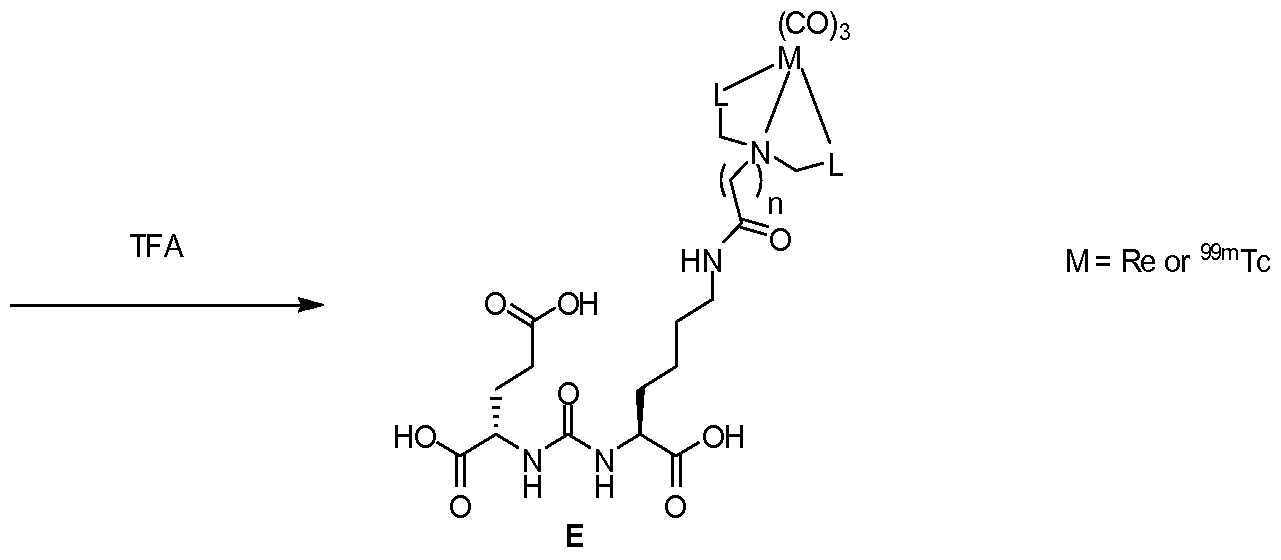
WWE Wipo information: entry into national phase

Ref document number: 200980153722.8

Country of ref document: CN

121 Ep: the epo has been informed by wipo that ep was designated in this application

Ref document number: 09775429

Country of ref document: EP

Kind code of ref document: A2

WWE Wipo information: entry into national phase

Ref document number: 2745955

Country of ref document: CA

Ref document number: 2011539755

Country of ref document: JP

NENP Non-entry into the national phase

Ref country code: DE

WWE Wipo information: entry into national phase

Ref document number: 2009322167

Country of ref document: AU

REEP Request for entry into the european phase
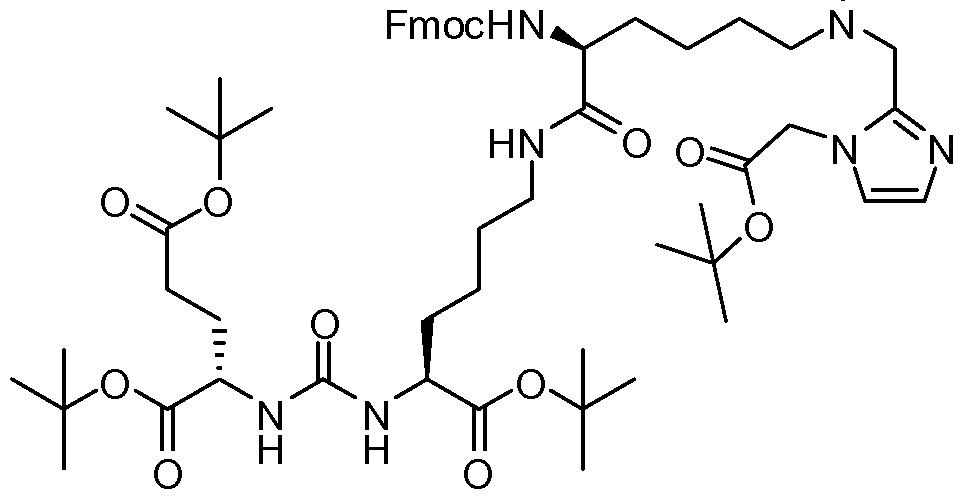
Ref document number: 2009775429

Country of ref document: EP

WWE Wipo information: entry into national phase

Ref document number: 2011127468

Country of ref document: RU

Ref document number: 2009775429

Country of ref document: EP

ENP Entry into the national phase

Ref document number: 2009322167

Country of ref document: AU

Date of ref document: 20091204

Kind code of ref document: A

ENP Entry into the national phase

Ref document number: PI0922779

Country of ref document: BR

Kind code of ref document: A2

Effective date: 20110603