WO2010070665A2 - A process for nanoemulsification of curcumin and derivatives of curcumin - Google Patents
A process for nanoemulsification of curcumin and derivatives of curcumin Download PDFInfo
- Publication number
- WO2010070665A2 WO2010070665A2 PCT/IN2009/000651 IN2009000651W WO2010070665A2 WO 2010070665 A2 WO2010070665 A2 WO 2010070665A2 IN 2009000651 W IN2009000651 W IN 2009000651W WO 2010070665 A2 WO2010070665 A2 WO 2010070665A2
- Authority
- WO
- WIPO (PCT)
- Prior art keywords
- curcuminoids
- curcumin
- curcuminoid
- cosolvent
- ratio
- Prior art date
- Legal status (The legal status is an assumption and is not a legal conclusion. Google has not performed a legal analysis and makes no representation as to the accuracy of the status listed.)
- Ceased
Links
Classifications
-
- A—HUMAN NECESSITIES
- A61—MEDICAL OR VETERINARY SCIENCE; HYGIENE
- A61K—PREPARATIONS FOR MEDICAL, DENTAL OR TOILETRY PURPOSES
- A61K36/00—Medicinal preparations of undetermined constitution containing material from algae, lichens, fungi or plants, or derivatives thereof, e.g. traditional herbal medicines
- A61K36/18—Magnoliophyta (angiosperms)
- A61K36/88—Liliopsida (monocotyledons)
- A61K36/906—Zingiberaceae (Ginger family)
- A61K36/9066—Curcuma, e.g. common turmeric, East Indian arrowroot or mango ginger
-
- A—HUMAN NECESSITIES
- A61—MEDICAL OR VETERINARY SCIENCE; HYGIENE
- A61K—PREPARATIONS FOR MEDICAL, DENTAL OR TOILETRY PURPOSES
- A61K9/00—Medicinal preparations characterised by special physical form
- A61K9/14—Particulate form, e.g. powders, Processes for size reducing of pure drugs or the resulting products, Pure drug nanoparticles
-
- A—HUMAN NECESSITIES
- A61—MEDICAL OR VETERINARY SCIENCE; HYGIENE
- A61P—SPECIFIC THERAPEUTIC ACTIVITY OF CHEMICAL COMPOUNDS OR MEDICINAL PREPARATIONS
- A61P27/00—Drugs for disorders of the senses
- A61P27/02—Ophthalmic agents
-
- A—HUMAN NECESSITIES
- A61—MEDICAL OR VETERINARY SCIENCE; HYGIENE
- A61P—SPECIFIC THERAPEUTIC ACTIVITY OF CHEMICAL COMPOUNDS OR MEDICINAL PREPARATIONS
- A61P29/00—Non-central analgesic, antipyretic or antiinflammatory agents, e.g. antirheumatic agents; Non-steroidal antiinflammatory drugs [NSAID]
-
- A—HUMAN NECESSITIES
- A23—FOODS OR FOODSTUFFS; TREATMENT THEREOF, NOT COVERED BY OTHER CLASSES
- A23V—INDEXING SCHEME RELATING TO FOODS, FOODSTUFFS OR NON-ALCOHOLIC BEVERAGES AND LACTIC OR PROPIONIC ACID BACTERIA USED IN FOODSTUFFS OR FOOD PREPARATION
- A23V2250/00—Food ingredients
- A23V2250/20—Natural extracts
- A23V2250/21—Plant extracts
- A23V2250/2112—Curcumin, turmeric
-
- A—HUMAN NECESSITIES
- A61—MEDICAL OR VETERINARY SCIENCE; HYGIENE
- A61K—PREPARATIONS FOR MEDICAL, DENTAL OR TOILETRY PURPOSES
- A61K9/00—Medicinal preparations characterised by special physical form
- A61K9/14—Particulate form, e.g. powders, Processes for size reducing of pure drugs or the resulting products, Pure drug nanoparticles
- A61K9/141—Intimate drug-carrier mixtures characterised by the carrier, e.g. ordered mixtures, adsorbates, solid solutions, eutectica, co-dried, co-solubilised, co-kneaded, co-milled, co-ground products, co-precipitates, co-evaporates, co-extrudates, co-melts; Drug nanoparticles with adsorbed surface modifiers
- A61K9/145—Intimate drug-carrier mixtures characterised by the carrier, e.g. ordered mixtures, adsorbates, solid solutions, eutectica, co-dried, co-solubilised, co-kneaded, co-milled, co-ground products, co-precipitates, co-evaporates, co-extrudates, co-melts; Drug nanoparticles with adsorbed surface modifiers with organic compounds
-
- A—HUMAN NECESSITIES
- A61—MEDICAL OR VETERINARY SCIENCE; HYGIENE
- A61K—PREPARATIONS FOR MEDICAL, DENTAL OR TOILETRY PURPOSES
- A61K9/00—Medicinal preparations characterised by special physical form
- A61K9/48—Preparations in capsules, e.g. of gelatin, of chocolate
- A61K9/50—Microcapsules having a gas, liquid or semi-solid filling; Solid microparticles or pellets surrounded by a distinct coating layer, e.g. coated microspheres, coated drug crystals
- A61K9/51—Nanocapsules; Nanoparticles
-
- A—HUMAN NECESSITIES
- A61—MEDICAL OR VETERINARY SCIENCE; HYGIENE
- A61K—PREPARATIONS FOR MEDICAL, DENTAL OR TOILETRY PURPOSES
- A61K9/00—Medicinal preparations characterised by special physical form
- A61K9/48—Preparations in capsules, e.g. of gelatin, of chocolate
- A61K9/50—Microcapsules having a gas, liquid or semi-solid filling; Solid microparticles or pellets surrounded by a distinct coating layer, e.g. coated microspheres, coated drug crystals
- A61K9/51—Nanocapsules; Nanoparticles
- A61K9/5107—Excipients; Inactive ingredients
- A61K9/5123—Organic compounds, e.g. fats, sugars
-
- Y—GENERAL TAGGING OF NEW TECHNOLOGICAL DEVELOPMENTS; GENERAL TAGGING OF CROSS-SECTIONAL TECHNOLOGIES SPANNING OVER SEVERAL SECTIONS OF THE IPC; TECHNICAL SUBJECTS COVERED BY FORMER USPC CROSS-REFERENCE ART COLLECTIONS [XRACs] AND DIGESTS
- Y10—TECHNICAL SUBJECTS COVERED BY FORMER USPC
- Y10S—TECHNICAL SUBJECTS COVERED BY FORMER USPC CROSS-REFERENCE ART COLLECTIONS [XRACs] AND DIGESTS
- Y10S977/00—Nanotechnology
- Y10S977/70—Nanostructure
- Y10S977/773—Nanoparticle, i.e. structure having three dimensions of 100 nm or less
-
- Y—GENERAL TAGGING OF NEW TECHNOLOGICAL DEVELOPMENTS; GENERAL TAGGING OF CROSS-SECTIONAL TECHNOLOGIES SPANNING OVER SEVERAL SECTIONS OF THE IPC; TECHNICAL SUBJECTS COVERED BY FORMER USPC CROSS-REFERENCE ART COLLECTIONS [XRACs] AND DIGESTS
- Y10—TECHNICAL SUBJECTS COVERED BY FORMER USPC
- Y10S—TECHNICAL SUBJECTS COVERED BY FORMER USPC CROSS-REFERENCE ART COLLECTIONS [XRACs] AND DIGESTS
- Y10S977/00—Nanotechnology
- Y10S977/902—Specified use of nanostructure
- Y10S977/904—Specified use of nanostructure for medical, immunological, body treatment, or diagnosis
- Y10S977/915—Therapeutic or pharmaceutical composition
Definitions
- the present invention relates to a novel process for nanoemulsification of the highly lipophillic polyphenols compounds such as curcuminoids using non-ionic surfactants and a non-ionic cosolvent at a particular concentration together with the help of sonar energy, to enhance the aqueous solubility.
- Curcuminoids are curcumins and derivatives of curcumins with different chemical groups. These compounds are polyphenols and produce yellow color. The characteristics of many curcuminoid compounds are unsuitable for drug design since they have poor solubility in water at acidic and physiological pH, and also hydrolyze rapidly in alkaline solutions. Therefore, curcumin derivatives are synthesized to increase their solubility and hence bioavailability (Studies on curcumin and curcuminoids XXXI. Symmetric and asymmetric curcuminoids: Stability, activity and complexation with cyclodextrin. Author (s): Tomren MA (Tomren, M.
- Natural curcuminoids are those extracted from the Curcuma longa plant and they are majorly comprised of 3 constituents a) Curcumin b) demethoxycurcumin c) bisdemethoxycurcumin. Several studies have shown that their pharmacological effects are comparable to those of corticosteroids and non-steroidal anti inflammatory drugs.
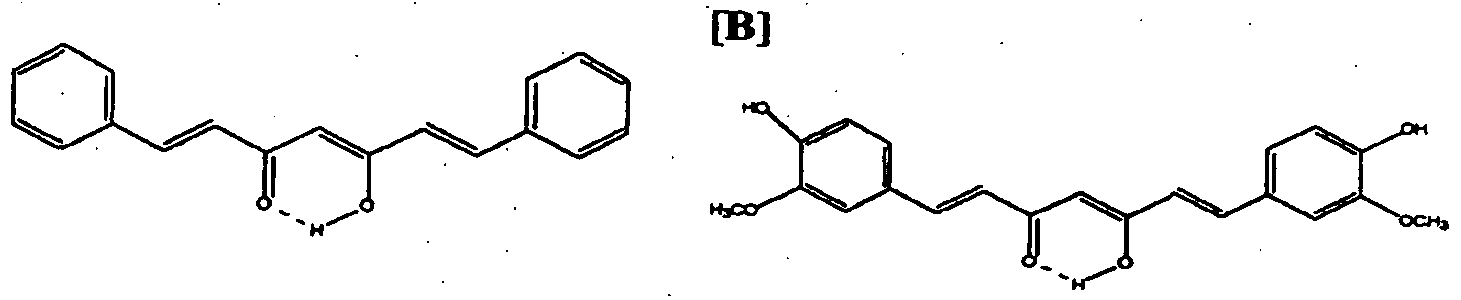
- FIG. IB Curcumin isolated in 1815 and structurally defined in 1910.
- Other curcuminoids isolated from Curcuma longa include demethoxycurcumin (FIG. 1 C), bisdemethoxycurcumin (FIG. 1 D), a cis-trans geometrical isomer of curcumin (FIG. 1 E), and cyclocurcumin (FIG. 1 F)
- Curcuminoid formulations having enhanced bioavailability are provided and comprise a curcuminoid, antioxidant, glucuronidation inhibitor, and water-soluble, pharmaceutically acceptable inhibitor.
- a method of treating Alzheimer's and other age-related diseases by administering such a composition is also provided and also a method to solubilize curcuminoids through nanoemulsions.
- PCT/KR2004/000529 describes a method for solubilization of curcumin and dispersion into water.
- the method prepares a water-soluble curcumin by covalent-bonding of sugar with the curcumin, thereby making the curcumin, which was insoluble in water, into a water-soluble curcumin.
- curcumin and curcuminoids XXXI. Symmetric and asymmetric curcuminoids: Stability, activity and complexation with cyclodextrin.
- non-ionic surfactants have been discussed for solubilization purpose in the above mentioned literatures, they appear to be in a different context.
- the surfactants used have been done so in order to make emulsions and the likes and not for directly solubilizing curcuminoids.
- the current invention aims to enhance the aqueous solubility of the highly lipophillic polyphenols compounds such as curcuminoids using non-ionic surfactants and a non-ionic cosolvent at a specific concentration together with the help of sonar energy.
- the main objective of the current invention is to solubilize highly lipophilic polyphenols compounds like curcuminoids (natural and synthetically derived) in an ampiphillic medium thereby rendering enhanced water solubility.
- Figure-1 The dose response curve indicating a concentration dependent increase in the transport of nanoemulsified LIO 1008 across A549 cell monolayers
- Figure-2 Graph showing serum LIO 1008 (BDMC) concentration (ug/ml) over 12 hrs after administration
- Figure-3 The graph indicating the size of nano-emulsified curcumin 98%.
- Figure-4 The graph indicating the size of unformulated curcumin 98%.
- Figure-5 The graph indicating the size of nano-emulsified BDMC.
- the current invention discloses a novel process for nanoemulsification of the highly lipophillic polyphenols compounds such as curcuminoids using non-ionic surfactants and a non-ionic cosolvent at a specific concentration together with the help of sonar energy, to enhance the aqueous solubility.
- 'surfactant means surface active agent which works by lowering the surface tension of water and enabling solubility of lipophilic compounds.
- 'co-solvent' in the present context means a solvent which synergistically enhances the solubility of the lipophillic compound of the present invention.
- a process is provided to solubilize the lipophillic compounds such as curcuminoids using non-ionic surfactant and non-ionic cosolvent with the help of sonar energy.
- the surfactants are amphiphilic, meaning they contain a hydrophobic tail and a hydrophilic head. Therefore, they are soluble in both hydrophobic mediums and water. They are of 2 types a) ionic b) nonionic.
- the current invention involves the use of nonionic surfactants of pharmaceutical purpose.
- the surfactants used can be selected from polysorbate 80 and 20, poloxamers, octoxynol and any pharmaceutically acceptable nonionic surfactant.
- cosolvent in the solubilization process which enables enhanced solubility due to synergism.
- the cosolvent used in this regard is polyethylene glycol (PEG-400).
- PEG 6000 can also be used.
- the mixture upon adding the surfactant and cosolvent to the curcuminoids, the mixture needs to be stirred well and then subjected to sonication or use of sound energy of 25Khz for 15-30min depending on the sample size to solubilize the curcuminoid.
- the curcuminoids upto 2.5% can be solubilized using the method of the present invention. Sonication enables solubilization of the curcuminoid by breaking intermolecular interactions and non-covalent bonds thereby aiding enhanced water solubility.
- the interesting feature of curcuminoids is the conjugated diene system in its structure that imparts its therapeutic properties. The sonar energy is not powerful enough to break these covalent bonds and hence the therapeutic property of curcuminoids is left without damage.
- the synergistic activity to solubilize curcuminoids could be because of the interaction of the curcuminoids with the hydrophobic pocket of the nonionic surfactants that is present as a long chain hydrophobic tail which enables further complexation with the cosolvent that confers a mild charge to the whole complex aided by the sound energy provided through sonication. This mild charge aids in enhanced solubility in aqueous systems.
- the process for solubilizing curcuminoids comprising the following steps:
- compositions prepared by using the solubilized curcuminoids as per the above process has shown marked increase in the transport of curcumin and improved bioavailability.
- the formulation is made using a unique nanoemulsification process which helps the compound to become more hydrophilic without any structural change to the compound thereby aiding in better transport and absorption, which is confirmed by both in vitro and in vivo studies.
- the advantage of the present invention is that the curcuminoids used for solubilization can be taken upto 2.5% which is on the higher side for any pharmaceutical formulation.
- the ratio of curcuminoid and nonionic surfactant is in the range of 1:10.
- the ratio of curcuminoid and nonionic cosolvent is in the range of 1: 10.
- Nonionic surfactants and nonionic co-solvents are present in the amount of 1% each in the solution.
- the current invention has three aspects which makes it indispensable in an industrial set up which are 1) economical 2) uncomplicated procedures 3) Lowered time consumption.
- Procedure for preparation of ophthalmic formulation Preparation of Solution A: 1. Weighing accurately 20gm of Hydroxypropyl methylcellulose and adding the same to a vessel containing 2L water (10 % of batch size) which is heated to about 90 0 C and kept over night.
- the map of scattering intensity versus angle is the primary source of information used to calculate the particle size.
- the scattering of particles is accurately predicted by the Mie scattering model allowing accurate sizing across the widest possible dynamic range.
- particles are passed through a focused laser beam. These particles scatter light at an angle that is inversely proportional to their size. The angular intensity of the scattered light is then measured by a series of photosensitive detectors.
- the advantage of this study is that there is no sample preparation involved.
- Bioavailability of the above formulation was studied on A549 cell line of human lung carcinoma fibroblast cell line. These are adherent cells with quick growth capabilities. The cells were cultured in DMEM media until they reached -90% confluency after which they were split into 12-well plates. When the culture plates become -90-100% confluent, they were used for the experiment. Normally, a seeding density of 10 5 cells per well can give rise to -90% confluent cultures in 3 days time.
- a dose response using varying concentrations of the formulation of the present invention was conducted to study the effect of one of the pharmacokinetic parameter on the transport of Bis-o-demethylcurcumin into the A549 cells.
- the dose response curve indicated by the graph (fig.l) representing the study undertaken indicates that there is definitely a concentration dependent increase in the transport of nanoemulsified Bis-o- demethylcurcumin across A549 cell monolayers and hence, it can be inferred that concentration is definitely a key parameter in the transport of nanoemulsified Bis-o- demethylcurcumin.
- the transport of the formulation prepared according to the process disclosed hereinabove was further studied in vivo through the ocular tissue of rabbits into the vitreous fluid. The vitreous fluid so collected and analyzed using HPLC. The compound was transported in detectable amounts and estimated at different time intervals.
- curcumin 98% ophthalmic formulation was instilled topically to the eyes of group HI animals only. Two hours later Sodium Selenite (25 ⁇ M/kg.bw of 5ml/ kg.bw) was injected subcutaneously to both group II and III animals, thereafter 5 ⁇ l of LP002-09 was instilled topically to the eyes of group III animals only.
- the curcumin 98% ophthalmic formulation was instilled daily thrice at an interval of 4 hours for a period of one week, whereas the group I and II animals were left undisturbed through out the dosing period. During instillation of the curcumin 98% the eyelids of the rat pups were opened gently and carefully and held approximately one minute to prevent overflowing of curcumin 98% ophthalmic formulation.
- the cataract was scored on a scale of 0 to 4 according to procedure described by Muranov et al., (2004).
- Grade 0 was a normal clear lens
- Grade 1 was a subcapsular opacity
- Grade 2 was nuclear cataract
- Grade 3 was strong nuclear cataract
- Grade 4 was dense opacity involving entire lens and the results have been presented in below table 1
- Table 1 Table 1
Landscapes
- Health & Medical Sciences (AREA)
- Natural Medicines & Medicinal Plants (AREA)
- Life Sciences & Earth Sciences (AREA)
- General Health & Medical Sciences (AREA)
- Medicinal Chemistry (AREA)
- Pharmacology & Pharmacy (AREA)
- Chemical & Material Sciences (AREA)
- Animal Behavior & Ethology (AREA)
- Public Health (AREA)
- Veterinary Medicine (AREA)
- Engineering & Computer Science (AREA)
- Epidemiology (AREA)
- Bioinformatics & Cheminformatics (AREA)
- Chemical Kinetics & Catalysis (AREA)
- Medical Informatics (AREA)
- General Chemical & Material Sciences (AREA)
- Nuclear Medicine, Radiotherapy & Molecular Imaging (AREA)
- Organic Chemistry (AREA)
- Mycology (AREA)
- Microbiology (AREA)
- Alternative & Traditional Medicine (AREA)
- Biotechnology (AREA)
- Botany (AREA)
- Ophthalmology & Optometry (AREA)
- Pain & Pain Management (AREA)
- Rheumatology (AREA)
- Acyclic And Carbocyclic Compounds In Medicinal Compositions (AREA)
- Medicinal Preparation (AREA)
- Organic Low-Molecular-Weight Compounds And Preparation Thereof (AREA)
- Pharmaceuticals Containing Other Organic And Inorganic Compounds (AREA)
Abstract
Description


Claims
Priority Applications (7)
| Application Number | Priority Date | Filing Date | Title |
|---|---|---|---|
| US13/129,424 US8632815B2 (en) | 2008-11-17 | 2009-11-17 | Process for nanoemulsification of curcumin and derivatives of curcumin |
| EA201170688A EA019446B1 (en) | 2008-11-17 | 2009-11-17 | A process for nanoemulsification of curcumin and derivatives of curcumin |
| CN2009801423458A CN102202652A (en) | 2008-11-17 | 2009-11-17 | A process for nanoemulsification of curcumin and derivatives of curcumin |
| EP09833075A EP2346492A4 (en) | 2008-11-17 | 2009-11-17 | A process for nanoemulsification of curcumin and derivatives of curcumin |
| JP2011543881A JP5528472B2 (en) | 2008-11-17 | 2009-11-17 | Nanoemulsification of curcumin and curcumin derivatives |
| CA2743965A CA2743965A1 (en) | 2008-11-17 | 2009-11-17 | A process for nanoemulsification of curcumin and derivatives of curcumin |
| AU2009329025A AU2009329025A1 (en) | 2008-11-17 | 2009-11-17 | A process for nanoemulsification of curcumin and derivatives of curcumin |
Applications Claiming Priority (2)
| Application Number | Priority Date | Filing Date | Title |
|---|---|---|---|
| IN2828/CHE/2008 | 2008-11-17 | ||
| IN2828CH2008 | 2008-11-17 |
Publications (2)
| Publication Number | Publication Date |
|---|---|
| WO2010070665A2 true WO2010070665A2 (en) | 2010-06-24 |
| WO2010070665A3 WO2010070665A3 (en) | 2010-10-28 |
Family
ID=42269179
Family Applications (1)
| Application Number | Title | Priority Date | Filing Date |
|---|---|---|---|
| PCT/IN2009/000651 Ceased WO2010070665A2 (en) | 2008-11-17 | 2009-11-17 | A process for nanoemulsification of curcumin and derivatives of curcumin |
Country Status (8)
| Country | Link |
|---|---|
| US (1) | US8632815B2 (en) |
| EP (1) | EP2346492A4 (en) |
| JP (1) | JP5528472B2 (en) |
| CN (1) | CN102202652A (en) |
| AU (1) | AU2009329025A1 (en) |
| CA (1) | CA2743965A1 (en) |
| EA (1) | EA019446B1 (en) |
| WO (1) | WO2010070665A2 (en) |
Cited By (5)
| Publication number | Priority date | Publication date | Assignee | Title |
|---|---|---|---|---|
| US20110229532A1 (en) * | 2008-11-17 | 2011-09-22 | Laila Pharmaceuticals Pvt. Ltd | Process for nanoemulsification of curcumin and derivatives of curcumin |
| US20120052095A1 (en) * | 2008-12-01 | 2012-03-01 | Laila Pharmaceuticals Pvt. Ltd. | Topical formulation(s) for the treatment of inflammation, skin and mucosal disorders and other diseases thereof |
| JP2013541557A (en) * | 2010-10-22 | 2013-11-14 | エイピーアイ・ジェネシス,エルエルシー | Methods of increasing the solubility of poorly soluble compounds and methods of making and using such compounds |
| WO2013175507A1 (en) | 2012-05-22 | 2013-11-28 | Laila Pharmaceuticals Pvt. Ltd. | Novel highly bioavailable, water soluble and sustained release nanoformulations of hydrophobic plant derived compounds and extracts |
| EP2934185B1 (en) | 2012-12-19 | 2016-10-12 | Aquanova AG | Curcumin solubilisate |
Families Citing this family (5)
| Publication number | Priority date | Publication date | Assignee | Title |
|---|---|---|---|---|
| CN104224716B (en) * | 2014-10-14 | 2016-08-31 | 哈尔滨工业大学 | Utilize the method that nanometer emulsified technology produces nanoparticle |
| US10085951B2 (en) | 2014-12-11 | 2018-10-02 | Designs For Health, Inc. | Curcuminoid formulations and related methods of treatment |
| CN105315143B (en) * | 2015-10-16 | 2017-06-16 | 苏州大学 | A kind of method for improving curcumin water solubility and solution photostability |
| IN201811044487A (en) * | 2018-11-26 | 2020-08-14 | Registrar, Panjab University Chandigarh | |
| CA3038346C (en) | 2019-01-31 | 2022-03-29 | Nam Hai LAI | Process for producing a nano-cbd microemulsion system |
Citations (1)
| Publication number | Priority date | Publication date | Assignee | Title |
|---|---|---|---|---|
| KR20040000529A (en) | 2002-06-21 | 2004-01-07 | 박계정 | Balance machine |
Family Cites Families (9)
| Publication number | Priority date | Publication date | Assignee | Title |
|---|---|---|---|---|
| US4263333A (en) * | 1979-09-12 | 1981-04-21 | General Foods Corporation | Curcumin-metal color complexes |
| US20030236236A1 (en) * | 1999-06-30 | 2003-12-25 | Feng-Jing Chen | Pharmaceutical compositions and dosage forms for administration of hydrophobic drugs |
| US7968115B2 (en) * | 2004-03-05 | 2011-06-28 | Board Of Regents, The University Of Texas System | Liposomal curcumin for treatment of cancer |
| US8568802B2 (en) * | 2005-10-13 | 2013-10-29 | Laila Impex | Process for producing enriched fractions of tetrahydroxycurcumin and tetrahydrotetrahydroxy-curcumin from the extracts of Curcuma longa |
| MX2009010907A (en) * | 2007-04-13 | 2010-03-17 | Univ North Texas | FORMULATION OF THE ACTIVE AGENT LOADED IN PLANT NANOPARTICLES ACTIVATED FOR NANO-THERAPEUTICS ADDRESSED FOR CANCER. |
| JP2011505235A (en) * | 2007-11-28 | 2011-02-24 | コモンウェルス サイエンティフィック アンド インダストリアル リサーチ オーガニゼイション | Nanoemulsion |
| WO2010010431A1 (en) * | 2008-07-24 | 2010-01-28 | National Institute Of Pharmaceutical Education And Research | Self-nano-emulsifying curcuminoids composition with enhanced bioavailability |
| JP5528472B2 (en) * | 2008-11-17 | 2014-06-25 | ライラ ファーマシューティカルズ ピーブイティ.エルティディ. | Nanoemulsification of curcumin and curcumin derivatives |
| US20110212142A1 (en) * | 2008-11-17 | 2011-09-01 | Laila Pharmaceuticals Pvt.Ltd. | Curcuminoids and its metabolites for the application in ocular diseases |
-
2009
- 2009-11-17 JP JP2011543881A patent/JP5528472B2/en not_active Expired - Fee Related
- 2009-11-17 AU AU2009329025A patent/AU2009329025A1/en not_active Abandoned
- 2009-11-17 CN CN2009801423458A patent/CN102202652A/en active Pending
- 2009-11-17 EP EP09833075A patent/EP2346492A4/en not_active Withdrawn
- 2009-11-17 WO PCT/IN2009/000651 patent/WO2010070665A2/en not_active Ceased
- 2009-11-17 US US13/129,424 patent/US8632815B2/en not_active Expired - Fee Related
- 2009-11-17 CA CA2743965A patent/CA2743965A1/en not_active Abandoned
- 2009-11-17 EA EA201170688A patent/EA019446B1/en not_active IP Right Cessation
Patent Citations (1)
| Publication number | Priority date | Publication date | Assignee | Title |
|---|---|---|---|---|
| KR20040000529A (en) | 2002-06-21 | 2004-01-07 | 박계정 | Balance machine |
Non-Patent Citations (7)
| Title |
|---|
| IMPROVING THE SOLUBILITY AND PHARMACOLOGICAL EFFICACY OF CURCUMIN BY HEAT TREATMENT- ASSAY AND DRUG DEVELOPMENT TECHNOLOGIES, vol. 5, no. 4, 1 August 2007 (2007-08-01), pages 567 - 576 |
| JAYAPRAKASHA GK; RAO LJ; SAKARIAH KK: "Antioxidant activities of curcumin, demethoxycurcumin and bisdemethoxycurcumin", FOOD CHEMISTRY, vol. 98, no. 4, 2006, pages 720 - 724 |
| POLYMERIC NANOPARTICLE-ENCAPSULATED CURCUMIN (''NANOCURCUMIN'): A NOVEL STRATEGY FOR HUMAN CANCER THERAPY JOURNAL OF NANOBIOTECHNOLOGY, vol. 5, 17 April 2007 (2007-04-17), pages 3 |
| See also references of EP2346492A4 |
| TIYABOONCHAI W; TUNPRADIT W; PLIANBANGCHANG P: "Formulation and characterization of curcuminoids loaded solid lipid nanoparticles", INTERNATIONAL JOURNAL OF PHARMACEUTICS, vol. 337, no. 1-2, 7 June 2007 (2007-06-07), pages 299 - 306 |
| TOMREN MA; MASSON M; LOFTSSON T; TONNESEN HH: "Studies on curcumin and curcuminoids XXXI Symmetric and asymmetric curcuminoids: Stability, activity and complexation with cyclodextrin", INTERNATIONAL JOURNAL OF PHARMACEUTICS, vol. 338, no. 1-2, 29 June 2007 (2007-06-29), pages 27 - 34 |
| TOMREN MA; MASSON M; LOFTSSON T; TONNESEN HH: "Symmetric and asymmetric curcuminoids: Stability, activity and complexation with cyclodextrin", INTERNATIONAL JOURNAL OF PHARMACEUTICS, vol. 338, no. 1-2, 29 June 2007 (2007-06-29), pages 27 - 34 |
Cited By (11)
| Publication number | Priority date | Publication date | Assignee | Title |
|---|---|---|---|---|
| US20110229532A1 (en) * | 2008-11-17 | 2011-09-22 | Laila Pharmaceuticals Pvt. Ltd | Process for nanoemulsification of curcumin and derivatives of curcumin |
| US8632815B2 (en) * | 2008-11-17 | 2014-01-21 | Laila Pharmaceutical Pvt., Ltd. | Process for nanoemulsification of curcumin and derivatives of curcumin |
| US20120052095A1 (en) * | 2008-12-01 | 2012-03-01 | Laila Pharmaceuticals Pvt. Ltd. | Topical formulation(s) for the treatment of inflammation, skin and mucosal disorders and other diseases thereof |
| US8535693B2 (en) * | 2008-12-01 | 2013-09-17 | Laila Pharmaceuticals Private Limited | Topical formulation(s) for the treatment of inflammation, skin and mucosal disorders and other diseases thereof |
| JP2013541557A (en) * | 2010-10-22 | 2013-11-14 | エイピーアイ・ジェネシス,エルエルシー | Methods of increasing the solubility of poorly soluble compounds and methods of making and using such compounds |
| WO2013175507A1 (en) | 2012-05-22 | 2013-11-28 | Laila Pharmaceuticals Pvt. Ltd. | Novel highly bioavailable, water soluble and sustained release nanoformulations of hydrophobic plant derived compounds and extracts |
| US20150072012A1 (en) * | 2012-05-22 | 2015-03-12 | LAlLA PHARMACEUTICALS PVT, LTD, | Novel highly bioavailable, water soluble and sustained release nanoformulations hydrophobic plant derived compounds and extracts |
| EP2852379A4 (en) * | 2012-05-22 | 2015-11-04 | Laila Pharmaceuticals Pvt Ltd | NEW NANOFORMULATIONS OF COMPOUNDS AND EXTRACTS DERIVED FROM HYDROPHOBIC, HIGHLY BIOAVAILABLE, WATER SOLUBLE AND EXTENDED RELEASE PLANTS |
| US10022416B2 (en) * | 2012-05-22 | 2018-07-17 | Laila Pharmaceuticals Pvt. Ltd. | Highly bioavailable, water soluble and sustained release nanoformulations hydrophobic plant derived compounds and extracts |
| EP2934185B1 (en) | 2012-12-19 | 2016-10-12 | Aquanova AG | Curcumin solubilisate |
| US11311483B2 (en) | 2012-12-19 | 2022-04-26 | Aquanova Ag | Curcumin solubilisate |
Also Published As
| Publication number | Publication date |
|---|---|
| JP2012508794A (en) | 2012-04-12 |
| AU2009329025A1 (en) | 2010-06-24 |
| CN102202652A (en) | 2011-09-28 |
| EA019446B1 (en) | 2014-03-31 |
| EP2346492A4 (en) | 2012-12-05 |
| JP5528472B2 (en) | 2014-06-25 |
| EP2346492A2 (en) | 2011-07-27 |
| CA2743965A1 (en) | 2010-06-24 |
| AU2009329025A2 (en) | 2011-06-02 |
| WO2010070665A3 (en) | 2010-10-28 |
| US20110229532A1 (en) | 2011-09-22 |
| US8632815B2 (en) | 2014-01-21 |
| EA201170688A1 (en) | 2011-12-30 |
Similar Documents
| Publication | Publication Date | Title |
|---|---|---|
| US8632815B2 (en) | Process for nanoemulsification of curcumin and derivatives of curcumin | |
| JP5775462B2 (en) | Curcuminoids and their metabolites for application to eye diseases | |
| US8759403B2 (en) | Curcuminoids and its metabolites for the application in allergic ocular/nasal conditions | |
| Nirbhavane et al. | Triamcinolone acetonide loaded-cationic nano-lipoidal formulation for uveitis: Evidences of improved biopharmaceutical performance and anti-inflammatory activity | |
| Zhang et al. | Preparation and evaluation of naringenin-loaded sulfobutylether-β-cyclodextrin/chitosan nanoparticles for ocular drug delivery | |
| Tahara et al. | Oral nuclear factor-κB decoy oligonucleotides delivery system with chitosan modified poly (D, L-lactide-co-glycolide) nanospheres for inflammatory bowel disease | |
| Khurana et al. | Yttrium oxide nanoparticles reduce the severity of acute pancreatitis caused by cerulein hyperstimulation | |
| Aboali et al. | Curcumin-loaded proniosomal gel as a biofreindly alternative for treatment of ocular inflammation: In-vitro and in-vivo assessment | |
| Salama et al. | Formulation and optimization of lornoxicam-loaded bilosomes using 23 full factorial design for the management of osteoarthritis in rats: Modulation of MAPK/Erk1 signaling pathway | |
| Wu et al. | Milk-derived exosome as delivery system for lutein encapsulation in alleviating dry eye disease | |
| Tawfik et al. | Oleic acid enriched leciplexes as novel mucoadhesive cationic nanocarriers of agomelatine for glaucoma treatment | |
| Song et al. | Novel luteolin@ pro-phytomicelles: In vitro characterization and in vivo evaluation of protection against drug-induced hepatotoxicity | |
| Alaaeldin et al. | Co-administration of thymoquinone and propolis in liposomal formulations as a potential approach for treatment of acetic acid-induced ulcerative colitis: physiological and histopathological analysis | |
| Mishra et al. | Screening of process variables using Box–Behnken design in the fabrication of berberine hydrochloride-loaded transethosomes for enhanced transdermal delivery | |
| Yu et al. | Heating-driven self-assembled glycyrrhizin nanomicelles loading bisdemethoxycurcumin: preparation, characterization, and efficacy evaluation on experimental dry eye | |
| CN109549924B (en) | SKLB023 mixed micelle and preparation method and application thereof | |
| CN117695256A (en) | Preparation method of functional lutein complex and its application in alleviating dry eye syndrome | |
| US12409146B2 (en) | Solid lipid nanoparticle for intracellular release of active substances and method for production the same | |
| Lin et al. | Macrophage membrane-camouflaged proanthocyanidin nano-modulators inhibit histone lactylation and target therapy for testicular ischemia-reperfusion injury | |
| Negi et al. | Nose-to-brain delivery of berberine-loaded nanoemulsion: Amelioration of brain targeting, behavioral, pharmacokinetic, and biodistribution insights for Alzheimer's intervention | |
| CN116672312A (en) | Tacrolimus-entrapped nano preparation and application thereof | |
| AU2011232745A1 (en) | Curcuminoids and its metabolites for the application in allergic nasal conditions | |
| BR112020011895B1 (en) | SOLID LIPID NANOPARTICLE FOR INTRACELLULAR RELEASE OF ACTIVE SUBSTANCES AND METHOD FOR PRODUCTION OF SAME | |
| BR112017006918B1 (en) | Nanostructured formulations for the release of silibinin and other active ingredients for the treatment of eye diseases. |
Legal Events
| Date | Code | Title | Description |
|---|---|---|---|
| WWE | Wipo information: entry into national phase |
Ref document number: 200980142345.8 Country of ref document: CN |
|
| 121 | Ep: the epo has been informed by wipo that ep was designated in this application |
Ref document number: 09833075 Country of ref document: EP Kind code of ref document: A2 |
|
| WWE | Wipo information: entry into national phase |
Ref document number: 2009833075 Country of ref document: EP |
|
| WWE | Wipo information: entry into national phase |
Ref document number: 2009329025 Country of ref document: AU |
|
| ENP | Entry into the national phase |
Ref document number: 2011543881 Country of ref document: JP Kind code of ref document: A |
|
| WWE | Wipo information: entry into national phase |
Ref document number: 13129424 Country of ref document: US Ref document number: 2743965 Country of ref document: CA |
|
| NENP | Non-entry into the national phase |
Ref country code: DE |
|
| ENP | Entry into the national phase |
Ref document number: 2009329025 Country of ref document: AU Date of ref document: 20091117 Kind code of ref document: A |
|
| WWE | Wipo information: entry into national phase |
Ref document number: 201170688 Country of ref document: EA |
|
| REG | Reference to national code |
Ref country code: BR Ref legal event code: B01E Ref document number: PI0915239 Country of ref document: BR Free format text: IDENTIFIQUE O SIGNATARIO DA PETICAO NO 018110017819 DE 12/05/2011, UMA VEZ QUE NAO E POSSIVEL IDENTIFICAR O NOME DO RESPONSAVEL PELA ASSINATURA DO FORMULARIO, NAO SENDO POSSIVEL DETERMINAR SE ESTE FAZ PARTE DOS PROCURADORES ELENCADOS NA PROCURACAO E SE TEM PODERES PARA ATUAR EM NOME DO DEPOSITANTE, E O ARTIGO 216 DA LEI 9.279/1996 DE 14/05/1996 (LPI) DETERMINA QUE ?OS ATOS PREVISTOS NESTA LEI SERAO PRATICADOS PELAS PARTES OU POR SEUS PROCURADORES, DEVIDAMENTE QUALIFICADOS?. |
|
| ENPW | Started to enter national phase and was withdrawn or failed for other reasons |
Ref document number: PI0915239 Country of ref document: BR Free format text: PEDIDO RETIRADO EM RELACAO AO BRASIL POR NAO ATENDER AS DETERMINACOES REFERENTES A ENTRADA DO PEDIDO NA FASE NACIONAL E POR NAO CUMPRIMENTO DA EXIGENCIA FORMULADA NA RPI NO 2506 |