WO2010073995A1 - 防汚塗料組成物、防汚塗膜および基材の防汚方法 - Google Patents
防汚塗料組成物、防汚塗膜および基材の防汚方法 Download PDFInfo
- Publication number
- WO2010073995A1 WO2010073995A1 PCT/JP2009/071146 JP2009071146W WO2010073995A1 WO 2010073995 A1 WO2010073995 A1 WO 2010073995A1 JP 2009071146 W JP2009071146 W JP 2009071146W WO 2010073995 A1 WO2010073995 A1 WO 2010073995A1
- Authority
- WO
- WIPO (PCT)
- Prior art keywords
- component
- antifouling
- paint composition
- polyester resin
- coating film
- Prior art date
- Legal status (The legal status is an assumption and is not a legal conclusion. Google has not performed a legal analysis and makes no representation as to the accuracy of the status listed.)
- Ceased
Links
Images

Classifications
-
- C—CHEMISTRY; METALLURGY
- C09—DYES; PAINTS; POLISHES; NATURAL RESINS; ADHESIVES; COMPOSITIONS NOT OTHERWISE PROVIDED FOR; APPLICATIONS OF MATERIALS NOT OTHERWISE PROVIDED FOR
- C09D—COATING COMPOSITIONS, e.g. PAINTS, VARNISHES OR LACQUERS; FILLING PASTES; CHEMICAL PAINT OR INK REMOVERS; INKS; CORRECTING FLUIDS; WOODSTAINS; PASTES OR SOLIDS FOR COLOURING OR PRINTING; USE OF MATERIALS THEREFOR
- C09D167/00—Coating compositions based on polyesters obtained by reactions forming a carboxylic ester link in the main chain; Coating compositions based on derivatives of such polymers
-
- C—CHEMISTRY; METALLURGY
- C08—ORGANIC MACROMOLECULAR COMPOUNDS; THEIR PREPARATION OR CHEMICAL WORKING-UP; COMPOSITIONS BASED THEREON
- C08K—Use of inorganic or non-macromolecular organic substances as compounding ingredients
- C08K3/00—Use of inorganic substances as compounding ingredients
- C08K3/18—Oxygen-containing compounds, e.g. metal carbonyls
- C08K3/20—Oxides; Hydroxides
- C08K3/22—Oxides; Hydroxides of metals
-
- C—CHEMISTRY; METALLURGY
- C09—DYES; PAINTS; POLISHES; NATURAL RESINS; ADHESIVES; COMPOSITIONS NOT OTHERWISE PROVIDED FOR; APPLICATIONS OF MATERIALS NOT OTHERWISE PROVIDED FOR
- C09D—COATING COMPOSITIONS, e.g. PAINTS, VARNISHES OR LACQUERS; FILLING PASTES; CHEMICAL PAINT OR INK REMOVERS; INKS; CORRECTING FLUIDS; WOODSTAINS; PASTES OR SOLIDS FOR COLOURING OR PRINTING; USE OF MATERIALS THEREFOR
- C09D193/00—Coating compositions based on natural resins; Coating compositions based on derivatives thereof
- C09D193/04—Rosin
-
- C—CHEMISTRY; METALLURGY
- C09—DYES; PAINTS; POLISHES; NATURAL RESINS; ADHESIVES; COMPOSITIONS NOT OTHERWISE PROVIDED FOR; APPLICATIONS OF MATERIALS NOT OTHERWISE PROVIDED FOR
- C09D—COATING COMPOSITIONS, e.g. PAINTS, VARNISHES OR LACQUERS; FILLING PASTES; CHEMICAL PAINT OR INK REMOVERS; INKS; CORRECTING FLUIDS; WOODSTAINS; PASTES OR SOLIDS FOR COLOURING OR PRINTING; USE OF MATERIALS THEREFOR
- C09D5/00—Coating compositions, e.g. paints, varnishes or lacquers, characterised by their physical nature or the effects produced; Filling pastes
- C09D5/16—Antifouling paints; Underwater paints
-
- C—CHEMISTRY; METALLURGY
- C09—DYES; PAINTS; POLISHES; NATURAL RESINS; ADHESIVES; COMPOSITIONS NOT OTHERWISE PROVIDED FOR; APPLICATIONS OF MATERIALS NOT OTHERWISE PROVIDED FOR
- C09D—COATING COMPOSITIONS, e.g. PAINTS, VARNISHES OR LACQUERS; FILLING PASTES; CHEMICAL PAINT OR INK REMOVERS; INKS; CORRECTING FLUIDS; WOODSTAINS; PASTES OR SOLIDS FOR COLOURING OR PRINTING; USE OF MATERIALS THEREFOR
- C09D5/00—Coating compositions, e.g. paints, varnishes or lacquers, characterised by their physical nature or the effects produced; Filling pastes
- C09D5/16—Antifouling paints; Underwater paints
- C09D5/1606—Antifouling paints; Underwater paints characterised by the anti-fouling agent
- C09D5/1612—Non-macromolecular compounds
- C09D5/1618—Non-macromolecular compounds inorganic
-
- C—CHEMISTRY; METALLURGY
- C09—DYES; PAINTS; POLISHES; NATURAL RESINS; ADHESIVES; COMPOSITIONS NOT OTHERWISE PROVIDED FOR; APPLICATIONS OF MATERIALS NOT OTHERWISE PROVIDED FOR
- C09D—COATING COMPOSITIONS, e.g. PAINTS, VARNISHES OR LACQUERS; FILLING PASTES; CHEMICAL PAINT OR INK REMOVERS; INKS; CORRECTING FLUIDS; WOODSTAINS; PASTES OR SOLIDS FOR COLOURING OR PRINTING; USE OF MATERIALS THEREFOR
- C09D5/00—Coating compositions, e.g. paints, varnishes or lacquers, characterised by their physical nature or the effects produced; Filling pastes
- C09D5/16—Antifouling paints; Underwater paints
- C09D5/1656—Antifouling paints; Underwater paints characterised by the film-forming substance
- C09D5/1662—Synthetic film-forming substance
-
- C—CHEMISTRY; METALLURGY
- C08—ORGANIC MACROMOLECULAR COMPOUNDS; THEIR PREPARATION OR CHEMICAL WORKING-UP; COMPOSITIONS BASED THEREON
- C08K—Use of inorganic or non-macromolecular organic substances as compounding ingredients
- C08K3/00—Use of inorganic substances as compounding ingredients
- C08K3/18—Oxygen-containing compounds, e.g. metal carbonyls
- C08K3/20—Oxides; Hydroxides
- C08K3/22—Oxides; Hydroxides of metals
- C08K2003/2248—Oxides; Hydroxides of metals of copper
-
- C—CHEMISTRY; METALLURGY
- C08—ORGANIC MACROMOLECULAR COMPOUNDS; THEIR PREPARATION OR CHEMICAL WORKING-UP; COMPOSITIONS BASED THEREON
- C08K—Use of inorganic or non-macromolecular organic substances as compounding ingredients
- C08K3/00—Use of inorganic substances as compounding ingredients
- C08K3/18—Oxygen-containing compounds, e.g. metal carbonyls
- C08K3/20—Oxides; Hydroxides
- C08K3/22—Oxides; Hydroxides of metals
- C08K2003/2296—Oxides; Hydroxides of metals of zinc
Definitions
- the present invention is a two-component type capable of imparting excellent antifouling properties to the surface of a substrate such as a ship, underwater structure, fishing net, fishing gear, etc., while reducing the impact on the environment and the human body.
- the present invention relates to a hydrolyzable antifouling paint composition, an antifouling coating film using the antifouling paint composition, and a method for antifouling a substrate.
- polyester resin is produced by esterification by dehydration condensation of acid and alcohol, so it is susceptible to hydrolysis, and not only has excellent antifouling performance, but also is easily incorporated into metabolic processes such as microorganisms by hydrolysis. It is done.
- Patent Document 1 discloses a hydrolyzable aliphatic polyester obtained by copolymerizing one or more of glycerin, ethylene glycol and 1,4-butanediol in a polyester composed of succinic acid and 1,2-propylene glycol.
- An antifouling paint used as a resin contains, in Patent Document 2, a hydrolyzable polyester resin obtained by reacting oxyacids such as lactic acid, polyvalent carboxylic acids not containing hydroxy groups, and polyhydric alcohols.
- the antifouling paint is disclosed in Patent Document 3 as a hydrolyzable polyester resin for an antifouling paint mainly composed of an aliphatic polyester containing a metal salt of hydroxycarboxylic acid.
- Patent Document 4 discloses glycolic acid, Appropriate addition is achieved by copolymerizing lactic acid, caprolactone, etc. with dicarboxylic acids having 2 to 40 carbon atoms and glycols having 2 to 40 carbon atoms. Excellent antifouling paint polyester resin coating suitability of degradation rate is disclosed, respectively.
- Patent Document 5 discloses an antifouling coating composition containing a resin having an acid value of 20 to 400, a metal-containing antifouling agent and a monobasic acid compound containing a carboxyl group
- Patent Document 6 discloses an antifouling coating composition.
- An antifouling coating composition containing a hydrolyzable polyester having a carboxyl group is disclosed in Patent Document 7 as a resin obtained by reacting an acrylic resin with a bivalent or higher metal oxide, and a polyester having an acid value of 50 to 200.
- Patent Document 8 An antifouling coating composition containing a resin and an antifouling agent is disclosed in Patent Document 8 in which an antifouling agent is blended with a polybutylene terephthalate copolymer having polytetramethylene glycol and isophthalic acid as copolymerization components.
- the polyester-based resin composition for antifouling algae includes, in Patent Document 9, an antifouling paint containing a biocide and a binder polymer that is a polymer hydrolyzable into an acid functional polymer.
- Patent Document 10 a hydrolyzable self-polishing resin (an acrylic resin or polyester resin), an antifouling paint containing cuprous oxide and copper pyrithione are disclosed respectively.
- JP 7-166106 A Japanese Patent Laid-Open No. 7-082513 JP-A-8-176501 Japanese Unexamined Patent Publication No. 7-53899 JP-A-9-12736 Japanese Patent Laid-Open No. 11-255869 JP 2000-248206 A JP-A-57-128742 Japanese Patent Laid-Open No. 2-196869 JP-A-10-298455
- VOC Volatile Organic Compounds
- Patent Documents 1 to 10 do not sufficiently study the reduction of VOC.
- the molecular weight of the resin is high, and it is necessary to use a large amount of solvent in order to obtain a viscosity suitable for coating. For this reason, the amount of VOC in the paint increases for practical use, and it cannot be said that the paint is preferable for the environment. It is possible to reduce the amount of organic solvent in the paint by reducing the molecular weight of the polyester to reduce the viscosity, but in this case, the hydrolysis rate in seawater becomes too high and the hydrolysis rate cannot be adjusted. Inferior to long-term antifouling properties. In addition, when polylactic acid, polyglycolic acid or the like is used as a polyester resin for an antifouling paint, the hydrolysis rate is too high to maintain long-term antifouling properties.
- Patent Document 8 discloses an aspect of an antifouling paint in which a polyester resin, cuprous oxide, and zinc white are blended. However, it is difficult to say that it is a hydrolyzable paint, and the VOC value can be kept low. Have difficulty. Furthermore, since the resin used in Patent Document 10 has a structure of an organic acid residue at the side chain end, it does not form a metal cross-linked body. Therefore, it is very difficult to reduce the VOC value without impairing the painting workability.
- the present invention has been made in view of the above-described problems of the prior art, and can achieve both a low VOC and a long-term antifouling property at a high level, and can form an antifouling coating film excellent in mechanical strength.
- An object of the present invention is to provide a novel antifouling paint composition, and an antifouling coating film using the antifouling paint composition and a method for antifouling a substrate.
- the present invention includes a polyester resin having a solid content acid value of 50 to 200, a solid content hydroxyl value of 100 or less, and a viscosity at 25 ° C. of 500 mPa ⁇ s or less.
- 1 component and the 2nd component which is a paste containing zinc oxide and a cuprous oxide, and content of a volatile organic compound (VOC) on the basis of the total amount of a 1st component and a 2nd component Is a two-component hydrolyzable antifouling paint composition (hereinafter sometimes simply referred to as “antifouling paint composition”).
- the “two-component antifouling paint” is a type of antifouling paint used by mixing two liquids immediately before painting.
- the antifouling paint composition of the present invention is a two-component antifouling paint composition used by mixing the first component and the second component, and after mixing the first component and the second component.
- crosslinking body by reaction of a polyester resin component and zinc oxide is employ
- a VOC value can be greatly reduced without impairing the coating workability, and a hydrolyzable antifouling paint composition having a long-term coating film scavenging property can be obtained by a stable hydrolysis mechanism.
- the viscosity of the resin itself is sufficiently low, the viscosity of the paint can be lowered, the flexibility of the coating film is high, and the practical workability of coating is less than VOC 400 g / L.
- the paint property composition can be realized.
- the polyester resin contained in the first component is a high acid value polyester resin, and by making it an essential component, the reactivity can be sufficiently increased, and the coating film drying property, coating film strength, coating film physical properties can be increased. , Properties such as hydrolyzability (Self polishing and antifouling properties) can be improved. That is, according to the antifouling coating composition of the present invention, the antifouling property can be maintained for a long period of time, and further, the drying property and hydrolyzability due to metal crosslinking can be controlled by controlling the acid value.
- the polyester resin preferably has a weight average molecular weight of 5,000 or less as measured by gel permeation chromatography.
- the content of zinc oxide in the second component is preferably 10 to 300 parts by weight with respect to 100 parts by weight of the polyester resin.
- the antifouling coating composition of the present invention preferably further contains rosin and / or a rosin derivative.
- the antifouling paint composition of the present invention preferably further contains an antifouling agent (however, excluding cuprous oxide).
- the antifouling coating composition of the present invention preferably further contains at least one plasticizer selected from chlorinated paraffin, petroleum resins, and ketone resins.
- the antifouling paint composition of the present invention preferably further contains extender pigments (excluding zinc oxide).
- the antifouling paint composition of the present invention preferably further contains a pigment dispersant.
- the antifouling coating composition of the present invention preferably further contains a color pigment.
- the present invention also provides an antifouling coating film characterized by curing the two-component hydrolyzable antifouling coating composition of the present invention.
- the present invention provides a base material characterized in that the two-component hydrolyzable antifouling paint composition of the present invention is applied or impregnated on a base material, and then cured to form an antifouling coating film.
- the present invention while maintaining low impact on the environment and the human body, it is excellent in good paint workability, drying properties, and long-term antifouling properties (consumables, stationary antifouling properties) while being low VOC. Further, it is possible to provide a low VOC high solids type hydrolyzable antifouling paint composition which can form an antifouling coating film excellent in mechanical strength and is balanced in various performance aspects. Moreover, according to this invention, the antifouling coating film which is excellent in long-term antifouling property and is excellent in mechanical strength can be provided.
- the antifouling method of the base material which can carry out antifouling for a long time on base-material surfaces, such as an underwater structure, a ship outer board, a fishing net, and a fishing gear base material, can be provided.
- the two-component hydrolyzable antifouling paint composition according to this embodiment has a solid content acid value of 50 to 200, a solid content hydroxyl value of 100 or less, and a viscosity at 25 ° C. of 500 mPa ⁇ s or less. It contains a first component containing a polyester resin (hereinafter sometimes referred to as “polyester resin (A)”) and a second component that is a paste containing zinc oxide and cuprous oxide, and is volatilized.
- the content of the organic organic compound is 400 g / L or less based on the total amount of the first component and the second component.
- polyester resin (A) examples include monocarboxylic acids such as benzoic acid and pt-butylbenzoic acid, aromatic dicarboxylic acids such as terephthalic acid, isophthalic acid, phthalic acid, and naphthalene dicarboxylic acid, or Adipic acid, sebacic acid, azelaic acid, succinic acid, hymic acid, aliphatic carboxylic acid such as 1,6-cyclohexanedicarboxylic acid, polybasic acid having 3 or more valences such as trimellitic acid and pyromellitic acid, or lower Examples thereof include alkyl esters (for example, C1-C4 alkyl esters) or acid anhydrides thereof.
- monocarboxylic acids such as benzoic acid and pt-butylbenzoic acid
- aromatic dicarboxylic acids such as terephthalic acid, isophthalic acid, phthalic acid, and naphthalene dicarboxylic
- Monocarboxylic acids and dibasic acids such as aromatic dicarboxylic acids and saturated aliphatic dicarboxylic acids may be used singly or in combination of two or more.
- Trivalent or higher polybasic acids may be used alone or in combination of two or more.
- the alcohol component of the polyester resin (A) includes ethylene glycol, propylene glycol, 1,2-propanediol, 1,3-propanediol, 1,3-butanediol, 1,4-butanediol, neopentyl glycol.
- the content of the structural unit derived from the acid component in the polyester resin (A) (100% by weight) is preferably It is 5 to 95% by weight, more preferably 10 to 90% by weight, and particularly preferably 20 to 80% by weight.
- the content of the structural unit derived from the alcohol component is preferably 5 to 95% by weight, more preferably 10 to 90% by weight, and particularly preferably 20 to 80% by weight.
- the polyester resin (A) As a production method of the polyester resin (A), first, the above acid component and alcohol component are blended, and the esterification reaction or the like by a known production method, for example, a solvent method (reflux method) such as a melting method, toluene, xylene or the like. A transesterification reaction is performed to prepare a saturated polyester resin.
- a solvent method such as a melting method, toluene, xylene or the like.
- a transesterification reaction is performed to prepare a saturated polyester resin.
- the catalyst When preparing a polyester resin, the catalyst is used at 200 to 300 ° C. under reduced pressure without a catalyst and, if necessary, under reduced pressure in the presence of a catalyst such as antimony trioxide, germanium oxide, or N-butyl titanate. It is also possible to obtain a polyester resin by performing a condensation reaction.
- the viscosity of the polyester resin (A) at 25 ° C. is 500 mPa ⁇ s or less, preferably 100 to 500 mPa ⁇ s, more preferably 200 to 400 mPa ⁇ s.
- the viscosity exceeds 500 mPa ⁇ s, it is difficult to prepare an antifouling coating composition that can be applied while the volatile organic compound (VOC) content is 400 g / L or less.
- the weight average molecular weight of the polyester resin (A) is 5,000 or less, preferably 4,000 or less, and more preferably 3,000 or less.
- the weight average molecular weight exceeds 5,000, the resin viscosity is high, the viscosity of the final coating becomes too high, and the VOC amount tends to increase because it is diluted with a solvent to a viscosity that can be applied.
- a weight average molecular weight is 500 or more.
- the weight average molecular weight of the polyester resin (A) is a value measured by a gel permeation chromatography (GPC) method and obtained using a standard polystyrene calibration curve.
- GPC gel permeation chromatography
- the GPC conditions for molecular weight measurement are as follows. ⁇ GPC conditions> Pump: Hitachi L-6200 Column: Hitachi Chemical Gel Pack GL-420, GL-430, GL-440 Eluent: Tetrahydrofuran
- the solid content acid value of the polyester resin (A) is from 50 to 200, preferably from 80 to 150, more preferably from 90 to 110. If the solid content acid value is less than 50, the reaction with zinc oxide slows down, so the drying property is inferior. If it exceeds 200, it reacts with zinc oxide during mixing and the paint becomes highly viscous and tends to thicken over time. is there.
- the solid content acid value of the polyester resin in this embodiment can be measured by titration with potassium hydroxide (KOH).
- the solid content hydroxyl value of the polyester resin (A) is 100 or less, preferably 50 or less, more preferably 20 or less, and most preferably 10 or less.
- the solid content hydroxyl value exceeds 100, the rosin used at the time of coating, the compatibility with petroleum resin, and the coating film appearance are deteriorated, and the water resistance of the coating film is poor.
- a method of introducing an acid with a dibasic acid, a method of modifying a polybasic acid, and the like are applicable. More specifically, a dibasic acid and a dihydric alcohol may be used as an acid-terminated polyester, or a polybasic acid (such as trimellitic anhydride) may be introduced after synthesizing the main chain polyester. it can. Although there is a method of introducing a polybasic acid from the initial stage of synthesis, introduction by addition after polyester synthesis is less likely to cause gelation or thickening, and the reaction is easy to control.
- a polybasic acid such as trimellitic anhydride may be introduced alone, but the localization of the carboxyl group increases and the polarity increases, so that the viscosity tends to increase.
- a combination of a monocarboxylic acid, dicarboxylic acid or the like and a polybasic acid is more preferable.
- the polyester resin (A) is regulated by blending at the initial stage of synthesis, or finally reacted with a hydroxyl group by reacting with a monocarboxylic acid. It is also possible.
- an organic solvent for dilution for example, it can be diluted with a solvent such as an aromatic hydrocarbon, an aliphatic hydrocarbon, an ester, a ketone, or an alcohol.
- a solvent such as an aromatic hydrocarbon, an aliphatic hydrocarbon, an ester, a ketone, or an alcohol.
- aromatic hydrocarbons such as toluene and xylene
- aliphatic hydrocarbons such as hexane
- esters such as ethyl acetate and butyl acetate
- ketones such as methyl ethyl ketone and methyl isobutyl
- methanol, butanol, and isopropanol examples include alcohols such as butanol.
- polyester resins Because of the high acid value of polyester resins, it is preferable to use polar solvents such as esters, ketones, and alcohols rather than aromatics for low VOCs due to low viscosity. However, alcohol causes alcoholysis and lowers the viscosity of the resin. There is a case. Ester and ketone solvents are preferred.
- the second component according to the present embodiment is a paste containing zinc oxide and cuprous oxide as essential components (hereinafter sometimes referred to as “paste (B)”).
- the zinc oxide contained in the paste (B) is an active pigment, and functions as a curing agent when the zinc oxide reacts with the carboxyl group of the polyester resin (A).
- Metal salt cross-linking with —COO group which is a residue from which a hydrogen ion is eliminated from the carboxyl group of polyester resin (A) by reaction of polyester resin (A) with zinc oxide, and Zn 2+ which is a metal ion of zinc oxide Structures (eg, —COO ⁇ Zn 2 + ⁇ OOC—) may be formed.
- the metal salt cross-linked structure is easily hydrolyzed and can exhibit a stable hydrolysis reaction. As a result, it is possible to demonstrate the film sharpness over a long period of time, so it is possible to obtain a coating film with excellent long-term antifouling performance and excellent flexibility, and a two-component reaction type. Even if the VOC value is set to 400 g / L, a practical paint viscosity can be obtained.
- the reaction between zinc oxide and the carboxyl group of the polyester resin (A) can be confirmed, for example, from the change in the hue of the solution before and after the paste (B) is mixed with the solution of the polyester resin (A). Moreover, it may be confirmed from the increase in viscosity of the mixture over time.
- the zinc oxide contained in the paste (B) those having various particle sizes can be used.
- fine zinc oxide such as activated zinc white
- the reaction between the carboxyl group of the polyester resin (A) and zinc oxide is promoted and the coating film hardness is improved in a shorter time than when zinc oxide having a large particle size is used.
- the content of zinc oxide is preferably 10 to 300 parts by weight, more preferably 50 to 200 parts by weight with respect to 100 parts by weight of the polyester resin (A). If it is less than 10 parts by weight, the physical properties of the coating film such as crack resistance tend to be poor, and if it exceeds 300 parts by weight, the curability tends to be poor and the film strength tends to be poor.
- the paste (B) used in this embodiment contains cuprous oxide as an antifouling agent as an essential component.
- Cuprous oxide exhibits stable antifouling performance from the viewpoint of antifouling properties against a wide range of organisms, and exhibits such effects that the antifouling properties of the antifouling coating film are expressed in various sea areas.
- cuprous oxide is used in an amount of preferably 50 to 800 parts by weight, more preferably 200 to 600 parts by weight, based on 100 parts by weight of the polyester resin.
- the antifouling paint composition according to this embodiment may further contain rosin and / or rosin derivatives.
- the rosin include gum rosin, wood rosin, tall oil rosin and the like.
- the rosin derivative include hydrogenated rosin, polymerized rosin, maleated rosin, aldehyde-modified rosin, rosin metal salt, rosinamine and the like. Rosin and / or derivatives thereof can be used alone or in combination of two or more.
- the rosin and / or rosin derivative may be contained in either the first component or the second component, or may be added to the mixture after mixing the first component and the second component. It is preferable to make it contain.
- the content of rosin and / or rosin derivative is preferably 0.5 to 300 parts by weight, more preferably 0.5 to 200 parts by weight with respect to 100 parts by weight of the polyester resin (A) solution. Most preferred is 0.5 to 150 parts by weight. If the amount is less than 0.5 part by weight, the viscosity of the paint tends to increase. If the amount exceeds 300 parts by weight, the physical properties tend to decrease, for example, cracks occur.
- the antifouling paint composition according to this embodiment may further contain an antifouling agent (however, excluding cuprous oxide, hereinafter referred to as “antifouling agent (D)”).
- the antifouling agent (D) may be any organic or inorganic antifouling agent, such as metal pyrithiones such as copper pyrithione and zinc pyrithione, 4,5-dichloro-2-n-octyl-4- Isothiazolin-3-one, 2-methylthio-4-tert-butylamino-6-cyclopropylamino-s-triazine, and the like can be used.
- the antifouling agent (D) is preferably contained in the second component.
- the antifouling agent (D) is preferably 10 to 600 parts by weight, more preferably 100 to 500 parts by weight, per 100 parts by weight of the polyester resin (A) solution. It is desirable to use in quantity.
- the antifouling coating composition comprises a plasticizer (e1), an extender pigment (e2), a pigment dispersant (e3), a color pigment (e4), a sagging inhibitor (e5), and an antisettling agent (e6). It may contain at least one additive selected from the group consisting of (hereinafter collectively referred to as “additive (E)”).
- the additive (E) may be contained in either the first component or the second component, or may be added to the mixture after mixing the first component and the second component. It is preferable to contain.
- the plasticizer (e1), the extender pigment (e2) (excluding zinc oxide), the pigment dispersant (e3), the color pigment (e4), the anti-sagging agent (e5), and the anti-settling agent (e6) are described in detail. Describe.
- plasticizer (e1) Plasticizer examples include chlorinated paraffin, petroleum resins, ketone resins, TCP (tricresyl phosphate), polyvinyl ethyl ether, and dialkyl phthalates.
- the crack resistance of the coating film (antifouling coating film) formed from the antifouling paint composition is improved. preferable.
- the chlorinated paraffin may be linear or branched and may be liquid or solid (powder) at room temperature, but the average carbon number is usually 8 to 30, preferably 10 to 26 are preferably used, and the number average molecular weight is usually 200 to 1200, preferably 300 to 1100, and the viscosity is usually 1 or more (poise / 25 ° C.), preferably 1.2 or more (poise / 25). And a specific gravity of 1.05 to 1.80 / 25 ° C., preferably 1.10 to 1.70 / 25 ° C. is preferably used.
- the carbon number of the chlorinated paraffin is less than 8, the crack suppressing effect may be insufficient, and if the carbon number exceeds 30, the wear resistance (updating property) of the obtained coating film surface is inferior. Dirty may be inferior.
- the chlorination rate (chlorine content) of the chlorinated paraffin is usually 35 to 75%, preferably 35 to 65%. When chlorinated paraffin having such a chlorination rate is used, a coating film with little cracking and peeling can be formed using the resulting antifouling coating composition.
- chlorinated paraffin examples include “Toyoparax 150” and “Toyoparax A-70” manufactured by Tosoh Corporation.
- C5 type, C9 type, styrene type, dicyclopentadiene type and hydrogenated products thereof can be used as petroleum resins, and as a commercial product, “Quinton 1500 made by Nippon Zeon Co., Ltd.” And “Quinton 1700”.
- chlorinated paraffin (chlorinated paraffin) petroleum resins
- ketone resins are preferable.
- These plasticizers can be used singly or in combination of two or more.
- the plasticizer (e1) is preferably 0.1 to 300 parts by weight, more preferably 0.1 to 200 parts by weight, and most preferably 0.1 to 300 parts by weight with respect to 100 parts by weight of the polyester resin (A) solution. It is desirable to include 150 parts by weight.
- the extender pigment (e2) (excluding zinc oxide) includes talc, silica, mica, clay, potash feldspar, and calcium carbonate, kaolin, alumina white, matte used as an anti-settling agent. Examples include white carbon, aluminum hydroxide, magnesium carbonate, barium carbonate, barium sulfate, etc., among which talc, silica, mica, clay, calcium carbonate, kaolin, barium sulfate, potassium feldspar An extender selected from the group is preferred.
- the extender pigment is a pigment that has a small refractive index and is transparent when kneaded with oil or varnish and does not hide the surface to be coated.
- the antifouling paint composition according to this embodiment contains the extender pigment (e2). It is preferable in terms of improving the physical properties of the coating film such as crack resistance.
- the extender pigment (e2) is preferably contained in an amount of 0.1 to 500 parts by weight, more preferably 50 to 300 parts by weight, per 100 parts by weight of the polyester resin (A) solution.
- pigment dispersant As the pigment dispersant (e3), conventionally known various organic and inorganic dispersants can be used. Examples of the organic pigment dispersant include aliphatic amines or organic acids (“Duomin TDO” manufactured by LION Corporation, “DISPERBYK-101” manufactured by BYK CHEMIE).
- the pigment dispersant (e3) is preferably contained in an amount of 0.01 to 100 parts by weight, more preferably 0.01 to 50 parts by weight, based on 100 parts by weight of the polyester resin (A) solution.
- color pigment (e4) conventionally known various organic and inorganic pigments can be used.
- organic pigments include carbon black, naphthol red, and phthalocyanine blue.
- inorganic pigments include bengara, barite powder, titanium white, and yellow iron oxide.
- Various colorants such as dyeing may also be included.
- the antifouling coating composition according to this embodiment contains the color pigment (e4) in that the hue of the antifouling coating film obtained from the composition can be arbitrarily adjusted.
- the color pigment (e4) is preferably contained in an amount of 0.01 to 100 parts by weight, more preferably 0.01 to 10 parts by weight with respect to 100 parts by weight of the polyester resin (A) solution.
- (E5) Sagging prevention agent also referred to as “flow prevention agent”
- the anti-sagging agent (e5) include amide wax, hydrogenated castor oil wax system, polyamide wax system, a mixture of both, and synthetic fine powder silica. Polyamide wax and synthetic fine powder silica are preferable. Commercially available products include “Disparon A630-20XC” manufactured by Enomoto Kasei Co., Ltd., “ASAT-250F” manufactured by Ito Seiyaku Co., Ltd., and the like. It is preferable that the antifouling paint composition according to the present embodiment contains a sagging-preventing agent (e5) in that the sagging-preventing property during coating can be adjusted.
- the sagging inhibitor (e5) is preferably contained in an amount of 0.1 to 100 parts by weight, more preferably 0.1 to 50 parts by weight, based on 100 parts by weight of the polyester resin (A) solution.
- Anti-settling agent examples include amine salts of organic clay Al, Ca, Zn, polyethylene wax, polyethylene oxide wax, and the like, and preferably polyethylene oxide wax. Examples of commercially available products include “Disparon 4200-20X” manufactured by Enomoto Kasei Co., Ltd. It is preferable that the antifouling coating composition according to the present embodiment contains an anti-settling agent (e6) in that precipitation during storage of the solvent-insoluble matter can be prevented and the stirrability can be improved.
- the anti-settling agent (e6) is preferably contained in an amount of 0.1 to 100 parts by weight, more preferably 0.1 to 50 parts by weight with respect to 100 parts by weight of the polyester resin (A) solution.
- the antifouling coating composition according to the present embodiment can further contain a solvent (F).
- a solvent (F) conventionally known solvents having a wide range of boiling points can be used. Specifically, aliphatic solvents such as terpenes; aromatic solvents such as toluene and xylene; isopropyl alcohol, n-butyl alcohol, isobutyl Alcohol solvents such as alcohol; ester solvents such as ethyl acetate and butyl acetate; ketone solvents such as methyl ethyl ketone, methyl isobutyl ketone and methyl amyl ketone; ethylene glycol monomethyl ether, ethylene glycol monobutyl ether, propylene glycol monomethyl ether, propylene glycol Examples include solvents such as monomethyl ether acetate and other ether-based or ether ester-based solvents, preferably xylene, methyl isobutyl ketone, and
- the antifouling coating composition according to this embodiment contains the first component and the second component, and the volatile organic compound (VOC) content is 400 g / L or less, preferably 100. ⁇ 350 g / L.
- VOC volatile organic compound
- the antifouling paint composition according to this embodiment can be produced by stirring and mixing the first component and the second component prepared in advance.
- conventionally known mixing and stirring devices such as a high speed disper, a sand grind mill, a basket mill, a ball mill, a three roll, a loss mixer, a planetary mixer, and a universal Shinagawa stirrer are appropriately used.
- the antifouling coating film according to this embodiment is obtained by curing the antifouling coating composition according to this embodiment.
- the antifouling method for a substrate according to the present embodiment is a method for applying or impregnating the antifouling paint composition according to the present embodiment to the substrate, followed by curing to form an antifouling coating film. .
- the base material that is the target of the antifouling method is not particularly limited, but is preferably any of an underwater structure, a ship, a fishing net, and fishing gear.
- the above-mentioned antifouling paint composition can be used to prevent sludge diffusion in various marine civil engineering works such as underwater structures such as water / water outlets of thermal power and nuclear power plants, gulf roads, submarine tunnels, harbor facilities, canals and waterways.
- Excellent antifouling properties and antifouling component if applied one or more times to the surface of various molded products such as ships, fishing materials (eg ropes, fishing nets, fishing gear, floats, buoys) can be sustainedly released over a long period of time, and even if it is thickly coated, an antifouling coating film-coated ship or an underwater structure having appropriate flexibility and excellent crack resistance can be obtained.
- fishing materials eg ropes, fishing nets, fishing gear, floats, buoys
- the antifouling coating film obtained by applying and curing the antifouling coating composition according to the present embodiment to the surface of various molded articles has a long-term adhesion of aquatic organisms such as Aosa, Barnacles, Aonori, Cellula, Oysters, and Flies. Excellent antifouling properties such as continuous prevention. In particular, even when a material such as a ship is FRP, steel, wood, aluminum alloy or the like, it adheres well to the surface of these materials.
- the antifouling paint composition according to the present embodiment to the surface of the underwater structure, it is possible to prevent the adhesion of marine organisms, the function of the structure can be maintained for a long time, and the antifouling paint composition can be applied to the fishing net. For example, it is possible to prevent the mesh of the fishing net from being blocked and to reduce the risk of environmental pollution.
- the antifouling paint composition according to the present embodiment may be applied directly to a fishing net, or may be applied to the surface of a ship or underwater structure or the like to which a base material such as a rust preventive or primer has been applied in advance. . Furthermore, the surface of a ship that has already been coated with a conventional antifouling paint or has been coated with the antifouling paint composition according to the present embodiment, particularly an FRP ship or an underwater structure, is used for repair.
- the antifouling coating composition according to this embodiment may be overcoated.
- the thickness of the antifouling coating film thus formed on the surface of ships, underwater structures and the like is not particularly limited, but is, for example, about 30 to 250 ⁇ m / time.
- the antifouling coating film according to the present embodiment obtained as described above is obtained by curing the antifouling coating composition according to the present embodiment. Excellent long-term antifouling property against organisms with attached objects.
- the antifouling property is low with a low environmental load, and the coating film is uniformly consumed at a constant speed over a long period of time, and the coating film has a uniform wearability.
- the two-component low-VOC hydrolysis-type antifouling that can maintain an excellent antifouling performance for a long period of time and can form an antifouling coating that is excellent in the long-term antifouling maintenance performance of a coating film and is suitable for ocean-going ships.
- a coating composition, an antifouling coating film, a ship coated with the antifouling coating film, an underwater structure, a fishing gear, or a fishing net can be provided.
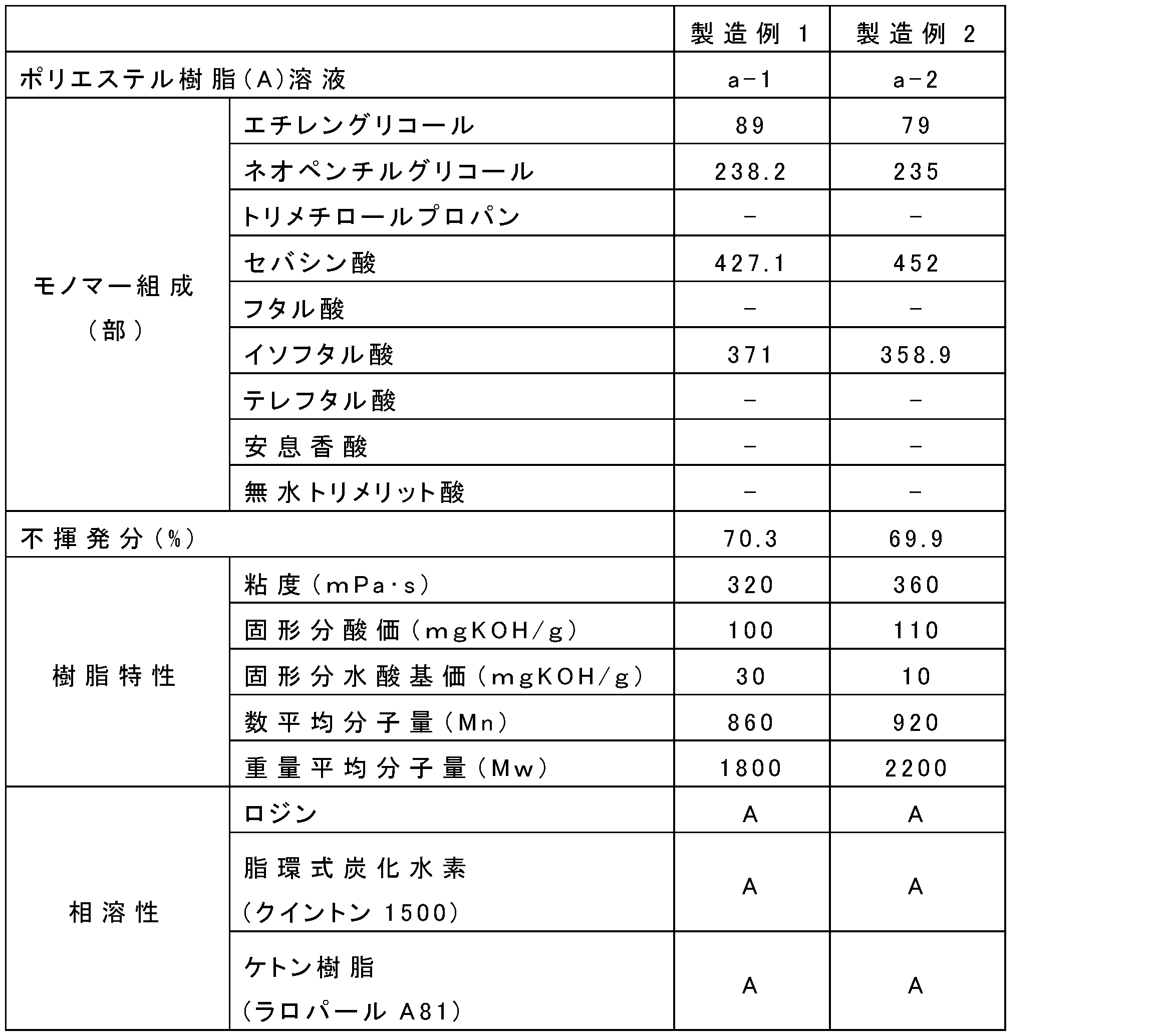
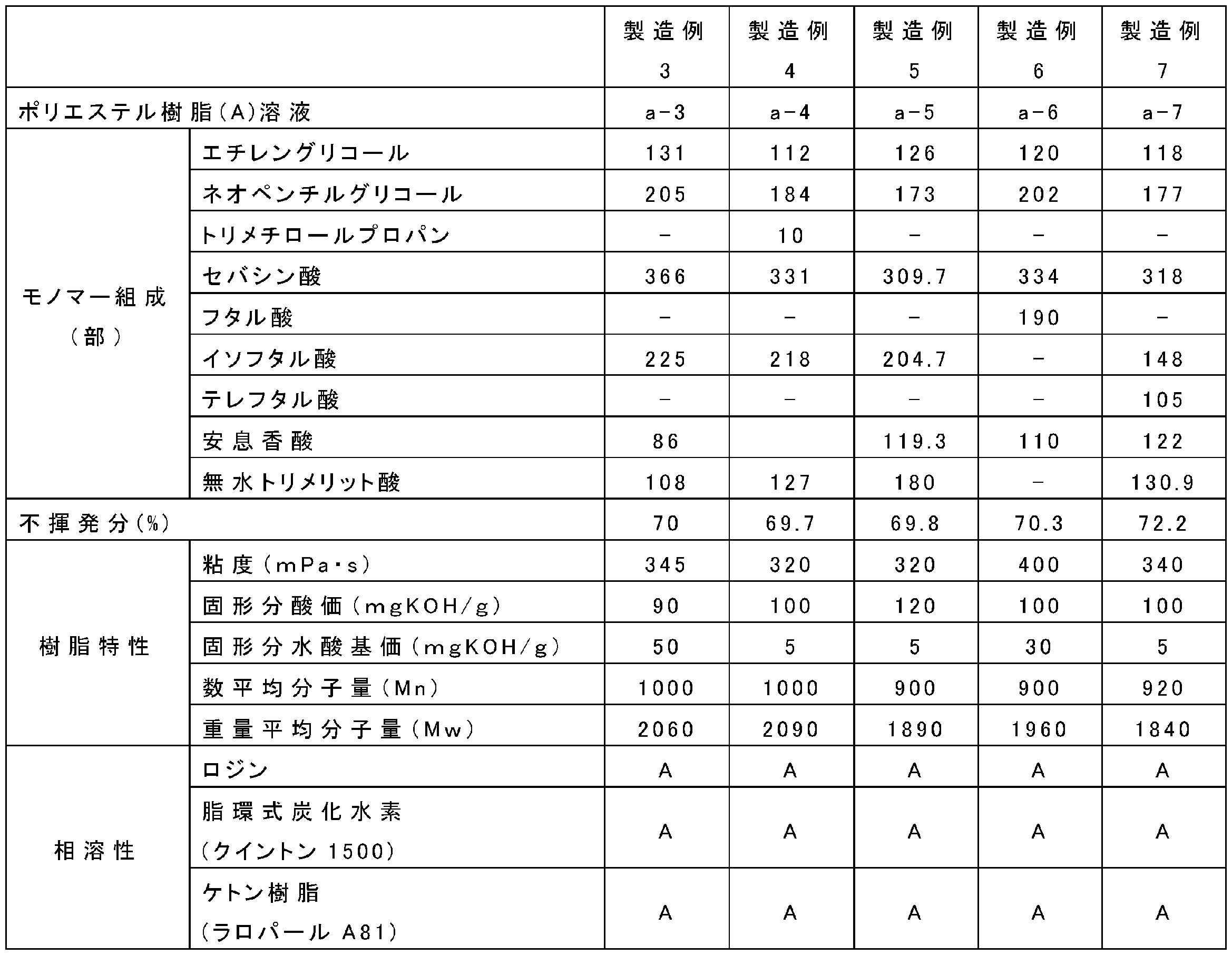
- Polyester resin solutions (a-4) to (a-7) were obtained in the same manner as in Production Example 3, except that the raw material types and amounts used were changed as shown in Table 2.
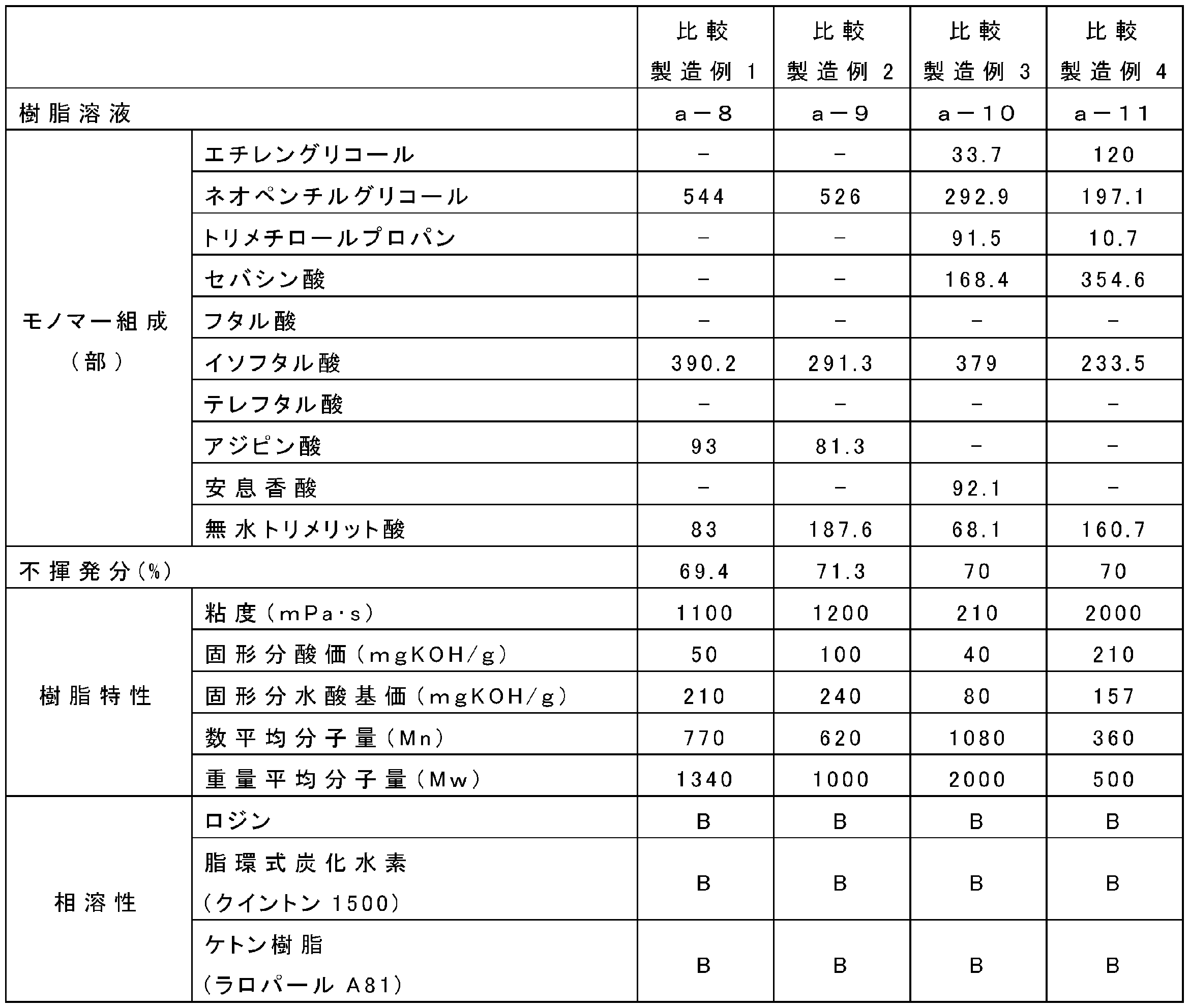
- Table 3 shows the amounts of raw materials used in the production of the resin solution as a comparative production example.
- the synthesis was performed in the same process as Production Example 3, and after confirming that the solid content acid value was 2 or less by the KOH titration method, the resin solution (a-8) was reacted with trimellitic anhydride. Alternatively, (a-9) was obtained.
- synthesis was performed in the same steps as Production Example 3, and after confirming the solid content acid value of 10 by the KOH titration method, trimellitic anhydride was reacted to obtain a solid content acid value of 40 to obtain a resin solution ( a-10) was obtained.
- Comparative Production Example 4 the synthesis was performed in the same steps as in Production Example 3, and after confirming the solid acid value 140 by the KOH titration method, trimellitic anhydride was reacted to obtain the solid acid value 210 and the resin solution ( a-11) was obtained.
- the polyester resin solution obtained from the production example and the various combination resins shown in Tables 1 to 3 were mixed at a solid content ratio of 1: 1, and a film applicator (clearance 0.3 mm) was placed on the glass plate. And the appearance after drying at 23 ° C. for 24 hours was investigated.
- “A” means compatible and “B” means no compatibility (separation).
- Example 1 The second component of the antifouling coating composition was prepared as follows. First, solvent xylene (8.5 parts), PGM (2.5 parts), methyl isobutyl ketone (1 part), duomine TDO (1.3 parts), rosin (7.5 parts), chlorine in a 1000 ml plastic container Paraffinized (2 parts) was blended and stirred with a paint shaker until evenly dissolved.
- talc FC-1 (3 parts), zinc oxide (11 parts), potash feldspar (4.2 parts), Nova Palm Red F5RK (0.3 parts), cuprous oxide (43.4 parts), copper pyrithione (2.5 parts) and an anti-settling agent Dis4200-20X (1 part) were added, and 200 parts of glass beads were added and dispersed for 1 hour. Further, an anti-sagging agent Dis630-20X (1.8 parts) was added and further dispersed for 20 minutes, followed by filtration through an 80-mesh filter screen to prepare paste (1) as the second component.
- the polyester resin solution (a-1) obtained in Production Example 1 was used as it was. 10 parts by weight of the polyester resin solution (a-1) as the first component and the second component were uniformly mixed using a disper to prepare an antifouling coating composition.
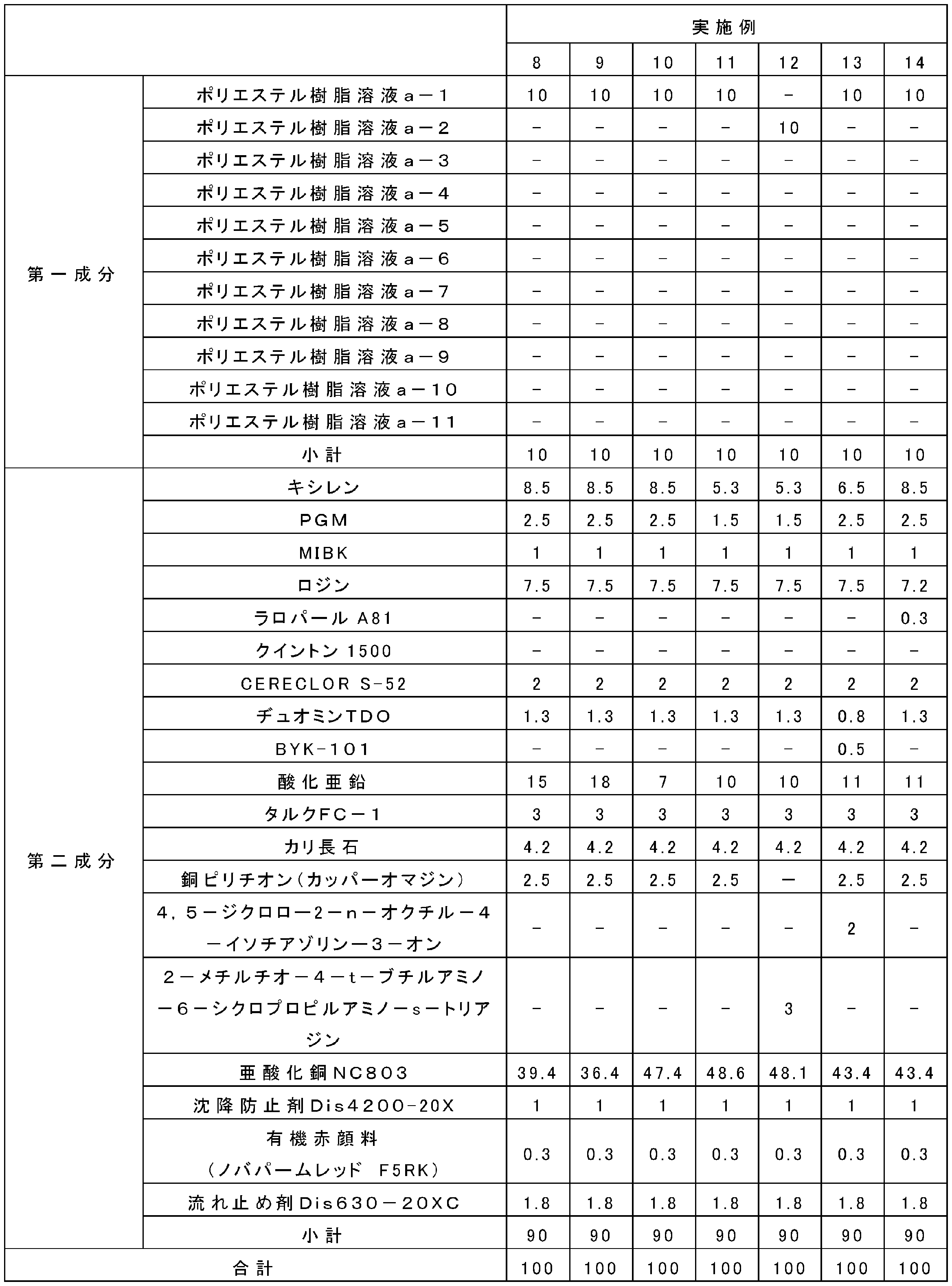
- Example 2 to 19 An antifouling coating composition was prepared in the same manner as in Example 1 except that the blending component and blending amount of the second component and the type and amount of the first component were changed as shown in Tables 4-6.
- VOC Volatile organic compound
- Coating film drying test (Kanoki pressure test); An epoxy anticorrosive paint (Chinese paint product “Banno 500”) is applied to a 150 ⁇ 70 ⁇ 3.2 mm sandblasted steel plate to a dry film thickness of 150 ⁇ m, and dried at room temperature (about 20 ° C.) for one day. A coating film is formed, and an epoxy binder paint (Chinese paint product “Banno 500N”) is further applied to the surface of the coating film so that the dry film thickness becomes 100 ⁇ m, and dried at room temperature (about 20 ° C.) for one day. To form a coating film.
- the antifouling coating composition was applied to the surface of this coating film so that the dry film thickness was 100 ⁇ m, and the operation of forming a coating film by drying at room temperature (about 20 ° C.) for one day was repeated twice.
- a test plate having a dirty coating film having a dry film thickness of 200 ⁇ m was prepared.
- the test plate is further dried at room temperature of 23 ° C. for 1, 3, 5 and 7 days, and a piece of 30 ⁇ 30 ⁇ 10 mm is placed on the coating film (center), and 40 kgf / cm 2 in the direction of the whip from the piece of wood.
- a pressure of (3.9 MPa) was applied for 20 minutes, and the state of the coating film surface was observed (deformation degree of the coating film was measured). Evaluation criteria are shown in FIG. In FIG.
- Evaluation criteria 1 10 is a piece of wood, and 20 is a coating film.
- Evaluation criteria 5 shows the most favorable state with no deformation of the coating film 20.
- Evaluation criteria 4 shows a good state with slight deformation of the coating film 20 but no exposure of the piece of wood 10.
- Evaluation criteria 3, 2, and 1 show a state in which the piece of wood 10 is exposed by deformation of the coating film 20, and the degree of damage (deformation) increases in the order of 3, 2, and 1. (7) Contamination test of antifouling coating film; Using an applicator, a 50 ⁇ 50 ⁇ 1.5 mm hard vinyl chloride plate was coated with the antifouling coating composition prepared in the Example so that the dry film thickness was 150 ⁇ m, and this was applied indoors at room temperature (about 20 ° C.
- test plate For 7 days to prepare a test plate. This test plate was attached to the side of a rotating drum installed in a thermostatic bath containing 25 ° C. seawater, rotated at a peripheral speed of 15 knots, and the consumption degree (thickness reduction) of the antifouling coating was measured every month. .
- Adhesion area of aquatic organisms exceeds 0% and 10% or less 1: Adhesion area of aquatic organisms exceeds 10% and 20% or less 2: Adhesion area of aquatic organisms is 20% Exceeding 30% or less 3: The aquatic organism adhesion area exceeds 30% and 40% or less 4: The aquatic organism adhesion area exceeds 40% and 50% or less 5: Evaluation based on the aquatic organism adhesion area exceeding 50% went.
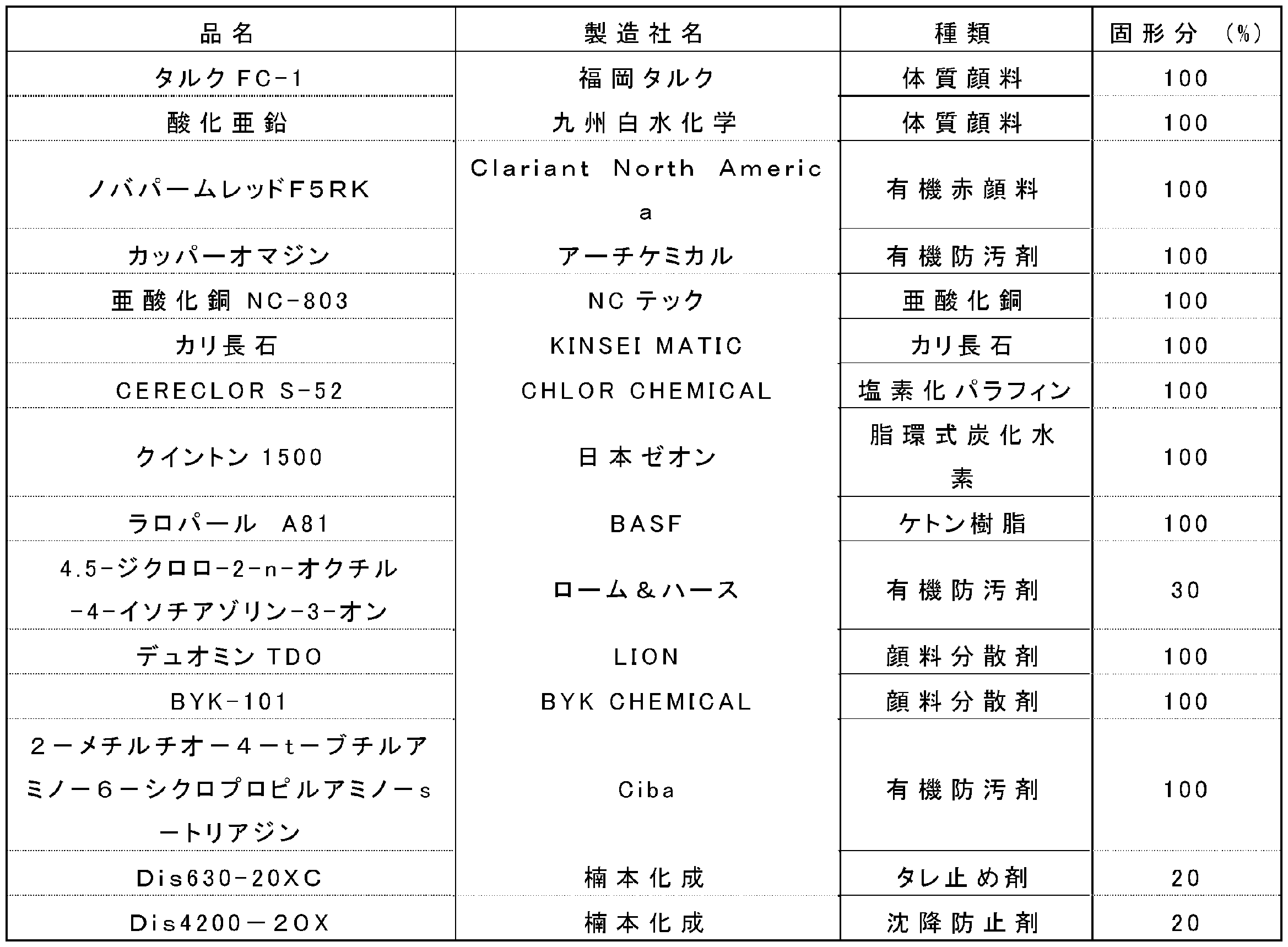
- Table 12 shows details of some of the raw materials used in the above examples and comparative examples.
Landscapes
- Chemical & Material Sciences (AREA)
- Organic Chemistry (AREA)
- Engineering & Computer Science (AREA)
- Materials Engineering (AREA)
- Wood Science & Technology (AREA)
- Life Sciences & Earth Sciences (AREA)
- Chemical Kinetics & Catalysis (AREA)
- Health & Medical Sciences (AREA)
- Medicinal Chemistry (AREA)
- Polymers & Plastics (AREA)
- Inorganic Chemistry (AREA)
- Paints Or Removers (AREA)
- Application Of Or Painting With Fluid Materials (AREA)
Abstract
Description
また、本発明によれば、長期防汚性に優れ、機械的強度に優れる防汚塗膜を提供することができる。
また、本発明によれば、水中構造物、船舶外板、漁網、漁具基材等の基材表面を、長期間防汚することが可能な基材の防汚方法を提供することができる。
本実施形態に係る二液型加水分解型防汚塗料組成物は、固形分の酸価が50~200、固形分の水酸基価が100以下であり、25℃における粘度が500mPa・s以下であるポリエステル樹脂(以下、場合により「ポリエステル樹脂(A)」という。)を含有する第1成分と、酸化亜鉛および亜酸化銅を含有するペーストである第2成分と、を含有するものであり、揮発性有機化合物の含有量は、第1成分と第2成分との合計量を基準として、400g/L以下である。まず、各成分について説明する。
ポリエステル樹脂(A)の酸成分としては、安息香酸、p-t-ブチル安息香酸等のモノカルボン酸、また、テレフタル酸、イソフタル酸、フタル酸、ナフタリンジカルボン酸などの芳香族ジカルボン酸、あるいは、アジピン酸、セバシン酸、アゼライン酸、コハク酸、ハイミック酸、1,6-シクロヘキサンジカルボン酸などの脂肪族カルボン酸、トリメリット酸、ピロメリット酸などの3価以上の多塩基酸、あるいはこれらの低級アルキルエステル(例えばC1~C4アルキルエステル)またはこれらの酸無水物等が挙げられる。モノカルボン酸及び、芳香族ジカルボン酸及び飽和脂肪族ジカルボン酸等の二塩基酸は、各々1種単独で使用してもよいし、2種以上を併用してもよい。また、3価以上の多塩基酸も1種単独で用いてもよいし、2種以上を併用してもよい。
〈GPC条件〉
ポンプ:日立製L-6200
カラム:日立化成製ゲルパックGL-420,GL-430,GL-440
溶離液:テトラヒドロフラン
なお、本実施形態におけるポリエステル樹脂の固形分酸価は、水酸化カリウム(KOH)による滴定により測定できる。
本実施形態に係る第2成分は、酸化亜鉛と亜酸化銅を必須成分として含有するペースト(以下、場合により「ペースト(B)」という。)である。
本実施形態に係る防汚塗料組成物はロジンおよび/またはロジン誘導体をさらに含有することができる。ロジンとしては、ガムロジン、ウッドロジン、トール油ロジンなどが挙げられる。また、ロジン誘導体としては、水添ロジン、重合ロジン、マレイン化ロジン、アルデヒド変性ロジン、ロジン金属塩、ロジンアミン等が挙げられる。ロジンおよび/またはその誘導体は、1種または2種以上組み合わせて用いることができる。ロジンおよび/またはロジン誘導体は、第1成分または第2成分のいずれに含有させてもよく、あるいは第1成分と第2成分とを混合した後にその混合物に添加してもよいが、第2成分に含有させることが好ましい。
本実施形態に係る防汚塗料組成物は、防汚剤(但し、亜酸化銅を除く。以下、場合により「防汚剤(D)」という。)をさらに含有することができる。防汚剤(D)としては、有機系、無機系のいずれの防汚剤であってもよく、銅ピリチオン、ジンクピリチオン等の金属ピリチオン類、4,5-ジクロロ-2-n-オクチル-4-イソチアゾリン-3-オン、2-メチルチオ-4-t-ブチルアミノ-6-シクロプロピルアミノ-s-トリアジンなどを用いることができる。静置条件での防汚性を考慮すると、防汚剤(D)として銅ピリチオン、4,5-ジクロロ-2-n-オクチル-4-イソチアゾリン-3-オン、2-メチルチオ-4-t-ブチルアミノ-6-シクロプロピルアミノ-s-トリアジンを用いることが好ましい。防汚剤(D)は第2成分に含有させることが好ましい。
本実施形態に係る防汚塗料組成物は、可塑剤(e1)、体質顔料(e2)、顔料分散剤(e3)、着色顔料(e4)、タレ止め剤(e5)、沈降防止剤(e6)からなる群から選ばれる少なくとも1種の添加剤(以下、「添加剤(E)」と総称する。)を含有していてもよい。添加剤(E)は、第1成分または第2成分のいずれに含有させてもよく、あるいは第1成分と第2成分とを混合した後にその混合物に添加してもよいが、第2成分に含有させることが好ましい。
可塑剤(e1)としては、塩化パラフィン、石油樹脂類、ケトン樹脂、TCP(トリクレジルフォスフェート)、ポリビニルエチルエーテル、ジアルキルフタレート等が挙げられる。本実施形態に係る防汚塗料組成物が可塑剤(e1)を含有していると、該防汚塗料組成物から形成される塗膜(防汚塗膜)の耐クラック性が向上する点で好ましい。
前記塩素化パラフィン(塩化パラフィン)としては、直鎖状でもよく分岐を有していてもよく、室温で液状でも固体(粉体)でもよいが、その平均炭素数が通常8~30、好ましくは10~26のものが好ましく用いられ、その数平均分子量が通常200~1200、好ましくは300~1100であり、粘度が通常1以上(ポイズ/25℃)、好ましくは1.2以上(ポイズ/25℃)であり、その比重が1.05~1.80/25℃、好ましくは1.10~1.70/25℃のものが好ましく用いられる。このような炭素数の塩素化パラフィンを用いると、得られる防汚塗料組成物を用いて割れ(クラック)、剥がれの少ない塗膜を形成できる。なお、塩素化パラフィンの炭素数が8未満では、クラックの抑制効果が不足となることがあり、またその炭素数が30を超えると、得られる塗膜表面の消耗性(更新性)に劣り防汚性が劣ることがある。また、この塩素化パラフィンの塩素化率(塩素含有量)は、通常35~75%、好ましくは35~65%であることが好ましい。このような塩素化率の塩素化パラフィンを用いると、得られる防汚塗料組成物を用いて割れ(クラック)、剥がれの少ない塗膜を形成できる。このような塩素化パラフィンとしては、東ソー(株)製の「トヨパラックス150」、「トヨパラックスA-70」などが挙げられる。また、石油樹脂類として具体的には、C5系、C9系、スチレン系、ジシクロペンタジエン系やそれらの水素添加物などを使用することができ、市販品としては、日本ゼオン製の「クイントン1500」、「クイントン1700」などが挙げられる。これらの中でも塩素化パラフィン(塩化パラフィン)、石油樹脂類、ケトン樹脂が好ましい。これらの可塑剤は、1種単独で又は2種以上を組み合わせて用いることができる。
体質顔料(e2)(但し、酸化亜鉛を除く)としては、タルク、シリカ、マイカ、クレー、カリ長石、また沈降防止剤としても用いられる炭酸カルシウム、カオリン、アルミナホワイト、艶消し剤としても用いられるホワイトカーボン、水酸化アルミニウム、炭酸マグネシウム、炭酸バリウム、硫酸バリウム等が挙げられ、これらの中では、タルク、シリカ、マイカ、クレー、炭酸カルシウム、カオリン、硫酸バリウム、カリ長石からなる群から選ばれる体質顔料が好ましい。体質顔料は、屈折率が小さく、油やワニスと混練した場合に透明で被塗面を隠さないような顔料であり、本実施形態に係る防汚塗料組成物が体質顔料(e2)を含有していると、耐クラック性などの塗膜物性向上などの点で好ましい。
顔料分散剤(e3)としては、従来公知の有機系、無機系の各種分散剤を用いることができる。有機系顔料分散剤としては、脂肪族アミンまたは有機酸類(LION株式会社製「ヂュオミンTDO」、BYK CHEMIE製「DISPERBYK-101」)等が挙げられる。
着色顔料(e4)としては、従来公知の有機系、無機系の各種顔料を用いることができる。有機系顔料としては、カーボンブラック、ナフトールレッド、フタロシアニンブルー等が挙げられる。無機系顔料としては、例えば、ベンガラ、バライト粉、チタン白、黄色酸化鉄等が挙げられる。なお、染色等の各種着色剤も含まれていてもよい。本実施形態に係る防汚塗料組成物が着色顔料(e4)を含有していると、該組成物から得られる防汚塗膜の色相を任意に調節できる点で好ましい。
タレ止め剤(e5)としては、アマイドワックス、水添ヒマシ油ワックス系、ポリアマイドワックス系および両者の混合物、合成微粉シリカが挙げられ、好ましくは、ポリアマイドワックス、合成微粉シリカが望ましい。市販品であれば、楠本化成(株)製の「ディスパロンA630-20XC」、伊藤精油(株)製の「ASAT-250F」等が挙げられる。本実施形態に係る防汚塗料組成物がタレ止め剤(e5)を含有していると、塗装時のタレ止め性等を調整することができる点で好ましい。
沈降防止剤(e6)としては、有機粘土系Al、Ca、Znのアミン塩、ポリエチレンワックス、酸化ポリエチレン系ワックス等が挙げられ、好ましくは、酸化ポリエチレン系ワックスが望ましい。市販品であれば、楠本化成(株)製の「ディスパロン4200-20X」等が挙げられる。本実施形態に係る防汚塗料組成物が沈降防止剤(e6)を含有していると、溶剤不溶物の貯蔵期間中の沈殿を防止でき、攪拌性を向上させることができる点で好ましい。
本実施形態に係る防汚塗料組成物は、溶剤(F)をさらに含有することができる。溶剤(F)としては、従来公知の広範な沸点の溶剤が使用でき、具体的にはターペンなどの脂肪族系溶剤;トルエン、キシレンなどの芳香族系溶剤;イソプロピルアルコール、n一ブチルアルコール、イソブチルアルコールなどのアルコール系溶剤;酢酸エチル、酢酸ブチルなどのエステル系溶剤;メチルエチルケトン、メチルイソブチルケトン、メチルアミルケトンなどのケトン系溶剤;エチレングリコールモノメチルエーテル、エチレングリコールモノブチルエーテル、プロピレングリコールモノメチルエーテル、プロピレングリコールモノメチルエーテルアセテートなどのエーテル系またはエーテルエステル系などの溶剤が挙げられ、好ましくはキシレン、メチルイソブチルケトン、プロピレングリコールモノメチルエーテルを挙げることができる。これら溶剤は、1種単独でまたは2種以上を組み合わせて用いられる。
本実施形態に係る防汚塗膜は、上記した本実施形態に係る防汚塗料組成物を硬化させてなるものである。また、本実施形態に係る基材の防汚方法は、上記した本実施形態に係る防汚塗料組成物を基材に塗布あるいは含浸し、次いで硬化させ、防汚塗膜を形成させるものである。
(製造例1:ポリエステル樹脂溶液(a-1)の製造)
イソフタル酸371.0部、セバシン酸427.1部、ネオペンチルグリコール238.2部、エチレングリコール89.0部を2Lの4口フラスコ内に配合し、窒素ガスの存在下、220℃で5時間反応させた(エステル化反応)。反応中、生成する水を還流脱水により除去し、KOH滴定法による酸価の測定及びアセチル化法による水酸基価の測定を行い、固形分酸価が100、固形分水酸基価が30となったときに反応を止めた。反応液を冷却後、メチルイソブチルケトンで希釈し、不揮発分70.3%、酸価70(固形分換算100)、水酸基価21(固形分換算30)、粘度320mPas、重量平均分子量1,800のポリエステル樹脂溶液(a-1)を得た。
原料の使用量を表1に示す量に変更した以外は実施例1と同様にしてポリエステル樹脂溶液(a-2)を得た。
イソフタル酸225.0部、セバシン酸366.0部、ネオペンチルグリコール205.0部、エチレングリコール131.0部、安息香酸86.0部を2Lの4口フラスコに内で配合し、窒素ガスの存在下、220℃で6時間反応させた(エステル化反応)。生成する水を還流脱水により除去し、KOH滴定法による酸価の測定及びアセチル化法による水酸基価の測定を行い、固形分酸価43、固形分水酸基価115となったときに反応を停止した。その後、170℃まで冷却し、無水トリメリット酸を108.0重量部加え、2時間保温し、付加反応を行い固形分酸価が90、固形分水酸基価が60であるところで反応を止めた。冷却後メチルイソブチルケトンで希釈し、加熱残分70.0%、酸価63(固形分換算90)、水酸基価42(固形分換算60)、粘度345mPas、重量平均分子量2,060のポリエステル樹脂溶液(a-3)を得た。
原料の種類および使用量を表2に示す通りに変更した以外は製造例3と同様にしてポリエステル樹脂溶液(a-4)~(a-7)を得た。
比較製造例としての樹脂溶液の製造に用いた原料の使用量は、表3に示した。
比較製造例1,2においては、製造例3と同様な工程で合成を行い、KOH滴定法で固形分酸価2以下を確認後、無水トリメリット酸を反応させて樹脂溶液(a-8)または(a-9)を得た。
比較製造例3においては、製造例3と同様な工程で合成を行い、KOH滴定法で固形分酸価10を確認後、無水トリメリット酸を反応させ、固形分酸価40にして樹脂溶液(a-10)を得た。
比較製造例4においては、製造例3と同様な工程で合成を行い、KOH滴定法で固形分酸価140を確認後、無水トリメリット酸を反応させ、固形分酸価210にして樹脂溶液(a-11)を得た。
製造例1~7で得られたポリエステル樹脂溶液(a-1)~(a-7)および比較製造例1で得られた樹脂溶液(a-8)~(a-11)について、以下の評価を実施した。得られた結果を表1~3に示す。
(1)GPC;
以下の条件で測定した。
(GPC測定条件)
装置:日立社製L-6200
カラム:日立化成社製ゲルパックGL-420,GL-430,GL-440
溶離液:THF
流速:2.0ml/min
(2)加熱残分(重量NV);
樹脂溶液1gを平底皿にはかり取り、質量既知の針金を使って均一に広げ、125℃で1時間乾燥後、残渣および針金の質量を量り、加熱残分(重量%)を算出した。
なお、「加熱残分」は前述した「不揮発分」と同義である。
(3)粘度;
ポリエステル樹脂溶液の粘度を、25℃でB型 粘度計により測定した。
(4)相溶性評価
製造例より得られたポリエステル樹脂溶液と、表1~3に示した各種併用樹脂とを固形分比1:1で混合し、ガラス板にフィルムアプリケーター(スキマ0.3mm)で塗付し、23℃乾燥24時間後の外観を調査した。表1~3中、「A」は相溶性あり、「B」は相溶性なし(分離)をそれぞれ意味する。
(実施例1)
防汚塗料組成物の第2成分を以下のようにして調製した。
まず、1000mlのポリ容器に溶剤キシレン(8.5部)、PGM(2.5部)、メチルイソブチルケトン(1部)、ヂュオミンTDO(1.3部)、ロジン(7.5部)、塩素化パラフィン(2部)を配合し、均一に溶解するまでペイントシェーカーで攪拌した。
次いで、タルクFC-1(3部)、酸化亜鉛(11部)、カリ長石(4.2部)、ノバパームレッドF5RK(0.3部)、亜酸化銅(43.4部)、銅ピリチオン(2.5部)、沈降防止剤Dis4200-20X(1部)を配合し、ガラスビーズ200部を添加し、1時間分散した。
さらに、タレ止め剤Dis630-20X(1.8部)を添加しさらに20分分散したのち80メッシュのろ過網でろ過し、第2成分であるペースト(1)を調製した。
一方、第1成分として、製造例1によって得られたポリエステル樹脂溶液(a-1)をそのまま使用した。
第1成分としての上記ポリエステル樹脂溶液(a-1)10重量部と、上記第2成分とをディスパーを用いて均一に混合し、防汚塗料組成物を調製した。
第2成分の配合成分および配合量、ならびに第1成分の種類および量を表4~6に示したように変更した以外は実施例1と同様にして、防汚塗料組成物を調製した。
第2成分の配合成分および配合量、ならびに第1成分の種類および量を表7に示したように変更した以外は実施例1と同様にして、防汚塗料組成物を調製した。

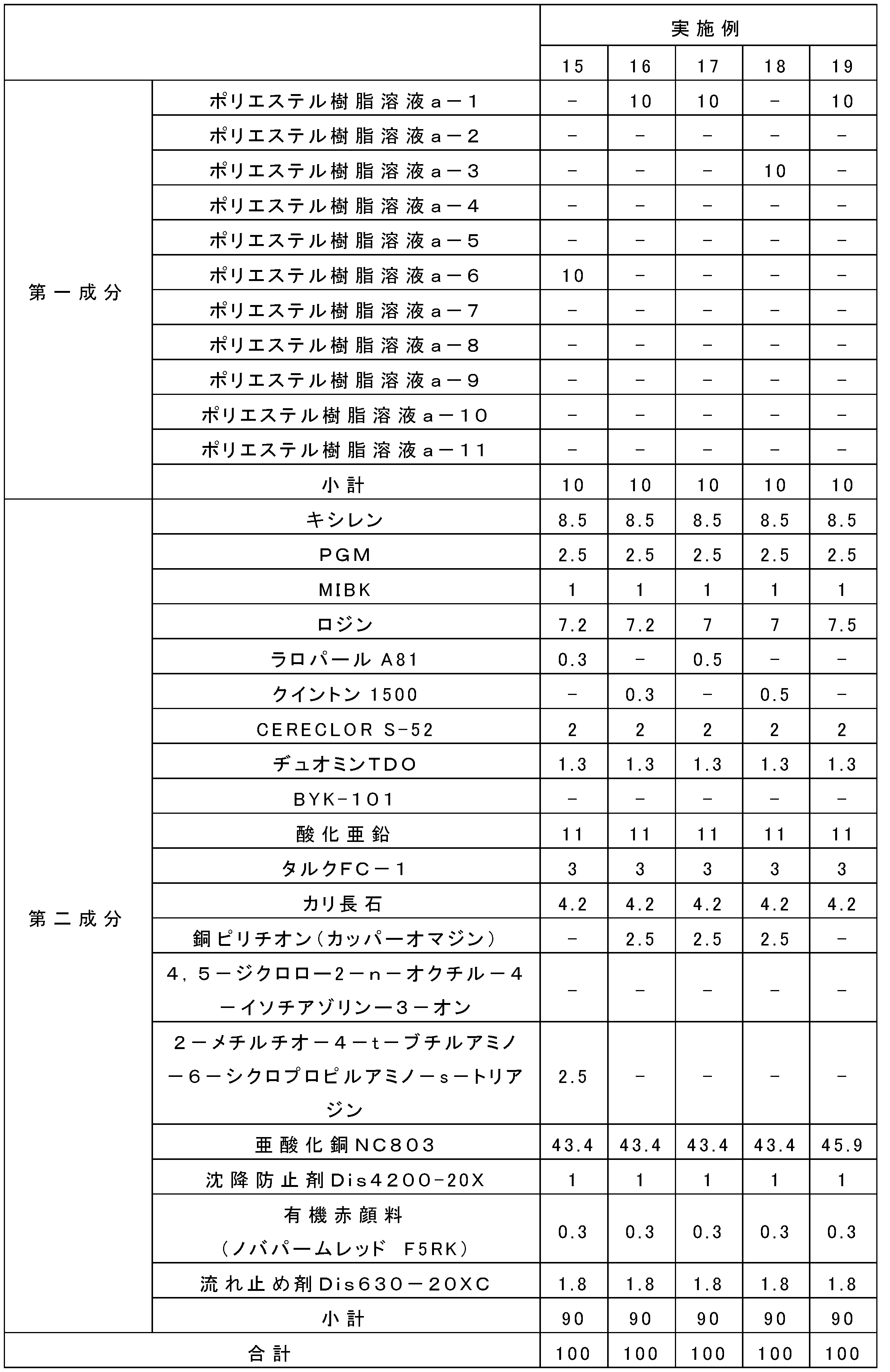
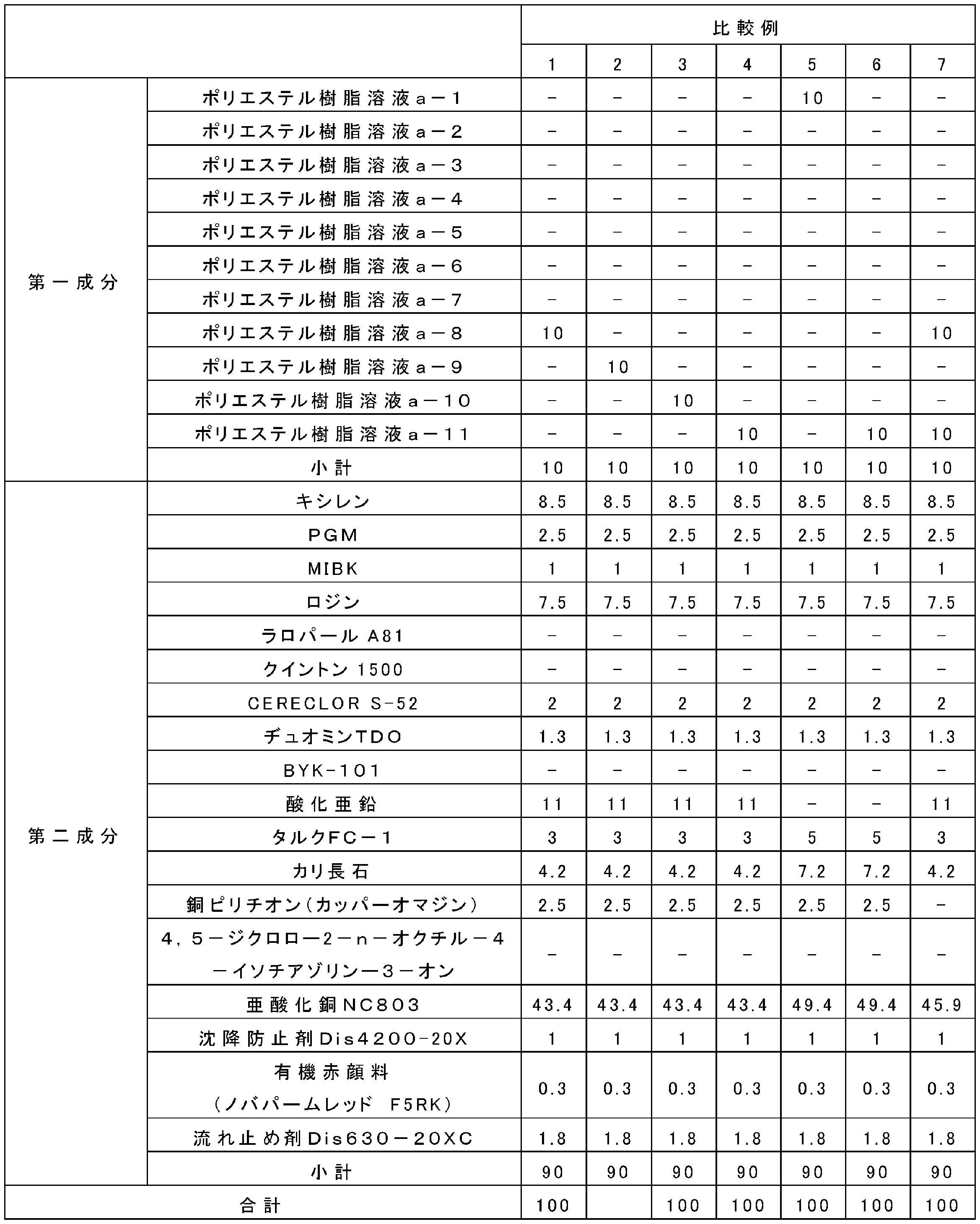
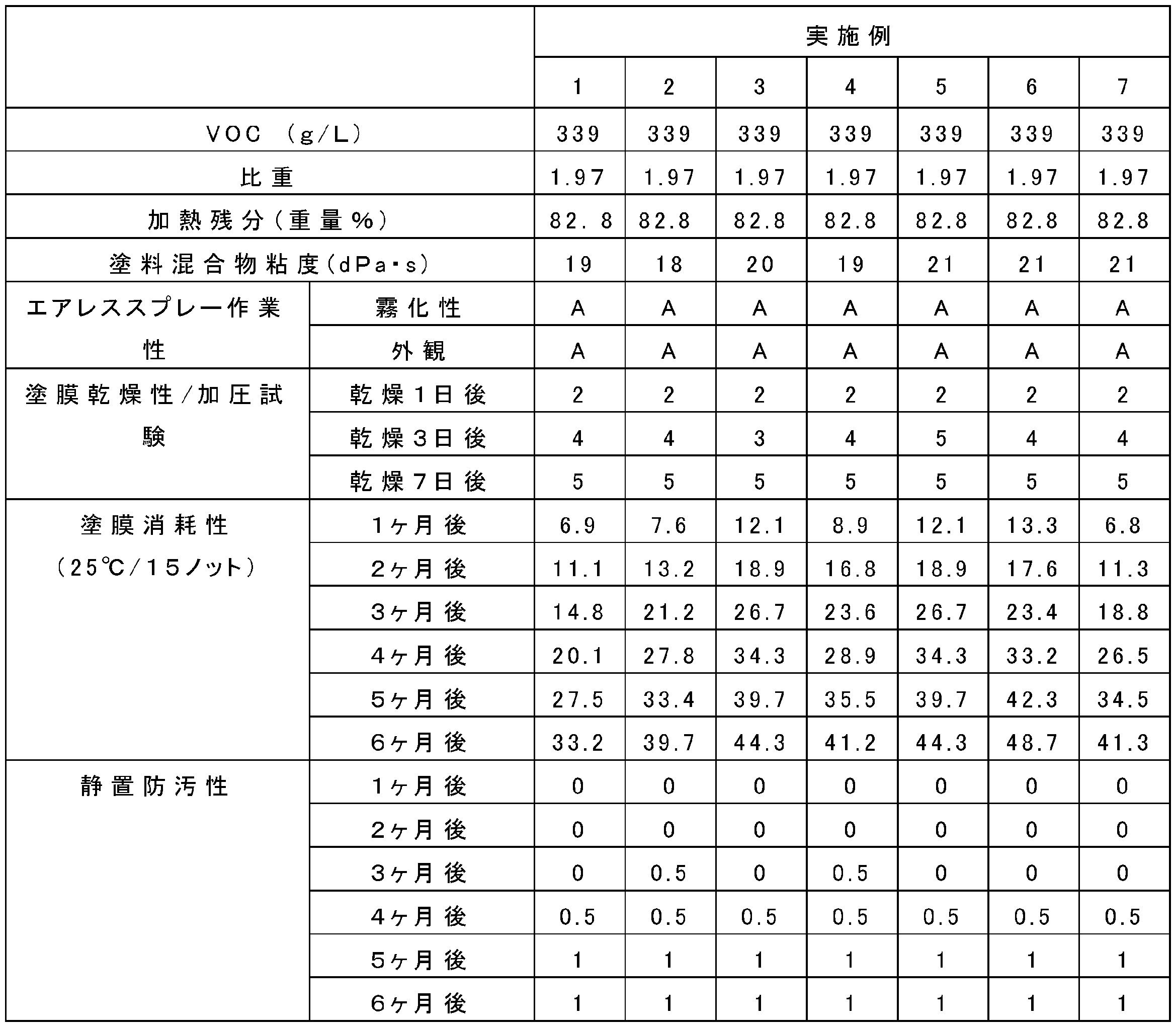
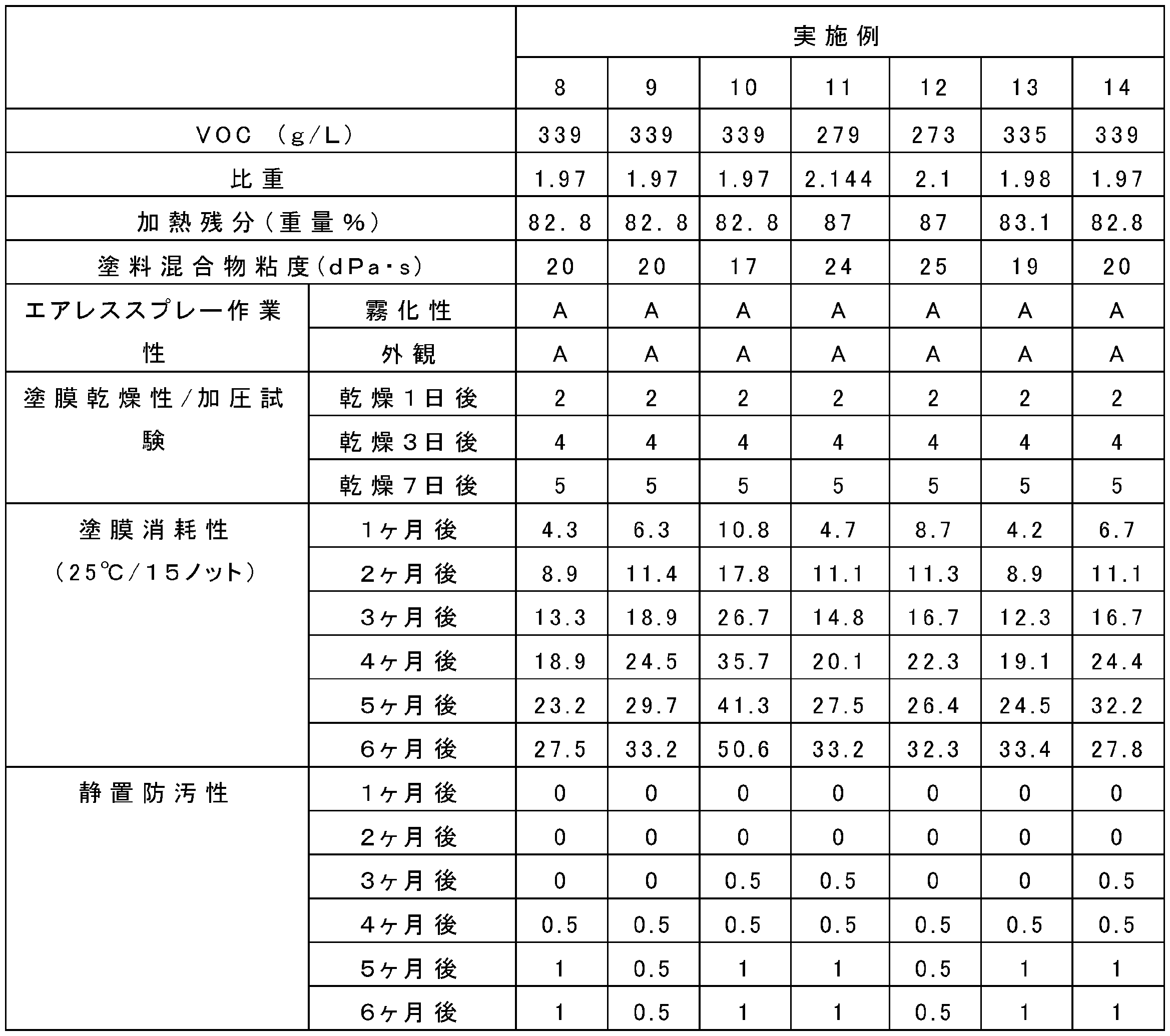
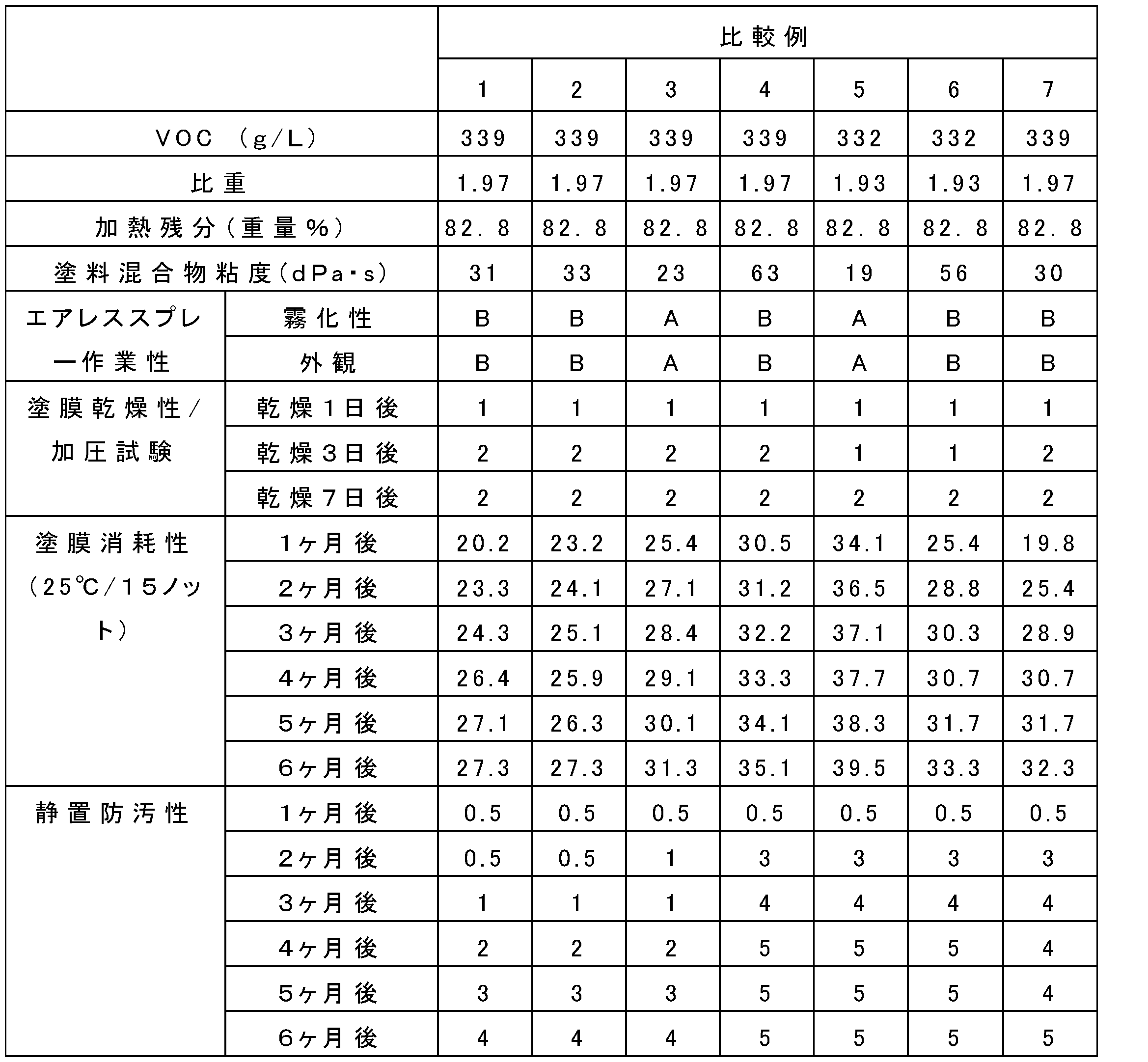
実施例1~19および比較例1~7の防汚塗料組成物およびそれらを用いて形成した塗膜の物性は、以下のように評価した。得られた結果を表8~11に示す。
(1)揮発性有機化合物(VOC)重量測定
上記の塗料比重および重量NVの値を用いて下式から算出した。
VOC(g/L)=塗料比重×1000×(100一重量NV)/100。
(2)比重
第1成分と第2成分とを混合した直後に、25℃において、内容積が100mlの比重カップに充満した防汚塗料組成物の質量を量ることにより、比重(塗料比重)(g/cm3)を測定した。
(3)加熱残分(重量NV)
第1成分と第2成分とを混合した直後に、防汚塗料組成物1gを平底皿に量り採り、質量既知の針金を使って均一に広げ、125℃で1時間乾燥後、残渣および針金の質量を量り、加熱残分(重量%)を算出した。
(4)防汚塗料組成物の粘度測定
第1成分と第2成分の総量が1000gになるように計量し、混合後の塗料粘度を23℃に調整し、リオン粘度計( RION CO.,LTD VISCOTESTER VT-04F 高粘度用、1号ローター)を用い測定した。
(5)エアレススプレー作業性
第1成分と第2成分を5000gになるように計量し、エアレススプレーでの塗装作業性(霧化性、塗膜外観)を確認した。表8~11中、「A」は塗装作業性が良好であったこと、「B」は塗装作業性に劣ることをそれぞれ意味する。
(6)塗膜乾燥性試験(盤木加圧試験);
150×70×3.2mmのサンドブラスト処理鋼板に、エポキシ系防食塗料(中国塗料製品“バンノー500”)を乾燥膜厚が150μmとなるように塗装し、室温(約20℃)で1日乾燥させて塗膜を形成し、この塗膜の表面にさらにエポキシ系バインダー塗料(中国塗料製品“バンノー500N”)を乾燥膜厚が100μmとなるように塗装し、室温(約20℃)で1日乾燥させて塗膜を形成した。この塗膜の表面に、防汚塗料組成物をその乾燥膜厚が100μmとなるように塗装し、室温(約20℃)で1日乾燥させて塗膜を形成する操作を2度繰り返し、防汚塗膜の乾燥膜厚が200μmである試験板を作成した。
上記試験板を室温23℃でさらに1、3、5、7日乾燥し、塗膜上(中央部)に30×30×10mmの木片を置き、その木片の上から鞭方向に40kgf/cm2(3.9MPa)の圧力を20分間加え、塗膜表面の状態を観察した(塗膜の変形度を測定した。)。評価基準を図1に示す。図1中、10は木片、20は塗膜である。評価基準5は、塗膜20の変形がなく、最も良好な状態を示している。評価基準4は、塗膜20の変形が若干認められるが、木片10の露出は認められず、良好な状態を示している。評価基準3、2、1は、塗膜20の変形により木片10が露出した状態を示しており、ダメージ(変形)の度合いは3、2、1の順に大きくなっている。
(7)防汚塗膜の消耗度試験;
50×50×1.5mmの硬質塩化ビニル板にアプリケーターを用いて、実施例で調整した防汚塗料組成物を乾燥膜厚150μmになるように塗付し、これを室内で室温(約20℃)にて7日間乾燥させ、試験板を作成した。
25℃の海水を入れた恒温槽に設置した回転ドラムの側面にこの試験板を取り付け、周速15ノットで回転させ、1ヵ月毎の防汚塗膜の消耗度(膜厚減少)を測定した。
(8)防汚塗膜の静置防汚性試験;
100×300×3.2mmのサンドブラスト処理鋼板に、エポキシ系塗料(中国塗料製品“バンノー500”)を乾燥膜厚150μm、エポキシ系バインダー塗料(中国塗料製品“バンノー500N”)を乾燥膜厚100μmとなるように、この順序で1日毎に塗装した後、該エポキシ系バインダーコートから形成された塗膜の表面に、ついで実施例で調整した防汚塗料組成物をその乾燥膜厚が150μmとなるように塗装間隔1日で塗付し、試験板を作成した。
上記試験板を23℃で7日間乾燥させ、長崎県長崎湾に静置浸漬し、1ヶ月毎の付着生物の付着面積を目視により計測し、下記評価基準:
0: 水生生物の付着無し
0.5: 水生生物の付着面積が0%を超え10%以下
1: 水生生物の付着面積が10%を超え20%以下
2: 水生生物の付着面積が20%を超え30%以下
3: 水生生物の付着面積が30%を超え40%以下
4: 水生生物の付着面積が40%を超え50%以下
5: 水生生物の付着面積が50%を超える
に基づき評価を行った。

Claims (11)
- 固形分の酸価が50~200、固形分の水酸基価が100以下であり、25℃における粘度が500mPa・s以下であるポリエステル樹脂を含有する第1成分と、
酸化亜鉛および亜酸化銅を含有するペーストである第2成分と、
を含有し、前記第1成分と前記第2成分との合計量を基準として、揮発性有機化合物の含有量が400g/L以下であることを特徴とする二液型加水分解型防汚塗料組成物。 - ゲルパーミッションクロマトグラフィーで測定される、前記ポリエステル樹脂の重量平均分子量が5,000以下であることを特徴とする、請求項1に記載の二液型加水分解型防汚塗料組成物。
- 前記第2成分中の酸化亜鉛の含有量が、前記ポリエステル樹脂100重量部に対して10~300重量部であることを特徴とする、請求項1または2に記載の二液型加水分解型防汚塗料組成物。
- ロジンおよび/またはロジン誘導体をさらに含有することを特徴とする、請求項1~3のいずれか一項に記載の二液型加水分解型防汚塗料組成物。
- 防汚剤(但し、亜酸化銅を除く)をさらに含有することを特徴とする、請求項1~4のいずれか一項に記載の二液型加水分解型防汚塗料組成物。
- 可塑剤をさらに含有することを特徴とする、請求項1~5のいずれか一項に記載の二液型加水分解型防汚塗料組成物。
- 体質顔料(但し、酸化亜鉛を除く)をさらに含有することを特徴とする、請求項1~6のいずれか一項に記載の二液型加水分解型防汚塗料組成物。
- 顔料分散剤をさらに含有することを特徴とする、請求項1~7のいずれか一項に記載の二液型加水分解型防汚塗料組成物。
- 着色顔料をさらに含有することを特徴とする、請求項1~8のいずれか一項に記載の二液型加水分解型防汚塗料組成物。
- 請求項1~9のいずれか一項に記載の二液型加水分解型防汚塗料組成物を硬化させてなることを特徴とする防汚塗膜。
- 請求項1~9のいずれか一項に記載の二液型加水分解型防汚塗料組成物を基材に塗布あるいは含浸し、次いで硬化させ、防汚塗膜を形成させることを特徴とする、基材の防汚方法。
Priority Applications (6)
| Application Number | Priority Date | Filing Date | Title |
|---|---|---|---|
| BRPI0923651A BRPI0923651A2 (pt) | 2008-12-24 | 2009-12-18 | composição de revestimento anti-incrustante, película de revestimento anti-incrustante e método para prevenção de incrustação de base |
| SG2011043528A SG172153A1 (en) | 2008-12-24 | 2009-12-18 | Antifouling coating composition, antifouling coating film, and method of preventing fouling of base |
| EP09834796.6A EP2368949A4 (en) | 2008-12-24 | 2009-12-18 | FABRIC-FREE COATING COMPOSITION, FACE-RESISTANT COATING FILM AND METHOD OF PREVENTING FIGURE LOSS ON A BASIC BASIS |
| CN2009801470641A CN102224209A (zh) | 2008-12-24 | 2009-12-18 | 防污涂料组合物、防污涂膜及基材的防污方法 |
| KR1020117014361A KR101264540B1 (ko) | 2008-12-24 | 2009-12-18 | 방오도료 조성물, 방오도막 및 기재의 방오방법 |
| JP2010506059A JP4621901B2 (ja) | 2008-12-24 | 2009-12-18 | 防汚塗料組成物および基材の防汚方法 |
Applications Claiming Priority (2)
| Application Number | Priority Date | Filing Date | Title |
|---|---|---|---|
| JP2008-328306 | 2008-12-24 | ||
| JP2008328306 | 2008-12-24 |
Publications (1)
| Publication Number | Publication Date |
|---|---|
| WO2010073995A1 true WO2010073995A1 (ja) | 2010-07-01 |
Family
ID=42287605
Family Applications (1)
| Application Number | Title | Priority Date | Filing Date |
|---|---|---|---|
| PCT/JP2009/071146 Ceased WO2010073995A1 (ja) | 2008-12-24 | 2009-12-18 | 防汚塗料組成物、防汚塗膜および基材の防汚方法 |
Country Status (7)
| Country | Link |
|---|---|
| EP (1) | EP2368949A4 (ja) |
| JP (1) | JP4621901B2 (ja) |
| KR (1) | KR101264540B1 (ja) |
| CN (1) | CN102224209A (ja) |
| BR (1) | BRPI0923651A2 (ja) |
| SG (1) | SG172153A1 (ja) |
| WO (1) | WO2010073995A1 (ja) |
Cited By (5)
| Publication number | Priority date | Publication date | Assignee | Title |
|---|---|---|---|---|
| WO2012176809A1 (ja) | 2011-06-23 | 2012-12-27 | 中国塗料株式会社 | 二液型加水分解型防汚塗料組成物、防汚塗膜および防汚基材の製造方法 |
| CN102947401A (zh) * | 2010-06-23 | 2013-02-27 | 中国涂料株式会社 | 防污涂料组合物、防污涂膜以及基材的防污方法 |
| GB202107159D0 (en) | 2021-03-23 | 2021-06-30 | Jotun As | Monitoring a vessel |
| WO2021180588A2 (en) | 2020-03-09 | 2021-09-16 | Jotun A/S | Hull cleaning robot |
| WO2022200430A1 (en) | 2021-03-23 | 2022-09-29 | Jotun A/S | Monitoring the cleanliness of an underwater surface of a stationary object |
Families Citing this family (7)
| Publication number | Priority date | Publication date | Assignee | Title |
|---|---|---|---|---|
| JP2013534543A (ja) * | 2010-06-04 | 2013-09-05 | ヨツン エーエス | 防汚組成物 |
| JP5916490B2 (ja) | 2012-04-09 | 2016-05-11 | 中国塗料株式会社 | 船底塗膜の摩擦抵抗予測方法および、該方法を用いた塗膜性能評価方法、塗膜性能評価装置 |
| CN102702939A (zh) * | 2012-06-14 | 2012-10-03 | 天长市银狐漆业有限公司 | 防污涂料组合物、防污涂膜及基材的防污方法 |
| WO2014010702A1 (ja) | 2012-07-12 | 2014-01-16 | 日立化成ポリマー株式会社 | 防汚塗料用ポリエステル樹脂、その製造方法、防汚塗料組成物、防汚塗膜、防汚基材 |
| WO2018008728A1 (ja) * | 2016-07-06 | 2018-01-11 | 関西ペイント株式会社 | 無機ジンクリッチペイント |
| EP4705397A1 (en) | 2023-05-04 | 2026-03-11 | Akzo Nobel Coatings International B.V. | Fouling control coating composition |
| AU2024265212A1 (en) | 2023-05-04 | 2025-10-09 | Akzo Nobel Coatings International B.V. | Fouling control coating composition |
Citations (14)
| Publication number | Priority date | Publication date | Assignee | Title |
|---|---|---|---|---|
| JPS54119534A (en) * | 1978-03-09 | 1979-09-17 | Kansai Paint Co Ltd | Two-part type anti-fouling coating composition |
| JPS57128742A (en) | 1981-02-03 | 1982-08-10 | Toray Ind Inc | Antifouling and algae-proofing polyester resin composition |
| JPH01298455A (ja) | 1988-05-27 | 1989-12-01 | Fujitsu Ltd | 通信端末装置 |
| JPH02196869A (ja) | 1988-10-13 | 1990-08-03 | Courtaulds Coatings Ltd | 防汚塗料 |
| JPH0753899A (ja) | 1993-08-18 | 1995-02-28 | Toyobo Co Ltd | 防汚塗料用ポリエステル樹脂組成物 |
| JPH0782513A (ja) | 1993-09-17 | 1995-03-28 | Dainippon Toryo Co Ltd | 防汚塗料組成物 |
| JPH07166106A (ja) | 1993-12-13 | 1995-06-27 | Toyobo Co Ltd | 防汚塗料用ポリエステル樹脂組成物 |
| JPH08176501A (ja) | 1994-12-21 | 1996-07-09 | Toyobo Co Ltd | 防汚塗料用加水分解型ポリエステル樹脂 |
| JPH09132736A (ja) | 1995-11-08 | 1997-05-20 | Dainippon Toryo Co Ltd | 防汚塗料組成物 |
| JPH11140376A (ja) * | 1985-05-17 | 1999-05-25 | Nippon Paint Co Ltd | 金属含有樹脂組成物 |
| JPH11255869A (ja) | 1998-03-11 | 1999-09-21 | Toyobo Co Ltd | 加水分解型ポリエステルおよびそれを含有する防汚塗料用組成物 |
| JP2000248206A (ja) | 1999-03-02 | 2000-09-12 | Kansai Paint Co Ltd | 防汚塗料組成物 |
| JP2001152086A (ja) * | 1999-11-29 | 2001-06-05 | Kansai Paint Co Ltd | 防汚塗料組成物 |
| JP2002241676A (ja) * | 2001-02-21 | 2002-08-28 | Nippon Paint Co Ltd | ハイソリッド型防汚塗料 |
Family Cites Families (11)
| Publication number | Priority date | Publication date | Assignee | Title |
|---|---|---|---|---|
| JPS5986669A (ja) * | 1982-11-10 | 1984-05-18 | Kansai Paint Co Ltd | 二液形防汚塗料 |
| JPH11513721A (ja) * | 1995-10-19 | 1999-11-24 | ビーエーエスエフ コーティングス アクチェンゲゼルシャフト | 少なくとも三成分からなる被覆剤、該被覆剤の製造ならびに該被覆剤の使用 |
| DK0900257T3 (da) * | 1996-05-22 | 2002-07-22 | Hempels Skibsfarve Fab J C | Antifouling-maling |
| JPH10114882A (ja) * | 1996-08-21 | 1998-05-06 | Dainippon Ink & Chem Inc | コ−ティング用樹脂組成物 |
| JPH10238072A (ja) * | 1997-02-28 | 1998-09-08 | Nichiei Kk | 石模様化粧パネル |
| JP3566034B2 (ja) * | 1997-06-12 | 2004-09-15 | 株式会社リコー | 着色剤及び着色剤を用いた電子写真現像液、塗料、印刷用インキ及びインクジェット用インク |
| JP3790332B2 (ja) * | 1997-07-17 | 2006-06-28 | 三洋化成工業株式会社 | 発泡性耐火塗料および被覆された構造体 |
| JP2000212502A (ja) * | 1998-11-19 | 2000-08-02 | Shinto Paint Co Ltd | 水分散塗料組成物及びその塗装方法 |
| JP4412790B2 (ja) * | 2000-01-27 | 2010-02-10 | 積水化学工業株式会社 | 二液型室温架橋性組成物 |
| JP2005075902A (ja) * | 2003-08-29 | 2005-03-24 | Konishi Co Ltd | 2液若しくは3液分別塗布型速硬化水性接着剤、及びそれを用いた速硬化接着方法 |
| JP5074055B2 (ja) * | 2006-08-17 | 2012-11-14 | 関西ペイント株式会社 | 上塗塗料組成物 |
-
2009
- 2009-12-18 JP JP2010506059A patent/JP4621901B2/ja not_active Expired - Fee Related
- 2009-12-18 CN CN2009801470641A patent/CN102224209A/zh active Pending
- 2009-12-18 WO PCT/JP2009/071146 patent/WO2010073995A1/ja not_active Ceased
- 2009-12-18 BR BRPI0923651A patent/BRPI0923651A2/pt not_active IP Right Cessation
- 2009-12-18 KR KR1020117014361A patent/KR101264540B1/ko not_active Expired - Fee Related
- 2009-12-18 EP EP09834796.6A patent/EP2368949A4/en not_active Withdrawn
- 2009-12-18 SG SG2011043528A patent/SG172153A1/en unknown
Patent Citations (14)
| Publication number | Priority date | Publication date | Assignee | Title |
|---|---|---|---|---|
| JPS54119534A (en) * | 1978-03-09 | 1979-09-17 | Kansai Paint Co Ltd | Two-part type anti-fouling coating composition |
| JPS57128742A (en) | 1981-02-03 | 1982-08-10 | Toray Ind Inc | Antifouling and algae-proofing polyester resin composition |
| JPH11140376A (ja) * | 1985-05-17 | 1999-05-25 | Nippon Paint Co Ltd | 金属含有樹脂組成物 |
| JPH01298455A (ja) | 1988-05-27 | 1989-12-01 | Fujitsu Ltd | 通信端末装置 |
| JPH02196869A (ja) | 1988-10-13 | 1990-08-03 | Courtaulds Coatings Ltd | 防汚塗料 |
| JPH0753899A (ja) | 1993-08-18 | 1995-02-28 | Toyobo Co Ltd | 防汚塗料用ポリエステル樹脂組成物 |
| JPH0782513A (ja) | 1993-09-17 | 1995-03-28 | Dainippon Toryo Co Ltd | 防汚塗料組成物 |
| JPH07166106A (ja) | 1993-12-13 | 1995-06-27 | Toyobo Co Ltd | 防汚塗料用ポリエステル樹脂組成物 |
| JPH08176501A (ja) | 1994-12-21 | 1996-07-09 | Toyobo Co Ltd | 防汚塗料用加水分解型ポリエステル樹脂 |
| JPH09132736A (ja) | 1995-11-08 | 1997-05-20 | Dainippon Toryo Co Ltd | 防汚塗料組成物 |
| JPH11255869A (ja) | 1998-03-11 | 1999-09-21 | Toyobo Co Ltd | 加水分解型ポリエステルおよびそれを含有する防汚塗料用組成物 |
| JP2000248206A (ja) | 1999-03-02 | 2000-09-12 | Kansai Paint Co Ltd | 防汚塗料組成物 |
| JP2001152086A (ja) * | 1999-11-29 | 2001-06-05 | Kansai Paint Co Ltd | 防汚塗料組成物 |
| JP2002241676A (ja) * | 2001-02-21 | 2002-08-28 | Nippon Paint Co Ltd | ハイソリッド型防汚塗料 |
Non-Patent Citations (1)
| Title |
|---|
| See also references of EP2368949A4 * |
Cited By (8)
| Publication number | Priority date | Publication date | Assignee | Title |
|---|---|---|---|---|
| CN102947401A (zh) * | 2010-06-23 | 2013-02-27 | 中国涂料株式会社 | 防污涂料组合物、防污涂膜以及基材的防污方法 |
| US20130102708A1 (en) * | 2010-06-23 | 2013-04-25 | Chugoku Marine Paints, Ltd. | Antifouling coating composition, antifouling coating film, and antifouling method for substrate |
| WO2012176809A1 (ja) | 2011-06-23 | 2012-12-27 | 中国塗料株式会社 | 二液型加水分解型防汚塗料組成物、防汚塗膜および防汚基材の製造方法 |
| JPWO2012176809A1 (ja) * | 2011-06-23 | 2015-02-23 | 中国塗料株式会社 | 二液型加水分解型防汚塗料組成物、防汚塗膜および防汚基材の製造方法 |
| WO2021180588A2 (en) | 2020-03-09 | 2021-09-16 | Jotun A/S | Hull cleaning robot |
| GB202107159D0 (en) | 2021-03-23 | 2021-06-30 | Jotun As | Monitoring a vessel |
| WO2022200430A1 (en) | 2021-03-23 | 2022-09-29 | Jotun A/S | Monitoring the cleanliness of an underwater surface of a stationary object |
| WO2022200427A1 (en) | 2021-03-23 | 2022-09-29 | Jotun A/S | Monitoring a vessel |
Also Published As
| Publication number | Publication date |
|---|---|
| CN102224209A (zh) | 2011-10-19 |
| BRPI0923651A2 (pt) | 2019-09-24 |
| EP2368949A1 (en) | 2011-09-28 |
| EP2368949A4 (en) | 2013-10-16 |
| JP4621901B2 (ja) | 2011-02-02 |
| KR20110086639A (ko) | 2011-07-28 |
| KR101264540B1 (ko) | 2013-05-14 |
| JPWO2010073995A1 (ja) | 2012-06-14 |
| SG172153A1 (en) | 2011-07-28 |
Similar Documents
| Publication | Publication Date | Title |
|---|---|---|
| JP4621901B2 (ja) | 防汚塗料組成物および基材の防汚方法 | |
| JP5989774B2 (ja) | 防汚塗料用ポリエステル樹脂、その製造方法、防汚塗料組成物、防汚塗膜、防汚基材 | |
| JP5661766B2 (ja) | 防汚塗料組成物、防汚塗膜および基材の防汚方法 | |
| KR101221685B1 (ko) | 방오도료 조성물, 방오도막, 도막 부착 기재, 방오성 기재, 기재 표면으로의 도막의 형성방법 및 기재의 방오방법 | |
| JP4837668B2 (ja) | 防汚塗料組成物、防汚塗膜、塗膜付き基材、防汚性基材、基材表面への塗膜の形成方法および基材の防汚方法 | |
| JP6360909B2 (ja) | 二液型防汚塗料組成物、防汚塗膜、防汚基材および防汚基材の製造方法 | |
| CN103608416B (zh) | 二液型水解型防污涂料组合物、防污涂膜及防污基材的制造方法 | |
| JPWO2011118526A1 (ja) | 防汚塗料組成物およびその用途 | |
| NO20210360A1 (en) | Waterborne antifouling coating material composition | |
| JPWO2017022661A1 (ja) | 防汚塗料組成物、防汚塗膜、防汚基材、防汚塗料組成物用のロジン化合物および防汚塗料組成物の製造方法 | |
| WO2017164283A1 (ja) | 防汚塗料組成物、防汚塗膜、防汚基材及びその製造方法 | |
| JPWO2009123263A1 (ja) | 淡水域対応型防汚塗料組成物、その塗膜、および防汚方法 | |
| JP6750875B2 (ja) | 防汚塗料用ポリエステル樹脂、防汚塗料組成物、防汚塗膜、防汚基材及び防汚基材の製造方法 | |
| CN102702939A (zh) | 防污涂料组合物、防污涂膜及基材的防污方法 |
Legal Events
| Date | Code | Title | Description |
|---|---|---|---|
| WWE | Wipo information: entry into national phase |
Ref document number: 200980147064.1 Country of ref document: CN |
|
| WWE | Wipo information: entry into national phase |
Ref document number: 2010506059 Country of ref document: JP |
|
| 121 | Ep: the epo has been informed by wipo that ep was designated in this application |
Ref document number: 09834796 Country of ref document: EP Kind code of ref document: A1 |
|
| WWE | Wipo information: entry into national phase |
Ref document number: 2009834796 Country of ref document: EP |
|
| ENP | Entry into the national phase |
Ref document number: 20117014361 Country of ref document: KR Kind code of ref document: A |
|
| NENP | Non-entry into the national phase |
Ref country code: DE |
|
| WWE | Wipo information: entry into national phase |
Ref document number: 5180/CHENP/2011 Country of ref document: IN |
|
| REG | Reference to national code |
Ref country code: BR Ref legal event code: B01A Ref document number: PI0923651 Country of ref document: BR |
|
| ENP | Entry into the national phase |
Ref document number: PI0923651 Country of ref document: BR Kind code of ref document: A2 Effective date: 20110624 |