WO2010074046A1 - 合わせガラス用積層体及び合わせガラス用中間膜 - Google Patents
合わせガラス用積層体及び合わせガラス用中間膜 Download PDFInfo
- Publication number
- WO2010074046A1 WO2010074046A1 PCT/JP2009/071268 JP2009071268W WO2010074046A1 WO 2010074046 A1 WO2010074046 A1 WO 2010074046A1 JP 2009071268 W JP2009071268 W JP 2009071268W WO 2010074046 A1 WO2010074046 A1 WO 2010074046A1
- Authority
- WO
- WIPO (PCT)
- Prior art keywords
- compound
- weight
- parts
- laminated glass
- content
- Prior art date
- Legal status (The legal status is an assumption and is not a legal conclusion. Google has not performed a legal analysis and makes no representation as to the accuracy of the status listed.)
- Ceased
Links
Images

Classifications
-
- B—PERFORMING OPERATIONS; TRANSPORTING
- B32—LAYERED PRODUCTS
- B32B—LAYERED PRODUCTS, i.e. PRODUCTS BUILT-UP OF STRATA OF FLAT OR NON-FLAT, e.g. CELLULAR OR HONEYCOMB, FORM
- B32B17/00—Layered products essentially comprising sheet glass, or glass, slag, or like fibres
- B32B17/06—Layered products essentially comprising sheet glass, or glass, slag, or like fibres comprising glass as the main or only constituent of a layer, next to another layer of a specific material
- B32B17/10—Layered products essentially comprising sheet glass, or glass, slag, or like fibres comprising glass as the main or only constituent of a layer, next to another layer of a specific material of synthetic resin
-
- B—PERFORMING OPERATIONS; TRANSPORTING
- B32—LAYERED PRODUCTS
- B32B—LAYERED PRODUCTS, i.e. PRODUCTS BUILT-UP OF STRATA OF FLAT OR NON-FLAT, e.g. CELLULAR OR HONEYCOMB, FORM
- B32B17/00—Layered products essentially comprising sheet glass, or glass, slag, or like fibres
- B32B17/06—Layered products essentially comprising sheet glass, or glass, slag, or like fibres comprising glass as the main or only constituent of a layer, next to another layer of a specific material
- B32B17/10—Layered products essentially comprising sheet glass, or glass, slag, or like fibres comprising glass as the main or only constituent of a layer, next to another layer of a specific material of synthetic resin
- B32B17/10005—Layered products essentially comprising sheet glass, or glass, slag, or like fibres comprising glass as the main or only constituent of a layer, next to another layer of a specific material of synthetic resin laminated safety glass or glazing
- B32B17/10009—Layered products essentially comprising sheet glass, or glass, slag, or like fibres comprising glass as the main or only constituent of a layer, next to another layer of a specific material of synthetic resin laminated safety glass or glazing characterized by the number, the constitution or treatment of glass sheets
- B32B17/10036—Layered products essentially comprising sheet glass, or glass, slag, or like fibres comprising glass as the main or only constituent of a layer, next to another layer of a specific material of synthetic resin laminated safety glass or glazing characterized by the number, the constitution or treatment of glass sheets comprising two outer glass sheets
-
- B—PERFORMING OPERATIONS; TRANSPORTING
- B32—LAYERED PRODUCTS
- B32B—LAYERED PRODUCTS, i.e. PRODUCTS BUILT-UP OF STRATA OF FLAT OR NON-FLAT, e.g. CELLULAR OR HONEYCOMB, FORM
- B32B17/00—Layered products essentially comprising sheet glass, or glass, slag, or like fibres
- B32B17/06—Layered products essentially comprising sheet glass, or glass, slag, or like fibres comprising glass as the main or only constituent of a layer, next to another layer of a specific material
- B32B17/10—Layered products essentially comprising sheet glass, or glass, slag, or like fibres comprising glass as the main or only constituent of a layer, next to another layer of a specific material of synthetic resin
- B32B17/10005—Layered products essentially comprising sheet glass, or glass, slag, or like fibres comprising glass as the main or only constituent of a layer, next to another layer of a specific material of synthetic resin laminated safety glass or glazing
- B32B17/1055—Layered products essentially comprising sheet glass, or glass, slag, or like fibres comprising glass as the main or only constituent of a layer, next to another layer of a specific material of synthetic resin laminated safety glass or glazing characterized by the resin layer, i.e. interlayer
- B32B17/10678—Layered products essentially comprising sheet glass, or glass, slag, or like fibres comprising glass as the main or only constituent of a layer, next to another layer of a specific material of synthetic resin laminated safety glass or glazing characterized by the resin layer, i.e. interlayer comprising UV absorbers or stabilizers, e.g. antioxidants
-
- B—PERFORMING OPERATIONS; TRANSPORTING
- B32—LAYERED PRODUCTS
- B32B—LAYERED PRODUCTS, i.e. PRODUCTS BUILT-UP OF STRATA OF FLAT OR NON-FLAT, e.g. CELLULAR OR HONEYCOMB, FORM
- B32B17/00—Layered products essentially comprising sheet glass, or glass, slag, or like fibres
- B32B17/06—Layered products essentially comprising sheet glass, or glass, slag, or like fibres comprising glass as the main or only constituent of a layer, next to another layer of a specific material
- B32B17/10—Layered products essentially comprising sheet glass, or glass, slag, or like fibres comprising glass as the main or only constituent of a layer, next to another layer of a specific material of synthetic resin
- B32B17/10005—Layered products essentially comprising sheet glass, or glass, slag, or like fibres comprising glass as the main or only constituent of a layer, next to another layer of a specific material of synthetic resin laminated safety glass or glazing
- B32B17/1055—Layered products essentially comprising sheet glass, or glass, slag, or like fibres comprising glass as the main or only constituent of a layer, next to another layer of a specific material of synthetic resin laminated safety glass or glazing characterized by the resin layer, i.e. interlayer
- B32B17/10761—Layered products essentially comprising sheet glass, or glass, slag, or like fibres comprising glass as the main or only constituent of a layer, next to another layer of a specific material of synthetic resin laminated safety glass or glazing characterized by the resin layer, i.e. interlayer containing vinyl acetal
-
- B—PERFORMING OPERATIONS; TRANSPORTING
- B32—LAYERED PRODUCTS
- B32B—LAYERED PRODUCTS, i.e. PRODUCTS BUILT-UP OF STRATA OF FLAT OR NON-FLAT, e.g. CELLULAR OR HONEYCOMB, FORM
- B32B17/00—Layered products essentially comprising sheet glass, or glass, slag, or like fibres
- B32B17/06—Layered products essentially comprising sheet glass, or glass, slag, or like fibres comprising glass as the main or only constituent of a layer, next to another layer of a specific material
- B32B17/10—Layered products essentially comprising sheet glass, or glass, slag, or like fibres comprising glass as the main or only constituent of a layer, next to another layer of a specific material of synthetic resin
- B32B17/10005—Layered products essentially comprising sheet glass, or glass, slag, or like fibres comprising glass as the main or only constituent of a layer, next to another layer of a specific material of synthetic resin laminated safety glass or glazing
- B32B17/10807—Making laminated safety glass or glazing; Apparatus therefor
- B32B17/10816—Making laminated safety glass or glazing; Apparatus therefor by pressing
- B32B17/10825—Isostatic pressing, i.e. using non rigid pressure-exerting members against rigid parts
- B32B17/10834—Isostatic pressing, i.e. using non rigid pressure-exerting members against rigid parts using a fluid
- B32B17/10844—Isostatic pressing, i.e. using non rigid pressure-exerting members against rigid parts using a fluid using a membrane between the layered product and the fluid
- B32B17/10853—Isostatic pressing, i.e. using non rigid pressure-exerting members against rigid parts using a fluid using a membrane between the layered product and the fluid the membrane being bag-shaped
-
- B—PERFORMING OPERATIONS; TRANSPORTING
- B32—LAYERED PRODUCTS
- B32B—LAYERED PRODUCTS, i.e. PRODUCTS BUILT-UP OF STRATA OF FLAT OR NON-FLAT, e.g. CELLULAR OR HONEYCOMB, FORM
- B32B27/00—Layered products comprising a layer of synthetic resin
- B32B27/06—Layered products comprising a layer of synthetic resin as the main or only constituent of a layer, which is next to another layer of the same or of a different material
- B32B27/10—Layered products comprising a layer of synthetic resin as the main or only constituent of a layer, which is next to another layer of the same or of a different material of paper or cardboard
-
- B—PERFORMING OPERATIONS; TRANSPORTING
- B32—LAYERED PRODUCTS
- B32B—LAYERED PRODUCTS, i.e. PRODUCTS BUILT-UP OF STRATA OF FLAT OR NON-FLAT, e.g. CELLULAR OR HONEYCOMB, FORM
- B32B7/00—Layered products characterised by the relation between layers; Layered products characterised by the relative orientation of features between layers, or by the relative values of a measurable parameter between layers, i.e. products comprising layers having different physical, chemical or physicochemical properties; Layered products characterised by the interconnection of layers
- B32B7/04—Interconnection of layers
- B32B7/12—Interconnection of layers using interposed adhesives or interposed materials with bonding properties
-
- B—PERFORMING OPERATIONS; TRANSPORTING
- B60—VEHICLES IN GENERAL
- B60J—WINDOWS, WINDSCREENS, NON-FIXED ROOFS, DOORS, OR SIMILAR DEVICES FOR VEHICLES; REMOVABLE EXTERNAL PROTECTIVE COVERINGS SPECIALLY ADAPTED FOR VEHICLES
- B60J1/00—Windows; Windscreens; Accessories therefor
-
- C—CHEMISTRY; METALLURGY
- C03—GLASS; MINERAL OR SLAG WOOL
- C03C—CHEMICAL COMPOSITION OF GLASSES, GLAZES OR VITREOUS ENAMELS; SURFACE TREATMENT OF GLASS; SURFACE TREATMENT OF FIBRES OR FILAMENTS MADE FROM GLASS, MINERALS OR SLAGS; JOINING GLASS TO GLASS OR OTHER MATERIALS
- C03C27/00—Joining pieces of glass to pieces of other inorganic material; Joining glass to glass other than by fusing
- C03C27/06—Joining glass to glass by processes other than fusing
-
- C—CHEMISTRY; METALLURGY
- C03—GLASS; MINERAL OR SLAG WOOL
- C03C—CHEMICAL COMPOSITION OF GLASSES, GLAZES OR VITREOUS ENAMELS; SURFACE TREATMENT OF GLASS; SURFACE TREATMENT OF FIBRES OR FILAMENTS MADE FROM GLASS, MINERALS OR SLAGS; JOINING GLASS TO GLASS OR OTHER MATERIALS
- C03C27/00—Joining pieces of glass to pieces of other inorganic material; Joining glass to glass other than by fusing
- C03C27/06—Joining glass to glass by processes other than fusing
- C03C27/10—Joining glass to glass by processes other than fusing with the aid of adhesive specially adapted for that purpose
-
- C—CHEMISTRY; METALLURGY
- C08—ORGANIC MACROMOLECULAR COMPOUNDS; THEIR PREPARATION OR CHEMICAL WORKING-UP; COMPOSITIONS BASED THEREON
- C08J—WORKING-UP; GENERAL PROCESSES OF COMPOUNDING; AFTER-TREATMENT NOT COVERED BY SUBCLASSES C08B, C08C, C08F, C08G or C08H
- C08J5/00—Manufacture of articles or shaped materials containing macromolecular substances
- C08J5/12—Bonding of a preformed macromolecular material to the same or other solid material such as metal, glass, leather, e.g. using adhesives
-
- C—CHEMISTRY; METALLURGY
- C08—ORGANIC MACROMOLECULAR COMPOUNDS; THEIR PREPARATION OR CHEMICAL WORKING-UP; COMPOSITIONS BASED THEREON
- C08K—Use of inorganic or non-macromolecular organic substances as compounding ingredients
- C08K5/00—Use of organic ingredients
- C08K5/04—Oxygen-containing compounds
- C08K5/10—Esters; Ether-esters
- C08K5/11—Esters; Ether-esters of acyclic polycarboxylic acids
-
- C—CHEMISTRY; METALLURGY
- C08—ORGANIC MACROMOLECULAR COMPOUNDS; THEIR PREPARATION OR CHEMICAL WORKING-UP; COMPOSITIONS BASED THEREON
- C08K—Use of inorganic or non-macromolecular organic substances as compounding ingredients
- C08K5/00—Use of organic ingredients
- C08K5/04—Oxygen-containing compounds
- C08K5/13—Phenols; Phenolates
- C08K5/132—Phenols containing keto groups, e.g. benzophenones
-
- C—CHEMISTRY; METALLURGY
- C08—ORGANIC MACROMOLECULAR COMPOUNDS; THEIR PREPARATION OR CHEMICAL WORKING-UP; COMPOSITIONS BASED THEREON
- C08K—Use of inorganic or non-macromolecular organic substances as compounding ingredients
- C08K5/00—Use of organic ingredients
- C08K5/16—Nitrogen-containing compounds
- C08K5/20—Carboxylic acid amides
-
- C—CHEMISTRY; METALLURGY
- C08—ORGANIC MACROMOLECULAR COMPOUNDS; THEIR PREPARATION OR CHEMICAL WORKING-UP; COMPOSITIONS BASED THEREON
- C08K—Use of inorganic or non-macromolecular organic substances as compounding ingredients
- C08K5/00—Use of organic ingredients
- C08K5/16—Nitrogen-containing compounds
- C08K5/34—Heterocyclic compounds having nitrogen in the ring
- C08K5/3467—Heterocyclic compounds having nitrogen in the ring having more than two nitrogen atoms in the ring
- C08K5/3472—Five-membered rings
- C08K5/3475—Five-membered rings condensed with carbocyclic rings
-
- C—CHEMISTRY; METALLURGY
- C08—ORGANIC MACROMOLECULAR COMPOUNDS; THEIR PREPARATION OR CHEMICAL WORKING-UP; COMPOSITIONS BASED THEREON
- C08K—Use of inorganic or non-macromolecular organic substances as compounding ingredients
- C08K5/00—Use of organic ingredients
- C08K5/16—Nitrogen-containing compounds
- C08K5/34—Heterocyclic compounds having nitrogen in the ring
- C08K5/3467—Heterocyclic compounds having nitrogen in the ring having more than two nitrogen atoms in the ring
- C08K5/3477—Six-membered rings
- C08K5/3492—Triazines
-
- B—PERFORMING OPERATIONS; TRANSPORTING
- B32—LAYERED PRODUCTS
- B32B—LAYERED PRODUCTS, i.e. PRODUCTS BUILT-UP OF STRATA OF FLAT OR NON-FLAT, e.g. CELLULAR OR HONEYCOMB, FORM
- B32B2307/00—Properties of the layers or laminate
- B32B2307/70—Other properties
- B32B2307/71—Resistive to light or to UV
-
- Y—GENERAL TAGGING OF NEW TECHNOLOGICAL DEVELOPMENTS; GENERAL TAGGING OF CROSS-SECTIONAL TECHNOLOGIES SPANNING OVER SEVERAL SECTIONS OF THE IPC; TECHNICAL SUBJECTS COVERED BY FORMER USPC CROSS-REFERENCE ART COLLECTIONS [XRACs] AND DIGESTS
- Y10—TECHNICAL SUBJECTS COVERED BY FORMER USPC
- Y10T—TECHNICAL SUBJECTS COVERED BY FORMER US CLASSIFICATION
- Y10T428/00—Stock material or miscellaneous articles
- Y10T428/31504—Composite [nonstructural laminate]
- Y10T428/31551—Of polyamidoester [polyurethane, polyisocyanate, polycarbamate, etc.]
- Y10T428/31627—Next to aldehyde or ketone condensation product
-
- Y—GENERAL TAGGING OF NEW TECHNOLOGICAL DEVELOPMENTS; GENERAL TAGGING OF CROSS-SECTIONAL TECHNOLOGIES SPANNING OVER SEVERAL SECTIONS OF THE IPC; TECHNICAL SUBJECTS COVERED BY FORMER USPC CROSS-REFERENCE ART COLLECTIONS [XRACs] AND DIGESTS
- Y10—TECHNICAL SUBJECTS COVERED BY FORMER USPC
- Y10T—TECHNICAL SUBJECTS COVERED BY FORMER US CLASSIFICATION
- Y10T428/00—Stock material or miscellaneous articles
- Y10T428/31504—Composite [nonstructural laminate]
- Y10T428/31551—Of polyamidoester [polyurethane, polyisocyanate, polycarbamate, etc.]
- Y10T428/31627—Next to aldehyde or ketone condensation product
- Y10T428/3163—Next to acetal of polymerized unsaturated alcohol [e.g., formal butyral, etc.]
-
- Y—GENERAL TAGGING OF NEW TECHNOLOGICAL DEVELOPMENTS; GENERAL TAGGING OF CROSS-SECTIONAL TECHNOLOGIES SPANNING OVER SEVERAL SECTIONS OF THE IPC; TECHNICAL SUBJECTS COVERED BY FORMER USPC CROSS-REFERENCE ART COLLECTIONS [XRACs] AND DIGESTS
- Y10—TECHNICAL SUBJECTS COVERED BY FORMER USPC
- Y10T—TECHNICAL SUBJECTS COVERED BY FORMER US CLASSIFICATION
- Y10T428/00—Stock material or miscellaneous articles
- Y10T428/31504—Composite [nonstructural laminate]
- Y10T428/31551—Of polyamidoester [polyurethane, polyisocyanate, polycarbamate, etc.]
- Y10T428/31645—Next to addition polymer from unsaturated monomers
-
- Y—GENERAL TAGGING OF NEW TECHNOLOGICAL DEVELOPMENTS; GENERAL TAGGING OF CROSS-SECTIONAL TECHNOLOGIES SPANNING OVER SEVERAL SECTIONS OF THE IPC; TECHNICAL SUBJECTS COVERED BY FORMER USPC CROSS-REFERENCE ART COLLECTIONS [XRACs] AND DIGESTS
- Y10—TECHNICAL SUBJECTS COVERED BY FORMER USPC
- Y10T—TECHNICAL SUBJECTS COVERED BY FORMER US CLASSIFICATION
- Y10T428/00—Stock material or miscellaneous articles
- Y10T428/31504—Composite [nonstructural laminate]
- Y10T428/31551—Of polyamidoester [polyurethane, polyisocyanate, polycarbamate, etc.]
- Y10T428/31645—Next to addition polymer from unsaturated monomers
- Y10T428/31649—Ester, halide or nitrile of addition polymer
-
- Y—GENERAL TAGGING OF NEW TECHNOLOGICAL DEVELOPMENTS; GENERAL TAGGING OF CROSS-SECTIONAL TECHNOLOGIES SPANNING OVER SEVERAL SECTIONS OF THE IPC; TECHNICAL SUBJECTS COVERED BY FORMER USPC CROSS-REFERENCE ART COLLECTIONS [XRACs] AND DIGESTS
- Y10—TECHNICAL SUBJECTS COVERED BY FORMER USPC
- Y10T—TECHNICAL SUBJECTS COVERED BY FORMER US CLASSIFICATION
- Y10T428/00—Stock material or miscellaneous articles
- Y10T428/31504—Composite [nonstructural laminate]
- Y10T428/31855—Of addition polymer from unsaturated monomers
- Y10T428/31859—Next to an aldehyde or ketone condensation product
-
- Y—GENERAL TAGGING OF NEW TECHNOLOGICAL DEVELOPMENTS; GENERAL TAGGING OF CROSS-SECTIONAL TECHNOLOGIES SPANNING OVER SEVERAL SECTIONS OF THE IPC; TECHNICAL SUBJECTS COVERED BY FORMER USPC CROSS-REFERENCE ART COLLECTIONS [XRACs] AND DIGESTS
- Y10—TECHNICAL SUBJECTS COVERED BY FORMER USPC
- Y10T—TECHNICAL SUBJECTS COVERED BY FORMER US CLASSIFICATION
- Y10T428/00—Stock material or miscellaneous articles
- Y10T428/31504—Composite [nonstructural laminate]
- Y10T428/31942—Of aldehyde or ketone condensation product
Definitions
- the present invention relates to a laminated body for laminated glass that can be used as a head-up display (HUD) and can produce a laminated glass that does not deteriorate even when exposed to light and has excellent impact resistance. Moreover, this invention relates to the intermediate film for laminated glasses used for this laminated body for laminated glasses.
- HUD head-up display
- a windshield for automobiles is displayed as a head-up display (HUD) in the same field of view as the windshield, such as speed information as vehicle driving data.
- HUD head-up display
- the HUD display part is not on the windshield surface
- the speed information transmitted from the control unit is reflected from the display unit of the instrument panel part to the windshield, and the driver is in the same position as the windshield, that is, the same.
- Such a head-up display has a drawback that the instrument display appearing in the driver's field of view looks double because the laminated glass constituting the windshield is composed of two parallel glasses.
- Patent Document 1 discloses a laminated glass using a retardation element.
- the retardation element is provided between the vehicle outer side glass and the interlayer film for laminated glass, and the phase difference element and the vehicle outer side glass are bonded to each other with an adhesive containing an ultraviolet absorber.
- the ultraviolet ray absorbing ability is not sufficient, and there are problems that the retardation element is deteriorated when exposed to light and that the impact resistance of the laminated glass is not sufficient.
- An object of the present invention is to provide a laminated body for laminated glass that can be used as a head-up display (HUD) and can produce a laminated glass that does not deteriorate even when exposed to light and has excellent impact resistance. Moreover, an object of this invention is to provide the intermediate film for laminated glasses used for this laminated body for laminated glasses.
- HUD head-up display
- the present invention is a laminated body for laminated glass in which an interlayer film for laminated glass and a retardation element sandwiched between adhesive layers are laminated, wherein the interlayer film for laminated glass comprises a thermoplastic resin and an ultraviolet absorber. Containing at least one compound selected from the group consisting of a malonic acid ester compound, an oxalic acid anilide compound and a triazine compound, and a benzotriazole compound or a benzophenone compound as the ultraviolet absorber.
- the total content of the malonic ester compound, the oxalic acid anilide compound and the triazine compound with respect to 100 parts by weight of the plastic resin is 0.8 parts by weight or more, and the total content of the benzotriazole compound and the benzophenone compound is 0.8.
- the pressure-sensitive adhesive layer has a glass transition temperature of ⁇ 20 ° C. or lower.
- Agent is a laminated glass laminate for containing. The present invention is described in detail below.
- a laminated glass comprising the laminate for laminated glass is used as a head-up display (HUD) by containing a certain amount of an ultraviolet absorber and forming the adhesive layer with an adhesive having a specific glass transition temperature. It has been found that the laminated glass is excellent in impact resistance and does not deteriorate even when exposed to light, and the present invention has been completed.
- HUD head-up display
- an interlayer film for laminated glass and a retardation element sandwiched between adhesive layers are laminated.
- size of the said phase difference element may be the same, you may differ, It is preferable that the said intermediate film for laminated glasses is larger than the said phase difference element.
- the interlayer film for laminated glass contains a thermoplastic resin and an ultraviolet absorber. Thereby, even if the laminated glass using the laminated body for laminated glasses of this invention is exposed to light, deterioration of a phase difference element can be prevented.
- the interlayer film for laminated glass comprises, as the ultraviolet absorber, a mixture of at least one compound selected from the group consisting of a malonic ester compound, an oxalic acid anilide compound, and a triazine compound, and a benzotriazole compound or a benzophenone compound. contains.
- the ultraviolet absorber a mixture of at least one compound selected from the group consisting of a malonic ester compound, an oxalic acid anilide compound, and a triazine compound, and a benzotriazole compound or a benzophenone compound. contains.
- the malonic ester compound preferably has an aromatic ring.
- Examples of the malonic acid ester compound having an aromatic ring include hostabin PR-25 (manufactured by Clariant) represented by the following formula (1-1) and hostabin B-CAP represented by the following formula (1-2) ( Clariant, etc.).
- the oxalic acid anilide compound preferably has an aromatic ring.
- examples of the oxalic acid anilide compound having an aromatic ring include Sanduboa VSU (manufactured by Clariant) represented by the following formula (2).
- Examples of the triazine compound include a compound represented by the following general formula (3).
- R 11 represents an organic group having 1 to 20 carbon atoms
- R 12 represents a hydrogen atom, an alkyl group having 1 to 8 carbon atoms, or an alkoxy group having 1 to 8 carbon atoms
- R 13 Represents a hydrogen atom or a hydroxyl group.
- Tinuvin 400 (manufactured by Ciba Geigy, R 11 is —CH 2 CH (OH) CH 2 —O—C 12 H 25 or —CH 2 CH (OH) CH 2 —O—C 13 H 27 , R 12 is CH 3 —, and R 13 is OH—
- Tinuvin 405 (Ciba Geigy, R 11 is —CH 2 CH (OH) CH 2 —O—CH 2 CH (C 2 H 5 ) C 4 H 9, R 12 is CH 3 -, R 13 is OH-)
- Tinuvin460 (manufactured by Ciba-Geigy, R 11 is C 4 H 9 -, R 12 is C 4 H 9 O-, R 13 is OH- in a)
- Tinuvin1577 (manufactured by Ciba-Geigy, R 11 is C 6 H 13 -, R 12 is H-, R 13 is OH-), LA-46 (
- R 11 preferably represents an organic group having 3 to 16 carbon atoms.
- the organic group may be an alkyl group, an organic group having an ether bond and a hydroxyl group, or an organic group having an ester bond in the organic group.
- R 12 is preferably a hydrogen atom, an alkyl group having 2 to 5 carbon atoms, or an alkoxy group having 2 to 5 carbon atoms.
- R 13 is preferably a hydroxyl group.
- Examples of the benzotriazole compound include a compound represented by the following general formula (4).
- R 14 represents a hydrogen atom or a halogen atom
- R 15 represents an alkyl group having 3 to 10 carbon atoms
- R 16 represents an alkyl group having 1 to 10 carbon atoms.
- Commercially available products of the above benzotriazole compounds are, for example, Tinuvin 328 (manufactured by Ciba Geigy, R 14 is H-, R 15 is CH 3 CH 2 C (CH 3 ) 2 —, and R 16 is CH 3 CH 2 C.
- R 14 is preferably a hydrogen atom.
- R 15 is preferably an alkyl group having a branched structure having 3 to 10 carbon atoms.
- R16 is preferably an alkyl group having a branched structure having 3 to 10 carbon atoms.
- Examples of the benzophenone compound include compounds represented by the following general formula (5).
- R 17 represents hydrogen, a hydroxyl group or an alkyl group having 1 to 8 carbon atoms
- R 18 represents hydrogen, a hydroxyl group or an alkyl group having 1 to 8 carbon atoms.
- R 17 and R 18 may be the same or different.
- the excellent effect of preventing the retardation element of the present invention from being deteriorated is that at least one compound selected from the group consisting of the malonic ester compounds, oxalic acid anilide compounds and triazine compounds, a benzotriazole compound or a benzophenone compound Is exhibited only when a certain amount or more is contained.
- the lower limit of the total content of the malonic ester compound, oxalic acid anilide compound and triazine compound with respect to 100 parts by weight of the thermoplastic resin in the interlayer film for laminated glass is 0.8 parts by weight.
- the retardation element is exposed to light. to degrade.
- the lower limit of the content of the benzotriazole compound and the benzophenone compound with respect to 100 parts by weight of the thermoplastic resin in the interlayer film for laminated glass is 0.8 parts by weight.
- the interlayer film for laminated glass comprises, as the ultraviolet absorber, at least one compound selected from the group consisting of a malonic ester compound, an oxalic acid anilide compound, and a triazine compound, and a benzotriazole compound or a benzophenone compound.
- the content of at least one compound selected from the group consisting of the malonic ester compound, the oxalic acid anilide compound, and the triazine compound with respect to 100 parts by weight of the thermoplastic resin is 0.8 parts by weight or more, and
- the content of the benzotriazole compound or benzophenone compound is preferably 0.8 parts by weight or more.
- the content of at least one compound selected from the group consisting of the malonic acid ester compound, the oxalic acid anilide compound, and the triazine compound is 0.1% with respect to 100 parts by weight of the thermoplastic resin.
- the amount is preferably 8 parts by weight or more.
- the content of the benzotriazole compound or the benzophenone compound is preferably 0.8 parts by weight or more with respect to 100 parts by weight of the thermoplastic resin.
- the preferable upper limit of the content of the triazine compound with respect to 100 parts by weight of the thermoplastic resin is 2.0 parts by weight, and the content of the benzotriazole compound is preferable.
- the upper limit is 1.4 parts by weight.
- the content of the triazine compound exceeds 2.0 parts by weight, the transparency of the interlayer film for laminated glass to be obtained may be lowered, the haze value may be increased, and the content of the benzotriazole compound is 1.4.
- the amount exceeds 50 parts by weight a benzotriazole compound may precipitate from the resulting interlayer film for laminated glass.
- a preferable lower limit of the total content of the triazine compound and the benzotriazole compound with respect to 100 parts by weight of the thermoplastic resin is 1.7 because the effect of preventing the retardation element from being deteriorated by exposure to light is excellent.
- Part by weight, the preferred upper limit is 3.4 parts by weight.
- the preferable upper limit of the content of the oxalic acid anilide compound with respect to 100 parts by weight of the thermoplastic resin is 1.4 parts by weight.
- the upper limit with preferable content is 1.4 weight part.
- the content of the oxalic anilide compound exceeds 1.4 parts by weight, the transparency of the resulting interlayer film for laminated glass may be lowered, and the haze value may be increased.
- the content of the benzotriazole compound is 1 When the amount exceeds 4 parts by weight, a benzotriazole compound may be precipitated from the obtained interlayer film for laminated glass.
- the preferable lower limit of the total content of the oxalic anilide compound and the benzotriazole compound with respect to 100 parts by weight of the thermoplastic resin is 1 because it is excellent in the effect of preventing the retardation element from being deteriorated by exposure to light. 0.7 parts by weight, and a preferred upper limit is 2.8 parts by weight.
- the preferred upper limit of the content of the malonate compound with respect to 100 parts by weight of the thermoplastic resin is 1.2 parts by weight of the benzotriazole compound.
- the upper limit with preferable content is 1.4 weight part.
- the content of the malonic ester compound exceeds 1.2 parts by weight, the transparency of the resulting interlayer film for laminated glass may be lowered, and the haze value may be increased.
- the content of the benzotriazole compound is 1 When the amount exceeds 4 parts by weight, a benzotriazole compound may be precipitated from the obtained interlayer film for laminated glass.
- the preferable lower limit of the total content of the malonic ester compound and the benzotriazole compound with respect to 100 parts by weight of the thermoplastic resin is 1 because it is excellent in the effect of preventing the retardation element from being deteriorated by exposure to light. 0.7 parts by weight, and the preferred upper limit is 2.6 parts by weight.
- the preferable upper limit of the content of the triazine compound with respect to 100 parts by weight of the thermoplastic resin is 2.0 parts by weight
- the preferable upper limit of the content of the benzophenone compound is 1.6 parts by weight.
- the preferred upper limit of the content of the oxalic acid anilide compound with respect to 100 parts by weight of the thermoplastic resin is 1.4 parts by weight
- the content of the benzophenone compound The preferable upper limit of is 1.6 parts by weight.
- the preferable upper limit of the content of the malonic acid ester compound with respect to 100 parts by weight of the thermoplastic resin is 1.2 parts by weight
- the content of the benzophenone compound The preferable upper limit of is 1.6 parts by weight.
- the ultraviolet absorber preferably contains a benzotriazole compound, for example, a combination of a triazine compound and a benzotriazole compound, a combination of an oxalic anilide compound and a benzotriazole compound, a malonic acid ester compound and a benzotriazole compound.
- a benzotriazole compound for example, a combination of a triazine compound and a benzotriazole compound, a combination of an oxalic anilide compound and a benzotriazole compound, a malonic acid ester compound and a benzotriazole compound.
- the said intermediate film for laminated glasses uses a hindered amine compound together with the said ultraviolet absorber.
- the hindered amine compound in combination, it is possible to further prevent the retardation element from being deteriorated due to exposure to light.
- the hindered amine compound is not particularly limited, and examples thereof include LA-63P (manufactured by Adeka, high molecular weight HALS), Tinuvin 144 (manufactured by Ciba Geigy, low molecular weight HALS), and the like.
- content of the said hindered amine compound in the said intermediate film for laminated glasses is not specifically limited, A preferable minimum is 0.03 weight part with respect to 100 weight part of thermoplastic resins mentioned later, A preferable upper limit is 0.4 weight part.
- content of the hindered amine compound is less than 0.03 parts by weight, the effect due to the inclusion of the hindered amine compound may not be obtained.
- content of the said hindered amine compound exceeds 0.4 weight part, transparency of the intermediate film for laminated glasses may fall, and a haze value may become high.
- the more preferred lower limit of the content of the hindered amine compound is 0.04 parts by weight, the more preferred upper limit is 0.2 parts by weight, the still more preferred lower limit is 0.05 parts by weight, and the still more preferred upper limit is 0.15 parts by weight. .
- the interlayer film for laminated glass contains a thermoplastic resin.
- the thermoplastic resin is not particularly limited, and examples thereof include polyvinyl acetal resin, ethylene-vinyl acetate copolymer resin, ethylene-acrylic copolymer resin, polyurethane resin, polyurethane resin containing sulfur element, and polyvinyl alcohol resin.
- polyvinyl acetal resin is used suitably.
- the polyvinyl acetal resin is not particularly limited as long as it is a polyvinyl acetal resin obtained by acetalizing polyvinyl alcohol with an aldehyde, but a polyvinyl butyral resin is preferable. Moreover, you may use together 2 or more types of polyvinyl acetal resin as needed.
- the preferable lower limit of the degree of acetalization of the polyvinyl acetal resin is 40 mol%, the preferable upper limit is 85 mol%, the more preferable lower limit is 55 mol%, the more preferable upper limit is 80 mol%, and the more preferable lower limit is 60 mol%. A more preferred upper limit is 75 mol%.
- the preferable lower limit of the degree of butyralization of the polyvinyl butyral resin is 40 mol%
- the preferable upper limit is 85 mol%
- the more preferable lower limit is 55 mol%
- the more preferable upper limit is 80 mol%
- the further preferable lower limit is 60 mol%.
- the mol%, more preferably the upper limit is 75 mol%.
- the acetalization degree and the butyralization degree can be measured by an infrared absorption spectrum (IR) method. For example, it can be measured by using FT-IR (HORIBA, Ltd., FREEEXACT-II, FT-720).
- the preferred lower limit of the amount of hydroxyl groups is 15 mol%, and the preferred upper limit is 35 mol%.
- the amount of hydroxyl group is less than 15 mol%, the adhesion between the interlayer film for laminated glass and the glass may be lowered, or the penetration resistance of the laminated glass may be lowered.
- the amount of hydroxyl groups exceeds 35 mol%, the interlayer film for laminated glass may become hard.
- the polyvinyl acetal resin can be prepared by acetalizing polyvinyl alcohol with an aldehyde.
- the polyvinyl alcohol is usually obtained by saponifying polyvinyl acetate, and polyvinyl alcohol having a saponification degree of 80 to 99.8 mol% is generally used.
- the preferable minimum of the polymerization degree of the said polyvinyl alcohol is 200, and a preferable upper limit is 4000.
- the polymerization degree is less than 200, the penetration resistance of the laminated glass may be lowered.
- the more preferable lower limit of the polymerization degree is 500, the more preferable upper limit is 3000, the still more preferable lower limit is 1000, and the more preferable upper limit is 2500.
- the aldehyde is not particularly limited, but generally an aldehyde having 1 to 10 carbon atoms is preferably used.
- the aldehyde having 1 to 10 carbon atoms is not particularly limited.
- the aldehyde is preferably n-butyraldehyde, n-hexyl aldehyde, or n-valeraldehyde, and more preferably n-butyraldehyde.
- These aldehydes may be used alone or in combination of two or more.
- the said intermediate film for laminated glasses contains a plasticizer other than the said structure.
- the interlayer film for laminated glass preferably contains a polyvinyl acetal resin and a plasticizer.
- the plasticizer is not particularly limited, and examples thereof include organic ester plasticizers such as monobasic organic acid esters and polybasic organic acid esters, and phosphoric acid plasticizers such as organic phosphoric acid plasticizers and organic phosphorous acid plasticizers.
- the above plasticizer is preferably a liquid plasticizer.
- the monobasic organic acid ester is not particularly limited.
- glycol such as triethylene glycol, tetraethylene glycol, tripropylene glycol, butyric acid, isobutyric acid, caproic acid, 2-ethylbutyric acid, heptylic acid, n-octyl
- glycol esters obtained by reaction with monobasic organic acids such as acid, 2-ethylhexyl acid, pelargonic acid (n-nonyl acid), and decyl acid.
- triethylene such as triethylene glycol dicaproate, triethylene glycol di-2-ethylbutyrate, triethylene glycol di-n-octylate, triethylene glycol di-2-ethylhexylate, etc.
- Glycol dialkyl acid esters and the like are preferred.
- the polybasic organic acid ester is not particularly limited.
- an ester compound of a polybasic organic acid such as adipic acid, sebacic acid or azelaic acid and an alcohol having a linear or branched structure having 4 to 8 carbon atoms.
- dihexyl adipate, dibutyl sebacic acid ester, dioctyl azelaic acid ester, dibutyl carbitol adipic acid ester and the like are preferable.
- the organic ester plasticizer is not particularly limited, and is triethylene glycol di-2-ethylbutyrate, triethylene glycol di-2-ethylhexanoate, triethylene glycol dicaprylate, triethylene glycol di-n. -Octanoate, triethylene glycol-di-n-heptanoate, tetraethylene glycol-di-2-ethylhexanoate, tetraethylene glycol-di-n-heptanoate, dibutyl sebacate, dioctyl azelate, dibutyl carbitol adipate, ethylene Glycol-di-2-ethylbutyrate, 1,3-propylene glycol-di-2-ethylbutyrate, 1,4-butylene glycol-di-2-ethylbutyrate, diethylene glycol-di-2-ethylbutyrate, Jie Lenglycol-di-2-ethylhex
- the organophosphate plasticizer is not particularly limited, and examples thereof include tributoxyethyl phosphate, isodecylphenyl phosphate, triisopropyl phosphate, and the like.
- dihexyl adipate DHA
- triethylene glycol-di-2-ethylhexanoate 3GO
- tetraethylene glycol-di-2-ethylhexanoate 4GO
- triethylene glycol-di -2-Ethylbutyrate 3GH
- Tetraethyleneglycol-di-2-ethylbutyrate 4GH
- Tetraethyleneglycol-di-n-heptanoate (4G7) Triethyleneglycol-di-n-heptanoate (3G7)
- a metal salt of a carboxylic acid having 5 or 6 carbon atoms as an adhesive strength modifier
- triethylene glycol-di-2-ethylhexanoate (3GO), triethylene glycol-di-2-ethylbutyrate (3GH), tetraethylene glycol-di- -2-Ethylhexanoate (4GO) and dihexyl adipate (DHA) are preferred, and triethylene glycol-di-2-ethylhexanoate (3GO) is more preferred.
- the content of the plasticizer in the interlayer film for laminated glass is not particularly limited, but a preferable lower limit is 30 parts by weight and a preferable upper limit is 70 parts by weight with respect to 100 parts by weight of the thermoplastic resin.
- a preferable lower limit is 30 parts by weight
- a preferable upper limit is 70 parts by weight with respect to 100 parts by weight of the thermoplastic resin.
- the content of the plasticizer is less than 30 parts by weight, the melt viscosity of the interlayer film for laminated glass increases, and the deaeration during the production of laminated glass may decrease.
- content of the said plasticizer exceeds 70 weight part, a plasticizer may raise
- the more preferable lower limit of the plasticizer content is 35 parts by weight
- the more preferable upper limit is 60 parts by weight
- the still more preferable lower limit is 38 parts by weight
- the still more preferable upper limit is 50 parts by weight.
- the interlayer film for laminated glass may contain an antioxidant, a light stabilizer, a flame retardant, an antistatic agent, an adhesive strength adjusting agent, a moisture resistant agent, a blue pigment, a blue dye, a green pigment, a green dye, and a fluorescent enhancement agent.
- You may contain additives, such as a white agent and an infrared absorber.
- the thickness of the said interlayer film for laminated glasses is not specifically limited, A preferable minimum is 0.1 mm and a preferable upper limit is 3 mm.
- a preferable minimum is 0.1 mm and a preferable upper limit is 3 mm.
- the thickness of the interlayer film for laminated glass is less than 0.1 mm, the penetration resistance of the laminated glass may be lowered.
- the thickness of the interlayer film for laminated glass exceeds 3 mm, the transparency of the interlayer film for laminated glass may decrease and the haze value may increase.
- the more preferable lower limit of the thickness of the interlayer film for laminated glass is 0.25 mm, the more preferable upper limit is 1.5 mm, the still more preferable lower limit is 0.3 mm, the still more preferable upper limit is 1.2 mm, and the particularly preferable lower limit is 0. 0.5 mm, and a particularly preferred upper limit is 1.0 mm.
- the interlayer film for laminated glass has a thickness of 760 ⁇ m, and is sandwiched between two clear glasses having a thickness of 2.5 mm, and has a visible light transmittance Tv of 60% or more measured by a method in accordance with JIS R 3106. It is preferable that When the visible light transmittance Tv is less than 60%, the transparency of the laminated glass obtained using the interlayer film for laminated glass may be lowered, and the haze value may be increased.
- the visible light transmittance Tv is preferably 70% or more, more preferably 80% or more, and more preferably 85% or more.
- the apparatus for measuring the visible light transmittance Tv is not particularly limited, and examples thereof include a spectrophotometer (“U-4000” manufactured by Hitachi, Ltd.).
- the method for producing the interlayer film for laminated glass is not particularly limited.
- an ultraviolet absorber, a plasticizer, and an additive to be blended as necessary are added to the thermoplastic resin, kneaded, and combined.
- mold the intermediate film for glass are mentioned.
- the kneading method is not particularly limited, and examples thereof include a method using an extruder, a plastograph, a kneader, a Banbury mixer, a calender roll, and the like.
- the molding method is not particularly limited, and examples thereof include an extrusion method, a calendar method, and a press method.
- the retardation element is sandwiched between adhesive layers.
- the retardation element adheres closely to the interlayer film for laminated glass and the glass, so that the impact resistance of the laminated glass is improved.
- the impact resistance of the laminated glass is further improved by bringing the retardation element sandwiched between the adhesive layers into close contact with the interlayer film for laminated glass and the vehicle interior glass.
- the retardation element sandwiched between the adhesive layers means that the adhesive layer, the retardation element, and the adhesive layer are sequentially laminated.
- the retardation element is not particularly limited, and is preferably a retardation element containing a liquid crystalline compound.
- the liquid crystalline compound is applied on a transparent substrate of a transparent plastic film such as polyethylene terephthalate (PET), and shear force is applied.
- PET polyethylene terephthalate
- a retardation element in which the liquid crystal alignment is fixed by heat treatment and cooling is exemplified.
- a retardation element containing a compound is suitable.
- Such a retardation element is excellent in heat resistance, has little change in retardation value under a high temperature atmosphere, and can maintain stable optical performance.
- n represents an integer of 3 to 10
- R 2 represents a —CH 2 —CH 2 — group, —CH 2 —CH (CH 3 ) — group, or —CH 2 —CH 2 —CH 2 —.
- R 3 represents a — (CH 2 ) p — group or a phenylene group
- p represents an integer of 4 to 8.
- R 4 represents a substituted phenylene group.
- R 1-1 , R 1-2 and R 1-3 represent an alkyl group having a branched structure having 5 or more carbon atoms.
- R 1-1 , R 1-2 , and R 1-3 may be the same or different.
- R 1-1 , R 1-2 , and R 1-3 represent an alkyl group having a branched structure having 5 or more carbon atoms.
- R 1-1 , R 1-2 , and R 1-3 are alkyl groups having a branched structure, the change in retardation value in a high temperature atmosphere is particularly small.
- the lower limit of the carbon number is preferably 6, and the upper limit is preferably 18.
- R 1-1 , R 1-2 , and R 1-3 are preferably CH 3 — (CH 2 ) m —CH (C 2 H 5 ) — groups, such as 2-ethylhexyl group or 2-ethylbutyl group. More preferably, it is a group.
- m represents an integer in the range of 1-6.
- R 3 when R 3 is a phenylene group, it may have a substituent at any of the o-position, m-position and p-position, but preferably has a substituent at the o-position.
- R 4 when R 4 is a substituted phenylene group, it may have a substituent at any of the o-position, m-position and p-position, but it must have a substituent at the o-position and p-position. preferable.
- R 2 represents a —CH 2 —CH 2 — group, a —CH 2 —CH (CH 3 ) — group or a —CH 2 —CH 2 —CH 2 — group. Of these, a —CH 2 —CH 2 — group is preferred.
- Examples of the compound represented by the above formula (6) include triethylene glycol-di-2-ethylhexanoate (3GO), tetraethylene glycol-di-2-ethylhexanoate (4GO), triethylene glycol- Di-2-ethylbutyrate (3GH), tetraethylene glycol-di-2-ethylbutyrate, pentaethylene glycol-di-2-ethylhexanoate, octaethylene glycol-di-2-ethylhexanoate, nona Examples thereof include ethylene glycol-di-2-ethylhexanoate and decaethylene glycol-di-2-ethylhexanoate.
- Examples of the compound represented by the formula (7) include bis (2-ethylhexyl) adipate, bis (2-ethylbutyl) adipate, bis (2-ethylhexyl) azelate, bis (2-ethylbutyl) azelate, Examples include sebacic acid-di-2-ethylhexyl, sebacic acid-di-2-ethylbutyl, phthalic acid-di-2-ethylhexyl, and phthalic acid-di-2-ethylbutyl.
- Examples of the compound represented by the above formula (8) include trimellitic acid-tri-2-ethylhexyl, trimellitic acid-tri-2-ethylbutyl, and the like.
- the compound represented by the above formula (6), the compound represented by the above formula (7), and the compound represented by the above formula (8) may be used alone or in combination of two or more. .
- the compound represented by the above formula (6) is preferable because it is excellent in compatibility with the liquid crystal compound and a stable retardation element can be obtained.
- triethylene glycol-di-2 is excellent in compatibility with the liquid crystal compound and particularly excellent in the effect of suppressing the change in retardation value under a high temperature atmosphere.
- -Ethylhexanoate (3GO) tetraethylene glycol-di-2-ethylhexanoate (4GO), triethylene glycol-di-2-ethylbutyrate (3GH) are more preferred, and triethylene glycol-di-2 More preferred is ethylhexanoate (3GO).
- the content of at least one compound selected from the group consisting of the compound represented by formula (6), the compound represented by formula (7) and the compound represented by formula (8) is not particularly limited.
- the preferable lower limit is 0.1 parts by weight and the preferable upper limit is 300 parts by weight with respect to 100 parts by weight of the liquid crystalline compound.
- the content of the compound is less than 0.1 parts by weight, the effect of suppressing the change in retardation value under a high temperature atmosphere may not be obtained. Even if the content of the above compound exceeds 300 parts by weight, the effect of suppressing the change in retardation value in the high temperature atmosphere of the present invention does not change.
- the more preferred lower limit of the content of the compound is 0.5 parts by weight, the more preferred upper limit is 50 parts by weight, the still more preferred lower limit is 0.8 parts by weight, the still more preferred upper limit is 30 parts by weight, and the particularly preferred lower limit is 1 part by weight. Parts, particularly preferred upper limit is 15 parts by weight.
- the liquid crystalline compound is not particularly limited as long as it is a compound exhibiting liquid crystallinity when oriented in a specific direction (for example, horizontal alignment, vertical alignment, spray alignment, twist alignment, tilt alignment, etc.).
- the liquid crystal compound include main chain type liquid crystal polymers such as polyester, polyamide, and polyester imide, side chain type liquid crystal polymers such as polyacrylate, polymethacrylate, polymaroto, and polyether, and polymerizable liquid crystals.
- the polymerizable liquid crystal is a liquid crystal compound having a polymerizable group in the molecule.
- the liquid crystalline compound is preferably a polymerizable liquid crystal.
- the polymerizable group is not particularly limited, and examples thereof include reactive groups such as (meth) acryloyl group, vinyl group, chalconyl group, cinnamoyl group, and epoxy group.
- the polymerizable liquid crystal usually exhibits liquid crystallinity before being polymerized, and is aligned in a specific direction and then polymerized to fix the alignment state. It is not always necessary to exhibit liquid crystallinity after immobilization, and the compound in which the alignment state by such polymerization is immobilized is also included in the liquid crystal compound in the present invention.
- any of the polymerizable liquid crystal before polymerization or the compound after polymerization does not exhibit liquid crystallinity is included in the liquid crystal compound in the present invention.
- the polymerizable liquid crystal preferably has a mesogenic group in the molecule in order to exhibit liquid crystallinity.
- the mesogenic group for example, a biphenyl group, a terphenyl group, a (poly) benzoic acid phenyl ester group, a (poly) ether group, a benzylidene aniline group, an acenaphthoquinoxaline group, a rod-like substituent, a plate shape, and the like Or a disc-shaped substituent such as a triphenylene group, a phthalocyanine group, or an azacrown group. That is, the mesogenic group has the ability to induce liquid crystal phase behavior.
- a liquid crystalline compound having a rod-like or plate-like substituent is known as a calamitic liquid crystal.
- a liquid crystal compound having a disc-like substituent is known as a discotic liquid crystal.
- the polymerizable liquid crystal having the mesogenic group does not necessarily exhibit a liquid crystal phase itself, but is mixed with other compounds, mixed with compounds having other mesogenic groups, mixed with other liquid crystalline compounds, or The polymerizable liquid crystal which shows a liquid crystal phase by polymerizing these mixtures may be used.
- the polymerizable liquid crystal is not particularly limited.
- the polymerizable liquid crystal described in JP-A-8-50206, JP-A-2003-315556, and JP-A-2004-29824, or “PALIOCOLOR” manufactured by BASF Corporation can be used.
- Series “ RMM Series ”manufactured by Merck, and the like.
- the polymerizable liquid crystal represented by the following formula (9) is more preferable because it has a plurality of polymerizable groups and is excellent in heat resistance.
- q and r represent an integer of 1 to 10
- X represents —COO— or —O—
- Y represents —OC (O) O— or —O—
- Z represents —COO.
- R 5 represents a phenylene group
- R 6 represents a substituted phenylene group, a substituted biphenylene group or a fluorenyl group
- R 7 represents -H,-(CH 2 ) w-CH 3 or -COO- (CH 2 ) represents w—CH 3
- W represents an integer of 0 to 11.
- the polymerizable liquid crystal represented by the above formula (9) includes a polymerizable liquid crystal represented by the following formula (9-1) and a polymerizable liquid crystal represented by the following formula (9-2). Further preferred. These polymerizable liquid crystals may be used alone or in combination of two or more.
- s and t represent an integer of 2 to 10
- R 8 represents — (CH 2 ) w—CH 3
- u and v represent an integer of 2 to 10
- R 9 represents —COO— (CH 2 ) w—CH 3 or — (CH 2 ) w—CH 3
- W represents an integer of 0 to 11.
- the polymerizable liquid crystal represented by the above formula (9) is used as the polymerizable liquid crystal
- the polymerizable liquid crystal represented by the following formulas (10) to (12) is further converted into a phase transition temperature or a retardation element. You may use together in order to adjust mechanical strength.
- w represents an integer of 0 to 11
- R 10 represents —O— (CH 2 ) y —CH 3 , — (CH 2 ) y —CH 3 or —CN
- y represents an integer of 0 to 12.
- the liquid crystalline compound may further contain the polymerizable liquid crystal and a polymerizable compound having no liquid crystallinity as a polymerization component. That is, the liquid crystal compound may be synthesized by polymerizing a liquid crystal composition containing the polymerizable liquid crystal and the polymerizable compound.
- the said liquid crystalline composition may contain the compound represented by the compound represented by the said Formula (6), the compound represented by the said Formula (7), or the said Formula (8).
- the polymerizable compound having no liquid crystallinity is not particularly limited, and examples thereof include an ultraviolet curable resin.
- the ultraviolet curable resin is not particularly limited.
- dipentaerythritol hexa (meth) acrylate a reaction product of dipentaerythritol penta (meth) acrylate and 1,6-hexamethylene-diisocyanate, an isocyanuric ring Product of triisocyanate and pentaerythritol tri (meth) acrylate, reaction product of pentaerythritol tri (meth) acrylate and isophorone-di-isocyanate
- dipentaerythritol penta (meth) acrylate dipentaerythritol Tetra (meth) acrylate
- pentaerythritol tetra (meth) acrylate pentaerythritol tri (meth) acrylate
- trimethylolpropane tri (meth) acrylate ditrimethylolpropante La (meth) acrylate
- tris
- the content of the polymerizable compound having no liquid crystallinity in the liquid crystal composition is not particularly limited, but it must be added to such an extent that the liquid crystallinity of the liquid crystal composition is not lost. 1% by weight and a preferred upper limit is 20% by weight, a more preferred lower limit is 1.0% by weight, and a more preferred upper limit is 10% by weight.
- the liquid crystalline compound is an ultraviolet curable polymerizable liquid crystal, or when the polymerizable compound having no liquid crystal property is an ultraviolet curable type, the liquid crystalline composition is used to cure these components with ultraviolet light. It is preferable that a photopolymerization initiator is added to the product.
- the photopolymerization initiator is not particularly limited.
- 2-methyl-1- [4- (methylthio) phenyl] -2-morpholinopropan-1-one (“Irgacure 907” manufactured by Ciba Specialty Chemicals)
- 2-Benzyl-2-dimethylamino-1- (4-morpholinophenyl) -butanone-1 (“Irgacure 369” manufactured by Ciba Specialty Chemicals)
- 1-hydroxycyclohexyl phenyl ketone (“Ciba Specialty Chemicals” Irgacure 184 ”)
- 4- (2-hydroxyethoxy) -phenyl (2-hydroxy-2-propyl) ketone (“ Irgacure 2959 ”manufactured by Ciba Specialty Chemicals)
- the content of the photopolymerization initiator in the liquid crystalline composition is not particularly limited, but with respect to a total of 100 parts by weight of the ultraviolet curable polymerizable liquid crystal and the ultraviolet curable liquid crystalline compound.
- the preferred lower limit is 0.5 parts by weight
- the preferred upper limit is 10 parts by weight
- the more preferred lower limit is 2 parts by weight
- the more preferred upper limit is 8 parts by weight.
- reaction aid is not particularly limited, and for example, triethanolamine, methyldiethanolamine, triisopropanolamine, n-butylamine, N-methyldiethanolamine, diethylaminoethyl methacrylate, Michler's ketone, 4,4′-diethylaminophenone, 4-dimethyl
- amine compounds such as ethyl aminobenzoate, ethyl 4-dimethylaminobenzoate (n-butoxy), and isoamyl 4-dimethylaminobenzoate.
- the content of the reaction aid in the liquid crystalline composition is not particularly limited, but it is preferably used in a range that does not affect the liquid crystallinity of the liquid crystalline composition, and the ultraviolet curable polymerizable liquid crystal and
- the preferred lower limit is 0.5 parts by weight
- the preferred upper limit is 10 parts by weight
- the more preferred lower limit is 2 parts by weight, more preferably, with respect to 100 parts by weight of the total of the polymerizable compounds having no UV-curable liquid crystallinity.
- the upper limit is 8 parts by weight.
- the content of the reaction aid is preferably 0.5 to 2 times the content of the photopolymerization initiator.
- the retardation element is, for example, at least one selected from the group consisting of a compound represented by the above formula (6), a compound represented by the above formula (7), and a compound represented by the above formula (8).
- a step of preparing a liquid crystalline composition containing the above compound and a liquid crystalline compound, a step of aligning the liquid crystalline composition in a certain direction by an alignment treatment, and a step of fixing the alignment it can. More specifically, for example, the liquid crystalline composition is dissolved in a solvent so as to have a predetermined concentration, and this solution is applied onto a rubbed film.
- the solvent is removed by heating or the like, but the liquid crystalline compound is aligned in a certain direction in the course of this heating or by leaving it at a temperature that exhibits a liquid crystal phase thereafter.
- the retardation element comprises a film obtained by polymerizing the polymerizable liquid crystal, a compound represented by the above formula (6), a compound represented by the above formula (7), and the above formula (8). It may be produced by swelling with at least one compound selected from the group consisting of the compounds represented.
- orientation treatment method examples include a method of rubbing a plastic film such as a polyester film or a cellulose film, a method of forming an orientation film on a glass plate or a plastic film, and a method of rubbing or photo-aligning the orientation film.
- the rubbing treatment uses a rubbing roll produced by laminating a velvet rubbing cloth such as nylon, rayon, cotton, etc. to a metal roll such as steel or aluminum, using a double-sided tape, etc., and rotating this at a high speed. This is achieved by moving a glass plate or a plastic film in contact with each other.
- the conditions for the rubbing treatment are the ease of orientation of the liquid crystal compound to be used, the type of rubbing cloth to be used, the rubbing roll diameter, the number of rotations of the rubbing roll, the rotational direction relative to the traveling direction of the substrate, the contact length between the substrate and the rubbing roll, Adjust appropriately according to various conditions such as the strength of pushing the rubbing roll onto the substrate, the substrate conveyance speed, and the substrate when the substrate is a plastic film, the wrap angle between the film and the rubbing roll, the conveyance tension of the plastic film, etc. do it.
- Examples of the method for fixing the alignment include, for example, a method in which an ultraviolet curable (liquid crystalline) compound is irradiated with ultraviolet rays in the presence of a photopolymerization initiator and cured by a polymerization reaction, and a hydroxyl group, a carboxyl group, A liquid crystalline composition containing a (liquid crystalline) compound having a functional group such as an amino group is heated in the presence of a crosslinking agent such as a polyvalent isocyanate or a polyvalent epoxy compound capable of undergoing a crosslinking reaction with the functional group.
- Examples include a method of fixing by crosslinking, and a method of fixing the alignment state by using a liquid crystalline compound having a liquid crystal phase in a high temperature region and quenching after alignment in a high temperature atmosphere.
- Examples of the method for applying the liquid crystalline composition include spin coating, wire bar coating, gravure coating, calendar coating, spray coating, meniscus coating, slot die coating, and the like.
- the phase difference value is appropriately selected.
- the amount of UV irradiation varies depending on the type and reactivity of the liquid crystalline compound and other polymerizable compounds, the type and addition amount of the photopolymerization initiator, and the film thickness, but is usually about 100 to 1000 mJ / cm 2 .
- the atmosphere at the time of ultraviolet irradiation can be suitably selected according to the ease of polymerization, such as in air or an inert gas such as nitrogen.
- the retardation element is excellent in heat resistance, has little change in retardation value in a high temperature atmosphere, and can maintain stable optical performance.
- the retardation value is the maximum refractive index direction (slow axis) n x, therewith the direction orthogonal n y in the plane of the plane of the retardation element, the refractive index in the thickness direction n z, thickness
- the retardation value R e in the front direction and the retardation value R th in the thickness direction can be obtained by the following formula (13) and the following formula (14), respectively.
- n x, n y, the value of n z can be controlled by the method of the type and orientation of a liquid crystal composition used. Examples of such a method include a method of adjusting the surface tension, the rubbing strength, the type of the alignment film, and the like of the substrate subjected to the alignment treatment.
- the pressure-sensitive adhesive layer sandwiching the retardation element contains a pressure-sensitive adhesive having a glass transition temperature of ⁇ 20 ° C. or lower (hereinafter also simply referred to as a pressure-sensitive adhesive).
- a pressure-sensitive adhesive having a glass transition temperature of ⁇ 20 ° C. or lower
- the pressure-sensitive adhesive layer sandwiching the retardation element preferably contains a pressure-sensitive adhesive having a glass transition temperature of ⁇ 20 to ⁇ 70 ° C.
- the adhesive which has a desired glass transition temperature can be obtained by adjusting the composition of a monomer component.
- the pressure-sensitive adhesive having a glass transition temperature of ⁇ 20 ° C. or lower is not particularly limited.
- pressure-sensitive adhesives such as acrylic pressure-sensitive adhesive, silicone pressure-sensitive adhesive, urethane pressure-sensitive adhesive, polyether pressure-sensitive adhesive, polyester pressure-sensitive adhesive, and rubber pressure-sensitive adhesive. Is mentioned.
- an acrylic pressure-sensitive adhesive is particularly preferable because of excellent impact resistance.
- the glass transition temperature can be measured by using a viscoelasticity measuring device (TA Instruments, ARES).
- the glass transition temperature is measured, for example, under the conditions of a measurement temperature range of ⁇ 100 to 180 ° C., a temperature sweep rate of 5 ° C./min, a parallel plate of 25 mm ⁇ , a strain amount of 10%, and an angular velocity of 1 rad / sec.
- the acrylic adhesive containing the polymer obtained by copolymerizing several (meth) acrylic acid ester as a main component of a monomer component is mentioned.
- the monomer component of the polymer include ethyl (meth) acrylate, butyl (meth) acrylate, pentyl (meth) acrylate, hexyl (meth) acrylate, heptyl (meth) acrylate, isoamyl (meth) acrylate, and 2-ethylhexyl (meth) ) Acrylate, isooctyl (meth) acrylate, isononyl (meth) acrylate, isomyristyl (meth) acrylate, etc.
- (meth) acrylic acid alkyl ester having 1 to 14 carbon atoms benzyl (meth) acrylate, naphthyl ( (Meth) acrylate, phenoxyethyl (meth) acrylate, phenoxybutyl (meth) acrylate, 2-hydroxyethyl (meth) acrylate, 4-hydroxyethyl (meth) acrylate, 4-hydro Sibutyl (meth) acrylate, 6-hydroxyhexyl (meth) acrylate, 8-hydroxyoctyl (meth) acrylate, 10-hydroxydecyl (meth) acrylate, 12-hydroxylauryl (meth) acrylate, (4-hydroxymethylcyclohexyl)- Methyl acrylate, 2-methyl-3-hydroxypropyl (meth) acrylate, acrylic acid, methacrylic acid, itaconic acid, maleic acid, glycidyl (meth) acrylate, methyl glycidyl (meth
- monomer components of polymers other than the above (meth) acrylic acid esters dimethylaminomethylacrylamide, N, N-dimethylacrylamide, acryloylmorpholine, vinyl ether monomer, vinyl acetate, (meth) acrylamide, (meth) acrylonitrile, and the like can be used.
- a monomer that can be polymerized can be used.
- a polymer as a main component of the acrylic pressure-sensitive adhesive By copolymerizing using the monomer component, a polymer as a main component of the acrylic pressure-sensitive adhesive can be obtained.
- the acrylic pressure-sensitive adhesive contains a polymer obtained by copolymerizing (meth) acrylic acid as a monomer component
- the content of (meth) acrylic acid is 0.1 weight with respect to 100 parts by weight of all monomer components. Part or more, preferably 1.0 part by weight or more.
- the content of (meth) acrylic acid is within the above range, deterioration of the retardation element when the obtained laminated body for laminated glass is heated can be suppressed.
- the pressure-sensitive adhesive 1 is obtained by copolymerizing butyl acrylate, methyl acrylate, methyl methacrylate, and acrylic acid as monomer components.
- the pressure-sensitive adhesive 2 is obtained by copolymerizing butyl acrylate, methyl acrylate, N, N-dimethylacrylamide, and 2-hydroxyethyl acrylate as monomer components.
- the pressure-sensitive adhesive 3 is obtained by copolymerizing 2-ethylhexyl acrylate and 2-hydroxyethyl acrylate as monomer components.
- the pressure-sensitive adhesive 4 is obtained by copolymerizing butyl acrylate, acrylic acid, and 2-hydroxyethyl methacrylate as monomer components.
- the pressure-sensitive adhesive 5 is obtained by copolymerizing butyl acrylate and acrylic acid as monomer components.
- the pressure-sensitive adhesive constituting the pressure-sensitive adhesive layer in contact with the interlayer film for laminated glass is pressure-sensitive adhesive A
- the pressure-sensitive adhesive constituting the pressure-sensitive adhesive layer in contact with glass is pressure-sensitive adhesive B.
- the pressure-sensitive adhesive A preferably contains a polymer obtained by copolymerization using (meth) acrylic acid.
- the pressure-sensitive adhesive may contain a crosslinking agent in order to adjust the durability of the pressure-sensitive adhesive and the adhesion to the retardation element or glass.
- the crosslinking agent is not particularly limited, and examples include a crosslinking agent that crosslinks by reacting with a hydroxyl group or a carboxyl group when a monomer containing a hydroxyl group or a carboxyl group is used as a monomer component constituting the pressure-sensitive adhesive. It is done.
- an isocyanate compound, an epoxy compound, a metal chelate compound, a melamine compound, an aziridine compound, a metal salt etc. are mentioned, for example.
- the isocyanate compound is not particularly limited.
- the isocyanate compound include polyisocyanate compounds formed with isocyanurate rings, burette bodies, allophanate bodies, and the like.
- the epoxy compound is not particularly limited.
- bisphenol A epichlorohydrin type epoxy resin, ethylene glycol diglycidyl ether, polyethylene glycol diglycidyl ether, glycerin diglycidyl ether, glycerin triglycidyl ether, 1,6-hexanediol
- diglycidyl ether and trimethylolpropane triglycidyl ether examples thereof include diglycidyl ether and trimethylolpropane triglycidyl ether.
- the metal chelate compound is not particularly limited, and examples thereof include acetylacetone and acetoacetate coordination compounds of polyvalent metals such as aluminum, iron, copper, zinc, tin, titanium, nickel, and magnesium.
- crosslinking agents may be used alone or in combination of two or more.
- isophorone diisocyanate, hexamethylene diisocyanate, ketoxime block products thereof, Phenol block products and epoxy compounds are preferably used.
- the content of the crosslinking agent is preferably in the range of 0.001 to 10 parts by weight, preferably in the range of 0.01 to 5 parts by weight, with respect to 100 parts by weight of the monomer component. More preferred.
- the said adhesive layer is the same adhesion by the adhesive layer (adhesive layer 3 in FIG. 1) of the interlayer film side for laminated glasses, and the adhesive layer (adhesive layer 5 in FIG. 1) of the vehicle interior glass side.
- different adhesive layers may be used. It may be used.
- the interlayer film for laminated glass used in the laminated body for laminated glass of the present invention as described above is also one aspect of the present invention. That is, an interlayer film for laminated glass containing a thermoplastic resin and an ultraviolet absorber, wherein the ultraviolet absorber is at least one selected from the group consisting of a malonic acid ester compound, an oxalic acid anilide compound, and a triazine compound.
- a laminated glass can be produced by using the interlayer film for laminated glass of the present invention and glass.
- Such a laminated glass has a vehicle outer side glass and a vehicle inner side glass as shown in FIG.
- the impact resistance of the laminated glass obtained by sandwiching the retardation element between the pressure-sensitive adhesive layers and arranging the retardation element on the vehicle interior glass side with respect to the interlayer film for laminated glass. And the deterioration of the retardation element can be prevented.
- the vehicle exterior glass and vehicle interior glass are not particularly limited, and conventionally known transparent plate glass or the like can be used.
- the method for producing the laminated glass is not particularly limited, and a conventionally known method can be used.
- the laminated body for laminated glasses which can be used as a head-up display (HUD), can produce the laminated glass which does not deteriorate even if exposed to light, and is excellent in impact resistance can be provided.
- the intermediate film for laminated glasses used for this laminated body for laminated glasses can be provided.
- Example 1 Preparation of interlayer film for laminated glass 40 parts by weight of triethylene glycol-di-2-ethylhexanoate (3GO) as a plasticizer and a benzotriazole compound (Tinbin 326, manufactured by Ciba Geigy Co.) as an ultraviolet absorber 0.8
- the polyester film (Toyobo Co., Ltd., A4100) was rubbed using a rubbing machine (EHC Co., Ltd., rubbing roll diameter 45 mm, rubbing roll rotational speed 1500 rpm, transport speed 1 m / min).
- a solution of the above liquid crystal composition is applied onto the rubbing surface with a spin coater, dried at 80 ° C. for 1 minute, and then cured by irradiation with a high pressure mercury lamp (630 mJ / cm 2 ) in an atmosphere purged with nitrogen.
- a film having a phase difference element was obtained.
- the obtained retardation element had a thickness of 4 ⁇ m, and the retardation value of the retardation element from which the polyester film had been removed was measured with an automatic birefringence meter (manufactured by Oji Scientific Co., Ltd., KOBRA-21ADH). The value was 270 nm.
- the release film on the pressure-sensitive adhesive layer A side of the obtained retardation element laminate is peeled off, and the pressure-sensitive adhesive layer A and the obtained interlayer film for laminated glass are combined with the center of the retardation element and the intermediate for laminated glass.
- a laminated body for laminated glass was produced by bonding so that the center of the film coincided.
- the pressure-sensitive adhesive layer A is a pressure-sensitive adhesive layer formed by a pressure-sensitive adhesive 5 obtained by crosslinking a polymer obtained by copolymerizing butyl acrylate and acrylic acid with an isocyanate crosslinking agent.
- the glass transition temperature of the pressure-sensitive adhesive 5 was ⁇ 50 ° C., and the content of acrylic acid with respect to 100 parts by weight of all monomer components was 10 parts by weight.
- the pressure-sensitive adhesive layer B is a pressure-sensitive adhesive layer formed of a pressure-sensitive adhesive 5 obtained by cross-linking a polymer obtained by copolymerizing butyl acrylate and acrylic acid with an isocyanate cross-linking agent.
- the glass transition temperature was measured using the viscoelasticity measuring apparatus (TA Instruments company make, ARES).
- the glass transition temperature was measured under the conditions of a measurement temperature range of ⁇ 100 to 180 ° C., a temperature sweep rate of 5 ° C./min, a parallel plate of 25 mm ⁇ , a strain amount of 10%, and an angular velocity of 1 rad / sec.
- the release film on the pressure-sensitive adhesive layer B side of the laminate for laminated glass thus obtained is peeled off, and the laminate for laminated glass is sandwiched between two transparent glass plates (length 300 mm ⁇ width 300 mm ⁇ thickness 2.5 mm). Then, the mixture was put in a rubber bag, depressurized, and pre-bonded at a temperature of 100 ° C. The pre-adhered laminated glass was heated and pressurized for 20 minutes under the conditions of a temperature of 140 ° C. and a pressure of 1.3 MPa using an autoclave to produce the laminated glass shown in FIG.
- Examples 2 to 41, Comparative Examples 1 to 23 Laminated glass in the same manner as in Example 1 except that the types and blending amounts of plasticizer, ultraviolet absorber, hindered amine compound and blending amount, and adhesive layer type were changed as shown in Tables 1 and 2. A laminated body and laminated glass were prepared. In addition, it showed below about the compound used by the present Example and the comparative example.
- UV absorber Benzotriazole compound (Ciba Geigy, Tinuvin 326) Benzotriazole compound (Ciba Geigy, Tinuvin 328) Benzophenone compound (ADEKA 1413, manufactured by ADEKA Corporation) Malonic acid ester compound (manufactured by Clariant, Hostavin PR-25) Oxalic acid anilide compound (manufactured by Clariant, Sanduor VSU) Triazine compound (manufactured by Ciba Geigy, Tinuvin 400)
- Hindered amine compound (Adeka, LA-63P) Hindered amine compound (Ciba Geigy, Tinuvin 144)
- Adhesive layer Adhesive 1 (adhesive obtained by crosslinking a polymer obtained by copolymerizing butyl acrylate, methyl acrylate, methyl methacrylate and acrylic acid with an isocyanate cross-linking agent, glass transition temperature is ⁇ 20 ° C.)
- Adhesive 2 Adhesive obtained by cross-linking a polymer obtained by copolymerizing butyl acrylate, methyl acrylate, N, N-dimethylacrylamide, and 2-hydroxyethyl acrylate with an isocyanate cross-linking agent.
- Adhesive 3 Adhesive obtained by cross-linking a polymer obtained by copolymerizing 2-ethylhexyl acrylate and 2-hydroxyethyl acrylate with an isocyanate cross-linking agent, glass transition temperature is ⁇ 70 ° C.
- Adhesive 4 Adhesive obtained by cross-linking a polymer obtained by copolymerizing butyl acrylate, acrylic acid and 2-hydroxyethyl methacrylate with an isocyanate cross-linking agent, glass transition temperature of ⁇ 45 ° C., all monomer components 100 The acrylic acid content relative to parts by weight was 3 parts by weight.
- Adhesive 5 Adhesive obtained by cross-linking a polymer obtained by copolymerizing butyl acrylate and acrylic acid with an isocyanate cross-linking agent, glass transition temperature is ⁇ 50 ° C.
- Rate of change (%) [ ⁇ (Phase difference value after ultraviolet irradiation) ⁇ (initial phase difference value) ⁇ / (initial phase difference value)] ⁇ 100
- the laminated glass was irradiated with ultraviolet rays from the side of the glass plate not in contact with the adhesive layer B.
- the laminated body for laminated glasses which can be used as a head-up display (HUD), can produce the laminated glass which does not deteriorate even if exposed to light, and is excellent in impact resistance can be provided.
- the intermediate film for laminated glasses used for this laminated body for laminated glasses can be provided.
Landscapes
- Chemical & Material Sciences (AREA)
- Organic Chemistry (AREA)
- Chemical Kinetics & Catalysis (AREA)
- Polymers & Plastics (AREA)
- Health & Medical Sciences (AREA)
- Medicinal Chemistry (AREA)
- Engineering & Computer Science (AREA)
- Life Sciences & Earth Sciences (AREA)
- Biochemistry (AREA)
- Materials Engineering (AREA)
- Ceramic Engineering (AREA)
- Geochemistry & Mineralogy (AREA)
- General Chemical & Material Sciences (AREA)
- Mechanical Engineering (AREA)
- Manufacturing & Machinery (AREA)
- Joining Of Glass To Other Materials (AREA)
- Compositions Of Macromolecular Compounds (AREA)
- Laminated Bodies (AREA)
Abstract
Description
近年、安全性を向上させるために、例えば、自動車用のフロントガラスについて、このフロントガラスと同じ視野内に、自動車走行データである速度情報等の計器表示をヘッドアップディスプレイ(HUD)として表示させようとする要望が高まっている。
例えば、HUD表示部がフロントガラス表面にはなく、コントロールユニットから送信される速度情報等をインストルメントパネル部の表示ユニットからフロントガラスに反射させることにより運転者にフロントガラスと同じ位置、すなわち、同一視野内で視認させる形態が提案されている。このようなヘッドアップディスプレイは、フロントガラスを構成する合わせガラスが2枚の平行なガラスから構成されているため、運転者の視野に写る計器表示が二重に見えるという欠点があった。
以下に本発明を詳述する。
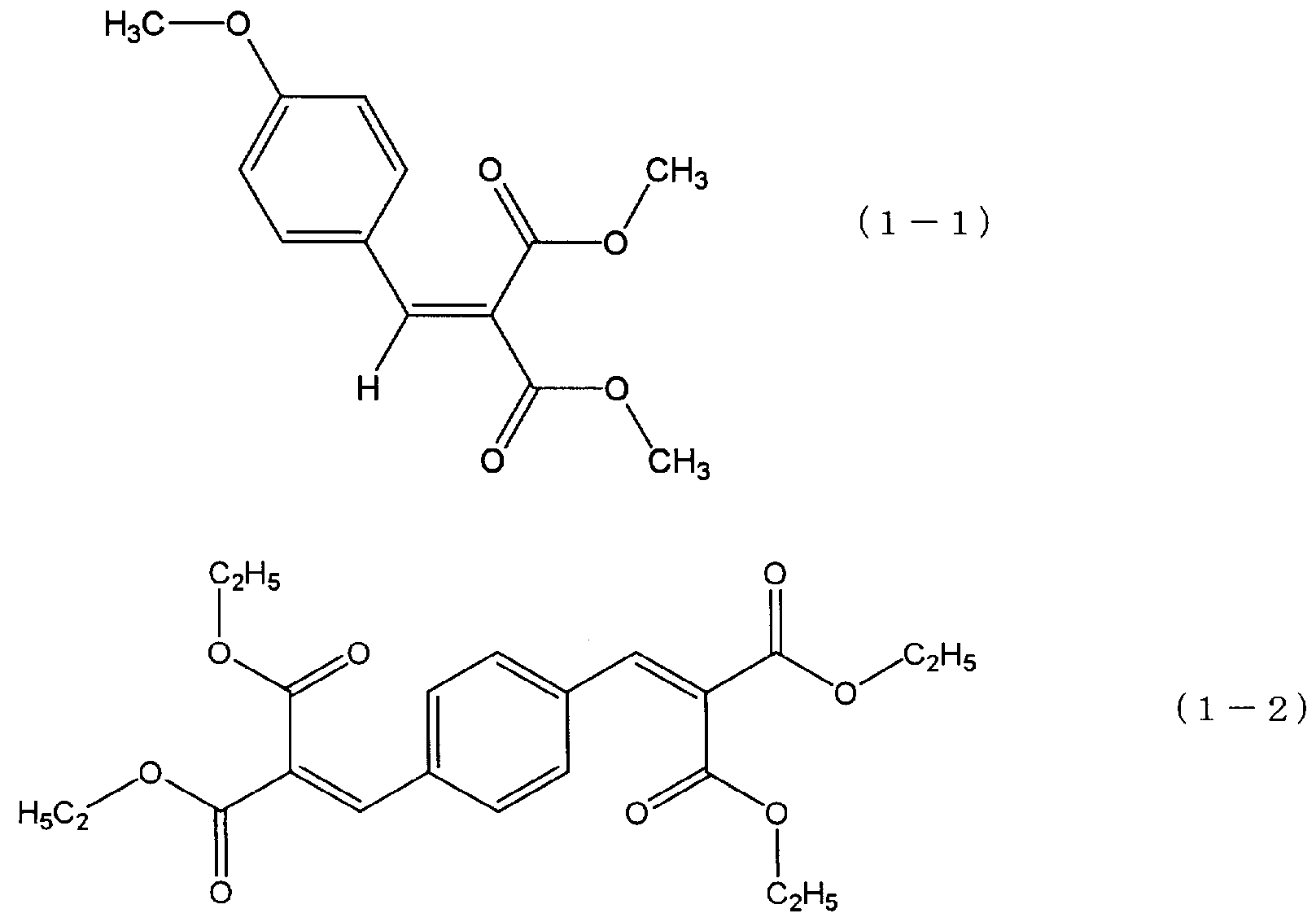

式(3)中、R11は、炭素数1~20の有機基を表し、R12は、水素原子、炭素数1~8のアルキル基又は炭素数1~8のアルコキシ基を表し、R13は、水素原子又は水酸基を表す。
上記トリアジン化合物の市販品は、例えば、Tinuvin400(チバガイギー社製、R11が-CH2CH(OH)CH2-O-C12H25又は-CH2CH(OH)CH2-O-C13H27、R12がCH3-、R13がOH-である)、Tinuvin405(チバガイギー社製、R11が-CH2CH(OH)CH2-O-CH2CH(C2H5)C4H9、R12がCH3-、R13がOH-である)、Tinuvin460(チバガイギー社製、R11がC4H9-、R12がC4H9O-、R13がOH-である)、Tinuvin1577(チバガイギー社製、R11がC6H13-、R12がH-、R13がOH-である)、LA-46(アデカ社製、R11がCH3CH2CH2-O-C(=O)-CH2CH2CH2CH2-、R12がH-、R13がOH-である)等が挙げられる。
式(3)中、R11は、炭素数3~16の有機基を表すことが好ましい。上記有機基はアルキル基であってもよく、有機基中にエーテル結合と水酸基を有する有機基又はエステル結合を有する有機基であってもよい。
式(3)中、R12は、水素原子、炭素数2~5のアルキル基又は炭素数2~5のアルコキシ基であることが好ましい。式(3)中、R13は、水酸基であることが好ましい。

式(4)中、R14は、水素原子又はハロゲン原子を表し、R15は、炭素数3~10のアルキル基を表し、R16は、炭素数1~10のアルキル基を表す。
上記ベンゾトリアゾール化合物の市販品は、例えば、Tinuvin328(チバガイギー社製、R14がH-であり、R15がCH3CH2C(CH3)2-であり、R16がCH3CH2C(CH3)2-である)、Tinuvin326(チバガイギー社製、R14がCl-であり、R15がCH3C(CH3)2-であり、R16がCH3-である)、Tinuvin234(チバガイギー社製、R14がH-であり、R15が1-メチル-1-フェニルエチル基であり、R16が1-メチル-1-フェニルエチル基である)等が挙げられる。
式(4)中、R14は、水素原子であることが好ましい。式(4)中、R15は、炭素数3~10の分岐構造を有するアルキル基であることが好ましい。式(4)中、R16は、炭素数3~10の分岐構造を有するアルキル基であることが好ましい。
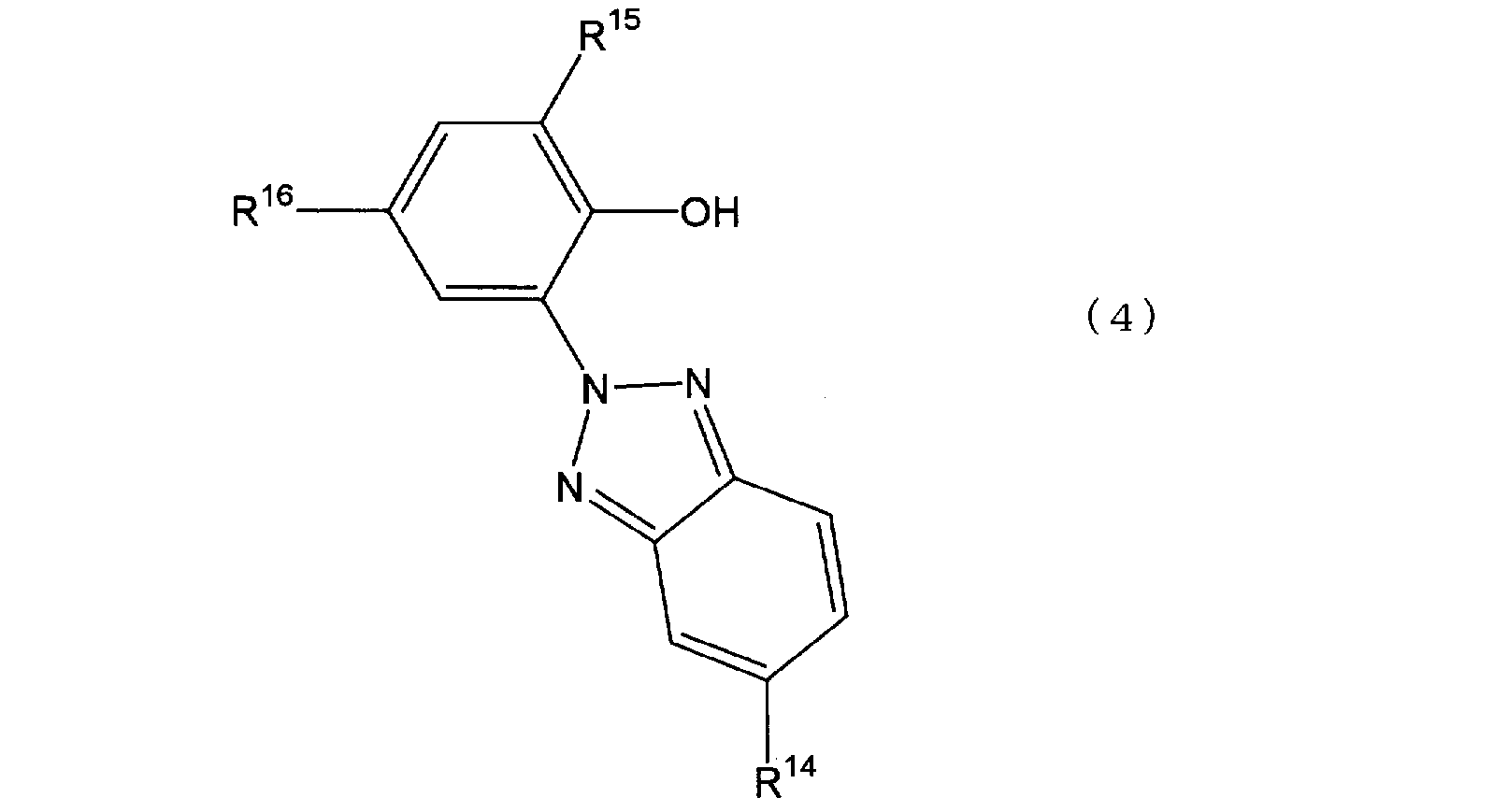
式(5)中、R17は、水素、水酸基又は炭素数1~8のアルキル基を表し、R18は水素、水酸基又は炭素数1~8のアルキル基を表す。R17、R18は同一であってもよく、異なっていてもよい。

上記合わせガラス用中間膜における上記熱可塑性樹脂100重量部に対する上記マロン酸エステル化合物、シュウ酸アニリド化合物及びトリアジン化合物の含有量の合計の下限は0.8重量部である。上記マロン酸エステル化合物、シュウ酸アニリド化合物及びトリアジン化合物からなる群より選択される少なくとも1種の化合物の含有量が0.8重量部未満であると、光に曝されることにより位相差素子が劣化する。
上記合わせガラス用中間膜における上記熱可塑性樹脂100重量部に対する上記ベンゾトリアゾール化合物及びベンゾフェノン化合物の含有量の下限は0.8重量部である。前記ベンゾトリアゾール化合物及びベンゾフェノン化合物の含有量が0.8重量部未満であると、光に曝されることにより位相差素子が劣化する。
また、上記合わせガラス用中間膜において、上記熱可塑性樹脂100重量部に対して、上記ベンゾトリアゾール化合物又はベンゾフェノン化合物の含有量が0.8重量部以上であることが好ましい。
光に曝されることにより位相差素子が劣化することを防止する効果に優れることから、上記熱可塑性樹脂100重量部に対する上記トリアジン化合物及びベンゾトリアゾール化合物の含有量の合計の好ましい下限は1.7重量部、好ましい上限は3.4重量部である。
光に曝されることにより位相差素子が劣化することを防止する効果に優れることから、上記熱可塑性樹脂100重量部に対する上記シュウ酸アニリド化合物及びベンゾトリアゾール化合物の含有量の合計の好ましい下限は1.7重量部、好ましい上限は2.8重量部である。
光に曝されることにより位相差素子が劣化することを防止する効果に優れることから、上記熱可塑性樹脂100重量部に対する上記マロン酸エステル化合物及びベンゾトリアゾール化合物の含有量の合計の好ましい下限は1.7重量部、好ましい上限は2.6重量部である。
上記熱可塑性樹脂は特に限定されないが、ポリビニルアセタール樹脂、エチレン-酢酸ビニル共重合体樹脂、エチレン-アクリル共重合体樹脂、ポリウレタン樹脂、硫黄元素を含有するポリウレタン樹脂、ポリビニルアルコール樹脂等が挙げられる。なかでも、可塑剤と併用するとガラスに対して優れた接着性を発揮する合わせガラス用中間膜が得られることから、ポリビニルアセタール樹脂が好適に用いられる。
上記ポリビニルアセタール樹脂のアセタール化度の好ましい下限は40モル%、好ましい上限は85モル%であり、より好ましい下限は55モル%、より好ましい上限は80モル%であり、更に好ましい下限は60モル%、更に好ましい上限は75モル%である。
また、上記ポリビニルブチラール樹脂のブチラール化度の好ましい下限は40モル%、好ましい上限は85モル%であり、より好ましい下限は55モル%、より好ましい上限は80モル%であり、更に好ましい下限は60モル%、更に好ましい上限は75モル%である。
なお、上記アセタール化度及びブチラール化度は、赤外吸収スペクトル(IR)法により、測定することができる。例えば、FT-IR(堀場製作所社製、FREEEXACT-II、FT-720)を用いて測定することができる。
水酸基量が15モル%未満であると、合わせガラス用中間膜とガラスとの接着性が低下したり、合わせガラスの耐貫通性が低下したりすることがある。水酸基量が35モル%を超えると、合わせガラス用中間膜が硬くなることがある。
上記ポリビニルアルコールは、通常、ポリ酢酸ビニルを鹸化することにより得られ、鹸化度80~99.8モル%のポリビニルアルコールが一般的に用いられる。
また、上記ポリビニルアルコールの重合度の好ましい下限は200、好ましい上限は4000である。上記重合度が200未満であると、合わせガラスの耐貫通性が低下することがある。上記重合度が4000を超えると、合わせガラス用中間膜の成形が困難となることがある。上記重合度のより好ましい下限は500、より好ましい上限は3000であり、更に好ましい下限は1000、更に好ましい上限は2500である。
これらのアルデヒドは単独で用いられてもよいし、2種以上が併用されてもよい。
上記可塑剤は特に限定されず、例えば、一塩基性有機酸エステル、多塩基性有機酸エステル等の有機エステル可塑剤や、有機リン酸可塑剤、有機亜リン酸可塑剤等のリン酸可塑剤等が挙げられ、上記可塑剤は液状可塑剤であることが好ましい。
上記一塩基性有機酸エステルは特に限定されないが、例えば、トリエチレングリコール、テトラエチレングリコール、トリプロピレングリコール等のグリコールと、酪酸、イソ酪酸、カプロン酸、2-エチル酪酸、ヘプチル酸、n-オクチル酸、2-エチルヘキシル酸、ペラルゴン酸(n-ノニル酸)、デシル酸等の一塩基性有機酸との反応によって得られたグリコールエステル等が挙げられる。なかでも、トリエチレングリコールジカプロン酸エステル、トリエチレングリコール-ジ-2-エチル酪酸エステル、トリエチレングリコール-ジ-n-オクチル酸エステル、トリエチレングリコール-ジ-2-エチルヘキシル酸エステル等のトリエチレングリコールジアルキル酸エステル等が好適である。
更に、上記可塑剤は、加水分解を起こしにくいため、トリエチレングリコール-ジ-2-エチルヘキサノエート(3GO)、トリエチレングリコール-ジ-2-エチルブチレート(3GH)、テトラエチレングリコール-ジ-2-エチルヘキサノエート(4GO)、ジヘキシルアジペート(DHA)であることが好ましく、トリエチレングリコール-ジ-2-エチルヘキサノエート(3GO)であることがより好ましい。
なお、上記可視光線透過率Tvを測定する装置は特に限定されず、例えば、分光光度計(日立製作所社製「U-4000」)等が挙げられる。
上記混練の方法は特に限定されず、例えば、押出機、プラストグラフ、ニーダー、バンバリーミキサー、カレンダーロール等を用いる方法が挙げられる。
また、上記成形する方法は特に限定されず、例えば、押し出し法、カレンダー法、プレス法等が挙げられる。
なかでも、下記式(6)で表される化合物、下記式(7)で表される化合物及び下記式(8)で表される化合物からなる群より選択される少なくとも1種の化合物と液晶性化合物とを含有する位相差素子が好適である。このような位相差素子は、耐熱性に優れ、高温雰囲気下において位相差値の変化が少なく、安定した光学性能を維持することができる。
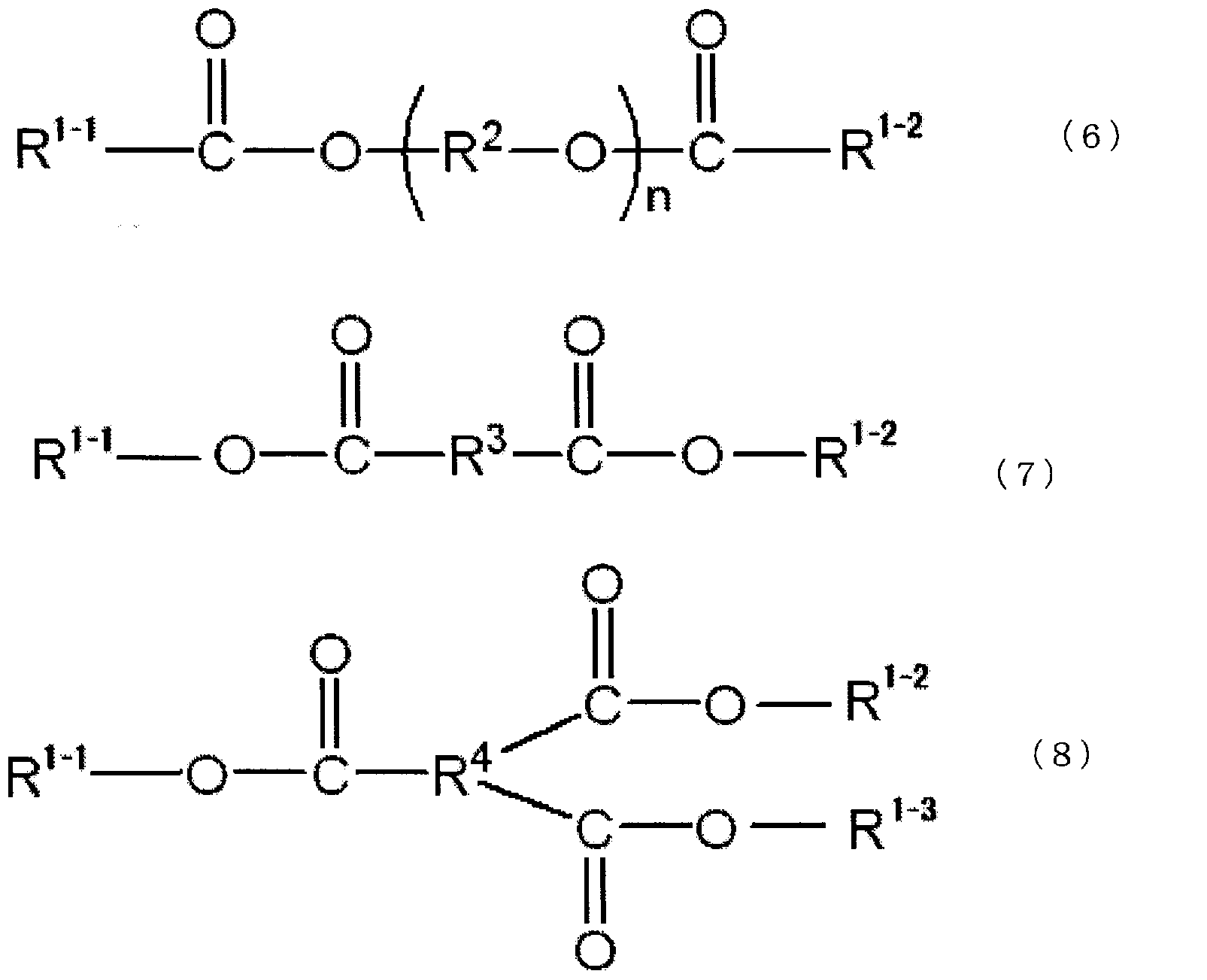
式(7)中、R3は-(CH2)p-基又はフェニレン基を表し、pは4~8の整数を表す。
式(8)中、R4は置換フェニレン基を表す。
式(6)~式(8)中R1-1、R1-2、R1-3は、炭素数5以上の分岐構造を有するアルキル基を表す。R1-1、R1-2、R1-3は、同一であってもよく、異なっていてもよい。
上記式(7)中、R3がフェニレン基である場合、o位、m位、p位のいずれに置換基を有してもよいが、o位に置換基を有することが好ましい。
上記式(8)中、R4が置換フェニレン基である場合、o位、m位、p位のいずれに置換基を有してもよいが、o位及びp位に置換基を有することが好ましい。
ここで、上記メソゲン基として、例えば、ビフェニル基、ターフェニル基、(ポリ)安息香酸フェニルエステル基、(ポリ)エーテル基、ベンジリデンアニリン基、アセナフトキノキサリン基等のロッド状の置換基、板状の置換基、又は、トリフェニレン基、フタロシアニン基、アザクラウン基等の円盤状の置換基等が挙げられる。すなわち、上記メソゲン基は液晶相挙動を誘導する能力を有する。なお、ロッド状又は板状の置換基を有する液晶性化合物は、カラミティック液晶として知られている。また、円盤状の置換基を有する液晶性化合物は、ディスコティック液晶として知られている。
上記メソゲン基を有する重合性液晶は、必ずしもそれ自身が液晶相を示さなくても他の化合物との混合、他のメソゲン基を有する化合物との混合、他の液晶性化合物との混合、又は、これらの混合物のポリマー化によって液晶相を示す重合性液晶であってもよい。
上記重合性液晶は特に限定されず、例えば、特開平8-50206号公報、特開2003-315556号公報、特開2004-29824号公報に記載されている重合性液晶や、BASF社製「PALIOCOLORシリーズ」、Merck社製「RMMシリーズ」等が挙げられる。なかでも下記式(9)で表される重合性液晶は複数の重合性基を有することにより、耐熱性に優れるためより好ましい。


式(9-2)中、u、vは2~10の整数を表し、R9は-COO-(CH2)w-CH3又は-(CH2)w-CH3を表す。
Wは0~11の整数を表す。

上記液晶性を有しない重合性化合物は特に限定されず、例えば、紫外線硬化型樹脂等が挙げられる。
上記反応助剤は特に限定されず、例えば、トリエタノールアミン、メチルジエタノールアミン、トリイソプロパノールアミン、n-ブチルアミン、N-メチルジエタノールアミン、ジエチルアミノエチルメタアクリレート、ミヒラーケトン、4,4’-ジエチルアミノフェノン、4-ジメチルアミノ安息香酸エチル、4-ジメチルアミノ安息香酸(n-ブトキシ)エチル、4-ジメチルアミノ安息香酸イソアミル等のアミン化合物が挙げられる。
また、上記反応助剤の含有量は、上記光重合開始剤の含有量に対して、0.5~2倍量であることが好ましい。
より具体的には、例えば、上記液晶性組成物を所定の濃度になるように溶剤に溶解させ、この溶液をラビング処理したフィルム上に塗布する。次いで、溶剤を加熱等により除去するが、この加熱の過程で、又は、その後液晶相を示す温度で放置することにより、上記液晶性化合物が一定方向に配向する。配向を固定化するために、このまま放冷しても、配向状態を維持したまま、紫外線を照射して重合等により硬化させてもよい。また上記位相差素子は、上記重合性液晶を重合させることにより得られたフィルムを、上記式(6)で表される化合物、上記式(7)で表される化合物及び上記式(8)で表される化合物からなる群より選択される少なくとも1種の化合物により膨潤させて製造してもよい。
上記ラビング処理は、鋼やアルミニウム等の金属ロールに、ナイロン、レーヨン、コットン等のベルベット状のラビング布を、両面テープ等を用いて貼り合せて作製したラビングロールを用い、これを高速回転させ、ガラス板やプラスチックフィルムを接触させながら移動させることにより達成される。
上記ラビング処理の条件は、用いる液晶性化合物の配向のしやすさ、用いるラビング布の種類、ラビングロール径、ラビングロールの回転数、基板の進行方向に対する回転方向、基板とラビングロールの接触長、基板へのラビングロールの押し込みの強さ、基板の搬送速度、基板がプラスチックフィルムである場合には、該フィルムとラビングロール接触部分のラップ角、該プラスチックフィルムの搬送張力等の諸条件によって適宜調整すればよい。
上記紫外線の照射量は、液晶性化合物や他の重合性化合物の種類や反応性、光重合開始剤の種類と添加量、膜厚によって異なるが、通常、100~1000mJ/cm2程度がよい。また、紫外線照射時の雰囲気は空気中、窒素等の不活性ガス中等、重合のしやすさに応じて適宜選択することができる。
上記位相差値は、位相差素子の面内の最大屈折率方向(遅相軸)をnx、それと面内で直交する方向をny、厚さ方向の屈折率をnz、厚さをdとするとき、正面方向の位相差値Re、及び、厚さ方向の位相差値Rthは、それぞれ下記式(13)及び下記式(14)によって求めることができる。
Re=(nx-ny)・d (13)
Rth=[{(nx+ny)/2}-nz]・d (14)
nx、ny、nzの値は用いる液晶性組成物の種類や配向の方法によって制御することができる。そのような方法として、例えば、配向処理される基板の表面張力、ラビング強度、配向膜の種類等を調整する方法が挙げられる。
上記ガラス転移温度が-20℃以下の粘着剤は特に限定されず、例えば、アクリル粘着剤、シリコーン粘着剤、ウレタン粘着剤、ポリエーテル粘着剤、ポリエステル粘着剤、ゴム粘着剤等の感圧接着剤が挙げられる。なかでも、耐衝撃性に優れることから、アクリル粘着剤が特に好ましい。
なお、ガラス転移温度は、粘弾性測定装置(TAインスツルメント社製、ARES)を用いて測定することができる。ガラス転移温度は、例えば、測定温度範囲が-100~180℃、温度掃引速度が5℃/min、パラレルプレートが25mmφ、歪み量が10%、角速度が1rad/secの条件にて測定する。
また、上記(メタ)アクリル酸エステル以外のポリマーのモノマー成分として、ジメチルアミノメチルアクリルアミド、N,N-ジメチルアクリルアミド、アクリロイルモルホリン、ビニルエーテルモノマー、酢酸ビニル、(メタ)アクリルアミド、(メタ)アクリロニトリル等の共重合できるモノマーを用いることができる。
粘着剤1は、モノマー成分として、ブチルアクリレート、メチルアクリレート、メチルメタクリレート、アクリル酸を共重合して得られる。
粘着剤2は、モノマー成分として、ブチルアクリレート、メチルアクリレート、N,N-ジメチルアクリルアミド、2-ヒドロキシエチルアクリレートを共重合して得られる。
粘着剤3は、モノマー成分として、2-エチルヘキシルアクリレート、2-ヒドロキシエチルアクリレートを共重合して得られる。
粘着剤4は、モノマー成分として、ブチルアクリレート、アクリル酸、2-ヒドロキシエチルメタクリレートを共重合して得られる。
粘着剤5は、モノマー成分として、ブチルアクリレート、アクリル酸を共重合して得られる。
上記車外側ガラス及び車内側ガラスは特に限定されず、従来公知の透明板ガラス等を用いることができる。
また、ガラスの代わりにポリカーボネート、ポリメチルメタクリレート等の透明プラスチック板を用いてもよい。
上記合わせガラスを製造する方法は特に限定されず、従来公知の方法を用いることができる。
(1)合わせガラス用中間膜の作製
可塑剤としてトリエチレングリコール-ジ-2-エチルヘキサノエート(3GO)40重量部に、紫外線吸収剤としてベンゾトリアゾール化合物(チバガイギー社製、Tinuvin326)0.8重量部、トリアジン化合物(チバガイギー社製、Tinuvin400)0.8重量部及びヒンダードアミン化合物(チバガイギー社製、Tinuvin144)0.1重量部を溶解させた溶液を、ポリビニルブチラール樹脂(水酸基量30.5モル%、アセチル基量0.9モル%、平均重合度1700)100重量部に添加し、ミキシングロールで均一に溶融混練した後、プレス成形機を用いて、150℃で30分間プレス成形し、厚み0.76mmの合わせガラス用中間膜を作製した。
紫外線硬化型重合性液晶(BASF社製、PARIOCOLORLC242、上記式(9-1)においてsが4、tが4である重合性液晶)100重量部と、2,4,6-トリメチルベンゾイルジフェニルフォスフィンオキサイド(BASF社製、ルシリンTPO)4重量部と、レベリング剤(ビックケミー社製、BYK361)0.1重量部とをシクロペンタノン243重量部に溶解させて固形分30重量%の溶液を調製した。次にトリエチレングリコール-ジ-2-エチルヘキサノエート(3GO)を10重量部加えて均一になるまで攪拌し、液晶性組成物の溶液を得た。次にポリエステルフィルム(東洋紡社製、A4100)をラビングマシン(EHC社製、ラビングロール径45mm、ラビングロール回転数1500rpm、搬送速度1m/min)を用いてラビング処理した。ラビング処理面上にスピンコーターにて上記液晶性組成物の溶液を塗布し、80℃で1分間乾燥後、窒素置換した雰囲気下で高圧水銀灯(630mJ/cm2)を照射して硬化させ、位相差素子を有するフィルムを得た。得られた位相差素子は厚さが4μmであり、ポリエステルフィルムを除去した位相差素子の位相差値を自動複屈折計(王子計測社製、KOBRA-21ADH)で測定した結果、540nmにおける位相差値が270nmであった。
2枚の離型フィルムに挟み込まれたアクリル粘着剤層Aの一方の離型フィルムを剥離して、得られた位相差素子(縦120mm×横120mm)を有するフィルムの位相差素子面に粘着剤層Aを貼り合わせた。次いで、位相差素子からポリエステルフィルムを剥離し、2枚の離型フィルムに挟み込まれたアクリル粘着剤層Bの一方の離型フィルムを剥離し、位相差素子に粘着剤層Bを貼り合わせ、離型フィルム/粘着剤層A/位相差素子/粘着剤層B/離型フィルムの順に積層された位相差素子積層体を作製した。
更に、得られた位相差素子積層体の粘着剤層A側の離型フィルムを剥離し、粘着剤層Aと得られた合わせガラス用中間膜とを、位相差素子の中心と合わせガラス用中間膜の中心とが一致するように貼り合わせることにより、合わせガラス用積層体を作製した。
粘着剤層Bはブチルアクリレートと、アクリル酸とを共重合させて得られたポリマーをイソシアネート架橋剤で架橋させた粘着剤5により形成された粘着剤層である。
なお、ガラス転移温度は、粘弾性測定装置(TAインスツルメント社製、ARES)を用いて測定した。ガラス転移温度は、測定温度範囲が-100~180℃、温度掃引速度が5℃/min、パラレルプレートが25mmφ、歪み量が10%、角速度が1rad/secの条件にて測定した。
可塑剤、紫外線吸収剤の種類及び配合量、ヒンダードアミン化合物の種類及び配合量、粘着剤層の種類を表1及び表2に示したように変更した以外は、実施例1と同様にして合わせガラス用積層体及び合わせガラスを作製した。
なお、本実施例及び比較例で用いた化合物について以下に示した。
トリエチレングリコール-ジ-2-エチルブチレート(3GH)
ベンゾトリアゾール化合物(チバガイギー社製、Tinuvin326)
ベンゾトリアゾール化合物(チバガイギー社製、Tinuvin328)
ベンゾフェノン化合物(アデカ社製、ADEKA1413)
マロン酸エステル化合物(クラリアント社製、Hostavin PR-25)
シュウ酸アニリド化合物(クラリアント社製、Sanduor VSU)
トリアジン化合物(チバガイギー社製、Tinuvin400)
ヒンダードアミン化合物(アデカ社製、LA-63P)
ヒンダードアミン化合物(チバガイギー社製、Tinuvin144)
粘着剤1(ブチルアクリレートと、メチルアクリレートと、メチルメタクリレートと、アクリル酸とを共重合させて得られたポリマーをイソシアネート架橋剤で架橋させた粘着剤、ガラス転移温度は-20℃)
粘着剤2(ブチルアクリレートと、メチルアクリレートと、N,N-ジメチルアクリルアミドと、2-ヒドロキシエチルアクリレートとを共重合させて得られたポリマーをイソシアネート架橋剤で架橋させた粘着剤、ガラス転移温度は-30℃)
粘着剤3(2-エチルヘキシルアクリレートと、2-ヒドロキシエチルアクリレートとを共重合させて得られたポリマーをイソシアネート架橋剤で架橋させた粘着剤、ガラス転移温度は-70℃)
粘着剤4(ブチルアクリレートと、アクリル酸と、2-ヒドロキシエチルメタクリレートとを共重合させて得られたポリマーをイソシアネート架橋剤で架橋させた粘着剤、ガラス転移温度は-45℃、全モノマー成分100重量部に対するアクリル酸の含有量は3重量部であった。)
粘着剤5(ブチルアクリレートと、アクリル酸とを共重合させて得られたポリマーをイソシアネート架橋剤で架橋させた粘着剤、ガラス転移温度は-50℃)
実施例及び比較例で得られた合わせガラスについて以下の評価を行った。結果を表1、表2及び表3に示した。
JIS R 3211及びJIS R 3212に準拠した方法により、得られた合わせガラスに紫外線を1000時間照射した後、自動複屈折計(王子計測社製、KOBRA-21ADH)を用いて540nmにおける位相差値を測定した。紫外線照射前後の位相差変化を下記式により算出した。
変化率(%)=
[{(紫外線照射後の位相差値)-(初期位相差値)}/(初期位相差値)]×100
なお、粘着剤層Bと接触していないガラス板側から、紫外線を合わせガラスに照射した。
得られた位相差変化の変化率(%)が0%以上~3%未満であった場合を「◎」、3%以上~6%未満であった場合を「○」、6%以上~8%未満であった場合を「△」、8%以上であった場合を「×」と評価した。
得られた合わせガラスについて、JIS R 3211及びJIS R 3212に準拠した方法により、耐衝撃性評価を行った。合格した合わせガラスを「○」、不合格の合わせガラスを「×」と評価した。
なお、粘着剤層Bと接触していないガラス板側に、剛球を落球させた。
得られた合わせガラスについて、積分式濁度計(東京電色社製)を用い、JIS K 7105に準拠してヘイズを測定した。
なお、ガラス板/合わせガラス用中間膜/粘着剤層A/位相差素子/粘着剤層B/ガラス板が積層されている部位のヘイズを測定した。


2 合わせガラス用中間膜
3 粘着剤層
4 位相差素子
5 粘着剤層
6 車内側ガラス
7 合わせガラス用積層体
Claims (20)
- 合わせガラス用中間膜と、粘着剤層で挟み込まれた位相差素子とが積層されている合わせガラス用積層体であって、
前記合わせガラス用中間膜は、熱可塑性樹脂及び紫外線吸収剤を含有し、
前記紫外線吸収剤として、マロン酸エステル化合物、シュウ酸アニリド化合物及びトリアジン化合物からなる群より選択される少なくとも1種の化合物と、ベンゾトリアゾール化合物又はベンゾフェノン化合物とを含有し、
前記熱可塑性樹脂100重量部に対する前記マロン酸エステル化合物、シュウ酸アニリド化合物及びトリアジン化合物の含有量の合計が0.8重量部以上、かつ、前記ベンゾトリアゾール化合物又はベンゾフェノン化合物の含有量の合計が0.8重量部以上であり、
前記粘着剤層は、ガラス転移温度が-20℃以下の粘着剤を含有する
ことを特徴とする合わせガラス用積層体。 - 紫外線吸収剤としてトリアジン化合物とベンゾトリアゾール化合物とを含有し、熱可塑性樹脂100重量部に対する前記トリアジン化合物の含有量が0.8~2.0重量部、前記ベンゾトリアゾール化合物の含有量が0.8~1.4重量部であることを特徴とする請求項1記載の合わせガラス用積層体。
- 紫外線吸収剤としてシュウ酸アニリド化合物とベンゾトリアゾール化合物とを含有し、熱可塑性樹脂100重量部に対する前記シュウ酸アニリド化合物の含有量が0.8~1.4重量部、前記ベンゾトリアゾール化合物の含有量が0.8~1.4重量部であることを特徴とする請求項1記載の合わせガラス用積層体。
- 紫外線吸収剤としてマロン酸エステル化合物とベンゾトリアゾール化合物とを含有し、熱可塑性樹脂100重量部に対する前記マロン酸エステル化合物の含有量が0.8~1.2重量部、前記ベンゾトリアゾール化合物の含有量が0.8~1.4重量部であることを特徴とする請求項1記載の合わせガラス用積層体。
- 紫外線吸収剤としてトリアジン化合物とベンゾフェノン化合物とを含有し、熱可塑性樹脂100重量部に対する前記トリアジン化合物の含有量が0.8~2.0重量部、前記ベンゾフェノン化合物の含有量が0.8~1.6重量部であることを特徴とする請求項1記載の合わせガラス用積層体。
- 紫外線吸収剤としてシュウ酸アニリド化合物とベンゾフェノン化合物とを含有し、熱可塑性樹脂100重量部に対する前記シュウ酸アニリド化合物の含有量が0.8~1.4重量部、前記ベンゾフェノン化合物の含有量が0.8~1.6重量部であることを特徴とする請求項1記載の合わせガラス用積層体。
- 紫外線吸収剤としてマロン酸エステル化合物とベンゾフェノン化合物とを含有し、熱可塑性樹脂100重量部に対する前記マロン酸エステル化合物の含有量が0.8~1.2重量部、前記ベンゾフェノン化合物の含有量が0.8~1.6重量部であることを特徴とする請求項1記載の合わせガラス用積層体。
- 合わせガラス用中間膜は、更にヒンダードアミン化合物を含有することを特徴とする請求項1、2、3、4、5、6又は7記載の合わせガラス用積層体。
- 粘着剤層は、アクリル粘着剤を含有することを特徴とする請求項1、2、3、4、5、6又は7記載の合わせガラス用積層体。
- 熱可塑性樹脂はポリビニルアセタール樹脂であることを特徴とする1、2、3、4、5、6又は7記載の合わせガラス用積層体。
- 更に、合わせガラス用中間膜は可塑剤を含有することを特徴とする請求項10記載の合わせガラス用積層体。
- 熱可塑性樹脂及び紫外線吸収剤を含有する合わせガラス用中間膜であって、
前記紫外線吸収剤として、マロン酸エステル化合物、シュウ酸アニリド化合物及びトリアジン化合物からなる群より選択される少なくとも1種の化合物と、ベンゾトリアゾール化合物又はベンゾフェノン化合物とを含有し、
前記熱可塑性樹脂100重量部に対する前記マロン酸エステル化合物、シュウ酸アニリド化合物及びトリアジン化合物の含有量の合計が0.8重量部以上、かつ、前記ベンゾトリアゾール化合物又はベンゾフェノン化合物の含有量の合計が0.8重量部以上である
ことを特徴とする合わせガラス用中間膜。 - 紫外線吸収剤としてトリアジン化合物とベンゾトリアゾール化合物とを含有し、熱可塑性樹脂100重量部に対する前記トリアジン化合物の含有量が0.8~2.0重量部、前記ベンゾトリアゾール化合物の含有量が0.8~1.4重量部であることを特徴とする請求項12記載の合わせガラス用中間膜。
- 紫外線吸収剤としてシュウ酸アニリド化合物とベンゾトリアゾール化合物とを含有し、熱可塑性樹脂100重量部に対する前記シュウ酸アニリド化合物の含有量が0.8~1.4重量部、前記ベンゾトリアゾール化合物の含有量が0.8~1.4重量部であることを特徴とする請求項12記載の合わせガラス用中間膜。
- 紫外線吸収剤としてマロン酸エステル化合物とベンゾトリアゾール化合物とを含有し、熱可塑性樹脂100重量部に対する前記マロン酸エステル化合物の含有量が0.8~1.2重量部、前記ベンゾトリアゾール化合物の含有量が0.8~1.4重量部であることを特徴とする請求項12記載の合わせガラス用中間膜。
- 紫外線吸収剤としてトリアジン化合物とベンゾフェノン化合物とを含有し、熱可塑性樹脂100重量部に対する前記トリアジン化合物の含有量が0.8~2.0重量部、前記ベンゾフェノン化合物の含有量が0.8~1.6重量部であることを特徴とする請求項12記載の合わせガラス用中間膜。
- 紫外線吸収剤としてシュウ酸アニリド化合物とベンゾフェノン化合物とを含有し、熱可塑性樹脂100重量部に対する前記シュウ酸アニリド化合物の含有量が0.8~1.4重量部、前記ベンゾフェノン化合物の含有量が0.8~1.6重量部であることを特徴とする請求項12記載の合わせガラス用中間膜。
- 紫外線吸収剤としてマロン酸エステル化合物とベンゾフェノン化合物とを含有し、熱可塑性樹脂100重量部に対する前記マロン酸エステル化合物の含有量が0.8~1.2重量部、前記ベンゾフェノン化合物の含有量が0.8~1.6重量部であることを特徴とする請求項12記載の合わせガラス用中間膜。
- 熱可塑性樹脂はポリビニルアセタール樹脂であることを特徴とする12、13、14、15、16、17又は18記載の合わせガラス用中間膜。
- 更に、可塑剤を含有することを特徴とする請求項19記載の合わせガラス用中間膜。
Priority Applications (8)
| Application Number | Priority Date | Filing Date | Title |
|---|---|---|---|
| US13/139,806 US8367216B2 (en) | 2008-12-22 | 2009-12-22 | Laminate for laminated glass and interlayer film for laminated glass |
| RU2011130561/05A RU2523814C2 (ru) | 2008-12-22 | 2009-12-22 | Слоистый материал для многослойного стекла и межслойная пленка для многослойного стекла |
| CN200980151518.2A CN102256910B (zh) | 2008-12-22 | 2009-12-22 | 夹层玻璃用层叠体及夹层玻璃用中间膜 |
| KR1020117016672A KR101692086B1 (ko) | 2008-12-22 | 2009-12-22 | 합판 유리용 적층체 및 합판 유리용 중간막 |
| JP2009554649A JP4570687B2 (ja) | 2008-12-22 | 2009-12-22 | 合わせガラス用積層体及び合わせガラス用中間膜 |
| EP09834847.7A EP2380859B1 (en) | 2008-12-22 | 2009-12-22 | Laminate for laminated glass and interlayer for laminated glass |
| BRPI0923529A BRPI0923529A2 (pt) | 2008-12-22 | 2009-12-22 | laminado para vidro laminado e película de intercamada para vidro laminado |
| US13/732,635 US8557394B2 (en) | 2008-12-22 | 2013-01-02 | Laminate for laminated glass and interlayer film for laminated glass |
Applications Claiming Priority (2)
| Application Number | Priority Date | Filing Date | Title |
|---|---|---|---|
| JP2008326168 | 2008-12-22 | ||
| JP2008-326168 | 2008-12-22 |
Related Child Applications (2)
| Application Number | Title | Priority Date | Filing Date |
|---|---|---|---|
| US13/139,806 A-371-Of-International US8367216B2 (en) | 2008-12-22 | 2009-12-22 | Laminate for laminated glass and interlayer film for laminated glass |
| US13/732,635 Continuation US8557394B2 (en) | 2008-12-22 | 2013-01-02 | Laminate for laminated glass and interlayer film for laminated glass |
Publications (1)
| Publication Number | Publication Date |
|---|---|
| WO2010074046A1 true WO2010074046A1 (ja) | 2010-07-01 |
Family
ID=42287655
Family Applications (1)
| Application Number | Title | Priority Date | Filing Date |
|---|---|---|---|
| PCT/JP2009/071268 Ceased WO2010074046A1 (ja) | 2008-12-22 | 2009-12-22 | 合わせガラス用積層体及び合わせガラス用中間膜 |
Country Status (9)
| Country | Link |
|---|---|
| US (2) | US8367216B2 (ja) |
| EP (1) | EP2380859B1 (ja) |
| JP (2) | JP4570687B2 (ja) |
| KR (1) | KR101692086B1 (ja) |
| CN (1) | CN102256910B (ja) |
| BR (1) | BRPI0923529A2 (ja) |
| RU (1) | RU2523814C2 (ja) |
| TW (1) | TWI462888B (ja) |
| WO (1) | WO2010074046A1 (ja) |
Cited By (3)
| Publication number | Priority date | Publication date | Assignee | Title |
|---|---|---|---|---|
| JP2014504229A (ja) * | 2010-12-13 | 2014-02-20 | サン−ゴバン グラス フランス | 湾曲窓板 |
| US20140307218A1 (en) * | 2012-01-17 | 2014-10-16 | Lg Chem, Ltd. | Liquid crystal composition |
| JP2022500703A (ja) * | 2018-09-24 | 2022-01-04 | スリーエム イノベイティブ プロパティズ カンパニー | 反射フィルムを含むガラスラミネート |
Families Citing this family (34)
| Publication number | Priority date | Publication date | Assignee | Title |
|---|---|---|---|---|
| JP2009188105A (ja) * | 2008-02-05 | 2009-08-20 | Teijin Dupont Films Japan Ltd | 太陽電池裏面保護膜用フィルム |
| JP2012137599A (ja) * | 2010-12-27 | 2012-07-19 | Ricoh Co Ltd | 電子写真感光体、該電子写真感光体を使用した画像形成方法、画像形成装置及びプロセスカートリッジ |
| US8995039B2 (en) * | 2011-05-06 | 2015-03-31 | Pittsburgh Glass Works, Llc | Switchable automotive glazing |
| KR20130081531A (ko) * | 2012-01-09 | 2013-07-17 | 삼성디스플레이 주식회사 | 도너 필름 및 이를 이용한 유기 발광 표시 장치 제조 방법 및 이를 이용하여 제조된 유기 발광 표시 장치 |
| WO2013118890A1 (ja) * | 2012-02-10 | 2013-08-15 | 積水化学工業株式会社 | 合わせガラス用中間膜及び合わせガラス |
| WO2014022663A1 (en) * | 2012-08-03 | 2014-02-06 | Corning Incorporated | Multi-layer transparent light-weight safety glazings |
| KR20160065044A (ko) * | 2013-09-30 | 2016-06-08 | 세키스이가가쿠 고교가부시키가이샤 | 접합 유리용 중간막 및 접합 유리 |
| JP5744345B1 (ja) | 2013-09-30 | 2015-07-08 | 積水化学工業株式会社 | 合わせガラス用中間膜及び合わせガラス |
| KR101399477B1 (ko) * | 2014-02-13 | 2014-05-30 | 삼성탈레스 주식회사 | 광학용 대형 사파이어 창의 접합방법 |
| US10800143B2 (en) | 2014-03-07 | 2020-10-13 | Corning Incorporated | Glass laminate structures for head-up display system |
| US20170147098A1 (en) * | 2014-04-03 | 2017-05-25 | Sekisui Chemical Co., Ltd. | Interlayer filling material for touch panel, and laminated body |
| WO2016017825A1 (ja) * | 2014-08-01 | 2016-02-04 | 積水化学工業株式会社 | 合わせガラス用中間膜及び合わせガラス |
| KR102041266B1 (ko) * | 2014-09-29 | 2019-11-06 | 세키스이가가쿠 고교가부시키가이샤 | 접합 유리용 중간막 및 접합 유리 |
| JP2016108230A (ja) * | 2014-11-10 | 2016-06-20 | 株式会社クラレ | 合わせガラス用中間膜および合わせガラス |
| JP6394963B2 (ja) * | 2014-12-19 | 2018-09-26 | 日本電気硝子株式会社 | ガラス樹脂積層体 |
| KR102539977B1 (ko) | 2015-03-31 | 2023-06-05 | 세키스이가가쿠 고교가부시키가이샤 | 접합 유리용 중간막 및 접합 유리 |
| FR3044258B1 (fr) * | 2015-11-30 | 2017-12-22 | Saint Gobain | Vitrage feuillete a base d'adhesif sensible a la pression |
| WO2018078882A1 (ja) * | 2016-10-31 | 2018-05-03 | 日立化成株式会社 | 合わせガラス及びその製造方法、並びに、合わせガラスの中間膜用光硬化性樹脂組成物 |
| WO2018078881A1 (ja) * | 2016-10-31 | 2018-05-03 | 日立化成株式会社 | 合わせガラス、及び合わせガラスの中間膜用フィルム材 |
| WO2018147420A1 (ja) * | 2017-02-10 | 2018-08-16 | 積水化学工業株式会社 | 合わせガラス用中間膜及び合わせガラス |
| JP7110606B2 (ja) * | 2017-02-27 | 2022-08-02 | 東ソー株式会社 | 熱可塑性ポリウレタン樹脂組成物、および該樹脂組成物を用いた成形体 |
| EP3587496B1 (en) * | 2017-02-27 | 2022-04-13 | Tosoh Corporation | Thermoplastic polyurethane resin composition and molded body using said resin composition |
| WO2018181755A1 (ja) * | 2017-03-31 | 2018-10-04 | 積水化学工業株式会社 | 成形体及び合わせガラス |
| JP6985258B2 (ja) * | 2017-03-31 | 2021-12-22 | 積水化学工業株式会社 | 合わせガラス用中間膜及び合わせガラス |
| WO2018181751A1 (ja) * | 2017-03-31 | 2018-10-04 | 積水化学工業株式会社 | 合わせガラス用中間膜及び合わせガラス |
| KR102228070B1 (ko) * | 2017-11-01 | 2021-03-12 | 주식회사 엘지화학 | 화학 증폭형 포토레지스트 조성물 및 이를 이용한 포토레지스트 필름 |
| KR20200118018A (ko) * | 2018-02-02 | 2020-10-14 | 세키스이가가쿠 고교가부시키가이샤 | 접합 유리용 중간막 및 접합 유리 |
| CN112424654B (zh) * | 2018-07-17 | 2023-09-19 | Agc株式会社 | 光学构件 |
| KR102200870B1 (ko) * | 2018-11-20 | 2021-01-11 | 롯데케미칼 주식회사 | 투명성이 우수한 내화학 내광성 폴리카보네이트 수지 조성물 |
| RU2718087C1 (ru) * | 2019-06-20 | 2020-03-30 | Общество с ограниченной ответственностью "Октополимер" | Слоистый уф-блокирующий материал для электрохромного модуля на стекле |
| JP6856720B2 (ja) * | 2019-08-20 | 2021-04-07 | 日東電工株式会社 | ガラス層付積層体および該ガラス層付積層体を含む画像表示装置 |
| WO2021204566A1 (de) | 2020-04-07 | 2021-10-14 | Saint-Gobain Glass France | Verfahren zum herstellen einer verbundscheibe und verbundscheibe |
| US11458707B2 (en) * | 2020-09-01 | 2022-10-04 | AGC Inc. | Laminated glass |
| US20240002574A1 (en) * | 2020-12-02 | 2024-01-04 | Huntsman International Llc | A thermoplastic polyurethane resin composition |
Citations (7)
| Publication number | Priority date | Publication date | Assignee | Title |
|---|---|---|---|---|
| JPH0850206A (ja) | 1994-05-31 | 1996-02-20 | Fuji Photo Film Co Ltd | 光学補償シート、液晶表示装置及びカラー液晶表示装置 |
| JPH08259280A (ja) | 1995-03-28 | 1996-10-08 | Central Glass Co Ltd | 合わせガラス |
| JPH1096874A (ja) * | 1996-05-24 | 1998-04-14 | Asahi Glass Co Ltd | 車両用ウインドシールドガラスおよびヘッドアップディスプレイ装置 |
| WO2003018502A1 (en) * | 2001-07-26 | 2003-03-06 | Sekisui Chemical Co., Ltd. | Laminated glass-use intermediate film and laminated glass |
| JP2003315556A (ja) | 2002-02-19 | 2003-11-06 | Nitto Denko Corp | 光学補償機能付き偏光板、及びそれを用いた液晶表示装置 |
| JP2003327455A (ja) * | 2002-05-08 | 2003-11-19 | Sekisui Chem Co Ltd | 合わせガラス用中間膜及び合わせガラス |
| JP2004029824A (ja) | 2002-06-27 | 2004-01-29 | Merck Patent Gmbh | ポリマー化液晶材料を含む膜の製造方法 |
Family Cites Families (6)
| Publication number | Priority date | Publication date | Assignee | Title |
|---|---|---|---|---|
| AU614466B2 (en) * | 1989-05-23 | 1991-08-29 | Minnesota Mining And Manufacturing Company | Flexible, substrate-insular retroreflective sheeting |
| US6259559B1 (en) | 1995-03-28 | 2001-07-10 | Central Glass Company, Limited | Glass arrangement including an outside glass plate, a polarization direction changing film and an adhesive layer therebetween, and an inside glass layer |
| JP4681193B2 (ja) * | 2000-02-01 | 2011-05-11 | チバ ホールディング インコーポレーテッド | 耐久性紫外線吸収剤による内容物の保護方法 |
| AU2004312250B2 (en) * | 2003-12-26 | 2009-09-03 | Sekisui Chemical Co., Ltd. | Intermediate film for laminated glass and laminated glass |
| KR20080005389A (ko) * | 2005-03-31 | 2008-01-11 | 데이진 가부시키가이샤 | 투명판 |
| JP5230905B2 (ja) * | 2006-03-23 | 2013-07-10 | 株式会社ブリヂストン | 合わせガラス用中間膜、それを用いた合わせガラス及びその製造方法 |
-
2009
- 2009-12-22 EP EP09834847.7A patent/EP2380859B1/en not_active Not-in-force
- 2009-12-22 BR BRPI0923529A patent/BRPI0923529A2/pt not_active Application Discontinuation
- 2009-12-22 WO PCT/JP2009/071268 patent/WO2010074046A1/ja not_active Ceased
- 2009-12-22 CN CN200980151518.2A patent/CN102256910B/zh not_active Expired - Fee Related
- 2009-12-22 JP JP2009554649A patent/JP4570687B2/ja active Active
- 2009-12-22 KR KR1020117016672A patent/KR101692086B1/ko not_active Expired - Fee Related
- 2009-12-22 TW TW98144130A patent/TWI462888B/zh not_active IP Right Cessation
- 2009-12-22 RU RU2011130561/05A patent/RU2523814C2/ru not_active IP Right Cessation
- 2009-12-22 US US13/139,806 patent/US8367216B2/en not_active Expired - Fee Related
-
2010
- 2010-05-27 JP JP2010121787A patent/JP5612357B2/ja active Active
-
2013
- 2013-01-02 US US13/732,635 patent/US8557394B2/en not_active Expired - Fee Related
Patent Citations (7)
| Publication number | Priority date | Publication date | Assignee | Title |
|---|---|---|---|---|
| JPH0850206A (ja) | 1994-05-31 | 1996-02-20 | Fuji Photo Film Co Ltd | 光学補償シート、液晶表示装置及びカラー液晶表示装置 |
| JPH08259280A (ja) | 1995-03-28 | 1996-10-08 | Central Glass Co Ltd | 合わせガラス |
| JPH1096874A (ja) * | 1996-05-24 | 1998-04-14 | Asahi Glass Co Ltd | 車両用ウインドシールドガラスおよびヘッドアップディスプレイ装置 |
| WO2003018502A1 (en) * | 2001-07-26 | 2003-03-06 | Sekisui Chemical Co., Ltd. | Laminated glass-use intermediate film and laminated glass |
| JP2003315556A (ja) | 2002-02-19 | 2003-11-06 | Nitto Denko Corp | 光学補償機能付き偏光板、及びそれを用いた液晶表示装置 |
| JP2003327455A (ja) * | 2002-05-08 | 2003-11-19 | Sekisui Chem Co Ltd | 合わせガラス用中間膜及び合わせガラス |
| JP2004029824A (ja) | 2002-06-27 | 2004-01-29 | Merck Patent Gmbh | ポリマー化液晶材料を含む膜の製造方法 |
Cited By (5)
| Publication number | Priority date | Publication date | Assignee | Title |
|---|---|---|---|---|
| JP2014504229A (ja) * | 2010-12-13 | 2014-02-20 | サン−ゴバン グラス フランス | 湾曲窓板 |
| US20140307218A1 (en) * | 2012-01-17 | 2014-10-16 | Lg Chem, Ltd. | Liquid crystal composition |
| JP2022500703A (ja) * | 2018-09-24 | 2022-01-04 | スリーエム イノベイティブ プロパティズ カンパニー | 反射フィルムを含むガラスラミネート |
| US12049062B2 (en) | 2018-09-24 | 2024-07-30 | 3M Innovative Properties Company | Glass laminate including reflective film |
| US12403674B2 (en) | 2018-09-24 | 2025-09-02 | 3M Innovative Properties Company | Glass laminate including reflective film |
Also Published As
| Publication number | Publication date |
|---|---|
| EP2380859A1 (en) | 2011-10-26 |
| EP2380859B1 (en) | 2018-08-22 |
| KR101692086B1 (ko) | 2017-01-02 |
| RU2523814C2 (ru) | 2014-07-27 |
| JP5612357B2 (ja) | 2014-10-22 |
| TW201033151A (en) | 2010-09-16 |
| JP4570687B2 (ja) | 2010-10-27 |
| CN102256910B (zh) | 2017-10-27 |
| CN102256910A (zh) | 2011-11-23 |
| RU2011130561A (ru) | 2013-01-27 |
| US20130131233A1 (en) | 2013-05-23 |
| TWI462888B (zh) | 2014-12-01 |
| JPWO2010074046A1 (ja) | 2012-06-14 |
| US8367216B2 (en) | 2013-02-05 |
| BRPI0923529A2 (pt) | 2016-01-26 |
| US20120021230A1 (en) | 2012-01-26 |
| JP2010265170A (ja) | 2010-11-25 |
| US8557394B2 (en) | 2013-10-15 |
| EP2380859A4 (en) | 2017-05-17 |
| KR20110097962A (ko) | 2011-08-31 |
Similar Documents
| Publication | Publication Date | Title |
|---|---|---|
| JP5612357B2 (ja) | 合わせガラス用積層体及び合わせガラス用中間膜 | |
| JP4590487B2 (ja) | 合わせガラス用積層体 | |
| KR102451016B1 (ko) | 광학 적층 구조체와 이를 이용한 헤드업 디스플레이 시스템 및 광반사 필름 | |
| US11294177B2 (en) | Head-up display system | |
| US20190091974A1 (en) | Intermediate film for laminated glass, and laminated glass using the intermediate film | |
| TWI468501B (zh) | Phase difference element | |
| HK1159600A (en) | Laminate for laminated glass and interlayer for laminated glass | |
| HK1159760A (en) | Laminate for laminated glass |
Legal Events
| Date | Code | Title | Description |
|---|---|---|---|
| WWE | Wipo information: entry into national phase |
Ref document number: 200980151518.2 Country of ref document: CN |
|
| WWE | Wipo information: entry into national phase |
Ref document number: 2009554649 Country of ref document: JP |
|
| 121 | Ep: the epo has been informed by wipo that ep was designated in this application |
Ref document number: 09834847 Country of ref document: EP Kind code of ref document: A1 |
|
| NENP | Non-entry into the national phase |
Ref country code: DE |
|
| WWE | Wipo information: entry into national phase |
Ref document number: 2009834847 Country of ref document: EP |
|
| WWE | Wipo information: entry into national phase |
Ref document number: 5485/DELNP/2011 Country of ref document: IN |
|
| ENP | Entry into the national phase |
Ref document number: 20117016672 Country of ref document: KR Kind code of ref document: A |
|
| WWE | Wipo information: entry into national phase |
Ref document number: 2011130561 Country of ref document: RU |
|
| WWE | Wipo information: entry into national phase |
Ref document number: 13139806 Country of ref document: US |
|
| REG | Reference to national code |
Ref country code: BR Ref legal event code: B01A Ref document number: PI0923529 Country of ref document: BR |
|
| ENP | Entry into the national phase |
Ref document number: PI0923529 Country of ref document: BR Kind code of ref document: A2 Effective date: 20110622 |