WO2010078512A2 - Production of substituted phenylene aromatic diesters - Google Patents
Production of substituted phenylene aromatic diesters Download PDFInfo
- Publication number
- WO2010078512A2 WO2010078512A2 PCT/US2009/069942 US2009069942W WO2010078512A2 WO 2010078512 A2 WO2010078512 A2 WO 2010078512A2 US 2009069942 W US2009069942 W US 2009069942W WO 2010078512 A2 WO2010078512 A2 WO 2010078512A2
- Authority
- WO
- WIPO (PCT)
- Prior art keywords
- tert
- butyl
- bmpd
- methylcatechol
- forming
- Prior art date
- Legal status (The legal status is an assumption and is not a legal conclusion. Google has not performed a legal analysis and makes no representation as to the accuracy of the status listed.)
- Ceased
Links
- PMRGVXIRSTVLJS-UHFFFAOYSA-N CC(C)(C)c(cc1O)cc(C)c1O Chemical compound CC(C)(C)c(cc1O)cc(C)c1O PMRGVXIRSTVLJS-UHFFFAOYSA-N 0.000 description 2
- 0 Cc(cccc1)c1O* Chemical compound Cc(cccc1)c1O* 0.000 description 2
- OXIGHDTWUVXGFN-UHFFFAOYSA-N CC(C)(C)C(CC1(C)Br)=CC(C)=C1O Chemical compound CC(C)(C)C(CC1(C)Br)=CC(C)=C1O OXIGHDTWUVXGFN-UHFFFAOYSA-N 0.000 description 1
- SNKLPZOJLXDZCW-UHFFFAOYSA-N CC(C)(C)c(cc1)cc(C)c1O Chemical compound CC(C)(C)c(cc1)cc(C)c1O SNKLPZOJLXDZCW-UHFFFAOYSA-N 0.000 description 1
- GXNXZJMAFGKLQI-UHFFFAOYSA-N CC(C)(C)c(cc1OC(c2ccccc2)=O)cc(C)c1OC(c1ccccc1)=O Chemical compound CC(C)(C)c(cc1OC(c2ccccc2)=O)cc(C)c1OC(c1ccccc1)=O GXNXZJMAFGKLQI-UHFFFAOYSA-N 0.000 description 1
- KXDAEFPNCMNJSK-UHFFFAOYSA-N NC(c1ccccc1)=O Chemical compound NC(c1ccccc1)=O KXDAEFPNCMNJSK-UHFFFAOYSA-N 0.000 description 1
Classifications
-
- C—CHEMISTRY; METALLURGY
- C08—ORGANIC MACROMOLECULAR COMPOUNDS; THEIR PREPARATION OR CHEMICAL WORKING-UP; COMPOSITIONS BASED THEREON
- C08F—MACROMOLECULAR COMPOUNDS OBTAINED BY REACTIONS ONLY INVOLVING CARBON-TO-CARBON UNSATURATED BONDS
- C08F10/00—Homopolymers and copolymers of unsaturated aliphatic hydrocarbons having only one carbon-to-carbon double bond
- C08F10/04—Monomers containing three or four carbon atoms
- C08F10/06—Propene
-
- C—CHEMISTRY; METALLURGY
- C08—ORGANIC MACROMOLECULAR COMPOUNDS; THEIR PREPARATION OR CHEMICAL WORKING-UP; COMPOSITIONS BASED THEREON
- C08F—MACROMOLECULAR COMPOUNDS OBTAINED BY REACTIONS ONLY INVOLVING CARBON-TO-CARBON UNSATURATED BONDS
- C08F4/00—Polymerisation catalysts
- C08F4/42—Metals; Metal hydrides; Metallo-organic compounds; Use thereof as catalyst precursors
- C08F4/44—Metals; Metal hydrides; Metallo-organic compounds; Use thereof as catalyst precursors selected from light metals, zinc, cadmium, mercury, copper, silver, gold, boron, gallium, indium, thallium, rare earths or actinides
- C08F4/60—Metals; Metal hydrides; Metallo-organic compounds; Use thereof as catalyst precursors selected from light metals, zinc, cadmium, mercury, copper, silver, gold, boron, gallium, indium, thallium, rare earths or actinides together with refractory metals, iron group metals, platinum group metals, manganese, rhenium technetium or compounds thereof
- C08F4/62—Refractory metals or compounds thereof
- C08F4/64—Titanium, zirconium, hafnium or compounds thereof
- C08F4/65—Pretreating the metal or compound covered by group C08F4/64 before the final contacting with the metal or compound covered by group C08F4/44
- C08F4/651—Pretreating with non-metals or metal-free compounds
-
- C—CHEMISTRY; METALLURGY
- C07—ORGANIC CHEMISTRY
- C07C—ACYCLIC OR CARBOCYCLIC COMPOUNDS
- C07C67/00—Preparation of carboxylic acid esters
- C07C67/14—Preparation of carboxylic acid esters from carboxylic acid halides
-
- B—PERFORMING OPERATIONS; TRANSPORTING
- B01—PHYSICAL OR CHEMICAL PROCESSES OR APPARATUS IN GENERAL
- B01J—CHEMICAL OR PHYSICAL PROCESSES, e.g. CATALYSIS OR COLLOID CHEMISTRY; THEIR RELEVANT APPARATUS
- B01J31/00—Catalysts comprising hydrides, coordination complexes or organic compounds
- B01J31/02—Catalysts comprising hydrides, coordination complexes or organic compounds containing organic compounds or metal hydrides
-
- C—CHEMISTRY; METALLURGY
- C07—ORGANIC CHEMISTRY
- C07C—ACYCLIC OR CARBOCYCLIC COMPOUNDS
- C07C37/00—Preparation of compounds having hydroxy or O-metal groups bound to a carbon atom of a six-membered aromatic ring
- C07C37/01—Preparation of compounds having hydroxy or O-metal groups bound to a carbon atom of a six-membered aromatic ring by replacing functional groups bound to a six-membered aromatic ring by hydroxy groups, e.g. by hydrolysis
- C07C37/02—Preparation of compounds having hydroxy or O-metal groups bound to a carbon atom of a six-membered aromatic ring by replacing functional groups bound to a six-membered aromatic ring by hydroxy groups, e.g. by hydrolysis by substitution of halogen
-
- C—CHEMISTRY; METALLURGY
- C07—ORGANIC CHEMISTRY
- C07C—ACYCLIC OR CARBOCYCLIC COMPOUNDS
- C07C37/00—Preparation of compounds having hydroxy or O-metal groups bound to a carbon atom of a six-membered aromatic ring
- C07C37/11—Preparation of compounds having hydroxy or O-metal groups bound to a carbon atom of a six-membered aromatic ring by reactions increasing the number of carbon atoms
- C07C37/14—Preparation of compounds having hydroxy or O-metal groups bound to a carbon atom of a six-membered aromatic ring by reactions increasing the number of carbon atoms by addition reactions, i.e. reactions involving at least one carbon-to-carbon unsaturated bond
-
- C—CHEMISTRY; METALLURGY
- C07—ORGANIC CHEMISTRY
- C07C—ACYCLIC OR CARBOCYCLIC COMPOUNDS
- C07C37/00—Preparation of compounds having hydroxy or O-metal groups bound to a carbon atom of a six-membered aromatic ring
- C07C37/11—Preparation of compounds having hydroxy or O-metal groups bound to a carbon atom of a six-membered aromatic ring by reactions increasing the number of carbon atoms
- C07C37/16—Preparation of compounds having hydroxy or O-metal groups bound to a carbon atom of a six-membered aromatic ring by reactions increasing the number of carbon atoms by condensation involving hydroxy groups of phenols or alcohols or the ether or mineral ester group derived therefrom
-
- C—CHEMISTRY; METALLURGY
- C07—ORGANIC CHEMISTRY
- C07C—ACYCLIC OR CARBOCYCLIC COMPOUNDS
- C07C37/00—Preparation of compounds having hydroxy or O-metal groups bound to a carbon atom of a six-membered aromatic ring
- C07C37/50—Preparation of compounds having hydroxy or O-metal groups bound to a carbon atom of a six-membered aromatic ring by reactions decreasing the number of carbon atoms
-
- C—CHEMISTRY; METALLURGY
- C07—ORGANIC CHEMISTRY
- C07C—ACYCLIC OR CARBOCYCLIC COMPOUNDS
- C07C37/00—Preparation of compounds having hydroxy or O-metal groups bound to a carbon atom of a six-membered aromatic ring
- C07C37/50—Preparation of compounds having hydroxy or O-metal groups bound to a carbon atom of a six-membered aromatic ring by reactions decreasing the number of carbon atoms
- C07C37/56—Preparation of compounds having hydroxy or O-metal groups bound to a carbon atom of a six-membered aromatic ring by reactions decreasing the number of carbon atoms by replacing a carboxyl or aldehyde group by a hydroxy group
-
- C—CHEMISTRY; METALLURGY
- C07—ORGANIC CHEMISTRY
- C07C—ACYCLIC OR CARBOCYCLIC COMPOUNDS
- C07C37/00—Preparation of compounds having hydroxy or O-metal groups bound to a carbon atom of a six-membered aromatic ring
- C07C37/60—Preparation of compounds having hydroxy or O-metal groups bound to a carbon atom of a six-membered aromatic ring by oxidation reactions introducing directly hydroxy groups on a =CH-group belonging to a six-membered aromatic ring with the aid of other oxidants than molecular oxygen or their mixtures with molecular oxygen
-
- C—CHEMISTRY; METALLURGY
- C08—ORGANIC MACROMOLECULAR COMPOUNDS; THEIR PREPARATION OR CHEMICAL WORKING-UP; COMPOSITIONS BASED THEREON
- C08F—MACROMOLECULAR COMPOUNDS OBTAINED BY REACTIONS ONLY INVOLVING CARBON-TO-CARBON UNSATURATED BONDS
- C08F110/00—Homopolymers of unsaturated aliphatic hydrocarbons having only one carbon-to-carbon double bond
- C08F110/04—Monomers containing three or four carbon atoms
- C08F110/06—Propene
-
- C—CHEMISTRY; METALLURGY
- C08—ORGANIC MACROMOLECULAR COMPOUNDS; THEIR PREPARATION OR CHEMICAL WORKING-UP; COMPOSITIONS BASED THEREON
- C08F—MACROMOLECULAR COMPOUNDS OBTAINED BY REACTIONS ONLY INVOLVING CARBON-TO-CARBON UNSATURATED BONDS
- C08F2/00—Processes of polymerisation
-
- C—CHEMISTRY; METALLURGY
- C08—ORGANIC MACROMOLECULAR COMPOUNDS; THEIR PREPARATION OR CHEMICAL WORKING-UP; COMPOSITIONS BASED THEREON
- C08F—MACROMOLECULAR COMPOUNDS OBTAINED BY REACTIONS ONLY INVOLVING CARBON-TO-CARBON UNSATURATED BONDS
- C08F210/00—Copolymers of unsaturated aliphatic hydrocarbons having only one carbon-to-carbon double bond
- C08F210/02—Ethene
-
- C—CHEMISTRY; METALLURGY
- C08—ORGANIC MACROMOLECULAR COMPOUNDS; THEIR PREPARATION OR CHEMICAL WORKING-UP; COMPOSITIONS BASED THEREON
- C08F—MACROMOLECULAR COMPOUNDS OBTAINED BY REACTIONS ONLY INVOLVING CARBON-TO-CARBON UNSATURATED BONDS
- C08F4/00—Polymerisation catalysts
- C08F4/28—Oxygen or compounds releasing free oxygen
- C08F4/32—Organic compounds
-
- C—CHEMISTRY; METALLURGY
- C08—ORGANIC MACROMOLECULAR COMPOUNDS; THEIR PREPARATION OR CHEMICAL WORKING-UP; COMPOSITIONS BASED THEREON
- C08F—MACROMOLECULAR COMPOUNDS OBTAINED BY REACTIONS ONLY INVOLVING CARBON-TO-CARBON UNSATURATED BONDS
- C08F4/00—Polymerisation catalysts
- C08F4/42—Metals; Metal hydrides; Metallo-organic compounds; Use thereof as catalyst precursors
-
- C—CHEMISTRY; METALLURGY
- C08—ORGANIC MACROMOLECULAR COMPOUNDS; THEIR PREPARATION OR CHEMICAL WORKING-UP; COMPOSITIONS BASED THEREON
- C08F—MACROMOLECULAR COMPOUNDS OBTAINED BY REACTIONS ONLY INVOLVING CARBON-TO-CARBON UNSATURATED BONDS
- C08F4/00—Polymerisation catalysts
- C08F4/42—Metals; Metal hydrides; Metallo-organic compounds; Use thereof as catalyst precursors
- C08F4/44—Metals; Metal hydrides; Metallo-organic compounds; Use thereof as catalyst precursors selected from light metals, zinc, cadmium, mercury, copper, silver, gold, boron, gallium, indium, thallium, rare earths or actinides
- C08F4/60—Metals; Metal hydrides; Metallo-organic compounds; Use thereof as catalyst precursors selected from light metals, zinc, cadmium, mercury, copper, silver, gold, boron, gallium, indium, thallium, rare earths or actinides together with refractory metals, iron group metals, platinum group metals, manganese, rhenium technetium or compounds thereof
- C08F4/62—Refractory metals or compounds thereof
- C08F4/64—Titanium, zirconium, hafnium or compounds thereof
-
- C—CHEMISTRY; METALLURGY
- C08—ORGANIC MACROMOLECULAR COMPOUNDS; THEIR PREPARATION OR CHEMICAL WORKING-UP; COMPOSITIONS BASED THEREON
- C08F—MACROMOLECULAR COMPOUNDS OBTAINED BY REACTIONS ONLY INVOLVING CARBON-TO-CARBON UNSATURATED BONDS
- C08F4/00—Polymerisation catalysts
- C08F4/42—Metals; Metal hydrides; Metallo-organic compounds; Use thereof as catalyst precursors
- C08F4/44—Metals; Metal hydrides; Metallo-organic compounds; Use thereof as catalyst precursors selected from light metals, zinc, cadmium, mercury, copper, silver, gold, boron, gallium, indium, thallium, rare earths or actinides
- C08F4/60—Metals; Metal hydrides; Metallo-organic compounds; Use thereof as catalyst precursors selected from light metals, zinc, cadmium, mercury, copper, silver, gold, boron, gallium, indium, thallium, rare earths or actinides together with refractory metals, iron group metals, platinum group metals, manganese, rhenium technetium or compounds thereof
- C08F4/62—Refractory metals or compounds thereof
- C08F4/64—Titanium, zirconium, hafnium or compounds thereof
- C08F4/65—Pretreating the metal or compound covered by group C08F4/64 before the final contacting with the metal or compound covered by group C08F4/44
- C08F4/652—Pretreating with metals or metal-containing compounds
- C08F4/653—Pretreating with metals or metal-containing compounds with metals of C08F4/64 or compounds thereof
-
- C—CHEMISTRY; METALLURGY
- C08—ORGANIC MACROMOLECULAR COMPOUNDS; THEIR PREPARATION OR CHEMICAL WORKING-UP; COMPOSITIONS BASED THEREON
- C08F—MACROMOLECULAR COMPOUNDS OBTAINED BY REACTIONS ONLY INVOLVING CARBON-TO-CARBON UNSATURATED BONDS
- C08F4/00—Polymerisation catalysts
- C08F4/42—Metals; Metal hydrides; Metallo-organic compounds; Use thereof as catalyst precursors
- C08F4/44—Metals; Metal hydrides; Metallo-organic compounds; Use thereof as catalyst precursors selected from light metals, zinc, cadmium, mercury, copper, silver, gold, boron, gallium, indium, thallium, rare earths or actinides
- C08F4/60—Metals; Metal hydrides; Metallo-organic compounds; Use thereof as catalyst precursors selected from light metals, zinc, cadmium, mercury, copper, silver, gold, boron, gallium, indium, thallium, rare earths or actinides together with refractory metals, iron group metals, platinum group metals, manganese, rhenium technetium or compounds thereof
- C08F4/62—Refractory metals or compounds thereof
- C08F4/64—Titanium, zirconium, hafnium or compounds thereof
- C08F4/65—Pretreating the metal or compound covered by group C08F4/64 before the final contacting with the metal or compound covered by group C08F4/44
- C08F4/652—Pretreating with metals or metal-containing compounds
- C08F4/654—Pretreating with metals or metal-containing compounds with magnesium or compounds thereof
-
- C—CHEMISTRY; METALLURGY
- C08—ORGANIC MACROMOLECULAR COMPOUNDS; THEIR PREPARATION OR CHEMICAL WORKING-UP; COMPOSITIONS BASED THEREON
- C08K—Use of inorganic or non-macromolecular organic substances as compounding ingredients
- C08K5/00—Use of organic ingredients
- C08K5/04—Oxygen-containing compounds
- C08K5/10—Esters; Ether-esters
-
- C—CHEMISTRY; METALLURGY
- C08—ORGANIC MACROMOLECULAR COMPOUNDS; THEIR PREPARATION OR CHEMICAL WORKING-UP; COMPOSITIONS BASED THEREON
- C08L—COMPOSITIONS OF MACROMOLECULAR COMPOUNDS
- C08L23/00—Compositions of homopolymers or copolymers of unsaturated aliphatic hydrocarbons having only one carbon-to-carbon double bond; Compositions of derivatives of such polymers
- C08L23/02—Compositions of homopolymers or copolymers of unsaturated aliphatic hydrocarbons having only one carbon-to-carbon double bond; Compositions of derivatives of such polymers not modified by chemical after-treatment
- C08L23/10—Homopolymers or copolymers of propene
-
- C—CHEMISTRY; METALLURGY
- C08—ORGANIC MACROMOLECULAR COMPOUNDS; THEIR PREPARATION OR CHEMICAL WORKING-UP; COMPOSITIONS BASED THEREON
- C08L—COMPOSITIONS OF MACROMOLECULAR COMPOUNDS
- C08L23/00—Compositions of homopolymers or copolymers of unsaturated aliphatic hydrocarbons having only one carbon-to-carbon double bond; Compositions of derivatives of such polymers
- C08L23/02—Compositions of homopolymers or copolymers of unsaturated aliphatic hydrocarbons having only one carbon-to-carbon double bond; Compositions of derivatives of such polymers not modified by chemical after-treatment
- C08L23/16—Ethylene-propylene or ethylene-propylene-diene copolymers
-
- C—CHEMISTRY; METALLURGY
- C08—ORGANIC MACROMOLECULAR COMPOUNDS; THEIR PREPARATION OR CHEMICAL WORKING-UP; COMPOSITIONS BASED THEREON
- C08F—MACROMOLECULAR COMPOUNDS OBTAINED BY REACTIONS ONLY INVOLVING CARBON-TO-CARBON UNSATURATED BONDS
- C08F210/00—Copolymers of unsaturated aliphatic hydrocarbons having only one carbon-to-carbon double bond
- C08F210/04—Monomers containing three or four carbon atoms
- C08F210/06—Propene
-
- C—CHEMISTRY; METALLURGY
- C08—ORGANIC MACROMOLECULAR COMPOUNDS; THEIR PREPARATION OR CHEMICAL WORKING-UP; COMPOSITIONS BASED THEREON
- C08F—MACROMOLECULAR COMPOUNDS OBTAINED BY REACTIONS ONLY INVOLVING CARBON-TO-CARBON UNSATURATED BONDS
- C08F2410/00—Features related to the catalyst preparation, the catalyst use or to the deactivation of the catalyst
- C08F2410/06—Catalyst characterized by its size
Definitions
- the present disclosure relates to the production of substituted phenylene aromatic diesters.
- Substituted phenylene aromatic diesters are used as internal electron donors in the preparation of procatalyst compositions for the production of olefm-based polymers.
- Ziegler-Natta catalysts containing 5-tert-butyl-3-methyl-l,2-phenylene dibenzoate as internal electron donor show high catalyst activity and high selectivity during polymerization.
- such catalysts produce olefin-based polymer (such as propylene-based polymer) with high isotacticity and broad molecular weight distribution.
- the art recognizes the need for olefin-based polymers and propylene-based polymers with improved properties. Desired are multiple and/or alternate synthesis pathways for the production of substituted phenylene aromatic diester to ensure a cost-effective, and reliable supply of the same.
- the present disclosure is directed to the production of substituted phenylene aromatic diesters and 5-tert-butyl-3-methyl-l,2-phenylene dibenzoate in particular.
- Disclosed herein are synthesis pathways for the production of a precursor to the 5-tert-butyl- 3 -methyl- 1 ,2-phenylene dibenzoate, namely 5-tert-butyl-3-rnethylcatechol. Provision of this precursor, as presented in this disclosure advantageously simplifies production of 5-tert- butyl-3 -methyl- 1 ,2-phenylene dibenzoate and enables large-scale production thereof with common, inexpensive starting materials.
- a process which includes reacting, under reaction conditions, 5-tert-butyl-3-methylcatechol
- WHD/6867784 1 (BMC) with an aromatic carboxylic acid or an aromatic carboxylic acid derivative, and forming 5-tert-butyl-3-methyl-l,2-phenylene dibenzoate (BMPD).
- a process includes alkylating, under reaction conditions, 3-methylcathecol with tert- butanol or isobutylene, and forming 5-tert-butyl-3-methylcatechol.
- a process includes oxidizing, under reaction conditions, 5-tert-butyl-3-methyl-2- hydroxybenzaldehyde, and forming 5-tert-butyl-3-methylcatechol.
- a process includes oxidizing, under reaction conditions, 4-tert-butyl-2-methylphenol, and forming 5-tert-butyl-3-methylcatechol.
- a process includes hydrolyzing, under reaction conditions, 2-halo-4-tert-butyl-6-methylphenol, and forming 5-tert-butyl-3-methylcatechol.
- a process includes hydrogenolyzing, under reaction conditions, 5-tert-butyl-3- aminomethylcatechol, and forming 5-tert-butyl-3-methylcatechol.
- An advantage of the present disclosure is an improved process for the production of substituted phenylene aromatic diester, such as 5 -tert-butyl-3 -methyl- 1,2-phenylene dibenzoate.
- An advantage of the present disclosure is the provision of a precursor to 5-tert- butyl-3 -methyl 1,2-phenylene dibenzoate, namely, 5 -tert-butyl-3 -methylcatechol.
- An advantage of the present disclosure is the provision of a plurality of synthesis pathways to produce 5-tert-butyl-3 -methylcatechol.
- An advantage of the present disclosure is the production of 5 -tert-butyl-3 -methyl- 1 ,2-phenylene dibenzoate using inexpensive starting materials.
- An advantage of the present disclosure is numerous synthesis pathways for the production of substituted phenylene aromatic diester, such as 5-tert-butyl-3-methyl- 1,2- phenylene dibenzoate, thereby ensuring a reliable supply of same for the production of propylene-based polymers.
- An advantage of the present disclosure is a process for large scale production of substituted phenylene aromatic diester.
- An advantage of the present disclosure is an environmentally-safe, non-toxic production process for substituted phenylene aromatic diester.
- An advantage of the present disclosure is the large scale production of substituted phenylene aromatic diester.
- An advantage of the present disclosure is a simple, time-effective, and/or cost- effective purification process for substituted phenylene aromatic diester.
- Figure 1 is a flowchart showing a process for producing a substituted phenylene aromatic diester in accordance with an embodiment of the present disclosure.
- Figure 2 is a flowchart showing a process for producing a substituted phenylene aromatic diester in accordance with an embodiment of the present disclosure.
- the present disclosure is directed to the production of substituted phenylene aromatic diester.
- 5-tert-butyl-3-methylcatechol (or "BMC") is found to be an effective precursor for the production of the substituted phenylene aromatic diester, 5-tert-butyl-3- methyl-l,2-phenylene dibenzoate (or "BMPD”).
- BMPD is an effective internal electron donor in Ziegler-Natta catalysts.
- the processes disclosed herein advantageously provide economical (both time and monetary economies), simplified, up-scalable, synthesis pathways to BMC with yields acceptable for commercial/industrial application thereof. Economical access of BMC correspondingly contributes to economical production of 5-tert-butyl-3- methyl-l,2-phenylene dibenzoate.
- 5-tert-butyl-3-methylcatechol has the structure (I) provided below.
- a process for producing BMC includes alkylating 3-methylcathecol with tert-butanol or isobutylene under reaction
- alkylating or “alkylation,” or “alkylation reaction” is the introduction of an alkyl radical into an organic compound.
- An "organic compound” is a chemical compound that contains a carbon atom.
- reaction conditions are temperature, pressure, reactant concentrations, solvent concentrations, reactant mixing/addition parameters, and/or other conditions within a reaction vessel that promote reaction between the reagents and formation of the resultant product.
- alkylation occurs with the addition of an inorganic acid (such as sulfuric acid) to a mixture of the 3-methylcatechol and the tert- butanol in heptane.
- the process includes the preparation of the 3-methylcatechol.
- the process includes oxidizing 2-hydroxy-3-methylbenzaldehyde under reaction conditions and forming the 3-methylcatechol (Rx 2).
- the oxidizing agent is a peroxide, such as hydrogen peroxide, which is added to the 2-hydroxy-3-methylaldehyde in an aqueous basic solution.
- the process includes the preparation of the 2-hydroxy-3- methylbenzaldehyde (Rx 3).
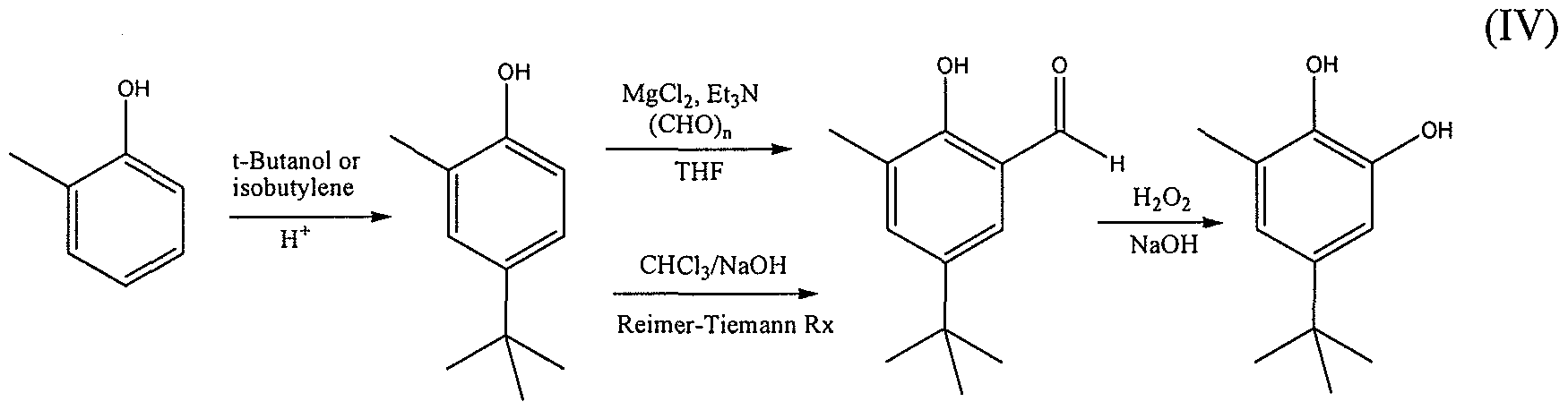
- the process includes formylating o-cresol with paraformaldehyde under reaction conditions, and forming 2-hydroxy-3-methylbenzaldehyde.
- the 2- hydroxy-3- methylbenzaldehyde is subsequently oxidized to form the 3-methylcatechol.
- the formylation reaction may occur by formylating the o-cresol with paraformaldehyde, magnesium chloride (MgCl 2 ) and triethylamine (Et 3 N) in refluxing tetrahydrofuran (THF).
- the reaction yields ortho-formylation of the o-cresol.
- Another suitable formylation reaction is the Reimer-Tiemann reaction (i. e. , ortho-formylation of the o-cresol in chloroform/sodium hydroxide).
- 3-methylcatechol is prepared directly from o-cresol.
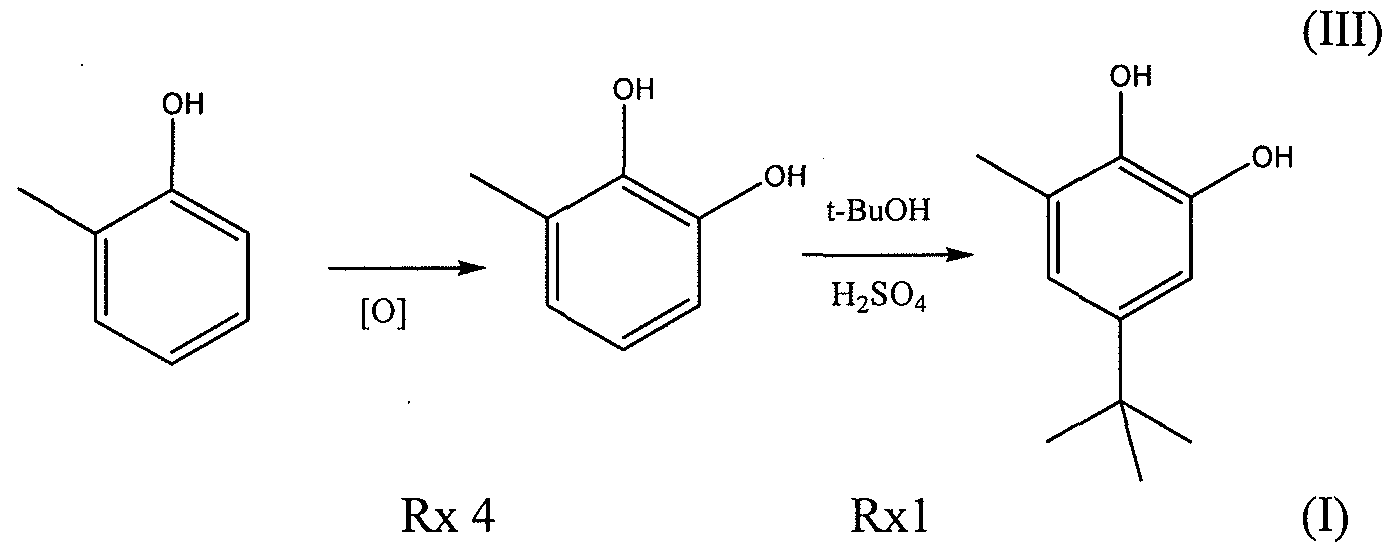
- the process includes oxidizing, under reaction conditions, o-cresol, and forming the 3- methylcatechol (Rx 4).
- the oxidizing agent is a peroxide, such as hydrogen peroxide.
- the process further includes alkylating the 3-methylcathecol and forming the BMC as disclosed above.
- reaction 4 A nonlimiting representation of reaction 4 is provided in pathway (III) below.
- another process for producing BMC includes oxidizing 5-tert-butyl-3-methyl-2-hydroxybenzaldehyde, under reaction conditions, and forming 5-tert-butyl-3-methylcatechol (Rx 5).
- the oxidizing agent is a peroxide, such as hydrogen peroxide.
- the process includes synthesis of the 5-tert-butyl-3-methyl-2- hydroxybenzaldehyde.
- the process includes formylating, under reaction conditions, 4-tert- butyl-2-methylphenol with paraformaldehyde and forming the 5-tert-butyl-3-methyl-2- hydroxybenzaldehyde (Rx 6).
- Formylation may occur by way of any suitable formylation reaction as disclosed herein.
- the process includes the synthesis of the 4-tert-butyl-2- methylphenol.
- the process includes alkylating, under reaction conditions, o-cresol with isobutylene or t-butanol to form 4-tert-butyl-2-methylphenol (Rx 7). Alkylation may occur by way of any suitable alkylation reaction as disclosed herein.
- the compound, o-cresol surprisingly has been found as an advantageous starting material for the production of BMC.
- the compound o-cresol is inexpensive and provides a methyl group directly adjacent to an
- the -OH group of o-cresol is a strong para-director for an electrophilic substitution reaction, enabling ready alkylation of o-cresol to 4-tert-butyl-2- methylphenol.
- the 4-tert-butyl-2-methylphenol is subsequently formylated, under reaction conditions, to form the 5-tert-butyl-3-methyl-2-hydroxybenzaldehyde.
- the present disclosure provides another process for producing BMC.
- a process is provided and includes oxidizing, under reaction conditions, 4-tert- butyl-2-methylphenol, and forming 5-tert-butyl-3-methylcatechol (Rx 8). Oxidation may occur by way of addition of a peroxide to the 4-tert-butyl-2-methylcresol in a basic aqueous solution.
- the process includes synthesis of the 4-tert-butyl-2- methylphenol.
- the process includes alkylating, under reaction conditions, o-cresol with tert- butanol or isobutylene, and forming the 4-tert-butyl-2-methylphenol (Rx 9). Alkylation may occur by way of any suitable alkylation reaction as disclosed herein.
- the 4-tert-butyl-2- methylcresol is subsequently oxidized to form the BMC.
- a process includes hydrolyzing, under reaction conditions, 2- halo-4-tert-butyl-6-methylphenol, and forming 5-tert-butyl-3-methylcatechol (Rx 10).
- hydrolyzing or “hydrolysis,” or “hydrolysis reaction” is a chemical reaction whereby water splits into H+ and OH- ions and the OH- ion replaces a functional group.
- halo is a halogen atom — F, Cl, Br, I. In an embodiment, the halogen atom is bromine yielding 2-bromo-4-tert-butyl-6-methylphenol.
- the halogen atom is chlorine yielding 2-chloro-4-tert-butyl-6-methylphenol.
- the hydrolysis reaction is catalyzed by a base and/or a salt, such as such as copper (II) sulfate.
- the process includes the synthesis of the 2-halo-4-tert-butyl-6- methylphenol.
- the process includes halogenating, under reaction conditions, 4-tert-butyl-2- methylphenol, and forming the 2-halo-4-tert-butyl-6-methylphenol (Rx 11).
- the term "halogenating,” or “halogenation,” or “halogenation reaction,” is the introduction of a halogen radical into an organic compound.
- Halogenation occurs by reacting the 4-tert-butyl- 2-methylphenol with a halogenating agent, such as a brominating agent or a chlorinating agent.
- a halogenating agent such as a brominating agent or a chlorinating agent.
- suitable halogenating agents include N-bromosuccinamine (NBS), a brominating agent, and/or N-chlorosuccinamine (NCS), a chlorinating agent.
- Halogenation may also occur by reacting the 4-tert-butyl-2-methylphenol with elemental halogen.
- the term "X 2 " in pathway (VI) below denotes the reaction with elemental halogen.
- the elemental halogen and may be Cl 2 or Br 2 .
- the process includes synthesis of the 4-tert-butyl-2- methylphenol.
- the 4-tert-butyl-2-methylphenol is formed by alkylating, under reaction conditions, o-cresol with isobutylene or t-butanol as disclosed above (Rx 12).
- the 4-tert-butyl-2-methylphenol is formed by alkylating, under reaction conditions, o-cresol with isobutylene or t-butanol as disclosed above (Rx 12).
- WHD/6867784 1 butyl-2-methylphenol is subsequently halogenated to form the 2-halo-4-tert-butyl-6- methylphenol.
- a process includes hydrogenolyzing, under reaction conditions, 5-tert-butyl-3-aminomethylcatechol, and forming 5-tert-butyl-3-methylcatechol (Rx 13).
- the term "hydrogenolyzing,” or “hydrogenolysis,” or “hydrogenolysis reaction” is a chemical reaction whereby a carbon-carbon or carbon-heteroatom single bond is cleaved by hydrogen.
- suitable hydrogenolyzing agents include catalytic hydrogenolyzing agents (such as palladium catalysts) and borohydrides, such as sodium cyano-borohydride.
- the process includes the synthesis of the 5-tert-butyl-3- aminomethylcateghol.
- the process includes an aminoalkylating, under reaction conditions, 4-tert-butylcatechol, and forming the 5-tert-butyl-3-aminomethylcatechol (Rx 14).
- the 5-tert- butyl-3-aminomethylcatechol is subsequently hydrogenolyzed to form the 5-tert-butyl-3- methylcatechol.
- Aminoalkylation occurs by way of the Mannich reaction.
- the "Mannich reaction” is an organic reaction which aminoalkylates an acidic proton located next to a carbonyl functional group with formaldehyde and ammonia or any primary or secondary amine.
- a process for producing 5-tert-butyl-3-methyl-l,2-phenylene dibenzoate includes reacting BMC, under reaction conditions, with a member selected from an aromatic carboxylic acid and/or an aromatic carboxylic acid derivative, and subsequently forming 5-tert-butyl-3-methyl-l,2-phenylene dibenzoate (BMPD).
- BMC is prepared by any of the synthesis pathways as previously disclosed herein.
- an "aromatic carboxylic acid” is a compound containing at least one benzene ring with at least one carboxyl group directly bonded to the benzene ring. It is understood that the aromatic carboxylic acid may be a monocyclic structure or a polycyclic structure. The aromatic carboxylic acid may be a mono- or a poly-carboxylic acid. Nonlimiting examples of suitable aromatic carboxylic acids include benzoic acid, 1- naphthoic acid, 2-naphthoic acid, 6H-phenalene-2-carboxylic acid, anthracene-2-carboxylic acid, phenanthrene-2-carboxylic acid, and phenanthrene-3 -carboxylic acid.
- a “derivative of an aromatic carboxylic acid” or “an aromatic carboxylic acid derivative,” as used herein, is an aromatic acyl halide, an aromatic anhydride, an aromatic carboxylate salt, or any combination thereof. It is understood that the derivative of the
- aromatic carboxylic acid may be a monocyclic structure or a poly cyclic structure.
- suitable aromatic acyl halides include halides of any of the aromatic carboxylic acids disclosed above (i.e., an acyl halide of one or more of the following: benzoic acid, 1 -naphthoic acid, 2-naphthoic acid, 6H-phenalene-2-carboxylic acid, anthracene-2- carboxylic acid, phenanthrene-2-carboxylic acid, and/or phenanthrene-3 -carboxylic acid).
- aromatic acyl halides include benzoyl chloride, benzoyl fluoride, benzoyl bromide, and benzoyl iodide, naphthoyl chloride, naphthoyl fluoride, naphthoyl bromide, naphthoyl iodide, and any combination of the foregoing aromatic acyl halides.
- Nonlimiting examples of suitable aromatic anhydrides include anhydride of the aromatic carboxylic acids disclosed above, (i.e., an anhydride of one or more of the following: benzoic acid, 1 -naphthoic acid, 2-naphthoic acid, 6H-phenalene-2-carboxylic acid, anthracene-2-carboxylic acid, phenanthrene-2-carboxylic acid, and/or phenanthrene-3 - carboxylic acid).
- suitable aromatic anhydrides include benzoic anhydride and any combination of the foregoing aromatic anhydrides.
- Nonlimiting examples of suitable aromatic carboxylate salts include potassium, sodium, or lithium salt of the aromatic carboxylic acids disclosed above (i.e., salts of one or more of the following: benzoic acid, 1 -naphthoic acid, 2-naphthoic acid, 6H- phenalene-2-carboxylic acid, anthracene-2-carboxylic acid, phenanthrene-2-carboxylic acid, and/or phenanthrene-3 -carboxylic acid).
- suitable aromatic carboxylate salts include potassium benzoate, sodium benzoate, lithium benzoate, potassium 2-naphthoate, sodium 2-naphthoate, and any combination of the foregoing aromatic carboxylate salts.
- the aromatic carboxylic acid, or derivative thereof may be substituted.
- substituted aromatic carboxylic acid or derivative thereof is an aromatic carboxylic acid, or derivative thereof, whereby at least one of the benzene-ring substituents (other than the carboxyl group) is a substituted hydrocarbyl group having 1 to 20 carbon atoms, an unsubstituted hydrocarbyl group having 1 to 20 carbon atoms, an alkoxy group having 1 to 20 carbon atoms, a heteroatom, and combinations thereof.
- substituted aromatic carboxylic acid or derivative thereof includes substituted aromatic
- WHD/6867784.1 carboxylic acid, substituted aromatic acyl halide, substituted aromatic anhydride, and/or substituted aromatic carboxylate salt.
- hydrocarbyl and “hydrocarbon” refer to substituents containing only hydrogen and carbon atoms, including branched or unbranched, saturated or unsaturated, cyclic, polycyclic, fused, or acyclic species, and combinations thereof.
- hydrocarbyl groups include alkyl-, cycloalkyl-, alkenyl-, alkadienyl-, cycloalkenyl-, cycloalkadienyl-, aryl-, aralkyl, alkylaryl, and alkynyl- groups.
- substituted hydrocarbyl and “substituted hydrocarbon” refer to a hydrocarbyl group that is substituted with one or more nonhydrocarbyl substituent groups.
- a nonlimiting example of a nonhydrocarbyl substituent group is a heteroatom.
- a heteroatom refers to an atom other than carbon or hydrogen.
- the heteroatom can be a non-carbon atom from Groups IV, V, VI, and VII of the Periodic Table.
- Nonlimiting examples of heteroatoms include: halogens (F, Cl, Br, I), N, O, P, B, S, and Si.
- a substituted hydrocarbyl group also includes a halohydrocarbyl group and/or a silicon-containing hydrocarbyl group.
- halohydrocarbyl group refers to a hydrocarbyl group that is substituted with one or more halogen atoms.
- sicon-containing hydrocarbyl group is a hydrocarbyl group that is substituted with one or more silicon atoms. The silicon atom(s) may or may not be in the carbon chain.
- BMPD is formed by reacting BMC, under reaction conditions, with an aromatic carboxylic acid derivative, benzoyl chloride.
- the process includes reacting BMC with benzoyl chloride in the presence of a base under reaction conditions, and forming BMPD (Rx 15).
- base include pyridine, triethylamine, trimethylamine, and/or molecular sieves.
- a nonlimiting representation of reaction 15 is provided in pathway (VIII) below.
- BMPD 5 -tert-buty 1-3 -methyl- 1 ,2-phenylene dibenzoate
- the reaction includes adding benzoyl chloride to a mixture of BMC, pyridine, and dichloromethane. Pyridine absorbs HCl, a by-product of the reaction.
- the process includes forming the BMPD by adding the benzoyl chloride to a reaction mixture composed of the BMC, acetonitrile and triethylamine. Triethylamine absorbs HCl, a by-product of the reaction.
- acetonitrile and triethylamine advantageously provides an environmentally safe, and low health risk (nontoxic) process for BMPD production, and large-scale (i.e., greater than 10 g, or greater than 1 kg) production of BMPD in particular.
- the process includes adding water to the reaction mixture (containing BMPD, acetonitrile triethylamine, benzoyl chloride, and BMC); and precipitating the BMPD.
- the solvent, acetonitrile is soluble in water. Bounded by no particular theory, addition of the water quenches the reaction and changes the solubility of the solvent to precipitate the BMPD from solution (the "BMPD-precipitate").
- Provision of the acetonitrile solvent system advantageously provides a simple, cost-effective and effective procedure for BMPD production, suitable for commercial or industrial scale.
- Figure 1 shows a nonlimiting flowchart for BMPD production.
- the process includes purifying the BMPD, and forming a BMPD composition comprising greater than 98 wt %, or greater than 99 wt % BMPD.
- WHD/6867784.1 purification of the BMPD includes performing one or more procedures on the BMPD- precipitate: recrystallization, extraction, concentration, washing, distillation, and any combination of the foregoing.
- the purification includes dissolving the BMPD-precipitate in a non-aqueous solvent (such as ethyl a cetate), and extracting with water.
- a non-aqueous solvent such as ethyl a cetate
- water extraction removes ionic impurities and/or ionic byproducts from the non-aqueous phase thereby purifying the BMPD.
- the non-aqueous phase is dried (over MgSO 4 ) and concentrated by way of roto-evaporation (the "concentrate") in conjunction with a hydrocarbon wash (heptane) to remove organic by-products/impurities. Recrystallization yields a purified BMPD composition composed of greater than 98 wt %, or greater than 99 wt %, BMPD.
- the purification includes distilling the concentrate in conjunction with a hydrocarbon wash (heptane). Filtration and drying yields a purified BMPD composition composed of greater than 98 wt %, or greater than 99 wt % BMPD.
- Figure 2 shows a nonlimiting flowchart for the purification of the BMPD-precipitate.
- the BMPD is advantageously applied as an internal electron donor in procatalyst/catalyst compositions for the production of olefm-based polymers (propylene- based polymers in particular) as disclosed in U.S. provisional application no. 61/141,902 filed on December 31, 2008 and U.S. provisional application no. 61/141,959 filed on December 31, 2008, the entire content of each application incorporated by reference herein.
- DEFINITIONS DEFINITIONS
- compositions claimed herein through use of the term “comprising” may include any additional additive, adjuvant, or compound whether polymeric or otherwise, unless stated to the contrary.
- any numerical range recited herein includes all values from the lower value to the upper value, in increments of one unit, provided that there is a separation of at least 2 units between any lower value and any higher value.
- amount of a component, or a value of a compositional or a physical property such as, for example, amount of a blend component, softening temperature, melt index, etc.
- amount of a blend component, softening temperature, melt index, etc. is between 1 and 100
- all individual values, such as, 1, 2, 3, etc., and all subranges, such as, 1 to 20, 55 to 70, 197 to 100, etc., are expressly enumerated in this specification.
- any numerical range recited herein includes any value or subrange within the stated range. Numerical ranges have been recited, as discussed herein, reference melt index, melt flow rate, and other properties.
- blend or "polymer blend,” as used herein, is a blend of two or more polymers. Such a blend may or may not be miscible (not phase separated at molecular level). Such a blend may or may not be phase separated. Such a blend may or may not contain one or more domain configurations, as determined from transmission electron spectroscopy, light scattering, x-ray scattering, and other methods known in the art.
- composition includes a mixture of materials which comprise the composition, as well as reaction products and decomposition products formed from the materials of the composition.
- polymer is a macromolecular compound prepared by polymerizing monomers of the same or different type.
- Polymer includes homopolymers, copolymers, terpolymers, interpolymers, and so on.
- interpolymer means a polymer prepared by the polymerization of at least two types of monomers or comonomers.
- copolymers which usually refers to polymers prepared from two different types of monomers or comonomers
- terpolymers which usually refers to polymers prepared from three different types of monomers or comonomers
- tetrapolymers which usually refers to polymers prepared from four different types of monomers or comonomers
- olefin-based polymer is a polymer containing, in polymerized form, a majority weight percent of an olefin, for example ethylene or propylene, based on the total weight of the polymer.
- olefin-based polymers include ethylene-based polymers and propylene-based polymers.
- propylene-based polymer refers to a polymer that comprises a majority weight percent polymerized propylene monomer (based on the total amount of polymerizable monomers), and optionally may comprise at least one polymerized comonomer.
- alkyl refers to a branched or unbranched, saturated or unsaturated acyclic hydrocarbon radical.
- suitable alkyl radicals include, for example, methyl, ethyl, n-propyl, i-propyl, 2-propenyl (or allyl), vinyl, n-butyl, t- butyl, i-butyl (or 2-methylpropyl), etc.
- the alkyls have 1 and 20 carbon atoms.
- substituted alkyl refers to an alkyl as just described in which one or more hydrogen atom bound to any carbon of the alkyl is replaced by another group such as a halogen, aryl, substituted aryl, cycloalkyl, substituted cycloalkyl, heterocycloalkyl, substituted heterocycloalkyl, halogen, haloalkyl, hydroxy, amino, phosphido, alkoxy, amino, thio, nitro, and combinations thereof.
- Suitable substituted alkyls include, for example, benzyl, trifluoromethyl and the like.
- aryl refers to an aromatic substituent which may be a single aromatic ring or multiple aromatic rings which are fused together, linked covalently,
- WHD/6867784 1 or linked to a common group such as a methylene or ethylene moiety.
- the aromatic ring(s) may include phenyl, naphthyl, anthracenyl, and biphenyl, among others.
- the aryls have 1 and 20 carbon atoms.
- substituted phenylene aromatic diester includes substituted 1,2- phenylene aromatic diester, substituted 1,3 -phenylene aromatic diester, and substituted 1,4-phenylene aromatic diester.
- the substituted phenylene diester is a 1,2- phenylene aromatic diester with the structure (A) below:
- R 1 -R 14 are the same or different.
- Each of Ri-R 14 is selected from a hydrogen, substituted hydrocarbyl group having 1 to 20 carbon atoms, an unsubstituted hydrocarbyl group having 1 to 20 carbon atoms, an alkoxy group having 1 to 20 carbon atoms, a heteroatom, and combinations thereof.
- At least one of Ri-Ri 4 is not hydrogen
- Example 1 Conversion of 3-methylcatechol to S-tert-butyl-S-methylcatechol
- a 100-mL 3 -neck round bottom flask, equipped with stirrer, reflux condenser, thermometer, dropping funnel is charged with 6.8 g of 2-hydroxy-3-methylaldehyde and 25 mL of 2N NaOH aqueous solution.
- a diluted H 2 O 2 is added in portion of 10 mL to maintain internal temperature between 40 0 C to 50 0 C.
- the temperature rises to 45 0 C and a dark solution results.
- the temperature is allowed to fall to 4O 0 C before a second portion of hydrogen peroxide is added.
- a 1-L 4-neck round bottom flask, equipped with stirrer, reflux condenser, thermometer, nitrogen inlet and bubbler is charged with 20.64 mL of o-cresol and 14.0 g of paraformaldehyde.
- THF is charged via syringe followed by addition of triethylamine via dropping funnel.
- o-cresol is added slowly via syringe, resulting in an opaque, light pink mixture that is refluxed for 4 hours.
- the reaction is cooled and diluted with 200 mL of ether, washed with 1 N HCl, water, and dried over Na 2 SO 4 .
- a 500 mL three-neck round bottom flask with thermowell is fitted with an addition funnel/N 2 inlet, mechanical stirrer and a stopper. After the system is purged with N 2 the vessel is loaded with the 5-tert-butyl-3-methylcatechol (20.0 g, 0.11 mol) and CH 3 CN (100 mL). The mixture is stirred at ambient temperature until all the solids are dissolved. To the vessel is added triethylamine (26.8 g, 0.27 mol) and the internal temperature of the reaction is taken to 1O 0 C using a dry ice/water bath. Benzoyl chloride (34.4 g, 0.24 mol) is added dropwise keeping the temperature at 10-20 0 C. The addition takes about 30 minutes. The ice bath is removed and the thick slurry is allowed to stir at ambient temperature for 1 hour.
- a 1 -liter three neck round bottom flask with thermowell is fitted with a N 2 inlet, mechanical stirrer and a stopper.
- water 400 mL
- the slurry from above is added in eight portions over about 20 min.
- the resulting slurry is stirred at ambient temperature for 30 minutes and then the solid is collected via filtration.
- the crude solid is dissolved in EtOAc (150 mL) and extracted with water (75 mL).
- the aqueous phase is discarded and the EtOAc phase is dried over MgSO 4 .
- the MgSO 4 is removed by filtration providing 175 g of light brown solution.
- the solution is concentrated on a rotary evaporator (45-5O 0 C bath @ 150-200 mmHg) taking 96 g of solvent
- a 5L three-neck round bottom flask with thermowell is fitted with an addition funnel/N 2 inlet, mechanical stirrer and a stopper. After the system is purged with N 2 the pot is loaded with the starting 5-tert-butyl-3-methylcatechol (314.3 g, 1.75 mol) and CH 3 CN (1570 mL). The mixture is stirred at ambient temperature until all the solids are dissolved. To the pot is added triethylamine (423 g, 4.17 mol) and the internal temperature of the reaction is taken to 1O 0 C using a dry ice/water bath. Benzoyl chloride (543 g, 3.84 mol) is added dropwise keeping the temperature at 10-20 0 C. Initially only half of the benzoyl chloride is added into the additional funnel to prevent all of the material from being added at once. The entire addition takes about 2 hours. The ice bath is removed and the thick slurry is allowed to stir at ambient temperature overnight.
- a total of 1243.4 g is produced at 92% yield with a melting point 110-112 0 C.
- the material has a purity greater than 99 wt %.
Landscapes
- Chemical & Material Sciences (AREA)
- Organic Chemistry (AREA)
- Chemical Kinetics & Catalysis (AREA)
- Health & Medical Sciences (AREA)
- Medicinal Chemistry (AREA)
- Polymers & Plastics (AREA)
- Engineering & Computer Science (AREA)
- Materials Engineering (AREA)
- Transition And Organic Metals Composition Catalysts For Addition Polymerization (AREA)
- Organic Low-Molecular-Weight Compounds And Preparation Thereof (AREA)
- Addition Polymer Or Copolymer, Post-Treatments, Or Chemical Modifications (AREA)
- Graft Or Block Polymers (AREA)
- Low-Molecular Organic Synthesis Reactions Using Catalysts (AREA)
- Compositions Of Macromolecular Compounds (AREA)
- Polymerisation Methods In General (AREA)
- Manufacture Of Macromolecular Shaped Articles (AREA)
- Catalysts (AREA)
- Emergency Medicine (AREA)
Abstract
Description




Claims
Priority Applications (8)
| Application Number | Priority Date | Filing Date | Title |
|---|---|---|---|
| JP2011544626A JP5461583B2 (en) | 2008-12-31 | 2009-12-31 | Production of substituted phenylene aromatic diesters |
| US12/651,142 US8507717B2 (en) | 2008-12-31 | 2009-12-31 | Production of substituted phenylene aromatic diesters |
| CN200980157529.1A CN102333749B (en) | 2008-12-31 | 2009-12-31 | Production of substituted phenylene aromatic diesters |
| MX2011007152A MX2011007152A (en) | 2008-12-31 | 2009-12-31 | Production of substituted phenylene aromatic diesters. |
| BRPI0918707A BRPI0918707A2 (en) | 2008-12-31 | 2009-12-31 | process for the production of substituted phenylene aromatic diesters |
| SG2011048048A SG172438A1 (en) | 2008-12-31 | 2009-12-31 | Production of substituted phenylene aromatic diesters |
| EP09796927A EP2373604A2 (en) | 2008-12-31 | 2009-12-31 | Production of substituted phenylene aromatic diesters |
| RU2011132141/04A RU2553475C2 (en) | 2008-12-31 | 2009-12-31 | Production of substituted phenylene aromatic diesters |
Applications Claiming Priority (4)
| Application Number | Priority Date | Filing Date | Title |
|---|---|---|---|
| US14195908P | 2008-12-31 | 2008-12-31 | |
| US14190208P | 2008-12-31 | 2008-12-31 | |
| US61/141,959 | 2008-12-31 | ||
| US61/141,902 | 2008-12-31 |
Publications (3)
| Publication Number | Publication Date |
|---|---|
| WO2010078512A2 true WO2010078512A2 (en) | 2010-07-08 |
| WO2010078512A3 WO2010078512A3 (en) | 2011-01-06 |
| WO2010078512A4 WO2010078512A4 (en) | 2011-03-10 |
Family
ID=44952766
Family Applications (5)
| Application Number | Title | Priority Date | Filing Date |
|---|---|---|---|
| PCT/US2009/069901 Ceased WO2010078485A1 (en) | 2008-12-31 | 2009-12-31 | Propylene-based polymer, articles, and process for producing same |
| PCT/US2009/069896 Ceased WO2010078480A1 (en) | 2008-12-31 | 2009-12-31 | Propylene impact copolymer and method |
| PCT/US2009/069929 Ceased WO2010078503A1 (en) | 2008-12-31 | 2009-12-31 | Enhanced procatalyst composition and process |
| PCT/US2009/069942 Ceased WO2010078512A2 (en) | 2008-12-31 | 2009-12-31 | Production of substituted phenylene aromatic diesters |
| PCT/US2009/069895 Ceased WO2010078479A1 (en) | 2008-12-31 | 2009-12-31 | Random propylene copolymer compositions, articles and process |
Family Applications Before (3)
| Application Number | Title | Priority Date | Filing Date |
|---|---|---|---|
| PCT/US2009/069901 Ceased WO2010078485A1 (en) | 2008-12-31 | 2009-12-31 | Propylene-based polymer, articles, and process for producing same |
| PCT/US2009/069896 Ceased WO2010078480A1 (en) | 2008-12-31 | 2009-12-31 | Propylene impact copolymer and method |
| PCT/US2009/069929 Ceased WO2010078503A1 (en) | 2008-12-31 | 2009-12-31 | Enhanced procatalyst composition and process |
Family Applications After (1)
| Application Number | Title | Priority Date | Filing Date |
|---|---|---|---|
| PCT/US2009/069895 Ceased WO2010078479A1 (en) | 2008-12-31 | 2009-12-31 | Random propylene copolymer compositions, articles and process |
Country Status (11)
| Country | Link |
|---|---|
| US (7) | US7935766B2 (en) |
| EP (5) | EP2373699A1 (en) |
| JP (7) | JP5607647B2 (en) |
| KR (5) | KR101676057B1 (en) |
| CN (6) | CN102333749B (en) |
| BR (5) | BRPI0918697A8 (en) |
| MX (6) | MX2011007153A (en) |
| MY (5) | MY159688A (en) |
| RU (5) | RU2518067C2 (en) |
| SG (5) | SG172448A1 (en) |
| WO (5) | WO2010078485A1 (en) |
Cited By (4)
| Publication number | Priority date | Publication date | Assignee | Title |
|---|---|---|---|---|
| WO2012135189A3 (en) * | 2011-03-29 | 2012-12-27 | Dow Global Technologies Llc | Production of substituted phenylene aromatic diesters |
| JP2014529624A (en) * | 2011-08-30 | 2014-11-13 | ダウ グローバル テクノロジーズ エルエルシー | Formation of substituted phenylene dibenzoates for use as internal electron donors and procatalysts for polymer preparation |
| US10358505B2 (en) | 2010-12-21 | 2019-07-23 | W. R. Grace & Co.-Conn. | Process for production of high melt flow propylene-based polymer and product from same |
| CN120483875A (en) * | 2025-07-10 | 2025-08-15 | 营口市向阳催化剂有限责任公司 | Process for the preparation of substituted phenylene aromatic diesters and use thereof in the preparation of catalysts |
Families Citing this family (100)
| Publication number | Priority date | Publication date | Assignee | Title |
|---|---|---|---|---|
| CN101835812B (en) * | 2007-08-24 | 2013-10-02 | 陶氏环球技术有限责任公司 | Self-limiting catalyst system and method with controlled ratio of aluminum to selectivity control agent |
| MX2011001970A (en) * | 2008-08-21 | 2011-08-12 | Dow Global Technologies Llc | Catalyst composition with mixed selectivity control agent and polymerisation method using it. |
| KR20160017096A (en) * | 2008-08-21 | 2016-02-15 | 더블유.알. 그레이스 앤드 캄파니-콘. | High melt flow propylene impact copolymer and method |
| MY159688A (en) * | 2008-12-31 | 2017-01-13 | W R Grace & Co -Conn | Random propylene copolymer composition, articles and process |
| CN104860826A (en) * | 2008-12-31 | 2015-08-26 | 陶氏环球技术有限责任公司 | Production of substituted phenylene aromatic diesters |
| CN102325808B (en) | 2008-12-31 | 2014-03-12 | 陶氏环球技术有限责任公司 | Procatalyst composition with substituted 1,2-phenylene aromatic diester internal donor and method |
| US8378045B2 (en) * | 2008-12-31 | 2013-02-19 | Dow Global Technologies Llc | Thermoformed article with high stiffness and good optics |
| RU2576519C2 (en) * | 2009-12-02 | 2016-03-10 | У.Р.Грейс Энд Ко.-Конн. | Dicarbonate compounds with two bridging atoms as internal donors in catalysts for polypropylene production |
| WO2011106494A1 (en) * | 2010-02-26 | 2011-09-01 | Dow Global Technologies Llc | Procatalyst composition with substituted amide ester internal electron donor |
| KR101882027B1 (en) * | 2010-02-26 | 2018-07-25 | 더블유.알. 그레이스 앤드 캄파니-콘. | Halogenated amide ester and internal electron donor with same |
| CN101845171A (en) * | 2010-04-20 | 2010-09-29 | 广州呈和科技有限公司 | Polypropylene reinforcement nucleating agent composition |
| US20140107274A1 (en) * | 2010-12-20 | 2014-04-17 | Braskem America, Inc. | Propylene-based compositions of enhanced appearance and excellent mold flowability |
| US20120157645A1 (en) * | 2010-12-21 | 2012-06-21 | Linfeng Chen | Procatalyst Composition with Alkoxypropyl Ester Internal Electron Donor and Polymer From Same |
| US20120157295A1 (en) * | 2010-12-21 | 2012-06-21 | Linfeng Chen | Process for Producing Procatalyst Composition with Alkoxyalkyl Ester Internal Electron Donor and Product |
| US9382343B2 (en) | 2010-12-21 | 2016-07-05 | W. R. Grace & Co.-Conn. | Procatalyst composition with alkoxypropyl ester internal electron donor and polymer from same |
| US9382342B2 (en) | 2010-12-21 | 2016-07-05 | W. R. Grace & Co.-Conn. | Procatalyst composition with alkoxyalkyl 2-propenoate internal electron donor and polymer from same |
| US9434796B2 (en) | 2010-12-21 | 2016-09-06 | W. R. Grace & Co.-Conn. | Catalyst composition with alkoxyalkyl ester internal electron donor and polymer from same |
| US8604146B2 (en) * | 2010-12-21 | 2013-12-10 | Dow Global Technologies Llc | Catalyst composition with alkoxyalkyl ester internal electron donor and polymer from same |
| EP2681248A1 (en) * | 2011-03-01 | 2014-01-08 | Dow Global Technologies LLC | Process for improving bulk density with multi-contact procatalyst and product |
| CN103403088B (en) | 2011-03-10 | 2016-02-10 | 巴塞尔聚烯烃意大利有限责任公司 | Polyolefin-based container |
| CA2742454C (en) | 2011-06-09 | 2018-06-12 | Nova Chemicals Corporation | Methods for controlling ethylene copolymer properties |
| RU2014106216A (en) * | 2011-07-28 | 2015-09-10 | У.Р.Грейс Энд Ко.-Конн. | PROPYLENE BASED POLYMER WITH LOW CONTENT OF ASH AND METHOD |
| US11254848B2 (en) | 2011-07-28 | 2022-02-22 | W.R. Grace & Co.-Conn. | Propylene/ethylene copolymer film for heat seal |
| EP2607384A1 (en) * | 2011-12-21 | 2013-06-26 | Basell Poliolefine Italia S.r.l. | Catalyst system for the polymerization of olefins |
| EP2610274A1 (en) * | 2011-12-30 | 2013-07-03 | Borealis AG | Propylene random copolymer |
| US9593172B2 (en) * | 2012-07-14 | 2017-03-14 | Indian Oil Corporation Limited | Ziegler-natta catalyst systems comprising a 1,2-phenylenedioate as internal donor and process for preparing the same |
| US9790291B2 (en) * | 2013-03-14 | 2017-10-17 | Formosa Plastics Corporation, Usa | Non-phthalate compounds as electron donors for polyolefin catalysts |
| EP2999721B2 (en) * | 2013-05-22 | 2021-01-13 | Borealis AG | Propylene copolymer for thin-wall packaging |
| EP3063194B1 (en) * | 2013-10-29 | 2021-12-08 | W.R. Grace & CO. - CONN. | Propylene ethylene random copolymer suitable for pipe |
| CN105705528B (en) * | 2013-11-15 | 2018-11-09 | 陶氏环球技术有限责任公司 | Polyolefin composition and method of producing same |
| PL3071608T3 (en) | 2013-11-21 | 2025-09-01 | W.R. Grace & Co. - Conn. | Producing high comonomer content propylene-based polymers |
| MX366147B (en) | 2013-11-22 | 2019-06-28 | Borealis Ag | Low emission propylene homopolymer. |
| WO2015081251A1 (en) | 2013-11-26 | 2015-06-04 | W. R. Grace & Co.-Conn | Producing propylene impact copolymers and products |
| BR112016012033B1 (en) * | 2013-11-27 | 2021-02-09 | W.R. Grace & Co.-Conn | polymerization process for impact copolymers |
| EP3083722B1 (en) * | 2013-12-20 | 2021-11-10 | Saudi Basic Industries Corporation | Catalyst system for polymerisation of an olefin |
| MX2016008041A (en) | 2013-12-20 | 2017-03-03 | Saudi Basic Ind Corp | Catalyst system for polymerisation of an olefin. |
| CN105934449B (en) | 2013-12-20 | 2018-07-10 | 沙特基础工业公司 | For the carbon monoxide-olefin polymeric of olefinic polymerization |
| BR112016013799B1 (en) | 2013-12-20 | 2022-02-22 | Saudi Basic Industries Corporation | PRO-CATALYST FOR THE POLYMERIZATION OF AN OLEFIN, ITS PREPARATION PROCESS, USE OF FORMULA X BENZAMIDE AND POLYOLEFIN PREPARATION PROCESS |
| US9944734B2 (en) | 2013-12-20 | 2018-04-17 | Saudi Basic Industries Corporation | Catalyst system for polymerization of an olefin |
| WO2015100374A2 (en) * | 2013-12-23 | 2015-07-02 | Braskem America, Inc. | Propylene-based compositions of enhanced appearance and excellent mold flowability |
| KR101834104B1 (en) | 2014-01-15 | 2018-03-02 | 엑손모빌 케미칼 패턴츠 인코포레이티드 | Propylene-based impact copolymers |
| US10465025B2 (en) | 2014-01-15 | 2019-11-05 | Exxonmobil Chemical Patents Inc. | Low comonomer propylene-based impact copolymers |
| US10723824B2 (en) | 2014-02-07 | 2020-07-28 | Eastman Chemical Company | Adhesives comprising amorphous propylene-ethylene copolymers |
| US10308740B2 (en) | 2014-02-07 | 2019-06-04 | Eastman Chemical Company | Amorphous propylene-ethylene copolymers |
| US10696765B2 (en) | 2014-02-07 | 2020-06-30 | Eastman Chemical Company | Adhesive composition comprising amorphous propylene-ethylene copolymer and propylene polymer |
| US10647795B2 (en) | 2014-02-07 | 2020-05-12 | Eastman Chemical Company | Adhesive composition comprising amorphous propylene-ethylene copolymer and polyolefins |
| US11267916B2 (en) | 2014-02-07 | 2022-03-08 | Eastman Chemical Company | Adhesive composition comprising amorphous propylene-ethylene copolymer and polyolefins |
| US9593179B2 (en) | 2014-02-07 | 2017-03-14 | Eastman Chemical Company | Amorphous propylene-ethylene copolymers |
| EP3183314B1 (en) * | 2014-08-21 | 2018-05-02 | Dow Global Technologies LLC | Hot melt adhesive composition |
| US10023770B2 (en) | 2014-08-21 | 2018-07-17 | Dow Global Technologies Llc | Adhesive composition |
| EP3015503A1 (en) | 2014-10-27 | 2016-05-04 | Borealis AG | Heterophasic polypropylene with improved stiffness/impact balance |
| US9593184B2 (en) | 2014-10-28 | 2017-03-14 | Formosa Plastics Corporation, Usa | Oxalic acid diamides as modifiers for polyolefin catalysts |
| CN107075207B (en) | 2014-11-19 | 2018-07-27 | 博里利斯股份公司 | Injection molded article based on Noblen |
| EP3307820B1 (en) | 2015-06-12 | 2019-10-02 | SABIC Global Technologies B.V. | Process for manufacture of low emission polypropylene |
| BR112018008756A2 (en) * | 2015-11-02 | 2018-10-30 | Braskem America Inc | homopolymer propylene and polypropylene based polymeric resins, impact copolymer polypropylene composition, and molded article |
| EP3184587B1 (en) * | 2015-12-21 | 2020-03-18 | Borealis AG | Extruded articles with improved optical properties |
| EP3397658B1 (en) | 2015-12-31 | 2022-07-27 | Braskem America, Inc. | Non-phthalate catalyst system and its use in the polymerization of olefins |
| US9777084B2 (en) | 2016-02-19 | 2017-10-03 | Formosa Plastics Corporation, Usa | Catalyst system for olefin polymerization and method for producing olefin polymer |
| EP3443016B1 (en) | 2016-04-13 | 2019-11-06 | Borealis AG | Injection molded article based on propylene homopolymer |
| PL3260489T3 (en) | 2016-06-24 | 2020-06-15 | Borealis Ag | Novel polypropylene compositions with low fogging |
| US11427660B2 (en) | 2016-08-17 | 2022-08-30 | Formosa Plastics Corporation, Usa | Organosilicon compounds as electron donors for olefin polymerization catalysts and methods of making and using same |
| US11014995B2 (en) * | 2016-10-06 | 2021-05-25 | W.R. Grace & Co.—Conn. | Procatalyst composition made with a combination of internal electron donors |
| US9815920B1 (en) | 2016-10-14 | 2017-11-14 | Formosa Plastics Corporation, Usa | Olefin polymerization catalyst components and process for the production of olefin polymers therewith |
| EP3596136A1 (en) * | 2017-03-17 | 2020-01-22 | SABIC Global Technologies B.V. | Process for the polymerization of a polyolefin |
| US11254758B2 (en) * | 2017-03-17 | 2022-02-22 | Sabic Global Technologies B.V. | Process for preparing a procatalyst for polymerization of olefins |
| JP7222912B2 (en) * | 2017-04-12 | 2023-02-15 | ダブリュー・アール・グレース・アンド・カンパニー-コーン | Method for producing low VOC content propylene copolymer |
| US10124324B1 (en) | 2017-05-09 | 2018-11-13 | Formosa Plastics Corporation, Usa | Olefin polymerization catalyst components and process for the production of olefin polymers therewith |
| US10822438B2 (en) | 2017-05-09 | 2020-11-03 | Formosa Plastics Corporation | Catalyst system for enhanced stereo-specificity of olefin polymerization and method for producing olefin polymer |
| CN110603270B (en) | 2017-05-18 | 2022-05-17 | 博里利斯股份公司 | Propylene-ethylene random copolymer with improved radiation resistance |
| RU2692246C1 (en) * | 2017-06-15 | 2019-06-24 | Индийская Нефтяная Корпорация Лимитэд | External donor for olefin polymerization |
| TWI766025B (en) * | 2017-06-28 | 2022-06-01 | 日商迪愛生股份有限公司 | Active ester compound and curable composition |
| CN110662773B (en) * | 2017-06-30 | 2022-08-19 | 三井化学株式会社 | Propylene polymer, method for producing same, propylene resin composition, and molded article |
| US10920053B2 (en) | 2017-10-16 | 2021-02-16 | Exxonmobil Chemical Patents Inc. | Propylene impact copolymer blends with improved gloss |
| WO2019094216A1 (en) | 2017-11-13 | 2019-05-16 | W.R. Grace & Co.-Conn. | Catalyst components for propylene polymerization |
| WO2019141462A1 (en) | 2018-01-22 | 2019-07-25 | Borealis Ag | Nucleated c3c4 copolymers |
| CN111902480A (en) | 2018-04-10 | 2020-11-06 | 北欧化工公司 | Bimodal polypropylene random copolymer with improved gamma radiation resistance |
| CN108484810B (en) * | 2018-05-04 | 2020-08-21 | 江苏煦和新材料有限公司 | A kind of method for preparing high melt strength polypropylene |
| EP3617238A1 (en) | 2018-08-28 | 2020-03-04 | Borealis AG | Propylene random copolymer with specific comonomer distribution |
| EP3931249A1 (en) * | 2019-02-27 | 2022-01-05 | Milliken & Company | Method for making heterophasic polymer compositions |
| US12221530B2 (en) | 2019-04-05 | 2025-02-11 | W. R. Grace & Co.-Conn. | Polypropylene copolymer composition having subzero impact resistance |
| MX2021013692A (en) * | 2019-05-10 | 2021-12-10 | Grace W R & Co | ACTIVATED CATALYST COMPONENTS FOR OLEFIN POLYMERIZATION. |
| CN114729074A (en) | 2019-09-18 | 2022-07-08 | 格雷斯公司 | Catalyst composition for polyolefin polymers |
| CA3183731A1 (en) * | 2020-06-29 | 2022-01-06 | Zhiru MA | Phthalate-free polypropylene homopolymer having high stiffness properties |
| JP7814370B2 (en) * | 2020-07-11 | 2026-02-16 | ダブリュー・アール・グレース・アンド・カンパニー-コーン | Propylene butene copolymers and compositions made therefrom - Patents.com |
| JP2023547383A (en) * | 2020-10-23 | 2023-11-10 | ダブリュー・アール・グレース・アンド・カンパニー-コーン | High impact polypropylene polymer composition with reduced VOC content |
| EP4359448A1 (en) * | 2021-06-25 | 2024-05-01 | Braskem, S.A. | Propylene preliminary polymerization |
| US12435168B2 (en) * | 2022-09-12 | 2025-10-07 | Formosa Plastics Corporation, U.S.A. | High ductility, high modulus and phthalate free impact resistant propylene copolymer |
| CN120380039A (en) | 2022-12-23 | 2025-07-25 | 北欧化工股份公司 | Polypropylene copolymer production method |
| WO2024168274A1 (en) | 2023-02-10 | 2024-08-15 | W.R. Grace & Co.-Conn. | Process for the separation of solvent from waste streams |
| US20250066513A1 (en) | 2023-08-23 | 2025-02-27 | Formosa Plastics Corporation, U.S.A. | Catalyst System For Enhanced Stereo-Specificity Of Olefin Polymerization |
| US20250066514A1 (en) | 2023-08-24 | 2025-02-27 | Formosa Plastics Corporation, U.S.A. | Catalysts component and process for the production of polypropylene having high melt flow rate with high isotacticity |
| US20250109218A1 (en) | 2023-09-29 | 2025-04-03 | Formosa Plastics Corporation, U.S.A. | Method for preparing catalyst component for polymerization of polyolefin without the use of internal electron donors |
| US20250115687A1 (en) | 2023-10-06 | 2025-04-10 | Formosa Plastics Corporation, U.S.A. | Production method for solid catalyst component for polymerizing olefins, and catalyst for polymerizaing olefins |
| US20250115686A1 (en) | 2023-10-09 | 2025-04-10 | Formosa Plastics Corporation, U.S.A. | Olefin polymerization catalyst components containing silane and process for the production of polypropylene having high isotacticity at high melt flow rate |
| US20250297039A1 (en) | 2024-03-19 | 2025-09-25 | Formosa Plastics Corporation, U.S.A. | Olefin polymerization catalyst components containing diglycidylester components and its use for the production of polypropylene having high isotacticity at high melt flow rate |
| WO2025219533A1 (en) | 2024-04-18 | 2025-10-23 | Borealis Gmbh | Process for the preparation of a propylene homopolymer |
| WO2025219537A1 (en) | 2024-04-18 | 2025-10-23 | Borealis Gmbh | Process for propylene polymerization with optimized prepolymerization conditions |
| EP4682176A1 (en) * | 2024-07-17 | 2026-01-21 | Borealis GmbH | Zinc adipate-nucleated propylene-ethylene random copolymer compositions |
| WO2026063967A1 (en) | 2024-09-19 | 2026-03-26 | Formosa Plastics Corporation, Usa | Olefin polymerization ziegler-natta catalyst components and process for the production of olefin polymers therewith |
| WO2026067166A1 (en) * | 2024-09-25 | 2026-04-02 | 国家能源投资集团有限责任公司 | Internal electron donor compound, catalyst component and olefin polymerization method |
Family Cites Families (101)
| Publication number | Priority date | Publication date | Assignee | Title |
|---|---|---|---|---|
| US3214469A (en) | 1958-01-15 | 1965-10-26 | Polaroid Corp | Dihydroxyphenylalkanoic acid amide derivatives |
| US5066737A (en) | 1990-10-22 | 1991-11-19 | Shell Oil Company | Olefin polymerization catalyst |
| US5151399A (en) | 1990-10-18 | 1992-09-29 | Shell Oil Company | Olefin polymerization catalyst |
| US5082907A (en) | 1990-10-18 | 1992-01-21 | Shell Oil Company | Olefin polymerization catalyst |
| US5106806A (en) | 1990-10-18 | 1992-04-21 | Shell Oil Company | Olefin polymerization catalyst |
| US5077357A (en) | 1990-10-22 | 1991-12-31 | Shell Oil Company | Olefin polymerization catalyst |
| ZA716958B (en) | 1970-10-30 | 1973-01-31 | Hoffmann La Roche | Phenylalanine amides |
| US3925338A (en) | 1973-03-16 | 1975-12-09 | Monsanto Co | Control of polymer particle size in olefin polymerization |
| DE2658866C3 (en) * | 1976-12-24 | 1979-10-31 | Bayer Ag, 5090 Leverkusen | Process for the preparation of polyhydric substituted phenols |
| IT1209255B (en) | 1980-08-13 | 1989-07-16 | Montedison Spa | CATALYSTS FOR THE POLYMERIZATION OF OLEFINE. |
| US4442276A (en) | 1982-02-12 | 1984-04-10 | Mitsui Petrochemical Industries, Ltd. | Process for polymerizing or copolymerizing olefins |
| JPS5991107A (en) | 1982-11-17 | 1984-05-25 | Toho Titanium Co Ltd | Production of catalyst component for olefin polymerization |
| JPS6023404A (en) | 1983-07-20 | 1985-02-06 | Toho Titanium Co Ltd | Catalytic component and catalyst for polymerizing olefins |
| US4866022A (en) | 1984-03-23 | 1989-09-12 | Amoco Corporation | Olefin polymerization catalyst |
| US4612299A (en) | 1984-07-09 | 1986-09-16 | Amoco Corporation | Magnesium carboxylate supports |
| US4540679A (en) | 1984-03-23 | 1985-09-10 | Amoco Corporation | Magnesium hydrocarbyl carbonate supports |
| US4579836A (en) | 1985-05-22 | 1986-04-01 | Amoco Corporation | Exhaustively prepolymerized supported alpha-olefin polymerization catalyst |
| US4614830A (en) * | 1985-08-09 | 1986-09-30 | Sterling Drug Inc. | Esterification process |
| JPH06104693B2 (en) | 1986-01-06 | 1994-12-21 | 東邦チタニウム株式会社 | Catalyst for olefin polymerization |
| JPS62205140A (en) * | 1986-03-03 | 1987-09-09 | Mitsubishi Paper Mills Ltd | Plasticizer for use in polymer |
| US4829037A (en) | 1986-05-06 | 1989-05-09 | Toho Titanium Co., Ltd. | Catalyst for polymerization of olefins |
| US4710482A (en) | 1986-06-18 | 1987-12-01 | Shell Oil Company | Olefin polymerization catalyst component |
| JPS63277944A (en) * | 1987-03-03 | 1988-11-15 | Kiroku Sozai Sogo Kenkyusho:Kk | Heat sensitive label for temperature management |
| CA1310955C (en) | 1987-03-13 | 1992-12-01 | Mamoru Kioka | Process for polymerization of olefins and polymerization catalyst |
| DE3751694T2 (en) | 1987-04-03 | 1996-08-01 | Fina Technology | Metallocene catalyst systems for the polymerization of olefins, with a silicon-hydrocarbyl bridge. |
| US5066738A (en) | 1987-04-09 | 1991-11-19 | Fina Technology, Inc. | Polymerization of olefins with an improved catalyst system using a new electron donor |
| US4927797A (en) | 1987-04-09 | 1990-05-22 | Fina Technology, Inc. | Catalyst system for the polymerization of olefins |
| US4882380A (en) * | 1987-07-07 | 1989-11-21 | Union Carbide Chemicals And Plastics Company Inc. | Process for the production of impact polypropylene copolymers |
| JPH01224351A (en) * | 1988-03-02 | 1989-09-07 | Mitsui Petrochem Ind Ltd | Production of aryl aromatic carboxylates |
| DE68913375T3 (en) | 1988-06-17 | 2002-05-02 | Mitsui Chemicals, Inc. | Olefin polymerization process and applicable polymerization catalyst. |
| US5247031A (en) | 1988-09-13 | 1993-09-21 | Mitsui Petrochemical Industries, Ltd. | Olefin polymerization catalyst component, process for production thereof, olefin polymerization catalyst, and process for polymerizing olefins |
| KR920007040B1 (en) | 1988-09-14 | 1992-08-24 | 미쓰이세끼유 가가꾸 고오교오 가부시끼가이샤 | Polymerizing catalyst of olefins and process for the preparation of olefin polimerization |
| US4946816A (en) | 1989-08-21 | 1990-08-07 | Amoco Corporation | Morphology-controlled olefin polymerization catalyst |
| JP2909550B2 (en) * | 1989-08-31 | 1999-06-23 | 三井化学株式会社 | Method for producing alkylphenols |
| US5247032A (en) | 1989-12-29 | 1993-09-21 | Mitsui Petrochemical Industries, Ltd. | Solid catalyst components for olefin polymerization and processes for the polymerization of olefin using same |
| JP2940684B2 (en) | 1989-12-29 | 1999-08-25 | 三井化学株式会社 | Solid catalyst component for olefin polymerization and method for polymerizing olefin using the catalyst component |
| US5034361A (en) | 1990-05-24 | 1991-07-23 | Shell Oil Company | Catalyst precursor production |
| US5229342A (en) | 1990-10-18 | 1993-07-20 | Shell Oil Company | Olefin polymerization catalyst |
| US5146028A (en) | 1990-10-18 | 1992-09-08 | Shell Oil Company | Olefin polymerization catalyst and process of polymerization |
| DE4117144A1 (en) * | 1991-05-25 | 1992-11-26 | Basf Ag | HIGHLY FLOWABLE PROPYLENE ETHYLENE COPOLYMERISATE |
| JP2699047B2 (en) | 1992-10-22 | 1998-01-19 | 昭和電工株式会社 | Method for producing propylene polymer |
| GB9300318D0 (en) | 1993-01-08 | 1993-03-03 | Oxford Analytical Instr Ltd | Improvements relating to sample monitoring |
| IL117114A (en) | 1995-02-21 | 2000-02-17 | Montell North America Inc | Components and catalysts for the polymerization ofolefins |
| US5674630A (en) * | 1995-05-08 | 1997-10-07 | Union Carbide Chemicals & Plastics Technology Corporation | Polymer compositions and cast films |
| JPH09227437A (en) * | 1995-12-19 | 1997-09-02 | Daiso Co Ltd | Production of catechol derivative |
| JP3697011B2 (en) | 1997-02-27 | 2005-09-21 | 三井化学株式会社 | Propylene polymer |
| GB2323363A (en) | 1997-03-19 | 1998-09-23 | Shell Int Research | Propylene polymer composition |
| FI980342A0 (en) * | 1997-11-07 | 1998-02-13 | Borealis As | Polymerroer och -roerkopplingar |
| EP0926165B1 (en) * | 1997-12-23 | 2002-02-27 | Borealis Technology Oy | Catalyst component comprising magnesium, titanium, a halogen and a electron donor, its preparation and use |
| KR100334163B1 (en) * | 1998-12-04 | 2002-10-25 | 삼성종합화학주식회사 | Olefin Polymerization or Copolymerization Method |
| FI991057A0 (en) * | 1999-05-07 | 1999-05-07 | Borealis As | High stiffness propylene polymers and process for their preparation |
| JP3808243B2 (en) * | 1999-07-27 | 2006-08-09 | 三井化学株式会社 | Soft resin composition |
| JP3986216B2 (en) | 1999-08-19 | 2007-10-03 | 三井化学株式会社 | Non-aqueous electrolyte and secondary battery using the same |
| JP2001096926A (en) * | 1999-10-04 | 2001-04-10 | Showa Highpolymer Co Ltd | Phenolic three-core body composition and developer composed of the composition used for heat-sensitive recording material |
| US6554154B1 (en) | 2000-02-11 | 2003-04-29 | Solo Cup Company | Thermoformed container having improved strength to weight ratio in sidewall |
| JP2002012583A (en) * | 2000-04-28 | 2002-01-15 | Sumitomo Chem Co Ltd | Method for producing amine derivative |
| JP2003535178A (en) * | 2000-05-31 | 2003-11-25 | バセル テクノロジー カンパニー ビー.ブイ. | Propylene polymer composition having improved impact strength and excellent optical properties |
| EP1377629B1 (en) | 2000-12-22 | 2012-02-01 | Basell Poliolefine Italia S.r.l. | Polyolefin sheets for thermoforming |
| US6534574B1 (en) | 2001-03-24 | 2003-03-18 | Milliken & Company | Highly nucleated thermoplastic articles |
| US6825146B2 (en) * | 2001-05-29 | 2004-11-30 | Union Carbide Chemicals & Plastics Technology Corporation | Olefin polymerization catalyst compositions and method of preparation |
| DE60106219T2 (en) * | 2001-06-27 | 2006-03-09 | Borealis Technology Oy | Propylene copolymer with random comonomer distribution and process for its preparation |
| US6960635B2 (en) | 2001-11-06 | 2005-11-01 | Dow Global Technologies Inc. | Isotactic propylene copolymers, their preparation and use |
| CN1169845C (en) * | 2002-02-07 | 2004-10-06 | 中国石油化工股份有限公司 | Solid catalyst component for olefin polymerization and catalyst containing same and use thereof |
| EP1364986A1 (en) * | 2002-05-21 | 2003-11-26 | Borealis Technology Oy | Polypropylene compositions especially for pipes |
| ES2272981T3 (en) * | 2002-05-29 | 2007-05-01 | Basell Poliolefine Italia S.R.L. | (CO9 1-BUTENE POLYMERS AND PROCEDURE FOR PREPARATION. |
| AU2003245297A1 (en) * | 2002-06-14 | 2003-12-31 | Union Carbide Chemicals And Plastics Technology Corporation ; | Catalyst composition and polymerization process using mixtures of electron donors |
| DE602004024994D1 (en) * | 2003-06-24 | 2010-02-25 | Union Carbide Chem Plastic | Catalyst composition and polymerization process with a mixture of silanes Elektrondonoren |
| CN1229400C (en) * | 2003-09-18 | 2005-11-30 | 中国石油化工股份有限公司 | Catalyst compoment used for olefinic polymerization and its catalyst |
| EP1668046B8 (en) * | 2003-09-23 | 2021-04-21 | W.R. Grace & CO. - CONN. | Self limiting catalyst composition and propylene polymerization process |
| JP2007505983A (en) | 2003-09-23 | 2007-03-15 | ユニオン・カーバイド・ケミカルズ・アンド・プラスティックス・テクノロジー・コーポレイション | Catalyst composition having mixed selectivity control agent and propylene polymerization method |
| JP2005112764A (en) * | 2003-10-07 | 2005-04-28 | Toagosei Co Ltd | Method for producing aromatic ester |
| FR2869035B1 (en) | 2004-04-16 | 2006-07-14 | Pierre Fabre Medicament Sa | EPIPODOPHYLLOTOXIN AMINOALKYLAMINOACETAMIDE (POLY) DERIVATIVES AND PROCESS FOR THEIR PREPARATION AND THEIR THERAPEUTIC APPLICATIONS AS ANTI-CANCER AGENT |
| JP4413069B2 (en) | 2004-04-28 | 2010-02-10 | 富士フイルム株式会社 | Lithographic printing plate and lithographic printing method |
| US7351778B2 (en) * | 2004-04-30 | 2008-04-01 | China Petroleum & Chemical Corporation | Catalyst component for olefin polymerization and catalyst comprising the same |
| EP1778780B1 (en) | 2004-08-18 | 2009-01-14 | Basell Poliolefine Italia S.r.l. | Stretch blow-molded containers from ziegler natta propylene polymer compositions |
| US8399079B2 (en) | 2004-08-31 | 2013-03-19 | Dow Global Technologies Llc | Composition suitable for thermoformable sheets and articles made therefrom |
| US20070202285A1 (en) | 2004-12-15 | 2007-08-30 | Fina Technology, Inc. | Articles having improved clarity, prepared from propylene-ethylene copolymers |
| US8536268B2 (en) | 2004-12-21 | 2013-09-17 | Dow Global Technologies Llc | Polypropylene-based adhesive compositions |
| US7491781B2 (en) | 2005-03-08 | 2009-02-17 | Ineos Usa Llc | Propylene polymer catalyst donor component |
| CN101175778B (en) | 2005-05-12 | 2011-12-07 | 巴塞尔聚烯烃意大利有限责任公司 | Propylene-ethylene copolymers and process for their preparation |
| EP1940888B1 (en) | 2005-10-21 | 2010-06-02 | Basell Polyolefine GmbH | Polypropylene random copolymers having high melt flow rates for injection molding and melt brown applications |
| CN100532405C (en) * | 2005-10-26 | 2009-08-26 | 中国石油化工股份有限公司 | Catalyst component for ethylene polymerization and its preparation method |
| JP2007175028A (en) * | 2005-12-28 | 2007-07-12 | Koojin Bio Kk | Closed cell culture container, closed cell culture kit, and method for producing closed cell culture container |
| MX2008015361A (en) * | 2006-06-01 | 2008-12-16 | Sunoco Inc R&M | High crystallinity, high melt flow rate polypropylene. |
| TW200817315A (en) | 2006-06-16 | 2008-04-16 | Sanol Arznei Schwarz Gmbh | Entacapone-derivatives |
| EP1873173B1 (en) | 2006-06-30 | 2015-04-22 | Borealis Technology Oy | High melt flow random polypropylene copolymer |
| KR20090034984A (en) * | 2006-07-18 | 2009-04-08 | 미쓰이 가가쿠 가부시키가이샤 | Solid titanium catalyst component, catalyst for olefin polymerization and olefin polymerization method |
| JP4857093B2 (en) | 2006-11-29 | 2012-01-18 | 日本ポリプロ株式会社 | Deep drawn container |
| BRPI0815246A2 (en) | 2007-08-24 | 2015-03-31 | Dow Global Technologies Inc | Catalyst Composition |
| CN101835812B (en) | 2007-08-24 | 2013-10-02 | 陶氏环球技术有限责任公司 | Self-limiting catalyst system and method with controlled ratio of aluminum to selectivity control agent |
| MX2010006895A (en) * | 2007-12-21 | 2010-09-30 | Dow Global Technologies Inc | Self-limiting catalyst composition with bidentate internal donor. |
| JP4944058B2 (en) | 2008-03-31 | 2012-05-30 | 株式会社エフピコ | Polypropylene resin sheet and polypropylene resin container |
| CN101318886B (en) * | 2008-07-04 | 2011-05-04 | 浙江理工大学 | Process for synthesizing o-hydroxyl-phenyl-alkyl ketone |
| US8003558B2 (en) * | 2008-07-29 | 2011-08-23 | Basf Corporation | Internal donor for olefin polymerization catalysts |
| KR20160017096A (en) * | 2008-08-21 | 2016-02-15 | 더블유.알. 그레이스 앤드 캄파니-콘. | High melt flow propylene impact copolymer and method |
| MX2011001970A (en) * | 2008-08-21 | 2011-08-12 | Dow Global Technologies Llc | Catalyst composition with mixed selectivity control agent and polymerisation method using it. |
| CN102325808B (en) | 2008-12-31 | 2014-03-12 | 陶氏环球技术有限责任公司 | Procatalyst composition with substituted 1,2-phenylene aromatic diester internal donor and method |
| MY159688A (en) | 2008-12-31 | 2017-01-13 | W R Grace & Co -Conn | Random propylene copolymer composition, articles and process |
| US8378045B2 (en) * | 2008-12-31 | 2013-02-19 | Dow Global Technologies Llc | Thermoformed article with high stiffness and good optics |
| CN104860826A (en) | 2008-12-31 | 2015-08-26 | 陶氏环球技术有限责任公司 | Production of substituted phenylene aromatic diesters |
| RU2576519C2 (en) | 2009-12-02 | 2016-03-10 | У.Р.Грейс Энд Ко.-Конн. | Dicarbonate compounds with two bridging atoms as internal donors in catalysts for polypropylene production |
-
2009
- 2009-12-31 MY MYPI2011003062A patent/MY159688A/en unknown
- 2009-12-31 US US12/650,625 patent/US7935766B2/en active Active
- 2009-12-31 WO PCT/US2009/069901 patent/WO2010078485A1/en not_active Ceased
- 2009-12-31 EP EP09795890A patent/EP2373699A1/en not_active Withdrawn
- 2009-12-31 SG SG2011048253A patent/SG172448A1/en unknown
- 2009-12-31 KR KR1020117017813A patent/KR101676057B1/en active Active
- 2009-12-31 WO PCT/US2009/069896 patent/WO2010078480A1/en not_active Ceased
- 2009-12-31 CN CN200980157529.1A patent/CN102333749B/en not_active Expired - Fee Related
- 2009-12-31 JP JP2011544619A patent/JP5607647B2/en active Active
- 2009-12-31 CN CN201510373023.1A patent/CN105037590B/en active Active
- 2009-12-31 KR KR1020117017812A patent/KR20110117124A/en not_active Ceased
- 2009-12-31 JP JP2011544618A patent/JP5770103B2/en not_active Expired - Fee Related
- 2009-12-31 US US12/651,032 patent/US8778826B2/en active Active
- 2009-12-31 WO PCT/US2009/069929 patent/WO2010078503A1/en not_active Ceased
- 2009-12-31 MY MYPI2011003064A patent/MY155383A/en unknown
- 2009-12-31 KR KR1020117017793A patent/KR20110100311A/en not_active Ceased
- 2009-12-31 US US12/650,617 patent/US8263692B2/en not_active Expired - Fee Related
- 2009-12-31 SG SG2011048261A patent/SG172449A1/en unknown
- 2009-12-31 CN CN200980157530.4A patent/CN102482376B/en not_active Expired - Fee Related
- 2009-12-31 MY MYPI2011003063A patent/MY159677A/en unknown
- 2009-12-31 BR BRPI0918697A patent/BRPI0918697A8/en not_active Application Discontinuation
- 2009-12-31 US US12/651,142 patent/US8507717B2/en not_active Expired - Fee Related
- 2009-12-31 BR BRPI0918348A patent/BRPI0918348A8/en not_active IP Right Cessation
- 2009-12-31 RU RU2011132063/04A patent/RU2518067C2/en active
- 2009-12-31 SG SG2011048048A patent/SG172438A1/en unknown
- 2009-12-31 JP JP2011544623A patent/JP5969210B2/en not_active Expired - Fee Related
- 2009-12-31 KR KR1020117017808A patent/KR101695995B1/en not_active Expired - Fee Related
- 2009-12-31 CN CN200980157206.2A patent/CN102325809B/en not_active Expired - Fee Related
- 2009-12-31 MX MX2011007153A patent/MX2011007153A/en active IP Right Grant
- 2009-12-31 WO PCT/US2009/069942 patent/WO2010078512A2/en not_active Ceased
- 2009-12-31 WO PCT/US2009/069895 patent/WO2010078479A1/en not_active Ceased
- 2009-12-31 JP JP2011544621A patent/JP5731988B2/en not_active Expired - Fee Related
- 2009-12-31 RU RU2011132147/04A patent/RU2522435C2/en not_active IP Right Cessation
- 2009-12-31 BR BRPI0918707A patent/BRPI0918707A2/en not_active IP Right Cessation
- 2009-12-31 MX MX2011007154A patent/MX2011007154A/en active IP Right Grant
- 2009-12-31 MY MYPI2011003042A patent/MY156636A/en unknown
- 2009-12-31 MY MYPI2011003065A patent/MY159689A/en unknown
- 2009-12-31 EP EP09802091.0A patent/EP2373703B1/en not_active Not-in-force
- 2009-12-31 MX MX2011007152A patent/MX2011007152A/en active IP Right Grant
- 2009-12-31 MX MX2011007151A patent/MX2011007151A/en not_active Application Discontinuation
- 2009-12-31 CN CN2009801574975A patent/CN102333796B/en not_active Expired - Fee Related
- 2009-12-31 RU RU2011132149/04A patent/RU2527036C2/en not_active IP Right Cessation
- 2009-12-31 EP EP09796285.6A patent/EP2373732B1/en active Active
- 2009-12-31 CN CN200980157533.8A patent/CN102741341B/en active Active
- 2009-12-31 RU RU2011132141/04A patent/RU2553475C2/en not_active IP Right Cessation
- 2009-12-31 MX MX2014008822A patent/MX342632B/en unknown
- 2009-12-31 US US12/650,633 patent/US8106138B2/en active Active
- 2009-12-31 EP EP09796286.4A patent/EP2373701B1/en not_active Not-in-force
- 2009-12-31 SG SG2011048238A patent/SG172446A1/en unknown
- 2009-12-31 MX MX2011007155A patent/MX2011007155A/en active IP Right Grant
- 2009-12-31 BR BRPI0918706-5A patent/BRPI0918706B1/en not_active IP Right Cessation
- 2009-12-31 EP EP09796927A patent/EP2373604A2/en not_active Withdrawn
- 2009-12-31 RU RU2011132064/04A patent/RU2518065C2/en active
- 2009-12-31 SG SG2011048097A patent/SG172819A1/en unknown
- 2009-12-31 BR BRPI0918691A patent/BRPI0918691B1/en active IP Right Grant
- 2009-12-31 KR KR1020117017810A patent/KR101696943B1/en not_active Expired - Fee Related
- 2009-12-31 JP JP2011544626A patent/JP5461583B2/en not_active Expired - Fee Related
-
2012
- 2012-08-29 US US13/597,536 patent/US20130041113A1/en not_active Abandoned
-
2014
- 2014-06-02 US US14/293,468 patent/US9464144B2/en not_active Expired - Fee Related
- 2014-08-28 JP JP2014174169A patent/JP6066968B2/en active Active
-
2016
- 2016-05-06 JP JP2016093313A patent/JP6097435B2/en not_active Expired - Fee Related
Non-Patent Citations (2)
| Title |
|---|
| LIEBIGS ANN. CHEM., vol. 688, 1965, pages 134 - 149 |
| Z. NATURFORSCHG., vol. 18B, 1963, pages 1002 - 1009 |
Cited By (11)
| Publication number | Priority date | Publication date | Assignee | Title |
|---|---|---|---|---|
| US10358505B2 (en) | 2010-12-21 | 2019-07-23 | W. R. Grace & Co.-Conn. | Process for production of high melt flow propylene-based polymer and product from same |
| US11254756B2 (en) | 2010-12-21 | 2022-02-22 | W.R. Grace & Co.-Conn. | Process for production of high melt flow propylene-based polymer and product from same |
| US11993672B2 (en) | 2010-12-21 | 2024-05-28 | W.R. Grace & Co.-Conn. | Production of high melt flow propylene-based polymer and product from same |
| WO2012135189A3 (en) * | 2011-03-29 | 2012-12-27 | Dow Global Technologies Llc | Production of substituted phenylene aromatic diesters |
| US20140012035A1 (en) * | 2011-03-29 | 2014-01-09 | Linfeng Chen | Production of Substituted Phenylene Aromatic Diesters |
| CN103562172A (en) * | 2011-03-29 | 2014-02-05 | 陶氏环球技术有限责任公司 | Preparation of substituted phenylene aromatic diesters |
| JP2014519477A (en) * | 2011-03-29 | 2014-08-14 | ダウ グローバル テクノロジーズ エルエルシー | Production of substituted phenylene aromatic diesters |
| JP2014529624A (en) * | 2011-08-30 | 2014-11-13 | ダウ グローバル テクノロジーズ エルエルシー | Formation of substituted phenylene dibenzoates for use as internal electron donors and procatalysts for polymer preparation |
| US9133286B2 (en) | 2011-08-30 | 2015-09-15 | W. R. Grace & Co.-Conn | Production of substituted phenylene dibenzoate internal electron donor and procatalyst with same |
| CN120483875A (en) * | 2025-07-10 | 2025-08-15 | 营口市向阳催化剂有限责任公司 | Process for the preparation of substituted phenylene aromatic diesters and use thereof in the preparation of catalysts |
| CN120483875B (en) * | 2025-07-10 | 2025-10-21 | 营口市向阳催化剂有限责任公司 | Preparation method of substituted phenylene aromatic diester and its application in catalyst preparation |
Also Published As
Similar Documents
| Publication | Publication Date | Title |
|---|---|---|
| US8507717B2 (en) | Production of substituted phenylene aromatic diesters | |
| US8604235B2 (en) | Production of substituted phenylene aromatic diesters and compositions | |
| JP3952520B2 (en) | Process for producing bis-quinolines | |
| Marvel et al. | o-Methoxy-, p-Benzyl-, o-Fluoro-, and o-Cyano-styrenes. Further Examples of the Disproportionation of Phenylmethylcarbinols to Ethylbenzenes1 | |
| JPH021142B2 (en) | ||
| CN107540559A (en) | A kind of antioxidant 4,4 ' is double(α, α dimethyl benzyl)The preparation method of diphenylamines | |
| US4278604A (en) | Process for preparing an alkenyl-substituted dicarboxylic acid anhydride | |
| US20140012035A1 (en) | Production of Substituted Phenylene Aromatic Diesters | |
| JP2594826B2 (en) | Method for producing p- or m-hydroxyphenethyl alcohol | |
| CN111348996B (en) | 2-benzoyl malonate compound, and preparation method and application thereof | |
| CN107001308B (en) | Process for the production of 4-azidosulfonylphthalic anhydride | |
| JP2557382B2 (en) | Method for producing metabrominated bifunol | |
| JP3004113B2 (en) | Decabromodiphenylalkane method | |
| WO1998011039A1 (en) | Process for the chloromethylation or aromatic hydrocarbons | |
| EP0148145A1 (en) | Process for making nitrodiarylamines | |
| EP0150169B1 (en) | A process for preparing substituted benzotrichloride compounds | |
| JP2586949B2 (en) | Method for producing p- or m-hydroxybenzaldehyde | |
| EP1102737B1 (en) | Method for the conversion of 3- and 4-methylcatechol to benzaldehyde | |
| Shapiro et al. | Synthesis of the dibenzo [b, g] oxocin system | |
| JP2717689B2 (en) | Process for producing p- or m-hydroxyphenylalkyl alcohol | |
| US2759968A (en) | Method of preparing esters from chloretone | |
| JPH07145097A (en) | Method for producing polyallylnaphthol compound | |
| JPH01211542A (en) | Production of 4,4'-dihydroxytetraphenylmethanes | |
| JPH07145096A (en) | Method for producing polyallylnaphthol compound | |
| JPH09249715A (en) | Production of maleinized polybutene |
Legal Events
| Date | Code | Title | Description |
|---|---|---|---|
| WWE | Wipo information: entry into national phase |
Ref document number: 200980157529.1 Country of ref document: CN |
|
| 121 | Ep: the epo has been informed by wipo that ep was designated in this application |
Ref document number: 09796927 Country of ref document: EP Kind code of ref document: A2 |
|
| DPE1 | Request for preliminary examination filed after expiration of 19th month from priority date (pct application filed from 20040101) | ||
| ENP | Entry into the national phase |
Ref document number: 2011544626 Country of ref document: JP Kind code of ref document: A |
|
| WWE | Wipo information: entry into national phase |
Ref document number: 4619/CHENP/2011 Country of ref document: IN |
|
| NENP | Non-entry into the national phase |
Ref country code: DE |
|
| WWE | Wipo information: entry into national phase |
Ref document number: MX/A/2011/007152 Country of ref document: MX |
|
| REEP | Request for entry into the european phase |
Ref document number: 2009796927 Country of ref document: EP |
|
| WWE | Wipo information: entry into national phase |
Ref document number: 2009796927 Country of ref document: EP |
|
| ENP | Entry into the national phase |
Ref document number: 20117017793 Country of ref document: KR Kind code of ref document: A |
|
| WWE | Wipo information: entry into national phase |
Ref document number: 2011132141 Country of ref document: RU |
|
| REG | Reference to national code |
Ref country code: BR Ref legal event code: B01E Ref document number: PI0918707 Country of ref document: BR Free format text: APRESENTAR DOCUMENTO DE CESSAO CORRETO PARA AS PRIORIDADES US 61/141,902 DE 31/12/2008 E US 61/141,959 DE 31/12/2008, UMA VEZ QUE O DOCUMENTO DE CESSAO APRESENTADO NA PETICAO NO 018110028291 DE 25/07/2011 NAO FAZ REFERENCIA AS PRIORIDADES REIVINDICADAS PELO DEPOSITANTE. A CESSAO DEVE CONTER, NO MINIMO, NUMERO DA PRIORIDADE A SER CEDIDA, DATA DE DEPOSITO DA PRIORIDADE, ASSINATURA DE TODOS OS INVENTORES E DATA DE CESSAO IGUAL OU ANTERIOR AO DEPOSITO INTERNACIONAL. |
|
| ENP | Entry into the national phase |
Ref document number: PI0918707 Country of ref document: BR Kind code of ref document: A2 Effective date: 20110630 |