ISOXAZOLINES DERIVATIVES AND THEIR USE AS PESTICIDE
FIELD OF THE INVENTION
This invention relates to novei isoxazoltnes, their N-oxsdes and salts, processes for their manufacture, their use in the controi of ectoparasites, especially insects and acari. on non- hurπan animais, especiaily productive livestock and domestic animals, and furthermore pesticϊdai compositions which contain one or more of these compounds.
BACKGROUND OF THE INVENTION
PCT Patent Publication WO 2007/079162 discloses isoxazoiine derivatives of Formula (A)
wherein, inter alia, each of A1-A8 and 8,-B3 are C(R3), Ri is haioaikyl and W is O or S. The compounds are mainly used in the control of invertebrate pests in agronomic environments. Many products are commercially available for these purposes, but the need continues for new compounds that are more effective, less costly, less toxic, environmentally safer or have different modes of action. It now has been surprisingly found that novel naphthyl derivatives with a modified heterocyclic side chain have superior properties in the control of pests.
SUMMARY OF THE INVENTION
This present invention is directed to a compound of formula
(0
including ail geometric and stereoisomers, N~oxides, and salts thereof, anύ compositions containing them and their use for controlling parasites, wherein
Ai, A2, A3, A^5 A5 and A6 are each independently selected from the group consisting of CR3' and N; n is an integer from 0 to 4;
Bi, 82 snύ 83 are each independently selected from the group consisting of CfV and N; each R2' is independently of the other H or R2; each R3' is independently of the other H or R3;
Ri is C-rCVaikyi, C2-C6-alkenyi, C2-C6-aikynyJ, CVCs-cycloaikyi, C4-Craikylcycioa!ky1 or C4-
C7-cyc!oaikylalky!, each unsubstituted or substituted with one or more sυbstituents independently seiected from R4; each R2 is independently halogen, CrCe~aiky!, CrCδ~hafoaiky!, d-Cs-aikoxy, C1-C6- haioaikoxy, CrC8~aiky!thio, CrC8~haioalkyithio, CrC6-aikyisu!firtyS, CrC6-haioaiky1suifiny!,
Ci-Cβ-alkylsυifonyi, Ci«C8-haioaikyisuifonyi. N-mono- or N.N-di-d-Ce-aikyiamino, C3-C8 aikoxycarbonyl, cyano (-CN) or nitro (-NO2); each R3 is independently halogen, CrC6-aikyi, CrC6-haloaSkyi, C,rCβ-cydoa!kyl, CrQ- halocycioaikyl, CrCg-aikoxy, CrCs-haioaikoxy, Ci-C6-alkytth!θ, CrCδ-haloalky!thio, CrCe alkyl-sυifinyi, CrCβ~rfaioalkyisu!finyi, CrCe-a!ky[su!fonyi( CrCβ-haloaikyisυlfonyl, amino.
N-rπono- or N.N-di-Ci-Cβ-alkyiarπino, Ci-Cβ-alkoxycarbonyi, -CN or -NO2;
R4 is haiogβfi, CrCtraikyi, CrC6-aikoxy, d-Cβ-aikyithio, CrC6-a!ky!sυlfιnyi, CrC6~aikyi- suSfonyi, -CN or -NO2;
Q is a 5- or 6~membered heterocyclic ring, or a QrCio~carbocyciic ring system or a 8», 9- or
1G~membered fuse<i hetero-bicydic ring system, each of them being unsubstituted or substituted with one or more substitυents independently selected from halogen, CrCδ-alkyi,
CrQrhafoalkyi, C3-C6-CyClOaSkVl1 C3-C8-halocycloalkyl, CrQ-aikoxy, C3-C6-cycioaikoxy( C1-
Cδ-haioalkoxy, CrCδ-alkenyl, Ca-Cs-haioalkenyi, CrC6-alkyithio, CrCa-liaioaikyithio, CrCe- aikyisυlflnyi, CrCe-haloaikyisυlfinyl, d-Craikyisulfonyl, CrCβ-hatoaSkylsuifonyi, -CN, -NO2. amino, N-mono- or N.N-di-CrCg-alkylarnino, CO2H, CrC6~a!koxycarbonyi, suifonamido, N- mono* or N1N, di-CrCe-alkylsulfonamido, CONH2, N-mono- or H,H, di-Ci-C6-a!kyfamino- carbonyl, N-mono- or N,N, di-CrCs-haloalkylaminocarbonyl, N*CrC2-ha!oaikyiamino- carbonyl-Ci-C2-alkyfamiπocarbonyi, CrCe-aikyicafbonyiamino, Cz-Ce-aikanoy!, C2"Cβ-halo« alkanoyi, CH2R5 , a group C(O)N=CHN(CH3}2, a group C(O)N^CHNHOCH3, pyrroltdonyi- carbonyi, and unsubstituted or habgen-, CrCg-aikyt-, CrCδ-haloaikyi-, Ci-Cδ-alkoxy~, d-Cδ- haloalkoxy-, nitro- or cyano-substituied phenyl, benzyl, phenethyl, pyridyi, pyridinyimethyl, pyrimidinyl, pyrimidiπyimethyS, benzoyi or phenoxy; and
R8 is CO2H, CrCe-aikoxycarbonyl, CONH2, N-mαnø- or H,H, di-CrCg-alkylaminocarbonyl, N-monO" or N,N, di-C-rCβ-haioalkyiaminocarbonyi, CrCs-alkylearbonylamino, pyridinyfaminocarfoonyi or tetrahydrofuraπyi.
According to a preferred embodiment there is provided a compound of formula (I) above, wherein Ai, A2, A3, Aj, A5 and A8 are each independently selected from the group consisting of CR3' and N; n is an integer from 0 to 4;
B1, S2 and B3 are each independently selected from the group consisting of CR2' and N; each R2' is independently of the other H or R2; each R3' is independently of the other H or R3;
Rt is CrCβ-aikyi, C2~C6~alkenyi, C2-CVa!kyny!, QrQrCyctøaiky!, C^CrSikylcycioalkyl or C4-
Cr-cvcioalkyialkyt, each υnsubstituted or substituted with one or more substituents independently selected from RA; each R2 is independently halogen, Ci-C«-alkyl, CrCδ-haioalkyl, Ci-C6-alkoxy, CrC6- haloaikoxy, CrC6-aiky!thio, Ci-C6-ha!oaikyithio, CrCg-aikylsuifinyl, CrCVhaioalkyisuifinyi,
CrCs-alkylsuifony!, CrCδ-haioaikylsu!fonyl, N-mono- or NtN-di-CrCe-a!kyiam!no, Ca-C6 aikoxycarbonyi, cyano (-CN) or nitro (-NO2); each R3 Is independently halogen, CyCe-alkyi, CrCfi-haloaikyl, Ca-Cg-cycioalkyl, CrCfi~ haiccycloalkyi, CrCβ-aikoxy, CrCe-haloalkoxy, CrC6-a!kylthio, CrCs-haloaikySthio, CrC6 aikyl-suSfinyl, Ci-C6-haioaikyisu!finy!( CrC6-a!kylsuifony1, CrCδ»hatoa!kylsuifony), amino,
N-mono- or N.N-di-CrCe-aikyiarnino, Ca-Cβ-aSkoxycarbonyi, -CN or -NO2;
R4 is halogen, Ci-Cβ-alkyi« CrCδ-aikoxy, Ci-C6~a!ky!thio, Ci-Cδ-aikylsulfiπyi, Ci-C6-a!kyi- suifonyl, -CN or -NO2; and
Q is a 5- or δ-membered heterocyclic ring, or a Cg-Cio-carbocyclic ring system or a 8-, 9- or
10-membered fused heterø-bicyctic ring system, each of them being unsubstitυted or substituted with one or more substituents iπdependentiy selected from halogen, Ci-C6-a!kyi,
C-Ce-haioalkyl, C3-Cδ-cycioa)kyl, C3-C6-halocycSoatkyi, d-Cβ-alkoxy, CrC6~haloalkoxy, C1-
Cβ-aikyithio, d-Cβ-fraioalkyithio, Ct-Cβ-alkyisuifinyl, CrCe-haioalkylsulfinyl, Ci-C6-a!kyl- sυlfonyi, CrCc-haloaikylsulfonyl, -CN1 -NO2, amino, N-mono- or N.N-di-CrCe-alkylamino, C2*
Ce-alkoxycarbonyl, suifonamido, N-mono- or N1N, di-CrCδ-alkyfsulfonamido, N-mono- or
N.N-di-CrCfe-aikyiearbonylamirjo, C2-Ce-alksnoyi and unsubstituted or halogen-, CrC6-alkyl-,
CrCs-haloaikyi-, d-Ce-aikoxy-, Cr€6-ftaloaikoxy-, nitro- or cyano-substituted phenyl, benzyl, benzoyl or phenoxy.
TNs invention aiso provides a composition comprising a compound of formula (S)1 an N-oxide or a sait thereof, and at least one additional component selected from the group consisting of a surfactant, a solid diluent &nό a liquid diluent.
In one embodiment, this invention also provides a composition for controiling parasites, in particular ectoparasites, comprising a biologlcaHy effective amount of a compound of formula (!), an N-oxsde or a sait thereof, and at ieast one additional component selected from the group consisting of a surfactant, a soiid diluent and a liquid diluent, said composition optionally further comprising a biologically effective amount of at ieast one additional biologically active compound or agent.
This invention further provides the composition described above in the form of a bait composition wherein the solid diiuent and/or the liquid diluent comprises one or more food materials, said composition optionally comprising an attractant and/or a bumectant
This invention further provides a trap device for controlling parasites, in particular ectoparasites, comprising said bait composition and a housing adapted to receive said bait composition, wherein the housing has at ieast one opening sized to permit the parasites to pass through the opening, so the invertebrate pest can gain access to said bait composition from a location outside the housing, and wherein the housing is further adapted to be placed in or near a iocus of potential or known activity for the parasites pest.
This invention also provides a method for controiling parasites comprising contacting the parasites or their environment with a biologically effective amount of a compound of formula (1), an N-oxkJe or a sait thereof, (e.g., as a composition described herein). This invention also relates to such method wherein the parasites or their environment are contacted with a composition comprising a biologically effective amount of a compound of formula 0). an N- oxide or a sait thereof, and at least one additional component selected from the group consisting of a surfactant, a solid diluent and a liquid diluent, said composition optionally further comprising a biologically effective amount of at ieast one additional biologically active compound or agent.
This invention also provides a composition for protecting an animal from an parasitic pest comprising a parasiticidaiiy effective amount of a compound of formula (I) Bn N-oxide or a
salt thereof, and at least one carrier. The present invention further provides the composition described above in a form for orai administration. This invention also provides a method for protecting an animal from a parasitic pest comprising administering to the animsf a parasiticus Hy effective amount of a compound of formula (i), an N~oxide or a sait thereof.
DETAILS OF THE INVENTION in the above recitations, the term "aikyS", used either alone or in compound words such as "aikyithio" or "haSoafkyP includes straight-chain or branched aiky.1, such as, methyl, ethyl, n~ propyl, i-proρyi, or the different butyl, penty! or hexyi isomers.
"Alkeπyi" includes straight-chain or branched aikenes such as ethenyl, 1~propenyl, 2- propenyi, and the different butenyi, pentenyl and hexenyl isomers. "ASkenyi" also includes polyenes such as 1 ,2-ρropadienyi and 2,4-hexadienyl.
"Aikynyf includes straight-chain or branched alkynes such as ethynyS, 1-propynyl, 2-propynyi and the different bυtynyS, pentynyi and hexynyi isomers. "Alkynyi" can also include moieties comprised of multiple triple bonds such as 2,5-hexadiynyi.
"Alkoxy" includes, for example, methoxy, ethoxy, n-propytoxy, isopropyioxy and the different butoxy, perttoxy and hexyloxy isomers. "Aikyithio" includes branched or straight-chain aikyithio moieties such as methylthio, ethylthio, and the different propyithio, butyithio, pentyithio and hexyithio isomers..
"Aikyisulfinyf Includes both enantiomers of an aikylsυifinyi group. Examples of "alkylsuifinyl" include CH3S(O)-, CH3CH2S(O)-, CH3CH2CH2S(O)-, {CH3)2CHS(O}- Bnύ the different butylsuifinyi pentylsuifinyi and hexylsulfiny! isomers.
Examples of "alkylsulfonyl" include CH3S(O)2-, CH3CH2S{O)r, CH3CH2CH2S(O)2-, (CH3)JCHS(O)2-, and the different butylsυifonyl, pertiylsuffony! and hexylsulfonyi isomers.
"N-alkyiamino", "N.N-di-aikyamino", and the like, are defined analogously to the above examples.
"Cyeioalkyi" incSυdes, for example, cyciopropyl, eyclobutyi, cyciopentyi and cyclohexyi The term "aifcyicydoalkyi" denotes alkyl substitution on a eyciøaikyi moiety and includes, for example, ethyteyciopropyl, i-propylcydobutyi, 3-methyicyεiopentyl and 4~mβthy1cyclαhexyi, The term "cycloaikylaikyi" denotes cycioaikyi substitution on an alkyl moiety. Examples of "cycløaikytaikyf include cyciopropyimethyi, cyetopentyiethyl, and other cycioaikyi moieties bonded to straight-chain or branched alkyi groups.
The term "halogen", either atone or in compound words such as "haioalkyi", includes fluorine, chlorine, bromine or iodine. Further, when used in compound words such as "baioalkyf, said aikyi may be partially or fully substituted with halogen atoms which may be the same or different. Examples of "haioaikyP inciude F3C-, ClCH2-, CF3CH2- and CF3CCI2-. The terms "hafocyeloaikyf, "haloafkoxy", "haløaikyithio", and the like, &t® defined analogously to the term "haioaikyi". Examples of "haioaikoxy" include CFjO-, CCI3CH2O-, HCFsCH2CH2O- and CF3CH2O-. Examples of "hatoalkytthio* inciude CCl3S-, CF3S-, CCl3CH2S- and CICH2CH2CH2S-. Exampies of "haloaikyisulfinyl" include CF3S(O)-, CCi3S(O)-, CF3CH2S(O)- and CF3CF2S(O)-. Examples of "hatoalkyteuHtonyT include CF3S(O)2-, CCi3S(O)2-, CF3CH2S(O)2- and CF3CF2S(O)2-.
"Aikyicarbonyl" denotes a straight-chain or branched alky! moteties bonded to a C(-0) moiety. Examples of "alkyicarbonyi" include CH3C(=0)-, CH3CH2CH2CC=O)- and (CH3)2CHC(=:O)~. Examples of "alkoxycarbonyl" inciude CH3OC(^O)-, CH3CH20C{~0), CH3CH2CH2OC(~O)~, (CH3^CH0C(~0)- and the different butoxy- or pentoxycarbonyi isomers, for example tert.-butoxycarboπyi (Boc).
The total number of carbon atoms in a substituent group is indicated by the "C1-Cf prefix where i and j are integers. For example, CrC4 alkylsulfonyi designates methyisuifonyl through butylsuifoπyi; C2-alkoxyalkyl designates CH3OCH2; C3~alkoxyaikyl designates, for example, CH3CH(OCH3), CH3OCH2CH2 or CH3CH2OCH2; and C4-alkoxyaikyi designates the various isomers of an aikyl group substituted with o,n aikoxy group containing a total of four carbon atoms, examples including CH3CH2CH2OCH2 and CH3CH2OCH2CHr-
When a compound is substituted with a substituent bearing a subscript thai indicates the number of said substituβnts can exceed 1 , said substituenfs (when they exceed 1 ) are independently selected from the group of defined substituents, e.g., (R2)m n is 1 or 2.
" Aromatic" indicates that each of the ring atoms is essentially in the same plane and has a p~ orbital perpendicular to the ring plane, and in which (4n + 2) n electrons, where n is a positive integer, are associated with the ring Io comply with Muckers rule.
The terms "heterocyclic ring" or "heterocycfe" denote a ring in which at ieast one atom forming the ring backbone is not carbon, e.g., nitrogen, oxygen or sulfur. Typically a heterocyclic ring contains no more than 4 nitrogens, no more than 2 oxygens and no more than 2 sulfurs. Unless otherwise indicated, a heterocyclic ring can be a saturated, partially unsaturated, or fully unsaturated ring. When a fully unsaturated heterocyclic ring satisfies Hϋckei's rule, then said ring is also called a "heteroarorπatic ring", "aromatic heterocyclic ring". Unless otherwise indicated, heterocyclic rings and ring systems can be attached through any available carbon or nitrogen by replacement of a hydrogen on said carbon or nitrogen.
When Q is a 5- or 6~membered nitrogen-containing heterocyclic ring, it may be attached to the remainder of formula (I) through any available carbon or nitrogen ring atom, unless otherwise described.
Each R2 is independently of the other preferably halogen, CrCδ~haioalkyl, Ci-Ce haloalkoxy or -CN, more preferably halogen, CF3, GCF3 or -CN, and in particular halogen.
B1, S2 and B3 are each independently of the other preferred the group CR2', wherein R2' is H or R2, and for R2 the above-given meanings and preferences apply. R2' is most preferably H or halogen.
The variable n is meant to summarize all radicals R2 in the δ-mernbered ring, n is preferably am integer from 0 to 4, more preferably from 1 to 3, and in particular 2 or 3.
R1 is preferably CrC6-a!kyl optionally substituted with one or more sυbstituents independently selected from R4, more preferably CrC3-alky! optionally substituted with halogen, even more preferably CrC3-HaIOaIKyI, especially preferably CrCa-aiky! substituted with F, and in particular CF3.
Each R3 is independently of the other preferably halogen, CrC4-ølkyl, CrCt-halαaikyi, C3-CV cycioaikyi, CrC^-alkoxy, CrC4-haioaikoxy, N-mono- or N,N-di-CrC2-a!kyiamino, -CN or -NO2, more preferably halogen, d-Qralkyj, CrC2-hafoa!kyi, cyclopropyS, Ci-C2-aikoxy, -CN or -NO2, and even more preferably halogen, C1-C2 a!ky!( CrC2 afkoxy.-CN or -NO2.
A1, A2, A3, A4, A5 and Ag are each independently of the other preferably a group CR3'. R3' is preferably H or R3, wherein for R3 the above-given meanings and preferences apply. Preferably, three of the radicals AL A2, A3, A4, A5 anά A6 are each CH and the other three radicals are either CH or CR3. Most preferably, AL A5, A3, A4, A5 and A5 are each CH.
R4 is preferably halogen, CrC2-aiky1, C,-C2~atkoxy, -CN or -NO2, more preferably halogen, - CN or -NO2, anύ in particular halogen.
According to one preferred embodiment of the invention, Q is a C6~Ci0-carbocyclic ring system, for example phenyl, πaphthyi, iβtrahydronaphthyi, iπdanyf, indenyl, hydrindanyi or octahydro-pentaien, in particular phenyl, which is each υnsubstituted or substituted by one or more same or different substsiuents selected from the group of substituents as defined before for Q. Q is preferably phenyl which is substituted by 1 to 4, preferably 1 to 3 and in particular 1 or 2 same or different substituents selected from the group consisting of halogen, CrC4-alkyS, Cr&rhaioaikyl, CrC^alkoxy, CrC4-haioalkoxy, CrC.raikyithio, C1-C4- haloaikylthio, CrC4-alkylsuHwyi, CrCrhaløafkyisulfinyi, Ci-C4-alkyisuifonyl, Ci-C4-ha!oa!kyi~ sulfoπyl, -CN, -NO2, CrCά-alkoxycarbonyi, sulfonamide, CrC3-aikanoyl and unsubstitufed or halogen-, CrCd-a!kyi.., CrC4-haloa!kyk CrC4-a!koxy-, C1-C4-HaIOaIkOXy-, nitro- or cyano- substituted phenyl, benzyi, benzoyl and phenoxy. Q is more preferably phenyl, which is substituted by 1 to 3, in particular 1 or 2, same or dtfferent substituents selected from the group consisting of halogen, CrQraikyt, CrCrhaloalkyf, CrC2-alkoxy, Ci-C2-haioalkoxy, Cr C2«haloalkylthio, -CN, -NO2, and unsubstituted or halogen-, Ci-C2-alkyl-, d-Ca-haloalkyl-, Ci- Cr-altoxy-, d-C^-haioaikoxy', nitro- or cyano-subsiUυted pheny! or phenoxy.
According to another preferred embodiment of the invention, Q is a 5- or 6~membered heterocyclic ring, which may be saturated or preferably unsaturated, &nά which is unsubstituted or substituted with one or more substituents selected from the group of substituents as defined before for Q.
Preførrβd substituents of the heterocyclic ring Q are, for example, CrC^alkyt, CrCXrhaio* aikyi, CrC4-aikoxy, Ci-C^haioaikoxy, CrC^alkyiihio, CrC-haloalkylthio, d-Co-alkylsuifinyl, CrC4~hak>a!ky1sulfinyit GrC4-aiky!suJfonyi GrCrhaiøalkylsuifonyl, -CN, -NO2, CrC4~aikoxy- carbony!, N-moπo- or N,N-di» CrCValkylcarbonyiamino, sulfonamide, CrC3~aikanoy! and unsubstituted or halogen- or Ci-C4~alkyl'Substitυt8d phenyl, benzyl, benzoyl and pnenoxy. Evert more preferred substituents of the heterocyclic ring Q are selected from the group consisting of halogen, C,~C2-alkyf, Ci-C2-ha!oaikyl, CrC2~alkoxy, CrC2-haloalkoxy, C1-C2- naloalkylthio, -CN, -NO2, and CrCs-alkoxycarbonyi, in particular CrCraikyi, CrC2-haioalkyi and d-C^alkoxycarboπyl,
A suitable heterocyeiic ring is, for example, a 5~ or 6-membered heteroaromatic ring having from 1 to 4, preferably from 1 to 3 same or different heteroatoms selected from the group consisting of N, O and S, which is further unsubstituted or substituted by one or more substituents as defined before for Q including the preferences given therefore. The heterocyclic radical Q is preferably substituted by 0 to 3, in particular 0, 1 or 2 substiluents from the group as defined before for O.
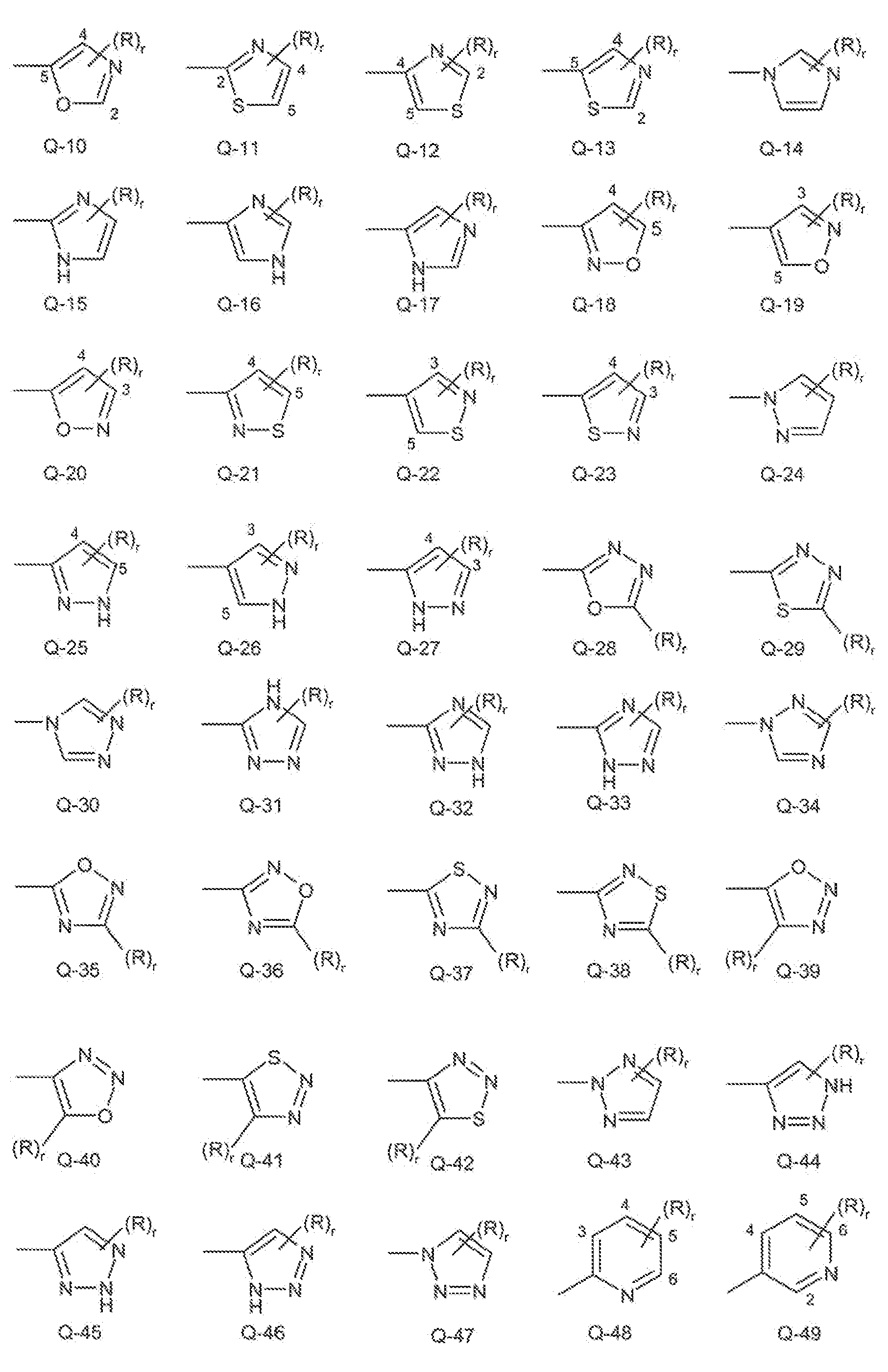
Examples of a 5- or 6-membered unsaturated aromatic heterocyclic ring optionally substituted with from one or more substituents include the rings Q-1 through Q-80 illustrated in Exhibit 1 wherein R is any suøstituent as defined before for Q including the preferences given, and r is an integer from 0 to 4, limited by the number of available positions on each Q group. As Q«28,~ Q-29, Q-35, Q-36, Q-37, Q-3B, Q~3δ, Q-40, Q-41 and Q-42 have only one available position, for these Q groups r is limited to the integers 0 or 1 and r being 0 means that the Q group is unsubstituted and a hydrogen is present at the position indicated by (R),,
Exhibit 1
A further group of suitable heterocyclic radicals comprises, for example, a 5- or 8-membered heterαaiiphatϊc or partly unsaturated ring having from 1 to 4, preferably from 1 to 3 same or different hβtβroatoms selected from the group consisting of N1 O and S. which is further uπsubstitutβd or substituted by one or mom substituents as defined before for Q including the preferences given therefore.
Examples of heteroaiiphatio or partly unsaturated rings include the radicals illustrated in Exhibit 2 below, wherein R and r are as defined above including the preferences given.
Exhibit 2
preferred heterocyclic raclicaS Q is of formula
whereiπ r is an integer from 0 to 3 and R is independently selected from the group given for Q including the preferences. Q is particularly preferred the unsubstituted radical G-34, G-43 or Q-47, wherein r is 0 in each case.
A further particularly preferred radical Q is a radical G-44, wherein r is an integer from 0 to 3, in particular 1 , and R is independency selected from the group given for Q including the preferences. Another preferred radical Q is a radical G-75, wherein r is an integer from 0 to 3, in particular 1 , and R is independently selected from the group given for Q including the
A further preferred radical G is a radical G-5, Q-14, Q-24, G-25, Q-26, G-3G, Q-32, Q-34, Q- 43, Q-44, Q-47, Q-49, Q-50 or Q~75, in particular a radical Q-24, Q-26, Q-30, Q-32, Q-34, Q-44 or Q-47, which is each unsubslituted or substituted by one or more substituents selected from the group consisting of CrC2~aikyi, halo- CrG2-SlKyS, halo- C1-C2- alkyicarbonyl, cyano, CrCt-aikoxycarbonyl^ CrC^-alkoxycarbonylmethyi, carboxy-Ct-Cr alkyi, aminocarbonyl, N-mono- or N^-di-Ci-Ca-afkytarfiinocarbonyi, halo- Ci-C2- alkyiaminocarbonyimethyl, halo-C^Ca-alkylaminocarbonylmethyiaminocarbonyl, haiovinyl, - C(G}N~CHN(CH3}2, -C(O)N=CHNHOCH3, unsubstituted or halogen or CrC2-aikoxy- substitutβd phenyl, benzyl and phenyiβthyl, unsubstiiuted and haiogen-substituted 2~, 3- mά 4-pyridyi and pyridylmethyi, pyridylcarbonylaminomethyi, pyrroiidinøcarbonyl, and 2-
A further particularly preferred radical G is a radicai G-5, Q-14, Q-24, Q-25, Q-26, Q-30, Q- 32, Q-34, Q-43, Q-44, Q-47, Q-49 Q-50 or Q-75, in particular a radical G-24, G~2δ, Q-30, Q- 32, Q-34, Q-44 or Q-47, which is each unsubstituted or substituted by one substituβnt selected from the group consisting of methyl, trifluoromethyi 2~trifiuoroethyf, trifiuormethyicarbonyi, cyano, methoxycarbonyl, tert.-buloxycarbonyi, carboxymelhyl, ethoxy- carbonyimethyl, aminocarbonyl, N-metliytaminocarbony!, 2~trif1uorethylaminocarbonyl- methyl, 24rifiuorethylaminocarbonyimethyiaminocarvbonyi,1-fiuoro-2-iodo-1-vinyf( - C{O}N~CHN(CH3)2, C(O}N~CHNHOCH3, 4~chlorphenyi, 4-ffuorophenyi, 4-methoxyphβnyl, benzyi, 4-chiorophenylethyi, 2-, 3~ and 4-ρyridyi, chloropyridyi, 2~, 3- and 4-pyridyimethyi, pyrroiidinecarbonyl, tetrahydrofuranyimethyi and pyridyicarbonyiaminomethyl.
Another preferred radical Q ts a radical of formula
wherein R is hydrogen or C
rC
2-aikyi, hab- C
rC
2-aSkyl, halo- C
rC
2-alk;y1carboπy!, cyan©, CrCa-aikoxycarboπy!, CrCralHoxycarboπylmethyi, carboxy-C, -Qj-aikyi, aminocarbonyl, hS-moπo- or N,N-di-CrC
2-aikylamiπocarb©nyl, halo- Ci-Craikyiaminocarbonylmethyi, halo- CrC
2-aSKyiaminocarboπyimetr\ylaminoGarbonyl
} haioviπyi, -G(O)N-CHN(CH
^)
2, -C(O)N=CHNHOCHa, unsubstituted or halogen or CrCa-alkoxy-substituted phenyl, benzyl or phenyiethyl, unsubstituted or hsiogeπ-substitυtβd 2-, 3- and 4-pyridyi and pyridyimethyi, pyridyicarbonyiaminomethy! , pyrrosidiπecarbony!, or 2-tetrahydrof υranyimethyS.
A suitable fused heierobicyciic ring system comprises, for example a 5- or β-memhβred heterocyclic ring having from 1 to 4, preferably from 1 to 3 same or different heteroatoms selected from the group consisting of N, O and S, to which is attached an aππυiated ring; in addition said fused bicycHc system is further unsubstituted or substituted by one or more subsiituente as defsned before for Q deluding the preferences given. Those rings can be saturated sing or unsaturated rings.
Examples of fused heterσ-b&cyclic ring systems Q are illustrated in Exhibit 3 below. Exhibit si
wherein for (R)
r each the above-given meanings and prefernces apply. In the above Exhibit 3, when the attachment point on the Q group is illustrated as floating, the Q group can be attached to the remainder of the formula (\) through any available carbon or nitrogen of the
Q group by replacement of a hydrogen atom. In addition, when the attachment point between (R)
r and the Q group is illustrated as floating, (R)
1. can be attached to any available carbon atom or nitrogen atom of the Q group.
Q is even more preferred the unsubstituted radical G-105, G106, Q-107, Q-108, Q-109, Q- 110 or G-111 , wherein r is 0 in each case. Particuiariy preferred fused bicyclic stαscfurøs Q are of formula
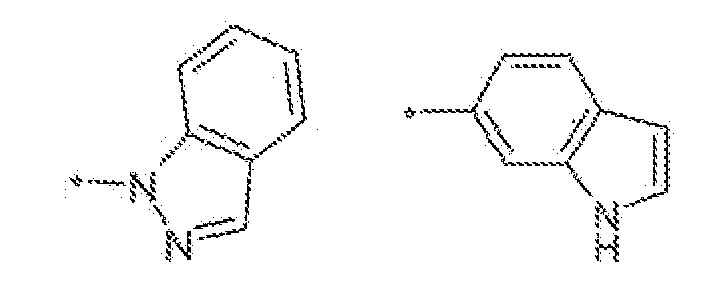
A further preferred fused bicyclic structure Q is of formula
According to a preferred embodiment of the invention there is provided a compound of formula
including all geometric anά stereoisomers, N~oxides, and salts thereof, wherein for R
1, R
2, R
3, Q and π each the above-given meanings and preferences apply, and m is an integer from 0 to 3.
In particular, n is an integer from 1 to 3, Rt is CrCa-haioalkyi, each Rg and R3 is independently selected from the group consisting of halogen, CrC2-aikyl, CrCz-hsioaikyl, Ct-C2- alkoxy, Cr-C2~haloaikoxy, C-rCa-haioalkyithio, -CU and -NO2, m is an integer from 0 to 2, in particular 0, and Q is either
(i) phenyl, which is unsubstituied or substituted by 1 to 3, Sn particular 1 or 2, same or different substituents selected from the group consisting of halogen, CrCraikyl, CrC2- haloalkyi, C,-C2-aikoxy, CrC2-ha!oaikoxy, CrQrhaloalkyiihio, -CN, -NO2, and υnsυbststuted or halogen-, CrC2~aikyh GrCrha!oaSkyS-, CrC2-aikoxy-, Ci-CVhaiαatkoxy-, -CN or -NO2- substituted phenyl or phenoxy, or is
(ii) a 5- or ø-membered heterocyclic ring having from 1 to 3 same or different heteroatoms selected from the group consisting of N, O and S, which is further unsubstituted or substituted by halogen, CrCa-aikyi, Ci-C2-haioa!kyi, d-Cj-aikoxy, d-Cz-haloalkoxy, C1-C2- haioaikylthio, -CN, -NO2 or Ci-C^aikoxycarbonyi, or is
(iii) a fused bicyelic ring system comprising a 5- or 6-membered heterocyclic ring having from 1 to 3 same or different heteroatoms selected from the group consisting of N, O and S, to which is attached an annulatβd ring, and which is further unsubsiituted or substituted by haiogβn, d-Craikyf, Ci-C2-haioaikyi, Ci~C2~alkoxy, Ci-C2-ha!oaikoxy, Ci-Ca-haioaikyithio, -CN, -NO2 or CrC4~alkoxycarbonyi.
A particuiariy prefeπeά embodiment of the invention relates to a compound of formula (Sa) above, wherein n is an integer from 1 to 3, Ri is CF3, each R2 is independently selected from the group consisting of halogen, CrCa-haioaikyl, Ci-C2-haloalkoxy and -CH, m is 0 and Q is either
(ii) a 5- or δ-mβmbδred hetsroaromatic ring selected from the group consisting of the above- given radicals Q-S1 Q-6, Q~7, Q-14, CM5, Q»16, Q-17, Q-24, Q-2β, Q-30, Q-31 , 0-32, Q-33, Q-34, Q-43, Q-47, Q-49, Q-50, Q-52 and Q-54, wherein r is an integer from 0 to 3 and R is independently selected from the group consisting of halogen, CrQralkyi, CrC2~ha!oa!kyi, d-C'2-aikoxy, CrC2-haioaikoxy, Ci-Crhaloalkyithiot -CN, -NO2 ^nύ CrC^alkoxycarbonyl, or is (iii) a fused bicycfic ring system of formula Q-107a, Q-107b or Q- 111a.
Another pr&iemύ embodiment of the invention relates to a compound of formula (ia) above, wherein n is an integer from 1 to 3, Ri is CF3, each R2 is independently selected from the group consisting of haiogβn, CrQrhaloalkyS, CrC2-ria!oaikoxy and -CN, m is O, and Q is a radical Q~5, Q-14, Q-24, G-25, Q-26, Q-30, Q-32, Q-34, Q-43, Q-44, Q-47, Q-49, Q-50 or Q-75, which is each unsubsfituted or substituted by one or more substifuents selected from the group consisting of CrC2~alkyi, halo- CrC2~aikyi, halo- Ct-C2- alkylcarbonyl, cyaπo, CrCralkoxycarbonyi, CrC4-alkoxycarbony1methyl, carboxy-Ci-Ca-
alkyi, amtnocarbonyl, N-mono- or N,N»di-Ct- C2-a!kylaminocaitsony!, haio- Crθ2- aikySaminocarbonyimβthyi, haio-CrCa-aikyiaminocarbonylmethylaminocarboπyl, halovinyi, ~ C(O)N~CHN{CH3)2, -C(O)N=CHNHOCH3, unβυbstituted or halogen or C1-C2-SIkOXy- substituted phenyl, benzyl and phenyieihyl, unsubstituted and halogen-substituted 2-, 3- and 4-pyridyl and pyridyimethyi, pyridylcarbonyiamsnomethyl, pyrrolidinecarbonyl, and 2~ tθtrahydrofuraπyimβthyi, or Q is a radical Q-10?a, Q-IOTb5 Q-111a or Q-134.
Another preferred embodiment of the invention relates to a compound of formula {ia} above, wherein n is an integer from 1 to 3, R1 is CF3, each R2 is independently halogen, rn is 0, and Q Is a radical Q-24a, Q-26a, Q-SOa, Q-32a, Q-32b, Q-34a, Q~44a or Q-47a, wherein R is hydrogen or d-Cralkyi, haio- Ci-C2 »alky1, haio- CrC∑-alkyicarbonyl, cyano, CrCV alkoxycarbonyl, CrC«~alkoxycarbony!methyi, carboxy-CrCz-alkyi, aminocarbony!, M-roono- or N.N-di-CrCa-alkylsrninocarbonyl, halo- CrCa-alkylaminocarboπylmethyl, ha!o~CrC2-alkyi- aminocarbonyimethylaminocarbonyl, haiovinyl, -C(O)N~CHN(CH3)a, -C(Q)N-CHNHOCH3, unsubstituted or haiogen or Ci-C2-aikoxy-substituted phenyl, benzyl or phenyiethyi, unsubstituted or haiαgen~$ub$ti£uted 2-, 3- and 4-pyridyi and pyridyimethyl, pyridyicarbonyi- aminomethy!, pyrrolidinecarbonyl, or 2~tøtrahydrofυranylmθthyi.
Compounds of this invention can exist as one or more stereoisomers. The various stereoisomers include enantlomers, diastereorners, atropisomers and geomeiήc isomers. One skilled in the art wiii appreciate that one stereoisomer may h® more active and/or may exhibit beneficial effects when enriched relative to the other stereoisomers) or when separated from the other stereoisomer(s). Additionally, the skilled artisan knows how to separate, enrich, and/or to selectively prepare said stereoisomers. The compounds of the invention may be present as a mixture of stereoisomers, individual stereoisomers, or as an optically active forot.
One skilled in the art wiH appreciate that not ail nitrogen containing heterocyclic rings can form N-oxides since the nitrogen requires an available ione pair for oxidation to the oxide; one skilled in the art wiii recognize those nitrogen containing heterocyclic rings which can form N-oxides. One skilled in the art will also recognize that tertiary amines can form N- oxides. Synthetic methods for the preparation of N-oxides of heterocyclic rings and tertiary amines are very well known by one skilled m the &ύ including the oxidation of heterocyclic rings <mή tertiary amines with peroxy acids such as peracetic and m-chloroperberszoic acid (MCPBA), hydrogen peroxide, alky! hydroperoxides such as t-butyl hydroperoxide, sodium
perborate, and dioxiranes such as dimethyl dioxirane These methods for the preparation of iV-oxides have been extensively described anύ reviewed In the literature.
One skiiied in the art recognizes that because of the environment and under physiological conditions salts of chemical compounds are in equilibrium with their corresponding nonsalt forms, salts share the biological utility of the nonsalt forms, Thus a wide variety of salts of the compounds of formula (i) are useful for control of invertebrate pests (i.e. are veterinariiy or agriculturally suitable). The salts of the compounds of formula (I) include acid-addition salts with inorganic or organic acids such as hydrobromic, hydrochloric, nitric, phosphoric, sulfuric, acetic, butyric, fumarie, lactic, maiβic, maionic, oxalic, propionic, salicylic, tartaric, 4~ toluenesuifonic or valeric acids. When a compound of formula (i) contains an acidic moiety such as a carbøxyisc acid or phenol, salts also inciude those formed with organic or inorganic bases such as pyridine, tπethylamine or ammonia, or amides, hydrides, hydroxides or carbonates of sodium, potassium, lithium, caicium, magnesium or barium. Accordingly, the present invention comprises compounds selected from formula (I), N-oxides and veterinary acceptable and agriculturally suitable salts thereof.
The compounds of the present invention made be prepared, for exarπpie, in analogy to the processes as outined in WO 2007/75459 on pages 29-31. Accordingly, the compounds of formula (!) or (Sa) may be prepared, for example, by cycioaddition of a compound of formula
with a nitriie oxide derived from an oximβ of fαrmuia
wherein A
1-A
6, B
1-B
3, R
1, R
2, Q and n each have the above-given meaning.
The reaction typicaily proceeds through the intβtrnediacy of an in situ generated hydroxamyi chloride, in a typicai procedure a chlorinating reagent such as sodium hypochlorite, N- chiorosuccinimide, or chioraroine-T is combined with the oxime in the presence of the styrene. Depending on the conditions amine bases such as pyridine or triethylamiπe may be necessary. The reaction can be run in a wide variety of solvents including tetrahydrofuran, diethyl ether, methylene chloride, dioxane, and toluene with optimum temperatures ranging from room temperature to the reflux temperature of the solvent.
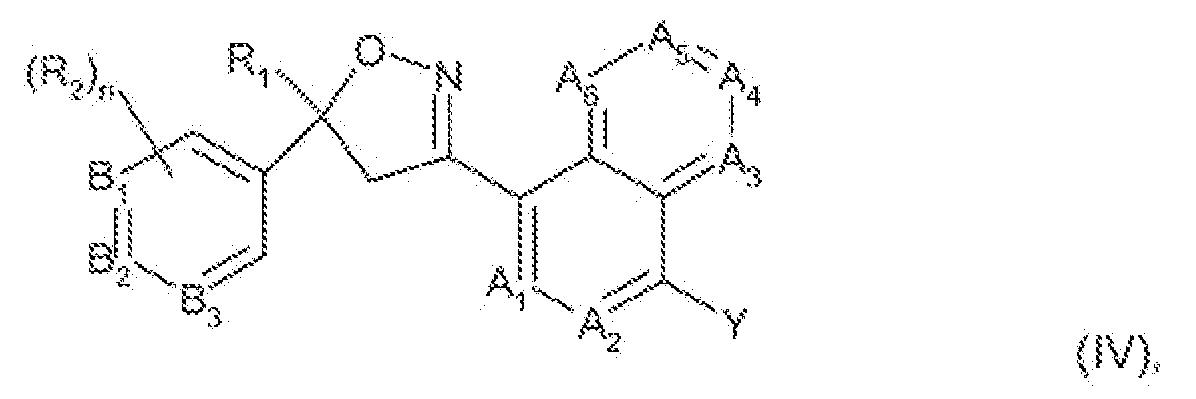
The compounds of formula (!) or (Ia), wherein Q is a 5-membered N-linked heterocyclic ring can also be prepared by direct displacement of an aromatic leaving group of formuia
wherein ApAe, BrB
3, R
5, R
2 and n each have the above-given meaning and Y is halogen, for example Br or F
1 tosyiate, trifiate or nitro, with a compound of the formula
Q' ~ H (V), wherein Q' is m azoie heterocyclic ring, in the presence of a base, Typical azole heterocyclic rings of formuia (V) include optionally substituted pyrazoiβs, imidazoles, triazoles and teirazoles. Bromides can be displaced with the use of copper iodide and a palladium catalyst, see for example Kanemasa et a!., European Journal of Organic Chemistry, 2004, 685-709. For direct fluorine displacement the reaction is typically run m a polar aprotic solvent such as N.N-dirnethyiformamide or N,N-dimethyiacetamide and in the presence of an inorganic base such as sodium or potassium carbonate.
Another process for the preparation of compounds of the formula (I) or (ia), wherein Q is a phenyl, naphthyl or heteroaramatic ring, includes the Suzuki reaction via Pd~catalyzed cross coupling of an aromatic iodide or bromide of formuia (IV) above, wherein Y is Br or J1 with an aryi or heteroary! borσnic acid of formula
Q" - B(OH)2 (Vi).
Many catalysts are useful for this type of transformation; a typical catalyst is tetrakis- (triphenylphosphine)paiiadium(O). Solvents such as teirahydrofuran, acetonitriie, diethyl
ether and dioxaπe are suitable. The boroπic acids of Formula 6 &r& either commercially avaiiabie or can be prepared by known methods. Other methods including the Heck, StiHe, Kυroada and Buchwald-Hartwig coupling procedures offer many alternatives for introduction of Q heterocyclic groups. For leading references see for example Zificsak, Craig A and Hiasta, Dennis J., Tetrahedron, 2004, 60, 8991-9016.
The compounds of of formulae (Ii) and (SV) are known, for example, from WO 2008/49459 or may be prepared in analogy to the methods disclosed therein. The compounds of formula (HI) may be prepared, for example, in analogy to the processes disclosed in WO 2007/75459 for the preparation of compounds of formuis (3),
Th© compounds of the formula (i) according to the Invention are notable for their broad activity spectrum and are valuable active ingredients for use in pest control They are particularly suitable in the control of ectoparasites and to a certain extent also for controlling endoparasϊtes on and in animals and in the hygiene field, whilst being weli tolerated by warm-blooded animals, in the context of the present invention, ectoparasites are understood to be in particular insects, acari (mites and ticks), and crustaceans (sea lice). These include insects of the following orders: Lepidoptera, Coleoptera, Homoptera, Herniptera, Heteroptera, Diptera, Oictyoptera, Thysanσptera, Orthopiera, Anoplura, Siphonaptera, Mallophaga, Thysanura, isoptera, Psocoptera and Hymenoptera. However, the ectoparasites which may be mentioned in particular are those which trouble humans or animais and carry pathogens, for example Hies such as Musca domestica, Musca vetustissima, Musca autumnaiϊs, Fannia oanicuiaris, Sarcophaga carnaria, lυcilia cuprina, LuciHa sericata, Hypoderrna bovϊs, Hypoderma lineatum, Chrysomyia chloropyga, Dermatobia hominis, Cochiiomyia horninivorax, Gasterophiius intestinalis, Oestrus ovis, biting flies such as Haematobia irrilans irritans, Haβmatobia irritans exigua, Stomoxys calcitrans, horse-flies (Tabanids) with the subfamilies of Tabanidae such as Haematopαta spp. (e.g. Haematopota piuviaiis) and Tabanus spp, (e.g.Tabanus nigrovittatus) and Chrysopsiπaβ such as Chrysops spp. (e.g. Chrysops caβcutiens); Hippoboscids such as Melophagus ovinus (sheep Red); tsetse flies, such as Glossinia spp,; other biting insects like midges, such as Ceratopogonidae (biting midges), Simuisidae (Biackfiies), Psychodidae (Sandflies); but also biood-sucksng insects, for example mosquitoes, such as Anopheles spp, Aedes spp and Culex spp, fleas, such as Ctenocephalides fells and Cienocephaiides canis (cat and dog fleas), Xenopsyila cheopis,
Pυiex irritaπs, CeratopftyOus gafSlnae, Dermatophiius penetrans, blood-sucking lice (Aπoplυra) such as Linognathus spp, Haematopinus spp, Solenopotes spp, Pedicuius humaπis; but also chewing lice (Mafiophaga) such as Bovicoia (Damatinia) ovis, Bovicoia (Damalinia) bovis and other Bovicoia spp. . Ectoparasites also include members of the order Acarina, such as mites (e.g. Chorioptes bovis, Cheyietieiia spp., Dermanyssυs gafifnae, Ortnithonyssus spp., Demodex cams, Sarcoptβs scabiei, Psorαptes ovis and Psorβrgatøs spp. and ticks. Known representatives of ticks are, for example, Boopfciius, Arnblyomma, Anocenior, Derroaeentor, Haemaphysalis, Hyaiomma, Ixodes, Rhipicentor, Margaropus, Rhipicephalus, Argas, Otobius and Qrnithodoros and the like, which preferably infest warmblooded animals inciuding farm animais. such as cattle, horses, pigs, sheep and goats, poultry such as chickens, turkeys, guineafowls and geese, fur-bearing animais such as mink, foxes, chinchillas, rabbits and the like, as well as companion animals such as ferrets, guinea pigs, rats, hamster, cats and dogs, but aiso humans.
The compounds of the formula (!) according to the invention are also active against all or individual development stages of animal pests showing norma! sensitivity, as well as those showing resistance to widely used parasiticides. This is especiaily true for resistant insects and members of the order Acarina. The insecticldai, ovicidai and/or acaricidai effect of the active substances of the invention can manifest itself directly, i.e. killing the pests either immediately or after some time has elapsed, for example when moulting occurs, or by destroying their eggs, or indirectly, e.g. reducing the number of eggs laid ^nό/ot the hatching rate, good efficacy corresponding to a pestiddaf rate (mortality) of at least 50 to 60%.
Compounds of the formula (I) can afso be used against hygiene pests, especially of the order Diptera of the families Muscidae, Sarcophagidae, Anophiiidae and Cuticidae; the orders Orthoptera, Dictyoptera (e.g. the family Btøttidae (cockroaches), such as Blateiia gerrrsansca, Biaita oπentaiis, Peripianeta americana) and Hymenoptera (e.g. the families Formicidaø (ants) and Vespidae (wasps).
Surprisingly, the compounds of formula (I) are also effective against ectoparasites of fishes, especially the sub-class of Copepoda (e.g. order of Siphonostomatoidae (sea lice), whiist being we!i tolerated by fish.
Compounds of the formula (I) also have sustainable efficacy on parasitic mites ®nά insects of plants. In the case of spider mites of the order Acarina, they are effective against eggs, nymphs and adults of Tetranychidae (Tetmnychus spp. and Pmonychus spp,).
They have high activity against sucking insects of the order Homopters, especially against pests of the families Aphididaβ, DΘlphaάdaβ, Cicad&Uidae, Psyilidae, Loccidae, Diaspidiάae and Eriophydidae (e.g. rυst mite on citrus fruits); the orders Hemipt&ra, Hetβroptera and Thysanoptem, and on the plant-eating insects of the orders Lepidoptera, Coleoptera, Diptem and Qriboptera
They are similarly suitable as a soil insecticide against pests in the soil.
The compounds of forrouia (1) are therefore effective against aii stages of development of sucking insects and eating insects on crops such as cereals, cotton, rice, maize, soya, potatoes, vegetables, fruit, tobacco, hops, citrus, avocados and other crops.
The compounds of formula i are also effective against piant nematodes of the species Meioidogyne, Heterodera, Pratyienchus, Dityi&nchus, Radophoius, Rizoglyphus etc.
Certain compounds of the formuia (!) seem to be also effective against certain species of helminths.
Helminths are commercially important because they cause serious diseases in mammals and pouitry, e.g. in sheep, pigs, goats, cattle, horses, donkeys, camels, dogs, cats, rabbits, guinea-pigs, hamsters, chicken, turkeys, guinea fowis and other farmed birds, as weϊi as exotic birds. Typical nematodes are; Haemonchus, Trichostrcngyius, Qstertagia, Nematotiirus, Cooperia, Ascaris, Bunostonum, Gesophagostonum, Charbertia, Trichuris, Strongyius, Trϊchonema, Dictyocaulus, Capsliarsa, Heterakis, Toxocara, Ascaridia, Oxyuris, Ancyiostoma, Uncinaria, Toxascaris and Parascaris. The trematodes include, in particular, the family of FasciαikJeae, especiaify Fasciola hepatica.
The good pesticida! activity of the compounds of formula (!) according to the invention corresponds to a mortality rate of at least 50-60% of the pests mentioned, more preferably to a mortality rate over 90%, most preferably to 95-100%. The compounds of formula (I) are preferably employed internally and externally in unmodified form or preferably together with the adjuvants conventionally used in the art of formulation and may therefore be processed in a known manner to give, for example, liquid formulations (e.g. spot-on, pour-on, spray-on, emulsions, suspensions, solutions, emulssfiable concentrates, solution concentrates), semisolid formulations (e.g. creams, ointments, pastes, gels, liposomal preparations) and solid
preparations (e.g. food additives tablets including e. g, capsules, powders including soluble powders, granules, or embβddings of the active ingredient In polymeric substances, like implants and microparticies). As with the compositions, the methods of application ar® selected in accordance with the intended objectives anύ the prevailing circumstances. The formulation, Ke. preparations containing the active ingredient of formula {!}, or combinations of these active ingredients with other active ingredients, and optionally a soiid, semi-solid or liquid adjuvant, are produced in a manner known per se, for example by intimately mixing, kneading or dispersing the active ingredients with compositions of excipients, whereby the physiological compatibility of the formulation excipients must be taken into consideration.
The solvents in question may be: alcohols (aliphatic and aromatic), such as benzylaicohol, ethanof, propanol, isopropanol or butanol, fatty aieohois, such as oieyl alcohol and glycols and their ethers anό esters, such as glycerin, propylene glycol, dipropylene glycol ether, ethylene glycol, ethylene glycol monomethyi or -ethyl ether and butyl dloxytoi, carbonates, such as propylene carbonate, ketones, such as cydohexanone, isophorone or diacetanoS aicohoi and polyethylene glycols, such as PEG 300. In addition, the compositions may comprise strong polar solvents, such as N-rnethyi-2-pyrroiidone, dimethyl sulfoxide or dimefhyiforroamide, or water, fatty acid esters, such as ethyl oleate or isopropyf pa imitate, vegetable oils, such as rape, castor, coconut, or soybean oil, synthetic mono-, di-, triglycerides like e.g. glyceryl monostearafe and medium chain triglycerides and also, if appropriate, silicone oils. The mentioned ingredients may also serve as carrier for particulate application froms.
As ointment base rβsp. structure building ingredients the following excipients may be used: Petroleum based substances, such as Vaseline or paraffines, bases made from wool fat, like e.g. lanolin or lanolin alcohols, polyethylene glycols like e.g. macrogols and Upiύ bases like e.g. phospholipids or triglyceride, such as hydrogenated vegetable oils. The use of emuisifiers, wetting agents and spreading agents may also be required, in general, lecithins like soy lecithin, salts of fatty acids with alkaline earth and alkali metals, aikyl sulfates like sodium cetylstearyl sulphate, chelates, fatty alcohols like cetyi alcohol, sterols like cholestesterol, pofyoxyeihylene sorbitan fatty acid esters like poiysorbate 20, sorbitan fatty acid esters like sorbitan mono laureate, fatty acid esters and fatty aicohoi ethers of polyoxyethyiene like poloxyl olβyl eih&r, polyoxypropyiene pdyoxyβthytene block copolymers as e.g. Piuronic™ , saccharose esters like saccharose distearate, poiygiyceryl
fatty acid esters like poiygiycβrøi øleate and fatty acid esters like e.g. ethyl oleate or isopropyimyristate.
The formulations may aiso include gelifying and stiffening agents, iikø e.g. polyacryiϊc acid derivatives, cellulose ethers, polyvinyl alcohols, polyvinylpyrroiidons and fine disperse siliciurn dioxide.
As polymeric agents with controlled release properties, may be applied derivatives made by e.g. pofyiactte acid, poiylactic cogiycoiic acid, poly orthoester, poiyethylene carbonate, poly anhydrids and starch and PVC based matrices,
The addition of penetration enhancers like ketones, sulfoxides, amides, fatty acid esters and fatty alcohols may be necessary.
Aiso preservatives like sorbic acid, benzyl alcohol and parabenes, and antioxidants as e.g. alpha tocopherol may be added.
The active ingredient or combinations of the active ingredient may aiso applied in capsules, like hard gelatine capsules or soft capsules.
The binders for tablets and boli may be chemically modified polymeric natural substances that are soluble in water or in alcohol, such as starch, ceiluiose or protein derivatives (e.g. methyl cellulose, carboxymethy! cellulose, ethyihydroxyethyl celiuiose, proteins such as zein, gelatin and the like), as well as synthetic polymers, such as polyvinyl alcohol, polyvinyl pyrroHdone etc. The tablets also contain fillers (e.g. starch, microcrystalline cellulose, sugar, lactose etc.), lubricants (e.g. magnesium stearate), giidants (e.g. colloidal silicon dioxide) and disintegrants (β,g. cellulose derivatives) and acid resistant coatings, like e.g. acrylic acid esters.
The compounds of formula (I) according to the invention may be used alone or in combination with other biocides. They may be combined with pesticides having the same sphere of activity e.g. to increase activity, or with substances having another sphere of activity e.g. to broaden the range of activity. It can also be sensibi© to add so-called repellents. For example, an case of a compound of formula (!) having a particular efficacy as aduiticlde, e.g. since the compounds of formula (!) are effective in particular against the adult stage of the target parasites, the addition of pesticides which instead attack the juveniie stages of the parasites may be very advantageous. In this way, the greatest part of those parasites that produce great economic damage will be covered. Moreover, this action will contribute substantially to avoiding the formation of resistance. Many combinations may aiso lead to synergistic effects, i.e. the total amount of active ingredient can be reduced, which is desirable from an ecological point of view. Preferred groups of combination partners and
especially preferred combination partners are named in the following, whereby combinations may contain one or more of these partners in addition to a compound of formula (i). Suitable partners in the mixture may be biocidβs, e.g. the insecticides anά acarieides with a varying mechanism of activity, which are named in the foiiowiπg and have been known to the person skilled in the art for a long feme, e.g. chitin synthesis inhibitors, growth regulators; active ingredients which act as juvenile hormones; active ingredients which act as aduitiddes; broad-band insecticides, broad-band acaricides and nematieides; and also the well known antheSminthies and insect- and/or aearrci-deterring substances, said repellents or detachers. Non-Hmitative examples of suitable insecticides and acaricides are mentioned in WO 2009/071500, compounds Nos. 1-284 on pages 18-21. Non-limitative examples of suitable anthelmintics are mentioned in WO 2009/071500, compounds (A1 ) - (A31 ) on page 21. Non-iimitative examples of suitable repellents and detachers are mentioned in WO 2009/071500, compounds {R1 } ~{R3) on page 21 and 22. Non-limitative examples of suiiabie synergists are mentioned in WO 2009/071500, compounds (S1 ) -(S3) on page 22. The said partners in the mixture are best known to specialists in this field. Most ar& described in various editions of the Pesticide Manual, The British Crop Protection Council, London, and others in the various editions of The Merck Index, Merck & Co., Inc., Rahway, New Jersey, USA or in patent literature. A iist of suitable partners including a reference is disclosed in WO 2005/058802 on pages 16-21, No. (!) to (CLXXXIH). As a consequence of the above details, a further aspect of the present invention relates to a combination preparation for the control of parasites on warm-biooded animals, characterised in that It contains, in addition to a compound of formula (!), at least one further active ingredient having the same or different sphere of activity mό at ieast one physiologically acceptable carrier. The present invention is not restricted to two-fold combinations. As a rule, the insecticidai and acaricidai compositions according to the invention contain 0.1 to 99 % by weight, especially 0.1 to 95 % by weight of one or more active ingredients of formuia (i), 99.9 to 1 % by weight, especially 99.8 to 5 % by weight of a solid or liquid admixture, including 0 to 25 % by weight, especially 0.1 to 25 % by weight of a surfactant Application of the compositions according to the invention to \h& animals to be treated may take piace topically, peroraily, parenteral^ or subcutaneoυsiy, the composition being present, for example, in the form of solutions, emuisions, suspensions, (drenches), powders, tablets, boJi, capsules, collars, eartags and poυr-on formulations. Preferred topicaS formulations are understood to refer to a ready-to-use solution in form of a spot-on, pour-on or spray-on forrnuiation often consisting of a dispersion or suspoemulsion
or a combination of active ingredient and spreading auxiliaries. The expression spot-on or pour-on method is understood to refer to a ready-to-use concentrate intended to be applied topically &nά locally on the animal This sort of formulation is intended to be applied directly to a relatively smaii area of lhe animal, preferably on the animal's back and breech or at one or several points along the line of the back and breech. !t is applied as a iow volume of about 0.05 to 1 mi per kg, preferably about 0.1 mi per kg, with a total volume from 0.1 to 100 ml per animal, preferably limited to a maximum of about 50 mi. However, it goes without saying that the total volume has to be adapted to the animal that is in ne&ά of the treatment and will clearly be different, for example, in young cats and in cattle. These pour-on and spot-on formulations are designed to spread ai! around the animal giving protection or treatment to almost any part of the animal. Even so the administration Is carried out by applying a swab or spray of the pour~on or spot-on formulation to a relatively smaii area of the coat, one observes that from the active substance is dispensed almost automatically over wide areas of the fur owing to the spreading nature of the components in the formulation and assisted by the animal's movements.
Pour~on or spot-on formulations suitably contain carriers, which promote rapid dispersement over the skin surface or in the coat of the host animal, and are generally regarded as spreading oils. Suitable carriers are e.g. oily solutions; alcoholic mά isopropanoiic solutions such as solutions of 2-octyidodecanoi or oleyi aicohol; solutions in esters of monocarboxylic adds, such as isopropyi myhstate, isopropyi paSmitate, lauric acid oxalate, oleic acid oley! ester, oleic acid decyi ester, hexyl iaurate, oleyi oieate, decyi oieaie, capric acid esters of saturated fat aϊcohois of chain length Ci2-C18; solutions of esters of dicarboxyiie acids, such as dibutyi phthalate, diisopropyl isophthaiate, adipic acid diisopropyi ester, di-n-butyf adipate or aiso soiutions of esters of aliphatic acids, e.g. glycols. It may be advantageous for a dispersing agent to be additionally pmsβnt, such as one known from the pharmaceutical or cosmetic industry. Examples are 2-pyrroiidone, 2-(N-a!ky!)pyrroϋdone, acetone, polyethylene glycol and the ethers and esters thereof, propylene glycol or synthetic triglycerides. The oily soiutions include e.g. vegetable oils such as olive oil, groundnut oil, sesame oil, pine oil, linseed oil or castor oii, The vegetable oils may aiso be present in epoxidised form. Paraffins and silicone oils may also be used.
A pour-on or spot-on formulation generally contains 1 to 98.9 % by weight of a compound of formula (I), 0.1 to 80 % by weight of dispersing agent anύ 1 to 98.9 % by weight of solvent. The pour-on or spot-on method is especially advantageous for use on herd animals such as cattle, horses, sheep or pigs, in which it is difficult or time-consuming to treat all the animals
orally or by injection. Because of its simplicity, this method can of course also be used for ail other animals, including individual domestic animals or pets, and is greatly favoured by the keepers of the animals, as it can often be carried out witliout the specialist presence of the veterinarian.
Whereas it is preferred to formulate commercial products as concentrates, the end user will often use dilute formulations. However, this depends on the mode of administration. Oraϋy administered products are most often used in diluted form or as feed additives, whereas commercial pour-on and spot-on formulations are normally ready-to~use concentrates,
Such compositions may also contain further additives, such as stabilisers, anti-foaming agents, viscosity regulators, binding agents or tackifiers, as weii as other active ingredients, in order to achieve special effects. lnseeticidal and acaricida! compositions of this type, which are used by the ®nά user, similarly form a constituent of the present invention.
In each of the processes according to the invention for pest control or in each of the pest control compositions according to the invention, the active ingredients of formula (!) can be used in ail of their sterie configurations or in mixtures thereof.
The invention also includes a method of prophyfacticaiiy protecting animals, especially productive livestock, domestic animals s>nύ pets, against parasitic helminths, which is characterised in that the active ingredients of formula (I) or the active ingredient formulations prepared therefrom are administered to the animals as an additive to the feed, or to the drinks or also in solid or liquid form, orally or by injection or parenteraliy. The invention also includes the compounds of formula (I) according to the invention for usage in one of the said processes
The following examples serve merely to illustrate the invention without restricting it, the term active ingredient representing any substance as described in the preparation examples,
In particular, preferred formulations are made up as follows:
{% - percent by weight)
The active ingredient is dissolved in methylene chloride, sprayed onto the carrier and the solvent subsequently concentrated by evaporation under vacuum. Granulates of this kind can be mixed with the animai feed, (ii) active ingredient 3 % poiyethyiene glycol (mw 200) 3 % kaolin 94 %
{mw - molecular weight)
The fineiy ground active Ingredient is evenly applied in a mixer to the kaolin which has been moistened with poiyethyiene glycol. In this way, dust-free coated granules Site obtained.
2. Tablets or boii
3 active ingredient 33.00 % methyiceliuiose 0.80 % silicic acid, highly dispersed 0,80 % com starch 8.40 %
Ii lactose, cryst. 22.50 % corn starch 17.00 % microcryst. cellulose 16.50 % magnesium stearate 1.00 % i Methyl cellulose is stirred into water. After the material has swollen, silicic acid is stirred in anά the mixture homogeneously suspended. The active ingredient and the corn starch are mixed. The aqueous suspension Is worked into this mixture and kneaded to a dough. The resulting mass is granulated through a 12 M sieve and dried. M Ail 4 exdpients are mixed thoroughly.
IiI The preliminary mixes obtained according to I mά Si are mixed and pressed into tablets or boli.
3. fnjeetabies
A. Oily vehicle (slow release) (i) active ingredient 0,1-1 ,0 g groundnut oil »ύ 100 ml (ii) active ingredient 0.1-1.0 g sesame oil ad 100 mi
Preparation: The active ingredient is dissolved in part of the oil whilst stirring and, if required, with gentle heating, then after cooling made up to the desired volume and sterile-filtered through a suitable membrane filter with a pore size of 0.22 μrn.
B Water-miseibie solvent (average rate of release) (i) active ingredient 0.1-1.0 g
4~hydroxymethyi~1 ,3-dioxolanβ {glycerol format) 40 g
1 ,2-propanediol ad 100 ml (Ii) active ingredient 0.1-1.0 g glycerol dimethyl keiai 40 g
1 ,2-ρropanedioi ad 100 ml
Preparation; The active ingredient is dissolved in part of the solvent whilst stirring, msάe up to the desired volume and sterile-fiftered through a suitable membrane fitter with a pore size of 0.22 μm.
C. Aqueous solubilisate (rapid release) (i) active ingredient 0,1-1 ,0 g pσiyethoxylated castor oil (40 ethylene oxide units) 10 g
1 ,2-propanediol 20 g benzyl alcohol 1 g aqua ad inject, ad 100 ml (ii) active ingredient 0.1-1.0 g poiyethoxyiated sorbitan monooieate (20 ethylene oxide units) 8 g
4~hydroxymβthyi-1 ,3-dioxoiane (glycerol formal) 20 g benzyl alcohol 1 g aqua ad inject, ad 100 mi
Preparation: The active ingredient is dissolved in the solvents anά the surfactant, and made up with water to the desired volume. Sterile filtration through an appropriate membrane filter of 0,22 μm pore size. 4. Pour on
(i) active ingredient 5 g isopropyi myristate 10 g isopropanoi ad 100 m!
(ii) active ingredient 2 g hexyi Ia urate 5 g medium-chained triglyceride 15 g ethanof ad 100 ml
(ill) active ingredient 2 g otey! oieate 5 g
N~meihy!-pyrroϋdone 40 g ssopropanoi aύ 100 mi
5. Spot on
(i) active ingredient 10-15 g diethySeneglycoi monøethyietber ad 100 mi
(ii) active ingredient 10-15 g octyl palrnitate 10 g isopropanol ad 100 ml
(iii) active ingredient 10-15 g isopropano! 20 g benzyl alcohol ad 100 m!
6. Spray on
(i) active ingredient 1 g isopropano! 40 g propylene carbonate aύ 100 mi
(ii) active ingredient 1 g propylene glycol 10 g ad 100 mi
The aqueous systems may also preferably be used for orai and/or intraluminal application. The compositions may also contain further additives, such as stabilisers, e.g. where appropriate epoxidised vegetable oiis {epoxidised coconut oil, rapeseed oil, or soybean oil); antifoams, e.g. silicone oil, preservatives, viscosity regulators, binders, tackifiers, as weif as fertilisers or other active ingredients to achieve special effects.
Further biologically active substances or additives, which are neutral towards the compounds of formula (!) and do not have a harmful effect on the host animal to be treated, as well as mineral salts or vitamins, may also be added to the described compositions.
The following examples serve to illustrate the invention. They do not limit the invention. The letter 'h' stands for hour. The starting materials am known and partially commercially available or may be produced in analogy to methods known per se.
Analysis of the purified samples is in each case done using a Waters Autopurificatioπ (HPLC/MS) system with a reversed phase column (Daisogel SP-120-ODS-AP 5μm, 150X3mm) from Bischoff, Lβonbβrg, Germany. The samples are characterized by m/s and retention time. The above-given retention times relate in each case to the use of a soivent system comprising two different solvents, solvent A: H2O + 0.01% HCOOH, and solvent 8: CH3CN + 0.01% HCOOH). Said two solvents A and B are employed at a flow rate of 2.00 ml/mjπ with a time-dependent gradient as given in the Table:
Preparation of 1 -{4-[5-(3)5-dichioro-pheπyl)-5-tnfiuoromethy1~4<5-dihydro4soxazol-3'"yi]- naphthaien-1-y!}-1H-[1 ,2,4]triazole (compound 1.1, Table 1).
Sjβg A; 3,3,3-TrifluoroprOpene (3.2 g), potassium carbonate (4.6 g) and bis- (tπphenyiphGsphine)-palladium chloride (0.2 Q) Bm added to a solution of 3,5- dichlorophenylooronic acid in THF (20 mi) under nitrogen. After 3 hours at reflux, the reaction is quenched with ethyl acetate (δO mi) and water {50 ml). The organic phase is then extracted with water and with s saturated aqueous solution of NaCi1 dried over Na2SO4 and concentrated in vacuo. The crude product is purified on silica ge! (35x45 mm) using heptane (150 ml) as eiuanf Io yield 1,3-dich!orθ"5~(1-trif!uoromethyi-viπyi>'benz8nβ (2.7 g), as a colorless oii. MS (HPLC/MS): no ionisatloπ. Retention time: 5.10 rnsn.
.Stesϋi SnCU (13 mi, 1M solution In dichiorcmethane) is added to a solution of djchtormethyi-πiethyiethβr in dichioromethane (6 m!) at O0C. After 1 hour at 00C, a solution of
1-fiuoro-naphtatene (1.46 g) in dtohioromethane (4 ml) is added over 10 minutes. The reaction is stirred overnight at room temperature and then quenched with cøict water (30 ml). The organic phase is separated anά the aqueous phase is extracted 3 times with dichiorømβthane. The combined organic phases are dried over Na3SO4 anά concentrated in vacuo to yield 44luoro-naphihatene~1-carbaidehyde (1.73 Q1 dark brown crystals). The crude product obtained is used without further purification. MS (HPLC/MS): no ionisatioπ. Retention time: 3.88 min.
StejLCj, 1,2,4-triazoie (248 rog) is aύάβό to a solution of 4-fluoro~naphthalene-1- carbaldehyde (522 mg) and potassium carbonate (49? mg} in DMF (4 ml), After 3 hours at room temperature, the reaction is quenched with water {40 ml) and ethyi acetate (50 mi). The organic phase is separated and the aqueous phase is extracted two times with ethyi acetate. The organic phases are combined, extracted with water and with a saturated aqueous solution of NaCI, dried over Na2SO4 and concentrated in vacuo. The crude product is purified on a semi-preparative HPLC to yieid 4~[1,2,4]triazoi-1-ykιaphthaiene-1- carbaktehyde (480 mg) as beige crystals. MS (HPUC/MS): 224 (MH+), Retention ϊime: 2.97 min.
Step D: Sodium acetate {282 mg) is added to a solution of hydrαxyiamtne hydrochloride (193 mg) anύ 4~(1 >2,4]tdazoi~1-yi~naphtha!ene-1-carbaidehydβ (4S5 mg) in THF (18 mi), water (2 ml) anά DiVISO (2 ml). After 5 hours at room temperature, the reaction is quenched with water and ethyi acetate. The organic phase is separated and the water phase is extracted with ethyi acetate. The combined organic phases are extracted with water and with a saturated aqueous solution of NaCI, dried over Na2SO4 and concentrated in vacuo to yieid 4-[1,2,4]triazol~1~yl~naphthaiene-1-carbaldehyde oximβ. The crude product obtained (390 mg, beige crystais) is used without further purification. MS (HPLC/MS): 239 (MH*). Retention time 2.78 min.
StepjE: tø-chiσrøsuccinirred (220 mg} is added to a solution of 4~[1 ,2,43tria2θl~1~yi~ naphtha!ene-1-carbaldehyde ©xfrne (390 mg) in DMF (5 mi). After 45 minutes at 400C, the reaction is cold down to 00C anύ 1 ,3~dichioro~5~(14rifluoromethyl-vinyi)-benzene (394 mg, Example 1, step A) and tπetriylarnine (0.25 ml) are added. The reaction is then further reacted at room temperature for 3 hours. Water is added (SO ml) and the reaction mixture is extracted two times with ethyi acetate. The organic phase is extracted with a saturated aqueous solution of NaCi, dried over Na2SO4 and concentrated in vacuo. The crude product is purified on a semi-preparative HPLC to yieid 1-{4-[5-{3,5~dichk>ro-phenyi)-S-
trifiuoromethyi-4,5-dihydro-isoxazo["3-yl]~naphthalen-1-yl}-1H-[1,2,4]triazofe (SOO mg) as beige crystals. MS (HPLC/MS); 47? (MH+), Retention time: 5.20 min.
Example 2
Preparation of 5-{3,5-dich!oro~ρheπy3)-3-[4~{1f/~pyrazol-4-yJ}-naphthaien-1-yl]~5- trifluoromethyl-4>5~dihydro-isoxazøle (compound 1.17, Table 1 )
Step A: A solution of benzoyl peroxide {87 mg) in trifiuorotoluene (40 mi) is refiuxed for 30 min under nitrogen. The reaction mixture is cooled to 78 0C and 1-bromo-4-methyl- naphthaiene (1.6 mi) anά W-bromosuccinimide (2.0 g) are added. The reaction is stirred for 1.5 hours at 78 0C and filtered. The filtrate is concentrated in vacuo and the residue crystallized in heptane to yield 1~bromø-4-bromometnyi-naphfchaien8. The crude product is used in the next step without further purification.
Step B: Sodium bicarbonate {1.4 g) is added to a solution of crude 1-bromo-4~bromomethyl~ naphthalene (2.5 g) in DMSO (25 rn!). The reaction is stirred for 3h at 95 "C and cooled down to room temperature. Water is added and the mixture is extracted with ethyi acetate. The organic phase is dried over MgSO4 and concentrated in vacuo. The crude product is purified on a semi-preparative HPLC to yield 4~bromo~naphtha!ene-1-carbafdehydθ as colorless crystals.
Step C: Hydroxyiamin© (50% aqueous, 0.37 ml) is added to a solution of 4-bromo- naphthalene-1-earbaidehyde (0,7 g) in methanol (8 ml). After 1δ hours at room temperature the reaction is concentrated in vacuo to yield crude 4-bromo-πaphthalenδ-i-carbaidehyde oxime, which Is used in the next step without further purification.
Step D: W-chiorosucclnirnid (134 mg) is added to a solution of crude 4~bromo~naphthalene-1- carbaidehyde oxime (250 rog) in DMF (3 mi). After 1 hour at 40 0C, the reaction is cooled down to 0 "C and 1,3-dichlorα-5-{1-trifiuoromethy!-vinyl}-bβnzene (240 mg) and trieihyiamine (0.15 m!) are added. The reaction is further reacted at room temperature for 16 hours. Water is added and the reaction mixture is extracted with ethyl acetate. The organic phase is washed with a saturated aqueous solution of NaCt, dried over MgSO4 and concentrated in vacuo. The catde product is purified on a semi-preparative HPLC to yield 3~(4-brømθ" naphthalen-i-yi^δ-CS.S-dichloro-phenyO-S-triflυoromethyl^.δ-dihydro-isoxazole as coiorless crystals: m.p. 127-130 0C.
Ste£^Li-rerf-butoxycafbonyi~4-W-pyrazoteboronic acid pinacxsi ester (126 mg), Tris(dibenzyltd8neacetone}dipa[iadium{G) [Pd2(dba}3 (7mg)], KiPO4 (185 mg) and 2- dicyclohexyiphosphiπno-2'(6'-d!m8thoxybipheπy! {12 mg) are added to a solution of 3-{4- bromo~naphtha!en~1 -y^δ^S.S-dichloro-pheπyO-δ-trifiuoromethyi^.δ-dihydfo-isoxazole (140 mg) in dry toluene (2.4 ml). After 18 hours at 75 0C the reaction is cøoied down to room temperature and fiitraied. The filtrate is concentrated in vacuo. The crude product is purified on a semi-preparative HPLC to yield 4~{4"[5-(3>5-dichiorθ'phenyI)-54rifiuoromethy!~415~ dihydro-isoxazol-S-yil-naphthalβn-i-yi^pyrazoie-i-carboxyiic acid terf-butyl ester (compound 1.10, Table 1) as a colorless oii.
Step F: Trifiuoroacetic acid anhydride (0.18 mi) is added to a soiution of_4-{4-[5-(3,5- dfChioro-phenyO-S-trifluoromethyi^.S-dshydro-isoxazol-S-y^naphthalen'i-yl^pyrazoie-i- carboxyiie acid t&rt~buty\ ester (135 mg) in didiloromethane (1 ml). After 1 hour at room temperature an aqueous soiution of sodium hydroxide (30%) is added. The aqueous phase is extracted with dϊchiorornethane and the combined organic phases are dried over MgSQ* and concentrated in vacuo. The crude product is purified on a semi-preparative HPLC to yield 5-(3,5»dichioro~ρheny1)-3-f4-(1H-pyra2θi-4-yi)-naphthalen-1-yi]-5-triflυoromethyi-4,5- dihydro-ssoxazoie as a coloriess solid: m.p. 117-120 0C (compound 1.17, table 1 ).
Example 3
Preparation of 5--(3,5-dichioro-pheny1)-3-{4-[1 -(2,2,2-trifluoro-ethy1)-1 H-pyrazoi-4-yt]- naphthaiβn-i-yl^δ-triflυoromethyW.δ-dihydro-isoxazote (compound 1.18, Table 1)
Sodium hydride (2 mg) is added to a solution of 5-(3,5-dichloro-pheπyi)"3-[4»(1H~pyrazol-4- yi)-naphthaien-1-yll-5-trif!uQramethyf-4,5-dihydro-isoxazoie (32 mg, Example 2) in DMF (0.4 ml) at 0 'C. After 1 hour at room temperature 2-iodo-1 ,1 ,1,-trέfluoroethane (18 mg) is added and the reaction mixture is further stirred for 18 hours at room temperature. Water is added and the reaction mixture is extracted with ethy! acetate. The organic phase is washed with a saturated aqueous solution of NaCI, dried over MgSC^ and concentrated in vacuo. The crude product is purified on a semi-preparative HPLC to yield 5-{3(5-dichloro-phenyf)-3-{4-[1~ (2,2,2-trifluorø-βthyl)-1H-pyra2θi-4-yl3-r»aphthal8π-1-yi}-5-trifluoromethyl-4,5~dihydro~ isoxazole (compound 1.18, Tabie 1} as a coioriess wax.
Example 4
Preparation of 2-{4-{4-[5-(3>5-dichioro»ph8ny!)-5-trifluorOm8t1iyW,δ-dihyciro-isoxa2θS-'3-yi]- naphthalen-1-yl}-[1(2,3]triazol-1-yim8thyl)-pyridfne (compound 1.27, Table 1)
SIULAI Trimethylsilyiacetylene (0.42 ml), triethyiamine (0.42 mi), Cui (38 rng) and Pd(PPSIa)2Ci2 (98 mg) are added to a solution of 3~(4~&rorno-naphthaien-1-yiHH3,5~ dich!oro-pheny!)-5-trifluoromethyM,5-dihydro-isoxa2:oie (1.0 g, example 2 step D) in DMF (10 mi). The reaction is stirred for 16 hours at room temperature. Water is added ars4 the reaction mixture is extracted with ethyi acetate. The organic phase is washed with a saturated aqueous solution of NaCi, dried over MgSO4 and concentrated in vacuo. The crude 5-(3,5-dicri!oro~pheny!)"54rifiuoromethyl-3-(4-tπmethylsiiany!ethynyi~naphthaieπ-1-yl)- 4,5~dihydrQ~isoxa2αie is used in the n&xi step without further purification.
Step 8: A soiution of tβtrabutyiamrπonium chloride (1 M in THF, 2.25 ml) is siowly added to a solution of crude 5"(3,5-dichloro-phenyi>5'triffuoromethy!-3-(4-tπmethyisiiany!8thyπyi- naphtbaien-1-yi)~4.5~dihydro-isoxazole (step A) in THF (25ml) at δ°C. After 3 hours at 5'C a saturated soiution of ammonium ehioride and ethyl acetate are added. The organic phase is washed with a saturated aqueous solution of NaC!, dried over MgSO4 and concentrated in vacuo. The crude product is purified on a semi-preparative HPLC to yield S-(3,5-dtch!oro- phenyi}~3-(4-ethynyl-πaphthaien-1 -yi)-5-tπfiuϋrømethyl-4,5-dihydrø-isoxazole as a brown soisd.
StejHC: Cu! (88 mg) is added to a soiution of 2-azidomethyl~pyrϊmidine (62 mg), N,N- dlfsopropyiethylamine (DtPEA, 2.0 m!) and 5"(3,5-dichloro-phenyi}-3-(4-ethyny!-naphtha!en- 1~y!)-5-trifluoromethyi-4,δ-dihydro-lsoxazole (100 rng) in OMF (1.0 rni). After 16 hours at room temperature, the reaction is quenched with a saturated soiution of NaHCO3 and extracted with dichforomethanø. The combined organic phases &r& dried over MgSO4 and concentrated in vacuo. The crude product is purified on a semi-preparative HPLC to yield 2- (4-{4~{5-(3,5-dich!oro-phenyi)~5~tnfluoromethyl~4<5-c!ihydro~isoxasoi-3-ylJ-naphthalen-1~yl}~ [I^.SJtriazoi-i-ylmethyi^pyridine as a beige foam, (compound 1.27, TabSe 1 ),
Example 5
Preparation of N-{1 -{4-[5-(3,5»diGhioro«phen^)-5-tr!f!uoromethy!-4>5-dihydro-isoxazol-3-yi]~ naphthalen-i-yiJ-IH^I^.SItriazoW-ylmethyO-isonicotinamide (compound 1.61 , Table 1 )
Step A: Sodium acetate (4.8 g) is added to a soiution of hydroxyiamine hydrochloride (2.9 g) and 4-ftuoro~naphthaiene~1~carbaicfehyde (6,1 g, example 1 step B) In THF (40 ml) and
water (10 mi). After 3 hours at room temperature, the reaction is quenched with water and ethy! acetate. The organic phase Is separated and the water phase is extracted with ethy! acetate. The combined organic phases are washed with water anά with a saturated aqueous solution of NaC!, dried over Mg2SO4 and concentrated in vacuo to yield 4~fiuoro~ naphthafene-i-earbaidehyde oxime. The crude product obtained is used without further purification,
StejtBi Λ/~chlorosuccinirnid (4.? q) is added to a solution of 4«fiuoro-naphthaiene-1- carbaldehyde oxime (8.6 g, example 5 step A) in DMF (50 mi). After 45 minutes at 400C, the reaction is cooied down to 00C and 1«3-dichk3ro-5-(1-trif!uoromethy!-vinyi)-benzeπe (8.4 g, example 1 step A) and iriethySamine (5-4 ml) are added. The reaction is then further reacted at room temperature for 3 hours. Water is added (50 mi) and the reaction mixture is extracted with ethyl acetate. The organic phase is washed with a saturated aqueous soiution of NaCi, dried over MgSO4 and concentrated in vacuo. The crude product is dissolved in dicNorometnane and filtered over a pad of silica gei to yield 5~{3,5-dichlQrα-pheπyl}~3-(4- fiυoro-naphthafeπ-1-y!)-5-trif!uoromethyl-4.5-dihydro~isoxa£θle as a beige solid.
Step C: Sodium azide (3.3 g) is aόdeά to a soiution otδ-(3,5~dichioro~phenyi)-3-(4-fiuoro~ πaphihaieπ-1"yi}-5-trifiuorornethyi»4,5-d3hydro-isoxa2θle (10.7 g) in OUF (50 ml). After 20 hours at 80δC another portion of sodium azide is added (3.3 g) and the reaction mixture is stirred for 20 hours at 8O0C. The soiution is cooiβd to room temperature and the volume concentrated to 10 mi in vacuo. Water anά ethyl acetate am added and the precipitate is collected after filtration to yield 3-{4~azido-πaphthaien-1-yl)»5-{3l5-dichioro-ph8nyi)-5- trif!uoromethy!~4,5-dibydro~isQxazofe as a beige soHd: m.p, 183-185 0C.
SMβ»Sl Cut (211 mg) is added to a soiution of 3~(4~azido-naphthalen-1-yl)-5-{3,5-dichioro- phenyi>-54rifluoromethyi-4f5-dihydro-isoxazoie (500 mg), DlPEA (3.3 rni) and Λ/-pfop~2~ynyi~ isonicotiπamide (1SO rπg) in DMF (2.0 ml). After 5 hours at room temperature, the reaction is quenched with a saturated solution of NaHCO3 and extracted with dschbromethane. The combined organic phases are dried ovef Na2SO4 and concentrated in vacuo. The crude product is purified on a semi-preparative HPLC to yield A/-(1~{4~[5-(3,5-dsch!oro«phenyi)~5~ trifluoromethyi-4,5-dfhydro-isoxazo!-3-yl]-naphthalen-1 ~y!}-1 W-[1 ,2,3|tria2øi-4-yimethy1)- lsonicoiinamide as a coioriess oil.
Tabie 1 provides further compounds of formula
wherein the meaning of Q is given Tabie 1. The substances are prepared analogously to the above-described methods. The following physical data are obtained according to the above- described HPLC/MS characterization process. The values of the meiting point are indicated in "C. Table 1:
I- :.. Activity jn ylt/o against Gtenoceøhalidβsfβlis XCatJjea).
A mixed adult population of fleas is placed in a suitably formatted 96-well plate allowing fleas to access and feed on treated biood via an artificial feeding system. Fleas are fed on treated blood for 24 hours, after which the compound's effect is recorded, insecticidal acliviiy is determined on the basis of the number of dead ffeas recovered from the feeding system- Compound 1 ,1, 1.2, 1.5. 1.6, 1.8, 1.10, 1.12, 1.14, 1.17, 1.18, 1.23-1.25, 1.27-1.30, 1.32- 1.35, 1.37-1.39, 1.41 , 1.45, 1 ,47-1 ,50, 1.55, 1.56, 1.58-1.64, 1.87, 1.69-1.74 showed more than 80% (EC80) efficacy at
Z..AcMto..in.vitro against Rhipic&βhalυs sanguineus (Dog tick),
A clean aduit teck population is used to seed a suitably formatted 9β~weii plate containing the test substances to be evaluated for antiparasitic activity. Each compound is tested by serial άllutlon in order to determine its minimal affective dose (MED). Ticks ate left in contact with the test compound for 10 minutes and are then incubated at 28"C and 80% relative humidity for 7 days, during which the test compound's effect is monitored. Acaricidai activity is confirmed if adult ticks are dead.
In this test the following examples showed more than 80% (ECβo) efficacy at 640pprn: 1.1,
1.5, 1.6, 114, 1.17, 1.18, 1.27-1.30, 1.33-1.35, 1.45, 1.55. 1.56, 1.59-1.61, 1.83, 1.74.
3. Activity in yivo BQdΛnsϊβhipioβphaius sanguineus nymphs on MongoJian αerbils (M&riones
On day 0, gerbiSs are treated with the test compound at a given dose by spray application. On day +1 , the animals &ΓB infested with nymphs of R sanguineus. Ticks are left on the
animate until fυii repletion. Seven days after infestation nymphs dropped off fully engorged are collected and counted. Efficacy in killing is expressed as a tick number reduction in comparison with a placebo treated group, using the Abbot's formula.
Results of some compounds from Tabte 1 are shown in Tabiδ 2