WO2010084847A1 - 無方向性電磁鋼板 - Google Patents
無方向性電磁鋼板 Download PDFInfo
- Publication number
- WO2010084847A1 WO2010084847A1 PCT/JP2010/050520 JP2010050520W WO2010084847A1 WO 2010084847 A1 WO2010084847 A1 WO 2010084847A1 JP 2010050520 W JP2010050520 W JP 2010050520W WO 2010084847 A1 WO2010084847 A1 WO 2010084847A1
- Authority
- WO
- WIPO (PCT)
- Prior art keywords
- mass
- less
- steel sheet
- electrical steel
- oriented electrical
- Prior art date
- Legal status (The legal status is an assumption and is not a legal conclusion. Google has not performed a legal analysis and makes no representation as to the accuracy of the status listed.)
- Ceased
Links
Classifications
-
- C—CHEMISTRY; METALLURGY
- C22—METALLURGY; FERROUS OR NON-FERROUS ALLOYS; TREATMENT OF ALLOYS OR NON-FERROUS METALS
- C22C—ALLOYS
- C22C38/00—Ferrous alloys, e.g. steel alloys
- C22C38/001—Ferrous alloys, e.g. steel alloys containing N
-
- C—CHEMISTRY; METALLURGY
- C22—METALLURGY; FERROUS OR NON-FERROUS ALLOYS; TREATMENT OF ALLOYS OR NON-FERROUS METALS
- C22C—ALLOYS
- C22C38/00—Ferrous alloys, e.g. steel alloys
- C22C38/004—Very low carbon steels, i.e. having a carbon content of less than 0,01%
-
- C—CHEMISTRY; METALLURGY
- C22—METALLURGY; FERROUS OR NON-FERROUS ALLOYS; TREATMENT OF ALLOYS OR NON-FERROUS METALS
- C22C—ALLOYS
- C22C38/00—Ferrous alloys, e.g. steel alloys
- C22C38/008—Ferrous alloys, e.g. steel alloys containing tin
-
- C—CHEMISTRY; METALLURGY
- C22—METALLURGY; FERROUS OR NON-FERROUS ALLOYS; TREATMENT OF ALLOYS OR NON-FERROUS METALS
- C22C—ALLOYS
- C22C38/00—Ferrous alloys, e.g. steel alloys
- C22C38/02—Ferrous alloys, e.g. steel alloys containing silicon
-
- C—CHEMISTRY; METALLURGY
- C22—METALLURGY; FERROUS OR NON-FERROUS ALLOYS; TREATMENT OF ALLOYS OR NON-FERROUS METALS
- C22C—ALLOYS
- C22C38/00—Ferrous alloys, e.g. steel alloys
- C22C38/04—Ferrous alloys, e.g. steel alloys containing manganese
-
- C—CHEMISTRY; METALLURGY
- C22—METALLURGY; FERROUS OR NON-FERROUS ALLOYS; TREATMENT OF ALLOYS OR NON-FERROUS METALS
- C22C—ALLOYS
- C22C38/00—Ferrous alloys, e.g. steel alloys
- C22C38/06—Ferrous alloys, e.g. steel alloys containing aluminium
-
- C—CHEMISTRY; METALLURGY
- C22—METALLURGY; FERROUS OR NON-FERROUS ALLOYS; TREATMENT OF ALLOYS OR NON-FERROUS METALS
- C22C—ALLOYS
- C22C38/00—Ferrous alloys, e.g. steel alloys
- C22C38/08—Ferrous alloys, e.g. steel alloys containing nickel
-
- C—CHEMISTRY; METALLURGY
- C22—METALLURGY; FERROUS OR NON-FERROUS ALLOYS; TREATMENT OF ALLOYS OR NON-FERROUS METALS
- C22C—ALLOYS
- C22C38/00—Ferrous alloys, e.g. steel alloys
- C22C38/14—Ferrous alloys, e.g. steel alloys containing titanium or zirconium
-
- C—CHEMISTRY; METALLURGY
- C22—METALLURGY; FERROUS OR NON-FERROUS ALLOYS; TREATMENT OF ALLOYS OR NON-FERROUS METALS
- C22C—ALLOYS
- C22C38/00—Ferrous alloys, e.g. steel alloys
- C22C38/60—Ferrous alloys, e.g. steel alloys containing lead, selenium, tellurium, or antimony, or more than 0.04% by weight of sulfur
-
- H—ELECTRICITY
- H01—ELECTRIC ELEMENTS
- H01F—MAGNETS; INDUCTANCES; TRANSFORMERS; SELECTION OF MATERIALS FOR THEIR MAGNETIC PROPERTIES
- H01F1/00—Magnets or magnetic bodies characterised by the magnetic materials therefor; Selection of materials for their magnetic properties
- H01F1/01—Magnets or magnetic bodies characterised by the magnetic materials therefor; Selection of materials for their magnetic properties of inorganic materials
- H01F1/03—Magnets or magnetic bodies characterised by the magnetic materials therefor; Selection of materials for their magnetic properties of inorganic materials characterised by their coercivity
- H01F1/12—Magnets or magnetic bodies characterised by the magnetic materials therefor; Selection of materials for their magnetic properties of inorganic materials characterised by their coercivity of soft-magnetic materials
- H01F1/14—Magnets or magnetic bodies characterised by the magnetic materials therefor; Selection of materials for their magnetic properties of inorganic materials characterised by their coercivity of soft-magnetic materials metals or alloys
- H01F1/16—Magnets or magnetic bodies characterised by the magnetic materials therefor; Selection of materials for their magnetic properties of inorganic materials characterised by their coercivity of soft-magnetic materials metals or alloys in the form of sheets
Definitions
- the present invention relates to a non-oriented electrical steel sheet suitable for a rotor of a high-speed rotating machine.
- Non-oriented electrical steel sheets are used for rotors of rotating machines, for example.
- the centrifugal force acting on the rotor is proportional to the radius of rotation and proportional to the square of the rotational speed. For this reason, very large stress acts on the rotor of the high-speed rotating machine. Therefore, it is preferable that the non-oriented electrical steel sheet for rotors has high tensile strength. That is, it is preferable that the non-oriented electrical steel sheet for the rotor has high tension. Thus, high tensile strength (high tension) is required for non-oriented electrical steel sheets for rotors.
- the iron loss is low in non-oriented electrical steel sheets used for iron cores as well as rotors of rotating machines.
- a non-oriented electrical steel sheet for a rotor of a high-speed rotating machine it is important that the high-frequency iron loss is low.
- the non-oriented electrical steel sheet for rotors is also required to have a low high-frequency iron loss. In other words, high efficiency is required when the rotating machine is used at a high frequency.
- An object of the present invention is to provide a non-oriented electrical steel sheet that can be easily manufactured and can obtain high tensile strength and low high-frequency iron loss.
- the present inventors have obtained solid mechanical strength, precipitation strengthening, work strengthening, grain refinement strengthening, strengthening by transformation structure, etc., from the viewpoint of obtaining good mechanical properties while suppressing iron loss low.
- the present inventors have investigated what kind of index is the high-frequency iron loss that is important in an actual high-speed rotating machine, in other words, what frequency it is important to reduce the iron loss. Accumulated analysis. The emphasis was also on the ease of processing such as cold rolling in the manufacturing process and the avoidance of processing complexity.
- the non-oriented electrical steel sheet according to the present invention includes C: 0.003% by mass to 0.05% by mass, N: 0.001% by mass to 0.01% by mass, and Si: 2.8% by mass or more. 3.5% by mass or less, and at least one selected from the group consisting of Ni: 4.0% by mass or less and Mn: 2.0% by mass or less, 0.5% by mass or more in total
- Ti Ti content is [Ti] mass%
- C content is [C] mass%
- N content is [N] mass%
- [Ti] / 4 [[[ C] + [N]
- the Al content is 3.0% by mass or less
- the P content is 0.2% by mass or less
- the remainder consists of Fe and inevitable impurities.
- the contents of Si, Mn, Ni, and the like and the value R Ti are appropriate, high tensile strength and low high-frequency iron loss can be obtained. Moreover, since content of Si etc. is appropriate, the process in a manufacturing process is easy and addition of the complicated process based on embrittlement etc. can also be avoided.
- Si has the effect of reducing iron loss such as high-frequency iron loss by increasing the electrical resistance of the non-oriented electrical steel sheet and reducing eddy current loss. Moreover, Si has the effect
- the Si content is less than 2.8% by mass, these functions are insufficient.
- the Si content exceeds 3.5 mass%, a decrease in magnetic flux density, embrittlement, difficulty in processing such as cold rolling, and an increase in material cost are caused. Accordingly, the Si content is set to 2.8 mass% or more and 3.5 mass% or less.
- Al like Si, has the effect of reducing iron loss such as high-frequency iron loss by increasing the electrical resistance of the non-oriented electrical steel sheet and reducing eddy current loss. Therefore, it may be contained for the purpose of further reducing high-frequency iron loss.
- the Al content exceeds 3.0% by mass, a decrease in magnetic flux density, embrittlement, difficulty in processing such as cold rolling, and an increase in material cost are caused. Therefore, the upper limit of the Al content is 3.0% by mass. Further, if the Al content is less than 0.1% by mass, fine precipitation of AlN becomes obvious and the iron loss increases, so the Al content is preferably 0.1% by mass or more.
- Ni and Mn contribute to improving the tension of the non-oriented electrical steel sheet. That is, Ni has an effect of increasing tension by solid solution strengthening, and Mn has an effect of increasing tension by solid solution strengthening and fine grain strengthening. Ni also has the effect of reducing iron loss such as high-frequency iron loss by increasing the electrical resistance of the non-oriented electrical steel sheet and reducing eddy current loss. Furthermore, Ni contributes to the improvement of the magnetic flux density accompanying the increase in the saturation magnetic moment of the non-oriented electrical steel sheet. Mn has the effect of reducing iron loss such as high-frequency iron loss by increasing the electrical resistance of the non-oriented electrical steel sheet and reducing eddy current loss.
- Ni and Mn When the total content of Ni and Mn is less than 0.5% by mass, these actions become insufficient and a tensile strength of 900 MPa or more cannot be obtained.
- Ni content exceeds 4.0% by mass, the magnetic flux density is reduced due to the reduction of the saturation magnetic moment.
- content of Mn exceeds 2.0 mass%, magnetic flux density will fall and material cost will rise. Accordingly, 4.0 mass% or less of Ni and / or 2.0 mass% or less of Mn is contained in a total amount of 0.5 mass% or more.
- P has the effect of greatly increasing the tension of the non-oriented electrical steel sheet. Therefore, it may be contained for the purpose of further improving the tension. In order to exhibit this effect, P is preferably contained in an amount of 0.001% by mass or more. However, if the P content exceeds 0.2% by mass, P segregates at the grain boundaries in the production process, the hot-rolled steel sheet becomes brittle, and subsequent cold rolling becomes very difficult. Therefore, the upper limit of the P content is 0.2% by mass.
- Ti reacts with C and N to produce fine precipitates containing Ti carbonitride, and has the effect of increasing the tension of the non-oriented electrical steel sheet by precipitation strengthening and grain refinement strengthening. Further, Ti dissolved in the non-oriented electrical steel sheet is aligned with ⁇ 111 ⁇ in the crystal orientation of the surface of the non-oriented electrical steel sheet during cold rolling, finish annealing, and the like. It also has the effect of increasing In order to fully exhibit these actions, it is important that both Ti precipitated as Ti carbonitride and Ti dissolved in the non-oriented electrical steel sheet are contained in appropriate amounts. .
- the value R Ti represented by is less than 1, the above-described action cannot be sufficiently exhibited. Therefore, the value R Ti is set to 1 or more. In the case where the value R Ti is 1, theoretically, all of Ti is bonded to C and / or N, but in reality, a part of Ti is not bonded to either C or N, and is not oriented as solute Ti. Included in electrical steel sheets.
- the value R Ti is preferably 2 or more, and more preferably 3 or more.
- the value R Ti exceeds 10, recrystallization hardly occurs and brittleness easily occurs. Further, as the solid solution Ti increases, the orientation to ⁇ 111 ⁇ becomes stronger, and the iron loss may increase. Therefore, the value R Ti is set to 10 or less. Note that the value R Ti is preferably 9 or less, and more preferably 7 or less.
- the C content is 0.003% to 0.05% and the N content is 0.001% to 0.01%.
- the C content exceeds 0.05% or the N content exceeds 0.01% by mass, the iron loss characteristics are remarkably deteriorated due to magnetic aging or the like.
- the Ti content is preferably 0.1% or more and 0.3% or less, and the upper limit of the Ti content is 0.25% by mass. Is more preferable.
- Ti In addition to Ti, Zr, V, Nb, and Mo are also mentioned as a metal element which forms carbonitride in a non-oriented electrical steel sheet. Among these, precipitation strengthening of Ti carbonitride is remarkable.
- B may be contained for the purpose of avoiding embrittlement of the grain boundaries accompanying the increase in tension.
- the B content is preferably 0.001% by mass or more.
- content of B is 0.007 mass% or less.
- Cu 0.02% to 1.0%
- Sn 0.02% to 0.5%
- Sb 0.02% to 0.5%
- Cr 0.02% or more and 3.0% or less
- / or rare earth metal REM: rare earth metal
- 0.001% or more and 0.01% or less may be contained. That is, one or more elements selected from the group consisting of these plural kinds of elements may be contained.
- the tensile strength of the non-oriented electrical steel sheet composed of these components is, for example, 900 MPa or more. For this reason, the rotor of the high-speed rotating machine manufactured using this non-oriented electrical steel sheet can realize sufficient high-speed rotation.
- the high-frequency iron loss W 10/1000 of the non-oriented electrical steel sheet made of these components is, for example, 100 W / kg or less.
- the rotor of the high-speed rotating machine manufactured using this non-oriented electrical steel sheet can contribute to high efficiency and downsizing of the rotating machine. That is, it is possible to suppress energy loss and heat generation associated with the conversion from electrical energy to mechanical energy.
- the thickness of a non-oriented electrical steel sheet is 0.30 mm or less.
- the present inventors confirmed these effects by the following experiment.
- C 0.017% by mass, Si: 3.12% by mass, Al: 0.65% by mass, Ni: 2.54% by mass, P: 0.02% by mass, N: 0.003% by mass
- a slab containing Ti: 0.18% by mass was hot-rolled to obtain a hot-rolled steel sheet.
- the value R Ti of this hot-rolled steel sheet is 2.3.
- the hot-rolled steel sheet was cold-rolled to four kinds of thicknesses shown in Table 1 to obtain cold-rolled steel sheets. Thereafter, the cold-rolled steel sheet was subjected to continuous finishing annealing at 780 ° C. for 20 seconds to obtain a non-oriented electrical steel sheet.
- the thickness of the non-oriented electrical steel sheet is preferably 0.30 mm or less.
- the non-oriented electrical steel sheet according to the present invention can be manufactured, for example, as follows. First, a slab having the above composition is melted, and this slab is heated and hot-rolled to obtain a hot-rolled steel sheet. Next, the hot-rolled steel sheet is cold-rolled to obtain a cold-rolled steel sheet. Then, finish annealing is performed. In order to avoid a decrease in strength and embrittlement associated with the growth of crystal grains, it is preferable not to perform hot-rolled sheet annealing, and it is also preferable not to perform cold rolling intermediate annealing.
- the hot-rolled steel sheet having the above composition is used, the effect of improving the tension and reducing the high-frequency iron loss can be obtained without performing hot-rolled sheet annealing and intermediate annealing. Also, bending workability can be improved by omitting hot-rolled sheet annealing. That is, since the non-oriented electrical steel sheet according to the present invention has the above-described composition, it is possible to improve the tension and reduce the high-frequency iron loss by a relatively simple process.
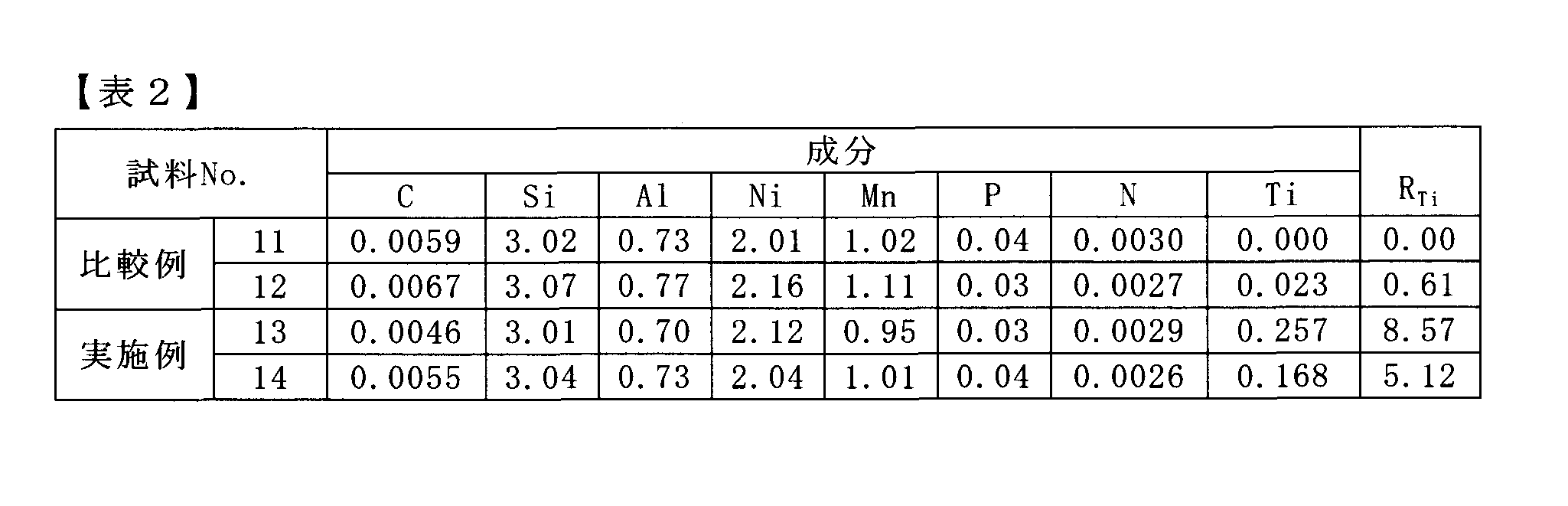
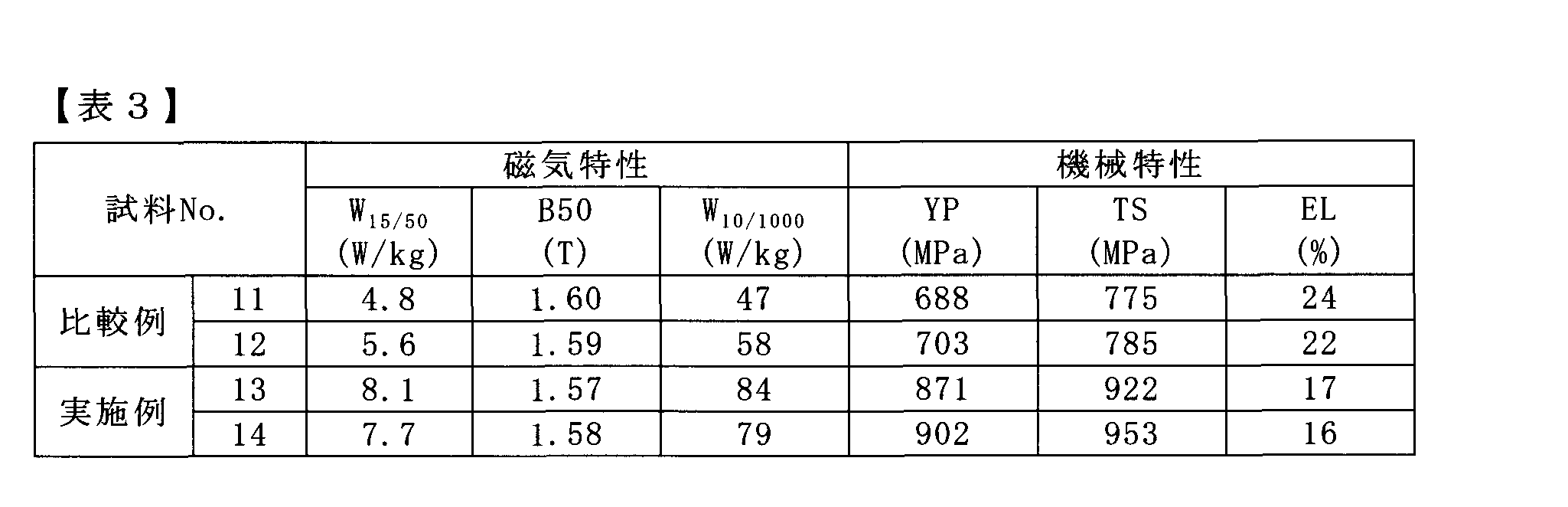
- Comparative Example No. 11 and 12 the high-frequency iron loss W 10/1000 was less than 100 W / kg, but since the value R Ti was less than 1, the tensile strength was as low as less than 900 MPa. In particular, Comparative Example No. In No. 11, since Ti was not contained at all, the tensile strength was extremely low.
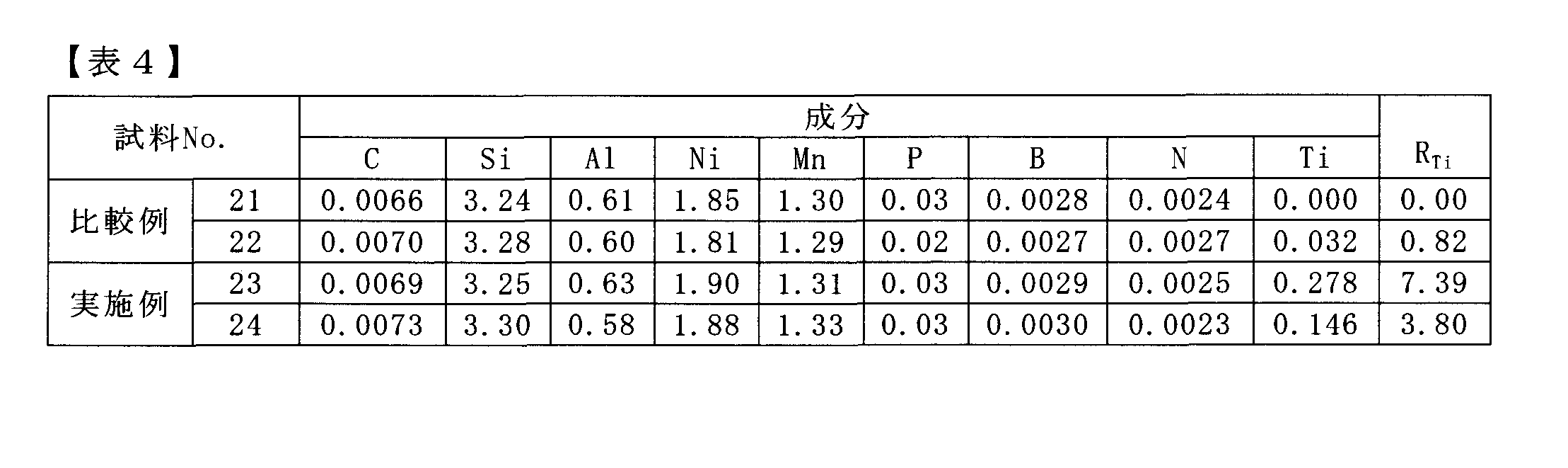
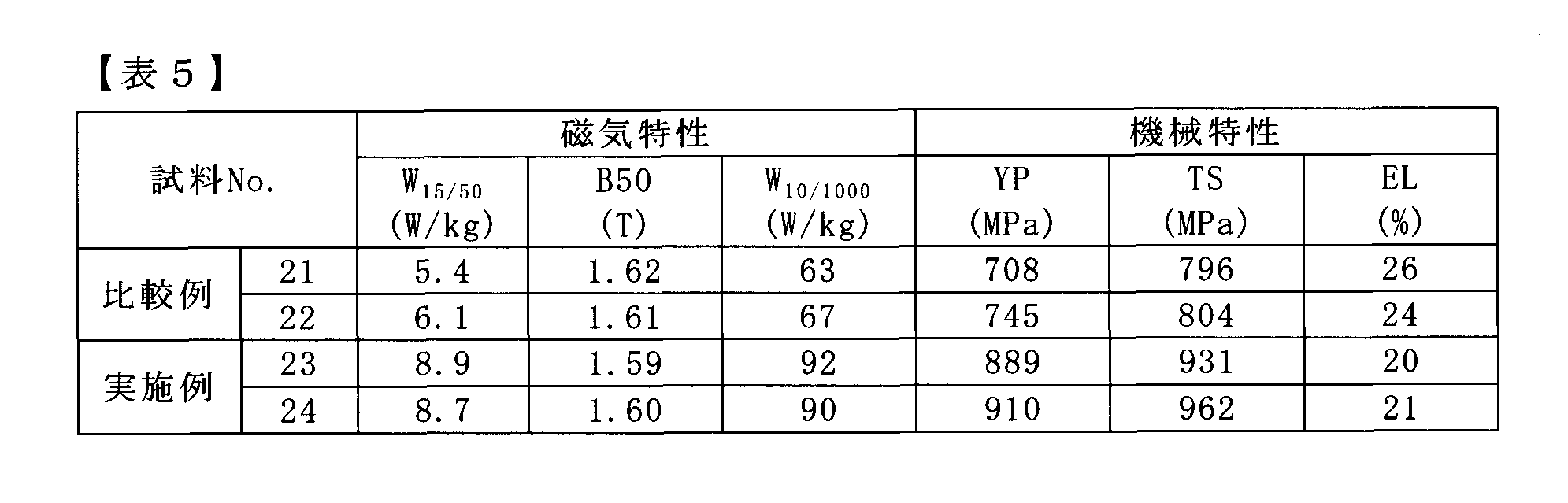
- Comparative Example No. 21 and 22 the high-frequency iron loss W 10/1000 was less than 100 W / kg, but since the value R Ti was less than 1, the tensile strength was as low as less than 900 MPa. In particular, Comparative Example No. In No. 21, since Ti was not contained at all, the tensile strength was remarkably low.
- the yield point is also Comparative Example No. Higher than 21 and 22.
- the present invention can be used, for example, in the electrical steel sheet manufacturing industry and the electrical steel sheet utilizing industry.
Landscapes
- Chemical & Material Sciences (AREA)
- Engineering & Computer Science (AREA)
- Materials Engineering (AREA)
- Mechanical Engineering (AREA)
- Metallurgy (AREA)
- Organic Chemistry (AREA)
- Dispersion Chemistry (AREA)
- Power Engineering (AREA)
- Soft Magnetic Materials (AREA)
- Manufacturing Of Steel Electrode Plates (AREA)
Abstract
Description

先ず、表2に示す成分を含有し、残部がFe及び不可避的不純物からなるスラブを熱間圧延し、熱間圧延鋼板を得た。次いで、熱間圧延鋼板を冷間圧延し、厚さが0.20mmの冷間圧延鋼板を得た。その後、冷間圧延鋼板に750℃で30秒間の連続仕上焼鈍を施し、無方向性電磁鋼板を得た。
先ず、表4に示す成分を含有し、残部がFe及び不可避的不純物からなるスラブを熱間圧延し、熱間圧延鋼板を得た。次いで、熱間圧延鋼板を冷間圧延し、厚さが0.25mmの冷間圧延鋼板を得た。その後、冷間圧延鋼板に775℃で30秒間の連続仕上焼鈍を施し、無方向性電磁鋼板を得た。
Claims (8)
- C:0.003質量%以上0.05質量%以下、
N:0.001質量%以上0.01質量%以下、及び
Si:2.8質量%以上3.5質量%以下、
を含有し、
更に、Ni:4.0質量%以下及びMn:2.0質量%以下からなる群から選択された少なくとも1種を、総量で0.5質量%以上含有し、
更に、Ti:Tiの含有量を[Ti]質量%、Cの含有量を[C]質量%、Nの含有量を[N]質量%としたとき、[Ti]/4([C]+[N])で表わされる値RTiが1以上10以下を含有し、
Alの含有量が3.0質量%以下であり、
Pの含有量が0.2質量%以下であり、
残部がFe及び不可避不純物からなることを特徴とする無方向性電磁鋼板。 - Tiの含有量が0.1質量以上0.3質量以下であることを特徴とする請求項1に記載の無方向性電磁鋼板。
- B:0.001質量%以上0.007質量%以下を含有することを特徴とする請求項1に記載の無方向性電磁鋼板。
- B:0.001質量%以上0.007質量%以下を含有することを特徴とする請求項2に記載の無方向性電磁鋼板。
- Cu:0.02質量%以上1.0質量%以下、
Sn:0.02質量%以上0.5質量%以下、
Sb:0.02質量%以上0.5質量%以下、
Cr:0.02質量%以上3.0質量%以下、及び
希土類金属:0.001質量%以上0.01質量%以下、
からなる群から選択された少なくとも1種を含有することを特徴とする請求項1に記載の無方向性電磁鋼板。 - Cu:0.02質量%以上1.0質量%以下、
Sn:0.02質量%以上0.5質量%以下、
Sb:0.02質量%以上0.5質量%以下、
Cr:0.02質量%以上3.0質量%以下、及び
希土類金属:0.001質量%以上0.01質量%以下、
からなる群から選択された少なくとも1種を含有することを特徴とする請求項2に記載の無方向性電磁鋼板。 - Cu:0.02質量%以上1.0質量%以下、
Sn:0.02質量%以上0.5質量%以下、
Sb:0.02質量%以上0.5質量%以下、
Cr:0.02質量%以上3.0質量%以下、及び
希土類金属:0.001質量%以上0.01質量%以下、
からなる群から選択された少なくとも1種を含有することを特徴とする請求項3に記載の無方向性電磁鋼板。 - Cu:0.02質量%以上1.0質量%以下、
Sn:0.02質量%以上0.5質量%以下、
Sb:0.02質量%以上0.5質量%以下、
Cr:0.02質量%以上3.0質量%以下、及び
希土類金属:0.001質量%以上0.01質量%以下、
からなる群から選択された少なくとも1種を含有することを特徴とする請求項4に記載の無方向性電磁鋼板。
Priority Applications (7)
| Application Number | Priority Date | Filing Date | Title |
|---|---|---|---|
| EP10733454.2A EP2390376B1 (en) | 2009-01-26 | 2010-01-19 | Non-oriented electrical steel sheet |
| CN2010800053348A CN102292462A (zh) | 2009-01-26 | 2010-01-19 | 无方向性电磁钢板 |
| US13/132,270 US20110229362A1 (en) | 2009-01-26 | 2010-01-19 | Non-oriented electrical steel sheet |
| JP2010522041A JP4681687B2 (ja) | 2009-01-26 | 2010-01-19 | 無方向性電磁鋼板 |
| PL10733454T PL2390376T3 (pl) | 2009-01-26 | 2010-01-19 | Blacha cienka z niezorientowanej stali elektrotechnicznej |
| KR1020117017427A KR101325369B1 (ko) | 2009-01-26 | 2010-01-19 | 무방향성 전자기 강판 |
| BRPI1007193-8A BRPI1007193B1 (pt) | 2009-01-26 | 2010-01-19 | chapa de aço elétrico não orientada |
Applications Claiming Priority (2)
| Application Number | Priority Date | Filing Date | Title |
|---|---|---|---|
| JP2009014298 | 2009-01-26 | ||
| JP2009-014298 | 2009-01-26 |
Publications (1)
| Publication Number | Publication Date |
|---|---|
| WO2010084847A1 true WO2010084847A1 (ja) | 2010-07-29 |
Family
ID=42355901
Family Applications (1)
| Application Number | Title | Priority Date | Filing Date |
|---|---|---|---|
| PCT/JP2010/050520 Ceased WO2010084847A1 (ja) | 2009-01-26 | 2010-01-19 | 無方向性電磁鋼板 |
Country Status (9)
| Country | Link |
|---|---|
| US (1) | US20110229362A1 (ja) |
| EP (1) | EP2390376B1 (ja) |
| JP (1) | JP4681687B2 (ja) |
| KR (1) | KR101325369B1 (ja) |
| CN (1) | CN102292462A (ja) |
| BR (1) | BRPI1007193B1 (ja) |
| PL (1) | PL2390376T3 (ja) |
| TW (1) | TWI417401B (ja) |
| WO (1) | WO2010084847A1 (ja) |
Cited By (2)
| Publication number | Priority date | Publication date | Assignee | Title |
|---|---|---|---|---|
| EP2679695A4 (en) * | 2011-02-24 | 2014-10-29 | Jfe Steel Corp | NON-ORIENTED ELECTROMAGNETIC STEEL SHEET AND MANUFACTURING METHOD THEREOF |
| JP2014529008A (ja) * | 2012-01-05 | 2014-10-30 | ティッセンクルップ スチール ヨーロッパ アクチェンゲゼルシャフトThyssenKrupp Steel Europe AG | 無方向性電磁鋼ストリップ又はシート、それから製造される部品及び無方向性電磁鋼ストリップ又はシートの製造方法 |
Families Citing this family (2)
| Publication number | Priority date | Publication date | Assignee | Title |
|---|---|---|---|---|
| TWI641703B (zh) * | 2017-01-16 | 2018-11-21 | 日商新日鐵住金股份有限公司 | 無方向性電磁鋼板及無方向性電磁鋼板的製造方法 |
| WO2022210864A1 (ja) * | 2021-03-31 | 2022-10-06 | 日本製鉄株式会社 | 無方向性電磁鋼板、無方向性電磁鋼板の製造方法、電動機および電動機の製造方法 |
Citations (7)
| Publication number | Priority date | Publication date | Assignee | Title |
|---|---|---|---|---|
| JPS60238421A (ja) | 1984-05-10 | 1985-11-27 | Kawasaki Steel Corp | 高抗張力無方向性電磁鋼板の製造方法 |
| JPS62256917A (ja) | 1986-04-28 | 1987-11-09 | Nippon Steel Corp | 回転機用高抗張力無方向性電磁鋼板およびその製造方法 |
| JPH028346A (ja) | 1988-06-27 | 1990-01-11 | Nippon Steel Corp | 高張力電磁鋼板及びその製造方法 |
| JPH0619520A (ja) | 1992-06-29 | 1994-01-28 | Hitachi Seiko Ltd | 電源異常対応制御を備えた数値制御工作機械装置 |
| JP2007186790A (ja) | 2005-12-15 | 2007-07-26 | Jfe Steel Kk | 高強度無方向性電磁鋼板およびその製造方法 |
| JP2007186791A (ja) | 2005-12-15 | 2007-07-26 | Jfe Steel Kk | 高強度無方向性電磁鋼板およびその製造方法 |
| JP2008240104A (ja) | 2007-03-28 | 2008-10-09 | Jfe Steel Kk | 高強度無方向性電磁鋼板およびその製造方法 |
Family Cites Families (7)
| Publication number | Priority date | Publication date | Assignee | Title |
|---|---|---|---|---|
| JPH0222442A (ja) * | 1988-07-12 | 1990-01-25 | Nippon Steel Corp | 高張力電磁鋼板及びその製造方法 |
| JP3305806B2 (ja) * | 1993-05-21 | 2002-07-24 | 新日本製鐵株式会社 | 高張力無方向性電磁鋼板の製造方法 |
| JP2001323347A (ja) * | 2000-05-15 | 2001-11-22 | Kawasaki Steel Corp | 加工性、リサイクル性および歪み取り焼鈍後の磁気特性に優れた無方向性電磁鋼板 |
| WO2003002777A1 (fr) * | 2001-06-28 | 2003-01-09 | Jfe Steel Corporation | Feuille en acier electromagnetique non orientee |
| JP5000136B2 (ja) * | 2003-10-06 | 2012-08-15 | 新日本製鐵株式会社 | 高強度電磁鋼板およびその形状加工部品とそれらの製造方法 |
| CN101218362B (zh) * | 2005-07-07 | 2010-05-12 | 住友金属工业株式会社 | 无方向性电磁钢板及其制造方法 |
| KR101011965B1 (ko) * | 2005-12-15 | 2011-01-31 | 제이에프이 스틸 가부시키가이샤 | 고강도 무방향성 전자 강판 및 그 제조 방법 |
-
2010
- 2010-01-19 CN CN2010800053348A patent/CN102292462A/zh active Pending
- 2010-01-19 JP JP2010522041A patent/JP4681687B2/ja active Active
- 2010-01-19 EP EP10733454.2A patent/EP2390376B1/en active Active
- 2010-01-19 WO PCT/JP2010/050520 patent/WO2010084847A1/ja not_active Ceased
- 2010-01-19 BR BRPI1007193-8A patent/BRPI1007193B1/pt active IP Right Grant
- 2010-01-19 KR KR1020117017427A patent/KR101325369B1/ko active Active
- 2010-01-19 PL PL10733454T patent/PL2390376T3/pl unknown
- 2010-01-19 US US13/132,270 patent/US20110229362A1/en not_active Abandoned
- 2010-01-25 TW TW099101935A patent/TWI417401B/zh active
Patent Citations (7)
| Publication number | Priority date | Publication date | Assignee | Title |
|---|---|---|---|---|
| JPS60238421A (ja) | 1984-05-10 | 1985-11-27 | Kawasaki Steel Corp | 高抗張力無方向性電磁鋼板の製造方法 |
| JPS62256917A (ja) | 1986-04-28 | 1987-11-09 | Nippon Steel Corp | 回転機用高抗張力無方向性電磁鋼板およびその製造方法 |
| JPH028346A (ja) | 1988-06-27 | 1990-01-11 | Nippon Steel Corp | 高張力電磁鋼板及びその製造方法 |
| JPH0619520A (ja) | 1992-06-29 | 1994-01-28 | Hitachi Seiko Ltd | 電源異常対応制御を備えた数値制御工作機械装置 |
| JP2007186790A (ja) | 2005-12-15 | 2007-07-26 | Jfe Steel Kk | 高強度無方向性電磁鋼板およびその製造方法 |
| JP2007186791A (ja) | 2005-12-15 | 2007-07-26 | Jfe Steel Kk | 高強度無方向性電磁鋼板およびその製造方法 |
| JP2008240104A (ja) | 2007-03-28 | 2008-10-09 | Jfe Steel Kk | 高強度無方向性電磁鋼板およびその製造方法 |
Non-Patent Citations (1)
| Title |
|---|
| See also references of EP2390376A4 |
Cited By (2)
| Publication number | Priority date | Publication date | Assignee | Title |
|---|---|---|---|---|
| EP2679695A4 (en) * | 2011-02-24 | 2014-10-29 | Jfe Steel Corp | NON-ORIENTED ELECTROMAGNETIC STEEL SHEET AND MANUFACTURING METHOD THEREOF |
| JP2014529008A (ja) * | 2012-01-05 | 2014-10-30 | ティッセンクルップ スチール ヨーロッパ アクチェンゲゼルシャフトThyssenKrupp Steel Europe AG | 無方向性電磁鋼ストリップ又はシート、それから製造される部品及び無方向性電磁鋼ストリップ又はシートの製造方法 |
Also Published As
| Publication number | Publication date |
|---|---|
| KR101325369B1 (ko) | 2013-11-08 |
| JPWO2010084847A1 (ja) | 2012-07-19 |
| KR20110096599A (ko) | 2011-08-30 |
| BRPI1007193A2 (pt) | 2016-02-23 |
| PL2390376T3 (pl) | 2019-09-30 |
| JP4681687B2 (ja) | 2011-05-11 |
| BRPI1007193B1 (pt) | 2020-12-22 |
| US20110229362A1 (en) | 2011-09-22 |
| EP2390376A1 (en) | 2011-11-30 |
| TWI417401B (zh) | 2013-12-01 |
| TW201031762A (en) | 2010-09-01 |
| CN102292462A (zh) | 2011-12-21 |
| EP2390376A4 (en) | 2017-04-26 |
| EP2390376B1 (en) | 2019-05-01 |
Similar Documents
| Publication | Publication Date | Title |
|---|---|---|
| JP6601646B2 (ja) | 無方向性電磁鋼板の製造方法とモータコアの製造方法ならびにモータコア | |
| JP5228379B2 (ja) | 強度と磁気特性に優れた無方向性電磁鋼板とその製造方法 | |
| JP2021036075A (ja) | 無方向性電磁鋼板およびモータコアとその製造方法 | |
| CN103052722B (zh) | 无方向性电磁钢板的制造方法 | |
| CN110088327B (zh) | 无取向电工钢板及其制造方法 | |
| JPWO2020262063A1 (ja) | 無方向性電磁鋼板の製造方法とモータコアの製造方法およびモータコア | |
| JP5194535B2 (ja) | 高強度無方向性電磁鋼板 | |
| US11041222B2 (en) | Non-oriented electrical steel strip for electric motors | |
| JP6269971B2 (ja) | 無方向性電磁鋼板とモータコア | |
| WO2012141206A1 (ja) | 高強度無方向性電磁鋼板 | |
| JP3305806B2 (ja) | 高張力無方向性電磁鋼板の製造方法 | |
| JP4740400B2 (ja) | 無方向性電磁鋼板 | |
| JP2017088968A (ja) | 回転子用無方向性電磁鋼板およびその製造方法 | |
| JP4681687B2 (ja) | 無方向性電磁鋼板 | |
| JP5614063B2 (ja) | 高周波鉄損の優れた高張力無方向性電磁鋼板 | |
| JP2008260996A (ja) | 圧延方向の磁気特性に優れる無方向性電磁鋼板およびその製造方法 | |
| JP4280139B2 (ja) | 無方向性電磁鋼板とその製造方法 | |
| JP2003342698A (ja) | 高周波鉄損の優れた高張力無方向性電磁鋼板 | |
| JP2006161137A (ja) | 高周波鉄損の優れた高張力無方向性電磁鋼板 | |
| JP2017057455A (ja) | 電磁鋼板とその製造方法 |
Legal Events
| Date | Code | Title | Description |
|---|---|---|---|
| WWE | Wipo information: entry into national phase |
Ref document number: 201080005334.8 Country of ref document: CN |
|
| WWE | Wipo information: entry into national phase |
Ref document number: 2010522041 Country of ref document: JP |
|
| 121 | Ep: the epo has been informed by wipo that ep was designated in this application |
Ref document number: 10733454 Country of ref document: EP Kind code of ref document: A1 |
|
| WWE | Wipo information: entry into national phase |
Ref document number: 13132270 Country of ref document: US |
|
| ENP | Entry into the national phase |
Ref document number: 20117017427 Country of ref document: KR Kind code of ref document: A |
|
| NENP | Non-entry into the national phase |
Ref country code: DE |
|
| WWE | Wipo information: entry into national phase |
Ref document number: 2010733454 Country of ref document: EP |
|
| REG | Reference to national code |
Ref country code: BR Ref legal event code: B01A Ref document number: PI1007193 Country of ref document: BR |
|
| ENP | Entry into the national phase |
Ref document number: PI1007193 Country of ref document: BR Kind code of ref document: A2 Effective date: 20110726 |