WO2010084862A1 - 積層フィルム - Google Patents
積層フィルム Download PDFInfo
- Publication number
- WO2010084862A1 WO2010084862A1 PCT/JP2010/050572 JP2010050572W WO2010084862A1 WO 2010084862 A1 WO2010084862 A1 WO 2010084862A1 JP 2010050572 W JP2010050572 W JP 2010050572W WO 2010084862 A1 WO2010084862 A1 WO 2010084862A1
- Authority
- WO
- WIPO (PCT)
- Prior art keywords
- lactic acid
- film
- laminated film
- plasticizer
- polymer
- Prior art date
- Legal status (The legal status is an assumption and is not a legal conclusion. Google has not performed a legal analysis and makes no representation as to the accuracy of the status listed.)
- Ceased
Links
Classifications
-
- B—PERFORMING OPERATIONS; TRANSPORTING
- B32—LAYERED PRODUCTS
- B32B—LAYERED PRODUCTS, i.e. PRODUCTS BUILT-UP OF STRATA OF FLAT OR NON-FLAT, e.g. CELLULAR OR HONEYCOMB, FORM
- B32B27/00—Layered products comprising a layer of synthetic resin
- B32B27/18—Layered products comprising a layer of synthetic resin characterised by the use of special additives
- B32B27/22—Layered products comprising a layer of synthetic resin characterised by the use of special additives using plasticisers
-
- B—PERFORMING OPERATIONS; TRANSPORTING
- B32—LAYERED PRODUCTS
- B32B—LAYERED PRODUCTS, i.e. PRODUCTS BUILT-UP OF STRATA OF FLAT OR NON-FLAT, e.g. CELLULAR OR HONEYCOMB, FORM
- B32B27/00—Layered products comprising a layer of synthetic resin
- B32B27/06—Layered products comprising a layer of synthetic resin as the main or only constituent of a layer, which is next to another layer of the same or of a different material
- B32B27/08—Layered products comprising a layer of synthetic resin as the main or only constituent of a layer, which is next to another layer of the same or of a different material of synthetic resin
-
- B—PERFORMING OPERATIONS; TRANSPORTING
- B32—LAYERED PRODUCTS
- B32B—LAYERED PRODUCTS, i.e. PRODUCTS BUILT-UP OF STRATA OF FLAT OR NON-FLAT, e.g. CELLULAR OR HONEYCOMB, FORM
- B32B27/00—Layered products comprising a layer of synthetic resin
- B32B27/30—Layered products comprising a layer of synthetic resin comprising vinyl (co)polymers; comprising acrylic (co)polymers
- B32B27/306—Layered products comprising a layer of synthetic resin comprising vinyl (co)polymers; comprising acrylic (co)polymers comprising vinyl acetate or vinyl alcohol (co)polymers
-
- B—PERFORMING OPERATIONS; TRANSPORTING
- B32—LAYERED PRODUCTS
- B32B—LAYERED PRODUCTS, i.e. PRODUCTS BUILT-UP OF STRATA OF FLAT OR NON-FLAT, e.g. CELLULAR OR HONEYCOMB, FORM
- B32B27/00—Layered products comprising a layer of synthetic resin
- B32B27/30—Layered products comprising a layer of synthetic resin comprising vinyl (co)polymers; comprising acrylic (co)polymers
- B32B27/308—Layered products comprising a layer of synthetic resin comprising vinyl (co)polymers; comprising acrylic (co)polymers comprising acrylic (co)polymers
-
- B—PERFORMING OPERATIONS; TRANSPORTING
- B32—LAYERED PRODUCTS
- B32B—LAYERED PRODUCTS, i.e. PRODUCTS BUILT-UP OF STRATA OF FLAT OR NON-FLAT, e.g. CELLULAR OR HONEYCOMB, FORM
- B32B27/00—Layered products comprising a layer of synthetic resin
- B32B27/32—Layered products comprising a layer of synthetic resin comprising polyolefins
-
- B—PERFORMING OPERATIONS; TRANSPORTING
- B32—LAYERED PRODUCTS
- B32B—LAYERED PRODUCTS, i.e. PRODUCTS BUILT-UP OF STRATA OF FLAT OR NON-FLAT, e.g. CELLULAR OR HONEYCOMB, FORM
- B32B27/00—Layered products comprising a layer of synthetic resin
- B32B27/34—Layered products comprising a layer of synthetic resin comprising polyamides
-
- B—PERFORMING OPERATIONS; TRANSPORTING
- B32—LAYERED PRODUCTS
- B32B—LAYERED PRODUCTS, i.e. PRODUCTS BUILT-UP OF STRATA OF FLAT OR NON-FLAT, e.g. CELLULAR OR HONEYCOMB, FORM
- B32B27/00—Layered products comprising a layer of synthetic resin
- B32B27/36—Layered products comprising a layer of synthetic resin comprising polyesters
-
- B—PERFORMING OPERATIONS; TRANSPORTING
- B32—LAYERED PRODUCTS
- B32B—LAYERED PRODUCTS, i.e. PRODUCTS BUILT-UP OF STRATA OF FLAT OR NON-FLAT, e.g. CELLULAR OR HONEYCOMB, FORM
- B32B7/00—Layered products characterised by the relation between layers; Layered products characterised by the relative orientation of features between layers, or by the relative values of a measurable parameter between layers, i.e. products comprising layers having different physical, chemical or physicochemical properties; Layered products characterised by the interconnection of layers
- B32B7/04—Interconnection of layers
- B32B7/12—Interconnection of layers using interposed adhesives or interposed materials with bonding properties
-
- B—PERFORMING OPERATIONS; TRANSPORTING
- B32—LAYERED PRODUCTS
- B32B—LAYERED PRODUCTS, i.e. PRODUCTS BUILT-UP OF STRATA OF FLAT OR NON-FLAT, e.g. CELLULAR OR HONEYCOMB, FORM
- B32B2250/00—Layers arrangement
- B32B2250/24—All layers being polymeric
-
- B—PERFORMING OPERATIONS; TRANSPORTING
- B32—LAYERED PRODUCTS
- B32B—LAYERED PRODUCTS, i.e. PRODUCTS BUILT-UP OF STRATA OF FLAT OR NON-FLAT, e.g. CELLULAR OR HONEYCOMB, FORM
- B32B2270/00—Resin or rubber layer containing a blend of at least two different polymers
-
- B—PERFORMING OPERATIONS; TRANSPORTING
- B32—LAYERED PRODUCTS
- B32B—LAYERED PRODUCTS, i.e. PRODUCTS BUILT-UP OF STRATA OF FLAT OR NON-FLAT, e.g. CELLULAR OR HONEYCOMB, FORM
- B32B2272/00—Resin or rubber layer comprising scrap, waste or recycling material
-
- B—PERFORMING OPERATIONS; TRANSPORTING
- B32—LAYERED PRODUCTS
- B32B—LAYERED PRODUCTS, i.e. PRODUCTS BUILT-UP OF STRATA OF FLAT OR NON-FLAT, e.g. CELLULAR OR HONEYCOMB, FORM
- B32B2307/00—Properties of the layers or laminate
- B32B2307/20—Properties of the layers or laminate having particular electrical or magnetic properties, e.g. piezoelectric
- B32B2307/21—Anti-static
-
- B—PERFORMING OPERATIONS; TRANSPORTING
- B32—LAYERED PRODUCTS
- B32B—LAYERED PRODUCTS, i.e. PRODUCTS BUILT-UP OF STRATA OF FLAT OR NON-FLAT, e.g. CELLULAR OR HONEYCOMB, FORM
- B32B2307/00—Properties of the layers or laminate
- B32B2307/30—Properties of the layers or laminate having particular thermal properties
- B32B2307/306—Resistant to heat
-
- B—PERFORMING OPERATIONS; TRANSPORTING
- B32—LAYERED PRODUCTS
- B32B—LAYERED PRODUCTS, i.e. PRODUCTS BUILT-UP OF STRATA OF FLAT OR NON-FLAT, e.g. CELLULAR OR HONEYCOMB, FORM
- B32B2307/00—Properties of the layers or laminate
- B32B2307/40—Properties of the layers or laminate having particular optical properties
- B32B2307/412—Transparent
-
- B—PERFORMING OPERATIONS; TRANSPORTING
- B32—LAYERED PRODUCTS
- B32B—LAYERED PRODUCTS, i.e. PRODUCTS BUILT-UP OF STRATA OF FLAT OR NON-FLAT, e.g. CELLULAR OR HONEYCOMB, FORM
- B32B2307/00—Properties of the layers or laminate
- B32B2307/50—Properties of the layers or laminate having particular mechanical properties
- B32B2307/51—Elastic
-
- B—PERFORMING OPERATIONS; TRANSPORTING
- B32—LAYERED PRODUCTS
- B32B—LAYERED PRODUCTS, i.e. PRODUCTS BUILT-UP OF STRATA OF FLAT OR NON-FLAT, e.g. CELLULAR OR HONEYCOMB, FORM
- B32B2307/00—Properties of the layers or laminate
- B32B2307/50—Properties of the layers or laminate having particular mechanical properties
- B32B2307/514—Oriented
- B32B2307/518—Oriented bi-axially
-
- B—PERFORMING OPERATIONS; TRANSPORTING
- B32—LAYERED PRODUCTS
- B32B—LAYERED PRODUCTS, i.e. PRODUCTS BUILT-UP OF STRATA OF FLAT OR NON-FLAT, e.g. CELLULAR OR HONEYCOMB, FORM
- B32B2307/00—Properties of the layers or laminate
- B32B2307/50—Properties of the layers or laminate having particular mechanical properties
- B32B2307/546—Flexural strength; Flexion stiffness
-
- B—PERFORMING OPERATIONS; TRANSPORTING
- B32—LAYERED PRODUCTS
- B32B—LAYERED PRODUCTS, i.e. PRODUCTS BUILT-UP OF STRATA OF FLAT OR NON-FLAT, e.g. CELLULAR OR HONEYCOMB, FORM
- B32B2307/00—Properties of the layers or laminate
- B32B2307/70—Other properties
- B32B2307/704—Crystalline
-
- B—PERFORMING OPERATIONS; TRANSPORTING
- B32—LAYERED PRODUCTS
- B32B—LAYERED PRODUCTS, i.e. PRODUCTS BUILT-UP OF STRATA OF FLAT OR NON-FLAT, e.g. CELLULAR OR HONEYCOMB, FORM
- B32B2307/00—Properties of the layers or laminate
- B32B2307/70—Other properties
- B32B2307/732—Dimensional properties
-
- B—PERFORMING OPERATIONS; TRANSPORTING
- B32—LAYERED PRODUCTS
- B32B—LAYERED PRODUCTS, i.e. PRODUCTS BUILT-UP OF STRATA OF FLAT OR NON-FLAT, e.g. CELLULAR OR HONEYCOMB, FORM
- B32B2307/00—Properties of the layers or laminate
- B32B2307/70—Other properties
- B32B2307/758—Odour absorbent
-
- B—PERFORMING OPERATIONS; TRANSPORTING
- B32—LAYERED PRODUCTS
- B32B—LAYERED PRODUCTS, i.e. PRODUCTS BUILT-UP OF STRATA OF FLAT OR NON-FLAT, e.g. CELLULAR OR HONEYCOMB, FORM
- B32B2553/00—Packaging equipment or accessories not otherwise provided for
-
- Y—GENERAL TAGGING OF NEW TECHNOLOGICAL DEVELOPMENTS; GENERAL TAGGING OF CROSS-SECTIONAL TECHNOLOGIES SPANNING OVER SEVERAL SECTIONS OF THE IPC; TECHNICAL SUBJECTS COVERED BY FORMER USPC CROSS-REFERENCE ART COLLECTIONS [XRACs] AND DIGESTS
- Y10—TECHNICAL SUBJECTS COVERED BY FORMER USPC
- Y10T—TECHNICAL SUBJECTS COVERED BY FORMER US CLASSIFICATION
- Y10T428/00—Stock material or miscellaneous articles
- Y10T428/24—Structurally defined web or sheet [e.g., overall dimension, etc.]
- Y10T428/24942—Structurally defined web or sheet [e.g., overall dimension, etc.] including components having same physical characteristic in differing degree
Definitions
- the present invention is a laminated film having a lactic acid polymer, which is a natural plant-derived resin, as one of the main raw materials, and can be suitably used as a packaging film, preferably suppressing odors of concern. It relates to a laminated film.
- lactic acid polymers are natural plant-derived resins obtained from starches such as corn and potatoes, and are not only mass-produced, but also have excellent transparency, and are attracting attention as raw materials for packaging films.
- the lactic acid polymer may be hard in the non-oriented state, it can be stretched and oriented to greatly improve the physical properties, or in the case of a packaging wrap film, by adding a plasticizer or the like, It has been made flexible.
- Patent Document 1 as a biodegradable wrap film having a cut ability, a packaging ability, and a heat resistance, which are characteristics of a small roll film, JIS K -7198
- the storage elastic modulus at 40 ° C measured at a frequency of 10 Hz and a strain of 0.1% by the dynamic viscoelasticity measurement method of Method A is in the range of 100 MPa to 3 GPa, and the storage elastic modulus at 100 ° C. Is in the range of 30 MPa to 500 MPa, and the loss tangent (tan ⁇ ) peak value is in the range of 0.1 to 0.8.
- a lactic acid resin composition such as a lactic acid polymer and a plasticizer is used in an amount of 60: 1 to 99.
- a biodegradable wrap film containing as a main component a lactic acid resin composition containing a mass ratio of 1 is disclosed.
- the outermost layer is a layer mainly composed of an olefin polymer, and a layer mainly composed of polylactic acid (lactic acid polymer) between the layers mainly composed of the olefin polymer.
- a shrink sheet-like material having at least one layer is disclosed, and an adhesive layer made of an acrylic-modified polyethylene resin is provided between a layer mainly composed of an olefin polymer and a layer mainly composed of polylactic acid. It is also disclosed that it can intervene.
- Patent Document 1 in a system in which a plasticizer is blended with a lactic acid polymer, the glass transition point (Tg) of the lactic acid polymer is lowered to around room temperature, so that it is rapidly cooled by a casting method or the like. Then, when a wrap film is formed, the sheet is kept amorphous and the elastic modulus is lowered, and if it is wound as it is long, there is a problem that the scroll is blocked. In addition, when the lactic acid polymer is exposed on the front and back layers of the wrap film, the molecular weight of the lactic acid polymer decreases with time due to hydrolysis, and thus there is a problem that blocking is more likely to occur.
- Tg glass transition point
- Patent Document 3 discloses a packaging film composed of a laminated film of 5 or more layers having at least a surface layer / adhesive layer / intermediate layer / adhesive layer / surface layer in this order, wherein both the surface layers are olefinic. Contains a polymer as a main component, the intermediate layer contains a lactic acid polymer as a main component, the two adhesive layers contain an adhesive resin as a main component, and the adhesive resin is modified.
- Olefin polymers copolymers of soft aromatic hydrocarbons and conjugated diene hydrocarbons, hydrogenated derivatives of these copolymers, or ethylene-acetic acid with a vinyl acetate content of 30 to 80% by mass
- Acrylic block having a vinyl copolymer or a lactic acid polymer and a polymer block mainly composed of acrylate units and a polymer block mainly composed of methacrylate units.
- Packaging film characterized is disclosed that the click co any one of the polymer and lactic acid-acrylic mixed resin having, or a resin comprising two or more thereof.
- a plasticizer is blended to produce a laminated film. Even if a surface layer that does not contain a plasticizer is laminated, it can be stored under high temperature and high humidity conditions, water, etc. When the film is contacted with the film or the film is heated, an annoying odor may be generated. Therefore, the present invention is to provide a new laminated film that effectively suppresses the generation of an odor that is anxious in a laminated film containing a lactic acid-based polymer as a main raw material.
- the present invention is a laminated film having at least three layers comprising an intermediate layer containing a lactic acid polymer (B) and a plasticizer (C), and a surface layer, and is detected under the following detection conditions.
- the present invention proposes a laminated film characterized in that the amount of lactic acid oligomer component is 50 ng / cm 2 or less, or the amount of odor component derived from a plasticizer is 50 ng / cm 2 or less.
- Detection condition Using a head space gas chromatograph mass spectrometer (HS-GC-MS), detection is performed by setting the sample temperature of the head space sampler (HS) to 60 ° C. and the heating time to 30 minutes.
- HS-GC-MS head space gas chromatograph mass spectrometer
- the odor-causing substance is sucked and exhausted at the vent port in the single-screw or twin-screw extruder. Is the most effective.
- Odors that occur when a laminated film is produced by blending a plasticizer with a lactic acid polymer are stored under high temperature and high humidity conditions, or contacted with water, etc. Lactic acid detected under the above detection conditions, assuming that it is an odor generated when decomposition is promoted to produce a lactic acid oligomer, or a odor when the film is heated and the plasticizer inside the film volatilizes.
- the oligomer component amount is 50 ng / cm 2 or less
- the plasticizer-derived odor component amount is 50 ng / cm 2 or less, it can be stored under high temperature and high humidity conditions, contacted with water, etc., or a film Even if was heated, it was possible to effectively suppress the generation of odors.
- the laminated film As an example of an embodiment of the present invention will be described.
- the scope of the present invention is not limited to the embodiments described below.
- the present laminated film is a laminated film having at least three layers, which contains a transparent resin as a main component ⁇ surface layer on both inner and outer surfaces (hereinafter simply referred to as “surface layer”)>, a lactic acid polymer (B), and And a ⁇ intermediate layer> containing a plasticizer (C) as a main component.
- surface layer a transparent resin as a main component ⁇ surface layer on both inner and outer surfaces
- B lactic acid polymer
- C plasticizer
- the main component of the surface layer may be a transparent and flexible resin.
- the resin that can be the main component of the surface layer include olefin polymers, polyester polymers such as PET, PBT, PEN, and PBN, acrylic polymers such as PMMA, and nylon resins. Of these, olefin polymers are preferred in terms of transparency and self-adhesion. Then, the olefin polymer (A) suitable as the main component of the surface layer will be described in detail next.
- Olefin polymer (A) examples of the olefin polymer (A) suitable as a main component of the surface layer include ethylene polymers, butylene polymers, propylene polymers such as polypropylene and ethylene-propylene copolymers, poly-4-methylpentene, Examples thereof include polybutene and ethylene-vinyl acetate copolymer. These resins may be one of the resins listed above, or may be a mixed resin composed of a combination of two or more resins. A polyolefin-based thermoplastic elastomer in which ethylene / propylene rubber or the like is dispersed and composited can also be used.
- the role of the surface layer for example, when used as a packaging film, prevention of blocking, odor suppression, maintenance of an appropriate balance between slip and surface adhesiveness, surface property functions such as anti-fogging, molding during film formation
- the main component of the surface layer is an ethylene polymer. preferable.
- ethylene polymer for example, one ethylene polymer selected from low density polyethylene, linear low density polyethylene, linear ultra low density polyethylene, medium density polyethylene and high density polyethylene, or two or more of these polymers Or a copolymer containing ethylene as a main component, that is, ethylene and propylene, butene-1, pentene-1, hexene-1, heptene-1, octene-1, etc.
- the copolymer include a mixed resin of two or more kinds of combinations of the multicomponent copolymer.
- the ethylene unit content of these ethylene polymers is preferably more than 50% by mass.
- low density polyethylene linear low density polyethylene, linear ultra low density polyethylene, ethylene-vinyl acetate copolymer, ethylene-acrylic acid ester copolymer and ethylene-methacrylic acid ester copolymer.
- a mixed resin composed of a kind of ethylene polymer or a combination of two or more of these is particularly preferred.
- the acrylic acid ester of the ethylene-acrylic acid ester copolymer include methyl acrylate and ethyl acrylate.
- acrylic acid ester of the ethylene-methacrylic acid ester copolymer include methyl methacrylate, methacrylic acid ester, and the like. Examples include ethyl acid.
- the vinyl acetate content is 10 to 60% by mass, the melt flow rate (hereinafter referred to as “MFR”).
- MFR melt flow rate
- the measurement conditions of MFR are 190 ° C., load 21.18 N based on JIS K 7210, and the same applies to other MFRs.
- Ethylene with 0.2 to 20 g / 10 min -Vinyl acetate copolymers are particularly preferred.
- the film is not hard because the crystallinity is low, the flexibility and elastic recovery are good, and the surface tackiness is also exhibited. It is preferable in that it is easy. On the other hand, if it is 60% by mass or less, heat resistance, film strength, etc. can be secured, bleed-out can be suppressed even if an antifogging agent is added, and the film is unwound because the surface tackiness is not too strong. It is preferable at the point that property and an external appearance can be made favorable.
- the vinyl acetate content of the ethylene-vinyl acetate copolymer is more preferably 10 to 58% by mass, and particularly preferably 12 to 56% by mass. If the MFR of the ethylene-vinyl acetate copolymer is 0.2 g / 10 min or more, the extrusion processability is stable, and if it is 20 g / 10 min or less, stable film formation is possible at the time of molding. It is preferable because thickness unevenness, decrease in mechanical strength, variation, and the like are reduced. From such a viewpoint, the MFR of the ethylene-vinyl acetate copolymer is more preferably 0.5 to 18 g / 10 minutes, and more preferably 1 to 15 g / 10 minutes.
- linear low density polyethylene having a density of 0.90 to 0.95 g / cm 3 and an MFR of 0.2 to 20 g / 10 min is used. Particularly preferred. If the density of the ethylene polymer is within such a range, the film does not become hard because it has appropriate crystallinity, and the flexibility and elastic recovery are good. Since the temperature will be higher than the operating temperature range, specifically the atmospheric temperature when heated in a microwave oven, etc., the food will be packaged with the resulting film, and even when heated in a microwave oven etc., the film will melt and stick to the food container etc. This is preferable because it does not cause a problem of sticking.
- the density of the ethylene polymer is particularly preferably 0.90 to 0.94 g / cm 3 , and more preferably 0.91 to 0.94 g / cm 3 .
- the MFR of the ethylene polymer is 0.2 g / 10 min or more, the extrusion processability is stable, and if it is 20 g / 10 min or less, stable film formation is possible at the time of molding. It is preferable because the decrease in strength, variation, and the like are reduced.
- the MFR of the ethylene polymer (A) is particularly preferably 0.5 to 18 g / 10 minutes, and more preferably 1 to 15 g / 10 minutes.
- the method for producing the ethylene polymer is not particularly limited, and a known polymerization method using a known olefin polymerization catalyst, for example, a multisite catalyst represented by a Ziegler-Natta type catalyst or a metallocene catalyst. Examples thereof include a slurry polymerization method, a solution polymerization method, a bulk polymerization method, a gas phase polymerization method using a single site catalyst, and a bulk polymerization method using a radical initiator.
- a known polymerization method using a known olefin polymerization catalyst for example, a multisite catalyst represented by a Ziegler-Natta type catalyst or a metallocene catalyst.
- a slurry polymerization method for example, a solution polymerization method, a bulk polymerization method, a gas phase polymerization method using a single site catalyst, and a bulk polymerization method using a radical initiator.
- an aliphatic alcohol fatty acid ester which is a compound of an aliphatic alcohol having 1 to 12 carbon atoms, preferably 1 to 6 carbon atoms and a fatty acid having 10 to 22 carbon atoms, preferably 12 to 18 carbon atoms, specifically, , Monoglycerin oleate, polyglycerin oleate, polyglycerin polyricinoleate, glycerin triricinoleate, glycerin acetyl ricinoleate, polyglycerin stearate, polyglycerin laurate, methyl acetyl lysylate, ethyl acetyl lysylate, butyl acetyl lysylate, Propylene glycol oleate, propylene glycol oleate, propylene glycol oleate, propylene glycol oleate, propylene glycol oleate, propylene glycol oleate, prop
- the intermediate layer is a layer containing a lactic acid polymer (B) and a plasticizer (C) as main components.
- lactic acid polymer (B) examples include poly (L-lactic acid) having a structural unit of L-lactic acid, poly (D-lactic acid) having a structural unit of D-lactic acid, and structural units of L-lactic acid and D-lactic acid.
- Poly (DL-lactic acid), a mixture thereof, or a copolymer containing these can be used.
- poly (L-lactic acid) or poly (D-lactic acid) mentioned here is ideally a polymer composed of 100% L-lactic acid or D-lactic acid, but inevitably different lactic acid is included in the polymerization. Since there is a possibility, it means a polymer containing 98% or more of L-lactic acid or D-lactic acid.
- the lactic acid-based polymer has low crystallinity. Therefore, polylactic acid having a lower crystallinity than poly (L-lactic acid), such as poly (D-lactic acid). ), Poly (DL-lactic acid), or a mixture thereof is preferable.
- the crystallinity of the lactic acid-based polymer is preferably higher, so that poly (L-lactic acid) is the main component.
- Lactic acid polymers are preferred.
- a lactic acid polymer having a composition containing 50% or more of poly (L-lactic acid), more preferably 75% or more, and still more preferably 90% or more (including 100%) is preferable.
- the lactic acid polymer has higher crystallinity.
- the average value considering the mass ratio is within the above range.
- the lactic acid-based polymer may contain other hydroxycarboxylic acid or the like as a small amount of a copolymer component, and may contain a small amount of a chain extender residue.
- a condensation polymerization method As a polymerization method for the lactic acid-based polymer, a condensation polymerization method, a ring-opening polymerization method, and other known polymerization methods can be employed.
- L-lactic acid or D-lactic acid, or a mixture thereof can be directly subjected to dehydration condensation polymerization to obtain a lactic acid polymer having an arbitrary composition.
- lactide which is a cyclic dimer of lactic acid, has an arbitrary composition and crystallinity using an appropriate catalyst while using a polymerization regulator or the like as necessary.
- a lactic acid polymer can be obtained.
- Lactide includes L-lactide, which is a dimer of L-lactic acid, D-lactide, which is a dimer of D-lactic acid, or DL-lactide consisting of L-lactic acid and D-lactic acid. Accordingly, a lactic acid polymer having any composition and any crystallinity can be obtained by mixing and polymerizing.
- the weight average molecular weight of the lactic acid polymer is preferably in the range of 50,000 to 400,000, more preferably in the range of 100,000 to 250,000. If the weight average molecular weight of the lactic acid-based polymer is 50,000 or more, practical properties such as mechanical properties and heat resistance can be secured, and if it is 400,000 or less, the melt viscosity is too high and the molding processability is inferior. There is no.
- a commercially available lactic acid polymer can be used as the lactic acid polymer used for the laminated film.
- the brand name “Lacia” series manufactured by Mitsui Chemicals
- the brand name “Nature Works” series manufactured by NatureWorks
- the brand name “U'z series” manufactured by Toyota Motor Corporation
- plasticizer (C) The type of the plasticizer (C) is not particularly limited as long as the lactic acid polymer (B) can be plasticized.
- ester compounds such as phthalic acid ester, adipic acid ester, trimellitic acid ester, phosphoric acid ester, adipic acid polyester, glycerin fatty acid ester, and other plasticizers can be mentioned. From the viewpoint of good compatibility, glycerin fatty acid esters are preferably used.
- glycerin fatty acid esters examples include monoglycerides, diglycerides, triglycerides, acetylated monoglycerides, and polyglycerin fatty acid esters such as diglycerin, triglycerin, and tetraglycerin.
- an acetylated monoglyceride having a molecular structure represented by the following chemical formula (1) is particularly preferable from the viewpoint of good compatibility with lactic acid polymers and high plasticizing ability.
- R 1 represents an alkyl group
- R 2 and R 3 each represents an acetyl group or hydrogen.
- the number of carbon atoms in these alkyl groups is not particularly limited and is appropriately selected so as to achieve the purpose of improving adhesion and flexibility. In general, it is preferably 6 to 20.
- glycerin diacetate monoester (C-1) is preferable from the viewpoint of further reducing the odor component derived from the plasticizer.
- R 1 is an alkyl group
- R 2 and R 3 are acetyl groups.
- Glycerin diacetate monoester (C-1) is relatively stable even at high temperatures, and can suppress the volatilization of the plasticizer when mixed with the resin, thereby reducing the odor derived from the plasticizer and stable plasticization. It is preferable from the viewpoint that it is possible to exhibit the conversion performance.
- glycerin monoacetomonoester (C-2) in the above chemical formula (1), R 1 is an alkyl group, one of R 2 and R 3 is an acetyl group, and the other is hydrogen.
- Glycerol monoacetomonoester (C-2) is preferable in that it has good plasticizing performance and can substantially reduce the number of plasticizers added to the resin to be mixed.
- a mixture of glycerin diacetomonoester (C-1) and glycerin monoacetomonoester (C-2) can also be suitably used.
- the one where the total acetylation degree of glycerol fatty acid ester is low is preferable from the surface of safety and health.
- the total degree of acetylation can be lowered by appropriately selecting R 1 , R 2 and R 3 in the chemical formula (1).
- R 1 , R 2 , and R 3 the total degree of acetylation can be lowered by appropriately selecting R 1 , R 2 , and R 3 .
- glycerin diacetate monoester (C-1) having a low total acetylation degree is used, or (C-1) and glycerin monoacetomonoester (C-2) are used in combination. Or glycerol monoacetomonoester (C-2) is preferably used alone.
- glycerin monoacetomonoester (C-2) is more advantageous than glycerin diacetomonoester (C-1) in terms of suppression of bleed-out and plasticizing performance, while reducing odor components.
- the thickness of the surface layer is preferably 20 to 65% with respect to the total thickness of the film from the viewpoint of odor suppression.
- a plasticizer is selected so as to reduce the total degree of acetylation and the surface layer is provided at a thickness ratio of 20 to 65%.
- a glycerin fatty acid ester other than the above may be added.
- polyglycerin fatty acid esters such as diglycerin, triglycerin, and tetraglycerin, etc. other than monoglyceride, diglyceride, triglyceride, and glycerin diacetate monoester are mentioned.
- the molecular weight of the glycerin fatty acid ester is preferably 2,000 or less, and more preferably 1,500 or less.
- the blending amount of the plasticizer (C) is preferably small from the viewpoint of processability.
- the plasticizer (C) is added in an amount of 1 to 30 parts by weight, particularly 1 to 20 parts by weight, with respect to 100 parts by weight of the lactic acid polymer (B). It is preferable to partially mix.
- the mixing amount of the plasticizer (C) is set to 30 parts by mass or less, the melt viscosity of the lactic acid resin composition as a mixture is not excessively decreased, and the difference in elastic modulus as well as the fluidity with the front and back layers is achieved. Can be reduced.
- the processability at the time of co-extrusion with the front and back layers is improved, and a film having an excellent appearance without striped pattern or whitening can be obtained.
- the stretchability can be set widely, so the workability during stretching is also good. .
- a chain extender (E) or an olefin polymer (F) for increasing the molecular weight, or these Both may be blended.
- Chain extender (E) By adding the chain extender (E), the molecular weight of the lactic acid composition composed of the lactic acid polymer (B) and the plasticizer (C) is increased, so that the lactic acid polymer (B ) Can be suppressed, generation of oligomers contained in the lactic acid polymer (B) can be suppressed, and as a result, odor can be further suppressed.
- the chain extender (E) can be used without particular limitation as long as it has an effect of increasing the molecular weight of the lactic acid composition composed of the lactic acid polymer (B) and the plasticizer (C).
- a compound containing an epoxy group, a compound containing an acid anhydride, a compound containing an oxazoline group, a compound containing an isocyanate group, a carbodiimide group compound, amorphous high molecular weight PTFE, or the like is preferably used.
- the polyfunctional epoxy compound has a large effect of increasing the molecular weight and is more preferably used.
- the polyfunctional epoxy compound refers to a compound having two or more epoxy groups (oxirane rings) in the molecule.
- a so-called bisphenol-type epoxy resin produced by a condensation reaction of bisphenol A and epichlorohydrin a resorcinol-type epoxy resin, a novolak-type epoxy resin that is a polyfunctional epoxy obtained by glycidylation of phenol novolac or linear high molecular weight cresol novolac
- Aliphatic epoxy resins, alicyclic epoxy resins, polyglycidylamine type epoxies, epoxy group-containing styrene copolymers, epoxy group-containing polyester copolymers and the like can be mentioned.
- an epoxy group-containing styrene copolymer is most preferably used.
- the styrene copolymer can be obtained by copolymerizing a vinyl monomer having an epoxy group and styrene.
- a vinyl monomer having an epoxy group glycidyl (meth) acrylate, (meth) acrylic acid ester having a cyclohexene oxide structure, (meth) acrylic glycidyl ether, or the like can be used.
- Preferred is glycidyl (meth) acrylate.
- the styrene copolymer having an epoxy group may be used in combination with any other vinyl monomer other than styrene that does not have any epoxy group as long as the effects of the present invention are not impaired.
- the epoxy value of the styrene copolymer is preferably 0.1 to 10 meq / g, more preferably 0.5 to 5 meq / g, from the viewpoint of increasing the molecular weight of the lactic acid composition. Most preferred is ⁇ 3 meq / g.
- the weight average molecular weight of the styrene copolymer is preferably from 500 to 50,000, more preferably from 1,000 to 30,000, particularly from 2,000 to 20,000, particularly from the viewpoint of the melt residence stability of the resin composition. In particular, it is more preferably less than 3000.
- the weight average molecular weight of the lactic acid composition after mixing with the chain extender (E) is preferably 150,000 to 400,000, more preferably 180,000 to 400,000, and 200,000 to 400,000. More preferably it is. If the molecular weight is 150,000 or more, the generation of lactic acid oligomers due to the decomposition of the lactic acid polymer (B) can be suppressed as much as possible, and if it is 400,000 or less, the melt viscosity is too high and the molding processability is poor. There is no. And what is necessary is just to determine the addition amount of a chain extension agent (E) so that it may become in the range of the said weight average molecular weight.
- the additive is preferably added in an amount of 0.05 to 10 parts by weight, more preferably 0.05 to 5 parts by weight, and 0.1 to 3 parts by weight in the lactic acid composition. More preferably.
- the olefin polymer (F) contained in the intermediate layer may be the same olefin polymer as the olefin polymer (A) constituting the surface layer or a different olefin polymer, preferably The same olefin polymer is preferred. If the olefin polymer (F) and the olefin polymer (A) constituting the surface layer are the same olefin polymer, the adhesion between the intermediate layer and the surface layer can be increased, In addition to improving mechanical properties, for example, trimming loss that occurs when trimming by trimming both ends of the formed film can be prepared by adding it as a constituent material of the intermediate layer, eliminating waste of materials. The material cost can be reduced.
- olefin polymer (F) an ethylene-vinyl acetate copolymer having a vinyl acetate content of 10 to 60% by mass can be mentioned.
- This ethylene-vinyl acetate copolymer can be suitably used as the olefin polymer (A) which is the main component of the surface layer, and is transparent when a recycled resin generated from trimming loss is added.
- the intermediate layer a heat stabilizer, an antioxidant, a UV absorber, an anti-blocking agent, a light stabilizer, a nucleating agent, a hydrolysis inhibitor, a deodorant, etc., as long as the effects of the present invention are not impaired.
- Additives can be formulated.
- the carbodiimide compound is preferably 0.1 to 3 parts by mass, more preferably 0.5 to 1 part by mass with respect to 100 parts by mass of the composition constituting the intermediate layer.
- the weight average molecular weight can be increased. Below this range, the effect of increasing the weight average molecular weight is often insignificant, and above this range, fish eyes and gels may be produced during film formation, which is not preferred.
- an aliphatic alcohol fatty acid ester which is a compound of an aliphatic alcohol having 1 to 12 carbon atoms, preferably 1 to 6 carbon atoms and a fatty acid having 10 to 22 carbon atoms, preferably 12 to 18 carbon atoms, specifically, , Monoglycerin oleate, polyglycerin oleate, polyglycerin polyricinoleate, glycerin triricinoleate, glycerin acetyl ricinoleate, polyglycerin stearate, polyglycerin laurate, methyl acetyl lysylate, ethyl acetyl lysylate, butyl acetyl lysylate, Propylene glycol oleate, propylene glycol laurate,
- the intermediate layer may contain a lactic acid oligomer (D) formed by decomposing the lactic acid polymer (B).
- a lactic acid oligomer formed by decomposing the lactic acid polymer (B).
- B lactic acid polymer
- a typical lactic acid oligomer a cyclic dimer lactide of lactic acid can be mentioned.
- This laminated film has at least three layers in which both surface layers contain the olefin polymer (A) as a main component, and the intermediate layer contains a lactic acid polymer (B) and a plasticizer (C) as main components. What is necessary is just the laminated film provided.
- the surface layer can contain an antifogging agent and the like, so that the antifogging property and the like of the film can be improved.
- P layer other layers other than the surface layer and the intermediate layer
- P layer may be appropriately interposed as required, such as improvement of mechanical properties and interlayer adhesion. It doesn't matter.
- an adhesive layer or / and a reproduction layer are preferable.
- a layer having the same composition as the surface layer (hereinafter abbreviated as S layer) may be provided as an intermediate layer, and a layer having the same composition as the intermediate layer (hereinafter abbreviated as M layer). Two or more layers may be provided between both surface layers.
- a three-layer structure composed of (S layer) / (M layer) / (S layer), a four-layer structure composed of (S layer) / (P layer) / (M layer) / (S layer), (S layer) 5 layers consisting of / (P layer) / (M layer) / (P layer) / (S layer), (S layer) / (M layer) / (P layer) / (M layer) / (S layer)
- the resin composition and thickness ratio of each layer may be the same or different.
- the type of the main component resin is not particularly limited, but for example, a copolymer of a soft aromatic hydrocarbon and a conjugated diene hydrocarbon, or a copolymer of this copolymer Hydrogenated derivatives, ethylene-vinyl acetate copolymers having a vinyl acetate content of 30 to 80% by mass, modified polyolefin resins, lactic acid polymers, and polymer block copolymers mainly composed of acrylate units.
- Main component is a resin composed of one or a combination of two or more of lactic acid / acrylic mixed resin, which is a mixed resin of a polymer and an acrylic block copolymer having a polymer block mainly composed of methacrylate units.
- the resin constituting the surface layer and the intermediate layer can be reused for the adhesive layer.
- the adhesive layer can be formed by using trimming loss that occurs when both ends of the formed film are cut and trimmed, so that waste of material can be eliminated and material cost can be reduced.
- the laminated film can have a reproduction layer.
- the reproduction layer can be formed by using trimming loss that occurs when both ends of the formed film are trimmed and trimming, an excess after being used for the adhesive layer, a defective molding, or the like. Material waste can be eliminated and material costs can be reduced.
- the reproduction layer can be provided between the surface layer and the adhesive layer, or between the intermediate layer and the adhesive layer.
- the surface layer, the intermediate layer, or the adhesive layer is configured as a two-layer structure, and the trimming loss at both ends of the film is returned to one layer, so that between the surface layer and the adhesive layer or between the intermediate layer and the adhesive layer.
- a reproducing layer can be provided between the two.
- the mixing ratio of the three components can be adjusted depending on whether the layer containing the return is based on the surface layer, the intermediate layer, or the adhesive layer. Moreover, you may use the mixture containing an olefin polymer (A) and a lactic acid type polymer (B) as an alternative of a reproduction
- the thickness ratio of the surface layer to the total thickness of the film is preferably 20 to 65%. If the thickness ratio of the surface layer is within this range, it is possible to prevent the lactic acid-based polymer that is the main component of the intermediate layer from migrating to the surface of the lactic acid oligomer and plasticizer, and consequently suppress the odor derived from it. Effect is obtained. In addition, even when stored in a state where the formed film is wound, blocking does not occur, antifogging properties and container adhesion are good, and in addition to being difficult to cause molecular weight reduction due to hydrolysis over time, It can be set as the packaging film which has favorable adhesiveness between layers.
- the thickness ratio of the intermediate layer to the total thickness of the film is preferably 35 to 65%, particularly 35 to 60%. It is more preferable that If the thickness ratio of the intermediate layer is within such a range, it becomes easy to design a film that satisfies the above characteristic values (E ′, tan ⁇ ) due to the dynamic viscoelasticity.
- Stable film-forming stability can be obtained, and mechanical properties for expressing a suitable cutting property for wrapping films for food packaging and relaxation properties for developing container adhesion can be imparted relatively easily. Can do.
- the ratio of the thickness of the intermediate layer to the total thickness of the film is preferably 60 to 90%. More preferably, it is 65 to 90%.
- the thickness ratio may be calculated using the total thickness of all the intermediate layers.
- the total thickness of the laminated film may be appropriately determined according to the application.
- the total thickness is, for example, 6 ⁇ m to 30 ⁇ m, preferably 7 ⁇ m to 20 ⁇ m, particularly 7 ⁇ m to 15 ⁇ m. preferable.
- the amount of lactic acid oligomer component detected under the following detection conditions is 50 ng / cm 2 or less, or the amount of odor component derived from a plasticizer is 50 ng / cm 2 or less.
- the amount of lactic acid oligomer component detected under the following detection conditions is 50 ng / cm 2 or less
- the amount of odor component derived from the plasticizer is 50 ng / cm 2 or less.
- the plasticizer (C) When the plasticizer (C) is mixed into the lactic acid polymer (B), the plasticizer accelerates the thermal decomposition of the lactic acid polymer (B) when it is melted and molded, and a large amount of lactic acid oligomer is generated. To do. Since the volatile components derived from lactic acid oligomers and plasticizers were considered to be odorous components, the amount of lactic acid oligomer components and the amount of odorous components derived from plasticizers were regulated within the above ranges. I was able to.
- the amount of the odor component derived from the plasticizer detected from this laminated film is more than 50 ng / cm 2 , the odor at the time of heating use is likely to be generated, and when used for food, the odor is transferred to the contents. May cause problems.
- the odor component amount from plasticizers detected from the laminated film is preferably at 40 ng / cm 2 or less, more preferably among them 30 ng / cm 2 or less.
- the lactic acid oligomer component amount is preferably at 40 ng / cm 2 or less, more preferably among them 30 ng / cm 2 or less.
- the odor component in the intermediate layer that is, the volatile component of the lactic acid oligomer (D) and the plasticizer (C).
- a method for reducing the amount of lactic acid oligomer a method of previously removing or reducing lactic acid oligomer (D) in the raw material of lactic acid polymer (B) to be used, or a method of reducing lactic acid oligomer (D) at the time of molding, processing or after that, The method of reducing or removing is mentioned.
- a method of reducing the volatile component of the plasticizer (C) a method of selecting a plasticizer having a high boiling point (equilibrium vapor pressure), a method of reducing the amount of the plasticizer (C) added, and further at the time of molding And a method of reducing or removing the volatile component of the plasticizer (C) during or after processing.
- the efficiency is good, so the lactic acid oligomer generated in the process of melt-kneading the lactic acid polymer (B) and the plasticizer (C), and melt-kneading
- the laminated film further has (2) a storage elastic modulus (E ′) measured by dynamic viscoelasticity measurement at a frequency of 10 Hz and a temperature of 20 ° C. of 1 to 4 GPa, and (3) a peak temperature of loss tangent (tan ⁇ ). Is 20 ° C. to 60 ° C., and (4) the laminated film can be suitably used as a small roll wrap film if prepared so that its peak value is in the range of 0.1 to 0.8. .
- E ′ storage elastic modulus measured by dynamic viscoelasticity measurement at a frequency of 10 Hz and a temperature of 20 ° C. of 1 to 4 GPa
- a peak temperature of loss tangent Tan ⁇
- the film has sufficient rigidity, so that the drawability when pulled out from the paper box when used as a small roll film can be sufficiently satisfied.
- the storage elastic modulus (E ′) is 4 GPa or less, when used as a small roll wrap film, it is possible to satisfactorily satisfy the cutability when being pulled out from the paper box and cut.
- the peak temperature of loss tangent (tan ⁇ ) is 60 ° C. or less and the peak value is 0.1 or more, the restoring behavior against deformation of the film does not occur instantaneously, so the film is packaged in a container.
- an intermediate layer forming composition constituting an intermediate layer and a surface layer forming composition constituting a surface layer are prepared in advance, and each layer forming composition is separately introduced into an extruder and melt-kneaded.
- the odor-causing substance is sucked and exhausted at the vent port in the extruder, and coextruded and laminated to form a film, and then stretched as necessary. It can be manufactured by heat treatment.
- Preparation of intermediate layer forming composition As a method for adding the plasticizer (C) to the lactic acid polymer (B), for example, mixing of a lactic acid polymer master batch containing a high concentration of the plasticizer (C) and a raw material of the lactic acid polymer The pellets may be put into an extruder and melt kneaded, but in order to minimize the thermal deterioration of the composition and minimize the generation of lactic acid oligomers, a single or twin screw extruder is used. Thus, a method in which the raw material of the lactic acid polymer and the plasticizer (C) are directly fed into the film extruder is preferable.
- a lactic acid polymer as a raw material is previously dried at 100 to 110 ° C. and charged into an extruder, and then a predetermined amount of a plasticizer is added from the first vent port of the extruder and melt-kneaded. After that, by reducing the pressure from the vent port on the downstream side of the extruder (referred to as “second vent port” or “depressurized vent port”), the volatile components of lactic acid oligomer and plasticizer (C) are sucked and exhausted outside the extruder. It is preferable to do so.
- the film may be formed while reducing the pressure from the vent port on the downstream side of the extruder. It is preferable to leave.
- the ratio (L / D) between the screw length and screw diameter of the extruder may be arbitrarily set, but in order to perform sufficient kneading, it is preferable that L / D is 20 or more.
- the degree of decompression at the vent port needs to be 700 mmHg or less, preferably 500 mmHg or less, more preferably 300 mmHg or less. If the pressure at the decompression vent port exceeds 700 mmHg, there is a possibility that the reduction of odorous components will not be sufficient.
- the decompression vent port defined in the present invention has a resin temperature that is equal to or higher than the melting point of the resin, is downstream of the place where the plasticizer is mixed, and upstream of the most advanced part of the extruder cylinder. As long as it is on the side, it can be installed in any location, and the number is not limited to one, and may be plural.
- the constituent raw materials of each layer are preferably mixed in advance and pelletized as necessary.
- a mixing method at this time for example, it may be pre-compounded in advance using a same-direction twin-screw extruder, a kneader, a Hayshell mixer, or the like. You may make it throw in.
- it is necessary to consider a decrease in molecular weight due to decomposition of the raw material, but pre-compounding is preferable for uniform mixing.
- the composition for forming each layer which is separately put into an extruder and melt-extruded, may be coextruded by T-die molding or inflation molding and laminated. At this time, it is preferable to form a film by practically pulling the melt extruded from the T die as it is while rapidly cooling it with a casting roll or the like.
- the melt-extruded sheet is cooled and solidified by a cooling roll, it is heated below the crystallization temperature of the resin, and the difference in speed between the nip rolls is used in the longitudinal direction of the film.
- a longitudinal stretching method in which the film is stretched 1.2 to 5.0 times, or a flat stretching method in which biaxial stretching and / or simultaneous biaxial stretching is performed successively 1.2 to 5.0 times in both the longitudinal and transverse directions of the film.
- the temperature of the extruded sheet is preferably set in the range of 30 to 90 ° C, and more preferably in the range of 40 to 90 ° C.
- both the lactic acid resin composition of the intermediate layer and the olefin polymer (A) of the surface layer can be made close to the elastic modulus suitable for stretching.
- the draw ratio is preferably in the range of 1.2 to 5.0 times, and more preferably in the range of 1.5 to 4.0 times. As long as the draw ratio is within this range, the cut property can be improved without causing troubles such as breakage and whitening of the extruded sheet.
- melt-extrude a material resin from an annular die and perform inflation molding it is preferable to melt-extrude a material resin from an annular die and perform inflation molding.
- a cooling method in that case, either a method of cooling from the outer surface of the tube, or a method of cooling from both the outer surface and the inner surface of the tube may be used.
- the film thus obtained is reduced in heat shrinkage rate and natural shrinkage rate, depending on the purpose such as suppression of occurrence of width shrinkage, longitudinal stretching between heating rolls as required, various heat setting, Heat treatment such as aging may be performed.
- the heat treatment temperature is preferably set in the range of 40 to 100 ° C., more preferably in the range of 60 to 90 ° C. If the heat treatment temperature is 40 ° C. or higher, the effect of the heat treatment can be sufficiently obtained, and if it is 100 ° C. or lower, the problem of formability such as stickiness of the film on the roll does not occur.
- treatments such as corona treatment and aging, and surface treatments and surface treatments such as printing and coating may be performed.
- the “main component” includes the meaning of allowing other components to be contained within a range that does not interfere with the function of the main component, unless otherwise specified.
- the content ratio of the main component is not specified, but the main component (when two or more components are main components, the total amount thereof) is 50% by mass or more, particularly 70% by mass in the composition. %, More preferably 90% by mass or more (including 100%).
- sheet is a thin product as defined by JIS and generally has a thickness that is small and flat instead of length and width.
- film refers to length and width.
- JISK6900 Japanese Industrial Standard
- a film having a thickness of 100 ⁇ m or more is sometimes referred to as a sheet, and a film having a thickness of less than 100 ⁇ m is sometimes referred to as a film.
- X is preferably greater than X” and “preferably Y”, with the meaning of “X to Y” unless otherwise specified. It is meant to include “less than”.
- more than X when expressed as “more than X” (X is an arbitrary number), unless otherwise specified, it means “preferably greater than X” and includes “Y or less” (Y is an arbitrary number) When expressed as (numerical), it means “preferably smaller than Y” unless otherwise specified.
- the odor component was quantified by mass spectrometry using a headspace gas chromatograph (HS-GC-MS). All samples were adjusted to 5 cm 2 .
- the headspace sampler (HS) uses JHS-100A manufactured by Nihon Analytical Industries, and the gas chromatograph (GC) uses GC-17A manufactured by Shimadzu Corporation.
- the sample temperature of the HS is 60 ° C., heating time 30 minutes, using a capillary column with an inner diameter of 0.25 mm and a length of 30 m for the GC column, holding the column temperature at 40 ° C. for 1 minute, then increasing the temperature to 200 ° C. to 10 ° C./min, Was 280 ° C.
- Quantification using a mass spectrometer was performed in terms of hexadecane using QP-5050 manufactured by Shimadzu Corporation.
- the odor components measured in the following Examples and Comparative Examples are cyclic dimer lactide (molecular weight 144) which is a lactic acid oligomer component and glycerin triacetate or glycerin diacetate which is a plasticizer-derived odor component. .
- the vibration frequency is measured in the transverse direction (TD) of the film using a dynamic viscoelasticity measuring device “DVA-200” manufactured by IT Measurement Control Co., Ltd. Measured from ⁇ 50 ° C. to 150 ° C. at a rate of temperature rise of 1 ° C./min at 10 Hz and a strain of 0.1%. From the obtained data, the storage elastic modulus (E ′) at a temperature of 20 ° C. and the loss tangent The peak temperature of (tan ⁇ ) and its peak value were determined.
- the mass average molecular weight of the standard polystyrene used is 20000, 670000, 110000, 35000, 10,000, 4000, 600.
- the molecular weight retention rate (% by mass) was calculated from the calculated mass average molecular weight before and after the test, and the determination was made according to the following criteria.
- ⁇ The molecular weight retention is 60% by mass or more and 100% by mass or less, and the molecular weight after aging is 100,000 or more.
- X The molecular weight retention is 0% by mass or more and less than 60% by mass, and the molecular weight after aging is less than 100,000.
- ⁇ Level where there is no blocking between films ⁇ : Level where there is a little blocking between films, but there is no practical problem ⁇ : Level where the film cannot be peeled off due to blocking between films, and rewinding is impossible, causing a practical problem
- Adhesiveness of container Adhesiveness to a container when packaged in a bowl made of ceramic bowl having a diameter of 10 cm and a depth of 5 cm was evaluated according to the following criteria.
- ⁇ Level that can be packaged moderately
- ⁇ Level that spreads slightly from the shape of the container, but no problem for practical use
- ⁇ Level that causes practical problems because the film spreads along the container
- the film is pasted on one side of a SUS304 cylinder with a diameter of 50 mm and a height of 80 mm, and the film is pasted in an environment with an outside temperature of 0-5 ° C.
- the cylindrical end 30 mm on the open side was immersed in water at a water temperature of 20 ° C., and after 1 hour from the start of immersion, the antifogging property was visually observed and evaluated according to the following criteria.
- ⁇ Water film with uniform moisture and no water droplets
- ⁇ Water film with uniform moisture content, but there are fine water droplets in some places
- ⁇ Water droplets with a diameter of about 3 mm
- ⁇ Level that can be used comfortably when cutting
- ⁇ Level that feels some resistance when cutting, but no problem in practical use
- ⁇ Level that feels excessive resistance when the wrap bites into the metal saw blade during cutting
- Example 1 About the composition which forms both surface layers, as a olefin polymer (A), Nippon Unicar company linear low density polyethylene “NUCG5361” (MFR: 4.0 g / 10min, crystallization calorie
- A-1 Nippon Unicar company linear low density polyethylene
- NUCG5371 manufactured by Nippon Unicar Co., Ltd.
- A-2 MFR: 12.0 g / 10 min, refractive index 1.51
- A-2 an olefin polymer as an antifogging agent mainly composed of diglycerin oleate.
- A 5.0 parts by mass of “MJ-1” manufactured by Riken Vitamin Co., Ltd. with respect to 100 parts by mass was charged into a unidirectional twin-screw extruder set at a preset extrusion temperature of 180 to 200 ° C. and melt kneaded.
- (E) (Styrene-acrylic oligomer containing epoxy group; “JONCRYL ADR4368” manufactured by BASF, molecular weight Mn ⁇ 3000) was blended in advance and the extrusion set temperature was set to 180 ° C. It was charged to the direction biaxial extruder.
- a plasticizer (C) glycerin diacetate monoester (C-1) is metered in from the first vent port of the extruder so as to be 15 parts by mass with respect to 100 parts by mass of the component (B). Then, the mixture was melt-kneaded while being injected using a vacuum pump, and was suctioned and exhausted from a vent port on the downstream side of the extruder using a vacuum pump to reduce the pressure (300 mmHg or less).
- Example 2 (Comparative Example 2) In Example 1, instead of the resin composition forming the both surface layers and the antifogging agent, a resin composition having the same composition as the resin composition forming the intermediate layer is pre-compounded to produce a pellet. The pellet was put into an extruder for both surface layers to make a substantially single-layer film, and no pressure reduction was performed by a vacuum pump. About others, the film for packaging of 12 micrometers in total thickness was obtained similarly to Example 1. FIG.
- Example 3 (Comparative Example 3)
- the resin composition for forming both surface layers and the antifogging agent were added to make a substantially single-layer film, the plasticizer was not injected, and the vacuum was applied. No pumping was performed. About others, it carried out similarly to Example 1, and obtained the film for packaging of 12 micrometers in total thickness. The results of evaluating the obtained film are shown in Table 1.
- the films obtained in Examples 1 to 3 can reduce the odor of the packaging film, can suppress the molecular weight from decreasing over time, and wound the formed film. It was confirmed that even when stored in a state, blocking did not occur, and antifogging properties and container adhesion were also good. Further, in Example 3, a mixture of glycerin monoacetomonoester and glycerin diacetate monoester was used as the plasticizer (C), so that the same physical properties as in Examples 1 and 2 were obtained even when the addition amount was small. It was confirmed that Furthermore, in Example 4, it turned out that cut property can be improved by performing an extending
Landscapes
- Laminated Bodies (AREA)
- Compositions Of Macromolecular Compounds (AREA)
- Wrappers (AREA)
- Biological Depolymerization Polymers (AREA)
Abstract
Description
また、乳酸系重合体がラップフィルムの表裏層に露出していると、加水分解によって乳酸系重合体の分子量が経時的に低下してしまうため、さらにブロッキングを生じ易くなるという問題もあった。
さらに、小巻ラップフィルムとして機能させるには、上記の如く、透明性のほか、容器への密着性、引き出したフィルムをカットする際のカット適性などの諸特性が求められるが、乳酸系重合体を主原料に用いて、このような諸特性を満足する小巻ラップフィルムを作製することは容易なことではなく、特に特許文献2のように、多層構造の積層フィルムにおいては、容器への密着性に優れるフィルムを作製することは簡単なことではなかった。
そこで本発明は、乳酸系重合体を主原料とする積層フィルムにおいて、気になる臭気の発生を効果的に抑制してなる、新たな積層フィルムを提供せんとするものである。
検出条件:ヘッドスペースガスクロマトグラフ質量分析計(HS-GC-MS)を用いて、ヘッドスペースサンプラー(HS)のサンプル温度を60℃、加熱時間を30分に設定して検出する。
本積層フィルムにおいて、表面層の主成分は、透明で柔軟性を有する樹脂であればよい。表面層の主成分なり得る樹脂として、例えばオレフィン系重合体、PET、PBT、PEN、PBN等のポリエステル系重合体、PMMA等のアクリル系重合体、ナイロン樹脂などを挙げることができる。中でも、透明性、自己密着性の点で、オレフィン系重合体が好ましい。
そこで次に、表面層の主成分として好適なオレフィン系重合体(A)について詳細に説明する。
表面層の主成分として好適なオレフィン系重合体(A)としては、例えばエチレン系重合体、ブチレン系重合体、ポリプロピレン、エチレン‐プロピレン共重合体等のプロピレン系重合体、ポリ4-メチルペンテン、ポリブテン、エチレン-酢酸ビニル共重合体などを挙げることができる。これらの樹脂は、前記に挙げたうちの一種類の樹脂であってもよいし、二種類以上の樹脂の組み合わせからなる混合樹脂であってもよい。
また、エチレン・プロピレンゴム等を分散複合化させたポリオレフィン系熱可塑性エラストマーを用いることもできる。
中でも、低密度ポリエチレン、線状低密度ポリエチレン、線状超低密度ポリエチレン、エチレン-酢酸ビニル共重合体、エチレン-アクリル酸エステル共重合体及びエチレン-メタクリル酸エステル共重合体の中から選ばれる1種のエチレン系重合体又はこれら2種類以上の組み合わせからなる混合樹脂が特に好ましい。
上記のエチレン-アクリル酸エステル共重合体のアクリル酸エステルとしては、例えばアクリル酸メチル、アクリル酸エチルなどが挙げられ、エチレン-メタクリル酸エステル共重合体のメタクリル酸エステルとしては、メタクリル酸メチル、メタクリル酸エチル等を挙げることができる。
このエチレン-酢酸ビニル共重合体において、酢酸ビニル含量が10質量%以上であれば、結晶性が低いためフィルムが硬くならず、柔軟性や弾性回復性が良好であり、表面粘着性も発現し易いという点で好ましい。その一方、60質量%以下であれば、耐熱性やフィルム強度等を確保でき、防曇剤等を添加してもブリードアウトを抑制でき、しかも表面粘着性が強すぎないためにフィルムの巻き出し性や外観を良好とすることができるという点で好ましい。このような観点から、エチレン-酢酸ビニル共重合体の酢酸ビニル含量は10~58質量%であるのがより好ましく、特に12~56質量%であるのがさらに好ましい。
また、エチレン-酢酸ビニル共重合体のMFRが0.2g/10分以上であれば、押出加工性は安定し、20g/10分以下であれば、成形時に安定した製膜が可能となると共に、厚み斑や力学強度の低下やバラツキ等が少なくなり好ましい。このような観点から、エチレン-酢酸ビニル共重合体のMFRは0.5~18g/10分であるのがより好ましく、中でも1~15g/10分がさらに好ましい。
エチレン系重合体の密度がこのような範囲内であれば、適度な結晶性を有するためフィルムが硬くならず、柔軟性や弾性回復性が良好となり、しかもエチレン系重合体の融点がラップの実使用温度範囲、具体的には電子レンジ等で加熱した場合の雰囲気温度よりも高くなるため、得られるフィルムで食品を包装し、電子レンジ等で加熱した場合でも食品容器等にフィルムが溶けて貼りつくといった問題を生じることが無いため好ましい。
このような観点から、エチレン系重合体の密度は0.90~0.94g/cm3であるのが特に好ましく、中でも0.91~0.94g/cm3であるのがさらに好ましい。
また、エチレン系重合体のMFRが0.2g/10分以上であれば、押出加工性は安定し、20g/10分以下であれば、成形時に安定した製膜が可能となり、厚み斑や力学強度の低下やバラツキ等が少なくなるため好ましい。このような観点から、エチレン系重合体(A)のMFRは0.5~18g/10分であるのが特に好ましく、中でも1~15g/10分であるのがさらに好ましい。
表面層には、防曇性、帯電防止性、滑り性、粘着性などの性能を付与するために次のような各種添加剤を適宜配合してもよい。
例えば、炭素数が1~12、好ましくは1~6の脂肪族アルコールと、炭素数が10~22、好ましくは12~18の脂肪酸との化合物である脂肪族アルコール系脂肪酸エステル、具体的には、モノグリセリンオレート、ポリグリセリンオレート、ポリグリセリンポリリシノレート、グリセリントリリシノレート、グリセリンアセチルリシノレート、ポリグリセリンステアレート、ポリグリセリンラウレート、メチルアセチルリシレート、エチルアセチルリシレート、ブチルアセチルリシレート、プロピレングリコールオレート、プロピレングリコールラウレート、ペンタエリスリトールオレート、ポリエチレングリコールオレート、ポリプロピレングリコールオレート、ソルビタンオレート、ソルビタンラウレート、ポリエチレングリコールソルビタンオレート、ポリエチレングリコールソルビタンラウレート等、ならびに、ポリアルキレンエーテルポリオール、具体的には、ポリエチレングリコール、ポリプロピレングリコール等、更に、パラフィン系オイルなどから選ばれた化合物の少なくとも1種を、各種を構成する樹脂成分100質量部に対して0.1~12質量部配合させることができ、好適には1~8質量部配合させるのが好ましい。
中間層は、乳酸系重合体(B)及び可塑剤(C)を主成分として含有する層である。
乳酸系重合体(B)としては、構造単位がL-乳酸であるポリ(L-乳酸)、構造単位がD-乳酸であるポリ(D-乳酸)、構造単位がL-乳酸及びD-乳酸であるポリ(DL-乳酸)、或いはこれらの混合体、或いはこれらを含む共重合体を用いることができる。
但し、ここでいうポリ(L-乳酸)またはポリ(D―乳酸)は、理想的にはL-乳酸またはD-乳酸100%からなるポリマーであるが、重合に際し不可避的に異なる乳酸が含まれる可能性があるため、L-乳酸またはD―乳酸を98%以上含むポリマーの意味である。
なお、L体とD体との共重合比が異なる乳酸系重合体をブレンドしてもよい。その場合、複数の乳酸系重合体のL体とD体との共重合比の平均値が上記範囲内に入るようにするのが好ましい。
この際、LD比率の異なる2種類以上の乳酸系重合体の混合樹脂を用いる場合には、その質量比率を考慮した平均値が上記範囲内であるのが好ましい。
例えば縮合重合法では、L-乳酸またはD-乳酸、あるいはこれらの混合物等を直接脱水縮合重合して任意の組成を有する乳酸系重合体を得ることができる。
また、開環重合法(ラクチド法)では、乳酸の環状ニ量体であるラクチドを、必要に応じて重合調節剤等を用いながら、適当な触媒を使用して任意の組成、結晶性を有する乳酸系重合体を得ることができる。
ラクチドには、L-乳酸の二量体であるL-ラクチド、D―乳酸の二量体であるD-ラクチド、或いはL-乳酸とD-乳酸からなるDL-ラクチドがあり、これらを必要に応じて混合して重合することにより任意の組成、任意の結晶性を有する乳酸系重合体を得ることができる。
可塑剤(C)は、乳酸系重合体(B)を可塑化することができれば、その種類を特に制限するものではない。例えばフタル酸エステル、アジピン酸エステル、トリメリット酸エステル、リン酸エステル、アジピン酸系ポリエステル、グリセリン脂肪酸エステル等のエステル類化合物、その他の可塑剤を挙げることができる、中でも、乳酸系重合体への良好な相溶性の観点から、グリセリン脂肪酸エステルを用いるのが好ましい。
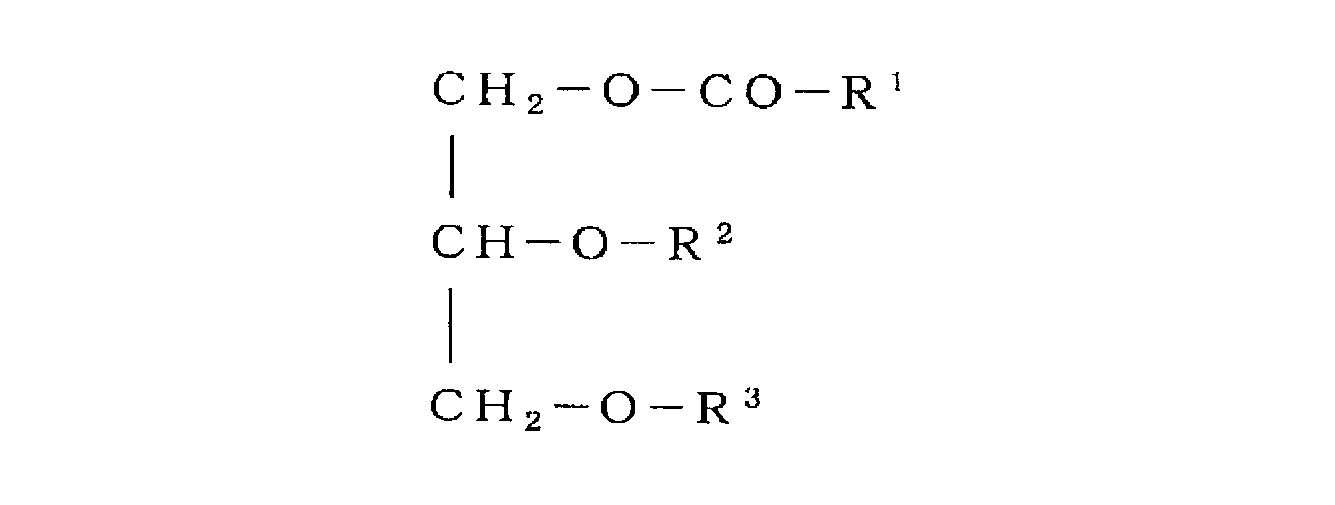
グリセリンジアセトモノエステル(C-1)は、上記化学式(1)においては、R1はアルキル基であり、R2およびR3はアセチル基である。
グリセリンジアセトモノエステル(C-1)は、高温においても比較的安定で、樹脂と混合する際の可塑剤の揮発等を抑制できることから可塑剤由来の臭気を低減することができ、かつ安定した可塑化性能を発揮することができるという観点において好ましい。
グリセリンモノアセトモノエステル(C-2)は、上記化学式(1)においては、R1はアルキル基であり、R2およびR3の一方がアセチル基、他方が水素である。
グリセリンモノアセトモノエステル(C-2)は、可塑化性能が良好であり、混合する樹脂への可塑剤の添加部数を実質的に減らすことができるという点で好ましい。
(C-1)と(C-2)の混合比が上記範囲内とすることで、可塑化性能を十分に発揮することができるため好ましい。
ただし、上記のとおりグリセリンモノアセトモノエステル(C-2)の場合には、ブリードアウト抑制および可塑化性能の観点でグリセリンジアセトモノエステル(C-1)よりも有利である一方、臭気成分を低減する観点ではグリセリンジアセトモノエステル(C-1)よりも不利であるため、後述するように表面層を設ける構成を併用することによって臭気低減を確実にするのが好ましい。この場合の表面層の厚みは、臭気抑制の観点からフィルムの総厚みに対して20~65%とすることが好ましい。
食品用の包装用ラップフィルムとして用いる場合の構成としては、トータルアセチル化度を低減するように可塑剤を選択し、かつ、表面層を20~65%の厚み比で設けることが特に好ましい態様であり、このような構成とすることによって、ブリードアウト抑制および臭気抑制を達成しつつ、十分かつ安定した可塑化性能を発揮することが可能となる。
本積層フィルムの中間層の作製に当たっては、乳酸系重合体(B)及び可塑剤(C)のほかに、分子量を上げるための鎖延長剤(E)或いはオレフィン系重合体(F)或いはこれらの両方を配合してもよい。
鎖延長剤(E)を配合することにより、乳酸系重合体(B)と可塑剤(C)からなる乳酸系組成物の分子量を高めることで、製膜後のフィルムにおける乳酸系重合体(B)の分解を抑制することができるから、乳酸系重合体(B)に含まれるオリゴマーの発生を抑制することができ、結果として臭気をより一層抑制することができる。
エポキシ基を有するビニル単量体として、(メタ)アクリル酸グリシジルやシクロヘキセンオキシド構造を有する(メタ)アクリル酸エステル、(メタ)アクリルグリシジルエーテル等を用いることができる。好ましくは(メタ)アクリル酸グリシジルである。
エポキシ基を有するスチレン共重合体は、本発明の効果を損なわない範囲で任意のその他のエポキシ基を有していないスチレン以外のビニル単量体を併用してもよい。
また、該スチレン共重合体の重量平均分子量は、該樹脂組成物の溶融滞留安定性の観点から500~50000であることが好ましく、1000~30000であることがより好ましく、特に2000~20000、中でも特に3000未満であることがさらに好ましい。
そして、上記重量平均分子量の範囲内となるように鎖延長剤(E)の添加量を決定すればよい。添加剤の添加量は、上記乳酸系組成物中に0.05~10質量部配合することが好ましく、0.05~5重量部配合することがより好ましく、0.1~3質量部配合することがさらに好ましい。
中間層が含有するオレフィン系重合体(F)は、表面層を構成するオレフィン系重合体(A)と同じオレフィン系重合体であっても、異なるオレフィン系重合体であってもよく、好ましくは同じオレフィン系重合体であるのがよい。オレフィン系重合体(F)と表面層を構成するオレフィン系重合体(A)とが同じオレフィン系重合体であれば、中間層と表面層との密着性を高めることができ、フィルム全体での力学特性を高めることができるほか、例えば製膜したフィルムの両端をカットしてトリミングした際に発生するトリミングロスを、中間層の構成原料として添加するようにして調製できるから、材料の無駄を無くし、材料コストの軽減を図ることができる。
例えば、本積層フィルムの実用特性を保持するために、中間層を構成する組成物100質量部に対して、カルボジイミド化合物を好ましくは0.1~3質量部、より好ましくは0.5~1質量部配合することで重量平均分子量を増大させることができる。かかる範囲を下回る場合、重量平均分子量を増大させる効果が薄い場合が多く、またかかる範囲を上回る場合には、フィルム成形時にフィッシュアイやゲルを生じる場合があり好ましくない。
例えば、炭素数が1~12、好ましくは1~6の脂肪族アルコールと、炭素数が10~22、好ましくは12~18の脂肪酸との化合物である脂肪族アルコール系脂肪酸エステル、具体的には、モノグリセリンオレート、ポリグリセリンオレート、ポリグリセリンポリリシノレート、グリセリントリリシノレート、グリセリンアセチルリシノレート、ポリグリセリンステアレート、ポリグリセリンラウレート、メチルアセチルリシレート、エチルアセチルリシレート、ブチルアセチルリシレート、プロピレングリコールオレート、プロピレングリコールラウレート、ペンタエリスリトールオレート、ポリエチレングリコールオレート、ポリプロピレングリコールオレート、ソルビタンオレート、ソルビタンラウレート、ポリエチレングリコールソルビタンオレート、ポリエチレングリコールソルビタンラウレート等、ならびに、ポリアルキレンエーテルポリオール、具体的には、ポリエチレングリコール、ポリプロピレングリコール等、更に、パラフィン系オイルなどから選ばれた化合物の少なくとも1種を、各種を構成する樹脂成分100質量部に対して0.1~12質量部配合させることができ、好適には1~8質量部配合させるのが好ましい。
中間層は、乳酸系重合体(B)が分解してなる乳酸オリゴマー(D)を含んでいてもよい。例えば、代表的な乳酸オリゴマーとして、乳酸の環状二量体ラクチドを挙げることができる。
本積層フィルムは、両表面層がオレフィン系重合体(A)を主成分として含有し、中間層が乳酸系重合体(B)及び可塑剤(C)を主成分として含有する、少なくとも3層を備えた積層フィルムであればよい。3層を備えた積層フィルムとすることにより、例えば表面層に防曇剤などを含ませることができるため、フィルムの防曇性などを高めることもできる。
また、表面層と同一組成の層(以下、S層と略する。)を、中間層として有してもよいし、中間層と同一組成の層(以下、M層と略する。)を、両表面層の間に2層以上有してもかまわない。
例えば(S層)/(M層)/(S層)からなる3層構成、(S層)/(P層)/(M層)/(S層)からなる4層構成、(S層)/(P層)/(M層)/(P層)/(S層)、(S層)/(M層)/(P層)/(M層)/(S層)などからなる5層構成を代表的に挙げることができる。この場合、各層の樹脂組成や厚み比に関しては同一であっても異なっていてもよい。
また、表面層および中間層を構成する樹脂を接着層に再利用することもできる。例えば製膜したフィルムの両端をカットしてトリミングした際に発生するトリミングロスを用いて接着層を形成することができ、材料の無駄を無くし、材料コストの軽減を図ることができる。
再生層は、表面層と接着層の間や、中間層と接着層との間に設けることができる。例えば、表面層、中間層、あるいは接着層の構成を2層構成にしておき、一方の層にフィルム両端のトリミングロスをリターンすることによって、表面層と接着層の間、または中間層と接着層との間に再生層を設けることができる。この場合、各層の厚み比や組成比のほか、リターンを含有させる層が表面層、中間層、あるいは接着層のいずれをベースとしているかによって、3成分の混合比が調整できる。
また、再生層の代替として、オレフィン系重合体(A)と乳酸系重合体(B)を含む混合物を用いてもよい。
本積層フィルムにおいて、フィルムの総厚みに対する表面層の厚み比は、20~65%であることが好ましい。表面層の厚み比がかかる範囲内であれば、中間層の主成分である乳酸系重合体の乳酸オリゴマー及び可塑剤の表面への移行を防ぐことができ、結果的にそれに由来する臭気を抑制する効果が得られる。また、製膜したフィルムを巻いた状態で保管しておいてもブロッキングが生じず、防曇性や容器密着性が良好であり、経時により加水分解による分子量低下が生じ難いことに加えて、各層間の接着性も良好である包装用フィルムとすることができる。
なお、中間層が上記したように2層以上ある場合には、全ての中間層の合計厚みを用いて厚み比を計算すればよい。
本積層フィルムは、(1)下記検出条件にて検出される乳酸オリゴマー成分量が50ng/cm2以下であるか、或いは可塑剤由来の臭気成分量が50ng/cm2以下であることが重要であり、好ましくは、下記検出条件にて検出される乳酸オリゴマー成分量が50ng/cm2以下であり、且つ、可塑剤由来の臭気成分量が50ng/cm2以下であるのがよい。
乳酸系重合体(B)に可塑剤(C)を混入する場合、これらを溶融して成形する際に可塑剤によって乳酸系重合体(B)の熱分解が促進され、多量の乳酸オリゴマーが発生する。この乳酸オリゴマーおよび可塑剤由来の揮発成分が気になる臭気成分であると考えられたため、乳酸オリゴマー成分量および可塑剤由来の臭気成分量を上記範囲に規制したところ、気になる臭気を無くすことができた。
本積層フィルムから検出される可塑剤由来の臭気成分量が、50ng/cm2より多いと、加熱使用時の臭気などが発生しやすく、食品用途として用いる場合には、内容物への臭気の移行問題等を引き起こす可能性がある。かかる観点から、本積層フィルムから検出される可塑剤由来の臭気成分量は、40ng/cm2以下であるのが好ましく、中でも30ng/cm2以下であるのがより好ましい。また、乳酸オリゴマー成分量も、40ng/cm2以下であるのが好ましく、中でも30ng/cm2以下であるのがより好ましい。
乳酸オリゴマー量を低減させる方法としては、用いる乳酸系重合体(B)の原料中の乳酸オリゴマー(D)を予め除去乃至低減する方法や、成形時や加工時或いはその後に乳酸オリゴマー(D)を低減乃至除去する方法が挙げられる。
一方、可塑剤(C)の揮発成分を低減させる方法としては、沸点(平衡蒸気圧)の高い可塑剤を選択する方法や、可塑剤(C)の添加量を低減する方法、さらには成形時や加工時或いはその後に可塑剤(C)の揮発成分を低減乃至除去する方法が挙げられる。
中でも、乳酸オリゴマー及び可塑剤(C)の揮発成分を同時に低減できれば、効率が良いため、乳酸系重合体(B)と可塑剤(C)を溶融混練する過程において発生した乳酸オリゴマーと、溶融混練時の加熱により発生する可塑剤(C)の揮発成分とを同時に除去するために、成形時や加工時或はその後に臭気成分を低減乃至除去する方法を選択するのが好ましい。
また、損失正接(tanδ)のピーク温度が60℃以下であり、そのピーク値が0.1以上であれば、フィルムの変形に対する復元挙動が瞬間的に起こることがないため、フィルムを容器に包装する際、僅かな間にフィルムが復元することがなく容器への密着性が良好となるため好ましい。また、損失正接(tanδ)のピーク温度が20℃以上であり、そのピーク値が0.8以下であれば、塑性的な変形を示すことがないため、通常の使用方法では問題となることがないため好ましい。
なお、損失正接(tanδ)とは、貯蔵弾性率(E’)に対する損失弾性率(E”)の比、すなわち損失正接(tanδ=E”/E’)であり、この値が高い温度領域では、材料の損失弾性率(E”)、すなわち粘弾性特性のうち粘性の寄与率が大きいことを意味している。この損失正接(tanδ)の値及び高い値を示す温度領域を評価することにより、包装時の容器への密着性や包装工程におけるフィルムの応力緩和挙動などを判断する大きな目安となる。
本積層フィルムの製造方法について説明するが、下記製造方法に限定されるものではない。
乳酸系重合体(B)に可塑剤(C)を添加する方法としては、例えば、可塑剤(C)を高濃度含有させた乳酸系重合体のマスターバッチと乳酸系重合体の原料との混合ペレットを押出機に投入して溶融混練してもよいが、組成物の熱劣化を最小限にし、乳酸オリゴマーの発生を最小限に留めるためには、単軸又は2軸の押出機を使用して、乳酸系重合体の原料と可塑剤(C)を直接フィルム押出機に投入する方法が好ましい。そしてその溶融混練時に、押出機内でベント口において臭気原因物質を吸引排気するのが好ましい。
より具体的には、例えば、原料の乳酸系重合体を予め100~110℃にて乾燥し、押出機に投入した後、押出機の第1ベント口から可塑剤を所定量添加し溶融混練した後、押出機下流側のベント口(「第二ベント口」或いは「減圧ベント口」という)より減圧することで、乳酸オリゴマーや可塑剤(C)の揮発成分を吸引して押出機外に排気するようにするのが好ましい。
予め作製したマスターバッチを使用する際にも、同様にして、押出機下流側のベント口より減圧しながら製膜すればよいが、加えてマスターバッチを作製する際にも減圧しながらペレット化しておくのが好ましい。
中間層以外の原料は、各層の構成原料が混合組成物である場合には、予め各層の構成原料を混合しておき、必要に応じてペレット化しておくのが好ましい。この際の混合方法としては、例えば、予め同方向2軸押出機、ニーダー、ヘイシェルミキサー等を用いてプレコンパウンドするようにしても構わないし、又、各原料をドライブレンドして直接フィルム押出機に投入するようにしても構わない。いずれの混合方法においても、原料の分解による分子量の低下を考慮する必要があるが、均一に混合させるためにはプレコンパウンドするのが好ましい。
次に、それぞれ別々に押出機に投入して溶融押出された各層の形成組成物を、Tダイ成形又はインフレーション成形により共押出して積層すればよい。
この際、実用的にはTダイより押出した溶融物をそのまま、キャスティングロールなどで急冷しながら引き取るようにしてフィルムを製膜するのが好ましい。
延伸温度としては、押出シートの温度を30~90℃の範囲に設定とすることが好ましく、さらに40~90℃の範囲とすることが好ましい。延伸温度がかかる範囲内であれば、中間層の乳酸系樹脂組成物と、表面層のオレフィン系重合体(A)の両方を延伸に好適な弾性率に近づけることができるため好ましい。また、延伸倍率は1.2~5.0倍の範囲内とすることが好ましく、さらに1.5~4.0倍の範囲とすることがより好ましい。延伸倍率がかかる範囲内であれば、押出シートの破断や白化等のトラブルが生じることなくカット性を向上させることができる。
熱処理条件としては、熱処理温度を40~100℃の範囲に設定することが好ましく、さらに60~90℃の範囲とすることが好ましい。熱処理温度が40℃以上であれば熱処理の効果を十分に得ることができ、100℃以下であればフィルムがロールにべたつく等の成形性の問題を生じることがない。
本発明において「主成分」とは、特に記載しない限り、当該主成分の機能を妨げない範囲で他の成分を含有することを許容する意を包含する。この際、当該主成分の含有割合を特定するものではないが、主成分(2成分以上が主成分である場合には、これらの合計量)が組成物中の50質量%以上、特に70質量%以上、中でも特に90質量%以上(100%含む)を占めるのが好ましい。
また、本発明において、「X以上」(Xは任意の数字)と表現した場合、特にことわらない限り、「好ましくはXより大きい」の意を包含し、「Y以下」(Yは任意の数字)と表現した場合、特にことわらない限り、「好ましくはYより小さい」の意を包含するものとする。
なお、本明細書中に表示されるフィルムについての種々の測定値および評価は次のようにして行った。ここで、フィルムの押出機からの流れ方向を縦方向(以下「MD」と記載する場合がある)、その直角方向を横方向(以下「TD」と略する場合がある)と称する。
臭気成分の定量は、ヘッドスペースガスクロマトグラフを用いて質量分析を行うことで実施した(HS-GC-MS)。
サンプルはすべて5cm2に調整した。ヘッドスペースサンプラー(HS)には日本分析工業社製のJHS-100Aを使用し、ガスクロマトグラフ(GC)には島津製作所製のGC-17Aを使用し、該HSのサンプル温度を60℃、加熱時間を30分、該GCのカラムに内径0.25mm、長さ30mのキャピラリーカラムを使用し、カラム温度を40℃で1分間保持した後、200℃まで10℃/minに昇温し、射出部温度を280℃とした。
質量分析計(MS)を用いた定量は、島津製作所製のQP-5050を使用し、ヘキサデカン換算にて行った。
なお、以下の各実施例及び比較例において測定した臭気成分は、乳酸オリゴマー成分である環状二量体ラクチド(分子量144)と、可塑剤由来の臭気成分であるグリセリントリアセテートまたはグリセリンジアセテートとである。
JIS K-7198 A法に記載の動的粘弾性測定法により、アイティー計測制御(株)製動的粘弾性測定装置「DVA-200」を用い、フィルムの横方向(TD)について、振動周波数10Hz、歪み0.1%にて、昇温速度1℃/分で-50℃から150℃まで測定し、得られたデータから温度20℃での貯蔵弾性率(E’)、並びに、損失正接(tanδ)のピーク温度及びそのピーク値を求めた。
得られたフィルムを、40℃×90質量%に調整したタバイエスペック製の恒温恒湿機LH-112内にて1ヶ月静置した。
東ソー(株)製のゲルパーミエーションクリマトグラフィーHLS-8120GPCに、(株)島津製作所製のクロマトカラムShim-PackシリーズのGPC-800CPを装着し、溶媒クロロホルム、溶液濃度0.2wt/vol質量%、溶液注入量200μL、溶媒流速1.0ml/分、溶媒温度40℃の条件で、試験前後(すなわち、前記1ヶ月静置の前後)のフィルムの質量平均分子量を測定し、表1には、これをポリスチレン換算した質量平均分子量を算出して示した。この際、用いた標準ポリスチレンの質量平均分子量は、2000000、670000、110000、35000、10000、4000、600である。
○:分子量保持率が60質量%以上、100質量以下%で、且つ、経時後の分子量が10万以上のもの。
×:分子量保持率が0質量%以上、60質量%未満で、且つ、経時後の分子量が10万未満のもの。
フィルムを製膜する際、特にガラス転移温度(Tg)が室温付近である場合には、押出の際にキャスティングロールに貼り付いてしまって、安定した製膜を妨げることがある。
◎:極めて安定している。
○:安定している。
×:不安定である。
得られたフィルムの巻き物を、温度43℃、相対湿度40%の条件の恒温室内に5日間保管し、その後の表面状態と巻き返し性とを観察し、以下の基準で評価した。
○:フィルム同士のブロッキングが少しあるが実用上問題とならないレベル
×:フィルム同士のブロッキングにより剥離が出来ず巻き返しが不可となり実用上問題となるレベル
直径10cm、深さ5cmの茶碗状の陶磁器製の容器に包装したときの容器への密着性を、以下の基準で評価した。
○:少し容器形状から広がるが実用上問題ないレベル
×:フィルムが容器に沿わず広がってしまい実用上問題となるレベル
直径50mm、高さ80mmからなるSUS304製の円筒の一側の開口部に、製膜したフィルムを皺なく貼り付け、外気温0~5℃の環境下で、フィルムを貼ってない開口部側の円筒端部30mmを水温20℃の水中に浸し、浸し始めてから1時間後の防曇性を目視観察し、以下の基準で評価した。
○:水分が均一な水膜となっているが、ところどころに細かい水滴あり
×:直径約3mmの水滴あり
製膜したフィルムを金属製鋸刃付きのカートンボックスに入れ、フィルムを引き出してカットし、その際のカットのし易さを以下の基準で評価した。
○:カット時に多少の抵抗を感じるが実用上問題ないレベル
×:カット時にラップが金属製鋸刃に食い込み、過度の抵抗を感じるレベル
両表面層を形成する組成物については、オレフィン系重合体(A)としての、日本ユニカー社製直鎖状低密度ポリエチレン「NUCG5361」(MFR:4.0g/10分、結晶化熱量:Δ100J/g、屈折率1.51)(以下「A-1」と略する)及び、日本ユニカー社製直鎖状低密度ポリエチレン「NUCG5371」(MFR:12.0g/10分、屈折率1.51)以下「A-2」と略する)を、質量比でA-1/A-2=50/50の割合で混合し、さらにジグリセリンオレートを主成分とする防曇剤として、オレフィン系重合体(A)100質量部に対し5.0質量部の理研ビタミン社製「MJ-1」を、押出設定温度180~200℃に設定した同方向2軸押出機に投入し溶融混練した。
(B)成分であるポリ乳酸について、B-1とB-2の混合比を質量比でB-1/B-2=40/60とした。その他については、実施例1と同様にして総厚み12μm(表面層/中間層/表面層=1.5μm/9μm/1.5μm)の包装用フィルムを得た。得られたフィルムについて評価した結果を表1に示す。
(C)成分である可塑剤について、グリセリンジアセトモノエステル(C-1)とグリセリンモノアセトモノエステル(C-2)との混合比を(C-1)/(C-2)=73/27とし、この混合物からなる可塑剤(C)を(B)成分100質量部に対して13質量部配合した。その他については、実施例1と同様にして総厚み12μm(表面層/中間層/表面層=1.5μm/9μm/1.5μm)の包装用フィルムを得た。得られたフィルムについて評価した結果を表1に示す。
実施例3と同様の構成にて共押出し、総厚み36μm(表面層/中間層/表面層=4.5μm/27μm/4.5μm)の原反フィルムを得た。次いで、ロール延伸により、延伸温度70℃、熱処理温度90℃、延伸倍率3倍にてMDに1軸延伸し、厚み12μmの包装用フィルムを得た。得られたフィルムを評価した結果を表1に示す。
乳酸系重合体(B)に鎖延長剤(E)を加えず、真空ポンプによる減圧を行わなかった。その他については、実施例1と同様にして総厚み12μmの包装用フィルムを得た。
実施例1において、両表面層を形成する樹脂組成物および防曇剤の替わりに、中間層を形成する樹脂組成物と同組成の樹脂組成物をプレコンパウンドしてペレットを作製しておき、このペレットを両表面層用の押出機に投入し、実質的に単層フィルムとし、真空ポンプによる減圧を行わなかった。その他については、実施例1と同様に総厚み12μmの包装用フィルムを得た。
実施例1において、中間層を形成する樹脂組成物の替わりに、両表面層を形成する樹脂組成物および防曇剤を投入し、実質的に単層フィルムとし、可塑剤を注入せず、真空ポンプによる減圧を行わなかった。その他については、実施例1と同様にして総厚み12μmの包装用フィルムを得た。得られたフィルムを評価した結果を表1に示す。

また、実施例3では、可塑剤(C)としてグリセリンモノアセトモノエステルとグリセリンジアセトモノエステルとの混合物を用いたことにより、添加量が少ない場合でも、実施例1~2と同等の物性が得られることが確認できた。
さらに、実施例4では、延伸加工を施すことによりカット性を高めることができることが分かった。
また、オレフィン系重合体を主成分とする表裏層を有さない場合(比較例2)には、容器密着性は良好であったが、製膜安定性、ブロッキング、防曇性が不十分であり、乳酸オリゴマー及び可塑剤由来の臭気を感じやすく、更には経時により加水分解による分子量低下が生じ、実用特性上不十分となり問題であった。
乳酸系重合体系樹脂組成物を主成分とする中間層を有さない場合には(比較例3)、臭気は感じられず、ブロッキング、防曇性、製膜安定性は良好であったが、容器密着性が不十分であった。
Claims (8)
- 乳酸系重合体(B)及び可塑剤(C)を含有する中間層と、表面層とを備えた、少なくとも3層を有する積層フィルムであって、
フィルムの総厚みに対する表面層の厚み比が20~65%であり、
下記検出条件にて検出される乳酸オリゴマー成分量が50ng/cm2以下、或いは可塑剤由来の臭気成分量が50ng/cm2以下であることを特徴とする積層フィルム。
検出条件:ヘッドスペースガスクロマトグラフ質量分析計(HS-GC-MS)を用いて、ヘッドスペースサンプラー(HS)のサンプル温度を60℃、加熱時間を30分に設定して検出する。 - 動的粘弾性測定により周波数10Hz、温度20℃で測定した貯蔵弾性率(E’)が1~4GPa、損失正接(tanδ)のピーク温度が20~60℃となり、且つそのピーク値が0.1~0.8の範囲にあることを特徴とする請求項1に記載の積層フィルム。
- 前記中間層は、乳酸系重合体(B)100質量部に対して1~30質量部の可塑剤(C)を含有することを特徴とする請求項1又は2に記載の積層フィルム。
- 可塑剤(C)が、分子量2000以下のグリセリン脂肪酸エステルであることを特徴とする請求項1~3の何れかに記載の積層フィルム。
- 乳酸系重合体(B)が、LD比率の異なる2種類以上の乳酸系重合体の混合樹脂であることを特徴とする請求項1~4の何れかに記載の積層フィルム。
- 表面層の主成分が、低密度ポリエチレン、線状低密度ポリエチレン、エチレン-酢酸ビニル共重合体、エチレン-アクリル酸エステル共重合体及びエチレン-メタクリル酸エステル共重合体の中から選ばれる1種の樹脂、又は、これらの2種以上の組合せからなる混合樹脂からなるオレフィン系重合体であることを特徴とする請求項1~5の何れかに記載の積層フィルム。
- 包装用ラップフィルムであることを特徴とする請求項1~6の何れかに記載の積層フィルム。
- 積層フィルムの製造過程において、中間層形成組成物を溶融混練する過程時に、単軸又は2軸の押出機内でベント口において吸引排気する工程を経て製造されたものであることを特徴とする請求項1~7の何れかに記載の積層フィルム。
Priority Applications (4)
| Application Number | Priority Date | Filing Date | Title |
|---|---|---|---|
| EP10733469.0A EP2380735A4 (en) | 2009-01-20 | 2010-01-19 | MULTILAYER FOIL |
| US13/145,362 US20110274899A1 (en) | 2009-01-20 | 2010-01-19 | Multilayer film |
| JP2010547489A JPWO2010084862A1 (ja) | 2009-01-20 | 2010-01-19 | 積層フィルム |
| CN2010800048068A CN102282018A (zh) | 2009-01-20 | 2010-01-19 | 叠层膜 |
Applications Claiming Priority (2)
| Application Number | Priority Date | Filing Date | Title |
|---|---|---|---|
| JP2009-009614 | 2009-01-20 | ||
| JP2009009614 | 2009-01-20 |
Publications (1)
| Publication Number | Publication Date |
|---|---|
| WO2010084862A1 true WO2010084862A1 (ja) | 2010-07-29 |
Family
ID=42355914
Family Applications (1)
| Application Number | Title | Priority Date | Filing Date |
|---|---|---|---|
| PCT/JP2010/050572 Ceased WO2010084862A1 (ja) | 2009-01-20 | 2010-01-19 | 積層フィルム |
Country Status (5)
| Country | Link |
|---|---|
| US (1) | US20110274899A1 (ja) |
| EP (1) | EP2380735A4 (ja) |
| JP (1) | JPWO2010084862A1 (ja) |
| CN (1) | CN102282018A (ja) |
| WO (1) | WO2010084862A1 (ja) |
Cited By (2)
| Publication number | Priority date | Publication date | Assignee | Title |
|---|---|---|---|---|
| JP2014526988A (ja) * | 2011-08-10 | 2014-10-09 | ランクホルスト ピューレ コンポジッツ ビー.ブイ. | 多成分系テープ、フィルム又は糸及びその調製方法 |
| JP2023148766A (ja) * | 2022-03-30 | 2023-10-13 | 三菱ケミカル株式会社 | ポリ乳酸系フィルム、食品包装用フィルム、青果物包装用フィルム |
Families Citing this family (3)
| Publication number | Priority date | Publication date | Assignee | Title |
|---|---|---|---|---|
| WO2014103587A1 (ja) * | 2012-12-28 | 2014-07-03 | 三菱樹脂株式会社 | ラップフィルム |
| JP6715791B2 (ja) * | 2017-03-14 | 2020-07-01 | グローブライド株式会社 | 取付部品が取り付けられた竿体を有する釣竿、管状体及びその製造方法 |
| WO2021089806A1 (en) * | 2019-11-08 | 2021-05-14 | Trioplast Ab | A multilayer stretch film |
Citations (7)
| Publication number | Priority date | Publication date | Assignee | Title |
|---|---|---|---|---|
| JP2002019053A (ja) | 2000-07-07 | 2002-01-22 | Mitsubishi Plastics Ind Ltd | 収縮シート状物 |
| JP2003145572A (ja) * | 2001-11-14 | 2003-05-20 | Fuji Photo Film Co Ltd | 樹脂成形品の製造方法 |
| WO2005082981A1 (ja) | 2004-02-26 | 2005-09-09 | Mitsubishi Plastics, Inc. | 生分解性ラップフィルム |
| JP2006131687A (ja) * | 2004-11-02 | 2006-05-25 | Mitsubishi Plastics Ind Ltd | ポリ乳酸系樹脂組成物及びこれを用いた成形品 |
| WO2008004510A1 (fr) | 2006-07-03 | 2008-01-10 | Mitsubishi Plastics, Inc. | film d'emballage |
| JP2008200860A (ja) * | 2007-02-16 | 2008-09-04 | Toray Ind Inc | ポリ乳酸系樹脂フィルムの製造方法 |
| JP2008273147A (ja) * | 2007-05-07 | 2008-11-13 | Daicel Pack Systems Ltd | 容器用積層シート |
Family Cites Families (6)
| Publication number | Priority date | Publication date | Assignee | Title |
|---|---|---|---|---|
| JP4626137B2 (ja) * | 2002-10-03 | 2011-02-02 | 東レ株式会社 | ポリ乳酸系樹脂延伸フィルムおよびその製造方法 |
| JP2005271272A (ja) * | 2004-03-23 | 2005-10-06 | Achilles Corp | 生分解性樹脂多層フィルムまたはシート |
| JP2006035666A (ja) * | 2004-07-28 | 2006-02-09 | C I Kasei Co Ltd | 複層ポリ乳酸系樹脂フィルム及びその製造方法 |
| JP4970878B2 (ja) * | 2006-09-05 | 2012-07-11 | 三菱樹脂株式会社 | 多層乳酸系軟質フィルム |
| JP5078399B2 (ja) * | 2007-03-16 | 2012-11-21 | 三菱樹脂株式会社 | 多層乳酸系軟質フィルム |
| JP5092521B2 (ja) * | 2007-04-19 | 2012-12-05 | 大日本印刷株式会社 | 多層積層フィルム |
-
2010
- 2010-01-19 JP JP2010547489A patent/JPWO2010084862A1/ja active Pending
- 2010-01-19 US US13/145,362 patent/US20110274899A1/en not_active Abandoned
- 2010-01-19 CN CN2010800048068A patent/CN102282018A/zh active Pending
- 2010-01-19 WO PCT/JP2010/050572 patent/WO2010084862A1/ja not_active Ceased
- 2010-01-19 EP EP10733469.0A patent/EP2380735A4/en not_active Withdrawn
Patent Citations (7)
| Publication number | Priority date | Publication date | Assignee | Title |
|---|---|---|---|---|
| JP2002019053A (ja) | 2000-07-07 | 2002-01-22 | Mitsubishi Plastics Ind Ltd | 収縮シート状物 |
| JP2003145572A (ja) * | 2001-11-14 | 2003-05-20 | Fuji Photo Film Co Ltd | 樹脂成形品の製造方法 |
| WO2005082981A1 (ja) | 2004-02-26 | 2005-09-09 | Mitsubishi Plastics, Inc. | 生分解性ラップフィルム |
| JP2006131687A (ja) * | 2004-11-02 | 2006-05-25 | Mitsubishi Plastics Ind Ltd | ポリ乳酸系樹脂組成物及びこれを用いた成形品 |
| WO2008004510A1 (fr) | 2006-07-03 | 2008-01-10 | Mitsubishi Plastics, Inc. | film d'emballage |
| JP2008200860A (ja) * | 2007-02-16 | 2008-09-04 | Toray Ind Inc | ポリ乳酸系樹脂フィルムの製造方法 |
| JP2008273147A (ja) * | 2007-05-07 | 2008-11-13 | Daicel Pack Systems Ltd | 容器用積層シート |
Non-Patent Citations (1)
| Title |
|---|
| See also references of EP2380735A4 * |
Cited By (2)
| Publication number | Priority date | Publication date | Assignee | Title |
|---|---|---|---|---|
| JP2014526988A (ja) * | 2011-08-10 | 2014-10-09 | ランクホルスト ピューレ コンポジッツ ビー.ブイ. | 多成分系テープ、フィルム又は糸及びその調製方法 |
| JP2023148766A (ja) * | 2022-03-30 | 2023-10-13 | 三菱ケミカル株式会社 | ポリ乳酸系フィルム、食品包装用フィルム、青果物包装用フィルム |
Also Published As
| Publication number | Publication date |
|---|---|
| EP2380735A1 (en) | 2011-10-26 |
| JPWO2010084862A1 (ja) | 2012-07-19 |
| CN102282018A (zh) | 2011-12-14 |
| US20110274899A1 (en) | 2011-11-10 |
| EP2380735A4 (en) | 2013-07-17 |
Similar Documents
| Publication | Publication Date | Title |
|---|---|---|
| JP5078399B2 (ja) | 多層乳酸系軟質フィルム | |
| JP6237644B2 (ja) | ラップフィルム | |
| JP5091140B2 (ja) | 多層乳酸系軟質フィルム | |
| JP5154848B2 (ja) | 包装用フィルム | |
| JPWO2010084862A1 (ja) | 積層フィルム | |
| JP2006016605A (ja) | 乳酸系軟質フィルム | |
| WO2008004510A1 (fr) | film d'emballage | |
| JP2008044359A (ja) | 包装用フィルム | |
| JP5475582B2 (ja) | 包装用フィルム | |
| JP5777133B2 (ja) | ポリ乳酸系樹脂フィルム | |
| JP5074363B2 (ja) | 包装用フィルム | |
| JP4440738B2 (ja) | インフレーション成形生分解性軟質フィルム | |
| JP2008238805A (ja) | 包装用フィルム | |
| JP5396688B2 (ja) | ポリエステルフィルム | |
| JP4970878B2 (ja) | 多層乳酸系軟質フィルム | |
| JP2008254421A (ja) | 包装用フィルム | |
| JP4880579B2 (ja) | 包装用フィルム | |
| JP2010229292A (ja) | 乳酸系軟質フィルム | |
| JP4800242B2 (ja) | 積層ストレッチフィルムおよびその製造方法 | |
| JP2020117617A (ja) | 樹脂組成物およびその樹脂組成物を用いた積層体 | |
| JP5074362B2 (ja) | 包装用フィルム | |
| JP2011000770A (ja) | 包装用フィルム | |
| JP2008221551A (ja) | 包装用フィルム | |
| JP5332221B2 (ja) | ポリ乳酸系樹脂組成物からなるチップ状物 | |
| JP4955469B2 (ja) | 積層樹脂フィルムおよびその製造方法 |
Legal Events
| Date | Code | Title | Description |
|---|---|---|---|
| WWE | Wipo information: entry into national phase |
Ref document number: 201080004806.8 Country of ref document: CN |
|
| 121 | Ep: the epo has been informed by wipo that ep was designated in this application |
Ref document number: 10733469 Country of ref document: EP Kind code of ref document: A1 |
|
| ENP | Entry into the national phase |
Ref document number: 2010547489 Country of ref document: JP Kind code of ref document: A |
|
| NENP | Non-entry into the national phase |
Ref country code: DE |
|
| WWE | Wipo information: entry into national phase |
Ref document number: 2010733469 Country of ref document: EP |