WO2010087636A2 - 알칼리 활성결합재, 상기 결합재를 이용한 알칼리 활성 모르터, 콘크리트, 콘크리트제품 및 황토습식포장재 - Google Patents
알칼리 활성결합재, 상기 결합재를 이용한 알칼리 활성 모르터, 콘크리트, 콘크리트제품 및 황토습식포장재 Download PDFInfo
- Publication number
- WO2010087636A2 WO2010087636A2 PCT/KR2010/000536 KR2010000536W WO2010087636A2 WO 2010087636 A2 WO2010087636 A2 WO 2010087636A2 KR 2010000536 W KR2010000536 W KR 2010000536W WO 2010087636 A2 WO2010087636 A2 WO 2010087636A2
- Authority
- WO
- WIPO (PCT)
- Prior art keywords
- alkali
- weight
- parts
- active
- binder
- Prior art date
- Legal status (The legal status is an assumption and is not a legal conclusion. Google has not performed a legal analysis and makes no representation as to the accuracy of the status listed.)
- Ceased
Links
Images


Classifications
-
- C—CHEMISTRY; METALLURGY
- C04—CEMENTS; CONCRETE; ARTIFICIAL STONE; CERAMICS; REFRACTORIES
- C04B—LIME, MAGNESIA; SLAG; CEMENTS; COMPOSITIONS THEREOF, e.g. MORTARS, CONCRETE OR LIKE BUILDING MATERIALS; ARTIFICIAL STONE; CERAMICS; REFRACTORIES; TREATMENT OF NATURAL STONE
- C04B28/00—Compositions of mortars, concrete or artificial stone, containing inorganic binders or the reaction product of an inorganic and an organic binder, e.g. polycarboxylate cements
- C04B28/02—Compositions of mortars, concrete or artificial stone, containing inorganic binders or the reaction product of an inorganic and an organic binder, e.g. polycarboxylate cements containing hydraulic cements other than calcium sulfates
- C04B28/021—Ash cements, e.g. fly ash cements ; Cements based on incineration residues, e.g. alkali-activated slags from waste incineration ; Kiln dust cements
-
- C—CHEMISTRY; METALLURGY
- C04—CEMENTS; CONCRETE; ARTIFICIAL STONE; CERAMICS; REFRACTORIES
- C04B—LIME, MAGNESIA; SLAG; CEMENTS; COMPOSITIONS THEREOF, e.g. MORTARS, CONCRETE OR LIKE BUILDING MATERIALS; ARTIFICIAL STONE; CERAMICS; REFRACTORIES; TREATMENT OF NATURAL STONE
- C04B28/00—Compositions of mortars, concrete or artificial stone, containing inorganic binders or the reaction product of an inorganic and an organic binder, e.g. polycarboxylate cements
- C04B28/006—Compositions of mortars, concrete or artificial stone, containing inorganic binders or the reaction product of an inorganic and an organic binder, e.g. polycarboxylate cements containing mineral polymers, e.g. geopolymers of the Davidovits type
- C04B28/008—Mineral polymers other than those of the Davidovits type, e.g. from a reaction mixture containing waterglass
-
- C—CHEMISTRY; METALLURGY
- C04—CEMENTS; CONCRETE; ARTIFICIAL STONE; CERAMICS; REFRACTORIES
- C04B—LIME, MAGNESIA; SLAG; CEMENTS; COMPOSITIONS THEREOF, e.g. MORTARS, CONCRETE OR LIKE BUILDING MATERIALS; ARTIFICIAL STONE; CERAMICS; REFRACTORIES; TREATMENT OF NATURAL STONE
- C04B28/00—Compositions of mortars, concrete or artificial stone, containing inorganic binders or the reaction product of an inorganic and an organic binder, e.g. polycarboxylate cements
- C04B28/02—Compositions of mortars, concrete or artificial stone, containing inorganic binders or the reaction product of an inorganic and an organic binder, e.g. polycarboxylate cements containing hydraulic cements other than calcium sulfates
- C04B28/08—Slag cements
-
- C—CHEMISTRY; METALLURGY
- C04—CEMENTS; CONCRETE; ARTIFICIAL STONE; CERAMICS; REFRACTORIES
- C04B—LIME, MAGNESIA; SLAG; CEMENTS; COMPOSITIONS THEREOF, e.g. MORTARS, CONCRETE OR LIKE BUILDING MATERIALS; ARTIFICIAL STONE; CERAMICS; REFRACTORIES; TREATMENT OF NATURAL STONE
- C04B28/00—Compositions of mortars, concrete or artificial stone, containing inorganic binders or the reaction product of an inorganic and an organic binder, e.g. polycarboxylate cements
- C04B28/18—Compositions of mortars, concrete or artificial stone, containing inorganic binders or the reaction product of an inorganic and an organic binder, e.g. polycarboxylate cements containing mixtures of the silica-lime type
-
- C—CHEMISTRY; METALLURGY
- C04—CEMENTS; CONCRETE; ARTIFICIAL STONE; CERAMICS; REFRACTORIES
- C04B—LIME, MAGNESIA; SLAG; CEMENTS; COMPOSITIONS THEREOF, e.g. MORTARS, CONCRETE OR LIKE BUILDING MATERIALS; ARTIFICIAL STONE; CERAMICS; REFRACTORIES; TREATMENT OF NATURAL STONE
- C04B2111/00—Mortars, concrete or artificial stone or mixtures to prepare them, characterised by specific function, property or use
- C04B2111/00474—Uses not provided for elsewhere in C04B2111/00
- C04B2111/0075—Uses not provided for elsewhere in C04B2111/00 for road construction
-
- C—CHEMISTRY; METALLURGY
- C04—CEMENTS; CONCRETE; ARTIFICIAL STONE; CERAMICS; REFRACTORIES
- C04B—LIME, MAGNESIA; SLAG; CEMENTS; COMPOSITIONS THEREOF, e.g. MORTARS, CONCRETE OR LIKE BUILDING MATERIALS; ARTIFICIAL STONE; CERAMICS; REFRACTORIES; TREATMENT OF NATURAL STONE
- C04B2111/00—Mortars, concrete or artificial stone or mixtures to prepare them, characterised by specific function, property or use
- C04B2111/10—Compositions or ingredients thereof characterised by the absence or the very low content of a specific material
- C04B2111/1025—Alkali-free or very low alkali-content materials
-
- Y—GENERAL TAGGING OF NEW TECHNOLOGICAL DEVELOPMENTS; GENERAL TAGGING OF CROSS-SECTIONAL TECHNOLOGIES SPANNING OVER SEVERAL SECTIONS OF THE IPC; TECHNICAL SUBJECTS COVERED BY FORMER USPC CROSS-REFERENCE ART COLLECTIONS [XRACs] AND DIGESTS
- Y02—TECHNOLOGIES OR APPLICATIONS FOR MITIGATION OR ADAPTATION AGAINST CLIMATE CHANGE
- Y02P—CLIMATE CHANGE MITIGATION TECHNOLOGIES IN THE PRODUCTION OR PROCESSING OF GOODS
- Y02P40/00—Technologies relating to the processing of minerals
- Y02P40/10—Production of cement, e.g. improving or optimising the production methods; Cement grinding
-
- Y—GENERAL TAGGING OF NEW TECHNOLOGICAL DEVELOPMENTS; GENERAL TAGGING OF CROSS-SECTIONAL TECHNOLOGIES SPANNING OVER SEVERAL SECTIONS OF THE IPC; TECHNICAL SUBJECTS COVERED BY FORMER USPC CROSS-REFERENCE ART COLLECTIONS [XRACs] AND DIGESTS
- Y02—TECHNOLOGIES OR APPLICATIONS FOR MITIGATION OR ADAPTATION AGAINST CLIMATE CHANGE
- Y02W—CLIMATE CHANGE MITIGATION TECHNOLOGIES RELATED TO WASTEWATER TREATMENT OR WASTE MANAGEMENT
- Y02W30/00—Technologies for solid waste management
- Y02W30/50—Reuse, recycling or recovery technologies
- Y02W30/91—Use of waste materials as fillers for mortars or concrete
-
- Y—GENERAL TAGGING OF NEW TECHNOLOGICAL DEVELOPMENTS; GENERAL TAGGING OF CROSS-SECTIONAL TECHNOLOGIES SPANNING OVER SEVERAL SECTIONS OF THE IPC; TECHNICAL SUBJECTS COVERED BY FORMER USPC CROSS-REFERENCE ART COLLECTIONS [XRACs] AND DIGESTS
- Y10—TECHNICAL SUBJECTS COVERED BY FORMER USPC
- Y10T—TECHNICAL SUBJECTS COVERED BY FORMER US CLASSIFICATION
- Y10T428/00—Stock material or miscellaneous articles
- Y10T428/13—Hollow or container type article [e.g., tube, vase, etc.]
Definitions
- the present invention relates to an alkali-active binder that can be used as a binder in place of cement, and more particularly, by reducing the total amount of Na 2 O and K 2 O in concrete, including sodium-free alkaline inorganic materials.
- the present invention relates to an alkali active binder having a composition capable of increasing safety and suppressing an alkali-aggregate reaction, a mortar including the binder, concrete, concrete products and ocher type wet packing materials.
- cement or cement clinker
- CaCO 3 a representative inorganic binder
- Energy is consumed and a large amount of CO 2 gas is generated, which is at least 44% by weight of the cement production.
- the carbon dioxide generated is about 7% of global greenhouse gas emissions.
- the cement is a powder consisting of a mixture of raw materials containing silica, alumina, and lime in an appropriate ratio, a part of which is melted and sintered by adding an appropriate amount of gypsum to a powder to prepare the clinker of such cement. Since it must be melted at a high temperature of about 1450 ° C., it consumes a large amount of energy (about 30 to 35 l / ton of oil). In addition, it is known to produce about 700 to 870 kg of carbon dioxide only by chemical reaction of limestone and silicic acid to produce one ton of cement.
- Korean Patent Application No. 2007-65185 discloses a blast furnace slag; And an alkaline inorganic material including sodium, wherein the alkaline inorganic material is at least one of sodium silicate and liquid water glass, and the weight ratio of sodium to blast furnace slag included in the alkaline inorganic material is 0.038 to 0.088.
- the weight of the sodium-based discloses an alkali active binder, characterized in that the value converted to Na 2 0.
- Cementum alkaline active binders known to date, including the above patents can replace the conventional ordinary portland cement, which can solve the industrial waste treatment, not only reduce the environmental load, but also save energy when the binder is filed And does not emit carbon dioxide has an environmentally friendly effect, but the alkaline inorganic material used in the conventional alkaline active binder is a composition containing sodium, in the case of a binder using an alkaline inorganic material of the composition containing sodium as described above There was a difficulty in controlling the total amount of alkali that had to be regulated to suppress the alkali-aggregate reaction.
- Na 2 O equivalent per 1 m 3 of concrete should be 0.3 kg or less. If it is out of the range of regulated total alkali, problems such as sudden slump loss may occur, resulting in deterioration of concrete quality. Because.
- the known conventional ocher packaging material also includes the above-described problems as it is because it uses an ideal cement used by mixing ocher and cement.
- the dry shrinkage of concrete is affected by the amount of water used, the amount of binder, the amount of binder and the amount of aggregate, etc.
- large dry shrinkage of the loess should be controlled when manufacturing concrete using loess.
- the road pavement has many dry shrinkage cracks and requires high tensile strength and flexural strength. Especially, dry shrinkage cracks on the surface give aesthetic instability rather than structural problems and cause distrust to the contractor and demand for defect repair. Because.
- the conventional ocher paving material uses cement and loess, it is difficult to secure required slump due to the increase in specific surface area due to the characteristics of the loess containing fine particles unlike sand.
- the dry method was the best method to control the dry shrinkage cracking according to the increase of the unit quantity.
- the dry process is difficult to control the moisture content of the material, and even if the material is not surely mixed, a uniform quality cannot be obtained.
- the slump is low and pressure is applied through various equipment to prevent the installation of packaging materials, construction cost increases.
- the present inventors have completed the present invention by developing an alkali active binder having a new composition free from the regulation of the total amount of alkali as a result of efforts to solve the above-mentioned disadvantages and problems of the prior art.
- an object of the present invention by using an alkaline inorganic material that can control the curing rate of the alkali active binder in a content ratio that can maintain the compressive strength, the alkali active binder having excellent workability and safety of the safety at the same time, the alkali active containing the binder To provide mortars, concrete and concrete products.
- Another object of the present invention is to suppress the alkali-aggregate reaction in concrete by reducing the total amount of Na 2 O and K 2 O in the concrete, which is effective for controlling the alkali-aggregate reaction, alkali active mortar comprising the binder To provide concrete, concrete and concrete products.
- Still another object of the present invention is to provide an alkali active binder, an alkali-activated mortar including the binder, concrete and concrete products, which have improved strength and economy by controlling the rapid phenomena occurring in the sodium series and activating the pozzolanic reaction.
- Another object of the present invention is to substitute for asphalt or concrete, not to consider the traffic loads such as trails, sidewalks, park roads, bicycle roads, etc., as well as to apply where high strength is required to allow the passage of heavy vehicles. It is to provide possible alkaline activated ocher wet packaging materials.
- the present invention is a slag or fly ash; And an alkali-free alkaline inorganic material.
- the sodium-free alkaline inorganic material per 100 parts by weight of the slag or fly ash is included in an amount of 0.5 to 30 parts by weight.
- the sodium-free alkaline inorganic material is an alkali active binder, characterized in that at least one of calcium hydroxide, barium hydroxide, gypsum, magnesium salt, magnesium oxide. +
- the magnesium salt is any one of magnesium sulfate, magnesium carbonate, magnesium hydroxide, magnesium chloride, magnesium stearate, magnesium metaphosphate, and magnesium lactate.
- the calcium hydroxide is contained 0.5 to 15 parts by weight per 100 parts by weight of the slag or fly ash.
- the barium hydroxide is contained 0.5 to 5 parts by weight per 100 parts by weight of the slag or fly ash.
- the magnesium salt or magnesium oxide salt is included 0.5 to 20 parts by weight per 100 parts by weight of the slag or fly ash.
- the present invention also provides an alkali active mortar comprising the alkali active binder of any one of claims 1 to 7.
- the present invention also provides an alkali active concrete comprising the alkali active binder of any one of claims 1 to 7.
- the present invention also provides an alkali activated concrete product, which is made of the concrete of claim 9.
- the concrete product comprises bricks, blocks, tiles, sewer pipes, boundary stones, concrete piles, prestressed concrete, concrete panels, concrete pipes, manholes, foam concrete, concrete structures. .
- the present invention is an alkali active binder of any one of claims 1 to 7; fine aggregate comprising at least one of sand, waste foundry sand, stone powder or artificial lightweight aggregate; And water; It provides an alkaline active preparation comprising a.
- it further comprises a sodium-containing inorganic material comprising at least one of sodium silicate, sodium sulfate, powdered sodium hydroxide, liquid water glass and liquid sodium hydroxide.
- the present invention includes the alkali active binder of any one of claims 1 to 7, loess, coarse aggregate, admixture, fiber, and blending water, wherein the blending water (W) and alkali active binder ( Provided is an alkali-active loess type wet packaging material, characterized in that the blending ratio (W / B) of B) is 40 to 65%.
- the admixture is a high performance water reducing agent and contains 0.5 to 1.5 parts by weight per 100 parts by weight of the alkali active binder.
- the fiber has a high density of fibers, fine fiber thickness, a large number of fibers per unit volume, and excellent dispersibility, and includes 10 to 35 parts by weight per 100 parts by weight of the alkali active binder.
- the fine aggregate further comprises a fine aggregate of 5 mm or less in diameter and is included in place of 20 to 30% by weight of the ocher weight.
- it further comprises a sodium-containing inorganic material comprising at least one of sodium silicate, sodium sulfate, powdered sodium hydroxide, liquid water glass and liquid sodium hydroxide.
- the compressive strength of 18 to 24MPa when 100 to 240 parts by weight of ocher, 170 to 300 parts by weight of coarse aggregate, 0.5 to 1.5 parts by weight of admixture, and 15 to 35 parts by weight of fiber are included per 100 parts by weight of the alkali active binder. Obtained.
- the present invention has the following excellent effects.
- the alkali active mortar including the binder, concrete and concrete products excellent work by using an alkaline inorganic material that can control the curing rate of the alkali active binder in a content ratio that can maintain the compressive strength It has both safety and strength.
- the alkali active binder of the present invention the alkali active mortar including the binder, concrete and concrete products, it is possible to suppress the alkali-aggregate reaction in the concrete by reducing the total amount of Na 2 O and K 2 O in the concrete and alkali Effective for controlling aggregate reaction
- the alkali active mortar including the binder, concrete and concrete products to control the rapid phenomena appear in the sodium series and to activate the pozzolanic reaction to improve the strength and economics.
- the alkali active binder of the present invention the alkali active mortar including the binder, concrete and concrete products, the production cost is reduced by using an alkaline inorganic material containing magnesium, which is relatively inexpensive.
- the alkali-activated product and the ocher-packed packaging material of the present invention it is more economical than using an alkali-activated binder containing only conventional sodium-containing alkaline inorganic material, while not only improving the compressive strength of the product but also stably increasing the strength. It has the characteristics to be expressed, has improved workability through the control of the rapid freezing phenomenon is improved productivity.
- the alkaline activated ocher wet packing material of the present invention is environmentally friendly by recycling industrial by-products and adding no cement, and has excellent initial strength and long-term strength expression compared to OPC cement, and excellent durability and chemical resistance compared to OPC cement, and heat of hydration. It is about 1/2 to 1/3 of this OPC cement, and is less sensitive to the quality of the aggregate, and the strength is not reduced even if it contains about 20% clay or foreign matter.
- the alkali-activated ocher wet packaging material of the present invention it is easy to disperse the dry shrinkage crack on the surface using fibers to improve tensile strength and flexural strength.
- alkaline activated ocher wet packing material of the present invention by replacing a part of the total ocher content with fine aggregate having a particle size similar to that of ocher, it controls dry shrinkage while maintaining the inherent color of the ocher and increases the compressive strength.
- alkaline activated ocher wet pavement material of the present invention as a substitute for asphalt or concrete, it is possible not only to consider traffic loads such as trails, sidewalks, park roads, bicycle roads, etc., but also to increase the strength of heavy vehicles. Applicable where required.
- 1 and 2 are the relationship between the calcium hydroxide content and the initial flow included in the alkali active binder according to an embodiment of the present invention and the flow loss slope (Graph showing the relationship between
- 3 and 4 are the relationship between the barium hydroxide content and the initial flow included in the alkali active binder according to another embodiment of the present invention and the flow loss slope (Graph showing the relationship between
- FIG. 11 is a graph showing the relationship between calcium hydroxide and barium hydroxide content and age 28 days compressive strength contained in the alkali-active binder according to another embodiment of the present invention.
- FIG. 13 is a graph showing the relationship between the 28-day compressive strength according to the type of magnesium-containing alkaline inorganic material contained in the alkali active binder according to another embodiment of the present invention.
- FIGS 14 and 15 are graphs showing the relationship between the initial flow and the 28-day compressive strength according to the change in the magnesium chloride content when the alkali-active binder according to another embodiment of the present invention includes magnesium chloride and calcium hydroxide,
- 16 and 17 are graphs showing the relationship between the initial flow and the 28-day compressive strength according to the change in the magnesium nitrate content when the alkali-active binder according to another embodiment of the present invention includes magnesium nitrate and calcium hydroxide,
- 20 and 21 are graphs showing the relationship between the initial flow and the 28-day compressive strength, respectively, according to the change in the magnesium oxide content when the alkali-active binder according to another embodiment of the present invention includes magnesium oxide and calcium hydroxide,
- 25 is a graph showing the relationship between the barium hydroxide content and the 28-day compressive strength contained in the cementless alkali-activated binder used in the light weight blocks and the light bricks prepared in Examples 46 to 48, respectively;
- FIG. 26 is a graph showing the relationship between calcium hydroxide and sodium sulfate content and age 28-day compressive strength contained in the cemented-alkali active binder used in the blocks prepared in Examples 49 to 56 of the present invention.
- 29 is a graph showing the relationship between the age and compressive strength of the alkaline active loess-wet packaging material 5 to 7 prepared according to the embodiments of the present invention.
- FIG. 30 is a graph showing a slump of the alkaline active loess-wet packing material 5 to 7 prepared according to the embodiments of the present invention.
- Figure 31 is a comparative graph showing the relationship between the age and compressive strength of the high-strength alkali-active ocher wet packaging material and the normal strength alkali-active ocher wet packaging material of the present invention.
- the present invention relates to an alkali active binder that can replace cement, and in particular, includes slag or fly ash and a sodium-based non-alkaline inorganic material.
- the conventional alkali-active binder used an alkaline inorganic material containing sodium, such as sodium silicate, powdered sodium hydroxide, liquid water glass and liquid sodium hydroxide, but the present invention does not use any alkaline inorganic material containing sodium. This is because it provides an alkali active binder having better functionality in stability of workability and strength.
- the alkaline active binder of the present invention may be prepared by uniformly mixing a sodium-free alkaline inorganic material and fly ash, metakaolin, or slag in a certain weight ratio, but in particular included in the mortar made of the alkali active binder of the present invention In order to reduce the Na 2 O content as much as possible, it is more preferable not to use alkaline mineral materials containing sodium at all, but also to use fly ash or slag having twice as much sodium as the industrial by-product metakaolin. Do.
- any one or more of calcium hydroxide, barium hydroxide, gypsum, or magnesium-containing alkaline inorganic material including magnesium salt and magnesium oxide may be used.
- the strength and workability may be slightly reduced. Therefore, in order to improve the workability and to provide more than the reference strength, it is preferable to include calcium hydroxide and barium hydroxide or gypsum in a certain weight ratio or magnesium-containing alkaline inorganic material in a certain weight ratio.
- magnesium salt or magnesium oxide is relatively inexpensive among alkaline inorganic materials that do not contain sodium, calcium hydroxide and magnesium salt or magnesium oxide may be used if they provide excellent strength at the same time as the reference strength and have excellent workability and economic efficiency. It is preferable to include each in a fixed weight ratio.
- the magnesium salt contained in the alkaline active binder of the present invention includes magnesium sulfate, magnesium carbonate, magnesium hydroxide, magnesium chloride, magnesium stearate, magnesium metaphosphate, magnesium lactate, and the like.
- the mortar and concrete including the alkali active binder of the present invention may include Na 2 O in an amount of 0.21 to 0.22 parts by weight per 100 parts by weight of the alkali active binder due to the sodium component contained in the raw material, ie slag or fly ash.
- the present invention relates to an alkali active masonry using an alkali active binder which can replace cement without using cement, in particular raw material and sodium ratio including any one or more of slag, fly ash, or metakaolin.
- alkaline inorganic materials which have technical features. That is, the conventional alkali-active binder used only sodium-based inorganic materials such as sodium silicate, powdered sodium hydroxide, liquid water glass and liquid sodium hydroxide, but the present invention does not use sodium-based inorganic materials at all, and uses only sodium-free inorganic materials.
- the masonry product used in the present invention is a collective name for all products used in the masonry structure of the building, including blocks, bricks.
- the sodium-containing alkaline inorganic material is not used at all and the sodium-containing alkaline inorganic material is used, or when the sodium-containing alkaline inorganic material and the sodium-free alkaline inorganic material are used together, the sodium-containing alkaline active material of the present invention is used.
- Alkaline inorganic materials are considerably high in price, while sodium-free alkaline inorganic materials are inexpensive, so the production cost is reduced and the economy is very excellent.
- sodium sulfate is significantly cheaper than other sodium-based inorganic materials, so the economy is excellent.
- the alkali-active binder used in the alkali-activated masonry product of the present invention comprises a raw material and an alkaline inorganic material of any one or more of slag, fly ash or metakaoli, which is calcium hydroxide, hydroxide Sodium-free alkaline inorganic materials containing any one or more of barium, gypsum or magnesium-containing alkaline inorganic materials, or sodium-containing alkalis of at least one of sodium silicate, sodium sulfate, powdered sodium hydroxide, liquid water glass and liquid sodium hydroxide It may be a composition of an inorganic material and an alkaline inorganic material containing no sodium.
- the calcium hydroxide contained in the alkali active binder is preferably 0.5 to 15 parts by weight per 100 parts by weight of the raw material
- the barium hydroxide is preferably 0.5 to 5 parts by weight per 100 parts by weight of the raw material
- the gypsum is 0.5 per 100 parts by weight of the raw material It is preferable that it is 5 weight part. Including such a non-sodium-containing inorganic material in such a weight ratio not only can control the alkali aggregate reaction while ensuring the appropriate strength required for the masonry product, but also excellent workability due to the control of the rapid phenomena.
- the alkaline active binder further comprises a sodium-containing alkaline inorganic material, that is, a composition of a sodium-containing alkaline inorganic material and a sodium-free inorganic material
- a sodium-containing alkaline inorganic material that is, a composition of a sodium-containing alkaline inorganic material and a sodium-free inorganic material
- the weight ratio of Na or Na 2 O to the raw material included in the sodium-containing alkaline inorganic material Should be blended so as to fall within the range of 0.005 to 0.14.
- the blending ratio is an optimal ratio in consideration of the advantage because the strength is improved when the Na or Na 2 O content is increased in the masonry product.
- the weight ratio of such sodium-based raw materials determines the mechanical properties such as fluidity, strength and dry shrinkage of the cementless alkali activated brick or block of the present invention.
- sodium-based alkaline inorganic materials sodium silicate, sodium sulfate, powdered sodium hydroxide, liquid water glass, and liquid sodium hydroxide may be present in the sodium-based Na or Na 2 O and calculated by the weight of Na 2 O Converted.
- the weight of sodium system when the weight of sodium system is present as Na 2 O, the weight was used as it is, and the weight of sodium system in another form was used to convert the weight of Na 2 O.
- the weight of the sodium-based alkaline inorganic material is determined and mixed so that the weight ratio of the sodium-based raw material can be properly adjusted.
- the amount of sodium-containing alkaline inorganic materials it is preferable to adjust the amount of sodium-containing alkaline inorganic materials so that the weight ratio of sodium-based raw material is in the range of 0.005 to 0.088.
- the raw material is fly ash or metakaolin
- sodium hydroxide solution of 8 to 16 M when the sodium-containing alkaline inorganic materials mixed in the alkaline active binder contain liquid sodium hydroxide.
- the fine aggregate included in the manufacture of the alkali-activated masonry product of the present invention includes one or more of artificial light weight aggregate, sand or stone powder, and the artificial light weight aggregate preferably has a specific gravity of 1.2 or less.
- Sand or stone powder contained in the fine aggregate is preferably a maximum diameter of 10mm or less, specific gravity of 2.5 or more, more preferably sand has a maximum diameter of 5mm or less, stone powder is 8mm or less.
- the artificial light weight aggregate contained in the fine aggregate has an internal void, unit volume weight is 300kg / m3 to 800kg / m3, it is preferable to use a maximum diameter of 10mm or less.
- the artificial light aggregate may be a fine aggregate artificially produced by using a ceramic as a main material, for example, when using any one or more of clay, volcanic ash, clinker and fly ash as artificial light aggregate, clay, volcanic ash, By expanding the clinker and the fly ash to have internal voids, it is possible to have a unit volume weight of the artificial lightweight aggregate described above.
- the present invention relates to an ocher type wet packaging material which does not include cement, and has a technical feature of using an alkali active binder including slag or fly ash and an alkaline inorganic material as a binder that can replace cement in loess. .
- the ocher packaging material is less sensitive to the quality of the aggregates, and thus the strength is not reduced even if the clay contains about 20% of the aggregate or foreign matter. to be.
- the ocher-type wet packaging material of the present invention solves the problems of cement toxicity according to the use of cement and carbon dioxide (CO 2 ) generated during the cement production, depletion of natural resources according to the production of cement, and according to the dry process of the existing ocher packaging material Overcome difficulties and low economics.
- CO 2 carbon dioxide
- the alkali-active loess type wet packing material of the present invention includes a cement-based alkaline active binder, ocher, coarse aggregate, admixture, fiber, and blended water.
- the alkali-active binder is preferably prepared by uniformly mixing a good raw material and an alkaline inorganic material having a powder degree of 29,000 cm 2 / g or more at 0.5 to 20 parts by weight per 100 parts by weight of the slag or fly ash.
- the alkaline inorganic material may be one or more of sodium-containing alkaline inorganic material, sodium-free alkaline inorganic material, fly ash, metakaolin or slag may be used as the raw material, but industrial by-products having different sodium contents Preference is given to using fly ash or slag that is at least twice as low as phosphorus metakaolin.
- the slag may be any one or more of blast furnace slag, electric furnace slag, converter slag, the type and mixing ratio of the alkaline inorganic material can be changed depending on the application of the packaging material.
- the ocher-type wet packaging material of the present invention includes the yellow soil 50 to 240 parts by weight per 100 parts by weight of the alkali active binder, the technical characteristics, the ocher has a maximum diameter of not more than 5mm, specific gravity 1.9 ⁇ 2.1, absorption rate 10 ⁇ 15% range It is preferable to use red ocher in its natural state. Therefore, ocher is used to satisfy the standard particle size distribution curve of 5mm fine aggregate of KS standard.
- the alkali-activated yellow soil wet packing material of the present invention has its technical characteristics in that it includes aggregates of 13 mm or less to control dry shrinkage using the aggregates.
- the drying shrinkage of concrete is affected by the amount of water used, the amount of binder, the amount of binder and the amount of aggregate.
- the ocher-type wet packing material of the present invention was intended to control dry shrinkage using aggregates.
- aggregates of 13 mm or less to include 80 to 300 parts by weight per 100 parts by weight of the alkali active binder Good strength was achieved.
- the alkali-activated yellow soil wet type packaging material of the present invention has a technical feature in that the fiber is contained in a certain weight ratio to control dry shrinkage cracking of the surface and improve tensile strength and flexural strength.
- the road pavement has a lot of dry shrinkage cracks and requires high tensile strength and flexural strength. Especially, dry shrinkage cracks on the surface give aesthetic instability rather than structural problems.
- the present invention used a fiber having a high density, a fine thickness, a large number of fibers per unit volume, and an excellent dispersibility, at 10 to 35 parts by weight per 100 parts by weight of the alkali active binder.
- the fiber is not limited as long as it satisfies the above properties, but at least one selected from the group consisting of PET fiber, cellulose fiber, PVA fiber, nylon fiber, and polyolefinic fiber is preferably used.
- the alkali-active loess type wet packing material of the present invention also has a technical feature in that it contains a dry admixture to secure a target slump considering the compressive strength and workability.
- the admixture may use all known kinds of admixtures used to secure the slump, but it is preferable to use a high quality polycarboxylic acid-based high performance reducing agent.
- the alkali-activated ocher wet packaging material of the present invention solves the problems of the dry process of the conventional ocher packaging material to provide an economical and eco-friendly ocher wet packaging material and a wet method capable of wet construction in the range of 150 ⁇ 200 mm slump. Is used so that the blending ratio (W / B) of the blending water (W) and the alkali-active binder (B) is 40 to 65%.
- the blended water should not contain harmful substances that affect the quality such as oil, acid, alkali, etc.
- drinking water is excellent as a blended water, but groundwater, industrial water, river water, etc. can be used if there is no harmful effect on concrete quality. It's okay.
- the alkali-active ocher type wet packing material of the present invention has the technical characteristics of using fine aggregates having a particle size similar to ocher to control dry shrinkage and increase compressive strength while maintaining the color of the ocher.
- the fine aggregate included is preferably 5 mm or less in diameter, and particularly, the content thereof is included to replace 20 to 30% by weight of the ocher weight.
- the maximum particle size of ocher is about 5mm, similar to fine aggregate, but the large absorption rate of ocher has problems such as dry shrinkage cracking, reduction of required slump, reduction of required compressive strength, and so on.
- GGBS used in the present invention is pulverized blast furnace slag into a powder of a certain size means a blast furnace slag powder (Ground Granulated Blast Furance Slag).
- Alkali-active binder 1 was prepared by uniformly mixing 100 parts by weight of GGBS and 0.5 parts by weight of calcium hydroxide powder.
- Alkali-active binder 2 was prepared by uniformly mixing 100 parts by weight of GGBS and 10 parts by weight of calcium hydroxide powder.
- Alkali-active binder 3 was prepared by uniformly mixing 100 parts by weight of GGBS and 15 parts by weight of calcium hydroxide powder.
- Alkali-active binder 5 was prepared by uniformly mixing 100 parts by weight of GGBS and 2.5 parts by weight of calcium hydroxide powder.
- Alkali-active binder 6 was prepared by uniformly mixing 100 parts by weight of GGBS and 5 parts by weight of calcium hydroxide powder.
- Alkali-active binder 7 was prepared by uniformly mixing 100 parts by weight of GGBS, 0.5 parts by weight of calcium hydroxide powder and 1 part by weight of barium hydroxide powder.
- Alkali-active binder 8 was prepared by uniformly mixing 100 parts by weight of GGBS, 0.5 parts by weight of calcium hydroxide powder and 5 parts by weight of barium hydroxide powder.
- Alkali-active binder 9 was prepared by uniformly mixing 100 parts by weight of GGBS, 15 parts by weight of calcium hydroxide powder and 0.5 parts by weight of barium hydroxide powder.
- Alkali-active binder 10 was prepared by uniformly mixing 100 parts by weight of GGBS, 15 parts by weight of calcium hydroxide powder and 5 parts by weight of barium hydroxide powder.
- Alkali-active binder 11 was prepared by uniformly mixing 100 parts by weight of GGBS, 10 parts by weight of calcium hydroxide powder and 0.5 parts by weight of gypsum powder.
- Alkali-active binder 12 was prepared by uniformly mixing 100 parts by weight of GGBS, 5 parts by weight of barium hydroxide powder and 5 parts by weight of gypsum powder.
- Alkali-active binder 13 was prepared by uniformly mixing 100 parts by weight of GGBS, 10 parts by weight of calcium hydroxide powder, 5 parts by weight of barium hydroxide powder and 2.5 parts by weight of gypsum powder.
- the ratio of water-alkali-active binders 1 to 13 prepared in Examples 1 to 13 (W / B) is 50%, sand-raw material weight ratio (S / B) is 3.0, and the maximum diameter of the aggregate is 5 mm or less.
- Alkali-active mortars 1 to 13 were prepared.
- the calcium hydroxide content included in the alkaline active binder decreased as the content increased, but the initial flow decreased as the content of barium hydroxide was increased.
- the increase in the amount of calcium hydroxide was effective in controlling the flow loss.
- the calcium hydroxide contained in the alkali active binder may delay the initial curing of the alkali active binder.
- the optimum workability may be secured by determining the contents of calcium hydroxide and barium hydroxide included in the alkaline active binder in consideration of the flowability considering the initial flow and the flow loss.
- a graph showing the relationship between the barium hydroxide, calcium hydroxide and / or gypsum content and the compressive strength of the 28-day compressive strength contained in the mortar is 2.5 parts by weight of the barium hydroxide contained in the alkali active binder
- the compressive strength of the 28-day compressive strength increased as the content of barium hydroxide increased, but the compressive strength of the 28-day compressive strength decreased as the content of barium hydroxide increased more than 2.5 parts by weight.
- the content ratio of barium hydroxide contained in the alkali active binder may be 0.5 parts by weight to 5 parts by weight.
- the compressive strength of the 28-day compressive strength decreases as the content of barium hydroxide is added, which includes only calcium hydroxide or is included with barium hydroxide. Even if the content of calcium hydroxide exceeds 10 parts by weight, no significant increase in compressive strength was observed with the increase of the calcium hydroxide content. As a result, it can be seen that the strength can be stably expressed by including calcium hydroxide in the alkaline active binder.
- the concrete also contains Na 2 O in an amount of 0.21 to 0.22 parts by weight per 100 parts by weight of the alkali active binder, similarly to the mortar including the alkali active binder.
- Alkaline active binder 14 was prepared by uniformly mixing 100 parts by weight of GGBS and 10 parts by weight of magnesium chloride powder.
- Alkali-active binder 15 was prepared by uniformly mixing 100 parts by weight of GGBS and 10 parts by weight of magnesium nitrate powder.
- Alkali-active binder 16 was prepared by uniformly mixing 100 parts by weight of GGBS and 10 parts by weight of magnesium silicate powder.
- Alkali-active binder 17 was prepared by uniformly mixing 100 parts by weight of GGBS and 10 parts by weight of magnesium oxide powder.
- Alkali-active binder 18 was prepared by uniformly mixing 100 parts by weight of GGBS, 10 parts by weight of calcium hydroxide powder, and 0.55 parts by weight of magnesium chloride powder.
- Alkali-active binders 19 to 21 were prepared in the same manner as in Example 5, except that magnesium chloride powder was used at 5.7 parts by weight, 12 parts by weight and 19 parts by weight, respectively.
- An alkali active binder 22 was prepared by uniformly mixing 100 parts by weight of GGBS, 10 parts by weight of calcium hydroxide powder, and 0.5 parts by weight of magnesium nitrate powder.
- Alkali-active binders 23 to 26 were prepared in the same manner as in Example 23, except that magnesium nitrate powder was used in 5 parts by weight, 7 parts by weight, 10 parts by weight and 15 parts by weight, respectively.
- Alkali-active binder 27 was prepared by uniformly mixing 100 parts by weight of GGBS, 10 parts by weight of calcium hydroxide powder and 0.5 parts by weight of magnesium silicate powder.
- Alkali-active binders 28 to 30 were prepared in the same manner as in Example 28, except that magnesium silicate powder was used in 5 parts by weight, 10 parts by weight, and 15 parts by weight, respectively.
- Alkali-active binder 31 was prepared by uniformly mixing 100 parts by weight of GGBS, 10 parts by weight of calcium hydroxide powder, and 0.5 parts by weight of magnesium oxide powder.
- Alkali-active binders 32 to 35 were prepared in the same manner as in Example 32, except that magnesium silicate powder was used in 2 parts by weight, 7 parts by weight, 10 parts by weight and 15 parts by weight, respectively.
- the ratio of water-alkali-active binders 14 to 35 prepared in Examples 15 to 36 (W / B) is 50%, the sand-raw material weight ratio (S / B) is 3.0, and the maximum diameter of the aggregate is 5 mm or less.
- Alkali-active mortars 14 to 35 were prepared.
- magnesium chloride may be included in the alkali active binder in an amount of 0.5 parts by weight to 20 parts by weight, and in consideration of workability, economy, and strength, it is particularly preferable to include 0.55 to 12 parts by weight.
- magnesium nitrate may be included in the alkali active binder in an amount of 0.5 parts by weight to 20 parts by weight. In consideration of workability, economy and strength, it can be seen that it is particularly preferably included in an amount of 10 parts by weight or less.
- the initial flow increased up to 5 parts by weight depending on the content of magnesium silicate added when the content of calcium hydroxide contained in the alkaline active binder was constant. It shows a tendency to decrease and the compressive strength also increases to 5 parts by weight and then gradually decreases.
- magnesium silicate may be included in the alkali active binder in an amount of 0.5 parts by weight to 20 parts by weight. In view of workability, economical efficiency and strength, magnesium silicate may also be included in an amount of 10 parts by weight or less.
- magnesium oxide may be included in the alkali active binder 0.5 parts by weight to 20 parts by weight, considering that workability, economy and strength, it can be seen that it is particularly preferably included in 10 parts by weight or less.
- the present invention is not only the production of alkali-activated concrete secondary products including lightweight bricks, bricks, sidewalk blocks, coastal blocks, adobe blocks, sewer pipes, boundary stones, concrete pipes as concrete containing an alkali active binder, Alkali-active concrete structural members can also be produced.
- the concrete product including the secondary concrete product and the concrete structural member is manufactured from the concrete including the alkali active binder of the present invention, the production is very easy because it is free from the regulation of the total amount of alkali in the concrete.
- the alkali-aggregate reaction can be prevented so that the strength is easily expressed and the expressed strength can be maintained.
- the alkaline active binder contained GGBS and calcium hydroxide, and about 5 parts by weight of calcium hydroxide was used per 100 parts by weight of raw materials.
- the alkali-activated composite product 1 uniformly stirs alkali active binders (GGBS, calcium hydroxide), fine aggregates and water of the contents shown in Table 1, and compactly fills bricks of a desired shape by vibrating compression through a known method. It is produced by steam curing in a curing room below 65 °C.
- the prepared alkali-activated masonry product 1 was a brick having a length of 190 ⁇ 2mm, a width of 90 ⁇ 2mm, and a height of 57 ⁇ 2mm.
- Alkali-activated preparation 2 was prepared in the same manner and in the same manner as in Example 38 except that the mixing ratios shown in Table 2 were used.
- Alkali-active binders used in the alkali-activating preparation 2 include GGBS and calcium hydroxide, and calcium hydroxide. About 10 parts by weight of silver was used per 100 parts by weight of raw materials.
- Alkali-activated crude product 3 was prepared in the same manner and in the same manner as in Example 38 except that the compounding ratios shown in Table 3 were used.
- the alkali-active binder used in the crude product 3 included GGBS, calcium hydroxide, and sodium silicate. About 5 parts by weight of calcium hydroxide was used per 100 parts by weight of the raw material, and the weight ratio of Na or Na 2 O to the raw material contained in the sodium-containing alkaline inorganic material, namely sodium silicate, was 0.015.
- Alkali-activated crude product 4 was prepared in the same manner and in the same manner as in Example 38 except that the compounding ratios shown in Table 4 were used.
- the alkali-active binder used in the crude product 4 includes GGBS, calcium hydroxide, and sodium silicate. About 5 parts by weight of calcium hydroxide was used per 100 parts by weight of the raw material, which is 0.03 in terms of the weight ratio of Na or Na 2 O to the raw material contained in sodium-containing alkaline mineral material, namely sodium silicate.
- Alkali-activated crude product 5 was prepared in the same manner and in the same manner as in Example 38, except that the compounding ratios shown in Table 5 were used.
- the alkali-active binder used in the crude product 5 included GGBS, calcium hydroxide, and sodium silicate. About 5 parts by weight of calcium hydroxide was used per 100 parts by weight of the raw material, which is 0.06 in terms of the weight ratio of Na or Na 2 O to the raw material contained in sodium-containing alkaline mineral material, namely sodium silicate.
- Example 38 Except for using the mixing ratio as shown in Table 6 to produce a light brick and a light block in the same manner as in Example 38, wherein the alkali-active binder used comprises GGBS and calcium hydroxide, calcium hydroxide is about 15 per 100 parts by weight of the raw material Parts by weight were used.
- Example 38 Except for using the mixing ratio as shown in Table 7 to produce a light brick and light block in the same manner as in Example 38, wherein the alkali-active binder is used to include GGBS and barium hydroxide, barium hydroxide per 100 parts by weight of raw materials About 0.5 parts by weight was used.
- a block was manufactured in the same manner as in Example 38, except that the formulation was satisfied so as to satisfy the blending conditions as shown in Table 8.
- Example 49, 51, 53, and 55 about 2.5 parts by weight of calcium hydroxide was used per 100 parts by weight of the raw material.
- Examples 50, 52, 54, and 56 are about 5 parts by weight of calcium hydroxide per 100 parts by weight of the raw material, and when the weight ratio of Na or Na 2 O to raw materials contained in sodium-containing alkaline inorganic material, namely sodium sulfate 49 and 50 are 0.007, Examples 51 and 52 are 0.014, Examples 53 and 54 are 0.021, and Examples 55 and 56 are 0.028.
- Comparative Products 1 to 5 were prepared in the same manner and in the same manner as in Example 38, except for blending to satisfy the compounding conditions as shown in Table 9 below.
- OPC means a compressive strength of a brick made of a general portland cement, and shows 16.0.
- the compressive strength of bricks (comparative products 1 to 5 in Comparative Examples 1 to 5) using alkali-activated inorganic binders containing only raw materials (blast furnace slag) and sodium-based alkaline inorganic materials is shown in place of portland cement.
- On the right side of the OPC replace Portland cement with raw materials (blast furnace slag) and sodium-free alkaline inorganic materials (e.g. sodium hydroxide), raw materials (blast furnace slag) and sodium-free alkaline inorganic materials (e.g. sodium hydroxide) and The compressive strength of bricks (preparations 1-5 of Examples 38-42) using alkali-active inorganic binders comprising sodium-based alkaline inorganic materials is shown.
- the alkaline active binder includes only raw materials and sodium-free alkaline inorganic materials (for example, sodium hydroxide), it can be seen that the compressive strength is significantly superior to that of a brick using general portland cement.
- the compressive strength increases when the sodium-free alkaline inorganic material (for example, sodium hydroxide) is added.
- OPC refers to the absorption rate of a brick made of general Portland cement, and is represented by 9.33.
- the absorption rate of bricks (comparative products 1 to 5 of Comparative Examples 1 to 5) using alkali-activated inorganic binders containing only raw materials (blast furnace slag) and sodium-based alkaline inorganic materials instead of portland cement is shown.
- the absorption rate of bricks (prepared products 1 to 5 of Examples 38 to 42) using an alkali-active inorganic binder containing a containing alkaline inorganic material is shown.
- the absorption rate in the case where the alkali-active binder includes only the raw material and the sodium-based alkaline inorganic material, the sodium-based alkaline inorganic material and the non-sodium-based inorganic material containing only sodium-free alkaline inorganic material in the raw material or raw materials includes a low absorption of the overall product 1 to 5, it can be seen that the properties are superior to the brick made of a general portland cement or a brick containing only a sodium-containing alkaline inorganic material.
- the alkaline active masonry products of the present invention including both general masonry products and lightweight masonry products, can be manufactured to have various shapes, dimensions, and weights at very low cost while being excellent in their properties. It can be seen that, in particular, it can be used in a variety of masonry in the construction industry technology.
- Alkali-active binder 36 was prepared by uniformly mixing 100 parts by weight of GGBS, 5 parts by weight of magnesium chloride powder and 10 parts by weight of calcium hydroxide, and 100 parts by weight of GGBS and 10 parts by weight of magnesium nitrate powder were uniformly prepared as in Example 16 above. Alkali-active binder 15 prepared by mixing was prepared.
- the alkali active binder 15 was used and the content ratio of the blended water, that is, the blended ratio (W / B) of the blended water (W) and the alkali active binder (B) was 45%, 50%, and 52.5%, respectively.
- the blended ratio (W / B) of the blended water (W) and the alkali active binder (B) was 45%, 50%, and 52.5%, respectively.
- alkali active yellow soil wet packing materials 5 to 7 were obtained, respectively.
- the standard compounding ratio of alkali activated ocher type wet packing materials can be divided into high strength and normal strength in consideration of the purpose of use and economic feasibility.
- High strength compounding increases the compressive strength by lowering the water-cement ratio (hereinafter referred to as "W / C"), and fine aggregate is added to secure the target slump at low W / C. It is characterized by higher.
- high-strength ocher type wet packaging material including 50 to 160 parts by weight of yellow clay, 80 to 140 parts by weight of coarse aggregate, 0.5 to 1.5 parts by weight of admixture, 10 to 20 parts by weight of fiber, and 10 to 48 parts by weight of fine aggregate, per 100 parts by weight of alkali active binder.
- Test the age and compressive strength relationship of the normal strength ocher type wet packing material including 100 to 240 parts by weight of ocher, 170 to 300 parts by weight of coarse aggregate, 0.5 to 1.5 parts by weight of admixture, and 15 to 35 parts by weight of fiber per 100 parts by weight of alkali active binder. The results are shown in FIG. 31.
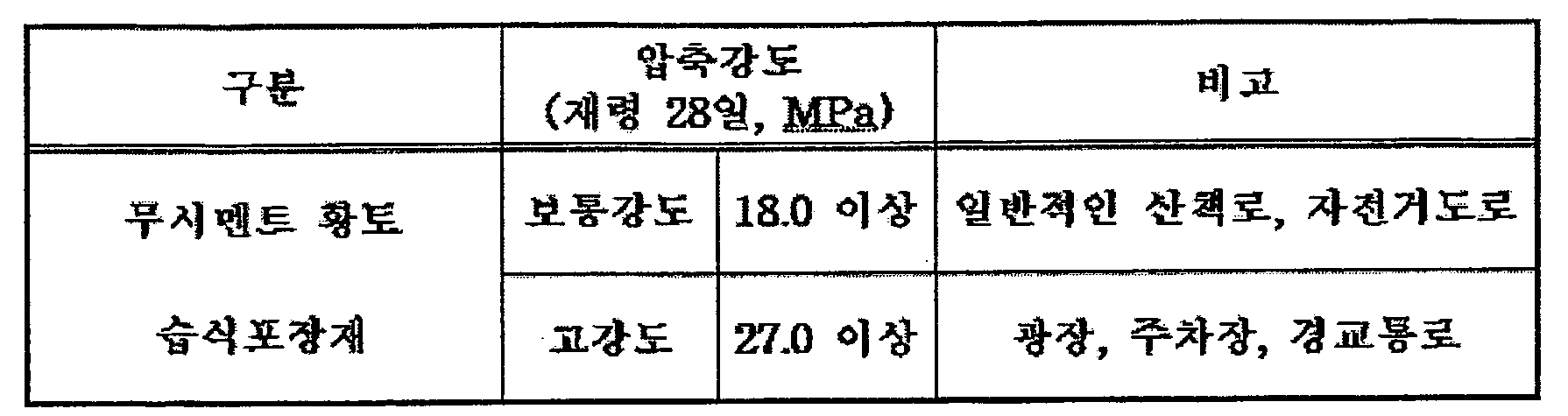
- the high-strength ocher type wet packaging material can obtain a compressive strength of 25 to 30 MPa, and a compressive strength of 18 to 24 MPa is obtained even in the case of a normal strength ocher type wet packaging material.
- composition and thickness of each layer in the packaging of the alkali-activated loess type wet packaging according to the present invention can be determined in consideration of economic conditions, such as traffic load conditions, hearth conditions, compounding materials conditions, environmental conditions, alkali active loess type wet packaging materials
- the flexural stresses generated in the surface layer are composed of the hearth, the auxiliary base layer, and the surface layer. Therefore, the pavement thickness is preferably calculated as follows.
- Packaging thickness according to the purpose of use of the alkali-active loess type wet packaging material of the present invention is as shown in Table 10
- the compressive strength according to the compressive strength of 28 days is shown in Table 11.
- the alkali-active loess type pavement material of the present invention is a substitute for asphalt or concrete, walkway, sidewalk, park road, bicycle road, playground, plaza, parking lot, tourist complex, temple, cultural heritage site, farm road, forest road, residential road in the city It can be applied to places that do not consider traffic loads such as agricultural canals and the like and where high strength is required to allow heavy vehicle traffic.
Landscapes
- Chemical & Material Sciences (AREA)
- Engineering & Computer Science (AREA)
- Ceramic Engineering (AREA)
- Chemical Kinetics & Catalysis (AREA)
- Inorganic Chemistry (AREA)
- Materials Engineering (AREA)
- Structural Engineering (AREA)
- Organic Chemistry (AREA)
- Combustion & Propulsion (AREA)
- Life Sciences & Earth Sciences (AREA)
- Environmental & Geological Engineering (AREA)
- General Life Sciences & Earth Sciences (AREA)
- Geochemistry & Mineralogy (AREA)
- Geology (AREA)
- Curing Cements, Concrete, And Artificial Stone (AREA)
- Road Paving Structures (AREA)
Abstract
Description


| 단위용적중량(kgf/㎥) | |||||
| GGBS | 규산나트륨 | 물유리 | 수산화칼슘 | 물 | 잔골재 |
| 212 | - | - | 11 | 181 | 1836 |
| 단위용적중량(kgf/㎥) | |||||
| GGBS | 규산나트륨 | 물유리 | 수산화칼슘 | 물 | 잔골재 |
| 213 | - | - | 21 | 154 | 1896 |
| 단위용적중량(kgf/㎥) | |||||
| GGBS | 규산나트륨 | 물유리 | 수산화칼슘 | 물 | 잔골재 |
| 206 | 7 | - | 10 | 158 | 1834 |
| 단위용적중량(kgf/㎥) | |||||
| GGBS | 규산나트륨 | 물유리 | 수산화칼슘 | 물 | 잔골재 |
| 199 | 14 | - | 10 | 128 | 1833 |
| 단위용적중량(kgf/㎥) | |||||
| GGBS | 규산나트륨 | 물유리 | 수산화칼슘 | 물 | 잔골재 |
| 186 | 27 | - | 9 | 113 | 1829 |
| 단위용적중량(kgf/㎥) | |||||
| GGBS | 규산나트륨 | 물유리 | 수산화칼슘 | 물 | 인조경량골재 |
| 213 | - | - | 32 | 134 | 1896 |
| 단위용적중량(kgf/㎥) | |||||
| GGBS | 규산나트륨 | 물유리 | 수산화바륨 | 물 | 인조경량골재 |
| 212 | - | - | 1.1 | 181 | 1836 |
| 단위용적중량(kgf/㎥) | |||||
| GGBS | 산화칼슘 | 황산나트륨 | 물 | 잔골재 | |
| 실시예49 | 384 | 10 | 5 | 120 | 1200 |
| 실시예50 | 374 | 20 | 5 | 120 | 1200 |
| 실시예51 | 378 | 10 | 10 | 120 | 1200 |
| 실시예52 | 368 | 20 | 10 | 120 | 1200 |
| 실시예53 | 372 | 10 | 15 | 120 | 1200 |
| 실시예54 | 362 | 20 | 15 | 120 | 1200 |
| 실시예55 | 366 | 10 | 20 | 120 | 1200 |
| 실시예56 | 356 | 20 | 20 | 120 | 1200 |
| 바인더종류 | 활성제종류 | 물/원재료 | Na2O/원재료 | |
| 비교예1 | GGBS | 규산나트륨 | 0.49 | 0.015 |
| 비교예2 | GGBS | 규산나트륨 | 0.48 | 0.025 |
| 비교예3 | Fly-ash | 규산나트륨 | 0.51 | 0.045 |
| 비교예4 | GGBS | 물유리 | 0.50 | 0.025 |
| 비교예5 | Fly-ash | 물유리 | 0.43 | 0.045 |


표 10
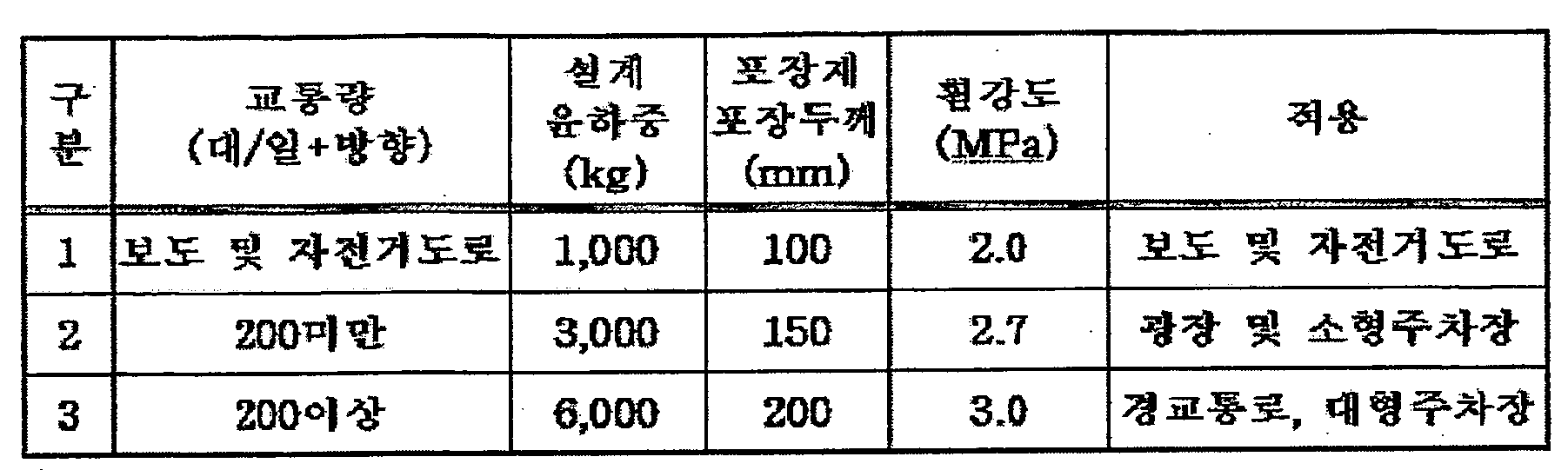
표 11
Claims (20)
- 슬래그 또는 플라이애쉬; 및나트륨 비함유 알칼리성 무기질 재료;를 포함하는 알칼리활성결합재.
- 제 1 항에 있어서,상기 슬래그 또는 플라이애쉬 100중량부당 상기 나트륨 비함유 알칼리성 무기질 재료는 0.5 내지 30중량부로 포함되는 것을 특징으로 하는 알칼리활성결합재.
- 제 1 항에 있어서,상기 나트륨 비함유 알칼리성 무기질 재료는 수산화칼슘, 수산화바륨, 석고, 마그네슘염, 산화마그네슘 중 하나 이상인 것을 특징으로 하는 알칼리활성결합재.
- 제 3 항에 있어서,상기 마그네슘염은 황산마그네슘, 탄산마그네슘, 수산화마그네슘, 염화마그네슘, 스테아린산 마그네슘, 메타인산마그네슘, 젖산 마그네슘 중 어느 하나인 것을 특징으로 하는 알칼리활성결합재.
- 제 3 항에 있어서,상기 수산화칼슘은 상기 슬래그 또는 플라이애쉬 100중량부당 0.5 내지 15중량부 포함되는 것을 특징으로 하는 알칼리활성결합재.
- 제 3 항에 있어서,상기 수산화바륨은 상기 슬래그 또는 플라이애쉬 100중량부당 0.5 내지 5중량부 포함되는 것을 특징으로 하는 알칼리활성결합재.
- 제 3 항에 있어서,상기 마그네슘염 또는 산화마그네슘염은 상기 슬래그 또는 플라이애쉬 100중량부당 0.5 내지 20중량부 포함되는 것을 특징으로 하는 알칼리활성결합재.
- 제 1 항 내지 제 7 항 중 어느 한 항의 알칼리 활성결합재를 포함하는 알칼리활성 모르터.
- 제 1 항 내지 제 7 항 중 어느 한 항의 알칼리 활성결합재를 포함하는 알칼리 활성 콘크리트.
- 제 9 항의 콘크리트로 제조된 것을 특징으로 하는 알칼리 활성 콘크리트 제품.
- 제 10 항에 있어서,상기 콘크리트 제품은 벽돌, 블록, 타일, 하수관, 경계석, 콘크리트 파일, 프리스트레스트 콘크리트(Prestressed Concrete), 콘크리트 패널, 콘크리트 관, 맨홀, 기포(氣泡) 콘크리트, 콘크리트 구조물을 포함하는 것을 특징으로 하는 알칼리활성콘크리트제품.
- 제 1 항 내지 제 7 항 중 어느 한 항의 알칼리 활성결합재;모래, 폐주물사, 석분 또는 인공경량골재 중 하나 이상을 포함하는 잔골재; 및물; 을 포함하는 것을 특징으로 하는 알칼리 활성조적제품.
- 제 12 항에 있어서,규산나트륨, 황산나트륨, 분말형의 수산화나트륨, 액상형의 물유리 및 액상형의 수산화나트륨 중 어느 하나 이상을 포함하는 나트륨함유 무기질 재료를 더 포함하는 것을 특징으로 하는 알칼리 활성조적제품.
- 제 1 항 내지 제 7 항 중 어느 한 항의 알칼리 활성결합재, 황토, 굵은골재, 혼화제, 섬유, 및 배합수를 포함하는데, 상기 배합수는 배합수(W)와 알칼리활성결합재(B)의 배합비(W/B)가 40 내지 65%가 되도록 포함되는 것을 특징으로 하는 알칼리활성 황토습식포장재.
- 제 14 항에 있어서,상기 혼화제는 고성능 감수제이고 알칼리 활성결합재 100중량부당 0.5 내지 1.5중량부 포함되는 것을 특징으로 하는 알칼리활성 황토습식포장재.
- 제 14 항에 있어서,상기 섬유는 섬유의 밀도가 높고 섬유 굵기가 미세하여 단위용적당 섬유의 수가 많으며, 분산성능이 뛰어난 것으로, 알칼리 활성결합재 100중량부당 10 내지 35 중량부 포함되는 것을 특징으로 하는 알칼리활성 황토습식포장재.
- 제 14 항에 있어서,잔골재를 더 포함하는데, 상기 잔골재는 직경이 5mm 이하이고 상기 황토 중량의 20 내지 30중량%를 대체하여 포함되는 것을 특징으로 하는 알칼리활성 황토습식포장재.
- 제 14 항에 있어서,규산나트륨, 황산나트륨, 분말형의 수산화나트륨, 액상형의 물유리 및 액상형의 수산화나트륨 중 어느 하나 이상을 포함하는 나트륨함유 무기질 재료를 더 포함하는 것을 특징으로 하는 알칼리활성 황토습식포장재.
- 제 14 항에 있어서,상기 알칼리 활성결합재 100중량부당 황토 50 내지 160중량부, 굵은 골재 80 내지 140중량부, 혼화제 0.5 내지 1.5중량부, 섬유 10 내지 20중량부, 잔골재 10 내지 48 중량부가 포함되면 25 내지 30MPa의 압축강도가 얻어지는 것을 특징으로 하는 알칼리활성 황토습식포장재.
- 제 14 항에 있어서,상기 알칼리 활성결합재 100중량부당 황토 100 내지 240중량부, 굵은 골재 170 내지 300중량부, 혼화제 0.5 내지 1.5중량부, 섬유 15 내지 35중량부가 포함되면 18 내지 24MPa의 압축강도가 얻어지는 것을 특징으로 하는 알칼리활성 황토습식포장재.
Priority Applications (3)
| Application Number | Priority Date | Filing Date | Title |
|---|---|---|---|
| CN201080005999.9A CN102300826B (zh) | 2009-01-30 | 2010-01-29 | 碱激活结合料、使用结合料的碱激活砂浆、混凝土制品和湿红粘土铺路材料 |
| JP2011547796A JP5544628B2 (ja) | 2009-01-30 | 2010-01-29 | アルカリ活性結合材、前記結合材を用いたアルカリ活性モルタル、コンクリート、コンクリート製品および黄土湿式舗装材 |
| US13/146,998 US8617307B2 (en) | 2009-01-30 | 2010-01-29 | Alkali-activated binder, alkali-activated mortar, concrete products and wet red clay paving material using binder |
Applications Claiming Priority (10)
| Application Number | Priority Date | Filing Date | Title |
|---|---|---|---|
| KR20090007488 | 2009-01-30 | ||
| KR10-2009-0007488 | 2009-01-30 | ||
| KR20090039488A KR100942032B1 (ko) | 2009-01-30 | 2009-05-06 | 무시멘트 알칼리 활성결합재, 상기 결합재를 포함하는 무시멘트 알칼리 활성 모르터, 콘크리트 및 콘크리트 제품 |
| KR10-2009-0039488 | 2009-05-06 | ||
| KR10-2009-0057913 | 2009-06-26 | ||
| KR20090057913A KR101014866B1 (ko) | 2009-06-26 | 2009-06-26 | 무시멘트 알칼리 활성 조적 제품 |
| KR10-2009-0114972 | 2009-11-26 | ||
| KR20090114972A KR101014868B1 (ko) | 2009-11-26 | 2009-11-26 | 무시멘트 마그네슘계 알칼리 활성결합재, 상기 결합재를 포함하는 무시멘트 마그네슘계 알칼리 활성 모르터, 콘크리트 및 콘크리트2차제품 |
| KR10-2009-0122736 | 2009-12-10 | ||
| KR1020090122736A KR101053032B1 (ko) | 2009-12-10 | 2009-12-10 | 무시멘트 황토 습식포장재, 및 상기 습식포장재 제조방법 |
Publications (2)
| Publication Number | Publication Date |
|---|---|
| WO2010087636A2 true WO2010087636A2 (ko) | 2010-08-05 |
| WO2010087636A3 WO2010087636A3 (ko) | 2010-11-04 |
Family
ID=42396193
Family Applications (1)
| Application Number | Title | Priority Date | Filing Date |
|---|---|---|---|
| PCT/KR2010/000536 Ceased WO2010087636A2 (ko) | 2009-01-30 | 2010-01-29 | 알칼리 활성결합재, 상기 결합재를 이용한 알칼리 활성 모르터, 콘크리트, 콘크리트제품 및 황토습식포장재 |
Country Status (4)
| Country | Link |
|---|---|
| US (1) | US8617307B2 (ko) |
| JP (1) | JP5544628B2 (ko) |
| CN (1) | CN102300826B (ko) |
| WO (1) | WO2010087636A2 (ko) |
Cited By (12)
| Publication number | Priority date | Publication date | Assignee | Title |
|---|---|---|---|---|
| WO2012055517A1 (de) * | 2010-10-29 | 2012-05-03 | Heidelbergcement Ag | Hydraulischer anreger für hüttensand |
| CN102531438A (zh) * | 2012-03-02 | 2012-07-04 | 东南大学 | 一种碱激发矿渣砂浆 |
| WO2013044325A1 (en) * | 2011-09-30 | 2013-04-04 | Hyssil Pty Ltd | Geopolymer product |
| CN106458756A (zh) * | 2014-06-20 | 2017-02-22 | 拉法基公司 | 超高性能混凝土 |
| CN106747186A (zh) * | 2016-12-05 | 2017-05-31 | 同济大学 | 一种以磷石膏基水硬性复合胶凝材料制备的混凝土路缘石及其制备方法 |
| CN107686322A (zh) * | 2017-08-15 | 2018-02-13 | 广西利升石业有限公司 | 一种人造石废浆循环利用的方法 |
| CN109320169A (zh) * | 2018-11-22 | 2019-02-12 | 盐城欣昌新型建材有限公司 | 一种光伏用的抗裂水泥管桩及其制备方法 |
| CN110128067A (zh) * | 2019-06-03 | 2019-08-16 | 厦门兑泰实业有限公司 | 一种利用黑铸砂生产抗裂砂浆的方法 |
| CN110183131A (zh) * | 2019-06-03 | 2019-08-30 | 厦门兑泰实业有限公司 | 一种利用黑铸砂生产抹灰砂浆和瓷砖胶助剂的方法 |
| CN110981234A (zh) * | 2019-12-10 | 2020-04-10 | 华南理工大学 | 一种胶凝材料及其制备方法 |
| CN115836037A (zh) * | 2020-04-08 | 2023-03-21 | 埃克塞姆材料有限公司 | 用于活化粒化高炉矿渣粉的包含碱金属盐和碳酸钙和/或碳酸镁的活化体系以及用于制备砂浆组合物或混凝土组合物的包含活化体系的胶凝材料 |
| WO2025075402A1 (ko) * | 2023-10-06 | 2025-04-10 | 울산과학기술원 | 중성자 차폐 인공경량골재 및 이의 제조방법 |
Families Citing this family (19)
| Publication number | Priority date | Publication date | Assignee | Title |
|---|---|---|---|---|
| CA2851349C (en) | 2011-10-07 | 2020-01-21 | Russell L. Hill | Inorganic polymer/organic polymer composites and methods of making same |
| US8864901B2 (en) | 2011-11-30 | 2014-10-21 | Boral Ip Holdings (Australia) Pty Limited | Calcium sulfoaluminate cement-containing inorganic polymer compositions and methods of making same |
| CN106045350B (zh) * | 2016-04-12 | 2017-11-10 | 沈阳建筑大学 | 一种利用氧化镁和高炉矿渣合成硅酸盐建材制品的方法 |
| JP6764702B2 (ja) * | 2016-06-16 | 2020-10-07 | 大成建設株式会社 | 水硬性組成物 |
| JP6873663B2 (ja) * | 2016-11-30 | 2021-05-19 | 大成建設株式会社 | 低炭素型地中構造物用プレキャスト部材 |
| KR101904861B1 (ko) | 2017-06-15 | 2018-10-08 | (재)한국건설생활환경시험연구원 | 알루미노 실리케이트계 무기 바인더 조성물 및 이를 이용한 고내산성 콘크리트 수로관 |
| CN108059373B (zh) * | 2017-11-30 | 2021-07-23 | 中冶建筑研究总院有限公司 | 碱-矿渣水泥作为软基处理材料的应用 |
| CN108083744B (zh) * | 2017-12-27 | 2020-08-04 | 青岛磊鑫混凝土有限公司 | 无水泥透水混凝土砖 |
| CN108409171A (zh) * | 2018-05-30 | 2018-08-17 | 福州大学 | 一种单组分碱激发粉煤灰水泥 |
| JP7139178B2 (ja) * | 2018-07-20 | 2022-09-20 | 日本軽金属株式会社 | 高放熱性の舗装材 |
| CN110304891B (zh) * | 2019-06-25 | 2021-11-02 | 江西保太有色金属集团有限公司 | 一种环保免烧砖及其制备方法 |
| CN110627396A (zh) * | 2019-10-12 | 2019-12-31 | 于波亮 | 一种铸造石英废砂混凝土、砂浆添加剂及其使用方法 |
| CN110803881A (zh) * | 2019-11-28 | 2020-02-18 | 山东永正水泥有限公司 | 超细灰及其制备方法和应用、水泥、混凝土 |
| FR3108055B1 (fr) * | 2020-03-13 | 2023-06-16 | Norper | Mortier à base de terre |
| CN111910942A (zh) * | 2020-07-14 | 2020-11-10 | 西北大学 | 一种旧址黄土窑洞开裂原位注浆修复方法 |
| KR102647247B1 (ko) * | 2021-11-22 | 2024-03-13 | 한국과학기술원 | 기존의 배치 플랜트 설비를 이용한 알칼리 활성 콘크리트 생산 방법 |
| CN114956767A (zh) * | 2022-05-20 | 2022-08-30 | 黑龙江省中冉建材有限公司 | 适合低温的无机结合料的稳定料制备方法 |
| CN118084511B (zh) * | 2024-03-01 | 2024-10-18 | 武汉科技大学 | 一种偏高岭土基耐火浇注料结合剂及其制备方法和应用 |
| JP7513856B1 (ja) | 2024-03-13 | 2024-07-09 | 日本乾溜工業株式会社 | 舗装材色相設計装置及びプログラム、並びに舗装材製造方法 |
Family Cites Families (35)
| Publication number | Priority date | Publication date | Assignee | Title |
|---|---|---|---|---|
| SU451658A1 (ru) * | 1972-06-12 | 1974-11-30 | Всесоюзный Научно-Исследовательский Институт Теплоизоляционных И Акустических Строительных Материалов И Изделий | В жущее |
| SU612911A1 (ru) * | 1976-01-26 | 1978-06-30 | Алма-Атинский научно-исследовательский и проектный институт строительных материалов | Сырьева смесь дл получени силикатного бетона |
| SU623837A1 (ru) * | 1976-11-23 | 1978-09-15 | Алма-Атинский научно-исследовательский и проектный институт строительных материалов | В жущее |
| JPS581071B2 (ja) * | 1980-07-02 | 1983-01-10 | 工業技術院長 | スラグ・炭酸マグネシウム系板材の製造方法 |
| SU975668A1 (ru) * | 1981-06-24 | 1982-11-23 | Алма-Атинский Архитектурно-Строительный Институт | Сырьева смесь дл получени безобжигового заполнител |
| JPS5884167A (ja) * | 1981-11-09 | 1983-05-20 | 株式会社クボタ | スラグ系無機質材の硬化方法 |
| US4715896A (en) * | 1986-08-04 | 1987-12-29 | Standard Slag Cement | Cementitious binder for consolidated fill |
| SU1578098A1 (ru) * | 1987-08-17 | 1990-07-15 | Киевский Инженерно-Строительный Институт | Шлакощелочное расшир ющеес в жущее |
| JP2710327B2 (ja) * | 1988-02-13 | 1998-02-10 | 電気化学工業株式会社 | 低アルカリセメント組成物 |
| SU1701677A1 (ru) * | 1988-12-26 | 1991-12-30 | Львовский политехнический институт им.Ленинского комсомола | Бетонна смесь |
| JPH10316967A (ja) * | 1997-05-15 | 1998-12-02 | Katsuichi Kunimatsu | 土壌固化剤 |
| JP2954136B2 (ja) * | 1998-02-04 | 1999-09-27 | 住友大阪セメント株式会社 | 地盤改良方法 |
| US6258160B1 (en) * | 1999-09-07 | 2001-07-10 | Halliburton Energy Services, Inc. | Methods and compositions for grouting heat exchange pipe |
| KR100408594B1 (ko) | 2000-02-11 | 2003-12-06 | 안호성 | 황토 도로포장재와 그 제조방법 |
| JP4140228B2 (ja) | 2000-12-13 | 2008-08-27 | Jfeスチール株式会社 | 保水性固化体用水硬材及び保水性固化体 |
| KR20010079397A (ko) | 2001-07-11 | 2001-08-22 | 최희용 | 고로슬래그 몰탈 조성물 |
| KR20030070204A (ko) | 2002-02-21 | 2003-08-29 | 경기대학교 | 폐기물을 이용한 인공 경량 골재용 조성물 및 그 제조방법 |
| CN1222484C (zh) * | 2003-06-19 | 2005-10-12 | 中国建筑材料科学研究院 | 混凝土的浆状磨细矿物掺合料及其制造方法 |
| WO2005037727A1 (de) | 2003-09-08 | 2005-04-28 | Christoph Muther | Verfahren zum herstellen eines hydraulischen bindemittels, eines bauelements, deren verwendung sowie vorrichtung dazu |
| JP2005119922A (ja) | 2003-10-17 | 2005-05-12 | Minoru Kyomure | 非セメント系水硬性目地材 |
| US7442248B2 (en) * | 2003-11-18 | 2008-10-28 | Research Incubator, Ltd. | Cementitious composition |
| WO2007053398A1 (en) * | 2005-10-28 | 2007-05-10 | Excell Technologies, Llc | Blended cement composition |
| KR100759855B1 (ko) | 2005-11-01 | 2007-09-18 | 요업기술원 | 플라이애쉬를 사용한 비소성 무기결합재 |
| JP5052804B2 (ja) * | 2006-03-29 | 2012-10-17 | 電気化学工業株式会社 | 緊急補修用材料 |
| KR100741637B1 (ko) | 2006-12-01 | 2007-07-20 | 최경득 | 시멘트를 사용하지 않은 환경친화형 블록 |
| KR100775360B1 (ko) * | 2007-01-10 | 2007-11-09 | 주식회사 신기 | 건식 황토흙 포장재 및 그 시공방법 |
| CA2675750C (en) * | 2007-01-19 | 2016-11-01 | Ceratech, Inc. | High strength cement, mortar and concrete including industrial by-products |
| WO2008128287A1 (en) * | 2007-04-20 | 2008-10-30 | Descrete Ip Pty Limited | Binding composition |
| KR100975309B1 (ko) | 2007-05-11 | 2010-08-12 | 서동혁 | 천연토를 이용한 도로 포장재 |
| CN101037308A (zh) | 2007-05-21 | 2007-09-19 | 北京东方建宇混凝土科学技术研究院有限公司 | 一种无熟料水泥的制备方法及其制备的混凝土 |
| WO2009005205A1 (en) | 2007-06-29 | 2009-01-08 | Industry Foundation Of Chonnam National University | Alkali-activated binder with no cement, method for fabricating mortar using it, and method for fabricating alkali-activated reinforcement mortar with no cement |
| US8337993B2 (en) * | 2007-11-16 | 2012-12-25 | Serious Energy, Inc. | Low embodied energy wallboards and methods of making same |
| JP5291333B2 (ja) * | 2007-12-26 | 2013-09-18 | 太平洋セメント株式会社 | 不溶化材及び不溶化方法 |
| KR100882888B1 (ko) | 2008-05-14 | 2009-02-10 | (주)에프씨코리아랜드 | 도로포장용 점토조성물과 이를 이용한 포장방법 |
| KR100924133B1 (ko) | 2009-04-21 | 2009-10-29 | 김재원 | 황토도로용 포장재 조성물, 그 제조방법 및 이를 이용한 황토도로 포장방법 |
-
2010
- 2010-01-29 WO PCT/KR2010/000536 patent/WO2010087636A2/ko not_active Ceased
- 2010-01-29 US US13/146,998 patent/US8617307B2/en not_active Expired - Fee Related
- 2010-01-29 JP JP2011547796A patent/JP5544628B2/ja not_active Expired - Fee Related
- 2010-01-29 CN CN201080005999.9A patent/CN102300826B/zh not_active Expired - Fee Related
Cited By (16)
| Publication number | Priority date | Publication date | Assignee | Title |
|---|---|---|---|---|
| WO2012055517A1 (de) * | 2010-10-29 | 2012-05-03 | Heidelbergcement Ag | Hydraulischer anreger für hüttensand |
| WO2013044325A1 (en) * | 2011-09-30 | 2013-04-04 | Hyssil Pty Ltd | Geopolymer product |
| CN102531438A (zh) * | 2012-03-02 | 2012-07-04 | 东南大学 | 一种碱激发矿渣砂浆 |
| CN106458756B (zh) * | 2014-06-20 | 2019-10-01 | 霍尔辛姆科技有限公司 | 超高性能混凝土 |
| CN106458756A (zh) * | 2014-06-20 | 2017-02-22 | 拉法基公司 | 超高性能混凝土 |
| CN106747186A (zh) * | 2016-12-05 | 2017-05-31 | 同济大学 | 一种以磷石膏基水硬性复合胶凝材料制备的混凝土路缘石及其制备方法 |
| CN107686322A (zh) * | 2017-08-15 | 2018-02-13 | 广西利升石业有限公司 | 一种人造石废浆循环利用的方法 |
| CN109320169A (zh) * | 2018-11-22 | 2019-02-12 | 盐城欣昌新型建材有限公司 | 一种光伏用的抗裂水泥管桩及其制备方法 |
| CN109320169B (zh) * | 2018-11-22 | 2021-06-04 | 泰州市恒瑞管桩有限公司 | 一种光伏用的抗裂水泥管桩及其制备方法 |
| CN110183131A (zh) * | 2019-06-03 | 2019-08-30 | 厦门兑泰实业有限公司 | 一种利用黑铸砂生产抹灰砂浆和瓷砖胶助剂的方法 |
| CN110128067A (zh) * | 2019-06-03 | 2019-08-16 | 厦门兑泰实业有限公司 | 一种利用黑铸砂生产抗裂砂浆的方法 |
| CN110183131B (zh) * | 2019-06-03 | 2021-07-13 | 厦门兑泰实业有限公司 | 一种利用黑铸砂生产抹灰砂浆和瓷砖胶助剂的方法 |
| CN110128067B (zh) * | 2019-06-03 | 2021-07-23 | 厦门兑泰环保科技有限公司 | 一种利用黑铸砂生产抗裂砂浆的方法 |
| CN110981234A (zh) * | 2019-12-10 | 2020-04-10 | 华南理工大学 | 一种胶凝材料及其制备方法 |
| CN115836037A (zh) * | 2020-04-08 | 2023-03-21 | 埃克塞姆材料有限公司 | 用于活化粒化高炉矿渣粉的包含碱金属盐和碳酸钙和/或碳酸镁的活化体系以及用于制备砂浆组合物或混凝土组合物的包含活化体系的胶凝材料 |
| WO2025075402A1 (ko) * | 2023-10-06 | 2025-04-10 | 울산과학기술원 | 중성자 차폐 인공경량골재 및 이의 제조방법 |
Also Published As
| Publication number | Publication date |
|---|---|
| JP5544628B2 (ja) | 2014-07-09 |
| CN102300826B (zh) | 2015-02-18 |
| WO2010087636A3 (ko) | 2010-11-04 |
| CN102300826A (zh) | 2011-12-28 |
| US8617307B2 (en) | 2013-12-31 |
| JP2012516280A (ja) | 2012-07-19 |
| US20110287198A1 (en) | 2011-11-24 |
Similar Documents
| Publication | Publication Date | Title |
|---|---|---|
| Altun et al. | Study on steel furnace slags with high MgO as additive in Portland cement | |
| Belouadah et al. | Influence of the addition of glass powder and marble powder on the physical and mechanical behavior of composite cement | |
| WO2021177541A1 (ko) | 입체섬유를 이용한 콘크리트 구조물의 보수보강 공법 | |
| US8617307B2 (en) | Alkali-activated binder, alkali-activated mortar, concrete products and wet red clay paving material using binder | |
| EP1159233B1 (en) | Quick setting cement with lime and aluminates | |
| SE0203287D0 (sv) | Process for producing blended cements with reduced carbon dioxide emissions | |
| WO2018079868A1 (ko) | 탄소광물화 처리된 비산재 및 조강형 팽창재를 포함하는 저수축 저탄소 그린 시멘트 조성물 및 이를 적용한 콘크리트 | |
| JP2004292285A (ja) | コンクリート | |
| US7722717B2 (en) | Hydraulic composition | |
| Nalli et al. | Utilization of ceramic waste powder and rice husk ash as a partial replacement of cement in concrete | |
| WO2018016781A1 (ko) | 슬래그를 포함하는 시멘트 콘크리트용 조강혼합물 및 이의 제조방법 | |
| WO2012122745A1 (zh) | 一种耐高温空心球及其制备方法 | |
| JP2002308661A (ja) | 高性能コンクリート | |
| WO2021002660A1 (ko) | 에어로겔 함유 분무용 조성물과 그 제조방법 | |
| WO2018216932A1 (ko) | 발포성형체의 제조방법 | |
| JP6133596B2 (ja) | 膨張材及び膨張コンクリート | |
| JP4514074B2 (ja) | セメント混和材、セメント組成物、及び高流動セメントコンクリート | |
| KR100473717B1 (ko) | 초속경성 무수축 그라우트재 | |
| WO2010024545A2 (ko) | 수직형 소성로를 이용한 자열 소성체 제조방법 | |
| JPH11180756A (ja) | 再生骨材を用いたセメント組成物 | |
| JP4481510B2 (ja) | 透水性コンクリート打継ぎ用ペースト又はモルタル | |
| JPH1036149A (ja) | 石膏ボード廃材の有効活用方法 | |
| US6997984B2 (en) | Cement admixture | |
| Basak et al. | Performance of ceramic tiles waste as a partial replacement of brick aggregate on mechanical and durability properties of concrete | |
| WO2013191500A1 (ko) | 개질유황, 이의 제조방법, 이의 제조장치 및 이의 용도 |
Legal Events
| Date | Code | Title | Description |
|---|---|---|---|
| WWE | Wipo information: entry into national phase |
Ref document number: 201080005999.9 Country of ref document: CN |
|
| 121 | Ep: the epo has been informed by wipo that ep was designated in this application |
Ref document number: 10736027 Country of ref document: EP Kind code of ref document: A2 |
|
| WWE | Wipo information: entry into national phase |
Ref document number: 2011547796 Country of ref document: JP |
|
| WWE | Wipo information: entry into national phase |
Ref document number: 13146998 Country of ref document: US |
|
| NENP | Non-entry into the national phase |
Ref country code: DE |
|
| 122 | Ep: pct application non-entry in european phase |
Ref document number: 10736027 Country of ref document: EP Kind code of ref document: A2 |