WO2010095706A1 - 新規抗炎症性化合物 - Google Patents
新規抗炎症性化合物 Download PDFInfo
- Publication number
- WO2010095706A1 WO2010095706A1 PCT/JP2010/052509 JP2010052509W WO2010095706A1 WO 2010095706 A1 WO2010095706 A1 WO 2010095706A1 JP 2010052509 W JP2010052509 W JP 2010052509W WO 2010095706 A1 WO2010095706 A1 WO 2010095706A1
- Authority
- WO
- WIPO (PCT)
- Prior art keywords
- substituted
- compound
- unsubstituted
- acid
- lox
- Prior art date
- Legal status (The legal status is an assumption and is not a legal conclusion. Google has not performed a legal analysis and makes no representation as to the accuracy of the status listed.)
- Ceased
Links
Images







Classifications
-
- C—CHEMISTRY; METALLURGY
- C07—ORGANIC CHEMISTRY
- C07C—ACYCLIC OR CARBOCYCLIC COMPOUNDS
- C07C59/00—Compounds having carboxyl groups bound to acyclic carbon atoms and containing any of the groups OH, O—metal, —CHO, keto, ether, groups, groups, or groups
- C07C59/40—Unsaturated compounds
- C07C59/42—Unsaturated compounds containing hydroxy or O-metal groups
-
- A—HUMAN NECESSITIES
- A61—MEDICAL OR VETERINARY SCIENCE; HYGIENE
- A61P—SPECIFIC THERAPEUTIC ACTIVITY OF CHEMICAL COMPOUNDS OR MEDICINAL PREPARATIONS
- A61P1/00—Drugs for disorders of the alimentary tract or the digestive system
-
- A—HUMAN NECESSITIES
- A61—MEDICAL OR VETERINARY SCIENCE; HYGIENE
- A61P—SPECIFIC THERAPEUTIC ACTIVITY OF CHEMICAL COMPOUNDS OR MEDICINAL PREPARATIONS
- A61P1/00—Drugs for disorders of the alimentary tract or the digestive system
- A61P1/04—Drugs for disorders of the alimentary tract or the digestive system for ulcers, gastritis or reflux esophagitis, e.g. antacids, inhibitors of acid secretion, mucosal protectants
-
- A—HUMAN NECESSITIES
- A61—MEDICAL OR VETERINARY SCIENCE; HYGIENE
- A61P—SPECIFIC THERAPEUTIC ACTIVITY OF CHEMICAL COMPOUNDS OR MEDICINAL PREPARATIONS
- A61P1/00—Drugs for disorders of the alimentary tract or the digestive system
- A61P1/16—Drugs for disorders of the alimentary tract or the digestive system for liver or gallbladder disorders, e.g. hepatoprotective agents, cholagogues, litholytics
-
- A—HUMAN NECESSITIES
- A61—MEDICAL OR VETERINARY SCIENCE; HYGIENE
- A61P—SPECIFIC THERAPEUTIC ACTIVITY OF CHEMICAL COMPOUNDS OR MEDICINAL PREPARATIONS
- A61P11/00—Drugs for disorders of the respiratory system
-
- A—HUMAN NECESSITIES
- A61—MEDICAL OR VETERINARY SCIENCE; HYGIENE
- A61P—SPECIFIC THERAPEUTIC ACTIVITY OF CHEMICAL COMPOUNDS OR MEDICINAL PREPARATIONS
- A61P11/00—Drugs for disorders of the respiratory system
- A61P11/06—Antiasthmatics
-
- A—HUMAN NECESSITIES
- A61—MEDICAL OR VETERINARY SCIENCE; HYGIENE
- A61P—SPECIFIC THERAPEUTIC ACTIVITY OF CHEMICAL COMPOUNDS OR MEDICINAL PREPARATIONS
- A61P13/00—Drugs for disorders of the urinary system
- A61P13/12—Drugs for disorders of the urinary system of the kidneys
-
- A—HUMAN NECESSITIES
- A61—MEDICAL OR VETERINARY SCIENCE; HYGIENE
- A61P—SPECIFIC THERAPEUTIC ACTIVITY OF CHEMICAL COMPOUNDS OR MEDICINAL PREPARATIONS
- A61P15/00—Drugs for genital or sexual disorders; Contraceptives
- A61P15/06—Antiabortive agents; Labour repressants
-
- A—HUMAN NECESSITIES
- A61—MEDICAL OR VETERINARY SCIENCE; HYGIENE
- A61P—SPECIFIC THERAPEUTIC ACTIVITY OF CHEMICAL COMPOUNDS OR MEDICINAL PREPARATIONS
- A61P15/00—Drugs for genital or sexual disorders; Contraceptives
- A61P15/08—Drugs for genital or sexual disorders; Contraceptives for gonadal disorders or for enhancing fertility, e.g. inducers of ovulation or of spermatogenesis
-
- A—HUMAN NECESSITIES
- A61—MEDICAL OR VETERINARY SCIENCE; HYGIENE
- A61P—SPECIFIC THERAPEUTIC ACTIVITY OF CHEMICAL COMPOUNDS OR MEDICINAL PREPARATIONS
- A61P29/00—Non-central analgesic, antipyretic or antiinflammatory agents, e.g. antirheumatic agents; Non-steroidal antiinflammatory drugs [NSAID]
-
- A—HUMAN NECESSITIES
- A61—MEDICAL OR VETERINARY SCIENCE; HYGIENE
- A61P—SPECIFIC THERAPEUTIC ACTIVITY OF CHEMICAL COMPOUNDS OR MEDICINAL PREPARATIONS
- A61P35/00—Antineoplastic agents
-
- A—HUMAN NECESSITIES
- A61—MEDICAL OR VETERINARY SCIENCE; HYGIENE
- A61P—SPECIFIC THERAPEUTIC ACTIVITY OF CHEMICAL COMPOUNDS OR MEDICINAL PREPARATIONS
- A61P43/00—Drugs for specific purposes, not provided for in groups A61P1/00-A61P41/00
-
- A—HUMAN NECESSITIES
- A61—MEDICAL OR VETERINARY SCIENCE; HYGIENE
- A61P—SPECIFIC THERAPEUTIC ACTIVITY OF CHEMICAL COMPOUNDS OR MEDICINAL PREPARATIONS
- A61P9/00—Drugs for disorders of the cardiovascular system
-
- A—HUMAN NECESSITIES
- A61—MEDICAL OR VETERINARY SCIENCE; HYGIENE
- A61P—SPECIFIC THERAPEUTIC ACTIVITY OF CHEMICAL COMPOUNDS OR MEDICINAL PREPARATIONS
- A61P9/00—Drugs for disorders of the cardiovascular system
- A61P9/10—Drugs for disorders of the cardiovascular system for treating ischaemic or atherosclerotic diseases, e.g. antianginal drugs, coronary vasodilators, drugs for myocardial infarction, retinopathy, cerebrovascula insufficiency, renal arteriosclerosis
-
- C—CHEMISTRY; METALLURGY
- C12—BIOCHEMISTRY; BEER; SPIRITS; WINE; VINEGAR; MICROBIOLOGY; ENZYMOLOGY; MUTATION OR GENETIC ENGINEERING
- C12P—FERMENTATION OR ENZYME-USING PROCESSES TO SYNTHESISE A DESIRED CHEMICAL COMPOUND OR COMPOSITION OR TO SEPARATE OPTICAL ISOMERS FROM A RACEMIC MIXTURE
- C12P7/00—Preparation of oxygen-containing organic compounds
- C12P7/64—Fats; Fatty oils; Ester-type waxes; Higher fatty acids, i.e. having at least seven carbon atoms in an unbroken chain bound to a carboxyl group; Oxidised oils or fats
- C12P7/6409—Fatty acids
- C12P7/6427—Polyunsaturated fatty acids [PUFA], i.e. having two or more double bonds in their backbone
-
- C—CHEMISTRY; METALLURGY
- C12—BIOCHEMISTRY; BEER; SPIRITS; WINE; VINEGAR; MICROBIOLOGY; ENZYMOLOGY; MUTATION OR GENETIC ENGINEERING
- C12P—FERMENTATION OR ENZYME-USING PROCESSES TO SYNTHESISE A DESIRED CHEMICAL COMPOUND OR COMPOSITION OR TO SEPARATE OPTICAL ISOMERS FROM A RACEMIC MIXTURE
- C12P7/00—Preparation of oxygen-containing organic compounds
- C12P7/64—Fats; Fatty oils; Ester-type waxes; Higher fatty acids, i.e. having at least seven carbon atoms in an unbroken chain bound to a carboxyl group; Oxidised oils or fats
- C12P7/6409—Fatty acids
- C12P7/6427—Polyunsaturated fatty acids [PUFA], i.e. having two or more double bonds in their backbone
- C12P7/6432—Eicosapentaenoic acids [EPA]
-
- C—CHEMISTRY; METALLURGY
- C12—BIOCHEMISTRY; BEER; SPIRITS; WINE; VINEGAR; MICROBIOLOGY; ENZYMOLOGY; MUTATION OR GENETIC ENGINEERING
- C12P—FERMENTATION OR ENZYME-USING PROCESSES TO SYNTHESISE A DESIRED CHEMICAL COMPOUND OR COMPOSITION OR TO SEPARATE OPTICAL ISOMERS FROM A RACEMIC MIXTURE
- C12P7/00—Preparation of oxygen-containing organic compounds
- C12P7/64—Fats; Fatty oils; Ester-type waxes; Higher fatty acids, i.e. having at least seven carbon atoms in an unbroken chain bound to a carboxyl group; Oxidised oils or fats
- C12P7/6409—Fatty acids
- C12P7/6427—Polyunsaturated fatty acids [PUFA], i.e. having two or more double bonds in their backbone
- C12P7/6434—Docosahexenoic acids [DHA]
-
- C—CHEMISTRY; METALLURGY
- C12—BIOCHEMISTRY; BEER; SPIRITS; WINE; VINEGAR; MICROBIOLOGY; ENZYMOLOGY; MUTATION OR GENETIC ENGINEERING
- C12P—FERMENTATION OR ENZYME-USING PROCESSES TO SYNTHESISE A DESIRED CHEMICAL COMPOUND OR COMPOSITION OR TO SEPARATE OPTICAL ISOMERS FROM A RACEMIC MIXTURE
- C12P7/00—Preparation of oxygen-containing organic compounds
- C12P7/64—Fats; Fatty oils; Ester-type waxes; Higher fatty acids, i.e. having at least seven carbon atoms in an unbroken chain bound to a carboxyl group; Oxidised oils or fats
- C12P7/6436—Fatty acid esters
Definitions
- the present invention relates to a novel anti-inflammatory compound.
- Inflammatory diseases are one of the important disease fields that need countermeasures in modern times, but current anti-inflammatory drugs are typically steroids, non-steroidal anti-inflammatory drugs (NSAIDs) such as aspirin and ibuprofen. Substance is being used.
- NSAIDs non-steroidal anti-inflammatory drugs
- steroids are highly effective, and are used in the clinical settings as therapeutic agents for both acute and chronic inflammatory diseases. Problems such as side effects have been pointed out.
- Non-Patent Documents 1 and 2 are used as symptomatic treatments because they have antipyretic analgesic effects. However, NSAIDs are also affected by long-term use, such as gastrointestinal tract disorders, increased heart disease risk, and inflammatory tissue damage. Progress is known to occur, which is a serious problem (Non-Patent Documents 1 and 2).
- a substance having a hydroxyl group at positions 18 and 5 of eicosapentaenoic acid such as resolvin such as resolvin E1 (RvE1; 5S, 12R, 18R-trihydroxyeicosapentaenoic acid) and its derivative, docosahexaenoic acid (protectin D1)
- EPA eicosapentaenoic acid
- RvE1 resolvin E1
- 5S, 12R, 18R-trihydroxyeicosapentaenoic acid docosahexaenoic acid
- D1 docosahexaenoic acid
- An object of the present invention is to provide a compound having a novel structure for overcoming the above-mentioned drawbacks of conventional steroids and NSAIDs.
- the present invention As a result of intensive studies, the present invention, as a result of researches, has not been disclosed in the prior art, and is a specific dihydroxy form of eicosapentaenoic acid and docosahexaenoic acid (8,18-dihydroxyeicosapentaenoic acid (8,18-diHEPE)), 11 , 18-dihydroxyeicosapentaenoic acid (11,18-diHEPE), 12,18-dihydroxyeicosapentaenoic acid (12,18-diHEPE), 17,18-dihydroxyeicosapentaenoic acid (17,18-diHEPE), 10,20 Dihydroxydocosahexaenoic acid (10,20-diHDoHE), 14,20-Dihydroxydocosahexaenoic acid (14,20-diHDoHE), 19,20-Dihydroxydocosahexaenoic acid (19,20-diHDoHE
- the present invention provides the following. (1) 8,18-Dihydroxyeicosapentaenoic acid (8,18-diHEPE)
- P 1 and P 2 are each independently
- R 1 and R 2 each independently represents a hydrogen atom, a halogen atom, a substituted or unsubstituted, branched or unbranched alkyl group, a substituted or unsubstituted aryl group, a substituted or unsubstituted, A branched or unbranched alkylaryl group or a combination thereof;
- X is —C (O) OR 3 , —C (O) NR 4 R 5 , —C (O) H, —C (NH) NR 4 R 5 , —C (S) H, —C (S) OR 3 , —C (S) NR 4 R 5 , —CN;
- R 3 is hydrogen, protecting group, substituted or unsubstituted alkyl, substituted or unsubstituted alkenyl, substituted or unsubstituted alkynyl, substituted or unsubstituted aryl, substituted or unsubstituted hetero
- R 4 and R 5 are each independently hydrogen, substituted or unsubstituted alkyl, substituted or unsubstituted alkenyl, substituted or unsubstituted alkynyl, substituted or unsubstituted aryl, substituted or unsubstituted heteroaryl, A substituted or unsubstituted cycloalkyl, a substituted or unsubstituted cycloalkenyl, a substituted or unsubstituted heterocycle, or R 4 and R 5 together with the adjacent nitrogen atom are substituted or unsubstituted May form a nitrogen heterocycle; And the double bond configuration of the compounds can each independently be either cis or trans.
- a compound or a pharmaceutically acceptable salt or solvate of the compound (2) The compound according to item 1, or a pharmaceutically acceptable salt or solvate of the compound, which is 8,18-dihydroxyeicosapentaenoic acid (8,18-diHEPE)
- a neutrophil inhibitor comprising the compound according to item 1 or 2, or a pharmaceutically acceptable salt or solvate of the compound.
- a medicament comprising the compound according to item 1 or 2, or a pharmaceutically acceptable salt or solvate of the compound.
- the medicament is a lung disease selected from pulmonary impending syndrome, adult respiratory distress syndrome and chronic obstructive pulmonary disease (COPD); ischemic heart disease, ischemic kidney disease, ischemic brain disease and ischemic liver disease Ischemic disease selected from; inflammatory disease; erosive gastritis / gastric ulcer / duodenal ulcer / bronchial asthma, ulcerative colitis, arteriosclerosis, Crohn's disease, malignant tumor, ovarian cyst, fallopianitis, uterine fibroid, uterus
- a disease, disorder or condition ameliorated by suppression of neutrophils selected from stress diseases selected from endometriosis, spontaneous abortion, pregnancy toxemia, infertility and dysmenorrhea
- a method for producing the compound according to item 1 or 2, or a pharmaceutically acceptable salt or solvate of the compound A) 8-lipoxygenase (8-LOX), 12-lipoxygenase (12-LOX) to eicosapentaenoic acid (EPA), docosahexaenoic acid (DHA), 18-hydroxylicosapentaenoic acid (HEPE) or 20-hydroxyldocosahexaenoic acid (HDoHE) ), Contacting at least one selected from the group consisting of 12 / 15-lipoxygenase (12 / 15-LOX), soybean lipoxygenase (sLOX) and eosinophils or an extract thereof to obtain an enzyme metabolite; B) The enzyme metabolite obtained in step A) is purified from 8-lipoxygenase (8-LOX), 12-lipoxygenase (12-LOX), 12 / 15-lipoxygena
- the present invention unexpectedly remarkably suppresses the infiltration and activation of neutrophils found during acute inflammation.
- the compound of the present invention is a compound not conventionally known. Therefore, it provides usefulness as a new therapeutic agent.
- the compound of the present invention since it was found in the present invention that the compound of the present invention can be found in vivo, it is expected to be a therapeutic agent with few side effects when administered in the medium to long term. In addition, since the action is different from that of steroids and NSAIDs, the effect of using in combination with existing steroids or the like is expected as an anti-inflammatory agent.
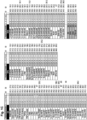
- FIG. 1C is a list of polyunsaturated fatty acid (PUFA) metabolites conventionally measured by MRM.
- EET represents epoxyeicosatrienoic acid
- ETE represents eicosatetraenoic acid
- HDoPE represents hydroxydocosapentaenoic acid
- DPE represents docosapentaenoic acid.
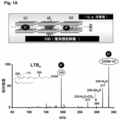
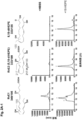
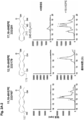
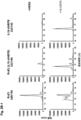
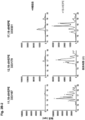
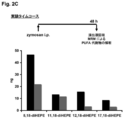
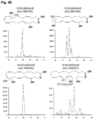
- FIG. 2D shows the analysis result of each metabolite generated as a result of incubation of 18-HEPE with eosinophils. An asterisk indicates the peak of each major metabolite.
- FIG. 2E shows the analysis results and relative quantification of each metabolite resulting from the incubation of 20-HDoHE with eosinophils. An asterisk indicates the peak of each major metabolite. 10,20-diHDoHE and 13,20-diHDoHE are shown in order from the upper left to the upper right, and 14,20-diHDoHE and 19,20-diDoHE are shown in order from the lower left to the lower right.
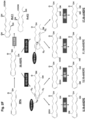
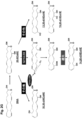
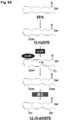
- FIG. 2F shows a metabolic pathway starting from 18-HEPE, which is a metabolite of eicosapentaenoic acid (EPA).
- FIG. 2G shows a metabolic pathway starting from 20-HDoHE, which is a metabolite of docosahexaenoic acid (DHA).
- 10,20-diHDoHE can be synthesized using 8-LOX.
- FIG. 3A is a result of reverse phase HPLC chromatogram (absorption chromatogram at 270 nm) showing the result of incubation of 18-HEPE and sLOX and purification of the sample by reverse phase high performance liquid chromatography (HPLC).
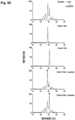
- FIG. 3D shows the results of spike experiments with samples (biological samples; samples) incubated with PEC and 18-HEPE 48 hours after induction of peritonitis for peaks 5 and 6, which are 17,18-diHEPE.
- the reverse phase HPLC chromatograms of sample only, peak 5 only, peak 6 only, peak 5 and sample, peak 6 and sample are shown in order from the top.
- FIG. 4A shows an evaluation of the bioactivity of 18-HEPE derived metabolite (17,18-diHEPE) in a zymosan peritonitis model.
- A From the left, physiological saline (control), 17,18-diHEPE (10 ng) and dexamethasone (10 ⁇ g) were injected from the tail vein of the mouse, and 5 minutes later, 1 mg of zymosan was intraperitoneally administered to start peritonitis.
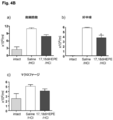
- FIG. 4B shows an evaluation of the physiological activity of an 18-HEPE derived metabolite (17,18-diHEPE) in an acute lung injury model.
- Intact from left intrabronchial hydrochloric acid administration (saline / HCl), 17,18-diHEPE 10 ng after tail vein administration, intrabronchial hydrochloric acid administration (17,18 diHEPE / HCl), infiltrate the lung at 12 hours
- the total cell count (a), neutrophil count (b) and macrophage count (c) are shown.
- Each experiment is averaged from 3 to 3 times, and the value is shown as mean ⁇ SEM. * Represents p ⁇ 0.05 with respect to saline / HCl.
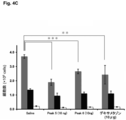
- FIG. 4C shows an evaluation of the bioactivity of peaks 5 and 6 in the zymosan peritonitis model. Saline and dexamethasone were used as controls. Gray columns indicate neutrophils, black columns indicate lymphocytes, and white columns indicate macrophages.
- FIG. 4D shows that the activity of the synthesized compound in the peritonitis model is dose dependent. The results are shown as mean + SD, * represents p ⁇ 0.05 with respect to physiological saline, and ** represents p ⁇ 0.001 with respect to physiological saline.
- FIG. 4E shows activity evaluation of synthesized compounds in an acute lung injury model.
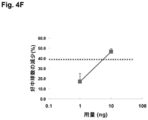
- FIG. 4F is a graph showing the dose-neutrophil count reduction relationship for studying IC 40 doses.
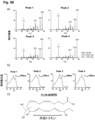
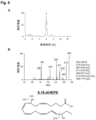
- FIG. 5 shows a reverse phase HPLC chromatogram (A), mass analysis of peak 1 (MS / MS) and structure of 8,18-diHEPE (B) of a sample incubated with 18-HEPE and 8-LOX. .
- FIG. 1 shows a reverse phase HPLC chromatogram (A), mass analysis of peak 1 (MS / MS) and structure of 8,18-diHEPE (B) of a sample incubated with 18-HEPE and 8-LOX. .
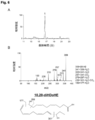
- FIG. 6 shows reverse phase HPLC chromatogram (A), mass analysis of peak 1 (MS / MS) and structure of 10,20-diHDoHE (B) of a sample incubated with 20-HDoHE and 8-LOX.
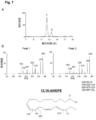
- FIG. 7 shows reverse phase HPLC chromatogram (A), mass analysis of peaks 1 and 2 (MS / MS) and structure of 12,18-diHEPE (B) of a sample incubated with 12-HpEPE and sLOX.
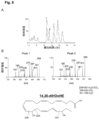
- FIG. 8 shows reverse phase HPLC chromatogram (A), peak 1 mass spectrometry (MS / MS) and 14,20-diHDoHE structure (B) of a sample incubated with 14-HpEPE and sLOX.
- FIG. 7 shows reverse phase HPLC chromatogram (A), mass analysis of peak 1 (MS / MS) and structure of 10,20-diHDoHE (B) of a sample incubated with 20-HDoHE and 8-LOX.
- FIG. 7 shows reverse phase HPLC chromat
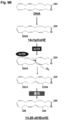
- FIG. 9A shows a metabolic pathway starting from 12-HpEPE, which is a metabolite of eicosapentaenoic acid (EPA).
- FIG. 9B shows a metabolic pathway starting from 14-HpDoHE, which is a metabolite of docosahexaenoic acid (DHA).
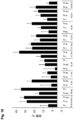
- FIG. 10 shows a comparison of activity for various compounds.
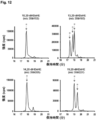
- FIG. 11 shows the analysis results of each metabolite generated as a result of incubation of 18-HEPE with human eosinophils. An asterisk indicates the peak of each major metabolite.
- Resolvin E1, resolvin E2, 8,18-diHEPE are shown in order from the upper left to the upper right, and 11,18-diHEPE, 12,18-diHEPE and 17,18-diHEPE are shown in order from the lower left to the lower right.
- FIG. 12 shows the analysis results of each metabolite generated as a result of incubation of 20-HDoHE and human eosinophils. An asterisk indicates the peak of each major metabolite. 10,20-diHDoHE and 13,20-diHDoHE are shown in order from the upper left to the upper right, and 14,20-diHDoHE and 19,20-diDoHE are shown in order from the lower left to the lower right.
- AA arachidonic acid
- CCR chemokine (CC motif) receptor
- COX cyclooxygenase
- DHA docosahexaenoic acid
- DPA docosapentaenoic acid
- EET Epoxy eicosatrienoic acid
- Ep Epoxy
- EpDPE Epoxy docosapentaenoic acid
- EpETE Epoxy eicosatetraenoic acid
- EPA eicosapentaenoic acid
- ETE eicosatetraenoic acid
- HBSS hanks' balanced salt solution
- HDoHE hydroxy docosahexaenoic acid
- HEPE hydroxy eicosapentaenoic acid
- HETE hydroxy eicosatetraenoic acid
- HpDoHE hydroperoxycosahexanoic acid; hydroperoxy docosapentanoi
- halogen means fluorine, chlorine, bromine and iodine. Fluorine, chlorine and bromine are preferred.
- alkyl as such or as part of another substituent, is the number derived and referred to by the removal of one hydrogen atom from a single carbon atom of the parent alkane.
- C1-C6 alkyl is used. More preferred is C1-C4 alkyl.
- a carbon number when a carbon number is specified, it means “alkyl” having a carbon number within the range.
- alkenyl is derived from the removal of one hydrogen atom from a single carbon atom of a parent alkene and contains at least one carbon. -Refers to an unsaturated, branched, linear or cyclic hydrocarbon group having a carbon double bond. Typically, it includes a linear or branched monovalent hydrocarbon group having 2 to 8 carbon atoms and having one or more double bonds. The group may be either cis or trans conformation with respect to the double bond.
- vinyl, allyl, 1-propenyl, 2-butenyl, 2-pentenyl, 2-hexenyl, 2-heptenyl, 2-octenyl and the like can be mentioned.
- C2-C6 alkenyl is used. More preferred is C2-C4 alkenyl.
- alkynyl includes straight or branched monovalent hydrocarbon groups having 2 to 8 carbon atoms and having one or more triple bonds. . Examples include ethynyl, 1-propynyl, 2-propynyl, 2-butynyl, 2-pentynyl, 2-hexynyl, 2-heptynyl, 2-octynyl and the like. Preferably, C2-C6 alkynyl is used. More preferred is C2-C4 alkynyl.
- an alkyl, alkenyl or alkynyl “diyl”, as such or as part of another substituent, is one from each of the two different carbon atoms of the parent alkane, alkene, alkyne. Or the removal of two hydrogen atoms from a single carbon atom of the parent alkane, alkene, alkyne, having the number of carbon atoms mentioned (ie C1-C6 are Means 1 to 6 carbon atoms), saturated or unsaturated, branched, straight-chain or cyclic divalent hydrocarbon radical.
- the valences at the center of two monovalent groups or at the center of a divalent group can form bonds with the same atom or different atoms.
- Typical diyl groups include, but are not limited to: methanediyl; ethane-1,1-diyl, ethane-1,2-diyl, ethene-1,1-diyl, ethene-1,2-diyl Ethyldiyl such as propane-1,1-diyl, propane-1,2-diyl, propane-2,2-diyl, propane-1,3-diyl, cyclopropane-1,1-diyl, cyclopropane-1, 2-diyl, prop-1-ene-1,1-diyl, prop-1-ene-1,2-diyl, prop-2-ene-1,2-diyl, prop-1-ene-1,3- Diyl, cycloprop-1-ene-1,2-diyl, cycloprop-2-ene-1,2-diyl, cycloprop-2-ene-1,1-diyl, prop-1-
- alkyldiyl alkenyldiyl and / or alkynyldiyl is used. Where it is specifically intended that the two valencies are on the same carbon atom, the nomenclature “alkylidene” is used.
- the alkyldiyl group is (C1-C6) alkyldiyl.
- Saturated acyclic alkanyldiyl groups centered on the terminal carbon such as methanediyl (methano); ethane-1,2-diyl (ethano); propane-1,3-diyl (propano); butane-1,4 -Diyl (butano); etc. are also preferred (also referred to as "alkyleno").
- cycloalkyl by itself or as part of another substituent, is derived from the removal of one hydrogen atom from a single carbon atom of the parent alkene, at least 1 An unsaturated, branched, linear or cyclic hydrocarbon group having one carbon-carbon triple bond. Typically, it includes cycloalkyl having 3 to 8 carbon atoms. Examples include cyclopropyl, cyclobutyl, cyclopentyl, cyclohexyl, cycloheptyl, and cyclooctyl. C3-C6 cycloalkyl is preferable.
- cycloalkenyl includes cycloalkenyl having 3 to 8 carbon atoms. Examples include cyclopropenyl, cyclobutenyl, cyclopentenyl, cyclohexenyl, cycloheptenyl, and preferably C3-C6 cycloalkenyl.
- alkoxy includes methyloxy, ethyloxy, n-propyloxy, isopropyloxy, n-butyloxy, isobutyloxy, sec-butyloxy, tert-butyloxy, n-pentyloxy, isopentyloxy, 2- Examples include pentyloxy, 3-pentyloxy, n-hexyloxy, isohexyloxy, 2-hexyloxy, 3-hexyloxy, n-heptyloxy, n-octyloxy and the like.
- C1-C6 alkyloxy is used. More preferred is C1-C4 alkyloxy.
- a carbon number when a carbon number is specified, it means “alkoxy” having a carbon number within the range.
- alkylsulfonyl includes methylsulfonyl, ethylsulfonyl, n-propylsulfonyl, isopropylsulfonyl, n-butylsulfonyl, isobutylsulfonyl, sec-butylsulfonyl, tert-butylsulfonyl, n-pentylsulfonyl, isopentyl.
- Examples include sulfonyl, 2-pentylsulfonyl, 3-pentylsulfonyl, n-hexylsulfonyl, isohexylsulfonyl, 2-hexylsulfonyl, 3-hexylsulfonyl, n-heptylsulfonyl, n-octylsulfonyl and the like.
- C1-C6 alkylsulfonyl is used. More preferred is C1-C4 alkylsulfonyl.
- alkyloxycarbonyl includes methyloxycarbonyl, ethyloxycarbonyl, n-propyloxycarbonyl, isopropyloxycarbonyl, n-butyloxycarbonyl, tert-butyloxycarbonyl, n-pentyloxycarbonyl and the like. Can be mentioned. Preferably, C1-C4 alkyloxycarbonyl is used. Particularly preferred is C1-C2 alkyloxycarbonyl.
- acyl includes formyl, alkylcarbonyl, alkenylcarbonyl, cycloalkylcarbonyl, cycloalkenylcarbonyl, arylcarbonyl, heteroarylcarbonyl, and heterocyclecarbonyl.
- acetyl, propionyl, butyroyl, benzoyl and the like can be mentioned.
- lower alkyl includes linear or branched alkyl having 1 to 6 carbon atoms, preferably 1 to 3 carbon atoms, such as methyl, ethyl, n-propyl, isopropyl, n -Butyl, isobutyl, sec-butyl, tert-butyl, n-pentyl, isopentyl, neopentyl, hexyl, isohexyl and the like.
- substituted or unsubstituted lower alkyl may be substituted, and may be preferably substituted with one or more groups selected from substituent group ⁇ .
- the substituent group ⁇ is halogen, hydroxy, lower alkoxy, hydroxy lower alkoxy, lower alkoxy lower alkoxy, acyl, acyloxy, carboxy, lower alkoxycarbonyl, amino, acylamino, lower alkylamino, imino, hydroxyimino, lower alkoxy It is a group consisting of imino, lower alkylthio, carbamoyl, lower alkylcarbamoyl, hydroxy lower alkylcarbamoyl, sulfamoyl, lower alkylsulfamoyl, lower alkylsulfinyl, cyano, nitro, carbocyclic group and heterocyclic group.
- lower alkenyl means 2 to 15 carbon atoms having one or more double bonds at any position, preferably 2 to 10 carbon atoms, more preferably 2 to 6 carbon atoms, still more preferably. Includes straight-chain or branched alkenyl having 2 to 4 carbon atoms.
- lower alkynyl is a straight chain or branched chain having 2 to 10, preferably 2 to 8, more preferably 3 to 6 carbon atoms having one or more triple bonds at any position. Includes branched alkynyl. Specifically, ethynyl, propynyl, butynyl, pentynyl, hexynyl, heptynyl, octynyl, nonynyl, decynyl and the like are included. These may further have a double bond at an arbitrary position.
- “carbocyclic group” includes cycloalkyl, cycloalkenyl, aryl, non-aromatic fused carbocyclic group and the like.
- substituted or unsubstituted amino refers to the above “alkyl”, the following “aryl”, the following “heteroaryl”, the following “heterocycle”, the “acyl”, the “alkyloxycarbonyl”,
- alkylsulfonyl the following “arylsulfonyl”, the following “heteroarylsulfonyl” and the following “heterocyclesulfonyl” include amino optionally substituted at one or two positions.
- amino, methylamino, dimethylamino, ethylamino, diethylamino, ethylmethylamino, benzylamino, acetylamino, benzoylamino, methyloxycarbonylamino, methylsulfonylamino and the like can be mentioned.
- Amino, methylamino, dimethylamino, ethylmethylamino, diethylamino, acetylamino, methylsulfonylamino and the like are preferable.
- substituted or unsubstituted carbamoyl includes a substituted or unsubstituted aminocarbonyl in which the substituted or unsubstituted amino moiety is the above “substituted or unsubstituted amino”.
- Examples include carbamoyl, N-methylcarbamoyl, N, N-dimethylcarbamoyl, N-ethyl-N-methylcarbamoyl, N, N-diethylcarbamoyl, N-benzylcarbamoyl, N-acetylcarbamoyl, N-methylsulfonylcarbamoyl, etc. It is done.
- carbamoyl, N-methylcarbamoyl, N, N-dimethylcarbamoyl, N-methylsulfonylcarbamoyl and the like can be mentioned.
- aryl includes monocyclic or condensed cyclic aromatic hydrocarbons. This may be condensed with the above-mentioned “cycloalkyl”, the following “heteroaryl” and the “heterocycle” at all possible positions. Whether aryl is a single ring or a fused ring, it can be attached at all possible positions. Examples include phenyl, 1-naphthyl, 2-naphthyl, anthryl, tetrahydronaphthyl, 1,3-benzodioxolyl, 1,4-benzodioxanyl and the like. Preferably, phenyl, 1-naphthyl and 2-naphthyl are used. More preferably, a phenyl is mentioned.
- heterocyclic or “heterocycle” may contain 1 to 4 heteroatoms such as an oxygen atom, a sulfur atom and a nitrogen atom in the ring, and can be substituted at any position.
- a non-aromatic heterocyclic group optionally having a bond.
- such a non-aromatic heterocyclic group may be further bridged with an alkyl chain having 1 to 4 carbon atoms, and a cycloalkane (preferably a 5- to 6-membered ring) or a benzene ring may be condensed. Good. If it is non-aromatic, it may be saturated or unsaturated.
- a 5- to 8-membered ring is preferable, but a non-aromatic heterocyclic ring may be further condensed.
- pyrrolinyl eg, 1-pyrrolinyl, 2-pyrrolinyl, 3-pyrrolinyl
- pyrrolidinyl eg, 1-pyrrolidinyl, 2-pyrrolidinyl, 3-pyrrolidinyl
- pyrrolidinone imidazolinyl (eg, 1-imidazolinyl, 2-imidazolinyl, 4-imidazolinyl), imidazolidinyl (eg 1-imidazolidinyl, 2-imidazolidinyl, 4-imidazolidinyl), imidazolidinone, pyrazolinyl (eg 1-pyrazolinyl, 3-pyrazolinyl, 4-pyrazolinyl), pyrazolidinyl (eg 1-pyrazolidinyl) , 3-pyrazolidinyl,
- heteroaryl includes an optionally selected 5- to 6-membered aromatic ring containing one or more heteroatoms such as an oxygen atom, a sulfur atom or a nitrogen atom in the ring.
- Heteroaryl includes “heterocyclic group” which is an aromatic cyclic group. It may be fused with the “cycloalkyl”, the “aryl”, the “heterocycle”, or other heteroaryl at all possible positions. Whether the heteroaryl is a single ring or a fused ring, it can be attached at all possible positions.
- pyrrolyl eg, 1-pyrrolyl, 2-pyrrolyl, 3-pyrrolyl
- furyl eg, 2-furyl, 3-furyl
- thienyl eg, 2-thienyl, 3-thienyl
- imidazolyl eg, 2 -Imidazolyl, 4-imidazolyl
- pyrazolyl eg 1-pyrazolyl, 3-pyrazolyl, 4-pyrazolyl
- isothiazolyl eg 3-isothiazolyl
- isoxazolyl eg 3-isoxazolyl
- oxazolyl eg 2-oxazolyl
- 4-oxazolyl 5-oxazolyl
- thiazolyl eg 2-thiazolyl, 4-thiazolyl, 5-thiazolyl
- pyridyl eg 2-pyridyl, 3-pyridyl, 4-pyridyl
- pyrazinyl eg
- the “heterocyclic group” includes a heterocyclic group having one or more hetero atoms arbitrarily selected from oxygen, sulfur, nitrogen and the like, specifically, pyrrolyl, imidazolyl. , Pyrazolyl, pyridyl, pyridazinyl, pyrimidinyl, pyrazinyl, triazolyl, triazinyl, tetrazolyl, furyl, thienyl, isoxazolyl, oxazolyl, oxadiazolyl, isothiazolyl, thiazolyl, thiadiazolyl, etc .; dioxanyl, thiranyl, oxiranyl, oxetanyl, Oxathiolanyl, azetidinyl, thianyl, thiazolidinyl, pyrrolidinyl, pyrrolinyl, imidazolidinyl, imidazolinyl.
- alkylene means a linear or branched alkylene having 1 to 10 carbon atoms, such as methylene, 1-methylmethylene, 1,1-dimethylmethylene, ethylene, 1- Methylethylene, 1-ethylethylene, 1,1-dimethylethylene, 1,2-dimethylethylene, 1,1-diethylethylene, 1,2-diethylethylene, 1-ethyl-2-methylethylene, trimethylene, 1-methyl Trimethylene, 2-methyltrimethylene, 1,1-dimethyltrimethylene, 1,2-dimethyltrimethylene, 2,2-dimethyltrimethylene, 1-ethyltrimethylene, 2-ethyltrimethylene, 1,1-diethyl Trimethylene, 1,2-diethyltrimethylene, 2,2-diethyltrimethylene, 2-ethyl-2-methyltrimethylene, Tramethylene, 1-methyltetramethylene, 2-methyltetramethylene, 1,1-dimethyltetramethylene, 1,2-dimethyltetramethylene, 2,
- alkenylene means a linear or branched alkenylene having 2 to 10 carbon atoms, for example, ethenylene, 1-methylethenylene, 1-ethylethenylene, 1,2-dimethylethenylene.
- alkynylene means a linear or branched carbon number of 2 to 10, preferably carbon number, which has a triple bond at an arbitrary position and may further have a double bond.
- a divalent carbon chain having 2 to 6, preferably 2 to 4 carbon atoms is included. Specific examples include ethynylene, propynylene, butynylene, pentynylene and hexynylene.
- alkyl part of “alkylcarbonyl” means the above “alkyl”.
- alkenyl part of “alkenyloxy” and “alkenylcarbonyl” means the above “alkenyl”.
- aryl part of “aryloxy” and “arylcarbonyl” means the above “aryl”.
- heteroaryl part of “heteroarylcarbonyl” means the above “heteroaryl”.
- heterocycle portion of “heterocyclecarbonyl” means the above “heterocycle”.
- aryl part of “arylsulfonyl” means the above “aryl”.
- heteroaryl part of “heteroarylsulfonyl” means the above “heteroaryl”.
- heterocycle part of “heterocyclesulfonyl” means the above “heterocycle”.
- typical heteroatoms and / or heteroatom groups that can replace a carbon atom include, but are not limited to: —O—, —S—, —SO—, — NR '-, - PH -, - S (O) -, - S (O) 2 -, - S (O) NR' -, - S (O) 2 NR'- like, including combinations thereof.
- each R ′ is independently hydrogen or (C1-C6) alkyl.
- aromatic ring system refers to an unsaturated ring or polycyclic ring system having a conjugated ⁇ electron system.
- Condensed ring systems in which one or more rings are aromatic and one or more rings are saturated or unsaturated, such as fluorene, indane, indene, phenalene, tetrahydronaphthalene, etc.
- aromatic ring systems Is included in the definition of Typical parent aromatic ring systems include, but are not limited to: acanthrylene, acenaphthylene, acephenanthrylene, anthracene, azulene, benzene, chrysene, coronene, fluoranthene, fluorene, hexacene, hexaphene, Hexalene, indacene, s-indacene, indane, indene, naphthalene, octacene, octaphen, octalene, ovalene, penta-2,4-diene, pentacene, pentalene, pentaphene, perylene, phenalene, phenanthrene, picene, preaden, pyrene, pyranthrene , Rubicene, tetrahydronaphthalene, triphenylene, tri
- non-aromatic fused carbocyclic group includes a group in which two or more cyclic groups selected from the above “cycloalkyl”, “cycloalkenyl” and “aryl” are condensed, Specific examples include indanyl, indenyl, tetrahydronaphthyl and fluorenyl.
- substituents of the “substituted or unsubstituted carbocyclic group” and “substituted or unsubstituted heterocyclic group” include any substituents, preferably lower alkyl and substituent groups. and one or more groups selected from the group consisting of ⁇ .
- substituted or unsubstituted alkyl “substituted or unsubstituted alkenyl”, “substituted or unsubstituted alkynyl”, “substituted or unsubstituted aryl”, “substituted or unsubstituted cycloalkyl” “Substituted or unsubstituted cycloalkenyl”, “substituted or unsubstituted heteroaryl”, “substituted or unsubstituted heterocycle”, “substituted or unsubstituted acyl”, “substituted or unsubstituted alkoxy”, “substituted”
- substituent in “unsubstituted alkylene”, “substituted or unsubstituted alkenylene”, and “substituted or unsubstituted alkynylene” include, for example,
- piperidyl piperidyl
- heterocyclealkyl e.g. Moruhorirumechiru
- alkoxy e.g. methoxy, ethoxy, propoxy, butoxy
- halogenated alkyloxy e.g. OCF 3
- alkenyloxy e.g.
- Aryloxy eg phenyloxy
- alkyloxycarbonyl eg methoxycarbonyl, ethoxycarbonyl, tert-butoxycarbonyl
- arylalkyloxy eg benzyloxy
- amino eg alkylamino (eg methyl) Amino, ethylamino, dimethylamino
- acylamino eg, acetylamino, benzoylamino
- arylalkylamino eg, benzylamino, tritylamino
- hydroxyamino alkylaminoalkyl (eg, diethylaminomethyl), sulfamoyl, etc.
- Selected from the group which may be substituted with 1 to 4 such substituents, or may be substituted with one or more groups selected from the group consisting of lower alkyl and substituent group ⁇ .
- alkyloxy refers to a group of formula —OR ′′
- alkylamine refers to a group of formula —NHR ′′
- dialkylamine refers to NR ′′ R ′′, Where each R ′′ is independently alkyl.
- haloalkoxy or “haloalkyloxy” refers to a group of formula —OR ′′ ′′ where R ′′ ′′ is haloalkyl.
- the “solvate” means a solvate of the compound of the present invention or a pharmaceutically acceptable salt thereof, for example, a solvate with an organic solvent (eg, alcohol (eg, ethanol )), Hydrates and the like.
- an organic solvent eg, alcohol (eg, ethanol )
- Hydrates and the like.
- the hydrate When forming a hydrate, it may be coordinated with any number of water molecules. Examples of the hydrate include monohydrate, dihydrate and the like.
- prodrug refers to the metabolic mechanism of the living body, and in its original form does not show drug action or only shows very weak activity, but is metabolized in vivo. That means that it has been modified for the first time to exhibit pharmacological activity or to increase pharmacological activity. Any form known in the art can be adopted as the pharmaceutically acceptable prodrug of the present invention. In addition to salts and solvates, esters, amides and the like can also be mentioned as examples of prodrugs.
- the terms “pharmaceutically acceptable salts, esters, amides, and prodrugs” as used herein refer to carboxylates, amino acid addition salts, esters of the compounds herein. , Amides, and prodrugs, which are within normal medical judgment and are suitable for use in contact with a patient's tissue without undue toxicity, inflammation, allergic response, etc. Which are effective for their intended use of the compounds of the invention.
- salt refers to a relatively non-toxic, inorganic or organic acid addition salt of a compound of the present invention. These salts are used either during final isolation and purification of the compound, or by reacting the purified compound in its free base form separately with a suitable organic or inorganic acid, and so on. It can be prepared by isolating the salt formed.
- Examples of the pharmaceutically acceptable salt of the compound of the present invention include the following salts.
- Examples of the pharmaceutically acceptable basic salt of the compound of the present invention include alkali metal salts such as sodium salt and potassium salt; alkaline earth metal salts such as calcium salt and magnesium salt; ammonium salt; trimethylamine salt and triethylamine salt , Aliphatic amine salts such as dicyclohexylamine salt, ethanolamine salt, diethanolamine salt, triethanolamine salt, procaine salt, meglumine salt, diethanolamine salt or ethylenediamine salt; aralkylamine salts such as N, N-dibenzylethylenediamine or venetamine salt A heterocyclic aromatic amine salt such as pyridine salt, picoline salt, quinoline salt, isoquinoline salt; tetramethylammonium salt, tetraethylammonium salt, benzyltrimethylammonium salt, benzyltriethylammonium salt Benzyltributylammonium salt, methyltrioctylammonium salt, qua
- Examples of the pharmaceutically acceptable acidic salt of the compound of the present invention include inorganic acid salts such as hydrochloride, sulfate, nitrate, phosphate, carbonate, bicarbonate, perchlorate; acetate, Organic acid salts such as propionate, lactate, maleate, fumarate, tartrate, malate, citrate, ascorbate; methanesulfonate, isethionate, benzenesulfonate, p -Sulfonates such as toluenesulfonate; acidic amino acids such as aspartate and glutamate.
- inorganic acid salts such as hydrochloride, sulfate, nitrate, phosphate, carbonate, bicarbonate, perchlorate
- acetate Organic acid salts such as propionate, lactate, maleate, fumarate, tartrate, malate, citrate, ascorbate
- methanesulfonate isethionate
- hydrochloric acid particularly preferred are hydrochloric acid, phosphoric acid, tartaric acid, methanesulfonic acid and the like. These salts can be formed by a commonly performed method.
- ester refers to the relatively non-toxic, esterified product of the compounds of the present invention. These esters can be prepared in situ during the final isolation and purification of the compound, or by reacting the purified compound in its free acid form or hydroxyl separately with a suitable esterifying agent. . Carboxylic acids can be converted to esters via treatment with alcohols in the presence of a catalyst. The term is further intended to include lower hydrocarbon groups that are solvatable under physiological conditions, such as alkyl esters, methyl esters, ethyl esters, and propyl esters.
- isomers refers to substances having the same molecular formula but different structural formulas and properties.
- the isomers used in the present invention are not limited to specific isomers, but all possible isomers (eg keto-enol isomers, imine-enamine isomers, diastereoisomers, optical isomers) Enantiomers, geometric isomers, stereoisomers, cis-trans isomers, conformers and rotational isomers) and racemates. It should be understood that there are one or more chiral centers in each of the compounds of the present invention. It should be understood that the present invention encompasses all stereochemical forms of each compound, such as enantiomers, diastereomers and racemates.
- the active (R) and (S) isomers may be separated using conventional techniques known to those skilled in the art.
- the present invention is meant to include possible diastereomers as well as racemates and optically resolved isomers.
- the hydroxyl in the compounds of the present invention can be protected by various protecting groups such as those known in the art.
- protecting group refers to a group of atoms that, when attached to a reactive functional group in a molecule, mask, reduce or interfere with the reactivity of the functional group. Typically, protecting groups may be selectively removed as desired during the course of synthesis. Examples of protecting groups include Greene and Wuts, Protective Groups in Organic Chemistry, 3rd edition, 1999, John Wiley & Sons, NY, and Harrison et al., Compendium of Synthetic Organics. 1-8, 1971-1996, John Wiley & Sons, NY.
- nitrogen protecting groups include, but are not limited to, formyl, acetyl, trifluoroacetyl, benzyl, benzyloxycarbonyl (“CBZ”), tert-butoxycarbonyl (“Boc”), trimethylsilyl (“ TMS “), 2-trimethylsilyl-ethanesulfonyl (“ TES “), trityl and substituted trityl groups, allyloxycarbonyl, 9-fluorenylmethyloxycarbonyl (" FMOC "), nitro-veratryloxycarbonyl (“ NVOC ”) )Such.
- Exemplary hydroxyl protecting groups include those in which the hydroxyl group is acetylated (esterified) or alkylated, such as benzyl ether and trityl ether, and alkyl ethers, tetrahydropyranyl ethers, trialkylsilyl ethers (eg, TMS). Groups or TIPPS groups), glycol ethers such as, but not limited to, ethylene glycol and propylene glycol derivatives, and allyl ethers.
- protecting groups may be useful for protecting hydroxyl groups. Standard methods are known in the art and are more fully described in the literature. For example, suitable protecting groups can be selected by those skilled in the art and are described in Green and Wuts, “Protecting Groups in Organic Synthesis” John Wiley and Sons, Chapters 5 and 7, 1991, the teachings of which are hereby incorporated by reference. Incorporated herein by reference.
- Preferred protecting groups include methyl and ethyl ether, TMS or TIPPS groups, acetic acid (ester) or propionic acid groups and glycol ethers such as ethylene glycol and propylene glycol derivatives.
- one or more hydroxyl groups can be treated with a mild base, such as triethylamine, in the presence of acid chloride or silyl chloride to facilitate the reaction between hydroxyl ions and halides.
- a mild base such as triethylamine
- alkyl halides can react with hydroxyl ions (generated by a base such as lithium diisopropylamide) to facilitate ether formation.
- Resolvin protectins refer to: 5S, 12R, 18R-trihydroxy-6Z, 8E, 10E, 14Z, 16E-eicosapentaenoic acid: resolvin E1a; 5S, 18R-dihydroxy-6E, 8Z, 11Z, 14Z, 16E-eicosapentaenoic acid: resolvin E2; 7S, 8,17R-trihydroxy-docosa-4Z, 9E, 11E, 13Z, 15E, 19Z-hexaenoic acid: aspirin-triggered resolvin D1; 7S, 16,17R-trihydroxy- Docosa-4Z, 8E, 10Z, 12E, 14E, 19Z-hexaenoic acid: aspirin-triggered resolvin D2; 4S, 11,17R-trihydroxy-docosa-5,7E, 9E, 13Z, 15E, 19Z-hexaenoic acid: aspirin Trigger type resolvin D3 4
- the compound of the present invention is a substance that is considered to have not been conventionally known, which is different from resolvin / protectin.
- P 1 and P 2 are each independently
- R 1 and R 2 each independently represents a hydrogen atom, a halogen atom, a substituted or unsubstituted, branched or unbranched alkyl group, a substituted or unsubstituted aryl group, a substituted or unsubstituted, A branched or unbranched alkylaryl group or a combination thereof;
- X is —C (O) OR 3 , —C (O) NR 4 R 5 , —C (O) H, —C (NH) NR 4 R 5 , —C (S) H, —C (S) OR 3 , —C (S) NR 4 R 5 , —CN;
- R 3 is hydrogen, protecting group, substituted or unsubstituted alkyl, substituted or unsubstituted alkenyl, substituted or unsubstituted alkynyl, substituted or unsubstituted aryl, substituted or unsubstituted hetero
- R 4 and R 5 are each independently hydrogen, substituted or unsubstituted alkyl, Substituted or unsubstituted alkenyl, substituted or unsubstituted alkynyl, substituted or unsubstituted aryl, substituted or unsubstituted heteroaryl, substituted or unsubstituted cycloalkyl, substituted or unsubstituted cycloalkenyl, substituted or unsubstituted Are heterocycles, or R 4 and R 5 may be taken together with the adjacent nitrogen atom to form a substituted or unsubstituted nitrogen-containing heterocycle; and the double bond configuration of the compound is Provided are compounds or pharmaceutically acceptable salts or solvates of the compounds, which can be either cis or trans independently.
- the invention provides a chemical formula:
- P 1 , P 2 , R 1 , R 2 and X are each independently as defined above.
- P 1 and P 2 are each a hydrogen atom
- R 1 and R 2 are each independently a methyl group or a hydrogen atom or a combination thereof
- X is a carboxylic acid or a carboxylic ester. is there.
- X can be a carboxylic acid, ester, amide, thiocarbamate, carbamate, thioester, thiocarboxamide, or nitrile.
- X is a carboxylic acid, a carboxylic acid ester, or a pharmaceutically acceptable carboxylate.
- the invention provides a chemical formula:
- P 1 , P 2 , R 1 , R 2 and X are each independently as defined above.
- P 1 and P 2 are each a hydrogen atom
- R 1 and R 2 are each independently a methyl group or a hydrogen atom or a combination thereof
- X is a carboxylic acid or a carboxylic ester. is there.
- X can be a carboxylic acid, ester, amide, thiocarbamate, carbamate, thioester, thiocarboxamide, or nitrile.
- X is a carboxylic acid, a carboxylic acid ester, or a pharmaceutically acceptable carboxylate.
- the invention provides a chemical formula:
- P 1 , P 2 , R 1 , R 2 and X are each independently as defined above.
- P 1 and P 2 are each a hydrogen atom
- R 1 and R 2 are each independently a methyl group or a hydrogen atom or a combination thereof
- X is a carboxylic acid or a carboxylic ester. is there.
- X can be a carboxylic acid, ester, amide, thiocarbamate, carbamate, thioester, thiocarboxamide, or nitrile.
- X is a carboxylic acid, a carboxylic acid ester, or a pharmaceutically acceptable carboxylate.
- the invention provides a chemical formula:
- P 1 , P 2 , R 1 , R 2 and X are each independently as defined above.
- P 1 and P 2 are each a hydrogen atom
- R 1 and R 2 are each independently a methyl group or a hydrogen atom or a combination thereof
- X is a carboxylic acid or a carboxylic ester. is there.
- X can be a carboxylic acid, ester, amide, thiocarbamate, carbamate, thioester, thiocarboxamide, or nitrile.
- X is a carboxylic acid, a carboxylic acid ester, or a pharmaceutically acceptable carboxylate.
- the invention provides a chemical formula:
- P 1 , P 2 , R 1 , R 2 and X are each independently as defined above.
- P 1 and P 2 are each a hydrogen atom
- R 1 and R 2 are each independently a methyl group or a hydrogen atom or a combination thereof
- X is a carboxylic acid or a carboxylic ester. is there.
- X can be a carboxylic acid, ester, amide, thiocarbamate, carbamate, thioester, thiocarboxamide, or nitrile.
- X is a carboxylic acid, a carboxylic acid ester, or a pharmaceutically acceptable carboxylate.
- the invention provides a chemical formula:
- P 1 , P 2 , R 1 , R 2 and X are each independently as defined above.
- P 1 and P 2 are each a hydrogen atom
- R 1 and R 2 are each independently a methyl group or a hydrogen atom or a combination thereof
- X is a carboxylic acid or a carboxylic ester. is there.
- X can be a carboxylic acid, ester, amide, thiocarbamate, carbamate, thioester, thiocarboxamide, or nitrile.
- X is a carboxylic acid, a carboxylic acid ester, or a pharmaceutically acceptable carboxylate.
- the invention provides a chemical formula:
- P 1 , P 2 , R 1 , R 2 and X are each independently as defined above.
- P 1 and P 2 are each a hydrogen atom
- R 1 and R 2 are each independently a methyl group or a hydrogen atom or a combination thereof
- X is a carboxylic acid or a carboxylic ester. is there.
- X can be a carboxylic acid, ester, amide, thiocarbamate, carbamate, thioester, thiocarboxamide, or nitrile.
- X is a carboxylic acid, a carboxylic acid ester, or a pharmaceutically acceptable carboxylate.
- the invention provides a chemical formula:
- P 1 , P 2 , R 1 , R 2 and X are each independently as defined above.
- P 1 and P 2 are each a hydrogen atom
- R 1 and R 2 are each independently a methyl group or a hydrogen atom or a combination thereof
- X is a carboxylic acid or a carboxylic ester. is there.
- X can be a carboxylic acid, ester, amide, thiocarbamate, carbamate, thioester, thiocarboxamide, or nitrile.
- X is a carboxylic acid, a carboxylic acid ester, or a pharmaceutically acceptable carboxylate.
- EPA eicosapentaenoic acid
- DHA docosahexaenoic acid
- R 1 , R 2 , P 1 and P 2 are hydrogen atoms and Z is a carboxylic acid
- the compound is either isolated and / or purified. Good.
- the purity of such compounds is at least 80% pure, in particular at least about 90% pure, more particularly at least 95% pure, and more based on analytical measurements such as using GC, MS, or 1 HNMR. Preferably it is at least about 99% pure. This applies to all isolated and / or purified compounds throughout this specification.
- R 1 and R 2 each independently represents a hydrogen atom, a halogen atom, a substituted or unsubstituted, branched or unbranched alkyl group, a substituted or unsubstituted aryl group, a substituted or unsubstituted, A branched or unbranched alkylaryl group or a combination thereof;
- X is -C (O) ORd, -C (O) NRcRc, -C (O) H, -C (NH) NRcRc, -C (S) H, -C (S) ORd, -C (S) NRcRc, —CN;
- Each Ra when present, is hydrogen, (C1-C6) alkyl, (C3-C8) cycloalkyl, cyclohexyl, (C4-C11) cycloalkylalkyl, (C5-C10) aryl, phenyl, (C6-C16
- Formed which may optionally contain one or more of the same or different additional heteroatoms, and may optionally be substituted with one or more of the same or different Ra groups or appropriate Rb groups;
- Each n, if present, is independently an integer from 0 to 3;
- Each Rd, when present, is independently a protecting group or Ra.
- X is a carboxylic acid, ester, pharmaceutically acceptable carboxylate salt, or prodrug thereof.
- X is a pharmaceutically acceptable salt of a carboxylic acid, in particular an ammonium salt, or forms a prodrug.
- P 1 and P 2 are each independently a hydrogen atom and X is a carboxylic acid or ester.
- one or more of P 1 and P 2 is a hydrogen atom and X is a carboxylic acid or ester.
- R 1 and R 2 are each independently a lower alkyl group such as methyl, ethyl, and propyl, and can be halogenated, such as trifluoromethyl. In one embodiment, at least one of R 1 and R 2 , when present, is not a hydrogen atom.
- X is a carboxylic acid and one or more of P 1 and P 2 is a hydrogen atom.
- P 1 and P 2 are each independently a hydrogen atom and X is a carboxyl ester. In other embodiments, P 1 and P 2 are each independently a hydrogen atom and X is a carboxylic acid. In other embodiments, P 1 and P 2 are each independently a hydrogen atom and X is not a carboxylic acid.
- the compounds described herein are isolated and / or purified, in particular, compounds in which P 1 and P 2 are each independently a hydrogen atom and X is a carboxylic acid Separated and / or purified.
- the compounds of the present invention are useful for treating diseases that can be treated or prevented by neutrophil suppression, such as inflammatory diseases.
- diseases that can be treated or prevented by neutrophil suppression such as inflammatory diseases.
- neutrophil suppression such as neutrophil suppression
- the present invention provides the following compound or a pharmaceutically acceptable salt or solvate of the compound:
- the compounds described herein have anti-inflammatory activity as seen by down-regulation of neutrophil infiltration in a peritonitis model.
- the C-17 position has an R configuration. In other embodiments, the C-17 position has an S configuration. In other embodiments, certain embodiments of the invention have an R configuration at the C-18 position.
- the compounds of the present invention can be protected by various protecting groups such as those known in the art. Those skilled in the art will recognize which protecting groups are protecting the hydroxyl groups using Green and Wuts, “Protecting Groups in Organic Synthesis” John Wiley and Sons, Chapters 5 and 7, 1991, and the methods described herein. Can be easily determined.
- hydroxyl groups need to be protected for the compounds of the present invention.
- One or all two hydroxyl groups can be protected. This is done by protecting the hydroxyl group using known techniques such as Green and Wuts, “Protecting Groups in Organic Synthesis” John Wiley and Sons, Chapters 5 and 7, 1991, and elsewhere in this specification. Can be achieved by stoichiometric selection of the reagents used to do so. Methods known in the art, such as HPLC, liquid chromatography (LC), flash chromatography, gel permeation chromatography, crystallization, distillation, etc., are used to separate mono- or di-protected hydroxy compounds. Can be used for
- each of the compounds identified above can take various isomeric forms.
- one or more chiral centers exist in the compounds of the present invention.
- the present invention encompasses all stereochemical forms of each compound, such as enantiomers, diastereomers and racemates. Where an asymmetric carbon atom is present, more than one stereoisomer is possible and all possible isomeric forms are intended to be included in the structural representation shown.
- the active (R) and (S) isomers may be separated using conventional techniques known to those skilled in the art.
- the present invention is meant to include possible diastereomers as well as racemates and optically resolved isomers.
- the compound of the present invention contains an acetylenic and / or ethylenically unsaturated site.
- the configuration chemistry can be either cis (E) or trans (Z), and expression throughout this specification is not meant to be limiting. Expressions are generally presented based on the configuration chemistry of the relevant DHA or EPA compound, and are not limited by theory, but are thought to have similar configuration chemistry.
- carbon-carbon bonds have been simplified, particularly to show the manner in which the bonds are ultimately placed relative to one another.
- the acetylene portion of resolvin actually contains about 180 ° geometry, but to aid in understanding the synthesis and the relationship between the final product and the starting material, such angles are It should be understood that extreme expressions are used to aid understanding.
- the present invention also encompasses compounds that can yield one or more products by hydrogenation of the acetylene moiety. All possible products are intended to be included herein.
- the hydrogenation of a diacetylenic compound of the present invention can involve up to 8 products (when the hydrogenation of both acetylene moieties is complete, which can be monitored by known methods) Diene products, ie, cis, cis; cis, trans; trans, cis; trans, trans), and four monoacetylene-monoacetylene products (cis or trans “monoene” -acetylene; acetylene-cis or trans “ Monoene ”) can be produced. All products can be separated and identified by HPLC, GC, MS, NMR, IR.
- the compound of the present invention can be synthesized by a general organic chemistry method, or an enzyme such as lipoxygenase such as 12 / 15-LOX in 18-HEPE or 20-HDoHE, etc., which is relatively abundant as a precursor. Can be produced by acting.
- the present invention provides a method for producing a compound of the present invention or a pharmaceutically acceptable salt or solvate of the compound.
- This method consists of A) eicosapentaenoic acid (EPA) or docosahexaenoic acid (DHA), or 18-hydroxyeicosapentaenoic acid (18-HEPE) or 20-hydroxy docosahexaenoic acid (HDoHE).
- 8-lipoxygenase (8-LOX)), 12-lipoxygenase (12-LOX) (eg, platelet type 12-LOX), 12 / 15-lipoxygenase (12 / 15-LOX) (eg, leukocyte type 12 / 15-LOX) ), Contacting soybean lipoxygenase, or eosinophils or an extract thereof to obtain an enzyme metabolite; and B) reducing or oxidizing the enzyme metabolite if necessary, and introducing a substituent if necessary. , If necessary, the desired compound or the compound Separating or purifying a pharmaceutically acceptable salt or solvate. When a peroxide (perhydroxy form) is formed, reduction of this produces a hydroxy form.
- step A the enzyme metabolites obtained in step B ′) A) are subjected to 8-lipoxygenase (8-LOX), 12-lipoxygenase (12-LOX), 12 after purification or without purification.
- step B ′ since a plurality of peroxides can be obtained in step A), they are individually separated (purified) or brought into contact with the same enzyme or another enzyme again without purification. Further oxidation can be carried out.
- the purification used herein include the methods described in the present specification, and examples thereof include HPLC, but are not limited thereto, and it is understood that the degree of separation and purification can be appropriately adjusted. .
- an exemplary method is to use 12-LOX as needed to make 12-hydroperoxyeicosapentaenoic acid (12-HpEPE) or 14-hydroperoxidecosahexaenoic acid (HpDoHE), then A) 12 -Contacting the soybean lipoxygenase with hydroperoxyeicosapentaenoic acid (12-HpEPE) or 14-hydroperoxidecosahexaenoic acid (HpDoHE) to obtain an enzyme metabolite; and B) reducing or oxidizing the enzyme metabolite as necessary And a method including the step of separating or purifying the target compound, or a pharmaceutically acceptable salt or solvate of the compound, if necessary, by introducing a substituent as necessary. Yes (FIGS. 9A and 9B).
- EPA and DHA are abundant in living organisms, so they can be extracted from food or the like as raw materials, or commercially available products may be purchased.
- 18-HEPE and 20-HDoPE commercially available products (available from Cayman) can be used, or they can be produced by the following method.
- Both 18-HEPE and 20-HDoHE are metabolites in which the very ⁇ 3 site of ⁇ 3 PUFA is oxidized.
- Enzymes used in the production method of the present invention include 8-lipoxygenase (eg, mouse recombinant 8-lipoxygenase (8-LOX)), 12-lipoxygenase (12-LOX) (eg, platelet type 12-LOX), 12 / 15-lipoxygenase (12 / 15-LOX) (for example, leukocyte type 12 / 15-LOX), soybean lipoxygenase, or an enzyme obtained from eosinophils, and the like, taking into account its substrate specificity
- 8-lipoxygenase eg, mouse recombinant 8-lipoxygenase (8-LOX)
- 12-lipoxygenase (12-LOX) eg, platelet type 12-LOX
- 12 / 15-lipoxygenase (12 / 15-LOX) for example, leukocyte type 12 / 15-LOX
- soybean lipoxygenase or an enzyme obtained from eosinophils, and the like, taking
- the following precursor materials (18-HEPE and 20-HDoPE) can be obtained by using commercially available products (available from Cayman Inc.), or by chemical synthesis or extraction from the living body.
- Purification, separation or isolation methods or techniques used herein include column chromatography, high performance liquid chromatography (HPLC), gas chromatography (GC), crystallization, and distillation, if necessary. . Characterization can be performed by ultraviolet (UV) analysis, mass spectrometry (MS), MS / MS, GC / MS, nuclear magnetic resonance (NMR), and the like.
- UV ultraviolet
- MS mass spectrometry
- MS / MS MS / MS
- GC / MS nuclear magnetic resonance
- NMR nuclear magnetic resonance
- P1 and P2 are other than hydrogen, for example, a protecting group, a hydrogen atom, an alkyl, a hydroxyl group, a substituted hydroxyl group, or a combination thereof
- these substituents are added to the precursor using a technique known in the art.
- the compound of the present invention is subjected to an enzymatic reaction, or a compound in which each is hydrogen is produced by the method described in this specification, and then a substituent is introduced, or a combination thereof. It is understood to manufacture.
- a known derivative production technique in resolvin / protectin can be applied.
- P1 and P2 are hydrogenated by substituting the hydroxyl of these compounds with an alkyl group or various protecting groups (for example, those known in the art). Other than that can be manufactured.
- protecting groups for example, those known in the art.
- Standard methods are known in the art and are well described in the literature. For example, substitution with an alkyl group, substitution with an appropriate protecting group, can be performed and easily selected by those skilled in the art, and can be easily selected, and Green and Wuts, “Protecting Groups in Organic Synthesis”, John Wiley and Sons, Chapters 5 and 7 , 1991 (the teaching content of which is incorporated herein by reference) can be referred to.
- Preferred protecting groups include methyl and ethyl esters, TMS and TIPPS groups, acetate or propionate groups and glycol ethers (eg, ethylene glycol and propylene glycol derivatives).
- TMS and TIPPS groups methyl and ethyl esters
- acetate or propionate groups eg, ethylene glycol and propylene glycol derivatives.
- glycol ethers eg, ethylene glycol and propylene glycol derivatives
- P 1 and P 2 are hydroxyl groups or substituted hydroxyl groups, that is, for peroxides, those obtained by enzymatic reaction are isolated, or in the case of substituted hydroxyl groups, peroxides are selected.
- substituents such as an alkyl group and a protective group, using the said well-known technique.
- a known derivative production technique in resolvin / protectin can be applied.
- R 1 and R 2 are other than hydrogen, for example, a halogen atom, a substituted or unsubstituted, branched or unbranched alkyl group, a substituted or unsubstituted aryl group, a substituted or unsubstituted, branched or When it is an unbranched alkylaryl group or a combination thereof, these substituents are introduced into the precursor using techniques known in the art, and then subjected to an enzymatic reaction, or each is hydrogen It is understood that the compounds of the present invention can be made by methods of introducing substituents after the compounds have been prepared by the procedures described herein, or by combinations thereof. As such a technique, a known derivative production technique in resolvin / protectin can be applied.
- R 1 and R 2 are other than hydrogen, that is, the use of “R protection chemistry” is not necessarily required for adjacent diols in the compounds of the present invention.
- vicinal diols are not easily oxidized and therefore generally do not require such protection by substitution of a hydrogen atom adjacent to the oxygen atom of the hydroxyl group.
- substitution of the adjacent diol by substitution of the hydrogen atom adjacent to the oxygen atom of the hydroxyl group using a substituent as described above as the protecting group. It is possible to prepare compounds in which the hydroxyl groups can independently be “protected”. As such a technique, a known derivative production technique in resolvin / protectin can be applied.
- R 1 and R 2 groups are introduced by, for example, oxidizing a hydroxy group into a ketone by Pfitzner-Moffatt oxidation, Swern oxidation, Jones oxidation, etc. to give a ketone, Grignard reaction, Barbier coupling reaction, in the presence of diiodosamarium.
- R 1 and R 2 can introduce substituents such as alkyl, aryl, alkylaryl, etc., as necessary, and further, P 1 , P 2 and the like can be further added. Can be introduced. As such a technique, a known derivative production technique in resolvin / protectin can be applied.
- the following synthetic route illustrates a method for preparing the target compounds of the invention.
- the preparation is not intended to be limiting, but serves as another means for preparing the compounds of the invention in accordance with more traditional practices and should be regarded as a complement to the biosynthesis described above.
- the compound of the present invention can also be synthesized by an organic synthesis method.
- the present invention provides a neutrophil inhibitor comprising a compound of the present invention or a pharmaceutically acceptable salt or solvate of the compound.
- the present invention provides a method for treating or preventing an inflammatory disease, wherein the compound of the present invention or a pharmaceutically acceptable salt of the compound or the like is used in a subject in need of the treatment or prevention.
- a method is provided comprising administering a solvate.
- the present invention is a method of treating or preventing an inflammatory disease, for producing a medicament of a compound of the present invention or a pharmaceutically acceptable salt or solvate of the compound. Regarding use.
- drugs nervetrophil inhibitors, etc.
- therapeutic methods preventive methods, and pharmaceuticals for treatment or prevention
- pharmaceuticals for treatment or prevention there are the following embodiments. This will be described in order below.
- the present invention can prevent, for example, infiltration and activation of neutrophils in tissues during acute inflammation.
- Such preventive ability is useful in preventing neutrophil infiltration and activation found in ischemia-reperfusion injury, stroke, myocardial infarction, acute nephritis and the like. Therefore, it is understood that the present invention is useful as a therapeutic agent because it strongly suppresses infiltration and activation of neutrophils in tissues at a very low dose.
- chronic inflammatory diseases such as rheumatoid arthritis, inflammatory colitis, and asthma
- the compound of the present invention was also found to be an endogenous substance originally present in the living body. Is expected to have a therapeutic improvement effect.
- the “disease, disorder or symptom related to neutrophil” refers to a disease, disorder or symptom improved by inhibition of neutrophils. Such disease states or symptoms are described throughout the present specification and are incorporated herein in their entirety. Currently unknown conditions associated with neutrophil regulation that may be discovered in the future are also encompassed by the present invention. This is because characterization as a condition associated with neutrophil regulation can be readily determined by one skilled in the art.
- the present invention also relates to a method for treating, ameliorating and curing a disease state or condition associated with inflammation.
- the diseases targeted by the present invention include the following. Many gastrointestinal inflammatory disorders of the digestive system (mouth, stomach, esophagus, small intestine and large intestine), for example inflammatory bowel diseases such as stomatitis, periodontal disease, esophagitis, gastritis, ulcerative colitis and Crohn's disease, Infectious enteritis (viral, bacterial, parasitic), antibiotic-related diarrhea, Clostridium difficile colitis, microscopic or lymphoid colitis, collagenous colitis, colon polyps and familial polyps syndromes (eg familial polyps) Polyposis syndrome, Gardner syndrome), Helicobacter pylori, irritable bowel syndrome, nonspecific diarrhea, and intestinal cancer; inflammatory bowel disease (IBD), colitis induced by external stimuli (eg, chemotherapy, The gastrointestinal tract caused by or associated with a treatment regimen such as administration such as radiation therapy (eg as a side effect) Inflammation (eg, colitis)), chronic granulomatous
- Inflammation includes acute and chronic inflammatory conditions.
- Acute inflammation is generally characterized by a brief onset and neutrophil infiltration or influx.
- Chronic inflammation is generally characterized by the onset of relatively long periods of time (eg, days, weeks, months, or years, and up to the life of the subject) and infiltration or influx of mononuclear cells. .
- Chronic inflammation can also typically be characterized by spontaneous recovery and duration of spontaneous development.
- the present invention provides a medicament comprising a compound of the present invention or a pharmaceutically acceptable salt or solvate of the compound.
- the compound of the present invention or a pharmaceutically acceptable salt thereof can be administered alone as it is, but it is usually preferable to provide it as various pharmaceutical preparations. In addition, these pharmaceutical preparations are used for animals and humans.
- the administration route most effective for treatment such as oral or, for example, rectal, intravaginal, intranasal, buccal, sublingual, transdermal, subcutaneous, intramuscular, intravenous, etc.
- Parenteral can be given.
- the amount of active ingredient that can be combined with a carrier material to produce a single dosage form will generally be that amount of the compound that produces a therapeutic effect. Generally, out of 100 percent, this amount ranges from about 1 percent to about 99 percent active ingredient, preferably from about 5 percent to about 70 percent, and most preferably from about 10 percent to about 30 percent. is there.
- Administration forms include capsules, tablets, pills, granules, powders, syrups, lozenges (preferred bases, usually using sucrose and acacia or tragacanth), emulsions, suppositories, injections, and the like.
- Liquid preparations such as emulsions and syrups suitable for oral administration are water, sugars such as sucrose, sorbit, fructose, glycols such as polyethylene glycol, propylene glycol, oils such as sesame oil, olive oil, soybean oil And preservatives such as p-hydroxybenzoates, and flavors such as strawberry flavor and peppermint.
- excipients such as lactose, glucose, sucrose and mannitol, disintegrants such as starch and sodium alginate, lubricants such as magnesium stearate and talc, polyvinyl It can be produced using a binder such as alcohol, hydroxypropyl cellulose, gelatin, a surfactant such as fatty acid ester, and a plasticizer such as glycerin.
- aqueous or non-aqueous liquids or as oil-in-water or water-in-oil liquid emulsions, or as elixirs or syrups, or aromatic tablets (gelatin and glycerin, or inert groups such as sucrose and acacia Agent) and / or as a mouthwash, each containing a predetermined amount of a compound of the invention as an active ingredient.
- aromatic tablets gelatin and glycerin, or inert groups such as sucrose and acacia Agent
- a mouthwash each containing a predetermined amount of a compound of the invention as an active ingredient.
- the compounds of the present invention may also be administered as boluses, electuaries or pastes.
- Formulations suitable for parenteral administration preferably comprise sterile aqueous preparations containing the active compound that is isotonic with the blood of the recipient.
- a solution for injection is prepared using a carrier comprising a salt solution, a glucose solution or a mixture of salt water and a glucose solution.
- a “pharmaceutically acceptable carrier” refers to or transports a compound herein into or into a subject so that it can perform its intended function. Included in the context means a pharmaceutically acceptable material, composition or vehicle, such as a liquid or solid filler, diluent, excipient, solvent or encapsulating material. Typically, such compounds are transported or transported from one organ or body part to another organ or body part. Each carrier must be “acceptable” in the sense of being compatible with the other ingredients of the formulation and not injurious to the patient.
- materials that can serve as pharmaceutically acceptable carriers include: sugars such as lactose, glucose and sucrose; starches such as corn starch and potato starch; celluloses such as sodium carboxymethyl cellulose, ethyl cellulose and cellulose acetate and Derivatives; powdered tragacanth; malt; gelatin; talc; excipients such as cocoa butter and suppository wax; oils such as peanut oil, cottonseed oil, safflower oil, sesame oil, olive oil, corn oil and soybean oil; glycols such as propylene glycol Polyols such as glycerin, sorbitol, mannitol and polyethylene glycol; esters such as ethyl oleate and ethyl laurate; agar; magnesium hydroxide and water Alginate; pyrogen-free water; isotonic saline; Ringer's solution; ethyl alcohol; phosphate buffer; and other non-toxic compatible materials
- the compounds of the invention may contain one or more acidic functional groups and are thus capable of forming a pharmaceutically acceptable salt with a pharmaceutically acceptable base.
- Such salts or bases are disclosed in, for example, Berge S. et al. M.M. “Pharmaceutical Salts” J. et al. Pharm. Sci, 1977; 66: 1-19, which is hereby incorporated by reference.
- Topical formulations are prepared by dissolving or suspending the active compound in one or more media such as mineral oil, petroleum, polyhydric alcohol and the like or other bases used in topical pharmaceutical formulations.
- a preparation for enteral administration is prepared using a normal carrier such as cacao butter, hydrogenated fat, hydrogenated fatty carboxylic acid and the like, and is provided as a suppository.
- glycols, oils, flavors, preservatives (including antioxidants), excipients, disintegrants, lubricants, binders, surfactants exemplified in oral preparations are also used in parenteral preparations.
- One or more auxiliary components selected from agents, plasticizers and the like can also be added.
- antioxidants examples include water-soluble antioxidants such as ascorbic acid, cysteine hydrochloride, sodium bisulfate, sodium metabisulfate, sodium sulfite; ascorbyl palmitate, butylated hydroxyanisole (BHA) ), Oil-soluble antioxidants such as butylated hydroxytoluene (BHT), lecithin, propyl gallate, ⁇ -tocopherol; and metal chelating agents such as citric acid, ethylenediaminetetraacetic acid (EDTA), sorbitol, tartaric acid, phosphoric acid, etc. included.
- water-soluble antioxidants such as ascorbic acid, cysteine hydrochloride, sodium bisulfate, sodium metabisulfate, sodium sulfite; ascorbyl palmitate, butylated hydroxyanisole (BHA)
- Oil-soluble antioxidants such as butylated hydroxytoluene (BHT), lecithin, propyl gallate, ⁇ -tocop
- An appropriate daily or single dose such as a compound of the invention or a pharmaceutically acceptable salt thereof, is the amount of the compound that is the lowest dose effective to produce a therapeutic effect, It is understood that the effective dose and the number of administrations such as pharmaceutically acceptable salts thereof vary depending on the administration form, patient age, body weight, nature or severity of symptoms to be treated, and the like.
- the oral dosage is 0.01 to 1000 mg / person per day, preferably 5 to 500 mg / person, and the number of times of administration is preferably once a day or divided.
- intravenous and subcutaneous doses such as the compounds of the invention or pharmaceutically acceptable salts thereof for patients are about 0.0001 per day when used for the indicated analgesic effect.
- the effective amount of the target or preventive is, for example, 0.1 to 20 mg / kg body weight, more preferably 1 to 10 mg / kg body weight.
- 0.1 to 20 mg / kg body weight For example, between about 0.01 ⁇ g and 20 ⁇ g, between about 20 ⁇ g and 100 ⁇ g, and between 10 ⁇ g and 200 ⁇ g of a compound of the invention is administered per 20 g of subject weight. It should be noted that dosage values can vary with the type and severity of the condition being alleviated.
- the methods of preparing these formulations or compositions include the step of bringing a compound of the invention into association with a carrier and optionally with one or more accessory ingredients.
- the formulations are obtained by uniformly and intimately bringing the compound of the invention into association with a liquid carrier, a finely divided solid carrier, or both, and then, if necessary, shaping the product. It is prepared by the process.
- the active ingredient is one or more pharmaceutically acceptable carriers, such as , Sodium citrate or dipotassium phosphate, and / or any of the following: fillers or extenders such as starch, lactose, sucrose, glucose, mannitol, and / or silicic acid; for example, carboxymethylcellulose, alginic acid Binders such as salt, gelatin, polyvinylpyrrolidone, sucrose and / or acacia; humectants such as glycerol; disintegrants such as agar, calcium carbonate, potato or tapioca starch, alginic acid, certain silicic acids, and sodium carbonate; paraffin, etc.
- pharmaceutically acceptable carriers such as , Sodium citrate or dipotassium phosphate, and / or any of the following: fillers or extenders such as starch, lactose, sucrose, glucose, mannitol, and / or silicic acid; for example, carboxymethylcellulose, alginic
- Solution retarders of Absorption accelerators such as ammonium compounds; for example, wetting agents such as cetyl alcohol and glycerol monostearate; absorbents such as kaolin and bentonite clay; talc, calcium stearate, magnesium stearate, solid polyethylene glycol, sodium lauryl sulfate, and its Lubricants such as mixtures; as well as colorants.
- the pharmaceutical composition may also include a buffer. Similar types of solid compositions may also be utilized as fillers in soft and hard filled gelatin capsules using excipients such as lactose or lactose, and high molecular weight polyethylene glycols.
- Tablets may be made by compression and molding, optionally with one or more auxiliary ingredients.
- Compressed tablets can be binders (eg gelatin or hydroxypropylmethylcellulose), lubricants, inert diluents, preservatives, disintegrating agents (eg starch sodium glycolate or crosslinked sodium carboxymethylcellulose), surfactants or dispersants. May be used to prepare.
- Molded tablets may be made by molding in a suitable machine a mixture of the powdered compound moistened with an inert liquid diluent.
- Tablets or other solid dosage forms of the pharmaceutical composition of the invention are well known in the field of coatings and shells, such as enteric coatings and pharmaceutical formulations. Along with the coating, it may optionally be given or prepared. They can also be used to provide delayed or controlled release of the active ingredients therein, eg, various proportions of hydroxypropyl methylcellulose, other polymer matrices, liposomes and / or to provide a desired release profile. Alternatively, it may be formulated using microspheres.
- compositions for example, by filtration through a bacteria-retaining filter or by incorporating a sterile agent in the form of a sterile solid composition that can be dissolved in sterile water or some other sterile injectable medium immediately before use. It may be sterilized.
- These compositions may also optionally contain opacifiers, which are compositions that release only the active ingredient, or preferentially, to a specific part of the gastrointestinal tract, optionally in a delayed manner. Also good.
- opacifiers are compositions that release only the active ingredient, or preferentially, to a specific part of the gastrointestinal tract, optionally in a delayed manner. Also good.
- embedding compositions that can be used include polymeric substances and waxes.
- the active ingredient can also be in microencapsulated form, if appropriate, with one or more of the above-described excipients.
- Liquid dosage forms for oral administration of the compounds of the invention include pharmaceutically acceptable emulsions, microemulsions, solutions, suspensions, syrups and elixirs.
- liquid dosage forms contain inert diluents commonly used in the art such as water and other solvents, solubilizers and emulsifiers such as ethyl alcohol, isopropyl Alcohol, ethyl carbonate, ethyl acetate, benzyl alcohol, benzyl benzoate, propylene glycol, 1,3-butylene glycol, oil (especially cottonseed oil, peanut oil, corn oil, germ oil, olive oil, castor oil, and sesame oil), glycerol , Tetrahydrofuryl alcohol, polyethylene glycol and sorbitan fatty acid esters, and mixtures thereof.
- inert diluents commonly used in the art such as water and other solvents, solubilizers and emulsifiers such as ethy
- the oral composition of the present invention may also contain adjuvants such as wetting agents, emulsifying agents and suspending agents, sweetening agents, flavoring agents, coloring agents, fragrances and preservatives in addition to the inert diluent.
- adjuvants such as wetting agents, emulsifying agents and suspending agents, sweetening agents, flavoring agents, coloring agents, fragrances and preservatives in addition to the inert diluent.
- the suspensions according to the invention are suspensions such as ethoxylated isostearyl alcohol, polyoxyethylene sorbitol and sorbitan esters, microcrystalline cellulose, aluminum metahydroxide, bentonite, Agar and tragacanth, and mixtures thereof may be included.
- Formulations of the pharmaceutical composition of the present invention may be provided as suppositories for rectal or vaginal administration, which is solid at room temperature but liquid at body temperature, and therefore rectal or vaginal cavity.
- One or more suitable nonirritating excipients or carriers which dissolve in and release the active compound for example comprising cocoa butter, polyethylene glycol, suppository waxes or salicylates, and one or more of the invention.
- the formulations of the present invention also include pessaries, tampons, creams, gels, pastes, foams, or spray formulations containing a carrier as known in the art to be suitable for vaginal administration.
- Dosage forms for the topical or transdermal administration of the compounds of the invention include powders, sprays, ointments, pastes, creams, lotions, gels, solutions, patches, and inhalants.
- the active compound may be mixed under sterile conditions with a pharmaceutically acceptable carrier, and with any preservatives, buffers, or propellants that may be required.
- Ointments, pastes, creams and gels are used in addition to the active compounds of the present invention for animal and vegetable fats, oils, waxes, paraffins, starches, tragacanth, cellulose derivatives, polyethylene glycols, silicones, bentonite, silicic acid, talc and Excipients such as zinc dioxide or mixtures thereof may be added.
- Powders and sprays can contain, in addition to the compounds of this invention, excipients such as lactose, talc, silicic acid, aluminum hydroxide, calcium silicates, and polyamide powder, or mixtures of these substances.
- the spray can further comprise conventional propellants such as chlorofluorohydrocarbons and volatile unsubstituted hydrocarbons such as butane and propane.
- Transdermal patches have the added benefit of providing controlled delivery of the compounds of the invention to the body.
- dosage forms can be made by dissolving or dispersing the compound in the proper medium.
- Absorption enhancers can also be used to increase the flux of the compound across the skin. The rate of such inflow can be controlled by either providing a rate controlling membrane or by dispersing the active compound in a polymer matrix or gel.
- the present invention is intended to encompass ophthalmic formulations, eye ointments, powders, solutions, and the like, and such solutions are useful for the treatment of conjunctivitis.
- compositions of the present invention are used for parenteral administration and are pharmaceutically acceptable sterile isotonic or non-aqueous solutions, dispersions, suspensions or emulsions, or sterile injectable solutions or
- sterile isotonic or non-aqueous solutions dispersions, suspensions or emulsions, or sterile injectable solutions
- One or more compositions of the present invention in combination with a sterile powder that can be reconstituted into a dispersion, which is antioxidant, buffer, bacteriostatic, formulation isotonic with the blood of the intended recipient Solutes, or suspending or thickening agents may be included.
- aqueous and non-aqueous carriers examples include water, ethanol, polyols (eg, glycerol, propylene glycol, polyethylene glycol, etc.), and suitable mixtures thereof, Vegetable oils such as olive oil and injectable organic esters such as ethyl oleate are included.
- the proper fluidity can be maintained, for example, by the use of a coating material such as lecithin, by the maintenance of the required particle size in the case of dispersion and by the use of surfactants.
- compositions may also contain adjuvants such as preservatives, wetting agents, emulsifying agents, and dispersing agents. Interference with the action of microorganisms may be ensured by the inclusion of various antibacterial and antifungal agents, for example, parabens, chlorobutanol, phenol, sorbic acid, and the like. It may also be desirable to include isotonic agents, for example, sugars, sodium chloride, and the like in the composition. In addition, prolonged absorption of the injectable pharmaceutical form may be brought about by the inclusion of agents that delay absorption such as aluminum monostearate and gelatin.
- adjuvants such as preservatives, wetting agents, emulsifying agents, and dispersing agents. Interference with the action of microorganisms may be ensured by the inclusion of various antibacterial and antifungal agents, for example, parabens, chlorobutanol, phenol, sorbic acid, and the like. It may also be desirable to include isotonic agents, for example
- the rate of drug absorption then depends on its rate of dissociation, which in turn can depend on crystal size and crystal form.
- delayed absorption of a parenterally administered drug form is accomplished by dissolving or suspending the drug in an oil vehicle.
- An injectable depot is made by forming a microcapsule matrix of the compound of interest in a biodegradable polymer such as polylactide-polyglycolide. Depending on the ratio of drug to polymer, the nature of the particular polymer utilized, the rate of drug release can be controlled. Examples of other biodegradable polymers include poly (orthoesters) and poly (anhydrides). Depot injectable formulations are also prepared by entrapping the drug in liposomes or microemulsions that are compatible with body tissues.
- the present invention also provides packaged pharmaceuticals comprising the novel compounds described throughout this specification for use in the treatment or prevention of various disease states and symptoms.
- prevention means to prevent or at least delay the disease, disorder or symptom by some means before the disease, disorder or symptom targeted by the present invention occurs, or This means that even if the cause of the failure or symptom itself occurs, the state in which the cause failure does not occur.
- treatment refers to the disease targeted by the present invention, whether or not the progression of a disease, disorder or symptom that has already developed, or completely or partially, An improvement in a disorder or symptom.
- subject refers to an animal that is a target of the disease, disorder or symptom targeted by the present invention.
- the animals targeted by the present invention may be, for example, birds and mammals.
- such animals are mammals (eg, single pores, marsupials, rodents, wings, wings, carnivorous, carnivorous, long-nosed, odd-hoofed, even-hoofed , Rodents, scales, sea cattle, cetaceans, primates, rodents, rabbits, etc.).
- Exemplary subjects include, but are not limited to, animals such as cows, pigs, horses, chickens, cats, dogs and the like. More preferably, small animals such as mice, rats, rabbits, hamsters and guinea pigs can be used.
- subjects of the present invention include humans, dogs, cats, cows, goats, and mice.
- the preparation of the present invention may be given orally, parenterally, topically, or rectally. These are of course given by the type that is appropriate for each route of administration. For example, they are administered in tablet or capsule form by injection, inhalation, eye lotion, ointment, suppository, etc., administration by infusion or inhalation; topically by lotion or ointment; and rectally by suppository. .
- oral administration and “orally administered” as used herein refer to modes of administration other than enteral and topical administration, usually by injection. But not limited to: intravenous, intramuscular, intraarterial, intrathecal, intracapsular, intraorbital, intracardiac, intradermal, intraperitoneal, transtracheal, subcutaneous, epidermal, intraarticular, subcapsular, arachnoid Including injections and infusions below, spinal cord, and sternum.
- systemic administration refers directly to the central nervous system.
- the compounds of the invention can be administered orally, nasally, for example by spray, rectal, vaginal, parenteral, cisterna, and topically, powders, ointments, including buccal and sublingual, or It can be administered to humans and other animals for treatment by any suitable route, including by drop and the like.
- the compounds of the present invention and / or the pharmaceutical compositions of the present invention that may be used in an appropriate hydrated form are prepared by conventional methods known to those skilled in the art. Formulated into a pharmaceutically acceptable dosage form.
- the actual dosage level of the active ingredient in the pharmaceutical composition of the present invention is effective to achieve the desired therapeutic response, composition, and mode of administration for a particular patient without toxicity to the patient. It can be varied to obtain the amount of active ingredient.
- the selected dosage level depends on the activity of the particular compound of the invention utilized, its ester, salt, or amide, the route of administration, the time of administration, the rate of elimination of the particular compound utilized, the duration of treatment, Other drugs, compounds, and / or substances used in combination with the particular compound utilized, the age, sex, weight, condition, general health status, and previous medical history of the patient being treated, and medicine Depends on a variety of factors including similar factors well known in the art.
- a physician or veterinarian having ordinary skill in the art can readily determine and prescribe the effective amount of the pharmaceutical composition required. For example, a physician or veterinarian will begin dosing a compound of the invention in a pharmaceutical composition at a level that is less than required to achieve the desired therapeutic effect, until the desired effect is achieved. The dosage can be gradually increased.
- a suitable daily dose of a compound of the invention is that amount of the compound that is the lowest dose effective to produce a therapeutic effect. Such effective dose generally depends on the above factors.
- intravenous and subcutaneous doses of the compounds of the invention for patients when used for the indicated analgesic effect are from about 0.0001 to about 100 mg / kg body weight per day, more preferably The range is from about 0.01 to about 50 mg / kg body weight per day, and even more preferably from about 0.1 to about 40 mg / kg body weight per day. For example, between about 0.01 ⁇ g and 20 ⁇ g, between about 20 ⁇ g and 100 ⁇ g, and between 10 ⁇ g and 200 ⁇ g of a compound of the invention is administered per 20 g of subject weight.
- an effective daily dose of the active compound may be 2, 3, 4, 5, 6 or more in unit dosage forms, optionally at appropriate intervals throughout the day. Can be administered separately as separate doses.
- the pharmaceutical composition of the present invention contains a “therapeutically effective amount” or “prophylactically effective amount” of one or more compounds of the present invention.
- “Therapeutically effective amount” refers to an effective amount at the dosage and time required to achieve the desired therapeutic result, eg, reduction or prevention of effects associated with various disease states or symptoms.
- a therapeutically effective amount of a compound of the invention can vary according to factors such as the disease state, age, sex, and weight of the individual and the ability of the therapeutic compound to elicit the desired effect in the individual.
- a therapeutically effective amount is also one that exceeds the therapeutically beneficial effect against any toxic or deleterious effects of the therapeutic agent.
- “Prophylactically effective amount” refers to an effective amount at the dosage and time required to achieve the desired prophylactic result. Typically, since a prophylactic dose is used before or in an early stage of the disease, the prophylactically effective amount is less than the therapeutically effective amount.
- Dosage treatment regimens can be adjusted to provide the optimal desired response (eg, therapeutic response or prophylactic response). For example, a single bolus can be administered, several divided doses can be administered over time, or this dose can be proportionally reduced or increased as indicated by the requirements of the treatment condition. It is especially advantageous to formulate parenteral compositions in dosage unit form for ease of administration and uniformity of dosage.
- a unit dosage form refers to a physically discrete unit that is suitable as a unit dosage for the mammalian subject being treated; each unit is a pharmaceutical that is required Contains a predetermined amount of active compound calculated to produce the desired effect in association with the carrier.
- unit dosage forms of the present invention are such as for (a) the unique properties of the compounds of the invention and the specific therapeutic or prophylactic effect achieved, and (b) the treatment of susceptibility in an individual. It is determined by and directly dependent on the inherent limitations in the art of constituting active compounds.
- An exemplary non-limiting range for a therapeutically or prophylactically effective amount of a compound of the invention is 0.1-20 mg / kg, more preferably 1-10 mg / kg. It should be noted that dosage values can vary with the type and severity of the condition being alleviated. For any particular subject, specific dosages, frequency of administration, etc. are adjusted over time according to the individual needs and the professional judgment of the person administering or supervising the administration of the composition It should be further understood that the dosage ranges shown herein are exemplary only and are not intended to limit the scope and practice of the invention.
- the compounds of the invention may be administered to the lungs in the form of an aerosol of respirable sized particles (less than about 10 ⁇ m in diameter).
- the aerosol formulation may be provided as a liquid or a dry powder.
- the particles can be prepared in respiratory size and then incorporated into a suspension formulation containing a propellant.
- the formulation can be prepared in solution form to avoid concerns about the appropriate particle size in the formulation. Solution formulations should be dispersed in a manner that produces respiratory sized particles or droplets.
- the aerosol formulation is filled into an aerosol canister equipped with a metered valve.
- the formulation is dispensed from the valve to the subject via an actuator adapted to direct the dose.
- the formulations of the present invention comprise (i) an amount of at least one compound sufficient to provide a plurality of therapeutically effective doses; (ii) addition of an amount of water effective to stabilize each formulation; iii) a sufficient amount of propellant to nebulize multiple doses from the aerosol canister; and (iv) combining any further optional ingredients such as ethanol as a co-solvent; and dispersing the ingredients Can be prepared.
- the components can be dispersed using conventional mixers or homogenizers by shaking or by ultrasonic energy.
- Bulk formulations can be transferred to smaller individual aerosol vials by using a valve-to-valve transfer method, by pressure filling, or by using a conventional cold filling method. It is not required that the stabilizer used in the suspension aerosol formulation be soluble in the propellant. Those that are not sufficiently soluble can be coated onto an appropriate amount of drug particles, and the coated particles can then be incorporated into the formulation as described above.
- Aerosol canisters with conventional valves can also be used to deliver the formulations of the present invention.
- Conventional neoprene and beech valve rubbers used in metered valves to deliver conventional CFC formulations can be used with formulations containing HFC-134a or HFC-227.
- septa formed by extrusion, injection molding, or compression molding from thermoplastic elastomer materials such as FLEXOMER TM GERS 1085 NT polyolefin (Union Carbide).
- formulations of the present invention are included in that of a conventional aerosol canister, eg, aluminum, glass, stainless steel, polyethylene terephthalate, coated or uncoated, anodized or unanodized be able to.
- a conventional aerosol canister eg, aluminum, glass, stainless steel, polyethylene terephthalate, coated or uncoated, anodized or unanodized be able to.
- the formulations of the present invention may be used to provide bronchodilation or to treat conditions that are sensitive to treatment by inhalation, such as those described throughout this specification, such as asthma, chronic obstructive pulmonary disease, and the like. It can be delivered to the respiratory tract and / or lung by oral inhalation.
- formulations of the present invention can also be delivered by nasal inhalation as is known in the art to treat or prevent respiratory conditions as referred to throughout this specification.
- a compound of the present invention While it is possible for a compound of the present invention to be administered alone, it is preferable to administer the compound as a pharmaceutical composition.
- the invention also encompasses a product comprising a packaging material and a formulation of a compound of the invention contained in the packaging material.
- the formulation includes at least one compound of the invention, and the packaging material is used in a fixed amount and at a fixed frequency to treat the formulation to treat one or more conditions as described herein.
- a label or package insert indicating that it can be administered to the subject for a period of time effective to treat or prevent such a condition.
- Such conditions are referred to throughout this specification and are incorporated herein by reference. Suitable compounds can be utilized as described herein.
- the invention features a packaging material and a product comprising at least one compound of the invention contained in the packaging material.
- the packaging material includes a label or instructions indicating that the formulation can be administered to a subject to treat or prevent symptoms associated with a disease as discussed throughout the specification.
- the medicament of the present invention is useful in the treatment or prevention of diseases, disorders, conditions, etc. including but not limited to: pulmonary impending syndrome, adult respiratory distress syndrome, chronic obstructive Lung diseases such as lung disease (COPD); ischemic diseases such as ischemic heart disease, ischemic kidney disease, ischemic brain disease, ischemic liver disease; digestive system (mouth, stomach, esophagus, small intestine and large intestine) Many gastrointestinal inflammatory disorders such as stomatitis, periodontal disease, esophagitis, gastritis, ulcerative colitis and Crohn's disease, infectious enteritis (viral, bacterial, parasitic), Antibiotic-related diarrhea, Clostridium difficile colitis, microscopic or lymphatic colitis, collagenous colitis, colonic polyps and familial polyps syndromes (eg familial polyps Syndrome, Gardner syndrome), Helicobacter pylori, irritable bowel syndrome, nonspecific diarrhea, and intestinal cancer;
- COPD chronic obstruct
- the present invention can also treat or prevent the following: gastroenteritis, ulcerative colitis, Crohn's disease, infectious enteritis, antibiotic-associated diarrhea, Clostridium difficile colitis, microscopic or Lymphatic colitis, collagenous colitis, colon polyps, familial polyps, familial polyposis syndrome, Gardner syndrome, Helicobacter pylori, irritable bowel syndrome, nonspecific diarrhea, and intestinal cancer or inflammatory diseases ( Allergic diseases (allergic dermatitis, allergic rhinitis, etc.), rheumatoid arthritis, anaphylaxis, etc.), arteriosclerosis, vascular / circulatory system diseases, cancer / tumor (hyperproliferative ataxia), immune system diseases, cells Includes proliferative diseases and infectious diseases.
- the pharmaceutical composition of the present invention contains encephalitis, myelitis and encephalomyelitis, meningitis, inflammatory polyneuropathy, neuritis, lacrimal inflammation, orbititis, conjunctivitis (allergic conjunctivitis, spring angle) Conjunctivitis, etc.), keratitis, choroidal scar, endophthalmitis, retrobulbar optic neuritis, retinopathy, glaucoma, cellulitis, otitis externa, chondritis, otitis media, otitis, mastitis, tympanitis, labyrinth Inflammation, pulpitis, periodontitis, salivary glanditis, stomatitis, glossitis, thyroiditis,
- the invention also treats a gastrointestinal disease or condition in a subject by administration in combination with another anti-inflammatory agent, eg, a steroidal agent or other agent such as an NSAID (aspirin, ibuprofen, etc.). Or relates to a method for prevention.
- another anti-inflammatory agent eg, a steroidal agent or other agent such as an NSAID (aspirin, ibuprofen, etc.).
- NSAID aspirin, ibuprofen, etc.
- these agents can be administered at the same time or at two different times.
- the present invention provides a method for analyzing the present invention.
- These compounds in human body fluids blood, urine, breast milk), biopsy materials, etc. as therapeutic markers for assessing effective n-3 status levels as indicators for developing a therapeutic basis for anti-inflammation Can be directed to assay.
- the present invention is a method for analyzing a compound or PUFA metabolite of the present invention comprising:
- Multiple reaction monitoring characterized by using the parameters shown in FIG. 1C, using the gradient shown in FIG. 1C, using the gradient shown in FIG. 1B, and 33 minutes ⁇ 80 ⁇ L / minute, 33-45 minutes ⁇ 100 ⁇ L / minute.
- the synthesized compounds in this case, those synthesized with an enzyme, for example, 11,18-diHEPE, 17,18-diHEPE of the present invention correspond to this
- MRM from the measured value of MS / MS. It is possible to optimize a parent cell and child cell pair (impact energy optimization). Once a calibration curve is created, quantitative analysis is possible. Those that cannot be combined (corresponding to 12,18-diHEPE, 8,18-diHEPE in the present case) can set a virtual condition and perform MRM for detection purposes. By using this method, the novel compound of the present invention can be analyzed.
- Example 1 Analysis of metabolites of 18-HEPE and 20-HDoHE: Establishment of a highly sensitive analysis method for PUFA metabolites
- Example 2 Analysis of metabolites of 18-HEPE and 20-HDoHE: Establishment of a highly sensitive analysis method for PUFA metabolites
- UPLC-MS / MS high performance liquid chromatography - tandem mass spectrometry
- PUFA polyunsaturated fatty acids
- MRM is a technique that enables selective and sensitive analysis of a target metabolite using MS / MS (FIG. 1A).
- MS / MS of a metabolite of PUFA is measured, for example, in the case of an oxide, fragmentation occurs at carbon-carbon bonds before and after the hydroxyl group. Then, an MS / MS value characteristic of the structure of the metabolite is detected. Therefore, the MS value derived from the molecular weight of a certain metabolite (because of the negative ion mode, in the case of the PUFA metabolite, the MS value when the proton is lost and ionized, molecular weight ⁇ 1) is the parent MS value (M ⁇ ).
- MRM is a method for selectively detecting only a substance having a combination of a parent MS value / child MS value, with the MS / MS value characteristic of the metabolite structure being a child MS value (A ⁇ ).
- a triple quadrupole MS is used, and a preset parent MS value is first selectively detected by Q1.
- other molecules are excluded, and only the molecules that have passed through Q1 are energized in the next q2 and fragmented. Of the generated fragments, only those having a preset child MS value are selectively detected in the next Q3.
- This parent MS value / child MS value combination is set as one channel, and for each target molecule, each parent cell value / child mass value combination, and the optimum cone voltage and collision energy are set as one channel. Go. Since the scan speed of one channel is about 30 msec, even if 100 kinds of metabolite channels are analyzed, the time required for one scan is about 3 seconds. Therefore, if the elution time of a metabolite when separated by LC is 3 seconds or more, the metabolite can be detected. Since the actual elution time is about ten or more seconds, in principle, more than 300 types of metabolites can be detected. However, taking into account the detection near the peak top, analysis can be performed simultaneously while maintaining quantitativeness up to about a few hundred metabolites. Furthermore, by combining LC-based separation systems, information on retention times specific to each metabolite can also be obtained, and from this information, high-sensitivity simultaneous quantitative analysis of the target metabolite group can be performed. .
- MRM multiple reaction monitoring
- a PUFA metabolite is basically a structure in which oxygen (hydroxyl group) is added to various positions of the carbon chain of PUFA, and is very similar in structure, so that it is difficult to separate.
- Acetonitrile, methanol, and water were mixed at various ratios, and the flow rate was optimized to establish a system that very well separates the PUFA metabolites in 45 minutes.
- the HEPE standard mixture was separated by LC and MRM analysis was performed, showing the chromatogram of the channel specific for each metabolite. For example, since 18-HEPE and 17,18-EpETE have the same structure-specific MS / MS fragment, both are detected in one channel, but by establishing a high-resolution LC system, Each could be distinguished by a difference in retention time.
- Example 2 Analysis of metabolic pathway and proof of existence of novel compound
- an 18-series EPA metabolic pathway was analyzed. Therefore, it has been found that there are novel compounds that have never been found in vivo.
- zymosan peritonitis model was used in which leukocytes infiltrated in many inflammatory sites as PEC (Peritoneal Exudate Cells) and easily recovered.
- PEC Peritoneal Exudate Cells
- peritonitis is induced by administration of zymozan, it shows a pattern characteristic of acute inflammation in which neutrophils infiltrate first, and then monocytes / macrophages infiltrate with the decrease of neutrophils. This time, PEC was used 4 hours after the administration of zymosan as the initial stage of inflammation and 48 hours after the late stage of inflammation, and incubation with 18-HEPE was performed.
- Phosphate buffered saline PBS: 137 mM sodium chloride (NaCl), 2.7 mM potassium chloride (KCl), 10 mM disodium hydrogen phosphate (Na 2 HPO 4 ), 2 mM diphosphate Potassium hydride (KH 2 PO 4 ); prepared as appropriate.
- HBSS Hanks balanced salt solution
- DMSO Dimethyl sulfoxide
- Zymosan A (1. Incubation with early and late PEC of inflammation) Zymosan A was suspended in physiological saline at 1 mg / mL and heated at 37 ° C. for 30 minutes. It was administered 1 mL intraperitoneally to mice. The mice were sacrificed after 4 hours and 48 hours, and 5 mL of PBS was injected into the peritoneal cavity. After the peritoneum was massaged 100 times, the intraperitoneal fluid was collected in a full tube. After counting the cells, centrifugation was performed at 1200 rpm and 4 ° C. for 5 minutes, HBSS was added to the cells (ppt.), And 900 ⁇ L was transferred to a 50 mL tube (5 ⁇ 10 6 cells / tube).
- Tubes containing cells were preincubated at 37 ° C. during which 18-HEPE and calcium ionophore A23187 were prepared.
- 18-HEPE was first taken into a 1.5 mL tube, and the solvent was blown off with nitrogen to dry it completely.
- HBSS was added thereto and sonicated to dissolve (200 ⁇ M).
- A23187 was diluted to 40 ⁇ M with HBSS.
- the prepared 18-HEPE and A23187 were added to each tube containing 50 ⁇ L of cells, and the lid was slightly opened and incubated at 37 ° C. for 30 minutes (18-HEPE was 10 ⁇ M, and A23187 was 2 ⁇ M final concentration).
- RvE1 and RvE2 tended to be produced more in the incubation with PEC in the early stage of inflammation, while 12,18-diHEPE and 17,18-diHEPE were more incubated with PEC in the later stage of inflammation. There was a greater trend (Figure 2B). Although it is clear that RvE1 and RvE2 are produced by the action of 5-LOX on 18-HEPE (Non-patent Documents 3 and 4), there is no report that other metabolites are produced. In addition, 5-LOX and 12 / 15-LOX are considered as lipoxygenases present in mouse PEC.
- Zymosan A (Wako Pure Chemical Industries) was suspended in physiological saline at a concentration of 1 mg / mL and heated at 37 ° C. for 30 minutes. This zymosan A suspension (1 mL) was intraperitoneally administered to C57BL / 6J mice (wild type; 8-10 weeks old, female; Japan SLC). After 48 hours, the cells exuded into the abdominal cavity were collected, and the number of cells was counted. Centrifugation was performed at 1200 rpm and 4 ° C. for 5 minutes, and the supernatant (exudate) was stored at ⁇ 20 ° C. Precipitates (cells) were suspended in PBS, passed through 70 ⁇ m and 38 ⁇ m meshes, and eosinophil population selection was performed with FACS Aria (BD Biosciences).
- 18-HEPE or 20-HDoHE prepared above (final concentration 10 ⁇ M) and A23187 (final concentration 2 ⁇ M) were added, and the mixture was heated at 37 ° C. for 30 minutes.
- 2 volumes of ice-cold methanol (Wako Pure Chemical Industries) was added, vortexed, and stored at -20 ° C.
- the sample was then run and washed with 20 ml of milliQ water. Thereafter, 10 mL of hexane (Wako Pure Chemical Industries) was flowed to elute neutral lipids, and then 10 mL of methyl formate (Wako Pure Chemical Industries) was flowed to elute fat metabolites, and this fraction was collected. The solvent was blown off with nitrogen and dissolved in methanol.
- MRM Lipid analysis by multiple reaction monitoring
- 18-HEPE showed that in addition to known metabolites such as RvE1, RvE2, at least four new metabolites (8,18- diHEPE, 11,18-diHEPE, 12,18-diHEPE and 17,18-diHEPE) are generated (FIG. 2D), and from 20-HDoHE, 10,20-diHDoHE, 13,20-diHDoHE, 14, It was revealed that 20-diHDoHE and 19,20-diHDoHE were produced (FIG. 2E).
- RvE1, RvE2 and 10,20-diHDoHE are known to be produced mainly by 5-LOX, which is highly expressed on eosinophils, while derived from the four 18-HEPEs identified herein.
- New metabolites (8,18-diHEPE, 11,18-diHEPE, 12,18-diHEPE and 17,18-diHEPE), and 13,20-diHDoHE, 14,20-diHDoHE and 19,20-diHDoHE It was revealed that it was produced by enzymes other than 5-LOX (FIGS. 2F and 2G).
- Example 3 Synthesis of metabolite derived from 18-HEPE
- a novel compound corresponding to a novel metabolite derived from 18-HEPE and 20-HDoPE can be synthesized. These have been found to be produced by 12 / 15-LOX or soybean LOX (sLOX) as a result of intensive studies. Therefore, in order to evaluate the activity of these metabolites, an attempt was made to synthesize these metabolites using an enzymatic reaction. In this example, instead of mouse 12 / 15-LOX, sLOX was used for the enzyme reaction for the purpose of general use. In addition, it was verified by a spike experiment whether the produced metabolite coincided with that produced by the living body.
- spikes with biological samples were performed on peaks 5 and 6 which are 17,18-diHEPE.
- 18-diHEPE was consistent with two major peaks of the channel that specifically detected (FIG. 3D).
- the two isoforms of 17,18-diHEPE obtained by enzymatic reaction are considered to be the same as those produced by living organisms. 11,18-diHEPE is expected to be synthesized similarly.
- Example 4 Evaluation of physiological activity of 18-HEPE-derived metabolite
- the physiological activity of the compound synthesized in Example 1 in a peritonitis model was evaluated to evaluate whether it had anti-inflammatory activity.
- Method (A. Evaluation using zymozan peritonitis model) As the inflammation model, zymosan peritonitis caused by intraperitoneal administration of zymosan, a cell wall component of yeast, was used. This model is suitable for the analysis of cytokines and eicosanoids because it can collect the peritoneal exudate.
- Zymosan A (Wako Pure Chemical Industries) was suspended in physiological saline so as to be 1 mg / mL, and heated at 37 ° C. for 30 minutes. Thereafter, the zymosanA solution was vortexed and returned to room temperature.
- the compound 17,18-diHEPE synthesized in the previous example was placed in a 1.5 mL tube, the solvent was blown off with nitrogen and completely dried, and then physiological saline was added and dissolved. Next, 100 ⁇ L of this compound solution was injected (1 ng or 10 ng / mouse) from the tail vein of C57BL / 6J mice (7 weeks old, male; Japan Marie).
- a group injected with physiological saline (Saline) alone and dexamethasone (10 ⁇ g / mouse), an anti-inflammatory steroid was used. About 2 minutes after this, 1 mL of zymozan A solution was intraperitoneally administered. After 2 hours, cells that had leached into the abdominal cavity were collected in a tube with PBS, and the number of cells was counted. Thereafter, the tube was centrifuged at 1200 rpm and 4 ° C. for 5 minutes to remove the supernatant, the precipitate (pellet) was suspended in PBS, and the population was analyzed by FACS three-color dyeing.
- mice C57BL / 6J mice (7 weeks old, male; CLEA Japan). After 15 minutes, the mice were anesthetized by intraperitoneal administration of a mixed solution of ketamine (Daiichi Sankyo Propharma) and xylazine (Bayer Medical) to expose the trachea, and hydrochloric acid (pH 1.0, 0.1 N). SIGMA) 25 ⁇ L was administered into the left bronchus.
- ketamine Diichi Sankyo Propharma
- xylazine Bayer Medical
- a group in which only saline was injected and hydrochloric acid was administered into the left bronchus after anesthesia (saline / HCl) and an untreated group (intact) were used. Twelve hours later, the mouse was sacrificed and bronchoalveolar lavage (BAL) was performed twice with 0.7 mL of PBS. The number of cells in the BAL solution was counted, and the cell population was quantified by simple Giemsa staining using the simple Giemsa staining solution Diffquick (Sysmex).
- IC 40 When this is expressed as IC 40 , it becomes as shown in FIG. 4F. As can be seen from this graph, IC 40 was calculated to be approximately 8 ng. In the conventional compound, the strongest compound is about 100 ng, so the compound of the present invention exhibits neutrophil inhibitory activity that is one order of magnitude stronger than the conventional compound.
- zymosan When zymosan is administered intraperitoneally, resident macrophages in the peritoneal cavity detect this and release neutrophil migration factor. Then, neutrophils in peripheral blood interact with vascular endothelial cells via integrins and the like, infiltrate between the endothelial cells, and migrate to the inflammatory site. Therefore, the mechanism by which the infiltration of neutrophils was suppressed may be that 17,18-diHEPE acts on macrophages to suppress the release of neutrophil migratory factor, and also on vascular endothelial cells or neutrophils There is a possibility that it acts to suppress infiltration. Assays using cells can reveal the point of action of 17,18-diHEPE.
- Example 5 Production by recombinant LOX
- a recombinant enzyme expressing mouse 12 / 15-LOX or platelet type 12-LOX in E. coli is used in place of sLOX in Example 3 to produce the compound of the present invention.
- the compound of the present invention can be synthesized.
- Example 6 Physiological activity of DHA metabolite
- the activity of the substance produced in Example 5 is measured based on the protocol described in Example 4.
- neutrophil inhibitory activity such as 8,18-diHEPE, 12,18-diHEPE, 17,18-diHEPE, 13,20-diHDoPE, 14,20-diHDoPE, 19,20-diHDoPE can be measured. it can.
- Example 7 Synthesis example using recombinant mouse LOX
- This example demonstrates the use of recombinant mouse 8-LOX in place of sLOX in Example 3 to produce the compounds of the invention.
- E. coli into which the gene had been introduced was cultured in LB medium, IPTG was added to 1 mM, and protein induction was performed at 15 ° C. The induced Escherichia coli was disrupted, the centrifuged supernatant was applied to a nickel column, and the target protein was purified.
- Sodium tetrahydroborate NaBH 4
- Wako Pure Chemical Industries 18-HEPE and 20-HDoHE Cayman (2. Purification of compound using reverse phase HPLC) -Methanol: Wako Pure Chemical Industries-Acetic acid (Wako Pure Chemical Industries) was added to 0.01% v / v acetic acid: milliQ (pure water) so as to be 0.01% at v / v.
- Example 8 Synthesis of metabolites derived from 12-HpEPE and 14-HpDoHE This example demonstrates using 12-HpEPE and 14-HpDoHE as substrates instead of 18-HEPE and 20-HDoHE to produce the compounds of the invention.
- Soybean lipoxygenase SIGMA Sodium tetrahydroborate (NaBH 4 ): Wako Pure Chemical Industries 12-HpEPE and 14-HpDoHE: Extracted by reacting EPA and DHA with mouse 12-LOX (prepared in the same manner as mouse 8-LOX in Example 7), respectively. Prepared.
- the compound of the present invention can be synthesized in the same manner as 18-HEPE or 20-HDoHE when 12-HpEPE or 14-HpDoHE is used as a substrate.
- the reaction mechanism of the enzyme reaction considered at this time is shown in FIGS. 9A and 9B.
- sLOX is considered to produce the metabolite of the present invention as a result of abstraction of hydrogen from carbon at position 16 of EPA and position 18 of DHA.
- Example 9 Comparison of physiological activity for various compounds
- dexamethasone, resolvin E2 (RvE2), 8,18-diHEPE, 11,18-diHEPE, 12,18-diHEPE and 17,18-diHEPE, 10,20-diHDoHE , 13,20-diHDoHE, 14,20-diHDoHE and 19,20-diDoHE were compared for physiological activity.
- Zymozan A (Wako Pure Chemical Industries) was suspended in physiological saline at 1 mg / mL and heated at 37 ° C. for 30 minutes. Then, this zymozan A solution was vortexed and returned to room temperature. Various compounds were placed in a 1.5 mL tube, and the solvent was blown off with nitrogen to dry it completely. Then, physiological saline was added to dissolve the compound.
- Example 10 Production by human eosinophils
- Example 10 Production by human eosinophils
- Eosinophils were purified from human peripheral blood using a known technique. Specifically, neutrophils were removed from granulocyte fractions obtained from peripheral blood using CD16 Microbeads (Miltenyl Biotec) and separated (Hansel et al. (1991) J. Immunol. Methods 145, 105). -110). The human eosinophils were stimulated by adding 10 ⁇ M of 18-HEPE or 20-HDoHE to 1.0 ⁇ 10 6 cells / ml in HBSS, and adding 10 ⁇ M of calcium ionophore A23187 (SIGMA). Cold methanol was added to stop the reaction, and solid phase extraction was performed. Solid phase extraction was performed as described in the examples and the like.
- the compound of the present invention can exist in vivo even in humans.
- the compound of the present invention can be produced not only by mouse eosinophils but also by human eosinophils.
- Example 11 Human neutrophil migration inhibition experiment
- migration inhibition experiment of human neutrophils is performed.
- Example 3 The compound produced in Example 3 or 5 is used.
- Neutrophils are isolated from human peripheral blood (see Serhan CN et al. Biochemistry. 34, 14609-14615 (1995)), and a medium (RPMI-0.1%) containing a target compound is added.
- BSA BSA
- BSA is mixed to 3 ⁇ 10 5 cells / 200 ⁇ l and incubated at 37 ° C. for 15 minutes. Thereafter, the cells are transferred to a cell culture insert (24 well, 3 ⁇ m pore; manufactured by Falcon), LTB4 (5 nM) is added as a migration factor to the lower layer, and the number of neutrophils transferred to the lower layer is measured after 2 hours.
- the compounds of the present invention can be considered as follows.
- the compounds of the present invention exhibit neutrophil inhibition in vitro and in vivo as described above. Therefore, the pharmaceutical composition of the present invention comprises encephalitis, myelitis and encephalomyelitis, meningitis, inflammatory polyneuropathy, neuritis, lacrimal adenitis, orbititis, conjunctivitis (allergic conjunctivitis, spring keratoconjunctivitis, etc.), keratitis , Retina choroidal scar, endophthalmitis, retrobulbar optic neuritis, retinopathy, glaucoma, cellulitis, otitis, chondritis, otitis media, otitis, mastitis, tymulitis, labyrinth, pulpitis, teeth Peritonitis, salivary glanditis, stomatitis, glossitis, thyroiditis, peri
- Example 13 Metabolic Stability Test Using a commercially available pooled human liver microsome, the target compound is allowed to react for a certain period of time, and the residual rate is calculated by comparing the reaction sample with the unreacted sample, and the degree of metabolism in the liver can be evaluated.
- reaction In 0.2 mL buffer (50 mmol / L Tris-HCl pH 7.4, 150 mmol / L potassium chloride, 10 mmol / L magnesium chloride) containing 0.5 mg protein / mL human liver microsomes in the presence of 1 mmol / L NADPH
- the reaction can be carried out at 37 ° C. for 0 or 30 minutes (oxidative reaction).
- the test compound in the centrifugal supernatant can be quantified by LC / MS / MS, and the residual ratio of the test compound after 30 minutes of reaction can be calculated with the amount of compound at the time of 0 minute reaction being 100%.
- the results can be evaluated in various cases such as when the compound concentration is 0.5 ⁇ mol / L and when the compound concentration is 2 ⁇ mol / L.
- Example 14 CYP inhibition test
- CYP1A2 7-ethoxyresorufin O-deethylation
- methyl tolbutamide as a typical substrate metabolic reaction of the major human CYP5 species (CYP1A2, 2C9, 2C19, 2D6, 3A4) -Index of hydroxylation (CYP2C9), mephenytoin 4'-hydroxylation (CYP2C19), dextromethorphan O-demethylation (CYP2D6), and terfenadine hydroxylation (CYP3A4).
- the degree of inhibition by the test compound can be evaluated.
- reaction conditions are as follows: substrate, 0.5 ⁇ mol / L ethoxyresorufin (CYP1A2), 100 ⁇ mol / L tolbutamide (CYP2C9), 50 ⁇ mol / L S-mephenytoin (CYP2C19), 5 ⁇ mol / L dextromethorphan (CYP2D6) ) 1 ⁇ mol / L terfenadine (CYP3A4); reaction time, 15 minutes; reaction temperature, 37 ° C .; enzyme, pooled human liver microsome 0.2 mg protein / mL; test drug concentration 1, 5, 10, 20 ⁇ mol / L (4 point).
- resorufin CYP1A2 metabolite
- CYP1A2 metabolite resorufin in the supernatant of the centrifugation was analyzed with a fluorescent multi-label counter, tolbutamide hydroxide (CYP2C9 metabolite), mephenytoin 4′-hydroxide (CYP2C19 metabolite).
- Dextrorphan CYP2D6 metabolite
- terfenadine alcohol CYP3A4 metabolite
- a control (100%) is the one in which only DMSO, which is a solvent for dissolving the drug, can be added to the reaction system, and the residual activity (%) at each concentration of the test drug solution added is calculated.
- the IC 50 can be calculated by inverse estimation using a logistic model.
- CYP3A4 fluorescence MBI test is a test for examining the enhancement of CYP3A4 inhibition of a compound by metabolic reaction.
- 7-benzyloxytrifluoromethylcoumarin (7-BFC) is debenzylated by CYP3A4 enzyme using E. coli-expressed CYP3A4 as an enzyme.
- the reaction that produces a fluorescent metabolite 7-hydroxytrifluoromethylcoumarin (HFC) is performed as an index.
- the reaction conditions are as follows: Substrate, 5.6 ⁇ mol / L 7-BFC; Pre-reaction time, 0 or 30 minutes; Reaction time, 15 minutes; Reaction temperature, 25 ° C. (room temperature); CYP3A4 content (E. coli expression enzyme ), Pre-reaction 62.5 pmol / mL, reaction 6.25 pmol / mL (10-fold dilution); test drug concentration, 0.625, 1.25, 2.5, 5, 10, 20 ⁇ mol / L ( 6 points).
- NADPH is also added to the remaining pre-reaction solution to start the pre-reaction (pre-reaction is present), and after pre-reaction for a predetermined time, one plate is diluted to 1/10 with the substrate and K-Pi buffer.
- the control (100%) was obtained by adding DMSO, which is a solvent in which the drug was dissolved, to the reaction system, and the residual activity (%) at each concentration with the test drug solution added was calculated.
- the IC 50 can be calculated by inverse estimation using a logistic model. The case where the difference in IC 50 values is 5 ⁇ mol / L or more can be represented as (+), and the case where it is 3 ⁇ mol / L or less can be represented as ( ⁇ ).
- Example 16 FAT test 20 ⁇ L of S. typhimurium (Salmonella typhimurium TA98 strain, TA100 strain) that has been cryopreserved may be inoculated into 10 mL liquid nutrient medium (2.5% Oxoid nutrient broth No. 2) and cultured at 37 ° C. for 10 hours before shaking. it can.
- TA98 strain 9 mL of the bacterial solution was centrifuged (2000 ⁇ g, 10 minutes) to remove the culture solution, and 9 mL of Micro F buffer solution (dipotassium hydrogen phosphate (K 2 HPO 4 ): 3.5 g / L, Potassium dihydrogen phosphate (KH 2 PO 4 ): 1 g / L, ammonium sulfate ((NH 4 ) 2 SO 4 ): 1 g / L, trisodium citrate dihydrate: 0.25 g / L, magnesium sulfate hemihydrate MicroF containing 110 mL of Exposure medium (biotin: 8 ⁇ g / mL, histidine: 0.2 ⁇ g / mL, glucose: 8 mg / mL) in which the bacteria are suspended in a Japanese product (MgSO 4 .7H 2 0): 0.1 g / L)
- the TA100 strain can be added to 120 mL of Exposure medium
- Test substance DMSO solution (maximum dose 50 mg / mL to 8-fold dilution at 2-fold common ratio), DMSO as negative control, and 50 ⁇ g / mL 4-nitroquinoline for TA98 strain under non-metabolic activation conditions as positive control 1-oxide DMSO solution, 0.25 ⁇ g / mL 2- (2-furyl) -3- (5-nitro-2-furyl) acrylamide DMSO solution for TA100 strain, TA98 strain under metabolic activation conditions 40 ⁇ g / mL 2-aminoanthracene DMSO solution, 20 ⁇ g / mL 2-aminoanthracene DMSO solution for TA100 strain and 588 ⁇ L of the test bacterial solution (under metabolic activation conditions, 498 ⁇ L of test bacterial solution and 90 ⁇ L of S9 mix) Mixed solution) and shaking culture at 37 ° C.
- a bacterium growth well that can change to yellow in 48 wells per dose. Can be counted and evaluated relative to a negative control group. Evaluation can be made by indicating that mutagenicity is negative as ( ⁇ ) and positive mutagenicity as (+).
- cells can be held at a membrane potential of ⁇ 80 mV by whole cell patch clamp, followed by +50 mV depolarization stimulation for 2 seconds and further ⁇ Record the I Kr elicited when a 50 mV repolarization stimulus is applied for 2 seconds.
- an extracellular fluid NaCl: 137 mmol / L, potassium chloride (KCl): 4 mmol / L, calcium chloride dihydrate (CaCl 2 ⁇ 2H) in which a test substance is dissolved at a target concentration.
- the inhibition rate with respect to the maximum tail current before application of the test substance can be calculated, and compared with the medium application group (0.1% dimethyl sulfoxide solution), the influence of the test substance on I Kr can be evaluated. .
- the results can indicate the inhibition rate at a compound concentration of 1 ⁇ mol / L.
- Example 21 BA test Oral absorbability can be performed using the following BA test.
- Intravenous administration was carried out from the tail vein using a syringe with an injection needle.
- the result can show the BA value at, for example, 1 mg / kg orally administered to rats.
- Example 22 Formulation example 1 tablet
- a tablet having the following composition is produced by a conventional method.
- 100 mg of the compound of the present invention Lactose 60mg Potato starch 30mg Polyvinyl alcohol 2mg Magnesium stearate 1mg Tar pigment Trace amount.
- Example 23 Formulation example 2 powder
- the powder which consists of the following composition is manufactured by a conventional method.
- 150 mg of the compound of the present invention Lactose 280 mg.
- Example 24 Formulation example 3 syrup
- the syrup which consists of the following composition is manufactured by a conventional method.
- 100 mg of the compound of the present invention Purified white sugar 40 g 40 mg ethyl p-hydroxybenzoate Propyl p-hydroxybenzoate 10mg Chocolate flavor 0.1cc Water is added to make a total amount of 100 cc.
- the present invention provides a medicament for treating a disease or disorder associated with neutrophil suppression, a compound used therefor, a pharmaceutically acceptable salt thereof, or a prodrug such as a hydrate thereof.
- the compounds of the present invention exhibit excellent neutrophil inhibitory action as described herein. Therefore, the present invention is useful in the pharmaceutical industry and the like.
Landscapes
- Chemical & Material Sciences (AREA)
- Health & Medical Sciences (AREA)
- Organic Chemistry (AREA)
- Life Sciences & Earth Sciences (AREA)
- Engineering & Computer Science (AREA)
- General Health & Medical Sciences (AREA)
- Chemical Kinetics & Catalysis (AREA)
- General Chemical & Material Sciences (AREA)
- Bioinformatics & Cheminformatics (AREA)
- Zoology (AREA)
- Wood Science & Technology (AREA)
- Veterinary Medicine (AREA)
- Public Health (AREA)
- Pharmacology & Pharmacy (AREA)
- Medicinal Chemistry (AREA)
- Animal Behavior & Ethology (AREA)
- Nuclear Medicine, Radiotherapy & Molecular Imaging (AREA)
- General Engineering & Computer Science (AREA)
- Biochemistry (AREA)
- Microbiology (AREA)
- Biotechnology (AREA)
- Oil, Petroleum & Natural Gas (AREA)
- Genetics & Genomics (AREA)
- Reproductive Health (AREA)
- Pulmonology (AREA)
- Pregnancy & Childbirth (AREA)
- Endocrinology (AREA)
- Gynecology & Obstetrics (AREA)
- Urology & Nephrology (AREA)
- Cardiology (AREA)
- Heart & Thoracic Surgery (AREA)
- Gastroenterology & Hepatology (AREA)
- Rheumatology (AREA)
- Vascular Medicine (AREA)
- Pain & Pain Management (AREA)
- Acyclic And Carbocyclic Compounds In Medicinal Compositions (AREA)
- Preparation Of Compounds By Using Micro-Organisms (AREA)
- Organic Low-Molecular-Weight Compounds And Preparation Thereof (AREA)
Abstract
Description
(1)
8,18-ジヒドロキシエイコサペンタエン酸(8,18-diHEPE)類
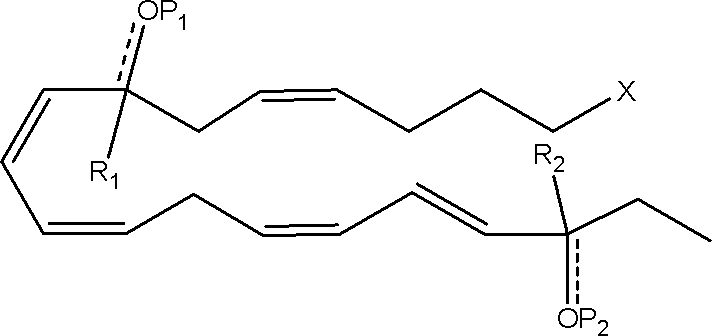


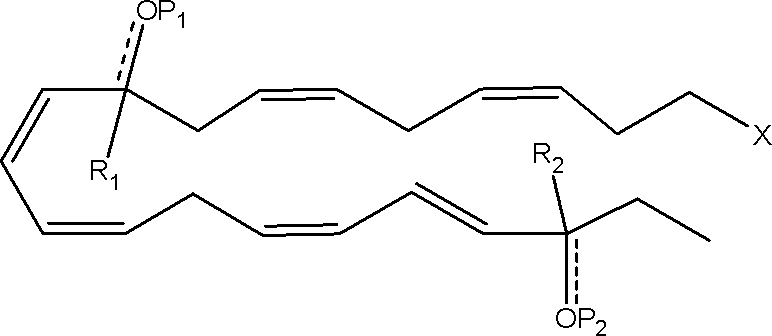
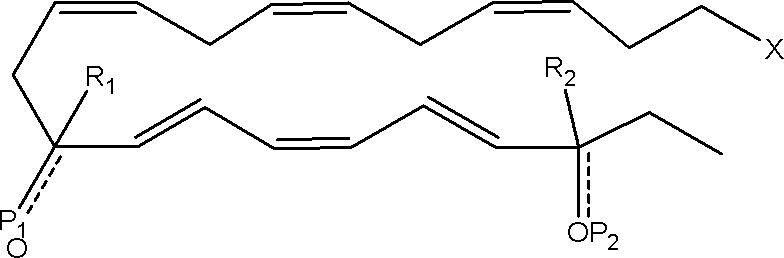
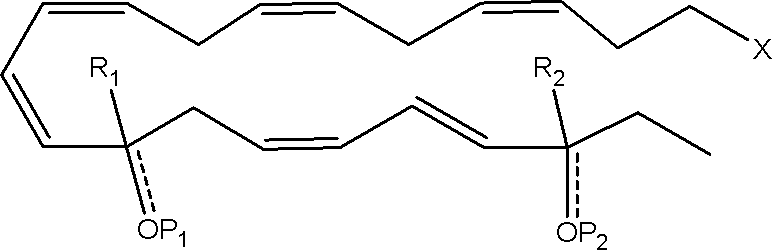
19,20-ジヒドロキシドコサヘキサエン酸(19,20-diHDoHE)類
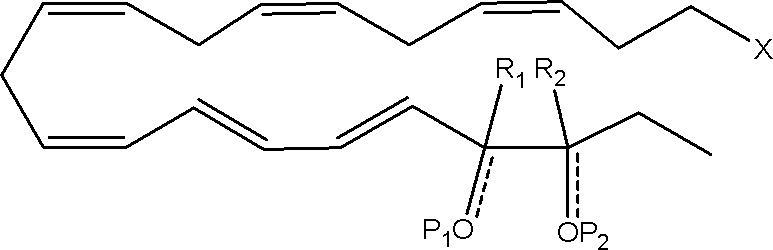
ここで、
P1およびP2は、各々独立して、


R1およびR2は、各々独立して、水素原子、ハロゲン原子、置換または非置換の、分枝状または非分枝状アルキル基、置換または非置換のアリール基、置換または非置換の、分枝状または非分枝状アルキルアリール基またはその組み合わせであり;
Xは、-C(O)OR3、-C(O)NR4R5、-C(O)H、-C(NH)NR4R5、-C(S)H、-C(S)OR3、-C(S)NR4R5、-CNであり;
R3は、水素、保護基、置換もしくは非置換のアルキル、置換もしくは非置換のアルケニル、置換もしくは非置換のアルキニル、置換もしくは非置換のアリール、置換もしくは非置換のヘテロアリール、置換もしくは非置換のシクロアルキル、置換もしくは非置換のシクロアルケニル、置換もしくは非置換のヘテロサイクルまたは式:-NRaRb(式中、RaおよびRbは各々独立して、水素、置換もしくは非置換のアルキル、置換もしくは非置換のアルケニル、置換もしくは非置換のアルキニル、置換もしくは非置換のアリール、置換もしくは非置換のヘテロアリール、置換もしくは非置換のシクロアルキル、置換もしくは非置換のシクロアルケニル、置換もしくは非置換のヘテロサイクルであるか、またはRaとRbは隣接する窒素原子と一緒になって、置換もしくは非置換の含窒素ヘテロ環を形成していてもよい。)であり;
R4およびR5は、各々独立して、水素、置換もしくは非置換のアルキル、置換もしくは非置換のアルケニル、置換もしくは非置換のアルキニル、置換もしくは非置換のアリール、置換もしくは非置換のヘテロアリール、置換もしくは非置換のシクロアルキル、置換もしくは非置換のシクロアルケニル、置換もしくは非置換のヘテロサイクルであるか、またはR4とR5は隣接する窒素原子と一緒になって、置換もしくは非置換の含窒素ヘテロ環を形成していてもよく;
そして、化合物の二重結合配置は各々独立してシスまたはトランスのいずれかであり得る、
化合物または該化合物の薬学的に受容可能な塩もしくは溶媒和物。
(2)項目1に記載の化合物または該化合物の薬学的に受容可能な塩もしくは溶媒和物であって、以下
8,18-ジヒドロキシエイコサペンタエン酸(8,18-diHEPE)
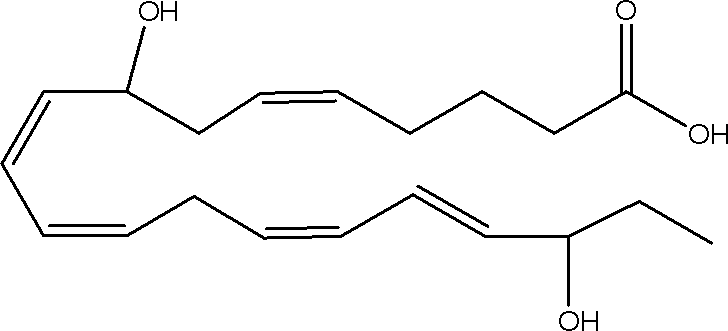

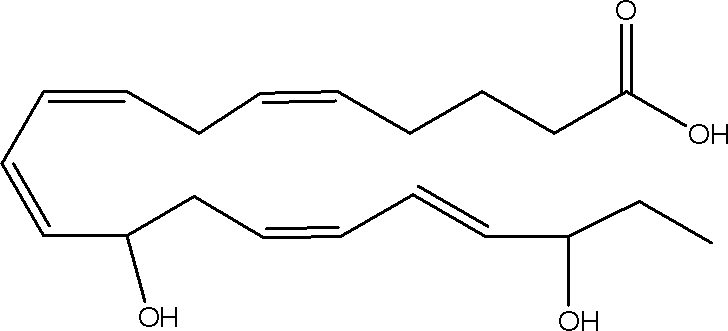
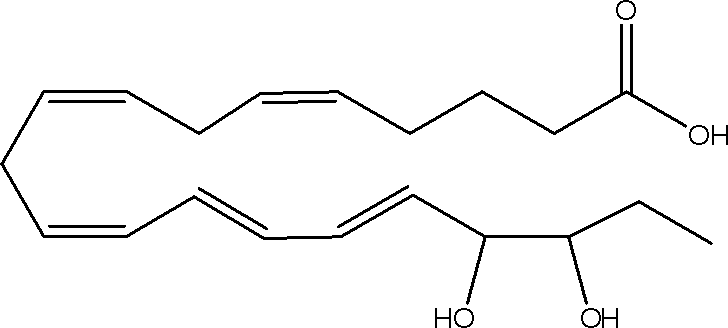
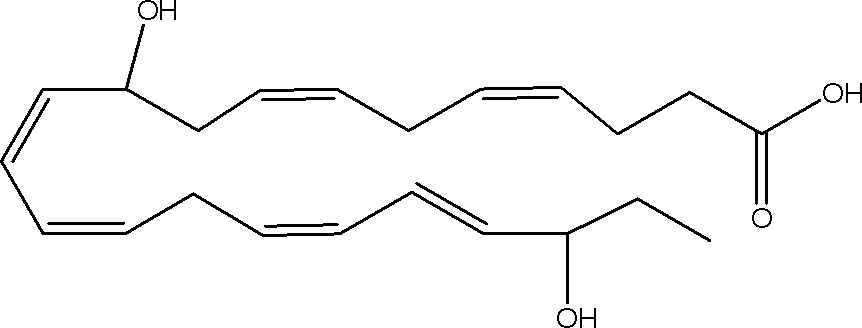
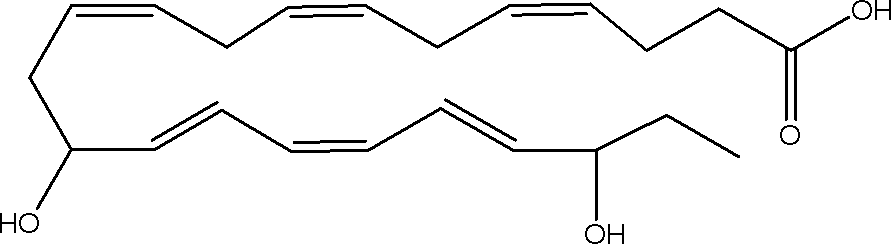
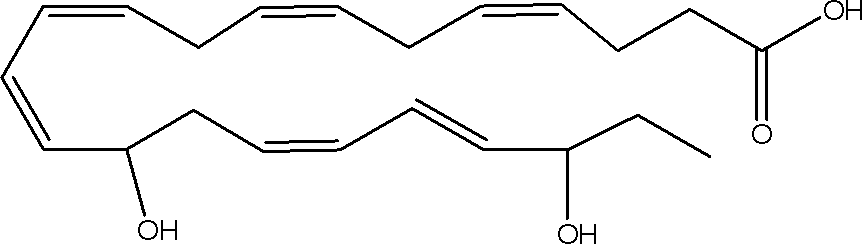
19,20-ジヒドロキシドコサヘキサエン酸(19,20-diHDoHE)

(3)項目1または2に記載の化合物または該化合物の薬学的に受容可能な塩もしくは溶媒和物を含む、好中球抑制剤。
(4)項目1または2に記載の化合物または該化合物の薬学的に受容可能な塩もしくは溶媒和物を含む医薬。
(5)前記医薬は、肺切迫症候群、成人呼吸窮迫症候群および慢性閉塞性肺疾患(COPD)から選択される肺疾患;虚血性心疾患、虚血性腎疾患、虚血性脳疾患および虚血性肝疾患から選択される虚血性疾患;炎症性疾患;びらん性胃炎・胃潰瘍・十二指腸潰瘍・気管支喘息、潰瘍性大腸炎、動脈硬化症、クローン病、悪性腫瘍、卵巣嚢腫、卵管炎、子宮筋腫、子宮内膜症、自然流産、妊娠中毒症、不妊症および月経困難症から選択されるストレス性疾患から選択される好中球の抑制により改善される疾患、障害または状態を処置または予防するためのものである、項目4に記載の医薬。
(6)項目1または2に記載の化合物または該化合物の薬学的に受容可能な塩もしくは溶媒和物を製造する方法であって、
A)エイコサペンタエン酸(EPA)、ドコサヘキサエン酸(DHA)、18-ヒドロキシルエイコサペンタエン酸(HEPE)または20-ヒドロキシルドコサヘキサエン酸(HDoHE)に8-リポキシゲナーゼ(8-LOX)、12-リポキシゲナーゼ(12-LOX)、12/15-リポキシゲナーゼ(12/15-LOX)、ダイズリポキシゲナーゼ(sLOX)および好酸球もしくはその抽出物からなる群より選択される少なくとも1つを接触させて酵素代謝産物を得る工程;および
B)必要に応じて該酵素代謝産物を還元または酸化し、必要に応じて置換基を導入し、必要に応じて目的とする該化合物または該化合物の薬学的に受容可能な塩もしくは溶媒和物を分離もしくは精製する工程を包含する、方法。
(7)項目1または2に記載の化合物または該化合物の薬学的に受容可能な塩もしくは溶媒和物を製造する方法であって、
A)エイコサペンタエン酸(EPA)、ドコサヘキサエン酸(DHA)、18-ヒドロキシルエイコサペンタエン酸(HEPE)または20-ヒドロキシルドコサヘキサエン酸(HDoHE)に8-リポキシゲナーゼ(8-LOX)、12-リポキシゲナーゼ(12-LOX)、12/15-リポキシゲナーゼ(12/15-LOX)、ダイズリポキシゲナーゼ(sLOX)および好酸球もしくはその抽出物からなる群より選択される少なくとも1つを接触させて酵素代謝産物を得る工程;
B)A)工程で得られた前記酵素代謝産物を、精製後または精製しないで8-リポキシゲナーゼ(8-LOX)、12-リポキシゲナーゼ(12-LOX)、12/15-リポキシゲナーゼ(12/15-LOX)、ダイズリポキシゲナーゼ(sLOX)および好酸球もしくはその抽出物からなる群より選択される少なくとも1つを接触させて二次酵素代謝産物を得る工程;ならびに
C)必要に応じて該二次酵素代謝産物を還元または酸化し、必要に応じて置換基を導入し、必要に応じて目的とする該化合物または該化合物の薬学的に受容可能な塩もしくは溶媒和物を分離もしくは精製する工程を包含する、方法。
(8)必要に応じて前記B)工程およびC)工程を繰り返す工程をさらに包含する、項目7の方法。
(9)炎症性疾患を処置または予防する方法であって、該処置または予防が必要な被験体に項目1または2に記載の化合物または該化合物の薬学的に受容可能な塩もしくは溶媒和物を投与する工程を包含する、方法。
(10)項目1または2に記載の化合物または該化合物の薬学的に受容可能な塩もしくは溶媒和物の、医薬品を製造するための使用。
(11)項目1または2に記載の化合物または該化合物の薬学的に受容可能な塩もしくは溶媒和物の、好中球が関連する疾患、障害または状態を処置または予防するための医薬品を製造するための使用。
(12)項目1または2に記載の化合物またはPUFA代謝物を分析する方法であって、以下の液体クロマトグラフィー条件
A液:水/酢酸=100/0.1、およびB液:アセトニトリル/メタノール=4/1を用いた溶媒系として用い、流速:0~30分→50μL/分、30~33分→80μL/分、33~45分→100μL/分を用い、勾配として図1Bに記載のものまたはその改変系を使用し、図1Cに記載のパラメータを用いることを特徴とする、
方法。
(13)A)エイコサペンタエン酸(EPA)、ドコサヘキサエン酸(DHA)、18-ヒドロキシルエイコサペンタエン酸(HEPE)または20-ヒドロキシルドコサヘキサエン酸(HDoHE)に8-リポキシゲナーゼ(8-LOX)、12-リポキシゲナーゼ(12-LOX)、12/15-リポキシゲナーゼ(12/15-LOX)、ダイズリポキシゲナーゼ(sLOX)および好酸球もしくはその抽出物からなる群より選択される少なくとも1つを接触させて酵素代謝産物を得る工程;および
B)必要に応じて該酵素代謝産物を還元または酸化し、必要に応じて置換基を導入し、必要に応じて目的とする該化合物または該化合物の薬学的に受容可能な塩もしくは溶媒和物を分離もしくは精製する工程を包含する、方法によって生産される生成物であって、
但し、レゾルビンE1、レゾルビンE2およびプロテクチンD1を除く、生成物。
本明細書において、必要に応じて、以下の略語を用いる。
AA:アラキドン酸;arachidonic acid
CCR:ケモカインレセプター;chemokine (C-C motif) receptor
COX:シクロオキシゲナーゼ;cyclooxygenase
DHA:ドコサヘキサエン酸;docosahexaenoic acid
DPA:ドコサペンタエン酸;docosapentaenoic acid
EET:エポキシエイコサトリエン酸;epoxy eicosatrienoic acid
Ep:エポキシ;epoxy
EpDPE:エポキシドコサペンタエン酸;epoxy docosapentaenoic acid
EpETE:エポキシエイコサテトラエン酸;epoxy eicosatetraenoic acid
EPA:エイコサペンタエン酸;eicosapentaenoic acid
ETE:エイコサテトラエン酸;eicosatetraenoic acid
HBSS:ハンクス平衡化塩溶液;hanks’ balanced salt solution
HDoHE:ヒドロキシドコサヘキサエン酸;hydroxy docosahexaenoic acid
HEPE:ヒドロキシエイコサペンタエン酸;hydroxy eicosapentaenoic acid
HETE:ヒドロキシエイコサテトラエン酸;hydroxy eicosatetraenoic acid
HpDoHE:ヒドロペルオキシドコサヘキサエン酸;hydroperoxy docosapentanoic acid
HpEPE:ヒドロペルオキシエイコサペンタエン酸;hydroperoxy eicosapentanoic acid
LC:液体クロマトグラフィー;liquid chromatography
LOX:リポキシゲナーゼ;lipoxygenase
LT:ロイコトリエン;leukotriene
LX:リポキシン;lipoxin
MRM:マルチプルリアクションモニタリング;multiple reaction monitoring
N:ノルマル・規定;normal
PBS:リン酸緩衝化生理食塩水;phosphate buffered saline
PEC:腹腔浸出細胞;peritoneal exudate cells
PD1:プロテクチンD1;protectin D1
PG:プロスタグランジン;prostaglandin
ppt.:ペレット;pellet
PUFA:多不飽和脂肪酸;polyunsaturated fatty acid
Rv:レゾルビン;resolvin
sLOX:ダイズリポキシゲナーゼ;soybean lipoxygenase
Tg:トランスジェニック;transgenic
UPLC:超高速液体クロマトグラフィー;ultra performance liquid chromatography
(用語)
以下に本明細書において用いられる各用語の意味を説明する。各用語は本明細書中、統一した意味で使用し、単独で用いられる場合も、または他の用語と組み合わされて用いられる場合も、同一の意味で用いられる。
本発明の好ましい実施形態を、以下に掲げる。以下に提供される実施形態は、本発明のよりよい理解のために提供されるものであり、本発明の範囲は以下の記載に限定されるべきでない。従って、当業者は、本明細書中の記載を参酌して、本発明の範囲内で適宜改変を行うことができることは明らかである。
1つの局面において、本発明は、以下の化合物を提供する。
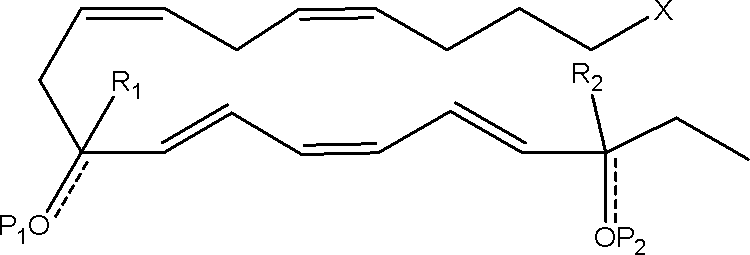


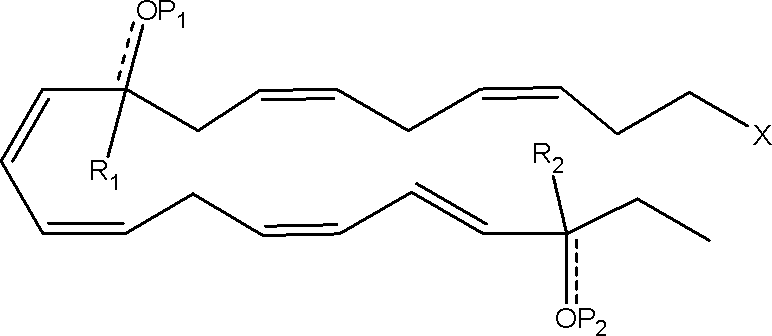
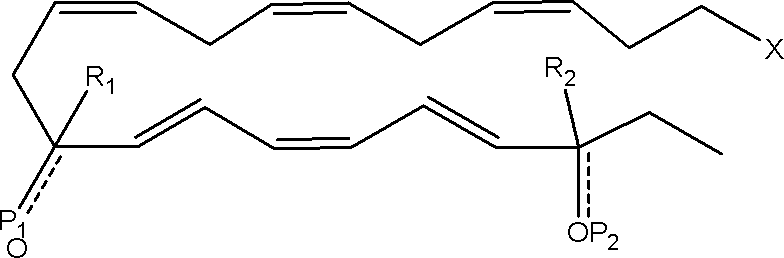
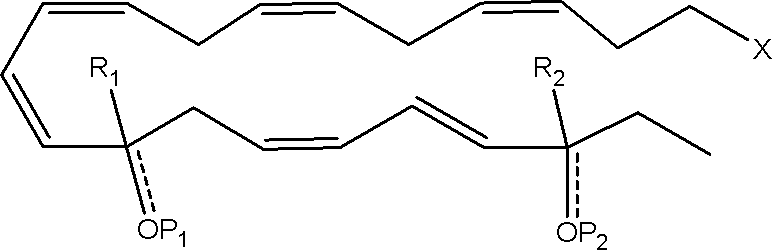
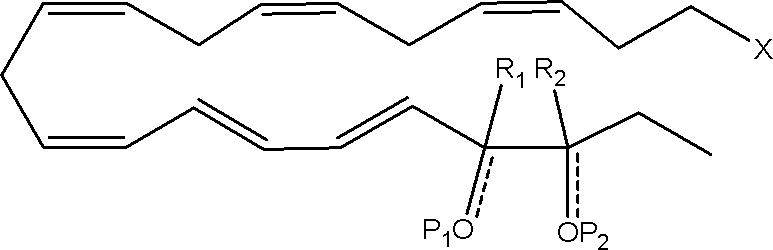
ここで、
P1およびP2は、各々独立して、


R1およびR2は、各々独立して、水素原子、ハロゲン原子、置換または非置換の、分枝状または非分枝状アルキル基、置換または非置換のアリール基、置換または非置換の、分枝状または非分枝状アルキルアリール基またはその組み合わせであり;
Xは、-C(O)OR3、-C(O)NR4R5、-C(O)H、-C(NH)NR4R5、-C(S)H、-C(S)OR3、-C(S)NR4R5、-CNであり;
R3は、水素、保護基、置換もしくは非置換のアルキル、置換もしくは非置換のアルケニル、置換もしくは非置換のアルキニル、置換もしくは非置換のアリール、置換もしくは非置換のヘテロアリール、置換もしくは非置換のシクロアルキル、置換もしくは非置換のシクロアルケニル、置換もしくは非置換のヘテロサイクルまたは式:-NRaRb(式中、RaおよびRbは各々独立して、水素、置換もしくは非置換のアルキル、置換もしくは非置換のアルケニル、置換もしくは非置換のアルキニル、置換もしくは非置換のアリール、置換もしくは非置換のヘテロアリール、置換もしくは非置換のシクロアルキル、置換もしくは非置換のシクロアルケニル、置換もしくは非置換のヘテロサイクルであるか、またはRaとRbは隣接する窒素原子と一緒になって、置換もしくは非置換の含窒素ヘテロ環を形成していてもよい。)であり;R4およびR5は、各々独立して、水素、置換もしくは非置換のアルキル、置換もしくは非置換のアルケニル、置換もしくは非置換のアルキニル、置換もしくは非置換のアリール、置換もしくは非置換のヘテロアリール、置換もしくは非置換のシクロアルキル、置換もしくは非置換のシクロアルケニル、置換もしくは非置換のヘテロサイクルであるか、またはR4とR5は隣接する窒素原子と一緒になって、置換もしくは非置換の含窒素ヘテロ環を形成していてもよく;そして、化合物の二重結合配置は各々独立してシスまたはトランスのいずれかであり得る、化合物または該化合物の薬学的に受容可能な塩もしくは溶媒和物を提供する。
1つの局面において、本発明は、化学式:


1つの局面において、本発明は、化学式:
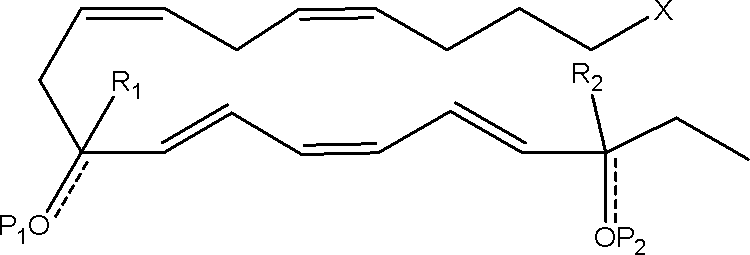

1つの局面において、本発明は、化学式:
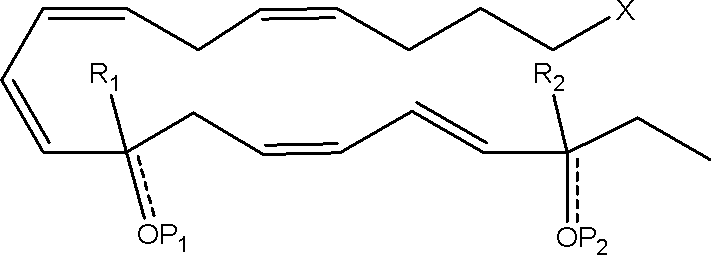

1つの局面において、本発明は、化学式:


1つの局面において、本発明は、化学式:
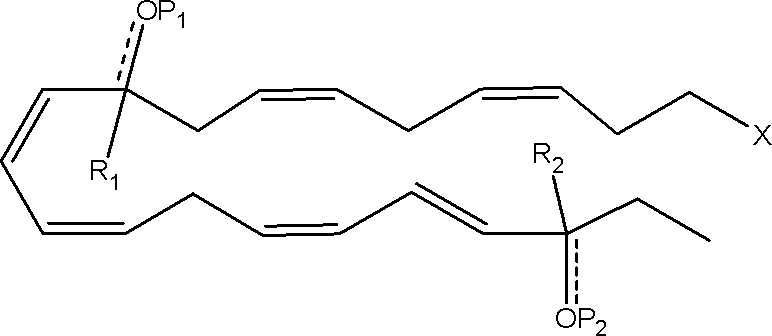

1つの局面において、本発明は、化学式:
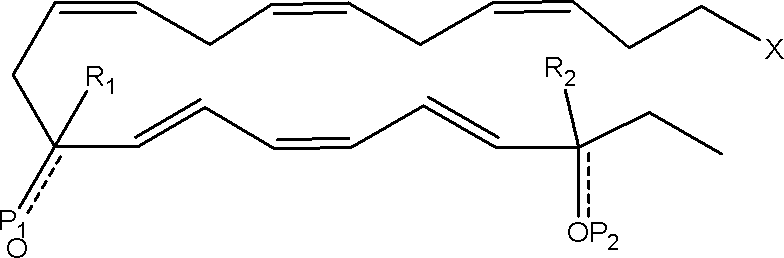

1つの局面において、本発明は、化学式:
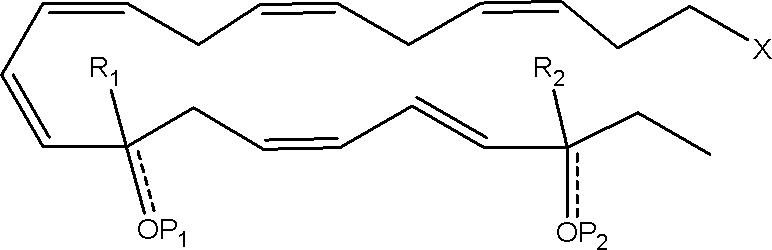

1つの局面において、本発明は、化学式:
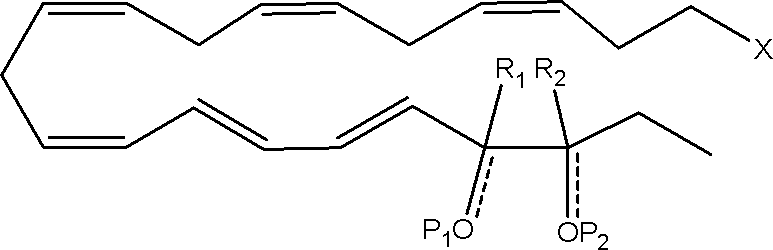

別の局面では、本発明は、以下のように表現することができる。
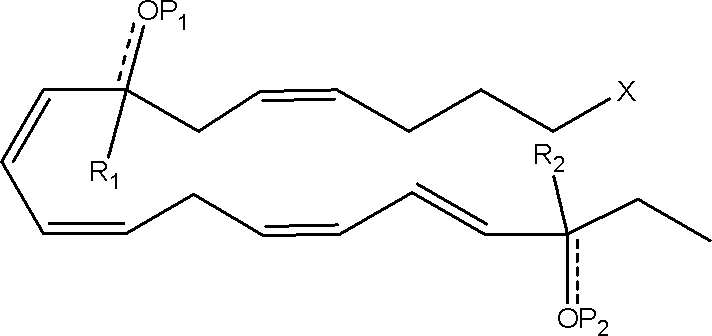

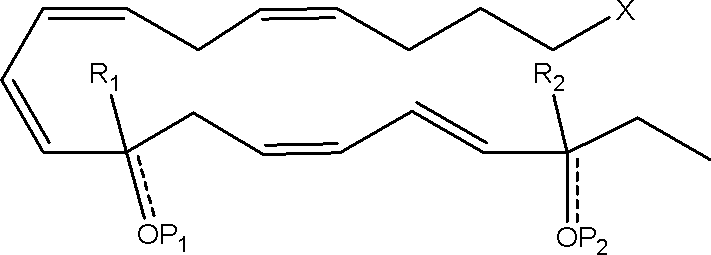


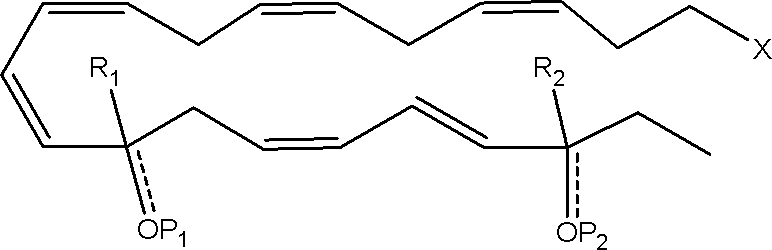
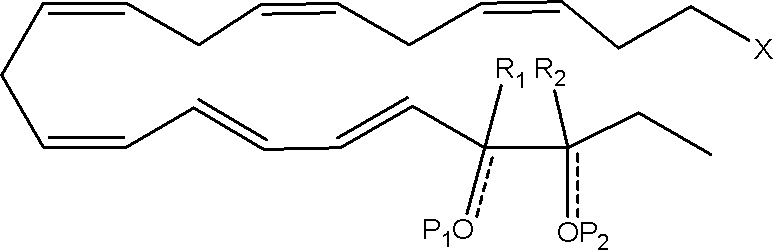
式中、
P1およびP2は、各々独立して、


R1およびR2は、各々独立して、水素原子、ハロゲン原子、置換または非置換の、分枝状または非分枝状アルキル基、置換または非置換のアリール基、置換または非置換の、分枝状または非分枝状アルキルアリール基またはその組み合わせであり;
Xは、-C(O)ORd、-C(O)NRcRc、-C(O)H、-C(NH)NRcRc、-C(S)H、-C(S)ORd、-C(S)NRcRc、-CNであり;
各Raは、存在する場合、水素、(C1~C6)アルキル、(C3~C8)シクロアルキル、シクロヘキシル、(C4~C11)シクロアルキルアルキル、(C5~C10)アリール、フェニル、(C6~C16)アリールアルキル、ベンジル、2~6員ヘテロアルキル、3~8員シクロヘテロアルキル、モルホリニル、ピペラジニル、ホモピペラジニル、ピペリジニル、4~11員シクロヘテロアルキルアルキル、5~10員ヘテロアリールおよび6~16員ヘテロアリールアルキルからなる基より独立して選択され;
各Rbは、存在する場合、=O、-ORd、(C1~C3)ハロアルキルオキシ、-OCF3、=S、-SRd、=NRd、=NORd、-NRcRc、ハロゲン、-CF3、-CN、-NC、-OCN、-SCN、-NO、-NO2、=N2、-N3、-S(O)Rd、-S(O)2Rd、-S(O)2ORd、-S(O)NRcRc、-S(O)2NRcRc、-OS(O)Rd、-OS(O)2Rd、-OS(O)2ORd、-OS(O)2NRcRc、-C(O)Rd、-C(O)ORd、-C(O)NRcRc、-C(NH)NRcRc、-C(NRa)NRcRc、-C(NOH)Ra、-C(NOH)NRcRc、-OC(O)Rd、-OC(O)ORd、-OC(O)NRcRc、-OC(NH)NRcRc、-OC(NRa)NRcRc、-[NHC(O)]nRd、-[NRaC(O)]nRd、-[NHC(O)]nORd、-[NRaC(O)]nORd、-[NHC(O)]nNRcRc、-[NRaC(O)]nNRcRc、-[NHC(NH)]nNRcRcおよび-[NRaC(NRa)]nNRcRcからなる基より独立して選択される適切な基であり;
各Rcは、存在する場合、独立して保護基もしくはRaであり、または、代替的には、各Rcはそれが結合する窒素原子と一緒になって5~8員シクロヘテロアルキルもしくはヘテロアリールを形成し、これらは1つ以上の同じもしくは異なるさらなるヘテロ原子を任意に含んでもよく、そして1つ以上の同じもしくは異なるRa基もしくは適切なRb基で任意に置換されてもよく;
各nは、存在する場合、独立して、0~3の整数であり;
各Rdは、存在する場合、独立して、保護基またはRaである。
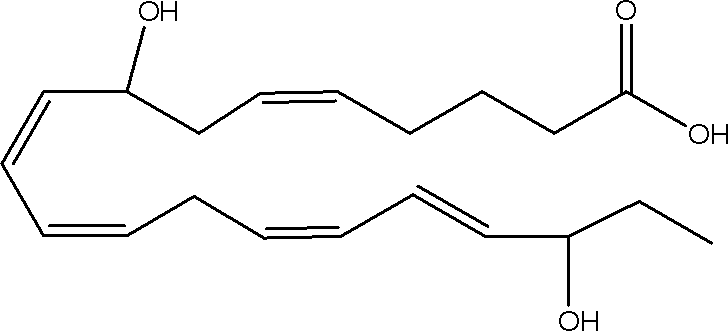
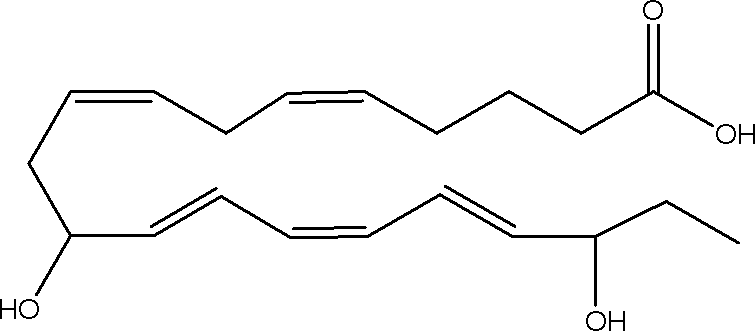
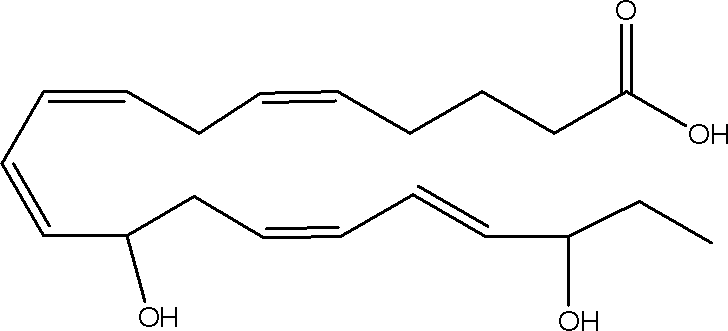
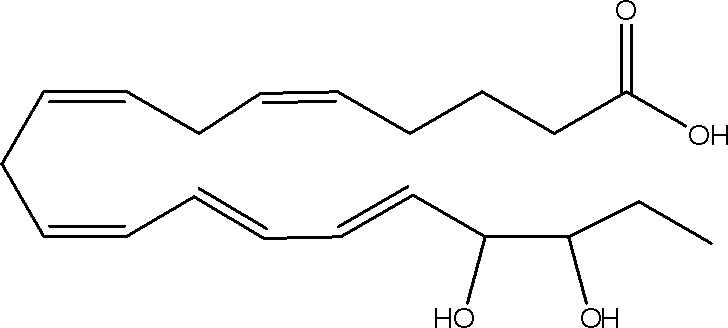
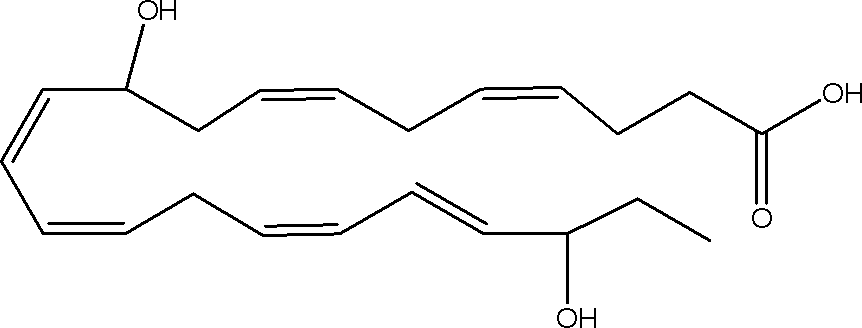
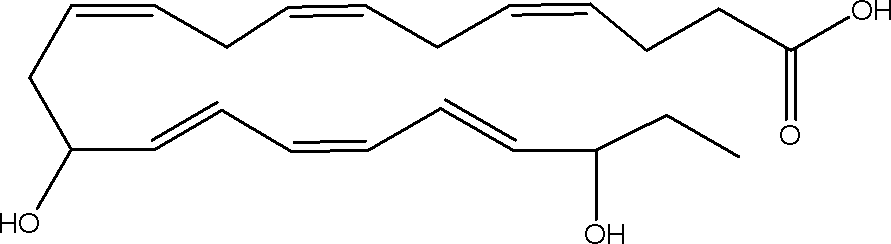

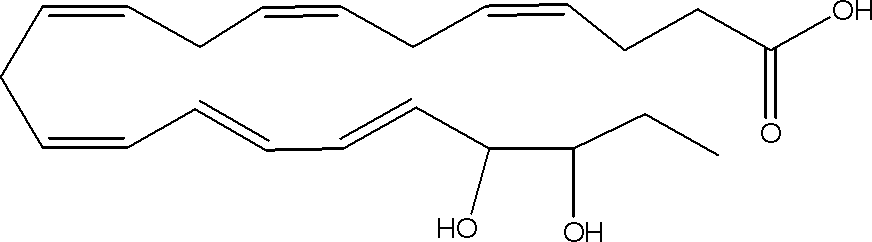
本発明の化合物は、一般的な有機化学の手法により合成されるか、あるいは、前駆体として比較的豊富に存在する18-HEPEまたは20-HDoHE等に12/15-LOX等のリポキシゲナーゼ等の酵素を作用させることによって生産することができる。
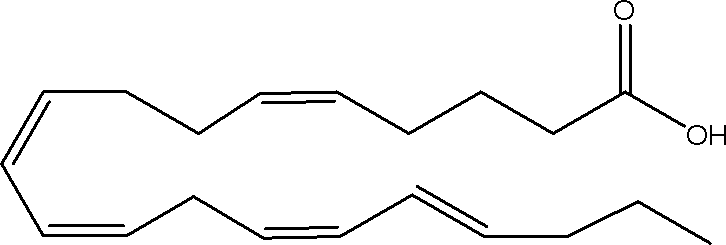
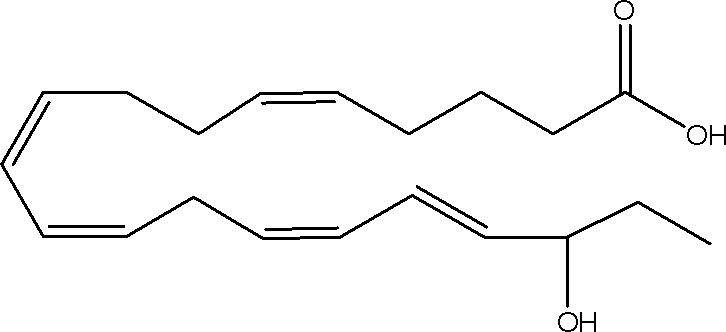



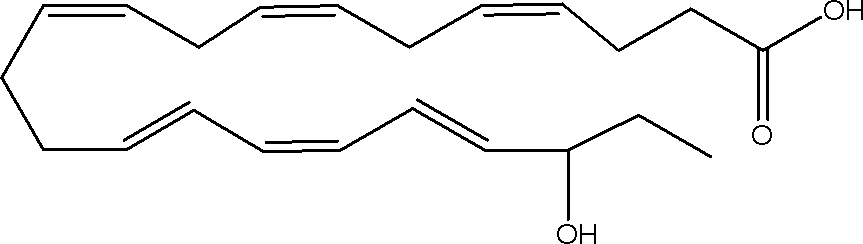
1つの局面において、本発明は、本発明の化合物または該化合物の薬学的に受容可能な塩もしくは溶媒和物を含む、好中球抑制剤を提供する。
1つの局面において、本発明は、本発明を分析する方法を提供する。抗炎症のための治療的基礎を開発するための指標としての有効なn-3状態レベルを評価するための治療マーカーとして、ヒト体液(血液、尿、母乳)、生検材料などでこれらの化合物をアッセイするために向けることができる。これには、LC-MS-MSおよびGC-MS特性が含まれ、これはまた、これらの新規な生成物をモニターするELISAアッセイを取り扱うためにはるかに容易な開発をもたらし得る。
以下の液体クロマトグラフィー条件
A液:水/酢酸=100/0.1、およびB液:アセトニトリル/メタノール=4/1を用いた溶媒系として用い、流速:0~30分→50μL/分、30~33分→80μL/分、33~45分→100μL/分、および図1Bに記載のグラジエントを用い、図1Cに記載のパラメータを用いることを特徴とする、マルチプルリアクションモニタリング(multiple reaction monitoring)を用いる方法を提供する。
本明細書において用いられる分子生物学的手法、生化学的手法、微生物学的手法は、当該分野において周知であり慣用されるものであり、例えば、Sambrook J.et al.(1989).Molecular Cloning:A Laboratory Manual,Cold Spring Harborおよびその3rd Ed.(2001);Ausubel,F.M.(1987).Current Protocols in Molecular Biology,Greene Pub.Associates and Wiley-Interscience;Ausubel,F.M.(1989).Short Protocols in Molecular Biology:A Compendium of Methods from Current Protocols in Molecular Biology,Greene Pub.Associates and Wiley-Interscience;Innis,M.A.(1990).PCR Protocols:A Guide to Methods and Applications,Academic Press;Ausubel,F.M.(1992).Short Protocols in Molecular Biology:A Compendium of Methods from Current Protocols in Molecular Biology,Greene Pub.Associates;Ausubel,F.M.(1995).Short Protocols in Molecular Biology:A Compendium of Methods from Current Protocols in Molecular Biology,Greene Pub.Associates;Innis,M.A.et al.(1995).PCR Strategies,Academic Press;Ausubel,F.M.(1999).Short Protocols in Molecular Biology:A Compendium of Methods from Current Protocols in Molecular Biology,Wiley,and annual updates;Sninsky,J.J.et al.(1999).PCR Applications:Protocols for Functional Genomics,Academic Press、別冊実験医学「遺伝子導入&発現解析実験法」羊土社、1997などに記載されており、これらは本明細書において関連する部分(全部であり得る)が参考として援用される。
本実施例では、新規化合物の分析をも可能にするために、まず、PUFA代謝物を高感度に、かつ多種類のものを一斉に定量分析できる系を確立することを試みた。本実施例では、高速液体クロマトグラフィー-タンデムマススペクトロメトリー(UPLC-MS/MS)を用いたマルチプルリアクションモニタリング(Multiple Reaction Monitoring;MRM)による多価不飽和脂肪酸(PUFA)代謝物の一斉定量分析系を確立した。
ヘキサン:和光純薬工業
イソプロパノール:和光純薬工業
酢酸:和光純薬工業。
PUFA代謝物のスタンダード(特に記載の無いものは全てCaymanより購入した)
PGE2、20-ヒドロキシ-PGE2、PGD2、PGF2α、6-ケト-PGF1α、15-デオキシ-Δ12,14-PGJ2、LxA4、LTB4、20-ヒドロキシ-LTB4、LTC4、LTD4、TxB2、5-HETE、5,6-EET、8-HETE、8,9-EET、12-HETE、11,12-EET、15-HETE、14,15-EET、16-HETE、17-HETE、20-HETE、5,15-diHETE、8,15-diHETE、14,15-diHETE、17,18-diHETE、5-オキソ-ETE、15-オキソ-ETE、LTB5:Biomol、RvE2(本学部有機反応化学教室より頂いた)、PGE3、PGD3、RvE1、5-HEPE、8-HEPE、12-HEPE、15-HEPE、14,15-EpETE、18-HEPE、17,18-EpETE、11,18-diHEPE:18-HEPEを用いて合成(本明細書参照)、17,18-diHEPE:18-HEPEを用いて合成(本明細書参照)、RvD1、4-HDoHE、7-HDoHE、10-HDoHE、13-HDoHE、14-HDoHE、17-HDoHE、16,17-EpDPE、20-HDoHE、19,20-EpDPE、7,17-diHDoHE:DHAを用いて合成(本明細書参照)、10,17-diHDoHE:DHAを用いて合成(本明細書参照))、アラキドン酸:SIGMA、DHA:SIGMA、EPA:SIGMA、DPA(ω6)、DPA(ω3)。
酢酸:和光純薬工業
メタノール:和光純薬工業
アセトニトリル:和光純薬工業。
(スタンダード化合物のMS/MS測定)
スタンダードとして用意した化合物をそれぞれ約1μMとなるようにメタノール/milliQ/酢酸=90/10/0.1の溶液で調整し、約150μlを10μL/分で送液しながら、4000Q-TRAP(アプライドバイオシステム)でMS/MSを測定した。
それぞれ測定したMS/MS値から、その化合物の構造に特徴的なMS/MS値を選び、コーン電圧(Cone Voltage)と衝突エネルギー(Collision Energy)を振って測定を行うことで、そのMS/MS値が一番感度良く検出されるような条件を決定した。
ポンプはUPLC(Waters)、カラムはAcquity UPLC BEH C18 1.7μm(1.0×150mm)を用いた。溶媒はA液:milliQ/酢酸=100/0.1、およびB液:アセトニトリル/メタノール=4/1を基本とし、時間ごとに比率、流速を調節し、スタンダード化合物の混合物(mixture)が30分以内で分離度も良く溶出する条件を決定した。最終的なLC条件は以下の通りである。
流速 : 0~30分→50μL/分
30~33分→80μL/分
33~45分→100μL/分。
スタンダード化合物を用いて5pg/10μL~1ng/10μLまでの希釈系列を作製し、確立したLC条件、およびMRMプログラムで分析し、検量線を作製した。ピークの高さをシグナル強度とした。
(MRMによるPUFA代謝物の一斉定量分析系の確立)
(PUFA代謝物の一斉分析系の確立)
スタンダード化合物を用いて、それぞれの化合物に特異的なMRMチャンネルを作製した。また、全く新規の構造の代謝物など、スタンダード化合物が存在しない場合は、構造から推定されるMS/MS値、および類似の構造の代謝物のコーン電圧および衝突エネルギーを参考に、仮想的にチャンネルを作製した。そういった作業を積み重ねていった結果、現在までに100種類以上の代謝物の一斉分析系を確立した(図1C)。酵素的に生成すると考えられているPUFA代謝物だけでなく、これまでに報告の無い新規代謝物についても30種類以上をMRMプログラムに登録した。また、これらの代謝物のほとんどはPUFA酸化物のポジションアイソマーであり、脱水や脱炭酸に由来する共通のMS/MS値を持つ。そういったMS/MS値を子マス値として用いることで、PUFAのモノヒドロキシドやジヒドロキシド、トリヒドロキシドなどを網羅的に検出するMRMチャンネルも作製した。
次に、PUFA代謝物がうまく分離する条件を検討した。PUFA代謝物(酸化物)は、基本的にはPUFAの炭素鎖の様々な位置に酸素(水酸基)の付加したものであり、構造的に非常に似ているため、分離が難しい。アセトニトリル、メタノール、水を様々な両比で混合し、また流速の最適化も行ったところ、45分でPUFA代謝物を非常によく分離させる系を確立した。HEPEスタンダード混合物(mixture)をLCで分離し、MRM分析を行い、それぞれの代謝物に特異的なチャンネルのクロマトグラムを示している。例えば、18-HEPEと17,18-EpETEは構造特異的なMS/MSのフラグメントが同じなため、一つのチャンネルで両方とも検出されるが、高分離能のLCの系を確立したことにより、それぞれを保持時間(retention time)の違いによって区別することができた。
本実施例で確立したMRM測定メソッドを用いて、スタンダード化合物の混合物を、量をふって測定した。その結果、5pg~1ngの範囲で精度の高い検量線を引くことができた。
本実施例では、18-シリーズEPA代謝パスウェイの解析を行った。そこで、生体内にいままで見出されたことがない新規化合物が存在することを見出した。
C57BL/6Jマウス 8-10週齢、雄性:日本クレア
12/15-LOX-/-マウス 8-10週齢、雄性:The Jackson Laboratory
zymosanA:和光純薬工業
リン酸緩衝化生理食塩水(PBS):137mM 塩化ナトリウム(NaCl),2.7mM 塩化カリウム(KCl),10mM リン酸水素二ナトリウム(Na2HPO4),2mM リン酸二水素カリウム(KH2PO4);適宜調製した。
ハンクス平衡塩溶液(HBSS)(Ca2+,Mg2+含有):Gibco
A23187:SIGMA:ジメチルスルホキシド(DMSO)(和光純薬工業)に溶解し、2mMとして-20℃保存した。
18-HEPE:Cayman。
zymosanAを1mg/mLで生理食塩水に懸濁し、37℃で30分間加温した。それをマウスに1mL腹腔内投与した。4時間後および48時間後にマウスを屠殺し、腹腔にPBSを5mL注入した。腹膜を100回揉んだ後、腹腔内液を全量チューブに回収した。細胞の計数後、1200rpm、4℃で5分間遠心し、細胞(ppt.)にHBSSを加え、900μLを50mLチューブにうつした(5×106細胞/チューブ)。細胞の入ったチューブを37℃でプレインキュベーションし、その間に18-HEPEおよびカルシウムイオノフォアA23187の調製を行った。18-HEPEは、まず1.5mLチューブにとり、窒素により溶媒を飛ばし、完全に乾固させた。そこにHBSSを加え、超音波処理して溶解させた(200μM)。A23187は、HBSSで希釈して40μMとした。以上調整した18-HEPEおよびA23187を50μLずつ細胞の入ったチューブに添加し、フタを少しあけて37℃で30分間インキュベーションを行った(18-HEPEは10μM、A23187は2μM 最終濃度)。30分後、氷冷メタノールを2mL加え、ボルテックス処理し、1時間以上、-20℃で静置した。固相抽出により脂肪酸代謝物の画分を調整し、MRMによる分析を行った。
(1.炎症の初期および後期のPECとのインキュベーション)
18-HEPEをPECとインキュベーションし、MRMによる分析を行った。その結果、抗炎症性メディエーターとして知られるRvE1やRvE2の他、いくつかのMRMチャンネルで18-HEPE依存的なピークが認められた(図2A)。これらのピークは、そのMRMチャンネル、および18-HEPE依存的に認められた点から、それぞれ8,18-diHEPE、11,18-diHEPE、12,18-diHEPE、17,18-diHEPEであると考えられる。いくつかのチャンネルについては複数のピークが認められるが、これは二重結合の配位の違い(cis,trans)や、水酸基の立体配置(S体、R体)の違いによるものではないかと考えられる。
zymosan A(和光純薬工業)を1mg/mLの濃度で生理食塩水に懸濁し、37℃で30分間加温した。このzymosan A懸濁液(1mL)を、C57BL/6Jマウス(野生型;8~10週齢、メス;日本SLC)に腹腔内投与した。48時間後、腹腔内に滲出してきた細胞を回収し、細胞数をカウントした。1200rpm、4℃で5分間遠心分離し、上清(滲出液)を-20℃で保存した。沈殿物(細胞)をPBSに懸濁し、70μmおよび38μmのメッシュに通して、FACS Aria(BD Biosciences)で好酸球ポピュレーションの選別を行った。
18-HEPE(Cayman)または20-HDoHE(Cayman)を1.5mLチューブにとって、溶媒を窒素で飛ばし、HBSS(Ca2+,Mg2+含有;Gibco)に溶解させた(100μM)。また、DMSO(和光純薬)中2mMのカルシウムイオノフォアA23187(SIGMA)の溶液をHBSSで希釈した(20μM)。野生型マウスに由来する好酸球を1.25×10⁶細胞/mLとなるようにHBSSで希釈し、50mLチューブに入れた(5×105細胞/チューブ)。このチューブに、上で調製した18-HEPEまたは20-HDoHE(ともに最終濃度10μM)とA23187(最終濃度2μM)とを加え、37℃で30分間加温した。このチューブに、2倍容の氷冷メタノール(和光純薬工業)を加えてボルテックスし、-20℃で保存した。
サンプルがメタノールを10%以上含む場合は、milliQ水を加えてメタノール含量を10%v/v未満となるようにした。サンプルに1N塩酸(和光純薬工業)を加えて、pHを約3にした。次にLTB4-6,7,14,15-d4(Biomol)を1ng加えた。バキュームポンプ付きカラム立て(Waters)にSep-pak C18カートリッジ(500mg;Waters製)を装着し、メタノール 20mL、milliQ水 20mLの順に流してカラムの平衡化を行った。次にサンプルを流し、milliQ水 20mLで洗浄した。その後、ヘキサン(和光純薬工業)10mLを流して中性脂質を溶出させ、次にギ酸メチル(和光純薬工業)10mLを流して脂肪代謝物を溶出させ、この画分を回収した。窒素で溶媒を飛ばし、メタノールに溶解させた。
MRMはある化合物のMS値(Q1)および構造に特徴的なMS/MS値(Q3)の組み合わせから、その化合物を特異的に検出する測定手法である。本明細書において同定した18-HEPE由来の代謝物は、ネガティブイオンモードで測定した際のMS値は18-HEPEに一つ酸素が付加した333で全て等しいが、酸素の付加する位置により構造特異的なMS/MSの値は異なる。それぞれの代謝物を検出するチャンネル(Q1/Q3)を、RvE1=(349/195)、RvE2=(333/195)、8,18-diHEPE=(333/155)、11,18-diHEPE=(333/167)、12,18-diHEPE=(333/179)、17,18-diHEPE=(333/201)とした。また、DHA代謝物については、10,20-diHDoHE=(359/153)、13,20-diHDoHE=(359/193)、14,20-diHDoHE=(359/205)、19,20-diHDoHE=(359/227)とした。さらに、このMRMをLCを組み合わせてそれぞれのチャンネルのクロマトグラムを作製した。測定機器として4000Q-TRAP(アプライドバイオシステムズ)、ポンプにはUPLC(Waters)を用いた。サンプルは最終的にmilliQ水/メタノール=40/60の溶媒30μLに溶解し、うち10μLを測定に用いた。LCの条件は以下の通りであった:
(移動相の組成)
A液:milliQ水/酢酸=100/0.1
B液:アセトニトリル/メタノール=4/1
0~ 5分 A液27%;
5~15分 A液27%→70%;
15~25分 A液70%→80%;
25~35分 A液80%→100%;
35~45分 A液100%
・流速
0~30分 50μL/分;
30~33分 80μL/分;
33~45分 100μL/分
(カラム)
X bridge C18 5.0μm,4.6mm×100mm(Waters)。
本発明では、18-HEPEおよび20-HDoPE由来の新規代謝物に該当する新規化合物を合成することができることを実証した。これらは、鋭意検討した結果12/15-LOXまたはダイズLOX(sLOX)により生成することが見出された。そこで、これらの代謝物の活性を評価すべく、そのためにそれらの代謝物を、酵素反応を用いて合成することを試みた。本実施例では、マウスの12/15-LOXの代わりとして、汎用に供する目的でsLOXを用いて酵素反応を行った。また、生成した代謝物が生体の生成するものと一致するかを、スパイク実験により検証した。
(1.酵素反応によるDHAのジヒドロキシ体の作製)
ダイズリポキシゲナーゼ(sLOX)を用いた酵素反応
ホウ酸緩衝液(pH9.0):ホウ酸および塩化カリウム(いずれも和光純薬工業)をmilliQに溶解する。1Nの水酸化カリウム(和光純薬工業)溶液を加えてpHを9.0に設定し、その後milliQでホウ酸および塩化カリウムが50mMとなるようにメスアップした。
ダイズリポキシゲナーゼ(sLOX):SIGMA
テトラヒドロホウ酸ナトリウム:和光純薬工業
DHA:SIGMA:100mg/mLのメタノール(和光純薬工業)溶液として、-20℃保存した。
・Sep-pakC18Cartridge(500mg):Waters
・メタノール:和光純薬工業
・ギ酸メチル:和光純薬工業
・ヘキサン:和光純薬工業
塩酸:和光純薬工業:milliQで1Nとなるように希釈し、室温で保存した。
・pH試験紙:MACHEREY-NAGEL
100pg/μLとなるようにエタノール(和光純薬工業)に希釈し、-20℃で保存した。
・メタノール:和光純薬工業
・0.01%v/v酢酸:milliQ(純水)に、v/vで0.01%となるように酢酸(和光純薬工業)を加えた。
・本実施例で合成、精製した化合物
・18-HEPEと炎症後期(48時間後)のPECとのインキュベーションサンプル
(方法)
(a.酵素反応による合成)
18-HEPE(Cayman)をナスフラスコに300μgとり、窒素で溶媒を飛ばし、ここに、ホウ酸緩衝液(ホウ酸、塩化カリウムそれぞれ50mM、pH9.0)を9mL加えて溶解させた。ここに、ダイズリポキシゲナーゼ(SIGMA)を1mg加えて酵素反応を進行させ、その後NaBH4(和光純薬工業)を用いて還元反応を行った。その後、固相抽出により脂肪酸代謝物の画分を調製した。
前述のように調製した脂肪酸代謝物の画分の溶媒を窒素で飛ばし、HPLCの初期移動相(H2O/MeOH/酢酸=35/65/0.01)に溶解させた。これをHPLC(Agilent Technologies)にかけて、ピークをガラス小試験管に分取した。窒素で溶媒を飛ばして乾固させ、最終的にエタノール溶液として、-20℃で保存した。逆相HPLCの条件は以下の通りであった:
・移動相の組成
A液:メタノール
B液:milliQ水/酢酸=100/0.01
0~21分 A65%
21~35分 A100%
・カラム
X bridge C18 5.0μm,4.6mm×100mm(Waters)
・流速
0.7mL/分。
18-HEPEとsLOXを反応させ、逆相HPLCで精製を行ったところ、6本のピークが生成した(図3A)。そこで、この6本を全て分取し、MS/MSを測定したところ、ピーク1~4は11位に酸素が添加されたことで生じるフラグメントのマス値(167)が認められたこと、また吸光スペクトルを測定した結果、二重結合が3つ共役した(トリエン)ときに特徴的な270nm付近をλmaxとする三つ山のスペクトルが認められたことから、11,18-diHEPEであると考えられた(図3B)。また、ピーク5および6は17位に酸素が添加されたことで生じるフラグメントのマス値(201)が認められたこと、また同様にトリエンに特徴的なスペクトルが認められたことから、17,18-diHEPEであると考えられた(図3C)。それぞれ複数のピークが認められたが、これは、二重結合のシス、トランスに由来するか、基質の18-HEPEがラセミ体であるので、エナンチオマーに由来するものと考えられる。
本実施例では、実施例1で合成された化合物の腹膜炎モデルにおける生理活性の評価を行い、抗炎症活性があるか評価を行った。
(1.ザイモザン腹膜炎の誘導)
・マウスC57BL/6J 7週齢、雄性:日本クレア
・生理食塩水:大塚製薬
・zymosanA:和光純薬工業
・リン酸緩衝化生理食塩水(PBS)
(2.FACSの三色染め(CD11b,Gr-1,F4/80))
・抗マウスCD16/CD32(0.5mg/mL):BDBiosciences
・FITC抗マウスF4/80(0.5mg/mL):eBiosciences
・PE抗マウスLy-6G&Ly-6C(Gr-1)(0.2mg/mL):eBiosciences
・PerCP-Cy5.5抗マウスCD11b(Mac-1)(0.2mg/mL):eBiosciences
・染色抗体mix
FITC抗マウスF4/80を1.0μL/サンプル
PE抗マウスLy-6G&Ly-6Cを0.5μL/サンプル
PerCP-Cy5.5抗マウスCD11bを0.5μL/サンプル
上記の抗体を50μL/サンプルのPBSに希釈する。用事調製。
・PBS:実施例2と同様。
・マウスC57BL/6J 7週齢、雄性:日本クレア
・塩酸:SIGMA
・ネンブタール:大日本住友製薬
・ケタミン:第一三共プロファーマ
・キシラジン:バイエルメディカル
・PBS:実施例2と同様に適宜調製
・生理食塩水:大塚製薬
・簡易ギムザ染色液Diffquick:シスメックス。
(a.ザイモザン腹膜炎モデルを用いた評価)
炎症モデルには、酵母の細胞壁成分であるザイモザンを腹腔内投与することにより惹起する、ザイモザン腹膜炎を用いた。本モデルは、腹腔内の浸出液を回収できるため、サイトカインやエイコサノイドの分析に適したモデルである。
腹腔細胞を2.5×10⁶細胞/mLに調整し、200μLを5mL丸底チューブ(BDFalcon)に入れた(5×105細胞/チューブ)。このチューブに、チューブ1本あたり1μLの抗マウスCD16/CD32抗体(0.5mg/mL;BDBiosciences)を加え、室温で10分間インキュベーションした。このチューブに、染色抗体ミックス(1サンプルあたり、1.0μLのFITC結合抗マウスF4/80抗体(0.5mg/mL;eBiosciences)、0.5μLのPE結合抗マウスLy-6G&Ly-6C抗体(0.2mg/mL;eBiosciences)および0.5μLのPerCP-Cy5.5結合抗マウスCD11b抗体(0.2mg/mL;eBiosciences)を50μLのPBSに希釈して調製)を50μL/チューブで添加し、室温、遮光下で15分間インキュベーションした。測定はFACS Calibur(BDBiosciences)で行った。
生理食塩水に溶解した化合物17,18-diHEPE 100μLを、C57BL/6Jマウス(7週齢、オス;日本クレア)の尾静脈から注入した。15分後、このマウスにケタミン(第一三共プロファーマ)とキシラジン(バイエル メディカル)の混合液を腹腔内投与して麻酔をかけ、気管を露出して、塩酸(pH1.0、0.1N;SIGMA)25μLを左気管支内に投与した。対照として、生理食塩水のみを注入し、麻酔後に塩酸の左気管支内投与を行った群(saline/HCl)と無処置の群(intact)とを用いた。12時間後にこのマウスを屠殺して、0.7mLのPBSで2回気管支肺胞洗浄(BAL)を行った。BAL液中の細胞数をカウントし、簡易ギムザ染色液Diffquick(シスメックス)を用いた簡易ギムザ染色によって細胞のポピュレーションを定量した。
合成した化合物をザイモザン腹膜炎モデルで評価したところ、17,18-diHEPEであるピーク5および6に、10ngという低用量で炎症初期の好中球の浸潤を抑制する活性が認められた(図4C)。またこれらの活性は用量依存的であり(図4D)、10ngでの好中球浸潤抑制活性は、抗炎症性ステロイドであるデキサメタゾン10μgに匹敵するものであった(図4C)。この時他の細胞群(マクロファージなど)に対する抑制効果は認められなかった。17,18-diHEPEの活性には、他の既存の薬剤に対して好中球に対して顕著に高い活性を有する(図4C)。
実施例3におけるsLOXに代えて、マウス12/15-LOXあるいは血小板型12-LOXを大腸菌で発現した組換え酵素を用いて、本発明の化合物を生産することを実証する。
実施例5で生産した物質を、実施例4に記載のプロトコールに基づき、活性を測定する。
本実施例では、実施例3におけるsLOXに代えて、組換えマウス8-LOXを用いて、本発明の化合物を生産することを実証する。
(1.酵素反応によるジヒドロキシ体の作製)
PBS
組換えマウス8-リポキシゲナーゼ(8-LOX):マウス皮膚からRNAを抽出し、RT-PCRにより増幅して、pCold TF DNA(TaKaRa)ベクターに組み込み、BL-21コンピテントセルにトランスフォーメーションした。遺伝子が導入された大腸菌をLB培地で培養し、IPTGを1mMになるように加えて、15℃でタンパク質の誘導を行った。誘導後の大腸菌を破砕し、遠心した上清をニッケルカラムにかけ、目的のタンパク質を精製した。
テトラヒドロホウ酸ナトリウム(NaBH4):和光純薬工業
18-HEPEおよび20-HDoHE:Cayman
(2.逆相HPLCを用いた化合物の精製)
・メタノール:和光純薬工業
・0.01%v/v酢酸:milliQ(純水)に、v/vで0.01%となるように酢酸(和光純薬工業)を加えた。
(a.酵素反応による合成)
18-HEPEまたは20-HDoHEを反応容器にとり、窒素で溶媒を飛ばし、ここに、18-HEPEまたは20-HDoHEの濃度が30μg/mLとなるようにPBSを加えて溶解させた。ここに、8-LOXを0.1mg/mLとなるように加えて酵素反応を進行させ、その後NaBH4を用いて還元反応を行った。その後、固相抽出により脂肪酸代謝物の画分を調製した。
前述のように調製した脂肪酸代謝物の画分の溶媒を窒素で飛ばし、HPLCの初期移動相(18-HEPEの反応物については、H2O/MeOH/酢酸=35/65/0.01、20-HDoHEの反応物については、H2O/MeOH/酢酸=30/70/0.01)に溶解させた。これをHPLC(Agilent Technologies)にかけて、ピークをガラス小試験管に分取した。窒素で溶媒を飛ばして乾固させ、最終的にエタノール溶液として、-20℃で保存した。逆相HPLCの条件は以下の通りであった:
・移動相の組成
A液:メタノール
B液:milliQ水/酢酸=100/0.01
(18-HEPEの反応物)
0~21分 A65%
21~35分 A100%
(20-HDoHEの反応物)
0~21分 A70%
21~35分 A100%
・カラム
TSK-GEL ODS-100V 3μm,4.6mm×7.5cm(東ソー)
・流速
0.7mL/分。
18-HEPEを8-LOXと反応させ、逆相HPLCで精製を行ったところ、1本のピークが生成した(図5A)。そこで、2本を分取し、MS/MSを測定したところ、EPAの8位及び18位に水酸基が導入されたことにより生じるフラグメンンイオンのMS/MS値が認められたことから、8,18-diHEPEであると考えられた(図5B)。
本実施例では、18-HEPEおよび20-HDoHEの代わりとして、12-HpEPEおよび14-HpDoHEを基質として用いて、本発明の化合物を生産することを実証する。
(1.酵素反応によるジヒドロキシ体の作製)
ダイズリポキシゲナーゼ(sLOX)を用いた酵素反応
ホウ酸緩衝液(pH9.0)
ホウ酸および塩化カリウム(いずれも和光純薬工業)をmilliQ水に溶解する。1Nの水酸化カリウム(和光純薬工業)溶液を加えてpHを9.0に設定し、その後milliQ水でホウ酸および塩化カリウムが50mMとなるようにメスアップした。
ダイズリポキシゲナーゼ(sLOX):SIGMA
テトラヒドロホウ酸ナトリウム(NaBH4):和光純薬工業
12-HpEPEおよび14-HpDoHE:EPAおよびDHAをそれぞれマウス12-LOX(実施例7のマウス8-LOXと同様にして調製)と反応させて抽出、調製した。
・メタノール:和光純薬工業
・0.01%v/v酢酸:milliQ(純水)に、v/vで0.01%となるように酢酸(和光純薬工業)を加えた。
(a.酵素反応による合成)
12-HpEPEまたは14-HpDoHEを反応容器にとり、窒素で溶媒を飛ばし、ここに、12-HpEPEまたは14-HpDoHEの濃度が30μg/mLとなるようにホウ酸緩衝液を加えて溶解させた。ここに、sLOXを0.1mg/mLとなるように加えて酵素反応を進行させ、その後NaBH4を用いて還元反応を行った。その後、固相抽出により脂肪酸代謝物の画分を調製した。
前述のように調製した脂肪酸代謝物の画分の溶媒を窒素で飛ばし、HPLCの初期移動相(12-HpEPEの反応物については、H2O/MeOH/酢酸=35/65/0.01、14-HpDoHEの反応物については、H2O/MeOH/酢酸=30/70/0.01)に溶解させた。これをHPLC(Agilent Technologies)にかけて、ピークをガラス小試験管に分取した。窒素で溶媒を飛ばして乾固させ、最終的にエタノール溶液として、-20℃で保存した。逆相HPLCの条件は以下の通りであった:
・移動相の組成
A液:メタノール
B液:milliQ水/酢酸=100/0.01
(12-HpEPEの反応物)
0~21分 A65%
21~35分 A100%
(14-HpDoHEの反応物)
0~21分 A70%
21~35分 A100%
・カラム
TSK-GEL ODS-100V 3μm,4.6mm×7.5cm(東ソー)
・流速
0.7mL/分。
12-HpEPEをsLOXと反応させ、逆相HPLCで精製を行ったところ、2本のピークが生成した(図7A)。そこで、2本を分取し、MS/MSを測定したところ、どちらもEPAの12位及び18位に水酸基が導入されたことにより生じるフラグメントイオンのMS/MS値が認められたことから、12,18-diHEPEであると考えられた(図7B)。複数のピークが認められたが、これは二重結合のシス、トランスに由来するか、水酸基の配位がS体かR体かによるものであると考えられる。
実施例4のザイモザン腹膜炎モデルの手法に準じて、デキサメタゾン、レゾルビンE2(RvE2)、8,18-diHEPE、11,18-diHEPE、12,18-diHEPEおよび17,18-diHEPE、10,20-diHDoHE、13,20-diHDoHE、14,20-diHDoHEおよび19,20-diDoHEの各々について、生理活性を比較検討した。
・マウスC57BL/6J 7週齢、雄性:日本クレア
・生理食塩水:大塚製薬
・ザイモザンA:和光純薬工業
・リン酸緩衝化生理食塩水(PBS)
・デキサメタゾン:SIGMA
・レゾルビンE2(RvE2):Ogawa S.et al.Org Lett.11,3602-3605(2009)に従って調製した。
・8,18-diHEPE、11,18-diHEPE、12,18-diHEPEおよび17,18-diHEPE、10,20-diHDoHE、13,20-diHDoHE、14,20-diHDoHEおよび19,20-diDoHE:各々、18-HEPEまたは20-HDoHEを基質として上記実施例等に記載される酵素反応により調製。
炎症モデルには、酵母の細胞壁成分であるザイモザンを腹腔内投与することにより惹起する、ザイモザン腹膜炎を用いた。本モデルは、腹腔内の浸出液を回収できるため、サイトカインやエイコサノイドの分析に適したモデルである。
種々の化合物をザイモザン腹膜炎モデルで評価したところ、各種化合物について、用量依存性の好中球浸潤抑制活性が見られた(図10)。17,18-diHEPE、14,20-diHDoHEでは、1ngで、抗炎症性ステロイドであるデキサメタゾン1μgを上回る活性が見られ、17,18-diHEPEおよび14,20-diHDoHEの好中球浸潤抑制活性が非常に強力なものであることが分かる。
本実施例では、ヒト好酸球による本発明の新規化合物の産生を実証した。
図11および12に記載されるように、18-HEPEを原料に用いた場合、本発明の8,18-diHEPE、11,18-diHEPE、12,18-diHEPE、17,18-diHEPEが生成した。また、レゾルビンE1およびレゾルビンE2の生成も観察された。20-HDoHEを原料に用いた場合、10,20-dHDoHE、13,20-dHDoHE、14,20-dHDoHE、19,20-dHDoHEが生成した。これらのことから、結果のMRMクロマトグラムは基本的にマウス好酸球の結果と同様であることが判明した。
好中球に対する抑制活性を別の観点で測定するために、ヒト好中球の遊走阻害実験を行う。
本実施例および他の実施例の結果から、本発明の化合物について、以下のように考察することができる。本発明の化合物は上記の通り、インビトロおよびインビボにおいて好中球抑制を示す。したがって本発明医薬組成物は、脳炎、脊髄炎および脳脊髄炎、髄膜炎、炎症性多発性ニューロパチー、神経炎、涙腺炎、眼窩炎、結膜炎(アレルギー性結膜炎、春季角結膜炎など)、角膜炎、網脈絡膜瘢痕、眼内炎、球後視神経炎、網膜症、緑内障、蜂窩織炎、外耳炎、軟骨膜炎、中耳炎、耳管炎、乳突起炎、鼓膜炎、迷路炎、歯髄炎、歯周炎、唾液腺炎、口内炎、舌炎、甲状腺炎、心膜炎、心内膜炎、心筋炎、高血圧症、心不全、動脈硬化(アテローム粥状硬化症など)、再狭窄、虚血再還流障害、血栓症(心筋梗塞、脳梗塞、など)、肥満症、血管炎、脈管炎、多発性動脈炎、リンパ節炎、リンパ腫、ホジキン病、好酸球性疾患(好酸球増多症、肺好酸球症、肺アスペルギルス症など)、炎症性または閉塞性気道疾患(アレルギー性鼻炎、慢性副鼻腔炎、肺炎、喉頭炎、喉頭気管炎、気管支炎、喘息、急性肺障害、急性呼吸促拍症候群、肺気腫、慢性閉塞性肺疾患など)、胸膜炎、塵肺症、中皮腫、食道炎、胃空腸潰瘍、胃炎、十二指腸炎、食物アレルギー、敗血症、肝炎、肝線維症、肝硬変、胆嚢炎、膵炎、腹膜炎、糖尿病(I型糖尿病、II型糖尿病)、炎症性またはアレルギー性皮膚疾患(アトピー性皮膚炎、接触性皮膚炎(アレルギー性接触皮膚炎、刺激性接触皮膚炎など)、乾癬、蕁麻疹、光アレルギー性反応、円形脱毛症など)、皮膚肥厚性障害(皮膚好酸球性肉芽腫など)、皮膚多発性筋炎、皮下脂肪組織炎、甲状腺機能亢進症、サルコイドーシス、自己免疫性血液疾患(溶血性貧血、突発性血小板減少性紫斑病など)、(全身性)紅斑性狼瘡、再発性多発性軟骨炎、多軟髄炎、スクレロドーマ(sclerodoma)、ウェゲナー肉芽腫症、皮膚筋炎、慢性活動性肝炎、重筋無力症、スチーブンス-ジョンソン症候群、特発性スプルー、自己免疫炎症性腸疾患(潰瘍性大腸炎、クローン病など)、内分泌眼病、サルコイドーシス、肺胞炎、慢性過敏性肺臓炎、多発性硬化症、原発性胆汁性肝硬変、ぶどう膜炎、乾性角結膜炎、間質性肺線維症、虹彩毛様体炎、乾癬性関節炎、糸球体腎炎、全身性硬化症、全身性結合組織疾患(シェーグレン症候群、ベーチェット病、びまん性筋膜炎など)、間質性筋炎、炎症性多発性関節障害、炎症性関節炎、関節リウマチ、変形性関節症,滑膜炎、滑液包炎、腱鞘炎、慢性多発性骨髄炎、腎炎症候群、尿細管間質性腎炎、膀胱炎、前立腺炎、精巣炎、精巣上体炎、卵管炎、卵巣炎、子宮頚部炎、女性骨盤炎症、外陰腟炎症、臓器移植拒絶、骨髄移植拒絶、移植片対宿主病等の疾患の予防および/または治療剤あるいは熱傷、外傷性炎症の治療剤として使用しうる。
化合物の溶解度は、1% DMSO添加条件下で決定することができる。DMSOにて10mmol/L 化合物溶液を調製し、化合物溶液6μLをpH6.8人工腸液(0.2mol/Lリン酸二水素カリウム試液 250mLに0.2mol/L 水酸化ナトリウム(NaOH)試液 118mL、水を加えて1000mLとした)594μLに添加することができる。25℃で16時間静置させた後、混液を吸引濾過することができる。ろ液をメタノール/水=1/1にて2倍希釈し、絶対検量線法によりHPLCまたはLC/MS/MSを用いてろ液中濃度を測定することができる。
市販のプールドヒト肝ミクロソームを用いて、対象化合物を一定時間反応させ、反応サンプルと未反応サンプルの比較により残存率を算出し、肝で代謝される程度を評価することができる。
市販のプールドヒト肝ミクロソームを用いて、ヒト主要CYP5分子種(CYP1A2、2C9、2C19、2D6、3A4)の典型的基質代謝反応として7-エトキシレゾルフィンのO-脱エチル化(CYP1A2)、トルブタミドのメチル-水酸化(CYP2C9)、メフェニトインの4’-水酸化(CYP2C19)、デキストロメトルファンのO-脱メチル化(CYP2D6)、テルフェナジンの水酸化(CYP3A4)を指標とし、それぞれの代謝物生成量が被検化合物によって阻害される程度を評価することができる。
CYP3A4蛍光MBI試験は、代謝反応による化合物のCYP3A4阻害の増強を調べる試験であり、酵素に大腸菌発現CYP3A4を用いて、7-ベンジルオキシトリフルオロメチルクマリン(7-BFC)がCYP3A4酵素により脱ベンジル化し、蛍光を発する代謝物7-ハイドロキシトリフルオロメチルクマリン(HFC)を生成する反応を指標として行う。
凍結保存しているネズミチフス菌(Salmonella typhimurium TA98株、TA100株)20μLを10mL液体栄養培地(2.5% Oxoid nutrient broth No.2)に接種し37℃にて10時間、振盪前培養することができる。TA98株は9mLの菌液を遠心(2000×g、10分間)して培養液を除去し、9mLのMicro F緩衝液(リン酸水素二カリウム(K2HPO4):3.5g/L、リン酸二水素カリウム(KH2PO4):1g/L、硫酸アンモニウム((NH4)2SO4):1g/L、クエン酸三ナトリウム二水和物:0.25g/L、硫酸マグネシウム七水和物(MgSO4・7H20):0.1g/L)に菌を懸濁し、110mLのExposure培地(ビオチン:8μg/mL、ヒスチジン:0.2μg/mL、グルコース:8mg/mLを含むMicroF緩衝液)に添加し、TA100株は3.16mL菌液に対しExposure培地120mLに添加し試験菌液を調製することができる。被験物質DMSO溶液(最高用量50mg/mLから2倍公比で8段階希釈)、陰性対照としてDMSO、陽性対照として非代謝活性化条件ではTA98株に対しては50μg/mLの4-ニトロキノリン-1-オキシドDMSO溶液、TA100株に対しては0.25μg/mLの2-(2-フリル)-3-(5-ニトロ-2-フリル)アクリルアミドDMSO溶液、代謝活性化条件ではTA98株に対して40μg/mLの2-アミノアントラセンDMSO溶液、TA100株に対しては20μg/mLの2-アミノアントラセンDMSO溶液それぞれ12μLと試験菌液588μL(代謝活性化条件では試験菌液498μLとS9 mix 90μLの混合液)を混和し、37℃にて90分間、振盪培養することができる。被験物質を暴露することができる菌液460μLを、Indicator培地(ビオチン:8μg/mL、ヒスチジン:0.2μg/mL、グルコース:8mg/mL、ブロモクレゾールパープル:37.5μg/mLを含むMicroF緩衝液)2300μLに混和し50μLずつマイクロプレート48ウェル/用量に分注し、37℃にて3日間、静置培養する。アミノ酸(ヒスチジン)合成酵素遺伝子の突然変異によって増殖能を獲得した菌を含むウェルは、pH変化により紫色から黄色に変色するため、1用量あたり48ウェル中の黄色に変色することができる菌増殖ウェルを計数し、陰性対照群と比較して評価することができる。変異原性が陰性のものを(-)、陽性のものを(+)として示すことにより評価することができる。
心電図QT間隔延長のリスク評価を目的として、human ether-a-go-go related gene(hERG)チャンネルを発現させたHEK293細胞を用いて、心室再分極過程に重要な役割を果たす遅延整流K+電流(IKr)への作用を検討することができる。
経口吸収性は、以下のBA試験を用いて実施することができる。
(1)使用動物:ラットあるいはマウスを使用した。
(2)飼育条件:ラットは、固形飼料および滅菌水道水を自由摂取させた。
(3)投与量、群分けの設定:経口投与、静脈内投与を所定の投与量により投与した。以下のように群を設定した。(化合物ごとで投与量は変更有)
経口投与 1~30mg/kg(n=2~3)
静脈内投与 0.5~10mg/kg(n=2~3)
(4)投与液の調製:経口投与は溶液または懸濁液として投与した。静脈内投与は可溶化して投与した。
(5)投与方法:経口投与は、経口ゾンデにより強制的に胃内に投与した。静脈内投与は、注射針を付けたシリンジにより尾静脈から投与した。
(6)評価項目:経時的に採血し、血漿中薬物濃度をLC/MS/MSを用いて測定した。
(7)統計解析:血漿中濃度推移について、非線形最小二乗法プログラムWinNonlin(登録商標)を用いて血漿中濃度‐時間曲線下面積(AUC)を算出し、経口投与群と静脈内投与群のAUCからバイオアベイラビリティ(BA)を算出した。
本発明により同定した、医薬成分について、常法により次の組成からなる錠剤を製造する。
本発明の化合物 100mg
乳 糖 60mg
馬鈴薯でんぷん 30mg
ポリビニルアルコール 2mg
ステアリン酸マグネシウム 1mg
タール色素 微量。
本発明により同定した、医薬成分について、常法により次の組成からなる散剤を製造する。
本発明の化合物 150mg
乳 糖 280mg。
本発明により同定した、医薬成分について、常法により次の組成からなるシロップ剤を製造する。
本発明の化合物 100mg
精製白糖 40 g
p-ヒドロキシ安息香酸エチル 40mg
p-ヒドロキシ安息香酸プロピル 10mg
チョコフレーバー 0.1cc
これに水を加えて全量100ccとする。
Claims (12)
-
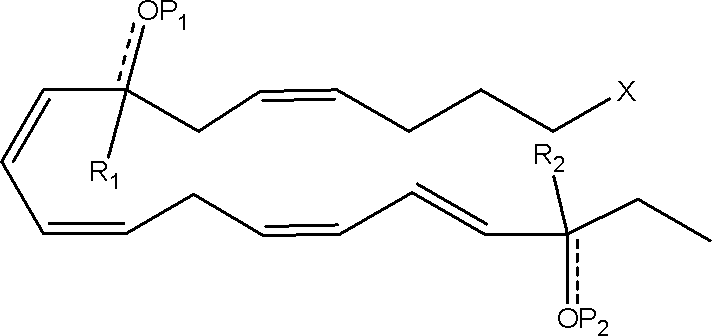


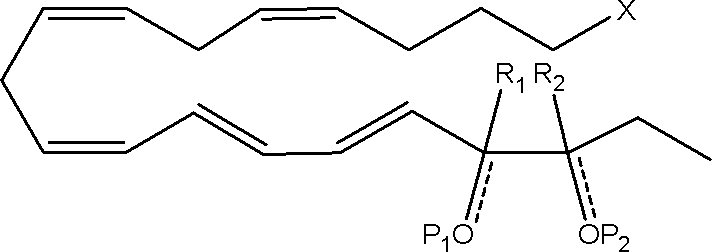
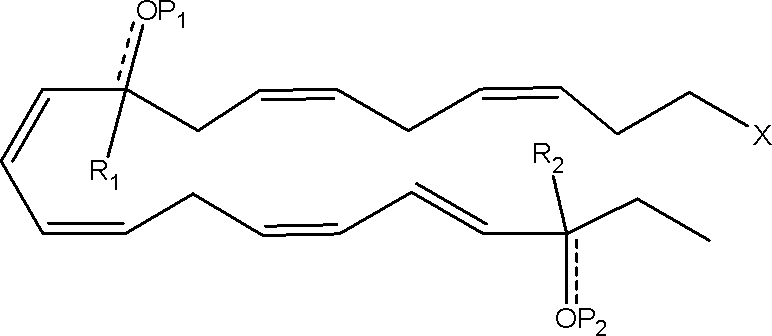
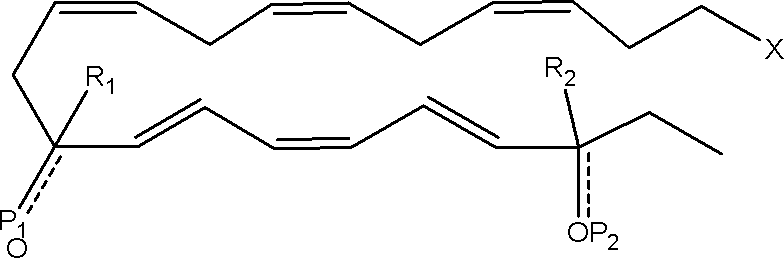
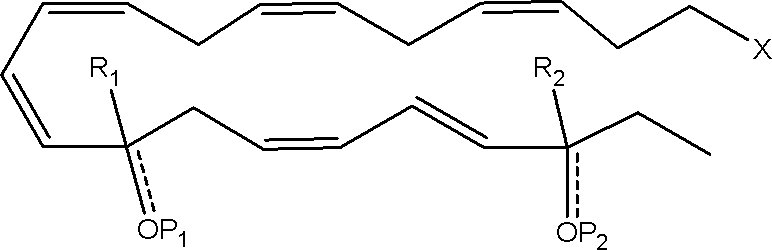
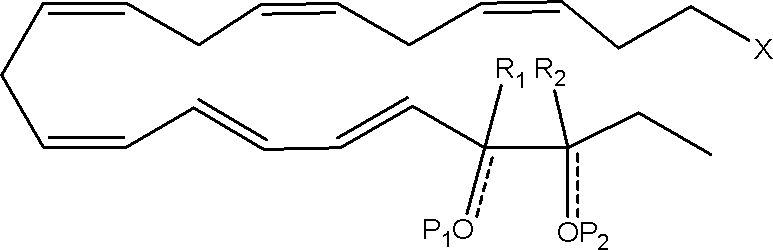
ここで、
P1およびP2は、各々独立して、


R1およびR2は、各々独立して、水素原子、ハロゲン原子、置換または非置換の、分枝状または非分枝状アルキル基、置換または非置換のアリール基、置換または非置換の、分枝状または非分枝状アルキルアリール基またはその組み合わせであり;
Xは、-C(O)OR3、-C(O)NR4R5、-C(O)H、-C(NH)NR4R5、-C(S)H、-C(S)OR3、-C(S)NR4R5、-CNであり;
R3は、水素、保護基、置換もしくは非置換のアルキル、置換もしくは非置換のアルケニル、置換もしくは非置換のアルキニル、置換もしくは非置換のアリール、置換もしくは非置換のヘテロアリール、置換もしくは非置換のシクロアルキル、置換もしくは非置換のシクロアルケニル、置換もしくは非置換のヘテロサイクルまたは式:-NRaRb(式中、RaおよびRbは各々独立して、水素、置換もしくは非置換のアルキル、置換もしくは非置換のアルケニル、置換もしくは非置換のアルキニル、置換もしくは非置換のアリール、置換もしくは非置換のヘテロアリール、置換もしくは非置換のシクロアルキル、置換もしくは非置換のシクロアルケニル、置換もしくは非置換のヘテロサイクルであるか、またはRaとRbは隣接する窒素原子と一緒になって、置換もしくは非置換の含窒素ヘテロ環を形成していてもよい。)であり;
R4およびR5は、各々独立して、水素、置換もしくは非置換のアルキル、置換もしくは非置換のアルケニル、置換もしくは非置換のアルキニル、置換もしくは非置換のアリール、置換もしくは非置換のヘテロアリール、置換もしくは非置換のシクロアルキル、置換もしくは非置換のシクロアルケニル、置換もしくは非置換のヘテロサイクルであるか、またはR4とR5は隣接する窒素原子と一緒になって、置換もしくは非置換の含窒素ヘテロ環を形成していてもよく;
そして、化合物の二重結合配置は各々独立してシスまたはトランスのいずれかであり得る、
化合物または該化合物の薬学的に受容可能な塩もしくは溶媒和物。 - 請求項1に記載の化合物または該化合物の薬学的に受容可能な塩もしくは溶媒和物であって、以下
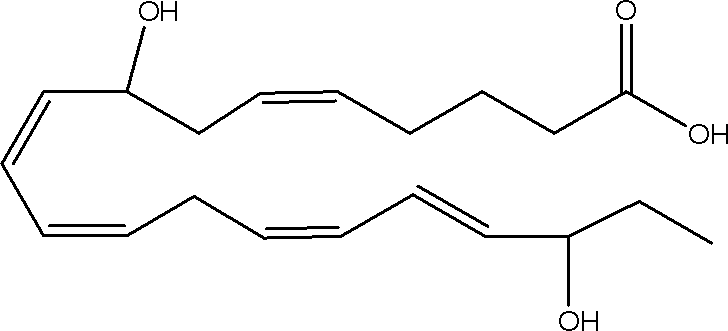
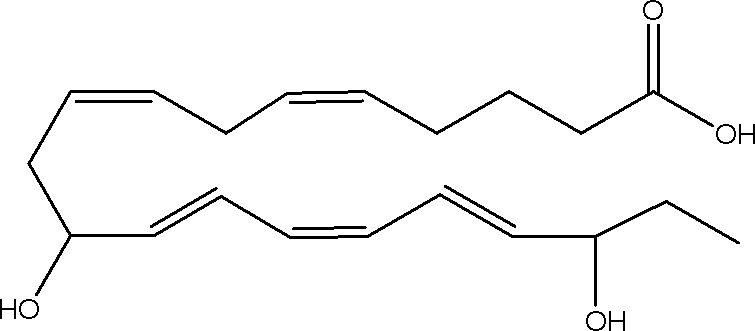
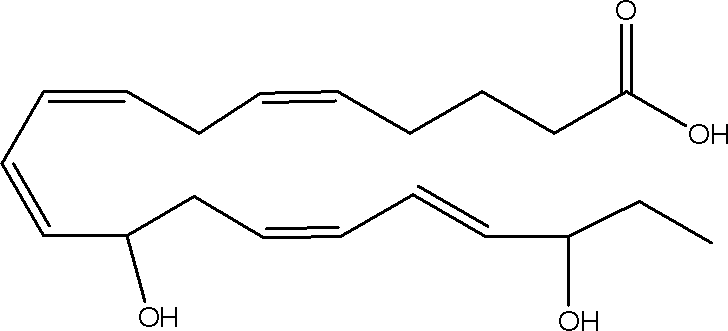
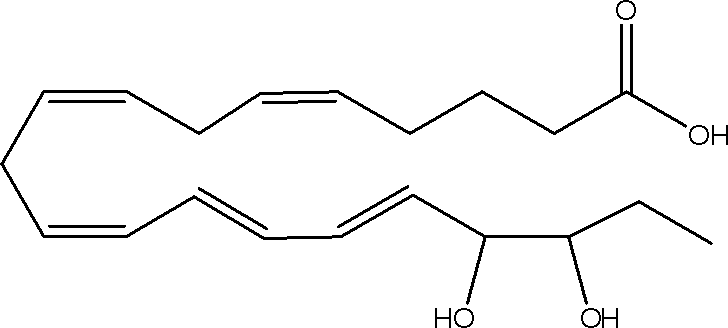
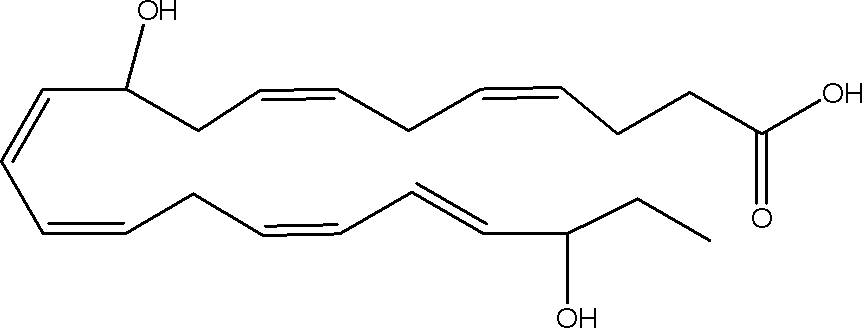
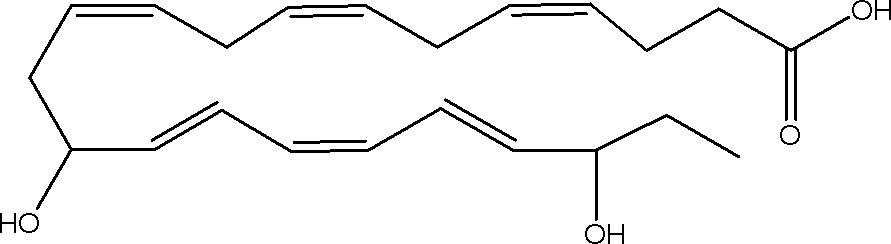
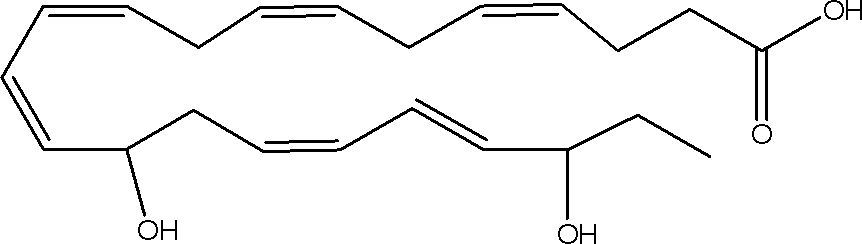

- 請求項1に記載の化合物または該化合物の薬学的に受容可能な塩もしくは溶媒和物を含む、好中球抑制剤。
- 請求項1に記載の化合物または該化合物の薬学的に受容可能な塩もしくは溶媒和物を含む医薬。
- 前記医薬は、肺切迫症候群、成人呼吸窮迫症候群および慢性閉塞性肺疾患(COPD)から選択される肺疾患;虚血性心疾患、虚血性腎疾患、虚血性脳疾患および虚血性肝疾患から選択される虚血性疾患;炎症性疾患;びらん性胃炎・胃潰瘍・十二指腸潰瘍・気管支喘息、潰瘍性大腸炎、動脈硬化症、クローン病、悪性腫瘍、卵巣嚢腫、卵管炎、子宮筋腫、子宮内膜症、自然流産、妊娠中毒症、不妊症および月経困難症から選択されるストレス性疾患から選択される好中球の抑制により改善される疾患、障害または状態を処置または予防するためのものである、請求項4に記載の医薬。
- 請求項1に記載の化合物または該化合物の薬学的に受容可能な塩もしくは溶媒和物を製造する方法であって、
A)エイコサペンタエン酸(EPA)、ドコサヘキサエン酸(DHA)、18-ヒドロキシルエイコサペンタエン酸(HEPE)または20-ヒドロキシルドコサヘキサエン酸(HDoHE)に8-リポキシゲナーゼ(8-LOX)、12-リポキシゲナーゼ(12-LOX)、12/15-リポキシゲナーゼ(12/15-LOX)、ダイズリポキシゲナーゼ(sLOX)および好酸球もしくはその抽出物からなる群より選択される少なくとも1つを接触させて酵素代謝産物を得る工程;および
B)必要に応じて該酵素代謝産物を還元または酸化し、必要に応じて置換基を導入し、必要に応じて目的とする該化合物または該化合物の薬学的に受容可能な塩もしくは溶媒和物を分離もしくは精製する工程
を包含する、方法。 - 請求項1または2に記載の化合物または該化合物の薬学的に受容可能な塩もしくは溶媒和物を製造する方法であって、
A)エイコサペンタエン酸(EPA)、ドコサヘキサエン酸(DHA)、18-ヒドロキシルエイコサペンタエン酸(HEPE)または20-ヒドロキシルドコサヘキサエン酸(HDoHE)に8-リポキシゲナーゼ(8-LOX)、12-リポキシゲナーゼ(12-LOX)、12/15-リポキシゲナーゼ(12/15-LOX)、ダイズリポキシゲナーゼ(sLOX)および好酸球もしくはその抽出物からなる群より選択される少なくとも1つを接触させて酵素代謝産物を得る工程;
B)A)工程で得られた前記酵素代謝産物を、精製後または精製しないで8-リポキシゲナーゼ(8-LOX)、12-リポキシゲナーゼ(12-LOX)、12/15-リポキシゲナーゼ(12/15-LOX)、ダイズリポキシゲナーゼ(sLOX)および好酸球もしくはその抽出物からなる群より選択される少なくとも1つを接触させて二次酵素代謝産物を得る工程
C)必要に応じて該二次酵素代謝産物を還元または酸化し、必要に応じて置換基を導入し、必要に応じて目的とする該化合物または該化合物の薬学的に受容可能な塩もしくは溶媒和物を分離もしくは精製する工程を包含する、方法。 - 炎症性疾患を処置または予防する方法であって、該処置または予防が必要な被験体に請求項1に記載の化合物または該化合物の薬学的に受容可能な塩もしくは溶媒和物を投与する工程を包含する、方法。
- 請求項1に記載の化合物または該化合物の薬学的に受容可能な塩もしくは溶媒和物の、医薬品を製造するための使用。
- 請求項1に記載の化合物または該化合物の薬学的に受容可能な塩もしくは溶媒和物の、好中球が関連する疾患、障害または状態を処置または予防するための医薬品を製造するための使用。
- 請求項1に記載の化合物またはPUFA代謝物を分析する方法であって、
以下の液体クロマトグラフィー条件
A液:水/酢酸=100/0.1、およびB液:アセトニトリル/メタノール=4/1を用いた溶媒系として用い、流速:0~30分→50μL/分、30~33分→80μL/分、33~45分→100μL/分を用い、および図1Bまたはその改変系を用い、図1Cに記載のパラメータを用いることを特徴とする、
方法。 - A)エイコサペンタエン酸(EPA)、ドコサヘキサエン酸(DHA)、18-ヒドロキシルエイコサペンタエン酸(HEPE)または20-ヒドロキシルドコサヘキサエン酸(HDoHE)に8-リポキシゲナーゼ(8-LOX)、12-リポキシゲナーゼ(12-LOX)、12/15-リポキシゲナーゼ(12/15-LOX)、ダイズリポキシゲナーゼ(sLOX)および好酸球もしくはその抽出物からなる群より選択される少なくとも1つを接触させて酵素代謝産物を得る工程;および
B)必要に応じて該酵素代謝産物を還元または酸化し、必要に応じて置換基を導入し、必要に応じて目的とする該化合物または該化合物の薬学的に受容可能な塩もしくは溶媒和物を分離もしくは精製する工程を包含する、方法によって生産される生成物であって、
但し、レゾルビンE1、レゾルビンE2およびプロテクチンD1を除く、生成物。
Priority Applications (3)
| Application Number | Priority Date | Filing Date | Title |
|---|---|---|---|
| JP2011500656A JP5523439B2 (ja) | 2009-02-20 | 2010-02-19 | 新規抗炎症性化合物 |
| EP10743831.9A EP2415748A4 (en) | 2009-02-20 | 2010-02-19 | NEW INFLAMMATORY COMPOUNDS |
| US13/202,489 US8853437B2 (en) | 2009-02-20 | 2010-02-19 | Anti-inflammatory compounds |
Applications Claiming Priority (2)
| Application Number | Priority Date | Filing Date | Title |
|---|---|---|---|
| JP2009037939 | 2009-02-20 | ||
| JP2009-037939 | 2009-02-20 |
Publications (1)
| Publication Number | Publication Date |
|---|---|
| WO2010095706A1 true WO2010095706A1 (ja) | 2010-08-26 |
Family
ID=42633985
Family Applications (1)
| Application Number | Title | Priority Date | Filing Date |
|---|---|---|---|
| PCT/JP2010/052509 Ceased WO2010095706A1 (ja) | 2009-02-20 | 2010-02-19 | 新規抗炎症性化合物 |
Country Status (5)
| Country | Link |
|---|---|
| US (1) | US8853437B2 (ja) |
| EP (1) | EP2415748A4 (ja) |
| JP (1) | JP5523439B2 (ja) |
| TW (1) | TW201039829A (ja) |
| WO (1) | WO2010095706A1 (ja) |
Cited By (8)
| Publication number | Priority date | Publication date | Assignee | Title |
|---|---|---|---|---|
| WO2012026106A1 (ja) * | 2010-08-25 | 2012-03-01 | 国立大学法人 東京大学 | 光学活性な新規抗炎症性化合物及びその製造方法 |
| WO2012170791A3 (en) * | 2011-06-10 | 2013-05-02 | The Brigham And Women's Hospital, Inc. | Docosahexaenoyl ethanolamides |
| JP2014136677A (ja) * | 2013-01-15 | 2014-07-28 | Univ Of Tokyo | 早産治療剤 |
| JP2016513136A (ja) * | 2013-02-28 | 2016-05-12 | アニダ ファーマ インコーポレイテッド | 聴器毒性を治療する方法 |
| JP2021521783A (ja) * | 2018-04-16 | 2021-08-30 | コリア リサーチ インスティテュート オブ バイオサイエンス アンド バイオテクノロジーKorea Research Institute Of Bioscience And Biotechnology | 多価不飽和脂肪酸のマルチヒドロキシ誘導体の生産方法 |
| EP3868359A4 (en) * | 2018-10-15 | 2022-08-10 | Amorepacific Corporation | SKIN BARRIER STRENGTHENING COMPOSITION |
| US12337049B2 (en) | 2021-05-26 | 2025-06-24 | Amorepacific Corporation | Method for whitening skin using composition for skin whitening |
| US12447117B2 (en) | 2018-10-24 | 2025-10-21 | Amorepacific Corporation | Composition and method of enhancing skin barrier using the same |
Families Citing this family (13)
| Publication number | Priority date | Publication date | Assignee | Title |
|---|---|---|---|---|
| AU2013259503B2 (en) | 2012-05-10 | 2017-03-16 | Solutex Na Llc | Oils with anti-inflammatory activity containing natural specialized proresolving mediators and their precursors |
| GB201301626D0 (en) * | 2013-01-30 | 2013-03-13 | Dignity Sciences Ltd | Composition comprising 15-OHEPA and methods of using the same |
| US9902681B2 (en) | 2013-05-30 | 2018-02-27 | The Brigham And Women's Hospital, Inc. | N-3 immunoresolvents: structures and actions |
| US9682034B2 (en) | 2015-03-10 | 2017-06-20 | Elc Management Llc | Methods and compositions for treating skin to resolve inflammation and screening for actives that stimulate pro-resolution pathways |
| HK1256301A1 (zh) | 2015-07-20 | 2019-09-20 | The Brigham And Women's Hospital, Inc. | 提高阿托伐他汀和清除感染的新的 13 系列消退素的说明 |
| WO2017041094A1 (en) | 2015-09-03 | 2017-03-09 | Solutex Na Llc | Compositions comprising omega-3 fatty acids, 17-hdha and 18- hepe and methods of using same |
| WO2017077528A2 (en) * | 2015-11-02 | 2017-05-11 | Salzman Lovelace Investments, Ltd. | Methods and pharmaceutical compositions for treatment of lung inflammation |
| WO2017153977A1 (en) * | 2016-03-08 | 2017-09-14 | Salzman Lovelace Investments, Ltd. | Solid formulations of resolvins and uses thereof |
| KR20190127527A (ko) * | 2018-05-04 | 2019-11-13 | 한국생명공학연구원 | 다중불포화지방산의 디-하이드록시 유도체 생산 방법 |
| KR102110837B1 (ko) * | 2018-04-16 | 2020-05-14 | 한국생명공학연구원 | 다중불포화지방산의 트리-하이드록시 또는 테트라-하이드록시 유도체 생산 방법 |
| KR102144809B1 (ko) * | 2019-10-15 | 2020-08-14 | 한국생명공학연구원 | 신규한 다중불포화지방산의 하이드록시 유도체 및 이의 용도 |
| KR20240150603A (ko) | 2022-03-03 | 2024-10-15 | 테티스 파마수티컬스 엘엘씨 | 특수화된 해소촉진 매개체의 시클로덱스트린 복합체 |
| CN120604758A (zh) * | 2025-06-04 | 2025-09-09 | 无锡市南京大学锡山应用生物技术研究所 | 外周红细胞人源化小鼠模型的构建方法及应用 |
Citations (2)
| Publication number | Priority date | Publication date | Assignee | Title |
|---|---|---|---|---|
| WO2006055965A2 (en) * | 2004-11-19 | 2006-05-26 | Martek Biosciences Corporation | Oxylipins from long chain polyunsaturated fatty acids and methods of making and using the same |
| JP2009037939A (ja) | 2007-08-03 | 2009-02-19 | Hitachi High-Technologies Corp | 走査型電子顕微鏡 |
Family Cites Families (14)
| Publication number | Priority date | Publication date | Assignee | Title |
|---|---|---|---|---|
| IL151299A0 (en) | 2000-02-16 | 2003-04-10 | Brigham & Womens Hospital | Aspirin-triggered lipid mediators |
| AU2002365167A1 (en) | 2001-12-18 | 2003-07-09 | The Brigham And Women's Hospital | Inhibition or prevention of infection by bacteria with epa, dha or analogs |
| US7582785B2 (en) | 2002-04-01 | 2009-09-01 | University Of Southern California | Trihydroxy polyunsaturated eicosanoid derivatives |
| US7759395B2 (en) | 2002-08-12 | 2010-07-20 | The Brigham And Women's Hospital, Inc. | Use of docosatrienes, resolvins and their stable analogs in the treatment of airway diseases and asthma |
| DK2216318T3 (en) | 2002-08-12 | 2018-12-10 | Brigham & Womens Hospital | Resolvins: Bio templates for therapeutic interventions |
| US20090318394A1 (en) | 2004-11-19 | 2009-12-24 | Julie Nauroth | Long Chain Polyunsaturated Fatty Acids and Methods of Making and Using the Same |
| US20060293288A1 (en) | 2005-01-07 | 2006-12-28 | Serhan Charles N | Use of resolvins to treat gastrointestinal diseases |
| EP2012828A2 (en) | 2006-04-28 | 2009-01-14 | Resolvyx Pharmaceuticals, Inc. | Compositions and methods for the treatment of cardiovascular disease |
| BRPI0714562A2 (pt) | 2006-07-19 | 2013-04-02 | Resolvyx Pharmaceuticals Inc | composiÇÕes e mÉtodos para o tratamento de mucosites |
| EP2131833A2 (en) | 2006-10-26 | 2009-12-16 | Resolvyx Pharmaceuticals, Inc. | Use of resolvins for inhibition of bone loss |
| US20080161275A1 (en) | 2006-12-05 | 2008-07-03 | Resolvyx Pharmaceuticals, Inc. | Compositions and methods for the treatment of inflammatory disease |
| EP2120920A4 (en) | 2007-02-20 | 2011-06-15 | Martek Biosciences Corp | OXYLIPINES OF LONG-CHAIN MULTIPLE-UNSATURATED FATTY ACIDS AND METHOD FOR THEIR PREPARATION AND USE |
| EP2207543A2 (en) | 2007-09-14 | 2010-07-21 | Resolvyx Pharmaceuticals, Inc. | Omega-3 fatty acids, hydroxy polyunsaturated fatty acids, lipoxin compounds, or oxylipin compounds for treating autoimmune diseases or inhibiting immune function |
| CN103191129A (zh) | 2007-10-12 | 2013-07-10 | C.T.辨析有限公司 | 治疗眼睛病症的脂氧化物类化合物 |
-
2010
- 2010-02-19 EP EP10743831.9A patent/EP2415748A4/en not_active Withdrawn
- 2010-02-19 WO PCT/JP2010/052509 patent/WO2010095706A1/ja not_active Ceased
- 2010-02-19 JP JP2011500656A patent/JP5523439B2/ja not_active Expired - Fee Related
- 2010-02-19 US US13/202,489 patent/US8853437B2/en not_active Expired - Fee Related
- 2010-02-22 TW TW099105021A patent/TW201039829A/zh unknown
Patent Citations (2)
| Publication number | Priority date | Publication date | Assignee | Title |
|---|---|---|---|---|
| WO2006055965A2 (en) * | 2004-11-19 | 2006-05-26 | Martek Biosciences Corporation | Oxylipins from long chain polyunsaturated fatty acids and methods of making and using the same |
| JP2009037939A (ja) | 2007-08-03 | 2009-02-19 | Hitachi High-Technologies Corp | 走査型電子顕微鏡 |
Non-Patent Citations (36)
| Title |
|---|
| "Experimental Medicine", 1997, YODOSHA CO. , LTD., article "Gene Introduction & Expression Analysis Experimental Method" |
| "MOLECULAR CLONING : A LABORATORY MANUAL", 2001 |
| ADAMS, R.L. ET AL.: "The Biochemistry of the Nucleic Acids", 1992, CHAPMAN & HALL |
| AUSUBEL, F. M.: "Current Protocols in Molecular Biology", 1987, GREENE PUB. ASSOCIATES AND WILEY INTERSCIENCE |
| AUSUBEL, F. M.: "Short Protocols in Molecular Biology: A Compendium of Methods from Current Protocols in Molecular Biology", 1989, GREENE PUB. ASSOCIATES AND WILEY-INTERSCIENCE |
| AUSUBEL, F. M.: "Short Protocols in Molecular Biology: A Compendium of Methods from Current Protocols in Molecular Biology", 1999, WILEY |
| AUSUBEL, F.M.: "Short Protocols in Molecular Biology: A Compendium of Methods from Current Protocols in Molecular Biology", 1992, GREENE PUB. ASSOCIATES |
| AUSUBEL, F.M.: "Short Protocols in Molecular Biology: A Compendium of Methods from Current Protocols in Molecular Biology", 1995, GREENE PUB. ASSOCIATES |
| BERGE S. M. ET AL.: "Pharmaceutical Salts", J. PHARM. SCI, vol. 66, 1977, pages 1 - 19 |
| BLACKBURN, G.M. ET AL.: "Nucleic Acids in Chemistry and Biology", 1996, OXFORD UNIVERSITY PRESS |
| E. TJONAHEN ET AL., CHEMISTRY & BIOLOGY, vol. 13, November 2006 (2006-11-01), pages 1193 - 1202 |
| ECKSTEIN, F.: "Oligonucleotides and Analogues: A Practical Approach", 1991, IRL PRESS |
| FUNK C.D., FITZGERALD G. A. J., CARDIOVASC PHARMACOL, vol. 50, 2007, pages 470 - 479 |
| GAIT, M.J.: "Oligonucleotide Synthesis: A Practical Approach", 1985, IRL PRESS |
| GAIT, M.J.: "Oligonucleotide Synthesis: A Practical Approach", 1990, IRL PRESS |
| GREEN, WUTS: "Protecting Groups in Organic Synthesis", 1991, JOHN WILEY AND SONS |
| GREENE, WUTS: "Protective Groups in Organic Chemistry", 1999, JOHN WILEY & SONS |
| HANSEL ET AL., J. IMMUNOL. METHODS, vol. 145, 1991, pages 105 - 110 |
| HARRISON ET AL.: "Compendium of Synthetic Organic Methods", vol. 1-8, 1971, JOHN WILEY & SONS |
| HERMANSON, G.T.: "Bioconjugate Techniques", 1996, ACADEMIC PRESS |
| INNIS, M. A.: "PCR Protocols: A Guide to Methods and Applications", 1990, ACADEMIC PRESS |
| INNIS, M.A. ET AL.: "PCR Strategies", 1995, ACADEMIC PRESS |
| JISAKA M., J BIOL CHEM, vol. 272, 1997, pages 24410 - 24416 |
| KUHN H. ET AL., PROSTAGLANDINS AND OTHER LIPID MEDIATORS, vol. 68-69, 2002, pages 263 - 290 |
| OGAWA S. ET AL., ORG LETT., vol. 11, 2009, pages 3602 - 3605 |
| OLIW E. H., PROSTAGLANDINS AND OTHER LIPID MEDIATORS, vol. 68-69, 2002, pages 313 - 324 |
| SAMBROOK J. ET AL.: "Molecular Cloning : A Laboratory Manual", 1989, COLD SPRING HARBOR |
| See also references of EP2415748A4 |
| SERHAN C. N. ET AL., PROSTAGLANDINS AND OTHER LIPID MEDIATORS, vol. 73, 2004, pages 155 - 172 |
| SERHAN C.N. ET AL., BIOCHEMISTRY, vol. 34, 1995, pages 14609 - 14615 |
| SHABAROVA, Z., ADVANCED ORGANIC CHEMISTRY OF NUCLEIC ACIDS, 1994 |
| SINGH G., AM. J. MED., vol. 105, 1998, pages 31S - 38S |
| SNINSKY, J. J. ET AL.: "PCR Applications: Protocols for Functional Genomics", 1999, ACADEMIC PRESS |
| TILG, H., MOSCHEN, A. R., NAT. REV. IMMUNOL., vol. 6, 2006, pages 772 - 783 |
| YOSHIMOTO T. ET AL., PROSTAGLANDINS AND OTHER LIPID MEDIATORS, vol. 68-69, 2002, pages 245 - 262 |
| YOSHIMOTO T., PROSTAGLANDINS AND OTHER LIPID MEDIATORS, vol. 68-69, 2002, pages 245 - 262 |
Cited By (14)
| Publication number | Priority date | Publication date | Assignee | Title |
|---|---|---|---|---|
| WO2012026106A1 (ja) * | 2010-08-25 | 2012-03-01 | 国立大学法人 東京大学 | 光学活性な新規抗炎症性化合物及びその製造方法 |
| JPWO2012026106A1 (ja) * | 2010-08-25 | 2013-10-28 | 国立大学法人 東京大学 | 光学活性な新規抗炎症性化合物及びその製造方法 |
| WO2012170791A3 (en) * | 2011-06-10 | 2013-05-02 | The Brigham And Women's Hospital, Inc. | Docosahexaenoyl ethanolamides |
| US10227291B2 (en) | 2011-06-10 | 2019-03-12 | The Brigham And Women's Hospital, Inc. | Docosahexaenoyl ethanolamides |
| US9416118B2 (en) | 2011-06-10 | 2016-08-16 | The Brigham And Women's Hospital, Inc. | Docosahexaenoyl ethanolamides |
| JP2014136677A (ja) * | 2013-01-15 | 2014-07-28 | Univ Of Tokyo | 早産治療剤 |
| US9987244B2 (en) | 2013-02-28 | 2018-06-05 | Anida Pharma, Inc. | Methods of treating ototoxicity |
| JP2016513136A (ja) * | 2013-02-28 | 2016-05-12 | アニダ ファーマ インコーポレイテッド | 聴器毒性を治療する方法 |
| USRE48077E1 (en) | 2013-02-28 | 2020-07-07 | Anida Pharma Inc. | Methods of treating ototoxicity |
| JP2021521783A (ja) * | 2018-04-16 | 2021-08-30 | コリア リサーチ インスティテュート オブ バイオサイエンス アンド バイオテクノロジーKorea Research Institute Of Bioscience And Biotechnology | 多価不飽和脂肪酸のマルチヒドロキシ誘導体の生産方法 |
| JP7490566B2 (ja) | 2018-04-16 | 2024-05-27 | コリア リサーチ インスティテュート オブ バイオサイエンス アンド バイオテクノロジー | 多価不飽和脂肪酸のマルチヒドロキシ誘導体の生産方法 |
| EP3868359A4 (en) * | 2018-10-15 | 2022-08-10 | Amorepacific Corporation | SKIN BARRIER STRENGTHENING COMPOSITION |
| US12447117B2 (en) | 2018-10-24 | 2025-10-21 | Amorepacific Corporation | Composition and method of enhancing skin barrier using the same |
| US12337049B2 (en) | 2021-05-26 | 2025-06-24 | Amorepacific Corporation | Method for whitening skin using composition for skin whitening |
Also Published As
| Publication number | Publication date |
|---|---|
| US20120059061A1 (en) | 2012-03-08 |
| TW201039829A (en) | 2010-11-16 |
| EP2415748A1 (en) | 2012-02-08 |
| JPWO2010095706A1 (ja) | 2012-08-30 |
| EP2415748A4 (en) | 2013-08-07 |
| JP5523439B2 (ja) | 2014-06-18 |
| US8853437B2 (en) | 2014-10-07 |
Similar Documents
| Publication | Publication Date | Title |
|---|---|---|
| JP5523439B2 (ja) | 新規抗炎症性化合物 | |
| JP5909183B2 (ja) | オメガ3系脂肪酸由来の新規抗炎症性代謝物 | |
| JP7060298B1 (ja) | Mgat2阻害活性を有する縮合環誘導体 | |
| KR102588982B1 (ko) | 파네소이드 x 수용체 효능제 및 이의 용도 | |
| CN107108595B (zh) | 新的fxr(nr1h4)调节化合物 | |
| US7241785B2 (en) | Five-membered heterocyclic alkanoic acid derivative | |
| EP2289883A1 (en) | Novel FXR (NR1H4) binding and activity modulating compounds | |
| EP3746448B1 (en) | Nitrogenous tricyclic compounds and uses thereof in medicine | |
| KR20090104092A (ko) | 피페리딘 gpcr 효능제 | |
| WO2002053547A1 (en) | Alkanoic acid derivatives, process for their production and use thereof | |
| JP7068743B2 (ja) | Mgat2阻害活性を有する縮合環誘導体を含有する医薬組成物 | |
| JP7068322B2 (ja) | 自己免疫疾患を治療するためのrorガンマモジュレーターとしてのn-{[2-(ピペリジン-1-イル)フェニル](フェニル)メチル}-2-(3-オキソ-3,4-ジヒドロ-2h-1,4-ベンゾオキサジン-7-イル)アセトアミド誘導体及び関連化合物 | |
| JP2008526867A (ja) | 胃腸疾患の治療のためのレゾルビンの使用 | |
| JP7295944B2 (ja) | Cgrpアンタゴニストのプロドラッグ | |
| CN113056265A (zh) | 法尼醇x受体激动剂及其用途 | |
| WO2016031987A1 (ja) | オートタキシン阻害活性を有するピリミジノン誘導体 | |
| JP7138647B2 (ja) | Rorガンマモジュレーター及びその使用 | |
| KR20210136139A (ko) | 란티오닌 c-유사 단백질 2 리간드, 이로 제조된 세포, 및 이를 사용하는 치료법 | |
| JPWO2012026106A1 (ja) | 光学活性な新規抗炎症性化合物及びその製造方法 | |
| JP2002348281A (ja) | 5員複素環アルカン酸誘導体 | |
| HK40059861B (en) | Fused ring derivative having mgat-2 inhibitory activity | |
| HK40059861A (en) | Fused ring derivative having mgat-2 inhibitory activity | |
| HK40019860A (en) | Farnesoid x receptor agonists and uses thereof | |
| HK1238632A1 (en) | Novel fxr (nr1h4) modulating compounds | |
| JP2006298885A (ja) | ナフタレンカルボン酸誘導体及びこれを含有する医薬組成物 |
Legal Events
| Date | Code | Title | Description |
|---|---|---|---|
| 121 | Ep: the epo has been informed by wipo that ep was designated in this application |
Ref document number: 10743831 Country of ref document: EP Kind code of ref document: A1 |
|
| ENP | Entry into the national phase |
Ref document number: 2011500656 Country of ref document: JP Kind code of ref document: A |
|
| WWE | Wipo information: entry into national phase |
Ref document number: 13202489 Country of ref document: US Ref document number: 2010743831 Country of ref document: EP |
|
| NENP | Non-entry into the national phase |
Ref country code: DE |