WO2010098280A1 - 生理用タンポン - Google Patents
生理用タンポン Download PDFInfo
- Publication number
- WO2010098280A1 WO2010098280A1 PCT/JP2010/052627 JP2010052627W WO2010098280A1 WO 2010098280 A1 WO2010098280 A1 WO 2010098280A1 JP 2010052627 W JP2010052627 W JP 2010052627W WO 2010098280 A1 WO2010098280 A1 WO 2010098280A1
- Authority
- WO
- WIPO (PCT)
- Prior art keywords
- covering material
- fiber
- absorbent
- hydrophilic
- fibers
- Prior art date
- Legal status (The legal status is an assumption and is not a legal conclusion. Google has not performed a legal analysis and makes no representation as to the accuracy of the status listed.)
- Ceased
Links
Images



Classifications
-
- A—HUMAN NECESSITIES
- A61—MEDICAL OR VETERINARY SCIENCE; HYGIENE
- A61L—METHODS OR APPARATUS FOR STERILISING MATERIALS OR OBJECTS IN GENERAL; DISINFECTION, STERILISATION OR DEODORISATION OF AIR; CHEMICAL ASPECTS OF BANDAGES, DRESSINGS, ABSORBENT PADS OR SURGICAL ARTICLES; MATERIALS FOR BANDAGES, DRESSINGS, ABSORBENT PADS OR SURGICAL ARTICLES
- A61L15/00—Chemical aspects of, or use of materials for, bandages, dressings or absorbent pads
- A61L15/16—Bandages, dressings or absorbent pads for physiological fluids such as urine or blood, e.g. sanitary towels, tampons
- A61L15/42—Use of materials characterised by their function or physical properties
-
- A—HUMAN NECESSITIES
- A61—MEDICAL OR VETERINARY SCIENCE; HYGIENE
- A61F—FILTERS IMPLANTABLE INTO BLOOD VESSELS; PROSTHESES; DEVICES PROVIDING PATENCY TO, OR PREVENTING COLLAPSING OF, TUBULAR STRUCTURES OF THE BODY, e.g. STENTS; ORTHOPAEDIC, NURSING OR CONTRACEPTIVE DEVICES; FOMENTATION; TREATMENT OR PROTECTION OF EYES OR EARS; BANDAGES, DRESSINGS OR ABSORBENT PADS; FIRST-AID KITS
- A61F13/00—Bandages or dressings; Absorbent pads
- A61F13/15—Absorbent pads, e.g. sanitary towels, swabs or tampons for external or internal application to the body; Supporting or fastening means therefor; Tampon applicators
- A61F13/20—Tampons, e.g. catamenial tampons; Accessories therefor
- A61F13/2022—Tampons, e.g. catamenial tampons; Accessories therefor characterised by the shape
- A61F13/2031—Tampons, e.g. catamenial tampons; Accessories therefor characterised by the shape having depressions or elevations, e.g. dots, lines
-
- A—HUMAN NECESSITIES
- A61—MEDICAL OR VETERINARY SCIENCE; HYGIENE
- A61F—FILTERS IMPLANTABLE INTO BLOOD VESSELS; PROSTHESES; DEVICES PROVIDING PATENCY TO, OR PREVENTING COLLAPSING OF, TUBULAR STRUCTURES OF THE BODY, e.g. STENTS; ORTHOPAEDIC, NURSING OR CONTRACEPTIVE DEVICES; FOMENTATION; TREATMENT OR PROTECTION OF EYES OR EARS; BANDAGES, DRESSINGS OR ABSORBENT PADS; FIRST-AID KITS
- A61F13/00—Bandages or dressings; Absorbent pads
- A61F13/15—Absorbent pads, e.g. sanitary towels, swabs or tampons for external or internal application to the body; Supporting or fastening means therefor; Tampon applicators
- A61F13/20—Tampons, e.g. catamenial tampons; Accessories therefor
-
- A—HUMAN NECESSITIES
- A61—MEDICAL OR VETERINARY SCIENCE; HYGIENE
- A61F—FILTERS IMPLANTABLE INTO BLOOD VESSELS; PROSTHESES; DEVICES PROVIDING PATENCY TO, OR PREVENTING COLLAPSING OF, TUBULAR STRUCTURES OF THE BODY, e.g. STENTS; ORTHOPAEDIC, NURSING OR CONTRACEPTIVE DEVICES; FOMENTATION; TREATMENT OR PROTECTION OF EYES OR EARS; BANDAGES, DRESSINGS OR ABSORBENT PADS; FIRST-AID KITS
- A61F13/00—Bandages or dressings; Absorbent pads
- A61F13/15—Absorbent pads, e.g. sanitary towels, swabs or tampons for external or internal application to the body; Supporting or fastening means therefor; Tampon applicators
- A61F13/20—Tampons, e.g. catamenial tampons; Accessories therefor
- A61F13/2071—Tampons, e.g. catamenial tampons; Accessories therefor characterised by the material or the structure of the outer layer
-
- A—HUMAN NECESSITIES
- A61—MEDICAL OR VETERINARY SCIENCE; HYGIENE
- A61F—FILTERS IMPLANTABLE INTO BLOOD VESSELS; PROSTHESES; DEVICES PROVIDING PATENCY TO, OR PREVENTING COLLAPSING OF, TUBULAR STRUCTURES OF THE BODY, e.g. STENTS; ORTHOPAEDIC, NURSING OR CONTRACEPTIVE DEVICES; FOMENTATION; TREATMENT OR PROTECTION OF EYES OR EARS; BANDAGES, DRESSINGS OR ABSORBENT PADS; FIRST-AID KITS
- A61F13/00—Bandages or dressings; Absorbent pads
- A61F13/15—Absorbent pads, e.g. sanitary towels, swabs or tampons for external or internal application to the body; Supporting or fastening means therefor; Tampon applicators
- A61F13/51—Absorbent pads, e.g. sanitary towels, swabs or tampons for external or internal application to the body; Supporting or fastening means therefor; Tampon applicators characterised by the outer layers of the pads
- A61F13/511—Topsheet, i.e. the permeable cover or layer facing the skin
- A61F13/513—Topsheet, i.e. the permeable cover or layer facing the skin characterised by its function or properties, e.g. stretchability, breathability, rewet, visual effect; having areas of different permeability
- A61F13/51305—Topsheet, i.e. the permeable cover or layer facing the skin characterised by its function or properties, e.g. stretchability, breathability, rewet, visual effect; having areas of different permeability having areas of different permeability
-
- A—HUMAN NECESSITIES
- A61—MEDICAL OR VETERINARY SCIENCE; HYGIENE
- A61F—FILTERS IMPLANTABLE INTO BLOOD VESSELS; PROSTHESES; DEVICES PROVIDING PATENCY TO, OR PREVENTING COLLAPSING OF, TUBULAR STRUCTURES OF THE BODY, e.g. STENTS; ORTHOPAEDIC, NURSING OR CONTRACEPTIVE DEVICES; FOMENTATION; TREATMENT OR PROTECTION OF EYES OR EARS; BANDAGES, DRESSINGS OR ABSORBENT PADS; FIRST-AID KITS
- A61F13/00—Bandages or dressings; Absorbent pads
- A61F13/15—Absorbent pads, e.g. sanitary towels, swabs or tampons for external or internal application to the body; Supporting or fastening means therefor; Tampon applicators
- A61F13/53—Absorbent pads, e.g. sanitary towels, swabs or tampons for external or internal application to the body; Supporting or fastening means therefor; Tampon applicators characterised by the absorbing medium
- A61F13/534—Absorbent pads, e.g. sanitary towels, swabs or tampons for external or internal application to the body; Supporting or fastening means therefor; Tampon applicators characterised by the absorbing medium having an inhomogeneous composition through the thickness of the pad
- A61F13/537—Absorbent pads, e.g. sanitary towels, swabs or tampons for external or internal application to the body; Supporting or fastening means therefor; Tampon applicators characterised by the absorbing medium having an inhomogeneous composition through the thickness of the pad characterised by a layer facilitating or inhibiting flow in one direction or plane, e.g. a wicking layer
- A61F13/53708—Absorbent pads, e.g. sanitary towels, swabs or tampons for external or internal application to the body; Supporting or fastening means therefor; Tampon applicators characterised by the absorbing medium having an inhomogeneous composition through the thickness of the pad characterised by a layer facilitating or inhibiting flow in one direction or plane, e.g. a wicking layer the layer having a promotional function on liquid propagation in at least one direction
-
- A—HUMAN NECESSITIES
- A61—MEDICAL OR VETERINARY SCIENCE; HYGIENE
- A61F—FILTERS IMPLANTABLE INTO BLOOD VESSELS; PROSTHESES; DEVICES PROVIDING PATENCY TO, OR PREVENTING COLLAPSING OF, TUBULAR STRUCTURES OF THE BODY, e.g. STENTS; ORTHOPAEDIC, NURSING OR CONTRACEPTIVE DEVICES; FOMENTATION; TREATMENT OR PROTECTION OF EYES OR EARS; BANDAGES, DRESSINGS OR ABSORBENT PADS; FIRST-AID KITS
- A61F13/00—Bandages or dressings; Absorbent pads
- A61F13/15—Absorbent pads, e.g. sanitary towels, swabs or tampons for external or internal application to the body; Supporting or fastening means therefor; Tampon applicators
- A61F13/15203—Properties of the article, e.g. stiffness or absorbency
- A61F2013/15284—Properties of the article, e.g. stiffness or absorbency characterized by quantifiable properties
- A61F2013/15422—Density
Definitions
- the present invention relates to a sanitary tampon having an absorbent body having absorbent fibers and a covering material covering the absorbent body.
- the sanitary tampon includes an absorber that can absorb liquid and a covering material that covers the absorber, and is inserted into the user's vagina to absorb bodily fluids such as menstrual blood.
- Such a sanitary tampon has an absorbent layer having absorbent fibers and a hydrophobic liquid-permeable liquid-permeable layer, and the absorbent layer is covered with the liquid-permeable layer to form an absorbent body.
- a sanitary tampon is known (see, for example, Patent Document 1).
- the conventional sanitary tampon described above has the following problems. That is, if the surface (liquid permeable layer) of the absorbent body that contacts the vaginal wall has hydrophobicity, the body fluid such as menstrual blood and the absorbent body are not familiar. For this reason, the body fluid tends to flow on the surface of the absorbent body, resulting in menstrual leakage and wearing discomfort.
- the surface of the absorber may be made hydrophilic.
- the absorbent body absorbs bodily fluids present on the vagina wall surface, so that the surface of the absorbent body tends to stick to the vagina wall. Therefore, the frictional resistance at the time of insertion or at the time of pulling out after use becomes high, causing discomfort to the user.
- an object of the present invention is to provide a sanitary tampon capable of enhancing the absorbability of body fluid such as menstrual blood and preventing sticking to the vaginal wall.
- a feature of the present invention is a sanitary tampon having an absorbent body having an absorbent fiber and a covering material covering the absorbent body, the covering material having an inner surface in contact with the absorbent body, An outer surface in contact with the vaginal wall, and the covering material includes hydrophilic fibers having a high affinity for water and hydrophobic fibers having a low affinity for water, and the presence of the hydrophobic fibers on the outer surface
- the ratio is larger than the existing ratio of the hydrophilic fibers, and the gist is that the inner surface is formed from the hydrophilic fibers.
- the present invention can provide a sanitary tampon capable of enhancing the absorbability of body fluid such as menstrual blood and preventing sticking to the vaginal wall.
- FIG. 1 is a perspective view of a sanitary tampon according to a first embodiment of the present invention.
- FIG. 2 is a perspective view of the absorbent body according to the first embodiment of the present invention.
- FIG. 3 is a developed plan view of the absorbent main body according to the first embodiment. 4 is a cross-sectional view taken along line A-A ′ shown in FIG.
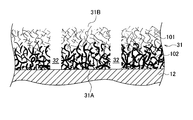
- FIG. 5 is an enlarged view of the sanitary tampon covering material and absorbent body according to the first embodiment of the present invention.
- FIG. 6 is an enlarged view of a sanitary tampon covering material and absorbent body according to the second embodiment of the present invention.
- FIG. 1 is a perspective view of a sanitary tampon according to a first embodiment of the present invention.
- FIG. 2 is a perspective view of the absorbent body according to the first embodiment of the present invention.
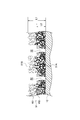
- FIG. 7 is an enlarged view of a covering material and an absorbent body of a sanitary tampon according to a third embodiment of the present invention.
- FIG. 8 is an enlarged view of a sanitary tampon covering material and absorbent body according to a fourth embodiment of the present invention.
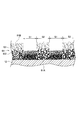
- FIG. 9 is an enlarged view of a covering material and an absorbent body of a sanitary tampon according to a fifth embodiment of the present invention.
- FIG. 1 is a perspective view of a sanitary tampon 1.
- the sanitary tampon 1 includes an absorbent main body 10 and an applicator 20 in which the absorbent main body 10 is accommodated.
- the applicator 20 includes an outer cylinder 21 that is loaded so that the absorbent main body 10 can be discharged, and a pressing body 22 that presses the absorbent main body 10.
- the outer cylinder 21 has an outer cylinder front end 23 that is inserted into the user's vagina and an outer cylinder rear end 24 that is located on the opposite side of the outer cylinder front end 23.
- An opening portion 25 through which the absorbent main body 10 is discharged is formed in the outer cylinder distal end portion 23.
- the pressing body 22 has a pressing front end portion 26 that presses the absorbent main body 10 toward the outside of the outer cylinder 21, and a pressing rear end portion 27 located on the opposite side of the pressing front end portion 26.
- the pressing body 22 has a communication hole 28 that allows the pressing front end portion 26 and the pressing rear end portion 27 to communicate with each other.
- a cord 13 (described later) connected to the absorbent main body 10 is passed through the communication hole 28.
- the pressing rear end portion 27 When the pressing rear end portion 27 is pressed toward the outer cylinder distal end portion 23 side, the pressing distal end portion 26 slides inside the outer cylinder 21 so that the absorbent main body 10 faces the outside of the outer cylinder 21. Press.
- the opening portion 25 is expanded by the absorbent main body 10. Thereby, the absorptive main body 10 is discharged from the opening portion 25 to the outside of the outer cylinder 21.
- FIG. 2 is a perspective view of the absorbent main body 10.
- FIG. 3 is a developed plan view of the absorbent main body 10.
- the absorptive main body 10 has a sheet shape.
- the absorptive main body 10 is accommodated in the outer cylinder 21 in a compressed state.
- the absorbent main body 10 has a connecting portion 14 at a predetermined position.
- the predetermined position is the central portion of the absorbent main body 10.
- the cord 13 is sewn to the absorbent main body 10 with a thread at the connecting portion 14.
- FIG. 4 is a cross-sectional view showing the A-A ′ cross section in FIG.
- the absorbent main body 10 includes an absorbent body 12 having absorbent fibers, and a covering material 11 that covers the absorbent body 12.
- the covering material 11 overlaps at the connecting portion 14, and the covering material 11, the absorber 12, and the cord 13 are stitched together with a thread at the connecting portion 14.
- FIG. 5 is an enlarged view of a region T in the cross-sectional view of FIG.
- the covering material 11 has an inner surface 11 ⁇ / b> A that contacts the absorbent body 12 and an outer surface 11 ⁇ / b> B that contacts the vagina wall during use.
- the covering material 11 includes hydrophobic fibers 101 having a low affinity for water and hydrophilic fibers 102 having a high affinity for water.
- the abundance ratio of the hydrophobic fibers 101 on the outer surface 11B is larger than the abundance ratio of the hydrophilic fibers 102.
- the blending ratio of the hydrophilic fibers 102 on the outer side surface 11B is preferably 10 to 50% with respect to the total amount of the covering material 11.
- the blending ratio of the hydrophilic fiber 102 in the outer surface 11B is 10% or less, the affinity between the outer surface 11B and water is lowered. Therefore, menstrual blood adhering to the absorbent main body 10 travels along the outer surface 11B of the absorbent main body 10 before shifting from the outer side surface 11B to the inner side surface 11A, and easily leaks from the vaginal opening.
- the affinity between the outer surface 11B and water is increased.
- the outer surface 11B sucks a small amount of menstrual blood on the vagina wall, so that the outer surface 11B sticks to the vagina wall, causing pain and discomfort to the user during extraction.
- the covering material 11 a non-woven fabric produced by a general non-woven fabric manufacturing method such as spun bond, point bond, air-through and the like can be used. More preferably, in this embodiment, the covering material 11 is a spunlace nonwoven fabric in which hydrophobic fibers 101 and hydrophilic fibers 102 are formed by a hydroentanglement method. Since the spunlace nonwoven fabric entangles the fibers by a water flow, there is no perfect boundary between the fiber layer made of the hydrophobic fibers 101 and the fiber layer made of the hydrophilic fibers 102. Thereby, a bodily fluid can transfer rapidly toward the inner side surface 11A from the outer side surface 11B. The spunlace nonwoven fabric is also advantageous in that there is no residue of raw cotton oil.
- the hydrophobic fiber 101 is preferably a synthetic fiber such as polyester, polyolefin, polyamide, polyacryl, or a mixture thereof. Moreover, since the absorptive main body 10 becomes high temperature and a high pressure when compressed and stored in the outer cylinder 21, it is preferable that the melting point is 130 ° C. or higher and the breaking strength of the nonwoven fabric (JIS L1096) is 12 mN / 25 mm.
- hydrophilic fiber 102 examples include rayon (including conventional normal rayon and modified rayon), cotton, ground wood pulp, wool, silk, chemically modified, modified, or crosslinked cellulose fiber, synthetic fiber, tissue, peat moss.
- the fiber generally used as an isoabsorbent can be used. Further, these fibers may be mixed and used.
- the hydrophilic fiber 102 is preferably the same material as the absorber 12 described later. When the hydrophilic fiber 102 and the absorbent body 12 are made of the same material, the familiarity between the hydrophilic fiber 102 and the absorbent body 12 is good, and body fluid such as menstrual blood can be easily guided to the absorbent body 12.
- the fiber diameter of the hydrophobic fiber 101 and the hydrophilic fiber 102 is preferably 1.7 to 3.3 denier.
- the fiber diameter is 3.3 denier or more, the rigidity of one fiber increases, and the user feels uncomfortable.
- the fiber diameter is 1.7 denier or less, it becomes difficult to produce with a stable thickness.
- the inner side surface 11A is formed from the hydrophilic fiber 102.
- the weight per unit area (referred to as basis weight) of the hydrophilic fiber 102 is not less than the weight per unit area of the hydrophobic fiber 101.
- the basis weight of the hydrophobic fibers 101 forming the outer surface 11B of the covering material 11 is 8 to 20 g / m 2 .
- the basis weight of the hydrophilic fiber 102 forming the inner surface 11A is preferably 8 to 40 g / m 2 . In the case of 8 g / m 2 or less, it is difficult to produce a web in a stable amount when the raw cotton is opened due to too few fibers.
- the menstrual blood adhering to the absorbent main body 10 is moved to the outer side surface 11B of the absorbent main body 10 before moving from the outer side surface 11B to the inner side surface 11A. It is transmitted and becomes easy to leak from the ostium of the vagina.
- the basis weight of the hydrophilic fiber 102 exceeds 40 g / m 2 , the rigidity of the covering material 11 becomes too high, so that when the absorbent main body 10 is inserted into the vagina, the shape of the absorbent main body 10 is changed. The operation to recover from the compressed state to the use state is hindered.
- Absorbent body 12 absorbs rayon (including conventional normal rayon and modified rayon), cotton, ground wood pulp, wool, silk, chemically modified, modified, or crosslinked cellulose fiber, synthetic fiber, tissue, peat moss, etc.
- the fiber generally used as a material can be used. Further, these fibers may be mixed and used.
- the absorbent body 12 may be mixed with an absorbent polymer, an absorbent gel material, or the like.
- the basis weight of the absorbent body 12 is preferably 100 to 1200 g / m 2 .
- the cord 13 is composed of a single yarn made of rayon, cotton, polyethylene, polypropylene or the like or a composite yarn obtained by twisting these.
- the cord 13 is preferably water-repellent with paraffin or the like in order to prevent contamination with menstrual blood or body fluid.
- the absorbent main body 10 is stored in the outer cylinder 21 in a compressed state.
- the absorbent main body 10 is compression-molded into a substantially cylindrical shape with a mold having a plurality of convex portions in the longitudinal direction.
- the absorptive main body 10 is compression-molded to a specified dimension by being pressed from a conveyance direction (MD direction) and a cross direction (CD direction), respectively.
- the length of the absorbent main body 10 after compression is preferably 30 to 60 mm. If the length of the absorbent main body 10 after being compressed is 30 mm or less, the area of the absorbent main body 10 that contacts the vagina wall is too small, and menstrual blood cannot be sufficiently absorbed. When the length of the absorbent main body 10 after being compressed exceeds 60 mm, the absorbent main body 10 expands to the vicinity of the vaginal opening when it absorbs menstrual blood and the like, causing a sense of discomfort to the user. .
- the length of the absorbent main body 10 after compression molding is 30 mm to 60 mm
- the length of the cord 13 is preferably in the range of 150 mm to 250 mm.
- the length of the cord 13 is 150 mm or less, it becomes difficult for the user to search when the absorbent main body 10 is pulled out.
- the extracted absorbent main body 10 may come into contact with clothes and toilets, and the clothes and toilets may be soiled.
- the covering material 11 includes the hydrophobic fiber 101 having a low affinity for water and the hydrophilic fiber 102 having a high affinity for water. Including. The abundance ratio of the hydrophobic fibers 101 on the outer side surface 11B is larger than the abundance ratio of the hydrophilic fibers 102.
- body fluid such as menstrual blood transmitted through the hydrophobic fibers 101 penetrates into the hydrophilic fibers 102 forming the outer surface 11B.
- the absorbability of body fluid can be increased.
- the surface of the covering material 11 is similar to the properties of the hydrophobic fibers. Thereby, sticking to the vagina wall of the absorptive main body 10 can be prevented.
- the basis weight of the hydrophilic fiber 102 is larger than the basis weight of the hydrophobic fiber 101. That is, the fiber layer made of the hydrophilic fiber 102 is thicker than the fiber layer made of the hydrophobic fiber 101. Since the amount of the hydrophilic fiber 102 is large, the covering material 11 itself can absorb the body fluid, and the familiarity with the absorbent body 12 is good.
- the covering material 11 is a spunlace nonwoven fabric in which hydrophobic fibers 101 and hydrophilic fibers 102 are formed by a hydroentanglement method. That is, since the hydrophobic fiber 101 that mainly forms the outer surface 11B and the hydrophilic fiber 102 that forms the inner surface 11A are entangled in the thickness direction of the covering material 11, the outer surface 11B and the inner surface 11A are intertwined. A heading channel is formed. Therefore, it becomes easy for body fluid to permeate from the outer surface 11B to the inner surface 11A.
- FIG. 6 is an enlarged view showing a partially enlarged absorbent body and a covering material covering the absorbent body, similarly to FIG. 5.
- a covering material 31 is used instead of the covering material 11.
- the covering material 31 has an inner side surface 31A in contact with the absorbent body 12 and an outer side surface 31B in contact with the vagina wall during use.
- the covering material 31 includes hydrophobic fibers 101 having a low affinity for water and hydrophilic fibers 102 having a high affinity for water.
- the abundance ratio of the hydrophobic fibers 101 on the outer side surface 31B is larger than the abundance ratio of the hydrophilic fibers 102.
- the inner side surface 31 ⁇ / b> A is formed from the hydrophilic fiber 102.
- a through hole 32 that penetrates the outer surface 31 ⁇ / b> B and the inner surface 31 ⁇ / b> A is formed in the covering material 31.
- the body fluid easily moves to the absorbent body 12 through the through hole 32 formed in the covering material 31. Thereby, absorptivity improves.
- FIG. 7 is an enlarged view showing a partially enlarged absorbent body and a covering material covering the absorbent body, similarly to FIG. 5.
- a covering material 41 is used instead of the covering material 11.
- the covering material 41 has an inner surface 41A in contact with the absorbent body 12 and an outer surface 41B in contact with the vagina wall during use.
- the covering material 41 includes hydrophobic fibers 101 having a low affinity for water and hydrophilic fibers 102 having a high affinity for water.
- the abundance ratio of the hydrophobic fibers 101 on the outer side surface 41B is larger than the abundance ratio of the hydrophilic fibers 102.
- the inner side surface 41 ⁇ / b> A is formed from the hydrophilic fiber 102.
- the covering material 41 is partially different in thickness. Specifically, as shown in FIG. 7, a part of the covering material 41 has a thickness L1, and the other part of the covering material 41 has a thickness L2. Here, L1> L2.
- a method of forming portions having different layer thicknesses there is a method of making the thicknesses different at the stage of manufacturing the covering material 41. In the manufacturing stage, a pattern plate in which convex portions are arranged at locations corresponding to thin portions is used, and a material as a raw material is deposited in the pattern plate.
- the body fluid easily enters the thin portion L2 from the thick portion L1 of the covering material 41. Thereby, absorptivity improves.
- FIG. 8 is an enlarged view showing a partially enlarged absorbent body and a covering material covering the absorbent body, as in FIG. 5.
- a covering material 51 is used instead of the covering material 11.
- a through hole is formed in a portion of the covering material 41 having a thickness L2 (thinner than the others).
- the covering material 51 has an inner side surface 51A in contact with the absorbent body 12 and an outer side surface 51B in contact with the vagina wall when in use.
- the covering material 51 includes hydrophobic fibers 101 having a low affinity for water and hydrophilic fibers 102 having a high affinity for water.
- the abundance ratio of the hydrophobic fibers 101 on the outer side surface 51B is larger than the abundance ratio of the hydrophilic fibers 102.
- the inner side surface 51A is formed from the hydrophilic fiber 102.
- the covering material 51 is partially different in thickness. Specifically, as shown in FIG. 8, a part of the covering material 51 has a thickness L1, and the other part of the covering material 51 has a thickness L2. Here, L1> L2. A through hole 52 is formed in the portion of the covering material 51 having a thickness L2.
- body fluid easily enters the thin portion L2 from the thick portion L1 of the covering material 51.
- the body fluid easily moves to the absorbent body 12 through the through hole 52 formed in the covering material 51. Thereby, absorptivity improves.
- FIG. 9 is an enlarged view showing a partially enlarged absorbent body and a covering material covering the absorbent body, as in FIG. 5.
- a covering material 61 is used instead of the covering material 11.
- the covering material 61 has a portion having a relatively high fiber density and a portion having a low fiber density.
- the covering material 61 has an inner side surface 61A that is in contact with the absorber 12, and an outer side surface 61B that is in contact with the vagina wall during use.
- the covering material 61 includes hydrophobic fibers 101 having a low affinity for water and hydrophilic fibers 102 having a high affinity for water.
- the abundance ratio of the hydrophobic fibers 101 on the outer side surface 61B is larger than the abundance ratio of the hydrophilic fibers 102.
- the inner side surface 61 ⁇ / b> A is formed from the hydrophilic fiber 102.
- region S1 in the covering material 61 indicates that the fiber density is a relatively high portion. Moreover, area
- the body fluid easily penetrates from a portion where the fiber density of the covering material 61 is low to a high portion. Thereby, absorptivity improves.
- a through hole may be provided in a portion where the fiber density of the covering material 61 is high.
- the cord 13 is sewn to the absorbent main body 10 at the connecting portion 14.
- the end of the thread used for sewing the covering material 11 and the absorbent body 12 may be extended outside the absorbent main body 10 and twisted to form the cord 13.
- the cord 13 not only integrates the covering material 11 and the absorbent body 12, but also serves as a cord for pulling out the absorbent main body 10 after use from the vaginal opening.
- cord 13 is coupled to the central portion, but the cord 13 may be coupled to the end of the absorbent main body 10.
- the hydrophilic fiber 102 may be a fiber that has been imparted with hydrophilicity by applying an appropriate treatment to a fiber having low affinity with water.
- Spunlace nonwoven fabric was described as a preferred embodiment of the coating material. However, it is not limited to spunlace nonwoven fabric.
- two non-woven fabrics may be laminated and integrated.
- a spunbond nonwoven fabric in which hydrophobic fibers and hydrophilic fibers are mixed is arranged on the outer surface
- a nonwoven fabric in which heat-bonded fibers are mixed in rayon is arranged on the inner surface and integrated by heat embossing.
- Nonwoven fabric can be used.
- the spunbond non-woven fabric on the outer surface prevents sticking to the vagina wall
- the non-woven fabric in which heat-bonding fibers are mixed with rayon can improve the liquid transfer property to the absorber.
- the absorbability of body fluids such as menstrual blood can be increased and the sticking to the vaginal wall can be prevented, so that it is useful in absorbent articles such as sanitary tampons.
Landscapes
- Health & Medical Sciences (AREA)
- General Health & Medical Sciences (AREA)
- Epidemiology (AREA)
- Engineering & Computer Science (AREA)
- Veterinary Medicine (AREA)
- Public Health (AREA)
- Life Sciences & Earth Sciences (AREA)
- Animal Behavior & Ethology (AREA)
- Heart & Thoracic Surgery (AREA)
- Vascular Medicine (AREA)
- Biomedical Technology (AREA)
- Hematology (AREA)
- Chemical & Material Sciences (AREA)
- Materials Engineering (AREA)
- Absorbent Articles And Supports Therefor (AREA)
- Materials For Medical Uses (AREA)
- Treatments For Attaching Organic Compounds To Fibrous Goods (AREA)
Abstract
Description
図1は、生理用タンポン1の斜視図である。生理用タンポン1は、吸収性本体10と、吸収性本体10が収納されるアプリケータ20とを有する。
本発明の第2実施形態について説明する。第2実施形態では、吸収体を覆う被覆材の構成が第1実施形態と異なる。以下では、第1実施形態との相違点について説明する。図6は、図5と同様、吸収体と、吸収体を覆う被覆材とを部分的に拡大して示す拡大図である。第2実施形態では、被覆材11に代わって被覆材31が用いられる。
本発明の第3実施形態について説明する。第3実施形態では、吸収体を覆う被覆材の構成が第1実施形態、第2実施形態と異なる。以下では、第1実施形態、第2実施形態との相違点について説明する。図7は、図5と同様、吸収体と、吸収体を覆う被覆材とを部分的に拡大して示す拡大図である。第3実施形態では、被覆材11に代わって被覆材41が用いられる。
本発明の第4実施形態について説明する。第4実施形態では、吸収体を覆う被覆材の構成が第1乃至第3実施形態と異なる。以下では、第1乃至第3実施形態との相違点について説明する。図8は、図5と同様、吸収体と、吸収体を覆う被覆材とを部分的に拡大して示す拡大図である。第4実施形態では、被覆材11に代わって被覆材51が用いられる。
本発明の第5実施形態について説明する。第5実施形態では、吸収体を覆う被覆材の構成が第1乃至第4実施形態と異なる。以下では、第1乃至第4実施形態との相違点について説明する。図9は、図5と同様、吸収体と、吸収体を覆う被覆材とを部分的に拡大して示す拡大図である。第5実施形態では、被覆材11に代わって被覆材61が用いられる。被覆材61は、繊維密度が相対的に高い部分と低い部分とを有する。
以上、上述の実施形態を用いて本発明について詳細に説明したが、当業者にとっては、本発明が本明細書中に説明した実施形態に限定されるものではないということは明らかである。本発明は、特許請求の範囲の記載により定まる本発明の趣旨及び範囲を逸脱することなく修正及び変更態様として実施することができる。従って、本明細書の記載は、例示説明を目的とするものであり、本発明に対して何ら制限的な意味を有するものではない。
Claims (7)
- 吸収性繊維を有する吸収体と、前記吸収体を覆う被覆材とを有する生理用タンポンであって、
前記被覆材は、
前記吸収体に接する内側面と、
使用時に膣壁に接する外側面とを有し、
前記被覆材は、水に対する親和性が高い親水性繊維と、水に対する親和性が低い疎水性繊維とを含み、
前記外側面における前記疎水性繊維の存在比率は、前記親水性繊維の存在比率よりも多く、
前記内側面は、前記親水性繊維から形成される
生理用タンポン。 - 前記親水性繊維の単位面積当りの重量は、前記疎水性繊維の単位面積当りの重量以上である請求項1に記載の生理用タンポン。
- 前記被覆材は、前記親水性繊維と前記疎水性繊維とが水流絡合法により形成されたスパンレース不織布である請求項1に記載の生理用タンポン。
- 前記被覆材は、前記被覆材の厚み方向の厚みが部分的に異なる請求項1に記載の生理用タンポン。
- 前記被覆材は、繊維密度が相対的に高い部分と低い部分とを有する請求項1に記載の生理用タンポン。
- 前記被覆材には、前記外側面及び前記内側面を貫通する貫通孔が形成される請求項1に記載の生理用タンポン。
- 前記吸収体と前記被覆材とは、糸で縫い合わされる請求項1に記載の生理用タンポン。
Priority Applications (7)
| Application Number | Priority Date | Filing Date | Title |
|---|---|---|---|
| EA201101216A EA201101216A1 (ru) | 2009-02-27 | 2010-02-22 | Гигиенический тампон |
| EP10746161.8A EP2401993B1 (en) | 2009-02-27 | 2010-02-22 | Sanitary tampon |
| KR1020117019040A KR101518100B1 (ko) | 2009-02-27 | 2010-02-22 | 생리용 탐폰 |
| AU2010218880A AU2010218880A1 (en) | 2009-02-27 | 2010-02-22 | Sanitary tampon |
| BRPI1005942-3A BRPI1005942A2 (ja) | 2009-02-27 | 2010-02-22 | Sanitary tampon |
| US13/203,607 US8834438B2 (en) | 2009-02-27 | 2010-02-22 | Sanitary tampon |
| CN2010800097859A CN102333510A (zh) | 2009-02-27 | 2010-02-22 | 卫生棉条 |
Applications Claiming Priority (2)
| Application Number | Priority Date | Filing Date | Title |
|---|---|---|---|
| JP2009-047328 | 2009-02-27 | ||
| JP2009047328A JP5566617B2 (ja) | 2009-02-27 | 2009-02-27 | 生理用タンポン |
Publications (1)
| Publication Number | Publication Date |
|---|---|
| WO2010098280A1 true WO2010098280A1 (ja) | 2010-09-02 |
Family
ID=42665487
Family Applications (1)
| Application Number | Title | Priority Date | Filing Date |
|---|---|---|---|
| PCT/JP2010/052627 Ceased WO2010098280A1 (ja) | 2009-02-27 | 2010-02-22 | 生理用タンポン |
Country Status (10)
| Country | Link |
|---|---|
| US (1) | US8834438B2 (ja) |
| EP (1) | EP2401993B1 (ja) |
| JP (1) | JP5566617B2 (ja) |
| KR (1) | KR101518100B1 (ja) |
| CN (1) | CN102333510A (ja) |
| AR (1) | AR075703A1 (ja) |
| AU (1) | AU2010218880A1 (ja) |
| BR (1) | BRPI1005942A2 (ja) |
| EA (1) | EA201101216A1 (ja) |
| WO (1) | WO2010098280A1 (ja) |
Cited By (1)
| Publication number | Priority date | Publication date | Assignee | Title |
|---|---|---|---|---|
| CN111343955A (zh) * | 2018-01-10 | 2020-06-26 | 尤妮佳股份有限公司 | 吸收性物品 |
Families Citing this family (19)
| Publication number | Priority date | Publication date | Assignee | Title |
|---|---|---|---|---|
| US9394637B2 (en) | 2012-12-13 | 2016-07-19 | Jacob Holm & Sons Ag | Method for production of a hydroentangled airlaid web and products obtained therefrom |
| JP6128845B2 (ja) * | 2012-12-28 | 2017-05-17 | ユニ・チャーム株式会社 | 生理用タンポン |
| KR101701689B1 (ko) * | 2013-10-31 | 2017-02-01 | 킴벌리-클라크 월드와이드, 인크. | 한 방향 밸브 부직포 물질 |
| RU2664357C1 (ru) | 2015-01-14 | 2018-08-16 | Ска Хайджин Продактс Аб | Впитывающее изделие, содержащее нетканый материал |
| MX369051B (es) * | 2015-01-14 | 2019-10-28 | Essity Hygiene & Health Ab | Producto absorbente que comprende un material no tejido. |
| AT517380A1 (de) * | 2015-06-25 | 2017-01-15 | Ruggli Projects Ag | Verfahren zur Herstellung eines Tampons |
| JP7143438B2 (ja) * | 2018-10-29 | 2022-09-28 | ユニ・チャーム株式会社 | 生理用タンポン |
| CN115869130A (zh) * | 2018-12-17 | 2023-03-31 | 宝洁公司 | 具有芯吸构件和改善的可制造性的棉塞 |
| CN113164290B (zh) | 2018-12-17 | 2023-03-03 | 宝洁公司 | 用于制备棉塞的方法和设备 |
| EP4316439A3 (en) | 2018-12-17 | 2024-05-01 | The Procter & Gamble Company | Tampons and methods for making tampons |
| IL285936B2 (en) | 2019-03-01 | 2024-10-01 | Tampro Inc | Reduced-leakage tampon |
| JP7008667B2 (ja) | 2019-07-18 | 2022-01-25 | 大王製紙株式会社 | 拭き取り用シート及び当該拭き取り用シートの製造方法 |
| USD977632S1 (en) | 2020-02-26 | 2023-02-07 | Tampro Inc. | Tampon |
| CA201900S (en) * | 2020-07-22 | 2022-05-02 | Bayer Consumer Care Ag | Vaginal applicator |
| USD1039690S1 (en) | 2020-09-01 | 2024-08-20 | Tampro Inc. | Tampon |
| WO2022051228A1 (en) | 2020-09-01 | 2022-03-10 | Tampro Inc. | Reduced-leakage tampon |
| JP7584261B2 (ja) * | 2020-09-10 | 2024-11-15 | ユニ・チャーム株式会社 | 体液吸収用シート |
| SE2250561A1 (en) * | 2022-05-09 | 2023-11-10 | Sibship Ab | Catamenial protection device and method for producing the same |
| USD1046123S1 (en) | 2023-04-28 | 2024-10-08 | Tampro Inc. | Tampon |
Citations (6)
| Publication number | Priority date | Publication date | Assignee | Title |
|---|---|---|---|---|
| JPH01146548A (ja) * | 1987-12-02 | 1989-06-08 | Kao Corp | タンポン |
| JPH07328064A (ja) * | 1994-05-31 | 1995-12-19 | Mcneil Ppc Inc | 膣の湿気をバランスさせるタンポン及び方法 |
| JP2001008964A (ja) | 1999-07-02 | 2001-01-16 | Uni Charm Corp | 生理用タンポン |
| JP2002514961A (ja) * | 1997-06-30 | 2002-05-21 | マクニール―ピーピーシー・インコーポレーテツド | 開口部のあるフィルムカバーを有するタンポン |
| JP2005537860A (ja) * | 2002-09-05 | 2005-12-15 | ザ プロクター アンド ギャンブル カンパニー | 使用後にクリーンな外観を有するタンポン |
| JP2009047328A (ja) | 2007-08-17 | 2009-03-05 | Nobuyuki Ueda | エア・コンディショナー室外機の水間欠滴下方式 |
Family Cites Families (13)
| Publication number | Priority date | Publication date | Assignee | Title |
|---|---|---|---|---|
| US3055369A (en) * | 1957-08-15 | 1962-09-25 | Personal Products Corp | Absorbent product |
| JPS6227952A (ja) * | 1985-07-31 | 1987-02-05 | 花王株式会社 | タンポンの吸収体 |
| JPS62144658A (ja) * | 1985-12-20 | 1987-06-27 | ユニ・チヤ−ム株式会社 | 生理用タンポン |
| JPH03982Y2 (ja) * | 1985-12-20 | 1991-01-14 | ||
| GB9118737D0 (en) * | 1991-09-02 | 1991-10-16 | Chicopee | Composite fabrics |
| JP3112726B2 (ja) * | 1991-09-12 | 2000-11-27 | ユニ・チャーム株式会社 | 生理用タンポン |
| JPH06227952A (ja) | 1993-02-03 | 1994-08-16 | Kanebo Ltd | シャンプー組成物 |
| IT1267412B1 (it) * | 1994-03-15 | 1997-02-05 | P & G Spa | Articolo assorbente migliorato con distribuzione controllata del liquido |
| US6830800B2 (en) * | 1999-12-21 | 2004-12-14 | The Procter & Gamble Company | Elastic laminate web |
| US20020142693A1 (en) * | 2001-03-30 | 2002-10-03 | Herve Buzot | Absorbent device for insertion into a vaginal cavity |
| US7947864B2 (en) * | 2004-01-07 | 2011-05-24 | Kimberly-Clark Worldwide, Inc. | Low profile absorbent pantiliner |
| KR100940223B1 (ko) * | 2009-07-06 | 2010-02-04 | (주)태봉 | 의료용 및 생리용 흡수체. |
| US20110217894A1 (en) * | 2009-09-03 | 2011-09-08 | First Quality Nonwovens, Inc. | Two-sided hydrophilic/hydrophobic nonwoven and method of manufacturing thereof |
-
2009
- 2009-02-27 JP JP2009047328A patent/JP5566617B2/ja not_active Expired - Fee Related
-
2010
- 2010-02-22 EP EP10746161.8A patent/EP2401993B1/en not_active Not-in-force
- 2010-02-22 EA EA201101216A patent/EA201101216A1/ru unknown
- 2010-02-22 WO PCT/JP2010/052627 patent/WO2010098280A1/ja not_active Ceased
- 2010-02-22 BR BRPI1005942-3A patent/BRPI1005942A2/ja not_active Application Discontinuation
- 2010-02-22 CN CN2010800097859A patent/CN102333510A/zh active Pending
- 2010-02-22 AU AU2010218880A patent/AU2010218880A1/en not_active Abandoned
- 2010-02-22 US US13/203,607 patent/US8834438B2/en not_active Expired - Fee Related
- 2010-02-22 KR KR1020117019040A patent/KR101518100B1/ko not_active Expired - Fee Related
- 2010-02-25 AR ARP100100550A patent/AR075703A1/es unknown
Patent Citations (6)
| Publication number | Priority date | Publication date | Assignee | Title |
|---|---|---|---|---|
| JPH01146548A (ja) * | 1987-12-02 | 1989-06-08 | Kao Corp | タンポン |
| JPH07328064A (ja) * | 1994-05-31 | 1995-12-19 | Mcneil Ppc Inc | 膣の湿気をバランスさせるタンポン及び方法 |
| JP2002514961A (ja) * | 1997-06-30 | 2002-05-21 | マクニール―ピーピーシー・インコーポレーテツド | 開口部のあるフィルムカバーを有するタンポン |
| JP2001008964A (ja) | 1999-07-02 | 2001-01-16 | Uni Charm Corp | 生理用タンポン |
| JP2005537860A (ja) * | 2002-09-05 | 2005-12-15 | ザ プロクター アンド ギャンブル カンパニー | 使用後にクリーンな外観を有するタンポン |
| JP2009047328A (ja) | 2007-08-17 | 2009-03-05 | Nobuyuki Ueda | エア・コンディショナー室外機の水間欠滴下方式 |
Non-Patent Citations (1)
| Title |
|---|
| See also references of EP2401993A4 * |
Cited By (2)
| Publication number | Priority date | Publication date | Assignee | Title |
|---|---|---|---|---|
| CN111343955A (zh) * | 2018-01-10 | 2020-06-26 | 尤妮佳股份有限公司 | 吸收性物品 |
| CN111343955B (zh) * | 2018-01-10 | 2023-04-11 | 尤妮佳股份有限公司 | 吸收性物品 |
Also Published As
| Publication number | Publication date |
|---|---|
| EA201101216A1 (ru) | 2012-05-30 |
| EP2401993A4 (en) | 2013-04-10 |
| AU2010218880A1 (en) | 2011-09-29 |
| US20120053550A1 (en) | 2012-03-01 |
| AR075703A1 (es) | 2011-04-20 |
| US8834438B2 (en) | 2014-09-16 |
| EP2401993A1 (en) | 2012-01-04 |
| KR20110127655A (ko) | 2011-11-25 |
| CN102333510A (zh) | 2012-01-25 |
| JP2010200860A (ja) | 2010-09-16 |
| BRPI1005942A2 (ja) | 2018-03-27 |
| EP2401993B1 (en) | 2014-10-01 |
| JP5566617B2 (ja) | 2014-08-06 |
| KR101518100B1 (ko) | 2015-05-06 |
Similar Documents
| Publication | Publication Date | Title |
|---|---|---|
| JP5566617B2 (ja) | 生理用タンポン | |
| KR100831634B1 (ko) | 흡수성 물품 | |
| KR100673915B1 (ko) | 생리용 탐폰 | |
| US8475425B2 (en) | Tampon with clean appearance post use | |
| KR100765219B1 (ko) | 흡수성 물품 | |
| EP1400224B1 (en) | Absorbent composite sheet and absorbent article using the same | |
| JP2008543520A (ja) | タンポン | |
| EP3897494B1 (en) | Tampons and methods for making tampons | |
| KR20020041319A (ko) | 흡수성 물품 | |
| JP4323787B2 (ja) | 液獲得層を有する吸収性物品 | |
| KR20010021423A (ko) | 흡수성 물품 | |
| JP4695332B2 (ja) | 吸収性物品 | |
| JPH04120734U (ja) | 生理用タンポン | |
| JP4712570B2 (ja) | 生理用タンポン |
Legal Events
| Date | Code | Title | Description |
|---|---|---|---|
| WWE | Wipo information: entry into national phase |
Ref document number: 201080009785.9 Country of ref document: CN |
|
| 121 | Ep: the epo has been informed by wipo that ep was designated in this application |
Ref document number: 10746161 Country of ref document: EP Kind code of ref document: A1 |
|
| ENP | Entry into the national phase |
Ref document number: 20117019040 Country of ref document: KR Kind code of ref document: A |
|
| NENP | Non-entry into the national phase |
Ref country code: DE |
|
| WWE | Wipo information: entry into national phase |
Ref document number: 3673/KOLNP/2011 Country of ref document: IN |
|
| WWE | Wipo information: entry into national phase |
Ref document number: 2010218880 Country of ref document: AU |
|
| WWE | Wipo information: entry into national phase |
Ref document number: 201101216 Country of ref document: EA |
|
| WWE | Wipo information: entry into national phase |
Ref document number: 2010746161 Country of ref document: EP |
|
| ENP | Entry into the national phase |
Ref document number: 2010218880 Country of ref document: AU Date of ref document: 20100222 Kind code of ref document: A |
|
| WWE | Wipo information: entry into national phase |
Ref document number: 13203607 Country of ref document: US |
|
| ENP | Entry into the national phase |
Ref document number: PI1005942 Country of ref document: BR Kind code of ref document: A2 Effective date: 20110829 |