WO2010103333A1 - Compounds for the treatment of metabolic disorders - Google Patents

Compounds for the treatment of metabolic disorders Download PDF

Info

Publication number
WO2010103333A1
WO2010103333A1 PCT/GB2010/050440 GB2010050440W WO2010103333A1 WO 2010103333 A1 WO2010103333 A1 WO 2010103333A1 GB 2010050440 W GB2010050440 W GB 2010050440W WO 2010103333 A1 WO2010103333 A1 WO 2010103333A1
Authority
WO
WIPO (PCT)
Prior art keywords
preparation
pharmaceutically acceptable
acceptable salt
formula
compound according
Prior art date
Legal status (The legal status is an assumption and is not a legal conclusion. Google has not performed a legal analysis and makes no representation as to the accuracy of the status listed.)
Ceased
Application number
PCT/GB2010/050440
Other languages
French (fr)
Inventor
Oscar Barba
Peter Timothy Fry
Matthew Colin Thor Fyfe
William Gattrell
Revathy Perpetua Jeevaratnam
Thomas Martin Krulle
Martin James Procter
Colin Peter Sambrook-Smith
Karen Lesley Schofield
Donald Smyth
Alan John William Stewart
David French Stonehouse
Simon Andrew Swain
Current Assignee (The listed assignees may be inaccurate. Google has not performed a legal analysis and makes no representation or warranty as to the accuracy of the list.)
Prosidion Ltd
Original Assignee
Prosidion Ltd
Priority date (The priority date is an assumption and is not a legal conclusion. Google has not performed a legal analysis and makes no representation as to the accuracy of the date listed.)
Filing date
Publication date
Priority to CA2754709A priority Critical patent/CA2754709A1/en
Priority to SG2011064441A priority patent/SG174279A1/en
Priority to MX2011009490A priority patent/MX2011009490A/en
Priority to EA201190208A priority patent/EA201190208A1/en
Priority to CN2010800115541A priority patent/CN102348703A/en
Priority to MA34244A priority patent/MA33190B1/en
Priority to AU2010222671A priority patent/AU2010222671A1/en
Priority to EP10709925A priority patent/EP2406247A1/en
Priority to US13/255,525 priority patent/US20120077793A1/en
Priority to JP2011553532A priority patent/JP2012520282A/en
Application filed by Prosidion Ltd filed Critical Prosidion Ltd
Priority to BRPI1013245A priority patent/BRPI1013245A2/en
Publication of WO2010103333A1 publication Critical patent/WO2010103333A1/en
Priority to IL215049A priority patent/IL215049A0/en
Anticipated expiration legal-status Critical
Priority to ZA2011/07445A priority patent/ZA201107445B/en
Ceased legal-status Critical Current

Links

Classifications

    • C—CHEMISTRY; METALLURGY
    • C07—ORGANIC CHEMISTRY
    • C07D—HETEROCYCLIC COMPOUNDS
    • C07D401/00—Heterocyclic compounds containing two or more hetero rings, having nitrogen atoms as the only ring hetero atoms, at least one ring being a six-membered ring with only one nitrogen atom
    • C07D401/02—Heterocyclic compounds containing two or more hetero rings, having nitrogen atoms as the only ring hetero atoms, at least one ring being a six-membered ring with only one nitrogen atom containing two hetero rings
    • C07D401/12—Heterocyclic compounds containing two or more hetero rings, having nitrogen atoms as the only ring hetero atoms, at least one ring being a six-membered ring with only one nitrogen atom containing two hetero rings linked by a chain containing hetero atoms as chain links
    • A—HUMAN NECESSITIES
    • A61—MEDICAL OR VETERINARY SCIENCE; HYGIENE
    • A61K—PREPARATIONS FOR MEDICAL, DENTAL OR TOILETRY PURPOSES
    • A61K31/00—Medicinal preparations containing organic active ingredients
    • A61K31/33—Heterocyclic compounds
    • A61K31/395—Heterocyclic compounds having nitrogen as a ring hetero atom, e.g. guanethidine or rifamycins
    • A61K31/435—Heterocyclic compounds having nitrogen as a ring hetero atom, e.g. guanethidine or rifamycins having six-membered rings with one nitrogen as the only ring hetero atom
    • A61K31/44—Non condensed pyridines; Hydrogenated derivatives thereof
    • A61K31/445—Non condensed piperidines, e.g. piperocaine
    • A61K31/4523—Non condensed piperidines, e.g. piperocaine containing further heterocyclic ring systems
    • A—HUMAN NECESSITIES
    • A61—MEDICAL OR VETERINARY SCIENCE; HYGIENE
    • A61P—SPECIFIC THERAPEUTIC ACTIVITY OF CHEMICAL COMPOUNDS OR MEDICINAL PREPARATIONS
    • A61P25/00—Drugs for disorders of the nervous system
    • A—HUMAN NECESSITIES
    • A61—MEDICAL OR VETERINARY SCIENCE; HYGIENE
    • A61P—SPECIFIC THERAPEUTIC ACTIVITY OF CHEMICAL COMPOUNDS OR MEDICINAL PREPARATIONS
    • A61P27/00—Drugs for disorders of the senses
    • A61P27/02—Ophthalmic agents
    • A—HUMAN NECESSITIES
    • A61—MEDICAL OR VETERINARY SCIENCE; HYGIENE
    • A61P—SPECIFIC THERAPEUTIC ACTIVITY OF CHEMICAL COMPOUNDS OR MEDICINAL PREPARATIONS
    • A61P27/00—Drugs for disorders of the senses
    • A61P27/16—Otologicals
    • A—HUMAN NECESSITIES
    • A61—MEDICAL OR VETERINARY SCIENCE; HYGIENE
    • A61P—SPECIFIC THERAPEUTIC ACTIVITY OF CHEMICAL COMPOUNDS OR MEDICINAL PREPARATIONS
    • A61P3/00—Drugs for disorders of the metabolism
    • A—HUMAN NECESSITIES
    • A61—MEDICAL OR VETERINARY SCIENCE; HYGIENE
    • A61P—SPECIFIC THERAPEUTIC ACTIVITY OF CHEMICAL COMPOUNDS OR MEDICINAL PREPARATIONS
    • A61P3/00—Drugs for disorders of the metabolism
    • A61P3/04—Anorexiants; Antiobesity agents
    • A—HUMAN NECESSITIES
    • A61—MEDICAL OR VETERINARY SCIENCE; HYGIENE
    • A61P—SPECIFIC THERAPEUTIC ACTIVITY OF CHEMICAL COMPOUNDS OR MEDICINAL PREPARATIONS
    • A61P3/00—Drugs for disorders of the metabolism
    • A61P3/06—Antihyperlipidemics
    • A—HUMAN NECESSITIES
    • A61—MEDICAL OR VETERINARY SCIENCE; HYGIENE
    • A61P—SPECIFIC THERAPEUTIC ACTIVITY OF CHEMICAL COMPOUNDS OR MEDICINAL PREPARATIONS
    • A61P3/00—Drugs for disorders of the metabolism
    • A61P3/08—Drugs for disorders of the metabolism for glucose homeostasis
    • A—HUMAN NECESSITIES
    • A61—MEDICAL OR VETERINARY SCIENCE; HYGIENE
    • A61P—SPECIFIC THERAPEUTIC ACTIVITY OF CHEMICAL COMPOUNDS OR MEDICINAL PREPARATIONS
    • A61P3/00—Drugs for disorders of the metabolism
    • A61P3/08—Drugs for disorders of the metabolism for glucose homeostasis
    • A61P3/10—Drugs for disorders of the metabolism for glucose homeostasis for hyperglycaemia, e.g. antidiabetics
    • A—HUMAN NECESSITIES
    • A61—MEDICAL OR VETERINARY SCIENCE; HYGIENE
    • A61P—SPECIFIC THERAPEUTIC ACTIVITY OF CHEMICAL COMPOUNDS OR MEDICINAL PREPARATIONS
    • A61P43/00—Drugs for specific purposes, not provided for in groups A61P1/00-A61P41/00
    • A—HUMAN NECESSITIES
    • A61—MEDICAL OR VETERINARY SCIENCE; HYGIENE
    • A61P—SPECIFIC THERAPEUTIC ACTIVITY OF CHEMICAL COMPOUNDS OR MEDICINAL PREPARATIONS
    • A61P9/00—Drugs for disorders of the cardiovascular system
    • A61P9/10—Drugs for disorders of the cardiovascular system for treating ischaemic or atherosclerotic diseases, e.g. antianginal drugs, coronary vasodilators, drugs for myocardial infarction, retinopathy, cerebrovascula insufficiency, renal arteriosclerosis
    • A—HUMAN NECESSITIES
    • A61—MEDICAL OR VETERINARY SCIENCE; HYGIENE
    • A61P—SPECIFIC THERAPEUTIC ACTIVITY OF CHEMICAL COMPOUNDS OR MEDICINAL PREPARATIONS
    • A61P9/00—Drugs for disorders of the cardiovascular system
    • A61P9/12—Antihypertensives
    • C—CHEMISTRY; METALLURGY
    • C07—ORGANIC CHEMISTRY
    • C07D—HETEROCYCLIC COMPOUNDS
    • C07D213/00—Heterocyclic compounds containing six-membered rings, not condensed with other rings, with one nitrogen atom as the only ring hetero atom and three or more double bonds between ring members or between ring members and non-ring members
    • C07D213/02—Heterocyclic compounds containing six-membered rings, not condensed with other rings, with one nitrogen atom as the only ring hetero atom and three or more double bonds between ring members or between ring members and non-ring members having three double bonds between ring members or between ring members and non-ring members
    • C07D213/04—Heterocyclic compounds containing six-membered rings, not condensed with other rings, with one nitrogen atom as the only ring hetero atom and three or more double bonds between ring members or between ring members and non-ring members having three double bonds between ring members or between ring members and non-ring members having no bond between the ring nitrogen atom and a non-ring member or having only hydrogen or carbon atoms directly attached to the ring nitrogen atom
    • C07D213/60—Heterocyclic compounds containing six-membered rings, not condensed with other rings, with one nitrogen atom as the only ring hetero atom and three or more double bonds between ring members or between ring members and non-ring members having three double bonds between ring members or between ring members and non-ring members having no bond between the ring nitrogen atom and a non-ring member or having only hydrogen or carbon atoms directly attached to the ring nitrogen atom with hetero atoms or with carbon atoms having three bonds to hetero atoms with at the most one bond to halogen, e.g. ester or nitrile radicals, directly attached to ring carbon atoms
    • C07D213/62—Oxygen or sulfur atoms
    • C07D213/63—One oxygen atom
    • C07D213/64—One oxygen atom attached in position 2 or 6
    • C—CHEMISTRY; METALLURGY
    • C07—ORGANIC CHEMISTRY
    • C07D—HETEROCYCLIC COMPOUNDS
    • C07D401/00—Heterocyclic compounds containing two or more hetero rings, having nitrogen atoms as the only ring hetero atoms, at least one ring being a six-membered ring with only one nitrogen atom
    • C07D401/14—Heterocyclic compounds containing two or more hetero rings, having nitrogen atoms as the only ring hetero atoms, at least one ring being a six-membered ring with only one nitrogen atom containing three or more hetero rings
    • C—CHEMISTRY; METALLURGY
    • C07—ORGANIC CHEMISTRY
    • C07D—HETEROCYCLIC COMPOUNDS
    • C07D403/00—Heterocyclic compounds containing two or more hetero rings, having nitrogen atoms as the only ring hetero atoms, not provided for by group C07D401/00
    • C07D403/14—Heterocyclic compounds containing two or more hetero rings, having nitrogen atoms as the only ring hetero atoms, not provided for by group C07D401/00 containing three or more hetero rings
    • C—CHEMISTRY; METALLURGY
    • C07—ORGANIC CHEMISTRY
    • C07D—HETEROCYCLIC COMPOUNDS
    • C07D413/00—Heterocyclic compounds containing two or more hetero rings, at least one ring having nitrogen and oxygen atoms as the only ring hetero atoms
    • C07D413/14—Heterocyclic compounds containing two or more hetero rings, at least one ring having nitrogen and oxygen atoms as the only ring hetero atoms containing three or more hetero rings

Definitions

  • the present invention is directed to therapeutic compounds useful for the treatment of metabolic disorders including type II diabetes.
  • the present invention is directed to compounds which have activity as agonists of GPRl 19.
  • Drugs aimed at the pathophysiology associated with non-insulin dependent type II diabetes have many potential side effects and do not adequately address the dyslipidaemia and hyperglycaemia in a high proportion of patients. Treatment is often focused at individual patient needs using diet, exercise, hypoglycaemic agents and insulin, but there is a continuing need for novel antidiabetic agents, particularly ones that may be better tolerated with fewer adverse effects.
  • metabolic syndrome places people at high risk of coronary artery disease, and is characterized by a cluster of risk factors including central obesity (excessive fat tissue in the abdominal region), glucose intolerance, high triglycerides and low HDL cholesterol, and high blood pressure.
  • central obesity excessive fat tissue in the abdominal region
  • glucose intolerance high triglycerides
  • low HDL cholesterol high blood pressure
  • Myocardial ischemia and microvascular disease is an established morbidity associated with untreated or poorly controlled metabolic syndrome.
  • Obesity is characterized by an excessive adipose tissue mass relative to body size.
  • body fat mass is estimated by the body mass index (BMI; weight(kg)/height(m) 2 ), or waist circumference.
  • BMI body mass index
  • Individuals are considered obese when the BMI is greater than 30 and there are established medical consequences of being overweight. It has been an accepted medical view for some time that an increased body weight, especially as a result of abdominal body fat, is associated with an increased risk for diabetes, hypertension, heart disease, and numerous other health complications, such as arthritis, stroke, gallbladder disease, muscular and respiratory problems, back pain and even certain cancers.
  • GPRl 19 (previously referred to as GPRl 16) is a GPCR identified as SNORF25 in WO00/50562 which discloses both the human and rat receptors, US 6,468,756 also discloses the mouse receptor (accession numbers: AAN95194 (human), AAN95195 (rat) and ANN95196 (mouse)).
  • GPRl 19 is expressed in the pancreas, small intestine, colon and adipose tissue.
  • the expression profile of the human GPRl 19 receptor indicates its potential utility as a target for the treatment of diabetes.
  • GPRl 19 agonists have been shown to stimulate the release of GLP-I from the GI tract. In doing so, GPRl 19 agonists (1) enhance glucose-dependent insulin release from the pancreas leading to improvements in oral glucose tolerance; (2) attenuate disease progression by increasing ⁇ -cell cAMP concentrations; and (3) induce weight loss possibly through GLP-I 's ability to reduce food intake.
  • DPP-IV Dipeptidyl peptidase IV
  • GLP-I inactivation GLP-I
  • DPP-IV inhibitors are of use for the treatment of type II diabetes, examples of DPP-IV inhibitors include vildagliptin, sitagliptin, alogliptin and saxagliptin.
  • the compounds of the invention may also have dual activity as agonists of GPRl 19 and inhibitors of DPP-IV.
  • the present invention is directed to compounds which have activity as agonists of GPRl 19 and may also be inhibitors of DPP-IV and are useful for the treatment of metabolic disorders including type II diabetes.
  • the present invention provides compounds of formula (I) and pharmaceutically acceptable salts thereof:
  • R 1 is -N(CH 3 )-C(O)-O-C 2 - 4 alkyl or -N(CH 3 )-C(O)-O-C 3 . 6 cycloalkyl wherein the cycloalkyl is optionally substitiuted by Ci_ 4 alkyl;
  • R 2 is -C(O)-O-C 2 - 4 alkyl, -C(O)-O-C 3 . 6 cycloalkyl wherein the cycloalkyl is optionally substitiuted by Ci_ 4 alkyl, -C(O)-C 2 .
  • Q is -O-, -0-CR 8 H- or -CR 8 H-O-;
  • X is phenyl or a 5- or 6-membered heteroaryl group containing one or more heteroatoms selected from N, O and S; provided that when Q is -0-CR 8 H- then X is not a 6-membered heteroaryl group;
  • Y is a bond, -CH 2 - or -CHMe-;
  • R 3 and R 3a are independently selected from hydrogen, fluoro or chloro, or when R 7 is cyano, R 3 may be methyl; provided that when Y is a bond, and R 3 and R 3a are in the ortho position to the Y group they are both hydrogen;
  • R 4 is hydrogen or, when Y is -CH 2 - or -CHMe-, R 4 can be -CH 2 - linked to position * on the phenyl ring to form a fused 6-membered N-containing heterocycle;
  • R 5 is benzyl optionally substituted by one or more fluoro, chloro, cyano or methyl groups, or R 5 is:
  • W is CH 2 or, when r is 2, W may be S; when W is CH 2 , R 7 is fluoro or cyano, and when W is S, R 7 is cyano; and R 8 is hydrogen or methyl.
  • the compounds of the invention have the stereochemistry as defined in formula (Ia), such compounds demonstrate DPP-IV inhibitory activity:
  • each p is independently 1 or 2, i.e. forming a 4-, 5- or 6-membered ring. In another embodiment of the invention each p is the same, i.e. forming a 4- or 6-membered ring. In the compounds of the invention p is preferably 2.
  • Z is preferably NR 2 .
  • R 2 is -C(O)OR 4 .
  • R 2 is:
  • Q is preferably -O- or -CR 8 H-O-, more preferably -CR 8 H-O-.
  • X is preferably a meta- or para-linked phenyl or a meta or para linked 6-membered heteroaromatic ring containing one or two nitrogen atoms, more preferably a para-linked phenyl or a para linked 6-membered heteroaromatic ring containing one or two nitrogen atoms.
  • X is preferably phenyl or pyridyl.
  • R 3 is preferably fluoro.
  • R 4 is preferably hydrogen.
  • R 5 is preferably:
  • W is preferably CH 2 .
  • r is preferably 2.
  • preferred compounds of this invention include those in which several or each variable in formula (I) is selected from the preferred groups for each variable. Therefore, this invention is intended to include all combinations of preferred listed groups.
  • Representative compounds of the invention which may be mentioned are those provided in the Examples as the free base or a pharmacutically acceptable salt thereof.
  • the molecular weight of the compounds of the invention is preferably less than 800, more preferably less than 600.
  • alkyl means carbon chains which may be linear or branched. Examples of alkyl groups include ethyl, propyl, isopropyl, butyl, sec- and tert-butyl.
  • heteroaryl rings means 5- or 6-membered N-containing heteroaryl rings containing up to 2 additional heteroatoms selected from N, O and S.
  • heteroaryl rings are pyrrolyl, pyrazolyl, imidazolyl, oxazolyl, isoxazolyl, thiazolyl, isothiazolyl, triazolyl, oxadiazolyl, thiadiazolyl, pyridinyl, pyridazinyl, pyrimidinyl, pyrazinyl and triazinyl.
  • Compounds described herein may contain one or more asymmetric centers and may thus give rise to diastereomers and optical isomers.
  • the present invention includes all such possible diastereomers as well as their racemic mixtures, their substantially pure resolved enantiomers, all possible geometric isomers, and pharmaceutically acceptable salts thereof.
  • the present invention includes all stereoisomers of the compounds of the invention and pharmaceutically acceptable salts thereof. Further, mixtures of stereoisomers as well as isolated specific stereoisomers are also included.
  • the products of such procedures can be a mixture of stereoisomers.
  • the present invention includes any possible tautomers and pharmaceutically acceptable salts thereof, and mixtures thereof, except where specifically drawn or stated otherwise.
  • the present invention includes any possible solvates and polymorphic forms.
  • a type of a solvent that forms the solvate is not particularly limited so long as the solvent is pharmacologically acceptable.
  • water, ethanol, propanol, acetone or the like can be used.
  • salts refers to salts prepared from pharmaceutically acceptable non-toxic bases or acids.
  • pharmaceutically acceptable non-toxic bases including inorganic bases and organic bases.
  • Salts derived from such inorganic bases include aluminum, ammonium, calcium, copper (ic and ous), ferric, ferrous, lithium, magnesium, potassium, sodium, zinc and the like salts. Particularly preferred are the ammonium, calcium, magnesium, potassium and sodium salts.
  • Salts derived from pharmaceutically acceptable organic non-toxic bases include salts of primary, secondary, and tertiary amines, as well as cyclic amines and substituted amines such as naturally occurring and synthesized substituted amines.
  • organic non-toxic bases from which salts can be formed include arginine, betaine, caffeine, choline, N',N'- dibenzylethylenediamine, diethylamine, 2-diethylaminoethanol, 2-dimethylaminoethanol, ethanolamine, ethylenediamine, N-ethylmorpholine, N-ethylpiperidine, glucamine, glucosamine, histidine, hydrabamine, isopropylamine, lysine, methylglucamine, morpholine, piperazine, piperidine, polyamine resins, procaine, purines, theobromine, triethylamine, trimethylamine, tripropylamine, tromethamine and the like.
  • the compound of the invention When the compound of the invention is basic, its corresponding salt can be conveniently prepared from pharmaceutically acceptable non-toxic acids, including inorganic and organic acids.
  • acids include, for example, acetic, benzenesulfonic, benzoic, camphorsulfonic, citric, ethanesulfonic, fumaric, gluconic, glutamic, hydrobromic, hydrochloric, isethionic, lactic, maleic, malic, mandelic, methanesulfonic, mucic, nitric, pamoic, pantothenic, phosphoric, succinic, sulfuric, tartaric, p-toluenesulfonic acid and the like
  • the compounds of the invention are intended for pharmaceutical use they are preferably provided in substantially pure form, for example at least 60% pure, more suitably at least 75% pure, especially at least 98% pure (% are on a weight for weight basis).
  • the compounds of formula (I) can be prepared as described below, wherein R 1 , R 2 , R 3 , R 3a , R 5 , R 6 , R 7 , R 8 , X, Y, W, Q, Z, m, p and r are as defined for formula (I).
  • PG is a protecting group
  • Hal is halogen
  • Tf is triflate
  • Compounds of formula (VI) can be prepared by reaction of aryl halide of formula (IV) with alcohols of formula (V) under standard conditions, such as KO 1 Bu in a suitable solvent such as THF at 15O 0 C in a microwave reactor. Deprotection of the amine functionality, using standard conditions well known to those with skill in the art, affords compounds of formula (I) as described above.
  • Aryl bromide of formula (VIII) can be prepared by reaction of alcohol of formula (V) with aryl chloride of formula (VII) in the prescence on a suitable base, such as NaH in a suitable solvent such as THF at 6O 0 C.
  • Aryl boronates of formula (IX) can be prepared by reaction of aryl bromide of formula (VIII) and bis(pinacolato)diboron in the prescence of a suitable catalyst, such as [l,l-bis(diphenylphosphino)ferrocene] dichloropalladium in a suitable solvent such as 1,4-dioxane at HO 0 C.
  • a suitable catalyst such as [l,l-bis(diphenylphosphino)ferrocene] dichloropalladium in a suitable solvent such as 1,4-dioxane at HO 0 C.
  • Compounds of formula (VI) can be prepared by reaction of triflate of formula (II) with a boronate of formula (IX) under, for example, Suzuki conditions using [1,1- bis(diphenylphosphino)ferrocene] dichloropalladium in a suitable solvent such as DMF/water at 8O 0 C. Deprotect
  • Aryl halide of formula (XI) can be prepared by reaction of alcohol of formula (V) and phenol (X) under, for example, Mitsunobu conditions using azodicarboxylic dipiperidide and tributylphosphine.
  • Aryl boronates of formula (XII) can be prepared by reaction of aryl halide of formula (XI) and bis(pinacolato)diboron in the prescence of a suitable catalyst, such as [l,l-bis(diphenylphosphino)ferrocene] dichloropalladium in a suitable solvent such as 1,4-dioxane at HO 0 C.
  • a suitable catalyst such as [l,l-bis(diphenylphosphino)ferrocene] dichloropalladium in a suitable solvent such as 1,4-dioxane at HO 0 C.
  • Compounds of formula (VI) can be prepared by reaction of triflate of formula (II) with a boronate of formula (XII) under, for example, Suzuki conditions using [l,l-bis(diphenylphosphino)ferrocene] dichloropalladium in a suitable solvent such as DMF/water at 8O 0 C in a microwave reactor. Deprotection of the amine functionality, using standard conditions well known to those with skill in the art, affords compounds of formula (I) as described above.
  • Aryl bromide of formula (VIII) can be prepared by reaction of alcohol of formula (V) with aryl bromide of formula (XIII) under, for example, Mitsunobu conditions using azodicarboxylic dipiperidide and tributylphosphine.
  • Compounds of formula (VI) can be prepared by reaction of aryl bromide of formula (VIII) with a boronate of formula (XIV) under, for example, Suzuki conditions using [1,1- bis(diphenylphosphino)ferrocene] dichloropalladium in a suitable solvent such as DMF/water at 8O 0 C in a microwave reactor. Deprotection of the amine functionality, using standard conditions well known to those with skill in the art, affords compounds of formula (I) as described above.
  • XIII VIII XIV VI Compounds of formula (I) where p is 2, Q is -0-CR 8 H- and X is phenyl can be synthesized as outlined in Scheme 5.
  • Mesylates of formula (XVI) can be prepared by reaction of alcohol of formula (XV) with methanesulfonyl chloride in the prescence of a suitable base, such as triethylamine, in a suitable solvent, such as DCM.
  • Aryl bromides of formula (XI) can be prepared by reaction of mesylates of formula (XVI) with alcohols of formula (XVII) in the prescence of a suitable base, such as NaH, in a suitable solvent, such as THF.
  • Aryl boronates of formula (XII) can be prepared by reaction of aryl halide of formula (XI) and bis(pinacolato)diboron in the prescence of a suitable catalyst, such as [1,1- bis(diphenylphosphino)ferrocene] dichloropalladium in a suitable solvent such as 1 ,4-dioxane at 11O 0 C.
  • a suitable catalyst such as [1,1- bis(diphenylphosphino)ferrocene] dichloropalladium in a suitable solvent such as 1 ,4-dioxane at 11O 0 C.
  • Compounds of formula (VI) can be prepared by reaction of triflate of formula (II) with a boronate of formula (XII) under, for example, Suzuki conditions using [1,1- bis(diphenylphosphino)ferrocene] dichloropalladium in a suitable solvent such as DMF/water at 8O 0 C in a microwave reactor. Deprotection of the amine functionality, using standard conditions well known to those with skill in the art, affords compounds of formula (I) as described above.
  • Aryl bromide of formula (VIII) can be prepared by reaction of alcohol of formula (V) with aryl bromide of formula (VII) in the presence of a suitable base, such as NaH, in a suitable solvent, such as DMF at 6O 0 C.
  • Compounds of formula (VI) can be prepared by reaction of aryl bromide of formula (VIII) with a boronate of formula (XIV) under, for example, Suzuki conditions using [l,l-bis(diphenylphosphino)ferrocene] dichloropalladium in a suitable solvent such as DMF/water at 8O 0 C in a microwave reactor. Deprotection of the amine functionality, using standard conditions well known to those with skill in the art, affords compounds of formula (I) as described above.
  • Aryl bromide of formula (VIII) can be prepared by reaction of alcohol of formula (V) with aryl bromide of formula (XIII) under, for example, Mitsunobu conditions using azodicarboxylic dipiperidide and tributylphosphine.
  • Compounds of formula (VI) can be prepared by reaction of aryl bromide of formula (VIII) with a boronate of formula (XIV) under, for example, Suzuki conditions using [1,1- bis(diphenylphosphino)ferrocene] dichloropalladium in a suitable solvent such as DMF/water at 8O 0 C in a microwave reactor. Deprotection of the amine functionality, using standard conditions well known to those with skill in the art, affords compounds of formula (I) as described above.
  • Nitrile of formula (XVIII) can be prepared by reaction of triflate of formula (II) with ZnCN in the presence of a suitable catalyst, such as [1,1- bis(diphenylphosphino)ferrocene] dichloropalladium in a suitable solvent such as DMF at 7O 0 C
  • a suitable catalyst such as [1,1- bis(diphenylphosphino)ferrocene] dichloropalladium in a suitable solvent such as DMF at 7O 0 C
  • Amidoxime of formula (XIX) can be prepared by reaction of nitrile of formula (XVIII) and hydroxylamine hydrochloride in the prescence of a suitable base such as K 2 CO 3 in a suitable solvent such as ethanol/water at 78 0 C.
  • Compounds of formula (VI) can be prepared by reaction of amidoxime of formula (XIX) with acid of formula (XX) under standard conditions, such as isobutyl chloroformate and triethylamine, in a suitable solvent such as DMF. Deprotection of the amine functionality, using standard conditions well known to those with skill in the art, affords compounds of formula (I) as described above.
  • Ketones of formula (XXVI) can be prepared by reaction of triflate of formula (II) with vinylbutylether in the prescence of a suitable catalyst, such as palladium acetate, in a suitable solvent, such as DMF at 8O 0 C.
  • a suitable catalyst such as palladium acetate
  • a suitable solvent such as DMF at 8O 0 C.
  • Bromoketones of formula (XXVII) can be prepared by reaction of ketones of formula (XXVI) with trimethylphenylammonium tribromide in a suitable solvent, such as THF.
  • Compounds of formula (XIV) can be prepared as outlined in Scheme 12.
  • Compounds of formula (XIV) can be prepared by reaction of triflate of formula (II) with bis(pinacolato)diboron in the prescence of a suitable catalyst, such as [l,l-bis(diphenylphosphino)ferrocene] dichloropalladium in a suitable solvent such as 1,4-dioxane at HO 0 C.
  • Aldehydes of formula (XXX) can be prepared by conversion of phenols of formula (XXIX) under standard conditions, for example, N-phenyltrifluoromethane sulfonimide in a suitable solvent, such as acetonitrile at room temperature.
  • Amine of formula (XXXI) can be prepared by reaction of aldehyde of formula (XXX) with LiHMDS, followed by reaction of the resultant imine with a suitable Grignard reagent. Protection of the resulting amine group with, for example, di-ter?-butyldicarbonate, affords compounds of the formula (II).
  • chiral compounds of formula (XXXII) where R 3 is fluorine, R 3a is hydrogen, Y is CHMe and R 4 is hydrogen can be prepared as outlined in Scheme 16.
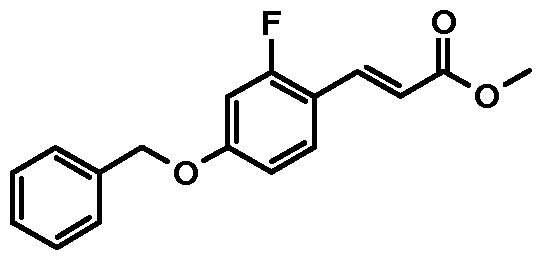
  • the compound of formula (XXXVII) can be synthesized by reaction of 4-benzyloxy-2- fluorobenzaldehyde (XXXVI) with methyl (triphenylphosphoranylidene) acetate in a suitable solvent, such as THF, under reflux conditions.
  • compounds of formula (XXXII) where R 3 is fluorine, R 3a is hydrogen, Y is CH 2 and R 4 is hydrogen can be prepared as outlined in Scheme 17.
  • Compounds of formula (XLVI) can be prepared by reaction of 2-fluoro-4-methoxybenzaldehyde (XLV) with sodium acetate and acetylaminoacetic acid at 12O 0 C in acetic anhydride. Reduction of the resulting alkenoic acid (XLVI), under standard conditions, affords a racemic compound of formula (XLVII).
  • the compounds of formula (I) may be prepared singly or as compound libraries comprising at least 2, for example 5 to 1,000, compounds and more preferably 10 to 100 compounds of formula (I).
  • Compound libraries may be prepared by a combinatorial "split and mix” approach or by multiple parallel synthesis using either solution or solid phase chemistry, using procedures known to those skilled in the art.
  • labile functional groups in the intermediate compounds e.g. hydroxy, carboxy and amino groups
  • the protecting groups may be removed at any stage in the synthesis of the compounds of formula (I) or may be present on the final compound of formula (I).
  • a comprehensive discussion of the ways in which various labile functional groups may be protected and methods for cleaving the resulting protected derivatives is given in, for example, Protective Groups in Organic Chemistry, T.W. Greene and P.G.M. Wuts, (1991) Wiley-Interscience, New York, 2 nd edition.
  • the compounds of the invention are useful as GPRl 19 agonists, e.g. for the treatment and/or prophylaxis of diabetes.
  • the compounds of the invention will generally be administered in the form of a pharmaceutical composition.
  • the compounds of the invention may also be useful as dual GPRl 19 agonists/DPP-IV inhibitors, e.g. for the treatment and/or prophylaxis of diabetes.
  • the compounds of the invention will generally be administered in the form of a pharmaceutical composition.
  • the invention also provides a compound of the invention, or a pharmaceutically acceptable salt thereof, for use as a pharmaceutical.
  • the invention also provides a pharmaceutical composition
  • a pharmaceutical composition comprising a compound of the invention, in combination with a pharmaceutically acceptable carrier.
  • composition is comprised of a pharmaceutically acceptable carrier and a non-toxic therapeutically effective amount of a compound of the invention, or a pharmaceutically acceptable salt thereof.
  • the invention also provides a pharmaceutical composition for the treatment of disease by modulating GPRl 19 and optionally DPP-IV, resulting in the prophylactic or therapeutic treatment of diabetes, comprising a pharmaceutically acceptable carrier and a nontoxic therapeutically effective amount of compound of the invention, or a pharmaceutically acceptable salt thereof.
  • compositions may optionally comprise other therapeutic ingredients or adjuvants.
  • the compositions include compositions suitable for oral, rectal, topical, and parenteral (including subcutaneous, intramuscular, and intravenous) administration, although the most suitable route in any given case will depend on the particular host, and nature and severity of the conditions for which the active ingredient is being administered.
  • the pharmaceutical compositions may be conveniently presented in unit dosage form and prepared by any of the methods well known in the art of pharmacy.
  • the compounds of the invention can be combined as the active ingredient in intimate admixture with a pharmaceutical carrier according to conventional pharmaceutical compounding techniques.
  • a pharmaceutical carrier may take a wide variety of forms depending on the form of preparation desired for administration, e.g. oral or parenteral (including intravenous).
  • compositions can be presented as discrete units suitable for oral administration such as capsules, cachets or tablets each containing a predetermined amount of the active ingredient. Further, the compositions can be presented as a powder, as granules, as a solution, as a suspension in an aqueous liquid, as a non-aqueous liquid, as an oil-in-water emulsion, or as a water-in-oil liquid emulsion.
  • the compound of the invention, or a pharmaceutically acceptable salt thereof may also be administered by controlled release means and/or delivery devices.
  • the compositions may be prepared by any of the methods of pharmacy.
  • such methods include a step of bringing into association the active ingredient with the carrier that constitutes one or more necessary ingredients.
  • the compositions are prepared by uniformly and intimately admixing the active ingredient with liquid carriers or finely divided solid carriers or both. The product can then be conveniently shaped into the desired presentation.
  • the compounds of the invention can also be included in pharmaceutical compositions in combination with one or more other therapeutically active compounds.
  • the pharmaceutical carrier employed can be, for example, a solid, liquid, or gas.
  • solid carriers include lactose, terra alba, sucrose, talc, gelatin, agar, pectin, acacia, magnesium stearate, and stearic acid.
  • liquid carriers are sugar syrup, peanut oil, olive oil, and water.
  • gaseous carriers include carbon dioxide and nitrogen.
  • any convenient pharmaceutical media may be employed.
  • water, glycols, oils, alcohols, flavoring agents, preservatives, coloring agents, and the like may be used to form oral liquid preparations such as suspensions, elixirs and solutions; while carriers such as starches, sugars, microcrystalline cellulose, diluents, granulating agents, lubricants, binders, disintegrating agents, and the like may be used to form oral solid preparations such as powders, capsules and tablets. Because of their ease of administration, tablets and capsules are the preferred oral dosage units whereby solid pharmaceutical carriers are employed.
  • tablets may be coated by standard aqueous or nonaqueous techniques.
  • a tablet containing the composition of this invention may be prepared by compression or molding, optionally with one or more accessory ingredients or adjuvants.
  • Compressed tablets may be prepared by compressing, in a suitable machine, the active ingredient in a free -flowing form such as powder or granules, optionally mixed with a binder, lubricant, inert diluent, surface active or dispersing agent. Molded tablets may be made by molding in a suitable machine, a mixture of the powdered compound moistened with an inert liquid diluent.
  • Each tablet preferably contains from about 0.05mg to about 5g of the active ingredient and each cachet or capsule preferably containing from about 0.05mg to about 5g of the active ingredient.
  • a formulation intended for the oral administration to humans may contain from about 0.5mg to about 5g of active agent, compounded with an appropriate and convenient amount of carrier material which may vary from about 5 to about 95 percent of the total composition.
  • Unit dosage forms will generally contain between from about lmg to about 2g of the active ingredient, typically 25 mg, 50mg, lOOmg, 200mg, 300mg, 400mg, 500mg, 600mg, 800mg, or lOOOmg.
  • compositions of the present invention suitable for parenteral administration may be prepared as solutions or suspensions of the active compounds in water.
  • a suitable surfactant can be included such as, for example, hydroxypropylcellulose.
  • Dispersions can also be prepared in glycerol, liquid polyethylene glycols, and mixtures thereof in oils. Further, a preservative can be included to prevent the detrimental growth of microorganisms.
  • compositions of the present invention suitable for injectable use include sterile aqueous solutions or dispersions.
  • the compositions can be in the form of sterile powders for the extemporaneous preparation of such sterile injectable solutions or dispersions.
  • the final injectable form must be sterile and must be effectively fluid for easy syringability.
  • the pharmaceutical compositions must be stable under the conditions of manufacture and storage; thus, preferably should be preserved against the contaminating action of microorganisms such as bacteria and fungi.
  • the carrier can be a solvent or dispersion medium containing, for example, water, ethanol, polyol (e.g. glycerol, propylene glycol and liquid polyethylene glycol), vegetable oils, and suitable mixtures thereof.
  • compositions of the present invention can be in a form suitable for topical use such as, for example, an aerosol, cream, ointment, lotion, dusting powder, or the like. Further, the compositions can be in a form suitable for use in transdermal devices. These formulations may be prepared, using a compound of the invention, or a pharmaceutically acceptable salt thereof, via conventional processing methods. As an example, a cream or ointment is prepared by admixing hydrophilic material and water, together with about 5wt% to about 10wt% of the compound, to produce a cream or ointment having a desired consistency.
  • compositions of this invention can be in a form suitable for rectal administration wherein the carrier is a solid. It is preferable that the mixture forms unit dose suppositories. Suitable carriers include cocoa butter and other materials commonly used in the art. The suppositories may be conveniently formed by first admixing the composition with the softened or melted carrier(s) followed by chilling and shaping in molds.
  • the pharmaceutical formulations described above may include, as appropriate, one or more additional carrier ingredients such as diluents, buffers, flavoring agents, binders, surface-active agents, thickeners, lubricants, preservatives (including anti-oxidants) and the like.
  • additional carrier ingredients such as diluents, buffers, flavoring agents, binders, surface-active agents, thickeners, lubricants, preservatives (including anti-oxidants) and the like.
  • additional carrier ingredients such as diluents, buffers, flavoring agents, binders, surface-active agents, thickeners, lubricants, preservatives (including anti-oxidants) and the like.
  • additional carrier ingredients such as diluents, buffers, flavoring agents, binders, surface-active agents, thickeners, lubricants, preservatives (including anti-oxidants) and the like.
  • other adjuvants can be included to render the formulation isotonic with the blood of the intended recipient
  • dosage levels on the order of 0.01mg/kg to about 150mg/kg of body weight per day are useful in the treatment of the above-indicated conditions, or alternatively about 0.5mg to about 7g per patient per day.
  • obesity may be effectively treated by the administration of from about 0.01 to 50mg of the compound per kilogram of body weight per day, or alternatively about 0.5mg to about 3.5g per patient per day.
  • the compounds of the invention may be used in the treatment of diseases or conditions in which GPRl 19 and optionally DPP-IV play a role.
  • the invention also provides a method for the treatment of a disease or condition in which GPRl 19 and optionally DPP-IV play a role comprising a step of administering to a subject in need thereof an effective amount of a compound of the invention, or a pharmaceutically acceptable salt thereof.
  • diseases or conditions diabetes, obesity, impaired glucose tolerance, insulin resistance and diabetic complications such as neuropathy, nephropathy, retinopathy, cataracts, cardiovascular complications and dyslipidaemia).
  • the compounds of the invention may also be used for treating metabolic diseases such as metabolic syndrome (syndrome X), impaired glucose tolerance, hyperlipidemia, hypertriglyceridemia, hypercholesterolemia, low HDL levels and hypertension.
  • the invention also provides a method for the treatment of type II diabetes, comprising a step of administering to a patient in need thereof an effective amount of a compound of the invention, or a pharmaceutically acceptable salt thereof.
  • the invention also provides a method for the treatment of obesity, metabolic syndrome (syndrome X), impaired glucose tolerance, hyperlipidemia, hypertriglyceridemia, hypercholesterolemia, low HDL levels or hypertension comprising a step of administering to a patient in need thereof an effective amount of a compound of the invention, or a pharmaceutically acceptable salt thereof.
  • the invention also provides a compound of the invention, or a pharmaceutically acceptable salt thereof, for use in the treatment of a condition as defined above.
  • the invention also provides the use of a compound of the invention, or a pharmaceutically acceptable salt thereof, in the manufacture of a medicament for the treatment of a condition as defined above.
  • treatment includes both therapeutic and prophylactic treatment.
  • the compounds of the invention may exhibit advantageous properties compared to known compounds or combination therapies for the treatment of diabetes.
  • the compounds of the invention, or pharmaceutically acceptable salts thereof, may be administered alone or in combination with one or more other therapeutically active compounds.
  • the other therapeutically active compounds may be for the treatment of the same disease or condition as the compounds of the invention or a different disease or condition.
  • the therapeutically active compounds may be administered simultaneously, sequentially or separately.
  • the compounds of the invention may be administered with other active compounds for the treatment of obesity and/or diabetes, for example insulin and insulin analogs, gastric lipase inhibitors, pancreatic lipase inhibitors, sulfonyl ureas and analogs, biguanides e.g. metformin, 0c2 agonists, glitazones, PPAR- ⁇ agonists, mixed PPAR- ⁇ / ⁇ agonists, RXR agonists, fatty acid oxidation inhibitors, ⁇ -glucosidase inhibitors, ⁇ -agonists, phosphodiesterase inhibitors, lipid lowering agents, glycogen phosphorylase inhibitors, antiobesity agents e.g.
  • pancreatic lipase inhibitors MCH-I antagonists and CB-I antagonists (or inverse agonists), amylin antagonists, lipoxygenase inhibitors, somostatin analogs, glucokinase activators, glucagon antagonists, insulin signalling agonists, PTPlB inhibitors, gluconeogenesis inhibitors, antilypolitic agents, GSK inhibitors, galanin receptor agonists, anorectic agents, CCK receptor agonists, leptin, serotonergic/dopaminergic antiobesity drugs, reuptake inhibitors e.g.
  • sibutramine CRF antagonists, CRF binding proteins, thyromimetic compounds, aldose reductase inhibitors, glucocorticoid receptor antagonists, NHE-I inhibitors or sorbitol dehydrogenase inhibitors.
  • Combination therapy comprising the administration of a compound of the invention, or a pharmaceutically acceptable salt thereof, and at least one other agent, for example another agent for the treatment of diabetes or obesity, represents a further aspect of the invention.
  • the present invention also provides a method for the treatment of diabetes in a mammal, such as a human, which method comprises administering an effective amount of a compound of the invention, or a pharmaceutically acceptable salt thereof, and another agent, for example another agent for the treatment of diabetes or obesity, to a mammal in need thereof.
  • the invention also provides the use of a compound of the invention, or a pharmaceutically acceptable salt thereof, and another agent for the treatment of diabetes.
  • the invention also provides the use of a compound of the invention, or a pharmaceutically acceptable salt thereof, in the manufacture of a medicament for use in combination with another agent, for the treatment of diabetes.
  • the compound of the invention, or a pharmaceutically acceptable salt thereof, and the other agent(s) may be co-administered or administered sequentially or separately.
  • Co-administration includes administration of a formulation which includes both the compound of the invention, or a pharmaceutically acceptable salt thereof, and the other agent(s), or the simultaneous or separate administration of different formulations of each agent. Where the pharmacological profiles of the compound of the invention, or a pharmaceutically acceptable salt thereof, and the other agent(s) allow it, coadministration of the two agents may be preferred.
  • the invention also provides the use of a compound of the invention, or a pharmaceutically acceptable salt thereof, and another agent in the manufacture of a medicament for the treatment of diabetes.
  • the invention also provides a pharmaceutical composition
  • a pharmaceutical composition comprising a compound of the invention, or a pharmaceutically acceptable salt thereof, and another antidiabetic agent, and a pharmaceutically acceptable carrier.
  • the invention also encompasses the use of such compositions in the methods described above.
  • the mass spectra were obtained using an electrospray ionisation source in the positive (ES + ) mode.
  • Chiral-HPLC was performed on a Daicel chiralpak IA 250 X 20 mm, 5 ⁇ M column.
  • Preparation 8 l-Piperidin-4-yl ethanol To a solution of ⁇ -methyl-4-pyridine methanol (3.7g, 30mmol) in EtOH (10OmL) was added AcOH (1.9mL, 33mmol) and platinum oxide (0.5g, 2.2mmol) and the resulting mixture was allowed to stir under an atmosphere of hydrogen at r.t. for 16h. The mixture was filtered and the filtrate was concentrated in vacuo. The residue was dissolved in MeOH, to which was added a solution of NaOH (1.6g, 40mmol) and water (1.6mL) in MeOH. The reaction was stirred for 30 min before removing the solvent in vacuo, and the resulting residue was suspended in diethyl ether for 30 min.
  • Acetic anhydride (54Og, 5.30mol) was added under stirring to a mixture of 2-fluoro-4- methoxybenzaldehyde (24Og, 1.56mol), N-acetylglycine (219g, 1.87mol) and sodium acetate (128g, 1.56mol) at ambient temperature.
  • the suspension was heated to 100 0 C for 18h.
  • the solution was cooled to ambient temperature and the residue was alternately extracted with DCM (5 X 50OmL) and water (5 X 20OmL).
  • the remaining crystalline solid was dried to yield 4-[l-(2- fluoro-4-methoxyphenyl)meth-(Zi)-ylidene]-2-methyl-4H-oxazol-5-one.
  • Triethylamine (4.6OmL, 33.0mmol) and pivaloyl chloride (3.6OmL, 28.2mmol) were added to a solution of (£)-3-(4-benzyloxy-2-fluorophenyl)acrylic acid (Preparation 90, 6.2Og, 22.8mmol) in THF (20OmL) at -78 0 C and stirred at this temperature for 15 min before stirring at O 0 C for 1 h.
  • the reaction was cooled to -78 0 C and transferred, via cannula, to a solution of N-bromosuccinimide (3.71g, 20.8mmol) in DCM (5OmL) under argon, previously cooled to -78°C.
  • the resulting reaction was stirred at -78°C for 2h and at O 0 C for 2h, before being quenched with 0.5M aqueous NaHCO 3 solution.
  • the DCM was removed in vacuo, EtOAc was added and the organic layer was washed with water, brine, dried (MgSO 4 ), and concentrated in vacuo.
  • Triethylamine (700 ⁇ L, 5.00mmol) and di-ter?-butyldicarboante (1.6Og, 7.33mmol) were added to a solution of (25, 3S)-3-(2-fluoro-4-hydroxyphenyl)-2-methylbutyric acid hydrochloride (Preparation 96, 682mg, 2.73mmol) in a mixture of dioxane and water (19:1, 5OmL) and the resulting solution was stirred for 72h. The solvent was removed in vacuo and to the residue was added EtOAc (30OmL) and water (10OmL). The mixture was made acidic with IM HCl solution and stirred vigorously.
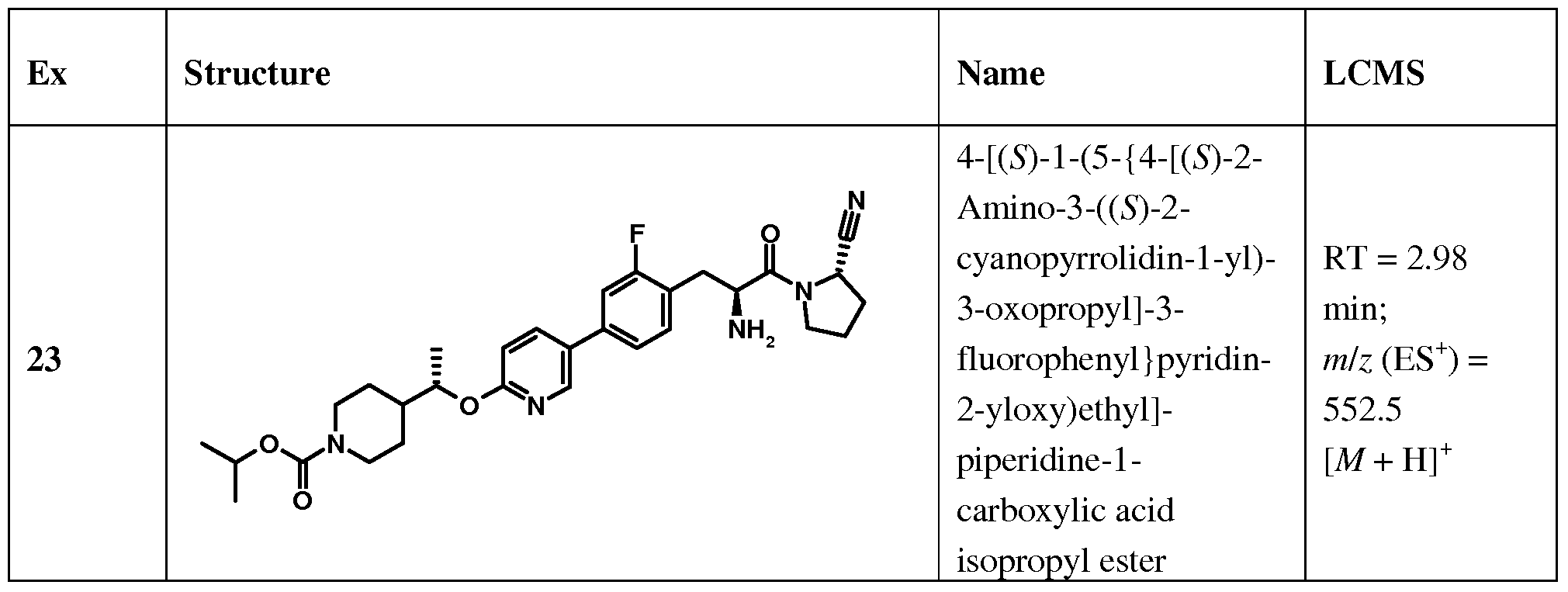
  • Example 22 4-[(/?)-l-(5- ⁇ 4-[(S)-2-Amino-3-((S)-2-cyanopyrrolidin-l-yl)-3-oxopropyl]-3- fluorophenyl ⁇ pyridin-2-yloxy)ethyl]piperidine-l-carboxylic acid isopropyl ester
  • Example 28 (S)-4- ⁇ 4'-[2-Amino-3-((S)-2-cyanopyrrolidin-l-yl)-3-oxopropyl]biphenyl-4- yloxymethyl ⁇ piperidine-l-carboxylic acid isopropyl ester hydrochloride
  • (5)-4- ⁇ 4'-[2-ter?-butoxycarbonylamino-3-((5)-2-cyanopyrrolidin-l-yl)- 3-oxopropyl]biphenyl-4-yloxymethyl ⁇ piperidine-l-carboxylic acid isopropyl ester Preparation 73, 56mg, 0.09mmol) in DCM was added TFA (2.5mL).
  • Example 37 4- ⁇ (S)-l-[4'-((S)-2-Amino-3-oxo-3-pyrrolidin-l-ylpropyl)-3'-fluorobiphenyl-4- yloxy]ethyl ⁇ piperidine-l-carboxylic acid isopropyl ester
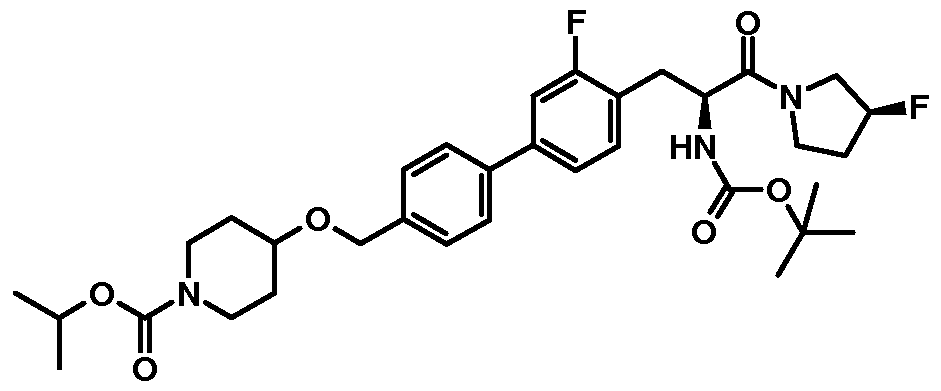
  • Example 40 4-((S)-l- ⁇ 4'-[(S)-2-Amino-3-((S)-3-fluoropyrrolidin-l-yl)-3-oxopropyl]-3'- fluorobiphenyl-4-yloxy ⁇ ethyl)piperidine-l-carboxylic acid isopropyl ester
  • the biological activity of the compounds of the invention may be tested in the following assay systems:
  • yeast cell-based reporter assays have previously been described in the literature (e.g. see Miret J. J. et al, 2002, J. Biol. Chem., 277:6881-6887; Campbell R.M. et al, 1999, Bioorg. Med. Chem. Lett., 9:2413-2418; King K. et al, 1990, Science, 250:121-123); WO 99/14344; WO 00/12704; and US 6,100,042).
  • yeast cells have been engineered such that the endogenous yeast G-alpha (GPAl) has been deleted and replaced with G-protein chimeras constructed using multiple techniques.
  • yeast GPCR Ste3 has been deleted to allow for heterologous expression of a mammalian GPCR of choice.
  • elements of the pheromone signaling transduction pathway which are conserved in eukaryotic cells (for example, the mitogen-activated protein kinase pathway), drive the expression of Fusl.
  • ⁇ -galactosidase LacZ
  • Fuslp Fusl promoter
  • Yeast cells were transformed by an adaptation of the lithium acetate method described by Agatep et al, (Agatep, R. et al, 1998, Transformation of Saccharomyces cerevisiae by the lithium acetate/single-stranded carrier DNA/polyethylene glycol (LiAc/ss-DNA/PEG) protocol. Technical Tips Online, Trends Journals, Elsevier). Briefly, yeast cells were grown overnight on yeast tryptone plates (YT).
  • Carrier single-stranded DNA (10 ⁇ g), 2 ⁇ g of each of two Fuslp- LacZ reporter plasmids (one with URA selection marker and one with TRP), 2 ⁇ g of GPRl 19 (human or mouse receptor) in yeast expression vector (2 ⁇ g origin of replication) and a lithium acetate/ polyethylene glycol/ TE buffer was pipetted into an Eppendorf tube.
  • the yeast expression plasmid containing the receptor/ no receptor control has a LEU marker.
  • Yeast cells were inoculated into this mixture and the reaction proceeds at 30 0 C for 60min. The yeast cells were then heat-shocked at 42°C for 15 min. The cells were then washed and spread on selection plates.
  • the selection plates are synthetic defined yeast media minus LEU, URA and TRP (SD- LUT). After incubating at 30 0 C for 2-3 days, colonies that grow on the selection plates were then tested in the LacZ assay.
  • yeast cells carrying the human or mouse GPRl 19 receptor were grown overnight in liquid SD-LUT medium to an unsaturated concentration (i.e. the cells were still dividing and had not yet reached stationary phase). They were diluted in fresh medium to an optimal assay concentration and 90 ⁇ L of yeast cells added to 96-well black polystyrene plates (Costar). Compounds, dissolved in DMSO and diluted in a 10% DMSO solution to 1OX concentration, were added to the plates and the plates placed at 30 0 C for 4 h. After 4 h, the substrate for the ⁇ -galactosidase was added to each well.
  • Fluorescein di ⁇ -D-galactopyranoside
  • FDG Fluorescein di
  • a substrate for the enzyme that releases fluorescein allowing a fluorimetric read-out.
  • 20 ⁇ L per well of 500 ⁇ M FDG/2.5% Triton XlOO was added (the detergent was necessary to render the cells permeable).
  • 20 ⁇ L per well of IM sodium carbonate was added to terminate the reaction and enhance the fluorescent signal. The plates were then read in a fluorimeter at 485/535nm.
  • cAMP cyclic AMP
  • the cell monolayers were washed with phosphate buffered saline and stimulated at 37°C for 30 min with various concentrations of compound in stimulation buffer plus 1 % DMSO. Cells were then lysed and cAMP content determined using the Perkin Elmer AlphaScreenTM (Amplified Luminescent Proximity Homogeneous Assay) cAMP kit. Buffers and assay conditions were as described in the manufacturer's protocol.
  • Compounds of the invention produced a concentration-dependent increase in intracellular cAMP level and generally had an EC 50 of ⁇ 10 ⁇ M. Compounds showing and EC 50 of less than 1 ⁇ M in the cAMP assay may be preferred.
  • DPP-IV activity was measured by monitoring the cleavage of the fluorogenic peptide substrate, H-Gly-Pro-7-amino-4-methylcoumarin (GP-AMC) whereby the product 7-amino-4- methylcoumarin is quantified by fluorescence at excitation 380 nm and emission 460 nm.
  • Assays were carried out in 96-well plates (Black OptiPlate-96F) in a total volume of 100 ⁇ L per well consisting of 50 mM Tris pH 7.6, 100 ⁇ M GP-AMC, 10-25 ⁇ U recombinant human DPP- IV and a range of inhibitor dilutions in a final concentration of 1 % DMSO. Plates were read in a fluorimeter after 30 min incubation at 37 0 C. Recombinant human DPP-IV residues Asn29- Pro766 was purchased from BioMol.
  • HIT-T15 cells (passage 60) were obtained from ATCC, and were cultured in RPMI1640 medium supplemented with 10% fetal calf serum and 30 nM sodium selenite. All experiments were done with cells at less than passage 70, in accordance with the literature, which describes altered properties of this cell line at passage numbers above 81 (Zhang HJ, Walseth TF, Robertson RP. Insulin secretion and cAMP metabolism in HIT cells. Reciprocal and serial passage -dependent relationships. Diabetes. 1989 Jan;38(l):44-8).
  • HIT-T 15 cells were plated in standard culture medium in 96-well plates at 100,000 cells/ 0.1 mL/ well and cultured for 24 h and the medium was then discarded. Cells were incubated for 15min at room temperature with lOO ⁇ l stimulation buffer (Hanks buffered salt solution, 5mM HEPES, 0.5mM IBMX, 0.1% BSA, pH 7.4). This was discarded and replaced with compound dilutions over the range 0.001, 0.003, 0.01, 0.03, 0.1, 0.3, 1, 3, 10, 30 ⁇ M in stimulation buffer in the presence of 0.5% DMSO. Cells were incubated at room temperature for 30 min.
  • lOO ⁇ l stimulation buffer Hors buffered salt solution, 5mM HEPES, 0.5mM IBMX, 0.1% BSA, pH 7.4
  • 75 uL lysis buffer (5mM HEPES, 0.3% Tween-20, 0.1% BSA, pH 7.4) was added per well and the plate was shaken at 900 rpm for 20 min. Particulate matter was removed by centrifugation at 3000rpm for 5 min, then the samples were transferred in duplicate to 384-well plates, and processed following the Perkin Elmer AlphaScreen cAMP assay kit instructions. Briefly 25 ⁇ L reactions were set up containing 8 ⁇ L sample, 5 ⁇ L acceptor bead mix and 12 ⁇ L detection mix, such that the concentration of the final reaction components is the same as stated in the kit instructions. Reactions were incubated at room temperature for 150 min, and the plate was read using a Packard Fusion instrument.
  • Measurements for cAMP were compared to a standard curve of known cAMP amounts (0.01, 0.03, 0.1, 0.3, 1, 3, 10, 30, 100, 300, 1000 nM) to convert the readings to absolute cAMP amounts. Data was analysed using XLfit 3 software.
  • Representative compounds of the invention were found to increase cAMP at an EC 50 of less than 10 ⁇ M. Compounds showing an EC 50 of less than 1 ⁇ M in the cAMP assay may be preferred. Insulin secretion assay
  • HIT-T15 cells are plated in standard culture medium in 12-well plates at 106 cells/ 1 ml/ well and cultured for 3 days and the medium then discarded. Cells are washed x 2 with supplemented Krebs-Ringer buffer (KRB) containing 119 mM NaCl, 4.74 mM KCl, 2.54 mM CaCl 2 , 1.19 mM MgSO 4 , 1.19 mM KH 2 PO 4 , 25 mM NaHCO 3 , 10 mM HEPES at pH 7.4 and 0.1% bovine serum albumin. Cells are incubated with 1ml KRB at 37°C for 30 min which is then discarded.
  • KRB Krebs-Ringer buffer
  • Compounds of the invention preferably increase insulin secretion at an EC 50 of less than 10 ⁇ M.
  • GIc oral glucose tolerance
  • Food is withdrawn 16 h before administration of GIc and remains withdrawn throughout the study. Rats have free access to water during the study. A cut is made to the animals' tails, then blood (1 drop) is removed for measurement of basal GIc levels 60 min before administration of the GIc load. Then, the rats are weighed and dosed orally with test compound or vehicle (20% aqueous hydroxypropyl- ⁇ -cyclodextrin) 45 min before the removal of an additional blood sample and treatment with the GIc load (2 g kg "1 p.o.).
  • Blood samples are taken from the cut tip of the tail 5, 15, 30, 60, 120, and 180 min after GIc administration. Blood glucose levels are measured just after collection using a commercially available glucose-meter (OneTouch® UltraTM from Lifescan). Compounds of the invention preferably statistically reduce the GIc excursion at doses ⁇ 100 mg kg "1 .
  • GIc oral glucose
  • Food is withdrawn 5 h before administration of GIc and remained withdrawn throughout the study. Mice have free access to water during the study. A cut was made to the animals' tails, then blood (20 ⁇ L) is removed for measurement of basal GIc levels 45 min before administration of the GIc load.
  • mice are weighed and dosed orally with test compound or vehicle (20% aqueous hydroxypropyl- ⁇ -cyclodextrin or 25% aqueous Gelucire 44/14) 30 min before the removal of an additional blood sample (20 ⁇ L) and treatment with the GIc load (2-5 g kg "1 p.o.). Blood samples (20 ⁇ L) are then taken 25, 50, 80, 120, and 180 min after GIc administration. The 20 ⁇ L blood samples for measurement of GIc levels are taken from the cut tip of the tail into disposable micro-pipettes (Dade Diagnostics Inc., Puerto Rico) and the sample added to 480 ⁇ L of haemolysis reagent.
  • test compound or vehicle 20% aqueous hydroxypropyl- ⁇ -cyclodextrin or 25% aqueous Gelucire 44/14) 30 min before the removal of an additional blood sample (20 ⁇ L) and treatment with the GIc load (2-5 g kg "1 p.o.).
  • Blood samples (20 ⁇ L) are then taken
  • Duplicate 20 ⁇ L aliquots of the diluted haemolysed blood are then added to 180 ⁇ L of Trinders glucose reagent (Sigma enzymatic (Trinder) colorimetric method) in a 96-well assay plate. After mixing, the samples are left at room temperature for 30 min before being read against GIc standards (Sigma glucose/urea nitrogen combined standard set). Compounds of the invention preferably statistically reduce the GIc excursion at doses ⁇ 100 mg kg "1 .

Landscapes

  • Chemical & Material Sciences (AREA)
  • Organic Chemistry (AREA)
  • Health & Medical Sciences (AREA)
  • Veterinary Medicine (AREA)
  • Animal Behavior & Ethology (AREA)
  • Engineering & Computer Science (AREA)
  • Public Health (AREA)
  • General Health & Medical Sciences (AREA)
  • Medicinal Chemistry (AREA)
  • Pharmacology & Pharmacy (AREA)
  • Bioinformatics & Cheminformatics (AREA)
  • Life Sciences & Earth Sciences (AREA)
  • Nuclear Medicine, Radiotherapy & Molecular Imaging (AREA)
  • General Chemical & Material Sciences (AREA)
  • Chemical Kinetics & Catalysis (AREA)
  • Diabetes (AREA)
  • Obesity (AREA)
  • Hematology (AREA)
  • Emergency Medicine (AREA)
  • Heart & Thoracic Surgery (AREA)
  • Cardiology (AREA)
  • Endocrinology (AREA)
  • Neurology (AREA)
  • Vascular Medicine (AREA)
  • Ophthalmology & Optometry (AREA)
  • Child & Adolescent Psychology (AREA)
  • Biomedical Technology (AREA)
  • Urology & Nephrology (AREA)
  • Neurosurgery (AREA)
  • Epidemiology (AREA)
  • Pharmaceuticals Containing Other Organic And Inorganic Compounds (AREA)
  • Plural Heterocyclic Compounds (AREA)
  • Medicines That Contain Protein Lipid Enzymes And Other Medicines (AREA)
  • Hydrogenated Pyridines (AREA)
  • Pyridine Compounds (AREA)

Abstract

The present invention is directed to therapeutic compounds which have activity as agonists of GPR119 and are useful for the treatment of metabolic disorders including type II diabetes (I).

Description

COMPOUNDS FOR THE TREATMENT OF METABOLIC DISORDERS
BACKGROUND OF THE INVENTION
The present invention is directed to therapeutic compounds useful for the treatment of metabolic disorders including type II diabetes. In particular, the present invention is directed to compounds which have activity as agonists of GPRl 19.
Drugs aimed at the pathophysiology associated with non-insulin dependent type II diabetes have many potential side effects and do not adequately address the dyslipidaemia and hyperglycaemia in a high proportion of patients. Treatment is often focused at individual patient needs using diet, exercise, hypoglycaemic agents and insulin, but there is a continuing need for novel antidiabetic agents, particularly ones that may be better tolerated with fewer adverse effects.
Similarly, metabolic syndrome (syndrome X) places people at high risk of coronary artery disease, and is characterized by a cluster of risk factors including central obesity (excessive fat tissue in the abdominal region), glucose intolerance, high triglycerides and low HDL cholesterol, and high blood pressure. Myocardial ischemia and microvascular disease is an established morbidity associated with untreated or poorly controlled metabolic syndrome.
Obesity is characterized by an excessive adipose tissue mass relative to body size. Clinically, body fat mass is estimated by the body mass index (BMI; weight(kg)/height(m)2), or waist circumference. Individuals are considered obese when the BMI is greater than 30 and there are established medical consequences of being overweight. It has been an accepted medical view for some time that an increased body weight, especially as a result of abdominal body fat, is associated with an increased risk for diabetes, hypertension, heart disease, and numerous other health complications, such as arthritis, stroke, gallbladder disease, muscular and respiratory problems, back pain and even certain cancers.
There is a continuing need for novel antidiabetic agents, particularly ones that are well tolerated with few adverse effects and in particular for agents which are weight neutral or preferably cause weight loss.
GPRl 19 (previously referred to as GPRl 16) is a GPCR identified as SNORF25 in WO00/50562 which discloses both the human and rat receptors, US 6,468,756 also discloses the mouse receptor (accession numbers: AAN95194 (human), AAN95195 (rat) and ANN95196 (mouse)).
In humans, GPRl 19 is expressed in the pancreas, small intestine, colon and adipose tissue. The expression profile of the human GPRl 19 receptor indicates its potential utility as a target for the treatment of diabetes.
GPRl 19 agonists have been shown to stimulate the release of GLP-I from the GI tract. In doing so, GPRl 19 agonists (1) enhance glucose-dependent insulin release from the pancreas leading to improvements in oral glucose tolerance; (2) attenuate disease progression by increasing β-cell cAMP concentrations; and (3) induce weight loss possibly through GLP-I 's ability to reduce food intake.
International Patent Applications WO2005/061489, WO2006/070208, WO2006/067532, WO2006/067531, WO2007/003960, WO2007/003961, WO2007/003962, WO2007/003964, WO2007/ 116229, WO2007/116230, WO2007/138362, WO2008/081204, WO2008/081205, WO2008/081206, WO2008/081207, WO2008/081208, WO2009/050522, WO2009/050971, WO2010/004343, WO2010/004344, WO2010/004345, WO2010/004347 and WO2010/00166 disclose GPRl 19 receptor agonists.
Dipeptidyl peptidase IV (DPP-IV) is a ubiquitous, yet highly specific, serine protease that cleaves N-terminal dipeptides from polypeptides with L-proline or L-alanine at the penultimate position. Studies with DPP-IV inhibitors show the principle role of DPP-IV is in the inactivation GLP-I. By extending the duration of action of GLP-I, insulin secretion is stimulated, glucagon release inhibited, and gastric emptying slowed. DPP-IV inhibitors are of use for the treatment of type II diabetes, examples of DPP-IV inhibitors include vildagliptin, sitagliptin, alogliptin and saxagliptin.
The possibility of using a combination of a GPRl 19 agonist and a DPP-IV inhibitor has been suggested, however this requires the administration of two separately formulated products to the patient or the co-formulation of two active ingredients with the inherent problems of achieving compatability in the physicochemical, pharmacokinetic and pharmacodynamic properties of the two active ingredients. International Patent Application WO2009/034388, published after the priority date of the present application, discloses compounds having dual activity as agonists of GPRl 19 and inhibitors of DPP-IV.
The compounds of the invention may also have dual activity as agonists of GPRl 19 and inhibitors of DPP-IV.
SUMMARY OF THE INVENTION
The present invention is directed to compounds which have activity as agonists of GPRl 19 and may also be inhibitors of DPP-IV and are useful for the treatment of metabolic disorders including type II diabetes.
DETAILED DESCRIPTION OF THE INVENTION
The present invention provides compounds of formula (I) and pharmaceutically acceptable salts thereof:
Figure imgf000003_0001
(I) wherein p is 1 or 2; when p is 2, Z is CHR1 or NR2; and when p is 1 , Z is -N-CH2-Ph wherein the Ph is optionally substituted by 1 or 2 groups independently selected from Ci_4alkyl, Ci_4haloalkyl and halo;
R1 is -N(CH3)-C(O)-O-C2-4alkyl or -N(CH3)-C(O)-O-C3.6cycloalkyl wherein the cycloalkyl is optionally substitiuted by Ci_4alkyl;
R2 is -C(O)-O-C2-4 alkyl, -C(O)-O-C3.6cycloalkyl wherein the cycloalkyl is optionally substitiuted by Ci_4alkyl, -C(O)-C2.4 alkyl, -C(O)-C3_6cycloalkyl wherein the cycloalkyl is optionally substituted by Ci_4alkyl, or R2 is:
Figure imgf000003_0002
where T together with the -N=C- to which it is attached forms a 5- or 6-membered heteroaryl ring optionally containing up to 2 additional heteroatoms selected from N, O and S; when T together with the -N=C- to which it is attached forms a 5-membered heteroaryl ring, R6 is C2-4 alkyl or C3_6 cycloalkyl optionally substituted by Ci_4alkyl, and when T together with the -N=C- to which it is attached forms a 6-membered heteroaryl ring, R6 is C2-4 alkyl, fluoro or chloro;
Q is -O-, -0-CR8H- or -CR8H-O-;
X is phenyl or a 5- or 6-membered heteroaryl group containing one or more heteroatoms selected from N, O and S; provided that when Q is -0-CR8H- then X is not a 6-membered heteroaryl group;
Y is a bond, -CH2- or -CHMe-;
R3 and R3a are independently selected from hydrogen, fluoro or chloro, or when R7 is cyano, R3 may be methyl; provided that when Y is a bond, and R3 and R3a are in the ortho position to the Y group they are both hydrogen;
R4 is hydrogen or, when Y is -CH2- or -CHMe-, R4 can be -CH2- linked to position * on the phenyl ring to form a fused 6-membered N-containing heterocycle;
R5 is benzyl optionally substituted by one or more fluoro, chloro, cyano or methyl groups, or R5 is:
Figure imgf000004_0001
where r is 1 or 2 and m is 0, 1 or 2; W is CH2 or, when r is 2, W may be S; when W is CH2, R7 is fluoro or cyano, and when W is S, R7 is cyano; and R8 is hydrogen or methyl.
In a preferred embodiment the compounds of the invention have the stereochemistry as defined in formula (Ia), such compounds demonstrate DPP-IV inhibitory activity:
Figure imgf000004_0002
(Ia)
In one of embodiment of the invention each p is independently 1 or 2, i.e. forming a 4-, 5- or 6-membered ring. In another embodiment of the invention each p is the same, i.e. forming a 4- or 6-membered ring. In the compounds of the invention p is preferably 2.
Z is preferably NR2.
In one embodiment of the invention R2 is -C(O)OR4.
In a further embodiment of the invention R2 is:
Figure imgf000004_0003
When R2 is: particular 5- or 6-membered heteroaryl ringrs formed by T together with the -N=C- to which it is attached which may be mentioned are oxadiazole and pyrimidine.
Q is preferably -O- or -CR8H-O-, more preferably -CR8H-O-.
X is preferably a meta- or para-linked phenyl or a meta or para linked 6-membered heteroaromatic ring containing one or two nitrogen atoms, more preferably a para-linked phenyl or a para linked 6-membered heteroaromatic ring containing one or two nitrogen atoms.
X is preferably phenyl or pyridyl.
R3 is preferably fluoro.
R4 is preferably hydrogen.
R5 is preferably:
Figure imgf000005_0001
W is preferably CH2. r is preferably 2.
While the preferred groups for each variable have generally been listed above separately for each variable, preferred compounds of this invention include those in which several or each variable in formula (I) is selected from the preferred groups for each variable. Therefore, this invention is intended to include all combinations of preferred listed groups.
Representative compounds of the invention which may be mentioned are those provided in the Examples as the free base or a pharmacutically acceptable salt thereof.
The molecular weight of the compounds of the invention is preferably less than 800, more preferably less than 600.
As used herein, unless stated otherwise, "alkyl" means carbon chains which may be linear or branched. Examples of alkyl groups include ethyl, propyl, isopropyl, butyl, sec- and tert-butyl.
The term "heteroaryl" rings means 5- or 6-membered N-containing heteroaryl rings containing up to 2 additional heteroatoms selected from N, O and S. Examples of such heteroaryl rings are pyrrolyl, pyrazolyl, imidazolyl, oxazolyl, isoxazolyl, thiazolyl, isothiazolyl, triazolyl, oxadiazolyl, thiadiazolyl, pyridinyl, pyridazinyl, pyrimidinyl, pyrazinyl and triazinyl.
Compounds described herein may contain one or more asymmetric centers and may thus give rise to diastereomers and optical isomers. The present invention includes all such possible diastereomers as well as their racemic mixtures, their substantially pure resolved enantiomers, all possible geometric isomers, and pharmaceutically acceptable salts thereof. The present invention includes all stereoisomers of the compounds of the invention and pharmaceutically acceptable salts thereof. Further, mixtures of stereoisomers as well as isolated specific stereoisomers are also included. During the course of the synthetic procedures used to prepare such compounds, or in using racemization or epimerization procedures known to those skilled in the art, the products of such procedures can be a mixture of stereoisomers. When a tautomer of the compound of the invention exists, the present invention includes any possible tautomers and pharmaceutically acceptable salts thereof, and mixtures thereof, except where specifically drawn or stated otherwise.
When the compound of the invention and pharmaceutically acceptable salts thereof exist in the form of solvates or polymorphic forms, the present invention includes any possible solvates and polymorphic forms. A type of a solvent that forms the solvate is not particularly limited so long as the solvent is pharmacologically acceptable. For example, water, ethanol, propanol, acetone or the like can be used.
The term "pharmaceutically acceptable salts" refers to salts prepared from pharmaceutically acceptable non-toxic bases or acids. When the compound of the present invention is acidic, its corresponding salt can be conveniently prepared from pharmaceutically acceptable non-toxic bases, including inorganic bases and organic bases. Salts derived from such inorganic bases include aluminum, ammonium, calcium, copper (ic and ous), ferric, ferrous, lithium, magnesium, potassium, sodium, zinc and the like salts. Particularly preferred are the ammonium, calcium, magnesium, potassium and sodium salts. Salts derived from pharmaceutically acceptable organic non-toxic bases include salts of primary, secondary, and tertiary amines, as well as cyclic amines and substituted amines such as naturally occurring and synthesized substituted amines. Other pharmaceutically acceptable organic non-toxic bases from which salts can be formed include arginine, betaine, caffeine, choline, N',N'- dibenzylethylenediamine, diethylamine, 2-diethylaminoethanol, 2-dimethylaminoethanol, ethanolamine, ethylenediamine, N-ethylmorpholine, N-ethylpiperidine, glucamine, glucosamine, histidine, hydrabamine, isopropylamine, lysine, methylglucamine, morpholine, piperazine, piperidine, polyamine resins, procaine, purines, theobromine, triethylamine, trimethylamine, tripropylamine, tromethamine and the like.
When the compound of the invention is basic, its corresponding salt can be conveniently prepared from pharmaceutically acceptable non-toxic acids, including inorganic and organic acids. Such acids include, for example, acetic, benzenesulfonic, benzoic, camphorsulfonic, citric, ethanesulfonic, fumaric, gluconic, glutamic, hydrobromic, hydrochloric, isethionic, lactic, maleic, malic, mandelic, methanesulfonic, mucic, nitric, pamoic, pantothenic, phosphoric, succinic, sulfuric, tartaric, p-toluenesulfonic acid and the like
Since the compounds of the invention are intended for pharmaceutical use they are preferably provided in substantially pure form, for example at least 60% pure, more suitably at least 75% pure, especially at least 98% pure (% are on a weight for weight basis).
The compounds of formula (I) can be prepared as described below, wherein R1, R2, R3, R3a, R5, R6, R7, R8, X, Y, W, Q, Z, m, p and r are as defined for formula (I). PG is a protecting group, Hal is halogen and Tf is triflate
Compounds of formula (I) where p is 2, Q is -O- or -CR8H-O-, X is a 2-pyridyl or 2- pyrimidyl and R2 is not -C(O)-O-C2-4 alkyl can be synthesized as outlined in Scheme 1. Compounds of formula (IV) can be synthesized by reaction of triflate of formula (II) with a boronate of formula (III) under, for example, Suzuki conditions using [1,1- bis(diphenylphosphino)ferrocene] dichloropalladium in a suitable solvent such as DMF/water at 8O0C. Compounds of formula (VI) can be prepared by reaction of aryl halide of formula (IV) with alcohols of formula (V) under standard conditions, such as KO1Bu in a suitable solvent such as THF at 15O0C in a microwave reactor. Deprotection of the amine functionality, using standard conditions well known to those with skill in the art, affords compounds of formula (I) as described above.
Scheme 1
Figure imgf000007_0001
VI
Compounds of formula (I) where p is 2, Q is -O- or -CR8H-O-, X is 2-pyridyl or 2- pyrimidyl and R2 is -C(O)-O-C2-4 alkyl can be synthesized as outlined in Scheme 2. Aryl bromide of formula (VIII) can be prepared by reaction of alcohol of formula (V) with aryl chloride of formula (VII) in the prescence on a suitable base, such as NaH in a suitable solvent such as THF at 6O0C. Aryl boronates of formula (IX) can be prepared by reaction of aryl bromide of formula (VIII) and bis(pinacolato)diboron in the prescence of a suitable catalyst, such as [l,l-bis(diphenylphosphino)ferrocene] dichloropalladium in a suitable solvent such as 1,4-dioxane at HO0C. Compounds of formula (VI) can be prepared by reaction of triflate of formula (II) with a boronate of formula (IX) under, for example, Suzuki conditions using [1,1- bis(diphenylphosphino)ferrocene] dichloropalladium in a suitable solvent such as DMF/water at 8O0C. Deprotection of the amine functionality, using standard conditions well known to those with skill in the art, affords compounds of formula (I) as described above.
Scheme 2
p(CH
Figure imgf000008_0001
VII VIII
Figure imgf000008_0002
Compounds of formula (I) where p is 2, Q is -O- or -CR8H-O- and X is phenyl can be synthesized as outlined in Scheme 3. Aryl halide of formula (XI) can be prepared by reaction of alcohol of formula (V) and phenol (X) under, for example, Mitsunobu conditions using azodicarboxylic dipiperidide and tributylphosphine. Aryl boronates of formula (XII) can be prepared by reaction of aryl halide of formula (XI) and bis(pinacolato)diboron in the prescence of a suitable catalyst, such as [l,l-bis(diphenylphosphino)ferrocene] dichloropalladium in a suitable solvent such as 1,4-dioxane at HO0C. Compounds of formula (VI) can be prepared by reaction of triflate of formula (II) with a boronate of formula (XII) under, for example, Suzuki conditions using [l,l-bis(diphenylphosphino)ferrocene] dichloropalladium in a suitable solvent such as DMF/water at 8O0C in a microwave reactor. Deprotection of the amine functionality, using standard conditions well known to those with skill in the art, affords compounds of formula (I) as described above.
Scheme 3
Figure imgf000009_0001
Compounds of formula (I) where p is 2, Q is -O- or -CR8H-O- and X is 5-pyridyl or 5- pyrimidyl and can be synthesized as outlined in Scheme 4. Aryl bromide of formula (VIII) can be prepared by reaction of alcohol of formula (V) with aryl bromide of formula (XIII) under, for example, Mitsunobu conditions using azodicarboxylic dipiperidide and tributylphosphine. Compounds of formula (VI) can be prepared by reaction of aryl bromide of formula (VIII) with a boronate of formula (XIV) under, for example, Suzuki conditions using [1,1- bis(diphenylphosphino)ferrocene] dichloropalladium in a suitable solvent such as DMF/water at 8O0C in a microwave reactor. Deprotection of the amine functionality, using standard conditions well known to those with skill in the art, affords compounds of formula (I) as described above.
Scheme 4
Figure imgf000009_0002
XIII VIII XIV
Figure imgf000009_0003
VI Compounds of formula (I) where p is 2, Q is -0-CR8H- and X is phenyl can be synthesized as outlined in Scheme 5. Mesylates of formula (XVI) can be prepared by reaction of alcohol of formula (XV) with methanesulfonyl chloride in the prescence of a suitable base, such as triethylamine, in a suitable solvent, such as DCM. Aryl bromides of formula (XI) can be prepared by reaction of mesylates of formula (XVI) with alcohols of formula (XVII) in the prescence of a suitable base, such as NaH, in a suitable solvent, such as THF. Aryl boronates of formula (XII) can be prepared by reaction of aryl halide of formula (XI) and bis(pinacolato)diboron in the prescence of a suitable catalyst, such as [1,1- bis(diphenylphosphino)ferrocene] dichloropalladium in a suitable solvent such as 1 ,4-dioxane at 11O0C. Compounds of formula (VI) can be prepared by reaction of triflate of formula (II) with a boronate of formula (XII) under, for example, Suzuki conditions using [1,1- bis(diphenylphosphino)ferrocene] dichloropalladium in a suitable solvent such as DMF/water at 8O0C in a microwave reactor. Deprotection of the amine functionality, using standard conditions well known to those with skill in the art, affords compounds of formula (I) as described above.
Scheme 5
Figure imgf000010_0001
XV XVI XVII XI
Figure imgf000010_0002
Compounds of formula (I) where p is 1 and X is 2-pyridyl or 2-pyrimidyl can be synthesized as outlined in Scheme 6. Aryl bromide of formula (VIII) can be prepared by reaction of alcohol of formula (V) with aryl bromide of formula (VII) in the presence of a suitable base, such as NaH, in a suitable solvent, such as DMF at 6O0C. Compounds of formula (VI) can be prepared by reaction of aryl bromide of formula (VIII) with a boronate of formula (XIV) under, for example, Suzuki conditions using [l,l-bis(diphenylphosphino)ferrocene] dichloropalladium in a suitable solvent such as DMF/water at 8O0C in a microwave reactor. Deprotection of the amine functionality, using standard conditions well known to those with skill in the art, affords compounds of formula (I) as described above.
Scheme 6
Figure imgf000011_0001
Figure imgf000011_0002
VI
Compounds of formula (I) where p is 1 and X is phenyl, 5-pyridyl or 5-pyrimidyl can be synthesized as outlined in Scheme 7. Aryl bromide of formula (VIII) can be prepared by reaction of alcohol of formula (V) with aryl bromide of formula (XIII) under, for example, Mitsunobu conditions using azodicarboxylic dipiperidide and tributylphosphine. Compounds of formula (VI) can be prepared by reaction of aryl bromide of formula (VIII) with a boronate of formula (XIV) under, for example, Suzuki conditions using [1,1- bis(diphenylphosphino)ferrocene] dichloropalladium in a suitable solvent such as DMF/water at 8O0C in a microwave reactor. Deprotection of the amine functionality, using standard conditions well known to those with skill in the art, affords compounds of formula (I) as described above.
Scheme 7
Figure imgf000011_0003
VI
Compounds of formula (I) where p is 2, Q is -0-CR8H- and X is oxadiazol-3-yl can be synthesized as outlined in Scheme 8. Nitrile of formula (XVIII) can be prepared by reaction of triflate of formula (II) with ZnCN in the presence of a suitable catalyst, such as [1,1- bis(diphenylphosphino)ferrocene] dichloropalladium in a suitable solvent such as DMF at 7O0C Amidoxime of formula (XIX) can be prepared by reaction of nitrile of formula (XVIII) and hydroxylamine hydrochloride in the prescence of a suitable base such as K2CO3 in a suitable solvent such as ethanol/water at 780C. Compounds of formula (VI) can be prepared by reaction of amidoxime of formula (XIX) with acid of formula (XX) under standard conditions, such as isobutyl chloroformate and triethylamine, in a suitable solvent such as DMF. Deprotection of the amine functionality, using standard conditions well known to those with skill in the art, affords compounds of formula (I) as described above.
Scheme 8
Figure imgf000012_0001
Figure imgf000012_0002
Compounds of formula (I) where p is 2, Q is -0-CR8H- and X is oxadiazol-5-yl can be prepared as outlined in Scheme 9. Acid of formula (XXI) can be prepared by reaction of triflate of formula (II) with carbon monoxide in the prescence of a suitable catalyst, such as palladium acetate in a suitable solvent, such as DMF at 8O0C. Compounds of formula (VI) can be prepared by reaction of acid of formula (XXI) with amidoxime of formula (XXII) under standard conditions, such as isobutyl chloroformate and triethylamine, in a suitable solvent such as DMF. Deprotection of the amine functionality, using standard conditions well known to those with skill in the art, affords compounds of formula (I) as described above.
Scheme 9
Figure imgf000013_0001
Figure imgf000013_0002
VI
Compounds of formula (I) where p is 2, Q is -0-CR8H- and X is thiazol-2-yl can be prepared as outlined in Scheme 10. Amide of formula (XXIII) can be prepared by reaction of nitrile of formula (XVIII) with hydrogen peroxide in a suitable solvent such as water/DMSO. Thioamide of formula (XXIV) can be prepared by reaction of amide of formula (XXIII) under standard conditions, for example using Lawesson's reagent in a suitable solvent such as toluene at reflux. Compounds of formula (VI) can be prepared by reaction of thioamide of formula (XXIV) with chloride of formula (XXV) in the prescence of a suitable base, such as K2CO3 in a suitable solvent such as acetone. Deprotection of the amine functionality, using standard conditions well known to those with skill in the art, affords compounds of formula (I) as described above.
Scheme 10
Figure imgf000013_0003
XVIII XXIII XXIV XXV
Figure imgf000013_0004
Compounds of formula (I) where p is 2, Q is -0-CR8H- and X is thiazol-4-yl can be prepared as outlined in Scheme 11. Ketones of formula (XXVI) can be prepared by reaction of triflate of formula (II) with vinylbutylether in the prescence of a suitable catalyst, such as palladium acetate, in a suitable solvent, such as DMF at 8O0C. Followed by work up with aqueous HCl solution at room temperature. Bromoketones of formula (XXVII) can be prepared by reaction of ketones of formula (XXVI) with trimethylphenylammonium tribromide in a suitable solvent, such as THF. Compounds of formula (VI) can be prepared by reaction of bromoketones of formula (XXVII) with thioamide of formula (XXVIII) under standard Hantzsch conditions, for example ethanol at room temperature. Deprotection of the amine functionality, using standard conditions well known to those with skill in the art, affords compounds of formula (I) as described above.
Scheme 11
Figure imgf000014_0001
Compounds of formula (XIV) can be prepared as outlined in Scheme 12. Compounds of formula (XIV) can be prepared by reaction of triflate of formula (II) with bis(pinacolato)diboron in the prescence of a suitable catalyst, such as [l,l-bis(diphenylphosphino)ferrocene] dichloropalladium in a suitable solvent such as 1,4-dioxane at HO0C.
Figure imgf000014_0002
II XIV
Compounds of formula (II) where R5 is benzyl can be prepared as outlined in Scheme 13. Aldehydes of formula (XXX) can be prepared by conversion of phenols of formula (XXIX) under standard conditions, for example, N-phenyltrifluoromethane sulfonimide in a suitable solvent, such as acetonitrile at room temperature. Amine of formula (XXXI) can be prepared by reaction of aldehyde of formula (XXX) with LiHMDS, followed by reaction of the resultant imine with a suitable Grignard reagent. Protection of the resulting amine group with, for example, di-ter?-butyldicarbonate, affords compounds of the formula (II).
Scheme 13
Figure imgf000015_0001
XXIX XXX XXXI
Figure imgf000015_0002
Compounds of formula (II) where R5 is amide, W is CH2 or S, m is 1 and R7 is cyano can be prepared as outlined in Scheme 14. Amides of formula (XXXIII) can be prepared by reaction of acids of formula (XXXII) with an appropriate amine under standard amide coupling conditions, for example, HOBT and EDCI, in a suitable solvent, such as DCM. Triflates of formula (XXXIV) can be prepared by conversion of amides of formula (XXXIII) under standard conditions, for example, N-phenyltrifluoromethane sulfonimide in a suitable solvent, such as acetonitrile at room temperature. Compounds of formula (II), as described above, can be prepared by reaction of compounds of formula (XXXIV) under standard dehydrating conditions, such as trifluoroacetic anhydride and pyridine in a suitable solvent, such as THF.
Scheme 14
Figure imgf000015_0003
Figure imgf000015_0004
XXXIV
Figure imgf000015_0005
Compounds of formula (II) where R5 is amide and R7 is not cyano can be prepared as outlined in Scheme 15. Amides of formula (XXXV) can be prepared by reaction of acids of formula (XXXII) with an appropriate amine under standard amide coupling conditions, for example, HOBT and EDCI in a suitable solvent, such as DCM. Triflates of formula (II) can be prepared by conversion of amides of formula (XXXIII) under standard conditions, for example, N-phenyltrifluoromethane sulfonimide in a suitable solvent, such as acetonitrile at room temperature.
Scheme 15
Figure imgf000016_0001
XXXII XXXV II
Specifically, chiral compounds of formula (XXXII) where R3 is fluorine, R3a is hydrogen, Y is CHMe and R4 is hydrogen can be prepared as outlined in Scheme 16. The compound of formula (XXXVII) can be synthesized by reaction of 4-benzyloxy-2- fluorobenzaldehyde (XXXVI) with methyl (triphenylphosphoranylidene) acetate in a suitable solvent, such as THF, under reflux conditions. Saponification, followed by activation of the resulting carboxylic acid with, for example, pivaloyl chloride, followed by reaction with (R)-(-)- 4-phenyl-2-oxazolidinone which has been deprotonatd with a suitable base, such as n- butyllithium, affords the compound of formula (XXXIX). Reaction with dimethyl sufide, methyl magnesium bromide and copper (I) bromide -dimethyl sulfide in a suitable solvent, such as THF, yields the compound of formula (XL). Subsequent reaction with dibutylborontriflate and N- bromosuccinimide, followed by reaction with NNN'.N'-tetramethylguanidinium azide, affords the compound of formula (XLII). Removal of the phenyloxazolidin-2-one group, with hydrogen peroxide and sodium hydroxide, gives the compound of formula (XLIII). Reduction, under standard conditions, followed by protection of the resulting amine group with, for example, di- terf-butyldicarbonate, affords compounds of the formula (XXXII) as described above.
Scheme 16
Figure imgf000017_0001
Specifically, compounds of formula (XXXII) where R3 is fluorine, R3a is hydrogen, Y is CH2 and R4 is hydrogen can be prepared as outlined in Scheme 17. Compounds of formula (XLVI) can be prepared by reaction of 2-fluoro-4-methoxybenzaldehyde (XLV) with sodium acetate and acetylaminoacetic acid at 12O0C in acetic anhydride. Reduction of the resulting alkenoic acid (XLVI), under standard conditions, affords a racemic compound of formula (XLVII). Reduction of the alkenoic acid (XLVI) with a chiral catalyst, such as [Rh(cod)(PP)]OTf and (5,5)-Et-Duphos, affords a compound of formula (XLVII) in high enantiomeric excess. Removal of the acetyl group, under standard acidic conditions, followed by protection of the amine group with, for example, di-terZ-butyldicarbonate yields compounds of formula (XXXII) as described above.
Scheme 17
Figure imgf000018_0001
Figure imgf000018_0002
XLVIII
Compounds of formula (XXV) where p is 2 and Q is -0-CR8H- can be prepared as outlined in Scheme 18. Alcohols of formula (XVII) can be treated with 1,3-dichloroacetone in the presence of a suitable base, such as K2CO3, in a suitable solvent such as DMF to give compounds of formula (XXV) as described above.
Scheme 18
Figure imgf000018_0003
XVII XXV
Compounds of formula (XXVIII) where p is 2 and Q is -0-CR8H- can be prepared as outlined in Scheme 19. Amides of formula (XLIX) can be prepared by reaction of acids of formula (XX) with an appropriate amine under standard amide coupling conditions, for example, HOBT and EDCI, in a suitable solvent, such as DCM. Thioamide of formula (XXVIII) can be prepared by reaction of amide of formula (XLIX) under standard conditions, for example using Lawesson's reagent in a suitable solvent such as toluene at reflux.
Scheme 19
Figure imgf000018_0004
XX XLIX XXVIII Other compounds of formula (I) may be prepared by methods analogous to those described above or by methods known per se. Further details for the preparation of the compounds of formula (I) are found in the examples.
The compounds of formula (I) may be prepared singly or as compound libraries comprising at least 2, for example 5 to 1,000, compounds and more preferably 10 to 100 compounds of formula (I). Compound libraries may be prepared by a combinatorial "split and mix" approach or by multiple parallel synthesis using either solution or solid phase chemistry, using procedures known to those skilled in the art.
During the synthesis of the compounds of formula (I), labile functional groups in the intermediate compounds, e.g. hydroxy, carboxy and amino groups, may be protected. The protecting groups may be removed at any stage in the synthesis of the compounds of formula (I) or may be present on the final compound of formula (I). A comprehensive discussion of the ways in which various labile functional groups may be protected and methods for cleaving the resulting protected derivatives is given in, for example, Protective Groups in Organic Chemistry, T.W. Greene and P.G.M. Wuts, (1991) Wiley-Interscience, New York, 2nd edition.
The processes for the production of the compounds of formula (I) and intermediates thereto as described above are also included as further aspects of the present invention.
Any novel intermediates as defined in the Schemes above or in the Examples, are also included within the scope of the invention. Therefore according to a further aspect of the invention there is provided a compound of any one of formulae II, IV, VI, XIV, XVIII, XIX, XXI, XXIII, XXIV, XXIV, XXVI, XXVII, XXXI, XXXIV as defined above. The preferred groups for variables recited above in relation to the compounds of formula (I) also apply to the intermediate compounds.
As indicated above the compounds of the invention are useful as GPRl 19 agonists, e.g. for the treatment and/or prophylaxis of diabetes. For such use the compounds of the invention will generally be administered in the form of a pharmaceutical composition.
The compounds of the invention may also be useful as dual GPRl 19 agonists/DPP-IV inhibitors, e.g. for the treatment and/or prophylaxis of diabetes. For such use the compounds of the invention will generally be administered in the form of a pharmaceutical composition.
The invention also provides a compound of the invention, or a pharmaceutically acceptable salt thereof, for use as a pharmaceutical.
The invention also provides a pharmaceutical composition comprising a compound of the invention, in combination with a pharmaceutically acceptable carrier.
Preferably the composition is comprised of a pharmaceutically acceptable carrier and a non-toxic therapeutically effective amount of a compound of the invention, or a pharmaceutically acceptable salt thereof.
Moreover, the invention also provides a pharmaceutical composition for the treatment of disease by modulating GPRl 19 and optionally DPP-IV, resulting in the prophylactic or therapeutic treatment of diabetes, comprising a pharmaceutically acceptable carrier and a nontoxic therapeutically effective amount of compound of the invention, or a pharmaceutically acceptable salt thereof.
The pharmaceutical compositions may optionally comprise other therapeutic ingredients or adjuvants. The compositions include compositions suitable for oral, rectal, topical, and parenteral (including subcutaneous, intramuscular, and intravenous) administration, although the most suitable route in any given case will depend on the particular host, and nature and severity of the conditions for which the active ingredient is being administered. The pharmaceutical compositions may be conveniently presented in unit dosage form and prepared by any of the methods well known in the art of pharmacy.
In practice, the compounds of the invention, or pharmaceutically acceptable salts thereof, can be combined as the active ingredient in intimate admixture with a pharmaceutical carrier according to conventional pharmaceutical compounding techniques. The carrier may take a wide variety of forms depending on the form of preparation desired for administration, e.g. oral or parenteral (including intravenous).
Thus, the pharmaceutical compositions can be presented as discrete units suitable for oral administration such as capsules, cachets or tablets each containing a predetermined amount of the active ingredient. Further, the compositions can be presented as a powder, as granules, as a solution, as a suspension in an aqueous liquid, as a non-aqueous liquid, as an oil-in-water emulsion, or as a water-in-oil liquid emulsion. In addition to the common dosage forms set out above, the compound of the invention, or a pharmaceutically acceptable salt thereof, may also be administered by controlled release means and/or delivery devices. The compositions may be prepared by any of the methods of pharmacy. In general, such methods include a step of bringing into association the active ingredient with the carrier that constitutes one or more necessary ingredients. In general, the compositions are prepared by uniformly and intimately admixing the active ingredient with liquid carriers or finely divided solid carriers or both. The product can then be conveniently shaped into the desired presentation.
The compounds of the invention, or pharmaceutically acceptable salts thereof, can also be included in pharmaceutical compositions in combination with one or more other therapeutically active compounds.
The pharmaceutical carrier employed can be, for example, a solid, liquid, or gas. Examples of solid carriers include lactose, terra alba, sucrose, talc, gelatin, agar, pectin, acacia, magnesium stearate, and stearic acid. Examples of liquid carriers are sugar syrup, peanut oil, olive oil, and water. Examples of gaseous carriers include carbon dioxide and nitrogen.
In preparing the compositions for oral dosage form, any convenient pharmaceutical media may be employed. For example, water, glycols, oils, alcohols, flavoring agents, preservatives, coloring agents, and the like may be used to form oral liquid preparations such as suspensions, elixirs and solutions; while carriers such as starches, sugars, microcrystalline cellulose, diluents, granulating agents, lubricants, binders, disintegrating agents, and the like may be used to form oral solid preparations such as powders, capsules and tablets. Because of their ease of administration, tablets and capsules are the preferred oral dosage units whereby solid pharmaceutical carriers are employed. Optionally, tablets may be coated by standard aqueous or nonaqueous techniques.
A tablet containing the composition of this invention may be prepared by compression or molding, optionally with one or more accessory ingredients or adjuvants. Compressed tablets may be prepared by compressing, in a suitable machine, the active ingredient in a free -flowing form such as powder or granules, optionally mixed with a binder, lubricant, inert diluent, surface active or dispersing agent. Molded tablets may be made by molding in a suitable machine, a mixture of the powdered compound moistened with an inert liquid diluent. Each tablet preferably contains from about 0.05mg to about 5g of the active ingredient and each cachet or capsule preferably containing from about 0.05mg to about 5g of the active ingredient.
For example, a formulation intended for the oral administration to humans may contain from about 0.5mg to about 5g of active agent, compounded with an appropriate and convenient amount of carrier material which may vary from about 5 to about 95 percent of the total composition. Unit dosage forms will generally contain between from about lmg to about 2g of the active ingredient, typically 25 mg, 50mg, lOOmg, 200mg, 300mg, 400mg, 500mg, 600mg, 800mg, or lOOOmg.
Pharmaceutical compositions of the present invention suitable for parenteral administration may be prepared as solutions or suspensions of the active compounds in water. A suitable surfactant can be included such as, for example, hydroxypropylcellulose. Dispersions can also be prepared in glycerol, liquid polyethylene glycols, and mixtures thereof in oils. Further, a preservative can be included to prevent the detrimental growth of microorganisms.
Pharmaceutical compositions of the present invention suitable for injectable use include sterile aqueous solutions or dispersions. Furthermore, the compositions can be in the form of sterile powders for the extemporaneous preparation of such sterile injectable solutions or dispersions. In all cases, the final injectable form must be sterile and must be effectively fluid for easy syringability. The pharmaceutical compositions must be stable under the conditions of manufacture and storage; thus, preferably should be preserved against the contaminating action of microorganisms such as bacteria and fungi. The carrier can be a solvent or dispersion medium containing, for example, water, ethanol, polyol (e.g. glycerol, propylene glycol and liquid polyethylene glycol), vegetable oils, and suitable mixtures thereof.
Pharmaceutical compositions of the present invention can be in a form suitable for topical use such as, for example, an aerosol, cream, ointment, lotion, dusting powder, or the like. Further, the compositions can be in a form suitable for use in transdermal devices. These formulations may be prepared, using a compound of the invention, or a pharmaceutically acceptable salt thereof, via conventional processing methods. As an example, a cream or ointment is prepared by admixing hydrophilic material and water, together with about 5wt% to about 10wt% of the compound, to produce a cream or ointment having a desired consistency.
Pharmaceutical compositions of this invention can be in a form suitable for rectal administration wherein the carrier is a solid. It is preferable that the mixture forms unit dose suppositories. Suitable carriers include cocoa butter and other materials commonly used in the art. The suppositories may be conveniently formed by first admixing the composition with the softened or melted carrier(s) followed by chilling and shaping in molds.
In addition to the aforementioned carrier ingredients, the pharmaceutical formulations described above may include, as appropriate, one or more additional carrier ingredients such as diluents, buffers, flavoring agents, binders, surface-active agents, thickeners, lubricants, preservatives (including anti-oxidants) and the like. Furthermore, other adjuvants can be included to render the formulation isotonic with the blood of the intended recipient. Compositions containing a compound of the invention, or pharmaceutically acceptable salts thereof, may also be prepared in powder or liquid concentrate form.
Generally, dosage levels on the order of 0.01mg/kg to about 150mg/kg of body weight per day are useful in the treatment of the above-indicated conditions, or alternatively about 0.5mg to about 7g per patient per day. For example, obesity may be effectively treated by the administration of from about 0.01 to 50mg of the compound per kilogram of body weight per day, or alternatively about 0.5mg to about 3.5g per patient per day.
It is understood, however, that the specific dose level for any particular patient will depend upon a variety of factors including the age, body weight, general health, sex, diet, time of administration, route of administration, rate of excretion, drug combination and the severity of the particular disease undergoing therapy.
The compounds of the invention may be used in the treatment of diseases or conditions in which GPRl 19 and optionally DPP-IV play a role.
Thus the invention also provides a method for the treatment of a disease or condition in which GPRl 19 and optionally DPP-IV play a role comprising a step of administering to a subject in need thereof an effective amount of a compound of the invention, or a pharmaceutically acceptable salt thereof. Such diseases or conditions diabetes, obesity, impaired glucose tolerance, insulin resistance and diabetic complications such as neuropathy, nephropathy, retinopathy, cataracts, cardiovascular complications and dyslipidaemia). And the treatment of patients who have an abnormal sensitivity to ingested fats leading to functional dyspepsia. The compounds of the invention may also be used for treating metabolic diseases such as metabolic syndrome (syndrome X), impaired glucose tolerance, hyperlipidemia, hypertriglyceridemia, hypercholesterolemia, low HDL levels and hypertension.
The invention also provides a method for the treatment of type II diabetes, comprising a step of administering to a patient in need thereof an effective amount of a compound of the invention, or a pharmaceutically acceptable salt thereof.
The invention also provides a method for the treatment of obesity, metabolic syndrome (syndrome X), impaired glucose tolerance, hyperlipidemia, hypertriglyceridemia, hypercholesterolemia, low HDL levels or hypertension comprising a step of administering to a patient in need thereof an effective amount of a compound of the invention, or a pharmaceutically acceptable salt thereof.
The invention also provides a compound of the invention, or a pharmaceutically acceptable salt thereof, for use in the treatment of a condition as defined above.
The invention also provides the use of a compound of the invention, or a pharmaceutically acceptable salt thereof, in the manufacture of a medicament for the treatment of a condition as defined above.
In the methods of the invention the term "treatment" includes both therapeutic and prophylactic treatment.
The compounds of the invention may exhibit advantageous properties compared to known compounds or combination therapies for the treatment of diabetes.
The compounds of the invention, or pharmaceutically acceptable salts thereof, may be administered alone or in combination with one or more other therapeutically active compounds. The other therapeutically active compounds may be for the treatment of the same disease or condition as the compounds of the invention or a different disease or condition. The therapeutically active compounds may be administered simultaneously, sequentially or separately.
The compounds of the invention may be administered with other active compounds for the treatment of obesity and/or diabetes, for example insulin and insulin analogs, gastric lipase inhibitors, pancreatic lipase inhibitors, sulfonyl ureas and analogs, biguanides e.g. metformin, 0c2 agonists, glitazones, PPAR-γ agonists, mixed PPAR-α/γ agonists, RXR agonists, fatty acid oxidation inhibitors, α-glucosidase inhibitors, β-agonists, phosphodiesterase inhibitors, lipid lowering agents, glycogen phosphorylase inhibitors, antiobesity agents e.g. pancreatic lipase inhibitors, MCH-I antagonists and CB-I antagonists (or inverse agonists), amylin antagonists, lipoxygenase inhibitors, somostatin analogs, glucokinase activators, glucagon antagonists, insulin signalling agonists, PTPlB inhibitors, gluconeogenesis inhibitors, antilypolitic agents, GSK inhibitors, galanin receptor agonists, anorectic agents, CCK receptor agonists, leptin, serotonergic/dopaminergic antiobesity drugs, reuptake inhibitors e.g. sibutramine, CRF antagonists, CRF binding proteins, thyromimetic compounds, aldose reductase inhibitors, glucocorticoid receptor antagonists, NHE-I inhibitors or sorbitol dehydrogenase inhibitors.
Combination therapy comprising the administration of a compound of the invention, or a pharmaceutically acceptable salt thereof, and at least one other agent, for example another agent for the treatment of diabetes or obesity, represents a further aspect of the invention.
The present invention also provides a method for the treatment of diabetes in a mammal, such as a human, which method comprises administering an effective amount of a compound of the invention, or a pharmaceutically acceptable salt thereof, and another agent, for example another agent for the treatment of diabetes or obesity, to a mammal in need thereof.
The invention also provides the use of a compound of the invention, or a pharmaceutically acceptable salt thereof, and another agent for the treatment of diabetes.
The invention also provides the use of a compound of the invention, or a pharmaceutically acceptable salt thereof, in the manufacture of a medicament for use in combination with another agent, for the treatment of diabetes.
The compound of the invention, or a pharmaceutically acceptable salt thereof, and the other agent(s) may be co-administered or administered sequentially or separately.
Co-administration includes administration of a formulation which includes both the compound of the invention, or a pharmaceutically acceptable salt thereof, and the other agent(s), or the simultaneous or separate administration of different formulations of each agent. Where the pharmacological profiles of the compound of the invention, or a pharmaceutically acceptable salt thereof, and the other agent(s) allow it, coadministration of the two agents may be preferred.
The invention also provides the use of a compound of the invention, or a pharmaceutically acceptable salt thereof, and another agent in the manufacture of a medicament for the treatment of diabetes.
The invention also provides a pharmaceutical composition comprising a compound of the invention, or a pharmaceutically acceptable salt thereof, and another antidiabetic agent, and a pharmaceutically acceptable carrier. The invention also encompasses the use of such compositions in the methods described above.
All publications, including, but not limited to, patents and patent application cited in this specification, are herein incorporated by reference as if each individual publication were specifically and individually indicated to be incorporated by reference herein as fully set forth.
The invention will now be described by reference to the following examples which are for illustrative purposes and are not to be construed as a limitation of the scope of the present invention. EXAMPLES
Materials and methods
Column chromatography was carried out on SiO2 (40-63 mesh) unless specified otherwise. LCMS data were obtained as follows: Atlantis 3// Ci8 column (3.0 X 20.0 mm, flow rate = 0.85 mL/min) eluting with a H2O-CH3CN solution containing 0.1% HCO2H over 6 min with UV detection at 220 nm. Gradient information: 0.0-0.3 min 100% H2O; 0.3-4.25 min: Ramp up to 10% H2O-90% CH3CN; 4.25-4.4 min: Ramp up to 100% CH3CN; 4.4-4.9 min: Hold at 100% CH3CN; 4.9-6.0 min: Return to 100% H2O. The mass spectra were obtained using an electrospray ionisation source in either the positive (ES+) or negative (ES") ion modes.
LCMS data (method 2) were obtained as follows: Chromolith SpeedROD column (4.6 X 50.0 monolith, flow rate = 3.0 mL/min) eluting with a H2O-CH3CN solution containing 0.1% TFA over 3 min with UV detection at 220 nm. Gradient information: 0-2 min: 99% H2O 1% MeCN to 100% MeCN; 2-3 min: Hold at 100% CH3CN. The mass spectra were obtained using an electrospray ionisation source in the positive (ES+) mode.
Chiral-HPLC was performed on a Daicel chiralpak IA 250 X 20 mm, 5 μM column.
Abbreviations and acronyms: Ac: Acetyl; AcOH: Acetic acid; ADDP: Azodicarboxylic dipiperidide; Boc: terf-butyloxycarbonyl; t-Bu: tert-Butyl; DBU: 1,8-Diazabicyclo[5.4.0]undec- 7-ene; DCE: 1 ,2-Dichloroe thane; DCM: Dichlorome thane; DIPEA: N,N-Diisopropylethylamine; DMF: Dimethylformamide; EDCI: l-(3-Dimethylaminopropyl)-3-ethylcarbodiimide hydrochloride; EtOH: Ethanol; Et: Ethyl; EtOAc: Ethyl acetate; eq: Equivalents; h: hour(s); min: minute/s; HATU: O-(7-Azabenzotriazol-l-yl)-N,N,N',N'-tetramethyluronium hexafluorophosphate; HCl: Hydrochloric acid; HPLC: High performance liquid chromatography; H2O: Water; HOBt: 1-Hydroxybenzotriazole; IH: Isohexane; LiHMDS: Lithium bis(trimethylsilyl)amide; MeOH: Methanol; Me: Methyl; MeCN: Acetonitrile; MP: Macroporous Polystyrene; MgSO4: Magnesium sulphate; MTBE: Methyl tert-butyl ether; Na2CO3: Sodium carbonate; Na2SO3: Sodium sulfite; Na2SO4: Sodium sulphate; NaHCO3: Sodium hydrogen carbonate; NaOH: Sodium hydroxide; NH4Cl: Ammonium chloride; PBu3: tri-terf-butyl phosphine; PE-AX column: silica based quaternary amine column; RP: Reverse Phase; RT: Retention time; r.t.: Room temperature; sat: Saturated; SiO2: Silica; TBAF: Tetra- butyl ammonium fluoride; THF: Tetrahydrofuran; TFA: Trifluoroacetic acid; TFAA: Trifluoroacetic anhydride; TMS: Trimethylsilyl.
The syntheses of the following compounds have been described elsewhere: [l-(3- isopropyl-[l,2,4]oxadiazol-5-yl)piperidin-4-yl]methanol: Jing et. al., WO2008/070692; (4- hydroxycyclohexyl)methylcarbamic acid isopropyl ester: Ackermann et. al., WO02/014267; 4- carboxymethoxypiperidine-1-carboxylic acid isopropyl ester: Fyfe et.al, WO2007/ 116229. All other compounds were available from commercial sources.
Preparation 1: 4-Hydroxymethyl piperidine-1-carboxylic acid isopropyl ester
Figure imgf000024_0001
To a solution of 4-piperidine methanol (12g, 104.12mmol) in DCM (20OmL) was added DIPEA (23.6mL, 135.42mmol) and the reaction was cooled to 00C. A solution of isopropylchloroformate (12OmL, 119.79mmol) in toluene (12OmL) was added dropwise, over 1.5h, then the reaction was brought to r.t. and stirred for a further 2.5h. The reaction mixture was partitioned with IM HCl solution (20OmL) then the organic layer was removed and washed with IM HCl solution (20OmL), brine (20OmL) and dried (MgSO4). Removal of the solvent in vacuo afforded the title compound: 1H NMR δH (400MHz, CDCl3): 4.96 - 4.86 (m, IH), 4.09 - 4.25 (m, 2H), 3.51 (d, J = 6.2 Hz, 2H), 2.80 - 2.68 (m, 2H), 1.78 - 1.62 (m, 3H), 1.49 - 1.41 (m, IH), 1.29 - 1.09 (m, 8H).
Preparation 2: 4-Hydroxypiperidine-l-carboxylic acid isopropyl ester
Figure imgf000025_0001
The title compound was prepared from 4-hydroxypiperidine employing a procedure similar to that outlined in Preparation 1: 1H NMR δH (400MHz, CDCl3): 4.96 - 4.87 (m, IH), 3.94 - 3.82 (m, 3H), 3.13 - 3.04 (m, 2H), 1.92 - 1.82 (m, 2H), 1.57 - 1.54 (m, IH), 1.54 - 1.42 (m, 2H), 1.26 - 1.22 (m, 6H).
Preparation 3: 4-(4-Bromophenoxy)piperidine-l-carboxylic acid isopropyl ester
Figure imgf000025_0002
4-Hydroxypiperidine-l-carboxylic acid isopropyl ester (Preparation 2, 4.68g, 25mmol), 4-bromophenol (5.19g, 30mmol) and triphenylphosphine (7.87g, 25mmol) were dissolved in DCM (125mL) and di terf-butylazodicarboxylate (6.9Og, 30mmol) was added, portionwise, over 20 min. The reaction was stirred at r.t. for 72h and then diluted with DCM (15OmL). The organic solution was washed with 2M NaOH solution (2 x 20OmL), brine (20OmL) then dried (MgSO4). Removal of the solvent in vacuo followed by purification by column chromatography (SiO2, IH:EtOAc, 90:10, 80:20, 70:30) afforded the title compound: RT = 4.09 min; mlz (ES+) = 342.1, 344.0 [M + H]+.
Preparation 4: 4-(5-Bromopyridin-2-yloxy)piperidine-l-carboxylic acid isopropyl ester
Figure imgf000025_0003
A dry solution of 4-hydroxypiperidine- 1-carboxylic acid isopropyl ester (Preparation 2, 1Og, 53mmol) in DMF, under argon, was cooled to 00C. Sodium hydride (60% in mineral oil, 2.54g, 64mmol) was added in one portion. The reaction was allowed to reach r.t. before stirring for a further 45 min. 5-Bromo-2-chloropyridine (12.32g, 64mmol) was added and the reaction was heated to 600C for 4Oh. The reaction mixture was allowed to cool to r.t. then EtOAc was added. The organic solution was washed with brine, dried (MgSO4) and solvent was removed in vacuo. The crude material was triturated from ώo-hexane (2 x 6mL) then diethyl ether to afford the title compound: RT = 3.98 min; mlz (ES+) = 343.0, 345.0 [M + H]+.
Preparation 5: 4-(5-Bromopyridin-2-yloxymethyl)piperidine-l-carboxylic acid isopropyl ester
The title compound was prepared from 4-hydroxymethyl piperidine-1-carboxylic acid isopropyl ester (Preparation 1, 2.5g, 12.42mmol) and 5-bromo-2-chloropyridine (2.8g, 14.4mmol) employing a procedure similar to that outlined in Preparation 4: RT = 4.20 min; mlz (ES+) = 357.1, 359.1 [M + H]+.
Figure imgf000026_0002
To a dry solution of 4-hydroxymethylpiperidine-l-carboxylic acid isopropyl ester (Preparation 1, 2.5g, 12.42mmol) in DCM (3OmL) under argon was added triethylamine (2.08mL, 14.9mmol) and the mixture was cooled to 00C. Methanesulfonyl chloride (l.OόmL, 13.66mmol) was added, dropwise, over 4 min then the reaction was stirred at 00C for 30 min. The mixture was diluted with DCM (5OmL) and the organic layer was washed with water (2 x 5OmL), 0.5M HCl solution (2 x 5OmL), brine (5OmL) then dried (MgSO4). Removal of the solvent in vacuo afforded the title compound: 1H NMR δH (400MHz, DMSOd6): 4.95 - 4.85 (m, IH), 4.25-4.18 (m, 2H), 4.17 - 4.07 (m, 2H), 3.31 (s, 3H), 2.98 - 2.79 (m, 2H), 2.08 - 1.96 (m, IH), 1.85 - 1.75 (m, 2H), 1.35 - 1.17 (m, 8H).
Preparation 7: 4-(4-Bromophenoxymethyl)piperidine-l-carboxylic acid isopropyl ester
Figure imgf000026_0003
To a solution of 4-methanesulfonyloxymethylpiperidine-l-carboxylic acid isopropyl ester (Preparation 6, 3.4g, 12.17mmol) and 4-bromophenol (2.32g, 13.39mmol) in DMF (7OmL) under argon was added potassium carbonate (3.36g, 24.34mmol) and the reaction was heated to 900C for 16h. The reaction solvent was removed in vacuo and crude residue was dissolved in EtOAc (20OmL) before being washed with water (3 x 10OmL). The aqueous layers were combined and extracted with EtOAc (5OmL). The organic fractions were combined and washed with sat. NaHCO3 solution (2 x 15OmL), brine (15OmL), then dried (MgSO4). Removal of the solvent in vacuo afforded the title compound: RT = 4.36 min; mlz (ES+) = 356.2, 358.2 [M + H]+.
Preparation 8: l-Piperidin-4-yl ethanol
Figure imgf000026_0004
To a solution of α-methyl-4-pyridine methanol (3.7g, 30mmol) in EtOH (10OmL) was added AcOH (1.9mL, 33mmol) and platinum oxide (0.5g, 2.2mmol) and the resulting mixture was allowed to stir under an atmosphere of hydrogen at r.t. for 16h. The mixture was filtered and the filtrate was concentrated in vacuo. The residue was dissolved in MeOH, to which was added a solution of NaOH (1.6g, 40mmol) and water (1.6mL) in MeOH. The reaction was stirred for 30 min before removing the solvent in vacuo, and the resulting residue was suspended in diethyl ether for 30 min. The mixture was filtered and the filtrate was concentrated in vacuo to afford the title compound: 1H NMR δH (400MHz, CDCl3): 3.63 - 3.55 (m, IH), 3.39 - 3.31 (m, 2H), 2.7 - 2.6 (m, 2H), 2.01 - 1.92 (m, 2H), 1.76 - 1.69 (m, IH), 1.67 - 1.54 (m, 2H), 1.51 - 1.42 (m, IH), 1.1 - 1.14 (m, 3H).
Preparation 9: 4-(l-Hydroxyethyl)piperidine-l-carboxylic acid isopropyl ester
Figure imgf000027_0001
The title compound was prepared from l-piperidin-4-yl ethanol (Preparation 8, 2.7g, 20.93mmol) employing the procedure outlined in Preparation 1: 1H NMR δH (400MHz, CDCl3): 4.97 - 4.87 (m, IH), 4.28 - 4.14 (m, 2H), 3.66 - 3.55 (m, IH), 2.77 - 2.63 (m, 2H), 1.8$ - 1.81 (m, IH), 1.67 - 1.59 (m, IH), 1.48 - 1.38 (m, IH), 1.26 - 1.16 (m, HH).
Preparation 10: 4-[l-(5-Bromopyridin-2-yloxy)ethyl]piperidine-l-carboxylic acid isopropyl ester
Figure imgf000027_0002
The title compound was prepared by reacting 4-(l-hydroxyethyl)piperidine-l-carboxylic acid isopropyl ester (Preparation 9, 7.4g, 57.36mmol) with 2-chloro-5-bromopyridine (13.2g, 68.8mmol) employing a procedure similar to that outlined in Preparation 4: RT = 4.34 min; ml z (ES+) = 371.2, 373.2 [M + H]+.
Preparation 11: 4-(l-Methanesulfonyloxyethyl)piperidine-l-carboxylic acid isopropyl ester
Figure imgf000027_0003
The title compound was prepared from 4-(l-hydroxyethyl)piperidine-l-carboxylic acid isopropyl ester (Preparation 9, 4.3g, 20mmol) employing a procedure similar to that outlined in Preparation 6: 1H NMR δH (400MHz, CDCl3): 4.98 - 4.86 (m, IH), 4.69 - 4.61 (m, IH), 4.31 - 4.17 (m, 2H), 3.01 (s, 3H), 2.76 - 2.66 (m, 2H), 1.84 - 1.63 (m, 3H), 1.44 - 1.38 (m, 3H), 1.35 - 1.22 (m, 8H). Preparation 12: 4-[l-(4-Bromophenoxy)ethyl]piperidine-l-carboxylic acid isopropyl ester
Figure imgf000028_0001
4-(l-Methanesulfonyloxyethyl)piperidine-l-carboxylic acid isopropyl ester (Preparation 11, lOOmg, 0.36mmol) was reacted with 4-bromophenol (69mg, 0.40mmol) employing the conditions outlined in Preparation 4. Work-up involved partitioning the reaction mixture between EtOAc and water. The organic phase was separated and washed with IM NaOH solution, water, brine, and dried (MgSO4). Removal of the solvent in vacuo followed by purification by column chromatography (SiO2, IH:EtOAc, 4:1) afforded the title compound: RT = 4.5 min; mlz (ES+) = 370.2, 372.1 [M + H]+.
Preparation 13: 4-(4-Bromopyridin-2-yloxymethyl)piperidine-l-carboxylic acid isopropyl ester
Figure imgf000028_0002
To a solution of 4-hydroxymethyl piperidine-1-carboxylic acid isopropyl ester (Preparation 1, l.lg, 5.47mmol) in THF (15mL) was added sodium hydride (60% in mineral oil, 218mg, 5.47 mmol) and the reaction stirred at r.t. for Ih. 4-Bromo-2-chloropyridine (0.62mL, 5.47mmol) was added and the reaction was heated to 900C for 4h before being quenched with water (1OmL). The organics were extracted into EtOAc (3 x 15mL), dried (MgSO4), and solvent was removed in vacuo. Purification by column chromatography (SiO2, IH:EtOAc, 9:1) afforded the title compound: RT = 4.16 min; mlz (ES+) = 357.1, 359.1 [M + H]+.
Preparation 14: Azetidin-3-ol
Figure imgf000028_0003
To a solution of l-benzhydrylazetidin-3-ol (30.5g, 130mmol) in EtOH (50OmL) was added a pre-mixed solution of triethylamine (55mL, 390mmol) and formic acid (15mL, 390mol) in ethanol (10OmL). Palladium on carbon (2.4Og) was added and the mixture heated to reflux for 3h. The mixture was cooled to r.t. and filtered through celite to afford the title compound as a solution in ethanol.
Preparation 15: l-(4-Isopropylbenzyl)azetidin-3-ol
Figure imgf000028_0004
To a solution of azetidin-3-ol (Preparation 14, 6.84 mmol) and 4- isopropylbenzaldehyde (8.21 mmol) in ethanol (45 mL) was added acetic acid (0.5mL). After stirring for Ih, sodium triacetoxyborohydride (8.21mmol) was added, and stirring continued for 72h. Aqueous hydrochloric acid (IM, 3OmL) was added and the mixture concentrated to remove ethanol. The mixture was extracted with diethyl ether (x 2), and the remaining aqueous mixture basified by addition of 2M NaOH solution. The solution was then extracted with DCM (x 3). The combined DCM extracts were dried (MgSO4) and concentrated to afford the title compound; RT = 2.00 min; m/z (ES+) = 206.1 [M + H]+.
Preparation 16: 5-Bromo-2-[l-(4-isopropyl benzyl)azetidin-3-yloxy]pyridine
Figure imgf000029_0001
A solution of l-(4-isopropylbenzyl)azetidin-3-ol (Preparation 15, 500mg, 2.44mmol) in DMF (1OmL) under argon was cooled to 00C. Sodium hydride (60% in mineral oil, 120mg, 2.92mmol) was added and the reaction was allowed to reach r.t. 5-Bromo-2-chloropyridine (562.4mg, 2.92mmol) was added and the reaction heated to 600C for 16h. Solvent was removed in vacuo and purification by column chromatography (SiO2, DCM:MeOH, 100:0, 90:10) afforded the title compound: RT = 2.98 min; m/z (ES+) = 361.2, 363.2 [M + H]+.
Preparation 17: 4-[5-(4,4,5,5-Tetramethyl-[l,3,2]dioxaborolan-2-yl)pyridin-2- yloxy]piperidine-l-carboxylic acid isopropyl ester
To a solution of 4-(5-bro Λmopyridin-2-yloxy)piperidine-l-carboxylic acid isopropyl ester (Preparation 4, 5.0g, 14.6mmol) in dioxane (10OmL) was added potassium acetate (4.3g, 43.7mmol), [l,l-bis(diphenylphosphino)ferrocene] dichloropalladium (1.2g, 1.5mmol) and bis(pinacolato)diboron (4.42g, 17.4mmol). Argon was bubbled through the reaction mixture for 15 min. The reaction was heated to 1100C for 16h, and then allowed to stir for a further 72h at r.t. Removal of the solvent in vacuo followed by purification by column chromatography (SiO2, DCM) afforded the title compound: RT = 4.00 min; m/z (ES+) = 391.2 [M + H]+.
The following compounds were prepared by reacting the appropriate aryl or heteroaryl bromide with bis(pinacolato)diboron employing a procedure similar to that outlined in Preparation 17:
Figure imgf000029_0002
Figure imgf000030_0001
Figure imgf000031_0004
Preparation 24: 4-(3-Bromophenoxymethyl)piperidine-l-carboxylic acid tert-butyl ester
Figure imgf000031_0001
The title compound was prepared by reacting 4-hydroxymethylpiperidine-l-carboxylic acid tert-butyl ester (1.075g, 5mmol) with 3-bromophenol (1.026g, 6mmol) employing the procedure outlined in Preparation 3: RT = 4.50 min; m/z (ES+) = 370.2, 372.2 [M + H]+.
Preparation 25: 4-(3-Bromophenoxymethyl)piperidine-l-carboxylic acid isopropyl ester
Figure imgf000031_0002
To a solution of 4-(3-bromophenoxymethyl)piperidine-l-carboxylic acid tert-butyl ester (Preparation 24, 1.5g, 4.05mmol) in DCM (8mL) was added TFA (2mL) and the reaction stirred at r.t. for 15 min. The mixture was diluted with DCM (15OmL) and quenched with sat. NaHCO3 solution (15OmL). Organics were separated and washed with brine then dried (MgSO4) and the solvent removed in vacuo. The residue was re -dissolved in DCM (2OmL) and DIPEA (0.8mL) was added before cooling the reaction to 00C. Isopropyl chloroformate (IM in toluene, 4.86mL, 4.86mmol) was added via syringe and the reaction was allowed to warm to r.t. before stirring for a further 16h. The mixture was diluted with EtOAc (15OmL) and the resulting solution was washed with IM citric acid solution then brine, and dried (MgSO4). Removal of the solvent in vacuo afforded the title compound: RT = 4.34 min; m/z (ES+) = 355.2, 357.2 [M + H]+.
Preparation 26: 4-[3-(4,4,5,5-Tetramethyl-[l,3,2]dioxaborolan-2-yl)phenoxymethyl] piperidine-1-carboxylic acid isopropyl ester
Figure imgf000031_0003
To a solution of 4-(3-bromophenoxymethyl)piperidine-l-carboxylic acid isopropyl ester in dioxane (Preparation 25, 430mg, 1.21mmol) was added potassium acetate (355mg, 3.62mmol) and bis(pinacolato)diboron (369mg, 1.45mmol) and the mixture purged with argon. [l,l-bis(diphenylphosphino)ferrocene] dichloropalladium (98mg, 0.12mmol) was added and the reaction was purged for a further 5 min before heating to 1000C for 2Oh. After this time celite was added and the mixture was filtered, washing with EtOAc. The resulting organic filtrate was washed with sat. NaHCO3 solution (15OmL) then brine (15OmL) and dried (MgSO4). Removal of the solvent in vacuo followed by purification by column chromatography (SiO2, IH:EtOAc, 7:3) afforded the title compound: RT = 4.44 min; m/z (ES+) = 404.3 [M + H]+.
Preparation 27: (S)-2-Amino-3-(2-fluoro-4-hydroxyphenyl)propionic acid hydrobromide
Figure imgf000032_0001
Acetic anhydride (54Og, 5.30mol) was added under stirring to a mixture of 2-fluoro-4- methoxybenzaldehyde (24Og, 1.56mol), N-acetylglycine (219g, 1.87mol) and sodium acetate (128g, 1.56mol) at ambient temperature. The suspension was heated to 1000C for 18h. The solution was cooled to ambient temperature and the residue was alternately extracted with DCM (5 X 50OmL) and water (5 X 20OmL). The remaining crystalline solid was dried to yield 4-[l-(2- fluoro-4-methoxyphenyl)meth-(Zi)-ylidene]-2-methyl-4H-oxazol-5-one. The DCM extracts were combined, dried (Na2SO4), filtered and concentrated in vacuo. The residue was recrystallized twice from EtOH to provide further 4-[l-(2-fluoro-4-methoxyphenyl)meth-(Zi)-ylidene]-2- methyl-4H-oxazol-5-one: RT = 3.00 min (LCMS method 2).
To 4-[l-(2-fluoro-4-methoxyphenyl)meth-(ii)-ylidene]-2-methyl-4H-oxazol-5-one (150.9g, 0.642mol) in dioxane (70OmL) was added IM HCl solution (100OmL) and the mixture was heated under reflux conditions for 90 min. The dioxane was widely removed by evaporation and the aqueous layer was extracted with EtOAc (x 2) and DCM (x 2). The combined organic layers were evaporated and the residue was recrystallized from EtOAc / heptane to afford (Z)-2- acetylamino-3-(2-fluoro-4-methoxyphenyl)acrylic acid: RT = 1.73 min (LCMS method 2). (Z)- 2-Acetylamino-3-(2-fluoro-4-methoxyphenyl)acrylic acid (35.Og, 138mmol) was dissolved in MeOH (670 mL) and hydrogenated in an autoclave for 96 h with a pressure of 8 bar at 500C using [Rh(cod)(PP)]OTf (277 μmol) as catalyst and (5,5)-Et-Duphos as ligand (277 μmol). The solution was cooled and evaporated and the crude product was dissolved in EtOAc (55OmL). The mixture was heated to 600C followed by the slow addition of heptane (20OmL) before slowly cooling to ambient temperature. The solids were isolated to afford (Z)-2-acetylamino-3- (2-fluoro-4-methoxyphenyl)acrylic acid. RT = 1.21 min (LCMS method 2). A tantal autoclave was charged with (Z)-2-acetylamino-3-(2-fluoro-4-methoxyphenyl)acrylic acid (71.0 g, 278 mmol), aqueous hydrobromic acid (48%, 42OmL) and acetic acid (32OmL) and heated to 1050C for 16h. The solvent was evaporated and the residue was subsequently triturated with diethyl ether and terf-butylmethylether before being dried at 300C in vacuo for 3h to afford the title compound: RT = 0.815 min; m/z (ES+) = 200.0 [M + H]+ (LCMS method 2).
Preparation 28: (S)-2-fert-Butoxycarbonylamino-3-(2-fluoro-4-hydroxyphenyl)propionic acid
Figure imgf000033_0001
To a suspension of (5)-2-amino-3-(2-fluoro-4-hydroxyphenyl)propionic acid hydrobromide (Preparation 27, 15g, 53.5mmol) and triethylamine (15.64mL, 112.25mmol) in a mixture of dioxane (15OmL) and water (15OmL) at 00C was added di-terZ-butyl dicarbonate (12.84g, 58.85mmol). The resulting suspension was allowed to warm to r.t. and stirred for 48h before removing the dioxane in vacuo. The resulting residue was partitioned between EtOAc and water then the aqueous phase was separated and acidified to pH3 with IM citric acid solution. The product was extracted into EtOAc, dried (MgSO4) and the solvent removed in vacuo to afford the title compound: RT = 2.82 min, m/z (ES+) = 300.1 [M + H]+.
Preparation 29: (S)-[2-((S)-2-Carbamoylpyrrolidin-l-yl)-l-(2-fluoro-4-hydroxybenzyl)-2- oxoethyl]carbamic acid tert-butyl ester
Figure imgf000033_0002
To a solution of (S)-2-terZ-butoxycarbonylamino-3-(2-fluoro-4- hydroxyphenyl)propionic acid (Preparation 28, 15.3g, 51mmol) in THF (20OmL) was added EDCI (12.21g, 63.75mmol), HOBt (6.94g, 51mmol) and DIPEA (17.73mL, 102mmol) and the reaction was stirred for 20 min. The mixture was treated with L-(-)-prolinamide (6.5 Ig, 56.1mmol) and stirring continued at r.t. for 18h. The solvent was removed in vacuo and the resulting residue was diluted with DCM. The organic solution was washed with 2M Na2CO3 solution, followed by 0. IM citric acid solution before being dried (MgSO4). Removal of the solvent in vacuo afforded the title compound: RT = 2.67 min, m/z (ES+) = 396.3 [M + H]+.
Preparation 30: (S)-Trifluoromethanesulfonic acid 4-[2-tert-butoxycarbonylamino-3-((S)- 2-carbamoylpyrrolidin-l-yl)-3-oxopropyl]-3-fluorophenyl ester
Figure imgf000033_0003
To a solution of (5)-[2-((5)-2-carbamoylpyrrolidin-l-yl)-l-(2-fluoro-4-hydroxybenzyl)- 2-oxoethyl]carbamic acid tert-butyl ester (Preparation 29, 17.65g, 44.46mmol) and DIPEA (8.5mL, 48.91mmol) in MeCN at 00C was added N-phenyltrifluoromethane sulfonimide (15.94g, 44.46mmol). The reaction was stirred at r.t. for 2h before removal of the solvent in vacuo. Purification of the residue by column chromatography (SiO2, EtOAc) afforded the title compound: RT = 3.42 min, m/z (ES+) = 528.3 [M + H]+. Preparation 31: (S)-Trifluoromethanesulfonic acid 4-[2-tert-butoxycarbonylamino-3-((S)- 2-cyanopyrrolidin-l-yl)-3-oxopropyl]-3-fluorophenyl ester
Figure imgf000034_0001
To a solution of (S)-trifluoromethanesulfonic acid 4-[2-ter?-butoxycarbonylamino-3- ((S)-2-carbamoylpyrrolidin-l-yl)-3-oxopropyl]-3-fluorophenyl ester (Preparation 30, 7.42g, 14.08mmol) in THF (15OmL) was added pyridine (2.26mL, 28.16mmol) and the mixture was cooled to 00C. The reaction was treated with TFAA (9.78mL, 70.4mmol) and stirred for 5 min before being diluted with DCM (10OmL), washed with sat. Na2CO3 solution and dried (MgSO4). Removal of the solvent in vacuo followed by purification by column chromatography (SiO2, IH:EtOAc, 4:1) afforded the title compound: 1H NMR δH(400MHz, DMSO-d6): 7.59 - 7.48 (m, 2H), 7.35 - 7.22 (m, 2H), 4.76 - 4.70 (m, IH), 4.52 - 4.42 (m, IH), 3.56 - 3.34 (m, 2H), 3.11 - 2.99 (m, IH), 2.91 - 2.81 (m, IH), 2.23 - 1.84 (m, 4H), 1.24 (s, 9H).
Preparation 32: (S)-[l-(2-Fluoro-4-hydroxybenzyl)-2-oxo-2-pyrrolidin-l-ylethyl]-carbamic acid tert-butyl ester
Figure imgf000034_0002
The title compound was prepared by reacting (S)-2-terZ-butoxycarbonylamino-3-(2- fluoro-4-hydroxyphenyl)propionic acid (Preparation 28, 4.2g, 14mmol) with pyrrolidine (1.27mL, 15.4mmol) employing the procedure outlined in Preparation 29: RT = 2.97 min, m/z (ES+) = 353.3 [M + H]+.
Preparation 33: (S)-Trifluoromethanesulfonic acid-4-(2-tert-butoxycarbonylamino-3-oxo- 3-pyrrolidin-l-ylpropyl)-3-fluorophenyl ester
Figure imgf000034_0003
The title compound was prepared by reacting (5)-[l-(2-fluoro-4-hydroxybenzyl)-2-oxo- 2-pyrrolidin-l-ylethyl]carbamic acid tert-butyl ester (Preparation 32, 5g, 14.0mmol) with N- phenyltrifluoromethane sulfonimide (5.5g, 15.4mmol) employing the procedure outlined in Preparation 30: RT = 3.92 min, m/z (ES+) = 485.3 [M + H]+.
Preparation 34: (S)-[l-(2-Fluoro-4-hydroxybenzyl)-2-((S)-3-fluoropyrrolidin-l-yl)-2- oxoethyl]carbamic acid tert-butyl ester
Figure imgf000035_0001
The title compound was prepared by reacting (S)-2-ter?-butoxycarbonylamino-3-(2- fluoro-4-hydroxyphenyl)propionic acid (Preparation 28) with (5)-3-fluoropyrrolidine hydrochloride employing the procedure outlined in Preparation 29: RT = 2.96 min, m/z (ES+) = 371.2 [M + H]+.
Preparation 35: (S)-Trifluoromethanesulfonic acid 4-[2-tert-butoxycarbonylamino-3-((S)- 3-fluoropyrrolidin-l-yl)-3-oxopropyl] 3-fluorophenyl ester
Figure imgf000035_0002
The title compound was prepared by reacting (5)-[l-(2-fluoro-4-hydroxybenzyl)-2-((5)- 3-fluoropyrrolidin-l-yl)-2-oxoethyl]carbamic acid tert-butyl ester (Preparation 34, 4.42g, 11.94mmol) with N-phenyltrifluoromethane sulfonimide (4.6g, 12.87mmol) employing the procedure outlined in Preparation 30: RT = 3.77 min, m/z (ES+) = 503.1 [M + H]+.
Preparation 36: (S)-[2-(3,3-Difluoropyrrolidin-l-yl)-l-(2-fluoro-4-hydroxybenzyl)-2- oxoethyl]carbamic acid tert-butyl ester
Figure imgf000035_0003
The title compound was prepare by reacting (S)-2-terZ-butoxycarbonylamino-3-(2- fluoro-4-hydroxyphenyl)propionic acid (Preparation 28) with 3,3-difluoropyrrolidine hydrochloride employing a procedure similar to that outlined in Preparation 29 but using triethylamine as the base: RT = 3.13 min, m/z (ES+) = 389.2 [M + H]+.
Preparation 37: (S)-Trifluoromethanesulfonic acid 4-[2-tert-butoxycarbonylamino-3-(3,3- difluoropyrrolidin-l-yl)-3-oxopropyl] 3-fluorophenyl ester
Figure imgf000035_0004
The title compound was prepared by reacting (5)-[2-(3,3-difluoropyrrolidin-l-yl)-l-(2- fluoro-4-hydroxybenzyl)-2-oxoethyl]carbamic acid tert-butyl ester (Preparation 36, 4.42g, 11.94mmol) with N-phenyltrifluoromethane sulfonimide (4.6g, 12.87mmol) employing the procedure outlined in Preparation 30: RT = 3.93 min, m/z (ES+) = 521.1 [M + H]+.
Preparation 38: (S)-4-(5-{4-[2-fert-Butoxycarbonylamino-3-(3,3-difluoropyrrolidin-l-yl)-3- oxopropyl]-3-fluorophenyl}pyridin-2-yloxy)piperidine-l-carboxylic acid isopropyl ester
Figure imgf000036_0001
To a solution of 4-[5-(4,4,5,5-tetramethyl-[l,3,2]dioxaborolan-2-yl)pyridine-2- yloxy]piperidine-l-carboxylic acid isopropyl ester (Preparation 17, 250mg, 0.64mmol) in a mixture of DMF (4.OmL) and water (1.3mL) was added (S)-trifTuoromethanesulfonic acid 4-[2- ter?-butoxycarbonylamino-3 -(3 , 3 -difluoropyrrolidin- 1 -yl) -3 -oxopropyl] 3 -fluorophenyl ester (Preparation 37, 278mg, 0.53mmol), [l,l-bis(diphenylphosphino)ferrocene]dichloropalladium (44mg, 0.05mmol) and triethylamine (223μL, l.όmmol) and the reaction was heated in a microwave reactor at 800C for 20 min. The mixture was taken up into EtOAc, washed with brine and dried (MgSO4). Removal of the solvent in vacuo and purification by column chromatography (SiO2, IH:EtOAc, 100:0, 90:10, 80:20, 70:30, 50:50, 0:100) afforded the title compound: RT = 4.23 min; m/z (ES+) = 635.3 [M + H]+.
Preparation 39: (S)-4-(5-{4-[2-fert-Butoxycarbonylamino-3-((S)-3-fluoropyrrolidin-l-yl)-3- oxopropyl]-3-fluorophenyl}pyridin-2-yloxy)piperidine-l-carboxylic acid isopropyl ester
Figure imgf000036_0002
The title compound was prepared from 4-[5-(4,4,5,5-tetramethyl-[l,3,2]dioxaborolan-2- yl)pyridine-2-yloxy]piperidine-l-carboxylic acid isopropyl ester (Preparation 17, 200mg, 0.51mmol) and (S)-trifTuoromethanesulfonic acid 4-[2-terZ-butoxycarbonylamino-3-((S)-3- fluoropyrrolidin-l-yl)-3-oxopropyl]-3-fluorophenyl ester (Preparation 35, 214mg, 0.43mmol) employing the procedure outlined in Preparation 38: RT = 4.10 min; m/z (ES+) = 617.4 [M + H]+.
Preparation 40: (S)-4-(5-{4-[2-tert-Butoxycarbonylamino-3-((S)-2-cyanopyrrolidin-l-yl)-3- oxopropyl]-3-fluorophenyl}pyridin-2-yloxymethyl)piperidine-l-carboxylic acid isopropyl ester
Figure imgf000037_0001
The title compound was prepared from 4-[5-(4,4,5,5-tetramethyl-[l,3,2]dioxaborolan-2- yl)pyridin-2-yloxymethyl]piperidine-l-carboxylic acid isopropyl ester (Preparation 18, 240mg, 0.59mmol) and (S)-trifluoromethanesulfonic acid 4-[2-terZ-butoxycarbonylamino-3-((S)-2- cyanopyrrolidin-l-yl)-3-oxopropyl]3-fluorophenyl ester (Preparation 31, 250mg, 0.49mmol) employing the procedure outlined in Preparation 38: RT = 4.32 min; mlz (ES+) = 638.5 [M + H]+.
Preparation 41: (S)-4-(5-{4-[2-ter^Butoxycarbonylamino-3-((S)-3-fluoropyrrolidin-l-yl)-3- oxopropyl]-3-fluorophenyl}pyridin-2-yloxymethyl)piperidine-l-carboxylic acid isopropyl ester
Figure imgf000037_0002
The title compound was prepared from 4-[5-(4,4,5,5-tetramethyl-[l,3,2]dioxaborolan-2- yl)pyridin-2-yloxymethyl]piperidine-l-carboxylic acid isopropyl ester (Preparation 18, 242mg, O.όOmmol) and (S)-trifluoromethanesulfonic acid 4-[2-terZ-butoxycarbonylamino-3-((S)-3- fluoropyrrolidin-1-yl) -3 -oxopropyl] 3 -fluorophenyl ester (Preparation 35, 250mg, 0.50mmol) employing the procedure outlined in Preparation 38: RT = 4.25 min; mlz (ES+) = 631.5 [M + H]+.
Preparation 42: [2-((S)-3-Fluoropyrrolidin-l-yl)-l-(4-hydroxyphenyl)-2-oxoethyl]carbamic acid tert-butyl ester
Figure imgf000037_0003
To a solution of ter?-butoxycarbonylamino(4-hydroxyphenyl)acetic acid (3.Og, 11.22mmol) in a mixture of DCM (3OmL) and DMF (6mL) under argon was added HOBt (2.06g, 13.47mmol) and EDCI (2.8Og, 14.59mmol) and the mixture was stirred at r.t. for 15 min. To the reaction was added (5)-3-fluoropyrrolidine hydrochloride (1.55g, 12.35mmol) and DIPEA (4.89mL, 28.06mmol) and stirring continued for a further 16h. Solvent was removed in vacuo and the crude material was partitioned between EtOAc (15OmL) and water (10OmL). The aqueous layer was removed and the organic phase was washed with water (10OmL), NaHCO3 solution (10OmL), IM HCl solution (10OmL) then brine (10OmL) before being dried (MgSO4). Removal of the solvent in vacuo followed by column chromatography (SiO2, DCM:MeOH, 95:5) afforded the title compound: RT = 2.76 min; mlz (ES+) = 339.3 [M + H]+.
Preparation 43: Trifluoromethanesulfonic acid 4-[l-tørt-butoxycarbonylamino-2-((S)-3- fluoropyrrolidin- 1 -yl)-2- oxoethyl] phenyl ester
Figure imgf000038_0001
A solution of [2-((5)-3-fluoropyrrolidin-l-yl)-l-(4-hydroxyphenyl)-2-oxoethyl]carbamic acid tert-butyl ester (Preparation 42, 2.28g, 6.74mmol) in MeCN (10OmL) under argon, was cooled to 00C. DIPEA (1.29mL, 7.41mmol) was added, followed by N-phenyltrifluoromethane sulfonimide (2.65g, 7.41mmol) and the reaction was stirred at 00C for 10 min before being allowed to stir at r.t. for 16h. The reaction solvent was removed in vacuo and the crude residue was re -dissolved in EtOAc (15OmL). The organic solution was washed with sat. NaHCO3 solution (6OmL), then brine (6OmL) and dried (MgSO4) and the solvent was removed in vacuo. Purification by column chromatography (SiO2, IH:EtOAc, 1:1) afforded the title compound: RT = 3.74 min; mlz (ES+) = 471.3 [M + H]+.
Preparation 44: (S)-4-{4'-[l-fert-Butoxycarbonylamino-2-((S)-3-fluoropyrrolidin-l-yl)-2- oxoethyl]biphenyl-4-yloxy}piperidine-l-carboxylic acid isopropyl ester
Figure imgf000038_0002
To a solution of trifluoromethanesulfonic acid 4-[l-ter?-butoxycarbonylamino-2-((5)-3- fluoropyrrolidin-l-yl)-2-oxoethyl]phenyl ester (Preparation 43, 544mg, l.lόmmol) and 4-[4- (4,4,5,5-tetramethyl-[l ,3,2]dioxaborolan-2-yl)-phenoxy]piperidine-l -carboxylic acid isopropyl ester (Preparation 19, 300mg, 0.77mmol) in a mixture of toluene (5mL) and EtOH (5mL), under argon, was added Na2CO3 solution (2M, 1.93mL, 3.85mmol) and the mixture was stirred for 5 min. [l,l-Bis(diphenylphosphino)ferrocene]dichloropalladium (126mg, 0.15mmol) was added and the reaction was bubbled with argon for 5 min before heating to 800C for 16h. The reaction solvent was concentrated in vacuo and the resulting residue was partitioned between EtOAc (10OmL) and water (10OmL). The organic layer was separated and washed with water (5OmL), saturated NaHCO3 solution (10OmL) then brine (10OmL) and dried (MgSO4). Removal of the solvent in vacuo followed by purification by column chromatography (SiO2, IH:EtOAc, 1:1) and chiral HPLC afforded the title compound: RT = 4.06 min; mlz (ES+) = 584.6 [M + H]+. Preparation 45: [2-((S)-2-Carbamoylpyrrolidin-l-yl)-l-(4-hydroxyphenyl)-2- oxoethyl]carbamic acid tert-butyl ester
Figure imgf000039_0001
To a solution of ter?-butoxycarbonylamino(4-hydroxyphenyl)acetic acid (3.Og, 11.2mmol) in DCM (75mL) was added (S)-prolinamide (1.54g, 13.5mmol), EDCI (2.15g, 11.2mmol), HOBt (2.06g, 13.47mmol) and DIPEA (4.69mL, 26.9mmol) and the reaction was stirred at r.t. for 24h. The reaction mixture was diluted with DCM and washed with IM citric acid, sat. NaHCO3 solution, water then brine and dried (MgSO4). Removal of the solvent in vacuo and purification by column chromatography (SiO2, DCM:MeOH, 95:5, 90:10) afforded the title compound: RT = 2.50 min; mlz (ES+) = 364.3 [M + H]+.
Preparation 46: Trifluoromethanesulfonic acid 4-[l-tørt-butoxycarbonylamino-2-((S)-2- carbamoylpyrrolidin-l-yl)-2-oxoethyl]phenyl ester
Figure imgf000039_0002
The title compound was prepared from [2-((5)-2-carbamoylpyrrolidin-l-yl)-l-(4- hydroxyphenyl)-2-oxoethyl]carbamic acid tert-huiyl ester (Preparation 45, 1.93g, 3.13mmol) employing the procedure outlined in Preparation 43: RT = 3.37 min; mlz (ES+) = 496.4 [M + H]+.
Preparation 47: Trifluoromethanesulfonic acid 4-[l-tørt-butoxycarbonylamino-2-((S)- cy anopyrr olidin- 1 -yl)-2- oxoethyl] phenyl ester
Figure imgf000039_0003
To a solution of trifluoromethanesulfonic acid 4-[l-ter?-butoxycarbonylamino-2-((5)-2- carbamoylpyrrolidin-l-yl)-2-oxoethyl]phenyl ester (Preparation 46, 1.55g, 3.13mmol) in THF (6OmL), cooled to 00C, was added pyridine (0.53mL, 6.57mmol) followed by TFAA (2.39mL, 16.89mmol). The reaction mixture was stirred at 00C for 5 min and then quenched by the addition of sat. NaHCO3 solution. Organics were extracted into EtOAc and washed with IM citric acid, water, then brine, and dried (MgSO4). Removal of the solvent in vacuo followed by purification by column chromatography (SiO2, IH:EtOAc, 1:1 followed by a second column using DCM:EtOAc, 95:5) afforded the title compound: RT = 3.80 min; mlz (ES+) = 478.4 [M + H]+. Preparation 48: (S)-4-{4'-[l-tert-Butoxycarbonylamino-2-((S)-2-cyanopyrrolidin-l-yl)-2- oxoethyl]biphenyl-4-yloxy}piperidine-l-carboxylic acid isopropyl ester
Figure imgf000040_0001
4-[4-(4,4,5,5-Tetramethyl-[l,3,2]dioxaborolan-2-yl)-phenoxy]piperidine-l-carboxylic acid isopropyl ester (Preparation 19, 234mg, O.όmmol) was reacted with trifluoromethanesulfonic acid 4- [ 1 -ter?-butoxycarbonylamino-2-((5)-cyanopyrrolidin- 1 -yl)-2- oxoethyl] phenyl ester (Preparation 47, 240mg, 0.5mmol) employing a similar procedure to that outlined in Preparation 38. Purification by chiral HPLC afforded the title compound: RT = 4.17 min; mlz (ES+) = 591.3 [M + H]+.
Preparation 49: (S)-4-[4'-(2-fert-Butoxycarbonylamino-3-oxo-3-pyrrolidin-l-yl- propyl)-3'- fluorobiphenyl-4-yloxymethyl]piperidine-l-carboxylic acid isopropyl ester
Figure imgf000040_0002
A solution of 4-[4-(4,4,5,5-tetramethyl-[l,3,2]dioxaborolan-2- yl)phenoxymethyl]piperidine-l-carboxylic acid isopropyl ester (Preparation 20, 200mg, 0.50mmol) in a mixture of DMF (1.5mL) and water (0.5mL)was combined with (S)- trifluoromethanesulfonic acid-4-(2-ter?-butoxycarbonylamino-3-oxo-3-pyrrolidin-l-ylpropyl)-3- fluorophenyl ester (Preparation 33, 200mg, 0.41mmol), [l,l-bis(diphenylphosphino)ferrocene] dichloropalladium (34mg, 0.04mmol) and DIPEA (216μL, 1.24mmol). The reaction was heated in a microwave reactor at 800C for 20 min. EtOAc (10OmL) was added and the solution was washed with water (3 x 5OmL), sat. NaHCO3 solution (2 x 5OmL) then brine (5OmL), and dried (MgSO4). Removal of the solvent in vacuo followed by purification by column chromatography (SiO2, IH:EtOAc, 1:1) afforded the title compound: RT = 4.53 min; mlz (ES+) = 612.5 [M + H]+.
The following compounds were prepared by reacting 4-[4-(4,4,5,5-tetramethyl- [l,3,2]dioxaborolan-2-yl)phenoxymethyl]piperidine-l-carboxylic acid isopropyl ester (Preparation 20) with the appropriate trifluoromethanesulfonate ester intermediate employing the procedure outlined in Preparation 49:
Figure imgf000040_0003
Figure imgf000041_0001
Preparation 52: 4-(6-Bromopyridin-3-yloxymethyl)piperidine-l-carboxylic acid isopropyl ester
Figure imgf000041_0002
To a dry solution of azodicarboxylic dipiperidide (5.01g, 19.87mmol) in toluene (20OmL) was added tri «-butylphosphine (4.95mL, 19.87mmol) followed by 2-bromo-5- hydroxypyridine (1.73g, 9.94mmol) and the reaction was cooled to 00C for 5 min. A solution of 4-hydroxymethyl piperidine-1-carboxylic acid isopropyl ester (Preparation 1, 2.Og, 9.94mmol) in toluene (5OmL) was added to the solution, dropwise over 5 min, and the reaction was allowed to stir at 00C for 16h, ώo-hexane (20OmL) was added and the reaction was stirred for 10 min before filtering the mixture to remove the precipitate. The filtrate was washed with 2M NaOH solution (2 x 15OmL), water (15OmL), IM HCl solution (2 x 15OmL), brine (15OmL) and dried (MgSO4). Removal of the solvent in vacuo and purification by column chromatography (SiO2, IH:EtOAc, 4:1, 3:1) afforded the title compound: RT = 3.87 min; mlz (ES+) = 357.2, 359.1 [M + H]+.
Preparation 53: (S)-{l-[2-Fluoro-4-(4,4,5,5-tetramethyl-[l,3,2]dioxaborolan-2-yl)benzyl]-2- oxo-2-pyrrolidin-l-ylethyl}carbamic acid tert-buty\ ester
Figure imgf000041_0003
To a solution of (S)-trifluoromet anesulfonic aci Vd-4-(2-ter?-butoxycarbonylamino-3- oxo-3-pyrrolidin-l-ylpropyl) -3 -fluorophenyl ester (Preparation 33, 320mg, 0.66mmol) in dioxane (12mL) under argon was added bis(pinacolato)diboron (201mg, 0.79mmol), potassium acetate (194mg, 0.07mmol) and l,l-bis(diphenylphosphino)ferrocene (37mg, 0.07mmol) and the mixture was bubbled with argon for 5 min. [l,l-bis(diphenylphosphino)ferrocene] dichloropalladium (54mg, 0.07mmol) was added and the reaction was bubbled with argon for a further 10 min before being heated to 900C for 16h. The reaction mixture was filtered through celite then purification by column chromatography (SiO2, IH:EtOAc, 6:4) afforded the title compound: RT = 4.07 min; mlz (ES+) = 463.4 [M + H]+.
The following compounds were prepared by reacting bis(pinacolato)diboron with the appropriate triflluoromethanesulfonate ester intermediate employing the procedure outlined in Preparation 53:
Figure imgf000042_0002
Preparation 56: (S)-4-{6-[4-(2-fert-Butoxycarbonylamino-3-oxo-3-pyrrolidin-l-ylpropyl)-3- fluorophenyl]pyridin-3-yloxymethyl}piperidine-l-carboxylic acid isopropyl ester
Figure imgf000042_0001
4-(6-Bromopyridin-3-yloxymethyl)piperidine-l-carboxylic acid isopropyl ester (Preparation 52, 133mg, 0.37mmol), (5)-{ l-[2-fluoro-4-(4,4,5,5-tetramethyl- [l,3,2]dioxaborolan-2-yl)benzyl]-2-oxo-2-pyrrolidin-l-ylethyl}carbamic acid ter?-butyl ester (Preparation 53, 190mg, 0.41mmol), [l,l-bis(diphenylphosphino)ferrocene]dichloropalladium (31mg, 0.04mmol) and DIPEA (195mg, 1.12mmol) were combined in a mixture of DMF (1.5mL) and water (0.5mL) and the reaction was heated to 800C in a microwave reactor for 25 min. The reaction mixture was diluted with EtOAc (5OmL) then washed with water (3 x 3OmL), sat. NaHCO3 solution (2 x 3OmL) then brine (3OmL) and dried (MgSO4). Removal of the solvent in vacuo followed by purification by column chromatography (SiO2, DCM:EtOAc, 7:3) afforded the title compound: RT = 4.10 min; mlz (ES+) = 613.5 [M + H]+.
The following compounds were prepared by reacting 4-(6-bromopyridin-3- yloxymethyl)-piperidine-l-carboxylic acid isopropyl ester (Preparation 52) with the appropriate boronate ester intermediate employing the procedure outlined in Preparation 56:
Figure imgf000043_0002
Preparation 59: (S)-[l-(2-Fluoro-4-{6-[l-(4-isopropylbenzyl)azetidin-3-yloxy]pyridin-3- yl}benzyl)-2-oxo-2-pyrrolidin-l-yl ethyl]carbamic acid tert- butyl ester
Figure imgf000043_0001
The title compound was prepared from 5-bromo-2-[l-(4-isopropylbenzyl)azetidin-3- yloxy]pyridine (Preparation 16, 92mg, 0.25mmol) and (5)-{ l-[2-fluoro-4-(4,4,5,5-tetramethyl- [l,3,2]dioxaborolan-2-yl)benzyl]-2-oxo-2-pyrrolidin-l-yl ethyl Jcarbamic acid tert-bvXy\ ester (preparation 53, 140mg, 0.3mmol) employing the procedure outlined in Preparation 38: RT = 3.23 min; mlz (ES+) = 617.5 [M + H]+. Preparation 60: (S)-[2-((S)-Cyanopyrrolidin-l-yl)-l-(2-fluoro-4-{6-[l-(4- isopropylbenzyl)azetidin-3-yloxy]pyridin-3-yl}benzyl)-2-oxoethyl]carbamic acid tert-butyl ester
Figure imgf000044_0001
The title compound was prepared from 5-bromo-2-[l-(4-isopropylbenzyl)azetidin-3- yloxyjpyridine (Preparation 16, 111. ling, 0.31mmol) and (5)-{2-((5)-2-cyanopyrrolidin-l-yl)- 1 -[2-fluoro-4-(4,4,5 ,5-tetramethyl- [ 1 ,3 ,2] dioxaborolan-2-yl)benzyl] -2-oxoethyl } carbamic acid tert-batyl ester (Preparation 55, 180mg, 0.37mmol) employing the procedure outlined in Preparation 38: RT = 3.22 min; mlz (ES+) = 642.5 [M + H]+.
Preparation 61: (S)-4-[l-(5-{4-[2-tert-Butoxycarbonylamino-3-((S)-2-cyanopyrrolidin-l-yl)- 3-oxopropyl]-3-fluorophenyl}pyridin-2-yloxy)ethyl]piperidine-l-carboxylic acid isopropyl ester
Figure imgf000044_0002
4-{ l-[5-(4,4,5,5-Tetramethyl-[l,3,2]dioxaborolan-2-yl)pyridin-2- yloxy]ethyl}piperidine-l-carboxylic acid isopropyl ester (Preparation 21, 49mg, 0.12mmol), (S)-trifluoromethanesulfonic acid 4-[2-ter?-butoxycarbonylamino-3-((5)-2-cyanopyrrolidin-l- yl)-3-oxopropyl]-3-fluorophenyl ester (Preparation 31, 50mg, O.lmmol), [1,1- bis(diphenylphosphino)ferrocene] dichloropalladium (8mg, O.Olmmol) and triethylamine (41 μL, 0.29mmol) were combined in a mixture of DMF (0.75mL) and water (0.25mL), and the reaction was heated in a microwave reactor at 800C for 3 x 20 min. The mixture was then filtered through celite, washing with EtOAc. The filtrate was washed with water (x 4), IM citric acid, then brine and dried (MgSO4). Removal of the solvent in vacuo followed by purification by column chromatography (SiO2, IH:EtOAc, 1:1) afforded the title compound: RT = 4.43 min; mlz (ES+) = 652.6 [M + H]+.
The following compounds were prepared by reacting the appropriate aryl or heteroaryl boronate ester with the appropriate trifluoromethanesulfonate ester intermediate employing a similar procedure to that outlined in Preparation 61:
Figure imgf000044_0003
Figure imgf000045_0001
Figure imgf000046_0001
Preparation 68: (S)-2-tørt-Butoxycarbonylamino-3-(4-trifluoromethanesulfonyloxy- phenyl)propionic acid methyl ester
Figure imgf000046_0002
To a solution of (5)-2-ter?-butoxycarbonylamino-3-(4-hydroxyphenyl)propionic acid methyl ester (2.9Og, 9.3mmol) in MeCN (10OmL) was added N-phenyltrifluoromethane sulfonamide (4.98g, 13.9mmol) and DIPEA (1.94mL, l l.lmmol) and the mixture was stirred at r.t. for 12h. After concentration in vacuo the residue was re-dissolved in EtOAc (40OmL), which was then washed with cone. NH4Cl solution, water and brine before being dried (MgSO4). Removal of the solvent in vacuo followed by purification by column chromatography (SiO2, IH:EtOAc, 2:1) afforded the title compound: RT = 4.01min; m/z (ES+) = 450.18 [M + Na]+.
Preparation 69: (S)-4-[4'-(2-tert-Butoxycarbonylamino-2-methoxycarbonylethyl)biphenyl- 4-yloxymethyl]piperidine-l-carboxylic acid isopropyl ester
Figure imgf000046_0003
A mixture of (5)-2-ter?-butoxycarbonylamino-3-(4-trifluoromethanesulfonyloxy- phenyl)propionic acid methyl ester (Preparation 68, 31 ling, 0.73mmol), 4-[4-(4,4,5,5- tetramethyl[l ,3,2]dioxaborolan-2-yl)phenoxymethyl]piperidine-l -carboxylic acid isopropyl ester (Preparation 20, 352mg, 0.87mmol), triethylamine (0.3mL, 2.15mmol) and [1,1- bis(diphenylphosphino)ferrocene] dichloropalladium (78mg, O.lOmmol) in a solution of DMF (4mL) and water (ImL) was heated in a microwave reactor at 8O0C for 20 min. The reaction mixture was diluted with EtOAc (20OmL) then washed with aqueous IM HCl solution, water and brine before being dried (MgSO4). Removal of the solvent in vacuo and purification of the residue by column chromatography (SiO2, IH:EtOAc, 2:1) afforded the title compound: RT = 4.64min; m/z (ES+) = 572.46 [M + NH4]+.
Preparation 70: (S)-4-[4'-(2-tert-Butoxycarbonylamino-2-carboxyethyl)biphenyl-4- yloxymethyl]piperidine-l-carboxylic acid isopropyl ester
Figure imgf000047_0001
To a solution of (S)-4-[4'-(2-ter?-butoxycarbonylamino-2- methoxycarbonylethyl)biphenyl-4-yloxymethyl]piperidine-l-carboxylic acid isopropyl ester (Preparation 69, 202mg, 0.36mmol) in THF (15mL) at O0C was added water (3mL) and lithium hydroxide hydrate (49mg, 1.17mmol). The ice bath was removed and stirring continued for 18h at r.t.. Water (5OmL) was added and the pH of the mixture was adjusted to 2-3 with dilute aqueous HCl. The reaction mixture was extracted with EtOAc, and the organic phase was washed with brine and dried (MgSO4), then removal of the solvent in vacuo afforded the title compound: RT = 4.15min; m/z (ES+) = 558.5 [M + NH4J+.
Preparation 71: (S)-4-{4'-[2-fert-Butoxycarbonylamino-3-((S)-3-fluoropyrrolidin-l-yl)-3- oxopropyl]biphenyl-4-yloxymethyl}piperidine-l-carboxylic acid isopropyl ester
Figure imgf000047_0002
To a solution of (5)-4-[4'-(2-ter?-butoxycarbonylamino-2-carboxyethyl)biphenyl-4- yloxymethyl]piperidine-l-carboxylic acid isopropyl ester (Preparation 70, 88mg, O.lόmmol) and (5)-(+)-3-fluoropyrrolidine hydrochloride (42mg, 0.33mmol) in DMF (5mL) was added HOBt (26mg, 0.17mmol), EDCI (42mg, 0.22mmol) and DIPEA (0.12mL, 0.69mmol). After stirring at r.t. for 12h the reaction mixture was partitioned between EtOAc (10OmL) and water/brine (1:1, 10OmL). The layers were separated and the aqueous phase was extracted with EtOAc (3 x 5OmL). The combined organic layers were washed with IM HCl solution (5OmL), IM NaOH solution (5OmL) and brine (5OmL) then dried (MgSO4). Removal of the solvent in vacuo followed by purification by column chromatography (SiO2, IH:EtOAc, 2:3) afforded the title compound: RT = 4.24min; m/z (ES+) = 612.5 [M + H]+.
Preparation 72: (S)-4-{4'-[2-ter^Butoxycarbonylamino-3-((S)-2-carbamoylpyrrolidin-l-yl)- 3-oxo-propyl]biphenyl-4-yloxymethyl}piperidine-l-carboxylic acid isopropyl ester
Figure imgf000047_0003
The title compound was prepared from (S)-4-[4'-(2-ter?-butoxycarbonylamino-2- carboxyethyl)biphenyl-4-yloxymethyl]piperidine-l-carboxylic acid isopropyl ester (Preparation 70, 88mg, O.lόmmol) and L-(-)-prolinamide (40mg, 0.35mmol) employing the procedure outlined in Preparation 71: RT = 3.98min; m/z (ES+) = 637.5 [M + H]+.
Preparation 73: (S)-4-{4'-[2-tøJt-Butoxycarbonylamino-3-((S)-2-cyanopyrrolidin-l-yl)-3- oxopropyl]biphenyl-4-yloxymethyl}piperidine-l-carboxylic acid isopropyl ester
Figure imgf000048_0001
To a solution of (5)-4-{4'-[2-ter?-butoxycarbonylamino-3-((5)-2-carbamoylpyrrolidin-l- yl)-3-oxopropyl]biphenyl-4-yloxymethyl}piperidine-l-carboxylic acid isopropyl ester (Preparation 72, 71mg, O.l lmmol) in dry THF (5mL) at O0C was added pyridine (20μL, 0.25mmol) and TFAA (8OmL, 0.58mmol). The mixture was stirred for 10 min at O0C before being quenched by adding to sat. NaHCO3 solution (10OmL). Organics were extracted with EtOAc (3 x 5OmL). The combined extracts were dried (MgSO4), filtered and concentrated in vacuo, then purification of the residue by column chromatography (SiO2, IH:EtOAc, 1:2) afforded the title compound: RT = 4.35min; m/z (ES+) = 636.5 [M + NH4J+.
Preparation 74: (S)-{l-[2-Fluoro-4-(6-fluoropyridin-3-yl)benzyl]-2-oxo-2-pyrrolidin-l- ylethyljcarbamic acid tert-butyl ester
Figure imgf000048_0002
To a solution of (S)-trifluoromethanesulfonic acid-4-(2-ter?-butoxycarbonylamino-3- oxo-3-pyrrolidin-l-ylpropyl) -3 -fluorophenyl ester (Preparation 33, 650mg, 1.34mmol) in a mixture of THF and water (5:1, 17mL) was added 2-fluoropyridyl-5-boronic acid (246mg, 1.75mmol), potassium phosphate (462mg, 2.01mmol) and [1,1- bis(diphenylphosphino)ferrocene] dichloropalladium (109mg, 0.13mmol), and the reaction was heated in a microwave reactor at 800C for 20 min. Additional portions of 2-fluoropyridyl-5- boronic acid (30mg, 0.2mmol), potassium phosphate (lOOmg, 0.47mmol) and [1,1- bis(diphenylphosphino)ferrocene] dichloropalladium (lOmg, O.Olmmol) were added and the reaction was heated at 800C for a further 20 min. The mixture was partitioned between DCM (15OmL) and water (10OmL) and the organic phase was separated then washed with sat. Na2CO3 solution (10OmL) and dried (MgSO4). Removal of the solvent in vacuo followed by trituration of the residue with diethyl ether afforded the title compound: RT = 3.67 min, m/z (ES+) = 432.3 [M + H]+. Preparation 75: (S)-4-(5-{4-[tøJt-Butoxycarbonylamino-3-((S)-2-cyanopyrrolidin-l-yl)-3- oxopropyl]-3-fluorophenyl}pyridine-2-yloxy)piperidine-l-carboxylic acid isopropyl ester
Figure imgf000049_0001
A mixture of 4-[5-(4,4,5,5-tetramethyl-[l ,3,2]dioxaborolan-2-yl)pyridin-2- yloxy]piperidine-l-carboxylic acid isopropyl ester (Preparation 17, 239mg, O.όlmmol), (S)- trifluoromethanesulfonic acid 4-[2-terZ-butoxycarbonylamino-3-((S)-2-cyanopyrrolidin-l -yl)-3- oxopropyl] -3 -fluorophenyl ester (Preparation 31, 250mg, 0.49mmol), palladium tetrakis (113mg, O.lmmol) and potassium carbonate (169mg, 1.23mmol) in toluene (5mL) were bubbled with argon for 5 min and then heated in a microwave reactor at 750C for 30 min. The reaction mixture was diluted with EtOAc and the organics were washed with water then brine, and dried (MgSO4). Removal of the solvent in vacuo followed by purification by column chromatography (SiO2, IH:EtOAc, 75:25, 60:40) afforded the title compound: RT = 4.08 min; m/z (ES+) = 624.6 [M + H]+.
Preparation 76: (S)-4-{4'-[2-teJt-Butoxycarbonylamino-3-((S)-2-cyanopyrrolidin-l-yl)-3- oxopropyl]-3'-fluorobiphenyl-4-yloxy}piperidine-l-carboxylic acid isopropyl ester
Figure imgf000049_0002
The title compound was prepared from 4-[4-(4,4,5,5-tetramethyl-[l,3,2]dioxaborolan-2- yl)phenoxy]piperidine-l-carboxylic acid isopropyl ester (Preparation 19, 300mg, 0.77mmol) and (S)-trifTuoromethanesulfonic acid 4-[2-ter?-butoxycarbonylamino-3-((5)-2-cyanopyrrolidin- l-yl)-3-oxopropyl]-3-fluorophenyl ester (Preparation 31, 314mg, 0.62mmol) employing the procedure outlined in Preparation 38: RT = 4.25 min; m/z (ES+) = 623.6 [M + H]+.
Preparation 77: (S)-4-{5-[4-(2-tert-Butoxycarbonylamino-3-oxo-3-pyrrolidin-l-ylpropyl)-3- fluorophenyl]pyridin-2-yloxymethyl}piperidine-l-carboxylic acid isopropyl ester
Figure imgf000049_0003
The title compound was prepared from 4-[5-(4,4,5,5-tetramethyl-[l,3,2]dioxaborolan-2- yl)pyridin-2-yloxymethyl]-piperidine-l-carboxylic acid isopropyl ester (Preparation 18, 261mg, 0.65mmol) and (S)-trifTuoromethanesulfonic acid-4-(2-ter?-butoxycarbonylamino-3- oxo-3-pyrrolidin-l-ylpropyl) -3 -fluorophenyl ester (Preparation 33, 250mg, 0.52mmol) employing the procedure outlined in Preparation 38: RT = 4.32 min; m/z (ES+) = 613.6 [M + H]+.
Preparation 78: (S)-4-{l-[4'-(2-tert-Butoxycarbonylamino-3-oxo-3-pyrrolidin-l-ylpropyl)- 3'-fluorobiphenyl-4-yloxy]ethyl}piperidine-l-carboxylic acid isopropyl ester
Figure imgf000050_0001
The title compound was prepared from 4-{ l-[4-(4,4,5,5-tetramethyl- [l,3,2]dioxaborolan-2-yl)phenoxy]ethyl}piperidine-l-carboxylic acid isopropyl ester (Preparation 22, 107.7mg, 0.26mmol) and (S)-trifluoromethanesulfonic acid-4-(2-tert- butoxycarbonylamino-3-oxo-3-pyrrolidin-l-ylpropyl)-3-fluorophenyl ester (Preparation 33, lOOmg, 0.21mmol) employing the procedure outlined in Preparation 38: RT = 4.57 min; m/z (ES+) = 626.6 [M + H]+.
Preparation 79: (S)-4-(l-{4'-[2-tert-Butoxycarbonylamino-3-((S)-3-fluoropyrrolidin-l-yl)- 3-oxopropyl]-3'-fluorobiphenyl-4-yloxy}ethyl)piperidine-l-carboxylic acid isopropyl ester
Figure imgf000050_0002
The title compound was prepared from 4-{ l-[4-(4,4,5,5-tetramethyl- [l,3,2]dioxaborolan-2-yl)phenoxy]ethyl}piperidine-l-carboxylic acid isopropyl ester (Preparation 22, 260mg, 0.63mmol) and (5)-trifluoromethanesulfonic acid 4-[2-tert- butoxycarbonylamino-3-((5)-3-fluoropyrrolidin- 1 -yl)-3-oxopropyl] 3 -fluorophenyl ester (Preparation 35, 252mg, 0.5mmol) employing the procedure outlined in Preparation 38: RT : 4.42 min; m/z (ES+) = 644.6 [M + H]+.
Preparation 80: (S)-7-Hydroxy-3,4-dihydro-lH-isoquinoline-2,3-dicarboxylic acid-2-tert- butyl ester
Figure imgf000050_0003
A mixture of (5)-7-hydroxy-l,2,3,4-tetrahydroisoquinoline-3-carboxylic acid (5g, 25.29mmol), di-terZ-butyl dicarbonate (6.6g, 30.35mmol) and triethylamine (3.42mL, 25.29mmol) in THF (4OmL) was stirred at r.t. for Ih. The mixture was partitioned between EtOAc (25OmL) and IM citric acid solution (50OmL), and the organic phase was separated before being washed with brine (50OmL) and dried (MgSO4). Removal of the solvent in vacuo followed by trituration with diethyl ether afforded the title compound: RT = 3.15 min, m/z (ES+) = 294.1 [M + H]+.
Preparation 81: (S)-3-((S)-2-Carbamoylpyrrolidine-l-carbonyl)-7-hydroxy-3,4-dihydro- lH-isoquinoline-2-carboxylic acid tert-butyl ester
Figure imgf000051_0001
The title compound was prepared by reacting (S)-7-hydroxy-3,4-dihydro-lH- isoquinoline-2,3-dicarboxylic acid-2-ter?-butyl ester (Preparation 80, 2.05g, 7.0mmol) with L- (-)-prolinamide (1.6g, 14.0mmol) employing a procedure similar to that outlined in Preparation 29 but using triethylamine as the base: RT = 2.62 min, m/z (ES+) = 390.3 [M + H]+.
Preparation 82: (S)-3-((S)-2-Carbamoylpyrrolidine-l-carbonyl)-7- trifluoromethanesulf onyloxy-3,4-dihydro- lH-isoquinoline-2-carboxylic acid tert-butyl ester
Figure imgf000051_0002
The title compound was prepared by reacting (5)-3-((5)-2-carbamoylpyrrolidine-l- carbonyl)-7-hydroxy-3,4-dihydro-lH-isoquinoline-2-carboxylic acid tert-butyl ester (Preparation 81, 900mg, 2.31mmol) with N-phenyltrifluoromethane sulfonimide (909mg, 2.54mmol) employing the procedure outlined in Preparation 30: RT = 3.41 min, m/z (ES+) = 522.3 [M + H]+.
Preparation 83: (S)-3-((S)-2-Cyanopyrrolidine-l-carbonyl)-7-trifluoromethanesulfonyloxy- 3,4-dihydro-lH-isoquinoline-2-carboxylic acid tert-butyl ester
Figure imgf000051_0003
The title compound was prepared by treating (5)-3-((5)-2-carbamoylpyrrolidine-l- carbonyl)-7-trifluoromethanesulfonyloxy-3,4-dihydro-lH-isoquinoline-2-carboxylic acid tert- butyl ester (Preparation 82, 1.2g, 2.3mmol) with TFAA (1.62mL, 11.52mmol) employing the procedure outlined in Preparation 47: RT = 3.93 min, m/z (ES+) = 504.3 [M + H]+.
Preparation 84: (S)-3-((S)-2-Cyanopyrrolidine-l-carbonyl)-7-[6-(l- isopropoxycarbonylpiperidin-4-ylmethoxy)pyridin-3-yl]-3,4-dihydro-lH-isoquinoline-2- carboxylic acid tert-butyl ester
Figure imgf000052_0001
The title compound was prepared by reacting 4-[5-(4,4,5,5-tetramethyl- [l,3,2]dioxaborolan-2-yl)pyridin-2-yloxymethyl]piperidine-l-carboxylic acid isopropyl ester (Preparation 18, 145mg, 0.36mmol) with (5)-3-((5)-2-cyanopyrrolidine-l-carbonyl)-7- trifluoromethanesulfonyloxy-3,4-dihydro-lH-isoquinoline-2-carboxylic acid tert-butyl ester (Preparation 83, 151mg, 0.3mmol) employing the procedure outlined in Preparation 38: RT : 4.32 min, m/z (ES+) = 632.6 [M + H]+.
Preparation 85: 4-(4-Bromobenzyloxy)piperidine-l-carboxylic acid isopropyl ester
Figure imgf000052_0002
The title compound was prepared by reacting 4-hydroxypiperidine-l-carboxylic acid isopropyl ester (Preparation 2, 2.05g, 12mmol) with 4-bromobenzylbromide (3.0g, 12mmol) employing the procedure outlined in Preparation 16: RT = 4.20 min, m/z (ES+) = 356.1, 358.1 [M + H]+.
Preparation 86: 4-[4-(4,4,5,5-Tetramethyl-[l,3,2]dioxaborolan-2-yl)benzyloxy]piperidine- 1-carboxylic acid isopropyl ester
Figure imgf000052_0003
The title compound was prepared from 4-(4-bromobenzyloxy)piperidine-l-carboxylic acid isopropyl ester (Preparation 85, 2.3g, 6.46mmol) employing a procedure similar to that outlined in Preparation 26: RT = 4.30 min, m/z (ES+) = 404.4 [M + H]+.
Preparation 87: (S)-4-[4'-(2-teJt-Butoxycarbonylamino-3-oxo-3-pyrrolidin-l-ylpropyl)-3'- fluorobiphenyl-4-ylmethoxy]piperidine-l-carboxylic acid isopropyl ester
Figure imgf000052_0004
The title compound was prepared by reacting 4-[4-(4,4,5,5-tetramethyl-
[l,3,2]dioxaborolan-2-yl)benzyloxy] piperidine-1-carboxylic acid isopropyl ester (Preparation 86, 300mg, 0.74mmol) with (S)-trifluoromethanesulfonic acid-4-(2-ter?-butoxycarbonylamino- 3-oxo-3-pyrrolidin-l-ylpropyl)-3-fluorophenyl ester (Preparation 33, 240mg, 0.5mmol) employing a similar procedure to that outlined in Preparation 38: RT = 4.43 min, m/z (ES+) = 612.5 [M + H]+.
Preparation 88: (S)-4-{4'-[2-tert-Butoxycarbonylamino-3-((S)-3-fluoropyrrolidin-l-yl)-3- oxopropyl]-3'-fluorobiphenyl-4-ylmethoxy}piperidine-l-carboxylic acid isopropyl ester
Figure imgf000053_0001
The title compound was prepared by reacting 4-[4-(4,4,5,5-tetramethyl-
[l,3,2]dioxaborolan-2-yl)benzyloxy] piperidine-1-carboxylic acid isopropyl ester (Preparation 86, 300mg, 0.74mmol) with (S)-trifluoromethanesulfonic acid 4-[2-terZ-butoxycarbonylamino-3- ((S)-3-fluoropyrrolidin-l-yl)-3-oxopropyl]-3-fluorophenyl ester (Preparation 35, 249mg, 0.5mmol) employing a similar procedure to that outlined in Preparation 38: RT = 4.20 min, m/z (ES+) = 630.5 [M + H]+.
Preparation 89: (Z?)-3-(4-Benzyloxy-2-fluorophenyl)acrylic acid methyl ester
Figure imgf000053_0002
Methyl (triphenylphosphoranylidene)acetate (25.Og, 74.8mmol) was added to a solution of 4-benzyloxy-2-fluorobenzaldehyde (9.1Og, 39.5mmol) in THF (40OmL) and the resulting solution was stirred under reflux conditions for 16h, before being absorbed onto silica and purified by column chromotogarphy (IH: EtOAc, 3:1) to afford the title compound: RT = 4.15 min; m/z (ES+) = 287.2 [M + H]+.
Preparation 90: (Z?)-3-(4-Benzyloxy-2-fluorophenyl)acrylic acid
Figure imgf000053_0003
IM NaOH solution (4OmL, 39.8mmol) was added to a solution of (Zi)-3-(4-benzyloxy- 2-fluorophenyl)acrylic acid methyl ester (Preparation 89, 9.5Og, 33.2mmol) in MeOH (30OmL) and the resulting suspension was stirred at ambient temperature before heating under reflux conditions for Ih to afford a solution. The solvent was removed in vacuo and the residue was dissolved in EtOAc (30OmL) and water (60OmL) before adding IM HCl solution (5OmL) and stirring at ambient temperature for 30 min. The aqueous layer was separated and further extracted with EtOAc (x 2). The combined organic layers were washed with brine, dried (MgSO4), filtered and concentrated in vacuo to afford the title compound: RT = 3.72 min; m/z (ES+) = 562.3 [2M + NH4J+.
Preparation 91: (/?)-3-[(i?)-3-(4-Benzyloxy-2-fluorophenyl)acryloyl]-4-phenyloxazolidin-2- one
Figure imgf000054_0001
Triethylamine (4.6OmL, 33.0mmol) and pivaloyl chloride (3.6OmL, 28.2mmol) were added to a solution of (£)-3-(4-benzyloxy-2-fluorophenyl)acrylic acid (Preparation 90, 6.2Og, 22.8mmol) in THF (20OmL) at -780C and stirred at this temperature for 15 min before stirring at O0C for 1 h. In a separate reaction flask, «-butyllithium (1.6M in hexane, 2OmL, 32.0 mmol) was added to a solution of R-(-)-4-phenyl-2-oxazolidinone (5.0Og, 30.6mmol) in THF (20OmL) at - 780C and stirred at this temperature for 20 min before adding the above solution, cooled to - 780C, via cannula. The resulting reaction mixture was stirred at -780C for 1.5 h and then at ambient temperature for 16 h. The reaction mixture was added to concentrated aqueous NH4Cl solution (30OmL), then the aqueous layer was separated and further extracted with EtOAc (2 X 20OmL). The combined organic layers were washed with brine, dried (MgSO4), and concentrated in vacuo. Recrystallisation (IH:EtOAc, 1:1, 25OmL) afforded the title compound: RT = 4.08 min; m/z (ES+) = 418.2 [M + H]+.
Preparation 92: (/?)-3-[(/?)-3-(4-Benzyloxy-2-fluorophenyl)butyryl]-4-phenyloxazolidin-2- one
Figure imgf000054_0002
Dimethyl sulfide (3OmL) and methyl magnesium bromide (3.0M solution in Et2O, 13.OmL, 39.0mmol) were added to a suspension of copper(I)bromidedimethyl sulfide (8.8Og, 42.9mmol) in THF (6OmL) at -4O0C and the resulting reaction mixture was stirred at this temperature for 30 min before warming to -2O0C to -150C. A solution of (/?)-3-[(£)-3-(4- benzyloxy-2-fluorophenyl)acryloyl]-4-phenyloxazolidin-2-one (Preparation 91, 40.Og, 9.58mmol) in THF (4OmL) was added dropwise maintaining the temperature between -250C and -150C and the solution was stirred at this temperature for 2.5h, then at ambient temperature for 72h. The reaction was quenched with concentrated aqueous NH4Cl solution (5OmL) and filtered through celite. The filtrate was diluted with EtOAc, washed with water and brine, dried (MgSO4), and concentrated in vacuo. Purification by column chromatography (IH:EtOAc, 3:1, 2:1) afforded the title compound: RT = 4.35 min; m/z (ES+) = 434.3 [M + H]+.
Preparation 93: (R)-3-[(2R, 3S)-3-(4-Benzyloxy-5-bromo-2-fluorophenyl)-2- bromobutyryl]-4-phenyloxazolidin-2-one
Figure imgf000055_0001
Dibutylborontriflate (10.OmL, lO.Ommol) and DIPEA (1.8OmL, 10.3mmol) were added to a solution of (R)-3-[(R)-3-(4-benzyloxy-2-fluorophenyl)butyryl]-4-phenyloxazolidin-2-one (Preparation 92, 3.00g, 6.92mmol) in DCM (5OmL) at -780C. The resulting reaction mixture was stirred at -780C for 10 min then at 00C for Ih. The reaction was cooled to -780C and transferred, via cannula, to a solution of N-bromosuccinimide (3.71g, 20.8mmol) in DCM (5OmL) under argon, previously cooled to -78°C. The resulting reaction was stirred at -78°C for 2h and at O0C for 2h, before being quenched with 0.5M aqueous NaHCO3 solution. The DCM was removed in vacuo, EtOAc was added and the organic layer was washed with water, brine, dried (MgSO4), and concentrated in vacuo. Purification by column chromatography (IH:EtOAc, 3:1) afforded the title compound: 1H NMR δH (400MHz, CDCl3) 7.51 - 7.30 (m, HH), 6.68 (m, IH), 6.12 (m, IH), 5.26 (m, IH), 5.13 (s, 2H), 4.59 (m, IH), 4.20 (m, IH), 3.63 (m, IH), 1.52 (m, 3H).
Preparation 94: (R)-3-[(2S, 3S)-2-Azido-3-(4-benzyloxy-5-bromo-2-fluorophenyl)butyryl]- 4-phenyloxazolidin-2-one
Figure imgf000055_0002
N, N, N', N'-Tetramethylguanidinium azide (3.7Og, 23.4mmol) was added to a solution of (R)-3-[(2R, 35)-3-(4-benzyloxy-5-bromo-2-fluorophenyl)-2-bromobutyryl]-4- phenyloxazolidin-2-one (Preparation 93, 3.4Og, 5.75mmol) in MeCN (25mL) and the resulting solution was stirred at ambient temperature for 16h. The reaction mixture was diluted with EtOAc and washed with water and brine, dried (MgSO4), and concentrated in vacuo. Purification by column chromatography (IH:EtOAc, 2:1) afforded the title compound: RT = 4.58 min; mlz (ES+) = 570.1, 572.1 [M + NH4J+.
Preparation 95: (IS, 3S)-2-Azido-3-(4-benzyloxy-5-bromo-2-fluorophenyl)butyric acid
Hydrogen peroxide (35% aqueous solution, 5.0OmL) and Lithium hydroxide monohydrate (810mg, 19.3mmol) were added to a solution of (/?)-3-[(25, 35)-2-azido-3-(4- benzyloxy-5-bromo-2-fluorophenyl)butyryl]-4-phenyloxazolidin-2-one (Preparation 94, 3.02g, 5.46mmol) in a mixture of THF and water (3:1, 10OmL) at O0C and the resulting solution was stirred at this temperature for 6h. The reaction was quenched with 10% aqueous (w/v) Na2SO3 solution and stirred at ambient temperature for Ih before quenching with water (25OmL) and extracting with EtOAc (4 X 20OmL). The combined organics were washed with 0.5M HCl solution and brine, dried (MgSO4), and concentrated in vacuo to afford the title compound: RT = 4.03 min; mlz (ES+) = 425.0, 427.0 [M + NH4J+.
Preparation 96: (IS, 3S)-3-(2-Fluoro-4-hydroxyphenyl)-2-methylbutyric acid hydrochloride
Figure imgf000056_0001
10% Palladium on carbon (1.65 g) was added to a solution of (2S,3S)-2-azido-3-(4- benzyloxy-5-bromo-2-fluorophenyl)butyric acid (Preparation 95, 2.23g, 5.46mmol) in a mixture of EtOH and water (9:1, 20OmL) and the resulting reaction mixture was stirred under an atmosphere of hydrogen for 72 h, before filtering through celite. The filtrate was concentrated in vacuo and the remainder dissolved in water and IM HCl solution, washed with EtOAc and concentrated in vacuo to afford the title compound: RT = 1.71 min; mlz (ES+) = 214.0 [M + H]+.
Preparation 97: (IS, 3S)-2-tert-Butoxycarbonylamino-3-(4-tert-butoxycarbonyloxy-2- fluorophenyl)butyric acid methyl ester
Figure imgf000056_0002
Triethylamine (700μL, 5.00mmol) and di-ter?-butyldicarboante (1.6Og, 7.33mmol) were added to a solution of (25, 3S)-3-(2-fluoro-4-hydroxyphenyl)-2-methylbutyric acid hydrochloride (Preparation 96, 682mg, 2.73mmol) in a mixture of dioxane and water (19:1, 5OmL) and the resulting solution was stirred for 72h. The solvent was removed in vacuo and to the residue was added EtOAc (30OmL) and water (10OmL). The mixture was made acidic with IM HCl solution and stirred vigorously. The aqueous layer was further extracted with EtOAc (2 X 10OmL) and the combined organic layers were washed with brine, dried (MgSO4), filtered and concentrated in vacuo. The remainder was dissolved in a mixture of toluene and MeOH (4:1, 5OmL) and cooled to O0C before the addition of trimethylsilyldiazomethane (2M in hexane, 2.5mL, 5.0mmol). The resulting reaction mixture was stirred from O0C to ambient temperature over 30 min, then quenched with AcOH (ImL) and concentrated in vacuo. Purification by column chromatography (IH:EtOAc, 3:1) afforded the title compound: RT = 4.10 min; mlz (ES+) = 428.2 [M + H]+.
Preparation 98: (IS, 3S)-2-tert-Butoxycarbonylamino-3-(4-tert-butoxycarbonyloxy-2- fluorophenyl)butyric acid
Figure imgf000056_0003
The title compound was prepared from (25, 3S)-2-ter?-butoxycarbonylamino-3-(4-terf- butoxycarbonyloxy-2-fTuorophenyl)butyric acid methyl ester (Preparation 97, 574mg, 1.53mmol) employing the procedure outlined in Preparation 70: 1H NMR δH (400MHz, CD3OD): 7.35 (m, IH) 6.95 (m, 2H), 4.43 (m, IH), 3.49 (m, IH), 1.55 (s, 9H), 1.36 (m, 12H).
Preparation 99: (lS,2S)-Carbonic acid 4-[2-tert-butoxycarbonylamino-3-(3,3- difluoropyrrolidin-l-yl)-l-methyl-3-oxopropyl]-3-fluorophenyl ester tert-butyl ester
Figure imgf000057_0001
The title compound was prepared by reacting (2S,3S)-2-terZ-butoxycarbonylamino-3-(4- ter?-butoxycarbonyloxy-2-fluorophenyl)butyric acid (Preparation 98, 318mg, 0.77mmol) with 3,3-difluoropyrrolidine hydrochloride (226mg, 1.57mmol) employing a similar procedure to that outlined in Preparation 71: RT = 4.05 min, m/z (ES+) = 503.5 [M + H]+.
Preparation 100: (lS,2S)-[l-(3,3-Difluoropyrrolidine-l-carbonyl)-2-(2-fluoro-4- hydroxyphenyl)propyl]carbamic acid tert-butyl ester
Figure imgf000057_0002
To a solution of (15,25)-carbonic acid 4-[2-ter?-butoxycarbonylamino-3-(3,3- difluoropyrrolidin-l-yl)-l-methyl-3-oxopropyl]-3-fluorophenyl ester tert-butyl ester (Preparation 99, 232mg, 0.46mmol) in DCM (8mL) was added piperidine (2.OmL, 20.2mmol) and the reaction was stirred at r.t. for 16h. The resulting mixture was partitioned between EtOAc (30OmL) and IM HCl solution (10OmL) and the organic layer was separated, washed with water then brine, and dried (MgSO4). Removal of the solvent in vacuo afforded the title compound: R- T = 3.40 min, m/z (ES+) = 403.2 [M + H]+.
Preparation 101: (lS,2S)-Trifluoromethanesulfonic acid 4[2-tert-butoxycarbonylamino-3- (3,3-difluoropyrrolidin-l-yl)-l-methyl-3-oxopropyl]-3-fluorophenyl ester
Figure imgf000057_0003
The title compound was prepared by reacting (15,25)-[l-(3,3-difluoropyrrolidine-l- carbonyl)-2-(2-fluoro-4-hydroxyphenyl)propyl]carbamic acid tert-butyl ester (Preparation 100, 185mg, 0.46mmol) with N-phenyltrifluoromethane sulfonimide (252mg, 0.71mmol) employing the procedure outlined in Preparation 30: RT = 3.96 min, m/z (ES+) = 535.4 [M + H]+. Preparation 102: 4-(5-{4-[(lS,2S)-2-tert-Butoxycarbonylamino-3-(3,3-difluoropyrrolidin-l- yl)-l-methyl-3-oxopropyl]-3-fluorophenyl}pyridin-2-yloxymethyl)piperidine-l-carboxylic acid isopropyl ester
Figure imgf000058_0001
The title compound was prepared by reacting 4-[5-(4,4,5,5-tetramethyl- [l,3,2]dioxaborolan-2-yl)pyridin-2-yloxymethyl]piperidine-l-carboxylic acid isopropyl ester (Preparation 18) with (lS,2S)-trifluoromethanesulfonic acid 4[2-ter?-butoxycarbonylamino-3- (3,3-difluoropyrrolidin-l-yl)-l-methyl-3-oxopropyl]-3-fluorophenyl ester (Preparation 101) employing the procedure outlined in Preparation 61: RT = 4.37 min; mlz (ES+) = 663.5 [M + H]+.
Preparation 103: (S)-3-((S)-2-Cyanopyrrolidine-l-carbonyl)-7-{6-[l-(l- isopropoxycarbonylpiperidin-4-yl)ethoxy]pyridin-3-yl}-3,4-dihydro-lH-isoquinoline-2- carboxylic acid tert-hnty\ ester
Figure imgf000058_0002
The title compound was prepared by reacting 4-{ l-[5-(4,4,5,5-tetramethyl- [l,3,2]dioxaborolan-2-yl)pyridin-2-yloxy]ethyl}piperidine-l-carboxylic acid isopropyl ester (Preparation 21, 150mg, 0.36mmol) with (5)-3-((5)-2-cyanopyrrolidine-l-carbonyl)-7- trifluoromethanesulfonyloxy-3,4-dihydro-lH-isoquinoline-2-carboxylic acid tert-huiyl ester (Preparation 83, 156mg, 0.3mmol) employing the procedure outlined in Preparation 38: RT : 4.39 min, m/z (ES+) = 646.6 [M + H]+.
Preparation 104: (S)-3-((S)-2-Cyanopyrrolidine-l-carbonyl)-7-{6-[(S)-l-(l- isopropoxycarbonylpiperidin-4-yl)ethoxy]pyridin-3-yl}-3,4-dihydro-lH-isoquinoline-2- carboxylic acid tert-hnty\ ester
Figure imgf000058_0003
The title compound was afforded via chiral HPLC separation of (S)-3-((S)-2- cyanopyrrolidine- 1 -carbonyl)-7- { 6-[ 1 -(I -isopropoxycarbonylpiperidin-4-yl)ethoxy]pyridin-3- yl}-3,4-dihydro-lH-isoquinoline-2-carboxylic acid tert-butyl ester (Preparation 103): Daicel chiral pack IA 250 X 20 mm, MTBE:EtOH:DEA, 40:60:0.1, lOmL/min, 285nm.
Preparation 105: (S)-3-((S)-2-Cyanopyrrolidine-l-carbonyl)-7-{6-[(/?)-l-(l- isopropoxycarbonylpiperidin-4-yl)ethoxy]pyridin-3-yl}-3,4-dihydro-lH-isoquinoline-2- carboxylic acid tert-butyl ester
Figure imgf000059_0001
The title compound was afforded via chiral HPLC separation of (S)-3-((S)-2- cyanopyrrolidine- 1 -carbonyl)-7- { 6-[ 1 -(I -isopropoxycarbonylpiperidin-4-yl)ethoxy]pyridin-3- yl}-3,4-dihydro-lH-isoquinoline-2-carboxylic acid tert-butyl ester (Preparation 103): Daicel chiral pack IA 250 X 20 mm, MTBE:EtOH:DEA, 40:60:0.1, lOmL/min, 285nm.
Preparation 106: (S)-4-(4{4-[2-tert-Butoxycarbonylamino-3-((S)-3-fluoropyrrolidin-l-yl)- 3-oxopropyl]-3-fluorophenyl}pyridin-2-yloxymethyl)piperidine-l-carboxylic acid isopropyl ester
Figure imgf000059_0002
A solution of 4-[4-(4,4,5,5-tetramethyl-[l,3,2]dioxaborolan-2-yl)pyridin-2- yloxymethyl]piperidine-l-carboxylic acid isopropyl ester (Preparation 23, 910mg, 2.25mmol) and potassium hydrogen fluoride (878mg, 11.24mmol) in MeOH (9mL) was stirred at r.t. for 16h. The solvent was removed in vacuo then the residue was washed with diethyl ether and recrystallised from MeCN to afford a white solid. The material was combined with (S)- trifluoromethanesulfonic acid 4-[2-ter?-butoxycarbonylamino-3-((S)-3-fluoropyrrolidin-l-yl)-3- oxopropyl] 3 -fluorophenyl ester (Preparation 35, 588mg, 1.17mmol), palladium (II) acetate (26mg, 1.17mmol) and potassium carbonate (462mg, 3.35mmol) in a mixture of toluene (5mL) and water (ImL), and the reaction was heated to 1100C for 24h. After cooling to r.t. the reaction mixture was extracted with DCM (3 x 1OmL) and the organic fractions were combined, dried (MgSO4), and the solvent removed in vacuo. Purification by column chromatography (SiO2, IH:EtOAc, 7:3, 1:1) afforded the title compound: RT = 4.20 min; mlz (ES+) = 631.4 [M + H]+.
Example 1: (S)-4-(5-{4-[2-Amino-3-(3,3-difluoropyrrolidin-l-yl)-3-oxopropyl]-3- fluorophenyl}pyridine-2-yloxy)piperidine-l-carboxylic acid isopropyl ester
Figure imgf000060_0001
A solution of (5)-4-(5-{4-[2-ter?-butoxycarbonylamino-3-(3,3-difluoropyrrolidin-l-yl)- 3-oxopropyl]-3-fluorophenyl}pyridin-2-yloxy)piperidine-l-carboxylic acid isopropyl ester (Preparation 38, 280mg, 0.44mmol) in DCM (5mL) under argon was cooled to 00C. TFA (ImL) was added and the reaction stirred at 00C for 2h. A further portion of TFA (0.5mL) was added and stirring continued for Ih. The reaction was quenched with saturated NaHCO3 solution and organics were extracted into DCM. The organic phase was washed with brine, dried (MgSO4) and the solvent was removed in vacuo. Purification by column chromatography (SiO2, DCM:MeOH, 98:2, 97:3, 95:5, 90:10, 80:20) afforded the title compound: RT = 3.18 min; mlz (ES+) = 535.3 [M + H]+.
The following examples were prepared by treating the appropriate tert-bvXy\ carbamate protected amine with TFA employing a procedure similar to that outlined in Example 1:
Figure imgf000060_0002
Figure imgf000061_0001
Figure imgf000062_0001
Example 17: (S)-4-(5-{4-[2-Amino-3-((S)-3-fluoropyrrolidin-l-yl)-3-oxopropyl]-3- fluorophenyl}pyridin-2-yloxy)piperidine-l-carboxylic acid isopropyl ester hydrochloride
Figure imgf000062_0002
A solution of (5)-4-(5-{4-[2-ter?-butoxycarbonylamino-3-((5)-3-fluoropyrrolidin-l-yl)- 3-oxopropyl]-3-fluorophenyl}pyridin-2-yloxy)piperidine-l-carboxylic acid isopropyl ester (Preparation 39, 230mg, 0.37mmol) in DCM (4mL) under argon was cooled to 00C. TFA (ImL) was added and the reaction was stirred for 16h. The mixture was diluted with DCM and a saturated Na2CO3 solution was added to adjust the pH. The organic phase was passed through a phase separator and the solvent was removed in vacuo. Purification by column chromatography (SiO2, DCMMeOH, 100:0, 95:5, 93:7) afforded the title compound as its free base. The product was taken into a solution of 4M HCl in dioxane and stirred at r.t. for 15 min. Removal of the solvent in vacuo afforded the title compound. RT = 2.81 min; mlz (ES+) = 517.4 [M + H]+.
Example 18: (S)-2-Amino-3-(2-fluoro-4-{6-[l-(4-isopropylbenzyl)azetidin-3-yloxy]pyridin- 3-yl}phenyl)-l-pyrrolidin-l-yl propan-l-one/7-toluenesulfonic acid salt
Figure imgf000063_0001
A solution of (S)-[l-(2-fluoro-4-{6-[l-(4-isopropylbenzyl)azetidin-3-yloxy]pyridin-3- yl} benzyl) -2-oxo-2-pyrrolidin-l-yl ethyl] carbamic acid tert-huiyl ester (Preparation 59, 75mg, 0.12mmol) in DCM (4mL) under argon was cooled to 00C. TFA (ImL) was added and the reaction was stirred for 3h. The mixture was diluted with DCM and a saturated NaHCO3 solution was added to adjust the pH. The organic phase was separated, dried (MgSO4) and the solvent was removed in vacuo. Purification by column chromatography (SiO2, DCM:MeOH, 100:0, 98:2, 95:5, 90:10) afforded the title compound as the free amine. The product was dissolved in DCM and p-toluenesulfonic acid monohydrate (leq, 15.2mg, 0.08mmol) was added as a solution in MeOH. The mixture was stirred for 15min. Removal of the solvent in vacuo afforded the title compound: RT = 2.57 min; mlz (ES+) = 517.5 [M + H]+.
The following examples were prepared by treating the appropriate tert-huiyl carbamate protected amine with TFA employing a procedure similar to that outlined in Example 18.
Ex Structure Name LCMS
F O (5)-4-{6-[4-(2-Amino-3- oxo-3 -pyrrolidin- 1 -yl RT = 2.85
NH2 uy propyl)-3-fluoro- min;
19 phenyl]pyridin-3 - mlz (ES+) =
YY° yloxymethyl Jpiperidine- 513.5
1-carboxylic acid [M + H]+ isopropyl ester
(5)-4-(6-{4-[2-Amino-3-
((5)-2-cyanopyrrolidin- RT = 2.90 l-yl)-3-oxopropyl]-3- min;
20 fluorophenyl }pyridin-3- mlz (ES+) = yloxymethyl)piperidine- 538.5
1-carboxylic acid [M + H]+
Figure imgf000063_0002
isopropyl ester
Example 21: (S)-4-{4'-[l-Amino-2-((S)-3-fluoropyrrolidin-l-yl)-2-oxoethyl]biphenyl-4- yloxy}piperidine-l-carboxylic acid isopropyl ester
Figure imgf000064_0001
A solution of 4-{4'-[l-ter?-butoxycarbonylamino-2-((5)-3-fluoropyrrolidin-l-yl)-2- oxoethyl]biphenyl-4-yloxy}piperidine-l-carboxylic acid isopropyl ester (Preparation 44, 106mg,0.18mmol) in DCM (5mL) under argon, was cooled to 00C. TFA (ImL) was added and the reaction was stirred at 00C for 1.5h. The reaction was quenched by adding sat. Na2CO3 solution (3OmL) and organics were extracted into EtOAc (5OmL). The organic layer was washed with brine (5OmL) then dried (MgSO4). Removal of the solvent in vacuo afforded the title compound: RT = 2.85 min; mlz (ES+) = 484.5 [M + H]+.
Example 22: 4-[(/?)-l-(5-{4-[(S)-2-Amino-3-((S)-2-cyanopyrrolidin-l-yl)-3-oxopropyl]-3- fluorophenyl}pyridin-2-yloxy)ethyl]piperidine-l-carboxylic acid isopropyl ester
Figure imgf000064_0002
The title compound was afforded via chiral HPLC separation of (5)-4-[l-(5-{4-[2- amino-3-((5)-2-cyanopyrrolidin-l-yl)-3-oxopropyl]-3-fluorophenyl}pyridin-2- yloxy)ethyl]piperidine-l-carboxylic acid isopropyl ester (Example 10): Daicel chiral pack IA 250 X 20 mm, MeCN:MeOH:DEA, 25:75:0.1, 15mL/min, 265nm.
The following examples were afforded via chiral HPLC purification of the relevant mixture of diastereoisomers, employing procedures similar to that outlined in Example 22.
Figure imgf000064_0003
Figure imgf000065_0001
Example 28: (S)-4-{4'-[2-Amino-3-((S)-2-cyanopyrrolidin-l-yl)-3-oxopropyl]biphenyl-4- yloxymethyl}piperidine-l-carboxylic acid isopropyl ester hydrochloride
Figure imgf000065_0002
To a solution of (5)-4-{4'-[2-ter?-butoxycarbonylamino-3-((5)-2-cyanopyrrolidin-l-yl)- 3-oxopropyl]biphenyl-4-yloxymethyl}piperidine-l-carboxylic acid isopropyl ester (Preparation 73, 56mg, 0.09mmol) in DCM was added TFA (2.5mL). After stirring at r.t. for 2.5h the reaction mixture was concentrated and the residue was partitioned between EtOAc (10OmL) and sat. NaHCO3 solution (10OmL). The layers were separated and the aqueous phase was extracted with EtOAc (3 x 5OmL). The combined organic fractions were dried (MgSO4), filtered and concentrated in vacuo. Purification of the residue by column chromatography (SiO2, DCM:MeOH, 100:7.5) afforded the title compound as the free amine. The product was dissolved in MeOH (5OmL) and treated with IM HCl solution (ImL). Removal of the solvent in vacuo followed by co-distillation with MeOH (2 x 5OmL) afforded the title compound: RT = 2.97 min; m/z (ES+) = 519.5 [M + H]+.
Example 29: (S)-4-{4'-[2-Amino-3-((S)-3-fluoropyrrolidin-l-yl)-3-oxopropyl]biphenyl-4- yloxymethyl}piperidine-l-carboxylic acid isopropyl ester hydrochloride
Figure imgf000066_0001
The title compound was prepared from (5)-4-{4'-[2-ter?-butoxycarbonylamino-3-((5)-3- fluoropyrrolidin- 1 -yl) -3 -oxopropyl]biphenyl-4-yloxymethyl } piperidine- 1 -carboxylic acid isopropyl ester (Preparation 71, 75mg, 0.12mmol) employing the procedure outlined in Example 28: RT = 3.03 min; m/z (ES+) = 512.4 [M + H]+.
Example 30: 2-Amino-3-(2-fluoro-4-{6-[l-(6-methylpyrazin-2-yl)piperidin-4- ylmethoxy]pyridin-3-yl}phenyl)-l-pyrrolidin-l-yl-propan-l-one
Figure imgf000066_0002
A solution of [l-(6-methylpyrazin-2-yl)piperidin-4-yl] methanol (144mg, 0.7mmol) and potassium terZ-butoxide (67mg, 0.7mmol) in THF (3mL) was stirred for 5 min before adding (5)-{ l-[2-fluoro-4-(6-fluoropyridin-3-yl)benzyl]-2-oxo-2-pyrrolidin-l-ylethyl}carbamic acid tert-bvXy\ ester (Preparation 74, 75mg, 0.17mmol) and heating in a microwave reactor at 1500C for 30 min. The reaction mixture was filtered through a plug of MgSO4 and solvent was removed in vacuo. Purification of the residue by preparative HPLC afforded the title compound: RT = 2.82 min; m/z (ES+) = 519.5 [M + H]+. The following examples were prepared by treating (S)- { l-[2-fluoro-4-(6-fluoropyridin- 3-yl)benzyl]-2-oxo-2-pyrrolidin-l-ylethyl}carbamic acid tert-butyl ester (Preparation 74) with the appropriate alcohol employing the procedure outlined in Example 30.
Figure imgf000067_0001
Example 34: (S)-2-Amino-3-(2-fluoro-4-{6-[l-(3-isopropyl-[l,2,4]oxadiazol-5-yl)piperidin- 4-ylmethoxy]pyridine-3-yl}phenyl)-l-pyrrolidin-l-yl-propan-l-one
Figure imgf000067_0002
The title compound was prepared by reacting [l-(3-isopropyl-[l,2,4]oxadiazol-5- yl)piperidin-4-yl] methanol (157mg, 0.7mmol) with (5)-{ l-[2-fluoro-4-(6-fluoropyridin-3- yl)benzyl]-2-oxo-2-pyrrolidin-l-ylethyl}carbamic acid tert-butyl ester (Preparation 74, 75mg, 0.17mmol) employing the procedure outlined in Example 30. Further purification by chiral HPLC afforded the title compound: RT = 2.77 min; m/z (ES+) = 537.4 [M + H]+.
Example 35: (S)-l-(4-{5-[4-(2-Amino-3-oxo-3-pyrrolidin-l-ylpropyl)-3- fluorophenyl]pyridin-2-yloxymethyl}piperidin-l-yl)-3-methylbutan-l-one
Figure imgf000068_0001
The title compound was prepared by reacting l-(4-hydroxymethylpiperidin-l-yl)-3- methyl butan-1-one (49mg, 0.24mmol) with (S)-{ l-[2-fluoro-4-(6-fTuoropyridin-3-yl)benzyl]-2- oxo-2-pyrrolidin-l-ylethyl}carbamic acid tert-butyl ester (Preparation 74, 70mg, O.lόmmol) employing the procedure outlined in Example 30. Further purification by chiral HPLC afforded the title compound: RT = 2.77 min; m/z (ES+) = 511.5 [M + H]+.
Example 36: (S)-4-{5-[4-(2-Amino-3-oxo-3-pyrroh'din-l-ylpropyl)-3-fluorophenyl]pyridine- 2-yloxymethyl}piperidine-l-carboxylic acid isopropyl ester
Figure imgf000068_0002
The title compound was prepared from (5)-4-{5-[4-(2-ter?-butoxycarbonylamino-3-oxo- 3-pyrrolidin-l-ylpropyl)-3-fluorophenyl]pyridin-2-yloxymethyl}piperidine-l-carboxylic acid isopropyl ester (Preparation 77) employing the procedure outlined in Example 21: RT = 2.96 min; m/z (ES+) = 513.4 [M + H]+.
Example 37: 4-{(S)-l-[4'-((S)-2-Amino-3-oxo-3-pyrrolidin-l-ylpropyl)-3'-fluorobiphenyl-4- yloxy]ethyl}piperidine-l-carboxylic acid isopropyl ester
Figure imgf000068_0003
The title compound was afforded via chiral HPLC separation of (5)-4-{ l-[4'-(2-amino- 3-oxo-3-pyrrolidin-l-ylpropyl)-3'-fluorobiphenyl-4-yloxy]ethyl}piperidine-l-carboxylic acid isopropyl ester (Example 15): Daicel chiral pack IA 250 X 20 mm, MeCN:MeOH:THF:DEA, 50:50:2:0.1, 15mL/min, 285nm.
Example 38: 4-{(/?)-l-[4'-((S)-2-Amino-3-oxo-3-pyrrolidin-l-ylpropyl)-3'-fluorobiphenyl- 4-yloxy]ethyl}piperidine-l-carboxylic acid isopropyl ester
Figure imgf000069_0001
The title compound was afforded via chiral HPLC separation of (5)-4-{ l-[4'-(2-amino- 3-oxo-3-pyrrolidin-l-ylpropyl)-3'-fluorobiphenyl-4-yloxy]ethyl}piperidine-l-carboxylic acid isopropyl ester (Example 15): Daicel chiral pack IA 250 X 20 mm, MeCN:MeOH:THF:DEA, 50:50:2:0.1, 15mL/min, 285nm.
Example 39: 4-(W-l-{4'-[(S)-2-Amino-3-((S)-3-fluoropyrrolidin-l-yl)-3-oxopropyl]-3'- fluorobiphenyl-4-yloxy}ethyl)piperidine-l-carboxylic acid isopropyl ester
Figure imgf000069_0002
The title compound was afforded via chiral HPLC separation of (5)-4-(l-{4'-[2-amino- 3-((5)-3 -fluoropyrrolidin- 1 -yl)-3 -oxopropyl] -3 ' -fluorobiphenyl-4-yloxy } ethyl)piperidine- 1 - carboxylic acid isopropyl ester (Example 16): Daicel chiral pack IA 250 X 20 mm, MeCN:MeOH:THF:DEA, 50:50:3:0.1, 15mL/min, 285nm.
Example 40: 4-((S)-l-{4'-[(S)-2-Amino-3-((S)-3-fluoropyrrolidin-l-yl)-3-oxopropyl]-3'- fluorobiphenyl-4-yloxy}ethyl)piperidine-l-carboxylic acid isopropyl ester
Figure imgf000069_0003
The title compound was afforded via chiral HPLC separation of (5)-4-(l-{4'-[2-amino- 3-((5)-3 -fluoropyrrolidin- 1 -yl)-3 -oxopropyl] -3 ' -fluorobiphenyl-4-yloxy } ethyl)piperidine- 1 - carboxylic acid isopropyl ester (Example 16): Daicel chiral pack IA 250 X 20 mm, MeCN:MeOH:THF:DEA, 50:50:3:0.1, 15mL/min, 285nm.
Example 41: (S)-4-{4'-[2-Amino-3-((S)-3-fluoropyrrolidin-l-yl)-3-oxopropyl]-3'- fluorobiphenyl-4-yloxy}piperidine-l-carboxylic acid isopropyl ester /7-toluenesulfonic acid salt
Figure imgf000070_0001
To a solution of (5)-4-{4'-[2-ter?-butoxycarbonylamino-3-((5)-3-fluoropyrrolidin-l-yl)- 3-oxopropyl]-3'-fluorobiphenyl-4-yloxy}piperidine-l-carboxylic acid isopropyl ester (Preparation 64, 204mg, 0.33mmol) in DCM (5mL) was added TFA (ImL) and the reaction was stirred at r.t. for Ih. The reaction was quenched by adding sat. NaHCO3 solution (10OmL) then the organic phase was separated and washed with brine (10OmL), then dried (MgSO4). Removal of the solvent in vacuo afforded the title compound as the free amine. The residue was dissolved in DCM and a solution of p-toluenesulfonic acid monohydrate (leq, 52mg, 0.27mmol) in MeOH was added. Removal of the solvent in vacuo afforded the title compound as its p- toluenesulfonic acid salt: RT = 3.12 min; mlz (ES+) = 516.3 [M + H]+.
The following examples were prepared as their p-toluenesulfonic acid salts by treating the appropriate tert-butyl carbamate -protected amine with TFA employing the procedure outlined in Example 41.
Figure imgf000070_0002
Figure imgf000071_0001
Example 45: (S)-4-{4'-[2-Amino-3-((S)-3-fluoropyrrolidin-l-yl)-3-oxopropyl]-3'- fluorobiphenyl-3-yloxymethyl}piperidine-l-carboxylic acid isopropyl ester hydrochloride
Figure imgf000071_0002
To a solution of (5)-4-{4'-[2-ter?-butoxycarbonylamino-3-((5)-3-fluoropyrrolidin-l-yl)- S-oxopropylJ-S'-fluorobiphenyl-S-yloxymethylJpiperidine-l-carboxylic acid isopropyl ester (Preparation 66, 37mg, O.Oόmmol) in DCM (5mL) was added TFA (ImL). The reaction was stirred at r.t. for 30 min then diluted with DCM (15OmL). Saturated NaHCO3 solution (15OmL) was added and organics were separated, washed with brine and dried (MgSO4). Removal of the solvent in vacuo afforded the title compound as the free amine. The product was dissolved in diethyl ether (1OmL) and treated with a few drops of HCl solution (4M in dioxane). Decanting the solvent afforded the title compound: RT = 2.95 min; m/z (ES+) = 530.4 [M + H]+.
The following examples were prepared by treating the appropriate tert-huiyl carbamate - protected amine with TFA employing a procedure similar to that outlined in Example 45.
Figure imgf000071_0003
Figure imgf000072_0001
Figure imgf000073_0002
Example 52: (S)-4-(4-{4-[2-Amino-3-((S)-3-fluoropyrrolidin-l-yl)-3-oxopropyl]-3- fluorophenyl}pyridin-2-yloxymethyl)piperidine-l-carboxylic acid isopropyl ester hydrochloride
Figure imgf000073_0001
The title compound was prepared from (5)-4-(4{4-[2-ter?-butoxycarbonylamino-3-((5)- 3 -fluoropyrrolidin- 1 -yl) -3 -oxopropyl] -3 -fluorophenyl } pyridin-2-yloxymethyl)piperidine- 1 - carboxylic acid isopropyl ester (Preparation 106, 150mg, 0.24mmol) employing a procedure similar to that outlined in Example 17: RT = 2.83 min; m/z (ES+) = 531.4 [M + H]+.
The biological activity of the compounds of the invention may be tested in the following assay systems:
GPR119 Yeast Reporter Assay Yeast Reporter Assay
The yeast cell-based reporter assays have previously been described in the literature (e.g. see Miret J. J. et al, 2002, J. Biol. Chem., 277:6881-6887; Campbell R.M. et al, 1999, Bioorg. Med. Chem. Lett., 9:2413-2418; King K. et al, 1990, Science, 250:121-123); WO 99/14344; WO 00/12704; and US 6,100,042). Briefly, yeast cells have been engineered such that the endogenous yeast G-alpha (GPAl) has been deleted and replaced with G-protein chimeras constructed using multiple techniques. Additionally, the endogenous yeast GPCR, Ste3 has been deleted to allow for heterologous expression of a mammalian GPCR of choice. In the yeast, elements of the pheromone signaling transduction pathway, which are conserved in eukaryotic cells (for example, the mitogen-activated protein kinase pathway), drive the expression of Fusl. By placing β-galactosidase (LacZ) under the control of the Fusl promoter (Fuslp), a system has been developed whereby receptor activation leads to an enzymatic readout.
Yeast cells were transformed by an adaptation of the lithium acetate method described by Agatep et al, (Agatep, R. et al, 1998, Transformation of Saccharomyces cerevisiae by the lithium acetate/single-stranded carrier DNA/polyethylene glycol (LiAc/ss-DNA/PEG) protocol. Technical Tips Online, Trends Journals, Elsevier). Briefly, yeast cells were grown overnight on yeast tryptone plates (YT). Carrier single-stranded DNA (10 μg), 2 μg of each of two Fuslp- LacZ reporter plasmids (one with URA selection marker and one with TRP), 2 μg of GPRl 19 (human or mouse receptor) in yeast expression vector (2 μg origin of replication) and a lithium acetate/ polyethylene glycol/ TE buffer was pipetted into an Eppendorf tube. The yeast expression plasmid containing the receptor/ no receptor control has a LEU marker. Yeast cells were inoculated into this mixture and the reaction proceeds at 300C for 60min. The yeast cells were then heat-shocked at 42°C for 15 min. The cells were then washed and spread on selection plates. The selection plates are synthetic defined yeast media minus LEU, URA and TRP (SD- LUT). After incubating at 300C for 2-3 days, colonies that grow on the selection plates were then tested in the LacZ assay.
In order to perform fluorimetric enzyme assays for β-galactosidase, yeast cells carrying the human or mouse GPRl 19 receptor were grown overnight in liquid SD-LUT medium to an unsaturated concentration (i.e. the cells were still dividing and had not yet reached stationary phase). They were diluted in fresh medium to an optimal assay concentration and 90 μL of yeast cells added to 96-well black polystyrene plates (Costar). Compounds, dissolved in DMSO and diluted in a 10% DMSO solution to 1OX concentration, were added to the plates and the plates placed at 300C for 4 h. After 4 h, the substrate for the β-galactosidase was added to each well. In these experiments, Fluorescein di (β-D-galactopyranoside) was used (FDG), a substrate for the enzyme that releases fluorescein, allowing a fluorimetric read-out. 20 μL per well of 500μM FDG/2.5% Triton XlOO was added (the detergent was necessary to render the cells permeable). After incubation of the cells with the substrate for 60 min, 20 μL per well of IM sodium carbonate was added to terminate the reaction and enhance the fluorescent signal. The plates were then read in a fluorimeter at 485/535nm.
All of Examples 1 to 52 showed activity in this assay giving an increase in fluorescent signal of at least ~ 1.5-fold that of the background signal (i.e. the signal obtained in the presence of 1% DMSO without compound). Compounds of the invention which give an increase of at least 5 -fold may be preferred.
cAMP Assay
A stable cell line expressing recombinant human GPRl 19 was established and this cell line was used to investigate the effect of compounds of the invention on intracellular levels of cyclic AMP (cAMP). The cell monolayers were washed with phosphate buffered saline and stimulated at 37°C for 30 min with various concentrations of compound in stimulation buffer plus 1 % DMSO. Cells were then lysed and cAMP content determined using the Perkin Elmer AlphaScreen™ (Amplified Luminescent Proximity Homogeneous Assay) cAMP kit. Buffers and assay conditions were as described in the manufacturer's protocol.
Compounds of the invention produced a concentration-dependent increase in intracellular cAMP level and generally had an EC50 of <10 μM. Compounds showing and EC50 of less than 1 μM in the cAMP assay may be preferred.
DPP-IV Assay Method
DPP-IV activity was measured by monitoring the cleavage of the fluorogenic peptide substrate, H-Gly-Pro-7-amino-4-methylcoumarin (GP-AMC) whereby the product 7-amino-4- methylcoumarin is quantified by fluorescence at excitation 380 nm and emission 460 nm. Assays were carried out in 96-well plates (Black OptiPlate-96F) in a total volume of 100 μL per well consisting of 50 mM Tris pH 7.6, 100 μM GP-AMC, 10-25 μU recombinant human DPP- IV and a range of inhibitor dilutions in a final concentration of 1 % DMSO. Plates were read in a fluorimeter after 30 min incubation at 370C. Recombinant human DPP-IV residues Asn29- Pro766 was purchased from BioMol.
All of Examples 1 to 52 showed activity in this assay having an IC50 of <20 μM. Compounds of the invention of formula (Ia) generally have an IC50 of <20 μM. Anti-diabetic effects of compounds of the invention in an in-vitro model of pancreatic beta cells (HIT-T15)
Cell Culture
HIT-T15 cells (passage 60) were obtained from ATCC, and were cultured in RPMI1640 medium supplemented with 10% fetal calf serum and 30 nM sodium selenite. All experiments were done with cells at less than passage 70, in accordance with the literature, which describes altered properties of this cell line at passage numbers above 81 (Zhang HJ, Walseth TF, Robertson RP. Insulin secretion and cAMP metabolism in HIT cells. Reciprocal and serial passage -dependent relationships. Diabetes. 1989 Jan;38(l):44-8).
cAMP assay
HIT-T 15 cells were plated in standard culture medium in 96-well plates at 100,000 cells/ 0.1 mL/ well and cultured for 24 h and the medium was then discarded. Cells were incubated for 15min at room temperature with lOOμl stimulation buffer (Hanks buffered salt solution, 5mM HEPES, 0.5mM IBMX, 0.1% BSA, pH 7.4). This was discarded and replaced with compound dilutions over the range 0.001, 0.003, 0.01, 0.03, 0.1, 0.3, 1, 3, 10, 30 μM in stimulation buffer in the presence of 0.5% DMSO. Cells were incubated at room temperature for 30 min. Then 75 uL lysis buffer (5mM HEPES, 0.3% Tween-20, 0.1% BSA, pH 7.4) was added per well and the plate was shaken at 900 rpm for 20 min. Particulate matter was removed by centrifugation at 3000rpm for 5 min, then the samples were transferred in duplicate to 384-well plates, and processed following the Perkin Elmer AlphaScreen cAMP assay kit instructions. Briefly 25 μL reactions were set up containing 8 μL sample, 5 μL acceptor bead mix and 12 μL detection mix, such that the concentration of the final reaction components is the same as stated in the kit instructions. Reactions were incubated at room temperature for 150 min, and the plate was read using a Packard Fusion instrument. Measurements for cAMP were compared to a standard curve of known cAMP amounts (0.01, 0.03, 0.1, 0.3, 1, 3, 10, 30, 100, 300, 1000 nM) to convert the readings to absolute cAMP amounts. Data was analysed using XLfit 3 software.
Representative compounds of the invention were found to increase cAMP at an EC50 of less than 10 μM. Compounds showing an EC50 of less than 1 μM in the cAMP assay may be preferred. Insulin secretion assay
HIT-T15 cells are plated in standard culture medium in 12-well plates at 106 cells/ 1 ml/ well and cultured for 3 days and the medium then discarded. Cells are washed x 2 with supplemented Krebs-Ringer buffer (KRB) containing 119 mM NaCl, 4.74 mM KCl, 2.54 mM CaCl2, 1.19 mM MgSO4, 1.19 mM KH2PO4, 25 mM NaHCO3, 10 mM HEPES at pH 7.4 and 0.1% bovine serum albumin. Cells are incubated with 1ml KRB at 37°C for 30 min which is then discarded. This is followed by a second incubation with KRB for 30 min, which is collected and used to measure basal insulin secretion levels for each well. Compound dilutions (0, 0.1, 0.3, 1, 3, 10 μM) are then added to duplicate wells in 1ml KRB, supplemented with 5.6 mM glucose. After 30 min incubation at 37°C samples are removed for determination of insulin levels. Measurement of insulin was done using the Mercodia Rat insulin ELISA kit, following the manufacturers' instructions, with a standard curve of known insulin concentrations. For each well, insulin levels are corrected by subtraction of the basal secretion level from the preincubation in the absence of glucose. Data is analysed using XLfit 3 software.
Compounds of the invention preferably increase insulin secretion at an EC50 of less than 10 μM.
Oral Glucose Tolerance Tests
The effects of compounds of the invention on oral glucose (GIc) tolerance may be evaluated in male Sprague-Dawley rats. Food is withdrawn 16 h before administration of GIc and remains withdrawn throughout the study. Rats have free access to water during the study. A cut is made to the animals' tails, then blood (1 drop) is removed for measurement of basal GIc levels 60 min before administration of the GIc load. Then, the rats are weighed and dosed orally with test compound or vehicle (20% aqueous hydroxypropyl-^-cyclodextrin) 45 min before the removal of an additional blood sample and treatment with the GIc load (2 g kg"1 p.o.). Blood samples are taken from the cut tip of the tail 5, 15, 30, 60, 120, and 180 min after GIc administration. Blood glucose levels are measured just after collection using a commercially available glucose-meter (OneTouch® UltraTM from Lifescan). Compounds of the invention preferably statistically reduce the GIc excursion at doses <100 mg kg"1.
The effects of compounds of the invention on oral glucose (GIc) tolerance may also be evaluated in male C57B1/6 or male oblob mice. Food is withdrawn 5 h before administration of GIc and remained withdrawn throughout the study. Mice have free access to water during the study. A cut was made to the animals' tails, then blood (20 μL) is removed for measurement of basal GIc levels 45 min before administration of the GIc load. Then, the mice are weighed and dosed orally with test compound or vehicle (20% aqueous hydroxypropyl-^-cyclodextrin or 25% aqueous Gelucire 44/14) 30 min before the removal of an additional blood sample (20 μL) and treatment with the GIc load (2-5 g kg"1 p.o.). Blood samples (20 μL) are then taken 25, 50, 80, 120, and 180 min after GIc administration. The 20 μL blood samples for measurement of GIc levels are taken from the cut tip of the tail into disposable micro-pipettes (Dade Diagnostics Inc., Puerto Rico) and the sample added to 480 μL of haemolysis reagent. Duplicate 20 μL aliquots of the diluted haemolysed blood are then added to 180 μL of Trinders glucose reagent (Sigma enzymatic (Trinder) colorimetric method) in a 96-well assay plate. After mixing, the samples are left at room temperature for 30 min before being read against GIc standards (Sigma glucose/urea nitrogen combined standard set). Compounds of the invention preferably statistically reduce the GIc excursion at doses <100 mg kg"1.

Claims

WHAT IS CLAIMED IS:
1. A compound of formula (I) or a pharmaceutically acceptable salt thereof:
Figure imgf000077_0001
(I) wherein p is 1 or 2; when p is 2, Z is CHR1 or NR2; and when p is 1 , Z is -N-CH2-Ph wherein the Ph is optionally substituted by 1 or 2 groups independently selected from Ci_4alkyl, Ci_4haloalkyl and halo;
R1 is -N(CH3)-C(O)-O-C2-4alkyl or -N(CH3)-C(O)-O-C3.6cycloalkyl wherein the cycloalkyl is optionally substituted by Ci_4alkyl;
R2 is -C(O)-O-C2-4 alkyl, -C(O)-O-C3.6cycloalkyl wherein the cycloalkyl is optionally substitiuted by Ci_4alkyl, -C(O)-C2.4 alkyl, -C(O)-C3_6cycloalkyl wherein the cycloalkyl is optionally substituted by Ci_4alkyl, or R2 is: where T together with the -N=C- to which it is attached forms a 5- or 6-membered heteroaryl ring optionally containing up to 2 additional heteroatoms selected from N, O and S; when T together with the -N=C- to which it is attached forms a 5-membered heteroaryl ring, R6 is C2.4 alkyl or C3_6 cycloalkyl optionally substitiuted by Ci_4alkyl, and when T together with the -N=C- to which it is attached forms a 6-membered heteroaryl ring, R6 is C2.4 alkyl, fluoro or chloro;
Q is -O-, -0-CR8H- or -CR8H-O-;
X is phenyl or a 5- or 6-membered heteroaryl group containing one of more heteroatoms selected from N, O and S; provided that when Q is -0-CR8H- then X is not a 6-membered heteroaryl group;
Y is a bond, -CH2- or -CHMe-;
R3 and R3a are independently selected from hydrogen, fluoro or chloro, or when R7 is cyano, R3 may be methyl; provided that when Y is a bond, and R3 and R3a are in the ortho position to the Y group they are both hydrogen;
R4 is hydrogen or, when Y is -CH2- or -CHMe-, R4 can be -CH2- linked to position * on the phenyl ring to form a fused 6-membered N-containing heterocycle;
R5 is benzyl optionally substituted by one or more fluoro, chloro, cyano or methyl groups, or R is:
Figure imgf000077_0003
where r is 1 or 2 and m is 0, 1 or 2; W is CH2 or, when r is 2, W may be S; when W is CH2, R7 is fluoro or cyano, and when W is S, R7 is cyano; and R8 is hydrogen or methyl.
2. A compound according to claim 1 , or a pharmaceutically acceptable salt thereof, having the stereochemistry as defined in formula (Ia):
Figure imgf000078_0001
(Ia)
3. A compound according to claim 1 or 2, or a pharmaceutically acceptable salt thereof, wherein p is 2.
4. A compound according to any one of the preceding claims, or a pharmaceutically acceptable salt thereof, wherein Z is NR2.
5. A compound according to claim 4, or a pharmaceutically acceptable salt thereof, wherein R2 is -C(O)OR4.
6. A compound according to claim 4, or a pharmaceutically acceptable salt thereof, wherein R2 is:
Figure imgf000078_0002
where the 5- or 6-membered heteroaryl ring formed by T together with the -N=C- to which it is attached is selected from oxadiazole and pyrimidine.
7. A compound according to any one of the preceding claims, or a pharmaceutically acceptable salt thereof, wherein X is a meta- or para-linked phenyl or a meta or para linked 6- membered heteroaromatic ring containing one or two nitrogen atoms.
8. A compound according to claim 6, or a pharmaceutically acceptable salt thereof, wherein X is a para-linked phenyl or a para linked 6-membered heteroaromatic ring containing one or two nitrogen atoms.
9. A compound according to any one of the preceding claims, or a pharmaceutically acceptable salt thereof, wherein X is phenyl or pyridyl.
10. A compound according to any one of the preceding claims, or a pharmaceutically acceptable salt thereof, wherein R3 is fluoro.
11. A compound according to any one of the preceding claims, or a pharmaceutically acceptable salt thereof, wherein R4 is hydrogen.
12. A compound according to any one of the preceding claims, or a pharmaceutically acceptable salt thereof, wherein R5 is:
Figure imgf000079_0001
13. A compound according to claim 12, or a pharmaceutically acceptable salt thereof, wherein r is 2.
14. A compound according to claim 12, or a pharmaceutically acceptable salt thereof, wherein W is CH2.
15. A compound as defined in any one of Examples 1 to 52 as the free base or a pharmaceutically acceptable salt thereof.
16. A pharmaceutical composition comprising a compound according to any one of claims
1 to 15, or a pharmaceutically acceptable salt thereof, and a pharmaceutically acceptable carrier.
17. A method for the treatment of a disease or condition in which GPRl 19 plays a role comprising a step of administering to a subject in need thereof an effective amount of a compound according to any one of claims 1 to 15, or a pharmaceutically acceptable salt thereof.
18. A method for the treatment of a disease or condition in which GPRl 19 and DPP-IV play a role comprising a step of administering to a subject in need thereof an effective amount of a compound according to any one of claims 1 to 15, or a pharmaceutically acceptable salt thereof.
19. A method for the treatment of type II diabetes comprising a step of administering to a subject in need thereof an effective amount of a compound according to any one of claims 1 to 15, or a pharmaceutically acceptable salt thereof.
20. A method for the treatment of obesity, metabolic syndrome (syndrome X), impaired glucose tolerance, hyperlipidemia, hypertriglyceridemia, hypercholesterolemia, low HDL levels or hypertension comprising a step of administering to a patient in need thereof an effective amount of a compound according to any one of claims 1 to 15, or a pharmaceutically acceptable salt thereof.
PCT/GB2010/050440 2009-03-12 2010-03-12 Compounds for the treatment of metabolic disorders Ceased WO2010103333A1 (en)

Priority Applications (13)

Application Number Priority Date Filing Date Title
US13/255,525 US20120077793A1 (en) 2009-03-12 2010-03-12 Compounds for the Treatment of Metabolic Disorders
MX2011009490A MX2011009490A (en) 2009-03-12 2010-03-12 Compounds for the treatment of metabolic disorders.
EA201190208A EA201190208A1 (en) 2009-03-12 2010-03-12 CONNECTIONS FOR THE TREATMENT OF METABOLIC DISORDERS
CN2010800115541A CN102348703A (en) 2009-03-12 2010-03-12 Compounds for the treatment of metabolic disorders
MA34244A MA33190B1 (en) 2009-03-12 2010-03-12 Compounds for the treatment of metabolic disorders
AU2010222671A AU2010222671A1 (en) 2009-03-12 2010-03-12 Compounds for the treatment of metabolic disorders
EP10709925A EP2406247A1 (en) 2009-03-12 2010-03-12 Compounds for the treatment of metabolic disorders
CA2754709A CA2754709A1 (en) 2009-03-12 2010-03-12 Compounds for the treatment of metabolic disorders
SG2011064441A SG174279A1 (en) 2009-03-12 2010-03-12 Compounds for the treatment of metabolic disorders
JP2011553532A JP2012520282A (en) 2009-03-12 2010-03-12 Compounds for the treatment of metabolic disorders
BRPI1013245A BRPI1013245A2 (en) 2009-03-12 2010-03-12 "compound for the treatment of metabolic disorders"
IL215049A IL215049A0 (en) 2009-03-12 2011-09-08 Gpr119 agonist compound, compositions comprising the same and uses thereof
ZA2011/07445A ZA201107445B (en) 2009-03-12 2011-10-11 Compound for the treatment of metabolic disorders

Applications Claiming Priority (2)

Application Number Priority Date Filing Date Title
GBGB0904284.7A GB0904284D0 (en) 2009-03-12 2009-03-12 Compounds for the treatment of metabolic disorders
GB0904284.7 2009-03-12

Publications (1)

Publication Number Publication Date
WO2010103333A1 true WO2010103333A1 (en) 2010-09-16

Family

ID=40600945

Family Applications (1)

Application Number Title Priority Date Filing Date
PCT/GB2010/050440 Ceased WO2010103333A1 (en) 2009-03-12 2010-03-12 Compounds for the treatment of metabolic disorders

Country Status (18)

Country Link
US (1) US20120077793A1 (en)
EP (1) EP2406247A1 (en)
JP (1) JP2012520282A (en)
KR (1) KR20110133044A (en)
CN (1) CN102348703A (en)
AU (1) AU2010222671A1 (en)
BR (1) BRPI1013245A2 (en)
CA (1) CA2754709A1 (en)
CL (1) CL2011002181A1 (en)
EA (1) EA201190208A1 (en)
GB (1) GB0904284D0 (en)
IL (1) IL215049A0 (en)
MA (1) MA33190B1 (en)
MX (1) MX2011009490A (en)
PE (1) PE20120657A1 (en)
SG (1) SG174279A1 (en)
WO (1) WO2010103333A1 (en)
ZA (1) ZA201107445B (en)

Cited By (8)

* Cited by examiner, † Cited by third party
Publication number Priority date Publication date Assignee Title
WO2011113947A1 (en) 2010-03-18 2011-09-22 Boehringer Ingelheim International Gmbh Combination of a gpr119 agonist and the dpp-iv inhibitor linagliptin for use in the treatment of diabetes and related conditions
WO2012066077A1 (en) 2010-11-18 2012-05-24 Prosidion Limited 1,4 di substituted pyrrolidine - 3 - yl -amine derivatives and their use for the treatment of metabolic disorders
US8293729B2 (en) 2009-06-24 2012-10-23 Boehringer Ingelheim International Gmbh Compounds, pharmaceutical composition and methods relating thereto
WO2012170867A1 (en) 2011-06-09 2012-12-13 Rhizen Pharmaceuticals Sa Novel compounds as modulators of gpr-119
WO2013026587A1 (en) 2011-08-22 2013-02-28 Prosidion Limited 1,4 disubstituted pyrrolidine - 3 - yl -amine derivatives and their use for the treatment of metabolic disorders
US8481731B2 (en) 2009-06-24 2013-07-09 Boehringer Ingelheim International Gmbh Compounds, pharmaceutical composition and methods relating thereto
WO2014011926A1 (en) 2012-07-11 2014-01-16 Elcelyx Therapeutics, Inc. Compositions comprising statins, biguanides and further agents for reducing cardiometabolic risk
JP2015500267A (en) * 2011-12-09 2015-01-05 ベーリンガー インゲルハイム インターナショナル ゲゼルシャフト ミット ベシュレンクテル ハフツング Novel compounds, pharmaceutical compositions and uses thereof

Families Citing this family (3)

* Cited by examiner, † Cited by third party
Publication number Priority date Publication date Assignee Title
KR101719321B1 (en) * 2016-03-31 2017-03-23 충남대학교산학협력단 Composition for treating obesity or depressive disorder comprising 3-(4-chlorophenyl)benzo[4,5]imidazo[2,1-b]thiazole-6-carboxylic acid
CN109053524A (en) * 2018-09-11 2018-12-21 山东谛爱生物技术有限公司 A kind of preparation method of N-Boc-3- hydroxy azetidine
CN117279889B (en) * 2022-04-28 2025-04-25 深圳湾实验室 Substituted fluorosulfates and their uses

Citations (30)

* Cited by examiner, † Cited by third party
Publication number Priority date Publication date Assignee Title
WO1999014344A1 (en) 1997-09-13 1999-03-25 Glaxo Group Limited G protein chimeras
WO2000012704A2 (en) 1998-09-01 2000-03-09 Basf Aktiengesellschaft Enhanced functional expression of g protein-coupled receptors
US6100042A (en) 1993-03-31 2000-08-08 Cadus Pharmaceutical Corporation Yeast cells engineered to produce pheromone system protein surrogates, and uses therefor
US6468756B1 (en) 1999-02-22 2002-10-22 Synaptic Pharmaceutical Corporation Methods of identifying compounds that bind to SNORF25 receptors
WO2004043940A1 (en) * 2002-11-07 2004-05-27 Merck & Co., Inc. Phenylalanine derivatives as dipeptidyl peptidase inhibitors for the treatment or prevention of diabetes
WO2005061489A1 (en) 2003-12-24 2005-07-07 Prosidion Limited Heterocyclic derivatives as gpcr receptor agonists
WO2006067531A1 (en) 2004-12-24 2006-06-29 Prosidion Ltd G-protein coupled receptor (gpr116) agonists and use thereof for treating obesity and diabetes
WO2006067532A1 (en) 2004-12-24 2006-06-29 Prosidion Ltd G-protein coupled receptor agonists
WO2006070208A1 (en) 2004-12-31 2006-07-06 Prosidion Ltd. Pyridine, pyrimidine and pyrazine derivatives as gpcr agonists
WO2007003964A1 (en) 2005-06-30 2007-01-11 Prosidion Limited G-protein coupled receptor agonists
WO2007003960A1 (en) 2005-06-30 2007-01-11 Prosidion Limited Gpcr agonists
WO2007003961A2 (en) 2005-06-30 2007-01-11 Prosidion Limited Gpcr agonists
WO2007003962A2 (en) 2005-06-30 2007-01-11 Prosidion Limited Gpcr agonists
WO2007116230A1 (en) 2006-04-11 2007-10-18 Prosidion Ltd Azetidine derivatives as g-protein coupled receptor (gpr119 ) agonists
WO2007116229A1 (en) 2006-04-06 2007-10-18 Prosidion Limited Heterocyclic gpcr agonists
WO2007138362A1 (en) 2006-06-01 2007-12-06 Prosidion Limited Use of gpcr agonists to delay progression of diabetes
WO2008070692A2 (en) * 2006-12-06 2008-06-12 Smithkline Beecham Corporation Bicyclic compounds and use as antidiabetics
WO2008081204A1 (en) 2007-01-04 2008-07-10 Prosidion Limited Piperidine gpcr agonists
WO2008081207A1 (en) 2007-01-04 2008-07-10 Prosidion Limited Piperidine gpcr agonists
WO2008081208A1 (en) 2007-01-04 2008-07-10 Prosidion Limited Piperidine gpcr agonists
WO2008081205A1 (en) 2007-01-04 2008-07-10 Prosidion Limited Piperidine gpcr agonists
WO2008081206A1 (en) 2007-01-04 2008-07-10 Prosidion Limited Piperidine gpcr agonists
WO2009034388A1 (en) 2007-09-10 2009-03-19 Prosidion Limited Compounds for the treatment of metabolic disorders
WO2009050522A1 (en) 2007-10-18 2009-04-23 Prosidion Limited Azetidinyl g-protein coupled receptor agonists
WO2009050971A1 (en) 2007-10-18 2009-04-23 Nippon Mining & Metals Co., Ltd. Metal covered polyimide composite, process for producing the composite, and process for producing electronic circuit substrate
WO2010000166A1 (en) 2008-06-30 2010-01-07 华为技术有限公司 Adjusting device of delay time and method thereof
WO2010004347A1 (en) 2008-07-10 2010-01-14 Prosidion Limited Heterocyclic gpcr agonists
WO2010004343A1 (en) 2008-07-10 2010-01-14 Prosidion Limited Piperidinyl gpcr agonists
WO2010004345A1 (en) 2008-07-10 2010-01-14 Prosidion Limited Piperidinyl gpcr agonists
WO2010004344A1 (en) 2008-07-10 2010-01-14 Prosidion Limited Piperidine gpcr agonists

Patent Citations (30)

* Cited by examiner, † Cited by third party
Publication number Priority date Publication date Assignee Title
US6100042A (en) 1993-03-31 2000-08-08 Cadus Pharmaceutical Corporation Yeast cells engineered to produce pheromone system protein surrogates, and uses therefor
WO1999014344A1 (en) 1997-09-13 1999-03-25 Glaxo Group Limited G protein chimeras
WO2000012704A2 (en) 1998-09-01 2000-03-09 Basf Aktiengesellschaft Enhanced functional expression of g protein-coupled receptors
US6468756B1 (en) 1999-02-22 2002-10-22 Synaptic Pharmaceutical Corporation Methods of identifying compounds that bind to SNORF25 receptors
WO2004043940A1 (en) * 2002-11-07 2004-05-27 Merck & Co., Inc. Phenylalanine derivatives as dipeptidyl peptidase inhibitors for the treatment or prevention of diabetes
WO2005061489A1 (en) 2003-12-24 2005-07-07 Prosidion Limited Heterocyclic derivatives as gpcr receptor agonists
WO2006067531A1 (en) 2004-12-24 2006-06-29 Prosidion Ltd G-protein coupled receptor (gpr116) agonists and use thereof for treating obesity and diabetes
WO2006067532A1 (en) 2004-12-24 2006-06-29 Prosidion Ltd G-protein coupled receptor agonists
WO2006070208A1 (en) 2004-12-31 2006-07-06 Prosidion Ltd. Pyridine, pyrimidine and pyrazine derivatives as gpcr agonists
WO2007003964A1 (en) 2005-06-30 2007-01-11 Prosidion Limited G-protein coupled receptor agonists
WO2007003960A1 (en) 2005-06-30 2007-01-11 Prosidion Limited Gpcr agonists
WO2007003961A2 (en) 2005-06-30 2007-01-11 Prosidion Limited Gpcr agonists
WO2007003962A2 (en) 2005-06-30 2007-01-11 Prosidion Limited Gpcr agonists
WO2007116229A1 (en) 2006-04-06 2007-10-18 Prosidion Limited Heterocyclic gpcr agonists
WO2007116230A1 (en) 2006-04-11 2007-10-18 Prosidion Ltd Azetidine derivatives as g-protein coupled receptor (gpr119 ) agonists
WO2007138362A1 (en) 2006-06-01 2007-12-06 Prosidion Limited Use of gpcr agonists to delay progression of diabetes
WO2008070692A2 (en) * 2006-12-06 2008-06-12 Smithkline Beecham Corporation Bicyclic compounds and use as antidiabetics
WO2008081204A1 (en) 2007-01-04 2008-07-10 Prosidion Limited Piperidine gpcr agonists
WO2008081207A1 (en) 2007-01-04 2008-07-10 Prosidion Limited Piperidine gpcr agonists
WO2008081208A1 (en) 2007-01-04 2008-07-10 Prosidion Limited Piperidine gpcr agonists
WO2008081205A1 (en) 2007-01-04 2008-07-10 Prosidion Limited Piperidine gpcr agonists
WO2008081206A1 (en) 2007-01-04 2008-07-10 Prosidion Limited Piperidine gpcr agonists
WO2009034388A1 (en) 2007-09-10 2009-03-19 Prosidion Limited Compounds for the treatment of metabolic disorders
WO2009050522A1 (en) 2007-10-18 2009-04-23 Prosidion Limited Azetidinyl g-protein coupled receptor agonists
WO2009050971A1 (en) 2007-10-18 2009-04-23 Nippon Mining & Metals Co., Ltd. Metal covered polyimide composite, process for producing the composite, and process for producing electronic circuit substrate
WO2010000166A1 (en) 2008-06-30 2010-01-07 华为技术有限公司 Adjusting device of delay time and method thereof
WO2010004347A1 (en) 2008-07-10 2010-01-14 Prosidion Limited Heterocyclic gpcr agonists
WO2010004343A1 (en) 2008-07-10 2010-01-14 Prosidion Limited Piperidinyl gpcr agonists
WO2010004345A1 (en) 2008-07-10 2010-01-14 Prosidion Limited Piperidinyl gpcr agonists
WO2010004344A1 (en) 2008-07-10 2010-01-14 Prosidion Limited Piperidine gpcr agonists

Non-Patent Citations (5)

* Cited by examiner, † Cited by third party
Title
AGATEP, R. ET AL.: "Technical Tips Online, Trends Journals", 1998, ELSEVIER, article "Transformation of Saccharomyces cerevisiae by the lithium acetate/single-stranded carrier DNA/polyethylene glycol (LiAc/ss-DNA/PEG) protocol"
CAMPBELL R.M. ET AL., BIOORG. MED. CHEM. LETT., vol. 9, 1999, pages 2413 - 2418
KING K. ET AL., SCIENCE, vol. 250, 1990, pages 121 - 123
MIRET J. J. ET AL., J. BIOL. CHEM., vol. 277, 2002, pages 6881 - 6887
ZHANG HJ; WALSETH TF; ROBERTSON RP: "Insulin secretion and cAMP metabolism in HIT cells. Reciprocal and serial passage-dependent relationships", DIABETES, vol. 38, no. 1, January 1989 (1989-01-01), pages 44 - 8

Cited By (8)

* Cited by examiner, † Cited by third party
Publication number Priority date Publication date Assignee Title
US8293729B2 (en) 2009-06-24 2012-10-23 Boehringer Ingelheim International Gmbh Compounds, pharmaceutical composition and methods relating thereto
US8481731B2 (en) 2009-06-24 2013-07-09 Boehringer Ingelheim International Gmbh Compounds, pharmaceutical composition and methods relating thereto
WO2011113947A1 (en) 2010-03-18 2011-09-22 Boehringer Ingelheim International Gmbh Combination of a gpr119 agonist and the dpp-iv inhibitor linagliptin for use in the treatment of diabetes and related conditions
WO2012066077A1 (en) 2010-11-18 2012-05-24 Prosidion Limited 1,4 di substituted pyrrolidine - 3 - yl -amine derivatives and their use for the treatment of metabolic disorders
WO2012170867A1 (en) 2011-06-09 2012-12-13 Rhizen Pharmaceuticals Sa Novel compounds as modulators of gpr-119
WO2013026587A1 (en) 2011-08-22 2013-02-28 Prosidion Limited 1,4 disubstituted pyrrolidine - 3 - yl -amine derivatives and their use for the treatment of metabolic disorders
JP2015500267A (en) * 2011-12-09 2015-01-05 ベーリンガー インゲルハイム インターナショナル ゲゼルシャフト ミット ベシュレンクテル ハフツング Novel compounds, pharmaceutical compositions and uses thereof
WO2014011926A1 (en) 2012-07-11 2014-01-16 Elcelyx Therapeutics, Inc. Compositions comprising statins, biguanides and further agents for reducing cardiometabolic risk

Also Published As

Publication number Publication date
IL215049A0 (en) 2011-11-30
MA33190B1 (en) 2012-04-02
KR20110133044A (en) 2011-12-09
MX2011009490A (en) 2011-10-11
GB0904284D0 (en) 2009-04-22
ZA201107445B (en) 2012-06-27
AU2010222671A1 (en) 2011-11-03
SG174279A1 (en) 2011-10-28
EA201190208A1 (en) 2012-04-30
US20120077793A1 (en) 2012-03-29
EP2406247A1 (en) 2012-01-18
PE20120657A1 (en) 2012-06-27
CA2754709A1 (en) 2010-09-16
CL2011002181A1 (en) 2012-05-04
BRPI1013245A2 (en) 2016-04-05
CN102348703A (en) 2012-02-08
JP2012520282A (en) 2012-09-06

Similar Documents

Publication Publication Date Title
EP2406247A1 (en) Compounds for the treatment of metabolic disorders
EP2010485B1 (en) Azetidine derivatives as g-protein coupled receptor (gpr119 ) agonists
AU2004303604B2 (en) Heterocyclic derivatives as GPCR receptor agonists
EP2013201B1 (en) Heterocyclic gpcr agonists
US20100286112A1 (en) Compounds for the treatment of metabolic disorders
WO2010103335A1 (en) Compounds for the treatment of metabolic disorders
EP2406251A1 (en) Compounds for the treatment of metabolic disorders
EP2215078A1 (en) Azetidinyl g-protein coupled receptor agonists
KR20070091038A (en) G-protein-coupled receptor (JPP116) agonists and their use to treat obesity and diabetes
EP2215077A1 (en) Azetidinyl g-protein coupled receptor agonists
WO2011147951A1 (en) Cycloamino derivatives as gpr119 antagonists
WO2011128394A1 (en) 3-substituted 5-(pyrrolidine-1-carbonyl) pyrrolidine and its derivatives for use in the treatment of metabolic disorders
GB2488360A (en) Heterocyclic GPCR agonists

Legal Events

Date Code Title Description
WWE Wipo information: entry into national phase

Ref document number: 201080011554.1

Country of ref document: CN

121 Ep: the epo has been informed by wipo that ep was designated in this application

Ref document number: 10709925

Country of ref document: EP

Kind code of ref document: A1

WWE Wipo information: entry into national phase

Ref document number: 2011002181

Country of ref document: CL

WWE Wipo information: entry into national phase

Ref document number: 2754709

Country of ref document: CA

WWE Wipo information: entry into national phase

Ref document number: 2011553532

Country of ref document: JP

Ref document number: 001632-2011

Country of ref document: PE

Ref document number: 12011501808

Country of ref document: PH

Ref document number: MX/A/2011/009490

Country of ref document: MX

NENP Non-entry into the national phase

Ref country code: DE

WWE Wipo information: entry into national phase

Ref document number: 2010709925

Country of ref document: EP

WWE Wipo information: entry into national phase

Ref document number: a201111910

Country of ref document: UA

Ref document number: 595655

Country of ref document: NZ

Ref document number: 4162/KOLNP/2011

Country of ref document: IN

Ref document number: 201190208

Country of ref document: EA

ENP Entry into the national phase

Ref document number: 20117024018

Country of ref document: KR

Kind code of ref document: A

ENP Entry into the national phase

Ref document number: 2010222671

Country of ref document: AU

Date of ref document: 20100312

Kind code of ref document: A

WWE Wipo information: entry into national phase

Ref document number: 13255525

Country of ref document: US

REG Reference to national code

Ref country code: BR

Ref legal event code: B01A

Ref document number: PI1013245

Country of ref document: BR

ENP Entry into the national phase

Ref document number: PI1013245

Country of ref document: BR

Kind code of ref document: A2

Effective date: 20110908