WO2010104137A1 - リチウムボレート系化合物の製造方法 - Google Patents
リチウムボレート系化合物の製造方法 Download PDFInfo
- Publication number
- WO2010104137A1 WO2010104137A1 PCT/JP2010/054075 JP2010054075W WO2010104137A1 WO 2010104137 A1 WO2010104137 A1 WO 2010104137A1 JP 2010054075 W JP2010054075 W JP 2010054075W WO 2010104137 A1 WO2010104137 A1 WO 2010104137A1
- Authority
- WO
- WIPO (PCT)
- Prior art keywords
- compound
- lithium
- carbonate
- lithium borate
- group
- Prior art date
- Legal status (The legal status is an assumption and is not a legal conclusion. Google has not performed a legal analysis and makes no representation as to the accuracy of the status listed.)
- Ceased
Links
Images
Classifications
-
- H—ELECTRICITY
- H01—ELECTRIC ELEMENTS
- H01M—PROCESSES OR MEANS, e.g. BATTERIES, FOR THE DIRECT CONVERSION OF CHEMICAL ENERGY INTO ELECTRICAL ENERGY
- H01M4/00—Electrodes
- H01M4/02—Electrodes composed of, or comprising, active material
- H01M4/36—Selection of substances as active materials, active masses, active liquids
- H01M4/58—Selection of substances as active materials, active masses, active liquids of inorganic compounds other than oxides or hydroxides, e.g. sulfides, selenides, tellurides, halogenides or LiCoFy; of polyanionic structures, e.g. phosphates, silicates or borates
-
- C—CHEMISTRY; METALLURGY
- C01—INORGANIC CHEMISTRY
- C01B—NON-METALLIC ELEMENTS; COMPOUNDS THEREOF; METALLOIDS OR COMPOUNDS THEREOF NOT COVERED BY SUBCLASS C01C
- C01B35/00—Boron; Compounds thereof
- C01B35/08—Compounds containing boron and nitrogen, phosphorus, oxygen, sulfur, selenium or tellurium
- C01B35/10—Compounds containing boron and oxygen
- C01B35/12—Borates
- C01B35/128—Borates containing plural metal or metal and ammonium
-
- B—PERFORMING OPERATIONS; TRANSPORTING
- B82—NANOTECHNOLOGY
- B82Y—SPECIFIC USES OR APPLICATIONS OF NANOSTRUCTURES; MEASUREMENT OR ANALYSIS OF NANOSTRUCTURES; MANUFACTURE OR TREATMENT OF NANOSTRUCTURES
- B82Y30/00—Nanotechnology for materials or surface science, e.g. nanocomposites
-
- C—CHEMISTRY; METALLURGY
- C01—INORGANIC CHEMISTRY
- C01B—NON-METALLIC ELEMENTS; COMPOUNDS THEREOF; METALLOIDS OR COMPOUNDS THEREOF NOT COVERED BY SUBCLASS C01C
- C01B35/00—Boron; Compounds thereof
- C01B35/08—Compounds containing boron and nitrogen, phosphorus, oxygen, sulfur, selenium or tellurium
- C01B35/10—Compounds containing boron and oxygen
- C01B35/12—Borates
-
- H—ELECTRICITY
- H01—ELECTRIC ELEMENTS
- H01M—PROCESSES OR MEANS, e.g. BATTERIES, FOR THE DIRECT CONVERSION OF CHEMICAL ENERGY INTO ELECTRICAL ENERGY
- H01M4/00—Electrodes
- H01M4/02—Electrodes composed of, or comprising, active material
- H01M4/13—Electrodes for accumulators with non-aqueous electrolyte, e.g. for lithium-accumulators; Processes of manufacture thereof
- H01M4/139—Processes of manufacture
- H01M4/1397—Processes of manufacture of electrodes based on inorganic compounds other than oxides or hydroxides, e.g. sulfides, selenides, tellurides, halogenides or LiCoFy
-
- H—ELECTRICITY
- H01—ELECTRIC ELEMENTS
- H01M—PROCESSES OR MEANS, e.g. BATTERIES, FOR THE DIRECT CONVERSION OF CHEMICAL ENERGY INTO ELECTRICAL ENERGY
- H01M4/00—Electrodes
- H01M4/02—Electrodes composed of, or comprising, active material
- H01M4/36—Selection of substances as active materials, active masses, active liquids
- H01M4/58—Selection of substances as active materials, active masses, active liquids of inorganic compounds other than oxides or hydroxides, e.g. sulfides, selenides, tellurides, halogenides or LiCoFy; of polyanionic structures, e.g. phosphates, silicates or borates
- H01M4/5825—Oxygenated metallic salts or polyanionic structures, e.g. borates, phosphates, silicates, olivines
-
- C—CHEMISTRY; METALLURGY
- C01—INORGANIC CHEMISTRY
- C01P—INDEXING SCHEME RELATING TO STRUCTURAL AND PHYSICAL ASPECTS OF SOLID INORGANIC COMPOUNDS
- C01P2002/00—Crystal-structural characteristics
- C01P2002/70—Crystal-structural characteristics defined by measured X-ray, neutron or electron diffraction data
- C01P2002/72—Crystal-structural characteristics defined by measured X-ray, neutron or electron diffraction data by d-values or two theta-values, e.g. as X-ray diagram
-
- C—CHEMISTRY; METALLURGY
- C01—INORGANIC CHEMISTRY
- C01P—INDEXING SCHEME RELATING TO STRUCTURAL AND PHYSICAL ASPECTS OF SOLID INORGANIC COMPOUNDS
- C01P2004/00—Particle morphology
- C01P2004/01—Particle morphology depicted by an image
- C01P2004/03—Particle morphology depicted by an image obtained by SEM
-
- C—CHEMISTRY; METALLURGY
- C01—INORGANIC CHEMISTRY
- C01P—INDEXING SCHEME RELATING TO STRUCTURAL AND PHYSICAL ASPECTS OF SOLID INORGANIC COMPOUNDS
- C01P2004/00—Particle morphology
- C01P2004/60—Particles characterised by their size
- C01P2004/64—Nanometer sized, i.e. from 1-100 nanometer
-
- H—ELECTRICITY
- H01—ELECTRIC ELEMENTS
- H01M—PROCESSES OR MEANS, e.g. BATTERIES, FOR THE DIRECT CONVERSION OF CHEMICAL ENERGY INTO ELECTRICAL ENERGY
- H01M10/00—Secondary cells; Manufacture thereof
- H01M10/05—Accumulators with non-aqueous electrolyte
- H01M10/052—Li-accumulators
- H01M10/0525—Rocking-chair batteries, i.e. batteries with lithium insertion or intercalation in both electrodes; Lithium-ion batteries
-
- H—ELECTRICITY
- H01—ELECTRIC ELEMENTS
- H01M—PROCESSES OR MEANS, e.g. BATTERIES, FOR THE DIRECT CONVERSION OF CHEMICAL ENERGY INTO ELECTRICAL ENERGY
- H01M4/00—Electrodes
- H01M4/02—Electrodes composed of, or comprising, active material
- H01M4/13—Electrodes for accumulators with non-aqueous electrolyte, e.g. for lithium-accumulators; Processes of manufacture thereof
- H01M4/136—Electrodes based on inorganic compounds other than oxides or hydroxides, e.g. sulfides, selenides, tellurides, halogenides or LiCoFy
-
- Y—GENERAL TAGGING OF NEW TECHNOLOGICAL DEVELOPMENTS; GENERAL TAGGING OF CROSS-SECTIONAL TECHNOLOGIES SPANNING OVER SEVERAL SECTIONS OF THE IPC; TECHNICAL SUBJECTS COVERED BY FORMER USPC CROSS-REFERENCE ART COLLECTIONS [XRACs] AND DIGESTS
- Y02—TECHNOLOGIES OR APPLICATIONS FOR MITIGATION OR ADAPTATION AGAINST CLIMATE CHANGE
- Y02E—REDUCTION OF GREENHOUSE GAS [GHG] EMISSIONS, RELATED TO ENERGY GENERATION, TRANSMISSION OR DISTRIBUTION
- Y02E60/00—Enabling technologies; Technologies with a potential or indirect contribution to GHG emissions mitigation
- Y02E60/10—Energy storage using batteries
Definitions
- the present invention relates to a method for producing a lithium borate compound useful as a positive electrode active material of a lithium ion battery and the use of the lithium borate compound obtained by this method.
- Lithium secondary batteries are small and have high energy density, and are widely used as power sources for portable electronic devices.
- Layered compounds such as LiCoO 2 have mainly been used as positive electrode active materials.
- these compounds have a drawback that oxygen is easily desorbed at about 150 ° C. in a fully charged state, and this easily causes an oxidative exothermic reaction of the non-aqueous electrolyte.
- olivine phosphate compounds LiMPO 4 (LiMnPO 4 , LiFePO 4 , LiCoPO 4, etc.) have been proposed as positive electrode active materials.
- This system improves thermal stability by using a bivalent / trivalent redox reaction instead of a trivalent / tetravalent redox reaction using an oxide such as LiCoO 2 as a positive electrode active material, Furthermore, it has been attracting attention as a system capable of obtaining a high discharge voltage by disposing a polyanion of a heteroelement having a high electronegativity around a central metal.
- the positive electrode material made of the olivine phosphate compound has a theoretical capacity limited to about 170 mAh / g due to the large molecular weight of the phosphate polyanion.
- LiCoPO 4 and LiNiPO 4 have a problem that the operating voltage is too high and there is no electrolyte solution that can withstand the charging voltage.
- LiFeBO 3 (theoretical capacity 220 mAh / g)
- LiMnBO 3 is a cathode material that is inexpensive, has a large amount of resources, has a low environmental load, has a high theoretical charge / discharge capacity of lithium ions, and does not release oxygen at high temperatures.
- Lithium borate-based materials such as (theoretical capacity 222 mAh / g) are attracting attention.
- the lithium borate material is a material that can be expected to improve the energy density by using B, which is the lightest element in the polyanion unit, and the true density (3.46 g / cm 3 ) of the borate material is phosphorus. It is smaller than the true density (3.60 g / cm 3 ) of the acid olivine iron material, and weight reduction can also be expected.
- Non-Patent Documents 1 to 3 As a method for synthesizing a borate-based compound, a solid-phase reaction method in which a raw material compound is reacted in a solid-phase state is known (see Non-Patent Documents 1 to 3 below).
- the solid-phase reaction method it is necessary to react at a high temperature of 600 ° C. or higher for a long time, and it is possible to dissolve the dope element. It leads to the problem of being slow.
- the reaction since the reaction is performed at a high temperature, a doping element that cannot be completely dissolved in the cooling process is precipitated, impurities are generated, and the resistance is increased.
- a borate-based compound having lithium deficiency or oxygen deficiency is formed, and there is a problem that it is difficult to increase capacity and improve cycle characteristics.
- the present invention has been made in view of the current state of the prior art described above, and its main purpose is to improve the cycle characteristics, capacity, etc. of lithium borate materials useful as positive electrode materials for lithium ion secondary batteries. It is an object of the present invention to provide a method by which a material having excellent performance can be produced by relatively simple means.
- the inventor has conducted intensive research to achieve the above-described purpose.
- a metal compound containing an iron compound or a manganese compound, boric acid, and lithium hydroxide as raw materials, in a molten salt of a mixture of lithium carbonate and other alkali metal carbonate, in a reducing atmosphere.
- a lithium borate compound containing iron or manganese can be obtained under relatively mild conditions.
- the obtained lithium borate compound is a borate compound that is fine, has a small impurity phase, contains excessive lithium atoms, and has good cycle characteristics when used as a positive electrode active material of a lithium ion secondary battery. It has been found that the material has a capacity, and the present invention has been completed here.
- the present invention provides the following method for producing a lithium borate compound, the lithium borate compound obtained by this method, and its use.
- Divalent iron in a reducing salt atmosphere in a molten salt of a carbonate mixture comprising at least one alkali metal carbonate and lithium carbonate selected from the group consisting of potassium carbonate, sodium carbonate, rubidium carbonate and cesium carbonate A lithium borate system characterized by reacting a divalent metal compound containing at least one compound selected from the group consisting of a compound and a divalent manganese compound, boric acid, and lithium hydroxide at 400 to 650 ° C. A method for producing a compound. 2.
- the divalent metal compound is 50 to 100 mol% of at least one compound selected from the group consisting of a divalent iron compound and a divalent manganese compound, with the entire metal compound being 100 mol%, Mg, Ca Item 2.
- Item 3 The method according to Item 1 or 2, wherein the reducing atmosphere is a mixed gas atmosphere of at least one gas selected from the group consisting of nitrogen and carbon dioxide and a reducing gas. 4).
- a method for producing a lithium borate compound comprising the steps of producing a lithium borate compound by the method according to any one of items 1 to 3 and then removing the alkali metal carbonate used as a flux with a solvent. 5.
- the formed lithium borate compound is Composition formula: Li 1 + ab Ab M 1-x M ′ x BO 3 + c (Wherein, A is at least one element selected from the group consisting of Na, K, Rb and Cs, M is at least one element selected from the group consisting of Fe and Mn, M ′ Is at least one element selected from the group consisting of Mg, Ca, Co, Al, Ni, Nb, Mo, W, Ti and Zr, where each subscript is as follows: 0 ⁇ x ⁇ 0.
- A is at least one element selected from the group consisting of Na, K, Rb and Cs, M is Fe or Mn, and M ′ is Mg, Ca, Co, Al, Ni. And at least one element selected from the group consisting of Nb, Mo, W, Ti and Zr, where the subscripts are as follows: 0 ⁇ x ⁇ 0.5, 0 ⁇ a ⁇ 1, 0 ⁇ b ⁇ 0.2, 0 ⁇ c ⁇ 0.3, 0 ⁇ y ⁇ 1, and a> b.
- a positive electrode active material for a lithium ion secondary battery comprising a lithium borate compound obtained by the method according to any one of items 1 to 7. 9.
- a positive electrode for a lithium secondary battery comprising, as an active material, a lithium borate compound obtained by the method according to any one of items 1 to 7. 10.
- a lithium secondary battery comprising the positive electrode according to item 9 as a constituent element.
- ⁇ Composition of molten salt> the group consisting of potassium carbonate (K 2 CO 3 ), sodium carbonate (Na 2 CO 3 ), rubidium carbonate (Rb 2 CO 3 ), and cesium carbonate (Cs 2 CO 3 ). It is necessary to carry out a synthesis reaction of a lithium borate compound in a molten salt of a carbonate mixture composed of at least one alkali metal carbonate selected from the group consisting of lithium carbonate (Li 2 CO 3 ).
- Lithium carbonate alone has a melting temperature of about 700 ° C., but in the case of a molten salt of a mixture of lithium carbonate and other alkali metal carbonate, the melting temperature can be lower than 650 ° C.
- the target lithium borate compound can be synthesized at a relatively low reaction temperature of 650 ° C. As a result, during the lithium borate synthesis reaction, grain growth is suppressed and a fine lithium borate compound is formed.
- the reaction is performed in the molten salt of the carbonate mixture under the above-described conditions, the formation of an impurity phase is small, and the lithium carbonate is contained in the carbonate mixture, so that lithium containing excessive lithium atoms is contained.
- a borate compound is formed.
- the lithium borate compound thus obtained is a positive electrode material for a lithium ion battery having good cycle characteristics and high capacity.
- the mixing ratio of at least one alkali metal carbonate selected from the group consisting of potassium carbonate, sodium carbonate, rubidium carbonate and cesium carbonate and lithium carbonate is a temperature at which the melting temperature of the formed molten salt is lower than 650 ° C. What should I do.
- the ratio of lithium carbonate in the carbonate mixture is not particularly limited, but usually it is preferably 30 mol% or more, particularly preferably 30 to 70 mol%, based on the total number of moles of the carbonate mixture. .
- the carbonate mixture a mixture composed of 30 to 70 mol% lithium carbonate, 0 to 60 mol% sodium carbonate, and 0 to 50 mol% potassium carbonate can be given.
- Preferred examples of such a carbonate mixture include a mixture comprising 40 to 45 mol% lithium carbonate, 30 to 35 mol% sodium carbonate and 20 to 30 mol% potassium carbonate, 50 to 55 mol% lithium carbonate and 45 sodium carbonate.
- Examples thereof include a mixture composed of ⁇ 50 mol%, a mixture composed of 60 to 65 mol% lithium carbonate and 35 to 40 mol% potassium carbonate.
- the raw material includes a divalent metal compound containing at least one compound selected from the group consisting of a divalent iron compound and a divalent manganese compound, boric acid (H 3 BO 3 ), and hydroxylation. Lithium (LiOH) is used.
- divalent iron compounds and divalent manganese compounds are not particularly limited, but oxalates such as iron oxalate and manganese oxalate should be used so that these compounds can be easily maintained divalent. Is preferred. Any one or both of the divalent iron compound and the divalent manganese compound can be used.
- the divalent metal compound at least one compound selected from the above-described divalent iron compound and divalent manganese compound is essential, but if necessary, other metal compounds may be used. Can be used.
- a compound containing at least one divalent metal element selected from the group consisting of Mg, Ca, Co, Al, Ni, Nb, Mo, W, Ti, and Zr can be used.
- the compound containing these divalent metal elements may be a compound containing only one kind of the metal element described above, or may be a composite compound containing two or more kinds of metal elements.
- the compound containing a bivalent metal element can be used individually by 1 type or in mixture of 2 or more types.
- the type of the compound containing these divalent metal elements is not particularly limited, and sulfate, carbonate, hydroxide, and the like can be used in addition to oxalate.
- the amount of at least one compound selected from the group consisting of a divalent iron compound and a divalent manganese compound needs to be 50 mol% or more, based on 100 mol% of the entire divalent metal compound. That is, the amount of the compound containing at least one divalent metal element selected from the group consisting of Mg, Ca, Co, Al, Ni, Nb, Mo, W, Ti and Zr is the total amount of the divalent metal compound. As 100 mol%, it can be 0 to 50 mol%.
- the bivalent metal compound containing the at least 1 sort (s) of compound chosen from the group which consists of an above-described divalent iron compound and a bivalent manganese compound it is usually bivalent with respect to 1 mol of boric acids.
- the total amount of the metal compound is preferably 0.9 to 1.2 mol, more preferably 0.95 to 1.1 mol.
- the amount of lithium hydroxide used is usually preferably from 0.9 to 1.2 mol, more preferably from 0.95 to 1.1 mol, based on 1 mol of boric acid. .
- a lithium borate compound of the present invention in a molten salt of a carbonate mixture comprising at least one alkali metal carbonate selected from the group consisting of potassium carbonate, sodium carbonate, rubidium carbonate and cesium carbonate and lithium carbonate.
- a divalent metal compound containing at least one compound selected from the group consisting of the above-described raw materials that is, a divalent iron compound and a divalent manganese compound, boric acid, and lithium hydroxide It is necessary to react.
- the specific reaction method is not particularly limited, but usually after mixing the above carbonate mixture, divalent metal compound, boric acid, and lithium hydroxide and uniformly mixing them using a ball mill or the like.
- the carbonate mixture may be melted by heating.
- the reaction of the divalent metal compound, boric acid, and lithium hydroxide proceeds in the molten carbonate, and the target lithium borate compound can be obtained.
- the mixing ratio of the raw material composed of the divalent metal compound, boric acid and lithium hydroxide and the carbonate mixture is not particularly limited, and the raw material is uniformly dispersed in the molten salt of the carbonate mixture.
- Any amount can be used, for example, in such an amount that the total amount of divalent metal compound, boric acid and lithium hydroxide is in the range of 100 to 300 parts by weight with respect to 100 parts by weight of the total amount of the carbonate mixture.
- the amount is in the range of 175 to 250 parts by weight.
- the reaction temperature of the raw material compound in the molten salt of the carbonate mixture is preferably 400 to 650 ° C, and more preferably 450 to 600 ° C. Therefore, it is necessary to prepare the composition of the carbonate mixture so that the melting temperature of the carbonate mixture is lower than the target reaction temperature.
- the above reaction needs to be performed in a reducing atmosphere in order to keep the metal ion divalent.
- the divalent metal ion may be reduced to a metallic state.
- the reducing gas with respect to 1 mol of at least one gas selected from the group consisting of nitrogen and carbon dioxide May be 0.01 to 0.2 mol, preferably 0.03 to 0.1 mol.
- the reducing gas for example, hydrogen, carbon monoxide and the like can be used, and hydrogen is particularly preferable.
- the pressure of the mixed gas described above is not particularly limited, and may normally be atmospheric pressure, but may be either under pressure or under reduced pressure.
- the reaction time of the raw material compound composed of a divalent metal compound, boric acid, and lithium hydroxide is usually 1 to 20 hours.
- the target lithium borate compound can be obtained by removing the alkali metal carbonate used as the flux.
- the alkali metal carbonate may be dissolved and removed by washing the product using a solvent capable of dissolving the alkali metal carbonate.
- a solvent capable of dissolving the alkali metal carbonate for example, although water can be used as a solvent, it is preferable to use a nonaqueous solvent such as alcohol or acetone in order to prevent oxidation of a metal contained in the lithium borate compound.
- acetic anhydride and acetic acid in a weight ratio of 2: 1 to 1: 1.
- this mixed solvent when acetic acid reacts with the alkali metal carbonate to produce water, acetic anhydride takes in the water and produces acetic acid. Therefore, it is possible to suppress the separation of water.
- acetic anhydride and acetic acid are used, first, acetic anhydride is mixed with the product, ground using a mortar or the like to make the particles fine, and then acetic anhydride is added in a state where acetic anhydride is blended with the particles. It is preferable. According to this method, since the water produced by the reaction of acetic acid and alkali metal carbonate reacts quickly with acetic anhydride, the chance of the product and water coming into contact with each other can be reduced. Can be suppressed.
- the lithium borate compound obtained by the above-described method is Composition formula: Li 1 + ab Ab M 1-x M ′ x BO 3 + c (Wherein, A is at least one element selected from the group consisting of Na, K, Rb and Cs, M is at least one element selected from the group consisting of Fe and Mn, M ′ Is at least one element selected from the group consisting of Mg, Ca, Co, Al, Ni, Nb, Mo, W, Ti and Zr, where each subscript is as follows: 0 ⁇ x ⁇ 0. 5, 0 ⁇ a ⁇ 1, 0 ⁇ b ⁇ 0.2, 0 ⁇ c ⁇ 0.3, and a> b).
- the compound contains lithium carbonate in the molten salt, so that lithium ions in the molten salt enter the Li ion site of the lithium borate compound, and compared with the stoichiometric amount, Li ions It becomes the compound which contains excessively. Further, by performing the reaction at a relatively low temperature of 400 to 650 ° C. in the molten salt of the carbonate mixture, the growth of crystal grains is suppressed, and the average particle size becomes fine particles of 50 nm to 20 ⁇ m. The amount of phase is greatly reduced. As a result, when used as a positive electrode active material of a lithium ion secondary battery, the material has good cycle characteristics and high capacity.
- the lithium borate compound obtained by the above method is particularly preferably one having an average particle diameter in the range of 50 nm to 1 ⁇ m.
- the average particle diameter is a value determined by a laser diffraction particle size distribution measuring apparatus (SALD7100, manufactured by Shimadzu Corporation).
- the lithium borate compound represented by the composition formula: Li 1 + ab Ab M 1-x M ′ x BO 3 + c obtained by the above-described method may be further subjected to a coating treatment with carbon to improve conductivity. preferable.
- the specific method of the carbon coating treatment is not particularly limited, and a pyrolysis method in which an organic substance serving as a carbon source and a lithium borate compound are uniformly mixed and then carbonized by heat treatment is applicable.
- a ball milling method in which a carbon material and Li 2 CO 3 are added to the lithium borate compound, and the lithium borate compound is uniformly mixed by a ball mill until it becomes amorphous, and then heat-treated.
- the lithium borate compound which is a positive electrode active material, is made amorphous by ball milling, and is uniformly mixed with carbon to increase adhesion.
- the lithium borate compound is recrystallized.
- carbon can be uniformly deposited around the lithium borate compound and coated.
- the presence of Li 2 CO 3 does not cause the lithium excess borate compound to be deficient in lithium, and exhibits a high charge / discharge capacity.
- the half-value width of the diffraction peak derived from the (011) plane of the sample having crystallinity before ball milling is represented by B (011) Crystal
- the half width of the peak of the sample obtained by ball milling is in the range of about 0.1-0.5 That's fine.
- acetylene black (AB), ketjen black (KB), graphite or the like can be used as the carbon material.
- the carbon material is 20 to 40 parts by weight and the Li 2 CO 3 is 20 to 40 parts by weight with respect to 100 parts by weight of the lithium borate compound. And it is sufficient.
- the ball milling process is performed until the lithium borate compound becomes amorphous by the above-described method, and then the heat treatment is performed.
- the heat treatment is performed in a reducing atmosphere in order to keep the metal ions contained in the lithium borate compound divalent.
- nitrogen and It is preferably in a mixed gas atmosphere of at least one gas selected from the group consisting of carbon dioxide and a reducing gas.
- the mixing ratio of at least one gas selected from the group consisting of nitrogen and carbon dioxide and the reducing gas may be the same as in the synthesis reaction of the lithium borate compound.
- the heat treatment temperature is preferably 500 to 800 ° C. If the heat treatment temperature is too low, it is difficult to deposit carbon uniformly around the lithium borate compound. On the other hand, if the heat treatment temperature is too high, decomposition of the lithium borate compound or lithium deficiency may occur. Since discharge capacity falls, it is not preferable.
- the heat treatment time is usually 1 to 10 hours.
- a carbon material and LiF are added to the lithium borate compound, and the mixture is uniformly mixed by a ball mill until the lithium borate compound becomes amorphous in the same manner as described above, followed by heat treatment. May be performed.
- carbon is uniformly deposited around the lithium borate compound simultaneously with recrystallization of the lithium borate compound, and the conductivity is improved.
- a part of the oxygen atom of the borate compound is replaced with a fluorine atom, Composition formula: Li 1 + ab Ab M 1-x M ′ x BO 3 + cy F 2y (In the formula, A is at least one element selected from the group consisting of Na, K, Rb and Cs, M is Fe or Mn, and M ′ is Mg, Ca, Co, Al, Ni. And at least one element selected from the group consisting of Nb, Mo, W, Ti and Zr, where the subscripts are as follows: 0 ⁇ x ⁇ 0.5, 0 ⁇ a ⁇ 1, 0 ⁇ b ⁇ 0.2, 0 ⁇ c ⁇ 0.3, 0 ⁇ y ⁇ 1, and a> b) are formed.
- the mixing ratio of the lithium borate compound, the carbon material, and LiF is 20 to 40 parts by weight of the carbon material and 10 to 40 parts by weight of LiF with respect to 100 parts by weight of the lithium borate compound. Good. Furthermore, Li 2 CO 3 may be included as necessary.
- the conditions for ball milling and heat treatment may be the same as described above.
- the lithium borate compound obtained by synthesis in the above molten salt, the lithium borate compound subjected to carbon coating treatment, and the lithium borate compound added with fluorine are all effective as an active material for a lithium secondary battery positive electrode.
- Can be used for The positive electrode using these lithium borate compounds can have the same structure as a normal positive electrode for a lithium ion secondary battery.
- acetylene black (AB), ketjen black (KB), vapor grown carbon fiber (Vapor Carbon Carbon Fiber: VGCF) and other conductive assistants, polyvinylidene fluoride (Polyvinylidene DiFluoride: PVdF) ), A binder such as polytetrafluoroethylene (PTFE) and styrene-butadiene rubber (SBR), and a solvent such as N-methyl-2-pyrrolidone (NMP) are added to form a paste, which is applied to the current collector.
- a positive electrode can be produced.
- the amount of the conductive aid used is not particularly limited, but can be 5 to 20 parts by weight with respect to 100 parts by weight of the lithium borate compound, for example.
- the amount of the binder used is not particularly limited, but may be 5 to 20 parts by weight with respect to 100 parts by weight of the lithium borate compound, for example.
- a mixture of a lithium borate compound, the above conductive additive and a binder is kneaded using a mortar or a press to form a film, and this is crimped to the current collector with a press.
- the positive electrode can be manufactured also by the method to do.
- the current collector is not particularly limited, and materials conventionally used as positive electrodes for lithium ion secondary batteries, such as aluminum foil, aluminum mesh, and stainless steel mesh, can be used. Furthermore, a carbon nonwoven fabric, a carbon woven fabric, etc. can be used as a collector.
- the positive electrode for a lithium ion secondary battery of the present invention is not particularly limited with respect to its shape, thickness, etc.
- the thickness is preferably 10 to 200 ⁇ m, more preferably compressed by filling with an active material. Is preferably 20 to 100 ⁇ m. Therefore, the filling amount of the active material may be appropriately determined so as to have the above-described thickness after compression according to the type and structure of the current collector to be used.
- a lithium ion secondary battery using the above-described positive electrode for a lithium ion secondary battery can be produced by a known method. That is, the positive electrode described above is used as a positive electrode material, and as a negative electrode material, a known carbon-based material such as lithium, graphite, a silicon-based material such as a silicon thin film, an alloy-based material such as copper-tin or cobalt-tin, An oxide material such as lithium titanate is used, and the electrolyte is a known nonaqueous solvent such as ethylene carbonate, dimethyl carbonate, propylene carbonate, dimethyl carbonate, lithium perchlorate, LiPF 6 , LiBF 4 , LiCF 3 SO 3.
- the lithium borate compound obtained by the method of the present invention is obtained by using a raw material that is inexpensive, has a large amount of resources, and has a low environmental load, and when used as a positive electrode active material of a lithium ion secondary battery, It is a material that can suppress desorption of oxygen.
- a lithium borate compound useful as a positive electrode active material of a lithium ion secondary battery having a high capacity and excellent cycle characteristics is obtained by a relatively simple means of reaction in a molten salt. Obtainable.
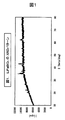
- FIG. 1 is a drawing showing an X-ray diffraction pattern of the product of Example 1.
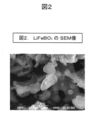
- FIG. 2 is a scanning electron microscope (SEM) photograph of the product of Example 1.
- Example 1 Lithium excess borate compound, as a charge-discharge characteristics raw material of a battery using the same, iron oxalate FeC 2 O 4 ⁇ 2H 2 O ( Sigma-Aldrich, 99.99% purity), water Lithium oxide (anhydrous) LiOH (Kishida Kagaku, 98%) and boric acid H 3 BO 3 (Kishida Kagaku, 99.5%) were used in an amount of 0.005 mol, respectively.
- the entire reactor core was taken out of the electric furnace as a heater and cooled to room temperature while passing gas.
- acetic anhydride (20 mL) was added to the product and ground in a mortar, and acetic acid (10 mL) was added to react with carbonates and removed, followed by filtration to obtain a LiFeBO 3 powder.
- the obtained product was subjected to X-ray diffraction measurement using a CuK ⁇ ray by a powder X-ray diffractometer.
- the XDR pattern is shown in FIG. This XDR pattern almost coincided with the reported pattern of LiFeBO 3 in the space group C2 / c.
- FIG. 2 a scanning electron microscope (SEM) photograph of the product is shown in FIG. From FIG. 2, it was confirmed that the product was a powder composed of crystal grains of about several ⁇ m or less.
- the composition formula is Li 1.04 FeBO 3.10 .
- This is a lithium-excess LiFeBO 3 -based lithium borate compound. I was able to confirm.
- AB acetylene black
- Li 2 CO 3 Li 2 CO 3
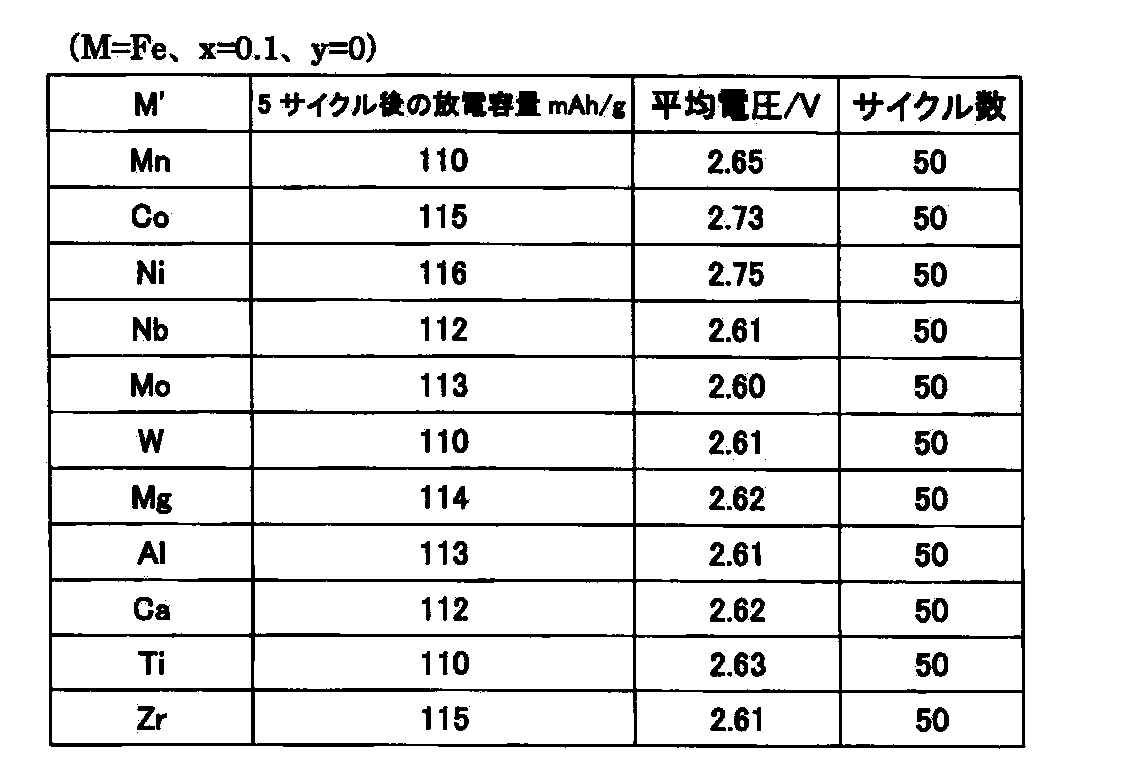
- This coin battery was subjected to a charge / discharge test in the range of 60 ° C., 0.05 mA, and voltage of 4.2 to 2 V. As a result, the discharge capacity after 5 cycles was about 100 mAh / g. Moreover, when the cycle characteristics were measured under the same conditions, the average voltage after 50 cycles was 2.62 V, indicating good cycle characteristics. These results are shown in Table 1 below.
- lithium carbonate Li 2 CO 3 , iron oxalate FeC 2 O 4 .2H 2 O, and boric acid H 3 BO 3 were ball-milled and then heat treated at 650 ° C. for 10 hours (solid phase reaction method).
- Table 1 shows the battery characteristics of the materials measured by the same method.
- Example 2 The composition formula: Li 1 + abB b M 1 is the same as in Example 1 except that a metal component corresponding to the target composition shown in Table 2 below is used together with the iron oxalate used in the method of Example 1.
- -X M ' x BO 3 + c (wherein A is at least one element selected from the group consisting of Na, K, Rb and Cs, and M is at least one type selected from the group consisting of Fe and Mn)
- M ′ is at least one element selected from the group consisting of Mg, Ca, Co, Al, Ni, Nb, Mo, W, Ti, and Zr.
- iron oxalate FeC 2 O 4 .2H 2 O manufactured by Sigma-Aldrich, purity 99.99%
- lithium hydroxide anhydrous LiOH (Kishida Chemical, 98%)
- boric acid H 3 BO 3 Korean Organic Chemical, alumilicate, alumilicate, alumilicate, alumilicate, alumilicate, alumilicate, alumilicate, alumilicate, tungsten oxide.
- manganese oxalate cobalt oxalate
- magnesium sulfate nickel oxide, niobium oxide, calcium oxide, aluminum oxide, lithium molybdenum oxide, and lithium tungsten oxide.
- the number of moles of each raw material was adjusted so as to have the same metal component ratio as that of the target product.
- compounds other than lithium hydroxide and boric acid were used so that the total number of moles of metal elements was 0.005 mol.
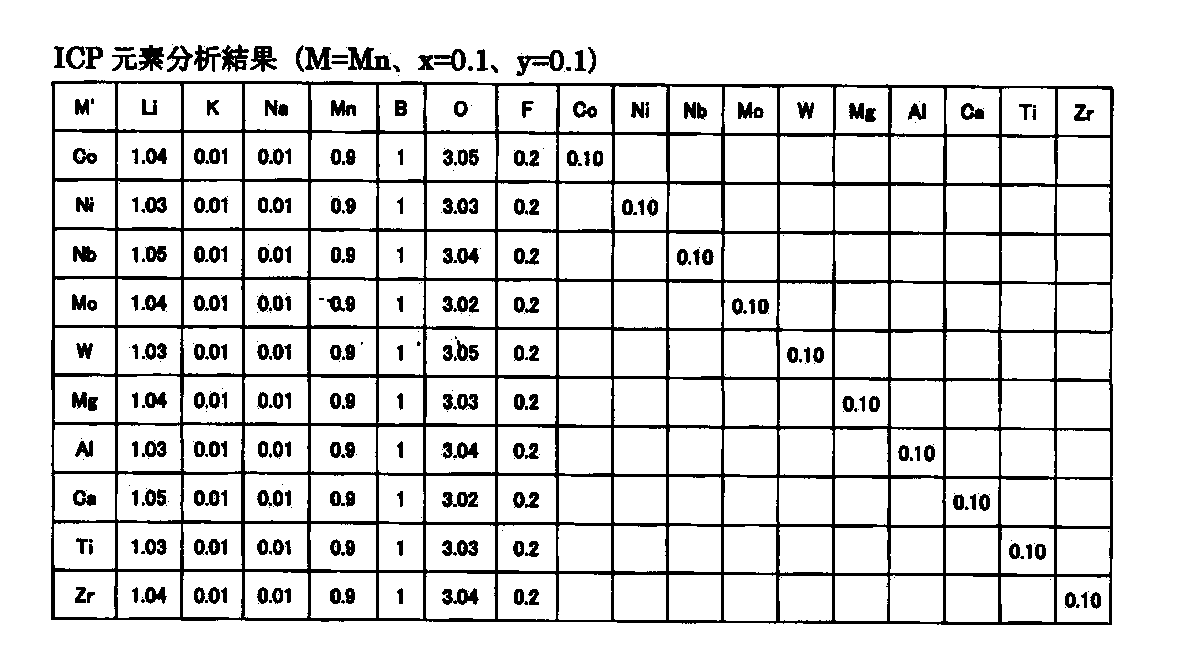
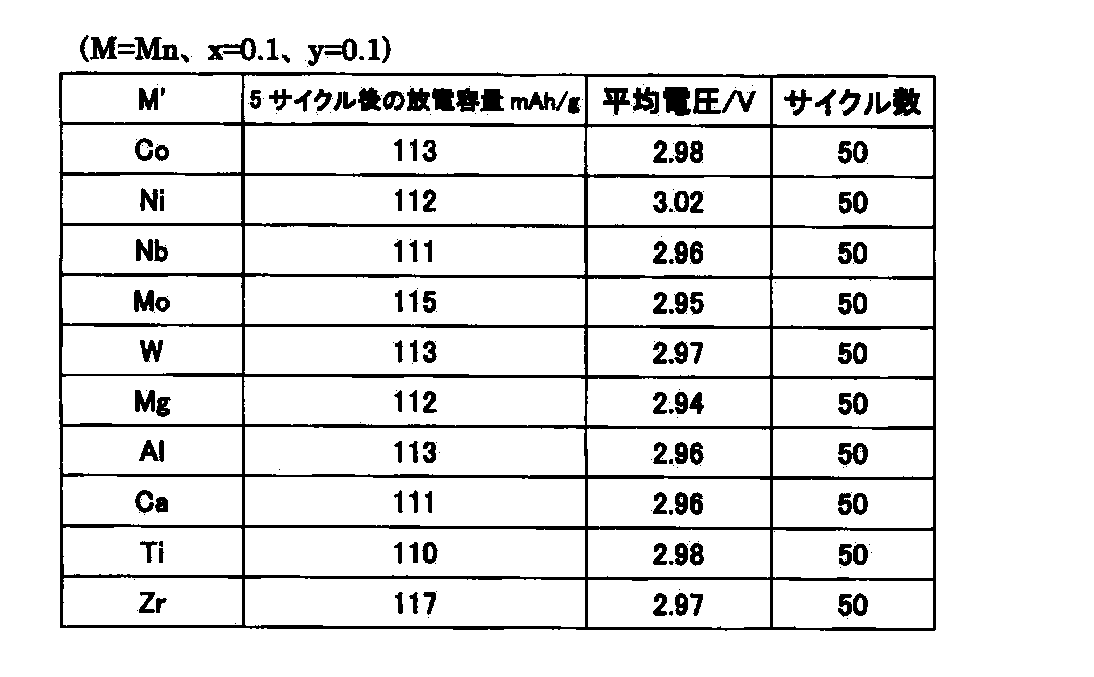
- Tables 2 and 3 below show the elemental analysis results (element molar ratios) obtained by the ICP method for the products after removing water-soluble substances such as carbonates. As is clear from these tables, it was confirmed that all the products were lithium-borated lithium borate compounds.
- each lithium borate compound obtained by the above-described method was subjected to milling treatment and heat treatment by adding acetylene black and Li 2 CO 3 in the same manner as in Example 1.
- the XRD pattern of the product after the heat treatment was in good agreement with the XRD pattern of the sample before the heat treatment, and it was confirmed that the lithium excess borate compound was maintained without being decomposed.
- Example 3 fluorine application
- 50 parts by weight of acetylene black (hereinafter referred to as AB) and 20 parts by weight of LiF were added to 100 parts by weight of the product (lithium borate compound) after removing water-soluble substances such as carbonates, and planets were added.
Landscapes
- Chemical & Material Sciences (AREA)
- Engineering & Computer Science (AREA)
- Inorganic Chemistry (AREA)
- Organic Chemistry (AREA)
- Electrochemistry (AREA)
- General Chemical & Material Sciences (AREA)
- Chemical Kinetics & Catalysis (AREA)
- Crystallography & Structural Chemistry (AREA)
- Materials Engineering (AREA)
- Nanotechnology (AREA)
- Physics & Mathematics (AREA)
- Composite Materials (AREA)
- Condensed Matter Physics & Semiconductors (AREA)
- General Physics & Mathematics (AREA)
- Manufacturing & Machinery (AREA)
- Battery Electrode And Active Subsutance (AREA)
Abstract
Description
1. 炭酸カリウム、炭酸ナトリウム、炭酸ルビシウム及び炭酸セシウムからなる群から選ばれた少なくとも一種のアルカリ金属炭酸塩と炭酸リチウムとからなる炭酸塩混合物の溶融塩中で、還元性雰囲気下において、2価の鉄化合物及び2価のマンガン化合物からなる群から選ばれた少なくとも一種の化合物を含む2価の金属化合物、ホウ酸、並びに水酸化リチウムを400~650℃で反応させることを特徴とする、リチウムボレート系化合物の製造方法。
2. 2価の金属化合物が、その金属化合物全体を100モル%として、2価の鉄化合物及び2価のマンガン化合物からなる群から選ばれた少なくとも一種の化合物を50~100モル%と、Mg、Ca、Co、Al、Ni、Nb、Mo、W、Ti及びZrからなる群から選ばれた少なくとも一種の2価の金属元素を含む化合物を0~50モル%含むものである上記項1に記載の製造方法。
3. 還元性雰囲気が、窒素及び二酸化炭素からなる群から選ばれた少なくとも一種のガスと、還元性ガスの混合ガス雰囲気である上記項1又は2に記載の方法。
4. 上記項1~3のいずれかの方法でリチウムボレート系化合物を製造した後、フラックスとして用いたアルカリ金属炭酸塩を溶媒により除去する工程を含む、リチウムボレート系化合物の製造方法。
5. 形成されるリチウムボレート系化合物が、
組成式:Li1+a−bAbM1−xM’xBO3+c
(式中、Aは、Na、K、Rb及びCsからなる群から選ばれた少なくとも一種の元素であり、Mは、Fe及びMnからなる群から選ばれた少なくとも一種の元素であり、M’は、Mg、Ca、Co、Al、Ni、Nb、Mo、W、Ti及びZrからなる群から選ばれた少なくとも一種の元素である。各添字は次の通りである:0≦x≦0.5、0<a<1、0≦b<0.2、0<c<0.3であって、且つa>bである)で表される化合物である、上記項1~4のいずれかに記載のリチウムボレート系化合物の製造方法。
6. 上記項1~5のいずれかの方法で得られたリチウムボレート系化合物に、カーボン材料とLi2CO3を加え、ボールミルによってアモルファス化するまで混合した後、還元性雰囲気下において熱処理を行うことを特徴とする、導電性の向上したリチウムボレート系化合物の製造方法。
7. 上記項1~5のいずれかの方法で得られたリチウムボレート系化合物に、カーボン材料、及びLiFを加え、ボールミルによってアモルファス化するまで混合した後、還元性雰囲気下において熱処理を行うことを特徴とする、
組成式:Li1+a−bAbM1−xM’xBO3+c−yF2y
(式中、Aは、Na、K、Rb及びCsからなる群から選ばれた少なくとも一種の元素であり、Mは、Fe又はMnであり、M’は、Mg、Ca、Co、Al、Ni、Nb、Mo、W、Ti及びZrからなる群から選ばれた少なくとも一種の元素である。各添字は次の通りである:0≦x≦0.5、0<a<1、0≦b<0.2、0<c<0.3、0<y<1であって、且つa>bである)で表されるフッ素含有リチウムボレート系化合物の製造方法。
8. 上記項1~7のいずれかの方法によって得られたリチウムボレート系化合物からなるリチウムイオン二次電池用正極活物質。
9. 上記項1~7のいずれかの方法によって得られたリチウムボレート系化合物を活物質として含むリチウム二次電池用正極。
10. 上記項9に記載の正極を構成要素として含むリチウム二次電池。
本発明のリチウムボレート系化合物の製造方法では、炭酸カリウム(K2CO3)、炭酸ナトリウム(Na2CO3)、炭酸ルビシウム(Rb2CO3)及び炭酸セシウム(Cs2CO3)からなる群から選ばれた少なくとも一種のアルカリ金属炭酸塩と、炭酸リチウム(Li2CO3)とからなる炭酸塩混合物の溶融塩中において、リチウムボレート系化合物の合成反応を行うことが必要である。炭酸リチウム単独では、溶融温度は700℃程度であるが、炭酸リチウムとその他のアルカリ金属炭酸塩との混合物の溶融塩とする場合には、650℃を下回る溶融温度とすることができ、400~650℃という比較的低い反応温度において、目的とするリチウムボレート系化合物を合成することが可能となる。その結果、リチウムボレートの合成反応時に粒成長が抑制されて微細なリチウムボレート系化合物が形成される。また、炭酸塩混合物の溶融塩中において上記した条件で反応させる場合には、不純物相の形成が少なく、しかも炭酸塩混合物中に炭酸リチウムが含まれていることによって、リチウム原子を過剰に含むリチウムボレート系化合物が形成される。この様にして得られるリチウムボレート化合物は、良好なサイクル特性と高い容量を有するリチウムイオン電池用正極材料となる。
本発明では、原料としては、2価の鉄化合物及び2価のマンガン化合物からなる群から選ばれた少なくとも一種の化合物を含む2価の金属化合物、ホウ酸(H3BO3)、並びに水酸化リチウム(LiOH)を用いる。
本発明のリチウムボレート化合物の製造方法では、炭酸カリウム、炭酸ナトリウム、炭酸ルビシウム及び炭酸セシウムからなる群から選ばれた少なくとも一種のアルカリ金属炭酸塩と炭酸リチウムとからなる炭酸塩混合物の溶融塩中で、還元性雰囲気下において、上記した原料、即ち、2価の鉄化合物及び2価のマンガン化合物からなる群から選ばれた少なくとも一種の化合物を含む2価の金属化合物、ホウ酸、並びに水酸化リチウムを反応させることが必要である。
上記した方法によって得られるリチウムボレート系化合物は、
組成式:Li1+a−bAbM1−xM’xBO3+c
(式中、Aは、Na、K、Rb及びCsからなる群から選ばれた少なくとも一種の元素であり、Mは、Fe及びMnからなる群から選ばれた少なくとも一種の元素であり、M’は、Mg、Ca、Co、Al、Ni、Nb、Mo、W、Ti及びZrからなる群から選ばれた少なくとも一種の元素である。各添字は次の通りである:0≦x≦0.5、0<a<1、0≦b<0.2、0<c<0.3であって、且つa>bである)で表される化合物である。
上記した方法で得られる組成式:Li1+a−bAbM1−xM’xBO3+cで表されるリチウムボレート系化合物は、更に、カーボンによる被覆処理を行って導電性を向上させることが好ましい。
組成式:Li1+a−bAbM1−xM’xBO3+c−yF2y
(式中、Aは、Na、K、Rb及びCsからなる群から選ばれた少なくとも一種の元素であり、Mは、Fe又はMnであり、M’は、Mg、Ca、Co、Al、Ni、Nb、Mo、W、Ti及びZrからなる群から選ばれた少なくとも一種の元素である。各添字は次の通りである:0≦x≦0.5、0<a<1、0≦b<0.2、0<c<0.3、0<y<1であって、且つa>bである)で表されるフッ素含有リチウムボレート系化合物が形成される。
上記した溶融塩中で合成して得られるリチウムボレート系化合物、カーボン被覆処理を行ったリチウムボレート系化合物、及びフッ素添加されたリチウムボレート系化合物は、いずれもリチウム二次電池正極用活物質として有効に使用できる。これらのリチウムボレート系化合物を用いる正極は、通常のリチウムイオン二次電池用正極と同様の構造とすることができる。
上記したリチウムイオン二次電池用正極を用いるリチウムイオン二次電池は、公知の手法により製造することができる。すなわち、正極材料として、上記した正極を使用し、負極材料として、公知の金属リチウム、黒鉛などの炭素系材料、シリコン薄膜などのシリコン系材料、銅−錫やコバルト−錫などの合金系材料、チタン酸リチウムなどの酸化物材料を使用し、電解液として、公知のエチレンカーボネート、ジメチルカーボネート、プロピレンカーボネート、ジメチルカーボネートなどの非水系溶媒に過塩素酸リチウム、LiPF6、LiBF4、LiCF3SO3などのリチウム塩を0.5mol/l~1.7mol/lの濃度で溶解させた溶液を使用し、さらにその他の公知の電池構成要素を使用して、常法に従って、リチウムイオン二次電池を組立てればよい。
発明の効果
図2は、実施例1の生成物の走査型電子顕微鏡(SEM)写真である。
原料として、シュウ酸鉄FeC2O4・2H2O(シグマアルドリッチ製、純度99.99%)、水酸化リチウム(無水)LiOH(キシダ化学、98%)、ホウ酸H3BO3(キシダ化学、99.5%)をそれぞれ0.005モル用い、これを炭酸塩混合物(炭酸リチウム(キシダ化学製、純度99.9%)、炭酸ナトリウム(キシダ化学製、純度99.5%)、及び炭酸カリウム(キシダ化学製、純度99.5%)をモル比0.435:0.315:0.25で混合したもの)と混合した。混合割合は、炭酸塩混合物100重量部に対して、シュウ酸鉄、水酸化リチウム及びホウ酸の合計量を225重量部の割合とした。


実施例1の方法で用いたシュウ酸鉄とともに、下記表2に示す目的組成に応じた金属成分を用いること以外は、実施例1と同様にして、組成式:Li1+a−bAbM1−xM’xBO3+c(式中、Aは、Na、K、Rb及びCsからなる群から選ばれた少なくとも一種の元素であり、Mは、Fe及びMnからなる群から選ばれた少なくとも一種の元素であり、M’は、Mg、Ca、Co、Al、Ni、Nb、Mo、W、Ti及びZrからなる群から選ばれた少なくとも一種の元素である。各添字は次の通りである:0≦x≦0.5、0<a<1、0≦b<0.2、0<c<0.3であって、且つa>bである)で表されるリチウム過剰ボレート系化合物を合成した。また、実施例1の方法で用いたシュウ酸鉄に代えて、下記表3に示す目的組成に応じた金属成分を用いること以外は、実施例1と同様にして、上記組成式で表されるリチウム過剰ボレート系化合物を合成した。





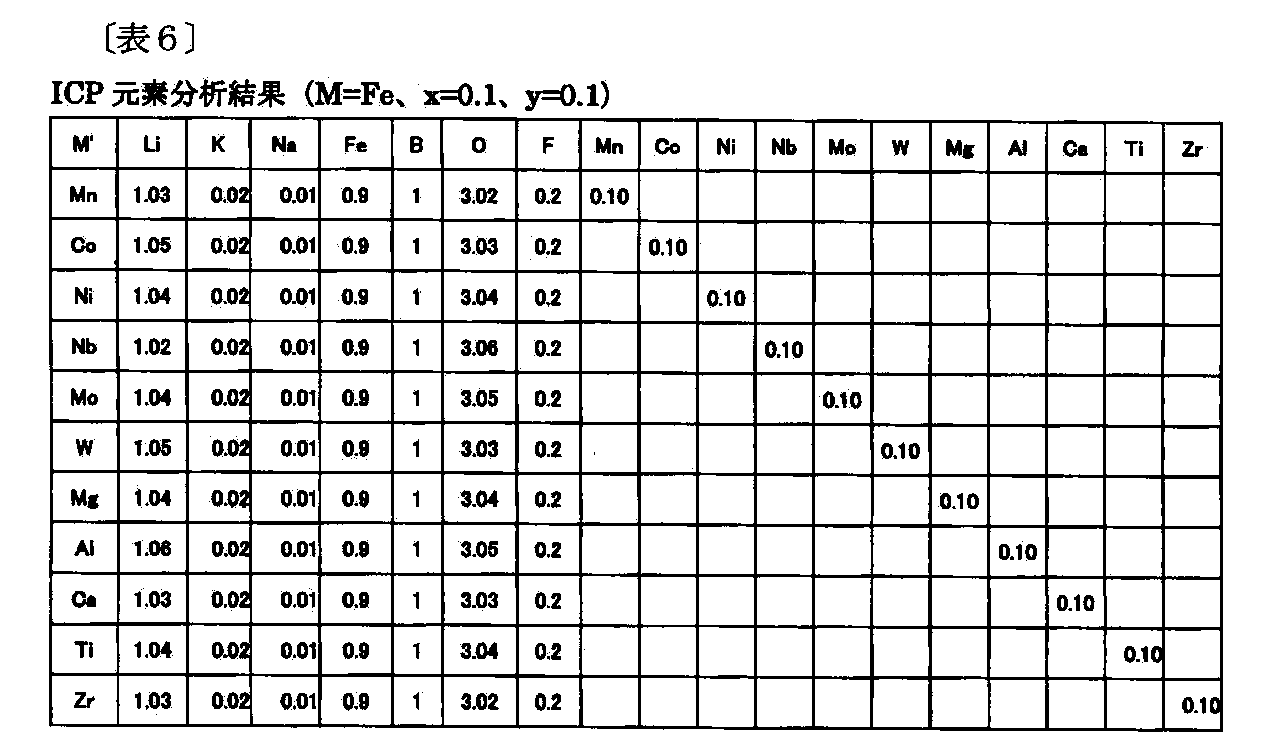
実施例2において炭酸塩等の水溶性物質を取り除いた後の生成物(リチウムボレート系化合物)100重量部に、アセチレンブラック(以下ABと表記)50重量部と、LiF20重量部を添加し、遊星ボールミル(5mmのジルコニアボール)を用いて450rpmで5時間ミリング処理を行い、二酸化炭素と水素の混合ガス((CO2:H2(モル比)=100:3)の雰囲気下において、700℃で2時間熱処理した。熱処理後の生成物のXRDパターンは、熱処理処理前の試料のXRDパターンとよく一致しており、リチウム過剰ボレート系化合物は分解されることなく、結晶構造を維持していることが確認できた。また、ICP法によって求めた元素分析結果(元素モル比)を下記表6及び表7に示す。これらの表から明らかなように、生成物は、いずれもリチウム過剰のフッ素含有リチウムボレート系化合物であることが確認できた。



Claims (10)
- 炭酸カリウム、炭酸ナトリウム、炭酸ルビシウム及び炭酸セシウムからなる群から選ばれた少なくとも一種のアルカリ金属炭酸塩と炭酸リチウムとからなる炭酸塩混合物の溶融塩中で、還元性雰囲気下において、2価の鉄化合物及び2価のマンガン化合物からなる群から選ばれた少なくとも一種の化合物を含む2価の金属化合物、ホウ酸、並びに水酸化リチウムを400~650℃で反応させることを特徴とする、リチウムボレート系化合物の製造方法。
- 前記2価の金属化合物が、該金属化合物全体を100モル%として、2価の鉄化合物及び2価のマンガン化合物からなる群から選ばれた少なくとも一種の化合物を50~100モル%と、Mg、Ca、Co、Al、Ni、Nb、Mo、W、Ti及びZrからなる群から選ばれた少なくとも一種の2価の金属元素を含む化合物を0~50モル%含むものである請求項1に記載の製造方法。
- 還元性雰囲気が、窒素及び二酸化炭素からなる群から選ばれた少なくとも一種のガスと、還元性ガスの混合ガス雰囲気である請求項1又は2に記載の方法。
- 請求項1~3のいずれかの方法でリチウムボレート系化合物を製造した後、フラックスとして用いたアルカリ金属炭酸塩を溶媒により除去する工程を含む、リチウムボレート系化合物の製造方法。
- 形成されるリチウムボレート系化合物が、
組成式:Li1+a−bAbM1−xM’xBO3+c
(式中、Aは、Na、K、Rb及びCsからなる群から選ばれた少なくとも一種の元素であり、Mは、Fe及びMnからなる群から選ばれた少なくとも一種の元素であり、M’は、Mg、Ca、Co、Al、Ni、Nb、Mo、W、Ti及びZrからなる群から選ばれた少なくとも一種の元素である。各添字は次の通りである:0≦x≦0.5、0<a<1、0≦b<0.2、0<c<0.3であって、且つa>bである)で表される化合物である、請求項1~4のいずれかに記載のリチウムボレート系化合物の製造方法。 - 請求項1~5のいずれかの方法で得られたリチウムボレート系化合物に、カーボン材料とLi2CO3を加え、ボールミルによってアモルファス化するまで混合した後、還元性雰囲気下において熱処理を行うことを特徴とする、導電性の向上したリチウムボレート系化合物の製造方法。
- 請求項1~5のいずれかの方法で得られたリチウムボレート系化合物に、カーボン材料、及びLiFを加え、ボールミルによってアモルファス化するまで混合した後、還元性雰囲気下において熱処理を行うことを特徴とする、
組成式:Li1+a−bAbM1−xM’xBO3+c−yF2y
(式中、Aは、Na、K、Rb及びCsからなる群から選ばれた少なくとも一種の元素であり、Mは、Fe又はMnであり、M’は、Mg、Ca、Co、Al、Ni、Nb、Mo、W、Ti及びZrからなる群から選ばれた少なくとも一種の元素である。各添字は次の通りである:0≦x≦0.5、0<a<1、0≦b<0.2、0<c<0.3、0<y<1であって、且つa>bである)で表されるフッ素含有リチウムボレート系化合物の製造方法。 - 請求項1~7のいずれかの方法によって得られたリチウムボレート系化合物からなるリチウムイオン二次電池用正極活物質。
- 請求項1~7のいずれかの方法によって得られたリチウムボレート系化合物を活物質として含むリチウム二次電池用正極。
- 請求項9に記載の正極を構成要素として含むリチウム二次電池。
Priority Applications (4)
| Application Number | Priority Date | Filing Date | Title |
|---|---|---|---|
| EP10750890A EP2407426A1 (en) | 2009-03-09 | 2010-03-04 | Process for producing lithium borate compound |
| KR1020117020913A KR101331916B1 (ko) | 2009-03-09 | 2010-03-04 | 리튬 보레이트계 화합물의 제조 방법, 리튬 이온 2차 전지용 정극 활물질, 리튬 이온 2차 전지용 정극 및 리튬 이온 2차 전지 |
| CN201080011418.2A CN102348640B (zh) | 2009-03-09 | 2010-03-04 | 硼酸锂系化合物的制备方法 |
| US13/255,447 US20110315919A1 (en) | 2009-03-09 | 2010-03-04 | Production process for lithium-borate-system compound |
Applications Claiming Priority (2)
| Application Number | Priority Date | Filing Date | Title |
|---|---|---|---|
| JP2009054842A JP5013622B2 (ja) | 2009-03-09 | 2009-03-09 | リチウムボレート系化合物の製造方法 |
| JP2009-054842 | 2009-03-09 |
Publications (1)
| Publication Number | Publication Date |
|---|---|
| WO2010104137A1 true WO2010104137A1 (ja) | 2010-09-16 |
Family
ID=42728425
Family Applications (1)
| Application Number | Title | Priority Date | Filing Date |
|---|---|---|---|
| PCT/JP2010/054075 Ceased WO2010104137A1 (ja) | 2009-03-09 | 2010-03-04 | リチウムボレート系化合物の製造方法 |
Country Status (6)
| Country | Link |
|---|---|
| US (1) | US20110315919A1 (ja) |
| EP (1) | EP2407426A1 (ja) |
| JP (1) | JP5013622B2 (ja) |
| KR (1) | KR101331916B1 (ja) |
| CN (1) | CN102348640B (ja) |
| WO (1) | WO2010104137A1 (ja) |
Cited By (2)
| Publication number | Priority date | Publication date | Assignee | Title |
|---|---|---|---|---|
| WO2012060084A1 (ja) * | 2010-11-05 | 2012-05-10 | 株式会社豊田自動織機 | リチウムボレート系化合物およびその製造方法 |
| EP4542678A4 (en) * | 2022-11-01 | 2026-01-14 | Zhuhai Cosmx Battery Co Ltd | POSITIVE ELECTRODE MATERIAL, POSITIVE ELECTRODE SHEET INCLUDING IT AND BATTERY |
Families Citing this family (16)
| Publication number | Priority date | Publication date | Assignee | Title |
|---|---|---|---|---|
| WO2011140327A2 (en) * | 2010-05-07 | 2011-11-10 | Massachusetts Institute Of Technology | Lithium manganese borate compounds |
| JP5164287B2 (ja) * | 2010-11-05 | 2013-03-21 | 株式会社豊田自動織機 | リチウムシリケート系化合物およびその製造方法 |
| CN104795563A (zh) * | 2014-01-18 | 2015-07-22 | 南京理工大学 | 一种柠檬酸法制备锂离子电池正极材料LiFeBO3/C的方法 |
| CN103943857B (zh) * | 2014-05-09 | 2016-02-03 | 湖南科技大学 | 一种锂离子电池LiMnBO3/KB复合正极材料及其制备方法 |
| KR101637925B1 (ko) | 2014-07-18 | 2016-07-08 | 한국과학기술연구원 | 리튬 망간 보레이트계 양극 활물질, 이를 포함하는 리튬 이온 이차전지 및 이의 제조방법 |
| CN106654184A (zh) * | 2015-10-29 | 2017-05-10 | 上海比亚迪有限公司 | 一种锂离子电池正极材料添加剂、正极材料、正极及电池 |
| CN105789625B (zh) * | 2016-04-25 | 2018-06-01 | 湖南科技大学 | 一种锂离子电池正极材料LiCoBO3的制备方法 |
| CN107039643B (zh) * | 2017-03-27 | 2019-05-24 | 上海应用技术大学 | 一种锂离子电池用正极材料及其制备方法 |
| CN107946585B (zh) * | 2017-12-26 | 2020-01-31 | 宁波职业技术学院 | 一种掺杂硼酸锰镁镁离子电池正极材料的制备方法 |
| CN108910907A (zh) * | 2018-07-20 | 2018-11-30 | 上海中锂实业有限公司 | 一种无水四硼酸锂的制备方法 |
| CN109110774B (zh) * | 2018-10-25 | 2022-02-01 | 河南省法恩莱特新能源科技有限公司 | 一种四氟硼酸锂的制备方法 |
| CN110563339A (zh) * | 2019-10-17 | 2019-12-13 | 维沃泰克仪器(扬州)有限公司 | 一种无水硼酸锂助熔剂的制备方法 |
| KR102630488B1 (ko) * | 2021-01-15 | 2024-01-29 | 울산대학교 산학협력단 | 할로겐 원소를 포함하는 전극 재료 및 이의 제조 방법 |
| CN115924931B (zh) * | 2023-01-06 | 2024-07-30 | 中国科学院新疆理化技术研究所 | 一种化合物硼酸锂钠及制备方法和用途 |
| CN117069119B (zh) * | 2023-06-29 | 2025-12-16 | 甘肃睿思科新材料有限公司 | 一种使用电池级碳酸锂在液相中制备高纯高密度四硼酸锂粉体的方法 |
| CN119503825A (zh) * | 2024-11-14 | 2025-02-25 | 孝感楚能新能源创新科技有限公司 | 一种硼酸钛铁锂正极材料及其制备方法和应用 |
Citations (6)
| Publication number | Priority date | Publication date | Assignee | Title |
|---|---|---|---|---|
| JPH10241682A (ja) * | 1997-02-25 | 1998-09-11 | Mitsubishi Cable Ind Ltd | リチウム二次電池用の正極活物質およびその製造方法 |
| JP2001048545A (ja) * | 1999-08-09 | 2001-02-20 | Mitsubishi Chemicals Corp | リチウムマンガン複合酸化物の製造方法及びこれを用いた二次電池 |
| JP2001064020A (ja) * | 1999-08-30 | 2001-03-13 | Mitsui Mining & Smelting Co Ltd | マンガン酸リチウムの製造方法 |
| JP2004207051A (ja) * | 2002-12-25 | 2004-07-22 | Junko Shigehara | 正極材料、それを利用したリチウム二次電池及びリチウムイオン二次電池 |
| JP2005112711A (ja) * | 2003-12-24 | 2005-04-28 | Mitsui Mining & Smelting Co Ltd | リチウム−マンガン系複合酸化物及びリチウム二次電池 |
| JP2005183088A (ja) * | 2003-12-17 | 2005-07-07 | Nichia Chem Ind Ltd | 非水電解質二次電池用正極活物質および非水電解質二次電池 |
Family Cites Families (3)
| Publication number | Priority date | Publication date | Assignee | Title |
|---|---|---|---|---|
| JP4691228B2 (ja) * | 1999-11-02 | 2011-06-01 | Agcセイミケミカル株式会社 | 非水リチウム二次電池用リチウム−マンガン複合酸化物の製造法 |
| KR20010056566A (ko) * | 1999-12-15 | 2001-07-04 | 성재갑 | 리튬전지용 리튬 망간 복합산화물 분말의 제조방법 |
| WO2006123711A1 (ja) * | 2005-05-17 | 2006-11-23 | Agc Seimi Chemical Co., Ltd. | リチウム二次電池正極用のリチウム含有複合酸化物の製造方法 |
-
2009
- 2009-03-09 JP JP2009054842A patent/JP5013622B2/ja not_active Expired - Fee Related
-
2010
- 2010-03-04 WO PCT/JP2010/054075 patent/WO2010104137A1/ja not_active Ceased
- 2010-03-04 KR KR1020117020913A patent/KR101331916B1/ko not_active Expired - Fee Related
- 2010-03-04 EP EP10750890A patent/EP2407426A1/en not_active Withdrawn
- 2010-03-04 CN CN201080011418.2A patent/CN102348640B/zh not_active Expired - Fee Related
- 2010-03-04 US US13/255,447 patent/US20110315919A1/en not_active Abandoned
Patent Citations (6)
| Publication number | Priority date | Publication date | Assignee | Title |
|---|---|---|---|---|
| JPH10241682A (ja) * | 1997-02-25 | 1998-09-11 | Mitsubishi Cable Ind Ltd | リチウム二次電池用の正極活物質およびその製造方法 |
| JP2001048545A (ja) * | 1999-08-09 | 2001-02-20 | Mitsubishi Chemicals Corp | リチウムマンガン複合酸化物の製造方法及びこれを用いた二次電池 |
| JP2001064020A (ja) * | 1999-08-30 | 2001-03-13 | Mitsui Mining & Smelting Co Ltd | マンガン酸リチウムの製造方法 |
| JP2004207051A (ja) * | 2002-12-25 | 2004-07-22 | Junko Shigehara | 正極材料、それを利用したリチウム二次電池及びリチウムイオン二次電池 |
| JP2005183088A (ja) * | 2003-12-17 | 2005-07-07 | Nichia Chem Ind Ltd | 非水電解質二次電池用正極活物質および非水電解質二次電池 |
| JP2005112711A (ja) * | 2003-12-24 | 2005-04-28 | Mitsui Mining & Smelting Co Ltd | リチウム−マンガン系複合酸化物及びリチウム二次電池 |
Non-Patent Citations (3)
| Title |
|---|
| V.LEGAGNEUR ET AL.: "LiMB03(M=Mn, Fe, Co): synthesis, crystal structure and lithium deinsertion/insertion properties", SOLID STATE IONICS, vol. 139, 2001, pages 37 - 46, XP055109920 * |
| Y.Z.DONG ET AL.: "Phase relations of Li20-FeO-B203 ternary system and elecrtochemical properties of LiFeB03 compound", JOURNAL OF ALLOYS AND COMPOUNDS, vol. 461, 2008, pages 585 - 590, XP022708776 * |
| Y.Z.DONG ET AL.: "The structure and electrochemical performance of LiFeB03 as a novel Li-battery cathode material", ELECTROCHIMICA ACTA, vol. 53, 2008, pages 2339 - 2345, XP002606643 * |
Cited By (3)
| Publication number | Priority date | Publication date | Assignee | Title |
|---|---|---|---|---|
| WO2012060084A1 (ja) * | 2010-11-05 | 2012-05-10 | 株式会社豊田自動織機 | リチウムボレート系化合物およびその製造方法 |
| JP2012104240A (ja) * | 2010-11-05 | 2012-05-31 | Toyota Industries Corp | リチウムボレート系化合物の製造方法 |
| EP4542678A4 (en) * | 2022-11-01 | 2026-01-14 | Zhuhai Cosmx Battery Co Ltd | POSITIVE ELECTRODE MATERIAL, POSITIVE ELECTRODE SHEET INCLUDING IT AND BATTERY |
Also Published As
| Publication number | Publication date |
|---|---|
| EP2407426A1 (en) | 2012-01-18 |
| JP5013622B2 (ja) | 2012-08-29 |
| JP2010208876A (ja) | 2010-09-24 |
| CN102348640A (zh) | 2012-02-08 |
| KR20110118806A (ko) | 2011-11-01 |
| US20110315919A1 (en) | 2011-12-29 |
| KR101331916B1 (ko) | 2013-11-21 |
| CN102348640B (zh) | 2014-02-05 |
Similar Documents
| Publication | Publication Date | Title |
|---|---|---|
| JP5013622B2 (ja) | リチウムボレート系化合物の製造方法 | |
| JP5298286B2 (ja) | リチウムシリケート系化合物の製造方法 | |
| US12170361B2 (en) | Batteries with anodes of carbon-coated macro-porous silicon | |
| JP5116177B2 (ja) | リチウムシリケート系化合物の製造方法 | |
| JP2011213587A (ja) | リン酸マンガン鉄リチウム粒子粉末の製造方法、リン酸マンガン鉄リチウム粒子粉末、及び該粒子粉末を用いた非水電解質二次電池 | |
| JP5252064B2 (ja) | リチウムシリケート系化合物及びその製造方法 | |
| JP2010521797A (ja) | Liベースの電池に使用するための室温単相Li挿入/抽出材料 | |
| KR101352793B1 (ko) | 이차전지용 양극재료 및 이의 제조방법 | |
| TWI465390B (zh) | 鋰蓄電池用正極活性物質之製造方法 | |
| JP2012023006A (ja) | リチウム二次電池用陽極材料及びその製造方法並びにその材料を含むリチウム二次電池 | |
| JP5110664B2 (ja) | リチウムボレート系化合物の製造方法 | |
| JP5608856B2 (ja) | リチウムイオン二次電池用正極活物質とその製造方法及びリチウムイオン二次電池用正極とリチウムイオン二次電池 | |
| KR101821880B1 (ko) | 글루코스를 이용한 다공성 게르마늄-카본 복합체 제조방법 | |
| JP5686378B2 (ja) | 水素含有リチウムシリケート系化合物及びその製造方法、並びに非水電解質二次電池用正極活物質、非水電解質二次電池用正極、非水電解質二次電池及び車両 | |
| WO2014155408A1 (ja) | 水素含有リチウムシリケート系化合物及びその製造方法、並びに非水電解質二次電池用正極活物質、非水電解質二次電池用正極、及び非水電解質二次電池 | |
| Hu et al. | Synthesis and electrochemical performance of Li2Mg0. 15Mn0. 4Co0. 45SiO4/C cathode material for lithium ion batteries |
Legal Events
| Date | Code | Title | Description |
|---|---|---|---|
| WWE | Wipo information: entry into national phase |
Ref document number: 201080011418.2 Country of ref document: CN |
|
| 121 | Ep: the epo has been informed by wipo that ep was designated in this application |
Ref document number: 10750890 Country of ref document: EP Kind code of ref document: A1 |
|
| ENP | Entry into the national phase |
Ref document number: 20117020913 Country of ref document: KR Kind code of ref document: A |
|
| WWE | Wipo information: entry into national phase |
Ref document number: 13255447 Country of ref document: US Ref document number: 2010750890 Country of ref document: EP |
|
| NENP | Non-entry into the national phase |
Ref country code: DE |
|
| WWE | Wipo information: entry into national phase |
Ref document number: 6480/CHENP/2011 Country of ref document: IN |