WO2010104202A1 - 複合金属酸化物、電極およびナトリウム二次電池 - Google Patents
複合金属酸化物、電極およびナトリウム二次電池 Download PDFInfo
- Publication number
- WO2010104202A1 WO2010104202A1 PCT/JP2010/054474 JP2010054474W WO2010104202A1 WO 2010104202 A1 WO2010104202 A1 WO 2010104202A1 JP 2010054474 W JP2010054474 W JP 2010054474W WO 2010104202 A1 WO2010104202 A1 WO 2010104202A1
- Authority
- WO
- WIPO (PCT)
- Prior art keywords
- metal oxide
- secondary battery
- electrode
- composite metal
- sodium secondary
- Prior art date
- Legal status (The legal status is an assumption and is not a legal conclusion. Google has not performed a legal analysis and makes no representation as to the accuracy of the status listed.)
- Ceased
Links
Images


Classifications
-
- H—ELECTRICITY
- H01—ELECTRIC ELEMENTS
- H01M—PROCESSES OR MEANS, e.g. BATTERIES, FOR THE DIRECT CONVERSION OF CHEMICAL ENERGY INTO ELECTRICAL ENERGY
- H01M4/00—Electrodes
- H01M4/02—Electrodes composed of, or comprising, active material
- H01M4/36—Selection of substances as active materials, active masses, active liquids
- H01M4/48—Selection of substances as active materials, active masses, active liquids of inorganic oxides or hydroxides
-
- H—ELECTRICITY
- H01—ELECTRIC ELEMENTS
- H01M—PROCESSES OR MEANS, e.g. BATTERIES, FOR THE DIRECT CONVERSION OF CHEMICAL ENERGY INTO ELECTRICAL ENERGY
- H01M4/00—Electrodes
- H01M4/02—Electrodes composed of, or comprising, active material
- H01M4/36—Selection of substances as active materials, active masses, active liquids
- H01M4/48—Selection of substances as active materials, active masses, active liquids of inorganic oxides or hydroxides
- H01M4/50—Selection of substances as active materials, active masses, active liquids of inorganic oxides or hydroxides of manganese
-
- C—CHEMISTRY; METALLURGY
- C01—INORGANIC CHEMISTRY
- C01G—COMPOUNDS CONTAINING METALS NOT COVERED BY SUBCLASSES C01D OR C01F
- C01G45/00—Compounds of manganese
- C01G45/12—Complex oxides containing manganese and at least one other metal element
- C01G45/1221—Manganates or manganites with trivalent manganese, tetravalent manganese or mixtures thereof
- C01G45/1228—Manganates or manganites with trivalent manganese, tetravalent manganese or mixtures thereof of the type (MnO2)-, e.g. LiMnO2 or Li(MxMn1-x)O2
-
- C—CHEMISTRY; METALLURGY
- C01—INORGANIC CHEMISTRY
- C01G—COMPOUNDS CONTAINING METALS NOT COVERED BY SUBCLASSES C01D OR C01F
- C01G49/00—Compounds of iron
- C01G49/0018—Mixed oxides or hydroxides
-
- C—CHEMISTRY; METALLURGY
- C01—INORGANIC CHEMISTRY
- C01G—COMPOUNDS CONTAINING METALS NOT COVERED BY SUBCLASSES C01D OR C01F
- C01G49/00—Compounds of iron
- C01G49/0018—Mixed oxides or hydroxides
- C01G49/0027—Mixed oxides or hydroxides containing one alkali metal
-
- C—CHEMISTRY; METALLURGY
- C01—INORGANIC CHEMISTRY
- C01G—COMPOUNDS CONTAINING METALS NOT COVERED BY SUBCLASSES C01D OR C01F
- C01G49/00—Compounds of iron
- C01G49/0018—Mixed oxides or hydroxides
- C01G49/0036—Mixed oxides or hydroxides containing one alkaline earth metal, magnesium or lead
-
- C—CHEMISTRY; METALLURGY
- C01—INORGANIC CHEMISTRY
- C01G—COMPOUNDS CONTAINING METALS NOT COVERED BY SUBCLASSES C01D OR C01F
- C01G51/00—Compounds of cobalt
- C01G51/40—Complex oxides containing cobalt and at least one other metal element
- C01G51/42—Complex oxides containing cobalt and at least one other metal element containing alkali metals, e.g. LiCoO2
-
- C—CHEMISTRY; METALLURGY
- C01—INORGANIC CHEMISTRY
- C01G—COMPOUNDS CONTAINING METALS NOT COVERED BY SUBCLASSES C01D OR C01F
- C01G51/00—Compounds of cobalt
- C01G51/80—Compounds containing cobalt, with or without oxygen or hydrogen, and containing one or more other elements
- C01G51/82—Compounds containing cobalt, with or without oxygen or hydrogen, and containing two or more other elements
-
- C—CHEMISTRY; METALLURGY
- C01—INORGANIC CHEMISTRY
- C01G—COMPOUNDS CONTAINING METALS NOT COVERED BY SUBCLASSES C01D OR C01F
- C01G53/00—Compounds of nickel
- C01G53/40—Complex oxides containing nickel and at least one other metal element
- C01G53/42—Complex oxides containing nickel and at least one other metal element containing alkali metals, e.g. LiNiO2
-
- C—CHEMISTRY; METALLURGY
- C01—INORGANIC CHEMISTRY
- C01G—COMPOUNDS CONTAINING METALS NOT COVERED BY SUBCLASSES C01D OR C01F
- C01G53/00—Compounds of nickel
- C01G53/40—Complex oxides containing nickel and at least one other metal element
- C01G53/42—Complex oxides containing nickel and at least one other metal element containing alkali metals, e.g. LiNiO2
- C01G53/44—Complex oxides containing nickel and at least one other metal element containing alkali metals, e.g. LiNiO2 containing manganese
- C01G53/50—Complex oxides containing nickel and at least one other metal element containing alkali metals, e.g. LiNiO2 containing manganese of the type (MnO2)n-, e.g. Li(NixMn1-x)O2 or Li(MyNixMn1-x-y)O2
-
- H—ELECTRICITY
- H01—ELECTRIC ELEMENTS
- H01M—PROCESSES OR MEANS, e.g. BATTERIES, FOR THE DIRECT CONVERSION OF CHEMICAL ENERGY INTO ELECTRICAL ENERGY
- H01M10/00—Secondary cells; Manufacture thereof
- H01M10/05—Accumulators with non-aqueous electrolyte
- H01M10/054—Accumulators with insertion or intercalation of metals other than lithium, e.g. with magnesium or aluminium
-
- H—ELECTRICITY
- H01—ELECTRIC ELEMENTS
- H01M—PROCESSES OR MEANS, e.g. BATTERIES, FOR THE DIRECT CONVERSION OF CHEMICAL ENERGY INTO ELECTRICAL ENERGY
- H01M10/00—Secondary cells; Manufacture thereof
- H01M10/05—Accumulators with non-aqueous electrolyte
- H01M10/056—Accumulators with non-aqueous electrolyte characterised by the materials used as electrolytes, e.g. mixed inorganic/organic electrolytes
- H01M10/0564—Accumulators with non-aqueous electrolyte characterised by the materials used as electrolytes, e.g. mixed inorganic/organic electrolytes the electrolyte being constituted of organic materials only
- H01M10/0565—Polymeric materials, e.g. gel-type or solid-type
-
- H—ELECTRICITY
- H01—ELECTRIC ELEMENTS
- H01M—PROCESSES OR MEANS, e.g. BATTERIES, FOR THE DIRECT CONVERSION OF CHEMICAL ENERGY INTO ELECTRICAL ENERGY
- H01M10/00—Secondary cells; Manufacture thereof
- H01M10/05—Accumulators with non-aqueous electrolyte
- H01M10/056—Accumulators with non-aqueous electrolyte characterised by the materials used as electrolytes, e.g. mixed inorganic/organic electrolytes
- H01M10/0564—Accumulators with non-aqueous electrolyte characterised by the materials used as electrolytes, e.g. mixed inorganic/organic electrolytes the electrolyte being constituted of organic materials only
- H01M10/0566—Liquid materials
- H01M10/0568—Liquid materials characterised by the solutes
-
- H—ELECTRICITY
- H01—ELECTRIC ELEMENTS
- H01M—PROCESSES OR MEANS, e.g. BATTERIES, FOR THE DIRECT CONVERSION OF CHEMICAL ENERGY INTO ELECTRICAL ENERGY
- H01M10/00—Secondary cells; Manufacture thereof
- H01M10/05—Accumulators with non-aqueous electrolyte
- H01M10/056—Accumulators with non-aqueous electrolyte characterised by the materials used as electrolytes, e.g. mixed inorganic/organic electrolytes
- H01M10/0564—Accumulators with non-aqueous electrolyte characterised by the materials used as electrolytes, e.g. mixed inorganic/organic electrolytes the electrolyte being constituted of organic materials only
- H01M10/0566—Liquid materials
- H01M10/0569—Liquid materials characterised by the solvents
-
- H—ELECTRICITY
- H01—ELECTRIC ELEMENTS
- H01M—PROCESSES OR MEANS, e.g. BATTERIES, FOR THE DIRECT CONVERSION OF CHEMICAL ENERGY INTO ELECTRICAL ENERGY
- H01M10/00—Secondary cells; Manufacture thereof
- H01M10/36—Accumulators not provided for in groups H01M10/05-H01M10/34
-
- H—ELECTRICITY
- H01—ELECTRIC ELEMENTS
- H01M—PROCESSES OR MEANS, e.g. BATTERIES, FOR THE DIRECT CONVERSION OF CHEMICAL ENERGY INTO ELECTRICAL ENERGY
- H01M4/00—Electrodes
- H01M4/02—Electrodes composed of, or comprising, active material
- H01M4/13—Electrodes for accumulators with non-aqueous electrolyte, e.g. for lithium-accumulators; Processes of manufacture thereof
- H01M4/131—Electrodes based on mixed oxides or hydroxides, or on mixtures of oxides or hydroxides, e.g. LiCoOx
-
- H—ELECTRICITY
- H01—ELECTRIC ELEMENTS
- H01M—PROCESSES OR MEANS, e.g. BATTERIES, FOR THE DIRECT CONVERSION OF CHEMICAL ENERGY INTO ELECTRICAL ENERGY
- H01M4/00—Electrodes
- H01M4/02—Electrodes composed of, or comprising, active material
- H01M4/36—Selection of substances as active materials, active masses, active liquids
- H01M4/48—Selection of substances as active materials, active masses, active liquids of inorganic oxides or hydroxides
- H01M4/483—Selection of substances as active materials, active masses, active liquids of inorganic oxides or hydroxides for non-aqueous cells
-
- H—ELECTRICITY
- H01—ELECTRIC ELEMENTS
- H01M—PROCESSES OR MEANS, e.g. BATTERIES, FOR THE DIRECT CONVERSION OF CHEMICAL ENERGY INTO ELECTRICAL ENERGY
- H01M4/00—Electrodes
- H01M4/02—Electrodes composed of, or comprising, active material
- H01M4/36—Selection of substances as active materials, active masses, active liquids
- H01M4/48—Selection of substances as active materials, active masses, active liquids of inorganic oxides or hydroxides
- H01M4/485—Selection of substances as active materials, active masses, active liquids of inorganic oxides or hydroxides of mixed oxides or hydroxides for inserting or intercalating light metals, e.g. LiTi2O4 or LiTi2OxFy
-
- H—ELECTRICITY
- H01—ELECTRIC ELEMENTS
- H01M—PROCESSES OR MEANS, e.g. BATTERIES, FOR THE DIRECT CONVERSION OF CHEMICAL ENERGY INTO ELECTRICAL ENERGY
- H01M50/00—Constructional details or processes of manufacture of the non-active parts of electrochemical cells other than fuel cells, e.g. hybrid cells
- H01M50/40—Separators; Membranes; Diaphragms; Spacing elements inside cells
- H01M50/409—Separators, membranes or diaphragms characterised by the material
- H01M50/443—Particulate material
-
- H—ELECTRICITY
- H01—ELECTRIC ELEMENTS
- H01M—PROCESSES OR MEANS, e.g. BATTERIES, FOR THE DIRECT CONVERSION OF CHEMICAL ENERGY INTO ELECTRICAL ENERGY
- H01M50/00—Constructional details or processes of manufacture of the non-active parts of electrochemical cells other than fuel cells, e.g. hybrid cells
- H01M50/40—Separators; Membranes; Diaphragms; Spacing elements inside cells
- H01M50/409—Separators, membranes or diaphragms characterised by the material
- H01M50/449—Separators, membranes or diaphragms characterised by the material having a layered structure
- H01M50/451—Separators, membranes or diaphragms characterised by the material having a layered structure comprising layers of only organic material and layers containing inorganic material
-
- C—CHEMISTRY; METALLURGY
- C01—INORGANIC CHEMISTRY
- C01P—INDEXING SCHEME RELATING TO STRUCTURAL AND PHYSICAL ASPECTS OF SOLID INORGANIC COMPOUNDS
- C01P2002/00—Crystal-structural characteristics
- C01P2002/50—Solid solutions
- C01P2002/52—Solid solutions containing elements as dopants
-
- C—CHEMISTRY; METALLURGY
- C01—INORGANIC CHEMISTRY
- C01P—INDEXING SCHEME RELATING TO STRUCTURAL AND PHYSICAL ASPECTS OF SOLID INORGANIC COMPOUNDS
- C01P2002/00—Crystal-structural characteristics
- C01P2002/50—Solid solutions
- C01P2002/52—Solid solutions containing elements as dopants
- C01P2002/54—Solid solutions containing elements as dopants one element only
-
- C—CHEMISTRY; METALLURGY
- C01—INORGANIC CHEMISTRY
- C01P—INDEXING SCHEME RELATING TO STRUCTURAL AND PHYSICAL ASPECTS OF SOLID INORGANIC COMPOUNDS
- C01P2002/00—Crystal-structural characteristics
- C01P2002/70—Crystal-structural characteristics defined by measured X-ray, neutron or electron diffraction data
- C01P2002/72—Crystal-structural characteristics defined by measured X-ray, neutron or electron diffraction data by d-values or two theta-values, e.g. as X-ray diagram
-
- C—CHEMISTRY; METALLURGY
- C01—INORGANIC CHEMISTRY
- C01P—INDEXING SCHEME RELATING TO STRUCTURAL AND PHYSICAL ASPECTS OF SOLID INORGANIC COMPOUNDS
- C01P2004/00—Particle morphology
- C01P2004/30—Particle morphology extending in three dimensions
- C01P2004/32—Spheres
-
- C—CHEMISTRY; METALLURGY
- C01—INORGANIC CHEMISTRY
- C01P—INDEXING SCHEME RELATING TO STRUCTURAL AND PHYSICAL ASPECTS OF SOLID INORGANIC COMPOUNDS
- C01P2004/00—Particle morphology
- C01P2004/54—Particles characterised by their aspect ratio, i.e. the ratio of sizes in the longest to the shortest dimension
-
- C—CHEMISTRY; METALLURGY
- C01—INORGANIC CHEMISTRY
- C01P—INDEXING SCHEME RELATING TO STRUCTURAL AND PHYSICAL ASPECTS OF SOLID INORGANIC COMPOUNDS
- C01P2006/00—Physical properties of inorganic compounds
- C01P2006/16—Pore diameter
-
- C—CHEMISTRY; METALLURGY
- C01—INORGANIC CHEMISTRY
- C01P—INDEXING SCHEME RELATING TO STRUCTURAL AND PHYSICAL ASPECTS OF SOLID INORGANIC COMPOUNDS
- C01P2006/00—Physical properties of inorganic compounds
- C01P2006/40—Electric properties
-
- C—CHEMISTRY; METALLURGY
- C01—INORGANIC CHEMISTRY
- C01P—INDEXING SCHEME RELATING TO STRUCTURAL AND PHYSICAL ASPECTS OF SOLID INORGANIC COMPOUNDS
- C01P2006/00—Physical properties of inorganic compounds
- C01P2006/80—Compositional purity
-
- H—ELECTRICITY
- H01—ELECTRIC ELEMENTS
- H01M—PROCESSES OR MEANS, e.g. BATTERIES, FOR THE DIRECT CONVERSION OF CHEMICAL ENERGY INTO ELECTRICAL ENERGY
- H01M4/00—Electrodes
- H01M4/02—Electrodes composed of, or comprising, active material
- H01M2004/026—Electrodes composed of, or comprising, active material characterised by the polarity
- H01M2004/028—Positive electrodes
-
- H—ELECTRICITY
- H01—ELECTRIC ELEMENTS
- H01M—PROCESSES OR MEANS, e.g. BATTERIES, FOR THE DIRECT CONVERSION OF CHEMICAL ENERGY INTO ELECTRICAL ENERGY
- H01M2200/00—Safety devices for primary or secondary batteries
- H01M2200/10—Temperature sensitive devices
-
- H—ELECTRICITY
- H01—ELECTRIC ELEMENTS
- H01M—PROCESSES OR MEANS, e.g. BATTERIES, FOR THE DIRECT CONVERSION OF CHEMICAL ENERGY INTO ELECTRICAL ENERGY
- H01M2300/00—Electrolytes
- H01M2300/0017—Non-aqueous electrolytes
- H01M2300/002—Inorganic electrolyte
-
- H—ELECTRICITY
- H01—ELECTRIC ELEMENTS
- H01M—PROCESSES OR MEANS, e.g. BATTERIES, FOR THE DIRECT CONVERSION OF CHEMICAL ENERGY INTO ELECTRICAL ENERGY
- H01M2300/00—Electrolytes
- H01M2300/0017—Non-aqueous electrolytes
- H01M2300/0025—Organic electrolyte
-
- H—ELECTRICITY
- H01—ELECTRIC ELEMENTS
- H01M—PROCESSES OR MEANS, e.g. BATTERIES, FOR THE DIRECT CONVERSION OF CHEMICAL ENERGY INTO ELECTRICAL ENERGY
- H01M2300/00—Electrolytes
- H01M2300/0088—Composites
-
- H—ELECTRICITY
- H01—ELECTRIC ELEMENTS
- H01M—PROCESSES OR MEANS, e.g. BATTERIES, FOR THE DIRECT CONVERSION OF CHEMICAL ENERGY INTO ELECTRICAL ENERGY
- H01M4/00—Electrodes
- H01M4/02—Electrodes composed of, or comprising, active material
- H01M4/36—Selection of substances as active materials, active masses, active liquids
- H01M4/48—Selection of substances as active materials, active masses, active liquids of inorganic oxides or hydroxides
- H01M4/50—Selection of substances as active materials, active masses, active liquids of inorganic oxides or hydroxides of manganese
- H01M4/505—Selection of substances as active materials, active masses, active liquids of inorganic oxides or hydroxides of manganese of mixed oxides or hydroxides containing manganese for inserting or intercalating light metals, e.g. LiMn2O4 or LiMn2OxFy
-
- H—ELECTRICITY
- H01—ELECTRIC ELEMENTS
- H01M—PROCESSES OR MEANS, e.g. BATTERIES, FOR THE DIRECT CONVERSION OF CHEMICAL ENERGY INTO ELECTRICAL ENERGY
- H01M4/00—Electrodes
- H01M4/02—Electrodes composed of, or comprising, active material
- H01M4/36—Selection of substances as active materials, active masses, active liquids
- H01M4/48—Selection of substances as active materials, active masses, active liquids of inorganic oxides or hydroxides
- H01M4/52—Selection of substances as active materials, active masses, active liquids of inorganic oxides or hydroxides of nickel, cobalt or iron
- H01M4/525—Selection of substances as active materials, active masses, active liquids of inorganic oxides or hydroxides of nickel, cobalt or iron of mixed oxides or hydroxides containing iron, cobalt or nickel for inserting or intercalating light metals, e.g. LiNiO2, LiCoO2 or LiCoOxFy
-
- H—ELECTRICITY
- H01—ELECTRIC ELEMENTS
- H01M—PROCESSES OR MEANS, e.g. BATTERIES, FOR THE DIRECT CONVERSION OF CHEMICAL ENERGY INTO ELECTRICAL ENERGY
- H01M50/00—Constructional details or processes of manufacture of the non-active parts of electrochemical cells other than fuel cells, e.g. hybrid cells
- H01M50/40—Separators; Membranes; Diaphragms; Spacing elements inside cells
- H01M50/489—Separators, membranes, diaphragms or spacing elements inside the cells, characterised by their physical properties, e.g. swelling degree, hydrophilicity or shut down properties
-
- H—ELECTRICITY
- H01—ELECTRIC ELEMENTS
- H01M—PROCESSES OR MEANS, e.g. BATTERIES, FOR THE DIRECT CONVERSION OF CHEMICAL ENERGY INTO ELECTRICAL ENERGY
- H01M50/00—Constructional details or processes of manufacture of the non-active parts of electrochemical cells other than fuel cells, e.g. hybrid cells
- H01M50/40—Separators; Membranes; Diaphragms; Spacing elements inside cells
- H01M50/489—Separators, membranes, diaphragms or spacing elements inside the cells, characterised by their physical properties, e.g. swelling degree, hydrophilicity or shut down properties
- H01M50/491—Porosity
-
- Y—GENERAL TAGGING OF NEW TECHNOLOGICAL DEVELOPMENTS; GENERAL TAGGING OF CROSS-SECTIONAL TECHNOLOGIES SPANNING OVER SEVERAL SECTIONS OF THE IPC; TECHNICAL SUBJECTS COVERED BY FORMER USPC CROSS-REFERENCE ART COLLECTIONS [XRACs] AND DIGESTS
- Y02—TECHNOLOGIES OR APPLICATIONS FOR MITIGATION OR ADAPTATION AGAINST CLIMATE CHANGE
- Y02E—REDUCTION OF GREENHOUSE GAS [GHG] EMISSIONS, RELATED TO ENERGY GENERATION, TRANSMISSION OR DISTRIBUTION
- Y02E60/00—Enabling technologies; Technologies with a potential or indirect contribution to GHG emissions mitigation
- Y02E60/10—Energy storage using batteries
Definitions
- the present invention relates to a composite metal oxide, an electrode, and a sodium secondary battery.
- the composite metal oxide is used as an electrode active material for a secondary battery.
- lithium secondary batteries have already been put into practical use as compact power sources for mobile phones, notebook computers, etc. Further, they are used as power sources for automobiles such as electric vehicles and hybrid vehicles, and power sources for distributed power storage. The demand is increasing because it can be used as a large power source.
- a rare metal element such as lithium is often used as a raw material for the electrode active material, and there is concern about the supply of the raw material to meet the increasing demand for large power sources. .
- a sodium secondary battery has been studied as a secondary battery that can solve the above supply concerns.
- Sodium secondary batteries can be made of abundant and inexpensive materials, and it is expected that large-scale power supplies can be supplied in large quantities by putting them into practical use.
- As an electrode active material for a sodium secondary battery a composite metal oxide NaFeO 2 is known (Japanese Patent Laid-Open No. 2005-317511).
- An object of the present invention is to provide a sodium secondary battery having a large discharge capacity when repeated charging and discharging as compared with a conventional sodium secondary battery, and a composite metal oxide that can be used as an electrode active material thereof. It is in.
- the inventors of the present invention have intensively studied to solve the above-mentioned problems and have arrived at the present invention.
- the present invention provides the following inventions.
- the molar ratio of Na: M 1 : M 2 is a: b: 1 (where a is in the range of 0.5 or more and less than 1).
- b is a value in the range of greater than 0 and less than or equal to 0.5
- a + b is a value in the range of greater than 0.5 and less than or equal to 1).
- ⁇ 3> The composite metal oxide according to ⁇ 1> or ⁇ 2>, wherein M 1 contains Sr.
- ⁇ 4> An electrode active material containing the composite metal oxide according to any one of ⁇ 1> to ⁇ 3>.
- ⁇ 5> An electrode containing the electrode active material according to ⁇ 4>.
- ⁇ 6> A sodium secondary battery having the electrode according to ⁇ 5> as a positive electrode.
- ⁇ 8> The sodium secondary battery according to ⁇ 7>, wherein the separator is a separator having a laminated film in which a heat-resistant porous layer and a porous film are laminated.
- FIG. 1 shows a powder X-ray diffraction pattern of the composite metal oxide C1.
- FIG. 2 shows a powder X-ray diffraction pattern of the composite metal oxide E1.
- FIG. 3 shows a powder X-ray diffraction pattern of the composite metal oxide E2.
- FIG. 4 shows a powder X-ray diffraction pattern of the composite metal oxide E3.
- FIG. 5 shows a powder X-ray diffraction pattern of the composite metal oxide E4.
- FIG. 6 shows a powder X-ray diffraction pattern of the composite metal oxide E5.
- FIG. 7 shows a powder X-ray diffraction pattern of the composite metal oxide C3.
- FIG. 8 shows a powder X-ray diffraction pattern of the mixed metal oxide E10.
- the composite metal oxide of the present invention is Na, M 1 And M 2 (Where M 1 Represents one or more elements selected from the group consisting of Mg, Ca, Sr and Ba; 2 Represents one or more elements selected from the group consisting of Mn, Fe, Co and Ni. ), Na: M 1 : M 2 A: b: 1 (wherein a is a value in the range of 0.5 to less than 1, b is a value in the range of greater than 0 and less than or equal to 0.5, and a + b is 0.8. It is a value in the range of more than 5 and 1 or less).
- the composite metal oxide of the present invention is preferably represented as the following formula (1).
- M 1 Represents one or more elements selected from the group consisting of Mg, Ca, Sr and Ba
- 2 Represents one or more elements selected from the group consisting of Mn, Fe, Co and Ni
- a is a value in the range of 0.5 or more and less than 1
- b is in the range of more than 0 and 0.5 or less.
- a + b is a value in the range of more than 0.5 and 1 or less.
- the value of 2 representing the molar ratio of oxygen element may slightly change.
- the range of change is about 2 ⁇ 0.5, that is, the range of the molar ratio of oxygen atoms in the formula (1) is about (2-0.5) or more and (2 + 0.5) or less.
- M 1 Preferably contains Ca, M 1 Is more preferably Ca.
- M 2 Preferably contains Fe and / or Mn, 2 Is more preferably Fe and / or Mn.
- M 1 Preferably contains Sr, and M 1 Is more preferably Sr.
- M 2 Preferably contains Fe, and M 2 Is more preferably Fe.
- M 1 Preferably contains Mg, M 1 Is more preferably Mg.
- M 2 Preferably contains Fe, more preferably Mn, Fe and Ni. In this case, the discharge capacity when charging / discharging for discharging after charging the obtained sodium secondary battery to a high voltage is increased.
- the composite metal oxide of the present invention is M 2 A part of M 2 You may substitute by metal elements other than (for example, Ti, V, Mo, W, Cu, etc.). The battery characteristics of the sodium secondary battery may be improved by substitution.
- Method for producing composite metal oxide of the present invention The composite metal oxide of the present invention can be produced by firing a mixture of metal-containing compounds having a composition that can be converted into the composite metal oxide of the present invention by firing.
- a metal-containing compound containing a corresponding metal element so as to have a predetermined composition
- a mixed metal oxide having a molar ratio of Na: Ca: Fe 0.90: 0.10: 1.00, which is one of the preferred molar ratios, is Na 2 CO 3 , CaCO 3 And Fe 3 O 4
- These raw materials are weighed so that the molar ratio of Na: Ca: Fe is 0.90: 0.10: 1.00, and the resulting mixture is fired.
- the obtained composite metal oxide is M in the above formula (1).
- the metal-containing compound that can be used for producing the composite metal oxide of the present invention include oxides and compounds that can be converted to oxides when decomposed and / or oxidized at high temperatures, such as hydroxides, carbonic acids, and the like. Salts, nitrates, halides, and oxalates can be used.
- Sodium compounds include Na 2 CO 3 NaHCO 3 And Na 2 O 2
- One or more compounds selected from the group consisting of: are preferable, and from the viewpoint of handleability, Na is more preferable. 2 CO 3 It is.
- Magnesium compounds include MgCO 3 , Mg (OH) 2 And one or more compounds selected from the group consisting of MgO are preferred.
- a calcium compound CaCO 3 , Ca (OH) 2
- SrCO as strontium compounds 3 , Sr (OH) 2 And one or more compounds selected from the group consisting of SrO.
- the barium compound BaCO 3 , Ba (OH) 2 And one or more compounds selected from the group consisting of BaO are preferred.
- MnO 2 It is preferable that the iron compound is Fe 3 O 4
- the cobalt compound is preferably Co 3 O 4 NiO is preferable as the nickel compound.
- metal-containing compounds may be hydrates.
- industrially used apparatuses such as a ball mill, a V-type mixer, and a stirrer can be used. The mixing at this time may be either dry mixing or wet mixing.
- a mixture of metal-containing compounds having a predetermined composition may be obtained by a crystallization method and used as a raw material for the composite metal oxide.
- the composite metal oxide of the present invention is obtained by holding and firing the mixture of the above metal-containing compounds in a temperature range of 600 ° C. to 1600 ° C. for 0.5 hours to 100 hours, for example.
- a preferable firing temperature range is a temperature range of 600 ° C.
- a compound that can be decomposed and / or oxidized at a high temperature such as a hydroxide, carbonate, nitrate, halide, or oxalate
- calcining is performed before firing the mixture. It is also possible to do this. Specifically, the calcination is performed by holding the mixture in a temperature range of 400 ° C. to 1600 ° C. and lower than the firing temperature. By this calcination, the metal-containing compound in the mixture can be converted into an oxide, or water of crystallization can be removed.
- the atmosphere in which the calcination is performed may be any of an inert gas atmosphere, an oxidizing atmosphere, or a reducing atmosphere. Moreover, it can also grind
- an atmosphere at the time of firing for example, an inert atmosphere such as nitrogen and argon; an oxidizing atmosphere such as air, oxygen, oxygen-containing nitrogen and oxygen-containing argon; and hydrogen containing 0.1% to 10% by volume of hydrogen
- a reducing atmosphere such as hydrogen-containing argon containing 0.1% to 10% by volume of nitrogen and hydrogen can be used.
- an appropriate amount of carbon may be included in a mixture of metal-containing compounds and fired.
- a preferred firing atmosphere is an oxidizing atmosphere, particularly air.
- the halide such as fluoride or chloride
- the crystallinity of the generated composite metal oxide and the average particle diameter of the particles constituting the composite metal oxide can be controlled.
- the halide may play a role as a reaction accelerator (flux).
- the flux for example, NaF, MgF 2 , CaF 2 , SrF 2 , BaF 2 , MnF 3 , FeF 2 , NiF 2 , NaCl, MgCl 2 , CaCl 2 , SrCl 2 , BaCl 2 , MnCl 2 , FeCl 2 , FeCl 3 NiCl 2 , Na 2 CO 3 NaHCO 3 , NH 4 Cl, NH 4 I, B 2 O 3 , H 3 BO 3
- the flux is used as a raw material (metal-containing compound) of the mixture or by adding an appropriate amount to the mixture.
- These fluxes may be hydrates.
- the composite metal oxide of the present invention can be used as an electrode active material for secondary batteries and the like.
- the composite metal oxide obtained as described above is optionally subjected to operations such as pulverization, washing, and classification using a ball mill, a jet mill, etc., thereby reducing the particle size of the composite metal oxide. It may be preferable to adjust. Moreover, you may perform baking twice or more. Further, a surface treatment such as coating the particle surface of the composite metal oxide with an inorganic substance containing Si, Al, Ti, Y or the like may be performed.
- the composite metal oxide of the present invention preferably has a crystal structure including a layered structure.
- the composite metal oxide of the present invention can be used as an electrode active material either alone or after being subjected to a surface treatment such as coating.
- the electrode active material of the present invention contains the composite metal oxide of the present invention. If the electrode containing the electrode active material of the present invention is used as a positive electrode of a sodium secondary battery, the resulting sodium secondary battery has a large discharge capacity when repeated charging and discharging, as compared with the conventional case.
- the internal resistance of the obtained sodium secondary battery can be reduced, and the overvoltage during charging and discharging can be reduced. If the overvoltage at the time of charging / discharging can be made small, the large current discharge characteristic of a secondary battery can be improved more.
- the electrode of the present invention contains the electrode active material of the present invention.
- the electrode of the present invention can be produced by supporting an electrode mixture containing the electrode active material of the present invention, a conductive material and a binder on an electrode current collector.
- the conductive material include carbon materials such as natural graphite, artificial graphite, cokes, and carbon black.
- the binder include thermoplastic resins.
- PVDF polyvinylidene fluoride
- polytetrafluoroethylene polytetrafluoroethylene
- tetrafluoroethylene / hexafluoropropylene / vinylidene fluoride and the like.
- Fluoropolymers such as copolymers, propylene hexafluoride / vinylidene fluoride copolymers, tetrafluoroethylene / perfluorovinyl ether copolymers, and polyolefin resins such as polyethylene and polypropylene.
- the electrode current collector Al, Ni, stainless steel or the like can be used.
- a pressure molding method or a paste obtained by pasting the electrode mixture using an organic solvent or the like is applied onto the electrode current collector and dried.
- the method of fixing by post-pressing etc. is mentioned.
- a paste is prepared using an electrode active material, a conductive material, a binder, and an organic solvent.
- organic solvent examples include amine solvents such as N, N-dimethylaminopropylamine and diethyltriamine; ether solvents such as ethylene oxide and tetrahydrofuran; ketone solvents such as methyl ethyl ketone; ester solvents such as methyl acetate; and dimethylacetamide And aprotic polar solvents such as N-methyl-2-pyrrolidone.
- amine solvents such as N, N-dimethylaminopropylamine and diethyltriamine
- ether solvents such as ethylene oxide and tetrahydrofuran
- ketone solvents such as methyl ethyl ketone
- ester solvents such as methyl acetate
- dimethylacetamide And aprotic polar solvents such as N-methyl-2-pyrrolidone.
- the method of coating the electrode mixture on the electrode current collector include a slit die coating method, a screen coating method, a curtain coating method
- the sodium secondary battery of the present invention has the electrode of the present invention as a positive electrode.
- the sodium secondary battery of the present invention includes, for example, an electrode group by laminating or laminating and winding the electrode (positive electrode) of the present invention, a separator, a negative electrode in which a negative electrode mixture is supported on a negative electrode current collector, and a separator in this order.
- the electrode group is housed in a battery case, and the electrode group is impregnated with an electrolytic solution containing an electrolyte and an organic solvent.
- a cross section when the electrode group is cut in a direction perpendicular to the winding axis is a circle, an ellipse, an ellipse, a rectangle, a rectangle with rounded corners, and the like.
- the shape which becomes can be mentioned.
- examples of the shape of the battery include a paper shape, a coin shape, a cylindrical shape, and a square shape.
- An electrode can be used.
- the negative electrode active material include carbon materials such as natural graphite, artificial graphite, coke, carbon black, pyrolytic carbon, carbon fiber, and organic polymer compound fired body capable of absorbing and desorbing sodium ions.
- the shape of the carbon material may be any of a flake shape such as natural graphite, a spherical shape such as mesocarbon microbeads, a fibrous shape such as graphitized carbon fiber, or an aggregate of fine powder.
- the carbon material may play a role as a conductive material.
- a chalcogen compound such as an oxide or sulfide that can absorb and desorb sodium ions at a lower potential than the positive electrode can be used.
- the negative electrode mixture may contain a binder and a conductive material as necessary. Therefore, the negative electrode of the sodium secondary battery of the present invention may contain a mixture of a negative electrode active material and a binder.
- the binder include a thermoplastic resin, and specifically include one or more selected from the group consisting of PVDF, thermoplastic polyimide, carboxymethyl cellulose, polyethylene, and polypropylene.
- the negative electrode current collector include Cu, Ni, and stainless steel. Cu is preferable because it is difficult to form an alloy with sodium and it is easy to process into a thin film.
- the method of supporting the negative electrode mixture on the negative electrode current collector is the same as in the case of the positive electrode, and the paste obtained by pasting using a method such as pressure molding or a solvent is applied on the negative electrode current collector. And a method of fixing by pressing after drying.
- a method of fixing by pressing after drying ⁇
- the material of the separator that can be used in the sodium secondary battery of the present invention can include materials such as polyolefin resins such as polyethylene and polypropylene, fluororesins, nitrogen-containing aromatic polymers, and the like.
- a material having a form such as a porous film, a nonwoven fabric, or a woven fabric can be used as the separator.
- the separator includes separators described in JP 2000-30686 A, JP 10-324758 A, and the like.
- the thickness of the separator is preferably as thin as possible as long as the mechanical strength is maintained in that the volume energy density of the battery is increased and the internal resistance is reduced. In general, the thickness of the separator is preferably about 5 to 200 ⁇ m, more preferably about 5 to 40 ⁇ m.
- the separator preferably has a porous film containing a thermoplastic resin. In the secondary battery, the separator is disposed between the positive electrode and the negative electrode.
- the separator cuts off the current and prevents the excessive current from flowing (shuts down. It is preferable to play a role.
- the shutdown is performed by closing the micropores of the porous film in the separator when the normal use temperature is exceeded. Even after the shutdown, even if the temperature in the battery rises to a certain high temperature, it is preferable to maintain the shutdown state without breaking the film due to the temperature, in other words, high heat resistance.
- a porous film having a heat-resistant material such as a laminated film in which a heat-resistant porous layer and a porous film are laminated, preferably a heat-resistant porous layer containing a heat-resistant resin and a porous film containing a thermoplastic resin And a laminated film in which and are laminated.
- a porous film having such a heat-resistant material as a separator, it is possible to further prevent thermal breakage of the secondary battery of the present invention.
- the heat-resistant porous layer may be laminated on both surfaces of the porous film.
- a laminated film in which a heat-resistant porous layer and a porous film preferable as a separator are laminated will be described.
- the thickness of this separator is usually 5 ⁇ m or more and 40 ⁇ m or less, preferably 20 ⁇ m or less.
- the value of A / B is preferably 0.1 or more and 1 or less.
- this separator preferably has an air permeability of 50 to 300 seconds / 100 cc, more preferably 50 to 200 seconds / 100 cc, from the viewpoint of ion permeability.
- the separator has a porosity of usually 30 to 80% by volume, preferably 40 to 70% by volume.
- the heat resistant porous layer preferably contains a heat resistant resin.
- the heat-resistant porous layer is preferably a thin heat-resistant porous layer having a thickness of 1 ⁇ m to 10 ⁇ m, further 1 ⁇ m to 5 ⁇ m, particularly 1 ⁇ m to 4 ⁇ m.
- the heat-resistant porous layer has fine pores, and the size (diameter) of the pores is usually 3 ⁇ m or less, preferably 1 ⁇ m or less. Furthermore, the heat resistant porous layer can also contain a filler described later. Moreover, the heat resistant porous layer may be composed of an inorganic powder. Examples of the heat-resistant resin contained in the heat-resistant porous layer include polyamide, polyimide, polyamideimide, polycarbonate, polyacetal, polysulfone, polyphenylene sulfide, polyether ketone, aromatic polyester, polyether sulfone, and polyetherimide.
- the heat-resistant resin is a nitrogen-containing aromatic polymer such as aromatic polyamide (para-oriented aromatic polyamide, meta-oriented aromatic polyamide), aromatic polyimide, aromatic polyamideimide, and particularly preferably aromatic.
- aromatic polyamide particularly preferably para-oriented aromatic polyamide (hereinafter sometimes referred to as “para-aramid”).
- para-aramid para-oriented aromatic polyamide
- examples of the heat resistant resin include poly-4-methylpentene-1 and cyclic olefin polymers.
- the heat resistance can be increased, that is, the thermal film breaking temperature can be increased.
- the thermal film breaking temperature depends on the type of heat-resistant resin and is selected and used according to the usage scene and purpose. Usually, the thermal film breaking temperature is 160 ° C. or higher. When the nitrogen-containing aromatic polymer is used as the heat-resistant resin, the temperature is about 400 ° C., when poly-4-methylpentene-1 is used, about 250 ° C., and when the cyclic olefin polymer is used, 300 is used. The thermal film breaking temperature can be controlled to about 0 ° C., respectively.
- the thermal film breaking temperature can be controlled to, for example, 500 ° C. or higher.
- the para-aramid is obtained by condensation polymerization of a para-oriented aromatic diamine and a para-oriented aromatic dicarboxylic acid halide, and the amide bond is in the para position of the aromatic ring or an oriented position equivalent thereto (for example, 4,4′- It consists essentially of repeating units bonded at opposite orientations, such as biphenylene, 1,5-naphthalene, 2,6-naphthalene, etc., oriented in the opposite direction coaxially or in parallel.
- para-aramid having a para-orientation type or a structure according to para-orientation type, specifically, poly (paraphenylene terephthalamide), poly (parabenzamide), poly (4,4′-benzanilide terephthalamide) , Poly (paraphenylene-4,4′-biphenylenedicarboxylic amide), poly (paraphenylene-2,6-naphthalenedicarboxylic acid amide), poly (2-chloro-paraphenylene terephthalamide), paraphenylene terephthalamide / 2 , 6-dichloroparaphenylene terephthalamide copolymer and the like.
- the aromatic polyimide is preferably a wholly aromatic polyimide produced by condensation polymerization of an aromatic dianhydride and a diamine.
- the dianhydride include pyromellitic dianhydride, 3,3 ′, 4,4′-diphenylsulfone tetracarboxylic dianhydride, 3,3 ′, 4,4′-benzophenone tetracarboxylic acid Examples thereof include dianhydrides, 2,2′-bis (3,4-dicarboxyphenyl) hexafluoropropane, 3,3 ′, 4,4′-biphenyltetracarboxylic dianhydride, and the like.
- diamines examples include oxydianiline, paraphenylenediamine, benzophenonediamine, 3,3′-methylenedianiline, 3,3′-diaminobenzophenone, 3,3′-diaminodiphenylsulfone, 1,5′-naphthalenediamine Etc.
- a polyimide soluble in a solvent can be preferably used.
- An example of such a polyimide is a polycondensate polyimide of 3,3 ′, 4,4′-diphenylsulfonetetracarboxylic dianhydride and an aromatic diamine.
- aromatic polyamideimide examples include those obtained from condensation polymerization using aromatic dicarboxylic acid and aromatic diisocyanate, and those obtained from condensation polymerization using aromatic diacid anhydride and aromatic diisocyanate.
- aromatic dicarboxylic acid examples include isophthalic acid and terephthalic acid.
- aromatic dianhydride examples include trimellitic anhydride.
- aromatic diisocyanate examples include 4,4'-diphenylmethane diisocyanate, 2,4-tolylene diisocyanate, 2,6-tolylene diisocyanate, orthotolylane diisocyanate, m-xylene diisocyanate, and the like.
- the heat resistant porous layer may contain one or more fillers.
- the filler that may be contained in the heat-resistant porous layer may be selected from any of organic powder, inorganic powder, or a mixture thereof.
- the particles constituting the filler preferably have an average particle size of 0.01 ⁇ m or more and 1 ⁇ m or less.
- Examples of the shape of the filler include a substantially spherical shape, a plate shape, a columnar shape, a needle shape, a whisker shape, and a fiber shape, and any particle can be used.
- Examples of the substantially spherical particles include particles having a particle aspect ratio (particle major axis / particle minor axis) in the range of 1 to 1.5.
- the aspect ratio of the particles can be measured by an electron micrograph.
- Examples of the organic powder as the filler include, for example, styrene, vinyl ketone, acrylonitrile, methyl methacrylate, ethyl methacrylate, glycidyl methacrylate, glycidyl acrylate, methyl acrylate, and the like, or two or more kinds of copolymers; polytetrafluoroethylene, Fluororesin such as tetrafluoroethylene-6 fluorinated propylene copolymer, tetrafluoroethylene-ethylene copolymer, polyvinylidene fluoride, etc .; melamine resin; urea resin; polyolefin; powder made of organic matter such as polymethacrylate Can be mentioned.
- An organic powder may be used independently and can also be used in mixture of 2 or more types.
- polytetrafluoroethylene powder is preferable from the viewpoint of chemical stability.
- the inorganic powder as the filler include powders made of inorganic materials such as metal oxides, metal nitrides, metal carbides, metal hydroxides, carbonates, sulfates, etc.
- inorganic materials having low conductivity The powder consisting of is preferably used. Specific examples include powders made of alumina, silica, titanium dioxide, barium sulfate, calcium carbonate, or the like.
- An inorganic powder may be used independently and can also be used in mixture of 2 or more types.
- alumina powder is preferable from the viewpoint of chemical stability. It is more preferable that all of the particles constituting the filler are alumina particles, and it is even more preferable that all of the particles constituting the filler are alumina particles, and part or all of them are substantially spherical alumina particles.
- the heat-resistant porous layer is composed of an inorganic powder, the inorganic powder exemplified above may be used, and may be mixed with a binder as necessary.
- the heat-resistant porous layer contains a heat-resistant resin, the filler content depends on the specific gravity of the filler material.
- the total amount of the heat-resistant porous layer is When the weight is 100, the weight of the filler is usually 5 or more and 95 or less, preferably 20 or more and 95 or less, more preferably 30 or more and 90 or less. These ranges can be appropriately set depending on the specific gravity of the filler material.
- the porous film In the laminated film, the porous film preferably has micropores and is preferably shut down. In this case, the porous film contains a thermoplastic resin. The thickness of this porous film is usually 3 to 30 ⁇ m, more preferably 3 to 25 ⁇ m.
- the porous film has fine pores, and the pore size is usually 3 ⁇ m or less, preferably 1 ⁇ m or less.
- the porosity of the porous film is usually 30 to 80% by volume, preferably 40 to 70% by volume.
- the porous film can close the micropores by softening the thermoplastic resin constituting the porous film.
- the thermoplastic resin contained in the porous film include those that soften at 80 to 180 ° C., and those that do not dissolve in the electrolytic solution in the secondary battery may be selected.
- thermoplastic resin examples include polyolefin resins such as polyethylene and polypropylene, and thermoplastic polyurethane resins, and a mixture of two or more of these may be used.
- the thermoplastic resin preferably contains polyethylene.
- polyethylene examples include polyethylene such as low density polyethylene, high density polyethylene, and linear polyethylene, and ultra high molecular weight polyethylene having a molecular weight of 1,000,000 or more.
- the thermoplastic resin preferably contains ultrahigh molecular weight polyethylene.
- the thermoplastic resin contains a wax made of polyolefin having a low molecular weight (weight average molecular weight of 10,000 or less).
- the porous film having a heat resistant material different from the laminated film includes a porous film made of a heat resistant resin and / or an inorganic powder, and a heat resistant resin and / or an inorganic powder such as a polyolefin resin or a thermoplastic polyurethane resin.
- a porous film dispersed in a thermoplastic resin film can also be exemplified.
- the above-mentioned thing can be mentioned as a heat resistant resin and inorganic powder.
- the electrolyte is NaClO 4 , NaPF 6 , NaAsF 6 , NaSbF 6 , NaBF 4 , NaCF 3 SO 3 NaN (SO 2 CF 3 ) 2 , Lower aliphatic carboxylic acid sodium salt, NaAlCl 4 A mixture of two or more of these may be used.
- the organic solvent include propylene carbonate, ethylene carbonate, dimethyl carbonate, diethyl carbonate, ethyl methyl carbonate, isopropyl methyl carbonate, vinylene carbonate, 4-trifluoromethyl.
- Carbonates such as -1,3-dioxolan-2-one and 1,2-di (methoxycarbonyloxy) ethane; 1,2-dimethoxyethane, 1,3-dimethoxypropane, pentafluoropropyl methyl ether, 2,2 , 3,3-tetrafluoropropyl difluoromethyl ether, ethers such as tetrahydrofuran and 2-methyltetrahydrofuran; esters such as methyl formate, methyl acetate and ⁇ -butyrolactone; Nitriles such as nitrile and butyronitrile; amides such as N, N-dimethylformamide and N, N-dimethylacetamide; carbamates such as 3-methyl-2-oxazolidone; sulfolane, dimethyl sulfoxide and 1,3-propane sultone Sulfur-containing compounds such as those described above, or those obtained by further introducing a fluorine substituent into the
- a solid electrolyte may be used instead of the electrolytic solution.
- an organic solid electrolyte such as a polyethylene oxide polymer compound, a polymer compound containing at least one of a polyorganosiloxane chain or a polyoxyalkylene chain can be used.
- maintained the electrolyte solution to the high molecular compound can also be used.
- an inorganic solid electrolyte such as may be used. Using these solid electrolytes, safety may be further improved.
- the solid electrolyte may serve as a separator, and in that case, the separator may not be required.
- the electrode and secondary battery fabrication method for charge / discharge test and the powder X-ray diffraction measurement method are as follows.
- electrode (positive electrode) A composite metal oxide as an electrode active material, acetylene black (manufactured by Denki Kagaku Kogyo Co., Ltd.) as a conductive material, and PVDF (manufactured by Kureha Co., Ltd., PolyVinylyleneDiFluoride) as an electrode
- conductive material: binder 85: 10: 5 (weight ratio).
- NMP N-methyl-2-pyrrolidone
- This electrode sheet was punched to a diameter of 1.5 cm with an electrode punching machine, and then sufficiently pressed with a hand press to obtain an electrode (positive electrode).
- an electrode positive electrode
- a positive electrode is placed with the aluminum foil facing downward, and NaClO 4 / propylene carbonate with a concentration of 1 M as an electrolyte,
- a battery was prepared by combining a polypropylene porous film (thickness 20 ⁇ m) and metallic sodium (manufactured by Aldrich) as a negative electrode. The battery was assembled in a glove box in an argon atmosphere.
- the obtained mixture of metal-containing compounds was filled in an alumina boat, heated in an air atmosphere using an electric furnace, held at 650 ° C. for 2 hours, and fired. Firing was performed twice. In this way, composite metal oxide C1 (NaFeO 2 ) of Comparative Example 1 was obtained.
- the powder X-ray diffraction pattern of the composite metal oxide C1 of Comparative Example 1 is shown in FIG. FIG. 1 shows that the crystal structure of the composite metal oxide C1 is a layered structure.
- (2) Evaluation of charge / discharge performance of sodium secondary battery An electrode was prepared using the composite metal oxide C1 of Comparative Example 1, and a battery was prepared using the electrode as a positive electrode of a sodium secondary battery. A constant current charge / discharge test was conducted.
- Charging / discharging conditions Charging was performed by CC (constant current: constant current) charging at a 0.1 C rate (a rate of complete charging in 10 hours) to 4.0 V. The discharge was performed by performing CC discharge at the same rate as the charge rate and cutting off at a voltage of 1.5V. Charging and discharging after the next cycle were performed at the same rate as the charging rate, and cut off at a charging voltage of 4.0 V and a discharging voltage of 1.5 V as in the first cycle. With respect to this battery, the discharge capacity at the 10th cycle when charging / discharging was repeated 10 cycles was defined as 100 (hereinafter, the discharge capacity at the 10th cycle in the batteries of Examples 1 to 8 is the charge / discharge of the battery of Comparative Example 1).
- Example 1 a composite metal oxide E1 (Na 0.99 Ca 0.01 FeO 2 ) of Example 1 was obtained.
- the powder X-ray diffraction pattern of the composite metal oxide E1 of Example 1 is shown in FIG. FIG. 2 shows that the crystal structure of the composite metal oxide E1 is a layered structure.
- the powder X-ray diffraction pattern of the mixed metal oxide E2 of Example 2 is shown in FIG.
- FIG. 3 shows that the crystal structure of the composite metal oxide E2 is a layered structure.
- the powder X-ray diffraction pattern of the mixed metal oxide E3 of Example 3 is shown in FIG.
- FIG. 4 shows that the crystal structure of the composite metal oxide E3 is a layered structure.
- the powder X-ray diffraction pattern of the mixed metal oxide E4 of Example 4 is shown in FIG.
- FIG. 5 shows that the crystal structure of the composite metal oxide E4 is a layered structure.
- the powder X-ray diffraction pattern of the mixed metal oxide E5 of Example 5 is shown in FIG.
- FIG. 6 shows that the crystal structure of the composite metal oxide E5 is a layered structure.
- sodium carbonate Na 2 CO 3 : Wako Pure Chemical Industries, Ltd .: purity 99.8%
- strontium hydroxide octahydrate Sr (OH) 2 8H 2 O: manufactured by Wako Pure Chemical Industries, Ltd .: purity 99% or higher
- the composite metal oxide C2 (NaMnO 2 ) of Comparative Example 2 was obtained.
- An electrode was prepared using the composite metal oxide C2 of Comparative Example 2, a battery was prepared using the electrode as the positive electrode of the sodium secondary battery, and Comparative Example 1
- the constant current charge / discharge test was carried out under the same conditions as in.
- the discharge capacity at the 10th cycle when charging / discharging was repeated 10 cycles was defined as 100 (hereinafter, the discharge capacity at the 10th cycle in the battery of Example 9 is 10 times the charge / discharge of the battery of Comparative Example 2).
- the relative discharge capacity is shown with the discharge capacity at the 10th cycle when the cycle is repeated as 100).
- Example 9 The obtained mixture of metal-containing compounds was filled in an alumina boat, heated in an air atmosphere using an electric furnace, held at 800 ° C. for 2 hours, and fired. Firing was performed twice. In this manner, a composite metal oxide E9 (Na 0.90 Ca 0.10 MnO 2 ) of Example 9 was obtained.
- An electrode was prepared using the composite metal oxide E9 of Example 9, the battery was prepared using the electrode as the positive electrode of the sodium secondary battery, and Comparative Example 1 The constant current charge / discharge test was carried out under the same conditions as in.
- FIG. 8 shows that the crystal structure of the composite metal oxide E10 is a layered structure.
- alumina powder (a) manufactured by Nippon Aerosil Co., Ltd., alumina C, average particle size 0.02 ⁇ m
- alumina powder (b) Sumiko Random, AA03, average particles 4 g in total as a filler is added and mixed, treated three times with a nanomizer, filtered through a 1000 mesh wire net, and degassed under reduced pressure to produce a slurry coating solution (B) did.
- the weight of alumina powder (filler) with respect to the total weight of para-aramid and alumina powder is 67% by weight.
- a polyethylene porous film (film thickness 12 ⁇ m, air permeability 140 seconds / 100 cc, average pore diameter 0.1 ⁇ m, porosity 50%) was used.
- the polyethylene porous film was fixed on a PET film having a thickness of 100 ⁇ m, and the slurry-like coating liquid for heat-resistant porous layer was applied onto the porous film by a bar coater manufactured by Tester Sangyo Co., Ltd. While the coated porous film on the PET film is integrated, it is immersed in water which is a poor solvent to deposit a para-aramid porous film (heat resistant porous layer), and then the solvent is dried to obtain a PET film.
- the thickness of the laminated film was 16 ⁇ m, and the thickness of the para-aramid porous film (heat resistant porous layer) was 4 ⁇ m.
- the laminated film had an air permeability of 180 seconds / 100 cc and a porosity of 50%.
- the cross section of the heat resistant porous layer in the laminated film was observed with a scanning electron microscope (SEM). It was found to have The evaluation of the laminated film was performed as follows (A) to (C). (A) Thickness measurement The thickness of the laminated film and the thickness of the porous film were measured in accordance with JIS standards (K7130-1992).
- the thickness of the heat resistant porous layer a value obtained by subtracting the thickness of the porous film from the thickness of the laminated film was used.
- B Measurement of air permeability by Gurley method The air permeability of the laminated film was measured by a digital timer type Gurley type densometer manufactured by Yasuda Seiki Seisakusho Co., Ltd. based on JIS P8117.
- C Porosity A sample of the obtained laminated film was cut into a 10 cm long square and the weight W (g) and thickness D (cm) were measured.
- the weight of each layer in the sample (Wi (g)) is determined, and the volume of each layer is determined from Wi and the true specific gravity of the material of each layer (true specific gravity i (g / cm 3 )).
- the laminated film obtained by the manufacture example is used as a separator, the sodium secondary battery which can prevent a thermal membrane breakage can be obtained.
Landscapes
- Chemical & Material Sciences (AREA)
- Organic Chemistry (AREA)
- Inorganic Chemistry (AREA)
- Chemical Kinetics & Catalysis (AREA)
- Electrochemistry (AREA)
- General Chemical & Material Sciences (AREA)
- Engineering & Computer Science (AREA)
- Manufacturing & Machinery (AREA)
- General Physics & Mathematics (AREA)
- Physics & Mathematics (AREA)
- Condensed Matter Physics & Semiconductors (AREA)
- Materials Engineering (AREA)
- Life Sciences & Earth Sciences (AREA)
- General Life Sciences & Earth Sciences (AREA)
- Geology (AREA)
- Dispersion Chemistry (AREA)
- Secondary Cells (AREA)
- Battery Electrode And Active Subsutance (AREA)
- Cell Separators (AREA)
- Compounds Of Iron (AREA)
- Inorganic Compounds Of Heavy Metals (AREA)
Abstract
Description
これに対し、上記の供給懸念を解決することのできる二次電池として、ナトリウム二次電池の検討がなされている。ナトリウム二次電池は、供給量が豊富でしかも安価な材料により構成することができ、これを実用化することにより、大型電源を大量に供給可能になるものと期待されている。
そして、ナトリウム二次電池用の電極活物質としては、複合金属酸化物NaFeO2が知られている(特開2005−317511号公報)。
本発明者らは、上記の課題を解決すべく鋭意研究を重ね、本発明に至った。すなわち、本発明は、下記の発明を提供する。
<1> Na、M1およびM2(ここで、M1は、Mg、Ca、SrおよびBaからなる群より選ばれる1種以上の元素を表し、M2は、Mn、Fe、CoおよびNiからなる群より選ばれる1種以上の元素を表す。)を含み、Na:M1:M2のモル比が、a:b:1(ここで、aは0.5以上1未満の範囲の値であり、bは0を超え0.5以下の範囲の値であり、かつa+bは0.5を超え1以下の範囲の値である。)である複合金属酸化物。
<2> M1が、Caを含む前記<1>記載の複合金属酸化物。
<3> M1が、Srを含む前記<1>または<2>記載の複合金属酸化物。
<4> 前記<1>~<3>のいずれかに記載の複合金属酸化物を含有する電極活物質。
<5> 前記<4>記載の電極活物質を含有する電極。
<6> 前記<5>記載の電極を、正極として有するナトリウム二次電池。
<7> セパレータを更に有する前記<6>記載のナトリウム二次電池。
<8> セパレータが、耐熱多孔層と多孔質フィルムとが積層されてなる積層フィルムを有するセパレータである前記<7>記載のナトリウム二次電池。
図2は、複合金属酸化物E1の粉末X線回折図形を示す。
図3は、複合金属酸化物E2の粉末X線回折図形を示す。
図4は、複合金属酸化物E3の粉末X線回折図形を示す。
図5は、複合金属酸化物E4の粉末X線回折図形を示す。
図6は、複合金属酸化物E5の粉末X線回折図形を示す。
図7は、複合金属酸化物C3の粉末X線回折図形を示す。
図8は、複合金属酸化物E10の粉末X線回折図形を示す。
本発明の複合金属酸化物は、Na、M1およびM2(ここで、M1は、Mg、Ca、SrおよびBaからなる群より選ばれる1種以上の元素を表し、M2は、Mn、Fe、CoおよびNiからなる群より選ばれる1種以上の元素を表す。)を含み、Na:M1:M2のモル比が、a:b:1(ここで、aは0.5以上1未満の範囲の値であり、bは0を超え0.5以下の範囲の値であり、かつa+bは0.5を超え1以下の範囲の値である。)である。
本発明の複合金属酸化物は、以下の式(1)として、表されることが好ましい。
NaaM1 bM2O2(1)
(ここで、M1は、Mg、Ca、SrおよびBaからなる群より選ばれる1種以上の元素を表し、M2は、Mn、Fe、CoおよびNiからなる群より選ばれる1種以上の元素を表し、aは0.5以上1未満の範囲の値であり、bは0を超え0.5以下の範囲の値であり、かつa+bは0.5を超え1以下の範囲の値である。)
式(1)において、酸素元素のモル比を表す2の値は、若干変化することがある。変化する範囲としては、例えば2±0.5程度、すなわち、式(1)における酸素原子のモル比の範囲は、(2−0.5)以上(2+0.5)以下程度である。
本発明の複合金属酸化物において、M1はCaを含むことが好ましく、M1がCaであることがより好ましい。このとき、得られるナトリウム二次電池について、高い電圧まで充電してから放電する充放電を繰り返したときの放電容量を高める観点で、M2はFeおよび/またはMnを含むことが好ましく、M2はFeおよび/またはMnであることがより好ましい。
本発明の複合金属酸化物において、M1がSrを含むことが好ましく、M1がSrであることがより好ましい。このとき、得られるナトリウム二次電池について、高い電圧まで充電してから放電する充放電を繰り返したときの放電容量を高める観点で、M2はFeを含むことが好ましく、M2はFeであることがより好ましい。
本発明の複合金属酸化物において、M1がMgを含むことが好ましく、M1がMgであることがより好ましい。この場合、得られるナトリウム二次電池について、高い電圧まで充電してから放電する充放電を繰り返したときの平均電位は高く、ナトリウム二次電池のエネルギー密度が高くなる。
また、本発明の複合金属酸化物において、M2はFeを含むことが好ましく、Mn、FeおよびNiであることがより好ましい。この場合、得られるナトリウム二次電池を高い電圧まで充電してから放電する充放電を繰り返したときの放電容量が大きくなる。
前記bは、0を超え0.5以下の範囲の値であることが好ましく、0.05以上0.2以下の範囲の値であることがより好ましい。
前記a+bは、0.7以上1以下の範囲の値であることが好ましい。
本発明の複合金属酸化物は、M2の一部を、M2以外の金属元素(例えば、Ti、V、Mo、WおよびCuなど)で置換してもよい。置換することにより、ナトリウム二次電池の電池特性が向上する場合もある。
<本発明の複合金属酸化物の製造方法>
本発明の複合金属酸化物は、焼成により本発明の複合金属酸化物となり得る組成を有する金属含有化合物の混合物を焼成することによって製造できる。具体的には、対応する金属元素を含有する金属含有化合物を所定の組成となるように秤量し、これらを混合することにより得られた混合物を焼成することによって製造できる。例えば、好ましいモル比の一つであるNa:Ca:Fe=0.90:0.10:1.00のモル比を有する複合金属酸化物は、Na2CO3、CaCO3およびFe3O4の各原料を、Na:Ca:Feのモル比が0.90:0.10:1.00となるように秤量し、それらを混合することにより得られた混合物を焼成することによって製造できる。この場合、得られる複合金属酸化物は、上記式(1)において、M1がCa、M2がFe、aが0.9、bが0.1であるNa0.9Ca0.1FeO2で表すことができる。
本発明の複合金属酸化物を製造するために用いることができる上記金属含有化合物としては、酸化物、ならびに高温で分解および/または酸化したときに酸化物になり得る化合物、例えば水酸化物、炭酸塩、硝酸塩、ハロゲン化物、シュウ酸塩を用いることができる。ナトリウム化合物としてはNa2CO3、NaHCO3およびNa2O2からなる群より選ばれる1種以上の化合物が好ましく、取り扱い性の観点で、より好ましくはNa2CO3である。マグネシウム化合物としてはMgCO3、Mg(OH)2およびMgOからなる群より選ばれる1種以上の化合物が好ましい。カルシウム化合物としてはCaCO3、Ca(OH)2およびCaOからなる群より選ばれる1種以上の化合物が好ましい。ストロンチウム化合物としてはSrCO3、Sr(OH)2およびSrOからなる群より選ばれる1種以上の化合物が好ましい。バリウム化合物としてはBaCO3、Ba(OH)2およびBaOからなる群より選ばれる1種以上の化合物が好ましい。マンガン化合物としてはMnO2が好ましく、鉄化合物としてはFe3O4が好ましく、コバルト化合物としてはCo3O4が好ましく、ニッケル化合物としてはNiOが好ましい。また、これらの金属含有化合物は、水和物であってもよい。
上記金属含有化合物の混合には、ボールミル、V型混合機、攪拌機等の工業的に通常用いられている装置を用いることができる。このときの混合は、乾式混合、湿式混合のいずれによってもよい。また晶析法によって、所定の組成の金属含有化合物の混合物を得て、これを複合金属酸化物の原料として用いてもよい。
上記の金属含有化合物の混合物を、例えば600℃~1600℃の温度範囲にて0.5時間~100時間にわたって保持して焼成することによって、本発明の複合金属酸化物が得られる。好ましい焼成温度範囲は、600℃~900℃の温度範囲であり、より好ましくは650℃~850℃の温度範囲である。金属含有化合物の混合物として、高温で分解および/または酸化しうる化合物、例えば水酸化物、炭酸塩、硝酸塩、ハロゲン化物、シュウ酸塩を使用した場合、該混合物の焼成の前に、仮焼を行うことも可能である。具体的には、仮焼は、該混合物を400℃~1600℃の温度範囲で、かつ焼成の温度より低い温度で保持することにより行う。この仮焼により、該混合物における金属含有化合物を酸化物にしたり、結晶水を除去したりすることが可能である。仮焼を行う雰囲気は、不活性ガス雰囲気、酸化性雰囲気または還元性雰囲気のいずれでもよい。また仮焼後に粉砕することもできる。
焼成時の雰囲気としては、例えば、窒素、アルゴン等の不活性雰囲気;空気、酸素、酸素含有窒素、酸素含有アルゴン等の酸化性雰囲気;水素を0.1体積%~10体積%含有する水素含有窒素、水素を0.1体積%~10体積%含有する水素含有アルゴン等の還元性雰囲気などが挙げられる。強い還元性の雰囲気で焼成するためには、適量の炭素を金属含有化合物の混合物に含有させてこれを焼成してもよい。好ましい焼成雰囲気は、酸化性雰囲気、特に空気である。
金属含有化合物として、フッ化物、塩化物等のハロゲン化物を適量用いることによって、生成する複合金属酸化物の結晶性、複合金属酸化物を構成する粒子の平均粒径を制御することができる。この場合、ハロゲン化物は、反応促進剤(フラックス)としての役割を果たす場合もある。フラックスとしては、例えばNaF、MgF2、CaF2、SrF2、BaF2、MnF3、FeF2、NiF2、NaCl、MgCl2、CaCl2、SrCl2、BaCl2、MnCl2、FeCl2、FeCl3、NiCl2、Na2CO3、NaHCO3、NH4Cl、NH4I、B2O3、H3BO3などを挙げることができ、フラックスは、混合物の原料(金属含有化合物)として、あるいは、混合物に適量添加して用いられる。また、これらのフラックスは、水和物であってもよい。
本発明の複合金属酸化物は、二次電池などの電極活物質として用いることができる。電極活物質として用いる場合、上記のようにして得られる複合金属酸化物について、随意にボールミルやジェットミル等を用いた粉砕、洗浄、分級等の操作を行うことにより、複合金属酸化物の粒度を調節することが好ましいことがある。また、焼成を2回以上行ってもよい。また、複合金属酸化物の粒子表面をSi、Al、Ti、Y等を含有する無機物質で被覆する等の表面処理をしてもよい。また、本発明の複合金属酸化物は、その結晶構造が層状構造を含むものが好ましい。
本発明の複合金属酸化物は、単独で、または被覆などの表面処理を施すなどして、電極活物質として用いることができる。本発明の電極活物質は、本発明の複合金属酸化物を含有する。本発明の電極活物質を含有する電極を、ナトリウム二次電池の正極として用いれば、得られるナトリウム二次電池は、従来に比し、充放電を繰り返したときの放電容量が大きい。また、本発明により、得られるナトリウム二次電池の内部抵抗を小さくし、充放電のときの過電圧を小さくすることもできる。充放電時の過電圧を小さくすることができれば、二次電池の大電流放電特性をより高めることができる。また、二次電池を過充電したときの電池の安定性を向上させることもできる。
<本発明の電極およびその製造方法>
本発明の電極は、本発明の電極活物質を含有する。本発明の電極は、本発明の電極活物質、導電材およびバインダーを含む電極合剤を、電極集電体に担持させて製造することができる。
導電材としては、天然黒鉛、人造黒鉛、コークス類、カーボンブラックなどの炭素材料などが挙げられる。バインダーとしては、熱可塑性樹脂を挙げることができ、具体的には、ポリフッ化ビニリデン(以下では「PVDF」とも言う)、ポリテトラフルオロエチレン、四フッ化エチレン・六フッ化プロピレン・フッ化ビニリデン系共重合体、六フッ化プロピレン・フッ化ビニリデン系共重合体、四フッ化エチレン・パーフルオロビニルエーテル系共重合体などのフッ素樹脂;ならびにポリエチレン、ポリプロピレンなどのポリオレフィン樹脂等を挙げることができる。電極集電体としては、Al、Ni、ステンレスなどを用いることができる。
電極集電体に電極合剤を担持させる方法としては、加圧成型する方法、または有機溶媒などを用いて電極合剤をペースト化して得られるペーストを電極集電体上に塗工して乾燥後プレスするなどして固着する方法が挙げられる。ペースト化する場合、電極活物質、導電材、バインダーおよび有機溶媒を用いて、ペーストを作製する。該有機溶媒としては、N,N−ジメチルアミノプロピルアミン、ジエチルトリアミン等のアミン系溶媒;エチレンオキシド、テトラヒドロフラン等のエーテル系溶媒;メチルエチルケトン等のケトン系溶媒;酢酸メチル等のエステル系溶媒;ならびにジメチルアセトアミド、N−メチル−2−ピロリドン等の非プロトン性極性溶媒等が挙げられる。電極合剤を電極集電体上に塗工する方法としては、例えばスリットダイ塗工法、スクリーン塗工法、カーテン塗工法、ナイフ塗工法、グラビア塗工法、静電スプレー法等が挙げられる。
<本発明のナトリウム二次電池>
本発明のナトリウム二次電池は、本発明の電極を、正極として有する。本発明のナトリウム二次電池は、例えば、本発明の電極(正極)、セパレータ、負極集電体に負極合剤が担持された負極およびセパレータをこの順に積層または積層・巻回することによって電極群を得、この電極群を電池ケース内に収納し、電解質および有機溶媒を含有する電解液を電極群に含浸させることによって、製造することができる。
ここで、この電極群の形状としては、例えば、この電極群を巻回の軸と垂直方向に切断したときの断面が、円、楕円、長円、長方形、角がとれたような長方形等となるような形状を挙げることができる。また、電池の形状としては、例えば、ペーパー型、コイン型、円筒型、角型などの形状を挙げることができる。
<本発明のナトリウム二次電池−負極>
本発明のナトリウム二次電池で用いることができる負極としては、負極活物質を含む負極合剤を負極集電体に担持したもの、ナトリウム金属またはナトリウム合金などのナトリウムイオンを吸蔵・脱離可能な電極を用いることができる。負極活物質としては、ナトリウムイオンを吸蔵・脱離することのできる天然黒鉛、人造黒鉛、コークス類、カーボンブラック、熱分解炭素類、炭素繊維、有機高分子化合物焼成体などの炭素材料が挙げられる。炭素材料の形状としては、例えば天然黒鉛のような薄片状、メソカーボンマイクロビーズのような球状、黒鉛化炭素繊維のような繊維状、または微粉末の凝集体などのいずれでもよい。ここで、炭素材料は、導電材としての役割を果たす場合もある。
また、負極活物質としては、酸化物、硫化物等のカルコゲン化合物のうち、正極よりも低い電位でナトリウムイオンを吸蔵・脱離することのできるものを用いることもできる。
負極合剤は、必要に応じて、バインダー、導電材を含有してもよい。したがって、本発明のナトリウム二次電池の負極は、負極活物質およびバインダーの混合物を含有していてもよい。バインダーとしては、熱可塑性樹脂を挙げることができ、具体的には、PVDF、熱可塑性ポリイミド、カルボキシメチルセルロース、ポリエチレンおよびポリプロピレンからなる群より選ばれる1種以上などを挙げることができる。
負極集電体としては、Cu、Ni、ステンレスなどを挙げることができ、ナトリウムと合金を作り難い点、薄膜に加工しやすいという点で、Cuが好ましい。負極集電体に負極合剤を担持させる方法は、上記正極の場合と同様であり、加圧成型する方法、溶媒などを用いてペースト化して得られるペーストを負極集電体上に塗工して乾燥後にプレスするなどして固着する方法等が挙げられる。
<本発明のナトリウム二次電池−セパレータ>
本発明のナトリウム二次電池で用いることができるセパレータの材質としては、例えば、ポリエチレン、ポリプロピレンなどのポリオレフィン樹脂、フッ素樹脂、含窒素芳香族重合体などの材質を挙げることができ、これらの材質からなる多孔質フィルム、不織布、織布などの形態を有する材料をセパレータとして用いることができる。また、これらの材質、材料を2種以上用いて、単層セパレータまたは積層セパレータとしてもよい。セパレータとしては、例えば特開2000−30686号公報、特開平10−324758号公報等に記載のセパレータを挙げることができる。セパレータの厚みは、電池の体積エネルギー密度が上がり、内部抵抗が小さくなるという点で、機械的強度が保たれる限り薄いほど好ましい。セパレータの厚みは一般に、5~200μm程度が好ましく、より好ましくは5~40μm程度である。
セパレータは、好ましくは、熱可塑性樹脂を含有する多孔質フィルムを有する。二次電池において、セパレータは、正極と負極の間に配置される。二次電池の充放電時に、正極−負極間の短絡等が原因で電池内に異常電流が流れた際には、セパレータは、電流を遮断して、過大電流が流れることを阻止する(シャットダウンする)役割を果たすことが好ましい。ここで、シャットダウンは、通常の使用温度を越えた場合に、セパレータにおける多孔質フィルムの微細孔を閉塞することによりなされる。そしてシャットダウンした後に、ある程度の高温まで電池内の温度が上昇しても、その温度により破膜することなく、シャットダウンした状態を維持すること、換言すれば、耐熱性が高いことが好ましい。かかるセパレータとして、耐熱多孔層と多孔質フィルムとが積層されてなる積層フィルムなどの耐熱材料を有する多孔質フィルム、好ましくは、耐熱樹脂を含有する耐熱多孔層と熱可塑性樹脂を含有する多孔質フィルムとが積層されてなる積層フィルムを挙げることができる。このような耐熱材料を有する多孔質フィルムをセパレータとして用いることにより、本発明の二次電池の熱破膜をより防ぐことが可能となる。ここで、耐熱多孔層は、多孔質フィルムの両面に積層されていてもよい。
<本発明のナトリウム二次電池−セパレータ−積層フィルム>
以下、セパレータとして好ましい耐熱多孔層と多孔質フィルムとが積層されてなる積層フィルムについて説明する。ここで、このセパレータの厚みは、通常5μm以上40μm以下、好ましくは20μm以下である。また、耐熱多孔層の厚みをA(μm)、多孔質フィルムの厚みをB(μm)としたときには、A/Bの値が、0.1以上1以下であることが好ましい。また更に、このセパレータは、イオン透過性の観点から、ガーレー法による透気度が50~300秒/100ccであることが好ましく、50~200秒/100ccであることがさらに好ましい。このセパレータの空孔率は、通常30~80体積%、好ましくは40~70体積%である。
(耐熱多孔層)
積層フィルムにおいて、耐熱多孔層は、耐熱樹脂を含有することが好ましい。イオン透過性をより高めるために、耐熱多孔層の厚みは、1μm以上10μm以下、さらには1μm以上5μm以下、特に1μm以上4μm以下という薄い耐熱多孔層であることが好ましい。また、耐熱多孔層は微細孔を有し、その孔のサイズ(直径)は通常3μm以下、好ましくは1μm以下である。さらに、耐熱多孔層は、後述のフィラーを含有することもできる。また、耐熱多孔層は、無機粉末により構成されていてもよい。
耐熱多孔層に含有される耐熱樹脂としては、ポリアミド、ポリイミド、ポリアミドイミド、ポリカーボネート、ポリアセタール、ポリサルホン、ポリフェニレンサルファイド、ポリエーテルケトン、芳香族ポリエステル、ポリエーテルサルホン、ポリエーテルイミドを挙げることができ、耐熱性をより高める観点で、ポリアミド、ポリイミド、ポリアミドイミド、ポリエーテルサルホン、ポリエーテルイミドが好ましく、ポリアミド、ポリイミド、ポリアミドイミドがより好ましい。さらにより好ましくは、耐熱樹脂は、芳香族ポリアミド(パラ配向芳香族ポリアミド、メタ配向芳香族ポリアミド)、芳香族ポリイミド、芳香族ポリアミドイミド等の含窒素芳香族重合体であり、とりわけ好ましくは芳香族ポリアミドであり、特に好ましくはパラ配向芳香族ポリアミド(以下、「パラアラミド」ということがある。)である。また、耐熱樹脂としては、ポリ−4−メチルペンテン−1、環状オレフィン系重合体を挙げることもできる。これらの耐熱樹脂を用いることにより、耐熱性を高めること、すなわち熱破膜温度を高めることができる。
熱破膜温度は、耐熱樹脂の種類に依存し、使用場面、使用目的に応じ、選択使用される。通常、熱破膜温度は160℃以上である。耐熱樹脂として、上記含窒素芳香族重合体を用いる場合は、400℃程度に、また、ポリ−4−メチルペンテン−1を用いる場合は250℃程度に、環状オレフィン系重合体を用いる場合は300℃程度に、夫々、熱破膜温度をコントロールすることができる。また、耐熱多孔層が、無機粉末からなる場合には、熱破膜温度を、例えば、500℃以上にコントロールすることも可能である。
上記パラアラミドは、パラ配向芳香族ジアミンとパラ配向芳香族ジカルボン酸ハライドの縮合重合により得られるものであり、アミド結合が芳香族環のパラ位またはそれに準じた配向位(例えば、4,4’−ビフェニレン、1,5−ナフタレン、2,6−ナフタレン等のような反対方向に同軸または平行に延びる配向位)で結合される繰り返し単位から実質的になるものである。パラアラミドとしては、パラ配向型またはパラ配向型に準じた構造を有するパラアラミド、具体的には、ポリ(パラフェニレンテレフタルアミド)、ポリ(パラベンズアミド)、ポリ(4,4’−ベンズアニリドテレフタルアミド)、ポリ(パラフェニレン−4,4’−ビフェニレンジカルボン酸アミド)、ポリ(パラフェニレン−2,6−ナフタレンジカルボン酸アミド)、ポリ(2−クロロ−パラフェニレンテレフタルアミド)、パラフェニレンテレフタルアミド/2,6−ジクロロパラフェニレンテレフタルアミド共重合体等が例示される。
上記芳香族ポリイミドとしては、芳香族の二酸無水物とジアミンの縮重合で製造される全芳香族ポリイミドが好ましい。二酸無水物の具体例としては、ピロメリット酸二無水物、3,3’,4,4’−ジフェニルスルホンテトラカルボン酸二無水物、3,3’,4,4’−ベンゾフェノンテトラカルボン酸二無水物、2,2’−ビス(3,4−ジカルボキシフェニル)ヘキサフルオロプロパン、3,3’,4,4’−ビフェニルテトラカルボン酸二無水物などがあげられる。ジアミンとしては、オキシジアニリン、パラフェニレンジアミン、ベンゾフェノンジアミン、3,3’−メチレンジアニリン、3,3’−ジアミノベンソフェノン、3,3’−ジアミノジフェニルスルフォン、1,5’−ナフタレンジアミンなどがあげられる。また、溶媒に可溶なポリイミドが好適に使用できる。このようなポリイミドとしては、例えば、3,3’,4,4’−ジフェニルスルホンテトラカルボン酸二無水物と、芳香族ジアミンとの重縮合物のポリイミドが挙げられる。
上記芳香族ポリアミドイミドとしては、芳香族ジカルボン酸および芳香族ジイソシアネートを用いてこれらの縮合重合から得られるもの、芳香族二酸無水物および芳香族ジイソシアネートを用いてこれらの縮合重合から得られるものが挙げられる。芳香族ジカルボン酸の具体例としてはイソフタル酸、テレフタル酸などが挙げられる。また芳香族二酸無水物の具体例としては、無水トリメリット酸などが挙げられる。芳香族ジイソシアネートの具体例としては、4,4’−ジフェニルメタンジイソシアネート、2,4−トリレンジイソシアネート、2,6−トリレンジイソシアネート、オルソトリランジイソシアネート、m−キシレンジイソシアネートなどが挙げられる。
耐熱多孔層が、耐熱樹脂を含有する場合には、耐熱多孔層は、1種以上のフィラーを含有していてもよい。耐熱多孔層に含有されていてもよいフィラーは、有機粉末、無機粉末またはこれらの混合物のいずれから選ばれるものであってよい。フィラーを構成する粒子は、その平均粒子径が、0.01μm以上1μm以下であることが好ましい。フィラーの形状としては、略球状、板状、柱状、針状、ウィスカー状、繊維状等が挙げられ、いずれの粒子も用いることができるが、均一な孔を形成しやすいことから、略球状粒子であることが好ましい。略球状粒子としては、粒子のアスペクト比(粒子の長径/粒子の短径)が1以上1.5以下の範囲の値である粒子が挙げられる。粒子のアスペクト比は、電子顕微鏡写真により測定することができる。
フィラーとしての有機粉末としては、例えば、スチレン、ビニルケトン、アクリロニトリル、メタクリル酸メチル、メタクリル酸エチル、グリシジルメタクリレート、グリシジルアクリレート、アクリル酸メチル等の単独あるいは2種類以上の共重合体;ポリテトラフルオロエチレン、4フッ化エチレン−6フッ化プロピレン共重合体、4フッ化エチレン−エチレン共重合体、ポリビニリデンフルオライド等のフッ素系樹脂;メラミン樹脂;尿素樹脂;ポリオレフィン;ポリメタクリレート等の有機物からなる粉末が挙げられる。有機粉末は、単独で用いてもよいし、2種以上を混合して用いることもできる。これらの有機粉末の中でも、化学的安定性の点で、ポリテトラフルオロエチレン粉末が好ましい。
フィラーとしての無機粉末としては、例えば、金属酸化物、金属窒化物、金属炭化物、金属水酸化物、炭酸塩、硫酸塩等の無機物からなる粉末が挙げられ、これらの中でも、導電性の低い無機物からなる粉末が好ましく用いられる。具体的に例示すると、アルミナ、シリカ、二酸化チタン、硫酸バリウムまたは炭酸カルシウム等からなる粉末が挙げられる。無機粉末は、単独で用いてもよいし、2種以上を混合して用いることもできる。これらの無機粉末の中でも、化学的安定性の点で、アルミナ粉末が好ましい。フィラーを構成する粒子のすべてがアルミナ粒子であることがより好ましく、フィラーを構成する粒子のすべてがアルミナ粒子であり、かつその一部または全部が略球状のアルミナ粒子であることがさらにより好ましい。因みに、耐熱多孔層が、無機粉末により構成される場合には、上記例示の無機粉末を用いればよく、必要に応じてバインダーと混ぜて用いればよい。
耐熱多孔層が耐熱樹脂を含有する場合におけるフィラーの含有量は、フィラーの材質の比重にもよるが、例えば、フィラーを構成する粒子のすべてがアルミナ粒子である場合には、耐熱多孔層の総重量を100としたとき、フィラーの重量は、通常5以上95以下であり、好ましくは20以上95以下、より好ましくは30以上90以下である。これらの範囲は、フィラーの材質の比重に依存して適宜設定できる。
(多孔質フィルム)
積層フィルムにおいて、多孔質フィルムは、微細孔を有し、シャットダウンすることが好ましい。この場合、多孔質フィルムは、熱可塑性樹脂を含有する。この多孔質フィルムの厚みは、通常、3~30μmであり、さらに好ましくは3~25μmである。多孔質フィルムは、上記耐熱多孔層と同様に、微細孔を有し、その孔のサイズは通常3μm以下、好ましくは1μm以下である。多孔質フィルムの空孔率は、通常30~80体積%、好ましくは40~70体積%である。二次電池において、通常の使用温度を越えた場合には、多孔質フィルムは、それを構成する熱可塑性樹脂の軟化により、微細孔を閉塞することができる。
多孔質フィルムに含有される熱可塑性樹脂としては、80~180℃で軟化するものを挙げることができ、二次電池における電解液に溶解しないものを選択すればよい。具体的には、熱可塑性樹脂としては、ポリエチレン、ポリプロピレンなどのポリオレフィン樹脂、熱可塑性ポリウレタン樹脂を挙げることができ、これらの2種以上の混合物を用いてもよい。より低温で軟化してシャットダウンさせるためには、熱可塑性樹脂としては、ポリエチレンを含有することが好ましい。ポリエチレンとしては、具体的には、低密度ポリエチレン、高密度ポリエチレン、線状ポリエチレン等のポリエチレンを挙げることができ、分子量が100万以上の超高分子量ポリエチレンを挙げることもできる。多孔質フィルムの突刺し強度をより高めるためには、熱可塑性樹脂は、超高分子量ポリエチレンを含有することが好ましい。また、多孔質フィルムの製造面において、熱可塑性樹脂は、低分子量(重量平均分子量1万以下)のポリオレフィンからなるワックスを含有することが好ましい場合もある。
また、上記積層フィルムとは異なる耐熱材料を有する多孔質フィルムとしては、耐熱樹脂および/または無機粉末からなる多孔質フィルムや、耐熱樹脂および/または無機粉末が、ポリオレフィン樹脂や熱可塑性ポリウレタン樹脂等の熱可塑性樹脂フィルムに分散した多孔質フィルムを挙げることもできる。ここで、耐熱樹脂、無機粉末としては、上述のものを挙げることができる。
<本発明のナトリウム二次電池−電解液または固体電解質>
本発明のナトリウム二次電池で用いることができる電解液において、電解質としては、NaClO4、NaPF6、NaAsF6、NaSbF6、NaBF4、NaCF3SO3、NaN(SO2CF3)2、低級脂肪族カルボン酸ナトリウム塩、NaAlCl4などが挙げられ、これらの2種以上の混合物を使用してもよい。これらの中でもフッ素を含むNaPF6、NaAsF6、NaSbF6、NaBF4、NaCF3SO3およびNaN(SO2CF3)2からなる群から選ばれた少なくとも1種を含むものを用いることが好ましい。
本発明のナトリウム二次電池で用いることができる電解液において、有機溶媒としては、例えばプロピレンカーボネート、エチレンカーボネート、ジメチルカーボネート、ジエチルカーボネート、エチルメチルカーボネート、イソプロピルメチルカーボネート、ビニレンカーボネート、4−トリフルオロメチル−1,3−ジオキソラン−2−オン、1,2−ジ(メトキシカルボニルオキシ)エタンなどのカーボネート類;1,2−ジメトキシエタン、1,3−ジメトキシプロパン、ペンタフルオロプロピルメチルエーテル、2,2,3,3−テトラフルオロプロピルジフルオロメチルエーテル、テトラヒドロフラン、2−メチルテトラヒドロフランなどのエーテル類;ギ酸メチル、酢酸メチル、γ−ブチロラクトンなどのエステル類;アセトニトリル、ブチロニトリルなどのニトリル類;N,N−ジメチルホルムアミド、N,N−ジメチルアセトアミドなどのアミド類;3−メチル−2−オキサゾリドンなどのカーバメート類;スルホラン、ジメチルスルホキシド、1,3−プロパンサルトンなどの含硫黄化合物;または上記の有機溶媒にさらにフッ素置換基を導入したものを用いることができる。有機溶媒として、これらのうちの二種以上を混合して用いてもよい。
また、前記電解液の代わりに固体電解質を用いてもよい。固体電解質としては、例えばポリエチレンオキサイド系の高分子化合物、ポリオルガノシロキサン鎖もしくはポリオキシアルキレン鎖の少なくとも一種以上を含む高分子化合物などの有機系固体電解質を用いることができる。また、高分子化合物に電解液を保持させた、いわゆるゲルタイプのものを用いることもできる。またNa2S−SiS2、Na2S−GeS2、NaTi2(PO4)3、NaFe2(PO4)3、Na2(SO4)3、Fe2(SO4)2(PO4)、Fe2(MoO4)3等の無機系固体電解質を用いてもよい。これら固体電解質を用いて、安全性をより高めることができることがある。また、本発明のナトリウム二次電池において、固体電解質を用いる場合には、固体電解質がセパレータの役割を果たす場合もあり、その場合には、セパレータを必要としないこともある。
(1)電極(正極)の作製
電極活物質としての複合金属酸化物、導電材としてのアセチレンブラック(電気化学工業株式会社製)、およびバインダーとしてのPVDF(株式会社クレハ製、PolyVinylideneDiFluoride)を、電極活物質:導電材:バインダー=85:10:5(重量比)の組成となるようにそれぞれ秤量した。その後、まず複合金属酸化物とアセチレンブラックをメノウ乳鉢で十分に混合して得られた混合物に、N−メチル−2−ピロリドン(NMP:東京化成工業株式会社製)を適量加え、さらにPVDFを加えて引き続き均一になるように混合して、スラリー化した。得られたスラリーを、集電体である厚さ40μmのアルミ箔上に、アプリケータを用いて100μmの厚さで塗布し、これを乾燥機に入れ、NMPを除去させながら、十分に乾燥することによって電極シートを得た。この電極シートを電極打ち抜き機で直径1.5cmに打ち抜いた後、ハンドプレスにて十分に圧着し、電極(正極)を得た。
(2)電池の作製
コインセル(宝泉株式会社製)の下側パーツの窪みに、アルミ箔を下に向けて正極を置き、そして電解液としての濃度1MのNaClO4/プロピレンカーボネート、セパレータとしてのポリプロピレン多孔質フィルム(厚み20μm)、および負極としての金属ナトリウム(アルドリッチ社製)を組み合わせて、電池を作製した。なお、電池の組み立てはアルゴン雰囲気のグローブボックス内で行った。
(3)粉末X線回折測定
測定は、株式会社リガク製の粉末X線回折測定装置RINT2500TTR型を用いて、以下の条件で行った:
X線 :CuKα
電圧−電流 :40kV−140mA
測定角度範囲:2θ=10~90°
ステップ :0.02°
スキャンスピード:4°/分
比較例1(Na:Fe=1.00:1.00)
(1)複合金属酸化物の製造
金属含有化合物として、炭酸ナトリウム(Na2CO3:和光純薬工業株式会社製:純度99.8%)、および酸化鉄(II、III)(Fe3O4:株式会社高純度化学研究所製:純度99%)を用い、Na:Feのモル比が1.00:1.00となるように秤量し、乾式ボールミルで4時間にわたって混合して、金属含有化合物の混合物を得た。得られた金属含有化合物の混合物を、アルミナボートに充填し、電気炉を用いて空気雰囲気において加熱して650℃で2時間にわたって保持して焼成した。焼成は2回行った。このようにして比較例1の複合金属酸化物C1(NaFeO2)を得た。比較例1の複合金属酸化物C1の粉末X線回折図形を図1に示している。図1より複合金属酸化物C1の結晶構造は層状構造であることがわかる。
(2)ナトリウム二次電池の充放電性能評価
比較例1の複合金属酸化物C1を用いて電極を作製し、該電極をナトリウム二次電池の正極として用いて、電池を作製し、以下の条件で定電流充放電試験を実施した。
充放電条件:
充電は、4.0Vまで0.1Cレート(10時間で完全充電する速度)でCC(コンスタントカレント:定電流)充電することにより行った。放電は、該充電速度と同じ速度で、CC放電を行い、電圧1.5Vでカットオフすることにより行った。次サイクル以降の充電、放電は、該充電速度と同じ速度で行い、1サイクル目と同様に、充電電圧4.0V、放電電圧1.5Vでカットオフした。
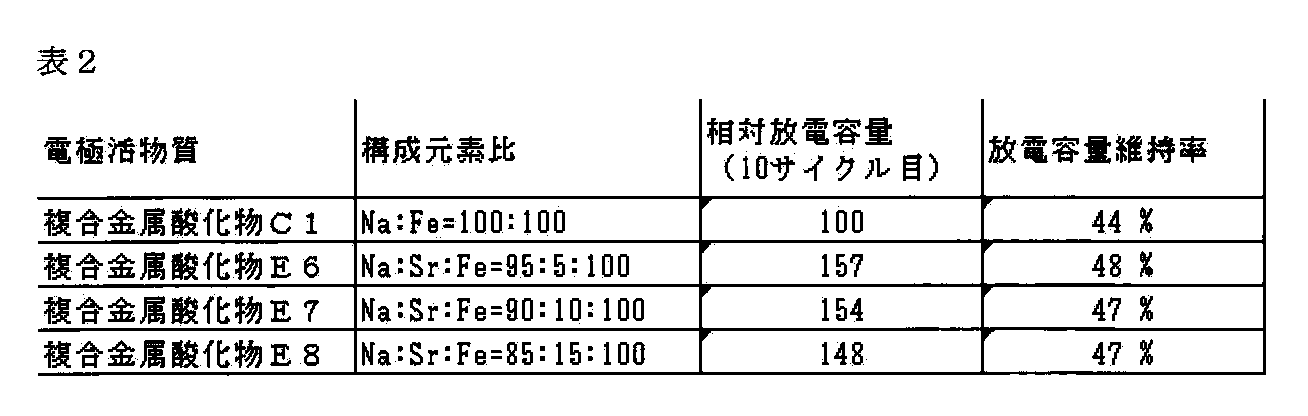
この電池について、充放電を10サイクル繰り返したときの10サイクル目の放電容量を100とした(以下、実施例1~8の電池における10サイクル目の放電容量は、比較例1の電池の充放電を10サイクル繰り返したときの10サイクル目の放電容量を100とした相対放電容量として示した)。また、1サイクル目の放電容量に対する10サイクル目の放電容量の維持率は44%であった。結果を表1に示している。
実施例1(Na:Ca:Fe=0.99:0.01:1.00)
(1)複合金属酸化物の製造
金属含有化合物として、炭酸ナトリウム(Na2CO3:和光純薬工業株式会社製:純度99.8%)、炭酸カルシウム(CaCO3:宇部マテリアルズ株式会社製、CS−3NA、純度99%以上)、および酸化鉄(II、III)(Fe3O4:株式会社高純度化学研究所製:純度99%)を用い、Na:Ca:Feのモル比が0.99:0.01:1.00となるように秤量し、乾式ボールミルで4時間にわたって混合して金属含有化合物の混合物を得た。得られた金属含有化合物の混合物を、アルミナボートに充填し、電気炉を用いて空気雰囲気において加熱して650℃で2時間にわたって保持して焼成した。焼成は2回行った。このようにして実施例1の複合金属酸化物E1(Na0.99Ca0.01FeO2)を得た。実施例1の複合金属酸化物E1の粉末X線回折図形を図2に示している。図2より複合金属酸化物E1の結晶構造は層状構造であることがわかる。
(2)ナトリウム二次電池の充放電性能評価
実施例1の複合金属酸化物E1を用いて電極を作製し、該電極をナトリウム二次電池の正極として用いて、電池を作製し、比較例1の場合と同様の条件で、定電流充放電試験を実施した。この電池について、充放電を10サイクル繰り返したときの10サイクル目の相対放電容量は134であり、また、1サイクル目の放電容量に対する10サイクル目の放電容量の維持率は44%であり、Caを含有させることにより、ナトリウム二次電池として充放電を繰り返したときの放電容量が大きくなることがわかった。結果を表1に示している。
実施例2(Na:Ca:Fe=0.95:0.05:1.00)
(1)複合金属酸化物の製造
Na:Ca:Feのモル比が0.95:0.05:1.00となる量で金属含有化合物を用いた以外は、実施例1と同様にして、実施例2の複合金属酸化物E2(Na0.95Ca0.05FeO2)を得た。実施例2の複合金属酸化物E2の粉末X線回折図形を図3に示している。図3より複合金属酸化物E2の結晶構造は層状構造であることがわかる。
(2)ナトリウム二次電池の充放電性能評価
実施例2の複合金属酸化物E2を用いて電極を作製し、該電極をナトリウム二次電池の正極として用いて、電池を作製し、比較例1の場合と同様の条件で、定電流充放電試験を実施した。この電池について、充放電を10サイクル繰り返したときの10サイクル目の相対放電容量は160であり、また、1サイクル目の放電容量に対する10サイクル目の放電容量の維持率は52%であり、Caを含有させることにより、ナトリウム二次電池として充放電を繰り返したときの放電容量が大きくなることがわかった。結果を表1に示している。
実施例3(Na:Ca:Fe=0.90:0.10:1.00)
(1)複合金属酸化物の製造
Na:Ca:Feのモル比が0.90:0.10:1.00となる量で金属含有化合物を用いた以外は、実施例1と同様にして、実施例3の複合金属酸化物E3(Na0.90Ca0.10FeO2)を得た。実施例3の複合金属酸化物E3の粉末X線回折図形を図4に示している。図4より複合金属酸化物E3の結晶構造は層状構造であることがわかる。
(2)ナトリウム二次電池の充放電性能評価
実施例3の複合金属酸化物E3を用いて電極を作製し、該電極をナトリウム二次電池の正極として用いて、電池を作製し、比較例1の場合と同様の条件で、定電流充放電試験を実施した。この電池について、充放電を10サイクル繰り返したときの10サイクル目の相対放電容量は170であり、また、1サイクル目の放電容量に対する10サイクル目の放電容量の維持率は59%であり、Caを含有させることにより、ナトリウム二次電池として充放電を繰り返したときの放電容量が大きくなることがわかった。結果を表1に示している。
実施例4(Na:Ca:Fe=0.85:0.15:1.00)
(1)複合金属酸化物の製造
Na:Ca:Feのモル比が0.85:0.15:1.00となる量で金属含有化合物を用いた以外は、実施例1と同様にして、実施例4の複合金属酸化物E4(Na0.85Ca0.15FeO2)を得た。実施例4の複合金属酸化物E4の粉末X線回折図形を図5に示している。図5より複合金属酸化物E4の結晶構造は層状構造であることがわかる。
(2)ナトリウム二次電池の充放電性能評価
実施例4の複合金属酸化物E4を用いて電極を作製し、該電極をナトリウム二次電池の正極として用いて、電池を作製し、比較例1の場合と同様の条件で、定電流充放電試験を実施した。この電池について、充放電を10サイクル繰り返したときの10サイクル目の相対放電容量は168であり、また、1サイクル目の放電容量に対する10サイクル目の放電容量の維持率は60%であり、Caを含有させることにより、ナトリウム二次電池として充放電を繰り返したときの放電容量が大きくなることがわかった。結果を表1に示している。
実施例5(Na:Ca:Fe=0.80:0.20:1.00)
(1)複合金属酸化物の製造
Na:Ca:Feのモル比が0.80:0.20:1.00となる量で金属含有化合物を用いた以外は、実施例1と同様にして、実施例5の複合金属酸化物E5(Na0.80Ca0.20FeO2)を得た。実施例5の複合金属酸化物E5の粉末X線回折図形を図6に示している。図6より複合金属酸化物E5の結晶構造は層状構造であることがわかる。
(2)ナトリウム二次電池の充放電性能評価
実施例5の複合金属酸化物E5を用いて電極を作製し、該電極をナトリウム二次電池の正極として用いて、電池を作製し、比較例1の場合と同様の条件で、定電流充放電試験を実施した。この電池について、充放電を10サイクル繰り返したときの10サイクル目の相対放電容量は163であり、また、1サイクル目の放電容量に対する10サイクル目の放電容量の維持率は61%であり、Caを含有させることにより、ナトリウム二次電池として充放電を繰り返したときの放電容量が大きくなることがわかった。結果を表1に示している。

(1)複合金属酸化物の製造
金属含有化合物として、炭酸ナトリウム(Na2CO3:和光純薬工業株式会社製:純度99.8%)、水酸化ストロンチウム八水和物(Sr(OH)2・8H2O:和光純薬工業株式会社製:純度99%以上)、および酸化鉄(II、III)(Fe3O4:株式会社高純度化学研究所製:純度99%)を用い、Na:Sr:Feのモル比が0.95:0.05:1.00となるように秤量し、乾式ボールミルで4時間にわたって混合して金属含有化合物の混合物を得た。得られた金属含有化合物の混合物を、アルミナボートに充填し、電気炉を用いて空気雰囲気において加熱して650℃で2時間にわたって保持して焼成した。焼成は2回行った。このようにして実施例6の複合金属酸化物E6(Na0.95Sr0.05FeO2)を得た。
(2)ナトリウム二次電池の充放電性能評価
実施例6の複合金属酸化物E6を用いて電極を作製し、該電極をナトリウム二次電池の正極として用いて、電池を作製し、比較例1の場合と同様の条件で、定電流充放電試験を実施した。この電池について、充放電を10サイクル繰り返したときの10サイクル目の相対放電容量は157であり、また、1サイクル目の放電容量に対する10サイクル目の放電容量の維持率は48%であり、Srを含有させることにより、ナトリウム二次電池として充放電を繰り返したときの放電容量が大きくなることがわかった。結果を表2に示している。
実施例7(Na:Sr:Fe=0.90:0.10:1.00)
(1)複合金属酸化物の製造
Na:Sr:Feのモル比が0.90:0.10:1.00となる量で金属含有化合物を用いた以外は、実施例6と同様にして、実施例7の複合金属酸化物E7(Na0.90Sr0.10FeO2)を得た。
(2)ナトリウム二次電池の充放電性能評価
実施例7の複合金属酸化物E7を用いて電極を作製し、該電極をナトリウム二次電池の正極として用いて、電池を作製し、比較例1の場合と同様の条件で、定電流充放電試験を実施した。この電池について、充放電を10サイクル繰り返したときの10サイクル目の相対放電容量は154であり、また、1サイクル目の放電容量に対する10サイクル目の放電容量の維持率は47%であり、Srを含有させることにより、ナトリウム二次電池として充放電を繰り返したときの放電容量が大きくなることがわかった。結果を表2に示している。
実施例8(Na:Sr:Fe=0.85:0.15:1.00)
(1)複合金属酸化物の製造
Na:Sr:Feのモル比が0.85:0.15:1.00となる量で金属含有化合物を用いた以外は、実施例6と同様にして、実施例8の複合金属酸化物E8(Na0.85Sr0.15FeO2)を得た。
(2)ナトリウム二次電池の充放電性能評価
実施例8の複合金属酸化物E8を用いて電極を作製し、該電極をナトリウム二次電池の正極として用いて、電池を作製し、比較例1の場合と同様の条件で、定電流充放電試験を実施した。この電池について、充放電を10サイクル繰り返したときの10サイクル目の相対放電容量は148であり、また、1サイクル目の放電容量に対する10サイクル目の放電容量の維持率は47%であり、Srを含有させることにより、ナトリウム二次電池として充放電を繰り返したときの放電容量が大きくなることがわかった。結果を表2に示している。
(1)複合金属酸化物の製造
金属含有化合物として、炭酸ナトリウム(Na2CO3:和光純薬工業株式会社製:純度99.8%)および酸化マンガン(IV)(MnO2:株式会社高純度化学研究所製:純度99.9%)を用い、Na:Mnのモル比が1.00:1.00となるように秤量し、乾式ボールミルで4時間にわたって混合して、金属含有化合物の混合物を得た。得られた金属含有化合物の混合物を、アルミナボートに充填し、電気炉を用いて空気雰囲気において加熱して800℃で2時間にわたって保持して焼成した。焼成は2回行った。このようにして比較例2の複合金属酸化物C2(NaMnO2)を得た。
(2)ナトリウム二次電池の充放電性能評価
比較例2の複合金属酸化物C2を用いて電極を作製し、該電極をナトリウム二次電池の正極として用いて、電池を作製し、比較例1の場合と同様の条件で、定電流充放電試験を実施した。この電池について、充放電を10サイクル繰り返したときの10サイクル目の放電容量を100とした(以下、実施例9の電池における10サイクル目の放電容量は、比較例2の電池の充放電を10サイクル繰り返したときの10サイクル目の放電容量を100とした相対放電容量として示した)。また、1サイクル目の放電容量に対する10サイクル目の放電容量の維持率は61%であった。結果を表3に示している。
実施例9(Na:Ca:Mn=0.90:0.10:1.00)
(1)複合金属酸化物の製造
金属含有化合物として、炭酸ナトリウム(Na2CO3:和光純薬工業株式会社製:純度99.8%)、炭酸カルシウム(CaCO3:宇部マテリアルズ株式会社製、CS−3NA、純度99%以上)および酸化マンガン(IV)(MnO2:株式会社高純度化学研究所製:純度99.9%)を用い、Na:Ca:Mnのモル比が0.90:0.10:1.00となるように秤量し、乾式ボールミルで4時間にわたって混合して金属含有化合物の混合物を得た。得られた金属含有化合物の混合物を、アルミナボートに充填し、電気炉を用いて空気雰囲気において加熱して800℃で2時間にわたって保持して焼成した。焼成は2回行った。このようにして実施例9の複合金属酸化物E9(Na0.90Ca0.10MnO2)を得た。
(2)ナトリウム二次電池の充放電性能評価
実施例9の複合金属酸化物E9を用いて電極を作製し、該電極をナトリウム二次電池の正極として用いて、電池を作製し、比較例1の場合と同様の条件で、定電流充放電試験を実施した。この電池について、充放電を10サイクル繰り返した10サイクル目の相対放電容量は120であり、1サイクル目の放電容量に対する10サイクル目の放電容量の維持率は86%であり、Caを含有させることにより、ナトリウム二次電池として充放電を繰り返したときの放電容量が大きくなることがわかった。結果を表3に示している。

(1)複合金属酸化物の製造
金属含有化合物として、炭酸ナトリウム(Na2CO3:和光純薬工業株式会社製:純度99.8%)、酸化マンガン(IV)(MnO2:株式会社高純度化学研究所製:純度99.9%)、酸化鉄(II、III)(Fe3O4:株式会社高純度化学研究所製:純度99%)、および酸化ニッケル(II)(NiO:株式会社高純度化学研究所製:純度99%)を用い、Na:Mn:Fe:Niのモル比が1.00:0.60:0.20:0.20となるように秤量し、乾式ボールミルで4時間にわたって混合して、金属含有化合物の混合物を得た。得られた金属含有化合物の混合物を、アルミナボートに充填し、電気炉を用いて空気雰囲気において加熱して800℃で2時間にわたって保持して焼成した。焼成は2回行った。このようにして比較例3の複合金属酸化物C3(NaMn0.6Fe0.2Ni0.2O2)を得た。比較例3の複合金属酸化物C3の粉末X線回折図形を図7に示している。図7より複合金属酸化物E5の結晶構造は層状構造であることがわかる。
(2)ナトリウム二次電池の充放電性能評価
比較例3の複合金属酸化物C3を用いて電極を作製し、該電極をナトリウム二次電池の正極として用いて、電池を作製し、比較例1の場合と同様の条件で、定電流充放電試験を実施した。この電池について、充放電を10サイクル繰り返したときの10サイクル目の放電容量を100とした(以下、実施例10の電池における10サイクル目の放電容量は、比較例3の電池の充放電を10サイクル繰り返したときの10サイクル目の放電容量を100とした相対放電容量として示した)。また、1サイクル目の放電容量に対する10サイクル目の放電容量の維持率は88%であった。結果を表4に示している。
実施例10(Na:Mg:M2=0.90:0.10:1.00、M2はMn、FeおよびNiである。)
(1)複合金属酸化物の製造
金属含有化合物として、炭酸ナトリウム(Na2CO3:和光純薬工業株式会社製:純度99.8%)、酸化マグネシウム(MgO:和光純薬工業株式会社製:純度99%以上)、酸化マンガン(IV)(MnO:株式会社高純度化学研究所製:純度99.9%)、酸化鉄(II、III)(Fe3O4:株式会社高純度化学研究所製:純度99%)、および酸化ニッケル(II)(NiO:株式会社高純度化学研究所製:純度99%)を用い、Na:Mg:Mn:Fe:Niのモル比が0.90:0.10:0.60:0.20:0.20となるように秤量し、乾式ボールミルで4時間にわたって混合して金属含有化合物の混合物を得た。得られた金属含有化合物の混合物を、アルミナボートに充填し、電気炉を用いて空気雰囲気において加熱して800℃で2時間にわたって保持して焼成した。焼成は2回行った。このようにして実施例10の複合金属酸化物E10(Na0.90Mg0.10Mn0.6Fe0.2Ni0.2O2)を得た。実施例10の複合金属酸化物E10の粉末X線回折図形を図8に示している。図8より複合金属酸化物E10の結晶構造は層状構造であることがわかる。
(2)ナトリウム二次電池の充放電性能評価
実施例10の複合金属酸化物E10を用いて電極を作製し、該電極をナトリウム二次電池の正極として用いて、電池を作製し、比較例1の場合と同様の条件で、定電流充放電試験を実施した。この電池について、充放電を10サイクル繰り返した10サイクル目の相対放電容量は119であり、1サイクル目の放電容量に対する10サイクル目の放電容量の維持率は96%であり、Mgを含有させることにより、ナトリウム二次電池として充放電を繰り返したときの放電容量が大きくなることがわかった。結果を表4に示している。

NMP4200gに塩化カルシウム272.7gを溶解した後、パラフェニレンジアミン132.9gを添加して完全に溶解させた。得られた溶液に、テレフタル酸ジクロライド243.3gを徐々に添加して重合し、パラアラミドを得て、さらにNMPで希釈して、濃度2.0重量%のパラアラミド溶液(A)を得た。得られたパラアラミド溶液100gに、アルミナ粉末(a)2g(日本アエロジル社製、アルミナC、平均粒子径0.02μm)とアルミナ粉末(b)2g(住友化学株式会社製スミコランダム、AA03、平均粒子径0.3μm)とをフィラーとして計4g添加して混合し、ナノマイザーで3回処理し、さらに1000メッシュの金網で濾過、減圧下で脱泡して、スラリー状塗工液(B)を製造した。パラアラミドおよびアルミナ粉末の合計重量に対するアルミナ粉末(フィラー)の重量は、67重量%となる。
(2)積層フィルムの製造および評価
多孔質フィルムとしては、ポリエチレン製多孔質フィルム(膜厚12μm、透気度140秒/100cc、平均孔径0.1μm、空孔率50%)を用いた。厚み100μmのPETフィルムの上に上記ポリエチレン製多孔質フィルムを固定し、テスター産業株式会社製バーコーターにより、該多孔質フィルムの上に耐熱多孔層用スラリー状塗工液を塗工した。PETフィルム上の塗工された該多孔質フィルムを一体にしたまま、貧溶媒である水中に浸漬させ、パラアラミド多孔質膜(耐熱多孔層)を析出させた後、溶媒を乾燥させて、PETフィルムをはがして、耐熱多孔層と多孔質フィルムとが積層された積層フィルムを得た。積層フィルムの厚みは16μmであり、パラアラミド多孔質膜(耐熱多孔層)の厚みは4μmであった。積層フィルムの透気度は180秒/100cc、空孔率は50%であった。積層フィルムにおける耐熱多孔層の断面を走査型電子顕微鏡(SEM)により観察をしたところ、0.03μm~0.06μm程度の比較的小さな微細孔と0.1μm~1μm程度の比較的大きな微細孔とを有することがわかった。なお、積層フィルムの評価は、以下の(A)~(C)のようにして行った。
(A)厚み測定
積層フィルムの厚み、多孔質フィルムの厚みは、JIS規格(K7130−1992)に従い、測定した。また、耐熱多孔層の厚みとしては、積層フィルムの厚みから多孔質フィルムの厚みを差し引いた値を用いた。
(B)ガーレー法による透気度の測定
積層フィルムの透気度は、JIS P8117に基づいて、株式会社安田精機製作所製のデジタルタイマー式ガーレー式デンソメータで測定した。
(C)空孔率
得られた積層フィルムのサンプルを一辺の長さ10cmの正方形に切り取り、重量W(g)と厚みD(cm)を測定した。サンプル中のそれぞれの層の重量(Wi(g))を求め、Wiとそれぞれの層の材質の真比重(真比重i(g/cm3))とから、それぞれの層の体積を求めて、次式より空孔率(体積%)を求めた。
空孔率(体積%)=100×{1−(W1/真比重1+W2/真比重2+・・+Wn/真比重n)/(10×10×D)}
上記実施例において、セパレータとして、製造例により得られた積層フィルムを用いれば、熱破膜をより防ぐことのできるナトリウム二次電池を得ることができる。
Claims (8)
- Na、M1およびM2(ここで、M1は、Mg、Ca、SrおよびBaからなる群より選ばれる1種以上の元素を表し、M2は、Mn、Fe、CoおよびNiからなる群より選ばれる1種以上の元素を表す。)を含み、Na:M1:M2のモル比が、a:b:1(ここで、aは0.5以上1未満の範囲の値であり、bは0を超え0.5以下の範囲の値であり、かつa+bは0.5を超え1以下の範囲の値である。)である複合金属酸化物。
- M1が、Caを含む請求項1記載の複合金属酸化物。
- M1が、Srを含む請求項1または2記載の複合金属酸化物。
- 請求項1~3のいずれかに記載の複合金属酸化物を含有する電極活物質。
- 請求項4記載の電極活物質を含有する電極。
- 請求項5記載の電極を、正極として有するナトリウム二次電池。
- セパレータを更に有する請求項6記載のナトリウム二次電池。
- セパレータが、耐熱多孔層と多孔質フィルムとが積層されてなる積層フィルムを有するセパレータである請求項7記載のナトリウム二次電池。
Priority Applications (4)
| Application Number | Priority Date | Filing Date | Title |
|---|---|---|---|
| CN201080011025.1A CN102349178B (zh) | 2009-03-13 | 2010-03-10 | 复合金属氧化物、电极以及钠二次电池 |
| KR1020117020781A KR101708951B1 (ko) | 2009-03-13 | 2010-03-10 | 복합 금속 산화물, 전극 및 나트륨 이차 전지 |
| EP10750947.3A EP2410596A4 (en) | 2009-03-13 | 2010-03-10 | COMPOUND METAL OXIDE, ELECTRODE AND SODIUM CYBER BATTERY |
| US13/256,159 US9502714B2 (en) | 2009-03-13 | 2010-03-10 | Mixed metal oxide, electrode, and sodium secondary battery |
Applications Claiming Priority (2)
| Application Number | Priority Date | Filing Date | Title |
|---|---|---|---|
| JP2009-060939 | 2009-03-13 | ||
| JP2009060939 | 2009-03-13 |
Publications (1)
| Publication Number | Publication Date |
|---|---|
| WO2010104202A1 true WO2010104202A1 (ja) | 2010-09-16 |
Family
ID=42728480
Family Applications (1)
| Application Number | Title | Priority Date | Filing Date |
|---|---|---|---|
| PCT/JP2010/054474 Ceased WO2010104202A1 (ja) | 2009-03-13 | 2010-03-10 | 複合金属酸化物、電極およびナトリウム二次電池 |
Country Status (6)
| Country | Link |
|---|---|
| US (1) | US9502714B2 (ja) |
| EP (1) | EP2410596A4 (ja) |
| JP (1) | JP5625390B2 (ja) |
| KR (1) | KR101708951B1 (ja) |
| CN (1) | CN102349178B (ja) |
| WO (1) | WO2010104202A1 (ja) |
Families Citing this family (29)
| Publication number | Priority date | Publication date | Assignee | Title |
|---|---|---|---|---|
| WO2011129419A1 (ja) * | 2010-04-16 | 2011-10-20 | 住友化学株式会社 | 複合金属酸化物、正極活物質、正極およびナトリウム二次電池 |
| JP5874328B2 (ja) | 2010-11-29 | 2016-03-02 | 住友化学株式会社 | 電極合剤ペースト、電極および非水電解質二次電池 |
| WO2012111681A1 (ja) * | 2011-02-15 | 2012-08-23 | 住友化学株式会社 | ナトリウム二次電池電極およびナトリウム二次電池 |
| KR102058460B1 (ko) * | 2012-02-27 | 2019-12-23 | 에스케이이노베이션 주식회사 | 난층 나트륨 버네싸이트 및 이의 제조방법 |
| GB2503896A (en) * | 2012-07-10 | 2014-01-15 | Faradion Ltd | Nickel doped compound for use as an electrode material in energy storage devices |
| GB2503898A (en) * | 2012-07-10 | 2014-01-15 | Faradion Ltd | Nickel doped compound for use as an electrode material in energy storage devices |
| GB2503897A (en) * | 2012-07-10 | 2014-01-15 | Faradion Ltd | Nickel doped compound for use as an electrode material in energy storage devices |
| CN105210218B (zh) | 2013-02-27 | 2018-01-02 | 尤米科尔公司 | 用于钠离子电池的掺杂的钠锰氧化物阴极材料 |
| CN103259009B (zh) * | 2013-04-18 | 2019-06-14 | 恩力能源科技有限公司 | 一种水系碱金属离子电化学储能器件 |
| JP6247051B2 (ja) * | 2013-08-28 | 2017-12-13 | 京セラ株式会社 | 二次電池用活物質およびそれを用いた二次電池 |
| KR102144996B1 (ko) | 2013-09-30 | 2020-08-18 | 삼성전자주식회사 | 양극활물질, 및 이를 포함하는 양극 및 나트륨이차전지 |
| KR102192082B1 (ko) | 2013-10-18 | 2020-12-16 | 삼성전자주식회사 | 음극 활물질, 상기 음극 활물질을 포함하는 음극 및 상기 음극을 포함하는 리튬 이차전지 |
| KR102149334B1 (ko) | 2013-10-21 | 2020-08-28 | 삼성전자주식회사 | 양극활물질, 및 이를 포함하는 양극 및 나트륨이차전지 |
| GB201400347D0 (en) * | 2014-01-09 | 2014-02-26 | Faradion Ltd | Doped nickelate compounds |
| US20170062868A1 (en) * | 2014-02-21 | 2017-03-02 | Sumitomo Chemical Company, Limited | Sodium secondary battery |
| CN104795552B (zh) * | 2014-10-16 | 2016-08-24 | 中国科学院物理研究所 | 一种层状氧化物材料、制备方法、极片、二次电池和用途 |
| JP6708326B2 (ja) * | 2014-11-18 | 2020-06-10 | 国立研究開発法人産業技術総合研究所 | ナトリウム二次電池用正極材料 |
| US9653731B2 (en) * | 2014-12-23 | 2017-05-16 | Sharp Kabushiki Kaisha | Layered oxide materials for batteries |
| US9660263B2 (en) | 2014-12-23 | 2017-05-23 | Sharp Kabushiki Kaisha | Layered oxide materials for batteries |
| CN104617288B (zh) * | 2015-01-21 | 2017-05-31 | 中国科学院物理研究所 | 一种铜基富钠层状氧化物材料及其制备方法和用途 |
| US20170025678A1 (en) * | 2015-07-21 | 2017-01-26 | Sharp Kabushiki Kaisha | Layered oxide materials for batteries |
| US11233236B2 (en) | 2017-03-29 | 2022-01-25 | Sumitomo Chemical Company, Limited | Electrode active material for sodium secondary battery, electrode for sodium secondary battery, sodium secondary battery and method for producing composite metal oxide |
| EP3604228B1 (en) * | 2017-03-29 | 2023-09-13 | Sumitomo Chemical Company, Limited | Composite metal oxide, positive electrode active material, positive electrode, sodium secondary battery, and method for producing composite metal oxide |
| CN110504443B (zh) * | 2018-05-16 | 2022-10-25 | 中国电力科学研究院有限公司 | 具有阴离子变价的钠镁锰基层状氧化物材料、制备方法和用途 |
| KR102112405B1 (ko) | 2018-07-27 | 2020-05-19 | 동국대학교 산학협력단 | 양극 활물질, 이를 포함하는 양극 및 이차전지 |
| CN111952675B (zh) * | 2020-08-20 | 2021-07-27 | 陕西科技大学 | 一种高性能全固态钠离子电池及其制备方法 |
| JP7571646B2 (ja) * | 2021-03-29 | 2024-10-23 | 戸田工業株式会社 | ナトリウムフェライト粒子粉末及びその製造方法 |
| JP7676936B2 (ja) * | 2021-05-18 | 2025-05-15 | 戸田工業株式会社 | ナトリウムフェライト粒子粉末及びその製造方法 |
| CN115275178A (zh) * | 2022-07-18 | 2022-11-01 | 贵州振华新材料有限公司 | 一种单晶钠离子电池正极材料及其制备方法和电池 |
Citations (9)
| Publication number | Priority date | Publication date | Assignee | Title |
|---|---|---|---|---|
| JPH10324758A (ja) | 1997-03-26 | 1998-12-08 | Sumitomo Chem Co Ltd | パラアラミド系多孔質フィルムおよびそれを用いた電池用セパレーターとリチウム二次電池 |
| JPH1140156A (ja) * | 1997-07-16 | 1999-02-12 | Sanyo Electric Co Ltd | 非水電解質二次電池 |
| JP2000030686A (ja) | 1998-04-27 | 2000-01-28 | Sumitomo Chem Co Ltd | 非水電解質電池セパレ―タ―とリチウム二次電池 |
| JP2001332258A (ja) * | 2000-05-22 | 2001-11-30 | Nippon Telegr & Teleph Corp <Ntt> | 複酸化物電極材料、その製造方法及びそれを用いた電池 |
| JP2002069221A (ja) * | 2000-06-14 | 2002-03-08 | Sumitomo Chem Co Ltd | 多孔質フィルムおよびそれを用いた電池用セパレータ |
| JP2004533706A (ja) * | 2001-04-06 | 2004-11-04 | ヴァレンス テクノロジー インコーポレーテッド | ナトリウムイオンバッテリ |
| JP2005317511A (ja) | 2004-03-31 | 2005-11-10 | Junichi Yamaki | 非水電解質二次電池用正極活物質 |
| WO2006057307A1 (ja) * | 2004-11-26 | 2006-06-01 | Sumitomo Chemical Company, Limited | 非水電解質二次電池用正極活物質 |
| JP2009227505A (ja) * | 2008-03-21 | 2009-10-08 | National Institute Of Advanced Industrial & Technology | マンガン酸化物、電池用電極活物質、及びそれらの製造方法、並びに電池用電極活物質を用いた二次電池 |
Family Cites Families (16)
| Publication number | Priority date | Publication date | Assignee | Title |
|---|---|---|---|---|
| US4912081A (en) * | 1988-06-27 | 1990-03-27 | Atlantic Richfield Company | Boron-promoted reducible metal oxides |
| US6080507A (en) * | 1998-04-13 | 2000-06-27 | Celgard Inc. | Trilayer battery separator |
| JPH11317225A (ja) * | 1998-04-30 | 1999-11-16 | Mitsubishi Materials Corp | リチウム二次電池用正極活物質およびその製造方法 |
| TWI315591B (en) | 2000-06-14 | 2009-10-01 | Sumitomo Chemical Co | Porous film and separator for battery using the same |
| US7045250B2 (en) | 2000-11-13 | 2006-05-16 | Sanyo Electric Co., Ltd. | Non-aqueous electrolyte battery |
| JP3778794B2 (ja) | 2000-11-13 | 2006-05-24 | 三洋電機株式会社 | 非水電解質二次電池の充放電方法 |
| JP2002280623A (ja) * | 2001-03-19 | 2002-09-27 | Tohoku Techno Arch Co Ltd | 酸化物熱電材料の製造方法 |
| GB0117235D0 (en) | 2001-07-14 | 2001-09-05 | Univ St Andrews | Improvements in or relating to electrochemical cells |
| CN100386900C (zh) * | 2002-04-09 | 2008-05-07 | 松下电器产业株式会社 | 热电变换材料及其制造方法 |
| WO2005096415A1 (ja) | 2004-03-31 | 2005-10-13 | Sumitomo Chemical Company, Limited | 非水電解質二次電池用正極活物質 |
| JP4739769B2 (ja) | 2005-02-07 | 2011-08-03 | 三洋電機株式会社 | 非水電解質二次電池 |
| KR100982595B1 (ko) | 2005-02-07 | 2010-09-15 | 산요덴키가부시키가이샤 | 정극 및 비수 전해질 이차 전지 |
| JP5142544B2 (ja) * | 2006-03-20 | 2013-02-13 | 三洋電機株式会社 | 非水電解質二次電池 |
| CN101168128A (zh) | 2006-10-25 | 2008-04-30 | 刘芬 | 复合金属氧化物催化剂及其制备方法和用途 |
| CN101157482B (zh) * | 2007-09-19 | 2010-12-08 | 哈尔滨工业大学 | 一种掺杂改性Ca-Co-O体系过渡金属复合氧化物及其制备方法 |
| JP2009135092A (ja) | 2007-11-09 | 2009-06-18 | Sumitomo Chemical Co Ltd | 複合金属酸化物およびナトリウム二次電池 |
-
2010
- 2010-03-02 JP JP2010045022A patent/JP5625390B2/ja active Active
- 2010-03-10 KR KR1020117020781A patent/KR101708951B1/ko active Active
- 2010-03-10 EP EP10750947.3A patent/EP2410596A4/en not_active Withdrawn
- 2010-03-10 CN CN201080011025.1A patent/CN102349178B/zh active Active
- 2010-03-10 WO PCT/JP2010/054474 patent/WO2010104202A1/ja not_active Ceased
- 2010-03-10 US US13/256,159 patent/US9502714B2/en active Active
Patent Citations (9)
| Publication number | Priority date | Publication date | Assignee | Title |
|---|---|---|---|---|
| JPH10324758A (ja) | 1997-03-26 | 1998-12-08 | Sumitomo Chem Co Ltd | パラアラミド系多孔質フィルムおよびそれを用いた電池用セパレーターとリチウム二次電池 |
| JPH1140156A (ja) * | 1997-07-16 | 1999-02-12 | Sanyo Electric Co Ltd | 非水電解質二次電池 |
| JP2000030686A (ja) | 1998-04-27 | 2000-01-28 | Sumitomo Chem Co Ltd | 非水電解質電池セパレ―タ―とリチウム二次電池 |
| JP2001332258A (ja) * | 2000-05-22 | 2001-11-30 | Nippon Telegr & Teleph Corp <Ntt> | 複酸化物電極材料、その製造方法及びそれを用いた電池 |
| JP2002069221A (ja) * | 2000-06-14 | 2002-03-08 | Sumitomo Chem Co Ltd | 多孔質フィルムおよびそれを用いた電池用セパレータ |
| JP2004533706A (ja) * | 2001-04-06 | 2004-11-04 | ヴァレンス テクノロジー インコーポレーテッド | ナトリウムイオンバッテリ |
| JP2005317511A (ja) | 2004-03-31 | 2005-11-10 | Junichi Yamaki | 非水電解質二次電池用正極活物質 |
| WO2006057307A1 (ja) * | 2004-11-26 | 2006-06-01 | Sumitomo Chemical Company, Limited | 非水電解質二次電池用正極活物質 |
| JP2009227505A (ja) * | 2008-03-21 | 2009-10-08 | National Institute Of Advanced Industrial & Technology | マンガン酸化物、電池用電極活物質、及びそれらの製造方法、並びに電池用電極活物質を用いた二次電池 |
Non-Patent Citations (1)
| Title |
|---|
| See also references of EP2410596A4 |
Also Published As
| Publication number | Publication date |
|---|---|
| KR101708951B1 (ko) | 2017-02-21 |
| CN102349178A (zh) | 2012-02-08 |
| US9502714B2 (en) | 2016-11-22 |
| JP5625390B2 (ja) | 2014-11-19 |
| EP2410596A4 (en) | 2013-05-01 |
| EP2410596A1 (en) | 2012-01-25 |
| US20120015230A1 (en) | 2012-01-19 |
| CN102349178B (zh) | 2016-01-20 |
| KR20110138348A (ko) | 2011-12-27 |
| JP2010235434A (ja) | 2010-10-21 |
Similar Documents
| Publication | Publication Date | Title |
|---|---|---|
| JP5625390B2 (ja) | 複合金属酸化物、電極およびナトリウム二次電池 | |
| CN101933180B (zh) | 复合金属氧化物和钠二次电池 | |
| CN101933179B (zh) | 复合金属氧化物及钠二次电池 | |
| JP5515306B2 (ja) | 複合金属酸化物およびナトリウム二次電池 | |
| JP5720389B2 (ja) | 複合金属酸化物およびナトリウム二次電池 | |
| JP5287520B2 (ja) | 電極活物質、電極および非水電解質二次電池 | |
| JP2009135092A (ja) | 複合金属酸化物およびナトリウム二次電池 | |
| US20110159345A1 (en) | Electrode active material and method for producing same | |
| JP5531602B2 (ja) | 電極活物質、電極および非水電解質二次電池 | |
| JP5391709B2 (ja) | 複合金属酸化物およびナトリウム二次電池 | |
| US20100266900A1 (en) | Sodium-manganese mixed metal oxide, production method thereof and sodium secondary battery | |
| JP2009206085A (ja) | 正極活物質およびナトリウム二次電池、ならびにオリビン型リン酸塩の製造方法 | |
| WO2009099068A1 (ja) | ナトリウム二次電池 | |
| JP2010040311A (ja) | 電極活物質、電極およびナトリウム二次電池 | |
| JP2009259601A (ja) | ナトリウムイオン二次電池用電極活物質およびその製造方法 | |
| JP2009224320A (ja) | ナトリウム二次電池 |
Legal Events
| Date | Code | Title | Description |
|---|---|---|---|
| WWE | Wipo information: entry into national phase |
Ref document number: 201080011025.1 Country of ref document: CN |
|
| 121 | Ep: the epo has been informed by wipo that ep was designated in this application |
Ref document number: 10750947 Country of ref document: EP Kind code of ref document: A1 |
|
| ENP | Entry into the national phase |
Ref document number: 20117020781 Country of ref document: KR Kind code of ref document: A |
|
| WWE | Wipo information: entry into national phase |
Ref document number: 2010750947 Country of ref document: EP |
|
| WWE | Wipo information: entry into national phase |
Ref document number: 13256159 Country of ref document: US |
|
| NENP | Non-entry into the national phase |
Ref country code: DE |
|
| WWE | Wipo information: entry into national phase |
Ref document number: 6575/CHENP/2011 Country of ref document: IN |