WO2010110994A2 - Polymer membranes prepared from aromatic polyimide membranes by thermal treating and uv crosslinking - Google Patents
Polymer membranes prepared from aromatic polyimide membranes by thermal treating and uv crosslinking Download PDFInfo
- Publication number
- WO2010110994A2 WO2010110994A2 PCT/US2010/025820 US2010025820W WO2010110994A2 WO 2010110994 A2 WO2010110994 A2 WO 2010110994A2 US 2010025820 W US2010025820 W US 2010025820W WO 2010110994 A2 WO2010110994 A2 WO 2010110994A2
- Authority
- WO
- WIPO (PCT)
- Prior art keywords
- membrane
- membranes
- polymer
- poly
- crosslinking
- Prior art date
- Legal status (The legal status is an assumption and is not a legal conclusion. Google has not performed a legal analysis and makes no representation as to the accuracy of the status listed.)
- Ceased
Links
Classifications
-
- B—PERFORMING OPERATIONS; TRANSPORTING
- B01—PHYSICAL OR CHEMICAL PROCESSES OR APPARATUS IN GENERAL
- B01D—SEPARATION
- B01D71/00—Semi-permeable membranes for separation processes or apparatus characterised by the material; Manufacturing processes specially adapted therefor
- B01D71/06—Organic material
- B01D71/58—Other polymers having nitrogen in the main chain, with or without oxygen or carbon only
- B01D71/62—Polycondensates having nitrogen-containing heterocyclic rings in the main chain
- B01D71/64—Polyimides; Polyamide-imides; Polyester-imides; Polyamide acids or similar polyimide precursors
-
- B—PERFORMING OPERATIONS; TRANSPORTING
- B01—PHYSICAL OR CHEMICAL PROCESSES OR APPARATUS IN GENERAL
- B01D—SEPARATION
- B01D71/00—Semi-permeable membranes for separation processes or apparatus characterised by the material; Manufacturing processes specially adapted therefor
- B01D71/06—Organic material
- B01D71/58—Other polymers having nitrogen in the main chain, with or without oxygen or carbon only
- B01D71/62—Polycondensates having nitrogen-containing heterocyclic rings in the main chain
-
- B—PERFORMING OPERATIONS; TRANSPORTING
- B01—PHYSICAL OR CHEMICAL PROCESSES OR APPARATUS IN GENERAL
- B01D—SEPARATION
- B01D53/00—Separation of gases or vapours; Recovering vapours of volatile solvents from gases; Chemical or biological purification of waste gases, e.g. engine exhaust gases, smoke, fumes, flue gases, aerosols
- B01D53/22—Separation of gases or vapours; Recovering vapours of volatile solvents from gases; Chemical or biological purification of waste gases, e.g. engine exhaust gases, smoke, fumes, flue gases, aerosols by diffusion
- B01D53/228—Separation of gases or vapours; Recovering vapours of volatile solvents from gases; Chemical or biological purification of waste gases, e.g. engine exhaust gases, smoke, fumes, flue gases, aerosols by diffusion characterised by specific membranes
-
- B—PERFORMING OPERATIONS; TRANSPORTING
- B01—PHYSICAL OR CHEMICAL PROCESSES OR APPARATUS IN GENERAL
- B01D—SEPARATION
- B01D67/00—Processes specially adapted for manufacturing semi-permeable membranes for separation processes or apparatus
- B01D67/0081—After-treatment of organic or inorganic membranes
- B01D67/0093—Chemical modification
- B01D67/00933—Chemical modification by addition of a layer chemically bonded to the membrane
-
- B—PERFORMING OPERATIONS; TRANSPORTING
- B01—PHYSICAL OR CHEMICAL PROCESSES OR APPARATUS IN GENERAL
- B01D—SEPARATION
- B01D69/00—Semi-permeable membranes for separation processes or apparatus characterised by their form, structure or properties; Manufacturing processes specially adapted therefor
- B01D69/02—Semi-permeable membranes for separation processes or apparatus characterised by their form, structure or properties; Manufacturing processes specially adapted therefor characterised by their properties
-
- C—CHEMISTRY; METALLURGY
- C08—ORGANIC MACROMOLECULAR COMPOUNDS; THEIR PREPARATION OR CHEMICAL WORKING-UP; COMPOSITIONS BASED THEREON
- C08G—MACROMOLECULAR COMPOUNDS OBTAINED OTHERWISE THAN BY REACTIONS ONLY INVOLVING UNSATURATED CARBON-TO-CARBON BONDS
- C08G73/00—Macromolecular compounds obtained by reactions forming a linkage containing nitrogen with or without oxygen or carbon in the main chain of the macromolecule, not provided for in groups C08G12/00 - C08G71/00
- C08G73/06—Polycondensates having nitrogen-containing heterocyclic rings in the main chain of the macromolecule
- C08G73/10—Polyimides; Polyester-imides; Polyamide-imides; Polyamide acids or similar polyimide precursors
- C08G73/1039—Polyimides; Polyester-imides; Polyamide-imides; Polyamide acids or similar polyimide precursors comprising halogen-containing substituents
-
- C—CHEMISTRY; METALLURGY
- C08—ORGANIC MACROMOLECULAR COMPOUNDS; THEIR PREPARATION OR CHEMICAL WORKING-UP; COMPOSITIONS BASED THEREON
- C08G—MACROMOLECULAR COMPOUNDS OBTAINED OTHERWISE THAN BY REACTIONS ONLY INVOLVING UNSATURATED CARBON-TO-CARBON BONDS
- C08G73/00—Macromolecular compounds obtained by reactions forming a linkage containing nitrogen with or without oxygen or carbon in the main chain of the macromolecule, not provided for in groups C08G12/00 - C08G71/00
- C08G73/06—Polycondensates having nitrogen-containing heterocyclic rings in the main chain of the macromolecule
- C08G73/10—Polyimides; Polyester-imides; Polyamide-imides; Polyamide acids or similar polyimide precursors
- C08G73/1042—Copolyimides derived from at least two different tetracarboxylic compounds or two different diamino compounds
-
- C—CHEMISTRY; METALLURGY
- C08—ORGANIC MACROMOLECULAR COMPOUNDS; THEIR PREPARATION OR CHEMICAL WORKING-UP; COMPOSITIONS BASED THEREON
- C08G—MACROMOLECULAR COMPOUNDS OBTAINED OTHERWISE THAN BY REACTIONS ONLY INVOLVING UNSATURATED CARBON-TO-CARBON BONDS
- C08G73/00—Macromolecular compounds obtained by reactions forming a linkage containing nitrogen with or without oxygen or carbon in the main chain of the macromolecule, not provided for in groups C08G12/00 - C08G71/00
- C08G73/06—Polycondensates having nitrogen-containing heterocyclic rings in the main chain of the macromolecule
- C08G73/10—Polyimides; Polyester-imides; Polyamide-imides; Polyamide acids or similar polyimide precursors
- C08G73/1046—Polyimides containing oxygen in the form of ether bonds in the main chain
-
- C—CHEMISTRY; METALLURGY
- C08—ORGANIC MACROMOLECULAR COMPOUNDS; THEIR PREPARATION OR CHEMICAL WORKING-UP; COMPOSITIONS BASED THEREON
- C08G—MACROMOLECULAR COMPOUNDS OBTAINED OTHERWISE THAN BY REACTIONS ONLY INVOLVING UNSATURATED CARBON-TO-CARBON BONDS
- C08G73/00—Macromolecular compounds obtained by reactions forming a linkage containing nitrogen with or without oxygen or carbon in the main chain of the macromolecule, not provided for in groups C08G12/00 - C08G71/00
- C08G73/06—Polycondensates having nitrogen-containing heterocyclic rings in the main chain of the macromolecule
- C08G73/10—Polyimides; Polyester-imides; Polyamide-imides; Polyamide acids or similar polyimide precursors
- C08G73/1057—Polyimides containing other atoms than carbon, hydrogen, nitrogen or oxygen in the main chain
- C08G73/1064—Polyimides containing other atoms than carbon, hydrogen, nitrogen or oxygen in the main chain containing sulfur
-
- C—CHEMISTRY; METALLURGY
- C08—ORGANIC MACROMOLECULAR COMPOUNDS; THEIR PREPARATION OR CHEMICAL WORKING-UP; COMPOSITIONS BASED THEREON
- C08G—MACROMOLECULAR COMPOUNDS OBTAINED OTHERWISE THAN BY REACTIONS ONLY INVOLVING UNSATURATED CARBON-TO-CARBON BONDS
- C08G73/00—Macromolecular compounds obtained by reactions forming a linkage containing nitrogen with or without oxygen or carbon in the main chain of the macromolecule, not provided for in groups C08G12/00 - C08G71/00
- C08G73/06—Polycondensates having nitrogen-containing heterocyclic rings in the main chain of the macromolecule
- C08G73/10—Polyimides; Polyester-imides; Polyamide-imides; Polyamide acids or similar polyimide precursors
- C08G73/16—Polyester-imides
-
- C—CHEMISTRY; METALLURGY
- C08—ORGANIC MACROMOLECULAR COMPOUNDS; THEIR PREPARATION OR CHEMICAL WORKING-UP; COMPOSITIONS BASED THEREON
- C08L—COMPOSITIONS OF MACROMOLECULAR COMPOUNDS
- C08L79/00—Compositions of macromolecular compounds obtained by reactions forming in the main chain of the macromolecule a linkage containing nitrogen with or without oxygen or carbon only, not provided for in groups C08L61/00 - C08L77/00
- C08L79/04—Polycondensates having nitrogen-containing heterocyclic rings in the main chain; Polyhydrazides; Polyamide acids or similar polyimide precursors
- C08L79/08—Polyimides; Polyester-imides; Polyamide-imides; Polyamide acids or similar polyimide precursors
-
- B—PERFORMING OPERATIONS; TRANSPORTING
- B01—PHYSICAL OR CHEMICAL PROCESSES OR APPARATUS IN GENERAL
- B01D—SEPARATION
- B01D2323/00—Details relating to membrane preparation
- B01D2323/08—Specific temperatures applied
- B01D2323/081—Heating
-
- B—PERFORMING OPERATIONS; TRANSPORTING
- B01—PHYSICAL OR CHEMICAL PROCESSES OR APPARATUS IN GENERAL
- B01D—SEPARATION
- B01D2323/00—Details relating to membrane preparation
- B01D2323/08—Specific temperatures applied
- B01D2323/082—Cooling
-
- B—PERFORMING OPERATIONS; TRANSPORTING
- B01—PHYSICAL OR CHEMICAL PROCESSES OR APPARATUS IN GENERAL
- B01D—SEPARATION
- B01D2323/00—Details relating to membrane preparation
- B01D2323/30—Cross-linking
-
- B—PERFORMING OPERATIONS; TRANSPORTING
- B01—PHYSICAL OR CHEMICAL PROCESSES OR APPARATUS IN GENERAL
- B01D—SEPARATION
- B01D2323/00—Details relating to membrane preparation
- B01D2323/34—Use of radiation
- B01D2323/345—UV-treatment
-
- Y—GENERAL TAGGING OF NEW TECHNOLOGICAL DEVELOPMENTS; GENERAL TAGGING OF CROSS-SECTIONAL TECHNOLOGIES SPANNING OVER SEVERAL SECTIONS OF THE IPC; TECHNICAL SUBJECTS COVERED BY FORMER USPC CROSS-REFERENCE ART COLLECTIONS [XRACs] AND DIGESTS
- Y02—TECHNOLOGIES OR APPLICATIONS FOR MITIGATION OR ADAPTATION AGAINST CLIMATE CHANGE
- Y02C—CAPTURE, STORAGE, SEQUESTRATION OR DISPOSAL OF GREENHOUSE GASES [GHG]
- Y02C20/00—Capture or disposal of greenhouse gases
- Y02C20/20—Capture or disposal of greenhouse gases of methane
Definitions
- This invention pertains to a new type of high performance polymer membranes prepared from aromatic polyimide membranes by thermal treating and UV crosslinking and methods for making and using these membranes.
- the membranes most commonly used in commercial gas separation applications are polymeric and nonporous. Separation is based on a solution-diffusion mechanism. This mechanism involves molecular-scale interactions of the permeating gas with the membrane polymer. The mechanism assumes that in a membrane having two opposing surfaces, each component is sorbed by the membrane at one surface, transported by a gas concentration gradient, and desorbed at the opposing surface.
- the membrane performance in separating a given pair of gases is determined by two parameters: the permeability coefficient (abbreviated hereinafter as PA) and the selectivity (OA/B)-
- PA the permeability coefficient
- OA/B selectivity
- the PA is the product of the gas flux and the selective skin layer thickness of the membrane, divided by the pressure difference across the membrane.
- Gases can have high permeability coefficients because of a high solubility coefficient, a high diffusion coefficient, or because both coefficients are high. In general, the diffusion coefficient decreases while the solubility coefficient increases with an increase in the molecular size of the gas. In high performance polymer membranes, both high permeability and selectivity are desirable because higher permeability decreases the size of the membrane area required to treat a given volume of gas, thereby decreasing capital cost of membrane units, and because higher selectivity results in a higher purity product gas. [0004] Polymers provide a range of properties including low cost, permeability, mechanical stability, and ease of processability that are important for gas separation. A polymer material with a high glass-transition temperature (Tg), high melting point, and high crystallinity is preferred.
- Tg glass-transition temperature
- Glassy polymers i.e., polymers at temperatures below their Tg
- polymers which are more permeable are generally less selective than are less permeable polymers.
- a general trade-off has always existed between permeability and selectivity (the so-called polymer upper bound limit). Over the past 30 years, substantial research effort has been directed to overcoming the limits imposed by this upper bound.
- Various polymers and techniques have been used, but without much success.
- traditional polymer membranes also have limitations in terms of thermal stability and contaminant resistance.
- CA Cellulose acetate glassy polymer membranes are used extensively in gas separation.
- CA membranes are used for natural gas upgrading, including the removal of carbon dioxide.
- CA membranes have many advantages, they are limited in a number of properties including selectivity, permeability, and in chemical, thermal, and mechanical stability. For example, it has been found in practice that polymer membrane performance can deteriorate quickly. The primary cause of loss of membrane performance is liquid condensation on the membrane surface. Condensation is prevented by providing a sufficient dew point margin for operation, based on the calculated dew point of the membrane product gas.
- UOP 's MemGuardTM system a pretreatment regenerable adsorbent system that uses molecular sieves, was developed to remove water as well as heavy hydrocarbons ranging from C JO to C35 from the natural gas stream, hence, to lower the dew point of the stream.
- the selective removal of heavy hydrocarbons by a pretreatment system can significantly improve the performance of the membranes.
- these pretreatment systems can effectively remove heavy hydrocarbons from natural gas streams to lower their dew point, the cost is quite significant.
- Some projects showed that the cost of the pretreatment system was as high as 10 to 40% of the total cost (pretreatment system and membrane system) depending on the feed composition. Reduction of the pretreatment system cost or total elimination of the pretreatment system would significantly reduce the membrane system cost for natural gas upgrading.
- the present invention provide a new type of high performance polymer membranes overcoming the problems of the prior art polymer membranes. These new polymer membranes have both high selectivity and high permeability (or permeance), as well as high thermal stability.
- This invention pertains to a new type of high performance polymer membranes prepared from aromatic polyimide membranes by thermal treating and UV crosslinking and methods for making and using these membranes.
- the high performance polymer membranes described in the current invention are prepared from aromatic polyimide membranes by thermal treating under inert atmosphere (e.g., nitrogen, argon or vacuum) followed by UV crosslinking using a UV radiation source.
- the aromatic polyimide membranes described in the current invention were made from aromatic polyimide polymers comprising both UV cross-linkable functional groups in the polymer backbone and pendent hydroxy functional groups ortho to the heterocyclic imide nitrogen.
- the novel high performance polymer membranes prepared from aromatic polyimide membranes by thermal treating and UV crosslinking showed significantly improved selectivity and permeability for gas separations compared to the aromatic polyimide membranes without any treatment.
- the high performance polymer membranes of the present invention overcome the problems of the prior art polymer membranes with the advantages of high selectivity, high permeability (or permeation), high thermal stability, and stable flux and sustained selectivity over time by resistance to solvent swelling, plasticization and hydrocarbon contaminants.
- the present invention provides a method for the production of the high performance polymer membrane by: 1) preparing an aromatic polyimide polymer membrane from an aromatic polyimide polymer comprising pendent hydroxy groups ortho to the heterocyclic imide nitrogen and UV crosslinkable functional groups (e.g., carbonyl group) in the polymer backbone; 2) thermal treating the aromatic polyimide polymer membrane by heating between 300° and 600 0 C under inert atmosphere, such as argon, nitrogen, or vacuum; and 3) UV crosslinking the thermal-treated aromatic polyimide polymer membrane from step 2) by UV radiation.
- UV crosslinkable functional groups e.g., carbonyl group
- a membrane post-treatment step can be added after step 3) by coating the selective layer surface of the both thermal-treated and UV-treated aromatic polyimide polymer membrane with a thin layer of high permeability material such as a polysiloxane, a fluoro-polymer, a thermally curable silicone rubber, or a UV radiation curable epoxy silicone.
- a thin layer of high permeability material such as a polysiloxane, a fluoro-polymer, a thermally curable silicone rubber, or a UV radiation curable epoxy silicone.
- the new high performance polymer membranes prepared from aromatic polyimide membranes by thermal treating and UV crosslinking in the present invention can have either a nonporous symmetric structure or an asymmetric structure with a thin nonporous dense selective layer supported on top of a porous support layer.
- the new high performance polymer membranes of the present invention be fabricated into any convenient geometry such as flat sheet (or spiral wound), disk, tube, hollow fiber, or thin film composite.
- the invention provides a process for separating at least one gas or liquid from a mixture of gases or liquids using the polymer membranes prepared from aromatic polyimide membranes by thermal treating and UV crosslinking described in the present invention, the process comprising: (a) providing a polymer membrane prepared from an aromatic polyimide membrane by thermal treating and UV crosslinking which is permeable to said at least one gas or liquid; (b) contacting the mixture on one side of the polymer membrane prepared from the aromatic polyimide membrane by thermal treating and UV crosslinking to cause said at least one gas or liquid to permeate the membrane; and (c) removing from the opposite side of the membrane a permeate gas or liquid composition comprising a portion of said at least one gas or liquid which permeated said membrane.
- novel high performance polymer membranes prepared from aromatic polyimide membranes by thermal treating and UV crosslinking showed dramatically improved selectivities and permeabilities for a wide range of separations such as for CO2/CH4, H2/CH4, O2/N2 and propylene/propane separations.
- the new polymer membrane prepared from thermal treating and UV crosslinking of the poly[3,3',4,4'- benzophenonetetracarboxylic dianhydride-2,2-bis(3-amino-4-hydroxyphenyl)- hexafluoropropane] (poly(BTDA-APAF)) polyimide membrane showed CO2 permeability ( p CO2) of 220 Barrer and CO2/CH4 selectivity ( ⁇ c ⁇ 2/CH4) of 48.4 for CO2/CH4 separation compared to the untreated poly(BTDA-APAF)) polyimide membrane with PcO2 of 5.92 Barrer and O-CO2/CH4 of 32.5.
- the new high performance polymer membranes of the present invention are not only suitable for a variety of liquid, gas, and vapor separations such as desalination of water by reverse osmosis, non-aqueous liquid separation such as deep desulfurization of gasoline and diesel fuels, ethanol/water separations, pervaporation dehydration of aqueous/organic mixtures, CO 2 /CH 4 , CO 2 /N 2 , H 2 /CH 4 , O 2 /N 2 , H 2 S/CH 4 , olefm/paraff ⁇ n, iso/normal paraffins separations, and other light gas mixture separations, but also can be used for other applications such as for catalysis and fuel cell applications.
- the present invention involves a new type of high performance polymer membranes prepared from aromatic polyimide membranes by thermal treating and UV crosslinking and methods for making and using these membranes.
- the high performance polymer membranes of the present invention overcome the problems of the prior art polymer membranes with the advantages of high selectivity, high permeability (or permeation), high thermal stability, and stable flux and sustained selectivity over time by resistance to solvent swelling, plasticization and hydrocarbon contaminants.
- the high performance polymer membranes described in the current invention are prepared from aromatic polyimide membranes by thermal treating followed by UV crosslinking.
- the aromatic polyimide membranes described in the current invention were prepared from aromatic polyimide polymers comprising both UV crosslinkable functional groups such as benzophenone group in the polymer backbone and pendent hydroxy functional groups ortho to the heterocyclic imide nitrogen.
- the thermal treatment and UV cross-linking offer the aromatic polyimide membranes significantly improved selectivity, permeability, as well as chemical and thermal stabilities compared to the untreated aromatic polyimide membranes.
- the performance improvement after thermal treating and UV crosslinking is not only related to the reaction between the heterocyclic imide groups and the pendent hydroxy groups ortho to the heterocyclic imide nitrogen, but also related to the formation of three dimensional crosslinked network structure due to the crosslinking of the polymer chain segments to each other through possible direct covalent bonds.
- the present invention provides a method for the production of the high performance polymer membrane by: 1) preparing an aromatic polyimide polymer membrane from an aromatic polyimide polymer comprising pendent hydroxy groups ortho to the heterocyclic imide nitrogen and UV crosslinkable functional groups (e.g., carbonyl group) in the polymer backbone; 2) thermal treating the aromatic polyimide polymer membrane; and 3) UV crosslinking the thermal-treated aromatic polyimide polymer membrane from step 2).
- UV crosslinkable functional groups e.g., carbonyl group
- a membrane post-treatment step can be added after step 3) by coating the selective layer surface of the both thermal-treated and UV-treated aromatic polyimide polymer membrane with a thin layer of high permeability material such as a polysiloxane, a fluoro-polymer, a thermally curable silicone rubber, or a UV radiation curable epoxy silicone.
- the thermal treatment for the aromatic polyimide polymer membranes is conducted by heating the membrane between 300° and 600 0 C under inert atmosphere, such as argon, nitrogen, or vacuum. It is proposed that there is an irreversible molecular rearrangement reaction between the heterocyclic imide groups and the pendent hydroxy groups ortho to the heterocyclic imide nitrogen during the thermal treatment process.
- the UV crosslinking of the thermal-treated aromatic polyimide polymer membranes is done by irradiating the membrane with a UV radiation source. It is believed that this UV crosslinking step results in the formation of three dimensional crosslinked network structures due to the crosslinking of the polymer chain segments to each other through possible direct covalent bonds.
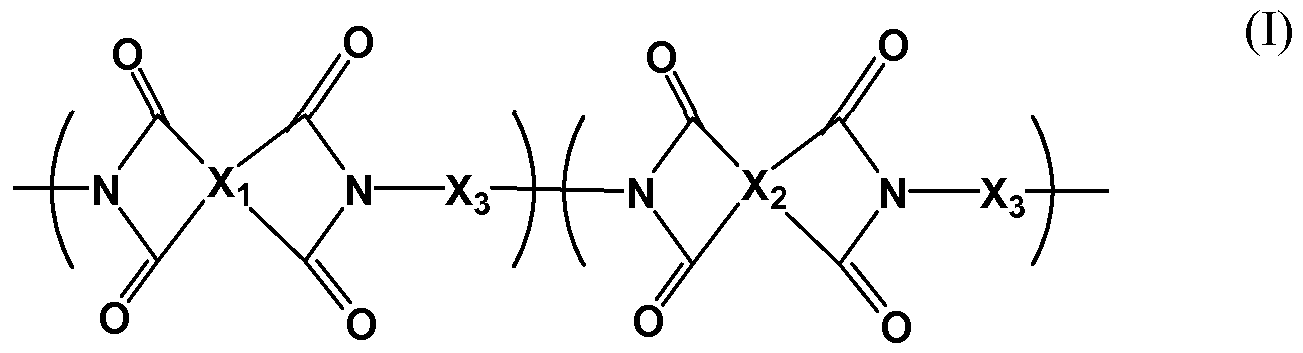
- the aromatic polyimide polymers comprising both UV crosslinkable functional groups and pendent hydroxy functional groups that are used for the preparation of the new high performance polymer membranes in the present invention comprise a plurality of first repeating units of a formula (I), wherein said formula (I) is: where -X ⁇ — of said formula (I) is or mixtures thereof, -X2 — of said formula (I) is either the same as -X ⁇ — or is selected from
- Some preferred aromatic polyimide polymers comprising both UV crosslinkable functional groups and pendent hydroxy functional groups that are used for the preparation of the new high performance polymer membranes in the present invention include, but are not limited to, poly[3,3',4,4'-benzophenonetetracarboxylic dianhydride-2,2-bis(3-amino-4- hydroxyphenyl)-hexafluoropropane] (poly(BTDA-APAF)), poly[4,4'-oxydiphthalic anhydride-2,2-bis(3-amino-4-hydroxyphenyl)-hexafluoropropane] (poly(ODPA-APAF)), poly(3,3',4,4'-benzophenonetetracarboxylic dianhydride-3,3'-dihydroxy-4,4'-diamino- biphenyl)
- the aromatic polyimide polymers comprising both UV crosslinkable functional groups and pendent hydroxy functional groups that are used for the preparation of the new high performance polymer membranes in the present invention are synthesized from diamine monomers and dianhydride monomers in polar solvents such as l-methyl-2-pyrrolidione (NMP) or N,N-dimethylacetamide (DMAc) by a two-step process involving the formation of the poly(amic acid)s followed by a solution imidization or a thermal imidization.
- NMP l-methyl-2-pyrrolidione
- DMAc N,N-dimethylacetamide
- Acetic anhydride is used as the dehydrating agent and pyridine (or triethylamine) is used as the imidization catalyst for the solution imidization reaction.
- the aromatic polyimide membrane in the present invention can be fabricated into a membrane with nonporous symmetric thin film geometry from the aromatic polyimide polymer comprising UV cross-linkable functional groups and pendent hydroxy functional groups ortho to the heterocyclic imide nitrogen in the polymer backbone by casting a homogeneous aromatic polyimide solution on top of a clean glass plate and allowing the solvent to evaporate slowly inside a plastic cover for at least 12 hours at room temperature. The membrane is then detached from the glass plate and dried at room temperature for 24 hours and then at 200 0 C for at least 48 hours under vacuum.
- the aromatic polyimide membrane in the present invention can also be fabricated by a method comprising the steps of: dissolving the aromatic polyimide polymer in a solvent to form a solution of the polyimide material; contacting a porous membrane support (e.g., a support made from inorganic ceramic material) with said solution; and evaporating the solvent to provide a thin selective layer comprising the aromatic polyimide polymer material on the supporting layer.
- a porous membrane support e.g., a support made from inorganic ceramic material
- the aromatic polyimide membrane in the present invention can also be fabricated as an asymmetric membrane with flat sheet or hollow fiber geometry by phase inversion followed by direct air drying through the use of at least one drying agent which is a hydrophobic organic compound such as a hydrocarbon or an ether (see US 4,855,048).
- the aromatic polyimide membrane in the present invention can also be fabricated as an asymmetric membrane with flat sheet or hollow fiber geometry by phase inversion followed by solvent exchange methods (see US 3,133,132).
- the solvents used for dissolving the aromatic polyimide polymer comprising both UV crosslinkable functional groups and pendent hydroxy functional groups are chosen primarily for their ability to completely dissolve the polymers and for ease of solvent removal in the membrane formation steps. Other considerations in the selection of solvents include low toxicity, low corrosive activity, low environmental hazard potential, availability and cost.
- Representative solvents for use in this invention include most amide solvents that are typically used for the formation of polymeric membranes, such as N-methylpyrrolidone (NMP) and N,N-dimethyl acetamide (DMAC), methylene chloride, tetrahydrofuran (THF), acetone, N,N-dimethylformamide (DMF), dimethyl sulfoxide (DMSO), toluene, dioxanes, 1,3-dioxolane, mixtures thereof, others known to those skilled in the art and mixtures thereof.
- NMP N-methylpyrrolidone
- DMAC N,N-dimethyl acetamide
- THF tetrahydrofuran
- DMF dimethylformamide
- DMSO dimethyl sulfoxide
- toluene dioxanes, 1,3-dioxolane, mixtures thereof, others known to those skilled in the art and mixtures thereof.
- the thermally treated aromatic polyimide polymer membrane was then further UV treated to crosslink the membrane by irradiating the membrane with a UV radiation source.
- One method to do the UV treatment is to use a UV lamp from a predetermined distance and for a period of time selected based upon the separation properties sought.
- the thermally treated aromatic polyimide polymer membrane can be further UV treated by exposure to UV radiation using 254 nm wavelength UV light generated from a UV lamp with 1.9 cm (0.75 inch) distance from the membrane surface to the UV lamp and a radiation time of 30 minutes at less than 5O 0 C.
- the UV lamp described here is a low pressure, mercury arc immersion UV quartz 12 watt lamp with 12 watt power supply from Ace Glass Incorporated.
- the UV cross-linking degree of the thermally treated aromatic polyimide polymer membrane can be controlled by adjusting the distance between the UV lamp and the membrane surface, UV radiation time, wavelength and strength of UV light, etc.
- the distance from the UV lamp to the membrane surface is in the range of 0.8 to 25.4 cm (0.3 to 10 inches) with a UV light provided from 12 watt to 450 watt low pressure or medium pressure mercury arc lamp, and the UV radiation time is in the range of 0.5 minute to 1 hour.
- the distance from the UV lamp to the membrane surface is in the range of 1.3 to 5.1 cm (0.5 to 2 inches) with a UV light provided from 12 watt to 450 watt low pressure or medium pressure mercury arc lamp, and the UV radiation time is in the range of 0.5 to 40 minutes.
- a membrane post-treatment step can be added after the thermal treating and UV crosslinking steps by introducing a thin layer of high permeability material such as a polysiloxane, a fluoro-polymer, a thermally curable silicone rubber, or a UV radiation curable epoxy silicone.
- the coating filling the surface pores and other imperfections comprising voids (see US 4,230,463; US 4,877,528; US 6,368,382).
- the new high performance polymer membranes prepared from the aromatic polyimide membranes by thermal treating and UV crosslinking described in the present invention can have either a nonporous symmetric structure or an asymmetric structure with a thin nonporous dense selective layer supported on top of a porous support layer.
- the porous support can be made from the same aromatic polyimide material or a different type of material with high thermal stability.
- the new high performance polymer membranes of the present invention can be fabricated into any convenient geometry such as flat sheet (or spiral wound), disk, tube, hollow fiber, or thin film composite.
- the invention provides a process for separating at least one gas or liquid from a mixture of gases or liquids using the new polymer membranes prepared from the aromatic polyimide membranes by thermal treating and UV crosslinking described in the present invention, the process comprising: (a) providing the new polymer membrane prepared from the aromatic polyimide membrane by thermal treating and UV crosslinking which is permeable to said at least one gas or liquid; (b) contacting the mixture on one side of the new polymer membrane prepared from the aromatic polyimide membrane by thermal treating and UV crosslinking to cause said at least one gas or liquid to permeate the membrane; and (c) removing from the opposite side of the membrane a permeate gas or liquid composition comprising a portion of said at least one gas or liquid which permeated said membrane.
- the new polymer membranes prepared from the aromatic polyimide membranes by thermal treating and UV crosslinking of the present invention are especially useful in the purification, separation or adsorption of a particular species in the liquid or gas phase.
- these high performance polymer membranes may, for example, can be used for the desalination of water by reverse osmosis or for the separation of proteins or other thermally unstable compounds, e.g. in the pharmaceutical and biotechnology industries.
- the new polymer membranes prepared from the aromatic polyimide membranes by thermal treating and UV crosslinking described in the present invention may also be used in fermenters and bioreactors to transport gases into the reaction vessel and transfer cell culture medium out of the vessel.
- these new polymer membranes may be used for the removal of microorganisms from air or water streams, water purification, ethanol production in a continuous fermentation/membrane pervaporation system, and in detection or removal of trace compounds or metal salts in air or water streams.
- the new polymer membranes prepared from the aromatic polyimide membranes by thermal treating and UV crosslinking described in the present invention are especially useful in gas separation processes in air purification, petrochemical, refinery, and natural gas industries. Examples of such separations include separation of volatile organic compounds (such as toluene, xylene, and acetone) from an atmospheric gas, such as nitrogen or oxygen and nitrogen recovery from air.
- separations are for the separation of CO2 or H2S from natural gas, H2 from N2, CH4, and Ar in ammonia purge gas streams, H2 recovery in refineries, olefin/paraffin separations such as propylene/propane separation, and iso/normal paraffin separations.
- Any given pair or group of gases that differ in molecular size for example nitrogen and oxygen, carbon dioxide and methane, hydrogen and methane or carbon monoxide, helium and methane, can be separated using the new polymer membranes prepared from the aromatic polyimide membranes by thermal treating and UV crosslinking described herein. More than two gases can be removed from a third gas.
- some of the gas components which can be selectively removed from a raw natural gas using the membrane described herein include carbon dioxide, oxygen, nitrogen, water vapor, hydrogen sulfide, helium, and other trace gases.
- Some of the gas components that can be selectively retained include hydrocarbon gases.
- permeable components are acid components selected from the group consisting of carbon dioxide, hydrogen sulfide, and mixtures thereof and are removed from a hydrocarbon mixture such as natural gas
- one module, or at least two in parallel service, or a series of modules may be utilized to remove the acid components.
- the pressure of the feed gas may vary from 275 kPa to 2.6 MPa (25 to 4000 psi).
- the differential pressure across the membrane can be as low as 0.7 bar or as high as 145 bar (10 psi or as high as 2100 psi) depending on many factors such as the particular membrane used, the flow rate of the inlet stream and the availability of a compressor to compress the permeate stream if such compression is desired. Differential pressure greater than 145 bar (2100 psi) may rupture the membrane. A differential pressure of at least 7 bar (100 psi) is preferred since lower differential pressures may require more modules, more time and compression of intermediate product streams.
- the operating temperature of the process may vary depending upon the temperature of the feed stream and upon ambient temperature conditions. Preferably, the effective operating temperature of the membranes of the present invention will range from - 50° to 15O 0 C. More preferably, the effective operating temperature of the membranes of the present invention will range from -20° to 100 0 C, and most preferably, the effective operating temperature of the membranes of the present invention will range from 25° to 100 0 C.
- the new polymer membranes prepared from the aromatic polyimide membranes by thermal treating and UV crosslinking described in the current invention are also especially useful in gas/vapor separation processes in chemical, petrochemical, pharmaceutical and allied industries for removing organic vapors from gas streams, e.g. in off-gas treatment for recovery of volatile organic compounds to meet clean air regulations, or within process streams in production plants so that valuable compounds (e.g., vinylchloride monomer, propylene) may be recovered.
- Further examples of gas/vapor separation processes in which these new polymer membranes prepared from the aromatic polyimide membranes by thermal treating and UV crosslinking may be used are hydrocarbon vapor separation from hydrogen in oil and gas refineries, for hydrocarbon dew pointing of natural gas (i.e.
- the new polymer membranes prepared from the aromatic polyimide membranes by thermal treating and UV crosslinking may incorporate a species that adsorbs strongly to certain gases (e.g. cobalt porphyrins or phthalocyanines for O2 or silver (I) for ethane) to facilitate their transport across the membrane.
- gases e.g. cobalt porphyrins or phthalocyanines for O2 or silver (I) for ethane
- the new polymer membranes prepared from the aromatic polyimide membranes by thermal treating and UV crosslinking also have immediate application to concentrate olefin in a paraffin/olefin stream for olefin cracking application.
- the new polymer membranes prepared from the aromatic polyimide membranes by thermal treating and UV crosslinking can be used for propyl ene/propane separation to increase the concentration of the effluent in a catalytic dehydrogenation reaction for the production of propylene from propane and isobutylene from isobutane. Therefore, the number of stages of propylene/propane splitter that is required to get polymer grade propylene can be reduced.
- Another application for the new polymer membranes prepared from the aromatic polyimide membranes by thermal treating and UV crosslinking is for separating isoparaffin and normal paraffin in light paraffin isomerization and MaxEneTM, a process for enhancing the concentration of normal paraffin (n-paraffm) in the naphtha cracker feedstock, which can be then converted to ethylene.
- the new polymer membranes prepared from the aromatic polyimide membranes by thermal treating and UV crosslinking can also be operated at high temperature to provide the sufficient dew point margin for natural gas upgrading (e.g, CO2 removal from natural gas).
- the new polymer membrane prepared from the aromatic polyimide membrane by thermal treating and UV crosslinking can be used in either a single stage membrane or as the first or/and second stage membrane in a two stage membrane system for natural gas upgrading.
- the new polymer membranes of the present invention have high selectivity, high permeance, and high thermal and chemical stabilities that allow the membranes to be operated without a costly pretreatment system.
- a costly membrane pretreatment system such as a MemGuardTM system will not be required in the new process containing the new polymer membrane system. Due to the elimination of the pretreatment system and the significant reduction of membrane area, the new process can achieve significant capital cost saving and reduce the existing membrane footprint.
- These new polymer membranes prepared from the aromatic polyimide membranes by thermal treating and UV crosslinking may also be used in the separation of liquid mixtures by pervaporation, such as in the removal of organic compounds (e. g., alcohols, phenols, chlorinated hydrocarbons, pyridines, ketones) from water such as aqueous effluents or process fluids.
- organic compounds e. g., alcohols, phenols, chlorinated hydrocarbons, pyridines, ketones
- a membrane which is ethanol-selective would be used to increase the ethanol concentration in relatively dilute ethanol solutions (5-10% ethanol) obtained by fermentation processes.
- Another liquid phase separation example using these new polymer membranes prepared from the aromatic polyimide membranes by thermal treating and UV crosslinking is the deep desulfurization of gasoline and diesel fuels by a pervaporation membrane process similar to the process described in US 7,048,846, incorporated by reference herein in its entirety.
- the new polymer membranes prepared from the aromatic polyimide membranes by thermal treating and UV crosslinking that are selective to sulfur-containing molecules would be used to selectively remove sulfur-containing molecules from fluid catalytic cracking (FCC) and other naphtha hydrocarbon streams.
- Further liquid phase examples include the separation of one organic component from another organic component, e.g. to separate isomers of organic compounds.
- Mixtures of organic compounds which may be separated using the new polymer membranes prepared from the aromatic polyimide membranes by thermal treating and UV crosslinking include: ethylacetate-ethanol, diethylether-ethanol, acetic acid-ethanol, benzene-ethanol, chloroform-ethanol, chloroform-methanol, acetone- isopropylether, allylalcohol-allylether, allylalcohol-cyclohexane, butanol-butylacetate, butanol-1-butylether, ethanol-ethylbutylether, propylacetate-propanol, isopropylether- isopropanol, methanol-ethanol-isopropanol, and ethylacetate-ethanol-acetic acid.
- the new polymer membranes prepared from the aromatic polyimide membranes by thermal treating and UV crosslinking may be used for separation of organic molecules from water (e.g. ethanol and/or phenol from water by pervaporation) and removal of metal and other organic compounds from water.
- water e.g. ethanol and/or phenol from water by pervaporation
- the new polymer membranes prepared from the aromatic polyimide membranes by thermal treating and UV crosslinking described in the current invention have immediate applications for the separation of gas mixtures including carbon dioxide removal from natural gas.
- the new polymer membrane permits carbon dioxide to diffuse through at a faster rate than the methane in the natural gas.
- Carbon dioxide has a higher permeation rate than methane because of higher solubility, higher diffusivity, or both.
- carbon dioxide enriches on the permeate side of the membrane, and methane enriches on the feed (or reject) side of the membrane.
- Yet another application of the new polymer membranes prepared from the aromatic polyimide membranes by thermal treating and UV crosslinking described in the current invention is as the catalytic polymeric membranes by loading metal catalysts or polymer-anchored metal catalysts, or molecular sieve catalysts to the new polymer membranes prepared from the aromatic polyimide membranes by thermal treating and UV crosslinking.
- the control of adsorption and diffusion properties by tailoring the characteristics of both the new polymer membranes prepared from the aromatic polyimide membranes by thermal treating and UV crosslinking and catalyst components can greatly improve process efficiency that can only be achieved in systems of liquid acids or bases, where great efficiency is achieved via great partition of one reactant relative to others or the reactants relative to product.
- the new polymer membranes prepared from the aromatic polyimide membranes by thermal treating and UV crosslinking described in the current invention possess many advantages over traditional catalysts for the above- mentioned catalysis applications.
- the advantages of these new polymer membranes prepared from the aromatic polyimide membranes by thermal treating and UV crosslinking for selective hydrogenation reactions include: 1) taking advantage of the catalytic membrane reactor concept by combining chemical reactions with the catalytic and separation activities of the membranes; 2) controllable H2 concentration; 3) adjustable H2/feed ratio, etc. These advanced characteristics will improve the reaction yield and selectivity simultaneously for selective hydrogenation reactions.
- Yet another application of the new polymer membranes prepared from the aromatic polyimide membranes by thermal treating and UV crosslinking described in the current invention is as the novel efficient proton-conducting membrane for fuel cell application.
- PEMFC proton exchange membrane fuel cells
- DMFC direct methanol fuel cells
- Optimized proton and water transport properties of the membrane are crucial for efficient fuel cell operation. Dehydration of the membrane reduces proton conductivity while excess of water can lead to flooding of the electrodes, both conditions may result in poor cell performance.
- the new polymer membranes prepared from the aromatic polyimide membranes by thermal treating and UV crosslinking described in the current invention are expected to exhibit significantly improved performance as proton-conducting membranes for fuel cell applications compared to traditional Nafion® polymer membranes because of their excellent proton conducting property, high water adsorption capacity, and high chemical and thermal stability.
- the high performance new polymer membranes prepared from the aromatic polyimide membranes by thermal treating and UV crosslinking of the present invention are not only suitable for a variety of liquid, gas, and vapor separations such as desalination of water by reverse osmosis, non-aqueous liquid separation such as deep desulfurization of gasoline and diesel fuels, ethanol/water separations, pervaporation dehydration of aqueous/organic mixtures, CO2/CH4, CO2/N2, H2/CH4, O2/N2, H2S/CH4, olefin/paraffin, iso/normal paraffins separations, and other light gas mixture separations, but also can be used for other applications such as for catalysis and fuel cell applications.
- liquid, gas, and vapor separations such as desalination of water by reverse osmosis, non-aqueous liquid separation such as deep desulfurization of gasoline and diesel fuels, ethanol/water separations, pervaporation dehydration of aqueous/organic mixtures, CO2/CH4, CO2/
- An aromatic poly[3,3',4,4'-benzophenonetetracarboxylic dianhydride-2,2-bis(3- amino-4-hydroxyphenyl)-hexafluoropropane] (poly(BTDA-APAF)) polyimide containing UV cross-linkable carbonyl groups and pendent -OH functional groups ortho to the heterocyclic imide nitrogen in the polymer backbone was synthesized from 2,2-bis(3-amino- 4-hydroxyphenyl)-hexafluoropropane diamine (BTDA) and 3,3',4,4'- benzophenonetetracarboxylic dianhydride (APAF) in NMP polar solvent by a two-step process involving the formation of the poly(amic acid) followed by a solution imidization process.
- BTDA-APAF 2,2-bis(3-amino- 4-hydroxyphenyl)-hexafluoropropane diamine
- APAF 3,3',4,4'- benzophen
- Acetic anhydride was used as the dehydrating agent and pyridine was used as the imidization catalyst for the solution imidization reaction.
- a 250 mL three-neck round-bottom flask equipped with a nitrogen inlet and a mechanical stirrer was charged with 10.0 g (27.3 mmol) of APAF and 40 mL of NMP.
- a solution of BTDA (8.8 g, 27.3 mmol) in 40 mL of NMP was added to the APAF solution in the flask.
- the reaction mixture was mechanically stirred for 24 hours at ambient temperature to give a viscous poly(amic acid) solution.
- the poly(BTDA-APAF) polyimide polymer membrane was prepared as follows: 4.O g of poly(BTDA-APAF) polyimide synthesized in Example 1 was dissolved in a solvent mixture of 12.0 g of NMP and 12.0 g of 1,3-dioxolane. The mixture was mechanically stirred for 2 h to form a homogeneous casting dope. The resulting homogeneous casting dope was allowed to degas overnight.
- the poly(BTDA-APAF) polymer membrane was prepared from the bubble free casting dope on a clean glass plate using a doctor knife with a 20-mil gap. The membrane together with the glass plate was then put into a vacuum oven.
- BTDA-APAF membrane poly(BTDA-APAF) polymer membrane
- the BTDA-APAF membrane prepared in Example 2 was thermally heated from 50° to 450 0 C at a heating rate of 5°C/min under N 2 flow. The membrane was hold for 1 h at 450 0 C and then cooled down to 50 0 C at a heating rate of 5°C/min under N 2 flow. The heat- treated BTDA-APAF membrane was then exposed to UV radiation using 254 nm wavelength UV light generated from a UV lamp with 1.9 cm (0.75 inch) distance from the membrane surface to the UV lamp and a radiation time of 20 minutes at 5O 0 C.
- the UV lamp that was used was a low pressure, mercury arc immersion UV quartz 12 watt lamp with 12 watt power supply from Ace Glass Incorporated.
- the heat-treated and then UV crosslinked new membrane was abbreviated as BTD A- AP AF-HT -UV membrane. EXAMPLE 4
- the BTDA-APAF membrane and the BTDA-APAF-HT-UV membrane were tested for CO2/CH4 separation under testing temperature of 50 0 C (Table 1).
- the BTDA- APAF-HT-UV membrane was also tested at 100 0 C. It can be seen from Table 1 that the BTDA-APAF-HT-UV membrane showed significantly increased CO2/CH4 selectivity and CO2 permeability compared to the untreated BTDA-APAF membrane at 50 0 C testing temperature.
- the BTDA-APAF-HT-UV membrane also showed good performance at 100 0 C high testing temperature.
- Comparable Example 1 was a single stage system using the currently commercially available membranes.
- Comparable Examples 2 and 3 were a single stage system using the new BTDA- APAF-HT-UV membrane listed in Table 1.
- Comparable Example 1 and Example 2 were operated at feed temperature of 50 0 C.
- MemGuardTM that uses molecular sieves developed by UOP, was applied in these two examples.
- Comparable Example 3 was operated at high feed temperature of 100 C due to the high thermal and mechanical stability of the new BTDA- APAF-HT-UV membrane. Since sufficient dew point margin was provided by operating the membrane system at the high temperature, no pretreatment system was required in Comparable Example 3. [0056] In order to improve the recovery of hydrocarbons from the natural gas stream, a two-stage membrane system was studied. In Comparable Example 4, commercially available membranes were used for both first and second stages. A pretreatment system such as MemGuardTM would be required for Comparable Example 4. In Comparable Example 5, new BTDA-APAF-HT-UV membrane was used for both first- and second-stage membranes. Comparable Example 5 operated the first stage at an elevated temeprature to provide a sufficient dew point margin for the product gas.
- Comparable Example 5 No pretreatment system was required for Comparable Example 5.
- the second stage of Comparable Example 5 was operated at 5O 0 C feed temperature to increase the membrane selectivity, hence, reduce the hydrocarbon loss. Since heavy hydrocarbons are hard to reach second stage feed, the pretreatment unit such as MemGuardTM was not required.
- Comparable Examples 1, 2, and 3 assumed a natural gas feed with 8% CO2, and the product spec for CO2 is at 2%.
- the commercially available membrane was assumed to be a membrane with typical performance in the current natural gas upgrading market.
- the new BTDA-APAF-HT -UV membrane material was used to make the membrane with a thickness of 200 nm.
- Comparable Example 2 showed significant cost saving (59.8% less membrane area required) and higher hydrocarbon recovery (7.4% more) compared to Comparable Example 1.
- Comparable Example 3 not only can save the membrane area (82.6%), but also can eliminate the costly MemGuardTM pretreatment system at slightly lower hydrocarbon recovery. It is anticipated that the new BTDA-APAF-HT-UV membrane system will significantly reduce the membrane system cost and footprint which is extremely important for large offshore gas processing projects.
- the hydrocarbon recovery can be increased by running a two stage membrane system as shown in Comparable Examples 4 and 5. In Comparable Example 4, both stages applied the commercially available membranes with the performance data the same as those in Comparable Example 1.
- Comparable Example 4 the new BTD A- AP AF -HT -UV membrane was used for both first stage and second stage.
- the first stage was operated at elevated temperature to eliminate the MemGuardTM system.
- the second stage was operated at lower temperature to increase the selectivity.
- the natural gas feed in Comparable Examples 3 and 4 had been changed to 45% CO2 (more meaningful for a two-stage system), and the product specification for CO2 in these two examples were assumed at 8%.
- Table 4 shows the results of the simulation for Comparable Examples 4 and 5.
- Comparable Example 4 and Comparable Example 5 have very similar hydrocarbon recovery. Due to the high temperature operation for the first stage membrane, Comparable Example 5 does not require a pretreatment such as a MemGuardTM system, which is 10 to 40% of the total cost of Comparable Example 4. At the same time, the first stage membrane area is reduced by 79.5% and the second stage membrane area is reduced by 59.2% from Comparable Example 4 to Comparable Example 5. It can be expected that the Comparable Example 5 will have a big capital (>50%) and footprint (>50%) saving compared to Comparable Example 4. The only drawback is that the compressor will be slightly bigger. Table 4 shows a 7.5% horse power increase from Comparable Example 4 to Comparable Example 5.
Landscapes
- Chemical & Material Sciences (AREA)
- Chemical Kinetics & Catalysis (AREA)
- Health & Medical Sciences (AREA)
- Medicinal Chemistry (AREA)
- Organic Chemistry (AREA)
- Polymers & Plastics (AREA)
- Engineering & Computer Science (AREA)
- General Chemical & Material Sciences (AREA)
- Inorganic Chemistry (AREA)
- Oil, Petroleum & Natural Gas (AREA)
- Manufacturing & Machinery (AREA)
- Analytical Chemistry (AREA)
- Separation Using Semi-Permeable Membranes (AREA)
- Processes Of Treating Macromolecular Substances (AREA)
- Manufacture Of Macromolecular Shaped Articles (AREA)
- Macromolecular Compounds Obtained By Forming Nitrogen-Containing Linkages In General (AREA)
- Treatments Of Macromolecular Shaped Articles (AREA)
Abstract
Description





Claims


Priority Applications (7)
| Application Number | Priority Date | Filing Date | Title |
|---|---|---|---|
| KR1020117024503A KR101422903B1 (en) | 2009-03-27 | 2010-03-02 | Polymer membranes prepared from aromatic polyimide membranes by thermal treating and uv crosslinking |
| CN2010800226775A CN102448591A (en) | 2009-03-27 | 2010-03-02 | Polymer membranes prepared from aromatic polyimide membranes by thermal treating and UV crosslinking |
| BRPI1013681A BRPI1013681A2 (en) | 2009-03-27 | 2010-03-02 | method for manufacturing polymeric membranes, polymeric membrane, and process for separating at least one gas or liquid from a mixture of gases or liquids |
| CA2755919A CA2755919A1 (en) | 2009-03-27 | 2010-03-02 | Polymer membranes prepared from aromatic polyimide membranes by thermal treating and uv crosslinking |
| AU2010229168A AU2010229168B2 (en) | 2009-03-27 | 2010-03-02 | Polymer membranes prepared from aromatic polyimide membranes by thermal treating and UV crosslinking |
| EP10756547A EP2411131A2 (en) | 2009-03-27 | 2010-03-02 | Polymer membranes prepared from aromatic polyimide membranes by thermal treating and uv crosslinking |
| JP2012502071A JP5373961B2 (en) | 2009-03-27 | 2010-03-02 | Polymer films prepared from aromatic polyimide films by heat treatment and UV crosslinking |
Applications Claiming Priority (2)
| Application Number | Priority Date | Filing Date | Title |
|---|---|---|---|
| US12/412,649 US8132677B2 (en) | 2009-03-27 | 2009-03-27 | Polymer membranes prepared from aromatic polyimide membranes by thermal treating and UV crosslinking |
| US12/412,649 | 2009-03-27 |
Publications (2)
| Publication Number | Publication Date |
|---|---|
| WO2010110994A2 true WO2010110994A2 (en) | 2010-09-30 |
| WO2010110994A3 WO2010110994A3 (en) | 2011-01-06 |
Family
ID=42221837
Family Applications (1)
| Application Number | Title | Priority Date | Filing Date |
|---|---|---|---|
| PCT/US2010/025820 Ceased WO2010110994A2 (en) | 2009-03-27 | 2010-03-02 | Polymer membranes prepared from aromatic polyimide membranes by thermal treating and uv crosslinking |
Country Status (10)
| Country | Link |
|---|---|
| US (3) | US8132677B2 (en) |
| EP (1) | EP2411131A2 (en) |
| JP (1) | JP5373961B2 (en) |
| KR (1) | KR101422903B1 (en) |
| CN (1) | CN102448591A (en) |
| AU (1) | AU2010229168B2 (en) |
| BR (1) | BRPI1013681A2 (en) |
| CA (1) | CA2755919A1 (en) |
| MY (1) | MY152462A (en) |
| WO (1) | WO2010110994A2 (en) |
Cited By (4)
| Publication number | Priority date | Publication date | Assignee | Title |
|---|---|---|---|---|
| US9579609B2 (en) | 2012-06-26 | 2017-02-28 | Fujifilm Manufacturing Europe Bv | Process for preparing membranes |
| WO2017056134A1 (en) * | 2015-10-01 | 2017-04-06 | 日揮株式会社 | Nonhydrocarbon gas separation device and nonhydrocarbon gas separation method |
| US11447743B2 (en) | 2014-04-22 | 2022-09-20 | Nippon Shokubai Co., Ltd. | Cell culture substrate comprising fluorine-containing polymer on its surface |
| KR20240153724A (en) | 2023-04-17 | 2024-10-24 | 서강대학교산학협력단 | Microporous Crosslinked Polymer Membrane and Process for Fabricating the Same |
Families Citing this family (56)
| Publication number | Priority date | Publication date | Assignee | Title |
|---|---|---|---|---|
| CA2640545A1 (en) * | 2008-05-19 | 2009-11-19 | Industry-University Cooperation Foundation, Hanyang University | Polyimides dope composition, preparation method of hollow fiber using the same and hollow fiber prepared therefrom |
| US8409325B2 (en) * | 2008-09-30 | 2013-04-02 | Ube Industries, Ltd. | Asymmetric gas separation membrane and process for gas separation |
| US9630141B2 (en) * | 2009-02-20 | 2017-04-25 | Cameron Solutions, Inc. | Membrane filter element with multiple fiber types |
| US8561812B2 (en) * | 2009-03-27 | 2013-10-22 | Uop Llc | Blend polymer membranes comprising thermally rearranged polymers derived from aromatic polyimides containing ortho-positioned functional groups |
| US8132677B2 (en) | 2009-03-27 | 2012-03-13 | Uop Llc | Polymer membranes prepared from aromatic polyimide membranes by thermal treating and UV crosslinking |
| US8132678B2 (en) * | 2009-03-27 | 2012-03-13 | Uop Llc | Polybenzoxazole polymer-based mixed matrix membranes |
| US8127936B2 (en) * | 2009-03-27 | 2012-03-06 | Uop Llc | High performance cross-linked polybenzoxazole and polybenzothiazole polymer membranes |
| US8127937B2 (en) | 2009-03-27 | 2012-03-06 | Uop Llc | High performance cross-linked polybenzoxazole and polybenzothiazole polymer membranes |
| US8613362B2 (en) * | 2009-03-27 | 2013-12-24 | Uop Llc | Polymer membranes derived from aromatic polyimide membranes |
| US20100326913A1 (en) * | 2009-06-25 | 2010-12-30 | Uop Llc | Polybenzoxazole membranes prepared from aromatic polyamide membranes |
| US8459469B2 (en) * | 2009-06-25 | 2013-06-11 | Uop Llc | Polybenzoxazole membranes prepared from aromatic polyamide membranes |
| US8915379B2 (en) * | 2009-09-25 | 2014-12-23 | Uop Llc | Method to improve the selectivity of polybenzoxazole membranes |
| US7810652B2 (en) * | 2009-09-25 | 2010-10-12 | Uop Llc | Method to improve the selectivity of polybenzoxazole membranes |
| US8931646B2 (en) * | 2009-09-25 | 2015-01-13 | Uop Llc | Polybenzoxazole membranes |
| JP2013075264A (en) * | 2011-09-30 | 2013-04-25 | Fujifilm Corp | Gas separation membrane, manufacturing method for the same, and gas separation membrane module using the same |
| KR102014880B1 (en) * | 2012-12-28 | 2019-08-28 | 삼성디스플레이 주식회사 | Display device and method for manufacturing the same |
| JP6502861B2 (en) | 2013-02-21 | 2019-04-17 | ザ リージェンツ オブ ザ ユニバーシティ オブ カリフォルニア | Universal Scalability High Cost Efficiency Surface Modification |
| US20140255636A1 (en) * | 2013-03-06 | 2014-09-11 | Saudi Basic Industries Corporation | Polymeric Membranes |
| EP3069784B1 (en) * | 2013-11-15 | 2020-01-08 | IUCF-HYU (Industry-University Cooperation Foundation Hanyang University) | Flue gas separation membrane comprising thermally rearranged poly(benzoxazole-imide) copolymer having cross-linked structure, and preparation method therefor |
| WO2015072692A1 (en) * | 2013-11-15 | 2015-05-21 | 한양대학교 산학협력단 | Thermally rearranged poly(benzoxazole-imide) copolymer having cross-linked structure, gas separation membrane comprising same and preparation method therefor |
| US9522364B2 (en) | 2013-12-16 | 2016-12-20 | Sabic Global Technologies B.V. | Treated mixed matrix polymeric membranes |
| EP3057689A4 (en) | 2013-12-16 | 2016-08-31 | Sabic Global Technologies Bv | POLYMERIC MEMBRANES TREATED BY ULTRAVIOLET AND THERMALLY RADIATION |
| US9669382B2 (en) | 2013-12-20 | 2017-06-06 | Uop Llc | Methods and apparatuses for isomerizing hydrocarbons |
| JP6681665B2 (en) * | 2014-04-22 | 2020-04-15 | 株式会社日本触媒 | Cell culture substrate containing fluorine-containing polyimide imidized by heat treatment on the surface |
| JP6681663B2 (en) * | 2014-04-22 | 2020-04-15 | 株式会社日本触媒 | Cell culture substrate containing on its surface a polyimide containing an ether bond and / or a thioether bond and a fluorine atom |
| KR101692133B1 (en) * | 2015-01-13 | 2017-01-02 | 연세대학교 원주산학협력단 | Preparation method for polyimide products from polyimide water solution |
| US10501579B2 (en) * | 2015-02-20 | 2019-12-10 | Sabic Global Technologies B.V. | Poly(amic acid) synthesis and conversion to high molecular weight polyimide |
| WO2016136404A1 (en) | 2015-02-27 | 2016-09-01 | 富士フイルム株式会社 | Gas separation membrane, gas separation module, gas separation device and gas separation method |
| WO2016148869A1 (en) | 2015-03-17 | 2016-09-22 | Dow Global Technologies Llc | Polymers of intrinsic microporosity |
| US10029217B2 (en) * | 2015-05-22 | 2018-07-24 | Chevron U.S.A. Inc. | Methods of making crosslinked membranes utilizing an inert gas atmosphere |
| DE112016002429T5 (en) | 2015-05-29 | 2018-02-22 | Dow Global Technologies Llc | ISATINCOPOLYMERS WITH INTRINSIC MICROPOROSITY |
| US10189948B2 (en) | 2015-06-24 | 2019-01-29 | Dow Global Technologies Llc | Isatin copolymers having intrinsic microporosity |
| WO2017087180A1 (en) * | 2015-11-20 | 2017-05-26 | Uop Llc | High selectivity copolyimide membranes for separations |
| DE112016005378T5 (en) | 2015-11-24 | 2018-09-13 | Dow Global Technologies Llc | TRÖGERSCHE BASE POLYMERS WITH INTRINSIC MICROPOROSITY |
| TWI629095B (en) * | 2016-04-08 | 2018-07-11 | 財團法人紡織產業綜合研究所 | Polyimide composition and preparation method of separation membrane |
| KR101748609B1 (en) * | 2016-06-30 | 2017-06-21 | 한국화학연구원 | Nitrous oxide selective gas separator membrane and the method of purification using thereby |
| EP3510080A1 (en) | 2016-09-12 | 2019-07-17 | Dow Global Technologies, LLC | Polymer including troger's base and isatin moieties and having intrinsic microporosity |
| US10472467B2 (en) | 2016-09-20 | 2019-11-12 | Dow Global Technologies Llc | Polymers having intrinsic microporosity including sub-units with troger's base and spirobisindane moieties |
| CN110248924A (en) | 2016-12-01 | 2019-09-17 | 加州大学评议会 | Energy production arrangement and its application |
| US10519082B2 (en) | 2016-12-20 | 2019-12-31 | Uop Llc | Removal of feed treatment units in aromatics complex designs |
| US10328386B2 (en) * | 2017-05-18 | 2019-06-25 | Uop Llc | Co-cast thin film composite flat sheet membranes for gas separations and olefin/paraffin separations |
| CN107082908B (en) * | 2017-06-06 | 2020-02-07 | 西南科技大学 | Polymer recovery, regeneration and remediation process |
| SG11202004599WA (en) | 2017-12-01 | 2020-06-29 | Univ California | Biofouling resistant coatings and methods of making and using the same |
| CN108598533B (en) * | 2018-04-25 | 2020-11-03 | 同济大学 | Coumarin-based photocyclization crosslinking sulfonated polyimide proton exchange membrane and preparation method thereof |
| TWI670295B (en) | 2018-08-20 | 2019-09-01 | 財團法人紡織產業綜合研究所 | Polyamide-imide and method of preparing the same |
| TWI718592B (en) * | 2018-08-20 | 2021-02-11 | 財團法人紡織產業綜合研究所 | Preparing method of polyamide-imide |
| US20210324142A1 (en) * | 2018-08-23 | 2021-10-21 | Dow Global Technologies Llc | Cross-linked polyimide membranes and carbon molecular sieve hollow fiber membranes made therefrom |
| CN111171856A (en) * | 2018-11-13 | 2020-05-19 | 中国科学院大连化学物理研究所 | A kind of carbon molecular sieve membrane is used for the separation method of C4-C6 normal isoparaffin |
| MX2021014949A (en) | 2019-06-05 | 2022-04-06 | Univ California | COATINGS RESISTANT TO BIOLOGICAL FOULING AND METHODS FOR PREPARING AND USING SAME. |
| KR102236277B1 (en) | 2020-03-11 | 2021-04-02 | 한국화학연구원 | High temperature polymer membrane for selective separation of water having H2O stability and reaction-separation hybrid system using the same |
| CN111530298B (en) * | 2020-05-12 | 2021-11-23 | 福建师范大学 | Preparation method of monolithic polyarylethersulfone ketone bipolar membrane containing phthalocyanine water dissociation catalytic group |
| CN113217313B (en) * | 2021-04-22 | 2022-05-17 | 北京航空航天大学杭州创新研究院 | Responsive actuation device, preparation method and application |
| CN114085393B (en) * | 2021-11-12 | 2023-03-24 | 苏州大学 | Preparation method and application of thermal crosslinking polymer separation membrane |
| CN116446109B (en) * | 2023-03-29 | 2026-05-01 | 华南理工大学 | Preparation method of high-fluorine-content crosslinked polyimide nanofiber membrane, lithium ion battery diaphragm and lithium ion battery |
| CN118079681B (en) * | 2024-01-26 | 2026-06-05 | 衢州膜材料创新研究院 | An asymmetric gas separation membrane, its preparation method and application |
| WO2025205855A1 (en) * | 2024-03-26 | 2025-10-02 | 日東電工株式会社 | Pervaporation membrane |
Family Cites Families (54)
| Publication number | Priority date | Publication date | Assignee | Title |
|---|---|---|---|---|
| NL271831A (en) | 1960-11-29 | |||
| US4230463A (en) | 1977-09-13 | 1980-10-28 | Monsanto Company | Multicomponent membranes for gas separations |
| US4847350A (en) | 1986-05-27 | 1989-07-11 | The Dow Chemical Company | Preparation of aromatic heterocyclic polymers |
| US4717393A (en) | 1986-10-27 | 1988-01-05 | E. I. Du Pont De Nemours And Company | Polyimide gas separation membranes |
| US4855048A (en) | 1987-09-22 | 1989-08-08 | Air Products And Chemicals, Inc. | Air dried cellulose acetate membranes |
| JPH01159024A (en) * | 1987-12-16 | 1989-06-22 | Central Glass Co Ltd | Gas separation membrane |
| US4877528A (en) | 1988-10-27 | 1989-10-31 | Bend Research, Inc. | Siloxane-grafted membranes |
| JPH02164427A (en) * | 1989-11-13 | 1990-06-25 | Nitto Denko Corp | Manufacture of multilayer membrane |
| WO1991016123A1 (en) | 1990-04-20 | 1991-10-31 | The Dow Chemical Company | Porous polybenzoxazole and polybenzothiazole membranes |
| JP2984716B2 (en) * | 1990-08-31 | 1999-11-29 | ダイセル化学工業株式会社 | Aromatic separation membrane |
| US5837032A (en) | 1991-01-30 | 1998-11-17 | The Cynara Company | Gas separations utilizing glassy polymer membranes at sub-ambient temperatures |
| JP3116976B2 (en) * | 1992-05-08 | 2000-12-11 | 宇部興産株式会社 | Polyimide separation membrane |
| JP2684582B2 (en) * | 1992-08-25 | 1997-12-03 | 宇部興産株式会社 | Polyimide separation membrane |
| US5409524A (en) | 1992-12-01 | 1995-04-25 | The Dow Chemical Company | Membranes having improved selectivity and recovery, and process for making same |
| JPH08215550A (en) * | 1995-02-15 | 1996-08-27 | Unitika Ltd | Dual membrane and its production |
| US5749943A (en) | 1995-02-27 | 1998-05-12 | Petroleum Energy Center | Method of selectively separating unsaturated hydrocarbon |
| US5679131A (en) | 1996-03-13 | 1997-10-21 | Photran Corporation | Method for producing titanium oxide from ore concentrates |
| JP3473300B2 (en) * | 1996-12-03 | 2003-12-02 | 宇部興産株式会社 | Aromatic polyimide gas separation membrane |
| US6248469B1 (en) | 1997-08-29 | 2001-06-19 | Foster-Miller, Inc. | Composite solid polymer electrolyte membranes |
| JP4070292B2 (en) * | 1998-03-11 | 2008-04-02 | 日東電工株式会社 | Gas separation membrane with fluorine-containing polyimide resin |
| JP3361770B2 (en) * | 1999-04-05 | 2003-01-07 | 財団法人石油産業活性化センター | Hydrocarbon separation method |
| US6368382B1 (en) | 2000-07-27 | 2002-04-09 | Uop Llc | Epoxysilicone coated membranes |
| US6500233B1 (en) | 2000-10-26 | 2002-12-31 | Chevron U.S.A. Inc. | Purification of p-xylene using composite mixed matrix membranes |
| US6896796B2 (en) | 2001-02-16 | 2005-05-24 | W. R. Grace & Co.-Conn. | Membrane separation for sulfur reduction |
| US6626980B2 (en) | 2001-09-21 | 2003-09-30 | L'air Liquide Societe Anonyme Pour L'etude Et L'exploitation Des Procedes Georges Claude | Mixed matrix membranes incorporating chabazite type molecular sieves |
| CA2474247A1 (en) | 2002-01-25 | 2003-08-07 | Colorado School Of Mines | Polymer blends and methods of separation using the same |
| US20070022877A1 (en) | 2002-04-10 | 2007-02-01 | Eva Marand | Ordered mesopore silica mixed matrix membranes, and production methods for making ordered mesopore silica mixed matric membranes |
| US6896717B2 (en) | 2002-07-05 | 2005-05-24 | Membrane Technology And Research, Inc. | Gas separation using coated membranes |
| KR100464317B1 (en) | 2002-07-06 | 2005-01-03 | 삼성에스디아이 주식회사 | Proton-conducting polymer containing acid group in side chain, polymer membrane prepared with them and fuel cell using the same |
| US6663805B1 (en) | 2002-09-20 | 2003-12-16 | L'air Liquide Societe Anonyme A Directoire Et Conseil De Surveillance Pour L'etude Et L'exploitation Des Procedes Georges Claude | Process for making hollow fiber mixed matrix membranes |
| WO2004037508A1 (en) | 2002-10-24 | 2004-05-06 | Toyo Boseki Kabushiki Kaisha | Heat-resistant film and composite ion-exchange membrane |
| JP2004231875A (en) | 2003-01-31 | 2004-08-19 | Toyobo Co Ltd | Polybenzoxazole film and method for producing the same |
| US7166146B2 (en) | 2003-12-24 | 2007-01-23 | Chevron U.S.A. Inc. | Mixed matrix membranes with small pore molecular sieves and methods for making and using the membranes |
| US20050268782A1 (en) | 2004-03-26 | 2005-12-08 | Kulkarni Sudhir S | Novel polyimide based mixed matrix membranes |
| KR100782959B1 (en) * | 2005-01-25 | 2007-12-11 | 한양대학교 산학협력단 | Porous organic polymer, preparation method thereof and gas separation membrane using same |
| FR2893623B1 (en) | 2005-11-22 | 2008-02-01 | Inst Nat Polytech Grenoble | PREPARATION OF FILMS FORMED BY A RETICULATED POLYMER HAVING IONIC GROUPS |
| US7485173B1 (en) | 2005-12-15 | 2009-02-03 | Uop Llc | Cross-linkable and cross-linked mixed matrix membranes and methods of making the same |
| US20080300336A1 (en) | 2007-06-01 | 2008-12-04 | Chunqing Liu | Uv cross-linked polymer functionalized molecular sieve/polymer mixed matrix membranes |
| US20090114089A1 (en) | 2007-11-02 | 2009-05-07 | Chunqing Liu | Microporous Aluminophosphate Molecular Sieve Membranes for Highly Selective Separations |
| US20090277837A1 (en) | 2008-05-06 | 2009-11-12 | Chunqing Liu | Fluoropolymer Coated Membranes |
| US8083834B2 (en) | 2008-05-07 | 2011-12-27 | Uop Llc | High permeability membrane operated at elevated temperature for upgrading natural gas |
| CA2640545A1 (en) | 2008-05-19 | 2009-11-19 | Industry-University Cooperation Foundation, Hanyang University | Polyimides dope composition, preparation method of hollow fiber using the same and hollow fiber prepared therefrom |
| US8127937B2 (en) | 2009-03-27 | 2012-03-06 | Uop Llc | High performance cross-linked polybenzoxazole and polybenzothiazole polymer membranes |
| US8613362B2 (en) | 2009-03-27 | 2013-12-24 | Uop Llc | Polymer membranes derived from aromatic polyimide membranes |
| US8561812B2 (en) | 2009-03-27 | 2013-10-22 | Uop Llc | Blend polymer membranes comprising thermally rearranged polymers derived from aromatic polyimides containing ortho-positioned functional groups |
| US20100133171A1 (en) | 2009-03-27 | 2010-06-03 | Chunqing Liu | Polybenzoxazole Polymer-Based Mixed Matrix Membranes |
| US8127936B2 (en) | 2009-03-27 | 2012-03-06 | Uop Llc | High performance cross-linked polybenzoxazole and polybenzothiazole polymer membranes |
| US8132678B2 (en) | 2009-03-27 | 2012-03-13 | Uop Llc | Polybenzoxazole polymer-based mixed matrix membranes |
| US8132677B2 (en) | 2009-03-27 | 2012-03-13 | Uop Llc | Polymer membranes prepared from aromatic polyimide membranes by thermal treating and UV crosslinking |
| US20100133188A1 (en) | 2009-06-25 | 2010-06-03 | Chunqing Liu | Polybenzoxazole Membranes Prepared From Aromatic Polyamide Membranes |
| US8459469B2 (en) | 2009-06-25 | 2013-06-11 | Uop Llc | Polybenzoxazole membranes prepared from aromatic polyamide membranes |
| US20100326913A1 (en) | 2009-06-25 | 2010-12-30 | Uop Llc | Polybenzoxazole membranes prepared from aromatic polyamide membranes |
| US8915379B2 (en) | 2009-09-25 | 2014-12-23 | Uop Llc | Method to improve the selectivity of polybenzoxazole membranes |
| US8931646B2 (en) | 2009-09-25 | 2015-01-13 | Uop Llc | Polybenzoxazole membranes |
-
2009
- 2009-03-27 US US12/412,649 patent/US8132677B2/en active Active
-
2010
- 2010-03-02 MY MYPI2011004422 patent/MY152462A/en unknown
- 2010-03-02 BR BRPI1013681A patent/BRPI1013681A2/en not_active IP Right Cessation
- 2010-03-02 KR KR1020117024503A patent/KR101422903B1/en not_active Expired - Fee Related
- 2010-03-02 AU AU2010229168A patent/AU2010229168B2/en not_active Ceased
- 2010-03-02 JP JP2012502071A patent/JP5373961B2/en not_active Expired - Fee Related
- 2010-03-02 CA CA2755919A patent/CA2755919A1/en not_active Abandoned
- 2010-03-02 EP EP10756547A patent/EP2411131A2/en not_active Withdrawn
- 2010-03-02 CN CN2010800226775A patent/CN102448591A/en active Pending
- 2010-03-02 WO PCT/US2010/025820 patent/WO2010110994A2/en not_active Ceased
-
2011
- 2011-06-22 US US13/165,939 patent/US8241501B2/en active Active
-
2012
- 2012-07-12 US US13/547,313 patent/US9138692B2/en active Active
Cited By (5)
| Publication number | Priority date | Publication date | Assignee | Title |
|---|---|---|---|---|
| US9579609B2 (en) | 2012-06-26 | 2017-02-28 | Fujifilm Manufacturing Europe Bv | Process for preparing membranes |
| US11447743B2 (en) | 2014-04-22 | 2022-09-20 | Nippon Shokubai Co., Ltd. | Cell culture substrate comprising fluorine-containing polymer on its surface |
| WO2017056134A1 (en) * | 2015-10-01 | 2017-04-06 | 日揮株式会社 | Nonhydrocarbon gas separation device and nonhydrocarbon gas separation method |
| US10737214B2 (en) | 2015-10-01 | 2020-08-11 | Jgc Corporation | Nonhydrocarbon gas separation device and nonhydrocarbon gas separation method |
| KR20240153724A (en) | 2023-04-17 | 2024-10-24 | 서강대학교산학협력단 | Microporous Crosslinked Polymer Membrane and Process for Fabricating the Same |
Also Published As
| Publication number | Publication date |
|---|---|
| CA2755919A1 (en) | 2010-09-30 |
| CN102448591A (en) | 2012-05-09 |
| US20110278227A1 (en) | 2011-11-17 |
| MY152462A (en) | 2014-10-15 |
| JP2012521872A (en) | 2012-09-20 |
| US20100133192A1 (en) | 2010-06-03 |
| WO2010110994A3 (en) | 2011-01-06 |
| AU2010229168B2 (en) | 2014-11-20 |
| KR20110130486A (en) | 2011-12-05 |
| BRPI1013681A2 (en) | 2016-04-26 |
| US9138692B2 (en) | 2015-09-22 |
| JP5373961B2 (en) | 2013-12-18 |
| EP2411131A2 (en) | 2012-02-01 |
| US8132677B2 (en) | 2012-03-13 |
| US20120276300A1 (en) | 2012-11-01 |
| KR101422903B1 (en) | 2014-07-30 |
| AU2010229168A1 (en) | 2011-10-06 |
| US8241501B2 (en) | 2012-08-14 |
Similar Documents
| Publication | Publication Date | Title |
|---|---|---|
| AU2010229168B2 (en) | Polymer membranes prepared from aromatic polyimide membranes by thermal treating and UV crosslinking | |
| CA2755925C (en) | Polymer membranes derived from aromatic polyimide membranes | |
| AU2010229241B2 (en) | High performance cross-linked polybenzoxazole and polybenzothiazole polymer membranes | |
| US8127936B2 (en) | High performance cross-linked polybenzoxazole and polybenzothiazole polymer membranes | |
| US8127937B2 (en) | High performance cross-linked polybenzoxazole and polybenzothiazole polymer membranes | |
| AU2010298634B2 (en) | Method to improve the selectivity of polybenzoxazole membranes | |
| US8561812B2 (en) | Blend polymer membranes comprising thermally rearranged polymers derived from aromatic polyimides containing ortho-positioned functional groups | |
| WO2010151451A2 (en) | Polybenzoxazole membranes prepared from aromatic polyamide membranes |
Legal Events
| Date | Code | Title | Description |
|---|---|---|---|
| WWE | Wipo information: entry into national phase |
Ref document number: 201080022677.5 Country of ref document: CN |
|
| 121 | Ep: the epo has been informed by wipo that ep was designated in this application |
Ref document number: 10756547 Country of ref document: EP Kind code of ref document: A2 |
|
| WWE | Wipo information: entry into national phase |
Ref document number: 2010229168 Country of ref document: AU |
|
| WWE | Wipo information: entry into national phase |
Ref document number: 2755919 Country of ref document: CA |
|
| WWE | Wipo information: entry into national phase |
Ref document number: 2012502071 Country of ref document: JP |
|
| NENP | Non-entry into the national phase |
Ref country code: DE |
|
| WWE | Wipo information: entry into national phase |
Ref document number: 2010756547 Country of ref document: EP |
|
| ENP | Entry into the national phase |
Ref document number: 2010229168 Country of ref document: AU Date of ref document: 20100302 Kind code of ref document: A |
|
| ENP | Entry into the national phase |
Ref document number: 20117024503 Country of ref document: KR Kind code of ref document: A |
|
| REG | Reference to national code |
Ref country code: BR Ref legal event code: B01A Ref document number: PI1013681 Country of ref document: BR |
|
| ENP | Entry into the national phase |
Ref document number: PI1013681 Country of ref document: BR Kind code of ref document: A2 Effective date: 20110926 |