WO2010114636A1 - Compositions for treatment of alzheimer's disease - Google Patents

Compositions for treatment of alzheimer's disease Download PDF

Info

Publication number
WO2010114636A1
WO2010114636A1 PCT/US2010/001041 US2010001041W WO2010114636A1 WO 2010114636 A1 WO2010114636 A1 WO 2010114636A1 US 2010001041 W US2010001041 W US 2010001041W WO 2010114636 A1 WO2010114636 A1 WO 2010114636A1
Authority
WO
WIPO (PCT)
Prior art keywords
disease
composition
pharmaceutical composition
alzheimer
beta amyloid
Prior art date
Legal status (The legal status is an assumption and is not a legal conclusion. Google has not performed a legal analysis and makes no representation as to the accuracy of the status listed.)
Ceased
Application number
PCT/US2010/001041
Other languages
French (fr)
Inventor
Jorge Galvez
Javier Llompart
David Land
Giulio Pasinetti
Current Assignee (The listed assignees may be inaccurate. Google has not performed a legal analysis and makes no representation or warranty as to the accuracy of the list.)
Icahn School of Medicine at Mount Sinai
Medisyn Technologies Inc
Original Assignee
Medisyn Technologies Inc
Mount Sinai School of Medicine
Priority date (The priority date is an assumption and is not a legal conclusion. Google has not performed a legal analysis and makes no representation as to the accuracy of the date listed.)
Filing date
Publication date
Application filed by Medisyn Technologies Inc, Mount Sinai School of Medicine filed Critical Medisyn Technologies Inc
Priority to EP10759174A priority Critical patent/EP2413696A4/en
Priority to CA2759187A priority patent/CA2759187A1/en
Priority to AU2010232923A priority patent/AU2010232923A1/en
Publication of WO2010114636A1 publication Critical patent/WO2010114636A1/en
Anticipated expiration legal-status Critical
Ceased legal-status Critical Current

Links

Classifications

    • AHUMAN NECESSITIES
    • A61MEDICAL OR VETERINARY SCIENCE; HYGIENE
    • A61KPREPARATIONS FOR MEDICAL, DENTAL OR TOILETRY PURPOSES
    • A61K31/00Medicinal preparations containing organic active ingredients
    • A61K31/33Heterocyclic compounds
    • A61K31/395Heterocyclic compounds having nitrogen as a ring hetero atom, e.g. guanethidine or rifamycins
    • A61K31/495Heterocyclic compounds having nitrogen as a ring hetero atom, e.g. guanethidine or rifamycins having six-membered rings with two or more nitrogen atoms as the only ring heteroatoms, e.g. piperazine or tetrazines
    • A61K31/505Pyrimidines; Hydrogenated pyrimidines, e.g. trimethoprim
    • A61K31/513Pyrimidines; Hydrogenated pyrimidines, e.g. trimethoprim having oxo groups directly attached to the heterocyclic ring, e.g. cytosine
    • AHUMAN NECESSITIES
    • A61MEDICAL OR VETERINARY SCIENCE; HYGIENE
    • A61KPREPARATIONS FOR MEDICAL, DENTAL OR TOILETRY PURPOSES
    • A61K31/00Medicinal preparations containing organic active ingredients
    • A61K31/33Heterocyclic compounds
    • A61K31/395Heterocyclic compounds having nitrogen as a ring hetero atom, e.g. guanethidine or rifamycins
    • A61K31/40Heterocyclic compounds having nitrogen as a ring hetero atom, e.g. guanethidine or rifamycins having five-membered rings with one nitrogen as the only ring hetero atom, e.g. sulpiride, succinimide, tolmetin, buflomedil
    • A61K31/403Heterocyclic compounds having nitrogen as a ring hetero atom, e.g. guanethidine or rifamycins having five-membered rings with one nitrogen as the only ring hetero atom, e.g. sulpiride, succinimide, tolmetin, buflomedil condensed with carbocyclic rings, e.g. carbazole
    • A61K31/404Indoles, e.g. pindolol
    • AHUMAN NECESSITIES
    • A61MEDICAL OR VETERINARY SCIENCE; HYGIENE
    • A61KPREPARATIONS FOR MEDICAL, DENTAL OR TOILETRY PURPOSES
    • A61K31/00Medicinal preparations containing organic active ingredients
    • A61K31/33Heterocyclic compounds
    • A61K31/395Heterocyclic compounds having nitrogen as a ring hetero atom, e.g. guanethidine or rifamycins
    • A61K31/41Heterocyclic compounds having nitrogen as a ring hetero atom, e.g. guanethidine or rifamycins having five-membered rings with two or more ring hetero atoms, at least one of which being nitrogen, e.g. tetrazole
    • A61K31/4151,2-Diazoles
    • AHUMAN NECESSITIES
    • A61MEDICAL OR VETERINARY SCIENCE; HYGIENE
    • A61KPREPARATIONS FOR MEDICAL, DENTAL OR TOILETRY PURPOSES
    • A61K31/00Medicinal preparations containing organic active ingredients
    • A61K31/33Heterocyclic compounds
    • A61K31/395Heterocyclic compounds having nitrogen as a ring hetero atom, e.g. guanethidine or rifamycins
    • A61K31/41Heterocyclic compounds having nitrogen as a ring hetero atom, e.g. guanethidine or rifamycins having five-membered rings with two or more ring hetero atoms, at least one of which being nitrogen, e.g. tetrazole
    • A61K31/41961,2,4-Triazoles
    • AHUMAN NECESSITIES
    • A61MEDICAL OR VETERINARY SCIENCE; HYGIENE
    • A61KPREPARATIONS FOR MEDICAL, DENTAL OR TOILETRY PURPOSES
    • A61K31/00Medicinal preparations containing organic active ingredients
    • A61K31/33Heterocyclic compounds
    • A61K31/395Heterocyclic compounds having nitrogen as a ring hetero atom, e.g. guanethidine or rifamycins
    • A61K31/41Heterocyclic compounds having nitrogen as a ring hetero atom, e.g. guanethidine or rifamycins having five-membered rings with two or more ring hetero atoms, at least one of which being nitrogen, e.g. tetrazole
    • A61K31/425Thiazoles
    • A61K31/4261,3-Thiazoles
    • AHUMAN NECESSITIES
    • A61MEDICAL OR VETERINARY SCIENCE; HYGIENE
    • A61KPREPARATIONS FOR MEDICAL, DENTAL OR TOILETRY PURPOSES
    • A61K31/00Medicinal preparations containing organic active ingredients
    • A61K31/33Heterocyclic compounds
    • A61K31/395Heterocyclic compounds having nitrogen as a ring hetero atom, e.g. guanethidine or rifamycins
    • A61K31/435Heterocyclic compounds having nitrogen as a ring hetero atom, e.g. guanethidine or rifamycins having six-membered rings with one nitrogen as the only ring hetero atom
    • A61K31/47Quinolines; Isoquinolines
    • A61K31/4709Non-condensed quinolines and containing further heterocyclic rings
    • AHUMAN NECESSITIES
    • A61MEDICAL OR VETERINARY SCIENCE; HYGIENE
    • A61KPREPARATIONS FOR MEDICAL, DENTAL OR TOILETRY PURPOSES
    • A61K31/00Medicinal preparations containing organic active ingredients
    • A61K31/69Boron compounds
    • AHUMAN NECESSITIES
    • A61MEDICAL OR VETERINARY SCIENCE; HYGIENE
    • A61PSPECIFIC THERAPEUTIC ACTIVITY OF CHEMICAL COMPOUNDS OR MEDICINAL PREPARATIONS
    • A61P25/00Drugs for disorders of the nervous system
    • A61P25/28Drugs for disorders of the nervous system for treating neurodegenerative disorders of the central nervous system, e.g. nootropic agents, cognition enhancers, drugs for treating Alzheimer's disease or other forms of dementia

Definitions

  • the application generally discloses compositions useful for treating Alzheimer's disease (AD). More specifically, the application discloses compositions that inhibit beta amyloid production, deposition and/or formation of high molecular weight A ⁇ 40 and A ⁇ 42 for treatment of Alzheimer's disease.
  • AD Alzheimer's disease
  • AD Alzheimer's disease
  • AD Alzheimer's disease
  • AD affects the parts of the brain that control thought, memory and language.
  • the financial costs attributable to Alzheimer's disease are high.
  • AD Alzheimer's Disease Education and Referral
  • the goals of treatment for Alzheimer's disease include improving cognition or, when this is not possible, slowing the loss of memory and cognition, as well as prolonging independent function and controlling co-morbid conditions.
  • AD Alzheimer's disease
  • Neurotransmitter replacement therapy i.e., inhibition of acetylcholine breakdown
  • This strategy provides symptomatic improvement and may delay the need for nursing home placement, but does not affect the underlying causes of the disease.
  • AD is characterized by the presence of extracellular A ⁇ plaques and intracellular neurofibrillary tangles (NFTs) within the afflicted brain, which causes neuronal loss in the neocortex, hippocampus, and basal forebrain, leading to progressive cognitive and behavioral decline.
  • a ⁇ plaques are composed mostly of insoluble A ⁇ peptides, mostly 40 and 42 amino acids in length with A ⁇ 42 being the most prevalent.
  • NFTs are composed mainly of hyperphosphorylated forms of microtubule-associated protein tau.
  • amyloid cascade hypothesis posits that an imbalance in the production or clearance of the A ⁇ peptide results in accumulation of A ⁇ and initiation of events leading to neurodegeneration and dementia.
  • Extracellular cerebral A ⁇ plaques consist of an insoluble aggregated core of A ⁇ surrounded by dystrophic axons, dendrites, activated microglia and reactive astrocytes.
  • Neurofibrillary Tangles (NFTs) made up of hyperphosphorylated tau protein destroy cellular architecture and aggregate into paired helical filaments in the cytoplasm of limbic and cortical neurons.
  • NFTs Neurofibrillary Tangles
  • Amyloidogenic 39-42 (A ⁇ 40 and A ⁇ 42) residue fragments of the amyloid precursor protein (APP) are produced via beta-secretase- and gamma-secretase-mediated cleavage during progression of AD.
  • Deposition and accumulation of the Abeta42 peptide (A ⁇ 42) in the brain constitute one major pathological feature of AD.
  • a small fraction of the total A ⁇ is in a soluble form, levels of which correlate with the severity of AD.
  • Inhibition of APP production, A ⁇ production i.e., through blocking cleavage or production of APP
  • reductions in A ⁇ accumulation and/or increases in A ⁇ degradation, solubilization and clearance from the brain represent potentially effective approaches for the treatment of AD.
  • the Blood-Brain-Barrier (BBB) is made of a dense layer of endothelial cells that create a barrier between the blood and brain parenchyma.
  • Many new therapeutic agents for AD have limited efficacy in vivo because of poor transport across the BBB.
  • Conventional strategies to improve transport across the BBB include extensive modification of drugs at significant cost, possible reduced efficacy, and delayed time to clinic.
  • compositions that are capable of inhibiting A ⁇ 40 and A ⁇ 42 in vivo activity to reduce the progression of AD.
  • compositions that are capable of inhibiting A ⁇ 40 and/or A ⁇ 42 in vivo cytotoxicity to reduce the progression of AD.
  • compositions that inhibit the formation of, or promote the degradation of, A ⁇ multimers including but not limited to A ⁇ forms of at least 40 kD. Administration of such compositions in vivo would provide the benefit of improved cognitive function for AD patients.
  • the disclosure provides beta amyloid (A ⁇ ) amount-reducing and/or A ⁇ anti- aggregation compounds and their use in pharmaceutical compositions.
  • the disclosure further includes methods of formulating pharmaceutical compositions and to methods of administering the compositions for treatment of disorders/diseases such as AD.
  • the disclosure provides a compound for the prevention, treatment, or amelioration of a symptom of Alzheimer's disease wherein the compound is unrelated to any known compound useful in treating Alzheimer's disease and, typically, unrelated to any known compound useful in treating AD or any related disease or disorder, such as neurological diseases (e.g., Parkinson's disease, Tourette's Syndrome, Transmissible Spongiform Encephalopathies such as familial or sporadic Creutzfeldt- Jakob disease, prion- related diseases, and the like).
  • neurological diseases e.g., Parkinson's disease, Tourette's Syndrome, Transmissible Spongiform Encephalopathies such as familial or sporadic Creutzfeldt- Jakob disease, prion- related diseases, and the like.
  • the compound is selected from the group consisting of a hexahydrobenzothiopheno[2,3-d]pyrimidin-2- ylsulfanyl acetamide, a phenyl triazole thiol, a benzyloxy naphthalene, an indole, a triazole, a hexahydro benzothieno pyrimidine, a tetrahydro benzothiophene, a thioxo thiazolidinone and a hydrotris (3-(4-cumenyl)-5-methylpyrazol-l-yl) borate, a pharmaceutically acceptable salt thereof, a pharmaceutically acceptable ester thereof, and a pharmaceutically acceptable amide thereof, and wherein the compound reduces beta amyloid amount, inhibits beta amyloid aggregation, or both.
  • Another aspect of the disclosure provides a compound for the prevention, treatment, or amelioration of a symptom of a disease or disorder related to Alzheimer's disease, such as Alzheimer's disease itself, wherein the compound is selected from the group consisting of a 3-[2-(4-oxo-5,6,7,8-tetrahydrobenzothiopheno[2,3-d]pyrimidin-3-yl)ethyl]- 5,6,7,8-tetrahydro benzothiopheno[2,3-d]pyrimidin-4-one, N-hexyl-5,6,7,8- tetrahydrobenzothiopheno[2,3-d]pyrimidin-4-amine, N-[(2-benzyloxy- 1 - naphthyl)methyleneamino]-2-(2,4-dichlorophenoxy) acetamide, 2-hydroxy-N-( 1 - naphthylmethyleneamino) acetamide, (5Z)-5-[(3,4-[(3,
  • the compound reduces beta amyloid amount by at least 5% compared to a control. In other embodiments, the compound reduces beta amyloid aggregation by at least 1% compared to a control. Other embodiments comprise a compound wherein beta amyloid amount, beta amyloid aggregation, or both are reduced by at least 1%, 5%, 10%, 15%, 20%, 25%, 30%, 40%, 50%, 75%, 90%, 95%, or 99%.
  • Another aspect of the disclosure provides a pharmaceutical composition comprising a pharmaceutically acceptable carrier and a therapeutically effective amount of a compound described herein for treating a disease or disorder related to Alzheimer's disease, such as Alzheimer's disease itself, wherein the compound reduces beta amyloid amount compared to a control.
  • An embodiment of this aspect of the disclosure is a pharmaceutical composition wherein the compound reduces beta amyloid amount by at least about 5% compared to a control.
  • a related aspect of the disclosure provides a pharmaceutical composition comprising a pharmaceutically acceptable carrier and a therapeutically effective amount of a compound described herein that reduces beta amyloid aggregation compared to a control.
  • An embodiment of this aspect of the disclosure provides a pharmaceutical composition wherein the beta amyloid aggregation is reduced by at least about 1% compared to a control.
  • Other embodiments comprise a pharmaceutical composition wherein the compound inhibits beta amyloid amount, beta amyloid aggregation, or both are reduced by at least 1%, 5%, 10%, 15%, 20%, 25%, 30%, 40%, 50%, 75%, 90%, 95%, or 99%.
  • kits for treating a disease or disorder related to Alzheimer's disease comprising a pharmaceutical composition described herein.
  • kits include an instruction for appropriate use of the composition, and optionally, the composition is provided in unit dosage form.
  • Another aspect of the disclosure is a method of treating a disease or disorder related to Alzheimer's disease, such as Alzheimer's disease itself, comprising administering to a subject a therapeutically effective amount of a pharmaceutical composition described herein.
  • the compound reduces beta amyloid amount by at least about 5% compared to a control, for example, the compound reduces beta amyloid aggregation by at least about 5% compared to a control.
  • the composition is effective to reduce beta amyloid level and aggregation, each by at least about 1% relative to a control.
  • inventions of the method comprise a pharmaceutical composition wherein the measure of Alzheimer's disease (e.g., inhibition of beta amyloid amount, inhibition of beta amyloid aggregation, inhibition of both beta amyloid amount and aggregation) is reduced by at least 1%, 5%, 10%, 15%, 20%, 25%, 30%, 40%, 50%, 75%, 90%, 95%, or 99%.
  • the measure of Alzheimer's disease e.g., inhibition of beta amyloid amount, inhibition of beta amyloid aggregation, inhibition of both beta amyloid amount and aggregation
  • Yet another aspect of the disclosure is a method of ameliorating a symptom associated with a disease or disorder related to Alzheimer's disease, such as Alzheimer's disease itself, comprising administering to a subject an amount of a pharmaceutical composition described herein that is effective to ameliorate a symptom of Alzheimer's disease.
  • the composition inhibits beta amyloid amount by at least about 1%.
  • the composition inhibits beta amyloid aggregation by at least about 5%.
  • the composition inhibits both beta amyloid amount and beta amyloid aggregation, each by at least about 5%.
  • inventions of the method comprise a pharmaceutical composition wherein the measure of amelioration of Alzheimer's disease (e.g., inhibition of beta amyloid amount, inhibition of beta amyloid aggregation, inhibition of both beta amyloid amount and aggregation) is reduced by at least 1%, 5%, 10%, 15%, 20%, 25%, 30%, 40%, 50%, 75%, 90%, 95%, or 99%.
  • the measure of amelioration of Alzheimer's disease e.g., inhibition of beta amyloid amount, inhibition of beta amyloid aggregation, inhibition of both beta amyloid amount and aggregation
  • a method of inhibiting or preventing the onset of a disease or disorder related to Alzheimer's disease, such as Alzheimer's disease itself comprising administering to a subject a prophylactically effective amount of a pharmaceutical composition as described herein.
  • the composition inhibits beta amyloid amount by at least about 1%.
  • the composition inhibits beta amyloid aggregation by at least about 1 %.
  • inventions of the method comprise a pharmaceutical composition wherein the measure of prevention of Alzheimer's disease (e.g., inhibition of beta amyloid amount, inhibition of beta amyloid aggregation, inhibition of both beta amyloid amount and aggregation) is reduced by at least 5%, 10%, 15%, 20%, 25%, 30%, 40%, 50%, 75%, 90%, 95%, or 99%.
  • the measure of prevention of Alzheimer's disease e.g., inhibition of beta amyloid amount, inhibition of beta amyloid aggregation, inhibition of both beta amyloid amount and aggregation
  • any known route of administration of the pharmaceutical composition is contemplated, for example by administering the composition orally.
  • Another aspect of the disclosure is a use of a pharmaceutical composition as described herein for preventing, treating, or ameliorating a symptom of a disease or disorder related to Alzheimer's disease, such as Alzheimer's disease itself.
  • composition comprising a pharmaceutically acceptable carrier and a therapeutically effective amount of a 2-[(4-oxo-5,6,7,8-tetrahydro-3H-benzothiopheno[2,3-d]pyrimidin-2-yl)sulfanyl]acetaldehyde having the formula:
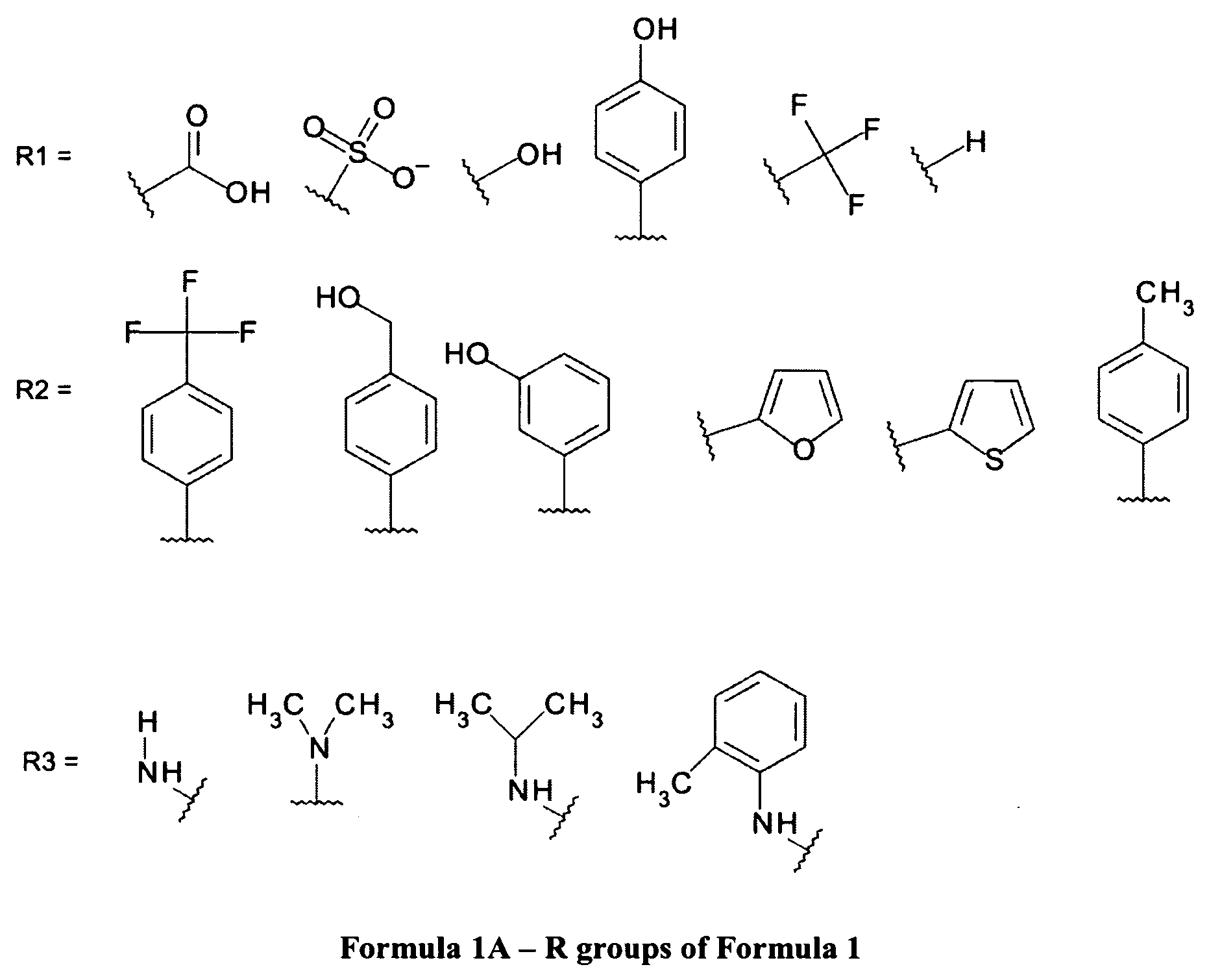
  • Rl is a carboxyl group ( — C(O) — OH), a hydrogen ( — H — ), a trifluoromethyl group ( — C(F 3 )), a phenol group ( — Ph — OH), an — SO 3 group, or a hydroxyl ( — OH) group;
  • R2 is a trifluoromethyl phenyl group (-Ph-CF 3 ), a methylphenyl ( — Ph — CH 3 ), — Ph- CH 2 — OH, a phenol group (— Ph- OH), a furan or a thiophene;
  • R3 is a -NH2, a -N(CH3)2, a -NH-(C(CH3)2), a -NH-Ph-meta-CH3; and wherein the composition is effective to inhibit production of beta amyloid monomer or promote degradation of A ⁇ monomer amount by at least about 5%
  • composition comprising a pharmaceutically acceptable carrier and a therapeutically effective amount of a 2-[(4-oxo- 5,6,7,8-tetrahydro-3H-benzothiopheno[2,3-d]pyrimidin-2-yl)sulfanyl]acetaldehyde having the formula:
  • Rl is a carboxyl group ( — C(O) — OH), a hydrogen ( — H — ), a trifluoromethyl group ( — C(F 3 )), a phenol group ( — PIi — OH), an — SO 3 group, or a hydroxyl ( — OH) group;
  • R2 is a trifluoromethyl phenyl group ( — Ph — CF 3 ), a methylphenyl ( — PIi — CH 3 ), — PIi — CH 2 — OH, a phenol group (— Ph-OH), a furan or a thiophene;
  • R3 is a-NH2, a -N(CH3)2, a -NH-(C(CH3)2), a -NH-Ph-meta-CH3; and wherein the composition is effective to inhibit beta amyloid aggregation into A ⁇ multimers or to promote
  • the composition is effective to inhibit beta amyloid aggregation in A ⁇ forms of at least 40 kD or to promote the degradation of A ⁇ forms of at least 40 kD (e.g., degrading 120 kD forms to 60 kD).
  • kits comprising the composition described in the preceding two paragraphs, any of the methods of treating a disease or disorder associated with Alzheimer's disease, such as Alzheimer's disease itself, described herein wherein the pharmaceutical composition of the preceding two paragraphs is administered, any of the methods of ameliorating a symptom of a disease or disorder associated with Alzheimer's disease, such as Alzheimer's disease itself, described herein wherein the pharmaceutical composition of the preceding two paragraphs is administered, any method of inhibiting or preventing the onset of a disease or disorder associated with Alzheimer's disease, such as Alzheimer's disease itself, described herein wherein the pharmaceutical composition of the preceding two paragraphs is administered, a use of the composition of the preceding two paragraphs for treating a disease or disorder associated with Alzheimer's disease, such as Alzheimer's disease itself, and a use of the composition of the preceding two paragraphs in the preparation of a medicament for treating a disease or disorder associated with Alzheimer's disease, such as Alzheimer's disease itself.
  • Another aspect of the disclosure is drawn to a pharmaceutical composition
  • a pharmaceutical composition comprising a pharmaceutically acceptable carrier and a therapeutically effective amount of a 4-phenyl-5-[(4-phenyl-5-sulfanyl-l,2,4-triazol-3-yl)methyl]-l,2,4-triazole-3-thiol having the formula:
  • Rl is — CH2 — Ph — CH3, — CH2— Ph-OH, — CH2— Ph- COOH, — CH2— C(O) — Ph- NH2, — CH2— C(O)- Ph- NH- C(O) - CH3, or— CH2— C(O) - N(Ph)(C(CH3)2; wherein R2 is — OH, — C(CH3)3, — CH2-C(O)-OH, — F or — CF3; and wherein the composition is effective to inhibit production of beta amyloid monomer or promote degradation of A ⁇ monomer amount by at least about 5% when compared to a control.
  • Inhibiting A ⁇ amount is achieved by any combination of inhibiting the production of A ⁇ (e.g., monomer) amount or promoting the degradation of existing A ⁇ (e.g., monomer) amount.
  • a ⁇ e.g., monomer
  • Another aspect of the disclosure is a pharmaceutical composition comprising a pharmaceutically acceptable carrier and a therapeutically effective amount of a 4-phenyl-5- [(4-phenyl-5-sulfanyl-l,2,4-triazol-3-yl)methyl]-l,2,4-triazole-3-thiol having the formula:
  • Rl is — CH2 — Ph — CH3, — CH2— Ph-OH, — CH2— Ph- COOH, — CH2— C(O) — Ph- NH2, — CH2— C(O)- Ph- NH- C(O) - CH3, or— CH2— C(O) - N(Ph)(C(CH3)2; wherein R2 is — OH, — C(CH3)3, — CH2-C(O)-OH, — F or — CF3; and wherein the composition is effective to inhibit beta amyloid aggregation into A ⁇ multimers or to promote the degradation of A ⁇ multimers by at least about 5% when compared to a control.
  • the composition is effective to inhibit beta amyloid aggregation in A ⁇ forms of at least 40 kD or to promote the degradation of A ⁇ forms of at least 40 kD (e.g., degrading 120 kD forms to 60 kD).
  • kits comprising the composition described in the preceding two paragraphs, any of the methods of treating a disease or disorder associated with Alzheimer's disease, such as Alzheimer's disease itself, described herein wherein the pharmaceutical composition of the preceding two paragraphs is administered, any of the methods of ameliorating a symptom of a disease or disorder associated with Alzheimer's disease, such as Alzheimer's disease itself, described herein wherein the pharmaceutical composition of the preceding two paragraphs is administered, any method of inhibiting or preventing the onset of a disease or disorder associated with Alzheimer's disease, such as Alzheimer's disease itself, described herein wherein the pharmaceutical composition of the preceding two paragraphs is administered, a use of the composition of the preceding two paragraphs for treating a disease or disorder associated with Alzheimer's disease, such as Alzheimer's disease itself, and a use of the composition of the preceding two paragraphs in the preparation of a medicament for treating a disease or disorder associated with Alzheimer's disease, such as Alzheimer's disease itself.
  • composition comprising a pharmaceutically acceptable carrier and a therapeutically effective amount of an N-(benzylideneamino)-2-[(4,5-diphenyl- 1 ,2,4-triazol-3-yl)sulfanyl]acetamide having the formula:
  • Rl is — CH(CH3)2, — CF3, — O — Ph,
  • composition is effective to inhibit production of beta amyloid monomer amount or promote degradation of A ⁇ monomer amount by at least about 5% when compared to a control.
  • Inhibiting A ⁇ amount is achieved by any combination of inhibiting the production of
  • a ⁇ e.g., monomer
  • promoting the degradation of existing A ⁇ e.g., monomer
  • composition comprising a pharmaceutically acceptable carrier and a therapeutically effective amount of an N- (benzylideneamino)-2-[(4,5-diphenyl-l ,2,4-triazol-3-yl)sulfanyl]acetamide having the formula:
  • Rl is — CH(CH3)2, — CF3, — O — Ph,
  • composition is effective to inhibit beta amyloid aggregation into A ⁇ multimers or to promote the degradation of A ⁇ multimers by at least about 5% when compared to a control.
  • the composition is effective to inhibit beta amyloid aggregation in A ⁇ forms of at least 40 kD or to promote the degradation of A ⁇ forms of at least 40 kD
  • kits comprising the composition described in the preceding two paragraphs, any of the methods of treating a disease or disorder associated with Alzheimer's disease, such as Alzheimer's disease itself, described herein wherein the pharmaceutical composition of the preceding two paragraphs is administered, any of the methods of ameliorating a symptom of a disease or disorder associated with Alzheimer's disease, such as Alzheimer's disease itself, described herein wherein the pharmaceutical composition of the preceding two paragraphs is administered, any method of inhibiting or preventing the onset of a disease or disorder associated with Alzheimer's disease, such as Alzheimer's disease itself, described herein wherein the pharmaceutical composition of the preceding two paragraphs is administered, a use of the composition of the preceding two paragraphs for treating a disease or disorder associated with Alzheimer's disease, such as Alzheimer's disease itself, and a use of the composition of the preceding two paragraphs in the preparation of a medicament for treating a disease or disorder associated with Alzheimer's disease, such as Alzheimer's disease itself.
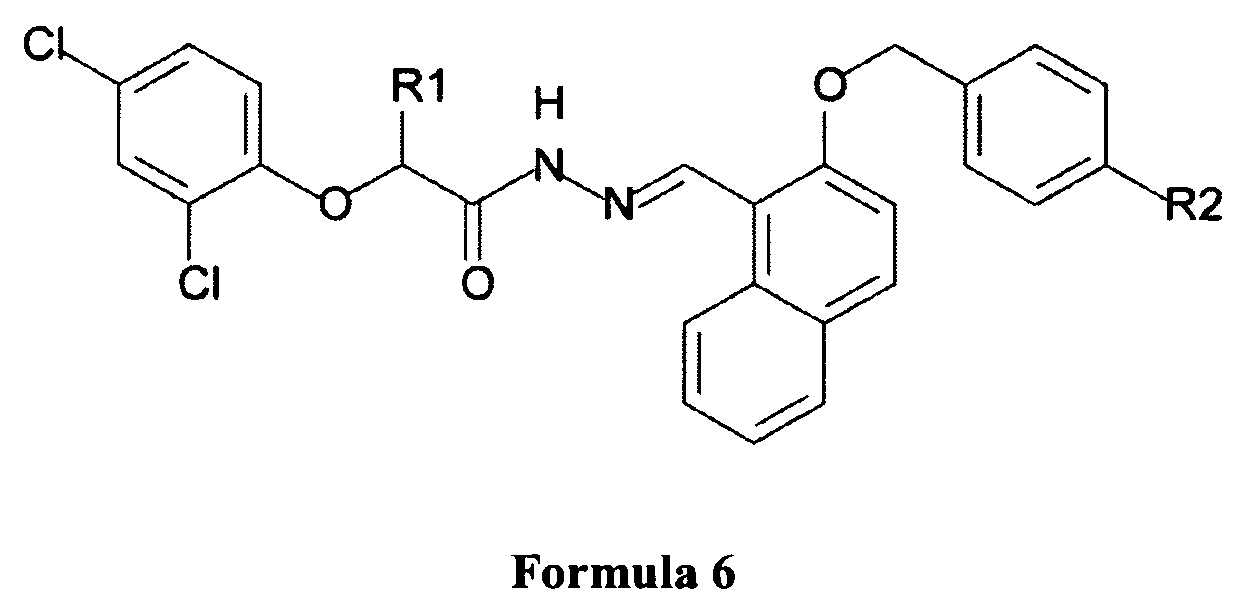
  • composition comprising a pharmaceutically acceptable carrier and a therapeutically effective amount of an N-[(2-benzyloxy-l -naphthyl)methyleneamino]-2-(2,4-dichlorophenoxy)acetamide having the formula:
  • Rl is — CH((CH3)2)
  • composition is effective to inhibit production of beta amyloid monomer or promote degradation of A ⁇ monomer amount by at least about 5% when compared to a control.
  • Inhibiting A ⁇ amount is achieved by any combination of inhibiting the production of A ⁇ (e.g., monomer) or promoting the degradation of existing A ⁇
  • composition comprising a pharmaceutically acceptable carrier and a therapeutically effective amount of an N-[(2- benzyloxy- 1 -naphthyl)methyleneamino]-2-(2,4-dichlorophenoxy)acetamide having the formula:
  • Rl is — CH((CH3)2)
  • composition is effective to inhibit beta amyloid aggregation into A ⁇ multimers or to promote the degradation of A ⁇ multimers by at least about 5% when compared to a control.
  • the composition is effective to inhibit beta amyloid aggregation in A ⁇ forms of at least 40 kD or to promote the degradation of A ⁇ forms of at least 40 kD (e.g., degrading 120 kD forms to 60 kD).
  • kits comprising the composition described in the preceding two paragraphs, any of the methods of treating a disease or disorder associated with Alzheimer's disease, such as Alzheimer's disease itself, described herein wherein the pharmaceutical composition of the preceding two paragraphs is administered, any of the methods of ameliorating a symptom of a disease or disorder associated with Alzheimer's disease, such as Alzheimer's disease itself, described herein wherein the pharmaceutical composition of the preceding two paragraphs is administered, any method of inhibiting or preventing the onset of a disease or disorder associated with Alzheimer's disease, such as Alzheimer's disease itself, described herein wherein the pharmaceutical composition of the preceding two paragraphs is administered, a use of the composition of the preceding two paragraphs for treating a disease or disorder associated with Alzheimer's disease, such as Alzheimer's disease itself, and a use of the composition of the preceding two paragraphs in the preparation of a medicament for treating a disease or disorder associated with Alzheimer's disease, such as Alzheimer's disease itself.
  • composition comprising a pharmaceutically acceptable carrier and a therapeutically effective amount of a 4-hydroxy-l-[2-(lH-indol-3-yl)ethyl]-2H-pyrrol-5-one having the formula:
  • Rl is — C(O) — C(CH3)3,
  • composition is effective to inhibit production of beta amyloid monomer amount or promote degradation of A ⁇ monomer amount by at least about 5% when compared to a control.
  • Inhibiting A ⁇ amount is achieved by any combination of inhibiting the production of A ⁇ (e.g., monomer) or promoting the degradation of existing A ⁇ (e.g., monomer).
  • composition comprising a pharmaceutically acceptable carrier and a therapeutically effective amount of a 4-hydroxy-l- [2-(lH-indol-3-yl)ethyl]-2H-pyrrol-5-one having the formula:
  • Rl is — C(O) — C(CH3)3,
  • composition is effective to inhibit beta amyloid aggregation into A ⁇ multimers or to promote the degradation of A ⁇ multimers by at least about 5% when compared to a control.
  • the composition is effective to inhibit beta amyloid aggregation in A ⁇ forms of at least 40 kD or to promote the degradation of A ⁇ forms of at least 40 kD (e.g., degrading
  • kits comprising the composition described in the preceding two paragraphs, any of the methods of treating a disease or disorder associated with Alzheimer's disease, such as Alzheimer's disease itself, described herein wherein the pharmaceutical composition of the preceding two paragraphs is administered, any of the methods of ameliorating a symptom of a disease or disorder associated with Alzheimer's disease, such as Alzheimer's disease itself, described herein wherein the pharmaceutical composition of the preceding two paragraphs is administered, any method of inhibiting or preventing the onset of a disease or disorder associated with Alzheimer's disease, such as Alzheimer's disease itself, described herein wherein the pharmaceutical composition of the preceding two paragraphs is administered, a use of the composition of the preceding two paragraphs for treating a disease or disorder associated with Alzheimer's disease, such as Alzheimer's disease itself, and a use of the composition of the preceding two paragraphs in the preparation of a medicament for treating a disease or disorder associated with Alzheimer's disease, such as Alzheimer's disease itself.
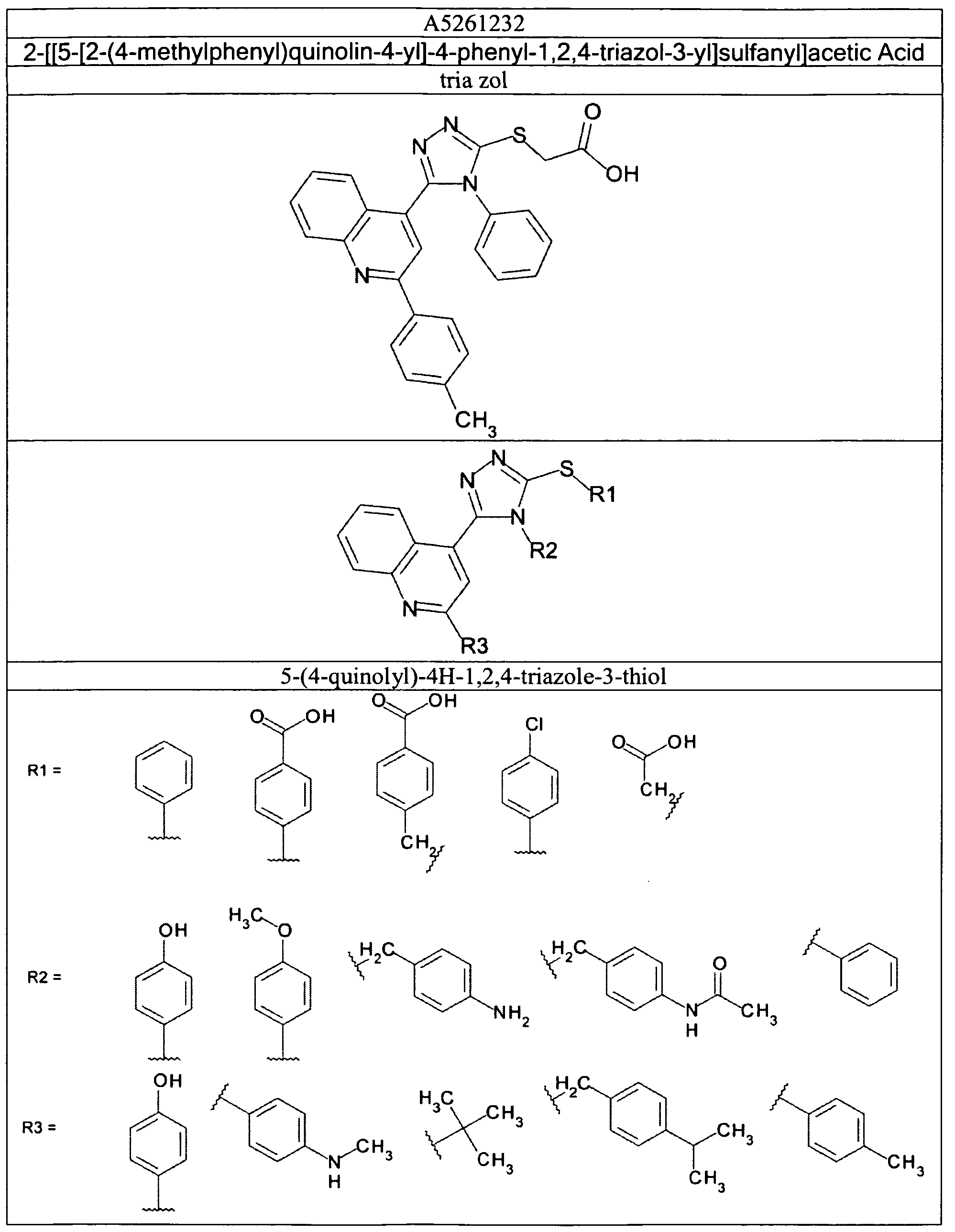
  • composition comprising a pharmaceutically acceptable carrier and a therapeutically effective amount of a 5-(4-quinolyl)-4H-l,2,4-triazole-3-thiol having the formula:
  • Rl is a phenyl ( — Ph),
  • Another aspect of the disclosure is a pharmaceutical composition
  • a pharmaceutical composition comprising a pharmaceutically acceptable carrier and a therapeutically effective amount of a 5-(4- quinolyl)-4H-l,2,4-triazole-3-thiol having the formula:
  • Rl is a phenyl ( — Ph), — CH2— C(O)-OH, —Cm— para— Ph-C(O) — OH, para— Ph-Cl or para— Ph-C(O) —OH; wherein R2 is a para— Ph- OH, para— Ph- O— CH3, — CH2— para— Ph- NH2, CH2— p ⁇ r ⁇ — Ph- NH-C(O) — CH3 or -Ph; wherein R3 is apara— Ph-OH, para— Ph- NH2— CH3, — C(CH3)3, — CH2— para— Ph- CH((CH3)2), or para — Ph — CH3; and wherein the composition is effective to inhibit beta amyloid aggregation into A ⁇ multimers or to promote the degradation of A ⁇ multimers by at least about 5% when compared to a control.
  • the composition is effective to inhibit beta amyloid aggregation in A ⁇ forms of at least 40 kD or to promote the degradation of A ⁇ forms of at least 40 kD (e.g., degrading 120 kD forms to 60 kD).
  • kits comprising the composition described in the preceding two paragraphs, any of the methods of treating a disease or disorder associated with Alzheimer's disease, such as Alzheimer's disease itself, described herein wherein the pharmaceutical composition of the preceding two paragraphs is administered, any of the methods of ameliorating a symptom of a disease or disorder associated with Alzheimer's disease, such as Alzheimer's disease itself, described herein wherein the pharmaceutical composition of the preceding two paragraphs is administered, any method of inhibiting or preventing the onset of a disease or disorder associated with Alzheimer's disease, such as Alzheimer's disease itself, described herein wherein the pharmaceutical composition of the preceding two paragraphs is administered, a use of the composition of the preceding two paragraphs for treating a disease or disorder associated with Alzheimer's disease, such as Alzheimer's disease itself, and a use of the composition of the preceding two paragraphs in the preparation of a medicament for treating a disease or disorder associated with Alzheimer's disease, such as Alzheimer's disease itself.
  • compositions comprising a pharmaceutically acceptable carrier and a therapeutically effective amount of a 3-[2-(4-oxo-5,6,7,8-tetrahydrobenzothiopheno[2,3-d]pyrimidin-3-yl)ethyl]-5,6,7,8- tetrahydrobenzothiopheno[2,3-d]pyrimidin-4-one having the formula:
  • Rl is a. para — Ph — O — CH3, a CH2- para — Ph- CH3, C(O) — O— CH3, C(O) — NH2, or a hydrogen (-H); wherein R2 is a — CH2— Ph, -Ph, —OH, — CH2— C(O) — NH2, or a hydrogen (-H); wherein R3 is — CH3, — C((CH3)3), -C(O) — O— CH2— CH3, or a hydrogen (-H); and wherein the composition is effective to inhibit production of beta amyloid monomer amount or promote degradation of A ⁇ monomer amount by at least about 5% when compared to a control. Inhibiting A ⁇ amount is achieved by any combination of inhibiting the production of A ⁇ (e.g., monomer) or promoting the degradation of existing A ⁇ (e.g., monomer).
  • Another aspect of the disclosure is a pharmaceutical composition
  • a pharmaceutical composition comprising a pharmaceutically acceptable carrier and a therapeutically effective amount of a 3-[2-(4-oxo- 5,6,7,8-tetrahydrobenzothiopheno[2,3-d]pyrimidin-3-yl)ethyl]-5,6,7,8- tetrahydrobenzothiopheno[2,3-d]pyrimidin-4-one having the formula:
  • Rl is a para — Ph — O — CH3, a CH2- para — Ph- CH3, C(O) — O— CH3, C(O) — NH2, or a hydrogen (-H);
  • R2 is a — CH2— Ph, -Ph, —OH, — CH2— C(O) — NH2, or a hydrogen (-H);
  • R3 is — CH3, — C((CH3)3), -C(O) — O— CH2— CH3, or a hydrogen (-H); and wherein the composition is effective to inhibit beta amyloid aggregation into A ⁇ multimers or to promote the degradation of A ⁇ multimers by at least about 5% when compared to a control.
  • the composition is effective to inhibit beta amyloid aggregation in A ⁇ forms of at least 40 kD or to promote the degradation of A ⁇ forms of at least 40 kD (e.g., degrading 12O kD forms to 6O kD).
  • kits comprising the composition described in the preceding two paragraphs, any of the methods of treating a disease or disorder associated with Alzheimer's disease, such as Alzheimer's disease itself, described herein wherein the pharmaceutical composition of the preceding two paragraphs is administered, any of the methods of ameliorating a symptom of a disease or disorder associated with Alzheimer's disease, such as Alzheimer's disease itself, described herein wherein the pharmaceutical composition of the preceding two paragraphs is administered, any method of inhibiting or preventing the onset of a disease or disorder associated with Alzheimer's disease, such as Alzheimer's disease itself, described herein wherein the pharmaceutical composition of the preceding two paragraphs is administered, a use of the composition of the preceding two paragraphs for treating a disease or disorder associated with Alzheimer's disease, such as Alzheimer's disease itself, and a use of the composition of the preceding two paragraphs in the preparation of a medicament for treating a disease or disorder associated with Alzheimer's disease, such as Alzheimer's disease itself.
  • composition comprising a pharmaceutically acceptable carrier and a therapeutically effective amount of an N-hexyl-5,6,7,8-tetrahydrobenzothiopheno[2,3-d]pyrimidin-4-amine having the formula:
  • Rl is a para — Ph — O — CH3, a CH2- para — Ph- CH3, C(O) — O— CH3, C(O) — NH2, or a hydrogen (-H); wherein R2 is a — CH2— Ph, -Ph, —OH, — CH2— C(O) — NH2, or a hydrogen (-H); wherein R3 is — CH3, — C((CH3)3), -C(O) — O— CH2— CH3, or a hydrogen (-H); and wherein the composition is effective to inhibit production of beta amyloid monomer or promote degradation of A ⁇ monomer amount by at least about 5% when compared to a control. Inhibiting A ⁇ amount is achieved by any combination of inhibiting the production of A ⁇ (e.g., monomer) or promoting the degradation of existing A ⁇ (e.g., monomer).
  • a ⁇ amount is achieved by any combination of inhibiting the production of A ⁇ (e.g., monomer) or
  • composition comprising a pharmaceutically acceptable carrier and a therapeutically effective amount of an N-hexyl- 5,6,7,8-tetrahydrobenzothiopheno[2,3-d]pyrimidin-4-amine having the formula:
  • Rl is a para — Ph — O — CH3, a CH2- para — Ph- CH3, C(O) — O— CH3, C(O) — NH2, or a hydrogen (-H);
  • R2 is a — CH2— Ph, -Ph, —OH, — CH2— C(O) — NH2, or a hydrogen (-H);
  • R3 is — CH3, — C((CH3)3), -C(O) — O— CH2— CH3, or a hydrogen (-H); and wherein the composition is effective to inhibit beta amyloid aggregation into A ⁇ multimers or to promote the degradation of A ⁇ multimers by at least about 5% when compared to a control.
  • the composition is effective to inhibit beta amyloid aggregation in A ⁇ forms of at least 40 kD or to promote the degradation of A ⁇ forms of at least 40 kD (e.g., degrading 12O kD forms to 6O kD).
  • kits comprising the composition described in the preceding two paragraphs, any of the methods of treating a disease or disorder associated with Alzheimer's disease, such as Alzheimer's disease itself, described herein wherein the pharmaceutical composition of the preceding two paragraphs is administered, any of the methods of ameliorating a symptom of a disease or disorder associated with Alzheimer's disease, such as Alzheimer's disease itself, described herein wherein the pharmaceutical composition of the preceding two paragraphs is administered, any method of inhibiting or preventing the onset of a disease or disorder associated with Alzheimer's disease, such as Alzheimer's disease itself, described herein wherein the pharmaceutical composition of the preceding two paragraphs is administered, a use of the composition of the preceding two paragraphs for treating a disease or disorder associated with Alzheimer's disease, such as Alzheimer's disease itself, and a use of the composition of the preceding two paragraphs in the preparation of a medicament for treating a disease or disorder associated with Alzheimer's disease, such as Alzheimer's disease itself.
  • composition comprising a pharmaceutically acceptable carrier and a therapeutically effective amount of a 2-hydroxy-N-(l-naphthylmethyleneamino)acetamide having the formula:
  • R2 is an isopropyl, a benzyl, a parachlorobenzyl, or an ethyl; wherein R3 is
  • composition is effective to inhibit production of beta amyloid monomer or promote degradation of A ⁇ monomer amount by at least about 5% when compared to a control.
  • Inhibiting A ⁇ amount is achieved by any combination of inhibiting the production of A ⁇ (e.g., monomer) or promoting the degradation of existing A ⁇ (e.g., monomer).
  • Another aspect of the disclosure is a pharmaceutical composition
  • a pharmaceutical composition comprising a pharmaceutically acceptable carrier and a therapeutically effective amount of a 2-hydroxy-N- (l-naphthylmethyleneamino)acetamide having the formula:
  • R2 is a isopropyl, benzyl, parachlorobenzyl, or ethyl; wherein R3 is
  • composition is effective to inhibit beta amyloid aggregation into A ⁇ multimers or to promote the degradation of A ⁇ multimers by at least about 5% when compared to a control.
  • the composition is effective to inhibit beta amyloid aggregation in A ⁇ forms of at least 40 kD or to promote the degradation of A ⁇ forms of at least 40 IcD (e.g., degrading 120 kD forms to 60 kD).
  • kits comprising the composition described in the preceding two paragraphs, any of the methods of treating a disease or disorder associated with Alzheimer's disease, such as Alzheimer's disease itself, described herein wherein the pharmaceutical composition of the preceding two paragraphs is administered, any of the methods of ameliorating a symptom of a disease or disorder associated with Alzheimer's disease, such as Alzheimer's disease itself, described herein wherein the pharmaceutical composition of the preceding two paragraphs is administered, any method of inhibiting or preventing the onset of a disease or disorder associated with Alzheimer's disease, such as Alzheimer's disease itself, described herein wherein the pharmaceutical composition of the preceding two paragraphs is administered, a use of the composition of the preceding two paragraphs for treating a disease or disorder associated with Alzheimer's disease, such as Alzheimer's disease itself, and a use of the composition of the preceding two paragraphs in the preparation of a medicament for treating a disease or disorder associated with Alzheimer's disease, such as Alzheimer's disease itself.
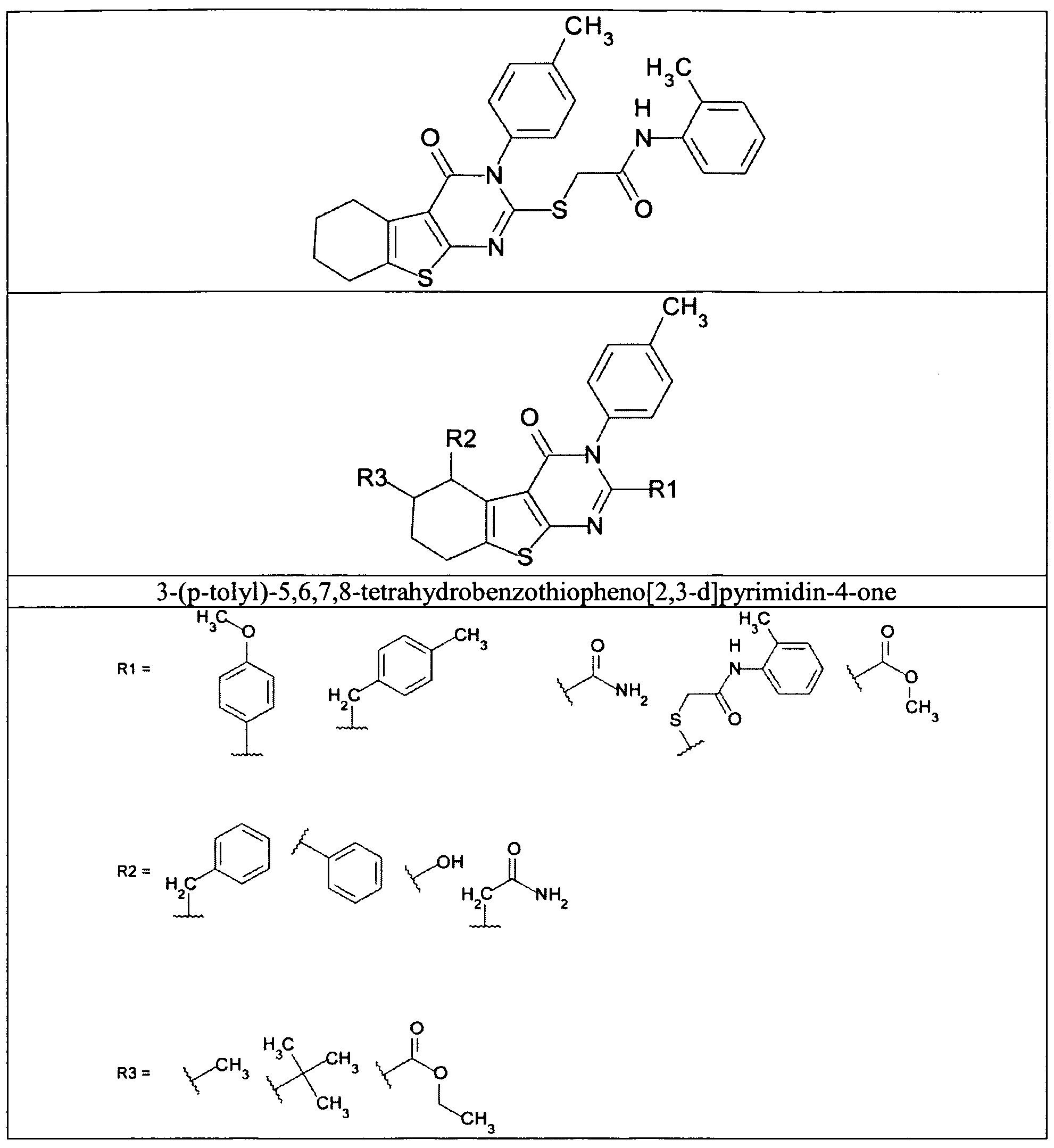
  • composition comprising a pharmaceutically acceptable carrier and a therapeutically effective amount of a 3-(p-tolyl)-5,6,7,8-tetrahydrobenzothiopheno[2,3-d]pyrimidin-4-one having the formula:
  • Rl is a. para — Ph — O — CH3, a CH2 — para — Ph- CH3, C(O) — O— CH3, C(O) — NH2, — S— CH2— C(O) — N— Ph- meta— CH3, or a hydrogen (-H); wherein R2 is a — CH2— Ph, -Ph, —OH, — CH2— C(O) — NH2, or a hydrogen (-H); wherein R3 is — CH3, — C((CH3)3), -C(O) — O — CH2 — CH3, or a hydrogen ( — H); and wherein the composition is effective to inhibit production of beta amyloid monomer or promote degradation of A ⁇ monomer amount by at least about 5% when compared to a control. Inhibiting A ⁇ amount is achieved by any combination of inhibiting the production of A ⁇ (e.g., monomer) or promoting the degradation of existing A ⁇
  • composition comprising a pharmaceutically acceptable carrier and a therapeutically effective amount of a 3-(p-tolyl)- 5,6,7,8-tetrahydrobenzothiopheno[2,3-d]pyrimidin-4-one having the formula:
  • Rl is a para — Ph — O — CH3, a CH2 — para — Ph- CH3, C(O) — O— CH3, C(O) — NH2, — S— CH2— C(O) — N— Ph- meta— CH3, or a hydrogen (-H); wherein R2 is a — CH2— Ph, -Ph, —OH, — CH2— C(O) — NH2, or a hydrogen (-H); wherein R3 is — CH3, — C((CH3)3), -C(O) — O — CH2 — CH3, or a hydrogen ( — H); and wherein the composition is effective to inhibit beta amyloid aggregation into A ⁇ multimers or to promote the degradation of A ⁇ multimers by at least about 5% when compared to a control.
  • the composition is effective to inhibit beta amyloid aggregation in A ⁇ forms of at least 40 kD or to promote the degradation of A ⁇ forms of at least 40 kD (e.g., degrading 120 kD forms to 60 kD).
  • kits comprising the composition described in the preceding two paragraphs, any of the methods of treating a disease or disorder associated with Alzheimer's disease, such as Alzheimer's disease itself, described herein wherein the pharmaceutical composition of the preceding two paragraphs is administered, any of the methods of ameliorating a symptom of a disease or disorder associated with Alzheimer's disease, such as Alzheimer's disease itself, described herein wherein the pharmaceutical composition of the preceding two paragraphs is administered, any method of inhibiting or preventing the onset of a disease or disorder associated with Alzheimer's disease, such as Alzheimer's disease itself, described herein wherein the pharmaceutical composition of the preceding two paragraphs is administered, a use of the composition of the preceding two paragraphs for treating a disease or disorder associated with Alzheimer's disease, such as Alzheimer's disease itself, and a use of the composition of the preceding two paragraphs in the preparation of a medicament for treating a disease or disorder associated with Alzheimer's disease, such as Alzheimer's disease itself.
  • composition comprising a pharmaceutically acceptable carrier and a therapeutically effective amount of a (5Z)-5-[(3,4-diethoxyphenyl)methylene]-3-methyl-2-thioxo-thiazolidin-4-one having the formula:
  • Rl is — Ph, — CH2 — (C(C1)3); wherein R2 is CH2— Ph, — C— ((CH3)3), — C(O)- NH2, -C(O)-OH, — CH2— OH; and wherein the composition is effective to inhibit production of beta amyloid monomer or promote degradation of A ⁇ monomer amount by at least about 5% when compared to a control.
  • Inhibiting A ⁇ amount is achieved by any combination of inhibiting the production of A ⁇ (e.g., monomer) or promoting the degradation of existing A ⁇ (e.g., monomer).
  • composition comprising a pharmaceutically acceptable carrier and a therapeutically effective amount of a (5Z)-5-[(3,4- diethoxyphenyl)methylene]-3-methyl-2-thioxo-thiazolidin-4-one having the formula:
  • composition is effective to inhibit beta amyloid aggregation into A ⁇ multimers or to promote the degradation of A ⁇ multimers by at least about 5% when compared to a control.
  • the composition is effective to inhibit beta amyloid aggregation in A ⁇ forms of at least 40 kD or to promote the degradation of A ⁇ forms of at least 40 kD (e.g., degrading 120 kD forms to 60 kD).
  • kits comprising the composition described in the preceding two paragraphs, any of the methods of treating a disease or disorder associated with Alzheimer's disease, such as Alzheimer's disease itself, described herein wherein the pharmaceutical composition of the preceding two paragraphs is administered, any of the methods of ameliorating a symptom of a disease or disorder associated with Alzheimer's disease, such as Alzheimer's disease itself, described herein wherein the pharmaceutical composition of the preceding two paragraphs is administered, any method of inhibiting or preventing the onset of a disease or disorder associated with Alzheimer's disease, such as Alzheimer's disease itself, described herein wherein the pharmaceutical composition of the preceding two paragraphs is administered, a use of the composition of the preceding two paragraphs for treating a disease or disorder associated with Alzheimer's disease, such as Alzheimer's disease itself, and a use of the composition of the preceding two paragraphs in the preparation of a medicament for treating a disease or disorder associated with Alzheimer's disease, such as Alzheimer's disease itself.
  • composition comprising a pharmaceutically acceptable carrier and a therapeutically effective amount of a hydrotris (3-(4-cumenyl)-5-methylpyrazol-l-yl) borate having the formula:
  • composition is effective to inhibit production of beta amyloid monomer or promote degradation of A ⁇ monomer amount by at least about 5% when compared to a control.
  • Inhibiting A ⁇ amount is achieved by any combination of inhibiting the production of A ⁇ (e.g., monomer) or promoting the degradation of existing A ⁇ (e.g., monomer).
  • composition comprising a pharmaceutically acceptable carrier and a therapeutically effective amount of a hydrotris (3- (4-cumenyl)-5-methylpyrazol-l-yl) borate having the formula:
  • composition is effective to inhibit beta amyloid aggregation into A ⁇ multimers or to promote the degradation of A ⁇ multimers by at least about 5% when compared to a control.
  • the composition is effective to inhibit beta amyloid aggregation in A ⁇ forms of at least 40 kD or to promote the degradation of A ⁇ forms of at least 40 kD (e.g., degrading 120 kD forms to 60 kD).
  • kits comprising the composition described in the preceding two paragraphs, any of the methods of treating a disease or disorder associated with Alzheimer's disease, such as Alzheimer's disease itself, described herein wherein the pharmaceutical composition of the preceding two paragraphs is administered, any of the methods of ameliorating a symptom of a disease or disorder associated with Alzheimer's disease, such as Alzheimer's disease itself, described herein wherein the pharmaceutical composition of the preceding two paragraphs is administered, any method of inhibiting or preventing the onset of a disease or disorder associated with Alzheimer's disease, such as Alzheimer's disease itself, described herein wherein the pharmaceutical composition of the preceding two paragraphs is administered, a use of the composition of the preceding two paragraphs for treating a disease or disorder associated with Alzheimer's disease, such as Alzheimer's disease itself, and a use of the composition of the preceding two paragraphs in the preparation of a medicament for treating a disease or disorder associated with Alzheimer's disease, such as Alzheimer's disease itself.
  • Embodiments of the various aspects of the disclosure drawn to compositions useful to inhibit A ⁇ aggregation and to methods of preventing, treating or ameliorating a symptom of a disease associated with Alzheimer's disease, such as Alzheimer's disease itself, comprise the inhibition of the formation, and/or the promotion of degradation, of A ⁇ multimers, including but not limited to A ⁇ multimers of at least 40 kilodaltons.
  • the composition inhibits the formation of, or promotes the degradation of, an A ⁇ aggregate that is a A ⁇ multimer, including but not limited to A ⁇ multimers that have a molecular weight of at least 40 kilodaltons.
  • the method inhibits the formation of, or promotes the degradation of, an A ⁇ aggregate that is a A ⁇ multimer, including but not limited to A ⁇ multimers that have a molecular weight of at least 40 kilodaltons.
  • Figure 1 illustrates a schematic of a process that is used to identify potent compounds that lower in vivo beta amyloid amounts.
  • Figure 2 illustrates an alternate embodiment of a process that is used to identify potent compounds that lower in vivo beta amyloid amount and/or A ⁇ anti-aggregation activity.
  • Figure 3 shows chemical compounds (i.e., compound no. 1, A2641934 (Formula 5); compound no. 3, A2739476 (Formula 1); and compound no. 6, A3414817 (Formula 1 1)) exhibiting anti-oligomerization activity by in vitro aggregation assay.
  • A Western blot analysis of HMW A ⁇ 42 oligomers in the presence of novel compounds.
  • B Quantification of HMW A ⁇ 42 oligomers.
  • Figure 4 shows identification of chemical compounds exhibiting anti- oligomerization activity by in vitro aggregation assay.
  • Four compounds (L 176117, A3932292 (Formula 6)); (7216540379, A4971549 (Formula 8)); (863536, A6239807 (Formula 9)); and (19-2800, A 1862443 (Formula 12)) were subjected to in vitro A ⁇ aggregation assay and found to have anti-A ⁇ aggregation activity.
  • the lower panel discloses the results of photo-induced cross-linking of unmodified proteins (PICUP) assays confirming the anti-oligomeric A ⁇ activity of compounds identified using in vitro anti-aggregation assays.
  • PICUP photo-induced cross-linking of unmodified proteins
  • Figure 5 provides the results of a short-term in vivo feasibility study in the TgCRND ⁇ mouse model of AD.
  • Compound 1 (A2641934, Formula 5) and Compound 3 (A2739476, Formula 1) were chosen for the short-term feasibility study.
  • A Total brain A ⁇ 42 and A ⁇ 40 in TgCRND8 mice treated with either Compound 1 (A2641934, Formula 5) or Compound 3 (A2739476, Formula 1).
  • B High molecular weight (HMW) soluble oligomeric content in the brain by Western blot analysis.
  • Figure 6 shows the results of an assay of anti-oligomerization activity by in vitro aggregation assay.
  • Compound 1 (A2641934, Formula 5), Compound 3 (A2739476, Formula 1), and Compound No. 6, A3414817 (Formula 11) were subjected to the assay.
  • A Western blot analysis of HMW A ⁇ 42 oligomers in the presence of the compounds.
  • B Quantification of HMW A ⁇ 42 oligomers.
  • Figure 7 reveals the results of in vitro anti-aggregation assays of compounds L176117 (i.e., A3932292); 7216540379 (i.e., A4971549); 863538 (i.e., A6239807); and 19- 2800 (i.e., Al 862443).
  • the data confirms that each of the four compounds identified as probables for anti-aggregation activity using MODEL 1 v 5 did exhibit A ⁇ anti-aggregation (anti-oligomerization) activity.
  • the technology disclosed herein uses Forward EngineeringTM, which is based on molecular topology (MT), to identify and/or design novel compounds in chemical classes unrelated to current anti-AD agents. These compounds exhibit dual anti-amyloid/anti- aggregation activity to enable (1) prevention and/or reduction of A ⁇ peptides, (2) halting A ⁇ deposition and/or (3) reduction of soluble A ⁇ 42.
  • MT molecular topology
  • treatment is defined to include preventing, lowering, stopping, or reversing the progression or severity of a condition or symptom being treated.
  • the present invention includes both medical therapeutic and/or prophylactic administration, as appropriate.
  • an effective amount is an amount of a pharmaceutical or nutraceutical composition that is effective in treating the target condition or symptom.
  • An effective of amount of any of the compounds disclosed in Tables 1 to 3 used to treat AD is an amount sufficient to reduce A ⁇ 40, A ⁇ 42, HMW soluble A ⁇ 40 fragments, HMW A ⁇ 42 fragments, or any combination of these.
  • the terms “A ⁇ 40” or “Abeta40” or “A ⁇ 40” each refer to the 40 amino acid peptide or protein fragment that is formed after sequential cleavage of the amyloid precursor protein (APP), a transmembrane glycoprotein of undetermined function primarily in the endoplasmic reticulum.
  • APP amyloid precursor protein
  • a ⁇ 40 or “Abeta40” or “A ⁇ 40” each are meant to refer to the peptides of 40 amino acids that appear in the amyloid plaques in the brains of Alzheimer's disease patients.
  • the terms “A ⁇ 40” or “Abeta40” or “A ⁇ 4 o” are also used interchangeably throughout the specification.
  • amyloid precursor protein or "APP” refers to a transmembrane glycoprotein of undetermined function that can be cleaved or processed by ⁇ - , ⁇ - and ⁇ -secretases to generate A ⁇ protein of 39 to 43 amino acids in length.
  • a ⁇ protein refers to the C-terminal end of a beta amyloid peptide generated by cleaving within the transmembrane region of APP and generating any number of isoforms of 39-43 amino acid residues in length.
  • Ab protein as used herein, is meant to encompass the two most common isoforms, A ⁇ 40 and A ⁇ 42.
  • a ⁇ protein is meant to encompass peptides of 39-43 amino acids that appear to be the main constituent of amyloid plaques in the brains of Alzheimer's disease patients.
  • the terms “A ⁇ 42” or “Abeta42” or A ⁇ 42 " each refer to the 42 amino acid peptide or protein fragment that is formed after sequential cleavage of the amyloid precursor protein (APP), a transmembrane glycoprotein of undetermined function primarily in the trans-Golgi network.
  • APP amyloid precursor protein
  • a ⁇ 42 or “Abeta42” or A ⁇ 42 " are each meant to refer to the peptides of 42 amino acids that appear in the amyloid plaques in the brains of Alzheimer's disease patients.
  • the terms “A ⁇ 42” or “Abeta42” or “A ⁇ 42 " are also used interchangeably throughout the specification.
  • HMW soluble A ⁇ 40 species or “HMW soluble A ⁇ 40 fragments” refer to the extracellular soluble high-molecular-weight A ⁇ 40 peptides or fragments that are formed upon oligomerization and/or aggregation of A ⁇ 40 peptides and have been implicated in the etiology of spatial memory reference deficits during progression of AD.
  • high molecular weight is meant A ⁇ 40 protein, A ⁇ 40 peptide, A ⁇ 40 oligomers, A ⁇ 40 peptide fractions and/or A ⁇ 40protein fractions that have a molecular weight of more than about 40 kilodaltons.
  • HMW soluble A ⁇ 42 species or “HMW soluble A ⁇ 42 fragments” refer to the extracellular soluble high-molecular-weight A ⁇ 42 peptides or fragments that are formed upon oligomerization and/or aggregation of A ⁇ 42 peptides and have been implicated in the etiology of spatial memory reference deficits during progression of AD.
  • high molecular weight is meant A ⁇ 42 protein, A ⁇ 42 peptide, A ⁇ 42 oligomers, A ⁇ 42 peptide fractions and/or A ⁇ 42protein fractions that have a molecular weight of more than about 40 kilodaltons.
  • AD Alzheimer's disease
  • Major pathological features of AD include deposition and accumulation of Abeta amyloid protein (also known as senile or neuritic plaque); the aggregation of highly phosphorylated tau proteins in neurons known as neurofibrillary tangles; and the loss of neurons.
  • anti-aggregation refers to the ability of a compound to inhibit aggregation into A ⁇ multimers or to inhibit aggregation into higher molecular weight species of more than about 40 kilodaltons, or to promote the degradation of A ⁇ multimers or the degradation of HMW species of A ⁇ of greater than about 40 kD.
  • An example of promoting degradation is an increase in conversion of, e.g., a 120 kD form of A ⁇ multimer into an 80 kD form of A ⁇ multimer, relative to a control.
  • anti-oligomerization refers to the ability of a compound to inhibit oligomerization into A ⁇ multimers or to inhibit oligomerization into higher molecular weight species of more than about 40 kilodaltons, or to promote degradation of A ⁇ multimers or HMW species of A ⁇ of greater than about 40 kD. For example, promoting the degradation of an A ⁇ multimer of 90 kD into an A ⁇ multimer of 50 kD demonstrates an anti- oligomerization activity.
  • free drug refers to solid particles consisting essentially of the compounds disclosed in Tables 1-3 and to chemically synthesized copies of any of the compounds disclosed in Tables 1-3.
  • sustained compound refers to a compound or composition that prevents or retards the settling of solid particles of any of the compounds disclosed in Tables 1 to 3 from a liquid suspension of the particles.
  • solution refers to solid particles of any of the compounds disclosed in Tables 1-3 dispersed in a liquid carrier.
  • the term “suspension” also refers to a liquid composition containing free drug particles of any of the compounds disclosed in Tables 1-3.
  • solution refers to a liquid composition having any of the compounds disclosed in Tables 1-3 dissolved therein.
  • solvate refers one or more molecules of a solute associated with a molecule of a compound, such as the compounds disclosed in Tables 1-3 associated with a molecule of water or acetic acid.
  • solid oral dosage form as used herein is used in a general sense to refer to pharmaceutical compositions administered orally.
  • General oral dosage forms are recognized by those skilled in the art to include such forms as tablets and capsules, for example.
  • d90 The nomenclature describing the particle size is commonly referred to herein as the "d90."
  • a d90 of 40 means that at least 90% of the particles have a particle size less than 40 microns.
  • oral dosage form as used herein is used in a general sense to refer to pharmaceutical compositions administered via the mouth.
  • Oral dosage forms are recognized by those skilled in the art to include such forms as liquid formulations, tablets, capsules, and gelcaps.
  • Solid oral dosage forms are recognized by those skilled in the art to include such forms as tablets, capsules, gelcaps and aerosols.
  • compositions are pharmaceutically acceptable.
  • pharmaceutically acceptable means carriers, excipients, diluents, salt forms of any of the compounds disclosed in Tables 1-3 or any chemically synthesized copy of any of the compounds disclosed in Tables 1-3 and other formulation ingredients that are compatible with all other ingredients of a composition, and are not deleterious to an individual treated with the composition.
  • IC 50 as used herein is the measure of potency of a compound to inhibit beta amyloid amount and/or A ⁇ anti-aggregation activity.
  • the IC 50 is the concentration of a compound that results in 50% beta amyloid production in a single dose-response experiment. Determining the IC 5O value for a compound is readily carried out by known in vitro methodology generally described in Y. Cheng et al., Biochem. Pharmacol., 22, pp. 3099-3108 (1973).
  • the term "activity profile” as used herein refers to capable of modulating a specific molecular target to result in a therapeutic effect. Furthermore, the term “activity profile”, as used herein refers to exertion of biological efficacy or activity against one or more molecular targets in vitro or in vivo. [0092] As used herein, the term “therapeutically effective amount” refers to an amount of the biologically active extracts which is sufficient to alleviate, ameliorate, prevent, and/or clear the symptoms and/or the pathology of a condition or disease contemplated to be treatable by monomelic and oligomeric beta amyloid inhibitors.
  • indices or “topological indices” or “TIs” or “topological descriptors” each refer to the algorithms that are used mathematically convert a topological signature of a compound into a single characteristic number.
  • indices or “topological indices” or “TIs” or “topological descriptors” are used interchangeably throughout the specification.
  • drugability refers to the feasibility of a target to be effectively modulated by a small molecule ligand that has appropriate (a) potency, (b) selectivity, (c) specificity, (d) defined mechanism of action (MOA), (e) ADME-Tox properties, (f) relatively easy synthesis route, and (g) patentability to be developed into a drug candidate with appropriate properties for the desired therapeutic use.
  • drugs given by other routes usually have an absolute bioavailability of less than one (F ⁇ 1).
  • Oral bioavailability predictions are expressed in percentage (%) of orally administered drug that reaches systemic circulation. In general, values between 0 and 100% are acceptable for therapeutic agents. Higher values are desired for orally administered drugs.
  • Urine excretion refers to the amount of a drug that is eventually excreted unchanged in the urine. Urine excretion is expressed as a percentage of the administered dose. In general, values between 0 and 100% are acceptable for therapeutic agents.
  • bound in plasma refers to the degree a drug is bound to the proteins within blood plasma. The less bound a drug is, the more efficiently it can traverse cell membranes or diffuse. Values between 0 and 100% are acceptable. Lower values are generally desired for therapeutic agents.
  • the term "clearance” refers to a measurement of the renal excretion ability or the inverse of the time constant that describes a removal rate of a substance from the body divided by its volume of distribution (or total body water).
  • the clearance of a drug generally varies as a function of body size, therefore acceptable values for therapeutic agents have a wide range.
  • the clearance of a drug should generally show an intermediate value (not too high and not too low). If the clearance is high (above 200) then there may be low plasmatic concentration. If clearance is low (below 10) there may be higher toxicity.
  • volume of distribution refers to the volume into which the amount of a drug would need to be uniformly distributed in order to produce the observed blood concentration. Volume of distribution generally varies as a function of body size, therefore acceptable values for therapeutic agents have a wide range.
  • the term “elimination half-life- ⁇ ” refers to the time necessary to reduce the drug concentration up to 50% of initial concentration.
  • the term “beta” is used since it is calculated only for bicompartmental drugs which have two simultaneous rates of elimination because the elimination process is biexponential. In general, values between 0 and 48 hours are generally acceptable for therapeutic agents. Ideally the period should be 24 hours. Too few hours imply inefficacy and too many hours imply toxicity.
  • peak life refers to the time required to achieve a maximal concentration. The peak time occurs when the rate of absorption equals the rate of elimination from the reference compartment. The peak life depends on the rate of drug absorption into blood from the site of administration and the rate of elimination. Lower values are generally desired for therapeutic agents.
  • peak concentration (C m3x ) refers to the highest concentration of drug in plasma that would be encountered in a given dose interval. Lower values are generally desired for therapeutic agents.
  • logP refers to a measure of the lipophilic character of the compound (the larger the logP the more lipophilic).
  • P is a ratio of octanol to water partition.
  • Optimal values for therapeutic agents are between about 3 and about 7.
  • water solubility index (WSI) refers to the solubility of a substance in water. In general, the larger value, the better water solubility index. Furthermore, WSI >1 implies solubility > 10 g/L. Variable, larger values are generally desired for therapeutic agents.
  • LD50 oral rat (mg/Kg)
  • LD50 oral rat (mg/Kg)
  • LD50, oral rat is a measure of acute toxicity. In general, higher values are generally desired for therapeutic agents.
  • LD50IV rat (mg/Kg)
  • rat (mg/Kg) refers to the median lethal dose in rats using intravenous administration at one time, hi general, higher values are always desired for therapeutic agents.
  • NOEL oral, rat refers to the non-observed effect level (NOEL) or the highest concentration of a compound where no detectable biological effect (of any sort) is observed.
  • the term "carcinogenicity” refers to the potential for a chemical agent to cause cancer. A determination of Yes, Probable or Possible indicates that, while the potential is low, chronic exposure needs further evaluation to make a full determination of toxicity. Potency values greater than zero (> 0) may indicate a compound as being carcinogenic as compared to Aflatoxin B 1.
  • mutagenicity refers to the potential for a chemical agent to cause a change in genetic material and cause mutations above the natural background level. A determination of Yes, Probable or Possible indicates that, while the potential is low, chronic exposure needs further evaluation to make a full determination of toxicity. Potency values > 0 may indicate a compound as being mutagenic as compared to aminoanthracene.
  • the term “teratogenicity” refers to the ability to cause defects in a developing fetus. This is distinct from mutagenicity, which causes genetic mutations in sperms, eggs or other cells. A determination of Yes, Probable or Possible indicates that, while the potential is low, chronic exposure needs further evaluation to make a full determination of toxicity. An activity reference is not included for this property.
  • neurotoxicity refers to the potential for a chemical agent to affect and/or cause damage to the nervous system. A determination of Yes, Probable or Possible indicates that, while the potential is low, chronic exposure needs further evaluation to make a full determination of toxicity. An activity reference is not included for this property.
  • hematoxicity refers to the potential for a chemical agent to damage red blood cells, disrupt blood clotting, cause organ degeneration or general tissue damage. An activity reference is not included for this property.
  • cytotoxicity refers to the potential for a chemical agent to cause damage to cells. In general, variable, larger values are desired for therapeutic agents.
  • the term "therapeutic index” refers to the therapeutic index (also known as therapeutic ratio), or a comparison of the amount of a therapeutic agent that causes the therapeutic effect to the amount that causes toxic effects. Quantitatively, it is the ratio given by the dose required to produce the toxic effect divided by the therapeutic dose. Variable, larger values generally above 10 are desired for therapeutic agents.
  • blood-brain-barrier refers to the dense layer of endothelial cells that create a barrier between the blood and brain parenchyma. Data in the form of log (brain/blood) values for commercially successful marketed drugs was used to create the BBB filter.
  • percent (%) success rate refers to the number of compounds determined to have positive experimental activity when compared to the total number of compounds tested for each model.
  • the disclosure provides compounds in chemical classes unrelated to current AD compounds that have the activity profile of inhibiting beta amyloid production, deposition, and/or formation of extracellular high-molecular- weight (HMW) oligomeric A ⁇ 40 and/or A ⁇ 42 species and are useful for treating AD.
  • the present invention further includes methods of administering the pharmaceutical compositions to inhibit beta amyloid production, deposition and/or formation of extracellular HMW beta amyloid species.
  • HMW high-molecular- weight
  • MT allows for the inclusion of multiple bioactive properties. Hence, identification of multi-functional single-agent compounds is possible.
  • the Forward EngineeringTM platform uses and expands upon the principles governing molecular connectivity theory of numerically characterizing molecular structure, or in the present case, active anti-AD drugs/agents using topological descriptors to build each model. Topological characterization has been shown to embody sufficient molecular information to provide strong correlation to therapeutic efficacy. This characterization method is necessary because molecular topology (MT) is founded on the assumption that (1) molecular formulas can be mathematically characterized and (2) mathematically determined parameters of molecules can be correlated with the molecules' experimentally measured properties (e.g., IC 50 values).
  • TIs topological indices
  • Algorithms procedures for converting the topological structures of a molecule into a single characteristic number.
  • TIs topological indices
  • Algorithms procedures for converting the topological structures of a molecule into a single characteristic number.
  • the core features of Forward EngineeringTM are speed, low cost, risk mitigation Absorption, Distribution, Metabolism, Excretion & Toxicity (ADME/Tox) evaluation, and novel compound discovery.
  • FIG. 1 A schematic of the process that is used to identify potent compounds with (1) in vitro or in vivo A ⁇ lowering and/or (2) A ⁇ anti-aggregation activity is illustrated in Figure 1.
  • at least one predictive in silico model 20 based on MT is built.
  • Model 20 is based on data from in vitro assay systems used to evaluate beta amyloid amount- lowering activity.
  • model 20 includes the molecular topological digital fingerprint for in vitro beta amyloid amount-lowering activity.
  • model 20 is used to screen or analyze at least one chemical compound database 30 to identify a plurality of compounds having the molecular topological digital fingerprint contained in model 20.
  • compounds are evaluated in standard in vitro and/or in vivo evaluation systems 40 to confirm beta amyloid amount-lowering activity.
  • two compounds 50 and a positive control, losartan are disclosed in Table 1 below.
  • positive control is meant any agent already known to have anti-AD activity, such as beta amyloid amount-lowering activity, anti-aggregation activity or any other experimental or current agent used in the treatment of AD.
  • Column 1 of Table 1 discloses an assigned identification (ID) number while column 2 includes the molecule number.
  • Column 3 of Table 1 contains the chemical class while column 4 includes the chemical 2-D structure.
  • Column 5 of Table 1 contains the molecular weight while column 6 contains one example of a preferred vendor.
  • Column 7 of Table 1 contains the catalog ID number for the preferred vendor of column 6 while column 8 includes the predicted amount- lowering activity for beta amyloid (% Ctrl Abetal) at the lOO ⁇ M as a % of the control (% control is 100%). % Ctrl Abetal is a composite measure of A ⁇ 40 and A ⁇ 42 amount-lowering activity. Table 1 further includes the positive control losartan that was identified as being active by model 20 which demonstrates that model 20 is good. Compounds assigned ID Nos. 1 and 7 (A2960599 and A1876199, respectively) are predicted to be 9.6 and 12.2, respectively versus 26 for losartan at 100 ⁇ M.
  • each compound is associated with a biological property, i.e., %A ⁇ -lowering or oligomeric A ⁇ anti-aggregation activity (when compared to a control); is associated with the corresponding 2-D formula (which was used as input data for topological characterization).
  • Good representative set of agents includes a very heterogeneous group of structurally diverse (1) A ⁇ lowering compounds and/or (2) A ⁇ anti-aggregation compounds and a group of inactive compounds that are structurally similar to (1) and (2) compounds above with respect to atoms, heteroatoms, bonds and cycles.
  • training set of compounds is generally provided in the form of a mol.file of the 2-D structure or molecular formula of experimental/current agents, it is to be understood that the training set can be provided in any general format, such as in an excel spreadsheet, powerpoint slide or the like.
  • Model building using the Forward EngineeringTM platform generally includes the steps of (1) selecting relevant topological descriptors for the training set of compounds, (2) characterizing the compounds with the topological descriptors, (3) mapping the topological descriptors to activity (or active and inactive compounds) and (4) cross-validating the model after the training set of compounds have been programmed into Forward EngineeringTM.
  • the Forward EngineeringTM platform typically includes one or more indices (Topological Indices or TIs) that are used to identify the molecular signature of a compound.
  • TIs are derived from procedures (algorithms) for converting the topological structures of a molecule into a single characteristic number. In general, there are over 400 published TIs that can be used for MT. In one example, four main types of topological indices that are correlated with therapeutic activity are used to analyze the training set of compounds.
  • the TIs include (a) connectivity indices that take into account the weight of the bond and use the diagonal of the matrix; (b) topological charge indices that evaluate the charge transfer between pairs of atoms and therefore the global charge transfers in the molecule using the distance matrix; (c) geometrical indices where information regarding vertices, bonds, path walks, path lengths, accessibility, volume, Weiner and several sub-graphs are used; and (d) electrotopological or atomic indices in which the atomic weights are used.
  • the TIs that are appropriate for characterizing the training set of A ⁇ -lowering or A ⁇ anti-aggregation agents are selected using an algorithm built into Forward EngineeringTM. Additional information can be found in Galvez et al, J. Chem. Inf.
  • each compound is mathematically characterized by the selected TIs using equations reported in Galvez et al which also describe rigorous validation of the use of TIs in the process of drug discovery. These equations are not included here due to space considerations.
  • the end result is the conversion of the inputted 2-D mol. files into well-defined topological sets of numerical values.
  • the next step is to create a discriminant function (DF) between these numerical values and the analyzed A ⁇ lowering or anti-aggregation activity as reported in IC50s, ED50s, and the like, using Forward EngineeringTM.
  • the discriminant functions are obtained by applying the "linear discriminant analysis" (LDA) or other statistical method as needed to all the different groups of compounds.
  • LDA linear discriminant analysis
  • the model is tested to make sure that the DF (model) works.
  • the test is performed by analyzing a group of known active (positive control) and inactive (negative control) A ⁇ amount-lowering compounds to see if the model is able to discern activity. Should the model be capable of discerning activity, the model is deemed good and capable of identifying compounds in other chemical classes with the same topological signature.
  • the test is performed by screening a chemical compound database and seeing if the compounds selected represent known active compounds. Should the model be capable of selecting known active compounds, the model is deemed good and capable of identifying compounds in other chemical classes with the same topological signature.
  • Suitable examples of databases that can be analyzed to confirm the predictive capability of a model, select and/or identify potent compounds include Repurposing Databases that contain (1) past and current commercial drugs, (2) successful Phase II candidates, (3) candidates in Phase III currently in the development pipeline as these are already validated for safety in humans and/or (4) Phase HI candidate failures that did not meet the primary efficacy endpoints, but are otherwise safe, Existing Chemical Databases, such as Available Chemical Database (ACD) and Screening Chemical Database (SCD); Natural Bioactives database, such as Dictionary of Natural Products (DNP), or Isolates of Natural Products (INP).
  • ADME/Tox filters that are also included as part of Forward EngineeringTM. Pre-qualification is accomplished by application of ADME/Tox filters to compound selections.
  • the ADME/Tox filters simulate the evaluation of potent hits using diverse in vitro and in vivo ADME/Tox assays during conventional drug discovery.
  • the ADME/Tox filters applied to compounds according to the disclosure are (1) based on successfully marketed and rigorously tested commercial drugs and/or (2) in vivo human clinical data.
  • the ADME/Tox filters applied to compounds according to the disclosure are a component of Forward EngineeringTM.
  • ADME/Tox filters that are included as part of Forward Engineering include, but are not limited to, oral Availability (%), half-life- ⁇ (hours), urinary excretion (%), peak time (hours), bound in plasma (%), Cmax (mg/L), clearance (L/h), LogP, volume of distribution (L), water solubility, LD 50 oral (rat (mg/Kg)), teratogenicity, LD 5 o IV (rat (mg/Kg)), neurotoxicity, NOEL Oral (rat (mg/Kg/day)), hematoxicity, carcinogenicity, cytotoxicity MNTC ( ⁇ M), mutagenicity, therapeutic index, and/or the blood-brain-barrier (BBB).
  • an output set of compounds is generated.
  • the output set includes known active and inactive compounds/agents
  • the output set of compounds generally includes 80 to 100 compounds.
  • the solvent-only sample control e.g., dimethyl sulfoxide (DMSO)
  • each compound is associated with a predictive efficacy value in units of % Ctrl Abetal at a concentration of lOO ⁇ M.
  • Percent Ctrl Abetal is a composite value for A ⁇ 40- and A ⁇ 42 amount-lowering activity as a percent of control (solvent), hi another example, the solvent- only control is DMSO and the predicted efficacy for DMSO is 100%. This means that the solvent-only sample does not lower beta amyloid amount in vitro or allows 100% of beta amyloid amount-lowering activity to occur.
  • the positive control compound/agent generally comprises from about 5% to about 100% activity, based on the activity of a solvent-only control, hi one embodiment, the positive control comprises about 100%, about 99%, about 98%, about 97%, about 96%, about 95%, about 90%, about 85%, about 80%, about 75%, about 70%, about 65%, about 60%, about 55%, about 50%, about 45%, about 40%, about 35%, about 30%, about 26%, about 25%, about 20%, about 15%, about 13%, about 12%, about 10%, about 9%, about 5% or about 2% activity of the (solvent) control, hi another embodiment, the positive control is losartan and the predictive value comprises about 26% of the solvent-only control.
  • the positive control comprises about 100%, about 99%, about 98%, about 97%, about 96%, about 95%, about 90%, about 85%, about 80%, about 75%, about 70%, about 65%, about 60%, about 55%, about 50%, about 45%, about 40%, about 35%, about 30%, about 26%, about 25%, about 20%, about 15%, about 13%, about 12%, about 10%, about 9%, about 5%, about 2%, about 1% or less than about 1% activity of the DMSO solvent-only sample.
  • Test compound concentrations comprise about l ⁇ M, about lO ⁇ M, about 50 ⁇ M or about lOO ⁇ M during evaluation.
  • Compounds can comprise from about 0.1 % to about 200%, from about 0.5% to about 150%, from about 1% to about 100%, from about 5% to about 95%, or from about 10% to about 90% of the activity of the positive control.
  • compounds comprise about 100%, about 99%, about 98%, about 97%, about 96%, about 95%, about 90%, about 85%, about 80%, about 75%, about 70%, about 65%, about 60%, about 55%, about 50%, about 45%, about 40%, about 35%, about 30%, about 26%, about 25%, about 20%, about 15%, about 10%, about 5% or about 2% of activity with respect to the solvent-only control activity of about 100%.
  • compounds lower or reduce beta amyloid levels and/or activity when compared to the original beta amyloid levels and/or activity present in untreated samples or patients.
  • compounds lower or reduce beta amyloid levels and/or activity to less than about 100%, about 99%, about 98%, about 97%, about 96%, about 95%, about 90%, about 85%, about 80%, about 75%, about 70%, about 65%, about 60%, about 55%, about 50%, about 45%, about 40%, about 35%, about 30%, about 26%, about 25%, about 20%, about 15%, about 10%, about 5%, about 2%, about 1% or less than about 1% of the original beta amyloid levels and/or activity present in samples not exposed to, or treated with, the compound.
  • compounds lower or reduce or inhibit aggregation of monomelic and/or dimeric beta amyloid peptides.
  • compounds lower or reduce or inhibit monomelic and/or dimeric beta amyloid peptide aggregation to by about 100%, about 99%, about 98%, about 97%, about 96%, about 95%, about 90%, about 85%, about 80%, about 75%, about 70%, about 65%, about 60%, about 55%, about 50%, about 45%, about 40%, about 35%, about 30%, about 26%, about 25%, about 20%, about 15%, about 10%, about 5%, about 2%, about 1% or less than about 1% activity with respect to the solvent-only control activity demonstrating about 100% activity.
  • compounds comprise more than about 100%, about 100%, about 99%, about 98%, about 97%, about 96%, about 95%, about 90%, about 85%, about 80%, about 75%, about 70%, about 65%, about 60%, about 55%, about 50%, about 45%, about 40%, about 35%, about 30%, about 26%, about 25%, about 20%, about 15%, about 13%, about 12%, about 10%, about 9%, about 5%, about 2%, less than about 2%, less than about 1 % predicted or experimental activity when compared to the predicted or experimental activity of a solvent-only control sample, such as DMSO, and/or known active compounds and/or agents, such as abienol, arthonionic acid, candesartan, diazoxide, erfocalciferol, euphol, furosemide, losartan, nitrendipine, pristimerol diacetate, psoromic acid, or valsartan.
  • a solvent-only control sample such as
  • the percent (%) success rate of each model can range up to about 85%.
  • the % success rate comprises from about 1% to about 85%, from about 2% to about 85%, from about 1% to about 80%, from about 1% to about 75%, from about 2% to about 75%, from about 5% to about 75%, or from about 5% to about 75%.
  • the % success rate is about 14%, about 26%, about 37%, about 40%, about 47%, about 53%, about 59% or about 73%.
  • pre-qualified compounds with in vivo beta amyloid amount-lowering activity in chemical classes unrelated to current beta amyloid-lowering agents and/or AD medicines were obtained according to the process 100 illustrated in Figure 2.
  • MODEL IA 101 was built using a training set that comprises 156 cardiovascular drugs associated with in vitro A ⁇ amount-lowering activity.
  • the training set comprising 156 cardiovascular drugs was uploaded into Forward EngineeringTM prior to building MODEL IA 101.
  • MODEL IA 101 was effective in predicting compounds able to lower beta amyloid levels in vitro.
  • MODEL IA lOl was used to analyze chemical compound databases and to identify compounds in new chemical classes that have A ⁇ 40 - and/or A ⁇ 42 amount-lowering activity (see Examples). Thereafter, the compounds are assayed for activity.
  • MODEL IB 102 is also built using a training set that comprises 54 antihypertensive drugs associated with in vitro A ⁇ amount-lowering activity (see Examples). The training set comprising 54 antihypertensive drug was uploaded into Forward EngineeringTM prior to building MODEL IB 102. MODEL IB 102 is able to predict compounds in new chemical classes able to lower beta amyloid levels in vitro (see Examples). After confirming that MODEL IB 102 is good, compound databases were screened by MODEL IB 102 and also used to identify compounds with A ⁇ 40- and/or A ⁇ 42 amount-lowering activity.
  • MODEL Iv4 105 is effective in identifying compounds with in vitro and in vivo efficacy. After confirming that MODEL 1 V4 105 was good, compound databases were screened by MODEL Iv4 105 and used to identify compounds that were submitted for evaluation of beta amyloid amount-lowering activity. Prior to testing, the compounds were screened with ADME/Tox filters 106 that include, but are not limited to, BBB and LDH filters.
  • MODEL Iy 5 108 data from compounds from MODEL Iv 4 were combined with in vivo A ⁇ anti-aggregation data to form MODEL Iy 5 108, which is effective in predicting compounds with in vitro and in vivo activity.
  • MODEL Iv 5 was used to screen compound databases and to identify compounds that demonstrated in vitro and in vivo activity. Thereafter, compounds were submitted for in vitro and in vivo evaluation.
  • the 1 st 6 compounds of Table 3 are the internal controls known to have in vivo anti-aggregation activity.
  • the latter 7 compounds of Table 3 are novel compounds in new chemical classes identified as having anti-aggregation activity by MODEL lvs-
  • the final column of Table 3 contains experimental in vitro anti-aggregation data obtained for the 7 novel compounds expressed as a percent of solvent-only control (DMSO is the vehicle with 100% activity).
  • Figures 1 and 2 include models based on data from compounds evaluated using both in vitro and in vivo assays, it is to be understood that models based solely on data from compounds evaluated using in vivo assays also can be used to identify compounds with in vivo efficacy.
  • tetrahydrobenzothiophene was unexpectedly selected on the basis of having similar molecular topological characteristics to active positive compounds that lower or reduce the beta amyloid level, activity, production and/or aggregation.
  • novel compounds having the Formula 1 were identified as being able to inhibit beta amyloid production and/or aggregation.
  • the tetrahydrobenzothiophene comprises 2-[(4-oxo-5,6,7,8-tetrahydro-3H- benzothiopheno[2,3-d]pyrimidin-2-yl)sulfanyl]acetaldehyde compound family (Formula 1).
  • N-(2-methylphenyl)-2- ⁇ [3-(4-methylphenyl)-4-oxo-3,4,5,6,7,8- hexahydro[l]benzothieno[2,3-d]pyrimidin-2-yl]sulfanyl ⁇ acetamide was selected as being able to inhibit or reduce beta amyloid level, activity, production and/or aggregation by about 100%, about 99%, about 98%, about 97%, about 96%, about 95%, about 90%, about 85%, about 80%, about 75%, about 70%, about 65%, about 60%, about 55%, about 50%, about 45%, about 40%, about 35%, about 30%, about 26%, about 25%, about 20%, about 15%, about 10%, about 5%, about 2%, about 1% or less than about 1% of the original beta amyloid levels and/or activity present in samples not exposed to, or treated with, the compound of Formula 1.
  • compounds that include the following R-groups (Formula IA), as part of Formula 1 were selected as being able to inhibit or reduce beta amyloid level, activity, production and/or aggregation by about 100%, about 99%, about 98%, about 97%, about 96%, about 95%, about 90%, about 85%, about 80%, about 75%, about 70%, about 65%, about 60%, about 55%, about 50%, about 45%, about 40%, about 35%, about 30%, about 26%, about 25%, about 20%, about 15%, about 10%, about 5%, about 2%, about 1% or less than about 1% of the original beta amyloid levels and/or activity present.
  • Rl is a carboxyl group ( — C(O) — OH), a hydrogen ( — H — ), a trifluoromethyl group (-C(F 3 )), a phenol group ( — Ph- -OH), a — SO3, or a hydroxyl ( — OH) group;
  • R2 is a trifluoromethyl phenyl group ( — Ph — CF 3 ), a methylphenyl ( — Ph — CH 3 ), — Ph- CH 2 — OH, a phenol group ( — Ph- OH), a furan or a thiophene;
  • R3 is a NH2, a — N(CH3)2, a — NH(C(CH3)2), a — NH- Ph- meta— CH3 of Formula 1 and the expected ability to inhibit or reduce beta amyloid level, activity, production and/or aggregation was generally less than about 100%, about 99%, about 98%, about 9
  • the compounds comprising Formula 1 in combination with any of the R groups disclosed in Formula IA were predicted to inhibit or reduce beta amyloid level, activity, production and/or aggregation by more than about 100%, more than about 200%, less than about 100%, less than about 99%, less than about 98%, less than about 97%, less than about 96%, less than about 95%, less than about 90%, less than about 85%, less than about 80%, less than about 75%, less than about 70%, less than about 65%, less than about 60%, less than about 55%, less than about 50%, less than about 45%, less than about 40%, less than about 35%, less than about 30%, less than about 26%, less than about 25%, less than about 20%, less than about 15%, less than about 10%, less than about 5%, less than about 2%, or less than about 1% when compared to the predicted activity of a positive active compound, such as abienol, arthonionic acid, candesartan, diazoxide,
  • the compounds comprising Formula 1 in combination with any of the R groups disclosed in Formula IA were predicted to have a % ctl Abetal of about 12.81% to about 54.15% ; a % ctl Abeta40-l of about 30.04% to about 87.04%; a % ctl Abeta42-1 of about 24.81% to about 78.61%; a % ctl LDH of about 78.02% to about 170.52%; and a % ctl MTT of about 90.06% to about 104.71%, as disclosed in Table 29.
  • the compounds comprising Formula 1 in combination with any of the R groups disclosed in Formula IA were predicted to have EC50 values of about -39.51 ⁇ M to about 136.75 ⁇ M.
  • the compounds comprising Formula 1 in combination with any of the R groups of Formula IA were predicted to have a bioavailabilty of about 43.09 to about 100; intestinal absorption of about 9.78 to about 100; log (blood/brain) passage of about -2.06 to about 0.32; bound in plasma (%) of about 9.17 to about 100%; and metabolites (%hep, elim) of about 0 to about 0.69 (Table 29).
  • a second tetrahydrobenzothiophene was also selected on the basis of having similar molecular topological characteristics to active positive compounds that lower or reduce the beta amyloid level, activity, production and/or aggregation, and this selection could not be predicted from known Alzheimer's therapeutics.
  • the tetrahydrobenzothiophene comprises 3-(p-tolyl)-5,6,7,8- tetrahydrobenzothiopheno[2,3-d]pyrimidin-4-one compound family ( Figure 4A).
  • N-(2-methylphenyl)-2- ⁇ [3-(4-methylphenyl)-4-oxo-3 ,4,5,6,7,8- hexahydro[l]benzothieno[2,3-d]pyrimidin-2-yl]sulfanyl ⁇ acetamide was selected as being able to inhibit or reduce beta amyloid level, activity, production and/or aggregation by about 100%, about 99%, about 98%, about 97%, about 96%, about 95%, about 90%, about 85%, about 80%, about 75%, about 70%, about 65%, about 60%, about 55%, about 50%, about 45%, about 40%, about 35%, about 30%, about 26%, about 25%, about 20%, about 15%, about 10%, about 5%, about 2%, about 1% or less than about 1% of the original beta amyloid levels and/or activity present in samples not exposed to or treated with the compound of Formula 2.
  • compounds that include the following R-groups (Formula 2A), as part of Formula 2 were selected as being able to inhibit or reduce beta amyloid level, activity, production and/or aggregation by about 100%, about 99%, about 98%, about 97%, about 96%, about 95%, about 90%, about 85%, about 80%, about 75%, about 70%, about 65%, about 60%, about 55%, about 50%, about 45%, about 40%, about 35%, about 30%, about 26%, about 25%, about 20%, about 15%, about 10%, about 5%, about 2%, about 1% or less than about 1% of the original beta amyloid levels and/or activity present.
  • Formula 2A R-groups
  • Rl is apara— Ph- O— CH3, a CH2— para — Ph- CH3, C(O) — O— CH3, C(O) — NH2, a — S— CH2— C(O) — N— Ph- meta— CH3, or a hydrogen (-H);
  • R2 is a — CH2— Ph, -Ph, —OH, — CH2— C(O) — NH2, or a hydrogen (-H);
  • R3 is — CH3, — C((CH3)3), -C(O) — O— CH2— CH3, or a hydrogen (-H) of Formula 2 and the expected ability to inhibit or reduce beta amyloid level, activity, production and/or aggregation was generally less than about 100%, about 99%, about 98%, about 97%, about 96%, about 95%, about 90%, about 85%, about 80%, about 75%, about 70%, about 65%, about 60%, about 55%, about 50%, about 45%, about 40%,
  • the compounds comprising Formula 2 in combination with any of the R groups disclosed in Formula 2 A were predicted to inhibit or reduce beta amyloid level, activity, production and/or aggregation by more than about 100%, more than about 200%, less than about 100%, less than about 99%, less than about 98%, less than about 97%, less than about 96%, less than about 95%, less than about 90%, less than about 85%, less than about 80%, less than about 75%, than about 70%, less than about 65%, less than about 60%, less than about 55%, less than about 50%, less than about 45%, less than about 40%, less than about 35%, less than about 30%, less than about 26%, less than about 25%, less than about 20%, less than about 15%, less than about 10%, less than about 5%, less than about 2%, or less than about 1 % when compared to the predicted activity of a positive active compound, such as abienol, arthonionic acid, candesartan, diazoxide,
  • the novel compounds comprising Formula 2 in combination with any of the R groups disclosed in Formula 2 A were predicted to have a % ctl Abetal of about 1 1.45% to about 39.72% ; a % ctl Abeta40-l of about 30.56% to about 71.97%; a % ctl Abeta42-1 of about 30.68% to about 100.04%; a % ctl LDH of about 100.55% to about 170.21%; and a % ctl MTT of about 79.01% to about 104.71% (Table 30).
  • the novel compounds comprising Formula 2 in combination with any of the R groups disclosed in Formula 2 A were predicted to have EC50 values of about 79.24 ⁇ M to about 136.75 ⁇ M.
  • the novel compounds comprising Formula 2 in combination with any of the R groups of Formula 2 A were predicted to have a bioavailabilty of about 42.61 to about 100; intestinal absorption of about 23.09 to about 100; log (blood/brain) passage of about -1.83to about -0.30; bound in plasma (%) of about 60.78 to about 100%; and metabolites (%hep, elim) of about 0 to about 0.69 (Table 30).
  • a third hexahydrobenzothienopyrimidine was surprisingly selected on the basis of having similar molecular topological characteristics to active positive compounds that lower or reduce the beta amyloid level, activity, production and/or aggregation.
  • the hexahydrobenzothienopyrimidine comprises 3-[2-(4-oxo-5,6,7,8- tetrahydrobenzothiopheno[2,3-d]pyrimidin-3-yl)ethyl]-5,6,7,8- tetrahydrobenzothiopheno[2,3-d]pyrimidin-4-one compound family (Formula 3).
  • 3-[2-(4-oxo-5,6,7,8-tetrahydro-[l]benzothiolo[2,3-d]pyrimidin-3-yl)ethyl]- 5,6,7,8-tetrahydro-[l]benzothiolo[2,3-d]pyrimidin-4-one was selected as being able to inhibit or reduce beta amyloid level, activity, production and/or aggregation by about 100%, about 99%, about 98%, about 97%, about 96%, about 95%, about 90%, about 85%, about 80%, about 75%, about 70%, about 65%, about 60%, about 55%, about 50%, about 45%, about 40%, about 35%, about 30%, about 26%, about 25%, about 20%, about 15%, about 10%, about 5%, about 2%, about 1% or less than about 1% of the original beta amyloid levels and/or activity present in samples not exposed to or treated with the compound of Formula 3.
  • compounds that include the following R- groups were selected as being able to inhibit or reduce beta amyloid level, activity, production and/or aggregation by about 100%, about 99%, about 98%, about 97%, about 96%, about 95%, about 90%, about 85%, about 80%, about 75%, about 70%, about 65%, about 60%, about 55%, about 50%, about 45%, about 40%, about 35%, about 30%, about 26%, about 25%, about 20%, about 15%, about 10%, about 5%, about 2%, about 1% or less than about 1% of the original beta amyloid levels and/or activity present.
  • Formula 3A R- groups
  • Rl is a para— Ph- O— CH3, a CH2— para — Ph- CH3, C(O) — O— CH3, C(O) — NH2, or a hydrogen (-H);
  • R2 is a — CH2— Ph, -Ph, —OH, — CH2— C(O) — NH2, or a hydrogen (-H);
  • R3 is — CH3, — C((CH3)3), -C(O) — O— CH2— CH3, or a hydrogen ( — H) of Formula 3 and the predicted ability to inhibit or reduce beta amyloid level, activity, production and/or aggregation was generally less than about 100%, about 99%, about 98%, about 97%, about 96%, about 95%, about 90%, about 85%, about 80%, about 75%, about 70%, about 65%, about 60%, about 55%, about 50%, about 45%, about 40%, about 35%, about 30%, about 26%, about 25%, about 20%, about 15%, about 10%
  • the compounds comprising Formula 3 in combination with any of the R groups disclosed in Formula 3 A were predicted to inhibit or reduce beta amyloid level, activity, production and/or aggregation by more than about 100%, more than about 200%, less than about 100%, less than about 99%, less than about 98%, less than about 97%, less than about 96%, less than about 95%, less than about 90%, less than about 85%, less than about 80%, less than about 75%, less than about 70%, less than about 65%, less than about 60%, less than about 55%, less than about 50%, less than about 45%, less than about 40%, less than about 35%, less than about 30%, less than about 26%, less than about 25%, less than about 20%, less than about 15%, less than about 10%, less than about 5%, less than about 2%, or less than about 1 % when compared to the predicted activity of a positive active compound, such as abienol, arthonionic acid, candesartan, diazoxide,
  • a positive active compound such as
  • the compounds comprising Formula 3 in combination with any of the R groups disclosed in Formula 3 A were predicted to have a % ctl Abetal of about 8.10% to about 16.37% ; a % ctl Abeta40-l of about 27.72% to about 54.63%; a % ctl Abeta42-1 of about 26.21% to about 67.98%; a % ctl LDH of about 152.66% to about 286.83%; and a % ctl MTT of about 78.80% to about 104.71%.
  • the compounds comprising Formula 3 in combination with any of the R groups disclosed in Formula 3 A were predicted to have EC50 values of about 124.86 ⁇ M to about 185.60 ⁇ M.
  • the novel compounds comprising Formula 3 in combination with any of the R groups of Formula 3 A were predicted to have a bioavailabilty of about 40.49 to about 100; intestinal absorption of about 13.47 to about 100; log (blood/brain) passage of about -2.0 Ho about -0.04; bound in plasma (%) of about 47.44 to about 100%; and metabolites (%hep, elim) of about 0 to about 0.96 (Table 31).
  • a fourth hexahydrobenzothienopyrimidine was selected on the basis of having similar molecular topological characteristics to active positive compounds that lower or reduce the beta amyloid level, activity, production and/or aggregation. Relative to known Alzheimer's therapeutics, the selection was surprising and unexpected. In general, novel compounds having the Formula 4:
  • the hexahydrobenzothienopyrimidine comprises N-hexyl-5,6,7,8- tetrahydrobenzothiopheno[2,3-d]pyrimidin-4-amine compound family (Formula 3).
  • N-hexyl-5,6,7,8-tetrahydro-[ 1 ]benzothiolo[2,3-d]pyrimidin-4-amine was selected as being able to inhibit or reduce beta amyloid level, activity, production and/or aggregation by about 100%, about 99%, about 98%, about 97%, about 96%, about 95%, about 90%, about 85%, about 80%, about 75%, about 70%, about 65%, about 60%, about 55%, about 50%, about 45%, about 40%, about 35%, about 30%, about 26%, about 25%, about 20%, about 15%, about 10%, about 5%, about 2%, about 1% or less than about 1% of the original beta amyloid levels and/or activity present in samples not exposed to, or treated with, the novel compound of Formula 4.
  • compounds that include the following R-groups (Formula 4A), as part of Formula 4 were selected as being able to inhibit or reduce beta amyloid level, activity, production and/or aggregation by about 100%, about 99%, about 98%, about 97%, about 96%, about 95%, about 90%, about 85%, about 80%, about 75%, about 70%, about 65%, about 60%, about 55%, about 50%, about 45%, about 40%, about 35%, about 30%, about 26%, about 25%, about 20%, about 15%, about 10%, about 5%, about 2%, about 1% or less than about 1% of the original beta amyloid levels and/or activity present.
  • Rl is a para — Ph — O — CH3, a CH2 — para — Ph- CH3, C(O) — O— CH3, C(O) — NH2, or a hydrogen (-H);
  • R2 is a — CH2— Ph, -Ph, —OH, — CH2— C(O) — NH2, or a hydrogen (-H);
  • R3 is — CH3, — C((CH3)3), -C(O) — O— CH2— CH3, or a hydrogen (-H) of Formula 3 and the predicted ability to inhibit or reduce beta amyloid level, activity, production and/or aggregation was generally less than about 100%, about 99%, about 98%, about 97%, about 96%, about 95%, about 90%, about 85%, about 80%, about 75%, about 70%, about 65%, about 60%, about 55%, about 50%, about 45%, about 40%, about 35%, about 30%, about 26%, about 25%, about 20%, about 15%
  • the compounds comprising Formula 4 in combination with any of the R groups disclosed in Formula 4A were predicted to inhibit or reduce beta amyloid level, activity, production and/or aggregation by more than about 100%, more than about 200%, less than about 100%, less than about 99%, less than about 98%, less than about 97%, less than about 96%, less than about 95%, less than about 90%, less than about 85%, less than about 80%, less than about 75%, less than about 70%, less than about 65%, less than about 60%, less than about 55%, less than about 50%, less than about 45%, less than about 40%, less than about 35%, less than about 30%, less than about 26%, less than about 25%, less than about 20%, less than about 15%, less than about 10%, less than about 5%, less than about 2%, or less than about 1% when compared to the predicted activity of a positive active compound, such as abienol, arthonionic acid, candesartan, diazoxide,
  • the compounds comprising Formula 4 in combination with any of the R groups disclosed in Formula 4A were predicted to have a % ctl Abetal of about 7.80 to about 20.45% ; a % ctl Abeta40-l of about 47.91% to about 121.69%; a % ctl Abeta42-1 of about 32.59% to about 111.36%; a % ctl LDH of about 78.96% to about 161.17%; and a % ctl MTT of about 79.18% to about 104.71% (Table 32).
  • the compounds comprising Formula 4 in combination with any of the R groups disclosed in Formula 4A were predicted to have EC50 values of about 73.40 ⁇ M to about 135.78 ⁇ M.
  • the compounds comprising Formula 4 in combination with any of the R groups of Formula 4A were predicted to have a bioavailabilty of about 42.28 to about 100; intestinal absorption of about 20.84 to about 100; log (blood/brain) passage of about -1.89to about 0.07; bound in plasma (%) of about 78.68 to about 100%; and metabolites (%hep, elim) of about 0.00 to about 12.31 (Table 32).
  • a phenyl triazole thiol was also surprisingly selected on the basis of having similar molecular topological characteristics to active positive compounds that lower or reduce the beta amyloid level, activity, production and/or aggregation.
  • the phenyltriazolethiol comprises N-(benzylideneamino)-2-[(4,5-diphenyl-l,2,4-triazol-3-yl)sulfanyl]acetamide compound family (Formula 5).
  • 2-[2-[(E)-[[2-[[5-(4-tert- butylphenyl)-4-phenyl-l,2,4-triazol-3-yl]sulfanyl]acetyl] hydrazinylidene]methyl]phenoxy]acetic acid was selected as being able to inhibit or reduce beta amyloid level, activity, production and/or aggregation by about 100%, about 99%, about 98%, about 97%, about 96%, about 95%, about 90%, about 85%, about 80%, about 75%, about 70%, about 65%, about 60%, about 55%, about 50%, about 45%, about 40%, about 35%, about 30%, about 26%, about 25%, about 20%, about 15%, about 10%, about 5%, about 2%, about 1% or less than about 1% of the original beta amyloid levels and/or activity present in samples not exposed to or treated with the compound of Formula 5.
  • compounds that include the following R-groups (Formula 5A), as part of Formula 5 were selected as being able to inhibit or reduce beta amyloid level, activity, production and/or aggregation by about 100%, about 99%, about 98%, about 97%, about 96%, about 95%, about 90%, about 85%, about 80%, about 75%, about 70%, about 65%, about 60%, about 55%, about 50%, about 45%, about 40%, about 35%, about 30%, about 26%, about 25%, about 20%, about 15%, about 10%, about 5%, about 2%, about 1% or less than about 1% of the original beta amyloid levels and/or activity present.
  • Formula 5A R-groups
  • Rl is — CH(CH3)2, — CF3, — O— Ph, — CH2— Ph, or — C(CH3)3;
  • R2 is — O— CH3, — O— CH2— CH3, — O— CH2— C(O)- NH2, — NH- CH2— C(O)-OH, HN- €H2— C(O>— NH2, O— CH2— Ph, O—CH2— Ph-OH, O—CH2— Ph-C(O)-OH, O — CH2 — C(O) — OH of Formula 5 and the predicted ability to inhibit or reduce beta amyloid level, activity, production and/or aggregation was generally less than about 100%, about 99%, about 98%, about 97%, about 96%, about 95%, about 90%, about 85%, about 80%, about 75%, about 70%, about 65%, about 60%, about 55%, about 50%, about 45%, about 40%, about 35%, about 30%, about 26%, about
  • the compounds comprising Formula 5 in combination with any of the R groups disclosed in Formula 5 A were predicted to inhibit or reduce beta amyloid level, activity, production and/or aggregation by more than about 100%, more than about 200%, less than about 100%, less than about 99%, less than about 98%, less than about 97%, less than about 96%, less than about 95%, less than about 90%, less than about 85%, less than about 80%, less than about 75%, less than about 70%, less than about 65%, less than about 60%, less than about 55%, less than about 50%, less than about 45%, less than about 40%, less than about 35%, less than about 30%, less than about 26%, less than about 25%, less than about 20%, less than about 15%, less than about 10%, less than about 5%, less than about 2%, or less than about 1 % when compared to the predicted activity of a positive active compound, such as abienol, arthonionic acid, candesartan, diazoxide,
  • a positive active compound such as
  • the compounds comprising Formula 5 in combination with any of the R groups disclosed in Formula 5A were predicted to have a % ctl Abetal of about 15.88 to about 36.51% ; a % ctl Abeta40-l of about 33.15% to about 55.72%; a % ctl Abeta42-1 of about 48.37% to about 94.04%; a % ctl LDH of about 218.03% to about 367.58%; and a % ctl MTT of about 76.59% to about 104.71% (Table 33).
  • the compounds comprising Formula 5 in combination with any of the R groups disclosed in Formula 5 A were predicted to have EC50 values of about -29.52 ⁇ M to about 55.32 ⁇ M.
  • the compounds comprising Formula 5 in combination with any of the R groups of Formula 5 A were predicted to have a bioavailabilty of about 41.17 to about 100; intestinal absorption of about 20.96 to about 100; log (blood/brain) passage of about - 1.55to about 0.12; bound in plasma (%) of about 18.28 to about 100%; and metabolites (%hep, elim) of about 0.05 to about 63.79 (Table 33).
  • a sixth novel benzyloxy naphthalene was selected on the basis of having similar molecular topological characteristics as active positive compounds that lower or reduce the beta amyloid level, activity, production and/or aggregation.
  • the benzyloxynaphthalene comprises N-[(2-benzyloxy-l -naphthyl)methyleneamino]-2-(2,4- dichlorophenoxy)acetamide compound family (Formula 6).
  • 2-(2,4- dichlorophenoxy)-N-[[2-[(4-fluorophenyl)methoxy]naphthalen-l-yl] methylideneamino] butanamide was selected as being able to inhibit or reduce beta amyloid level, activity, production and/or aggregation by about 100%, about 99%, about 98%, about 97%, about 96%, about 95%, about 90%, about 85%, about 80%, about 75%, about 70%, about 65%, about 60%, about 55%, about 50%, about 45%, about 40%, about 35%, about 30%, about 26%, about 25%, about 20%, about 15%, about 10%, about 5%, about 2%, about 1% or less than about 1% of the original beta amyloid levels and/or activity present in samples not exposed to or treated with the compound of Formula 6.
  • compounds that include the following R-groups (Formula 6A), as part of Formula 6 were selected as being able to inhibit or reduce beta amyloid level, activity, production and/or aggregation by about 100%, about 99%, about 98%, about 97%, about 96%, about 95%, about 90%, about 85%, about 80%, about 75%, about 70%, about 65%, about 60%, about 55%, about 50%, about 45%, about 40%, about 35%, about 30%, about 26%, about 25%, about 20%, about 15%, about 10%, about 5%, about 2%, about 1% or less than about 1% of the original beta amyloid levels and/or activity present.
  • Formula 6A R-groups
  • Rl is — CH((CH3)2), — CH2— O— Ph, — CH2— Ph, or CH2— CH3;
  • R2 is — CF3, —OH, —CH2— C(O)-OH or — F of Formula 6 and the predicted ability to inhibit or reduce beta amyloid level, activity, production and/or aggregation was generally less than about 100%, about 99%, about 98%, about 97%, about 96%, about 95%, about 90%, about 85%, about 80%, about 75%, about 70%, about 65%, about 60%, about 55%, about 50%, about 45%, about 40%, about 35%, about 30%, about 26%, about 25%, about 20%, about 15%, about 10%, about 5%, about 2%, or about 1% when compared to DMSO at 100% activity.
  • the compounds comprising Formula 6 in combination with any of the R groups disclosed in Formula 6 A were predicted to inhibit or reduce beta amyloid level, activity, production and/or aggregation by more than about 100%, more than about 200%, less than about 100%, less than about 99%, less than about 98%, less than about 97%, less than about 96%, less than about 95%, less than about 90%, less than about 85%, less than about 80%, less than about 75%, less than about 70%, less than about 65%, less than about 60%, less than about 55%, less than about 50%, less than about 45%, less than about 40%, less than about 35%, less than about 30%, less than about 26%, less than about 25%, less than about 20%, less than about 15%, less than about 10%, less than about 5%, less than about 2%, or less than about 1 % when compared to the predicted activity of a positive active compound, such as abienol, arthonionic acid, candesartan, diazoxide,
  • a positive active compound such as
  • the compounds comprising Formula 6 in combination with any of the R groups disclosed in Formula 6A were predicted to have a % ctl Abetal of about 18.15 to about 34.79% ; a % ctl Abeta40-l of about 3.63% to about 6.31%; a % ctl Abeta42-1 of about 7.51% to about 12.03%; a % ctl LDH of about 140.55% to about 202.42%; and a % ctl MTT of about 8.52% to about 10.40 (Table 9).
  • the compounds comprising Formula 6 in combination with any of the R groups disclosed in Formula 6A were predicted to have EC50 values of about -6.29 ⁇ M to about 78.35 ⁇ M.
  • the compounds comprising Formula 6 in combination with any of the R groups of Formula 6A were predicted to have a bioavailabilty of about 41.38 to about 98.97; intestinal absorption of about 22.84 to about 51.53; log (blood/brain) passage of about -1.17to about 0.51; bound in plasma (%) of about 52.53 to about 100%; and metabolites (%hep, elim) of about 0.07 to about 37.12 (Table 34).
  • a benzyloxy naphthalene was selected on the basis of having similar molecular topological characteristics to active positive compounds that lower or reduce the beta amyloid level, activity, production and/or aggregation.
  • the benzyloxynaphthalene comprises a 2-hydroxy-N-(l-naphthylmethyleneamino)acetamide compound family (Formula 7).
  • 2-(2,4-dichlorophenoxy)-N-[[2-[(4- fluorophenyl) methoxy]naphthalen-l-yl] methylideneaminojbutanamide was selected as being able to inhibit or reduce beta amyloid level, activity, production and/or aggregation by about 100%, about 99%, about 98%, about 97%, about 96%, about 95%, about 90%, about 85%, about 80%, about 75%, about 70%, about 65%, about 60%, about 55%, about 50%, about 45%, about 40%, about 35%, about 30%, about 26%, about 25%, about 20%, about 15%, about 10%, about 5%, about 2%, about 1% or less than about 1% of the original beta amyloid levels and/or activity present in samples not exposed to, or treated with, the compound of Formula 7.
  • compounds that include the following R- groups as part of Formula 7 were selected as being able to inhibit or reduce beta amyloid level, activity, production and/or aggregation by about 100%, about 99%, about 98%, about 97%, about 96%, about 95%, about 90%, about 85%, about 80%, about 75%, about 70%, about 65%, about 60%, about 55%, about 50%, about 45%, about 40%, about 35%, about 30%, about 26%, about 25%, about 20%, about 15%, about 10%, about 5%, about 2%, about 1% or less than about 1% of the original beta amyloid levels and/or activity present.
  • Formula 7A R- groups
  • the R groups disclosed in Formula 7A have a predicted ability to inhibit or reduce beta amyloid level, activity, production and/or aggregation that is generally less than about 100%, about 99%, about 98%, about 97%, about 96%, about 95%, about 90%, about 85%, about 80%, about 75%, about 70%, about 65%, about 60%, about 55%, about 50%, about 45%, about 40%, about 35%, about 30%, about 26%, about 25%, about 20%, about 15%, about 10%, about 5%, about 2%, or about 1% when compared to DMSO at 100% activity.
  • the compounds comprising Formula 7 in combination with any of the R groups disclosed in Formula 7 A were predicted to inhibit or reduce beta amyloid level, activity, production and/or aggregation by more than about 100%, more than about 200%, less than about 100%, less than about 99%, less than about 98%, less than about 97%, less than about 96%, less than about 95%, less than about 90%, less than about 85%, less than about 80%, less than about 75%, less than about 70%, less than about 65%, less than about 60%, less than about 55%, less than about 50%, less than about 45%, less than about 40%, less than about 35%, less than about 30%, less than about 26%, less than about 25%, less than about 20%, less than about 15%, less than about 10%, less than about 5%, less than about 2%, or less than about 1% when compared to the predicted activity of a positive active compound, such as abienol, arthonionic acid, candesartan, diazoxide,
  • the compounds comprising Formula 7 in combination with any of the R groups disclosed in Formula 7 A were predicted to have a % ctl Abetal of about 18.19 to about 39.91% ; a % ctl Abeta40-l of about 0.70 to about 57.83%; a % ctl Abeta42-1 of about 2.23 to about 71.72%; a % ctl LDH of about 127.91% to about 209.13%%; and a % ctl MTT of about 2.61% to about 65.18% (Table 10).
  • the compounds comprising Formula 7 in combination with any of the R groups disclosed in Formula 7A were predicted to have EC50 values of about -21.16 ⁇ M to about 87.89 ⁇ M.
  • the compounds comprising Formula 7 in combination with any of the R groups of Formula 7A were predicted to have a bioavailabilty of about 41.26 to about 97.59; intestinal absorption of about 20.20 to about 78.32; log (blood/brain) passage of about -1.25to about 0.60; bound in plasma (%) of about 36.04 to about 100%; and metabolites (%hep, elim) of about 0.03 to about 42.85 (Table 35).
  • a thioxothiazolidinone was also selected on the basis of having similar molecular topological characteristics to active positive compounds that lower or reduce the beta amyloid level, activity, production and/or aggregation.
  • the thioxothiazolidinone comprises the (5Z)-5-[(3,4-diethoxyphenyl)methylene]-3-methyl-2- thioxo-thiazolidin-4-one compound family (Formula 8).
  • 2-[(5Z)-5- [(3 ,4-diethoxyphenyl)methylidene] -4-oxo-2-sulfanylidene- 1 ,3 -thiazolidin-3-yl] -2- phenylacetic acid was selected as being able to inhibit or reduce beta amyloid level, activity, production and/or aggregation by about 100%, about 99%, about 98%, about 97%, about 96%, about 95%, about 90%, about 85%, about 80%, about 75%, about 70%, about 65%, about 60%, about 55%, about 50%, about 45%, about 40%, about 35%, about 30%, about 26%, about 25%, about 20%, about 15%, about 10%, about 5%, about 2%, about 1% or less than about 1% of the original beta amyloid levels and/or activity present in samples not exposed to, or treated with, a compound of Formula 8.
  • compounds that include the following R-groups (Formula 8A), as part of Formula 8 were selected as being able to inhibit or reduce beta amyloid level, activity, production and/or aggregation by about 100%, about 99%, about 98%, about 97%, about 96%, about 95%, about 90%, about 85%, about 80%, about 75%, about 70%, about 65%, about 60%, about 55%, about 50%, about 45%, about 40%, about 35%, about 30%, about 26%, about 25%, about 20%, about 15%, about 10%, about 5%, about 2%, about 1% or less than about 1% of the original beta amyloid levels and/or activity present.
  • the R groups disclosed in Formula 8 A have a predicted ability to inhibit or reduce beta amyloid level, activity, production and/or aggregation that was generally less than about 100%, about 99%, about 98%, about 97%, about 96%, about 95%, about 90%, about 85%, about 80%, about 75%, about 70%, about 65%, about 60%, about 55%, about 50%, about 45%, about 40%, about 35%, about 30%, about 26%, about 25%, about 20%, about 15%, about 10%, about 5%, about 2%, or about 1% when compared to DMSO at 100% activity.
  • the compounds comprising Formula 8 in combination with any of the R groups disclosed in Formula 8 A were predicted to inhibit or reduce beta amyloid level, activity, production and/or aggregation by more than about 100%, more than about 200%, less than about 100%, less than about 99%, less than about 98%, less than about 97%, less than about 96%, less than about 95%, less than about 90%, less than about 85%, less than about 80%, less than about 75%, less than about 70%, less than about 65%, less than about 60%, less than about 55%, less than about 50%, less than about 45%, less than about 40%, less than about 35%, less than about 30%, less than about 26%, less than about 25%, less than about 20%, less than about 15%, less than about 10%, less than about 5%, less than about 2%, or less than about 1 % when compared to the predicted activity of a positive active compound, such as abienol, arthonionic acid, candesartan, diazoxide,
  • a positive active compound such as
  • the compounds comprising Formula 8 in combination with any of the R groups disclosed in Formula 8A were predicted to have a % ctl Abetal of about 14.51 to about 25.56% ; a % ctl Abeta40-l of about 1 to about 61.58%; a % ctl Abeta42-1 of about 1.67 to about 72.04%; a % ctl LDH of about 113.5% to about 155.93%; and a % ctl MTT of about 2.13% to about 78.98% (Table 11).
  • the compounds comprising Formula 8 in combination with any of the R groups disclosed in Formula 8A were predicted to have EC50 values of about 39.60 microM to about 108.27 microM.
  • the compounds comprising Formula 8 in combination with any of the R groups of Formula 8 A were predicted to have a bioavailabilty of about 43.91 to about 100; intestinal absorption of about 45.37 to about 100%; log (blood/brain) passage of about -1.10 to about -0.27; bound in plasma (%) of about 100%; and metabolites (%hep, elim) of about 0.0 to about 2.93 (Table 36).
  • Another unexpected compound, an indole was selected on the basis of having similar molecular topological characteristics to active positive compounds that lower or reduce the beta amyloid level, activity, production and/or aggregation.
  • the indole comprises the 4-hydroxy-l-[2-(lH-indol-3-yl)ethyl]-2H-pyrrol-5-one compound family (Formula 9A).
  • methyl 4-[3-(4-chlorobenzoyl)-4-hydroxy-l-[2-(lH- indol-3-yl)ethyl]-5-oxo-2H-pyrrol-2-yl]benzoate was selected as being able to inhibit or reduce beta amyloid level, activity, production and/or aggregation by about 100%, about 99%, about 98%, about 97%, about 96%, about 95%, about 90%, about 85%, about 80%, about 75%, about 70%, about 65%, about 60%, about 55%, about 50%, about 45%, about 40%, about 35%, about 30%, about 26%, about 25%, about 20%, about 15%, about 10%, about 5%, about 2%, about 1% or less than about 1% of the original beta amyloid levels and/or activity present in samples not exposed to or treated with the compound of Formula 9.
  • compounds that include the following R-groups (Formula 9A), as part of Formula 9 were selected as being able to inhibit or reduce beta amyloid level, activity, production and/or aggregation by about 100%, about 99%, about 98%, about 97%, about 96%, about 95%, about 90%, about 85%, about 80%, about 75%, about 70%, about 65%, about 60%, about 55%, about 50%, about 45%, about 40%, about 35%, about 30%, about 26%, about 25%, about 20%, about 15%, about 10%, about 5%, about 2%, about 1% or less than about 1% of the original beta amyloid levels and/or activity present.
  • Formula 9A R-groups
  • the R groups disclosed in Formula 9A have a predicted ability to inhibit or reduce beta amyloid level, activity, production and/or aggregation that was generally less than about 100%, about 99%, about 98%, about 97%, about 96%, about 95%, about 90%, about 85%, about 80%, about 75%, about 70%, about 65%, about 60%, about 55%, about 50%, about 45%, about 40%, about 35%, about 30%, about 26%, about 25%, about 20%, about 15%, about 10%, about 5%, about 2%, or about 1% when compared to DMSO at 100% activity.
  • the compounds comprising Formula 9 in combination with any of the R groups disclosed in Formula 9 A were predicted to inhibit or reduce beta amyloid level, activity, production and/or aggregation by more than about 100%, more than about 200%, less than about 100%, less than about 99%, less than about 98%, less than about 97%, less than about 96%, less than about 95%, less than about 90%, less than about 85%, less than about 80%, less than about 75%, less than about 70%, less than about 65%, less than about 60%, less than about 55%, less than about 50%, less than about 45%, less than about 40%, less than about 35%, less than about 30%, less than about 26%, less than about 25%, less than about 20%, less than about 15%, less than about 10%, less than about 5%, less than about 2%, or less than about 1 % when compared to the predicted activity of a positive active compound, such as abienol, arthonionic acid, candesartan, diazoxide,
  • a positive active compound such as
  • the compounds comprising Formula 9 in combination with any of the R groups disclosed in Formula 9A were predicted to have a % ctl Abetal of about 23.57 to about 36.13% ; a % ctl Abeta40-l of about 9.19 to about 51.09%; a % ctl Abeta42-1 of about 16.62 to about 58.05%; a % ctl LDH of about 108.22% to about 176.36%; and a % ctl MTT of about 30.33% to about 104.17% (Table 12).
  • the compounds comprising Formula 9 in combination with any of the R groups disclosed in Formula 9A were predicted to have EC50 values of about 25.78 ⁇ M to about 51.40 ⁇ M.
  • the compounds comprising Formula 9 in combination with any of the R groups of Formula 9 A were predicted to have a bioavailabilty of about 42.84 to about 100; intestinal absorption of about 29,73 to about 76; log (blood/brain) passage of about -0.74 to about 0.25; bound in plasma (%) of about 62.58% to about 98.97%: and metabolites (%hep, elim) of about 0.0 to about 2.34 (Table 37).
  • a tenth compound, a triazole was yet another unexpected compound family selected on the basis of having similar molecular topological characteristics to active positive compounds that lower or reduce the beta amyloid level, activity, production and/or aggregation.
  • the triazole comprises 5-(4-quinolyl)-4H-l,2,4-triazole-3 -thiol compound family (Formula 10).
  • 2-[[5-[2-(4-methylphenyl)quinolin-4-yl]-4-phenyl-l ,2,4-triazol-3- yl]sulfanyl] acetic acid was selected as being able to inhibit or reduce beta amyloid level, activity, production and/or aggregation by about 100%, about 99%, about 98%, about 97%, about 96%, about 95%, about 90%, about 85%, about 80%, about 75%, about 70%, about 65%, about 60%, about 55%, about 50%, about 45%, about 40%, about 35%, about 30%, about 26%, about 25%, about 20%, about 15%, about 10%, about 5%, about 2%, about 1% or less than about 1% of the original beta amyloid levels and/or activity present in samples not exposed to or treated with the novel compound of Formula 10.
  • compounds that include the following R-groups were selected as being able to inhibit or reduce beta amyloid level, activity, production and/or aggregation by about 100%, about 99%, about 98%, about 97%, about 96%, about 95%, about 90%, about 85%, about 80%, about 75%, about 70%, about 65%, about 60%, about 55%, about 50%, about 45%, about 40%, about 35%, about 30%, about 26%, about 25%, about 20%, about 15%, about 10%, about 5%, about 2%, about 1% or less than about 1% of the original beta amyloid levels and/or activity present.
  • the R groups disclosed in Formula 1OA have a predicted ability to inhibit or reduce beta amyloid level, activity, production and/or aggregation that was generally less than about 100%, about 99%, about 98%, about 97%, about 96%, about 95%, about 90%, about 85%, about 80%, about 75%, about 70%, about 65%, about 60%, about 55%, about 50%, about 45%, about 40%, about 35%, about 30%, about 26%, about 25%, about 20%, about 15%, about 10%, about 5%, about 2%, or about 1% when compared to DMSO at 100% activity.
  • the compounds comprising Formula 10 in combination with any of the R groups disclosed in Formula 1OA were predicted to inhibit or reduce beta amyloid level, activity, production and/or aggregation by more than about 100%, more than about 200%, less than about 100%, less than about 99%, less than about 98%, less than about 97%, less than about 96%, less than about 95%, less than about 90%, less than about 85%, less than about 80%, less than about 75%, less than about 70%, less than about 65%, less than about 60%, less than about 55%, less than about 50%, less than about 45%, less than about 40%, less than about 35%, less than about 30%, less than about 26%, less than about 25%, less than about 20%, less than about 15%, less than about 10%, less than about 5%, less than about 2%, or less than about 1% when compared to the predicted activity of a positive active compound, such as abienol, arthonionic acid, candesartan, diazoxide,
  • the compounds comprising Formula 10 in combination with any of the R groups disclosed in Formula 1OA were predicted to have a % ctl Abetal of about 14.98 to about 48.09% ; a % ctl Abeta40-l of about 5.75 to about 56.65%; a % ctl Abeta42-1 of about 12.83 to about 96.97%; a % ctl LDH of about 115.15% to about 209.45%; and a % ctl MTT of about 25.07% to about 104.17% (Table 13).
  • the compounds comprising Formula 10 in combination with any of the R groups disclosed in Formula 1OA were predicted to have EC50 values of about 3.68 ⁇ M to about 74.17 ⁇ M.
  • the compounds comprising Formula 10 in combination with any of the R groups of Formula 1OA were predicted to have a bioavailabilty of about 42.06 to about 100; intestinal absorption of about 29.51 to about 100; log (blood/brain) passage of about -1.64 to about 0.28; bound in plasma (%) of about 62.97% to about 100%: and metabolites (%hep, elim) of about 0.0 to about 8.59 (Table 38).
  • Compound Family #11 - A341817 4-phenyl-5-[(4-phenyl-5-sulfanyl-l,2,4-triazol-3- y ⁇ )methy ⁇
  • a phenyl triazolethiol was also unexpectedly selected on the basis of having similar molecular topological characteristics to active positive compounds that lower or reduce the beta amyloid level, activity, production and/or aggregation.
  • the phenyltriazolethiol comprises the 4-phenyl-5-[(4-phenyl-5-sulfanyl-l,2,4-triazol-3- yl)methyl]-l,2,4-triazole-3 -thiol compound family (Formula 1 IA).
  • 2-[[5-[[5-[2-oxo-2-(N-propan-2-ylanilino)ethyl]sulfanyl-4-phenyl-l,2,4-triazol-3-yl] methyl]- 4-phenyl-l,2,4-triazol-3-yl]sulfanyl]-N-phenyl-N-propan-2-ylacetamide was selected as being able to inhibit or reduce beta amyloid level, activity, production and/or aggregation by about 100%, about 99%, about 98%, about 97%, about 96%, about 95%, about 90%, about 85%, about 80%, about 75%, about 70%, about 65%, about 60%, about 55%, about 50%, about 45%, about 40%, about 35%, about 30%, about 26%, about 25%, about 20%, about 15%, about 10%, about 5%, about 2%, about 1% or less than about 1% of the original beta amyloid levels and/or activity present in samples not exposed to,
  • compounds that include the following R- groups (Formula 1 IA), as part of Formula 11 were selected as being able to inhibit or reduce beta amyloid level, activity, production and/or aggregation by about 100%, about 99%, about 98%, about 97%, about 96%, about 95%, about 90%, about 85%, about 80%, about 75%, about 70%, about 65%, about 60%, about 55%, about 50%, about 45%, about 40%, about 35%, about 30%, about 26%, about 25%, about 20%, about 15%, about 10%, about 5%, about 2%, about 1% or less than about 1% of the original beta amyloid levels and/or activity present.
  • the R groups disclosed in Formula 1 IA have a predicted ability to inhibit or reduce beta amyloid level, activity, production and/or aggregation that was generally less than about 100%, about 99%, about 98%, about 97%, about 96%, about 95%, about 90%, about 85%, about 80%, about 75%, about 70%, about 65%, about 60%, about 55%, about 50%, about 45%, about 40%, about 35%, about 30%, about 26%, about 25%, about 20%, about 15%, about 10%, about 5%, about 2%, or about 1% when compared to DMSO at 100% activity.
  • the compounds comprising Formula 11 in combination with any of the R groups disclosed in Formula 1 IA were predicted to inhibit or reduce beta amyloid level, activity, production and/or aggregation by more than about 100%, more than about 200%, less than about 100%, less than about 99%, less than about 98%, less than about 97%, less than about 96%, less than about 95%, less than about 90%, less than about 85%, less than about 80%, less than about 75%, less than about 70%, less than about 65%, less than about 60%, less than about 55%, less than about 50%, less than about 45%, less than about 40%, less than about 35%, less than about 30%, less than about 26%, less than about 25%, less than about 20%, less than about 15%, less than about 10%, less than about 5%, less than about 2%, or less than about 1% when compared to the predicted activity of a positive active compound, such as abienol, arthonionic acid, candesartan, diazoxide,
  • a positive active compound such as
  • the compounds comprising Formula 11 in combination with any of the R groups disclosed in Formula 1 IA were predicted to have a % ctl Abetal of about 8.84 to about 40.58% ; a % ctl Abeta40-l of about 28.94 to about 72.71%; a % ctl Abeta42-1 of about 30.21 to about 93.88%; a % ctl LDH of about 171.13% to about 490.76%; and a % ctl MTT of about 104.71 (Table 14).
  • the novel compounds comprising Formula 11 in combination with any of the R groups disclosed in Formula 1 IA were predicted to have EC50 values of about -125.84 ⁇ M to about 68.95 ⁇ M.
  • the compounds comprising Formula 11 in combination with any of the R groups of Formula 1 IA were predicted to have a bioavailabilty of about 31.50 to about 96.59; intestinal absorption of about 4.01 to about 100; log (blood/brain) passage of about -3.40 to about 0.53; bound in plasma (%) of about 17.77% to about 100%: and metabolites (%hep, elim) of about 0.0 to about 10.92 (Table 39). ⁇
  • Another unexpected compound family characterized by organometallic (boron), was selected on the basis of having similar molecular topological characteristics as active positive compounds that lower or reduce the beta amyloid level, activity, production and/or aggregation.
  • novel compounds having the Formula 12 were identified as being able to inhibit beta amyloid production and/or aggregation.
  • organometallic (boron) hydrotris (3-(4-cumenyl)-5-methylpyrazol-l-yl)borate compound family (Formula 14A).
  • hydrotris (3-(4-cumenyl)-5-methylpyrazol-l-yl) borate was selected as being able to inhibit or reduce beta amyloid level, activity, production and/or aggregation by about 100%, about 99%, about 98%, about 97%, about 96%, about 95%, about 90%, about 85%, about 80%, about 75%, about 70%, about 65%, about 60%, about 55%, about 50%, about 45%, about 40%, about 35%, about 30%, about 26%, about 25%, about 20%, about 15%, about 10%, about 5%, about 2%, about 1% or less than about 1% of the original beta amyloid levels and/or activity present in samples not exposed to or treated with the novel compound of Formula 12.
  • the compounds comprising Formula 12 were predicted to have activities disclosed in Table 40.
  • a method of treating AD in a human or nonhuman animal body includes administering a therapeutically effective amount of any of the compounds in Tables 1-3, or any combination thereof, to the body.
  • the compounds of the present invention can be administered by any suitable route, for example by oral, buccal, inhalation, sublingual, rectal, vaginal, transurethral, nasal, topical, percutaneous, i.e., transdermal, or parenteral (including intravenous, intramuscular, subcutaneous, and intracoronary) administration.
  • Parenteral administration can be accomplished using a needle and syringe, or using a high pressure technique, like POWDERJECTTM.
  • Oral administration of any of the compounds listed in Tables 1-3 is the preferred route as oral administration is one of the most convenient and avoids the disadvantages associated with other routes of administration.
  • the compound can be administered parenterally, e.g., sublingually or buccally.
  • the compounds according to the disclosure are expected to be effective in lowering A ⁇ 40 and A ⁇ 42 activity levels both in vitro and in vivo.
  • the compounds disclosed herein generally have desirable characteristics, e.g., as outlined in Tables 1-3 as shown by computer modeling and comparisons, and may be used to treat patients to mitigate the symptoms of AD.
  • Cells in vitro and in vivo may be exposed to any of the compounds listed in Tables 1-3 for this purpose, for example.
  • Anti-amyloid and anti-aggregation agents are important commercial products that are used in many ways; similarly, any of the compounds disclosed in Tables 1 -3 may also be used for such purposes. Accordingly, potential uses would include use for diagnostics, cell testing, and as chemical therapeutics for commercial sale.
  • any combination of any of these compounds listed in Tables 1-3 may be used in vitro or in vivo to inhibit A ⁇ 40 and A ⁇ 42 levels and/or minimize extracellular HMW beta amyloid species and are valuable research tools for in vitro and in vivo treatment of cells.
  • Administration of Compositions may be used in vitro or in vivo to inhibit A ⁇ 40 and A ⁇ 42 levels and/or minimize extracellular HMW beta amyloid species and are valuable research tools for in vitro and in vivo treatment of cells.
  • salts of the compounds described herein may be synthesized according to methods known to those skilled in this art, see, for example Pharmaceutical Salts: Properties, Selection, and Use, P. Heinrich Stahl (Editor), Camille G. Wermuth (Editor) June 2002.
  • such salts are prepared by reacting the free-base forms of these compounds with a stoichiometric amount of the appropriate acid in water or in an organic solvent, or in a mixture of the two; generally, nonaqueous media like ether, ethyl acetate, ethanol, isopropanol, or acetonitrile are preferred. Lists of some appropriate salts are found, for example, in Remington's Pharmaceutical Sciences, 17th ed., Mack Publishing Company, Easton, Pa., 1985.
  • the compounds described herein are used in combination with one or more current and/or experimental AD agents for mitigation of the symptoms specific for AD.
  • the compounds described herein may be administered as a single active drug or mixtures thereof.
  • the compounds may be administered in oral dosage forms that include tablets, capsules, pills, powders, granules, elixirs, tinctures, suspensions, syrups, and emulsions. Further, the compounds may be administered in intravenous (bolus or infusion), intraperitoneal, subcutaneous, or intramuscular form.
  • the compounds described herein are typically to be administered in admixture with suitable pharmaceutical diluents, excipients, extenders, or carriers (termed herein as a pharmaceutically acceptable carrier, or a carrier) suitably selected with respect to the intended form of administration and as consistent with conventional pharmaceutical practices.
  • suitable pharmaceutical diluents, excipients, extenders, or carriers suitably selected with respect to the intended form of administration and as consistent with conventional pharmaceutical practices.
  • the deliverable compound will be in a form suitable for oral, rectal, topical, intravenous injection or parenteral administration.
  • Carriers include solids or liquids, and the type of carrier is chosen based on the type of administration being used.
  • the compounds may be administered as a dosage that has a known quantity of the compound.
  • Suitable binders, lubricants, disintegrating compounds, coloring compounds, flavoring compounds, flow-inducing compounds, and melting compounds may be included as carriers, e.g., for pills.
  • an active drug component can be combined with an oral, non-toxic, pharmaceutically acceptable, inert carrier such as lactose, gelatin, agar, starch, sucrose, glucose, methyl cellulose, magnesium stearate, dicalcium phosphate, calcium sulfate, mannitol, sorbitol and the like.
  • Suitable binders include, for example, starch, gelatin, natural sugars such as glucose or beta-lactose, corn sweeteners, natural and synthetic gums such as acacia, tragacanth, or sodium alginate, carboxymethylcellulose, polyethylene glycol, waxes, and the like.
  • Lubricants used in these dosage forms include sodium oleate, sodium stearate, magnesium stearate, sodium benzoate, sodium acetate, sodium chloride, and the like.
  • Disintegrators include, for example, starch, methyl cellulose, agar, bentonite, xanthan gum, and the like.
  • the compounds may also be used with liposome delivery systems, such as small unilamellar vesicles, large unilamellar vesicles, and multilamellar vesicles.
  • Liposomes can be formed from a variety of phospholipids, such as cholesterol, stearylamine, or phosphatidylcholines.
  • the compounds may also be coupled to polymers as targetable drug carriers or as a prodrug.
  • Suitable biodegradable polymers useful in achieving controlled release of a drug include, for example, polylactic acid, polyglycolic acid, copolymers of polylactic and polyglycolic acid, caprolactones, polyhydroxy butyric acid, polyorthoesters, polyacetals, polydihydropyrans, polycyanoacylates, and hydrogels, preferably covalently crosslinked hydrogels.
  • the active compounds can be administered orally in solid dosage forms, such as capsules, tablets, and powders, or in liquid dosage forms, such as elixirs, syrups, and suspensions.
  • the active compounds can also be administered parenterally, in sterile liquid dosage forms.
  • Capsules may contain the active compound and powdered carriers, such as lactose, starch, cellulose derivatives, magnesium stearate, stearic acid, and the like. Similarly, such diluents can be used to make compressed tablets. Both tablets and capsules can be manufactured as immediate release products or as sustained release products to provide for continuous or long-term release of the active compounds.
  • the deliverable form of the compounds can be sugar coated or film coated to mask any unpleasant taste and protect the tablet from the atmosphere, or enteric coated for selective disintegration in the gastrointestinal tract.
  • the drug components may be combined with any oral, non-toxic, pharmaceutically acceptable inert carrier such as ethanol, glycerol, water, and the like.
  • liquid forms include solutions or suspensions in water, pharmaceutically acceptable fats and oils, alcohols or other organic solvents, including esters, emulsions, syrups or elixirs, suspensions, solutions and/or suspensions reconstituted from non- effervescent granules and effervescent preparations reconstituted from effervescent granules.
  • Liquid dosage forms may contain, for example, suitable solvents, preservatives, emulsifying compounds, suspending compounds, diluents, sweeteners, thickeners, and melting compounds.
  • Liquid dosage forms for oral administration can contain coloring and flavoring, as needed.
  • water, a suitable oil, saline, aqueous dextrose (glucose), and related sugar solutions and glycols such as propylene glycol or polyethylene glycols are suitable carriers for parenteral solutions.
  • Solutions for parenteral administration preferably contain a water soluble salt of the active ingredient, suitable stabilizing compounds, and if necessary, buffer substances.
  • Antioxidizing compounds such as sodium bisulfite, sodium sulfite, or ascorbic acid, either alone or combined, are suitable stabilizing compounds.
  • citric acid and its salts and sodium EDTA are also used.
  • parenteral solutions can contain preservatives, such as benzalkonium chloride, methyl- or propyl-paraben, and chlorobutanol.
  • Suitable pharmaceutical carriers are described in Remington's Pharmaceutical Sciences, Mack Publishing Company, a standard reference text in this field.
  • the compounds described herein may also be administered in intranasal form via use of suitable intranasal vehicles, or via transdermal routes, using those forms of transdermal skin patches known to those skilled in these arts. To be administered in the form of a transdermal delivery system, the dosage administration will generally be continuous rather than intermittent throughout the dosage regimen. Parenteral and intravenous forms may also include minerals and other materials to make them compatible with the type of injection or delivery system chosen.
  • kits for the treatment of AD may also be used in pharmaceutical kits for the treatment of AD, or other purposes, which comprise one or more containers containing a pharmaceutical composition comprising a therapeutically effective amount of any of the compounds disclosed in Tables 1-3.
  • kits may further include, if desired, one or more of various components, such as, for example, containers with the compound, containers with one or more pharmaceutically acceptable carriers, additional containers, and instructions.
  • the instructions may be in printed or provided in electronic form, for example, as inserts or labels, indicating quantities of the components to be administered, guidelines for administration, and/or guidelines for mixing the components.
  • Dosage levels include from about 0.01 mg to about 2000 mg of active compound per kilogram of body weight per day as preferable dosages. Persons of ordinary skill in these arts will recognize that all doses and ranges between these explicit values are contemplated, e.g., 0.01 to 100, and 0.1 to 50 mg/kg per day.
  • the amount of active compound that may be combined with the carrier materials to produce a single dosage form will vary depending upon the host treated and the particular mode of administration. Dosage unit forms will generally contain between from about 0.01 mg to about 10,000 mg of an active compound; persons of ordinary skill in these arts will recognize that all doses and ranges between these explicit values are contemplated.
  • a suitable dosage adopted for oral or intravenous administration of any of the compounds disclosed herein may range from about 0.01 to about 1000 mg per dose, from once per week to 5 times daily and may be easily calculated from IC 5 o values.
  • MODEL 1 - comprising in vitro AB 40 and AB 42 lowering activity data.
  • MODEL 2 - comprising literature-based in vivo AB 40 and AB 42 lowering activity (rats) data.
  • MODEL 3 - comprising MSSM-based in vivo AB 40 and AB 42 lowering activity data.
  • MODEL 4 comprising in vivo beta amyloid lowering activity based on human clinical studies data.
  • MODEL 5 comprising MSSM-based in vivo oligomeric AB lowering activity data.
  • MODEL 1 was built first, followed by MODELs 2-4.
  • MODEL 5 was built last. Initially, training sets comprising data for MODEL specified above were assembled. Each training set included current/experimental agents with in vitro (MODEL 1 ), literature-based in vivo (MODEL 2), experimental in vivo (MODEL 3), human clinical in vivo (MODEL 4), and experimental in vivo beta amyloid anti-aggregation activity (MODEL 5). Each training set included a very heterogeneous group of structurally diverse active agents and a group of inactive compounds that are structurally similar to the active agents with respect to atoms, heteroatoms, bonds and cycles were uploaded into Forward EngineeringTM.
  • MODEL 1 In vitro A ⁇ 40 and A ⁇ 42 lowering activity -
  • MODEL IA was based on a training set that included 156 cardiovascular drugs with in vitro A ⁇ -lowering activity while MODEL IB was based on 54 anti-hypertensive drugs with in vitro A ⁇ -lowering activity.
  • Exemplary chemical members of each training set are provided in Tables 4 and 5 below.
  • column 1 discloses the drug name while column 2 contains the 2-D structure.
  • Column 3 contains the beta amyloid (A ⁇ 40 or A ⁇ 42) lowering activity expressed as a percent (%) of control.
  • the last column contains the release of the cytosolic lactase dehydrogenase (LDH) expressed as a percent (%) of control.
  • LDH cytosolic lactase dehydrogenase
  • MODEL 2 literature-based in vivo A ⁇ lowering activity - A ⁇ -lowering compounds that have been tested in vivo were obtained from both PubMed and Integrity. The data describing % lowering for A ⁇ 4 o and A ⁇ 42 were based on varying methods, animals, and controls as described in the literature. Rather than generally categorizing compounds in terms of active/inactive, they were categorized as having high (>50%), medium (21-49%) and low ( ⁇ 20%) activity.
  • a suitable example of a MODEL 2 training set is provided below:
  • MODEL 3 - in vivo AB lowering activity Twenty compounds were used to form the training set for MODEL 3. Data showing relative levels of A ⁇ activity in vivo were used to form the training set for MODEL 3. Examples of the data used to form the training set for MODEL 3 are provided in Table 7 below.
  • MODEL 4 In vivo AB lowering activity based on human clinical data - A ⁇ - lowering compounds that have been tested in human clinical trials were obtained from both PubMed and Integrity. An example is provided in Table 8.
  • column 1 discloses the drug name while column 2 contains the 2-D structure.
  • Column 3 discloses the clinical phase of each drug while column 4 contains the prescribed dosage for efficacy.
  • the last column contains the mechanisms of action (MOAs).
  • Column 1 of Table 9 contains the drug name while column 2 discloses the 2-D structure.
  • Column 3 discloses the measured in vivo beta amyloid lowering activity as a % of control while columns 4 and 5 disclose cytosolic release of LDH and release of MTT as measures of liver toxicity.
  • the last column of Table 9 contains the measured EC50 in microM for beta amyloid anti-aggregation activity.
  • the training sets were uploaded into the Forward EngineeringTM platform, that is available from Medisyn Technologies, Inc,. Minnetonka, MN.
  • relevant TIs were selected by the Forward EngineeringTM software program in order to analyze the compounds in the training set.
  • the TIs that were appropriate for characterizing the training set of beta amyloid reducing agents were selected using a proprietary algorithm built into Forward EngineeringTM.
  • each compound was mathematically characterized by the selected TI's using equations disclosed in the publications cited above, which also describe the rigorous validation of the use of TIs in the process of drug discovery.
  • the end result is the conversion of the 2-D structures into well-defined sets of numerical values.
  • each predictive model was tested to make sure that MODELs 1-5 were good.
  • each MODEL was used to screen ACD and SCD databases and a first output of approximately 100 compounds was generated.
  • Each output set included the predictive efficacies for each compound as a % of control.
  • the first output of compounds was reviewed to make sure that both known active compounds/agents ( ⁇ 75% beta amyloid lowering activity, % Ctrl Abetal) and inactive compounds/agents (>75% beta amyloid lowering activity, % Ctrl Abetal) at lOO ⁇ M concentration were present. Since the output of compounds included both known active and known inactive compounds, each MODEL was deemed good.
  • a second test was used to determine if each MODEL was able to predict efficacy of known active compounds/agents.
  • the positive control for A ⁇ -lowering activity was losartan, as disclosed in Table 10.
  • the predictive values for beta amyloid-lowering activity is a composite of A ⁇ 40- and A ⁇ 42-lowering activities, a true comparison between predicted and experimental values for beta amyloid-lowering activity cannot be made.
  • Several positive controls for MODELs 2-5 are listed in the Table 11 with activity reported in term of % anti- oligomeric (e.g., anti-aggregation) activity.
  • Column 1 of Table 10 contains the chemical class, while column 2 discloses the molecule name.
  • Columns 3 and 4 contain predicted and experimental anti-oligomeric activity in terms of EC50 since the predictive models are in vivo predictive models.
  • anti- oligomeric is meant the degree to which a compound prevents aggregation of beta amyloid (A ⁇ 40 and A ⁇ 42) in vivo.
  • Prequalif ⁇ cation of compounds -Compounds were prequalified for drug-like effectiveness and by screening with ADME/Tox filters as part of the Forward EngineeringTM platform.
  • columns 1 and 2 contain the molecule ID no. or name and chemical class while the latter columns contain the diverse ADME/Tox filters used for screening.
  • the ADME/Tox predictions predicted ranges for each ADME/Tox parameter became known. In general, each tested compound came within the acceptable ranges for each parameter and/or within the ranges (or value) of the internal controls provided.
  • Test compounds were A2960599, Al 876199 and Losartan as the positive control.
  • Test compounds were A2960599, A 1876199 and Losartan as the positive control.
  • Test compounds were A2960599, A 1876199 and Losartan as the positive control.
  • Positive controls in Table 14 include ergosterol, benzoic acid phenyl ester, steroid, benzoimidazole, dihydropiridine diester, and aminobutryic acid.
  • ADME/Tox properties included Log P, Oral Availability, Intestinal absorption, Blood Brain Barrier (BBB), Urinary Excretion, Nonrenal elimination, Metabolites (%hep.elim), Bound in plasma (%), and clearance (L/hr).
  • Positive controls listed in Table 15 include ergosterol, benzoic acid phenyl ester, steroid, benzoimidazole, dihydropiridine diester, and aminobutryic acid.
  • ADME/Tox properties included Dilution volume (Vd(L)), Half-life (beta), hours, peak time (hr), Peak concentration (mg/L), probability toxicity, high toxicity probability, LD50 rat oral (mg/Kg), LD50 rat IV (Mg/Kg), Oral NOEL Rat subchronic, and Oral NOEL rat chronic.
  • Positive controls listed in Table 16 include ergosterol, benzoic acid phenyl ester, steroid, benzoimidazole, dihydropindine diester, and aminobutryic acid.
  • ADME/Tox properties included probable carcinogenicity, carcinogenicity (potency), probable mutagenicity, probable neurotoxicity, probable hematoxicity, cytotoxicity (microM), and probable teratogenicity.
  • ADME/Tox properties listed in Table 17 included Log P, Oral Availability, Intestinal absorption, Blood Brain Barrier (BBB), Urinary Excretion, Nonrenal elimination, Metabolites (%hep.elim), Bound in plasma (%), and clearance (L/hr). TABLE 18 - ADME/TOX PREDICTIONS FOR KEY SELECTIONS WITH A ⁇
  • ADME/Tox properties included Dilution volume (Vd(L)), Half- life (beta), hours, peak time (hr), Peak concentration (mg/L), probability toxicity, high toxicity probability, LD50 rat oral (mg/Kg), LD50 rat IV (Mg/Kg), Oral NOEL Rat subchronic, and Oral NOEL rat chronic.
  • Vd(L) Dilution volume
  • Beta Half- life
  • hours peak time
  • Peak concentration mg/L
  • probability toxicity high toxicity probability
  • LD50 rat oral mg/Kg
  • LD50 rat IV Mg/Kg
  • Oral NOEL Rat subchronic Oral NOEL Rat subchronic
  • Oral NOEL rat chronic TABLE 19 - ADME/TOX PREDICTIONS FOR KEY SELECTIONS WITH A ⁇
  • Selections include A3932292, A4971549, A6239807, A1862443, and A5261232 from ACD.
  • ADME/Tox properties of the listed compounds included probable carcinogenicity, carcinogenicity (potency), probable mutagenicity, probable neurotoxicity, probable hematoxicity, cytotoxicity (microM), and probable teratogenicity.
  • ADME/Tox properties included Log P, Oral Availability, Intestinal absorption, Blood Brain Barrier (BBB), Urinary Excretion, Nonrenal elimination, Metabolites (%hep.elim), Bound in plasma (%), and clearance (L/hr).
  • ADME/Tox properties included Dilution volume (Vd(L)), Half-life (beta), hours, peak time (hr), Peak concentration (mg/L), probability toxicity, high toxicity probability, LD5O rat oral (mg/Kg), LD50 rat IV (Mg/Kg), Oral NOEL Rat subchronic, and Oral NOEL rat chronic.
  • ADME/Tox properties included probable carcinogenicity, carcinogenicity (potency), probable mutagenicity, probable neurotoxicity, probable hematoxicity, cytotoxicity (microM), and probable teratogenicity.
  • Embryonic day 16 cortico-hippocampal neuronal cultures were prepared from heterozygous Tg2576 transgenic mice (Tg2576 neurons) according to the method of Wang et al, 2007. Embryonic brain tissues were mechanically triturated and centrifuged. Neurons were seeded onto poly-d-lysine-coated 96-well plates at 1.0 ⁇ 10 5 cells per well and cultured in the serum-free chemically defined Neurobasal medium, supplemented with 2% B27, 0.5mM 1-glutamine, and 1% penicillin-streptomycin (Gibco-BRL; Invitrogen).
  • astrocytes ⁇ 2% were confirmed by the virtual absence of glialfibrillary acidic (GFAP) protein immunostaining. Plates were treated with 0.1 ⁇ M, l ⁇ M, lO ⁇ M, 50 ⁇ M, and lOO ⁇ M of each compound in duplicate for approximately 16 hours. Thereafter, conditioned medium was collected for A ⁇ detection using commercially available ELISA kits (BioSource).
  • GFAP glialfibrillary acidic
  • MODEL IA was used to predict that 24 compounds would have beta amyloid lowering activity. Of the 24 compounds, 21 compounds from MODEL lwere found to be active for A ⁇ 40 lowering activity while 16 were active for A ⁇ 42 lowering activity. This represents 88% and 67% success rates, respectively. Three compounds demonstrated activity at the lOO ⁇ M concentration, 3 at a concentration of 50 ⁇ M, 2 at a concentration of lO ⁇ M and 2 compounds were active at a concentration of l ⁇ M. The two compounds demonstrating activity at a concentration of l ⁇ M were A2960599 and Al 876199. These two compounds were predicted to have activities of 9.6 and 12.2, respectively, versus 26 for losartin, all tested at lOO ⁇ M. Results are shown in Table 23, with losartan as the positive control.
  • MODEL 1 B was used to identify 23 compounds with beta amyloid lowering activity. Of the 23 compounds (not shown), 26% success rate or 6 compounds lowered A ⁇ 42 levels in vitro and 26% success rate or 6 different compounds lowered A ⁇ 40 levels in vitro. After combining MODEL IA and IB, the MODEL was used to identify 22 compounds in 11 new chemical classes unrelated to classes containing known beta amyloid lowering activity. Of the 22 compounds, 13 compounds (59% success rate) were effective in lowering in vitro A ⁇ 42 levels at the lOO ⁇ M concentrations while 5 compounds were effective at the 50 ⁇ M concentration. Similarly, 16 compounds (73% success rate) were effective in lowering in vitro A ⁇ 40 levels at the lOO ⁇ M concentrations, 6 were effective at the 50 ⁇ M and 2 exerted activity at lO ⁇ M.
  • MODEL 4 was used to identify 37 compounds. Of the 37 compounds from MODEL 4, 5 compounds demonstrated in vitro A ⁇ lowering activity (a 14% success rate), as presented b the examples disclosed in Table 24. Concentrations tested were 1 ⁇ M, 1 O ⁇ M, 50 ⁇ M and 100 ⁇ M.
  • Column 1 of Table 24 contains the MSSM ID No. while column 2 contains the chemical class.
  • Column 3 includes the molecule ID No from ACD while column 4, contains the 2-D structure.
  • Column 5 contains the chemical name, if known, while column 6 contains the predicted beta amyloid lowering activity as a percent of control.
  • Columns 7-14 contain the experimental data for beta amyloid lowering activity (A ⁇ 40 and A ⁇ 42, respectively) tested at concentration of l ⁇ M, lO ⁇ M, 50 ⁇ M, and lOO ⁇ M.
  • F-12K medium ATCC, Manassas, VA
  • F-12K medium containing 15% (v/v) horse serum, 2.5% (v/v) fetal bovine serum, 100 units/ml penicillin, 0.1 mg/ml of streptomycin, and 25 ⁇ g/ml amphotericin B at 37°C in an atmosphere of 5% (v/v) CO 2 in air.
  • F-12K medium containing 0.5% (v/v) fetal bovine serum, 100 units/ml penicillin, 0.1 mg/ml streptomycin, and 25 ⁇ g /ml amphotericin B.
  • a cell suspension then was prepared by addition of this latter medium, but containing 100 ⁇ g/ml of nerve growth factor (Invitrogen), followed by agitation of the flask.
  • Cell concentration was determined using trypan blue staining, after which cells were plated at a density of 30,000 cells/well (90 ⁇ l total volume/well) in 96-well assay plates (Costar #3610, Corning Inc., Corning, NY). The nerve growth factor-induced differentiation of the cells was allowed to proceed for 48 hours, at which point toxicity assays were done.
  • MTT in vitro assays -Peptides were pre-incubated either with 0 or 25 ⁇ M compound in 1OmM sodium phosphate, pH 7.4, at 37°C for 0, 2, 3, or 7 days prior to addition of a 10 ⁇ l aliquot of the peptide: compound mixture to the differentiated PC 12 cells.
  • a ⁇ were incubated as described above, but in the absence of compound.
  • the peptide solutions were mixed with 0 or 25 ⁇ M compound immediately before addition to cells.
  • Cells were treated for 24 hours with a final concentration of 0 or approximately 2 ⁇ M A ⁇ alone or with A ⁇ plus 2.5 ⁇ M compound.
  • MTT solution Promega, Madison, WI
  • 15 ⁇ l of MTT solution were added to each well of the microtiter plate and the plate were incubated in the CO 2 incubator for an additional 3.5 hours.
  • the cells were lysed by the addition of 100 ⁇ l of solubilization solution (Promega, Madison, WI) followed by overnight incubation.
  • MTT reductions were assessed by measuring absorption at 570nm (corrected for background absorbance at 630nm) using a BioTek Synergy HT microplate reader (Bio-Tek Instruments, Winooski, Vermont). Controls included media with sodium phosphate ("negative”), peptides or fibrils ("positive”), and 1 ⁇ M staurosporine ("maximal positive").
  • LDH in vitro assays CytoTox-ONE Homogeneous Membrane Integrity assay was used to measure LDH.
  • Peptide and peptide:compound solutions prepared as described above for MTT in vitro assays were incubated with the cells for 48 hr. 100 ⁇ l of LDH reagent were added to each well. The plates incubated in the dark for 10 min, after which 50 ⁇ l of stop solution was added and the fluorescence measured using the BioTek Synergy HT microplate reader with excitation wavelength of 560 nm and emission wavelength of 590 nm. Controls included media with sodium phosphate ("negative”), peptide or fibrils ("positive”), and lysis solution (“maximal positive").
  • Monomelic or fibrillar A ⁇ 40 and A ⁇ 42 were added to cells at final concentrations of lO ⁇ M and 5 ⁇ M, respectively. Six replicates were performed for each treatment group and the data from 4 independent experiments were combined. Results were reported as mean ⁇ S. E. Percent toxicity was calculated according to the formula above, except the term Astaurospo ⁇ ne was replaced with Alysis. Ten (10) compounds from MODEL IA met all parameters for efficacy and favorable toxicology, including A2960599 and A2750186.
  • a ⁇ l-42 peptide was dissolved in l,l,l,3,3,3,-hexafluoro-2-propanol (HFIP; Sigma- Aldrich), incubated at room temperature for 60 minutes, aliquoted, vacuum dried, and stored at -80°C.
  • a ⁇ peptide was dissolved in DMSO and diluted into ddH2O to a final concentration of 100 ⁇ g/ml.
  • the peptide was mixed with an equal volume of compound (1 :1 ratio) and incubated at 37°C for 1 day. Following incubation, samples were centrifuged at 14,000 g for 10 minutes at 4°C.
  • the mixture was irradiated for Is and quenched immediately with lO ⁇ L of Tricine sample buffer (Invitrogen) containing 5% b- mercaptoethanol (Bitan et al., 2001).
  • the reaction was subjected to SDS-PAGE and visualized by silver staining (SilverXpress; Invitrogen).
  • MODEL Iy 4 Five compounds from MODEL Iy 4 (MODEL 4; Table 3) demonstrating A ⁇ -lowering activity were screened by MODEL Iv 5 (MODEL 5) to determine if any of the compounds had anti-aggregation activity. After rating the five compounds as "probable,” four of these compounds (L1761 17 or A3932292; 7216540379 or A4971549; 863538 or A6239807; and 19-2800 or A1862443) were also screened ( Figure 7). In addition, photo- induced cross-linking of unmodified proteins (PICUP) analysis was used to confirm the anti- oligomeric A ⁇ activity of A2641934, A2739476, and A3414817.
  • PICUP photo- induced cross-linking of unmodified proteins
  • Compounds 1 and 3 were subsequently subjected to short-term in vivo efficacy testing (Figure 5).
  • Figure 5 As Compounds 1 and 3 were highly insoluble, i.p administration was required. Specifically, two-month-old TgCRND 8 mice were treated with 2 mg/kg/day via i.p. injection. The treatment continued for two weeks. At ten weeks of age, animals were decapitated and brains were removed for neuropathology analysis. The 2 mg/kg/day treatment was well-tolerated as reflected by their normal body weight and food consumption. Total brain A ⁇ 42 was significantly reduced in both Compound 1 and Compound 3 treatment ( Figure 5a).
  • Column 1 of Table 25 contains the chemical class while column 2 contains the molecule identifier number or name.
  • Column 3 of Table 25 contains the predicted anti- aggregation activity of beta amyloid while the experimental results based on evaluation of anti-aggregation activity are disclosed in column 4.
  • Column 5 contains the experimental results from in vitro anti-aggregation testing.
  • Column 6 contains the test compound to peptide ratio that is required to inhibit aggregation by 50%. The smaller the ratio, the more potent the test compound.
  • Double transgenic mice expressing a chimeric mouse/human amyloid precursor protein (Mo/HuAPP695swe) and a mutant human presenilin 1 (PSl-dE9) both directed to CNS neurons will be used. Both mutations are associated with early-onset Alzheimer's disease.
  • the "humanized" Mo/HuAPP695swe transgene allows the mice to secrete a human A-beta peptide. Both the transgenic peptide and holoprotein can be detected by antibodies specific for human sequence within this region (Signet Laboratories' monoclonal 6E10 antibody).
  • the included Swedish mutations (K595N/M596L) elevate the amount of A ⁇ produced from the transgene by favoring processing through the beta-secretase pathway.
  • Transgenic mice develop beta-amyloid deposits in brain as early as four months of age. These animals also display a slight alteration in their tail phenotype that is believed to be due to the mixed genetic background of the strain and is not related to transgene expression.
  • the Mo/HuAPP695swe transgene expresses a "humanized" mouse amyloid beta (A4) precursor protein gene modified at three amino acids to reflect the human residues and further modified to contain the K595N/M596L Swedish mutations linked to familial Alzheimer's.
  • A4 mouse amyloid beta
  • mice Male B6C3-Tg mice (Jax Laboratories) will be randomly assigned to the following compound treatment groups. Animals are treated at approximately 5 months of age with a starting dose of 5 mg/kg/day and increased 2-fold every 7-8 days until reaching a dose of 160 mg/kg/day according to the method of Wang et al (2006). In parallel control studies, age-, strain-, and gender-matched wild-type (WT) mice are subjected to the same treatment. Liquid consumption, food intake, and animal body weight are monitored weekly throughout the study.
  • mice are anesthetized with the general inhalation anesthetic l-chloro-2,2,2- trifluoroethyl difluoromethyl ether (Baxter Healthcare) and sacrificed by decapitation. Brains are harvested and hemi-dissected. One hemisphere is fixed in 4% paraformaldehyde for 24 hours for histological studies. Hippocampus and cortex are dissected from the opposite hemisphere, rapidly frozen, pulverized in liquid nitrogen, and stored at -80°C for biochemical studies.
  • Tg2576 mice and GSPE treatment - Tg2576 AD transgenic mice (catalog #001349; Taconic) are used.
  • a ⁇ peptide content in the brain accumulates exponentially between 7 and 15 months of age (Hsiao et al., 1996; Kawarabayashi et al., 2001). Therefore, animals are treated for 5 months, starting at 6 (for behavioral testing) and 10 (for neuropathology and mechanistic study) months of age.
  • mice which have a more robust plaque neuropathology (Callahan et al., 2001) and low mortality rate compared with the male Tg2576 mice, will be assigned to two different groups: the compound treatment group and the water control group. Animals are treated at approximately 5 months of age with a starting dose of 5 mg/kg/day and increased 2 fold every 7-8 days until reaching a dose of 160 mg/kg/day according to the method of Wang et al (2006). Animals have ad libitum access to the liquid and standard chow. After 5 months of treatment, mice are anesthetized with the general anesthetic ketamine HCl and xylazine (Fort Dodge Animal Health) and killed by decapitation. Brains are harvested as described previously (Wang et al., 2005).
  • mice are given a single dose of glucose postprandially (i.p. 2 g/kg body weight). Blood is collected from the tail vein periodically over a 2-hour period. Blood glycemic content is assessed using the OneTouch LifeScan System (LifeScan), following the manufacturer's instructions.
  • LifeScan OneTouch LifeScan System
  • frozen pulverized tissue is homogenized in 5.0 M guanidine buffer, diluted (1 : 10) in PBS containing 0.05% (vol/vol) Tween-20 and 1 mM Pefabloc protease inhibitors (Roche Biochemicals) and centrifuged for 20 minutes at 4°C.
  • Total A ⁇ 40 or A ⁇ 42 is quantified by sandwich ELISA (BioSource).
  • Serum A ⁇ content is analyzed using ELISA.
  • 4% paraformaldehyde-fixed brain is sectioned, and every 15th section is selected from a random start position and processed for thioflavin-S staining.
  • the amyloid burden is estimated using the Cavalieri principle with a small-size grid (50x50m) for point counting. Estimates of plaque volume will be obtained using a systematic random sampling procedure at 4Ox magnification.
  • Serum A ⁇ content is analyzed using the same ELISA kit, following manufacturer's instructions.
  • For stereological assessment of AD-type amyloid burden freshly harvested mouse brain hemispheres are immersed and fixed overnight in 4% paraformaldehyde. They are then sectioned in the coronal plane on a Vibratome at a nominal thickness of 50 ⁇ m. Every 12th section is selected from a random start position and processed for thioflavin-S staining. All stereologic analyses are performed using a Zeiss Axiophoto photomicroscope equipped with a Zeiss motorized stage and MSP65 stage controller, a high-resolution MicroFire digital camera, and a Dell computer running the custom-designed software Stereo Investigate (MBF Bioscience). The amyloid burden will be estimated using the Cavalieri principle with a small-size grid (25 * 25 ⁇ m) for point counting.
  • TgCRND8 Mouse Model The in vivo assessment of compound effects on A ⁇ activity levels were assessed. Short-term in vivo studies of compounds in the TGCRND8 mouse model of AD were conducted. Compounds 1 (A2641934) and 3 (A2739476) were chosen for the short-term feasibility study. Shown in Figure 5(A) is total brain A ⁇ 42 and A ⁇ 40 in TgCRND ⁇ mice treated with Compound 1 or compound 3. Fig. 5(B) shows the level of high molecular weight (HMW) soluble oligomeric content in the brain by Western blot analysis. Compounds 1 and 3 (A2641934 and A2739476), shown to have anti-aggregation activity by PICUP assay, were subsequently subjected to short-term in vivo efficacy testing (Fig. 5).
  • HMW high molecular weight
  • test compounds resulted in the use of i.p. injection for administration of test compounds. Nevertheless, i.p. injection created extreme discomfort for the animals, which required halting the study at the end of two weeks rather than the normal four weeks.
  • oral administration via solid food will be attempted in a four-week study to enable accurate selection of the most potent compound for continued drug development. Therefore, all eight compounds will be tested in vivo using two-month-old TgCRND ⁇ mice. Brain amyloid content, HMW oligomer levels and determination of bioavailability will also be performed.
  • Example 7 Evaluation of in vivo A ⁇ anti-aggregation or aggregation-lowering activity.
  • the level of soluble A ⁇ oligomers are measured both by dot blot assay and Western blot analysis and quantified by ELISA. Briefly, soluble amyloid peptide is extracted in PBS supplemented with protease inhibitor mixture stock (25x aqueous solution; Roche Applied Science). After centrifugation at 78,50Og for 1 hour at 4°C, the supernatant is analyzed. Five micrograms of total protein are spotted on nitrocellulose membrane and probed with 6E10 antibody (1 :1,000; Signet) specific for oligomeric forms of A ⁇ .
  • the immunoreactive signals are visualized using enhanced chemiluminescence detection (Pierce) and quantified densitometrically (Quantity One; Bio-Rad).
  • the same sample is also used for Western analysis. Seventy- five micrograms of total protein are separated by 10-20% Tris-Tricine gel, transferred to a
  • Results are confirmed using a dot blot immunoassay with an antibody (Al l) that selectively detects HMW A ⁇ species with molecular masses greater than 40 kDa.
  • Example 6 in vivo A ⁇ - lowering activity
  • Example 7 in vivo A ⁇ anti-aggregation activity
  • Example 8 Behavioral assessment of cognitive function by the Morris Water Maze (MWM) test - the MWM test is used to evaluate working and reference memory function in response to treatment with compounds in B6C3-Tg or Tg2576 mice.
  • Mice are tested in a 1.25m circular pool filled with water mixed with nontoxic white paint. Mice are trained to mount a hidden/submerged (1.5 cm below water surface) escape platform (14x14 cm) in a restricted region of the pool. Spatial memory is assessed by recording the latency time for the animal to escape from the water onto a submerged escape platform as a function of the number of learning trials during the learning phase. Twenty- four hours after the learning phase, mice are subjected to a 45-second probe trial wherein the escape platform is removed. The water maze activity is monitored with the San Diego Instrument Poly-Track video tracking system. The behavior analysis is consistently conducted during the last 4 hours of the day portion of the light cycle in an environment with minimal stimuli (e.g., noise, movement, or changes in light or temperature).
  • minimal stimuli
  • holoamyloid precursor protein is examined by Western blot analysis with the C8 antibody (raised against aa 676-695 of the human APP cytoplasmic domain). Immunoprecipitation is performed for detection of soluble APP (sAPP)- ⁇ or sAPP- ⁇ as described previously (Wang et al., 2005). The ⁇ -, ⁇ -, and ⁇ -secretase activities are assessed using commercially available kits (R&D Systems) (Ho et al., 2004; Wang et al., 2006). The ⁇ -, ⁇ -, and ⁇ - carboxy terminal fragments (CTFs) are assessed by Western blot analysis using conventional techniques.
  • CTFs carboxy terminal fragments
  • Frozen pulverized brain samples are homogenized in 9 volumes (w/v) of buffer (50 mM Tris, pH 7.4, 150 mM NaCl, 1% SDS, 5 mM EDTA, 2 mM 1 , 10-phenanthroline, and Sigma protease inhibitor mixture), boiled, sonicated, boiled again, and centrifuged at 16,000 g. Supernatant is diluted 10-fold with 50 mM Tris-HCl, and CTF fragments are immunoprecipitated with antibody (Ab) C8 (raised against aa 676-695 of the human APP cytoplasmic domain) bound to protein A Sepharose beads (Roche Biochemicals, Indianapolis, IN, USA).
  • buffer 50 mM Tris, pH 7.4, 150 mM NaCl, 1% SDS, 5 mM EDTA, 2 mM 1 , 10-phenanthroline, and Sigma protease inhibitor mixture
  • homogenate is added to secretase-specific APP peptide conjugated to the reporter molecules EDANS and DABCYL.
  • fluorescent emissions from EDANS are quenched by the physical proximity of the DABCYL moiety, which exhibits maximal absorption at the same wavelength (495 nm) as EDANS emission.
  • Cleavage of APP peptide by secretase physically separates the EDANS and DABCYL reporter molecules, allowing for the release of a fluorescent signal.
  • the level of secretase enzymatic activity is proportional to the fluorometric reaction in the homogenate (R&D Systems).
  • Table 27 provides active chemical compound names, the core chemical structure, or scaffold, of active compounds, as well as the structures of R groups that can be attached to the cores or scaffolds. It is expressly contemplated that an active compound will have any combination of R groups described for a given scaffold, as disclosed herein and in Table 27. Although an effort was made to provide as much information in Table 27 as possible, description provided in the application is not negated by its absence from Table 27 and the disclosure should be viewed in its entirety. DS AND R GROUPS

Landscapes

  • Health & Medical Sciences (AREA)
  • Chemical & Material Sciences (AREA)
  • Medicinal Chemistry (AREA)
  • Pharmacology & Pharmacy (AREA)
  • Life Sciences & Earth Sciences (AREA)
  • Animal Behavior & Ethology (AREA)
  • General Health & Medical Sciences (AREA)
  • Public Health (AREA)
  • Veterinary Medicine (AREA)
  • Epidemiology (AREA)
  • Engineering & Computer Science (AREA)
  • Bioinformatics & Cheminformatics (AREA)
  • Biomedical Technology (AREA)
  • Neurology (AREA)
  • Neurosurgery (AREA)
  • Hospice & Palliative Care (AREA)
  • Psychiatry (AREA)
  • Chemical Kinetics & Catalysis (AREA)
  • General Chemical & Material Sciences (AREA)
  • Nuclear Medicine, Radiotherapy & Molecular Imaging (AREA)
  • Organic Chemistry (AREA)
  • Pharmaceuticals Containing Other Organic And Inorganic Compounds (AREA)

Abstract

The present invention includes Aβ-reducing and/or Aβ-anti-aggregation compounds and their uses in pharmaceutical compositions. The present invention further includes methods of formulating pharmaceutical compositions and methods of administering the compositions for treatment of Alzheimer's disease.

Description

COMPOSITIONS FOR TREATMENT OF ALZHEIMER'S DISEASE CROSS-REFERENCE TO RELATED APPLICATIONS
[0001] This application claims the priority benefit of provisional U.S. Patent Application Number 61/21 1,821 filed April 3, 2009, which is incorporated herein by reference in its entirety.
FIELD
[0002] The application generally discloses compositions useful for treating Alzheimer's disease (AD). More specifically, the application discloses compositions that inhibit beta amyloid production, deposition and/or formation of high molecular weight Aβ40 and Aβ42 for treatment of Alzheimer's disease.
BACKGROUND
[0003] Alzheimer's disease (AD) is a progressive and ultimately fatal degenerative brain disorder that primarily affects the elderly. AD affects the parts of the brain that control thought, memory and language. The financial costs attributable to Alzheimer's disease are high. According to the Alzheimer's Disease Education and Referral (ADEAR) Center, the annual cost of caring for one patient with mild AD is US $18,408, while the annual cost of caring for a single patient with moderate AD is USD $30,096 and for a patient with severe AD is USD $36,132. The goals of treatment for Alzheimer's disease include improving cognition or, when this is not possible, slowing the loss of memory and cognition, as well as prolonging independent function and controlling co-morbid conditions. Most treatment guidelines, in consideration of cost and limited efficacy in the later stages of illness, recommend discontinuing drug therapy in the most advanced stages of the disease.
[0004] The effective disease-modifying therapy for AD is currently the greatest unmet medical need in the field of neurology. Neurotransmitter replacement therapy (i.e., inhibition of acetylcholine breakdown) has been the foremost approach used to combat the primary symptoms of AD for the past 20 years. This strategy provides symptomatic improvement and may delay the need for nursing home placement, but does not affect the underlying causes of the disease.
[0005] AD is characterized by the presence of extracellular Aβ plaques and intracellular neurofibrillary tangles (NFTs) within the afflicted brain, which causes neuronal loss in the neocortex, hippocampus, and basal forebrain, leading to progressive cognitive and behavioral decline. Aβ plaques are composed mostly of insoluble Aβ peptides, mostly 40 and 42 amino acids in length with Aβ 42 being the most prevalent. NFTs are composed mainly of hyperphosphorylated forms of microtubule-associated protein tau.
[0006] The amyloid cascade hypothesis posits that an imbalance in the production or clearance of the Aβ peptide results in accumulation of Aβ and initiation of events leading to neurodegeneration and dementia. Extracellular cerebral Aβ plaques consist of an insoluble aggregated core of Aβ surrounded by dystrophic axons, dendrites, activated microglia and reactive astrocytes. Neurofibrillary Tangles (NFTs) made up of hyperphosphorylated tau protein destroy cellular architecture and aggregate into paired helical filaments in the cytoplasm of limbic and cortical neurons. Furthermore, recent findings suggest that Aβ also forms small soluble oligomers that are neurotoxic and may be associated with the earliest loss of cognitive function in AD.
[0007] Amyloidogenic 39-42 (Aβ40 and Aβ42) residue fragments of the amyloid precursor protein (APP) are produced via beta-secretase- and gamma-secretase-mediated cleavage during progression of AD. Deposition and accumulation of the Abeta42 peptide (Aβ42) in the brain constitute one major pathological feature of AD. A small fraction of the total Aβ is in a soluble form, levels of which correlate with the severity of AD. Inhibition of APP production, Aβ production (i.e., through blocking cleavage or production of APP), reductions in Aβ accumulation and/or increases in Aβ degradation, solubilization and clearance from the brain represent potentially effective approaches for the treatment of AD.
[0008] Downstream targeting of Aβ such as enhancing its degradation using insulin degrading enzyme or neprilysin or increasing brain clearance by immunization with native or modified Aβ forms have shown some effectiveness. Recent studies indicate that accumulations of soluble high molecular weight (HMW) extracellular oligomeric Aβ species rather than deposition might be specifically related to cognitive impairment. Furthermore, clearance by immunization does not result in the restoration of cognitive function.
[0009] The Blood-Brain-Barrier (BBB) is made of a dense layer of endothelial cells that create a barrier between the blood and brain parenchyma. Many new therapeutic agents for AD have limited efficacy in vivo because of poor transport across the BBB. Conventional strategies to improve transport across the BBB include extensive modification of drugs at significant cost, possible reduced efficacy, and delayed time to clinic.
[0010] Therefore, it would be desirable to identify novel beta-amyloid-reducing compounds in new chemical classes based on design criteria that allows for inclusion of in vivo efficacy and effective transport through the BBB. It would also be helpful to identify compositions that are capable of inhibiting Aβ40 and Aβ42 in vivo activity to reduce the progression of AD. It would also be helpful to identify compositions that are capable of inhibiting Aβ40 and/or Aβ42 in vivo cytotoxicity to reduce the progression of AD. In addition, it would be beneficial to identify compositions that inhibit the formation of, or promote the degradation of, Aβ multimers, including but not limited to Aβ forms of at least 40 kD. Administration of such compositions in vivo would provide the benefit of improved cognitive function for AD patients.
SUMMARY
[0011] The disclosure provides beta amyloid (Aβ) amount-reducing and/or Aβ anti- aggregation compounds and their use in pharmaceutical compositions. The disclosure further includes methods of formulating pharmaceutical compositions and to methods of administering the compositions for treatment of disorders/diseases such as AD.
[0012] In one aspect, the disclosure provides a compound for the prevention, treatment, or amelioration of a symptom of Alzheimer's disease wherein the compound is unrelated to any known compound useful in treating Alzheimer's disease and, typically, unrelated to any known compound useful in treating AD or any related disease or disorder, such as neurological diseases (e.g., Parkinson's disease, Tourette's Syndrome, Transmissible Spongiform Encephalopathies such as familial or sporadic Creutzfeldt- Jakob disease, prion- related diseases, and the like). In this aspect according to the disclosure, the compound is selected from the group consisting of a hexahydrobenzothiopheno[2,3-d]pyrimidin-2- ylsulfanyl acetamide, a phenyl triazole thiol, a benzyloxy naphthalene, an indole, a triazole, a hexahydro benzothieno pyrimidine, a tetrahydro benzothiophene, a thioxo thiazolidinone and a hydrotris (3-(4-cumenyl)-5-methylpyrazol-l-yl) borate, a pharmaceutically acceptable salt thereof, a pharmaceutically acceptable ester thereof, and a pharmaceutically acceptable amide thereof, and wherein the compound reduces beta amyloid amount, inhibits beta amyloid aggregation, or both. [0013] Another aspect of the disclosure provides a compound for the prevention, treatment, or amelioration of a symptom of a disease or disorder related to Alzheimer's disease, such as Alzheimer's disease itself, wherein the compound is selected from the group consisting of a 3-[2-(4-oxo-5,6,7,8-tetrahydrobenzothiopheno[2,3-d]pyrimidin-3-yl)ethyl]- 5,6,7,8-tetrahydro benzothiopheno[2,3-d]pyrimidin-4-one, N-hexyl-5,6,7,8- tetrahydrobenzothiopheno[2,3-d]pyrimidin-4-amine, N-[(2-benzyloxy- 1 - naphthyl)methyleneamino]-2-(2,4-dichlorophenoxy) acetamide, 2-hydroxy-N-( 1 - naphthylmethyleneamino) acetamide, (5Z)-5-[(3,4-diethoxyphenyl) methylene] -3 -methyl-2- thioxo-thiazolidin-4-one, 4-hydroxy-l-[2-(lH-indol-3-yl)ethyl]-2H-pyrrol-5-one, hydrotris (3-(4-cumenyl)-5-methylpyrazol-l-yl) borate, 5-(4-quinolyl)-4H-l,2,4-triazole-3-thiol, N- (benzylideneamino)-2-[(4,5-diphenyl-l ,2,4-triazol-3-yl)sulfanyl] acetamide, 2-[(4-oxo- 5,6,7,8-tetrahydro-3H-benzothiopheno[2,3-d]pyrimidin-2-yl)sulfanyl] acetaldehyde, 3-(p- tolyl)-5,6,7,8-tetrahydrobenzothiopheno[2,3-d]pyrimidin-4-one, 4-phenyl-5-[(4-phenyl-5- sulfanyl-l,2,4-triazol-3-yl) methyl]- l,2,4-triazole-3-thiol, a pharmaceutically acceptable salt thereof, a pharmaceutically acceptable ester thereof, and a pharmaceutically acceptable amide thereof, and wherein the compound reduces beta amyloid amount, inhibits beta amyloid aggregation, or both.
[0014] In embodiments of either of the preceding aspects of the disclosure, the compound reduces beta amyloid amount by at least 5% compared to a control. In other embodiments, the compound reduces beta amyloid aggregation by at least 1% compared to a control. Other embodiments comprise a compound wherein beta amyloid amount, beta amyloid aggregation, or both are reduced by at least 1%, 5%, 10%, 15%, 20%, 25%, 30%, 40%, 50%, 75%, 90%, 95%, or 99%.
[0015] Another aspect of the disclosure provides a pharmaceutical composition comprising a pharmaceutically acceptable carrier and a therapeutically effective amount of a compound described herein for treating a disease or disorder related to Alzheimer's disease, such as Alzheimer's disease itself, wherein the compound reduces beta amyloid amount compared to a control. An embodiment of this aspect of the disclosure is a pharmaceutical composition wherein the compound reduces beta amyloid amount by at least about 5% compared to a control. A related aspect of the disclosure provides a pharmaceutical composition comprising a pharmaceutically acceptable carrier and a therapeutically effective amount of a compound described herein that reduces beta amyloid aggregation compared to a control. An embodiment of this aspect of the disclosure provides a pharmaceutical composition wherein the beta amyloid aggregation is reduced by at least about 1% compared to a control. Other embodiments comprise a pharmaceutical composition wherein the compound inhibits beta amyloid amount, beta amyloid aggregation, or both are reduced by at least 1%, 5%, 10%, 15%, 20%, 25%, 30%, 40%, 50%, 75%, 90%, 95%, or 99%.
[0016] Another aspect is a kit for treating a disease or disorder related to Alzheimer's disease, such as Alzheimer's disease itself, comprising a pharmaceutical composition described herein. In addition, such kits include an instruction for appropriate use of the composition, and optionally, the composition is provided in unit dosage form.
[0017] Another aspect of the disclosure is a method of treating a disease or disorder related to Alzheimer's disease, such as Alzheimer's disease itself, comprising administering to a subject a therapeutically effective amount of a pharmaceutical composition described herein. In some embodiments of the method, the compound reduces beta amyloid amount by at least about 5% compared to a control, for example, the compound reduces beta amyloid aggregation by at least about 5% compared to a control. In other embodiments of the method, the composition is effective to reduce beta amyloid level and aggregation, each by at least about 1% relative to a control. Other embodiments of the method comprise a pharmaceutical composition wherein the measure of Alzheimer's disease (e.g., inhibition of beta amyloid amount, inhibition of beta amyloid aggregation, inhibition of both beta amyloid amount and aggregation) is reduced by at least 1%, 5%, 10%, 15%, 20%, 25%, 30%, 40%, 50%, 75%, 90%, 95%, or 99%.
[0018] Yet another aspect of the disclosure is a method of ameliorating a symptom associated with a disease or disorder related to Alzheimer's disease, such as Alzheimer's disease itself, comprising administering to a subject an amount of a pharmaceutical composition described herein that is effective to ameliorate a symptom of Alzheimer's disease. In some embodiments of this method, the composition inhibits beta amyloid amount by at least about 1%. In other embodiments of this method, the composition inhibits beta amyloid aggregation by at least about 5%. In yet other embodiments of the method, the composition inhibits both beta amyloid amount and beta amyloid aggregation, each by at least about 5%. Other embodiments of the method comprise a pharmaceutical composition wherein the measure of amelioration of Alzheimer's disease (e.g., inhibition of beta amyloid amount, inhibition of beta amyloid aggregation, inhibition of both beta amyloid amount and aggregation) is reduced by at least 1%, 5%, 10%, 15%, 20%, 25%, 30%, 40%, 50%, 75%, 90%, 95%, or 99%.
[0019] In another aspect of the disclosure, a method of inhibiting or preventing the onset of a disease or disorder related to Alzheimer's disease, such as Alzheimer's disease itself, is provided comprising administering to a subject a prophylactically effective amount of a pharmaceutical composition as described herein. In some embodiments of this method, the composition inhibits beta amyloid amount by at least about 1%. In other embodiments of the method, the composition inhibits beta amyloid aggregation by at least about 1 %. Other embodiments of the method comprise a pharmaceutical composition wherein the measure of prevention of Alzheimer's disease (e.g., inhibition of beta amyloid amount, inhibition of beta amyloid aggregation, inhibition of both beta amyloid amount and aggregation) is reduced by at least 5%, 10%, 15%, 20%, 25%, 30%, 40%, 50%, 75%, 90%, 95%, or 99%.
[0020] For each of the methods described above, any known route of administration of the pharmaceutical composition is contemplated, for example by administering the composition orally.
[0021] Another aspect of the disclosure is a use of a pharmaceutical composition as described herein for preventing, treating, or ameliorating a symptom of a disease or disorder related to Alzheimer's disease, such as Alzheimer's disease itself. Another use contemplated by the disclosure is a pharmaceutical composition as described herein in the preparation of a medicament for preventing, treating, or ameliorating a symptom of a disease or disorder related to Alzheimer's disease, such as Alzheimer's disease itself.
[0022] Another aspect of the disclosure is drawn to a pharmaceutical composition comprising a pharmaceutically acceptable carrier and a therapeutically effective amount of a 2-[(4-oxo-5,6,7,8-tetrahydro-3H-benzothiopheno[2,3-d]pyrimidin-2-yl)sulfanyl]acetaldehyde having the formula:
Figure imgf000007_0001
or a pharmaceutically acceptable salt thereof; wherein Rl is a carboxyl group ( — C(O) — OH), a hydrogen ( — H — ), a trifluoromethyl group ( — C(F3)), a phenol group ( — Ph — OH), an — SO3 group, or a hydroxyl ( — OH) group; wherein R2 is a trifluoromethyl phenyl group (-Ph-CF3), a methylphenyl ( — Ph — CH3), — Ph- CH2 — OH, a phenol group (— Ph- OH), a furan or a thiophene; wherein R3 is a -NH2, a -N(CH3)2, a -NH-(C(CH3)2), a -NH-Ph-meta-CH3; and wherein the composition is effective to inhibit production of beta amyloid monomer or promote degradation of Aβ monomer amount by at least about 5% when compared to a control. Inhibiting Aβ amount is achieved by any combination of inhibiting the production of Aβ (e.g., monomer) amount or promoting the degradation of existing Aβ (e.g., monomer) amount.
[0023] Another aspect of the disclosure is a pharmaceutical composition comprising a pharmaceutically acceptable carrier and a therapeutically effective amount of a 2-[(4-oxo- 5,6,7,8-tetrahydro-3H-benzothiopheno[2,3-d]pyrimidin-2-yl)sulfanyl]acetaldehyde having the formula:
Figure imgf000008_0001
or a pharmaceutically acceptable salt thereof; wherein Rl is a carboxyl group ( — C(O) — OH), a hydrogen ( — H — ), a trifluoromethyl group ( — C(F3)), a phenol group ( — PIi — OH), an — SO3 group, or a hydroxyl ( — OH) group; wherein R2 is a trifluoromethyl phenyl group ( — Ph — CF3), a methylphenyl ( — PIi — CH3), — PIi — CH2 — OH, a phenol group (— Ph-OH), a furan or a thiophene; wherein R3 is a-NH2, a -N(CH3)2, a -NH-(C(CH3)2), a -NH-Ph-meta-CH3; and wherein the composition is effective to inhibit beta amyloid aggregation into Aβ multimers or to promote the degradation of Aβ multimers by at least about 5% when compared to a control. In an embodiment, the composition is effective to inhibit beta amyloid aggregation in Aβ forms of at least 40 kD or to promote the degradation of Aβ forms of at least 40 kD (e.g., degrading 120 kD forms to 60 kD).
[0024] Related aspects of the disclosure include a kit comprising the composition described in the preceding two paragraphs, any of the methods of treating a disease or disorder associated with Alzheimer's disease, such as Alzheimer's disease itself, described herein wherein the pharmaceutical composition of the preceding two paragraphs is administered, any of the methods of ameliorating a symptom of a disease or disorder associated with Alzheimer's disease, such as Alzheimer's disease itself, described herein wherein the pharmaceutical composition of the preceding two paragraphs is administered, any method of inhibiting or preventing the onset of a disease or disorder associated with Alzheimer's disease, such as Alzheimer's disease itself, described herein wherein the pharmaceutical composition of the preceding two paragraphs is administered, a use of the composition of the preceding two paragraphs for treating a disease or disorder associated with Alzheimer's disease, such as Alzheimer's disease itself, and a use of the composition of the preceding two paragraphs in the preparation of a medicament for treating a disease or disorder associated with Alzheimer's disease, such as Alzheimer's disease itself.
[0025] Another aspect of the disclosure is drawn to a pharmaceutical composition comprising a pharmaceutically acceptable carrier and a therapeutically effective amount of a 4-phenyl-5-[(4-phenyl-5-sulfanyl-l,2,4-triazol-3-yl)methyl]-l,2,4-triazole-3-thiol having the formula:
Figure imgf000009_0001
or a pharmaceutically acceptable salt thereof; wherein Rl is — CH2 — Ph — CH3, — CH2— Ph-OH, — CH2— Ph- COOH, — CH2— C(O) — Ph- NH2, — CH2— C(O)- Ph- NH- C(O) - CH3, or— CH2— C(O) - N(Ph)(C(CH3)2; wherein R2 is — OH, — C(CH3)3, — CH2-C(O)-OH, — F or — CF3; and wherein the composition is effective to inhibit production of beta amyloid monomer or promote degradation of Aβ monomer amount by at least about 5% when compared to a control. Inhibiting Aβ amount is achieved by any combination of inhibiting the production of Aβ (e.g., monomer) amount or promoting the degradation of existing Aβ (e.g., monomer) amount. [0026] Another aspect of the disclosure is a pharmaceutical composition comprising a pharmaceutically acceptable carrier and a therapeutically effective amount of a 4-phenyl-5- [(4-phenyl-5-sulfanyl-l,2,4-triazol-3-yl)methyl]-l,2,4-triazole-3-thiol having the formula:
Figure imgf000010_0001
or a pharmaceutically acceptable salt thereof; wherein Rl is — CH2 — Ph — CH3, — CH2— Ph-OH, — CH2— Ph- COOH, — CH2— C(O) — Ph- NH2, — CH2— C(O)- Ph- NH- C(O) - CH3, or— CH2— C(O) - N(Ph)(C(CH3)2; wherein R2 is — OH, — C(CH3)3, — CH2-C(O)-OH, — F or — CF3; and wherein the composition is effective to inhibit beta amyloid aggregation into Aβ multimers or to promote the degradation of Aβ multimers by at least about 5% when compared to a control. In an embodiment, the composition is effective to inhibit beta amyloid aggregation in Aβ forms of at least 40 kD or to promote the degradation of Aβ forms of at least 40 kD (e.g., degrading 120 kD forms to 60 kD).
[0027] Related aspects of the disclosure include a kit comprising the composition described in the preceding two paragraphs, any of the methods of treating a disease or disorder associated with Alzheimer's disease, such as Alzheimer's disease itself, described herein wherein the pharmaceutical composition of the preceding two paragraphs is administered, any of the methods of ameliorating a symptom of a disease or disorder associated with Alzheimer's disease, such as Alzheimer's disease itself, described herein wherein the pharmaceutical composition of the preceding two paragraphs is administered, any method of inhibiting or preventing the onset of a disease or disorder associated with Alzheimer's disease, such as Alzheimer's disease itself, described herein wherein the pharmaceutical composition of the preceding two paragraphs is administered, a use of the composition of the preceding two paragraphs for treating a disease or disorder associated with Alzheimer's disease, such as Alzheimer's disease itself, and a use of the composition of the preceding two paragraphs in the preparation of a medicament for treating a disease or disorder associated with Alzheimer's disease, such as Alzheimer's disease itself.
[0028] Another aspect of the disclosure is drawn to a pharmaceutical composition comprising a pharmaceutically acceptable carrier and a therapeutically effective amount of an N-(benzylideneamino)-2-[(4,5-diphenyl- 1 ,2,4-triazol-3-yl)sulfanyl]acetamide having the formula:
Figure imgf000011_0001
or a pharmaceutically acceptable salt thereof; wherein Rl is — CH(CH3)2, — CF3, — O — Ph,
— CH2— Ph, or — C(CH3)3; wherein R2 is — O— CH3, — O— CH2— CH3,
— O— CH2— C(O)- NH2, — NH- CH2— C(O)-OH, HN- CH2— C(O)- NH2,
O— CH2— Ph, O—CH2— Ph-OH, O—CH2— Ph-C(O)-OH, O—CH2— C(O)-OH; and wherein the composition is effective to inhibit production of beta amyloid monomer amount or promote degradation of Aβ monomer amount by at least about 5% when compared to a control. Inhibiting Aβ amount is achieved by any combination of inhibiting the production of
Aβ (e.g., monomer) or promoting the degradation of existing Aβ (e.g., monomer).
[0029] Another aspect of the disclosure is a pharmaceutical composition comprising a pharmaceutically acceptable carrier and a therapeutically effective amount of an N- (benzylideneamino)-2-[(4,5-diphenyl-l ,2,4-triazol-3-yl)sulfanyl]acetamide having the formula:
Figure imgf000012_0001
or a pharmaceutically acceptable salt thereof; wherein Rl is — CH(CH3)2, — CF3, — O — Ph,
— CH2— Ph, or — C(CH3)3; wherein R2 is — O— CH3, — O— CH2— CH3,
— O— CH2— C(O)- NH2, — NH- CH2— C(O)-OH, HN- CH2— C(O)- NH2,
O— CH2— Ph, O— CH2— Ph- OH, O—€H2— Ph-C(O)-OH, O—CH2— C(O)-OH; and wherein the composition is effective to inhibit beta amyloid aggregation into Aβ multimers or to promote the degradation of Aβ multimers by at least about 5% when compared to a control. In an embodiment, the composition is effective to inhibit beta amyloid aggregation in Aβ forms of at least 40 kD or to promote the degradation of Aβ forms of at least 40 kD
(e.g., degrading 120 kD forms to 60 kD).
[0030] Related aspects of the disclosure include a kit comprising the composition described in the preceding two paragraphs, any of the methods of treating a disease or disorder associated with Alzheimer's disease, such as Alzheimer's disease itself, described herein wherein the pharmaceutical composition of the preceding two paragraphs is administered, any of the methods of ameliorating a symptom of a disease or disorder associated with Alzheimer's disease, such as Alzheimer's disease itself, described herein wherein the pharmaceutical composition of the preceding two paragraphs is administered, any method of inhibiting or preventing the onset of a disease or disorder associated with Alzheimer's disease, such as Alzheimer's disease itself, described herein wherein the pharmaceutical composition of the preceding two paragraphs is administered, a use of the composition of the preceding two paragraphs for treating a disease or disorder associated with Alzheimer's disease, such as Alzheimer's disease itself, and a use of the composition of the preceding two paragraphs in the preparation of a medicament for treating a disease or disorder associated with Alzheimer's disease, such as Alzheimer's disease itself. [0031] Another aspect of the disclosure is drawn to a pharmaceutical composition comprising a pharmaceutically acceptable carrier and a therapeutically effective amount of an N-[(2-benzyloxy-l -naphthyl)methyleneamino]-2-(2,4-dichlorophenoxy)acetamide having the formula:
Figure imgf000013_0001
or a pharmaceutically acceptable salt thereof; wherein Rl is — CH((CH3)2),
— CH2— O— Ph, — CH2— Ph, or CH2— CH3; wherein R2 is — CF3, —OH,
— CH2 — C(O) — OH or — F; and wherein the composition is effective to inhibit production of beta amyloid monomer or promote degradation of Aβ monomer amount by at least about 5% when compared to a control. Inhibiting Aβ amount is achieved by any combination of inhibiting the production of Aβ (e.g., monomer) or promoting the degradation of existing Aβ
(e.g., monomer).
[0032] Another aspect of the disclosure is a pharmaceutical composition comprising a pharmaceutically acceptable carrier and a therapeutically effective amount of an N-[(2- benzyloxy- 1 -naphthyl)methyleneamino]-2-(2,4-dichlorophenoxy)acetamide having the formula:
Figure imgf000013_0002
or a pharmaceutically acceptable salt thereof; wherein Rl is — CH((CH3)2),
— CH2— O— Ph, — CH2— Ph, or CH2— CH3; wherein R2 is — CF3, —OH,
— CH2 — C(O) — OH or — F; and wherein the composition is effective to inhibit beta amyloid aggregation into Aβ multimers or to promote the degradation of Aβ multimers by at least about 5% when compared to a control. In an embodiment, the composition is effective to inhibit beta amyloid aggregation in Aβ forms of at least 40 kD or to promote the degradation of Aβ forms of at least 40 kD (e.g., degrading 120 kD forms to 60 kD).
[0033] Related aspects of the disclosure include a kit comprising the composition described in the preceding two paragraphs, any of the methods of treating a disease or disorder associated with Alzheimer's disease, such as Alzheimer's disease itself, described herein wherein the pharmaceutical composition of the preceding two paragraphs is administered, any of the methods of ameliorating a symptom of a disease or disorder associated with Alzheimer's disease, such as Alzheimer's disease itself, described herein wherein the pharmaceutical composition of the preceding two paragraphs is administered, any method of inhibiting or preventing the onset of a disease or disorder associated with Alzheimer's disease, such as Alzheimer's disease itself, described herein wherein the pharmaceutical composition of the preceding two paragraphs is administered, a use of the composition of the preceding two paragraphs for treating a disease or disorder associated with Alzheimer's disease, such as Alzheimer's disease itself, and a use of the composition of the preceding two paragraphs in the preparation of a medicament for treating a disease or disorder associated with Alzheimer's disease, such as Alzheimer's disease itself.
[0034] Another aspect of the disclosure is drawn to a pharmaceutical composition comprising a pharmaceutically acceptable carrier and a therapeutically effective amount of a 4-hydroxy-l-[2-(lH-indol-3-yl)ethyl]-2H-pyrrol-5-one having the formula:
Figure imgf000014_0001
or a pharmaceutically acceptable salt thereof; wherein Rl is — C(O) — C(CH3)3,
— C(O)- CH- ((CH3)2)), — C(O)- para— Ph- OH, — C(O)- para— Ph- NH2, or
— C(O)- para — Ph-Cl; wherein R2 is — CH2— para — Ph-C(O) — OH,
CH2— para— Ph- OH, — CH2— CH2— para— Ph-C(O)-OH,
— CH2 — CH2— para — PIi — OH, ox para — PIi — C(O) — 0CH3; and wherein the composition is effective to inhibit production of beta amyloid monomer amount or promote degradation of Aβ monomer amount by at least about 5% when compared to a control. Inhibiting Aβ amount is achieved by any combination of inhibiting the production of Aβ (e.g., monomer) or promoting the degradation of existing Aβ (e.g., monomer).
[0035] Another aspect of the disclosure is a pharmaceutical composition comprising a pharmaceutically acceptable carrier and a therapeutically effective amount of a 4-hydroxy-l- [2-(lH-indol-3-yl)ethyl]-2H-pyrrol-5-one having the formula:
Figure imgf000015_0001
or a pharmaceutically acceptable salt thereof; wherein Rl is — C(O) — C(CH3)3,
— C(O)- CH- ((CH3)2)), — C(O)- para— Ph- OH, — C(O)- para— Ph- NH2, or
— C(O)- para — Ph-Cl; wherein R2 is — CH2— pαrα— Ph-C(O) — OH,
CH2— para— Ph- OH, —CH2—CH2— para— Ph-C(O)-OH,
— CH2— CH2— para — Ph- OH, or para — Ph-C(O) — 0CH3; and wherein the composition is effective to inhibit beta amyloid aggregation into Aβ multimers or to promote the degradation of Aβ multimers by at least about 5% when compared to a control. In an embodiment, the composition is effective to inhibit beta amyloid aggregation in Aβ forms of at least 40 kD or to promote the degradation of Aβ forms of at least 40 kD (e.g., degrading
12O kD forms to 6O kD).
[0036] Related aspects of the disclosure include a kit comprising the composition described in the preceding two paragraphs, any of the methods of treating a disease or disorder associated with Alzheimer's disease, such as Alzheimer's disease itself, described herein wherein the pharmaceutical composition of the preceding two paragraphs is administered, any of the methods of ameliorating a symptom of a disease or disorder associated with Alzheimer's disease, such as Alzheimer's disease itself, described herein wherein the pharmaceutical composition of the preceding two paragraphs is administered, any method of inhibiting or preventing the onset of a disease or disorder associated with Alzheimer's disease, such as Alzheimer's disease itself, described herein wherein the pharmaceutical composition of the preceding two paragraphs is administered, a use of the composition of the preceding two paragraphs for treating a disease or disorder associated with Alzheimer's disease, such as Alzheimer's disease itself, and a use of the composition of the preceding two paragraphs in the preparation of a medicament for treating a disease or disorder associated with Alzheimer's disease, such as Alzheimer's disease itself.
[0037] Another aspect of the disclosure is drawn to a pharmaceutical composition comprising a pharmaceutically acceptable carrier and a therapeutically effective amount of a 5-(4-quinolyl)-4H-l,2,4-triazole-3-thiol having the formula:
Figure imgf000016_0001
or a pharmaceutically acceptable salt thereof; wherein Rl is a phenyl ( — Ph),
— CH2— C(O)-OH, —Cm— para— Ph-C(O) — OH, para— Ph-Cl ox para— Ph-C(O)
—OH; wherein R2 is a para— Ph- OH, para— Ph- O— CH3, — CH2— para— Ph- NH2,
CH2— pαrø— Ph- NH-C(O) — CH3 or -Ph; wherein R3 is a para— Ph-OH, para— Ph- NH2— CH3, — C(CH3)3, — CH2— para— Ph- CH((CH3)2), or para — Ph — CH3; and wherein the composition is effective to inhibit production of beta amyloid monomer or promote degradation of Aβ monomer amount by at least about 5% when compared to a control. Inhibiting Aβ amount is achieved by any combination of inhibiting the production of Aβ (e.g., monomer) or promoting the degradation of existing Aβ
(e.g., monomer).
[0038] Another aspect of the disclosure is a pharmaceutical composition comprising a pharmaceutically acceptable carrier and a therapeutically effective amount of a 5-(4- quinolyl)-4H-l,2,4-triazole-3-thiol having the formula:
Figure imgf000017_0001
or a pharmaceutically acceptable salt thereof; wherein Rl is a phenyl ( — Ph), — CH2— C(O)-OH, —Cm— para— Ph-C(O) — OH, para— Ph-Cl or para— Ph-C(O) —OH; wherein R2 is a para— Ph- OH, para— Ph- O— CH3, — CH2— para— Ph- NH2, CH2— pαrα— Ph- NH-C(O) — CH3 or -Ph; wherein R3 is apara— Ph-OH, para— Ph- NH2— CH3, — C(CH3)3, — CH2— para— Ph- CH((CH3)2), or para — Ph — CH3; and wherein the composition is effective to inhibit beta amyloid aggregation into Aβ multimers or to promote the degradation of Aβ multimers by at least about 5% when compared to a control. In an embodiment, the composition is effective to inhibit beta amyloid aggregation in Aβ forms of at least 40 kD or to promote the degradation of Aβ forms of at least 40 kD (e.g., degrading 120 kD forms to 60 kD).
[0039] Related aspects of the disclosure include a kit comprising the composition described in the preceding two paragraphs, any of the methods of treating a disease or disorder associated with Alzheimer's disease, such as Alzheimer's disease itself, described herein wherein the pharmaceutical composition of the preceding two paragraphs is administered, any of the methods of ameliorating a symptom of a disease or disorder associated with Alzheimer's disease, such as Alzheimer's disease itself, described herein wherein the pharmaceutical composition of the preceding two paragraphs is administered, any method of inhibiting or preventing the onset of a disease or disorder associated with Alzheimer's disease, such as Alzheimer's disease itself, described herein wherein the pharmaceutical composition of the preceding two paragraphs is administered, a use of the composition of the preceding two paragraphs for treating a disease or disorder associated with Alzheimer's disease, such as Alzheimer's disease itself, and a use of the composition of the preceding two paragraphs in the preparation of a medicament for treating a disease or disorder associated with Alzheimer's disease, such as Alzheimer's disease itself.
[0040] Another aspect of the disclosure is drawn to a pharmaceutical composition comprising a pharmaceutically acceptable carrier and a therapeutically effective amount of a 3-[2-(4-oxo-5,6,7,8-tetrahydrobenzothiopheno[2,3-d]pyrimidin-3-yl)ethyl]-5,6,7,8- tetrahydrobenzothiopheno[2,3-d]pyrimidin-4-one having the formula:
Figure imgf000018_0001
or a pharmaceutically acceptable salt thereof; wherein Rl is a. para — Ph — O — CH3, a CH2- para — Ph- CH3, C(O) — O— CH3, C(O) — NH2, or a hydrogen (-H); wherein R2 is a — CH2— Ph, -Ph, —OH, — CH2— C(O) — NH2, or a hydrogen (-H); wherein R3 is — CH3, — C((CH3)3), -C(O) — O— CH2— CH3, or a hydrogen (-H); and wherein the composition is effective to inhibit production of beta amyloid monomer amount or promote degradation of Aβ monomer amount by at least about 5% when compared to a control. Inhibiting Aβ amount is achieved by any combination of inhibiting the production of Aβ (e.g., monomer) or promoting the degradation of existing Aβ (e.g., monomer).
[0041] Another aspect of the disclosure is a pharmaceutical composition comprising a pharmaceutically acceptable carrier and a therapeutically effective amount of a 3-[2-(4-oxo- 5,6,7,8-tetrahydrobenzothiopheno[2,3-d]pyrimidin-3-yl)ethyl]-5,6,7,8- tetrahydrobenzothiopheno[2,3-d]pyrimidin-4-one having the formula:
Figure imgf000018_0002
or a pharmaceutically acceptable salt thereof; wherein Rl is a para — Ph — O — CH3, a CH2- para — Ph- CH3, C(O) — O— CH3, C(O) — NH2, or a hydrogen (-H); wherein R2 is a — CH2— Ph, -Ph, —OH, — CH2— C(O) — NH2, or a hydrogen (-H); wherein R3 is — CH3, — C((CH3)3), -C(O) — O— CH2— CH3, or a hydrogen (-H); and wherein the composition is effective to inhibit beta amyloid aggregation into Aβ multimers or to promote the degradation of Aβ multimers by at least about 5% when compared to a control. In an embodiment, the composition is effective to inhibit beta amyloid aggregation in Aβ forms of at least 40 kD or to promote the degradation of Aβ forms of at least 40 kD (e.g., degrading 12O kD forms to 6O kD).
[0042] Related aspects of the disclosure include a kit comprising the composition described in the preceding two paragraphs, any of the methods of treating a disease or disorder associated with Alzheimer's disease, such as Alzheimer's disease itself, described herein wherein the pharmaceutical composition of the preceding two paragraphs is administered, any of the methods of ameliorating a symptom of a disease or disorder associated with Alzheimer's disease, such as Alzheimer's disease itself, described herein wherein the pharmaceutical composition of the preceding two paragraphs is administered, any method of inhibiting or preventing the onset of a disease or disorder associated with Alzheimer's disease, such as Alzheimer's disease itself, described herein wherein the pharmaceutical composition of the preceding two paragraphs is administered, a use of the composition of the preceding two paragraphs for treating a disease or disorder associated with Alzheimer's disease, such as Alzheimer's disease itself, and a use of the composition of the preceding two paragraphs in the preparation of a medicament for treating a disease or disorder associated with Alzheimer's disease, such as Alzheimer's disease itself.
[0043] Another aspect of the disclosure is drawn to a pharmaceutical composition comprising a pharmaceutically acceptable carrier and a therapeutically effective amount of an N-hexyl-5,6,7,8-tetrahydrobenzothiopheno[2,3-d]pyrimidin-4-amine having the formula:
Figure imgf000020_0001
or a pharmaceutically acceptable salt thereof; wherein Rl is a para — Ph — O — CH3, a CH2- para — Ph- CH3, C(O) — O— CH3, C(O) — NH2, or a hydrogen (-H); wherein R2 is a — CH2— Ph, -Ph, —OH, — CH2— C(O) — NH2, or a hydrogen (-H); wherein R3 is — CH3, — C((CH3)3), -C(O) — O— CH2— CH3, or a hydrogen (-H); and wherein the composition is effective to inhibit production of beta amyloid monomer or promote degradation of Aβ monomer amount by at least about 5% when compared to a control. Inhibiting Aβ amount is achieved by any combination of inhibiting the production of Aβ (e.g., monomer) or promoting the degradation of existing Aβ (e.g., monomer).
[0044] Another aspect of the disclosure is a pharmaceutical composition comprising a pharmaceutically acceptable carrier and a therapeutically effective amount of an N-hexyl- 5,6,7,8-tetrahydrobenzothiopheno[2,3-d]pyrimidin-4-amine having the formula:
Figure imgf000020_0002
or a pharmaceutically acceptable salt thereof; wherein Rl is a para — Ph — O — CH3, a CH2- para — Ph- CH3, C(O) — O— CH3, C(O) — NH2, or a hydrogen (-H); wherein R2 is a — CH2— Ph, -Ph, —OH, — CH2— C(O) — NH2, or a hydrogen (-H); wherein R3 is — CH3, — C((CH3)3), -C(O) — O— CH2— CH3, or a hydrogen (-H); and wherein the composition is effective to inhibit beta amyloid aggregation into Aβ multimers or to promote the degradation of Aβ multimers by at least about 5% when compared to a control. In an embodiment, the composition is effective to inhibit beta amyloid aggregation in Aβ forms of at least 40 kD or to promote the degradation of Aβ forms of at least 40 kD (e.g., degrading 12O kD forms to 6O kD).
[0045] Related aspects of the disclosure include a kit comprising the composition described in the preceding two paragraphs, any of the methods of treating a disease or disorder associated with Alzheimer's disease, such as Alzheimer's disease itself, described herein wherein the pharmaceutical composition of the preceding two paragraphs is administered, any of the methods of ameliorating a symptom of a disease or disorder associated with Alzheimer's disease, such as Alzheimer's disease itself, described herein wherein the pharmaceutical composition of the preceding two paragraphs is administered, any method of inhibiting or preventing the onset of a disease or disorder associated with Alzheimer's disease, such as Alzheimer's disease itself, described herein wherein the pharmaceutical composition of the preceding two paragraphs is administered, a use of the composition of the preceding two paragraphs for treating a disease or disorder associated with Alzheimer's disease, such as Alzheimer's disease itself, and a use of the composition of the preceding two paragraphs in the preparation of a medicament for treating a disease or disorder associated with Alzheimer's disease, such as Alzheimer's disease itself.
[0046] Another aspect of the disclosure is drawn to a pharmaceutical composition comprising a pharmaceutically acceptable carrier and a therapeutically effective amount of a 2-hydroxy-N-(l-naphthylmethyleneamino)acetamide having the formula:
Figure imgf000021_0001
or a pharmaceutically acceptable salt thereof; wherein Rl is a
Figure imgf000022_0001
wherein R2 is an isopropyl, a benzyl, a parachlorobenzyl, or an ethyl; wherein R3 is
Figure imgf000022_0002
; and wherein the composition is effective to inhibit production of beta amyloid monomer or promote degradation of Aβ monomer amount by at least about 5% when compared to a control. Inhibiting Aβ amount is achieved by any combination of inhibiting the production of Aβ (e.g., monomer) or promoting the degradation of existing Aβ (e.g., monomer).
[0047] Another aspect of the disclosure is a pharmaceutical composition comprising a pharmaceutically acceptable carrier and a therapeutically effective amount of a 2-hydroxy-N- (l-naphthylmethyleneamino)acetamide having the formula:
Figure imgf000022_0003
or a pharmaceutically acceptable salt thereof; wherein Rl is a
Figure imgf000022_0004
wherein R2 is a isopropyl, benzyl, parachlorobenzyl, or ethyl; wherein R3 is
Figure imgf000023_0001
; and wherein the composition is effective to inhibit beta amyloid aggregation into Aβ multimers or to promote the degradation of Aβ multimers by at least about 5% when compared to a control. In an embodiment, the composition is effective to inhibit beta amyloid aggregation in Aβ forms of at least 40 kD or to promote the degradation of Aβ forms of at least 40 IcD (e.g., degrading 120 kD forms to 60 kD).
[0048] Related aspects of the disclosure include a kit comprising the composition described in the preceding two paragraphs, any of the methods of treating a disease or disorder associated with Alzheimer's disease, such as Alzheimer's disease itself, described herein wherein the pharmaceutical composition of the preceding two paragraphs is administered, any of the methods of ameliorating a symptom of a disease or disorder associated with Alzheimer's disease, such as Alzheimer's disease itself, described herein wherein the pharmaceutical composition of the preceding two paragraphs is administered, any method of inhibiting or preventing the onset of a disease or disorder associated with Alzheimer's disease, such as Alzheimer's disease itself, described herein wherein the pharmaceutical composition of the preceding two paragraphs is administered, a use of the composition of the preceding two paragraphs for treating a disease or disorder associated with Alzheimer's disease, such as Alzheimer's disease itself, and a use of the composition of the preceding two paragraphs in the preparation of a medicament for treating a disease or disorder associated with Alzheimer's disease, such as Alzheimer's disease itself.
[0049] Another aspect of the disclosure is drawn to a pharmaceutical composition comprising a pharmaceutically acceptable carrier and a therapeutically effective amount of a 3-(p-tolyl)-5,6,7,8-tetrahydrobenzothiopheno[2,3-d]pyrimidin-4-one having the formula:
Figure imgf000024_0001
or a pharmaceutically acceptable salt thereof; wherein Rl is a. para — Ph — O — CH3, a CH2 — para — Ph- CH3, C(O) — O— CH3, C(O) — NH2, — S— CH2— C(O) — N— Ph- meta— CH3, or a hydrogen (-H); wherein R2 is a — CH2— Ph, -Ph, —OH, — CH2— C(O) — NH2, or a hydrogen (-H); wherein R3 is — CH3, — C((CH3)3), -C(O) — O — CH2 — CH3, or a hydrogen ( — H); and wherein the composition is effective to inhibit production of beta amyloid monomer or promote degradation of Aβ monomer amount by at least about 5% when compared to a control. Inhibiting Aβ amount is achieved by any combination of inhibiting the production of Aβ (e.g., monomer) or promoting the degradation of existing Aβ (e.g., monomer).
[0050] Another aspect of the disclosure is a pharmaceutical composition comprising a pharmaceutically acceptable carrier and a therapeutically effective amount of a 3-(p-tolyl)- 5,6,7,8-tetrahydrobenzothiopheno[2,3-d]pyrimidin-4-one having the formula:
Figure imgf000024_0002
or a pharmaceutically acceptable salt thereof; wherein Rl is a para — Ph — O — CH3, a CH2 — para — Ph- CH3, C(O) — O— CH3, C(O) — NH2, — S— CH2— C(O) — N— Ph- meta— CH3, or a hydrogen (-H); wherein R2 is a — CH2— Ph, -Ph, —OH, — CH2— C(O) — NH2, or a hydrogen (-H); wherein R3 is — CH3, — C((CH3)3), -C(O) — O — CH2 — CH3, or a hydrogen ( — H); and wherein the composition is effective to inhibit beta amyloid aggregation into Aβ multimers or to promote the degradation of Aβ multimers by at least about 5% when compared to a control. In an embodiment, the composition is effective to inhibit beta amyloid aggregation in Aβ forms of at least 40 kD or to promote the degradation of Aβ forms of at least 40 kD (e.g., degrading 120 kD forms to 60 kD).
[0051] Related aspects of the disclosure include a kit comprising the composition described in the preceding two paragraphs, any of the methods of treating a disease or disorder associated with Alzheimer's disease, such as Alzheimer's disease itself, described herein wherein the pharmaceutical composition of the preceding two paragraphs is administered, any of the methods of ameliorating a symptom of a disease or disorder associated with Alzheimer's disease, such as Alzheimer's disease itself, described herein wherein the pharmaceutical composition of the preceding two paragraphs is administered, any method of inhibiting or preventing the onset of a disease or disorder associated with Alzheimer's disease, such as Alzheimer's disease itself, described herein wherein the pharmaceutical composition of the preceding two paragraphs is administered, a use of the composition of the preceding two paragraphs for treating a disease or disorder associated with Alzheimer's disease, such as Alzheimer's disease itself, and a use of the composition of the preceding two paragraphs in the preparation of a medicament for treating a disease or disorder associated with Alzheimer's disease, such as Alzheimer's disease itself.
[0052] Another aspect of the disclosure is drawn to a pharmaceutical composition comprising a pharmaceutically acceptable carrier and a therapeutically effective amount of a (5Z)-5-[(3,4-diethoxyphenyl)methylene]-3-methyl-2-thioxo-thiazolidin-4-one having the formula:
Figure imgf000025_0001
or a pharmaceutically acceptable salt thereof; wherein Rl is — Ph, — CH2 — (C(C1)3); wherein R2 is CH2— Ph, — C— ((CH3)3), — C(O)- NH2, -C(O)-OH, — CH2— OH; and wherein the composition is effective to inhibit production of beta amyloid monomer or promote degradation of Aβ monomer amount by at least about 5% when compared to a control. Inhibiting Aβ amount is achieved by any combination of inhibiting the production of Aβ (e.g., monomer) or promoting the degradation of existing Aβ (e.g., monomer).
[0053] Another aspect of the disclosure is a pharmaceutical composition comprising a pharmaceutically acceptable carrier and a therapeutically effective amount of a (5Z)-5-[(3,4- diethoxyphenyl)methylene]-3-methyl-2-thioxo-thiazolidin-4-one having the formula:
Figure imgf000026_0001
or a pharmaceutically acceptable salt thereof; wherein Rl is — Ph, — CH2 — (C(C1)3); wherein R2 is CH2— Ph, — C— ((CH3)3), — C(O)- NH2, -C(O)-OH, — CH2— OH; and wherein the composition is effective to inhibit beta amyloid aggregation into Aβ multimers or to promote the degradation of Aβ multimers by at least about 5% when compared to a control. In an embodiment, the composition is effective to inhibit beta amyloid aggregation in Aβ forms of at least 40 kD or to promote the degradation of Aβ forms of at least 40 kD (e.g., degrading 120 kD forms to 60 kD).
[0054] Related aspects of the disclosure include a kit comprising the composition described in the preceding two paragraphs, any of the methods of treating a disease or disorder associated with Alzheimer's disease, such as Alzheimer's disease itself, described herein wherein the pharmaceutical composition of the preceding two paragraphs is administered, any of the methods of ameliorating a symptom of a disease or disorder associated with Alzheimer's disease, such as Alzheimer's disease itself, described herein wherein the pharmaceutical composition of the preceding two paragraphs is administered, any method of inhibiting or preventing the onset of a disease or disorder associated with Alzheimer's disease, such as Alzheimer's disease itself, described herein wherein the pharmaceutical composition of the preceding two paragraphs is administered, a use of the composition of the preceding two paragraphs for treating a disease or disorder associated with Alzheimer's disease, such as Alzheimer's disease itself, and a use of the composition of the preceding two paragraphs in the preparation of a medicament for treating a disease or disorder associated with Alzheimer's disease, such as Alzheimer's disease itself.
[0055] Another aspect of the disclosure is drawn to a pharmaceutical composition comprising a pharmaceutically acceptable carrier and a therapeutically effective amount of a hydrotris (3-(4-cumenyl)-5-methylpyrazol-l-yl) borate having the formula:
Figure imgf000027_0001
wherein the composition is effective to inhibit production of beta amyloid monomer or promote degradation of Aβ monomer amount by at least about 5% when compared to a control. Inhibiting Aβ amount is achieved by any combination of inhibiting the production of Aβ (e.g., monomer) or promoting the degradation of existing Aβ (e.g., monomer).
[0056] Another aspect of the disclosure is a pharmaceutical composition comprising a pharmaceutically acceptable carrier and a therapeutically effective amount of a hydrotris (3- (4-cumenyl)-5-methylpyrazol-l-yl) borate having the formula:
Figure imgf000028_0001
wherein the composition is effective to inhibit beta amyloid aggregation into Aβ multimers or to promote the degradation of Aβ multimers by at least about 5% when compared to a control. In an embodiment, the composition is effective to inhibit beta amyloid aggregation in Aβ forms of at least 40 kD or to promote the degradation of Aβ forms of at least 40 kD (e.g., degrading 120 kD forms to 60 kD).
[0057] Related aspects of the disclosure include a kit comprising the composition described in the preceding two paragraphs, any of the methods of treating a disease or disorder associated with Alzheimer's disease, such as Alzheimer's disease itself, described herein wherein the pharmaceutical composition of the preceding two paragraphs is administered, any of the methods of ameliorating a symptom of a disease or disorder associated with Alzheimer's disease, such as Alzheimer's disease itself, described herein wherein the pharmaceutical composition of the preceding two paragraphs is administered, any method of inhibiting or preventing the onset of a disease or disorder associated with Alzheimer's disease, such as Alzheimer's disease itself, described herein wherein the pharmaceutical composition of the preceding two paragraphs is administered, a use of the composition of the preceding two paragraphs for treating a disease or disorder associated with Alzheimer's disease, such as Alzheimer's disease itself, and a use of the composition of the preceding two paragraphs in the preparation of a medicament for treating a disease or disorder associated with Alzheimer's disease, such as Alzheimer's disease itself. [0058] Embodiments of the various aspects of the disclosure drawn to compositions useful to inhibit Aβ aggregation and to methods of preventing, treating or ameliorating a symptom of a disease associated with Alzheimer's disease, such as Alzheimer's disease itself, comprise the inhibition of the formation, and/or the promotion of degradation, of Aβ multimers, including but not limited to Aβ multimers of at least 40 kilodaltons. In some embodiments of the composition according to the disclosure, the composition inhibits the formation of, or promotes the degradation of, an Aβ aggregate that is a Aβ multimer, including but not limited to Aβ multimers that have a molecular weight of at least 40 kilodaltons. In embodiments of the methods according to the disclosure, the method, inhibits the formation of, or promotes the degradation of, an Aβ aggregate that is a Aβ multimer, including but not limited to Aβ multimers that have a molecular weight of at least 40 kilodaltons.
[0059] Other features and advantages of the disclosure will be better understood by reference to the following detailed description, including the drawing and the examples.
BRIEF DESCRIPTION OF THE DRAWING
[0060] Figure 1 illustrates a schematic of a process that is used to identify potent compounds that lower in vivo beta amyloid amounts.
[0061] Figure 2 illustrates an alternate embodiment of a process that is used to identify potent compounds that lower in vivo beta amyloid amount and/or Aβ anti-aggregation activity.
[0062] Figure 3 shows chemical compounds (i.e., compound no. 1, A2641934 (Formula 5); compound no. 3, A2739476 (Formula 1); and compound no. 6, A3414817 (Formula 1 1)) exhibiting anti-oligomerization activity by in vitro aggregation assay. (A) Western blot analysis of HMW Aβ42 oligomers in the presence of novel compounds. (B) Quantification of HMW Aβ42 oligomers.
[0063] Figure 4 shows identification of chemical compounds exhibiting anti- oligomerization activity by in vitro aggregation assay. Four compounds (L 176117, A3932292 (Formula 6)); (7216540379, A4971549 (Formula 8)); (863536, A6239807 (Formula 9)); and (19-2800, A 1862443 (Formula 12)) were subjected to in vitro Aβ aggregation assay and found to have anti-Aβ aggregation activity. The lower panel discloses the results of photo-induced cross-linking of unmodified proteins (PICUP) assays confirming the anti-oligomeric Aβ activity of compounds identified using in vitro anti-aggregation assays. PICUP analysis was used to evaluate the effects of compounds (Compound No. 1, A2641934 (Formula 5); Compound No. 3, A2739476 (Formula 1); and Compound No. 6, Al 862443 (Formula 12) on Aβ self-assembly (A) Aβ42 and (B) Aβ40.
[0064] Figure 5 provides the results of a short-term in vivo feasibility study in the TgCRNDδ mouse model of AD. Compound 1 (A2641934, Formula 5) and Compound 3 (A2739476, Formula 1) were chosen for the short-term feasibility study. (A) Total brain Aβ42 and Aβ40in TgCRND8 mice treated with either Compound 1 (A2641934, Formula 5) or Compound 3 (A2739476, Formula 1). (B) High molecular weight (HMW) soluble oligomeric content in the brain by Western blot analysis.
[0065] Figure 6 shows the results of an assay of anti-oligomerization activity by in vitro aggregation assay. Compound 1 (A2641934, Formula 5), Compound 3 (A2739476, Formula 1), and Compound No. 6, A3414817 (Formula 11) were subjected to the assay. (A) Western blot analysis of HMW Aβ42 oligomers in the presence of the compounds. (B) Quantification of HMW Aβ42 oligomers. Lanes 1-A2641934; 2-A2985014, 3-A2739476, 4-A5151238, 5- A1950109, 6-A3414817, 7-A3933393, 8-A3534525, 9-A4441582, 10-A3932566, 1 1- A3932292, 12-A2161997, and 13-A4441924.
[0066] Figure 7 reveals the results of in vitro anti-aggregation assays of compounds L176117 (i.e., A3932292); 7216540379 (i.e., A4971549); 863538 (i.e., A6239807); and 19- 2800 (i.e., Al 862443). The data confirms that each of the four compounds identified as probables for anti-aggregation activity using MODEL 1 v5 did exhibit Aβ anti-aggregation (anti-oligomerization) activity.
DETAILED DESCRIPTION
[0067] The dualistic hypothesis of "plaques and tangles" as representatives of AD pathology offers various potential targets for treatments. We have chosen to focus on anti- amyloid strategies.
[0068] The technology disclosed herein uses Forward Engineering™, which is based on molecular topology (MT), to identify and/or design novel compounds in chemical classes unrelated to current anti-AD agents. These compounds exhibit dual anti-amyloid/anti- aggregation activity to enable (1) prevention and/or reduction of Aβ peptides, (2) halting Aβ deposition and/or (3) reduction of soluble Aβ 42. This multifaceted approach targets early steps in the pathogenesis of AD that are also expected to be responsible for clinical progression of the disease.
[0069] The subject matter disclosed herein, i.e., novel classes or families of chemical compounds useful in preventing, treating or ameliorating a symptom of Alzheimer's disease, do not rely on Forward Engineering or Molecular Topology considerations for their preparation or use. Those of skill in the art will understand how to synthesize or otherwise prepare the compounds and methods and uses of the compounds are disclosed herein. In recognition of the role of the platform, including involved techniques, in the identification of chemical families unrelated to any known AD therapeutic, the platform has been explained herein, although explanations of the platform and its techniques will appear elsewhere.
[0070] For the purposes of the subject matter disclosed and claimed herein, the following terms and abbreviations have the following meanings.
I. Definitions
[0071] The term "treatment" as used herein is defined to include preventing, lowering, stopping, or reversing the progression or severity of a condition or symptom being treated. As such, the present invention includes both medical therapeutic and/or prophylactic administration, as appropriate.
[0072] The term "effective amount" as used herein is an amount of a pharmaceutical or nutraceutical composition that is effective in treating the target condition or symptom. An effective of amount of any of the compounds disclosed in Tables 1 to 3 used to treat AD is an amount sufficient to reduce Aβ40, Aβ42, HMW soluble Aβ40 fragments, HMW Aβ42 fragments, or any combination of these.
[0073] As used herein, the terms "Aβ40" or "Abeta40" or "Aβ40" each refer to the 40 amino acid peptide or protein fragment that is formed after sequential cleavage of the amyloid precursor protein (APP), a transmembrane glycoprotein of undetermined function primarily in the endoplasmic reticulum. In addition, it is to be understood that the terms "Aβ40" or "Abeta40" or "Aβ40" each are meant to refer to the peptides of 40 amino acids that appear in the amyloid plaques in the brains of Alzheimer's disease patients. The terms "Aβ40" or "Abeta40" or "Aβ4o" are also used interchangeably throughout the specification. [0074] As used herein, the term "amyloid precursor protein" or "APP" refers to a transmembrane glycoprotein of undetermined function that can be cleaved or processed by α- , β- and γ-secretases to generate Aβ protein of 39 to 43 amino acids in length.
[0075] As used herein, the term " Aβ protein" refers to the C-terminal end of a beta amyloid peptide generated by cleaving within the transmembrane region of APP and generating any number of isoforms of 39-43 amino acid residues in length. In addition, it is to be understood the term "Ab protein" as used herein, is meant to encompass the two most common isoforms, Aβ40 and Aβ42. Furthermore, the term "Aβ protein" is meant to encompass peptides of 39-43 amino acids that appear to be the main constituent of amyloid plaques in the brains of Alzheimer's disease patients.
[0076] As used herein, the terms "Aβ42" or "Abeta42" or Aβ42" each refer to the 42 amino acid peptide or protein fragment that is formed after sequential cleavage of the amyloid precursor protein (APP), a transmembrane glycoprotein of undetermined function primarily in the trans-Golgi network. In addition, it is to be understood that the terms "Aβ42" or "Abeta42" or Aβ42" are each meant to refer to the peptides of 42 amino acids that appear in the amyloid plaques in the brains of Alzheimer's disease patients. The terms "Aβ42" or "Abeta42" or "Aβ42" are also used interchangeably throughout the specification.
[0077] As used herein, the terms "HMW soluble Aβ40 species" or "HMW soluble Aβ40 fragments" refer to the extracellular soluble high-molecular-weight Aβ40 peptides or fragments that are formed upon oligomerization and/or aggregation of Aβ40 peptides and have been implicated in the etiology of spatial memory reference deficits during progression of AD. By high molecular weight is meant Aβ40 protein, Aβ40 peptide, Aβ40 oligomers, Aβ40 peptide fractions and/or Aβ40protein fractions that have a molecular weight of more than about 40 kilodaltons.
[0078] As used herein, the terms "HMW soluble Aβ42 species" or "HMW soluble Aβ42 fragments" refer to the extracellular soluble high-molecular-weight Aβ42 peptides or fragments that are formed upon oligomerization and/or aggregation of Aβ42 peptides and have been implicated in the etiology of spatial memory reference deficits during progression of AD. By high molecular weight is meant Aβ42 protein, Aβ42 peptide, Aβ42 oligomers, Aβ42 peptide fractions and/or Aβ42protein fractions that have a molecular weight of more than about 40 kilodaltons.
[0079] The term "Alzheimer's disease" (AD) as used herein refers to the progressive, fatal neurodegenerative disorder characterized by cognitive and physical deterioration. Major pathological features of AD include deposition and accumulation of Abeta amyloid protein (also known as senile or neuritic plaque); the aggregation of highly phosphorylated tau proteins in neurons known as neurofibrillary tangles; and the loss of neurons.
[0080] As used herein, the term "anti-aggregation" refers to the ability of a compound to inhibit aggregation into Aβ multimers or to inhibit aggregation into higher molecular weight species of more than about 40 kilodaltons, or to promote the degradation of Aβ multimers or the degradation of HMW species of Aβ of greater than about 40 kD. An example of promoting degradation is an increase in conversion of, e.g., a 120 kD form of Aβ multimer into an 80 kD form of Aβ multimer, relative to a control.
[0081] As used herein, the term "anti-oligomerization" refers to the ability of a compound to inhibit oligomerization into Aβ multimers or to inhibit oligomerization into higher molecular weight species of more than about 40 kilodaltons, or to promote degradation of Aβ multimers or HMW species of Aβ of greater than about 40 kD. For example, promoting the degradation of an Aβ multimer of 90 kD into an Aβ multimer of 50 kD demonstrates an anti- oligomerization activity.
[0082] The term "free drug" as used herein refers to solid particles consisting essentially of the compounds disclosed in Tables 1-3 and to chemically synthesized copies of any of the compounds disclosed in Tables 1-3.
[0083] The term "suspending compound" as used herein refers to a compound or composition that prevents or retards the settling of solid particles of any of the compounds disclosed in Tables 1 to 3 from a liquid suspension of the particles.
[0084] The term "suspension" as used herein refers to solid particles of any of the compounds disclosed in Tables 1-3 dispersed in a liquid carrier. The term "suspension" also refers to a liquid composition containing free drug particles of any of the compounds disclosed in Tables 1-3. The term "solution" refers to a liquid composition having any of the compounds disclosed in Tables 1-3 dissolved therein. [0085] The term "solvate" as used herein refers one or more molecules of a solute associated with a molecule of a compound, such as the compounds disclosed in Tables 1-3 associated with a molecule of water or acetic acid.
[0086] The term "solid oral dosage form" as used herein is used in a general sense to refer to pharmaceutical compositions administered orally. General oral dosage forms are recognized by those skilled in the art to include such forms as tablets and capsules, for example.
[0087] The nomenclature describing the particle size is commonly referred to herein as the "d90." A d90 of 40 means that at least 90% of the particles have a particle size less than 40 microns.
[0088] The term "oral dosage form" as used herein is used in a general sense to refer to pharmaceutical compositions administered via the mouth. Oral dosage forms are recognized by those skilled in the art to include such forms as liquid formulations, tablets, capsules, and gelcaps. Solid oral dosage forms are recognized by those skilled in the art to include such forms as tablets, capsules, gelcaps and aerosols.
[0089] The term "pharmaceutically acceptable" as used herein means carriers, excipients, diluents, salt forms of any of the compounds disclosed in Tables 1-3 or any chemically synthesized copy of any of the compounds disclosed in Tables 1-3 and other formulation ingredients that are compatible with all other ingredients of a composition, and are not deleterious to an individual treated with the composition.
[0090] The term "IC50" as used herein is the measure of potency of a compound to inhibit beta amyloid amount and/or Aβ anti-aggregation activity. The IC50 is the concentration of a compound that results in 50% beta amyloid production in a single dose-response experiment. Determining the IC5O value for a compound is readily carried out by known in vitro methodology generally described in Y. Cheng et al., Biochem. Pharmacol., 22, pp. 3099-3108 (1973).
[0091] The term "activity profile" as used herein refers to capable of modulating a specific molecular target to result in a therapeutic effect. Furthermore, the term "activity profile", as used herein refers to exertion of biological efficacy or activity against one or more molecular targets in vitro or in vivo. [0092] As used herein, the term "therapeutically effective amount" refers to an amount of the biologically active extracts which is sufficient to alleviate, ameliorate, prevent, and/or clear the symptoms and/or the pathology of a condition or disease contemplated to be treatable by monomelic and oligomeric beta amyloid inhibitors. The methods in accordance with the disclosure contemplate administration of biologically active extracts whether or not symptoms are manifest, i.e., prophylactic administration is contemplated. Because preferred dosages of AD agents for a variety of therapeutic purposes are well known in the art, appropriate dosages of purified and/or concentrated biologically active extracts for incorporation into nutraceutical compositions may be easily determined by standard methods.
[0093] As used herein, the term "indices" or "topological indices" or "TIs" or "topological descriptors" each refer to the algorithms that are used mathematically convert a topological signature of a compound into a single characteristic number. The terms "indices" or "topological indices" or "TIs" or "topological descriptors" are used interchangeably throughout the specification.
[0094] As used herein, the term "drugability" refers to the feasibility of a target to be effectively modulated by a small molecule ligand that has appropriate (a) potency, (b) selectivity, (c) specificity, (d) defined mechanism of action (MOA), (e) ADME-Tox properties, (f) relatively easy synthesis route, and (g) patentability to be developed into a drug candidate with appropriate properties for the desired therapeutic use.
[0095] As used herein, the term "oral bioavailability" refers to a drug given by the intravenous route that will have an absolute bioavailability (F) of 1 (F=I). In contrast, drugs given by other routes usually have an absolute bioavailability of less than one (F<1). Oral bioavailability predictions are expressed in percentage (%) of orally administered drug that reaches systemic circulation. In general, values between 0 and 100% are acceptable for therapeutic agents. Higher values are desired for orally administered drugs.
[0096] As used herein, the term "urinary excretion" refers to the amount of a drug that is eventually excreted unchanged in the urine. Urine excretion is expressed as a percentage of the administered dose. In general, values between 0 and 100% are acceptable for therapeutic agents.
[0097] As used herein, the term "bound in plasma" refers to the degree a drug is bound to the proteins within blood plasma. The less bound a drug is, the more efficiently it can traverse cell membranes or diffuse. Values between 0 and 100% are acceptable. Lower values are generally desired for therapeutic agents.
[0098] As used herein, the term "clearance" refers to a measurement of the renal excretion ability or the inverse of the time constant that describes a removal rate of a substance from the body divided by its volume of distribution (or total body water). The clearance of a drug generally varies as a function of body size, therefore acceptable values for therapeutic agents have a wide range. The clearance of a drug should generally show an intermediate value (not too high and not too low). If the clearance is high (above 200) then there may be low plasmatic concentration. If clearance is low (below 10) there may be higher toxicity.
[0099] As used herein, the term "volume of distribution" refers to the volume into which the amount of a drug would need to be uniformly distributed in order to produce the observed blood concentration. Volume of distribution generally varies as a function of body size, therefore acceptable values for therapeutic agents have a wide range.
[0100] As used herein, the term "elimination half-life-β" refers to the time necessary to reduce the drug concentration up to 50% of initial concentration. The term "beta" is used since it is calculated only for bicompartmental drugs which have two simultaneous rates of elimination because the elimination process is biexponential. In general, values between 0 and 48 hours are generally acceptable for therapeutic agents. Ideally the period should be 24 hours. Too few hours imply inefficacy and too many hours imply toxicity.
[0101] As used herein, the term "peak life (tmax)" refers to the time required to achieve a maximal concentration. The peak time occurs when the rate of absorption equals the rate of elimination from the reference compartment. The peak life depends on the rate of drug absorption into blood from the site of administration and the rate of elimination. Lower values are generally desired for therapeutic agents.
[0102] As used herein, the term "peak concentration (Cm3x)" refers to the highest concentration of drug in plasma that would be encountered in a given dose interval. Lower values are generally desired for therapeutic agents.
[0103] As used herein, the term "logP" refers to a measure of the lipophilic character of the compound (the larger the logP the more lipophilic). P is a ratio of octanol to water partition. Optimal values for therapeutic agents are between about 3 and about 7. [0104] As used herein, the term "water solubility index (WSI)" refers to the solubility of a substance in water. In general, the larger value, the better water solubility index. Furthermore, WSI >1 implies solubility > 10 g/L. Variable, larger values are generally desired for therapeutic agents.
[0105] As used herein, the term "LD50, oral rat (mg/Kg)" refers to the dose of drug leading to fifty percent of death toll in the group of animals. LD50, oral rat is a measure of acute toxicity. In general, higher values are generally desired for therapeutic agents.
[0106] As used herein, the term "LD50IV, rat (mg/Kg)" refers to the median lethal dose in rats using intravenous administration at one time, hi general, higher values are always desired for therapeutic agents.
[0107] As used herein, the term "NOEL oral, rat (mg/Kg)" refers to the non-observed effect level (NOEL) or the highest concentration of a compound where no detectable biological effect (of any sort) is observed.
[0108] As used herein, the term "carcinogenicity" refers to the potential for a chemical agent to cause cancer. A determination of Yes, Probable or Possible indicates that, while the potential is low, chronic exposure needs further evaluation to make a full determination of toxicity. Potency values greater than zero (> 0) may indicate a compound as being carcinogenic as compared to Aflatoxin B 1.
[0109] As used the term "mutagenicity" refers to the potential for a chemical agent to cause a change in genetic material and cause mutations above the natural background level. A determination of Yes, Probable or Possible indicates that, while the potential is low, chronic exposure needs further evaluation to make a full determination of toxicity. Potency values > 0 may indicate a compound as being mutagenic as compared to aminoanthracene.
[0110] As used herein, the term "teratogenicity" refers to the ability to cause defects in a developing fetus. This is distinct from mutagenicity, which causes genetic mutations in sperms, eggs or other cells. A determination of Yes, Probable or Possible indicates that, while the potential is low, chronic exposure needs further evaluation to make a full determination of toxicity. An activity reference is not included for this property. [0111] As used herein, the term "neurotoxicity" refers to the potential for a chemical agent to affect and/or cause damage to the nervous system. A determination of Yes, Probable or Possible indicates that, while the potential is low, chronic exposure needs further evaluation to make a full determination of toxicity. An activity reference is not included for this property.
[0112] As used herein, the term "hematoxicity" refers to the potential for a chemical agent to damage red blood cells, disrupt blood clotting, cause organ degeneration or general tissue damage. An activity reference is not included for this property.
[0113] As used herein, the term "cytotoxicity (μM)" refers to the potential for a chemical agent to cause damage to cells. In general, variable, larger values are desired for therapeutic agents.
[0114] As used herein, the term "therapeutic index" refers to the therapeutic index (also known as therapeutic ratio), or a comparison of the amount of a therapeutic agent that causes the therapeutic effect to the amount that causes toxic effects. Quantitatively, it is the ratio given by the dose required to produce the toxic effect divided by the therapeutic dose. Variable, larger values generally above 10 are desired for therapeutic agents.
[0115] As used herein, "blood-brain-barrier" refers to the dense layer of endothelial cells that create a barrier between the blood and brain parenchyma. Data in the form of log (brain/blood) values for commercially successful marketed drugs was used to create the BBB filter.
[0116] As used herein, the term "percent (%) success rate" refers to the number of compounds determined to have positive experimental activity when compared to the total number of compounds tested for each model.
II. Modes for Carrying Out the Invention
[0117] The disclosure provides compounds in chemical classes unrelated to current AD compounds that have the activity profile of inhibiting beta amyloid production, deposition, and/or formation of extracellular high-molecular- weight (HMW) oligomeric Aβ40 and/or Aβ42 species and are useful for treating AD. The present invention further includes methods of administering the pharmaceutical compositions to inhibit beta amyloid production, deposition and/or formation of extracellular HMW beta amyloid species. [0118] It is well known that current in vitro assays used during drug discovery and development of Alzheimer's medicines do not translate well into the lowering of in vivo beta- amyloid amounts. Surprisingly, novel compounds that reduce beta amyloid levels in chemical classes unrelated to current beta amyloid amount-lowering agents and/or AD medicines have been discovered through the use of molecular topology (MT).
[0119] MT allows for the inclusion of multiple bioactive properties. Hence, identification of multi-functional single-agent compounds is possible. The Forward Engineering™ platform uses and expands upon the principles governing molecular connectivity theory of numerically characterizing molecular structure, or in the present case, active anti-AD drugs/agents using topological descriptors to build each model. Topological characterization has been shown to embody sufficient molecular information to provide strong correlation to therapeutic efficacy. This characterization method is necessary because molecular topology (MT) is founded on the assumption that (1) molecular formulas can be mathematically characterized and (2) mathematically determined parameters of molecules can be correlated with the molecules' experimentally measured properties (e.g., IC 50 values). Hence, the most important tools to identify the molecular signature of a compound are the topological indices (TIs) derived from procedures (algorithms) for converting the topological structures of a molecule into a single characteristic number. We have developed over 2000 TIs combined with exclusive algorithms and proven statistical techniques, and programmed the TIs into Forward Engineering™ to provide a framework to identify anti-AD activity in compounds not known to have anti-AD activity. The core features of Forward Engineering™ are speed, low cost, risk mitigation Absorption, Distribution, Metabolism, Excretion & Toxicity (ADME/Tox) evaluation, and novel compound discovery. Therefore, just as supercomputers harnessed the power of computers for drug discovery, we harness the power of a "Google"- like mathematical chemistry platform in desktop computers to advance bioactive molecule design and/or discovery. This approach of multifunctional biomolecular modeling approach to drug design departs from traditional drug discovery efforts, which are not well-suited to identification of novel chemical entities (NCEs) based on multiple targets or multi-functional activity.
[0120] A schematic of the process that is used to identify potent compounds with (1) in vitro or in vivo Aβ lowering and/or (2) Aβ anti-aggregation activity is illustrated in Figure 1. As disclosed at 10 in Figure 1, at least one predictive in silico model 20 based on MT is built. Model 20 is based on data from in vitro assay systems used to evaluate beta amyloid amount- lowering activity. Furthermore, model 20 includes the molecular topological digital fingerprint for in vitro beta amyloid amount-lowering activity. Thereafter, model 20 is used to screen or analyze at least one chemical compound database 30 to identify a plurality of compounds having the molecular topological digital fingerprint contained in model 20. Next, compounds are evaluated in standard in vitro and/or in vivo evaluation systems 40 to confirm beta amyloid amount-lowering activity.
[0121] In one example, two compounds 50 and a positive control, losartan are disclosed in Table 1 below. By "positive control" is meant any agent already known to have anti-AD activity, such as beta amyloid amount-lowering activity, anti-aggregation activity or any other experimental or current agent used in the treatment of AD. Column 1 of Table 1 discloses an assigned identification (ID) number while column 2 includes the molecule number. Column 3 of Table 1 contains the chemical class while column 4 includes the chemical 2-D structure. Column 5 of Table 1 contains the molecular weight while column 6 contains one example of a preferred vendor. Column 7 of Table 1 contains the catalog ID number for the preferred vendor of column 6 while column 8 includes the predicted amount- lowering activity for beta amyloid (% Ctrl Abetal) at the lOOμM as a % of the control (% control is 100%). % Ctrl Abetal is a composite measure of Aβ40 and Aβ42 amount-lowering activity. Table 1 further includes the positive control losartan that was identified as being active by model 20 which demonstrates that model 20 is good. Compounds assigned ID Nos. 1 and 7 (A2960599 and A1876199, respectively) are predicted to be 9.6 and 12.2, respectively versus 26 for losartan at 100 μM.
TABLE 1 - KEY SELECTIONS FROM MODEL IA - Aβ AMOUNT-LOWERING
ACTIVITY
Figure imgf000041_0001
[0122] The compound identifier for compounds A2960599 and A1876199 is based on the Symyx/MDL database.
BuUd Model
[0123] When building a predictive in silico model, the type of model with respect to in vitro or in vivo predictive capabilities is dependent on the assay system that is used to evaluate the compounds selected as part of the training set for that model. Hence, if selected compounds are expressed in terms of an in vivo assay system, the predictive model that is built can be described as an in vivo predictive model.
[0124] To build a model based on MT, a good training set must be compiled. To form good training sets, current/experimental agents with Aβ amount-lowering activity are generally assembled. Compounds included as part of each training set are carefully selected after analyzing and discussing the type of assays that are used to characterize the compound. Next, each compound is associated with a biological property, i.e., %Aβ-lowering or oligomeric Aβ anti-aggregation activity (when compared to a control); is associated with the corresponding 2-D formula (which was used as input data for topological characterization). [0125] Good representative set of agents includes a very heterogeneous group of structurally diverse (1) Aβ lowering compounds and/or (2) Aβ anti-aggregation compounds and a group of inactive compounds that are structurally similar to (1) and (2) compounds above with respect to atoms, heteroatoms, bonds and cycles.
[0126] When building the predictive in silico models, the Forward Engineering™ platform that is available from Medisyn Technologies, Inc., (Minnetonka, MN) is used. Forward Engineering™ uses and expands upon the principles governing molecular connectivity theory of numerically characterizing molecular structure, or in the present case, active (1) Aβ- lowering compounds and/or (2) anti-aggregation compounds using topological descriptors. Topological characterization has been shown to embody sufficient molecular information to provide strong correlation to therapeutic efficacy. Input of the actual 3-D shape or crystallographic picture of a molecule or active (binding) site is not necessary for MT. Therefore, understanding the (1) nature and lengths of the chemical bonds connecting its atoms, (2) the angles between bonds and (3) even the individual atoms, as required for SBD techniques, are irrelevant for topological analysis.
[0127] To build the model, the training set of compounds in the form of a mol.file of the 2- D structure (or molecular formula) of Aβ lowering compounds is uploaded into Forward Engineering™. Next, mathematical characterization of these compounds in terms of (1) the number of atoms, (2) how many other atoms each is connected to within the molecule, (3) and whether the atoms are connected to form a straight chain with branches, ring(s) or combinations thereof is performed by Forward Engineering™. This characterization method is necessary because MT is founded on the assumption that (1) molecular formulas can be mathematically characterized and (2) mathematically determined parameters of molecules can be correlated with the molecules' experimentally measured properties (e.g., IC50 values). While the training set of compounds is generally provided in the form of a mol.file of the 2-D structure or molecular formula of experimental/current agents, it is to be understood that the training set can be provided in any general format, such as in an excel spreadsheet, powerpoint slide or the like.
[0128] Model building using the Forward Engineering™ platform generally includes the steps of (1) selecting relevant topological descriptors for the training set of compounds, (2) characterizing the compounds with the topological descriptors, (3) mapping the topological descriptors to activity (or active and inactive compounds) and (4) cross-validating the model after the training set of compounds have been programmed into Forward Engineering™.
[0129] The Forward Engineering™ platform typically includes one or more indices (Topological Indices or TIs) that are used to identify the molecular signature of a compound. TIs are derived from procedures (algorithms) for converting the topological structures of a molecule into a single characteristic number. In general, there are over 400 published TIs that can be used for MT. In one example, four main types of topological indices that are correlated with therapeutic activity are used to analyze the training set of compounds. The TIs include (a) connectivity indices that take into account the weight of the bond and use the diagonal of the matrix; (b) topological charge indices that evaluate the charge transfer between pairs of atoms and therefore the global charge transfers in the molecule using the distance matrix; (c) geometrical indices where information regarding vertices, bonds, path walks, path lengths, accessibility, volume, Weiner and several sub-graphs are used; and (d) electrotopological or atomic indices in which the atomic weights are used. In another example, the TIs that are appropriate for characterizing the training set of Aβ-lowering or Aβ anti-aggregation agents are selected using an algorithm built into Forward Engineering™. Additional information can be found in Galvez et al, J. Chem. Inf. Comput. Sci., 35, 272-284 (1995); Galvez et al., J. Chem. Inf. Comput. Sci., 34, 1198-1203 (1994); Dudek et al., Comb Chem High Throughput Screen., 9, 213-228 (2006), Galvez et al., J. Chem. Inf. Comput. Sci., 34,520-525 (1994); Galvez et al., A topological Approach to Drug Design, QSAR and Molecular Modeling: Concepts, Computational Tools and Biological Application, Prous Science Publishers, pages 163-166 (1996); Garcia et al, Quant. Struct.-Act. Relat. 15, 1-7 (1996); Galvez et al, J. MoI Graphics, 14:272-276 (1996); Garcia-Domenech, et al., SAR and QSAR Envir. Res., 12, 237-254 (2001); Galvez et al., J. MoI. Graph. Model., 20 (l),84-94 (2001); Duart et al., International Journal of Pharmaceutics, 246, 111-119 (2002); Julian- Ortiz et al., SAR and QSAR Envir Res, 15, 263-272 (2005); and Rouvray et al., Sci Am, 30, 40-47, (1986).
[0130] After identifying or selecting the TIs, each compound is mathematically characterized by the selected TIs using equations reported in Galvez et al which also describe rigorous validation of the use of TIs in the process of drug discovery. These equations are not included here due to space considerations. The end result is the conversion of the inputted 2-D mol. files into well-defined topological sets of numerical values. [0131] After calculating the TI's, the next step is to create a discriminant function (DF) between these numerical values and the analyzed Aβ lowering or anti-aggregation activity as reported in IC50s, ED50s, and the like, using Forward Engineering™. The discriminant functions are obtained by applying the "linear discriminant analysis" (LDA) or other statistical method as needed to all the different groups of compounds.
Analyzing databases
[0132] After performing the LDA, the model is tested to make sure that the DF (model) works. In one embodiment, the test is performed by analyzing a group of known active (positive control) and inactive (negative control) Aβ amount-lowering compounds to see if the model is able to discern activity. Should the model be capable of discerning activity, the model is deemed good and capable of identifying compounds in other chemical classes with the same topological signature.
[0133] In another embodiment, the test is performed by screening a chemical compound database and seeing if the compounds selected represent known active compounds. Should the model be capable of selecting known active compounds, the model is deemed good and capable of identifying compounds in other chemical classes with the same topological signature. Suitable examples of databases that can be analyzed to confirm the predictive capability of a model, select and/or identify potent compounds include Repurposing Databases that contain (1) past and current commercial drugs, (2) successful Phase II candidates, (3) candidates in Phase III currently in the development pipeline as these are already validated for safety in humans and/or (4) Phase HI candidate failures that did not meet the primary efficacy endpoints, but are otherwise safe, Existing Chemical Databases, such as Available Chemical Database (ACD) and Screening Chemical Database (SCD); Natural Bioactives database, such as Dictionary of Natural Products (DNP), or Isolates of Natural Products (INP).
[0134] If the model does not pass the validation test and is not good, then more data (additional compounds) are added to the model or the test output of compounds is experimentally validated (which are negative for activity) and the data fed back into the model. Prequalifϊcation of selected compounds
[0135] Compounds that have been selected by the predictive model are generally prequalified for drug-like effectiveness using a series of ADME/Tox filters that are also included as part of Forward Engineering™. Pre-qualification is accomplished by application of ADME/Tox filters to compound selections. The ADME/Tox filters simulate the evaluation of potent hits using diverse in vitro and in vivo ADME/Tox assays during conventional drug discovery. In one embodiment, the ADME/Tox filters applied to compounds according to the disclosure are (1) based on successfully marketed and rigorously tested commercial drugs and/or (2) in vivo human clinical data. In another embodiment, the ADME/Tox filters applied to compounds according to the disclosure are a component of Forward Engineering™. Suitable examples of ADME/Tox filters that are included as part of Forward Engineering include, but are not limited to, oral Availability (%), half-life-β (hours), urinary excretion (%), peak time (hours), bound in plasma (%), Cmax (mg/L), clearance (L/h), LogP, volume of distribution (L), water solubility, LD50 oral (rat (mg/Kg)), teratogenicity, LD 5o IV (rat (mg/Kg)), neurotoxicity, NOEL Oral (rat (mg/Kg/day)), hematoxicity, carcinogenicity, cytotoxicity MNTC (μM), mutagenicity, therapeutic index, and/or the blood-brain-barrier (BBB).
[0136] After screening through ADME/Tox filters, compounds not having this profile are removed from further consideration or continued evaluation. Compounds that successfully pass this stage are designated as pre-qualified compounds that are expected to perform well experimentally.
Output set of compounds
[0137] After application of ADME/Tox filters, an output set of compounds is generated. When the output set includes known active and inactive compounds/agents, the output set of compounds generally includes 80 to 100 compounds. After removing known active and inactive agents/compounds with documented beta amyloid-lowering and/or anti-Aβ- aggregation activity from the output set, generally about 25 to about 30 compounds and the solvent-only sample control (e.g., dimethyl sulfoxide (DMSO)) remains. In one example of an output set generated when practicing the technology according to the disclosure, each compound is associated with a predictive efficacy value in units of % Ctrl Abetal at a concentration of lOOμM. Percent Ctrl Abetal is a composite value for Aβ40- and Aβ42 amount-lowering activity as a percent of control (solvent), hi another example, the solvent- only control is DMSO and the predicted efficacy for DMSO is 100%. This means that the solvent-only sample does not lower beta amyloid amount in vitro or allows 100% of beta amyloid amount-lowering activity to occur.
[0138] When the output set includes one or more positive controls or active compounds/agents known to reduce beta amyloid levels and/or aggregation activity, the positive control compound/agent generally comprises from about 5% to about 100% activity, based on the activity of a solvent-only control, hi one embodiment, the positive control comprises about 100%, about 99%, about 98%, about 97%, about 96%, about 95%, about 90%, about 85%, about 80%, about 75%, about 70%, about 65%, about 60%, about 55%, about 50%, about 45%, about 40%, about 35%, about 30%, about 26%, about 25%, about 20%, about 15%, about 13%, about 12%, about 10%, about 9%, about 5% or about 2% activity of the (solvent) control, hi another embodiment, the positive control is losartan and the predictive value comprises about 26% of the solvent-only control. In a third embodiment, the positive control comprises about 100%, about 99%, about 98%, about 97%, about 96%, about 95%, about 90%, about 85%, about 80%, about 75%, about 70%, about 65%, about 60%, about 55%, about 50%, about 45%, about 40%, about 35%, about 30%, about 26%, about 25%, about 20%, about 15%, about 13%, about 12%, about 10%, about 9%, about 5%, about 2%, about 1% or less than about 1% activity of the DMSO solvent-only sample.
Evaluation of Compounds
[0139] Compounds obtained using the techniques and methods described herein are generally evaluated in published in vitro and/or in vivo test assays that measure the beta amyloid-lowering and/or anti-aggregation activities. Suitable test assays are disclosed in Wang et al, 2007, The Journal of Clinical Investigation, 117(11):3393-3402; Wang et al, 2007, The Journal of Neuroscience, 28(25);6388-6392, Ono et al, 2008, J. Biol. Chem. M806154200, Mirjany et al, the Journal of Pharmacology and Experimental Therapeutics, 301(2), 494-500; and/or Wang et al, 2006, The FASEB Journal 20:2313- 2320 all of which are incorporated in their entireties herein by reference. Test compound concentrations comprise about lμM, about lOμM, about 50μM or about lOOμM during evaluation.
[0140] Compounds can comprise from about 0.1 % to about 200%, from about 0.5% to about 150%, from about 1% to about 100%, from about 5% to about 95%, or from about 10% to about 90% of the activity of the positive control. Alternatively, compounds comprise about 100%, about 99%, about 98%, about 97%, about 96%, about 95%, about 90%, about 85%, about 80%, about 75%, about 70%, about 65%, about 60%, about 55%, about 50%, about 45%, about 40%, about 35%, about 30%, about 26%, about 25%, about 20%, about 15%, about 10%, about 5% or about 2% of activity with respect to the solvent-only control activity of about 100%.
[0141] In a third embodiment, compounds lower or reduce beta amyloid levels and/or activity when compared to the original beta amyloid levels and/or activity present in untreated samples or patients. In this third embodiment, compounds lower or reduce beta amyloid levels and/or activity to less than about 100%, about 99%, about 98%, about 97%, about 96%, about 95%, about 90%, about 85%, about 80%, about 75%, about 70%, about 65%, about 60%, about 55%, about 50%, about 45%, about 40%, about 35%, about 30%, about 26%, about 25%, about 20%, about 15%, about 10%, about 5%, about 2%, about 1% or less than about 1% of the original beta amyloid levels and/or activity present in samples not exposed to, or treated with, the compound.
[0142] In a fourth embodiment, compounds lower or reduce or inhibit aggregation of monomelic and/or dimeric beta amyloid peptides. In this fourth embodiment, compounds lower or reduce or inhibit monomelic and/or dimeric beta amyloid peptide aggregation to by about 100%, about 99%, about 98%, about 97%, about 96%, about 95%, about 90%, about 85%, about 80%, about 75%, about 70%, about 65%, about 60%, about 55%, about 50%, about 45%, about 40%, about 35%, about 30%, about 26%, about 25%, about 20%, about 15%, about 10%, about 5%, about 2%, about 1% or less than about 1% activity with respect to the solvent-only control activity demonstrating about 100% activity.
[0143] In a fifth embodiment, compounds comprise more than about 100%, about 100%, about 99%, about 98%, about 97%, about 96%, about 95%, about 90%, about 85%, about 80%, about 75%, about 70%, about 65%, about 60%, about 55%, about 50%, about 45%, about 40%, about 35%, about 30%, about 26%, about 25%, about 20%, about 15%, about 13%, about 12%, about 10%, about 9%, about 5%, about 2%, less than about 2%, less than about 1 % predicted or experimental activity when compared to the predicted or experimental activity of a solvent-only control sample, such as DMSO, and/or known active compounds and/or agents, such as abienol, arthonionic acid, candesartan, diazoxide, erfocalciferol, euphol, furosemide, losartan, nitrendipine, pristimerol diacetate, psoromic acid, or valsartan. [0144] The percent (%) success rate of each model can range up to about 85%. In one example, the % success rate comprises from about 1% to about 85%, from about 2% to about 85%, from about 1% to about 80%, from about 1% to about 75%, from about 2% to about 75%, from about 5% to about 75%, or from about 5% to about 75%. In another example, the % success rate is about 14%, about 26%, about 37%, about 40%, about 47%, about 53%, about 59% or about 73%.
[0145] In another embodiment, pre-qualified compounds with in vivo beta amyloid amount-lowering activity in chemical classes unrelated to current beta amyloid-lowering agents and/or AD medicines were obtained according to the process 100 illustrated in Figure 2.
[0146] In the process 100, MODEL IA 101 was built using a training set that comprises 156 cardiovascular drugs associated with in vitro Aβ amount-lowering activity. The training set comprising 156 cardiovascular drugs was uploaded into Forward Engineering™ prior to building MODEL IA 101. MODEL IA 101 was effective in predicting compounds able to lower beta amyloid levels in vitro. After confirming that MODEL IA lOl was good, MODEL IA lOl was used to analyze chemical compound databases and to identify compounds in new chemical classes that have Aβ40- and/or Aβ42 amount-lowering activity (see Examples). Thereafter, the compounds are assayed for activity. MODEL IB 102 is also built using a training set that comprises 54 antihypertensive drugs associated with in vitro Aβ amount-lowering activity (see Examples). The training set comprising 54 antihypertensive drug was uploaded into Forward Engineering™ prior to building MODEL IB 102. MODEL IB 102 is able to predict compounds in new chemical classes able to lower beta amyloid levels in vitro (see Examples). After confirming that MODEL IB 102 is good, compound databases were screened by MODEL IB 102 and also used to identify compounds with Aβ40- and/or Aβ42 amount-lowering activity. Next, the in vitro testing results from compounds from MODEL IA 101 and MODEL IB 102 were combined and used to form MODEL 1 V3 103 which is effective in predicting compounds with more potent beta amyloid amount-lowering activity in vitro. After validating MODEL Iv3 as good, compound databases were screened by MODEL Iv3 103 and used to identify compounds in new chemical classes unrelated to chemicals with known beta amyloid amount-lowering activity. [0147] Next, data from (1) compounds from MODELs IA 101, IB 102 and 1V3 103, (2) in vivo testing data 104 from compounds MODEL IA and (3) in vivo Aβ-lowering and anti- aggregation activity data from published and proprietary sources were combined to form MODEL Iy4 105. MODEL Iv4 105 is effective in identifying compounds with in vitro and in vivo efficacy. After confirming that MODEL 1 V4 105 was good, compound databases were screened by MODEL Iv4 105 and used to identify compounds that were submitted for evaluation of beta amyloid amount-lowering activity. Prior to testing, the compounds were screened with ADME/Tox filters 106 that include, but are not limited to, BBB and LDH filters.
[0148] Next, data from compounds from MODEL Iv4 were combined with in vivo Aβ anti-aggregation data to form MODEL Iy5108, which is effective in predicting compounds with in vitro and in vivo activity. After confirming that MODEL lvs 108 was good, MODEL Iv5 was used to screen compound databases and to identify compounds that demonstrated in vitro and in vivo activity. Thereafter, compounds were submitted for in vitro and in vivo evaluation.
[0149] Select compounds identified by MODEL 1 V4 based on process 100 of Figure 2 were evaluated using in vitro beta amyloid amount-lowering activity assays and the results are disclosed in Table 2. Column 1 of Table 2 discloses assigned ID Nos. while column 2 discloses the chemical class. Column 3 of Table 2 discloses the molecule ID number based on the chemical database from which the compound was derived. For Table 2, compounds were obtained from ACD. Column 3 of Table 2 contains the chemical structure while column 4 contains the name of the compound if known. Column 5 of Table 2 includes the predicted % beta amyloid amount-lowering activity for both Aβ40 and Aβ42 when compared to control (DMSO only) at lOOμM. Columns 6 to 13 of Table 2 contain experimental data showing beta amyloid amount-lowering activity at lμM, lOμM, 50μM and lOOμM concentrations for test compounds, for Aβ in the form of both Aβ40 and Aβ42.
Figure imgf000050_0001
[0150] Select compounds identified by MODEL 1 V5 based on process 100 of Figure 2 were evaluated using in vitro beta amyloid anti-aggregation activity assays and the results are disclosed in Table 3. For Table 3, Column 1 discloses the chemical class while column 2 contains the name or molecule ID number based on the chemical compound database from which the compound is identified. Column 3 of Table 3 discloses the predicted in vivo oligomeric beta amyloid (Aβ4o&42) amount-lowering activity in terms of EC50 when compared to control (solvent only) at lOOμM. Column 4 of Table 3 contains experimental data for in vivo oligomeric beta amyloid (Aβ40&42) amount-lowering activity in terms of EC50 at a concentration of lOOμM. In addition, the 1st 6 compounds of Table 3 are the internal controls known to have in vivo anti-aggregation activity. The latter 7 compounds of Table 3 are novel compounds in new chemical classes identified as having anti-aggregation activity by MODEL lvs- The final column of Table 3 contains experimental in vitro anti-aggregation data obtained for the 7 novel compounds expressed as a percent of solvent-only control (DMSO is the vehicle with 100% activity).
[0151] While Figures 1 and 2 include models based on data from compounds evaluated using both in vitro and in vivo assays, it is to be understood that models based solely on data from compounds evaluated using in vivo assays also can be used to identify compounds with in vivo efficacy.
Compound Families and Members Thereof
Compound Family #1 - A2739476: 2-[(4-oxo-5,6,7,8-tetrahydro-3H- benzothiopheno[2,3-d]pyrimidin-2-yl)sulfanyl]acetaldehyde
[0152] Using the techniques and methods disclosed herein (molecular topology considerations implemented using Forward Engineering™), a tetrahydrobenzothiophene was unexpectedly selected on the basis of having similar molecular topological characteristics to active positive compounds that lower or reduce the beta amyloid level, activity, production and/or aggregation. In general, novel compounds having the Formula 1 :
Figure imgf000052_0001
were identified as being able to inhibit beta amyloid production and/or aggregation. In one embodiment, the tetrahydrobenzothiophene comprises 2-[(4-oxo-5,6,7,8-tetrahydro-3H- benzothiopheno[2,3-d]pyrimidin-2-yl)sulfanyl]acetaldehyde compound family (Formula 1). In another embodiment, N-(2-methylphenyl)-2-{[3-(4-methylphenyl)-4-oxo-3,4,5,6,7,8- hexahydro[l]benzothieno[2,3-d]pyrimidin-2-yl]sulfanyl}acetamide was selected as being able to inhibit or reduce beta amyloid level, activity, production and/or aggregation by about 100%, about 99%, about 98%, about 97%, about 96%, about 95%, about 90%, about 85%, about 80%, about 75%, about 70%, about 65%, about 60%, about 55%, about 50%, about 45%, about 40%, about 35%, about 30%, about 26%, about 25%, about 20%, about 15%, about 10%, about 5%, about 2%, about 1% or less than about 1% of the original beta amyloid levels and/or activity present in samples not exposed to, or treated with, the compound of Formula 1. In a third embodiment, compounds that include the following R-groups (Formula IA), as part of Formula 1 were selected as being able to inhibit or reduce beta amyloid level, activity, production and/or aggregation by about 100%, about 99%, about 98%, about 97%, about 96%, about 95%, about 90%, about 85%, about 80%, about 75%, about 70%, about 65%, about 60%, about 55%, about 50%, about 45%, about 40%, about 35%, about 30%, about 26%, about 25%, about 20%, about 15%, about 10%, about 5%, about 2%, about 1% or less than about 1% of the original beta amyloid levels and/or activity present. In this third embodiment, Rl is a carboxyl group ( — C(O) — OH), a hydrogen ( — H — ), a trifluoromethyl group (-C(F3)), a phenol group ( — Ph- -OH), a — SO3, or a hydroxyl ( — OH) group; R2 is a trifluoromethyl phenyl group ( — Ph — CF3), a methylphenyl ( — Ph — CH3), — Ph- CH2 — OH, a phenol group ( — Ph- OH), a furan or a thiophene; R3 is a NH2, a — N(CH3)2, a — NH(C(CH3)2), a — NH- Ph- meta— CH3 of Formula 1 and the expected ability to inhibit or reduce beta amyloid level, activity, production and/or aggregation was generally less than about 100%, about 99%, about 98%, about 97%, about 96%, about 95%, about 90%, about 85%, about 80%, about 75%, about 70%, about 65%, about 60%, about 55%, about 50%, about 45%, about 40%, about 35%, about 30%, about 26%, about 25%, about 20%, about 15%, about 10%, about 5%, about 2%, or about 1% when compared to DMSO at 100% activity.
Figure imgf000053_0001
[0153] In a fourth embodiment, the compounds comprising Formula 1 in combination with any of the R groups disclosed in Formula IA were predicted to inhibit or reduce beta amyloid level, activity, production and/or aggregation by more than about 100%, more than about 200%, less than about 100%, less than about 99%, less than about 98%, less than about 97%, less than about 96%, less than about 95%, less than about 90%, less than about 85%, less than about 80%, less than about 75%, less than about 70%, less than about 65%, less than about 60%, less than about 55%, less than about 50%, less than about 45%, less than about 40%, less than about 35%, less than about 30%, less than about 26%, less than about 25%, less than about 20%, less than about 15%, less than about 10%, less than about 5%, less than about 2%, or less than about 1% when compared to the predicted activity of a positive active compound, such as abienol, arthonionic acid, candesartan, diazoxide, erfocalciferol, euphol, furosemide, losartan, nitrendipine, pristimerol diacetate, psoromic acid, or valsartan, as disclosed in Table 4. In a fifth embodiment, the compounds comprising Formula 1 in combination with any of the R groups disclosed in Formula IA were predicted to have a % ctl Abetal of about 12.81% to about 54.15% ; a % ctl Abeta40-l of about 30.04% to about 87.04%; a % ctl Abeta42-1 of about 24.81% to about 78.61%; a % ctl LDH of about 78.02% to about 170.52%; and a % ctl MTT of about 90.06% to about 104.71%, as disclosed in Table 29.
Figure imgf000055_0001
Figure imgf000056_0001
[0154] Similarly, in a sixth embodiment, the compounds comprising Formula 1 in combination with any of the R groups disclosed in Formula IA were predicted to have EC50 values of about -39.51 μM to about 136.75 μM. Likewise, the compounds comprising Formula 1 in combination with any of the R groups of Formula IA were predicted to have a bioavailabilty of about 43.09 to about 100; intestinal absorption of about 9.78 to about 100; log (blood/brain) passage of about -2.06 to about 0.32; bound in plasma (%) of about 9.17 to about 100%; and metabolites (%hep, elim) of about 0 to about 0.69 (Table 29).
Compound Family #2 - A2739476: 3-(p-tolyl)-5,6,7,8-tetrahydrobenzothiopheno[2,3- d] py r imidin-4-one
[0155] A second tetrahydrobenzothiophene was also selected on the basis of having similar molecular topological characteristics to active positive compounds that lower or reduce the beta amyloid level, activity, production and/or aggregation, and this selection could not be predicted from known Alzheimer's therapeutics. In general, compounds having the Formula 2:
Figure imgf000057_0001
were identified as being able to inhibit beta amyloid production and/or aggregation. In one embodiment, the tetrahydrobenzothiophene comprises 3-(p-tolyl)-5,6,7,8- tetrahydrobenzothiopheno[2,3-d]pyrimidin-4-one compound family (Figure 4A). In another embodiment, N-(2-methylphenyl)-2- {[3-(4-methylphenyl)-4-oxo-3 ,4,5,6,7,8- hexahydro[l]benzothieno[2,3-d]pyrimidin-2-yl]sulfanyl}acetamide was selected as being able to inhibit or reduce beta amyloid level, activity, production and/or aggregation by about 100%, about 99%, about 98%, about 97%, about 96%, about 95%, about 90%, about 85%, about 80%, about 75%, about 70%, about 65%, about 60%, about 55%, about 50%, about 45%, about 40%, about 35%, about 30%, about 26%, about 25%, about 20%, about 15%, about 10%, about 5%, about 2%, about 1% or less than about 1% of the original beta amyloid levels and/or activity present in samples not exposed to or treated with the compound of Formula 2. In a third embodiment, compounds that include the following R-groups (Formula 2A), as part of Formula 2 were selected as being able to inhibit or reduce beta amyloid level, activity, production and/or aggregation by about 100%, about 99%, about 98%, about 97%, about 96%, about 95%, about 90%, about 85%, about 80%, about 75%, about 70%, about 65%, about 60%, about 55%, about 50%, about 45%, about 40%, about 35%, about 30%, about 26%, about 25%, about 20%, about 15%, about 10%, about 5%, about 2%, about 1% or less than about 1% of the original beta amyloid levels and/or activity present. In this third embodiment, Rl is apara— Ph- O— CH3, a CH2— para — Ph- CH3, C(O) — O— CH3, C(O) — NH2, a — S— CH2— C(O) — N— Ph- meta— CH3, or a hydrogen (-H); R2 is a — CH2— Ph, -Ph, —OH, — CH2— C(O) — NH2, or a hydrogen (-H); and R3 is — CH3, — C((CH3)3), -C(O) — O— CH2— CH3, or a hydrogen (-H) of Formula 2 and the expected ability to inhibit or reduce beta amyloid level, activity, production and/or aggregation was generally less than about 100%, about 99%, about 98%, about 97%, about 96%, about 95%, about 90%, about 85%, about 80%, about 75%, about 70%, about 65%, about 60%, about 55%, about 50%, about 45%, about 40%, about 35%, about 30%, about 26%, about 25%, about 20%, about 15%, about 10%, about 5%, about 2%, or about 1% when compared to DMSO at 100% activity.
Figure imgf000058_0001
[0156] In a fourth embodiment, the compounds comprising Formula 2 in combination with any of the R groups disclosed in Formula 2 A were predicted to inhibit or reduce beta amyloid level, activity, production and/or aggregation by more than about 100%, more than about 200%, less than about 100%, less than about 99%, less than about 98%, less than about 97%, less than about 96%, less than about 95%, less than about 90%, less than about 85%, less than about 80%, less than about 75%, than about 70%, less than about 65%, less than about 60%, less than about 55%, less than about 50%, less than about 45%, less than about 40%, less than about 35%, less than about 30%, less than about 26%, less than about 25%, less than about 20%, less than about 15%, less than about 10%, less than about 5%, less than about 2%, or less than about 1 % when compared to the predicted activity of a positive active compound, such as abienol, arthonionic acid, candesartan, diazoxide, erfocalciferol, euphol, furosemide, losartan, nitrendipine, pristimerol diacetate, psoromic acid, or valsartan as disclosed in Table 3. In a fifth embodiment, the novel compounds comprising Formula 2 in combination with any of the R groups disclosed in Formula 2 A were predicted to have a % ctl Abetal of about 1 1.45% to about 39.72% ; a % ctl Abeta40-l of about 30.56% to about 71.97%; a % ctl Abeta42-1 of about 30.68% to about 100.04%; a % ctl LDH of about 100.55% to about 170.21%; and a % ctl MTT of about 79.01% to about 104.71% (Table 30).
Figure imgf000060_0001
[0157] Similarly, in a sixth embodiment, the novel compounds comprising Formula 2 in combination with any of the R groups disclosed in Formula 2 A were predicted to have EC50 values of about 79.24 μM to about 136.75 μM. Likewise, the novel compounds comprising Formula 2 in combination with any of the R groups of Formula 2 A were predicted to have a bioavailabilty of about 42.61 to about 100; intestinal absorption of about 23.09 to about 100; log (blood/brain) passage of about -1.83to about -0.30; bound in plasma (%) of about 60.78 to about 100%; and metabolites (%hep, elim) of about 0 to about 0.69 (Table 30).
Compound Family #3 - A2960599: 3-[2-(4-oxo-5,6,7,8-tetrahydrobenzothiopheno[2,3-d] pyrimidin-3-yl) ethyl|-5,6,7,8-tetrahydrobenzothiopheno[2,3-d]pyrimidin-4-one
[0158] A third hexahydrobenzothienopyrimidine was surprisingly selected on the basis of having similar molecular topological characteristics to active positive compounds that lower or reduce the beta amyloid level, activity, production and/or aggregation. In general, novel compounds having the Formula 3:
Figure imgf000061_0001
were identified as being able to inhibit beta amyloid production and/or aggregation. In one embodiment, the hexahydrobenzothienopyrimidine comprises 3-[2-(4-oxo-5,6,7,8- tetrahydrobenzothiopheno[2,3-d]pyrimidin-3-yl)ethyl]-5,6,7,8- tetrahydrobenzothiopheno[2,3-d]pyrimidin-4-one compound family (Formula 3). In another embodiment, 3-[2-(4-oxo-5,6,7,8-tetrahydro-[l]benzothiolo[2,3-d]pyrimidin-3-yl)ethyl]- 5,6,7,8-tetrahydro-[l]benzothiolo[2,3-d]pyrimidin-4-one was selected as being able to inhibit or reduce beta amyloid level, activity, production and/or aggregation by about 100%, about 99%, about 98%, about 97%, about 96%, about 95%, about 90%, about 85%, about 80%, about 75%, about 70%, about 65%, about 60%, about 55%, about 50%, about 45%, about 40%, about 35%, about 30%, about 26%, about 25%, about 20%, about 15%, about 10%, about 5%, about 2%, about 1% or less than about 1% of the original beta amyloid levels and/or activity present in samples not exposed to or treated with the compound of Formula 3. In a third embodiment, compounds that include the following R- groups (Formula 3A), as part of Formula 3 were selected as being able to inhibit or reduce beta amyloid level, activity, production and/or aggregation by about 100%, about 99%, about 98%, about 97%, about 96%, about 95%, about 90%, about 85%, about 80%, about 75%, about 70%, about 65%, about 60%, about 55%, about 50%, about 45%, about 40%, about 35%, about 30%, about 26%, about 25%, about 20%, about 15%, about 10%, about 5%, about 2%, about 1% or less than about 1% of the original beta amyloid levels and/or activity present. In this third embodiment, Rl is a para— Ph- O— CH3, a CH2— para — Ph- CH3, C(O) — O— CH3, C(O) — NH2, or a hydrogen (-H); R2 is a — CH2— Ph, -Ph, —OH, — CH2— C(O) — NH2, or a hydrogen (-H); R3 is — CH3, — C((CH3)3), -C(O) — O— CH2— CH3, or a hydrogen ( — H) of Formula 3 and the predicted ability to inhibit or reduce beta amyloid level, activity, production and/or aggregation was generally less than about 100%, about 99%, about 98%, about 97%, about 96%, about 95%, about 90%, about 85%, about 80%, about 75%, about 70%, about 65%, about 60%, about 55%, about 50%, about 45%, about 40%, about 35%, about 30%, about 26%, about 25%, about 20%, about 15%, about 10%, about 5%, about 2%, or about 1% when compared to DMSO at 100% activity.
Figure imgf000063_0001
[0159] In a fourth embodiment, the compounds comprising Formula 3 in combination with any of the R groups disclosed in Formula 3 A were predicted to inhibit or reduce beta amyloid level, activity, production and/or aggregation by more than about 100%, more than about 200%, less than about 100%, less than about 99%, less than about 98%, less than about 97%, less than about 96%, less than about 95%, less than about 90%, less than about 85%, less than about 80%, less than about 75%, less than about 70%, less than about 65%, less than about 60%, less than about 55%, less than about 50%, less than about 45%, less than about 40%, less than about 35%, less than about 30%, less than about 26%, less than about 25%, less than about 20%, less than about 15%, less than about 10%, less than about 5%, less than about 2%, or less than about 1 % when compared to the predicted activity of a positive active compound, such as abienol, arthonionic acid, candesartan, diazoxide, erfocalciferol, euphol, furosemide, losartan, nitrendipine, pristimerol diacetate, psoromic acid, or valsartan as disclosed in Table 3. hi a fifth embodiment, the compounds comprising Formula 3 in combination with any of the R groups disclosed in Formula 3 A were predicted to have a % ctl Abetal of about 8.10% to about 16.37% ; a % ctl Abeta40-l of about 27.72% to about 54.63%; a % ctl Abeta42-1 of about 26.21% to about 67.98%; a % ctl LDH of about 152.66% to about 286.83%; and a % ctl MTT of about 78.80% to about 104.71%. Similarly, in a sixth embodiment, the compounds comprising Formula 3 in combination with any of the R groups disclosed in Formula 3 A were predicted to have EC50 values of about 124.86 μM to about 185.60 μM. Likewise, the novel compounds comprising Formula 3 in combination with any of the R groups of Formula 3 A were predicted to have a bioavailabilty of about 40.49 to about 100; intestinal absorption of about 13.47 to about 100; log (blood/brain) passage of about -2.0 Ho about -0.04; bound in plasma (%) of about 47.44 to about 100%; and metabolites (%hep, elim) of about 0 to about 0.96 (Table 31).
TABLE 31
Figure imgf000064_0002
Compound Family #4 - A1876199: N-hexyl-5,6,7,8-tetrahydrobenzothiopheno[2,3- d] py rimidin-4-amine
[0160] A fourth hexahydrobenzothienopyrimidine was selected on the basis of having similar molecular topological characteristics to active positive compounds that lower or reduce the beta amyloid level, activity, production and/or aggregation. Relative to known Alzheimer's therapeutics, the selection was surprising and unexpected. In general, novel compounds having the Formula 4:
Figure imgf000064_0001
[0161] were identified as being able to inhibit beta amyloid production and/or aggregation. In one embodiment, the hexahydrobenzothienopyrimidine comprises N-hexyl-5,6,7,8- tetrahydrobenzothiopheno[2,3-d]pyrimidin-4-amine compound family (Formula 3). In another embodiment, N-hexyl-5,6,7,8-tetrahydro-[ 1 ]benzothiolo[2,3-d]pyrimidin-4-amine was selected as being able to inhibit or reduce beta amyloid level, activity, production and/or aggregation by about 100%, about 99%, about 98%, about 97%, about 96%, about 95%, about 90%, about 85%, about 80%, about 75%, about 70%, about 65%, about 60%, about 55%, about 50%, about 45%, about 40%, about 35%, about 30%, about 26%, about 25%, about 20%, about 15%, about 10%, about 5%, about 2%, about 1% or less than about 1% of the original beta amyloid levels and/or activity present in samples not exposed to, or treated with, the novel compound of Formula 4. In a third embodiment, compounds that include the following R-groups (Formula 4A), as part of Formula 4 were selected as being able to inhibit or reduce beta amyloid level, activity, production and/or aggregation by about 100%, about 99%, about 98%, about 97%, about 96%, about 95%, about 90%, about 85%, about 80%, about 75%, about 70%, about 65%, about 60%, about 55%, about 50%, about 45%, about 40%, about 35%, about 30%, about 26%, about 25%, about 20%, about 15%, about 10%, about 5%, about 2%, about 1% or less than about 1% of the original beta amyloid levels and/or activity present. In this third embodiment, Rl is a para — Ph — O — CH3, a CH2 — para — Ph- CH3, C(O) — O— CH3, C(O) — NH2, or a hydrogen (-H); R2 is a — CH2— Ph, -Ph, —OH, — CH2— C(O) — NH2, or a hydrogen (-H); R3 is — CH3, — C((CH3)3), -C(O) — O— CH2— CH3, or a hydrogen (-H) of Formula 3 and the predicted ability to inhibit or reduce beta amyloid level, activity, production and/or aggregation was generally less than about 100%, about 99%, about 98%, about 97%, about 96%, about 95%, about 90%, about 85%, about 80%, about 75%, about 70%, about 65%, about 60%, about 55%, about 50%, about 45%, about 40%, about 35%, about 30%, about 26%, about 25%, about 20%, about 15%, about 10%, about 5%, about 2%, or about 1% when compared to DMSO at 100% activity.
[0162] In a fourth embodiment, the compounds comprising Formula 4 in combination with any of the R groups disclosed in Formula 4A were predicted to inhibit or reduce beta amyloid level, activity, production and/or aggregation by more than about 100%, more than about 200%, less than about 100%, less than about 99%, less than about 98%, less than about 97%, less than about 96%, less than about 95%, less than about 90%, less than about 85%, less than about 80%, less than about 75%, less than about 70%, less than about 65%, less than about 60%, less than about 55%, less than about 50%, less than about 45%, less than about 40%, less than about 35%, less than about 30%, less than about 26%, less than about 25%, less than about 20%, less than about 15%, less than about 10%, less than about 5%, less than about 2%, or less than about 1% when compared to the predicted activity of a positive active compound, such as abienol, arthonionic acid, candesartan, diazoxide, erfocalciferol, euphol, furosemide, losartan, nitrendipine, pristimerol diacetate, psoromic acid, or valsartan as disclosed in Table 3.
Figure imgf000066_0001
[0163] In a fifth embodiment, the compounds comprising Formula 4 in combination with any of the R groups disclosed in Formula 4A were predicted to have a % ctl Abetal of about 7.80 to about 20.45% ; a % ctl Abeta40-l of about 47.91% to about 121.69%; a % ctl Abeta42-1 of about 32.59% to about 111.36%; a % ctl LDH of about 78.96% to about 161.17%; and a % ctl MTT of about 79.18% to about 104.71% (Table 32). Similarly, in a sixth embodiment, the compounds comprising Formula 4 in combination with any of the R groups disclosed in Formula 4A were predicted to have EC50 values of about 73.40 μM to about 135.78 μM. Likewise, the compounds comprising Formula 4 in combination with any of the R groups of Formula 4A were predicted to have a bioavailabilty of about 42.28 to about 100; intestinal absorption of about 20.84 to about 100; log (blood/brain) passage of about -1.89to about 0.07; bound in plasma (%) of about 78.68 to about 100%; and metabolites (%hep, elim) of about 0.00 to about 12.31 (Table 32).
TABLE 32
Figure imgf000067_0001
Compound Family #5 - A3641934: N-(benzylideneamino)-2-[(4,5-diphenyl-l,2,4- triazol-3-y l)sulfanyl] acetamide
[0164] A phenyl triazole thiol was also surprisingly selected on the basis of having similar molecular topological characteristics to active positive compounds that lower or reduce the beta amyloid level, activity, production and/or aggregation.
Figure imgf000068_0001
Figure imgf000069_0001
[0165] In general, compounds having Formula 5 were identified as being able to inhibit beta amyloid production and/or aggregation. In one embodiment, the phenyltriazolethiol comprises N-(benzylideneamino)-2-[(4,5-diphenyl-l,2,4-triazol-3-yl)sulfanyl]acetamide compound family (Formula 5). In another embodiment, 2-[2-[(E)-[[2-[[5-(4-tert- butylphenyl)-4-phenyl-l,2,4-triazol-3-yl]sulfanyl]acetyl] hydrazinylidene]methyl]phenoxy]acetic acid was selected as being able to inhibit or reduce beta amyloid level, activity, production and/or aggregation by about 100%, about 99%, about 98%, about 97%, about 96%, about 95%, about 90%, about 85%, about 80%, about 75%, about 70%, about 65%, about 60%, about 55%, about 50%, about 45%, about 40%, about 35%, about 30%, about 26%, about 25%, about 20%, about 15%, about 10%, about 5%, about 2%, about 1% or less than about 1% of the original beta amyloid levels and/or activity present in samples not exposed to or treated with the compound of Formula 5. hi a third embodiment, compounds that include the following R-groups (Formula 5A), as part of Formula 5 were selected as being able to inhibit or reduce beta amyloid level, activity, production and/or aggregation by about 100%, about 99%, about 98%, about 97%, about 96%, about 95%, about 90%, about 85%, about 80%, about 75%, about 70%, about 65%, about 60%, about 55%, about 50%, about 45%, about 40%, about 35%, about 30%, about 26%, about 25%, about 20%, about 15%, about 10%, about 5%, about 2%, about 1% or less than about 1% of the original beta amyloid levels and/or activity present. In this third embodiment, Rl is — CH(CH3)2, — CF3, — O— Ph, — CH2— Ph, or — C(CH3)3; R2 is — O— CH3, — O— CH2— CH3, — O— CH2— C(O)- NH2, — NH- CH2— C(O)-OH, HN- €H2— C(O>— NH2, O— CH2— Ph, O—CH2— Ph-OH, O—CH2— Ph-C(O)-OH, O — CH2 — C(O) — OH of Formula 5 and the predicted ability to inhibit or reduce beta amyloid level, activity, production and/or aggregation was generally less than about 100%, about 99%, about 98%, about 97%, about 96%, about 95%, about 90%, about 85%, about 80%, about 75%, about 70%, about 65%, about 60%, about 55%, about 50%, about 45%, about 40%, about 35%, about 30%, about 26%, about 25%, about 20%, about 15%, about 10%, about 5%, about 2%, or about 1% when compared to DMSO at 100% activity.
[0166] In a fourth embodiment, the compounds comprising Formula 5 in combination with any of the R groups disclosed in Formula 5 A were predicted to inhibit or reduce beta amyloid level, activity, production and/or aggregation by more than about 100%, more than about 200%, less than about 100%, less than about 99%, less than about 98%, less than about 97%, less than about 96%, less than about 95%, less than about 90%, less than about 85%, less than about 80%, less than about 75%, less than about 70%, less than about 65%, less than about 60%, less than about 55%, less than about 50%, less than about 45%, less than about 40%, less than about 35%, less than about 30%, less than about 26%, less than about 25%, less than about 20%, less than about 15%, less than about 10%, less than about 5%, less than about 2%, or less than about 1 % when compared to the predicted activity of a positive active compound, such as abienol, arthonionic acid, candesartan, diazoxide, erfocalciferol, euphol, furosemide, losartan, nitrendipine, pristimerol diacetate, psoromic acid, or valsartan as disclosed in Table 33.
Figure imgf000070_0001
[0167] In a fifth embodiment, the compounds comprising Formula 5 in combination with any of the R groups disclosed in Formula 5A were predicted to have a % ctl Abetal of about 15.88 to about 36.51% ; a % ctl Abeta40-l of about 33.15% to about 55.72%; a % ctl Abeta42-1 of about 48.37% to about 94.04%; a % ctl LDH of about 218.03% to about 367.58%; and a % ctl MTT of about 76.59% to about 104.71% (Table 33). Similarly, in a sixth embodiment, the compounds comprising Formula 5 in combination with any of the R groups disclosed in Formula 5 A were predicted to have EC50 values of about -29.52 μM to about 55.32 μM. Likewise, the compounds comprising Formula 5 in combination with any of the R groups of Formula 5 A were predicted to have a bioavailabilty of about 41.17 to about 100; intestinal absorption of about 20.96 to about 100; log (blood/brain) passage of about - 1.55to about 0.12; bound in plasma (%) of about 18.28 to about 100%; and metabolites (%hep, elim) of about 0.05 to about 63.79 (Table 33).
Compound Family #6 - A3932292: N-[(2-benzyIoxy-l-naphthyl)methyleneamino]-2- (2,4-dichlorophenoxy)acetamide
[0168] Surprisingly, a sixth novel benzyloxy naphthalene was selected on the basis of having similar molecular topological characteristics as active positive compounds that lower or reduce the beta amyloid level, activity, production and/or aggregation.
Figure imgf000071_0001
[0169] In general, novel compounds having the Formula 6 were identified as being able to inhibit beta amyloid production and/or aggregation. In one embodiment, the benzyloxynaphthalene comprises N-[(2-benzyloxy-l -naphthyl)methyleneamino]-2-(2,4- dichlorophenoxy)acetamide compound family (Formula 6). In another embodiment, 2-(2,4- dichlorophenoxy)-N-[[2-[(4-fluorophenyl)methoxy]naphthalen-l-yl] methylideneamino] butanamide was selected as being able to inhibit or reduce beta amyloid level, activity, production and/or aggregation by about 100%, about 99%, about 98%, about 97%, about 96%, about 95%, about 90%, about 85%, about 80%, about 75%, about 70%, about 65%, about 60%, about 55%, about 50%, about 45%, about 40%, about 35%, about 30%, about 26%, about 25%, about 20%, about 15%, about 10%, about 5%, about 2%, about 1% or less than about 1% of the original beta amyloid levels and/or activity present in samples not exposed to or treated with the compound of Formula 6. In a third embodiment, compounds that include the following R-groups (Formula 6A), as part of Formula 6 were selected as being able to inhibit or reduce beta amyloid level, activity, production and/or aggregation by about 100%, about 99%, about 98%, about 97%, about 96%, about 95%, about 90%, about 85%, about 80%, about 75%, about 70%, about 65%, about 60%, about 55%, about 50%, about 45%, about 40%, about 35%, about 30%, about 26%, about 25%, about 20%, about 15%, about 10%, about 5%, about 2%, about 1% or less than about 1% of the original beta amyloid levels and/or activity present. In this third embodiment, Rl is — CH((CH3)2), — CH2— O— Ph, — CH2— Ph, or CH2— CH3; R2 is — CF3, —OH, —CH2— C(O)-OH or — F of Formula 6 and the predicted ability to inhibit or reduce beta amyloid level, activity, production and/or aggregation was generally less than about 100%, about 99%, about 98%, about 97%, about 96%, about 95%, about 90%, about 85%, about 80%, about 75%, about 70%, about 65%, about 60%, about 55%, about 50%, about 45%, about 40%, about 35%, about 30%, about 26%, about 25%, about 20%, about 15%, about 10%, about 5%, about 2%, or about 1% when compared to DMSO at 100% activity.
[0170] In a fourth embodiment, the compounds comprising Formula 6 in combination with any of the R groups disclosed in Formula 6 A were predicted to inhibit or reduce beta amyloid level, activity, production and/or aggregation by more than about 100%, more than about 200%, less than about 100%, less than about 99%, less than about 98%, less than about 97%, less than about 96%, less than about 95%, less than about 90%, less than about 85%, less than about 80%, less than about 75%, less than about 70%, less than about 65%, less than about 60%, less than about 55%, less than about 50%, less than about 45%, less than about 40%, less than about 35%, less than about 30%, less than about 26%, less than about 25%, less than about 20%, less than about 15%, less than about 10%, less than about 5%, less than about 2%, or less than about 1 % when compared to the predicted activity of a positive active compound, such as abienol, arthonionic acid, candesartan, diazoxide, erfocalciferol, euphol, furosemide, losartan, nitrendipine, pristimerol diacetate, psoromic acid, or valsartan as disclosed in Table 3.
[0171] In a fifth embodiment, the compounds comprising Formula 6 in combination with any of the R groups disclosed in Formula 6A were predicted to have a % ctl Abetal of about 18.15 to about 34.79% ; a % ctl Abeta40-l of about 3.63% to about 6.31%; a % ctl Abeta42-1 of about 7.51% to about 12.03%; a % ctl LDH of about 140.55% to about 202.42%; and a % ctl MTT of about 8.52% to about 10.40 (Table 9). Similarly, in a sixth embodiment, the compounds comprising Formula 6 in combination with any of the R groups disclosed in Formula 6A were predicted to have EC50 values of about -6.29 μM to about 78.35 μM. Likewise, the compounds comprising Formula 6 in combination with any of the R groups of Formula 6A were predicted to have a bioavailabilty of about 41.38 to about 98.97; intestinal absorption of about 22.84 to about 51.53; log (blood/brain) passage of about -1.17to about 0.51; bound in plasma (%) of about 52.53 to about 100%; and metabolites (%hep, elim) of about 0.07 to about 37.12 (Table 34).
Figure imgf000074_0001
Figure imgf000074_0002
Formula 6A - R groups of Formula 6 Compound Family #7 — A3932292: 2-hydroxy-N-(l-naphthylmethyleneamino)acetamide
[0172] Surprisingly, a benzyloxy naphthalene was selected on the basis of having similar molecular topological characteristics to active positive compounds that lower or reduce the beta amyloid level, activity, production and/or aggregation.
Figure imgf000074_0003
[0173] In general, novel compounds having the Formula 7 were identified as being able to inhibit beta amyloid production and/or aggregation, hi one embodiment, the benzyloxynaphthalene comprises a 2-hydroxy-N-(l-naphthylmethyleneamino)acetamide compound family (Formula 7). In another embodiment, 2-(2,4-dichlorophenoxy)-N-[[2-[(4- fluorophenyl) methoxy]naphthalen-l-yl] methylideneaminojbutanamide was selected as being able to inhibit or reduce beta amyloid level, activity, production and/or aggregation by about 100%, about 99%, about 98%, about 97%, about 96%, about 95%, about 90%, about 85%, about 80%, about 75%, about 70%, about 65%, about 60%, about 55%, about 50%, about 45%, about 40%, about 35%, about 30%, about 26%, about 25%, about 20%, about 15%, about 10%, about 5%, about 2%, about 1% or less than about 1% of the original beta amyloid levels and/or activity present in samples not exposed to, or treated with, the compound of Formula 7. hi a third embodiment, compounds that include the following R- groups (Formula 7A), as part of Formula 7 were selected as being able to inhibit or reduce beta amyloid level, activity, production and/or aggregation by about 100%, about 99%, about 98%, about 97%, about 96%, about 95%, about 90%, about 85%, about 80%, about 75%, about 70%, about 65%, about 60%, about 55%, about 50%, about 45%, about 40%, about 35%, about 30%, about 26%, about 25%, about 20%, about 15%, about 10%, about 5%, about 2%, about 1% or less than about 1% of the original beta amyloid levels and/or activity present. In this third embodiment, the R groups disclosed in Formula 7A have a predicted ability to inhibit or reduce beta amyloid level, activity, production and/or aggregation that is generally less than about 100%, about 99%, about 98%, about 97%, about 96%, about 95%, about 90%, about 85%, about 80%, about 75%, about 70%, about 65%, about 60%, about 55%, about 50%, about 45%, about 40%, about 35%, about 30%, about 26%, about 25%, about 20%, about 15%, about 10%, about 5%, about 2%, or about 1% when compared to DMSO at 100% activity.
Figure imgf000076_0001
[0174] In a fourth embodiment, the compounds comprising Formula 7 in combination with any of the R groups disclosed in Formula 7 A were predicted to inhibit or reduce beta amyloid level, activity, production and/or aggregation by more than about 100%, more than about 200%, less than about 100%, less than about 99%, less than about 98%, less than about 97%, less than about 96%, less than about 95%, less than about 90%, less than about 85%, less than about 80%, less than about 75%, less than about 70%, less than about 65%, less than about 60%, less than about 55%, less than about 50%, less than about 45%, less than about 40%, less than about 35%, less than about 30%, less than about 26%, less than about 25%, less than about 20%, less than about 15%, less than about 10%, less than about 5%, less than about 2%, or less than about 1% when compared to the predicted activity of a positive active compound, such as abienol, arthonionic acid, candesartan, diazoxide, erfocalciferol, euphol, furosemide, losartan, nitrendipine, pristimerol diacetate, psoromic acid, or valsartan as disclosed in Table 3.
[0175] In a fifth embodiment, the compounds comprising Formula 7 in combination with any of the R groups disclosed in Formula 7 A were predicted to have a % ctl Abetal of about 18.19 to about 39.91% ; a % ctl Abeta40-l of about 0.70 to about 57.83%; a % ctl Abeta42-1 of about 2.23 to about 71.72%; a % ctl LDH of about 127.91% to about 209.13%%; and a % ctl MTT of about 2.61% to about 65.18% (Table 10). Similarly, in a sixth embodiment, the compounds comprising Formula 7 in combination with any of the R groups disclosed in Formula 7A were predicted to have EC50 values of about -21.16 μM to about 87.89 μM. Likewise, the compounds comprising Formula 7 in combination with any of the R groups of Formula 7A were predicted to have a bioavailabilty of about 41.26 to about 97.59; intestinal absorption of about 20.20 to about 78.32; log (blood/brain) passage of about -1.25to about 0.60; bound in plasma (%) of about 36.04 to about 100%; and metabolites (%hep, elim) of about 0.03 to about 42.85 (Table 35).
Figure imgf000078_0001
Figure imgf000078_0002
Formula 7A - R groups of Formula 7
Compound Family #8 - A3934971549: (5Z)-5-[(3,4-diethoxyphenyl)methylene]-3- methyl-2-thioxo-thiazolidin-4-one
[0176] A thioxothiazolidinone was also selected on the basis of having similar molecular topological characteristics to active positive compounds that lower or reduce the beta amyloid level, activity, production and/or aggregation.
Figure imgf000078_0003
Figure imgf000079_0001
[0177] In general, novel compounds having Formula 8 were identified as being able to inhibit beta amyloid production and/or aggregation. In one embodiment, the thioxothiazolidinone comprises the (5Z)-5-[(3,4-diethoxyphenyl)methylene]-3-methyl-2- thioxo-thiazolidin-4-one compound family (Formula 8). In another embodiment, 2-[(5Z)-5- [(3 ,4-diethoxyphenyl)methylidene] -4-oxo-2-sulfanylidene- 1 ,3 -thiazolidin-3-yl] -2- phenylacetic acid was selected as being able to inhibit or reduce beta amyloid level, activity, production and/or aggregation by about 100%, about 99%, about 98%, about 97%, about 96%, about 95%, about 90%, about 85%, about 80%, about 75%, about 70%, about 65%, about 60%, about 55%, about 50%, about 45%, about 40%, about 35%, about 30%, about 26%, about 25%, about 20%, about 15%, about 10%, about 5%, about 2%, about 1% or less than about 1% of the original beta amyloid levels and/or activity present in samples not exposed to, or treated with, a compound of Formula 8. In a third embodiment, compounds that include the following R-groups (Formula 8A), as part of Formula 8 were selected as being able to inhibit or reduce beta amyloid level, activity, production and/or aggregation by about 100%, about 99%, about 98%, about 97%, about 96%, about 95%, about 90%, about 85%, about 80%, about 75%, about 70%, about 65%, about 60%, about 55%, about 50%, about 45%, about 40%, about 35%, about 30%, about 26%, about 25%, about 20%, about 15%, about 10%, about 5%, about 2%, about 1% or less than about 1% of the original beta amyloid levels and/or activity present. In this third embodiment, the R groups disclosed in Formula 8 A have a predicted ability to inhibit or reduce beta amyloid level, activity, production and/or aggregation that was generally less than about 100%, about 99%, about 98%, about 97%, about 96%, about 95%, about 90%, about 85%, about 80%, about 75%, about 70%, about 65%, about 60%, about 55%, about 50%, about 45%, about 40%, about 35%, about 30%, about 26%, about 25%, about 20%, about 15%, about 10%, about 5%, about 2%, or about 1% when compared to DMSO at 100% activity.
[0178] In a fourth embodiment, the compounds comprising Formula 8 in combination with any of the R groups disclosed in Formula 8 A were predicted to inhibit or reduce beta amyloid level, activity, production and/or aggregation by more than about 100%, more than about 200%, less than about 100%, less than about 99%, less than about 98%, less than about 97%, less than about 96%, less than about 95%, less than about 90%, less than about 85%, less than about 80%, less than about 75%, less than about 70%, less than about 65%, less than about 60%, less than about 55%, less than about 50%, less than about 45%, less than about 40%, less than about 35%, less than about 30%, less than about 26%, less than about 25%, less than about 20%, less than about 15%, less than about 10%, less than about 5%, less than about 2%, or less than about 1 % when compared to the predicted activity of a positive active compound, such as abienol, arthonionic acid, candesartan, diazoxide, erfocalciferol, euphol, furosemide, losartan, nitrendipine, pristimerol diacetate, psoromic acid, or valsartan as disclosed in Table 3.
[0179] In a fifth embodiment, the compounds comprising Formula 8 in combination with any of the R groups disclosed in Formula 8A were predicted to have a % ctl Abetal of about 14.51 to about 25.56% ; a % ctl Abeta40-l of about 1 to about 61.58%; a % ctl Abeta42-1 of about 1.67 to about 72.04%; a % ctl LDH of about 113.5% to about 155.93%; and a % ctl MTT of about 2.13% to about 78.98% (Table 11). Similarly, in a sixth embodiment, the compounds comprising Formula 8 in combination with any of the R groups disclosed in Formula 8A were predicted to have EC50 values of about 39.60 microM to about 108.27 microM. Likewise, the compounds comprising Formula 8 in combination with any of the R groups of Formula 8 A were predicted to have a bioavailabilty of about 43.91 to about 100; intestinal absorption of about 45.37 to about 100%; log (blood/brain) passage of about -1.10 to about -0.27; bound in plasma (%) of about 100%; and metabolites (%hep, elim) of about 0.0 to about 2.93 (Table 36).
Figure imgf000081_0001
Figure imgf000082_0001
Compound Family #9 - A6239807: 4-hydroxy-l-[2-(lH-indol-3-yl)ethyl]-2H-pyrrol-5- one
[0180] Another unexpected compound, an indole, was selected on the basis of having similar molecular topological characteristics to active positive compounds that lower or reduce the beta amyloid level, activity, production and/or aggregation.
Figure imgf000083_0001
[0181] In general, novel compounds having the Formula 9 were identified as being able to inhibit beta amyloid production and/or aggregation. In one embodiment, the indole comprises the 4-hydroxy-l-[2-(lH-indol-3-yl)ethyl]-2H-pyrrol-5-one compound family (Formula 9A). In another embodiment, methyl 4-[3-(4-chlorobenzoyl)-4-hydroxy-l-[2-(lH- indol-3-yl)ethyl]-5-oxo-2H-pyrrol-2-yl]benzoate was selected as being able to inhibit or reduce beta amyloid level, activity, production and/or aggregation by about 100%, about 99%, about 98%, about 97%, about 96%, about 95%, about 90%, about 85%, about 80%, about 75%, about 70%, about 65%, about 60%, about 55%, about 50%, about 45%, about 40%, about 35%, about 30%, about 26%, about 25%, about 20%, about 15%, about 10%, about 5%, about 2%, about 1% or less than about 1% of the original beta amyloid levels and/or activity present in samples not exposed to or treated with the compound of Formula 9. In a third embodiment, compounds that include the following R-groups (Formula 9A), as part of Formula 9 were selected as being able to inhibit or reduce beta amyloid level, activity, production and/or aggregation by about 100%, about 99%, about 98%, about 97%, about 96%, about 95%, about 90%, about 85%, about 80%, about 75%, about 70%, about 65%, about 60%, about 55%, about 50%, about 45%, about 40%, about 35%, about 30%, about 26%, about 25%, about 20%, about 15%, about 10%, about 5%, about 2%, about 1% or less than about 1% of the original beta amyloid levels and/or activity present. In this third embodiment, the R groups disclosed in Formula 9A have a predicted ability to inhibit or reduce beta amyloid level, activity, production and/or aggregation that was generally less than about 100%, about 99%, about 98%, about 97%, about 96%, about 95%, about 90%, about 85%, about 80%, about 75%, about 70%, about 65%, about 60%, about 55%, about 50%, about 45%, about 40%, about 35%, about 30%, about 26%, about 25%, about 20%, about 15%, about 10%, about 5%, about 2%, or about 1% when compared to DMSO at 100% activity.
[0182] In a fourth embodiment, the compounds comprising Formula 9 in combination with any of the R groups disclosed in Formula 9 A were predicted to inhibit or reduce beta amyloid level, activity, production and/or aggregation by more than about 100%, more than about 200%, less than about 100%, less than about 99%, less than about 98%, less than about 97%, less than about 96%, less than about 95%, less than about 90%, less than about 85%, less than about 80%, less than about 75%, less than about 70%, less than about 65%, less than about 60%, less than about 55%, less than about 50%, less than about 45%, less than about 40%, less than about 35%, less than about 30%, less than about 26%, less than about 25%, less than about 20%, less than about 15%, less than about 10%, less than about 5%, less than about 2%, or less than about 1 % when compared to the predicted activity of a positive active compound, such as abienol, arthonionic acid, candesartan, diazoxide, erfocalciferol, euphol, furosemide, losartan, nitrendipine, pristimerol diacetate, psoromic acid, or valsartan as disclosed in Table 3.
[0183] In a fifth embodiment, the compounds comprising Formula 9 in combination with any of the R groups disclosed in Formula 9A were predicted to have a % ctl Abetal of about 23.57 to about 36.13% ; a % ctl Abeta40-l of about 9.19 to about 51.09%; a % ctl Abeta42-1 of about 16.62 to about 58.05%; a % ctl LDH of about 108.22% to about 176.36%; and a % ctl MTT of about 30.33% to about 104.17% (Table 12). Similarly, in a sixth embodiment, the compounds comprising Formula 9 in combination with any of the R groups disclosed in Formula 9A were predicted to have EC50 values of about 25.78 μM to about 51.40 μM. Likewise, the compounds comprising Formula 9 in combination with any of the R groups of Formula 9 A were predicted to have a bioavailabilty of about 42.84 to about 100; intestinal absorption of about 29,73 to about 76; log (blood/brain) passage of about -0.74 to about 0.25; bound in plasma (%) of about 62.58% to about 98.97%: and metabolites (%hep, elim) of about 0.0 to about 2.34 (Table 37).
Figure imgf000085_0001
Figure imgf000086_0001
Compound Family #10 - A5261232: 5-(4-quinolyI)-4H-l,2,4-triazole-3-thiol
[0184) A tenth compound, a triazole, was yet another unexpected compound family selected on the basis of having similar molecular topological characteristics to active positive compounds that lower or reduce the beta amyloid level, activity, production and/or aggregation.
Figure imgf000087_0001
[0185] In general, compounds having the Formula 10 were identified as being able to inhibit beta amyloid production and/or aggregation. In one embodiment, the triazole comprises 5-(4-quinolyl)-4H-l,2,4-triazole-3 -thiol compound family (Formula 10). In another embodiment, 2-[[5-[2-(4-methylphenyl)quinolin-4-yl]-4-phenyl-l ,2,4-triazol-3- yl]sulfanyl] acetic acid was selected as being able to inhibit or reduce beta amyloid level, activity, production and/or aggregation by about 100%, about 99%, about 98%, about 97%, about 96%, about 95%, about 90%, about 85%, about 80%, about 75%, about 70%, about 65%, about 60%, about 55%, about 50%, about 45%, about 40%, about 35%, about 30%, about 26%, about 25%, about 20%, about 15%, about 10%, about 5%, about 2%, about 1% or less than about 1% of the original beta amyloid levels and/or activity present in samples not exposed to or treated with the novel compound of Formula 10. In a third embodiment, compounds that include the following R-groups (Formula 10A), as part of Formula 10 were selected as being able to inhibit or reduce beta amyloid level, activity, production and/or aggregation by about 100%, about 99%, about 98%, about 97%, about 96%, about 95%, about 90%, about 85%, about 80%, about 75%, about 70%, about 65%, about 60%, about 55%, about 50%, about 45%, about 40%, about 35%, about 30%, about 26%, about 25%, about 20%, about 15%, about 10%, about 5%, about 2%, about 1% or less than about 1% of the original beta amyloid levels and/or activity present. In this third embodiment, the R groups disclosed in Formula 1OA have a predicted ability to inhibit or reduce beta amyloid level, activity, production and/or aggregation that was generally less than about 100%, about 99%, about 98%, about 97%, about 96%, about 95%, about 90%, about 85%, about 80%, about 75%, about 70%, about 65%, about 60%, about 55%, about 50%, about 45%, about 40%, about 35%, about 30%, about 26%, about 25%, about 20%, about 15%, about 10%, about 5%, about 2%, or about 1% when compared to DMSO at 100% activity.
[0186] In a fourth embodiment, the compounds comprising Formula 10 in combination with any of the R groups disclosed in Formula 1OA were predicted to inhibit or reduce beta amyloid level, activity, production and/or aggregation by more than about 100%, more than about 200%, less than about 100%, less than about 99%, less than about 98%, less than about 97%, less than about 96%, less than about 95%, less than about 90%, less than about 85%, less than about 80%, less than about 75%, less than about 70%, less than about 65%, less than about 60%, less than about 55%, less than about 50%, less than about 45%, less than about 40%, less than about 35%, less than about 30%, less than about 26%, less than about 25%, less than about 20%, less than about 15%, less than about 10%, less than about 5%, less than about 2%, or less than about 1% when compared to the predicted activity of a positive active compound, such as abienol, arthonionic acid, candesartan, diazoxide, erfocalciferol, euphol, furosemide, losartan, nitrendipine, pristimerol diacetate, psoromic acid, or valsartan as disclosed in Table 3.
[0187] hi a fifth embodiment, the compounds comprising Formula 10 in combination with any of the R groups disclosed in Formula 1OA were predicted to have a % ctl Abetal of about 14.98 to about 48.09% ; a % ctl Abeta40-l of about 5.75 to about 56.65%; a % ctl Abeta42-1 of about 12.83 to about 96.97%; a % ctl LDH of about 115.15% to about 209.45%; and a % ctl MTT of about 25.07% to about 104.17% (Table 13). Similarly, in a sixth embodiment, the compounds comprising Formula 10 in combination with any of the R groups disclosed in Formula 1OA were predicted to have EC50 values of about 3.68 μM to about 74.17 μM. Likewise, the compounds comprising Formula 10 in combination with any of the R groups of Formula 1OA were predicted to have a bioavailabilty of about 42.06 to about 100; intestinal absorption of about 29.51 to about 100; log (blood/brain) passage of about -1.64 to about 0.28; bound in plasma (%) of about 62.97% to about 100%: and metabolites (%hep, elim) of about 0.0 to about 8.59 (Table 38).
Figure imgf000089_0001
Figure imgf000090_0001
Compound Family #11 - A341817: 4-phenyl-5-[(4-phenyl-5-sulfanyl-l,2,4-triazol-3- yϊ)methyϊ|-l,2,4-triazole-3-thiol
[0188] A phenyl triazolethiol was also unexpectedly selected on the basis of having similar molecular topological characteristics to active positive compounds that lower or reduce the beta amyloid level, activity, production and/or aggregation.
Figure imgf000091_0001
[0189] In general, compounds having the Formula 11 were identified as being able to inhibit beta amyloid production and/or aggregation. In one embodiment, the phenyltriazolethiol comprises the 4-phenyl-5-[(4-phenyl-5-sulfanyl-l,2,4-triazol-3- yl)methyl]-l,2,4-triazole-3 -thiol compound family (Formula 1 IA). In another embodiment, 2-[[5-[[5-[2-oxo-2-(N-propan-2-ylanilino)ethyl]sulfanyl-4-phenyl-l,2,4-triazol-3-yl] methyl]- 4-phenyl-l,2,4-triazol-3-yl]sulfanyl]-N-phenyl-N-propan-2-ylacetamide was selected as being able to inhibit or reduce beta amyloid level, activity, production and/or aggregation by about 100%, about 99%, about 98%, about 97%, about 96%, about 95%, about 90%, about 85%, about 80%, about 75%, about 70%, about 65%, about 60%, about 55%, about 50%, about 45%, about 40%, about 35%, about 30%, about 26%, about 25%, about 20%, about 15%, about 10%, about 5%, about 2%, about 1% or less than about 1% of the original beta amyloid levels and/or activity present in samples not exposed to, or treated with, the compound of Formula 1 1. In a third embodiment, compounds that include the following R- groups (Formula 1 IA), as part of Formula 11 were selected as being able to inhibit or reduce beta amyloid level, activity, production and/or aggregation by about 100%, about 99%, about 98%, about 97%, about 96%, about 95%, about 90%, about 85%, about 80%, about 75%, about 70%, about 65%, about 60%, about 55%, about 50%, about 45%, about 40%, about 35%, about 30%, about 26%, about 25%, about 20%, about 15%, about 10%, about 5%, about 2%, about 1% or less than about 1% of the original beta amyloid levels and/or activity present. In this third embodiment, the R groups disclosed in Formula 1 IA have a predicted ability to inhibit or reduce beta amyloid level, activity, production and/or aggregation that was generally less than about 100%, about 99%, about 98%, about 97%, about 96%, about 95%, about 90%, about 85%, about 80%, about 75%, about 70%, about 65%, about 60%, about 55%, about 50%, about 45%, about 40%, about 35%, about 30%, about 26%, about 25%, about 20%, about 15%, about 10%, about 5%, about 2%, or about 1% when compared to DMSO at 100% activity.
[0190] In a fourth embodiment, the compounds comprising Formula 11 in combination with any of the R groups disclosed in Formula 1 IA were predicted to inhibit or reduce beta amyloid level, activity, production and/or aggregation by more than about 100%, more than about 200%, less than about 100%, less than about 99%, less than about 98%, less than about 97%, less than about 96%, less than about 95%, less than about 90%, less than about 85%, less than about 80%, less than about 75%, less than about 70%, less than about 65%, less than about 60%, less than about 55%, less than about 50%, less than about 45%, less than about 40%, less than about 35%, less than about 30%, less than about 26%, less than about 25%, less than about 20%, less than about 15%, less than about 10%, less than about 5%, less than about 2%, or less than about 1% when compared to the predicted activity of a positive active compound, such as abienol, arthonionic acid, candesartan, diazoxide, erfocalciferol, euphol, furosemide, losartan, nitrendipine, pristimerol diacetate, psoromic acid, or valsartan as disclosed in Table 3.
[0191] In a fifth embodiment, the compounds comprising Formula 11 in combination with any of the R groups disclosed in Formula 1 IA were predicted to have a % ctl Abetal of about 8.84 to about 40.58% ; a % ctl Abeta40-l of about 28.94 to about 72.71%; a % ctl Abeta42-1 of about 30.21 to about 93.88%; a % ctl LDH of about 171.13% to about 490.76%; and a % ctl MTT of about 104.71 (Table 14). Similarly, in a sixth embodiment, the novel compounds comprising Formula 11 in combination with any of the R groups disclosed in Formula 1 IA were predicted to have EC50 values of about -125.84 μM to about 68.95 μM. Likewise, the compounds comprising Formula 11 in combination with any of the R groups of Formula 1 IA were predicted to have a bioavailabilty of about 31.50 to about 96.59; intestinal absorption of about 4.01 to about 100; log (blood/brain) passage of about -3.40 to about 0.53; bound in plasma (%) of about 17.77% to about 100%: and metabolites (%hep, elim) of about 0.0 to about 10.92 (Table 39). 
Figure imgf000093_0001
Figure imgf000094_0001
Compound Family #12 - A1862443: HYDROTRIS (3-(4-CUMENYL)-5- METHYLPYRAZOL-1-YL) BORATE
[0192] Another unexpected compound family, characterized by organometallic (boron), was selected on the basis of having similar molecular topological characteristics as active positive compounds that lower or reduce the beta amyloid level, activity, production and/or aggregation.
Figure imgf000095_0001
[0193] In general, novel compounds having the Formula 12 were identified as being able to inhibit beta amyloid production and/or aggregation. In one example, the organometallic (boron) hydrotris (3-(4-cumenyl)-5-methylpyrazol-l-yl)borate compound family (Formula 14A). In another embodiment, hydrotris (3-(4-cumenyl)-5-methylpyrazol-l-yl) borate was selected as being able to inhibit or reduce beta amyloid level, activity, production and/or aggregation by about 100%, about 99%, about 98%, about 97%, about 96%, about 95%, about 90%, about 85%, about 80%, about 75%, about 70%, about 65%, about 60%, about 55%, about 50%, about 45%, about 40%, about 35%, about 30%, about 26%, about 25%, about 20%, about 15%, about 10%, about 5%, about 2%, about 1% or less than about 1% of the original beta amyloid levels and/or activity present in samples not exposed to or treated with the novel compound of Formula 12. [0194] In another embodiment, the compounds comprising Formula 12 were predicted to have activities disclosed in Table 40.
TABLE 39
Figure imgf000096_0001
TABLE 40
Figure imgf000097_0001
Once identified, a therapeutic is used to treat Alzheimer's disease. A method of treating AD in a human or nonhuman animal body includes administering a therapeutically effective amount of any of the compounds in Tables 1-3, or any combination thereof, to the body. The compounds of the present invention can be administered by any suitable route, for example by oral, buccal, inhalation, sublingual, rectal, vaginal, transurethral, nasal, topical, percutaneous, i.e., transdermal, or parenteral (including intravenous, intramuscular, subcutaneous, and intracoronary) administration. Parenteral administration can be accomplished using a needle and syringe, or using a high pressure technique, like POWDERJECT™.
[0195] Oral administration of any of the compounds listed in Tables 1-3 is the preferred route as oral administration is one of the most convenient and avoids the disadvantages associated with other routes of administration. For patients suffering from a swallowing disorder or from impairment of drug absorption after oral administration, the compound can be administered parenterally, e.g., sublingually or buccally.
[0196] The compounds according to the disclosure are expected to be effective in lowering Aβ40 and Aβ42 activity levels both in vitro and in vivo. The compounds disclosed herein generally have desirable characteristics, e.g., as outlined in Tables 1-3 as shown by computer modeling and comparisons, and may be used to treat patients to mitigate the symptoms of AD. Cells in vitro and in vivo may be exposed to any of the compounds listed in Tables 1-3 for this purpose, for example. Anti-amyloid and anti-aggregation agents are important commercial products that are used in many ways; similarly, any of the compounds disclosed in Tables 1 -3 may also be used for such purposes. Accordingly, potential uses would include use for diagnostics, cell testing, and as chemical therapeutics for commercial sale. In addition, any combination of any of these compounds listed in Tables 1-3 may be used in vitro or in vivo to inhibit Aβ40 and Aβ42 levels and/or minimize extracellular HMW beta amyloid species and are valuable research tools for in vitro and in vivo treatment of cells. Administration of Compositions
[0197] Pharmaceutically acceptable salts of the compounds described herein may be synthesized according to methods known to those skilled in this art, see, for example Pharmaceutical Salts: Properties, Selection, and Use, P. Heinrich Stahl (Editor), Camille G. Wermuth (Editor) June 2002. Generally, such salts are prepared by reacting the free-base forms of these compounds with a stoichiometric amount of the appropriate acid in water or in an organic solvent, or in a mixture of the two; generally, nonaqueous media like ether, ethyl acetate, ethanol, isopropanol, or acetonitrile are preferred. Lists of some appropriate salts are found, for example, in Remington's Pharmaceutical Sciences, 17th ed., Mack Publishing Company, Easton, Pa., 1985.
[0198] In some embodiments, the compounds described herein are used in combination with one or more current and/or experimental AD agents for mitigation of the symptoms specific for AD. The compounds described herein may be administered as a single active drug or mixtures thereof. The compounds may be administered in oral dosage forms that include tablets, capsules, pills, powders, granules, elixirs, tinctures, suspensions, syrups, and emulsions. Further, the compounds may be administered in intravenous (bolus or infusion), intraperitoneal, subcutaneous, or intramuscular form.
[0199] The compounds described herein are typically to be administered in admixture with suitable pharmaceutical diluents, excipients, extenders, or carriers (termed herein as a pharmaceutically acceptable carrier, or a carrier) suitably selected with respect to the intended form of administration and as consistent with conventional pharmaceutical practices. The deliverable compound will be in a form suitable for oral, rectal, topical, intravenous injection or parenteral administration. Carriers include solids or liquids, and the type of carrier is chosen based on the type of administration being used. The compounds may be administered as a dosage that has a known quantity of the compound.
[0200] Techniques and compositions for making dosage forms useful for materials and methods described herein are described, for example, in the following references: 7 Modern Pharmaceutics, Chapters 9 and 10 (Banker & Rhodes, Editors, 1979); Pharmaceutical Dosage Forms: Tablets (Lieberman et al., 1981); Ansel, Introduction to Pharmaceutical Dosage Forms 2nd Edition (1976); Remington's Pharmaceutical Sciences, 17th ed. (Mack Publishing Company, Easton, Pa., 1985); Advances in Pharmaceutical Sciences (David Ganderton, Trevor Jones, Eds., 1992); Advances in Pharmaceutical Sciences VoI 7. (David Ganderton, Trevor Jones, James McGinity, Eds., 1995); Aqueous Polymeric Coatings for Pharmaceutical Dosage Forms (Drugs and the Pharmaceutical Sciences, Series 36 (James McGinity, Ed., 1989); Pharmaceutical Particulate Carriers: Therapeutic Applications: Drugs and the Pharmaceutical Sciences, VoI 61 (Alain Rolland, Ed., 1993); Drug Delivery to the Gastrointestinal Tract (Ellis Horwood Books in the Biological Sciences. Series in Pharmaceutical Technology; J. G. Hardy, S. S. Davis, Clive G. Wilson, Eds.); Modern Pharmaceutics Drugs and the Pharmaceutical Sciences, VoI 40 (Gilbert S. Banker, Christopher T. Rhodes, Eds.).
[0201] Suitable binders, lubricants, disintegrating compounds, coloring compounds, flavoring compounds, flow-inducing compounds, and melting compounds may be included as carriers, e.g., for pills. For instance, an active drug component can be combined with an oral, non-toxic, pharmaceutically acceptable, inert carrier such as lactose, gelatin, agar, starch, sucrose, glucose, methyl cellulose, magnesium stearate, dicalcium phosphate, calcium sulfate, mannitol, sorbitol and the like.
[0202] Suitable binders include, for example, starch, gelatin, natural sugars such as glucose or beta-lactose, corn sweeteners, natural and synthetic gums such as acacia, tragacanth, or sodium alginate, carboxymethylcellulose, polyethylene glycol, waxes, and the like. Lubricants used in these dosage forms include sodium oleate, sodium stearate, magnesium stearate, sodium benzoate, sodium acetate, sodium chloride, and the like. Disintegrators include, for example, starch, methyl cellulose, agar, bentonite, xanthan gum, and the like.
[0203] The compounds may also be used with liposome delivery systems, such as small unilamellar vesicles, large unilamellar vesicles, and multilamellar vesicles. Liposomes can be formed from a variety of phospholipids, such as cholesterol, stearylamine, or phosphatidylcholines.
[0204] The compounds may also be coupled to polymers as targetable drug carriers or as a prodrug. Suitable biodegradable polymers useful in achieving controlled release of a drug include, for example, polylactic acid, polyglycolic acid, copolymers of polylactic and polyglycolic acid, caprolactones, polyhydroxy butyric acid, polyorthoesters, polyacetals, polydihydropyrans, polycyanoacylates, and hydrogels, preferably covalently crosslinked hydrogels. [0205] The active compounds can be administered orally in solid dosage forms, such as capsules, tablets, and powders, or in liquid dosage forms, such as elixirs, syrups, and suspensions. The active compounds can also be administered parenterally, in sterile liquid dosage forms.
[0206] Capsules may contain the active compound and powdered carriers, such as lactose, starch, cellulose derivatives, magnesium stearate, stearic acid, and the like. Similarly, such diluents can be used to make compressed tablets. Both tablets and capsules can be manufactured as immediate release products or as sustained release products to provide for continuous or long-term release of the active compounds. The deliverable form of the compounds can be sugar coated or film coated to mask any unpleasant taste and protect the tablet from the atmosphere, or enteric coated for selective disintegration in the gastrointestinal tract.
[0207] For oral administration as a liquid, the drug components may be combined with any oral, non-toxic, pharmaceutically acceptable inert carrier such as ethanol, glycerol, water, and the like. Examples liquid forms include solutions or suspensions in water, pharmaceutically acceptable fats and oils, alcohols or other organic solvents, including esters, emulsions, syrups or elixirs, suspensions, solutions and/or suspensions reconstituted from non- effervescent granules and effervescent preparations reconstituted from effervescent granules. Liquid dosage forms may contain, for example, suitable solvents, preservatives, emulsifying compounds, suspending compounds, diluents, sweeteners, thickeners, and melting compounds.
[0208] Liquid dosage forms for oral administration can contain coloring and flavoring, as needed. In general, water, a suitable oil, saline, aqueous dextrose (glucose), and related sugar solutions and glycols such as propylene glycol or polyethylene glycols are suitable carriers for parenteral solutions. Solutions for parenteral administration preferably contain a water soluble salt of the active ingredient, suitable stabilizing compounds, and if necessary, buffer substances. Antioxidizing compounds such as sodium bisulfite, sodium sulfite, or ascorbic acid, either alone or combined, are suitable stabilizing compounds. Also used are citric acid and its salts and sodium EDTA. In addition, parenteral solutions can contain preservatives, such as benzalkonium chloride, methyl- or propyl-paraben, and chlorobutanol. Suitable pharmaceutical carriers are described in Remington's Pharmaceutical Sciences, Mack Publishing Company, a standard reference text in this field. [0209] The compounds described herein may also be administered in intranasal form via use of suitable intranasal vehicles, or via transdermal routes, using those forms of transdermal skin patches known to those skilled in these arts. To be administered in the form of a transdermal delivery system, the dosage administration will generally be continuous rather than intermittent throughout the dosage regimen. Parenteral and intravenous forms may also include minerals and other materials to make them compatible with the type of injection or delivery system chosen.
[0210] The compounds set forth herein may also be used in pharmaceutical kits for the treatment of AD, or other purposes, which comprise one or more containers containing a pharmaceutical composition comprising a therapeutically effective amount of any of the compounds disclosed in Tables 1-3. Such kits may further include, if desired, one or more of various components, such as, for example, containers with the compound, containers with one or more pharmaceutically acceptable carriers, additional containers, and instructions. The instructions may be in printed or provided in electronic form, for example, as inserts or labels, indicating quantities of the components to be administered, guidelines for administration, and/or guidelines for mixing the components.
[0211] Dosage levels include from about 0.01 mg to about 2000 mg of active compound per kilogram of body weight per day as preferable dosages. Persons of ordinary skill in these arts will recognize that all doses and ranges between these explicit values are contemplated, e.g., 0.01 to 100, and 0.1 to 50 mg/kg per day. The amount of active compound that may be combined with the carrier materials to produce a single dosage form will vary depending upon the host treated and the particular mode of administration. Dosage unit forms will generally contain between from about 0.01 mg to about 10,000 mg of an active compound; persons of ordinary skill in these arts will recognize that all doses and ranges between these explicit values are contemplated. It will be understood, however, that the specific dose level for any particular patient will depend upon a variety of factors including the activity of the specific compound employed, the age, body weight, general health, sex, diet, time of administration, route of administration and rate of excretion, drug combination and the severity of the particular disease undergoing therapy. For example, a suitable dosage adopted for oral or intravenous administration of any of the compounds disclosed herein (see, e.g., compounds of compound families 1-12 described herein) may range from about 0.01 to about 1000 mg per dose, from once per week to 5 times daily and may be easily calculated from IC5o values.
[0212] Nevertheless, in practice, it is believed that a physician and/or individual will determine the actual dosing regimen which is most suitable for an individual patient when administering pharmaceutical compositions that include any combination of the compounds of compound families 1-12, and the dosage is expected to vary with the age, weight, and response of the particular patient. Furthermore, the above dosages are exemplary of an average case, but there can be individual instances in which higher or lower dosages are merited, and such are within the scope of this invention.
[0213] The presently disclosed subject matter is more particularly described in the following examples that are intended as illustrations only since numerous modifications and variations within the scope of the claimed subject matter will be apparent to those skilled in the art.
EXAMPLES
[0214] The disclosure may be better understood with reference to the following examples. These examples are intended to be representative of specific embodiments of the invention and are not intended as limiting the scope of the invention.
Example 1 - Building the Model
[0215] Five different models were built in order to identify potent novel compounds for treatment of AD that are in new chemical classes and unrelated to current beta amyloid- lowering activity agents using Forward Engineering™ (Medisyn Technologies, Inc. Minnetonka, MN). The models included:
MODEL 1 - comprising in vitro AB40 and AB42 lowering activity data.
MODEL 2 - comprising literature-based in vivo AB40 and AB42 lowering activity (rats) data.
MODEL 3 - comprising MSSM-based in vivo AB40 and AB42 lowering activity data.
MODEL 4 - comprising in vivo beta amyloid lowering activity based on human clinical studies data. MODEL 5 - comprising MSSM-based in vivo oligomeric AB lowering activity data.
[0216] MODEL 1 was built first, followed by MODELs 2-4. MODEL 5 was built last. Initially, training sets comprising data for MODEL specified above were assembled. Each training set included current/experimental agents with in vitro (MODEL 1 ), literature-based in vivo (MODEL 2), experimental in vivo (MODEL 3), human clinical in vivo (MODEL 4), and experimental in vivo beta amyloid anti-aggregation activity (MODEL 5). Each training set included a very heterogeneous group of structurally diverse active agents and a group of inactive compounds that are structurally similar to the active agents with respect to atoms, heteroatoms, bonds and cycles were uploaded into Forward Engineering™.
[0217] MODEL 1 - In vitro Aβ40 and Aβ42 lowering activity - For MODEL 1 , two different models (MODEL IA and MODEL IB) were built. MODEL IA was based on a training set that included 156 cardiovascular drugs with in vitro Aβ-lowering activity while MODEL IB was based on 54 anti-hypertensive drugs with in vitro Aβ-lowering activity. Exemplary chemical members of each training set are provided in Tables 4 and 5 below.
TABLE 4
Figure imgf000104_0001
[0218] For Tables 4-7, column 1 discloses the drug name while column 2 contains the 2-D structure. Column 3 contains the beta amyloid (Aβ40 or Aβ42) lowering activity expressed as a percent (%) of control. The last column contains the release of the cytosolic lactase dehydrogenase (LDH) expressed as a percent (%) of control.
TABLE 5
Figure imgf000104_0002
[0219] MODEL 2 - literature-based in vivo Aβ lowering activity - Aβ-lowering compounds that have been tested in vivo were obtained from both PubMed and Integrity. The data describing % lowering for Aβ4o and Aβ42 were based on varying methods, animals, and controls as described in the literature. Rather than generally categorizing compounds in terms of active/inactive, they were categorized as having high (>50%), medium (21-49%) and low (<20%) activity. A suitable example of a MODEL 2 training set is provided below:
TABLE 6
Figure imgf000105_0001
[0220] MODEL 3 - in vivo AB lowering activity - Twenty compounds were used to form the training set for MODEL 3. Data showing relative levels of Aβ activity in vivo were used to form the training set for MODEL 3. Examples of the data used to form the training set for MODEL 3 are provided in Table 7 below.
[0221] MODEL 4 - In vivo AB lowering activity based on human clinical data - Aβ- lowering compounds that have been tested in human clinical trials were obtained from both PubMed and Integrity. An example is provided in Table 8.
TABLE 7 - EXAMPLES OF TRAINING SET COMPOUNDS FOR MODEL 3
Figure imgf000106_0001
TABLE 8 - EXAMPLES OF TRAINING SET COMPOUNDS FOR MODEL 4
Figure imgf000106_0002
[0222] For Table 8, column 1 discloses the drug name while column 2 contains the 2-D structure. Column 3 discloses the clinical phase of each drug while column 4 contains the prescribed dosage for efficacy. The last column contains the mechanisms of action (MOAs).
[0223] MODEL 5 - in vivo oligomeric Aβ lowering activity - 20 active compounds known to have both Aβ-lowering and anti-aggregation activities expressed in units Of EC50 were used. A partial illustration is provided in Table 9 were used to generate Model 5. TABLE 9 - EXAMPLES OF TRAINING SET COMPOUNDS FOR MODEL 5
Figure imgf000107_0001
[0224] Column 1 of Table 9 contains the drug name while column 2 discloses the 2-D structure. Column 3 discloses the measured in vivo beta amyloid lowering activity as a % of control while columns 4 and 5 disclose cytosolic release of LDH and release of MTT as measures of liver toxicity. The last column of Table 9 contains the measured EC50 in microM for beta amyloid anti-aggregation activity.
[0225] The training sets were uploaded into the Forward Engineering™ platform, that is available from Medisyn Technologies, Inc,. Minnetonka, MN. Next, relevant TIs were selected by the Forward Engineering™ software program in order to analyze the compounds in the training set. The TIs that were appropriate for characterizing the training set of beta amyloid reducing agents were selected using a proprietary algorithm built into Forward Engineering™.
[0226] Next, each compound was mathematically characterized by the selected TI's using equations disclosed in the publications cited above, which also describe the rigorous validation of the use of TIs in the process of drug discovery. The end result is the conversion of the 2-D structures into well-defined sets of numerical values.
[0227] After calculating the TIs, discriminant functions (DFs) were created from these numerical values and the analyzed activity as reported in IC50s, EC50s, and/or ED50s. The discriminant functions were obtained by applying a "linear discriminant analysis" (LDA) or other statistical method as needed to both active and inactive groups of compounds. Example 2 - Validating the Model
[0228] After performing the LDA, each predictive model was tested to make sure that MODELs 1-5 were good. In the test, each MODEL was used to screen ACD and SCD databases and a first output of approximately 100 compounds was generated. Each output set included the predictive efficacies for each compound as a % of control. The first output of compounds was reviewed to make sure that both known active compounds/agents (<75% beta amyloid lowering activity, % Ctrl Abetal) and inactive compounds/agents (>75% beta amyloid lowering activity, % Ctrl Abetal) at lOOμM concentration were present. Since the output of compounds included both known active and known inactive compounds, each MODEL was deemed good.
[0229] A second test was used to determine if each MODEL was able to predict efficacy of known active compounds/agents. The positive control for Aβ-lowering activity was losartan, as disclosed in Table 10. As the predictive values for beta amyloid-lowering activity is a composite of Aβ40- and Aβ42-lowering activities, a true comparison between predicted and experimental values for beta amyloid-lowering activity cannot be made. Several positive controls for MODELs 2-5 are listed in the Table 11 with activity reported in term of % anti- oligomeric (e.g., anti-aggregation) activity.
TABLE 10 - POSITIVE CONTROLS FOR ANTI-AGGREGATION ACTIVITY
Figure imgf000108_0001
[0230] Column 1 of Table 10 contains the chemical class, while column 2 discloses the molecule name. Columns 3 and 4 contain predicted and experimental anti-oligomeric activity in terms of EC50 since the predictive models are in vivo predictive models. By "anti- oligomeric" is meant the degree to which a compound prevents aggregation of beta amyloid (Aβ40 and Aβ42) in vivo. [0231) Prequalifϊcation of compounds -Compounds were prequalified for drug-like effectiveness and by screening with ADME/Tox filters as part of the Forward Engineering™ platform. For Tables 11-22, columns 1 and 2 contain the molecule ID no. or name and chemical class while the latter columns contain the diverse ADME/Tox filters used for screening. With the ADME/Tox predictions, predicted ranges for each ADME/Tox parameter became known. In general, each tested compound came within the acceptable ranges for each parameter and/or within the ranges (or value) of the internal controls provided.
TABLE 11 - ADME/TOX PREDICTIONS FOR KEY SELECTIONS WITH Aβ LOWERING ACTIVITY AND LOSARTAN (CONTROL)
Figure imgf000109_0001
[0232] Test compounds were A2960599, Al 876199 and Losartan as the positive control. ADME/Tox properties included Log P, Oral Availability, Intestinal absorption, Blood Brain Barrier (BBB), Urinary Excretion, Nonrenal elimination, Metabolites (%hep.elim), Bound in plasma (%), and clearance (L/hr). TABLE 12 - ADME/TOX PREDICTIONS FOR KEY SELECTIONS WITH Aβ LOWERING ACTIVITY AND LOSARTAN (CONTROL)
Figure imgf000110_0001
[0233] Test compounds were A2960599, A 1876199 and Losartan as the positive control. ADME/Tox properties included Dilution volume (Vd(L)), Half-life (beta), hours, peak time (hr), Peak concentration (mg/L), probability toxicity, high toxicity probability, LD50 rat oral (mg/Kg), LD50 rat IV (Mg/Kg), Oral NOEL Rat subchronic, and Oral NOEL rat chronic.
TABLE 13 - ADME/TOX PREDICTIONS FOR KEY SELECTIONS WITH Aβ LOWERING ACTIVITY AND LOSARTAN (CONTROL)
Figure imgf000111_0001
[0234] Test compounds were A2960599, A 1876199 and Losartan as the positive control. ADME/Tox properties included probable carcinogenicity, carcinogenicity (potency), probable mutagenicity, probable neurotoxicity, probable hematoxicity, cytotoxicity (microM), and probable teratogenicity.
TABLE 14 - ADME/TOX PREDICTIONS FOR POSITIVE CONTROLS OF ANTI- AGGREGATION ACTIVITY
Figure imgf000112_0001
[0235] Positive controls in Table 14 include ergosterol, benzoic acid phenyl ester, steroid, benzoimidazole, dihydropiridine diester, and aminobutryic acid. ADME/Tox properties included Log P, Oral Availability, Intestinal absorption, Blood Brain Barrier (BBB), Urinary Excretion, Nonrenal elimination, Metabolites (%hep.elim), Bound in plasma (%), and clearance (L/hr).
I l l TABLE 15 - ADME/TOX PREDICTIONS FOR POSITIVE CONTROLS OF ANTI- AGGREGATION ACTIVITY
Figure imgf000113_0001
[0236] Positive controls listed in Table 15 include ergosterol, benzoic acid phenyl ester, steroid, benzoimidazole, dihydropiridine diester, and aminobutryic acid. ADME/Tox properties included Dilution volume (Vd(L)), Half-life (beta), hours, peak time (hr), Peak concentration (mg/L), probability toxicity, high toxicity probability, LD50 rat oral (mg/Kg), LD50 rat IV (Mg/Kg), Oral NOEL Rat subchronic, and Oral NOEL rat chronic. TABLE 16 - ADME/TOX PREDICTIONS FOR POSITIVE CONTROLS OF ANTI- AGGREGATION ACTIVITY
Figure imgf000114_0001
[0237] Positive controls listed in Table 16 include ergosterol, benzoic acid phenyl ester, steroid, benzoimidazole, dihydropindine diester, and aminobutryic acid. ADME/Tox properties included probable carcinogenicity, carcinogenicity (potency), probable mutagenicity, probable neurotoxicity, probable hematoxicity, cytotoxicity (microM), and probable teratogenicity. TABLE 17 - ADME/TOX PREDICTIONS FOR KEY SELECTIONS WITH Aβ
LOWERING ACTIVITY
Figure imgf000115_0001
[0238] Selections include A3932292, A4971549, A62398O7, A1862443, and A5261232 from ACD. ADME/Tox properties listed in Table 17 included Log P, Oral Availability, Intestinal absorption, Blood Brain Barrier (BBB), Urinary Excretion, Nonrenal elimination, Metabolites (%hep.elim), Bound in plasma (%), and clearance (L/hr). TABLE 18 - ADME/TOX PREDICTIONS FOR KEY SELECTIONS WITH Aβ
LOWERING ACTIVITY
Figure imgf000116_0001
[0239] Selections listed in Table 18 include A3932292, A4971549, A6239807, A1862443, and A5261232 from ACD. ADME/Tox properties included Dilution volume (Vd(L)), Half- life (beta), hours, peak time (hr), Peak concentration (mg/L), probability toxicity, high toxicity probability, LD50 rat oral (mg/Kg), LD50 rat IV (Mg/Kg), Oral NOEL Rat subchronic, and Oral NOEL rat chronic. TABLE 19 - ADME/TOX PREDICTIONS FOR KEY SELECTIONS WITH Aβ
LOWERING ACTIVITY
Figure imgf000117_0001
[0240] Selections include A3932292, A4971549, A6239807, A1862443, and A5261232 from ACD. ADME/Tox properties of the listed compounds included probable carcinogenicity, carcinogenicity (potency), probable mutagenicity, probable neurotoxicity, probable hematoxicity, cytotoxicity (microM), and probable teratogenicity. TABLE 20 - ADME/TOX PREDICTIONS FOR KEY SELECTIONS WITH ANTI- AGGREGATION ACTIVITY
Figure imgf000118_0001
[0241] Compounds disclosed in Table 20 included A 1847341, A2641934, A2739476, and A3414817 from ACD. ADME/Tox properties included Log P, Oral Availability, Intestinal absorption, Blood Brain Barrier (BBB), Urinary Excretion, Nonrenal elimination, Metabolites (%hep.elim), Bound in plasma (%), and clearance (L/hr).
TABLE 21 - ADME/TOX PREDICTIONS FOR KEY SELECTIONS WITH ANTI- AGGREGATION ACTIVITY
Figure imgf000119_0001
[0242] Compounds provided in Table 21 included Al 847341 , A2641934, A2739476, and A3414817 from ACD. ADME/Tox properties included Dilution volume (Vd(L)), Half-life (beta), hours, peak time (hr), Peak concentration (mg/L), probability toxicity, high toxicity probability, LD5O rat oral (mg/Kg), LD50 rat IV (Mg/Kg), Oral NOEL Rat subchronic, and Oral NOEL rat chronic. TABLE 22 - ADME/TOX PREDICTIONS FOR KEY SELECTIONS WITH ANTI- AGGREGATION ACTIVITY
Figure imgf000120_0001
[0243] Compounds listed in Table 22 included Al 847341 , A2641934, A2739476, and A3414817 from ACD. ADME/Tox properties included probable carcinogenicity, carcinogenicity (potency), probable mutagenicity, probable neurotoxicity, probable hematoxicity, cytotoxicity (microM), and probable teratogenicity.
[0244) After prequalification, known active and inactive compounds were excluded from further evaluation unless selected to serve as internal controls. Thereafter, the remaining compounds were reviewed to determine which compounds (1) represent new chemical classes that were not known to possess beta amyloid-reducing activity and (2) are patentable. Only those compounds that represent new chemical classes and therefore are patentable were selected for further testing.
Example 3 - Evaluation of in vitro Aβ-lowering activity
[0245] Embryonic day 16 cortico-hippocampal neuronal cultures were prepared from heterozygous Tg2576 transgenic mice (Tg2576 neurons) according to the method of Wang et al, 2007. Embryonic brain tissues were mechanically triturated and centrifuged. Neurons were seeded onto poly-d-lysine-coated 96-well plates at 1.0χ105 cells per well and cultured in the serum-free chemically defined Neurobasal medium, supplemented with 2% B27, 0.5mM 1-glutamine, and 1% penicillin-streptomycin (Gibco-BRL; Invitrogen). The absence of astrocytes (<2%) was confirmed by the virtual absence of glialfibrillary acidic (GFAP) protein immunostaining. Plates were treated with 0.1 μM, lμM, lOμM, 50μM, and lOOμM of each compound in duplicate for approximately 16 hours. Thereafter, conditioned medium was collected for Aβ detection using commercially available ELISA kits (BioSource).
[0246] MODEL IA was used to predict that 24 compounds would have beta amyloid lowering activity. Of the 24 compounds, 21 compounds from MODEL lwere found to be active for Aβ40 lowering activity while 16 were active for Aβ42 lowering activity. This represents 88% and 67% success rates, respectively. Three compounds demonstrated activity at the lOOμM concentration, 3 at a concentration of 50μM, 2 at a concentration of lOμM and 2 compounds were active at a concentration of lμM. The two compounds demonstrating activity at a concentration of lμM were A2960599 and Al 876199. These two compounds were predicted to have activities of 9.6 and 12.2, respectively, versus 26 for losartin, all tested at lOOμM. Results are shown in Table 23, with losartan as the positive control.
TABLE 23 - KEY SELECTIONS FROM MODEL IA WITH Aβ-LOWERING
ACTIVITY
Figure imgf000121_0001
[0247] MODEL 1 B was used to identify 23 compounds with beta amyloid lowering activity. Of the 23 compounds (not shown), 26% success rate or 6 compounds lowered Aβ42 levels in vitro and 26% success rate or 6 different compounds lowered Aβ40 levels in vitro. After combining MODEL IA and IB, the MODEL was used to identify 22 compounds in 11 new chemical classes unrelated to classes containing known beta amyloid lowering activity. Of the 22 compounds, 13 compounds (59% success rate) were effective in lowering in vitro Aβ42 levels at the lOOμM concentrations while 5 compounds were effective at the 50μM concentration. Similarly, 16 compounds (73% success rate) were effective in lowering in vitro Aβ40 levels at the lOOμM concentrations, 6 were effective at the 50μM and 2 exerted activity at lOμM.
[0248] MODEL 4 was used to identify 37 compounds. Of the 37 compounds from MODEL 4, 5 compounds demonstrated in vitro Aβ lowering activity (a 14% success rate), as presented b the examples disclosed in Table 24. Concentrations tested were 1 μM, 1 OμM, 50μM and 100 μM.
TABLE 24 - KEY SELECTIONS OF Aβ-LOWERING ACTIVITY FROM MODEL 4
Figure imgf000123_0001
[0249] Column 1 of Table 24 contains the MSSM ID No. while column 2 contains the chemical class. Column 3 includes the molecule ID No from ACD while column 4, contains the 2-D structure. Column 5 contains the chemical name, if known, while column 6 contains the predicted beta amyloid lowering activity as a percent of control. Columns 7-14 contain the experimental data for beta amyloid lowering activity (Aβ40 and Aβ42, respectively) tested at concentration of lμM, lOμM, 50μM, and lOOμM.
Example 4 - Evaluation of in vitro cytotoxicity
[[00225500]] CCeellll ccuullttuurree -- RRaatt pphheeoocchhrroommooccyyttoommaa PPC 12 cells were cultured in 75cm2 flasks
(#430641, Corning Inc., Coming, NY) in F-12K medium (ATCC, Manassas, VA) containing 15% (v/v) horse serum, 2.5% (v/v) fetal bovine serum, 100 units/ml penicillin, 0.1 mg/ml of streptomycin, and 25 μg/ml amphotericin B at 37°C in an atmosphere of 5% (v/v) CO2 in air. To prepare cells for assay, the medium was removed and the cells were washed once gently with F-12K medium, containing 0.5% (v/v) fetal bovine serum, 100 units/ml penicillin, 0.1 mg/ml streptomycin, and 25μg /ml amphotericin B. A cell suspension then was prepared by addition of this latter medium, but containing 100 μg/ml of nerve growth factor (Invitrogen), followed by agitation of the flask. Cell concentration was determined using trypan blue staining, after which cells were plated at a density of 30,000 cells/well (90 μl total volume/well) in 96-well assay plates (Costar #3610, Corning Inc., Corning, NY). The nerve growth factor-induced differentiation of the cells was allowed to proceed for 48 hours, at which point toxicity assays were done.
[0251] MTT in vitro assays -Peptides were pre-incubated either with 0 or 25 μM compound in 1OmM sodium phosphate, pH 7.4, at 37°C for 0, 2, 3, or 7 days prior to addition of a 10 μl aliquot of the peptide: compound mixture to the differentiated PC 12 cells. For some samples, Aβ were incubated as described above, but in the absence of compound. In this latter case, the peptide solutions were mixed with 0 or 25 μM compound immediately before addition to cells. Cells were treated for 24 hours with a final concentration of 0 or approximately 2 μM Aβ alone or with Aβ plus 2.5 μM compound. To determine toxicity, 15 μl of MTT solution (Promega, Madison, WI) were added to each well of the microtiter plate and the plate were incubated in the CO2 incubator for an additional 3.5 hours. The cells were lysed by the addition of 100 μl of solubilization solution (Promega, Madison, WI) followed by overnight incubation. MTT reductions were assessed by measuring absorption at 570nm (corrected for background absorbance at 630nm) using a BioTek Synergy HT microplate reader (Bio-Tek Instruments, Winooski, Vermont). Controls included media with sodium phosphate ("negative"), peptides or fibrils ("positive"), and 1 μM staurosporine ("maximal positive"). Monomeric or fibrillar Aβ40 and Aβ42 were added to cells at final concentrations of 10 μM and 5 μM, respectively. The same fibril preparations was used for all experiments and served to control inter-assay variability. To enable inter-assay comparisons, toxicity within each experiment was determined first. Six replicates were performed for each treatment group and the data from 3 independent experiments were combined and reported as mean ± S. E. Percent toxicity T= ((AAβ-Amedium)/(AiStaurosporine-Amedium))\\00; where AAβ, Amedium, and Astaurosporine are absorbance values from Aβ-containing samples, medium alone, or staurosporine alone, respectively. [0252] LDH in vitro assays - CytoTox-ONE Homogeneous Membrane Integrity assay was used to measure LDH. Peptide and peptide:compound solutions prepared as described above for MTT in vitro assays were incubated with the cells for 48 hr. 100 μl of LDH reagent were added to each well. The plates incubated in the dark for 10 min, after which 50μl of stop solution was added and the fluorescence measured using the BioTek Synergy HT microplate reader with excitation wavelength of 560 nm and emission wavelength of 590 nm. Controls included media with sodium phosphate ("negative"), peptide or fibrils ("positive"), and lysis solution ("maximal positive"). Monomelic or fibrillar Aβ40 and Aβ42 were added to cells at final concentrations of lOμM and 5μM, respectively. Six replicates were performed for each treatment group and the data from 4 independent experiments were combined. Results were reported as mean ± S. E. Percent toxicity was calculated according to the formula above, except the term Astaurospoήne was replaced with Alysis. Ten (10) compounds from MODEL IA met all parameters for efficacy and favorable toxicology, including A2960599 and A2750186.
Example 5 - Evaluation of in vitro Aβ anti-aggregation activity
[0253] Lyophilized Aβl-42 peptide was dissolved in l,l,l,3,3,3,-hexafluoro-2-propanol (HFIP; Sigma- Aldrich), incubated at room temperature for 60 minutes, aliquoted, vacuum dried, and stored at -80°C. Aβ peptide was dissolved in DMSO and diluted into ddH2O to a final concentration of 100 μg/ml. The peptide was mixed with an equal volume of compound (1 :1 ratio) and incubated at 37°C for 1 day. Following incubation, samples were centrifuged at 14,000 g for 10 minutes at 4°C. Supernatants were mixed with 2χSDS sample buffer and separated on a 10%-20% Tris-Tricine gradient SDS gel (Invitrogen). The separated peptides were subjected to Western blotting using 6E10 antibody (1 :1,000; Signet). Immunoreactive signals were visualized using ECL detection (Amersham) and quantified densitometrically (Quantity One; Bio-Rad). To enable detection of HMW Aβ species with molecular masses greater than 4OkDa and serve as a confirmation of Western blot results, dot blot analysis of samples was undertaken. Briefly, samples used for the Western blot analysis (100 ng peptide) were directly applied to the nitrocellulose membrane, air dried, and blocked with 5% nonfat milk followed by incubation with anti-oligomer antibody Al l (1 : 1 ,000; Biosource), an antibody that specifically recognizes the oligomeric form of Aβ; or 6E10 antibody (1 :1,000; Signet). Dot blot immunoreactive signals were detected densitometrically. For total soluble Aβ assessment, the extracellular soluble protein in each sample used for dot blot analysis was subjected to ELISA analysis. [0254] Photo-induced cross-linking of unmodified proteins (PICUP) assay - The
PICUP assay was also run to confirm that anti-oligomeric activity is due to aggregation of Aβ peptides rather than nonspecific protein aggregation. Freshly isolated low-molecular-weight Ab42 (10-20μM) or Ab40 (30-40μM) peptide was mixed with lμL of 1 (Ix), 2 (2x), 5 (5x), or 10 (lOx)mM tris(2,2-bipyridyl) dichlororuthenium (II) [Ru(Bpy)] and 1 μL of 20 (Ix), 40 (2x), 100 (5x), or 200 (lOx)mM ammonium persulfate (APS) in the presence or absence of 50μM compound in 10 mM phosphate, pH 7.4. The mixture was irradiated for Is and quenched immediately with lOμL of Tricine sample buffer (Invitrogen) containing 5% b- mercaptoethanol (Bitan et al., 2001). The reaction was subjected to SDS-PAGE and visualized by silver staining (SilverXpress; Invitrogen).
[0255] Data from all prior models were combined to form MODEL 5 and used to predict 13 compounds as having Aβ anti-aggregation activity. After testing with the procedure used above, the results are presented below. Western blot analysis shows bands at 11 kDa represent the monomelic Aβ form whereas a smear between 55 and 130 kDa represents the oligomeric form of Aβ. Three of the 13 compounds (A2641934, A2739476 and A3414817 corresponding to 1, 3, 6 in Figure 6, 23% success rate) were shown to prevent aggregation of Aβ42 peptides into HMW Aβ species in vitro, as seen in Figure 6.
[0256] Five compounds from MODEL Iy4 (MODEL 4; Table 3) demonstrating Aβ-lowering activity were screened by MODEL Iv5 (MODEL 5) to determine if any of the compounds had anti-aggregation activity. After rating the five compounds as "probable," four of these compounds (L1761 17 or A3932292; 7216540379 or A4971549; 863538 or A6239807; and 19-2800 or A1862443) were also screened (Figure 7). In addition, photo- induced cross-linking of unmodified proteins (PICUP) analysis was used to confirm the anti- oligomeric Aβ activity of A2641934, A2739476, and A3414817. These active compounds were found to significantly inhibit oligomer Aβ42 (Aβl-42) and Aβ40 (Aβl-40) formation at a molar ratio of 1 :10 (Aβxompound). Only Compounds 1 and 3 (A2641934 and A2739476) could significantly reduce the oligomeric Aβ at a molar ratio of 1 : 1 (Aβxompound), indicating Compounds 1 and 3 are more potent in their anti-aggregation activity (Figure 4, lower panel). None of the compounds interfere with GST aggregation, indicating that the compounds do not interfere with the PICUP chemistry. [0257] Following confirmation by PICUP assay, Compounds 1 and 3 (A2641934 and A2739476) were subsequently subjected to short-term in vivo efficacy testing (Figure 5). As Compounds 1 and 3 were highly insoluble, i.p administration was required. Specifically, two-month-old TgCRND 8 mice were treated with 2 mg/kg/day via i.p. injection. The treatment continued for two weeks. At ten weeks of age, animals were decapitated and brains were removed for neuropathology analysis. The 2 mg/kg/day treatment was well-tolerated as reflected by their normal body weight and food consumption. Total brain Aβ42 was significantly reduced in both Compound 1 and Compound 3 treatment (Figure 5a). Most importantly, the oligomeric Aβ content was significantly reduced in the brains of the Compound 1- and Compound 3-treated animals (Figure 5b). Independent oligomeric Aβ ELISA analysis (Invitrogen) also showed the significant reduction of oligomeric Aβ content in brains treated with either of Compounds 1 or 3.
[0258] Three of the 13 compounds (A2641934, A2739476 and A3414817, 23% success rate) were shown to prevent aggregation of Aβ42 peptides into a HMW Aβ species in vitro as seen in Figure 3. In addition, the 5 compounds from MODEL 4 demonstrating Aβ-lowering activity were screened by MODEL 5 to determine if any of the compounds could have oligomeric Aβ lowering activity. After rating the 5 compounds as "probable," 4 of these compounds (L176117 or A3932292, 7216540379 or A4971549, 863538 or A6239807 and 19-2800 or A 1862443) from MODEL 4 were also screened. The results are shown in Figure 4. The results for the 7 compounds along with positive controls are summarized in Table 25.
TABLE 25 - KEY SELECTIONS WITH ANTI-AGGREGATION ACTIVITY FROM
MODEL 5
Figure imgf000128_0001
[0259] Column 1 of Table 25 contains the chemical class while column 2 contains the molecule identifier number or name. Column 3 of Table 25 contains the predicted anti- aggregation activity of beta amyloid while the experimental results based on evaluation of anti-aggregation activity are disclosed in column 4. Column 5 contains the experimental results from in vitro anti-aggregation testing. Column 6 contains the test compound to peptide ratio that is required to inhibit aggregation by 50%. The smaller the ratio, the more potent the test compound.
Example 6 - Evaluation of in vivo Aβ lowering activity
[0260] Compounds from any of Tables 1-3, Formulas 1-12, or Examples 1-5 above are assessed for in vivo Aβ-lowering activity as described below. Additionally, chemical classes, or families, identified using MODEL 1V5 as suitable for in vivo testing are provided in Table 26. TABLE 26- SELECTIONS FROM MODEL 1V5 FOR IN VIVO ANALYSIS
Figure imgf000129_0001
BβCS-TgCAPPswe-PSENldE^SSDbo/J mice and compound treatment
[0261] Double transgenic mice expressing a chimeric mouse/human amyloid precursor protein (Mo/HuAPP695swe) and a mutant human presenilin 1 (PSl-dE9) both directed to CNS neurons will be used. Both mutations are associated with early-onset Alzheimer's disease. The "humanized" Mo/HuAPP695swe transgene allows the mice to secrete a human A-beta peptide. Both the transgenic peptide and holoprotein can be detected by antibodies specific for human sequence within this region (Signet Laboratories' monoclonal 6E10 antibody). The included Swedish mutations (K595N/M596L) elevate the amount of Aβ produced from the transgene by favoring processing through the beta-secretase pathway. Transgenic mice develop beta-amyloid deposits in brain as early as four months of age. These animals also display a slight alteration in their tail phenotype that is believed to be due to the mixed genetic background of the strain and is not related to transgene expression. The Mo/HuAPP695swe transgene expresses a "humanized" mouse amyloid beta (A4) precursor protein gene modified at three amino acids to reflect the human residues and further modified to contain the K595N/M596L Swedish mutations linked to familial Alzheimer's.
[0262] Male B6C3-Tg mice (Jax Laboratories) will be randomly assigned to the following compound treatment groups. Animals are treated at approximately 5 months of age with a starting dose of 5 mg/kg/day and increased 2-fold every 7-8 days until reaching a dose of 160 mg/kg/day according to the method of Wang et al (2006). In parallel control studies, age-, strain-, and gender-matched wild-type (WT) mice are subjected to the same treatment. Liquid consumption, food intake, and animal body weight are monitored weekly throughout the study. In the B6C3-Tg AD mouse model, since Aβ peptide content in the brain starts to accumulate between 4 and 6 months of age, animals are treated starting at 5 (for neuropathology and mechanistic study) and 8 (for behavioral testing) months of age. At approximately 9 months of age, following assessment of spatial memory functions by the MWM test, mice are anesthetized with the general inhalation anesthetic l-chloro-2,2,2- trifluoroethyl difluoromethyl ether (Baxter Healthcare) and sacrificed by decapitation. Brains are harvested and hemi-dissected. One hemisphere is fixed in 4% paraformaldehyde for 24 hours for histological studies. Hippocampus and cortex are dissected from the opposite hemisphere, rapidly frozen, pulverized in liquid nitrogen, and stored at -80°C for biochemical studies.
[0263] Tg2576 mice and GSPE treatment - Tg2576 AD transgenic mice (catalog #001349; Taconic) are used. In this Tg2576 AD mouse model, Aβ peptide content in the brain accumulates exponentially between 7 and 15 months of age (Hsiao et al., 1996; Kawarabayashi et al., 2001). Therefore, animals are treated for 5 months, starting at 6 (for behavioral testing) and 10 (for neuropathology and mechanistic study) months of age. Adult female Tg2576 mice, which have a more robust plaque neuropathology (Callahan et al., 2001) and low mortality rate compared with the male Tg2576 mice, will be assigned to two different groups: the compound treatment group and the water control group. Animals are treated at approximately 5 months of age with a starting dose of 5 mg/kg/day and increased 2 fold every 7-8 days until reaching a dose of 160 mg/kg/day according to the method of Wang et al (2006). Animals have ad libitum access to the liquid and standard chow. After 5 months of treatment, mice are anesthetized with the general anesthetic ketamine HCl and xylazine (Fort Dodge Animal Health) and killed by decapitation. Brains are harvested as described previously (Wang et al., 2005).
[0264] Effect of chronic treatment of compounds is assessed by monitoring animal body weight, daily fluid consumption and general metabolic status as glucose tolerance responses assessed at the conclusion of the study (9 or 11 months). Should selected compounds represent repurposed drugs, then evaluation of the potential influence of each drug on AD pathology is conducted below the dosage known to be effective on the primary therapeutic target, if possible, as learned with valsartan, an anti-hypertensive drug being evaluated for Aβ -lowering activity for treatment of AD.
[0265) To assess potential alteration in glucose utilization in response to chronic treatment with valsartan, an insulin glucose tolerance test (IGTT) was used. Briefly, mice are given a single dose of glucose postprandially (i.p. 2 g/kg body weight). Blood is collected from the tail vein periodically over a 2-hour period. Blood glycemic content is assessed using the OneTouch LifeScan System (LifeScan), following the manufacturer's instructions.
[0266] Assessment ofAD-type amyloid neuropathology in B6C3-Tg or Tg2576 mice -
For quantitative assessment of Aβ peptide in the brain, frozen pulverized tissue is homogenized in 5.0 M guanidine buffer, diluted (1 : 10) in PBS containing 0.05% (vol/vol) Tween-20 and 1 mM Pefabloc protease inhibitors (Roche Biochemicals) and centrifuged for 20 minutes at 4°C. Total Aβ40 or Aβ42 is quantified by sandwich ELISA (BioSource). Serum Aβ content is analyzed using ELISA. In addition, 4% paraformaldehyde-fixed brain is sectioned, and every 15th section is selected from a random start position and processed for thioflavin-S staining. The amyloid burden is estimated using the Cavalieri principle with a small-size grid (50x50m) for point counting. Estimates of plaque volume will be obtained using a systematic random sampling procedure at 4Ox magnification.
[0267] Serum Aβ content is analyzed using the same ELISA kit, following manufacturer's instructions. For stereological assessment of AD-type amyloid burden, freshly harvested mouse brain hemispheres are immersed and fixed overnight in 4% paraformaldehyde. They are then sectioned in the coronal plane on a Vibratome at a nominal thickness of 50 μm. Every 12th section is selected from a random start position and processed for thioflavin-S staining. All stereologic analyses are performed using a Zeiss Axiophoto photomicroscope equipped with a Zeiss motorized stage and MSP65 stage controller, a high-resolution MicroFire digital camera, and a Dell computer running the custom-designed software Stereo Investigate (MBF Bioscience). The amyloid burden will be estimated using the Cavalieri principle with a small-size grid (25 * 25 μm) for point counting.
[0268] TgCRND8 Mouse Model - The in vivo assessment of compound effects on Aβ activity levels were assessed. Short-term in vivo studies of compounds in the TGCRND8 mouse model of AD were conducted. Compounds 1 (A2641934) and 3 (A2739476) were chosen for the short-term feasibility study. Shown in Figure 5(A) is total brain Aβ 42 and Aβ 40 in TgCRNDδ mice treated with Compound 1 or compound 3. Fig. 5(B) shows the level of high molecular weight (HMW) soluble oligomeric content in the brain by Western blot analysis. Compounds 1 and 3 (A2641934 and A2739476), shown to have anti-aggregation activity by PICUP assay, were subsequently subjected to short-term in vivo efficacy testing (Fig. 5).
[0269] As Compounds 1 and 3 were highly insoluble, i.p administration was required. Specifically, two-month-old TgCRND8 mice were treated with 2 mg/kg/day via i.p. injection. The treatment continued for two weeks. At ten weeks of age, animals were decapitated and brains were removed for neuropathology analysis. The 2 mg/kg/day treatment was well- tolerated, as reflected by their normal body weight and food consumption. Total brain Aβ 42 was significantly reduced in both Compound 1 and Compound 3 treatments (Fig. 5A). Most importantly, the oligomeric Aβ content was significantly reduced in the brains of the Compound 1- and 3-treated animals (Fig. 5B). Independent oligomeric Aβ ELISA analysis (Invitrogen) also showed the significant reduction of oligomeric Aβ content in the brains treated with Compound 1 and 3.
[0270] As noted above, the highly water-insoluble nature of test compounds resulted in the use of i.p. injection for administration of test compounds. Nevertheless, i.p. injection created extreme discomfort for the animals, which required halting the study at the end of two weeks rather than the normal four weeks. Given the physicochemical properties of the test compounds, oral administration via solid food will be attempted in a four-week study to enable accurate selection of the most potent compound for continued drug development. Therefore, all eight compounds will be tested in vivo using two-month-old TgCRNDδ mice. Brain amyloid content, HMW oligomer levels and determination of bioavailability will also be performed. Given the pharmacokinetic challenges previously encountered with two of the eight compounds, all in vivo data will be used to refine the in silico anti-AD predictive models and to identify an additional 25 to 30 compounds. After compound review, in vitro anti-amyloid and anti-aggregation testing to determine efficacy will be undertaken. The five most potent compounds will be selected as back-ups for in vivo studies. The five additional compounds will also represent new chemical classes not known to affect any of the biomarkers of AD pathology, as this is a core feature of Forward Engineering™.
[0271] The data provided herein demonstrates that compounds disclosed herein exhibit therapeutically beneficial activities in a mouse model recognized in the art as an accurate model of human Alzheimer's disease.
[0272] Example 7 - Evaluation of in vivo Aβ anti-aggregation or aggregation-lowering activity. The level of soluble Aβ oligomers are measured both by dot blot assay and Western blot analysis and quantified by ELISA. Briefly, soluble amyloid peptide is extracted in PBS supplemented with protease inhibitor mixture stock (25x aqueous solution; Roche Applied Science). After centrifugation at 78,50Og for 1 hour at 4°C, the supernatant is analyzed. Five micrograms of total protein are spotted on nitrocellulose membrane and probed with 6E10 antibody (1 :1,000; Signet) specific for oligomeric forms of Aβ. The immunoreactive signals are visualized using enhanced chemiluminescence detection (Pierce) and quantified densitometrically (Quantity One; Bio-Rad). The same sample is also used for Western analysis. Seventy- five micrograms of total protein are separated by 10-20% Tris-Tricine gel, transferred to a nitrocellulose membrane, and probed with antibody 6E10 (Signet). Immunoreactive signals are visualized and quantified. For quantitative oligomeric Aβ analysis, the same sample is subjected to ELISA using a commercially available ELISA kit that specifically detects aggregated amyloid using protocols provided by the manufacturer (Invitrogen).
[0273] Results are confirmed using a dot blot immunoassay with an antibody (Al l) that selectively detects HMW Aβ species with molecular masses greater than 40 kDa.
[0274] The TGCRND8 mouse model was used to assess compound effect on Aβ aggregation, as indicated in Example 6. As shown in Fig. 5B, the selected compounds exhibited significant anti-Aβ aggregation in vivo. Thus, the experimental results provided in both Example 6 (in vivo Aβ- lowering activity) and Example 7 (in vivo Aβ anti-aggregation activity) establish that the compounds disclosed herein are active in a therapeutically beneficial way in an art-recognized mouse model of human Alzheimer's disease.
[0275] Example 8 - Behavioral assessment of cognitive function by the Morris Water Maze (MWM) test - the MWM test is used to evaluate working and reference memory function in response to treatment with compounds in B6C3-Tg or Tg2576 mice. Mice are tested in a 1.25m circular pool filled with water mixed with nontoxic white paint. Mice are trained to mount a hidden/submerged (1.5 cm below water surface) escape platform (14x14 cm) in a restricted region of the pool. Spatial memory is assessed by recording the latency time for the animal to escape from the water onto a submerged escape platform as a function of the number of learning trials during the learning phase. Twenty- four hours after the learning phase, mice are subjected to a 45-second probe trial wherein the escape platform is removed. The water maze activity is monitored with the San Diego Instrument Poly-Track video tracking system. The behavior analysis is consistently conducted during the last 4 hours of the day portion of the light cycle in an environment with minimal stimuli (e.g., noise, movement, or changes in light or temperature).
[0276] Example 9 - Evaluation of APP processing and α-,β-,α«</ y-secretase activity -
Expression of holoamyloid precursor protein (APP) is examined by Western blot analysis with the C8 antibody (raised against aa 676-695 of the human APP cytoplasmic domain). Immunoprecipitation is performed for detection of soluble APP (sAPP)-α or sAPP-β as described previously (Wang et al., 2005). The α-, β-, and γ-secretase activities are assessed using commercially available kits (R&D Systems) (Ho et al., 2004; Wang et al., 2006). The α-, β-, and γ- carboxy terminal fragments (CTFs) are assessed by Western blot analysis using conventional techniques.
[0277] Frozen pulverized brain samples are homogenized in 9 volumes (w/v) of buffer (50 mM Tris, pH 7.4, 150 mM NaCl, 1% SDS, 5 mM EDTA, 2 mM 1 , 10-phenanthroline, and Sigma protease inhibitor mixture), boiled, sonicated, boiled again, and centrifuged at 16,000 g. Supernatant is diluted 10-fold with 50 mM Tris-HCl, and CTF fragments are immunoprecipitated with antibody (Ab) C8 (raised against aa 676-695 of the human APP cytoplasmic domain) bound to protein A Sepharose beads (Roche Biochemicals, Indianapolis, IN, USA). After washing, SDS sample buffer is added and the samples are boiled, run on 10 to 20% Tris-Tricine gels (Bio-Rad Laboratories, Hercules, CA, USA), and transferred to nitrocellulose membranes. Membranes are boiled in PBS and blotted with Ab 369 raised against the cytoplasmic domain of APP. Immunoreactivity is visualized by fluorescence autoradiography using enhanced chemiluminescence (ECL) detection (Super- Signal Chemiluminescent Detection Kit; Pierce, Rockford, IL, USA) and quantified densitometrically.
[0278] Alternatively, homogenate is added to secretase-specific APP peptide conjugated to the reporter molecules EDANS and DABCYL. In the uncleaved form, fluorescent emissions from EDANS are quenched by the physical proximity of the DABCYL moiety, which exhibits maximal absorption at the same wavelength (495 nm) as EDANS emission. Cleavage of APP peptide by secretase physically separates the EDANS and DABCYL reporter molecules, allowing for the release of a fluorescent signal. The level of secretase enzymatic activity is proportional to the fluorometric reaction in the homogenate (R&D Systems).
[0279] Statistical analysis - All values are expressed as mean and SEM. Differences between means were analyzed using either two-way repeated measures ANOVA or two- tailed Student's t test. In all analyses, the null hypothesis was rejected at the 0.05 level. All statistical analyses are performed using the Prism Stat program (GraphPad Software).
[0280] In addition to the descriptions of chemical compounds useful in preventing, treating or ameliorating a symptom of Alzheimer's disease provided throughout the disclosure, Table 27 provides active chemical compound names, the core chemical structure, or scaffold, of active compounds, as well as the structures of R groups that can be attached to the cores or scaffolds. It is expressly contemplated that an active compound will have any combination of R groups described for a given scaffold, as disclosed herein and in Table 27. Although an effort was made to provide as much information in Table 27 as possible, description provided in the application is not negated by its absence from Table 27 and the disclosure should be viewed in its entirety. DS AND R GROUPS
Figure imgf000136_0001
Figure imgf000137_0001
Figure imgf000138_0001
Figure imgf000139_0001
Figure imgf000140_0001
Figure imgf000141_0001
Figure imgf000142_0001
Figure imgf000143_0001
Figure imgf000144_0001
Figure imgf000145_0001
Figure imgf000145_0002
Figure imgf000146_0001
Figure imgf000147_0001
[0281] It should be noted that, as used in this specification and the appended claims, the singular forms "a," "an," and "the" include plural referents unless the content clearly dictates otherwise. Thus, for example, reference to a composition containing "a compound" includes a mixture of two or more compounds. It should also be noted that the term "or" is generally employed in its sense including "and/or" unless the content clearly dictates otherwise.
[0282] All publications and patent applications in this specification are indicative of the level of ordinary skill in the art to which this invention pertains. All publications and patent applications are herein incorporated by reference to the same extent as if each individual publication or patent application was specifically and individually indicated by reference.
[0283] The invention has been described with reference to various specific and preferred embodiments and techniques. It should be understood, however, that many variations and modifications may be made while remaining within the spirit and scope of the invention.

Claims

CLAIMS What is Claimed Is:
1. A compound for the prevention, treatment, or amelioration of a symptom of Alzheimer's disease wherein the compound is selected from the group consisting of a hexahydrobenzothiopheno[2,3-d]pyrimidin-2-ylsulfanyl acetamide, a phenyl triazole thiol, a benzyloxy naphthalene, an indole, a triazole, a hexahydro benzothieno pyrimidine, a tetrahydro benzothiophene, a thioxo thiazolidinone and a hydrotris (3-(4-cumenyl)-5- methylpyrazol-1-yl) borate, a pharmaceutically acceptable salt thereof, a pharmaceutically acceptable ester thereof, and a pharmaceutically acceptable amide thereof, and wherein the compound reduces beta amyloid amount, inhibits beta amyloid aggregation, or both.
2. A compound for the prevention, treatment, or amelioration of a symptom of Alzheimer's disease wherein the compound is selected from the group consisting of a 3-[2- (4-oxo-5,6,7,8-tetrahydrobenzothiopheno[2,3-d]pyrimidin-3-yl)ethyl]-5,6,7,8-tetrahydro benzothiopheno[2,3-d]pyrimidin-4-one, N-hexyl-5,6,7,8-tetrahydrobenzothiopheno[2,3- d]pyrimidin-4-amine, N-[(2-benzyloxy- 1 -naphthyl)methyleneamino]-2-(2,4- dichlorophenoxy) acetamide, 2-hydroxy-N-(l-naphthylmethyleneamino) acetamide, (5Z)-5- [(3,4-diethoxyphenyl) methylene]-3-methyl-2-thioxo-thiazolidin-4-one, 4-hydroxy- 1 -[2-( 1 H- indol-3-yl)ethyl]-2H-pyrrol-5-one, hydrotris (3-(4-cumenyl)-5-methylpyrazol-l-yl) borate, 5- (4-quinolyl)-4H-l,2,4-triazole-3-thiol, N-(benzylideneamino)-2-[(4,5-diphenyl-l,2,4-triazol- 3-yl)sulfanyl] acetamide, 2-[(4-oxo-5,6,7,8-tetrahydro-3H-benzothiopheno[2,3-d]pyrimidin- 2-yl)sulfanyl] acetaldehyde, 3-(p-tolyl)-5,6,7,8-tetrahydrobenzothiopheno[2,3-d]pyrimidin-4- one, 4-phenyl-5-[(4-phenyl-5-sulfanyl-l,2,4-triazol-3-yl) methyl]- l,2,4-triazole-3-thiol, a pharmaceutically acceptable salt thereof, a pharmaceutically acceptable ester thereof, and a pharmaceutically acceptable amide thereof, and wherein the compound reduces beta amyloid amount, inhibits beta amyloid aggregation, or both.
3. The compound of claim 1 wherein the compound reduces beta amyloid amount by at least 5% compared to a control.
4. The compound of claim 1 wherein the compound reduces beta amyloid aggregation by at least 5% compared to a control.
5. A pharmaceutical composition comprising a pharmaceutically acceptable carrier and a therapeutically effective amount of a compound of claim 1 for treating Alzheimer's disease, wherein the compound reduces beta amyloid amount compared to a control.
6. The pharmaceutical composition of claim 5 wherein the compound reduces beta amyloid amount by at least about 5% compared to a control.
7. A pharmaceutical composition comprising a pharmaceutically acceptable carrier and a therapeutically effective amount of a compound of claim 1 that reduces beta amyloid aggregation compared to a control.
8. The pharmaceutical composition of claim 7 wherein the beta amyloid aggregation is reduced by at least about 5% compared to a control.
9. A kit for treating Alzheimer's disease comprising the pharmaceutical composition of claim 1.
10. A method of treating Alzheimer's disease comprising:
administering to a subject a therapeutically effective amount of a pharmaceutical composition of claim 1.
11. The method of claim 10 wherein the compound reduces beta amyloid amount by at least about 5% compared to a control.
12 The method of claim 10 wherein the compound reduces beta amyloid aggregation by at least about 5% compared to a control.
13. The method of claim 10 wherein the composition is effective to reduce beta amyloid amount and aggregation, each by at least about 5% relative to a control.
14. A method of ameliorating a symptom associated with Alzheimer's disease comprising:
administering to a subject an amount of a pharmaceutical composition of claim 1 effective to ameliorate a symptom of Alzheimer's disease.
15. The method of ameliorating a symptom associated with Alzheimer's disease of claim 14 wherein the composition inhibits beta amyloid amount by at least about 5%.
16. The method of ameliorating a symptom associated with Alzheimer's disease of claim 14 wherein the composition inhibits beta amyloid aggregation by at least about 5%.
17. A method of inhibiting or preventing the onset of Alzheimer's disease comprising:
administering to a subject a prophylactically effective amount of a pharmaceutical composition of claim 1.
18. The method of inhibiting or preventing the onset of Alzheimer's disease of claim 17 wherein the composition inhibits beta amyloid amount by at least about 5%.
19. The method of inhibiting or preventing the onset of Alzheimer's disease of claim 17 wherein the composition inhibits beta amyloid aggregation by at least about 5%.
20. The method of any one of claims 10-19, wherein the composition is administered orally.
21. A use of a pharmaceutical composition of claim 1 for treating Alzheimer's disease.
22. A use of a pharmaceutical composition of claim 1 in the preparation of a medicament for treating Alzheimer's disease.
23. The pharmaceutical composition of claim 5 comprising:
a therapeutically effective amount of a 2-[(4-oxo-5,6,7,8-tetrahydro-3H- benzothiopheno[2,3-d]pyrimidin-2-yl)sulfanyl]acetaldehyde having the formula:
Figure imgf000151_0001
or a pharmaceutically acceptable salt thereof; wherein Rl is a carboxyl group ( — C(O) — OH), a hydrogen ( — H — ), a trifluoromethyl group ( — C(F3)), a phenol group ( — PIi — OH), an — SO3 group, or a hydroxyl ( — OH) group;
wherein R2 is a trifluoromethyl phenyl group ( — Ph — CF3), a methylphenyl (-Ph-CH3), — Ph — CH2 — OH, a phenol group (— Ph-OH), a furan or a thiophene;
wherein R3 is a -NH2, a -N(CH3)2, a -NH-(C(CH3)2), a -NH-Ph-meta-CH3; and
wherein the composition is effective to inhibit beta amyloid amount by at least about 5% when compared to a control.
24. The pharmaceutical composition of claim 7 wherein the compound is a 2-[(4- oxo-5,6,7,8-tetrahydro-3H-benzothiopheno[2,3-d]pyrimidin-2-yl)sulfanyl]acetaldehyde having the formula:
Figure imgf000152_0001
or a pharmaceutically acceptable salt thereof;
wherein Rl is a carboxyl group ( — C(O) — OH), a hydrogen ( — H — ), a trifluoromethyl group ( — C(F3)), a phenol group ( — Ph — OH), an — SO3 group, or a hydroxyl ( — OH) group;
wherein R2 is a trifluoromethyl phenyl group ( — Ph — CF3), a methylphenyl (-Ph-CH3), — Ph — CH2 — OH, a phenol group ( — Ph- OH), a furan or a thiophene;
wherein R3 is a -NH2, a -N(CH3)2, a -NH-(C(CH3)2), a -NH-Ph-meta-CH3; and
wherein the composition is effective to inhibit beta amyloid aggregation by at least about 5% when compared to a control.
25. The kit of claim 9 comprising the composition of claim 23 or claim 24.
26. The method of treating Alzheimer's disease of any one of claims 10-13 wherein the pharmaceutical composition of claim 23 is administered.
27. The method of ameliorating a symptom of Alzheimer's disease of any one of claims 14-16 wherein the pharmaceutical composition of claim 23 or claim 24 is administered.
28. The method of inhibiting or preventing the onset of Alzheimer's disease of any one of claims 17-20 wherein the pharmaceutical composition of claim 23 or claim 24 is administered.
29. A use of the composition of claim 23 or claim 24 for treating Alzheimer's disease.
30. A use of the composition of claim 23 or claim 24 in the preparation of a medicament for treating Alzheimer's disease.
31. The pharmaceutical composition of claim 5 comprising a therapeutically effective amount of a 4-phenyl-5-[(4-phenyl-5-sulfanyl-l,2,4-triazol-3-yl)methyl]-l,2,4- triazole-3-thiol having the formula:
Figure imgf000153_0001
or a pharmaceutically acceptable salt thereof;
wherein Rl is — CH2— Ph- CH3, — CH2— Ph-OH, — CH2— Ph- COOH, — CH2— C(O) — Ph- NH2, — CH2— C(O)-Ph-NH-C(O) — CH3, or — CH2— C(O) — N(Ph)(C(CH3)2;
wherein R2 is —OH, — C(CH3)3, — CH2-C(O)-OH, — F or — CF3; and wherein the composition is effective to inhibit beta amyloid amount by at least about 5% when compared to a control.
32. The pharmaceutical composition of claim 7 comprising a therapeutically effective amount of a 4-phenyl-5-[(4-phenyl-5-sulfanyl-l,2,4-triazol-3-yl)methyl]- 1,2,4- triazole-3-thiol having the formula:
Figure imgf000154_0001
or a pharmaceutically acceptable salt thereof;
wherein Rl is — CH2— Ph- CH3, — CH2— Ph- OH, — CH2— Ph- COOH, — CH2— C(O) — Ph- NH2, — CH2— C(O)-Ph-NH-C(O) — €H3, or — CH2— C(O) — N(Ph)(C(CH3)2;
wherein R2 is —OH, — C(CH3)3, — CH2-C(O)-OH, — F or — CF3; and
wherein the composition is effective to inhibit beta amyloid aggregation by at least about 5% when compared to a control.
33. The kit of claim 9 wherein the compound is a 4-phenyl-5-[(4-phenyl-5- sulfanyl-l,2,4-triazol-3-yl)methyl]-l,2,4-triazole-3-thiol having the formula of claim 31 or claim 32.
34. The method of treating Alzheimer's disease of any one of claims 9-12 wherein the pharmaceutical composition of claim 31 or claim 32 is administered.
35. The method of ameliorating a symptom of Alzheimer's disease of any one of claims 14-16 wherein the pharmaceutical composition of claim 31 or claim 32 is administered.
36. The method of inhibiting or preventing the onset of Alzheimer's disease of any one of claims 17-20 wherein the pharmaceutical composition of claim 31 or claim 32 is administered.
37. A use of the composition of claim 31 or claim 32 for treating Alzheimer's disease.
38. A use of the composition of claim 31 or claim 32 in the preparation of a medicament for treating Alzheimer's disease.
39. The pharmaceutical composition of claim 5 comprising a therapeutically effective amount of an N-(benzylideneamino)-2-[(4,5-diphenyl-l,2,4-triazol-3- yl)sulfanyl]acetamide having the formula:
Figure imgf000155_0001
or a pharmaceutically acceptable salt thereof;
wherein Rl is — CH(CH3)2, — CF3, — O— Ph, - CH2— Ph, or — C(CH3)3;
wherein R2 is — O— CH3, — O— CH2— CH3, — O— CH2— C(O)- NH2, — NH- CH2— C(O)-OH, HN- CH2— C(O)- NH2, O— CH2— Ph, O— CH2— Ph- OH, O—CH2— Ph-C(O)-OH, O—CH2— C(O)-OH; and
wherein the composition is effective to inhibit beta amyloid amount by at least about 5% when compared to a control.
40. The pharmaceutical composition of claim 7 comprising a therapeutically effective amount of an N-(benzylideneamino)-2-[(4,5-diphenyl-l,2,4-triazol-3- yl)sulfanyl]acetamide having the formula:
Figure imgf000156_0001
or a pharmaceutically acceptable salt thereof;
wherein Rl is — CH(CH3)2, — CF3, — O— Ph, - CH2— Ph, or — C(CH3)3;
wherein R2 is — O— CH3, — O— CH2— CH3, — O— CH2— C(O)- NH2, — NH- CH2— C(O)-OH, HN- CH2— C(O)- NH2, O— CH2— Ph, O— CH2— Ph- OH, O—CH2— Ph-C(O)-OH, O—CH2— C(O)-OH; and
wherein the composition is effective to inhibit beta amyloid aggregation by at least about 5% when compared to a control.
41. The kit of claim 9 wherein the compound is an N-(benzylideneamino)-2-[(4,5- diphenyl-l,2,4-triazol-3-yl)sulfanyl]acetamide having the formula of claim 39 or claim 40.
42. The method of treating Alzheimer ' s disease of any one of claims 10-13 wherein the pharmaceutical composition of claim 39 or claim 40 is administered.
43. The method of ameliorating a symptom of Alzheimer's disease of any one of claims 14-16 wherein the pharmaceutical composition of claim 39 or claim 40 is administered.
44. The method of inhibiting or preventing the onset of Alzheimer's disease of any one of claims 17-20 wherein the pharmaceutical composition of claim 39 or claim 40 is administered.
45. A use of the composition of claim 39 or claim 40 for treating Alzheimer's disease.
46. A use of the composition of claim 39 or claim 40 in the preparation of a medicament for treating Alzheimer's disease.
47. The pharmaceutical composition of claim 5 comprising a therapeutically effective amount of an N-[(2-benzyloxy-l-naphthyl)methyleneamino]-2-(2,4- dichlorophenoxy)acetamide having the formula:
Figure imgf000157_0001
or a pharmaceutically acceptable salt thereof;
wherein Rl is — CH((CH3)2), — CH2— O— Ph, — CH2— Ph, or CH2— CH3;
wherein R2 is — CF3, —OH, — CH2— C(O)-OH or — F; and
wherein the composition is effective to inhibit beta amyloid amount by at least about 5% when compared to a control.
48. The pharmaceutical composition of claim 7 comprising a therapeutically effective amount of an N-[(2-benzyloxy-l-naphthyl)methyleneamino]-2-(2,4- dichlorophenoxy)acetamide having the formula:
Figure imgf000157_0002
or a pharmaceutically acceptable salt thereof;
wherein Rl is — CH((CH3)2), — CH2— O— Ph, — CH2— Ph , or CH2— CH3;
wherein R2 is — CF3, —OH, — CH2— C(O)-OH or — F; and wherein the composition is effective to inhibit beta amyloid aggregation by at least about 5% when compared to a control.
49. The kit of claim 9 wherein the compound is a benzyloxy naphthalene having the formula of claim 47 or claim 48.
50. The method of treating Alzheimer's disease of any one of claims 10-13 wherein the pharmaceutical composition of claim 47 or claim 48 is administered.
51. The method of ameliorating a symptom of Alzheimer's disease of any one of claims 14-16 wherein the pharmaceutical composition of claim 47 or claim 48 is administered.
52. The method of inhibiting or preventing the onset of Alzheimer's disease of any one of claims 17-20 wherein the pharmaceutical composition of claim 47 or claim 48 is administered.
53. A use of the composition of claim 47 or claim 48 for treating Alzheimer's disease.
54. A use of the composition of claim 47 or claim 48 in the preparation of a medicament for treating Alzheimer's disease.
55. The pharmaceutical composition of claim 5 comprising a therapeutically effective amount of a 4-hydroxy-l-[2-(lH-indol-3-yl)ethyl]-2H-pyrrol-5-one having the formula:
Figure imgf000158_0001
or a pharmaceutically acceptable salt thereof;
wherein Rl is — C(O)- C(CH3)3, — C(O)- CH- ((CH3)2)), — C(O)- para— Ph- OH, — C(O)- para— Ph- NH2, or — C(O)- para— Ph- Cl; wherein R2 is —CH2— para— Ph-C(O)-OH, CH2— para— Ph-OH, —Cm— Cm— para— Ph-C(O)-OH, — CH2— CH2— pαm— Ph-OH, or para — Ph-C(O) — 0CH3; and
wherein the composition is effective to inhibit beta amyloid amount by at least about 5% when compared to a control.
56. The pharmaceutical composition of claim 7 comprising a therapeutically effective amount of a 4-hydroxy-l-[2-(lH-indol-3-yl)ethyl]-2H-pyrrol-5-one having the formula:
Figure imgf000159_0001
or a pharmaceutically acceptable salt thereof;
wherein Rl is— C(O)- C(CH3)3, — C(O)- CH- ((CH3)2)), — C(Oy- para— Ph- OH, — C(O)- para— Ph- NH2, or — C(O)- para— Ph- Cl;
wherein R2 is —CH2— para— Ph-C(O)-OH, CH2— pαrø— Ph-OH, — CH2— CH2— pαrø— Ph-C(O)-OH, — CH2— CH2— para— Ph- OH, or para— Ph- C(O)- 0CH3; and
wherein the composition is effective to inhibit beta amyloid aggregation by at least about 5% when compared to a control.
57. The kit of claim 9 wherein the compound is a phenyl triazole thiol having the formula of claim 55 or claim 56.
58. The method of treating Alzheimer's disease of any one of claims 10-13 wherein the pharmaceutical composition of claim 55 or claim 56 is administered.
59. The method of ameliorating a symptom of Alzheimer's disease of any one of claims 14-16 wherein the pharmaceutical composition of claim 55 or claim 56 is administered.
60. The method of inhibiting or preventing the onset of Alzheimer's disease of any one of claims 17-20 wherein the pharmaceutical composition of claim 55 or claim 56 is administered.
61. A use of the composition of claim 55 or claim 56 for treating Alzheimer's disease.
62. A use of the composition of claim 55 or claim 56 in the preparation of a medicament for treating Alzheimer's disease.
63. The pharmaceutical composition of claim 5 comprising a therapeutically effective amount of a 5-(4-quinolyl)-4H-l,2,4-triazole-3-thiol having the formula:
Figure imgf000160_0001
or a pharmaceutically acceptable salt thereof;
wherein Rl is a phenyl (-Ph), — CH2— C(O)-OH, —CH2— para— Ph-C(O) — OH, para— Ph-Cl oτ para— Ph-C(O) —OH;
wherein R2 is a para— Ph- OH, para— Ph- O— CH3, — CH2— para— Ph- NH2, Cm— para— Ph- NH-C(O) — 0CH3 or -Ph;
wherein R3 is apara— Ph- OH, para— Ph- NH2— CH3, — C(CH3)3, — CH2— para— Ph- CH((CH3)2), or para— Ph- CH3; and
wherein the composition is effective to inhibit beta amyloid amount by at least about 5% when compared to a control.
64. The pharmaceutical composition of claim 7 comprising a therapeutically effective amount of a 5-(4-quinolyl)-4H-l,2,4-triazole-3-thiol having the formula:
Figure imgf000161_0001
or a pharmaceutically acceptable salt thereof;
wherein Rl is a phenyl (-Ph), — CH2— C(O)-OH, —CH2— para— Ph-C(O) — OH, para— Ph-Cl ox para— Ph-C(O) —OH;
wherein R2 is a para— Ph- OU, para— Ph- O— CH3, — CH2— para— Ph- NH2, Cm— para— Ph- NH-C(O) — OCH3 or -Ph;
wherein R3 is a para— Ph- OK, para— Ph- NH2— CH3, — C(CH3)3, — CH2— para— Ph- CH((CH3)2), ox para— Ph- CH3; and
wherein the composition is effective to inhibit beta amyloid aggregation by at least about 5% when compared to a control.
65. The kit of claim 9 wherein the compound is a 5-(4-quinolyl)-4H- 1,2,4- triazole-3 -thiol having the formula of claim 63 or claim 64.
66. The method of treating Alzheimer's disease of any one of claims 10-13 wherein the pharmaceutical composition of claim 63 or claim 64 is administered.
67. The method of ameliorating a symptom of Alzheimer's disease of any one of claims 14-16 wherein the pharmaceutical composition of claim 63 or claim 64 is administered.
68. The method of inhibiting or preventing the onset of Alzheimer's disease of any one of claims 17-20 wherein the pharmaceutical composition of claim 63 or claim 64 is administered.
69. A use of the composition of claim 63 or claim 64 for treating Alzheimer's disease.
70. A use of the composition of claim 63 or claim 64 in the preparation of a medicament for treating Alzheimer's disease.
71. The pharmaceutical composition of claim 5 comprising a therapeutically effective amount of a 3-[2-(4-oxo-5,6,7,8-tetrahydrobenzothiopheno[2,3-d]pyrimidin-3- yl)ethyl]-5,6,7,8-tetrahydrobenzothiopheno[2,3-d]pyrimidin-4-one having the formula:
Figure imgf000162_0001
or a pharmaceutically acceptable salt thereof;
wherein Rl is a para— Ph- O— CH3, a CH2— para — Ph- CH3, C(O) — O— CH3, C(O) — NH2, or a hydrogen (-H);
wherein R2 is a — CH2— Ph, -Ph, —OH, — CH2— C(O) — NH2, or a hydrogen (-H);
wherein R3 is — CH3, — C((CH3)3), -C(O) — O— CH2— CH3, or a hydrogen (-H); and
wherein the composition is effective to inhibit beta amyloid amount by at least about 5% when compared to a control.
72. The pharmaceutical composition of claim 7 comprising a therapeutically effective amount of a 3-[2-(4-oxo-5,6,7,8-tetrahydrobenzothiopheno[2,3-d]pyrimidin-3- yl)ethyl]-5,6,7,8-tetrahydrobenzothiopheno[2,3-d]pyrimidin-4-one having the formula:
Figure imgf000163_0001
or a pharmaceutically acceptable salt thereof;
wherein Rl is apara— Ph- O— CH3, a CH2— para — Ph- CH3, C(O) — O— CH3, C(O) — NH2, or a hydrogen (-H);
wherein R2 is a — CH2— Ph, -Ph, —OH, — CH2— C(O) — NH2, or a hydrogen (-H);
wherein R3 is — CH3, — C((CH3)3), -C(O) — O— CH2— CH3, or a hydrogen (-H); and
wherein the composition is effective to inhibit beta amyloid aggregation by at least about 5% when compared to a control.
73. The kit of claim 9 wherein the compound is a 3-[2-(4-oxo-5,6,7,8- tetrahydrobenzothiopheno[2,3-d]pyrimidin-3-yl)ethyl]-5,6,7,8- tetrahydrobenzothiopheno[2,3-d]pyrimidin-4-one having the formula of claim 71 or claim 72.
74. The method of treating Alzheimer's disease of any one of claims 10-13 wherein the pharmaceutical composition of claim 71 or claim 72 is administered.
75. The method of ameliorating a symptom of Alzheimer's disease of any one of claims 14-16 wherein the pharmaceutical composition of claim 71 or claim 72 is administered.
76. The method of inhibiting or preventing the onset of Alzheimer's disease of any one of claims 17-20 wherein the pharmaceutical composition of claim 71 or claim 72 is administered.
77. A use of the composition of claim 71 or claim 72 for treating Alzheimer's disease.
78. A use of the composition of claim 71 or claim 72 in the preparation of a medicament for treating Alzheimer's disease.
79. The pharmaceutical composition of claim 5 comprising a therapeutically effective amount of an N-hexyl-5,6,7,8-tetrahydrobenzothiopheno[2,3-d]pyrimidin-4-amine having the formula:
Figure imgf000164_0001
or a pharmaceutically acceptable salt thereof;
wherein Rl is apara— Ph- O— CH3, a CH2— para — Ph- CH3, C(O) — O— CH3, C(O) — NH2, or a hydrogen (-H);
wherein R2 is a — CH2— Ph, -Ph, —OH, — CH2— C(O) — NH2, or a hydrogen (-H);
wherein R3 is — CH3, — C((CH3)3), -C(O) — O— CH2— CH3, or a hydrogen (-H); and
wherein the composition is effective to inhibit beta amyloid amount by at least about 5% when compared to a control.
80. The pharmaceutical composition of claim 7 comprising a therapeutically effective amount of an N-hexyl-5,6,7,8-tetrahydrobenzothiopheno[2,3-d]pyrimidin-4-amine having the formula:
Figure imgf000165_0001
or a pharmaceutically acceptable salt thereof;
wherein Rl is a para— Ph- O— CH3, a CH2— para — Ph- CH3, C(O) — O— CH3, C(O) — NH2, or a hydrogen (-H);
wherein R2 is a — CH2— Ph, -Ph, —OH, — CH2— C(O) — NH2, or a hydrogen (-H);
wherein R3 is — CH3, — C((CH3)3), -C(O) — 0— CH2— CH3, or a hydrogen (-H); and
wherein the composition is effective to inhibit beta amyloid aggregation by at least about 5% when compared to a control.
81. The kit of claim 9 wherein the compound is a N-hexyl-5,6,7,8- tetrahydrobenzothiopheno[2,3-d]pyrimidin-4-amine having the formula of claim 79 or claim 80.
82. The method of treating Alzheimer's disease of any one of claims 10-13 wherein the pharmaceutical composition of claim 79 or claim 80 is administered.
83. The method of ameliorating a symptom of Alzheimer's disease of any one of claims 14-16 wherein the pharmaceutical composition of claim 79 or claim 80 is administered.
84. The method of inhibiting or preventing the onset of Alzheimer's disease of any one of claims 17-20 wherein the pharmaceutical composition of claim 79 or claim 80 is administered.
85. A use of the composition of claim 79 or claim 80 for treating Alzheimer's disease.
86. A use of the composition of claim 79 or claim 80 in the preparation of a medicament for treating Alzheimer's disease.
87. The pharmaceutical composition of claim 5 comprising a therapeutically effective amount of a 2-hydroxy-N-(l-naphthylmethyleneamino)acetamide having the formula:
Figure imgf000166_0001
or a pharmaceutically acceptable salt thereof;
wherein Rl is a
Figure imgf000166_0002
wherein R2 is a isopropyl, benzyl, parachlorobenzyl, or ethyl; wherein R3 is
Figure imgf000166_0003
wherein the composition is effective to inhibit beta amyloid amount by at least about 5% when compared to a control.
88. The pharmaceutical composition of claim 7 comprising a therapeutically effective amount of a 2-hydroxy-N-(l-naphthylmethyleneamino)acetamide having the formula:
Figure imgf000167_0001
or a pharmaceutically acceptable salt thereof;
wherein Rl is a
Figure imgf000167_0002
wherein R2 is a isopropyl, benzyl, parachlorobenzyl, or ethyl; wherein R3 is
Figure imgf000167_0003
wherein the composition is effective to inhibit beta amyloid aggregation by at least about 5% when compared to a control.
89. The kit of claim 9 wherein the compound is a 2-hydroxy-N-(l - naphthylmethyleneamino)acetamide having the formula of claim 87 or claim 88.
90. The method of treating Alzheimer's disease of any one of claims 10-13 wherein the pharmaceutical composition of claim 87 or claim 88 is administered.
91. The method of ameliorating a symptom of Alzheimer' s disease of any one of claims 14-16 wherein the pharmaceutical composition of claim 87 or claim 88 is administered.
92. The method of inhibiting or preventing the onset of Alzheimer's disease of any one of claims 17-20 wherein the pharmaceutical composition of claim 87 or claim 88 is administered.
93. A use of the composition of claim 87 or claim 88 for treating Alzheimer's disease.
94. A use of the composition of claim 87 or claim 88 in the preparation of a medicament for treating Alzheimer's disease.
95. The pharmaceutical composition of claim 5 comprising a therapeutically effective amount of a 3-(p-tolyl)-5,6,7,8-tetrahydrobenzothiopheno[2,3-d]pyrimidin-4-one having the formula:
Figure imgf000168_0001
or a pharmaceutically acceptable salt thereof;
wherein Rl is a para— Ph- O— CH3, a CH2— para — Ph- CH3, C(O) — O— CH3, C(O) — NH2, — S-CH2-C(O)-N-Ph-meta-CH3, or a hydrogen (-H);
wherein R2 is a — CH2— Ph, -Ph, —OH, — CH2— C(O) — NH2, or a hydrogen (-H);
wherein R3 is — CH3, — C((CH3)3), -C(O) — O— CH2— CH3, or a hydrogen (-H); and wherein the composition is effective to inhibit beta amyloid amount by at least about 5% when compared to a control.
96. The pharmaceutical composition of claim 7 comprising a therapeutically effective amount of a 3-(p-tolyl)-5,6,7,8-tetrahydrobenzothiopheno[2,3-d]pyrimidin-4-one having the formula:
Figure imgf000169_0001
or a pharmaceutically acceptable salt thereof;
wherein Rl is a. para— Ph- O— CH3, a CH2— para — Ph- CH3, C(O) — O— CH3, C(O) — NH2, — S-CH2-C(O)-N-Ph-meta-CH3, or a hydrogen (-H);
wherein R2 is a — CH2— Ph, -Ph, —OH, — CH2— C(O) — NH2, or a hydrogen (-H);
wherein R3 is — CH3, — C((CH3)3), -C(O) — O— CH2— CH3, or a hydrogen (-H); and
wherein the composition is effective to inhibit beta amyloid aggregation by at least about 5% when compared to a control.
97. The kit of claim 9 wherein the compound is a 3-(p-tolyl)-5,6,7,8- tetrahydrobenzothiopheno[2,3-d]pyrimidin-4-one having the formula of claim 95 or claim 96.
98. The method of treating Alzheimer's disease of any one of claims 10-13 wherein the pharmaceutical composition of claim 95 or claim 96 is administered.
99. The method of ameliorating a symptom of Alzheimer's disease of any one of claims 14-16 wherein the pharmaceutical composition of claim 95 or claim 96 is administered.
100. The method of inhibiting or preventing the onset of Alzheimer's disease of any one of claims 17-20 wherein the pharmaceutical composition of claim 95 or claim 96 is administered.
101. A use of the composition of claim 95 or claim 96 for treating Alzheimer's disease.
102. A use of the composition of claim 95 or claim 96 in the preparation of a medicament for treating Alzheimer's disease.
103. The pharmaceutical composition of claim 5 comprising a therapeutically effective amount of a (5Z)-5-[(3,4-diethoxyphenyl)methylene]-3-methyl-2-thioxo- thiazolidin-4-one having the formula:
Figure imgf000170_0001
or a pharmaceutically acceptable salt thereof;
wherein Rl is -Ph, — CH2— (C(C1)3);
wherein R2 is CH2— Ph, — C— ((CH3)3), — C(O)- NH2, -C(O)-OH, — CH2— OH; and
wherein the composition is effective to inhibit beta amyloid amount by at least about 5% when compared to a control.
104. The pharmaceutical composition of claim 7 comprising a therapeutically effective amount of a (5Z)-5-[(3,4-diethoxyphenyl)methylene]-3-methyl-2-thioxo- thiazolidin-4-one having the formula:
Figure imgf000171_0001
or a pharmaceutically acceptable salt thereof;
wherein Rl is -Ph, — CH2— (C(C1)3);
wherein R2 is CH2— Ph, — C— ((CH3)3), — C(O)- NH2, -C(O)-OH, — CH2— OH; and
wherein the composition is effective to inhibit beta amyloid aggregation by at least about 5% when compared to a control.
105. The kit of claim 9 wherein the compound is a (5Z)-5-[(3,4- diethoxyphenyl)methylene]-3-methyl-2-thioxo-thiazolidin-4-one having the formula of claim 103 or claim 104.
106. The method of treating Alzheimer's disease of any one of claims 10-13 wherein the pharmaceutical composition of claim 103 or claim 104 is administered.
107. The method of ameliorating a symptom of Alzheimer's disease of any one of claims 14-16 wherein the pharmaceutical composition of claim 103 or claim 104 is administered.
108. The method of inhibiting or preventing the onset of Alzheimer' s disease of any one of claims 17-20 wherein the pharmaceutical composition of claim 103 or claim 104 is administered.
109. A use of the composition of claim 103 or claim 104 for treating Alzheimer's disease.
1 10. A use of the composition of claim 103 or claim 104 in the preparation of a medicament for treating Alzheimer's disease.
111. The pharmaceutical composition of claim 5 comprising a therapeutically effective amount of a hydrotris (3-(4-cumenyl)-5-methylpyrazol-l-yl) borate having the formula:
Figure imgf000172_0001
or a pharmaceutically acceptable salt thereof;
wherein the composition is effective to inhibit beta amyloid amount by at least about 5% when compared to a control.
112. The pharmaceutical composition of claim 7 comprising a therapeutically effective amount of a hydrotris (3-(4-cumenyl)-5-methylpyrazol-l-yl) borate having the formula:
Figure imgf000173_0001
or a pharmaceutically acceptable salt thereof; wherein the composition is effective to inhibit beta amyloid aggregation by at least about 5% when compared to a control.
113. The kit of claim 9 wherein the compound is a hydrotris (3-(4-cumenyl)-5- methylpyrazol-1-yl) borate having the formula of claim 111 or claim 1 12.
114. The method of treating Alzheimer's disease of any one of claims 10-13 wherein the pharmaceutical composition of claim 111 or claim 112 is administered.
115. The method of ameliorating a symptom of Alzheimer's disease of any one of claims 14-16 wherein the pharmaceutical composition of claim 111 or claim 112 is administered.
116. The method of inhibiting or preventing the onset of Alzheimer's disease of any one of claims 17-20 wherein the pharmaceutical composition of claim 1 11 or claim 1 12 is administered.
1 17. A use of the composition of claim 1 1 1 or claim 112 for treating Alzheimer's disease.
1 18. A use of the composition of claim 111 or claim 112 in the preparation of a medicament for treating Alzheimer's disease.
119. The composition according to any one of claims 1 , 2, 4, 7, 8, 24, 32, 40, 48, 56, 64, 72, 80, 88, 96, 104, 1 12, and 121 wherein the Aβ aggregate is a Aβ multimer.
120. The composition according to claim 1 19 wherein the Aβ multimer has a molecular weight of at least 40 kilodaltons.
121. The method according to any one of claims 10, 12, 13, 14, 16, 17, 19, 20, 26- 28, 34-36, 42-44, 50-52, 58-60, 66-68, 74-76, 82-84, 92-94, 98-100, 106-108, 114-116, and 122 wherein the Aβ aggregate is an Aβ multimer.
122. The method according to claim 121 wherein the Aβ multimer has a molecular weight of at least 40 kilodaltons.
PCT/US2010/001041 2009-04-03 2010-04-05 Compositions for treatment of alzheimer's disease Ceased WO2010114636A1 (en)

Priority Applications (3)

Application Number Priority Date Filing Date Title
EP10759174A EP2413696A4 (en) 2009-04-03 2010-04-05 Compositions for treatment of alzheimer's disease
CA2759187A CA2759187A1 (en) 2009-04-03 2010-04-05 Compositions for treatment of alzheimer's disease
AU2010232923A AU2010232923A1 (en) 2009-04-03 2010-04-05 Compositions for treatment of Alzheimer's disease

Applications Claiming Priority (2)

Application Number Priority Date Filing Date Title
US21182109P 2009-04-03 2009-04-03
US61/211,821 2009-04-03

Publications (1)

Publication Number Publication Date
WO2010114636A1 true WO2010114636A1 (en) 2010-10-07

Family

ID=42828621

Family Applications (1)

Application Number Title Priority Date Filing Date
PCT/US2010/001041 Ceased WO2010114636A1 (en) 2009-04-03 2010-04-05 Compositions for treatment of alzheimer's disease

Country Status (4)

Country Link
EP (1) EP2413696A4 (en)
AU (1) AU2010232923A1 (en)
CA (1) CA2759187A1 (en)
WO (1) WO2010114636A1 (en)

Cited By (4)

* Cited by examiner, † Cited by third party
Publication number Priority date Publication date Assignee Title
CN102391262A (en) * 2011-07-20 2012-03-28 延边大学 Antimicrobial compound containing 3-carboxyalkyl rhodanine derivative
US20140142134A1 (en) * 2011-07-13 2014-05-22 Microbiotix, Inc. Inhibitors of bacterial type iii secretion system
WO2014186450A3 (en) * 2013-05-14 2015-01-29 The Board Of Regents Of The University Of Texas System Highly potent inhibitors of porcupine
WO2022120150A1 (en) * 2020-12-03 2022-06-09 Duke University Amiloride derivatives and methods of using same for the treatment of viral infections

Citations (16)

* Cited by examiner, † Cited by third party
Publication number Priority date Publication date Assignee Title
US4898867A (en) * 1987-09-16 1990-02-06 Taiho Pharmaceutical Company, Limited Thienopyrimidine derivaties as aldose-reductase inhibitors
US5019574A (en) * 1988-09-30 1991-05-28 Chugai Seiyaku Kabushiki Kaisha 3,4-diaminoquinoline and 3,4-diamino-5,6,7,8-tetrahydroquinoline compounds useful for improving psychoneural function
US5523314A (en) * 1992-09-10 1996-06-04 Eli Lilly And Company Compounds useful as hypoglycemic agents and for treating Alzheimer's disease
US5948819A (en) * 1994-04-06 1999-09-07 Shionogi & Co., Ltd α-substituted phenylacetic acid derivative, its production and agricultural fungicide containing it
US6069110A (en) * 1995-12-21 2000-05-30 Basf Aktiengesellschaft Bis- and tris(pyrazolyl)borate metal complex catalysts
US20020120139A1 (en) * 1997-11-06 2002-08-29 Deirdre Mary Bernadette Hickey Pyrimidinone compounds and pharmaceutical compositions containing them
US6559155B1 (en) * 1998-08-21 2003-05-06 Smithkline Beecham P.L.C. Pyrimidinone derivatives for the treatment of atherosclerosis
WO2005012286A1 (en) * 2003-07-25 2005-02-10 Amgen Inc. Substituted pyridones and pyrimidinones with antiinflammatory properties
US20050153980A1 (en) * 2002-04-16 2005-07-14 Oliver Schadt Substituted indoles
US20050272789A1 (en) * 2001-04-27 2005-12-08 Hale Michael R Triazole-derived kinase inhibitors and uses thereof
US20070135502A1 (en) * 2001-11-21 2007-06-14 Bach Andrew T Heterocyclic compounds and methods of use
US20070225333A1 (en) * 2004-04-28 2007-09-27 Bryans Justin S 3-Heterocyclyl-4-Phenyl-Triazole Derivatives as Inhibitors of the Vasopressin Via Receptor
US20080039465A1 (en) * 2006-07-14 2008-02-14 Charvat Trevor T Triazolyl phenyl benzenesulfonamides
US20080044356A1 (en) * 2004-10-22 2008-02-21 Regents Of The University Of Minnesota Assemblies of Oligomeric Amyloid Beta Protein and Uses Thereof
US20080267911A1 (en) * 2007-04-18 2008-10-30 Probiodrug Ag Novel inhibitors of glutaminyl cyclase
US20090023801A1 (en) * 2007-07-16 2009-01-22 Wyeth Inhibitors of beta amyloid production

Family Cites Families (2)

* Cited by examiner, † Cited by third party
Publication number Priority date Publication date Assignee Title
WO1992001455A1 (en) * 1990-07-25 1992-02-06 Luedke Hans Werner Medicament against degenerative brain performance diseases of the alzheimer type and cholinergic system disturbances
ITMI20020347A1 (en) * 2002-02-21 2003-08-21 Polimeri Europa Srl TRIS-PYRAZOLYL NORGAL BORATES AND THEIR USE IN THE HOMOCO AND TER-POLYMERIZATION OF ALFA-OLEFINE

Patent Citations (16)

* Cited by examiner, † Cited by third party
Publication number Priority date Publication date Assignee Title
US4898867A (en) * 1987-09-16 1990-02-06 Taiho Pharmaceutical Company, Limited Thienopyrimidine derivaties as aldose-reductase inhibitors
US5019574A (en) * 1988-09-30 1991-05-28 Chugai Seiyaku Kabushiki Kaisha 3,4-diaminoquinoline and 3,4-diamino-5,6,7,8-tetrahydroquinoline compounds useful for improving psychoneural function
US5523314A (en) * 1992-09-10 1996-06-04 Eli Lilly And Company Compounds useful as hypoglycemic agents and for treating Alzheimer's disease
US5948819A (en) * 1994-04-06 1999-09-07 Shionogi & Co., Ltd α-substituted phenylacetic acid derivative, its production and agricultural fungicide containing it
US6069110A (en) * 1995-12-21 2000-05-30 Basf Aktiengesellschaft Bis- and tris(pyrazolyl)borate metal complex catalysts
US20020120139A1 (en) * 1997-11-06 2002-08-29 Deirdre Mary Bernadette Hickey Pyrimidinone compounds and pharmaceutical compositions containing them
US6559155B1 (en) * 1998-08-21 2003-05-06 Smithkline Beecham P.L.C. Pyrimidinone derivatives for the treatment of atherosclerosis
US20050272789A1 (en) * 2001-04-27 2005-12-08 Hale Michael R Triazole-derived kinase inhibitors and uses thereof
US20070135502A1 (en) * 2001-11-21 2007-06-14 Bach Andrew T Heterocyclic compounds and methods of use
US20050153980A1 (en) * 2002-04-16 2005-07-14 Oliver Schadt Substituted indoles
WO2005012286A1 (en) * 2003-07-25 2005-02-10 Amgen Inc. Substituted pyridones and pyrimidinones with antiinflammatory properties
US20070225333A1 (en) * 2004-04-28 2007-09-27 Bryans Justin S 3-Heterocyclyl-4-Phenyl-Triazole Derivatives as Inhibitors of the Vasopressin Via Receptor
US20080044356A1 (en) * 2004-10-22 2008-02-21 Regents Of The University Of Minnesota Assemblies of Oligomeric Amyloid Beta Protein and Uses Thereof
US20080039465A1 (en) * 2006-07-14 2008-02-14 Charvat Trevor T Triazolyl phenyl benzenesulfonamides
US20080267911A1 (en) * 2007-04-18 2008-10-30 Probiodrug Ag Novel inhibitors of glutaminyl cyclase
US20090023801A1 (en) * 2007-07-16 2009-01-22 Wyeth Inhibitors of beta amyloid production

Non-Patent Citations (1)

* Cited by examiner, † Cited by third party
Title
See also references of EP2413696A4 *

Cited By (6)

* Cited by examiner, † Cited by third party
Publication number Priority date Publication date Assignee Title
US20140142134A1 (en) * 2011-07-13 2014-05-22 Microbiotix, Inc. Inhibitors of bacterial type iii secretion system
US9340551B2 (en) * 2011-07-13 2016-05-17 Microbiotix, Inc. Inhibitors of bacterial type III secretion system
CN102391262A (en) * 2011-07-20 2012-03-28 延边大学 Antimicrobial compound containing 3-carboxyalkyl rhodanine derivative
WO2014186450A3 (en) * 2013-05-14 2015-01-29 The Board Of Regents Of The University Of Texas System Highly potent inhibitors of porcupine
US9783550B2 (en) 2013-05-14 2017-10-10 The Board Of Regents Of The University Of Texas System Highly potent inhibitors of porcupine
WO2022120150A1 (en) * 2020-12-03 2022-06-09 Duke University Amiloride derivatives and methods of using same for the treatment of viral infections

Also Published As

Publication number Publication date
CA2759187A1 (en) 2010-10-07
EP2413696A4 (en) 2012-10-24
EP2413696A1 (en) 2012-02-08
AU2010232923A1 (en) 2011-11-03

Similar Documents

Publication Publication Date Title
Sanati et al. Impact of gold nanoparticles on amyloid β-induced Alzheimer’s disease in a rat animal model: Involvement of STIM proteins
Reggiori et al. Autophagy: more than a nonselective pathway
EP2285366B1 (en) Molecules inhibiting a metabolic pathway involving the syk protein tyrosine kinase and method for identifying said molecules
Tang et al. A novel drug candidate for Alzheimer's disease treatment: gx-50 derived from Zanthoxylum bungeanum
US20110027251A1 (en) Novel uses for 4-phenylbutyrate (4pba) and its pharmaceutically acceptable salts
Zhang et al. TLR4-IN-C34 inhibits lipopolysaccharide-stimulated inflammatory responses via downregulating TLR4/MyD88/NF-κB/NLRP3 signaling pathway and reducing ROS generation in BV2 cells
US20100120787A1 (en) Modification of amyloid-beta load in non-brain tissue
Jayan et al. Piperidine: a versatile heterocyclic ring for developing monoamine oxidase inhibitors
EP3280404B1 (en) Methods for selecting phosphatase selective and non-selective phosphatase inhibitors
WO2019205748A1 (en) APPLICATION OF COMPOUND IN INHIBITING Aβ ACCUMULATION AND TREATING ALZHEIMER&#39;S DISEASE
WO2010114636A1 (en) Compositions for treatment of alzheimer&#39;s disease
WO2011050095A2 (en) Prevention and treatment of post-operative cognitive dysfunction (pocd)
Gitto et al. Discovery of neuroprotective agents based on a 5-(4-Pyridinyl)-1, 2, 4-triazole scaffold
JP2021001188A (en) Compositions for app-selective bace inhibition and uses therefor
CN103221043B (en) ERK inhibitors for the treatment of developmental disorders of neuronal connections
Craft et al. Aminopyridazines attenuate hippocampus-dependent behavioral deficits induced by human β-amyloid in a murine model of neuroinflammation
Shah et al. Synthetic and Natural Bioactive Molecules in Balancing the Crosstalk among Common Signaling Pathways in Alzheimer’s Disease: Understanding the Neurotoxic Mechanisms for Therapeutic Intervention
Zhang et al. Design, synthesis and biological evaluation of novel osthole-based derivatives as potential neuroprotective agents
Kalsoom et al. Structure dependent differential modulation of Aβ fibrillization by selenadiazole-based inhibitors
Kumar et al. Recent progress in the treatment strategies for Alzheimer’s disease
EP2412705B1 (en) Novel therapeutic agent for cognitive impairment
Elgohary et al. Discovery and characterization of phenoxyacetic acid derivatives as potential antiepileptic agents
WO2013067157A1 (en) Compositions and methods for reduction of amyloid-beta load
KR20160145489A (en) Pharmaceutical compositions for preventing or treating diabetic nephropathy comprising the activity inhibitor of tenc1
Katti et al. Design, Synthesis, In silico, In vivo Evaluation of 2 (4-amino phenyl), 5-substituted phenyl) 1, 3, 4-Oxadiazoles as Potential Nootropic Agents.

Legal Events

Date Code Title Description
121 Ep: the epo has been informed by wipo that ep was designated in this application

Ref document number: 10759174

Country of ref document: EP

Kind code of ref document: A1

NENP Non-entry into the national phase

Ref country code: DE

WWE Wipo information: entry into national phase

Ref document number: 2759187

Country of ref document: CA

WWE Wipo information: entry into national phase

Ref document number: 2010759174

Country of ref document: EP

ENP Entry into the national phase

Ref document number: 2010232923

Country of ref document: AU

Date of ref document: 20100405

Kind code of ref document: A