WO2010124296A2 - Compositions containing hc•ha complex and methods of use thereof - Google Patents
Compositions containing hc•ha complex and methods of use thereof Download PDFInfo
- Publication number
- WO2010124296A2 WO2010124296A2 PCT/US2010/032452 US2010032452W WO2010124296A2 WO 2010124296 A2 WO2010124296 A2 WO 2010124296A2 US 2010032452 W US2010032452 W US 2010032452W WO 2010124296 A2 WO2010124296 A2 WO 2010124296A2
- Authority
- WO
- WIPO (PCT)
- Prior art keywords
- complex
- tsg
- rchcηa
- nhc
- protein
- Prior art date
- Legal status (The legal status is an assumption and is not a legal conclusion. Google has not performed a legal analysis and makes no representation as to the accuracy of the status listed.)
- Ceased
Links
Classifications
-
- A—HUMAN NECESSITIES
- A61—MEDICAL OR VETERINARY SCIENCE; HYGIENE
- A61K—PREPARATIONS FOR MEDICAL, DENTAL OR TOILETRY PURPOSES
- A61K38/00—Medicinal preparations containing peptides
- A61K38/16—Peptides having more than 20 amino acids; Gastrins; Somatostatins; Melanotropins; Derivatives thereof
- A61K38/55—Protease inhibitors
- A61K38/57—Protease inhibitors from animals; from humans
-
- A—HUMAN NECESSITIES
- A61—MEDICAL OR VETERINARY SCIENCE; HYGIENE
- A61K—PREPARATIONS FOR MEDICAL, DENTAL OR TOILETRY PURPOSES
- A61K47/00—Medicinal preparations characterised by the non-active ingredients used, e.g. carriers or inert additives; Targeting or modifying agents chemically bound to the active ingredient
- A61K47/50—Medicinal preparations characterised by the non-active ingredients used, e.g. carriers or inert additives; Targeting or modifying agents chemically bound to the active ingredient the non-active ingredient being chemically bound to the active ingredient, e.g. polymer-drug conjugates
- A61K47/51—Medicinal preparations characterised by the non-active ingredients used, e.g. carriers or inert additives; Targeting or modifying agents chemically bound to the active ingredient the non-active ingredient being chemically bound to the active ingredient, e.g. polymer-drug conjugates the non-active ingredient being a modifying agent
- A61K47/54—Medicinal preparations characterised by the non-active ingredients used, e.g. carriers or inert additives; Targeting or modifying agents chemically bound to the active ingredient the non-active ingredient being chemically bound to the active ingredient, e.g. polymer-drug conjugates the non-active ingredient being a modifying agent the modifying agent being an organic compound
- A61K47/55—Medicinal preparations characterised by the non-active ingredients used, e.g. carriers or inert additives; Targeting or modifying agents chemically bound to the active ingredient the non-active ingredient being chemically bound to the active ingredient, e.g. polymer-drug conjugates the non-active ingredient being a modifying agent the modifying agent being an organic compound the modifying agent being also a pharmacologically or therapeutically active agent, i.e. the entire conjugate being a codrug
-
- A—HUMAN NECESSITIES
- A61—MEDICAL OR VETERINARY SCIENCE; HYGIENE
- A61K—PREPARATIONS FOR MEDICAL, DENTAL OR TOILETRY PURPOSES
- A61K47/00—Medicinal preparations characterised by the non-active ingredients used, e.g. carriers or inert additives; Targeting or modifying agents chemically bound to the active ingredient
- A61K47/50—Medicinal preparations characterised by the non-active ingredients used, e.g. carriers or inert additives; Targeting or modifying agents chemically bound to the active ingredient the non-active ingredient being chemically bound to the active ingredient, e.g. polymer-drug conjugates
- A61K47/51—Medicinal preparations characterised by the non-active ingredients used, e.g. carriers or inert additives; Targeting or modifying agents chemically bound to the active ingredient the non-active ingredient being chemically bound to the active ingredient, e.g. polymer-drug conjugates the non-active ingredient being a modifying agent
- A61K47/56—Medicinal preparations characterised by the non-active ingredients used, e.g. carriers or inert additives; Targeting or modifying agents chemically bound to the active ingredient the non-active ingredient being chemically bound to the active ingredient, e.g. polymer-drug conjugates the non-active ingredient being a modifying agent the modifying agent being an organic macromolecular compound, e.g. an oligomeric, polymeric or dendrimeric molecule
- A61K47/61—Medicinal preparations characterised by the non-active ingredients used, e.g. carriers or inert additives; Targeting or modifying agents chemically bound to the active ingredient the non-active ingredient being chemically bound to the active ingredient, e.g. polymer-drug conjugates the non-active ingredient being a modifying agent the modifying agent being an organic macromolecular compound, e.g. an oligomeric, polymeric or dendrimeric molecule the organic macromolecular compound being a polysaccharide or a derivative thereof
-
- A—HUMAN NECESSITIES
- A61—MEDICAL OR VETERINARY SCIENCE; HYGIENE
- A61P—SPECIFIC THERAPEUTIC ACTIVITY OF CHEMICAL COMPOUNDS OR MEDICINAL PREPARATIONS
- A61P17/00—Drugs for dermatological disorders
-
- A—HUMAN NECESSITIES
- A61—MEDICAL OR VETERINARY SCIENCE; HYGIENE
- A61P—SPECIFIC THERAPEUTIC ACTIVITY OF CHEMICAL COMPOUNDS OR MEDICINAL PREPARATIONS
- A61P17/00—Drugs for dermatological disorders
- A61P17/02—Drugs for dermatological disorders for treating wounds, ulcers, burns, scars, keloids, or the like
-
- A—HUMAN NECESSITIES
- A61—MEDICAL OR VETERINARY SCIENCE; HYGIENE
- A61P—SPECIFIC THERAPEUTIC ACTIVITY OF CHEMICAL COMPOUNDS OR MEDICINAL PREPARATIONS
- A61P29/00—Non-central analgesic, antipyretic or antiinflammatory agents, e.g. antirheumatic agents; Non-steroidal antiinflammatory drugs [NSAID]
-
- A—HUMAN NECESSITIES
- A61—MEDICAL OR VETERINARY SCIENCE; HYGIENE
- A61P—SPECIFIC THERAPEUTIC ACTIVITY OF CHEMICAL COMPOUNDS OR MEDICINAL PREPARATIONS
- A61P37/00—Drugs for immunological or allergic disorders
- A61P37/02—Immunomodulators
- A61P37/06—Immunosuppressants, e.g. drugs for graft rejection
-
- A—HUMAN NECESSITIES
- A61—MEDICAL OR VETERINARY SCIENCE; HYGIENE
- A61P—SPECIFIC THERAPEUTIC ACTIVITY OF CHEMICAL COMPOUNDS OR MEDICINAL PREPARATIONS
- A61P9/00—Drugs for disorders of the cardiovascular system
-
- C—CHEMISTRY; METALLURGY
- C07—ORGANIC CHEMISTRY
- C07K—PEPTIDES
- C07K14/00—Peptides having more than 20 amino acids; Gastrins; Somatostatins; Melanotropins; Derivatives thereof
- C07K14/435—Peptides having more than 20 amino acids; Gastrins; Somatostatins; Melanotropins; Derivatives thereof from animals; from humans
- C07K14/78—Connective tissue peptides, e.g. collagen, elastin, laminin, fibronectin, vitronectin or cold insoluble globulin [CIG]
-
- A—HUMAN NECESSITIES
- A61—MEDICAL OR VETERINARY SCIENCE; HYGIENE
- A61K—PREPARATIONS FOR MEDICAL, DENTAL OR TOILETRY PURPOSES
- A61K38/00—Medicinal preparations containing peptides
-
- Y—GENERAL TAGGING OF NEW TECHNOLOGICAL DEVELOPMENTS; GENERAL TAGGING OF CROSS-SECTIONAL TECHNOLOGIES SPANNING OVER SEVERAL SECTIONS OF THE IPC; TECHNICAL SUBJECTS COVERED BY FORMER USPC CROSS-REFERENCE ART COLLECTIONS [XRACs] AND DIGESTS
- Y02—TECHNOLOGIES OR APPLICATIONS FOR MITIGATION OR ADAPTATION AGAINST CLIMATE CHANGE
- Y02A—TECHNOLOGIES FOR ADAPTATION TO CLIMATE CHANGE
- Y02A50/00—TECHNOLOGIES FOR ADAPTATION TO CLIMATE CHANGE in human health protection, e.g. against extreme weather
- Y02A50/30—Against vector-borne diseases, e.g. mosquito-borne, fly-borne, tick-borne or waterborne diseases whose impact is exacerbated by climate change
Definitions
- the amniotic membrane is the innermost membrane enwrapping the fetus in the amniotic cavity.
- the AM consists of a simple epithelium, a thick basement membrane, and an avascular stroma.
- an HC » HA complex comprising hyaluronan and a heavy chain of IaI, wherein the transfer of the heavy chain of IaI is catalyzed, at least in part, by TSG-6, recombinant TSG-6, TSG-6 like protein, recombinant TSG-6 like protein, or a combination thereof.
- the HC'HA complex comprises HCl and HC2 of IaI.
- the HC'HA complex has a purity of at least 75%.
- an HC»HA complex comprising hyaluronan and a heavy chain of IaI, wherein the transfer of the heavy chain of IaI is catalyzed by the TSG-6 like protein and/or a recombinant TSG-6 like protein.
- the HC » HA complex comprises HCl and HC2 of IaI.
- the HC » HA complex has a purity of at least 75%.
- a method of reducing or preventing inflammation comprising administering an HC»HA disclosed herein to an individual in need thereof.
- the HC » HA complex is produced by contacting (a) hyaluronan, (b) a heavy chain of IaI, and (c) TSG-6. In some embodiments, the HC » HA complex is produced by contacting (a) hyaluronan, (b) HCl and HC2 of IaI, and (c) TSG-6. In some embodiments, the HC » HA complex is produced by contacting (a) hyaluronan, (b) a heavy chain of IaI, and (c) the TSG-6 like protein.
- the HC » HA complex is produced by contacting (a) hyaluronan, (b) HCl and HC2 of IaI, and (c) the TSG-6 like protein.
- the method further comprises administering an additional antiinflammatory agent.
- the method further comprises administering an additional antibiotic agent.
- HC » HA complex is produced by contacting (a) hyaluronan, (b) a heavy chain of IaI, and (c) TSG-6.
- the HC » HA complex is produced by contacting (a) hyaluronan, (b) HCl and HC2 of IaI, and (c) TSG-6.
- the HC » HA complex is produced by contacting (a) hyaluronan, (b) a heavy chain of IaI, and (c) the TSG-6 like protein. In some embodiments, the HC » HA complex is produced by contacting
- the method further comprises administering an additional antiinflammatory agent. In some embodiments, the method further comprises administering an additional antibiotic agent.
- HC » HA complex is produced by contacting (a) hyaluronan, (b) a heavy chain of IaI, and (c) TSG-6.
- the HC » HA complex is produced by contacting (a) hyaluronan,
- the HC'HA complex is produced by contacting (a) hyaluronan, (b) a heavy chain of IaI, and (c) the TSG-6 like protein.
- the HC » HA complex is produced by contacting (a) hyaluronan, (b) HCl and HC2 of IaI, and (c) the TSG-6 like protein.
- the method further comprises co-administering an additional chemotherapeutic agent.
- a method of preventing transplant rejection comprising contacting a tissue or a plurality of cells with an HC » HA complex of any of claims 1-6.
- the method further comprises contacting the tissue or plurality of cells with reperfusion solution.
- the HC » HA complex is produced by contacting (a) hyaluronan, (b) a heavy chain of IaI, and (c) TSG-6.
- the HC » HA complex is produced by contacting (a) hyaluronan, (b) HCl and HC2 of IaI, and (c) TSG-6.
- the HC » HA complex is produced by contacting (a) hyaluronan, (b) a heavy chain of IaI, and (c) the TSG-6 like protein.
- the HC'HA complex is produced by contacting (a) hyaluronan, (b) HCl and HC2 of IaI, and (c) the TSG-6 like protein.
- the method further comprises co-administering an additional immuno-suppressive agent.
- a method of manufacturing an HC » HA complex comprising, contacting (a) HA; (b) HCl and HC2 of IaI, wherein at least one of HCl and HC2 is optionally recombinant; and (c) TSG-6 or TSG-6 like protein, wherein the TSG-6 or TSG-6 like protein is optionally recombinant.
- the method further comprises a bioreactor.
- the method further comprises a plurality of cells wherein the cells are engineered to constitutively express TSG-6 or TSG-6 like protein.
- the method further comprises a plurality of cells wherein the cells are engineered to constitutively express HCl, HC2, or both.
- a method of isolating HC » HA from amniotic material comprising: (a) processing the amniotic material such that it is suitable for extraction of an HC » HA complex; and (b) extracting HC » HA complex by a method selected from: chromatography, gel filtration, centrifugation, or differential solubility, ethanol precipitation, or combinations thereof.
- the processing comprises homogenizing the amniotic material.
- the method further comprises extracting the HC » HA complex by gradient centrifugation.
- the processing occurs at below ambient temperature.
- the processing occurs at 4°C.
- the amniotic material is amniotic membrane.
- the amniotic material is chorionic membrane.
- FIGURE 1 Extract A was treated (in duplicate) with a series of NaOH concentrations (0, 0.02, 0.05, 0.10, 0.2 N) before Western blotting with an anti-I ⁇ l antibody to determine the optimal NaOH concentration for cleaving linkage between HA and HCs (A, M: protein ladder markers and IaI: purified from the human plasma). Extracts A, B, and C with or without HAase digestion or 0.05 N NaOH treatment were analyzed (B). Bikunin was not associated with HA in AM extracts when the same samples as described in B were analyzed by Western blot with an anti-bikunin antibody (C, purified urine bikunin, i.e., UTI, as the control).
- C purified urine bikunin, i.e., UTI
- FIGURE 2 TSG-6 and TSG-6 like proteins were found to be present in Extract A using three different antibodies that recognized the control TSG-6Q (25 ng) as a ⁇ 32- kDa protein (A, Bands of ⁇ 35-kDa and ⁇ 50-kDa were seen in Extract A).
- TSG-Q 25 ng
- FIGURE 3 A dose-dependent relationship was noted in the suppression of the TGF- ⁇ l promoter activity by a series of concentrations of Extract P (A). In contrast, there was not such a relationship by a series of concentrations of HMW HA (B).
- FIGURE 4 Fraction# 8-15 from the first CsCl/4M guanidine HCl ultracentrifugation (1st) started at the initial density of 1.35 g/ml (A) and Fraction# 3-15 from the second ultracentrifugation (2nd) started at the initial density of 1.40 g/ml (B) were pooled according to the presence of HA but the absence of proteins.
- nHC » HA complex treated with or without 0.05 N NaOH at 25 0 C for 1 h, and analyzed on 0.5% agarose gel before being stained with All-stains dye (C), stained with the Coomassie blue dye (D), or on the western blot using an anti-I ⁇ l antibody (E).
- C All-stains dye
- D Coomassie blue dye
- E anti-I ⁇ l antibody
- the pooled fractions from the second ultracentrifugation (labeled as 2nd) in D were concentrated ⁇ 20 fold by lyophilized before loading to enhance the detection by the Coomassie blue dye.
- the HA binding capacity (%) on HABP-crosslinked wells was determined to be maximal at 25 ⁇ g/ml of HMW HA by addition of both human IaI and recombinant human TSG-6 (A, •) when compared to HMW HA alone (A, A) or HMW HA with IaI (A, ⁇ ).
- FIGURE 6 Western blot using an anti-I ⁇ l antibody (B) revealed that the bound HMW HA on HABP-crosslinked wells formed HC » HA complex when added with both IaI and TSG-6 (HA+I ⁇ I+TSG-6, lanes 6, 10, and 14) when compared to HMW HA alone (lanes 3, 7, and 11), with IaI alone (HA+I ⁇ l, lanes 4, 8, 12) or TSG-6 alone (HA+TSG-6, lanes 5, 9, 13) either without (lanes 3 -6) or with HAase digestion (lanes 7-10) or NaOH treatment (lanes 11-14). [0016] FIGURE 6.
- HMW HA alone (HA) or with additional IaI (HA+I ⁇ l) or TSG-6 (HA+TSG-6) did not show any effect (all p> 0.05).
- FIGURE 7 The MTT assay showed that HC'HA complex purified from AME
- FIGURE 8 The morphology of HUVEC cells is changed by an HC'HA complex but not by HMW HA.
- HUVEC maintained a typical polyhedral shape without (Ctrl) or with 4 ⁇ g/ml HMW HA for 2 days (HA).
- HUVEC became small, rounded and aggregated with 4 ⁇ g/ml HC'HA complex for 2 days.
- FIG. 8E shows that cell death increases.
- the Live & Dead assay showed live HUVEC cells in control with or without addition of 25 ⁇ g/ml HMW HA. In contrast, notable reduction of live cells and increase of dead cells were caused by 25 ⁇ g/ml HC'HA complex.
- HC'HA complex When the HC'HA complex was added 24 h after HUVEC seeding, it did not cause the same morphological rounding when compared to the plastic control (Ctrl) or HMW HA as noted when the HC'HA complex was added simultaneously with HUVEC seeding (c.f., Fig. 9, phase contrast micrographs. However, addition of the HC'HA complex caused significant reduction of viability (based on the MTT assay) when compared to Ctrl and HMW HA (Fig. 9A). Interestingly, preincubation of the antibody blocking CD44 did not affect the reduction of HUVEC viability caused by the HC'HA complex (Fig. 9A).
- FIGURE 10 Protein Density and Concentration after 1 st (A) and 2 nd (B) round of Ultracentrifugation. CH extract/CsCl/4M (1.35 g/ml) guanidine mixtures for 3 donors were centrifuged at 125000 g for 48 h at 15 0 C. Fractions were collected from the top to the bottom of each tube(15 fractions, 0.8 ml/fraction). The weight and proteins in each fraction were measured and fractions 9-15, which contained minimal proteins were pooled.
- FIGURE 11 HA Concentration in extract and after 1 st and 2 nd round of Ultracentrifugation. The HA concentration of extract before centrifugation and after the 1 st and 2 nd round of ultracentrifugation for 3 donors were measured by HA ELISA. The purified HA complex was stored at -80 0 C and used for further biochemical characterization. [0022] FIGURE 12.
- BrdU ELISA results (A450-670nm) for HC-HA(AME) and HC-HA(CHE). BrdU ELISA shows adequate difference between labeled control and background control (1.9 vs. 0.65).
- HC HA (AME) significantly inhibits proliferation (p ⁇ 0.05) at 5, 12.5 and 25 ⁇ g/ml.
- HC HA (CHE) significantly inhibits proliferation (p ⁇ 0.05) at 0.25, 0.5 and 1 ⁇ g/ml.
- the lowest effective dose for HC HA (AME) and HC HA (CHE) is between l-5 ⁇ g/ml and 0.05-0.25 ⁇ g/ml respectively.
- the lowest effective dose for HC ⁇ A (ASE) is between 0.2-1 ⁇ g/ml
- FIGURE 13 BrdU ELISA logarithmic plot for HC HA(AME) and
- the derivatives of the functions for HC-HA (AME) and HC-HA (CHE) are 0.35/[HA] and 0.39
- HC » HA complexes Disclosed herein, in certain embodiments, are HC » HA complexes.
- an HC » HA complex is reconstituted HC » HA complex (i.e., manufactured; hereinafter "rcHC ⁇ A").
- the rcHC ⁇ A comprises one or more recombinant components (e.g., recombinant HCl or recombinant HC2).
- HC » HA complexes that have been isolated and purified from amniotic material, including amniotic membrane, amniotic fluid or chorionic membrane (hereinafter "nHC'HA").
- amniotic material is preferably mammalian amniotic material, and more preferably human amniotic material.
- the amniotic material is human amniotic membrane.
- the amniotic material is human chorionic membrane.
- formulations of HC » HA complexes that include both rcHC'HA and nHC » HA. [0025] Disclosed herein, in certain embodiments, is a method of manufacturing an HC » HA complex.
- the agent that facilitates the transfer of, catalyzes the transfer of, and/or transfers a heavy chain (hereinafter HC) of IaI onto HA is selected from TSG-6; recombinant TSG-6; a biological material obtained from water soluble and water insoluble amniotic membrane extracts that contains TSG-6 or a 50 kDa material as determined by a Western blot using anti-TSG-6 antibodies
- TSG-6 like protein a recombinant form of the TSG-6 like protein; or combinations thereof.
- TSG-6 or TSG-6-like protein is obtained from cultures of human amniotic epithelial cells or amniotic stromal mesenchymal cells.
- rcHC ⁇ A is manufactured using (a) HA; (b) recombinant inter-alpha-trypsin inhibitor (IaI), recombinant HC 1 , recombinant HC2, or combinations thereof; and (c) TSG-6 or TSG-6 like protein, wherein the TSG-6 or TSG-6 like protein is optionally recombinant.
- rcHC ⁇ A is manufactured using (a) HA; (b) IaI from serum, wherein the IaI is optionally purified from the serum; (c) TSG-6 or TSG-6 like protein, wherein the TSG-6 or TSG-6 like protein is optionally recombinant.
- the manufactured HC » HA complex is at least 25% purified from other components of the manufacturing process; at least 50% purified from other components of the manufacturing process; at least 75% purified from other components of the manufacturing process; or at least 90% purified from other components of the manufacturing process.
- rcHC ⁇ A is obtained by contacting (a) HA; (b) HC 1 and HC2 of IaI, wherein at least one of HC 1 and HC2 is optionally recombinant; and (c) TSG-6 or TSG-6 like protein, wherein the TSG-6 or TSG-6 like protein is optionally recombinant.
- the method further comprises a plurality of cells wherein the cells are engineered to constitutive Iy express TSG-6 or TSG-6 like protein.
- the method further comprises a plurality of cells wherein the cells are engineered to constitutive Iy express HCl, HC2, or both.
- the source of the HA, HCl and HC2 of IaI, and TSG-6 or TSG-6 like protein is any combination of the sources disclosed in Table 1. However, the list is not intended to be exclusive, only exemplary. The source of the source of the HA, HCl and HC2 of IaI, and TSG-6 or TSG-6 like protein is any suitable source.
- the manufactured HC » HA complex is at least 25% purified from other components of the reconstituting process; at least 50% purified from other components of the reconstituting process; at least 75% purified from other components of the reconstituting process; or at least 90% purified from other components of the reconstituting process.
- the method comprises (a) processing the amniotic material such that it is suitable for extraction of an HC » HA complex; and (b) extracting HC » HA complex by a method selected from: chromatography, gel filtration, centrifugation, or differential solubility, ethanol precipitation, or combinations thereof.
- the processing comprises homogenizing the amniotic material. In some embodiments, the processing occurs at below ambient temperature.
- the manufactured HC » HA complex is at least 25% purified from other components of the isolation process; at least 50% purified from other components of the isolation process; at least 75% purified from other components of the isolation process; or at least 90% purified from other components of the isolation process.
- the amniotic material is amniotic membrane. In some embodiments, the amniotic material is chorionic membrane .
- Also disclosed herein is a method of reducing or preventing inflammation, comprising administering an HC » HA complex disclosed herein to an individual in need thereof.
- the method comprises the use of nHC » HA and/or rcHC ⁇ A.
- the method comprises the use of nHC'HA.
- the method comprises the use of reconstituted HC » HA
- rcHC ⁇ A At least one heavy chain of rcHC ⁇ A is recombinant (e.g., HCl is from a recombinant source, HC2 is from a recombinant source, or both are from recombinant sources).
- HCl is from a recombinant source
- HC2 is from a recombinant source
- both are from recombinant sources.
- a method of reducing or preventing scarring comprising administering an HC » HA complex disclosed herein to an individual in need thereof.
- the method comprises the use of nHC'HA and/or rcHC ⁇ A.
- the method comprises the use of nHC'HA.
- the method comprises the use of reconstituted HC » HA (rcHC ⁇ A).
- At least one heavy chain of rcHC ⁇ A is recombinant (e.g., HCl is from a recombinant source, HC2 is from a recombinant source, or both are from recombinant sources).
- the method comprises the use of nHC'HA and/or rcHC ⁇ A. In some embodiments, the method comprises the use of nHC'HA. In some embodiments, the method comprises the use of reconstituted HC'HA (rcHC ⁇ A). In some embodiments, at least one heavy chain of rcHC ⁇ A is recombinant (e.g., HCl is from a recombinant source, HC2 is from a recombinant source, or both are from recombinant sources).
- a method of preventing transplant rejection comprising contacting a plurality of cells (e.g., stem cells, an organ, or a tissue graft) with an HC » HA complex.
- the method comprises the use of nHC'HA and/or rcHC ⁇ A.
- the method comprises the use of nHC'HA.
- the method comprises the use of reconstituted HC » HA (rcHC ⁇ A).
- At least one heavy chain of rcHC ⁇ A is recombinant (e.g., HCl is from a recombinant source, HC2 is from a recombinant source, or both are from recombinant sources).
- isolated refers to separating and removing a component of interest from components not of interest. Isolated substances can be in either a dry or semi-dry state, or in solution, including but not limited to an aqueous solution.
- the isolated component can be in a homogeneous state or the isolated component can be a part of a pharmaceutical composition that comprises additional pharmaceutically acceptable carriers and/or excipients. Purity and homogeneity may be determined using analytical chemistry techniques including, but not limited to, polyacrylamide gel electrophoresis or high performance liquid chromatography.
- the component is described herein as substantially purified.
- proteins are “isolated” when such proteins are free of at least some of the cellular components with which it is associated in the natural state, or that the protein has been concentrated to a level greater than the concentration of its in vivo or in vitro production.
- the term "purified,” as used herein, refers to a component of interest which is at least 85% pure, at least 90% pure, at least 95% pure, at least 99% or greater pure.
- the term "subject”, “individual” or “individual” as used herein encompasses mammals and non-mammals. None of the terms are to be construed as requiring the supervision of a medical professional (e.g., a physician, nurse, orderly, hospice worker). In one embodiment of the methods and compositions provided herein, the mammal is a human.
- the terms “treat,” “treating” or “treatment,” and other grammatical equivalents mean slowing or stopping the development of a disorder, causing regression of a disorder, ameliorating a disorder, the symptoms of a disorder, preventing the development or presentation of additional symptoms, ameliorating and/or preventing the underlying cause of a symptom, or combinations thereof.
- the term further includes achieving a prophylactic benefit.
- an HC » HA complex or composition disclosed herein is administered to an individual at risk of developing a particular disorder, predisposed to developing a particular disorder, or to an individual reporting one or more of the physiological symptoms of a disorder.
- pharmaceutically effective amount refers to an amount of an HC'HA complex that is sufficient to treat a disorder.
- the result is a reduction in and/or alleviation of the signs, symptoms, or causes of a disorder, or any other desired alteration of a biological system.
- an HC'HA complex that is sufficient to treat a disorder.
- the result is a reduction in and/or alleviation of the signs, symptoms, or causes of a disorder, or any other desired alteration of a biological system.
- “effective amount” for therapeutic uses is the amount of the composition comprising an HC'HA complex as disclosed herein required to provide a clinically significant decrease in a disorder.
- An appropriate “effective” amount in any individual case is determined using any suitable technique, (e.g., a dose escalation study).
- pharmaceutically acceptable refers to a material, (e.g., a carrier or diluent), which does not abrogate the biological activity or properties of an HC'HA complexes described herein, and is relatively nontoxic (i.e., the material is administered to an individual without causing undesirable biological effects or interacting in a deleterious manner with any of the components of the composition in which it is contained).
- nucleic acid refers to deoxyribonucleotides, deoxyribonucleosides, ribonucleosides, or ribonucleotides and polymers thereof in either single- or double- stranded form. Unless specifically limited, the term encompasses nucleic acids containing known analogues of natural nucleotides which have similar binding properties as the reference nucleic acid and are metabolized in a manner similar to naturally occurring nucleotides.
- oligonucleotide analogs including PNA (peptidonucleic acid), analogs of DNA used in antisense technology (phosphorothioates, phosphoroamidates, and the like).
- PNA peptidonucleic acid
- analogs of DNA used in antisense technology phosphorothioates, phosphoroamidates, and the like.
- a particular nucleic acid sequence also implicitly encompasses conservatively modified variants thereof (including but not limited to, degenerate codon substitutions) and complementary sequences as well as the sequence explicitly indicated.
- degenerate codon substitutions are achieved by generating sequences in which the third position of one or more selected (or all) codons is substituted with mixed-base and/or deoxyinosine residues (Batzer et al, Nucleic Acid Res. 19:5081 (1991); Ohtsuka et al, J. Biol. Chem. 260:2605-
- amino acid refers to naturally occurring and non-naturally occurring amino acids, as well as amino acid analogs and amino acid mimetics that function in a manner similar to the naturally occurring amino acids.
- Naturally encoded amino acids are the 20 common amino acids (alanine, arginine, asparagine, aspartic acid, cysteine, glutamine, glutamic acid, glycine, histidine, isoleucine, leucine, lysine, methionine, phenylalanine, proline, serine, threonine, tryptophan, tyrosine, and valine) and pyrolysine and selenocysteine.
- amino acids alanine, arginine, asparagine, aspartic acid, cysteine, glutamine, glutamic acid, glycine, histidine, isoleucine, leucine, lysine, methionine, phenylalanine, proline, serine, threonine, tryptophan, tyrosine, and valine
- Amino acid analogs refers to agents that have the same basic chemical structure as a naturally occurring amino acid, i.e., an ⁇ carbon that is bound to a hydrogen, a carboxyl group, an amino group, and an R group, such as, homoserine, norleucine, methionine sulfoxide, methionine methyl sulfonium. Such analogs have modified R groups (such as, norleucine) or modified peptide backbones, but retain the same basic chemical structure as a naturally occurring amino acid.
- Amino acids are referred to herein by either their commonly known three letter symbols or by the one-letter symbols recommended by the IUPAC-IUB
- polypeptide peptide
- protein protein
- the terms apply to naturally occurring amino acid polymers as well as amino acid polymers in which one or more amino acid residues is a non-naturally occurring amino acid, e.g., an amino acid analog.
- the terms encompass amino acid chains of any length, including full length proteins, wherein the amino acid residues are linked by covalent peptide bonds.
- the sequences can be aligned for optimal comparison purposes (e.g., gaps are introduced in the sequence of a first amino acid or nucleic acid sequence for optimal alignment with a second amino or nucleic acid sequence).
- the amino acid residues or nucleotides at corresponding amino acid positions or nucleotide positions can then be compared. When a position in the first sequence is occupied by the same amino acid residue or nucleotide as the corresponding position in the second sequence, then the molecules are identical at that position.
- Gapped BLAST is utilized as described in Altschul et al. (1997) Nucleic Acids Res. 25:3389-3402.
- the default parameters of the respective programs e.g., XBLAST and NBLAST. See the website of the National Center for Biotechnology Information for further details
- Proteins suitable for use in the methods described herein also includes proteins having between 1 to 15 amino acid changes, e.g., 1, 2, 3, 4, 5, 6, 7, 8, 9, 10, 11, 12, 13, 14, or 15 amino acid substitutions, deletions, or additions, compared to the amino acid sequence of any protein described herein.
- the altered amino acid sequence is at least 75% identical, e.g., 77%, 80%, 82%, 85%, 88%, 90%, 92%, 95%, 97%, 98%, 99%, or 100% identical to the amino acid sequence of any protein inhibitor described herein.
- sequence-variant proteins are suitable for the methods described herein as long as the altered amino acid sequence retains sufficient biological activity to be functional in the compositions and methods described herein.
- the substitutions should be conservative amino acid substitutions.
- a "conservative amino acid substitution” is illustrated by a substitution among amino acids within each of the following groups: (1) glycine, alanine, valine, leucine, and isoleucine, (2) phenylalanine, tyrosine, and tryptophan, (3) serine and threonine, (4) aspartate and glutamate, (5) glutamine and asparagine, and (6) lysine, arginine and histidine.
- the BLOSUM62 table is an amino acid substitution matrix derived from about 2,000 local multiple alignments of protein sequence segments, representing highly conserved regions of more than 500 groups of related proteins (Henikoff et al (1992), Proc. Natl Acad. Sci. USA, 89: 10915-10919). Accordingly, the BLOSUM62 substitution frequencies are used to define conservative amino acid substitutions that, in some embodiments, are introduced into the amino acid sequences described or disclosed herein. Although it is possible to design amino acid substitutions based solely upon chemical properties (as discussed above), the language "conservative amino acid substitution” preferably refers to a substitution represented by a BLOSUM62 value of greater than -1.
- an amino acid substitution is conservative if the substitution is characterized by a BLOSUM62 value of 0, 1, 2, or 3.
- preferred conservative amino acid substitutions are characterized by a BLOSUM62 value of at least 1 (e.g., 1, 2 or 3), while more preferred conservative amino acid substitutions are characterized by a BLOSUM62 value of at least 2 (e.g., 2 or 3).
- the TSG-6 like protein means a biological material obtained from amniotic membrane that presents a 50 kDa band in a Western blot of water soluble and water insoluble amniotic membrane extracts using anti-TSG-6 antibodies. See FIG. 2.
- TSG-6 like protein is only found in the amniotic membrane and produced by amniotic epithelial cells or amniotic stromal mesenchymal cells.
- recombinant TSG-6 means a TSG-6 protein that is produced by recombinant methods (i.e., the TSG-6 gene from a first source (e.g., a human TSG-6 gene) is cloned into a DNA molecule from a second source (e.g., a bacterial plasmid)),
- recombinant TSG-6 like protein means a TSG-6 like protein that is produced by recombinant methods (i.e., the TSG-6 like gene from a first source
- a human TSG-6 like gene is cloned into a DNA molecule from a second source (e.g., a bacterial plasmid)),
- recombinant HCl means an HCl protein that is produced by recombinant methods (i.e., the HCl gene from a first source (e.g., a human HCl gene) is cloned into a DNA molecule from a second source (e.g., a bacterial plasmid)),
- recombinant HC2 means an HC2 protein that is produced by recombinant methods (i.e., the HC2 gene from a first source (e.g., a human HC2 gene) is cloned into a DNA molecule from a second source (e.g., a bacterial plasmid)),
- a first source e.g., a human HC2 gene
- a second source e.g., a bacterial plasmid
- a bioreactor is 1 liter, 10 liters, 100 liters, 250 liters, 500 liters, 1000 liters, 2500 liters, 5000 liters, 8000 liters, 10,000 liters, or 12,000 liters.
- a bioreactor is composed of any material that is suitable for holding mammalian cell cultures suspended in media (e.g., glass, plastic or metal).
- the "production bioreactor" is the bioreactor in which the final
- HC'HA complex disclosed herein is reconstituted.
- hyaluronan means a substantially non-sulfated or non- sulfated glycosaminoglycan with linear repeating disaccharide units of glucuronosyl-N-acetylglucosamine.
- HA is obtained from a commercial supplier (e.g., Sigma Aldrich or Abbott Medical Optics, Irvine, CA).
- HA is obtained from a commercial supplier as a powder.
- HA is obtained from a cell that expresses a hyaluronan synthases (e.g., HASl, HAS2, and HAS3).
- an HA synthase lengthens hyaluronan by repeatedly adding glucuronic acid and N- acetylglucosamine to the nascent polysaccharide as it is extruded through the cell membrane into the extracellular space.
- high molecular weight (HMW) HA promotes cell quiescence and structural integrity of such tissues as the cartilage and the vitreous body (humor) in the eye, and is associated with scarless fetal wound healing.
- HMW HA inhibits the gene expression of pro-inflammatory mediators and pro- angiogenesis.
- HMW HA is degraded into smaller fragments and oligosaccharides (e.g., via hyaluronase or free radical oxidation) conditions.
- LMW HA stimulate vascular endothelial cell proliferation, migration, collagen synthesis, sprout formation, and angiogenesis in rat skin, myocardial infarction, and cryo-injured skin graft model by promoting the gene expression of pro-inflammatory and pro-angiogenic mediators.
- HC heavy chains
- IaI inter- ⁇ -inhibitor
- IaI consists of two heavy chains (HCl and HC2), both of which are linked through ester bonds to a chondroitin sulfate chain that is attached to the light chain (i.e., Bikunin).
- the TSG-6 or TSG-6 like protein facilitates the transfer of, catalyzes the transfer of, and/or transfers the HCl and HC2 of IaI to HA.
- the expression of TSG-6 is induced by inflammatory mediators such as TNF- ⁇ and interleukin-1.
- the expression of TSG-6 like protein is independent of inflammatory mediators such as TNF- ⁇ .
- Described herein, in certain embodiments, is a method of preventing, reducing, or reversing scarring in a subject in need thereof, comprising administering to the subject a composition comprising an HC » HA complex (e.g., nHC'HA and/or rcHC ⁇ A) disclosed herein.
- a composition comprising an HC » HA complex (e.g., nHC'HA and/or rcHC ⁇ A) disclosed herein.
- scar refers to the formation of a scar.
- the scar is a hypertrophic scar, or keloid scar, or a scar resulting from acne.
- a "scar” is an area of fibrous tissue that results from the overproduction of collagen.
- wound healing comprises the migration of fibroblasts to the site of injury.
- fibroblasts deposit collagen.
- fibroblasts deposit excess collagen at the wound site, resulting in a scar.
- an HC » HA complex disclosed herein e.g., nHC'HA and/or rcHC ⁇ A) prevents or inhibits TGF- ⁇ signaling.
- TGF- ⁇ regulates the extracellular matrix by stimulating fibroplasia and collagen deposition and inhibiting extracellular matrix degradation (by up-regulating the synthesis of protease inhibitors). In certain instances, preventing or inhibiting the expression of TGF- ⁇ results in the prevention of or a reduction in intensity of a scar. In some embodiments, administering an HC » HA complex disclosed herein (e.g., nHC'HA and/or rcHC ⁇ A) prevents or reduces scarring.
- an HC » HA complex disclosed herein e.g., nHC'HA and/or rcHC ⁇ A
- an HC » HA complex disclosed herein inhibits or prevents the ability of fibroblasts to differentiate into myofibroblasts.
- an HC » HA complex disclosed herein e.g., nHC'HA and/or rcHC ⁇ A
- a method disclosed herein is used to prevent, reduce or reverse the formation of a scar.
- a method disclosed herein comprises administering an HC » HA complex disclosed herein (e.g., nHC'HA and/or rcHC ⁇ A) to an individual with a disorder that results in scarring (e.g., dermatitis).
- a method disclosed herein comprises administering an HC'HA complex disclosed herein (e.g., nHC'HA and/or rcHC ⁇ A) to an individual in need thereof before or after trauma.
- a method disclosed herein comprises administering an HC » HA complex disclosed herein (e.g., nHC'HA and/or rcHC ⁇ A) to an individual in need thereof before or after surgery.
- a method disclosed herein is used to prevent or reduce the formation of a scar on an eye or on the surrounding tissue.
- a method disclosed herein comprises administering an HC » HA complex disclosed herein (e.g., nHC'HA and/or rcHC ⁇ A) to an individual with a disorder that results in scarring of the eye or surrounding tissue (e.g., retinopathy of prematurity).
- a method disclosed herein comprises administering an HC » HA complex disclosed herein (e.g., nHC'HA and/or rcHC ⁇ A) to an individual in need thereof before or after trauma to an eye or the surrounding tissue.
- a method disclosed herein comprises administering an HC » HA complex disclosed herein (e.g., nHC'HA and/or rcHC ⁇ A) to an individual in need thereof before or after surgery to an eye or the surrounding tissue.
- an HC » HA complex disclosed herein e.g., nHC'HA and/or rcHC ⁇ A
- a composition comprising an HC » HA complex e.g., nHC'HA and/or rcHC ⁇ A
- inflammation means physiological responses resulting from the migration of plasma and/or leukocytes (e.g., lymphocytes, macrophages, granulocytes, and neutrophils) to the site of an infection or trauma (e.g., blunt force trauma, penetrating trauma, or surgery).
- leukocytes e.g., lymphocytes, macrophages, granulocytes, and neutrophils
- cytokines secrete cytokines following contact with an antigen.
- cytokines are signaling proteins or glycoproteins.
- a cytokine binds to a cell-surface receptor.
- cytokines induces the chemotaxis of leukocytes to the site of an infection.
- cell surface receptors on a leukocyte detect chemical gradients of a cytokine.
- a leukocyte follows the gradient to the site of infection.
- the binding of a cytokine to a cell-surface receptor results in the upregulation or downregulation of certain genes and their transcription factors.
- cytokines include interleukins IL-I, IL-6, IL-8, MCP-I (also known as CCL2), and TNF- ⁇ .
- Interleukin 1 is present in the body in two isoforms: IL- l ⁇ and IL- l ⁇ .
- the presence of IL-I increases the expression of adhesion factors on endothelial cells. This, in turn, enables the transmigration of leukocytes to the site of infection.
- IL-8 induces the chemotaxis of leukocytes.
- TNF- ⁇ induces the chemotaxis of leukocytes.
- MCP-I recruits leukocytes to sites of tissue injury and infection.
- an HC » HA complex disclosed herein suppresses the production of and/or activity of cytokines.
- a decrease in the concentration cytokines reduces or prevents inflammation by decreasing the number of leukocytes and/or the rate at which leukocytes migrate to the site of an injury.
- an HC » HA complex disclosed herein induces apoptosis of a leukocyte (e.g., a macrophage, neutrophil, or lymphocyte).
- a leukocyte e.g., a macrophage, neutrophil, or lymphocyte.
- an HC » HA complex disclosed herein decreases the number of activated leukocytes or the rate at which leukocytes are activated.
- a decrease in the concentration of leukocytes reduces or prevents inflammation by decreasing the number (e.g., facilitate death of such cells via apoptosis) of cells that migrate to the site of an injury.
- the inflammatory disorder is an autoimmune disorder, an allergy, a leukocyte defect, graft versus host disease, tissue transplant rejection, or combinations thereof.
- the inflammatory disorder is a bacterial infection, a protozoal infection, a protozoal infection, a viral infection, a fungal infection, or combinations thereof.
- the inflammatory disorder is a T-cell mediated inflammatory disorder.
- the inflammatory disorder is a macrophage mediated inflammatory disorder.
- the inflammatory disorder is a Th- 17 mediated immune disorder.
- the inflammatory disorder is Acute disseminated encephalomyelitis; Addison's disease; Ankylosing spondylitis; Antiphospholipid antibody syndrome; Autoimmune hemolytic anemia; Autoimmune hepatitis; Autoimmune inner ear disease; Bullous pemphigoid; Chagas disease; Chronic obstructive pulmonary disease; Coeliac disease; Dermatomyositis; Diabetes mellitus type 1; Diabetes mellitus type 2; Endometriosis; Goodpasture's syndrome; Graves' disease; Guillain-Barre syndrome; Hashimoto's disease; Idiopathic thrombocytopenic purpura; Interstitial cystitis; Systemic lupus erythematosus (SLE); Metabolic syndrome, Multiple sclerosis; Myasthenia gravis; Myocarditis, Narcolepsy; Obesity; Pemphigus Vulgaris; Pernicious anaemia; Polymy
- Sjogren's syndrome Vasculitis; Vitiligo; Wegener's granulomatosis; Allergic rhinitis; Prostate cancer; Non-small cell lung carcinoma; Ovarian cancer; Breast cancer; Melanoma; Gastric cancer; Colorectal cancer; Brain cancer; Metastatic bone disorder; Pancreatic cancer; a Lymphoma; Nasal polyps; Gastrointestinal cancer; Ulcerative colitis; Crohn's disorder; Collagenous colitis; Lymphocytic colitis;
- the inflammatory disorder is an inflammatory disorder of an eye or the surrounding tissue.
- the inflammatory disorder is conjunctivitis.
- conjunctivitis results from exposure to an allergen.
- conjunctivitis results from a bacterial infection.
- the inflammatory disorder is keratitis.
- keratitis is a disorder characterized by inflammation of the cornea.
- the inflammatory disorder is keratoconjunctivitis (i.e., a combination of conjunctivitis and keratitis (i.e., corneal inflammation)).
- the inflammatory disorder is blepharitis.
- blepharitis is an ophthalmic disorder characterized by inflammation of the eyelid margins.
- the inflammatory disorder is blepharoconjunctivitis (i.e., a combination of conjunctivitis and blepharitis (i.e., inflammation of an eyelid)).
- the inflammatory disorder is scleritis.
- scleritis is a disorder characterized by inflammation of the sclera.
- the inflammatory disorder is episcleritis.
- episcleritis is an inflammatory disorder of the episclera characterized by hyperaemia, and chemosis.
- the inflammatory disorder is uveitis.
- uveitis is an inflammatory disorder of the uvea.
- the disorder is retinitis.
- retinitis is an inflammatory disorder of a retina.
- the disorder is choroiditis.
- choroiditis is an inflammatory disorder of the uvea, ciliary body and the choroid.
- angiogenesis means the formation of new blood vessels.
- angiogenesis facilitates the growth and metastasis of a tumor.
- abnormal angiogenesis is the basis of wet age- related macular degeneration (w ARMD) and diabetic proliferative retinopathy.
- an HC » HA complex (e.g., nHC'HA and/or rcHC ⁇ A) disclosed herein prevents or reduces angiogenesis.
- VEGFR-2 VEGF receptor-2
- the binding of a ligand to the VEGF receptor-2 (VEGFR-2) starts a tyrosine kinase signaling cascade that stimulates the production of factors that variously stimulate vessel permeability (eNOS, producting NO), proliferation/survival (bFGF), migration (ICAMs/VCAMs/MMPs) and finally differentiation into mature blood vessels.
- eNOS vessel permeability
- bFGF proliferation/survival
- ICMs/VCAMs/MMPs migration
- endothelial cells form tube structures resembling capillaries.
- wet Age Related Macular Degeneration means a disorder of an eye characterized by the proliferation of blood vessels from the choroid. In certain instances, wet ARMD causes vision loss due blood and protein leakage below the macula. In certain instances, bleeding, leaking, and scarring from these blood vessels cause irreversible damage to the photoreceptors and rapid vision loss if left untreated.
- diabetic proliferative retinopathy means a disorder of an eye characterized by incompetence of the vascular walls. In certain instances, the lack of oxygen in the retina results in angiogenesis along the retina and in the vitreous humour.
- the new blood vessels bleed, cloud vision, and destroy the retina.
- the proliferation of capillaries supplies a tumor with nutrients, allowing the tumor to expand.
- the proliferation of capillaries enables the rapid removal of cellular waste enabling tumor growth.
- angiogenesis facilitates metastasis.
- the proliferation of capillaries increases the chances that a cancerous cell will be able to enter a blood vessel and thus establish a new tumor at a new site.
- Exemplary cancer types that can be treated using an HC » HA complex described herein include but are not limited to Acute Lymphoblastic Leukemia, Acute Myeloid Leukemia, Adrenocortical Carcinoma, AIDS-Related Cancers, AIDS-Related Lymphoma, Anal Cancer, Astrocytoma, Basal Cell Carcinoma, Bile Duct Cancer, Bladder Cancer, Bladder Cancer, Bone Cancer, Brain Stem Glioma, Brain Tumor, Breast Cancer , Bronchial Adenomas,
- Burkitt's Lymphoma Carcinoid Tumor, Carcinoma, Central Nervous System Lymphoma, Cerebellar Astrocytoma, Cervical Cancer, Chronic Lymphocytic Leukemia, Chronic Myelogenous Leukemia, Chronic Myeloproliferative Disorders, Colon Cancer, Colorectal Cancer, Cutaneous T-CeIl Lymphoma, Endometrial Cancer, Ependymoma, Esophageal Cancer, Extragonadal Germ Cell Tumor, Eye
- Leukemia Acute Myeloid
- Leukemia Choronic Lymphocytic
- Leukemia Choronic Myelogenous
- Lip and Oral Cavity Cancer Liver Cancer, Lung Cancer (Non-Small Cell), Lung Cancer (Small Cell), Lymphoma, (Cutaneous T-CeIl), Lymphoma (Non- Hodgkin's), Malignant Fibrous Histiocytoma of Bone/Osteosarcoma, Medulloblastoma, Melanoma, Merkel Cell Carcinoma, Mesothelioma, Metastatic
- Cancer Oropharyngeal Cancer, Osteosarcoma/Malignant Fibrous Histiocytoma of Bone, Ovarian Cancer, Ovarian Epithelial Cancer, Ovarian Germ Cell Tumor, Ovarian Low Malignant Potential Tumor, Pancreatic Cancer, Parathyroid Cancer, Penile Cancer, Pheochromocytoma, Pineoblastoma and Supratentorial Primitive Neuroectodermal Tumors, Pituitary Tumor, Plasma Cell Neoplasm/Multiple
- Myeloma Pleuropulmonary Blastoma, Prostate Cancer, Rectal Cancer, Retinoblastoma, Rhabdomyosarcoma, Salivary Gland Cancer, Sarcoma (Kaposi's), Sarcoma (uterine), Sezary Syndrome, Skin Cancer (non-Melanoma), Skin Cancer (Melanoma), Skin Carcinoma (Merkel Cell), Small Intestine Cancer, Soft Tissue Sarcoma, Squamous Cell Carcinoma, Stomach (Gastric) Cancer, T-CeIl Lymphoma,
- Testicular Cancer Thymoma, Thyroid Cancer, Trophoblastic Tumor, Gestational, Urethral Cancer, Uterine Cancer, Endometrial, Uterine Sarcoma, Vaginal Cancer, Visual Pathway and Hypothalamic Glioma, Vulvar Cancer, Waldenstrom's Macroglobulinemia, Wilms' Tumor, and the like.
- amniotic material e.g., amniotic membrane or chorionic membrane
- nHC'HA amniotic material
- the amniotic material is human amniotic material.
- the amniotic material is human amniotic membrane.
- the amniotic material is chorionic membrane.
- a method of reconstituting an HC HA complex comprises contacting (a) hyaluronan (HA); (b) heavy chains of led (e.g., HCl and HC2); and (c) TSG-6, recombinant TSG-6, TSG-6 like protein, recombinant TSG-6 like protein, or combinations thereof.
- HA hyaluronan
- led e.g., HCl and HC2
- a method of manufacturing an HC HA complex comprises contacting (a) hyaluronan (HA); (b) heavy chains of IaI (e.g., HCl and HC2); and (c) TSG-6, recombinant TSG-6, TSG-6 like protein, recombinant TSG-6 like protein, or combinations thereof; wherein one or more components is generated by a plurality of live cells.
- HA hyaluronan
- IaI e.g., HCl and HC2
- TSG-6, recombinant TSG-6, TSG-6 like protein, recombinant TSG-6 like protein, or combinations thereof wherein one or more components is generated by a plurality of live cells.
- nHC'HA amniotic material
- amniotic material e.g., amniotic membrane or chorionic membrane
- the amniotic material is human amniotic material.
- the amniotic material is human amniotic membrane.
- the amniotic material is human chorionic membrane.
- nHC'HA complex purified from chorionic membrane contains a higher protein:HA ratio than nHC ⁇ A isolated from AM (see Table 3 in Example 12).
- nHC ⁇ A isolated from chorionic membrane exerts stronger anti-inflammatory and anti-angiogenic activity than nHC ⁇ A isolated from amniotic membrane.
- nHC ⁇ A isolated from chorionic membrane is 10-fold more effective as an anti-inflammatory and anti-angiogenic activity than nHC ⁇ A isolated from amniotic membrane.
- nHC'HA isolated from chorionic membrane is 15 -fold more effective as an antiinflammatory and anti-angiogenic activity than nHC ⁇ A isolated from amniotic membrane.
- nHC ⁇ A isolated from chorionic membrane is 20-fold more effective as an anti-inflammatory and anti-angiogenic activity than nHC'HA isolated from amniotic membrane.
- nHC ⁇ A isolated from chorionic membrane is 25-fold more effective as an anti-inflammatory and anti-angiogenic activity than nHC ⁇ A isolated from amniotic membrane.
- amniotic material e.g. powdered amniotic membrane or powdered chorionic membrane
- nHC'HA is purified from the processed amniotic material by any suitable method.
- the nHC'HA complex is purified by chromatography (e.g., ion exchange, affinity, size exclusion, and hydroxyapatite chromatography), gel filtration, centrifugation (e.g., gradient centrifugation), or differential solubility, ethanol precipitation or by any other available technique for the purification of proteins (See, e.g., Scopes, Protein Purification Principles and Practice 2nd Edition, Springer- Verlag, New York, 1987; Higgins, S. J. and Hames, B. D. (eds.), Protein Expression: A Practical Approach,
- the nHC'HA complex is purified by any suitable method or combination of methods. The embodiments described below are not intended to be exclusive, only exemplary.
- the nHC'HA complex is purified by immunoaffmity chromatography.
- anti HCl antibodies, anti-HC2 antibodies, or both are generated and affixed to a stationary support.
- the unpurified nHC'HA complex (i.e., the mobile phase) is passed over the support.
- the nHC'HA complex binds to the antibodies (e.g., via interaction of (a) an HCl antibody and HCl, (b) an HC2 antibody and HC2, or (c) both).
- the support is washed (e.g., with PBS) to remove any unbound or loosely bound molecules.
- the support is then washed with a solution that enables elution of the nHC'HA complex from the support (e.g., 1% SDS, 6M guanidine-HCl, or 8M urea).
- the nHC'HA complex is purified by affinity chromatography.
- HABP is generated and affixed to a stationary support.
- the unpurified nHC'HA complex i.e., the mobile phase
- the nHC'HA complex binds to the HABP.
- the support is washed (e.g., with PBS) to remove any unbound or loosely bound molecules.
- the support is then washed with a solution that enables elution of the nHC'HA complex from the support.
- the nHC'HA complex is purified by a combination of HABP affinity chromotography, and immunoaffinity chromatography using anti HCl antibodies, anti-HC2 antibodies, or both.
- Amniotic Membrane (AM) powder is mixed with the cold PBS buffer without protease inhibitors at 1 : 1 (g/ml). The mixture is centrifuged at 48,000 x g 4 0 C for 30 min. The supernatant (Extract P) is dissolved in CsCl/4M guanidine HCl mixture at the initial density of 1.35 g/ml, and centrifuged at 125,000 x g for 48 h at 15 0 C.
- the supernatant is extracted and dialyzed against distilled water to remove CsCl and guanidine HCl.
- the dialysate is mixed with 3 volumes of 95% (v/v) ethanol containing 1.3% (w/v) potassium acetate at 0 0 C for 1 h. After centrifugation at 15,000 x g, the pellet is washed with 70% (v/v) ethanol and centrifugation. The pellet is briefly dried by air, stored at -80 0 C.
- Amniotic Membrane (AM) powder is mixed with the cold PBS buffer without protease inhibitors at 1 : 1 (g/ml).
- the mixture is centrifuged at 48,000 x g 4 0 C for 30 min.
- the supernatant (Extract P) is dissolved in CsCl/4M guanidine HCl mixture at the initial density of 1.35 g/ml, and centrifuged at 125,000 x g for 48 h at 15 0 C.
- a total of 15 fractions (0.8 ml/fraction) are collected from the top to the bottom of each tube.
- the concentration of proteins and HA in each fraction is measured by BCA Protein Assay and HA Quantitative Test Kit, respectively.
- Fractions #8-15 which contain HA but no detectable proteins, are pooled, adjusted with CsCl/4M guanidine HCl at the initial density of 1.40 g/ml, centrifuged, and fractionated in the same manner as described above.
- Fractions #3-15 which contained HA but no detectable proteins, are pooled and dialyzed against distilled water to remove CsCl and guanidine HCl. The dialysate is mixed with 3 volumes of 95% (v/v) ethanol containing 1.3% (w/v) potassium acetate at 0 0 C for 1 h. After centrifugation at 15,000 x g, the pellet is washed with 70% (v/v) ethanol and centrifugation. The pellet is briefly dried by air, stored at -80 0 C.
- Chorionic Membrane (CH) powder is mixed with the cold PBS buffer without protease inhibitors at 1 : 1 (g/ml). The mixture is centrifuged at 48,000 x g 4 0 C for 30 min. The supernatant (Extract P) is dissolved in CsCl/4M guanidine HCl mixture at the initial density of 1.35 g/ml, and centrifuged at 125,000 x g for 48 h at 15 0 C. The supernatant is extracted and dialyzed against distilled water to remove CsCl and guanidine HCl.
- CH Chroonic Membrane
- the dialysate is mixed with 3 volumes of 95% (v/v) ethanol containing 1.3% (w/v) potassium acetate at 0 0 C for 1 h. After centrifugation at 15,000 x g, the pellet is washed with 70% (v/v) ethanol and centrifugation. The pellet is briefly dried by air, stored at -80 0 C.
- the method comprises contacting (a) hyaluronan (HA); (b) heavy chains of IaI (e.g., HCl and HC2); and (c) TSG-6, recombinant
- TSG-6 TSG-6 like protein
- recombinant TSG-6 like protein or combinations thereof.
- heavy chains of IaI are isolated from serum. In some embodiments, heavy chains of IaI are not isolated from serum. In some embodiments, heavy chains of IaI are prepared by recombinant technology.
- TSG6 or TSG-6 like protein is isolated from a cell or a plurality of cells (e.g., a tissue extract). In some embodiments, TSG6 or TSG-6 like protein is not isolated from a cell or a plurality of cells (e.g., a tissue extract). In some embodiments, TSG6 or TSG-6 like protein is prepared by recombinant technology. [0094] In some embodiments, HA (e.g., HMW HA) is contacted with HCl and HC2 of IaI
- HA e.g., HMW HA
- HCl HCl
- HC2 of IaI e.g., from unpurified serum, purified from serum, or recombinant peptides
- TSG-6 e.g., TSG-6Q
- HA e.g., HMW HA
- HCl and HC2 of IaI e.g., from unpurified serum, purified from serum, or recombinant peptides
- TSG-6 like protein.
- HA e.g., HMW HA
- a heavy chains of IaI e.g.,
- the contacting occurs for at least 6 hours, at least 12 hours, at least 24 hours, at least 36 hours, at least 48 hours, at least 60 hours, or at least 72 hours.
- the method further comprises HA binding protein (HABP).
- HABP is affixed to a stationary support (e.g., by cross- linking).
- the stationary support comprising HABP is contacted with HA (e.g., HMW HA), a heavy chain of IaI and a rcHC ⁇ A catalytic protein selected from TSG-6, recombinant TSG-6, TSG-6 like protein, recombinant
- the contacting occurs for at least 6 hours, at least 12 hours, at least 24 hours, at least 36 hours, at least 48 hours, at least 60 hours, or at least 72 hours.
- the stationary support is washed to remove any unbound components.
- the rcHC ⁇ A complex is purified by any suitable method or combination of methods. The embodiments described below are not intended to be exclusive, only exemplary.
- the rcHC ⁇ A complex is purified by chromatography (e.g., ion exchange, affinity, size exclusion, and hydroxyapatite chromatography), gel filtration, centrifugation (e.g., gradient centrifugation), or differential solubility, ethanol precipitation or by any other available technique for the purification of proteins (See, e.g., Scopes, Protein Purification Principles and Practice 2nd Edition, Springer- Verlag, New York, 1987; Higgins, S. J. and Hames, B. D. (eds.), Protein Expression: A Practical Approach, Oxford Univ Press, 1999; and Deutscher, M. P., Simon, M. L, Abelson, J. N.
- chromatography e.g., ion exchange, affinity, size exclusion, and hydroxyapatite chromatography
- gel filtration e.g., gel filtration
- centrifugation e.g., gradient centrifugation
- differential solubility ethanol precipitation or
- the rcHC ⁇ A complex is purified by immunoaffinity chromatography.
- anti HCl antibodies, anti-HC2 antibodies, or both are generated and affixed to a stationary support.
- the unpurified rcHC ⁇ A complex i.e., the mobile phase is passed over the support.
- the rcHC ⁇ A complex binds to the antibodies (e.g., via interaction of (a) an HC 1 antibody and HC 1 , (b) an HC2 antibody and HC2, or (c) both).
- the support is washed (e.g., with PBS) to remove any unbound or loosely bound molecules.
- the support is then washed with a solution that enables elution of the rcHC ⁇ A complex from the support (e.g., 1% SDS, 6M guanidine-HCl, or 8M urea).
- the rcHC ⁇ A complex is purified by affinity chromatography.
- HABP is generated and affixed to a stationary support.
- the unpurified rcHC ⁇ A complex i.e., the mobile phase
- the rcHC ⁇ A complex binds to the HABP.
- the support is washed (e.g., with PBS) to remove any unbound or loosely bound molecules.
- the support is then washed with a solution that enables elution of the rcHC ⁇ A complex from the support.
- the rcHC ⁇ A complex is purified by a combination of HABP affinity chromotography, and immunoaffinity chromatography using anti HCl antibodies, anti-HC2 antibodies, or both.
- the method comprises contacting (a) hyaluronan (HA); (b) a heavy chain of IaI (e.g., HCl and HC2); and (c) TSG-6, TSG-6 like protein, or combinations thereof; wherein one or more components is generated or expressed by a plurality of cells in a bioreactor.
- HA hyaluronan
- IaI e.g., HCl and HC2
- TSG-6, TSG-6 like protein, or combinations thereof wherein one or more components is generated or expressed by a plurality of cells in a bioreactor.
- the method comprises HA that is obtained from a commercial supplier.
- the method comprises HA that is generated by a plurality of cells in a bioreactor.
- the plurality of cells constitutively generate HA.
- the plurality of cells constitutively expresses HASl, HAS2, HAS3, or a combination thereof.
- the plurality of cells are contacted with at least one factor known to upregulate HASl, HAS2, HAS3, or a combination thereof.
- the method comprises a heavy chain of IaI is isolated from serum. In some embodiments, the method comprises a heavy chain of IaI that is not isolated from serum. In some embodiments, the method comprises a heavy chain of IaI that is expressed by a plurality of cells in a bioreactor. In some embodiments, the method comprises HCl that is expressed by a plurality of cells in a bioreactor. In some embodiments, the method comprises HC2 that is expressed by a plurality of cells in a bioreactor. In some embodiments, the plurality of cells constitutively expresses a heavy chain of IaI. In some embodiments, the plurality of cells constitutively expresses constitutively express HCl . In some embodiments, the plurality of cells constitutively expresses HC2.
- the method comprises TSG-6 or TSG-6 like protein that is isolated from a cell or a plurality of cells (e.g., a tissue extract). In some embodiments, the method comprises TSG-6 or TSG-6 like protein that is not isolated from a cell or a plurality of cells (e.g., a tissue extract). In some embodiments, the method comprises TSG-6 or TSG-6 like protein that is expressed by a plurality of cells in a bioreactor. In some embodiments, the plurality of cells constitutively generates TSG-6 or TSG-6 like protein. In some embodiments, the plurality of cells constitutively expresses TSG-6 or TSG-6 like protein. In some embodiments, the plurality of cells is contacted with at least one factor known to upregulate TSG-6 or TSG-6 like protein.
- a cell that constitutively (a) expresses a heavy chain of IaI (e.g., HCl and HC2); or (b) express TSG-6, TSG-6 like protein is generated by any suitable method.
- a cell that constitutively (a) expresses a heavy chain of IaI (e.g., HCl and HC2); or (b) express TSG-6, TSG-6 like protein is generated by introducing point mutations into the gene encoding (a) a heavy chain of IaI (e.g., HCl and HC2); or (b) TSG-6, TSG-6 like protein.
- the mutations are substitution mutations, deletion mutations, or insertion mutations.
- a cell that constitutively generates HA is produced by any suitable method.
- a cell that constitutively generates HA is produced by introducing point mutations into a gene encoding HASl, HAS2,
- a cell that constitutively generates HA is produced by contacting the cell with at least one factor known to upregulate HASl, HAS2, HAS3, or a combination thereo f .
- the plurality of cells comprises mammalian cells.
- the plurality of cells comprises Chinese Hamster ovary-derived CHO cells; human HeLa cells; HEK293 cells; amniotic epithelial cell; amniotic stromal mesenchymal cells; or combinations thereof.
- a gene sequence of interest is cloned into a suitable expression vector which is then inserted into a host cell.
- the vector is pMSG, or pcDNA3.1(+).
- the host cell is transformed with the vector by use of calcium phosphate method, DEAE-dextran method, lipofection, or electroporation.
- a gene sequence of interest is cloned into a suitable expression vector which then inserts into the genome of the cells.
- the vector is a retrovirus, lentivirus, an adenovirus, or a combination thereof.
- the plurality of cells comprises bacterial cells (e.g., E. co Ii).
- a gene sequence of interest is cloned into a suitable expression vector which is then inserted into a host cell.
- the host is a bacterial cell.
- the vector is pET-3 or pGEX-1.
- the host cell is transformed with the vector by electroporation or the Hanahan method.
- a gene sequence of interest is cloned into a suitable expression vector which then inserts into the genome of the cells.
- the vector is a retrovirus, lentivirus, an adenovirus, or a combination thereof.
- the plurality of cells comprises yeast cells.
- a gene sequence of interest is cloned into a suitable expression vectors which is then inserted into a host cell.
- the host cell is transformed with the vector by spheroplast fusion or lithium acetate methods.
- a gene sequence of interest is cloned into a suitable expression vector which then inserts into the genome of the cells.
- the vector is a retrovirus, lentivirus, an adenovirus, or a combination thereof
- the method further comprises confirming expression of the gene sequence of interest.
- any suitable method is used.
- a plurality of cells described above is cultured by any suitable method.
- the cells are first expanded in a starter culture (e.g., 1
- a cell culture further comprises serum (e.g., fetal calf sera, newborn calf sera, human sera, equine sera).
- a cell culture is agitated to increase oxygenation of the medium and dispersion of nutrients to the cells.
- the cells are passaged several times in bioreactors of increasing volume before the cells are placed in the production bioreactor.
- the cells are passaged to the succeeding bioreactor while still in contact with the media in which the cells were previously grown.
- the cells are removed from the media, for example, by low-speed centrifugation before being passaged to the succeeding bioreactor.
- the cells are washed with fresh with media before seeding the next bioreactor to remove any unwanted metabolic waste products or medium components.
- the media is the same in each bioreactor. In some embodiments, the media varies between bioreactors.
- the expanded cells from one bioreactor are diluted before being added to the succeeding bioreactor.
- the starting cell density for the production bioreactor is from about 2x 10² viable cells per mL to about 2x 10³, 2x 10⁴, 2x 10⁵, 2x 10⁶, 5x 10⁶ or 10x 106 viable cells per mL and higher.
- a cell culture is maintained in the initial growth phase under conditions conducive to the survival, growth and viability of the cell culture.
- the necessary environmental conditions will vary depending on the cell type, the organism from which the cell was derived, and the nature and character of the expressed polypeptides, HA, and the rcHC ⁇ A complex.
- the temperature of the cell culture in the initial growth phase will be selected based primarily on the range of temperatures at which the cell culture remains viable. For example, during the initial growth phase, CHO cells grow well at 37° C. In some embodiments, the temperature is from about 25° C to about 42° C. In some embodiments, the temperature is from about 35° C to 40° C. [00117] In some embodiments, the temperature of the initial growth phase is maintained at a single, constant temperature. In some embodiments, the temperature of the initial growth phase is maintained within a range of temperatures. In some embodiments, the temperature is increased or decreased during the initial growth phase. In some embodiments, the temperature is steadily increased or decreased during the initial growth phase.
- the temperature is increased or decreased by discrete amounts at various times during the initial growth phase.
- the cells are grown for a period of time sufficient to achieve a viable cell density that is a given percentage of the maximal viable cell density that the cells would eventually reach if allowed to grow undisturbed.
- the cells are grown for a period of time sufficient to achieve a desired viable cell density of 1, 5, 10, 15, 20, 25, 30, 35, 40, 45, 50, 55, 60, 65, 70, 75, 80, 85, 90, 95 or 99 percent of maximal viable cell density.
- the cells are grown for a defined period of time regardless of their density.
- the cells are grown for 0, 1, 2, 3, 4, 5, 6, 7, 8, 9, 10, 11, 12, 13, 14, 15, 16, 17, 18, 19, 20 or more days. In some embodiments, the cells are grown for a month. [00120] In some embodiments, the cell culture is agitated during the initial culture phase in order to increase oxygenation and dispersion of nutrients to the cells. Shifting Culture Conditions
- the culture conditions are shifted by shifting the temperature of the culture. In some embodiments, the culture conditions are shifted by shifting the osmolality of the culture. On the other hand, in some embodiments, the culture conditions are prevented from shifting to undesired conditions, e.g., by keeping the pH of the culture condition at or around neutral conditions, and if necessary to prevent a shift to an alkaline pH (which has the potential to break the covalent bonds between HA and HC.
- the condition shift is gradual. In some embodiments, the condition shift occurs over several hours. In some embodiments, the condition shift occurs over about 24 hours. In some embodiments, the condition shift occurs over several days. In some embodiments, the condition shift is abrupt. In some embodiments, the condition shift occurs over less than about an hour. Production Phase
- the cell culture conditions during the production phase are determined by a) the conditions at which the cell culture remains viable b) the conditions at which the plurality of cells (i) expresses a heavy chain of IaI (e.g., HCl and HC2); (ii) expresses TSG-6, TSG-6 like protein; or (iii) generates HA and c) the conditions at which the an rcHC ⁇ A complex disclosed herein is formed (e.g., at commercially adequate levels).
- the culture is agitated during the production phase in order to increase oxygenation and dispersion of nutrients to the cells. Monitoring Culture Conditions
- the conditions of the cell culture are monitored to ensure that an rcHC ⁇ A complex disclosed herein is being produced at optimal levels.
- small aliquots of the culture are removed for analysis.
- temperature, pH, cell density, cell viability, integrated viable cell density, lactate levels, ammonium levels, osmolarity, or titer of an rcHC ⁇ A complex disclosed herein are monitored.
- the conditions of the culture are monitored by any suitable method.
- cell density is measured using a hemacytometer, a Coulter counter, or Cell density examination (CEDEX).
- viable cell density is determined by staining a culture sample with Trypan blue.
- lactate, ammonium or an rcHC ⁇ A complex disclosed herein levels are monitored by use of HPLC.
- an rcHC ⁇ A complex disclosed herein is determined by coomassie staining of SDS-PAGE gels, Western blotting, Bradford assays, Lowry assays, Biuret assays, and UV absorbance. Isolation ofrcHC ⁇ A Complex Obtained via Use of Live Cells [00127]
- an rcHC ⁇ A complex disclosed herein is isolated from the cell culture and purified.
- an rcHC ⁇ A complex disclosed herein is isolated from the cells of the culture and any other solids by centrifugation or filtration.
- an rcHC ⁇ A complex disclosed herein is isolated from the cells of the culture and any other solids by removing the media and lysing the cells. Lysing of the cells is done by any suitable method.
- the rcHC ⁇ A complex is purified by any suitable method or combination of methods. The embodiments described below are not intended to be exclusive, only exemplary.
- an rcHC ⁇ A complex disclosed herein is purified by chromatography (e.g., ion exchange, affinity, size exclusion, and hydroxyapatite chromatography), gel filtration, centrifugation, or differential solubility, ethanol precipitation or by any other available technique for the purification of proteins (See, e.g., Scopes, Protein Purification Principles and Practice 2nd Edition, Springer- Verlag, New York, 1987; Higgins, S. J. and Hames, B. D. (eds.), Protein Expression: A Practical Approach, Oxford Univ Press, 1999; and Deutscher, M. P.,
- an rcHC ⁇ A complex disclosed herein is purified by immunoaffmity chromatography.
- HC2 antibodies, or both or HABP are generated and affixed to a stationary support.
- the rcHC ⁇ A complex i.e., the mobile phase
- the rcHC ⁇ A complex binds to the antibodies.
- the support is washed (e.g., with PBS) to remove any unbound or loosely bound molecules.
- the support is then washed with a solution that enables elution of an rcHC ⁇ A complex disclosed herein from the support (e.g., 1% SDS, 6M guanidine-HCl, or 8M urea).
- an rcHC ⁇ A complex disclosed herein comprises an affinity tag.
- the affinity tag is an influenza coat sequence, poly-histidine, or glutathione-S-transferase sequence.
- the ligand for the affinity tag is affixed to the stationary support.
- the unpurified rcHC ⁇ A complex is passed over the support.
- the rcHC ⁇ A complex binds to the ligand.
- the support is washed (e.g., with PBS) to remove any unbound or loosely bound molecules.
- the support is then washed with a solution that enables elution of an rcHC ⁇ A complex disclosed herein from the support.
- the rcHC ⁇ A complex is purified by a combination of HABP affinity chromotography, and immunoaff ⁇ nity chromatography using anti
- protease inhibitors e.g., phenyl methyl sulfonyl fluoride (PMSF), leupeptin, pepstatin or aprotinin
- PMSF phenyl methyl sulfonyl fluoride
- leupeptin e.g., leupeptin
- pepstatin e.g., pepstatin
- aprotinin e.g., aprotin inhibitors
- compositions may be formulated in a conventional manner using one or more physiologically acceptable carriers including excipients and auxiliaries which facilitate processing of an HC » HA complex into preparations which can be used pharmaceutically. Proper formulation is dependent upon the route of administration chosen. Any of the well-known techniques, carriers, and excipients may be used as suitable and as understood in the art. A summary of pharmaceutical compositions described herein may be found, for example, in Remington: The Science and Practice of Pharmacy, Nineteenth Ed (Easton, Pa. : Mack Publishing
- a pharmaceutical composition comprising an HC » HA complex (e.g., nHC'HA and/or rcHC ⁇ A) disclosed herein.
- the pharmaceutical composition further comprises at least one pharmaceutically acceptable carrier.
- the pharmaceutical composition further comprises an adjuvant, excipient, preservative, agent for delaying absorption, filler, binder, adsorbent, buffer, and/or solubilizing agent.
- an HC » HA complex disclosed herein e.g., nHC'HA and/or rcHC ⁇ A
- an aqueous suspension comprises a sweetening or flavoring agent, coloring matters or dyes and, if desired, emulsifying agents or suspending agents, together with diluents water, ethanol, propylene glycol, glycerin, or combinations thereof.
- an aqueous suspension comprises a suspending agent.
- an aqueous suspension comprises sodium carboxymethylcellulose, methylcellulose, hydroxypropylmethyl-cellulose, sodium alginate, polyvinylpyrrolidone, gum tragacanth and/or gum acacia. In some embodiments, an aqueous suspension comprises a dispersing or wetting agent.
- an aqueous suspension comprises a naturally-occurring phosphatide, for example lecithin, or condensation products of an alkylene oxide with fatty acids, for example polyoxyethylene stearate, or condensation products of ethylene oxide with long chain aliphatic alcohols, for example heptadecaethylene-oxycetanol, or condensation products of ethylene oxide with partial esters derived from fatty acids and a hexitol such as polyoxyethylene sorbitol monooleate, or condensation products of ethylene oxide with partial esters derived from fatty acids and hexitol anhydrides, for example polyethylene sorbitan monooleate.
- an aqueous suspension comprises a preservative.
- an aqueous suspension comprises ethyl, or n-propyl p-hydroxybenzoate. In some embodiments, an aqueous suspension comprises a sweetening agent. In some embodiments, an aqueous suspension comprises sucrose, saccharin or aspartame. [00138] In some embodiments, an HC » HA complex disclosed herein (e.g., nHC'HA and/or rcHC ⁇ A) is administered as an oily suspension. In some embodiments, an oily suspension is formulated by suspending the active ingredient in a vegetable oil (e.g., arachis oil, olive oil, sesame oil or coconut oil), or in mineral oil (e.g., liquid paraffin). In some embodiments, an oily suspension comprises a thickening agent
- an oily suspension comprises sweetening agents (e.g., those set forth above).
- an oily suspension comprises an anti-oxidant (e.g., butylated hydroxyanisol or alpha-tocopherol).
- an HC » HA complex (e.g., nHC » HA and/or rcHC'HA) disclosed herein is formulated for parenteral injection (e.g., via injection or infusion, including intraarterial, intracardiac, intradermal, intraduodenal, intramedullary, intramuscular, intraosseous, intraperitoneal, intrathecal, intravascular, intravenous, intravitreal, epidural and/or subcutaneous).
- an HC » HA complex disclosed herein e.g., nHC'HA and/or rcHC ⁇ A is administered as a sterile solution, suspension or emulsion.
- a formulation for parenteral administration includes aqueous and/or non-aqueous (oily) sterile injection solutions of an HC » HA complex disclosed herein (e.g., nHC'HA and/or rcHC ⁇ A) which may contain antioxidants, buffers, bacteriostats and/or solutes which render the formulation isotonic with the blood of the intended recipient; and/or aqueous and/or non-aqueous sterile suspensions which may include a suspending agent and/or a thickening agent.
- an HC » HA complex disclosed herein e.g., nHC'HA and/or rcHC ⁇ A
- antioxidants e.g., nHC'HA and/or rcHC ⁇ A
- bacteriostats and/or solutes which render the formulation isotonic with the blood of the intended recipient
- aqueous and/or non-aqueous sterile suspensions which may include a suspending agent and/or a thicken
- a formulation for parenteral administration includes suitable stabilizers or agents which increase the solubility of an HC » HA complex disclosed herein (e.g., nHC'HA and/or rcHC ⁇ A) to allow for the preparation of highly concentrated solutions.
- suitable stabilizers or agents which increase the solubility of an HC » HA complex disclosed herein e.g., nHC'HA and/or rcHC ⁇ A
- an HC » HA complex disclosed herein e.g., nHC'HA and/or rcHC ⁇ A
- an aqueous suspension comprises water, Ringer's solution and/or isotonic sodium chloride solution.
- an HC » HA complex disclosed herein e.g., nHC'HA and/or rcHC ⁇ A
- an HC » HA complex disclosed herein is administered as an oil-in- water micro-emulsion where the active ingredient is dissolved in the oily phase.
- an HC » HA complex disclosed herein e.g., nHC'HA and/or rcHC ⁇ A
- a fatty oil e.g., sesame oil, or synthetic fatty acid esters, (e.g., ethyl oleate or triglycerides, or liposomes.
- an HC » HA complex disclosed herein e.g., nHC'HA and/or rcHC ⁇ A
- the oil solution is introduced into a water and glycerol mixture and processed to form a micro-emulsion.
- a composition formulated for parenteral administration is administered as a single bolus shot.
- a composition formulated for parenteral administration is administered via a continuous intravenous delivery device (e.g., Deltec CADD-PLUSTM model 5400 intravenous pump).
- a formulation for injection is presented in unit dosage form, e.g., in ampoules or in multi-dose containers, with an added preservative.
- a formulation for injection is stored in powder form or in a freeze-dried (lyophilized) condition requiring only the addition of the sterile liquid carrier, for example, saline or sterile pyrogen-free water, immediately prior to use.
- an HC » HA complex e.g., nHC'HA and/or rcHC ⁇ A
- HC » HA complex e.g., nHC'HA and/or rcHC ⁇ A
- Topical formulations include, but are not limited to, ointments, creams, lotions, solutions, pastes, gels, sticks, liposomes, nanoparticles.
- a topical formulation is administered by use of a patch, bandage or wound dressing.
- a topical formulation comprises a gelling (or thickening) agent.
- Suitable gelling agents include, but are not limited to, celluloses, cellulose derivatives, cellulose ethers (e.g., carboxymethylcellulose, ethylcellulose, hydroxyethylcellulose, hydroxymethylcellulose, hydroxypropylmethylcellulose, hydroxypropylcellulose, methylcellulose), guar gum, xanthan gum, locust bean gum, alginates (e.g., alginic acid), silicates, starch, tragacanth, carboxyvinyl polymers, carrageenan, paraffin, petrolatum, acacia (gum arabic), agar, aluminum magnesium silicate, sodium alginate, sodium stearate, bladderwrack, bentonite, carbomer, carrageenan, carbopol, xanthan, cellulose, microcrystalline cellulose (MCC), ceratonia, chondrus, dextrose, furcellaran
- PEG 200- 4500 gum tragacanth, ethyl cellulose, ethylhydroxyethyl cellulose, ethylmethyl cellulose, methyl cellulose, hydroxyethyl cellulose, hydroxyethylmethyl cellulose, hydroxypropyl cellulose, poly(hydroxyethyl methacrylate), oxypolygelatin, pectin, polygeline, povidone, propylene carbonate, methyl vinyl ether/maleic anhydride copolymer (PVM/MA), poly(methoxyethyl methacrylate), poly(methoxyethoxyethyl methacrylate), hydroxypropyl cellulose, hydroxypropylmethyl-cellulose (HPMC), sodium carboxymethyl-cellulose (CMC), silicon dioxide, polyvinylpyrrolidone (PVP: povidone), or combinations thereof.
- PVM/MA methyl vinyl ether/maleic anhydride copolymer
- HPMC sodium carboxymethyl-cellulose
- CMC
- a topical formulation disclosed herein comprises an emollient.
- Emollients include, but are not limited to, castor oil esters, cocoa butter esters, safflower oil esters, cottonseed oil esters, corn oil esters, olive oil esters, cod liver oil esters, almond oil esters, avocado oil esters, palm oil esters, sesame oil esters, squalene esters, kikui oil esters, soybean oil esters, acetylated monoglycerides, ethoxylated glyceryl monostearate, hexyl laurate, isohexyl laurate, isohexyl palmitate, isopropyl palmitate, methyl palmitate, decyloleate, isodecyl oleate, hexadecyl stearate decyl stearate, isopropyl isostearate, methyl isostearate, diisopropy
- an HC » HA complex (e.g., nHC'HA and/or rcHC ⁇ A) disclosed herein is formulated for administration to an eye or a tissue related thereto.
- Formulations suitable for administration to an eye include, but are not limited to, solutions, suspensions (e.g., an aqueous suspension), ointments, gels, creams, liposomes, niosomes, pharmacosomes, nanoparticles, or combinations thereof.
- an HC » HA complex disclosed herein e.g., nHC'HA and/or rcHC ⁇ A for topical administration to an eye is administered spraying, washing, or combinations thereof.
- an HC » HA complex disclosed herein e.g., nHC'HA and/or rcHC ⁇ A
- an injectable depot preparation is administered to an eye via an injectable depot preparation.
- a "depot preparation” is a controlled-release formulation that is implanted in an eye or a tissue related thereto (e.g., the sclera) (for example subcutaneous Iy, intramuscularly, intravitreally, or within the subconjunctiva).
- a depot preparation is formulated by forming microencapsulated matrices (also known as microencapsule matrices) of an HC » HA complex disclosed herein (e.g., nHC'HA and/or rcHC ⁇ A) in biodegradable polymers.
- a depot preparation is formulated by entrapping an HC » HA complex disclosed herein (e.g., nHC'HA and/or rcHC ⁇ A) in liposomes or microemulsions.
- a formulation for administration to an eye has an ophthalmically acceptable tonicity.
- lacrimal fluid has an isotonicity value equivalent to that of a 0.9% sodium chloride solution.
- an isotonicity value from about 0.6% to aboutl .8% sodium chloride equivalency is suitable for topical administration to an eye.
- a formulation for administration to an eye disclosed herein has an osmolarity from about 200 to about 600 mOsm/L.
- a formulation for administration to an eye disclosed herein is hypotonic and thus requires the addition of any suitable to attain the proper tonicity range.
- Ophthalmically acceptable substances that modulate tonicity include, but are not limited to, sodium chloride, potassium chloride, sodium thiosulfate, sodium bisulfite and ammonium sulfate.
- a formulation for administration to an eye has an ophthalmically acceptable clarity. Examples of ophthalmically-acceptable clarifying agents include, but are not limited to, polysorbate 20, polysorbate 80, or combinations thereof.
- a formulation for administration to an eye comprises an ophthalmically acceptable viscosity enhancer. In some embodiments, a viscosity enhancer increases the time a formulation disclosed herein remains in an eye.
- a formulation disclosed herein remains in the eye allows for greater drug absorption and effect.
- mucoadhesive polymers include carboxymethylcellulose, carbomer (acrylic acid polymer), poly(methylmethacrylate), polyacrylamide, polycarbophil, acrylic acid/butyl acrylate copolymer, sodium alginate and dextran.
- a formulation for administration to an eye is administered or delivered to the posterior segments of an eye (e.g., to the retina, choroid, vitreous and optic nerve).
- a topical formulation for administration to an eye disclosed herein for delivery to the posterior of the eye comprises a solubilizing agent, for example, a glucan sulfate and/or a cyclodextrin.
- Glucan sulfates which can be used include, but are not limited to, dextran sulfate, cyclodextrin sulfate and ⁇ -l,3-glucan sulfate, both natural and derivatives thereof, or any compound which can temporarily bind to and be retained at tissues which contain fibroblast growth factor (FGF), which improves the stability and/or solubility of a drug, and/or which improves penetration and ophthalmic absorption of a topical formulation for administration to an eye disclosed herein.
- FGF fibroblast growth factor
- Cyclodextrin derivatives that can be used as a solubilizing agent include, but are not limited to, ⁇ - cyclodextrin, ⁇ -cyclodextrin, ⁇ -cyclodextrin, hydroxyethyl ⁇ -cyclodextrin, hydroxypropyl ⁇ -cyclodextrin, hydroxypropyl ⁇ -cyclodextrin, sulfated ⁇ - cyclodextrin, sulfated ⁇ -cyclodextrin, sulfated ⁇ -cyclodextrin, sulfobutyl ether ⁇ -cyclodextrin.
- an HC » HA complex (e.g., nHC'HA and/or rcHC ⁇ A) disclosed herein is formulated for rectal or vaginal administration.
- an HC » HA complex disclosed herein (e.g., nHC'HA and/or rcHC ⁇ A) is administered as a suppository.
- a composition suitable for rectal administration is prepared by mixing an HC » HA complex disclosed herein (e.g., nHC'HA and/or rcHC ⁇ A) with a suitable non-irritating excipient which is solid at ordinary temperatures but liquid at the rectal temperature and will therefore melt in the rectum to release the drug.
- a composition suitable for rectal administration is prepared by mixing an HC » HA complex disclosed herein (e.g., nHC'HA and/or rcHC ⁇ A) with cocoa butter, glycerinated gelatin, hydrogenated vegetable oils, mixtures of polyethylene glycols of various molecular weights or fatty acid esters of polyethylene glycol. Dosages [00155] The amount of pharmaceutical compositions administered will firstly be dependent on the individual being treated.
- the daily dosage will normally be determined by the prescribing physician with the dosage generally varying according to the age, sex, diet, weight, general health and response of the individual, the severity of the individual's symptoms, the precise indication or condition being treated, the severity of the indication or condition being treated, time of administration, route of administration, the disposition of the composition, rate of excretion, drug combination, and the discretion of the prescribing physician.
- the dosage of an HC » HA complex e.g., nHC'HA and/or rcHC ⁇ A
- the amount of HC » HA complex disclosed herein is in the range of about 0.5 to about 50 mg/kg/day. In some embodiments, the amount of HC » HA complex disclosed herein (e.g., nHC'HA and/or rcHC ⁇ A) is about 0.001 to about 7 g/day. In some embodiments, the amount of HC'HA complex disclosed herein (e.g., nHC'HA and/or rcHC ⁇ A) is about 0.01 to about 7 g/day.
- the amount of HC » HA complex disclosed herein is about 0.02 to about 5 g/day. In some embodiments, the amount of HC » HA complex disclosed herein (e.g., nHC'HA and/or rcHC ⁇ A) is about 0.05 to about 2.5 g/day. In some embodiments, the amount of HC » HA complex disclosed herein (e.g., nHC'HA and/or rcHC ⁇ A) is about 0.1 to about 1 g/day.
- An HC-HA complex (e.g., nHC ⁇ A and/or rcHC ⁇ A) disclosed herein and combination therapies can be administered before, during or after the occurrence of a disease or condition, and the timing of administering the composition containing an HC'HA complex disclosed herein (e.g., nHC'HA and/or rcHC ⁇ A) can vary.
- an HC » HA complex disclosed herein e.g., nHC'HA and/or rcHC ⁇ A
- An HC HA complex disclosed herein can be administered to a subject during or as soon as possible after the onset of the symptoms.
- the administration of an HC HA complex disclosed herein can be initiated within the first 48 hours of the onset of the symptoms, preferably within the first 48 hours of the onset of the symptoms, more preferably within the first 6 hours of the onset of the symptoms, and most preferably within 3 hours of the onset of the symptoms.
- the initial administration can be via any route practical, such as, for example, an intravenous injection, a bolus injection, infusion over 5 minutes to about 5 hours, a pill, a capsule, transdermal patch, buccal delivery, and the like, or combination thereof.
- An HC HA complex disclosed herein e.g., nHC'HA and/or rcHC ⁇ A
- nHC'HA and/or rcHC ⁇ A is preferably administered as soon as is practicable after the onset of a disease or condition is detected or suspected, and for a length of time necessary for the treatment of the disease, such as, for example, from about 1 month to about 3 months.
- the length of treatment can vary for each subject, and the length can be determined using the known criteria.
- an HC HA complex disclosed herein e.g., nHC'HA and/or rcHC ⁇ A
- a formulation containing a complex can be administered for at least 2 weeks, preferably about 1 month to about 5 years, and more preferably from about 1 month to about 3 years.
- an HC » HA complex (e.g., nHC'HA and/or rcHC ⁇ A) disclosed herein is administered in a single dose, once daily.
- an HC'HA complex disclosed herein (e.g., nHC'HA and/or rcHC ⁇ A) is administered in multiple doses, more than once per day.
- an HC'HA complex disclosed herein (e.g., nHC'HA and/or rcHC ⁇ A) is administered twice daily.
- an HC » HA complex disclosed herein (e.g., nHC'HA and/or rcHC ⁇ A) is administered three times per day.
- an HC » HA complex is administered four times per day.
- an HC » HA complex disclosed herein e.g., nHC'HA and/or rcHC » HA
- an HC » HA complex disclosed herein e.g., nHC'HA and/or rcHC ⁇ A
- an HC » HA complex disclosed herein is administered to an individual already suffering from a disease or condition, in an amount sufficient to cure or at least partially arrest the symptoms of the disease or condition. Amounts effective for this use will depend on the severity and course of the disease or condition, previous therapy, the individual's health status, weight, and response to the drugs, and the judgment of the treating physician.
- an HC » HA complex disclosed herein e.g., nHC'HA and/or rcHC ⁇ A
- an HC » HA complex disclosed herein is administered to an individual that is at risk of a particular disorder.
- Such an amount is defined to be a "prophylactically effective amount or dose.”
- the precise amounts also depend on the individual's state of health, weight, and the like.
- an HC » HA complex disclosed herein e.g., nHC'HA and/or rcHC ⁇ A
- nHC'HA and/or rcHC ⁇ A is administered chronically, that is, for an extended period of time, including throughout the duration of the individual's life in order to ameliorate or otherwise control or limit the symptoms of the individual's disease or condition.
- an HC » HA complex disclosed herein e.g., nHC'HA and/or rcHC ⁇ A
- the dose of drug being administered may be temporarily reduced or temporarily suspended for a certain length of time (i.e., a "drug holiday").
- the length of the drug holiday can vary between 2 days and 1 year, including by way of example only, 2 days, 3 days, 4 days, 5 days, 6 days, 7 days, 10 days, 12 days, 15 days, 20 days, 28 days, 35 days, 50 days, 70 days, 100 days, 120 days, 150 days, 180 days, 200 days, 250 days, 280 days, 300 days, 320 days, 350 days, or 365 days.
- the dose reduction during a drug holiday may be from 10%- 100%, including, by way of example only, 10%, 15%, 20%, 25%, 30%, 35%, 40%,
- a maintenance dose is administered if necessary. Subsequently, the dosage or the frequency of administration, or both, can be reduced, as a function of the symptoms, to a level at which the improved disease, disorder or condition is retained.
- the pharmaceutical composition described herein may be in unit dosage forms suitable for single administration of precise dosages.
- the formulation is divided into unit doses containing appropriate quantities of an HC HA complex disclosed herein (e.g., nHC'HA and/or rcHC ⁇ A).
- the unit dosage may be in the form of a package containing discrete quantities of the formulation.
- Non- limiting examples are packaged tablets or capsules, and powders in vials or ampoules.
- Aqueous suspension compositions can be packaged in single-dose non- reclosable containers.
- multiple-dose reclosable containers can be used, in which case it is typical to include a preservative in the composition.
- formulations for parenteral injection may be presented in unit dosage form, which include, but are not limited to ampoules, or in multi dose containers, with an added preservative.
- the daily dosages appropriate for an HC » HA complex disclosed herein are from about 0.01 to 2.5 mg/kg per body weight.
- An indicated daily dosage in the larger mammal is in the range from about 0.5 mg to about 100 mg, conveniently administered in divided doses, including, but not limited to, up to four times a day or in extended release form.
- Suitable unit dosage forms for oral administration include from about 1 to 50 mg active ingredient.
- Such dosages may be altered depending on a number of variables, not limited to the activity of an HC HA complex used (e.g., nHC'HA and/or rcHC ⁇ A), the disease or condition to be treated, the mode of administration, the requirements of the individual subject, the severity of the disease or condition being treated, and the judgment of the practitioner.
- Toxicity and therapeutic efficacy of such therapeutic regimens can be determined by standard pharmaceutical procedures in cell cultures or experimental animals, including, but not limited to, the determination of the LD50 (the dose lethal to 50% of the population) and the ED50 (the dose therapeutically effective in 50% of the population).
- the dose ratio between the toxic and therapeutic effects is the therapeutic index and it can be expressed as the ratio between LD50 and ED50.
- HC HA complexes exhibiting high therapeutic indices are preferred.
- the data obtained from cell culture assays and animal studies can be used in formulating a range of dosage for use in human.
- the dosage of an HC HA complex disclosed herein e.g., nHC'HA and/or rcHC ⁇ A
- the dosage may vary within this range depending upon the dosage form employed and the route of administration utilized.
- compositions and methods described herein are used in conjunction with a second therapeutic agent.
- an HC'HA complex disclosed herein e.g., nHC'HA and/or rcHC ⁇ A
- a second therapeutic agent are administered in the same dosage form.
- an HC'HA complex disclosed herein e.g., nHC'HA and/or rcHC ⁇ A
- a second therapeutic agent are administered in separate dosage forms.
- an HC » HA complex disclosed herein e.g., nHC'HA and/or rcHC ⁇ A
- a second therapeutic agent are administered concurrently (e.g., simultaneously, essentially simultaneously or within the same treatment protocol).
- an HC » HA complex disclosed herein e.g., nHC'HA and/or rcHC ⁇ A
- a second therapeutic agent are administered sequentially.
- an HC » HA complex disclosed herein e.g., nHC'HA and/or rcHC ⁇ A
- the time period between administration of an HC » HA complex disclosed herein (e.g., nHC'HA and/or rcHC ⁇ A) and a second active agent ranges from a few minutes to several hours, depending upon the properties of each pharmaceutical agent, such as potency, solubility, bioavailability, plasma half-life and kinetic profile of the pharmaceutical agent. Circadian variation of the target molecule concentration may also determine the optimal dose interval.
- the timing between the administration of an HC » HA complex disclosed herein (e.g., nHC'HA and/or rcHC ⁇ A) and a second active agent is about less than an hour, less than a day, less than a week, or less than a month.
- the co-administration of an HC » HA complex disclosed herein results in an HC » HA complex's requiring a lower dosage than is required when administering an HC » HA complex alone.
- the co-administration of a second therapeutic agent results in the second agent's requiring a lower dosage than is required when administering the second agent alone.
- the second therapeutic agent is selected from cytotoxic agents, anti-angiogenesis agents and/or anti-neoplastic agents.
- the second therapeutic agent is selected from alkylating agents, antimetabolites, epidophyllotoxins; antineoplastic enzymes, topoisomerase inhibitors, procarbazines, mitoxantrones, platinum coordination complexes, biological response modifiers and growth inhibitors, hormonal/anti-hormonal therapeutic agents, haematopoietic growth factors, aromatase inhibitors, anti-estrogens, anti-androgens, corticosteroids, gonadorelin agonists, microtubule active agents, nitrosoureas, lipid or protein kinase targeting agenst, IMiDs, protein or lipid phosphatase targeting agents, anti-angiogenic agents, Akt inhibitors, I
- the second therapeutic agent is selected from ARRY-
- DTIC dacarbazine
- actinomycins C 2 , C 3 , D, and F 1 cyclophosphamide, melphalan, estramustine, maytansinol, rifamycin, streptovaricin, doxorubicin, daunorubicin, epirubicin, idarubicin, detorubicin, carminomycin, idarubicin, epirubicin, esorubicin, mitoxantrone, bleomycins A, A 2 , and B, camptothecin,
- the second active agent is niacin, a f ⁇ brate, a statin, a
- Apo-Al mimetic polypeptide e.g., DF-4, Novartis
- an apoA-I transcriptional up- regulator e.g., DF-4, Novartis
- an ACAT inhibitor e.g., a CETP modulator
- Glycoprotein (GP) Ilb/IIIa receptor antagonists e.g., P2Y12 receptor antagonists, Lp-PLA2 -inhibitors
- an anti-TNF agent e.g., DF-4, Novartis
- P2Y12 receptor antagonists e.g., P2Y12 receptor antagonists, Lp-PLA2 -inhibitors
- an anti-TNF agent e.g., an IL-I receptor antagonist, an IL-2 receptor antagonist
- a cytotoxic agent e.g., an anti-TNF agent
- an IL-I receptor antagonist e.g., an IL-2 receptor antagonist
- a cytotoxic agent e.g., an anti-TNF agent
- the second active is niacin, bezafibrate; ciprofibrate; clof ⁇ brate; gemfibrozil; fenofibrate; DF4 (Ac-D-W-F-K-A-F-Y-D-K-V-A-E-K-F-K-
- E-A-F-NH2 E-A-F-NH2
- DF5 DF5
- RVX-208 Resverlogix
- avasimibe pactimibe sulfate
- CS-505 pactimibe sulfate
- CI-1011 (2,6-diisopropylphenyl [(2, 4,6-triisopropylphenyl)acetyl]sulfamate
- CI- 976 (2,2-dimethyl-N-(2,4,6- trimethoxyphenyl)dodecanamide
- VULM1457 l-(2,6- diisopropyl-phenyl)-3-[4-(4'-nitrophenylthio)phenyl] urea
- CI-976 (2,2-dimethyl-N- (2,4,6- trimethoxyphenyl)dodecanamide
- E-5324 n-butyl-N'-(2-(3-(5-e
- NCI Baylor College of Medicine
- NCI antibody anti-anb3 integrin
- BIW-8962 Bio Wa Inc.
- Antibody BC8 NCI
- antibody muJ591 NCI
- indium In 111 monoclonal antibody MN- 14 NCI
- yttrium Y 90 monoclonal antibody MN- 14 NCI
- F 105 Monoclonal Antibody NIAID
- Monoclonal Antibody RAV 12 Raven Biotechnologies
- CAT-192 Human Anti-TGF-Betal Monoclonal Antibody
- Genzyme antibody 3F8 (NCI), 177Lu-J591 (Weill Medical College of Cornell University), TB-403 (Biolnvent International AB), anakinra, azathioprine, cyclophosphamide, cyclosporine A, leflunomide, d-penicillamine, amitriptyline, or nortriptyline, chlorambucil, nitrogen mustard, prasterone, LJP 394 (abetimus sodium), LJP 1082 (La Jolla Pharmaceutical), eculizumab, belibumab, rhuCD40L (NIAID), epratuzumab, sirolimus, tacrolimus, pimecrolimus, thalidomide, antithymocyte globulin-equine (Atgam, Pharmacia Upjohn), antithymocyte globulin-rabbit (Thymoglobulin, Genzyme), Muromonab-CD3 (FDA Office of
- basiliximab basiliximab, daclizumab, riluzole, cladribine, natalizumab, interferon beta- Ib, interferon beta- Ia, tizanidine, baclofen, mesalazine, asacol, pentasa, mesalamine, balsalazide, olsalazine, 6-mercaptopurine, AIN457 (Anti IL- 17 Monoclonal Antibody, Novartis), theophylline, D2E7 (a human anti- TNF mAb from Knoll Pharmaceuticals), Mepolizumab (Anti-IL-5 antibody, SB
- Canakinumab Anti-IL-1 Beta Antibody, NIAMS
- Anti-IL-2 Receptor Antibody Daclizumab, NHLBI
- CNTO 328 Anti IL-6 Monoclonal Antibody, Centocor
- ACZ885 fully human anti-interleukin-lbeta monoclonal antibody, Novartis
- CNTO 1275 Fully Human Anti-IL-12 Monoclonal Antibody, Centocor
- 3-thiomorpholine carboxamide (apratastat), golimumab (CNTO 148), Onercept, BG9924 (Biogen personal), Certolizumab Pegol (CDP870, UCB Pharma), AZD9056 (AstraZeneca), AZD5069 (AstraZeneca), AZD9668 (AstraZeneca), AZD7928 (AstraZeneca), AZD2914 (AstraZeneca), AZD6067 (AstraZeneca), AZD3342 (AstraZeneca), AZD8309 (AstraZeneca), ), [(lR)-3-methyl-l-( ⁇ (2S)-3-phenyl-2-
- the second therapeutic agent is an antibiotic. In some embodiments, the second therapeutic agent is an anti-bacterial agent. In some embodiments, the second therapeutic agent is amikacin, gentamicin, kanamycin, neomycin, netilmicin, streptomycin, tobramycin, paromomycin, geldanmycin, herbimycin, loracarbef, ertapenem, doripenem, imipenem, cilastatin, meropenem, cefadroxil, cefazolin, cefalotin, cefalexin, cefaclor, cefamandole, cefoxitin, defprozil, cefuroxime, cef ⁇ xime, cefdinir, cefditoren, cefoperazone, cefotaxime, cefpodoxime, ceftazidime, ceftibuten, ceftizoxime, ceftriaxone, cefepime, ceftobiprole
- the second therapeutic agent is an antibiotic. In some embodiments, the second therapeutic agent is an anti-viral agent. In some embodiments, the second therapeutic agent is acyclovir, famciclovir, valacyclovir, abacavir, aciclovir, adfovir, amantadine, amprenavir, arbidol., atazanavir, artipla, brivudine, cidofovir, combivir, edoxudine, efavirenz, emtricitabine, enfuvirtide, entecavir, fomvirsen, fosamprenavir, foscarnet, fosfonet, ganciclovir, gardasil, ibacitabine, imunovir, idoxuridine, imiquimod, indinavir, inosine, integrase inhibitors, interferons, including interferon type III, interferon type II, inter
- the second therapeutic agent is an antibiotic. In some embodiments, the second therapeutic agent is an anti-fungal agent. In some embodiments, the second therapeutic agent is amrolfine, utenafine, naftif ⁇ ne, terbinafme, flucytosine, fluconazole, itraconazole, ketoconazole, posaconazole, ravuconazole, voriconazole, clotrimazole, econazole, miconazole, oxiconazole, sulconazole, terconazole, tioconazole, nikkomycin Z, caspofungin, micafungin, anidulafungin, amphotericin B, liposomal nystastin, pimaricin, griseofulvin, ciclopirox olamine, haloprogin, tolnaftate, undecylenate, clioquinol, and combinations thereof.
- the second therapeutic agent is an antibiotic. In some embodiments, the second therapeutic agent is an anti-parasitic agent. In some embodiments, the second therapeutic agent is amitraz, amoscanate, avermectin, carbadox, diethylcarbamizine, dimetridazole, diminazene, ivermectin, macrof ⁇ laricide, malathion, mitaban, oxamniquine, permethrin, praziquantel, prantel pamoate, selamectin, sodium stibogluconate, thiabendazole, and combinations thereof.
- an HC » HA complex disclosed herein e.g., nHC'HA and/or rcHC ⁇ A
- a tissue transplant e.g., nHC'HA and/or rcHC ⁇ A
- an HC » HA complex disclosed herein e.g., nHC'HA and/or rcHC ⁇ A
- an organ transplant e.g., nHC'HA and/or rcHC ⁇ A
- an HC » HA complex disclosed herein e.g., nHC'HA and/or rcHC ⁇ A
- a tissue transplant e.g., nHC'HA and/or rcHC ⁇ A
- an HC » HA complex disclosed herein is administered before or after a tissue transplant.
- the time period between administration of an HC » HA complex disclosed herein (e.g., nHC'HA and/or rcHC ⁇ A) and the tissue transplant ranges from a few minutes to several hours, depending upon the properties of each pharmaceutical agent, such as potency, solubility, bioavailability, plasma half-life and kinetic profile of the pharmaceutical agent. Circadian variation of the target molecule concentration may also determine the optimal dose interval.
- the timing between the administration of an HC » HA complex disclosed herein (e.g., nHC'HA and/or rcHC ⁇ A) and a second active agent is about less than an hour, less than a day, less than a week, or less than a month.
- an HC » HA complex disclosed herein is co -administered with a tissue transplant and an immunosuppressive agent.
- an HC » HA complex disclosed herein is co-administered with a tissue transplant and a calcineurin inhibitor (e.g., cyclosporin or tacrolimus); an mTOR inhibitor (sirolimus; everolimus); an anti-proliferative agent (azathioprine or mycophenolic acid); a corticosteroid (e.g., prednisolone or hydrocortisone); a monoclonal anti-IL-2R ⁇ receptor antibody (e.g., basiliximab or daclizumab); a polyclonal anti-T-cell antibodies (e.g., anti-thym
- a tissue is coated with an HC » HA complex disclosed herein (e.g., nHC'HA and/or rcHC ⁇ A).
- a plurality of stem cells are coated with an HC » HA complex disclosed herein (e.g., nHC'HA and/or rcHC ⁇ A).
- an organ is coated with an HC » HA complex disclosed herein (e.g., nHC'HA and/or rcHC ⁇ A).
- coating a tissue with an HC » HA complex disclosed herein prevent a tissue from being acted upon by the host immune system.
- an organ, tissue, or plurality of stem cells is contacted with an HC » HA complex disclosed herein.
- an organ, tissue, or plurality of stem cells is contacted with a composition comprising an HC » HA complex disclosed herein (e.g., nHC'HA and/or rcHC ⁇ A).
- the composition has a pH of about 7.0 to about 7.5.
- the composition has a pH of 7.4.
- the composition further comprises potassium, magnesium, and Raffinose.
- the composition further comprises at least one of adenosine, glutathine, allopurinol, and hydroxyethyl starch.
- the composition is UW solution supplemented with an HC » HA complex disclosed herein.
- the organ, tissue, or plurality of stem cells are contacted with an HC » HA complex disclosed herein (e.g., nHC'HA and/or rcHC » HA)for about 30 minutes, about 1 hour, about 2 hours, about 3 hours, about 4 hours, about 5 hours, about 6 hours, about 12 hours, about 24 hours, about 36 hours, or about 48 hours.
- the contacting occurs at a temperature that protects tissues and vascular conditioning (e.g., less than ambient temperature). In some embodiments, the contacting occurs at 4°C.
- AM is weighed, transferred to a 100 mm or 150 mm sterile Petri dish, and frozen in the air phase of a liquid nitrogen container for 20 min before being sliced into small pieces with a disposable scalpel and homogenized with Tissue Tearor (Biospec Products, Inc., Dremel, WI) in PBS.
- the homogenate is mixed at 4 0 C for 30 min and centrifuged at 15,000 x g for 30 min.
- the supernatant is collected, designated as AME, and stored in aliquots (0.5 ml) at - 80 0 C.
- Cryopreserved human AM obtained from Bio-tissue, Inc. (Miami, FL), was sliced into small pieces, frozen in liquid nitrogen, and ground to fine powder by a BioPulverizer. The powder was mixed with Buffer A (100 mM Tris-HCl, pH 7.6, 150 mM NaCl, 4 mM EDTA, 1% (v/v) Triton X-100) at 1 : 1 (g/ml) at 4 0 C for 1 h. The mixture was centrifuged at 48,000 x g for 30 min at 4 0 C and the supernatant
- Example A stored at -80 0 C.
- the pellet was then washed three times with Buffer A before being extracted with Buffer B (100 mM Tris-HCl, pH 7.6, 1 M NaCl, 4 mM EDTA, 1% (v/v) Triton X-100) at 4 0 C for 1 h.
- Buffer B 100 mM Tris-HCl, pH 7.6, 1 M NaCl, 4 mM EDTA, 1% (v/v) Triton X-100
- Example 2 Purification of native (nHC ⁇ A) complex
- the dialysate was mixed with 3 volumes of 95% (v/v) ethanol containing 1.3% (w/v) potassium acetate at 0 0C for 1 h. After centrifugation at 15,000 x g, the pellet was washed with 70% (v/v) ethanol and centrifugation. The pellet was briefly dried by air, stored at -80 0 C, and designated as the nHC'HA complex.
- Amniotic membrane was obtained from three separate donors. The amniotic membrane was extracted sequentially with Buffers A, B, and C, which consisted of increasing salt concentrations (0.15 M NaCl, 1.0 M NaCl, and 4 M Guanidine HCl, respectively). ELISA-based HA Quantitative Test and BCA Protein Assay were then used to measure HA and protein levels of these 3 extracts.
- IaI inter- ⁇ -inhibitor
- FIG. IB Western blotting showed purified IaI (FIG. IB, lane 2) consisted of a major band at -250 kDa, representing the intact IaI, and several bands with smaller MWs, which are presumably degradation products of IaI.
- Extract A contained a band corresponding to IaI, but also had a HMW band, which as shown below was a complex formed by HMW HA and HC of IaI (HC » HA complex), which could not enter the gel due to its large size, and two other major bands of 75 kDa (corresponding to a free HC) and 120 kDa (consisting of one HC covalently coupled to either the bikunin or TSG-6) (FIG. IB, lane 3). Similar findings were noted in Extract C (FIG. IB, lane 5) but not in Extract B (FIG. IB, lane 4). To further characterize an HC » HA complex, we used HAase to digest HA into small fragments so that HC could enter the gel. HAase digestion (FIG. IB, lanes
- HMW species had an average MW of greater than 1x10 6 Da (FIG. 4C).
- Purified HC'HA was concentrated by -20 fold before loading on SDS-PAGE. Subsequent Coomassie blue staining confirmed that except for the visible band corresponding to individual HC (75-80 kDa), there were few visible protein bands in purified HC » HA complex (FIG. 4D). The identity of this protein band being HC was further confirmed by Western blot analysis (FIG. 4E). Purified HC » HA complex was detected in the well (unable to enter the gel due to its HMW in association with HA) (c.f. FIG. 4D and 4E), but disappeared completely after HAase digestion and partially by NaOH treatment.
- Example 5 In Vitro Reconstitution of HC*HA Complex (rcHC ⁇ A )
- rcHC ⁇ A HC*HA Complex
- HMW HA HealonTM, Advanced Medical Optics, CA
- IAI purif ⁇ ed by our laboratory
- TSG-6 prepared TSG-6 (kindly provided by Dr. Anthony J Day).
- HABP HA binding protein
- Covalink-NH plates (NUNC, Placerville, NJ) are sterilized and dried in 70 % alcohol for 2 h before being added with 50 ⁇ l of 0.184 mg/ml Sulfo-NHS (Pierce, Rockford, IL) in distilled H 2 O containing 0.04 mg/ml HABP (Seikagaku corporation, Tokyo, Japan) per 96-well.
- the crosslinking was performed by adding 1 ⁇ l of 0.123 mg/ml l-ethy-l-3(3-dimethylaminopropyl)carbidodiimide (EDAC) in distilled H2O per well.
- HABP cross-linked plates are used immediately by adding 50 ⁇ l of 1.5 to 200 ⁇ g/ml of HMW HA (> 4x10⁶
- HA alone A or with additional 40 ⁇ g/ml concentration of IaI alone ( ⁇ ) or both 40 ⁇ g/ml IaI and 6 ⁇ g/ml TSG-6 (•) (FIG. 5A).
- the ELISA-based HA Quantitative Test showed that the quantity of bound HA was significantly decreased when added with IaI, but significantly increased when added with both IaI and TSG-6. This result is consistent with the notion that addition of IaI alone might interfere with HA' s binding with HABP, while addition of TSG-6 facilitates cross-linking between HA and IaI, hence promoting binding with HABP.
- Example 6 Anti-Inflammatory and Anti-Scarring Actions of HC*HA Complex Purified from AME or In Vitro Reconstitution
- HC'HA complex purified from mouse macrophage RAW264.7 cells
- AME reduced cell spreading and increased cell rounding as soon as 2 h upon introduction to the medium.
- HC » HA complex purified from AME (termed native HC » HA or nHC'HA) to that in vitro reconstituted (rcHC ⁇ A; see above) using the macrophage MTT assay.
- Untreated Extract A contained a band corresponding to IaI, but also had a HMW band still remaining in the gel loading well and two other major bands of 75- and 120-kDa (FIG. IA, lanes 3 and 4).
- the HMW band is likely to be IaI components covalently linked with HMW HA, where their size precludes them from entering the gel.
- the 75-kDa band is presumed to correspond to a free HC and 120- kDa band is likely to be one HC covalently coupled to either the bikunin or TSG-6.
- Treatment with 0.02 N NaOH caused a large reduction of IAI - immunoreactive bands, with the exception of the 120-kDa species, and dramatically increased the intensity of 75-kDa band and the emergence of an 80-kDa band, where the 75- and 80-kDa species are likely to correspond to HCl and HC2, respectively.
- 250- and 120-kDa species correspond to intact IAI and a HC-containing complex (e.g., HC'bikunin or TSG-6 ⁇ C), respectively.
- HC-containing complex e.g., HC'bikunin or TSG-6 ⁇ C
- Example 8 Suppression of TGF- ⁇ by AM Isotonic Extract
- Extract P suppressed TGF- ⁇ transcription
- AME is prepared as described above.
- HC » HA complex is purified from the
- AME using two rounds of ultracentrifugation in CsCl and 4M guanidine HCl. AME and HC'HA Complex are serially diluted.
- MMP Activity based on zymogen assay using MMP substrates such as collagen, fibringogen, or gelatin, (2) Proliferation based on morphology, the MTT assay, BrdU labeling and Live & Dead assay; (3) Migration based on chemotaxis, and (4) Tube Formation of HUVEC in Matrigel.
- PBS as the negative control.
- a minimum of sample size of 5 will be used for statistical analyses.
- HUVEC cells are pre-incubated with antibodies to CD44 (Cat# 16-0441 , eBioscience, San Diego, CA), RHAMM, HARE, or TLR while using their respective isotype antibodies as the control. HUVEC morphology, viability, proliferation and death will similarly assessed as described in Exp. #1B and compared among PBS control, HMW HA, and an HC » HA complex.
- HUVEC lysates are collected and subjected to western blot analyses using antibodies specific to phosphorylated or total ERK, PBK and Akt using histone 3 as the loading control.
- HC»HA complex in exerting anti-inflammatory and anti- scarring actions is demonstrated by macrophage MTT assay with or without activation by 200 U/ml IFN- ⁇ in DMEM with ITS as well as by TGF- ⁇ l promoter assay using human corneal fibroblasts cultured in DMEM/FBS, respectively. These results are compared to the positive controls including cryopreserved AM and AME, and the negative controls including plastic and HMW HA alone. [00236] Furthermore, the relative potency between HC » HA complex and AME based on the same ⁇ g/ml of HA is determined by submitting their serial dilutions to these two assays using HMW HA alone as the negative control.
- HC HC
- HA complex based on ⁇ g/ml of HA is then used to validate its anti-inflammatory potency by correlating its MTT assay with other assays of macrophage death/apoptosis such as LIVE/DEAD assay (Molecular Probes),
- the anti-scarring potency judged by suppression of TGF- ⁇ l promoter activity is correlated with phenotypic change of human keratocytes or human amniotic stromal mesenchymal cells into fibroblasts and myofibroblasts as judged by expression of keratocan, Factin, ED-A fibronectin, S- 100A4, and ⁇ -SMA using immunostaining and Western blot analysis, and by monitoring Smad-mediated signaling using immunocytolocalization of Smads 2, 3 and 4.
- HC'HA complex was extracted from chorionic membrane using the same protocols used for extracting HC » HA complex from amniotic membrane.
- Table 2 Extract Yield, Protein & HA Content for 3 Donors with Entire Chorion except for Donor 1, from which a part was included. Data regarding HA for Donor 2 was excluded due to loss of sample resulted from a broken dialysis tube. The volume of extract sampled for each Donor for purification is 10.97ml).
- Table 3 Average protein & HA Concentration and Ratio of CHE in comparison to AME before and after purification.
- the low percent yield of HA (6-25% )as seen in Table 1 is due to the high protein content after ultracentrifugation resulting in a small final pool fraction volume (4.8ml per donor).
- the high protein concentration in CHE after the 2 rounds of ultracentrifugation may be due to the high protein content before purification relative to AME ( ⁇ 8.5 times fold) and may need a 3 rd round of
- Example 13 BrdU ELISA-Dosage Curve for HC HA(AME) and HC HA(CHE) with Fibronectin Coating and VEGF.
- Table 4 HA concentrations for HOHA (AME) and HOHA (CHE) to establish a dosage curve.
- control cells are mostly spindle shaped and the cell density has significantly increased since 24 hours. No difference is observed between the New VEGF group and control group. The cell density in the Old VEGF group appears to be noticeably less than control.
- the cell density is significantly less in the 25 ⁇ g/ml and l ⁇ g/ml samples respectively and increases with decreasing HC HA concentration. No difference can be seen between cells in control group and cells in groups with HC HA concentration below l ⁇ g/ml for HC-HA (AME) and 0.05 ⁇ g/ml for HC-HA (CHE). Compared to 24 hours, the cells treated with HC-HA (AME and CHE) have become flatter.
- BrdU ELISA is more sensitive and better to illustrate the dose-dependent changes than morphological changes.
- Lowest effective dose of HC-HA (CHE) as measured by BrdU ELISA is between 0.25 and l ⁇ g/ml, while that of HC-HA (AME) is between 1 and 5 ⁇ g/ml.
- HC HA (CHE) is 25 fold more potent than HC HA (AME) according to IC50
Landscapes
- Health & Medical Sciences (AREA)
- Life Sciences & Earth Sciences (AREA)
- Chemical & Material Sciences (AREA)
- Medicinal Chemistry (AREA)
- General Health & Medical Sciences (AREA)
- Engineering & Computer Science (AREA)
- Bioinformatics & Cheminformatics (AREA)
- Veterinary Medicine (AREA)
- Public Health (AREA)
- Pharmacology & Pharmacy (AREA)
- Animal Behavior & Ethology (AREA)
- Organic Chemistry (AREA)
- Epidemiology (AREA)
- Immunology (AREA)
- Chemical Kinetics & Catalysis (AREA)
- General Chemical & Material Sciences (AREA)
- Nuclear Medicine, Radiotherapy & Molecular Imaging (AREA)
- Zoology (AREA)
- Gastroenterology & Hepatology (AREA)
- Proteomics, Peptides & Aminoacids (AREA)
- Toxicology (AREA)
- Molecular Biology (AREA)
- Genetics & Genomics (AREA)
- Biophysics (AREA)
- Biochemistry (AREA)
- Dermatology (AREA)
- Transplantation (AREA)
- Rheumatology (AREA)
- Pain & Pain Management (AREA)
- Heart & Thoracic Surgery (AREA)
- Cardiology (AREA)
- Peptides Or Proteins (AREA)
- Medicines That Contain Protein Lipid Enzymes And Other Medicines (AREA)
Abstract
Disclosed herein, in certain embodiments, is an HC⋅HA complex comprising hyaluronan and a heavy chain of IαI, wherein the transfer of the heavy chain of IαI is catalyzed by TSG-6. Further disclosed herein, in certain embodiments, is an HC⋅HA complex comprising hyaluronan and a heavy chain of IαI, wherein the transfer of the heavy chain of IαI is catalyzed by the TSG-6 like protein. Additionally, disclosed herein are methods of manufacturing said complex and methods of use thereof
Description
COMPOSITIONS CONTAINING HC HA COMPLEX AND METHODS OF USE
THEREOF
CROSS-REFERENCE
[0001] This application claims the benefit of U.S. Provisional Application No. 61/172,621, filed 24-April-2009, and U.S. Provisional Application No. 61/267,776, filed 08-Dec-2009 both of which are incorporated herein by reference.
BACKGROUND OF THE INVENTION
[0002] The amniotic membrane (AM) is the innermost membrane enwrapping the fetus in the amniotic cavity. The AM consists of a simple epithelium, a thick basement membrane, and an avascular stroma.
SUMMARY OF THE INVENTION
[0003] Disclosed herein, in certain embodiments, is an HC»HA complex comprising hyaluronan and a heavy chain of IaI, wherein the transfer of the heavy chain of IaI is catalyzed, at least in part, by TSG-6, recombinant TSG-6, TSG-6 like protein, recombinant TSG-6 like protein, or a combination thereof. In some embodiments, the HC'HA complex comprises HCl and HC2 of IaI. In some embodiments, the HC'HA complex has a purity of at least 75%. [0004] Disclosed herein, in certain embodiments, is an HC»HA complex comprising hyaluronan and a heavy chain of IaI, wherein the transfer of the heavy chain of IaI is catalyzed by the TSG-6 like protein and/or a recombinant TSG-6 like protein. In some embodiments, the HC»HA complex comprises HCl and HC2 of IaI. In some embodiments, the HC»HA complex has a purity of at least 75%. [0005] Disclosed herein, in certain embodiments, is a method of reducing or preventing inflammation, comprising administering an HC»HA disclosed herein to an individual in need thereof. In some embodiments, the HC»HA complex is produced by contacting (a) hyaluronan, (b) a heavy chain of IaI, and (c) TSG-6. In some embodiments, the HC»HA complex is produced by contacting (a) hyaluronan, (b) HCl and HC2 of IaI, and (c) TSG-6. In some embodiments, the HC»HA complex is produced by contacting (a) hyaluronan, (b) a heavy chain of IaI, and (c) the TSG-6 like protein. In some embodiments, the HC»HA complex is produced by contacting (a) hyaluronan, (b) HCl and HC2 of IaI, and (c) the TSG-6 like protein. In some
embodiments, the method further comprises administering an additional antiinflammatory agent. In some embodiments, the method further comprises administering an additional antibiotic agent.
[0006] Disclosed herein, in certain embodiments, is a method of reducing or preventing scarring comprising administering an HC»HA complex of any of claims 1-6 to an individual in need thereof. In some embodiments, the HC»HA complex is produced by contacting (a) hyaluronan, (b) a heavy chain of IaI, and (c) TSG-6. In some embodiments, the HC»HA complex is produced by contacting (a) hyaluronan, (b) HCl and HC2 of IaI, and (c) TSG-6. In some embodiments, the HC»HA complex is produced by contacting (a) hyaluronan, (b) a heavy chain of IaI, and (c) the TSG-6 like protein. In some embodiments, the HC»HA complex is produced by contacting
(a) hyaluronan, (b) HCl and HC2 of IaI, and (c) the TSG-6 like protein. In some embodiments, the method further comprises administering an additional antiinflammatory agent. In some embodiments, the method further comprises administering an additional antibiotic agent.
[0007] Disclosed herein, in certain embodiments, is a method of reducing or preventing angiogenesis comprising administering an HC»HA complex of any of claims 1-6 to an individual in need thereof. In some embodiments, the HC»HA complex is produced by contacting (a) hyaluronan, (b) a heavy chain of IaI, and (c) TSG-6. In some embodiments, the HC»HA complex is produced by contacting (a) hyaluronan,
(b) HCl and HC2 of led, and (c) TSG-6. In some embodiments, the HC'HA complex is produced by contacting (a) hyaluronan, (b) a heavy chain of IaI, and (c) the TSG-6 like protein. In some embodiments, the HC»HA complex is produced by contacting (a) hyaluronan, (b) HCl and HC2 of IaI, and (c) the TSG-6 like protein. In some embodiments, the method further comprises co-administering an additional chemotherapeutic agent.
[0008] Disclosed herein, in certain embodiments, is a method of preventing transplant rejection comprising contacting a tissue or a plurality of cells with an HC»HA complex of any of claims 1-6. In some embodiments, the method further comprises contacting the tissue or plurality of cells with reperfusion solution. In some embodiments, the HC»HA complex is produced by contacting (a) hyaluronan, (b) a heavy chain of IaI, and (c) TSG-6. In some embodiments, the HC»HA complex is produced by contacting (a) hyaluronan, (b) HCl and HC2 of IaI, and (c) TSG-6. In
some embodiments, the HC»HA complex is produced by contacting (a) hyaluronan, (b) a heavy chain of IaI, and (c) the TSG-6 like protein. In some embodiments, the HC'HA complex is produced by contacting (a) hyaluronan, (b) HCl and HC2 of IaI, and (c) the TSG-6 like protein. In some embodiments, the method further comprises co-administering an additional immuno-suppressive agent.
[0009] Disclosed herein, in certain embodiments, is a method of manufacturing an HC»HA complex comprising, contacting (a) HA; (b) HCl and HC2 of IaI, wherein at least one of HCl and HC2 is optionally recombinant; and (c) TSG-6 or TSG-6 like protein, wherein the TSG-6 or TSG-6 like protein is optionally recombinant. In some embodiments, the method further comprises a bioreactor. In some embodiments, the method further comprises a plurality of cells wherein the cells are engineered to constitutively express TSG-6 or TSG-6 like protein. In some embodiments, the method further comprises a plurality of cells wherein the cells are engineered to constitutively express HCl, HC2, or both. [0010] Disclosed herein, in certain embodiments, is a method of isolating HC»HA from amniotic material comprising: (a) processing the amniotic material such that it is suitable for extraction of an HC»HA complex; and (b) extracting HC»HA complex by a method selected from: chromatography, gel filtration, centrifugation, or differential solubility, ethanol precipitation, or combinations thereof. In some embodiments, the processing comprises homogenizing the amniotic material. In some embodiments, the method further comprises extracting the HC»HA complex by gradient centrifugation. In some embodiments, the processing occurs at below ambient temperature. In some embodiments, the processing occurs at 4°C. In some embodiments, the amniotic material is amniotic membrane. In some embodiments, the amniotic material is chorionic membrane.
DESCRIPTION OF DRAWINGS
[0011] FIGURE 1 : Extract A was treated (in duplicate) with a series of NaOH concentrations (0, 0.02, 0.05, 0.10, 0.2 N) before Western blotting with an anti-Iαl antibody to determine the optimal NaOH concentration for cleaving linkage between HA and HCs (A, M: protein ladder markers and IaI: purified from the human plasma). Extracts A, B, and C with or without HAase digestion or 0.05 N NaOH treatment were analyzed (B). Bikunin was not associated with HA in AM extracts
when the same samples as described in B were analyzed by Western blot with an anti-bikunin antibody (C, purified urine bikunin, i.e., UTI, as the control). [0012] FIGURE 2. TSG-6 and TSG-6 like proteins were found to be present in Extract A using three different antibodies that recognized the control TSG-6Q (25 ng) as a ~32- kDa protein (A, Bands of ~35-kDa and ~50-kDa were seen in Extract A). TSG-
6 was not covalently coupled with HA in Extracts A, B, C that were treated with or without HAase or NaOH and analyzed by Western blots with anti-TSG-6 antibody MAB2104 (B). The TSG-6-like protein was found to be different from TSG-6 in the molecular weight, and specifically produced by the amniotic membrane. [0013] FIGURE 3. A dose-dependent relationship was noted in the suppression of the TGF- βl promoter activity by a series of concentrations of Extract P (A). In contrast, there was not such a relationship by a series of concentrations of HMW HA (B). The suppressive effect of the TGF-βl promoter activity was lost when Extract P (125 μg/ml proteins), by not HMW HA (125 μg/ml) was digested with hyaluronidase (C) or heat-treated (95 0C for 10 min) (D). In A, B, C, and D, an astark (*) indicated p <
0.05 (n=4). [0014] FIGURE 4. Fraction# 8-15 from the first CsCl/4M guanidine HCl ultracentrifugation (1st) started at the initial density of 1.35 g/ml (A) and Fraction# 3-15 from the second ultracentrifugation (2nd) started at the initial density of 1.40 g/ml (B) were pooled according to the presence of HA but the absence of proteins.
The latter fraction, after dialysis and removal of water, was designated as the nHC»HA complex, treated with or without 0.05 N NaOH at 25 0C for 1 h, and analyzed on 0.5% agarose gel before being stained with All-stains dye (C), stained with the Coomassie blue dye (D), or on the western blot using an anti-Iαl antibody (E). The results confirmed the nHC'HA complex was formed by HMW HA and HC of IaI via a NaOH-sensitive bond. Please note the pooled fractions from the second ultracentrifugation (labeled as 2nd) in D were concentrated ~20 fold by lyophilized before loading to enhance the detection by the Coomassie blue dye. [0015] FIGURE 5. The HA binding capacity (%) on HABP-crosslinked wells was determined to be maximal at 25 μg/ml of HMW HA by addition of both human IaI and recombinant human TSG-6 (A, •) when compared to HMW HA alone (A, A) or HMW HA with IaI (A, ■). Western blot using an anti-Iαl antibody (B) revealed that the bound HMW HA on HABP-crosslinked wells formed HC»HA complex
when added with both IaI and TSG-6 (HA+IαI+TSG-6, lanes 6, 10, and 14) when compared to HMW HA alone (lanes 3, 7, and 11), with IaI alone (HA+Iαl, lanes 4, 8, 12) or TSG-6 alone (HA+TSG-6, lanes 5, 9, 13) either without (lanes 3 -6) or with HAase digestion (lanes 7-10) or NaOH treatment (lanes 11-14). [0016] FIGURE 6. As compared to PBS as the control (Ctrl), rcHCΗA complex or nHCΗA significantly suppressed TGF-βl promoter activity, i.e. as measured by the TGF-βl promoter assay (A, p = 0.004 and 0.005, respectively), and promoted macrophage death as measured by the MTT assay (B, p = 0.0003 and 0.0007, respectively). In contrast, HMW HA alone (HA) or with additional IaI (HA+Iαl) or TSG-6 (HA+TSG-6) did not show any effect (all p> 0.05).
[0017] FIGURE 7. The MTT assay showed that HC'HA complex purified from AME
(labeled as HC-HA) significantly decreased the cell viability more so than HMW HA or AME alone (P=0.002 and 0.02, respectively). [0018] FIGURE 8. The morphology of HUVEC cells is changed by an HC'HA complex but not by HMW HA. When an HC'HA complex was simultaneously with HUVEC seeding, HUVEC maintained a typical polyhedral shape without (Ctrl) or with 4 μg/ml HMW HA for 2 days (HA). In contrast, HUVEC became small, rounded and aggregated with 4 μg/ml HC'HA complex for 2 days. Fig. 8B, an MTT assay, shows that there is no difference in cell viability between the control (Ctrl) and HMW HA (P=O.1). In contrast, HUVEC viability was significantly suppressed by an HC'HA complex when compared to the control or HMW HA (P=O.01 or 0.003, respectively). FIG. 8C and 8D show that proliferation is inhibited. There was no significant difference in percentage of BrdU positive nuclei between the control (32.5%, n=133) or 5 μg/ml HWW HA added for 48 h (31.9%, n=144) and in the labeling index (i.e., the percentage of proliferating cells) HMW HA) (P=O.9). In contrast, BrdU labeling was completely abolished when HUVEC cells were added with 5 μg/ml HC'HA complex, resulting in a significant reduction of the labeling index (1.9%, n=69), which was significantly different from Ctrl and HMW HA (P= 0.00005 and P=0.001, respectively). Finally, FIG. 8E shows that cell death increases. The Live & Dead assay showed live HUVEC cells in control with or without addition of 25 μg/ml HMW HA. In contrast, notable reduction of live cells and increase of dead cells were caused by 25 μg/ml HC'HA complex.
[0019] FIGURE 9. When the HC'HA complex was added 24 h after HUVEC seeding, it did not cause the same morphological rounding when compared to the plastic control (Ctrl) or HMW HA as noted when the HC'HA complex was added simultaneously with HUVEC seeding (c.f., Fig. 9, phase contrast micrographs. However, addition of the HC'HA complex caused significant reduction of viability (based on the MTT assay) when compared to Ctrl and HMW HA (Fig. 9A). Interestingly, preincubation of the antibody blocking CD44 did not affect the reduction of HUVEC viability caused by the HC'HA complex (Fig. 9A). Pre -incubation of the antibody blocking CD44 did not alter the reduction of HUVEC viability (by the MTT) (Fig. 9B). [0020] FIGURE 10. Protein Density and Concentration after 1st (A) and 2nd (B) round of Ultracentrifugation. CH extract/CsCl/4M (1.35 g/ml) guanidine mixtures for 3 donors were centrifuged at 125000 g for 48 h at 15 0C. Fractions were collected from the top to the bottom of each tube(15 fractions, 0.8 ml/fraction). The weight and proteins in each fraction were measured and fractions 9-15, which contained minimal proteins were pooled. The pooled sample was adjusted with CsCl and guanidine-HCl (1.40 g/ml) and centrifuged again as above. Fractions were collected and proteins were measured. Fractions 13-15, which contained minimal proteins, were pooled and dialyzed to distill water to remove CsCl and guanidine. [0021] FIGURE 11. HA Concentration in extract and after 1st and 2nd round of Ultracentrifugation. The HA concentration of extract before centrifugation and after the 1st and 2nd round of ultracentrifugation for 3 donors were measured by HA ELISA. The purified HA complex was stored at -80 0C and used for further biochemical characterization. [0022] FIGURE 12. BrdU ELISA results (A450-670nm) for HC-HA(AME) and HC-HA(CHE). BrdU ELISA shows adequate difference between labeled control and background control (1.9 vs. 0.65). HC HA (AME) significantly inhibits proliferation (p<0.05) at 5, 12.5 and 25 μg/ml. HC HA (CHE) significantly inhibits proliferation (p<0.05) at 0.25, 0.5 and 1 μg/ml. The lowest effective dose for HC HA (AME) and HC HA (CHE) is between l-5μg/ml and 0.05-0.25μg/ml respectively. In Aim2b of P-184, the lowest effective dose for HCΗA (ASE) is between 0.2-1 μg/ml
(on fibronectin+collagen without VEGF) .No statistical difference was found between the VEGF groups (old or new) and the control although a slight lower absorbance value is obtained for the old VEGF compared to control.
[0023] FIGURE 13. BrdU ELISA logarithmic plot for HC HA(AME) and
HC-HA(CHE). The absorbance values plotted against HC-HA (AME) and HC-HA (CHE) concentration from 0. 5-25μg/ml fits logarithmic curve equations: y=- 0.351n(x) + 0.98, R2=l and y=-0.391n(x)-0.22, R2=0.99 respectively. The derivatives of the functions for HC-HA (AME) and HC-HA (CHE) are 0.35/[HA] and 0.39
/[HA] respectively.
DETAILED DESCRIPTION OF THE INVENTION
[0024] Disclosed herein, in certain embodiments, are HC»HA complexes. In some embodiments, an HC»HA complex is reconstituted HC»HA complex (i.e., manufactured; hereinafter "rcHCΗA"). In some such embodiments, the rcHCΗA comprises one or more recombinant components (e.g., recombinant HCl or recombinant HC2). Also, disclosed herein, in certain embodiments, are HC»HA complexes that have been isolated and purified from amniotic material, including amniotic membrane, amniotic fluid or chorionic membrane (hereinafter "nHC'HA"). Such amniotic material is preferably mammalian amniotic material, and more preferably human amniotic material. In some embodiments, the amniotic material is human amniotic membrane. In some embodiments, the amniotic material is human chorionic membrane. Also disclosed herein are formulations of HC»HA complexes that include both rcHC'HA and nHC»HA. [0025] Disclosed herein, in certain embodiments, is a method of manufacturing an HC»HA complex. In some embodiments, the agent that facilitates the transfer of, catalyzes the transfer of, and/or transfers a heavy chain (hereinafter HC) of IaI onto HA is selected from TSG-6; recombinant TSG-6; a biological material obtained from water soluble and water insoluble amniotic membrane extracts that contains TSG-6 or a 50 kDa material as determined by a Western blot using anti-TSG-6 antibodies
(hereinafter, the "TSG-6 like protein"); a recombinant form of the TSG-6 like protein; or combinations thereof. In some embodiments, TSG-6 or TSG-6-like protein is obtained from cultures of human amniotic epithelial cells or amniotic stromal mesenchymal cells. In some embodiments, rcHCΗA is manufactured using (a) HA; (b) recombinant inter-alpha-trypsin inhibitor (IaI), recombinant HC 1 , recombinant HC2, or combinations thereof; and (c) TSG-6 or TSG-6 like protein, wherein the TSG-6 or TSG-6 like protein is optionally recombinant. In some embodiments, rcHCΗA is manufactured using (a) HA; (b) IaI from serum, wherein
the IaI is optionally purified from the serum; (c) TSG-6 or TSG-6 like protein, wherein the TSG-6 or TSG-6 like protein is optionally recombinant. The manufactured HC»HA complex is at least 25% purified from other components of the manufacturing process; at least 50% purified from other components of the manufacturing process; at least 75% purified from other components of the manufacturing process; or at least 90% purified from other components of the manufacturing process.
[0026] Further disclosed herein, in certain embodiments, are methods of reconstituting HC'HA. In some embodiments, rcHCΗA is obtained by contacting (a) HA; (b) HC 1 and HC2 of IaI, wherein at least one of HC 1 and HC2 is optionally recombinant; and (c) TSG-6 or TSG-6 like protein, wherein the TSG-6 or TSG-6 like protein is optionally recombinant. In some embodiments, the method further comprises a plurality of cells wherein the cells are engineered to constitutive Iy express TSG-6 or TSG-6 like protein. In some embodiments, the method further comprises a plurality of cells wherein the cells are engineered to constitutive Iy express HCl, HC2, or both. In some embodiments, the source of the HA, HCl and HC2 of IaI, and TSG-6 or TSG-6 like protein is any combination of the sources disclosed in Table 1. However, the list is not intended to be exclusive, only exemplary. The source of the source of the HA, HCl and HC2 of IaI, and TSG-6 or TSG-6 like protein is any suitable source. The manufactured HC»HA complex is at least 25% purified from other components of the reconstituting process; at least 50% purified from other components of the reconstituting process; at least 75% purified from other components of the reconstituting process; or at least 90% purified from other components of the reconstituting process.
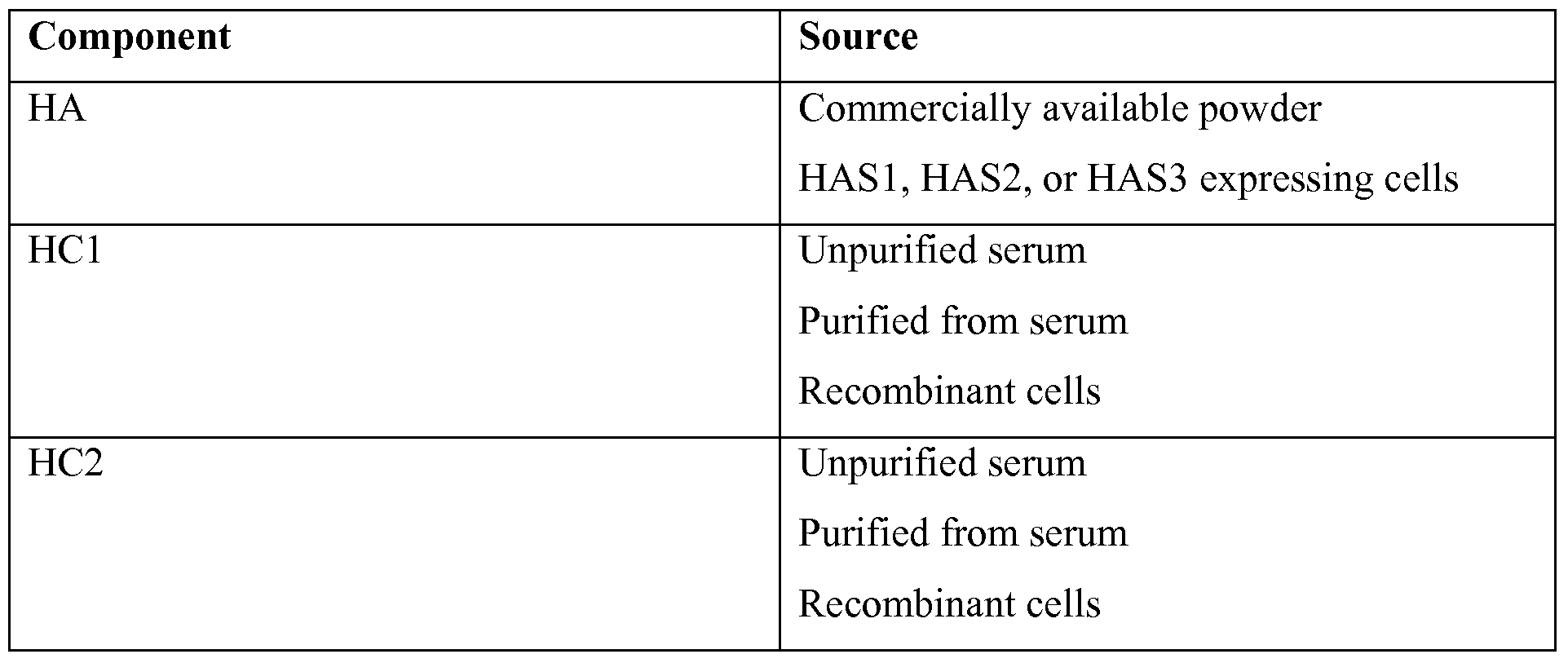

Table 1
[0027] Additionally, disclosed herein, in certain embodiments, are methods of isolating HC'HA from amniotic material. In some embodiments, the method comprises (a) processing the amniotic material such that it is suitable for extraction of an HC»HA complex; and (b) extracting HC»HA complex by a method selected from: chromatography, gel filtration, centrifugation, or differential solubility, ethanol precipitation, or combinations thereof. In some embodiments, the processing comprises homogenizing the amniotic material. In some embodiments, the processing occurs at below ambient temperature. The manufactured HC»HA complex is at least 25% purified from other components of the isolation process; at least 50% purified from other components of the isolation process; at least 75% purified from other components of the isolation process; or at least 90% purified from other components of the isolation process. In some embodiments, the amniotic material is amniotic membrane. In some embodiments, the amniotic material is chorionic membrane .
[0028] Also disclosed herein is a method of reducing or preventing inflammation, comprising administering an HC»HA complex disclosed herein to an individual in need thereof. In some embodiments, the method comprises the use of nHC»HA and/or rcHCΗA. In some embodiments, the method comprises the use of nHC'HA. In some embodiments, the method comprises the use of reconstituted HC»HA
(rcHCΗA). In some embodiments, at least one heavy chain of rcHCΗA is recombinant (e.g., HCl is from a recombinant source, HC2 is from a recombinant source, or both are from recombinant sources). [0029] Further disclosed herein, is a method of reducing or preventing scarring comprising administering an HC»HA complex disclosed herein to an individual in need thereof.
In some embodiments, the method comprises the use of nHC'HA and/or rcHCΗA. In some embodiments, the method comprises the use of nHC'HA. In some embodiments, the method comprises the use of reconstituted HC»HA (rcHCΗA). In some embodiments, at least one heavy chain of rcHCΗA is recombinant (e.g., HCl is from a recombinant source, HC2 is from a recombinant source, or both are from recombinant sources).
[0030] Disclosed herein, in certain embodiments, is a method of reducing or preventing angiogenesis comprising administering an HC»HA complex disclosed herein to an individual in need thereof. In some embodiments, the method comprises the use of nHC'HA and/or rcHCΗA. In some embodiments, the method comprises the use of nHC'HA. In some embodiments, the method comprises the use of reconstituted HC'HA (rcHCΗA). In some embodiments, at least one heavy chain of rcHCΗA is recombinant (e.g., HCl is from a recombinant source, HC2 is from a recombinant source, or both are from recombinant sources). [0031] Additionally, disclosed herein, in certain embodiments, is a method of preventing transplant rejection comprising contacting a plurality of cells (e.g., stem cells, an organ, or a tissue graft) with an HC»HA complex. In some embodiments, the method comprises the use of nHC'HA and/or rcHCΗA. In some embodiments, the method comprises the use of nHC'HA. In some embodiments, the method comprises the use of reconstituted HC»HA (rcHCΗA). In some embodiments, at least one heavy chain of rcHCΗA is recombinant (e.g., HCl is from a recombinant source, HC2 is from a recombinant source, or both are from recombinant sources).
Certain Terminology [0032] Unless defined otherwise, all technical and scientific terms used herein have the same meaning as is commonly understood by one of skill in the art to which the claimed subject matter belongs. [0033] It is to be understood that the foregoing general description and the following detailed description are exemplary and explanatory only and are not restrictive of any subject matter claimed. In this application, the use of the singular includes the plural unless specifically stated otherwise. It must be noted that, as used in the specification and the appended claims, the singular forms "a", "an" and "the" include plural referents unless the context clearly dictates otherwise. It should also be noted
that use of "or" means "and/or" unless stated otherwise. Furthermore, use of the term "including" as well as other forms, (e.g., "include", "includes", and "included" is not limiting.
[0034] The term "isolated," as used herein, refers to separating and removing a component of interest from components not of interest. Isolated substances can be in either a dry or semi-dry state, or in solution, including but not limited to an aqueous solution. The isolated component can be in a homogeneous state or the isolated component can be a part of a pharmaceutical composition that comprises additional pharmaceutically acceptable carriers and/or excipients. Purity and homogeneity may be determined using analytical chemistry techniques including, but not limited to, polyacrylamide gel electrophoresis or high performance liquid chromatography. In addition, when a component of interest is isolated and is the predominant species present in a preparation, the component is described herein as substantially purified. By way of example only, proteins are "isolated" when such proteins are free of at least some of the cellular components with which it is associated in the natural state, or that the protein has been concentrated to a level greater than the concentration of its in vivo or in vitro production.
[0035] The term "purified," as used herein, refers to a component of interest which is at least 85% pure, at least 90% pure, at least 95% pure, at least 99% or greater pure. [0036] The term "subject", "individual" or "individual" as used herein encompasses mammals and non-mammals. None of the terms are to be construed as requiring the supervision of a medical professional (e.g., a physician, nurse, orderly, hospice worker). In one embodiment of the methods and compositions provided herein, the mammal is a human. [0037] The terms "treat," "treating" or "treatment," and other grammatical equivalents mean slowing or stopping the development of a disorder, causing regression of a disorder, ameliorating a disorder, the symptoms of a disorder, preventing the development or presentation of additional symptoms, ameliorating and/or preventing the underlying cause of a symptom, or combinations thereof. The term further includes achieving a prophylactic benefit. For prophylactic benefit, an HC»HA complex or composition disclosed herein is administered to an individual at risk of developing a particular disorder, predisposed to developing a particular disorder, or to an individual reporting one or more of the physiological symptoms of a disorder.
[0038] The terms "effective amount", "therapeutically effective amount" or
"pharmaceutically effective amount" as used herein, refer to an amount of an HC'HA complex that is sufficient to treat a disorder. In some embodiments, the result is a reduction in and/or alleviation of the signs, symptoms, or causes of a disorder, or any other desired alteration of a biological system. For example, an
"effective amount" for therapeutic uses is the amount of the composition comprising an HC'HA complex as disclosed herein required to provide a clinically significant decrease in a disorder. An appropriate "effective" amount in any individual case is determined using any suitable technique, (e.g., a dose escalation study). [0039] The term "pharmaceutically acceptable" as used herein, refers to a material, (e.g., a carrier or diluent), which does not abrogate the biological activity or properties of an HC'HA complexes described herein, and is relatively nontoxic (i.e., the material is administered to an individual without causing undesirable biological effects or interacting in a deleterious manner with any of the components of the composition in which it is contained).
[0040] The term "nucleic acid" refers to deoxyribonucleotides, deoxyribonucleosides, ribonucleosides, or ribonucleotides and polymers thereof in either single- or double- stranded form. Unless specifically limited, the term encompasses nucleic acids containing known analogues of natural nucleotides which have similar binding properties as the reference nucleic acid and are metabolized in a manner similar to naturally occurring nucleotides. Unless specifically limited otherwise, the term also refers to oligonucleotide analogs including PNA (peptidonucleic acid), analogs of DNA used in antisense technology (phosphorothioates, phosphoroamidates, and the like). Unless otherwise indicated, a particular nucleic acid sequence also implicitly encompasses conservatively modified variants thereof (including but not limited to, degenerate codon substitutions) and complementary sequences as well as the sequence explicitly indicated. Specifically, degenerate codon substitutions are achieved by generating sequences in which the third position of one or more selected (or all) codons is substituted with mixed-base and/or deoxyinosine residues (Batzer et al, Nucleic Acid Res. 19:5081 (1991); Ohtsuka et al, J. Biol. Chem. 260:2605-
2608 (1985); and Cassol et al. (1992); Rossolini et al., MoI. Cell. Probes 8:91-98 (1994)).
[0041] The term "amino acid" refers to naturally occurring and non-naturally occurring amino acids, as well as amino acid analogs and amino acid mimetics that function in a manner similar to the naturally occurring amino acids. Naturally encoded amino acids are the 20 common amino acids (alanine, arginine, asparagine, aspartic acid, cysteine, glutamine, glutamic acid, glycine, histidine, isoleucine, leucine, lysine, methionine, phenylalanine, proline, serine, threonine, tryptophan, tyrosine, and valine) and pyrolysine and selenocysteine. Amino acid analogs refers to agents that have the same basic chemical structure as a naturally occurring amino acid, i.e., an α carbon that is bound to a hydrogen, a carboxyl group, an amino group, and an R group, such as, homoserine, norleucine, methionine sulfoxide, methionine methyl sulfonium. Such analogs have modified R groups (such as, norleucine) or modified peptide backbones, but retain the same basic chemical structure as a naturally occurring amino acid. [0042] Amino acids are referred to herein by either their commonly known three letter symbols or by the one-letter symbols recommended by the IUPAC-IUB
Biochemical Nomenclature Commission. Nucleotides, likewise, are referred to by their commonly accepted single-letter codes.
[0043] The terms "polypeptide", peptide" and "protein" are used interchangeably herein to refer to a polymer of amino acid residues. The terms apply to naturally occurring amino acid polymers as well as amino acid polymers in which one or more amino acid residues is a non-naturally occurring amino acid, e.g., an amino acid analog. The terms encompass amino acid chains of any length, including full length proteins, wherein the amino acid residues are linked by covalent peptide bonds. [0044] To determine the percent homology of two amino acid sequences or of two nucleic acids, the sequences can be aligned for optimal comparison purposes (e.g., gaps are introduced in the sequence of a first amino acid or nucleic acid sequence for optimal alignment with a second amino or nucleic acid sequence). The amino acid residues or nucleotides at corresponding amino acid positions or nucleotide positions can then be compared. When a position in the first sequence is occupied by the same amino acid residue or nucleotide as the corresponding position in the second sequence, then the molecules are identical at that position. The percent homology between the two sequences is a function of the number of identical positions shared by the sequences (i.e., % identity = # of identical positions/total # of positions (e.g.,
overlapping positions) x 100). In some embodiments the two sequences are the same length. To determine percent homology between two sequences, the algorithm of Karlin and
Altschul (1990) Proc. Natl. Acad. Sci. USA 87:2264-2268, modified as in Karlin and Altschul (1993) Proc. Natl. Acad. Sci. USA 90:5873-5877 is used. Such an algorithm is incorporated into the NBLAST and XBLAST programs of Altschul, et al. (1990) J. MoI. Biol. 215:403-410. BLAST nucleotide searches are performed with the NBLAST program, score=100, wordlength=12 to obtain nucleotide sequences homologous to a nucleic acid molecules described or disclose herein. BLAST protein searches are performed with the XBLAST program, score=50, wordlength=3. To obtain gapped alignments for comparison purposes, Gapped BLAST is utilized as described in Altschul et al. (1997) Nucleic Acids Res. 25:3389-3402. When utilizing BLAST and Gapped BLAST programs, the default parameters of the respective programs (e.g., XBLAST and NBLAST) are used. See the website of the National Center for Biotechnology Information for further details
(on the World Wide Web at ncbi.nlm.nih.gov). Proteins suitable for use in the methods described herein also includes proteins having between 1 to 15 amino acid changes, e.g., 1, 2, 3, 4, 5, 6, 7, 8, 9, 10, 11, 12, 13, 14, or 15 amino acid substitutions, deletions, or additions, compared to the amino acid sequence of any protein described herein. In other embodiments, the altered amino acid sequence is at least 75% identical, e.g., 77%, 80%, 82%, 85%, 88%, 90%, 92%, 95%, 97%, 98%, 99%, or 100% identical to the amino acid sequence of any protein inhibitor described herein. Such sequence-variant proteins are suitable for the methods described herein as long as the altered amino acid sequence retains sufficient biological activity to be functional in the compositions and methods described herein. Where amino acid substitutions are made, the substitutions should be conservative amino acid substitutions. Among the common amino acids, for example, a "conservative amino acid substitution" is illustrated by a substitution among amino acids within each of the following groups: (1) glycine, alanine, valine, leucine, and isoleucine, (2) phenylalanine, tyrosine, and tryptophan, (3) serine and threonine, (4) aspartate and glutamate, (5) glutamine and asparagine, and (6) lysine, arginine and histidine. The BLOSUM62 table is an amino acid substitution matrix derived from about 2,000 local multiple alignments of protein sequence segments,
representing highly conserved regions of more than 500 groups of related proteins (Henikoff et al (1992), Proc. Natl Acad. Sci. USA, 89: 10915-10919). Accordingly, the BLOSUM62 substitution frequencies are used to define conservative amino acid substitutions that, in some embodiments, are introduced into the amino acid sequences described or disclosed herein. Although it is possible to design amino acid substitutions based solely upon chemical properties (as discussed above), the language "conservative amino acid substitution" preferably refers to a substitution represented by a BLOSUM62 value of greater than -1. For example, an amino acid substitution is conservative if the substitution is characterized by a BLOSUM62 value of 0, 1, 2, or 3. According to this system, preferred conservative amino acid substitutions are characterized by a BLOSUM62 value of at least 1 (e.g., 1, 2 or 3), while more preferred conservative amino acid substitutions are characterized by a BLOSUM62 value of at least 2 (e.g., 2 or 3). [0046] As used herein, "the TSG-6 like protein" means a biological material obtained from amniotic membrane that presents a 50 kDa band in a Western blot of water soluble and water insoluble amniotic membrane extracts using anti-TSG-6 antibodies. See FIG. 2. In certain instances, TSG-6 like protein is only found in the amniotic membrane and produced by amniotic epithelial cells or amniotic stromal mesenchymal cells. [0047] As used herein, "recombinant TSG-6" means a TSG-6 protein that is produced by recombinant methods (i.e., the TSG-6 gene from a first source (e.g., a human TSG-6 gene) is cloned into a DNA molecule from a second source (e.g., a bacterial plasmid)), [0048] As used herein, "recombinant TSG-6 like protein" means a TSG-6 like protein that is produced by recombinant methods (i.e., the TSG-6 like gene from a first source
(e.g., a human TSG-6 like gene) is cloned into a DNA molecule from a second source (e.g., a bacterial plasmid)),
[0049] As used herein, "recombinant HCl" means an HCl protein that is produced by recombinant methods (i.e., the HCl gene from a first source (e.g., a human HCl gene) is cloned into a DNA molecule from a second source (e.g., a bacterial plasmid)),
[0050] As used herein, "recombinant HC2" means an HC2 protein that is produced by recombinant methods (i.e., the HC2 gene from a first source (e.g., a human HC2
gene) is cloned into a DNA molecule from a second source (e.g., a bacterial plasmid)), [0051] As used herein, the term "bioreactor" refers to any artificial container in which mammalian cells grow. In some embodiments, a bioreactor is 1 liter, 10 liters, 100 liters, 250 liters, 500 liters, 1000 liters, 2500 liters, 5000 liters, 8000 liters, 10,000 liters, or 12,000 liters. A bioreactor is composed of any material that is suitable for holding mammalian cell cultures suspended in media (e.g., glass, plastic or metal). [0052] As used herein, the "production bioreactor" is the bioreactor in which the final
HC'HA complex disclosed herein is reconstituted.
HC HA
[0053] As used herein, "hyaluronan" (or "HA") means a substantially non-sulfated or non- sulfated glycosaminoglycan with linear repeating disaccharide units of glucuronosyl-N-acetylglucosamine. In some embodiments, HA is obtained from a commercial supplier (e.g., Sigma Aldrich or Abbott Medical Optics, Irvine, CA). In some embodiments, HA is obtained from a commercial supplier as a powder. In some embodiments, HA is obtained from a cell that expresses a hyaluronan synthases (e.g., HASl, HAS2, and HAS3). In certain instances, an HA synthase lengthens hyaluronan by repeatedly adding glucuronic acid and N- acetylglucosamine to the nascent polysaccharide as it is extruded through the cell membrane into the extracellular space. [0054] In certain instances, high molecular weight (HMW) HA promotes cell quiescence and structural integrity of such tissues as the cartilage and the vitreous body (humor) in the eye, and is associated with scarless fetal wound healing. In certain instances, HMW HA inhibits the gene expression of pro-inflammatory mediators and pro- angiogenesis. [0055] In certain instances, HMW HA is degraded into smaller fragments and oligosaccharides (e.g., via hyaluronase or free radical oxidation) conditions. In certain instances, LMW HA stimulate vascular endothelial cell proliferation, migration, collagen synthesis, sprout formation, and angiogenesis in rat skin, myocardial infarction, and cryo-injured skin graft model by promoting the gene expression of pro-inflammatory and pro-angiogenic mediators.
[0056] In certain instances, HA forms a covalent complex with the heavy chains (HC) of inter-α-inhibitor (IaI) by covalently binding to the heavy chains (hereinafter, "HC -HA"). (See FIG. 1). In certain instances, IaI consists of two heavy chains (HCl and HC2), both of which are linked through ester bonds to a chondroitin sulfate chain that is attached to the light chain (i.e., Bikunin).
[0057] In certain instances, the TSG-6 or TSG-6 like protein facilitates the transfer of, catalyzes the transfer of, and/or transfers the HCl and HC2 of IaI to HA. In certain instances, the expression of TSG-6 is induced by inflammatory mediators such as TNF-α and interleukin-1. In certain instances, the expression of TSG-6 like protein is independent of inflammatory mediators such as TNF-α.
Methods of Treatment A. Scarring
[0058] Described herein, in certain embodiments, is a method of preventing, reducing, or reversing scarring in a subject in need thereof, comprising administering to the subject a composition comprising an HC»HA complex (e.g., nHC'HA and/or rcHCΗA) disclosed herein.
[0059] As used herein, "scarring" refers to the formation of a scar. In one aspect, the scar is a hypertrophic scar, or keloid scar, or a scar resulting from acne. As used herein, a "scar" is an area of fibrous tissue that results from the overproduction of collagen. In certain instances, wound healing comprises the migration of fibroblasts to the site of injury. In certain instances, fibroblasts deposit collagen. In certain instances, fibroblasts deposit excess collagen at the wound site, resulting in a scar. [0060] In certain instances, an HC»HA complex disclosed herein (e.g., nHC'HA and/or rcHCΗA) prevents or inhibits TGF-β signaling. In certain instances, TGF-β regulates the extracellular matrix by stimulating fibroplasia and collagen deposition and inhibiting extracellular matrix degradation (by up-regulating the synthesis of protease inhibitors). In certain instances, preventing or inhibiting the expression of TGF- β results in the prevention of or a reduction in intensity of a scar. In some embodiments, administering an HC»HA complex disclosed herein (e.g., nHC'HA and/or rcHCΗA) prevents or reduces scarring.
[0061] In some embodiments, an HC»HA complex disclosed herein (e.g., nHC'HA and/or rcHCΗA) inhibits or prevents the ability of fibroblasts to differentiate into
myofibroblasts. In some embodiments, an HC»HA complex disclosed herein (e.g., nHC'HA and/or rcHCΗA) reverts differentiated myofibroblasts to fibroblasts. [0062] In some embodiments, a method disclosed herein is used to prevent, reduce or reverse the formation of a scar. In some embodiments, a method disclosed herein comprises administering an HC»HA complex disclosed herein (e.g., nHC'HA and/or rcHCΗA) to an individual with a disorder that results in scarring (e.g., dermatitis). In some embodiments, a method disclosed herein comprises administering an HC'HA complex disclosed herein (e.g., nHC'HA and/or rcHCΗA) to an individual in need thereof before or after trauma. In some embodiments, a method disclosed herein comprises administering an HC»HA complex disclosed herein (e.g., nHC'HA and/or rcHCΗA) to an individual in need thereof before or after surgery. [0063] In some embodiments, a method disclosed herein is used to prevent or reduce the formation of a scar on an eye or on the surrounding tissue. In some embodiments, a method disclosed herein comprises administering an HC»HA complex disclosed herein (e.g., nHC'HA and/or rcHCΗA) to an individual with a disorder that results in scarring of the eye or surrounding tissue (e.g., retinopathy of prematurity). In some embodiments, a method disclosed herein comprises administering an HC»HA complex disclosed herein (e.g., nHC'HA and/or rcHCΗA) to an individual in need thereof before or after trauma to an eye or the surrounding tissue. In some embodiments, a method disclosed herein comprises administering an HC»HA complex disclosed herein (e.g., nHC'HA and/or rcHCΗA) to an individual in need thereof before or after surgery to an eye or the surrounding tissue. B. Inflammation [0064] Described herein, in certain embodiments, is a method of preventing or reducing inflammation in a subject in need thereof, comprising administering to the subject a composition comprising an HC»HA complex (e.g., nHC'HA and/or rcHCΗA) disclosed herein. As used herein, "inflammation" means physiological responses resulting from the migration of plasma and/or leukocytes (e.g., lymphocytes, macrophages, granulocytes, and neutrophils) to the site of an infection or trauma (e.g., blunt force trauma, penetrating trauma, or surgery).
[0065] In certain instances, leukocytes secrete cytokines following contact with an antigen. As used herein, "cytokines" are signaling proteins or glycoproteins. In certain instances, a cytokine binds to a cell-surface receptor. In certain instances, cytokines
induces the chemotaxis of leukocytes to the site of an infection. In certain instances, cell surface receptors on a leukocyte detect chemical gradients of a cytokine. In certain instances, a leukocyte follows the gradient to the site of infection. In certain instances, the binding of a cytokine to a cell-surface receptor results in the upregulation or downregulation of certain genes and their transcription factors. In certain instances, changes in gene expression results in the production of cytokines, an increase in the production of cytokines, or an increase in the presentation of cell surface receptors. [0066] By way of non- limiting example, cytokines include interleukins IL-I, IL-6, IL-8, MCP-I (also known as CCL2), and TNF-α. Interleukin 1 is present in the body in two isoforms: IL- lα and IL- lβ. In certain instances, the presence of IL-I increases the expression of adhesion factors on endothelial cells. This, in turn, enables the transmigration of leukocytes to the site of infection. In certain instances, IL-8 induces the chemotaxis of leukocytes. In certain instances, TNF-α induces the chemotaxis of leukocytes. In certain instances, MCP-I recruits leukocytes to sites of tissue injury and infection.
[0067] In some embodiments, an HC»HA complex disclosed herein (e.g., nHC'HA and/or rcHCΗA) suppresses the production of and/or activity of cytokines. In certain instances, a decrease in the concentration cytokines reduces or prevents inflammation by decreasing the number of leukocytes and/or the rate at which leukocytes migrate to the site of an injury.
[0068] In some embodiments, an HC»HA complex disclosed herein (e.g., nHC'HA and/or rcHCΗA) induces apoptosis of a leukocyte (e.g., a macrophage, neutrophil, or lymphocyte). In some embodiments, an HC»HA complex disclosed herein (e.g., nHCΗA and/or rcHCΗA) decreases the number of activated leukocytes or the rate at which leukocytes are activated. In certain instances, a decrease in the concentration of leukocytes reduces or prevents inflammation by decreasing the number (e.g., facilitate death of such cells via apoptosis) of cells that migrate to the site of an injury. [0069] In some embodiments, the inflammatory disorder is an autoimmune disorder, an allergy, a leukocyte defect, graft versus host disease, tissue transplant rejection, or combinations thereof. In some embodiments, the inflammatory disorder is a bacterial infection, a protozoal infection, a protozoal infection, a viral infection, a
fungal infection, or combinations thereof. In some embodiments, the inflammatory disorder is a T-cell mediated inflammatory disorder. In some embodiments, the inflammatory disorder is a macrophage mediated inflammatory disorder. In some embodiments, the inflammatory disorder is a Th- 17 mediated immune disorder. In some embodiments, the inflammatory disorder is Acute disseminated encephalomyelitis; Addison's disease; Ankylosing spondylitis; Antiphospholipid antibody syndrome; Autoimmune hemolytic anemia; Autoimmune hepatitis; Autoimmune inner ear disease; Bullous pemphigoid; Chagas disease; Chronic obstructive pulmonary disease; Coeliac disease; Dermatomyositis; Diabetes mellitus type 1; Diabetes mellitus type 2; Endometriosis; Goodpasture's syndrome; Graves' disease; Guillain-Barre syndrome; Hashimoto's disease; Idiopathic thrombocytopenic purpura; Interstitial cystitis; Systemic lupus erythematosus (SLE); Metabolic syndrome, Multiple sclerosis; Myasthenia gravis; Myocarditis, Narcolepsy; Obesity; Pemphigus Vulgaris; Pernicious anaemia; Polymyositis; Primary biliary cirrhosis; Rheumatoid arthritis; Schizophrenia; Scleroderma;
Sjogren's syndrome; Vasculitis; Vitiligo; Wegener's granulomatosis; Allergic rhinitis; Prostate cancer; Non-small cell lung carcinoma; Ovarian cancer; Breast cancer; Melanoma; Gastric cancer; Colorectal cancer; Brain cancer; Metastatic bone disorder; Pancreatic cancer; a Lymphoma; Nasal polyps; Gastrointestinal cancer; Ulcerative colitis; Crohn's disorder; Collagenous colitis; Lymphocytic colitis;
Ischaemic colitis; Diversion colitis; Behcet's syndrome; Infective colitis; Indeterminate colitis; Inflammatory liver disorder, Endotoxin shock, Septic shock; Rheumatoid spondylitis, Ankylosing spondylitis, Gouty arthritis, Polymyalgia rheumatica, Alzheimer's disorder, Parkinson's disorder, Epilepsy, AIDS dementia, Asthma, Adult respiratory distress syndrome, Bronchitis, Cystic fibrosis, Acute leukocyte-mediated lung injury, Distal proctitis, Wegener's granulomatosis, Fibromyalgia, Bronchitis, Cystic fibrosis, Uveitis, Conjunctivitis, Psoriasis, Eczema, Dermatitis, Smooth muscle proliferation disorders, Meningitis, Shingles, Encephalitis, Nephritis, Tuberculosis, Retinitis, Atopic dermatitis, Pancreatitis, Periodontal gingivitis, Coagulative Necrosis, Liquefactive Necrosis, Fibrinoid
Necrosis, Neointimal hyperplasia, or combinations thereof. In some embodiments, the inflammatory disorder is an inflammatory disorder of an eye or the surrounding tissue. In some embodiments, the inflammatory disorder is
conjunctivitis. In certain instances, conjunctivitis results from exposure to an allergen. In certain instances, conjunctivitis results from a bacterial infection. In some embodiments, the inflammatory disorder is keratitis. As used herein, "keratitis" is a disorder characterized by inflammation of the cornea. In some embodiments, the inflammatory disorder is keratoconjunctivitis (i.e., a combination of conjunctivitis and keratitis (i.e., corneal inflammation)). In some embodiments, the inflammatory disorder is blepharitis. As used herein, "blepharitis" is an ophthalmic disorder characterized by inflammation of the eyelid margins. In some embodiments, the inflammatory disorder is blepharoconjunctivitis (i.e., a combination of conjunctivitis and blepharitis (i.e., inflammation of an eyelid)). In some embodiments, the inflammatory disorder is scleritis. As used herein, "scleritis" is a disorder characterized by inflammation of the sclera. In some embodiments, the inflammatory disorder is episcleritis. As used herein, "episcleritis" is an inflammatory disorder of the episclera characterized by hyperaemia, and chemosis. In some embodiments, the inflammatory disorder is uveitis. As used herein,
"uveitis" is an inflammatory disorder of the uvea. In some embodiments, the disorder is retinitis. As used herein, "retinitis" is an inflammatory disorder of a retina. In some embodiments, the disorder is choroiditis. As used herein, "choroiditis" is an inflammatory disorder of the uvea, ciliary body and the choroid. C. Angiogenesis
[0071] Disclosed herein, in certain embodiments, is a method of preventing or reducing angiogenesis in a subject in need thereof, comprising administering to the subject a composition comprising an HC»HA complex (e.g., nHC'HA and/or rcHCΗA) disclosed herein. As used herein, "angiogenesis" means the formation of new blood vessels. In certain instances, angiogenesis facilitates the growth and metastasis of a tumor. Further, in certain instances, abnormal angiogenesis is the basis of wet age- related macular degeneration (w ARMD) and diabetic proliferative retinopathy. In certain instances, an HC»HA complex (e.g., nHC'HA and/or rcHCΗA) disclosed herein prevents or reduces angiogenesis. [0072] In certain instances, the binding of a ligand to the VEGF receptor-2 (VEGFR-2) starts a tyrosine kinase signaling cascade that stimulates the production of factors that variously stimulate vessel permeability (eNOS, producting NO), proliferation/survival (bFGF), migration (ICAMs/VCAMs/MMPs) and finally
differentiation into mature blood vessels. In certain instances, following binding of VEGFR-2 to its ligand, endothelial cells form tube structures resembling capillaries. [0073] As used herein, "wet Age Related Macular Degeneration", "wARMD", or "wet ARMD" means a disorder of an eye characterized by the proliferation of blood vessels from the choroid. In certain instances, wet ARMD causes vision loss due blood and protein leakage below the macula. In certain instances, bleeding, leaking, and scarring from these blood vessels cause irreversible damage to the photoreceptors and rapid vision loss if left untreated. [0074] As used herein, "diabetic proliferative retinopathy" means a disorder of an eye characterized by incompetence of the vascular walls. In certain instances, the lack of oxygen in the retina results in angiogenesis along the retina and in the vitreous humour. In certain instances, the new blood vessels bleed, cloud vision, and destroy the retina. [0075] In certain instances, the proliferation of capillaries supplies a tumor with nutrients, allowing the tumor to expand. In certain instances, the proliferation of capillaries enables the rapid removal of cellular waste enabling tumor growth. In certain instances, angiogenesis facilitates metastasis. In certain instances, the proliferation of capillaries increases the chances that a cancerous cell will be able to enter a blood vessel and thus establish a new tumor at a new site. [0076] Exemplary cancer types that can be treated using an HC»HA complex described herein (e.g., nHC'HA and/or rcHCΗA) include but are not limited to Acute Lymphoblastic Leukemia, Acute Myeloid Leukemia, Adrenocortical Carcinoma, AIDS-Related Cancers, AIDS-Related Lymphoma, Anal Cancer, Astrocytoma, Basal Cell Carcinoma, Bile Duct Cancer, Bladder Cancer, Bladder Cancer, Bone Cancer, Brain Stem Glioma, Brain Tumor, Breast Cancer , Bronchial Adenomas,
Burkitt's Lymphoma, Carcinoid Tumor, Carcinoma, Central Nervous System Lymphoma, Cerebellar Astrocytoma, Cervical Cancer, Chronic Lymphocytic Leukemia, Chronic Myelogenous Leukemia, Chronic Myeloproliferative Disorders, Colon Cancer, Colorectal Cancer, Cutaneous T-CeIl Lymphoma, Endometrial Cancer, Ependymoma, Esophageal Cancer, Extragonadal Germ Cell Tumor, Eye
Cancer, Intraocular Melanoma, Eye Cancer, Retinoblastoma, Gallbladder Cancer, Gastrointestinal Carcinoid Tumor, Gastrointestinal Stromal Tumor (GIST), Germ Cell Tumor (Extracranial), Germ Cell Tumor (Extragonadal), Germ Cell Tumor
(Ovarian), Gestational Trophoblastic Tumor, Glioma, Hairy Cell Leukemia, Head and Neck Cancer, Hepatocellular (Liver) Cancer, Hodgkin's Lymphoma, Hypopharyngeal Cancer, Hypothalamic and Visual Pathway Glioma, Intraocular Melanoma, Islet Cell Carcinoma (Endocrine Pancreas), Kaposi's Sarcoma, Kidney (Renal Cell) Cancer, Laryngeal Cancer, Leukemia (Acute Lymphoblastic),
Leukemia (Acute Myeloid), Leukemia (Chronic Lymphocytic), Leukemia (Chronic Myelogenous), Lip and Oral Cavity Cancer, Liver Cancer, Lung Cancer (Non-Small Cell), Lung Cancer (Small Cell), Lymphoma, (Cutaneous T-CeIl), Lymphoma (Non- Hodgkin's), Malignant Fibrous Histiocytoma of Bone/Osteosarcoma, Medulloblastoma, Melanoma, Merkel Cell Carcinoma, Mesothelioma, Metastatic
Squamous Neck Cancer with Occult Primary, Multiple Endocrine Neoplasia Syndrome, Multiple Myeloma/Plasma Cell Neoplasm, Mycosis Fungoides, Myelodysplastic Syndromes, Myelodysplastic/Myeloproliferative Diseases, Myelogenous Leukemia, Myeloid Leukemia, Myeloproliferative Disorders, Nasal Cavity and Paranasal Sinus Cancer, Nasopharyngeal Cancer, Neuroblastoma, Oral
Cancer, Oropharyngeal Cancer, Osteosarcoma/Malignant Fibrous Histiocytoma of Bone, Ovarian Cancer, Ovarian Epithelial Cancer, Ovarian Germ Cell Tumor, Ovarian Low Malignant Potential Tumor, Pancreatic Cancer, Parathyroid Cancer, Penile Cancer, Pheochromocytoma, Pineoblastoma and Supratentorial Primitive Neuroectodermal Tumors, Pituitary Tumor, Plasma Cell Neoplasm/Multiple
Myeloma, Pleuropulmonary Blastoma, Prostate Cancer, Rectal Cancer, Retinoblastoma, Rhabdomyosarcoma, Salivary Gland Cancer, Sarcoma (Kaposi's), Sarcoma (uterine), Sezary Syndrome, Skin Cancer (non-Melanoma), Skin Cancer (Melanoma), Skin Carcinoma (Merkel Cell), Small Intestine Cancer, Soft Tissue Sarcoma, Squamous Cell Carcinoma, Stomach (Gastric) Cancer, T-CeIl Lymphoma,
Testicular Cancer, Thymoma, Thyroid Cancer, Trophoblastic Tumor, Gestational, Urethral Cancer, Uterine Cancer, Endometrial, Uterine Sarcoma, Vaginal Cancer, Visual Pathway and Hypothalamic Glioma, Vulvar Cancer, Waldenstrom's Macroglobulinemia, Wilms' Tumor, and the like.
Methods of Production
[0077] Methods involving biological techniques are described herein. Such techniques are described in treatises such as Molecular Cloning: A Laboratory Manual, 3rd ed., vol.
1-3, ed. Sambrook et al, Cold Spring Harbor Laboratory Press, Cold Spring Harbor, N. Y., 2001; and Current Protocols in Molecular Biology, ed. Ausubel et al., Greene Publishing and Wiley-Interscience, New York, 2003 (with periodic updates). Various conventional techniques for culturing animal cells are described in Culture of Animal Cells: A Manual of Basic Technique, 4th ed., R. Ian Freshney, Wiley-Liss,
Hoboken, NJ, 2000, and Animal Cell Culture Techniques (Springer Lab Manual), M. Clynos, Springer -Verlag, New York, NY, 1998. Methods involving protein analysis and purification are also known in the art and are described in Protein Analysis and Purification: Benchtop Techniques, 2nd ed., Ian M. Rosenberg, Birkhauser, New York, NY, 2004.
[0078] Disclosed herein, in certain embodiments, is a method of isolating HC»HA from amniotic material (e.g., amniotic membrane or chorionic membrane) (nHC'HA). Preferably, the amniotic material is human amniotic material. In some embodiments, the amniotic material is human amniotic membrane. In some embodiments, the amniotic material is chorionic membrane.
[0079] Disclosed herein, in certain embodiments, is a method of reconstituting an HC HA complex (rcHCΗA). In some embodiments, the method comprises contacting (a) hyaluronan (HA); (b) heavy chains of led (e.g., HCl and HC2); and (c) TSG-6, recombinant TSG-6, TSG-6 like protein, recombinant TSG-6 like protein, or combinations thereof.
[0080] Disclosed herein, in certain embodiments, is a method of manufacturing an HC HA complex. In some embodiments, the method comprises contacting (a) hyaluronan (HA); (b) heavy chains of IaI (e.g., HCl and HC2); and (c) TSG-6, recombinant TSG-6, TSG-6 like protein, recombinant TSG-6 like protein, or combinations thereof; wherein one or more components is generated by a plurality of live cells.
A. Isolation and Purification ofnHC'HΛ
[0081] Disclosed herein, in certain embodiments, is a method of isolating HC»HA from amniotic material (e.g., amniotic membrane or chorionic membrane) (nHC'HA). Preferably, the amniotic material is human amniotic material. In some embodiments, the amniotic material is human amniotic membrane. In some embodiments, the amniotic material is human chorionic membrane. [0082] In some embodiments, nHC'HA isolated from chorionic membrane. In some embodiments, nHC'HA complex purified from chorionic membrane contains a
higher protein:HA ratio than nHCΗA isolated from AM (see Table 3 in Example 12). In some embodiments, nHCΗA isolated from chorionic membrane exerts stronger anti-inflammatory and anti-angiogenic activity than nHCΗA isolated from amniotic membrane. In some embodiments, nHCΗA isolated from chorionic membrane is 10-fold more effective as an anti-inflammatory and anti-angiogenic activity than nHCΗA isolated from amniotic membrane. In some embodiments, nHC'HA isolated from chorionic membrane is 15 -fold more effective as an antiinflammatory and anti-angiogenic activity than nHCΗA isolated from amniotic membrane. In some embodiments, nHCΗA isolated from chorionic membrane is 20-fold more effective as an anti-inflammatory and anti-angiogenic activity than nHC'HA isolated from amniotic membrane. In some embodiments, nHCΗA isolated from chorionic membrane is 25-fold more effective as an anti-inflammatory and anti-angiogenic activity than nHCΗA isolated from amniotic membrane. For experimental data showing increased efficacy see Figures 12 and 13 and Example 13.
[0083] In some embodiments, amniotic material (e.g. powdered amniotic membrane or powdered chorionic membrane) is processed such that it is suitable for nHC'HA complex extraction. In some embodiments, nHC'HA is purified from the processed amniotic material by any suitable method. In some embodiments, the nHC'HA complex is purified by chromatography (e.g., ion exchange, affinity, size exclusion, and hydroxyapatite chromatography), gel filtration, centrifugation (e.g., gradient centrifugation), or differential solubility, ethanol precipitation or by any other available technique for the purification of proteins (See, e.g., Scopes, Protein Purification Principles and Practice 2nd Edition, Springer- Verlag, New York, 1987; Higgins, S. J. and Hames, B. D. (eds.), Protein Expression: A Practical Approach,
Oxford Univ Press, 1999; and Deutscher, M. P., Simon, M. L, Abelson, J. N. (eds.), Guide to Protein Purification: Methods in Enzymology (Methods in Enzymology Series, VoI 182), Academic Press, 1997, all incorporated herein by reference). [0084] In some embodiments, the nHC'HA complex is purified by any suitable method or combination of methods. The embodiments described below are not intended to be exclusive, only exemplary. [0085] In some embodiments, the nHC'HA complex is purified by immunoaffmity chromatography. In some embodiments, anti HCl antibodies, anti-HC2 antibodies,
or both are generated and affixed to a stationary support. In some embodiments, the unpurified nHC'HA complex (i.e., the mobile phase) is passed over the support. In certain instances, the nHC'HA complex binds to the antibodies (e.g., via interaction of (a) an HCl antibody and HCl, (b) an HC2 antibody and HC2, or (c) both). In some embodiments the support is washed (e.g., with PBS) to remove any unbound or loosely bound molecules. In some embodiments, the support is then washed with a solution that enables elution of the nHC'HA complex from the support (e.g., 1% SDS, 6M guanidine-HCl, or 8M urea). [0086] In some embodiments, the nHC'HA complex is purified by affinity chromatography. In some embodiments, HABP is generated and affixed to a stationary support. In some embodiments, the unpurified nHC'HA complex (i.e., the mobile phase) is passed over the support. In certain instances, the nHC'HA complex binds to the HABP. In some embodiments the support is washed (e.g., with PBS) to remove any unbound or loosely bound molecules. In some embodiments, the support is then washed with a solution that enables elution of the nHC'HA complex from the support.
[0087] In some embodiments, the nHC'HA complex is purified by a combination of HABP affinity chromotography, and immunoaffinity chromatography using anti HCl antibodies, anti-HC2 antibodies, or both. [0088] By way of non- limiting example: Amniotic Membrane (AM) powder is mixed with the cold PBS buffer without protease inhibitors at 1 : 1 (g/ml). The mixture is centrifuged at 48,000 x g 4 0C for 30 min. The supernatant (Extract P) is dissolved in CsCl/4M guanidine HCl mixture at the initial density of 1.35 g/ml, and centrifuged at 125,000 x g for 48 h at 15 0C. The supernatant is extracted and dialyzed against distilled water to remove CsCl and guanidine HCl. The dialysate is mixed with 3 volumes of 95% (v/v) ethanol containing 1.3% (w/v) potassium acetate at 0 0C for 1 h. After centrifugation at 15,000 x g, the pellet is washed with 70% (v/v) ethanol and centrifugation. The pellet is briefly dried by air, stored at -80 0C. [0089] By way of non- limiting example: Amniotic Membrane (AM) powder is mixed with the cold PBS buffer without protease inhibitors at 1 : 1 (g/ml). The mixture is centrifuged at 48,000 x g 4 0C for 30 min. The supernatant (Extract P) is dissolved in CsCl/4M guanidine HCl mixture at the initial density of 1.35 g/ml, and centrifuged at 125,000 x g for 48 h at 15 0C. A total of 15 fractions (0.8 ml/fraction)
are collected from the top to the bottom of each tube. Besides the density, the concentration of proteins and HA in each fraction is measured by BCA Protein Assay and HA Quantitative Test Kit, respectively. Fractions #8-15, which contain HA but no detectable proteins, are pooled, adjusted with CsCl/4M guanidine HCl at the initial density of 1.40 g/ml, centrifuged, and fractionated in the same manner as described above. Fractions #3-15, which contained HA but no detectable proteins, are pooled and dialyzed against distilled water to remove CsCl and guanidine HCl. The dialysate is mixed with 3 volumes of 95% (v/v) ethanol containing 1.3% (w/v) potassium acetate at 0 0C for 1 h. After centrifugation at 15,000 x g, the pellet is washed with 70% (v/v) ethanol and centrifugation. The pellet is briefly dried by air, stored at -80 0C.
[0090] By way of non- limiting example: Chorionic Membrane (CH) powder is mixed with the cold PBS buffer without protease inhibitors at 1 : 1 (g/ml). The mixture is centrifuged at 48,000 x g 4 0C for 30 min. The supernatant (Extract P) is dissolved in CsCl/4M guanidine HCl mixture at the initial density of 1.35 g/ml, and centrifuged at 125,000 x g for 48 h at 15 0C. The supernatant is extracted and dialyzed against distilled water to remove CsCl and guanidine HCl. The dialysate is mixed with 3 volumes of 95% (v/v) ethanol containing 1.3% (w/v) potassium acetate at 0 0C for 1 h. After centrifugation at 15,000 x g, the pellet is washed with 70% (v/v) ethanol and centrifugation. The pellet is briefly dried by air, stored at -80 0C.
B. Bioreactor Production of an rcHC*HA Complex without Use of Live Cells
[0091] Disclosed herein, in certain embodiments, is a method of reconstituting an rcHCΗA complex. In some embodiments, the method comprises contacting (a) hyaluronan (HA); (b) heavy chains of IaI (e.g., HCl and HC2); and (c) TSG-6, recombinant
TSG-6, TSG-6 like protein, recombinant TSG-6 like protein, or combinations thereof.
[0092] In some embodiments, heavy chains of IaI are isolated from serum. In some embodiments, heavy chains of IaI are not isolated from serum. In some embodiments, heavy chains of IaI are prepared by recombinant technology.
[0093] In some embodiments, TSG6 or TSG-6 like protein is isolated from a cell or a plurality of cells (e.g., a tissue extract). In some embodiments, TSG6 or TSG-6 like protein is not isolated from a cell or a plurality of cells (e.g., a tissue extract). In
some embodiments, TSG6 or TSG-6 like protein is prepared by recombinant technology. [0094] In some embodiments, HA (e.g., HMW HA) is contacted with HCl and HC2 of IaI
(e.g., from unpurifϊed serum, purified from serum, or recombinant peptides); and TSG-6. In some embodiments, HA (e.g., HMW HA) is contacted with HCl and
HC2 of IaI (e.g., from unpurified serum, purified from serum, or recombinant peptides); and recombinant TSG-6 (e.g., TSG-6Q). In some embodiments, HA (e.g., HMW HA) is contacted with HCl and HC2 of IaI (e.g., from unpurified serum, purified from serum, or recombinant peptides); and TSG-6 like protein. In some embodiments, HA (e.g., HMW HA) is contacted with (a) heavy chains of IaI (e.g.,
HCl and HC2; from unpurified serum, purified from serum, or recombinant peptides); and (b) TSG-6, recombinant TSG-6, TSG-6 like protein, recombinant TSG-6 like protein, or combinations thereof . In some embodiments, the contacting occurs for at least 6 hours, at least 12 hours, at least 24 hours, at least 36 hours, at least 48 hours, at least 60 hours, or at least 72 hours.
[0095] In some embodiments, the method further comprises HA binding protein (HABP). In some embodiments, HABP is affixed to a stationary support (e.g., by cross- linking). In some embodiments, the stationary support comprising HABP is contacted with HA (e.g., HMW HA), a heavy chain of IaI and a rcHCΗA catalytic protein selected from TSG-6, recombinant TSG-6, TSG-6 like protein, recombinant
TSG-6 like protein, or combinations thereof. In some embodiments, the contacting occurs for at least 6 hours, at least 12 hours, at least 24 hours, at least 36 hours, at least 48 hours, at least 60 hours, or at least 72 hours. In some embodiments, the stationary support is washed to remove any unbound components. [0096] In some embodiments, the rcHCΗA complex is purified by any suitable method or combination of methods. The embodiments described below are not intended to be exclusive, only exemplary.
[0097] In some embodiments, the rcHCΗA complex is purified by chromatography (e.g., ion exchange, affinity, size exclusion, and hydroxyapatite chromatography), gel filtration, centrifugation (e.g., gradient centrifugation), or differential solubility, ethanol precipitation or by any other available technique for the purification of proteins (See, e.g., Scopes, Protein Purification Principles and Practice 2nd Edition, Springer- Verlag, New York, 1987; Higgins, S. J. and Hames, B. D. (eds.), Protein
Expression: A Practical Approach, Oxford Univ Press, 1999; and Deutscher, M. P., Simon, M. L, Abelson, J. N. (eds.), Guide to Protein Purification: Methods in Enzymology (Methods in Enzymology Series, VoI 182), Academic Press, 1997, all incorporated herein by reference). [0098] In some embodiments, the rcHCΗA complex is purified by immunoaffinity chromatography. In some embodiments, anti HCl antibodies, anti-HC2 antibodies, or both are generated and affixed to a stationary support. In some embodiments, the unpurified rcHCΗA complex (i.e., the mobile phase) is passed over the support. In certain instances, the rcHCΗA complex binds to the antibodies (e.g., via interaction of (a) an HC 1 antibody and HC 1 , (b) an HC2 antibody and HC2, or (c) both). In some embodiments the support is washed (e.g., with PBS) to remove any unbound or loosely bound molecules. In some embodiments, the support is then washed with a solution that enables elution of the rcHCΗA complex from the support (e.g., 1% SDS, 6M guanidine-HCl, or 8M urea). [0099] In some embodiments, the rcHCΗA complex is purified by affinity chromatography. In some embodiments, HABP is generated and affixed to a stationary support. In some embodiments, the unpurified rcHCΗA complex (i.e., the mobile phase) is passed over the support. In certain instances, the rcHCΗA complex binds to the HABP. In some embodiments the support is washed (e.g., with PBS) to remove any unbound or loosely bound molecules. In some embodiments, the support is then washed with a solution that enables elution of the rcHCΗA complex from the support.
[00100] In some embodiments, the rcHCΗA complex is purified by a combination of HABP affinity chromotography, and immunoaffinity chromatography using anti HCl antibodies, anti-HC2 antibodies, or both.
C. Bioreactor Production of an rcHC'HΛ Complex via Use of Live Cells [00101] Disclosed herein, in certain embodiments, is a method of reconstituting an rcHCΗA complex via use of live cells. In some embodiments, the method comprises contacting (a) hyaluronan (HA); (b) a heavy chain of IaI (e.g., HCl and HC2); and (c) TSG-6, TSG-6 like protein, or combinations thereof; wherein one or more components is generated or expressed by a plurality of cells in a bioreactor. [00102] In some embodiments, the method comprises HA that is obtained from a commercial supplier. In some embodiments, the method comprises HA that is
generated by a plurality of cells in a bioreactor. In some embodiments, the plurality of cells constitutively generate HA. In some embodiments, the plurality of cells constitutively expresses HASl, HAS2, HAS3, or a combination thereof. In some embodiments, the plurality of cells are contacted with at least one factor known to upregulate HASl, HAS2, HAS3, or a combination thereof.
[00103] In some embodiments, the method comprises a heavy chain of IaI is isolated from serum. In some embodiments, the method comprises a heavy chain of IaI that is not isolated from serum. In some embodiments, the method comprises a heavy chain of IaI that is expressed by a plurality of cells in a bioreactor. In some embodiments, the method comprises HCl that is expressed by a plurality of cells in a bioreactor. In some embodiments, the method comprises HC2 that is expressed by a plurality of cells in a bioreactor. In some embodiments, the plurality of cells constitutively expresses a heavy chain of IaI. In some embodiments, the plurality of cells constitutively expresses constitutively express HCl . In some embodiments, the plurality of cells constitutively expresses HC2.
[00104] In some embodiments, the method comprises TSG-6 or TSG-6 like protein that is isolated from a cell or a plurality of cells (e.g., a tissue extract). In some embodiments, the method comprises TSG-6 or TSG-6 like protein that is not isolated from a cell or a plurality of cells (e.g., a tissue extract). In some embodiments, the method comprises TSG-6 or TSG-6 like protein that is expressed by a plurality of cells in a bioreactor. In some embodiments, the plurality of cells constitutively generates TSG-6 or TSG-6 like protein. In some embodiments, the plurality of cells constitutively expresses TSG-6 or TSG-6 like protein. In some embodiments, the plurality of cells is contacted with at least one factor known to upregulate TSG-6 or TSG-6 like protein.
Constitutive Expression
[00105] In some embodiments, a cell that constitutively (a) expresses a heavy chain of IaI (e.g., HCl and HC2); or (b) express TSG-6, TSG-6 like protein is generated by any suitable method. In some embodiments, a cell that constitutively (a) expresses a heavy chain of IaI (e.g., HCl and HC2); or (b) express TSG-6, TSG-6 like protein is generated by introducing point mutations into the gene encoding (a) a heavy chain of IaI (e.g., HCl and HC2); or (b) TSG-6, TSG-6 like protein. In some
embodiments, the mutations are substitution mutations, deletion mutations, or insertion mutations. [00106] In some embodiments, a cell that constitutively generates HA is produced by any suitable method. In some embodiments, a cell that constitutively generates HA is produced by introducing point mutations into a gene encoding HASl, HAS2,
HAS3, or a combination thereof. In some embodiments, the mutations are substitution mutations, deletion mutations, or insertion mutations. In some embodiments, a cell that constitutively generates HA is produced by contacting the cell with at least one factor known to upregulate HASl, HAS2, HAS3, or a combination thereo f .
Generation of Cell Lines
[00107] In some embodiments, the plurality of cells comprises mammalian cells. In some embodiments, the plurality of cells comprises Chinese Hamster ovary-derived CHO cells; human HeLa cells; HEK293 cells; amniotic epithelial cell; amniotic stromal mesenchymal cells; or combinations thereof. In some embodiments, a gene sequence of interest is cloned into a suitable expression vector which is then inserted into a host cell. In some embodiments, the vector is pMSG, or pcDNA3.1(+). In some embodiments, the host cell is transformed with the vector by use of calcium phosphate method, DEAE-dextran method, lipofection, or electroporation. In some embodiments, a gene sequence of interest is cloned into a suitable expression vector which then inserts into the genome of the cells. In some embodiments, the vector is a retrovirus, lentivirus, an adenovirus, or a combination thereof.
[00108] In some embodiments, the plurality of cells comprises bacterial cells (e.g., E. co Ii). In some embodiments, a gene sequence of interest is cloned into a suitable expression vector which is then inserted into a host cell. In some embodiments, the host is a bacterial cell. In some embodiments, the vector is pET-3 or pGEX-1. In some embodiments, the host cell is transformed with the vector by electroporation or the Hanahan method. In some embodiments, a gene sequence of interest is cloned into a suitable expression vector which then inserts into the genome of the cells. In some embodiments, the vector is a retrovirus, lentivirus, an adenovirus, or a combination thereof. [00109] In some embodiments, the plurality of cells comprises yeast cells. In some embodiments, a gene sequence of interest is cloned into a suitable expression vectors
which is then inserted into a host cell. In some embodiments, the host cell is transformed with the vector by spheroplast fusion or lithium acetate methods. In some embodiments, a gene sequence of interest is cloned into a suitable expression vector which then inserts into the genome of the cells. In some embodiments, the vector is a retrovirus, lentivirus, an adenovirus, or a combination thereof
[00110] In some embodiments, the method further comprises confirming expression of the gene sequence of interest. In some embodiments, any suitable method is used. In some embodiments, immunohistochemistry, immunoprecipitation, flow cytometry, immunofluorescence microscopy, SDS- PAGE, Western blots, enzyme- linked immunosorbentassay (ELISA), high performance liquid chromatography
(HPLC) techniques, biological activity assays or affinity chromatography is used. Starter Cultures
[00111] In some embodiments, a plurality of cells described above is cultured by any suitable method. [00112] In some embodiments, the cells are first expanded in a starter culture (e.g., 1
10 mL culture, overnight). In some embodiments, the cells are grown in Ham's FlO (Sigma), Basal medium (BEM), Minimal Essential Medium (MEM), RPMI-1640, Supplemental Hormone Medium (SHEM), or Dulbecco's Modified Eagle's Medium (DMEM). In some embodiments, a cell culture further comprises serum (e.g., fetal calf sera, newborn calf sera, human sera, equine sera). In some embodiments, a cell culture is agitated to increase oxygenation of the medium and dispersion of nutrients to the cells.
[00113] In some embodiments, the cells are passaged several times in bioreactors of increasing volume before the cells are placed in the production bioreactor. In some embodiments, the cells are passaged to the succeeding bioreactor while still in contact with the media in which the cells were previously grown. In some embodiments, the cells are removed from the media, for example, by low-speed centrifugation before being passaged to the succeeding bioreactor. In some embodiments, the cells are washed with fresh with media before seeding the next bioreactor to remove any unwanted metabolic waste products or medium components. In some embodiments, the media is the same in each bioreactor. In some embodiments, the media varies between bioreactors.
[00114] In some embodiments, the expanded cells from one bioreactor are diluted before being added to the succeeding bioreactor. In some embodiments, the starting cell density for the production bioreactor is from about 2x 10² viable cells per mL to about 2x 10³, 2x 10⁴, 2x 10⁵, 2x 10⁶, 5x 10⁶ or 10x 106 viable cells per mL and higher.
Production Bioreactor
[00115] In some embodiments, a cell culture is maintained in the initial growth phase under conditions conducive to the survival, growth and viability of the cell culture. The necessary environmental conditions will vary depending on the cell type, the organism from which the cell was derived, and the nature and character of the expressed polypeptides, HA, and the rcHCΗA complex.
[00116] In some embodiments, the temperature of the cell culture in the initial growth phase will be selected based primarily on the range of temperatures at which the cell culture remains viable. For example, during the initial growth phase, CHO cells grow well at 37° C. In some embodiments, the temperature is from about 25° C to about 42° C. In some embodiments, the temperature is from about 35° C to 40° C. [00117] In some embodiments, the temperature of the initial growth phase is maintained at a single, constant temperature. In some embodiments, the temperature of the initial growth phase is maintained within a range of temperatures. In some embodiments, the temperature is increased or decreased during the initial growth phase. In some embodiments, the temperature is steadily increased or decreased during the initial growth phase. In some embodiments, the temperature is increased or decreased by discrete amounts at various times during the initial growth phase. [00118] In some embodiments, the cells are grown for a period of time sufficient to achieve a viable cell density that is a given percentage of the maximal viable cell density that the cells would eventually reach if allowed to grow undisturbed. In some embodiments, the cells are grown for a period of time sufficient to achieve a desired viable cell density of 1, 5, 10, 15, 20, 25, 30, 35, 40, 45, 50, 55, 60, 65, 70, 75, 80, 85, 90, 95 or 99 percent of maximal viable cell density. [00119] In some embodiments, the cells are grown for a defined period of time regardless of their density. In some embodiments, the cells are grown for 0, 1, 2, 3, 4, 5, 6, 7, 8, 9, 10, 11, 12, 13, 14, 15, 16, 17, 18, 19, 20 or more days. In some embodiments, the cells are grown for a month.
[00120] In some embodiments, the cell culture is agitated during the initial culture phase in order to increase oxygenation and dispersion of nutrients to the cells. Shifting Culture Conditions
[00121] Following achievement of the desired cell density (or the end of the prescribed growth time), in some embodiments at least one of the culture conditions is shifted. In some embodiments, the culture conditions are shifted by shifting the temperature of the culture. In some embodiments, the culture conditions are shifted by shifting the osmolality of the culture. On the other hand, in some embodiments, the culture conditions are prevented from shifting to undesired conditions, e.g., by keeping the pH of the culture condition at or around neutral conditions, and if necessary to prevent a shift to an alkaline pH (which has the potential to break the covalent bonds between HA and HC. [00122] In some embodiments, the condition shift is gradual. In some embodiments, the condition shift occurs over several hours. In some embodiments, the condition shift occurs over about 24 hours. In some embodiments, the condition shift occurs over several days. In some embodiments, the condition shift is abrupt. In some embodiments, the condition shift occurs over less than about an hour. Production Phase
[00123] In some embodiments, the cell culture conditions during the production phase are determined by a) the conditions at which the cell culture remains viable b) the conditions at which the plurality of cells (i) expresses a heavy chain of IaI (e.g., HCl and HC2); (ii) expresses TSG-6, TSG-6 like protein; or (iii) generates HA and c) the conditions at which the an rcHCΗA complex disclosed herein is formed (e.g., at commercially adequate levels). [00124] In some embodiments, the culture is agitated during the production phase in order to increase oxygenation and dispersion of nutrients to the cells. Monitoring Culture Conditions
[00125] In some embodiments, the conditions of the cell culture are monitored to ensure that an rcHCΗA complex disclosed herein is being produced at optimal levels. In some embodiments, small aliquots of the culture are removed for analysis.
As a non-limiting example, temperature, pH, cell density, cell viability, integrated viable cell density, lactate levels, ammonium levels, osmolarity, or titer of an rcHCΗA complex disclosed herein are monitored.
[00126] The conditions of the culture are monitored by any suitable method. In some embodiments, cell density is measured using a hemacytometer, a Coulter counter, or Cell density examination (CEDEX). In some embodiments, viable cell density is determined by staining a culture sample with Trypan blue. In some embodiments, lactate, ammonium or an rcHCΗA complex disclosed herein levels are monitored by use of HPLC. In some embodiments, the level of an rcHCΗA complex disclosed herein is determined by coomassie staining of SDS-PAGE gels, Western blotting, Bradford assays, Lowry assays, Biuret assays, and UV absorbance. Isolation ofrcHCΗA Complex Obtained via Use of Live Cells [00127] In some embodiments, an rcHCΗA complex disclosed herein is isolated from the cell culture and purified. In some embodiments, an rcHCΗA complex disclosed herein is isolated from the cells of the culture and any other solids by centrifugation or filtration. In some embodiments, an rcHCΗA complex disclosed herein is isolated from the cells of the culture and any other solids by removing the media and lysing the cells. Lysing of the cells is done by any suitable method.
[00128] In some embodiments, the rcHCΗA complex is purified by any suitable method or combination of methods. The embodiments described below are not intended to be exclusive, only exemplary. [00129] In some embodiments, an rcHCΗA complex disclosed herein is purified by chromatography (e.g., ion exchange, affinity, size exclusion, and hydroxyapatite chromatography), gel filtration, centrifugation, or differential solubility, ethanol precipitation or by any other available technique for the purification of proteins (See, e.g., Scopes, Protein Purification Principles and Practice 2nd Edition, Springer- Verlag, New York, 1987; Higgins, S. J. and Hames, B. D. (eds.), Protein Expression: A Practical Approach, Oxford Univ Press, 1999; and Deutscher, M. P.,
Simon, M. L, Abelson, J. N. (eds.), Guide to Protein Purification: Methods in Enzymology (Methods in Enzymology Series, VoI 182), Academic Press, 1997, all incorporated herein by reference). [00130] In some embodiments, an rcHCΗA complex disclosed herein is purified by immunoaffmity chromatography. In some embodiments, anti HCl antibodies, anti-
HC2 antibodies, or both or HABP are generated and affixed to a stationary support. In some embodiments, the rcHCΗA complex (i.e., the mobile phase) is passed over the support. In certain instances, the rcHCΗA complex binds to the antibodies. In
some embodiments the support is washed (e.g., with PBS) to remove any unbound or loosely bound molecules. In some embodiments, the support is then washed with a solution that enables elution of an rcHCΗA complex disclosed herein from the support (e.g., 1% SDS, 6M guanidine-HCl, or 8M urea). [00131] In some embodiments, an rcHCΗA complex disclosed herein comprises an affinity tag. In some embodiments, the affinity tag is an influenza coat sequence, poly-histidine, or glutathione-S-transferase sequence. In some embodiments, the ligand for the affinity tag is affixed to the stationary support. In some embodiments, the unpurified rcHCΗA complex is passed over the support. In certain instances, the rcHCΗA complex binds to the ligand. In some embodiments the support is washed (e.g., with PBS) to remove any unbound or loosely bound molecules. In some embodiments, the support is then washed with a solution that enables elution of an rcHCΗA complex disclosed herein from the support. [00132] In some embodiments, the rcHCΗA complex is purified by a combination of HABP affinity chromotography, and immunoaffϊnity chromatography using anti
HCl antibodies, anti-HC2 antibodies, or both. [00133] In some embodiments, protease inhibitors (e.g., phenyl methyl sulfonyl fluoride (PMSF), leupeptin, pepstatin or aprotinin) are added to reduce or eliminate degradation of the rcHCΗA complex during the purification process. Protease inhibitors are particularly desired when cells must be lysed.
IV. Pharmaceutical Compositions
[00134] Pharmaceutical compositions may be formulated in a conventional manner using one or more physiologically acceptable carriers including excipients and auxiliaries which facilitate processing of an HC»HA complex into preparations which can be used pharmaceutically. Proper formulation is dependent upon the route of administration chosen. Any of the well-known techniques, carriers, and excipients may be used as suitable and as understood in the art. A summary of pharmaceutical compositions described herein may be found, for example, in Remington: The Science and Practice of Pharmacy, Nineteenth Ed (Easton, Pa. : Mack Publishing
Company, 1995); Hoover, John E., Remington 's Pharmaceutical Sciences, Mack Publishing Co., Easton, Pennsylvania 1975; Liberman, H.A. and Lachman, L., Eds., Pharmaceutical Dosage Forms, Marcel Decker, New York, N. Y., 1980; and
Pharmaceutical Dosage Forms and Drug Delivery Systems, Seventh Ed. (Lippincott Williams & Wilkins; 1999), herein incorporated by reference in their entirety. [00135] Disclosed herein, in certain embodiments, is a pharmaceutical composition comprising an HC»HA complex (e.g., nHC'HA and/or rcHCΗA) disclosed herein. [00136] In some embodiments, the pharmaceutical composition further comprises at least one pharmaceutically acceptable carrier. In some embodiments, the pharmaceutical composition further comprises an adjuvant, excipient, preservative, agent for delaying absorption, filler, binder, adsorbent, buffer, and/or solubilizing agent. Dosage Forms
[00137] In some embodiments, an HC»HA complex disclosed herein (e.g., nHC'HA and/or rcHCΗA) is administered as an aqueous suspension. In some embodiments, an aqueous suspension comprises a sweetening or flavoring agent, coloring matters or dyes and, if desired, emulsifying agents or suspending agents, together with diluents water, ethanol, propylene glycol, glycerin, or combinations thereof. In some embodiments, an aqueous suspension comprises a suspending agent. In some embodiments, an aqueous suspension comprises sodium carboxymethylcellulose, methylcellulose, hydroxypropylmethyl-cellulose, sodium alginate, polyvinylpyrrolidone, gum tragacanth and/or gum acacia. In some embodiments, an aqueous suspension comprises a dispersing or wetting agent. In some embodiments, an aqueous suspension comprises a naturally-occurring phosphatide, for example lecithin, or condensation products of an alkylene oxide with fatty acids, for example polyoxyethylene stearate, or condensation products of ethylene oxide with long chain aliphatic alcohols, for example heptadecaethylene-oxycetanol, or condensation products of ethylene oxide with partial esters derived from fatty acids and a hexitol such as polyoxyethylene sorbitol monooleate, or condensation products of ethylene oxide with partial esters derived from fatty acids and hexitol anhydrides, for example polyethylene sorbitan monooleate. In some embodiments, an aqueous suspension comprises a preservative. In some embodiments, an aqueous suspension comprises ethyl, or n-propyl p-hydroxybenzoate. In some embodiments, an aqueous suspension comprises a sweetening agent. In some embodiments, an aqueous suspension comprises sucrose, saccharin or aspartame.
[00138] In some embodiments, an HC»HA complex disclosed herein (e.g., nHC'HA and/or rcHCΗA) is administered as an oily suspension. In some embodiments, an oily suspension is formulated by suspending the active ingredient in a vegetable oil (e.g., arachis oil, olive oil, sesame oil or coconut oil), or in mineral oil (e.g., liquid paraffin). In some embodiments, an oily suspension comprises a thickening agent
(e.g., beeswax, hard paraffin or cetyl alcohol). In some embodiments, an oily suspension comprises sweetening agents (e.g., those set forth above). In some embodiments, an oily suspension comprises an anti-oxidant (e.g., butylated hydroxyanisol or alpha-tocopherol). [00139] In some embodiments, an HC»HA complex (e.g., nHC»HA and/or rcHC'HA) disclosed herein is formulated for parenteral injection (e.g., via injection or infusion, including intraarterial, intracardiac, intradermal, intraduodenal, intramedullary, intramuscular, intraosseous, intraperitoneal, intrathecal, intravascular, intravenous, intravitreal, epidural and/or subcutaneous). In some embodiments, an HC»HA complex disclosed herein (e.g., nHC'HA and/or rcHCΗA) is administered as a sterile solution, suspension or emulsion.
[00140] In some embodiments, a formulation for parenteral administration includes aqueous and/or non-aqueous (oily) sterile injection solutions of an HC»HA complex disclosed herein (e.g., nHC'HA and/or rcHCΗA) which may contain antioxidants, buffers, bacteriostats and/or solutes which render the formulation isotonic with the blood of the intended recipient; and/or aqueous and/or non-aqueous sterile suspensions which may include a suspending agent and/or a thickening agent. In some embodiments, a formulation for parenteral administration includes suitable stabilizers or agents which increase the solubility of an HC»HA complex disclosed herein (e.g., nHC'HA and/or rcHCΗA) to allow for the preparation of highly concentrated solutions.
[00141] In some embodiments, an HC»HA complex disclosed herein (e.g., nHC'HA and/or rcHCΗA) is administered as an aqueous suspension. In some embodiments, an aqueous suspension comprises water, Ringer's solution and/or isotonic sodium chloride solution.
[00142] In some embodiments, an HC»HA complex disclosed herein (e.g., nHC'HA and/or rcHCΗA) is administered as an oil-in- water micro-emulsion where the active ingredient is dissolved in the oily phase. In some embodiments, an HC»HA
complex disclosed herein (e.g., nHC'HA and/or rcHCΗA) is dissolved in a fatty oil (e.g., sesame oil, or synthetic fatty acid esters, (e.g., ethyl oleate or triglycerides, or liposomes. In some embodiments, an HC»HA complex disclosed herein (e.g., nHC'HA and/or rcHCΗA) is dissolved in a mixture of soybean oil and/or lecithin. In some embodiments, the oil solution is introduced into a water and glycerol mixture and processed to form a micro-emulsion. [00143] In some embodiments, a composition formulated for parenteral administration is administered as a single bolus shot. In some embodiments, a composition formulated for parenteral administration is administered via a continuous intravenous delivery device (e.g., Deltec CADD-PLUS™ model 5400 intravenous pump).
[00144] In some embodiments, a formulation for injection is presented in unit dosage form, e.g., in ampoules or in multi-dose containers, with an added preservative. In some embodiments, a formulation for injection is stored in powder form or in a freeze-dried (lyophilized) condition requiring only the addition of the sterile liquid carrier, for example, saline or sterile pyrogen-free water, immediately prior to use. [00145] In some embodiments, an HC»HA complex (e.g., nHC'HA and/or rcHCΗA) disclosed herein is formulated for topical administration. Topical formulations include, but are not limited to, ointments, creams, lotions, solutions, pastes, gels, sticks, liposomes, nanoparticles. In some embodiments, a topical formulation is administered by use of a patch, bandage or wound dressing.
[00146] In some embodiments, a topical formulation comprises a gelling (or thickening) agent. Suitable gelling agents include, but are not limited to, celluloses, cellulose derivatives, cellulose ethers (e.g., carboxymethylcellulose, ethylcellulose, hydroxyethylcellulose, hydroxymethylcellulose, hydroxypropylmethylcellulose, hydroxypropylcellulose, methylcellulose), guar gum, xanthan gum, locust bean gum, alginates (e.g., alginic acid), silicates, starch, tragacanth, carboxyvinyl polymers, carrageenan, paraffin, petrolatum, acacia (gum arabic), agar, aluminum magnesium silicate, sodium alginate, sodium stearate, bladderwrack, bentonite, carbomer, carrageenan, carbopol, xanthan, cellulose, microcrystalline cellulose (MCC), ceratonia, chondrus, dextrose, furcellaran, gelatin, ghatti gum, guar gum, hectorite, lactose, sucrose, maltodextrin, mannitol, sorbitol, honey, maize starch, wheat starch, rice starch, potato starch, gelatin, sterculia gum, polyethylene glycol (e.g. PEG 200-
4500), gum tragacanth, ethyl cellulose, ethylhydroxyethyl cellulose, ethylmethyl cellulose, methyl cellulose, hydroxyethyl cellulose, hydroxyethylmethyl cellulose, hydroxypropyl cellulose, poly(hydroxyethyl methacrylate), oxypolygelatin, pectin, polygeline, povidone, propylene carbonate, methyl vinyl ether/maleic anhydride copolymer (PVM/MA), poly(methoxyethyl methacrylate), poly(methoxyethoxyethyl methacrylate), hydroxypropyl cellulose, hydroxypropylmethyl-cellulose (HPMC), sodium carboxymethyl-cellulose (CMC), silicon dioxide, polyvinylpyrrolidone (PVP: povidone), or combinations thereof. [00147] In some embodiments, a topical formulation disclosed herein comprises an emollient. Emollients include, but are not limited to, castor oil esters, cocoa butter esters, safflower oil esters, cottonseed oil esters, corn oil esters, olive oil esters, cod liver oil esters, almond oil esters, avocado oil esters, palm oil esters, sesame oil esters, squalene esters, kikui oil esters, soybean oil esters, acetylated monoglycerides, ethoxylated glyceryl monostearate, hexyl laurate, isohexyl laurate, isohexyl palmitate, isopropyl palmitate, methyl palmitate, decyloleate, isodecyl oleate, hexadecyl stearate decyl stearate, isopropyl isostearate, methyl isostearate, diisopropyl adipate, diisohexyl adipate, dihexyldecyl adipate, diisopropyl sebacate, lauryl lactate, myristyl lactate, and cetyl lactate, oleyl myristate, oleyl stearate, and oleyl oleate, pelargonic acid, lauric acid, myristic acid, palmitic acid, stearic acid, isostearic acid, hydroxystearic acid, oleic acid, linoleic acid, ricinoleic acid, arachidic acid, behenic acid, erucic acid, lauryl alcohol, myristyl alcohol, cetyl alcohol, hexadecyl alcohol, stearyl alcohol, isostearyl alcohol, hydroxystearyl alcohol, oleyl alcohol, ricinoleyl alcohol, behenyl alcohol, erucyl alcohol, 2-octyl dodecanyl alcohol, lanolin and lanolin derivatives, beeswax, spermaceti, myristyl myristate, stearyl stearate, carnauba wax, candelilla wax, lecithin, and cholesterol.
[00148] In some embodiments, an HC»HA complex (e.g., nHC'HA and/or rcHCΗA) disclosed herein is formulated for administration to an eye or a tissue related thereto. Formulations suitable for administration to an eye include, but are not limited to, solutions, suspensions (e.g., an aqueous suspension), ointments, gels, creams, liposomes, niosomes, pharmacosomes, nanoparticles, or combinations thereof. In some embodiments, an HC»HA complex disclosed herein (e.g., nHC'HA and/or rcHCΗA) for topical administration to an eye is administered spraying, washing, or combinations thereof. In some embodiments, an HC»HA complex disclosed herein
(e.g., nHC'HA and/or rcHCΗA) is administered to an eye via an injectable depot preparation. [00149] As used herein, a "depot preparation" is a controlled-release formulation that is implanted in an eye or a tissue related thereto (e.g., the sclera) (for example subcutaneous Iy, intramuscularly, intravitreally, or within the subconjunctiva). In some embodiments, a depot preparation is formulated by forming microencapsulated matrices (also known as microencapsule matrices) of an HC»HA complex disclosed herein (e.g., nHC'HA and/or rcHCΗA) in biodegradable polymers. In some embodiments, a depot preparation is formulated by entrapping an HC»HA complex disclosed herein (e.g., nHC'HA and/or rcHCΗA) in liposomes or microemulsions.
[00150] A formulation for administration to an eye has an ophthalmically acceptable tonicity. In certain instances, lacrimal fluid has an isotonicity value equivalent to that of a 0.9% sodium chloride solution. In some embodiments, an isotonicity value from about 0.6% to aboutl .8% sodium chloride equivalency is suitable for topical administration to an eye. In some embodiments, a formulation for administration to an eye disclosed herein has an osmolarity from about 200 to about 600 mOsm/L. In some embodiments, a formulation for administration to an eye disclosed herein is hypotonic and thus requires the addition of any suitable to attain the proper tonicity range. Ophthalmically acceptable substances that modulate tonicity include, but are not limited to, sodium chloride, potassium chloride, sodium thiosulfate, sodium bisulfite and ammonium sulfate. [00151] A formulation for administration to an eye has an ophthalmically acceptable clarity. Examples of ophthalmically-acceptable clarifying agents include, but are not limited to, polysorbate 20, polysorbate 80, or combinations thereof. [00152] In some embodiments, a formulation for administration to an eye comprises an ophthalmically acceptable viscosity enhancer. In some embodiments, a viscosity enhancer increases the time a formulation disclosed herein remains in an eye. In some embodiments, increasing the time a formulation disclosed herein remains in the eye allows for greater drug absorption and effect. Non-limiting examples of mucoadhesive polymers include carboxymethylcellulose, carbomer (acrylic acid polymer), poly(methylmethacrylate), polyacrylamide, polycarbophil, acrylic acid/butyl acrylate copolymer, sodium alginate and dextran.
[00153] In some embodiments, a formulation for administration to an eye is administered or delivered to the posterior segments of an eye (e.g., to the retina, choroid, vitreous and optic nerve). In some embodiments, a topical formulation for administration to an eye disclosed herein for delivery to the posterior of the eye comprises a solubilizing agent, for example, a glucan sulfate and/or a cyclodextrin. Glucan sulfates which can be used include, but are not limited to, dextran sulfate, cyclodextrin sulfate and β-l,3-glucan sulfate, both natural and derivatives thereof, or any compound which can temporarily bind to and be retained at tissues which contain fibroblast growth factor (FGF), which improves the stability and/or solubility of a drug, and/or which improves penetration and ophthalmic absorption of a topical formulation for administration to an eye disclosed herein. Cyclodextrin derivatives that can be used as a solubilizing agent include, but are not limited to, α- cyclodextrin, β-cyclodextrin, γ-cyclodextrin, hydroxyethyl β-cyclodextrin, hydroxypropyl γ-cyclodextrin, hydroxypropyl β-cyclodextrin, sulfated β- cyclodextrin, sulfated α-cyclodextrin, sulfobutyl ether β-cyclodextrin.
[00154] In some embodiments, an HC»HA complex (e.g., nHC'HA and/or rcHCΗA) disclosed herein is formulated for rectal or vaginal administration. In some embodiments, an HC»HA complex disclosed herein (e.g., nHC'HA and/or rcHCΗA) is administered as a suppository. In some embodiments, a composition suitable for rectal administration is prepared by mixing an HC»HA complex disclosed herein (e.g., nHC'HA and/or rcHCΗA) with a suitable non-irritating excipient which is solid at ordinary temperatures but liquid at the rectal temperature and will therefore melt in the rectum to release the drug. In some embodiments, a composition suitable for rectal administration is prepared by mixing an HC»HA complex disclosed herein (e.g., nHC'HA and/or rcHCΗA) with cocoa butter, glycerinated gelatin, hydrogenated vegetable oils, mixtures of polyethylene glycols of various molecular weights or fatty acid esters of polyethylene glycol. Dosages [00155] The amount of pharmaceutical compositions administered will firstly be dependent on the individual being treated. In the instances where pharmaceutical compositions are administered to a human subject, the daily dosage will normally be determined by the prescribing physician with the dosage generally varying according to the age, sex, diet, weight, general health and response of the individual,
the severity of the individual's symptoms, the precise indication or condition being treated, the severity of the indication or condition being treated, time of administration, route of administration, the disposition of the composition, rate of excretion, drug combination, and the discretion of the prescribing physician. [00156] In some embodiments, the dosage of an HC»HA complex (e.g., nHC'HA and/or rcHCΗA) is between about 0.001 to about 1000 mg/kg body weight/day. In some embodiments, the amount of HC»HA complex disclosed herein (e.g., nHC'HA and/or rcHCΗA) is in the range of about 0.5 to about 50 mg/kg/day. In some embodiments, the amount of HC»HA complex disclosed herein (e.g., nHC'HA and/or rcHCΗA) is about 0.001 to about 7 g/day. In some embodiments, the amount of HC'HA complex disclosed herein (e.g., nHC'HA and/or rcHCΗA) is about 0.01 to about 7 g/day. In some embodiments, the amount of HC»HA complex disclosed herein (e.g., nHC'HA and/or rcHCΗA) is about 0.02 to about 5 g/day. In some embodiments, the amount of HC»HA complex disclosed herein (e.g., nHC'HA and/or rcHCΗA) is about 0.05 to about 2.5 g/day. In some embodiments, the amount of HC»HA complex disclosed herein (e.g., nHC'HA and/or rcHCΗA) is about 0.1 to about 1 g/day.
[00157] An HC-HA complex (e.g., nHCΗA and/or rcHCΗA) disclosed herein and combination therapies can be administered before, during or after the occurrence of a disease or condition, and the timing of administering the composition containing an HC'HA complex disclosed herein (e.g., nHC'HA and/or rcHCΗA) can vary. Thus, for example, an HC»HA complex disclosed herein (e.g., nHC'HA and/or rcHCΗA) is used as a prophylactic and is administered continuously to subjects with a propensity to develop conditions or diseases in order to prevent the occurrence of the disease or condition. An HC HA complex disclosed herein (e.g., nHC'HA and/or rcHCΗA) can be administered to a subject during or as soon as possible after the onset of the symptoms. The administration of an HC HA complex disclosed herein (e.g., nHC'HA and/or rcHCΗA) can be initiated within the first 48 hours of the onset of the symptoms, preferably within the first 48 hours of the onset of the symptoms, more preferably within the first 6 hours of the onset of the symptoms, and most preferably within 3 hours of the onset of the symptoms. The initial administration can be via any route practical, such as, for example, an intravenous injection, a bolus injection, infusion over 5 minutes to about 5 hours, a
pill, a capsule, transdermal patch, buccal delivery, and the like, or combination thereof. An HC HA complex disclosed herein (e.g., nHC'HA and/or rcHCΗA) is preferably administered as soon as is practicable after the onset of a disease or condition is detected or suspected, and for a length of time necessary for the treatment of the disease, such as, for example, from about 1 month to about 3 months. The length of treatment can vary for each subject, and the length can be determined using the known criteria. For example, an HC HA complex disclosed herein (e.g., nHC'HA and/or rcHCΗA) or a formulation containing a complex can be administered for at least 2 weeks, preferably about 1 month to about 5 years, and more preferably from about 1 month to about 3 years.
[00158] In some embodiments, an HC»HA complex (e.g., nHC'HA and/or rcHCΗA) disclosed herein is administered in a single dose, once daily. In some embodiments, an HC'HA complex disclosed herein (e.g., nHC'HA and/or rcHCΗA) is administered in multiple doses, more than once per day. In some embodiments an HC'HA complex disclosed herein (e.g., nHC'HA and/or rcHCΗA) is administered twice daily. In some embodiments, an HC»HA complex disclosed herein (e.g., nHC'HA and/or rcHCΗA) is administered three times per day. In some embodiments, an HC»HA complex is administered four times per day. In some embodiments, an HC»HA complex disclosed herein (e.g., nHC'HA and/or rcHC»HA)is administered more than four times per day.
[00159] In some embodiments, an HC»HA complex disclosed herein (e.g., nHC'HA and/or rcHCΗA) is administered for prophylactic and/or therapeutic treatments. In therapeutic applications, an HC»HA complex disclosed herein (e.g., nHC'HA and/or rcHCΗA) is administered to an individual already suffering from a disease or condition, in an amount sufficient to cure or at least partially arrest the symptoms of the disease or condition. Amounts effective for this use will depend on the severity and course of the disease or condition, previous therapy, the individual's health status, weight, and response to the drugs, and the judgment of the treating physician. [00160] In prophylactic applications, an HC»HA complex disclosed herein (e.g., nHC'HA and/or rcHCΗA) is administered to an individual that is at risk of a particular disorder. Such an amount is defined to be a "prophylactically effective amount or dose." In this use, the precise amounts also depend on the individual's state of health, weight, and the like.
[00161] In the case wherein the individual's condition does not improve, upon the doctor's discretion an HC»HA complex disclosed herein (e.g., nHC'HA and/or rcHCΗA) is administered chronically, that is, for an extended period of time, including throughout the duration of the individual's life in order to ameliorate or otherwise control or limit the symptoms of the individual's disease or condition.
[00162] In the case wherein the individual's status does improve, upon the doctor's discretion an HC»HA complex disclosed herein (e.g., nHC'HA and/or rcHCΗA) is administered continuously; alternatively, the dose of drug being administered may be temporarily reduced or temporarily suspended for a certain length of time (i.e., a "drug holiday"). The length of the drug holiday can vary between 2 days and 1 year, including by way of example only, 2 days, 3 days, 4 days, 5 days, 6 days, 7 days, 10 days, 12 days, 15 days, 20 days, 28 days, 35 days, 50 days, 70 days, 100 days, 120 days, 150 days, 180 days, 200 days, 250 days, 280 days, 300 days, 320 days, 350 days, or 365 days. The dose reduction during a drug holiday may be from 10%- 100%, including, by way of example only, 10%, 15%, 20%, 25%, 30%, 35%, 40%,
45%, 50%, 55%, 60%, 65%, 70%, 75%, 80%, 85%, 90%, 95%, or 100%. [00163] Once improvement of the individual's conditions has occurred, a maintenance dose is administered if necessary. Subsequently, the dosage or the frequency of administration, or both, can be reduced, as a function of the symptoms, to a level at which the improved disease, disorder or condition is retained.
Individuals can, however, require intermittent treatment on a long-term basis upon any recurrence of symptoms. [00164] The pharmaceutical composition described herein may be in unit dosage forms suitable for single administration of precise dosages. In unit dosage form, the formulation is divided into unit doses containing appropriate quantities of an HC HA complex disclosed herein (e.g., nHC'HA and/or rcHCΗA). The unit dosage may be in the form of a package containing discrete quantities of the formulation. Non- limiting examples are packaged tablets or capsules, and powders in vials or ampoules. Aqueous suspension compositions can be packaged in single-dose non- reclosable containers. Alternatively, multiple-dose reclosable containers can be used, in which case it is typical to include a preservative in the composition. By way of example only, formulations for parenteral injection may be presented in unit dosage
form, which include, but are not limited to ampoules, or in multi dose containers, with an added preservative. [00165] The daily dosages appropriate for an HC»HA complex disclosed herein (e.g., nHC'HA and/or rcHCΗA) are from about 0.01 to 2.5 mg/kg per body weight. An indicated daily dosage in the larger mammal, including, but not limited to, humans, is in the range from about 0.5 mg to about 100 mg, conveniently administered in divided doses, including, but not limited to, up to four times a day or in extended release form. Suitable unit dosage forms for oral administration include from about 1 to 50 mg active ingredient. The foregoing ranges are merely suggestive, as the number of variables in regard to an individual treatment regime is large, and considerable excursions from these recommended values are not uncommon. Such dosages may be altered depending on a number of variables, not limited to the activity of an HC HA complex used (e.g., nHC'HA and/or rcHCΗA), the disease or condition to be treated, the mode of administration, the requirements of the individual subject, the severity of the disease or condition being treated, and the judgment of the practitioner. [00166] Toxicity and therapeutic efficacy of such therapeutic regimens can be determined by standard pharmaceutical procedures in cell cultures or experimental animals, including, but not limited to, the determination of the LD50 (the dose lethal to 50% of the population) and the ED50 (the dose therapeutically effective in 50% of the population). The dose ratio between the toxic and therapeutic effects is the therapeutic index and it can be expressed as the ratio between LD50 and ED50. HC HA complexes exhibiting high therapeutic indices are preferred. The data obtained from cell culture assays and animal studies can be used in formulating a range of dosage for use in human. The dosage of an HC HA complex disclosed herein (e.g., nHC'HA and/or rcHCΗA) lies preferably within a range of circulating concentrations that include the ED50 with minimal toxicity. The dosage may vary within this range depending upon the dosage form employed and the route of administration utilized. I. Combinations
[00167] In some embodiments, the compositions and methods described herein are used in conjunction with a second therapeutic agent. In some embodiments, an
HC'HA complex disclosed herein (e.g., nHC'HA and/or rcHCΗA) and a second therapeutic agent are administered in the same dosage form. In some embodiments, an HC'HA complex disclosed herein (e.g., nHC'HA and/or rcHCΗA) and a second therapeutic agent are administered in separate dosage forms. [00168] In some embodiments, an HC»HA complex disclosed herein (e.g., nHC'HA and/or rcHCΗA) and a second therapeutic agent are administered concurrently (e.g., simultaneously, essentially simultaneously or within the same treatment protocol). [00169] In some embodiments, an HC»HA complex disclosed herein (e.g., nHC'HA and/or rcHCΗA) and a second therapeutic agent are administered sequentially. In some embodiments, an HC»HA complex disclosed herein (e.g., nHC'HA and/or rcHCΗA) is administered before or after the second therapeutic agent. In some embodiments, the time period between administration of an HC»HA complex disclosed herein (e.g., nHC'HA and/or rcHCΗA) and a second active agent ranges from a few minutes to several hours, depending upon the properties of each pharmaceutical agent, such as potency, solubility, bioavailability, plasma half-life and kinetic profile of the pharmaceutical agent. Circadian variation of the target molecule concentration may also determine the optimal dose interval. In some embodiments, the timing between the administration of an HC»HA complex disclosed herein (e.g., nHC'HA and/or rcHCΗA) and a second active agent is about less than an hour, less than a day, less than a week, or less than a month. [00170] In some embodiments, the co-administration of an HC»HA complex disclosed herein (e.g., nHC'HA and/or rcHCΗA) results in an HC»HA complex's requiring a lower dosage than is required when administering an HC»HA complex alone. In some embodiments, the co-administration of a second therapeutic agent results in the second agent's requiring a lower dosage than is required when administering the second agent alone. Methods for experimentally determining therapeutically-effective dosages of drugs and other agents for use in combination treatment regimens are described in the literature. For example, the use of metronomic dosing, i.e., providing more frequent, lower doses in order to minimize toxic side effects, has been described extensively in the literature. Combination treatment further includes periodic treatments that start and stop at various times to assist with the clinical management of the individual.
[00171] In some embodiments, the second therapeutic agent is selected from cytotoxic agents, anti-angiogenesis agents and/or anti-neoplastic agents. In some embodiments, the second therapeutic agent is selected from alkylating agents, antimetabolites, epidophyllotoxins; antineoplastic enzymes, topoisomerase inhibitors, procarbazines, mitoxantrones, platinum coordination complexes, biological response modifiers and growth inhibitors, hormonal/anti-hormonal therapeutic agents, haematopoietic growth factors, aromatase inhibitors, anti-estrogens, anti-androgens, corticosteroids, gonadorelin agonists, microtubule active agents, nitrosoureas, lipid or protein kinase targeting agenst, IMiDs, protein or lipid phosphatase targeting agents, anti-angiogenic agents, Akt inhibitors, IGF-I inhibitors, FGF3 modulators, mTOR inhibitors, Smac mimetics, HDAC inhibitors, agents that induce cell differentiation, bradykinin 1 receptor antagonists, angiotensin II antagonists, cyclooxygenase inhibitors, heparanase inhibitors, lymphokine inhibitors, cytokine inhibitors, IKK inhibitors, P38MAPK inhibitors, HSP90 inhibitors, multlikinase inhibitors, bisphosphanate, rapamycin derivatives, anti-apoptotic pathway inhibitors, apoptotic pathway agonists, PPAR agonists, RAR agonists, inhibitors of Ras isoforms, telomerase inhibitors, protease inhibitors, metalloproteinase inhibitors, aminopeptidase inhibitors, SHIP activators - AQX-MNlOO, Humax-CD20 (ofatumumab), CD20 antagonists, IL2-diptheria toxin fusions, or combinations thereof.
[00172] In some embodiments, the second therapeutic agent is selected from ARRY-
797, dacarbazine (DTIC), actinomycins C2, C3, D, and F1, cyclophosphamide, melphalan, estramustine, maytansinol, rifamycin, streptovaricin, doxorubicin, daunorubicin, epirubicin, idarubicin, detorubicin, carminomycin, idarubicin, epirubicin, esorubicin, mitoxantrone, bleomycins A, A2, and B, camptothecin,
Irinotecan, Topotecan, 9-aminocamptothecin, 10,11 -methylenedioxycamptothecin, 9-nitrocamptothecin, bortezomib, temozolomide, TAS 103, NPI0052, combretastatin, combretastatin A-2, combretastatin A-4, calicheamicins, neocarcinostatins, epothilones A B, C, and semi-synthetic variants, Herceptin, Rituxan, CD40 antibodies, asparaginase, interleukins, interferons, leuprolide, and pegaspargase, 5- fluorouracil, fluorodeoxyuridine, ptorafur, 5'-deoxyfluorouridine, UFT, MITC, S-I capecitabine, diethylstilbestrol, tamoxifen, toremefme, tolmudex, thymitaq, flutamide, fluoxymesterone, bicalutamide, finasteride, estradiol, trioxifene,
dexamethasone, leuproelin acetate, estramustine, droloxifene, medroxyprogesterone, megesterol acetate, aminoglutethimide, testolactone, testosterone, diethylstilbestrol, hydroxyprogesterone, mitomycins A, B and C, porfiromycin, cisplatin, carboplatin, oxaliplatin, tetraplatin, platinum-DACH, ormaplatin, thalidomide, lenalidomide, CI- 973, telomestatin, CHIR258, Rad 001, SAHA, Tubacin, 17-AAG, sorafenib, JM-
216, podophyllotoxin, epipodophyllotoxin, etoposide, teniposide, Tarceva, Iressa, Imatinib, Miltefosine, Perifosine, aminopterin, methotrexate, methopterin, dichloro- methotrexate, 6-mercaptopurine, thioguanine, azattuoprine, allopurinol, cladribine, fludarabine, pentostatin, 2-chloroadenosine, deoxycytidine, cytosine arabinoside, cytarabine, azacitidine, 5-azacytosine, gencitabine, 5-azacytosine-arabinoside, vincristine, vinblastine, vinorelbine, leurosine, leurosidine and vindesine, paclitaxel, taxotere and/or docetaxel.
[00173] In some embodiments, the second active agent is niacin, a fϊbrate, a statin, a
Apo-Al mimetic polypeptide (e.g., DF-4, Novartis), an apoA-I transcriptional up- regulator, an ACAT inhibitor, a CETP modulator, Glycoprotein (GP) Ilb/IIIa receptor antagonists, P2Y12 receptor antagonists, Lp-PLA2 -inhibitors, an anti-TNF agent, an IL-I receptor antagonist, an IL-2 receptor antagonist, a cytotoxic agent, an immunomodulatory agent, an antibiotic, a T-cell co-stimulatory blocker, a disorder- modifying anti-rheumatic agent, a B cell depleting agent, an immunosuppressive agent, an anti-lymphocyte antibody, an alkylating agent, an anti-metabolite, a plant alkaloid, a terpenoids, a topoisomerase inhibitor, an antitumour antibiotic, a monoclonal antibody, a hormonal therapy (e.g., aromatase inhibitors), or combinations thereof. [00174] In some embodiments, the second active is niacin, bezafibrate; ciprofibrate; clofϊbrate; gemfibrozil; fenofibrate; DF4 (Ac-D-W-F-K-A-F-Y-D-K-V-A-E-K-F-K-
E-A-F-NH2); DF5; RVX-208 (Resverlogix); avasimibe; pactimibe sulfate (CS-505); CI-1011 (2,6-diisopropylphenyl [(2, 4,6-triisopropylphenyl)acetyl]sulfamate); CI- 976 (2,2-dimethyl-N-(2,4,6- trimethoxyphenyl)dodecanamide); VULM1457 (l-(2,6- diisopropyl-phenyl)-3-[4-(4'-nitrophenylthio)phenyl] urea); CI-976 (2,2-dimethyl-N- (2,4,6- trimethoxyphenyl)dodecanamide); E-5324 (n-butyl-N'-(2-(3-(5-ethyl-4- phenyl- 1 H-imidazol- 1 -yl)propoxy)-6-methylphenyl)urea); HL-004 (N-(2,6- diisopropylphenyl) tetradecylthioacetamide); KY-455 (N-(4,6- dimethyl- 1- pentylindolin-7-yl)-2,2-dimethylpropanamide); FY-087 (N-[2-[N'-pentyl-(6,6-
dimethyl-2,4-heptadiynyl)amino]ethyl]-(2-methyl-l-naphthyl-thio)acetamide); MCC-147 (Mitsubishi Pharma); F 12511 ((S)-2>,3',5'-trimethyl-4>-hydroxy-alpha- dodecylthioacetanilide); SMP-500 (Sumitomo Pharmaceuticals); CL 277082 (2,4- difluoro-phenyl-N[[4-(2,2-dimethylpropyl)phenyl]methyl]-N-(hepthyl)urea); F-1394 ((I s,2s)-2-[3-(2,2-dimethylpropyl)-3-nonylureido]aminocyclohexane- 1 -yl 3-[N-
(2,2,5,5-tetramethyl-l,3-dioxane-4-carbonyl)amino]propionate); CP- 113818 (N- (2,4-bis(methylthio)-6-methylpyridin-3-yl)-2-(hexylthio)decanoic acid amide); YM- 750; torcetrapib; anacetrapid; JTT-705 (Japan Tobacco/Roche); abciximab; eptifibatide; tirofiban; roxifiban; variabilin; XV 459 (N(3)-(2-(3-(4- formamidinophenyl)isoxazolin-5-yl)acetyl)-N(2)-(l-butyloxycarbonyl)-2,3- diaminopropionate); SR 121566A (3-[N-{4-[4-(aminoiminomethyl)phenyl ]-l ,3- thiazol-2-yl}-N-(l -carboxymethylpiperid-4-yl) aminol propionic acid, trihydrochloride); FK419 ((S)-2-acetylamino-3-[(R)-[ 1 -[3-(piperidin-4-yl) propionyl] piperidin-3-ylcarbonyl] amino] propionic acid trihydrate); clopidogrel; prasugrel; cangrelor; AZD6140 (AstraZeneca); MRS 2395 (2,2-Dimethyl-propionic acid 3-(2-chloro-6-methylaminopurin-9-yl)- 2-(2,2-dimethyl-propionyloxymethyl)- propyl ester); BX 667 (Berlex Biosciences); BX 048 (Berlex Biosciences); darapladib (SB 480848); SB-435495 (GlaxoSmithKline); SB-222657 (GlaxoSmithKline); SB-253514 (GlaxoSmithKline); alefacept, efalizumab, methotrexate, acitretin, isotretinoin, hydroxyurea, mycophenolate mofetil, sulfasalazine, 6-Thioguanine, Dovonex, Taclonex, betamethasone, tazarotene, hydroxychloroquine, sulfasalazine, etanercept, adalimumab, infliximab, abatacept, rituximab, trastuzumab, Anti-CD45 monoclonal antibody AFIN- 12 (NCI), Iodine - 131 Anti-Bl Antibody (Corixa Corp.), anti-CD66 monoclonal antibody BW 250/183 (NCI, Southampton General Hospital), anti-CD45 monoclonal antibody
(NCI, Baylor College of Medicine), antibody anti-anb3 integrin (NCI), BIW-8962 (Bio Wa Inc.), Antibody BC8 (NCI), antibody muJ591 (NCI), indium In 111 monoclonal antibody MN- 14 (NCI), yttrium Y 90 monoclonal antibody MN- 14 (NCI), F 105 Monoclonal Antibody (NIAID), Monoclonal Antibody RAV 12 (Raven Biotechnologies), CAT-192 (Human Anti-TGF-Betal Monoclonal Antibody,
Genzyme), antibody 3F8 (NCI), 177Lu-J591 (Weill Medical College of Cornell University), TB-403 (Biolnvent International AB), anakinra, azathioprine, cyclophosphamide, cyclosporine A, leflunomide, d-penicillamine, amitriptyline, or
nortriptyline, chlorambucil, nitrogen mustard, prasterone, LJP 394 (abetimus sodium), LJP 1082 (La Jolla Pharmaceutical), eculizumab, belibumab, rhuCD40L (NIAID), epratuzumab, sirolimus, tacrolimus, pimecrolimus, thalidomide, antithymocyte globulin-equine (Atgam, Pharmacia Upjohn), antithymocyte globulin-rabbit (Thymoglobulin, Genzyme), Muromonab-CD3 (FDA Office of
Orphan Products Development), basiliximab, daclizumab, riluzole, cladribine, natalizumab, interferon beta- Ib, interferon beta- Ia, tizanidine, baclofen, mesalazine, asacol, pentasa, mesalamine, balsalazide, olsalazine, 6-mercaptopurine, AIN457 (Anti IL- 17 Monoclonal Antibody, Novartis), theophylline, D2E7 (a human anti- TNF mAb from Knoll Pharmaceuticals), Mepolizumab (Anti-IL-5 antibody, SB
240563), Canakinumab (Anti-IL-1 Beta Antibody, NIAMS), Anti-IL-2 Receptor Antibody (Daclizumab, NHLBI), CNTO 328 (Anti IL-6 Monoclonal Antibody, Centocor), ACZ885 (fully human anti-interleukin-lbeta monoclonal antibody, Novartis), CNTO 1275 (Fully Human Anti-IL-12 Monoclonal Antibody, Centocor), (3S)-N-hydroxy-4-({4-[(4-hydroxy-2-butynyl)oxy]phenyl}sulfonyl)-2,2-dimet- hyl-
3-thiomorpholine carboxamide (apratastat), golimumab (CNTO 148), Onercept, BG9924 (Biogen Idee), Certolizumab Pegol (CDP870, UCB Pharma), AZD9056 (AstraZeneca), AZD5069 (AstraZeneca), AZD9668 (AstraZeneca), AZD7928 (AstraZeneca), AZD2914 (AstraZeneca), AZD6067 (AstraZeneca), AZD3342 (AstraZeneca), AZD8309 (AstraZeneca), ), [(lR)-3-methyl-l-({(2S)-3-phenyl-2-
[(pyrazin-2-ylcarbonyl)amino]propanoyl} amino)butyl]boronic acid (Bortezomib), AMG-714, (Anti-IL 15 Human Monoclonal Antibody, Amgen), ABT-874 (Anti IL- 12 monoclonal antibody, Abbott Labs), MRA(Tocilizumab, an Anti IL-6 Receptor Monoclonal Antibody, Chugai Pharmaceutical), CAT-354 (a human anti- interleukin-13 monoclonal antibody, Cambridge Antibody Technology,
Medlmmune), aspirin, salicylic acid, gentisic acid, choline magnesium salicylate, choline salicylate, choline magnesium salicylate, choline salicylate, magnesium salicylate, sodium salicylate, diflunisal, carprofen, fenoprofen, fenoprofen calcium, flurobiprofen, ibuprofen, ketoprofen, nabutone, ketolorac, ketorolac tromethamine, naproxen, oxaprozin, diclofenac, etodolac, indomethacin, sulindac, tolmetin, meclofenamate, meclofenamate sodium, mefenamic acid, piroxicam, meloxicam, celecoxib, rofecoxib, valdecoxib, parecoxib, etoricoxib, lumiracoxib, CS-502 (Sankyo), JTE-522 (Japan Tobacco Inc.), L-745,337 (Almirall), NS398 (Sigma),
betamethasone (Celestone), prednisone (Deltasone), alclometasone, aldosterone, amcinonide, beclometasone, betamethasone, budesonide, ciclesonide, clobetasol, clobetasone, clocortolone, cloprednol, cortisone, cortivazol, deflazacort, deoxycorticosterone, desonide, desoximetasone, desoxycortone, dexamethasone, diflorasone, diflucortolone, difluprednate, fluclorolone, fludrocortisone, fludroxycortide, flumetasone, flunisolide, fluocinolone acetonide, fluocinonide, fluocortin, fluocortolone, fluorometholone, fluperolone, fluprednidene, fluticasone, formocortal, formoterol, halcinonide, halometasone, hydrocortisone, hydrocortisone aceponate, hydrocortisone buteprate, hydrocortisone butyrate, loteprednol, medrysone, meprednisone, methylprednisolone, methylprednisolone aceponate, mometasone furoate, paramethasone, prednicarbate, prednisone, rimexolone, tixocortol, triamcinolone, ulobetasol; cisplatin; carboplatin; oxaliplatin; mechlorethamine; cyclophosphamide; chlorambucil; vincristine; vinblastine; vinorelbine; vindesine; azathioprine; mercaptopurine; fludarabine; pentostatin; cladribine; 5-fluorouracil (5FU); floxuridine (FUDR); cytosine arabinoside; methotrexate; trimethoprim; pyrimethamine; pemetrexed; paclitaxel; docetaxel; etoposide; teniposide; irinotecan; topotecan; amsacrine; etoposide; etoposide phosphate; teniposide; dactinomycin; doxorubicin; daunorubicin; valrubicine; idarubicine; epirubicin; bleomycin; plicamycin; mitomycin; trastuzumab; cetuximab; rituximab; bevacizumab; finasteride; goserelin; aminoglutethimide; anastrozole; letrozole; vorozole; exemestane; 4-androstene-3,6,17-trione ("6-OXO"; l,4,6-androstatrien-3,17-dione (ATD); formestane; testolactone; fadrozole; or combinations thereof. In some embodiments, the second therapeutic agent is an antibiotic. In some embodiments, the second therapeutic agent is an anti-bacterial agent. In some embodiments, the second therapeutic agent is amikacin, gentamicin, kanamycin, neomycin, netilmicin, streptomycin, tobramycin, paromomycin, geldanmycin, herbimycin, loracarbef, ertapenem, doripenem, imipenem, cilastatin, meropenem, cefadroxil, cefazolin, cefalotin, cefalexin, cefaclor, cefamandole, cefoxitin, defprozil, cefuroxime, cefϊxime, cefdinir, cefditoren, cefoperazone, cefotaxime, cefpodoxime, ceftazidime, ceftibuten, ceftizoxime, ceftriaxone, cefepime, ceftobiprole, teicoplanin, vancomycin, azithromycin, clarithromycin, dirithromycin, erythromycin, roxithromycin, troleandomycin, telithromycin, spectinomycin,
aztreonam, amoxicillin, ampicillin, azlocillin, carbenicillin, cloxacillin, dicloxacillin, flucloxacillin, mezlocillin, meticillin, nafcillin, oxacillin, penicillin, piperacillin, ticarcillan, bacitracin, colistin, polymyxin B, ciprofloxacin, enoxacin, gatifloxacin, levofloxacin, lomefloxacin, moxifloxacin, norfloxacin, ofloxacin, trovfloxacin, mafenide, prontosil, sulfacetamide, sulfamethizole, sulfanimilimde, sulfsalazine, sulfsioxazole, trimethoprim, demeclocycline, doxycycline, minocycline, oxtetracycline, tetracycline, arsphenamine, chloramphenicol, clindamycin, lincomycin, ethambutol, fosfomycin, fusidic acid, furazolidone, isoniazid, linezolid, metronidazole, mupirocin, nitrofurantoin, platensimycin, pyrazinamide, quinuspristin/dalfopristin, rifampin, tinidazole, and combinations thereof.
[00176] In some embodiments, the second therapeutic agent is an antibiotic. In some embodiments, the second therapeutic agent is an anti-viral agent. In some embodiments, the second therapeutic agent is acyclovir, famciclovir, valacyclovir, abacavir, aciclovir, adfovir, amantadine, amprenavir, arbidol., atazanavir, artipla, brivudine, cidofovir, combivir, edoxudine, efavirenz, emtricitabine, enfuvirtide, entecavir, fomvirsen, fosamprenavir, foscarnet, fosfonet, ganciclovir, gardasil, ibacitabine, imunovir, idoxuridine, imiquimod, indinavir, inosine, integrase inhibitors, interferons, including interferon type III, interferon type II, interferon type I, lamivudine, lopinavir, loviride, MK-0518, maraviroc, moroxydine, nelfmavir, nevirapine, nexavir, nucleoside analogues, oseltamivir, penciclovir, peramivir, pleconaril, podophyllotoxin, protease inhibitors, reverse transcriptase inhibitors, ribavirin, rimantadine, ritonavir, saquinavir, stavudine, tenofovir, tenofovir disoproxil, tipranavir, trifluridine, trizivir, tromantadine, truvada, valganciclovir, vicriviroc, vidarabine, viramidine, zalcitabine, zanamivir, zidovudine, and combinations thereof.
[00177] In some embodiments, the second therapeutic agent is an antibiotic. In some embodiments, the second therapeutic agent is an anti-fungal agent. In some embodiments, the second therapeutic agent is amrolfine, utenafine, naftifϊne, terbinafme, flucytosine, fluconazole, itraconazole, ketoconazole, posaconazole, ravuconazole, voriconazole, clotrimazole, econazole, miconazole, oxiconazole, sulconazole, terconazole, tioconazole, nikkomycin Z, caspofungin, micafungin, anidulafungin, amphotericin B, liposomal nystastin, pimaricin, griseofulvin,
ciclopirox olamine, haloprogin, tolnaftate, undecylenate, clioquinol, and combinations thereof. [00178] In some embodiments, the second therapeutic agent is an antibiotic. In some embodiments, the second therapeutic agent is an anti-parasitic agent. In some embodiments, the second therapeutic agent is amitraz, amoscanate, avermectin, carbadox, diethylcarbamizine, dimetridazole, diminazene, ivermectin, macrofϊlaricide, malathion, mitaban, oxamniquine, permethrin, praziquantel, prantel pamoate, selamectin, sodium stibogluconate, thiabendazole, and combinations thereof. [00179] In some embodiments, an HC»HA complex disclosed herein (e.g., nHC'HA and/or rcHCΗA) is co-administered with a tissue transplant. In some embodiments, an HC'HA complex disclosed herein (e.g., nHC'HA and/or rcHCΗA) is coadministered with a stem cell transplant. In some embodiments, an HC»HA complex disclosed herein (e.g., nHC'HA and/or rcHCΗA) is co-administered with an organ transplant.
[00180] In some embodiments, an HC»HA complex disclosed herein (e.g., nHC'HA and/or rcHCΗA) is administered concurrently (e.g., simultaneously, essentially simultaneously or within the same treatment protocol) with a tissue transplant. In some embodiments, an HC»HA complex disclosed herein (e.g., nHC'HA and/or rcHCΗA) is administered before or after a tissue transplant. In some embodiments, the time period between administration of an HC»HA complex disclosed herein (e.g., nHC'HA and/or rcHCΗA) and the tissue transplant ranges from a few minutes to several hours, depending upon the properties of each pharmaceutical agent, such as potency, solubility, bioavailability, plasma half-life and kinetic profile of the pharmaceutical agent. Circadian variation of the target molecule concentration may also determine the optimal dose interval. In some embodiments, the timing between the administration of an HC»HA complex disclosed herein (e.g., nHC'HA and/or rcHCΗA) and a second active agent is about less than an hour, less than a day, less than a week, or less than a month. [00181] In some embodiments, an HC»HA complex disclosed herein (e.g., nHC'HA and/or rcHCΗA) is co -administered with a tissue transplant and an immunosuppressive agent. In some embodiments, an HC»HA complex disclosed herein (e.g., nHC'HA and/or rcHCΗA) is co-administered with a tissue transplant and a
calcineurin inhibitor (e.g., cyclosporin or tacrolimus); an mTOR inhibitor (sirolimus; everolimus); an anti-proliferative agent (azathioprine or mycophenolic acid); a corticosteroid (e.g., prednisolone or hydrocortisone); a monoclonal anti-IL-2Rα receptor antibody (e.g., basiliximab or daclizumab); a polyclonal anti-T-cell antibodies (e.g., anti-thymocyte globulin (ATG) or anti-lymphocyte globulin
(ALG)); or combinations thereof.
[00182] In some embodiments, a tissue is coated with an HC»HA complex disclosed herein (e.g., nHC'HA and/or rcHCΗA). In some embodiments, a plurality of stem cells are coated with an HC»HA complex disclosed herein (e.g., nHC'HA and/or rcHCΗA). In some embodiments, an organ is coated with an HC»HA complex disclosed herein (e.g., nHC'HA and/or rcHCΗA). In some embodiments, coating a tissue with an HC»HA complex disclosed herein prevent a tissue from being acted upon by the host immune system. [00183] In some embodiments, an organ, tissue, or plurality of stem cells is contacted with an HC»HA complex disclosed herein. In some embodiments, an organ, tissue, or plurality of stem cells is contacted with a composition comprising an HC»HA complex disclosed herein (e.g., nHC'HA and/or rcHCΗA). In some embodiments, the composition has a pH of about 7.0 to about 7.5. In some embodiments, the composition has a pH of 7.4. In some embodiments, the composition further comprises potassium, magnesium, and Raffinose. In some embodiments, the composition further comprises at least one of adenosine, glutathine, allopurinol, and hydroxyethyl starch. In some embodiments, the composition is UW solution supplemented with an HC»HA complex disclosed herein. [00184] In some embodiments, the organ, tissue, or plurality of stem cells are contacted with an HC»HA complex disclosed herein (e.g., nHC'HA and/or rcHC»HA)for about 30 minutes, about 1 hour, about 2 hours, about 3 hours, about 4 hours, about 5 hours, about 6 hours, about 12 hours, about 24 hours, about 36 hours, or about 48 hours. In some embodiments, the contacting occurs at a temperature that protects tissues and vascular conditioning (e.g., less than ambient temperature). In some embodiments, the contacting occurs at 4°C.
EXAMPLES
Preparation of AME, and AMP
[00185] All procedures for the above materials are carried out aseptically.
[00186] Frozen human AM obtained from Bio-tissue (Miami, FL) is washed 2-3 times with PBS to remove the storage medium. To prepare AME, AM is weighed (~10 mg/cm2), transferred to a sterile 50 ml centrifuge tube and centrifuged at 4 0C for 5 min at 5000 x g to remove the excess fluid. AM is weighed, transferred to a 100 mm or 150 mm sterile Petri dish, and frozen in the air phase of a liquid nitrogen container for 20 min before being sliced into small pieces with a disposable scalpel and homogenized with Tissue Tearor (Biospec Products, Inc., Dremel, WI) in PBS. The homogenate is mixed at 4 0C for 30 min and centrifuged at 15,000 x g for 30 min. The supernatant is collected, designated as AME, and stored in aliquots (0.5 ml) at - 80 0C.
[00187] To prepare lyophilized AMP, AME is lyophilized by SpeedVac (Savant
Instruments Inc., Farmingdale, NY) at 4 0C for 4 h to remove 89% of weight due to water and stored at - 80 0C.
Example 1 - Sequential AM Extraction
[00188] Cryopreserved human AM, obtained from Bio-tissue, Inc. (Miami, FL), was sliced into small pieces, frozen in liquid nitrogen, and ground to fine powder by a BioPulverizer. The powder was mixed with Buffer A (100 mM Tris-HCl, pH 7.6, 150 mM NaCl, 4 mM EDTA, 1% (v/v) Triton X-100) at 1 : 1 (g/ml) at 4 0C for 1 h. The mixture was centrifuged at 48,000 x g for 30 min at 4 0C and the supernatant
(Extract A) stored at -80 0C. The pellet was then washed three times with Buffer A before being extracted with Buffer B (100 mM Tris-HCl, pH 7.6, 1 M NaCl, 4 mM EDTA, 1% (v/v) Triton X-100) at 4 0C for 1 h. After the centrifugation, the supernatant (Extract B) was stored. The remaining pellet was washed with Buffer B before adding Buffer C (100 mM sodium acetate, pH 5.8, 4 M guanidine hydrochloride, 4 mM EDTA, 1% Triton X-100) at 4 0C for 24 h. Again after the centrifugation, the supernatant (Extract C) was stored. Buffers A, B, and C were supplemented with the following protease and phosphatase inhibitors: protease inhibitor cocktail (1 : 100 dilution according to manufacturer's suggestion), 0.5 mM PMSF, 50 mM sodium fluoride, and 0.2 mM sodium vanadate. Protein concentrations in AM extracts were determined by BCA Protein Assay Kit, while HA concentrations by an ELISA-based HA Quantitative Test Kit.
Example 2 - Purification of native (nHCΗA) complex
[00189] The whole procedure for preparation of human AM extracts was carried out aseptically for subsequent cell culture-based experiments as recently reported. Most of preparation steps were the same as described above with the following modifications. The AM powder was mixed with the cold PBS buffer without protease inhibitors at 1 : 1 (g/ml). The mixture was centrifuged at 48,000 x g 4 0C for 30 min. The supernatant was designated as Extract P. [00190] Extract P (prepared in PBS) was dissolved in CsCl/4M guanidine HCl mixture at the initial density of 1.35 g/ml, and centrifuged at 125,000 x g for 48 h at
15 0C. A total of 15 fractions (0.8 ml/fraction) were collected from the top to the bottom of each tube. Besides the density, the concentration of proteins and HA in each fraction was measured by BCA Protein Assay and HA Quantitative Test Kit, respectively. Fractions #8-15, which contain HA but no detectable proteins, were pooled, adjusted with CsCl/4M guanidine HCl at the initial density of 1.40 g/ml, centrifuged, and fractionated in the same manner as described above. Fractions #3- 15, which contained HA but no detectable proteins, were pooled and dialyzed against distilled water to remove CsCl and guanidine HCl. The dialysate was mixed with 3 volumes of 95% (v/v) ethanol containing 1.3% (w/v) potassium acetate at 0 0C for 1 h. After centrifugation at 15,000 x g, the pellet was washed with 70% (v/v) ethanol and centrifugation. The pellet was briefly dried by air, stored at -80 0C, and designated as the nHC'HA complex.
Example 3 - Biochemical Characterization of HC*HA Covalent Complex and Its Association with TSG-6 in AME
[00191] Amniotic membrane was obtained from three separate donors. The amniotic membrane was extracted sequentially with Buffers A, B, and C, which consisted of increasing salt concentrations (0.15 M NaCl, 1.0 M NaCl, and 4 M Guanidine HCl, respectively). ELISA-based HA Quantitative Test and BCA Protein Assay were then used to measure HA and protein levels of these 3 extracts.
[00192] The result showed that HA was present in all, but was mostly (more than
70%) extracted by Buffer A in the water-soluble Extract A as well as in AME,
resulting a much higher ratio of HA/protein, and had an average MW of 6x10⁶ Daltons (Da). [00193] Because inter-α-inhibitor (IaI) is a natural inhibitor of HAase, we confirmed the presence of IaI in AM stroma by immunostaining. [00194] Western blotting showed purified IaI (FIG. IB, lane 2) consisted of a major band at -250 kDa, representing the intact IaI, and several bands with smaller MWs, which are presumably degradation products of IaI. Without treatment (None), Extract A contained a band corresponding to IaI, but also had a HMW band, which as shown below was a complex formed by HMW HA and HC of IaI (HC»HA complex), which could not enter the gel due to its large size, and two other major bands of 75 kDa (corresponding to a free HC) and 120 kDa (consisting of one HC covalently coupled to either the bikunin or TSG-6) (FIG. IB, lane 3). Similar findings were noted in Extract C (FIG. IB, lane 5) but not in Extract B (FIG. IB, lane 4). To further characterize an HC»HA complex, we used HAase to digest HA into small fragments so that HC could enter the gel. HAase digestion (FIG. IB, lanes
6-8) completely removed an HC»HA complex retained in the well to yield a 75 kDa HC band in Extracts A, B and C. We also used 0.02 N NaOH for 1 h to hydrolyze any ester bond formed between HCs and HA, and noted that such a treatment caused a large reduction of Iαl-immunoreactive bands, with the exception of the 120 kDa species, and dramatically increased the intensity of 75 kDa HC band. (FIG. IB, lanes
9-11).
[00195] A similar result was found in AME prepared by low speed (15,000 x g, L) or high speed (48,000 x g, H) centrifugation (FIG. ID).
Example 4 - Biochemical Purification of HC*HA Complex from AME
[00196] We used Microcon centrifugal spin columns with 30, 50, or 100 kDa MW cutoff (Millipore, Billerica, MA) to obtain "filtrate" and "retentate" from AME. We noted that TGF-βl promoter activity was significantly suppressed by the retentate, but not by the filtrate, of these three MW cutoffs up to 100 kDa. This result suggested that the suppressive activity was retained in HMW complex greater than
10O kDa.
[00197] To test this hypothesis, we purified an HC»HA complex by submitting AME to two successive rounds of CsCl ultracentrifugation in the presence of 4M Guanidine HCl with the initial density of 1.35g/ml and 1.40 g/ml, respectively. [00198] After ultracentrifugation, each tube was subdivided into a total of 15 fractions (from the low density to high density) and monitored by ELISA-based HA
Quantitative Test and BCA Protein Assay for HA and protein contents, respectively. We pooled those fractions that contained HA but no proteins from these two runs. As a result, Fractions #8-15 were pooled from the first round before subjecting to the second round. Similarly, Fractions #4-15 were pooled from the second round and designated it as "Purified HC»HA Complex".
[00199] Compared to AME, which started with 1370 μg of protein and 62 μg of HA per ml, Purified HC»HA complex did not contain detectable proteins. Even if it was 10 fold concentrated, purified HC»HA complex still did not contain proteins detectable by the BCA Protein Assay. Judged by the detection limit of the BCA assay of being 25 μg/ml, we estimated that our biochemical purification resulted in at least 550 folds purification.
[00200] Agarose gel analysis confirmed that HA in purified HC»HA complex was of
HMW species, had an average MW of greater than 1x10⁶ Da (FIG. 4C). Purified HC'HA was concentrated by -20 fold before loading on SDS-PAGE. Subsequent Coomassie blue staining confirmed that except for the visible band corresponding to individual HC (75-80 kDa), there were few visible protein bands in purified HC»HA complex (FIG. 4D). The identity of this protein band being HC was further confirmed by Western blot analysis (FIG. 4E). Purified HC»HA complex was detected in the well (unable to enter the gel due to its HMW in association with HA) (c.f. FIG. 4D and 4E), but disappeared completely after HAase digestion and partially by NaOH treatment. Meanwhile the intensity of the HC band (75-80 kDa) was markedly enhanced because it was released from HMW HA or because the ester bond formed between HC and HA was broken, respectively (FIG. 4E). [00201] Western blot analysis with an anti-TSG-6 antibody did not detect any TSG-6 in the preparation of purified HC»HA complex.
Example 5 - In Vitro Reconstitution of HC*HA Complex (rcHCΗA )
[00202] To further define the biological function of purified HC»HA complex, we reconstituted the HAΗC complex in vitro using three defined components including HMW HA (Healon™, Advanced Medical Optics, CA), IAI(purifϊed by our laboratory), and TSG-6 (kindly provided by Dr. Anthony J Day). [00203] HABP (HA binding protein) is crosslinked to Covalink-NH 96 well. In brief,
Covalink-NH plates (NUNC, Placerville, NJ) are sterilized and dried in 70 % alcohol for 2 h before being added with 50 μl of 0.184 mg/ml Sulfo-NHS (Pierce, Rockford, IL) in distilled H2O containing 0.04 mg/ml HABP (Seikagaku corporation, Tokyo, Japan) per 96-well. The crosslinking was performed by adding 1 μl of 0.123 mg/ml l-ethy-l-3(3-dimethylaminopropyl)carbidodiimide (EDAC) in distilled H2O per well. The plate is incubated overnight at 4 0C or for 2 h at 23 0C before the coupling solution is removed, and washed 3X with PBS containing 2 M NaCl and 50 mM MgSO4 followed by 3X washes with PBS. [00204] To determine the maximal HA binding capacity, HABP cross-linked plates are used immediately by adding 50 μl of 1.5 to 200 μg/ml of HMW HA (> 4x10⁶
Da, Advanced Medical Optics, Santa Ana, CA) in PBS with 5 mM MgC12 with or without 40 μg/ml human IaI (purified by our laboratory) and/or 6 μg/ml recombinant human TSG-6 (provided by Dr. A.J. Day). The mixture is incubated at 25°C for 24 h, and the unbound component is removed by 4X PBS washes. The bound HA was quantitated by the same HA kit and subjected to HAase digestion or
NaOH treatment before Western blotting.
[00205] We then added 50 μl of serial concentrations of 1.5 to 200 μg/ml of HMW
HA alone (A) or with additional 40 μg/ml concentration of IaI alone (■) or both 40 μg/ml IaI and 6 μg/ml TSG-6 (•) (FIG. 5A). [00206] After washing, the ELISA-based HA Quantitative Test showed that the quantity of bound HA was significantly decreased when added with IaI, but significantly increased when added with both IaI and TSG-6. This result is consistent with the notion that addition of IaI alone might interfere with HA' s binding with HABP, while addition of TSG-6 facilitates cross-linking between HA and IaI, hence promoting binding with HABP.
[00207] The above result also indicated that in vitro reconstitution of HA-containing complex onto immobilized plastic surface is optimized by reaching 100% binding capacity when 25 μ g/ml of HMW HA was used (FIG. 5A).
[00208] Based on the above data, we applied the same volume of 50 μ 1 of 25 μ g/ml
HMW HA to each well of the above conditions (FIG. 5A). After extensive washing to remove unbound components, each well containing the bound HA was subjected to 50 units/ml HAase digestion or 0.05 N NaOH treatment as mentioned above, and solubilized in the Laemmli sample buffer for Western blotting with an anti-Iαl antibody. As compared to IaI (FIG. 5B, lane 2) and HMW HA alone (FIG. 5B, lane 3), intact IaI, but not its degraded fragments, was present in the HABP/HA-coated wells and retained after extensive washing (FIG. 5B, lane 4). As expected, there was no Iαl-immunoreactive band where HA was added with TSG-6 alone (FIG. 5B, lane 5).
[00209] Importantly, when HA, IaI, and TSG-6 were incubated together (FIG. 5B, lane 6), an additional HMW band was seen at bottom of the loading well while the intensity of the IaI band was reduced, presumably because some IaI had been consumed in the transfer of HC to HMW HA by TSG-6. This HC'HA band and IaI were eliminated by HAase digestion (FIG. 5B, lane 10) or NaOH treatment (FIG.
5B, lane 14), resulting in the release (appearance) of a ~75-80-kDa HC band. [00210] By a comparison, intact IaI (FIG. 5B, lane 4) was digested by HAase into at least two bands including a higher MW 120-kDa band and ~75-80-kDa band, where the former is likely to correspond to a HC'bikunin complex linked by chondroitin sulfate since it was cleavable by NaOH (FIG. 5B, lane 12) but resistance to hyaluronidase treatment (FIG. 5B, lane 8). [00211] These data verified that an HC'HA complex could be effectively reconstituted in vitro from HA and IaI in the presence of TSG-6. Once the complex was formed, TSG-6 was not covalently associated in this complex as it can be washed away, a finding that was supported by Western blotting using an anti-TSG-6 antibody.
Example 6 - Anti-Inflammatory and Anti-Scarring Actions of HC*HA Complex Purified from AME or In Vitro Reconstitution [00212] For mouse macrophage RAW264.7 cells, HC'HA complex purified from
AME reduced cell spreading and increased cell rounding as soon as 2 h upon introduction to the medium. The MTT assay showed that HC'HA complex purified
from AME significantly decreased the cell viability more so than HMW HA or AME alone (P=0.002 and 0.02, respectively) (FIG. 7).
[00213] To further confirm that such an inhibitory activity on macrophage viability resided in HC»HA complex, we compared HC»HA complex purified from AME (termed native HC»HA or nHC'HA) to that in vitro reconstituted (rcHCΗA; see above) using the macrophage MTT assay.
[00214] Compared to the control cultured on the HABP-coated dish (Ctrl), addition of HMW HA alone (HA) and addition of HMW HA with either 40 μg/ml I I (HA/Iαl) or 6 μg/ml TSG-6 (HA/TSG-6) did not cause any significant difference in macrophage viability (P=0.30, 0.19, and 0.08, respectively) (FIG. 6A).
[00215] In contrast, both rcHC'HA and nHC»HA significantly reduced the macrophage viability (P=O.0003 and 0.007, respectively, FIG. 6A), while rcHC'HA and nHC»HA exhibited a similar inhibitory activity (P=O.64, FIG. 6A).
[00216] To determine whether nHC'HA and rcHCΗA exerted a similar anti-scarring action, we seeded 3xlO4/ml of human corneal fibroblasts, which had been transfected with adenovirus containing either TGF- βl promoter- lucif erase or CMV- β-gal for 48 h before being subjected to the TGF-βl promoter activity assay. Compared to the control (Ctrl), the TGF-βlpromoter activity was not significantly suppressed by HA, HA/Iαl, or HA/TSG-6 (P = 0.07, 0.06 and 0.10, respectively, FIG. 6B). In contrast, both rcHCΗA and nHC'HA showed significant suppression
(P = 0.004 and 0.005, respectively, FIG.6B).
[00217] Again, the extent of suppression of TGF-βl promoter activity exerted by nHC'HA was not significantly different from rcHCΗA (P=O.20). The same result was obtained by adding these components as a solution in the well (without being bound to HABP-crosslinked dish).
EXAMPLE 7 - HA in AM Is Covalently Linked with HCs of IaI
[00218] To investigate whether IaI is covalently linked with HMW HA in AM extracts, we used either HAase to digest HA into small fragments (that would run on SDS-PAGE) or weak NaOH to hydrolyze any ester bonds between HCs and HA.
HMW HA in these extracts was completely digested by 20 units/ml HAase at 37 0C for 2 h, but was not hydrolyzed by 0.2 N NaOH at 25 0C for 4 h. However, we found the amount of total proteins visualized by Coomassie blue staining in Extracts A, B,
and C after 0.2 N NaOH treatment appeared to be less than those without such treatment. [00219] To optimize NaOH treatment so as not to cause protein hydrolysis, we subjected Extract A to a range of NaOH concentrations at 25 0C for 1 h. Similar to what had been reported, purified IaI (FIG. IA, lane 2) yielded a major band at -250- kDa when analyzed by Western blotting, representing the intact IaI. Other bands with smaller MWs were also seen, which are presumably degradation products of IaI. [00220] Untreated Extract A contained a band corresponding to IaI, but also had a HMW band still remaining in the gel loading well and two other major bands of 75- and 120-kDa (FIG. IA, lanes 3 and 4). The HMW band is likely to be IaI components covalently linked with HMW HA, where their size precludes them from entering the gel. The 75-kDa band is presumed to correspond to a free HC and 120- kDa band is likely to be one HC covalently coupled to either the bikunin or TSG-6. [00221 ] Treatment with 0.02 N NaOH caused a large reduction of IAI - immunoreactive bands, with the exception of the 120-kDa species, and dramatically increased the intensity of 75-kDa band and the emergence of an 80-kDa band, where the 75- and 80-kDa species are likely to correspond to HCl and HC2, respectively. [00222] Treatment with 0.05-0.2 N NaOH led to complete removal of all bands except for the 75- and 80-kDa bands, where the highest concentrations of NaOH had a somewhat lower intensity of these bands, presumably due to protein hydrolysis. Therefore, in the subsequent experiments 0.05 N NaOH was chosen to treat AM extracts and the results were compared with those digested with HAase. [00223] Coomassie blue staining showed that the sample loading of Extracts A, B and C was similar for non-treated (None), HAase digested (HAase), and NaOH treated (NaOH) samples. Therefore, the same samples were then used for the Western blot analysis with anti-Iαl antibody. As shown in FIG. IB, non-treated Extract C (lane 5) had similar band profiles to that of Extract A described above (FIG. IA, lane 3 and FIG. IB, lane 3), whereas no IAI was detected in Extract B (lane 4). HAase digestion (lanes 6-8) completely removed the HMW band (retained in the well) in Extracts A and C, suggesting that this band is a HMW IaI-HA complex. For Extracts A and C, the 75-kDa band was increased after HAase digestion, where it also became visible in Extract B. These results clearly
demonstrated that HCs and HA were linked and present in both water soluble (Extracts A, B and P) and water insoluble (Extract C) extracts.
[00224] Noticeably, the 250- and 120-kDa bands became much sharper and more intense following HAase digestion (FIG. IB, lanes 6 and 8) indicating that some of these species may be released from HA.
[00225] Because both 250- and 120-kDa bands were completely eliminated by 0.05
N NaOH (FIG. IA), resulting in the most increase of the 75-kDa band (the 80-kDa band was difficult to see at most time points) (FIG. IB, lanes 9-11), this indicated that the 250- and 120-kDa bands are complexes of HCs and other components linked by ester bonds. These results are therefore consistent with the conclusion that the
250- and 120-kDa species correspond to intact IAI and a HC-containing complex (e.g., HC'bikunin or TSG-6ΗC), respectively.
Example 8 - Suppression of TGF-β by AM Isotonic Extract [00226] To test whether Extract P suppressed TGF-β transcription, we used a luciferase based TGF-β 1 promoter assay. The suppression of TGF-β 1 promoter activity in human corneal fibroblasts was dose-dependent over the range of protein concentrations from 0.2 tol25 μg/ml of Extract P (Fig. 3A). As low as 1 μg/ml proteins significantly suppressed TGF-β 1 promoter activation and there was a greater than 50% suppression when 125 μg/ml proteins (containing ~5 μg/ml HA) was added (p=0.008). In contrast, 1 μg/ml of the control HMW HA (medical grade) did not significantly suppress TGF-β 1 promoter activation (P=O.20, Fig. 3B). No significant suppression of the promoter activity was achieved by 5, 25, and 125 μg/ml of HMW HA (P=O.10, 0.09, and 0.06, respectively, Fig. 3B). [00227] To further test whether this activity was related to HA alone or HA-protein complex, both HMW HA and Extract P were digested with HAase or heated at 95 0C for 10 min before testing. The results showed that both treatments abolished the significant suppressive effect of Extract P (P=O.06 and 0.12 for HAase and heat treatment, respectively, Fig. 3C and 3D). In contrast, they did not cause significant change in HMW HA-treated group (P=O.31 and 0.70, for HAase and heat treatment, respectively, Fig. 5C and 5D). These data indicated both HA and proteins in Extract P were necessary for suppressing the TGF-Bl promoter activity.
Example 9 - Characterization and Validation of Anti- Angiogenic Actions of an HCΗA complex
[00228] AME is prepared as described above. HC»HA complex is purified from the
AME using two rounds of ultracentrifugation in CsCl and 4M guanidine HCl. AME and HC'HA Complex are serially diluted.
Experiments IA
[00229] The relative anti-angiogenic potency of AME and HC»HA is compared based on the same μg/ml HA in the following 4 in vitro assays using HUVEC cultured in the endothelial cell growth medium supplemented by 2% FBS, 0.1 ng/ml EGF, 1 μg/ml hydrocortisone, and 1 ng/mL bFGF with or without 1 to 100 μg/ml VEGF: (1)
MMP Activity based on zymogen assay using MMP substrates such as collagen, fibringogen, or gelatin, (2) Proliferation based on morphology, the MTT assay, BrdU labeling and Live & Dead assay; (3) Migration based on chemotaxis, and (4) Tube Formation of HUVEC in Matrigel. Experiment IB
[00230] Afterwards, in Exp. #1B, the anti-angiogenic action of the purified HC»HA complex is examined in the following in vivo assays: (1) Chick chorioallantoic membrane (CAM) assay, (2) in vivo Matrigel assay in right lower abdomen of female mice, and (3) Corneal angiogenesis assay. For these three in vivo assays, the angiogenesis will be induced by impregnating bFGF or VEGF or both in either
Matrigel or ELVAX (ethylene vinyl copolymer) with or without an HC»HA complex at a concentration determined in Exp. #1A. [00231] For both Exp. #1A and Exp. #1B, the anti-angiogenic action of an HC»HA complex will be compared to that of the control of medical grade HMW HA (Healon™, Advanced Medical Optics, CA) at the same μg/ml HA, and that of the
PBS as the negative control. A minimum of sample size of 5 will be used for statistical analyses.
Example 10 - Exploration of How an HC*HA complex Disrupts Signaling Mediated by HA Receptors and VEGFR
[00232] For both experiments below, the anti-angiogenic action of an HC»HA complex will be compared to that of HMW HA. Experiment #2A
[00233] HUVEC cells are pre-incubated with antibodies to CD44 (Cat# 16-0441 , eBioscience, San Diego, CA), RHAMM, HARE, or TLR while using their respective isotype antibodies as the control. HUVEC morphology, viability, proliferation and death will similarly assessed as described in Exp. #1B and compared among PBS control, HMW HA, and an HC»HA complex.
Experiment #2B
[00234] For a time frame from 15 min to 2 h with or without addition of VEGF, of which the optimal concentration has been determined in Exp. #1B, HUVEC lysates are collected and subjected to western blot analyses using antibodies specific to phosphorylated or total ERK, PBK and Akt using histone 3 as the loading control.
Example 11 - Validation of the Potency of Purified HC*HA Complex in Exerting In Vitro
Anti-Inflammatory and Anti-Scarring Actions
[00235] The potency of HC»HA complex in exerting anti-inflammatory and anti- scarring actions is demonstrated by macrophage MTT assay with or without activation by 200 U/ml IFN-γ in DMEM with ITS as well as by TGF-βl promoter assay using human corneal fibroblasts cultured in DMEM/FBS, respectively. These results are compared to the positive controls including cryopreserved AM and AME, and the negative controls including plastic and HMW HA alone. [00236] Furthermore, the relative potency between HC»HA complex and AME based on the same μg/ml of HA is determined by submitting their serial dilutions to these two assays using HMW HA alone as the negative control. The most appropriate concentration of HC»HA complex based on μg/ml of HA is then used to validate its anti-inflammatory potency by correlating its MTT assay with other assays of macrophage death/apoptosis such as LIVE/DEAD assay (Molecular Probes),
Hoechst-33342 nuclear staining, and Cell Death Detection ELISAPLUS kit (Roche). Furthermore, these results are correlated with macrophage activation judged by membrane expression of MHCII, CD80 and CD86, with western blot analysis of Cox-2 expression (Fig. 12), and with the PGE2/PGD2 ratio (Fig. 13), and levels of anti-inflammatory (IL-10) and proinflammatory (IL-I, IL-6, and TNF-α cytokines by ELISA assays. Similarly, the anti-scarring potency judged by suppression of TGF-βl promoter activity is correlated with phenotypic change of human keratocytes or human amniotic stromal mesenchymal cells into fibroblasts and
myofibroblasts as judged by expression of keratocan, Factin, ED-A fibronectin, S- 100A4, and α-SMA using immunostaining and Western blot analysis, and by monitoring Smad-mediated signaling using immunocytolocalization of Smads 2, 3 and 4.
Example 12 - Comparison of HC*HA Complex Extracted from Amniotic Membrane and Chorionic Membrane
[00237] HC'HA complex was extracted from chorionic membrane using the same protocols used for extracting HC»HA complex from amniotic membrane.


Table 2: Extract Yield, Protein & HA Content for 3 Donors with Entire Chorion except for Donor 1, from which a part was included. Data regarding HA for Donor 2 was excluded due to loss of sample resulted from a broken dialysis tube. The volume of extract sampled for each Donor for purification is 10.97ml).
*PBS was added to Extract at ratio of 1:2 (Extract: PB S). This portion of extract was excluded from the rest of the measurements.
"Calculated based on an extract portion of 12.5ml
***Average based on Donor 2 & Donor 3 only
****Based on final volume of Purified Extract which is 4.8ml per Donor
[00238] There was significant loss of tissue during pulverizing (31±16%) and further loss of tissue during homogenization to reduce the wet tissue into powder and extract form subsequently. An alternative is to use a blender and homogenizer for large scale preparation of AM & Jelly lysate and Placenta extract.

Table 3: Average protein & HA Concentration and Ratio of CHE in comparison to AME before and after purification.
(1) *Calculated based on extract volume of AM ~30ml (The Yield of HC'HA Purified from One AM- 5 Hua He)
[00239] From Table 3, it is noted that the protein content in CHE is significantly to
AME in both the extract and the purified extract. In contrast, the HC HA content (measured by HA content) is significantly lower in CHE compared to AME before
10 and after purification. The low percent yield of HA (6-25% )as seen in Table 1 is due to the high protein content after ultracentrifugation resulting in a small final pool fraction volume (4.8ml per donor). The high protein concentration in CHE after the 2 rounds of ultracentrifugation may be due to the high protein content before purification relative to AME (~8.5 times fold) and may need a 3rd round of
15 ultracentrifugation to increase purity. Another reason for the proteins which remain present even after two rounds of ultracentrifugation with CsCl and guanidine is that there may be a strong binding between the proteins and the HC HA complexes. These proteins may potentially have significant roles in promoting the formation and/or regulating the function of HC HA complex. We are currently in the process
20 of identifying and characterizing these proteins
Example 13: BrdU ELISA-Dosage Curve for HC HA(AME) and HC HA(CHE) with Fibronectin Coating and VEGF.
[00240] 96-well plates (n=3) are coated with fibronectin. HUVEC are then seeded at
25 4000 cells/well HCΗA in the precoated wells for 48 hours (see table below). Two
groups (n=3) with 10 ng/ml VEGF (Old VEGF-(receive date) or New VEGF (receive date: 3/10/10) ) added simultaneously during seeding are included. BrdU label are added for last 6 hours of culturing period. BrdU ELISA performed as described in H-095.
HA Concentration (μg/ffiϊ)
HC HA 25 12.5 5 1 0.5 0.25 0. 05 0 .025 0 .01 0 .005 (AME)
HC HA 1 0.5 0.25 0. 05 0 .025 0 .01 0 .005 (CHE)
Control(Medium) 0
Old VEGF 0
New VEGF 0
Table 4: HA concentrations for HOHA (AME) and HOHA (CHE) to establish a dosage curve.
[00241] At 48 hours, control cells are mostly spindle shaped and the cell density has significantly increased since 24 hours. No difference is observed between the New VEGF group and control group. The cell density in the Old VEGF group appears to be noticeably less than control. In the HC HA (AME) and HC HA (CHE) groups, the cell density is significantly less in the 25μg/ml and lμg/ml samples respectively and increases with decreasing HC HA concentration. No difference can be seen between cells in control group and cells in groups with HC HA concentration below lμg/ml for HC-HA (AME) and 0.05μg/ml for HC-HA (CHE). Compared to 24 hours, the cells treated with HC-HA (AME and CHE) have become flatter.
Conclusions:
[00242] BrdU ELISA is more sensitive and better to illustrate the dose-dependent changes than morphological changes.
[00243] Dose-dependent inhibition of proliferation by HC-HA (CHE) and HC-HA
(AME) follows a logarithmic curve.
[00244] Lowest effective dose of HC-HA (CHE) as measured by BrdU ELISA is between 0.25 and lμg/ml, while that of HC-HA (AME) is between 1 and 5μg/ml.
[00245] HC HA (CHE) is 25 fold more potent than HC HA (AME) according to IC50
(3.0 vs 0.12) based on HA concentration.
Claims
1. A reaction mixture comprising: a. HA; b. HCl and HC2 of IaI, wherein at least one of HCl and HC2 is optionally recombinant; and c. TSG-6 or TSG-6 like protein, wherein the TSG-6 or TSG-6 like protein is optionally recombinant.
2. The reaction mixture of claim 1, wherein at least one of the HA, HCl, HC2, TSG-6 and TSG-6 like protein is generated by a plurality of cells present in the reaction mixture.
3. A purified rcHCΗA complex, wherein the rcHCΗA complex is substantially free of any amniotic material.
4. A purified rcHCΗA complex, obtained by a process comprising: a. providing a reaction mixture comprising : i. HA; ii. HC 1 and HC2 of IaI, wherein at least one of HC 1 and HC2 is optionally recombinant; and iii. TSG-6 or TSG-6 like protein, wherein the TSG-6 or TSG-6 like protein is optionally recombinant; wherein at least one of HA, HCl, HC2, TSG-6, TSG-6 like protein is optionally generated by a plurality of cells present in the reaction mixture; b. incubating the reaction mixture for a period of time sufficient to produce rcHCΗA complex; and c. isolating and purifying the rcHCΗA complex.
5. The purified rcHCΗA complex of claim 4, wherein the rcHCΗA complex is isolated by centrifugation, filtration, or a combination thereof.
6. The purified rcHCΗA complex of claim 4, wherein the rcHCΗA complex is purified by chromatography, gel filtration, centrifugation, differential solubility, ethanol precipitation, or a combination thereof.
7. The purified rcHCΗA complex of claim 4, wherein the rcHCΗA complex is purified by affinity chromatography.
8. A purified nHC'HA complex obtained by: a. homogenizing chorionic membrane such that it is suitable for extraction of an HC'HA complex; and b. extracting HC»HA complex by a method selected from: chromatography, gel filtration, centrifugation, or differential solubility, ethanol precipitation, or combinations thereof.
9. The purified nHC'HA complex of claim 8, wherein the extracting is by gradient centrifugation.
10. The purified nHC'HA complex of claim 8, wherein the homogenizing occurs at about 4°C.
11. A pharmaceutical composition, comprising a. rcHCΗA complex; and b. a pharmaceutically-acceptable excipient.
12. The composition of claim 11, further comprising nHC'HA complex.
13. The composition of claim 11, wherein the nHC'HA complex is isolated from chorionic membrane, amniotic membrane, or a combination thereof.
14. The composition of claim 11, wherein the rcHCΗA complex is manufactured by a process comprising: a. providing a reaction mixture comprising: i. HA; ii. HC 1 and HC2 of IaI, wherein at least one of HC 1 and HC2 is optionally recombinant; and iii. TSG-6 or TSG-6 like protein, wherein the TSG-6 or TSG-6 like protein is optionally recombinant; wherein the at least one of HA, HCl, HC2, TSG-6, TSG-6 like protein is optionally generated by a plurality of cells present in the reaction mixture; b. incubating the reaction mixture for a period of time sufficient to produce HC'HA complex; and c. isolating and purifying the rcHCΗA complex.
15. The composition of claim 11, further comprising: an anti-inflammatory agent, an anti-scarring agent, a chemotherapeutic agent, an immuno-suppressive agent, or a combination thereof.
16. A method of producing an rcHCΗA complex, comprising a. providing a reaction mixture comprising: i. HA; ii. HC 1 and HC2 of IaI, wherein at least one of HC 1 and HC2 is optionally recombinant; and iii. TSG-6 or TSG-6 like protein, wherein the TSG-6 or TSG-6 like protein is optionally recombinant; wherein at least one of HA, HCl, HC2, TSG-6, TSG-6 like protein is optionally generated by a plurality of cells in the reaction mixture; and b. incubating the reaction mixture for a period of time sufficient to produce
HC'HA complex.
17. The method of claim 16, wherein the rcHCΗA complex is purified.
18. The method of claim 16, wherein the HA is generated by a plurality of cells present in the reaction mixture.
19. The method of claim 16, wherein TSG-6 or TSG-6 like protein is generated by a plurality of cells present in the reaction mixture.
20. The method of claim 16, wherein HCl, HC2, or both is generated by a plurality of cells present in the reaction mixture.
21. A method of preventing or reversing scarring in a subject in need thereof, comprising administering to the subject an rcHCΗA complex, an nHC'HA complex isolated from chorionic membrane, or a combination thereof.
22. Use of an rcHCΗA complex, an nHC'HA complex isolated from chorionic membrane, or a combination thereof to reduce or prevent scarring.
23. A method of preventing or reducing inflammation in a subject in need thereof, comprising administering to the administering to the subject an rcHCΗA complex, an nHC'HA complex isolated from chorionic membrane, or a combination thereof.
24. Use of an rcHCΗA complex, an nHC'HA complex isolated from chorionic membrane, or a combination thereof to reduce or prevent inflammation.
25. A method of preventing or reducing angiogenesis in a subject in need thereof, comprising administering to the subject an rcHCΗA complex, an nHC'HA complex isolated from chorionic membrane, or a combination thereof.
26. Use of an rcHCΗA complex, an nHC'HA complex isolated from chorionic membrane, or a combination thereof to reduce or prevent angiogenesis.
27. A method of preventing transplant rejection in a transplant recipient, comprising administering to the transplant recipient an HC»HA complex comprising hyaluronan and a heavy chain of IaI to a subject in need thereof.
28. The method of claim 27, wherein the HC»HA complex is nHC'HA complex, rcHCΗA complex, or a combination thereof.
29. The method of claim 27, wherein the nHC'HA complex is isolated from chorionic membrane.
30. The method of claim 27, wherein the HC»HA complex is administered before a transplantation procedure, after a transplantation procedure, or during a transplantation procedure.
31. Use of an rcHCΗA complex, an nHC'HA complex isolated from chorionic membrane or amniotic membrane, or a combination thereof to prevent transplant rejection.
Priority Applications (6)
| Application Number | Priority Date | Filing Date | Title |
|---|---|---|---|
| EP10767898.9A EP2421901B1 (en) | 2009-04-24 | 2010-04-26 | Compositions containing hc ha complex and methods of use thereof |
| DK10767898.9T DK2421901T3 (en) | 2009-04-24 | 2010-04-26 | Compositions comprising HC-HA complex, and methods of use thereof |
| US13/262,725 US9175066B2 (en) | 2009-04-24 | 2010-04-26 | Compositions containing HC-HA complex and methods of use thereof |
| CA2758571A CA2758571A1 (en) | 2009-04-24 | 2010-04-26 | Compositions containing hc-ha complex and methods of use thereof |
| ES10767898.9T ES2559029T3 (en) | 2009-04-24 | 2010-04-26 | Compositions containing the HC.HA complex and methods of use thereof |
| US14/869,609 US20160095931A1 (en) | 2009-04-24 | 2015-09-29 | Compositions containing hc-ha complex and methods of use thereof |
Applications Claiming Priority (4)
| Application Number | Priority Date | Filing Date | Title |
|---|---|---|---|
| US17262109P | 2009-04-24 | 2009-04-24 | |
| US61/172,621 | 2009-04-24 | ||
| US26777609P | 2009-12-08 | 2009-12-08 | |
| US61/267,776 | 2009-12-08 |
Related Child Applications (2)
| Application Number | Title | Priority Date | Filing Date |
|---|---|---|---|
| US13/262,725 A-371-Of-International US9175066B2 (en) | 2009-04-24 | 2010-04-26 | Compositions containing HC-HA complex and methods of use thereof |
| US14/869,609 Continuation US20160095931A1 (en) | 2009-04-24 | 2015-09-29 | Compositions containing hc-ha complex and methods of use thereof |
Publications (2)
| Publication Number | Publication Date |
|---|---|
| WO2010124296A2 true WO2010124296A2 (en) | 2010-10-28 |
| WO2010124296A3 WO2010124296A3 (en) | 2011-03-10 |
Family
ID=43011794
Family Applications (1)
| Application Number | Title | Priority Date | Filing Date |
|---|---|---|---|
| PCT/US2010/032452 Ceased WO2010124296A2 (en) | 2009-04-24 | 2010-04-26 | Compositions containing hc•ha complex and methods of use thereof |
Country Status (6)
| Country | Link |
|---|---|
| US (2) | US9175066B2 (en) |
| EP (1) | EP2421901B1 (en) |
| CA (1) | CA2758571A1 (en) |
| DK (1) | DK2421901T3 (en) |
| ES (1) | ES2559029T3 (en) |
| WO (1) | WO2010124296A2 (en) |
Cited By (5)
| Publication number | Priority date | Publication date | Assignee | Title |
|---|---|---|---|---|
| WO2014011813A1 (en) * | 2012-07-11 | 2014-01-16 | Tissuetech, Inc. | Compositions containing hc-ha/ptx3 complexes and methods of use thereof |
| WO2016187555A1 (en) * | 2015-05-20 | 2016-11-24 | Tissuetech, Inc. | Compositions and methods for preventing the proliferation and epithelial-mesenchymal transition of epithelial cells |
| KR101828828B1 (en) | 2011-10-24 | 2018-03-29 | 할로자임, 아이엔씨 | Companion diagnostic for anti-hyaluronan agent therapy and methods of use thereof |
| US12508349B2 (en) | 2015-02-23 | 2025-12-30 | Biotissue Holdings Inc. | Apparatuses and methods for treating ophthalmic diseases and disorders |
| US12558379B2 (en) | 2022-04-25 | 2026-02-24 | Biotissue Holdings Inc. | Compositions and methods relating to pooled fetal support tissue |
Families Citing this family (11)
| Publication number | Priority date | Publication date | Assignee | Title |
|---|---|---|---|---|
| CA2999420A1 (en) | 2005-09-27 | 2007-04-05 | Tissuetech, Inc. | Amniotic membrane preparations and purified compositions and methods of use |
| US8187639B2 (en) | 2005-09-27 | 2012-05-29 | Tissue Tech, Inc. | Amniotic membrane preparations and purified compositions and anti-angiogenesis treatment |
| WO2012149486A1 (en) | 2011-04-28 | 2012-11-01 | Tissuetech, Inc. | Methods of modulating bone remodeling |
| WO2012170504A2 (en) * | 2011-06-06 | 2012-12-13 | The Cleveland Clinic Foundation | Treatment of extracellular matrix to reduce inflammation |
| US8940294B2 (en) | 2012-03-02 | 2015-01-27 | Tissuetech, Inc. | Methods of isolating and culturing stem cells |
| US12551509B2 (en) | 2015-11-18 | 2026-02-17 | Lucina Patent Holdco, Llc | Acellular regenerative products and methods of their manufacture |
| CN113893252A (en) | 2016-03-11 | 2022-01-07 | 阿迪亚生命科学公司 | CXCR-2 inhibitors for the treatment of crystalline joint disorders |
| CN109387593B (en) * | 2017-08-11 | 2020-10-09 | 上海市徐汇区中心医院 | Acute myelocytic leukemia chemotherapy sensitivity evaluation kit and application thereof |
| CN114470001A (en) * | 2018-04-18 | 2022-05-13 | 浙江大学 | Therapeutic use of human amniotic epithelial cells in autoimmune diseases |
| CN108949669A (en) * | 2018-08-02 | 2018-12-07 | 遵义医学院附属医院 | It is a kind of for treating the preparation method and application of the cell combination preparation of type-1 diabetes mellitus |
| CN115697265A (en) * | 2020-04-03 | 2023-02-03 | 组织技术公司 | Methods of treating ocular surface disorders using umbilical cord products |
Family Cites Families (75)
| Publication number | Priority date | Publication date | Assignee | Title |
|---|---|---|---|---|
| US3993073A (en) | 1969-04-01 | 1976-11-23 | Alza Corporation | Novel drug delivery device |
| US3598122A (en) | 1969-04-01 | 1971-08-10 | Alza Corp | Bandage for administering drugs |
| US3598123A (en) | 1969-04-01 | 1971-08-10 | Alza Corp | Bandage for administering drugs |
| US3710795A (en) | 1970-09-29 | 1973-01-16 | Alza Corp | Drug-delivery device with stretched, rate-controlling membrane |
| US4069307A (en) | 1970-10-01 | 1978-01-17 | Alza Corporation | Drug-delivery device comprising certain polymeric materials for controlled release of drug |
| US3731683A (en) | 1971-06-04 | 1973-05-08 | Alza Corp | Bandage for the controlled metering of topical drugs to the skin |
| US3996934A (en) | 1971-08-09 | 1976-12-14 | Alza Corporation | Medical bandage |
| US3742951A (en) | 1971-08-09 | 1973-07-03 | Alza Corp | Bandage for controlled release of vasodilators |
| BE795384A (en) | 1972-02-14 | 1973-08-13 | Ici Ltd | DRESSINGS |
| US3921636A (en) | 1973-01-15 | 1975-11-25 | Alza Corp | Novel drug delivery device |
| US3993072A (en) | 1974-08-28 | 1976-11-23 | Alza Corporation | Microporous drug delivery device |
| US3972995A (en) | 1975-04-14 | 1976-08-03 | American Home Products Corporation | Dosage form |
| US4077407A (en) | 1975-11-24 | 1978-03-07 | Alza Corporation | Osmotic devices having composite walls |
| US4031894A (en) | 1975-12-08 | 1977-06-28 | Alza Corporation | Bandage for transdermally administering scopolamine to prevent nausea |
| US4060084A (en) | 1976-09-07 | 1977-11-29 | Alza Corporation | Method and therapeutic system for providing chemotherapy transdermally |
| US4201211A (en) | 1977-07-12 | 1980-05-06 | Alza Corporation | Therapeutic system for administering clonidine transdermally |
| CA1097233A (en) | 1977-07-20 | 1981-03-10 | George K. E. Gregory | Packages |
| JPS5562012A (en) | 1978-11-06 | 1980-05-10 | Teijin Ltd | Slow-releasing preparation |
| US4230105A (en) | 1978-11-13 | 1980-10-28 | Merck & Co., Inc. | Transdermal delivery of drugs |
| US4291015A (en) | 1979-08-14 | 1981-09-22 | Key Pharmaceuticals, Inc. | Polymeric diffusion matrix containing a vasodilator |
| US4327725A (en) | 1980-11-25 | 1982-05-04 | Alza Corporation | Osmotic device with hydrogel driving member |
| US5116817A (en) | 1982-12-10 | 1992-05-26 | Syntex (U.S.A.) Inc. | LHRH preparations for intranasal administration |
| US4476116A (en) | 1982-12-10 | 1984-10-09 | Syntex (U.S.A.) Inc. | Polypeptides/chelating agent nasal compositions having enhanced peptide absorption |
| US5093487A (en) | 1986-01-06 | 1992-03-03 | Mobay Corporation | Low viscosity high molecular weight filter sterilizable hyaluronic acid |
| US4624848A (en) | 1984-05-10 | 1986-11-25 | Ciba-Geigy Corporation | Active agent containing hydrogel devices wherein the active agent concentration profile contains a sigmoidal concentration gradient for improved constant release, their manufacture and use |
| GB8518301D0 (en) | 1985-07-19 | 1985-08-29 | Fujisawa Pharmaceutical Co | Hydrodynamically explosive systems |
| US5011692A (en) | 1985-12-28 | 1991-04-30 | Sumitomo Pharmaceuticals Company, Limited | Sustained pulsewise release pharmaceutical preparation |
| GB8708009D0 (en) | 1987-04-03 | 1987-05-07 | Clayton Found Res | Injectable soft tissue augmentation materials |
| US5312325A (en) | 1987-05-28 | 1994-05-17 | Drug Delivery Systems Inc | Pulsating transdermal drug delivery system |
| US4968509A (en) | 1987-07-27 | 1990-11-06 | Mcneilab, Inc. | Oral sustained release acetaminophen formulation and process |
| US5052558A (en) | 1987-12-23 | 1991-10-01 | Entravision, Inc. | Packaged pharmaceutical product |
| US5033252A (en) | 1987-12-23 | 1991-07-23 | Entravision, Inc. | Method of packaging and sterilizing a pharmaceutical product |
| IL92966A (en) | 1989-01-12 | 1995-07-31 | Pfizer | Dispensing devices powered by hydrogel |
| US5192744A (en) | 1990-01-12 | 1993-03-09 | Northwestern University | Method of inhibiting angiogenesis of tumors |
| US5017381A (en) | 1990-05-02 | 1991-05-21 | Alza Corporation | Multi-unit pulsatile delivery system |
| US5633009A (en) | 1990-11-28 | 1997-05-27 | Sano Corporation | Transdermal administration of azapirones |
| WO1992018106A1 (en) | 1991-04-16 | 1992-10-29 | Nippon Shinyaku Co., Ltd. | Method of manufacturing solid dispersion |
| US5229135A (en) | 1991-11-22 | 1993-07-20 | Prographarm Laboratories | Sustained release diltiazem formulation |
| HU227530B1 (en) | 1991-11-22 | 2011-07-28 | Warner Chilcott Company | Delayed-release compositions containing risedronate and process for their production |
| US5461140A (en) | 1992-04-30 | 1995-10-24 | Pharmaceutical Delivery Systems | Bioerodible polymers for solid controlled release pharmaceutical compositions |
| US5260068A (en) | 1992-05-04 | 1993-11-09 | Anda Sr Pharmaceuticals Inc. | Multiparticulate pulsatile drug delivery system |
| US5323907A (en) | 1992-06-23 | 1994-06-28 | Multi-Comp, Inc. | Child resistant package assembly for dispensing pharmaceutical medications |
| US5437287A (en) | 1992-08-17 | 1995-08-01 | Carbomedics, Inc. | Sterilization of tissue implants using iodine |
| JP2616252B2 (en) | 1992-10-16 | 1997-06-04 | 日本新薬株式会社 | Preparation of wax matrix |
| US5260069A (en) | 1992-11-27 | 1993-11-09 | Anda Sr Pharmaceuticals Inc. | Pulsatile particles drug delivery system |
| US5686105A (en) | 1993-10-19 | 1997-11-11 | The Procter & Gamble Company | Pharmaceutical dosage form with multiple enteric polymer coatings for colonic delivery |
| US5665378A (en) | 1994-09-30 | 1997-09-09 | Davis; Roosevelt | Transdermal therapeutic formulation |
| US5567441A (en) | 1995-03-24 | 1996-10-22 | Andrx Pharmaceuticals Inc. | Diltiazem controlled release formulation |
| JPH11505258A (en) | 1995-05-17 | 1999-05-18 | セダーシナイ メディカル センター | Compositions comprising fatty acids that improve digestion and absorption in the small intestine |
| US5837284A (en) | 1995-12-04 | 1998-11-17 | Mehta; Atul M. | Delivery of multiple doses of medications |
| US6929801B2 (en) | 1996-02-19 | 2005-08-16 | Acrux Dds Pty Ltd | Transdermal delivery of antiparkinson agents |
| US6923983B2 (en) | 1996-02-19 | 2005-08-02 | Acrux Dds Pty Ltd | Transdermal delivery of hormones |
| US6152142A (en) | 1997-02-28 | 2000-11-28 | Tseng; Scheffer C. G. | Grafts made from amniotic membrane; methods of separating, preserving, and using such grafts in surgeries |
| US5932545A (en) | 1997-03-17 | 1999-08-03 | Abbott Laboratories | Antiangiogenic drug to treat cancer, arthritis and retinopathy |
| US5840329A (en) | 1997-05-15 | 1998-11-24 | Bioadvances Llc | Pulsatile drug delivery system |
| US6391452B1 (en) | 1997-07-18 | 2002-05-21 | Bayer Corporation | Compositions for nasal drug delivery, methods of making same, and methods of removing residual solvent from pharmaceutical preparations |
| US5869090A (en) | 1998-01-20 | 1999-02-09 | Rosenbaum; Jerry | Transdermal delivery of dehydroepiandrosterone |
| US6946144B1 (en) | 1998-07-08 | 2005-09-20 | Oryxe | Transdermal delivery system |
| US6395300B1 (en) | 1999-05-27 | 2002-05-28 | Acusphere, Inc. | Porous drug matrices and methods of manufacture thereof |
| US6573249B2 (en) | 2000-02-15 | 2003-06-03 | Alphamed Pharmaceutical Corp. | Topical wound therapeutic compositions |
| KR20010098716A (en) | 2000-04-19 | 2001-11-08 | 김재찬 | Amnionic extract for ophthalmopathy |
| US6465014B1 (en) | 2001-03-21 | 2002-10-15 | Isp Investments Inc. | pH-dependent sustained release, drug-delivery composition |
| TWI290055B (en) | 2002-03-14 | 2007-11-21 | Tissuetech Inc | Amniotic membrane covering for a tissue surface and devices facilitating fastening of membranes |
| SI1530469T1 (en) | 2002-08-20 | 2009-06-30 | Euro Celtique Sa | Transdermal dosage form comprising an active agent and a salt and free-base form of an antagonist |
| WO2004026244A2 (en) | 2002-09-18 | 2004-04-01 | Emiliano Ghinelli | Use of a human amniotic membrane composition for prophylaxis and treatment of diseases and conditions of the eye and skin |
| KR100794289B1 (en) | 2002-11-08 | 2008-01-11 | 아이진 주식회사 | Scar Formation Inhibitors Including the JPM-7 Polypeptide |
| ITRM20030595A1 (en) | 2003-12-23 | 2005-06-24 | Sigma Tau Ind Farmaceuti | USE OF PTX3 OR ITS FUNCTIONAL DERIVATIVES ALONE OR IN ASSOCIATION WITH TSG6 FOR THE TREATMENT OF DEGENARATIVE PATHOLOGIES OF BONE OR CARTILAGE AND FOR THE TREATMENT OF FEMALE INFERTILITY. |
| WO2006094247A2 (en) | 2005-03-02 | 2006-09-08 | Tissuetech, Inc. | Amniotic membrane extracts, compositions thereof, and methods of use |
| GB0514567D0 (en) | 2005-07-15 | 2005-08-24 | Univ Nottingham | Surgical membrane |
| US8187639B2 (en) | 2005-09-27 | 2012-05-29 | Tissue Tech, Inc. | Amniotic membrane preparations and purified compositions and anti-angiogenesis treatment |
| CA2999420A1 (en) | 2005-09-27 | 2007-04-05 | Tissuetech, Inc. | Amniotic membrane preparations and purified compositions and methods of use |
| US20080102135A1 (en) | 2006-10-28 | 2008-05-01 | Franck Jean Ollivier | Use of equine amniotic membrane in ophthalmic surgeries in veterinary medicine |
| US8093365B2 (en) * | 2008-03-03 | 2012-01-10 | New York University | Biocompatible materials containing stable complexes method of TSG-6 and hyaluronan and method of using same |
| WO2012149486A1 (en) | 2011-04-28 | 2012-11-01 | Tissuetech, Inc. | Methods of modulating bone remodeling |
| EP3838293A1 (en) | 2012-07-11 | 2021-06-23 | Tissuetech, Inc. | Compositions containing hc-ha/ptx3 complexes and methods of use thereof |
-
2010
- 2010-04-26 WO PCT/US2010/032452 patent/WO2010124296A2/en not_active Ceased
- 2010-04-26 ES ES10767898.9T patent/ES2559029T3/en active Active
- 2010-04-26 CA CA2758571A patent/CA2758571A1/en not_active Abandoned
- 2010-04-26 US US13/262,725 patent/US9175066B2/en not_active Expired - Fee Related
- 2010-04-26 DK DK10767898.9T patent/DK2421901T3/en active
- 2010-04-26 EP EP10767898.9A patent/EP2421901B1/en not_active Not-in-force
-
2015
- 2015-09-29 US US14/869,609 patent/US20160095931A1/en not_active Abandoned
Non-Patent Citations (9)
| Title |
|---|
| "Current Protocols in Molecular Biology", 2003, GREENE PUBLISHING AND WILEY-INTERSCIENCE |
| "Methods in Enzymology Series", vol. 182, 1997, ACADEMIC PRESS, article "Guide to Protein Purification: Methods in Enzymology" |
| "Pharmaceutical Dosage Forms and Drug Delivery Systems", 1999, LIPPINCOTT WILLIAMS & WILKINS |
| "Protein Expression: A Practical Approach", 1999, OXFORD UNIV PRESS |
| "Springer Lab Manual", 1998, SPRINGER -VERLAG, article "Animal Cell Culture Techniques" |
| IAN M. ROSENBERG: "Protein Analysis and Purification: Benchtop Techniques", 2004, BIRKHAUSER |
| R. IAN FRESHNEY: "Culture of Animal Cells: A Manual of Basic Technique", 2000, WILEY-LISS |
| SCOPES: "Protein Purification Principles and Practice", 1987, SPRINGER-VERLAG |
| See also references of EP2421901A4 |
Cited By (8)
| Publication number | Priority date | Publication date | Assignee | Title |
|---|---|---|---|---|
| KR101828828B1 (en) | 2011-10-24 | 2018-03-29 | 할로자임, 아이엔씨 | Companion diagnostic for anti-hyaluronan agent therapy and methods of use thereof |
| WO2014011813A1 (en) * | 2012-07-11 | 2014-01-16 | Tissuetech, Inc. | Compositions containing hc-ha/ptx3 complexes and methods of use thereof |
| KR20150053753A (en) | 2012-07-11 | 2015-05-18 | 티슈테크, 인코포레이티드 | Compositions containing hc-ha/ptx3 complexes and methods of use thereof |
| US12508349B2 (en) | 2015-02-23 | 2025-12-30 | Biotissue Holdings Inc. | Apparatuses and methods for treating ophthalmic diseases and disorders |
| WO2016187555A1 (en) * | 2015-05-20 | 2016-11-24 | Tissuetech, Inc. | Compositions and methods for preventing the proliferation and epithelial-mesenchymal transition of epithelial cells |
| US10342831B2 (en) | 2015-05-20 | 2019-07-09 | Tissuetech, Inc. | Composition and methods for preventing the proliferation and epithelial-mesenchymal transition of epithelial cells |
| US11318169B2 (en) | 2015-05-20 | 2022-05-03 | Tissuetech, Inc. | Compositions and methods for preventing the proliferation and epithelial-mesenchymal transition of epithelial cells |
| US12558379B2 (en) | 2022-04-25 | 2026-02-24 | Biotissue Holdings Inc. | Compositions and methods relating to pooled fetal support tissue |
Also Published As
| Publication number | Publication date |
|---|---|
| EP2421901A2 (en) | 2012-02-29 |
| EP2421901A4 (en) | 2012-10-10 |
| DK2421901T3 (en) | 2016-01-11 |
| ES2559029T3 (en) | 2016-02-10 |
| US20120083445A1 (en) | 2012-04-05 |
| US20160095931A1 (en) | 2016-04-07 |
| US9175066B2 (en) | 2015-11-03 |
| EP2421901B1 (en) | 2015-10-28 |
| WO2010124296A3 (en) | 2011-03-10 |
| CA2758571A1 (en) | 2010-10-28 |
Similar Documents
| Publication | Publication Date | Title |
|---|---|---|
| EP2421901B1 (en) | Compositions containing hc ha complex and methods of use thereof | |
| US20230279048A1 (en) | Compositions containing hc-ha/ptx3 complexes and methods of use thereof | |
| CN110194787B (en) | Polypeptide targeting and inhibiting Wnt/β-catenin signaling activity and its use | |
| BR112020013420A2 (en) | compositions, methods to treat disease, to inhibit infection, to treat injury, to speed up or improve healing, to prevent or treat a condition, to treat syndrome, to treat endotoxemia, to produce a composition, to select a batch, to control the content of acid and use | |
| SA04240497A (en) | Low dose methods for treating disorders in which tnf c activity is detrimental | |
| JP2018528218A (en) | Recombinant glycosylated eculizumab and eculizumab variants | |
| JP2012530131A (en) | Method for purification of recombinant human granulocyte colony-stimulating factor | |
| WO2020154640A1 (en) | Compositions and methods for stimulating natural killer cells | |
| US11571455B2 (en) | Methods and compositions for treating alcoholic liver disease | |
| WO2021163419A1 (en) | Methods of killing or inhibiting the growth of cancer cells | |
| TWI887237B (en) | Process for preparing granulocyte-colony stimulating factor | |
| Sangai et al. | Biotechnology-based therapies for mitigation of pulmonary fibrosis: an update | |
| EP3815706A1 (en) | Agent for enhancing phagocytosis ability of neutrophils | |
| Dohi et al. | Post nephrectomy increase in serum ribonuclease activity after total hepatectomy or nitrogen mustard derivatives administration | |
| Lu et al. | 4School of Public Health, Xinxiang Medical University, Xinxiang 453003, Henan, China | |
| HK1210425B (en) | Compositions containing hc-ha/ptx3 complexes and methods of use thereof | |
| HK1226634A1 (en) | Combination therapy of anti-mif antibodies and chemotherapeutics |
Legal Events
| Date | Code | Title | Description |
|---|---|---|---|
| 121 | Ep: the epo has been informed by wipo that ep was designated in this application |
Ref document number: 10767898 Country of ref document: EP Kind code of ref document: A2 |
|
| WWE | Wipo information: entry into national phase |
Ref document number: 2758571 Country of ref document: CA |
|
| NENP | Non-entry into the national phase |
Ref country code: DE |
|
| WWE | Wipo information: entry into national phase |
Ref document number: 2010767898 Country of ref document: EP |
|
| WWE | Wipo information: entry into national phase |
Ref document number: 13262725 Country of ref document: US |