WO2010128401A1 - Polyunsaturated fatty acids for the treatment of diseases related to cardiovascular, metabolic and inflammatory disease areas - Google Patents
Polyunsaturated fatty acids for the treatment of diseases related to cardiovascular, metabolic and inflammatory disease areas Download PDFInfo
- Publication number
- WO2010128401A1 WO2010128401A1 PCT/IB2010/001251 IB2010001251W WO2010128401A1 WO 2010128401 A1 WO2010128401 A1 WO 2010128401A1 IB 2010001251 W IB2010001251 W IB 2010001251W WO 2010128401 A1 WO2010128401 A1 WO 2010128401A1
- Authority
- WO
- WIPO (PCT)
- Prior art keywords
- group
- compound according
- lipid compound
- lipid
- chosen
- Prior art date
- Legal status (The legal status is an assumption and is not a legal conclusion. Google has not performed a legal analysis and makes no representation as to the accuracy of the status listed.)
- Ceased
Links
- IWOVFTUTKBEIPL-CESBDKBESA-N CC[C@H](C(N([C@@H](C)[C@@H](c1ccccc1)O1)C1=O)=O)OCCCC/C=C\C/C=C\C/C=C\C/C=C\C/C=C\CC Chemical compound CC[C@H](C(N([C@@H](C)[C@@H](c1ccccc1)O1)C1=O)=O)OCCCC/C=C\C/C=C\C/C=C\C/C=C\C/C=C\CC IWOVFTUTKBEIPL-CESBDKBESA-N 0.000 description 1
Classifications
-
- C—CHEMISTRY; METALLURGY
- C07—ORGANIC CHEMISTRY
- C07C—ACYCLIC OR CARBOCYCLIC COMPOUNDS
- C07C57/00—Unsaturated compounds having carboxyl groups bound to acyclic carbon atoms
- C07C57/02—Unsaturated compounds having carboxyl groups bound to acyclic carbon atoms with only carbon-to-carbon double bonds as unsaturation
- C07C57/03—Monocarboxylic acids
-
- C—CHEMISTRY; METALLURGY
- C07—ORGANIC CHEMISTRY
- C07D—HETEROCYCLIC COMPOUNDS
- C07D263/00—Heterocyclic compounds containing 1,3-oxazole or hydrogenated 1,3-oxazole rings
- C07D263/02—Heterocyclic compounds containing 1,3-oxazole or hydrogenated 1,3-oxazole rings not condensed with other rings
- C07D263/08—Heterocyclic compounds containing 1,3-oxazole or hydrogenated 1,3-oxazole rings not condensed with other rings having one double bond between ring members or between a ring member and a non-ring member
- C07D263/16—Heterocyclic compounds containing 1,3-oxazole or hydrogenated 1,3-oxazole rings not condensed with other rings having one double bond between ring members or between a ring member and a non-ring member with hetero atoms or with carbon atoms having three bonds to hetero atoms with at the most one bond to halogen, e.g. ester or nitrile radicals, directly attached to ring carbon atoms
- C07D263/18—Oxygen atoms
- C07D263/20—Oxygen atoms attached in position 2
- C07D263/26—Oxygen atoms attached in position 2 with hetero atoms or acyl radicals directly attached to the ring nitrogen atom
-
- A—HUMAN NECESSITIES
- A61—MEDICAL OR VETERINARY SCIENCE; HYGIENE
- A61K—PREPARATIONS FOR MEDICAL, DENTAL OR TOILETRY PURPOSES
- A61K31/00—Medicinal preparations containing organic active ingredients
- A61K31/185—Acids; Anhydrides, halides or salts thereof, e.g. sulfur acids, imidic, hydrazonic or hydroximic acids
- A61K31/19—Carboxylic acids, e.g. valproic acid
-
- A—HUMAN NECESSITIES
- A61—MEDICAL OR VETERINARY SCIENCE; HYGIENE
- A61K—PREPARATIONS FOR MEDICAL, DENTAL OR TOILETRY PURPOSES
- A61K31/00—Medicinal preparations containing organic active ingredients
- A61K31/185—Acids; Anhydrides, halides or salts thereof, e.g. sulfur acids, imidic, hydrazonic or hydroximic acids
- A61K31/19—Carboxylic acids, e.g. valproic acid
- A61K31/195—Carboxylic acids, e.g. valproic acid having an amino group
-
- A—HUMAN NECESSITIES
- A61—MEDICAL OR VETERINARY SCIENCE; HYGIENE
- A61K—PREPARATIONS FOR MEDICAL, DENTAL OR TOILETRY PURPOSES
- A61K31/00—Medicinal preparations containing organic active ingredients
- A61K31/21—Esters, e.g. nitroglycerine, selenocyanates
- A61K31/215—Esters, e.g. nitroglycerine, selenocyanates of carboxylic acids
- A61K31/22—Esters, e.g. nitroglycerine, selenocyanates of carboxylic acids of acyclic acids, e.g. pravastatin
-
- A—HUMAN NECESSITIES
- A61—MEDICAL OR VETERINARY SCIENCE; HYGIENE
- A61K—PREPARATIONS FOR MEDICAL, DENTAL OR TOILETRY PURPOSES
- A61K31/00—Medicinal preparations containing organic active ingredients
- A61K31/33—Heterocyclic compounds
- A61K31/395—Heterocyclic compounds having nitrogen as a ring hetero atom, e.g. guanethidine or rifamycins
- A61K31/41—Heterocyclic compounds having nitrogen as a ring hetero atom, e.g. guanethidine or rifamycins having five-membered rings with two or more ring hetero atoms, at least one of which being nitrogen, e.g. tetrazole
- A61K31/42—Oxazoles
- A61K31/421—1,3-Oxazoles, e.g. pemoline, trimethadione
-
- A—HUMAN NECESSITIES
- A61—MEDICAL OR VETERINARY SCIENCE; HYGIENE
- A61K—PREPARATIONS FOR MEDICAL, DENTAL OR TOILETRY PURPOSES
- A61K45/00—Medicinal preparations containing active ingredients not provided for in groups A61K31/00 - A61K41/00
- A61K45/06—Mixtures of active ingredients without chemical characterisation, e.g. antiphlogistics and cardiaca
-
- A—HUMAN NECESSITIES
- A61—MEDICAL OR VETERINARY SCIENCE; HYGIENE
- A61P—SPECIFIC THERAPEUTIC ACTIVITY OF CHEMICAL COMPOUNDS OR MEDICINAL PREPARATIONS
- A61P1/00—Drugs for disorders of the alimentary tract or the digestive system
-
- A—HUMAN NECESSITIES
- A61—MEDICAL OR VETERINARY SCIENCE; HYGIENE
- A61P—SPECIFIC THERAPEUTIC ACTIVITY OF CHEMICAL COMPOUNDS OR MEDICINAL PREPARATIONS
- A61P1/00—Drugs for disorders of the alimentary tract or the digestive system
- A61P1/04—Drugs for disorders of the alimentary tract or the digestive system for ulcers, gastritis or reflux esophagitis, e.g. antacids, inhibitors of acid secretion, mucosal protectants
-
- A—HUMAN NECESSITIES
- A61—MEDICAL OR VETERINARY SCIENCE; HYGIENE
- A61P—SPECIFIC THERAPEUTIC ACTIVITY OF CHEMICAL COMPOUNDS OR MEDICINAL PREPARATIONS
- A61P1/00—Drugs for disorders of the alimentary tract or the digestive system
- A61P1/16—Drugs for disorders of the alimentary tract or the digestive system for liver or gallbladder disorders, e.g. hepatoprotective agents, cholagogues, litholytics
-
- A—HUMAN NECESSITIES
- A61—MEDICAL OR VETERINARY SCIENCE; HYGIENE
- A61P—SPECIFIC THERAPEUTIC ACTIVITY OF CHEMICAL COMPOUNDS OR MEDICINAL PREPARATIONS
- A61P19/00—Drugs for skeletal disorders
- A61P19/02—Drugs for skeletal disorders for joint disorders, e.g. arthritis, arthrosis
-
- A—HUMAN NECESSITIES
- A61—MEDICAL OR VETERINARY SCIENCE; HYGIENE
- A61P—SPECIFIC THERAPEUTIC ACTIVITY OF CHEMICAL COMPOUNDS OR MEDICINAL PREPARATIONS
- A61P29/00—Non-central analgesic, antipyretic or antiinflammatory agents, e.g. antirheumatic agents; Non-steroidal antiinflammatory drugs [NSAID]
-
- A—HUMAN NECESSITIES
- A61—MEDICAL OR VETERINARY SCIENCE; HYGIENE
- A61P—SPECIFIC THERAPEUTIC ACTIVITY OF CHEMICAL COMPOUNDS OR MEDICINAL PREPARATIONS
- A61P3/00—Drugs for disorders of the metabolism
- A61P3/04—Anorexiants; Antiobesity agents
-
- A—HUMAN NECESSITIES
- A61—MEDICAL OR VETERINARY SCIENCE; HYGIENE
- A61P—SPECIFIC THERAPEUTIC ACTIVITY OF CHEMICAL COMPOUNDS OR MEDICINAL PREPARATIONS
- A61P3/00—Drugs for disorders of the metabolism
- A61P3/06—Antihyperlipidemics
-
- A—HUMAN NECESSITIES
- A61—MEDICAL OR VETERINARY SCIENCE; HYGIENE
- A61P—SPECIFIC THERAPEUTIC ACTIVITY OF CHEMICAL COMPOUNDS OR MEDICINAL PREPARATIONS
- A61P3/00—Drugs for disorders of the metabolism
- A61P3/08—Drugs for disorders of the metabolism for glucose homeostasis
- A61P3/10—Drugs for disorders of the metabolism for glucose homeostasis for hyperglycaemia, e.g. antidiabetics
-
- A—HUMAN NECESSITIES
- A61—MEDICAL OR VETERINARY SCIENCE; HYGIENE
- A61P—SPECIFIC THERAPEUTIC ACTIVITY OF CHEMICAL COMPOUNDS OR MEDICINAL PREPARATIONS
- A61P7/00—Drugs for disorders of the blood or the extracellular fluid
-
- A—HUMAN NECESSITIES
- A61—MEDICAL OR VETERINARY SCIENCE; HYGIENE
- A61P—SPECIFIC THERAPEUTIC ACTIVITY OF CHEMICAL COMPOUNDS OR MEDICINAL PREPARATIONS
- A61P9/00—Drugs for disorders of the cardiovascular system
- A61P9/10—Drugs for disorders of the cardiovascular system for treating ischaemic or atherosclerotic diseases, e.g. antianginal drugs, coronary vasodilators, drugs for myocardial infarction, retinopathy, cerebrovascula insufficiency, renal arteriosclerosis
-
- C—CHEMISTRY; METALLURGY
- C07—ORGANIC CHEMISTRY
- C07C—ACYCLIC OR CARBOCYCLIC COMPOUNDS
- C07C51/00—Preparation of carboxylic acids or their salts, halides or anhydrides
- C07C51/347—Preparation of carboxylic acids or their salts, halides or anhydrides by reactions not involving formation of carboxyl groups
- C07C51/367—Preparation of carboxylic acids or their salts, halides or anhydrides by reactions not involving formation of carboxyl groups by introduction of functional groups containing oxygen only in singly bound form
-
- C—CHEMISTRY; METALLURGY
- C07—ORGANIC CHEMISTRY
- C07C—ACYCLIC OR CARBOCYCLIC COMPOUNDS
- C07C59/00—Compounds having carboxyl groups bound to acyclic carbon atoms and containing any of the groups OH, O—metal, —CHO, keto, ether, groups, groups, or groups
- C07C59/40—Unsaturated compounds
- C07C59/58—Unsaturated compounds containing ether groups, groups, groups, or groups
- C07C59/60—Unsaturated compounds containing ether groups, groups, groups, or groups the non-carboxylic part of the ether being unsaturated
-
- C—CHEMISTRY; METALLURGY
- C07—ORGANIC CHEMISTRY
- C07C—ACYCLIC OR CARBOCYCLIC COMPOUNDS
- C07C67/00—Preparation of carboxylic acid esters
- C07C67/30—Preparation of carboxylic acid esters by modifying the acid moiety of the ester, such modification not being an introduction of an ester group
- C07C67/31—Preparation of carboxylic acid esters by modifying the acid moiety of the ester, such modification not being an introduction of an ester group by introduction of functional groups containing oxygen only in singly bound form
-
- C—CHEMISTRY; METALLURGY
- C07—ORGANIC CHEMISTRY
- C07C—ACYCLIC OR CARBOCYCLIC COMPOUNDS
- C07C69/00—Esters of carboxylic acids; Esters of carbonic or haloformic acids
- C07C69/66—Esters of carboxylic acids having esterified carboxylic groups bound to acyclic carbon atoms and having any of the groups OH, O—metal, —CHO, keto, ether, acyloxy, groups, groups, or in the acid moiety
- C07C69/67—Esters of carboxylic acids having esterified carboxylic groups bound to acyclic carbon atoms and having any of the groups OH, O—metal, —CHO, keto, ether, acyloxy, groups, groups, or in the acid moiety of saturated acids
- C07C69/675—Esters of carboxylic acids having esterified carboxylic groups bound to acyclic carbon atoms and having any of the groups OH, O—metal, —CHO, keto, ether, acyloxy, groups, groups, or in the acid moiety of saturated acids of saturated hydroxy-carboxylic acids
-
- C—CHEMISTRY; METALLURGY
- C07—ORGANIC CHEMISTRY
- C07C—ACYCLIC OR CARBOCYCLIC COMPOUNDS
- C07C69/00—Esters of carboxylic acids; Esters of carbonic or haloformic acids
- C07C69/66—Esters of carboxylic acids having esterified carboxylic groups bound to acyclic carbon atoms and having any of the groups OH, O—metal, —CHO, keto, ether, acyloxy, groups, groups, or in the acid moiety
- C07C69/67—Esters of carboxylic acids having esterified carboxylic groups bound to acyclic carbon atoms and having any of the groups OH, O—metal, —CHO, keto, ether, acyloxy, groups, groups, or in the acid moiety of saturated acids
- C07C69/675—Esters of carboxylic acids having esterified carboxylic groups bound to acyclic carbon atoms and having any of the groups OH, O—metal, —CHO, keto, ether, acyloxy, groups, groups, or in the acid moiety of saturated acids of saturated hydroxy-carboxylic acids
- C07C69/68—Lactic acid esters
-
- C—CHEMISTRY; METALLURGY
- C07—ORGANIC CHEMISTRY
- C07C—ACYCLIC OR CARBOCYCLIC COMPOUNDS
- C07C69/00—Esters of carboxylic acids; Esters of carbonic or haloformic acids
- C07C69/66—Esters of carboxylic acids having esterified carboxylic groups bound to acyclic carbon atoms and having any of the groups OH, O—metal, —CHO, keto, ether, acyloxy, groups, groups, or in the acid moiety
- C07C69/67—Esters of carboxylic acids having esterified carboxylic groups bound to acyclic carbon atoms and having any of the groups OH, O—metal, —CHO, keto, ether, acyloxy, groups, groups, or in the acid moiety of saturated acids
- C07C69/708—Ethers
-
- C—CHEMISTRY; METALLURGY
- C07—ORGANIC CHEMISTRY
- C07B—GENERAL METHODS OF ORGANIC CHEMISTRY; APPARATUS THEREFOR
- C07B2200/00—Indexing scheme relating to specific properties of organic compounds
- C07B2200/07—Optical isomers
Definitions
- the present disclosure relates to lipid compounds of the general formula (I):
- Ri is a C10-C22 alkyl group, a C 1 0-C 22 alkenyl group having 1-6 double bonds, or a C 1 0-C 22 alkynyl group having 1-6 triple bonds;
- R 2 and R 3 are the same or different and may be chosen from a hydrogen atom, a hydroxy group, an alkyl group, a halogen atom, an alkoxy group, an acyloxy group, an acyl group, an alkenyl group, an alkynyl group, an aryl group, an alkylthio group, an alkoxycarbonyl group, a carboxy group, an alkylsulfinyl group, an alkylsulfonyl group, an amino group, and an alkylamino group, with the proviso that R 2 and R3 cannot both be a hydrogen atom; or
- R 2 and R 3 together form a cycloalkyl group, such as cyclopropane, cyclobutane, cyclopentane, or cyclohexane;
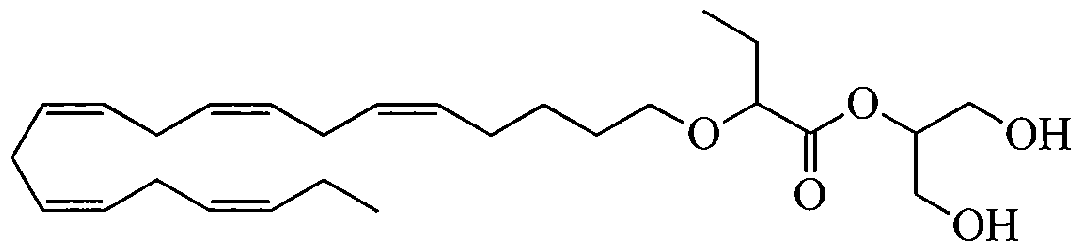
- X is a carboxylic acid or a derivative thereof, such as, a carboxylic ester, a carboxylic anhydride, carboxamide, phospholipid, monoglyceride, diglyceride, or triglyceride; or a pharmaceutically acceptable salt, solvate, solvate of such salt or a prodrug thereof.
- the compounds of formula (I) are capable of existing in stereoisomeric forms. It will be understood that the invention encompasses all optical isomers of the compounds of formula (I) and mixtures thereof.
- the present disclosure also relates to pharmaceutical compositions and lipid compositions comprising at least one compound of formula (I).
- the present disclosure includes compounds of formula (I) for use as medicaments or for use in therapy, such as for the treatment of diseases related to the cardiovascular, metabolic, and inflammatory disease areas.
- Dietary polyunsaturated fatty acids have effects on diverse physiological processes impacting normal health and chronic diseases, such as the regulation of plasma lipid levels, cardiovascular and immune functions, insulin action, neuronal development and visual function.
- PUFAs Due to their limited stability in vivo and their lack of biological specificity, PUFAs have not achieved widespread use as therapeutic agents. Chemical modifications of the n-3 polyunsaturated fatty acids have been performed by several research groups in order to change or increase their effects.
- a novel group of fatty acid derivatives combining an oxygen atom in ⁇ -position with a ⁇ -substituents represented by the general formula (I) has been developed. These novel fatty acids reduce lipid levels in a dyslipidemic mice model to a greater extent than naturally occurring polyunsaturated fatty acids.
- Figure 1 Cholesterol and triglyceride levels in APOE * 3Leiden mice after administration of one embodiment of the present disclosure and OmacorTM.
- Figure 2 Cholesterol and triglyceride levels in APOE * 3Leiden.CETP mice after administration of one embodiment of the present disclosure and fenofibrate.
- Figure 3 HDL levels in APOE * 3Leiden. CETP mice after administration of one embodiment of the present disclosure and fenofibrate.
- One object of the present disclosure is to provide lipid compounds having improved biological activity compared to naturally occurring polyunsaturated fatty acids. This object may be achieved by a lipid compound of formula (I)
- Ri is a C- 10 -C 22 alkyl group, a C 1 0-C 22 alkenyl group having 1-6 double bonds, or a C 10 -C 22 alkynyl group having 1-6 triple bonds;
- R 2 and R 3 are the same or different and may be chosen from a hydrogen atom, a hydroxy group, an alkyl group, a halogen atom, an alkoxy group, an acyloxy group, an acyl group, an alkenyl group, an alkynyl group, an aryl group, an alkylthio group, an alkoxycarbonyl group, a carboxy group, an alkylsulfinyl group, an alkylsulfonyl group, an amino group, and an alkylamino group, with the provisio that R 2 and R 3 cannot both be a hydrogen atom; or
- R 2 and R 3 together can form a cycloalkyl group, such as cyclopropane, cyclobutane, cyclopentane, or cyclohexane;
- X is a carboxylic acid or a derivative thereof, such as, a carboxylic ester, a carboxylic anhydride , a carboxamide, a phospholipid, or a triglyceride; or a pharmaceutically acceptable salt, solvate, solvate of such salt or a prodrug thereof.
- the alkyl group may be chosen from methyl, ethyl, n-propyl, isopropyl, n-butyl, sec-butyl, and n-hexyl.
- the alkenyl group may be chosen from allyl, 2-butenyl, and 3-hexenyl.
- the alkynyl group may be chosen from propargyl, 2-butynyl, and 3-hexynyl.
- the halogen atom may be chosen from fluorine, chlorine, bromine, and iodine.
- the alkoxy group may be chosen from methoxy, ethoxy, propoxy, isopropoxy, sec-butoxy, phenoxy, benzyloxy, OCH 2 CF 3 , and OCH 2 CH 2 OCH 3 .
- the acyloxy group may be chosen from acetoxy, propionoxy, and butyroxy.
- the aryl group is a phenyl group.
- the alkylthio group may be chosen from methylthio, ethylthio, isopropylthio, and phenylthio.
- the alkoxycarbonyl group may be chosen from methoxycarbonyl, ethoxycarbonyl, propoxycarbonyl, and butoxycarbonyl.
- the alkylsulfinyl group may be chosen from methanesulfinyl, ethanesulfinyl, and isopropanesulfinyl.
- the alkylsulfonyl group may be chosen from methanesulfonyl, ethanesulfonyl, and isopropanesulfonyl.
- the alkylamino group may be chosen from methylamino, dimethylamino, ethylamino, and diethylamino.
- the carboxylate group may be chosen from ethyl carboxylate, methyl carboxylate, n-propyl carboxylate, isopropyl carboxylate, n-butyl carboxylate, sec-butyl carboxylate, and n-hexyl carboxylate.
- the carboxamide group may be chosen from carboxamides, such as N-methyl carboxamide, N,N-dimethyl carboxamide, N-ethyl carboxamide and N,N-diethyl carboxamide.
- one of the substituents R 2 and R 3 of the compound of formula (I) is hydrogen and the other one is chosen from a hydroxy group, an alkyl group, a halogen atom, an alkoxy group, an acyloxy group, an acyl group, an alkenyl group, an alkynyl group, an aryl group, an alkylthio group, an alkoxycarbonyl group, a carboxy group, an alkylsulfinyl group, an alkylsulfonyl group, an amino group, and an alkylamino group.
- the substituents R 2 and R 3 of the compound of formula (I) are the same or different and may be chosen from a hydroxy group, an alkyl group, a halogen atom, an alkoxy group, an acyloxy group, an acyl group, an alkenyl group, an alkynyl group, an aryl group, an alkylthio group, an alkoxycarbonyl group, a carboxy group, an alkylsulfinyl group, an alkylsulfonyl group, an amino group.
- R 2 and R 3 may be chosen from methyl, ethyl, n-propyl, or isopropyl.
- R 1 is typically a C 10 -C 22 alkenyl group with 3-6 double bonds, e.g. 3-6 methylene interrupted double bonds in Z configuration.
- Ri may be chosen from:
- R 1 may be a C 10 -C 22 alkynyl group, e.g. a C 16 - C 22 alkynyl with 1-6 triple bonds.
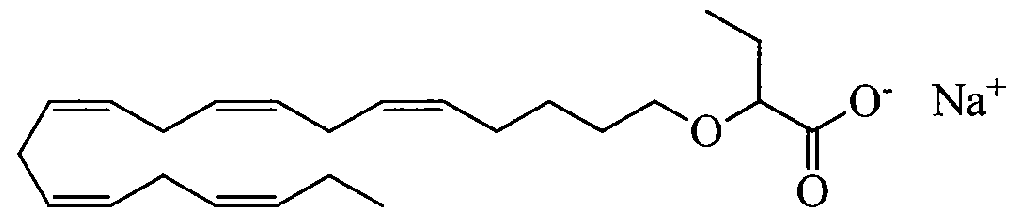
- the present disclosure also relates to salts of the compound of formula (I). Such salts may be represented by
- Z + may be NH 4 + , a metal ion such as Li + , Na + , or K + , a protonated primary amine such as terf-butyl ammonium, (3s,5s,7s)- adamantan-1 -ammonium, 1 ,3-dihydroxy-2-(hydroxymethyl)propan-2- ammonium or a protonated aminopyridine (e.g., pyridine-2-ammonium), a protonated secondary amine such as diethylammonium, 2,3,4,5,6- pentahydroxy-N-methylhexan-1 -ammonium, N-ethylnaphthalen-1 -ammonium, a protonated tertiary amine such as 4-methy]morpholin-4-ium, a protonated guanidine such as amino((4-amino-4-carboxybutyl)amino)methaniminium or a protonated pyridine (e.g.
- X COO "
- Z 2+ may be Mg 2+ or Ca 2+ , or a diprotonated diamine such as ethane-1 ,2-diammonium or piperazine-1 ,4-diium.
- X COO "
- Z 2+ may be Mg 2+ or Ca 2+ , or a diprotonated diamine such as ethane-1 ,2-diammonium or piperazine-1 ,4-diium.
- W is: and wherein W is:
- the compounds of formula (I) are capable of existing in stereoisomeric forms. It will be understood that the invention encompasses all optical isomers of the compounds of formula (I) and mixtures thereof. Hence, compounds of formula (I) that exist as diastereomers, racemates, and enantiomers are included within the scope of the present disclosure.
- the present disclosure also relates to at least one lipid compound according of formula (I) for use as a medicament.
- the present disclosure provides a food supplement, a food additive, or a nutraceutical preparation comprising a lipid compound of formula (I).
- Such a food supplement may be produced for administration through any route of administration.
- the food supplement may be administered as a liquid nutritional or as a beverage.
- the food supplement may be in the form of a capsule, e.g. a gelatin capsule, and the capsule may be flavoured.
- the present disclosure provides a pharmaceutical composition
- a pharmaceutical composition comprising at least one compound of formula (I), optionally together with one or more pharmaceutically acceptable carriers or excipients.
- novel lipid compounds and compositions of the disclosure may be formulated in conventional oral administration forms, e.g. tablets, coated tablets, capsules, powders, granulates, solutions, dispersions, suspensions, syrups, emulsions, and sprays, using conventional excipients, e.g.
- solvents diluents, binders, sweeteners, aromas, pH modifiers, viscosity modifiers, antioxidants, corn starch, lactose, glucose, microcrystalline cellulose, magnesium stearate, polyvinylpyrrolidone, citric acid, tartaric acid, water, ethanol, glycerol, sorbitol, polyethylene glycol, propylene glycol, cetylstearyl alcohol, carboxymethylcellulose, or fatty substances, such as hard fat or suitable mixtures thereof.
- Conventional formulation techniques well known in the art, may be used to formulate the lipid compounds according to the present disclosure.
- compositions may be administered by conventional administration routes, for example, orally.
- orally administrable compositions e.g. tablets, coated tablets, capsules, or syrups are included within the scope of this disclosure.
- the composition may be in the form of a gelatin capsule, a tablet, or a sachet.
- a suitable daily dosage of the at least one compound according to formula (I) may range from about 1 mg to about 3 g.
- the daily dose ranges from about 1 mg to about 10 g, from about 50 mg to about 1 g, from about 10 mg to about 2 g, from about 50 mg to about 500 mg, from about 50 mg to about 200 mg, from about 100 mg to about 1 g, from about 100 mg to about 500 mg, or from about 100 mg to about 250 mg.
- composition according to the present disclosure may be used as a medicament.
- the present disclosure also relates to lipid compositions comprising at least one lipid compound according to formula (I).
- the lipid composition may comprise at least 60% by weight, or at least 80% by weight of the at least one compound of formula (I).
- the lipid composition may further comprise a pharmaceutically acceptable antioxidant, e.g. tocopherol or 3-BHA.
- a pharmaceutically acceptable antioxidant e.g. tocopherol or 3-BHA.
- the present disclosure relates to a lipid composition for use as a medicament.
- lipid compound according to formula (I) for use in:
- HMG hypertriglyceridemia
- NAFLD nonalcoholic fatty liver disease
- the present disclosure also relates to lipid compounds according to formula (I) for the treatment of the above mentioned conditions, and to methods for the treatment and/or prevention of the conditions listed above, comprising administering to a mammal in need thereof a pharmaceutically effective amount of a compound according to formula (I).
- the raw material may e.g. originate from a vegetable, a microbial and/or an animal source, such as a marine fish oil. In at least one embodiment marine oil or a krill oil is used.
- lipid compound relates to fatty acid analogues derived from e.g. saturated fatty acids, monounsaturated fatty acids, polyunsaturated fatty acids and lipids comprising 1-6 triple bonds. It is to be understood that derived from includes preparation of the compounds of formula (I) from fatty acids, such as saturated fatty acids, monounsaturated fatty acids, polyunsaturated fatty acids and lipids comprising 1-6 triple bonds. Such fatty acids may occur naturally or be synthetic.
- a “pharmaceutically effective amount” relates to an amount that will lead to the desired pharmacological and/or therapeutic effects, i.e. an amount of the disclosed product which is effective to achieve its intended purpose. While individual patient needs may vary, determination of optimal ranges for effective amounts of the disclosed product is within the skill of the art. Generally, the dosage regimen for treating a condition with the disclosed product of this invention is selected in accordance with a variety of factors, including the type, age, weight, sex, diet and medical condition of the patient. [0042] By “a pharmaceutical composition” is meant a lipid compound according to the present disclosure in any form suitable to be used for a medical purpose.
- Treatment includes any therapeutic application that can benefit a human or non-human mammal. Both human and veterinary treatments are within the scope of the present disclosure. Treatment may be in respect of an existing condition or it may be prophylactic, for example, preventative.
- Fatty acids are straight chain hydrocarbons possessing a carboxyl (COOH) group at one end ( ⁇ ) and (usually) a methyl group at the other ( ⁇ ) end. In chemistry, the numbering of the carbon atoms starts from the ⁇ end.
- the ⁇ carbon refers to the first carbon after the carbon that attaches to the functional group, and the second carbon is the ⁇ carbon.
- methylene interrupted double bonds relates to the case when a methylene group (-CH 2 -) is located between two double bonds in a carbon chain of a lipid compound.
- lipid compound categories A-D are particularly preferable.
- Ri is a C10-C22 alkyl
- Ri is a C- 10 -C 22 alkenyl having 1 double bond
- Ri is a C 20 alkenyl having 5 double bonds
- Ri C 20 with 5 methylene interrupted double bonds in Z-configuration
- Category D derived from polyunsaturated fatty acids • R 1 is a C 22 alkenyl having 6 double bonds
- R 1 C 22 with 6 methylene interrupted double bonds in Z-configuration
- Ri is a C 18 alkenyl having 3 double bonds
- R 1 C-i 8 with 3 methylene interrupted double bonds in Z-configuration
- R 1 is a C- 15 alkenyl having 4 double bonds
- Ri C 15 with 4 methylene interrupted double bonds in Z-configuration
- Category G • derived from polyunsaturated fatty acids
- Ri is a Ci 8 alkenyl having 5 double bonds
- Ri Ci 8 with 5 methylene interrupted double bonds in Z-configu ration
- X is a carboxylic acid in the form of a triglyceride, diglyceride, monoglyceride or phospholipid
- X a carboxylic acid in the form of a triglyceride
- X a carboxylic acid in the form of a 2-monoglyceride
- Ri is a C10-C22 alkynyl
- Specific examples of preferred lipid compounds according to the present disclosure include: Category A:
- R 1 C 18 H 31
- R 2 ethyl
- Z + is K + .
- the alcohols of formula (X) described in method I, Il and III may be prepared directly from the carboxylic esters of, for example, naturally occurring fatty acids; e.g. alpha-linolenic acid, conjugated linoleic acid, or eicosapentaenoic acid (EPA) by reduction with a reducing agent like lithium aluminum hydride (LAH) or diisobultyl aluminum hydride (DIBAL-H) at -1O 0 C to O 0 C.
- LAH lithium aluminum hydride
- DIBAL-H diisobultyl aluminum hydride
- the alcohols can also be prepared by degradation of the polyunsaturated fatty acids, such as EPA and DHA, as described by Holmeide et al. ⁇ J.Chem. Soc, Perkin Trans. 1 (2000) 2271.) In this case, one can start with purified EPA or DHA, but it is also possible to start with fish oil containing EPA and DHA.
- LG present in compounds of formula (Xl) may, for example, be mesylate, tosylate or a suitable halogen, such as bromine. Other leaving groups will be apparent to the skilled artisan.
- the alcohols of formula (X) can react in a substitution reaction with a compound of formula (Xl) in the presence of base such as an alkali metal hydroxide, for example NaOH in an appropriate solvent system.
- bases such as an alkali metal hydroxide, for example NaOH
- Suitable solvent systems include a two-phase mixture of toluene and water.
- an alkylation step may be added to the sequence (Step II) in order to replace one or both of these hydrogen's with an alkyl group.
- Such alkylation may be performed by treating the product from Step I with an alkyl group bearing a suitable leaving group, for example a halogen, such as bromine or iodine, or other leaving groups that will be apparent to a person of ordinary skill in the art, in the presence of base, such as LDA in an appropriate solvent system.
- a suitable leaving group for example a halogen, such as bromine or iodine, or other leaving groups that will be apparent to a person of ordinary skill in the art, in the presence of base, such as LDA in an appropriate solvent system.
- the alcohols of formula (X) can be converted using functional group interconversion, by methods familiar to persons skilled in the art, to compounds where the terminal hydroxy group have been transformed into a suitable leaving group (LG).
- Suitable leaving groups include bromine, mesylate, and tosylate, or others that will be apparent to one of ordinary skill in the art.
- These compounds can be reacted further (step IV) in a substitution reaction with the appropriately substituted hydroxy acetic acid derivatives (compounds of formula XII), in the presence of base in an appropriate solvent system.
- the alcohol of formula (X) can react with the appropriately substituted hydroxy acetic acid derivatives (compounds of formula XII), under classic or non-classic Mitsunobu conditions, using methods familiar to persons skilled in the art.
- an esterifying group such as a methyl or an ethyl group may be removed, for example, by alkaline hydrolysis using a base such as an alkali metal hydroxide, for example LiOH, NaOH or KOH or by using an organic base, for example Et 3 N together with an inorganic salt, for example LiCI in an appropriate solvent system.
- a tert-butyl group may be removed, for example, by treatment with an acid, for example an organic acid such as trifluoroacetic acid or formic acid in an appropriate solvent system. Suitable solvent systems include dichloromethane.
- An arylmethylene group such as a benzyl group may be removed, for example, by hydrogenation over a catalyst such as palladium-on-carbon in an appropriate solvent system.
- Salification of a carboxylic acid of formula (I) can be perfomed by treating it with a suitable base in an appropriate solvent system. Removal of the solvent will give the resulting salt.
- the preparation of compounds of formula (I), according to method I, Il or III, may result in mixtures of stereoisomers. If required, these isomers may be separated by means of chiral resolving agents and/or by chiral column chromatography through methods known to the person skilled in the art.
- GPC sn-glycero-3-phosphocholine
- an activated fatty acid such as fatty acid imidazolides
- Sn-Glycero-3-phosphocholine, as a cadmium (II) adduct can also be reacted with the imidazolide activated fatty acid in the presence of DBU (1 ,8-diazabicyclo[5.4.0]undec-7-ene) to prepare the phosphatidylcholine of the respective fatty acid.
- DBU 1,8-diazabicyclo[5.4.0]undec-7-ene
- Enzymatic transphosphatidylation can effect the transformation of phosphatidylcholine to phosphatidyletanolamine.
- Phospholipids may also be prepared by enzymatic esterification and transesterification of phospholipids or enzymatic transphosphatidylation of phospholipids. (Hosokawa, J.Am. Oil Chem. Soc. 1995, 1287, Lilja-Hallberg, Biocatalysis, (1994) 195.)
- the compounds of formula (I) wherein X is a carboxylic acid derivative in the form of a triglyceride can be prepared through the following process. Excess of the fatty acid can be coupled to glycerol using dimethylaminopyridine (DMAP) and 2-(1 H-benzotriazol-1-yl)-N,N,N',N'- tetramethyluroniumhexafluorophosphate (HBTU).
- DMAP dimethylaminopyridine
- HBTU 2-(1 H-benzotriazol-1-yl)-N,N,N',N'- tetramethyluroniumhexafluorophosphate
- the compounds of formula (I) wherein X is a carboxylic acid derivative in the form of a diglyceride can be prepared by reaction of the fatty acid (2 equivalents) with glycerol (1 equivalent) in the presence of 1 ,3- dicyclohexylcarbondiimide (DCC) and 4-dimethylaminopyridine (DMAP).
- DCC 1,3- dicyclohexylcarbondiimide
- DMAP 4-dimethylaminopyridine
- a 1 ,3-regiospecific lipase from the fungus Mucor miehei can be used to produce triglycerides or diglycerides from polyunsaturated fatty acids and glycerol.
- a different lipase, the non-regiospecific yeast lipase from Candida antartica is highly efficient in generating triglycerides from polyunsaturated fatty acids.
- Tetrabutylammonium chloride (0.55 g, 1.98 mmol) was added to a solution of (5Z,8Z,11Z,14Z,17Z)-icosa-5,8,11 ,14,17-pentaen-1-ol, (3.50 g, 12.1 mmol) in toluene (35 mL) at ambient temperature under nitrogen.
- An aqueous solution of sodium hydroxide (50% (w/w), 1 1.7 mL) was added under vigorous stirring at room temperature, followed by f-butyl 2-bromobutyrate (5.41 g, 24.3 mmol).
- (4S,5R)-3-((R)-2-((5Z,8Z, 11 Z, 14Z, 17Z)-icosa-5,8, 11 ,14,17- pentaenyloxy)butanoyl)-4-methyl-5-phenyloxazolidin-2-one was obtained in 0.95 g (34% yield) as an oil.
- Trifluoroacetic acid (2 ml_) was added to a solution of 2- ((5Z.8Z, 11 Z, 14Z, 17Z)-icosa-5,8, 11 ,14,17-pentaenyloxy)propanoate (1.4O g, 3.36 mmol) in dichloromethane (10 ml_) held under nitrogen and the reaction mixture was stirred at room temperature for three hours. Diethyl ether (50 imL) was added and the organic phase was washed with water (30 mL), dried (Na 2 SO 4 ) and concentrated.
- Trifluoroacetic acid (5 mL) was added to a solution of tert- butyl 2-((5Z,8Z, 11 Z, 14Z, 17Z)-icosa-5,8, 11 ,14,17-pentaenyloxy)-2- methylpropanoate (600 mg, 1.39 mmol) in dichloromethane (20 mL) under nitrogen and the reaction mixture was stirred at room temperature for two hours. Water was added and the aqueous phase was extracted twice with dichloromethane. The combined organic extract was washed with brine, dried (Na 2 SO 4 ), filtered and concentrated.
- the residue was purified by flash chromatography on silica gel using a mixture of heptane, ethyl acetate and formic acid (80:20:1) as eluent.
- the appropriate fractions were concentrated and the residue (135 mg) was purified further by flash chromatography on silica gel using a gradient of 5-10% of a mixture of ethyl acetate and formic acid (95:5) in heptane as eluent. Concentration of the appropriate fractions afforded 80 mg slightly impure product.
- Trifluoroacetic acid (2 mL) was added and the reaction mixture was stirred at room temperature for one hour. Water was added and the aqueous phase was extracted twice with dichloromethane. The combined organic extract was washed with brine, dried (Na 2 SO 4 ), filtered and concentrated. The residue was purified by flash chromatography on silica gel using a mixture of heptane, ethyl acetate and formic acid (80:20:1) as eluent. Concentration of the appropriate fractions afforded 0.18 g (59% yield) of the desired product as an oil.
- the combined organic extract was washed with water and brine, dried (IS ⁇ SCM), filtered and concentrated.
- the residue was purified by flash chromatography on silica gel using a gradient of 2.5-5% ethyl acetate in heptane as eluent. Concentration of the appropriate fractions afforded 1.36 g of the /-butyl ester as an oil.
- the residue was dissolved in dichloromethane (20 mL) and placed under nitrogen. Trifluoroacetic acid (5 mL) was added and the reaction mixture was stirred at room temperature for one hour. Water was added and the aqueous phase was extracted twice with dichloromethane.
- terf-Butyl 2-((5Z,8Z,11Z,14Z,17Z)-icosa-5,8,11 ,14,17- pentaen-1-yloxy)butanoate (480 mg, 1.11 mmol) was added dropwise over 30 minutes to a solution of lithium diisopropylamine (LDA) (2.0 M, 750 ⁇ L, 1.50 mmol) in dry tetrahydrofuran (10 ml_) held at -70 0 C under nitrogen. The reaction mixture was stirred for 30 minutes. Ethyl iodide (312 mg, 2.00 mmol) was added in one portion and the resulting mixture was warmed to ambient temperature during 1 hour.
- LDA lithium diisopropylamine
- the reaction mixture was stirred at ambient temperature for 17 hours.
- the mixture was poured into saturated NH 4 CI (aq.) (50 ml_) and extracted with heptane (2 * 50 ml_).
- the combined organic phases was washed successiveively with brine (50 ml_), 0.25 M HCI (50 ml_) and brine (50 ml_), dried (MgSO 4 ), filtered and concentrated.
- the residue was purified by flash chromatography on silica gel using increasingly polar mixtures of heptane and ethyl acetate (100:0 -> 95:5) as eluent. Concentration of the appropriate fractions afforded 343 mg (67% yield) of the title compound as an oil.
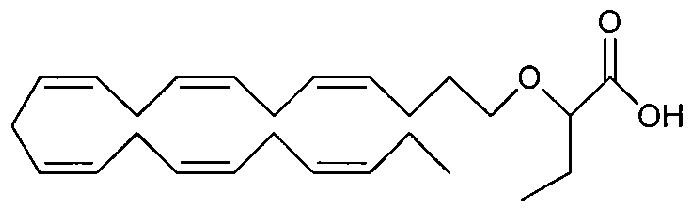
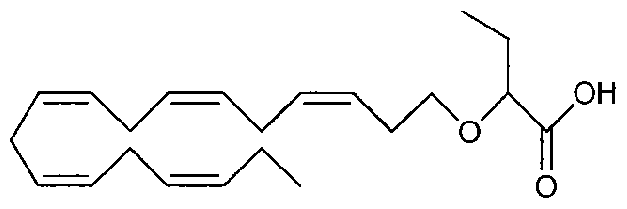
- Example 16 Preparation of terf-butyl 2-((3Z,6Z,9Z,12Z ) 15Z)-octadeca-3,6,9,12,15- pentaen-1 -yloxy)butanoate:
- the assays were carried out in vitro using mammalian-one- hybrid assays (M 1 H) comprising GAL4-DNA binding domain-PPAR-LBD fusion constructs in conjunction with 5xGAL4-sites driven Photinus pyralis luciferase reporter constructs in transiently transfected HEK293 cells.
- M 1 H mammalian-one- hybrid assays
- 5xGAL4-sites driven Photinus pyralis luciferase reporter constructs in transiently transfected HEK293 cells.
- Renilla reniformis luciferase driven by a constitutive promoter, was included as internal control to improve experimental accuracy.
- the compounds (A-C) and a positive control were tested at six different concentrations in duplicate.
- the positive controls were GW7647 (PPAR ⁇ ), GW501516 (PPAR ⁇ ) and rosiglitazone (PPAR ⁇ ).
- the efficacy of the controls were set to 100%.
- This animal model has proven to be representative of the human situation with respect to plasma lipoprotein levels and its responsiveness to hypolipidemic drugs, such as statins and fibrates, and nutritional intervention.
- hypolipidemic drugs such as statins and fibrates
- nutritional intervention depending on the level of plasma cholesterol, APOE * 3Leiden mice develop atherosclerotic lesions in the aorta resembling those found in humans with respect to cellular composition and morphological and immunohistochemical characteristics.
- test substance (A) was tested at 0.3 mmol/kg bw/day.
- the reference (Omega-3 acid ethyl esters, OmacorTM, LovazaTM) was tested at 3.3 mmol/kg bw/day.
- the APOE * 3Leiden.CETP transgenic mouse is a model where the human cholesterol ester transfer protein has been introduced to the APOE * 3Leiden transgenic mouse. This results in a more human-like lipoprotein profile. This model is very well suited for testing the effects of drugs on plasma HDL and triglyceride levels.
- test substances were administered orally as admix to the Western-type diet.
- This animal model has proven to be representative of the human situation with respect to plasma lipoprotein levels and its responsiveness to hypolipidemic drugs (like statins, fibrates etc.) and nutritional intervention.
- APOE * 3Leiden.CETP mice develop atherosclerotic lesions in the aorta resembling those found in humans with respect to cellular composition and morphological and immunohistochemical characteristics.
- TC plasma total cholesterol
- HDL-C HDL cholesterol
- TG triglycerides
- test substances were administered orally as admix to the Western-type diet.
- sunflower oil was added to a total oil volume of 10 mL/kg diet.
- the test compound (A) was tested at initially at 0.1 mmol/kg bw/day and reduced to 0.04 mmol/kg bw/day at 4 weeks. The initial dose was based on a prior dose-finding study to establish the required dosage that would reduce VLDL/LDL cholesterol by 25- 30%.
- the dosage of fenofibrate was initially 10 mg/kg bw/day and was reduced to 4,2 mg/kg bw/day (to parallel reductions in VLDL/LDL induced by compound A).
- blood samples were taken after a 4 hour-fast to measure food intake, total plasma cholesterol, HDL cholesterol and triglycerides and lipoprotein profiles. Atherosclerosis development in the aortic root (lesion number, total lesion area and lesion severity) was assessed at study-end.
Landscapes
- Chemical & Material Sciences (AREA)
- Health & Medical Sciences (AREA)
- Organic Chemistry (AREA)
- Veterinary Medicine (AREA)
- Public Health (AREA)
- General Health & Medical Sciences (AREA)
- Animal Behavior & Ethology (AREA)
- Life Sciences & Earth Sciences (AREA)
- Pharmacology & Pharmacy (AREA)
- Medicinal Chemistry (AREA)
- Engineering & Computer Science (AREA)
- Chemical Kinetics & Catalysis (AREA)
- Bioinformatics & Cheminformatics (AREA)
- Nuclear Medicine, Radiotherapy & Molecular Imaging (AREA)
- General Chemical & Material Sciences (AREA)
- Epidemiology (AREA)
- Diabetes (AREA)
- Hematology (AREA)
- Emergency Medicine (AREA)
- Obesity (AREA)
- Rheumatology (AREA)
- Oil, Petroleum & Natural Gas (AREA)
- Urology & Nephrology (AREA)
- Vascular Medicine (AREA)
- Child & Adolescent Psychology (AREA)
- Pain & Pain Management (AREA)
- Cardiology (AREA)
- Gastroenterology & Hepatology (AREA)
- Immunology (AREA)
- Orthopedic Medicine & Surgery (AREA)
- Physical Education & Sports Medicine (AREA)
- Heart & Thoracic Surgery (AREA)
- Endocrinology (AREA)
- Acyclic And Carbocyclic Compounds In Medicinal Compositions (AREA)
- Organic Low-Molecular-Weight Compounds And Preparation Thereof (AREA)
- Pharmaceuticals Containing Other Organic And Inorganic Compounds (AREA)
- Low-Molecular Organic Synthesis Reactions Using Catalysts (AREA)
- Heterocyclic Carbon Compounds Containing A Hetero Ring Having Nitrogen And Oxygen As The Only Ring Hetero Atoms (AREA)
- Medicinal Preparation (AREA)
- Medicines That Contain Protein Lipid Enzymes And Other Medicines (AREA)
Abstract
Description







Claims


Priority Applications (23)
| Application Number | Priority Date | Filing Date | Title |
|---|---|---|---|
| AU2010244136A AU2010244136B2 (en) | 2009-05-08 | 2010-05-07 | Polyunsaturated fatty acids for the treatment of diseases related to cardiovascular, metabolic and inflammatory disease areas |
| BRPI1015120A BRPI1015120B8 (en) | 2009-05-08 | 2010-05-07 | Alpha-substituted lipid compound, derivatives of polyunsaturated beta-oxo fatty acids, pharmaceutical and lipid composition and methods for producing lipid compound and 2-((5z,8z,11z,14z,17z)-icosa-5,8, 11,14,17-pentaenyloxy)butanoic |
| US13/319,101 US8735436B2 (en) | 2009-05-08 | 2010-05-07 | Polyunsaturated fatty acids for the treatment of diseases related to cardiovascular, metabolic and inflammatory disease areas |
| DK10772077.3T DK2427415T3 (en) | 2009-05-08 | 2010-05-07 | Polyunsaturated fatty acids for the treatment of diseases of cardiovascular, metabolic and inflammatory disease areas |
| KR1020117028820A KR101783817B1 (en) | 2009-05-08 | 2010-05-07 | Polyunsaturated fatty acids for the treatment of diseases related to cardiovascular, metabolic and inflammatory disease areas |
| PL10772077T PL2427415T3 (en) | 2009-05-08 | 2010-05-07 | Polyunsaturated fatty acids for the treatment of diseases related to cardiovascular, metabolic and inflammatory disease areas |
| MX2011011614A MX2011011614A (en) | 2009-05-08 | 2010-05-07 | Polyunsaturated fatty acids for the treatment of diseases related to cardiovascular, metabolic and inflammatory disease areas. |
| CA2760877A CA2760877C (en) | 2009-05-08 | 2010-05-07 | Polyunsaturated fatty acids for the treatment of diseases related to cardiovascular, metabolic and inflammatory disease areas |
| MA34421A MA33341B1 (en) | 2009-05-08 | 2010-05-07 | POLYUNSATURATED FATTY ACIDS FOR THE TREATMENT OF DISEASES RELATED TO THE FIELD OF CARDIOVASCULAR, METABOLIC AND INFLAMMATORY DISEASES |
| MX2014000881A MX366137B (en) | 2009-05-08 | 2010-05-07 | Polyunsaturated fatty acids for the treatment of diseases related to cardiovascular, metabolic and inflammatory disease areas. |
| CN201080030436.5A CN102459142B (en) | 2009-05-08 | 2010-05-07 | For treating the polyunsaturated fatty acid to disease cardiovascular, that metabolism is related with inflammatory disease field |
| EA201171371A EA021177B1 (en) | 2009-05-08 | 2010-05-07 | Polyunsaturated fatty acids for the treatment of diseases related to cardiovascular, metabolic and inflammatory disease areas |
| ES10772077T ES2726765T3 (en) | 2009-05-08 | 2010-05-07 | Polyunsaturated fatty acids for the treatment of diseases related to the field of cardiovascular, metabolic and inflammatory diseases |
| JP2012509111A JP5843755B2 (en) | 2009-05-08 | 2010-05-07 | Polyunsaturated fatty acids for the treatment of diseases related to cardiovascular, metabolic and inflammatory disease areas |
| EP10772077.3A EP2427415B1 (en) | 2009-05-08 | 2010-05-07 | Polyunsaturated fatty acids for the treatment of diseases related to cardiovascular, metabolic and inflammatory disease areas |
| SG2011079613A SG175401A1 (en) | 2009-05-08 | 2010-05-07 | Polyunsaturated fatty acids for the treatment of diseases related to cardiovascular, metabolic and inflammatory disease areas |
| NZ596386A NZ596386A (en) | 2009-05-08 | 2010-05-07 | Polyunsaturated fatty acids for the treatment of diseases related to cardiovascular, metabolic and inflammatory disease areas |
| HRP20190732TT HRP20190732T1 (en) | 2009-05-08 | 2010-05-07 | Polyunsaturated fatty acids for the treatment of diseases related to cardiovascular, metabolic and inflammatory disease areas |
| UAA201113181A UA109528C2 (en) | 2009-05-08 | 2010-07-05 | Polyunsaturated fatty acids for the treatment of diseases that belong to a series of cardiovascular, metabolic and inflammatory diseases |
| IL216171A IL216171A (en) | 2009-05-08 | 2011-11-07 | Lipid compound, method for its preparation, a pharmaceutical composition and a lipid composition comprising the same and uses thereof |
| ZA2011/08163A ZA201108163B (en) | 2009-05-08 | 2011-11-07 | Polyunsaturated fatty acids for the treatment of diseases related to cardiovascular,metabolic and inflammatory disease areas |
| US14/250,980 US20140221439A1 (en) | 2009-05-08 | 2014-04-11 | Polyunsaturated fatty acids for the treatment of diseases related to cardiovascular, metabolic and inflammatory disease areas |
| PH12015500930A PH12015500930B1 (en) | 2009-05-08 | 2015-04-24 | Polyunsaturated fatty acids for the treatment of diseases related to cardiovascular, metabolic and inflammatory disease areas |
Applications Claiming Priority (2)
| Application Number | Priority Date | Filing Date | Title |
|---|---|---|---|
| US17650309P | 2009-05-08 | 2009-05-08 | |
| US61/176,503 | 2009-05-08 |
Related Child Applications (2)
| Application Number | Title | Priority Date | Filing Date |
|---|---|---|---|
| US13/319,101 A-371-Of-International US8735436B2 (en) | 2009-05-08 | 2010-05-07 | Polyunsaturated fatty acids for the treatment of diseases related to cardiovascular, metabolic and inflammatory disease areas |
| US14/250,980 Continuation US20140221439A1 (en) | 2009-05-08 | 2014-04-11 | Polyunsaturated fatty acids for the treatment of diseases related to cardiovascular, metabolic and inflammatory disease areas |
Publications (2)
| Publication Number | Publication Date |
|---|---|
| WO2010128401A1 true WO2010128401A1 (en) | 2010-11-11 |
| WO2010128401A9 WO2010128401A9 (en) | 2011-12-08 |
Family
ID=43050039
Family Applications (1)
| Application Number | Title | Priority Date | Filing Date |
|---|---|---|---|
| PCT/IB2010/001251 Ceased WO2010128401A1 (en) | 2009-05-08 | 2010-05-07 | Polyunsaturated fatty acids for the treatment of diseases related to cardiovascular, metabolic and inflammatory disease areas |
Country Status (29)
| Country | Link |
|---|---|
| US (2) | US8735436B2 (en) |
| EP (1) | EP2427415B1 (en) |
| JP (2) | JP5843755B2 (en) |
| KR (1) | KR101783817B1 (en) |
| CN (1) | CN102459142B (en) |
| AR (2) | AR078507A1 (en) |
| AU (1) | AU2010244136B2 (en) |
| BR (1) | BRPI1015120B8 (en) |
| CA (1) | CA2760877C (en) |
| CL (1) | CL2011002745A1 (en) |
| CO (1) | CO6430454A2 (en) |
| DK (1) | DK2427415T3 (en) |
| EA (1) | EA021177B1 (en) |
| ES (1) | ES2726765T3 (en) |
| HR (1) | HRP20190732T1 (en) |
| IL (1) | IL216171A (en) |
| MA (1) | MA33341B1 (en) |
| MX (2) | MX2011011614A (en) |
| MY (1) | MY165292A (en) |
| NZ (2) | NZ618734A (en) |
| PH (1) | PH12015500930B1 (en) |
| PL (1) | PL2427415T3 (en) |
| PT (1) | PT2427415T (en) |
| SG (1) | SG175401A1 (en) |
| TR (1) | TR201905768T4 (en) |
| TW (1) | TWI558395B (en) |
| UA (1) | UA109528C2 (en) |
| WO (1) | WO2010128401A1 (en) |
| ZA (2) | ZA201108163B (en) |
Cited By (18)
| Publication number | Priority date | Publication date | Assignee | Title |
|---|---|---|---|---|
| WO2012028688A1 (en) * | 2010-09-02 | 2012-03-08 | Avexxin As | Rheumatoid arthritis treatment using polyunsaturated long chain ketones |
| WO2012059818A1 (en) * | 2010-11-05 | 2012-05-10 | Pronova Biopharma Norge As | Methods of treatment using lipid compounds |
| US8609157B2 (en) | 2009-10-30 | 2013-12-17 | Tharos Ltd. | Solvent-free process for obtaining phospholipids and neutral enriched krill oils |
| US8735436B2 (en) | 2009-05-08 | 2014-05-27 | Pronova Biopharma Norge As | Polyunsaturated fatty acids for the treatment of diseases related to cardiovascular, metabolic and inflammatory disease areas |
| US8741966B2 (en) | 2007-11-09 | 2014-06-03 | Pronova Biopharma Norge As | Lipid compounds for use in cosmetic products, as food supplement or as a medicament |
| US8759558B2 (en) | 2008-07-15 | 2014-06-24 | Pronova Biopharma Norge As | Sulphur containing lipids for use as food supplement or as medicament |
| WO2014132134A1 (en) * | 2013-02-28 | 2014-09-04 | Pronova Biopharma Norge As | A composition comprising a lipid compound, a triglyceride, and a surfactant, and methods of using the same |
| WO2014132135A3 (en) * | 2013-02-28 | 2014-11-27 | Pronova Biopharma Norge As | Method of preparing 2-((5z,8z,11 z,14z,17z)-icosa-5,8,1 1,14,17-pentaenyloxy)butanoic acid |
| WO2016156912A1 (en) * | 2015-04-01 | 2016-10-06 | Pronova Biopharma Norge As | Use of thia oxo compounds for lowering apo c3 |
| WO2016173923A1 (en) | 2015-04-28 | 2016-11-03 | Pronova Biopharma Norge As | Use of structurally enhanced fatty acids containing sulphur for preventing and/or treating non-alcoholic steatohepatitis |
| WO2014083528A3 (en) * | 2012-12-02 | 2017-03-09 | Cellixbio Private Limited | Compositions and methods for the treatment of cardiovascular diseases and lipid disorders |
| US10085953B2 (en) | 2014-05-27 | 2018-10-02 | Avexxin As | Skin cancer treatment |
| WO2019111048A1 (en) | 2017-12-06 | 2019-06-13 | Basf As | Fatty acid derivatives for treating non-alcoholic steatohepatitis |
| WO2019224602A2 (en) | 2018-05-23 | 2019-11-28 | Northsea Therapeutics B.V. | Structurally modified fatty acids for improving glycemic control and treating inflammatory bowel disease |
| KR20200075815A (en) | 2017-10-23 | 2020-06-26 | 에피트래커, 인코포레이티드 | Fatty acid analogs and their use in the treatment of metabolic syndrome related conditions |
| US10953004B2 (en) | 2016-03-14 | 2021-03-23 | Avexxin As | Combination therapy for proliferative diseases |
| US11351127B2 (en) | 2016-09-21 | 2022-06-07 | Avexxin As | Pharmaceutical composition |
| WO2022137125A1 (en) | 2020-12-22 | 2022-06-30 | Northsea Therapeutics B.V. | Combination therapies comprising oxygen-containing structurally enhanced fatty acids for treatment of non-alcoholic steatohepatitis |
Families Citing this family (13)
| Publication number | Priority date | Publication date | Assignee | Title |
|---|---|---|---|---|
| NZ588603A (en) | 2008-03-26 | 2012-03-30 | Oramed Ltd | Methods and compositions for oral administration of a protein of up to 100000 Daltaons, a first protease inhibitor and a second protease inhibitor wherein said protease inhibitors inhibit trypsin |
| WO2014106846A2 (en) | 2013-01-03 | 2014-07-10 | Oramed Ltd. | Methods and compositions for treating nafld, hepatic steatosis, and sequelae thereof |
| JP7341916B2 (en) * | 2015-04-01 | 2023-09-11 | ビーエーエスエフ エーエス | Use of thiaoxo compounds to lower apoC3 |
| GB201521085D0 (en) * | 2015-11-30 | 2016-01-13 | Biozep As | Use |
| MX2019013683A (en) | 2017-05-16 | 2020-01-15 | Ability Pharmaceuticals Sl | A pharmaceutical combination for the treatment of a cancer. |
| AU2019271067B2 (en) * | 2018-05-16 | 2023-08-03 | Epitracker, Inc. | Compositions and methods for diagnosis and treatment of conditions related to aging |
| AU2019274431B2 (en) | 2018-05-23 | 2025-03-13 | Epitracker, Inc. | Compositions and methods for diagnosis and treatment of conditions related to the quality of aging and longevity |
| SG11202103011YA (en) * | 2018-10-11 | 2021-04-29 | Basf As | Aromatic compounds and pharmaceutical uses thereof |
| EP3908374A4 (en) | 2019-01-09 | 2022-12-28 | Epitracker, Inc. | COMPOSITIONS AND METHODS FOR THE DIAGNOSIS AND TREATMENT OF NEURODEGENERATIVE DISEASES |
| JP7404382B2 (en) | 2019-03-04 | 2023-12-25 | エピトラッカー インコーポレイテッド | Fatty acid analogs and their use in the treatment of cognitive dysfunction, behavioral symptoms and chronic pain |
| BR112022001488A2 (en) | 2019-07-29 | 2022-04-19 | Heparegenix Gmbh | Heteroaryl-substituted pyrazolo-pyridine protein kinase inhibitors to promote liver regeneration or reduction or prevention of hepatocyte death |
| CA3164361A1 (en) | 2020-01-15 | 2021-07-22 | Heparegenix Gmbh | 3-benzoyl-1h-pyrrolo[2,3-b]pyridine derivatives as mkk4 inhibitors for treating liver diseases |
| EP4426130A1 (en) | 2021-11-03 | 2024-09-11 | Epitracker, Inc. | Pentadecanoylcarnitine for treatment of conditions related to the quality of aging and longevity |
Citations (10)
| Publication number | Priority date | Publication date | Assignee | Title |
|---|---|---|---|---|
| US4032564A (en) * | 1974-09-09 | 1977-06-28 | Zoecon Corporation | Esters of cyclopropylalkanols |
| EP0175591A2 (en) * | 1984-09-20 | 1986-03-26 | Canon Kabushiki Kaisha | Lactic acid derivative, liquid crystal composition containing same and liquid crystal device |
| WO1996011908A1 (en) | 1994-10-13 | 1996-04-25 | Peptide Technology Limited | Modified polyunsaturated fatty acids |
| WO1997038688A1 (en) * | 1996-04-12 | 1997-10-23 | Peptide Technology Pty. Limited | Methods of treating immunopathologies using polyunsaturated fattyacids |
| US6060515A (en) * | 1997-01-24 | 2000-05-09 | The Regents Of The University Of California | Treatment of skin conditions by use of PPARα activators |
| WO2005073164A1 (en) * | 2004-01-30 | 2005-08-11 | Peplin Biolipids Pty Ltd | Therapeutic and carrier molecules |
| WO2006117668A1 (en) | 2005-05-04 | 2006-11-09 | Pronova Biopharma Norge As | Fatty acid analogues, i.e. dha derivatives for uses as a medicament |
| WO2008053331A1 (en) * | 2006-11-01 | 2008-05-08 | Pronova Biopharma Norge A/S | Alpha-substituted omega-3 lipids that are activators or modulators of the peroxisome proliferators-activated receptor (ppar). |
| WO2008053340A1 (en) | 2006-11-03 | 2008-05-08 | Pronova Biopharma Norge As | A combination product comprising at least one lipid substituted in the alpha position and at least one hypoglycemic agent |
| WO2009056983A1 (en) | 2007-10-31 | 2009-05-07 | Pronova Biopharma Norge As | New dha derivatives and their use as medicaments |
Family Cites Families (67)
| Publication number | Priority date | Publication date | Assignee | Title |
|---|---|---|---|---|
| US2909554A (en) | 1956-07-23 | 1959-10-20 | Monsanto Chemicals | Process for the manufacture of (alkylmercapto) alkyl sulfates |
| GB1038723A (en) | 1962-03-26 | |||
| US4040781A (en) | 1974-06-06 | 1977-08-09 | Lever Brothers Company | Novel 2-(alkylsulfinyl)ethyl sulfates and compositions employing same |
| GB1523276A (en) | 1974-09-20 | 1978-08-31 | Lafon Labor | Sulphur-containing amino compounds |
| US4009211A (en) | 1975-07-29 | 1977-02-22 | Gulf Research & Development Company | Beta,beta-dialkylethylmercaptoethoxylate as new compounds |
| US4209410A (en) | 1976-04-28 | 1980-06-24 | Phillips Petroleum Company | Lubricants |
| DE2861974D1 (en) | 1977-11-11 | 1982-09-16 | Ciba Geigy Ag | Pyridine dicarboxylic acid derivatives, their mixtures with metallic stabilisers and their use in stabilising chlorine-containing thermoplasts |
| JPS5570841A (en) | 1978-11-24 | 1980-05-28 | Konishiroku Photo Ind Co Ltd | Forming method of dye image |
| US4368190A (en) | 1980-04-17 | 1983-01-11 | Merck & Co., Inc. | Immunologically active dipeptidyl 4-O-,6-O-acyl-2-amino-2-deoxy-D-glucose derivatives and methods for their preparation |
| EP0050327B1 (en) | 1980-10-21 | 1984-06-20 | Roche Diagnostics GmbH | Phospholipids that contain sulphur, process for their preparation and medicines containing these compounds |
| US4411808A (en) | 1982-08-04 | 1983-10-25 | Exxon Research & Engineering Co. | Multifunctional additive for power transmission shift fluids |
| JPS6176438A (en) * | 1984-09-20 | 1986-04-18 | Canon Inc | lactic acid derivative |
| CA2010000A1 (en) | 1989-04-07 | 1990-10-07 | Paul B. Merkel | Photographic recording material containing a cyan dye-forming coupler |
| JPH0451149A (en) | 1990-06-19 | 1992-02-19 | Fuji Photo Film Co Ltd | Silver halide color photographic sensitive material |
| FR2663928B1 (en) | 1990-06-27 | 1994-04-08 | Norsolor | NOVEL SULFUR ACRYLIC COMPOUNDS, A PROCESS FOR THEIR PREPARATION AND THEIR APPLICATION TO THE SYNTHESIS OF NEW POLYMERS. |
| EP0487809A1 (en) | 1990-11-28 | 1992-06-03 | Monsanto Europe S.A./N.V. | Rubber compositions having improved processability and improved rubber-vulcanisate properties |
| JPH0543529A (en) | 1991-08-10 | 1993-02-23 | Taisho Pharmaceut Co Ltd | Alkaneamide ammonium compound |
| JP2793458B2 (en) | 1992-03-19 | 1998-09-03 | 三井化学株式会社 | Polyamide resin composition for connector and connector |
| JP2755279B2 (en) | 1992-03-19 | 1998-05-20 | 三井化学株式会社 | Thermoplastic resin composition and molded article thereof |
| CA2164717C (en) | 1993-06-10 | 2009-10-20 | Louis S. Kucera | Method of combatting hepatitis b virus infection |
| JP3110918B2 (en) | 1993-06-18 | 2000-11-20 | 富士写真フイルム株式会社 | Silver halide photographic material |
| US5523430A (en) * | 1994-04-14 | 1996-06-04 | Bristol-Myers Squibb Company | Protein farnesyl transferase inhibitors |
| GB2290789B (en) | 1994-07-01 | 1998-09-16 | Ciba Geigy Ag | Titanium and zirconium complexes of carboxylic acids as corrosion inhibitors |
| US7517858B1 (en) | 1995-06-07 | 2009-04-14 | The Regents Of The University Of California | Prodrugs of pharmaceuticals with improved bioavailability |
| FR2741619B1 (en) * | 1995-11-28 | 1998-02-13 | Pf Medicament | NOVEL 2,3,5-TRIMETHYL-4-HYDROXY-ANILIDES DERIVATIVES, THEIR PREPARATION AND THEIR THERAPEUTIC APPLICATION |
| CN1248916A (en) * | 1997-01-24 | 2000-03-29 | 加利福尼亚大学董事会 | Use of FXR, PPAR 'alpha' and LXR 'alpha' activators to restore barrier function, promote epidermal differentiation and inhibit proliferation |
| AU4806497A (en) * | 1997-10-01 | 1999-04-23 | Procter & Gamble Company, The | Glyoxylic compound comprising one or more active ingredient |
| JPH11180929A (en) | 1997-12-19 | 1999-07-06 | Asahi Glass Co Ltd | Ester derivatives |
| WO1999058120A1 (en) | 1998-05-08 | 1999-11-18 | Rolf Berge | USE OF NON-β-OXIDIZABLE FATTY ACID ANALOGUES FOR TREATMENT OF SYNDROME-X CONDITIONS |
| FR2786187B1 (en) | 1998-11-19 | 2001-11-09 | Univ Paris Curie | 2-ACYLAMINO-2-DEOXY-GLUCONO-1,5-LACTONE TYPE COMPOUNDS, PROCESS FOR OBTAINING SAME, COMPOSITIONS COMPRISING SAME AND USES THEREOF |
| FR2792312B1 (en) | 1999-04-15 | 2001-06-08 | Oreal | THIA-ALCYNOIC (POLY) COMPOUNDS AND DERIVATIVES THEREOF, COMPOSITIONS COMPRISING SAME AND THEIR USE |
| JP2003500459A (en) | 1999-06-01 | 2003-01-07 | ザ・ユニバーシティ・オブ・テキサス・サウスウエスタン・メディカル・センター | Substituted biaryl ether compounds |
| US6723717B1 (en) | 1999-06-01 | 2004-04-20 | The University Of Texas Southwestern Medical Center | Sulfur-containing thyroxane derivatives and their use as hair growth promotors |
| NO328803B1 (en) | 2000-03-03 | 2010-05-18 | Thia Medica | New fatty acid analogues |
| AU5884101A (en) * | 2000-05-26 | 2001-12-03 | Nippon Shinyaku Co Ltd | Heterocyclic compounds |
| UA75083C2 (en) | 2000-06-22 | 2006-03-15 | Тераванс, Інк. | Derivatives of glycopeptidephosphonates |
| FR2828487B1 (en) | 2001-08-09 | 2005-05-27 | Genfit S A | NOVEL COMPOUNDS DERIVED FROM FATTY ACIDS, PREPARATION AND USES |
| JP2005514437A (en) | 2001-12-21 | 2005-05-19 | スリーエム イノベイティブ プロパティズ カンパニー | Pharmaceutical aerosol formulations containing ion-pair complexes |
| GB2383355A (en) | 2001-12-22 | 2003-06-25 | Schlumberger Holdings | An aqueous viscoelastic fluid containing hydrophobically modified polymer and viscoelastic surfactant |
| WO2003064707A1 (en) | 2002-01-31 | 2003-08-07 | Tfl Ledertechnik Gmbh | Compositions and its use for imparting water repellency to leather or furskins, textiles and other fibrous materials |
| AU2003251518B2 (en) | 2002-06-13 | 2009-07-02 | New York University | Synthetic C-glycolipid and its use for treating cancer infectious diseases and autoimmune diseases |
| FR2845991B1 (en) | 2002-10-16 | 2005-02-04 | Pf Medicament | ALPHA-PHENYL ACETANILIDE DERIVATIVES AND THEIR USE IN HUMAN THERAPEUTICS |
| US8372430B2 (en) | 2002-12-17 | 2013-02-12 | The Procter & Gamble Company | Compositions, methods, and kits useful for the alleviation of gastrointestinal effects |
| JPWO2004076404A1 (en) | 2003-02-28 | 2006-06-01 | 株式会社カネカ | Method for producing optically active compound having substituent at 2-position |
| DE10326303A1 (en) | 2003-06-11 | 2004-12-30 | Celares Gmbh | Reagents for modifying biopharmaceuticals, their manufacture and use |
| JP4563114B2 (en) | 2004-08-30 | 2010-10-13 | 出光興産株式会社 | Additive for lubricant |
| WO2006109491A1 (en) | 2005-03-31 | 2006-10-19 | Yamaguchi University | Wave power energy converter |
| CN101213281B (en) * | 2005-05-04 | 2013-03-13 | 普罗诺瓦生物医药挪威公司 | New DHA derivatives and their use as medicines |
| US20070167529A1 (en) | 2006-01-17 | 2007-07-19 | Walton Rebecca A | Antimicrobial compositions for treating fabrics and surfaces |
| ES2391305T3 (en) | 2006-04-12 | 2012-11-23 | Unilever N.V. | Oral composition comprising a polyunsaturated fatty acid and salicylic acid to obtain an anti-inflammatory effect on the skin |
| EP1849449A1 (en) | 2006-04-26 | 2007-10-31 | 3M Innovative Properties Company | Filler containing composition and process for production and use thereof |
| US7763607B2 (en) | 2006-04-27 | 2010-07-27 | Solvay Pharmaceuticals Gmbh | Pharmaceutical compositions comprising CBx cannabinoid receptor modulators and potassium channel modulators |
| US20080075692A1 (en) | 2006-05-09 | 2008-03-27 | Perrine Susan P | Methods for treating blood disorders |
| CN101225064A (en) | 2007-01-19 | 2008-07-23 | 上海汇瑞生物科技有限公司 | A new method for preparing β-thia-α-alkyl fatty acids |
| DE102007017179A1 (en) * | 2007-04-12 | 2008-10-23 | Clariant International Ltd. | Process for the preparation of Alkylpolyglykolcarbonsäuren and Polyglykoldicarbonsäuren by direct oxidation |
| EP2205074A4 (en) * | 2007-10-04 | 2013-07-31 | Harvard College | ANALOGUES OF THE MOENOMYCIN, METHODS OF SYNTHESIS AND USES THEREOF |
| WO2009061208A1 (en) | 2007-11-09 | 2009-05-14 | Pronova Biopharma Norge As | Lipid compounds for use in cosmetic products, as food supplement or as a medicament |
| WO2009149496A1 (en) | 2008-06-10 | 2009-12-17 | Central Northern Adelaide Health Service | Treatment of diabetes and complications thereof and related disorders |
| FR2933006B1 (en) | 2008-06-27 | 2010-08-20 | Inst Francais Du Petrole | ABSORBENT SOLUTION CONTAINING SULFUR DEGRADATION INHIBITOR WITH CARBOXYL GROUPING AND METHOD FOR LIMITING THE DEGRADATION OF AN ABSORBENT SOLUTION |
| DK2315740T3 (en) | 2008-07-08 | 2018-01-08 | Catabasis Pharmaceuticals Inc | Fatty Acid Acetylated Salicylates and Their Uses |
| EP2147910A1 (en) | 2008-07-15 | 2010-01-27 | Pronova BioPharma Norge AS | Novel lipid compounds |
| BRPI1015120B8 (en) | 2009-05-08 | 2022-02-15 | Basf As | Alpha-substituted lipid compound, derivatives of polyunsaturated beta-oxo fatty acids, pharmaceutical and lipid composition and methods for producing lipid compound and 2-((5z,8z,11z,14z,17z)-icosa-5,8, 11,14,17-pentaenyloxy)butanoic |
| WO2011028689A1 (en) | 2009-09-01 | 2011-03-10 | Catabasis Pharmaceuticals, Inc. | Fatty acid niacin conjugates and their uses |
| EP2526084A1 (en) | 2010-01-20 | 2012-11-28 | Pronova BioPharma Norge AS | Salicylate fatty acid derivatives |
| ES2618604T3 (en) | 2010-11-05 | 2017-06-21 | Pronova Biopharma Norge As | Methods of treatment using lipid compounds |
| WO2012115695A1 (en) | 2011-02-25 | 2012-08-30 | Catabasis Pharmaceuticals, Inc. | Bis-fatty acid conjugates and their uses |
| WO2013016531A2 (en) | 2011-07-26 | 2013-01-31 | Purdue Research Foundation | Compounds and methods for use in treating neoplasia and cancer |
-
2010
- 2010-05-07 BR BRPI1015120A patent/BRPI1015120B8/en active IP Right Grant
- 2010-05-07 WO PCT/IB2010/001251 patent/WO2010128401A1/en not_active Ceased
- 2010-05-07 NZ NZ618734A patent/NZ618734A/en unknown
- 2010-05-07 PL PL10772077T patent/PL2427415T3/en unknown
- 2010-05-07 EA EA201171371A patent/EA021177B1/en not_active IP Right Cessation
- 2010-05-07 MA MA34421A patent/MA33341B1/en unknown
- 2010-05-07 MX MX2011011614A patent/MX2011011614A/en active IP Right Grant
- 2010-05-07 TW TW099114670A patent/TWI558395B/en active
- 2010-05-07 MX MX2014000881A patent/MX366137B/en unknown
- 2010-05-07 TR TR2019/05768T patent/TR201905768T4/en unknown
- 2010-05-07 JP JP2012509111A patent/JP5843755B2/en active Active
- 2010-05-07 MY MYPI2011005299A patent/MY165292A/en unknown
- 2010-05-07 EP EP10772077.3A patent/EP2427415B1/en active Active
- 2010-05-07 KR KR1020117028820A patent/KR101783817B1/en active Active
- 2010-05-07 DK DK10772077.3T patent/DK2427415T3/en active
- 2010-05-07 SG SG2011079613A patent/SG175401A1/en unknown
- 2010-05-07 CN CN201080030436.5A patent/CN102459142B/en active Active
- 2010-05-07 HR HRP20190732TT patent/HRP20190732T1/en unknown
- 2010-05-07 AU AU2010244136A patent/AU2010244136B2/en active Active
- 2010-05-07 ES ES10772077T patent/ES2726765T3/en active Active
- 2010-05-07 US US13/319,101 patent/US8735436B2/en active Active
- 2010-05-07 AR ARP100101568A patent/AR078507A1/en active IP Right Grant
- 2010-05-07 NZ NZ596386A patent/NZ596386A/en unknown
- 2010-05-07 CA CA2760877A patent/CA2760877C/en active Active
- 2010-05-07 PT PT10772077T patent/PT2427415T/en unknown
- 2010-07-05 UA UAA201113181A patent/UA109528C2/en unknown
-
2011
- 2011-11-04 CL CL2011002745A patent/CL2011002745A1/en unknown
- 2011-11-07 IL IL216171A patent/IL216171A/en active IP Right Grant
- 2011-11-07 ZA ZA2011/08163A patent/ZA201108163B/en unknown
- 2011-12-07 CO CO11168717A patent/CO6430454A2/en active IP Right Grant
-
2013
- 2013-05-30 ZA ZA2013/03962A patent/ZA201303962B/en unknown
-
2014
- 2014-04-11 US US14/250,980 patent/US20140221439A1/en not_active Abandoned
-
2015
- 2015-04-24 PH PH12015500930A patent/PH12015500930B1/en unknown
- 2015-07-31 JP JP2015151385A patent/JP2016026146A/en active Pending
-
2017
- 2017-10-03 AR ARP170102752A patent/AR109789A2/en not_active Application Discontinuation
Patent Citations (11)
| Publication number | Priority date | Publication date | Assignee | Title |
|---|---|---|---|---|
| US4032564A (en) * | 1974-09-09 | 1977-06-28 | Zoecon Corporation | Esters of cyclopropylalkanols |
| EP0175591A2 (en) * | 1984-09-20 | 1986-03-26 | Canon Kabushiki Kaisha | Lactic acid derivative, liquid crystal composition containing same and liquid crystal device |
| WO1996011908A1 (en) | 1994-10-13 | 1996-04-25 | Peptide Technology Limited | Modified polyunsaturated fatty acids |
| WO1997038688A1 (en) * | 1996-04-12 | 1997-10-23 | Peptide Technology Pty. Limited | Methods of treating immunopathologies using polyunsaturated fattyacids |
| US6060515A (en) * | 1997-01-24 | 2000-05-09 | The Regents Of The University Of California | Treatment of skin conditions by use of PPARα activators |
| WO2005073164A1 (en) * | 2004-01-30 | 2005-08-11 | Peplin Biolipids Pty Ltd | Therapeutic and carrier molecules |
| WO2006117668A1 (en) | 2005-05-04 | 2006-11-09 | Pronova Biopharma Norge As | Fatty acid analogues, i.e. dha derivatives for uses as a medicament |
| WO2006117664A1 (en) | 2005-05-04 | 2006-11-09 | Pronova Biopharma Norge As | New dha derivatives and their use as medicaments |
| WO2008053331A1 (en) * | 2006-11-01 | 2008-05-08 | Pronova Biopharma Norge A/S | Alpha-substituted omega-3 lipids that are activators or modulators of the peroxisome proliferators-activated receptor (ppar). |
| WO2008053340A1 (en) | 2006-11-03 | 2008-05-08 | Pronova Biopharma Norge As | A combination product comprising at least one lipid substituted in the alpha position and at least one hypoglycemic agent |
| WO2009056983A1 (en) | 2007-10-31 | 2009-05-07 | Pronova Biopharma Norge As | New dha derivatives and their use as medicaments |
Non-Patent Citations (15)
| Title |
|---|
| FLOCK, S. ET AL., ACTA CHEMICA SCANDINAVICA, vol. 53, 1999, pages 436 |
| GRANLUND, L. ET AL.: "Effects of structural changes of fatty acids on lipid accumulation in adipocytes and primary hepatocytes", BIOCHIMICA ET BIOPHYSICA ACTA, vol. 1687, 2005, pages 23 - 30, XP004749796, DOI: doi:10.1016/j.bbalip.2004.11.009 |
| HARALDSSON, PHARMAZIE, 2000, pages 3 |
| HERMETTER, CHEMISTRY AND PHYSICS OF LIPIDS, vol. 28, 1981, pages 111 |
| HOLMEIDE ET AL., J.CHEM. SOC., PERKIN TRANS., vol. 1, 2000, pages 2271 |
| HOSOKAWA, J.AM. OIL CHEM.SOC., 1995, pages 1287 |
| LARSEN, L.N. ET AL.: "Polyunsaturated thia- and oxa-fatty acids: incorporation into cell-lipids and their effects on arachidonic acid- and eicosanoid synthesis", BIOCHIMICA ET BIOPHYSICA ACTA, vol. 1348, 1997, pages 346 - 354 |
| LILJA-HALLBERG, BIOCATALYSIS, 1994, pages 195 |
| O'BRIAN, J.ORG.CHEM., 1996, pages 5914 |
| PARKKARI ET AL., BIOORG. MED.CHEM.LETT., 2006, pages 2437 |
| PITT, MJ ET AL., SYNTHESIS, 1997, pages 1240 - 1242 |
| ROSSMEISL, M. ET AL.: "Obesity", 15 January 2009, SILVER SPRING |
| S. FLOCK, ACTA CHEMICA SCANDINAVICA, vol. 53, 1999, pages 436 - 445 |
| See also references of EP2427415A4 |
| WANG ET AL., J. AM. CHEM. SOC., vol. 115, 1993, pages 10487 |
Cited By (54)
| Publication number | Priority date | Publication date | Assignee | Title |
|---|---|---|---|---|
| US8741966B2 (en) | 2007-11-09 | 2014-06-03 | Pronova Biopharma Norge As | Lipid compounds for use in cosmetic products, as food supplement or as a medicament |
| US8759558B2 (en) | 2008-07-15 | 2014-06-24 | Pronova Biopharma Norge As | Sulphur containing lipids for use as food supplement or as medicament |
| US8735436B2 (en) | 2009-05-08 | 2014-05-27 | Pronova Biopharma Norge As | Polyunsaturated fatty acids for the treatment of diseases related to cardiovascular, metabolic and inflammatory disease areas |
| US8772516B2 (en) | 2009-10-30 | 2014-07-08 | Tharos. Ltd. | Solvent-free process for obtaining phospholipids and neutral enriched krill oils |
| US8609157B2 (en) | 2009-10-30 | 2013-12-17 | Tharos Ltd. | Solvent-free process for obtaining phospholipids and neutral enriched krill oils |
| US8865236B2 (en) | 2009-10-30 | 2014-10-21 | Tharos Ltd. | Solvent-Free Process for Obtaining Phospholipids and Neutral Enriched Krill Oils |
| US9011942B2 (en) | 2009-10-30 | 2015-04-21 | Tharos, Ltd. | Solvent-free process for obtaining phospholipids and neutral enriched krill oils |
| US9150815B2 (en) | 2009-10-30 | 2015-10-06 | Tharos Ltd. | Solvent-free process for obtaining phospholipids and neutral enriched krill oils |
| WO2012028688A1 (en) * | 2010-09-02 | 2012-03-08 | Avexxin As | Rheumatoid arthritis treatment using polyunsaturated long chain ketones |
| US9682930B2 (en) | 2010-09-02 | 2017-06-20 | Avexxin As | Rheumatoid arthritis treatment |
| WO2012059818A1 (en) * | 2010-11-05 | 2012-05-10 | Pronova Biopharma Norge As | Methods of treatment using lipid compounds |
| AU2011324909B2 (en) * | 2010-11-05 | 2016-09-08 | Pronova Biopharma Norge As | Methods of treatment using lipid compounds |
| EA028535B1 (en) * | 2010-11-05 | 2017-11-30 | Пронова Биофарма Норге Ас | Methods of treatment using lipid compounds |
| US9394228B2 (en) | 2010-11-05 | 2016-07-19 | Pronova Biopharma Norge As | Methods of treatment using lipid compounds |
| WO2014083528A3 (en) * | 2012-12-02 | 2017-03-09 | Cellixbio Private Limited | Compositions and methods for the treatment of cardiovascular diseases and lipid disorders |
| JP2019163325A (en) * | 2013-02-28 | 2019-09-26 | ビーエーエスエフ アーエス | Composition comprising lipid compound, triglyceride, and surfactant, and methods of using the same |
| KR102213143B1 (en) | 2013-02-28 | 2021-02-08 | 바스프 에이에스 | A composition comprising a lipid compound, a triglyceride, and a surfactant, and methods of using the same |
| US12599580B2 (en) * | 2013-02-28 | 2026-04-14 | Basf As | Composition comprising a lipid compound, a triglyceride, and a surfactant, and methods of using the same |
| US20230090432A1 (en) * | 2013-02-28 | 2023-03-23 | Basf As | Composition comprising a lipid compound, a triglyceride, and a surfactant, and methods of using the same |
| US9365482B2 (en) | 2013-02-28 | 2016-06-14 | Pronova Biopharma Norge As | Methods of preparing fatty acid derivatives |
| KR20150124984A (en) * | 2013-02-28 | 2015-11-06 | 프로노바 바이오파마 너지 에이에스 | A composition comprising a lipid compound, a triglyceride, and a surfactant, and methods of using the same |
| WO2014132135A3 (en) * | 2013-02-28 | 2014-11-27 | Pronova Biopharma Norge As | Method of preparing 2-((5z,8z,11 z,14z,17z)-icosa-5,8,1 1,14,17-pentaenyloxy)butanoic acid |
| US11351139B2 (en) | 2013-02-28 | 2022-06-07 | Basf As | Composition comprising a lipid compound, a triglyceride, and a surfactant, and methods of using the same |
| AU2014222390B2 (en) * | 2013-02-28 | 2018-05-31 | Pronova Biopharma Norge As | Method of preparing 2-((5Z,8Z,11 Z,14Z,17Z)-icosa-5,8,1 1,14,17-pentaenyloxy)butanoic acid |
| US20160206585A1 (en) * | 2013-02-28 | 2016-07-21 | Pronova Biopharma Norge As | A composition comprising a lipid compound, a triglyceride, and a surfactant, and methods of using the same |
| AU2014222389B2 (en) * | 2013-02-28 | 2018-11-29 | Pronova Biopharma Norge As | A composition comprising a lipid compound, a triglyceride, and a surfactant, and methods of using the same |
| EP3578170A1 (en) | 2013-02-28 | 2019-12-11 | Basf As | A composition comprising a lipid compound, a triglyceride, and a surfactant, and methods of using the same |
| WO2014132134A1 (en) * | 2013-02-28 | 2014-09-04 | Pronova Biopharma Norge As | A composition comprising a lipid compound, a triglyceride, and a surfactant, and methods of using the same |
| US10085953B2 (en) | 2014-05-27 | 2018-10-02 | Avexxin As | Skin cancer treatment |
| WO2016156912A1 (en) * | 2015-04-01 | 2016-10-06 | Pronova Biopharma Norge As | Use of thia oxo compounds for lowering apo c3 |
| RU2705991C2 (en) * | 2015-04-01 | 2019-11-13 | Пронова Биофарма Норге Ас | Use of thia oxo compounds for lowering apo c3 content |
| AU2015389862B2 (en) * | 2015-04-01 | 2021-04-15 | Pronova Biopharma Norge As | Use of thia oxo compounds for lowering Apo C3 |
| JP7524411B2 (en) | 2015-04-28 | 2024-07-29 | プロノヴァ バイオファーマ ノルゲ エーエス | Use of structurally enriched sulfur-containing fatty acids for the prevention and/or treatment of non-alcoholic steatohepatitis - Patent Application 20100233633 |
| US10722481B2 (en) | 2015-04-28 | 2020-07-28 | Basf As | Substituted fatty acids for treating non-alcoholic steatohepatitis |
| KR102644400B1 (en) | 2015-04-28 | 2024-03-06 | 바스프 에이에스 | Use of structurally enhanced fatty acids containing sulphur for preventing and/or treating non-alcoholic steatohepatitis |
| WO2016173923A1 (en) | 2015-04-28 | 2016-11-03 | Pronova Biopharma Norge As | Use of structurally enhanced fatty acids containing sulphur for preventing and/or treating non-alcoholic steatohepatitis |
| US11911354B2 (en) | 2015-04-28 | 2024-02-27 | Basf | Substituted fatty acids for treating non-alcoholic steatohepatitis |
| US11234948B2 (en) | 2015-04-28 | 2022-02-01 | Basf As | Substituted fatty acids for treating non-alcoholic steatohepatitis |
| KR20170140376A (en) * | 2015-04-28 | 2017-12-20 | 프로노바 바이오파마 너지 에이에스 | Use of structurally enhanced fatty acids containing sulphur for preventing and/or treating non-alcoholic steatohepatitis |
| US12465580B2 (en) | 2015-04-28 | 2025-11-11 | Basf As | Substituted fatty acids for treating non-alcoholic steatohepatitis |
| JP2023116579A (en) * | 2015-04-28 | 2023-08-22 | プロノヴァ バイオファーマ ノルゲ エーエス | Use of structurally enriched fatty acids containing sulfur for the prevention and/or treatment of non-alcoholic steatohepatitis |
| US10953004B2 (en) | 2016-03-14 | 2021-03-23 | Avexxin As | Combination therapy for proliferative diseases |
| US11351127B2 (en) | 2016-09-21 | 2022-06-07 | Avexxin As | Pharmaceutical composition |
| EP3661600A4 (en) * | 2017-10-23 | 2021-08-11 | Epitracker, Inc. | Fatty acid analogs and their use in the treatment of conditions related to metabolic syndrome |
| KR20200075815A (en) | 2017-10-23 | 2020-06-26 | 에피트래커, 인코포레이티드 | Fatty acid analogs and their use in the treatment of metabolic syndrome related conditions |
| KR102701244B1 (en) * | 2017-10-23 | 2024-09-02 | 에피트래커, 인코포레이티드 | Fatty acid analogues and their use in the treatment of metabolic syndrome-related pathologies |
| AU2018354090B2 (en) * | 2017-10-23 | 2024-10-24 | Epitracker, Inc. | Fatty acid analogs and their use in the treatment of conditions related to metabolic syndrome |
| US11925614B2 (en) | 2017-12-06 | 2024-03-12 | Basf As | Fatty acid derivatives for treating non-alcoholic steatohepatitis |
| US12440466B2 (en) | 2017-12-06 | 2025-10-14 | Basf As | Fatty acid derivatives for treating non-alcoholic steatohepatitis |
| WO2019111048A1 (en) | 2017-12-06 | 2019-06-13 | Basf As | Fatty acid derivatives for treating non-alcoholic steatohepatitis |
| WO2019224602A3 (en) * | 2018-05-23 | 2020-03-05 | Northsea Therapeutics B.V. | Structurally modified fatty acids for improving glycemic control and treating inflammatory bowel disease |
| AU2019274203B2 (en) * | 2018-05-23 | 2025-01-02 | Basf As | Structurally modified fatty acids for improving glycemic control and treating inflammatory bowel disease |
| WO2019224602A2 (en) | 2018-05-23 | 2019-11-28 | Northsea Therapeutics B.V. | Structurally modified fatty acids for improving glycemic control and treating inflammatory bowel disease |
| WO2022137125A1 (en) | 2020-12-22 | 2022-06-30 | Northsea Therapeutics B.V. | Combination therapies comprising oxygen-containing structurally enhanced fatty acids for treatment of non-alcoholic steatohepatitis |
Also Published As
Similar Documents
| Publication | Publication Date | Title |
|---|---|---|
| CA2760877C (en) | Polyunsaturated fatty acids for the treatment of diseases related to cardiovascular, metabolic and inflammatory disease areas | |
| US8759558B2 (en) | Sulphur containing lipids for use as food supplement or as medicament | |
| RU2509071C2 (en) | Novel lipid compounds | |
| AU2011324909B2 (en) | Methods of treatment using lipid compounds | |
| CN101535238A (en) | Alpha-substituted omega-3 lipids that are activators or modulators of the peroxisome proliferators-activated receptor (PPAR) | |
| US20100267828A1 (en) | dha derivatives and their use as medicaments | |
| EP2248798A1 (en) | Novel lipid compounds | |
| AU2013205154A1 (en) | Polyunsaturated fatty acids for the treatment of diseases related to cardiovascular, metabolic and inflammatory disease areas | |
| HK1170722A (en) | Polyunsaturated fatty acids for the treatment of diseases related to cardiovascular, metabolic and inflammatory disease areas | |
| HK1170722B (en) | Polyunsaturated fatty acids for the treatment of diseases related to cardiovascular, metabolic and inflammatory disease areas | |
| RU2507193C2 (en) | Alpha-substituted omega-3 lipids, activators or modulators of peroxisome proliferator activated receptor (ppar) | |
| HK1189174A (en) | Methods of treatment using lipid compounds |
Legal Events
| Date | Code | Title | Description |
|---|---|---|---|
| WWE | Wipo information: entry into national phase |
Ref document number: 201080030436.5 Country of ref document: CN |
|
| 121 | Ep: the epo has been informed by wipo that ep was designated in this application |
Ref document number: 10772077 Country of ref document: EP Kind code of ref document: A1 |
|
| WWE | Wipo information: entry into national phase |
Ref document number: MX/A/2011/011614 Country of ref document: MX |
|
| WWE | Wipo information: entry into national phase |
Ref document number: 2760877 Country of ref document: CA |
|
| WWE | Wipo information: entry into national phase |
Ref document number: 2011002745 Country of ref document: CL |
|
| WWE | Wipo information: entry into national phase |
Ref document number: 2012509111 Country of ref document: JP |
|
| NENP | Non-entry into the national phase |
Ref country code: DE |
|
| WWE | Wipo information: entry into national phase |
Ref document number: 596386 Country of ref document: NZ |
|
| ENP | Entry into the national phase |
Ref document number: 2010244136 Country of ref document: AU Date of ref document: 20100507 Kind code of ref document: A |
|
| ENP | Entry into the national phase |
Ref document number: 20117028820 Country of ref document: KR Kind code of ref document: A |
|
| WWE | Wipo information: entry into national phase |
Ref document number: 11168717 Country of ref document: CO Ref document number: 9132/CHENP/2011 Country of ref document: IN Ref document number: 2010772077 Country of ref document: EP Ref document number: 201171371 Country of ref document: EA |
|
| WWE | Wipo information: entry into national phase |
Ref document number: 13319101 Country of ref document: US |
|
| REG | Reference to national code |
Ref country code: BR Ref legal event code: B01A Ref document number: PI1015120 Country of ref document: BR |
|
| WWE | Wipo information: entry into national phase |
Ref document number: 12015500930 Country of ref document: PH |
|
| ENP | Entry into the national phase |
Ref document number: PI1015120 Country of ref document: BR Kind code of ref document: A2 Effective date: 20111103 |